No one was more surprised than I was when the American Dialect Society named ‘‘enshittification’’ – my dirty little coinage to describe how everything on the internet is (suddenly, simultaneously) getting (much) worse – to be its Word of the Year. But though the news was a surprise, it was a very pleasant one.
My early writings on enshittification focused on its symptoms, the way platforms decay. The progression of ...Read More
Journalism and classic media in general are in trouble. That's no news, of course, in all the senses "no news" may have. However, there is an interesting development that may come from SOME of those media.
Two weeks ago, P. Fahri wrote in the Atlantic that "Right-Wing Media Are in Trouble", because "the flow of traffic to Donald Trump’s most loyal digital-media boosters isn’t just slowing; it’s utterly collapsing."
In that article, Fahri first summarizes a report describing how readership of the 10 largest american conservative websites fell down 40 percent since 2020, then tries to answer "why the falloff has been especially steep on the right side of the media aisle."
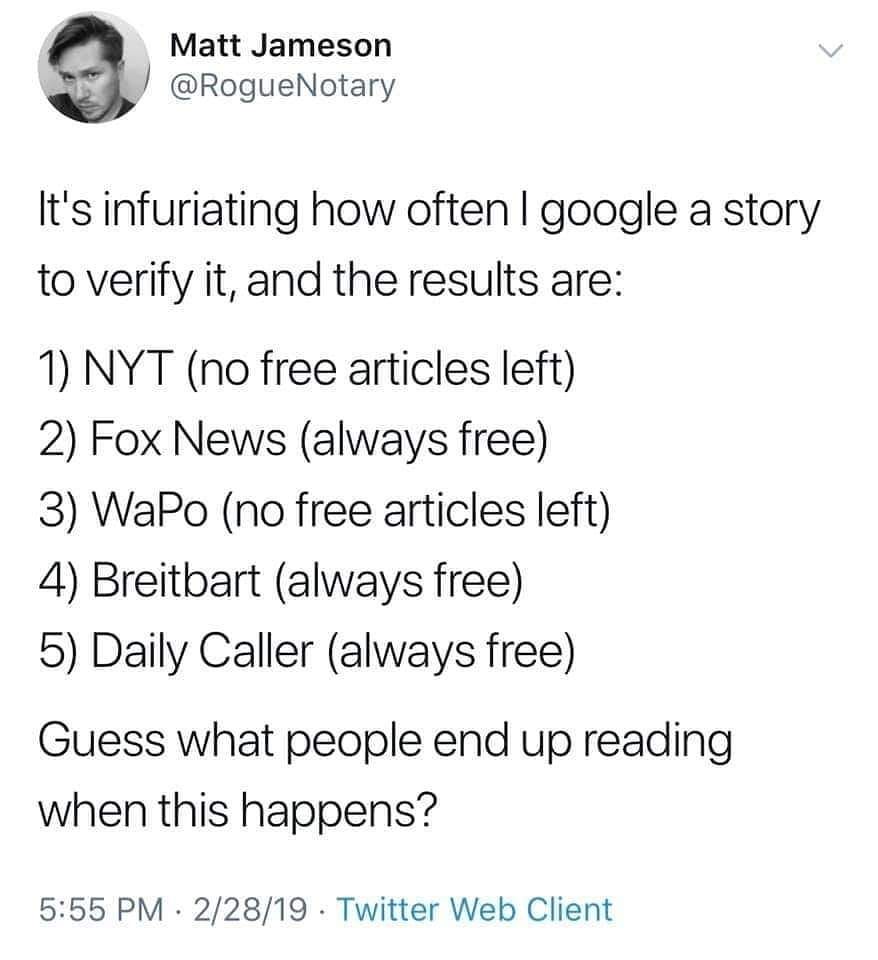
I saw this on Twitter, so it must be true. But keep reading to know HOW it can do good
In a nutshell, Fahri argues that the obvious culprit is Facebook, because:
since 2018, Facebook has been "deemphasizing news content, giving greater priority to content posted by friends and family members", also on Instagram and Threads
conservative digital media are much more dependent on social-media referrals than "prominent mainstream and liberal sites", simply because the former are newer.
Just for the record, that "deemphasizing" from all social media is THE reason why I was forced to open this Substack, since newsletters are the next best thing to do, if not the only way left, until people refuse the solution explained below.
Back to Fahri, his thesis is that, when social media (and Google!) started to strangle publishers and adult discourse in general, "prominent mainstream and liberal media" already had already, much more than right-wing ones, established brands, lots of staff and paying subscribers to weather that storm. Therefore, they are suffering, but much less than the on average much younger right-wing outlets, for which the only way to be visible was to excel at "injecting irresistibly outrageous, clickable nuggets into people's feeds".
This makes sense, but even if it were completely wrong it would not matter for this post. Here, I want to speculate about one specific consequence that this collapse of right-wing reach may have for the web at large. A consequence that would be surely beneficial for everybody, regardless of their political opinions.
What I hope is that, if the surveillance and censorship of social media is really hurting them so much more than their adversaries, right-wing media will conclude that they have no other way to survive than go back to the future.
You see, there has always been a way to see all the news from all your favorite sources in one place. A way that is much more efficient, much less distracting and much, much harder to control or block than social media. Oh, and also much less expensive to for publishers, at least in the long run, than any other alternative.
That way, available for more than twenty years now, is good old plain websites, with RSS feeds and RSS newsreaders.
RSS what???
An RSS feed is a small text file that contains titles and possibly excerpts of all the latest posts or comments from the website that publishes it. EVERY website management software existing today generates RSS feeds automatically, every time it's necessary, unless its webmaster deliberately turns them off (and if he does, he should be fired right away)
Why RSS is good for people
With RSS, every web user can automatically download and read all the headlines or comment notifications from every source she wants, as one unaltered timeline, in one window, with dedicated software programs, or web services, called RSS newsreaders, or RSS aggregators. With such programs, everybody can do that without enduring any advertising, centralized surveillance or any middlemen. Even without subscribing.
Reading all the news only, say, twenty minutes per day, at whatever time is best for YOU, is as easy with RSS aggregators as it's impossible with social media that only make your world smaller and harmfully faster. Indeed, many problems of social media of today would disappear if they just removed instantness and important people could post online only two minutes per day. If everybody started reading and commenting news only via RSS, and started using "social media" or instant messaging only to share (as little as possible) really personal stuff, like "Pizza tonight?" or "Here's my holiday pics", life and politics would be much more productive. But let's go back again to right-wing media and their collapse.
Why RSS is good for all publishers, right-wing or not
That's simple: any website that manages to convert its readers to RSS can merrily tell Facebook, Twitter and every other similar platform to f * * ck off. And it can keep 100% of any advertising revenue they may find.
Of course, you may ask, if RSS is so great, why are more and more website editors and owners so stupid to not display the links to their RSS feeds to all their followers, alongside those to their social media accounts? Why don't they put the RSS feed icon before those of Facebook, Twitter, Instagram and what not? Doing it is extremely easy and surely not harmless, not doing it is unbelievably stupid.
The answer is, I don't know. All I can say is that the problem isn't limited to right-wing media. So many publishers of all kinds (including "most effective communicators"!) do this stupid mistake that if I wanted to list them all in the ”Snob RSS” Hall of Shame I proposed years ago, it would be a full time job.
The biggest sin of ALL media in the last 15 years is not promoting or failing to denounce Trump, Orban, Le Pen, Meloni... or the woke, or the anti-woke, or everything else you may dislike. It has been to not tell their readers, every day, "this idea of connecting via social media is totally cretin and suicidal, both for us and for you. Follow us with RSS instead".
Writing (WITHOUT any AI support!) is how I earn a living, and every subscription makes a difference to how much I can share through this newsletter. If you appreciate my work, please consider a paid subscription.
Right-wing media, saving RSS to save themselves.
What I hope is that Breitbart, Daily Caller, Drudge Report, The Federalist, Fox News, and all the other right-wing media quoted or not in that piece are really suffering social media so much to finally realize, before their adversaries...
... that the only way to survive, that is to remain always, surely, directly visible to their followers that is already available and stable since 2002, the only way that (with the exception mentioned below) won't cost them a dime whatever kind of website they already have, is to:
give up any hope that other "platforms" may save them
tell all their readers, every day starting yesterday, "let's meet directly, without those damned liberals in the middle: get an RSS newsreaders NOW, it's free"
tell all their current or potential sponsors and advertisers "give your money to us, not Big Tech", because even at cheaper rates they'd get to keep all the money
The exception is that doing so implies having to host and moderate readers' comments. To that, I answer that yes, it is a cost, but since it's exactly the refusal to pay it that brought publishers to social media, that is to their ruin, it's still a much better deal than dying.
So, I sincerely hope that right-wing media switch back to RSS en masse, and are successful, which is NOT the same as "I sincerely hope right-wing politics win". This is only about getting a World Wide Web where politics and everything else are less hysterical, a bit more mature than kindergarden tantrums and without omnipotent gatekeepers.
If right-wing social media recover influence and financial sustainability thanks to RSS, I can't exclude that some morons will propose to outlaw RSS. The Streisand effect that would unavoidably follow would help RSS, but it's not necessary. If right-wing media recover thanks to RSS, everybody else will be forced to notice how much better a way to stay informed RSS is.
Right-wing media may help everybody to Make the Web Great Again.
Why not? Stranger things have happened. And while we're at this, let me present you...
The other web thingy that right-wing media are ALREADY doing right
Right-wing websites, and extremists sites in general, don't hide their content behind paywalls, and are also happy to pass it to AI bots. Now, I KNOW that writers must be paid (please consider a paid subscription or donations, see below!) and I am no friend of AI as it is today. But it's impossible to complain that AI just amplifies prejudices and biases, or that people are gullible, misinformed “baskets of deplorables” and so on, if only one side regularly gives both people and bots all they could read:
Usual final call:the more direct support I get, the more I can investigate and share content like this with everybody who could and should know it. If you can’t or don’t want to do it with a paid subscription, you may fund me directly via via PayPal (mfioretti@nexaima.net), LiberaPay, or in any of the other ways listed here.
Earlier this week, Henry Oliver wrote a passionate piece to argue that smartphones are not the source of all social ills. I fully agree, but I also think that, especially as far as children are concerned, he made a bad job overall to describe certain issues and how to deal with them, for at least a couple of reasons.
Image source: me, saying the same the same things I say here, five years ago.
First, some excerpts
Here are, in italic, six quotes from Oliver's piece, with my comments attached.
1: This is two quotes actually, separate but related:
Tech companies are called attention merchants and algorithmic exploiters.
I prefer smartphones to what came before. It’s easier to be uncontactable
With all we know in 2024 about how tech companies work, I doubt they themselves would question the "attention merchants" label, and if I listed here half the bookmarks I have about the first sentence, this post would be three times longer. On the same topic, the second sentence, and the whole piece in general, doesn’t mention at all that, if it's easier to be uncontactable by humans, it's almost impossible to be untraceable by the same companies, which in the big picture is probably a bigger problem.
2:[N]ow the psychologist Jonathan Haidt is promoting the idea that smartphones and social media have “rewired” the brains of a generation of children, which makes them depressed and anxious. ... But Haidt’s claims are not uncontroversial... The evidence is less certain than it appears.
In a world that's still arguing about stuff that's way easier to measure, from superconductivity to average temperatures, expecting any claim on social science issues like these to be really uncontroversial does not seem realistic to me, but never mind. What I am sure about, from both my own experience as parent and decades of volunteering for teenagers, is that the solutions that Haidt proposes have merits of their own, and above all that they are much, much more feasible and scalable than what Oliver suggests. I'll get back to this in the final part of this post.
3:Do we really believe that the effects of this new technology are so different to, say, the arrival of landline phones and cars?
(at least) As far as children are concerned... Hell, yes. No one, child or adult, could ever influence, or be influenced by, hundreds to millions of peers simultaneously with one phone call. As far as cars are concerned, and without negating what Oliver says about them in the next point, the same children who hurt themselves with smartphones know pretty well by themselves how stupid it is to run in front of a car, not to mention that children don't get to drive cars wherever they want, whenever they want, when they are still in primary schools.
4:The most persuasive argument isn’t that phones cause unhappiness on their own, but that it exacerbates an existing trend. Children used to be much more free to play outside and take risks. Cars ended that. It is impossible to allow modern children the run of their neighbourhoods as they had in the 1950s when we have traffic levels (with heavier, faster cars) of modern times... Similarly, teenagers began reading far fewer books decades before smartphones were invented. Phones may have exacerbated that trend, but they certainly didn’t cause it.
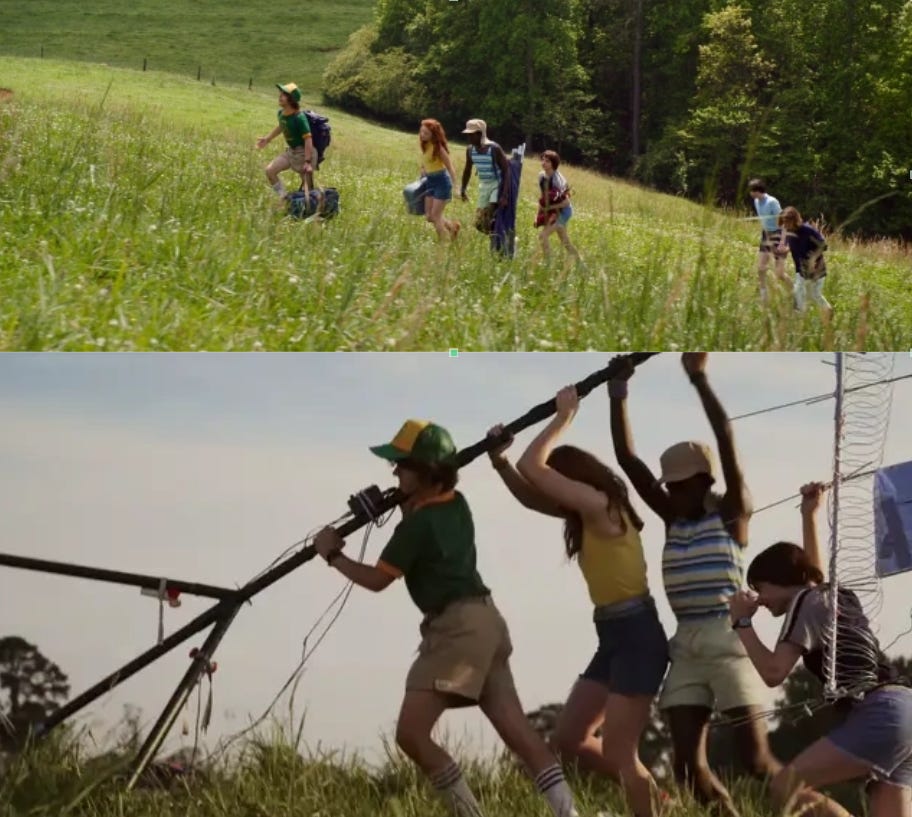
This part makes much more sense. Please check the "Stranger Things" part of this proposal of mine to see how I suggest to rebuild cities to fix the "play outside" problem. However, it still leaves important things out, and doesn't end looking in the right direction anyway. The last sentence is true, but not a valid reason to have a personal smartphone before one is 14 or older. Even the reading issue is true, but does it prove that smartphones aren't bad for children in many other ways? If anything, that's an argument for giving every child not smartphones but ebook readers, that is devices that would bring thousands of books right on their nightstands, but without openings to cyberbullying.
Again on cars: yes, they do make kid's lives much harder, but what ended outside play (yes, since decades before smartphones) is overparenting that suffocates children with parents' fears of everything that may lie outside, from aliens to scratches, with parents' pressures to be champions in as many fields as possible, as early as possible, and with parents attaching smartphones to their children just to control them every minute. Still, none of this justifies the confusion I'll cover shortly.
5:Without the danger of passing cars, [her daughter] has something closer to an old fashioned childhood: free time, where she takes risks, without being constantly supervised. If we can solve that problem, many children will likely be much happier. It isn’t all about phones.
What’s the REAL charm of Stranger Things? Not the Underworld, surely.
I've said myself that parents must let children play alone outdoors, before worrying about social media. This said, allow me to complete, not criticize, the "danger of passing cars": I obviously do not know how things are where Oliver lives. But I've seen lots of neighborhoods, in Italy and abroad, where the same children who wouldn't live long if they tried to play in the middle of the streets could safely walk on sidewalks and pedestrian crossings, to school or to some friend's place, if only their parents hadn't been made paranoid or snob by systemic pressures (coming also, who would have known, through smartphones).
6:And amongst all this clamouring, we risk overlooking the immense benefits of phones and social media.
Standing up against the overmighty state is much easier with social media.... There’s a reason why access is limited in China and Russia.
On a more mundane level, phones and social media give us access to the world in a way that was unimaginable to previous generations:
This is one of the weakest part of Oliver's piece. Point 6.1 is true in theory, not in a world where much top-down political control happens just through social media that government have learned how to turn into partners, or block altogether, since at least the Arab Spring. As far as children are concerned, instead, the same point is just irrelevant, because it just doesn't matter how many good things adults may do with a smartphone. To see it, take that sentence, replace "social media" with "assault rifles in every home", then go check how many of the same people who do think that's the best idea ever would give their children an assault rifle to use unattended, 24/7.
For the other point, which is one of the two main issues I have with Oliver's piece, here is how he describes that unimaginable access:
In the last few days social media has meant I booked tickets to a Sally Rooney event, discovered a new piano recording by Vikingar Ólafsson, watched the science explainer videos of Sabine Hossenfelder, messaged a scientist on Twitter and been sent their research paper, discovered and read a short story by Somerset Maugham, learned that Beethoven had a low genetic predisposition towards musical accomplishment, discovered a magazine of Nigerian literary criticism, and watched a video with my children of a komodo dragon eating a pony whole (recommended). Other things I have done include reading a poem by John Donne, using AI to explain a technical article I didn’t understand, chatting with subscribers to my Substack about Shakespeare, and writing about how late bloomers find their calling in life. And this is not to mention the pictures of my baby nephew that I get sent on WhatsApp.
The problem here, that Oliver himself lays out very clearly, is that he is not a meaningful sample on which to base any conclusion or policy on these issues. Not at all, and I say so as a compliment. Oliver is a successful writer with, quoting the first endorsement on his own website, "a rare talent: smart, funny and insightful".
In the same days when Oliver and every other adult with comparable natural skills, birth lottery luck, education and income as Oliver were doing all those marvelous things above, many more human beings of all ages, as in "one to ten thousands times more", were using the same phones and social media for little more than losing sleep to kitten videos, conspiracy theories, culture wars and so on.
Oliver himself tells us that he homeschools his children, that is that his children are automatically shielded from all the pressures or worst they'd have to endure in a classroom full of peers with smartphones. Again, good for them, but hardly a valid sample for general conclusions.
The other example Oliver makes, a woman evidently born with all it took to make "her passion become her career" as a social media strategist (that is an active user, among masses of passive ones of phones and social media) further strengthens the same point: what Oliver and everybody else like him can achieve only thanks to "phones and social media" is wonderful, no doubt. But it's no evidence on which anybody should base any policy or advice for the other 99 point something per cent of human beings.
The main problem: misunderstandings promoted to laws of nature
Yes, of course adults and kids who lock themselves inside smartphones wouldn't do it if the rest of their lives didn't suck. We can also accept, at least as first approximation, that "phones and social media" just exacerbated pre-existing negative trends, rather than creating them. That's nothing else than the very nature of everything digital: it greatly, greatly amplifies and accelerates everything it touches, both good and bad.
But there is digital, and then there is digital. In his piece, Oliver does outline the solution, that is "find ways of maximising the benefits and minimising the negatives - as we do with many things", but doesn't tell, or see, what the most effective ways are and why.
Here is the most important point that is completely absent from Oliver's piece, and so many still fail to see: the internet, the Web, social media, personal "stationary" computers (including laptops) and smartphones or tablets are five SEPARATE things, that must remain as separate as possible, at least in the minds of parents, educators and policymakers. The dumbest tech-related mistake done in the last 15 years may be just the equation internet = smartphone, which reached the status of law of nature for NO reason whatsoever, except digital ignorance.
Look again at all the wonderful things that Oliver did with “social media”: first of all, none of those things requires social media to work in ways that, no matter how personally immune Oliver is, are designed to be addictive. But even if social media were not addictive and were able and willing to filter out toxic content, the most important truth to grasp is that:
anybody, children included, can do all those things with a stationary device placed in one's kitchen or living room, instead of a smartphone
and that that mere change of device makes a world of difference
To see how big that difference would be for adults, imagine a world with all the same social media and online services as ours, but without smartphones, just with camera-equipped good old cellphones. That is, a world where you'd still be reachable wherever you are, and able to do everything Oliver wrote, but... in order to engage in flamewars, or share on Instagram all the food pictures taken in some fancy restaurant, you'd have to wait until you're back home, where you could attach your camera to your computer. In such a world, would you waste more or less time and stress than today?
Back to my main beef with Oliver's piece, that is Haidt and children with smartphones: regardless of the validity of his data, Haidt is not saying that smartphones, the internet or even social media should disappear. When you cut to the chase, the main if not only thing that Haidt says is only that giving uncontrollable personal smartphones to children less than 14/16 years old was a huge mistake that should end yesterday.
But this does not mean at all to give up all the good things children can do online. There is a lot that children can and should learn since primary school about the internet, the web, online communication, digital creativity and so on. But NOTHING of that requires a personal smartphone, with its intrinsic illimitability. This is what Oliver seems to completely ignore, or at least to completely fail to communicate, when he writes that "As with so many of the things teenagers start discovering, the aim should be to teach them the best use of it". What's the point of teaching or promoting the best use of the internet... just with the one tool that is much more dangerous than all the others, but not necessary at all?
What to do then?
The right thing to do is just what Oliver himself leaks out in a couple of sentences, that get hidden by all the rest. The first is when he writes to be "appalled that my thirteen year old brother has a smartphone and is allowed to waste so much time on it."
That's where the solution is. The difference between giving children a family computer they can use, possibly while other family members are around, only between homework and dinner, and a smartphone is very simple. It's the same difference there is between telling a child "hey come here and help me cut the bread with this knife", and giving her the same knife to carry around, 24/7 unattended, to use in any way hers or some stranger's brain may suggest.
In the first cases, the children get to learn and do cool, useful things, with almost no risk. In the others, "what could possibly go wrong?" is not even funny.
Writing WITHOUT any AI support is how I earn a living, and every subscription makes a difference to how much I can share through this newsletter. If you appreciate my work, please consider a paid subscription.
Adults are another story for another day. As far as children go, the reality we all actually live in is the one in which:
almost all real children less than 14/15 years old do not have the skills AND the education AND, above all, parents with enough skills AND time to help, to use smartphones without harm (ditto for teachers, in case you're thinking schools could or should ever do enough)
therefore, the children for whom a smartphone is at best an expensive ballast, at worst a mental health polluter and always an electronic tag are surely many more than those who can and do use smartphones to enrich themselves without any negative consequence
both categories of children could do almost everything Oliver does from a normal computer in their living room, which just by its own nature, location and built-in "time limits" would eliminate almost all the dangers
Corollary of all of the above: at the end of the day, it doesn't even matter how accurate Haid's data are. Or, as I wrote four months ago, it doesn't really matter whether "social media" is good or bad for "kids". Even if all THIS critic of Haidt's work, newer than those linked by Oliver, was all true, there is nothing to lose and lots to gain (even financially...) from giving children less than 14/15 years old only stationary home computers and broadband, NO smartphones. Only the first devices give access to pretty much everything positive children could need or want, age too quickly but still much slower than smartphones but block, just by being stationary where relatives can walk by, a BIG LOT of exposure and opportunities for negative outcomes.
So, please learn to distinguish between "smartphone" and "internet" or "social media". Give children stationary internet soon, but delay as much as possible the uncontrollable, unsuperviseable access to the whole internet and to the continuous, digitally distorted pressures from equally unprepared peers that smartphones couldn't avoid being, even if their makers wanted.
Who should do it? Easy: follow Oliver, again, when he writes "I don’t want to ban my brother from using... the internet wisely." This is NOT something that laws or mandatory "age verification" schemes that would never work as advertised could or should do. Thanks, but no thanks. Not giving children a smartphone before they are 14/15 years old is something that only parents can and must do. It's as simple as that, really.
Usual final call:the more direct support I get, the more I can investigate and share content like this with everybody who could and should know it. If you can’t or don’t want to do it with a paid subscription, you may fund me directly via via PayPal (mfioretti@nexaima.net), LiberaPay, or in any of the other ways listed here.
Please share this post among as many PARENTS as possible, in and outside Substack!
The extremely (not) surprising key findings of a a paper about "Robots, meaning, and self-determination", says the Register, would be that "robots harm work meaningfulness and autonomy". It seems to me that such findings, or at least the way they are presented, overlooks something that should be even more obvious.
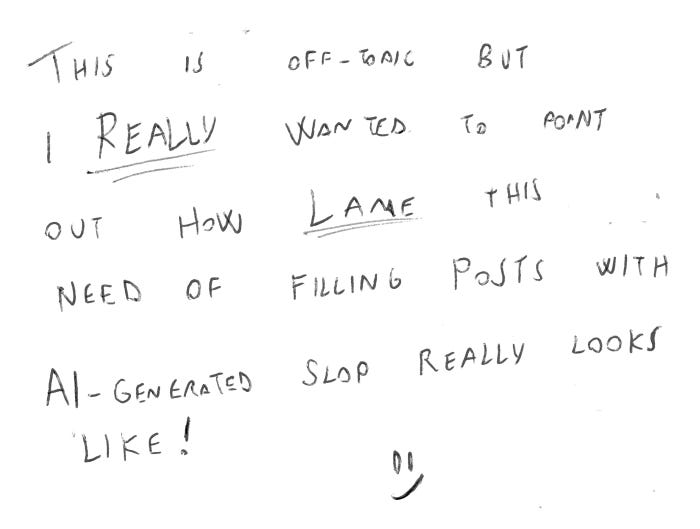
Yes, it’s off topic, but NO AIs were wasted to make it, and I really needed to get this off my chest. Thank you for your understanding.
The study focused not on the purely monetary impacts of industrial automation, but on how industrial robots affect both the meaning of work, and the self-determination of workers.
What it found is that the adoption of industrial robots "takes a mental toll on workers, especially those with repetitive jobs [and] routine responsibilities". That toll consists of diminished need for creative problem solving, reduced worker autonomy and reduced human interactions to the detriment of work relationships.
Quantitatively speaking, the study found that the average increase in robotization between 2005 and 2020 was almost a four-fold (389%), and as much as 26 times in industries like mining and quarring, and that doubling the presence of robots lead to a 0.9 percent decline in work meaningfulness and a 1 percent decline in autonomy.
The authors also concluded that one way to mitigate the loss of autonomy is to give workers control: "Specifically, working with computers completely offsets the negative consequences of automation for autonomy". That is, robots make workers feel worse - unless they control (or "teach", that is program) the machines, robotics or not.
Forms and consequences of "Reduced human interaction"
Robots are just software, after all. Whatever the exact amount of alienation from industrial robots is, the problem surely exists, and exists with every kind of automation and, albeit in different forms, in almost every sector of the economy, including retail or any kind of office or "knowledge" work.
When it comes to interaction between workers and their end users or customers, for example, much automation just hides and alienates the former, rather than replacing them. The last perfect example of this issue is the Amazon Just Walk Out stores which only seemed completely automated, because they had more than 1,000 people in India, obviously paid much less than western cashiers, watching and labeling videos to ensure accurate checkouts.
In factories, warehouses and offices, instead, "reduced human interactions that harm work relationships| are the unavoidable consequence of one fact, that's much older than computers and software. In order to understand, reproduce and manage any kind of complex process, from photosynthesis to satellite building, science and technology must split that process into as many elementary parts as possible.
When coupled with capitalism, mass production and bureaucratization of life, that fact unavoidably leads to more meticulous division of labor, where every person has their own defined task, until every worker only needs to depend on some machine. As an acute Japanese writer observed more than 30 years ago, automation like this has caused "every individual to find their determined position in the great societal machine...This is the strongest organizational force in modern society. While it lies outside the confines of politics and law, it is nonetheless very powerful".
Did you notice the last two sentences one of the best definitions of Big Tech one may give? But I digress.
Writing WITHOUT any AI support is how I earn a living, and every subscription makes a difference to how much I can share through this newsletter. If you appreciate my work, please consider a paid subscription.
Automation does NOT create more USABLE jobs
The story goes that yes, automation creates alienation and eventually unemployment, but that's not a problem, because it always creates even more new, surely better jobs. Yeah, right. But for whom, and how usable? All this displacement by software and robots would not be a problem IF:
jobs were not the only way to pay one's rent, mortgage, food and clothes (or, put another way, if we didn't insist to get concepts like UBI and AI in reverse order)
ENOUGH decent jobs that COULD be taken by the RIGHT people, that is workers displaced by automation, COULD not just exist but above all be taken WHEN those workers would need; that is, as soon as possible, not after some magic "upskilling" that in most cases would have to be so advanced that it would fail in most cases, or so long that it would cost taxpayers much more than unemployment insurance
The reality today is (quoting someone else now , not me) that we won't be able to retrain the majority of the workforce fast enough to take the new jobs in emerging industries. Not in a world where, unlike in previous industrial revolutions, the older workers are much more than the younger(aspiring) ones, would need much more training, and "entire industries' disruptions in periods that are shorter than election cycles".
Automation isn't even "freeing time"
A while ago, I almost spit my tea when I read that automation is freeing time, because, "there is a sports equipment boom in the USA, and how was the time to use it freed, if not through machines?" One answer to this "argument" may be that those who can afford sport equipment, or state of the art gym memberships are less than those work of many more working poors. If automation is freeing time, how come most families are forced to have every adult member working full time just to make ends meet? Another answer may be that if there are so many people who lose weight by making drugs like Ozempic scarcer and more expensive for those who would really need them instead of practicing some sports, is because automation just gave them more money, but not enough time to spend it decently.
Side note on humanoid robot
While we are at this... Another symptom of how much confusion and hype there is on robotic automation and related issues is the interest, which I fail to share outside of science fiction, in humanoid robots. Most industrial robots or machines have no need whatsoever to be human-shaped, and never will. If they did, they'd probably be less effective, not more: "you don't make [humanoid] robots to fix all plumbing, you design all plumbing to be fixable by robots". Outside factories, what automation would be better? Better appliances, or housemaid-shaped robots that have the same probability of mastering the billion situations they would meet in real homes as "driverless" cars of becoming really able to drive autonomously on all real roads? Ditto for warfare, office work and so on...
Robots with similar shapes to animals would be much better, for at least two reasons. One is that certain animal shapes would actually be better for certain jobs. Four -legged or serpentine robots, for example, could explore and monitor caves, oil pipes, ship bilges and thousands more similar environments, much better than anything human shaped, human or robot.
The other and most important reason is that the less robots look like humans, the easier it is to avoid confusing what being human or machine means. Robots looking like humans make it easier to treat even humans like robots. Having "someONE", not someTHING, to dominate, or to alleviate one's need of actual humans, hardly seems an easier path to positive human growth. As proof of that, we can just look at the biggest, already existing market for "something that looks like a human to boss around":
Back to the links between displacement and automation displacement by robots, AI or anything else, I recently read here, that "technology's displacement effects can be outweighed if new tasks are created where labor has an advantage over automation. This is a huge if."
No, that's not a huge "if". It's a huge "WHY???"
Let's be clear: we do need much more automation than today, albeit of a very different nature than most startuppers or venture capitalists would like you to buy. I am pretty sure that the miners of 150 or even just 50 years ago would give some year of life they couldn't enjoy anyway, displacement be damned, to work in the much better, much safer conditions that highly automatized mining can provide today. There are still plenty of actually necessary, but dangerous jobs that can and should use more automation. It's equally obvious that even the bare maintenance of existing vital infrastructures, from ports to bridges and power lines will need much more automation, if you consider how quickly populations are aging worldwide, and how many of their younger members, the ones best suited for certain jobs, are still blinded by getting a good degree, just to win a "great job".
"working with computers completely offsets the negative consequences of automation for autonomy"
also left something critical out when he wrote something that science and technology "guaranteed the values of individualism" and "improved the status of individuals, increased individual self-consciousness, and strengthened the sense of individual responsibility".
The problem is that "need to depend" can mean two terribly different things: one is need to depending on having a machine to do one's work, be it a computer to blog, a circular saw to build cabinets or a synthesizer to play music. The other is to depend as in "subordinate, being managed by", without responsibilities.
It's just the difference between "working with" and "working for/under", but it's huge. The first scenario is good, the other is the dystopia where (regardless of its appearance) a computer is in charge, bossing a human around "at a robotic pace, with robotic vigilance"One gets increased individual self-consciousness and all that ONLY if and when what automation provides are tools that extend one's capabilities, not inhuman bosses and controllers.
The final and most serious problem about automation that that study leaves unsaid is the one that Dante Alighieri explained seven centuries ago:
"Call to mind from whence ye sprang: 'Ye were not form'd to live the life of brutes, 'But virtue to pursue and knowledge high.'(Inferno, CANTO XXV)
Dante and Virgil observe the false counsellors. (Gustave Dore’, from Wikipedia)
There is no amount of control or "creative problem solving" that can avoid mental tolls if, as it happens more and more frequently, the end product or "mission" itself of one's job is inherently pointless or outright superfluous. I suspect that this is the displacement, lack of meaning or whatever you want to call it that automation often just exposes, rather than create: maybe automation scares a lot of people not (just) because it makes them lose their jobs, but because it makes impossible to ignore that their jobs themselves were worthless to begin with.
Of course, that's a problem only until full time work for every adult remains a dogma, and only for those who must absolutely have a job, instead of a purpose, to feel they are worth something.
Usual final call:the more direct support I get, the more I can investigate and share content like this with everybody who could and should know it. If you can’t or don’t want to do it with a paid subscription, you may fund me directly via via PayPal (mfioretti@nexaima.net), LiberaPay, or in any of the other ways listed here.
A little over a year ago, I started this digital space with an essay on, well, digital spaces. It was two months after Musk had taken over Twitter—oh halcyon days of innocence and youth! Everyone I knew, followed, was professionally connected to or wanted to be, whose politics I agreed with, whose morals I admired, all of them were very busy at that moment in time, very loudly proclaiming that they could not possibly stay on Twitter given Musk’s obvious econo-cultural malfeasance and vividly telegraphed nasty intentions.
It felt inevitable. A sorrowing sort of twilight moment. We were sure we’d lose track of each other, because it was just so clear no one could possibly support that new incarnation of Twitter being run into the ground by braying, slobbering, panting jackasses in jackboots.
Because purity is so important, you see.
We simply cannot support anything or anyone who slips up a bit ideologically, even a little bit. There’s no such thing as a necessary moral compromise, don’t you know? No situation ever has or ever shall occur in which a good person might make a politically fraught choice in order to further the cause of progress. Every stance, every word, every action, must exist in perfect virtue, without one single solitary speck of ethical contamination, a thing which a real living human person can definitely do. Every position and policy must hover at the absolute bleeding edge of tomorrow’s most enlightened progressive thought. Doing otherwise will bring fury raining down from the digital heavens. Managing to thread the needle will be rewarded with absolutely nothing, certainly not votes or political support or even a slight nod of acknowledgement.
Because obviously I just can’t vote for Joe Biden. Yes, the alternative is grinding, authoritarian far-right fascism. I feel just peachy about letting that happen (to other people, I literally cannot imagine it ever affecting me, why yes I am the working class proletariat salt of the earth, you’re too kind), but I will not, not ever, NEVER OH NEVER SHALL I check a box next to someone who…has had to suck it up and quietly work with people they don’t like and profoundly disagree with in order to accomplish any version at all of the things I keep saying I want!
AND I’M ABOUT TO TELL YOU ALL ABOUT IT FROM THE PAID ACCOUNT I NEVER DELETED ON ELON MUSK’S CRATERED HEARTLESS NAZI-INFECTED HAZMAT DUMPSITE TWITTER WITH A STRAIGHT FUCKING FACE.
We all hold contradictory views: We love our families, but they drive us crazy. We want more housing in our cities, but we don’t want our property values to decrease with expanded supply. We want better schools, but we recoil from a 0.1% municipal levy to fund them.
It’s normal to hold contradictory views, but when those views come into conflict, how we act shows ...Read More
Of course AI is a bubble. It has all the hallmarks of a classic tech bubble. Pick up a rental car at SFO and drive in either direction on the 101 – north to San Francisco, south to Palo Alto – and every single billboard is advertising some kind of AI company. Every business plan has the word “AI” in it, even if the business itself has no AI in ...Read More
It’s tempting to think of the Great Enshittening – in which all the internet services we enjoyed and came to rely upon became suddenly and irreversibly terrible – as the result of moral decay. That is, it’s tempting to think that the people who gave us the old, good internet did so because they were good people, and the people who enshittified it did so because they are shitty people. ...Read More
I was surprised as anyone when I found myself accidentally using a large language model (that is, an “AI” chatbot) to write some prose for me. I was twice as surprised when I found myself impressed by what it wrote.
Last month, an airline stranded me overnight in New York City when my flight to LA was canceled due to an air traffic control snafu. The airline rep at the ...Read More

 Login
Login