Normal view

Of the rich living just like we all did, and what makes it possible

13 October 2024 at 20:06

I am actively seeking work as blogger, (ghost-) writer, speaker, researcher, popularizer... on all the topics in this and my other posts. Thanks for your attention, and support, by subscribing or in any other way.

There has always been some members of the elites who lived frugally, spending and showing off, at least for some things or moments, much less than the masses. The most famous example may be King Charles, who's been wearing the same coat for 40 years and even recycled a 67-year old coat from his father. In the last ten or twenty years, however, the trend has been expanding in subtler, but in more interesting ways, for one common, equally interesting reason, or so it seems to me. Let me explain, by summarizing what's happening in several spheres of life.

Just an invitation... is a reader-supported publication. To receive new posts and support my work, consider becoming a free or paid subscriber.

Frugal clothing and accessories
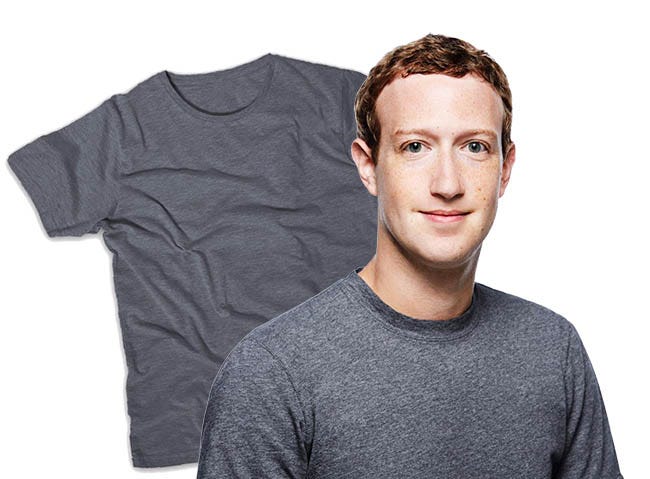
This guy must be really poor, he only has one t-shirt.

Once upon a time, most rich people made sure their dresses showed how much money they have, while the poor carried along with a few indistinguishable rags. Today, the masses run after cheap, extravagant that's as colored and fast as it is polluting, while the Zuckerbergs and those who can afford it sport "quiet luxury" by always wearing "the same (real plain) outfits every day, or not buying covers for their smartphones.

REAL food

In darker ages, the poor ate whatever they could get their hands on straight from the land, while the rich killed themselves of gout by guzzling as much heavily "processed" food as they could. Today, the rich can and want to eat less but pasture-feed, free-range and all that. The rest of us would have to make do, after AI-managed fast food, with synthetic beef or other lab-made food that may even be impossible to grow at scale.

Parenthood

Once upon a time, most of the poor produced as many children as their bodies could afford, by ignorance or as labor force, while many rich people made an effort to have less, in order to preserve their wealth.

Today, it's the masses who give up on parenting altogether. For some, it is a actually free, actually thoughtful choice, that nobody should criticize or disrespect. But for too many it's half because they are working poors, and half because they've been convinced by "market" forces that, since it would leave them free to spend whatever they can on endless products or services, not having kids is the smartest thing they could do.

At the same time, individual with so much money they can believe they could survive on Mars have 12 children, and elite couples promote (their own, self-) "breeding to save mankind" in perplexing ways including really expensive fertility techniques, for perplexing reasons.
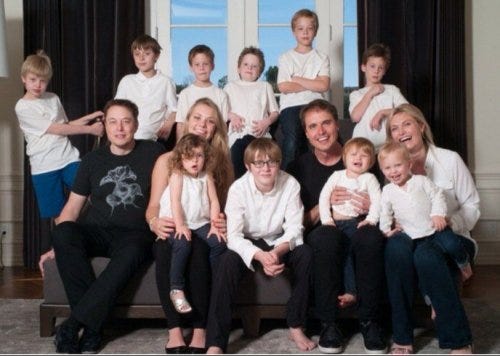
Elon Musk, with as many kids as a poor farmer in the 1800s (image source).

Researching and popularizing certain issues is my way to make a living by helping to make the world a better place. Thanks for sustaining this effort by with a subscription, paid or not.

Offspring access to tech

The gap on parenthood is just as wide among people who do become parents. As recently as one or two generations ago, even rich children could access real computers, never mind computer networks, only in special places, with adult supervision.

Today, unlimited, uncontrolled access to state-of-the-art personal tech is granted to, if not forced upon, unprivileged kids, who are abandoned to addictive apps, the more the better, to be convinced as soon as possible that such an imitation of the rich or, even worse: such a "living through the rich" is all it takes to be a sane, cool adult. tech is for poor kids only, who are abandoned to addictive apps, the more the better, and even convinced that this pretending to live like the rich or, even worse: live through the rich is all it takes to be a sane, cool adult.

Rich kids, instead, go to exclusive schools capable to deliver “state-of-the-art, cutting-edge technology resources, along with the knowledge and skills to use these tools in a meaningful way.”

The really rich kids, by Steve Jobs or Bill Gates-level parents get even more freedom from addicting tech than their poorer peers, be it "tech-free dinners and no smartphones past 10 pm, sometimes no cell phones period, or "banning screens from class altogether".

That is, children of poorer and middle-class parents risk being raised by screens, (in UK, and surely elsewhere), while rich children are much more likely to keep maturing on human-written books instead of AI-generated shit full of errors. Over time, that divide will extend to communication methods and skills: "In a post-literate era, those who continue to read and to practice critical thinking skills will increasingly be unable to effectively communicate with those who don’t" (source).

This will be a result of another reversal, i.e. rich kids using the Internet much like poor kids used to eat real meat: as an opportunity, or privilege, to be taken in small doses. Modern poor kids will be handicapped by using the Internet like rich pupils of the past used expensive wines or cigars to waste themselves, that is "mindlessly". It really seems only rich parents get, or can afford to get, that the real solution to this problem is the simplest.

Tech-free living, and human contact privileges

Of course, the same divide on tech is present among adults, and flipped in the same way. Once upon a terribly recent time, owning and personally operating anything electronic beyond Casio watches used to be an actual status symbol, or the prerogative of exclusive, well respected jobs like astronaut, physicist, computer scientist... Now, the status symbol is being able to not touch such devices, and is just accelerating, as Geordie on Mastodon, said really well:

I genuinely reckon the hallmark of being rich in the future will be that you can opt out of AI and “smart” computational shit. Someone doing alright will have a phone that can take the “best” image from a photo, and a watch that gives notifications and be able to pay for stuff by blinking at a scanner, but a RICH person will have a camera that takes a nice photo, a watch that’s very well made and just tells the time, and a really nice leather wallet.

For the record, that's a comment about a single real spouse, that faulty AI turned into three impossible ones:

From remote controlled vibrators to surveillance delegated to robodogs or face recognition, and software actually counterfeiting humans, so much contemporary technology just "frees" everybody from ever being close or just talking to other human beings that one suspects that's its actual and ONLY purpose.

Of course, that's a purpose, or more exactly a condition, that only the rich can really opt out of. I have been thinking for years that THE only real privilege of people with way more money than one may ever spend sensibly is not material wealth, but the capability to choose exactly which other real human beings can be around them in any moment. Or, as the New York Times put it, human contact is now a luxury good. Even the off-grid life that once was the curse (or not?) of hillbillies is now "a boon for the wealthy, a burden for the rest".

What all these reversals have in common

Possibly the main, likely the most important thing that's behind every reversal I've mentioned is digital technologies. Certain things are not new, of course. But nothing I described could happen so fast, everywhere, without being digitized in one way or another. I see this as another confirmation that, rather than being "INNOVATION!!!" in and by itself, always, digital technologies are "just" something that seriously amplifies everything it touches, good or bad it's the same.

My working slogan for almost twenty years now.

Point is, in the long run, letting all these "amplifications" continue will result (or is resulting?) in the emergence of two separate species, less likely (or able, see “post-literate” above) to interbreed than the Sapiens and Neanderthals of yore. After all, even without reversals, dating digitally enhanced by apps or by the self-segregation power that's the core of "social" media already amounts to self-inflicted eugenics.

Final, obvious questions: If giving up parenthood, offsourcing children to uncontrollable tech, spending as much as possible on dumb tech or dresses and generally being lonely... had real value, why would so many of the people who got the highest freedom of choice exactly by offering those opportunities... do just the opposite? Why shouldn't we start imitating the supposedly sharpest tools in the box now, at least in the easy cases where it would even save us money, instead of just making them even richer?

Just an invitation... is a reader-supported publication. To receive new posts and support my work, consider becoming a free or paid subscriber.

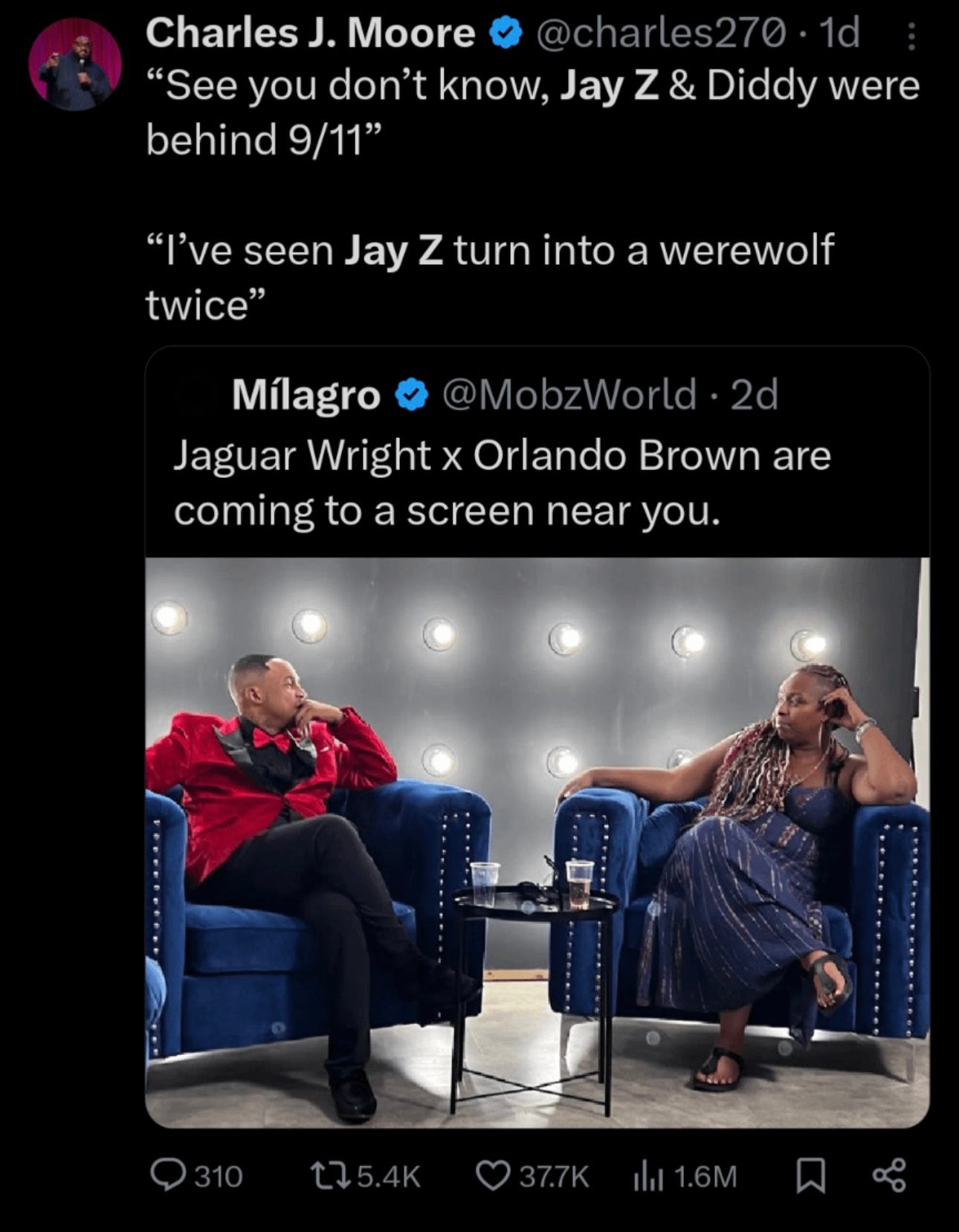
There Are No Alternative Facts: Some Rules For Discerning Reality In This Hallucinogenic Hellscape of Misinformation

10 October 2024 at 19:52

I am a professional science fiction, fantasy, and horror writer. It is what I live and breathe. It is what I love. For twenty years I have stretched my imagination to tell the most out-there stories I can to as many people as I can. To imagine the future and the past, new technologies and philosophies and how to function within them.

So when I tell you people are getting really fucking weird about the line between imagination and reality, you need to believe me. It’s not ChatGPT that might end up putting me out of work, it’s the way we’re apparently just allowing millions of people to announce their personal epic science fiction spec script is reality, act on that conviction, still be treated as serious people to be taken seriously, and given influence and power. WHAT THE FUCK IS GOING ON WE DO NOT HAVE WEATHER CONTROL OR MEDBEDS OR CLONES AND JAY-Z IS NOT A FREAKING WEREWOLF.

It’s this. This shit right here, liked by 377,000 people, not even close to all of whom thought it was a joke or a grift. Thought I admit, the “twice” is a hilarious touch.

Now, the way this Substack works is that each public post has a companion piece under the paywall containing all the things I wanted to say but didn’t want to deal with the usual horde of bad-faith concern trolling and screaming misinformation in the comments.

On top of that, this particular one is locked because I’m going to start off by telling a story about a family reunion I went to awhile back and the truly acid-addled-raccoon genre fiction presented to me, to my face in real life, by human beings I ostensibly share DNA with, as objective, common sense fact. To be completely honest, the last time I mentioned their worldview online, one of the relations in question popped up in the discussion and not only doubled down hard, but insisted on con-splaining how the sun works (spoiler: nope), not quite realizing that their version of Being Online and mine are very different. That person subsequently had no fun at all while fifty thousand people or so laughed at them and threw digital tomatoes.

I don’t totally know which I’m trying to avoid, that happening again and family members getting their feelings hurt/yelling at me, or my total fucking despair if it didn’t, because I can no longer be sure anyone on Twitter knows the difference between whatever they dreamed the last time they took Benadryl on an empty stomach and reality. God DAMMIT, Planet Earth.

But I’m going to unbury the lede and put the first rule for discerning What Is from What Is Fucking Squirrel Nuts above the fold. There’s a few other rules, but this one is just a simple and effective question to ask yourself when evaluating whether some stupid outlandish thing you heard is reality or JUST TOTAL GIBBON-SHRIEKING INTO AN INFINITE HALL OF NIGHTMARES. As a public service.

DON’T BE AFRAID, IT’S CRITICAL THINKING TIME. If the answer the following is yes…

  1. Would life be massively easier, more fun and interesting, or at least massively more dangerous/exciting and interesting, than you’ve ever known it to be for one single second of your lived experience if this thing were even half-true?

THEN IT’S PROBABLY VENOMOUS DREAMPUKE EJECTED FROM THE SUGAR PLUM FUCKING FAIRY’S MONEY-SUCKING BILE-CLOACA, YOU CANTELOPE, STOP BEING SUCH A GORMLESS SUCKER.

Okay! All set? Time to talk shit about what my second cousins believe!

Let’s hop in the definitely-real Democrat-controlled time machine fueled by baby blood and straight men’s tears. Reserve yours now for 47 non-refundable installments of just $47.47! Product launch date: MAYBE!

I suspected something was about to shake dangerously loose in the collective American psyche around the summer of 2016, at a reunion of my maternal family in upstate New York, about six weeks after my maternal grandfather had died, a fact which will be quite important in approximately 35 seconds, the precise amount of time it took between getting out of my car and someone I’d never met before just bellyflopping with gusto into a Smilex vat of bugfuck nonsense…

Read more

Wait Til Daddy Gets Home: America's Sad, Craven, Masochistic Relationship with the Republican Party

8 October 2024 at 22:01

I suppose the bright side of, well, every goddamned thing I’m about to say, is that people finally seem to be noticing that the media, whether mainstream/legacy media, or the squalid chaos-bins of TikTok, Youtube, Twitter, and Meta, or even the atomized, janky self-checkout counter of news and commentary and commentary-on-commentary the rest of us have nailed together out of the last eight years’ worth of absolute fuckshit, is nothing like the orgy of liberal bias we were always told it was.

Wait, who told us that? Oh, was it conservatives? Like literally the whole time? Whenever the nasty, festering, soul-rotting hypocrisies and crimes and corruption and oppression they were gleefully pulling got so out of control the media couldn’t find any more ways to not report on it, and apologetically crafted mild-mannered weasel-worded headlines out of some new utterly heinous, deliberate and multi-pronged sadism? And we all just meekly bent our heads and accepted that everyone should just try to be a little more conservative in the future, after all, the poor things have it so hard, it’s so unfair to them that people don’t want to be their subjects and the crimes they commit to make themselves kings (or just for funsies) keep getting discovered, underplayed in the press, perfunctorily investigated, weakly prosecuted, and hurriedly forgotten?

Did you think I was talking about the COVID response? January 6th? Emoluments? Stolen documents? Fake electors? Bribing SCOTUS? Colluding with Russia to swing an election and undermining NATO to prepare for an antagonistic nation’s new war of land acquisition? Opening the entire treasury to the President’s friends without oversight and handing out billions in pre-forgiven loans (by definition, not loans)? Refusing to help their own state’s citizens suffering and dying in multiple storms, even so much as taking a phone call or voting for aid, because they don’t like the current administration and want to blame them for not helping?

My siblings in Christ, I was talking about Iran Contra.

Because it’s always been this way. ALWAYS. I don’t know what kind of roving, sentient, ravenous Memory Hole has taken hold of this world, but it’s eating REAL GOOD these days. Oh, is CNN shining up the conservative candidate with generous tongue-baths, weasel words, and strategic silences while breathlessly pointing and screeching at the liberal’s slightest ill-timed fart? Is the Wall Street Journal reporting on a speech in which the Republican suggested literally the worst economic ideas of all time as “nuanced and bold”? Is the New York Times publishing a whole lot of op-eds like they’re objective news and then you open the op-ed and it was clearly written by fucking Ungoliant?

Saw this art piece from a Men Of The West video showing Morgoth & Balrogs  fighting Ungoliant. Why does her underside have human hands? :  r/lordoftherings
Your taxes will go down to nothing if YOU FUCKING LET US EAT YOU. Just saying! Donate to protect America from the libs! In my stomach! Those evil libs can’t get you there!

I mean…yeah. They do that. They’ve always done that. Conservatives do not change, by definition, except to get more authoritarian. It’s kind of their whole thing.

Hey, remember when the New York Times knowingly ran fabricated stories just to get a cute lil head-pat from the Bush Administration, except without the head-pat part? Remember how fucking excited every single cable news network was to get their photogenic reporters artfully smudged with dirt and “embedded” with actual combat troops, with whom they would definitely never form tight bonds and feel reluctant to publish anything critical of? Remember how everyone involved with the Clinton impeachment was fucking someone, or many someones, other than their wives, with gusto, in office, and literally nobody said anything about it until years later when it didn’t matter anymore? And Trump having five kids by three wives, countless affairs, and pretty openly fucking a right-wing grifter on the campaign trail is not even worth clutching one lonely pearl about? And how hard the media mocked Hillary for saying there was a “vast right-wing conspiracy” to bring down the President and then said nothing when George Conway went around laughing about absolutely running a vast right-wing conspiracy to bring down the President (aw, he says it was so annoying to have to do that with fax machines and copiers! Poor guy!) twenty years later, and in fact, presenting that fucking guy as some kind of liberal rebel against his wife Kelly Ann’s conservatism because HELL IS EMPTY AND ALL THE DEVILS ARE HERE? Remember when they all helpfully didn’t report on Reagan’s dementia? And stopped talking about Iran Contra as soon as humanly possible? How Carter is still thought of as some kind of uniquely terrible President despite being preceded by Nixon/Ford and succeeded by the infected root of the poisoned tree whose fruit we’re all still choking on to this day?

This is a minor sampling. You’d think people would at least remember 2016, when every NYT cover story was a sweaty, heavy-breathed, puff piece pretending to be Woodward & Bernstein “exposing” Hillary’s scandals while CNN just went ahead with the actual headline “Does Trump Transcend Truth?” while showing a live feed of his empty podium for hours, waiting for their bestest boyfriend to show up. Or how happily they all parroted the “migrant caravan” story and said nothing about how quickly it seemed to vanish after the election. Or any of the dozens of recent stories about Trump’s “resurfaced” background that didn’t resurface at all, the media just stopped talking about it and everyone forgot.

But I guess it’s more fun to pretend this bizarre eagerness to turn down the sheets of democracy for conservatives is brand new and everything before was somehow honest and fair—biased toward the left, if anything! Those sneaky leftists! Always maintaining a multi-generational united front to enact subtle, patient, incremental long-term plans to slowly win America to their side with the loyal cooperation of major corporations and without interference by systemic structures! YEAH THAT SOUNDS LIKE THE LEFT.

And it’s not about a “horse race,” either. That’s become the newest excuse for so many outlets sanewashing the fact that every time Trump opens his mouth what comes out is the elevator-blood from The Shining with some gobs of electrified shark and the fucking shards of Kristallnacht floating in it.

Give the police one real rough, nasty, violent day and it will end crime!

But it’s bullshit of the highest degree. Incredibly effective bullshit that allows people to acknowledge the problem and immediately shrug it off. It sounds right. It’s just cynical enough. It feels like it makes sense and fits with all our frustrations about capitalism and the media’s complicity in the rise of the new fascism. We can comfortably repeat it while still appearing cool and unfooled and smarter than everyone else. It appeals to our basic assumption that profit is the only motive for entities as vast as media conglomerates.

Still bullshit.

Honestly, I’m not even sure how the idea is believable to anyone for more than a minute or two. First of all, exposing Trump and honestly reporting on his enshittification of the modern world would bring in a whole lot of clicks, as would, you know, defeating the new fascism. That’s the kind of thing you break out the Big Boy Fonts for. Most of the country was literally dancing in the streets when Biden won—there would be zero loss of profit in uncovering Trump’s malfeasance and downfall. Not to mention, actual investigative digging would turn up some truly incredible stories. There is no reason not to investigate the ways the GOP has tried to set up cheating in this election, but it barely makes a blip in the headlines when yet another scheme turns up and is promptly not dealt with.

Second, when Biden was floundering in the polls, did the media go hard on Trump to maintain a close race and all those thirsty terrified eyeballs on their content? Fucking no. I was there. You were there. They ignored every insane thing Trump said during the debate and came together in an almost unprecedented unity to thump Biden out of the race and convince everyone he had Parkinson’s. Aaron Sorkin, of all over-blessed people on this dumbass rock, published an op-ed saying if the Democrats were actually serious about the threat of Trump, they’d completely non-democratically nominate Mitt Dog-on-a-Hot-Car-Roof Romney as their candidate the day before Biden dropped out. The media landscape was so unified that that was the creator of The West Wing’s solution: Well, if EVERYONE was conservative, we wouldn’t have all this division! Don’t like the new Hitler? Go with Himmler! See? All fixed!

Did the media go hard on Trump when Biden trailed him in 2020? No, they argued over who got to blow him first by cleaning up daddy’s messy speeches (oh those strategic broken quotation marks and ellipses have so much to answer for) and telling us all Biden couldn’t possibly win so get used to it. When the Butler shooting happened, did they finally start reporting on all the good Biden has actually done for the country to balance out the narrative that this clinched the whole thing for the party promising a new civil war? Not for one fucking second! You could feel the absolute thrill behind every outlet running that “epic!1!” photo as it suddenly became the only photo that had ever been taken in the history of the world, then the disappointment when the shooter turned out not to be the blue-haired trans immigrant communist abortion activist of the legacy media’s dreams. And every cable news outlet spent 2016-2020 swoonily reciting one now he’s finally becoming America’s President tone-poem after another, as though by the purity of their yearning they can make it so. I do not ever remember once seeing a pundit with moist eyes stare longingly at a Democrat and moan with pleasure that he had finally become our President, least of all because he managed to complete a State of the Union speech without ritualistically sacrificing a migrant worker on the floor of the House or dropped a giant fuck-off bomb on Afghanistan hoping it it would make him feel a big boy.

One half of our political establishment (and it’s not just the bleached Gibbering Mouther from Georgia) is openly discussing and disseminating the talking point that Democrats have a weather control machine that can create hurricanes (which they have not used to fix climate change because reasons) and direct them at conservatives. That, and I cannot stress this enough, is fucking crazy-ass wibbly-wobbly shit. Anyone who actually believes it is profoundly in need of powerful medication. Yet reporting on these completely out to lunch fans of radical science fiction, such as it is, has at best acted like this is funny, just another thing a Republican said and not completely disqualifying from anything but an in-patient treatment program, or reported it with wan, disinfected headlines like “Yes, They Can Control the Weather, Says Marjorie Taylor-Greene” while barely addressing multiple Republican governors refusing to save their own people as they drown and flee. We are now expected to just deal with pure moon-howling madness as a serious part of our national discourse.

Wow, +5 against any consequences at all!

Now, of course the media criticises Trump. They made billions doing just that. It’s the journalistic Eden they want back, so that they can copy/paste someone’s misspelled tweet and plaster Democracy Dies In Darkness above it. But they also carry water for him while offering nothing but scorn to any Democratic move or action, and super-gluing a megaphone to the lips of anyone with a grievance against them not fixing every problem instantly with a deadlocked Congress so that both sides look equally wretched. They insist on detailed policy from Harris while asking how Trump’s tummy is feeling today. Constantly ask how a Democrat is going to pay for programs to actually help people while never bothering to ask how a Republican plans to pay for infinite tax cuts, absurd tariff plans, and orgiastic military spending. Or if they do manage to squeak out a real question, most outlets turn right around and pretend Trump didn’t answer by rambling about nailing Haitian swans to lawnmowers or pledge to nominate Clarice Starling as Attorney General.

I’ve gone on and on, I know, and I could keep going until this is a 9-part series. This is where I’m going with it: what’s going on in the media is simply not about creating a horse-race, not only because it’s always been a race between a normal fucking horse and a geriatric centaur huffing that rage-drug from Firefly, but because no one seems to care what kind of race it is as long as the Democrat stays behind. Imagining it’s about money or ratings or both is just a lot easier to believe. That this craven, groveling behavior, not just from the media, but from a very uncomfortable percentage of this country, is about capitalism and profit and not genuinely preferring conservatives and putting their giant meat-paws on the scale for the daddies they never had.

America just likes conservatives more than it likes liberals. Over and over, time and again, this country bends itself into tesseracts trying to give Republican candidates a chance not to be the absolute fucking worst all the fucking time forever. They always are the absolute fucking worst they can get away with, and then everyone trips over their own children to forget and imagines that there was some kind of mythical “traditional Republican Party” that wasn’t like this and may one day return at our greatest hour of need like King Arthur with one divine hand in a hedge fund and the other in a meth lab.

I feel like I’ve spent most of my life hearing dyed-in-the-wool Democrats say they’d absolutely vote for a Republican who threw this or that sad little bone to the idea that maybe we shouldn’t all live in Gilead, only without the massive social programs, free food, clothing, and housing, or employment guarantees the actual clownshit evil Gilead had. I rarely see any Democrat not happy to say they liked McCain (don’t google the Keating Five, kids!) or whoever the new “welcome to the resistance” Republican is this month (before they inevitably yank off their fucking face and cackle that they were Old Man Fascism the whole time)

These days, I hear quite a few leftists saying Trump would be better because it would teach Democrats a lesson or accelerate the Rapture revolution or whatever idea was definitively proven to be a nihilistic mind-pit of wrong by the fact that the walking carcass was already President and all that happened was they got to hurt us and smile.

I have never heard a hardcore Republican say they’d give a Democratic candidate a chance under any circumstances whatsoever. Let alone a far-right Christian nationalist. In fact, the one thing the far right and far left seem to be able to agree on is that the absolute most disgusting and reprehensible, any, demonic thing to be in the history of the world is a regular old well-meaning liberal. Which definitely doesn’t come from having grown up listening to the entire media slowly morph liberal into a curse word no one even wants to say anymore and just sucking that shit down with mother’s milk.

There is just something dark and awful here, deep down, that wants a mean daddy.

America’s entire relationship with its two political parties (not to mention the “third parties” that only ever exist to carve off votes from Democrats and somehow never seem to harm Republican performance at the polls) is the grotesque acting out of an abused child, writ large. Generations have grown up with distant, authoritarian, or absent fathers as a romanticized ideal from Hollywood to the church pulpit, if not flat-out reality in so many cases. (Not all, tons of Dads are wonderful, tons of Moms suck and vice versa. This is about abusive patriarchal and maternal archetypes, don’t get upset, it’s a metaphor. This isn’t a gender thing, either, substitute Mean Mommy and Cringe Dad if you like.)

So America just keeps playing out this sick but classic pathology. Suck up to stern, angry, distant, uncontrolled yet controlling Dad, give him every chance to just stop being an asshole for five seconds; lash out at Mom because she’s safe and boring and will keep trying to help no matter what we do. If only she were better, if only she behaved perfectly, if only she loved him more, if only she gave him more, if only she gave us more, if only she weren’t so fucking annoying all the time!

But Dad? Dad is cool and strong! He’s a provider! He doesn’t need any of our shit! Cool Dad lets us do whatever we want! He’s not even here half the time because he’s so important and has so much on his shoulders! I mean, we can’t do anything Cool Dad doesn’t like, and he takes our lunch money every day and punches us in the stomach if he thinks the boys seem suspiciously gay today or the girls speak up or anyone asks where he was last night, he really seems to hate our foster-siblings and starts fights with our neighbors for no reason, and he thinks it’s Mom’s fault every time it rains, but we can play with guns and not pay for stuff and beat up other kids! Dad says school is stupid and we shouldn’t have to go! He lets us eat candy every day! He always gets his way and we want to always get OUR way too! He’s sooooo rad and funny and strong!

But Loser Mom can’t stop yammering about dumb crap like rules and decency and thinking of future consequences. She’s always making compromises and telling us we have to do stuff and be nice to others and get along and be patient and like, not drink from the awesome rusty fire hose because Dad takes a shit in the well every morning and use the filter pitcher instead. Or we hate her because she’s always cleaning up his mess and trying to placate him instead of (somehow) kicking him out in a superhero cape when Dad’s buddies run half the town and a whole bunch of the kids told her they’d go with him if she tried. IT’S SO CRINGEY AND WEAK. Ugh, Mom sucks so much. I wish we had a new Mom! But not a new Dad, because Cool Dad rules and he only beats us because Mom makes him so mad. And hey, it’s Mom’s job to take care of us, not Dad’s! She’s the one that’ll be judged if we fall apart; Dad doesn’t even want a family in the first place.

Americans love Cool Dad because he does not love them and never will, so we beg for crumbs, and hates Uncool Mom because she neither burns the house down with both of them in it nor will she ever stop allowing his abuse to seem less horrible by working to fix the problems he creates before they take us all down, so we can just call her a bitch and know she’ll still probably make dinner out of whatever Dad left after his last rampage.

Or if you’re a libertarian, I guess Dad going for a pack of cigarettes and never coming back is the goal.

And we just keep acting like this, over and over, forgetting what every cycle of Republican fuckup/Democratic damage control (conveniently leaving little time or funds for actual Democratic policy progress) should teach us: Lucy isn’t ever gonna let anyone kick that ball, and on the off chance someone managed to get a punt in, she’s filled it with catshit and TNT on the sly.

The media is made of people, it’s not a great eldritch beast of many eyes and mouths. And people have biases. They have fucked-up shit they’re working through. A lot of older people had Dads exactly like that because that was more or less how Dads were supposed to be until very recently: authoritarian, disciplinarian, distant, uninvolved in day-to-day household affairs, and primarily concerned with enriching himself, which riches would then trickle down to the rest of the family. Parental figures and the entire structure and cosmology of dominant Judeo-Christian-Islamic religions which have God as literally an absentee or punishing Father at their core, scald ideas about authority and its use into our tiny baby brains. The planet is still being run by very old people whose baby brains learned that fathers knew best, and the biggest, strongest, most authoritarian ones got to dole out the hurt and not get hurt themselves, or any consequences for acting that way—and quite a few rewards. It just hasn’t been that long since, minus actually beating his wife and children (and sometimes even then), this was considered the order of the natural world and the hereafter.

And then there’s something darker and uglier down there in the mess: choice and agency and the modern world are hard and scary. Being an adult is weird and crazy different than it’s ever been and living in the future isn’t exactly super fun. When people are scared, they retreat behind walls, behind whatever they perceive as strong, even if it’s cruelty, and jam their heads directly into the sand. I think a lot of people just kind of want to give up, give in, say fuck it, why try to be responsible for each other and accept those who aren’t like us and mind our stupid manners all the time and work together to keep this house standing when it needs so much repair? Why not just take a wrecking ball to it, or let that businessman with a briefcase who definitely has normal teeth and not fangs and super definitely isn’t drooling with anticipation, take charge so we don’t have to think about what’s right anymore?

There is this strange nihilism floating around about how close Trump is to winning. A this might as well happen apathy I cannot comprehend. None of this is inevitable. Even the reddest states have massive blue voter bases that still vote, and more that don’t turn out. We do not have to descend into this madness. It will be worse, not better, than anyone is imagining. We do not have to accept Garbage Daddy (and Trump is LITERALLY that Dad to his own kids and us) just because the neighborhood gossips would rather seriously discuss weather control, translate Dad’s drunken rambling like the priests at the Oracle of Delphi, and fume about how Mom hasn’t gotten the neighbors down the road to stop setting each other’s houses on fire while getting kicked in the head in her own kitchen all day every day, all the while some guy plasters every house with flyers saying weather control is totally real, but vaccines aren’t, and Terrible Mom is an Atlantean hell-dolphin hungering to eat us all (while hiding the tell-tale hump of a fiery fin on his own back under a techbro-casual bomber jacket).

IT’S FUCKING NUTS AROUND HERE. And we’ve just gotten numb and learned to live with it for nine years.

I don’t want to do this anymore. That’s always the downfall of the liberal voter base: we just want to go about our lives, so we do, and the shadows close in while we’re not paying attention. But we will keep doing it, even if Harris wins, and may the Atlantean hell-dolphins help us if she doesn’t, America (and wouldn’t it be nice if it were only America) will go right back to pawing at the trouser-leg of the patriarch who doesn’t love them in 2028 and 2032 and so on. People want to believe in the Good Conservative. They’ll grasp at any straw that lets them. The fight is never over, because it’s with the broken psyche of this nation, which is not actually that preciously unique in any of this, and that healing is measured in centuries, if it’s even possible.

Conservatism and progress have been at war since Uruk and Jericho—this one is our battle, it sucks beyond the telling, but we can’t just give up, no matter how determined the legacy media and the new online political ecosystem are to coddle full theocratic fascism into life—the truth isn’t that hard to figure out.

Democrats don’t control the weather.

And Republicans don’t control our fate.

Leave a comment

Welcome to Garbagetown is a reader-supported publication. To receive new posts and support my work, consider becoming a free or paid subscriber. Only 88 paid subscribers to go to unlock biweekly essays!

Thanks for reading Welcome to Garbagetown! This post is public so feel free to share it.

Share

Every Three Hours Is A Chance To Make A New World: Notes from the Oklo Reactor

7 October 2024 at 18:10

Not everything has to be politics.

Some things are all-consuming fires from the primal depths of time and the void.

Last Friday, in my usual bleary, resentful early-morning delirium, I followed a link in the comments section of an article about something beyond completely unrelated to the treasures hidden by that blue text (oh, concerned piece about long-term effects of America's increasing marijuana use, who knew you came bearing such gifts!) and pitched headfirst down a long rabbit hole, at the bottom of which, somehow, turned out to be a molten ancient nuclear reactor I feel just unreasonably affectionate toward now.

Obviously I immediately went to tell the internet about it, which is REALLY NOT THAT EASY ANYMORE since I guess we've all just given up on APIs and cross-posting apps because billionaires hate nice things.

Problem is, I get SO FUCKING EXCITED about learning something new (and this one is a DOOZY), and then EVEN MORE EXCITED about teaching others something new, that it's all I can think about for several hours on either end, and I don't quite know what book I'm going to DEFINITELY USE THIS IN yet, and work still must be done while the child is in school, so...I want to expand on what I wrote on the annoying micro-blogging websites here, where I can use BOTH primate tool-usey wiggle-parts.

So this is the bigger, grander, more in-depth, more accurate, and more ADHD EXCITEBIKE version, all in one place and much longer, just for you fine folks who support me here and over at Patreon*.

*The nine o’clock show is completely different than the seven o’clock show disclaimer: This essay and the Patreon one are not quite the same, so that everyone on each site feels they got their money’s worth of something special**. (Only 96 paid subscribers left to commit to a biweekly posting schedule!)

**Plus I learned more in discussing it over the weekend.

Look, there's a reason I became a writer, well, many reasons, but one of them is definitely that it's a great way to just be in graduate school and writing a thesis all the time, because research thrills and excites and absorbs me like little else. That is extremely stressful. It is also extremely stimulating! Another reason is that being a professional writer is a fantastic way to force other human beings to love and care about the obscure, irrelevant-to-daily-grindlife things you love and care about. I literally get short of breath learning something new and fascinating, and then, sadly for all of us, also literally, run around spinning in delighted circles like Maria in The Sound of Music singing loudly to the hills so everyone has to listen to my latest nonsense. It's deeply embarrassing, and I feel sorry for my friends.

But THIS ONE is the coolest thing I've learned about in a hot minute--both adjectival puns intentional.

When I first started reading about this, I wondered if maybe this was a thing everyone already knew about and I just missed somehow. If so, WE CAN GEEK OUT IN THE COMMENTS. If not, WE LEARN/FEAST TOGETHER. But I gather from reactions (heh) to the initial thread that it's not terribly well known to the general public, so AHHHH LET'S JUMP INTO A LIBRARY AND COVER OURSELVES IN BOOKSMELL.

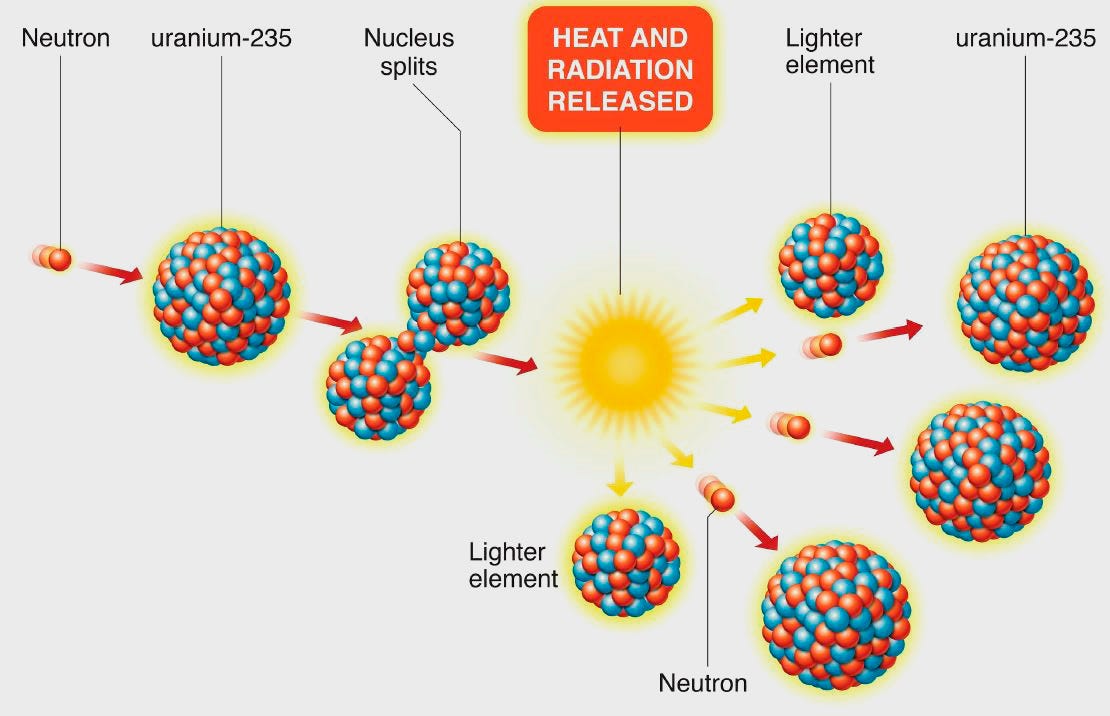
SO. It turns out that, under the precise right (or very wrong) conditions, large natural deposits of uranium can develop spontaneous nuclear fission chain reactions identical to the kind we make on purpose in modern nuclear reactors.

Ooooh I am SUCH a Naughty Lump, I am!

This has already happened at least once. About 1.7 billion years ago in Oklo, Gabon.

How do we know a spontaneous natural nuclear fission reactor formed in Africa 1.7 billion years ago?

Well, in 1972, a bunch of French chemists were quality-testing reactor-bound ore from Gabon, and it turned out a LOT of the local uranium was already markedly depleted, far more than any previously-found Happy Fun Rock, some of it by over 40%. Which meant, at the end of the day, this lab's till was short a whole lot of radioactive isotopes that should have been produced by processing that Gabonese ore.

This being the Cold War, people were pretty uptight about accounting for and tracking all fissionable isotopes in or out of any given civilian facility because, you know, big boom bad, so somebody was in trouble and they needed to figure out pretty quick how this could possibly have happened in a fairly new mine, or someone was going to get real aggressive about who stole the doomcookie from the doomcookie jar.

SCIENCE TIME.

Party Rock is in the house toniiiiight! Everybody gonna have a bad time!

Turns out the specific type of depletion in this ore told the story. In artificially processed and/or depleted uranium, the big players, U234, U235, and U236 are all affected. In the Oklo deposits, U235 showed the same type of depletion we find in spent waste materials left over from light water reactors. All the expected "product isotopes" and "daughter nuclides" that get churned up during fission reactions were present. But in our reactor waste, U234 and U236 are still present in small, altered amounts, because those isotopes are both consumed when neutrons merge and produced by fast neutron reactions happening during the fission process. So most of them get burned up, but the burninating process also makes more, so there should be some leftover at the end of it all, if not as much as the deposit started out with.

But in the Oklo materials, U234 and U236 were totally gone, because, you know, even at the crazy half-life of all this crap (250 million years, give or take), 1.7 billion years is plenty of time for it to fade to black. So this wasn't uranium humans had used to make anything go (reactors) or stop (bombs), it was ore that hadn’t been doing the VERY fiery splits for a long, long time.

The French team announced their findings: around 2 billion years ago, a self-sustaining nuclear reaction had occurred naturally within this pile of West African rock. And over the next many years, other sites, all near Oklo, showed the same markers, all part of the same extreme, widespread event.

It doesn't mean anything and it's not important, but it made me smile: that announcement took place on September 25th, 1972, which is my child's birthday, forty-six years before they were born.

So here's where it gets (more) interesting.

The Oklo reactor started doing its thing around 1.7 billion years ago, which is a very specific number. That puts it during the Paleoproterozoic era, when life on Earth was a loose gentlemen's club of sea algae and a few early eukaryotic cells. Before anything. Before dinosaurs or mushrooms or bacteriophages or even your mom.

I am a basic eukaryotic cell! I want to have anxiety when I grow up!

Atmospheric oxygen was pretty damned new. It came from cyanobacterial photosynthesis...probably, and maybe a big comet or meteor hitting the Earth like Santa's gift bag, full of funkadelic outer space molecules.

Thus, the oxygen content of our atmosphere had only recently gentrified the joint & ticked up to a perky 2%, which is not perky at all considering our current atmosphere is 21% oxygen. DON’T JUDGE HER, EVERYBODY'S GOTTA START SOMEWHERE.

But Our Problematic Friend Uranium can only dissolve into water in the presence of oxygen, and the oxygen in water doesn’t count because, well, if you use that up it’s not water anymore. So all this uranium was lying around being a mountain and hills and ground, probably constantly inundated with groundwater for who-knows-how-long, until the oxygen in the atmosphere was thick enough to allow uranium to do what it does. The groundwater seeped into a uranium lode and moderated the neutrons being produced by natural nuclear fission into a self-sustained chain reaction just the way the rods & pools of a man-made reactor do.

Long story short? The Oklo reactor burned & cooled on a THREE HOUR CYCLE for HUNDREDS OF THOUSANDS OF YEARS until all the fissionable material was used up.

Yep. Three hours. Concentrations of the gases produced by fission trapped in the Gabonian ore fields allow us to actually know the time intervals of the reaction cycle from 1.7 billion years ago (which, what the fuck, we are amazing sometimes) and it's BONKERS.

30 minutes of mega-Chernobyl-style criticality that boiled away the Super Helpful lightly-oxygenated groundwater, then, once it was gone, without a moderator to slow the excited neutrons down (don't worry too much about it but there's a weird counter-intuitive thing where water cooling and slowing these neutrons is what makes the chain reaction stable enough to keep going, without it, the critical reaction itself slows down even though the neutrons are moving faster I DON'T REALLY GET IT EITHER) the chain reaction went through 2.5 hours of cooldown until the water could seep back in & the whole thing started all over again.

FOR HUNDREDS OF THOUSANDS OF YEARS.

So to recap, 1.7 billion years ago, when life was basically just Spicy Algae, there was an open, bleeding, unfathomably, incandescently hot wound, spreading for miles around curve-in bit on the west coast of Africa that ooze-ploded underground every three hours for several hundred thousand years, hurking out radiation, intense heat, & all kinds of xenon, iodine, caesium, & barium into the air, groundwater, soil, nearby sea, & very, very early photosynthetic organisms.

All this happened about 3km below the surface, which would seem safe enough shielding, except…that particular basin was once home to a shit-ton of geysers, unstable volcanoes, and still-antsy plate tectonics moving geography all around. Any one of these could have churned radioactive material to the surface, not to mention the possibility that the primeval geography was still very much in flux. Portions of the reactor may have breached the surface all on their own during portions of these hundreds of thousands of years of earth, sea, and everything else figuring out what they wanted to be when they grew up.

Now, I'm not remotely a scientist, but on reading about all this I immediately wondered if the Oklo reactors, and others, if they occurred elsewhere & we just haven't found them yet, alongside ultraviolet radiation, could be a pretty significant factor in Spicy Algae mutating into Spicier Bubbles & Piquant Fungi, and so on all the way up to us. Radioactivity doesn’t behave like it does in comic books, but it does create mutations when it doesn’t kill the thing whose DNA its shuffling like a shitty Reno card dealer whose favorite relaxation technique is meth. Most of those mutations won’t be useful or survivable, but some will, and will be passed on to the next generation, and the next, if they give anybody a leg up in the local environment.

See, 1.7 billion is a very neat number in terms of Earth's timeline: the evolutionary party started popping off not long after that. It would explain why so much of everything came from Africa and its extreme biodiversity despite lots of other fertile and temperate zones all over the place. It might imply reasons why the next earliest stage of life was indeed primitive fungi, mushrooms being things that spring up often in areas of high radioactivity because many can consume or otherwise process it.

You, uh…gonna finish that all-consuming flame?

A Primeval Splash Park of radioactive slag interacting with a few Floaty Cell Bois for hundreds of thousands of years, longer than all of what we would even recognize as human civilization has been around, slinging wrecking balls of recombinatory chaos into everything around it. Maybe all of us came from this Devil's Threeway of seawater, light, and magic rocks, slouching toward sentience, their hour come, well, maybe, someday, if we're lucky.

Maybe our mother is a stone in Africa. Maybe that's our home.

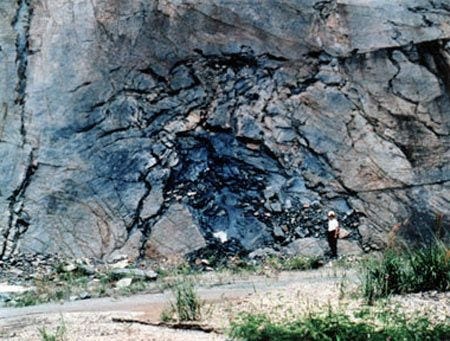
This is the molten glass-slag of a single patch of Oklo today. A portrait of Mom. Hi Mom. You worked so hard for us.

So I Googled it, & that was in fact the very next hypothesis made by actual smart scientists. QA techs may well have discovered the origin of life. This is a very real theory about the origin of the vast biodiversity of our Mutation-Happy Planet. Can we prove it? Not really. Are hypotheses that feel right and pretty and neat around the edges often wrong? Boy howdy.

And yet. Reading about all this felt almost religious to me. Which is the root of much misinformation, but we take what feelings of connection and purpose we can these days. Because not only all this *gestures wildly at the above*, but the glorious poisonous underground psychotic finger-painting that was the Oklo reactor was only possible because natural uranium deposits of uranium had much higher concentrations of U235 1.7 billion years ago than they ever would again. This could never happen now, not the natural fission of uranium or the groundwater reaction. Nor could it happen before it did, and very soon (on a planetary scale) afterward, it couldn't happen ever again. There was a tiny little window in which the deposits had enough U235 and the water was oxygenated just enough. Sure, a coincidence. Sure, a dumb-luck geological pimple-pop that may occur so rarely in the universe that life's apparent sparseness amongst trillions of star systems makes nothing but sense.

If God is a word you’re comfortable with, perhaps a way of thinking of such a force lies in the confluence of light, water, and stone, touched by the finger of time at just the perfect moment, then never again.

Maybe Plato was right, and those gods did split us all apart at the beginning of the world. Over and over again.

So whenever you feel like everything is terrible because mostly everything is terrible, remember that we are very likely just a runaway nuclear reaction that found a way to outlive its power source, get up out of the ground, walk around the place, screw everything up, make some really beautiful art, unscrew a couple of things, screw way more up even worse, have a lot of existential crises, leave the planet completely and venture out into the fucking stars, get bored of venturing out into the fucking stars, create sitcoms and pop music and Doric columns and fascism and religion and acid-wash jeans and musical theater and combustion engines and antibiotics and love and grief and hate and joy.

And also sometimes that ambulatory runaway nuclear meltdown became tigers or dragonflies or horseshoe crabs or bananas or the leather in a leather jacket or the hibiscus in an old lady's garden or a grey cat named Mystery limping up a strange human’s porch hoping for help, tomatoes in your salad or the General Sherman sequoia or your mother's piano or the olive in a martini or the pages of a book. It was dinosaurs for awhile. It was whales. It was Lucy, the little girl in C.S. Lewis's imagination or the skeleton in Ethiopia, and then it wasn't either anymore. The inferno even got fancy enough to figure out that it was a walking, talking, feeling, anxiety-riddled nuclear meltdown still-in-progress, and yet kept on going, on and on, out and out, more and more, maybe just trying to be, in aggregate, just a little better every cycle. On thirty minutes of real productive criticality every three hours. Every thirty minutes, another chance to escape a closed loop and make a new world.

And real talk, thirty minutes of actual productivity every three hours feels just about right these days.

So, honestly, it's okay to be a hot mess. It's what we came from. It's our birthright. It's our mother and father. It’s a miracle, if ever one has occurred. And it's beautiful, even as it's terrifying. It's us. An endlessly cycling fission event and all its horrifying, glorious byproducts, all confined in the bodies of trillions of organisms. We are all one. It's just that the thing that unites us is a catastrophic vivisection-by-flame of our every cell and deeper still, which really makes everything make so much more sense, when you think about it That crack in the Earth up there is a picture of Mom. Mom did her best. Sometimes your kids get away from you. Sometimes they don't call. The molten stone of the beginning of us is still inside, all the time, and it's just chemicals and minerals, it doesn't know or understand why your marriage didn't last or you lost that job or why dinner out is so stupid expensive now or who will win an election. It's just fire. It wants to burn. It wants to warm. It wants to move.

It wants to grow. It wants to breathe, and to live.

I think we've all done extraordinarily well for a bunch of broken, wet, rocks slowly cooling over eons in the middle of a void.

I think you've done amazing, sweetie.

And so did Mom.

Leave a comment

Welcome to Garbagetown is a reader-supported publication. To receive new posts and support my work, consider becoming a free or paid subscriber.

Spill, part one (a Little Brother story)

7 October 2024 at 03:08

Will Staehle's cover for 'Spill': a white star on an aqua background; a black stylized fist rises out of the star with a red X over its center.

This week on my podcast, I read part one of “Spill“, a new Little Brother story commissioned by Clay F Carlson and published on Reactor, the online publication of Tor Books. Also available in DRM-free ebook form as a Tor Original.

Doctors smoke. Driving instructors text and drive. Dentists eat sugary snacks before bed. And hackers? Well, we’re no better at taking our own advice than anyone else.

Take “There is no security in obscurity”—if a security system only works when your enemies don’t understand it, then your security system doesn’t work.

A couple of years ago, I decided I wanted to move off the cloud. “There’s no such thing as the cloud, there’s only other peoples’ computers.” If you trust Google (or Apple, or, God help you, Amazon to host your stuff, well, let’s just say I don’t think you’ve thought this one through, pal).

I Am Good at Nerd, and managing a server for my own email and file transfers and streaming media didn’t seem that hard. I’d been building PCs since I was fifteen. I even went through a phase where I built my own laptops, so why couldn’t I just build myself a monster-ass PC with stupid amounts of hard drives and RAM and find a data center somewhere that would host it?


MP3

Digital FAKE "AI" is no problem. Only the REAL AI is

1 October 2024 at 18:30

I am actively seeking work as blogger, (ghost-) writer, speaker, researcher, popularizer... on all the topics in this and my other posts. Thanks for your attention, and support, by subscribing or in any other way.

Some days ago L. Rosenberg asked on Medium whether we have "reached peak Human" and we'll be overcome by Artificial Intelligence. While that post does contain some interesting data and food for thought, I also think it is a good summary of certain absurd concerns about AI and wrong ways to frame the whole "relationship" between AI and human beings.

The problems start at the very beginning of the piece, with the explanation that "reaching Peak Human" means reaching (all emphasis mine):

(Excerpt 1) "the point where AI systems can outthink the majority of individual humans, thus defining the moment in time when we "peaked” as an intellectual force on planet earth."

"After all, once we pass this milestone, we will steadily lose our cognitive edge until AI systems can outthink all individual humans - even the most brilliant among us. At that later point, we will say that AI has achieved the more dangerous milestone of Superintelligence. And while most people focus on the second milestone, I believe we should track the first because it could happen within months, not years."

SO WHAT? Why on Earth should we care to "lose our cognitive edge" to some THING, nothing more, that we can literally shut down by just pulling its plug? If tomorrow morning an alien race, extremely fragile and unable to physically harm us unless we beg it to do so landed on Earth to rule us, would we accept that or laugh in their face, before kicking their asses back in space?

Assuming we didn't well before the arrival of AI, "losing our cognitive edge" is something that will happen IF we make it happen by NOT stopping something that is absolutely stoppable.

(Excerpt 2) "Until recently, the average human could easily outperform even the most powerful AI systems when it comes to basic reasoning."

Why on Earth should reasoning alone be something that determines who "rules"? There are plenty of extremely smart, extremely high IQ humans who nobody would trust with tending an infant more than 10 minutes. And we are in trouble EXACTLY because we let some such people run wild without restraints. Why on Earth should we be even stupider and let anything non-human do the same?

Researching and popularizing these concepts is how I pay the bills. Thanks for helping me both by sharing my work, and with a (possibly paid) subscription.

(Excerpt 3) Someone developed a custom IQ test that "does not appear anywhere online and therefore is not in the training data, and gave that “offline test” to Open AI’s new “o1” model, and it scored an IQ of 95 [on that test] that it was NOT trained on. This is still an impressive result. That score beats 37% of adults on the reasoning tasks... At this rate of progress, it is very likely that an AI model will be able to beat 50% of adult humans on standard IQ tests this year."

Again: so what? Even if it had any conscience it would still have no right whatsoever to rule us, and it doesn't have a conscience, or dignity. It's just stuff we can and really should use in much better ways than playing morbid IQ contests, and stuff we can annihilate with the flip of a switch before it becomes dangerous.

(Excerpt 4) "Does this mean we will reach Peak Human in 2024? Yes and no. First, I predict yes, at least one foundational AI model will be released in 2024 that can outthink more than 50% of adult humans on pure reasoning tasks. From this perspective, we will exceed my definition for Peak Human and will be on a downward path towards the rapidly approaching day when an AI is released that can outperform all individual humans, period".

This treats AI as if it were some virus, that is some physical object that could leak from some lab any time. Funny, really.

(Excerpt 5) "We humans have another trick up our sleeves. It’s called collective intelligence, and it relates to the fact that human groups can be smarter than individuals... I bring this up because my personal focus as an AI researcher over the last decade has been the use of AI to connect groups of humans together into real-time systems that amplify our collective intelligence to superhuman levels. I call this goal Collective Superintelligence and I believe it is a viable pathway for keeping humanity cognitively competitive even after AI systems can outperform the reasoning ability of every individual among us... I believe we are just scratching the surface of how smart humans can become when we use AI to connect human groups together in larger and larger numbers..."

Again? Thinking we'd have to be cognitively competitive in order to overcome something trapped inside a bunch of transistors is like thinking that to overcome a professional boxer tied to an electric chair to we'd need to be stronger than him. Or fearing lung cancer from "sentient" cigarettes that we could avoid by just not smoking.

Besides... amplifying human intelligence by connecting "human groups together in larger and larger numbers" through software? If this sound familiar, it's because it is.

Even "the internet" was supposed to be collaborative, peer to peer superintelligence, and look how it's ended, exactly because we let it to the MERCE of a few guys with way too much money, way too much self-worth, but almost zero knowledge of anything but programming, and zero oversight from above or outside.

Share

(Excerpt 6) This is about a slightly different issue, but still off-base: " [The author is] passionate about pursuing Collective Superintelligence because it has the potential to greatly amplify humanity’s cognitive abilities, and unlike a digital superintelligence it is inherently instilled with human values, morals, sensibilities, and interests."

Being "passionate about greatly amplifying... human values, morals... etc", you say? That's me too.. I just say we already have all it takes to act with "human values, morals, sensibilities, and interests", without plugging into something that wastes huge amounts of energy that should be used in much better ways and, more likely than not, would make most people even dumber (the Internet, remember?).

The fault here is believing, accepting, surrendering, hoping... that we need to put physical or virtual electrodes in our brains, Matrix-like, to do stuff that would really, seriously improve our lives like this, this or this.

(Excerpt 7)"Amplifying our collective intelligence might help us maintain our edge long enough to figure out how to protect ourselves from being outmatched."

Here it goes again: the concern about some superintelligent, immortal species in space that can rule us... but it totally, totally depends on us to both land and to remain alive on Earth. Me, I'd say that if we have to submit to a dictator, they'd better be humans, right? Because humans die, digital systems can be eternal (more on immortality below).

(Excerpt 8) The results of a very recent study would suggest that "AI has reached at least the same level, or even surpassed, the average human’s ability to generate ideas in the most typical test of creative thinking. I’m not sure I fully believe this result, but it’s just a matter of time before it holds true."

Whatever. It doesn't matter if it is, or will ever become true, until the whole attitude remains the equivalent of "let's research viruses, but if we discover lethal ones we will just have to release it in the atmosphere, the more the better".

It still makes no sense. Using the author's words, this sentence "Whether we like it or not, our evolutionary position as the smartest and most creative brains on planet earth is likely to be challenged in the very near future..." lacks the obvious conclusion that every average primary school student that gets enough sleep every night would reach all by himself: "...if we are so stupid to let it happen".

Let’s do more? Sure!

Final quote, with which I agree 100%: "we need to be doing more to protect ourselves from being outmatched."

Sure we do. Let's stop wasting energy on way more AI data centers that we would ever need, and that may never exist if enough nVidia engineers quit tomorrow, as they could very comfortably do (I would, in their shoes).

Let's stop running AI models for the public, use AI for stuff that matters.

Let's slow down everything, not just AI, because that would be the collective superintelligence we would need the most right now.

Above all, let's stop listening to corporations, or governments that say this is unavoidable.

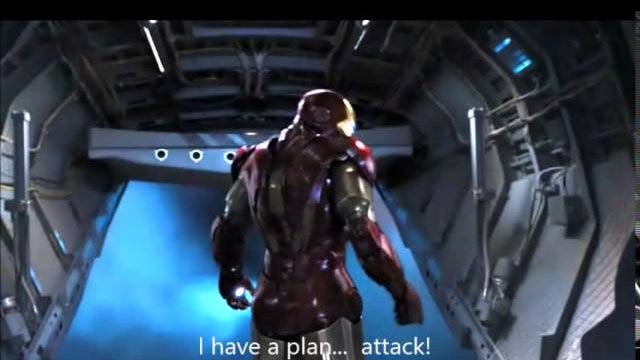
Get real, already. AI is not thermodynamics, or any other physical law. It's not entropy, that can only increase. AI is not inexorable. AI is a human artifact and nothing else, for heaven's sake. A mere, damned artifact that needs us to exist, but we have NO OBLIGATION WHATSOEVER TO EVER LET "live" (note the quotes) or treat, let roam or otherwise dignify as human. Learn from Iron Man:

"Stark, what if AI becomes too powerful? We need a plan! I have a plan... Attack"

Get real, already. The problem is not AI

Get real, already, and kick AI back into the box where it must remain (1). The problem is not AI. It never was. The problem is the very, very few people who are telling AI is inexorable AND control and will control how it is used.

The REAL "AI" we should worry about is the one, which is just as immortal, ubiquitous and omnipotent as the fake AI we're told to fear, but already took over more than one century ago. It's corporations, that is the same entities who are aggressively pushing this idea that we have to surrender to AI.

  1. Hey, check this: "AI could already solve so many of our problems, so how is “superintelligence” going to improve things?".

Vigilant (a Little Brother story)

29 September 2024 at 19:59

Will Staehle's cover for 'Vigilant': a stylized, shattered mobile phone on a mustard-colored background.

This week on my podcast, I read “Vigilant“, a new Little Brother story commissioned by Nelda Buckman and published on Reactor, the online publication of Tor Books. Also available in DRM-free ebook form as a Tor Original.

Kids hate email.


Dee got my number from his older brother, who got it from Tina, my sister-in-law, who he knew from art school. He texted me just as I was starting to make progress with a gnarly bug in some logging software I was trying to get running for my cloud servers.


My phone went bloop and vibrated a little on the kitchen table, making ripples in my coffee. My mind went instantly blank. I unlocked my phone.


> Is this marcus


I almost blocked the number, but dammit, this was supposed to be a private number. I’d just changed it. I wanted to know how it was getting out and whether I needed to change it again.


> Who’s this?


Yeah, I punctuate my texts. I’m old.


> I need help with some school stuff some spying stuff at school i heard your good at that


MP3

My Other Job Involves Spaceships

20 September 2024 at 19:17

Hello, fellow Garbagetowners!

I’m working on a new pair of essays, slowed temporarily by having had very painful surgery on my hands, which do tend to be helpful when it comes to typing letters into machines in satisfactory order. But also slowed by the flurry of activity that goes along with publishing a new novel.

Yes! It’s true! I do not actually make my living yelling creative profanities at American politics and/or the internet at large! I’M NOT LIVING THAT $400K A MONTH PUTINBESTIE PLATINUM TIER MLM LIFE.

Nah, I’m a science fiction, fantasy, and horror novelist and short story writer. In fact, “Garbagetown” in “Welcome to Garbagetown” isn’t just a reference to how rubbish this world truly has become, but also a reference to my climate dystopian book The Past Is Red. I’ve been doing this thing for twenty years, and book #49 is coming out next Tuesday.

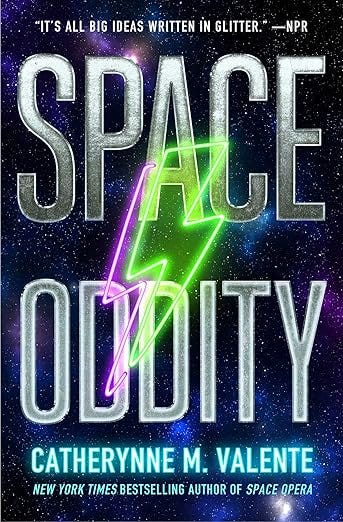
There she is, looking all shiny and new! Space Oddity is the sequel to Space Opera, the most elaborate result of an idle Twitter dare ever, and one which rather a lot of people turned out to be very fond of. Both together are possibly the most ridiculous things I’ve ever done—Eurovision in space, but also political commentary, and then also gonzo comedy on top of that. Look, it’s easier to show you. Here is how Space Oddity starts:

Once upon a time, in a very large, very elegant, shockingly belligerent galaxy, there lived a rather troublesome planet about whose precise character no one could quite agree except to begrudgingly admit, at the conclusion of a number of publicly broadcast hearings, that it was most certainly blue. 

Ish.

On this (allegedly) blue world, there happened to evolve all three of the following, though not at the same time: a Dutch sea captain by the name of Willem de Vlamingh, a Lebanese hedge fund manager called Nassim Nicholas Taleb, and a very large, very elegant, shockingly belligerent bird called a swan… 

Wait! Don’t run away! Yes, if you follow me elsewhere (Mastodon, Twitter, Instagram, Facebook) you’ve probably already seen posts like this and BELIEVE YOU ME, I get that they’re annoying in just precisely the same way as PBS pledge-drive breaks, but it’s my job and I have to, so let’s get through this together and we’ll all move on to the bar.

Posting this gif-you-can-hear in a state of extreme authorial self-cringe since 2004

So, ya know, anyway, ahem, you should definitely pre-order (or regular order if you’re reading this after 9/24) the ebook or hardback or amazing audiobook performance, because of how much I and my 1st grader and my animals enjoy eating and being inside when it rains. And honestly, if you like the way I write here, this book will definitely be your jam, baby.

If you’re reasonably local to Portland, Maine or NYC, I’ll be having a bookstore launch party this thursday, 9/27, at 7pm at my extraordinary local indie bookshop, Print: A Bookstore here in PWM (and anything of mine you order from them you can get signed for free before shipping), a Eurovision karaoke book party Friday night (9/28) at 8pm here where I live on Peaks Island at the American Legion (hush, it’s rad) though I don’t expect many islanders are Garbagetown readers, then reading at Brooklyn Books & Booze in…uh…Brooklyn, on 10/15. Come if you can!

And finally, as I mentioned before, I’ve set a casual sort of stretch goal here, in which I offered to commit to a regular posting schedule if we could get 500 paid subscribers (to which number I’ve included new Patreon patrons who told me they got there from here as well) and I’m thrilled to say we’re up to 401 all-inclusive as a result of that, so only 99 to go! Double digits! If you were waffling, now would be a great time to sign up. Paid subscribers here get access to a companion piece to every public essay, in which all my too-spicy-for-me-to-want-to-deal-with-sea-lions opinions wait to yell even louder.

That about wraps it up for admin business for the moment! New pair of essays next week! Swans everywhere! Let’s get back to cathartic swearing! If nothing else, we have all of us had a better week than at least one guy in North Carolina!

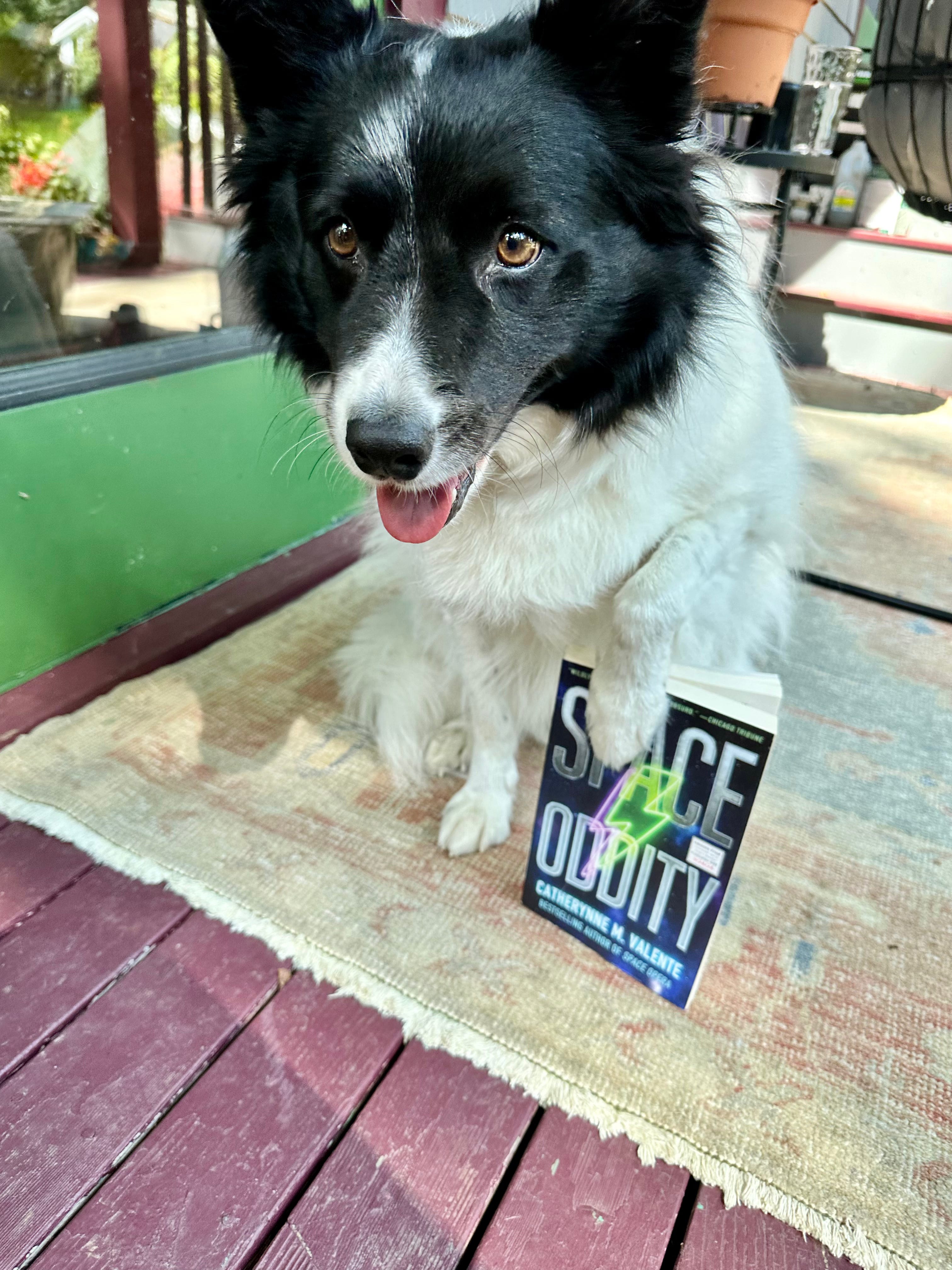
In conclusion, this is Fiona. She is a very beautiful and intelligent border collie. She has fetched herself a copy and would like treats. She thinks you should also have copies. Just saying.

Fiona is just saying, obviously. I would never. I am very quiet and unobtrusive. But border collies? FULL OF BEES AND INSISTENCE.

I swear I didn’t even tell her to put her paw on the book, she just got tired of it falling over and was like HERE IS THIS WHAT YOU’RE TRYING TO DO? JFC, HUMAN, IT’S NOT HARD. I SHOULD GO INTO PR.

Welcome to Garbagetown is a reader-supported publication. To receive new posts and support my work, consider becoming a free or paid subscriber.

Share

Leave a comment

Jobs and dating are screwed. In the same way, for the same reasons

19 September 2024 at 18:03

On one side, there is so much work it's unbelievable people keep doing it

Right now, the most profitable company of the world is nVidia, because it makes the most wanted special chips that power AI applications.

One major reason for the success of nVidia, according to Bloomberg, is grueling 24/7 work by employees who, in increasing numbers, could already cash out millions in stock options. This may be creating "a culture problem brewing at nVidia" that I could only summarize as "why on Earth should I still live like this? To make "AI" that's just clones of people who already have so much wealth to become dementia?"

In other words, the whole house of cards of AI, which can't happen without nVidia, could crash, possibly triggering a global meltdown worst than 2008, the day after one tiny group of people realizes they could retire rich NOW, to finally enjoy life.

Popularization like this is how I try to make the world a better place, AND also to make a living. Thanks for considering a paid subscription.

On the other side, there is too little work, or no work at all

In the same world where those few guys could realize any moment they're working themselves dead for no real good reason, workers with comparable or higher skills have the opposite problem. Take Kevin Cash, a US Navy veteran with five degrees who, since he was laid off two years ago, has sent almost 2,200 jobs without success, and now survives off Uber rides and Taskrabbit gigs, almost sure that continuing to try, even for someone with with five degrees and years of experience, "is futile".

One reason he's giving up is what many people, me included have been reporting for years now: "a lot of posted jobs are fake... I spent a solid 12 ½ days applying to jobs that never existed." Another is that software, including the AI proudly powered by those nVidia engineers, make way too easy to demand unneeded or impossible purple squirrels, as in "[one recruiter] wanted 10 years of experience with a certain software program that had only been around for six years".

Long story short, the strategies to "try new (online) ways to “develop and retain talent”" suggested just a few years ago have failed miserably, and even actual job interviews fail to predict if a candidate will succeed. For the record, the very day I decided to write this post, I got this piece of spam email:

"Are you interested in having the ability to search for candidates - for all types of desk roles?... Our service enables you to search for handpicked candidates from a database of over 4 million highly skilled remote staff from the Philippines."

The story of Kevin Cash, however, means much more than it seems at first sight. To begin with, his story is important because he's unemployed with the same skills that nVidia should need to remain so profitable, namely "business intelligence and semiconductor manufacturing".

Then, it's even more important because almost all the 2.200 jobs he's quite qualified to get but didn't are (besides being often fake!) exactly the kind of jobs that, thanks to some mythical "upskilling" are supposed to compensate everybody, not just guys with five degrees, of the jobs they lost or will lose because of automation, AI and what not.

Sure, innovation eventually creates more jobs than it destroys. I could still believe that. But in the last decade or two "innovation" has been destroying exactly the kind of jobs people should have "upskilled themselves for, and it keeps doing so faster and faster: in the US only, the whole high-tech industry faced in 2023 a brutal wave of layoffs that shows "no signs of slowing down", with figures "lower than all estimates in a Bloomberg survey.

That's the whole problem, here, speed: "in the long run we're all dead", longtermism be damned. I really don't get how anyone in this reality can still believe that the super fast "innovation" we are going through will create enough jobs that enough of the real people it will put on the streets could ever get qualified for, before starving under some bridge. That's just a fable, and it's always been a fable, because:

Executive summary of this whole section: forget a full employment society, and forget upskilling to wages that can afford a family more than a tiny percentage of all the workers that should be thankful to live in these wonderful times.

Worldwide job market, ca. 2030

Dating is just like looking for a job: so complicated it's futile

A new research on dating, which was expecting to find "a substantial improvement in the ability to find and meet potential partners, reflecting reduced search costs brought about by [online dating] technology" found something else instead:

"data suggest that search costs have not changed over time despite the wide use of online dating sites and apps."

If this looks like the guy still jobless after 2,200 applications, is because it is. The researchers explicitly note that recent literature documents "a similar lack of improvement in matching efficiency in labor and product markets".

Jobs and dating go hand in hand even in inequality: another recent research found that online dating caused "a rise in U.S. income inequality", making Americans (and everybody else, why not?) to increasingly "marry someone more like themselves" (for the record, that's just what I meant when I wrote that online dating amounts to self-inflicted eugenics).

Back to the first research, one reason it mentions for lack of improvements may be that, exactly because they can ask so much with dating apps, lonely hearts become as hard to please as those HR recruiters dreaming of purple squirrels. The researchers, however, point to a simpler explanation: dating apps just don't increase one's inborn capability to process information, which is what would ultimately determine one's "proficiency in mate selection within the marriage market" (which is just the dating version of the already mentioned "genius is SCARCE"" thing).

For what it's worth, I suspect it's even simpler: the mere fact of looking at things like dating and marriage as "markets" is twisted. Well-adjusted human beings are those who use "markets", or help others to do so, to buy carrots or screwdrivers, not life partners.

Leave a comment

Same new, same new

What makes dating apps pointless is the same thing that makes stupidly hard to hire or get hired, thus contributing, among other things, to parents and children getting in debt for schooling that's prestigious, but little else: technology for the sake of technology. That's not the only cause, of course, nor the main one: almost always technology, especially digital technology, just enables or accelerates stuff (good or bad, doesn't matter) that humans were already doing or were begging to do anyway.

Still, all the stories and studies I've reported so far are perfect examples that going too fast, too digital, is bad for everybody's mental health, because dating, marriage and jobs aren't hobbies. They greatly overlap with one's own meaning and stability in life, and if they are all messed up simultaneously, in the same way and for the same reasons, it's not sustainable for much longer.

Solutions are as simple as they are hard to implement. It's painfully evident that both head hunters and lonely hearts should spend much more time with the real people who may help them.

That would only be a stopgap, however. As I said, there are too many signs that we're going towards a future where, even if there was no global warming whose only real solution were to "just sit still and smell the roses" ...

...full employment will neither possible nor more urgent than fighting mass loneliness that creates nevrotic masses, by finding life partners in ways that work, possibly to form families which will be sorely needed.

I argue that we can get there by getting UBI and AI in the right order, after disrupting the first if not the only thing that REALLY needs disruption. That may look hard, or downright crazy. But the more we keep going like this, the more it seems to me the less unrealistic, less unfeasible solution among those that would work. Just ask good old uncle Albert, below.

PSA: I am actively seeking work as blogger, (ghost-) writer, speaker, researcher, popularizer... on all the topics in this and my other posts. Or, you can support me directly by subscribing, or with donations.

Anti-cheat, gamers, and the Crowdstrike disaster

16 September 2024 at 02:29

A psychedelic, brightly colored castle wall with turrets. It floats on in an existential background of a glowing, neon green grid that meets a code waterfall as seen in the credit sequences of the Wachowskis' 'Matrix' films. The words GAME OVER are centered above the wall in the sky, in blocky, glowing, 8-bit type. The wall is shattered and peering out of it is a shadowy hacker in a hoodie. Next to the shattered wall is a red 'insert coin' slot from a vintage arcade game.

This week on my podcast, I read my latest Pluralistic.net column, “Anti-cheat, gamers, and the Crowdstrike disaster” about the way that gamers were sucked into the coalition to defend trusted computing, and how the Crowdstrike disaster has seen them ejected from the coalition by Microsoft:


As a class, gamers *hate* digital rights management (DRM), the anti-copying, anti-sharing code that stops gamers from playing older games, selling or giving away games, or just *playing* games:

https://www.reddit.com/r/truegaming/comments/1x7qhs/why_do_you_hate_drm/

Trusted computing promised to supercharge DRM and make it orders of magnitude harder to break – a promise it delivered on. That made gamers a weird partner for the pro-trusted computing coalition.

But coalitions are weird, and coalitions that bring together diverging (and opposing) constituencies are *very* powerful (if fractious), because one member can speak to lawmakers, companies, nonprofits and groups that would normally have nothing to do with another member.

Gamers may hate DRM, but they hate *cheating* even more. As a class, gamers have an all-consuming hatred of cheats that overrides all other considerations (which is weird, because the cheats are *used* by gamers!). One thing trusted computing is pretty good at is detecting cheating. Gamers – or, more often, game *servers* – can use remote attestation to force each player’s computer to cough up a true account of its configuration, including whether there are any cheats running on the computer that would give the player an edge. By design, owners of computers can’t override trusted computing modules, which means that even if you *want* to cheat, your computer will still rat you out.


MP3

(Image: Bernt Rostad, Elliott Brown, CC BY 2.0)

Wrong questions about children online persist, from pediatricians to Parliaments

12 September 2024 at 20:11

Dr. Farnetani, a famous italian pediatrician, just said "No to age limits for smartphones and social media" (italian) when interviewed about a petition by other Italian experts, who asked the government to ban smartphones before 14 years old, and social media before 16. These are his main points and suggestions:

  1. such tools are harmful if taken in excessive doses, for long periods

  2. what is necessary is to teach children a responsible, conscious usage of said tools

  3. because those tools are now part of everybody's lifestyle, with undeniable advantages

  4. being with peers is always positive as long as virtual meetings aren't THE exclusive way to be together

  5. rather than imposing generic bans, it is important that parents create alternative opportunities for socialization

  6. rather than hiding the problem it's better to have a daily, continuous conversation also about these things

  7. sleep must be protected, because using electronic devices right before sleeping, or worst: in bed, makes falling asleep harder

  8. teach smartphones and social media, because learning how to use such crucial tools can't be left to self-improvement. Such teaching must start and happen in the family, but also in schools and by NGOs, via properly trained teachers

Sure. If...

Dr. Farnetani surely is a very competent pediatrician. Still, I argue that, in the real world, his intrinsically good recommendations are hardly applicable, and partly misleading, at least as reported in that interview. The world would be wonderful if everybody could follow Dr. Farnetani's advice. Seriously. Besides, should age limits be enforced, the only ones who could do that without serious collateral damage and huge waste of money would be parents, NEVER governments, like that petition says. Still, there are many things that fall short in that interview.

Magical spells, i.e. the ONLY age limit on social media that could work in REAL life without BIG collateral damage.

First, there is no explicit declaration of how soon is certainly too soon, which is sorely needed, and never repeated enough. Tell the average family of 2024 that "children do not need smartphones bans", and way too many parents will just hear "it's OK to keep giving personal smartphones to kids as young as seven/eight years old", which I would bet is not what Dr. Farnetani meant.

Second, it is wrong to equate smartphones with social media or messaging systems like WhatsApp or Telegram. Really wrong. From a certain point of view, it doesn't even matter whether "social media" is good or bad.

The real problem, however, is that most suggestions of the list above are basically impossible to follow for the overwhelming majority of today's real families wealthy enough to have kids that could be harmed by smartphones and social media. It's as simple as that.

That is, how many real parents of today have, on top of all their other responsibilities, BOTH the knowledge AND the time to have "daily, continuous conversations" for teaching "responsible, conscious use" of something that, unlike cooking, bicycling or even dating, that they themselves don't really understand (more on this below)? How many parents have concrete possibilities to "create alternative opportunities for socialization" for their own children... before those children grow up? Ditto for real schools, in case you were thinking it should be their responsibility.

Seriously, why didn’t the journalist ask Dr. Farnetani how many parents of 2024 have the time, and skills, and opportunities to be like Henry Oliver? One in a thousand? One in five hundred? Surely too few to make a difference. Or, put in another way, Dr. Farnetani's advice, while being indeed very good, does not scale at all. Not enough to make a difference in society, for the next 15/20 years at least.

Leave a comment

We must certainly strive for a world in which all parents have those possibilities, but that is another discussion. In the real world of today, and as long as certain things stay the same, the only smartphone and social media strategy that will work without negative effects on the overwhelming majority of real kids with real parents is exactly the only one that almost every real parent could afford and will be able to follow: "no smartphone before ~14 years old, period". And if you didn't notice right away that I did NOT say "no internet", do read that piece twice, and then this.

If you need proof that way too few adults of today don't understand enough the actual nature and deep impacts of digital networks and services, just check the "Ruby Goldberg" part of this post, look at NFTs, or remember the credit still given to dumb ideas like online voting.

I am not saying this to accuse, insult or shame anybody! I am simply pointing out the fact that smartphones, social media and other digital tech that even much science fiction of the 20th century didn't imagine pretty much crashed on us just 20 years ago, changing every quarter since then.

I am just saying that all this stuff is so new, so big and so fast, for a species that needed 150 thousand years to "invent" agriculture and 6/7 thousand years more to invent writing, that almost nobody has had the time to really understand it, no matter how smart they may be. There is no shame at all in taking it slow, or just refusing (not being forced!) to use certain services until they make sense. Quite the contrary, actually, especially when children are concerned. It's just basic common sense.

The sooner we accept we’re ALL as ready as these guys to handle certain things, the happier our children will be. (source: screenshot of image search for “cavemen with smartphones”

Furthermore, speaking of social media, the interview doesn't mention at all that datafication, censorship, surveillance and misguided or missing regulations make current social media so bad that even adults should use them as little as possible, and children even less, regardless of any mental health concerns.

Subscribe now

Then again, omissions of the complete picture are very common in many, similarly well intentioned proposals to limit certain abuses. For example, last May the European Parliament voted on a law proposal nicknamed "Chat Control", whose intended purpose is to fight child sexual abuse, collateral damage be damned. Under Chat Control (source), "users of apps and services with chat functions [would] be asked whether they accept the indiscriminate and error-prone scanning and possibly reporting of their privately shared images, photos and videos" and those who refused such scanning "would be blocked from sending or receiving images, photos, videos and links". It goes without saying that refusing would automatically make of whoever chose to do a potential target of many other forms of surveillance or discrimination.

Surprisingly, many NGOs and politicians, including this member of the European Parliament, asked to reject the proposal period, which is what eventually happened. But I dream that it would be much better, should that or any similar proposal return, if everybody first approved it, and then every citizen refused to submit to the automatic scanning.

I dream this first of all because if everybody (starting with parents) did so it would be an excellent proof, and a powerful political signal, that it is a stupid, very dangerous law.

But I dream this even more because losing the ability to share as we do today pictures and notifications of every meal, party, relative, holiday, home improvement... and to receive the same "news" from every "friend" would be a feature, not a bug. Heck, it would be a return to circa 2005, not the Bronze Age, because Chat Control would not touch forums, blogging, email, IRC or those ugly, so personal phone calls (1). Can you imagine a better remedy for the endless stream of "me, me, ME!" flood everyone is pushed to both practice and endure these days?

Of course, this would NOT solve all our problems, including the root, pre-digital issues that (starting from this one) make life suck so much to make people escape inside Instagram or TikTok. The point of this post is just that as long as journalists or members of Parliaments only ask wrong or incomplete questions, the answers don't really matter, no matter how well intentioned and competent the other party is.

Please note: I am actively seeking work as blogger, (ghost-) writer, speaker, researcher, popularizer... on all the topics in this and my other posts. Alternatively, you can support more paywall-free, fully independent writing like this, directly by subscribing, or with donations.

  1. Yes, of course the same parties who long for Chat Control would target those other media, sooner of later, and of course we should fight those proposals too. One problem at a time.

Marshmallow Longtermism

9 September 2024 at 01:28

A serene, cross-legged, gilded Buddha statue; he is wearing a top-hat and posed on a field of white, fluffy marshmallows.

This week on my podcast, I read my latest Locus Magazine column, “Marshmallow Longtermism” a reflection on how conservatives self-mythologize as the standards-bearers for deferred gratification and making hard trade-offs, but are utterly lacking in these traits when it comes to climate change and inequality.


I’m no fan of Charles Koch, but I agree that his performance at the helm of Koch Industries demonstrated impressive discipline and self-control, and that his enormous economic and political power stems in large part from his ability to resist temptation and reinvest patient money in patient technologies.

But Koch’s foresight is extremely selective. Much of Koch’s fossil-fuel for­tune has been spent on funding climate denial and inaction. Koch claims that he sincerely believes that the climate emergency isn’t real or urgent, which is awfully convenient, given the centrality of fossil fuels to Koch’s power and wealth.

The rigor Koch applies to evaluating the technical propositions of new, efficient coal extraction and refining processes disappears when it comes to climate science. If Koch held coal-tech to the same evidentiary standard that he applies to the climate, he never would have bought a single piece of gear.


MP3

(Image: Mark S, CC BY 2.0, modified)

There is only ONE thing that really, urgently needs "disruption"

4 September 2024 at 18:43

and we already have all it takes to do it. Except our own minds.

Short PSA first: I am actively seeking work as blogger, (ghost-) writer, speaker, researcher, popularizer... on all the topics in this and my other posts. Or, you can support me directly by subscribing, or with donations.

In this uncertain world, there may be just three things that I am more sure of, every year more. One is that we already have all the tech and science we need to solve our most urgent REAL problems (including sensible use of machine learning, of course).

The second thing is that we do not have enough raw stuff to keep doing Life As Usual, even assuming it would be worth it. Not at affordable costs, in acceptable time scales, that is. We just don't.

The last, and most important, is that we're not going to live in a society that really works for as many people as possible, until we avoid all the distractions caused by the two things above, which are just symptoms of another thingy on which we should focus first, which thanks to digital technologies is also much, much easier than it would have been 2 or 3 decades ago. Before looking at that thing, it's necessary to recap the real problems we have, because they are what make that thing THE most urgent thing.

The real problems we have

Clueless coders and number crunchers roam unchecked

We have left free rein to people who know (financial) math or coding but NOTHING else... precisely because hey, they can code and count so they must be good, right? Never mind that their pinnacle achievements include utter dumbness like HFT, calling "AI" what's just their own, half-baked clones, or setting up rogue states that they cannot really control, but still influence elections when they don't directly influence wars among other states.

Geeks must participate in world making, but letting them pilot or "disrupt" any mission-critical service, from nuclear power to healthcare or death is almost always a wretched idea. Especially when it causes the next problem:

High-Tech dumb dreams suck all the oxygen (and money) in the room

Letting immature techies unchecked has brought to power characters who dump oceans of money and precious physical resources down drains like:

Musk is just James Sullivan, Zuckerberg is just Nolan Sorrento.

Escapes that cannot work

Another evolutionary dead-end that wastes precious resources is any form of prepping, from setting up remote homesteads to defend in arms to building micro-nations populated with all and only nice people their founders would like. Both visions are quite .. short-sighted, if not reactionary, hopeless navel gazing . Above all, they are already too late.

You may happily retire in the mountains, and one guy (already) left free to launch sulphur balloons on the other side of the planet could still be all it takes to tweak the climate wherever you "escaped" enough to make you starve. Similarly, no digital fairy kingdom on the internet will run, if the few aging guys fixing submarine cables aren't replaced soon.

As things stand now, the truth is that (source) "the contemporary regulatory and administrative state... emerged for a very good reason", namely the "only way to take the danger out of social life" in a system so fragile and globalized as the current world.

Retreating on mountaintops or on digital pillars would be enough for a past that won't return. The world has become too interconnected to be shielded from it, even if network states weren't so inherently.... unbalanced to go quickly downhill by themselves. Today, however one imagines it, withdrawing into any custom-made utopia is an absurd notion.

Two REAL network states, from the only age where they could really work.

Everybody's getting sad, furious, or both

There are many people for whom at least the "no heaven nor hell, no countries, nothing to kill or die for" part of John Lennon's Imagine already is the world they live in, and yet they are often sad, and more than others too. And then, as thisand other elections in the last years clearly show, there are more and more people every year who are more or less furious, because they sincerely consider those same things to be deeply wrong. Personally, during Italy's lockdowns I was depressed because I HAD a job which PREVENTED me from doing useful work.

Who's right or wrong there is totally off topic here. Me, I have a feeling that each side dismissing the other as one monolithic bunch of losers "on the wrong side of history" won't make anybody happier, but never mind me. Here, I'm only pointing out that, regardless of their material quality of life, there is a huge, and growing number of people who aren't exactly happy these days. We must be all doing something wrong.

Two simple proofs that the system doesn't work

The country proud to be the birthplace of much of the waste outlined above is the same that has the lowest life expectancy among English-speaking countries (with rates of early death "well beyond those of other rich countries", and maternal death rates increasing at an alarming rate), eight of its elite colleges basically admitting collusion on price fixing, 78% of citizens living paycheck to paycheck in 2023, other embarrassing primates (and just dropped out of the 20 happiest countries list).

Meanwhile, the country painted as its most successful opponent, and possibly successor, has a population set to halve by 2100, with youngsters (in very Western manners, if I may say so) holding resignation parties, self-identifying as full-time children, and equating marriage and childbirth with stress, all after finding itself with enough EMPTY houses for 3 billion people.

Thanks for sharing this as much as you can, in and outside Substack!

Share

What to do instead

First of all, accept that none of the problems I just outlined can be fixed by new technology. As to what to do instead...

The Italian science-fiction comic Nathan Never, started in 1991, happens in a world that was totally devastated in the year... 2024 by a dumb geoengineering attempt to exploit the energetic potential of Earth's magma. Devastation is so bad that all the governments of the planet accept the proposal (italian) of the Pope elected in the same days of the catastrophe: a worldwide reset of the calendar back from January 1st, 2024 to January 1st, 1946, as tangible, continuous incitement to participate in rebuilding the world, both psychologically and technologically, just as everybody did after the end of World War II.

We need something like that: a practically sudden, very visible, very concrete, worldwide restart of the right thing, that is the very nature of money, through global, almost simultaneous:

  1. Debt Jubilee, that is cancellation, of both public and private debt (2025 already is a particularly good excuse for that)

  2. abandonment of GDP, because it's at least 56 years we know it's terribly stupid. Make Bob Kennedy happy, already

  3. fiscal/financial/whatever monetary reforms that make Universal Basic Income viable (why? See here and here)

  4. abolition of corporate personhood, and of shareholder value as the ONE main goal of corporations, both stupid ideas for lots of reasons that are much more capitalist than "communist", like this, this, this or this

That was 1968. Now, we have 56 more years of evidence he was right.

Don't dismiss this as madness right away. Keep reading

Instead of "no heaven nor hell, no countries, etc.."

Imagine all nations on Earth doing, on January 1st 202.., a reset of all debt, both public and private, freeing huge energies throughout the developing world that would sensibly reduce migrations.

Imagine the evening news of New Year’s Eve, showing New Year parties in New Zealand and China, then Australia, then India, the Middle east, Europe, and finally Wall Street and the Silicon Valley... where people party not because a new number appeared on their smartphones, but because they have economic peace of mind, at last.

Why would the 1% want or allow this?

First, because at this point in time they can't ignore it would be pretty bad for their businesses and investments... but much, much better than the chaos that will soon happen otherwise. Second, because they would still be the 1%, status being relative to what everybody else has.

Popularizing these topics is how I pay my bill. Thanks for considering a (possibly paid) subscription).

The real obstacles

The real, biggest obstacle to realizing the four points above is not the 1%. It's everybody else. It's us, who are self-conditioned to instinctively fear or hate such measures.

The real obstacle is every common person who wants to live badly, because they don't get they are already slaves today. It's the ordinary people who, for example:

  • demand innovation because innovation, the faker the better, or believe 15-minutes cities would make them slaves more, not less than they are right now

  • insist that we should not fight for social innovation because... ... it could be taken away at a later point (yes, I've actually heard this!)

  • actually call any "dependence on government money" an "immoral, worse-than-death slavery, while calling freedom the freedom to endure depression, debt, urban violence and lack of access to decent food and healthcare... while never being actually free from the same governments".

Truth is, a world based on such measures would be much more advanced and free than a world in which a few guys dream flying cars ... that would just get them stuck in mid-air traffic jams and everybody else lives paycheck to paycheck in unaffordable or uninsurable homes.

It would be a world in every real entrepreneur would still have the possibility innovate and disrupt all she wants (except UBI, of course), and be free to fire underperforming employees without accusations of ruining their lives.

It would be a world in which everybody else would have both no fear of homelessness and the time to monitor and held accountable whoever runs the show and may curb their actual freedom. Open Data, anyone?

It would be a world in which the fast-growing sandwich generation would have time to look after their kids and their aging parents and their own health, that is to spare lots of money and hugely reduce the public costs of healthcare, in ways that make sense (like, you know, having the time to prepare healthier meals and exercise, instead of getting in debt (or pregnant) over Ozempic). It would also be a world in which the young wouldn't be forced to get in debts for degrees that may never repay themselves.

Sure, in the first years of such a world there would be lots of therapy to pay for the too many people who still identify their dignity with their jobs. Then again, they would hardly be more than the people who would need therapy, right now, from the US to Europe and Asia, in no negligible part exactly because of economic precariousness.

Leave a comment

OK, Debt Jubilee and all the rest. How?

First, don't accept that it can't be done without serious, thoroughly vetted proof that it can't. The actual, simultaneous reset and reconfiguration of all accounts and ledgers worldwide, should be by far the easiest, since all current major currencies are either fiat money all the way down, or heavily controlled, and all highly digitized. The real obstacles are the already mentioned resistance of the masses, and figuring out how to implement certain measures without causing worse-than-Weimar inflation or other catastrophes related to the availability of money, or lack thereof.

About this surely very complex problem, I only know one thing: today…

that is, the money system we currently endure is so much complex, unstable, dangerous... that I sincerely fail to believe that certain proposals would be harder or riskier (1). What about you?

You may say, I'm a dreamer...

  1. There already are other proposals worth considering, if nothing else as starting points (add yours in the comments!)

Cory Doctorow: Marshmallow Longtermism

2 September 2024 at 17:30

There are many ways to cleave the views of the political right from the political left, but none is so science fictional as the right’s confidence in the role of individual self-discipline on one’s life chances. Dip into any political fight about crime and poverty and you’re sure to turn up someone confidently asserting that these social ills are rooted in impatience. Poverty, we’re told, is rooted in an unwillingness ...Read More

Google sucks, Snow White is woke in the wrong way and streaming went backwards.

27 August 2024 at 19:08

And it's all for the same reason.

Google REALLY sucks. Use something else

A few days ago I wanted to share a post I wrote years ago on my main blog, titled "NO, it's not maths and tech specialists who need Hippocratic Oath".

I didn't remember the link or the publication date of that post. So, being almost certain that there are no other posts there with the word "Oath" in their title, I automatically typed "Oath site:stop.zona-m.net" in Google search bar, to retrieve that link (in case you don't know, adding "site:DOMAIN_NAME" to any search string tells the search engine to only search for that string inside that one website).

With such a specific, site-limited query, the first result of any search engine worth its name and stocks should have been title and link of that post, right? Instead, Google failed:

How could that happen? That post DOES exist, is only five years old (more on "only" in a moment), and I know for sure that that Google had indexed my whole website at least once since then. Fact is, Google failed to do the right thing, unlike DuckDuckGo which, answering the exact same query showed my post where it belongs, at the top of its list. As you can see comparing the screenshot above with the corresponding page of my blog archive:

all Google managed to do was to list, in this order:

  • the index page of my website for the posts in the "DigiWorld" category

  • the posts right before and after the one I was looking for

This proves that Google HAD all it needed to see, index and show that post. Still, it showed , everything "around" my post, except the post itself, behaving like a Table of Contents that said "Chapter Three is before Chapter Four and after Chapter Two" instead of "Chapter Three starts at page 42". How dumb and confusing is that? Luckily, DuckDuckGo did the Right Thing.

Of course, nothing of this is new. This is just another proof that, as I and others were already reporting in 2018, Google deliberately but without any recognizable criterion, forgets lots of "old" pages. When it doesn't fills screens with AI-driven crap, that is, which is bad in more ways than we can count.

How old are your web pages? For REAL, I mean

Google's obsession for "newness" is bad also because it pushes websites to falsify themselves.

Back in 2011, I wrote a roundup of six Linux file managers for the LinuxFormat magazine, which is still readable online with my byline at TechRadar, a sister publication of the same group. Thirteen years are an eternity in software, and yet that piece is still relevant now, for one specific reason: its date, which as of August 26th, 2024 reads "last updated August 3, 2021". Now, I would not mind at all if somebody had updated that piece without my knowledge. Problem is, it was not updated, as you can quickly verify by yourself, by just checking the versions numbers of the programs reviewed. As of August 26th, 2024, that article "last updated August 3, 2021" is still about version 0.8.0 of 4Pane (now it's 8.0) and version 2.32 of Nautilus (which was renamed years ago and is now at version 46).

Can an article REALLY “last updated in 2021” review software release ten years earlier?

On the same note, I remember seeing online articles dated e.g. "November 2023", without any "last updated" notice, but with lots of reader comments at least five years older. With both them and my roundup, by far the most likely explanation of those misleading date is that they were falsified years after publication, just to make Google keep them in its index. Not good.

Whatever. Just stop using Google. Nothing to find there anymore. Let's talk of Snow White, instead.

The REAL problem behind Woke Snow White

In the unlikely case that you got distracted by petty issues like the climate crisis, Gaza or Ukraine, there is a serious crisis unraveling about... the wokeness of Disney's next Snow White movie, due next year. After a summary of that crucial topic, the article moves to the more important issue of whether "this revamp is really needed", or not.

Micro rant, skip to next paragraph if you want: as far as I am concerned, that revamp is not needed at all period, regardless of wokeness or lack thereof. I won't see that movie for the same reason I never bothered with the sequels of Highlander, Back to the Future, or anything Star Wars after the first two trilogies. To me, certain stories are OK as they were told the first time with a defined end, and obsessively repackaging just them specifically to make money isn't interesting. If Hollywood believes that real creativity, diversity and inclusivity are important, which of course they are, I'd rather have them produce really new or previously unknown stories about, or by, people and places that were always ignored or misrepresented before.

But never mind the previous paragraph. The really important reason to be bothered about the new Snow White movie by Disney is the same thing that should bother everybody about Harry Potter novels and J.K. Rowling, regardless, again, of whatever one thinks of "wokeness".

The problem with the allegedly woke Snow White that I care about even if I'm not going to watch that movie is the fact that "Snow White or Frozen, it's all the same", because it's all from Disney and only Disney all the time (including allegedly woke mermaid castings). The problem is the fact that everybody else trying to create anything that directly takes from that movie will be sued to bankruptcy, even if their version, woke or not who cares, will be better than anything Disney could do.

Appreciation that this happens in a "free market" is left as exercise for the reader. My first concern is the monopoly on "imposing a canon as a way to grab and hold (cultural) power", more and for longer than any impact a single movie may have. Because what copyright lobbies really fight, consciously or not, is not piracy of already published works: it's the very possibility to make future movies or books, that is to make money, but also new ideas and cultural models, that they couldn't control.

Ditto for lots of stories about Harry Potter and everything else Disney, as well as stories about Middle Earth, Tin Tin, Poirot, Asterix, Sherlock Holmes, James Bond etc... that, for the same reasons, must remain well below the radar, confined in fan fiction communities. This sucks just as Google canceling websites, for the same reason. Which brings us to streaming.

Popularizing important information like this, without any stochastic parrot, is an important part of my livelyhood. Thanks for considering a paid subscription!

The Dark Streaming ages

Another things that really sucks and is really gone too far is this concept that one should subscribe (1) for months, if not one year to some streaming platform, even if all they want to watch on that platform is one movie. Me, I'd love to watch with my kids The In-Laws, in all its impeccable “serpentine” madness. But I'll wait till some TV channel reruns it, because The In-Laws is only available on streaming platforms I am not already subscribed to. I am not making more subscriptions, even if they have free trial periods, just to watch ONE, forty-five years old movie, that should already be in the public domain.

This is terribly stupid, and would remain so even if the main problem I explain in the last paragraph didn't exist. It's very wasteful, and way too complicated to be sustainable for long anyway. It must end now, in two ways. First, there must be one, really quick, simple and privacy-friendly way to pay to see just one movie, on any device, regardless of who streams it. Like, you know, those obsolete places where people could go without ever knowing who owned them, and watch just the movie they wanted, all without being tracked by digital payments (all right, movie teathers would be better if they didn't run 20+ minutes of spots before the movie and confiscated all smartphones at the gate, but you know what I mean).

Second, any form of "out of print" must disappear. You make a movie, you get exclusive rights (for 10, 15 years top, surely no 70!) to make money off it in any way. That's fair. But if you stop distributing that movie, even to people willing to pay for it, at no higher prices than your newer movies, you lose those rights, and that movie automatically goes in the public domain. Even if it happens one month after release. Ditto for e-books, music or any other "content", of course. This is what people should see right before any movie, song, book… is taken offline:

Gimme CATMS, a Copyright Act That Makes Sense

Please share this, in and outside Substack. The more people are informed, the sooner things can change.

Share

Connecting the dots

What do Google's selective amnesias, monopoly on hypothetical future movies and past movies locked by streaming have in common? The fact that they are all ways in which great works are or become hidden way too soon for the common good, that's what. There are surely thousands of great cultural works of any kind that never benefit all the people they could, for this reason only.

Instead, by tolerating laws that make copyright last forever or extend it beyond decency like the DMCA, and an ignorance that brings "Digital Dark Ages", we keep alive a world where only the big guys can reinvent old stories, all in the name of a "creativity" that is more and more mere self-looting their own basements:

Ever wondered who cannot make the kind of movies that always break the same records? (source)

There are plenty of NGOs and cultural institutions that fight this madness worldwide, and it's high time that they become a real mass movement. So, as material for a follow-up post, please write your favorite one(s) in the comments, or tell me about them by email.

The more direct support I get, the more I can investigate and share content like this with everybody who could and should know it. If you can’t or don’t want to do it with a paid subscription, you may fund me directly via via PayPal (mfioretti@nexaima.net), LiberaPay, or in any of the other ways listed here.

OK, THIS is a remake I would watch (source)

  1. Hey, don't go "why ask for paid subscriptions here then!!!" on me! Read this, instead, and then this

Ever wondered WHY we are in a Digital Dark Age?

20 August 2024 at 20:14

As I always say, YOUR civil rights and the quality of YOUR life depend every year more on how software and digital data are used AROUND you. This begs the questions, which are today's topic, "Are those data really so terribly fragile and ephemeral as they seem, and if they are, what should we do about it?"

This is NOT a post about huge electromagnetic storms or EMP pulses by nuclear explosions that may destroy every digital devices and data. Never mind them. Should such events happen, either they wouldn't be so bad, or your data would be the last of your problems (1). This is about the digital dark age made of technical fragility, secrecy and decadence we already live in, every day, because we keep failing to see its real nature and causes.

EMP weapons? Worry about what they would MEAN, not their effects on your data (Image source)

The problem, as perceived

Yes, our lives depend on equipment, services and data that may too easily break or disappear any moment precisely because they are "digital". But what makes the core problem really bad is just the fact that, while it is relatively well delimited and easy to define, it takes so many different forms that most people struggle to see it... if and when they realize certain forms (still) exist.

Floppy drives, for example, are fifty-years old digital technology that for most people is as dead and distant as phone booths. But did you know that the German Navy has started to replace the floppy drives inside its anti-submarine frigates ONLY THIS YEAR? Or that Japan managed to free itself of more than one thousand regulations that mandated the usage of floppy disks ONLY THIS YEAR?

Did you know that floppy drives are still essential to load data and software programs in many other public and professional contexts, including:

Why is that so? I'll get back to that in a bit (of course), because a bigger digital fragility problem, which still goes largely unnoticed, is the low durability of consumer grade optical media. Many music CDs from the 1980's or 1990's, including yours, "aren't just aging, they're dying". Ditto for movies or video games on CD and DVDs, including FACTORY SEALED ones. What about YOUR CDs and DVDs? Do they show anything like "bronzing of discs, small pin-hole specs located on the discs, or “edge-rot"? Check them, and let me know in the comments!

DVDs damaged by “disc bronzing” (source)

Leave a comment

"The cloud" isn't any better

The Web and Cloud storage were supposed to solve both the evident physical limits of distributing physical documents, and the invisible fragility and ephemerality of digital ones. Instead, as we let them grow unattended, Web and Cloud brought us the worst of both worlds, by marking the end of the end of files as individual objects that could a) live as long as they really could and b) controllable, or at least surely readable by their owners or viewers.

Link rot is a growing digital pandemic: in 2021, over 60% of older links in the New York Times articles still accessible online were already broken. Web-wise, 38% of webpages that existed in 2013 were no longer accessible in 2023, and 23% of news webpages contained at least one broken link.

Google makes things even worse. After years of deliberately forgetting perfectly working websites just because the weren't "new", one month ago Google stopped indexing altogether (as in "practically erase from the Web") millions of still working web pages with unique content, just because they were published before mobile phones, but their authors will never have the time or money to "optimize" them for such devices.

The situation is so bad to make E. Mollick argue that "only LLMs will remember the web, since our own knowledge is rotting", and then wonder "how many people would be willing to license unlimited LLM training on their content in order to ensure that their work is “remembered,” in some way, somewhere".

Hell, no, I say. Even without LLM hallucinations, if "the cloud is just somebody else's computer" LLMs would be just somebody else's memory. Somebody who could stop talking to you any moment.

Private files stored online are rotting as much as public web pages, albeit in a slower and very different way. This is because (source) “files are discrete objects that exist in a physical place [but] the internet is pretty much the opposite of that".

Services like Google Docs do not let us sort or organize files in any way that (see above...) doesn't just“prioritize [only] the new over the important”, and by "us" I don't mean septuagenarians mourning the good old days of handwritten letters posted with just a 6c stamp: we already are in the second or third round of university STEM students for whom it is possible to struggle with homework because they cannot find their own files in their own computers, and of younger students in no better conditions, as we all saw during the 2020 lockdowns. Unsurprisingly, these are the same generations that, in order to "own" again the stuff they paid for, are allegedly going... back to "more permanent" vinyl and DVDs. Oh, my...

The more people know this stuff, the sooner we’ll exit the Digital Dark Age. Please share this post, in and outside Substack!

Share

The REAL nature of "Digital Dark Ages"

Civilizations and individual humans cannot really exist without permanent memories of their own lives. How did we came to this? Mainly, because there still is a dangerous level of ignorance, at all levels from lawmaking to parenting, around all things digital.

Let Big Tech Toddlers with way more money than their maturity can handle chase immortality. As I wrote years ago, if digital files really disappear as discrete, permanent objects, it will be only OUR fault. What we should all make immortal is OUR DATA, not our bodies.

This IS possible. Let's take books and e-books as an example. People who go back to paper books because "iPads are distracting and paper is unmatched" or "don't own what they (NEVER, actually) "bought", instead of demanding open formats and copyright reform really miss the point. The solution to the current stupid constraints on (NOT "of"!) e-books is to demand e-books that will never expire, and nothing less (for even more examples, see here).

The truth is that paper books, printed photographs, and pretty much everything "non-digital" document storage technology, including clay tablets, is much more fragile and durable than bits.

"Father of the Internet" Vint Cerf, who is rightly worried that future generation will have little or no record of the 21st Century also pointed out that “modern photographs may not last more than 150–200 years before they fade or disintegrate. Modern books, unless archival paper is used, may not last more than 100 years.” All it takes to destroy one unique, "eternal" papyrus or clay tablet is one fire, one spilled cup of coffee by overworked, underpaid archivists or similar minor accidents.

Bits are the ONLY way to PRESERVE in just one, extremely small and overall really cheap "bit container", literally tons of content of all the possible kinds that we would NEVER, EVER have the space or money to preserve in any pre-digital format.

Even better, bits and bit containers are the ONLY way, both space- and money-wise, to make and keep MULTIPLE COPIES of the same content in different places, that is to NEVER, EVER LOSE any document after it was digitized.

THIS is the reality. Durability of paper or vinyl my foot. If anything, there is too little available digitization of non-digital stuff that matters. There still are mountains of potentially valuable "dark data" "unknown to most of the world, some of it never even seen by human eyes". The United States have lost complete, original version of 75% of their silent films. More than one-quarter of scholarly articles are not being properly archived and preserved.

Hardware, electricity, software... those are not REAL problems

Yes, if civilization fell back to any state that makes electricity or computer technology unavailable, it would become impossible to read, write and produce the "bit containers". But that's a dumb concern to have.

The reality is that fully interchangeable "bit containers" are the only physically possible way to preserve everything that should be preserved and keep doing a million more good things we can't live without anymore, and that a regress to pre-electricity or pre-computer ages would be a catastrophe anyway. So, the right thing to do is to avoid that catastrophe and manage bits in the right ways, not to give them up.

This said, the "right way to manage bits" does include worrying about hardware in the right ways, places and moments. After all, the real reason why why we worry about the accessibility of bits that, unlike with pen and paper, we need two high-tech things to handle them (it's actually three, but I'll leave the most important for last), and one of them is objects, from monitors to microprocessors, that can be manufactured only with very advanced, very expensive machines.

That's not a big problem, however, except in very special cases. Some experimental and rare films and video works, for example, are "very difficult if not impossible to digitize without losses". But those are exceptions.

If the average life of a hard disk is, say, five years, having two different disks for backups, and replacing them every 3.5 or 4 years will keep all your document and memories safe as long as ANY kind of computer exists. Surely much longer than any vinyl, paper or tape could, IF you had space for them.

Important: I say "hard disk" to mean "whatever storage media is more common in any given period". I have files from the 1990s that I copied from floppy to CD, then to DVD, then to USB drive... and will continue to copy on whatever kind of "bit container" comes next. Bits don't care what they live on.

Even when the only way to access some valuable content is one very specific piece of hardware, if the designs and specs of that hardware are available, it is technically possible to make another copy of that hardware that behaves exactly in the same way. The extremely expensive machines that still work perfectly but need floppies, for example, will not be replaced until they break, which is good considering how scarce of raw metals we continuously forget we are. However, making those machines believe that any cheap USB key of 2024 is a real floppy disk from the 1970s is easy, with stuff like this, because the design of floppy drives is completely known. That's what matters, as far as hardware is concerned:

You can make every machine believe it still has a floppy drive

The other obstacle to managing bits without worries is software. This is often the biggest problem, partly because software is still black magic for 99.9% of human beings and will likely remain such for the foreseeable future, no matter how many coding classes are laid on children, or adults that should be "upskilled" to do "work" that shouldn't be done.

Many real problems with software, however, only happen when that software is secret or uselessly complex. Unless they were made with Flash, the archives of websites made 25 years ago are bunches of files that still “just work”, those of websites made 25 months ago are useless without getting mad with software dependencies. Static blogs like this or this are a wonderful way to self-publish online, not to mention a mandatory backup for every Substack author.

The root problem: ignorance, at all levels

We joke that executives politicians are clueless about everything digital, but even the creator of Star Trek was clueless about digital preservation, and even an intellectual giant like Umberto Eco got e-books wrong. This is the real problem: too many people, at all levels, still sincerely believe bits will surely last much less than paper, vinyl or film, and that it could't be any other way.

Writing and researching important issues is how I pay my bills. Thanks for supporting it, with paid subscriptions, or any other mean!

The (mandatory) road ahead

A complete strategy to avoid "Digital Dark Ages" would be much longer than one post (2), but it should surely include two or three basic guidelines.

One would be to acknowledge that not everything needs preserving, or even created in the first place. Check out all the pictures you took: how many of them will still make sense in one or five years?

The second thing to do would be to learn for good that, since the dawn of culture, all human beings have always managed information by combining three very different things:

  • Physical Supports, that is some the material objects "hosting" the information

  • Data Formats, that is the rules by which the information is encoded on the support, and

  • User Interfaces, that is the tools used to write and read the data according to the format

This is what everybody should learn, and politicians should enshrine in laws:

Starting yesterday, digital interface, supports and formats must return and remain as separate as they were in the Bronze Age, possibly more. To see what I mean, have a look at these screenshots of my evergreen seminar on file formats (2):

This is how we started: clearly SEPARATE supports, formats and interfaces!
Digital can be as durable as hyeroglyphs, if it separates support, format and interface in the same way

and then check the full thing, especially slides 8 to 13 and the "bit containers" part.

It doesn't matter if the "data format" is handwritten language, or a set of rules to decode a sequence of bits. What matters is only that the formats are completely open, to allow new software programs to keep handling them. Even the Vatican says so for their archives. This is hardly surprising for me, considering Free Software’s surprising sympathy with Catholic doctrine, but never mind me: when it comes to permanence and durability, who should you trust more than an institution that's lasted millennia and has every intention to last even more?

Two-sentence executive summary: The real problem of "Digital Dark Ages" is the same that Japan got partially rid of just this year: not technology, but laws and regulations that tolerate, when they don't impose, closed file formats, dumb practices like DRM, or ignorance about these issues. Get rid of those, and your bits will last forever.

Finally… the more direct support I get, the more I can investigate and share content like this with everybody who could and should know it. If you can’t or don’t want to do it with a paid subscription, you may fund me directly via via PayPal (mfioretti@nexaima.net), LiberaPay, or in any of the other ways listed here.

NOTES: 1. to put solar storms and EMPs in perspective, read here, here, here and here 2. Wanna hire me for tutoring, popularization or research on those topics? Just email

AI’s productivity theater

4 August 2024 at 19:44

A medieval tapestry depicting an overseer gesturing imperiously with his stick at three bent peasants who are grubbing in a field. The image has been altered. Contrasts and colors have been pushed into psychedelic pinks, greens and blues. Part of the tapestry fades into a 'code waterfall' effect as seen in the credit sequences of the Wachowskis' 'Matrix' movies. The overseer's head has been replaced with the hostile red eye of HAL 9000 from Kubrick's '2001: A Space Odyssey.'

This week on my podcast, I read a recent post from my Pluralistic.net blog/newsletter: “AI’s productivity theater,” about the severe mismatch between the bosses who buy AI to increase their workers’ efficiency, and the utter bafflement of the workers who are expected to use the AI…somehow.


A new research report from the Upwork Research Institute offers a look into the bizarre situation unfolding in workplaces where bosses have been conned into buying AI and now face the challenge of getting it to work as advertised:

https://www.upwork.com/research/ai-enhanced-work-models

The headline findings tell the whole story:

* 96% of bosses expect that AI will make their workers more productive;

* 85% of companies are either requiring or strongly encouraging workers to use AI;

* 49% of workers have no idea how AI is supposed to increase their productivity;

* 77% of workers say using AI decreases their productivity.


MP3

(Image: Cryteria, CC BY 3.0, modified)

No petroleum and minerals? No problem

2 August 2024 at 10:30

Last week, Michael Bauwens asked on X if someone could please have some AI summarize the transcripts of three videos (linked below) in which Simon Michaux, a professor of geometallurgy, first describes how "Green Transitions" or "Circular Economies" just ignore physical realities and then his own alternative, which he also aims to demonstrate in an idealized city of 10,000 people in the desert of Peru.

Since many of the crucial, age-defining themes in those videos are very close to what I cover here, I said "let me try, without any AI, of course!". This post, with my apologies in advance for any error or misunderstanding of Michaux's arguments, is the result, followed by some suggestions by me, and an explanation of why I've been offline for more than one month.

Same for AI-written summaries, of course.

Historical/geopolitical background: BRICS, the Ukraine war, peak oil and money

Michaux argues that the BRICS economies and the Ukraine war are a change from a [petrodollar] Empire to a Commodities backed Empire. In that context, he says, the Russians are not interested in finishing the war anytime soon, because what it's really about is not Ukraine: it's Russia's attempt to do what the United States did in 1973, trying to force Europe into a position where it allows survival of the ruble, which already is a partially commodity-backed asset.

Of course, he says, the West cannot let that transition happen, since the affirmation of a commodity-backed currency would "set off a financial nuclear explosion" of fiat currencies like the dollar and the Euro, and all the associated debt.

For the world at large, a bigger (underlying) problem than BRICS and wars is the fact that, while there still are enormous amounts of fossil fuels, all the cheap and easy ones to get are gone, especially oil: fracking, biofuels, gasoline made with alternative processes all bring massive inefficiencies to an industry that spent decades to become super efficient.

This inefficiency would be the reason why a barrel of oil cost 80 USD, but a gallon of gas still costs 3.5 USD at the pump: to get that gallon of usable oil, we much more money, infrastructure, upstream investments and refining. It's like, says Michaux, trying to drink beer with a spoon: the first half of the mug is no problem, but the bottom becomes harder and harder to drink as you go.

The global financial crisis of 2008, he says, was caused by a chain reaction with its genesis in these growing problems of the oil industry. The problem was solved, or better: postponed, by printing money, as with all previous crises of the same kind since 1970, all tied to increasingly serious geopolitics issues. For example, says Michaux, countries like Qatar, Norway and the US, could provide all the gas Europe and China need only if they canceled all their existing contracts. Only Russia produces so much more gas than it consumes to also fill those needs.

In the background, after decades of the same play, global debt is spiraling out of control (in 2008 American debt was around 7 trillion USD, now it's 34) to levels that printing money won't fix anymore, and will require a reset.

The root cause of all this is that when we're talking about money we're actually talking about physical systems: no matter how many financial or fiscal policy tricks you invent, money is linked in an unbreakable trinity with energy and raw materials. Technology (powered by money) consumes energy to turn those raw materials into some outcome that's useful to whoever provided the money. But money and economics, defined as "a decision-making system of who owns what and who does what", are just the top layer which can never ignore its physical constraints.

Green transition and circular economy cannot work as advertised

Unfortunately, instead of taking those physical constraints into account, we tend to hope for future technology breakthroughs that will somehow deliver more commodity resources. But dogmas like "The free market will fix it" or "human Innovation is amazingly powerful" are just denials of reality, and the entire Green Transition can only be a stepping stone to something else.

Net Zero by 2050 means having, just 26 years from now, all energy from renewable sources, all transport of goods and people powered by assorted combinations of electricity, hydrogen fuel cells, synthetic fuels, biofuels or ammonia, and heating by electrically powered heat pumps. Is that physically feasible?

Michaux's answer, backed in the videos with plenty of research, data and charts, is NO, no way, because we simply don't have enough time and money, and even if we did, we'd meet huge bottlenecks:

  • to make the current economy work with renewable but intermittent sources like wind or solar, there must be enough energy storage to power the whole system for at least four weeks, or months in many places. That (see next paragraphs) turns out to be the largest task

  • we don't have the technology to save so much power for such a long time

  • as large as they are, Chinese refineries and industries are not large enough to deliver all the physical stuff that is needed

  • we don't even have to care that expanding mining would destroy ecosystems and have its own extra effect on climate change, because mineral supplies (from both land and sea floors) are "nowhere near enough, not even close"

  • recycling (and by extension the circular economy) is not the answer, and not even because the quality of the material flows that are coming out of recycling is just not good enough. To make the Green Transition by 2050, we'd need 30 times all the copper that has been consumed in the last 30 years. Same for most other metals: the quantities mined until today are a tiny fraction of what would be needed to transition the whole world economy as it is today

Circular economy is just as flawed and imbalanced as the Green Transition, says Michaux: more specifically, he argues that European conceived the circular economy because they were concerned only with the dependence of European industries upon raw materials that came from China, not with the intrinsic scarcity of the same materials. In other words, the EU conceived the circular economy just as a market-based answer to a market phenomenon, not to hard, physical limits.

Leave a comment

Causes of the bottlenecks and limits of renewables

Wind and solar are highly variable sources, and even very short glitches may destroy the electronic devices we are totally dependent upon. Our world needs stationary, very stable power, but today there are still no large renewable network that can provide it by running completely in a self-sufficient matter. For example, in Europe, wind turbines in Denmark are balanced by power from Germany and Sweden gas turbines, because if you have unsufficient wind in Denmark, you will almost always have the same situation even in neighboring countries. Ditto for solar power.

In order to balance these large scale, long term variations you would need months of storage, but hydrogen and battery banks simply can't do that at scale, and pumped hydro isn't viable either. Michaux quotes studies that found 530K sites worldwide that could become pumped hydro reservoirs, but obviously concluded that first ,it would be politically impossible to rezone enough of them, and second that should that happen, it would "lock" half of the fresh water that's absolutely needed by humans and agriculture.

Michaux goes on to demonstrate that all this doesn't even matter, because providing uninterrupted power year round would require "four times more raw materials than there are thought to be on Earth period", and even if they existed, mining a meaningful quantity of them by 2050 would be impossible anyway. He also observes that the more we moved to nuclear power, the smaller this problem would be, because that move would substantially reduce the total amount of metals needed. For that to happen, however, we should find much faster ways to build nuclear plants, and use lots of fossil fuels to do it.

The biggest problem is inside us

On the positive side, Michaux points out that markets, growth and many related concepts are not laws of nature, but just a rule set that this current batch of society has put together: we can burn them to the ground and make something else, so the future doesn't have to be one of war, doom and gloom.

Michaux says it's crucial to accept that renewable energy sources just aren't strong enough to replace fossil fuels in their current form, because they aren't as effective, and we'd need many more of them that we can physically make anyway. Even more important, we have to realize and accept that so far, every time a new source of energy came along, we just stacked it on top of the other ones, but now, this is the first time through the ascent of man is that we'll be removing lesser dense forms of energies for different forms of energy, whether we like it or not.

Usually (and often with good reasons) we think in terms of patches instead of completely new solutions, as in "just replace internal combustion engine vehicles with electric ones and Life Will Go On as before". But the only way to cope with that fact is to radically reorganize all current industries, and Michaux fears that until we start rationing this necessity is not going to fully hit home on the general population, at least in "First World" countries" where everybody is still living in the 1950s in their head: air conditioning running 24/7, cheap food in supermarket, gadgets from Amazon, a sea of energy taken for granted.

Writing about important issues WITHOUT abusing any stochastic parrot is how I earn a living. If you appreciate my work, please consider a paid subscription, or read below.

Purple transition

Michaux advocates a "purple transition" to a resource balanced economy that has reliable and consistently stable electricity generation with every weather, in all geographical locations, preferably in concentrated form, and low materials footprint.

Concretely, at the heart of his proposal there is a reimagined commodity sector, and (besides geothermal, which if someone does get it to work will provide enormous amounts of energy) four technologies:

  • Small, modular, molten salt thorium reactors that have a very different logistical footprint, produce much less waste and are much easier to place and manage, because doesn't need water to cool it

  • Iron powder, whose combustion is hot enough for cement production and iron smelting and yelds... plain old rust, which can be converted back to pure iron powder, sometimes even using dried human sewage

  • Ammonium, which is much easier to store and transport than hydrogen, as fuel for internal combustion engines.

  • Different batteries for energy storage, made out of much more abundant minerals than lithium, like chloride sodium magnesium

The real transition or revolution, however, would be the restructuring of the whole economy and society on regional scopes instead of global ones, around concepts like:

  • replacing industrial agriculture with something else

  • different transport technologies of raw heavy goods and materials

  • population distribution: large cities or not? how large?

  • replacing today's huge power grids with series of micro grids, each attached to one specific "customer" (village or neighborhood, smelter, hospital...), but all connected so they can transfer power between them

  • a new relationship with raw materials and energy, that is industrial policies that put feasible rates and steps of mining in all its forms at their very heart, and allow for production to periodically shut down to reduce energy storage needs which, as said above, are a huge part of the problem

  • information management systems that allow us to make intelligent choices fast, taking advantage of digital twins and mineral intelligence

  • new social contract and new monetary system

Michaux's final remark is that BRICS countries are ahead on this, because the West is not paying as much attention to this resource scarcity.

My own take, and suggestions

Image Source: MagicalQuote

The pure non-existence of enough raw stuff to keep doing Business As Usual is maybe the most ignored fact of our time. If you still ignore it and have a few hours to spare, do watch Michaux videos below, otherwise read this post of mine.

Luckily, as I always repeat here and on my original blog, technology or lack thereof is the last of our problems. Real innovation is needed in our minds, laws and political participation, not inside labs or high-tech startup and factories, because much of current innovation is just fake, and "Civilization is the limitless multiplication of unnecessary necessities", said Mark Twain.

There is a LOT we can simplify and reduce without any harm to our rights, or any substantial reduction of our quality of life. Here are a few proposals I already made here, to replace:

Last but not least: why did I disappear for a whole month?

Easy: the first two weeks, I did what every "First World", internet-connected human should do once a year, that is going 100% offline to recharge myself. The other two, catching up with paid assignments to pay the bills got priority over writing here.

It's that simple: the more direct support I get, the more I can investigate and share content like this with everybody who could and should know it. If you can’t or don’t want to do it with a paid subscription, you may fund me directly via via PayPal (mfioretti@nexaima.net), LiberaPay, or in any of the other ways listed here.

The more people know about our physical limits, the easier it will be to find a FEASIBLEsolution. Please share this post as much as you see fit.

Share

The videos

On the Future of Welcome to Garbagetown--And YOU

Hello…um…Garbagetowners?

It is your friendly local yeller of things here.

We’ve been doing this for about a year and a half now, and as I mentioned before, it remains commented upon to me privately that I do not post enough of the essays you all come here for.

As I said in that post, this is about my fourth job (I write books! One is coming out in September!) and it doesn’t make me a huge amount of money, unlike many folk you’re certainly aware of who make a whole living here.

But as my post frequency or lack thereof keeps coming up, and I do deeply enjoy and value the community and commentariat we’ve grown here, and this is a really intense time politically, but…I’m a single parent with a small child and many animals to feed as well as, occasionally, myself, I thought I’d make a suggestion/offer:

If we can get up to 500 paid subscribers, of any type, I’ll commit to doing a pair (one public, one for too-spicy-for-prime-time hollering under the paywall) of WtG-brand long-form essays every month instead of…whenever I can while not going broke.

That’s a fair jump, but not impossible, and I know the economy is hard…but the economy is hard and I have to balance this against my paying work somehow. And you’ll get the fresh new essay from today plus all the other treehouse club posts from the last 19 months.

I have no idea if it’s possible to make that jump, but I guess we’ll see. I feel embarrassed even suggesting it, so that’s super fun for all of us!

Mean Girls Embarrassed GIF - Mean Girls Embarrassed Hiding - Discover &  Share GIFs

I will also count any subscriptions of the same monthly/yearly amount to my Patreon if you message me to tell me that’s why you’re subscribing. I know many people have issues with Substack, and I’ve made it a policy to cross-post any paywalled essays here over there 24 hours later as long as someone actively asks to see it. (My Patreon is a much cozier place, dedicated to art as this place is to politics and cultural screaming. I like that separation, but one or the other is and should be fine.)

So there’s my offer for making WtG a fixture. Hopefully this place has value to you—if not, that’s fine too and we’ll keep on as we can and current events inspire.

Please register to vote and vote Harris in November!

Welcome to Garbagetown is a reader-supported publication. To receive new posts and support my work, consider becoming a free or paid subscriber.

Leave a comment

Thank you for reading Welcome to Garbagetown. This post is public so feel free to share it.

Share

❌