Is the book done? No. About ten chapters left, because everything that could go hilariously wrong last week, from a massive heat dome in New England to my ceiling flooding and falling through, did indeed happen, plus more outlandish rubbish on top of it. Thus, I am still drowning in stress, plus more stress, plus bathtub water and it’s still too hot.
So hold tight, I shall not perish, yet. I’m looking to have the last post in Move Fast and Break People up over the weekend.
In the meantime!
I have a new short story out at Uncanny Magazine, and I’m super excited about it, so I’m taking the step of telling my political readers to hey maybe check out a bit of my fiction. The personal, and fictional, is always political, after all.
Plus…the premise is just a ton of cheeky fun and I don’t want to tell you what it is, because it’ll spoil the whole thing, but you will recognize it and laugh some minor, unimportant body part off before the whole thing veers wildly into new territory.
Give it a read if you want! And I’ll be back this weekend with some more yelling about our grim tech-lich overlords.
Welcome to Garbagetown is a reader-supported publication. To receive new public posts, subscribe for free! To receive public pieces, exclusive extra-spicy essays, and support my work, consider becoming a paid subscriber.
I realize I have not yet finished the Move Fast and Break People series. I am often full of failures. However! There are reasons! And not just the totally bugfuck pinwheeling madness that is every single headline every single day!
On top of The Horror of It All, I am not just a Yeller of Swears, but a science fiction and fantasy novelist, believe it or not, and sometimes the Big Job makes Big Demands.
I appear to actually be near to finishing Nobody But Us, the near-future gender dys/utopia thriller I’ve been working on for quite some time, can’t imagine why I’d want to write about that sort of thing these days, total coincidence I’m sure.
I have not disappeared on you, I promise! But I will be a bit quiet for the next 10-ish days while I try to put this beast to bed. Trust I have many things to say and want to say them, but at the moment, I must attend to the world in my head, which is also on fire, only this fire I can fix. Writing books is nice that way.
Thank you all so much for your patience and support! The series will finish around the end of the month once the book is done and my brain can brain reality once more. Lord, I cannot fucking wait to see life on the other side of this.
See you all on the flipside, T-10ish days!
Life feed from my office. Facial expression is correct.
Welcome to Garbagetown is a reader-supported publication. To receive new posts and support my work, consider becoming a free subscriber. To receive the spiciest posts, extras, and help me feed my household, please consider becoming paid subscriber.
Please excuse a brief pause in our series on the internet slowly absorbing and replacing all human life with yelling to…yell.
I just have some things I need to say. For my own health, because I’m pretty sure shoving all this what-the-fuckery down into my innards to rot with the absolute tonnage of reeking fucking trash I have to suppress my fury about every single day is bad for you. In fact, I’m pretty sure the entire reason middle-aged people are in such a sour little snit of a mood all the time is the crushing weight of years of bullshit, our own, others’, and most definitely the world’s, accreting directly on our lower backs.
AT SOME POINT, YOU EITHER KEEL OVER OR GET A STUPID SPORTS CAR ABOUT IT BUT WE’RE ALL BROKE SO BLOGGING IT FUCKING IS.
Oh, and this one’s going under a paywall. If you want to yell back at me about how super chill and cool the allegedly-lefty internet is being about Biden’s diagnosis right now, you gotta kick me a buck because oh my god, my back is killing me.
Thomas got radicalized by the Dieselsphere Podcast Network
If a group of people have been trying to get something done for some time without success, there are two possibilities: Either they’re failing because of bad tactics, or they’re failing because they simply lack the power to achieve their goals. When things start changing in big, dramatic ways, that means that some group in society has either discovered a new tactic, or they’ve found some new coalition partners.
Note: Welcome to WTG’s first multi-part series! As promised, this Substack will now post regularly, at least twice a month. Normally, the way this works is that every public essay has a follow-up piece for paid subscribers that gets into things I ran out of space for or are too spicy to deal with the inevitable sea-lions in the comments.
But as I worked on this series, I really didn’t want to put any of it under a paywall. It’s one of the biggest things I’ve tried to say outside of fiction, and, given the enormity of everything we’re going through, I wanted anyone to be able to read it in perpetuity. I wanted to discuss it with anyone. Unfortunately for us all, I also want to eat and stay warm and feed my family. So, just for this series, each part will go up for paid subscribers only for 24 hours, and then I’ll open it publicly and keep it that way.
Addendum: due to recent & upcoming changes over at Patreon, I and many creators have taken a serious hit to our income. Truly, believe me when I tell you I hate doing this with every ounce of my dumb little soul, but despite how badly we are all suffering right now, I’d ask you to please consider signing up (here or there—but if there, only do so through your browser, not the app) for a paid subscription if you value you what I do, so that I can keep doing it while feeding my kid and having a roof over our heads.
Welcome back to your nuclear hellscape of infinite human torment already in progress! What a fucking beautiful day in the goddamned cursed-ass neighborhood of slowly-deflating dreams, in which the very concept of hope is being pilloried daily in every town square. King Friday just sent a kindergartner to a Salvadorean prison, then slept the guiltless, unperturbed sleep of a baby.
The stock market tanked because of you, little Timmy, not me. Off to the Sarlacc pit you go!
IT’S GREAT HERE. Did you know hell always had the option of adding more rings? That franchise opportunities for torment-expansion and new items on the Value Menu of Breathtaking Moral Putrescence was just…always on the table for us? NEAT FACT!
We last left our dingus century slowly burgeoning into a digital technocracy and blundering through the long process of kicking down fundamental pillars of civilization, replacing them all with apps, and expecting the overall structure to stay totally fine and cool and never, ever wobble despite no one taking care of it, at all, in any way.
But that wasn’t enough for us, oh no. We are such very clever, super rad, bold and edgy futuremonkeys. So we started kicking it, too.
Just a little bit. Not because we hated the basic structure of interconnected human systems. Because most of us never really understood anything about the basic structure of interconnected human systems. The particular pillars we were whacking on weren’t exactly obviously load-bearing. In fact, for quite a long time, a little vigorous boot-smacking seemed to improve things. And a bunch of people who confidently said they did understand those structures insisted it wasn’t kicking, it was industry disruption, and hey, who doesn’t love disrupting nasty fat greedy old industry? Yeah, fuck the system, give it a roundhouse this time!
So when, eventually, the janky societal stud-finder that is the American Electoral Cycle started coming up catastrophically empty, we’d spent so long saying fuck the system and getting rapturous, deafening cheers for it (and absolutely nothing but acidic disdain for maybe system good just need fix?) we never should have been surprised to find the system, well, totally fucked.
Ew, you like the system? Gross, Stephanie.
This essay concerns one of those not-obviously-integral societal pillars: trends in fictional televisual storytelling. OH WE GETTING HOT NOW.
No, but we kind of are. Everything we thought and taught about these two things was changing throughout the first quarter of the 21st century, converging on a new consensus at the exact same time as people slowly learning how much they genuinely enjoyed not having to deal with other human beings for every little thing and not thinking too hard about how the bedrock definition of society is human beings having to deal with other human beings for every little thing.
The thing is, the kinds of stories we take in on a daily basis and the professions we choose to pursue are enormous, broad-sweeping cultural movements. The issues this series is trying to address, concerning the dominance of the internet and digital living, are not uniformly experienced. How much or how little daily life has been made physically intangible varies from person to person, country to country. (And of course, all these thoughts are heavy on the American landscape because…well, the American landscape has been weaponized against both itself and everyone else plus I live here.) A large rural family, to whose address Instacart delivers only thoughts and prayers, does not have the same relationship with the internet, or daily direct human interaction quotients, that a single, WFH, recent college graduate living in a major test-market city does.
But they’ve all heard that Iron Man is a badass.
Here’s the lede, unburied above the fold: I’m not saying Tony Soprano ended the American experiment. That’s just silliness.
But I’m not not saying Tony Soprano ended the American experiment, either.
You guys weren’t supposed to look up to me. You get that, right? Right?
This whole digression started because a friend and I were talking about politics (it’s like doomscrolling! But you do it in person, and maybe there is whiskey, and maybe there is yelling, but yelling together, and at least probably also no one calls you a shitlib) and they asked: how could anyone think these assholes were actually going to be effective at solving any problems? I just don’t get how you can even trick yourself into thinking these are the guys, even if you’re a very devoted Nazi.
And I knee-jerk answered:
Oh, that’s easy! Because we’ve spent the last quarter-fucking-century consuming virtually infinite movies, shows, games, and books in which the Asshole Anti-hero is the only guy who can cut through all the bullshit and get the job done. Then we told everyone growing up or coming of age during that time not to study the humanities or they were a stupid waste of flesh destined to starve to death in a ditch, so they couldn’t think critically about any of it.
If you didn’t experience the pre-2K media environment in real time, it’s hard to express the size and depth of the sea change I’m talking about here. From the advent of mainstream televisual entertainment in the 20s and 30s up through the very late 90s, the heroes of major tentpole media units were many things, but they were almost always…you know…heroes. All narrative has a moral agenda, and while yes, a big part of the 20th century moral agenda was sit down and shut up if you’re not a straight white man or else, for straight white men themselves, the moral lessons of film and television was very much centered on a kind of post-doc Sunday School hey, I know you have this rage without form or focus inside you all the time, but have you considered being a good person about it? Here’s how!
The heroes of the stories America most liked to tell about its Golden Children were never screaming fucking sociopaths quipping the day away cleverly, clothed in the the tattered shreds of the lives they’ve carelessly destroyed, for whom everything more or less works out, even when they die, because when and if they do eat it, their worldview is almost always upheld, and their nihilistic dog-eat-dog death forms a supporting argument, or at least an emphatic underline, for their nihilistic dog-eat-dog way of life, Mr. I-Am-the-One-Who-Knocks SIR.
Before you hop on the comment section to note well, actually The Screaming Fucking Sociopath Show ran from 1971-1974 on CBS—look, there’s never 0% or 100% in media analysis, there’s always exceptions and outliers. GENERAL TRENDS, PEOPLE. Plus, on the rare occasion that an unutterable nightmare of human psychology was the protagonist of a movie or show, that was the point of the story, and they weren’t rewarded for it. For all Hollywood’s heavy breathing over the Italian mafia in the 1970s, Al Capone still dies in prison unloved and unmourned, and hubris was still a fatal flaw instead of a singularly required virtue. While the beginning of the douche-as-imperfect-but-semi-lovable-hero genre might have started with shows like The Simpsons or Married With Children or literally anything Martin Scorsese ever touched, Homer and Al are not effective at life, they aren’t right about very much, most people around them don’t really like them, and a huge number of plot points revolve around the Dipshit In Question learning some kind of basically pro-social lesson.
Pre-1999ish, monstrous, dick-swinging assholes and their tediously identical personal philosophies about how the whole system, whatever the system in question is, should be replaced with the hypnotic motions of that selfsame swinging dick, weren’t often presented, shot, or reacted to by others as attractive, or delightful, or highly competent, or posited as maybe actually a legitimate way to conduct yourself in real life. And the horrifying, violent, anti-social, hate-pickled soul-amputee didn’t regularly end up being pretty much right all along while regular people just moving through life trying to mostly do the right thing are lame suckers or even hateful bitches who exist only to be fodder for or obstacles to This Fucking Guy’s big plans because that’s a fucking crazy thing to embed in the brains of a traumatized post-two-different-world-wars population.
Why don’t you come up and oppress me sometime?
It might not seem important. It might not seem like it could really make much of a difference. But our brains crave stories and the stories those brains gorge on become the way those brains expect life to work, at least on some level. Millions upon millions of people spend more focused, intentional time with their favorite OMG SO BINGEABLE movie and TV show characters than they do with anyone but their actual immediate families, and for many, many more, the math may not actually come out in favor of family. That’s a tremendous amount of influence, whose hypnotic immersion doesn’t even break for commercials anymore. So when the most common archetype of the Successful and Effective HeroMan fundamentally changes, what people expect to find when they go looking for successful effectiveness also changes. Mr. Smith going to Washington starts to look like a gormless boring weirdo who doesn’t remotely understand what’s Really Going On and is defending a shitty system anyway so why root for him? Now, Walter White, Don Draper, Tony Stark, Patrick Bateman, Jack Bauer, Tyler Durden? Jaime/any Lannister, Jordan Belfort? Those guys are so fun—and they get shit done.
This isn’t a post-9/11 nihilism thing, either, though it ramped up a lot after that. I glibly blamed it on Tony Soprano, but that’s not really wrong. Oz has a real claim to starting the trend in 1997, but few shows have ever had the mainstream in the palm of their hand the way The Sopranos did from 1999-2007, and it was Ground Zero for the Age of the Rewarded Asshole.
1999-2001 saw an absolute supernova of televisual stories whose protagonists were dark, edgy, violent, cruel, angry at “the system” (always for denying them the status and rewards they’re clearly owed, never for the specific flaws of that system), totally without empathy, disrespectful and obnoxious to everyone around them, narcissistic, and 24/7 surly without for one second not being the absolute hero of their stories—Fight Club, The Matrix, Boondock Saints, 24, Boiler Room, American Psycho, Dark City, Memento, Snatch, Angel, even comedies like Pushing Tin, Futurama (don’t @ me, I love that show but they’re all assholes), Family Guy, High Fidelity, Black Books, The fucking Man Show…and yes, even my beloved Farscape. Because you could be pretty sure that if the hero wasn’t a complete dickwagon, the rest of the story was gonna work real hard to make you love the villain, think they’re WAY cooler than the heroes, and feel bad for their poor widdle hurt villanous feewings.
Suddenly there was a whole crop of assholes running around being pretty damned successful at solving problems, where before THE archetype of even the Complicated Hero was a basically decent guy put upon by life and doing his best to make the moral choice in an unfeeling universe.
And then, saints and ministers of grace defend us, there’s The Phantom Menace. George Lucas created from the definitional SpaceGood vs. SpaceEvil clear-cut heroic trilogy where decent people try real hard to make decent choices and it works, in the 70s, when nothing was clear-cut or very heroic. Then, before anyone had anything bad to say about Star Wars, spent the entire first decade of the new century spending hundreds of millions and bending everything he’d ever done into unloosesable narrative knots, all to make us love and empathize with Darth Ever-Fucking Vader because reasons. And then Disney built the sequels and almost all their sequel-merchandising around Han and Leia’s psychotic dirtbag homo/geno/patri/regi/avunculi/arguably matricidal son as some kind of “blood-drenched fascism is fine if you’re hot and tortured while you do it” brooding hero and it worked. (not to make a thesis out of it, but the only reason any of these brooding heroes brood at all is that people just inexplicably refuse to treat them with the deference and awe they’re owed by their very nature. Probably because people are bad and need to be punished into worshipful adoration. That sounds right, doesn’t it? It also sounds like a certain voting bloc’s bedrock policy complaint.)
And all those movies were ostensibly aimed at kids. Whose moralities were under construction, excuse the mess.
It’s like there was a meeting and we all just decided good people are boring and stupid and we wanted to hear way less of them for the foreseeable future.
Hey kids, it totes okay to kill billions of people literally all the time for fun as long as you don’t feel bad about it at all and the last dude you kill is your boss! Now let’s get out there and neglect some sons!
There was another huge explosion of this in 2008-10, not coincidentally as Obama was elected, the shadow of Bush/Cheney, a decade of war, fear, and disastrous Wall Street auto-fellatio seemed to be lifting. A good dude was in the White House, so no need to push hard on stories about doing the right thing to attempt some kind of pressure on the powers that be to maybe think about not being shrieking beholders all the time. It was definitely time to shove our faces right down into Bad People Fiction like a pile of freesia-scented cocaine. Breaking Bad, The Dark Knight, Mad Men, Sons of Anarchy, Archer, Fringe, Luther, Iron Man, Sideways, Inglorious Basterds, Inception (and also everything Christopher Nolan has ever done), on and on.
Gen X had a lot going on. Just…a significant number of issues to work through.
And these heroes are literally all the same person. “Morally grey” always means the same guy is about to fart his way into your psyche.
SEE IF THIS SLUDGE RINGS A SHITBELL:
Doing pretty solidly at life within the parameters of the socio-economic class to which they belong, but hasn’t gotten to the tippy-top of that class, either, for reasons the story insists are beyond their control.
Either extremely physically attractive or conspicuously not attractive whatsoever, yet possessing a seriously obscene amount of weird, cruel charisma/affability that comes out most entertainingly during his worst actions
A consistent garbage asshole to any wife, family, social circle, and co-workers, who gives nothing back for the mountain of love, grace, patience, time, money, and favors showered upon him, yet somehow the shower never ends because occasionally he shows reluctant affection to a child or animal or the memory of a dead wife. Maybe a sled, idk.
Hates the system, man. What system? It doesn’t matter, he hates it and he’s gonna bring it down. And he’s not gonna do it by being a good boy, no way! Fuck you, DAD! He’s gonna do it with a bunch of crazy shit that looks suspiciously like just acting on your id 100% of the time but totes isn’t that, promise. Whatever plans he has to get rid of the old system or building a new one are nebulous at best, the point is SYSTEM BAD, SYSTEM DOWN, MAN AWESOME. He’s so edgy and cool! He says things you’re not supposed to! He’s above the law! You want him to be above the law because that’s the only way the story continues so FUCK YOU, LAW. And when he does his cool violence the audience isn’t supposed to have uncomfortable feelings aboutit the way they normally would if anyone else did them, because having uncomfortable feelings about things is just another part of the system, my dudes.
Because it’s so entertaining, the story has now taught you to fucking hate anyone who stands in the way of this super cool swaggerboss, even if they’re doing that by committing such heinous acts as…asking any questions at all of Broody Mclotsadrugs or politely offering an alternative course of action to Bigjaw Gruntybear’s “fuck everyone who isn’t me” plan.
Because, you see, the normal rules just don’t apply to this zomg so cool and fuckable and powerful lone rebel, vessel of dgaf masculinity and mechanism of applying irrationality to rational life that he is! Normal rules would actually be taking something ineffable away from him, damaging his soul, making him less of a man, nay, less of a human.
Has zero hesitation about hurting people (physically, mentally, emotionally, financially, socially, etc depending on genre) to achieve their goals, in fact, profoundly believes their goals are unachievable without hurting people. The story itself usually revolves around incredibly vivid and creative expressions of that hurt, without depicting the aftermath. The story rarely presents any other workable means of achieving the protagonist’s goals, ultimately proving him right without having to say so and letting all the creators do a Dr. Evil pinky-smirk about how they never meant these characters to be attractive role models admired by millions.
White dude, because obviously we get super uncomfy when any other kind of human acts like this. Straightness may or may not wobble, but if wobble, must wobble at a decidedly masc angle.
It’s a cautionary tale! I don’t know why people are looking up to my protagonist as a role model just because I made him look and talk and dress and act as cool as I possibly could and succeed at everything! Must be the audience’s fault for being so stupid whilst I am so smart.
Now, it’s never been so concentrated in slower media like books and plays, other trends were also going on, and certainly, in recent years the trend has recoiled a bit in the face of this shit not turning out to be so thrillingly fun in real life, but the visual (i.e. easiest to consume) storytelling landscape of the 21st century was colonized by assholes to a truly clownshoes and their accompanying clownstockings degree. By the end of the aughts, the vast majority of stories committed to film involved some kind of anti-hero, and they were almost always proven effective at their goals in the end, often the only people who could accomplish them, and only by their chosen means. Those means might look insane at first, but they always prove more, or at least more quickly, effective than being good and moral. And then Game of Thrones premiered!
Even Michael Scott was repeatedly shown to be the best salesmen in the company despite his horrible behavior and clear idiocy. (So we get the “even an idiot asshole is more effective at the same job than a competent person” narrative in the most popular comedy of its decade) And Ron Swanson, much as I love him, was regularly a totally heinous shit to everyone around him, at times even approaching malevolent sabotage of the entire local government apparatus simply because it is the government apparatus. And the show made it, and his school of pug-nosed libertarianism, so endearing and cool people were actively disappointed when he grew and evolved. The Marvel movies are absolutely chock full of horrifying narcissists, now with SWEET BRANDING AND MERCHANDISE.
Of course, there’d always been bad people and complicated protagonists—noir wouldn’t exist otherwise. But usually, especially in the period betwen the end of WW2 and the end of the Cold War, when America felt the need to at least appear morally upright to contrast with those nasty communists, those guys got some kind of comeuppance. Citizen Kane still dies alone and unloved, no matter how sick his sled was when he was 8. Michael Corleone doesn’t exactly have a nice time, and his methodologies become obsolete almost as soon as the sequel rolls film. Most people involved in noir stories end up face down in a pool of their own consequences.
The difference wasn’t necessarily that obnoxious bullies were in media, but that they suddenly were the heroes we needed.
Because they always won, even though they had to suffer through one or two Good Person DEI Hires on the way. They always win even when they die in the end. Yeah, Walter White ate it…in the series finale, in very epic fashion, after accomplishing literally all of his goals, none of which were ever “be a nice family man people enjoy spending time with.”
And that’s without even mentioning Reality TV, the Skinnerian Box that disgorged Donald Trump’s final form, in which the villains very often triumphed, and the promise of cruelty meant a great episode.
The worst part is, nobody telling these stories was necessarily doing anything wrong or bad. This was a new(ish) way to tell stories to a massive worldwide mainstream audience in a world with precious few of those. It was exciting and fresh and so fun to write, to act, even more fun to watch and discuss. We liked watching it because it was made to be liked. We liked making it because it feels good to make art that feels challenging and dangerous.
Unfortunately, it also trained us, over the course of almost three decades, to see slick monsters as necessary heroes, victims as suckers, and the smashing of all systems as inherently moral and FUCKIN’ BADASS, no matter what the qualities of the system itself.
Which had also, not coincidentally, been the underlying message of most of the heroes of the previous generation—they were rarely out-and-out psychopaths and monsters, but almost all of them were edgy outsiders with contempt for “normie” life, who could eat 50 eggs, who couldn’t forget about Chinatown, who made offers that couldn’t be refused, who always wanted to be a gangster, as far back as they could remember. Boomer media is FULL of guys raging against the system and being totally unsatisfied with even the richest rewards of that system. That the system existed was enough reason to hate it and punch it in the face while laughing at the dumb rubes who just wanted to have an okay normal time in life and maybe a job. Right or left, it didn’t and doesn’t matter, the only unforgiveable sin, artistically and politically, for the last thirty years, has been to be seen as part of, beholden to, or standing up for any tiny sliver of, any kind of established societal system.
Was it really any wonder no one cared about defending the system by the time we crawled over broken glass to 2025?
After all, the angry, unpleasant, rude, anti-social, obnoxious, violent, capricious, sadistic, unrefined, swaggering, totally emotionally unregulated anti-protagonist who blasts through everyone else like a demented Kool-Aid man always turns out to be right, or at least, the very coolest one of us all.
At least, that’s what I’ve heard. FOR MY ENTIRE ADULT LIFE.
Welcome to Garbagetown is a reader-supported publication. To receive new posts and support my work, consider becoming a free or paid subscriber.
The mental health of teens and pre-teens worldwide is far from satisfactory, and two famous American psychology researchers and authors, Jonathan Haidt and Peter Gray disagree as to what the main cause is. After following their work through their Substack blogs (1) for more than one year now, I just can't understand why, at least in those places, there is no mention so far of what would surely be one of the best solutions, whoever is right.
Who's to blame for teens' mental health?
Haidt says the main culprits are smartphones and social media, and as solution he proposes:
Just an invitation... is a reader-supported publication. To receive new posts and support my work, consider becoming a free or paid subscriber.
no smartphones before high school (or age 14)
no social media before 16
phone-free schools
more independence, free play, and responsibility in the real world
Gray, instead, argues (also here) that the mental health crisis preceded smartphones, social media and even public access to the Internet, and that the "smartphone/social media panic that has been simmering for several years and exploded with the publication of Jonathan Haidt's The Anxious Generation" just follows the script of all the other moral panics about kids before it. For Gray it's not a coincidence that, at least in some countries, "the increased rates of anxiety, depression, and other indices of poor mental health coincided with the time when government mandates made schooling more unpleasant and stressful than it had been before."
Personally, I think that they are both right, but that even if Haidt were wrong, at least 99% of parents should do what he suggests anyway. As a minimum, it would make things much simpler, without any real drawback. I say so because, in the real world I see around me and almost everybody else there is just what, one every 1,000 real parents with both the competence and the time to educate and support his or her kids to get more benefits than hassles from having personal smartphones too early.
As much as they disagree on the main cause of the teen mental health crisis, both Gray and Haidt have the same vision of how sane kids should live, as these deliberately mixed, almost literal quotes from their blogs prove:
Gray: "Children are biologically designed to play, explore, daydream, and mess around in their own self-directed ways. Through behaving in these natural ways, they learn about themselves and the world around them; discover what they like to do and develop passionate interests; learn in social play how to get along with others; learn in risky play how to manage fear; learn they can fail and bounce back from it; learn they can get into trouble and find their way out. That is how they acquire the resilience, confidence, and real-world skills required for success in life.
Gray: Learn about your world, your self, and how the two fit together. Because the first fifteen to eighteen years of a person’s life are... primarily years of self-chosen play and exploration in which young people make sense of the world around them, try out different ways of being in that world, develop and pursue passionate interests, and create at least a tentative plan about how they might support themselves as independent adults.
Haidt: No matter the weather, the darkness, the kids’ protests... just get them outside
Gray: Kids who grow up in a self-directed education community... are given the time and space they need to figure out who they are and what is important to them. They are able to delve deeply into their own interests, develop deep and meaningful social connections, and create rich and fulfilling lives together.
Haidt: Find ways to give boys something to be proud of. Help them to discover high-quality leisure activities that... are active, not passive; develop skills to produce valuable things in a physical world
Gray: [it's bad that] already by 1990 we had taken away most of kids opportunities to play, explore, and communicate with one another independently of adult control in the real world.
See what I mean? No matter how much Gray and Haidt disagree on the role of smartphones, social media and school systems, the solution they propose to restore kids' mental health is basically the same: self-directed life, directly interacting with peers, outside more often than not. So why do they never mention one of the already existing, already successful and well time-tested implementations of that philosophy? Why do they repeatedly tiptoe around it, without ever mentioning it?
That is, why ignore a solution based on principles like:
A week of camp life is worth six months of theoretical teaching in a room
Know exactly what to do when anything unexpected happens
Living indoors without fresh air quickly poisons the blood and makes people feel tired and seedy when they don't know why
Happiness doesn't come from being rich, nor merely from being successful in your career, nor by self-indulgence. One step towards happiness is to make yourself healthy and strong while you are a boy so that you can be useful and so you can enjoy life when you are a man
In case you didn't see it, I'm talking of Scouting. The list above is all quotes from the founder of Scouting, B-P. Scouting associations worldwide have been doing literally everything Gray and Haidt preach for 117 years now. Any of the quotes by Gray and Haidt in the previous paragraph has almost literal equivalents in Scouting mission statements and manuals, if one only bothers to look. And still, as of April 12th, 2025, if you search for "scout" or "scouting" inside those two websites, those words only show up a few times... in readers comments, not in the articles. Why?
Surely, it's not because Scouting is "old". Human psyche changes thousands times slower than technology, and if some education approach worked well one or two centuries ago, its age it's the last reason to abandon it, if it's a reason at all. So, why?
Part of the answer may be the simple fact that, since both Haidt and Gray are American, they may confuse Scouting as such (or fear their audiences do so) with the main American Scouting associations, and the problems those specific associations have had in the last one or two decades. I am also aware that certain problems and misconceptions about Scouting aren't limited to the US, but please do not distract yourself or waste time in the comments by denouncing them!
All those issues could be reasons to bring back to its origins, or otherwise reform, this or that particular association, not to ignore the potential of Scouting for mental health. The only topic worth discussing here is:
Scouting is not the only solution, and it's obviously possible to grow up sane without it. But if the original proposal of Scouting is so close to what (at least) two major experts propose for improving teen mental health, why aren't those experts and everybody else openly telling parents to go for more true Scouting, now? Please let me know, here or by email, I'm really interested!
Second, divulgation like this is a big part of what I do to pay bills, but I do it without paywalls because otherwise it wouldn't be divulgation. For this and other reasons, I do welcome paid subscriptions, but one time donations are even better. To see how and why, please read the final "Unusual Request" part of this other post. Thanks!
Because that's what we all really have here, not "Substacks" nor newsletters, which are just the way to make posts visible because nobody can be bothered anymore to click on link in social media posts or, which would be THE right way to get news, just use RSS, for heaven's sake!
Just an invitation... is a reader-supported publication. To receive new posts and support my work, consider becoming a free or paid subscriber.
Don’t get me wrong — I like unspoiled wilderness. I like my sky clear and blue and my city free of the thunder of cars and jackhammers. I’m no technocrat. But goddamit, who wouldn’t want a fully automatic, laser-guided, armor-piercing, self-replenishing personal sidearm?
Nice turn of phrase, huh? I finally memorized it one night, from one of the hoppers, as he stood in my bedroom, pointing his hand-cannon at another hopper, enumerating its many charms: “This is a laser-guided blah blah blah. Throw down your arms and lace your fingers behind your head, blah blah blah.” I’d heard the same dialog nearly every day that month, whenever the dimension-hoppers catapaulted into my home, shot it up, smashed my window, dived into the street, and chased one another through my poor little shtetl, wreaking havoc, maiming bystanders, and then gateing out to another poor dimension to carry on there.
Assholes.
It was all I could do to keep my house well-fed on sand to replace the windows. Much more hopper invasion and I was going to have to extrude its legs and babayaga to the beach. Why the hell was it always my house, anyway?
Don’t get me wrong — I like unspoiled wilderness. I like my sky clear and blue and my city free of the thunder of cars and jackhammers. I’m no technocrat. But goddamit, who wouldn’t want a fully automatic, laser-guided, armor-piercing, self-replenishing personal sidearm?
Nice turn of phrase, huh? I finally memorized it one night, from one of the hoppers, as he stood in my bedroom, pointing his hand-cannon at another hopper, enumerating its many charms: “This is a laser-guided blah blah blah. Throw down your arms and lace your fingers behind your head, blah blah blah.” I’d heard the same dialog nearly every day that month, whenever the dimension-hoppers catapaulted into my home, shot it up, smashed my window, dived into the street, and chased one another through my poor little shtetl, wreaking havoc, maiming bystanders, and then gateing out to another poor dimension to carry on there.
Assholes.
It was all I could do to keep my house well-fed on sand to replace the windows. Much more hopper invasion and I was going to have to extrude its legs and babayaga to the beach. Why the hell was it always my house, anyway?
This week on my podcast, I read Why I don’t like AI art, a column from last week’s Pluralistic newsletter:
Which brings me to art. As a working artist in his third decade of professional life, I’ve concluded that the point of art is to take a big, numinous, irreducible feeling that fills the artist’s mind, and attempt to infuse that feeling into some artistic vessel – a book, a painting, a song, a dance, a sculpture, etc – in the hopes that this work will cause a loose facsimile of that numinous, irreducible feeling to manifest in someone else’s mind.
Art, in other words, is an act of communication – and there you have the problem with AI art. As a writer, when I write a novel, I make tens – if not hundreds – of thousands of tiny decisions that are in service to this business of causing my big, irreducible, numinous feeling to materialize in your mind. Most of those decisions aren’t even conscious, but they are definitely decisions, and I don’t make them solely on the basis of probabilistic autocomplete. One of my novels may be good and it may be bad, but one thing is definitely is is rich in communicative intent. Every one of those microdecisions is an expression of artistic intent.
This week on my podcast, I read my latest Locus Magazine column, “There Were Always Enshittifiers,” about the historical context for my latest novel, Picks and Shovels:
It used to be a much fairer fight. It used to be that if a company figured out how to block copying its floppies, another company – or even just an individual tinkerer – could figure out how to break that “copy protection.” There were plenty of legitimate reasons to want to do this: Maybe you owned more than one computer, or maybe you were just worried that your floppy disk would degrade to the point of unreadability. That’s a very reasonable fear: Floppies were notoriously unreliable, and every smart computer user learned to make frequent backups against the day that your computer presented you with the dread DISK ERROR message.
In those early days, it was an arms race between companies that wanted to control how their customers used their own computers, and the technological guerrillas who produced the countermeasures that restored command over your computer to you, its owner. It’s true that the companies making the “copy protection” (in scare quotes because the way you protect your data is by making copies of it) typically had far more resources than the toolsmiths who were defending technology users.
Note: Welcome to WTG’s first multi-part series! As promised, this Substack will now post regularly, at least twice a month. (Sorry, I’ve had the flu for three weeks, it’s been graphic around here.) Normally, the way this works is that every public essay has a follow-up piece for paid subscribers that gets into things I ran out of space for or are too spicy to deal with the inevitable sea-lions in the comments.
But as I worked on this series, I really didn’t want to put any of it under a paywall. This is important stuff, if roughly phrased. It’s one of the biggest things I’ve tried to say outside of fiction, and, given the enormity of everything we’re going through, I wanted anyone to be able to read it in perpetuity. I wanted to discuss it with anyone. Unfortunately for us all, I also want to eat and stay warm and feed my family. So, just for this series, each part will go up for paid subscribers only for 24 hours, and then I’ll open it publicly and keep it that way.
Good afternoon, this is your very stressed-out captain speaking. Welcome back to the most depressing shit imaginable! We are flying at dangerously breakneck speeds above what appears to be a couple of hundred million Artaxes stuck teeth-deep in a nationwide Swamp of Mudsucking Sadness on our long-haul flight from Normal Fucking Life to the Inevitable Burning Wreckage of Ostensibly-Civilized Society. We hope you’re enjoying our in-flight Long Form Socio-Philosophical Essay service. Out the left windows, you can see just exactly where it all went wrong, but don’t worry, this is a non-stop flight, and we’re not going to do one even half-assed thing about it. We are expecting an absolute rustic pigfuck of a journey through the end of liberal democracy and anticipate noisily facedrilling into medieval fucking feudalism within the year.
Brb, just gonna check my feed…
Last time on I’m From the Government and I’m Here to Tell You to Get Fucked, Die Broke, and Worship Dear Leader, we talked about how, over the course of thirty or so years, we replaced every part of regular, everyday human life with the internet, and when we couldn’t quite totally replace something with various iterations of a live feed of people screaming at each other about politics, we just went ahead and stapled the internet onto the side of it, whether anyone wanted or needed that or not, we were not fucking fussed.
But we might have sort of kind of basically held together, with wishes, imagination, a lot of caulk and emojis, and people’s annoying habit of actually wanting some kind of social interaction aside from blood relations and toner relations work colleagues. After all, we’ve had malevolent dickvoids moaning over their weird ergot-dreams of total domination running things for pretty much always, in all places and times, forever.
They just couldn’t get us all in one place before. I’m not even specifically talking about the walled gardens of Facebook or X or TikTok, I mean the internet itself. A place whose points of ingress and egress they already controlled, and whose activity they could manipulate for, quite literally, less money and effort than it takes an average consumer to buy a new car.
And now it will become clear how a little musing about hey maybe we shouldn’t have relied on that whole “caring about other people” thing to get us through an election against Goblin Fascism, seeing as how we just got done rearranging all of society to discourage interaction with other people as much as possible and then just let that bin-bag full of trauma-diapers marinate in its own fetid juices for four years turned into a four-part series: it’s all just so much. Once you start pulling at the threads, it’s everything.
(And I swear by the ghost of Usenet I’m not just shuffling around the house being 45 and complaining about how much better everything was back in the time known colloquially as “my day.” A lot of this was not better. That’s why we replaced it with the internet. It was slow and clunky and annoying and unexciting. It sucked up all the extra hours of your day, and then a few more, like a gluttonous anaconda of time and energy. There were definitely nefarious schemes afoot from the earliest of digital days, but the most nefarious of all turned out to be that almost everybody is just a comfort-seeking human animal who would like things to just be a little easier and less scary than they were yesterday, to have just a few more minutes between work and sleep to exist, to be just a little more comfortable, have less on their mind, experience a little more of life. What a bunch of assholes, right?)
So how did we get here? Well, to put it plainly, without jokey profanity?
We tried to use technology to fix our very human loneliness and increasing alienation from the modern world and accidentally got close enough to making progress that way too many of us were all gathered in one place for way too many hours in the day, until it became so easy and convenient for the people in charge of that place to control public opinion that not doing it, to these edgelord minds, was not only lame and cringe, but approached fiduciary negligence.
Plus, being able to control how and what people think and not doing it really annoyed them. Some humans find pleasure in nothing so much as controlling other humans, and if you were that kind of person in the 90s tech boom, you probably gravitated toward the big shiny new thing with no rules that could reach right into the brain of those oh-so-controllable human toys and let you play.
We let ourselves get corralled. Brought in from the prairies and fenced off in one place, where it was trivially easy to get to all of us at once. And it’s just so unbelievably fucking sad that we did it, not entirely, but largely, because we were lonely.
Because, as the digital age ascended and the structures of the analogue world decayed, we went looking for a new third place.
I remember the first time I heard the phrase “third place,” meaning a place humans go to be human at each other which is neither home nor work. The loss of such places has been a subject of great distress, handwringing, and much scapegoating for most of my adult life, even before such places were really lost at all.
I heard the phrase first in 2001, but it was only coined in 1989, by a sociologist named Ray Oldenburg. Before that, such a phrase would’ve been mostly non-sensical, even apart from the fact that, for most of history, it would’ve had to be a fourth place, neither home nor work nor church. But we very intelligent, enlightened lefties only saw the (admittedly terrible) religious part so we already went ahead and ditched that useless thing where you had to go somewhere every week, dress vaguely well, look your neighbors in the eye, talk to them in a manner that wouldn’t get you ostracized from the entire town, hear about their problems, meet their children, let them witness how you treat your family, and be forced to at least pretend to consider stupid shit like hey maybe be nice to each other you leaky fucking bin bags, if you don’t someone’s gonna set you on fire forever, just saying.
The weird thing is, even in 2001, the context in which I heard “third place” was…a bunch of young people bemoaning that they were extinct, and that extinction was dooming humanity forever. The internet was the only third place left; it would be the lone hope of our generation. In the future, they said, the internet would be everyone’s third place.
ruh roh shaggy
The irony of this sentiment being uttered by a bunch of young people hanging out in an internet cafe, itself very obviously a third goddamned place, was completely lost on me at the time because I was a dork-ass child. But, in my defense, it was lost on everyone else, too. In comparison to 2024, in 2001, third places were absolutely bloody everywhere. Pubs, clubs, rec centers, cafes, bowling alleys, hell, even Grange Halls were still kind of a thing, if only for the olds. There was literally no shortage at all of places to go or things to do. And those places were packed and they were cheap, even for the young.
So what were we bitching about in our cozy, cheap, easily accessible by bicycle, third place?
Well, none of the third places available except internet cafes, and the internet itself, were meant for, or appealing to, people like us. People who were young or at least not 100% sold on adult conformity, weird, disinclined to participate in things “everyone” liked, maybe not the best at raw-dog socialization, interested in niche culture, not mainstream, possibly overly arrogant in our assessment of our own intellect, often traumatized and bullied or just ignored in real life, depressed or angry or shy or otherwise unable or unwilling to fit in, go along to get along, blend in with the other good workers with good futures, but rarely pretty or charismatic enough to make that an intriguing movie-script-ready personality trait.
You know, geeks. Only geeks weren’t cool yet. Geeks weren’t profitable yet. Geeks weren’t even a demographical term anyone with influence was talking about without a curled lip of disgust. And we found each other online, developed our own in-group lingo, rules for behavior, trends, fashions, ways to spot one another in the real world.
Unfortunately, so did a lot of other folks who weren’t very good at fitting into society before society learned to function without direct human interaction. I’m not talking about your average neurodivergent introvert. Your average neurodivergent introvert is lovely, and made pretty art online, or argued about Kirk and Picard, or got weirdly into reading long recaps of television shows they’d already seen. I am talking about people like Peter Thiel and Mark Zuckerberg, Curtis Yarvin, Steve Bannon, Elon Musk, and all the C-Suite Children of Gmork whose names you don’t even recognize because they’re just sociopaths, not narcissists, and they don’t need constant adulation to serve the Nothing.
You should hear this guy’s TED Talk, what an icon. I heard Trump’s nominated him for Labor Secretary
And those are the people, good and bad, optimistic and opportunistic, who set up the scaffolding for the way online life was going to work before the people who were pretty okay at offline life even knew what was up. They are also the people who have been able to live longest in the antiseptic world of not actually needing to wrangle with the radical concept of “other people” at all unless they want to. (VCs do not count as other people, obviously, the whole ecosystem is literally just a weaponized frat) Every app that kicked another societal pylon down in slow motion piloted in Palo Alto or Cupertino first, or somewhere very nearby.
Not for nothing, but that conversation about third places back in 2001 took place maybe thirty miles away from Palo Alto.
But back then, my age cohort was just a bit too young to have made fortunes in the 90s tech boom, and were, instead, rushing to a terminal in our spare time to take apart this new thing and see how it worked, or could work. We, and everyone else, still had to talk to another human being, in a minimally socially acceptable manner, to accomplish a majority of life’s necessities—and even when you didn’t, a lot of people still preferred to, and could, run their shit that way. Face to face or over the phone, with paper and pen or printed from a computer onto paper and notated with pen, slow as Heinz, exhausting, and yet a lot of people still pretty consistently chose it over the new digital world.
2001 was a seriously transitional time, even apart from 9/11. Conventional wisdom holds that the internet went mainstream in 1997, but the vast majority of people were still not very online at all four years later, and certainly not for daily logistical activities. Not just because the tech wasn’t there yet, but because “normies” vaguely, yet holistically, disliked and distrusted the internet on principle, if they took it seriously at all.
Most regular people were not very active online yet. Vanishingly few celebrities were. No one’s grandparents were—they were too busy having to sit the fuck down in an office with another human person whose demeanor, apparel, personal scent, and manner of speaking determined how much car insurance said gramps was going to buy that day. It was like San Diego ComicCon before it was OMG COMICCON. And that was why we all felt so comfortable being as raw and open and actually bonkers inappropriately personal on Livejournal or Diaryland or our own scattered and be-webringed blogs—none of which we called social media, because we did not yet consider it to be media. Because our parents weren’t looking. Our bosses definitely weren’t. Even most of our IRL friends weren’t. We were still writing emails with full and correct grammar, openings and closings, like 19th century letters, and Google wasn’t a verb yet.
Going online felt like a fucking miracle back then. And the real heartbreak is that most of the moving parts of that miracle were the exact things that, over the years, curdled into the poison we won’t stop chugging straight out of the bottle now, even though we know we could.
We young pioneers had to interface with the meatspace, all the time, in all its difficulty and pressure and how little it seemed to enjoy us, so we valued real life just about as much as famed documentaries The Matrix and Fight Club would lead you to believe. You didn’t even have to use your real name. No one ever had to know what you looked like. You could be whoever you wanted on the internet, which was both an almost knee-buckling blessing and a monstrous curse. It was both those things, but it still is, too.
And one of the biggest draws to that digital world was how obnoxious and separated the real world so often was. Maybe you find the one other kid at your school who has every line of Monty Python and Hitchhiker’s Guide memorized and maybe you don’t, but when you log on to your forum of choice everyone there knew the parrot sketch and where their towel was and someone was working on a full babel fish cosplay and someone else re-wrote the Galaxy Song with more accurate numbers and it felt like coming home.
So that’s where we went. To discuss our interests and relax after work and trade stupid jokes and gossip and learn cool facts and meet new people. A third place. Not work, not family. A new home.
And you trust your home, don’t you? You know it so well. It knows you. It belongs to you. It wouldn’t hurt you. It wouldn’t trick you. Not like the outside world.
Where everyone knows your username…
The problem is, third places had always been the one realm where the Man, however you should like to define said Man in this, the Year of Depends Adult Undergarment, couldn’t quite get to you. At work, you were subject to management, the business day, pressures to conform and perform, the tension at whatever points in which government entities interacted with your industry. You had to look, act, speak, and deliver in certain stratified and expected ways order to not get fired. At home, you were subject to your spouse, children, extended relations, neighbors, the needs of the home, the need to model your values for the next generation, whatever they were, and television was super excited at all times, eager to sell you acres of useless plastic, convince you you were ugly, encourage you to imitate fake people in fake places doing fake things, and coax you into really committing to getting your whites their whitest. And church-as-third-place never helped at all with this one, because God could get straight at you there.
But at the pub, or the arcade, or the VFW, or the Rotary, or bridge club, or indeed, the internet cafe, you could simply exist, subject to yourself alone and the barest minimum of please do not piss directly on the ceiling, actively rob the place, scream uncontrollably into the face of strangers, or rip the larynx out of any of the other patrons in order to express dominance standards of behavior, for the price of a shitty beer, if that.
We didn’t think about that stuff then, at least not much. We were just happy to find somewhere we could build into a place to fit in. We couldn’t see that, if the internet actually became everyone’s third place, then the eternal abusive spouses that are the 1% would have the societal Triforce fully assembled in their pockets.
Anywhere you can be your own self alone without being constantly fucked with is going to feel precious, more than precious, authentic. You’re going to believe the things you hear there a little more, because they didn’t come from a random media figure, they came from Bob from the grocery store or Sarah who has a kid in your kid’s class. Value the thoughts of the other humans you meet there just a little more deeply, because they’re just people talking, and you trust that Regular Dude doesn’t have the kinds of ulterior motives Work Dude and In-Law Dude might. Get a little more personally attached to the way things work in that place, because it matters so very much to you to have a place like it. React a little more strongly to any perceived change, any possible whisper of a threat. Defend the owners who provide it to you just a little more strongly.
It certainly wouldn’t occur to you that Regular Dude chit-chatting about Star Wars at the pub is a fucking agent of a foreign government or an actual robot. That is nightmare fuel, when you imagine it happening in the meatspace. But online, we just accept that every time we talk to someone we don’t personally know, there’s a solid chance one of those is what’s up. And somehow we go about our day.
It was never possible to manage public opinion the way it is now because after Work and Home, there was a wide, varied field of wildly different places where people existed and formed their identities and found meaning and authenticity.
Slowly, over the course of this century, because everything got scary and expensive and weird and it was just so easy and cheap to log on instead of go out, because the new third place had dopamine on tap and seratonin shots on the bar, we moved toward one place. One place that could be owned. That could be shaped. That could be, at trivial expense and with trivial effort, made to serve.
Almost as soon as anyone whose job it was to notice such things noticed the premium desirable consumer demographics were beginning to put on a kind of DIY authenticity that rose from internet culture specifically because it was separate from, less gatekept, rougher and less stage-managed than mainstream culture, an arms race began among marketers, politicians, and all sort of media entities to repackage all their old shit into something that appeared as authentic as possible, appeared to be coming up from the masses rather than down from above. To very consciously trick a massive audience into believing anything, so long as it looked a little off and unprofessional.
Can you think of anything else that’s gotten real fucky because people thought the thing that looked super off and unprofessional was authentic? I mean, I can’t think of anything. But maybe you can.
Because the internet itself looked a little off and unprofessional back then, and that was where the people who understand money knew the future was hiding. It was a goddamned hamster-dancing mess of technicolor vomit. A million different fonts and colors and obnoxious braying auto-play songs and animated wallpapers and wonky homespun photoshop images. Which slowly, over time, became two or three fonts, standardized (and muted) colors, profile pics so small it’s difficult to tell who’s talking, and a handful of websites whose graphical layouts became the almost-unseen window through which we experience the world outside our neighborhoods, commutes, offices, and families.
I remember the first time I saw a commercial that put the standard ecstatic housewife belting out a Euripidean paean to laundry detergent inside a jank-ass old school YouTube frame. Other than that, it was a normal commercial. But it all took place inside the insnantly-recognizable grey toolbar and icons of YouTube. The young had already started valuing YouTube over other sources of information—and that simple frame was meant to trick our brains into receiving Big Soap’s buy-begging along the same neuro-pathways that it received the Vlog Brothers and Lonelygirl15 and fucking Dramatic Squirrel.
And it worked.
Poor buddy. He didn’t ask for this.
Thus began the Authenticity Wars of the early 00s. An arms race to be the most trusted bullshit-slinger, to reinvent the vibe of the internet into all other marketing and culture, until the hero’s journey in mainstream films, up to and including animated Disney features—looking at you Wreck-It-Ralph 2—involves having something go miraculously viral to solve all the protagonist’s problems.
Here in these godforsaken 2020s, God appears in the form of the view counter at the bottom of a viral video.
The problem is, when everything gets carefully re-skinned with the New Authenticity, it’s impossible to tell what’s real. When you scroll through a feed, there is no visual differentiation between an actual elected representative notifying their constituency of a legitimate emergency and eaglebazooka1488 notifying their followers that Ozempic is made from the tears of pure Aryan conservative children collected after they saw a trans exist, and no matter how evolved we might like to think we are, our brains receive those two pieces of information the exact same way, and lend it the exact same legitimacy, because they look identical, and both came at us out of the corners of our very precious, authentic, third place megapub where Bob and Sarah tell us the truth.
Ask yourself why the most unhinged accounts have anime profile pictures. IS it because that obscures identity and it’s easier for bots to be mistaken for people that way? Sure. It’s also because geeky shit became synonymous with authenticity, intelligence, and in-group coolness for about ten years and our skulls are filled with electrocuted meat that’s SUPER slow on the uptake. Why, the pink galactic fox with stars in her tail couldn’t possibly be trying to socially engineer liberal democracy into the fucking Sarlacc pit! That’s just so silly!
I love long walks on the beach, picnics, and enslaving the masses to serve a cancerous supremacist ideology that gamefies human happiness to the point that they voluntarily sell their brain chemistry to dark lords for less than a cent, turn on their own families, and reboot feudalism tee hee!
When the internet is everyone’s third place, that is a very, very big target. Once such a huge swatch of humanity, across country and demographic lines, is in one place, not only does it become trivially easy and trivially cheap to reach them all at once. For quite a long time, the buy-in to become Sarah down at the pub Who Knows What’s Up was fairly high: you had to be able to write interesting long-form blog posts, even if they were just about Julia Child or cats, or you had to be able to produce unique videos quickly, you had to be knowledgable enough to build an audience, to cultivate comment sections. And the second it’s possible to automate that hero’s journey—via AI or bots or fake followers or the utter pure unalloyed evil that is the engagement algorithms—it’s simply to easy to change what people think for the kind of people who like to control what people think to not do it all day every day.
Neuralink is so unnecessary. We’re already there. The neo-oligarchy that grew out of the tech boom got access to the one thing only religion had even managed to sip at before: the little voice in the back of our heads that we trust more than anything because it’s our own voice. The voice of our conscience. Of our most intimate selves.
And then COVID happened, and the last of us who weren’t Doing This Shit had the world reduced to a small glowing screen in their homes for a year. Everyone who’d held out got sucked in.
That’s why it’s working. And that’s why it’ll be almost impossible to put any of the china cups back on the shelves when and if this particular meth-addled fuckbull ever leaves the shop. Fiscal and governmental entities have rarely been able to access the most intimate backwaters of the human mind, much as they’ve tried. And once we all had to stay inside for a real expanse of time…we all logged on.
And they got to replace that little still voice of our genuine selves with an infinite feed of what sure the fuck seems like human beings, but only sometimes are, screaming and selling and fighting and monetizing and attacking and defending and going at each other as though there’s only one pint of dopamine left in the universe and it’s on fucking Twitter. It just hadn’t been possible to access the little voice in our own heads as a megaphone before. Not at scale. You’d have to go on one crazy road trip to seed even a simple idea in every pub, church, rotary, grange hall, barcade, sports stadium, book club, craft night, bowling league—anywhere people could be themselves apart from work and family.
That still little voice got replaced with Gmork. With The Nothing.
The internet will be everyone’s third place in the future! Oh, how optimistic we were, never once considering that “everyone” included Elon Musk, Donald Trump, and Vladimir Putin, all of whom used the adolescent internet to convince people who would never worship a craptastic programmer, a game show host, and a dictator as the risen gods of their world, that they were cool and authentic in a way they never EVER could in face-to-face real life.
You can be anyone on the internet. You’re not chained down by the old ways. But so could they. And neither are they.
Back in 1938, a large part of the nation tuned into the radio and heard a broadcast concerning an alien invasion. It was just Orson Welles reading The War of the Worlds, but people believed it. Because it came through the radio, whence all the other True Things came. Some people—many weren’t fooled. But many were. It took a a bit of effort to convince the fooled to join the unfooled, but it didn’t become a crisis. You could still look out your window and see a startling lack of aliens.
But in this un-brave new world, we live in 1938 all the time. In many more ways than this one. And when we look through the window of a social media site’s algorithmic authenticity-generating machine, we might see a startling lack of aliens…and we might see an AI-generated video of aliens landing. Or the President talking about how serious the alien problem is. Or the richest man in the world blaming the invasion on trans athletes. Or a famous man telling you to vote his way if you don’t want to get eaten by Martians.
And all of them sound as convincing as the voice in your head reading this sentence out loud right now.
Part 3 Next Week.
Welcome to Garbagetown is a reader-supported publication. To receive new posts, exclusive early access, and support my work on the page and online, consider becoming a free or paid subscriber.
(the “reallly unusual on Substack” request is at the end, don’t miss it!!!).
"The same automatic, old script that has produced socially zoned, polluted, and dehumanizing urban environments throughout the planet keeps unfolding on a higher level, including the metaverse, as Marco Fioretti explains in this issue."
Just an invitation... is a reader-supported publication. To receive new posts and support my work, consider becoming a free or paid subscriber.
What you just read is the presentation in the Journal of Biourbanism of an essay of mine, of which this post is just a summary. The complete version, with references to all sources, was recently published in Volume X, No. 1 & 2 of the Journal.
Human beings thrived in cities full of variety. Then, they lost them
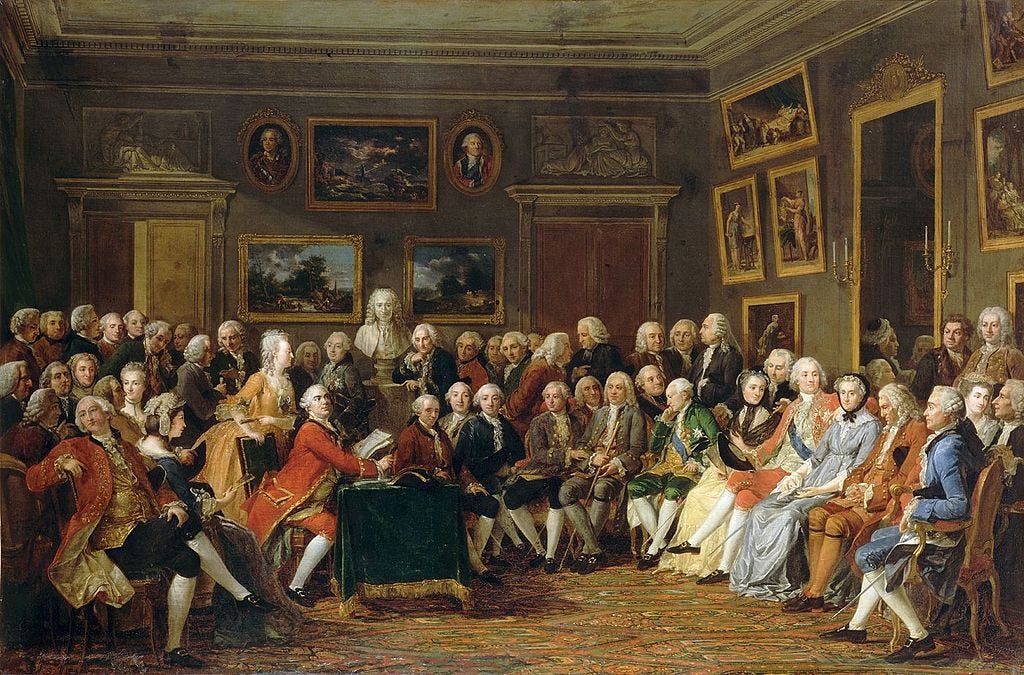
Illuminists in 1755, pondering how to curse their descendants with social media (Source: Wikipedia)
To begin with, I'll summarize the common thesis of a few experts of architecture and urbanism I discovered a couple years ago: non-complex urban systems alienate, dumb down and control both individuals and whole societies, and in extreme cases can even push them toward civil war.
The root reason is that human physiology never evolved to cope with environments that treat even human beings as objects without variety. This is an application of the Law of Requisite Vriety, first expressed by W. Ross Ashby in 1956, which states that "any system that governs another, larger complex system must have a degree of complexity comparable to the system it is governing".
This also applies to cities which, argues N. Salingaros, consist of two complex systems that govern each other.
The first system is the human individuals and society that design and govern the other system, which is the built environment. In turn, that environment governs people and society, because its geometry contains and controls the activities of its users through physical spaces and their psychological impact.
Since Ashby's Law also applies to human habitats, the monotonous, drastically simplified built environments made of non-interacting units that became much more common worldwide after World War II will only sustain equally constrained people, making it easier to mold them into any form.
How are those people constrained, exactly? Today's "optimized" urban spaces (and time), according to M. Marra, prioritize compulsive motion, light, actuality, and reification. They saturate the senses by fostering and constantly mixing roars from the crowds.
This process, says Marra, started with the Enlightenment - a movement that, in order to fight a primeval fear for what is unknown and does not surrender to simplifications, started a programmatic erasure of differences, invisibility and shadows of every kind. Modern cities dematerialize life, reducing human-inhabited space to economics, exchange, and usury value.
This reduction is both a prerequisite and a consequence of industrialization, because uniform places are a much better fit for production, accumulation, consumption, and dissipation.
Still quoting Marra, it is that flattening of urban space that initiated the compelling need for speed, the excess of information, the disaggregation of the social fabric's continuity (via zoning and gentrification), and, on a deeper layer, the atomization of the individual and its severance from every connecting background, including collective memory and narrative.
“Real terror comes from architects”, sang Adriano Celentano in 1981 (English translation here). Would he say the same today?
Going even further than Marra and Salingaros, Syrian architect Marwa al-Sabouni has described in her book "The Battle for Home" and the corresponding TED Talk, how urbanism and architecture direct human activity so much that they can actively contribute to "prime" people for war, or do just the opposite.
Settlement, identity and social integration, says al-Sabouni, are all the producer and product of effective urbanism that, without negating their identities, forces people to respect the diversity of the other people around them, and the mutual interest of living together in harmony.
Designing cities, instead, as though they were the temporary shacks of nomads, takes away continuity and collective memory. That's the same as taking away citizenship, because nomads belong to, and find reference points in, only tribes, not places.
Al-Sabouni illustrates this point by comparing the old and new urbanization of Syrian Cities like Homs and Aleppo.
In old Homs, or Aleppo, drinking fountains on the streets, benches to sit on, and the cool shade of trees nurtured a shared morality and understanding of public goods. Markets with many facing and adjoining shops, a shared route under one ceiling and one sky for all, helped and trained all merchants to be kind. Mosques and Churches placed in the same streets or squares were not affirmations of rival "identities", but signs of mutual accommodation, freeing both Muslims and Christians from ever having to prove their social status through their religions.
Mosques and Churches side by side? Social media this is not! (Image source: The Battle for Home)
Then, modern urbanization took over, destroying those cities before war even began. When the Syrian Civil War started in 2011, almost half of the Syrian population was living inside anonymous concrete barracks, in zones all distinct by class, creed, ethnicity, or other equally sectarian differences, and all disconnected from the city centers and from each other.
Having no pre-existing identity attached to them other than the segregated ones of their new, freshly displaced residents, the new neighborhoods produced social disaffection, social stagnation and introversion.
This segregation divided people who had been previously able to talk with each other long enough to push them into the precursor of actual civil war: a "war of identities based on... a desperate need to define identity not by what everybody shares but by what excludes others".
Digital cities? Same old, same old
At the end of the day, all those experts say the same thing: forcing monotony and fragmentation on human environments is bad, because urbanism based on zoning by class, race, religion and similar criteria can only bring serious instability, everywhere it is practiced.
Reading Salingaros, Marra and al-Sabouni I immediately saw, and wrote the essay to help everybody do the same, truly striking similarities between the alienation and war-facilitating effects of bad architecture and the mental health issues, exaltation of identity politics and political polarization enabled by current social media.
In other words, if today we have toxic social media, it's because we let unprepared people build those digital cities all by themselves, in the same ways that were already toxic centuries before the invention of software: the ways that "prioritize compulsive motion, light, actuality, reification [and] saturate the senses by fostering... roars from the crowds".
Platforms designed to intensify user atomization and exasperation can only produce the same dialogue-killing "desperate need of definition by what excludes others" of urban segregation by ethnicity or any other criterion. "Nomads belonging to, and finding reference points in only tribes, not place" is a great one-sentence summary of the extremes that identity politics would have hardly reached so quickly, without Twitter and other flame-war accelerators.
At the same time, be they physical or digital, ugly, monotonous, and self-segregating places make people sad, angry and easier to control. Just like the alienating cities described by Marra, environments like Facebook, Instagram, Twitter or TikTok, can only make of trust-based communities "the scarcest thing in the world".
How do we fix this mess?
Can we redesign digital cities to make them provide the same benefits of "old" physical cities? Above all, should we? Where? Here are, again from the full essay, the starting points for a discussion we cannot delay anymore.
To begin with, one big reason why people are drawn to digital squares is exactly the fact that their physical ones suck - if they even still exist. Many millions of people "replaced the sidewalk with the timeline" because they have literally no more sidewalks to walk on, or reasons to do it. Digital squares exploit for profit the pre-existing urge to avoid alienating physical places, which is the dumbest thing to do, because democracy is where bodies are.
Speaking of digital squares and cities, instead, the long term solution could be to overcome the very concept of "social platforms" in favor of permanent, personal clouds.
At the same time, it's necessary to acknowledge, together with all the similarities, the crucial difference between bad physical cities and bad digital ones.
In physical slums, segregation and disgregation happen thanks to physical barriers - from zoning to lack of roads or public transit - that prevent integration because they are very visible, and take too much time or money to dismantle, or get around.
In digital cities, instead, (self-) segregation, hysteria and alienation happen exactly in the opposite way: the barriers that would prevent such problems do not exist, while those that make them happen not only are invisible, but take zero time and money to build, while still giving people, through instantaneous "communication", illusions of freedom and self-realization.
The consequence of this fundamental difference is that, in order to become or return healthy places, physical and digital cities must follow opposite strategies.
Physical cities must build or restore among their various communities closeness, interaction and concrete opportunities to really understand and support each other; this means reducing what generates or perpetuates segregation and hostility, like zoning, lack of public transit and so on.
Social media are just warp-speed banlieues
Dgital cities, instead, should do two things: first, get rid of endlessly customizable, but invisible barriers that are way too easy to erect, by both the owners and the residents of said cities, that is (in a nutshell!) profiling and algorithm-driven feeds. The other is enforcing speed limits just like physical cities do.
Instantness, that is the lack of physical limits on quantity and speed of "communication" (NOT on its content, which would be censorship!) but also on the ability to erect walls, is exactly what makes infinitely easier for everybody to get angry, or totally indifferent, about everybody else.
Whatever fringe priority or frustration one may have, being instantaneously connected to all and only the other humans with the same priorities or frustrations, and nobody else, is a perfect digital replica of the "anonymous concrete barracks [each self-segregated] by class, creed, ethnicity, or other equally sectarian differences" that al-Sabouni exposes as "active precursors of war".
The only discourse that this digital urbanism of instantaneous self segregation facilitates is the same, only choice left to the Homs newcomers: affirming identity "not by what everybody shares but by what excludes others."
When scrolling through monotony replaces strolling among variety, and confirmation feedback is instantaneous, nobody ever crosses or stays long enough in any "public reality" or varied place. That's why an essential step to make digital variety real and really "liberating, without top-down control," as Salingaros puts it, may be to just slow down social media, to a speed human brains can handle.
What if every "group comment", that is every single comment to every YouTube video, tweet, Instagram post... did not appear instantaneously to every other users, but five or ten minutes later, by design? (continues here, on page 129).
Thanks for subscribing or… accepting the unusual request below!
More down to earth, the subscription econony just doesn’t work, and cannot work, for enough people. Getting a subscription to every source of content, just to access a few movies or posts from that source would be too complicated and overwhelming even if it weren’t just too expensive (1,000$/year on average in the US? No way!). Hence, my request:
if you find this and my Substack archive promising enough to deserve a paid subscription here, by all means go for it, thanks!
however, in my own personal interpretation of the 1,000 True Fans Theory, I also strongly suggest every reader who feels it would be good to give me as much time as possible to make more of this or similar works, to…
just go for a one time donation for any amount you want, via PayPal (mfioretti@nexaima.net) or LiberaPay (*). No strings attached, no risks of automatic renewals, and the right, affordable price for everybody, that is just what you can and want to chip in right now, subscriptions be damned!
I’m serious. Let’s make this darned “attention economy” sustainable for everybody, shall we? Set an example. Just give me one donation, do the same for every other “creator” (God, how I hate that word…), and let’s hope we meet again sometime.
This is just a note to say that I know I started this big giant series and a regular posting schedule plan and all and then promptly disappeared for three weeks, like a BOSS.
Welp, I got the flu. The bad one that’s been hopping around and takes forever to get its shit together. I’ve been so sick for so long it’s bordering on the ridiculous. Then my child got it.
Then I got it, or something just as nasty which I suspect might have been undetected covid because the brain fog is so bad, again.
Then we got hit with five snowstorms separated by a few days each time, and school more or less gave up because the ice subsumed us all.
And my instinct, when faced with many pressures and deadlines and guilt piling up and a body not co-operating, is and has always been to hide and say nothing so no one will notice the disappointment of me—which is a very good instinct I wholeheartedly recommend and has definitely never steered anyone wrong.
WELL, WE’RE ALL TRYING TO GET BETTER, AREN’T WE?
So: I am only just now wobblingly back on my feet, still coughing eldritch ichor out of my lungs, and will have Move Fast and Break People Part 2 up very shortly. (Just for this series, each part will go up under for paid subscribers only for 24 hours, then open to the public, as I mentioned in Part 1.)
Apologies again, we will resume our regular programming momentarily. Thanks for your patience.
Welcome to Garbagetown is a reader-supported publication. To receive new posts and support my work, consider becoming a free or paid subscriber.
In my new novel Picks and Shovels, we learn the origins of Martin Hench, my bestselling, two-fisted, scambusting forensic accountant who debuted in 2023’s Red Team Blues and whose adventures continued in 2024’s The Bezzle.
Marty’s origin story starts at MIT in 1982, where he joins the proud lineage of computer science students who flunk out of their degrees because they’re too busy hacking code to do their ...Read More
This speech specifically addresses the unique opportunities for disenshittification created by Trump’s rapid unscheduled midair disassembly of the international free trade system. The US used trade deals to force nearly every country in the world to adopt the IP laws that make enshittification possible, and maybe even inevitable. As Trump burns these trade deals to the ground, the rest of the world has an unprecedented opportunity to retaliate against American bullying by getting rid of these laws and producing the tools, devices and services that can protect every tech user (including Americans) from being ripped off by US Big Tech companies.
I’m so grateful for the chance to give this talk. I was hosted for the day by the Centre for Culture and Technology, which was founded by Marshall McLuhan, and is housed in the coach house he used for his office. The talk itself took place in Innis College, named for Harold Innis, who is definitely the thinking person’s Marshall McLuhan. What’s more, I was mentored by Innis’s daughter, Anne Innis Dagg, a radical, brilliant feminist biologist who pretty much invented the field of giraffology.
But with all respect due to Anne and her dad, Ursula Franklin is the thinking person’s Harold Innis. A brilliant scientist, activist and communicator who dedicated her life to the idea that the most important fact about a technology wasn’t what it did, but who it did it for and who it did it to. Getting to work out of McLuhan’s office to present a talk in Innis’s theater that was named after Franklin? Swoon!
Since February 5th, 2025, a document warning about Curtis Yarvin and the Silicon Valley led coup attempt has been circulating among think tank experts and DNC employees. The document is titled “The Imminent Neoreactionary Threat to the American Republic”. It opens with a statement that the brief was, “iteratively and collectively compiled by a broad, bipartisan, and decentralized network of experts who wish to remain anonymous due to concerns about being targeted.”
Thanks for reading Shatter Zone! Subscribe for free to receive new posts and support my work.
The title of the actual file when I received it was “Evidence_Brief_for_Journalists”, and the introduction describes its aim as “explaining the nature of the current political crisis to journalists who are attempting to inform the public.” This would lead one to think the document was largely written for the benefit of the press.
However I spoke with two sources who are members of these groups and received the document. They told me that to their knowledge the document mostly spreading among people you might broadly refer to as “policy wonks”. One source I interviewed explained: “It is a thing for think tanks to frame overviews for laypeople as briefs for journalists or congress, see the IPCC reports. Part of me thinks the framing ‘for journalists’ is just a shortcut for ‘this is somewhat specialized knowledge broken down’”.
The paper opens by acknowledging the scope of the executive power grab being perpetrated under President Trump, and the destabilization wrought by Elon Musk and his DOGE team. It then notes, “the threat is an order of magnitude beyond” just a presidential power grab. Musk, it argues, is tied to a “broader group” of Silicon Valley tech elites, including Peter Thiel and Marc Andreessen, who seek to end Democracy. Curtis Yarvin is labeled a “thought leader” in this group, “called the Neoreactionaries”.
I will stop here to note that this summary is accurate enough for mass consumption. But I have some issues with it. Musk probably would not label himself a Neoreactionary and does not have much of a history with Yarvin. Peter Thiel does, but it’s more a relationship of patronage than mutual influence. It would be more accurate to say that Thiel and Andreessen find Yarvin useful, because of his success in spreading to a lot of young techie kids the idea that CEOs should run the world.
Musk, I feel, has largely jumped on this bandwagon because those kids are useful foot soldiers. Yarvin’s ideas about “retiring” all government employees and destroying the independent media and academia are convenient for his own ambitions. This context may be unnecessary for explaining the danger to regular people, but I think it is a mistake to credit Yarvin with more power than he holds.
The document refers to him as the “leader” of the Neoreactionary Movement. I would not advise ignoring his influence and centrality here, but Yarvin is not dangerous because of his leadership abilities.
That all said the document sums up the threat quite well: “The Neoreactionaries have openly stated their aims: to destroy the nation-state and the Constitutional order and replace them with a new privately owned corporate state, to be run by a CEO-dictator. Citizens become subjects owned by the state – ‘state slaves’ - because ‘everything rots when it has no owner—human beings included’.”
Those quoted lines are, of course, Yarvin’s. From here, the document argues that Musk and his team are attempting to bring about this dystopia by taking over the “nervous system of the state”. These would be the data and communications systems DOGE is trying to centralize in its unaccountable hands. Next, the authors of this document make a call to action:
“The most dramatic reversals of democratic breakdown (1977 India; 2022 Brazil; 2023 Poland) have been accomplished by radically large-tent, cross-ideological coalitions with little in common except a desire for the continuation of a Constitutional order. Evidence suggests that the present threat to American democracy is dire enough that such a broad-tent approach focusedon Musk and his associates may be required.”
This is the most interesting and hopeful part of the whole document for me. For one thing I think it accurately states what is needed in the present moment: a popular front against autocracy and dictatorship. (I would add to their list of relevant examples France from 1934-38.) It is heartening to see evidence that this understanding has started to grow within the DNC policy set.
The source who sent me this document in the first place described themselves as a member of “a few unofficial networks of climate activists who are high ranking in the government and policy / think tank circles”. They noted that these are normally “very milquetoast lib spaces” but “they’re being radicalized” rapidly.
Both sources I interviewed for this requested anonymity. The second person I talked with gave an explicit reason: “…I’ve suspected for a while a lot more things in DNC stuff was compromised than people were comfortable with”. In other words, they believe the Republican Party has spies within the DNC. My sources worried these “GOP moles” might retaliate against them, but moreso they worried the document itself might contain false information, meant to provoke a reaction that would be useful to Republicans.
While I think this caveat is worthwhile, I should also note that I have spent more time than most studying Curtis Yarvin and the Neoreactionaries. Nothing in this document struck me as obviously false or incorrect, nor did the tone seem hysteric or unreasonable.
I asked my sources if over the past month they’d seen more people talking about Yarvin in their daily lives, which involve communicating and working with DNC staffers and politicians. One said, “No” and “That’s kind of one of the odd things to be frank. This guy is being brought to big events in D.C. He’s been referenced by Bannon and Vance. I have heard his talking points come from Republican mouths but he’s largely not tracked.”
It is noteworthy, then, that influential individuals in the policy space, with connections to Democratic politicians and the DNC as an organization, have started a grassroots effort to spread the word about Yarvin as a threat. It is even more noteworthy that this document is unsparing about the danger, and the fact that a clock is currently ticking over all our heads:
“If non-governmental actors (by which we mean unelected, unratified, unvetted, untrained, unconstrained, and/or unaccountable actors) gain access to key digital infrastructure, they can seize control of critical functions of government in ways that will be difficult or impossible to reverse.”
In a section titled “National Security”, the focus shifts to Elon Musk, who it claims “poses a uniquely significant security risk”. This is because Musk and DOGE espouse “anti-Constitutional ideologies” and “are under the influence of America’s principal foreign adversaries (China and Russia)”. It goes on at some length about Musk’s foreign business interests and how they might compromise him.
I don’t disagree that he is compromised, but I see his actions as very much consistent with those of a man seizing power for himself. I think it would be a strategic mistake to focus popular messaging around this in terms of how it empowers “America’s principal foreign adversaries”. The primary adversary Musk has empowered is himself, and he is now a greater danger to every citizen of the United States than any foreign government.
The next section of the paper days out the definition of a coup:
“In essence, a coup is a 1) rapid seizure of state power by unelected actors, who acquire that power by 2) seizing critical government infrastructure and 3) weaponizing it to neutralize legitimate government actors'efforts to stop them. The unelected actors then use this power to 4) remake the rules of the political game in a way that cannot easily be checked or undone through democratic processes.”
It argues convincingly that all four of these steps are underway now. One thing I found compelling is the way it recognized the threat cryptocurrency represents right now, and how it can and will be used by the new regime to cement their power in ways that sidestep the present legal system:
“Without canceling elections, for example, cryptocurrency can be used to create informal but powerful new levers of political influence: politicians can sell personal coins to unknown buyers who "vote" on public policy on the basis of their shareholder power, shielded from public view.”
Next we have a summary of the Neoreactionary Agenda, which lists some additional names among the Silicon Valley elite currently championing an overthrow of democracy. These include David Sacks, Balaji Srinivasan and JD Vance. Also name-dropped is political theorist Nick Land, who is referenced twice in the paper.
The authors next lay out Yarvin’s concept of the “Butterfly Revolution”, based on an essay he wrote in 2022 laying out how a “full reboot” of the U.S. government could be accomplished.
Subsequent pages summarize the first days of the Trump administration and DOGE activity and show how they comport with the “Butterfly Revolution” blueprint.
We’ve all lived that in real time, so I won’t summarize their arguments here. The document does end this segment with a section on “Actions and Rhetoric to Watch”. First are government contracts, which fund many of Musk’s companies at present. Next is “Greenland and Mars”:
“A core tenet of neoreactionary ideology is the replacement of nation-states with "network states." But states require territory. Technocracy Inc., a predecessor to the Neoreactionary movement whose one-time director was Elon Musk's grandfather, proposed a North American Technate where the entire continent of North America would be united under one Technocratic Super State. There is currently a Peter Thiel-backed "network state" project called Praxis in Greenland. Musk's public statements about colonizing Mars also can be read as part of a territorial project.”
Lastly it lists Crypto, which the authors primarily seem to fear as a method of deniably bribing Trump.
Overall, the document is thorough in its layout of the Neoreactionary ecosystem, and the actual plan currently being enacted to end U.S. democracy. It includes a section that lists several of the earliest known DOGE employees, and quotes extensively from Yarvin and less extensively from Land.
The paper’s ultimate conclusion is that Musk is using this moment to turn himself into the kind of unitary all-powerful executive Yarvin longs for, one who rules alongside a largely “ceremonial” President. Congress and the courts would also be “ceremonial” at best in this new order.
Again, I do not believe Musk is particularly well read on Curtis Yarvin’s work. But Yarvin’s dream of a CEO-King ruling next to a puppet president gels with what some of Elon’s confidants have described as his ambition. A recent Vanity Fair article quoted a “close associate” of Musk’s from Silicon Valley. He told them:
“Elon believes he should be emperor of the world, and this is his way of showing people what he’s capable of as emperor. He truly believes his way of handling the world is the best possible outcome for everyone in it.”
The last few weeks provide more than enough proof that the authors of this document accurately understand the danger we are in. Unfortunately, aside from the suggestion of a popular front against dictatorship, the document is short on solutions. There is one line that promises: “Section III articulates what Congress and other actors can do” to stop Musk.However, the document in its present form does not include a Section 3 or any comprehensive suggestions.
If the situation weren’t so dire, I might find that funny.
Note: Welcome to WTG’s first multi-part series! As promised, this Substack will now post regularly, at least twice a month. Normally, the way this works is that every public essay has a follow-up piece for paid subscribers that gets into things I ran out of space for or are too spicy to deal with the inevitable sea-lions in the comments.
But as I worked on this series, I really didn’t want to put any of it under a paywall. It’s one of the biggest things I’ve tried to say outside of fiction, and, given the enormity of everything we’re going through, I wanted anyone to be able to read it in perpetuity. I wanted to discuss it with anyone. Unfortunately for us all, I also want to eat and stay warm and feed my family. So, just for this series, each part will go up for paid subscribers only for 24 hours, and then I’ll open it publicly and keep it that way.
Happy International Bloodfeast Season, fellow shattered husks of thinking human beings! Here we are on the flipside of several deranged politico-cultural orgies of pain, and I don’t think it’s a terribly scalding take to say, details aside, in a holistic, big-picture, view from 10,000 feet sense, that shit’s not right.
Really not right. Surreally so. I’ve personally spent this dry-heave of a year so far feeling like Han Solo; not the heroic, dashing, man of action part, no, no, perish the thought. The part where he spent like a goddamned year frozen in carbonite hanging on a filthy bathroom wall while who knows what kind of 24/7 grotesque violent slime-n-crime worm-orgy went on around him.
Aw, fucking hell, he’s doing that thing with his tail again
No one wants to see any of that shit, but it’s happening anyway, it isn’t going to stop, it’s oozing and moaning right there in front of you, and you physically can’t close your eyes or move away or do anything about it until some unspecified time in the future that may or may not actually arrive, so you just hang there stuck in a timeless helldream limbo of unending horror while a fat slobbering barely-verbal rapist crime boss stuffs his face with garbage, shreds people for entertainment, and somehow stays in power despite visibly doing fuck-all to run a government.
HAPPY VALENTINE’S DAY EVERYONE.
It’s hard to know what to say about it all. It’s hard to even know where to begin. It’s hard to keep up with the Macy’s Parade of “unprecedented” pit-sludge that may or may not end us all. Just getting through each and every gom jabbar of a goddamned day around here requires a level of dissociation and compartmentalization the human brain usually reserves for abuse, war, loss, severe injury. Only now we have to go all the way to deep trauma responses just to scan the headlines in the morning, or, occasionally, walk into a restaurant with the pure sadistic audacity to air the news on the TV behind the bar.
What’s in the box? BREAKING NEWS
So I want to talk about something bigger than the Regular Morning Horror Breakfast that will be out of date by the time I finish writing this. Because really, it’s not just the crusty worm on the big murder-chair. Or his nasty little shrieking sidekick. A lot of shit isn’t right. It hasn’t been right for awhile. It’s easy to point to COVID, that massive unresolved trauma we’re not even allowed to talk about anymore, let alone remember or process in any infinitesimally small way, but shit, in the grand, Sagan-esque, universal sense, was upside-down in its mortgage on reality long before that. COVID just tried to cash a payment on that mortgage and found an account that long ago ran dry.
So what happened? Because it’s not actually Trump per se. Trump isn’t even just a symptom. He’s not the reason we’re so clenched up and angry and self-loathing and paralyzed and isolated from each other, he’s just the baseball bat with a nail shoved through it a bunch of folks grabbed to take it all out on someone. Anyone they can find. Even if they couldn’t tell you exactly what they’re taking out on everyone around them.
Babies, what happened to us?
Well, gather in, children: Granny Minnesota is here tell you another tale of the Internet Olden Times. And it’s a beast of a tale. Approaching a Grand Unified Theory of What the Fuck Happened. I started writing this six weeks ago, and it’s grown and grown until it was forced to become a multi-part series due to Geneva conventions regarding the length of self-indulgent, navel-gazing, insufferably meta blog posts on the internet about the internet.
So. Bear with me.
Wouldn’t be an old lady story without a bunch of meandering nostalgia, kittens
Once upon a time before the invention of the wheel, we had no choice but to watch commercials to get to our scheduled units of televisual entertainment. And they didn’t just air before and after the show! Goodness no! Repeated every 6-7 minutes, taking up fully one-third of the show’s timeslot! Nor were they specifically targeted to our interests and buying habits by a massive data-mining operation that inadvertently, or possibly advertently, ended civilized society! No, no, my pets, these were the same commercials, blasted out blindly to every household from Manhattan to Modesto, with minor variations for large designated market areas, taking up 23-28 minutes of every single hour of broadcast television. I literally grew up seeing ads for a particular fast food chain that had precisely zero locations in my home state, and dagnabbit that’s how we liked it! (Spoiler: no one liked it.)
But the upshot of all this marketing monoculture was that, every-fucking-body, down to the smallest child, knew the longer-running slogans and jingles by heart, and they became something like memes today, used as punchlines, shorthand, and socially-lubricating references signaling in-group membership.
One of the more famous came from the, at the time, very popular Folgers’ Instant Crystals. Not just plain old iguana-bile Folgers’ Coffee, mind you, but the even more demonically foul instant crystals, made by taking an industrial vat of coffee leavings drained out of the drip-grate below a 7-11 coffee dispenser on the banks of the fucking Styx and freeze-drying it into poop-crumbs of total despair.
I don’t know what to tell you. No one told Americans what a latte was until like 1994. Then Americans immediately said coffee that tasted good was a gay liberal plot. We’ve just…always been like this.
The commercial opened on a fancy restaurant full of linen tablecloths, wine glasses, candles, a rack of lamb served with those white scrunchees on the top bits, and young sophisticates, presumably talking about books or foreign films or whatever while they waited for podcasts to be invented. The announcer walks through a haute-cuisine kitchen, saying in an authoritative newscaster voice, as though we’re about to witness a cutting-edge social experiment: We’ve secretly replaced the fine coffee they ordinarily serve with Folgers’ Instant Crystals. Let’s see if they notice!
You’ll never believe it, but they do NOT notice! All the young professional folk rave about how amazing the coffee is, how rich and robust they find the taste, how they simply cannot believe it’s Folgers’ Instant Crystals omg you guys just empty that can of dry-ass caffeine sprinkles directly into my discerning patrician mouth! Screw the real thing! I just can’t get enough of bitter awful freeze-dried science-droppings!
And now it’s a modern meme shared by people too young to ever have seen the commercial! THE CIRCLE OF FOLKLORE.
So anyway, I’ve been thinking about the election a lot lately. CAN’T IMAGINE WHY. Not in terms of what’s going to specifically happen over the next many months and years, or what’s happening literally today, because I think it’s being made pretty resoundingly clear how little any of us down here in the vomitorium can do about that, but in terms of what’s been happening for the last twenty years that got us to November 5th, 2024. To a place where no one seems to particularly care about the concept of any kind of objective truth existing anywhere, accelerationism and nihilism are the Pantone colors of the year, and giving a shit about anyone else is regularly punished at the ballot box. To this carnival of shit in which we’re all now forced to live, an unending janky Gravitron Wheel O’ Chaos spun up to Intestine-Extraction speed and the only music is screams. Every few hours, the wheel spins, and the flashing neon arrow selects a different soul-slurping subterranean clown-wendigo to be in charge of some massively important part of all our destinies, just as long as they know absolutely nothing about that part specifically, and the only person seeing any kind of consequences for doing a chaos is the guy who denied a CEO’s claim to life on the grounds that being a fucking monster is a pre-existing condition.
As the children say, we’re cooked.
Though I’m not sure how many of the people obsessively over-using have considered that once something is cooked, it’s not exactly finished.
Traditionally, the next step is being devoured. With relish.
And that doesn’t exactly seem like a sustainable situation for humanity, but the general reaction to it all, not just post-election, but for awhile now, to a lot of events, even as things start to completely fall apart at the seams, seems to just be minor variations on the sentiment of Maurice Sendak’s Pierre:
Great work, everyone. Really top notch.
And that old coffee commercial keeps popping into my head.
Because I think that’s what happened. The big gnarly rootball at the bottom of the many, many seemingly unrelated branches of what’s still happening. What has almost zero likelihood of slowing down or unhappening anytime soon. Slowly, inexorably, profoundly, thoroughly, and on purpose. We hunted down every part, down to the scraps, of normal human everyday life, down to the most basic social, commercial, political, logistical, financial, educational, parental, informational, psychological, romantic, religious, military, technological, artistic, and familial interactions, and secretly replaced them with the internet.
And for a long time, because it was slow, and because it did make that humdrum normal everyday life so much easier, so much faster, so unfathomably more convenient, and even, god help us all, more diverting and exciting and personally validating, hardly anyone noticed. When we finally did start to catch on, we all sat around raving about how much better it was than the old world, how rich and robust and almost exactly like real life it tasted, how excited we all were to make the switch, how young and urban and professional and haute we all were for taking to it so easily and just vigorously motorboating the future with such uncritical enthusiasm.
Come on, guys! It’s new! It’s Science! It’s fun! It makes everything fast and easy! There could never, ever, be any downside to this, or any, new technology!
Now, this isn’t about enshittification. At least, not exactly. It isn’t about the tendency of all systems to rot and self-corrupt in the presence of dipshits who look at human beings interacting and only see financial opportunity. Because…that’s what dipshits do. They’ve been doing it to every new system that pops up since Uruk and Jericho. Some percentage of humans are just born assholes. You can’t really stop that or change it beyond nudging the Rate of Asshole Production up or down a bit, which is why communism works so nice in your head and so horrifyingly in real life. The existential malfeasance of that problematic population of resource-greedy psychopaths is a problem, but it’s old news. It’s consistent. You can set the watch they sell you by it. And it’s practically boring in comparison to the voluntarywholesale replacement of human-to-human life with intangible digital gladiatorial combat.
We, as a species, simply were not ready for the internet. We, as a species, were not ready to spend our waking hours inundated with the interior monologues of billions of other beings piped directly into our brains as though they were our own. Especially when those thoughts, just because existence is hard and sad and fucked up and weird and no one really escapes that for more than a couple of hours at a go, are more often than not, the thoughts of beings in pain, facing the future with extreme anxiety, desperate to feel seen and loved, desperate to not feel helpless and lost in the face of vast forces, beings who felt invisible and alone for most of their lives, suffering in ways large and small, most of the time.
My first grader has mispronounced “screens” as “screams” since they were three. I’ve never corrected them because it was cute and they’ll say everything in the usual way forever soon enough. But…they’re not wrong. We are being screamed at all the time. We are screaming all the time.
And the screams are our major source of entertainment.
There’s a reason every TV show that does an episode about someone suddenly getting psychic powers depicts it as an absolute mind-shearing hell. It is, and now, that Sea of Screams is humanity’s home. Just trying to exist while constantly being mentally hammered with the cries and wails and bitchy petty complaints and narcissistic judgments and pleadings for love (in one form or another) of all mankind will literally make you fucking crazy and it will do it incredibly fast. At no point has anyone suggested having a shit-ton of voices in your head is a good and healthy thing for a happy, fulfilling life on Planet Earth, but these days we all have a shit-ton of voices in our heads 24/7 and they never, ever stop screaming.
We made a hive mind. We did it too soon and too fast, and it’s eating us alive. Back in the old digital days, people used to talk a lot about the Singularity—a future event or technology that would change the world so fundamentally and radically that it’s simply impossible to imagine life afterward from the vantage point of life today. This was often applied to true, sentient AI or other science-fictional concepts, but the truth is, while we early-adopting children of the computer age were having those conversations, it was already happening all around us, so truly transformational we couldn’t see the water for the ocean.
The mass adoption of the Internet was the Singularity. People still talk as though the Singularity hasn’t happened yet. That without flying cars and affordable interplanetary travel opportunities, we can’t possibly have arrived at The Big Future already. But we’re long past it, into the Previously Unthinkable Mess Beyond. Of course, as William Gibson said, it’s not evenly distributed, some of us are less online by choice or circumstance, but COVID took the last band-aid off by confining everyone in their homes, and the powers that be keep chipping away at the option to live mostly offline.
Think about what we’ve done with the 21st century. We took almost every job, every form of entertainment, every logistical task, every virtue and vice, every path to forming a personal identity, every simplest transaction between living beings or previously unavoidable reason you had to interact with another living being, every way of actually meeting and creating a connection with another living being as well as every method we ever came up with to maintain connection with other living beings, and either moved them entirely online or made the internet such a massive, mainstream sidecar to such units of social structure that trying to accomplish it all offline requires extra, dedicated, conscious effort or privation. And possibly a detailed mission statement just to underpin a personal philosophy of maybe putting your phone down sometimes.
You know, back in the time known as the Age of Folgers Instant Coffee Crystals, people used to be, generally, fairly concerned with how much TV everyone was watching when I was younger. Rots your brain, don’t you know. Makes you lazy and passive and stupid. Kill Your TV was a major movement. Bumperstickers, posters, the whole nine.
No one ever says Kill Your Computer, Kill Your Phone, Kill Your Internet Connection. Because we can’t. Our entire culture is tentpoled around internet access. It’s been inserted into even the smallest interactions, not just between humans, but between humans and everything.
At the risk of crumbling to dust before your very eyes, I do not know how to explain to any young person the sheer number of other human beings we used to have to interact with, on the phone or in person, in a baseline socially competent manner, just to get from one end of the day to another.
To deposit your paycheck. To pay a bill. To purchase anything. To get a refund on a product. To speak with any incarnation of customer service. To get a bit of advice on childrearing or fixing a leaky faucet. To address any sort of issue whatsoever with anything. To plan a vacation. To put gas in your car. To insure that car. To choose classes for the next semester. To get a nice family photo taken. To apply for a job. To excel in that job or ever hope for a promotion. To organize for a cause. To get food delivered, if you even could. To share your thoughts on recent elections or a new film with someone outside your immediate family.
You stood in a line and you waited and then you talked to someone, and if they didn’t like they way you handled any of that, if your social skills weren’t ready for prime time, well, you might just…not get what you needed. At all. And if you didn’t like the way someone else was behaving toward you, you didn’t really have to give them what they needed, either. You had to make it work using human psychology, rhetoric,
It all used to require human beings, face-to-face, or at least mouth-to-ear, and so most people encountered and had to learn to deal with, many, many different kinds of other humans in their environment. That was how, by and large, people met romantic partners, friends, that famous “guy who knows a guy.” Mutual connections, co-ed classes, and just…interacting with random strangers all day every day.
Sure was, bud.
It was exhausting! We were thrilled to be able to do a whole heap of that annoying everyday crap automatically. IT WAS FUCKING GREAT. It saved so much time, so much energy that we could use for activities! I’m not a Luddite here, I’ve been terminally online since before we had a word for that. No one did anything wrong by cannonballing into the digital age before actually learning how to swim. That’s how tragedy works. Nor do I honestly think there was ever any real possibility that we wouldn’t embrace that gargantuan level of convenience. It IS easier to do things online, other people are fussy and difficult and there’s a lot of rules and even if neurotypicals don’t call use the word, they still mask, and it’s annoying to have to do it all the time.
We took to the internet like fish to bleach. But damn, it sure did look like water for a long time.
And then, having steadily, determinedly, removed or made voluntary so many of the tiny ways in which you were forced to behave yourself toward others, even so much as talking to your taxi driver to tell them where you wanted to go or checking out at the grocery store or ordering food at a restaurant, we stood back, very proud of ourselves, we liberal digital folk, and told everyone to care A WHOLE LOT about the person next to them. More than they care about themselves, in some cases. To protect those others, to value their issues, problems, and needs equally to our own, and to vote that way.
The problem was, as a great many people looked to one side and then another, there was no one actually, physically next to them anymore.
The internet has become the lens through which Other People can be seen, heard, understood, and interacted with, and on a good day, 78% of the internet is a goddamned Jacobean nightmare parade of lies, scams, rage, and a howling labyrinth of the opinions of maladjusted dopamine addicts who may or may not be 13 years old, or fuming after a fight with their spouses, or in the depths of despair, or a content-scraper, or addicted to conflict because they’re desperately lonely, or employed specifically to piss other people off as efficiently as possible, or a really nice person trying to have an intellectual conversation, or fucking AI, and there is no way for the human brain to tell the difference between any of these at a glance.
People are not good at caring deeply about abstractions. They are extremely bad at valuing others’ needs over their own wants, but catastrophically bad at doing that when they don’t actually have to physically see those scary, weird, oh-so-different others with their own gooshy corneas. This is a huge part of why cities are usually blue and rural communities usually not; because in cities you still have to acknowledge the existence of, and navigate through, millions of real, thinking, breathing, sweating, yelling people who are nothing like you.
Not only did we make a hive mind way too soon, but we also jumped several guns on uploading our minds to servers and abandoning the meatspace. Because we can’t abandon the meatspace yet, but we all went ahead and put our brains in digital jars anyway.
The internet turned most of human existence into a series of abstractions viewed through a 6x3 inch black rectangle with a heart of lithium and sadism. And the guys who have been able to live longest in a cozy bubble of convenience, instantaneity, and constant stimulation without the annoyance of having to deal other human beings or see them as anything but flashy lights on a fashy screen, are the malevolent, solipsistic Silicon Valley Smaugs who built the abyss in which we’re all drowning, brick by fucking brick, and are even now ransacking our government for virtually no one’s benefit, not even, ultimately, their own.
No one can care too much about things they don’t have to deal with pretty regularly, not even the best of us, which that tech most certainly are not. Unfortunately, by making it so easy to not deal with other people at all, we kicked the legs out from under the barest concept of society itself being a pretty good thing we should probably not set on fire for the clout.
Beep, beep, babygirl.
Over the next several weeks, this series is going to look long and hard at what we’ve done to ourselves and why, exactly what the internet has and hasn’t replaced, the effects of it all, expected and unexpected, the little UI tweaks and algorithmic adjustments that might have fucking ended liberal democracy, and what the hell we can do about it now.
I don’t know about that last one. Maybe. I’m hoping. If we’re lucky. And I have enough Folgers’ Crystals on hand.
Because maybe the smartphone was humanity’s gom jabbar, and we failed by passing. Put your most vulnerable self in this shiny black box, connect to the person on the other side of it, and experience unfathomable pain, but also unfathomable reward. You’re only a real person if you keep your hand in the box. If you pull away, you might as well’ve never existed.
I doubt even Frank Herbert could have imagined Paul rocking up to the space nun the next morning and asking to have another go at Happy Fun Box. Let alone rolling over in bed and grabbing it first thing. But we got so used to the pain only the reward remained: the confirmation that we’re human, we’re real, we’re seen, we’re valued, at least by someone, somewhere, for something, even if it’s dark and awful. Once you have that, it does feel like dying to disengage.
And a little while after that, the weird fascists who made the box don’t even need the needle at our necks anymore.
Welcome to Garbagetown is a reader-supported publication. To receive new posts and support my work, consider becoming a free or paid subscriber.
The government of two weeks ago no longer exists. We are now in a fundamentally different country.Under the authority of President Trump, Elon Musk is leading a de facto cyber-coup of the United States. Using the intentionally vague and unaccountable “Department of Government Efficiency,” Musk is seizing control of the United States’ critical digital infrastructure, literally rewriting the code that runs our country, and culling the federal workforce.
Using the justification of removing government bureaucracy, Musk and the Trump administration have installed their own batch of bureaucratic tech oligarchs, made up of former Tesla and SpaceX interns and engineers, Thiel Fellowship researchers, Palantir employees, eugenics enthusiasts, and Nick Fuentes pilled groypers.
Thanks for reading Shatter Zone! Subscribe for free to receive new posts and support my work.
Career employees have been locked out of their respective agencies, both digitally and physically, as the DOGE team ransacks various departments and accesses wide swaths of sensitive government data. Agency officials who tried to resist Musk’s seizure of classified materials have been fired, and more federal employees have been put on leave, including the entirety of USAID. This effectively amounts to Musk abolishing the whole department, all without congressional authorization or oversight, not even an executive order from Trump that exceeds presidential authority. On a whim, the unelected Elon Musk decided to carry out the closure of a government agency. He is far from finished; DOGE has hijacked the Treasury to withhold authorized payments to multiple agencies.
Elon Musk has personally directed the General Services Administration to terminate leases on “mostly empty” federal buildings. The GSA, essentially the landlord of the federal government, was one of the first agencies to receive Musk’s “Fork in the Road” deferred resignation letter offering to buy out the entire workforce. The legality of the letter is uncertain as it promises to pay out currently unappropriated funds. IRS workers who accepted the resignation offer have already been asked to return to work until May.
The newly appointed GSA commissioner, Michael Peters, a private equity executive that specializes in downsizing corporate real estate, has decided that “non-DoD federal building space should be reduced 50%,” according to a GSA employee who requested to remain anonymous. On top of planning to cut the entire federal portfolio by half, DOGE is seeking to cut GSA’s own budget by as much as 50%, with talk of consolidating GSA offices to a few major cities using a “hub model.” Wired reports that DOGE staff may be trying to use White House IT credentials to access GSA computers remotely.
An anonymous GSA employee claims that few people at the agency have elected to take up the voluntary paid resignation offer, with those who have mostly being of retirement age. High-level Trump appointees used “scare tactics” in agency emails, pressuring career employees to accept the deferred resignation offer, warning that cost cutting measures will eventually lead to a further “reduction in force.” Employees are concerned that a reduced workforce would result in federal buildings losing their operations and maintenance contracts, with disastrous consequences for the functionality of government buildings. “The brain drain is going to cripple our ability to maintain the buildings, even more than it already was. We aren’t overstaffed,” per a GSA employee.
“I think this process is already too far along to stop,” adding “I’m hoping we just need to get to the midterms.”
What is happening across the federal government right now is unprecedented. But this is not Germany in the 1930s; it’s not the fall of the Soviet Union. We grasp at analogies to help contextualize current events that escape understanding. There are similarities, but what’s happening is new, very American, and very 21st century. In 50 years it will be talked about in the vein of ‘What happened to the United States in the mid-2020s.’
Rhetoric of cutting red tape and breaking federal bureaucracy has been common political claptrap for decades, and previous efforts have largely been all bark and no bite, but now there’s been a huge chomp. So why now?
DRAIN THE SWAMP
Trump has blamed entrenched federal bureaucracy (or the ‘deep state’) for preventing him from enacting sweeping change during his first term. The obstacles Trump encountered didn't just come from Congress and the courts, but rank-and-file government workers who run the day-to-day operations. Last month the far-right America First Policy Institute published a report titled Tales From the Swamp: How Federal Bureaucrats Resisted President Trump. The author, James Sherk, a former Heritage fellow, credits “hostile career employees” for “refusing to implement policies.”
“Many career employees refused or defied directives, withheld information, slow-walked projects they opposed, performed unacceptably, and used strategic leaking to undermine the president’s agenda,” writes Sherk.
Trump himself realized this late into his first term and sought to remedy the problem by revoking civil protections for tens of thousands of federal career employees, reclassifying them as at-will employees under an executive order called Schedule F. This allowed Trump to treat large swaths of federal employees as political appointments. In his article for AFPI, Sherk refers to career removal protections as a “modern invention that protects entrenched bureaucracy.”
Though Biden repealed Schedule F, Trump effectively reinstated the order on the first day of his second term. Trump promised to restore his authority to “remove rogue bureaucrats” back in early 2023 under his Agenda47 plan, vowing to “wield that power very aggressively.”
When Trump first ran on “drain the swamp” in 2015, he was referring to corporate lobbyists, special interests, and Washington corruption. But now the term is used to deride the so-called “administrative state,” federal agencies, regulatory boards, and bureaucratic career employees that maintain the basic functionality of our government. Both Schedule F and DOGE are part of a two-pronged assault on the administrative state, all in service of consolidating then amplifying executive power.
Trump has fully embraced the unitary executive theory, proposed by the likes of Russell Vought, Project 2025 co-author and the newly confirmed director of the White House Office of Management and Budget. Although it’s understood that Congress has “power of the purse,” under unitary executive theory Trump now believes that the funding appropriated by Congress does not need to be spent; rather, the executive branch controls the flow of federal spending, and Congress merely “sets a ceiling” on spending that the executive must not exceed.
Under this interpretation of the Constitution, the President has sole and complete control of the Executive Branch, including all its agencies and departments. But others, like JD Vance and Elon Musk, could be pushing Trump to go even further. To where “the President considers both the judicial and legislative branches purely ceremonial and advisory,” in the words of New Right philosopher Curtis Yarvin.
And arguably we are already well on our way to that point. This centralized executive power allows the Executive Branch to achieve goals I would have previously considered quite lofty. I’ll outline two examples pulling from the aspirations of the modern conservative movement.
BYE BYE FBI
Though the Right has typically been thought to be firmly in the “back the blue” camp, this isn’t always the case, especially on the more extreme end. The far-right “militia movement” has long clashed with federal law enforcement agencies like the FBI and ATF. In the aftermath of January 6th, many MAGA supporters found themselves at odds with the Federal Bureau of Investigation. Republican politicians began to feed into right-wing uproar surrounding the FBI as Trump himself became a target for investigations.
After the Mar-a-Lago raid in August of 2022, Marjorie Taylor Green tweeted "DEFUND THE FBI!" Arizona Rep. Paul Gosar joined in attacks on the bureau, posting, “We must destroy the FBI. We must save America."
That same month, right-wing columnist and podcaster Liz Wheeler published an op-ed titled “Abolish the FBI,” which called to “farm out the vital functions of the FBI and raze the rest.” The New-Right publication Compact Magazine featured a slightly better written article by the same title, “Abolish the FBI.” At CPAC in March of 2023, Matt Gaetz advocated to get rid of the FBI, among other federal agencies.
In April of 2023, Trump joined in calls to defund the FBI after being charged with 34 felony counts of falsifying business records. Next month, two former FBI employees testified in a congressional hearing, accusing the bureau of “weaponization” against conservatives in regards to January 6th investigations. The same two former FBI employees, who had their security clearance revoked after espousing J6 conspiracy theories, later called to “abolish the FBI” at a Heritage Foundation symposium on the “Weaponization of U.S. Government” in April of 2024.
During a live episode of Donald Trump Jr.’s podcast on July 8th, 2024, he called to abolish several federal agencies starting with the FBI, as well as the CIA and IRS.
The Trump admin has already begun the process to dismantle large swaths of the FBI before Kash Patel has even been confirmed by the Senate. Eight top FBI officials have been fired or forced to resign by order of Acting Deputy Attorney General Emil Bove, despite resistance from Acting FBI Director Brian Driscoll. A questionnaire was distributed to FBI supervisors requesting agents provide information pertaining to their involvement in the January 6th investigations; this was believed to be used for the targeted removal of agency personnel.
Last week the FBI handed over a list containing the information of 5,000 employees and agents who worked on the January 6th investigations. FBI leadership initially chose to withhold employee names; in response, Bove accused the FBI leadership of insubordination. This was ultimately a fruitless effort as data seized by Elon Musk’s DOGE team could easily match employee IDs to names. Trump has since agreed to not publicly release the names of agents until at least late March, as lawsuits continue, and is required to give two days notice if the administration chooses to disclose names.
But individual agents are still worried. An anonymous letter from an FBI agent warns, “Currently, there is an effort to cull a significant number of career Special Agents from the Federal Bureau of Investigation.”
Around one third of FBI agents were told they would be placed on leave, according to a government source who spoke on the condition of anonymity. FBI employees have lost access to systems only to later regain access, while others were told to wait to find out their employment status. Agents are now trying to negotiate back into their jobs, with sources saying FBI employees may be able to stay if they prove their loyalty to Trump and disown the January 6th prosecutions.
I write all this not in defense of the FBI, but to demonstrate how far Trump is willing to go to expand his executive power and transfer law enforcement duties to agencies seen as more loyal to the President. Though I doubt the FBI will be completely abolished in the next few years, the agency could become unrecognizable. A shell of its former self, with hardline Trump loyalists replacing the existing (already largely conservative) workforce. Alternative agencies perceived as being more loyal to Trump, like Homeland Security Investigations, could start picking up the FBI slack. According to a senior government source, on day two of Trump’s second term, HSI was instructed to reopen investigations into the 2020 George Floyd protests “to identify protesters (“blm rioters”), “like they did to us after Jan 6.””
DEPARTMENT OF EDUCATION
Conservatives have advocated for dismantling the Department of Education ever since Jimmy Carter signed its modern incarnation into law in 1979. Most notably, Ronald Reagan tried and failed to abolish the department in 1981, but Reagan’s commission ironically strengthened support for the department. Once Reagan ran into roadblocks, he instead sought to limit the department’s power and influence.
Since Reagan, calls to abolish the Department of Education have been a recurring Republican talking point among certain think tanks and politicians, but they have struggled to land sizable blows against the department. Trump previously fiddled around with merging the Departments of Education and Labor during his first term, but that plan went nowhere.
In Trump’s own Agenda 47 plan released in 2023, he expressed his goal of “closing up the Department of Education in Washington, D.C.” Later at the National Religious Broadcasters’ 2024 Christian Media Convention in February of 2024, Trump repeated the promise, “I will close the federal Department of Education, and we will move everything back to the states, where it belongs, and where they can individualize education.”
Project 2025 outlined how to achieve the effective dismantling of the Department of Education by transferring funding and duties to other departments such as Health and Human Services and the DOJ.
Opposition to the Department of Education was a frequent topic at the 2024 Republican National Convention in Milwaukee, Wisconsin. I attended multiple panels and events taking aim at the department, hosted by groups like Mom’s For Liberty and the Heritage Foundation. On the first day of the convention, the party ratified their official 2024 RNC platform, which called to “close the Department of Education in Washington, D.C. and send it back to the States, where it belongs, and let the States run our educational system as it should be run.”
And now the department seems to be next on the Trump/DOGE chopping block. The administration is drafting a sweeping executive order while Trump says he wants his education nominee, Linda McMahon, “to put herself out of a job.”
The planned executive order would not just direct the Secretary of Education to begin dismantling the department but also ask Congress for assistance in formally abolishing the agency. It’s unlikely Trump would get the 60 Senate votes needed to pass the “necessary” legislation. But even if they can’t manage to technically abolish the Department of Education, he could still try to rip its guts out, slash spending, and forcibly resign or fire employees. Basically make the department simply non-functioning, much like what DOGE did to USAID. Upwards of 16 DOGE staffers are currently listed in the Education Department directory. Federal education employees have already received the “Fork in the Road” resignation buyout offer, while others have been fired for alleged links to DEI.
Without someone like Elon Musk in Trump's administration, there was no clear path towards implementing some of the more lofty plans proposed by conservative thought leaders, whether they be Trump’s own Agenda 47, the Heritage Foundation’s Project 2025, or Curtis Yarvin’s dream of a CEO-King. Only Elon Musk could do this; you need someone with his influence, connections, money, experience, and knowledge of fringe neo-reactionary Silicon Valley political theory to propose and carry out something like DOGE. So how did Musk get here?
MUSK TIMELINE:
Though it's common knowledge that Musk has drifted pretty severely rightward the past 5 years, leading into the 2024 presidential campaign, he was not an out and proud Trump supporter. As recently as 2022, Musk deemed Trump too old to serve as president again, tweeting that it was time for Trump to “hang up his hat & sail into the sunset.” Initially Musk threw his support behind the doomed presidential bid of Florida Governor Ron DeSantis, but as it became clear Trump would be the Republican nominee, Musk fell in behind (his new) party line. Musk’s implicit support of Trump was kept on the down-low. The two met in Florida in March of 2024, among other wealthy Republican donors, as Trump was lobbying for campaign funding. The New York Times reported that Musk did not want to publicly endorse Trump, as of early 2024, telling friends the most he would do was an “anti-Biden endorsement.” Instead of public support, Musk would create his own super PAC to secretly help get Trump elected, timing payments so his fiscal backing of Trump’s campaign could only go public after the election.
But all that changed on July 13th. After Trump’s brush with death in Butler, Pennsylvania, Musk seemingly took Trump’s call of “FIGHT! FIGHT! FIGHT!” to heart, tweeting less than an hour after the attempted assassination, “I fully endorse President Trump and hope for his rapid recovery.” This opened more frequent communication between Musk and Trump. Later that weekend, both Musk and Peter Thiel called Trump to recommend JD Vance as Vice President.
Next week was the Republican National Convention, during which Elon Musk was frequently name-dropped, both by official speakers and regular attendees. Talked about as some kind of mythic right-wing superhero. On the final day of the RNC, rumors circulated that Musk himself would make a surprise appearance on stage. Though said rumors did not come to fruition, Musk's specter haunted the entirety of the convention.
Come August, Musk just finished overhauling leadership at his America Super PAC and was rigorously pushing pro-Trump messaging on X (the everything app). On August 12th, Musk hosted Trump in a two-hour live-streamed phone call, dubbed an “X-space.” This conversation marked the first time Trump casually spoke at length about the assassination attempt. The pair also discussed “migrant crime” and the need to eliminate federal bureaucracy. Trump complimented Musk, calling him “the greatest cutter,” followed up by saying, “I need an Elon Musk. I need somebody that has a lot of strength and courage and smarts. I want to close up the Department of Education, move education back to the states.”
News outlets were more interested in reporting on the stream’s technical glitches rather than Musk’s idea for a “government efficiency commission,” to which Trump responded very positively. Next month, on September 4th, Trump announced that “at the suggestion of Elon Musk,” if elected he would “create a government efficiency commission tasked with conducting a complete financial and performance audit of the entire federal government and making recommendations for drastic reforms.” Musk himself agreed to be appointed head of the commission, aiming to cut “trillions of dollars.”
The New York Times called commissions such as this, “a favorite Washington solution for delaying dealing with hard problems.” The Times later reported that the commission “can issue recommendations around federal funding and regulations but will be powerless to enact them without executive actions by Mr. Trump or funding approval by Congress.”
Meanwhile that autumn, Musk's super PAC mobilized thousands of canvassers across key swing states and collected data to target both enthusiastic and unlikely voters. Throughout 2024, Musk spent over 290 million dollars in contributions in support of the MAGA campaign, mostly via his own super PAC.
On October 5th, Musk made his first appearance at an official campaign event, joining Trump for his return to Butler, Pennsylvania. Musk continued to appear at Trump rallies in the month leading up to the election. By election day, Musk was firmly in Trump’s inner circle, spending election night and most of the next week with President-Elect Trump at Mar-a-Lago.
SPEEDRUNNING:
Now a few months later, Elon is doing to the U.S. what he did to Twitter. By the end it still might technically function on some level, just worse in every way. Prone to glitches and full of nazis. The previous version was already bad and harmful, but the new one somehow sucks even more and no longer has the aspects that made it semi-worthwhile.
The “Fork in the Road” deferred resignation letter sent to government employees used the exact same title as a similar email sent to Twitter employees after Musk bought the company. The DOGE team installed sofa beds on the fifth floor of the headquarters of the Office of Personnel Management to enable working around the clock, mirroring Musk’s previous actions during his takeover of Twitter.
Musk has brought on some of the same exact people who helped him take over Twitter, all of whom are now ‘special government employees’ with odd job titles but immense power.
It was reported in Wired that a Musk stooge told General Services Administration workers that the agency will now pursue an “AI-first strategy,” and that GSA should operate like a “startup software company.”
Musk ordered the General Services Administration to terminate leases for all roughly 7,500 federal offices amidst a national call to return to in-person work. This is, again, a classic Musk move taken from his takeover of Twitter, in which to cut costs, he refused to pay rent for Twitter offices in London, NYC, and San Francisco while the buildings were still in use. A current GSA employee was quoted in Wired as saying, “They are acting like this is a takeover of a tech company.”
Musk’s own personal success hasn't been from his skill as an inventor or software engineer. What he’s proficient at is taking over corporations and molding them in his image. This is what happened to Tesla, SpaceX, and Twitter. In 2020 Musk called government “the ultimate corporation,” and now he seeks to become CEO.
In doing this, Musk is following the tech industry motto ‘move fast and break things.’ So far, all his actions bypass Congress, the slow controller of stable government. Having everything be done via executive order and DOGE helps to speedrun a full reboot of the administrative state. The motto of the old federal government may as well be ‘move slow and build things.’ Progress is slow, but detonation is fast. The breakage of government isn’t a mere side effect or bug of this expedited form of rule; it’s a feature. To reshape the government into their ideal technocracy, first breaking things is a requirement.
They might not get away with all of it, and they don't need to. They are doing SO much, SO fast, knowing they will only get away with some of it. But with new Supreme Court-approved presidential immunity and unlimited pardon power, they can try as much as they want with zero consequence.
These are not the moves you would make if you wanted a stable government. It’s the moves you would make as a new tech company. Which is why Musk’s operation is masked with the Silicon Valley language of ‘efficiency.’ The inefficiencies of government are part of the point! That's what creates stability, makes the country a trusted ally, and gives the dollar value.
"Regulations can be bothersome sometimes and downright problematic...but that's kinda the point. They act as a control on imprecise and rushed decision making. If the cost of doing business is slowing down the process, that's the cost that has to be made,” to quote a government employee who spoke on the condition of anonymity.
But those inefficiencies and pesky regulations really irritate the Silicon Valley tech bros who think they are the smartest people on the planet. It’s their view that since they’re so smart, shouldn't they run the country? Musk has a personal interest in slashing the regulatory state as it interferes with his own businesses and dream of space colonization. Last year Musk claimed that DOGE was “the only path to extending life beyond Earth.” The White House press secretary said that Musk himself will determine when there is a conflict of interest involving his businesses and DOGE. SpaceX alone has received 15.4 billion in government contracts, according to The New York Times.
BUTTERFLY REVOLUTION:
The large reduction in the federal workforce, through the combined efforts of DOGE and Schedule F, bears an irrefutable similarity to a plan outlined by New Right blogger Curtis Yarvin, Peter Thiel’s favorite philosopher. In 2022, Yarvin outlined how a second Trump term could “reboot” the United States government. This plan amounts to a corporate takeover of government, which subsequently reshapes the structure of government akin to a corporation.
Though in Yarvin’s mind, it is not President Trump who assumes the role of CEO. Instead, the President acts as “chairman of the board” and, before inauguration, should select a CEO who is “an experienced executive.” This appointed CEO could then “run the executive branch without any interference from the Congress or courts,” while President Trump reviews the CEO’s performance in the background.
Yarvin writes, “most existing important institutions, public and private, will be shut down and replaced with new and efficient systems. Trump will be monitoring this CEO’s performance…on TV, and can fire him if need be.”
Musk may believe he has successfully maneuvered Trump into appointing him CEO, but Trump could be well aware of Musk’s ambitions but is keeping him around as an emergency patsy, ready to fire when needed. The Trump admin is testing the limits of presidential authority, and once those limits get surpassed by the standards of Senate Republicans, Musk is the easiest guy to blame and push out of the administration's inner circle.
The first step in Yarvin’s plan has the Trump campaign running on centralizing executive power to eliminate government inefficiency. This was in line with both Project 2025 and Musk’s suggestion of an efficiency commission. Once Trump gets into office, the plan is as follows:
Purge bureaucracy,what Yarvin calls RAGE, Retire All Government Employees. This is being carried out by DOGE, Schedule F, and pressuring career employees to accept deferred resignation offers by threatening future mass layoffs. Senior-level officials have been replaced by a batch of loyal tech oligarchs with links to Musk and Peter Thiel. The stupidity of DOGE was almost a secret weapon; the cryptocurrency meme-ness made everyone in respectable society not take the idea seriously. What’s the worst an advisory commission could do with no power to enforce its suggestions? Oops!
Nullify “elite” institutions of power, like the media and academia. Musk’s takeover of Twitter has gone a long way in altering the country’s information ecosystem. The Trump admin seems to be utilizing Steve Bannon’s “flood the zone” strategy to distract and exhaust the media, as well as more directed attacks. On January 31st, the Department of Defense kicked out NBC News, The New York Times, NPR, and Politico from their in-house press offices and replaced them with One America News, the New York Post, Breitbart, and HuffPost. Under direction from DOGE, the White House has ordered government agencies to cancel subscriptions to policy news services from multiple news outlets. A White House advisor told Axios, “The eye of Sauron is on more than just Politico. It's all the media.” For academia, the federal grant freeze has had devastating effects on university research.
Co-opt Congress and ignore the courts; this is where we are at right now. The goal is to reduce both the judicial and legislative branches to being purely ceremonial and advisory, as advocated by Yarvin. So far the Trump administration has effectively sidestepped the legislative bodies via Elon Musk and DOGE. It’s highly unlikely Trump would ever be impeached or removed by this Congress. Furthermore, this Congress seems to have willfully given up their power over the federal budget. “The real challenge is that Congress is on board for now in losing their own budgetary authority,” to quote a senior government official. A lone security guard standing outside USAID and the Department of Education has been enough to deter resistance.
“When Congress is willing to hand the keys over to the president, then we really no longer have, you know, a democracy, or at least the constitutional democracy that was created a couple centuries ago,” says Derek Black, a constitutional law professor at the University of South Carolina. “The bigger danger, I think, is that through law itself, Congress cedes more and more power to the president with new legislation, so if Congress were to pass new legislation giving the president more centralized power, that would be a concerning thing to me.”
The real roadblock is the courts. The Trump administration has already displayed a willingness to ignore the courts, based on the continued halting of federal spending and grants, despite an order from a U.S. District Judge. The Justice Department argued that the order to resume funding “contains several ambiguous terms and provisions that could be read to constitute significant intrusions on the executive branch’s lawful authorities and the separation of powers.”
This past weekend, Musk raged against a federal judge who ordered to temporarily restrict DOGE’s access to Treasury data. Both Musk and the White House have labeled the judge an “activist,” with White House spokesperson Harrison Fields calling the order “absurd and judicial overreach.” On X (the everything app), Musk boosted claims calling this a “judicial coup” and an announcement from California Rep. Darrell Issa to introduce legislation “to stop these rogue judges.”
Even without added legislation, Musk and the Trump administration are gearing up to directly defy judicial authority. On Saturday Musk shared a tweet reading, “I don't like the precedent it sets when you defy a judicial ruling, but I'm just wondering what other options are these judges leaving us if they're going to blatantly disregard the constitution for their own partisan political goals?” On Sunday, JD Vance posted a statement undermining judicial power.
Now it all comes down to force. If the executive branch not just ignores judicial authority but blatantly defies it, who would be left to enforce the power of the court? Which leads us to…
Centralize the police; nationalize local law enforcement to place them under federal control. Trump has flirted with this tactic when he deputized Washington police as U.S. Marshals to kill Michael Reinoehl. DOGE staff threatened to call U.S. Marshals when USAID security officials (who have since been fired) denied them access to classified systems. Yarvin believes this step is paramount: “support of the democratic public is a cipher; I think that actually all you need is command of the police.” If you have all the guys with guns, who can physically stop you? Support from the public doesn't hurt though, and if things get tricky Trump could…
Mobilize populist support, but don’t wait until you are at your weakest, at the end of your term after losing an election. Under popular mandate, deploy your empowered supporters at the height of your power to oppose any obstruction from government agencies or the courts. Trump may weaponize Supreme Court-ordained presidential immunity and his unrestricted pardon power to make any willing actor carry out his bidding with zero risk of legal consequence.
Even if Trump himself isn’t aware of this plan, his vice president certainly is. On a far-right podcast in 2021, JD Vance laid out a very similar vision for a second Trump term, using what the Peter Thiel protégé described as a “de-woke-ification program” to purge bureaucracy.
“I think Trump is going to run again in 2024. I think that what Trump should do, if I was giving him one piece of advice: Fire every single mid-level bureaucrat, every civil servant in the administrative state, replace them with our people.”
The future vice president continued, “And when the courts stop you, stand before the country and say, ‘The chief justice has made his ruling. Now let him enforce it.’”
Yarvin writes that the initial goal of the new administration should not be to simply govern, but “to figure out what the Trump administration can actually do—when it assumes the full constitutional powers given to the chief executive of the executive branch.”
What the administration can do once they fully seize this power is so incredibly vast. Without checks and balances, all those “crazy things” Trump tried to do in his first term would be a lot easier to enact, let alone whatever Musk and the tech oligarchs want out of the United States Incorporated. But that is a whole separate topic. The current fight determines the degree to which this power is seized.
Yarvin notes the importance of going all the way: “Trump in 2017 took office; he took about 0.01% of power. If Trump in 2021 wants to have more than 0.001% of power the only way he can do it is to take 100%. To take it all at once, completely legally. The real Donald J. Trump would never have the guts to even think of doing this. (And he’s just too old.)”
All this doesn't even need to benefit Trump supporters, because Trump’s main campaign promise wasn’t mass deportations, fixing the economy, or abolishing the Department of Education. It was retribution. As extremism analyst Jared Holt notes, “The Right got its base so hooked on the idea of ‘revenge’ it doesn’t even have to pretend any of this benefits their base in any tangible way. They just have to say it hurts the ‘wrong’ people and it satisfies them.”
If Trump and Musk continue to get their way it could take years to fix, but the past ten years have shown us you can’t return to normal. There probably is no going back. The options are to hunker down and play it slow and try to survive whatever happens in the next 2-4 years while offering passive resistance. Or accelerate to whatever comes next, put cards on the table, trigger a kinetic confrontation, and fully manifest the results of this constitutional crisis. We are dealing with managing crumbles vs. full systems collapse. Sad face emoji.
Thanks for reading Shatter Zone! Subscribe for free to receive new posts and support my work.

 Login
Login