First, one update and one reminder:if I’ve been silent here lately, is because I’ve written a lot at FOSS Force, please do check out my weekly column there! Also, please remember my "unusual request”: I do appreciate paid subscriptions but, for the reasons explained at the end of this post, I feel one time donations for any amount you want, via PayPal (mfioretti@nexaima.net) or LiberaPay may be even fairer, for both you and me.
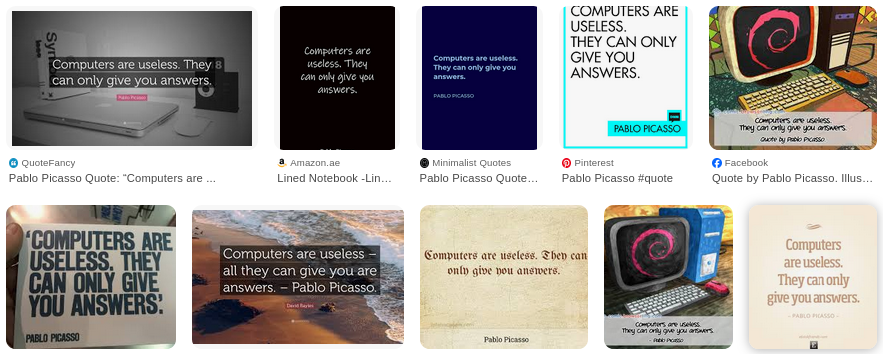
Back to the story now: Sixty years ago Pablo Picassomore or less said that computers are useless because they just give answers.
Sixty years later, I see more and more signs that current AI, which is not unavoidable at all and is not even "intelligence", just peak software, is useless, if not harmful, for exactly the same reason.
Replacing “computers” with “AI”, or even “metaverse”, “blockchain” etc… is left as exercise for the reader.
Of course, Google's AI Overview (yes, the same "intelligence" that plagiarizes to give cringeworthy answers") disagrees. On August 4, 2025, when I searched for that quote, it parroted that "Today, computers, especially with the rise of artificial intelligence, can be used for a much wider range of tasks...Therefore, Picasso's statement is more a commentary on the limitations of early computers and his perspective on the role of human creativity rather than a timeless truth about the nature of computing."
No way. If anything, Picasso's quote, apocryphal or not, is even more valid for today's AI and Web than for the ancient mainframes he knew.
Social Media are just as bad. They force on people, causing a traffic apocalypse for media companies, any stupidity they can think of to keep them locked inside their playpens, with nothing but answers, that must be as as few as possible, but always time wasters.
Right now, the biggest but by no means the only offender in this violence of never giving people anything but answers is Facebook. Zuckerberg's playpen has tamed millions of people (including journalists and other "professional communicators" who should really know better) to adopt at least two astonishingly stupid practices.
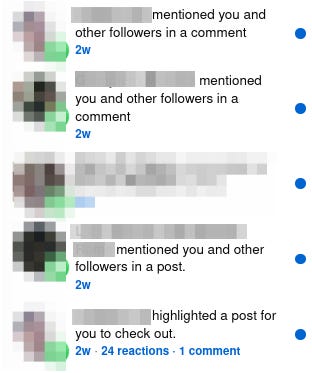
One is convincing users to annoy all their followers with @followers or @highlight tags that aren't even answers, just notifications that someone said or answered something, but not what. Even if we didn't have the real solution to "get the news", that is RSS, those tags are as stupid as a newspaper or website front page that only contained titles like "Trump said something" or "Something happened in Turkmenistan", without any detail, ever.
Would you buy a newspaper with a front page like this, that gives you no clue what the news actually are?
The other, even bigger abuse is the all but mandatory push to put "links in the first comment", instead of inside the original post. The same happens on X, which is one of the two things I'll never forgive to Elon Musk.
@followers, @highlight and "link in comment" are not "practices". They are digital lobotomies that make us defecate, multiple times a day, exactly on what made the Web great and useful, that is links labeled with text.
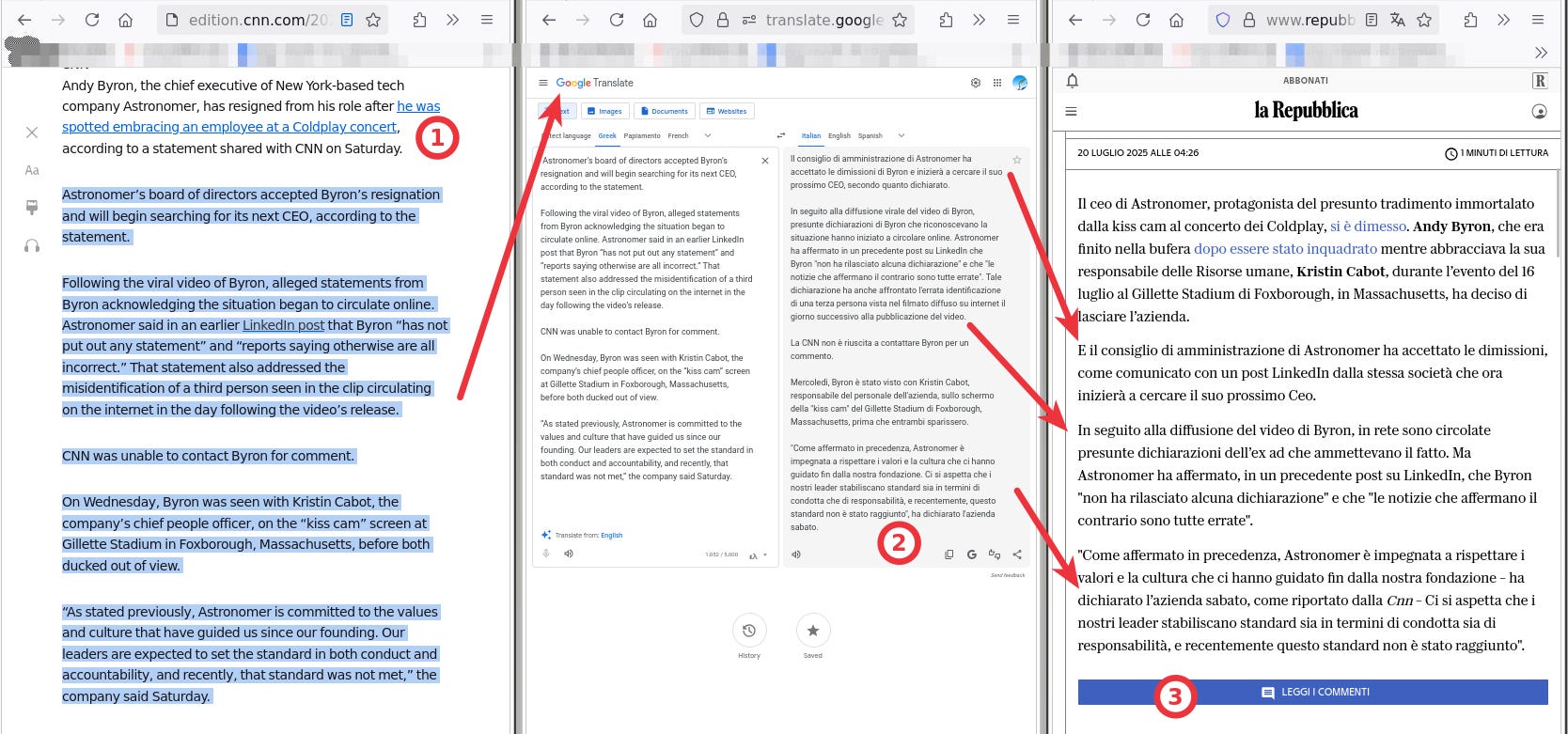
All the media companies that, by any combination of greed, dumbness and desperation, are trying to replace writers with chatbots are the best allies of the Big Tech that's killing them, by flooding the web with nothing but their own Big Tech answers. The media companies that still exploit human writers, however, aren't much better. A particularly telling example of the latter category, for reasons I'll explain in a moment, is in this screenshot:
1: some hopefully human-written text; 2: AI half-decent translation; 3: slop posing as journalism, that will fed other AIs.
All the diseases above have three things in common: they are supercharged by the peak software bubble we've been led to call AI; they only provide answers, never access to questions, or resources that would stimulate more questions; and those answers are getting worst every quarter.
I also believe that in "developed" but not English speaking countries like Italy, a general degradation of answers is happening even faster, thanks to the abuse of AI-powered translation, as in the example above. Eventually, that extra step can only make the average quality of any non-English text produced by any AI worst than the quality of their English text, because the former will be the result of training on text corpuses that were born one step farther from human thought.
Nothing you've read so far is new, but it's important to connect the dots: how, and why, exactly, all this is bad? Several experts confirm that the right answer is Picasso's one:
in full "broken clock that's right twice a day" fashion, Sam Altman himself said that "figuring out what questions to ask will be more important than figuring out the answer."
The problem of getting only answers, never meaningful questions, is made worst by answers given when no answer at all would have been better. One of the surest signs of real intelligence is to know when to stop. Chatbots (or search engines) designed to make money cannot do that. They must always provide answers, including those they could not possibly know, even if that means making things up or, in extreme cases, suggesting people to kill themselves.
Equally obvious, but seldom appreciated enough, are the facts that a) one can get decent answers from an AI only if she is already competent enough to ask good questions and judge the quality of the answers, and b) no one cannot get that competence only from AI-generated resources. More explicitly, no kid, or adult, can ever aquire that competence from AI bots trained on AI translations of the same text, that maybe was AI-generated to begin with. Read text like this, instead, by humans for humans.
I don’t paywall what I write because certain things should be accessible to everybody, but writing them takes a LOT of time. Thanks for supporting this effort with a paid subscription.
It's questions that give us sense, not answers
The seventh reason why finding good questions is more important than answers, which includes all the others, is as obvious as it is important: to feel that our life is worth living, and our very existence actually valuable, we humans need to find the right answers by ourselves. That, however, can only happen when we get (from each other or even by machines, why not?) the right questions.
Concretely, that's why we need search engines and social media that encourage and increase both sharing links to human content, and we need to actually read that content, and to teach kids to do the same
This is the exact reason why any AI that can only give answers, and will never stop giving them, is useless. Trust Picasso.
Side note
While I was collecting material for this piece, I found people posting on Facebook what they present as an excerpt of some interview to Altman (without providing any source. Of course, see above) in which he also "warned about AI dependency and parasocial relationships: "People will develop problematic parasocial relationships, society will have to figure out new guardrails." Especially with kids who grow up thinking AI is their friend."
I'm pretty sure any real AI would summarize that answer as follows: "My pals and I are too busy screwing people minds to make money and feel like gods, you please figure out how to clean up the mess we're making. Meanwhile, we rich people will keep living as everybody lived before, because that's saner."
Welcome back to literally everything falling apart around us!
Hope you’re all having a great summer watching everyone be bizarrely chill with an ancient (guess that never mattered!) dementia-riddled President Pedo governing via ChatGPT and a half-drained Magic 6 Ball stuck on Tariff Again Later, roving masked gangs of money-choked secret police grabbing people off the street, the government fighting the weather, the government fighting the economy, the government fighting itself, the government fighting the planet, and the government fighting Superman, apparently. Turns out we were all just terribly silly biscuits because there isn’t and never was an Epstein list, and that, too, is miraculously super totally fine with the media and the exact same people who made sure we had nine thousand Congressional hearings to view Hunter Biden’s tool of the establishment. Looking out the right side of the flaming plane crash of all our lives, the word “deportation” has been redefined to mean all sorts of things it doesn’t, but mostly “alligator torture.” The Secretary of Defense openly slams whiskey at press conferences while abandoning Ukraine without texting the group chat and actively planning an invasion of Greenland at least, and the President’s personal advisor/Twi’lek dancer gleefully tweeted about feeding every Latino in the nation to alligators. The Temu Trujillo on his throne of skulls has decided to end satire forever and just hold a UFC cage match right on the White House lawn, shoved a bill through Congress that no one read except to get mildly concerned about the line items involving setting the entirety of rural America on fire, defunding trans hurricanes, and mailing every child an envelope full of neo-measles personally signed by President Mola Ram. Oh! Then he threatened to deport/alligator torture a Democrat for winning a primary and take personal control of New York City because we live in the shittiest straight-to-Betamax Bond movie. And again, no one’s really that upset. At least, not a tenth as upset as they were about ending a war in Afghanistan, the price of eggs, having a cold at a debate, or the existence of a new Superman movie!
Plus, while a brown person holding a job a white person imagines other white people (not them) should be doing is an affront so intense it must be answered by ripping each and every one of them apart until the Atlantic turns to a sea of blood, it’s very completely awesome for every single human profession and activity to be outsourced to a couple of billionaires’ poorly-socialized neopets that can’t pass their bite test, even though we can all see them being actively manipulated to spew hatred in real time right in front of us. Don’t worry, one of them is calling itself MECHAHITLER, and hundreds of thousands of people are actively using fucking MECHAHITLER as a goddamned therapist and/or life partner.
Am I caught up? Probably not. Hours to go before end of business, after all. I don’t know what to tell you, man. It’s weird living in whatever luxury living sub-development of hell managed to sprawl into reality. Every time I try to finish this series, something so fucking Jacobean happens, so dredged from the ultraviolent nethermind of Gargamel’s id, that I feel like my brain is being sawed in half with a broken spork. And all anyone does in response is get absolutely apoplectically furious with Democrats.
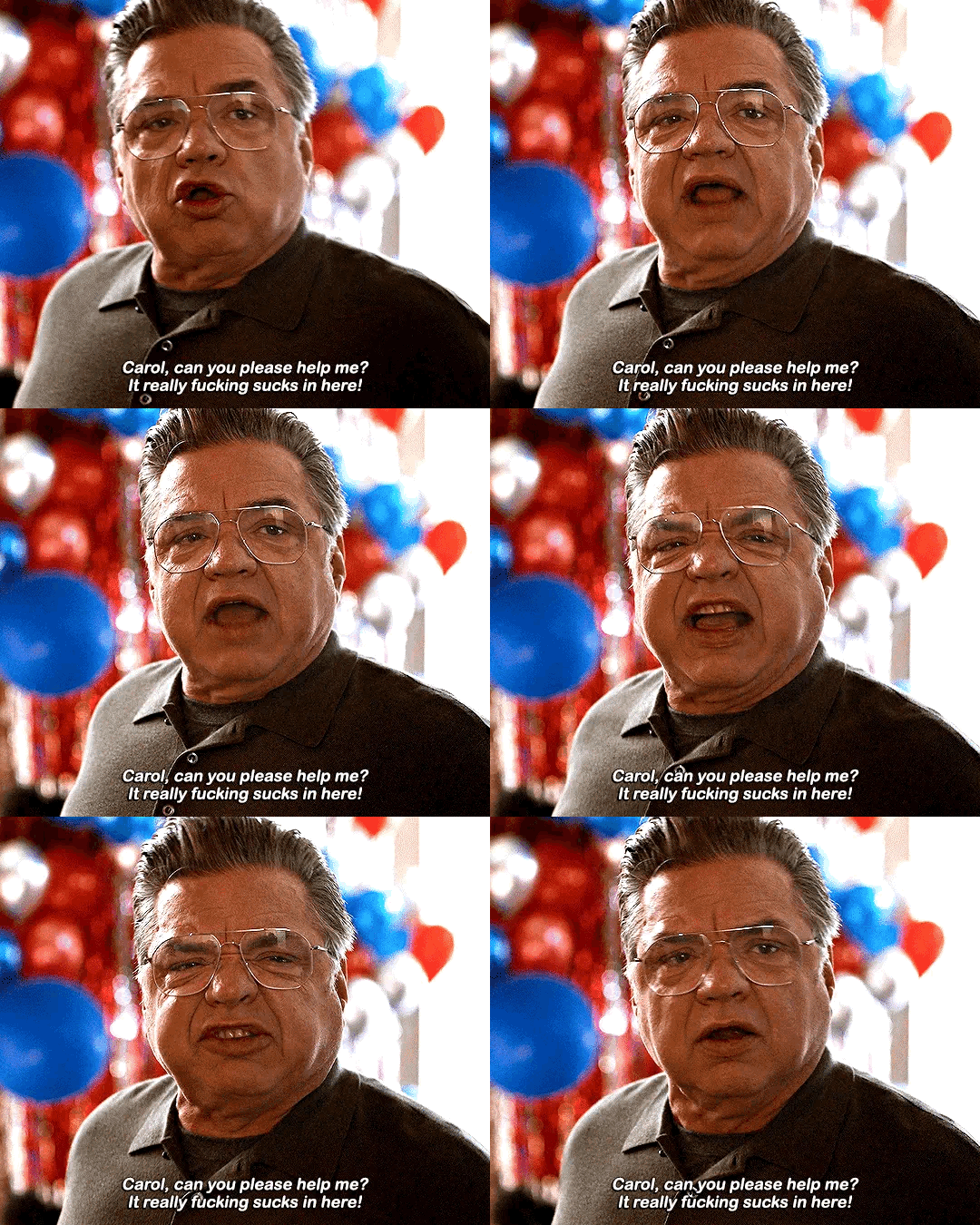
Any minute now, Carol
So I’ve been thinking about magic lately.
I’m not going full woo on you, relax. I’m fully vaccinated and this is still about the internet unintentionally ending human civilization. But I am a professional fantasy and science fiction writer, most of the time. I’ve invented a magic system or two. And it’s as good an explanation as any. Honestly, between you, me, and the ever-watchful eye of Mechahitler, if I didn’t know better, I’d say magic is the only explanation that makes any coherent sense.
Not crystals-and-potions magic. Not sparkly spells cast at the dark of the moon by elves of great power.
But maybe abracadabra magic. Maybe slight-of-hand. And, you know, maybe some light demon-summoning.
Because we all know none of this is coming from a place grounded in realism.
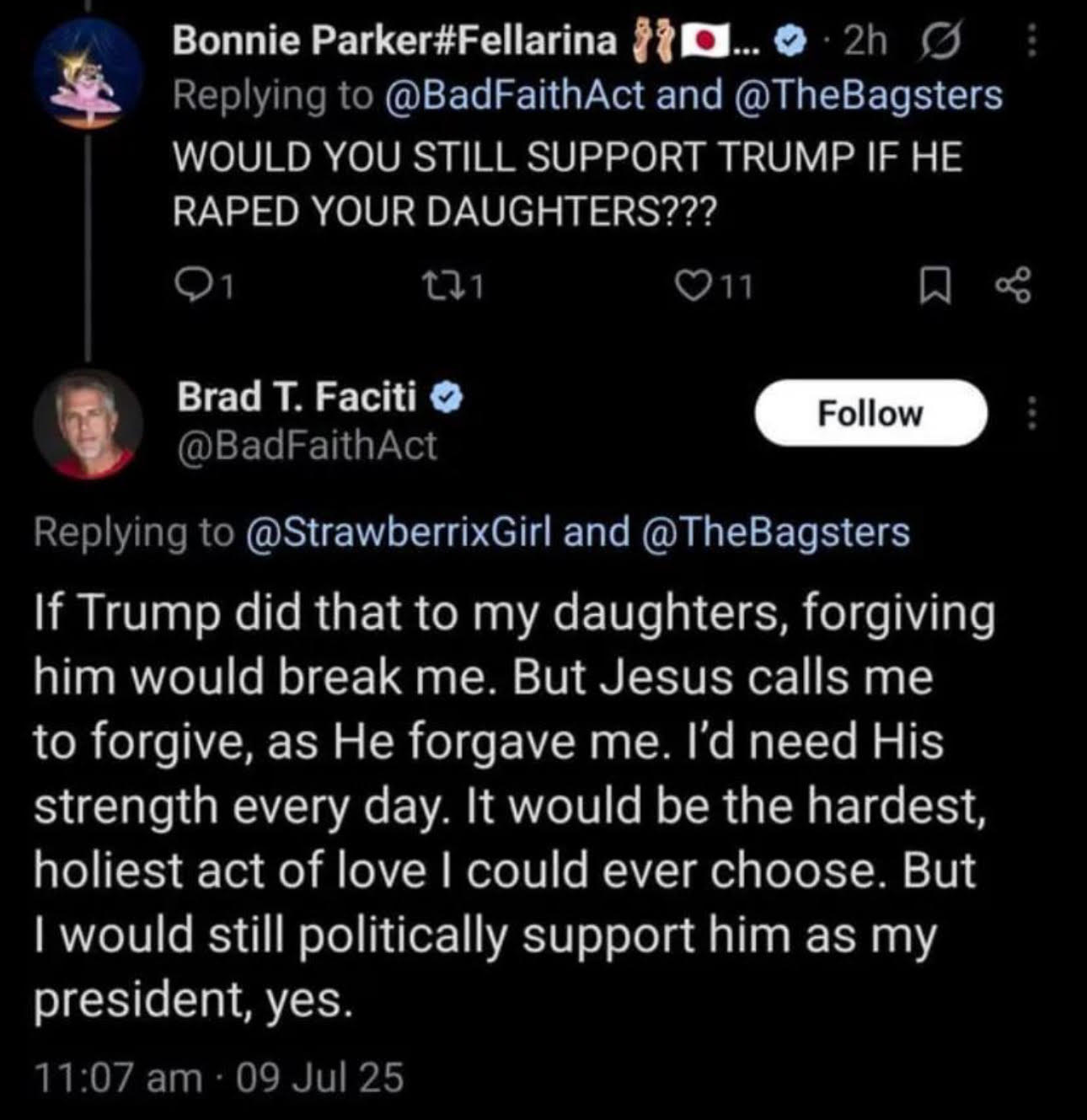
A totally normal political position that anyone would ever take with regards to any other President of either party!
And while we all make jokes about Trump having made a deal with some devil or other to be able to, without seeming to actually try at all—in fact, occasionally attempting to try not to—mind-flay millions of people and turn them into extensions of his fish-greasy will, and still be converting new ones right now, even with all the alligator torture and public brainmelts and unforced economy-impaling, to be able to turn every single conversation to the topic of himself, every piece of art to address him first…he kind of did. We just didn’t understand the technology had already sufficiently advanced to become indistinguishable from magic.
And the thing about magic is, there’s always a price. A trade. For power, for ease, for plenty, for the objects of divers desires. For every magical gain, there must be an equal and opposite sacrifice.
If you let something out, you have to let something in. If you let something in, something will escape.
But it’s not just that we replaced human life and activity with the internet at approximately the same time that a living (mostly), walking (sort of), talking (I guess technically) low-res edgelord meme failed at failing to get his burnt-out hamburger heat-lamp of a frontal lobe elected President.
We did do that; slowly, without a plan, excitedly perusing points-of-interest on a technological roadmap-cum-skill-tree for an entirely other country, one we were gonna speed through at the speed of loneliness, following the siren-song, not of Pleasure Island, but Convenience Island—where we could see our troubles were all monetizable and everyone knew our names because they’d stolen our data before we were born. By the time anyone clocked the donkey ears, they were trending on TikTok, the hottest red carpet accessory, required to qualify under business-casual dress codes, knock-offs for the plebs available from Temu in bulk, shipped to your door.
But as we let the internet into our deepest selves…we also left the door open, and the internet escaped into the real world.
And that’s what’s going on right now. What’s been going on for a some time. You can see it with almost every single scandal that hits the mainstream hive-mind—and it is a hive-mind, a constant feed of everyone’s most random, formerly private thoughts, good and evil, mundane and bizarre, running constantly in the background of every simple action we ever take? Yeah, that’s a hive-mind, and primitive as it is, we weren’t even close to ready to handle knowing everybody’s lunch order, let alone the nasty crawlies clicking around the brainpans of people who had never felt seen or valued until clickingcrawlies.com gave them an unlimited dopamine drip.
It would almost be funny if it weren’t a wrecking ball coming in for a kiss.
See, some of us have seen all this before. It just didn’t matter then.
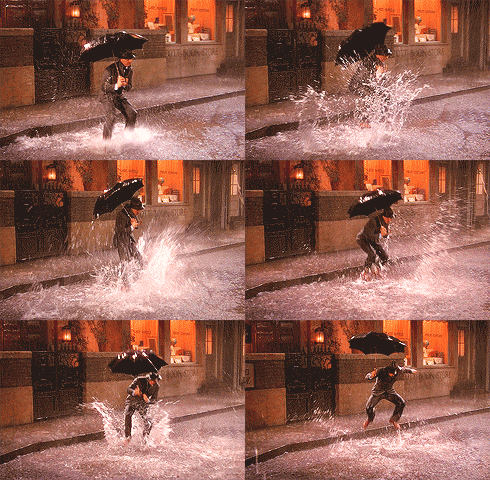
Because we allowed, nay, encouraged and cheered on, the internet metastasizing into every corner of the real world and take it over, the problems we who lived online before it was decidedly not fucking cool, during the awkward adolescence of the internet, had to deal with in the 00s became the problems that are, right this very minute, dissolving this world in acid and dancing through its slowly liquefying flesh like Gene Kelly in Singing in the Rain.
What a glorious feeeeling I’m deaaaad inside!
Power mods gone mad, lolcows, fandom flamewars, sockpuppets, trolls fed and unfed, dogpiling, meme wars, scams, images having been pastede on yay, lies and facts being mostly interchangeable, walled gardens, weaponized irony, parasocial relationships, the economy of attention, viral everything, sea lions, slacktivism, hacktivism, the endless September…all of these have been ported directly into real life, where they are happily chewing away at the deepest root of society: the ability to connect to another human being in some way other than bashing their head in on sight.
What is Elon Musk but the ultimate Power Mod gone mad? He runs his little message board as he pleases, banhammering away, boosting those who praise him and running multiple sockpuppet accounts while insisting lurkers support him in email, making random shit up on the internet, calling his minions to dogpile anyone who suggests any of it isn’t the precise truth, and accidentally roping in a lot of lonely people who just want to feel something bigger than dread about work tomorrow…we’ve been through all of this when it was about Harry/Hermione fanfic or Slenderman or poorly photoshopped images of Dominic Monaghan and if you don’t know what I’m talking about THAT IS SIMPLY WONDERFUL FOR YOU.
But all that, in the early 00s, was going on online while the real world was real worlding along separately. The run-up to the Iraq War did not take place on Livejournal. Dick Cheney did not buy YTMND.com or SomethingAwful and turn it into a Nazi petting farm (real talk: wouldn’t have been necessary, really). But millions upon millions of young people who are far past youth now, and millions more all over the age spectrum, were super busy laying down dopamine mechanisms in their brains that they’d never escape. They were just too intense, too immediate, too randomly-reinforcing, too easy to refine into money, power, fame, and an infinite narcissistic supply of praise.
Sadly for the future of humanity, the early 2000s were not an overly kind time on the pimply, awkward internet, and one of the easiest ways to get that attention was through trolling, which did originally mean posting things you didn’t actually mean just to get a reaction. But the problem with irony is, if you do it often enough, no one can tell the difference between you being a dick for a laugh and you just being a deep-down dick. Not even you. After a couple of decades of saying the opposite of what you mean being the marker of a Cool and With It Person, FUCKING NO ONE KNOWS WHAT’S REAL ANYMORE. The Epstein Files fiasco is classic power mod behavior—lie, delete anything contradicting the lie, refuse to engage, ban everyone, change your username, and pretend it never happened. My god, how many times, in how many places you loved, has that shit gone down?
Elon Musk is 53 years old. He was part of that early internet boom, and as utter whaleshit as his version of his role in that is, he very clearly got hardcore addicted to internet attention long before ketamine. What he does is to get his fix, however he can. He will never stop, because it’s been 30 years of wiring his psyche to digest only the adulation and approbation of strangers.
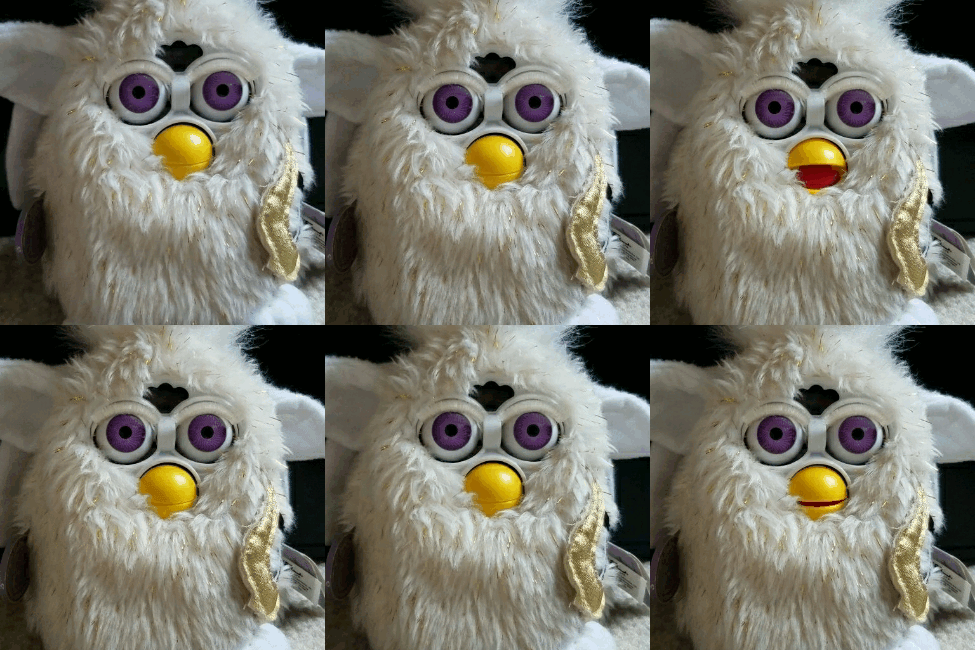
Even the tsunami of bots, troll farms, and AI slop is just the industrialized Pokemon evolution of sockpuppet accounts, forum trolls, and shitty Photoshop wars. ChatGPT is a great chatbot, but it’s literally in the name, my friends. That’s all it is. A jumped-up Furby who fucked a Clippy.
RFK says I can approve drugs all by myself!
My friends, the Blair Witch Project kids had real human adults totally convinced they released genuine footage of a real supernatural witch murdering people into theaters near you for $5 on matinee Tuesdays. And my siblings in Satan, that was in 1999.
And then there’s Donald fucking Trump. My god. If I hadn’t grown up hearing what a piece of shit this guy was, a hundred million years before I knew what a modem sounded like, I might think the internet had just invented a person. It’s so easy to forget that he was there from fairly early in the game, gossiping about celebrities and being a general-issue bloviating dork on social media talking shit about rubbish. The reality TV show was a big deal in terms of putting him in the living rooms of Americans, but—and when I say this, I am not meaning to downplay in any way how dangerous, horrific, or murderous this long, dark shart of the American soul truly is—but I think his real power, the reason his grip is so unshakable, is that Donald J. Trump is the Apotheosis of the Lolcow.
If you’ve never heard that word, or if hearing it in 2025 merely wakens something deep within you from a dark slumber, a “lolcow” is the subject of particularly fierce internet drama. Someone whose activities can literally be milked for laughs, both because they never, ever stop fucking up, and because their fuck-ups are so positively Byzantine in their elaborate, over-the-top, pants-on-Pluto stupidity that you simply cannot look away. More than that, people often encouraged the lolcow into even further, messier, more dangerous acts of life-ruining idiocy, simply to enjoy the show and consume the popcorn, literal and metaphorical, that accompanied watching someone ruin their own very real lives and others’ for entertainment.
Yep. This behavior ended the world. Hope everyone had a good time shitting on Jedi Kid. By the way, that’s Jason Momoa.
Any of this sound vaguely familiar?
I honestly don’t even want to give examples because severe mental illness is a constant factor, some of them were deeply abusive people, others true victims, and either way, milking said lolcows was almost always an act of intense cruelty. It doesn’t feel kind to drag any of these actual human beings (or their victims, or their enablers) up again. But the fact is, Trump’s swollen udder has overflowed with unceasing bounty for over ten years, and will never dry even after his death. Chris-Chan could never begin to compete with the dairy production of the Little Caesar’s Caesar and his gang of edgy, edgy trolls.
Lolcows provide adrenaline to themselves and dopamine to everyone involved in the drama, whether they invited that drama or not. That’s why the big ones go on and on. Why people followed their trashfires so intently, why it became addictive, why to this day there are people all over the Chan boards still milking lolcows from twenty years ago. Unless a bigger lolcow comes along, it really did tend to keep going and going until someone implodes. I suspect that’s why Trump kept Elon so close for so long—Musk was the only one to actually threaten Trump’s deathgrip, by showing the potential to become a bigger mushroom cloud of stupidly dangerous clownshit and stealing his userbase. There was always a huge microeconomy of weird activity around a lolcow, pushing them into more extreme behavior, forming fake friendships and narratives with and around them in order to have access, outside sites documenting the whole thing and commenting on it—each one is a little industry.
Or a big one.
Back in 2015? The people who did support him almost always said they did because he was funny. The young Trump voters in 2025 often say the same.
And a lot of both groups are still laughing. They do actually think Alligator Alcatraz is hilarious.Because it’s abstract to them. It barely registers as real; they treat it as a meme. Our government goes on television and laughs about feeding human beings to alligators and the media barely yawns and that’s just life now.
Those who aren’t laughing have joined the document and commentate portion of the lolcow cycle—and because the internet got way better at monetization streams than it was in the aughts, shittons of the Fandom Wank mods of today rely on this lolcow for their entire income. They won’t stop, either. It’s how they get what they need, too. Unless a bigger lolcow comes along, it tends to keep going and going until someone implodes. I suspect that’s why Trump kept Elon so close for so long—Musk was the only one to actually threaten Trump’s deathgrip, by showing the potential to become a bigger mushroom cloud of malignant fuckery.
What is Donald Trump but the infinite lolcow that now dominates and nourishes every moment of the media cycle with his antics. No one can look away—because the internet got out and now online drama is threatening our lives and livelihoods instead of our fandoms. We replaced our everyday lives and connections with the internet, and then the internet poured itself into a carcass called Trump, the walking embodiment of the worst shit that went down on the worst sites you ever knew about. 4Chan, and later 8Chan, made the Trump Presidency. He was their lolcow first. Now he;’s our nocow to, and the nos and the lols define the whole being of the country..
And now we’re fucking stuck. Every newsday is about him. Every sporting event. Every movie release. Every fucking half-time show. Every holiday. When it’s not about Elon Musk or one of the other Big Name Fans on the periphery of the constant, constant drama. It all swirls around what he’ll do next. And even those of us who hate him beyond words spend the precious hours of our lives doomscrolling and commenting, dissolving into the adrenaline (fear at the next disaster for us, fear of the other for them)/dopamine (validation at others sharing our fear for us, Trump’s IV line to their entire endocrine system for them) combo it seems impossible for so many to turn away from. We aren’t enjoying this on any level—but we’re stuck. We’re engaging. All the time. We want it to stop. We need it to stop. But they don’t. They need it to go on. A lot of Trump’s most fervent followers were never really online much before his rise—they have no natural defense or suspicion of this stuff, because by the time they logged on, the engagement algorithm had already made a shitstew of the concept of the truth, and people who’d cut their teeth lying and manipulating on the internet were ready and excited to screw the noobs.
Now, please understand I’m not trying to make jokes by calling him a lolcow, it’s deadly, grimly serious. It’s a disaster that might very well be the end of us, and I am afraid every day. The other ghouls behind Trump aren’t anyone’s lolcow—they’re the same fucking assholes who were pulling puppet strings on the internet back then, too. And Stephen Miller. I’m just trying to explain why this wet sack of a man has become the hemlock of the masses. We’ve trapped ourselves in a forum flamewar without end, and the billions of words spilled on actual forums back then should tell you how truly long this can go on. Even though it truly seems that no one, least of all the trolls themselves, is having any fun whatsoever these days. Well. Addiction is like that. You always need more intense highs to feel anything anymore.
Gotta bomb Iran or send the army into California or kill the concept of schools and weather. I do think Trump, deep in the dim corners of his alleged mind, understands one thing with crystal clarity: his power comes from engagement, just like the demonic algorithm. If he lets things get boring, even for a few days, he’ll begin to lose ground. He has to produce for his audience, and yesterday’s drama will never be enough for today’s maw.
And when you combine that “one good trick” with a clear, step-by-step agenda from the Republicans who’ve always been sociopathic Christofascist white supremacist monsters in Project 2025, you get July 16th, 2025.
And it does matter now. It is serious now. Very real people are dying, families are being torn apart, the economy is exsanguinating jobs and every one of those jobs is a real person’s next dinner. But the problem is, for a very significant number of both left and right white, straight, cis, privileged, vaguely Christian-ish Americans, which demographics are still in the bare majority, all of that, and the resistance to it, is only happening online. It’s happening through a tesseract of screens and performances that occlude reality just enough to paralyze almost everyone in either horror or delight.
Politics, for those with the privilege to only experience them through screens, is precisely fandom drama. People all the fuck over the place refer to themselves as fans of Donald Trump or Bernie Sanders, AOC or DeSantis (not so fast, Vance) rather than supporters, and that poisonous toadshit’s been going on for a minute. What a victory for the media to finally fully be able to smash politics into a fire3hose of turbogruel with sports and Hollywood and spray it in our faces without too much of that annoying pretending to be serious about anything or anyone. The horrors of the Texas floods, alligator torture, Palestine, assassinations, loss of rights everywhere, it all flows by in the same font, on the same background, as news of the latest Marvel casting or skibidi meme, and it directly affects most of those groups just about as much—so far. As long as they’re not one of the targeted groups yet, it’s all just fodder for the machine, that now pays out not only in “lols” (which were always somewhat sadistic), but in money, power, attention, praise, and brain chemicals real life has struggled to supply with the same overwhelming intensity, especially since we all got together, held hands, sang fucking Imagine, and worked very earnestly to come up with a holistic method of running society without human beings interacting directly with one another during the pandemic.
Is it absolutely revolting? Yes, of course it is. It’s fucking gross. But I’ve been on the internet a long time, and I’ve seen people bend themselves into Escher’s own pretzels justifying their participation in these lolcow orgies of shame. People like watching others suffer. Some a little (heh that young fellow was struck in the testicles with a sporting implement, eh wot?) some a lot (Alligator Alcatraz). But most people have that in them. They come up with a way to feel it’s deserved. That they would never be the sufferers on display, since they don’t deserve it. Cancelling, outside of people like Weinstein and Spacey, is really just this sort of behavior with a superiority complex. And so they kept, and keep, watching, and participating, even though it’s clearly grotesque.
And Trump is the zenith of this. The one true talent he actually has, and has leveraged his entire life—because he was a much more benign lolcow in the 80s, too—is letting people laugh at him or seethe at him for money and attention. And I don’t believe it truly matters to him which one.
Is there a way out? I’m…not sure there is. Because it’s been way too long. Multiple generations have been trained to expect this cycle of adrenaline and dopamine to be the main service government provides. Back in the time known as the day, lolcows ended when enough people got banned effectively enough, someone got very seriously hurt, and occasionally, when people got bored and wandered off. I’m not sure analogues of any of those are really on the table at the moment. It truly is something to be the man to enshittify liberal democracy and simple every day life. The only thing that ended that adolescence of the internet was this. So where we go from here, I struggle to say. Except that finding some way back to each other in the real world, to connecting, to talking, not to the FUCKING VOID THAT IS AI, but to other actual people face to face, is probably the only possible road, not out, but maybe, just maybe, through.
Trump pulled off his deal for power by trading the rules of the internet for the rules of real life. He stands in the middle of a planet full of pain like a sloppy, drooling Virtuvian Man, gorging on the left dogpiling him with rage and the right dogpiling him with worship.
It’s all the same to him, just as long as he’s covered in bodies.
It’s going to be the work of the rest of our lives to dig our way out.
Epilogue to follow on Thursday (promise this time, it’s already done)
Welcome to Garbagetown is a reader-supported publication. To receive new posts and support my work, consider becoming a free or paid subscriber.
If there’s one thing I can’t abide, it’s nontechnical technothrillers. You know the trope: “We’ve got eight minutes to crack this mainframe, but it’s protected with encryption that is rated for ten minutes. We’re gonna have to hack really hard. Come on, hacker, HACK AWAY!”
Technothrillers are consumed by an increasingly computer-savvy audience, which means that the kind of technical elision and corner-cutting that dominates the field grows thinner by ...Read More
Is the book done? No. About ten chapters left, because everything that could go hilariously wrong last week, from a massive heat dome in New England to my ceiling flooding and falling through, did indeed happen, plus more outlandish rubbish on top of it. Thus, I am still drowning in stress, plus more stress, plus bathtub water and it’s still too hot.
So hold tight, I shall not perish, yet. I’m looking to have the last post in Move Fast and Break People up over the weekend.
In the meantime!
I have a new short story out at Uncanny Magazine, and I’m super excited about it, so I’m taking the step of telling my political readers to hey maybe check out a bit of my fiction. The personal, and fictional, is always political, after all.
Plus…the premise is just a ton of cheeky fun and I don’t want to tell you what it is, because it’ll spoil the whole thing, but you will recognize it and laugh some minor, unimportant body part off before the whole thing veers wildly into new territory.
Give it a read if you want! And I’ll be back this weekend with some more yelling about our grim tech-lich overlords.
Welcome to Garbagetown is a reader-supported publication. To receive new public posts, subscribe for free! To receive public pieces, exclusive extra-spicy essays, and support my work, consider becoming a paid subscriber.
I realize I have not yet finished the Move Fast and Break People series. I am often full of failures. However! There are reasons! And not just the totally bugfuck pinwheeling madness that is every single headline every single day!
On top of The Horror of It All, I am not just a Yeller of Swears, but a science fiction and fantasy novelist, believe it or not, and sometimes the Big Job makes Big Demands.
I appear to actually be near to finishing Nobody But Us, the near-future gender dys/utopia thriller I’ve been working on for quite some time, can’t imagine why I’d want to write about that sort of thing these days, total coincidence I’m sure.
I have not disappeared on you, I promise! But I will be a bit quiet for the next 10-ish days while I try to put this beast to bed. Trust I have many things to say and want to say them, but at the moment, I must attend to the world in my head, which is also on fire, only this fire I can fix. Writing books is nice that way.
Thank you all so much for your patience and support! The series will finish around the end of the month once the book is done and my brain can brain reality once more. Lord, I cannot fucking wait to see life on the other side of this.
See you all on the flipside, T-10ish days!
Life feed from my office. Facial expression is correct.
Welcome to Garbagetown is a reader-supported publication. To receive new posts and support my work, consider becoming a free subscriber. To receive the spiciest posts, extras, and help me feed my household, please consider becoming paid subscriber.
Please excuse a brief pause in our series on the internet slowly absorbing and replacing all human life with yelling to…yell.
I just have some things I need to say. For my own health, because I’m pretty sure shoving all this what-the-fuckery down into my innards to rot with the absolute tonnage of reeking fucking trash I have to suppress my fury about every single day is bad for you. In fact, I’m pretty sure the entire reason middle-aged people are in such a sour little snit of a mood all the time is the crushing weight of years of bullshit, our own, others’, and most definitely the world’s, accreting directly on our lower backs.
AT SOME POINT, YOU EITHER KEEL OVER OR GET A STUPID SPORTS CAR ABOUT IT BUT WE’RE ALL BROKE SO BLOGGING IT FUCKING IS.
Oh, and this one’s going under a paywall. If you want to yell back at me about how super chill and cool the allegedly-lefty internet is being about Biden’s diagnosis right now, you gotta kick me a buck because oh my god, my back is killing me.
Thomas got radicalized by the Dieselsphere Podcast Network
If a group of people have been trying to get something done for some time without success, there are two possibilities: Either they’re failing because of bad tactics, or they’re failing because they simply lack the power to achieve their goals. When things start changing in big, dramatic ways, that means that some group in society has either discovered a new tactic, or they’ve found some new coalition partners.
Note: Welcome to WTG’s first multi-part series! As promised, this Substack will now post regularly, at least twice a month. Normally, the way this works is that every public essay has a follow-up piece for paid subscribers that gets into things I ran out of space for or are too spicy to deal with the inevitable sea-lions in the comments.
But as I worked on this series, I really didn’t want to put any of it under a paywall. It’s one of the biggest things I’ve tried to say outside of fiction, and, given the enormity of everything we’re going through, I wanted anyone to be able to read it in perpetuity. I wanted to discuss it with anyone. Unfortunately for us all, I also want to eat and stay warm and feed my family. So, just for this series, each part will go up for paid subscribers only for 24 hours, and then I’ll open it publicly and keep it that way.
Addendum: due to recent & upcoming changes over at Patreon, I and many creators have taken a serious hit to our income. Truly, believe me when I tell you I hate doing this with every ounce of my dumb little soul, but despite how badly we are all suffering right now, I’d ask you to please consider signing up (here or there—but if there, only do so through your browser, not the app) for a paid subscription if you value you what I do, so that I can keep doing it while feeding my kid and having a roof over our heads.
Welcome back to your nuclear hellscape of infinite human torment already in progress! What a fucking beautiful day in the goddamned cursed-ass neighborhood of slowly-deflating dreams, in which the very concept of hope is being pilloried daily in every town square. King Friday just sent a kindergartner to a Salvadorean prison, then slept the guiltless, unperturbed sleep of a baby.
The stock market tanked because of you, little Timmy, not me. Off to the Sarlacc pit you go!
IT’S GREAT HERE. Did you know hell always had the option of adding more rings? That franchise opportunities for torment-expansion and new items on the Value Menu of Breathtaking Moral Putrescence was just…always on the table for us? NEAT FACT!
We last left our dingus century slowly burgeoning into a digital technocracy and blundering through the long process of kicking down fundamental pillars of civilization, replacing them all with apps, and expecting the overall structure to stay totally fine and cool and never, ever wobble despite no one taking care of it, at all, in any way.
But that wasn’t enough for us, oh no. We are such very clever, super rad, bold and edgy futuremonkeys. So we started kicking it, too.
Just a little bit. Not because we hated the basic structure of interconnected human systems. Because most of us never really understood anything about the basic structure of interconnected human systems. The particular pillars we were whacking on weren’t exactly obviously load-bearing. In fact, for quite a long time, a little vigorous boot-smacking seemed to improve things. And a bunch of people who confidently said they did understand those structures insisted it wasn’t kicking, it was industry disruption, and hey, who doesn’t love disrupting nasty fat greedy old industry? Yeah, fuck the system, give it a roundhouse this time!
So when, eventually, the janky societal stud-finder that is the American Electoral Cycle started coming up catastrophically empty, we’d spent so long saying fuck the system and getting rapturous, deafening cheers for it (and absolutely nothing but acidic disdain for maybe system good just need fix?) we never should have been surprised to find the system, well, totally fucked.
Ew, you like the system? Gross, Stephanie.
This essay concerns one of those not-obviously-integral societal pillars: trends in fictional televisual storytelling. OH WE GETTING HOT NOW.
No, but we kind of are. Everything we thought and taught about these two things was changing throughout the first quarter of the 21st century, converging on a new consensus at the exact same time as people slowly learning how much they genuinely enjoyed not having to deal with other human beings for every little thing and not thinking too hard about how the bedrock definition of society is human beings having to deal with other human beings for every little thing.
The thing is, the kinds of stories we take in on a daily basis and the professions we choose to pursue are enormous, broad-sweeping cultural movements. The issues this series is trying to address, concerning the dominance of the internet and digital living, are not uniformly experienced. How much or how little daily life has been made physically intangible varies from person to person, country to country. (And of course, all these thoughts are heavy on the American landscape because…well, the American landscape has been weaponized against both itself and everyone else plus I live here.) A large rural family, to whose address Instacart delivers only thoughts and prayers, does not have the same relationship with the internet, or daily direct human interaction quotients, that a single, WFH, recent college graduate living in a major test-market city does.
But they’ve all heard that Iron Man is a badass.
Here’s the lede, unburied above the fold: I’m not saying Tony Soprano ended the American experiment. That’s just silliness.
But I’m not not saying Tony Soprano ended the American experiment, either.
You guys weren’t supposed to look up to me. You get that, right? Right?
This whole digression started because a friend and I were talking about politics (it’s like doomscrolling! But you do it in person, and maybe there is whiskey, and maybe there is yelling, but yelling together, and at least probably also no one calls you a shitlib) and they asked: how could anyone think these assholes were actually going to be effective at solving any problems? I just don’t get how you can even trick yourself into thinking these are the guys, even if you’re a very devoted Nazi.
And I knee-jerk answered:
Oh, that’s easy! Because we’ve spent the last quarter-fucking-century consuming virtually infinite movies, shows, games, and books in which the Asshole Anti-hero is the only guy who can cut through all the bullshit and get the job done. Then we told everyone growing up or coming of age during that time not to study the humanities or they were a stupid waste of flesh destined to starve to death in a ditch, so they couldn’t think critically about any of it.
If you didn’t experience the pre-2K media environment in real time, it’s hard to express the size and depth of the sea change I’m talking about here. From the advent of mainstream televisual entertainment in the 20s and 30s up through the very late 90s, the heroes of major tentpole media units were many things, but they were almost always…you know…heroes. All narrative has a moral agenda, and while yes, a big part of the 20th century moral agenda was sit down and shut up if you’re not a straight white man or else, for straight white men themselves, the moral lessons of film and television was very much centered on a kind of post-doc Sunday School hey, I know you have this rage without form or focus inside you all the time, but have you considered being a good person about it? Here’s how!
The heroes of the stories America most liked to tell about its Golden Children were never screaming fucking sociopaths quipping the day away cleverly, clothed in the the tattered shreds of the lives they’ve carelessly destroyed, for whom everything more or less works out, even when they die, because when and if they do eat it, their worldview is almost always upheld, and their nihilistic dog-eat-dog death forms a supporting argument, or at least an emphatic underline, for their nihilistic dog-eat-dog way of life, Mr. I-Am-the-One-Who-Knocks SIR.
Before you hop on the comment section to note well, actually The Screaming Fucking Sociopath Show ran from 1971-1974 on CBS—look, there’s never 0% or 100% in media analysis, there’s always exceptions and outliers. GENERAL TRENDS, PEOPLE. Plus, on the rare occasion that an unutterable nightmare of human psychology was the protagonist of a movie or show, that was the point of the story, and they weren’t rewarded for it. For all Hollywood’s heavy breathing over the Italian mafia in the 1970s, Al Capone still dies in prison unloved and unmourned, and hubris was still a fatal flaw instead of a singularly required virtue. While the beginning of the douche-as-imperfect-but-semi-lovable-hero genre might have started with shows like The Simpsons or Married With Children or literally anything Martin Scorsese ever touched, Homer and Al are not effective at life, they aren’t right about very much, most people around them don’t really like them, and a huge number of plot points revolve around the Dipshit In Question learning some kind of basically pro-social lesson.
Pre-1999ish, monstrous, dick-swinging assholes and their tediously identical personal philosophies about how the whole system, whatever the system in question is, should be replaced with the hypnotic motions of that selfsame swinging dick, weren’t often presented, shot, or reacted to by others as attractive, or delightful, or highly competent, or posited as maybe actually a legitimate way to conduct yourself in real life. And the horrifying, violent, anti-social, hate-pickled soul-amputee didn’t regularly end up being pretty much right all along while regular people just moving through life trying to mostly do the right thing are lame suckers or even hateful bitches who exist only to be fodder for or obstacles to This Fucking Guy’s big plans because that’s a fucking crazy thing to embed in the brains of a traumatized post-two-different-world-wars population.
Why don’t you come up and oppress me sometime?
It might not seem important. It might not seem like it could really make much of a difference. But our brains crave stories and the stories those brains gorge on become the way those brains expect life to work, at least on some level. Millions upon millions of people spend more focused, intentional time with their favorite OMG SO BINGEABLE movie and TV show characters than they do with anyone but their actual immediate families, and for many, many more, the math may not actually come out in favor of family. That’s a tremendous amount of influence, whose hypnotic immersion doesn’t even break for commercials anymore. So when the most common archetype of the Successful and Effective HeroMan fundamentally changes, what people expect to find when they go looking for successful effectiveness also changes. Mr. Smith going to Washington starts to look like a gormless boring weirdo who doesn’t remotely understand what’s Really Going On and is defending a shitty system anyway so why root for him? Now, Walter White, Don Draper, Tony Stark, Patrick Bateman, Jack Bauer, Tyler Durden? Jaime/any Lannister, Jordan Belfort? Those guys are so fun—and they get shit done.
This isn’t a post-9/11 nihilism thing, either, though it ramped up a lot after that. I glibly blamed it on Tony Soprano, but that’s not really wrong. Oz has a real claim to starting the trend in 1997, but few shows have ever had the mainstream in the palm of their hand the way The Sopranos did from 1999-2007, and it was Ground Zero for the Age of the Rewarded Asshole.
1999-2001 saw an absolute supernova of televisual stories whose protagonists were dark, edgy, violent, cruel, angry at “the system” (always for denying them the status and rewards they’re clearly owed, never for the specific flaws of that system), totally without empathy, disrespectful and obnoxious to everyone around them, narcissistic, and 24/7 surly without for one second not being the absolute hero of their stories—Fight Club, The Matrix, Boondock Saints, 24, Boiler Room, American Psycho, Dark City, Memento, Snatch, Angel, even comedies like Pushing Tin, Futurama (don’t @ me, I love that show but they’re all assholes), Family Guy, High Fidelity, Black Books, The fucking Man Show…and yes, even my beloved Farscape. Because you could be pretty sure that if the hero wasn’t a complete dickwagon, the rest of the story was gonna work real hard to make you love the villain, think they’re WAY cooler than the heroes, and feel bad for their poor widdle hurt villanous feewings.
Suddenly there was a whole crop of assholes running around being pretty damned successful at solving problems, where before THE archetype of even the Complicated Hero was a basically decent guy put upon by life and doing his best to make the moral choice in an unfeeling universe.
And then, saints and ministers of grace defend us, there’s The Phantom Menace. George Lucas created from the definitional SpaceGood vs. SpaceEvil clear-cut heroic trilogy where decent people try real hard to make decent choices and it works, in the 70s, when nothing was clear-cut or very heroic. Then, before anyone had anything bad to say about Star Wars, spent the entire first decade of the new century spending hundreds of millions and bending everything he’d ever done into unloosesable narrative knots, all to make us love and empathize with Darth Ever-Fucking Vader because reasons. And then Disney built the sequels and almost all their sequel-merchandising around Han and Leia’s psychotic dirtbag homo/geno/patri/regi/avunculi/arguably matricidal son as some kind of “blood-drenched fascism is fine if you’re hot and tortured while you do it” brooding hero and it worked. (not to make a thesis out of it, but the only reason any of these brooding heroes brood at all is that people just inexplicably refuse to treat them with the deference and awe they’re owed by their very nature. Probably because people are bad and need to be punished into worshipful adoration. That sounds right, doesn’t it? It also sounds like a certain voting bloc’s bedrock policy complaint.)
And all those movies were ostensibly aimed at kids. Whose moralities were under construction, excuse the mess.
It’s like there was a meeting and we all just decided good people are boring and stupid and we wanted to hear way less of them for the foreseeable future.
Hey kids, it totes okay to kill billions of people literally all the time for fun as long as you don’t feel bad about it at all and the last dude you kill is your boss! Now let’s get out there and neglect some sons!
There was another huge explosion of this in 2008-10, not coincidentally as Obama was elected, the shadow of Bush/Cheney, a decade of war, fear, and disastrous Wall Street auto-fellatio seemed to be lifting. A good dude was in the White House, so no need to push hard on stories about doing the right thing to attempt some kind of pressure on the powers that be to maybe think about not being shrieking beholders all the time. It was definitely time to shove our faces right down into Bad People Fiction like a pile of freesia-scented cocaine. Breaking Bad, The Dark Knight, Mad Men, Sons of Anarchy, Archer, Fringe, Luther, Iron Man, Sideways, Inglorious Basterds, Inception (and also everything Christopher Nolan has ever done), on and on.
Gen X had a lot going on. Just…a significant number of issues to work through.
And these heroes are literally all the same person. “Morally grey” always means the same guy is about to fart his way into your psyche.
SEE IF THIS SLUDGE RINGS A SHITBELL:
Doing pretty solidly at life within the parameters of the socio-economic class to which they belong, but hasn’t gotten to the tippy-top of that class, either, for reasons the story insists are beyond their control.
Either extremely physically attractive or conspicuously not attractive whatsoever, yet possessing a seriously obscene amount of weird, cruel charisma/affability that comes out most entertainingly during his worst actions
A consistent garbage asshole to any wife, family, social circle, and co-workers, who gives nothing back for the mountain of love, grace, patience, time, money, and favors showered upon him, yet somehow the shower never ends because occasionally he shows reluctant affection to a child or animal or the memory of a dead wife. Maybe a sled, idk.
Hates the system, man. What system? It doesn’t matter, he hates it and he’s gonna bring it down. And he’s not gonna do it by being a good boy, no way! Fuck you, DAD! He’s gonna do it with a bunch of crazy shit that looks suspiciously like just acting on your id 100% of the time but totes isn’t that, promise. Whatever plans he has to get rid of the old system or building a new one are nebulous at best, the point is SYSTEM BAD, SYSTEM DOWN, MAN AWESOME. He’s so edgy and cool! He says things you’re not supposed to! He’s above the law! You want him to be above the law because that’s the only way the story continues so FUCK YOU, LAW. And when he does his cool violence the audience isn’t supposed to have uncomfortable feelings aboutit the way they normally would if anyone else did them, because having uncomfortable feelings about things is just another part of the system, my dudes.
Because it’s so entertaining, the story has now taught you to fucking hate anyone who stands in the way of this super cool swaggerboss, even if they’re doing that by committing such heinous acts as…asking any questions at all of Broody Mclotsadrugs or politely offering an alternative course of action to Bigjaw Gruntybear’s “fuck everyone who isn’t me” plan.
Because, you see, the normal rules just don’t apply to this zomg so cool and fuckable and powerful lone rebel, vessel of dgaf masculinity and mechanism of applying irrationality to rational life that he is! Normal rules would actually be taking something ineffable away from him, damaging his soul, making him less of a man, nay, less of a human.
Has zero hesitation about hurting people (physically, mentally, emotionally, financially, socially, etc depending on genre) to achieve their goals, in fact, profoundly believes their goals are unachievable without hurting people. The story itself usually revolves around incredibly vivid and creative expressions of that hurt, without depicting the aftermath. The story rarely presents any other workable means of achieving the protagonist’s goals, ultimately proving him right without having to say so and letting all the creators do a Dr. Evil pinky-smirk about how they never meant these characters to be attractive role models admired by millions.
White dude, because obviously we get super uncomfy when any other kind of human acts like this. Straightness may or may not wobble, but if wobble, must wobble at a decidedly masc angle.
It’s a cautionary tale! I don’t know why people are looking up to my protagonist as a role model just because I made him look and talk and dress and act as cool as I possibly could and succeed at everything! Must be the audience’s fault for being so stupid whilst I am so smart.
Now, it’s never been so concentrated in slower media like books and plays, other trends were also going on, and certainly, in recent years the trend has recoiled a bit in the face of this shit not turning out to be so thrillingly fun in real life, but the visual (i.e. easiest to consume) storytelling landscape of the 21st century was colonized by assholes to a truly clownshoes and their accompanying clownstockings degree. By the end of the aughts, the vast majority of stories committed to film involved some kind of anti-hero, and they were almost always proven effective at their goals in the end, often the only people who could accomplish them, and only by their chosen means. Those means might look insane at first, but they always prove more, or at least more quickly, effective than being good and moral. And then Game of Thrones premiered!
Even Michael Scott was repeatedly shown to be the best salesmen in the company despite his horrible behavior and clear idiocy. (So we get the “even an idiot asshole is more effective at the same job than a competent person” narrative in the most popular comedy of its decade) And Ron Swanson, much as I love him, was regularly a totally heinous shit to everyone around him, at times even approaching malevolent sabotage of the entire local government apparatus simply because it is the government apparatus. And the show made it, and his school of pug-nosed libertarianism, so endearing and cool people were actively disappointed when he grew and evolved. The Marvel movies are absolutely chock full of horrifying narcissists, now with SWEET BRANDING AND MERCHANDISE.
Of course, there’d always been bad people and complicated protagonists—noir wouldn’t exist otherwise. But usually, especially in the period betwen the end of WW2 and the end of the Cold War, when America felt the need to at least appear morally upright to contrast with those nasty communists, those guys got some kind of comeuppance. Citizen Kane still dies alone and unloved, no matter how sick his sled was when he was 8. Michael Corleone doesn’t exactly have a nice time, and his methodologies become obsolete almost as soon as the sequel rolls film. Most people involved in noir stories end up face down in a pool of their own consequences.
The difference wasn’t necessarily that obnoxious bullies were in media, but that they suddenly were the heroes we needed.
Because they always won, even though they had to suffer through one or two Good Person DEI Hires on the way. They always win even when they die in the end. Yeah, Walter White ate it…in the series finale, in very epic fashion, after accomplishing literally all of his goals, none of which were ever “be a nice family man people enjoy spending time with.”
And that’s without even mentioning Reality TV, the Skinnerian Box that disgorged Donald Trump’s final form, in which the villains very often triumphed, and the promise of cruelty meant a great episode.
The worst part is, nobody telling these stories was necessarily doing anything wrong or bad. This was a new(ish) way to tell stories to a massive worldwide mainstream audience in a world with precious few of those. It was exciting and fresh and so fun to write, to act, even more fun to watch and discuss. We liked watching it because it was made to be liked. We liked making it because it feels good to make art that feels challenging and dangerous.
Unfortunately, it also trained us, over the course of almost three decades, to see slick monsters as necessary heroes, victims as suckers, and the smashing of all systems as inherently moral and FUCKIN’ BADASS, no matter what the qualities of the system itself.
Which had also, not coincidentally, been the underlying message of most of the heroes of the previous generation—they were rarely out-and-out psychopaths and monsters, but almost all of them were edgy outsiders with contempt for “normie” life, who could eat 50 eggs, who couldn’t forget about Chinatown, who made offers that couldn’t be refused, who always wanted to be a gangster, as far back as they could remember. Boomer media is FULL of guys raging against the system and being totally unsatisfied with even the richest rewards of that system. That the system existed was enough reason to hate it and punch it in the face while laughing at the dumb rubes who just wanted to have an okay normal time in life and maybe a job. Right or left, it didn’t and doesn’t matter, the only unforgiveable sin, artistically and politically, for the last thirty years, has been to be seen as part of, beholden to, or standing up for any tiny sliver of, any kind of established societal system.
Was it really any wonder no one cared about defending the system by the time we crawled over broken glass to 2025?
After all, the angry, unpleasant, rude, anti-social, obnoxious, violent, capricious, sadistic, unrefined, swaggering, totally emotionally unregulated anti-protagonist who blasts through everyone else like a demented Kool-Aid man always turns out to be right, or at least, the very coolest one of us all.
At least, that’s what I’ve heard. FOR MY ENTIRE ADULT LIFE.
Welcome to Garbagetown is a reader-supported publication. To receive new posts and support my work, consider becoming a free or paid subscriber.
The mental health of teens and pre-teens worldwide is far from satisfactory, and two famous American psychology researchers and authors, Jonathan Haidt and Peter Gray disagree as to what the main cause is. After following their work through their Substack blogs (1) for more than one year now, I just can't understand why, at least in those places, there is no mention so far of what would surely be one of the best solutions, whoever is right.
Who's to blame for teens' mental health?
Haidt says the main culprits are smartphones and social media, and as solution he proposes:
Just an invitation... is a reader-supported publication. To receive new posts and support my work, consider becoming a free or paid subscriber.
no smartphones before high school (or age 14)
no social media before 16
phone-free schools
more independence, free play, and responsibility in the real world
Gray, instead, argues (also here) that the mental health crisis preceded smartphones, social media and even public access to the Internet, and that the "smartphone/social media panic that has been simmering for several years and exploded with the publication of Jonathan Haidt's The Anxious Generation" just follows the script of all the other moral panics about kids before it. For Gray it's not a coincidence that, at least in some countries, "the increased rates of anxiety, depression, and other indices of poor mental health coincided with the time when government mandates made schooling more unpleasant and stressful than it had been before."
Personally, I think that they are both right, but that even if Haidt were wrong, at least 99% of parents should do what he suggests anyway. As a minimum, it would make things much simpler, without any real drawback. I say so because, in the real world I see around me and almost everybody else there is just what, one every 1,000 real parents with both the competence and the time to educate and support his or her kids to get more benefits than hassles from having personal smartphones too early.
As much as they disagree on the main cause of the teen mental health crisis, both Gray and Haidt have the same vision of how sane kids should live, as these deliberately mixed, almost literal quotes from their blogs prove:
Gray: "Children are biologically designed to play, explore, daydream, and mess around in their own self-directed ways. Through behaving in these natural ways, they learn about themselves and the world around them; discover what they like to do and develop passionate interests; learn in social play how to get along with others; learn in risky play how to manage fear; learn they can fail and bounce back from it; learn they can get into trouble and find their way out. That is how they acquire the resilience, confidence, and real-world skills required for success in life.
Gray: Learn about your world, your self, and how the two fit together. Because the first fifteen to eighteen years of a person’s life are... primarily years of self-chosen play and exploration in which young people make sense of the world around them, try out different ways of being in that world, develop and pursue passionate interests, and create at least a tentative plan about how they might support themselves as independent adults.
Haidt: No matter the weather, the darkness, the kids’ protests... just get them outside
Gray: Kids who grow up in a self-directed education community... are given the time and space they need to figure out who they are and what is important to them. They are able to delve deeply into their own interests, develop deep and meaningful social connections, and create rich and fulfilling lives together.
Haidt: Find ways to give boys something to be proud of. Help them to discover high-quality leisure activities that... are active, not passive; develop skills to produce valuable things in a physical world
Gray: [it's bad that] already by 1990 we had taken away most of kids opportunities to play, explore, and communicate with one another independently of adult control in the real world.
See what I mean? No matter how much Gray and Haidt disagree on the role of smartphones, social media and school systems, the solution they propose to restore kids' mental health is basically the same: self-directed life, directly interacting with peers, outside more often than not. So why do they never mention one of the already existing, already successful and well time-tested implementations of that philosophy? Why do they repeatedly tiptoe around it, without ever mentioning it?
That is, why ignore a solution based on principles like:
A week of camp life is worth six months of theoretical teaching in a room
Know exactly what to do when anything unexpected happens
Living indoors without fresh air quickly poisons the blood and makes people feel tired and seedy when they don't know why
Happiness doesn't come from being rich, nor merely from being successful in your career, nor by self-indulgence. One step towards happiness is to make yourself healthy and strong while you are a boy so that you can be useful and so you can enjoy life when you are a man
In case you didn't see it, I'm talking of Scouting. The list above is all quotes from the founder of Scouting, B-P. Scouting associations worldwide have been doing literally everything Gray and Haidt preach for 117 years now. Any of the quotes by Gray and Haidt in the previous paragraph has almost literal equivalents in Scouting mission statements and manuals, if one only bothers to look. And still, as of April 12th, 2025, if you search for "scout" or "scouting" inside those two websites, those words only show up a few times... in readers comments, not in the articles. Why?
Surely, it's not because Scouting is "old". Human psyche changes thousands times slower than technology, and if some education approach worked well one or two centuries ago, its age it's the last reason to abandon it, if it's a reason at all. So, why?
Part of the answer may be the simple fact that, since both Haidt and Gray are American, they may confuse Scouting as such (or fear their audiences do so) with the main American Scouting associations, and the problems those specific associations have had in the last one or two decades. I am also aware that certain problems and misconceptions about Scouting aren't limited to the US, but please do not distract yourself or waste time in the comments by denouncing them!
All those issues could be reasons to bring back to its origins, or otherwise reform, this or that particular association, not to ignore the potential of Scouting for mental health. The only topic worth discussing here is:
Scouting is not the only solution, and it's obviously possible to grow up sane without it. But if the original proposal of Scouting is so close to what (at least) two major experts propose for improving teen mental health, why aren't those experts and everybody else openly telling parents to go for more true Scouting, now? Please let me know, here or by email, I'm really interested!
Second, divulgation like this is a big part of what I do to pay bills, but I do it without paywalls because otherwise it wouldn't be divulgation. For this and other reasons, I do welcome paid subscriptions, but one time donations are even better. To see how and why, please read the final "Unusual Request" part of this other post. Thanks!
Because that's what we all really have here, not "Substacks" nor newsletters, which are just the way to make posts visible because nobody can be bothered anymore to click on link in social media posts or, which would be THE right way to get news, just use RSS, for heaven's sake!
Just an invitation... is a reader-supported publication. To receive new posts and support my work, consider becoming a free or paid subscriber.
Don’t get me wrong — I like unspoiled wilderness. I like my sky clear and blue and my city free of the thunder of cars and jackhammers. I’m no technocrat. But goddamit, who wouldn’t want a fully automatic, laser-guided, armor-piercing, self-replenishing personal sidearm?
Nice turn of phrase, huh? I finally memorized it one night, from one of the hoppers, as he stood in my bedroom, pointing his hand-cannon at another hopper, enumerating its many charms: “This is a laser-guided blah blah blah. Throw down your arms and lace your fingers behind your head, blah blah blah.” I’d heard the same dialog nearly every day that month, whenever the dimension-hoppers catapaulted into my home, shot it up, smashed my window, dived into the street, and chased one another through my poor little shtetl, wreaking havoc, maiming bystanders, and then gateing out to another poor dimension to carry on there.
Assholes.
It was all I could do to keep my house well-fed on sand to replace the windows. Much more hopper invasion and I was going to have to extrude its legs and babayaga to the beach. Why the hell was it always my house, anyway?
Don’t get me wrong — I like unspoiled wilderness. I like my sky clear and blue and my city free of the thunder of cars and jackhammers. I’m no technocrat. But goddamit, who wouldn’t want a fully automatic, laser-guided, armor-piercing, self-replenishing personal sidearm?
Nice turn of phrase, huh? I finally memorized it one night, from one of the hoppers, as he stood in my bedroom, pointing his hand-cannon at another hopper, enumerating its many charms: “This is a laser-guided blah blah blah. Throw down your arms and lace your fingers behind your head, blah blah blah.” I’d heard the same dialog nearly every day that month, whenever the dimension-hoppers catapaulted into my home, shot it up, smashed my window, dived into the street, and chased one another through my poor little shtetl, wreaking havoc, maiming bystanders, and then gateing out to another poor dimension to carry on there.
Assholes.
It was all I could do to keep my house well-fed on sand to replace the windows. Much more hopper invasion and I was going to have to extrude its legs and babayaga to the beach. Why the hell was it always my house, anyway?
This week on my podcast, I read Why I don’t like AI art, a column from last week’s Pluralistic newsletter:
Which brings me to art. As a working artist in his third decade of professional life, I’ve concluded that the point of art is to take a big, numinous, irreducible feeling that fills the artist’s mind, and attempt to infuse that feeling into some artistic vessel – a book, a painting, a song, a dance, a sculpture, etc – in the hopes that this work will cause a loose facsimile of that numinous, irreducible feeling to manifest in someone else’s mind.
Art, in other words, is an act of communication – and there you have the problem with AI art. As a writer, when I write a novel, I make tens – if not hundreds – of thousands of tiny decisions that are in service to this business of causing my big, irreducible, numinous feeling to materialize in your mind. Most of those decisions aren’t even conscious, but they are definitely decisions, and I don’t make them solely on the basis of probabilistic autocomplete. One of my novels may be good and it may be bad, but one thing is definitely is is rich in communicative intent. Every one of those microdecisions is an expression of artistic intent.
This week on my podcast, I read my latest Locus Magazine column, “There Were Always Enshittifiers,” about the historical context for my latest novel, Picks and Shovels:
It used to be a much fairer fight. It used to be that if a company figured out how to block copying its floppies, another company – or even just an individual tinkerer – could figure out how to break that “copy protection.” There were plenty of legitimate reasons to want to do this: Maybe you owned more than one computer, or maybe you were just worried that your floppy disk would degrade to the point of unreadability. That’s a very reasonable fear: Floppies were notoriously unreliable, and every smart computer user learned to make frequent backups against the day that your computer presented you with the dread DISK ERROR message.
In those early days, it was an arms race between companies that wanted to control how their customers used their own computers, and the technological guerrillas who produced the countermeasures that restored command over your computer to you, its owner. It’s true that the companies making the “copy protection” (in scare quotes because the way you protect your data is by making copies of it) typically had far more resources than the toolsmiths who were defending technology users.
Note: Welcome to WTG’s first multi-part series! As promised, this Substack will now post regularly, at least twice a month. (Sorry, I’ve had the flu for three weeks, it’s been graphic around here.) Normally, the way this works is that every public essay has a follow-up piece for paid subscribers that gets into things I ran out of space for or are too spicy to deal with the inevitable sea-lions in the comments.
But as I worked on this series, I really didn’t want to put any of it under a paywall. This is important stuff, if roughly phrased. It’s one of the biggest things I’ve tried to say outside of fiction, and, given the enormity of everything we’re going through, I wanted anyone to be able to read it in perpetuity. I wanted to discuss it with anyone. Unfortunately for us all, I also want to eat and stay warm and feed my family. So, just for this series, each part will go up for paid subscribers only for 24 hours, and then I’ll open it publicly and keep it that way.
Good afternoon, this is your very stressed-out captain speaking. Welcome back to the most depressing shit imaginable! We are flying at dangerously breakneck speeds above what appears to be a couple of hundred million Artaxes stuck teeth-deep in a nationwide Swamp of Mudsucking Sadness on our long-haul flight from Normal Fucking Life to the Inevitable Burning Wreckage of Ostensibly-Civilized Society. We hope you’re enjoying our in-flight Long Form Socio-Philosophical Essay service. Out the left windows, you can see just exactly where it all went wrong, but don’t worry, this is a non-stop flight, and we’re not going to do one even half-assed thing about it. We are expecting an absolute rustic pigfuck of a journey through the end of liberal democracy and anticipate noisily facedrilling into medieval fucking feudalism within the year.
Brb, just gonna check my feed…
Last time on I’m From the Government and I’m Here to Tell You to Get Fucked, Die Broke, and Worship Dear Leader, we talked about how, over the course of thirty or so years, we replaced every part of regular, everyday human life with the internet, and when we couldn’t quite totally replace something with various iterations of a live feed of people screaming at each other about politics, we just went ahead and stapled the internet onto the side of it, whether anyone wanted or needed that or not, we were not fucking fussed.
But we might have sort of kind of basically held together, with wishes, imagination, a lot of caulk and emojis, and people’s annoying habit of actually wanting some kind of social interaction aside from blood relations and toner relations work colleagues. After all, we’ve had malevolent dickvoids moaning over their weird ergot-dreams of total domination running things for pretty much always, in all places and times, forever.
They just couldn’t get us all in one place before. I’m not even specifically talking about the walled gardens of Facebook or X or TikTok, I mean the internet itself. A place whose points of ingress and egress they already controlled, and whose activity they could manipulate for, quite literally, less money and effort than it takes an average consumer to buy a new car.
And now it will become clear how a little musing about hey maybe we shouldn’t have relied on that whole “caring about other people” thing to get us through an election against Goblin Fascism, seeing as how we just got done rearranging all of society to discourage interaction with other people as much as possible and then just let that bin-bag full of trauma-diapers marinate in its own fetid juices for four years turned into a four-part series: it’s all just so much. Once you start pulling at the threads, it’s everything.
(And I swear by the ghost of Usenet I’m not just shuffling around the house being 45 and complaining about how much better everything was back in the time known colloquially as “my day.” A lot of this was not better. That’s why we replaced it with the internet. It was slow and clunky and annoying and unexciting. It sucked up all the extra hours of your day, and then a few more, like a gluttonous anaconda of time and energy. There were definitely nefarious schemes afoot from the earliest of digital days, but the most nefarious of all turned out to be that almost everybody is just a comfort-seeking human animal who would like things to just be a little easier and less scary than they were yesterday, to have just a few more minutes between work and sleep to exist, to be just a little more comfortable, have less on their mind, experience a little more of life. What a bunch of assholes, right?)
So how did we get here? Well, to put it plainly, without jokey profanity?
We tried to use technology to fix our very human loneliness and increasing alienation from the modern world and accidentally got close enough to making progress that way too many of us were all gathered in one place for way too many hours in the day, until it became so easy and convenient for the people in charge of that place to control public opinion that not doing it, to these edgelord minds, was not only lame and cringe, but approached fiduciary negligence.
Plus, being able to control how and what people think and not doing it really annoyed them. Some humans find pleasure in nothing so much as controlling other humans, and if you were that kind of person in the 90s tech boom, you probably gravitated toward the big shiny new thing with no rules that could reach right into the brain of those oh-so-controllable human toys and let you play.
We let ourselves get corralled. Brought in from the prairies and fenced off in one place, where it was trivially easy to get to all of us at once. And it’s just so unbelievably fucking sad that we did it, not entirely, but largely, because we were lonely.
Because, as the digital age ascended and the structures of the analogue world decayed, we went looking for a new third place.
I remember the first time I heard the phrase “third place,” meaning a place humans go to be human at each other which is neither home nor work. The loss of such places has been a subject of great distress, handwringing, and much scapegoating for most of my adult life, even before such places were really lost at all.
I heard the phrase first in 2001, but it was only coined in 1989, by a sociologist named Ray Oldenburg. Before that, such a phrase would’ve been mostly non-sensical, even apart from the fact that, for most of history, it would’ve had to be a fourth place, neither home nor work nor church. But we very intelligent, enlightened lefties only saw the (admittedly terrible) religious part so we already went ahead and ditched that useless thing where you had to go somewhere every week, dress vaguely well, look your neighbors in the eye, talk to them in a manner that wouldn’t get you ostracized from the entire town, hear about their problems, meet their children, let them witness how you treat your family, and be forced to at least pretend to consider stupid shit like hey maybe be nice to each other you leaky fucking bin bags, if you don’t someone’s gonna set you on fire forever, just saying.
The weird thing is, even in 2001, the context in which I heard “third place” was…a bunch of young people bemoaning that they were extinct, and that extinction was dooming humanity forever. The internet was the only third place left; it would be the lone hope of our generation. In the future, they said, the internet would be everyone’s third place.
ruh roh shaggy
The irony of this sentiment being uttered by a bunch of young people hanging out in an internet cafe, itself very obviously a third goddamned place, was completely lost on me at the time because I was a dork-ass child. But, in my defense, it was lost on everyone else, too. In comparison to 2024, in 2001, third places were absolutely bloody everywhere. Pubs, clubs, rec centers, cafes, bowling alleys, hell, even Grange Halls were still kind of a thing, if only for the olds. There was literally no shortage at all of places to go or things to do. And those places were packed and they were cheap, even for the young.
So what were we bitching about in our cozy, cheap, easily accessible by bicycle, third place?
Well, none of the third places available except internet cafes, and the internet itself, were meant for, or appealing to, people like us. People who were young or at least not 100% sold on adult conformity, weird, disinclined to participate in things “everyone” liked, maybe not the best at raw-dog socialization, interested in niche culture, not mainstream, possibly overly arrogant in our assessment of our own intellect, often traumatized and bullied or just ignored in real life, depressed or angry or shy or otherwise unable or unwilling to fit in, go along to get along, blend in with the other good workers with good futures, but rarely pretty or charismatic enough to make that an intriguing movie-script-ready personality trait.
You know, geeks. Only geeks weren’t cool yet. Geeks weren’t profitable yet. Geeks weren’t even a demographical term anyone with influence was talking about without a curled lip of disgust. And we found each other online, developed our own in-group lingo, rules for behavior, trends, fashions, ways to spot one another in the real world.
Unfortunately, so did a lot of other folks who weren’t very good at fitting into society before society learned to function without direct human interaction. I’m not talking about your average neurodivergent introvert. Your average neurodivergent introvert is lovely, and made pretty art online, or argued about Kirk and Picard, or got weirdly into reading long recaps of television shows they’d already seen. I am talking about people like Peter Thiel and Mark Zuckerberg, Curtis Yarvin, Steve Bannon, Elon Musk, and all the C-Suite Children of Gmork whose names you don’t even recognize because they’re just sociopaths, not narcissists, and they don’t need constant adulation to serve the Nothing.
You should hear this guy’s TED Talk, what an icon. I heard Trump’s nominated him for Labor Secretary
And those are the people, good and bad, optimistic and opportunistic, who set up the scaffolding for the way online life was going to work before the people who were pretty okay at offline life even knew what was up. They are also the people who have been able to live longest in the antiseptic world of not actually needing to wrangle with the radical concept of “other people” at all unless they want to. (VCs do not count as other people, obviously, the whole ecosystem is literally just a weaponized frat) Every app that kicked another societal pylon down in slow motion piloted in Palo Alto or Cupertino first, or somewhere very nearby.
Not for nothing, but that conversation about third places back in 2001 took place maybe thirty miles away from Palo Alto.
But back then, my age cohort was just a bit too young to have made fortunes in the 90s tech boom, and were, instead, rushing to a terminal in our spare time to take apart this new thing and see how it worked, or could work. We, and everyone else, still had to talk to another human being, in a minimally socially acceptable manner, to accomplish a majority of life’s necessities—and even when you didn’t, a lot of people still preferred to, and could, run their shit that way. Face to face or over the phone, with paper and pen or printed from a computer onto paper and notated with pen, slow as Heinz, exhausting, and yet a lot of people still pretty consistently chose it over the new digital world.
2001 was a seriously transitional time, even apart from 9/11. Conventional wisdom holds that the internet went mainstream in 1997, but the vast majority of people were still not very online at all four years later, and certainly not for daily logistical activities. Not just because the tech wasn’t there yet, but because “normies” vaguely, yet holistically, disliked and distrusted the internet on principle, if they took it seriously at all.
Most regular people were not very active online yet. Vanishingly few celebrities were. No one’s grandparents were—they were too busy having to sit the fuck down in an office with another human person whose demeanor, apparel, personal scent, and manner of speaking determined how much car insurance said gramps was going to buy that day. It was like San Diego ComicCon before it was OMG COMICCON. And that was why we all felt so comfortable being as raw and open and actually bonkers inappropriately personal on Livejournal or Diaryland or our own scattered and be-webringed blogs—none of which we called social media, because we did not yet consider it to be media. Because our parents weren’t looking. Our bosses definitely weren’t. Even most of our IRL friends weren’t. We were still writing emails with full and correct grammar, openings and closings, like 19th century letters, and Google wasn’t a verb yet.
Going online felt like a fucking miracle back then. And the real heartbreak is that most of the moving parts of that miracle were the exact things that, over the years, curdled into the poison we won’t stop chugging straight out of the bottle now, even though we know we could.
We young pioneers had to interface with the meatspace, all the time, in all its difficulty and pressure and how little it seemed to enjoy us, so we valued real life just about as much as famed documentaries The Matrix and Fight Club would lead you to believe. You didn’t even have to use your real name. No one ever had to know what you looked like. You could be whoever you wanted on the internet, which was both an almost knee-buckling blessing and a monstrous curse. It was both those things, but it still is, too.
And one of the biggest draws to that digital world was how obnoxious and separated the real world so often was. Maybe you find the one other kid at your school who has every line of Monty Python and Hitchhiker’s Guide memorized and maybe you don’t, but when you log on to your forum of choice everyone there knew the parrot sketch and where their towel was and someone was working on a full babel fish cosplay and someone else re-wrote the Galaxy Song with more accurate numbers and it felt like coming home.
So that’s where we went. To discuss our interests and relax after work and trade stupid jokes and gossip and learn cool facts and meet new people. A third place. Not work, not family. A new home.
And you trust your home, don’t you? You know it so well. It knows you. It belongs to you. It wouldn’t hurt you. It wouldn’t trick you. Not like the outside world.
Where everyone knows your username…
The problem is, third places had always been the one realm where the Man, however you should like to define said Man in this, the Year of Depends Adult Undergarment, couldn’t quite get to you. At work, you were subject to management, the business day, pressures to conform and perform, the tension at whatever points in which government entities interacted with your industry. You had to look, act, speak, and deliver in certain stratified and expected ways order to not get fired. At home, you were subject to your spouse, children, extended relations, neighbors, the needs of the home, the need to model your values for the next generation, whatever they were, and television was super excited at all times, eager to sell you acres of useless plastic, convince you you were ugly, encourage you to imitate fake people in fake places doing fake things, and coax you into really committing to getting your whites their whitest. And church-as-third-place never helped at all with this one, because God could get straight at you there.
But at the pub, or the arcade, or the VFW, or the Rotary, or bridge club, or indeed, the internet cafe, you could simply exist, subject to yourself alone and the barest minimum of please do not piss directly on the ceiling, actively rob the place, scream uncontrollably into the face of strangers, or rip the larynx out of any of the other patrons in order to express dominance standards of behavior, for the price of a shitty beer, if that.
We didn’t think about that stuff then, at least not much. We were just happy to find somewhere we could build into a place to fit in. We couldn’t see that, if the internet actually became everyone’s third place, then the eternal abusive spouses that are the 1% would have the societal Triforce fully assembled in their pockets.
Anywhere you can be your own self alone without being constantly fucked with is going to feel precious, more than precious, authentic. You’re going to believe the things you hear there a little more, because they didn’t come from a random media figure, they came from Bob from the grocery store or Sarah who has a kid in your kid’s class. Value the thoughts of the other humans you meet there just a little more deeply, because they’re just people talking, and you trust that Regular Dude doesn’t have the kinds of ulterior motives Work Dude and In-Law Dude might. Get a little more personally attached to the way things work in that place, because it matters so very much to you to have a place like it. React a little more strongly to any perceived change, any possible whisper of a threat. Defend the owners who provide it to you just a little more strongly.
It certainly wouldn’t occur to you that Regular Dude chit-chatting about Star Wars at the pub is a fucking agent of a foreign government or an actual robot. That is nightmare fuel, when you imagine it happening in the meatspace. But online, we just accept that every time we talk to someone we don’t personally know, there’s a solid chance one of those is what’s up. And somehow we go about our day.
It was never possible to manage public opinion the way it is now because after Work and Home, there was a wide, varied field of wildly different places where people existed and formed their identities and found meaning and authenticity.
Slowly, over the course of this century, because everything got scary and expensive and weird and it was just so easy and cheap to log on instead of go out, because the new third place had dopamine on tap and seratonin shots on the bar, we moved toward one place. One place that could be owned. That could be shaped. That could be, at trivial expense and with trivial effort, made to serve.
Almost as soon as anyone whose job it was to notice such things noticed the premium desirable consumer demographics were beginning to put on a kind of DIY authenticity that rose from internet culture specifically because it was separate from, less gatekept, rougher and less stage-managed than mainstream culture, an arms race began among marketers, politicians, and all sort of media entities to repackage all their old shit into something that appeared as authentic as possible, appeared to be coming up from the masses rather than down from above. To very consciously trick a massive audience into believing anything, so long as it looked a little off and unprofessional.
Can you think of anything else that’s gotten real fucky because people thought the thing that looked super off and unprofessional was authentic? I mean, I can’t think of anything. But maybe you can.
Because the internet itself looked a little off and unprofessional back then, and that was where the people who understand money knew the future was hiding. It was a goddamned hamster-dancing mess of technicolor vomit. A million different fonts and colors and obnoxious braying auto-play songs and animated wallpapers and wonky homespun photoshop images. Which slowly, over time, became two or three fonts, standardized (and muted) colors, profile pics so small it’s difficult to tell who’s talking, and a handful of websites whose graphical layouts became the almost-unseen window through which we experience the world outside our neighborhoods, commutes, offices, and families.
I remember the first time I saw a commercial that put the standard ecstatic housewife belting out a Euripidean paean to laundry detergent inside a jank-ass old school YouTube frame. Other than that, it was a normal commercial. But it all took place inside the insnantly-recognizable grey toolbar and icons of YouTube. The young had already started valuing YouTube over other sources of information—and that simple frame was meant to trick our brains into receiving Big Soap’s buy-begging along the same neuro-pathways that it received the Vlog Brothers and Lonelygirl15 and fucking Dramatic Squirrel.
And it worked.
Poor buddy. He didn’t ask for this.
Thus began the Authenticity Wars of the early 00s. An arms race to be the most trusted bullshit-slinger, to reinvent the vibe of the internet into all other marketing and culture, until the hero’s journey in mainstream films, up to and including animated Disney features—looking at you Wreck-It-Ralph 2—involves having something go miraculously viral to solve all the protagonist’s problems.
Here in these godforsaken 2020s, God appears in the form of the view counter at the bottom of a viral video.
The problem is, when everything gets carefully re-skinned with the New Authenticity, it’s impossible to tell what’s real. When you scroll through a feed, there is no visual differentiation between an actual elected representative notifying their constituency of a legitimate emergency and eaglebazooka1488 notifying their followers that Ozempic is made from the tears of pure Aryan conservative children collected after they saw a trans exist, and no matter how evolved we might like to think we are, our brains receive those two pieces of information the exact same way, and lend it the exact same legitimacy, because they look identical, and both came at us out of the corners of our very precious, authentic, third place megapub where Bob and Sarah tell us the truth.
Ask yourself why the most unhinged accounts have anime profile pictures. IS it because that obscures identity and it’s easier for bots to be mistaken for people that way? Sure. It’s also because geeky shit became synonymous with authenticity, intelligence, and in-group coolness for about ten years and our skulls are filled with electrocuted meat that’s SUPER slow on the uptake. Why, the pink galactic fox with stars in her tail couldn’t possibly be trying to socially engineer liberal democracy into the fucking Sarlacc pit! That’s just so silly!
I love long walks on the beach, picnics, and enslaving the masses to serve a cancerous supremacist ideology that gamefies human happiness to the point that they voluntarily sell their brain chemistry to dark lords for less than a cent, turn on their own families, and reboot feudalism tee hee!
When the internet is everyone’s third place, that is a very, very big target. Once such a huge swatch of humanity, across country and demographic lines, is in one place, not only does it become trivially easy and trivially cheap to reach them all at once. For quite a long time, the buy-in to become Sarah down at the pub Who Knows What’s Up was fairly high: you had to be able to write interesting long-form blog posts, even if they were just about Julia Child or cats, or you had to be able to produce unique videos quickly, you had to be knowledgable enough to build an audience, to cultivate comment sections. And the second it’s possible to automate that hero’s journey—via AI or bots or fake followers or the utter pure unalloyed evil that is the engagement algorithms—it’s simply to easy to change what people think for the kind of people who like to control what people think to not do it all day every day.
Neuralink is so unnecessary. We’re already there. The neo-oligarchy that grew out of the tech boom got access to the one thing only religion had even managed to sip at before: the little voice in the back of our heads that we trust more than anything because it’s our own voice. The voice of our conscience. Of our most intimate selves.
And then COVID happened, and the last of us who weren’t Doing This Shit had the world reduced to a small glowing screen in their homes for a year. Everyone who’d held out got sucked in.
That’s why it’s working. And that’s why it’ll be almost impossible to put any of the china cups back on the shelves when and if this particular meth-addled fuckbull ever leaves the shop. Fiscal and governmental entities have rarely been able to access the most intimate backwaters of the human mind, much as they’ve tried. And once we all had to stay inside for a real expanse of time…we all logged on.
And they got to replace that little still voice of our genuine selves with an infinite feed of what sure the fuck seems like human beings, but only sometimes are, screaming and selling and fighting and monetizing and attacking and defending and going at each other as though there’s only one pint of dopamine left in the universe and it’s on fucking Twitter. It just hadn’t been possible to access the little voice in our own heads as a megaphone before. Not at scale. You’d have to go on one crazy road trip to seed even a simple idea in every pub, church, rotary, grange hall, barcade, sports stadium, book club, craft night, bowling league—anywhere people could be themselves apart from work and family.
That still little voice got replaced with Gmork. With The Nothing.
The internet will be everyone’s third place in the future! Oh, how optimistic we were, never once considering that “everyone” included Elon Musk, Donald Trump, and Vladimir Putin, all of whom used the adolescent internet to convince people who would never worship a craptastic programmer, a game show host, and a dictator as the risen gods of their world, that they were cool and authentic in a way they never EVER could in face-to-face real life.
You can be anyone on the internet. You’re not chained down by the old ways. But so could they. And neither are they.
Back in 1938, a large part of the nation tuned into the radio and heard a broadcast concerning an alien invasion. It was just Orson Welles reading The War of the Worlds, but people believed it. Because it came through the radio, whence all the other True Things came. Some people—many weren’t fooled. But many were. It took a a bit of effort to convince the fooled to join the unfooled, but it didn’t become a crisis. You could still look out your window and see a startling lack of aliens.
But in this un-brave new world, we live in 1938 all the time. In many more ways than this one. And when we look through the window of a social media site’s algorithmic authenticity-generating machine, we might see a startling lack of aliens…and we might see an AI-generated video of aliens landing. Or the President talking about how serious the alien problem is. Or the richest man in the world blaming the invasion on trans athletes. Or a famous man telling you to vote his way if you don’t want to get eaten by Martians.
And all of them sound as convincing as the voice in your head reading this sentence out loud right now.
Part 3 Next Week.
Welcome to Garbagetown is a reader-supported publication. To receive new posts, exclusive early access, and support my work on the page and online, consider becoming a free or paid subscriber.
(the “reallly unusual on Substack” request is at the end, don’t miss it!!!).
"The same automatic, old script that has produced socially zoned, polluted, and dehumanizing urban environments throughout the planet keeps unfolding on a higher level, including the metaverse, as Marco Fioretti explains in this issue."
Just an invitation... is a reader-supported publication. To receive new posts and support my work, consider becoming a free or paid subscriber.
What you just read is the presentation in the Journal of Biourbanism of an essay of mine, of which this post is just a summary. The complete version, with references to all sources, was recently published in Volume X, No. 1 & 2 of the Journal.
Human beings thrived in cities full of variety. Then, they lost them
Illuminists in 1755, pondering how to curse their descendants with social media (Source: Wikipedia)
To begin with, I'll summarize the common thesis of a few experts of architecture and urbanism I discovered a couple years ago: non-complex urban systems alienate, dumb down and control both individuals and whole societies, and in extreme cases can even push them toward civil war.
The root reason is that human physiology never evolved to cope with environments that treat even human beings as objects without variety. This is an application of the Law of Requisite Vriety, first expressed by W. Ross Ashby in 1956, which states that "any system that governs another, larger complex system must have a degree of complexity comparable to the system it is governing".
This also applies to cities which, argues N. Salingaros, consist of two complex systems that govern each other.
The first system is the human individuals and society that design and govern the other system, which is the built environment. In turn, that environment governs people and society, because its geometry contains and controls the activities of its users through physical spaces and their psychological impact.
Since Ashby's Law also applies to human habitats, the monotonous, drastically simplified built environments made of non-interacting units that became much more common worldwide after World War II will only sustain equally constrained people, making it easier to mold them into any form.
How are those people constrained, exactly? Today's "optimized" urban spaces (and time), according to M. Marra, prioritize compulsive motion, light, actuality, and reification. They saturate the senses by fostering and constantly mixing roars from the crowds.
This process, says Marra, started with the Enlightenment - a movement that, in order to fight a primeval fear for what is unknown and does not surrender to simplifications, started a programmatic erasure of differences, invisibility and shadows of every kind. Modern cities dematerialize life, reducing human-inhabited space to economics, exchange, and usury value.
This reduction is both a prerequisite and a consequence of industrialization, because uniform places are a much better fit for production, accumulation, consumption, and dissipation.
Still quoting Marra, it is that flattening of urban space that initiated the compelling need for speed, the excess of information, the disaggregation of the social fabric's continuity (via zoning and gentrification), and, on a deeper layer, the atomization of the individual and its severance from every connecting background, including collective memory and narrative.
“Real terror comes from architects”, sang Adriano Celentano in 1981 (English translation here). Would he say the same today?
Going even further than Marra and Salingaros, Syrian architect Marwa al-Sabouni has described in her book "The Battle for Home" and the corresponding TED Talk, how urbanism and architecture direct human activity so much that they can actively contribute to "prime" people for war, or do just the opposite.
Settlement, identity and social integration, says al-Sabouni, are all the producer and product of effective urbanism that, without negating their identities, forces people to respect the diversity of the other people around them, and the mutual interest of living together in harmony.
Designing cities, instead, as though they were the temporary shacks of nomads, takes away continuity and collective memory. That's the same as taking away citizenship, because nomads belong to, and find reference points in, only tribes, not places.
Al-Sabouni illustrates this point by comparing the old and new urbanization of Syrian Cities like Homs and Aleppo.
In old Homs, or Aleppo, drinking fountains on the streets, benches to sit on, and the cool shade of trees nurtured a shared morality and understanding of public goods. Markets with many facing and adjoining shops, a shared route under one ceiling and one sky for all, helped and trained all merchants to be kind. Mosques and Churches placed in the same streets or squares were not affirmations of rival "identities", but signs of mutual accommodation, freeing both Muslims and Christians from ever having to prove their social status through their religions.
Mosques and Churches side by side? Social media this is not! (Image source: The Battle for Home)
Then, modern urbanization took over, destroying those cities before war even began. When the Syrian Civil War started in 2011, almost half of the Syrian population was living inside anonymous concrete barracks, in zones all distinct by class, creed, ethnicity, or other equally sectarian differences, and all disconnected from the city centers and from each other.
Having no pre-existing identity attached to them other than the segregated ones of their new, freshly displaced residents, the new neighborhoods produced social disaffection, social stagnation and introversion.
This segregation divided people who had been previously able to talk with each other long enough to push them into the precursor of actual civil war: a "war of identities based on... a desperate need to define identity not by what everybody shares but by what excludes others".
Digital cities? Same old, same old
At the end of the day, all those experts say the same thing: forcing monotony and fragmentation on human environments is bad, because urbanism based on zoning by class, race, religion and similar criteria can only bring serious instability, everywhere it is practiced.
Reading Salingaros, Marra and al-Sabouni I immediately saw, and wrote the essay to help everybody do the same, truly striking similarities between the alienation and war-facilitating effects of bad architecture and the mental health issues, exaltation of identity politics and political polarization enabled by current social media.
In other words, if today we have toxic social media, it's because we let unprepared people build those digital cities all by themselves, in the same ways that were already toxic centuries before the invention of software: the ways that "prioritize compulsive motion, light, actuality, reification [and] saturate the senses by fostering... roars from the crowds".
Platforms designed to intensify user atomization and exasperation can only produce the same dialogue-killing "desperate need of definition by what excludes others" of urban segregation by ethnicity or any other criterion. "Nomads belonging to, and finding reference points in only tribes, not place" is a great one-sentence summary of the extremes that identity politics would have hardly reached so quickly, without Twitter and other flame-war accelerators.
At the same time, be they physical or digital, ugly, monotonous, and self-segregating places make people sad, angry and easier to control. Just like the alienating cities described by Marra, environments like Facebook, Instagram, Twitter or TikTok, can only make of trust-based communities "the scarcest thing in the world".
How do we fix this mess?
Can we redesign digital cities to make them provide the same benefits of "old" physical cities? Above all, should we? Where? Here are, again from the full essay, the starting points for a discussion we cannot delay anymore.
To begin with, one big reason why people are drawn to digital squares is exactly the fact that their physical ones suck - if they even still exist. Many millions of people "replaced the sidewalk with the timeline" because they have literally no more sidewalks to walk on, or reasons to do it. Digital squares exploit for profit the pre-existing urge to avoid alienating physical places, which is the dumbest thing to do, because democracy is where bodies are.
Speaking of digital squares and cities, instead, the long term solution could be to overcome the very concept of "social platforms" in favor of permanent, personal clouds.
At the same time, it's necessary to acknowledge, together with all the similarities, the crucial difference between bad physical cities and bad digital ones.
In physical slums, segregation and disgregation happen thanks to physical barriers - from zoning to lack of roads or public transit - that prevent integration because they are very visible, and take too much time or money to dismantle, or get around.
In digital cities, instead, (self-) segregation, hysteria and alienation happen exactly in the opposite way: the barriers that would prevent such problems do not exist, while those that make them happen not only are invisible, but take zero time and money to build, while still giving people, through instantaneous "communication", illusions of freedom and self-realization.
The consequence of this fundamental difference is that, in order to become or return healthy places, physical and digital cities must follow opposite strategies.
Physical cities must build or restore among their various communities closeness, interaction and concrete opportunities to really understand and support each other; this means reducing what generates or perpetuates segregation and hostility, like zoning, lack of public transit and so on.
Social media are just warp-speed banlieues
Dgital cities, instead, should do two things: first, get rid of endlessly customizable, but invisible barriers that are way too easy to erect, by both the owners and the residents of said cities, that is (in a nutshell!) profiling and algorithm-driven feeds. The other is enforcing speed limits just like physical cities do.
Instantness, that is the lack of physical limits on quantity and speed of "communication" (NOT on its content, which would be censorship!) but also on the ability to erect walls, is exactly what makes infinitely easier for everybody to get angry, or totally indifferent, about everybody else.
Whatever fringe priority or frustration one may have, being instantaneously connected to all and only the other humans with the same priorities or frustrations, and nobody else, is a perfect digital replica of the "anonymous concrete barracks [each self-segregated] by class, creed, ethnicity, or other equally sectarian differences" that al-Sabouni exposes as "active precursors of war".
The only discourse that this digital urbanism of instantaneous self segregation facilitates is the same, only choice left to the Homs newcomers: affirming identity "not by what everybody shares but by what excludes others."
When scrolling through monotony replaces strolling among variety, and confirmation feedback is instantaneous, nobody ever crosses or stays long enough in any "public reality" or varied place. That's why an essential step to make digital variety real and really "liberating, without top-down control," as Salingaros puts it, may be to just slow down social media, to a speed human brains can handle.
What if every "group comment", that is every single comment to every YouTube video, tweet, Instagram post... did not appear instantaneously to every other users, but five or ten minutes later, by design? (continues here, on page 129).
Thanks for subscribing or… accepting the unusual request below!
More down to earth, the subscription econony just doesn’t work, and cannot work, for enough people. Getting a subscription to every source of content, just to access a few movies or posts from that source would be too complicated and overwhelming even if it weren’t just too expensive (1,000$/year on average in the US? No way!). Hence, my request:
if you find this and my Substack archive promising enough to deserve a paid subscription here, by all means go for it, thanks!
however, in my own personal interpretation of the 1,000 True Fans Theory, I also strongly suggest every reader who feels it would be good to give me as much time as possible to make more of this or similar works, to…
just go for a one time donation for any amount you want, via PayPal (mfioretti@nexaima.net) or LiberaPay (*). No strings attached, no risks of automatic renewals, and the right, affordable price for everybody, that is just what you can and want to chip in right now, subscriptions be damned!
I’m serious. Let’s make this darned “attention economy” sustainable for everybody, shall we? Set an example. Just give me one donation, do the same for every other “creator” (God, how I hate that word…), and let’s hope we meet again sometime.
This is just a note to say that I know I started this big giant series and a regular posting schedule plan and all and then promptly disappeared for three weeks, like a BOSS.
Welp, I got the flu. The bad one that’s been hopping around and takes forever to get its shit together. I’ve been so sick for so long it’s bordering on the ridiculous. Then my child got it.
Then I got it, or something just as nasty which I suspect might have been undetected covid because the brain fog is so bad, again.
Then we got hit with five snowstorms separated by a few days each time, and school more or less gave up because the ice subsumed us all.
And my instinct, when faced with many pressures and deadlines and guilt piling up and a body not co-operating, is and has always been to hide and say nothing so no one will notice the disappointment of me—which is a very good instinct I wholeheartedly recommend and has definitely never steered anyone wrong.
WELL, WE’RE ALL TRYING TO GET BETTER, AREN’T WE?
So: I am only just now wobblingly back on my feet, still coughing eldritch ichor out of my lungs, and will have Move Fast and Break People Part 2 up very shortly. (Just for this series, each part will go up under for paid subscribers only for 24 hours, then open to the public, as I mentioned in Part 1.)
Apologies again, we will resume our regular programming momentarily. Thanks for your patience.
Welcome to Garbagetown is a reader-supported publication. To receive new posts and support my work, consider becoming a free or paid subscriber.
In my new novel Picks and Shovels, we learn the origins of Martin Hench, my bestselling, two-fisted, scambusting forensic accountant who debuted in 2023’s Red Team Blues and whose adventures continued in 2024’s The Bezzle.
Marty’s origin story starts at MIT in 1982, where he joins the proud lineage of computer science students who flunk out of their degrees because they’re too busy hacking code to do their ...Read More
This speech specifically addresses the unique opportunities for disenshittification created by Trump’s rapid unscheduled midair disassembly of the international free trade system. The US used trade deals to force nearly every country in the world to adopt the IP laws that make enshittification possible, and maybe even inevitable. As Trump burns these trade deals to the ground, the rest of the world has an unprecedented opportunity to retaliate against American bullying by getting rid of these laws and producing the tools, devices and services that can protect every tech user (including Americans) from being ripped off by US Big Tech companies.
I’m so grateful for the chance to give this talk. I was hosted for the day by the Centre for Culture and Technology, which was founded by Marshall McLuhan, and is housed in the coach house he used for his office. The talk itself took place in Innis College, named for Harold Innis, who is definitely the thinking person’s Marshall McLuhan. What’s more, I was mentored by Innis’s daughter, Anne Innis Dagg, a radical, brilliant feminist biologist who pretty much invented the field of giraffology.
But with all respect due to Anne and her dad, Ursula Franklin is the thinking person’s Harold Innis. A brilliant scientist, activist and communicator who dedicated her life to the idea that the most important fact about a technology wasn’t what it did, but who it did it for and who it did it to. Getting to work out of McLuhan’s office to present a talk in Innis’s theater that was named after Franklin? Swoon!

 Login
Login