
 Login
Login
Dear parents, social media are yesterday's battle
(please DO read here to know what I write here, why and how, and how to support it. Thanks!)
In case you missed it, there is a growing trend that, since last December, is making angry and concerned parents happy: Australia mandated by law a minimum age (16) for having social media accounts and, answering a call to governments that keeps growing, Finland and other countries are seriously considering doing the same. Is this good news, bad news or, as I suspect... news that’s not relevant anymore? Let’s find out.
Weak objections to age limits
As surprising as it may seem, not everybody is convinced that social media does way more harm than good to kids, but I fail to find their arguments valid. Claims that this or the next one or two generations of real children may do wonderful things with a smartphone invariably come from people so smart they can’t understand they and their own kids are needles in haystacks.
A more concrete objection is that banning social media may isolate and ultimately harm both kids with disabilities and adolescents who are at high risk for suicide. While I do agree that social media can be quite beneficial in those special cases, I find all certain concerns quite ill-thought-out, for a simple reason: socialization benefits come, by definition, only if all the non-special kids are in the same environment.
But if something that - however you call it - is very often harmful to the majority of children does benefit what’s surely a minority of them... why on Earth should we keep the majority in harm’s way, instead of finding other solutions for the special cases???
You may have also heard that it’s wrong and counterproductive to call and treat social media as real addictions, instead of less harmful “bad habits”. That’s an argument that strictly speaking may have some merit, but I personally find almost irrelevant at this point.
While I’m at this, I’m also unable to trust reports that kids with smartphones are less likely to find life meaningless and get angry, because that’s the same thing opium addicts surely reported of their dens. Duh. If something makes you forget, or prevent you from ever learning how happier you’d be playing with peers in the sun... of course it also diminishes your anger and depression. Until it doesn’t.
The real problems with age limits for social media
Since the beginning of social media, if not of the web itself, proposals of setting age limits online by mandatory identification or automatic profiling have shared the same problems.
First, age limits alone just kick the can down the road, because they don’t touch toxic features like infinite scrolling, that afflict everybody over 16, starting from older adults. To solve the problem instead of just delaying it, we’d also need to outlaw all those features.
Much more important is that, as I myself explained two months ago, age-limits laws facilitate censorship and harm collective freedom.
This said, here is the real bad news: in 2026, these other issues are still valid, but they are also quickly becoming irrelevant.
It almost doesn’t matter anymore if “social media” are good or bad
Forget social media, for a moment. Let’s look at something that, in spite of all the hype that keeps its investors alive, is much more invisible and ubiquitous. That is AI or, more exactly, the effects of universal, uninterrupted, unavoidable exposure to AI chatbots and other services. The first and easier to see result is... hardly any real productivity: OpenAI itself reports that 73% of its user prompts concern non work-related topics, very often by young people. Many of those requests are to write (that is, to conceive on behalf of the user) some sort of finished product (homework, dating profiles etc..).
Unsurprisingly, this is an habit that can lower cognitive activity and is only going to get bigger, because every online interaction that can happen through written words or spoken words is, or will soon be, vulnerable to AI. Problem is, this affects much more than practical activities.
What’s really bad is that AI bots and apps capture human interiority, invisibly influencing personal thoughts and actions.

Without AI, social media would “only” influence and shape human-to-human relationships. AI bots replace that with a direct, exclusive connection, on equal footing between individual humans and machines. Such forced or even voluntary immersions in AI personal services don’t merely shortcut brains together like social media do: they engage every single individual relationally and emotionally, by grabbing and offering emotions instead of just data.
All this can only shape one’s thinking less visibly, but much more effectively than social media. Double that for children and adolescents, for whom by far the likeliest outcome of AI interfering with their inner development is to:
“second-guess their developing sense of how to treat other people. But A.I. has been trained to give us answers we like, rather than the ones we may need to hear”
“reduce willingness to repair interpersonal conflict, while increasing the conviction of being in the right, creating new compulsions and cementing performative social obligations”
Summing up, leave concerns that AI will destroy all jobs to people who still get AI and the meaning of work and money backwards. Worry about personal growth and social interactions, instead, because unrestricted dumping of AIs inside people brains and feelings as it’s allowed today does everything bad that social media do, just much more, much better. Of course, that’s no accident.
The more support I get, the more I can write. Please consider a paid subscription, or the other support in the first link of this post:
Current AI does all this by design
The reduction of the effort and emotional load of managing human interaction summarized in the previous paragraph is there by design, driven (as most digital tech from Silicon Valley in the last decade at least) by two urges. One is money, obviously, not just for greed but out of desperation. This AI is just the software side of peak capitalism, and “Hail Mary” AI investments the only thing keeping the US out of recession. The sooner it crashes, the better.
The other, deeper force driving AI like this is the urge, by challenged kids who only knew how to code, to limit any physical interaction with other humans, making them optional. They want to “democratize” - that is: to force on everybody - the soul-destroying convenience that before digitization was only accessible to rich people: the capability, thanks to fences, butlers, guards and secretaries, to notice and meet only the humans they wanted, when and how they wanted.
Those two urges are the reason why every company now is an AI-powered company seeking to replace communication and interaction with family, friends and pets with solitary people using AI products. But they offer no way for kids to grow up decently, or for adults to stay sane.
Back to age limits for social media now
A full solution to the urges above requires disruption and reinvention of the only thing that really needs it these days. So let’s stick to digital bans for children for today.
Even the main advocates of the 16 age limit for social media have no idea of why their call succeeded so quickly, after decades of both governments and parents looking the other way. I think the answer is quite simple, and has two components.
One is that governments finally got that such laws are excellent proxies for generalized internet censorship and datafication.
The other, more serious reasons is that the childish sociopaths that run Big Tech don’t really need social media anymore. AI is the new social media, that is their new, and much better tool to control people and avoid bankruptcy. In their present scheme of things, social media on smartphones was just an appetizer and marketing strategy that opened the way to plug AI into everybody’s skull, and is less needed every day. Age limits for social media are yesterday’s battle.
What to really ban under 16 and why
In general, I already wrote two years ago that universal, unrestricted access to AI chatbots should stop yesterday, even for adults.
Speaking of kids, growth happens by doing stuff for real, and often by making mistakes. We must preserve space for kids to screw up socially and learn how to solve concrete problems by themselves. We also have a way to do just that that’s been field-tested worldwide for 120 years now, a way that is still unexplicably ignored by the gurus of child protection online. I already introduced that way before, so as I said, let’s stick to digital bans here.
Advocates of age limits for social media explain 16 is the right age because puberty is a crucial period of brain re-wiring and identity formation, and the ability to self-regulate increases throughout adolescence, only reaching a plateau in the mid 20s. Consequently, parents should be most careful about how their children spend their time and who (or what) is influencing their developing brains and identities, that is until the end of puberty, fixed at 16 for practical purposes. I fully agree with that. What I find wrong is what to be careful about.
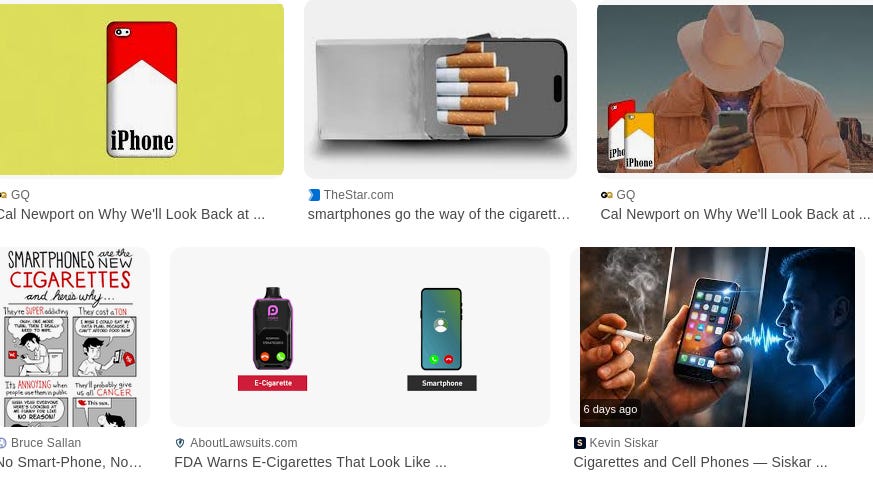
The point that most parents and gurus alike continue to ignore because it’s uncool, bad for GDP and too simple is that what really “influences developing brains and identities”, and would do it even if social media and AI bots didn’t exist is the damn smartphone dropped into kid laps years before they are ready.
Smartphones are not the Internet. It’s perfectly possible to get all that’s good online with desktop or laptop computers or smart TVs, and the sooner children learn how to do it with those tool the better, I say. But smartphones, or any other mobile, pocket-sized or wearable device with Internet access and a camera, are wildly different, for two reasons that’s easy to miss because they are too big and simple.
One is that, even if porn, social media and predators didn’t exist, smartphones before 16 years old would still facilitate sleep deprivation and myopia epidemics. Above all, they would still be synonyms of unrestricted, uncontrollable access to questionable websites, uninterruptable peer pressures and other pressures and surveillance by... overzealous parents. Plus, of course, unrestrictable, continuous exposure to all sorts of “personality-shaping” AI services. Please notice that even when (not “if”) the AI bubble will crash, all the other issues will remain.
The other reason is that banning personal smartphone before 16 it’s hugely easier (not to mention orders of magnitudes cheaper) than enforcing age limits, and without side effects.
I’ve read learned people opposing smartphone bans because “Why would anyone want to deprive children of such a remarkable tool as a smartphone?” The one-sentence version of the really easy answer is: because (NO offense meant, this is a systemic, generational issue beyond any parent’s control!!), unlike the experts who ask such question, 95% of the real children and parents existing today are able to do it properly.
Please share this with all the parents you know!
Five bullet take-home summary: what to ban, how, and who should do it
Ask governments to outlaw the intrinsically toxic features of social media, for everybody’s benefit
Never ask governments to ban or restrict internet access. It cannot work, only backfire, and when kids are concerned, certain actions are the parents’ job anyway
If you have kids, don’t give them a personal smartphone before 16, period. Give them any kind of home-tied computer as soon as possible and, if you really really must, a dumbphone. They’ll grow up just fine, practically for free, without missing anything important, and without anybody controlling them as today
If you have no kids, loudly support the parenting style in the previous bullet. Again, keep governments out of this, not just for-profit companies. Social pressure is the way
All the bullets above were already valid ten years ago. In 2026, AI is just giving parents and everybody else a billion more urgent reasons to do them now
UPDATE, 8.03pm GMT+1, 23/2/2026
I only noticed this instant that Afterbabel too had warned about “AI chatbot for kids” six months ago: But the most effective strategy remains the same: before (not instead!) struggling to reform AI chatbots as they suggest, make it impossible for them to reach kids through smartphones!

