Normal view

[Sponsor] Paper

Paper is a professional design tool where every layer is real HTML and CSS. Your design is already code, which means fewer handoffs and fewer translations between what you design and what ships.

Paper works both ways: code to design, and design to code. Connect any agent through MCP and it can read and edit your designs. Or use Paper Snapshot to capture your live site as editable layers and make new iterations.

Agents handle the tedious work so you can focus on your craft and the decisions that matter.

Try Paper at paper.design.

How to Estimate Knife Steel Properties

By: Larrin
13 July 2026 at 19:26

Patreon

Thanks to our new Patreon supporters!

Kyle

Paxton Irving

Patrick Chase

Robert Angerer

Willow Cheney

Chris Cramer

Paul Nawashar

Video

There is also a video that presents the same information:

Knife Steel Tests and Ratings

I have tested many knife steels over the past several years and reported the results in many articles. I also have an article where I created ratings for each steel based on those past experiments. In that article I spent quite a bit of space on what is behind the properties of each steel. For example, I showed an equation I developed that predicts the CATRA edge retention of different steels based on carbide types, carbide volume, steel hardness, and the edge angle of the blade. I wanted to try to demystify the ratings a bit to show that steel results are somewhat predictable based on certain factors. Of course there are always many counter-examples where we test a steel and are surprised by a result, usually in the negative direction. With enough investigation it is possible to find out why a result was different than the expectation, though of course we don’t always have the resources to do that.

So in an ideal world we would have experimental data for each steel and don’t have to speculate on how good the steel might be. Before I started doing my testing there was very little 3rd party data available for comparing steels between companies. So Crucible or Uddeholm, etc. might compare the general properties between their own steels but generally not between their steels and the competitors’. And the companies rarely have data for everything about a steel, many data sheets are missing wear resistance or toughness experimental results, etc. But can the average knife enthusiast look at a steel composition and make a reasonable estimate of its properties? Can it be done just by looking at one or two elements and then checking with a chart? (As opposed to complicated equations). I decided to see if such a thing could be possible. I will also point out some of the cases where the estimates break down and why.

This might be my worst idea ever, as now my comments will be filled with people asking about every possible outlier in the predictions. At least you will be better at predicting steel properties than AI.

Compositions

So for these predictions, I am trying to find the best correlations I can using only the published elemental composition of each steel. These are available in many places, such as the steel manufacturer websites, in articles on my website, in Knife Engineering 2nd edition, or Zknives.com has a huge database of them. For the high alloy steels, it also lists whether it is “ingot” (conventional steelmaking) or PM (powder metallurgy), which will be relevant for the toughness predictions.

Carbon Steels

Low Alloy Steels

High Alloy Steels

High Speed Steels

Stainless Steels

Edge Retention

Edge retention seems to be the favorite property of knife enthusiasts so we will start there. I have a big article on CATRA edge retention here that discusses a lot of the individual grades and why they land where they do.

One thing I showed was a chart comparing some different stainless and non-stainless steels to each other and the overall amount of carbide to show that more carbide leads to higher wear resistance and edge retention:

Those different color dots correspond to different amounts of chromium and vanadium because those are important factors for edge retention:

You can see micrographs of the steels to get an idea of the increase in carbide volume:

CPM-3V

CPM-4V

CPM-10V

CPM-15V

The steels with low chromium (5-7.5%) and vanadium additions form a very hard vanadium carbide, and because of the high hardness of those carbides they have a stronger effect on edge retention for a given carbide volume. Chromium carbides are significantly softer and so you need a lot more carbide to achieve the same level of wear resistance. Increasing amounts of chromium in the steel reduces the amount of vanadium carbide formed for a given amount of vanadium, and replaces it with the softer chromium carbides. However, because the total carbide volume is generally higher for those grades, the edge retention is actually pretty consistent for a given amount of vanadium:

However, this is not perfect of course. Most of the steels I “normalized” to a hardness of 61 HRC so we are comparing the steels and not the steel and hardness at the same time. The effect of hardness on CATRA edge retention is relatively predictable if you look at the angled grey dashed lines on the CATRA chart. Z-Max, Maxamet, and Rex 121 are above the line for the other steels because they have a lot of tungsten/molybdenum carbide in them and also because they were tested at very high hardness levels and aren’t really designed to be used at lower hardness. So I didn’t normalize them to 61 HRC. Also when you look at the 0% vanadium region it ranges all the way from 300 to 750 mm or so. This is because there are steels with little or no vanadium that can have a lot of chromium carbide and still have relatively high wear resistance. Those steels still need high carbon to form all of those carbides, however, which also includes those extreme high speed steels like Rex 121. So I found that carbon was actually the simplest predictor of edge retention:

There are still some steels that are relatively low compared to others, such as the cluster of steels in the 300 mm range at 1-1.5% carbon. Those are low alloy steels with very soft iron carbides called cementite. So I broke out the steels into different categories and the predictions get even better:

So to get an estimate of edge retention based on composition you follow this process:

  1. Does the steel have less than 3% Cr? If yes it is a “low alloy” steel, otherwise it is a “high alloy steel.”
  2. Does the steel have a significant vanadium addition? If so look at the “High Alloy >1%V” line, otherwise look at the grey line.

Nothing is perfect of course but that can give you an idea of where the properties might land. Note that it is not separated by stainless vs carbon steel, all of the stainless steels are within the “high alloy” category in this case. Could also probably break out steels designed to be used at over 66 HRC but this is close enough for our purposes I think. This does not factor in nitrogen since there are very few steels with which to build an estimate. Nitrogen could probably be added to the carbon, or perhaps use 6/7 multiplied by nitrogen because of the atomic weight difference.

Toughness

Toughness is also greatly controlled by steel hardness and carbide volume. However, the carbide hardness matters a lot less for toughness, and instead it is the carbide size that is very important in this case, which we didn’t discuss at all for edge retention. One of the big differentiators here is the technology used to make the steel. The most expensive knife steels are made with powder metallurgy, which leads to a smaller carbide size. So you can get higher toughness for a given amount of carbide. One example would be D2 steel made with conventional steelmaking, powder metallurgy, or an in-between technology called sprayform. You can see the difference in carbide size and toughness below:

CPM-D2 (powder metallurgy)

PSF27 (sprayform D2)

D2 (conventional steelmaking)

The amount of carbide matters just as much as the size as the carbides, however. More carbide reduces toughness because they are very hard particles, and are the sites where cracks will initiate and grow. Here is a chart showing powder metallurgy steels and the strong correlation with toughness and carbide volume:

However, we do not know what the carbide volume is just based on the composition, so we need some other factor for estimating. The closest we have is again looking at the carbon content, since you need more carbon to form more carbide:

So that gives us a reasonably good estimate of toughness though not perfect of course. While you can see that toughness drops relatively rapidly up to 1.5% carbon this can be somewhat misleading. In terms of expected performance, toughness behaves more on a log scale. Plotting it that way shows the following:

As an example of how even a relatively low carbon steel can end up with poor toughness look at 1.4116, which is a stainless steel with 0.5% C,15% Cr, and a small amount of Mo and V. With the low carbon content we would predict a relatively high toughness value. However, it only tested about 8 ft-lbs even though it was only 57 HRC. When analyzing the microstructure I found there were some very large carbides. These large carbides will of course limit the toughness. It is likely possible with better processing to reduce or eliminate these large carbides, but poor processing can turn a good steel into a bad steel.

A large carbide I found in 1.4116 stainless steel

I tried to break it down further so the spread for each carbon content is smaller though it does start to get messy:

The conventional steels, whether high or low alloy are relatively close to powder metallurgy below about 1% carbon but rapidly drop. The high alloy steels see this steep drop because the carbide size becomes more and more difficult to control as the carbide volume increases. Low alloy steels have significantly less carbide for a given amount of carbon but they have more issues with “plate martensite” above about 0.85% carbon. You can read more in this article about forging knife steels. The biggest counterexample is 52100 which is the blue dot at 1% carbon and ~30 ft-lbs. The 1.5% Cr makes it less prone to having plate martensite.

The highest points on the chart are the yellow ones which are the powder metallurgy non-stainless steels. Both PM high speed (light blue) and PM stainless steels (orange) are significantly below. The reason is that the stainless steels have a significant amount of chromium carbide, and in powder metallurgy steels the chromium carbides are significantly larger than the vanadium carbides. The amount of carbide for a given carbon content is also generally higher, probably because the high chromium leads to more overall carbide. The high speed steels instead have significantly amounts of tungsten/molybdenum carbides which are also larger than vanadium carbides. Counterexamples for the above are MagnaCut, MagnaMax, and CPM-M4. MagnaCut and MagnaMax were designed to not have chromium carbides, so they behave more similarly to the non-stainless steels. CPM-M4 has less tungsten/molybdenum carbide than most other high speed steels, and is overall more balanced than other high speed steels.

Corrosion Resistance

I have a previous article about corrosion resistance testing and the factors that lead to high corrosion resistance. I also wrote about corrosion resistance and tested a bunch of steels for the MagnaCut article. Of course one of the most basic aspects of a stainless steel is having at least 10.5% Cr. However, the chromium content alone does not tell you the corrosion resistance because not all of that chromium will go towards the corrosion resistance but instead will end up as chromium carbides (which are detrimental to corrosion resistance). But the correlation is still pretty good with bulk chromium:

MagnaCut has high corrosion resistance for a given chromium content for two reasons: 1) all of the chromium is in solution rather than being locked up in a carbide, and 2) it has no chromium carbides in the heat treated condition and those carbides are bad for corrosion resistance. D2 and ZDP-189 have low corrosion resistance for their level of chromium. These steels have very high carbon and thus form a lot of chromium carbide, reducing the amount of chromium in solution available for creating the chromium oxide protective film at the surface. So I tried to plot Cr divided by carbon and see if that gave a better correlation, since D2 and ZDP-189 have a low Cr/C ratio:

The trend now does not show those outliers that are too low but has a bunch of values that are above the trendline. Also Vanax and LC200N have a significant amount of carbon replaced by nitrogen so it is hard to plot them with the others. One reason there are many values that are above the trend line is because they have significant amounts of vanadium and thus much of that carbon is going toward the formation of vanadium carbides rather than chromium carbides. So I broke them out by whether the steels had sizeable vanadium additions:

Definitely not getting perfect predictions but not terrible. You should be able to get a decent idea of the corrosion resistance by looking at the ratio of Cr over C from the bulk composition. Anything over a “7” or so would be stainless. One check of this chart would be an old steel called K190 which is a powder metallurgy version of an even older steel called D7, which is a non-stainless with 12.5% Cr and 4% V, which puts it into the high vanadium group. However, its Cr/C is still only 5.4 which would still predict it to be non-stainless. MagnaCut would be a 9.3 despite its relatively low Cr content so that still predicts it to be stainless, though that predicts it to be roughly an 8 out of 10 rather than its true 9.5. MagnaMax prediction is significantly worse even though its corrosion resistance is roughly the same, because it has much more carbon than MagnaCut, though with more V and Nb it still does not form chromium carbides. So as with all of the above estimates there are going to be outliers that do not work with the predictions.

Toughness-Edge Retention Balance

Of course you can see that our best correlations for both edge retention and toughness were with carbon. In other words, increasing carbon leads to an increase in edge retention but a reduction in toughness. And of course increasing one property leads to a reduction in the other. However, some things can improve the edge retention-toughness balance such as using vanadium alloying and powder metallurgy production.

Summary and Conclusions

So surprisingly you can get a decent estimate of knife steel properties including edge retention, toughness, and corrosion resistance just by looking at the carbon, chromium, and vanadium content. It was a fun exercise though I’m still not completely sure how much utility it has. Of course this isn’t perfect and there are so many hundreds of caveats to this estimate that you can’t take any estimate like this as gospel. But hopefully it will lead to fewer people believing that “steel X has crazy high edge retention!!!” because they can check the carbon content and know right away that their claim is questionable.

The post How to Estimate Knife Steel Properties appeared first on Knife Steel Nerds.
Remember Musk’s Suit Alleging a Conspiracy Between Apple and OpenAI?

13 July 2026 at 17:24

Ashley Belanger, reporting for Ars Technica back in August 2025:

After a public outburst over Grok’s App Store rankings, on Monday, Elon Musk followed through on his threat to sue Apple and OpenAI.

At first, Musk appeared fixated on ChatGPT consistently topping Apple’s “Must Have” app list — which Grok has never made — claiming Apple seemed to preference OpenAI, an Apple partner, over all chatbot rivals. But Musk’s filing shows that the X and xAI owner isn’t just trying to push for more Grok downloads on iPhones — he’s concerned that Apple and OpenAI have teamed up to completely dash his “everything app” dreams, which was the reason he bought Twitter.

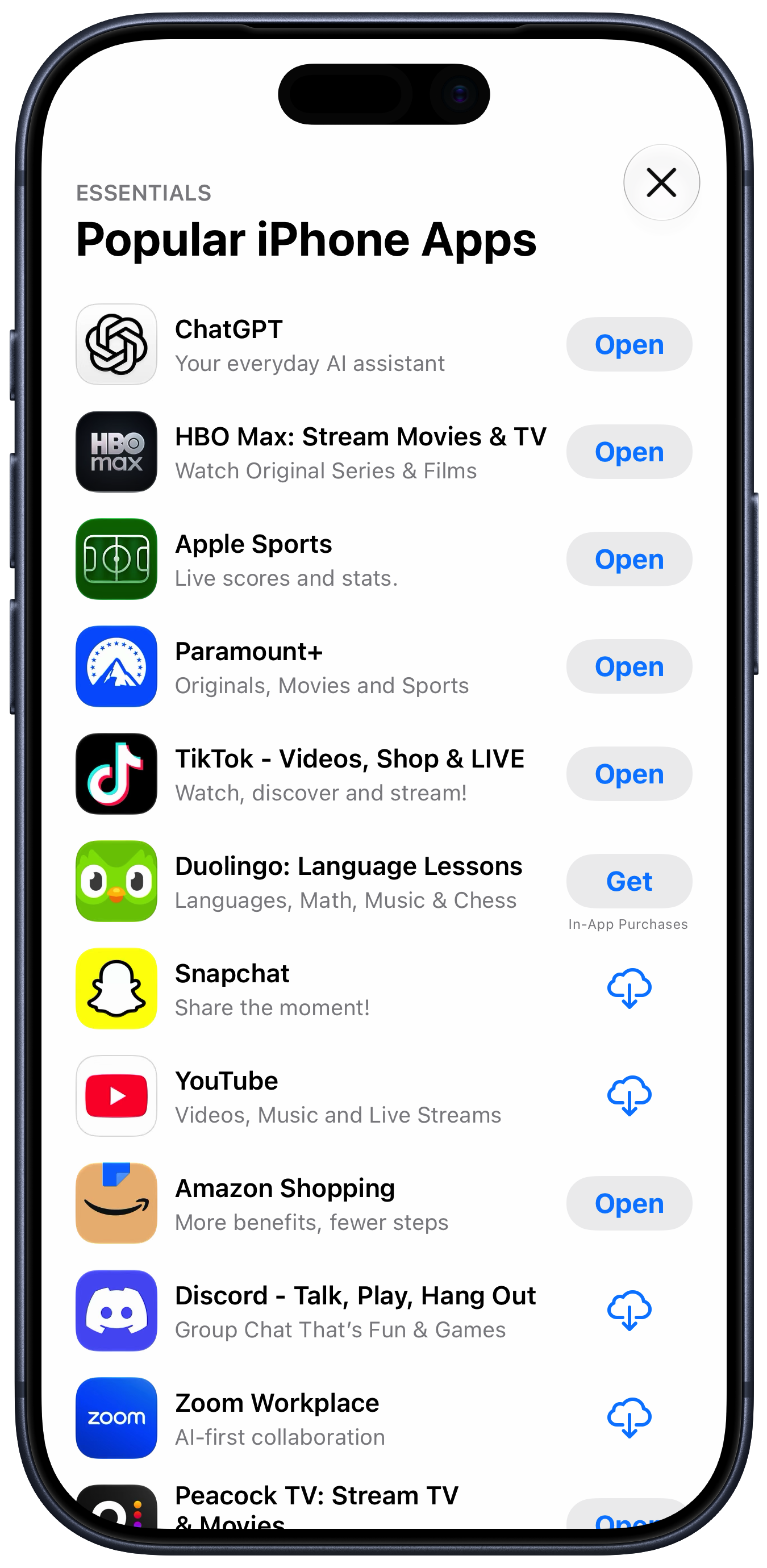
For what it’s worth, I just looked at the App Store editorially-curated “Popular iPhone Apps” list, and ChatGPT is in the top spot. Given the lawsuit Apple filed against OpenAI last week, I’d say this is pretty good anecdata that these editorial decisions in the App Store aren’t driven by favoritism. The top 10 downloads list for free iPhone apps currently looks like this (for me here in the U.S. App Store):

  1. Paramount+
  2. Netflix Game Controller
  3. ChatGPT
  4. Kalshi: Trade the World Cup
  5. Peacock TV: Stream TV & Movies
  6. Netshort - Popular Dramas & TV
  7. Threads
  8. TikTok Pro - Events
  9. Freecash - Get Paid Real Money
  10. Depop - Buy & Sell Clothes

There are some real winners on that list. But only one AI app: ChatGPT.

Musk alleges that the top downloads list is crooked too. That’s just projection. If Musk ran a popular App Store he’d put his thumb on the scale to make sure his own apps always top the list. That’s what he’s done with his personal account, and accounts aligned with his politics, on Twitter/X. Because that’s what he would do, he thinks that’s what Apple does. I really do think he believes the App Store’s top download lists are fixed, and that Grok is on the wrong side of the fix. Crooks think everyone is crooked. It’s just one of several ways that Musk is not hooked up right.

I suspect, though, that he’s no longer worried that Apple is putting its thumb on the scale to favor OpenAI. Maybe he should never-mind this lawsuit.

WorkOS Pipes

13 July 2026 at 00:17

My thanks, once again, to WorkOS for sponsoring DF last week. Users expect apps and agents to reach the tools they already work in. Every integration that gets you there is a different OAuth flow, a different token lifecycle, and weeks of infrastructure before you write a line of product code.

WorkOS Pipes handles it with one API call. Pre-built connectors for GitHub, Slack, Salesforce, Google Drive, and more. Pipes handles OAuth, token refresh, and credential storage. You call the real provider API with a fresh token, every time.

Connect to 100+ providers with WorkOS Pipes.

Paulo Andrade: ‘A WWDC 26 Update on Building a Mac-Assed App With SwiftUI’

12 July 2026 at 23:18

Paulo Andrade:

My last post on using SwiftUI to build a Mac-assed app got a bit more traction than I expected. It was mentioned on Mastodon several times, included in iOS Dev Weekly, inspired May’s edition of the Swift Blog Carnival, and was eventually mentioned by John Gruber, arguably the person most to blame for popularizing the term “Mac-assed”, on Daring Fireball.

All this attention also resulted in an engineer from Apple reaching out with some notes. We exchanged a few emails, I filed a few radars, and now that WWDC 27 is behind us, this post serves as a small update to the issues I wrote about before.

There’s real progress here, but I think my main point still stands: SwiftUI is now seven years old and it does not make it easy to create great Mac apps.

How UIs Degrade Over Time

12 July 2026 at 21:51

These examples are from Windows, but the same degradation is true for the standard look for MacOS alerts too. There was a time when system UI chrome was improving in clarity, everywhere. Today we live in an age when it’s degrading in clarity, everywhere. It’s rather inexplicable.

‘Every Frame Perfect’

12 July 2026 at 21:48

Nikita “Tonsky” Prokopov:

The rule of thumb is:

If I take a screenshot of your app at any moment, you should be able to explain what I see.

Why care about every frame? It builds trust. Users can’t see the code, so UI is the only way for them to judge the quality of the app. If UI looks good, that means developers had time to polish it, which means that they probably spent a comparable amount of time to iron out the code. It’s a heuristic, but a reasonable one.

Now, what does it mean in practice? I can think of a few things:

  • No white flashes between screens.
  • No partially loaded content.
  • No relayout while content loads.
  • Internally consistent. If one part of the UI says “1 update available”, another part should not say “Checking for updates...”
  • Precise animations.

Animations often end up being forgotten. A UI might look great in both start and end states but very janky in between.

“Every frame perfect” is a great mantra for UI craftsmanship. If you care about every frame, that discipline will be palpable, even though almost no users will ever examine your animations and transitions frame-by-frame, and most will happen too quickly to see in real time. If you cut corners on interstitial states “because no one will notice”, you’ll start cutting corners elsewhere.

TwoMillionKit: Use Private Cloud Compute in MacOS 27 Foundation Models Without an Entitlement

12 July 2026 at 20:04

Guilherme Rambo:

Apple ships the fm command-line tool in macOS 27, which can be used to run inference with the local system model or Private Cloud Compute from Terminal or scripts. You know what else can run command-line tools? Mac apps! 😃

I decided to spend some of my Codex tokens and take GPT 5.6 Sol for a spin. I asked it to create this Swift package. All it does is provide a LanguageModel implementation that uses the fm command-line tool under the hood, meaning that any Mac app can use the Private Cloud Compute model without requiring a special entitlement from Apple.

The main limitation is that this will not work for sandboxed Mac apps, so any Mac app distributed via the Mac App Store won’t be able to use it.

But for developers of Mac apps distributed outside the Mac App Store, this provides a simple and entitlement-free way to use Private Cloud Compute in their apps.

Use sparingly and at your own risk.

This is a workaround for Apple’s current limitation that only grants access to Private Cloud Compute to “developers in the App Store Small Business Program with fewer than two million first time App Store downloads”. Hence Rambo’s clever name for the framework.

Sam Altman and Elon Musk Argue Over Who’s Running the Bigger Scam

12 July 2026 at 19:45

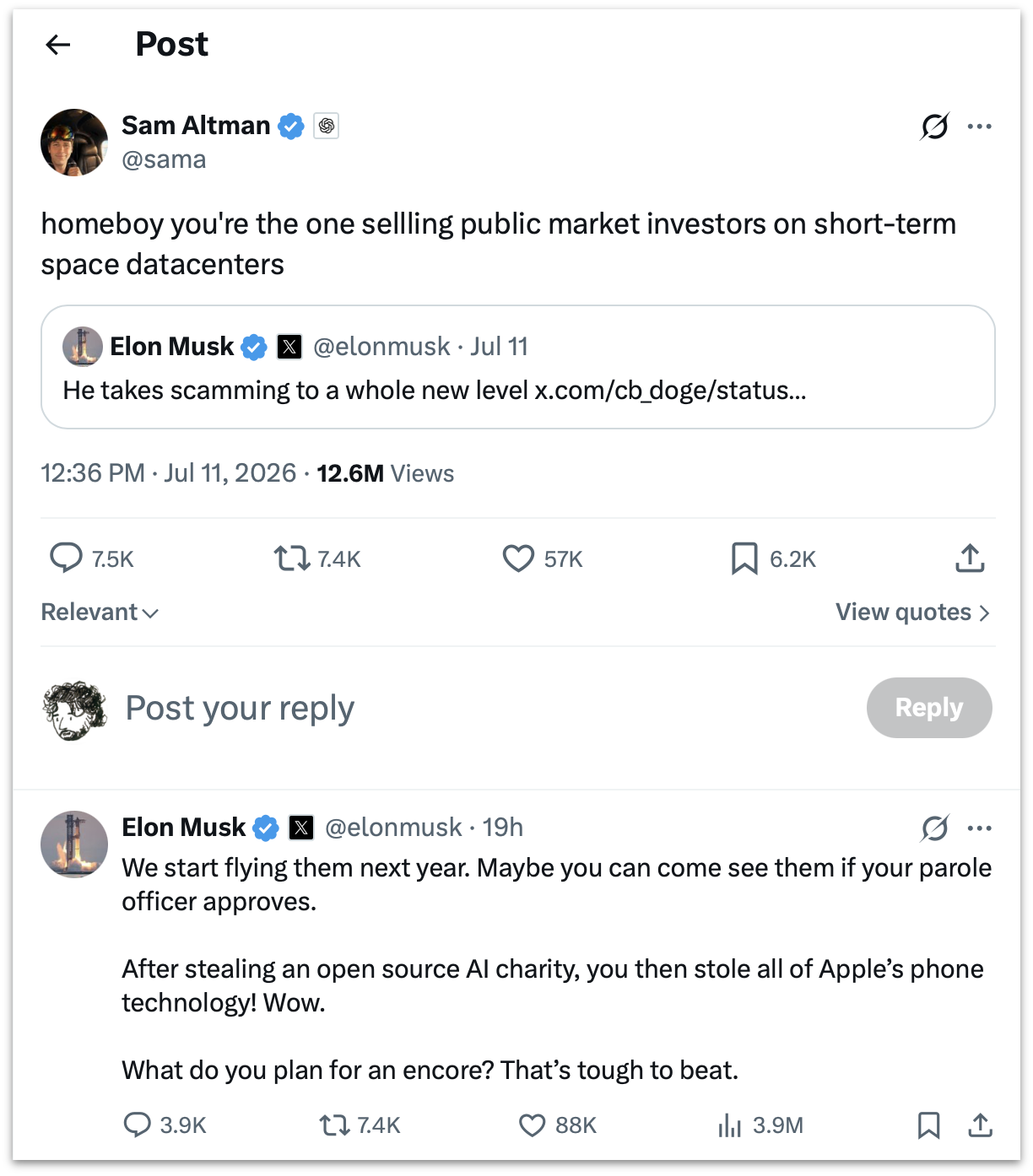
Elon Musk, linking to his own tweet from March that “Sam Altman is super good at scamming”:

He takes scamming to a whole new level

Sam Altman:

homeboy you’re the one sellling public market investors on short-term space datacenters

Musk:

We start flying them next year. Maybe you can come see them if your parole officer approves.

After stealing an open source AI charity, you then stole all of Apple’s phone technology! Wow.

What do you plan for an encore? That’s tough to beat.

(All spelling, capitalization, and punctuation sic.)

These are two of the CEOs of the most valuable companies on the planet. Say what you want about it, but Musk’s Twitter/X is like nothing else that’s ever existed. Screenshot of the thread for posterity, and an XCancel link for those icked by X itself.

Lunacy — Jeff Halter’s Lunatic Fringe Player

12 July 2026 at 19:19

After linking to Stacks, his remarkable new modern HyperCard player, I made the terrible mistake of clicking around the rest of Jeff Halter’s website, and fell upon Lunacy:

Created by Ben Haller and released in the early ’90s as part of the Macintosh More After Dark software package, Lunatic Fringe was unique among screensavers in that it was not just a passive animation to watch, but an interactive game! Toggling the Caps Lock key while the screensaver was running popped you into a space shooter where you could fly around, collect power-ups, and blast a variety of baddies all in pursuit of a high score. It was a blast.

Running Lunatic Fringe on a modern computer has been a challenge. Fringe Player by Greg Parker filled this need during Apple’s PPC and Intel era, but is not supported on modern Apple platforms. Lunacy brings Lunatic Fringe to the present: a native Swift app with a built-in emulation engine that runs the original module, unchanged, on modern Apple platforms.

Lunatic Fringe is one of my all-time favorite classic Mac games. Lunacy is a great modern player, including CRT simulation to make the game look a lot more like it did back in the day.

Stacks — HyperCard Player for Modern MacOS

12 July 2026 at 17:42

Well this is just delightful:

  • Run HyperCard stacks directly on your modern Mac. No emulator required!
  • Browse the Internet Archive’s HyperCard collection and run stacks with one-click.
  • Period-accurate typography.
  • Sound, instruments, and MacinTalk speech synthesis.
  • Cross-stack navigation.

Stacks is a really beautiful native Mac app, and its presentation of classic HyperCard stacks is exquisitely faithful to the era. It’s simultaneously Mac-assed 2026-style and Mac-assed 1987-style. Crackerjack work from developer Jeff Halter.

Can Someone Explain to Me How to Get ‘ChatGPT Classic’?

12 July 2026 at 00:38

One more link from OpenAI’s Help Center, this one explaining how to upgrade from the old Mac app to the new “super” app version:

Follow the prompt in the app to download the new ChatGPT desktop app. Then sign in with the same ChatGPT account.

The new app may install alongside your current app. If both remain installed, you will see:

  • ChatGPT: The new app with Chat, Work, and Codex.
  • ChatGPT Classic: The previous ChatGPT desktop app. You can continue using it; no migration is required at launch. It continues to receive model updates, bug fixes, security patches, and support for its existing Enterprise capabilities. New agent features may be available only in the new app.

None of this has been my experience. I had the existing old ChatGPT app installed on three different Macs. On all three of them, the built-in “Check for Updates” command only installs the latest version of the classic app. This is good, I suppose. But if you’re not aware from following the news that OpenAI released an altogether new “super” app for MacOS and Windows, you’d never know it from the Check for Updates command built into the classic Mac app.

So I don’t see “the prompt in the app to download the new ChatGPT desktop app”. If I download the new app manually, I get a disk image. After mounting the disk image, the instructions say to double-click the “ChatGPT” app on the disk image — not to drag it to the Applications folder. If I do that while the old ChatGPT app is still running, it bounces back and forth a few times but nothing new gets installed and nothing old gets removed or renamed. I’m just left with the classic ChatGPT app, still named “ChatGPT”.

If I run the installer on the disk image when the old ChatGPT app is not running, the old app gets replaced by the new one in my Applications folder, and the old app is moved to the Trash. There is no app named “ChatGPT Classic”.

I mean, their Help document does say “the new app may install alongside your current app”, and “if both remained installed”, so they seem just as confused as I am. And while you can, for now at least, just remain on the old version of the app and still get model updates and bug fixes, there is seemingly no way to download a new copy of the classic ChatGPT Mac app if you don’t already have a copy. The update installation is seemingly non-deterministic.

This is an app with over a billion users. I know there aren’t a billion users of the native Mac app, but, still. It’s one of the most popular apps any company has ever made, and the biggest update they’ve ever shipped is an incoherent confusing mess.

OpenAI Help Center Describes What Is Wrong With the New ChatGPT

12 July 2026 at 00:24

OpenAI Help Center, “Where Work and Codex are available”:

Work is available on ChatGPT web and mobile for eligible paid plans. Work is also available in the ChatGPT desktop app when included for your plan and workspace.

Work on web and mobile runs in the cloud. Work in the desktop app can also use local files and desktop apps with your permission. At launch, cloud Work conversations do not appear in desktop Work; desktop Work threads and local files remain on that computer.

Codex is available as a mode in the ChatGPT desktop app. It can work with local folders, repositories, terminals, and developer tools. Codex is not a selectable mode on web or mobile. You can access supported desktop Codex tasks from the Remote tab in the ChatGPT mobile app, but those tasks do not become web or mobile chat history.

These three paragraphs, from OpenAI’s own Help Center, sound more like a critic’s scathing review of what’s wrong with the new ChatGPT “super” app than a guide to how to use it.

Benedict Evans on the New ‘Super App’ ChatGPT

12 July 2026 at 00:16

Benedict Evans with a succinct review on Threads:

Wow, what a total mess.

What is the difference between a project, a task and a chat?

Why did chats get a crappy floating window but tasks and projects don’t?

Why does choosing ‘plugins’ get me ‘templates’?

Am I not allowed to finish ‘setup’ if I don’t use Slack or Google Drive?

I forget how I made the Setup dickbar disappear despite my not using Slack or Google Drive. It was confusing.

It is sometimes observed that in companies dominated by internal politics, their shipped product (and public keynotes) reflect the company’s org chart. That’s never been truer than with the new ChatGPT app. OpenAI’s internal org chart is a complete disorganized mess. This new app perfectly reflects that.

The old ChatGPT app was focused. That’s the app that still ships for mobile (which includes iPad, which tells you whether OpenAI thinks iPad is a real computer or a big iPhone), and is, for some Mac users, left installed on their systems as “ChatGPT Classic”. The new app is an incredibly confusing sloppy mess. At a glance it looks like a polished app. But the UI is just slop. It has the veneer of a polished app without actually being organized or structured or labeled in ways that add clarity and coherence. It’s playing dress-up as a big-boy app. My understanding from people adjacent to OpenAI is that the company’s senior executives are singularly consumed with FOMO obsession regarding Anthropic, and the only real clout within the company belongs to the AI researchers. Not product designers or app craftspeople. What the researchers say goes, and with this update, we can see their level of taste in app design.

The app icon for the new “super” app should be the Homer.

★ Exactly Like Om Malik

11 July 2026 at 21:43

Fred Vogelstein (Om’s partner at Crazy Stupid Tech):

We met a week later at his outdoor office — a bench in SF’s South Park. He told me that he was going emeritus at True Ventures, the VC firm, and that he was going to spend more of his time writing.

It was awesome to see him. Sitting on a bench with Om could be quasi religious. He talked so softly and deliberately that it forced you to slow down, lean in and forget about everything else.

What became clear was that we actually saw the world the same way. We didn’t agree what Wired should be doing about it. But we did agree on this: While everyone was fixated on big tech, an explosion in tech innovation not seen in a generation was taking place. We both agreed that not enough people were writing about it.

“Maybe we should do something together then,” I said.

Joanna Stern:

So saddened to hear about @om. His writing was one of the reasons I went into tech journalism. Right out of college, I was working at a PR agency and started reading his site. It inspired me to start blogging.

Years later, he tried to recruit me. Even after I went elsewhere, he’d send me notes telling me how proud he was of my work. He’d often review my reviews, so here’s mine of him: Generous with his time. Honest with his feedback. Endlessly encouraging to those coming up behind him.

Casey Newton:

Very sad to hear about the passing of @om. He shared two lasting lessons with me: the first when I was a cub tech reporter at the SF Chronicle; he interviewed me for a job but told me he didn’t think I could hack it at GigaOm because newspaper writers were too slow. It taught me that I needed to get out of print media ASAP.

The second was many years later, when I was having a drink with him and some other reporters. We asked him for advice. “Never name a blog after yourself,” he said. RIP

Jim Nielsen:

One day on Twitter I got a DM from someone with the handle @om.

“I don’t know who this is,” I thought, “but damn that is a great handle!”

Then I peaked at the follower count: over 1 million!

“WTF? Who is this???” I thought.

I’d never — then or since — been contacted by someone with such a high profile online.

How was I even on this person’s radar?

Om seemingly read everything.

MG Siegler:

Looking at my emails and social media messages from back then is just a treasure trove. Om was always quick with a compliment about something I had written but also with a criticism at times. He clearly just read endlessly and couldn’t help but share his opinions, even if privately. In person too he was amazingly candid and honest. He would complain how annoyed he was if you beat him to some story — but complain even louder if he felt like he actually beat you but wasn’t getting enough credit. He was clearly competitive too. And he was correct in his assessments, because again, he was honest. [...]

To me, Om was and will always be such a singular individual. There will never be anyone quite like him. He’s the only person I know who could be both humorously downtrodden and insanely optimistic at the exact same time. Again, he just seemed to wear his emotions on his sleeve.

Jason Hiner, in a post on LinkedIn:

This is the opening anecdote from “Chapter Six: The Blogger” from my 2016 book, Follow the Geeks, co-authored with Lyndsey Gilpin. Om once told me that “For three years, it was every day a rejection” as he tried to break into tech journalism. This was how he finally broke through.

David Churbuck checked his voicemail. There was a message from someone looking for a job.

Because of the guy’s thick Indian accent, David could barely make out what he was saying, except that he worked for a wire service down on Wall Street and was a big Forbes fan. The guy heard that Forbes was going to be one of the first media companies to launch its magazine on the web and he wanted to come help.

David ignored the message. He had a small team and hardly any budget.

Then he got a fax. It was from this guy, explaining why he was a perfect fit to join the team.

The next day, the guy left another message. If David would just give him a call, it would be great to talk with him. He wouldn’t regret it.

Ignore.

The following day, he left another. Whatever time limit there was for voicemails, this guy always used up every minute.

Still, David ignored it.

And then the guy started getting creative.

[...]

One of the journalists, Michael Noer, said half jokingly, “Just call the guy in!” So, partly out of admiration, and partly out of pure morbid curiosity, David called him back.

One interview. Fifteen minutes. That was all it took for David to hire Om Malik.

“They do not sell themselves”, Om told me in a separate story from that same time in his life.

Hiner made the entire chapter available to read as a handsome PDF. It’s so good, and so utterly Om. It’s a crackerjack good read about the very early “WWW” days of the web. A bit:

Om is charming and disarming, forceful and accommodating. He has an easy smile, a quiet, melodic voice, and a handsome face. Once he opens his mouth, it’s obvious how much he reads and how thirsty he is to learn. It’s rare to meet someone who is ready to debate you on almost any topic, but who’s also genuinely curious about your life and your opinion. It all makes the burly journalist one of the most huggable people on Earth. That’s what David was up against when he met Om. He didn’t stand a chance.

“It was destiny,” said David, with a self-deprecating laugh. “It was total destiny.”

Om’s close friend, photographer Christopher Michel, published “Om the Great”, an enormous gallery of portraits of him. Here’s just one of hundreds:

July 2024 portrait of Om Malik, holding a camera, by Christopher Michel.

Lastly, here’s a story from Andrew Sasaki, which he sent me by email, and I’m reproducing with his permission. It’s the perfect Om story:

I met Om briefly at a tech event in NYC around 2008 or so. He was talking with a friend of mine, and when I walked up he introduced himself: “Hi, I’m Om.”

“‘Om’ like ‘Om Malik’?” I asked.

This amused him greatly.

“Yes, exactly like Om Malik”, he said.

A couple of years later the iPad had just launched, and I saw my friend again at another industry event. I asked him a question related to the unprecedented development effort we were already seeing around the new platform that didn’t yet have a single compelling use case.

“You know who I bet would know about that? Om Malik”, he said, and gave me Om’s email address.

I hesitated to bother Om, but eventually reached out with my question. “I don’t know if you remember me, but we met a couple of years ago, and…” blah blah blah.

Naturally, there was no answer. Why would there be? He doesn’t know me from Adam, and he’s Om Fucking Malik.

Except there was an answer about 4 days later. Om started off by apologizing for the delay in responding, but he had taken the time to research his answer before writing to me. And of course, his answer was thoughtful, insightful, and absolutely correct. I was gobsmacked at the generosity he had shown replying to someone he didn’t even know. He gave no indication that he even remembered me until his signature line:

“Exactly Like Om Malik”

Gurman on Tang Tan and Paul Meade

11 July 2026 at 20:02

Mark Gurman, reporting for Bloomberg (paywalled, alas):

Apple was quickly alarmed by OpenAI’s recruiting drive, which included poaching senior hardware and design leaders and ravaging several teams across its engineering organizations. The practice continued as recently as June, when OpenAI lured away Apple’s smart glasses chief. That executive, Paul Meade, was quickly shown the door at Apple and not given the opportunity to stay on for a transition period, according to people with knowledge of the matter.

Regarding Tang Tan, who is at the center of Apple’s lawsuit:

Tan was famous for taking risks at Apple and “flying very close to the sun” during his 25-year career, according to someone who worked with him. “Tang is well known for moving fast, playing fast and loose and breaking things,” said the person, who asked not to be identified while discussing former colleagues.

Gurman broke the story of Meade leaving Apple for OpenAI on June 26, writing then:

Meade’s departure is a blow to the iPhone maker. He has led hardware engineering for the Vision Pro headset — once seen as Apple’s next major computing platform — for seven years. Apple and OpenAI spokespeople declined to comment. He has also been responsible for the development of display-free Apple smart glasses meant to vault the company into the AI wearables space next year and compete with a growing category pioneered by Meta Platforms Inc.

‘No Interest’

11 July 2026 at 05:41

Drew Pusateri, director of communications at OpenAI, on Twitter/X (or XCancel):

Our statement in response to this suit: We have no interest in other companies’ trade secrets. We remain focused on building innovative technology that empowers people everywhere.

Let’s say I think you stole my wallet. I approach a police officer and tell him my suspicion and describe the evidence that makes me think you have my wallet in your pocket. “Is that his wallet in your pocket?” the cop asks.

“I have no interest in other people’s wallets” would be a rather curious answer.

Ice Cold

11 July 2026 at 05:14

Alex Heath, on Threads:

At WWDC, Apple execs I met with were ice-cold when I asked about their OpenAI partnership.

Now we know why: Apple just sued OpenAI for allegedly stealing trade secrets related to consumer hardware (Apple and OAI senior leaders are in Sun Valley this week. Yikes!)

I noticed the same ice-cold reaction to my questions about ChatGPT and Siri. (In fact, I think Heath and I even talked about it together when we bumped into each other at the end of the day on Monday during WWDC week.) At the time I took it as Apple execs not wanting to distract from the fact that Siri AI with Apple Intelligence, with no third-party plug-in, was truly competitive. But in hindsight their coolness, I think, was about this.

There was no response like, say, “We think ChatGPT is great and we’re happy to keep it available in iOS 27 as an option for our customers who love that experience, but the new Siri AI truly stands on its own.” That’s a typical Apple answer. But what they actually said was just more like “The ChatGPT extension remains available.” I didn’t think much of it at the time but now it stands out.

Ryanair Literally Sucks

11 July 2026 at 05:04

The AP:

Fellow passengers pulled back a man who was partially sucked out of a dislodged airplane window on Friday, a few minutes after takeoff on a flight from northern Greece to Germany. The plane subsequently returned to the airport in Greece.

The incident happened on a morning flight from the northern Greek city of Thessaloniki to Memmingen, near Munich, operated by Malta Air, a subsidiary of Ryanair, Europe’s largest budget carrier.

Worse than bad date math.

Newly Renamed Trump Airport in Palm Beach Has an AI Slop Logo

11 July 2026 at 05:01

Frank Landymore, writing for Futurism:

Look past its gaudiness, though, and you’ll notice some things that’re a little off in the finer details. The talons are horribly deformed and shaped differently from each other. The entire legs are uneven, too, and the base of them are represented as a strange conglomeration of blobs, which are also inconsistent. In fact, the whole thing is slightly asymmetrical. The wings have an uneven number of feathers. The two olive branches — another error in itself, because the eagle is supposed to be clutching a bundle of arrows in its right-side talon — have differing numbers of leaves. And the shield only has eleven stripes, as opposed to the thirteen that the actual Great Seal is supposed to feature.

The fourth star is crooked. What a mess. Perfect logo for Trump Airport.

❌