Normal view

Apple Upgrade — New Program With Klarna for Leasing iPhones, Macs, iPads, and More for Near-Zero Interest

29 July 2026 at 18:51

Apple Newsroom:

Apple today announced Apple Upgrade, a new product leasing program provided by Klarna for iPhone, Apple Watch, Mac, and iPad available on the Apple Store online, in the Apple Store app, and at Apple Store locations in the United States. Apple Upgrade makes it even easier for customers to get the Apple products they love with a leasing plan that is right for them. [...]

Apple Upgrade offers 12- and 24-month leasing options for iPhone and Apple Watch, and 24- and 36-month leasing options for Mac and iPad. Leasing prices start as low as $17.99 per month for iPhone, $11.99 for Apple Watch, $24.99 for Mac, and $11.99 for iPad. When customers first enroll in Apple Upgrade, they can further lower their monthly lease payments by trading in their currently owned device through Apple Trade In. Customers can also earn 3 percent Daily Cash back when making their lease payments with Apple Card.

Michael Tsai, quoting Juli Clover at MacRumors:

Juli Clover:

The payoff amount is the difference between what was paid during the leasing period and the retail price of the device, minus any remaining trade-in credits. Klarna is not charging a fee for the leasing program, so an iPhone that’s $1,099 can be leased and then purchased for $1,099 with no extra cost beyond taxes.

I guess this means that, for a bit of hassle, you can essentially buy the device for the list price at 0% interest.

If you’d rather lease or buy over time, this seems like as good a deal as you could hope for, without any catches.

Pastebot 3

29 July 2026 at 18:07

New from Tapbots: version 3 of their excellent clipboard manager for Mac. There are so many clipboard managers for the Mac. I run two other apps — Keyboard Maestro and LaunchBar — that offer good clipboard managers as ancillary features. But for years now I’ve chosen to use Pastebot. Chief among my favorite features:

  • Remembers up to 1,500 clippings (up from a mere 1,000 in v2).
  • Syncs via iCloud. If I copy something on one Mac, it’s in my Pastebot history on my other Macs.
  • That sweet Tapbots UI.

Pastebot 3 requires MacOS 26 Tahoe or later. That means I’m only using it on secondary Macs for now — my primary workstation will continue running MacOS 15 Sequoia until I upgrade directly to 27 Golden Gate later this year. But iCloud sync continues to work between Pastebot 2 and 3.

New features include more powerful filters (e.g. you can use a filter to copy a URL and then paste that URL in Markdown’s link syntax), a CLI tool (as yet undocumented), and Shortcuts support.

$39 for a license via direct purchase, with a $13 discount for users of previous versions. It’s still pending approval in the Mac App Store, where it will cost $25/year or $3/month.

Count Those Underscores

29 July 2026 at 17:28

Nate Anderson, reporting for Ars Technica under the headline “A Missing Underscore Sent Innocent Man to Prison for 18 Months”:

Police were looking for a man using the Kik messaging service under the name “fus__ro_dah” (two underscores after “fus”), but they accidentally requested records for the username “fus_ro_dah” (one underscore after “fus”). This one-character difference led them not to the perpetrator but to a Canadian man named Brandon Klayme. [...]

Despite finding no evidence of the crime on his digital devices, Canadian police arrested Klayme in 2020 on child sex abuse charges. He was convicted after a trial in 2023 and sentenced in 2024 to 18 months in prison. He served the full term.

Even after release, Klayme continued to fight his conviction. In the process of preparing his appeal, the username mistake that led to all these years of disruption was finally discovered. On Thursday, the Nova Scotia Court of Appeal overturned Klayme’s conviction, writing: “Mr. Klayme is factually innocent of the offences. He should never have been charged, let alone convicted.”

Via Paul Kafasis, who asks:

While I understand how the mistake led to this poor guy becoming a suspect, I really can’t fathom how he was convicted. What the hell happened during that trial?

Contra Ars’s headline, it wasn’t the missing underscore that sent Klayme to prison for 18 months.

Update: Guy Chapman observes that this is basically the central plot of Terry Gilliam’s Brazil.

‘eBay’s Bizarre Cyberstalking Saga Ends With a $56 Million Settlement’

29 July 2026 at 16:43

Emma Roth, The Verge:

eBay and three former executives will pay $55.7 million as part of a settlement with a Massachusetts couple targeted with a bizarre harassment and cyberstalking campaign in 2019, as reported earlier by CNBC. The settlement will resolve a lengthy legal saga that revealed how eBay’s former executives sent live insects, a bloody pig mask, a funeral wreath, and other strange items to David and Ina Steiner over their newsletter’s coverage of eBay.

The Steiners, who operate the EcommerceBytes newsletter, sued eBay and its former executives — including ex-CEO Devin Wenig — in 2021. The lawsuit accused the company and its executives of launching a coordinated effort to “intimidate, threaten to kill, torture, terrorize, stalk and silence” the Steiners in an attempt to “stifle” their eBay-related reporting.

I don’t think I’ve ever linked to this saga before, but I’m not sure why. One of those stories that slipped through the cracks. It’s an astonishing tale. Could be the basis for a Coen brothers movie.

From David Streitfeld’s 2020 overview of the saga for The New York Times (gift link):

Prosecutors say that on Aug. 7, Ms. Popp — the “Mom” to Mr. Baugh’s “Dad” — began sending Twitter messages to Ms. Steiner via a fake account, @Tui_Elei. The profile picture was a skull, and he seemed to be an eBay user from Samoa who believed that EcommerceBytes had harmed his sales. Ms. Steiner ignored the messages, even as the tone got angrier and more abusive. @Tui_Elei wrote: “I guess im goin to have to get ur attention another way bitch…”

A parade of disturbing deliveries began at 4 p.m. on Aug. 10, when a package containing a bloody pig mask arrived at the Steiners’ home. Fourteen minutes later, @Tui_Elei wrote: “DO I HAVE UR ATTENTION NOW????”

The Steiners received a book titled “Grief Diaries: Surviving the Loss of a Spouse” and a funeral wreath. They got fly larvae and live spiders and a box of cockroaches. Copies of the September issue of “Hustler: Barely Legal” touting “eye-popping 18-year-olds” arrived at the homes of neighbors with David Steiner’s name on them. The Twitter bombardment continued, as @Tui_Elei began to hint at violence: “wen u hurt our bizness u hurt our familys… Ppl will do ANYTHING 2 protect family!!!!”

It’s certainly not how anyone would plan a business strategy, but this settlement seemingly makes the Steiners some of the most successful independent writers in history. Here’s Ina Steiner’s piece on the settlement at eCommerceBytes.

Steve Jobs in 2011: ‘We Build Products That We Want for Ourselves, Too, and We Just Don’t Want Ads’

28 July 2026 at 18:22

Dan Frommer, writing for Business Insider in 2011 about that year’s WWDC (Jobs’s last):

While discussing Apple’s free, new iCloud email service, he took an apparent jab at Gmail, Yahoo Mail, and the others, which stuff ads in their free email services.

“No ads,” he boasted. “We build products that we want for ourselves, too, and we just don’t want ads.”

Jobs’s “we” is interesting to ponder here. Apple’s senior leadership today is comprised mostly of the same people in senior leadership positions in 2011. Tim Cook, Phil Schiller, Eddy Cue, Craig Federighi, Greg Joswiak, and even John Ternus (then a director of hardware engineering for the iPad team, I believe) were all presumably included in Jobs’s “we”. The only big player missing today from Jobs’s 2011 “we” is Scott Forstall.

The people haven’t changed, but Apple has. Strong leaders inevitably shape the personality — the spirit — of organizations over time. Apple in 2011 was peak Steve Jobs Apple. Apple in 2026 is peak Tim Cook Apple. But it was Cook who popularized the “you’re not the customer, you’re the product” argument against “free with ads” online services. But that was in 2014.

[Sponsor] Introducing Agent Fone

Every phone now ships with an assistant. You ask, it answers. Lame. We built a phone that writes software instead. The app idea you’ve had in your notes for years. The side hustle you will never get around to building. The weird thing only you would want. Describe it, answer a few questions, and it’s on your home screen — yours, working, sendable to a friend. No app store between you and your ideas. The first fifty units go to teams who’ll push on it and tell us what breaks.

‘Always Choose the Good Soap’

28 July 2026 at 03:13

Jason Snell:

Apple’s most valuable asset is its brand. Not its real estate, not its intellectual property, not even any particular product. Even the mighty iPhone has no value if, over time, the traits that differentiate it from competitor products are erased. Apple’s brand has always stood for higher quality products — you pay more, but you get more. Apple has never wanted to be the low-price leader. It didn’t put stickers on the first Intel Macs to get some marketing dollars from Intel. It doesn’t load up new Macs with loads of lousy bundled third-party software like so many PCs do.

Those are choices Apple has made that cost the company revenue, but they’ve got a bigger purpose. They reinforce the brand.

Opting not to add more revenue to the bottom line is a difficult choice for anyone working at a profit-driven corporation.

Great minds write about the same topic on the same day.

What Snell’s column makes clear is that the incremental revenue Apple is gaining from putting shitty ads in its software comes at a price. They’re withdrawals from Apple’s brand equity. The brand equity that Apple is losing by foisting these ads is more valuable than the marginal dollars they’re earning from them. There’s juice, yes, but it’s a perfect case of the juice not being worth the squeeze.

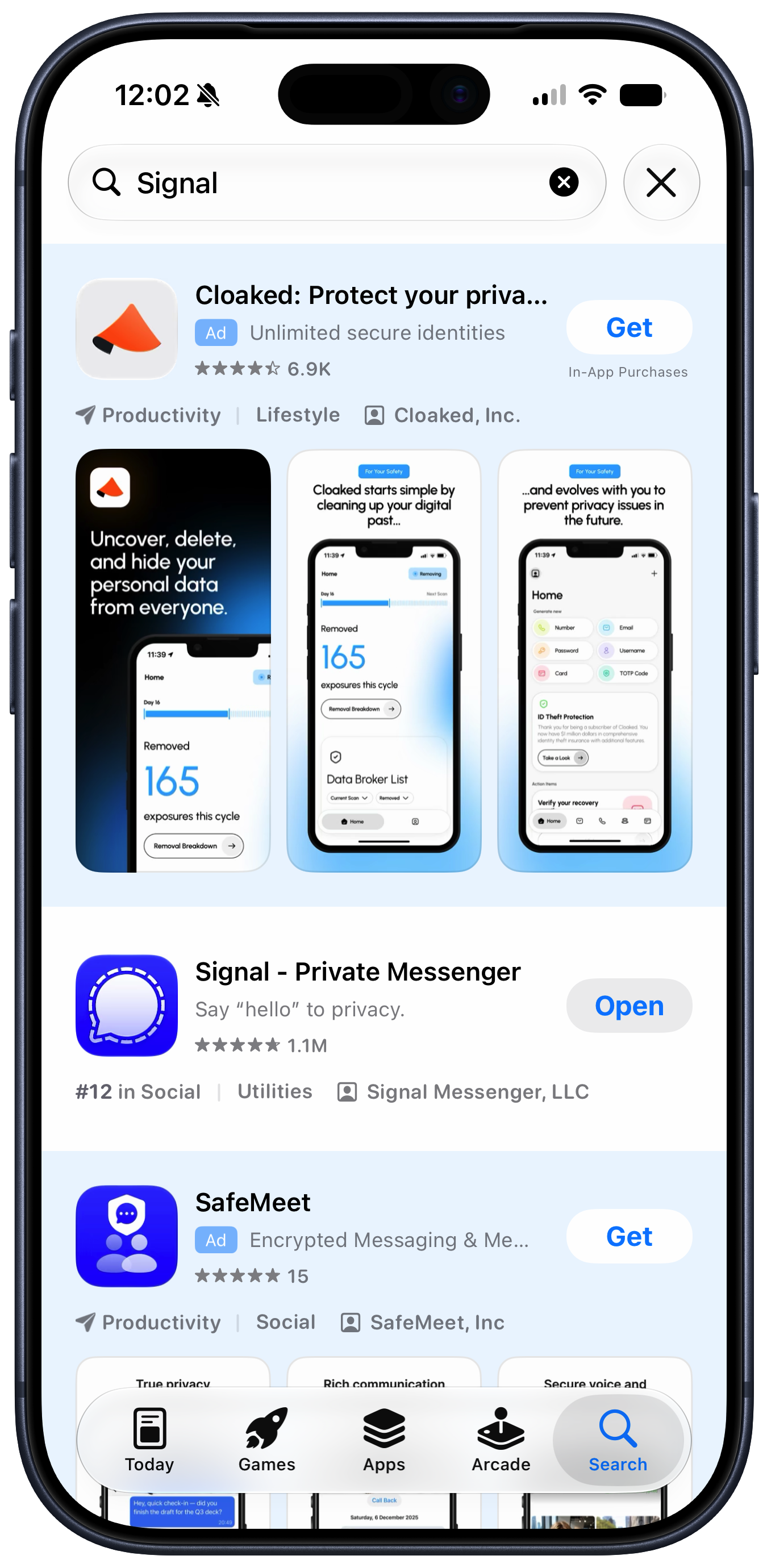
It shouldn’t be easy for users to simply imagine obvious ways for Apple’s software to improve. But it’s trivial for any user to imagine an obvious way for the App Store to be better: take out the ads from search results. If there were a preference setting to remove ads from App Store search results, everyone would turn that on. Apple is doing a thing that obviously makes the experience worse. It’s a little thing. The experience is only a little worse. But getting all the little things right is how you get to insanely great, and insanely great is Apple’s North Star.

Apple’s competition is lousy with ads. Downright lousy. Apple seems to be choosing the route of “Don’t like ads? Choose Apple, we shove fewer of them in your face.” That’s way less bracingly clear a marketing message than “Don’t like ads? Choose Apple, we don’t shove any ads in your face.” If your competitors’ stores all smell pervasively of dogshit, don’t aim to have the store that smells the least like shit. Aim to have a store that smells pristine. “Our stores only carry a vague whiff of dogshit” is not insanely great.

★ Ads in Software Are Like Stickers on Laptops

27 July 2026 at 18:32

Regarding my recent pieces regarding Apple’s shitty ads in the App Store and Apple News (and, perhaps soon, Apple Maps), a friend sent me this pithy take:

The ads Apple is happy to inflict on us in its apps are the equivalent of the stickers it would never allow on its physical products.

Bullseye.

That’s what those stickers on PCs are: they’re ads. Intel pays for the “Intel Inside” stickers that booger up PC laptop palm rests. Longtime readers will recall that back in August 2007, Apple held a Town Hall event to introduce new iMacs and some iLife and iWork software updates. In a post-event Q&A (imagine that), Bob Keefe of Cox Newspapers asked “Can you say why you all are not participating in the Intel Inside program, putting the stickers on your new or previous Macs?” This question was so absurd from the perspective of those who covered Apple closely that it prompted outright laughter. Jason Snell wrote a great column arguing that it was actually a good question.

Here’s the whole exchange (via Dan Moren, then at MacUser). Give it a listen, it’s only 100 seconds or so:

Keefe asks, Steve Jobs answers, Phil Schiller answers, and then Jobs closes it. Jobs broke the ice in his initial answer, with “What can I say? We like our own stickers better.” I was in the room, and that line killed. Jobs at his best. But you can tell that Jobs wasn’t really sure how to answer at first. He didn’t want to throw any shade at Intel, Apple’s partner, but he knew there was a key point to make here about Apple.

The whole thing is funny because at a fundamental level we all just know in our bones that Apple never even considered putting “Intel Inside” stickers on Macs. But why? For eons, mankind knew that when you drop something, it will fall to the ground. But why? Gravity is worth asking about. Worth figuring out. I think that’s the point of Snell’s 2007 column arguing that people (like me) were wrong to mock Keefe for asking.

It’s when Jobs comes back to the question, after Schiller, that we get the real answer:

You know, we put ourselves in the customers’ shoes and we say, what do we want stuck on our product when we take it out of the box? And the answer is, nothing.

That’s the answer. Apple still treats its hardware with that level of respect. With reverence. iPhones don’t even say “iPhone” on the hardware. No model or serial numbers. No small print. Just an Apple logo on the back.

Putting themselves in customers’ shoes today, how many ads do Apple’s executives want stuck in the results when they search for an app in the App Store? We know the honest answer. But the answer evidenced by the actual App Store is “Two really big ones, including one in the first spot.”

WorkOS MCP

27 July 2026 at 18:30

My thanks to WorkOS for sponsoring last week at DF to promote their MCP server. Debugging SSO, managing users, adjusting auth policies, configuring branding: every configuration task has lived behind a UI that only a human can drive.

The WorkOS MCP server gives agents the same access as your dashboard login. Hundreds of operations, discoverable at runtime. Connect in one command via OAuth, with scoped tokens instead of a master API key. Pass a screenshot of your marketing site and ask your agent to match the login page. If a human had to do it before, an agent can do it now. Connect your agent today.

‘AI Mania Is Eviscerating Global Decision-Making’

25 July 2026 at 20:15

Fascinating essay by Nikhil Suresh:

On a trip overseas, I had the privilege of a meeting with one of the Fortune 500 executives mentioned at the beginning of the post, who will remain anonymous so that they are not executed by firing squad by their board. As we were chatting, it became clear that they were very switched-on and technically competent, and they also happened to be at a company that had committed to the usual battery of exorbitant claims about their recent innovations — we’ve 100×’d our productivity, AI is the future of everything, I am but a vessel for OpenAI to make love to my wife. You know, normal things. But since I had them there without any microphones around, I asked why this was being repeated without opposition. Was it just sales fluff?

The answer was a lot more interesting. It was partially ridiculous sales material being delivered to an easily excitable audience, but this was not the dominant factor constraining honesty. Executives at their customers were saying absurd things about achieving 100× productivity, and this meant that if any executive at the vendor said that these gains were not plausible, it would undermine the credibility of the customer’s executive, be perceived as an attack (or heresy), and possibly result in an enterprise contract cancellation. And getting enterprise contracts cancelled because you wanted to opine on something that doesn’t really matter to your organisation’s mission is a great way to get fired.

The whole essay is very much worth reading, and might make you feel saner for harboring your own doubts regarding just how much has been changed in the world by generative AI. The gist of his argument is that the entire corporate world — not merely the computer/tech industry — is caught up in an AI mania that brooks no dissent. It’s a religious fervor and heretics are excommunicated. But the dissenters, who feel they must remain silent, are largely correct.

One way I’ve been thinking about AI mania is this: Computers have profoundly changed the world. There can be no dispute about that. Computers continue to improve in capability as networking effects grow and especially as Moore’s Law makes them faster and more capable at a pace unlike any other previous technical revolution. But most people are incapable of understanding how computers really work, and thus personally aren’t able to do much with them. Computers, for most people, are communication tools, not creative tools. Generative AI changes that. People with no computer aptitude are able to create things or discover things via ChatGPT and Claude that were simply beyond their ken heretofore. Per Clarke’s third law, “Any sufficiently advanced technology is indistinguishable from magic”. Generative AI feels a bit magical to all of us, even those of us with mid-to-high levels of understanding how computers work and how to make them work. But it feels like the first time ever that computers have been tools for their own creation for a lot of rather dimwitted but confident corporate manager/executive types. This moment feels like the Big Bang to them. The religiosity of this is such that there is no way to convince them that AI, as it stands today, is impressive and useful and innovative, yes, but several orders of magnitude less so than they’re imagining that it is. No way to convince them, that is, until the bubble bursts.

EU Fines Google $1 Billion for DMA Competition Violations, Including Making Search Results More Useful

25 July 2026 at 19:44

The European Commission on Thursday:

The Commission found that Google gives preferential treatment to its own services, including shopping, hotels, transport and sports results, over those of third parties in Google Search, thereby breaching its obligations under the DMA.

Google displays its own services more prominently in search results, including at the top of the search results page or by using enhanced visuals and filters, while similar third-party services do not have the same prominence.

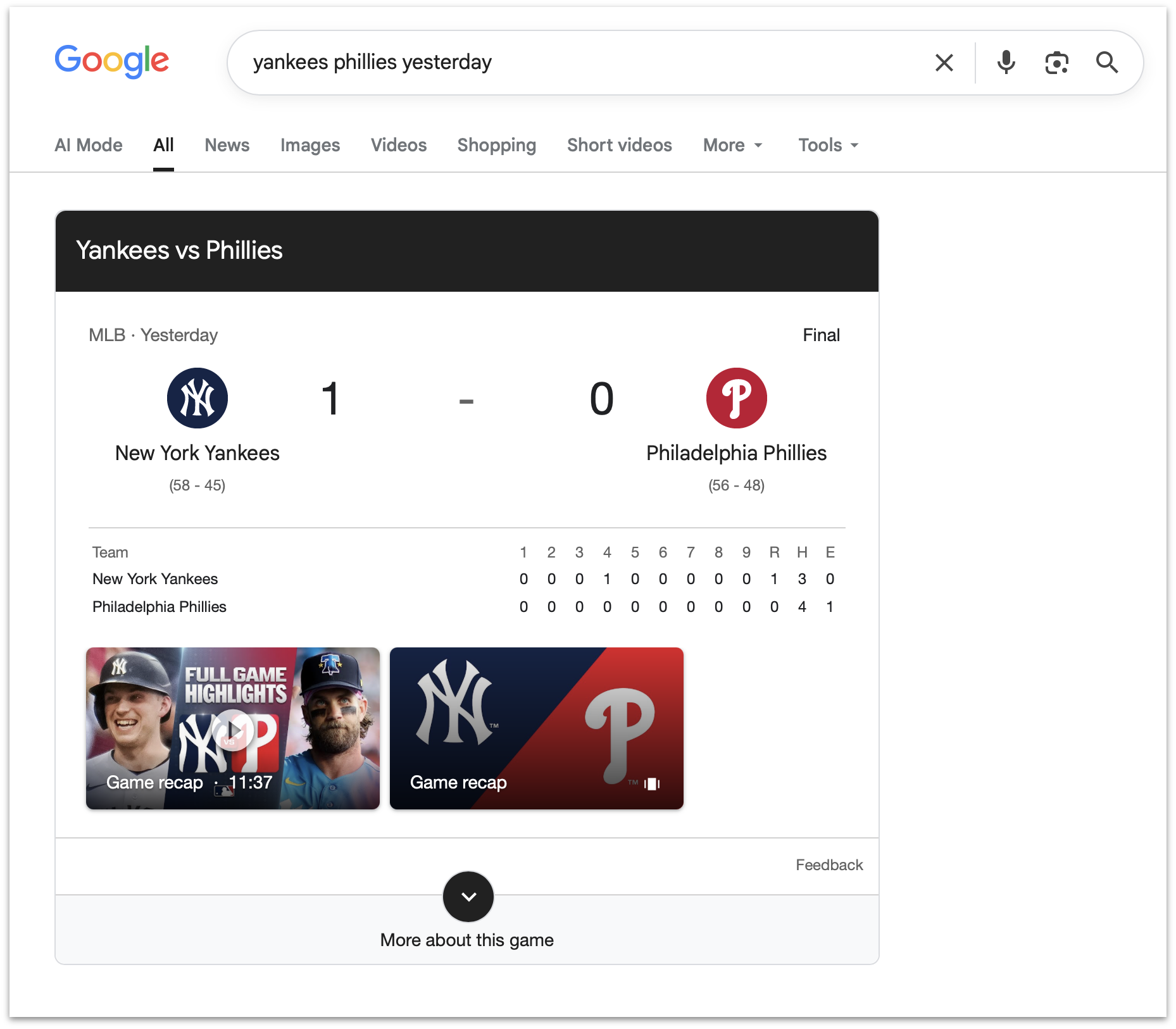
So if you search for the score of a sporting event, it’s illegal in the EU for Google to show you the score, like this search I just tried. What the EC is saying is that because Google Search is so popular, it’s no longer allowed to improve. It is impossible to imagine how this benefits EU citizens.

What generates more for the EU, fines against US tech companies, or tax income from EU tech companies? Here’s a viral post on Twitter/X that claims it’s now fines against US tech companies. The amounts certainly seem to be in the same ballpark.

Court Grants SerpApi’s Motion to Dismiss Google Lawsuit

25 July 2026 at 19:27

Julien Khaleghy, CEO of SerpApi:

The U.S. District Court for the Northern District of California granted our motion to dismiss Google’s lawsuit, marking a win not just for SerpApi, but for all who depend on an open internet. We’re pleased that the court rejected Google’s attempts to expand the DMCA to assert control over access to public pages. The internet’s founding principle — open access to usable information — is essential to driving innovation and ensuring everyone benefits from the promise of data. SerpApi will continue supporting developers, AI companies, researchers, and businesses that rely on access to public search information.

Yours truly, back in March, when SerpApi filed the motion to dismiss:

I’ve come around on SerpApi in the last few months. My initial take was that it surely must be illegal for a company to scrape Google’s search results and offer access to that data as an API. But I’ve come around to the argument that what SerpApi is doing to obtain Google search results is, well, exactly how Google scrapes the rest of the entire web to build its search index. It’s all just scraping publicly accessible web pages.

This December piece by Mike Masnick at Techdirt is what began to change my mind.

Even Google seems to understand the logical bind they’re in here, regarding scraping.

Apple Maps to Power Navigation Experience for Ford’s New EVs

25 July 2026 at 18:21

Apple Newsroom:

Apple and Ford today announced that Apple Maps will be integrated directly into Ford’s upcoming Universal Electric Vehicle (UEV) Platform through Apple’s new MapKit for Automotive SDK. Coming to Ford’s UEV Platform in 2027, this integration will deliver a beautiful and easy-to-use navigation experience powered by Apple Maps directly to the vehicle’s displays. Road-level Maps information will also enable Ford’s Latitude AI team to build a seamless hands-free driving experience.

See also: Techmeme’s roundup of commentary.

Measles Cases Hit New Record in U.S., as Stupid-Americans Reject Vaccines

25 July 2026 at 18:06

Teddy Rosenbluth, reporting for The New York Times:

On Friday, the Centers for Disease Control and Prevention announced that there have been 2,318 confirmed cases of measles so far this year. The case count toppled the record set last year, when measles infected more than 2,200 Americans and killed two unvaccinated children. More measles cases have been reported in the United States in the last two years than in all the years from 2000 through 2024 combined.

Reversing course on measles would require a nationwide push to improve vaccination rates, a prospect that experts said seemed unlikely under the leadership of Health Secretary Robert F. Kennedy Jr. He has halted funding for vaccine hesitancy research, downplayed the risks of measles and spearheaded a hunt for evidence that vaccines are unsafe.

Nilay Patel, endorsing Kamala Harris for president in 2024: “A Vote for Donald Trump Is a Vote for School Shootings and Measles”. (He missed “quagmire war with Iran”.)

“tarltontarlton” on Reddit last year: “Stupid-Americans are the New Irish-Americans, Trump is Their JFK”. I continue to think about this post frequently.

Isaac Asimov, in a column for Newsweek in 1980:

There is a cult of ignorance in the United States, and there has always been. The strain of anti-intellectualism has been a constant thread winding its way through our political and cultural life, nurtured by the false notion that democracy means that “my ignorance is just as good as your knowledge”.

I continue to think about this frequently as well.

bIRC — A New Native IRC Client for Mac

25 July 2026 at 17:39

For a long time the best native Mac IRC client was Textual, but although Textual still works, it’s been sunset by the author. Not to fear, however. Fredrik Blank just launched bIRC:

Creating an IRC client in 2026 is not something that will pay the bills : ) It would be just for the joy of programming. But the amount of work involved always made me throw the thought aside.

But one night when I had nothing better to do, I started implementing the good old spec in Swift (RFC 2812). And then I got motivated to continue, adding IRCv3 extensions and UI. Been working on it on and off on it since the end of 2025. Now I feel pretty satisfied with the result. Say hi to bIRC — an IRCv3 client for Mac.

I was never a big IRC user, personally, and haven’t used IRC in years. But I installed bIRC just because it looks so good, and took it for a brief test drive. It’s nice. And it is very Mac-assed in a modern way. It’s got a detailed documentation page too. There are (alas) many great apps that lack good documentation, but there are very few apps with good documentation that aren’t great apps. bIRC is free to download and use from the App Store, and there’s a suite of additional fun/pro features you can unlock for a one-time $13 purchase. I bought the pro upgrade despite seldom using IRC just to celebrate a killer new Mac app.

★ Regarding Ad Blockers and Daring Fireball

24 July 2026 at 22:57

Following up on the previous item today, re: content blockers and ad-blocking, I ran into a weird situation a few weeks ago with my column “John Ternus Should Reverse Apple’s Slide Down the Advertising Slippery Slope”. That article contains this sentence, in Markdown:

And -- at this writing, still "coming soon" -- Apple is
launching [ads on Apple Maps][🗺️].

[🗺️]: https://ads.apple.com/maps

The problem is that anyone reading that article in NetNewsWire saw it rendered like this, with the words “ads on Apple Maps”1 omitted:

Screenshot of article text from NetNewsWire.

It looks like I forgot to finish writing that sentence. NetNewsWire simply omits the hyperlinked words. After a few readers reported this, I immediately suspected the problem was the “ads.apple.com” domain. I’ve never linked to that domain before, and many ad blockers just block any domain that starts with a domain prefix like ads.*.

And that’s exactly what the problem is. I had no idea that NetNewsWire filtered any content whatsoever (and I sort of think it shouldn’t), but DF reader Antonio Germano searched through NetNewsWire’s open-source code and found it in the core.css file, line 49:

38  /*Block ads and junk*/
39  
40  iframe[src*="feedads" ],
41  iframe[src*="doubleclick"],
42  iframe[src*="plusone.google"] {
43      display: none !important;
44  }
45  
46  a[href*=".ads."],
47  a[href*="feedads" ],
48  a[href*="doubleclick"],
49  a[href*="//ads."],

The culprit identified, I dutifully pinged my friend Brent Simmons to report the problem. But then I had to decide what to do about it. I have no idea which feed readers are being used to read Daring Fireball’s feeds, but NetNewsWire is surely one of the most popular, and probably the most popular. It’s the feed reader I use personally. I can’t change the contents of NetNewsWire’s core.css file, so I can’t keep NetNewsWire from stripping out words that link to Apple’s ads.apple.com domain. What I could do is not link to ads.apple.com, like, say by changing my link from ads.apple.com/maps to a shorten-and-redirect URL like bit.ly/4wmXFSE that points back to Apple’s original URL.

But I didn’t do that. I don’t like playing whack-a-mole to work around bugs in other software. I have enough trouble fixing my own mistakes. I also don’t like the idea of showing everyone a “Click it and find out where it actually goes” mystery URL from Bitly rather than the direct URL. It’s a general principle thing, and also a much better policy for links that are meant to last for decades.

What I really don’t like about NetNewsWire’s ad-blocking here is that it just omits the linked text. It doesn’t remove the link but leave the words; it removes the words that are hyperlinked to the blocked domain. I’ve run into this with other content blocking extensions. For example, the Banish extension for Safari, which I recommended back in 2022. At some point a year or two ago, Banish started blocking links to Apple’s App Store domain, and it did so by removing the words that link to the App Store. That’s crazy. I linked to the App Store in my own post recommending Banish, which means if you have Banish installed and read that post, you won’t see the headline of the post (nor be able to follow the link). I think there are other content blockers that do the same thing with text that links to the App Store.2

So what do I do about that? Do I stop linking to the App Store? That’s dumb. Do I create custom URL redirects for every single link I make to the App Store? That’s work I don’t need or want to do, and adds a layer of abstraction that confuses everyone who isn’t using a content blocker with such a stupid rule. So I just ignore it. But that means an untold number of readers, who are using such content blockers, are just missing words in my articles whenever I link to the App Store. Well, so be it. Ideally, content blockers “just work” — blocking only things you want blocked, never things you don’t want blocked. Nothing is perfect however. What’s pernicious about blockers that remove the actual words that link to certain domains is that that’s not expected behavior. From the reader’s perspective, it really just looks like an editing error on the part of the website, not a content blocker with an overzealous pattern-matching rule.

Ultimately, though, when you install a content blocker extension, you take responsibility for any overzealousness in what it blocks.


Let me use this opportunity to make a small personal request. The display ads on Daring Fireball are unobtrusive and limited to one per page. They are also entirely private, and always have been. There not only are no cookies or JavaScript that attempt to track you, but the ads themselves are served from the daringfireball.net domain. I turn down advertisers who request to serve images (or “tracking pixels”, which are just invisible images) from their domains. (Such requests are infrequent, thankfully.) I don’t display the ads in between paragraphs mid-article, a common practice that to me is disrespectful both to the writer and reader. In short, I try to keep the ads on Daring Fireball not merely unobjectionable, but something that actually adds to the site. I actually like the ads in certain high-quality print magazines, like The New Yorker. My goal for the ads on DF is for them to be like that.

In short, I hope they’re the sort of ads readers don’t want to block. I’m pleased to say that most of the ad-blocking content blocking extensions I’ve personally tried do not block ads on Daring Fireball by default. In other cases, they do, but it’s easy to adjust the per-domain settings to allow them. In the previous post, I recommended uBlock Origin Lite (free, a bit complex) and Magic Lasso (paid, much simpler). Magic Lasso does not block ads on DF by default. I don’t remember what uBlock Origin does by default, but it’s trivial to change it to allow them.

If you use an ad blocker and it currently blocks the ads on DF, I humbly ask you to consider taking a moment to tweak the settings to permit them. (If you are using a blocker that strips the ads from DF by default, you can do me an additional favor and shoot me a short email telling me which one. I’m curious.) If you are the developer of an ad blocker, I ask you to consider allowlisting Daring Fireball by default.

If you are a reader and you really do want to block DF’s ads, please, go right ahead. I find that an odd mindset, but it’s your web browser and your call. No hard feelings. (Please further note that I have no JavaScript code that attempts to detect whether you’re blocking DF’s ads in order to nag you.)


  1. I omitted the Markdown creating a link on the words “still ‘coming soon’” for clarity, to emphasize only the problematic link in my original prose. (Also, it’s fun to use emoji as named link definitions, like in this example.) ↩︎︎

  2. I of course reported this to the developer of Banish, twice, but he never responded. I, err, banished Banish from my own devices, and upon finishing this article, I’m going to update my 2022 recommendation of Banish to un-recommend it. ↩︎

Coiner of ‘Enshittification’ Endorses ‘Dickover’

24 July 2026 at 20:51

Speaking of dickovers, here’s Cory Doctorow, writing this week at Pluralistic:

Seizing the means of computation isn’t theft, it’s bargaining. Commercial surveillance companies will tell you that by spying on you, they are simply engaged in a marketplace exchange in which you swap your privacy for access to online services. But they are running a very curious sort of market: it’s a “market” where as soon as you stop to browse someone’s wares, the stallholder gets to reach into your pocket and clean out your wallet. In “markets,” prices are announced and bargained over, not set unilaterally and extracted from anyone unwise enough to cross the threshold.

Adblocking, dickover blocking and other customizations are a way for you to bargain back, to answer the opening bid of “How about you give me all of your data forever and let me do anything I want with it?” with “How about ‘nah?’”

Doctorow’s specific advice is to switch to Firefox for your browser and Linux as your desktop OS. You’re probably not going to do either of those things. But the spirit of his advice is that you should avail yourself of bookmarklets and browser extensions that fight back against shitty ads and dickovers. There are some great options for Safari. StopTheMadness Pro is great for creating custom rules to permanently block specific page elements. uBlock Origin Lite is a free-of-charge content blocker that is incredibly effective, and very configurable (but complicated). Magic Lasso is a paid content blocker — $30/year — which includes synced blocking on iOS, MacOS, and even Apple TV. Magic Lasso offers a much more approachable configuration interface, and includes a “just turn it on” easy-to-use private VPN feature that allows for blocking ads in all apps, including Apple News.

Bargaining back is exactly what using content blockers is. There’s no reason to feel guilty about it.

(Magic Lasso has previously been a DF sponsor, but not since May 2021. I’m recommending Magic Lasso here only as a happy paying user.)

Dickover of the Week: Tomtoc

24 July 2026 at 18:43

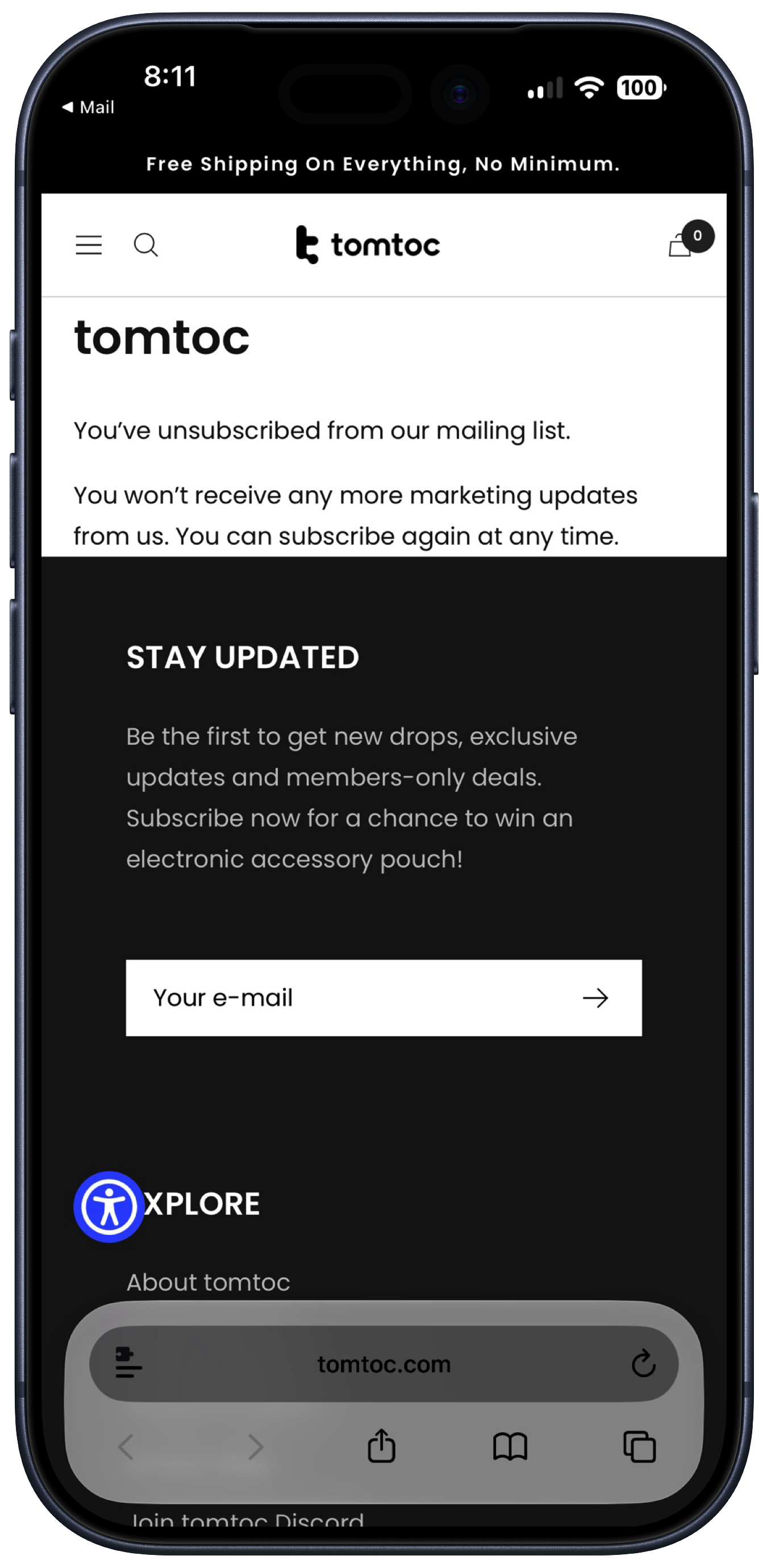
Here’s a real gem that a reader sent me. Tomtoc is a maker of laptop bags and sleeves. Visit their homepage and, of course, you’ll get a dickover asking you to join their mailing list “for exclusive updates and get a chance to win a free tech pouch every month.” But here’s the gem. If you do subscribe, and you decide later to unsubscribe, you get this:

Screenshot from an iPhone of Tomtoc’s “you’ve been unsubscribed from our mailing list” webpage presenting a dickover asking you to subscribe to their mailing list.

Sixers Sign LeBron James

24 July 2026 at 18:40

The betting odds for the Sixers to win the NBA championship went from 20-1 to 10-1. Here’s James on Twitter/X, explaining his decision:

This is my last decision. I’m not going for money. I’m not going for family. What am I really playing for at this point?

I still want to sacrifice. I still want to work. I still want to grind. I still want to compete, to win and to have a chance at the feeling of winning another championship.

I believe I can help make the Philadelphia 76ers a championship team and I am so excited to energize a new fan base and start this incredible journey one last time.

James signed for the league minimum for a veteran: two years at just $4 million per year. He’s going to love playing here.

❌