Normal view

★ Temu Is a Comically Bad App

31 July 2026 at 20:27

Cabel Sasser on Mastodon:

the temu app will be studied for generations.

i opened the app, and recorded this unedited, nearly two minute, launch sequence. it somehow just gets funnier and more absurd

I agree with this sentiment, right down to the fact that Temu doesn’t deserve capital letters.

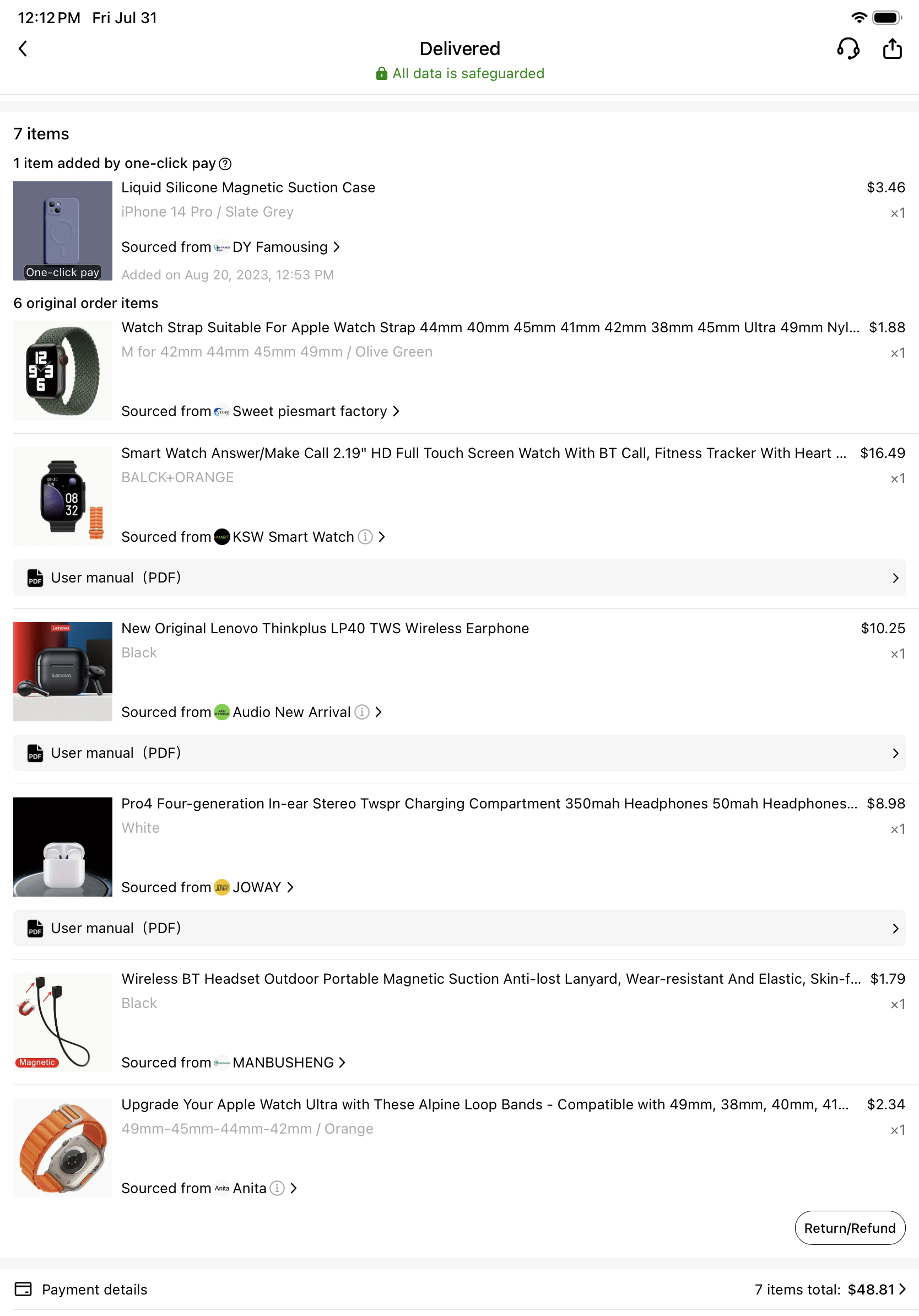
I placed an order from Temu back in August 2023. At the time Temu was the #1 app in the App Store. I surmised it was some sort of crap store, but wanted to see for myself. It is in fact not merely a crap store but a spectacular crap store — like if a souvenir shop on a Jersey shore boardwalk were the size of a football stadium. Thousands of items, many of them rip-offs, at absurdly low prices. I bought (screenshot):

  • Two Apple Watch straps. One of them knocking off Apple’s Braided Solo Loop for $1.88; another knocking off the Apple Watch Ultra Alpine Loop for $2.34.
  • A pair of knock-off AirPods: $8.98.
  • Another pair of wireless earbuds branded “Lenovo” but definitely not made by Lenovo: $10.25.
  • A knock-off Apple Watch Ultra (“Smart Watch Answer/Make Call 2.19" HD Full Touch Screen Watch With BT Call, Fitness Tracker With Heart Monitor”), which included both orange and black (misspelled “balck”) rip-offs of Apple’s Ocean Band, for $16.49.
  • A “Magnetic Suction Anti-Lost Lanyard” for, I think, AirPods: $1.79.
  • An iPhone case: $3.46.

Grand total for all seven items: $48.81. I ordered it all on 20 August 2023, and it arrived at my P.O. box on 2 September. The contents of the box looked less like it had been “packed” than “picked out of the trash and hurriedly stuffed into a box”.

The iPhone case was so flimsy it didn’t properly snap onto the phone. The Apple Watch straps were ... OK? They were about as good as you could hope given that they cost around $2 each. The knock-off Apple Watch Ultra actually did sort of work, insofar as it had a color screen that turned on and showed watch-like screens (that looked nothing at all like WatchOS). The watch case was made of plastic, and watch straps did not snap into place in the slide-in channel where they connect — they just permanently slid around. I couldn’t get either of the bluetooth earbuds to work but I didn’t spend more than a few minutes trying with each, because I realized I had no intention of putting them into my ears. The lanyard I don’t remember.

Temu today no longer tops the U.S. App Store’s Top Free Apps list, but it remains in the top 25. (It was at #19 this morning, and #22 this afternoon.) Temu’s slogan remains unchanged: “Shop like a billionaire.” Who am I to argue with that? We know one of them is on a lot of drugs — maybe all of them are, and Temu is what it’s like.

After I placed that initial order, I started getting emails from Temu. Seven of the emails pertained to my order: an order confirmation, a shipping notice, a shipping update, another shipping update, a “we noticed your order didn’t arrive on time so here’s a $5 coupon” update, a delivery confirmation, and then a prompt to leave “an honest review detailing our product quality and your overall experience”. The emails kept coming. I decided to leave them turned on until I wrote about my Temu experience on Daring Fireball. As I type this sentence, I’ve received a grand total of 916 emails. That’s just under one per day for the 1,076 days since I placed my one and only order from them. Here’s a text file with the dates and Subject lines for all 916 emails. In the early months after placing my order, they sent me multiple emails per day, every single day. I particularly enjoy how, in the Subject lines, they occasionally abbreviate my name as “John Gru...” (for privacy?), despite the fact that (a) the emails are all sent to me, and (b) in many of the other messages, they spell out my full name in the Subject.

Don’t do what I did and actually try Temu. Just watch Sasser’s video. It tells you everything you need to know.

Mark Zuckerberg: ‘The AI Future Is for Everyone’

30 July 2026 at 23:09

Mark Zuckerberg, in an op-ed Tuesday for The Wall Street Journal (gift link; and irony isn’t lost that “everyone” needs a paid WSJ subscription to read this):

We are fortunate to live at an incredible moment in history. In the next few years, people will be able to use superintelligence beyond human capacity to create and discover extraordinary new things, build new businesses, express our ideas, learn new concepts, and improve our lives, health, relationships and careers.

Perhaps we’ll be able to use it to build a metaverse too. Or to keep our attention on a major initiative for more than two or three years.

Apple Releases iOS and MacOS 26.6, MacOS 15.7.8, and More

30 July 2026 at 22:41

Samuel Axon, Ars Technica:

Apple has released iOS, iPadOS, macOS, watchOS, and tvOS 26.6. Apart from potential security hotfixes, these are likely the last updates before the arrival of iOS 27, macOS 27, and so on.

All of today’s releases include minor bug fixes, and there are numerous security updates: more than 150 for macOS 26.6. Apple also rolled out macOS 14.8.8 and macOS 15.7.8 for older devices, also focused on security fixes.

In terms of new features, you won’t find many in these releases, as they mainly pave the way for the next major OS update, likely to hit sometime in September. Most notably, the release notes for iOS and iPadOS 26.6 say the update “optimizes the Spotlight index to prepare for iOS 27.” This update will kick off some indexing work that will then be leveraged in an ostensibly much more robust Spotlight search feature when iOS 27 launches next month.

I don’t mean to pick nits, but there’s nothing “ostensible” about it. You can use the new Spotlight index via Siri AI in the OS 27 beta releases and it’s really good. The initial background indexing took almost a full week for me on iOS, I suspect because I have so much email archived, but anyone who upgrades to these 26.6 releases now shouldn’t have to wait at all after upgrading to 27.0 in September. Or even if you wait for the 27.1 releases — you won’t need to wait for Siri AI to have your full semantic index at hand.

Rogue Amoeba: Unobtrusive Update Notifications

30 July 2026 at 22:33

Paul Kafasis, on the Rogue Amoeba blog back in April:

Though Sparkle serves us very well, it has one notable downside. Update announcements are most likely to appear at the least convenient time: right after you’ve launched the app. You want to start recording with Audio Hijack, for instance, but the app is telling you about a new version.

We’ve long wished to avoid these disruptions. With that in mind, we’re making changes to how update notifications appear throughout our apps. In the future, when the software’s timed automated check detects a newer version, it will no longer pop an obtrusive window like the one seen above.

Instead, a small “Update Available” indicator will be shown in the app’s interface.

Such a little thing, but like I wrote earlier this week, getting all the little things right is how you get to insanely great. Every Mac app using Sparkle ought to copy this. It’s so much nicer.

Looking for the Catch in Apple Upgrade

30 July 2026 at 18:59

Damon Beres, writing for The Atlantic under the hed/subhed: “The New iPhone Underclass: Apple’s rental program is a trap”:

The Klarna plan — “Apple Upgrade,” which replaces the iPhone Upgrade Program — is truly, legally, a lease. This is confusing! And it’s confusing in part because this is not how Klarna, a well-known buy-now, pay-later service, typically operates: When you use Klarna for clothing from Shein or lip kits at Sephora or an Xbox at GameStop, you’re paying back a loan, exactly as you were in the original iPhone Upgrade Program. Same if you use Klarna to buy a Samsung Galaxy phone. But with Apple Upgrade, you are renting: The Mac or Apple Watch is not yours until the final payment is made.

I don’t think this is confusing at all. Apple Upgrade is the primary brand for this program, not Klarna. Klarna is really only mentioned in the small print. You get into Apple Upgrade through Apple. Off the top of your head, do you remember Apple’s bank partner for the now-discontinued iPhone Upgrade Program? (It was Citizens Bank.) The Samsung program Beres links to above is named “Klarna Pay in 4”. “Apple Upgrade is a leasing program partnered with Klarna” is easily understood.

Here’s what Beres thinks is a “trap”:

Consider a student or a young professional, or perhaps an underemployed older one, who needs a new laptop. They decide on a MacBook. Apple Upgrade will appear to be the best deal: In its announcement, Apple offers the example of a 14-inch MacBook Pro that retails for $1,999 but that can be had for a monthly lease. Perhaps this person goes for the two-year term, which has them paying $54 a month. Best Buy, which currently has the same computer on sale for $1,849, offers an 18-month loan repayment with $103 installments. Apple’s deal appears to be cheaper: The 24-month lease adds up to $1,296; Best Buy’s 18-month loan lands at the store’s full retail price of $1,849.

Why does Best Buy’s laptop seem more expensive? It’s because the plan is actually designed for you to fully pay off the device. At the end of the 24-month MacBook Pro lease, meanwhile, the consumer will still owe $703, meaning that the actual total price of the Apple arrangement is $1,999 — higher than Best Buy’s offer.

This has nothing to do with the differences between Apple Upgrade’s leasing terms and Best Buy’s 18-month loan. It’s the difference between Apple’s retail price of $1,999 and Best Buy’s $1,849. Guess what? $1,849 is less than $1,999.

I generally like paying for everything I buy up front. The only thing I have a loan for right now is our home. So when Apple Upgrade was announced, I approached it with skepticism, presuming that participants would wind up paying more over time than they would buying devices outright up front. But no. There is no interest penalty. If anything, if you presume inflation is still going to run a bit high for the next few years, buying devices through Apple Upgrade might be a slightly better deal than paying up front.

Is it a “trap” that at the end of your 24-month lease you still owe $703 if you want to buy it? I would say that’s not a trap at all, given that you’d have only paid $1,296 to date on a $1,999 device. I’m not trying to be obtuse. I get it. If you pay the full $1,999 up front, or take a loan to pay the full amount over 24 months, then, after two years, you own the device outright and you might not be tempted to buy a new device for a few more years. If instead you lease it and still owe $703 after 24 months, you might be inclined to think that it’d be no fun at all to pay $703 to finish purchasing a now-two-year-old MacBook, even if the price is totally fair and carries no interest penalty. It’s just not fun. What might seem fun, at that point, is to just hand the leased MacBook back to Apple and start a new lease on a brand-new MacBook. That’s surely the appeal of this whole thing from Apple’s perspective — that leasing entices people to keep starting new leases every two years rather than just sit back and enjoy a fully-paid-for device for a few additional years. I think it’s a stretch to call that a “trap”, though.

The Differences Between the New ‘Apple Upgrade’ and the Old ‘iPhone Upgrade Program’

30 July 2026 at 17:56

Ryan Christoffel, writing for 9to5Mac:

Apple Upgrade launched this week, and the iPhone Upgrade Program is being discontinued as a result. But despite some similarities, the two offerings are not the same. Here are the key differences.

I wrote yesterday that there seemingly is no catch with the new Apple Upgrade program, but there’s at least one, which Christoffel’s piece doesn’t note. When you lease an iPhone through Apple Upgrade, you need a cellular account on one of the big three U.S. carriers: AT&T, T-Mobile, or Verizon. That kind of stinks, and I’m not quite sure I understand why. You’re leasing the iPhone through Apple and Klarna, not the carrier, so I don’t know why Apple cares. If you know why, shoot me a message and explain it. Is it just a simplistic credit-risk evaluation, where prepaid plan-holders and MVNO users in general are viewed suspiciously?

I’ve been hearing a lot of good things about the higher-quality MVNOs, especially US Mobile. (Quinn Nelson mentioned last week on The Talk Show that he’s on US Mobile.) But if you’re not on one of the big three you can’t lease an iPhone through Apple Upgrade.

(I think the old iPhone Upgrade Program required you to have a plan on one of the big three carriers too, so that might be why Christoffel didn’t mention it — it’s the same, not a difference.)

Apple Says iOS 27 ‘Restricted Mode’ Isn’t for Users Who Miss Payments in New Apple Upgrade Program

29 July 2026 at 22:56

Last week 9to5Mac reported on code in the latest iOS 27 developer beta seemingly meant to restrict leased devices after the user had missed one or more payments. When engaged, Restricted Mode limits the device to the following apps:

  • Accessibility Reader
  • App Store
  • Health
  • Magnifier
  • Phone
  • Clock
  • Settings
  • Wallet
  • Passwords

And some limited access to apps like Messages or health-related apps that might have critical messages.

Many people reasonably speculated that this feature was related to Apple Upgrade, Apple’s new device leasing partnership with Klarna, which Mark Gurman spoiled a few weeks ago. But an Apple spokesman confirmed to Emma Roth at The Verge today that “There will be no restricted mode and/or there will be no limitations put on device functionality due to missed payments or default with the Apple Upgrade program.”

Writing again today, here’s 9to5Mac’s Marcus Mendes:

Apple, however, did not tell The Verge what Restricted Mode is intended for. One possibility is that it was developed for financing programs offered by carriers, retailers, or other partners outside Apple Upgrade, potentially including markets where device restrictions are already used to enforce installment agreements.

In India, lenders have worked in the past with smartphone manufacturers to remotely block financed devices after borrowers missed payments. As The Economic Times reported last year, the Reserve Bank of India (RBI) told non-bank lenders to stop the practice in late 2024, amid concerns about lenders sharing customers’ default information with device manufacturers.

The regulator may now permit a more limited version of the practice. As Reuters reported in May, the RBI proposed allowing lenders to restrict certain functions on financed phones once a loan is at least 90 days overdue, provided the borrower agreed to the measure in the contract and received advance notice.

Apple Upgrade — New Program With Klarna for Leasing iPhones, Macs, iPads, and More for Near-Zero Interest

29 July 2026 at 18:51

Apple Newsroom:

Apple today announced Apple Upgrade, a new product leasing program provided by Klarna for iPhone, Apple Watch, Mac, and iPad available on the Apple Store online, in the Apple Store app, and at Apple Store locations in the United States. Apple Upgrade makes it even easier for customers to get the Apple products they love with a leasing plan that is right for them. [...]

Apple Upgrade offers 12- and 24-month leasing options for iPhone and Apple Watch, and 24- and 36-month leasing options for Mac and iPad. Leasing prices start as low as $17.99 per month for iPhone, $11.99 for Apple Watch, $24.99 for Mac, and $11.99 for iPad. When customers first enroll in Apple Upgrade, they can further lower their monthly lease payments by trading in their currently owned device through Apple Trade In. Customers can also earn 3 percent Daily Cash back when making their lease payments with Apple Card.

Michael Tsai, quoting Juli Clover at MacRumors:

Juli Clover:

The payoff amount is the difference between what was paid during the leasing period and the retail price of the device, minus any remaining trade-in credits. Klarna is not charging a fee for the leasing program, so an iPhone that’s $1,099 can be leased and then purchased for $1,099 with no extra cost beyond taxes.

I guess this means that, for a bit of hassle, you can essentially buy the device for the list price at 0% interest.

If you’d rather lease or buy over time, this seems like as good a deal as you could hope for, without any catches.

Pastebot 3

29 July 2026 at 18:07

New from Tapbots: version 3 of their excellent clipboard manager for Mac. There are so many clipboard managers for the Mac. I run two other apps — Keyboard Maestro and LaunchBar — that offer good clipboard managers as ancillary features. But for years now I’ve chosen to use Pastebot. Chief among my favorite features:

  • Remembers up to 1,500 clippings (up from a mere 1,000 in v2).
  • Syncs via iCloud. If I copy something on one Mac, it’s in my Pastebot history on my other Macs.
  • That sweet Tapbots UI.

Pastebot 3 requires MacOS 26 Tahoe or later. That means I’m only using it on secondary Macs for now — my primary workstation will continue running MacOS 15 Sequoia until I upgrade directly to 27 Golden Gate later this year. But iCloud sync continues to work between Pastebot 2 and 3.

New features include more powerful filters (e.g. you can use a filter to copy a URL and then paste that URL in Markdown’s link syntax), a CLI tool (as yet undocumented), and Shortcuts support.

$39 for a license via direct purchase, with a $13 discount for users of previous versions. It’s still pending approval in the Mac App Store, where it will cost $25/year or $3/month.

Count Those Underscores

29 July 2026 at 17:28

Nate Anderson, reporting for Ars Technica under the headline “A Missing Underscore Sent Innocent Man to Prison for 18 Months”:

Police were looking for a man using the Kik messaging service under the name “fus__ro_dah” (two underscores after “fus”), but they accidentally requested records for the username “fus_ro_dah” (one underscore after “fus”). This one-character difference led them not to the perpetrator but to a Canadian man named Brandon Klayme. [...]

Despite finding no evidence of the crime on his digital devices, Canadian police arrested Klayme in 2020 on child sex abuse charges. He was convicted after a trial in 2023 and sentenced in 2024 to 18 months in prison. He served the full term.

Even after release, Klayme continued to fight his conviction. In the process of preparing his appeal, the username mistake that led to all these years of disruption was finally discovered. On Thursday, the Nova Scotia Court of Appeal overturned Klayme’s conviction, writing: “Mr. Klayme is factually innocent of the offences. He should never have been charged, let alone convicted.”

Via Paul Kafasis, who asks:

While I understand how the mistake led to this poor guy becoming a suspect, I really can’t fathom how he was convicted. What the hell happened during that trial?

Contra Ars’s headline, it wasn’t the missing underscore that sent Klayme to prison for 18 months.

Update: Guy Chapman observes that this is basically the central plot of Terry Gilliam’s Brazil.

‘eBay’s Bizarre Cyberstalking Saga Ends With a $56 Million Settlement’

29 July 2026 at 16:43

Emma Roth, The Verge:

eBay and three former executives will pay $55.7 million as part of a settlement with a Massachusetts couple targeted with a bizarre harassment and cyberstalking campaign in 2019, as reported earlier by CNBC. The settlement will resolve a lengthy legal saga that revealed how eBay’s former executives sent live insects, a bloody pig mask, a funeral wreath, and other strange items to David and Ina Steiner over their newsletter’s coverage of eBay.

The Steiners, who operate the EcommerceBytes newsletter, sued eBay and its former executives — including ex-CEO Devin Wenig — in 2021. The lawsuit accused the company and its executives of launching a coordinated effort to “intimidate, threaten to kill, torture, terrorize, stalk and silence” the Steiners in an attempt to “stifle” their eBay-related reporting.

I don’t think I’ve ever linked to this saga before, but I’m not sure why. One of those stories that slipped through the cracks. It’s an astonishing tale. Could be the basis for a Coen brothers movie.

From David Streitfeld’s 2020 overview of the saga for The New York Times (gift link):

Prosecutors say that on Aug. 7, Ms. Popp — the “Mom” to Mr. Baugh’s “Dad” — began sending Twitter messages to Ms. Steiner via a fake account, @Tui_Elei. The profile picture was a skull, and he seemed to be an eBay user from Samoa who believed that EcommerceBytes had harmed his sales. Ms. Steiner ignored the messages, even as the tone got angrier and more abusive. @Tui_Elei wrote: “I guess im goin to have to get ur attention another way bitch…”

A parade of disturbing deliveries began at 4 p.m. on Aug. 10, when a package containing a bloody pig mask arrived at the Steiners’ home. Fourteen minutes later, @Tui_Elei wrote: “DO I HAVE UR ATTENTION NOW????”

The Steiners received a book titled “Grief Diaries: Surviving the Loss of a Spouse” and a funeral wreath. They got fly larvae and live spiders and a box of cockroaches. Copies of the September issue of “Hustler: Barely Legal” touting “eye-popping 18-year-olds” arrived at the homes of neighbors with David Steiner’s name on them. The Twitter bombardment continued, as @Tui_Elei began to hint at violence: “wen u hurt our bizness u hurt our familys… Ppl will do ANYTHING 2 protect family!!!!”

It’s certainly not how anyone would plan a business strategy, but this settlement seemingly makes the Steiners some of the most successful independent writers in history. Here’s Ina Steiner’s piece on the settlement at eCommerceBytes.

Steve Jobs in 2011: ‘We Build Products That We Want for Ourselves, Too, and We Just Don’t Want Ads’

28 July 2026 at 18:22

Dan Frommer, writing for Business Insider in 2011 about that year’s WWDC (Jobs’s last):

While discussing Apple’s free, new iCloud email service, he took an apparent jab at Gmail, Yahoo Mail, and the others, which stuff ads in their free email services.

“No ads,” he boasted. “We build products that we want for ourselves, too, and we just don’t want ads.”

Jobs’s “we” is interesting to ponder here. Apple’s senior leadership today is comprised mostly of the same people in senior leadership positions in 2011. Tim Cook, Phil Schiller, Eddy Cue, Craig Federighi, Greg Joswiak, and even John Ternus (then a director of hardware engineering for the iPad team, I believe) were all presumably included in Jobs’s “we”. The only big player missing today from Jobs’s 2011 “we” is Scott Forstall.

The people haven’t changed, but Apple has. Strong leaders inevitably shape the personality — the spirit — of organizations over time. Apple in 2011 was peak Steve Jobs Apple. Apple in 2026 is peak Tim Cook Apple. But it was Cook who popularized the “you’re not the customer, you’re the product” argument against “free with ads” online services. But that was in 2014.

[Sponsor] Introducing Agent Fone

Every phone now ships with an assistant. You ask, it answers. Lame. We built a phone that writes software instead. The app idea you’ve had in your notes for years. The side hustle you will never get around to building. The weird thing only you would want. Describe it, answer a few questions, and it’s on your home screen — yours, working, sendable to a friend. No app store between you and your ideas. The first fifty units go to teams who’ll push on it and tell us what breaks.

‘Always Choose the Good Soap’

28 July 2026 at 03:13

Jason Snell:

Apple’s most valuable asset is its brand. Not its real estate, not its intellectual property, not even any particular product. Even the mighty iPhone has no value if, over time, the traits that differentiate it from competitor products are erased. Apple’s brand has always stood for higher quality products — you pay more, but you get more. Apple has never wanted to be the low-price leader. It didn’t put stickers on the first Intel Macs to get some marketing dollars from Intel. It doesn’t load up new Macs with loads of lousy bundled third-party software like so many PCs do.

Those are choices Apple has made that cost the company revenue, but they’ve got a bigger purpose. They reinforce the brand.

Opting not to add more revenue to the bottom line is a difficult choice for anyone working at a profit-driven corporation.

Great minds write about the same topic on the same day.

What Snell’s column makes clear is that the incremental revenue Apple is gaining from putting shitty ads in its software comes at a price. They’re withdrawals from Apple’s brand equity. The brand equity that Apple is losing by foisting these ads is more valuable than the marginal dollars they’re earning from them. There’s juice, yes, but it’s a perfect case of the juice not being worth the squeeze.

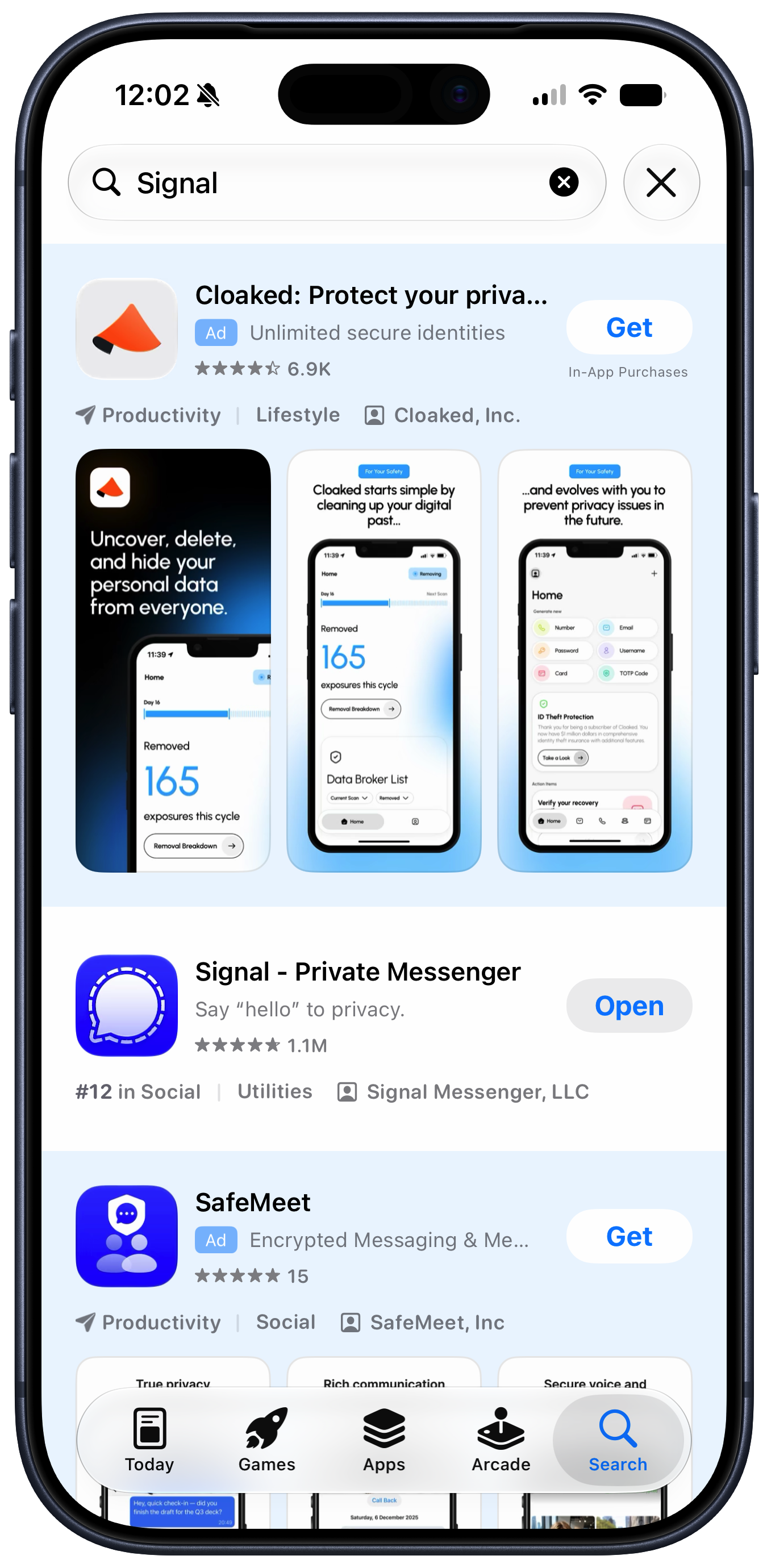
It shouldn’t be easy for users to simply imagine obvious ways for Apple’s software to improve. But it’s trivial for any user to imagine an obvious way for the App Store to be better: take out the ads from search results. If there were a preference setting to remove ads from App Store search results, everyone would turn that on. Apple is doing a thing that obviously makes the experience worse. It’s a little thing. The experience is only a little worse. But getting all the little things right is how you get to insanely great, and insanely great is Apple’s North Star.

Apple’s competition is lousy with ads. Downright lousy. Apple seems to be choosing the route of “Don’t like ads? Choose Apple, we shove fewer of them in your face.” That’s way less bracingly clear a marketing message than “Don’t like ads? Choose Apple, we don’t shove any ads in your face.” If your competitors’ stores all smell pervasively of dogshit, don’t aim to have the store that smells the least like shit. Aim to have a store that smells pristine. “Our stores only carry a vague whiff of dogshit” is not insanely great.

★ Ads in Software Are Like Stickers on Laptops

27 July 2026 at 18:32

Regarding my recent pieces regarding Apple’s shitty ads in the App Store and Apple News (and, perhaps soon, Apple Maps), a friend sent me this pithy take:

The ads Apple is happy to inflict on us in its apps are the equivalent of the stickers it would never allow on its physical products.

Bullseye.

That’s what those stickers on PCs are: they’re ads. Intel pays for the “Intel Inside” stickers that booger up PC laptop palm rests. Longtime readers will recall that back in August 2007, Apple held a Town Hall event to introduce new iMacs and some iLife and iWork software updates. In a post-event Q&A (imagine that), Bob Keefe of Cox Newspapers asked “Can you say why you all are not participating in the Intel Inside program, putting the stickers on your new or previous Macs?” This question was so absurd from the perspective of those who covered Apple closely that it prompted outright laughter. Jason Snell wrote a great column arguing that it was actually a good question.

Here’s the whole exchange (via Dan Moren, then at MacUser). Give it a listen, it’s only 100 seconds or so:

Keefe asks, Steve Jobs answers, Phil Schiller answers, and then Jobs closes it. Jobs broke the ice in his initial answer, with “What can I say? We like our own stickers better.” I was in the room, and that line killed. Jobs at his best. But you can tell that Jobs wasn’t really sure how to answer at first. He didn’t want to throw any shade at Intel, Apple’s partner, but he knew there was a key point to make here about Apple.

The whole thing is funny because at a fundamental level we all just know in our bones that Apple never even considered putting “Intel Inside” stickers on Macs. But why? For eons, mankind knew that when you drop something, it will fall to the ground. But why? Gravity is worth asking about. Worth figuring out. I think that’s the point of Snell’s 2007 column arguing that people (like me) were wrong to mock Keefe for asking.

It’s when Jobs comes back to the question, after Schiller, that we get the real answer:

You know, we put ourselves in the customers’ shoes and we say, what do we want stuck on our product when we take it out of the box? And the answer is, nothing.

That’s the answer. Apple still treats its hardware with that level of respect. With reverence. iPhones don’t even say “iPhone” on the hardware. No model or serial numbers. No small print. Just an Apple logo on the back.

Putting themselves in customers’ shoes today, how many ads do Apple’s executives want stuck in the results when they search for an app in the App Store? We know the honest answer. But the answer evidenced by the actual App Store is “Two really big ones, including one in the first spot.”

WorkOS MCP

27 July 2026 at 18:30

My thanks to WorkOS for sponsoring last week at DF to promote their MCP server. Debugging SSO, managing users, adjusting auth policies, configuring branding: every configuration task has lived behind a UI that only a human can drive.

The WorkOS MCP server gives agents the same access as your dashboard login. Hundreds of operations, discoverable at runtime. Connect in one command via OAuth, with scoped tokens instead of a master API key. Pass a screenshot of your marketing site and ask your agent to match the login page. If a human had to do it before, an agent can do it now. Connect your agent today.

‘AI Mania Is Eviscerating Global Decision-Making’

25 July 2026 at 20:15

Fascinating essay by Nikhil Suresh:

On a trip overseas, I had the privilege of a meeting with one of the Fortune 500 executives mentioned at the beginning of the post, who will remain anonymous so that they are not executed by firing squad by their board. As we were chatting, it became clear that they were very switched-on and technically competent, and they also happened to be at a company that had committed to the usual battery of exorbitant claims about their recent innovations — we’ve 100×’d our productivity, AI is the future of everything, I am but a vessel for OpenAI to make love to my wife. You know, normal things. But since I had them there without any microphones around, I asked why this was being repeated without opposition. Was it just sales fluff?

The answer was a lot more interesting. It was partially ridiculous sales material being delivered to an easily excitable audience, but this was not the dominant factor constraining honesty. Executives at their customers were saying absurd things about achieving 100× productivity, and this meant that if any executive at the vendor said that these gains were not plausible, it would undermine the credibility of the customer’s executive, be perceived as an attack (or heresy), and possibly result in an enterprise contract cancellation. And getting enterprise contracts cancelled because you wanted to opine on something that doesn’t really matter to your organisation’s mission is a great way to get fired.

The whole essay is very much worth reading, and might make you feel saner for harboring your own doubts regarding just how much has been changed in the world by generative AI. The gist of his argument is that the entire corporate world — not merely the computer/tech industry — is caught up in an AI mania that brooks no dissent. It’s a religious fervor and heretics are excommunicated. But the dissenters, who feel they must remain silent, are largely correct.

One way I’ve been thinking about AI mania is this: Computers have profoundly changed the world. There can be no dispute about that. Computers continue to improve in capability as networking effects grow and especially as Moore’s Law makes them faster and more capable at a pace unlike any other previous technical revolution. But most people are incapable of understanding how computers really work, and thus personally aren’t able to do much with them. Computers, for most people, are communication tools, not creative tools. Generative AI changes that. People with no computer aptitude are able to create things or discover things via ChatGPT and Claude that were simply beyond their ken heretofore. Per Clarke’s third law, “Any sufficiently advanced technology is indistinguishable from magic”. Generative AI feels a bit magical to all of us, even those of us with mid-to-high levels of understanding how computers work and how to make them work. But it feels like the first time ever that computers have been tools for their own creation for a lot of rather dimwitted but confident corporate manager/executive types. This moment feels like the Big Bang to them. The religiosity of this is such that there is no way to convince them that AI, as it stands today, is impressive and useful and innovative, yes, but several orders of magnitude less so than they’re imagining that it is. No way to convince them, that is, until the bubble bursts.

EU Fines Google $1 Billion for DMA Competition Violations, Including Making Search Results More Useful

25 July 2026 at 19:44

The European Commission on Thursday:

The Commission found that Google gives preferential treatment to its own services, including shopping, hotels, transport and sports results, over those of third parties in Google Search, thereby breaching its obligations under the DMA.

Google displays its own services more prominently in search results, including at the top of the search results page or by using enhanced visuals and filters, while similar third-party services do not have the same prominence.

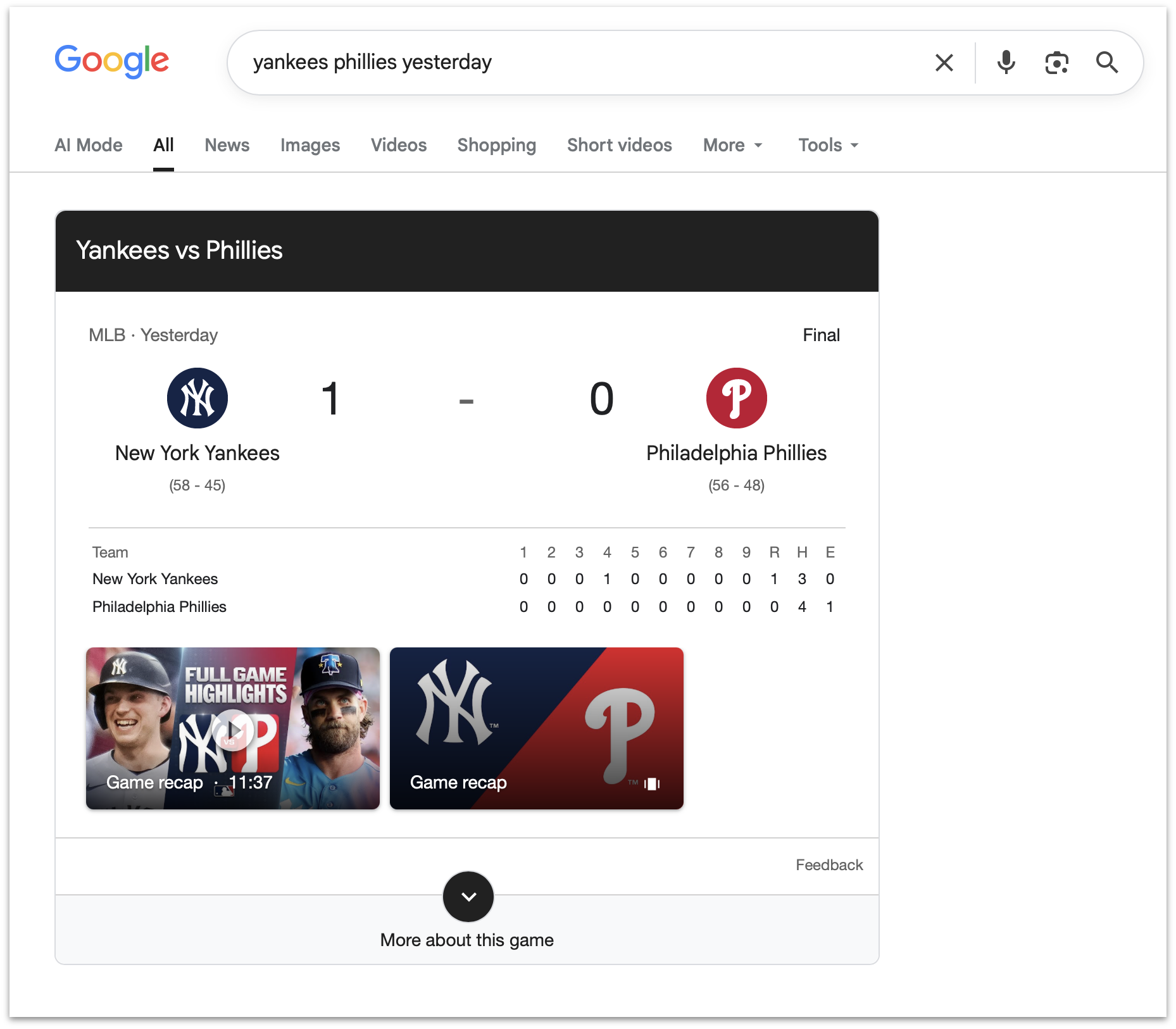
So if you search for the score of a sporting event, it’s illegal in the EU for Google to show you the score, like this search I just tried. What the EC is saying is that because Google Search is so popular, it’s no longer allowed to improve. It is impossible to imagine how this benefits EU citizens.

What generates more for the EU, fines against US tech companies, or tax income from EU tech companies? Here’s a viral post on Twitter/X that claims it’s now fines against US tech companies. The amounts certainly seem to be in the same ballpark.

Court Grants SerpApi’s Motion to Dismiss Google Lawsuit

25 July 2026 at 19:27

Julien Khaleghy, CEO of SerpApi:

The U.S. District Court for the Northern District of California granted our motion to dismiss Google’s lawsuit, marking a win not just for SerpApi, but for all who depend on an open internet. We’re pleased that the court rejected Google’s attempts to expand the DMCA to assert control over access to public pages. The internet’s founding principle — open access to usable information — is essential to driving innovation and ensuring everyone benefits from the promise of data. SerpApi will continue supporting developers, AI companies, researchers, and businesses that rely on access to public search information.

Yours truly, back in March, when SerpApi filed the motion to dismiss:

I’ve come around on SerpApi in the last few months. My initial take was that it surely must be illegal for a company to scrape Google’s search results and offer access to that data as an API. But I’ve come around to the argument that what SerpApi is doing to obtain Google search results is, well, exactly how Google scrapes the rest of the entire web to build its search index. It’s all just scraping publicly accessible web pages.

This December piece by Mike Masnick at Techdirt is what began to change my mind.

Even Google seems to understand the logical bind they’re in here, regarding scraping.

❌