Normal view

Ceramic Shield 2 Is the Real Deal

13 August 2026 at 17:46

Philip Michaels, writing last September for Tom’s Guide:

iPhone 17 torture test videos done by JerryRigEverything indicate that Ceramic Shield 2 certainly resists scratching, with scratch testing leaving only light scratches at level 7 on the Mohs scale of hardness. Scratches typically show up on glass at levels 5 or 6 on that scale.

“Ceramic Shield 2 is indeed the best we’ve ever seen,” JerryRigEverything remarks in the iPhone 17 Pro testing video.

That backs up Apple’s own Ceramic Shield 2 video, in which a mineral tip can be seen rubbing against a Ceramic Shield 2-coated display. There’s residue left on the screen, but it’s material from that tip, as it wipes away fairly easily.

I mentioned yesterday that I try never to place my iPhones face down, to avoid scratches, and that my nearly year-old iPhone 17 Pro seemingly has not one visible scratch on the front glass. Not even a single micro abrasion I can see, even when tilting it with the display off to hunt for them. Surely Apple’s Ceramic Shield 2, which is intended to provide best-ever scratch resistance, is a factor too — and likely the biggest factor. Apple at its best.

Google Design Pisses Its Pants on Twitter/X

13 August 2026 at 03:03

A few years ago I’d have looked at this post and maybe leaned toward the idea that a precocious 8th grader somewhere hacked into the @GoogleDesign Twitter account and tried to pass off their little to-do app as having come from Google’s design team. But this is apparently real. I almost hope it’s AI slop and that there aren’t any human designers there who think anything in this app has appropriate proportions or is aesthetically pleasing.

(Here’s an XCancel link for the x.com averse. You can just change any x.com/* URL to xcancel.com/*. But, alas, the XCancel mirror of the original tweet loses the animation showing the UI in motion — for some, but not all, users.)

Joanna Stern on the Pixel 11 ‘HiLight’ Notification Light

12 August 2026 at 23:23

Joanna Stern, writing at The New Things (gift link):

I used to love the blinking notification light on my BlackBerry, and later my Droid 2. It was a simple way to know I had a message without actually looking at my messages. Then BlackBerry let you customize the color, and it was a rainbow dream.

Google’s HiLight takes it a step further by letting you assign different colors to VIP contacts. So when your phone is face down, you can tell who’s trying to reach you without picking it up. It looks cool. The big bummer? At launch, it only works for phone calls.

Google told me it’s “continuing to invest in this technology” and that messaging notifications are coming. Still, it’s odd they aren’t there at launch, especially since Google found plenty of colors for Gemini. The ring changes hue depending on whether the AI is listening, thinking or responding.

I have no interest in this because a few years ago I stopped ever putting my iPhone on any surface face down. I don’t use a case, so setting the phone face down is a good way to pick up scratches. I stopped doing that, ever, and now I’ve got a nearly year-old iPhone 17 Pro that seemingly doesn’t have even a micro abrasion on the display glass.

And it seems downright goofy that it’s launching with support only for phone calls. Google can’t even launch a blinking light right on these Pixel phones.

Google Introduces ‘Camera Looks’ With Pixel 11 Phones

12 August 2026 at 22:58

David Imel, The Verge:

But in our current moment, the photos people are drawn to are not flawless — and that’s created a real problem for the people making smartphone cameras. “The gap between what two random people want from their camera is growing dramatically,” says Isaac Reynolds, who leads the Pixel camera team at Google. Some people want a perfectly optimized photo, Reynolds says. “But there’s a growing number of people who want something that they feel is more authentic or traditional, by their definition.”

That’s what Reynolds and the Pixel team are setting out to solve with Camera Looks, a total rethink of how the camera captures and styles an image on the Pixel 11 series. The phones include a new suite of processing tools aimed at giving people much more control over the camera’s output. At first glance, they look a lot like filters, with names like Black Tie, Classic, and most strikingly, Digi, in reference to the growing trend of buying cheap digital cameras from the early aughts. But unlike a filter, which generally applies editing tweaks after the processing happens, Camera Looks is changing how image data is processed at the sensor level.

This sounds a lot like Apple’s “Photographic Styles” in the iPhone 13 and later, but with the addition of some control over grain and sharpness. I love grain, and the thing I like least about Apple’s built-in photo processing is the way it attempts to eliminate all noise. I like digital cameras that embrace noise and try to make it pleasing, rather than over-processing to try to pretend these tiny sensors aren’t inherently noisy. So I say kudos to Google for loosening up on “everyone gets the over-sharpened, over-smoothed look”.

But, that said, what’s made me happy over the last year is shooting almost all my photos with third-party apps — in particular, Halide, Not Boring Camera, and Analogue — that give me low-level control over processing through LUTs (or in Halide’s parlance, “looks”). These apps give me the looks I want just through point-and-shoot photography. No need to process images after shooting. But because they (optionally) shoot RAW, I can reprocess in post without losing any original sensor data. I can shoot in black-and-white and subsequently change my mind and reprocess with a color look later. These apps enable honest film-look photography without looking at all gimmicky, and without baking any sort of filtering into the image data in my camera roll. It’s the best of both worlds. It’s also way, way fussier than the built-in Camera app should be.

Anyway, all this Pixel announcement news today has me thinking that these days, I never hear much about Pixel cameras or image processing. In the early years of the Pixel lineup, there was a common view that Pixel phones were the best camera phones in the world. I never believed that, but I did think they were an interesting alternative, taking different but equally valid philosophical choices than Apple. Apple has always insisted on instant processing. You snap the shutter and the iPhone saves your image instantly. Pixel cameras often undertook seconds-long processing. That enabled features the iPhone couldn’t offer.

I think it’s pretty easy to pinpoint when things changed for Pixel — when Marc Levoy left Google for Adobe in 2020 (where he now leads the team making the very intriguing Indigo camera app, that is exclusively available for iPhone and which offers a slew of innovative computational photography features).

When Levoy was leading Google’s camera photography team, there was a credible argument that Pixel phones were the best still camera phones in the world. (They were never even close on video.) Ever since, I never hear about them except in the middle of August each year, when Google announces new Pixel hardware. See you in 12 months.

TechCrunch on Google’s Pixel 11 Lineup

12 August 2026 at 21:45

Ivan Mehta, TechCrunch:

With this year’s Pixel 11 series launch, Google is thinking more agentic AI to complete your tasks. With Gemini, U.S.-based users will be able to order groceries, book rides, or get coffee, for instance. Plus, Gemini can call businesses on users’ behalf for table reservations or appointments. Google said that users can take over or stop tasks at any point in time and also review transcripts for AI-operated calls.

Over the next few weeks, a new slate of connected apps will be able to work with Gemini to get things done, including Granola, Otter.ai, Wix, Fever, Get Your Guide, Localiza, OpenTable (U.K.), Ticketmaster, iHeartRadio, Pandora, Angi, Thumbtack, and Zocdoc.

I’ve never heard of most of those apps, or, if I have heard of them, I thought they went defunct years ago. The one app amongst those I do use, OpenTable, apparently only supports this Gemini integration in the U.K.?

Another knockout year for the Pixel phones and Android.

Hands-On With Google Pixel 11 Pro Fold

12 August 2026 at 21:40

Sam Rutherford, writing for Engadget:

Granted, the P11 Pro Fold still includes IP68 dust and water resistance, which is better than what you get on the Z Fold 8 line (IP48). But after making an absolute tank of a foldable phone with last year’s model, I said Google really needed to cut weight and thickness this generation, and it just hasn’t. Instead, it seems like Google has leaned even more into the Pro Fold’s sturdiness with a new glass fibre material for its rear panel that the company says is nearly impossible to crack. This is great in theory, but obviously I wasn’t in a position to smash one of Google’s demo units in order to test that claim.

I have never seen anyone, anywhere, with a folding Pixel phone. Pretty sure I won’t this year either.

I played with a Pixel 10 Fold or whatever its name was last year at the Google Store on Newbury street in Boston, which store felt like a small library or museum. The Pixel Fold display was so plasticky that I had a moment where I wondered if the display units were fake props, like at Ikea. But no, it was the real thing. And it cost $1,800 to start.

Google’s Pixel Watch 5

12 August 2026 at 21:38

Victoria Song, The Verge:

The $399 Google Pixel Watch 5 isn’t about the hardware. Sure, there’s a new satin pyrite case finish, a few new strap colors, and a Steph Curry Special Edition. Under the hood, there’s a slightly faster Qualcomm processor and an itty-bitty battery bump. There’s a $50 price hike from last year, too, because the Pixel Watch 5 isn’t immune to RAMageddon — none of us are. Otherwise, no one would blame you for looking at this watch and thinking absolutely nothing’s changed. That’s because the big updates this year are all software-based.

I have never seen anyone in real life wearing a Pixel Watch. (I’ve only seen a handful of people using Pixel phones, and every single one of them was at a tech event of some sort.)

You can also use AI to generate watchfaces. I created a watchface featuring “fat cats and an elegant font.” It didn’t quite do that. The fat cats weren’t characters, so much as pleasantly plump, cat-shaped clock numbers. It’s a gimmicky way to shoehorn the Nano Banana model onto the watch… but if that’s your thing, it works.

Well I’m sure now I’ll see plenty of people wearing Pixel Watches.

Amazon Is Spiting Customers With Unhelpful Order Confirmation Emails

12 August 2026 at 20:51

Mia Sato, The Verge:

Earlier this summer, Amazon customers began noticing that emails related to their online orders looked sparse: Order confirmation emails didn’t name specific items anymore, and instead listed only item categories.

“Your Beauty item is confirmed!” an email about my retainer cleaning tablets read. Shoppers have posted other iterations of the redacted emails as well: “Ordered: 1 Hardware item,” “Your Drugstore, Shoes, and other items are here!” and “1 Nutrition & Wellness, 1 Wireless Accessories,” for example. The emails have clip art-style illustrations of general product categories, and a shopper has to exit their email and go to Amazon to see what item it’s actually referring to.

Complaints about the vague emails appear to have started in July; orders placed as recently as June contain thumbnails and names of the exact item purchased. [...]

“As customers shop with us more frequently, including on their phones, and use the ‘Your Orders’ page in the Amazon app to get real-time, consolidated order details and delivery status, we’ve simplified several order-related emails to direct customers to our app and website for the latest information on their orders,” spokesperson Maxine Tagay said in an email. “This also reduces customer information shared outside the Amazon app and website to further improve customer privacy.”

That statement from Amazon is almost honest, if you squint at it and ignore the bit about it having anything to do with “simplification”. If you order a Torx screwdriver, what’s simple is getting a confirmation email with the exact name, brand, and photo of the item you ordered, not “a hardware item”. The honest part is “reduces customer information shared outside the Amazon app”.

The fact is, a lot of people use apps like Gmail for email. In fact, a lot of people use Gmail in particular. There’s a good chance you do. When you use Gmail, Google learns everything in your email. Amazon sees this as a competitive problem for them, not a privacy problem for users. Everyone who uses Gmail basically knows that Google “knows” what’s in their email, and they’re voluntarily agreeing to that. Amazon just doesn’t like that any of its competitors — perhaps especially Google — can glean so much information about what people are buying from Amazon. So Amazon, in an act of competitive spite that corrupts its relationship with its own customers, is limiting all useful purchase information to channels that it controls — its website and its own apps.

If customers relied solely on the “Your Orders” page at Amazon, they wouldn’t need to send any emails at all. The obvious fact is, people go to Amazon when they want to buy something. They don’t come back until they want to buy something else. They enjoy getting confirmation and shipping notifications in email because they check their email regularly.

App Store Scam of the Week: ‘TabControl Extension’ for Safari

12 August 2026 at 17:06

Jeff Johnson:

These purported reviews, all but one of which is 5 stars, are all in English. Yet none of them is in the US App Store. I also looked at other English-speaking countries such as Australia and Canada but found no reviews. Also suspicious is that the name of every reviewer was a first name followed by an initial for the last name. If you’ve ever looked through App Store user reviews, it’s unusual to find this naming format. In most cases, the name on App Store user reviews is a uniquely chosen username, with no space character, often suffixed by a number.

The final and most conclusive evidence that these reviews are fake, totally invented out of thin air by the developer (or more likely, by an LLM), is that the dates on the reviews, such as “Mar 12,” predate the release of TabControl Extension in the App Store!

God only knows what this obvious AI slop scam is doing with the data from users’ Safari tabs. It’s currently the 12th or 13th most popular Safari extension in the App Store.

Nature Is Healing

12 August 2026 at 16:43

Basic Apple Guy:

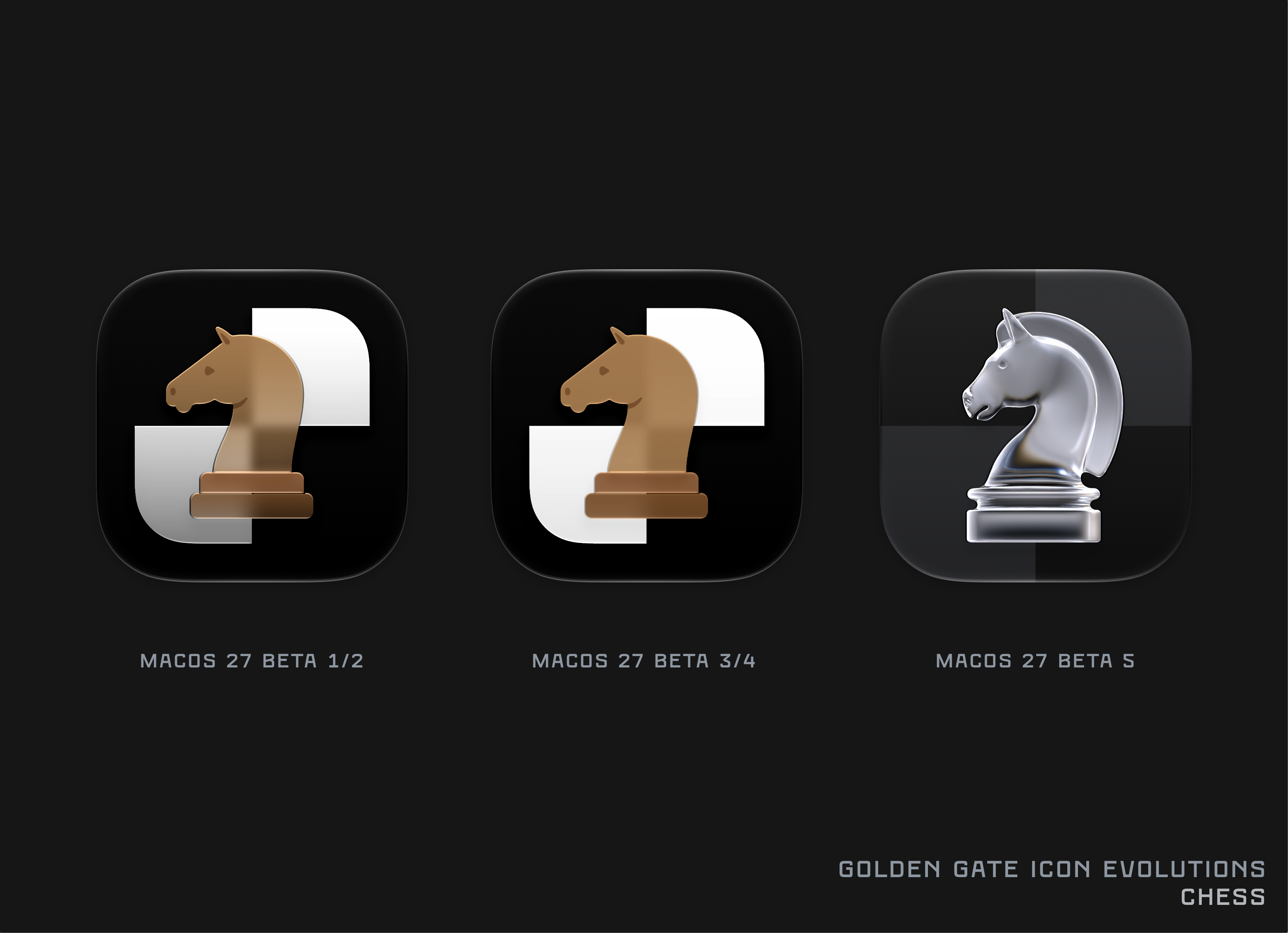
Apple just dropped the hardest icon glow-up for the new Chess icon in macOS 27 Beta 5.

Comparison of the Chess app icons in MacOS 27 Golden Gate: betas 1/2, betas 3/4, and an all new-icon for beta 5. The earlier ones show a flat brown knight. The new one in beta 5 shows a fully-articulated 3D silvery knight. The new one looks great. The previous ones look like shit.

This is not just a tweak or small improvement. This is the difference between total shit and a really nice icon.

The Economist: ‘How to Spot AI Writing’

11 August 2026 at 23:37

The Economist (‘twas a gift link, but alas, I guess gift views have been used up — here’s an archive link in case the gift link is vexing you):

You can discover AI’s hallmarks by comparing the writing of man and machine. To do this you need a baseline that is distinctive and familiar. The Economist turned to prose that we’re sure is human and that readers will recognise: our own. We designed a study to ask top LLMs — OpenAI’s ChatGPT, Anthropic’s Claude, Google’s Gemini and xAI’s Grok — to write versions of our articles without consulting the web. (As a prompt, we gave them the AI-generated summaries that we have experimentally added to some of our articles.)

This gave us a corpus of human and AI creations and we compared them across 55,940 sentences and 1.2m words. To make sure we were detecting AI quirks rather than our own, we also checked the AI texts against journalism from CNN, the New York Times and the Washington Post. Excerpts from hit novels published between 1950 and 2022 offered another test.

Our findings are surprising. AI prose is distinguishable by word and punctuation choice as well as sentence and paragraph structure. But its hallmarks are not what you might expect, partly because its writing style has changed with software updates. That does not mean that LLMs are great writers: their prose lacks lucidity and elegance and is often formulaic. So those aspiring to be impressive (human) storytellers should avoid the following peculiarities in their own prose.

On point for today.

Some specific findings:

Much of this language could be described as what George Orwell called “pretentious diction”. He railed against writers who “dress up simple statements” with complicated words and jargon to sound clever. Such pontificating penmen, Orwell observed, also believe that “Latin or Greek words are grander than Saxon ones”. (Bots agree: more Latinate suffixes crop up in their writing than in human texts.)

Then look at punctuation. Many believe LLMs stuff their prose with em-dashes, but that is not true after the most recent updates. Today only Claude uses more em-dashes than human writers, with ChatGPT using markedly fewer than any other writer in our study. Humans rejoice — and start using dashes again.

A better way to spot AI-generated writing would be to look for texts without much punctuation at all. LLMs are very Joycean about it: they use fewer commas and semicolons than humans (and hardly any parentheses). They use less punctuation in part because they write longer sentences — “and” is their most overused word — and in part because they do not quote experts.

Alex Micek on BMW’s iDrive ‘Special Surprises’

11 August 2026 at 21:56

Alex Micek:

In the future, I will feel angry if my car strands me on the side of the road.
I will feel angry if the motor brushes fail expectedly.
I will feel angry if it leaks water.

By contrast, I don’t feel anger when the car tricks me into seeing an advertisement. Instead, I feel a deep, smothering, let-down at the promise of futurism. Bottomless despair is probably inappropriate; a symptom of the misanthropy I should grow out of. But. In the meantime, I feel helpless, discouraged, deeply sad.

Such a good take. I should not let 19 years pass again between linking to his writing.

BMW Probably Paid Sony for the Spider-Man Dashboard Ads, Not the Other Way Around

11 August 2026 at 21:46

This didn’t occur to me but should have — BMW paid Sony to place BMWs throughout the new Spider-Man: Brand New Day movie. They’re not just in the movie but part of the story. So it’s probably the case not that Sony paid BMW to put Spider-Man animations in the dashboards of every late model BMW on the road, but that BMW offered to do it as part of the promotional deal they paid Sony. So BMW probably paid Sony for something that ultimately infuriated a bunch of BMW’s own customers. Geniuses.

Mark Zuckerberg Posts 6,500-Word AI Essay

11 August 2026 at 21:36

Two weeks ago Zuckerberg published a 1,000-word essay, “The AI Future Is for Everyone”. This week he published an expanded 6,500-word version of the essay on Meta’s website. Somehow it almost says nothing more than the original. This tidbit, however, struck me as notable:

For example, in Richland Parish, Louisiana, where Meta is building a large data center, teachers received a $50,000 bonus this year because of the increased tax revenue from our investment. The superintendent told us that teachers are now moving there from across the country and he believes it will become one of the nation’s best school districts.

Unlike the concern about knowledge work displacement, there is a shortage of skilled tradespeople like carpenters, electricians, and construction workers to support the demand for infrastructure buildout. Meta has created America’s Workforce Academy to provide free training for skilled tradespeople and guaranteed high-paying jobs in the areas we’re building data centers.

Those $50K bonuses to public-school teachers are real, and they’re more than most of those teachers’ annual salaries. That’s the sort of thing that could turn public sentiment on data center construction around. But it hasn’t turned around yet.

The Talk Show: ‘Getting the Snack Right’

11 August 2026 at 21:00

Chance Miller returns to the show. Topics include iOS 27’s progress over summer, live baseball in Vision Pro, the RAM crisis, Apple’s trade secret lawsuit against OpenAI and io, and the EU/DMA situation.

Sponsored by:

  • Squarespace: Save 10% off your first purchase of a website or domain using code TALKSHOW.
  • Factor: Healthy eating, made easy. Get 50% off and one free breakfast item per box for one year, with code talkshow50off.
  • Notion: The collaborative AI workspace where teams and agents work side by side, with a Developer Platform teams can build on.

Netflix Has Peaked

11 August 2026 at 20:54

Andrew Sharp, writing at Sharp Text last month after Netflix’s earnings, asking “Is Netflix Washed Now?”:

I offer this observation as a swirl of heightened anxiety surrounds the company, so let me clarify one thing up front: I’m not predicting imminent doom. Netflix content reaches a staggering 85% of American viewers and has 325 million subscribers globally. Growth is slowing, but that’s the law of large numbers. If practically everyone in America and much of the world is already subscribed to some version of Netflix, and churn rates are still low, then any concern is relative. Going forward: cable is still dying, and even if the biggest premium distribution platform in the world can’t make great content of its own, it can still license movies, TV and sports rights. Netflix can then spread those costs across hundreds of millions of subscribers and a steadily growing ads business, seeing more engagement in a week than Apple TV sees in a year.

So no, the company’s not doomed today or destined for collapse tomorrow. Instead, I think what’s interesting to consider is that Netflix has almost certainly peaked. As a cultural force, as a business success story, and as an entertainment death star destined to swallow Hollywood whole, the arrows are all pointing the wrong direction.

Sometimes the problem with a company isn’t that it isn’t a good business, but merely that it isn’t as good a business as it holds itself up to be. A billion-dollar business ought to be a good thing, but it’s a disaster if the company is valued by investors as a trillion-dollar business. That’s Netflix.

To me it’s backwards that Netflix is valued at $300 billion, roughly the 50th most valued company in the world, and Disney is valued at $180 billion, roughly 120th. Netflix has a streaming video service and owns some IP, like Stranger Things and Squid Game. Disney owns two streaming video services (Disney+ and Hulu), and owns some IP. Little stuff like Mickey Mouse, Star Wars, Marvel, the Disney princesses, and everything from Pixar. Netflix has started dabbling in sports; Disney owns ESPN. Disney owns the world’s biggest and best theme parks and an entire cruise ship line.

It’s true that Netflix’s streaming service is by far the biggest in the world, and likely will remain so for the foreseeable future. But Disney+ combined with Hulu is clearly in second place globally.

For the most recent 12 months:

DisneyNetflix
Revenue$97 B$48 B
Net Profit$11 B$14 B
Net Margin11.5%28%

Netflix is generating slightly more profit on half the revenue. With its theme parks, resorts, and cruise ships, big parts of Disney are effectively hardware, not software — so it’s almost inevitable its margins will be lower than a pure software play like Netflix. But those “hardware” businesses diversify Disney. How confident are you that Netflix will remain the undisputed leader in streaming 10 years from now, or 25? I’d bet good money that Walt Disney World will be the world’s biggest, best, and most profitable theme park 50 years from now. And it’s a joke to compare the value and longevity of the two companies’ IP.

I don’t know that Disney is undervalued by the market, but I sure think Netflix is overvalued. And as for quality, I’ve watched a bit more Netflix original content this summer than I had of late. David Attenborough’s A Gorilla Story was a splendid documentary, but nature documentaries don’t pay the bills. A few other things I watched (or at least watched part of) were absolute dreck. Not high-quality fun trash like Tiger King but amateur-hour I’m-worried-I-lost-a-few-IQ-points-by-watching-it trash. We pay $27/month for Netflix premium and I can say unequivocally that it’s not worth it. I continue paying for it because I’m willing to overpay for it the same way I am for beverages at a hotel — it’s money I’m willing to squander, knowing full well I’m squandering it.

It feels to me like Mr. Market is getting increasingly skeptical whether Netflix justifies its valuation, and Netflix is getting a little squirrelly and desperate trying to come up with an answer. Simple question: what’s their moat? It sure isn’t content quality.

Anthropic Posts ‘How Claude Marks AI-Generated Content’ Without Explaining How Claude Marks AI-Generated Content

11 August 2026 at 19:59

Anthropic support page:

Anthropic has signed the EU AI Act’s Article 50(2) Code of Practice on Transparency of AI-Generated Content, as a provider of both generative AI models and generative AI systems. This article describes how we’re planning to put those commitments into practice, how marking works, and what its limitations are. We’ll update this article and publish more detailed technical guidance as it becomes available.

Regarding generated plain text output:

When a supported Claude model generates text, it weaves an imperceptible watermark directly into the text itself. You won’t see it, and it doesn’t change the meaning, quality, or readability of Claude’s response.

Because the watermark is part of the text, it will travel with the text when it’s copied and pasted elsewhere, and may persist through some editing. Watermarking will be applied at the model level, which means it will be present no matter which Claude product or surface the text comes from. [...]

We’re also working to enable users and other third parties to detect Claude’s embedded watermarks and provenance metadata. Detection checks whether a piece of text or a file carries a supported Claude mark. If a supported mark is found, it indicates that the content may have been processed by Claude.

We’ll share details on detection mechanisms in forthcoming technical documentation.

Anthropic is claiming this is for compliance with an EU law but that “Marking will apply to output from supported models wherever Claude is offered, worldwide.”

This is infuriatingly opaque. I won’t speak to the “signed provenance metadata” they say they’ll be embedding in generated files like PDFs, SVGs, PNGs, and JPEGs. That’s important but it’s complex. Plain text is simple. A string of text is just one character followed by another. At first I presumed that Claude is going to start “embedding” invisible characters/byte sequences between visible characters — which would unavoidably cause immediate problems.

Let’s say I have Claude generate the phrase “Hello world”. (Two words is surely too short to bother with “AI generated” detection — I’m using a two-word phrase here for simplicity in the example.) Claude creates the string of characters “Hello«invisible characters that comprise a “watermark” here» world”. I paste this on the web. Humans who look at it will see “Hello world” but the invisible characters are there. Character-count-limited social media platforms will show that the string contains more than the 11 visible characters in “Hello world”.

If the “watermark” is not comprised of invisible characters but rather visible ones, how in the world does this jibe with their claim that it’s “imperceptible”? This Reddit thread claims that’s how it will work — “It’s a form of steganography where the model subtly biases its word choice to create a statistical pattern that can be detected later.” How in the world can that be squared with “it doesn’t change the meaning, quality, or readability”? And any sort of semantic detection like this is going to cause false-positive problems.

If I ask a tool to generate text or suggest text for me, I expect that tool to generate the best possible word choices it can. Not corrupt its output for the sake of watermarking. If they go through with this, this ought to be poison to the Claude brand.

What happens if you copy my text and quote it in something you write, by hand? Now you’ve got a watermark in your prose, invisible characters or something, that implicates that your prose is AI-generated? Even though you didn’t use AI and just copy and pasted text from me? Madness.

They obviously need to explain exactly what they’re embedding in text if anyone is actually going to detect it, but if they explain it, anyone can simply remove it. And what happens, for example, if someone just OCRs Claude-generated text rather than selects and copies it? This is all so stupid. I have never been happier that I’ve never actually used Claude for anything.

What’s New in iOS 27 Beta 5

10 August 2026 at 23:54

Zac Hall at 9to5Mac has a good rundown of new features and changes in beta 5. Some app icons got tweaks (the Siri app in particular looks much cooler now), and a bunch of the existing American and British Siri speaking voices now have the Pace and Expressivity adjustment sliders.

Also interesting: the OS 27 releases were stuck at beta 4 for 22 days. That’s a week longer than usual. Will Hains (my Kotoba friend) maintains a wonderful single-page website tracking iOS version release date history. For these summer “next big version” comparisons, it’s best to filter by “*.0” releases. Do that at Hains’s website and you can see a fairly clear pattern: betas 1 through 4 typically last about two weeks each; then starting with beta 5, Apple switches to a roughly weekly schedule until the end of the beta cycle. I wouldn’t read anything into that other than to expect beta 6 next week and beta 7 the week after that.

❌