 Login
Login
The Trans Panic Clickbait Economy
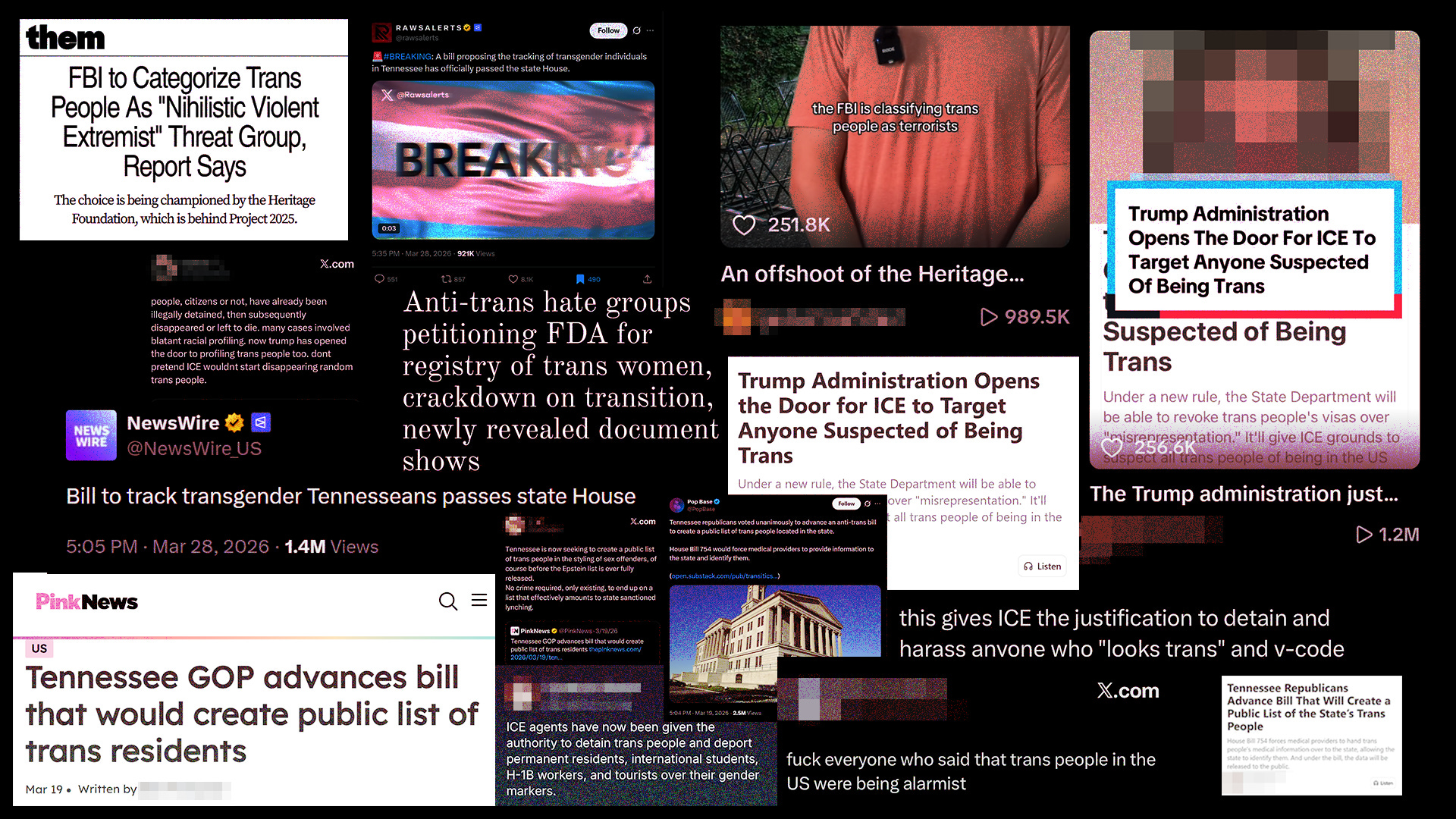
The past few weeks my social media feeds have been more apocalyptic than usual. Not due to escalating war with Iran, the shellshocked economy, or oil prices, but because of a wave of posts and news articles proclaiming imminent doom for trans people in the United States. Attacks on trans rights are obviously not new and have steadily risen the past ten years, but this recent collection of worrying claims are especially apocalyptic, or outright genocidal.
Just this month I’ve seen viral posts, citing online articles, saying that ICE is going to round up and “disappear trans people,” that the FDA is making a national “registry of trans women,” and that an adult trans healthcare ban is rapidly on the way. These panic inducing claims and the articles they’re sourced from are referring to real things or movements happening in anti-trans activism, regulations, and legislation, but are framed in a way to maximize catastrophe rather than understanding what’s actually happening at the moment and what we can do about it.
The danger of uncritically engaging with trans panic clickbait is that it reduces the worthwhile process of “staying informed” to being in a state of constant doom and feeling hopeless against an unstoppable enemy. Alternatively, it risks causing people to completely check out and not believe anything they see online even if there is a real pressing threat. Both of these outcomes cloud our ability to accurately assess and respond to very real threats.
Migrating While Trans
The bulk of this article will focus on a story claiming that ICE is now permitted to detain anyone for “looking trans.” This story and the online discussion around it is a microcosmatic example of how we understand both the Trump administration’s attacks on trans people, and how and why ICE operates as an agency.
On March 12th, a Substack article was posted with the headline “Trump Administration Opens the Door for ICE to Target Anyone Suspected of Being Trans.” The subheadline continues by reading, “Under a new rule, the State Department will be able to revoke trans people’s visas over ‘misrepresentation.’ It’ll give ICE grounds to suspect all trans people of being in the US illegally.”
The information contained in this headline is the furthest many people will engage with the content of this article. Combining that headline with preconceived notions about how ICE functions under the second Trump administration makes this a very frightening claim.
So what evidence does the Substack article include to support this claim? Earlier this month the State Department updated its policy for the Diversity Immigrant Visa Program, also known as the green card lottery.
New State Department rules require that applicants upload a scan of their foreign passport’s biographic and signature page to help cut down on fraudulent DV Program entries. The policy update also changed the “gender” entry to “sex” on the form. In the policy rule update the State Department wrote, “The marker reflected in the “sex” field on any visa application, including the entry form, should match the applicant’s biological sex at birth, even if that differs from the sex listed on the applicant’s foreign passport or other identifying documentation.”
The Substack article claims this could force a “mismatch between trans people’s applications and their passports—something it can then use to declare their applications fraudulent and disqualify them entirely.” The first half of that sentence is true, a mismatch may occur between the gender listed on foreign documents, and the sex listed on a US visa application. But it’s not the case that this mismatch will inevitably result in an application being deemed fraudulent and then denied.
According to Malita Picasso, staff attorney for the ACLU’s LGBTQ & HIV Rights Project, the kind of fraud this rule change is trying to combat by requiring a passport scan is not unique to trans people. Picasso said in an email that the new rule “seems to more directly target fraudulent activities involving third parties basically entering the lottery on behalf of individuals without their knowledge and consent, and then extorting them for large amounts of money if they are selected.”
The stipulation requiring an applicant to list their “biological sex at birth” on forms has actually already been State Department policy for both immigrant and nonimmigrant visa applications for over a year. Effectively since Trump’s executive order mandating the US government officially recognize two biological sexes which are determined at birth, and that “government-issued identity documents, including visas, and all forms that require an individual’s sex shall accurately reflect an individual’s immutable biological classification as either male or female.”
Claiming that a mismatch between the gender listed on a foreign document and the sex marked on application forms will itself “disqualify” someone from receiving a visa has little to no basis in government policy. Picasso told me that the new policy itself recognizes this could cause discrepancies, and that she doesn’t see a “new or heightened risk of being accused of fraud/willful misrepresentation if a transgender person follows the instructions by listing their sex assigned at birth on the application, even if they also file a birth certificate that has been updated to reflect their gender identity.”
The State Department has been aware for a while that their “biological sex” policy will create these kinds of mismatches. A February, 2025 State Department memo reads, “There may be instances when a consular officer becomes aware that the sex listed on the foreign passport may not be the applicant’s sex as defined in the [Executive
Order]. In such cases, the adjudicator should confirm the applicant’s sex as defined in the E.O., indicate that sex on the visa, and add a case note documenting any discrepancy between the passport and the visa to prevent issues at the [Port of Entry].”
Later in April of 2025, USCIS officially updated their policy on requiring “biological sex” on immigration applications. The policy also states that “USCIS does not deny immigration benefits solely based on a failure to properly indicate the benefit requestor’s sex.” ACLU staff attorney Malita Picasso told me that USCIS officials do have “a lot of discretion,” and that the policy warns that failure to list biological sex “will cause delays in processing the application while USCIS tries to verify your sex assigned at birth,” according to Picasso.
The State Department has said there are grounds to deny visa applications for trans people if they make a “willful, affirmative, material act of misrepresentation” by misrepresenting their “biological sex at birth” in application forms or to a consular officer to gain entry to the United States under false pretenses. This language was written to restrict trans athletes from entering the country to play sports. The sort of misrepresentation the State Department is talking about is if a trans woman “misrepresents” her birth sex to procure a visa or admission into the country for the purpose of competing in a women’s sports competition.
This same sports memo, dated February 24th 2025, also states, “If there is a discrepancy either in the applicant’s documents or in electronic consular records, or if other evidence casts reasonable doubt on the applicant’s sex, you should refuse the case under 221(g) and request additional evidence to demonstrate sex at birth.” Section 221g of the INA is a temporary visa refusal pending further documents or information provided by the applicant. For an athlete visa the bar is very high and the burden is on the applicant to prove they have the special and rare qualities required to be eligible for a visa.
But the Substack article doesn’t just claim being trans could disqualify you from receiving a visa, the article escalates its claims to say that trans people who already have a valid visa could have it revoked and be deported for misrepresenting their sex in the past. The author of the Substack cites US law that if an alien is found to have obtained a visa “by fraud or willfully misrepresenting a material fact” they are ineligible to be in the United States, and refers to a section of the foreign affairs manual which includes providing a “fake birth certificate in support of an Immigrant Visa application” as “misrepresenting a material fact.” The article goes on to assert that the Trump administration would refuse to recognize trans people’s amended birth certificates and essentially consider them “fake,” thus making their visa eligible to be revoked.
The author links to another of her own articles on federal policy regarding the issuing of US passports with sex markers reflecting “biological sex at birth.” Under the new passport policy, State Department employees may check birth certificates for signs of being amended, and request more documents that list sex at the time of birth such as medical, hospital, or early school records. Picasso said that this does not mean officially amended birth certificates are “fake” for the purposes of establishing fraud or willful misrepresentation, which the Trump administration has never argued.
“I think it’s dangerous to even suggest that a legally obtained and valid birth certificate could be viewed as “fake” without a much clearer statement from the federal government to that effect,” Picasso advised. Trump’s recent travel bans have specifically mentioned the availability of fake birth certificates in certain countries.
This whole claim about trans people’s visas being revoked because of accusations of misrepresentation is contradicted by the State Department which said last year, “Currently valid U.S. visas issued prior to the effective date of this guidance bearing a sex that differs from the visa holder’s sex as defined in the E.O. will remain valid through its expiration date; the visa holder does not need to apply for a new visa with an amended sex marker until the current visa expires.”
The first half of this article covers what I argue are misinterpretations of State Department visa policy. The second half speculates on how this misinterpretation could be enforced by ICE. In a Supreme Court ruling last year, Justice Kavanaugh wrote that ICE could detain people based on a combination of factors such as working a certain kind of job, ethnicity, and speaking Spanish or talking with an accent. Kavanaugh said that ICE can detain someone for questioning “if they have a reasonable suspicion, based on specific articulable facts, that the person being questioned . . . is an alien illegally in the United States.”
With a substantial leap in logic, the Substack author argues that Kavanaugh’s concurrence “effectively permitted” ICE to use the fact that someone ‘looks’ trans as the “specific articulable fact allowing its officers to question, harass, detain, and even deport both citizens and non-citizens—as long as it has a reason to claim that being trans makes a person more likely to be in the US illegally.” Adding that because of State Department policy asking applicants to list “biological sex” on forms, ICE now has the “enforcement rationale to assert that trans people are more likely than cis people to have “misrepresented” themselves during the visa process and, therefore, are more likely to have entered the country “unlawfully.””
This assertion rests on the idea that looking transgender makes someone more likely to be in the US illegally, which is simply not supported by any immigration policy, memo, or guideline. It also assumes the justification for a Kavanaugh stop is the same as the legal process of removal, which it is not. This idea was invented by the author of this article, it’s not based on any enforcement directive from ICE, and misrepresents what the State Department means by “intentionally misrepresenting” biological sex in the visa application process.
Discrepancies in gender markers across government documents is not itself grounds for detention or deportation, in fact it’s federal policy to create such discrepancies. Furthermore, dealing with potential discrepancies between gender markers on foreign documents and the Trump admin’s insistence on only using “biological sex at birth” on federal documents is handled by State Department consular officers and USCIS employees, not ICE Enforcement and Removal Operations officers who work under an entirely different agency.
But the main thing that makes me believe that ICE will not suddenly start targeting people for being trans is that this State Department policy requiring sex at birth on visa applications isn’t actually new! It’s existed since February of 2025 for both immigrant and nonimmigrant visas, the only recent change is that the green card lottery rules have been updated to use the same language.
“Nothing about this new rule makes it more or less likely that ICE will be free to scrutinize trans people’s documents and detain those whose documents show any inconsistencies,” affirmed Picasso.
Put plainly, State Department restrictions on stating assigned sex at birth on green card/visa applications does not give ICE any new justification to roam around disappearing random people who “look trans.” But it could make border crossings more risky for noncitizens and visa applications harder to navigate and subject to delays. This policy from the State Department is bad, but turning that into “ICE is going to now round up trans people and v-code them” doesn’t understand how this will actually affect immigrant trans people.

[ “V-coding” refers to the systematic enabling of sexual abuse toward incarcerated trans women to please male prisoners. ]
Near the end of the article the author suggests that trans Kansans could be at extra risk of getting detained by ICE because of a new law invalidating driver’s licences and birth certificates with amended gender markers, possibly leaving some US citizens temporarily unable to prove citizenship with a valid birth certificate. In that case a passport would be ideal, otherwise a hospital birth certificate or early school records can theoretically be used to help prove citizenship. It’s worth reiterating that a citizen temporarily losing documentation, does not put them at the same level of marginalized risk as an undocumented immigrant. The new Kansas law does direct the office of vital statistics to “reissue birth certificates when necessary to correct the sex identification.” Similarly, DMVs were instructed to reissue a “corrected” license once the invalided one was turned in.
Doomer Discourse
The unsubstantiated claims made in this article went viral across social media platforms like TikTok, Bluesky, and Twitter bolstering speculation. Social media posts even further extrapolating the potential harm facing trans people by ICE agents beyond the claims made in the article by saying ICE will now “deport” or “disappear” trans citizens.
Anyone who tried to push back on the legitimacy of these were labeled “dangerous” or “feds” for trying to “downplay” the threat posed by ICE. Back and forth discourse largely took three forms. One: Saying that because ICE is already doing X bad things, they could then also start doing this new bad thing. Two: Asserting that this is already happening. Three: Arguments based on distrust of the government or ICE’s lack of legality.
Much of the discussion emerged from the genuine belief that ICE has been granted new power or has been “authorized“ to detain someone for “looking trans,” that Trump has “opened the door” for ICE to start profiling trans people. That, like the Supreme Court’s ruling last year, profiling has essentially been greenlit for trans people, or that checking the consistency of gender markers has been added to ICE’s “jurisdiction.” To be 100% clear, there has not been any new ICE memo or policy related to trans people, gender markers, or documentation being in their jurisdiction. State Department policy about not misrepresenting birth sex on visa applications has existed for over a year. The real danger posed by this policy is that more trans immigrants could have visas delayed or in extreme cases denied, and may need help navigating an increasingly confusing application process.
Still, social media users have tried to assert that ICE’s specific targeting of trans people was “already happening.” In the past year ICE has detained trans people; it’s hard to get exact numbers on this because ICE stopped collecting detention data for trans people last year to comply with Trump’s anti-trans executive orders. Though we do know of attempts to deport trans people from news reporting. Last August, ICE detained a trans woman who overstayed a visa by 6 years, and in November a trans woman who lost her lawful permanent resident status in 2023 after pleading guilty to a felony was “inadvertently” deported to Mexico, despite a court order specifically barring her being sent to Mexico. There’s no evidence that these women were targeted for removal on the basis of being trans, but what happened to them is still horrific. As of now there has been no reporting on people being targeted for detention based on “looking trans,” because the government has not actually argued that being trans itself qualifies as reasonable suspicion of illegal presence.
When I posted about this online in an attempt to dissuade panic-inducing misinformation, people argued that even if this has yet to happen, ICE still could expand their operations to include profiling and targeting trans people for detention since they’re already profiling and rounding up “random brown people.” After all, I write for a podcast called “It Could Happen Here,” and ICE has detained both citizens and legal immigrants and sent them to camps.
Just because I work on a news show called It Could Happen Here doesn’t mean I should spread unsubstantiated doom spiraling disconnected from the material reality of real policies advancing a fascist project. The Trump administration has been very clear and open about targeting groups of people flooding through our southern border. That’s who ICE is designed to target. ICE has policies directing them to do so and expanded authority from the Supreme Court.
It is true that ICE has temporarily detained US citizens when looking for people they suspect are undocumented immigrants. This has been for two reasons: US citizens accused of interfering with ICE activity while protesting, or because ICE suspects US citizens may be undocumented, based on factors like skin tone, occupation, or speaking a foreign language, usually Spanish. This second group of people then must demonstrate proof of citizenship, or if they are immigrants, their legal status. The period they’re detained is supposed to be relatively short, usually a few hours, though in extreme cases that’s stretched into multiple days.
During my brief engagement in this online discourse, someone sent me a Wikipedia article claiming it proved that ICE has deported 170 US citizens during Trump’s second term. This article actually said 170 citizens have been detained. Since Trump’s took office again there have been a few reported instances of US born citizens being deported, these were citizen children deported with immigrant parents to avoid child separation.
The last argument people fall back on is simply that ICE is a completely lawless agency and can do whatever it wants, including going after trans people. After all, ICE has murdered US citizens on camera in broad daylight. But it’s important to remember that happened for a reason, those were not random acts. ICE and CBP murdered people protesting ICE raids targeting immigrant neighbors. Federal agents killed people because the protesting was an inconvenience, and there was use of force policy and training directing ICE to do so. For decades CBP agents have killed people at the border and gotten away with it.
The Trump admin may not care about the law, but this analysis is not based on any assumptions about legality. It’s based on the administration’s own stated goals, which they have been very open about, and the policies and practices currently in effect, none of which relate to ICE targeting people for “looking trans.” The Kavanaugh stops have never been used to target trans people for being trans as reasonable suspicion of being illegally in the country, and there’s been no change in guidelines saying that being trans can be the basis for stops. Asserting otherwise is simply false. Insisting that because of State Department application guidelines, ICE will now randomly arrest trans people is conflating two very different things. This is not about the potential legality of ICE targeting trans people, it’s that there is no such directive instructing ICE to do that.
Asserting that the Trump admin is completely 100% unbounded by law ignores the fact that federal and immigration courts are still an active terrain of battle. While the administration has ignored the courts and judges orders, people have also been successfully released from ICE custody by filing habeas corpus petitions.
It’s not that I believe in the personal integrity of ICE agents, far from it, but this concept of ICE as this vague fascist death squad that will go after any group the Trump administration hates turns ICE into this abstract idea, rather than a single material agency with concrete motivations and limits, that leaves a wake of destruction in the course of achieving their purpose. ICE does raids where there are high concentrations of immigrant workers. Their targeting isn’t actually random, ICE is going after undocumented immigrant workers, sometimes using skin and language as a rough proxy for document checks.
To assert the inevitability of ICE going after trans people, people invoke comparisons to the Nazis. As rhetorically useful as it is to equate ICE to a modern version of the Gestapo, this is not Germany in the 1930s. ICE is a contemporary version but the current world is different. History is not destined to repeat the exact same way, it evolves. The chronically online doomer may retort, “But once ICE is done with immigrants, then they will go after trans people! What’s the purpose of increasing ICE’s staff and funding, or building a network of detention centers across the country, if not to use them against the undesirables?”
There’s about 15 million undocumented immigrants in the United States, and about 3 million trans people. That’s five times as many undocumented immigrants than trans people! Last year ICE reached a record high number of deportations, over 600,000. This record number still leaves millions and millions of undocumented immigrants. ICE will never be “done” with immigrants. This logic again reduces ICE to this vague abstract evil and fails to consider the purpose of ICE and why it currently operates as it does.
So what motivates ICE? Do individual ICE agents share the same motivations as the agency itself, or the people directing it? Individual agents certainly could be motivated by racism, political ideology, a paycheck, or a combination thereof. But the motivating factors cannot solely be based on ethnicity itself, or else you wouldn’t see as many hispanic ICE and CBP agents.
People tend to think of hate as a vague causal force itself, rather than being the result of complex societal factors shaped by material forces, like the economy, job insecurity, and housing shortages. These material forces are often expressed as racial or ethnic prejudice, but the underlying motivation of ICE as an agency, and by extension DHS, still rests on material forces, not racial hatred as an abstract ideal.
Rank and file employees could have entirely different modifications compared to some of those at the top or the agency as a whole. People in charge of the agency may even be confused as to the material motivations that underline the existence of immigration enforcement agencies; this lack of alignment is a weakness in the agency and DHS more broadly, as demonstrated by the fallout of Operation Metro Surge in Minneapolis which left ICE and DHS in a compromised state.
Then why does ICE exist, what material role does it fulfil? It seeks to stabilize the social order by targeting surplus populations. And what’s the most efficient way to do that? By going after the most marginalized populations with the least amount of legal and economic protections, which are undocumented immigrants. This operation may be sold to the public, and indeed its enforcers, by marketing it in the language of race and crime, categories which are often equated, but underneath that it’s still an attempt to solve problems caused by material economic forces. In reality this material motivation establishes a certain direction of impact as well as material limits, like budget, personnel, and balancing between public approval and opposition.
So with that in mind, does it make sense to claim that Immigration and Customs Enforcement is going to conduct the targeted mass detention of trans people as a class? Signs point to no. It’s not that I disagree with the idea that trans people are under threat from the government, but they’re under a different threat than undocumented immigrants or people detained by ICE based on profiling.
Obviously trans immigrants have an overlapping threat vector. As such, migrant support should remain focused on ICE-Watch, rapid response networks, and providing immigrants legal resources, including to trans immigrants who may need assistance navigating the visa process, and working to get people out of ICE detention. The latter is especially important considering Trump’s executive order forcing trans women in federal custody to be detained with men, and the Trump administration’s plan to end federal prison rape protections for trans people.
Most people engaged in this discourse genuinely don’t understand how the State Department policy on visa applications will actually affect trans immigrants and what we can then do to support trans immigrants. This whole discourse takes the focus away from the people most at risk of ICE which are undocumented immigrant workers. Lilith in Seattle with a 150k dollar tech job is not at high risk being detained by ICE. Believing otherwise prohibits people who are actually safe and secure from using their wealth and status to support others who do not have the same safety provided by status or wealth, whether they’re transgender, an immigrant, or both.
Misleading articles and the larger panic driven information economy encourages people with financial or legal security to be scared into paralysis because they believe that any amount of opposition to the government will result in being disappeared to a concentration camp. This justifies a retreat from the world by framing it as safety, allowing one to focus on maximizing their own power and wealth to achieve security. Retreating solely into the role of the victim
achieves a sort of emotional catharsis, but this also alienates you from the world and ends up doing propaganda for the enemy.
In this discourse there’s a tendency to make the enemy out to be an unstoppable monster, which further justifies inaction because it doesn’t allow you to understand the limits of the enemy, whether logistical or ideological, and resigns us to cower before an omnipotent all powerful evil. ICE operations are an expensive, unpopular, destabilizing thing, we must keep an eye on the fragility of power as that informs us how to fight it. When removed from action in the real world people have no way to confront truth.
It is a frightening time to be a trans person, on top of what feels like never ending attacks on healthcare and our ability to exist in public life, you now see news stories about a US state invalidating people’s ID at the same time as viral social media posts claim ICE has been given the authority to detain trans people and deport immigrants for having the wrong gender marker.
Various attacks on trans rights separated through time could be viewed as a coherent centralized strategy towards a singular horrific end, but in fact are disparate, often petty attempts at cruelty intending to demoralize trans people and make trans life prohibitively difficult. The way red states and the Trump admin are trying to “eliminate transgenderism,” as Michael Knowles would say, is by making it incredibly difficult to socially and medically transition, such as not recognizing gender on government documents, being excluded from public bathrooms, and the continuing efforts to restrict healthcare.
Constant Catastrophe
Trans internet is trapped in a state of catastrophic fear. This is maintained by a near constant wave of articles that flood the zone with panic-inducing headlines, which then fuel social media posts that further escalate and abstract the claims made in headlines to a Nazi Germany-esque level of potential danger facing trans people.
One such impending danger circulating online this month is a claim that the FDA is making a registry of trans women and moving to criminalize DIY estrogen. This claim originated from an article in a trans news outlet, published March 12, reporting that anti-trans lobbying groups sent a petition to the FDA to create a registry of trans women who take estrogen and to restrict the use of feminizing HRT, which if implemented could “fast track a pathway to criminalizing estrogen use.”
Importantly, this citizen’s petition is not US law or proposed government legislation, nor is it FDA policy or regulation, it was written by an anti trans activist coalition and sent to the FDA over three months ago in December of 2025. The petition requests “immediate action” by establishing a new docket for the public to officially comment on the “safety and effectiveness” of estrogen in gender transitions, and to schedule a public hearing on the subject. That is mainly what this petition is for, though it does make further “recommendations” following the conclusion of a public hearing. These recommendations include adding a warning label to estrogen, conducting a safety review, having clinicians report adverse events to the FDA, and requiring drug manufacturers “establish a patient registry as part of a Risk Evaluation and Mitigations Study to capture real-world safety data.”
This article, or more accurately, distorted versions of its claims went viral around trans twitter, with tens of thousands of likes and hundreds of thousands of “views,” but received strong pushback on Bluesky for being “sensationalist and inflammatory.” The outlet that published the story later updated the article to clarify that the FDA receives hundreds of petitions a year, and even if implemented it can take years to go into effect. From 2001 to 2013 only 6.6% of FDA citizen petitions were approved and resulted in new regulation. A study from 2016 found that on average “these petitions required 2.85 years for a final agency decision, and many decisions remain pending 10–13 years after their initial submission.”
The FDA petition story was not the only article this month theorizing about a trans registry or adult HRT restrictions. In mid March, multiple LGBTQ news outlets reported that Republican lawmakers in Tennessee advanced a bill that would “create a public list” of trans residents in the state. The bill in question mandates insurance companies also cover detransition, and would require that care providers submit statistics on gender-affirming care to the Tennessee Department of Health, which must “not contain individually identifiable information defined in HIPAA.” The Tennessee Department of Health would then use that information to make a publicly available statistics report.
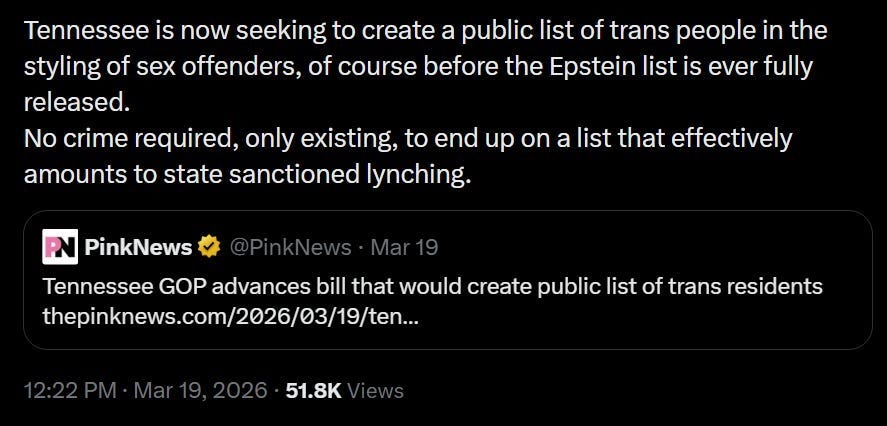
But online accounts are spreading this story as if Tennessee is making a “sex offender style” public registry with the names and locations of all trans people in the state. A bill like this could potentially be used for harm, and it may face court challenges for possibly violating parts of HIPAA by collecting data on county of residence and procedure dates, but the reporting on the bill and viral reaction online make it out to be something completely different. There’s no reason to believe this bill would create a publicly accessible registry or list identifying trans people in the state.
The bill has not yet passed the state senate, and it may not in its current form. Currently it’s unclear what exact form the collected data will take within a statistics report and what level of anonymizing data aggregation will be employed. This is something to keep an eye on if the bill does pass and the state Department of Health drafts guidelines for the mandatory statistics reporting, but the way it’s being reported is misleading. Interestingly, the originating source for the “public list” framing is the same substack outlet that created the false story about ICE now being able to detain people for “looking trans.”
Earlier this month, multiple LGBTQ news outlets reported that the 4th circuit court approved state bans on gender affirming healthcare for adults. On March 10th, a Republican appointed three-judge panel of the Fourth Circuit Court of Appeals ruled that states can prohibit gender affirming surgery from being covered by Medicaid. The ruling affirmed a ban on Medicaid coverage for “sex-change surgeries” in West Virginia, with the panel arguing it doesn’t discriminate against trans people because it applies to specific procedures, not specific individuals.
Certainly bad news for trans people in West Virginia on medicaid, but reporting that this decision could soon result in trans people losing healthcare in other states or nationally is misleading and removes key context. This is not a total ban on these procedures, it’s a ban on state Medicaid coverage of these procedures. The ruling is not a ban on other forms of gender affirming healthcare like HRT, nor does it threaten the hospital’s ability to receive Medicare and Medicaid funds for providing gender affirming healthcare like the Trump admin has threatened, so far unsuccessfully.
Some independent reporters theorized about how this ruling could be laying the legal groundwork to eliminate adult transgender healthcare, but trans journalist David Forbes noted that this ruling will likely be appealed to the wider 4th circuit, which has recently ruled in the opposite direction of this three panel ruling. What panicked assertions of an impending total ban on trans healthcare tends to overlook is that going from a state ban on medicaid coverage for surgery straight to an all ages ban on gender affirming healthcare skips a lot of steps, and those steps are crucially important.
The larger problem here is that panic clickbait induced doomer mindset treats every single horrific potentiality as an inevitable eventuality. This “flooded zone” undermines our ability to accurately assess risk and effectively dedicate resources to oppose pressing threats, like the new Idaho bill punishing public bathroom use with prison time.
The Substack Incentive
So what purpose does this sort of doom posting serve? And why are people so primed to believe it? These panic driven claims rest on the very real fact that trans people are facing present danger. Oftentimes people boosting these panic stories are genuinely trying to help inform their own community of potential harm. In the case of that ICE story, it was based on the assumption that there was a legitimate recent rule change enabling ICE to target people under suspicion of being trans.
It makes sense that people want to raise the alarm about ICE gaining new powers, but ACLU staff attorney Matilda Picasso cautioned, “We are supporting our community by trying to warn people. BUT these warnings need to be clear and accurate. Otherwise we end up inadvertently contributing to the chaos and fear.”
Other times, these panic stories are spread with the hope of scaring allies into caring about the ongoing attacks on trans people. Perhaps successfully in some cases, I don’t know, but as a side effect this strategy deals significant damage to the people it’s trying to protect. Forecasting inevitable doom 24/7 can drive people into hopeless despair and push them away from strategies to fight against the current attacks on trans rights. Panic driven agit-prop could also contribute to a girl who cried wolf scenario where allies start to discount concerns about certain attacks on trans rights due to previous unsubstantiated viral claims.
Though many people spreading these claims may have genuinely good intentions, the people creating these claims may develop certain material incentives. Traditional mainstream journalism has failed to question the massive government overreach into the lives of trans people, and in some cases helped manufacture consent for the stripping away of trans rights. This state of affairs made trans people lose faith in the big outlets, leading to small upstart outlets filling the information gaps in trans news coverage without any institutional backing.
Independent news sites and Substack style blogs have to build an audience and generate traction to stay operating. Turns out thousands of people constantly freaking out creates high social media engagement! This creates a loop where trans panic fearmongering boosts social media engagement, which further encourages more irresponsible clickbait framing.
Those who are successful may slowly develop a new class position which then needs to be maintained. Financial incentives may even pressure journalists who have done good work to fall back on panic driven engagement bait to attract new traffic. This isn’t exclusive to trans outlets either. Following the assassination of Charlie Kirk, Ken Klippenstein reported on his substack that the FBI was about to “designate transgender people as violent extremists.”
New verifiable information was absent from this report, the core evidence was an unnamed “senior official” who told Klippenstein he “feels” like trans people could be labeled “Nihilist Violent Extremists.” Klippenstein has previously misunderstood the NVE label, the term actually predates the Trump admin and refers to groups like 764, other child sextortion rings, and communities like the school shooter fandom “TCC.”
Hours before Klippenstein’s report was published, the Heritage Foundation and the Oversight Project publicly released a petition calling for a new classification of extremism called “Trans Ideology Inspired Violent Extremism,” to categorize attacks they believe are motivated by “transgender ideology.” The petition memo denied that all trans people and their allies would be designated domestic terrorists under this label, only those who “encourage, promote, condone, take, or incite unlawful violent action or threats based on this ideology.” The Heritage petition also runs contrary to Klippenstein’s report by advocating against the use of the NVE label to describe transgender motivated violence.
A Heritage petition to establish a new category of extremist action is different from an unnamed official who “feels” like trans people as a whole could be labeled under “NVE,” and it’s important to understand that distinction. That was last September, it’s now half a year later and neither of these things has come to fruition. The closest was in late September following Trump’s Antifa Terrorism executive order, with the National Security Presidential Memorandum-7 which listed “extremism on migration, race, and gender” as “common recurrent motivations and indicia…of violent and terroristic activities under the umbrella of self-described “anti-fascism,”” among many other threads animating violent conduct. Regardless of that, people online interpreted both Klippenstein’s reporting and the Heritage petition as meaning that the FBI classified the entire class of trans people as domestic terrorists.
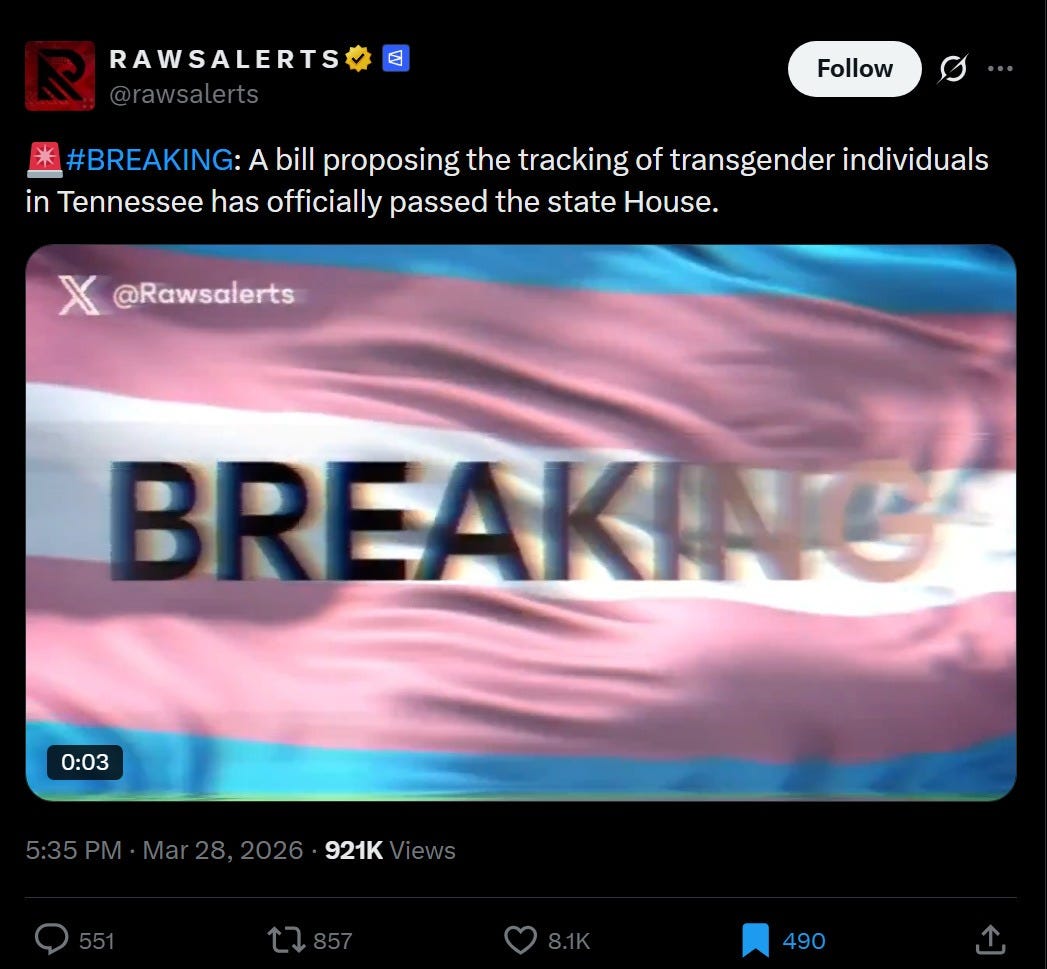
Social media both amplifies and distorts already misleading claims, turning news into a massive game of telephone, and the siloing of certain users and platforms makes countering misinformation difficult. The social media economy carries certain incentives, for the producers of panic bait that could be attention, status, and money. Monetized news aggregation accounts like “NewsWire,” “PopBase,” and the Polymarket powered “RawsAlerts” have figured out that trans panic posting is a cheat code for high engagement. But the consumers of panic also stand to gain something, catharsis, justification for their actions (or lack thereof), as well as attention from fellow consumers. Panic produces helplessness, but helplessness can actually be cathartic for the individual. It’s not helpful for people currently in the most danger.
These clickbait panic pieces explode around trans Twitter which is still quite active, consisting of sex workers, gamers, tttt style posters, and zoomers who think Bluesky is cringe and liberal. Some of these panic stories, like the FDA registry, don’t do very well on Bluesky because that’s where a lot of trans journalists who do actual journalism are. But those journalists are not as active on Twitter and Tiktok, making it harder to counter misinformation on those platforms.
Countering trans panic clickbait misinformation suffers from algorithmic suppression because it doesn’t get people as riled up. A wave of emotionally charged doom posting is boosted much farther than a calm and calculated rebuttal. The biggest TikTok about ICE detaining people under suspension of being trans has 1.2 million views, the biggest TikTok “fact checking” this claim has 290k views.
So much of social media politics is emotional manipulation based on anger, fear, or catharsis. Posting about perceived danger is essentially viewed as a form of activism, and if someone casts doubt on what’s seen as an existential threat, that person becomes emotionally equated with the enemy threat.
So then what is there to do? In terms of the trans panic information economy, don’t be afraid to openly question the legitimacy of certain reporting due to fear of backlash from “the community.” If it’s good reporting, it should be able to stand up to scrutiny. When you see a new story that triggers an emotional response, stop a moment before clicking share and find out where this claim is coming from. A reliable journalistic outlet? An independent publication? What other reporting has this publication done, has it been accurate? Who is the reporter? Are you familiar with their reporting? What else have they reported on? Is it speculative? Are there logical jumps without supporting evidence? Have other outlets reported this differently?
I’m not trying to minimize the danger coming from attacks on trans people, quite the contrary. The right is continuing to take away trans rights, and these threats should be treated seriously. When trying to counter these real attacks, one must be cautious about looking so far ahead into the speculative future that it takes the focus away from the clear and present harms. Healthy skepticism regarding certain claims isn’t about trusting the government, it’s about trying to accurately understand the world in order to change it.