
Normal view

Received — 30 July 2026 TPM – Talking Points Memo

Blue States Sue DHS and FEMA Over Coercive Election Changes

Hello, and welcome back to The Franchise!

Last week, a coalition of officials from 25 Democratic-led states and Washington D.C. filed a federal lawsuit against the Department of Homeland Security and the Federal Emergency Management Agency, arguing that the administration is coercing states into complying with new unlawful election changes by withholding billions of dollars in disaster relief funding and homeland security grants if the states do not bend to President Trump’s demands around election administration. 

Specifically, the lawsuit argues that the Trump administration is coercing the states into adopting a number of new election procedures that it is trying to unconstitutionally force on state election officials. That apparently includes demands to transition to a paper ballot system and a requirement for states to run their voter rolls through an unrelated and unsecure database, the Federal Systematic Alien Verification for Entitlements (SAVE) system, to check voter rolls, among other things. 

“Last year, DHS and FEMA embarked on an unprecedented campaign to leverage the billions of dollars in federal funding that they administer to coerce States into adopting the Administration’s preferred policies,” the lawsuit states.  

The SAVE system, as TPM has reported, has been co-opted by the Trump administration and used as a way to purge alleged non-citizens from the voter rolls. The issue, however, is that there is evidence to suggest that the system has actually been removing eligible voters from the rolls, the states outline in their complaint.  

It’s worth noting too that the use of the SAVE system to purge voters from the rolls was blocked by a federal judge just last month.

“Congress never gave DHS or FEMA authority to rewrite state election law, require cooperation with federal immigration agents, or terminate federal funding streams at any time and for any reason,” the lawsuit says.

“The Constitution grants the States the power to administer and set the rules governing federal elections, and pursuant to that grant of authority the States have adopted a range of systems for ensuring that votes are counted fairly and accurately. Defendants, however, seek to upend those laws and policies and—using hundreds of millions of dollars in federal funds as a cudgel—impose the current Administration’s preferred policies in their place,” the plaintiffs argue. 

We’ll keep you updated as this challenge progresses. As always, there’s a lot more to unpack into this week, so let’s dive in.

Making Sense of the 150,000 Rejected California Mail Ballots

Close to 150,000 mail ballots were rejected in California’s primary last month — the highest number of rejected ballots in recent years. According to data from the California Secretary of State’s office, a total of 148,241 mail-in ballots were rejected, which is 1.7 percent of all the mail-in-ballots cast. 

The majority of the rejected ballots — 93,497 to be more precise — were scrapped due to reportedly not being received on time. In California, all mail-in ballots need to be postmarked on or before Election Day, and they need to be received up to seven days after Election Day in order to be counted. Another 52,000 ballots were rejected due to signature verification issues, meaning either there was no signature on the ballot or there was an issue with non-matching signatures.

“I believe we saw an increase in the number of ballots rejected for being too late to count due primarily to voters holding on to their ballots longer than they might otherwise because of the volatile nature of the race for Governor and many groups encouraging voters to wait,” Kim Alexander, president of the nonpartisan California Voter Foundation said in an email to TPM.

And while this is a larger number of rejected ballots than usual, “it’s a comparatively small percentage,” Justin Levitt, professor of law at Loyola Marymount University told me.

“People keep forgetting, California is huge,” he said. 

And Levitt said the incident actually provides evidence that election integrity is alive and well in California — despite what the Trump administration and election deniers might want you to believe. 

“It, to me, is part of the evidence that California takes the integrity of its election incredibly seriously,” he said. “California puts a thumb on the scale for bending over backward in its legal rules to help ballots get counted. But if you’re outside of those legal rules, it’s not going to count the ballots.”

DOJ Uses New Jersey Noncitizen Voter Episode to Bolster Its Demand for Unredacted Voter Data

Democratic New Jersey Gov. Mikie Sherrill is pushing back on the DOJ’s demand to hand over the names of close to 6,600 noncitizens who were reportedly accidentally added to the state’s voter rolls due to a software error in the state’s automatic voter registration program in 2023 and 2024.

Last week, Sherrill announced the error which originated at the state’s Motor Vehicle Commission. As a result of the glitch, 400 noncitizens voted in at least one election since 2023. And although Sherrill has said that these noncitizens were removed from the voter rolls and that these ineligible votes did not impact the results of the elections in which they participated, it’s been good news for the Trump administration’s years-long quest to find evidence of any kind to support the myth that non citizens are voting in our elections.

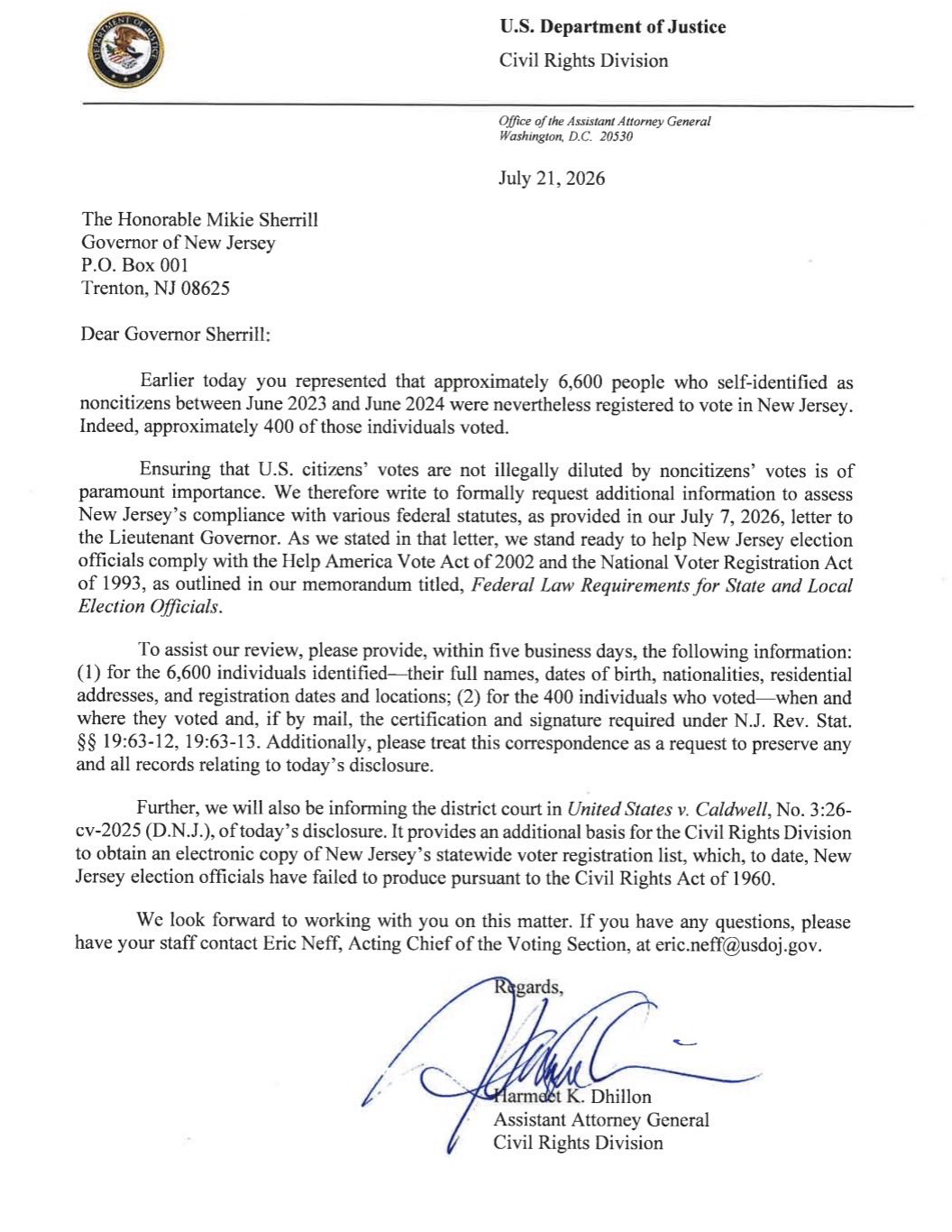
In response to this revelation, Assistant Attorney General for the Civil Rights Division Harmeet Dhillon, sent a letter to Sherrill last week demanding that she hand over data (including names and addresses) on all these noncitizens. Sherrill, however, is refusing to comply with this demand.

“We are not in the practice of turning over this kind of personally identifying data over to the federal government because we have seen them weaponize it, I’ve seen it personally,” she said last week. “They are working to weaponize personal data, and they don’t have a reputation for keeping it private either.”

Of course, this whole unfortunate episode is now being used by the Trump administration as a way to help bolster its failing campaign to seize sensitive voter data from the states. The DOJ has, for months now, been demanding unredacted voter files from at least 44 states and Washington, D.C. Few states have complied, and the DOJ has sued in response — and it has lost every single case that has gone to court.

On the same day that it sent the letter to Sherril, the DOJ also filed a notice of additional basis in court to help its New Jersey voter roll case, arguing that the incident is evidence that the DOJ truly does need the state’s unredacted voter rolls. 

“The Civil Rights Division of the U.S. Department of Justice sent Defendant the Additional Basis Letter because the Civil Rights Division learned of Governor Mikie Sherrill’s announcement on X on July 21, 2026, that ‘roughly 6,600 people who indicated that they were not U.S. citizens between June 2023 and June 2024’ were in fact ‘registered … anyway’ by New Jersey election processes—and roughly 400 of those people voted,” the notice reads. 

In Other Election News

TPM: Jay Clayton Confirmed As DNI — A Position Trump Warped to Feed His Election Conspiracy Theories

Democracy Docket: Trump DOJ said some states ‘cooperated’ with voter roll grab by providing public information. It sued other states for doing the same

AP: Trump’s attacks on mail balloting and concerns over delays turn midterms spotlight on Postal Service

Just $3,017 To Go!

30 July 2026 at 18:52

We’re right on the cusp of a big Drive milestone – $400,000, 80% of the way toward our goal of raising at least $500,000 in this year’s Annual TPM Journalism Fund Drive. Who can help us cross this threshold today? You can be that person by clicking right here and making a contribution in any amount. $3,017 to go! Thank you to everyone who has contributed so far!

Update: Now just $546 to go!

Kash Patel’s Ambitious Defamation Lawsuit Foiled By Basic Civil Procedure Doctrine

30 July 2026 at 18:41

This article is part of TPM Cafe, TPM’s home for opinion and news analysis. It was originally published at Balls and Strikes.

Kash Patel, the conservative podcaster whom President Donald Trump appointed as the director of the FBI in 2025, is currently suing The Atlantic for $250 million over its reporting that his predilection for drinking “to the point of obvious intoxication” has been a “recurring source of concern across the government.” In a lawsuit he filed in federal court on April 20, Patel characterized the article as a “sweeping, malicious, and defamatory hit piece.” In an interview on April 23, the writer, Sarah Fitzpatrick, said that in the days since The Atlantic published the story, she’d been “inundated” with new sources corroborating it.

PHOTOS: TPM and The Handbasket Get Together in Brooklyn

Thanks so much to everyone who came out to our event at Crystal Lake bar last night in collaboration with Marisa Kabas of The Handbasket! It was great to see some of you again, meet some local readers making it out to their first TPM event, and connect with readers who traveled just for this show. (Shout out to the lovely couple from Berkeley, California!)

Is John Cornyn Playing Us All For Fools in the Todd Blanche Nomination Fight?

30 July 2026 at 16:03

Let’s See the Actual Language

I harbor a growing suspicion that a collective hoodwinking is going on in the Senate confirmation of Todd Blanche as attorney general.

It’s hard to argue that the delay of today’s crucial Senate Judiciary Committee vote on Blanche’s nomination isn’t a pretty big deal (even though he could still remain on as acting attorney general for the balance of Trump’s term).

But when you look closely at what Sen. John Cornyn (R-TX), backed by Sen. Thom Tillis (R-NC), is demanding for his vote, it’s not at all clear what the dispute is actually over — and there’s quite a bit of reporting that suggests Cornyn is not driving a hard bargain at all.

If it seems weird to you that the breathless coverage of the Blanche confirmation is happening without anyone publicly knowing exactly what Cornyn is demanding, I agree! It’s weird.

Going into this dustup, the common understanding was that senators like Cornyn and Tillis wanted more ironclad reassurances that the “anti-weaponization” slush fund was well and truly dead. So far so good.

Then came the somewhat surprising and even refreshing news that Cornyn was also targeting the legally dubious immunity that Trump had also been given in the settlement of his lawsuit against the IRS. Even better.

If Blanche could stick around as acting AG anyway, then extracting a concession on the insanely corrupt IRS immunity provision of the settlement agreement was arguably a shrewd, if narrow, win for Cornyn and those of us in the anti-corruption brigade. If estimates are correct, the value to Trump of securing immunity from past tax liabilities to the IRS was in the range of $100 million. That’s not nothing.

But over the past few days, news reports on what Cornyn is demanding have been very fuzzy and often gloss over the specifics, just saying generally that Cornyn is targeting the IRS immunity deal. But what Cornyn has said himself and what a few reporters have picked up on raise serious doubts that Cornyn is actually targeting the Trump IRS immunity everyone has been up at arms about.

Instead, Cornyn seems to be aiming to keep the immunity deal intact but to limit it to the retroactive immunity everyone already understood to be part of the deal, not prospective immunity, which an expansive interpretation of the loose language of the agreement might have allowed. Cornyn also apparently wants to make sure no one else gets the benefit of the immunity deal other than the parties to the lawsuit — Trump, two of his sons, and the Trump Org.

At this point, you should be saying WTF?

Again, I agree!

Here’s the most comprehensive statement of Cornyn’s position, from his own mouth on Monday (emphasis mine):

What I want is the written document to say the same thing [Blanche] did in his sworn testimony in front of the Judiciary Committee, and, as you recall, what he said is the weaponization fund is dead. He said the audit immunity basically doesn’t extend to parties beyond the lawsuit, and it doesn’t also extend to future actions by federal agencies other than the IRS.

I’m not sure how else to read that other than it locks in the retroactive immunity and applies it only to the Trumps and their company.

That’s still the line Cornyn was taking yesterday, not long before the committee vote was pushed off, as paraphrased by the WSJ (emphasis mine):

To earn his vote, Cornyn said, the simplest fix would be for the parties to the settlement—the Justice Department, IRS and Trump—to revise it to conform to Blanche’s testimony at his confirmation hearing: The weaponization fund is dead, the audit protection doesn’t apply to people beyond the parties to the lawsuit, and it only applies to the IRS, not other agencies.

Here’s how the NYT obliquely puts it: Cornyn “said he had received no written assurances from Mr. Blanche that the audit shield would not apply to future tax liabilities or be extended to a wider circle of people.”

Cornyn and the DOJ have reportedly traded draft language back and forth but none of that has been made public, so it’s impossible to know precisely what they’re haggling over — or if Cornyn is indeed giving away the whole store, as it has started to seem this week.

If the reporting on Cornyn’s demands is correct, then Trump, Don Jr., Eric, and their company still get the $100 million gift from the President’s own administration to himself. And locking that in has the political (though not legal) effect of Senate Republicans publicly ratifying the corrupt bargain by voting to confirm Blanche.

In another worrying sign that Cornyn isn’t really asking for much, both sides seem perplexed that things haven’t gotten worked out yet and confident that they can iron out whatever differences remain over the precise language.

“It’s not a big ask,” Cornyn said yesterday, in what may be the understatement of the week.

Quote of the Day

“This is so dangerous. I’m living proof of the danger. My son isn’t here because someone disagreed with the way I was handling a case in court.”—U.S. District Judge Esther Salas, whose son was killed and husband wounded in 2020 attack at her New Jersey home by a disgruntled attorney, on DHS General Counsel James Percival attacking district judges by name on X

TPM in the World

I talked with Greg Sargent yesterday about the blast of new filings in the James Comey “86 47” case — and about Trump bumping up against the limits of his powers in several different realms:

We Need You

Our goal is to raise $500,000 in this year’s fundraising drive for the TPM Journalism Fund. As I write this morning, we’re sitting at $395,000. It’s a great start, but we’re going to need a great finish to get there.

If you value Morning Memo or the work that the rest of the TPM team does (or both!), please consider making a contribution to support our independent journalism. You are essential. Without you, TPM doesn’t exist.

If you’ve already contributed, thank you! If you haven’t yet, do it now!

RIP Glen Hansard

News? Tips? Feedback? Please let me know. For sensitive information, use the encrypted methods here.

The Brief: Trump Threatens Thune’s Job in Renewed Bid to Suppress the Vote

30 July 2026 at 14:09

Good morning. It was great to meet all of you who came out to our event in New York last night with Marisa Kabas of The Handbasket.

Trump Tries to Raise the Stakes on SAVE Again

President Donald Trump made a show yesterday afternoon of preparing to throw Senate Majority Leader John Thune (R-SD) to the wolves out of frustration that the SAVE Act is not yet on track to pass in any form. The latest push is to jam parts of the bill through using budget reconciliation, which requires 51 instead of 60 votes, though Trump also continues to agitate for Thune to nuke the filibuster and pass the full voter suppression package.

Asked whether Thune is the right person to lead the Senate, Trump said, “We will find out, and I will let you know.”

“All right. Well, that’s nice of him, I guess,” Thune told Punchbowl. “I don’t know — what do you say on that? That’s a decision that’s made by my colleagues.”

Throughout Trump’s SAVE Act pressure campaign on his Senate allies, he has repeatedly made demands that misunderstand the reality of how the Senate functions, and how bills become law. He has seemed amenable to passing what everyone has taken to calling the “SAVE Act” through budget reconciliation, even though a SAVE Act done through reconciliation, while bad, would likely be without the nationwide voter-ID and proof-of-citizenship mandates that are core to what the SAVE Act is. It is unclear whether Trump realizes this. He has refused to sign a popular housing bill, though without his signature it simply became law after 10 days; in doing so, the president achieved nothing on the SAVE Act while robbing himself of an opportunity to claim a victory on “affordability.” His demands for the SAVE Act to be attached to various funding bills dramatically complicated his allies’ attempts to fund ICE over Democratic opposition in the spring, and look sure to complicate government funding fights this fall.

When we see legislators take bills hostage, an increasingly common phenomenon since the Obama era that has often led to government shutdowns, the more effective efforts involve lawmakers carefully finding legislation where they have maximal leverage. Trump hasn’t done this — perhaps he doesn’t have the attention to detail to do so — and is as a result unable to truly achieve anything beyond making life considerably more frustrating for his fellow elected Republicans.

That’s the case this week, too. Thune is, of course, right that, in the end, Trump does not select the majority leader, though he may wish he did. Other senators do. Trump can’t oust Thune. But he can elevate him as a target at which his activist base should direct their hate.

Trump’s Blanche Nomination Gets Stuck

WASHINGTON, DC – JULY 29: Attorney General Nominee Todd Blanche leaves a meeting on Capitol Hill on July 29, 2026 in Washington, DC. The Senate Judiciary Committee is scheduled to hold a vote to advance Blanche’s nomination tomorrow. However, two Republican lawmakers, Sen. John Cornyn (R-TX) and Sen. Thom Tillis (R-NC), said they are unsure whether they will support him. (Photo by Kevin Dietsch/Getty Images)

John Cornyn (R-TX) has caused a vote to advance Todd Blanche’s nomination for attorney general, scheduled for today, to be postponed.

  • Yesterday, Cornyn said he was canceling a meeting with Blanche, explaining that he wanted to see a written modification to the settlement between Trump and the IRS that would have created the “anti-weaponization” slush fund.
  • The DOJ told us it sent a “written proposal to Senator Cornyn’s staff.” Cornyn told reporters, “I haven’t seen a single piece of writing that is responsive to what I’ve requested.”
  • The vote could move forward whenever Cornyn gives the green light, though at this point that might not happen with enough time to confirm him before the Senate takes a month-long recess, beginning at the end of next week.
  • The episode is more significant as a (perhaps short-lived) display of GOP Senate resistance to Trump than as an actual check on the DOJ: Even if Blanche isn’t confirmed, he can remain in the role as acting attorney general. And whatever the fate of the slush fund, settlements for right-wing activists continue, with the DOJ agreeing this week to pay more than a million dollars to an anti-abortion activist who was convicted in 2024 of conspiring to prevent access to a clinic, the New York Times reports.

Tabs

  • Republicans may not end up following Trump’s endorsement and picking Darline Graham Nordone to fill her brother’s seat, the Washington Post writes. The Downballot gives a rundown of the many, many other candidates in the race, including some figures we’ve covered quite a bit over the years.
  • Kash Patel has lost a defamation suit against an internet poster who called him a “googly-eyed Kremlin bitch” and a “chud,” the New Republic reports. U.S. District Court Judge for the district of Nevada Andrew P. Gordon found he did not have jurisdiction.

Man of the Hour

AUSTIN, TEXAS – NOVEMBER 8: Alex Jones speaks to the media outside the 459th Civil District Court on Tuesday, Aug. 2, 2022 in Austin, Texas. More information has been revealed regarding the sale of Jones’ Infowars’ assets, including the production rights, the e-commerce business that sells nutrition supplements and the archival library. The initial bid deadline is Nov. 8. (Sergio Flores/Connecticut Post via Getty Images)

It’s Alex Jones, the onetime stalwart ally of President Trump who has now turned to demanding his impeachment over the Iran war to attract attention (which, admittedly, he is succeeding in doing). I used a gas station bathroom off I-95 the other day where someone had written “Alex Jones is right” on the soap dispenser — so make of that what you will.

Are We at War?

You bet.

The Real Logic Behind the GOP’s New Push for Judicial Elections

30 July 2026 at 14:00

This article is part of Cafe, TPM’s home for opinion and news analysis.

On August 4, Kansas voters will decide whether to replace the state’s longstanding merit selection system for Supreme Court justices with direct elections. Republicans want voters to believe the proposed constitutional amendment is just about transparency and giving the public more power over who sits on the state’s highest court, but the debate in Kansas is also part of a broader Republican push to inject more partisanship into state judicial elections. But the differences in where they want partisan elections and where they do not give the game away.

Senators Urge SEC to Investigate Truth Social Plan to Sell Access to Wall Street

29 July 2026 at 22:34

Two influential Senate Democrats are pushing back on the nearly unfathomable idea that a company owned by the sitting U.S. president can sell Wall Street early access to that president’s thoughts and actions.

Sen. Elizabeth Warren (D-MA), ranking member of the Senate Banking Committee, and Sen. Adam Schiff (D-CA), a member of the Senate Judiciary Committee, called on Securities and Exchange Commission Chair Paul Atkins to “immediately” investigate a forthcoming subscription model from the company behind President Donald Trump’s Truth Social that plans to sell extra-fast access to the most influential posts on the platform to high-paying clients. 

The subscription appears to be founded in the premise that Trump’s social media posts influence financial markets and investors. Providing high-paying institutional customers first dibs on that market-moving information, the senators said in the letter, could give them a trade advantage and further exacerbate the divide between a hyper-wealthy investment class and everybody else.

“The Trump Administration is the most corrupt in the nation’s history, and questions about inappropriate insider access to information about its policies and actions have raised questions on multiple occasions,” the letter, dated Tuesday, reads. 

The Truth Social fast-access plan, though, “represents a shocking abuse of the office of the President and the trust of the American public for his personal gain.”

On July 16, Trump Media and Technology group announced Truth API, the “business-to-business” subscription model that would offer banks and trading firms “real-time” access to Trump’s market-moving musings on Truth Social. A press release about the program boasted that it would feed subscribers the platform’s most influential posts “within milliseconds.” And the company — 41% of which, according to the senators’ letter, is held by Trump’s revocable trust — didn’t shy away from the fact that this scheme will be profitable. It mulled charging as much as $100,000 a month for the subscription, according to a report from Reuters.

“As adoption grows, we expect Truth API to become a meaningful, ongoing source of revenue for the company, creating lasting value for shareholders,” TMTG interim CEO Kevin McGurn said in a mid-July release.

The plan is set to launch by August 1 and immediately drew concerns about insider trading. One former SEC official told TPM the plan should at least draw scrutiny from Congress and the SEC. 

Warren and Schiff are calling on the SEC to provide an analysis of the TMTG plan as it relates to laws about insider trading and market manipulation, to detail plans for enforcement in the event of market manipulation relating to this subscription, and to share legal tools available for retail investors.

Warren and Schiff’s letter to Atkins goes on to list the well-documented ways in which stock performance has changed based on Trump’s social posts: Citigroup outperformed other banks the day Trump made a Truth Social post praising the bank, the letter said. After Trump used Palantir Technology’s ticker symbol to celebrate the Defense Department contractor’s equipment, the company’s stock shot up, it noted. And “Intel shares proceeded to jump 3%” hours after Trump wrote “Intel Stock continues to rise” on Truth Social.

“Ultimately,” the letter says, “Trump Media’s new service threatens to undermine the integrity of capital markets.”

Trump and Republicans Ensconce Themselves in 2020 in Lieu of Any 2026 Midterms Strategy

29 July 2026 at 22:29

By now, you may have seen the headlines about Sen. Rand Paul (R-KY) dragging former Trump and Biden administration health official Dr. Anthony Fauci before the Senate Homeland Security and Governmental Affairs Committee — during which he berated him for pleading the fifth and kicked Fauci’s attorney out of the hearing.

Whose Assumptions Will Get Wrecked in the Michigan Senate Race?

29 July 2026 at 22:22

It looks like we are going to get a big test of some cardinal (possibly outdated) assumptions about American politics. I’m thinking first about the Michigan Senate race (though we might have something similar in the Wisconsin governor’s race). Several recent polls show Abdul El-Sayed holding a consistent, substantial lead over Rep. Haley Stevens. The primary is on August 4. This has been presented as a prototypical Democratic establishment vs Bernie progressive/insurgent race. And in key respects it is.

El-Sayed has all the Bernie/progressive positions. He’s run a campaign that places a heavy emphasis on the Israel-Palestine issue. And he’s centered AIPAC in his campaign in a way that even for many longtime critics and haters of AIPAC (including myself here) has a distinct whiff of antisemitic conspiracy theories. To wit, yes, AIPAC sucks. They’re a blight. They are functionally a Republican operation these days. But they are not the secret hand guiding things in the background every time there’s a bad news story or reverse of fortune for some progressive candidate, which is basically the role they’re playing in El-Sayed’s campaign.

Received — 29 July 2026 TPM – Talking Points Memo

Sen. Cornyn Cancels Meeting With Blanche as Confirmation Vote Hangs in Balance

29 July 2026 at 20:18

Acting Attorney General Todd Blanche’s confirmation is stalled.

A meeting that was scheduled to take place between Sen. John Cornyn (R-TX) and Blanche was cancelled abruptly Wednesday morning — just a day before the Senate Judiciary Committee was scheduled to vote to move Blanche’s nomination for Attorney General out of committee. 

Juicy and Hilarious New Details About Trump’s Crusade Against Comey

29 July 2026 at 17:20

Comey Offers Judge an Easy Way Out

In new court filings last evening, James Comey unloaded a triple shotgun blast at the bogus “86 47” seashells prosecution against him.

I’ll get into the trio of filings — which include a cameo by Sammy the Bull Gravano and juicy details about President Trump’s intense personal interest in the case as relayed through internal Secret Service communications — in a moment. I promise.

But first let me orient you briefly to what I suspect is Comey’s strategy here.

As we discussed here yesterday, Comey had already filed another motion to dismiss the indictment on Monday before last evening’s flurry. That motion is the most straightforward, direct, least messy way for the judge to end this case, arguing (quite reasonably) that posting to Instagram a photo of an arrangement of seashells that spells out “86 47” is in no way a true threat to President Trump and in any event is constitutionally protected free speech.

Still, it’s a big step for a judge to dismiss an indictment — especially in a high-profile case like this — based solely on the indictment being facially insufficient. But the choice Comey is giving the judge makes that option seem like the easy way out compared to donning hip waders and venturing into the muck of a vindictive prosecution analysis, which involves peeling back the curtain on the rotten Trump DOJ, the over-involved Trump White House, and now the role of the Secret Service in this whole mess.

While Comey is clearly exalting in exposing some of the depredations of the Trump II presidency and its corrupt misuse of the Justice Department, he first and foremost wants to get out from under this indictment and spare himself and his family the risks of a conviction. And so the sequencing of the filings makes the judge’s hard lift of straight-up dismissing the indictment for failure to allege an actual crime seem a whole lot less heavy considering the alternative path this case could go down.

In one sense, this strategy could produce a disappointing result in a civics and democracy sense. Trump’s pursuit of Comey is a classic case of vindictive prosecution without precedent in American history. Yet, the corrupt and bumbling efforts are so inept that Comey may prevail in getting a prosecution thrown out for a second time without a judge even getting to the vindictive prosecution allegations.

In the Virginia case against him, Comey successfully disqualified Lindsey Halligan as interim U.S. attorney, which meant the indictment she obtained was no good. In this case, the indictment itself may also be so flawed that the case goes no farther. But probably the better way to view this is that corruptly predicated prosecutions produce corrupt investigations and shoddy lawyering. It’s all part of the same package of retributive conduct.

The New Filings

With the above framework in mind, here are the three new filings (for diehards, I’m linking to the substantive legal memoranda rather than the barebones motions themselves):

  • Motion to Dismiss Indictment for Vindictive and Selective Prosecution: This motion covers a lot of familiar ground regarding Trump’s crusade of retribution against Comey, including the first failed prosecution in Virginia.
  • Motion for Disclosure of Grand Jury Proceedings: This motion takes the known grand jury irregularities that judges found in the Virginia case and combines them with irregularities in the North Carolina case (including public statements by FBI Director Kash Patel and other acts and omissions revealed in discovery) to urge the judge to suspend the presumption of regularity and allow Comey access to the grand jury transcripts.
  • Motion to Suppress and for Franks Hearing: Comey alleges that the FBI case agent made false statements and omitted material facts in the applications for two digital search warrants — one before the indictment to Apple and one after the indictment to Google — about the evidence gathered in the case, including exculpatory evidence.

There is a key fourth filing: a 21-page affidavit from Comey attorney Patrick Fitzgerald (the former Chicago U.S. attorney) with a whopping 43 attached exhibits that is filed in support of all three motions and offers a narration of the discovery Comey has obtained from the government thus far that is relevant to the three motions.

Rather than analyze each motion separately, I’m pulling out some of the key themes from all three motions, which are also separately narrated by Fitzgerald, who provides specific citations to the supporting documents obtained in discovery.

If you’re still with me, this is where we get into the good stuff.

Trump’s Keen Interest in the Case

Some of the juiciest details from the discovery in the case offer a glimpse of President Trump tracking the Secret Service investigation in real time from Air Force One.

Internal Secret Service communications describe the head of Trump’s protective detail, Special Agent in Charge John Bush, “expecting to have to brief POTUS. He has since briefed the Chief of Staff on the below updates….”

Later, Bush emailed from Air Force One seeking a “readout” of the Secret Service’s imminent interview of Comey at headquarters: “As I am getting LOTS of questions, is it possible for me to get an immediate readout (call) of the interview?”

Another document obtained by Comey noted that “POTUS was requesting a copy of the interview notes to use in his 6 pm press conference.”

Bush responded: “It is a hot topic on the plane and [redacted code name for President Trump] is very interested.”

At one point, Bush asked about any further updates noting “the COS just asked me.”

Another document relays that a Secret Service official was told by the Protective Intelligence Operations Center “that they received a request from SAIC Bush who received a direct request from [Secret Service code name for the President] for a summary of the interview when available.”

Ultimately, an executive summary of the Comey interview was sent to Bush on Air Force One, according to the filings.

Illegal Surveillance of Comey

After Comey arranged to talk to the Secret Service in person when he returned from the beach in North Carolina to his home in Virginia, the Secret Service tracked his cell phone despite doubts revealed in internal communications that they had the proper legal justification to do so, according to the filings.

When a senior Secret Service official said it was a “bad idea” to ping Comey’s cellphone, Bush agreed it was “legally questionable” but indicated “we might anyway.”

The Secret Service agent who signed the emergency request to Verizon to ping Comey’s cellphone said he did so “with hesitation.” Another senior Secret Service official said that “the # 3 guy at DOJ ‘wanted to ping the cellphone via an exigency request.’” It’s not clear to whom at DOJ he was referring because there was not a No. 3 official in place at that time.

Once the Secret Service pinged Comey’s cellphone, they tracked him electronically and in person on his return trip from North Carolina to Virginia, although the agents surveilling him physically lost track of him when Comey and his wife stopped at the gravesite of their infant son. The electronic surveillance continued during the cemetery visit. In a striking parenthetical, Fitzgerald writes: “(The Government later seized—pursuant to the challenged March 2026 search warrant—a photo Mr. Comey took of the flowers at his son’s grave that day.)”

A Rudy Giuliani Cameo

A recurring character in the filings identified only as Person-1 apparently knew the Comeys but had come to hold Comey in low regard. Person-1 texted Comey’s wife shortly after the Instagram post went up warning that “86” could be construed a violent term, according to the filings.

Person-1 said they initially thought “86” was a benign reference to the restaurant term but then heard a Rudy Giuliani media appearance and became convinced that Comey’s use of the term was nefarious and told the Secret Service as much when interviewed the day after hearing Giuliani.

Giuliani seems to have improbably kicked off an entire absurdist thread of the investigation when he claimed publicly that Comey had worked on organized crime cases where the term “86” was used to mean “kill.”

Trying Desperately to Find Mob Usage of ’86’ … and Failing

The most vivid scene that emerges from the slew of new filings, is a May 13, 2026, trip by the first assistant U.S. attorney and an FBI agent to the home of the notorious former mobster Salvatore “Sammy the Bull” Gravano to try to establish that the mob regularly used “86” in a violent sense.

Gravano is the former Gambino underboss who famously testified against John Gotti, admitted to participating in 19 murders, entered then left the witness protection program, and was subsequently convicted again. “He is now a podcaster,” Fitzgerald dryly observes in a footnote.

Gravano said he was convinced Comey had to know the violent connotation for “86,” but Gravano had no memory of talking about it with Comey, who as a young prosecutor was involved in the Gambino case. While mobsters did use the term “86,” Gravano told investigators, they were careful not to use it in the presence of law enforcement.

That set off an astounding search by Comey investigators for references to “86” in decades of FBI files. After searching the entirety of the FBI’s Sentinel database, an agent reported:

These searches produced inconclusive results regarding the use of “86” or “eighty-six” as a slang term. Additionally, the searcher was unable to determine if the subject would have had access or been exposed to any potential files meeting the search parameters.

Investigators did a separate search of the Gambino case file: The case file contained no references to the term “86.” Same with the trial transcript: nada. They also talked to two former FBI agents who investigated the mob who had never heard “86” used to mean “kill.”

Secret Service Seemed Satisfied There Was No Crime

The discovery in the case leaves the strong impression that after its initial investigation into Comey’s Instagram post, the Secret Service — which has a unit dedicated to the nonstop stream of threats directed towards its protectees — was satisfied there was no crime here.

After leading the May 2025 interview of Comey in person at Secret Service headquarters, a senior official emailed a group of other Secret Service personnel, suggesting that the case was “resolved,” as so many initial threat investigations are: “You all contributed, some in non-traditional ways, to this issue being resolved in a professional and efficient manner.”

Discovery shows the Secret Service treated the Comey investigation as a “non-referred” matter meaning under internal policy “the determination can be made based upon initial investigation that there is no risk of an unwanted outcome and there is no judicial outcome.”

The Secret Service investigation, after the initial flurry, went nowhere and by the fall of 2025 it seemed like it had died. But in October, it was revived by the FBI out of its Charlotte office.

Comey Attorney-Client Privilege Violated AGAIN

The violation of Comey’s attorney-client privilege had already been an issue in the Virginia case and spawned an entire separate case involving Daniel Richman, the Comey attorney who is also a Columbia University law professor, who prevailed against the Justice Department.

But stunningly it happened again in the “86” investigation, Comey claims.

In the search warrant for Apple, “the government made no provision whatsoever to screen Mr. Richman’s communications,” Fitzgerald alleged. In addition, investigators only filtered for office landline numbers of another Comey attorney, and not his cellphone number.

Last month, prosecutors agreed to “quarantine” two text conversations Comey had with the second lawyer, according to Fitzgerald, but only after those communications had already been reviewed by the first assistant U.S. attorney, two other assistant U.S. attorneys, the FBI case agent and an FBI supervisor. They told Fitzgerald last month they had looked at the text thread only after they had obtained the indictment against Comey.

News? Tips? Feedback? Please let me know. For sensitive information, use the encrypted methods here.

This MAGA Influencer Runs a Charity to Teach Kids Civics. Much of the Money Goes to Him Instead.

29 July 2026 at 14:51

This story was originally published by ProPublica

In a private ceremony on Sept. 17, Defense Secretary Pete Hegseth stood at a podium inside the National Archives building in Washington, D.C., and praised a Florida nonprofit for what he called a singular achievement in American education. The attendees were celebrating the Foundation for Liberty and American Greatness, which announced that it had reached 2 million children with civics education since its founding in 2016.

“I hope you understand how important this is,” Hegseth told the room. “What we pour into the next generation will determine whether we keep our republic or not.”

FLAG’s founder, Nick Adams, had spent nearly a decade building toward this moment. An Australian-born conservative commentator and MAGA influencer, Adams had created the nonprofit, raised $7.7 million for it over 10 years, and garnered repeated praise from President Donald Trump. In March, Trump appointed Adams as the special presidential envoy for American tourism, exceptionalism and values — a position created for him after his nomination as ambassador to Malaysia stalled the previous year.

But a review of FLAG’s finances, donor operations and online donation network reveals a less celebratory picture. There is little evidence that the nonprofit has provided the civics education it claims. And Adams and his nonprofit have engaged in a pattern of questionable financial arrangements, including paying Adams and his mother more than half its recent annual revenue, while raising much of its money through a sweepstakes operation that has promised donors a chance to win $1,000,000 — a prize FLAG’s records show no evidence of ever paying.

The Brief: Trump’s Fixation on the SAVE Act Has Become a Defining Force in American Politics

29 July 2026 at 14:13

How to Think About the SAVE Act

The SAVE America Act is playing a few roles in our politics right now.

On the one hand, it is a sweeping voter suppression bill, and one prong of Trump’s multifaceted assault on elections. Should it become law, it would add new hurdles for a wide range of Americans to participate in democracy, including voter ID for casting a ballot and proof of citizenship to register to vote. Republican supporters of the bill seem to have the impression that these restrictions would overwhelmingly hurt Democrats, and they are likely right: Recent polling by G. Elliott Morris at Strength In Numbers shows a greater number of Democrats — and Black Americans in particular — are likely to have trouble producing the documents needed to prove their citizenship. The law would hit Republicans, too — more than its supporters seem to realize. Among other things, women who change their names when they get married, a group that certainly includes many white, American-born, Republican voters, may have to provide additional documents to prove their citizenship under their new name.

So thats’s the reality of the SAVE Act, if it passes. Quite significant.

At the same time, the more expansive versions of the SAVE Act, including versions with national mandates around voter ID and proof of citizenship, have never had a clear path through the Senate — even as Trump sporadically attempts to up the pressure on his fellow Republicans to make it happen.

That, despite the seriousness of the legislation at hand, has led to an almost comic dynamic where everything the Senate, and much that the House, tries to accomplish is derailed by new Trump demands related to the SAVE Act. It has blown up primaries, too; Ken Paxton was able to prevent a Trump endorsement of Sen. John Cornyn (R), and ultimately win it for himself, by painting Cornyn as an insufficiently dedicated supporter of the legislation.

So we cover all this keeping two things in our mind at once: Should Republicans find a way to maneuver the SAVE Act through Congress — including by finally agreeing to nuke the filibuster for it, as Trump has demanded — it would create a sweeping distortion of the franchise. In the meantime, however, it has been a force for chaos, with Trump’s monomaniacal fixation on it leading to a far less effective Republican trifecta than we might have predicted in the early days of his second term.

Trump Gets His New, Permanent DNI

WASHINGTON, DC – JUNE 24: Acting Director of National Intelligence is Bill Pulte (L) and U.S. Secretary of the Department of Homeland Security Markwayne Mullin attend a rally to kick off the Great American State Fair on the National Mall on June 24, 2026 in Washington, DC. The Freedom 250-backed Great American State Fair celebrates the 250th anniversary of the United States with pavilions, live performances, military demonstrations, and exhibits and runs through July 10th. (Photo by Andrew Harnik/Getty Images)

Jay Clayton was confirmed last night, Khaya Himmelman reports for TPM, replacing Acting Director of National Intelligence Bill Pulte.

  • His confirmation hearing was defined by his alarming refusal to state plainly that Trump lost the 2020 election.
  • While that has become a kind of standard operating procedure for Trump nominees before the Senate, it is particularly troubling given what the DNI job has become under Trump: Former DNI Tulsi Gabbard participated in the FBI raid on Fulton County, Georgia’s election hub. Current, acting DNI Bill Pulte headed up a largely ineffectual, new effort to again undermine the 2020 election, culminating in Trump’s big primetime speech earlier this month.
  • Fittingly, Politico reports this morning that Pulte is agitating to stay in his acting role a little longer, pushing Trump to delay Clayton’s swearing-in.

Tabs

  • Former FBI Director James Comey’s lawyers are seeking grand jury transcripts related to his seashell-photo indictment, Lawfare’s Anna Bower notes — raising fresh questions about the Trump DOJ’s dealings with grand juries as it seeks to punish its enemies.
  • Trump said on Truth Social earlier this month that he would ask the Supreme Court to reconsider its ruling on birthright citizenship. The deadline to do so has passed, NBC reports, and he has not.
  • Large majorities of Americans support term limits for members of Congress, greater restrictions on money in politics, and scrapping the Electoral College, new polling by Pew Research Center finds.

Man of the Hour

Breaking News: Ross Douthat, The New York Times opinion columnist, is joining CBS News’s “60 Minutes” in one of the first major hires since Bari Weiss’s takeover.

The New York Times (@nytimes.com) 2026-07-28T20:57:44.755968Z

It’s Ross Douthat, leaving his job as a top New York Times opinion writer to become the face of Bari Weiss’ 60 minutes. Good luck in the new job, Ross.

Are We at War?

Yes, with a wave of missiles fired by Iran overnight and Saudi Arabia joining the U.S. in striking Iranian militias.

Received — 28 July 2026 TPM – Talking Points Memo

Help Us With This Milestone

28 July 2026 at 22:47

Thank you to everyone who contributed yesterday. A big day of contributions that has gotten us near one of the biggest milestones on the way to our goal. TPM Publisher Joe Ragazzo and I have developed – both statistically and instinctively – a feel for the cadence of the Annual TPM Journalism Fund Drive having run them now for several years. $0 to $250,000 is a sprint. There’s a lot of energy. $250,000 to $400,000 is a slog. Like pushing a boulder up a hill. Once we hit $400,000 it’s a bit like getting to the top of the hill and rolling the boulder down is a lot easier. Not easy. It’s still essential to remind people, make the case. (I have moments wondering: does it make sense to show how the drive sausage is made? Well, in for a time in for a dollar: knocking down that fourth wall has always been the essence of TPM’s reporting and how we communicate with the TPM community.) We’re now $21,350 from that $400,000 milestone. Can you help us get there? If you haven’t had a spare moment to join us this year today would be a great time. Just click right here.

The Revolt of the Insiders

28 July 2026 at 21:15

Here’s a brief follow up, genetically if not literally similar to my post from earlier today about AI bubbles. Axios has a report on the public comments on the Securities and Exchange Commission’s proposal to “ease” (i.e., get rid of) the requirement that public companies issue quarterly disclosure reports. The SEC has received almost a quarter million comments (orders of magnitude more than normal) and they are almost universally against it. Some of this is organized, organizations or company that represent or advocate for investors trying to get people to write in. But it’s mainly that there is simply zero constituency for this: retail investors, institutional investors, former SEC chairs, academics who study business. According to Axios, the pro side was “the Chamber of Commerce, the Business Roundtable and Exxon Mobile.” As they note, the agency has to consider the comments. It’s not a vote. They can move forward regardless.

What struck me here is that it’s almost impossible to look at the current state of the U.S. economy, equity markets, trends in retail investing, the widespread public exposure to mutual funds and index funds, and the increasing inattention to white-collar crime and think that what the economy needs is less transparency. The current head of the SEC, Paul Atkins, has pitched these changes as a way to “make IPOs great again.” First of all, it’s not entirely clear why IPOs should be great again. We want new companies. New companies finding new points of market need, devising new services, finding ways to chip away at the dead wood of monopoly and bureaucratic sclerosis is important to the economy. But that’s not the same as a high-octane culture of IPOs. Indeed, to the extent there are fewer IPOs, it’s more tied to the growth of monopolies. If there are new ideas to be nurtured, it’s happening within the monopolies, or they’re bought out or snuffed out early by those monopolies to ward off future competitors.

AI and Bubbles All the Way Down

28 July 2026 at 18:54

Like many others, I continue to be baffled and unnerved at how transactions that seem like definitional signs of a bubble (or possibly even fraud) are now so thoroughly baked into the very structure of the AI industry. This morning, Semafor’s Liz Hoffman starts a piece with this overview: “OpenAI and Anthropic need to borrow a lot of money but they don’t have profits or a track record of creditworthiness. Enter Jensen Huang.”

It goes on from there …

While One Challenge to Trump’s Election Order Reaches SCOTUS, He Notches Early Win in Parallel Case

28 July 2026 at 18:11

Multiple challenges to President Donald Trump’s March “election integrity” executive order are moving through the federal judiciary simultaneously, including one that has reached the Supreme Court. On Tuesday, an appeals court in Washington D.C. presiding over a separate challenge to the EO sided with the administration, agreeing that it is too early for plaintiffs to challenge the order that would overhaul the absentee voting system.

❌