Normal view

Received — 6 August 2026 TPM – Talking Points Memo

DOJ Election Monitoring In Michigan Was Uneventful — But That Doesn’t Fit Trump’s Narrative

6 August 2026 at 19:26

Michigan election officials oversaw primary elections this week and also dealt with the Trump administration sending federal elections monitors to oversee polling sites in three blue municipalities — one of which Trump has repeatedly targeted with his election conspiracy theories. 

While the Justice Department, under Democratic and Republican administrations, does regularly send election monitors to observe voting in Michigan and other states, the decision to send DOJ monitors to key polling sites in Michigan was suspect given this DOJ’s focus on investigating Trump’s election conspiracy theories. And, although, as election officials have noted, the presence of federal monitors in Detroit, Lansing, East Lansing, and Hamtramck was uneventful — their presence did still stir up fear and unease, election officials said. 

“The fact that the DOJ felt it was necessary in the first place, it served to cast doubt,” Ingham County Clerk Barb Byrum told Votebeat. “Now, tomorrow, they can speak with authority having been here — is that going to lend credit to future claims, even when they’re nonsense?”

It is, of course, no coincidence that the administration sent federal monitors to oversee elections in parts of Michigan where voters typically elect Democrats in an important battleground state that has previously been ground zero for 2020 election conspiracy theories. It’s just one of many ways that the Trump administration has tried to exert control over election administration and sow seeds of doubt in the election system. 

Back in June, as my colleague Josh Kovensky reported, DOJ Voting Section Deputy Chief Timothy Mellett wrote in a letter to Detroit officials that voting monitors that were present in 2024 identified voting concerns related to allegedly long voting lines caused by a lack of provisional ballots. This is something that Detroit City Clerk Janice Winfrey disputes.

Mellet sent similar letters to officials in Lansing and East Lansing as well.

In response to the letter sent to Detroit, Winfrey said that the DOJ had drawn a “baseless conclusion that then becomes the pretext for additional monitoring of Detroit elections,” and that Mellet’s claims “are not a valid pretext for increasing monitoring in Detroit.”

“Michigan law provides not only a variety of ways to vote, but also plenty of opportunities to get involved in the election process,” Michigan’s Democratic Attorney General Dana Nessel wrote in response to the DOJ’s letter last month. 

“The law even provides parameters for federal and congressional poll monitors. We encourage everyone to participate and see for themselves how secure and fair our elections are – but make no mistake, my office stands ready to hold accountable those who attempt to unlawfully interfere with or intimidate Michigan election workers,” she added. 

Nevertheless, the monitors were present at several polling places during Tuesday’s primary election and no issues have been reported by the DOJ thus far. But that did not stop President Trump from immediately promoting conspiracy theories about how the vote was counted in Detroit in the wake of Abdul El-Sayed’s victory. 

“Wayne County (Detroit) in Michigan is one of the most corrupt voting areas in the United States, if not the World. It is strictly Third World! Miracles happen in Wayne County, including more votes being cast than there are voters, by a lot,” he wrote in a Truth Social post Wednesday. 

As always, there’s lots more to unpack this week. Let’s dig in.

Two More Losses for the DOJ’s Campaign to Seize Voter Data

Yes, the DOJ has been handed two more losses in its failing campaign to seize sensitive voter data from the states. Last week, the DOJ earned its 19th loss to date (with zero wins) after a federal judge dismissed a case against Illinois with prejudice. Days later, it was handed its 20th loss after a federal judge similarly dismissed a case against Colorado. 

Like the many other judges in the cases before him have concluded, U.S. District Judge Colleen Lawless ruled that the federal government is simply not entitled to the state’s sensitive voter data, which includes Social Security and driver’s license numbers. 

For many many months now, the DOJ has been demanding that at least 44 states and Washington, D.C. hand over sensitive voter roll data. The DOJ has been relying on provisions in the Help America Vote Act (HAVA), the National Voter Registration Act (NVRA) and the Civil Rights Act of 1960 (CRA) to make its (very weak) case. 

Lawless pointed out in his ruling that the CRA does not entitle the federal government to this type of information. 

“…,the Court finds Title III does not provide the Attorney General with the authority to compel production of the unredacted voter registration list, and the written demand was deficient as a matter of law,” he wrote. 

“Dismissal is additionally warranted because the Attorney General’s written demand did not include both a sufficient basis and legitimate purpose for requesting the unredacted voter registration list,” he added.  

Then, early this week, U.S. District Judge Philip Brimmer, also ruled that the state’s unredacted voter rolls are not something the federal government is entitled to and also pointed out the administration never provided a “basis” for its request. 

Voters Incorrectly Flagged As Potential Noncitizens in Texas

Over 2,000 voters were recently incorrectly flagged as potential noncitizens in Texas. The Secretary of State’s office is now directing election officials to reinstate the voters that it had incorrectly flagged as ineligible, Votebeat reported

Per Votebeat, the state elections director, Christina Adkins, confirmed the citizenship status of some of the 2,724 registered voters who were flagged as potential being noncitizens. Adkins, however, did not confirm how many of the 2,724 voters flagged provided proof of citizenship to the Texas Department of Public Safety.

Yikes. So, how does such a mistake happen?

The voters were flagged after the state put its voter rolls through the Federal Systematic Alien Verification for Entitlements (SAVE) system, which has recently been used by the Trump administration to purge supposed noncitizens from the voter rolls. The system, however, which was originally developed as an immigration tool to verify immigration status of people applying for certain governmental benefits, is known to be unreliable

So, it’s no surprise that a mistake like this happened and the whole episode helps bolster the case for why the database that the Department of Homeland Security is trying to force states to run their voter rolls through is not effective. 

Votebeat reported that we don’t know exactly how many voter registrations have been canceled in total. Kristin Miles, the Bastrop County elections administrator and president of the Texas Association of County Election Official, made the following statement to Votebeat: “Counties are following appropriate list maintenance procedures under Texas law, and will ensure eligible voters whose registrations were cancelled are reinstated, and that only U.S. citizens remain on the voter rolls.” 

In Other Election News:

TPM: Missouri Republicans Count on Foot Dragging to Help Jam Through Gerrymander

NBC News: Democrats put redistricting amendment on Maryland’s midterm ballot

The New York Times: For Trump, the Year Is Always 2020

Received — 30 July 2026 TPM – Talking Points Memo

Blue States Sue DHS and FEMA Over Coercive Election Changes

Hello, and welcome back to The Franchise!

Last week, a coalition of officials from 25 Democratic-led states and Washington D.C. filed a federal lawsuit against the Department of Homeland Security and the Federal Emergency Management Agency, arguing that the administration is coercing states into complying with new unlawful election changes by withholding billions of dollars in disaster relief funding and homeland security grants if the states do not bend to President Trump’s demands around election administration. 

Specifically, the lawsuit argues that the Trump administration is coercing the states into adopting a number of new election procedures that it is trying to unconstitutionally force on state election officials. That apparently includes demands to transition to a paper ballot system and a requirement for states to run their voter rolls through an unrelated and unsecure database, the Federal Systematic Alien Verification for Entitlements (SAVE) system, to check voter rolls, among other things. 

“Last year, DHS and FEMA embarked on an unprecedented campaign to leverage the billions of dollars in federal funding that they administer to coerce States into adopting the Administration’s preferred policies,” the lawsuit states.  

The SAVE system, as TPM has reported, has been co-opted by the Trump administration and used as a way to purge alleged non-citizens from the voter rolls. The issue, however, is that there is evidence to suggest that the system has actually been removing eligible voters from the rolls, the states outline in their complaint.  

It’s worth noting too that the use of the SAVE system to purge voters from the rolls was blocked by a federal judge just last month.

“Congress never gave DHS or FEMA authority to rewrite state election law, require cooperation with federal immigration agents, or terminate federal funding streams at any time and for any reason,” the lawsuit says.

“The Constitution grants the States the power to administer and set the rules governing federal elections, and pursuant to that grant of authority the States have adopted a range of systems for ensuring that votes are counted fairly and accurately. Defendants, however, seek to upend those laws and policies and—using hundreds of millions of dollars in federal funds as a cudgel—impose the current Administration’s preferred policies in their place,” the plaintiffs argue. 

We’ll keep you updated as this challenge progresses. As always, there’s a lot more to unpack into this week, so let’s dive in.

Making Sense of the 150,000 Rejected California Mail Ballots

Close to 150,000 mail ballots were rejected in California’s primary last month — the highest number of rejected ballots in recent years. According to data from the California Secretary of State’s office, a total of 148,241 mail-in ballots were rejected, which is 1.7 percent of all the mail-in-ballots cast. 

The majority of the rejected ballots — 93,497 to be more precise — were scrapped due to reportedly not being received on time. In California, all mail-in ballots need to be postmarked on or before Election Day, and they need to be received up to seven days after Election Day in order to be counted. Another 52,000 ballots were rejected due to signature verification issues, meaning either there was no signature on the ballot or there was an issue with non-matching signatures.

“I believe we saw an increase in the number of ballots rejected for being too late to count due primarily to voters holding on to their ballots longer than they might otherwise because of the volatile nature of the race for Governor and many groups encouraging voters to wait,” Kim Alexander, president of the nonpartisan California Voter Foundation said in an email to TPM.

And while this is a larger number of rejected ballots than usual, “it’s a comparatively small percentage,” Justin Levitt, professor of law at Loyola Marymount University told me.

“People keep forgetting, California is huge,” he said. 

And Levitt said the incident actually provides evidence that election integrity is alive and well in California — despite what the Trump administration and election deniers might want you to believe. 

“It, to me, is part of the evidence that California takes the integrity of its election incredibly seriously,” he said. “California puts a thumb on the scale for bending over backward in its legal rules to help ballots get counted. But if you’re outside of those legal rules, it’s not going to count the ballots.”

DOJ Uses New Jersey Noncitizen Voter Episode to Bolster Its Demand for Unredacted Voter Data

Democratic New Jersey Gov. Mikie Sherrill is pushing back on the DOJ’s demand to hand over the names of close to 6,600 noncitizens who were reportedly accidentally added to the state’s voter rolls due to a software error in the state’s automatic voter registration program in 2023 and 2024.

Last week, Sherrill announced the error which originated at the state’s Motor Vehicle Commission. As a result of the glitch, 400 noncitizens voted in at least one election since 2023. And although Sherrill has said that these noncitizens were removed from the voter rolls and that these ineligible votes did not impact the results of the elections in which they participated, it’s been good news for the Trump administration’s years-long quest to find evidence of any kind to support the myth that non citizens are voting in our elections.

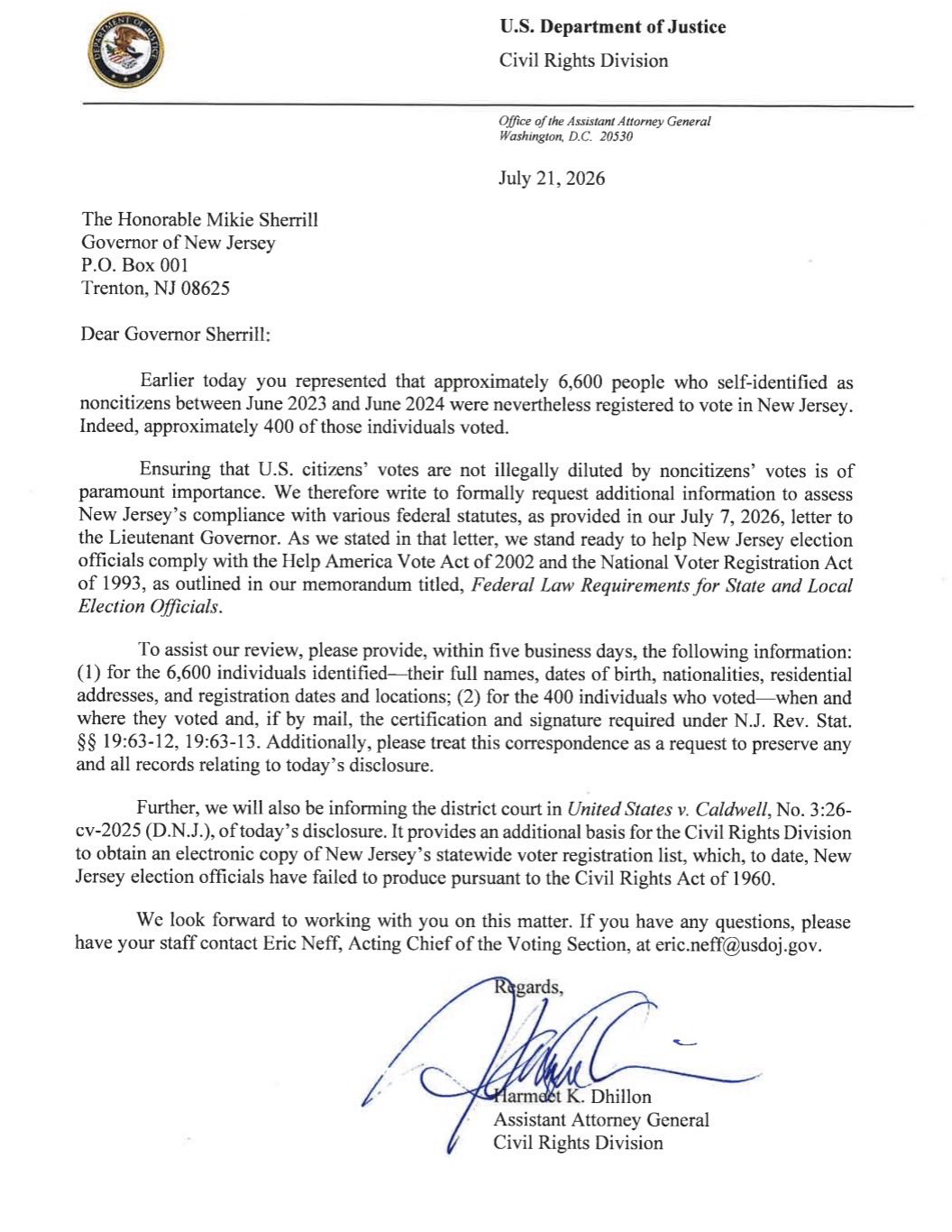
In response to this revelation, Assistant Attorney General for the Civil Rights Division Harmeet Dhillon, sent a letter to Sherrill last week demanding that she hand over data (including names and addresses) on all these noncitizens. Sherrill, however, is refusing to comply with this demand.

“We are not in the practice of turning over this kind of personally identifying data over to the federal government because we have seen them weaponize it, I’ve seen it personally,” she said last week. “They are working to weaponize personal data, and they don’t have a reputation for keeping it private either.”

Of course, this whole unfortunate episode is now being used by the Trump administration as a way to help bolster its failing campaign to seize sensitive voter data from the states. The DOJ has, for months now, been demanding unredacted voter files from at least 44 states and Washington, D.C. Few states have complied, and the DOJ has sued in response — and it has lost every single case that has gone to court.

On the same day that it sent the letter to Sherril, the DOJ also filed a notice of additional basis in court to help its New Jersey voter roll case, arguing that the incident is evidence that the DOJ truly does need the state’s unredacted voter rolls. 

“The Civil Rights Division of the U.S. Department of Justice sent Defendant the Additional Basis Letter because the Civil Rights Division learned of Governor Mikie Sherrill’s announcement on X on July 21, 2026, that ‘roughly 6,600 people who indicated that they were not U.S. citizens between June 2023 and June 2024’ were in fact ‘registered … anyway’ by New Jersey election processes—and roughly 400 of those people voted,” the notice reads. 

In Other Election News

TPM: Jay Clayton Confirmed As DNI — A Position Trump Warped to Feed His Election Conspiracy Theories

Democracy Docket: Trump DOJ said some states ‘cooperated’ with voter roll grab by providing public information. It sued other states for doing the same

AP: Trump’s attacks on mail balloting and concerns over delays turn midterms spotlight on Postal Service

Received — 29 July 2026 TPM – Talking Points Memo
Received — 23 July 2026 TPM – Talking Points Memo

Election Deniers’ Grip on the Republican Party Strengthens in Arizona

Hello, and welcome back to The Franchise!

Three prominent 2020 election deniers won GOP primary elections in Arizona for secretary of state, governor and attorney general. It’s concerning news for the future of election administration in such a crucial state.

Arizona GOP state Rep. Alexander Kolodin, who is a known election denier, won the Republican primary for secretary of state this week. Kolodin is a member of the right-wing Arizona Freedom Caucus and in 2023 was sanctioned by the State Bar of Arizona for his participation in the so-called “Kraken” lawsuits, challenging the results of the 2020 election. 

The fact that an election denier could be in charge of running elections in a state that has been ground zero for election conspiracy theories since 2020, is, of course, a harrowing prospect. 

Kolodin will face off against Democratic incumbent Secretary of State Adrian Fontes in November. 

Staunch MAGA ally Rep. Andy Biggs (R-AZ) won the GOP nomination for Arizona governor this week too, and will now face off against Democratic incumbent Gov. Katie Hobbs in November. 

Biggs, who is the former chair of the Freedom Caucus, has a rich election denial history. He has consistently supported and repeated Trump’s baseless conspiracy theories about the 2020 election and was subpoenaed by the House January 6 select committee in May of 2022 as part of its investigation into the events leading up to the attack and efforts to disrupt the peaceful transfer of power. 

On January 6, 2021, Biggs objected to the counting of electoral votes in Arizona, as well as five other Biden-won states that were all subject to election misinformation in the aftermath of 2020. 

“I object to counting the votes of Arizona electors because the federal courts went around the legislatively constructed mechanism for choosing Arizona’s presidential electors allowing tens of thousands of voters to unlawfully cast votes,” Biggs wrote in a 2021 press release.

Hobbs had this to say about Biggs in a post on X this week: “Andy Biggs has spent his career selling out Arizona families for billionaires, special interests, and even convicted sex offenders.The more Arizonans learn about Biggs, the more they’ll realize he’s one big problem they can’t afford.”

Lastly, Arizona Senate President Warren Petersen secured the GOP nomination for attorney general this week. Earlier this month, Petersen complied with a federal grand jury subpoena — part of the administration’s ongoing investigation into non-existent fraud in the 2020 election. Petersen handed over documents to the FBI related to a 2021 scam of an election audit in Maricopa County that found no traces of election fraud.

As always, there is lots more to catch up on. Let’s dig in. 

Trump Admin Escalates Threats of Criminal Charges Against Election Administrators

Department of Homeland Security Secretary Markwayne Mullin continues to threaten state election officials with criminal persecution over non-citizen voting, in yet another attempt by the Trump administration to exert control over elections and elevate Trump’s conspiracy theories about non-citizens voting en masse for Democrats, a repeatedly debunked myth. 

Earlier this month, the DOJ sent election officials in all 50 states letters threatening criminal prosecution if non-citizens are found on voter rolls.

On Friday, during a press conference, Mullin doubled down on these threats, demanding that states run their voter rolls through a federal database — or risk losing federal election-related funding and/or face possible criminal persecution. 

“We’re saying that the machines had to be secure, and that your voter registration list needs to be scrubbed,” Mullin said on Friday. 

“We need to make sure that individuals that are legally able to vote are voting,” he continued. “If you’re illegal and attempted to vote, or you tried to vote illegally for someone else, we will find you and we will charge you.”

Mullin is insisting that states participate in the Federal Systematic Alien Verification for Entitlements (SAVE) system, a database typically used for verifying the citizenship and immigration status of individuals applying for certain governmental benefits. It’s been co-opted by the Trump administration to purge alleged non-citizens from voter rolls. There is evidence, however, that this tool has been incorrectly flagging eligible citizens to be booted from the voter rolls. 

“If the election officials, once we gave them the information they need to secure their elections, and they chose not to, then those individuals can also be held accountable by fines, by penalties, and even, depending on how far it goes, prison time,” Mullin said.

This comes as the use of the database for the Trump administration’s aims has been challenged in court. The use of the SAVE system to purge voters from the rolls was blocked by a federal judge last month.

A Remarkable 16 Losses for the DOJ’s Campaign to Seize State Voter Data 

The DOJ has officially earned its 16th loss (with an impressive zero wins) in the administration’s ongoing and failing campaign to seize sensitive voter roll data from the states. On Friday, U.S. District Judge Kari Dooley, a Trump-appointee, dismissed the DOJ’s case against Connecticut, ruling that the state’s voter data is not something the federal government is entitled to. 

For many long (and embarrassing) months, the DOJ has been desperately trying to force at least 44 states and Washington, D.C. to give the department access to unredacted voter roll data, which includes private information like Social Security numbers and drivers license numbers, to the federal government.

The DOJ has been relying on provisions in the Help America Vote Act (HAVA), the National Voter Registration Act (NVRA) and the Civil Rights Act of 1960 (CRA) to argue that the federal government is entitled to this type of personal identifying information. 

So far, not a single judge has agreed. 

“…the Court concludes that the Connecticut SVRL is not a record that falls within the scope of Title III, and is therefore not subject to the preservation and production requirements contemplated therein,” Dooley wrote in her order on Friday.

“This lawsuit was an illegal attempt to disenfranchise Connecticut voters and today, the court shut it down,” Connecticut’s Democratic Attorney General William Tong said in a statement on Friday. “The Constitution is clear: the President does not control our elections and has no right to manipulate Connecticut voter rolls. Connecticut follows federal law and takes its obligations under federal law very seriously. We will not be bullied into handing over sensitive voter information just because Trump demands it.”

In Other Election News

New York Times: How the G.O.P. Turned Olive Garden Into a Voter ID Talking Point

ABC News: State officials preparing if the federal government tries interfering with how they run elections

Democracy Docket: Georgia Secretary of State’s office responds to Trump DOJ threats, defends voting policies

Received — 21 July 2026 TPM – Talking Points Memo

Mike Lindell Is Not Registered to Vote in Minnesota. He Claims His Temp ID Registers Him.

Pillow magnate and election denier Mike Lindell, who is also the Trump-endorsed Republican gubernatorial candidate in Minnesota, is reportedly not even registered to vote in Minnesota. Lindell, however, disputes this, telling TPM it’s simply “fake news.”

❌