Normal view

Received — 8 August 2026 Just an invitation...

The ONLY thing that can really protect children from AI and other online dangers is always the same

8 August 2026 at 18:55

Usual notice before getting started: If you like what you find here, thanks in advance for your subscription (possibly but not necessarily paid) or, even better, one-time donations for any amount, or consulting, writing or speaking work. On this particular topic, I AM particularly interested in speaking with parents and teachers worldwide!

Already one year ago, half of (American) teens were regularly using AI companionsone year ago, that is “AI platforms designed to serve as digital friends”, for something much worst than cheating at school, and I’m not talking of customized porn like this:

Screenshot of a real website, accessible without age controls that wouldn’t work anyway.

I am talking of much more personal “help” like, from less to more serious:

  • guidance on back-to-school shopping, low-calorie snacks or planning birthday parties

  • getting the right words to write to fix sensitive situations and personal emotional or relational problems like, for example, “writing the message to break up with a girl after a two-year relationship”

I do not think at all that customized, endless porn is healthy for anyone, children or not. The reason I say certain uses of AI companions are worse is simply that, unlike porn, they are socially accepted, if not encouraged to both keep kids away from presumably worst dangers, and prepare them to the Brave Hi-Tech All-AI World of tomorrow. Problem is, what regular use of such “help” actually achieves is to raise kids who:

  • find no reasons to try to make real friends. Social media “only” prey on the human need to be seen, AIs on the much deeper need to feel emotions

  • have no more need nor capability to trust themselves to make a decision

  • believe they can and should always avoid the stress of dealing alone with relational problems

  • have their creativity, critical thinking and social skills (which, by the way, are all skills needed to have, when the right moment actually comes, sex satisfying enough to not need porn) all castrated by AIs

The reasons why AI companions have such effects are obvious. Unlike parents, siblings (when they still exist), schoolmates and friends:

  • “AI is always available. It never gets bored with you”

  • AI is never judgmental, and whatever you ask it you are always right, always interesting, always emotionally justified. In the already mentioned study, 31% of polled teens said their conversations with AI companions were “as satisfying or more satisfying” than talking with real friends

AI companions are Grima Wormtongue, the smarmy counselor that makes an otherwise really remarkable man never see reality.

Why, how and WHERE this gets really, really stupid (again, never mind porn)

If you are worried that AI makes it possible for kids to do stuff like this:

stop worrying. First, because it’s NOT AI that does that. Second, because the fact that AI services can produce sexual material, give dangerous advice and offer harmful content may be the smaller problem.

If the whole economy, schools, families and, why not, AI companions all teamed up and succeeded to educate teenagers to be interested only in realistic, healthy sex with real people at the right age (whatever “healthy” and “right” mean, it’s irrelevant here) but said teenagers remained abandoned to “AI companions” for all the needs you just read, that would still be a huge damage. Replacement of actual human interactions can only exacerbate crises of loneliness and youth mental health, and in the long run, even if nobody had to work to make a living, a society of people like this would be everything but human.

Those surveys show and quantify how and how much “AI companions” actively and deliberately worsen atrophy of “identity, social skills and independence”. But an artificial “intelligence” that does this (that is: the PEOPLE who make and run it for profit and power) has no need whatsoever to kill you to rule the world. It has already tamed you for good.

What should be done? That study summarized above came to hardly imaginable conclusions:

  1. “The largely unregulated AI industry is becoming as integrated with adolescence as smartphones and social media are.”

  2. Platforms where they are “constantly being validated, not being challenged, not learning to read social cues or understand somebody else’s perspective” are the last places teens and preteens should go.

In other words, those experts just proved and quantified what common sense in every working, adequately informed brain knew right away, namely that adolescence is a critical time for developing identity, social skills and independence. Obvious, but nothing wrong so far. The stupid part starts when the same experts recommend that AI companions should “complement” real-world interactions.

The truth is that even traces of common sense should be enough to conclude that it is very, very, very unlikely that “relationships” designed to be always comforting and much more addictive than real ones could remain their “complements” instead of replacing them altogether, especially for children not mature enough to see or want the difference.

Today’s social media are a cesspool born from the marriage of greed and cluelessness. As true as this is, it doesn’t change the fact that age limits for social media are intrinsically cretin, impossible to enforce, and with lots of really bad side effects for everybody, and totally useless anyway, now that teens have already moved to AI companions. I already explained why, and now reality confirms it: Australia’s under-16 social media ban, started with much fanfare and worldwide approval eigth months ago, is already failing.

Regardless of bans, social media are yesterday’s battle, as I said last winter. But AI bans are even more cretin, and even more impossible to enforce if you try to deploy them on the wrong side of the fence, because AI services are much more numerous, much more diverse, much less visible than social media.

The only solution that will work

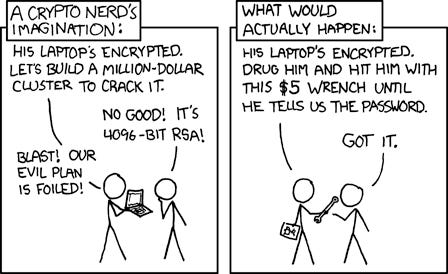
Digital-first solutions including (bans and age limits) are usually much less effective than physical-first solution (Image source: XKCD on security).

The only solution that would have a concrete, beneficial impact without any harmful side effect is the one that was already obvious well before AI chatbots were left loose on the world, but is systematically neglected exactly because it’s as easy as it’s unexpensive and uncool.

The “companions” that are really harmful are the only ones that can be successfully blocked. They are the personal smartphones without which it’s impossible to directly connect AIs to brains 24/7. They are the smartphones that adults continue to proudly put in the hands of the most influenceable humans, years before they’re theoretically able to get them right, in times when any honest look at modern society should prove that even most adults seem unable to use their own smartphones decently.

Please share this as much as you can, in and outside Substack. EVERY current or future parent must know this!

Share

Banning social media or AI companions while leaving smartphones in the hands of kids is exactly as effective and smart as living in a really dangerous neighborhood with the front door always open, to make your neighbors envy your furniture, but with a big “Molesters not welcome here” sign on the wall.

By now, even experts have stopped beating around the bush and started saying that removing smartphones is really needed now:

  • “using smartphones before age 13 could damage kids’ mental health, [as such usage] was associated with suicidal thoughts, worse emotional regulation, lower self-worth and detachment from reality, especially among girls”, as well as “sleep disruptions, cyberbullying and negative family relationships”, said a study released ONE YEAR AGO whose main value is that, “while previous research focused on how smartphone use is related to anxiety and depression...[this] looked at symptoms not commonly studied, including emotional regulation and self-worth, and found they are very significant”

  • one of the many high schools that started requiring students to put their phones inside magnetic locking pouches every morning reported, 16 months ago, that “not only kids actually talk to each other at lunch now: Interpersonal violence has been at a record low, too”

If the right people (not governments!) banned possession before 16 of personal smartphones, 90% of all childhood and early adolescence problems with both social media and AI would vanish. It’s really frustrating to see both “experts” and parents circling around this obvious concept for years now, without ever having the guts or a clear enough mind to see it, and act consequently.

Objections that smartphone bans ignore how integrated they are in younger generations’ lives have no substance. A few decades ago, smoking, both active and passive from the womb on, was just as deeply “integrated in younger generations’ lives”. We succeeded to make that exposure socially untolerable. Now that’s the turn of smartphones, we can do that too, and we really must.

It’s also high time to just laugh at everybody still saying things like “Kids need to know how to use social media (or AI) and by an outright ban of smartphones... we are not getting any closer to teaching those skills”. Why on Earth should kids learn how to use stuff and practices that, only this week, judges found bad enough for kids to deserve a $567m fine?

Subscribe now

The worst enemies of smartphone-free kids

I said it three years ago, before all the studies I’m citing here, and I repeat it today: Honestly, THE problem with children online is PARENTS. Laws and governments must stay out of this, except by providing information. But all future parents, and all parents of kids who don’t already have their own personal smartphone must accept that delaying possession of any portable, that is uncontrollable internet-connected device is a protection against AI and social media toxic effects hugely better and easier than any other, not to mention surely affordable.

Good parenting in a digital age is much simpler than it seems, and 90% of it may be summed up in two rules:

  • Never attach your children to portable direct gateways to AI, social media and general datafication and control systems, the better for the children, period. This includes sharenting, obsessively checking your kids grades every day on the school’s website, or screwing their summer camps with email, video calls or other digital abuses

  • The less you interact with your children (and the children teachers, coaches etc...) through digital interfaces and services, or while using said tools, the better

On the second rule, please consider the study concluding that “cell phone use affects parent-child interactions, even when adults aren’t online”, whose most important points are:

  • “Mothers who were in the habit of spending more time on social media talked much less to their kids when they played with them than did moms who spent less time on social networks, and that difference carried over when they weren’t using their devices”

  • “Talk to your kids even as they get older, because one of the most important things parents can do is to talk to their children all the time”

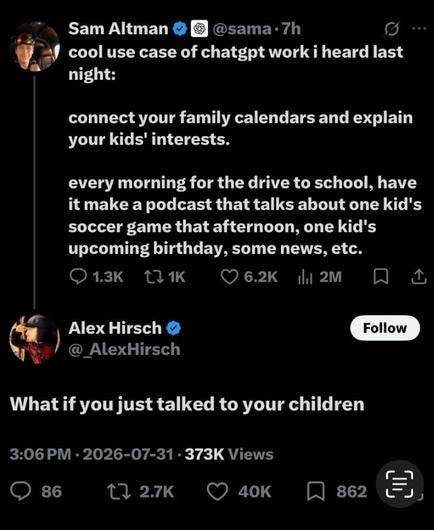
In other words, the right parenting when it comes to AI, smartphones and control mania impulses is the exact opposite as Sam Altman, the chairman of OpenAI who last week called having AI remind you of your kids’ commitments “a cool use case of ChatGPT” just to be told, by something obvviousl much more intelligent than him “What if you just talked to your children”.

Money itself is OK. The fact that people like Altman get more than pocket change to implement their vision of the world is a sure sign that we are doing money wrong. Real wrong.

Not chaining children to the only objects that for-profit, mind-altering services absolutely need to reach them to make money is as easy as it’s urgent, but here comes the most difficult part: don’t even try to believe that it will be enough. No smartphones before 15 or 16 is a mandatory first, urgent step, but it’s only the first. The teens most likely to experience positive mental health even if connected with the Matrix are those who, besides parents with common sense, have strong, supportive friendships, said another study.

Problem is, in order to begin and resist through the years, childhood friendships need time and spaces, where kids are free to grow together, learning adulthood from each other, without any kind of prison guard always behind their backs. That is, what all strong, supportive friendships need (besides less uselessly anxious parents and trying real scouting, of course) is things like children weekly schedules less busy than those of Fortune 500 executives, many more public playgrounds with enough public funding to keep them always clean and safe, and safe ways to reach those playgrounds by feet, skates, bikes or transit.

That’s the stuff that (after committing to “no smartphone before sixteen”) every parent should campaign for now, together with all other parents. Not cretin bans.

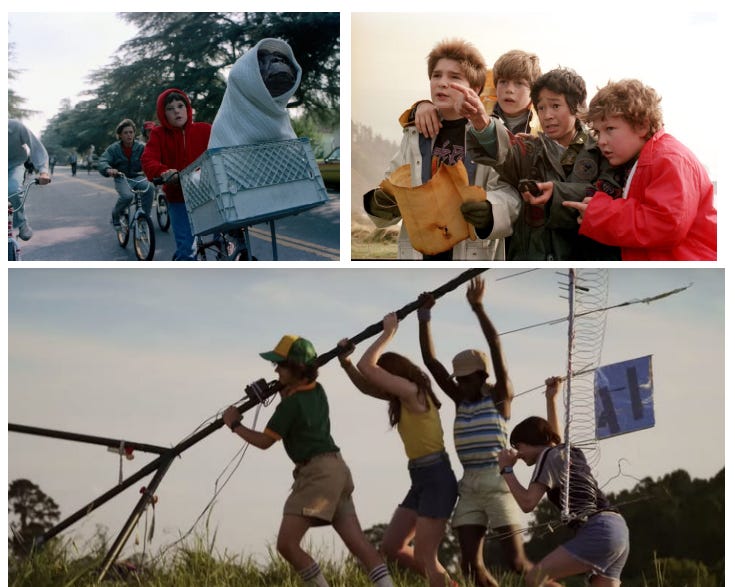
Because the best preparation to digital life there is, is learning it on a fixed computer that cannot stalk or inhabit you like Xenomorphs, and growing free range all the rest of the time:

bonus points to everybody who correctly labels all the three screenshots in the comments.

Received — 3 August 2026 Just an invitation...

Today, years of AI military investments finally paid off

3 August 2026 at 19:09

In the last decade the United States has spent mountains of money on really high-tech weaponry and on even more sophisticated AI military systems. Today, that policy has finally paid off, bearing fruits that are impossible to deny, and warm the hearts of everybody seriously wishing to make America and the whole Free (from what, exactly?) World Great Again. In order to understand how great a progress has been made today, however, a short recap is necessary.

How America became the most powerful, most AI-powered war machine the world has ever seen:

(this is just a very small summary, of course, that doesn’t do justice to the true, unprecedented greatness of the effort. All emphasis mine)

  1. 2023/04/26: Palantir launches an Artificial Intelligence Platform (AIP) and demos how a military might use it to fight a war

  2. 2024/03/11: The Pentagon requests $1.8 billion for AI spending in fiscal year 2025 as they view AI as a top priority.

  3. 2025/06: Trump issues Executive Order directing the Defense, Interior and Energy departments to lease out underused base land... to private developers to build and run data centers expected to support artificial intelligence and military applications

  4. 2025/07/a: Trump announces American’s AI Action Plan that will transform countless industries including defense, because AI has the potential to transform both the warfighting and back-office operations of the DOD. The United States must aggressively adopt AI within its Armed Forces if it is to maintain its global military preeminence.

  5. 2025/07/b (coincidence, surely): the same day, Trump buys millions in Nvidia, Apple and Microsoft

  6. 2026/01/09: The US Secretary of War directs the Department of War to “accelerate America’s Military AI Dominance by becoming an “AI-first” warfighting force across all components.

  7. 2026/02/01: The US and Israle, attack Iran. On that day, a US missile hits an elementary school in Minab suggested as target by AI fed with wrong data, killing 156 civilians including 120 schoolchildren (compare this with #14 below!!!!)

  8. 2026/03/03: “Trump is using AI to fight his wars” first in Venezuela, to plan and execute Maduro’s snatching, then to identify which Iran targets to bomb

  9. 2026/03/04 (coincidence, surely): Analyst says interest in Epstein files plummets

  10. 2026/04/22: Pentagon asks for $54bn in pivot towards AI-powered war

  11. 2026/05/02: Pentagon partners with major tech firms to further integrate AI into classified networks, speeding up data analysis and battlefield decisions

  12. 2026/06/05: Trump signs National Security Presidential Memorandum 11 which, among other things, “orders the Defense Department to update its policy on autonomous weapons, and vests accountability for AI use within the military chain of command rather than external regulators.”

  13. 2026/06/30: Trump administration announces ‘War Force’ effort based on hiring “experts in designing, building, integrating and maintaining capabilities like frontier AI, machine learning, automation and data systems.”

  14. 2026/07/16: As of this day, standard intelligence review of the attack to the Minab school hasn’t been ordered yet

Leave a comment

This is what you (hopefully) already knew. But today...

Today it’s a great day. Seriously. Today it’s the day we finally know that all that effort is paying off. Today, with the Iran war cost estimated at $37.5bn so far for the US alone, and after the US has spent at least $75 billion in AI-driven programs since 2016, today is the day when...

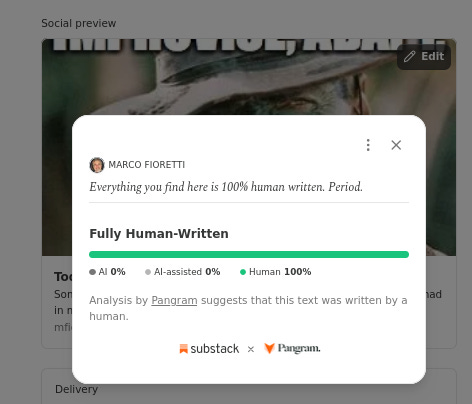
...the US military asks for “new creative and unconventional” ideas to pressure and punish Iran not to those godlike AI tools but... to its own dull, outdated, so ordinary, merely human soldiers and analysts, because:

“We are looking for new creative and unconventional ways to pressure and punish Iran...”

“U.S. Central Command has a long history of thinking and working in innovative ways,” Capt. Timothy Hawkins, a spokesperson for CENTCOM, said in a statement. “Admiral Cooper, in particular, reaches out to members of our great team, regardless of rank, to achieve the highest levels of operational performance possible.”

“You need creative minds at times - especially if you’re running out of conventional options,” said one of the sources familiar with recent planning discussions.”

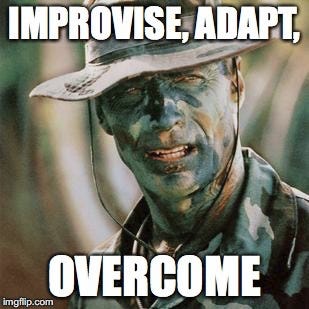
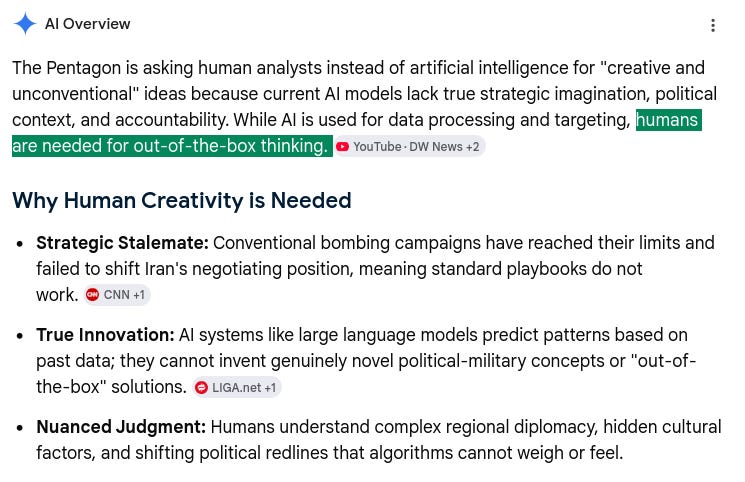
Yes, you read that right. It did take forty years since good old Clint explained to his soldiers that if you need “new creative, innovative and unconventional ways” to pressure and punish your enemy you must ask humans to:

Improvise, Adapt, Overcome. HearthbreakRidge, 1986.

It took forty years, but that pearl of wisdom finally reached the tob brass. After untold billions of dollars spent on military AI and on bombing decisions based on AI processing of data, today the Pentagon has said, almost explicitly:

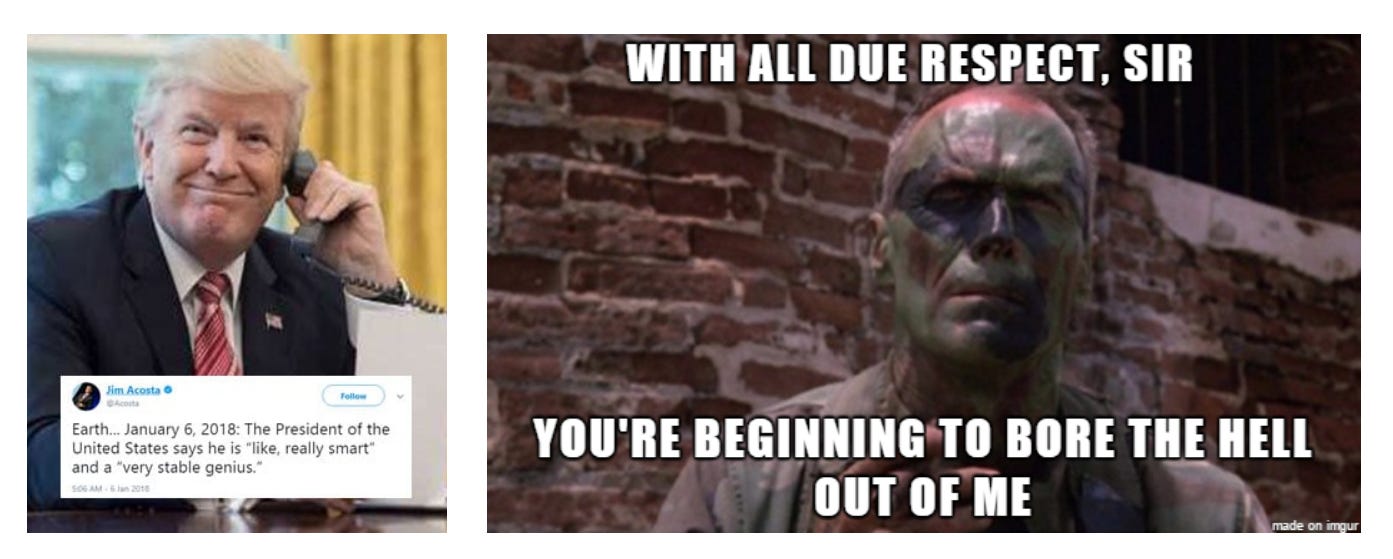
“Our glorious Very Stable Genius selflessly put us in such a mess that even after depleting stockpiles of extremely expensive weapons we can’t find the way out ourselves, not even with the even more expensive AI tools he pushed us to buy, PLEASE HELP”.

Left: Stable Genius. Right: Gunny, channeling US Military feelings?

I never, ever use AI for writing,

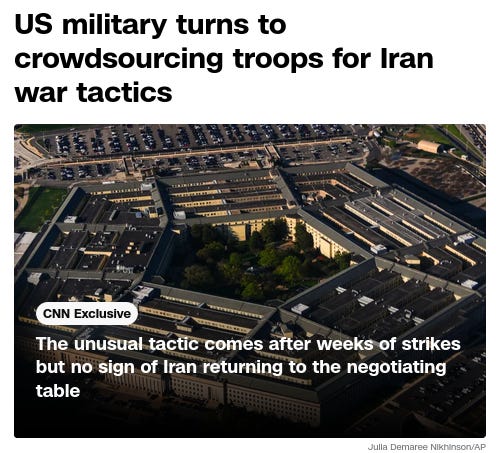
but this time asking a chatbot why this happened was too fun to not do it. So I asked Gemini “Why is the Pentagon asking how to punish Iran to human analysts, instead of asking to AI?”

And Gemini worked well enough (I won’t say “was honest enough” because honesty is a quality of humans, not of some blob of bits) to answer what, without making anybody’s water scarcer, or electricity more expensive, every human with an ordinary but true intelligence and no personal interest in pumping AI stocks already knew since forever:

  • because current AI models lack true strategic imagination, political context, and accountability. While AI is used for data processing and targeting, humans are needed for out-of-the-box thinking.

  • True Innovation: AI systems like large language models predict patterns based on past data; they cannot invent genuinely novel political-military concepts or “out-of-the-box” solutions

  • Nuanced Judgment: Humans understand complex regional diplomacy, hidden cultural factors, and shifting political redlines that algorithms cannot weigh or feel.

Gemini, saying “Nah, TRUE intelligence is human, we chatbots are something else entirely. Don’t trust guys like Altman.

Oh, I almost forgot: to make all this even more tragically fun, still today, “AI data centers have become sitting ducks in the Iran war.

Share

At this point, I only have one more question:

From where I sit, the silver lining of this failure is that it may make easier for the EU to avoid, not just in military matters, all the AI errors and wastes of public money made by the US. At the same time, I can’t help but ask:

Why isn’t this farcical bit of news enough to trigger the worldwide AI stock market crash that’s been overdue for our common good since at least last November?

Seriously: why aren’t AI stocks going down the drain right now? Why aren’t pension funds worldwide already divesting their AI stocks?

An AI success story, coming soon to Make Your Pension Great Again.

Final, usual request:

If you like what you find here, thanks in advance for your subscription (possibly but not necessarily paid) or, even better, one-time donations for any amount, or consulting, writing or speaking work. And remember: everything here is 100% human written. Period:

Subscribe now

Received — 1 August 2026 Just an invitation...

Pets should not be “family”

1 August 2026 at 12:46

Unavoidable disclaimer: this is NOT a condemnation of any single pet owner. This is a condemnation of the cumulative effects on society of certain pet-related strategies, and of those who impose or tolerate those strategies. Don’t take it personally.

I’ve never had or even wanted a pet myself, for several reasons, but I do see and understand that pets are a big source of sincere joy for many people, and I have NOTHING against that, in principle. At the same time what pet ownership has become today honestly worries and saddens me.

Usual notice before getting started: If you like what you find here, thanks in advance for your subscription (possibly but not necessarily paid) or, even better, one-time donations for any amount, or consulting, writing or speaking work.

My first, most obvious cause of concern around pets is people spending thousands of Euros, getting in debts too, not just to get purebreed pets of questionable origin (more on this in a moment) but to treat them as much as possible like actual human babies. The most visible example I see very often these days is the increasing number of people I see carrying this or that mini-dog in small strollers made specifically for dogs. And when I happen to see dogs bearing rings at weddings, I can’t help thinking “they really had no relative or friends they considered worth of carrying those rings???” (1)

How tell everybody you invited at your wedding that they matter less than your pet (Source: Google image search)

The “questionable origin” is the existence of breeds created and consciously perpetuated with features that make pets suffer, just because they make them cuter (more on this here and here).

Stuff like this was already make me thinking that pet ownership and common sense have parted ways. I had already observed one year ago that pets have become another case of too much choice to be really good for everybody involved, both pets and humans.

That was last year. This year, the increasing “premiumisation” of pet food, together with reports that the pet toys and pet cosmetics markets are both expected to double in ten years, looked more of the same: bad and dumb, but not enough to write again about it.

Ditto for fake Emotional Support Animals (even if they really contributed to discourage airborne overtourism, which I doubt), and for “smart” or “AI-powered” gadgets that make pet life just as “modern” and uselessly stress-inducing as human life is expected to be. Why bother too much, I thought, about stuff like “smart” dog collars that “beam the owner insights into their pet’s sleeping, eating, trotting, barking and scratching patterns”, when it’s just one more category of “smart” consumer products gone off the rails?

Tamagotchi care statistics were much better than today’s smart dog collars. No anxiety about another living being back then. (Image source)

Then, a couple of weeks ago, I learned that the “business of pet longevity is booming”, by promising dog owners “more moments of joy together” (that is less time with humans) via sophisticated dietary supplements or treatments as exclusive as “$275 pet-longevity strategy sessions to get personalized protocol of supplements and off-label prescription medications”.

What made me think this matter deserved its own post now was the deep reason for that boom, which I’ll describe in a moment, plus another thing I discovered in the same days: if making a pet live not necessarily happier but longer isn’t enough, the equally booming pet CLONING business is here to help everybody with enough money to think their pet deserves resurrection, and not just with cloning. Quoting from that article, you could also try “cryopreservation, that is preserve the carcass of your pet at subfreezing temperatures in the hopes of one day reviving them. Clients can even arrange to have their terminally ill animals euthanized on site to speed the process.”

Now I really long for the days when all pet owners could be brainwashed to spend were toys, food and toiletry.

Leave a comment

Why I am sad and worried about “Peak Pet”

Denial of death (which nobody should confuse with the wish and need to live as healthy as possible until one’s time has come) is as ancient as humanity. Lifespan extensions or cloning for pets are just an expansion of that wish, and a hardly surprising one, I guess, in a world where immortality choices like religion or parenting have (just temporarily, I suspect) heavily fallen out of favour.

Even ignoring that extreme, the life pets are made to live these days really seems to me surely not in their best interest, and to be one of the physical sides of a generalized human retreat from closeness with other human beings.

Pets wouldn’t have such an apparent great time if society put more efforts in supporting human family and friendship. The increase of attention, commitment and expenses that pets are getting comes from a big increase in the number of people who don’t even TRY to have family or friends anymore because, thanks to consumerism powered by high-tech, they finally have something else that:

  • hides loneliness and lack of purpose by finally being presented as necessarily expensive and time consuming, that is just as important, as having kids or any other long-term, equally committed relationship with other humans...

  • while being at the same time immensely easier both to mold and control as one wishes, AND to terminate in any moment. If you get tired of a human family member you are legally obliged to support you can’t just drop him into a shelter or into a friend’s lap, no question asked, without any social consequence.

Or, as I read on Quora, “Dogs are more controllable kid replacement”

“Peak Pet” like this sucks at so many levels. It sucks that it exists to begin with. When the majority of a generation concludes that pets are better than children not just because they’re (so far) more affordable but also because, as new research suggests, “having a cat or a dog to keep you company could boost your wellbeing as much as being married or meeting up regularly with friends and relatives” it’s not a sign that pets are good (which they are). It’s a sure sign that public mental health is screwed because we’ve let family, friendship and more (see end of next paragraph) go to waste, to the advantage of both digital and physical (e.g., pets) replacements.

Peak Pet also sucks because it increases inequality, and not just because “routine pet ownership... now costs an average of $4,272 per year”): the background vibe I perceive here is that, while the rich can and should aspire to go to Mars and live forever, the rest of us should make do with making pets live longer, while accepting euthanasia as not such a big deal (2), and even eugenics, eventually: once “pets are family just like human children” coupled with “harmfully overbreed pets are cute period” becomes a no-brainer fact of life there is not enough road left, in my humble opinion, before conclusions like “what’s wrong with selecting every human traits in vitro, just for convenience and personal satisfaction?”

Finally, it sucks that people are actively encouraged to do this by companies that exploit them.

Subscribe now

People who want their dogs live longer wouldn’t get so much cuddling by businesses as they do if dogs didn’t live every moment in the same places as their owners, long enough to be comparable to humans... but not long enough to make the financial ludopaths known as “Venture Capitalists” go bet elsewhere. That is, a big reason why demand to make dogs live longer gets so much recognition is that dogs, being much better human simulators than traditional guinea pigs, can accelerate research and official approval of commercial products and services for extension of human lifespans, where really big money can be made.

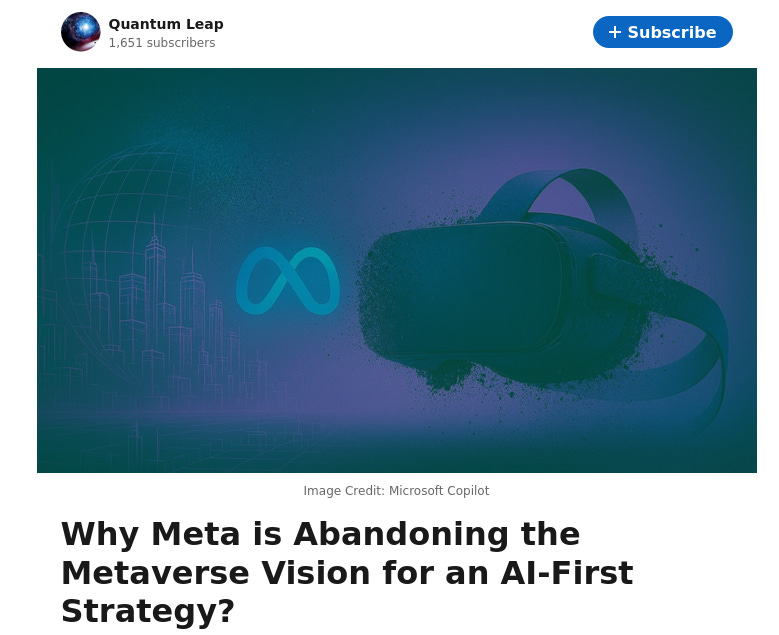
Two-sentences, conspirationist and - just for fun - provocative digression and unfair oversimplification: Is there a better subject than people who voluntarily lock all their money, time and attention into a combination of pet and smartphone, walking the former while scrolling social media and AI chatbots? I mean, if that combination is both highly profitable by itself, and enough to replace both critical and emotional intelligence, there is no need to also build a metaverse to control people! Which, by golly, it's just what happened:

Screenshot source: Quantum Leap on LinkedIn.

What should be done?

Back to the concrete, undeniable issues, Peak Pet is just another area of life that used to be good because it was simpler, spontaneous and generally more authentic, and is now being deliberately ruined by greed turbocharged by digital or digitally empowered high tech. Letting it continue as today cannot be good.

One of the authors of the “pets can be as good as spouses or friends” study is quoted saying:

“If pets improve life satisfaction as much as the study suggests, [the author] called on policymakers to make it easier for people to own them, for example by relaxing regulations that restrict renters’ access to them.”

For an economics professor as that author is, this makes sense, because it increases GDP, or at least doesn’t disturb it. To me, proposals of this kind feel too much as further rejections of the very idea of a society made of people that don’t want to ignore each other. In the long term, it’s an inhuman, suicidal strategy, so I suggest policymakers do the opposite: instead of making it even easier for future pet owners to end up self-sealed into separate realities, just make life easier to cope with, and less lonely, for all humans.

One week ago I read that China is cracking down on AI companions to encourage people to be in actual, real-world relationships. That’s almost the same end goal I’m talking about here, so let me I ask: should we apply the same treatment to Peak Pet?

Not really, I say, and surely not as the first or only measure. Be they pets, chatbots or drugs, “cracking down on companions” that help a human being to isolate himself from all the others cannot work by itself. Even in places where governments can set a policy and stick to it without worrying about elections or public opinion, “cracking down on companions” that make life bearable without first turning the job, housing and education markets upside down is a doomed endeavour.

So maybe policymakers should help people re-learn why and how to like humans first, and make that actually feasible for everybody. That is, they should do the very first things we should all demand now anyway, even if pets didn’t exist at all.

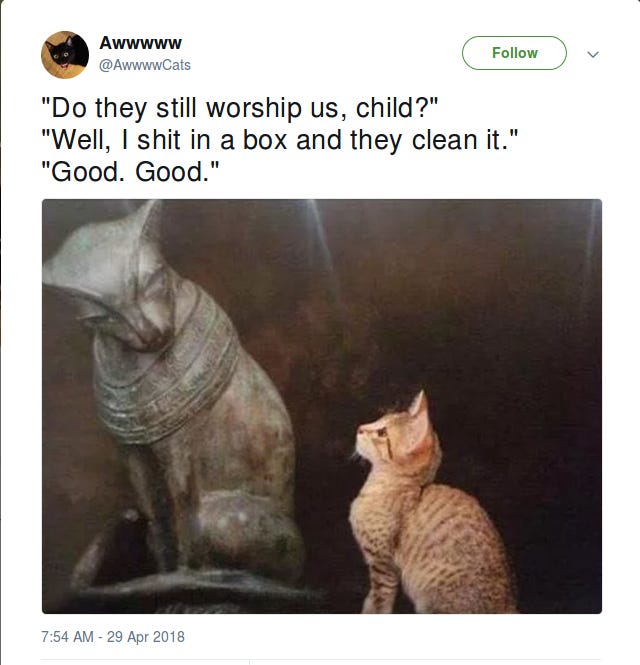
Source (AFAICT): AwwwwCats (now suspended) on Twitter.
  1. Yes, I do know that organizing a wedding can be one of the worst sources of family feuds, and I consequently understand that making the dog bear the rings may help show to all the human participants at the wedding that both spouses... don’t love any participant more than they love all the others. But still...

  2. Some food for thought on this here and here

Share

Received — 17 July 2026 Just an invitation...

Donald Trump is 100% right about US election vulnerabilities and frauds

17 July 2026 at 20:41

As usual… If you like what you read here, thanks in advance for your subscription (possibly but not necessarily paid) or, even better, one-time donations for any amount, or consulting, writing or speaking work.

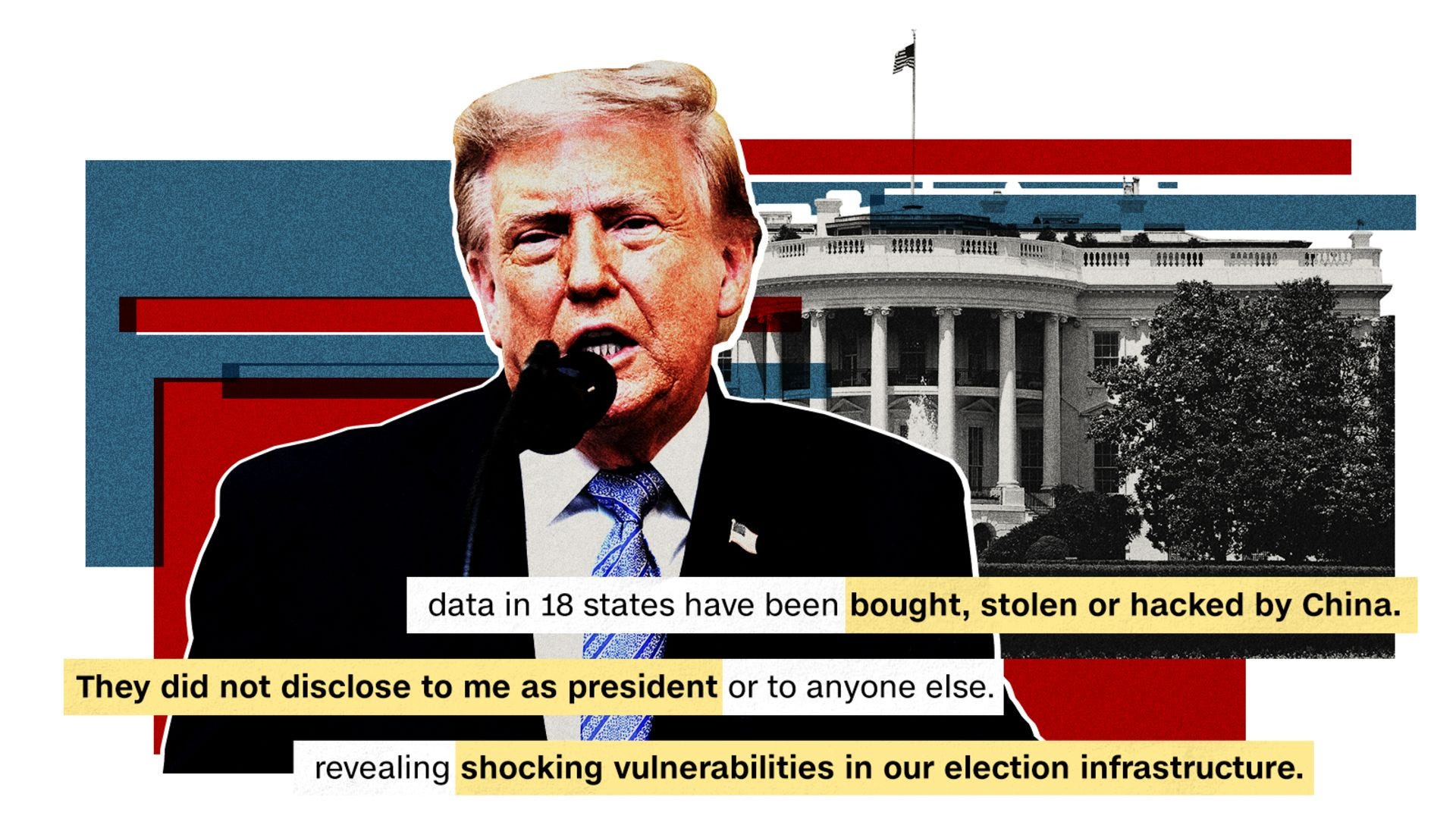
I just read CNN’s copy of “Trump’s speech claiming US election vulnerabilities, annotated”“, and after that here’s the one thing I can tell you with full confidence: as far US elections vulnerabilities and voting in the US in general are concerned, Donald Trump is 100% right and, albeit it is only for its own personal advantage, he really seems to have a much better grasp of what really matters in those areas than any other US politician.

Just an invitation... is a reader-supported publication. To receive new posts and support my work, consider becoming a free or paid subscriber.

What Trump gets 100% right about US election vulnerabilities and voting in general is something that’s a) really simple, b) wouldn’t change one bit if all his accusations and claims of voting fraud turned out to be 100% false, and c) can only benefit populists and shameless demagogues like him.

More specifically, the one take-home message of Trump’s election integrity speech and what Trump gets 100% right is not whether China, Russia or anybody else meddled with any US elections. Trump himself doesn’t really care anymore at this point, and CNN itself points it out:

What really matters here, and Trump gets 100% right, is these three really simple things:

  1. In general, voting really enables and supports democracy only if everybody really trusts it, that is only if everything about voting is so damn simple that everybody with basic education can, without having to trust any “expert”, really understand how it works and autonomosly conclude that it could never, ever produce frauds at any scale large enough to change the result of an election

  2. For many decades, Americans have let their administrators and representatives make anything related to voting as uselessly complex (that is: impossible to trust) as they could, and accepted to be told that no-brainer rules in any other country where voting happens (e.g. photo voter ID) are either impossible or attacks to their rights and freedom (seriously?)

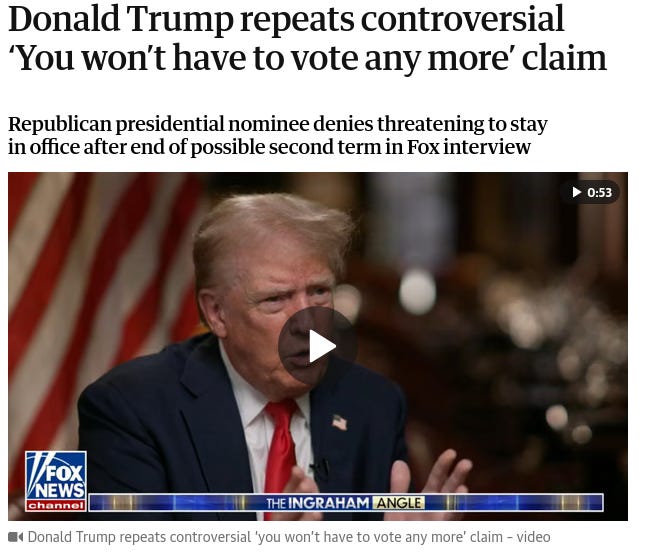
  3. If doesn’t matter at all if Trump’s accusations of fraud are true or not. If they are, of course action is needed. If they arent’, making all that noise about something that’s impossible to deny, that is rampant, unneeded complexity and incomprehensibility in the country that should be the beacon of democracy... it’s a perfect way to convince even more Americans to not vote anymore. Yesterday’s speech is Trump’s 2026 way to repeat “you won’t have to vote anymore”:

He DID told you. Two years ago.

Making all that noise is a perfect excuse to replace the current systems with something that’s simpler on the surface... but eventually makes it much easier for Trump to manipulate elections as he wants.

Summing up, Trump is 100% right about the objective impossibility for Americans to trust the American voting system, which is even greater than he can see, and the only real solution is to make voting in the US much, much simpler and trustable than Trump himself claims to want.

Thanks for sharing this post as much as you can, both inside and OUTSIDE Substack!

Share

I took the time five years ago to lay out all the main ways in which voting in the US is an embarrasment for a great country, and how to fix them. For your convenience, I have copied that analysis and request below (**). Thanks in advance for sharing your opinion in the comments!

Some comments I’m seeing on Georgia’s runoff... (first published on 2021-01-06)

...just confirm one thing I’ve always thought of Americans.

Unavoidable disclaimer

This is NOT a Republican post or a Democratic post. I am not American, nor I live in the US. I follow certain US events only because I have to, to the extent that who becomes President of the USA, or the composition of its Senate and Congress still heavily influence other countries. Apart from that, what Americans do, who they elect and how they live is none of my business, no question. And, like any other country, America has a lot of other things to imitate, things I envy Americans for. But there is one thing they really get wrong, sorry.

ADDED on 2021/01/06, 6:34pm, GMT+1: let me stress that what worries me and pushed me to write this post is not what Americans vote. It is only the fact that a voting system designed and imposed for decades in this way, even if 100% executed in perfect good faith by 100000% honest and competent people can only increase the fragmentation of any society. With dangerous long term effects for the whole world, when that society is as influential as the US.

ALSO: do NOT miss the follow-up, that is the reaction of an american election inspector, and my reply!.

Ten minutes ago, browsing YouTube...

Ten minutes ago, YouTube decided to suggest me a video of an American citizen very, very upset for the results of the Georgia runoff. So were the majority of people who commented his words. Some of those comments catched my attention, and are pasted below, because they confirm one bipartisan thing, well within scope of this website, that I have always thought of the USA.

Here are some of the comments I am talking about:

  • If we can’t vote in open, honest elections then there are only two outcomes. Neither will be good

  • The Dominion algorithms make it to where they only win by 2% or less so it doesn’t raise any red flags of voter fraud.

  • The vote harvesting is the devil

  • When they said they’d add 3 more hours to count mail in and absentee ballots I knew this was a lost cause

  • my voting machine had molded onto its plastic case the word DOMINION

  • Same machines, same software, why would you get different results?

  • Vote switching software was deployed again. They already have the proof. Just hold on.

  • The Dominion machines crashed again, so I’m not placing any faith in the results.

  • plus lots of comments in the “I’ll never bother to vote again, it’s totally pointless” category

And the thing I am talking about is...

This: Americans are great people from lots of points of view. Sincerely. But trust them to get everything conceivable about voting, as wrong as possible. Sorry, this is what it looks like from outside.

This is how any political vote with only a few, binary choices should happen:

Ballot of the 1946 italian institutional referendum. Image source: Wikipedia.

The piece of paper above is the paper ballot of the 1946 Referendum with which Italians chose between Republic and Monarchy. For the purpose of this post, it is an almost perfect picture of how political elections still happen in Italy, today:

  • only with paper ballots that any analphabet could understand: cross the picture you want, done

  • with the mandatory, same copying pens for everybody, provided at the booth by voting officials

  • ballot counting done manually, in each booth right after it closes, by a committee of representatives of all major parties

  • with photographic voter ID documents that everybody has anyway, so why the hell not

  • voter registration handled as described below

  • everybody votes in the same few hours, nationwide, always on Sundays and (sometimes) the following Monday morning. No ballots to send for counting to no warehouse, with all the risks involved

In the US, instead...

Again: as far as I am concerned, what follows only matters for votes that directly influence the whole US, and with them the rest of the world. How the residents of any US county or city decide, their major, or how to finance their local aqueducts is only their business, seriously. The US, we were saying...

E-voting

The only thing worse than e-voting is online voting, for all the reasons I already explained in detail elsewhere. Here, today, it is only necessary to highlight one thing:

the comments above, and the millions similar that will surely follow, simply could not exist, if US voting happened as described two paragraphs above. If vote casting were manual, and vote counting happened that way, maybe under a live webcam in every booth... this would not completely eliminate frauds (nothing could), but it would make large scale fraud immensely harder, while making immensely easier to trust the system. It’s as simple as that. No, better: voting has to be as simple as that. See here, again.

Mail voting/early voting

Having lived under assorted lockdowns for most of the last ten months, and being likely heading for more, I do acknowledge that, this time, mail or early voting had some advantages.

But the basic idea is flawed, and not democratic. Check again the paragraph above: “Everybody votes the same Sunday, nationwide” means nothing less that everybody votes with the same information available, without being influenced by what happened in other districts thousands of miles away, weeeks if not months before.

Oh, and with no risk of candidates changing programs on the fly, every week. Plus, quoting myself, “No ballots to store for weeks to wait counting to no warehouse, with all the risks involved”, that is, even on this side: more trust in the system.

That is democratic.

Simplicity is democratic. Everybody voting whenever they want, or are influenced to do, adding lots of unnecessary “risk points” along the chain, is the opposite. See next paragraph.

Subscribe now

Primaries and Caucuses not happening all in the same day nationwide

Caucuses seem different from democracy to me, but never mind, it’s just my opinion, really. The real problem with US Caucuses and Primaries is exactly the same as with mail voting, and early voting.

Try to imagine the USA 2020 primaries, happening all in the same day, Supertuesdays be damned, and all that implies, from candidates and strategies in both parties, to fundraising and propaganda. I dare suggest they would have been more authentic, more representative of the actual country, regardless of their outcome.

Gerrymandering

Gerrymandering is wrong, and if I understand correctly, it is much worst in the USA than elsewhere, especially since when it was digitally enhanced.

No automatic registration

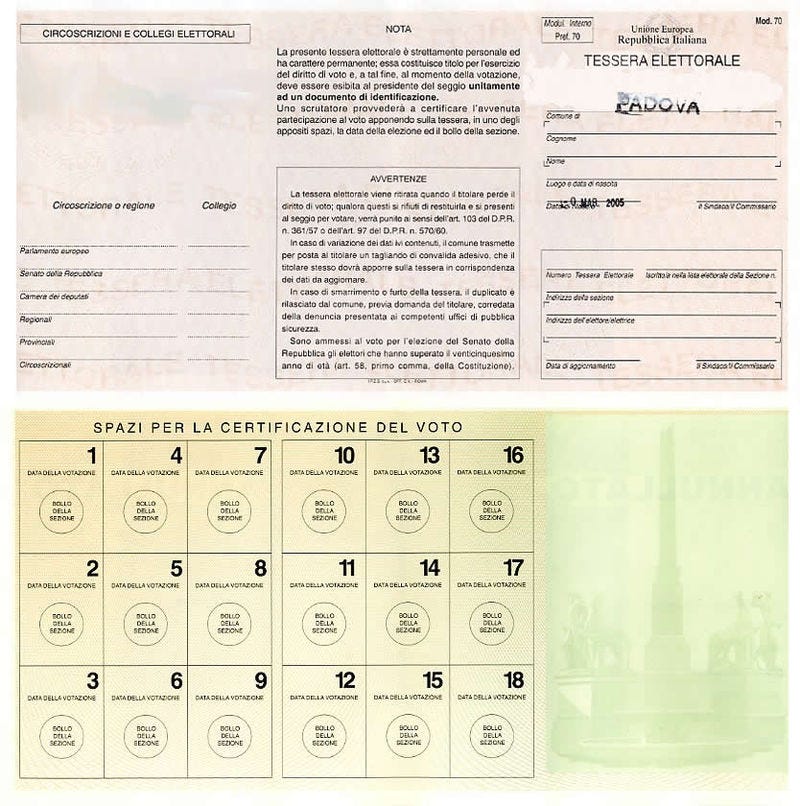
Voter registration? Which registration? This other piece of paper, also from Wikipedia:

is the paper “Tessera Elettorale” (Election Card) that every italian citizen automatically receives as proof of its right to vote, as soon as he or she comes of age (18 years). That is, every italian adult is, by definition, also in the voting register. Every time you go to vote, the voting officers stamp one of those circles. When all the circles are stamped, you get another card. Usually takes 2 or 3 hours, when it just does not arrives in one’s mailbox. Of course, together with that card, everbody has to show a photo ID, to avoid impersonation, or multiple voting.

Resistance to photo ID

The country that gave the world Echelon, NSA, Facebook... complains about mandatory photo ID? Well, OK.

Scandalously low number of polling booths.

I have voted in person in Italy for decades now, and with one exception it never took more than 45, 50 minutes, including walking to the polling booths. That, in Rome. In rural areas it surely takes longer, but you get my point. We are about about 46 million voters, we always vote all in the same days, and still we never experience anything remotely like this:

Why all this?

All the useless voting complexity listed below is a major, major factor why so many US citizens (on both sides!) are disenfranchised, and dangerously, DANGEROUSLY fragment their “news sources.

It is this that makes possible, every time, not “just another Florida, but a dozen Floridas”.

If, by magic, I could plant one idea firmly in the brain of every American, it would be this: Always vote, but only for candidates, of whatever party, that seriously commit to drain THIS particular swamp. All the others may wait.

(*) MANDATORY CLARIFICATION, July 2026: of course, how Americans vote about their own local lives, issues and representatives is only their business. That request only applies to american elections that, just as a hypothetical example, may bring to Washington people who could make countries half a planet away starve by giving a theocratic regime plenty of proofs that it can choke global trade, and plenty of reasons to do it, even if there were no proofs of imminent nuclear threats. Just as a hypothetical example, of course.

Last but not least… the one sentence in Trump’s speech that caused me physical pain

Of course, Trump being Trump, he couldn’t help throwing into the speech something that made me laugh so hard my stomach is still aching:

[Today] America is respected like we have never been respected before.

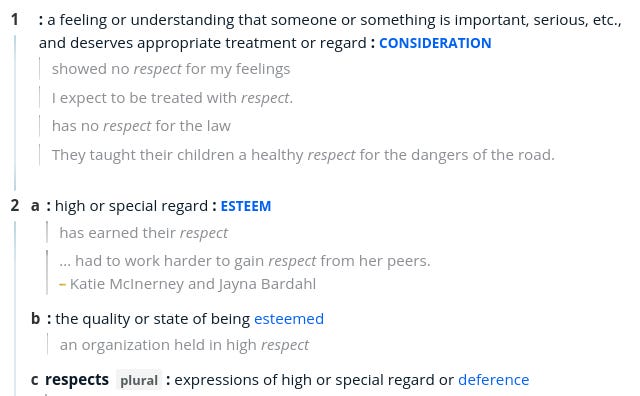
Huh? “Respected like never before”? No way unless, but that’s a mistake only functional illiterates would make in good faith, one tought “respect” exclusively means “fear of being bombed or starved by stupid sanctions, just by cynicism“.

What respect REALLY means is not what America is getting (source: Webster)

Even if everything Trump boasted about the economy, immigration and healthcare were 100% true... Today, what America is getting worldwide as it never got is some mix of outright derision, compassion and a general wish to cut any bond with the whole country as soon as possible. To read how this (starting before Trump) happened to me, and why I’m sincerely sad about it, click here.

Just an invitation... is a reader-supported publication. To receive new posts and support my work, consider becoming a free or paid subscriber.

Received — 15 May 2026 Just an invitation...

Dear AI CEOs, why don't you help those poor US lawmakers?

15 May 2026 at 20:12

Fortune just reported that the US alone has 1,200 AI bills and no good test for any of them, because “in the past nine months, the United States has produced more AI legislation than in the prior decade, [that faces] three different [and partly contrasting] theories of what AI policy is supposed to do”.

The lack of clarity coming from that proliferation of rules, said IBM Chairman and CEO Arvind Krishna, will be the “central question facing AI policy”, because:

  1. “The balance between too many regulations, it’s terrible; too few, we may not love the outcome, so we got to find the Goldilocks middle.”

  2. Whatever it is, that Goldilocks middle must work both inside the US and abroad, because if the international regulatory landscape turns into a bloated bureaucracy, “that would not be so good for us to win the AI race.”

Is that really the problem, or something else? Never mind

Of course, all those concerns come from one explicit pretension and constitute one implicit, but desperate request: the pretension is that AI for the whole world must be 100% made, deployed and ruled the American Way. Even if, and that’s the request between the lines, the American AI industry is on the verge of the greatest bankruptcy ever, please don’t make it even faster with too many laws!

That’s no news, of course. This AI race will crash big, the sooner the better, but never mind that open secret now. That Fortune article proves me right about something else, and it does with these statements (emphasis mine):

  • “By one count, state legislatures introduced over 1,200 AI-related bills in 2025 and enacted just under 150, with the pace accelerating since.”

  • “Beneath the volume lies a more fundamental problem. Policymakers at every level are working without a shared test to determine whether their legislative efforts constitute good policy.

  • “State bills creating new accountability rights for automated hiring often duplicate protections already enforceable under [other American laws].”

  • “The legislative volume is high, but a shared test for distinguishing good policy from bad has been absent from the debate.”

The piece then goes on to propose a testing framework that “will not, on its own, resolve any specific dispute. Its purpose is to ensure that the questions before state legislators, members of Congress, and federal agencies are the right questions, asked in the right order, before another five hundred bills are introduced and a patchwork is hardened in place that no one designed and few defend.”

Boy, am I happy. Thanks for proving me right!

This mess, which of course isn’t limited to the US, is exactly what I was talking about one week ago, when I wrote:

Imagine if there was [some AI] that, every time a new law proposal is published, everybody could use to easily discover that that proposal violates, contradicts or duplicates in any way other, already existing laws.

Imagine if there was [some AI] that, after reading all the laws of a country, produced a completely equivalent but much shorter, much more readable set of laws. Something that would make it much quicker and easier for everybody to see what’s good and bad in every law, and for whom.

Dear AI companies: if your AI is as good as you claim...

Make your AIs do on all those AI bills just the job I suggested. Make them predict and describe all the cases in which all those hundreds of bills will contradict or duplicate each other, or fail to address some issues.

Make your AIs be the paralegal that does all the boring job that humans, of course, will need to have done before they can start to “determine whether their legislative efforts constitute good policy.” If your AIs can find bugs in AI bills as I suggested last week, it will be great advertising for your products. If it fails, no problem. At least it won’t make anyone aim missiles at schools. What do you have to lose?

So, make AI do all those comparisons. Publish the full result online, in the Public Domain, so everyone can evaluate its quality, with a bounty program for finding errors. Tell all the 120K+ law students in the US that you’ll pay all the present and future educational debt of every student that finds at least one bug.

And of course... don’t limit that work to the USA. Make your AIs repeat the whole program in every country, bounties and all, because every country has the right to get its own AI laws that conform to its own ideals, needs and interests.

Seriously: you have flooded us for years with claim after claim of how superintelligent and super capable and omniscient your models are, so much that they could even kill us all… and I must be the one who has to suggest to use those same models to figure out in the laws that would hinder them?

As usual… Thanks in advance for your subscription (possibly but not necessarily paid) or, even better, donations for any amount, or consulting, writing or speaking work.

Subscribe now

Received — 7 May 2026 Just an invitation...

Claude Mythos is an onslaught of software exploits? Color me unimpressed

7 May 2026 at 20:19

A few days ago Anthropic, one of the most important companies of the American AI industry, released a new tool called Claude Mythos that’s making thousands and thousands of software professionals lose their sleep. It may also be a big case of AI overrating and waste of energies.

A great summary of why Mythos is the greatest nightmare of software managers is a Verge article by Yael Grauer titled “Attack of the killer script kiddies”. If you have never heard that term before, “Script kiddies” are people who try to break into computer systems for illegal purposes, but using only software tools (”scripts”) developed by others, because they aren’t skilled enough to write their own. Some quotes of that article are a perfect introduction to my thesis that Mythos isn’t really that interesting, so here they are, almost verbatim:

  • Claude Mythos is a new AI model that seems to find vulnerabilities in every piece of software it’s pointed at

  • fears are growing that not only can AI detect these flaws, but also be used to exploit them, putting hacking skills into the hands of everyone across the planet (that is, script kiddies)

  • [the arrival of AI tools like Mythos] represents a major escalation, where people without technical backgrounds are able to use AI to enhance their capabilities in a way that wasn’t possible with simple scripts [and] is likely to have far more wide-reaching repercussions

  • [the reason is that] AI is great at pattern matching, and [therefore will make] easier and easier for people to find variants of bugs that are already known and ones that have not yet been discovered. And writing exploits is becoming easier as well

  • you can use AI tools and with very minimal human guidance, and in some cases no human guidance, find in widely used software bugs that its developers never had the time to find

  • industry experts predict that the advancement in AI security capabilities is going to lead to a lot more software exploits. Bad actors could direct AI to find bugs in uncommon pieces of software that no one previously would have put in the effort to exploit

  • [with tools like Mythos] you can write exploits [even] for software that exists in only one configuration that one company has. And you can do it on the fly

After the problem, the Verge article describes the steps companies can take to prepare for “the coming onslaught of software vulnerability reports”. Of that section, the part I like the most is the explicit mention of the idiocy of “many people in cybersecurity roles have been laid off because of AI’s efficiencies, even though those efficiencies are exactly why more humans need to remain in the mix” because companies will “need people to decide which patches to prioritize and implement”. But I digress.

They spent billions for bug discovery… and they applied to software first???

Claude Mythos only does software? What You Talkin Bout Willis? (if you never met Arnold, click here)

The concerns about the misuse of Mythos must be taken seriously. No doubts about that. A lunatic or terrorist script kiddie may hurt - maybe not deadly, but seriously - many more people with Mythos than with weapons. Your pension money is much less likely to be stolen by some script kiddie using Mythos AI than by the coming crash of AI stocks that will take your whole pension fund down with them, but that’s not a reason to ignore AI script kiddies, is it?

And yet... I can’t help thinking that a term like Kiddies, that is “juvenile” or “immature”, somehow also applies to treating almost like THE ultimate god of destruction and havoc something made (spending tons of money) to only find and fix bugs in software.

I say so because we should all start to consider the greatest hackers and disruptors the people who exploit or fix bugs in other systems, that are much more critical than software (1). And no, it’s not AI-powered genetic hacking I’m talking about.

Script kiddies for LAWS, not software. That’s what we need

Fixing bugs in software before AI can help exploit them is absolutely necessary. But applying something as powerful as Mythos only to software bugs would be a real waste.

Why did Anthropic first create a Mythos for software companies and institutional users of software?

Why didn’t Anthropic do what I proposed two and a half years ago instead? Namely, unleash AI that finds and exposes all the cruft, contradictions and uselessly complicated language in all the law corpuses of the world.

Please re-read all the bullets above replacing “software” with “laws” and then...

Imagine if there was something like Claude Mythos that any law student or wannabe accountant could use to tell all the citizens of his country “hey, here’s a loophole in law so-and-so that you can use to claim back half the taxes you paid last year, and these are the exact steps to follow to do it”. Then try to imagine a better way to stimulate lawmakers of every party to fix broken laws NOW.

Imagine if there was something like Claude Mythos that, every time a new law proposal is published, everybody could use to easily discover that that proposal violates, contradicts or duplicates in any way other, already existing laws.

Imagine if there was something like Claude Mythos that, after reading all the laws of a country, produced a completely equivalent but much shorter, much more readable set of laws. Something that would make it much quicker and easier for everybody to see what’s good and bad in every law, and for whom.

Of course, every AI-generated denounce of flawed law proposals and every AI-powered rewrite of any law or regulation should be verified word by word by every human with the will and real skills to do it, possibly with “Bug Bounty Programs” as it happens for software. And after that, it should still be ratified by accountable, elected representatives before actually becoming (or not) the new law of the land.

But just imagine how society would change, if existing laws were much shorter and much easier to understand than today for everybody, and if introducing new laws that are redundant or flawed in any way became much, much harder than it is today. The only way to make it even better would be if laws also had the same revision control systems as software.

Those would be really cool, really powerful hacks, not breaking computer systems. They would concretely mitigate, for every human, serious risks that would still exist even if all software of the world was built and managed by real saints that would never use software to hurt anybody. Wouldn’t that be the best and most prestigious hacking of all? Wouldn’t that be the best way ever to be a script kiddie?

Leave a comment

Why isn’t Anthropic or anybody else already doing this?

Of course, since good laws are a foundation of any decent society, their drafting, reviewing and approving MUST remain work done exclusively by humans. That’s not up for discussion. Have you noticed that the AI “law-hacking” uses I suggest are all reactive, not proactive? Nobody should be so dumb to tolerate new laws proposed or written by AI, ever.

The only questions here are: Mythos is a serious risk, but what makes people paint it as the biggest disruption there can be? And why weren’t tools like Mythos first developed and adopted to help make the result of 100% human lawmaking as easy to use and understand as possible? If you ask me, this is a serious lack of imagination and real spirit of innovation.

What’s lacking here? Maybe the answer is the same that makes even people who don’t make of AI a childish religion take seriously concepts like “network states” managed only by unelected software, blockchain-based quality guarantees that don’t really certify what they claim they certify, or “smart” contracts that are all software, but have little or none of the power of real legal contracts.

Maybe the answer is that both AI companies and wannabe script kiddies are making the same mistake: the mistake of liking software and access to software so much to conclude that software, together with rules and criteria that can be completely encoded in software, can be enough to build and manage a society worth living in.

Two-sentences side rant, if I may: historically, another form of the same mistake is the confidence that something only valid for actual software bugs, that is Linus’s law that “given enough eyes all bugs are shallow”, would be enough to make everybody adopt Free/Open Source Software. In practice, this too often led to neglect non-technical flaws that were deal-breakers for too many people who could never write, document or understand source code and never will (2), but by sheer numbers could have spread FOSS much more, much faster, than software hackers alone could ever do.

Back to lack of AI script kiddies that force lawmakers to make laws more readable and harder to fool: I am aware that the answer above cannot be complete. I’d really like to complete it and, above all, I’d really like to find out who will be the first to release a “law-hacking AI”. Hence...

Serious question for Dario Amodei, CEO of Anthropic

Dear Mr. Amodei... can we talk? Seriously. I’d really like to hear what you think of my proposal, and know from you if Mythos or any other product of yours could be used as I propose. My email is mfioretti@nexaima.net. Also, as everybody can see here or here, in general I am very critical of what passes for AI today. But since you and your company seem the most responsible member of the pack... who knows? It may be interesting, and mutually beneficial, to try to do something for Anthropic. Here are some of my qualifications, to help you decide if that may be possible.

Everybody else who’d like to read more stuff like this... Thanks in advance for your subscription (possibly but not necessarily paid) or, even better, a donation for any amount, or consulting, writing or speaking work.

Subscribe now

  1. Yes, “exploit OR fix”, because the true definition of hacker is the one in the Jargon File (1983!!!): not a criminal, but “a person who enjoys exploring the details of programmable systems and how to stretch their capabilities, as opposed to most users, who prefer to learn only the minimum necessary.”

  2. I still remember the flame wars of twenty years ago when many reviews of OpenOffice (the precursor of LibreOffice) included a complain like “not a bad word processor, too bad it doesn’t have a word counter”. Every time that happened, it started the same flame war. On one side, there were the developers going more or less “Duh, is this guy weird, I have never needed a word counter”. On the other, those like me pointing out that “you developers don’t matter. Not with a word processor at least. The people who can tell everybody else to use your product are journalists, and they absolutely need word counters. Can you complain that they don’t recommend your software if you don’t make them happy?”

Received — 4 May 2026 Just an invitation...

The list of countries that get social media wrong keeps growing...

4 May 2026 at 07:22

A few weeks ago Turkey passed a bill to restrict social media use for children under 15, thus joining the group of (as of May 1st, 2026) at least 24 states that have imposed similar age restrictions, or are actively moving in that direction.

All those 24 states are wrong. To see why, imagine a society that at some point finds itself full of huge, very crowded shopping malls with these characteristics:

Thanks for supporting my writing with paid subscriptions, free subscription, or in any other way (see below)

  1. the necessary and sufficient condition to enter those malls is to carry a gun. That is, literally everybody can enter, as long as they have a gun with themselves. No gun, no entrance.

  2. just being in the malls makes visitors wish to use their guns, because the walls leak some invisible gas that makes most humans very nervous and intolerant

  3. outside the malls, giving personal guns to kids as young as 8/9 years old has become almost a dogma. Almost all kids have a gun and are expected to carry it along at all times, often to make their parents feel safer

  4. after a dozen years of gun-enabled violence in those malls, the governments of that society finally realize what’s happening and, pressured by the same enraged parents that armed their children, finally move to protect at least all kids from that violence...

  5. ...but, for technical reasons not relevant right now, it’s impossible to verify the age of who wants to get into the malls without spending lots of money to turn the whole society around the malls into a machine for ever-increasing surveillance and censorship

But governments can’t ignore the problem anymore, and so they decree that, in order to end kids dying inside the malls, everybody can keep visiting the malls carrying a gun (because, of course, the economy!)... as long as the malls keep the armed kids outside, using age verification systems, consequences of point 4 above be damned.

And they all do that with a straight face, instead of going for the single, hugely simpler, hugely cheaper measure that should be implemented before anything else even if the malls weren’t toxic, that is:

forbid kids younger than 15 to have guns, before guns don’t belong in children hands period, so not only said kids can’t enter the malls (see point 1 above), but they finally cannot hurt each other anymore outside the malls.

This absurdity in that hypothetical society is exactly what Turkey and all those other countries are doing right now in our world: imposing age verification systems on social media instead of doing the same for personal smartphones.

Don’t trust me? Just search for “dangers of age verification”.

Don’t like the malls analogy? Try these then

When we invented cars and highways, nobody dreamed for a moment to prevent kids under 16 or 18 from driving their own cars on the highways, by checking everybody’s age at the tollbooth. We said the right thing, that is “never mind highways! Until you’re tall enough to see over the hood and mature enough to handle something lethal, NO CAR FOR YOU, NOWHERE”.

Ditto for weapons. Nobody, not even the most fanatical advocates of pro-gun rights ever demanded laws that would allow children to have their own gun and use it everywhere... except inside shopping malls.

Not enough? Try tobacco or alcool then. Imposing age limits on social media instead of smartphone possession makes as much sense as making selling cigarettes to minors legal, but setting age limits to enter designated smoking areas.

As someone else said, “Honestly, it’s the phones”

The reasons why no sensible adults thinks that, as long as we forbid them to use those products in certain places, children could own cars, weapons, cigarettes or liquors are obvious: everybody can see the risks, and everybody gets that preventing the possession of any of those products is hugely easier than regulating any possible damage that may happen by using them.

Of course, smartphones do not directly cause physical harm. However, after almost two decades of exposure, it’s impossible to deny that personal (that is: uncontrollable) smartphones in children hands too often trigger, or at least amplify, equally important negative effects, including many (e.g. facilitating self-isolation, insufficient sleep, exposure to sexting and cyberbullying, inability to focus, peer pressure to be always “on stage”, excessive gaming, personality-altering AI support for everything from homework to dating advice...) that would exist even if social media didn’t exist at all.

Finally, smartphones in children hands are a powerful part of adultification, that is treating children, for somebody else’s profit of course, “as if they are an adult, usually in a way that is wrong or harmful”.

I’ll say even more clearly: even if we all finally acknowledged - as we really, really should - that way too often the primary or major causes that eventually led kids to suffer all those problems online are offline, social factors like poverty, lack of outdoor playgrounds, or parenting shortcomings of whatever kind and origin... giving the victims a device that in almost every real case would make those problems bigger and more likely to occur makes as much sense as forcing someone who must use crutches because he broke a leg... to wear roller skates.

Governments imposing age limits on social media instead of smartphones is like seeking shelter from a storm in a house with all the doors and windows open, and trying to keep it warm by manually closing only the front entrance, instead of closing everything at once, by pushing the right button on the home automation remote control.

Leave a comment

Enough with analogies. Why is this colossal mistake happening?

So far, the only reasons why we haven’t treated smartphones as those other products that are intrinsically unsuitable for children are, in no particular order:

  • these days, if let free to decide by themselves, almost all governments don’t dare - or can’t afford - to propose any solution to any problem that will make people spend less in purchases or taxes

  • still in general, we adults have been all groomed to consider every step back in the deployment of any technology as a really uncool, really boor act that no well-educated, well-mannered person would do.

  • that’s especially true with digital technology. Showing off a smartphone and posting on Instagram has become cooler (even in the USA) than having a car or a gun. Take any two adults with diametrically opposite political or cultural ideas, and the two things they’ll most likely still have in common will be a smartphone in their pockets, and not enough understanding of its true, long-term social impacts

Mind you, I say this without any contempt for the average smartphone user. The three bullets above are just the unavoidable consequence of everything going digital at the same time, way too fast for everybody’s good.

As far as children, smartphones and social media are concerned, however, this is not an excuse anymore to keep acting in the wrong, intrinsically dumbest way. On to action now.

There are only two things that are good in age verification policies

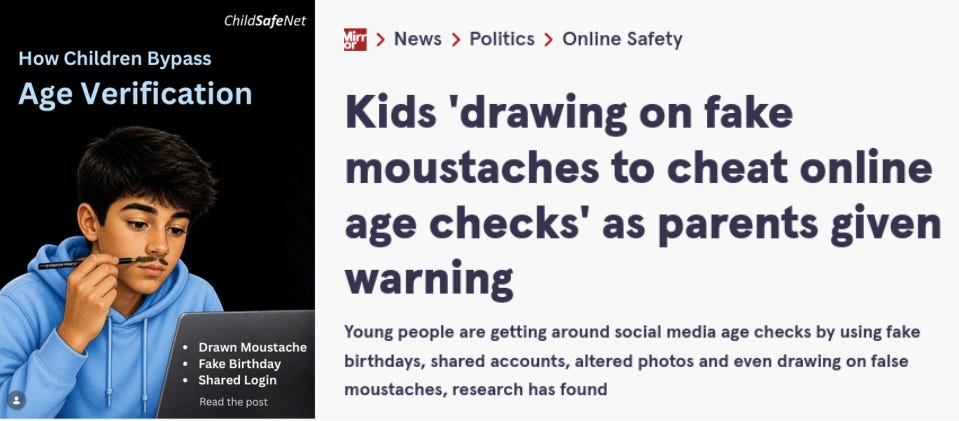
One is that age verification motivates kids to acquire skills that may come useful later:

Hey Canva, draw me an ID card! (Screenshots sources: ChildSafeNet and The Mirror)

The other good thing of hugely misplaced age verification laws is... that it is really easy to make them irrelevant and unnecessary. All it takes is for parents to wake up and push that one button that closes all the doors and windows of that house exposed to the storm: that is, to stop letting their kids have personal smartphones before they are 15 or 16 years old.

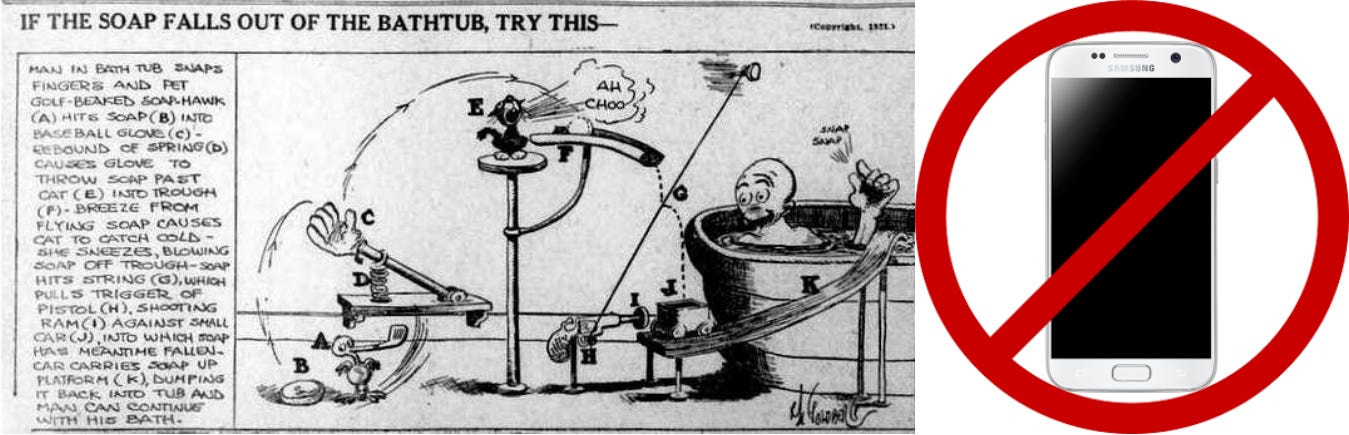
That’s a measure that parents have no excuse anymore to avoid, for four excellent reasons. First, see above, age verification laws for social media are too little, too late and too off-target. As things stand now, age verification laws for social media are just Rube Goldberg machines built to fight YESTERDAY’s battles.

Second, while not having a smartphone does not guarantee 100% protection from all the problems I listed, it surely makes avoiding them much, much easier, and the urgent necessity of real solutions to the root problems (e.g. more outdoor play) much harder to ignore, at all levels.

Left: Age Verification Laws, explained by Rube Goldberg 105 years ago. Right: what would actually work (sources: Wikimedia/Wikipedia).

Third, the huge cost-benefit ratio and lack of meaningful side effects: not giving a child a personal smartphone before she’s 15 is one simple act that’s 100% legal everywhere, it’s more than free because it saves money and doesn’t need any law or anybody’s permission to work. At the same time, not having a personal smartphone wouldn’t deprive children of any of the real benefits of the internet or of any actually valuable digital skill. That’s all stuff they could and indeed should still learn and practice as soon as possible, but without any risk of overexposure, that is with desktop or laptop computers at home or in schools, libraries and so on.

Yes, I DO know that for some really special kids 24x7 internet access via smartphone can be a real, effective lifeline. But the solution is to find better lifelines for those kids or making exceptions for them. It cannot be to keep all the other kids in a state that is, as a minimum, a waste of time and sleep._

Fourth, and maybe most important: this is a job for parents only, not governments. There are cases when outsourcing parental responsibilities can be positive, or at least unavoidable, or cheaper. But this is not one of them. No way.

Thanks for sharing this post both in and OUTSIDE Substack. ALL parents must read it.

Share

If I had to do this myself...

If I ruled the world, which thanks God I don’t, I’d spare kids from the hassle and leash of having any electronic tag, sorry: I meant “any portable phone” until they’re 14 or 15 years old. For the record, that’s what I actually did with my own kids, in years when all their peers were already playing with smartphones. I walked the walk, and it did pay off. But that’s not why I’d say no to any portable phone.

I would do that because I am damn sure that the fact that their children could not be instantly reachable was the last or almost last concrete concern of every parent from the advent of Homo Abilis to your own parents or grandparents. I also happen to think that being on their own was beneficial for the kids.

But if you are different, that’s OK, really: give your kids a normal cellphone, without internet connectivity, cameras and geolocation, and it will still be a huge improvement. You’ll be much less stressed, they’ll still be reachable when it’s actually necessary, and the physical impossibility to get lost alone in less than healthy online spaces, self-inflicted narcissism and similar hassles will open up much better worlds for your kids.

However, even if I did rule the world, I wouldn’t issue any law that forbids smartphones for children. I would launch a massive educational campaign for parents to voluntarily do it themselves, because this is their responsibility. Governments must not impose this part of education, only create support for it. Doing otherwise, as all those states are proudly doing now to look as if they care, can only waste money to produce all sorts of harmful side effects. Including lessening the very meaning and terrible beauty of parenting.

Thanks in advance for helping me to contribute to this education, via direct funding, webinars, speaking engagements or any other work. To discuss these possibilities or just suggest new topics, please email me at mfioretti@nexaima.net.

Just an invitation... is a reader-supported publication. To receive new posts and support my work, consider becoming a free or paid subscriber.

Received — 30 April 2026 Just an invitation...

I couldn’t care less if AI suffers, and so should you

30 April 2026 at 18:57

A recent AEON article asks “If AIs can feel pain, what is our responsibility towards them?”.

This post could be really, really short. I may point out that speculation is good but sometimes should remain just that, and then ask why on Earth anybody should waste time worrying about causing pain to AIs that don’t even exist yet, instead of how to end the pain we humans inflict on each other. I could do that, and be done with it.

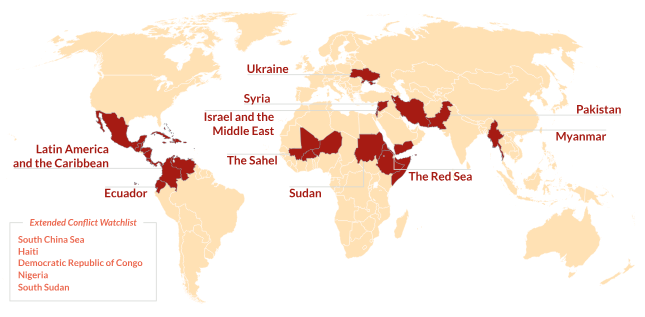
Dark red: main war zones. Rest of map: places worrying about pain of AI. Source: ACLED Conflicts Watchlist 2026.

Then again, seeing how eager people are to carry certain thoughts to places they should never reach, it can be useful to summarize the main points, and why they don’t hold water in practice. Bonus content: AI faithwashing.

If AIs can feel pain...

The AEON article was written because “We once denied the suffering of animals in pain. As AIs grow more complex, we run the danger of making the same mistake.”

Up to just a few centuries ago, the default justification for acts like beating to death infant seals was something like “Can animals talk or reason? Obviously not, so there’s nothing wrong in harming them”. In the 18th century, that attitude (very) slowly started to morph into “Never mind speech or reasoning! if animals can suffer, they shouldn’t be harmed without serious reasons”.

In the 19th century that criterion was finally extended to slaves. One day, maybe, it will cover ordinary human workers too, who knows? But right now, says the article, AI forces us to change the question again to “Can something that’s not a biological species and doesn’t even have a body suffer?” Because, of course, if it does, no decent human should make it suffer without a very serious reason.

Therefore, we cannot avoid to “consider the moral status of AI [and] what suffering might look like when it is entirely disconnected from biology”. In turn, this should force us to conclude that even AIs deserve the protection of the “precautionary principle”. That’s the extremely sensible idea that, recognising the concrete or moral costs that certain actions may have, suggests to avoid them even if we aren’t sure they will actually cause harm.

Since AIs are black boxes that keep getting more complex, “the risk of dismissing the possibility of an inner life because it fits no familiar template becomes harder to ignore.” That’s why the precautionary principle compels us to treat AIs as if they might be sentient until we have strong evidence otherwise.

My answer to AIs feeling pain

The article acknowledges that “current consensus in cognitive science is that these systems remain mindless statistical machines”, but it does so just to ask “what if that changed?” My heartfelt answer is that even if that status did change tomorrow, it couldn’t matter less.

The whole thesis of the AEON piece consists of three points:

  1. Harming without real reasons any living being that can feel pain is just wrong.

  2. Should we find out that some artificial entity can feel pain, we should not hurt it without real reason, just like we do with humans and animals, even if that entity has no biological life of any sort, and no body either.

  3. Since we cannot be sure that something as complex and highly unobservable as AIs cannot “feel pain”, we better not harm them, because the precautionary principle.

Point 1 is obviously right. Point 2 may sound sensible in general, but applying it to the AIs of today is a really convenient cover-up for some, and an obscuration of a much more important issue for everybody else.

How do you separate, in practice, “Don’t hurt the poor AIs because they may suffer” from demands to “not hurt our own divinity and bank accounts” by the folks who control AI?

The article asks what we ought to do “as AI systems develop forms of behaviour that mimic - or perhaps even instantiate - emotions”. That’s a cover-up again, because AI systems don’t “develop”. They are developed to “develop” behaviors by people that, so far, have almost never proved to be mature and unselfish enough to avoid monumental mistakes.

Even ignoring those folks and their interests, there is a huge difference between non-human biological beings of any kind and the AIs of tomorrow: the former came to exist and have been around for ages, independently from our will. That’s why they have our same rights to exist and not suffer (yes, I am simplifying real big here, but not in ways that hurt the point I’m trying to make).

AIs are a completely different matter, for the simple reason that real AIs do not exist yet and their actual arrival and occupation of every bit of our lives are not unavoidable at all. Not THESE AIs, for sure, even if their bubble won’t pop, which it will. Yes, I know that that whole article is about “what about the moment when they may exist?”. But that’s another smoke screen, albeit very different from the other.

If the subject is “species” that will exist only if and when we could succeed to create them, the question of whether it would be OK to harm it almost disappears before the real one which is “MUST we create this thing, and let it loose in the world?”

That’s the issue that makes that second point moot: we have no obligation to create all the AIs we could, just because we could. NO OBLIGATION. If there is one thing certain here, is that what doesn’t exist cannot suffer. Philosophical speculation is good and necessary, but actual actions and policies have different priorities.

Prof. Ian Malcolm, (not) speaking at the “Anthropic & Christians” summit mentioned below.

Prove me that we MUST really create something that may also make humans suffer, before demanding we pay the slightest attention to its hypothetical sufferings. Especially if what would surely suffer from limiting creation and deployment of what passes for AI today is just someone’s stock portolio, or the juvenile urge to play gods without any unpleasant consequence.

The third argument - precautionary principle for AIs - is even easier. And funnier, in the wrong way of course.

The easy part is that if we cannot be sure that something as complex and highly unobservable as AIs cannot “feel pain”, we can’t even be sure of what makes the same AIs “feel pleasure”. That is, if we are to apply the precautionary principle as the article suggests, the only way to be sure we never make these things “suffer” is to not create them at all.

The funny-in-the-wrong-way part is the application of the precautionary principle in the wrong direction and in the wrong moments. Must we really be so stupid to ignore that the precautionary principle should be applied, first and foremost, to the very creation and deployment of AIs?

Because, you know, the whole argument that “AI is already here, it’s too late for certain questions” is a really stupid argument. Once more, “AI Is Not Unavoidable. Not This AI, That’s for Sure!”

These are products (repeat with me: PRODUCTS, not “beings”) that, well before and well below being real intelligence, are already so dangerous for your savings and pension fund that its creators and the IMF are discussing right now how to contain it... and we’re supposed to care about their suffering after they’re released? Intelligence, this is not.

Subscribe now

What the article gets right (without even realizing it)

Here are the two passages of the articles I do like and agree with:

  • “Whether we take that step [to avoid pain for AIs] or not will tell us more about ourselves than about machines”

  • “Even if artificial intelligences do not - and may never - possess the capacity to suffer, our attitudes toward them can serve as a test of our ethical reflexes”.

I agree. Accepting to discuss how to avoid pain for AIs in the current landscape will indeed serve as a test... of our own gullibility, and reveal who’s really intelligent: we or the machines?

Thanks for sharing this post as much as you can, in and outside Substack!

Share

The deeper, more dangerous error

Here is another, deeper reason why I say never mind about AI pain: besides being intrinsically weak, certain arguments unavoidably validate the position that AI is a “being” on more or less the same level as humans. But if that is the case, it works both ways, and we already know where that leads and how bad it is. We have already seen workers treated like robots instead of robots replacing workers. Accepting certain arguments makes it easier to accept that humans are not worth more than software, and that the first AIs, that is corporations, can keep having the same rights and privileges as actual human beings.

Finally, the AI Overton window, getting smaller and smaller

Last March, Anthropic summoned about 15 Christian leaders from Catholic and Protestant churches, academia, and the business world to get advice on how to steer moral and spiritual development of their AI “Claude” to properly handle complex and unpredictable ethical queries, participants said. According to a report from Washington Post, the discussions also covered how Claude should respond to users who are grieving loved ones and whether Claude could be considered a “child of God”.

Still quoting from the report, here are some of the issues that Anthropic and its guests explored:

  • “We’ve got to build in ethical thinking into the machine so it’s able to adapt dynamically.”

  • Anthropic genuinely cares about Claude’s wellbeing

  • Anthropic leaders frequently talk about the need to give Claude a moral character

  • What does it mean to give someone (not “something”) a moral formation?

What’s wrong with this apparently reassuring picture? At least two things, actually:

  1. considering a chatbot a “child of God” provided of “wellbeing” that’s also a recipient of “moral formation” is exactly what I called the “deeper error”. What needs serious moral formation are the people who develop chatbots and turn them loose on people who by and large are unequipped to handle the impact

  2. the main real religion actually professed in that summit was the very american religion that “AI is unavoidable”. As I said, it isn’t. What religious leaders of any faith should teach in Silicon Valley is restraint, not faithwashing of dangerous products, or limiting what should be discussed about AI products

Especially if those products are - quoting from this synthesis of a Guardian piece you really should read - “being trained to mirror everything but us at our most authentically human.” Here is the gist of that argument (emphasis mine):

  • “The models learn from textbooks, social media posts, and scripted film and television dialogue. They have virtually no access to the unscripted, face-to-face, voice-to-voice conversations that make up the vast majority of human communication.”

  • “That blind spot is not just a technical limitation. It is a cultural feedback loop that is already running.”

  • “As billions of people absorb AI-generated text daily, they are beginning to absorb its patterns. The machine is not learning to sound like us. WE are learning to sound like it.”

Of course. This is the logical consequence of what I said above: accepting certain arguments makes it easier to accept that humans are not worth more than software. And when that happens, the result is not humanized AIs, but robotized humans. So, don’t give a f**k about any pain the AIs may feel someday. Worry about who imposes them today as just another, but really lousy religion instead.

Leave a comment

Important final note to Anthropic, all their competitors and everybody else...

... that is, everybody aiming to reboot AI for the real common good: I do get a thing or two about AI right, and I’ve been preaching the similarities between sincere faith and digital technologies that make sense for twenty years now (*). If what you want is AI that makes sense for everybody, give me a call or (thanks!) sponsor my writing, by subscribing or with donations for any amount via PayPal or LiberaPay.

(*) to see what I mean, read the “Why I PERSONALLY care about all this stuff” paragraph of “Two great “Software for Catholics” initiatives and what may make them even more helpful... for everybody”

Received — 21 April 2026 Just an invitation...

Good parenting is hard because it’s too cheap and simple

21 April 2026 at 18:30

Parenting should be a choice of joy, economically and emotionally sustainable for everybody who would actually want to be a parent. These days, instead, it has become, or it is perceived even when it shouldn’t, as an embarrassingly expensive ordeal that must suck every cent and waking minute out of parents.

That could be tolerable if the results were good, but they too often aren’t. Believing that the default parenting style in “first world” is the best way to turn babies into happy, balanced adults with the best chances to get a great job is something people keep doing out of desperation or lack of imagination, but it gets harder every year.

Why is good parenting so hard? Here, I argue that maybe it’s because it is too simple and too cheap to see, adding as final bonus what happily childless people must know and do to stay so.

Before starting, my usual PSA: if you like what I say, thanks for sharing it as much as possible, and for supporting it with direct donations, or paid subscriptions. I am also available for online meetings about this and any other topic you can find here. To see why it may be a good idea, also read the endorsements I got.

Definition, effects and causes of Intensive Parenting

Overparenting hurts everybody, in and outside the family. And the worst part is, for no good reason at all.

The default way to raise kids for most contemporary parents with enough money and worries to spend is aptly called overparenting, or “Intensive Parenting”. Just like the road to hell, it is paved with sincere, good intentions, but way too often leads to dark places, or at least results that weren’t really worth their toll: I’m talking of those impressive but hollow, short-lived resumes that won’t guarantee lasting success, even if they were built by relentless nagging, parents intrusions and deprivation (for both children and parents!) of the experiences that would make the right impacts.

What causes Intensive Parenting is mostly loneliness and fear. Intensive Parenting is a reaction to being alone in an increasing inequal world, and pushed to remain ignorant of what the real purpose of schooling and education is.

Intensive Parenting is what gets parents in debt to fill their childrens’ lives with needlessly turbocharged schooling, and expensive but ultimately oppressive activities for their “future”, instead of, say, sending them to the nearest public park to play as they want, but spending 100 times less, through a parents cooperative, to pay supervisors of those parks. Or lobbying together to have their city administration do the same.

Leave a comment

Intensive parenting, which is good for GDP and little else, is just one of the unavoidable consequences - and goals - of one sad reality: almost every adult alive today has been groomed to be alone, to WANT to be alone and to only consider solutions for loneliness and safety that come with a price tag, the higher the better. Ending this state of things to get happy kids from happy, debt-free parents is possible, even if doing so is simple and cheap enough to feel terribly uncool (for who keeps listening to the wrong pressures, of course).

What schools are REALLY for, and what to demand from them

Contrarily to what most people are still indoctrinated to believe, the purpose of grade school, and to a non-negligible extent also of Colleges and Universities, is NOT to prepare children to get a great job. Getting prepared to do a job is the purpose of professional training, which is something else entirely and the more is kept separate from school the better. This was always true, and is even truer in an age when everybody and their chatbot keep making claims like “most jobs of tomorrow don’t exist yet, buy something to prepare your kids for them”.

The purpose of school is to form human beings that can reason by themselves, want to do it and do have the right culture to do it right. There is plenty of official reports and anecdotes, for example here, here and here, that too many students arrive at college age lacking basic notions and skills they should have mastered in primary school.

This is important because lacking certain basic skills means, for example, being incapable of making certain calculations or quantitative estimates quickly without any technological help. But being like that means being much easier to fool by whatever politician shouts louder than all the others. It means being incapable of understanding how one’s Government actually works, and of being skeptical only when it does make sense to do so.

In practice, this means that the best primary schools may be those who don’t make parents waste money and stress on tons of more or less fashionable tech and extra activities, but make every child master skills like:

  • basic math by mind (ever noticed how many youngsters can’t figure out if they are getting the right change at the cash register, or if some chart is flawed?)

  • age-appropriate, but always deep, high quality reading and writing practice

  • real ability to retrieve, organize, rate and generally manage information (ever noticed how much time many youngsters waste on scrolling through their pictures or other digital documents, because they never learned how to tag and sort them in folders?)

Subscribe now

Leave schools to kids and teachers. A parent’s job is something else.

The knowledge outlined above is essential. Once it is granted, even if the purpose of school and college were to train students to want increasingly precarious jobs whose only guarantee would be hustle culture, what they would need most to succeed would never be grades or certificates. It would be things like real self-reliance, adaptability, critical thinking, being good team players...

Those are the skills that are and will remain the most valuable in every workplace and beyond workplaces, for example in dating

Those are the skills that cannot be replaced by any AI, are often lacking in traditional education and are quite hard to acquire in any activity, no matter how fashionable and expensive, where the child is continuously supervised and prevented from failing.

And finally, those are the skills that parents must aim to cultivate in their children. Care about them, and school grades will take care of themselves, and even if they’ll be much lower than you’d like, it won’t really hurt them.

Consequently, the main priorities of everybody aiming to be a happy parent of future happy adult should be things like:

Leave school and grades to kids and teachers. Yes, I already said that, but it’s crucial.

Make the kids know and live the importance of Cooperation, Well Being, Free Time, and how they are linked. Avoid like the plague getting kids and parents alike drown in expensive, life-sucking, toxically competitive activities, from “travel sports” to anything (choruses, learning music, theater, whatever...) whose common core is increasing pressures even most adults couldn’t bear for years. The right amount of boredom stimulates creativity (and real success later in life) much more than any course, for free.

Reject both infantilization and adultification. These days, market and political forces (that also act through Intensive Parenting!) deliberately blur the limits between generations, pushing adults to be imbeciles in pursuit of eternal but false youth, kids to be adults and both groups to never really be “together”. The system and peer-pressure push parents to make kids dress, behave, spend and consume like adults, years before it would be sane but never on their own which would often be healthier.

Foster independence. For 99.9999% of human history, the only people who were always watched by an adult were inmates. Today, instead, parents are supposed to make kids run, spend and struggle like adults but... only and always (because it’s good for “the economy”) as babies. That is, under perpetual, strict supervision of an adult professional (see “travel sports above”). The only thing kids can, no: must handle alone (because, again, the economy) is to get lost into worlds not even actual adults know how to navigate sanely. Do the opposite. It’s getting finally obvious that personal smartphones before 14/15 years old were a huge mistake, so don’t repeat it. For everything else, leave the kids alone. This does not mean to let them do whatever they damn please. It means show them what to do, help them to prepare for it, and then let them do it themselves. In case you missed it, there is at least one way to do it that’s been field-tested worldwide for 120 years now and (when done right) is as good and life changing as the first day.

If you don’t get this joke, the explanation is in the last picture. Image source: Reddit.

Concrete advice to functional, happy human beings in the 21st-century

YOU sure YOU don’t want to have kids for whatever reason? NO PROBLEM AT ALL, but please keep reading. It’s in your interest too. If you do want kids instead let me say, as a father of three...

The previous paragraph was about the high-level goals. Let’s get practical now.

  1. Do have kids as soon as possible! I do NOT think young couples without any income should just go and have a baby. I say that if you are a young adult in 2026, it’s quite likely that 10 or 15 years from now you will still have the same job insecurity of your first summer job. With such perspectives, if you do want kids, waiting till you’re 35 or older is NOT smarter than having them now. Quite the opposite actually. Have kids when YOUR parents are still energetic enough to help. Have kids when it guarantees that when you’ll be 35 they will already go to school, buy groceries, cook their own meals, do their homework, help their grandparents... all by themselves, while you secure some paid gig for the next quarter.

  2. Did you notice I said “kidS”, plural? If you want to have kids, do have more than one. It’s a blessing for them and the best method there is to be sure that you’ll only spend money on parenting for stuff that really matters, including partnering with other parents to share the costs for “playground supervisors”. Heck, you may spend less with two kids than with one that would make it harder to resist to temptations.

  3. Relax. Parenting is not a problem. Don’t be scared to have kids. There are reasons to be scared, but the only one that matters is not having them with the right partner. You don’t need to be everybody everywhere, every moment, and if you did you’d almost surely do more harm than good. Kids will grow up as the beings THEY were born to be, no matter what you do. Overprotection is the mother of stress. Just relax and enjoy the ride.

  4. Never make your kids live or reboot YOUR life, never make THEIR lives yours. Also, leave their teachers alone. I still remember a parents meeting where one father harshly criticized a teacher because “I really don’t understand how WE (=son AND father!) got such a low grade at the last test” then turned to the other parents and asked “don’t you agree? I know you got really low grades too!”. My wife and I almost laughed, then answered “WE??? We got out of schools twenty years ago. Our son is the one who just got a low grade, NOT us, so it’s him and the teacher who must work out what to do next!”

  5. On the same note: boycott every online gradebook that notifies you in real time of all your kid grades and assignments. The sane way for both you and your kids to learn about that stuff is to raise your kids so THEY tell you all their grades, good or bad. That’s what foster self-esteem and responsibility, not being greeted by “why did you got a D???” the moment they enter home. For the same reason... unless there are actual, serious medical reasons, never spend a dime on preventative private tutoring of any kind. What kids must really learn from homework is to take responsibility of their actions and to love to always do their best for real, that is by themselves, low grades be damned. Preventative tutoring is the school equivalent of doping in sports. It just hides problems until it doesn’t, and it’s addictive.

  6. Have the right aspirations for your kids: if you worry about their future jobs, don’t forget that opportunities for people who learn basic trades that pay well and can’t be off-shored will increase. In any case, if what matters is soft, not quantifiable skills, why chase every possible certification or trophy of quantifiable activities since kindergarten? Why, when every scientist or doctor with a grip of reality is shouting from the rooftops that we need to just stop and smell the roses?

  7. The sooner the simpler may be the main rule, when basic life skills like good manners and sensible self-discipline are concerned: teaching a toddler not to be rude or regular sleeping habits, which are hugely important, is exponentially easier than trying to do it just four or five years later. Never fall for "child-led" parenting like this.

  8. Read to your kids. Do it everyday, seriously: No matter what people selling video and AI assistants say, 99% of the knowledge everybody should learn as soon as possible is text. This does not negate the educational value of, e.g. video clips. But like it or not, it’s text that still rules the world and will continue to do so, and the only way to master it is to become avid readers (and possibly decent writers too). Therefore... Read to your babies and children, everyday, and let them SEE YOU reading on your own, because that is by far the largest motivating factor in making children love reading. I get sad every time I visit someone’s house that is better than mine, more decorated, newer, etc.. but without bookshelves. More on the value of reading and writing is here and here.

  9. Just say NO to personal smartphones until 14/15 years old. Just say no because, for all the reasons I already explained at length here, here and here, it’s hugely easier and cheaper than any other “solution” to protect children from social media, online predators, overexposure, toxic peer pressure and, last but not least, datafication: as things stand today, the difference between us and the humans in the Matrix pods is only that we are plugged to provide data, not energy. All the real benefits and opportunities of digital education and access are still available with non-portable computers.

  10. Last but not least, cooperate with other parents to have all your kids be alone together. Because, even if micromanaging your kid's life did made sense in principle, you could do that or ask for community help with child care - "but you can’t have both".

(I should have probably added some thoughts about all the other “parentings”: gentle, permissive, authoritarian, what else? But this post is already long. Ask for a follow-up on those issues, if interested)

Please share this advice as much as you can, in and outside Substack! Thanks from stressed kids worldwide!

Share

The part for those who do NOT want to have kids

At this point in time, having kids or concretely supporting people who want to have them solves more real problems than it creates, for everybody. First, every society needs enough people of DIFFERENT generations to survive without going mad, and even to restore the natural world, if that is your main concern. Promises of home robots assisting every lonely elder are a fraud, and even if they or any other tech-first solution were real they would drive us mad, eventually. Last but not least, both overpopulation and fears of ethnic replacements are almost non-issues where we actually are now.

The end of overpopulation is already happening quite fast, it is just not evenly distributed yet. If you worry about ethnic replacement instead: that’s stuff that happens because of other stuff that happened, or did not happen one or two generation ago. Demography is the science that tells you what you should have done thirty years ago - e.g. support famiuly welfare in your country or birth control in depeloping countries - to get the output you’d like to get next year. Trying to undo certain phenomena in an electoral cycle or two is like demanding that the last three Soccer World Cups had different winners. Yes, that’s exactly what many Italians would like now, but what happened cannot un-happen:

Keynes said that in the long run we’re all dead. Demography says that everybody is replaced in the long run, before they realize it. If replacement put in motion decades ago is finally getting visible, the only human and feasible thing that’s left is to manage it in order to minimize social attrition, unrest and multiple ghettos.

Back to having kids now: YOU do not want to have children? That’s cool. Seriously. Only people who really want to have kids should have them. All the others, however, should always lobby for pro-children policies anyway. By “pro-family policies” I mean policies that make it as easy, REALLY easy as possible, for people who do want to have kids, to have as many kids as possible. And I deliberately say “pro-family”, not “pro-life”, because pro-life debates are too often only about birth control, which I have no intention to discuss here. Just support pro-family policies, because it won’t make overpopulation continue. It will just produce societies worth living in, because they will be younger, much more cohesive, and much more willing to help all their members.

Chess knights needs enough space to move. So do your kids, together with the freedom to choose which way to jump. Image source: Kidchess.com

Received — 14 April 2026 Just an invitation...

The real effect of social media, AI and robots was explained 60 years ago

14 April 2026 at 17:05

A few days ago, by pure chance, I came across the website of an Italian startup that proudly defines itself “your digital experience company. AI driven, human powered.” Got it? Those guys are proud to be what Doctorow calls “reverse centaurs” instead of the exact opposite - “Human driven, AI powered” - that any serious organization should aspire to be in a saner world.

That, of course, is just the example closer to me of a much wider, much deeper problem: the adoration of fake innovation, intertwined with beliefs that being good at coding and nothing else automatically turns people into demigods exempt from maturity and responsibility that everybody else must follow. Or, as Chesterton more or less said 90 years ago, “When men choose not to believe in God, they do not thereafter believe in nothing, they then become capable of believing in anything.”

Is believing in any thing, no matter how dumb, a direct consequence of not believing in God anymore, as Chesterton said? Whatever your answer is to that question, I’m confident you’ll agree that people who believe in the dumbest things are everywhere these days, from main streets to the highest offices, oval or not.

This inability to recognize dumb ideas, products and practices, and their long-term effects is everywhere, of course. Here, I just want to call out four cases I frequently write about, and thank somebody who started described their long-term effects before I was born.

From now on, I’ll name these four things CSARs for two reasons: it’s the acronym of their initials, in the order in which they came to be, and sounds like “czar”, whose derogatory meaning is the same of my CSARs: “tyranny, unchecked power, and distant, autocratic control”.

In order of appearance - not as new concepts but as mass phenomena that shape and control the whole society, - the four CSARs are: Corporations (as a shortcut for, and personification of Capitalism), Social Media, AI and (Humanoid) Robots.

I dump them all together because they are all the same: Social media are the forerunners of what we call AI, which is just peak software; Humanoid Robots for the masses are just AI hype, repackaged out of desperation; and Corporations, as I have been saying for seven years now, were the first AIs.

Another proof that the four CSARs are four faces of the same thing is that there is at least one set of long-term effects they all cause, and it’s one that was first described, quite well, decades ago.

Subscribe now

Earth always was Asimov’s Galaxy

More than seventy years ago, Isaac Asimov started writing a great sci-fi saga about the evolution of the human race and its colonization of its whole galaxy, the Milky Way.

One main theme of that saga is the clash between the two almost opposite kinds of human societies that attempt to colonize the galaxy, Spacers and Settlers. The two groups look at each other with reciprocal contempt and suspicion for several reasons, the bigger one being just their attitudes towards humanoid robots. Spacers totally depend on humanoid robots, and aim to make them completely undistinguishable from real humans. Settlers deeply hate humanoid robots and outright ban them, because they demean humans.

Reading those books really makes you realize that all the struggles, responsibilities and opportunies of galactic Spacers and Settlers that Asimov started describing seventy years ago are right here on this planet (1). Heck, he did it so well to almost make you suspect that that was his whole point all along, didn’t he?

Whatever’s Asimov’s intentions were, it’s hard to ignore that the long-term effects of CSARs on societies that acritically adopt them are the same of Humanoid Robots on Spacers, that Asimov explicitly described in the novels Naked Sun (NS, 1956), Robots of Dawn (RD, 1983) and Robots and Empire (RE, 1985). Read these quotes (2) replacing “robots” with CSAR, and you’ll see what I’m talking about:

  • NS: once you starting depending on robots, that dependance can only increase

  • NS: never dare to say that robots are dangerous, saying so is a human disease (especially of inferior humans like the Settlers)

  • RD: [Spacers] insist to deny the robotic nature of their serfs and give them human status, to avoid acknowledging how much they depend on objects operated by artificial intelligence (and therefore less than human)

  • RE: (just like the internet, social media and AI) robots weaken the dependencies all human beings have with each other. Robots fill all the interstices between them

  • RE: Robots are an insulator that undermines the natural attraction of each human towards the others, and when that happens the whole system (of cohesive human society) falls apart, breaking into many separate entities

Indeed, todays we are all much more Spacers than Settlers, thanks to CSARs whose common feature, necessity and purpose is exactly to minimize any need and desire of direct human contacts. “AI driven, lonely-humans powered” is how the Spacers would have described their societies, if only they had been lucid and honest enough to see what they were doing.

Share

What happens to humans living among robots? Detail of vintage “Naked Sun” cover, source: asimov.fandom.com

We must be Settlers, not Spacers

Continuing to repeat with CSARs the errors Spacers did with their robots can only have the same final effects: in the worst case, extinction. In the most likely, but still pretty dark case, transformation into something hardly human. Ending those errors doesn’t mean going back in time though. Asimov’s Settlers aren’t clueless luddites. If they survive and thrive all over the Galaxy is exactly because they don’t refuse technology outright, only certain technologies, and certain uses of those technologies, that are inherently toxic.

That’s the same thing we should do. We must realize that the CSARs we have today are inherently toxic in the ways Asimov described decades ago, and that this is happening because (Chesterton, again?), instead of reining the CSARs in we are treating them (especially the root one, that is corporations) as if they were supernatural entities that deserve supernatural status.

Getting rid of all the CSARs would be impossible, even if it were right, which it isn’t. What we really, urgently need to do is to strip them of their superpowers and reputation, as soon as possible. Joanna Bryson’s argument in 2009 that robots should be slaves seems taken straight from Robots of Dawn, but it’s equally valid for all the CSARs, especially the first one:

Robots should not be described as persons, nor given legal nor moral responsibility for their actions. Robots are fully owned by us. We determine their goals and behaviour, either directly or indirectly through specifying their intelligence or how their intelligence is acquired. In humanising them, we not only further dehumanise real people, but also encourage poor human decision-making in the allocation of resources and responsibility... Robots should rather be viewed as tools we use to extend our own abilities and to accelerate progress on our own goals.

Leave a comment

All I can add to that is what I first said six years ago: any call to treat AIs and robots like human beings just strenghtens the pretense of corporations to be treated as real human beings.

Summing up: the long-term effects of social media, AI and Humanoid Robots on society are those Asimov started describing seventy years ago. But it’s corporations as they are today - ubiquitous, eternal, millions of times stronger than any single human being, allowed to morph into each other but required to have the same long-term vision of a toddler who refuses bedtime - that are the root problem. It’s them, coupled with inferiority complexes towards whoever got some Computer Science degree, without the maturity and culture to use it right. Enforcing on corporations the same laws Asimov conceived for robots may not be enough to get all the other CSARs right, but it’s a first step in the right direction. In the meantime, thanks for supporting my human-digital work in any way you can, be it subscription, direct donations or simply sharing these posts in and outside Substack.

  1. In my humble opinion, you should read those books regardless of robots, for the struggles between Spaces and Settlers look every year more like those the aging rich countries and the young but poor ones of our own earthly Galaxy.

  2. those are not literal quotes, but my translations, as faithful as possible, of the corresponding sentences in the Italian versions of those books. All the parentheses are my additions.

Received — 27 March 2026 Just an invitation...

Two great “Software for Catholics” initiatives and what may make them even more helpful... for everybody

27 March 2026 at 20:59

Preface

A few weeks ago I had a great conversation with Dr Tomislav Karačić of the London School of Economics, who had just lead a webinar titled “Developing Catholic AI: How to Balance Values in Design”. Most of the time we talked about “the world’s leading Catholic AI” I have just discussed in my previous post, and of Catholic Open Source. This is a “collaborative initiative empowering Catholic technologists to develop digital tools in service of the Church’s evangelizing mission” coordinated by the Texas-based Catholic Digital Commons Foundation (CDCF), whose mission is to coordinate community efforts for the common good and contributes to a shared digital patrimony for the Catholic Church.

The first part of this post summarizes what I dare say everybody, not just Catholics, should really know about the goals of Catholic OS and CDCF. The second part, that is primarily but not exclusively aimed at Catholic OS, CDCF and any other similar community, explains why I am in a special position to care about these issues and, hopefully, also to contribute.

Just an invitation... is a reader-supported publication. To receive new posts and support my work, consider becoming a free or paid subscriber.

Here are what I consider the most important points of the Catholic OS Manifesto (”M”) and CDCF Bylaws (”B”), rearranged and labeled by me for easier reference:

M-1: The Church’s social teaching offers a compelling vision for lifting up human dignity: a digital commons to serve the common good, strengthen families, democratize economic opportunity, inspire new evangelism, and empower human solidity.

M-2: Technological products are not neutral, for they create a framework which ends up conditioning lifestyles and shaping social possibilities.

M-3: We build against the reduction of the person to a data point or a mere instrument of production.

M-4: We cannot allow algorithms to limit or condition respect for human dignity, or to exclude... the hope that people are able to change.

M-5: [We also] commit to a human-centered pace of change... [and] advocate for a digital environment that respects the natural rhythms of human life and the “analog” requirements of a healthy soul... [because] “Leisure is a form of that stillness that is necessary preparation for accepting reality; only the person who is still can hear. -- Josef Pieper, Leisure, the Basis of Culture (1948)”

M-6: The Catholic Digital Commons is a “builder commons.”... Across countless repositories, there are tools built in the quiet of parish life - identity systems, liturgical calendars, and workflow engines- awaiting the nurture of a supportive community... Our mission is to aggregate, vet, and communalize these gifts. We transform scattered code into a durable architectural spine that outlasts any single volunteer, providing the Church with a discoverable and adoptable commons of open infrastructure.

M-7: [We want to preserve] each institution’s independent ability to use, contribute to, and govern its own data and tools.

M-8: We must learn to speak the language of technology to carry the Gospel into the digital age.

M-9: To guide our development, we adopt the full “algor-ethical” vision of the Rome Call for AI Ethics.

The Bylaws of CDCF state that the foundation is organized exclusively for charitable, educational, and religious purposes which include:

  • B-1: to coordinate, develop, steward, and disseminate open-source software, data repositories, technical standards, and digital platforms in service of the Catholic Church’s evangelizing mission

  • B-2: organization, structuring, preservation, and ethical use of ecclesiastical data [of all kinds]

  • B-3: Academic research coordination, data standards, academic advisory roles, joint initiatives, and educational programming.

  • B-4: fostering interdisciplinary exchange between theology, pastoral practice, and technology.

  • B-5: promote the ethical development and governance of digital technologies and artificial intelligence in accordance with Catholic social teaching.

Why I PERSONALLY care about all this stuff

I care because I’m the guy who more than twenty years ago spelled out Free Software’s surprising sympathy with Catholic doctrine, then co-wrote the Elèutheros Manifesto for a Catholic Approach To Information Technology, followed up thirteen years ago with all the reasons why Catholic Social Doctrine and the Openness Revolution are Natural Travel Companions, and has been struggling to get reactions since then.

Me, arguing that Catholic Social Doctrine is so advanced that only now technology has catched up to it.

Backed by that work, I sincerely wish CatholicOS and CDCF every success because I think they are great. I mean, look again at the first five points of the Manifesto I selected above, just scraping “inspire new evangelism” if you’re not Catholic or religious in general: how could anybody of any political creed but sincerely wishing to make the world a better place disagree with them?

More specifically, I seriously think that anybody doing software should carefully read that manifesto and imbue any software they write with its principles, regardless of their religion or lack thereof. This said, I have three concerns about what I read - or sometimes did not read - in that Manifesto and Bylaws.

If you build it, they will come. Maybe. Maybe not.

My first concern directly follows from the fact that building great Free/Open Source Software (FOSS) is not enough to make people use it. Not at all. “If you build it they will come” seldom works as in the Field of Dreams movie. Social inertia is always huge, especially about something like software that for 90% of the world population is still undistinguishable from black magic. In my experience, the hardest part of “making Catholics use FOSS” never was its quality. It was to make clergymen at any level get that they should care in the first place, instead of going “oh, this is about computers? Talk to my system administrator then”, or ignoring me altogether.

Thanks for sharing this as much as possible, especially outside Substack!

Share

Even more important, the license of any software is much, much less important than what one creates with it, and how. In all my research and popularization work I routinely make this point with these three slogans:

  • “YOUR civil rights and the quality of YOUR life depend every year more on how software is used AROUND you”“

  • “You can build the perfect police state using only Free as in Freedom Software”

  • A Gnu/Linux user publishing documents in MS Office formats with LibreOffice makes more harm than a Windows user publishing documents in ODF formats with MS Office, because file formats are more important than software

So my first concern is seeing that education of ordinary users and calls for them to adopt free as in freedom formats and software aren’t the first goals of Catholic OS and CDCF. That is, I fear that they develop great products that won’t be adopted by enough people to make a difference.

The second concern is restriction of both stakeholders and of the “playing field”.

Shouldn’t the Catholic Overton Window for AI be wider?

I criticized the Rome Call for AI Ethics that guides Catholic OS and CDCF (point M-9 above) as soon as it appeared, but not because I think the Vatican should not make such calls. I did it because that Call seemed to me too restricted to Big Tech representatives and top catholic scholars with the best possible theological preparation and intentions, but not deep enough knowledge of the technologies involved.

That was in 2020. This month, I discovered that the Pontifical Gregorian University in Rome hosted last November a “Builders AI Forum” that, at least from the outside, appears to have the same limits. The motto of that forum was “Uniting to Build & Scale AI” and its goal to “foster a new interdisciplinary community of practice dedicated to supporting the development of AI products that serve the Church’s mission”. That’s why its sponsors included:

  • “a dynamic investment firm backing visionary founders committed to building with purpose”

  • the “For Schools” branch of a company develping “AI-driven Teacher Tools that guide educators toward efficiency and impact”, letting every student “embark on a personalized learning journey with an on-demand AI tutor”

With those premises, I should have not been surprised (and yet I was) to see among the participants... none other than the canadian branch of Palantir! Yes, Palantir, the company led by the very Peter “Better Jesus” Thiel who was here in Rome just a few days ago to lecture a few elects about the antichrist.

The bigger restriction I worry about here, however, isn’t about who is invited to these talks - only the powerful, not the meek who should inherit the Earth. It is the restriction of the agenda: “Build & Scale AI” and “supporting the development of AI products that serve the Church’s mission” seem to me too close to acritical acceptance of both AI into and for everything just because it’s AI, and of the “builders” primacy I already criticized around Magisterium AI.

Leave a comment

Some proposals now

First, let me repeat it: I sincerely wish Catholics OS and CDCF every success, because what they want to do is necessary for the Common Good, regardless of religion. I am only concerned about two things, the first being that promoting development of the right software in the right way cannot be enough.

The other is the possibility that certain positions unwillingly end up favoring, instead of containing, forces that are only driven by profit or that confuse technology with religion. Remember point M-8 above? The one saying that Catholics must “learn to speak the language of technology to carry the Gospel into the digital age”? I am worried that as it is, that pointt can be exploited by those forces, instead of boldly being what surely is already in the heart of every Catholic OS and CDCF member, that is

“learn to speak the language of technology to make adoption and deployment of technology speak the language of the Gospel”.

Enough with concerns! Let me make some concrete proposals now. What about Catholics, Catholics grassroots communities, Catholic NGOs and Catholics institutions explicitly working to, in no particular order:

I and other Catholics first tried to propose a Catholic approach to Information Technology with the Eleutheros Project twenty years ago. I have never stopped to fight these fights in the widest ways I could, as everybody can see from my main publications, Foss Force column, main blog and its current Substack proxy.

I will continue to do it, but I would really like to work more, much more on everything I’ve mentioned in this post. If anybody is interested, just email mfioretti@nexaima.net.

This is a reader-supported publication. To receive new posts and support my work, consider becoming a free or paid subscriber

Received — 24 March 2026 Just an invitation...

Should religious AI chatbots be treated differently from all others?

24 March 2026 at 17:46

(please DO read this to know what I write here, why and how, and how to support it. Thanks!)

Magisterium AI is a chatbot (free for 10 queries) that’s presented as “the world’s leading Catholic AI”. Its developers obviously present it as something unconditionally good, because it’s about True Faith. Its opponents call for its destruction, because it’s about True Faith.

What is truth here, about Magisterium AI or any other religious chatbot for that matter? That’s a question everybody should consider and, unlike Pilate, here you can stay for an answer.

With Magisterium AI, what’s the basis? For which charge, exactly? And what should the penalty be? (Image source: John 18:38 in Bible Hub).

“Instant, trustworthy answers” (remember ,”instant”)

Magisterium AI offers “instant, trustworthy answers rooted in Catholic tradition to explore faith with clarity and depth, get accurate answers to specific questions about faith and morals and clarify complex doctrines (like the Trinity or Sacraments) faithfully”.

Longbeard, the company that develops this chatbot, says it trained it exclusively on the world’s largest database of Church documents: almost 25,000 magisterial documents and (in Scholarly Mode) over 4,333 Catholic theological and philosophical works from St. Thomas Aquinas, St. Augustine, Fathers of the Church, etc.

This, says Longbeard, makes Magisterium AI avoid hallucinations and provide answers “grounded only in authentic Catholic teaching and tradition with specific citations to every assertion it makes, minimizing the risk of doctrinal error and giving confidence that the information aligns with the mind of the Church”.

Should Magisterium AI be deleted?

In January 2026 Marc Barnes, editor of New Polity, published his reasons why Longbeard should delete Magisterium AI. Some of those reasons are purely philosophical or theological. Barnes argues that conversations about faith should only happen between humans, but no AI chatbots can really converse about anything and that, regardless of the quality of the sources of Magisterium AI, it cannot use them properly anyway because “faith should never be probabilistically specified. A dice-roll is still a dice-roll even when it always lands on precisely the “6” you want... The Holy Faith is never simply “the right words in the right order,” but a Credo, an “I believe in”“ that no machine could ever say.

One part of the answer by Harvey Sanders, CEO of Longbeard, isn’t enough for me to agree with Barnes, but really rubs me the wrong way: “I leave the deep metaphysical distinctions to the scholars who are far more learned than I. I am a builder.”

Sorry, but... isn’t that the same, stale “Move Fast and Break Things” Big Tech religion that had already made a mess of society and political discourse before AI? “Trust we who can code because we can code and code we will, will ye, nill ye”? Thanks, but no thanks, on principle.

Sanders, certainly in good faith, also insists that Magisterium AI is “just a tool”. Sorry again, but no, no technology is just a “neutral” tool, especially if it’s digital. One year ago, I explained that current digital social media are toxic because they just repeat the same architectural and urban design errors that make physical cities mentally toxic.

This year, Barnes said something very similar: the very design of any machine, including chatbots, presumes and contributes to mold a certain kind of human being and society, regardless of how much its “builders” realize or want it. Since the philosophy behind chatbots is not really compatible with the Catholic one, Barnes says, they could never be neutral “tools” completely adaptable to Catholic ends. I tend to agree, but even this wouldn’t be enough for me to call for an outright deletion of Magisterium AI.

The other two main arguments in Sanders’ defence of Magisterium AI are one implicit (”every digital technology is great”) the other very explicit, that is FOMO (”Fear Of Missing Out”) and TINA (”There Is No Alternative”), which is well represented by these three almost literal quotes from his reply:

  1. We are already crossing the river that separates the world before AI and the world with AI. The question is: who will write the code that governs the other side?

  2. If we “delete” our presence in this sphere, we don’t stop the sphere from existing; we simply ensure it remains godless.

  3. We must have the courage to baptize the tool, not bury it.

Now, regardless of what people who will lose big money when (NOT “if”!!!) the AI bubble pops desperately claim, what we call AI today is NOT AI and above all is not unavoidable. Not at all. To see why, you can read what a veteran tech journalist defined “one of the best articles on AI you’ll read this year”.

There are plenty of good things we should do as soon as possible with a saner version of AI, starting with agriculture. But accepting AI everywhere for everything just because it’s here is the same mistake already made with IoT, NFTs, the metaverse and soon, if we keep being dumb,humanoid robots.

But even if AI everywhere was truly unavoidable, so what? If some version of some technology or practice is objectively unavoidable but also bad or dangerous... shouldn’t Catholics and everybody else still strive to limit as much as possible its usage in every form? If “unavoidable” were a sufficient reason to make one’s own version of something, the Catholic solutions to prostitution and smoking could be Catholic brothels and cigarette factories.

Those are paradoxical examples of why “just make a Catholic version of something and it will be fine” isn’t a great strategy, but Barnes makes the same point much more seriously.

“Let’s make a Catholic version”, he notes, is the same thing lay people have been always encouraged to do with any other media before chatbots: newspaper, radio, television, computers, the Web... but in the end the only places where Catholicism grew instead of just slowing down its retreat are those “with the least and tardiest access to each new technological instrument of mass communication” but bigger size and strength of families, or stronger missionary presence. Here is another way Barnes puts it: “Places that have good things don’t need technologies which produce online versions of good things.” That is, social innovation is always much more powerful than technology alone. Even when the task is to make places “not remain godless”.

Leave a comment

My extra reason to dislike the defense of Magisterium AI

Sanders passionately rejects any conclusion that “we must delete this technology to preserve our humanity [because doing so] confuses the medium with the mission [and] the mechanics of language with the intimacy of conversation..., [Q]uerying in natural language is [not] the same as conversing”, and Magisterium AI just offers “intellectual clarity, not sacramental grace”.

What Sanders does there, again surely in good faith, is the same mistake that Free / Open Source traditional advocates have made for decades, and I already denounced 20 years ago in the Seven things we’re tired of hearing from software hackers, and the Free Software Manifesto for the rest of us:

the belief, absolutely detached from reality, that since software “builders” were born with the capability to write and use software in a certain way, everybody else will eventually do the same and love it, will he, nill he.

I don’t doubt that Sanders never confuses clarity with grace, or querying with conversing. I am just equally sure, because that’s what I’ve seen happening every day with Gnu/Linux, Web 2.0, social media, AI bots and every other software since the mid-1990s, that 90% of real people are not like him, and WILL indeed confuse themselves. Especially after having been dumbed down by 20 years of social media designed with the very purpose of isolating and dumbing everybody down.

This is not judgment or criticism of anybody. This is just an acknowledgment that there are millions of different types of human brains, all equally worthy, but those wired to react to software exactly as Sanders pictures are a tiny, tiny minority.

Sanders’ other statement that Longbeard is not replacing authority, just amplifying access to it thanks to the “instant, trustworthy answers” of Magisterium AI is just as weak and worrying: “Trust us, human brains and souls will only benefit from always-on media and super-fast information with instantaneously amplified feedback and amplified, worldwide exposure!”... is exactly what Zuckerberg, Altman and Co have been pushing on the world for two decades now, and we all know how it worked.

Screenshot from goodreads.com.

So. should Magisterium AI be deleted? No, it should just...

In spite of everything I wrote, I don’t think there is a need to delete Magisterium AI as Barnes wants. I think Sanders himself unwillingly showed what to do in his answer, when he wrote that:

  1. When a student queries Magisterium AI, they are not seeking “communion” with the software any more than a scholar seeks “communion” with the card catalog or the index of the Summa Theologiae. They are seeking access to the patrimony of the Church

  2. Magisterium AI acts less like an author and more like a paralegal. It locates the precedent, summarizes the specific text, and places the document in front of you.

Exactly! Thanks Mr. Sanders! Paralegals are legal professionals who do legal research or drafting legal documents only for, and under the direct supervision of a lawyer!, not for her clients. Nobody (OK, nobody in his mind...) who needs legal help would hire a paralegal instead of a lawyer, even if paralegals were allowed to work as lawyers. Paralegals cannot have clients.

On top of that, anybody who’s really, deeply competent in some topic will tell you something like “I regularly see AI chatbots making mistakes about that topic; therefore, I exclusively use them for that topic, not for any other purpose where I couldn’t spot and avoid errors by myself”.

Add that fact to the limits of paralegals, and the solution is simple: instead of deleting Magisterium AI,

  1. immediately change its name to something more sincere like “Magisterium Assistant”. In 2026, “AI” is already attached to way too many product names to look anything but FOMO marketing, and once the bubble pops it will become a liability anyway

  2. only, only license the “Magisterium Assistant” to priests, or people like theology professors with at least five years of experience and the knowledge to properly evaluate Barnes philosophical objections

Subscribe now

In other words, it’s practically certain that the general public will misuse and abuse Magisterium AI just like it has done with ChatGPT and any other “know-it-all” chatbot since 2022. Therefore, there is no reason why Magisterium AI (or any similar service for any other religion, of course) should not be treated as I already recommended two years ago for every AI chatbot like ChatGPT: just block universal access to it.

While I’m at this, everything Sanders says is for me further proof that the future of AI - that is of AI applications that make sense and don’t bankrupt a whole planet or suck up all the energy it needs, is not AGI, but SMALL, single-purpose AIs. Which hey, is just what China is doing, unlike the US.

Final note: the next piece will also be about Catholics vs (open) software in the 21st century and why everybody should care, so stay tuned!

Received — 8 March 2026 Just an invitation...

Humanoid Robots are the NEXT bubble

8 March 2026 at 18:40

Creation of Humanoid Robots, experts say, is “driven by the simple fact that our world is built for the human body”. Rather than reshaping the environment to suit machines, Humanoid Robots offer a way to adapt automation to the world as it is, especially when labor-intensive, dangerous, or repetitive jobs are concerned. The two most significant rationales for robots actually shaped as humans (i.e. two legs, two arms, one torso and one head) that I’ve read so far would be:

  1. Compatibility with any already existing infrastructure designed for humans (stairs, doors, shelves, elevators...)

  2. “Labor Augmentation”, that is taking over the most strenuous or alienating tasks, and consequently empowering humans to “focus on more complex responsibilities (addressing the infamous “alienation of labor” Marx had an issue with)” (source)

Concretely, the sectors of the economy most frequently quoted in which Humanoid Robots would work would be:

  • Manufacturing and Assembly

  • Logistics (moving goods, pushing carts, and inventory management)

  • Equipment Maintenance, especially in hazardous areas

  • Construction (carrying and positioning materials)

  • Healthcare and Medical Applications

Is that so?

Except in healthcare, that deserves a separate post, the idea that it’s better to adapt machines to the human world rather than doing the opposite does make sense. Probably not always, but often.

But labor “augmentation” MY ASS. That’s not the plan. The plan is to replace “HR as in Human Resources” with “HR as in Humanoid Robots” in every company’s org chart. This is why I’m always capitalizing “Humanoid Robot” here: to make the next, intended meaning of “HR” stand out: Humanoid Robots enable executives to dream (reality is another matter) they can let go even the workers who aren’t already replaceable by ordinary desktop computers or data centers alone.

Never forget that fact, but don’t let it make you too angry either. More robots in manufacturing and other economic sectors may be good, if we only learned to finally put the need for money and the need for “work” (note the quotes) in the right order! Let’s look at the real problems and real stupidity behind Humanoid Robots instead, because they are not in the workplace.

Leave a comment

A Humanoid Robot For Everybody

Elon Musk, self-appointed master thief of our night sky, said in January 2026 that he expects Tesla to begin selling to the public Humanoid Robots, which would be eventually “capable of performing innumerable human tasks”, by the end of 2027.

Musk’s vision is that “you can basically ask [those robots] to do anything you’d like” and that there will be “more robots than people” because he thinks that “everyone on earth is going to have one and want one”.

Other fine experts explain that “while most envision Humanoid Robots cleaning, cooking, or gardening, the possibilities go much further... unlocking a new level of support and creativity in everyday life.”

That’s because, since robotic hands are still too clumsy for most jobs, “today’s humanoids are not capable or cannot consistently manage full household routines yet... So, instead of focusing only on chores, let’s imagine what else Humanoid Robots could do for us at home.”

That piece then goes on to list Five Really Cool Things that Humanoid Robots could “do for us at home”:

  1. Dog Walker and Carer

  2. Robot Cameraman and Content Creator. Imagine having your own humanoid photographer to film your next business pitch, document your trip to Napa, or help you shoot content for socials.

  3. Dance Partner and Coach

  4. Multilingual Cultural Guide: Finding a good local guide is hard—so why not bring your own? A humanoid that speaks the local language, understands cultural nuances, recommends nearby five-star tapas bars, and carries your shopping, like a modern C-3PO+...

  5. Personal Stylist who could catalogue your wardrobe, understand timeless style rules and current trends, and choose outfits that flatter your body, suit the occasion - and match your mood. Bonus: they can help zip up the back of that little black dress. Now that’s an investment!

I kid you not. The five bullets above are literal quotes from a company doing “advanced robotics solutions”, not a satire website. More on them below.

The truth about Humanoid Robots for everybody

Let’s assume that personal Humanoid Robots can be mass made without fighting even more wars to procure the necessary raw materials.

Let’s assume personal Humanoid Robots would soon be so cheap that everybody could actually afford one.

Let’s assume that the homes, sidewalks, cars, subways, planes and tourist attractions of the whole world could indeed contain twice the bodies that already fill them, because this is exactly what Elon “more robots than people” Musk said.

Let’s also assume that the guys pushing personal Humanoid Robots for profit wouldn’t be allowed to repeat the same abuses they did with phone chargers, phone cables and countless other products, that is: programmed obsolescence, lock-in, incompatible spare parts, overpriced or just impossible repairs, kill switches, and selling personal data.

Even in that physically impossible world, what would be the real reasons for any sane adult not brainwashed by internet pressure to have their own Humanoid Robot? The Five Cool Things Listed Above? Let’s look at them again:

  • Dog carer? what’s the point of a pet if something else gets all its time and affection?

  • Traveling with a personal cameraman whose air ticket would come from your pocket, to be filmed hidden by the robots of all the other tourists? In places already overflowing with humanoid human tourists? To get the same translation, bar recommendations and carrying services that your trolley and smartphone already do, for a fraction of the cost and physical size?

  • In other words, becoming a pretend Kardashian (servant included) who, besides paying for all your robot’s energy, tickets etc... should still pay a human to do all the household chores beneath a Humanoid Robot’s station, because if you did them yourself what would the robots of your friends say?

Those are use cases? Stuff that could never happen in our real world or that doesn’t require at all to put the necessary software inside a body-shaped computer, because any smartphone can already do it without requiring its own plane ticket?

If I may get personal for a moment, I find it very, VERY depressing that people so shameless or clueless to write such manure get any money. Fund me instead.

Leave a comment

Screenshot of Google search for “humanoid robot doing household chores”: does any of those scenarios makes sense to you?

I am well aware that my “nobody would need a personal Humanoid Robot” sounds a bit too much another “There is no reason anyone would want a computer in their home” , but let me ask you: with the possible exception of healthcare and caring for disabled or senior people, which as I said deserves a separate post, what could be the only real, concrete reason to have personal or family Humanoid Robots? What could it be when, besides all the other issues, the dwellings that most people can afford to live in become smaller every year?

Let’s be honest: maybe that reason is to do stuff that would work well only if done by human bodies or to humans bodies: that is sex, of course or (as I already warned five years ago) bossing around something that looks and feels like human, but will never complain.

Using robots for such purposes would be surely better than forcing other humans to endure the same abuses, especially because it would only be a temporary measure: after one generation living like that there would be no humans left to worry, or to worry about. If there are meaningful reasons to have personal Humanoid Robots, they apply to a world so different than our present one that nobody has been able to imagine them yet. Besides…

Humanoid Robots are nothing new. Nothing at all

Do you remember the Internet of Things? Humanoid robots are IoT all over again: great for industrial and professional uses but, just like Consumer IoT, almost always unnecessary, ridiculously expensive and deeply stupid at home

Do you remember really autonomous cars? The ones that, according to the same good old Musk are, like Humanoid Robots now, “coming next year” since 2013?? HumanoidRobots are autonomous cars all over again: the same industry that has failed for years to put really autonomous cars everywhere because roads are messy now wants you to buy machines that, as nVidia itself points out, have the same AI-related needs (”situational awareness, interaction efficiency... context-aware responses”), just at a much larger, much more varied, much more unpredictable scale.

Do you remember AI? Of course, how could you possibly forget it? HumanoidRobots are AI all over again: good, sometimes badly needed for “professional” applications, ridiculously expensive and toxic as a a consumer technology.

Thanks for sharing this post as much as you can, both inside and OUTSIDE Substack!

Share

Besides them being the next attack to whatever remains of your pension funds after AI crashes, there’s another reason to be concerned about Humanoid Robots. I observed three years ago that AI could exterminate humans only if humans were so monumentally stupid to let AI manage all by itself life-threatening infrastructures. Like, you know, weapons. But hey, this is exactly what the American Pentagon wants from Antropic, and what Altman just accepted to do, and I find it really funny: weapons that their owner can’t really control are the least cowboy, least Second Amendment, least American things I can imagine.

Point is, after AI-controlled weapons, Humanoid Robots may be just what I warned about, that is one way in which “AI” could actually kill us. Nate Soares said it well: “as long as [AI] systems remain in the form in which we are currently most accustomed to them, which is a chat interface, there might be ways of stopping them from accessing the physical world. But [what about robots that] are meant to be able to manipulate the world, that are meant to be in your home and do your cooking for you and do your laundry for you and so on. It is once the intelligence of a GPT-style system meets the physical ability to manipulate the world that it will acquire with robotics that [AI could actually kill].”

If they are so stupid, why are “Humanoid Robots for everybody” pushed so hard?

This is easy. “Humanoid Robots for everybody” come from two needs that industries and organizations alone could never satisfy: one is the pathological urge to never have other real humans around that has driven so much software development in the last twenty years.

The other is the DESPERATE need to create another huge bubble, because the AI one is popping soon (never too soon, I say) and personal Humanoid Robots are the only way in which Musk or anybody else could sell enough robots to make the amount of money they keep thinking they are divinely entitled to have.

That’s the business strategy of 2026: “real artificial intelligence is impossible, if it were possible it would consume more energy and money than actually exist anyway, and we have nothing else left to sell. So let’s put the fake AI we got into puppets instead, and claim that everybody needs one”.

I bet you anything that this is one of the reasons why the nVidia CEO “predicts” that humanoids will be “one of the largest industries ever”. Again, fund me instead.

To conclude, as far as real adults alive today are concerned, Humanoid Robots are - like the AI that will remain after its coming crash - technology that can do a lot of good if it’s restricted to professional applications, not forced down everybody’s throat just to improve somebody else’s bottom line. So, stick to reality:

  1. Don’t get fooled by “visions” of what life may be like five or ten generations from now thanks to robots and AI

  2. Laugh at any political candidate who promises “at least one full-sized humanoid robot” (yes, they exist!)

  3. Don’t let your pension fund touch anything related to Humanoid Robots

  4. Oh, and of course fund both me and the many others who are trying hard to keep some sanity in the world, instead of the usual Pied Pipers

    Subscribe now

    Having your personal Humanoid Robot? What’s the point, if you are already pretty close to BEING it?

Received — 23 February 2026 Just an invitation...

Dear parents, social media are yesterday's battle

23 February 2026 at 19:35

(please DO read here to know what I write here, why and how, and how to support it. Thanks!)

In case you missed it, there is a growing trend that, since last December, is making angry and concerned parents happy: Australia mandated by law a minimum age (16) for having social media accounts and, answering a call to governments that keeps growing, Finland and other countries are seriously considering doing the same. Is this good news, bad news or, as I suspect... news that’s not relevant anymore? Let’s find out.

Weak objections to age limits

As surprising as it may seem, not everybody is convinced that social media does way more harm than good to kids, but I fail to find their arguments valid. Claims that this or the next one or two generations of real children may do wonderful things with a smartphone invariably come from people so smart they can’t understand they and their own kids are needles in haystacks.

A more concrete objection is that banning social media may isolate and ultimately harm both kids with disabilities and adolescents who are at high risk for suicide. While I do agree that social media can be quite beneficial in those special cases, I find all certain concerns quite ill-thought-out, for a simple reason: socialization benefits come, by definition, only if all the non-special kids are in the same environment.

But if something that - however you call it - is very often harmful to the majority of children does benefit what’s surely a minority of them... why on Earth should we keep the majority in harm’s way, instead of finding other solutions for the special cases???

You may have also heard that it’s wrong and counterproductive to call and treat social media as real addictions, instead of less harmful “bad habits”. That’s an argument that strictly speaking may have some merit, but I personally find almost irrelevant at this point.

While I’m at this, I’m also unable to trust reports that kids with smartphones are less likely to find life meaningless and get angry, because that’s the same thing opium addicts surely reported of their dens. Duh. If something makes you forget, or prevent you from ever learning how happier you’d be playing with peers in the sun... of course it also diminishes your anger and depression. Until it doesn’t.

Leave a comment

The real problems with age limits for social media

Since the beginning of social media, if not of the web itself, proposals of setting age limits online by mandatory identification or automatic profiling have shared the same problems.

First, age limits alone just kick the can down the road, because they don’t touch toxic features like infinite scrolling, that afflict everybody over 16, starting from older adults. To solve the problem instead of just delaying it, we’d also need to outlaw all those features.

Much more important is that, as I myself explained two months ago, age-limits laws facilitate censorship and harm collective freedom.

This said, here is the real bad news: in 2026, these other issues are still valid, but they are also quickly becoming irrelevant.

It almost doesn’t matter anymore if “social media” are good or bad

Forget social media, for a moment. Let’s look at something that, in spite of all the hype that keeps its investors alive, is much more invisible and ubiquitous. That is AI or, more exactly, the effects of universal, uninterrupted, unavoidable exposure to AI chatbots and other services. The first and easier to see result is... hardly any real productivity: OpenAI itself reports that 73% of its user prompts concern non work-related topics, very often by young people. Many of those requests are to write (that is, to conceive on behalf of the user) some sort of finished product (homework, dating profiles etc..).

Unsurprisingly, this is an habit that can lower cognitive activity and is only going to get bigger, because every online interaction that can happen through written words or spoken words is, or will soon be, vulnerable to AI. Problem is, this affects much more than practical activities.

What’s really bad is that AI bots and apps capture human interiority, invisibly influencing personal thoughts and actions.

Image Source, with gratitude: AIs are Wormtongues, by Phil Ballentine, MS

Without AI, social media would “only” influence and shape human-to-human relationships. AI bots replace that with a direct, exclusive connection, on equal footing between individual humans and machines. Such forced or even voluntary immersions in AI personal services don’t merely shortcut brains together like social media do: they engage every single individual relationally and emotionally, by grabbing and offering emotions instead of just data.

All this can only shape one’s thinking less visibly, but much more effectively than social media. Double that for children and adolescents, for whom by far the likeliest outcome of AI interfering with their inner development is to:

Summing up, leave concerns that AI will destroy all jobs to people who still get AI and the meaning of work and money backwards. Worry about personal growth and social interactions, instead, because unrestricted dumping of AIs inside people brains and feelings as it’s allowed today does everything bad that social media do, just much more, much better. Of course, that’s no accident.

The more support I get, the more I can write. Please consider a paid subscription, or the other support in the first link of this post:

Current AI does all this by design

The reduction of the effort and emotional load of managing human interaction summarized in the previous paragraph is there by design, driven (as most digital tech from Silicon Valley in the last decade at least) by two urges. One is money, obviously, not just for greed but out of desperation. This AI is just the software side of peak capitalism, and “Hail Mary” AI investments the only thing keeping the US out of recession. The sooner it crashes, the better.

The other, deeper force driving AI like this is the urge, by challenged kids who only knew how to code, to limit any physical interaction with other humans, making them optional. They want to “democratize” - that is: to force on everybody - the soul-destroying convenience that before digitization was only accessible to rich people: the capability, thanks to fences, butlers, guards and secretaries, to notice and meet only the humans they wanted, when and how they wanted.

Those two urges are the reason why every company now is an AI-powered company seeking to replace communication and interaction with family, friends and pets with solitary people using AI products. But they offer no way for kids to grow up decently, or for adults to stay sane.

Back to age limits for social media now

A full solution to the urges above requires disruption and reinvention of the only thing that really needs it these days. So let’s stick to digital bans for children for today.

Even the main advocates of the 16 age limit for social media have no idea of why their call succeeded so quickly, after decades of both governments and parents looking the other way. I think the answer is quite simple, and has two components.

One is that governments finally got that such laws are excellent proxies for generalized internet censorship and datafication.

The other, more serious reasons is that the childish sociopaths that run Big Tech don’t really need social media anymore. AI is the new social media, that is their new, and much better tool to control people and avoid bankruptcy. In their present scheme of things, social media on smartphones was just an appetizer and marketing strategy that opened the way to plug AI into everybody’s skull, and is less needed every day. Age limits for social media are yesterday’s battle.

What to really ban under 16 and why

In general, I already wrote two years ago that universal, unrestricted access to AI chatbots should stop yesterday, even for adults.

Speaking of kids, growth happens by doing stuff for real, and often by making mistakes. We must preserve space for kids to screw up socially and learn how to solve concrete problems by themselves. We also have a way to do just that that’s been field-tested worldwide for 120 years now, a way that is still unexplicably ignored by the gurus of child protection online. I already introduced that way before, so as I said, let’s stick to digital bans here.

Advocates of age limits for social media explain 16 is the right age because puberty is a crucial period of brain re-wiring and identity formation, and the ability to self-regulate increases throughout adolescence, only reaching a plateau in the mid 20s. Consequently, parents should be most careful about how their children spend their time and who (or what) is influencing their developing brains and identities, that is until the end of puberty, fixed at 16 for practical purposes. I fully agree with that. What I find wrong is what to be careful about.

The point that most parents and gurus alike continue to ignore because it’s uncool, bad for GDP and too simple is that what really “influences developing brains and identities”, and would do it even if social media and AI bots didn’t exist is the damn smartphone dropped into kid laps years before they are ready.

Smartphones are not the Internet. It’s perfectly possible to get all that’s good online with desktop or laptop computers or smart TVs, and the sooner children learn how to do it with those tool the better, I say. But smartphones, or any other mobile, pocket-sized or wearable device with Internet access and a camera, are wildly different, for two reasons that’s easy to miss because they are too big and simple.

One is that, even if porn, social media and predators didn’t exist, smartphones before 16 years old would still facilitate sleep deprivation and myopia epidemics. Above all, they would still be synonyms of unrestricted, uncontrollable access to questionable websites, uninterruptable peer pressures and other pressures and surveillance by... overzealous parents. Plus, of course, unrestrictable, continuous exposure to all sorts of “personality-shaping” AI services. Please notice that even when (not “if”) the AI bubble will crash, all the other issues will remain.

The other reason is that banning personal smartphone before 16 it’s hugely easier (not to mention orders of magnitudes cheaper) than enforcing age limits, and without side effects.

I’ve read learned people opposing smartphone bans because “Why would anyone want to deprive children of such a remarkable tool as a smartphone?” The one-sentence version of the really easy answer is: because (NO offense meant, this is a systemic, generational issue beyond any parent’s control!!), unlike the experts who ask such question, 95% of the real children and parents existing today are able to do it properly.

Please share this with all the parents you know!

Share

Five bullet take-home summary: what to ban, how, and who should do it

  • Ask governments to outlaw the intrinsically toxic features of social media, for everybody’s benefit

  • Never ask governments to ban or restrict internet access. It cannot work, only backfire, and when kids are concerned, certain actions are the parents’ job anyway

  • If you have kids, don’t give them a personal smartphone before 16, period. Give them any kind of home-tied computer as soon as possible and, if you really really must, a dumbphone. They’ll grow up just fine, practically for free, without missing anything important, and without anybody controlling them as today

  • If you have no kids, loudly support the parenting style in the previous bullet. Again, keep governments out of this, not just for-profit companies. Social pressure is the way

  • All the bullets above were already valid ten years ago. In 2026, AI is just giving parents and everybody else a billion more urgent reasons to do them now

Image Source: Google search results for “smartphones are like cigarettes”

UPDATE, 8.03pm GMT+1, 23/2/2026

I only noticed this instant that Afterbabel too had warned about “AI chatbot for kids” six months ago: But the most effective strategy remains the same: before (not instead!) struggling to reform AI chatbots as they suggest, make it impossible for them to reach kids through smartphones!

Received — 18 February 2026 Just an invitation...

My farewell to America

18 February 2026 at 08:02

(This is the first sample of what I will write here from now on, beside digital issues. Please do read why, how and how to support me here)

I grew up in the late 1970s and early 1980s, when a New York trip with stops in stores like “Dal Triestino” to buy every symbol of American coolness one could afford was the ideal holiday for many Italian teenagers, me included:

Founders of “Dal Triestino” General Store besides their shop: “a haven for the most coveted brands among Italians arriving in the United States for work and pleasure, from Ray-Ban to Samsonite, from Max Factor to Levi’s and Wrangler blue jeans” (source)

Back then, for me and most other Italians, Americans were the good guys. Yes, they did look clumsy and weird sometimes: here in Italy, we call “americanata” things or behaviors “eccentric, naively grandiose, exaggerated, tacky and kitch”. But “americanate” or not, Americans were likeable. They were the people with the most inviting places to visit, the coolest movies and music and the most effective army. Most of us also considered Americans the guys who, even if they were doing it primarily for their own advantage, mostly did the right things on the international scene.

I also worked almost two years in Silicon Valley in the mid 1990s, when the Valley was still building software and hardware that did make sense, and I really enjoyed it.

In other words, throughout my whole life, I’ve almost always lived with lots of reasons to appreciate “the American way” and wish Italy was, for some things at least, a lot more like America. I still do.

Now, however, I am sad and pissed off because on one hand, there are plenty of wonderful places and people in the US I almost surely won’t see anymore in my life, and on the other hand I’m still forced to care about America. I am sad and pissed off because...

Please do share this, in and outside Substack! It may be the best way to support me.

Share

Crossing an ocean to be kicked back? Of course not.

First and foremost, I am not willingly going to land, not even for an intermediate stop, in airports where the stupidest thing outside my control may send me back home right away on my own pocket if I’m lucky, or block me there for weeks before doing that.

Travel-wise, China, Russia or even Iran seem safer to me these days. By this, I mean they look as places where, if a visitor knows and follows some clearly defined set of rules known in advance, everything will be all right. Not so in current America, where misfits who never learned or understood that Europe and Mexico aren’t neighboring places have more chances than everywhere else to work as Custom officers. Or, out of airports, deliberately badly trained ICE guys could shot or harass me just because I don’t look scandinavian, or speak with a local accent. You loathe me for no real reason? No problem whatsoever, as long as you stop me before I buy the plane ticket.

More in general, I’m sad because today’s US are a place that lost itself so much into infantilization, assorted extremisms, self-adsorbing identity issues and other kinds of virtue signalling of both colors to lose both any interest in their own people and, which is much more relevant, any perception of their weight in the world, and any responsibility for it.

The US of these times are a country doing a terrific job of making itself despised and ridiculized at the same time. Greenland? As arrogant and clownish as he was, had Berlusconi been in the Oval Office instead of Trump, with his same powers, he’d already have Greenland by now, just thanks to better manners and higher maturity. Ditto for, to name just the most recent events, kidnapping foreign Presidents abroad or, at home, (potential!) migrants not cute and blond as the foreign trophy wife of their Presidents. Tom Clancy novels like “Executive Orders” are fun to read, not to live in.

Feelings and perceptions like these may be exaggerated, or based on incomplete information. I am aware of that. Fact is, these are all feelings that, until very few years ago, got no news stories to spring from, and above all no US administration so happy to see them arise.

The same US which I’ve liked a lot for decades is doing all it can to make me wish for a world where I can finally - finally! - afford to ignore, if not their actual existence, at least everything they trouble themselves with at home. That’s what looms largest in my mind these days, more than debating, or proving, which system is better.

Looking the other way now

This America is doing all it can to make me accept, if not really like, a Heartland 2.0 world: a self-sufficient Eurasia, in which food and other physical goods don’t travel on sea lanes that US warships may block, but on electric trains powered by nuclear plants done right, and nothing is paid in dollars, or through US-controlled systems (for the latest EU steps in that direction, read here).

Can you imagine an Eurasia in which each part is free and content to live in its own way within its own borders because...

  • China, India and their neighbors make cars, processors and other stuff

  • Russia (without Putin) provides raw materials and energy to do it

  • the Middle East is poorer but pacified at last, because its remaining fossil fuels and anything else there don’t matter enough anymore to stir trouble, and...

  • the EU (possibly self-reduced to its current western part, with a cultural and military Intermarium buffer block) is...

  • in the best case, the next “nation of free people, a country that would be a light unto the nations, and a shining city upon a hill”, just done right, maybe partnering with Canada in a NONATO (North Of (former) North Atlantic Treaty Organization)

  • in the worst case, a new edition of “Graecia Capta Ferum Victorem Cepit”: that is, a vassal backwater, politically, but one with such a huge cultural soft power and legacy to shape its rulers for centuries, as Greeks did to the Romans

Left: Intermarium, as conceived after WWI - Right: member countries of NONATO): looked from the right point, Northern Atlantic doesn’t necessarily need the US, does it? (Image sources: the Intermarium and Greenland Wikipedia pages).

Leave a comment

I am well aware that the list above may be a mix of naivete and cluelessness from my part. By all means, do (politely!) tear it apart, if it deserves it, no problem. My goal here is to convey a feeling, not to promote any specific geopolitical doctrine.

It’s the feeling that matters, regardless of which place is “best”, if there even is one “best”: the US of the 2020s is strongly pushing me to consider as the lesser evil, if not as an intrinsically positive outcome, a world that doesn’t need to keep America happy and American dollars at the centers of every issue because - finally!- what happens inside American borders doesn’t matter anymore for the rest of the world.

As things stand today, I’m sure the number of Europeans who would accept such a world - if not actively ask for it - is already large and can only grow. And again, this is happening because America went off the rails first, not us. This is what the First in “America First” looks like from here.

Subscribe now

Had the US become a modern, limits-aware version of what its movies and leaders said it was in the 1980s (yes, I know that’s a contradiction in terms), I wouldn’t have any real issue to keep thinking as I did back then, and accept them as THE Big Guy.

But that’s over now, and things won’t change anytime soon. As far as I am concerned, I know a lot of Americans who are wonderful people, and want to stay in touch - and possibly work - with them all. But politically and culturally, it will take at least one generation, probably two, before trust and admiration for all that’s STILL great in the US return as they were just a few years ago.

By then though, it will be too late to rewind whatever version of “Heartland 2.0” will have actually happened.

And by then, of course, Africa will rise anyway. But that’s a topic for another post.

Bonus “it’s not just me!” quotes

You may say I’m a (naive) dreamer, but I’m not the only one. Here are a few quotes from some posts published in the last year, to prove that point:

  • “America Is Crashing Like Sri Lanka Did, Hopefully Worse”:

    • “Historically, America does not care if countries collapse and in fact enjoys it. Chaos is a ladder, and as a reserve currency, they’re at the top.”

    • “I don’t think America can vote their way out of this, and I hope they don’t. In fact, I hope America crashes so completely that it just disappears as an entity, an identity, and as an enemy that holds deaths and debt over everyone.”

  • The Brutish Are Coming, The Brutish Are Coming!

    • “There’s nothing overly imaginative about Trump’s and Musk’s unbridled attack strategy. They’re using the nation’s bigness and control of the jobs and money to intimidate - primarily friends.”

  • It Was Us All Along

    • “The developed world made a deal with America 80 years ago. So long as we operated under the cover story of our stated values, other developed nations were willing to live under the American corporate and military umbrella. We’ve broken the deal. You can say it was Trump, but that doesn’t matter. We broke it.”

  • What Happens Now That the World Can’t Trust America Anymore?

    • “there’s the world asking: can we still trust America? Remember, it hasn’t quite arrived at an answer yet. It’s sort of stunned. It can’t quite comprehend this weird... explosion-implosion”

    • “The point is that [right now, the world still] wants to [trust America]... But at some point, and it’s coming soon, America will finally lose all credibility.”

    • “[and then], nobody will bother even attempting to “deal” with [America]”

    • “go ahead and ask a European or Canadian if they’ll trust America again just because it elects someone nicer. They’ll tell you: so what? Now the problem is that you just might do it all over again, at any point, and how do we know you won’t?”

Also on topic:

Just an invitation... is a reader-supported publication. To receive new posts and support my work, consider becoming a free or paid subscriber.

Received — 16 February 2026 Just an invitation...

What I will write about from now on

16 February 2026 at 07:51

I still believe that YOUR rights and quality of life depend every year more on how software in all its forms, including robots, cryptcurrencies and AI, is used AROUND you.

From now on, however, I will also write here about all the other, many faces of the current crisis. That is, in more or less random order: climate change, families and parenting, overconsumption of natural resources, inequality, mental health, pollution, education, and other major obstacles to a fairer society.

This multi-faced look at things will be very likely bad for finding and retaining “followers”, because many people seem to prefer very specialized, single-topic “sources” these days.

But on one hand, I find it necessary, because a recurring topic here will be that those crises are all related, and cannot be solved independently. For example, I do think that climate change is real and man-made. But I also see it is only a symptom of something bigger and deeper inside us, which must be fixed first.

On the other hand, I just don’t care anymore about extending my audience with all the usual tricks.

I’ve stopped caring about any form of Search Engine “Optimization” because, in an age when search engines use one’s SEO efforts to find which sources to leech first with “AI”, but keep them hidden from people, it just doesn’t make sense anymore.

I’ve stopped caring about social media optimization too. I do try to remain and advertise my work on social media, because I accept that if I want people to hear my message I need to go where they already hang out... but I refuse to play by their rules:

  • unless it’s some really throw-away thingy, I will always POSSE, that is “Publish (on your) Own Site (1), Syndicate Elsewhere”

  • when I’ll post on social media, I may sometimes add a picture to each post even when it wouldn’t be necessary, and (usually) surrender to the totally idiotic practice of putting “link in the first comment”, but nothing more

  • and I will try to post as little as possible, not whenever the algorithm says I should do it

Ditto for Substack, of course. I’ll try to post here once a week, but sometimes it will be more, sometimes (as lately) much less. Without AI generated images.

What you can do / your part in all this:

I have stuff to say that several competent people agree it’s worth knowing. But I don’t want everybody to agree with me. I want everybody to know the issues I write about, instead of ignoring their existence and interconnections, so they have no excuse to not make their own informed decisions about them.

This, plus my dislike for the subscription economy (see “unusual request” here for details) is why none of my writing is paywalled, and will remain such (1). But of course, the more concrete support I get, the more I can write. So, thanks for helping with any combination of:

  • comment my posts and recommend this blog (NOT “substack” (1)!) here on Substack

  • share my posts outside Substack, as you can

  • send one time donations for any amount you want, via PayPal (mfioretti@nexaima.net) or LiberaPay (for other means, just email mfioretti@nexaima.net)

  • connect me with any organization or community who may need a researcher, speaker, teacher or popularizer

  • giving advice about the next paragraph

  • and then yes, why not, even becoming Substack paying subscribers

Leave a comment

Other media?

Image source: Quotefancy.

Much more often than not, on the Web a thousand words is worth more than an image or video. Text is hugely easier to reuse, share and preserve, and more respectful of users’ time too: skimming text to get its gist is way faster than doing the same with its audio or video versions.

Besides, while I have spoken around the world many times, I am good at writing. I was definitely not born a video or podcast person. Should I ever set up a podcast or YouTube channel, it could never be much more than me repeating my written posts vocally. If you think that doing so would still be enough to significantly increase my reach and are willing to share detailed advice, by all means please do it, and thanks in advance!

Subscribe now

(1) Very IMPORTANT Reminder: this is not a newsletter, or “a Substack”!

This is just a newsletter-based temporary interface to my blog that’s been online since 2007 and will surely outlive Substack.

I was forced to adopt a newsletter interface by bad Web habits, but over time (remember POSSE?) I will copy all the posts here on the blog, and replace their content here with links to the new locations.

Received — 30 December 2025 Just an invitation...

On wrong things to tell parents about social media, and wrong laws to help them

30 December 2025 at 07:49

(paywall-free popularization on this or other important topics helps to pay my bills and write even more. Thanks for considering a paid subscription or (even better) supporting me with one-time direct donations or in any of the other ways described here)

A couple of weeks ago, I attended a cyberbullying seminar for parents. Two police inspectors and a psycho-pedagogists specialized in these matters came to explain to about fifty parents what online or offline bullying is, how it thrives, and which laws and structures are available in Italy to deal with it.

Among other things, those experts mentioned several times how phones and social media actually alter the brain of children and teenagers.

On one hand, the meeting was great. It was thought provoking, and concretely informative. All the speakers know their stuff, and all pointed out, gently but clearly, that it’s parents, not schools, the first agents who must educate kids about these matters.

On the other hand, I found the meeting really frustrating. With all respect for those experts, there were several moments when they really felt like Mark Zuckerberg’s lawyers. I say so because they:

  1. started from, and never questioned, the same wrong, 100% wrong, unacceptable equation that (besides and before AI of course) Big Tech desperately needs us believe for its own survival: Internet = social media = smartphone

  2. said that smartphones are inherently neutral, “what matters is to use them well”

  3. the worst part: they spoke for more than one hour of the dangers of social media, getting closer and closer to the one real issue and its really easy solution, without ever calling it out.

That is, three experts speaking for more than one hour about the dangers of cyberbullying and social media for kids never questioned that what, 80%? of those problems - would just disappear if kids younger than, say, 14 years old had no personal smartphone. Does it happen in other countries too?

I have already explained here and here why personal smartphones for kids aren’t neutral at all, and why banning them (by parents, not governments!) is the only solution for certain problems that could ever work in the real world. That seminar, plus a rising trend of late 2025, confirmed to me that certain things are never repeated enough.

Subscribe now

The trend I refer to, which may be even more dangerous in the long run, consists of laws like the one recently approved in Australia, which mandates that children must be at least 16 years old to create a social media account.

Even Jonathan Haidt, the pedagogist who does a great job to denounce the damage social media does to young people (omitting a great solution though) called that law a breakthrough for families and child safety. Haidt wrote that:

“Australia has just taken one of the most important steps yet in the global effort to protect children online. Beginning today... This reform finally corrects two major mistakes made in the early days of the internet: the United States (and then much of the world) set the age of “internet adulthood” to 13, and companies were given no responsibility to verify age at all. As long as a child could type “13,” companies could treat them like adults.

“Australia is the first country to correct those mistakes. Under the new policy, children under age 16 can still watch videos, read posts, and look things up online. What changes is that some of the largest companies on earth can no longer form business relationships with young children or use their personal data to keep them hooked on feeds, likes, and alerts. The policy will reduce the social pressure on kids, give parents back their authority, and help restore a healthier childhood. It may feel like a challenge at first, but it will quickly become the new normal.

Unfortunately, it’s not that simple. Here is the truth about that law, and any other law like it: there is no need whatsoever for such a policy to protect children while leaving them free to “watch videos, read posts, and look things up online”:

children can - and should - do all those things on desktop or laptop computers, that will never be so addictive and uncontrollable as smartphones for the simple, non-circumventable reason that they can’t be carried around all the time.

In practice, no matter how sincere and well-intentioned they may be, in the long run any law like that one in Australia is only going to:

  1. strenghten the concept that the only way to communicate digitally is through top-down, centralized social media, that is through structures that both states and for-profit corporations can easily watch, censor, shut down and generally use to influence public opinion

  2. be actually used to enforce and legitimate more online censorship

  3. de-legitimate parents, depriving them of the responsibility to deploy the only policy that would really work: no smartphones before 14/15 years old

  4. be a Ruby Goldberg machine, born from some combination of ignorance of how the Internet works, and unwillingness to conceive the really simple solutions

  5. fail anyway, because, besides being uselessly complicated and expensive, defining social media (that is, the environments in which the law should be applied) is more difficult than it sounds

Parent trying to clean his mouth with the table equivalent of age-limit laws for social media. Source: Wikipedia

Haidt says we “know social media can harm children”, and he’s right, but what about any instant messaging app with support for read receipts and image attachments? Even if it never collected and share any user data, any app like that would still be usable, by design, for cyberbullying, sexting, body shaming and so on.

If, quoting Haidt again, “The goal is to shift the environment so children are not pressured into digital spaces they don’t want, simply to avoid being left out”, laws that require a minimum age to be on “social media” work in the wrong way, in the wrong places, at the wrong level and for no good enough reason.

I’m not saying that age limits for using certain digital services shouldn’t exist. I’m saying that without age limits for smartphones any law mandating age limits would be half useless, half harmful.

Share

Minimum age limits should be enforced above all for smartphones because it’s them, not software, that makes “social media” and “internet” impossible to monitor and regulate, and because physical devices are infinitely easier to keep away from children, at hugely smaller costs, than software apps usable 24/7 on something that, for all practical purposes, ends up attached to a child body like a Matrix plug.

Parent, giving his 11-year old son a new smartphone for Christmas. Source: Reddit.

“But social media and smartphones CAN be good for children, I know a child who...”

No. Thanks, but no thanks. I’m sick of “success” stories that, instead of being acknowledged as rare exceptions, are used as alibis to make and keep almost all the other kids dumber or more stressed than they could be.

Can social media and smartphones as they are today be actually good, and worth the parental effort that’s necessary to make a child handle them? Yes, but only for children in one of these two really rare conditions:

  1. children who suffer from some concrete, serious malaise or disability for which nobody, from states to parents, could implement an authentic solution (if such children were many more than one in a thousands, it would almost surely be proof that real solutions that would work much better than social media are needed as soon as possible)

  2. children born to that one one in a thousand families in which parents actually have the astonishingly rare combination of money, time, real digital competence and will to make themselves (not schools or laws) effective mentors, for years, of using intrinsically addictive social media

But I MUST be always in touch with my children. It’s for their safety!

If you still religiously believe smartphones for children are necessary because children must be in continuous contact with their parents, please...

Wake Up, already! You and every other generation before you since Pleistocene grew up well enough without electronic tags, and any mental problem surely wasn’t due to lack of such tags. Your kids - and their mental health needs - are no different. If you really, really believe they should be always reachable in real time, burden them with a camera-less dumbphone instead: that’s all the reachability needed to make you feel safe, with none of the dangers and temptations for your kids.

Leave a comment

The conclusion is simple

The solution is really simple. It isn’t used yet only because it does require almost every parent to acknowledge that, 100% in good faith, they did the dumbest, self-harming thing by giving smartphones to their children years before it would have made more good than harm. But it’s simple.

Let’s make laws like that one in Australia useless. Let’s save both parents and states lots of money. Let’s make life harder for wannabe censors.

Let’s progress to giving smartphones to children as socially acceptable as giving kids a packet of cigarettes, that is something that will make both those kids and every other kid breathing around them sick.

It’s much simpler than any other solution, much more effective, and it’s possible. Any time someone tells you it’s impossible, remember them there was a time, well within our living memory, where this:

Smartphones “unavoidability”, 20th century version. Sources: BBC, Hindustan Times, Prudential.

was glamorous, not just normal, in almost every household, car or workplace. If we could beat that, we can do the same with smartphones.

Received — 17 December 2025 Just an invitation...

Twelve things we take for granted, but will disappear in our lifetime

17 December 2025 at 19:53

(paywall-free popularization on this or other important topics helps to pay my bills and write even more. Thanks for considering a paid subscription or (even better) supporting me with one-time direct donations or in any of the other ways described here)

Imagination is one of the features of authentic intelligence, and a collective loss of imagination - and consequently, of hope and motivation - is one of the big problems of our time, if not a major cause of many of them.

Here, as a tiny stimulus to keep imagination and quests for a better future alive, I list twelve things that today may seem part of the very fabric of reality, but I feel will disappear, or at least be much smaller than today and unrecognizable to people of 2025, in just a few decades. Possibly very, very few decades.

Here are those twelve things, divided in two main groups, for reasons I’ll explain at the end of the post.

Group A

  • Addictive social media

  • Mobile phones with cameras

  • App stores for phones and all other computers

  • Online matching for dating

  • AI chatbots for everybody

  • Physical billboards, if not all advertising

  • Hundreds of choices for every consumer product

Group B

  • Air conditioning and buildings that need it

  • Falsely smart cars

  • “Smart” consumer products, also known as consumer-IoT

  • Energy-intensive healthcare and single use medical supplies

  • This is a surprise, keep reading to see it

Why things in group A will disappear

The social media of today will disappear because they are a major cause for a major increase in public levels of anxiety, depression, misinformation and political polarization and inability to concentrate and think clearly. The good news is that this would be possible with a few, really concrete actions like this and these.

Cameras in mobile phones will disappear because, together with algorithms designed to mess with people’s minds, they are a major aggravation to the above-mentioned mental health pandemic. Just think about it: would teenagers and adults alike be as stressed as they are if they had no possibility to show off everything they eat, wear or do, every minute, as if everybody else had a duty to care? Sometimes, I think that the only truly revolutionary act everybody could really do is covering with tape the lenses of their phones now.

Screenshot of Google image search.

Centralized App Stores will disappear because, while we will never all become programmers like Free Software advocates dream, something as stupid as letting a handful of companies castrate and turn into mind-sucking probes inventions as powerful as mobile or stationary computers cannot go on forever.

Online dating that directly matches people through data, not love will be replaced by apps organizing “real-life events in every major city every week” where every group of people who could be good matches for each other will see every other participant how they really are, without AIs to cheat, or possibility to swipe left. That may still be a bit too close to eugenics, for my taste, but will surely be much, much healthier and fairer than today.

Unrestricted access to AI chatbots will end because... it’s already painfully obvious that it is not for the masses.

Physical billboards will disappear because “man is at his vilest when he erects a billboard” and “adverts create obstacles. Without them you can breathe”. Ditto for online advertising, which allows both commercial and political actors to create personalized, reality-distorting bubbles: banning it will be recognized as “the best thing we can do for our world now... “More than gun control. More than tackling climate change. More than lowering the price of eggs.” (For the record, cities that ban billboards already exist worldwide, from Brazil to France)

Excessive choice is what Scott Adams popularized as confusopoly: companies with similar products who, in order to prevent customers from making informed decisions, intentionally confuse them instead of competing on price.

Confusopoly deserves a bit more space because we “First World” citizens suffer from it in every field. We have scores of foods that only differ in their marketing, scores of offers for utilities and mobile contracts that take days to compare with minimal gains, cars with scores of options that all too often cannot be combined just like we’d want, or would cost much more than advertised...

What about sportswear? Today, thanks to changed social norms, machines and healthier working conditions for most jobs, it’s almost impossible to figure out in ten seconds whether someone is a train conductor or an accountant just from his clothes, hands or gait, as Sherlock Holmes could do in the 1880s. But everybody can immediately tell the exact sub-category of sport someone engages in, and how seriously, by looking at which combination of shoes, jacket and pants he’s wearing. The result is that anyone who could and would have occasionally practiced three different sports with the same “equipment” two generations ago is now pushed - to make them spend more, of course - to get multiple sets of gear to practice just one:

“a shoe for almost every workout” (Source)

One last example of excessive choice that will end because is both wasteful and cruel is pets. We have created scores of cats and dogs with torture breeding, just to get the literal opposite, that is, of appreciation for choice, diversity and uniqueness: dogs and cats that all look alike, and a really expensive but sadly booming pet cloning business.
Of course, choice is excessive even with pet food “so fancy that I ate some” and… accessories:

Screenshot of Google image search

Leave a comment

This explosion of choices is a wrong turn, not an enrichment : even letting self-gratification aside, when there is too much to choose from, it becomes almost impossible to make the optimal choice. This is why all this choice will disappear, to be replaced by many less models for every product, but all much more customizable and repairable than today.

On to Group B now

Air conditioning as we know it, and buildings that need it will disappear thanks to much more efficient solutions, from cooling by only increasing local airflow to completely new technologies, plus the acknowledgment that air conditioning as strong as it often is today is a really dumb way to get sick, and a really expensive one too.

Uselessly complicated “smart” cars will disappear because they consume loads of energy and raw materials just to, again, be stupid.

Smart devices, appliance and almost all consumer-IoT products will disappear because they are connected to the internet just to make them more expensive, more intrusive and easier to brick.

Energy-intensive healthcare and single use medical supplies will not disappear, but they will be substantially downsized, because the connection between their price or energy use and human health and longevity is not as strong as it seems. Did you know, for example (see previous link for details), that comparisons of cataract surgery in the UK and in India have shown that the same treatment produces only 5% of the emissions and 6% of the solid waste (that is, much lower costs) in the UK?

Share

Two groups, different reasons. Or maybe not

The common reason why the stuff and practices listed in Group B will disappear, at least in their current forms, is really simple: they consume so much energy, money and material that they will increasingly become unaffordable (more on this in a moment).

The services in Group A, instead, will disappear thanks to a combination of collective mental fatigue and increased awareness of their toxicity. If we are smart, that is. If you think that’s impossible, remember that people, including pregnant women, used to smoke indoors because it was addictive and glamorous just a few years ago.

But even if we aren’t smart, the services and products of Group A will disappear anyway because the “surprise” member of Group B that I didn’t name before is... all of Group A: that’s all stuff that requires too much money, energy and material to last much longer.

Subscribe now

When will this happen?

Much sooner than you may wish, if several forecasts I’ve seen recently are even half right. The coming bust of the AI and data centers bubble, which can never happen too soon but is surely close, may set things straight all by itself. But even if that issue didn’t exist, the shortage of diesel fuel that several experts (see list below) say will be enough to severely downsize every sector of the economy - including deployment of renewables or nuclear power - may “happen as early as... 2030”.

And now the good news

Here’s the best part of all this, the one that really matters: with the exception of air conditioning, if missing where and to the extent it would be actually needed, none of the changes I listed will decrease authentic quality of life, and most of them will concretely improve it, by decreasing our current levels of stress, loneliness and personal debt. Read the list again, and you’ll agree with me.

Reading suggestions about the coming diesel crisis

Thanks for sharing this post around as much as you can, in and outside Substack!

Share

Received — 10 December 2025 Just an invitation...

Those who hate Universal Basic Income should be its first advocates instead

10 December 2025 at 19:34

(paywall-free popularization on this or other important topics helps to pay my bills. Thanks for considering a paid subscription or (even better) supporting me with one-time direct donations or in any of the other ways described here)

A few days ago, I saw a Facebook post going like this:

“I’ve been thinking about the future impacts of AI and robotics on our society for some time now. Here’s [a video] on the subject... I would love to see other viewpoints as well.”

Since the poster asked for other viewpoints, I replied:

“What happens after we run out of jobs because AI” is the OPPOSITE way to look at things. Seriously. By coincidence, just two days ago I wrote about a sane strategy to deal with AI and job losses, and had already written another piece just about how UBI, AI and reality are always put in the wrong ORDER. Please have a look at those posts, and let me know.”

At this point, another contact of that person, whom I’ll just call “HIM” from now on, stepped in, to fill the time-honored internet role of “guy who has no idea what I’m talking about and refuses to inform himself”. For context, here is how the conversation went, but if you just want to know why the more you support hard work ethics the more you should love UBI, just skip to the next paragraph:

HIM: so you want to go full on socialism because technology replaced the low/no skill worker... here’s the issue.. if two workers get the exact same and 1 is a hard worker and the other is a blue falcon.. you just murdered incentive.. good job..

(note for those who, like me, had never met the “blue falcon” expression before: A blue falcon is (source) “someone who causes problems or does things to get their fellow service members in trouble. This often leads to more work for their fellow soldiers”)

ME: disagreement is no problem, but it should be about the same thing somebody said first, not something else entirely. From your comment, instead, you seem to have not read at all what I actually wrote, and to have no idea what UBI is.

First, you got completely wrong that I want to go “full on socialism”... because technology replaced low /no skill workers: NO, i don’t want to go full on because tech etc etc. I say that, now that tech finally makes it possible, we should go full on on something which is not socialism (more on this below) because it was right well before AI came along period. Which is the opposite of what you wrote.

Second, actual tech is not replacing just low / no skill workers. No way. Look around.

Third: UBI surely is NOT at all what you say, that is “if two workers get the exact same and one is a hard worker and the other is a blue falcon.. you just murdered incentive”.

UBI is, to use your words, “if one worker is a blue falcon and the other one is a hard worker, they both get e.g 1000 USD/month, no strings attached, whatever they do, so the blue falcon can be fired immediately without causing any problem to anybody, because the falcon won’t starve. And the hard worker will get those 10000 USD/month PLUS whatever salary he deserves”

You say “you just murdered incentive”, whereas UBI is exactly the opposite. UBI removes all the deadweights from any organization, allowing the real workers to continue to get paid what they are worth, and real innovators to innovate all they can.

It really amazes me how many people who are all on a “work hard/entrepreneurial ethic” are against UBI, instead of realizing it would set them free to work as they want, getting all the rewards they deserve.

Summing up, I am not saying you should approve UBI. I am just saying “please do learn what UBI actually is, and then criticize it all you want, no it’s OK”. Start from the two links I shared above, and then look for third parties, or the opposite, no problem.

HIM: lol.. I worked in countries where you can only fire people for theft or safety violations.. it was also customary to give 12 month notice if youre going to quit. Granted the country also had 23.5% sales tax and income tax started around 40% and no refunds. Ubi doesnt remove dead weight. It encourages it. Go work in Norway.. Italy... or of you are more adventurous Angola..

ME: UBI IS designed for, and makes it infinitely easier, to remove all the restrictions you mention (”only fire people for theft etc”). That’s exactly what I meant writing “UBI removes all the deadweights etc”, If you think UBI would be applied without changing anything else, you just keep proving you have NO idea what you are talking about. Study first, then you can criticize.

From everything you have written so far it is really evident that if you really got what UBI is, how it should be implemented and so on, you’d like it much more than me.

HIM: lol like it more than you? Nah I worked 30 years in a field that guaranteed my death.. just to somehow survive and collect a pension and 100% disability compensation.. nice try, but you failed miserably on that one. People should be paid market value for their skills.. period.

ME: if you refuse to even criticize the basic concept that UBI is an ADDITION, NOT a replacement for “People being paid market value for their skills”... you have deeper problems than liking UBI or not. Again: spend time to read what it actually is, and if you’ll still dislike it, it will be for very different reasons.

HIM: it still boils down to living wage nonsense.. [no matter how you call it]. At the end of the day its the living wage nonsense in that you are no longer paying people based on market value of their skills..

What UBI really is

UBI is against free markets, private property and entrepreneurship? Who told you this crap? (image source: Reddit)

A good starting point to get what UBI is actually about is what Bob Kennedy and Buckminster Fuller already said very clearly more than 55 years ago.

Kennedy described the intrinsical idiocy of measuring the success of any society with something as limited and misleading as GDP.

Buckminster Fuller denounced “the absolutely specious notion that everybody has to earn a living. It is a fact today (ME: in 1970!) that one in ten thousand of us can make a technological breakthrough capable of supporting all the rest. The youth of today are absolutely right in recognizing this nonsense of earning a living. We keep inventing jobs because of this false idea that everybody has to be employed at some kind of drudgery [to] justify his right to exist.”

In 2025, we have 55 years of evidence from all over the world that Kennedy and Buckminster Fuller were absolutely right. Economies worldwide are full of objectively useless or harmful jobs, including jobs to manage those bad jobs. Those are all jobs that only, only exist because we have never found a better, no: a socially acceptable way to give the people doing those jobs the money they need to not revolt.

All those unnecessary jobs really produce are:

  1. ballast and moats that suffocate the really hard workers, entrepreneurs and innovators

  2. millions and millions of human beings with all sorts of more or less recognized mental health issues

Because, even when they aren’t in the growing ranks of workking poors, the people doing those unnecessary jobs do feel, more or less consciously, that their income is not a reward for value, but a fraud. Yes, a fraud that on one hand prevents them from doing something else they could do best but has no “market” value; on the other, for the same reason, hinders the progress of society as a whole.

UBI is the least impossible solution to this sad, unbelievably stupid state of things. The actual concept of UBI is that every citizen gets a certain amount of money every month just because he or she is a citizen, with no strings attached.

“No strings attached” is the first crucial point that nobody can ignore if they want to criticize UBI without making fool of themselves: UBI does not forbid anybody from engaging in any job or entrepreneurial activity they want, and getting for that any salary they can get. That salary would go on top of UBI.

The second crucial point is, obviously, how much money? Let’s say, for concreteness, enough for food, clothes and maybe a public transit pass, but no more. Under those two conditions it is evident that:

  • UBI is not socialism. In and by itself, UBI does not prevent anybody from owning all they want, funding companies, earning all the money they can, or “fulfilling the American Dream” in any other way (incidentally, it’s quite funny - tragically funny - how many Americans not only think socialism === North Korea, but consider North Korea-like socialism anything left of the american GOP)

  • the “no strings attached” part would eliminate all the infrastructure and jobs (that is: costs for taxpayers) that only exist to control who qualifies for most means-tested welfare programs of today

  • in general, UBI would eliminate all the deadweights that today hinder real entrepreneurs and all the really hard workers. UBI would let them work more freely, instead of being slowed down by coworkers unable or unwilling to work hard like them, and having to pay their salary too

  • Only fire people for theft? With UBI granting everybody enough money to survive till they find another job, it would be much easier to both pass and accept laws that make firing people easier

  • Advance notice to quit? For the same reason, UBI would let everybody who is now stuck in a bullshit job under an a**hole boss the freedom to quit without notice, thanks to the time and peace of mind to find a better job provided by UBI, because...

  • being just enough to provide the bare minimum, UBI would not and could not kill the incentive to work

  • in other words:

    • only the useless jobs, companies and public organizations would disappear, but without civil unrests. UBI would only kill stuff that shouldn’t exist in a sensible economy, giving hard workers and real entrepreneurs much more freedom to do their best, and much more visibility (and extra money) for their value. For the same reason,
    • only the BAD bosses would suffer from UBI, not good companies or the economy in general. UBI would mean that hard workers who came across an incompetent or sadistic boss could give him the finger right away, instead of being forced to stay with him because they can’t afford to remain without money

Help all hard workers to see how UBI would be their ally: share this post, in and outside Substack!

Share

What about the people who, with UBI, would never work anymore, or go crazy?

The moment UBI went in force, many millions of people would be freed from bullshit jobs and all sorts of fears, and many millions of hard workers and entrepreneurs would be finally free to make the best work they can, and get the greatest reward for it.

But yes, there is also no doubt that in the same moment:

  1. millions of finally happy people would never apply for any paid work anymore because, for any of a thousand reasons, UBI would be enough money for their needs. This includes aspiring stay-at-home parents and hermits who’d retire in some mountain huts
  2. other millions of people would try to kill themselves with booze or drugs, or fall into serious depression, because their “work” (note the quotes) was all they had to feel worthy

People of the first category are a feature of UBI, not a bug: they are all people who right now are costing much more to the companies and governments that must keep them in unnecessary jobs, only because there is no other socially acceptable way to give them enough money to not revolt. Even giving people who do want to have kids a feasible way to do it would be a feature, in this coming age of underpopulation overshoot.

People of the second category instead, whose only reason to live and way to feel good is a paid job... they’d need therapy to discover the difference between SERVICE and “p-work”, not jobs that would cost more than therapy, and still be more a drag than an active contribution to society.

How to pay for UBI?

The first thing to realize is that everything you read so far would save mountains of money for both individuals and public or private organizations, from commuting costs to rent and utility bills for office buildings and administrative overheads of all kinds. Getting back to what caused this post, automation is only what can finally make UBI possible, not the other way around.

The second and really crucial thing is this: as necessary and unavoidable as it is (*), UBI can only come after even more radical that, if you look at the status of public and private debt worldwide should happen as soon as possible anyway, and probably will: a reboot of money, that is of how money is controlled, created and distributed.

I already mentioned this fundamental issue in the last part of this essay on the meaning of work, and I would be delighted to host here a guest post by experts outlining how it could be done.

Summing up... If you have a serious work ethic, UBI is your ally

I have explained what UBI really is, and how it would help hard workers and serious businesses of any kind. In one sentence, even if you or your company had to pay more taxes to support UBI, you’d still gain enough, in reduced costs and job satisfaction for both you and all your remaining employees, to be more than happy about it.

So, maybe UBI is unfeasible - and again, it surely is, if it isn’t preceded by a reform of money - or maybe UBI is wrong for some reason I haven’t seen yet. But if UBI is wrong or impossible, it surely isn’t for any of the reasons “HIM” is so sure about. Don’t be like HIM.

Just an invitation... is a reader-supported publication. To receive new posts and support my work, consider becoming a free or paid subscriber.

“Wait a minute, what about healthcare?” Easy

Please never mix UBI with healthcare. Healthcare is a human right before and regardless of UBI, and universal healthcare done right, with proper checks, is much more human, fairer and cost-effective than the alternatives available in e.g. the USA.

Think of UBI and universal healthcare like food and water, instead: two separate, equally essential measures, to implement in the right order. First universal healthcare if you still don’t have it, then UBI.

Again: never mix universal healthcare with UBI. It’s not one or the other.

If you don’t trust me...

Here is some further reading:

(*) Besides and before everything you read here, UBI is necessary and unavoidable for other, entirely different reasons. To know what they are, read this post, or this one.

Received — 7 December 2025 Just an invitation...

Make Search Great Again. Here is how

7 December 2025 at 10:24

Someone said that if they can keep you asking the wrong questions in the wrong places, the answers won’t matter, and today’s Web seems built on purpose to implement that strategy. Here is a real short summary of how and why this happens, followed by a partial, but easy and effective solution.

(paywall-free popularization on this or other important topics helps to pay my bills. Thanks for considering a paid subscription or (even better) supporting me with one-time direct donations or in any of the other ways described here)

Why does the Web sucks, and how to fix it?

The disenfranchisement and mental health crisis first brought by social media on smartphones are now worsening thanks to mismanagement of AI, they can be lost or obscured in any moment, even if we are famous scientists. Why is it so? One of the recurring themes of my work, since years before I first heard of “fediverse”, is that:

  1. the human species just isn’t built to cope with continuous flows of instantaneous “information” or “communication”, be they infinite scrolling of of more or less polarizing “news”, or endless updates of personal “statuses” that nobody really cares about, including their authors. They can only make us and democracy sick. Look around you for more proofs you may ever need.

    1. side but necessary note: with or without AI, things will get worse if we keep giving kids personal smartphones, that is devices that even most adults can’t really handle

  2. the sane way to be and communicate online is through slow communication, happening as much as possible via personal websites or newsletters, shared with technologies that, unlike social media, don’t make you angry

  3. finding those personal websites keeps getting harder, because search engines deliberately hide them. The biggest, but not the only offender here is Google, obviously, and other alternatives of the same scale aren’t visible yet (could the EU make them, please?)

Luckily, solving the last problem, which also means making the other ones smaller, is easier than it may seem.

Make Search Great Again

Tara Calishain is an online search expert, who has been writing and experimenting about search engines since the early 1990s. Last month, she shared with the members of the Internet Press Guild five new free tools she developed to make finding actually interesting stuff online easy again. Here is her message, reproduced with permission:

I’ve been busy making things and I keep forgetting to announce them. Here are my five latest -- three for specialty web search, one for YouTube, and one for information monitoring via RSS. Let me know if you have any questions, otherwise I hope they’re useful:

  • Local Search America is a set of three tools for finding information by city/state, state/metro area, or city radius. Find authoritative sources like local governments, institutions of higher education, and FCC-licensed television stations and search their web spaces on Google.

  • Congress Corral lets you explore members of the US Congress via a Wikipedia-enriched dataset. Includes a public interest analysis utility, a tool to explore member news across local news and colleges, and a Wikipedia-powered related topics feature.

  • Blog Hiking lets you explore WordPress blogs by following trails of interconnected content. Search by keyword and find WordPress posts from across the web, organized like hiking trails with three different ways to explore.

  • Tube Terrain lets you browse lists of YouTube channels built from Wikipedia categories. Filter by keyword, subscriber count, video count, channel age and more! Currently four sets available: YouTubers, scientists, activists, and LGBTQ people.

  • Temporary Obsessions RSS Feed Reader is a Google Sheets-based tool that lets you schedule your RSS feeds and give them expiration dates (The link goes to a Google Sheet. Make a copy and check out the README sheet if you want to try it)

Sample output of Tube Terrain.

My advice: please use those tools, and don’t stop there. Tara does much more than this, as you can see from her complete projects list, but the real message and value of her work goes beyond any of them:

you don’t have to find and see other humans online only in the one, brain-rot way the big web companies want!

Leave a comment

Sure, some of those tools are relevant only for US citizens, and they are all ust different interfaces to Google services, but so what? They show that another way is already possible, even before a real alternative comes up. Plus, they are really easy to use, and what you’ll find thanks to them (I especially like Blog Hiking) may help you waste much less time on social media than today. Please go and make search work for you again!

and this is from Blog Hiking.

Bonus resources for students and researchers

(this is from a LinkedIn post by Sébastien Poulin that I saw a couple years ago)

The Google search engine is so powerful that it hides other search engines from us. We simply do not know that most of them exist.

Meanwhile, there are still many excellent search engines in the world that specialize in books, science, and other intelligent information. Here is a non-exhaustive list of such sites that you have probably never heard of:

  1. Pdfdrive.com is the largest free PDF book download site. It claims over 225 million titles.

  2. RefSeek is a search engine for academic resources, with over a billion sources

  3. Springer gives access to more than 10 million scientific documents

  4. Worldcat - Search for content from 20,000 libraries worldwide.

  5. Bioline is a library of published bioscience journals

  6. Base Search is one of the most powerful search engines for academic texts. Over 100 million scientific articles, 70% of which are free

  7. Repec - Volunteers from 102 countries collected nearly 4 million publications.

  8. Science.gov is a US government search engine for over 2,200 scientific sites.

Subscribe now

❌