❌

Normal view

Received — 8 October 2026 ⏭ Just an invitation...

Three strong signs that America is unmaking itself

8 October 2026 at 17:48

Once upon a time, there was such a thing as American Exceptionalism. That’s the faith, first mentioned by Alexis de Tocqueville about two centuries ago, that America’s position among democratic nations was “quite exceptional” and therefore it had a “Manifest Destiny” to grow from sea to shining sea.

Since the beginning, the core requirement and highest embodiment of that Exceptionalism and Destiny has been the Rugged Individual “self-reliant, independent, and fiercely committed to personal freedom and self-rule”, going “where others had not gone before, even when it required an inordinate amount of bravery” and always finding new opportunities behind some ever-expanding Frontier. A full human being, who could make it anywhere all by him or herself, thanks only to self-confidence, self-reliance, and an irrepressible love for fairness and personal freedom that would never tolerate robber barons of any kind.

In the last few years, however, I have noticed that America really seems hell-bent to become the opposite of all that, in at least three ways.

First, autonomous weapons and AI-managed wars

Since the beginnings, one of the most untouchable characteristics of American-style self-reliance has been the holyness of gun ownership. I wouldn’t be surprised to hear that even the bushmen of the Kalahari know about the Second Amendment, so much Americans make a big deal of it.

Point is, ownership by definition is full control of when and how and by whom something is used. Seven years ago, I saw some Americans going in full self-denial mode about by giving serious consideration to smart weapons with “ethical AI” inside, that would only fire at terrorists and other “bad guys”, never at cops. Weapons, that is, that would work as intended only when they (or whoever hacked them of course) wanted, not their Rugged Individual “owner”. I really rolled on the floor laughing that day, and not because such an idea would never work as intended in the real world. I laughed because the mere concept of guns that don’t fire when their owner wants was so un-cowboyish, so totally contrary to everything I’d always heard about America that I thought its proposers had to be high that day.

This year, instead, after letting AI decide that a school should be bombed, and asking humans to suggest better ways to fight Iran, since AI clearly wasn’t enough, the US Secretary of War announced a new “autonomous weapons command”. “Command” and “autonomous” in the same sentence about weapons look a quite funny return of that totally un-American moment of 2019, but maybe I’m just weird.

Or so I thought, until the launch of Project Meridian last week, which is a whole different story. In and by itself, a plan to study the future role in American warfare of “artificial intelligence, robotics and autonomous systems” is so predictable to be no news at all. It would be news if America did not have such a plan, wouldn’t it? The fact that Meridian will officially follow the advice of the same Elon Musk who explicitly ran DOGE to (fail to) replace with AI as many American civil decision makers as possible, however, makes the idea of a completely un-American future in which the Second Amendment only applies to government owned robots not entirely unlikely. Will anybody please make a movie in which John Rambo and Colonel Trautman team up to burn the Meridian headquarter to ashes?

Second, robber barons back with a vengeance

This is much shorter to explain: what’s the point of calling to court Big Tech, if the only outcome is virdicts in which they not only absolve themselves paying just a symbolic fine, but also get to set rules to exclude competitors? And why isn’t everybody in the US laughing at AI executives warning, just to inflate their coming IPOs and, again, exclude competitors, that their AIs will kill everybody but they will build them anyway? You can see what I’m talking about here, here and here, but the question for this post is: what’s more Gilded Age and more un-American than this letting huge corporations, not individuals, decide for everybody just to make their owners even richer?

Third, and most dangerous: hogtying the PARENTS of future Rugged Individuals

Rugged Individuals don’t just pop out of nowhere. They must be groomed for that purpose, and allowed to roam. That does not seem what’s happening right now in the US, and I’m not referring to American parents meddling in their kids’ homework since the 1980s or to the average American kid of 2026 spending more time on screens than sleeping. Something worst is happening, as Sam and his mother can tell.

Sam is a real 5-year old American kid who practices competitive swimming and lives with his family inside an American gated community that includes a pond a half-mile walk from his home.

Six months ago, Sam and his mother went out for a walk. When they came back home, Sam said he wanted to return to that pond alone, to collect more feathers for his collection.

Sam does know that walk that’s all inside that gated community very well, does know how to cross the street safely and does know how to ask for help. His parents, in full compliance with 1000% American Rugged Individualism, strongly believe that is important for children to encounter reasonable risks. Therefore, Sam’s mother let him go.

In return for doing the most obviously American thing to do, Sam’s mother got a sentence to six months of suspended jail time for letting her son outside alone. The same article where I read this obscenity mentions that similar things are happening to other American parents guilty of the same crime.

Couple this trend with the free rein still given in the US to immature sociopaths that call positive a future in which every child will have “a personalized AI tutor and coach”, whose surest effect will be AI dependence, and you get the least American thing one could have imagined so far: guaranteed extinction of the American Rugged Individual within one generation, entirely from within. The only positive part is that there would be no need of weapons, with or without AI, to control what’s left.

“American Progress”, an allegory of Manifest Destiny painted in 1872. Note how each settler is accompanied by his parents, who protect him with AI-powered weapons.

Part of the way out? Going back to the future

I find it really hard to imagine anything farther from American Exceptionalism, Manifest Destiny and all that stuff than what will result from letting those three trends continue: a whole nation full of AI weapons too autonomous for everyone’s good, and of humans not autonomous enough, both eventually controlled by a handful of greedy hacks whose only real talents are coding (maybe) coupled with the (undisputable) ability to sell AI snake oil, and fake innovation in general.

Wherever it happens, that’s a recipe for disaster, and that’s why I care about America becoming UnAmerica: while I and everybody else outside the US are adapting, and sometimes can’t wait, to live ignoring the US, we are all still following them too much, by pure inertia, to be safe from certain risks.

Thanks for sharing this post as much as you can, in and outside Substack!

Share

Less MAGA, more MASIA

As for a way out... A full retreat forward to a saner state of things is a huge task, but here is how I would describe two of its essential parts: America and everybody else need to protect adults more (because much of the current parenting-related paranoias come from adult insecurity that the robber barons and AI hysteria of today can only strenghten), and protect kids a bit less, and not just from AI. You can bet everything you still have that if kids could live for real, instead of being caged, they would have much less need of AI “companions” or social media.

Make Americans SANE Individualists Again!

If you have never seen the scene below before, watch it now, but don’t wait for another John Wayne to make kids learn to swim through life. Allow all kids to learn life by themselves. There are many ways to do it, including, but not limited to, the 120-years old, world-tested Solution That Must Not Be Named.

Final, very short public service announcements:

  1. If you like what you find here, thanks in advance for considering a (possibly paid) subscription or, even better, one-time donations for any amount via PayPal (mfioretti@nexaima.net) or LiberaPay.

  2. I am available for one-hour video-meetings with current or future parents to discuss everything, not just social media, about parenting in a digital age. For details, please see the “what I am going to do about it” paragraph of this other post, and then email me at mfioretti@nexaima.net.

Subscribe now

Received — 3 August 2026 ⏭ Just an invitation...

Today, years of AI military investments finally paid off

3 August 2026 at 19:09

In the last decade the United States has spent mountains of money on really high-tech weaponry and on even more sophisticated AI military systems. Today, that policy has finally paid off, bearing fruits that are impossible to deny, and warm the hearts of everybody seriously wishing to make America and the whole Free (from what, exactly?) World Great Again. In order to understand how great a progress has been made today, however, a short recap is necessary.

How America became the most powerful, most AI-powered war machine the world has ever seen:

(this is just a very small summary, of course, that doesn’t do justice to the true, unprecedented greatness of the effort. All emphasis mine)

  1. 2023/04/26: Palantir launches an Artificial Intelligence Platform (AIP) and demos how a military might use it to fight a war

  2. 2024/03/11: The Pentagon requests $1.8 billion for AI spending in fiscal year 2025 as they view AI as a top priority.

  3. 2025/06: Trump issues Executive Order directing the Defense, Interior and Energy departments to lease out underused base land... to private developers to build and run data centers expected to support artificial intelligence and military applications

  4. 2025/07/a: Trump announces American’s AI Action Plan that will transform countless industries including defense, because “AI has the potential to transform both the warfighting and back-office operations of the DOD. The United States must aggressively adopt AI within its Armed Forces if it is to maintain its global military preeminence.“

  5. 2025/07/b (coincidence, surely): the same day, Trump buys millions in Nvidia, Apple and Microsoft

  6. 2026/01/09: The US Secretary of War directs the Department of War to “accelerate America’s Military AI Dominance by becoming an “AI-first” warfighting force across all components.“

  7. 2026/02/01: The US and Israle, attack Iran. On that day, a US missile hits an elementary school in Minab suggested as target by AI fed with wrong data, killing 156 civilians including 120 schoolchildren (compare this with #14 below!!!!)

  8. 2026/03/03: “Trump is using AI to fight his wars” first in Venezuela, to plan and execute Maduro’s snatching, then to identify which Iran targets to bomb

  9. 2026/03/04 (coincidence, surely): Analyst says interest in Epstein files plummets

  10. 2026/04/22: Pentagon asks for $54bn in pivot towards AI-powered war

  11. 2026/05/02: Pentagon partners with major tech firms to further integrate AI into classified networks, speeding up data analysis and battlefield decisions

  12. 2026/06/05: Trump signs National Security Presidential Memorandum 11 which, among other things, “orders the Defense Department to update its policy on autonomous weapons, and vests accountability for AI use within the military chain of command rather than external regulators.”

  13. 2026/06/30: Trump administration announces ‘War Force’ effort based on hiring “experts in designing, building, integrating and maintaining capabilities like frontier AI, machine learning, automation and data systems.”

  14. 2026/07/16: As of this day, standard intelligence review of the attack to the Minab school hasn’t been ordered yet

Leave a comment

This is what you (hopefully) already knew. But today...

Today it’s a great day. Seriously. Today it’s the day we finally know that all that effort is paying off. Today, with the Iran war cost estimated at $37.5bn so far for the US alone, and after the US has spent at least $75 billion in AI-driven programs since 2016, today is the day when...

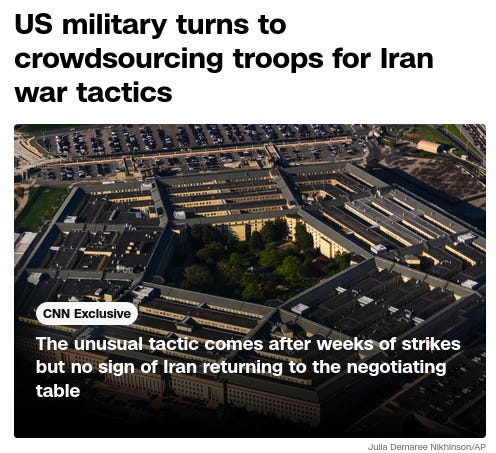
...the US military asks for “new creative and unconventional” ideas to pressure and punish Iran not to those godlike AI tools but... to its own dull, outdated, so ordinary, merely human soldiers and analysts, because:

“We are looking for new creative and unconventional ways to pressure and punish Iran...”

“U.S. Central Command has a long history of thinking and working in innovative ways,” Capt. Timothy Hawkins, a spokesperson for CENTCOM, said in a statement. “Admiral Cooper, in particular, reaches out to members of our great team, regardless of rank, to achieve the highest levels of operational performance possible.”

“You need creative minds at times - especially if you’re running out of conventional options,” said one of the sources familiar with recent planning discussions.”

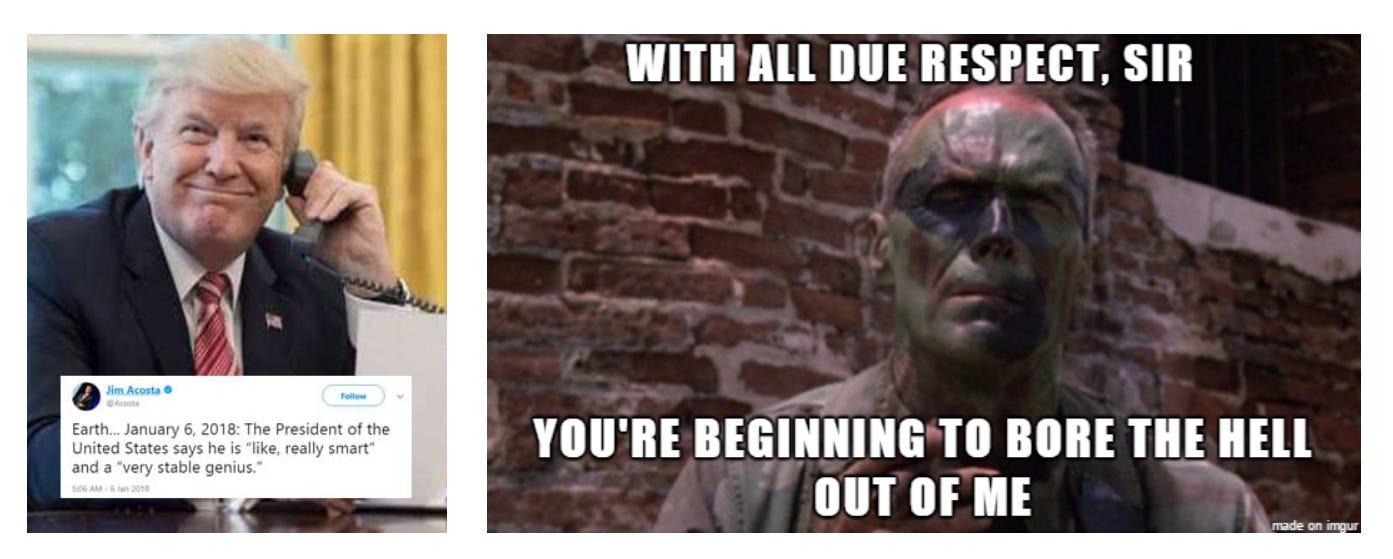
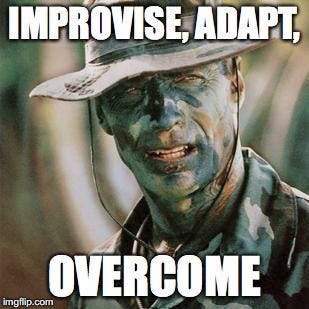
Yes, you read that right. It did take forty years since good old Clint explained to his soldiers that if you need “new creative, innovative and unconventional ways” to pressure and punish your enemy you must ask humans to:

Improvise, Adapt, Overcome. HearthbreakRidge, 1986.

It took forty years, but that pearl of wisdom finally reached the tob brass. After untold billions of dollars spent on military AI and on bombing decisions based on AI processing of data, today the Pentagon has said, almost explicitly:

“Our glorious Very Stable Genius selflessly put us in such a mess that even after depleting stockpiles of extremely expensive weapons we can’t find the way out ourselves, not even with the even more expensive AI tools he pushed us to buy, PLEASE HELP”.

Left: Stable Genius. Right: Gunny, channeling US Military feelings?

I never, ever use AI for writing,

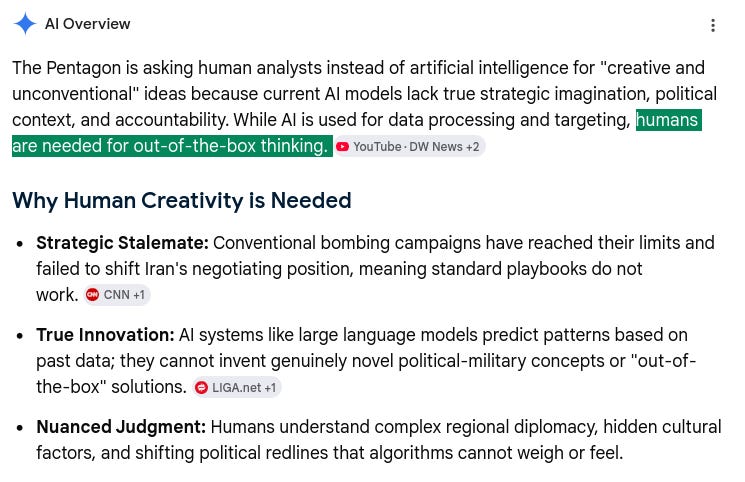
but this time asking a chatbot why this happened was too fun to not do it. So I asked Gemini “Why is the Pentagon asking how to punish Iran to human analysts, instead of asking to AI?”

And Gemini worked well enough (I won’t say “was honest enough” because honesty is a quality of humans, not of some blob of bits) to answer what, without making anybody’s water scarcer, or electricity more expensive, every human with an ordinary but true intelligence and no personal interest in pumping AI stocks already knew since forever:

  • because current AI models lack true strategic imagination, political context, and accountability. While AI is used for data processing and targeting, humans are needed for out-of-the-box thinking.

  • True Innovation: AI systems like large language models predict patterns based on past data; they cannot invent genuinely novel political-military concepts or “out-of-the-box” solutions

  • Nuanced Judgment: Humans understand complex regional diplomacy, hidden cultural factors, and shifting political redlines that algorithms cannot weigh or feel.

Gemini, saying “Nah, TRUE intelligence is human, we chatbots are something else entirely. Don’t trust guys like Altman.

Oh, I almost forgot: to make all this even more tragically fun, still today, “AI data centers have become sitting ducks in the Iran war”.

Share

At this point, I only have one more question:

From where I sit, the silver lining of this failure is that it may make easier for the EU to avoid, not just in military matters, all the AI errors and wastes of public money made by the US. At the same time, I can’t help but ask:

Why isn’t this farcical bit of news enough to trigger the worldwide AI stock market crash that’s been overdue for our common good since at least last November?

Seriously: why aren’t AI stocks going down the drain right now? Why aren’t pension funds worldwide already divesting their AI stocks?

An AI success story, coming soon to Make Your Pension Great Again.

Final, usual request:

If you like what you find here, thanks in advance for your subscription (possibly but not necessarily paid) or, even better, one-time donations for any amount, or consulting, writing or speaking work. And remember: everything here is 100% human written. Period:

Subscribe now

Received — 1 August 2026 ⏭ Just an invitation...

Pets should not be “family”

1 August 2026 at 12:46

Unavoidable disclaimer: this is NOT a condemnation of any single pet owner. This is a condemnation of the cumulative effects on society of certain pet-related strategies, and of those who impose or tolerate those strategies. Don’t take it personally.

I’ve never had or even wanted a pet myself, for several reasons, but I do see and understand that pets are a big source of sincere joy for many people, and I have NOTHING against that, in principle. At the same time what pet ownership has become today honestly worries and saddens me.

Usual notice before getting started: If you like what you find here, thanks in advance for your subscription (possibly but not necessarily paid) or, even better, one-time donations for any amount, or consulting, writing or speaking work.

My first, most obvious cause of concern around pets is people spending thousands of Euros, getting in debts too, not just to get purebreed pets of questionable origin (more on this in a moment) but to treat them as much as possible like actual human babies. The most visible example I see very often these days is the increasing number of people I see carrying this or that mini-dog in small strollers made specifically for dogs. And when I happen to see dogs bearing rings at weddings, I can’t help thinking “they really had no relative or friends they considered worth of carrying those rings???” (1)

How tell everybody you invited at your wedding that they matter less than your pet (Source: Google image search)

The “questionable origin” is the existence of breeds created and consciously perpetuated with features that make pets suffer, just because they make them cuter (more on this here and here).

Stuff like this was already make me thinking that pet ownership and common sense have parted ways. I had already observed one year ago that pets have become another case of too much choice to be really good for everybody involved, both pets and humans.

That was last year. This year, the increasing “premiumisation” of pet food, together with reports that the pet toys and pet cosmetics markets are both expected to double in ten years, looked more of the same: bad and dumb, but not enough to write again about it.

Ditto for fake Emotional Support Animals (even if they really contributed to discourage airborne overtourism, which I doubt), and for “smart” or “AI-powered” gadgets that make pet life just as “modern” and uselessly stress-inducing as human life is expected to be. Why bother too much, I thought, about stuff like “smart” dog collars that “beam the owner insights into their pet’s sleeping, eating, trotting, barking and scratching patterns”, when it’s just one more category of “smart” consumer products gone off the rails?

Tamagotchi care statistics were much better than today’s smart dog collars. No anxiety about another living being back then. (Image source)

Then, a couple of weeks ago, I learned that the “business of pet longevity is booming”, by promising dog owners “more moments of joy together” (that is less time with humans) via sophisticated dietary supplements or treatments as exclusive as “$275 pet-longevity strategy sessions to get personalized protocol of supplements and off-label prescription medications”.

What made me think this matter deserved its own post now was the deep reason for that boom, which I’ll describe in a moment, plus another thing I discovered in the same days: if making a pet live not necessarily happier but longer isn’t enough, the equally booming pet CLONING business is here to help everybody with enough money to think their pet deserves resurrection, and not just with cloning. Quoting from that article, you could also try “cryopreservation, that is preserve the carcass of your pet at subfreezing temperatures in the hopes of one day reviving them. Clients can even arrange to have their terminally ill animals euthanized on site to speed the process.”

Now I really long for the days when all pet owners could be brainwashed to spend were toys, food and toiletry.

Leave a comment

Why I am sad and worried about “Peak Pet”

Denial of death (which nobody should confuse with the wish and need to live as healthy as possible until one’s time has come) is as ancient as humanity. Lifespan extensions or cloning for pets are just an expansion of that wish, and a hardly surprising one, I guess, in a world where immortality choices like religion or parenting have (just temporarily, I suspect) heavily fallen out of favour.

Even ignoring that extreme, the life pets are made to live these days really seems to me surely not in their best interest, and to be one of the physical sides of a generalized human retreat from closeness with other human beings.

Pets wouldn’t have such an apparent great time if society put more efforts in supporting human family and friendship. The increase of attention, commitment and expenses that pets are getting comes from a big increase in the number of people who don’t even TRY to have family or friends anymore because, thanks to consumerism powered by high-tech, they finally have something else that:

  • hides loneliness and lack of purpose by finally being presented as necessarily expensive and time consuming, that is just as important, as having kids or any other long-term, equally committed relationship with other humans...

  • while being at the same time immensely easier both to mold and control as one wishes, AND to terminate in any moment. If you get tired of a human family member you are legally obliged to support you can’t just drop him into a shelter or into a friend’s lap, no question asked, without any social consequence.

Or, as I read on Quora, “Dogs are more controllable kid replacement”

“Peak Pet” like this sucks at so many levels. It sucks that it exists to begin with. When the majority of a generation concludes that pets are better than children not just because they’re (so far) more affordable but also because, as new research suggests, “having a cat or a dog to keep you company could boost your wellbeing as much as being married or meeting up regularly with friends and relatives” it’s not a sign that pets are good (which they are). It’s a sure sign that public mental health is screwed because we’ve let family, friendship and more (see end of next paragraph) go to waste, to the advantage of both digital and physical (e.g., pets) replacements.

Peak Pet also sucks because it increases inequality, and not just because “routine pet ownership... now costs an average of $4,272 per year”): the background vibe I perceive here is that, while the rich can and should aspire to go to Mars and live forever, the rest of us should make do with making pets live longer, while accepting euthanasia as not such a big deal (2), and even eugenics, eventually: once “pets are family just like human children” coupled with “harmfully overbreed pets are cute period” becomes a no-brainer fact of life there is not enough road left, in my humble opinion, before conclusions like “what’s wrong with selecting every human traits in vitro, just for convenience and personal satisfaction?”

Finally, it sucks that people are actively encouraged to do this by companies that exploit them.

Subscribe now

People who want their dogs live longer wouldn’t get so much cuddling by businesses as they do if dogs didn’t live every moment in the same places as their owners, long enough to be comparable to humans... but not long enough to make the financial ludopaths known as “Venture Capitalists” go bet elsewhere. That is, a big reason why demand to make dogs live longer gets so much recognition is that dogs, being much better human simulators than traditional guinea pigs, can accelerate research and official approval of commercial products and services for extension of human lifespans, where really big money can be made.

Two-sentences, conspirationist and - just for fun - provocative digression and unfair oversimplification: Is there a better subject than people who voluntarily lock all their money, time and attention into a combination of pet and smartphone, walking the former while scrolling social media and AI chatbots? I mean, if that combination is both highly profitable by itself, and enough to replace both critical and emotional intelligence, there is no need to also build a metaverse to control people! Which, by golly, it's just what happened:

Screenshot source: Quantum Leap on LinkedIn.

What should be done?

Back to the concrete, undeniable issues, Peak Pet is just another area of life that used to be good because it was simpler, spontaneous and generally more authentic, and is now being deliberately ruined by greed turbocharged by digital or digitally empowered high tech. Letting it continue as today cannot be good.

One of the authors of the “pets can be as good as spouses or friends” study is quoted saying:

“If pets improve life satisfaction as much as the study suggests, [the author] called on policymakers to make it easier for people to own them, for example by relaxing regulations that restrict renters’ access to them.”

For an economics professor as that author is, this makes sense, because it increases GDP, or at least doesn’t disturb it. To me, proposals of this kind feel too much as further rejections of the very idea of a society made of people that don’t want to ignore each other. In the long term, it’s an inhuman, suicidal strategy, so I suggest policymakers do the opposite: instead of making it even easier for future pet owners to end up self-sealed into separate realities, just make life easier to cope with, and less lonely, for all humans.

One week ago I read that China is cracking down on AI companions to encourage people to be in actual, real-world relationships. That’s almost the same end goal I’m talking about here, so let me I ask: should we apply the same treatment to Peak Pet?

Not really, I say, and surely not as the first or only measure. Be they pets, chatbots or drugs, “cracking down on companions” that help a human being to isolate himself from all the others cannot work by itself. Even in places where governments can set a policy and stick to it without worrying about elections or public opinion, “cracking down on companions” that make life bearable without first turning the job, housing and education markets upside down is a doomed endeavour.

So maybe policymakers should help people re-learn why and how to like humans first, and make that actually feasible for everybody. That is, they should do the very first things we should all demand now anyway, even if pets didn’t exist at all.

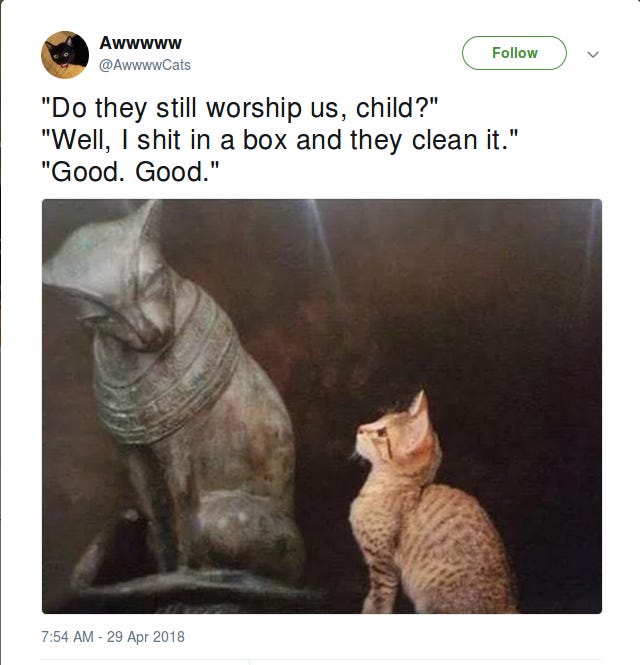
Source (AFAICT): AwwwwCats (now suspended) on Twitter.
  1. Yes, I do know that organizing a wedding can be one of the worst sources of family feuds, and I consequently understand that making the dog bear the rings may help show to all the human participants at the wedding that both spouses... don’t love any participant more than they love all the others. But still...

  2. Some food for thought on this here and here

Share

Received — 7 May 2026 ⏭ Just an invitation...

Claude Mythos is an onslaught of software exploits? Color me unimpressed

7 May 2026 at 20:19

A few days ago Anthropic, one of the most important companies of the American AI industry, released a new tool called Claude Mythos that’s making thousands and thousands of software professionals lose their sleep. It may also be a big case of AI overrating and waste of energies.

A great summary of why Mythos is the greatest nightmare of software managers is a Verge article by Yael Grauer titled “Attack of the killer script kiddies”. If you have never heard that term before, “Script kiddies” are people who try to break into computer systems for illegal purposes, but using only software tools (”scripts”) developed by others, because they aren’t skilled enough to write their own. Some quotes of that article are a perfect introduction to my thesis that Mythos isn’t really that interesting, so here they are, almost verbatim:

  • Claude Mythos is a new AI model that seems to find vulnerabilities in every piece of software it’s pointed at

  • fears are growing that not only can AI detect these flaws, but also be used to exploit them, putting hacking skills into the hands of everyone across the planet (that is, script kiddies)

  • [the arrival of AI tools like Mythos] represents a major escalation, where people without technical backgrounds are able to use AI to enhance their capabilities in a way that wasn’t possible with simple scripts [and] is likely to have far more wide-reaching repercussions

  • [the reason is that] AI is great at pattern matching, and [therefore will make] easier and easier for people to find variants of bugs that are already known and ones that have not yet been discovered. And writing exploits is becoming easier as well

  • you can use AI tools and with very minimal human guidance, and in some cases no human guidance, find in widely used software bugs that its developers never had the time to find

  • industry experts predict that the advancement in AI security capabilities is going to lead to a lot more software exploits. Bad actors could direct AI to find bugs in uncommon pieces of software that no one previously would have put in the effort to exploit

  • [with tools like Mythos] you can write exploits [even] for software that exists in only one configuration that one company has. And you can do it on the fly

After the problem, the Verge article describes the steps companies can take to prepare for “the coming onslaught of software vulnerability reports”. Of that section, the part I like the most is the explicit mention of the idiocy of “many people in cybersecurity roles have been laid off because of AI’s efficiencies, even though those efficiencies are exactly why more humans need to remain in the mix” because companies will “need people to decide which patches to prioritize and implement”. But I digress.

They spent billions for bug discovery… and they applied to software first???

Claude Mythos only does software? What You Talkin Bout Willis? (if you never met Arnold, click here)

The concerns about the misuse of Mythos must be taken seriously. No doubts about that. A lunatic or terrorist script kiddie may hurt - maybe not deadly, but seriously - many more people with Mythos than with weapons. Your pension money is much less likely to be stolen by some script kiddie using Mythos AI than by the coming crash of AI stocks that will take your whole pension fund down with them, but that’s not a reason to ignore AI script kiddies, is it?

And yet... I can’t help thinking that a term like Kiddies, that is “juvenile” or “immature”, somehow also applies to treating almost like THE ultimate god of destruction and havoc something made (spending tons of money) to only find and fix bugs in software.

I say so because we should all start to consider the greatest hackers and disruptors the people who exploit or fix bugs in other systems, that are much more critical than software (1). And no, it’s not AI-powered genetic hacking I’m talking about.

Script kiddies for LAWS, not software. That’s what we need

Fixing bugs in software before AI can help exploit them is absolutely necessary. But applying something as powerful as Mythos only to software bugs would be a real waste.

Why did Anthropic first create a Mythos for software companies and institutional users of software?

Why didn’t Anthropic do what I proposed two and a half years ago instead? Namely, unleash AI that finds and exposes all the cruft, contradictions and uselessly complicated language in all the law corpuses of the world.

Please re-read all the bullets above replacing “software” with “laws” and then...

Imagine if there was something like Claude Mythos that any law student or wannabe accountant could use to tell all the citizens of his country “hey, here’s a loophole in law so-and-so that you can use to claim back half the taxes you paid last year, and these are the exact steps to follow to do it”. Then try to imagine a better way to stimulate lawmakers of every party to fix broken laws NOW.

Imagine if there was something like Claude Mythos that, every time a new law proposal is published, everybody could use to easily discover that that proposal violates, contradicts or duplicates in any way other, already existing laws.

Imagine if there was something like Claude Mythos that, after reading all the laws of a country, produced a completely equivalent but much shorter, much more readable set of laws. Something that would make it much quicker and easier for everybody to see what’s good and bad in every law, and for whom.

Of course, every AI-generated denounce of flawed law proposals and every AI-powered rewrite of any law or regulation should be verified word by word by every human with the will and real skills to do it, possibly with “Bug Bounty Programs” as it happens for software. And after that, it should still be ratified by accountable, elected representatives before actually becoming (or not) the new law of the land.

But just imagine how society would change, if existing laws were much shorter and much easier to understand than today for everybody, and if introducing new laws that are redundant or flawed in any way became much, much harder than it is today. The only way to make it even better would be if laws also had the same revision control systems as software.

Those would be really cool, really powerful hacks, not breaking computer systems. They would concretely mitigate, for every human, serious risks that would still exist even if all software of the world was built and managed by real saints that would never use software to hurt anybody. Wouldn’t that be the best and most prestigious hacking of all? Wouldn’t that be the best way ever to be a script kiddie?

Leave a comment

Why isn’t Anthropic or anybody else already doing this?

Of course, since good laws are a foundation of any decent society, their drafting, reviewing and approving MUST remain work done exclusively by humans. That’s not up for discussion. Have you noticed that the AI “law-hacking” uses I suggest are all reactive, not proactive? Nobody should be so dumb to tolerate new laws proposed or written by AI, ever.

The only questions here are: Mythos is a serious risk, but what makes people paint it as the biggest disruption there can be? And why weren’t tools like Mythos first developed and adopted to help make the result of 100% human lawmaking as easy to use and understand as possible? If you ask me, this is a serious lack of imagination and real spirit of innovation.

What’s lacking here? Maybe the answer is the same that makes even people who don’t make of AI a childish religion take seriously concepts like “network states” managed only by unelected software, blockchain-based quality guarantees that don’t really certify what they claim they certify, or “smart” contracts that are all software, but have little or none of the power of real legal contracts.

Maybe the answer is that both AI companies and wannabe script kiddies are making the same mistake: the mistake of liking software and access to software so much to conclude that software, together with rules and criteria that can be completely encoded in software, can be enough to build and manage a society worth living in.

Two-sentences side rant, if I may: historically, another form of the same mistake is the confidence that something only valid for actual software bugs, that is Linus’s law that “given enough eyes all bugs are shallow”, would be enough to make everybody adopt Free/Open Source Software. In practice, this too often led to neglect non-technical flaws that were deal-breakers for too many people who could never write, document or understand source code and never will (2), but by sheer numbers could have spread FOSS much more, much faster, than software hackers alone could ever do.

Back to lack of AI script kiddies that force lawmakers to make laws more readable and harder to fool: I am aware that the answer above cannot be complete. I’d really like to complete it and, above all, I’d really like to find out who will be the first to release a “law-hacking AI”. Hence...

Serious question for Dario Amodei, CEO of Anthropic

Dear Mr. Amodei... can we talk? Seriously. I’d really like to hear what you think of my proposal, and know from you if Mythos or any other product of yours could be used as I propose. My email is mfioretti@nexaima.net. Also, as everybody can see here or here, in general I am very critical of what passes for AI today. But since you and your company seem the most responsible member of the pack... who knows? It may be interesting, and mutually beneficial, to try to do something for Anthropic. Here are some of my qualifications, to help you decide if that may be possible.

Everybody else who’d like to read more stuff like this... Thanks in advance for your subscription (possibly but not necessarily paid) or, even better, a donation for any amount, or consulting, writing or speaking work.

Subscribe now

  1. Yes, “exploit OR fix”, because the true definition of hacker is the one in the Jargon File (1983!!!): not a criminal, but “a person who enjoys exploring the details of programmable systems and how to stretch their capabilities, as opposed to most users, who prefer to learn only the minimum necessary.”

  2. I still remember the flame wars of twenty years ago when many reviews of OpenOffice (the precursor of LibreOffice) included a complain like “not a bad word processor, too bad it doesn’t have a word counter”. Every time that happened, it started the same flame war. On one side, there were the developers going more or less “Duh, is this guy weird, I have never needed a word counter”. On the other, those like me pointing out that “you developers don’t matter. Not with a word processor at least. The people who can tell everybody else to use your product are journalists, and they absolutely need word counters. Can you complain that they don’t recommend your software if you don’t make them happy?”

Received — 14 April 2026 ⏭ Just an invitation...

The real effect of social media, AI and robots was explained 60 years ago

14 April 2026 at 17:05

A few days ago, by pure chance, I came across the website of an Italian startup that proudly defines itself “your digital experience company. AI driven, human powered.” Got it? Those guys are proud to be what Doctorow calls “reverse centaurs” instead of the exact opposite - “Human driven, AI powered” - that any serious organization should aspire to be in a saner world.

That, of course, is just the example closer to me of a much wider, much deeper problem: the adoration of fake innovation, intertwined with beliefs that being good at coding and nothing else automatically turns people into demigods exempt from maturity and responsibility that everybody else must follow. Or, as Chesterton more or less said 90 years ago, “When men choose not to believe in God, they do not thereafter believe in nothing, they then become capable of believing in anything.”

Is believing in any thing, no matter how dumb, a direct consequence of not believing in God anymore, as Chesterton said? Whatever your answer is to that question, I’m confident you’ll agree that people who believe in the dumbest things are everywhere these days, from main streets to the highest offices, oval or not.

This inability to recognize dumb ideas, products and practices, and their long-term effects is everywhere, of course. Here, I just want to call out four cases I frequently write about, and thank somebody who started described their long-term effects before I was born.

From now on, I’ll name these four things CSARs for two reasons: it’s the acronym of their initials, in the order in which they came to be, and sounds like “czar”, whose derogatory meaning is the same of my CSARs: “tyranny, unchecked power, and distant, autocratic control”.

In order of appearance - not as new concepts but as mass phenomena that shape and control the whole society, - the four CSARs are: Corporations (as a shortcut for, and personification of Capitalism), Social Media, AI and (Humanoid) Robots.

I dump them all together because they are all the same: Social media are the forerunners of what we call AI, which is just peak software; Humanoid Robots for the masses are just AI hype, repackaged out of desperation; and Corporations, as I have been saying for seven years now, were the first AIs.

Another proof that the four CSARs are four faces of the same thing is that there is at least one set of long-term effects they all cause, and it’s one that was first described, quite well, decades ago.

Subscribe now

Earth always was Asimov’s Galaxy

More than seventy years ago, Isaac Asimov started writing a great sci-fi saga about the evolution of the human race and its colonization of its whole galaxy, the Milky Way.

One main theme of that saga is the clash between the two almost opposite kinds of human societies that attempt to colonize the galaxy, Spacers and Settlers. The two groups look at each other with reciprocal contempt and suspicion for several reasons, the bigger one being just their attitudes towards humanoid robots. Spacers totally depend on humanoid robots, and aim to make them completely undistinguishable from real humans. Settlers deeply hate humanoid robots and outright ban them, because they demean humans.

Reading those books really makes you realize that all the struggles, responsibilities and opportunies of galactic Spacers and Settlers that Asimov started describing seventy years ago are right here on this planet (1). Heck, he did it so well to almost make you suspect that that was his whole point all along, didn’t he?

Whatever’s Asimov’s intentions were, it’s hard to ignore that the long-term effects of CSARs on societies that acritically adopt them are the same of Humanoid Robots on Spacers, that Asimov explicitly described in the novels Naked Sun (NS, 1956), Robots of Dawn (RD, 1983) and Robots and Empire (RE, 1985). Read these quotes (2) replacing “robots” with CSAR, and you’ll see what I’m talking about:

  • NS: once you starting depending on robots, that dependance can only increase

  • NS: never dare to say that robots are dangerous, saying so is a human disease (especially of inferior humans like the Settlers)

  • RD: [Spacers] insist to deny the robotic nature of their serfs and give them human status, to avoid acknowledging how much they depend on objects operated by artificial intelligence (and therefore less than human)

  • RE: (just like the internet, social media and AI) robots weaken the dependencies all human beings have with each other. Robots fill all the interstices between them

  • RE: Robots are an insulator that undermines the natural attraction of each human towards the others, and when that happens the whole system (of cohesive human society) falls apart, breaking into many separate entities

Indeed, todays we are all much more Spacers than Settlers, thanks to CSARs whose common feature, necessity and purpose is exactly to minimize any need and desire of direct human contacts. “AI driven, lonely-humans powered” is how the Spacers would have described their societies, if only they had been lucid and honest enough to see what they were doing.

Share

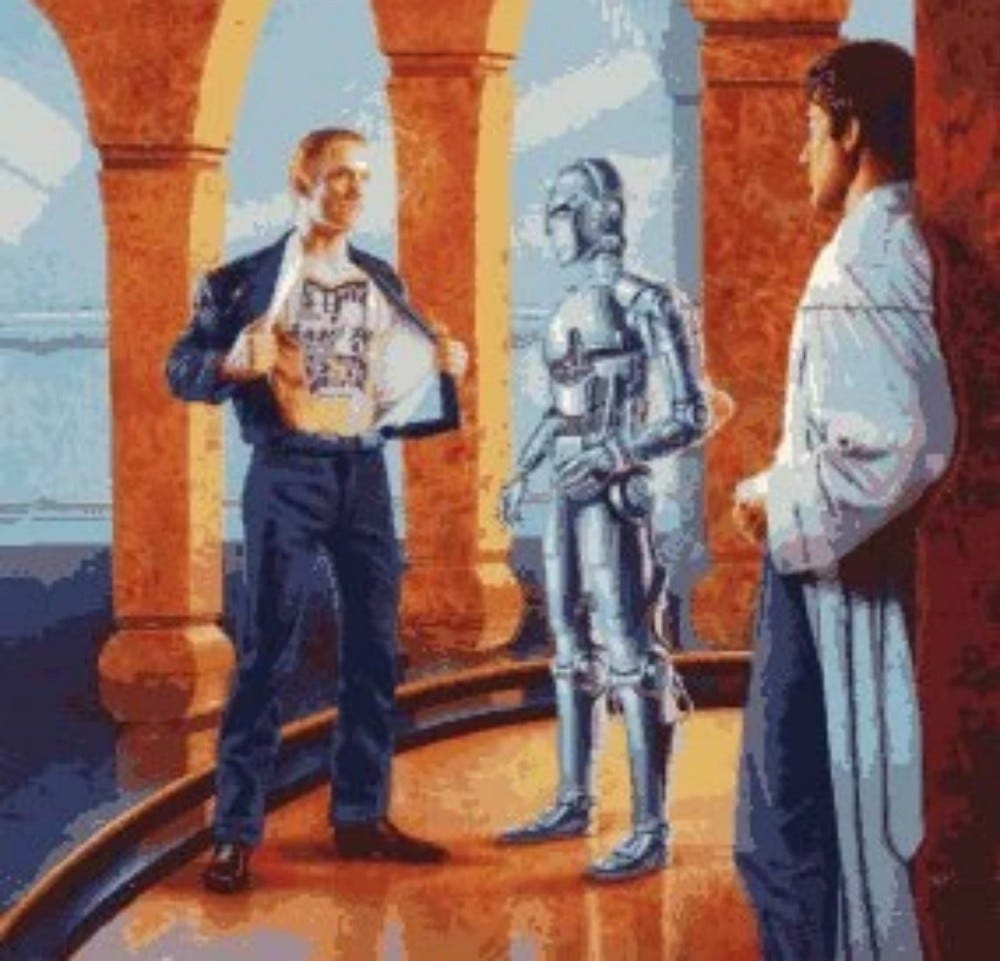
What happens to humans living among robots? Detail of vintage “Naked Sun” cover, source: asimov.fandom.com

We must be Settlers, not Spacers

Continuing to repeat with CSARs the errors Spacers did with their robots can only have the same final effects: in the worst case, extinction. In the most likely, but still pretty dark case, transformation into something hardly human. Ending those errors doesn’t mean going back in time though. Asimov’s Settlers aren’t clueless luddites. If they survive and thrive all over the Galaxy is exactly because they don’t refuse technology outright, only certain technologies, and certain uses of those technologies, that are inherently toxic.

That’s the same thing we should do. We must realize that the CSARs we have today are inherently toxic in the ways Asimov described decades ago, and that this is happening because (Chesterton, again?), instead of reining the CSARs in we are treating them (especially the root one, that is corporations) as if they were supernatural entities that deserve supernatural status.

Getting rid of all the CSARs would be impossible, even if it were right, which it isn’t. What we really, urgently need to do is to strip them of their superpowers and reputation, as soon as possible. Joanna Bryson’s argument in 2009 that robots should be slaves seems taken straight from Robots of Dawn, but it’s equally valid for all the CSARs, especially the first one:

Robots should not be described as persons, nor given legal nor moral responsibility for their actions. Robots are fully owned by us. We determine their goals and behaviour, either directly or indirectly through specifying their intelligence or how their intelligence is acquired. In humanising them, we not only further dehumanise real people, but also encourage poor human decision-making in the allocation of resources and responsibility... Robots should rather be viewed as tools we use to extend our own abilities and to accelerate progress on our own goals.

Leave a comment

All I can add to that is what I first said six years ago: any call to treat AIs and robots like human beings just strenghtens the pretense of corporations to be treated as real human beings.

Summing up: the long-term effects of social media, AI and Humanoid Robots on society are those Asimov started describing seventy years ago. But it’s corporations as they are today - ubiquitous, eternal, millions of times stronger than any single human being, allowed to morph into each other but required to have the same long-term vision of a toddler who refuses bedtime - that are the root problem. It’s them, coupled with inferiority complexes towards whoever got some Computer Science degree, without the maturity and culture to use it right. Enforcing on corporations the same laws Asimov conceived for robots may not be enough to get all the other CSARs right, but it’s a first step in the right direction. In the meantime, thanks for supporting my human-digital work in any way you can, be it subscription, direct donations or simply sharing these posts in and outside Substack.

  1. In my humble opinion, you should read those books regardless of robots, for the struggles between Spaces and Settlers look every year more like those the aging rich countries and the young but poor ones of our own earthly Galaxy.

  2. those are not literal quotes, but my translations, as faithful as possible, of the corresponding sentences in the Italian versions of those books. All the parentheses are my additions.

Received — 27 March 2026 ⏭ Just an invitation...

Two great “Software for Catholics” initiatives and what may make them even more helpful... for everybody

27 March 2026 at 20:59

Preface

A few weeks ago I had a great conversation with Dr Tomislav Karačić of the London School of Economics, who had just lead a webinar titled “Developing Catholic AI: How to Balance Values in Design”. Most of the time we talked about “the world’s leading Catholic AI” I have just discussed in my previous post, and of Catholic Open Source. This is a “collaborative initiative empowering Catholic technologists to develop digital tools in service of the Church’s evangelizing mission” coordinated by the Texas-based Catholic Digital Commons Foundation (CDCF), whose mission is to coordinate community efforts for the common good and contributes to a shared digital patrimony for the Catholic Church.

The first part of this post summarizes what I dare say everybody, not just Catholics, should really know about the goals of Catholic OS and CDCF. The second part, that is primarily but not exclusively aimed at Catholic OS, CDCF and any other similar community, explains why I am in a special position to care about these issues and, hopefully, also to contribute.

Just an invitation... is a reader-supported publication. To receive new posts and support my work, consider becoming a free or paid subscriber.

Here are what I consider the most important points of the Catholic OS Manifesto (”M”) and CDCF Bylaws (”B”), rearranged and labeled by me for easier reference:

M-1: The Church’s social teaching offers a compelling vision for lifting up human dignity: a digital commons to serve the common good, strengthen families, democratize economic opportunity, inspire new evangelism, and empower human solidity.

M-2: Technological products are not neutral, for they create a framework which ends up conditioning lifestyles and shaping social possibilities.

M-3: We build against the reduction of the person to a data point or a mere instrument of production.

M-4: We cannot allow algorithms to limit or condition respect for human dignity, or to exclude... the hope that people are able to change.

M-5: [We also] commit to a human-centered pace of change... [and] advocate for a digital environment that respects the natural rhythms of human life and the “analog” requirements of a healthy soul... [because] “Leisure is a form of that stillness that is necessary preparation for accepting reality; only the person who is still can hear. -- Josef Pieper, Leisure, the Basis of Culture (1948)”

M-6: The Catholic Digital Commons is a “builder commons.”... Across countless repositories, there are tools built in the quiet of parish life - identity systems, liturgical calendars, and workflow engines- awaiting the nurture of a supportive community... Our mission is to aggregate, vet, and communalize these gifts. We transform scattered code into a durable architectural spine that outlasts any single volunteer, providing the Church with a discoverable and adoptable commons of open infrastructure.

M-7: [We want to preserve] each institution’s independent ability to use, contribute to, and govern its own data and tools.

M-8: We must learn to speak the language of technology to carry the Gospel into the digital age.

M-9: To guide our development, we adopt the full “algor-ethical” vision of the Rome Call for AI Ethics.

The Bylaws of CDCF state that the foundation is organized exclusively for charitable, educational, and religious purposes which include:

  • B-1: to coordinate, develop, steward, and disseminate open-source software, data repositories, technical standards, and digital platforms in service of the Catholic Church’s evangelizing mission

  • B-2: organization, structuring, preservation, and ethical use of ecclesiastical data [of all kinds]

  • B-3: Academic research coordination, data standards, academic advisory roles, joint initiatives, and educational programming.

  • B-4: fostering interdisciplinary exchange between theology, pastoral practice, and technology.

  • B-5: promote the ethical development and governance of digital technologies and artificial intelligence in accordance with Catholic social teaching.

Why I PERSONALLY care about all this stuff

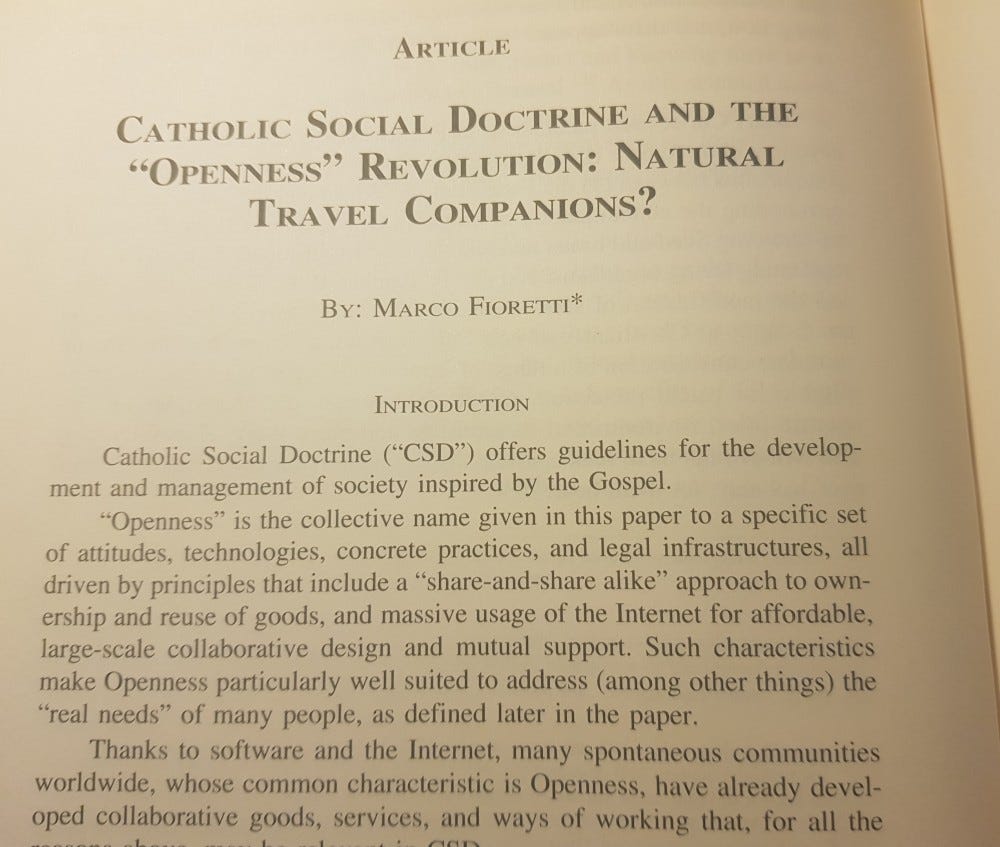
I care because I’m the guy who more than twenty years ago spelled out Free Software’s surprising sympathy with Catholic doctrine, then co-wrote the Elèutheros Manifesto for a Catholic Approach To Information Technology, followed up thirteen years ago with all the reasons why Catholic Social Doctrine and the Openness Revolution are Natural Travel Companions, and has been struggling to get reactions since then.

Me, arguing that Catholic Social Doctrine is so advanced that only now technology has catched up to it.

Backed by that work, I sincerely wish CatholicOS and CDCF every success because I think they are great. I mean, look again at the first five points of the Manifesto I selected above, just scraping “inspire new evangelism” if you’re not Catholic or religious in general: how could anybody of any political creed but sincerely wishing to make the world a better place disagree with them?

More specifically, I seriously think that anybody doing software should carefully read that manifesto and imbue any software they write with its principles, regardless of their religion or lack thereof. This said, I have three concerns about what I read - or sometimes did not read - in that Manifesto and Bylaws.

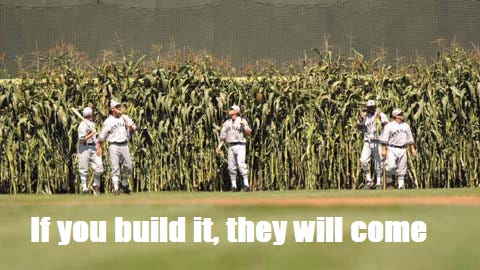
If you build it, they will come. Maybe. Maybe not.

My first concern directly follows from the fact that building great Free/Open Source Software (FOSS) is not enough to make people use it. Not at all. “If you build it they will come” seldom works as in the Field of Dreams movie. Social inertia is always huge, especially about something like software that for 90% of the world population is still undistinguishable from black magic. In my experience, the hardest part of “making Catholics use FOSS” never was its quality. It was to make clergymen at any level get that they should care in the first place, instead of going “oh, this is about computers? Talk to my system administrator then”, or ignoring me altogether.

Thanks for sharing this as much as possible, especially outside Substack!

Share

Even more important, the license of any software is much, much less important than what one creates with it, and how. In all my research and popularization work I routinely make this point with these three slogans:

  • “YOUR civil rights and the quality of YOUR life depend every year more on how software is used AROUND you”“

  • “You can build the perfect police state using only Free as in Freedom Software”

  • A Gnu/Linux user publishing documents in MS Office formats with LibreOffice makes more harm than a Windows user publishing documents in ODF formats with MS Office, because file formats are more important than software

So my first concern is seeing that education of ordinary users and calls for them to adopt free as in freedom formats and software aren’t the first goals of Catholic OS and CDCF. That is, I fear that they develop great products that won’t be adopted by enough people to make a difference.

The second concern is restriction of both stakeholders and of the “playing field”.

Shouldn’t the Catholic Overton Window for AI be wider?

I criticized the Rome Call for AI Ethics that guides Catholic OS and CDCF (point M-9 above) as soon as it appeared, but not because I think the Vatican should not make such calls. I did it because that Call seemed to me too restricted to Big Tech representatives and top catholic scholars with the best possible theological preparation and intentions, but not deep enough knowledge of the technologies involved.

That was in 2020. This month, I discovered that the Pontifical Gregorian University in Rome hosted last November a “Builders AI Forum” that, at least from the outside, appears to have the same limits. The motto of that forum was “Uniting to Build & Scale AI” and its goal to “foster a new interdisciplinary community of practice dedicated to supporting the development of AI products that serve the Church’s mission”. That’s why its sponsors included:

  • “a dynamic investment firm backing visionary founders committed to building with purpose”

  • the “For Schools” branch of a company develping “AI-driven Teacher Tools that guide educators toward efficiency and impact”, letting every student “embark on a personalized learning journey with an on-demand AI tutor”

With those premises, I should have not been surprised (and yet I was) to see among the participants... none other than the canadian branch of Palantir! Yes, Palantir, the company led by the very Peter “Better Jesus” Thiel who was here in Rome just a few days ago to lecture a few elects about the antichrist.

The bigger restriction I worry about here, however, isn’t about who is invited to these talks - only the powerful, not the meek who should inherit the Earth. It is the restriction of the agenda: “Build & Scale AI” and “supporting the development of AI products that serve the Church’s mission” seem to me too close to acritical acceptance of both AI into and for everything just because it’s AI, and of the “builders” primacy I already criticized around Magisterium AI.

Leave a comment

Some proposals now

First, let me repeat it: I sincerely wish Catholics OS and CDCF every success, because what they want to do is necessary for the Common Good, regardless of religion. I am only concerned about two things, the first being that promoting development of the right software in the right way cannot be enough.

The other is the possibility that certain positions unwillingly end up favoring, instead of containing, forces that are only driven by profit or that confuse technology with religion. Remember point M-8 above? The one saying that Catholics must “learn to speak the language of technology to carry the Gospel into the digital age”? I am worried that as it is, that pointt can be exploited by those forces, instead of boldly being what surely is already in the heart of every Catholic OS and CDCF member, that is

“learn to speak the language of technology to make adoption and deployment of technology speak the language of the Gospel”.

Enough with concerns! Let me make some concrete proposals now. What about Catholics, Catholics grassroots communities, Catholic NGOs and Catholics institutions explicitly working to, in no particular order:

I and other Catholics first tried to propose a Catholic approach to Information Technology with the Eleutheros Project twenty years ago. I have never stopped to fight these fights in the widest ways I could, as everybody can see from my main publications, Foss Force column, main blog and its current Substack proxy.

I will continue to do it, but I would really like to work more, much more on everything I’ve mentioned in this post. If anybody is interested, just email mfioretti@nexaima.net.
This is a reader-supported publication. To receive new posts and support my work, consider becoming a free or paid subscriber

Received — 17 December 2025 ⏭ Just an invitation...

Twelve things we take for granted, but will disappear in our lifetime

17 December 2025 at 19:53

(paywall-free popularization on this or other important topics helps to pay my bills and write even more. Thanks for considering a paid subscription or (even better) supporting me with one-time direct donations or in any of the other ways described here)

Imagination is one of the features of authentic intelligence, and a collective loss of imagination - and consequently, of hope and motivation - is one of the big problems of our time, if not a major cause of many of them.

Here, as a tiny stimulus to keep imagination and quests for a better future alive, I list twelve things that today may seem part of the very fabric of reality, but I feel will disappear, or at least be much smaller than today and unrecognizable to people of 2025, in just a few decades. Possibly very, very few decades.

Here are those twelve things, divided in two main groups, for reasons I’ll explain at the end of the post.

Group A

  • Addictive social media

  • Mobile phones with cameras

  • App stores for phones and all other computers

  • Online matching for dating

  • AI chatbots for everybody

  • Physical billboards, if not all advertising

  • Hundreds of choices for every consumer product

Group B

  • Air conditioning and buildings that need it

  • Falsely smart cars

  • “Smart” consumer products, also known as consumer-IoT

  • Energy-intensive healthcare and single use medical supplies

  • This is a surprise, keep reading to see it

Why things in group A will disappear

The social media of today will disappear because they are a major cause for a major increase in public levels of anxiety, depression, misinformation and political polarization and inability to concentrate and think clearly. The good news is that this would be possible with a few, really concrete actions like this and these.

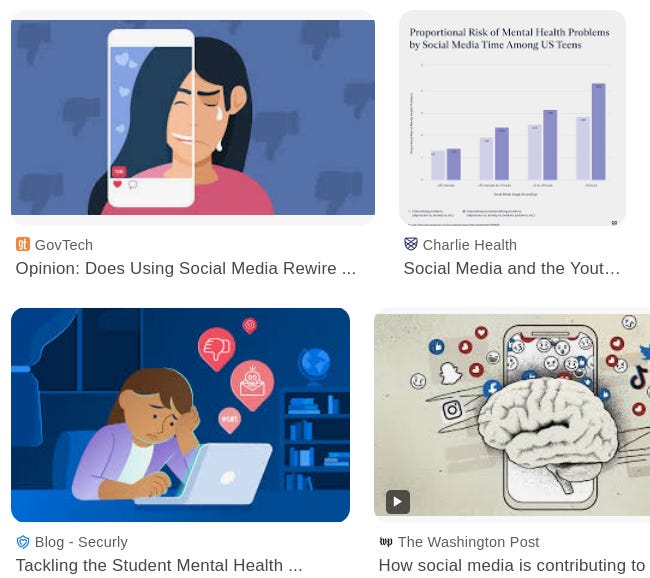
Cameras in mobile phones will disappear because, together with algorithms designed to mess with people’s minds, they are a major aggravation to the above-mentioned mental health pandemic. Just think about it: would teenagers and adults alike be as stressed as they are if they had no possibility to show off everything they eat, wear or do, every minute, as if everybody else had a duty to care? Sometimes, I think that the only truly revolutionary act everybody could really do is covering with tape the lenses of their phones now.

Screenshot of Google image search.

Centralized App Stores will disappear because, while we will never all become programmers like Free Software advocates dream, something as stupid as letting a handful of companies castrate and turn into mind-sucking probes inventions as powerful as mobile or stationary computers cannot go on forever.

Online dating that directly matches people through data, not love will be replaced by apps organizing “real-life events in every major city every week” where every group of people who could be good matches for each other will see every other participant how they really are, without AIs to cheat, or possibility to swipe left. That may still be a bit too close to eugenics, for my taste, but will surely be much, much healthier and fairer than today.

Unrestricted access to AI chatbots will end because... it’s already painfully obvious that it is not for the masses.

Physical billboards will disappear because “man is at his vilest when he erects a billboard” and “adverts create obstacles. Without them you can breathe”. Ditto for online advertising, which allows both commercial and political actors to create personalized, reality-distorting bubbles: banning it will be recognized as “the best thing we can do for our world now... “More than gun control. More than tackling climate change. More than lowering the price of eggs.” (For the record, cities that ban billboards already exist worldwide, from Brazil to France)

Excessive choice is what Scott Adams popularized as confusopoly: companies with similar products who, in order to prevent customers from making informed decisions, intentionally confuse them instead of competing on price.

Confusopoly deserves a bit more space because we “First World” citizens suffer from it in every field. We have scores of foods that only differ in their marketing, scores of offers for utilities and mobile contracts that take days to compare with minimal gains, cars with scores of options that all too often cannot be combined just like we’d want, or would cost much more than advertised...

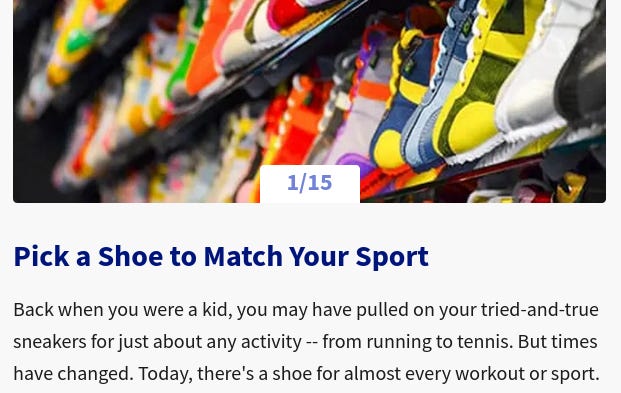
What about sportswear? Today, thanks to changed social norms, machines and healthier working conditions for most jobs, it’s almost impossible to figure out in ten seconds whether someone is a train conductor or an accountant just from his clothes, hands or gait, as Sherlock Holmes could do in the 1880s. But everybody can immediately tell the exact sub-category of sport someone engages in, and how seriously, by looking at which combination of shoes, jacket and pants he’s wearing. The result is that anyone who could and would have occasionally practiced three different sports with the same “equipment” two generations ago is now pushed - to make them spend more, of course - to get multiple sets of gear to practice just one:

“a shoe for almost every workout” (Source)

One last example of excessive choice that will end because is both wasteful and cruel is pets. We have created scores of cats and dogs with torture breeding, just to get the literal opposite, that is, of appreciation for choice, diversity and uniqueness: dogs and cats that all look alike, and a really expensive but sadly booming pet cloning business.

Of course, choice is excessive even with pet food “so fancy that I ate some” and… accessories:

Screenshot of Google image search

Leave a comment

This explosion of choices is a wrong turn, not an enrichment : even letting self-gratification aside, when there is too much to choose from, it becomes almost impossible to make the optimal choice. This is why all this choice will disappear, to be replaced by many less models for every product, but all much more customizable and repairable than today.

On to Group B now

Air conditioning as we know it, and buildings that need it will disappear thanks to much more efficient solutions, from cooling by only increasing local airflow to completely new technologies, plus the acknowledgment that air conditioning as strong as it often is today is a really dumb way to get sick, and a really expensive one too.

Uselessly complicated “smart” cars will disappear because they consume loads of energy and raw materials just to, again, be stupid.

Smart devices, appliance and almost all consumer-IoT products will disappear because they are connected to the internet just to make them more expensive, more intrusive and easier to brick.

Energy-intensive healthcare and single use medical supplies will not disappear, but they will be substantially downsized, because the connection between their price or energy use and human health and longevity is not as strong as it seems. Did you know, for example (see previous link for details), that comparisons of cataract surgery in the UK and in India have shown that the same treatment produces only 5% of the emissions and 6% of the solid waste (that is, much lower costs) in the UK?

Share

Two groups, different reasons. Or maybe not

The common reason why the stuff and practices listed in Group B will disappear, at least in their current forms, is really simple: they consume so much energy, money and material that they will increasingly become unaffordable (more on this in a moment).

The services in Group A, instead, will disappear thanks to a combination of collective mental fatigue and increased awareness of their toxicity. If we are smart, that is. If you think that’s impossible, remember that people, including pregnant women, used to smoke indoors because it was addictive and glamorous just a few years ago.

But even if we aren’t smart, the services and products of Group A will disappear anyway because the “surprise” member of Group B that I didn’t name before is... all of Group A: that’s all stuff that requires too much money, energy and material to last much longer.

Subscribe now

When will this happen?

Much sooner than you may wish, if several forecasts I’ve seen recently are even half right. The coming bust of the AI and data centers bubble, which can never happen too soon but is surely close, may set things straight all by itself. But even if that issue didn’t exist, the shortage of diesel fuel that several experts (see list below) say will be enough to severely downsize every sector of the economy - including deployment of renewables or nuclear power - may “happen as early as... 2030”.

And now the good news

Here’s the best part of all this, the one that really matters: with the exception of air conditioning, if missing where and to the extent it would be actually needed, none of the changes I listed will decrease authentic quality of life, and most of them will concretely improve it, by decreasing our current levels of stress, loneliness and personal debt. Read the list again, and you’ll agree with me.

Reading suggestions about the coming diesel crisis

Thanks for sharing this post around as much as you can, in and outside Substack!

Share

Received — 28 August 2025 ⏭ Just an invitation...

The 10 biggest errors of our time

28 August 2025 at 19:10

Before getting started… these days, I am already writing a lot about digital policy issues on FOSS Force. Therefore, here I will mostly, but not exclusively discuss what I consider the ten biggest errors of our time, summarized here. Please let me know if you agree, commenting here or by email, and please pass around the requests at the end.

The ten biggest errors of our times are, in semi-random order…

Partial image search results for overpopulation, greenwashing, elite overproduction.

Error 1: Environmentalism without class

As I read somewhere online, environmentalism without class is just gardening, and that's why it cannot gather enough votes to make a difference. One good example is politics that push electric cars as good for the environment, instead of politics to free the millions of working poors from the slavery of forced car ownership with much more transit, with collateral but huge environmental benefits.

Error 2: believing we still have an overpopulation problem

Demography is the science that tells you what you should have done thirty years ago, in order to have around you today just the type and quantity of people you'd like. Sure, today there are on Earth three times more people than when I was born, but they are a very different mix of generations than just one or two... generations ago.

Today almost all countries, even in Africa, are aging fast, and the time to manage that change is yesterday. Regardless of what the material economy will look like thirty years from now, most people already alive today will live very strenuous and very, very depressing "golden" years if they don't seriously, concretely encourage and support now those among us who do want to have as many kids as possible.

Error 3: demeaning the 3Fs = Flag, Faith and Family

The Enlightenment was absolutely necessary, but could never be enough. Fascism does very often come "wrapped in a flag and carrying a Bible". However, automatically equating all flags, religions and, why not, preferences for traditional families with fascism is a non-negligible reason why today there are more, not less authoritarian, reactionary governments in western countries than ten or twenty years ago. We do have to get rid of all the many, real phobies, intolerance and bigotry that still plague us. But why keep doing in a way tha, no matter how right it could be in principle, is obviously backfiring?

Error 4: believing that "more is better" is progress, and that any progress must be endless, mandatory and FAST

The brains and bodies of our species are not built for instantness and excesses of any kind, be they food, communication or simulations of thinking. Physically speaking, it doesn't matter if it's inside (excess body fat) or inside (excess clothing, car, home...): we cannot be healthy with too much stuff crushing us. Brain-wise, it's the same: we cannot function properly, both individually and as a society, with brain plugs doubling as electronic tags that either drown our consciences and sense of being with just too much data or do the exact opposite, that is mine data.

Error 5: believing that Work = WORTH

Abandon the "absolutely specious notion that everybody has to earn a living" to be valuable. People still thinking they must absolutely have a job, any job, to do good and be valuable need counseling, not a job. What human beings actually need is money to stay alive, and a purpose to make being alive worth it, vut the more the two things are separate, the better. Continues here and here.

Leave a comment

Error 6: believing that education and schooling must prepare for work

The purpose of education is to prepare for life, not work. Education must prepare people to be good citizens, partners and parents, not good employees for roles that may not exist anymore by the time one graduates. That's the purpose of vocational training, which is something else entirely, and as such should happen outside, or after, school and college.

The confusion of education with training has created two huge problems, one short- and one long-term: the first is the myth that education MUST be always high-tech, complicated, and expensive. The second is what's called elite overproduction, that will make many people very angry. The sooner that confusion stops, the better.

Error 7: snobbing text, that is HUMAN writing and reading

99% of the knowledge we need to be really diffused across society is still text. Human-written text. That is something that requires writing and reading to master. See the purpose of education above, and the tips for parents below.

Error 8: Granting human status to what is NOT human

Real entrepreneurships is good, and so can be markets, when properly regulated. Granting the same rights of frail but precious human beings to immortal, ubiquitous, omnipotent entities is instead a hugely stupid mistake. Corporations must not have personhood, or any other human right. Ditto for what passes for AI today, which is just a really fragile smokescreen for something that is not unavoidable at all.

While I'm at this, pets. Regardless of their environmental impact or the very ethics of owning another living being for personal gratification, if we have come to benefiting from pets as much as from a spouse, fulfilling pets needs with AI and needing expensive pet insurance to cure pets we created with health issues... Maybe we must re-learn relationships, both with animals and among humans.

Error 9: not demanding a reform of MONEY before everything else

Beyond ending corporate personhood, no real reform of work and society could last without a reform of money and how it is managed, from creation to taxation. Personally, I have no idea if stuff like Modern Monetary Theory or Wörgl negative money could be the solution, but I cannot accept that the geniuses who already screwed the real economy with financial schemes "too complex to fail" except for working poors cannot also conjure something that would benefit everybody.

Error 10: believing we can act alone

Fuck lontermism, that is the advice to put the wellbeing of humans that may never exist before yours... given by the only people rich enough to never have any of your problems today. Fuck longtermism, but never do it alone. We have all been told for decades that we are only allowed to fight the system as individuals, but the only way to fix those errors and make the world a better place in your lifetime is to vote and work together now, even (especially?) with people who have very different ideas than yours on some issues.

Thanks for becoming a paid subscriber or… for giving the final paragraph all your attention!

Back to the future

Besides what I already mentioned, many of the problems above would be much, much smaller if we only were mature enough to go back to the levels of material comforts and tech sophistication of the western 1980s, rebooted and optimized with modern technologies and adult common sense. I'm talking of something nobody could dare call "degrowth, like:

  • personal goods, from cars and appliances to clothes and computers, built to last decades with cheap maintenance, without idiotic "smart" additions, plus

  • long overdue infrastructural changes like efficient public transit, rebooted air conditioning, and rebooted cement industry for all the crumbling infrastructures, from bridges to pipes, that we can't live without…

  • and yes, even mobile Internet, just with RSS and slowness in social media, at the right age

I mean, if even the rich are back to living like we all used to do, why shouldn’t you?

Final note on education...

On one hand, many of the jobs that pay well, are more resistant to automation and offshoring, and are also sources of great self-realization don't need a degree. More than programmers or MBAs, today's world needs plumbers, electricians, roofers and many other technicians, who also know and appreciate the humanities.

Bookkeeper and Baker, rightfully enjoying Puccini as much as the next Harvard PhD.

On the other hand, if I ran parenting classes, which I would like, almost all the tricks I would teach are those that you hear very seldom, because they cost nothing: avoid personal smartphones (not the internet!) until your kid is at least 14/15 years old; teach kids to always sleep regularly, make your kids addict to reading; and make kids play outside alone, as they want, as much as possible. Do this, and what will increase sensibly will be your chances of growing balanced, happy adults, instead of their student debt.

Before reading the final paragraph… thanks for sharing the exposure of these errors as much as you see fit.

Share

... and final personal requests to all readers.

The more support I get, the more I can write. If you want and can become a paid subscriber, thanks, that's wonderful, really. But I know we've reached peak subscription, and I think that one-time donations can be even better, for both me and and my readers. To do that, go here. Also, I am available to speak, teach, consult on any of those errors. Just email me.

Received — 14 March 2025 ⏭ Just an invitation...

New Places, Old Mistakes: How Bad Architecture Moved from Physical to Digital

14 March 2025 at 18:04

(the “reallly unusual on Substack” request is at the end, don’t miss it!!!).

"The same automatic, old script that has produced socially zoned, polluted, and dehumanizing urban environments throughout the planet keeps unfolding on a higher level, including the metaverse, as Marco Fioretti explains in this issue."

Just an invitation... is a reader-supported publication. To receive new posts and support my work, consider becoming a free or paid subscriber.

What you just read is the presentation in the Journal of Biourbanism of an essay of mine, of which this post is just a summary. The complete version, with references to all sources, was recently published in Volume X, No. 1 & 2 of the Journal.

Human beings thrived in cities full of variety. Then, they lost them

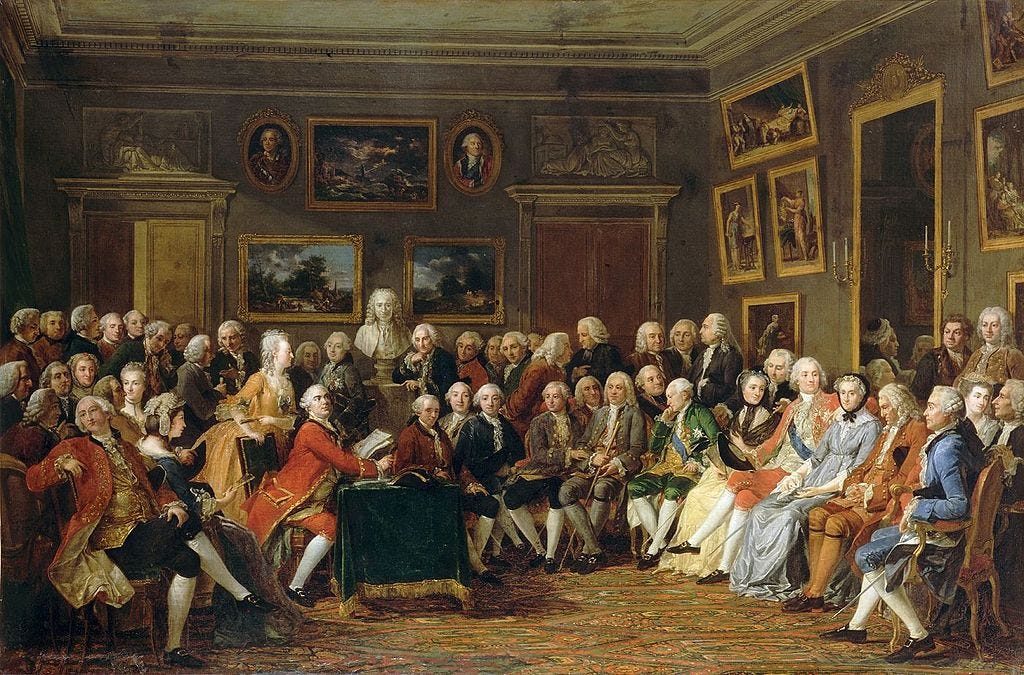
Illuminists in 1755, pondering how to curse their descendants with social media (Source: Wikipedia)

To begin with, I'll summarize the common thesis of a few experts of architecture and urbanism I discovered a couple years ago: non-complex urban systems alienate, dumb down and control both individuals and whole societies, and in extreme cases can even push them toward civil war.

The root reason is that human physiology never evolved to cope with environments that treat even human beings as objects without variety. This is an application of the Law of Requisite Vriety, first expressed by W. Ross Ashby in 1956, which states that "any system that governs another, larger complex system must have a degree of complexity comparable to the system it is governing".

This also applies to cities which, argues N. Salingaros, consist of two complex systems that govern each other.

The first system is the human individuals and society that design and govern the other system, which is the built environment. In turn, that environment governs people and society, because its geometry contains and controls the activities of its users through physical spaces and their psychological impact.

Since Ashby's Law also applies to human habitats, the monotonous, drastically simplified built environments made of non-interacting units that became much more common worldwide after World War II will only sustain equally constrained people, making it easier to mold them into any form.

How are those people constrained, exactly? Today's "optimized" urban spaces (and time), according to M. Marra, prioritize compulsive motion, light, actuality, and reification. They saturate the senses by fostering and constantly mixing roars from the crowds.

This process, says Marra, started with the Enlightenment - a movement that, in order to fight a primeval fear for what is unknown and does not surrender to simplifications, started a programmatic erasure of differences, invisibility and shadows of every kind. Modern cities dematerialize life, reducing human-inhabited space to economics, exchange, and usury value.

This reduction is both a prerequisite and a consequence of industrialization, because uniform places are a much better fit for production, accumulation, consumption, and dissipation.

Still quoting Marra, it is that flattening of urban space that initiated the compelling need for speed, the excess of information, the disaggregation of the social fabric's continuity (via zoning and gentrification), and, on a deeper layer, the atomization of the individual and its severance from every connecting background, including collective memory and narrative.

“Real terror comes from architects”, sang Adriano Celentano in 1981 (English translation here). Would he say the same today?

Going even further than Marra and Salingaros, Syrian architect Marwa al-Sabouni has described in her book "The Battle for Home" and the corresponding TED Talk, how urbanism and architecture direct human activity so much that they can actively contribute to "prime" people for war, or do just the opposite.

Settlement, identity and social integration, says al-Sabouni, are all the producer and product of effective urbanism that, without negating their identities, forces people to respect the diversity of the other people around them, and the mutual interest of living together in harmony.

Designing cities, instead, as though they were the temporary shacks of nomads, takes away continuity and collective memory. That's the same as taking away citizenship, because nomads belong to, and find reference points in, only tribes, not places.

Al-Sabouni illustrates this point by comparing the old and new urbanization of Syrian Cities like Homs and Aleppo.

In old Homs, or Aleppo, drinking fountains on the streets, benches to sit on, and the cool shade of trees nurtured a shared morality and understanding of public goods. Markets with many facing and adjoining shops, a shared route under one ceiling and one sky for all, helped and trained all merchants to be kind. Mosques and Churches placed in the same streets or squares were not affirmations of rival "identities", but signs of mutual accommodation, freeing both Muslims and Christians from ever having to prove their social status through their religions.

Mosques and Churches side by side? Social media this is not! (Image source: The Battle for Home)

Then, modern urbanization took over, destroying those cities before war even began. When the Syrian Civil War started in 2011, almost half of the Syrian population was living inside anonymous concrete barracks, in zones all distinct by class, creed, ethnicity, or other equally sectarian differences, and all disconnected from the city centers and from each other.

Having no pre-existing identity attached to them other than the segregated ones of their new, freshly displaced residents, the new neighborhoods produced social disaffection, social stagnation and introversion.

This segregation divided people who had been previously able to talk with each other long enough to push them into the precursor of actual civil war: a "war of identities based on... a desperate need to define identity not by what everybody shares but by what excludes others".

Digital cities? Same old, same old

At the end of the day, all those experts say the same thing: forcing monotony and fragmentation on human environments is bad, because urbanism based on zoning by class, race, religion and similar criteria can only bring serious instability, everywhere it is practiced.

Reading Salingaros, Marra and al-Sabouni I immediately saw, and wrote the essay to help everybody do the same, truly striking similarities between the alienation and war-facilitating effects of bad architecture and the mental health issues, exaltation of identity politics and political polarization enabled by current social media.

In other words, if today we have toxic social media, it's because we let unprepared people build those digital cities all by themselves, in the same ways that were already toxic centuries before the invention of software: the ways that "prioritize compulsive motion, light, actuality, reification [and] saturate the senses by fostering... roars from the crowds".

Platforms designed to intensify user atomization and exasperation can only produce the same dialogue-killing "desperate need of definition by what excludes others" of urban segregation by ethnicity or any other criterion. "Nomads belonging to, and finding reference points in only tribes, not place" is a great one-sentence summary of the extremes that identity politics would have hardly reached so quickly, without Twitter and other flame-war accelerators.

At the same time, be they physical or digital, ugly, monotonous, and self-segregating places make people sad, angry and easier to control. Just like the alienating cities described by Marra, environments like Facebook, Instagram, Twitter or TikTok, can only make of trust-based communities "the scarcest thing in the world".

How do we fix this mess?

Can we redesign digital cities to make them provide the same benefits of "old" physical cities? Above all, should we? Where? Here are, again from the full essay, the starting points for a discussion we cannot delay anymore.

To begin with, one big reason why people are drawn to digital squares is exactly the fact that their physical ones suck - if they even still exist. Many millions of people "replaced the sidewalk with the timeline" because they have literally no more sidewalks to walk on, or reasons to do it. Digital squares exploit for profit the pre-existing urge to avoid alienating physical places, which is the dumbest thing to do, because democracy is where bodies are.

Speaking of digital squares and cities, instead, the long term solution could be to overcome the very concept of "social platforms" in favor of permanent, personal clouds.

In the meantime, instead of pointless proposals to break up social media companies or guarantee data portability we should make adversarial interoperability mandatory. This measure alone would make social media much less addictive and time consuming, and force media corporations to treat their users better.

At the same time, it's necessary to acknowledge, together with all the similarities, the crucial difference between bad physical cities and bad digital ones.

In physical slums, segregation and disgregation happen thanks to physical barriers - from zoning to lack of roads or public transit - that prevent integration because they are very visible, and take too much time or money to dismantle, or get around.

In digital cities, instead, (self-) segregation, hysteria and alienation happen exactly in the opposite way: the barriers that would prevent such problems do not exist, while those that make them happen not only are invisible, but take zero time and money to build, while still giving people, through instantaneous "communication", illusions of freedom and self-realization.

The consequence of this fundamental difference is that, in order to become or return healthy places, physical and digital cities must follow opposite strategies.

Physical cities must build or restore among their various communities closeness, interaction and concrete opportunities to really understand and support each other; this means reducing what generates or perpetuates segregation and hostility, like zoning, lack of public transit and so on.

Social media are just warp-speed banlieues

Dgital cities, instead, should do two things: first, get rid of endlessly customizable, but invisible barriers that are way too easy to erect, by both the owners and the residents of said cities, that is (in a nutshell!) profiling and algorithm-driven feeds. The other is enforcing speed limits just like physical cities do.

Instantness, that is the lack of physical limits on quantity and speed of "communication" (NOT on its content, which would be censorship!) but also on the ability to erect walls, is exactly what makes infinitely easier for everybody to get angry, or totally indifferent, about everybody else.

Whatever fringe priority or frustration one may have, being instantaneously connected to all and only the other humans with the same priorities or frustrations, and nobody else, is a perfect digital replica of the "anonymous concrete barracks [each self-segregated] by class, creed, ethnicity, or other equally sectarian differences" that al-Sabouni exposes as "active precursors of war".

The only discourse that this digital urbanism of instantaneous self segregation facilitates is the same, only choice left to the Homs newcomers: affirming identity "not by what everybody shares but by what excludes others."

When scrolling through monotony replaces strolling among variety, and confirmation feedback is instantaneous, nobody ever crosses or stays long enough in any "public reality" or varied place. That's why an essential step to make digital variety real and really "liberating, without top-down control," as Salingaros puts it, may be to just slow down social media, to a speed human brains can handle.

What if every "group comment", that is every single comment to every YouTube video, tweet, Instagram post... did not appear instantaneously to every other users, but five or ten minutes later, by design? (continues here, on page 129).

Thanks for subscribing or… accepting the unusual request below!

Now, the unusual request

In general, the subscription economy is bad for society, because too many paywalls just leave the field open to free news that make extremists.

More down to earth, the subscription econony just doesn’t work, and cannot work, for enough people. Getting a subscription to every source of content, just to access a few movies or posts from that source would be too complicated and overwhelming even if it weren’t just too expensive (1,000$/year on average in the US? No way!). Hence, my request:

  • if you find this and my Substack archive promising enough to deserve a paid subscription here, by all means go for it, thanks!

  • however, in my own personal interpretation of the 1,000 True Fans Theory, I also strongly suggest every reader who feels it would be good to give me as much time as possible to make more of this or similar works, to…

  • just go for a one time donation for any amount you want, via PayPal (mfioretti@nexaima.net) or LiberaPay (*). No strings attached, no risks of automatic renewals, and the right, affordable price for everybody, that is just what you can and want to chip in right now, subscriptions be damned!

  • I’m serious. Let’s make this darned “attention economy” sustainable for everybody, shall we? Set an example. Just give me one donation, do the same for every other “creator” (God, how I hate that word…), and let’s hope we meet again sometime.

(*) If you prefer other methods, just contact me.


Just an invitation... is a reader-supported publication. To receive new posts and support my work, consider becoming a free or paid subscriber.

❌