❌

Normal view

Received β€” 27 May 2024 ⏭ Just an invitation...

Carmakers must die... and flat cars must be their tombstones

27 May 2024 at 13:04

Some days ago I heard a radio interview to workers and union representatives of a FIAT/Stellantis car manufacturing plant in Italy, that was halting production because it is not convenient anymore. The thing that impressed me the most in the interviews were people declaring that β€œin Italy we produce too few cars!”, because I was listening while completely stuck in traffic: I had hundred of cars in front of me, behind me and on my sides.
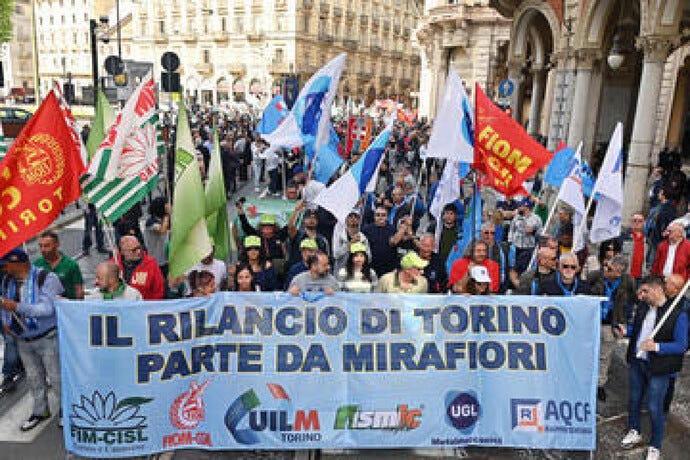
No, I wasn’t talking of THESE workers!

Here’s the trick: the most important part of the paragraph you just read is that I did not write it this month of May 2024, when Stellantis stopped the assembly line of the electric FIAT 500 in Turin. I wrote it almost fifteen years ago, when FIAT, its workers and their unions were playing exactly the same script about the stop of another FIAT plant, in Termini Imerese. As in, we really haven't learned anything in fifteen years.

But maybe now we are to the point where there is nothing to learn, just an already well established reality to see. We need to see what comes after the car and who will do it, because the car as a mass phenomenon is already dying, for all the reasons I wrote here, and all these that came later:

Flying cars, solving traffic bumper-to-bumper traffic in no galaxy, ever.

Leave a comment

What next, then?

I said this years ago, and I'll repeat it now: I fail to see how carmaker stocks can still be considered a long- or even medium term good investment. The mass car of 2024 is just another culture that "rose to the top of their arcs of progress… Only to experience a fall and a subsequent dark age thereafter. And most ironically... developed their most sophisticated technologies right before their demise" (source).
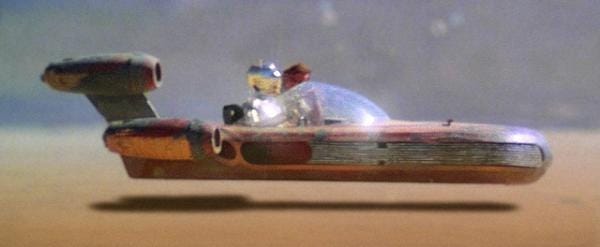
A β€œflying” car that WOULD make sense, for a change

What comes after the cars of today may not even be cars. If you ask me, if cars for mass private transits weren’t dying period, personal hovercrafts would be a cool, real life version of Luke Skywalker's landspeeder, that would be perfect in the real towns of our real world that are already reducing paved infrastructures. On a more realistic level, the vehicles that are powering an EV revolution in India, and generally electrifying faster than basically any other type are not cars, but highly effective rickshaws. An even bigger, even cheaper and easier revolution may be subsidized PRIVATE scooters.

But sticking to cars... The engine type doesn't matter. A mass car industry can exist only if car remains a mass product. In a world where population keeps concentrating in cities, rural residents may certainly still need and keep huge SUVs or pickups, but they would very likely have to build them by themselves, Mad Max style, or pay them as much as a house.

The only "mass" cars that can survive are cars that will bury all current car makers. First, simply because of cost and lack of space, there will be too few, mostly shared cars where most people are going to live (cities) to keep Car Business As Usual profitable. Second, because those cars will have to be beyond the capability of most current carmakers to adapt.

These are crucial matters! Please share this public post as much as you can, both in and outside Substack!

Share

We have billions of battery-operated devices of all sort because their batteries, being small, fungible commodities that only exist in a few tens of fully standardized models, can go inside any device made for them, and even be moved from device to device, anywhere in the world. To survive, cars must become like those batteries.
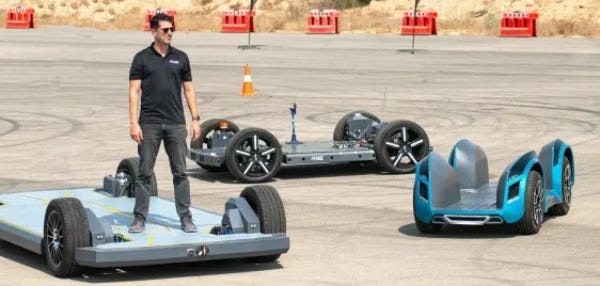
Imagine a "car" that is only a flat platform you can plug "inside", that is below, any car body you ordered separately, including ones you may rent for special occasions, e.g. going to a fancy wedding.

Imagine a car like that, much simpler, much cheaper because it's much more modular, based on few standardized frames shipped in flat packages like Ikea furniture.
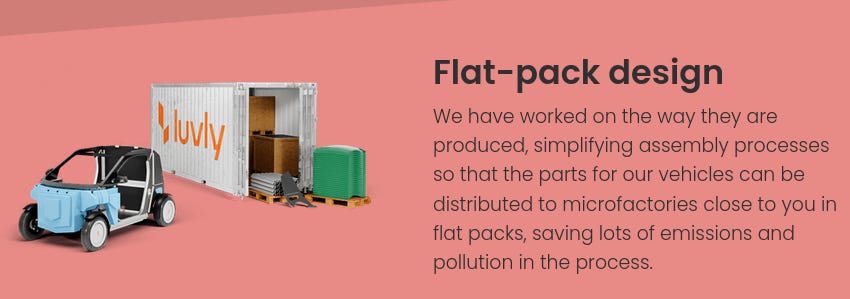
Yes, flat pack cars already exist.

Imagine such a car coupled with laws that make its repair by any independent technician really easy and affordable for decades, with open protocols that directly connect buyers and sellers of spare parts.

Such real innovation is the only way for cars to survive, and at some point it WILL happen simply, if nothing else because all the alternatives are already withering away. To make it happen in the least traumatic way possible though, two things are necessary, starting yesterday:

  1. Lots of future-, not market-oriented regulation and standardization

  2. Super-optimized manufacturing and distribution

The only organization that has both enough influence and is not close, but less distant than any other to the right mindset to make the first point start now is the European Union. The EU just loves to regulate, and this is its real, not perfect but usually beneficial soft power. The only organization that can do the second point soon enough is China. Assuming it’s not already doing just that, of course. Says here, about a Chinese car that sells around $12,000 in China, with craftsmanship comparable to vehicles that cost three times as much:

  • Any car company that’s not paying attention to BYD as a competitor is going to be lost when they hit their market

  • "Chinese EVs are so good that without trade barriers, they will pretty much demolish most other car companies in the world”

Summing up, the solution, or more exactly the only unavoidable future for a car industry that is also sustainable, whatever you mean by sustainable, looks a lot like managed "rightsizing" by EU-driven regulation of Chinese production of EV, or at least hybrid cars. A hugely difficult task, yes. Wars have happened for much less. But if the EU and China were smart enough to partner on this... Wow!
At the personal level, this means that, wherever you live, your last car will very likely be Chinese but..

Writing WITHOUT abusing any stochastic parrot is how I earn a living. If you appreciate my work, please consider a paid subscription, or read below.

Does it really matter, since your next car will likely be your LAST car anyway? Would that be really bad? For whom? If there is one thing we know for sure, is that no matter how the car industry evolves, most of its current employees won't make it to retirement anyway. Their personal livelihood must be guaranteed, but that is a separate problem that would exist and be urgent even if nothing described here happened.

As far drivers and consumers are concerned, a car is just a tool like a screwdriver, not one's dignity. What would be wrong if everybody who needs a car got even better solutions, or a car so good that "pretty much demolishes most other car companies in the world" and lasts at least 25 years, in a world that doesn't make him or her want to wall themselves off?

Usual final call: the more direct support I get, the more I can investigate and share content like this with everybody who could and should know it. If you can’t or don’t want to do it with a paid subscription, you may fund me directly via via PayPal (mfioretti@nexaima.net), LiberaPay, or in any of the other ways listed here.


  1. If you don't believe me on satellites, read this, this and this

  2. Flying cars? Nah. Also here and here

Received β€” 9 May 2024 ⏭ Just an invitation...

5000 words for Europe, again

9 May 2024 at 17:53

On May 8th, 1945, what was still standing of an abominable regime that must never return signed its unconditional surrender to allies from all over the world.

Among other things that surrender, celebrated as "Victory in Europe Day" on May 8th or May 9th, also led to the Schuman Declaration of May 9th, 1950, that the European Community and its successor, the European Union, celebrate as Europe Day since 1985.

For these reasons, and because I strongly feel that a better understanding of "Europe" could be really useful for all human beings (including those against any "Europe") no matter where they live, I celebrate this Victory Day/Europe Day relaunching an idea I had sometime in 2015.

Back then, through this article, I discovered the existence of a book titled β€œCultural Literacy: What Every American Needs to Know, ”written in 1987 by a Mr E. D. Hirsch Jr..

That book, which contains the β€œ5,000 essential concepts and names - 1066, Babbitt, Pickwickian - that educated (American) people should be familiar with”, was written because β€œchildren in the United States are being deprived of the basic knowledge that would enable them to function in contemporary society. They lack cultural literacy - a grasp of background information that writers and speakers assume their audience already has”.

As soon as I read that article, I thought that an European version would be really useful, but had no time to propose it until 2017. Since it didn't succeed, but I dare think it would be even more useful today than in 2017, here it is again. In a nutshell:

  • everybody suggests through this poll one or more of the 5000 concepts, people, books, events, works of art, ecosystems, industries, places etc... they think every European should know in 2024 (you can read all the submissions so far here)

  • once there are 5000 suitable submissions, I automatically download and reformat as one e-book all the corresponding entries from Wikipedia, and make it available online free of charge, with the same license as Wikipedia

If you feel such a book would be useful… please share this as much as you can, in and outside Substack!

Share

To know why I would do this in this particular ways, and all other details, please read the "How I will build 5000 concepts for Europe, and why" part of my original post and the corresponding FAQs. Before that, however, allow me to outline...

Why you'd want "5000 words for Europe" TODAY

There are at least six big reasons:

  • BECAUSE what Hirsch called "cultural literacy" almost forty years ago is even more necessary in an age of deep fakes, crucial elections and highly polarized culture or politics wars, both in and outside Europe

  • BECAUSE, even if what I wrote right after the Brexit referendum were false, that is: even if in 2016 young UK voters were not β€œbetrayed” from their own non-voting peers, it's almost certain that at least many Brexiters were not informed enough, and could have used such a book

UK before and after Brexit, in 2:30 minutes? Just click here
  • In other words: BECAUSE, willing or not, Europeans and their more or less informed choices (starting with the upcoming European Elections) play a non-negligible part in world affairs, and that part will be even more relevant (for better or for worse, is anybody's guess) in a multipolar world. Understanding where those decisions come from, historically and culturally, is helpful even for non-Europeans.

  • Also BECAUSE, since Europe sits just besides the only (BIG) part of the world where population will grow, a book like that may make integration of the millions migrants that will reach Europe whether Europeans like it or not a bit easier.

  • BECAUSE, whatever Eurosceptics worldwide may believe, the European Union never was about straigthening bananas and similar Euromyths, or about merely making business easier. The real goal of Europe, as A. Cottica said much better than me:

"Europe was never about standards - though they support innovation and growth, and give consumers and business confidence. Standards are just a tool to develop the European single market. And the single market itselfΒ is just a machine designed to prevent war.

Europe is about peace. Peace initiatives have happened before, but the European Union is self-reinforcing. Over the decades, EU institutions have enabled, and we the people have built, a dense web of relationships. First it was international trade; then education (Erasmus, anyone?); then business partnerships; then thousands and thousands friendships and marriages. War has become unviable, unthinkable. This was never meant to stop at our borders."

We can discuss the "growth" part another time, but it's impossible to deny that an European soft/digital "superpower" would counterbalance the very few, extremely powerful companies from just one or two countries that right now dominate every aspect of digital life across the whole planet. That is, if you care about anything digital, any background info on how Europeans came to see certain matters differently from both the US and China could be useful, or at least interesting.

Writing (WITHOUT any AI support!) is how I earn a living. If you appreciate my work, please consider a paid subscription.

You don't need to agree with me to want "5000 words for Europe"

Those above are my own reasons to have "5000 words for Europe" in one book. I do hope I can complete this project. But even if you completely disagree with every one of those reasons, hate the EU or live on the other side of the planet, I hope you’ll agree that "Europe" is something everybody should know better, even if only to cricitize or fight it. So, thanks in advance for submitting your own suggestions, and for sharing as much as possible this invitation!

Usual final call: the more direct support I get, the more I can investigate and share content like this with everybody who could and should know it. If you can’t or don’t want to do it with a paid subscription, you may fund me directly via via PayPal (mfioretti@nexaima.net), LiberaPay, or in any of the other ways listed here.

Received β€” 1 May 2024 ⏭ Just an invitation...

Right-wing media may save the Web

1 May 2024 at 07:22

Journalism and classic media in general are in trouble. That's no news, of course, in all the senses "no news" may have. However, there is an interesting development that may come from SOME of those media.

Two weeks ago, P. Fahri wrote in the Atlantic that "Right-Wing Media Are in Trouble", because "the flow of traffic to Donald Trump’s most loyal digital-media boosters isn’t just slowing; it’s utterly collapsing."

In that article, Fahri first summarizes a report describing how readership of the 10 largest american conservative websites fell down 40 percent since 2020, then tries to answer "why the falloff has been especially steep on the right side of the media aisle."

I saw this on Twitter, so it must be true. But keep reading to know HOW it can do good

In a nutshell, Fahri argues that the obvious culprit is Facebook, because:

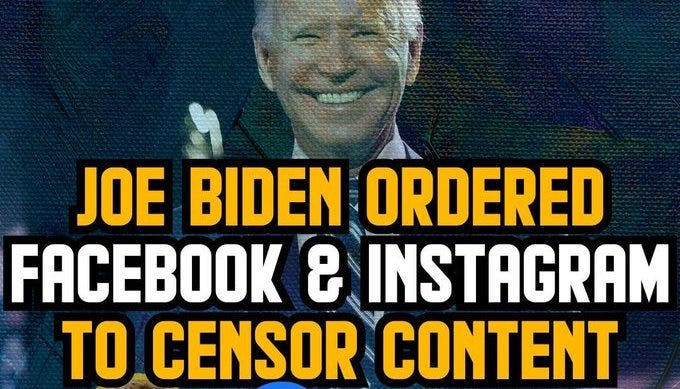
  • since 2018, Facebook has been "deemphasizing news content, giving greater priority to content posted by friends and family members", also on Instagram and Threads

  • conservative digital media are much more dependent on social-media referrals than "prominent mainstream and liberal sites", simply because the former are newer.

Just for the record, that "deemphasizing" from all social media is THE reason why I was forced to open this Substack, since newsletters are the next best thing to do, if not the only way left, until people refuse the solution explained below.

Back to Fahri, his thesis is that, when social media (and Google!) started to strangle publishers and adult discourse in general, "prominent mainstream and liberal media" already had already, much more than right-wing ones, established brands, lots of staff and paying subscribers to weather that storm. Therefore, they are suffering, but much less than the on average much younger right-wing outlets, for which the only way to be visible was to excel at "injecting irresistibly outrageous, clickable nuggets into people's feeds".

This makes sense, but even if it were completely wrong it would not matter for this post. Here, I want to speculate about one specific consequence that this collapse of right-wing reach may have for the web at large. A consequence that would be surely beneficial for everybody, regardless of their political opinions.

What I hope is that, if the surveillance and censorship of social media is really hurting them so much more than their adversaries, right-wing media will conclude that they have no other way to survive than go back to the future.

You see, there has always been a way to see all the news from all your favorite sources in one place. A way that is much more efficient, much less distracting and much, much harder to control or block than social media. Oh, and also much less expensive to for publishers, at least in the long run, than any other alternative.

That way, available for more than twenty years now, is good old plain websites, with RSS feeds and RSS newsreaders.

RSS what???

An RSS feed is a small text file that contains titles and possibly excerpts of all the latest posts or comments from the website that publishes it. EVERY website management software existing today generates RSS feeds automatically, every time it's necessary, unless its webmaster deliberately turns them off (and if he does, he should be fired right away)

Why RSS is good for people

With RSS, every web user can automatically download and read all the headlines or comment notifications from every source she wants, as one unaltered timeline, in one window, with dedicated software programs, or web services, called RSS newsreaders, or RSS aggregators. With such programs, everybody can do that without enduring any advertising, centralized surveillance or any middlemen. Even without subscribing.

Reading all the news only, say, twenty minutes per day, at whatever time is best for YOU, is as easy with RSS aggregators as it's impossible with social media that only make your world smaller and harmfully faster. Indeed, many problems of social media of today would disappear if they just removed instantness and important people could post online only two minutes per day. If everybody started reading and commenting news only via RSS, and started using "social media" or instant messaging only to share (as little as possible) really personal stuff, like "Pizza tonight?" or "Here's my holiday pics", life and politics would be much more productive. But let's go back again to right-wing media and their collapse.

Why RSS is good for all publishers, right-wing or not

That's simple: any website that manages to convert its readers to RSS can merrily tell Facebook, Twitter and every other similar platform to f * * ck off. And it can keep 100% of any advertising revenue they may find.

Of course, you may ask, if RSS is so great, why are more and more website editors and owners so stupid to not display the links to their RSS feeds to all their followers, alongside those to their social media accounts? Why don't they put the RSS feed icon before those of Facebook, Twitter, Instagram and what not? Doing it is extremely easy and surely not harmless, not doing it is unbelievably stupid.

The answer is, I don't know. All I can say is that the problem isn't limited to right-wing media. So many publishers of all kinds (including "most effective communicators"!) do this stupid mistake that if I wanted to list them all in the ”Snob RSS” Hall of Shame I proposed years ago, it would be a full time job.

The biggest sin of ALL media in the last 15 years is not promoting or failing to denounce Trump, Orban, Le Pen, Meloni... or the woke, or the anti-woke, or everything else you may dislike. It has been to not tell their readers, every day, "this idea of connecting via social media is totally cretin and suicidal, both for us and for you. Follow us with RSS instead".

Writing (WITHOUT any AI support!) is how I earn a living, and every subscription makes a difference to how much I can share through this newsletter. If you appreciate my work, please consider a paid subscription.

Right-wing media, saving RSS to save themselves.

What I hope is that Breitbart, Daily Caller, Drudge Report, The Federalist, Fox News, and all the other right-wing media quoted or not in that piece are really suffering social media so much to finally realize, before their adversaries...

... that the only way to survive, that is to remain always, surely, directly visible to their followers that is already available and stable since 2002, the only way that (with the exception mentioned below) won't cost them a dime whatever kind of website they already have, is to:

  • give up any hope that other "platforms" may save them

  • tell all their readers, every day starting yesterday, "let's meet directly, without those damned liberals in the middle: get an RSS newsreaders NOW, it's free"

  • tell all their current or potential sponsors and advertisers "give your money to us, not Big Tech", because even at cheaper rates they'd get to keep all the money

The exception is that doing so implies having to host and moderate readers' comments. To that, I answer that yes, it is a cost, but since it's exactly the refusal to pay it that brought publishers to social media, that is to their ruin, it's still a much better deal than dying.

Share

So, I sincerely hope that right-wing media switch back to RSS en masse, and are successful, which is NOT the same as "I sincerely hope right-wing politics win". This is only about getting a World Wide Web where politics and everything else are less hysterical, a bit more mature than kindergarden tantrums and without omnipotent gatekeepers.

If right-wing social media recover influence and financial sustainability thanks to RSS, I can't exclude that some morons will propose to outlaw RSS. The Streisand effect that would unavoidably follow would help RSS, but it's not necessary. If right-wing media recover thanks to RSS, everybody else will be forced to notice how much better a way to stay informed RSS is.

Right-wing media may help everybody to Make the Web Great Again.

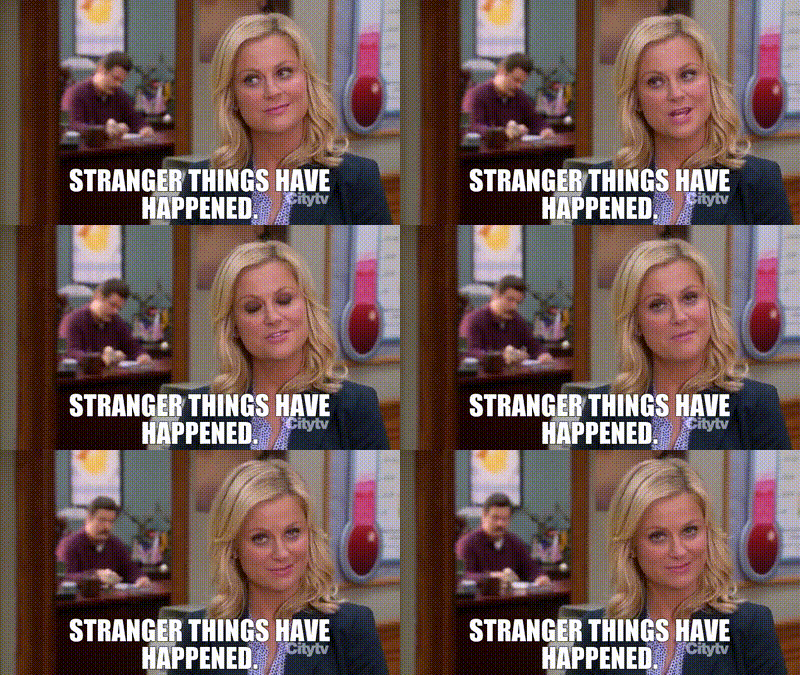
Why not? Stranger things have happened. And while we're at this, let me present you...

The other web thingy that right-wing media are ALREADY doing right

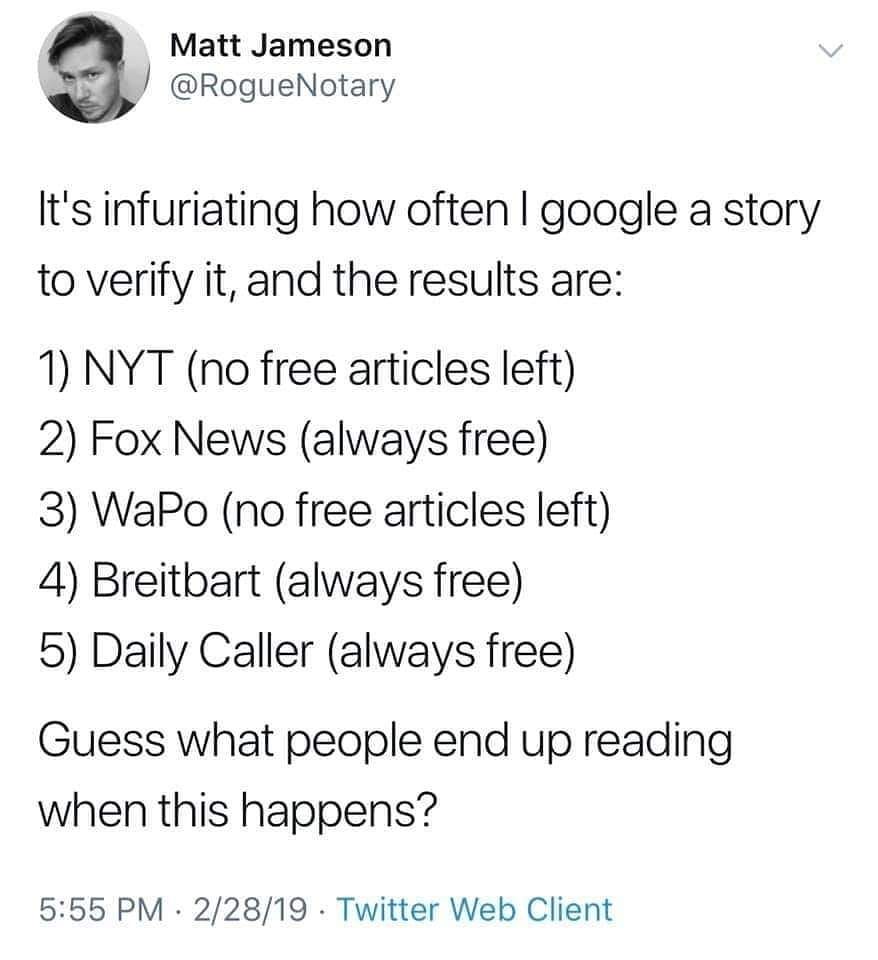
Right-wing websites, and extremists sites in general, don't hide their content behind paywalls, and are also happy to pass it to AI bots. Now, I KNOW that writers must be paid (please consider a paid subscription or donations, see below!) and I am no friend of AI as it is today. But it's impossible to complain that AI just amplifies prejudices and biases, or that people are gullible, misinformed β€œbaskets of deplorables” and so on, if only one side regularly gives both people and bots all they could read:

Usual final call: the more direct support I get, the more I can investigate and share content like this with everybody who could and should know it. If you can’t or don’t want to do it with a paid subscription, you may fund me directly via via PayPal (mfioretti@nexaima.net), LiberaPay, or in any of the other ways listed here.
Received β€” 12 April 2024 ⏭ Just an invitation...

Smartphones are the source of a HUGE mistake, not of all social ills.

12 April 2024 at 11:51

Earlier this week, Henry Oliver wrote a passionate piece to argue that smartphones are not the source of all social ills. I fully agree, but I also think that, especially as far as children are concerned, he made a bad job overall to describe certain issues and how to deal with them, for at least a couple of reasons.

Image source: me, saying the same the same things I say here, five years ago.

First, some excerpts

Here are, in italic, six quotes from Oliver's piece, with my comments attached.

1: This is two quotes actually, separate but related:

  • Tech companies are called attention merchants and algorithmic exploiters.

  • I prefer smartphones to what came before. It’s easier to be uncontactable

With all we know in 2024 about how tech companies work, I doubt they themselves would question the "attention merchants" label, and if I listed here half the bookmarks I have about the first sentence, this post would be three times longer. On the same topic, the second sentence, and the whole piece in general, doesn’t mention at all that, if it's easier to be uncontactable by humans, it's almost impossible to be untraceable by the same companies, which in the big picture is probably a bigger problem.

2: [N]ow the psychologist Jonathan Haidt is promoting the idea that smartphones and social media have β€œrewired” the brains of a generation of children, which makes them depressed and anxious. ... But Haidt’s claims are not uncontroversial... The evidence is less certain than it appears.

In a world that's still arguing about stuff that's way easier to measure, from superconductivity to average temperatures, expecting any claim on social science issues like these to be really uncontroversial does not seem realistic to me, but never mind. What I am sure about, from both my own experience as parent and decades of volunteering for teenagers, is that the solutions that Haidt proposes have merits of their own, and above all that they are much, much more feasible and scalable than what Oliver suggests. I'll get back to this in the final part of this post.

3: Do we really believe that the effects of this new technology are so different to, say, the arrival of landline phones and cars?

(at least) As far as children are concerned... Hell, yes. No one, child or adult, could ever influence, or be influenced by, hundreds to millions of peers simultaneously with one phone call. As far as cars are concerned, and without negating what Oliver says about them in the next point, the same children who hurt themselves with smartphones know pretty well by themselves how stupid it is to run in front of a car, not to mention that children don't get to drive cars wherever they want, whenever they want, when they are still in primary schools.

4: The most persuasive argument isn’t that phones cause unhappiness on their own, but that it exacerbates an existing trend. Children used to be much more free to play outside and take risks. Cars ended that. It is impossible to allow modern children the run of their neighbourhoods as they had in the 1950s when we have traffic levels (with heavier, faster cars) of modern times... Similarly, teenagers began reading far fewer books decades before smartphones were invented. Phones may have exacerbated that trend, but they certainly didn’t cause it.

This part makes much more sense. Please check the "Stranger Things" part of this proposal of mine to see how I suggest to rebuild cities to fix the "play outside" problem. However, it still leaves important things out, and doesn't end looking in the right direction anyway. The last sentence is true, but not a valid reason to have a personal smartphone before one is 14 or older. Even the reading issue is true, but does it prove that smartphones aren't bad for children in many other ways? If anything, that's an argument for giving every child not smartphones but ebook readers, that is devices that would bring thousands of books right on their nightstands, but without openings to cyberbullying.

Again on cars: yes, they do make kid's lives much harder, but what ended outside play (yes, since decades before smartphones) is overparenting that suffocates children with parents' fears of everything that may lie outside, from aliens to scratches, with parents' pressures to be champions in as many fields as possible, as early as possible, and with parents attaching smartphones to their children just to control them every minute. Still, none of this justifies the confusion I'll cover shortly.

Leave a comment

5: Without the danger of passing cars, [her daughter] has something closer to an old fashioned childhood: free time, where she takes risks, without being constantly supervised. If we can solve that problem, many children will likely be much happier. It isn’t all about phones.

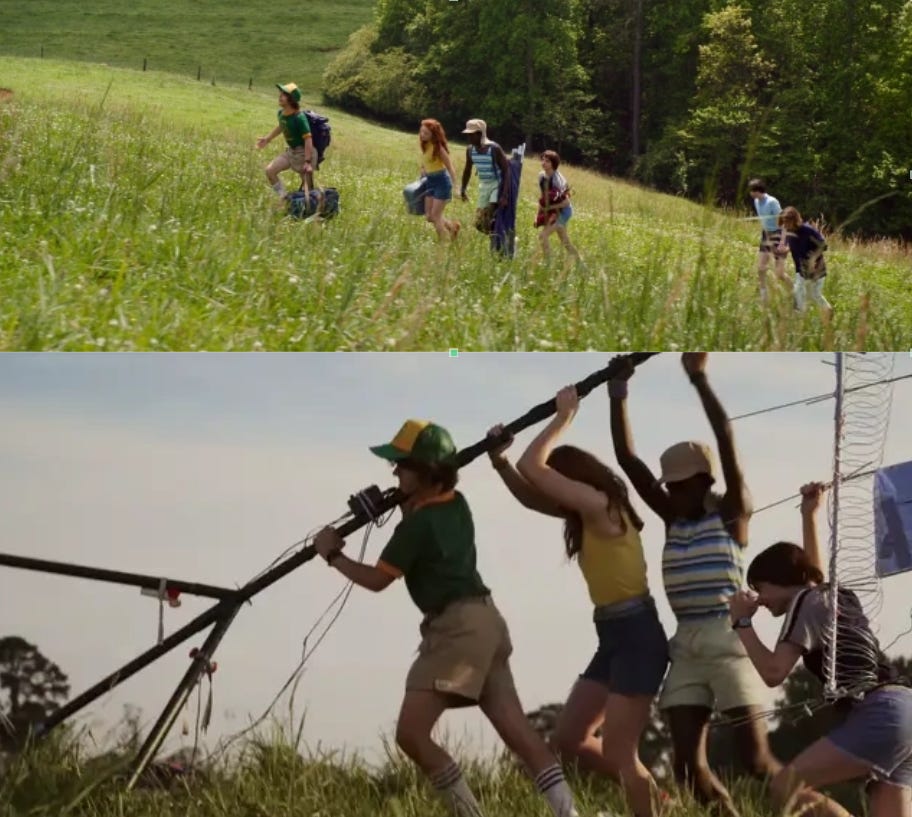
What’s the REAL charm of Stranger Things? Not the Underworld, surely.

I've said myself that parents must let children play alone outdoors, before worrying about social media. This said, allow me to complete, not criticize, the "danger of passing cars": I obviously do not know how things are where Oliver lives. But I've seen lots of neighborhoods, in Italy and abroad, where the same children who wouldn't live long if they tried to play in the middle of the streets could safely walk on sidewalks and pedestrian crossings, to school or to some friend's place, if only their parents hadn't been made paranoid or snob by systemic pressures (coming also, who would have known, through smartphones).

6: And amongst all this clamouring, we risk overlooking the immense benefits of phones and social media.

  1. Standing up against the overmighty state is much easier with social media.... There’s a reason why access is limited in China and Russia.

  2. On a more mundane level, phones and social media give us access to the world in a way that was unimaginable to previous generations:

This is one of the weakest part of Oliver's piece. Point 6.1 is true in theory, not in a world where much top-down political control happens just through social media that government have learned how to turn into partners, or block altogether, since at least the Arab Spring. As far as children are concerned, instead, the same point is just irrelevant, because it just doesn't matter how many good things adults may do with a smartphone. To see it, take that sentence, replace "social media" with "assault rifles in every home", then go check how many of the same people who do think that's the best idea ever would give their children an assault rifle to use unattended, 24/7.

For the other point, which is one of the two main issues I have with Oliver's piece, here is how he describes that unimaginable access:

In the last few days social media has meant I booked tickets to a Sally Rooney event, discovered a new piano recording by Vikingar Γ“lafsson, watched the science explainer videos of Sabine Hossenfelder, messaged a scientist on Twitter and been sent their research paper, discovered and read a short story by Somerset Maugham, learned that Beethoven had a low genetic predisposition towards musical accomplishment, discovered a magazine of Nigerian literary criticism, and watched a video with my children of a komodo dragon eating a pony whole (recommended). Other things I have done include reading a poem by John Donne, using AI to explain a technical article I didn’t understand, chatting with subscribers to my Substack about Shakespeare, and writing about how late bloomers find their calling in life. And this is not to mention the pictures of my baby nephew that I get sent on WhatsApp.

The problem here, that Oliver himself lays out very clearly, is that he is not a meaningful sample on which to base any conclusion or policy on these issues. Not at all, and I say so as a compliment. Oliver is a successful writer with, quoting the first endorsement on his own website, "a rare talent: smart, funny and insightful".

In the same days when Oliver and every other adult with comparable natural skills, birth lottery luck, education and income as Oliver were doing all those marvelous things above, many more human beings of all ages, as in "one to ten thousands times more", were using the same phones and social media for little more than losing sleep to kitten videos, conspiracy theories, culture wars and so on.

Oliver himself tells us that he homeschools his children, that is that his children are automatically shielded from all the pressures or worst they'd have to endure in a classroom full of peers with smartphones. Again, good for them, but hardly a valid sample for general conclusions.

The other example Oliver makes, a woman evidently born with all it took to make "her passion become her career" as a social media strategist (that is an active user, among masses of passive ones of phones and social media) further strengthens the same point: what Oliver and everybody else like him can achieve only thanks to "phones and social media" is wonderful, no doubt. But it's no evidence on which anybody should base any policy or advice for the other 99 point something per cent of human beings.

Leave a comment

The main problem: misunderstandings promoted to laws of nature

Yes, of course adults and kids who lock themselves inside smartphones wouldn't do it if the rest of their lives didn't suck. We can also accept, at least as first approximation, that "phones and social media" just exacerbated pre-existing negative trends, rather than creating them. That's nothing else than the very nature of everything digital: it greatly, greatly amplifies and accelerates everything it touches, both good and bad.

But there is digital, and then there is digital. In his piece, Oliver does outline the solution, that is "find ways of maximising the benefits and minimising the negatives - as we do with many things", but doesn't tell, or see, what the most effective ways are and why.

Here is the most important point that is completely absent from Oliver's piece, and so many still fail to see: the internet, the Web, social media, personal "stationary" computers (including laptops) and smartphones or tablets are five SEPARATE things, that must remain as separate as possible, at least in the minds of parents, educators and policymakers. The dumbest tech-related mistake done in the last 15 years may be just the equation internet = smartphone, which reached the status of law of nature for NO reason whatsoever, except digital ignorance.

Look again at all the wonderful things that Oliver did with β€œsocial media”: first of all, none of those things requires social media to work in ways that, no matter how personally immune Oliver is, are designed to be addictive. But even if social media were not addictive and were able and willing to filter out toxic content, the most important truth to grasp is that:

  • anybody, children included, can do all those things with a stationary device placed in one's kitchen or living room, instead of a smartphone

  • and that that mere change of device makes a world of difference

To see how big that difference would be for adults, imagine a world with all the same social media and online services as ours, but without smartphones, just with camera-equipped good old cellphones. That is, a world where you'd still be reachable wherever you are, and able to do everything Oliver wrote, but... in order to engage in flamewars, or share on Instagram all the food pictures taken in some fancy restaurant, you'd have to wait until you're back home, where you could attach your camera to your computer. In such a world, would you waste more or less time and stress than today?

Back to my main beef with Oliver's piece, that is Haidt and children with smartphones: regardless of the validity of his data, Haidt is not saying that smartphones, the internet or even social media should disappear. When you cut to the chase, the main if not only thing that Haidt says is only that giving uncontrollable personal smartphones to children less than 14/16 years old was a huge mistake that should end yesterday.

But this does not mean at all to give up all the good things children can do online. There is a lot that children can and should learn since primary school about the internet, the web, online communication, digital creativity and so on. But NOTHING of that requires a personal smartphone, with its intrinsic illimitability. This is what Oliver seems to completely ignore, or at least to completely fail to communicate, when he writes that "As with so many of the things teenagers start discovering, the aim should be to teach them the best use of it". What's the point of teaching or promoting the best use of the internet... just with the one tool that is much more dangerous than all the others, but not necessary at all?

What to do then?

The right thing to do is just what Oliver himself leaks out in a couple of sentences, that get hidden by all the rest. The first is when he writes to be "appalled that my thirteen year old brother has a smartphone and is allowed to waste so much time on it."

That's where the solution is. The difference between giving children a family computer they can use, possibly while other family members are around, only between homework and dinner, and a smartphone is very simple. It's the same difference there is between telling a child "hey come here and help me cut the bread with this knife", and giving her the same knife to carry around, 24/7 unattended, to use in any way hers or some stranger's brain may suggest.

In the first cases, the children get to learn and do cool, useful things, with almost no risk. In the others, "what could possibly go wrong?" is not even funny.

Writing WITHOUT any AI support is how I earn a living, and every subscription makes a difference to how much I can share through this newsletter. If you appreciate my work, please consider a paid subscription.

Adults are another story for another day. As far as children go, the reality we all actually live in is the one in which:

  1. almost all real children less than 14/15 years old do not have the skills AND the education AND, above all, parents with enough skills AND time to help, to use smartphones without harm (ditto for teachers, in case you're thinking schools could or should ever do enough)

  2. therefore, the children for whom a smartphone is at best an expensive ballast, at worst a mental health polluter and always an electronic tag are surely many more than those who can and do use smartphones to enrich themselves without any negative consequence

  3. both categories of children could do almost everything Oliver does from a normal computer in their living room, which just by its own nature, location and built-in "time limits" would eliminate almost all the dangers

Corollary of all of the above: at the end of the day, it doesn't even matter how accurate Haid's data are. Or, as I wrote four months ago, it doesn't really matter whether "social media" is good or bad for "kids". Even if all THIS critic of Haidt's work, newer than those linked by Oliver, was all true, there is nothing to lose and lots to gain (even financially...) from giving children less than 14/15 years old only stationary home computers and broadband, NO smartphones. Only the first devices give access to pretty much everything positive children could need or want, age too quickly but still much slower than smartphones but block, just by being stationary where relatives can walk by, a BIG LOT of exposure and opportunities for negative outcomes.

So, please learn to distinguish between "smartphone" and "internet" or "social media". Give children stationary internet soon, but delay as much as possible the uncontrollable, unsuperviseable access to the whole internet and to the continuous, digitally distorted pressures from equally unprepared peers that smartphones couldn't avoid being, even if their makers wanted.

Who should do it? Easy: follow Oliver, again, when he writes "I don’t want to ban my brother from using... the internet wisely." This is NOT something that laws or mandatory "age verification" schemes that would never work as advertised could or should do. Thanks, but no thanks. Not giving children a smartphone before they are 14/15 years old is something that only parents can and must do. It's as simple as that, really.

Usual final call: the more direct support I get, the more I can investigate and share content like this with everybody who could and should know it. If you can’t or don’t want to do it with a paid subscription, you may fund me directly via via PayPal (mfioretti@nexaima.net), LiberaPay, or in any of the other ways listed here.

Please share this post among as many PARENTS as possible, in and outside Substack!

Share

Received β€” 9 April 2024 ⏭ Just an invitation...

OK, let's speak of automation

9 April 2024 at 12:21

*How is it harmful, again? For which people?

The extremely (not) surprising key findings of a a paper about "Robots, meaning, and self-determination", says the Register, would be that "robots harm work meaningfulness and autonomy". It seems to me that such findings, or at least the way they are presented, overlooks something that should be even more obvious.

Yes, it’s off topic, but NO AIs were wasted to make it, and I really needed to get this off my chest. Thank you for your understanding.

The study focused not on the purely monetary impacts of industrial automation, but on how industrial robots affect both the meaning of work, and the self-determination of workers.

What it found is that the adoption of industrial robots "takes a mental toll on workers, especially those with repetitive jobs [and] routine responsibilities". That toll consists of diminished need for creative problem solving, reduced worker autonomy and reduced human interactions to the detriment of work relationships.

Quantitatively speaking, the study found that the average increase in robotization between 2005 and 2020 was almost a four-fold (389%), and as much as 26 times in industries like mining and quarring, and that doubling the presence of robots lead to a 0.9 percent decline in work meaningfulness and a 1 percent decline in autonomy.

The authors also concluded that one way to mitigate the loss of autonomy is to give workers control: "Specifically, working with computers completely offsets the negative consequences of automation for autonomy". That is, robots make workers feel worse - unless they control (or "teach", that is program) the machines, robotics or not.

Forms and consequences of "Reduced human interaction"

Robots are just software, after all. Whatever the exact amount of alienation from industrial robots is, the problem surely exists, and exists with every kind of automation and, albeit in different forms, in almost every sector of the economy, including retail or any kind of office or "knowledge" work.

When it comes to interaction between workers and their end users or customers, for example, much automation just hides and alienates the former, rather than replacing them. The last perfect example of this issue is the Amazon Just Walk Out stores which only seemed completely automated, because they had more than 1,000 people in India, obviously paid much less than western cashiers, watching and labeling videos to ensure accurate checkouts.

In factories, warehouses and offices, instead, "reduced human interactions that harm work relationships| are the unavoidable consequence of one fact, that's much older than computers and software. In order to understand, reproduce and manage any kind of complex process, from photosynthesis to satellite building, science and technology must split that process into as many elementary parts as possible.

When coupled with capitalism, mass production and bureaucratization of life, that fact unavoidably leads to more meticulous division of labor, where every person has their own defined task, until every worker only needs to depend on some machine. As an acute Japanese writer observed more than 30 years ago, automation like this has caused "every individual to find their determined position in the great societal machine...This is the strongest organizational force in modern society. While it lies outside the confines of politics and law, it is nonetheless very powerful".

Did you notice the last two sentences one of the best definitions of Big Tech one may give? But I digress.

Writing WITHOUT any AI support is how I earn a living, and every subscription makes a difference to how much I can share through this newsletter. If you appreciate my work, please consider a paid subscription.

Automation does NOT create more USABLE jobs

The story goes that yes, automation creates alienation and eventually unemployment, but that's not a problem, because it always creates even more new, surely better jobs. Yeah, right. But for whom, and how usable? All this displacement by software and robots would not be a problem IF:

  • jobs were not the only way to pay one's rent, mortgage, food and clothes (or, put another way, if we didn't insist to get concepts like UBI and AI in reverse order)

  • ENOUGH decent jobs that COULD be taken by the RIGHT people, that is workers displaced by automation, COULD not just exist but above all be taken WHEN those workers would need; that is, as soon as possible, not after some magic "upskilling" that in most cases would have to be so advanced that it would fail in most cases, or so long that it would cost taxpayers much more than unemployment insurance

The reality today is (quoting someone else now , not me) that we won't be able to retrain the majority of the workforce fast enough to take the new jobs in emerging industries. Not in a world where, unlike in previous industrial revolutions, the older workers are much more than the younger(aspiring) ones, would need much more training, and "entire industries' disruptions in periods that are shorter than election cycles".

Automation isn't even "freeing time"

A while ago, I almost spit my tea when I read that automation is freeing time, because, "there is a sports equipment boom in the USA, and how was the time to use it freed, if not through machines?" One answer to this "argument" may be that those who can afford sport equipment, or state of the art gym memberships are less than those work of many more working poors. If automation is freeing time, how come most families are forced to have every adult member working full time just to make ends meet? Another answer may be that if there are so many people who lose weight by making drugs like Ozempic scarcer and more expensive for those who would really need them instead of practicing some sports, is because automation just gave them more money, but not enough time to spend it decently.

Side note on humanoid robot

While we are at this... Another symptom of how much confusion and hype there is on robotic automation and related issues is the interest, which I fail to share outside of science fiction, in humanoid robots. Most industrial robots or machines have no need whatsoever to be human-shaped, and never will. If they did, they'd probably be less effective, not more: "you don't make [humanoid] robots to fix all plumbing, you design all plumbing to be fixable by robots". Outside factories, what automation would be better? Better appliances, or housemaid-shaped robots that have the same probability of mastering the billion situations they would meet in real homes as "driverless" cars of becoming really able to drive autonomously on all real roads? Ditto for warfare, office work and so on...

Robots with similar shapes to animals would be much better, for at least two reasons. One is that certain animal shapes would actually be better for certain jobs. Four -legged or serpentine robots, for example, could explore and monitor caves, oil pipes, ship bilges and thousands more similar environments, much better than anything human shaped, human or robot.

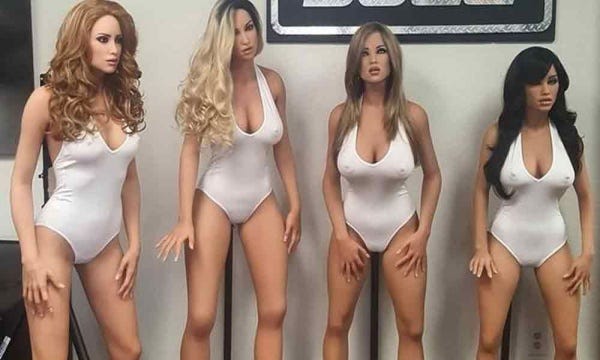
The other and most important reason is that the less robots look like humans, the easier it is to avoid confusing what being human or machine means. Robots looking like humans make it easier to treat even humans like robots. Having "someONE", not someTHING, to dominate, or to alleviate one's need of actual humans, hardly seems an easier path to positive human growth. As proof of that, we can just look at the biggest, already existing market for "something that looks like a human to boss around":

Share

What that study doesn't say

Back to the links between displacement and automation displacement by robots, AI or anything else, I recently read here, that "technology's displacement effects can be outweighed if new tasks are created where labor has an advantage over automation. This is a huge if."

No, that's not a huge "if". It's a huge "WHY???"

Let's be clear: we do need much more automation than today, albeit of a very different nature than most startuppers or venture capitalists would like you to buy. I am pretty sure that the miners of 150 or even just 50 years ago would give some year of life they couldn't enjoy anyway, displacement be damned, to work in the much better, much safer conditions that highly automatized mining can provide today. There are still plenty of actually necessary, but dangerous jobs that can and should use more automation. It's equally obvious that even the bare maintenance of existing vital infrastructures, from ports to bridges and power lines will need much more automation, if you consider how quickly populations are aging worldwide, and how many of their younger members, the ones best suited for certain jobs, are still blinded by getting a good degree, just to win a "great job".

Leave a comment

This said, the same author who wrote:

  • "They only need to depend on a machine"

  • "working with computers completely offsets the negative consequences of automation for autonomy"

also left something critical out when he wrote something that science and technology "guaranteed the values of individualism" and "improved the status of individuals, increased individual self-consciousness, and strengthened the sense of individual responsibility".

The problem is that "need to depend" can mean two terribly different things: one is need to depending on having a machine to do one's work, be it a computer to blog, a circular saw to build cabinets or a synthesizer to play music. The other is to depend as in "subordinate, being managed by", without responsibilities.

It's just the difference between "working with" and "working for/under", but it's huge. The first scenario is good, the other is the dystopia where (regardless of its appearance) a computer is in charge, bossing a human around "at a robotic pace, with robotic vigilance"One gets increased individual self-consciousness and all that ONLY if and when what automation provides are tools that extend one's capabilities, not inhuman bosses and controllers.

The final and most serious problem about automation that that study leaves unsaid is the one that Dante Alighieri explained seven centuries ago:

"Call to mind from whence ye sprang: 'Ye were not form'd to live the life of brutes, 'But virtue to pursue and knowledge high.' (Inferno, CANTO XXV)

Dante and Virgil observe the false counsellors. (Gustave Dore’, from Wikipedia)

There is no amount of control or "creative problem solving" that can avoid mental tolls if, as it happens more and more frequently, the end product or "mission" itself of one's job is inherently pointless or outright superfluous. I suspect that this is the displacement, lack of meaning or whatever you want to call it that automation often just exposes, rather than create: maybe automation scares a lot of people not (just) because it makes them lose their jobs, but because it makes impossible to ignore that their jobs themselves were worthless to begin with.

Of course, that's a problem only until full time work for every adult remains a dogma, and only for those who must absolutely have a job, instead of a purpose, to feel they are worth something.

Usual final call: the more direct support I get, the more I can investigate and share content like this with everybody who could and should know it. If you can’t or don’t want to do it with a paid subscription, you may fund me directly via via PayPal (mfioretti@nexaima.net), LiberaPay, or in any of the other ways listed here.
Substacks quoted here: SK Ventures and T. Greer.

Just an invitation... is a reader-supported publication. To receive new posts and support my work, consider becoming a free or paid subscriber.

Received β€” 30 March 2024 ⏭ Just an invitation...

Catholic Social Doctrine and Open digital revolutions

30 March 2024 at 20:40

Back in 2013, I wrote a relatively long essay titled "Catholic Social Doctrine And the Openness Revolution: Natural Travel Companions?" which, in spite of its name, was not addressed only to Catholics. Instead, I thought and still think that it may be quite useful even for people who have no love nor interest for anything Christian, and no intention to change their ways. Therefore today, on Easter's eve, I'd like to share a much shorter version of that essay, as an invitation to think about what should be the real nature, and usage, of digital innovation (for the full story with all sources and citations, please consult the full essay).

First, Openness

I define "Opennes" as the set of attitudes, technologies, concrete practices and legal infrastructures, all driven by principles that include a "share-and-share alike" approach to ownership and reuse of goods and services, characterized and enabled by massive usage of the Internet for affordable, large-scale collaborative design and mutual support.

Some of the best known and most developed real-world applications of Openness are Free/Open Source Software (FOSS), Open Data, Open Access, Open Hardware and distributed, mass-customizable " manufacturing, with open licenses, via 3D printing and similar techniques.

To see the real meaning and value of these applications, let's consider 3D printing, open manufacturing and digital maps (but there are many more examples in the full essay). 3D printing technology is perfect for low or very low volume production, that is the very kind of production that may be appropriate even for (networks of) villages and other small communities in developing countries, with little or no money to invest in machinery. 3D printing also is an excellent way to produce on demand spare parts of obsolete products that may not be commercially available.

With or without 3D printing, Open, collaborative design and manufacturing are not limited to immaterial or small size products or, more generally, non-primary needs of lucky citizens in the most advanced societies. They are also extremely important, for example, for agriculture, as I wrote just one week ago.

Digital cartography and mapping are two activities that can carry (or block) important political messages, and be acts of either exclusion or social self-affirmation. Proprietary online maps may be almost useless in developing countries, if they show every possible detail of "rich" places, but little or nothing of poor ones, because mapping them could never be profitable for a traditional private corporation.

When Open Tech does better than Big Tech: digital maps of Gaza are much better than proprietary ones

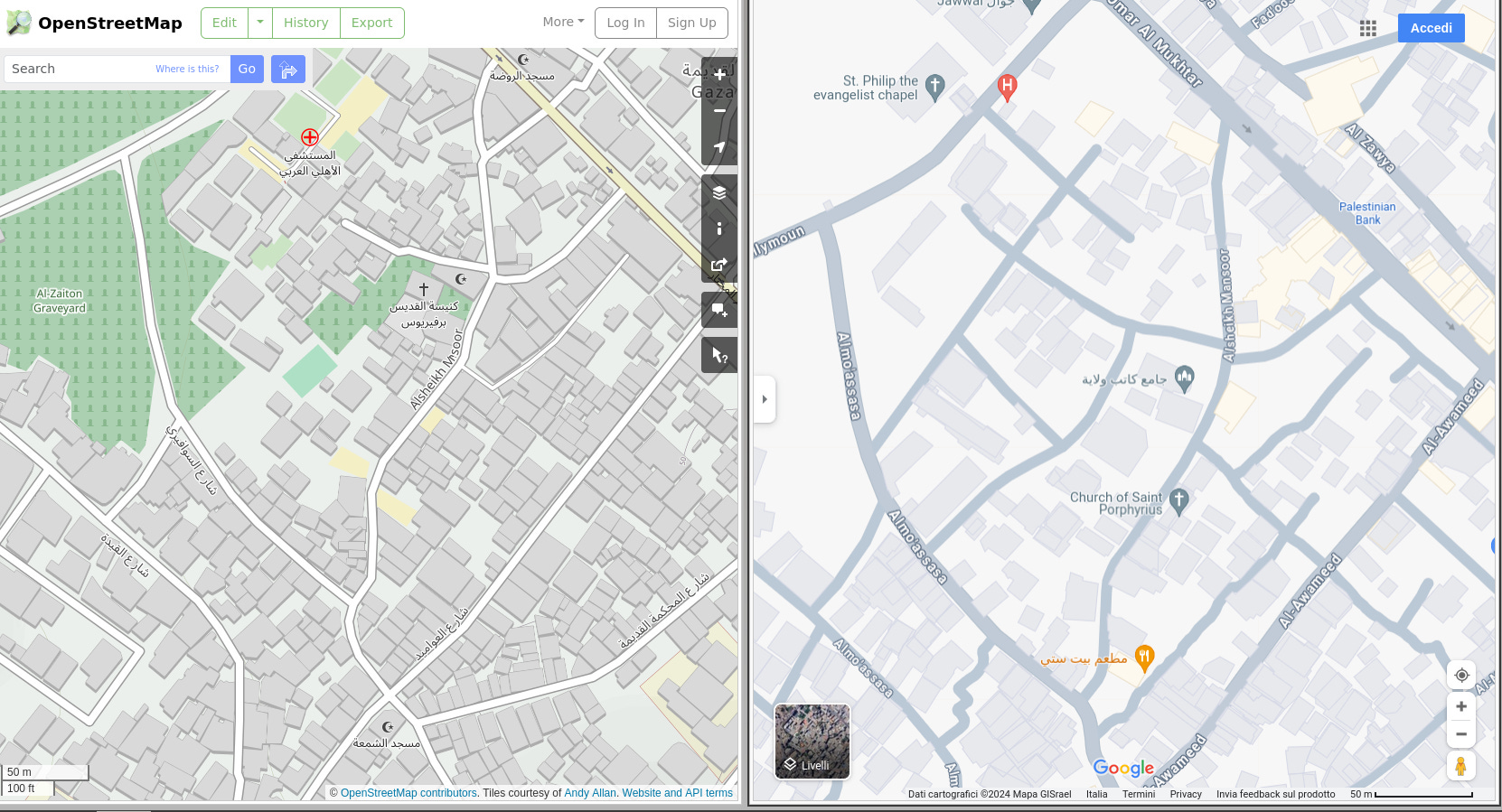
The Gaza Strip is a perfect example of both this problem and its solution. In 2013, the Strip looked almost empty on Google Maps, but its ambulance drivers could quickly reach people in need anyway, thanks to OpenStreetMap. Even today, the OSM map of Gaza seems more accurate and up to date than the Google's one. OSM also makes it much easier for linguistic minorities to build and preserve state-of-the-art digital representations of their own land, history and culture, in their own language, with their own symbols.

In general, its characteristics make Openness particularly well suited to address (among other things) the real needs of people.

As everything else here, this post is REALLY public. Please share it both IN and OUTSIDE Substack.

Share

Second, a short, ad-hoc summary of Catholic Social Doctrine

Based on the Ten Commandments, the Gospel, human wisdom, and science, CSD is "a single teaching, consistent and at the same time ever new" about development and management of society, that only defines general principles: "The Church has no models to present; models that are real and truly effective can only arise within the framework of different historical situations... [CSD is just] an indispensable and ideal orientation." Concretely, CSD has always strongly proposed a society built on Common Good, Solidarity and Subsidiarity, defined as follows.

Common good is defined as the sum total of social conditions that enable human development "on the basis of a balanced hierarchy of values" that maximizes the possibility of what would be authentically good for groups or single persons (real needs, again!), both in the short and in the long term. Participation, that is active contribution to the common good from each individual, is necessary because it enhances society, and because everyone has something to contribute.

Solidarity: human beings are social by nature (which, incidentally, is just what the Web 2.0 meme is all about), but their true unity in society must come from free acceptance of the commandment of Jesus Christ to love one’s neighbor. Consequently, while solidarity implies social charity and mutual support, in CSD it is never a demand for a Welfare State. Its goal is that human persons are not made dependent on the rest of society.

Subsidiarity: placing the human person at the center implies subsidiarity - that is devolution of effective power to "the lowest and most local level compatible with the common good" (which sometimes demands "that decisions which affect many people are sometimes taken at a higher level"). Only in this way each single human being, or association of human beings, can practice as much freedom and responsibility as possible. This is perfectly in line with the will to avoid some "all-encompassing Welfare State." Simplifying a lot, subsidiarity is not mere consultation ("Do you like this law proposal?") but genuine participation ("Shall we write this proposal together?"). In order to respect both subsidiarity and solidarity principles, "the State’s intervention in the economic environment must be neither invasive nor absent, but commensurate with society’s real needs."

Summing up, any society based on CSD would be a society that would help the poor by empowering them through government that is small in assistentialism but "big" in fair rules. Through active participation (at all levels, from family to State) and distributed ownership of means of production, that society should serve the real needs of all its members, both at the spiritual and at the practical level.

Leave a comment

Connecting dots

However short, the two syntheses of the previous paragraphs should be enough to highlight that there are many important points of contacts between Openness and CSD. To begin with, both Openness and CSD are not, and never can be, a direct endorsement of any single product, brand, company, country or political system. Nor are they tied to any technology, with one crucial exception for Openness that I will explain shortly. Openness is, first of all, a way of working and regulating some technologies. All the practices and movements described in the first part are:

  • legally and deeply adaptable to very diverse, local, real needs and the common good of all their users without special permissions, at the smallest possible cost;

  • perfect for decentralization at the lowest possible levels;

  • driven by, or supportive of, free and spontaneous initiatives, by individuals and communities, and voluntary, participated work, instead of assistentialism from above;

  • not driven by profit, even if they don’t exclude it;

  • based on means of production that (at least in the immaterial parts) really belong to all their users, thus distributing ownership at a much bigger and more resilient scale, than would have been impossible even a few years ago;

  • usable, and already used, to build tools of peace of all sorts, from tractors to textbooks;

  • beneficial even for people without (broadband) Internet access

In the second place, software, which is the technology that makes all kinds of Openness actually accessible to the masses, produces legislation and culture: therefore, understanding the nature of software belongs to any "system" to build a better world as much as to technical curricula, and making certain decisions about software is a responsibility that the heads of every institution cannot delegate to their ICT staff. Similarly, in the modern world, respect for the person should include making sure that each person can choose the software he or she really needs.

Besides, CSD has always advocated a just distribution of means of production. Software and knowledge, albeit immaterial, are crucial, strategic means of production. Their just distribution implies (without excluding private initiative and profit!) their opening.

Connections among globalization, Openness and subsidiarity as in CSD are equally strong. Since the times of Paul VI development in CSD implies active participation of peoples, "on equal terms, in the international economic process." Openness makes this easier, turning globalization, that is access to appropriate knowledge and to the most efficient means of production, to the poor’s advantage. In this sense, Openness seems a bit like globalization done right.

In addition, it is subsidiarity itself, which I may summarize again as "whenever people can do something by themselves, help them to do so!," that requires and contains Openness.

On the same note, and with respect to globalization, Pope Benedict pointed out that the [current] context of international trade and finance limits the sovereignty of States. This lessening of power of the States puts subsidiarity in danger: no State may delegate powers and tasks that it completely or partially lost due to globalization, international trade treaties and intellectual property abuses. By encouraging Openness, States can get back some of their power to offer subsidiarity. Besides, promoting Openness reduces unnecessary costs, freeing important resources for more critical tasks, and increases the free circulation of solutions to real problems.

Today, Open techniques are too often used to build "first world-only" gadgets and services. However, they also seem made to order to fight consumerism and help the poor more efficiently, at the smallest possible cost. Technology for Openness already exists and doesn’t require any "extension" or changes to CSD; in a way, we may say that Openness may be used to implement with ICT the orthodox CSD that already exists.

Another way to express the same concept is that, if we had to build from scratch technologies and ways to use them that match CSD point by point, the result would be unavoidably very, very similar to what is described in section three. So, why do it from scratch?

The Open Revolution is based on technology, and Paul VI and Benedict XVI rightly warned against "the great danger of entrusting the entire process of development to technology alone." Indeed, in general any technology can create new divides, increase exploitation instead of fighting it, or encourage its own idolization.

The Open solutions described here, however, do not depend only on the smallest possible number of technocrats as it happens with closed, proprietary systems! By design, Open solutions not only enable, but encourage all the people and communities using them to "look under the hood," to take control and modify the "machine" until it really suits them, or to ask for help to do that.

Writing is how I earn a living, and every subscription makes a difference to how much I can share through this newsletter. If you appreciate my work, please consider a paid subscription.

Conclusion

Openness is not some "savior" to be idolized in and by itself. It is, however, one of the necessary tools to support real human development. As far as I am concerned, the Openness Revolution also proves the timelessness and modernity of CSD and, in general, of the message of the Church: it’s a bit like CSD had already conceived, decades or centuries ago, solutions so advanced that technology has been able to build the necessary tools only in these years!

That’s why, in my opinion, while Openness is good in and by itself, Catholics have even more reasons than others to promote, teach and use it. This said, the main point and main take-home lesson of this piece is that nothing, nothing you have read here should be considered valid or relevant only for Catholics, including the basic concepts of CSD. Consider these questions, which are generalizations of three questions actually asked by U.S. Bishops almost thirty years ago:

  • How can any community call those in positions of power to promote.. decent wages, and greater opportunities?

  • How can any community shape the priorities of its culture to promote greater personal responsibility and better economic choices?

  • How can business, labor, various levels of government, and NGOs of all sorts, including churches, work together to overcome economic injustice and exploitation in our communities?

What I argue is that first, Openness as defined here is good and necessary, for at least the reasons one may found in CSD, for every belief system or world vision that cares for individual freedom, solidarity and decent answers to the three questions above.

Second, as I wrote even before that essay, "software is too important to leave it programmers" (also here). Does this mean that everybody, Catholic and everybody else, should become hackers or software programmers? Of course not! It just means that everybody should all be aware of these issues and opportunities, in order to vote and act accordingly, in their own interest. After all, as I will never stop saying, "YOUR civil rights and the quality of YOUR life depend every year more on how software is used AROUND you".

Usual final call: the more direct support I get, the more I can investigate and share content like this with everybody who could and should know it. If you can’t or don’t want to do it with a paid subscription, you may fund me directly via via PayPal (mfioretti@nexaima.net), LiberaPay, or in any of the other ways listed here.

❌