Login
Login
Seven reasons why Pablo Picasso got AI right, sixty years ago
First, one update and one reminder: if I’ve been silent here lately, is because I’ve written a lot at FOSS Force, please do check out my weekly column there! Also, please remember my "unusual request”: I do appreciate paid subscriptions but, for the reasons explained at the end of this post, I feel one time donations for any amount you want, via PayPal (mfioretti@nexaima.net) or LiberaPay may be even fairer, for both you and me.
Back to the story now: Sixty years ago Pablo Picasso more or less said that computers are useless because they just give answers.
Sixty years later, I see more and more signs that current AI, which is not unavoidable at all and is not even "intelligence", just peak software, is useless, if not harmful, for exactly the same reason.
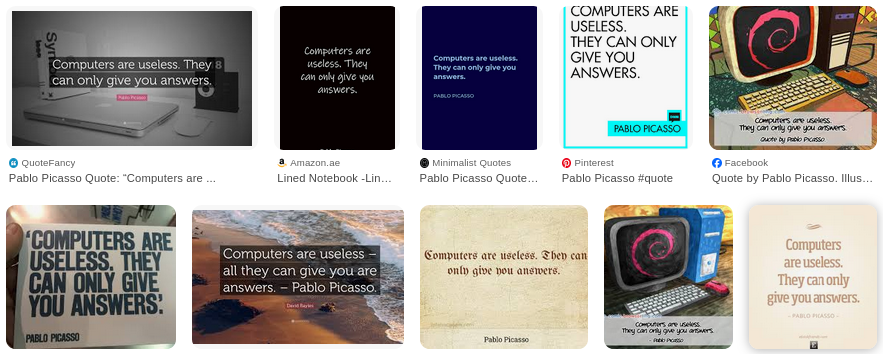
Of course, Google's AI Overview (yes, the same "intelligence" that plagiarizes to give cringeworthy answers") disagrees. On August 4, 2025, when I searched for that quote, it parroted that "Today, computers, especially with the rise of artificial intelligence, can be used for a much wider range of tasks...Therefore, Picasso's statement is more a commentary on the limitations of early computers and his perspective on the role of human creativity rather than a timeless truth about the nature of computing."
No way. If anything, Picasso's quote, apocryphal or not, is even more valid for today's AI and Web than for the ancient mainframes he knew.
All the big players on the Web want you to see only answers, possibly their own answers. With AI summaries, search engines now deliver their own answers instead of links, making as much as 34% less people follow links to websites. Even book publishers anticipate a massive decrease in sales, due to chatbots.
Social Media are just as bad. They force on people, causing a traffic apocalypse for media companies, any stupidity they can think of to keep them locked inside their playpens, with nothing but answers, that must be as as few as possible, but always time wasters.
Right now, the biggest but by no means the only offender in this violence of never giving people anything but answers is Facebook. Zuckerberg's playpen has tamed millions of people (including journalists and other "professional communicators" who should really know better) to adopt at least two astonishingly stupid practices.
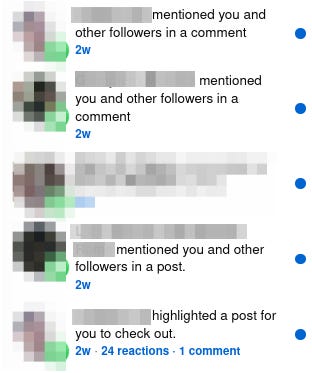
One is convincing users to annoy all their followers with @followers or @highlight tags that aren't even answers, just notifications that someone said or answered something, but not what. Even if we didn't have the real solution to "get the news", that is RSS, those tags are as stupid as a newspaper or website front page that only contained titles like "Trump said something" or "Something happened in Turkmenistan", without any detail, ever.
The other, even bigger abuse is the all but mandatory push to put "links in the first comment", instead of inside the original post. The same happens on X, which is one of the two things I'll never forgive to Elon Musk.
@followers, @highlight and "link in comment" are not "practices". They are digital lobotomies that make us defecate, multiple times a day, exactly on what made the Web great and useful, that is links labeled with text.
All the media companies that, by any combination of greed, dumbness and desperation, are trying to replace writers with chatbots are the best allies of the Big Tech that's killing them, by flooding the web with nothing but their own Big Tech answers. The media companies that still exploit human writers, however, aren't much better. A particularly telling example of the latter category, for reasons I'll explain in a moment, is in this screenshot:
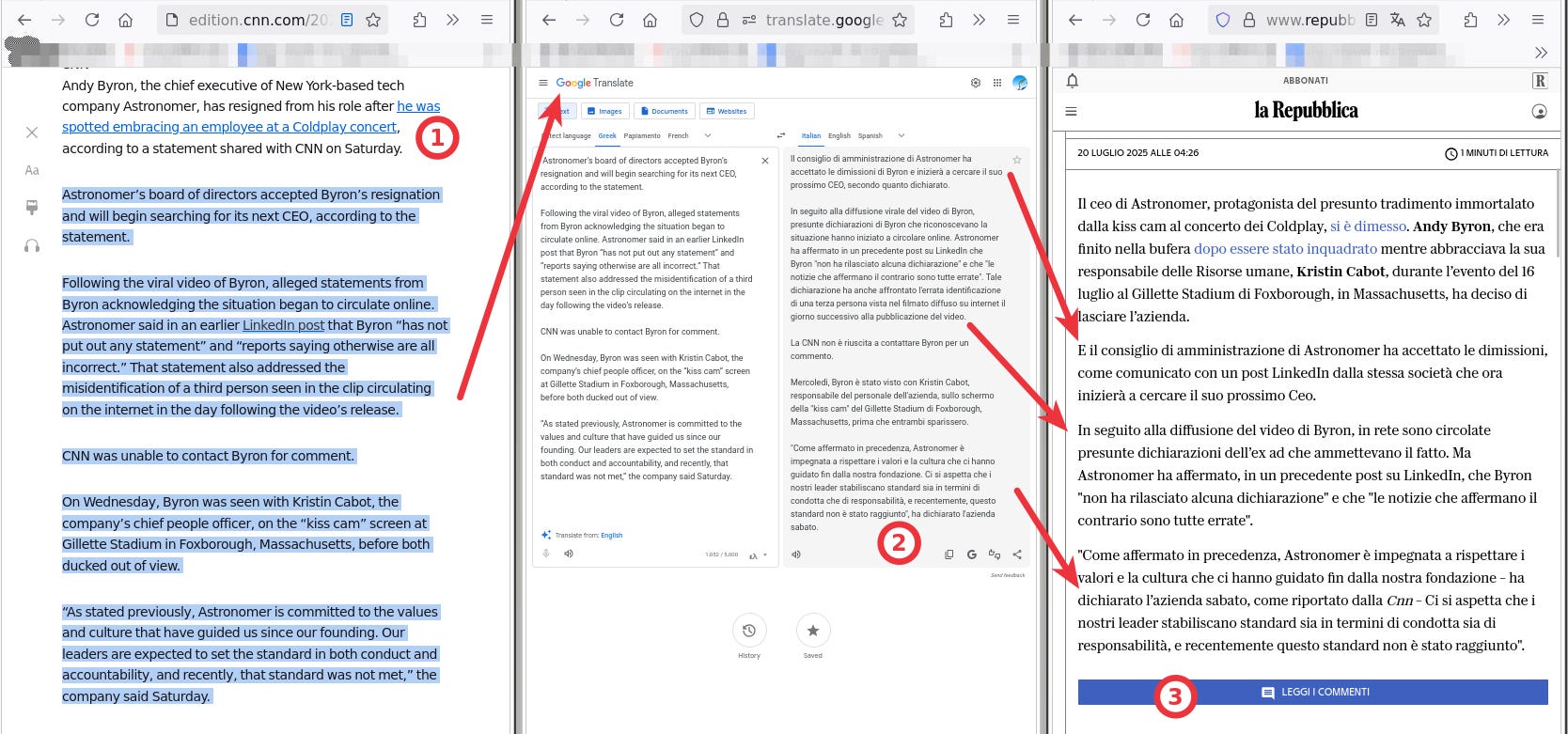
That's an "article" by a major Italian newspaper that is mostly text cut and pasted from the automatic translation of a CNN one, obviously without attribution.
Are answsers enough? Ask the experts
All the diseases above have three things in common: they are supercharged by the peak software bubble we've been led to call AI; they only provide answers, never access to questions, or resources that would stimulate more questions; and those answers are getting worst every quarter.
I also believe that in "developed" but not English speaking countries like Italy, a general degradation of answers is happening even faster, thanks to the abuse of AI-powered translation, as in the example above. Eventually, that extra step can only make the average quality of any non-English text produced by any AI worst than the quality of their English text, because the former will be the result of training on text corpuses that were born one step farther from human thought.
Nothing you've read so far is new, but it's important to connect the dots: how, and why, exactly, all this is bad? Several experts confirm that the right answer is Picasso's one:
Learning to ask good questions matters more than finding answers
[Real] knowledge itself is impossible without understanding causation, which AI chatbots can't do because they lack a "rational soul"
"Answers-only" AI cannot "encourage the ethical practice of open-ended curiosity so desperately needed in today’s complex information environment."
Communication with machines that never listen, just respond, only trains us to respond back
in full "broken clock that's right twice a day" fashion, Sam Altman himself said that "figuring out what questions to ask will be more important than figuring out the answer."
The problem of getting only answers, never meaningful questions, is made worst by answers given when no answer at all would have been better. One of the surest signs of real intelligence is to know when to stop. Chatbots (or search engines) designed to make money cannot do that. They must always provide answers, including those they could not possibly know, even if that means making things up or, in extreme cases, suggesting people to kill themselves.
Equally obvious, but seldom appreciated enough, are the facts that a) one can get decent answers from an AI only if she is already competent enough to ask good questions and judge the quality of the answers, and b) no one cannot get that competence only from AI-generated resources. More explicitly, no kid, or adult, can ever aquire that competence from AI bots trained on AI translations of the same text, that maybe was AI-generated to begin with. Read text like this, instead, by humans for humans.
I don’t paywall what I write because certain things should be accessible to everybody, but writing them takes a LOT of time. Thanks for supporting this effort with a paid subscription.
It's questions that give us sense, not answers
The seventh reason why finding good questions is more important than answers, which includes all the others, is as obvious as it is important: to feel that our life is worth living, and our very existence actually valuable, we humans need to find the right answers by ourselves. That, however, can only happen when we get (from each other or even by machines, why not?) the right questions.
Concretely, that's why we need search engines and social media that encourage and increase both sharing links to human content, and we need to actually read that content, and to teach kids to do the same
This is the exact reason why any AI that can only give answers, and will never stop giving them, is useless. Trust Picasso.
Side note
While I was collecting material for this piece, I found people posting on Facebook what they present as an excerpt of some interview to Altman (without providing any source. Of course, see above) in which he also "warned about AI dependency and parasocial relationships: "People will develop problematic parasocial relationships, society will have to figure out new guardrails." Especially with kids who grow up thinking AI is their friend."
I'm pretty sure any real AI would summarize that answer as follows: "My pals and I are too busy screwing people minds to make money and feel like gods, you please figure out how to clean up the mess we're making. Meanwhile, we rich people will keep living as everybody lived before, because that's saner."
As I said, trust Picasso instead.