 Login
Login
I thought I'd despise this AI strategy. Then I discovered I really like it
Two days ago, a friend of mine asked me to watch a 2:20 hours long interview to an AI expert so we could discuss it later. When I first looked at the title and index of the video I thought it was just some other self-exalted Silicon Valley priest yelling all the time “AI will kill us for sure, give me all your money to tame it!”.
After browsing the transcript - which is what I always do with any video like that because it’s much faster - I changed my mind, and wrote this post to explain why I think that, while from that video he seems to:
get the relation between AI and Universal Basic Income backwards,
take some AI hype too seriously, and
maybe miss an elephant in the room…
…Tristan Harris is a smart, sensible guy who is fighting the good fight, and I really wouldn’t mind working for him, or having a public conversation about these issues.
To see why I say so, here are the most important things Harris said in the video, synthesized and reorganized by topic (the parts in italic are by Harris, the others are my own syntheses or comments of what he said).
Computer geniuses, without any real education
I like how Harris describes the birth of social media:
“We have the most anxious and depressed generation of our lifetime. We have the least informed and most polarized generation. We have the worst critical thinking. We have the worst ability to concentrate and do things. And that’s because we did not govern the impact of [social media] technology well.”
Here is what he means for “not governing the impact well”: “if the incentive is to maximize eyeballs and attention and engagement, then you’re incentivizing a more addicted, distracted, lonely, polarized, sexualized breakdown of shared reality society because all of those outcomes are success cases of maximizing for engagement for an individual human on a screen.”
This all happened because we let design and deployment of social media to people who, when asked whether it was sensible to “change billions of people’s psychological experiences with their families, with their friends, at dinner, with their date night, on romantic relationships...” dismissed that concern “as if it’s like a throwaway question” and kept building social media exactly like urban slums we already know to cause riots.
Being someone who, just like him, has been calling for alternatives 2013... Kudos to Harris for seeing these dangers from within in the same days, and trying to fight them. Seriously.
The Singularity... or hype to hide desperation?
One thing I dislike in how Harris outlined the problem with robots or what’s called AI today is attributing godlike powers to those technologies. My own instinct is to call out both issues - or more exactly the way they are sold to investors and politicians - as the frauds they are.
That is, if AI and robots are really dangerous (they are) it’s not because they are superhuman. It’s because they are really toxic, expensive, wasteful frauds, in a time when we’d really need sanity and concreteness, not scaremongering.
For example, Harris said that “they’re doing [AI] to train robots. In household situations. And Elon’s now saying production will start very, very soon on humanoid robots in America”.
First of all, that’s the same Elon who’s been saying for twelve years now that we’d have driverless cars in three or four years. I’d take what Musk is saying now about humanoid robots more like the desperate Plan B of someone who dislikes humans so much that, having failed to relocate on Mars, is now falling back on replacing humans around him. I know that even gubernatorial candidates (Zoltan Istvan, that’s you!) claim that millions of humanoid robots will both displace humans and make them happy, but that remains a really unrealistic vision.
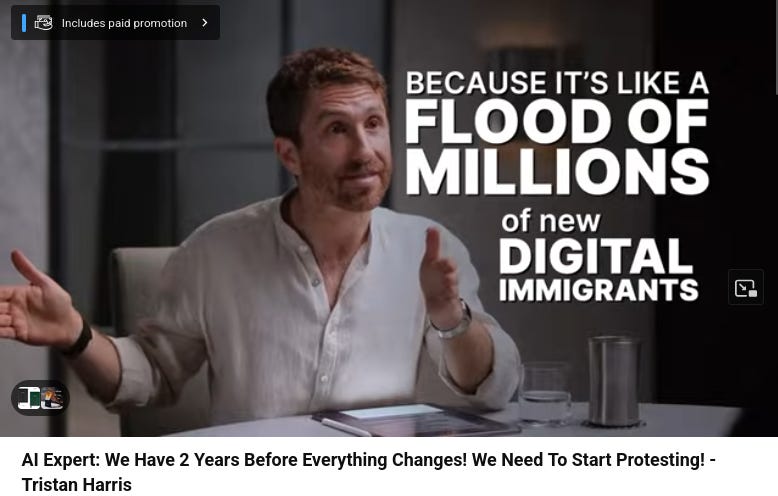
Speaking of AI, Harris said that “AI is like a flood of millions of new digital immigrants that are Nobel Prize level capability and will work at superhuman speed, for less than minimum wage.”
Spoiler: digital immigrants capable of working at superhuman speed for little or no pay have been around for decades. They were just called “software”. More on this shortly.
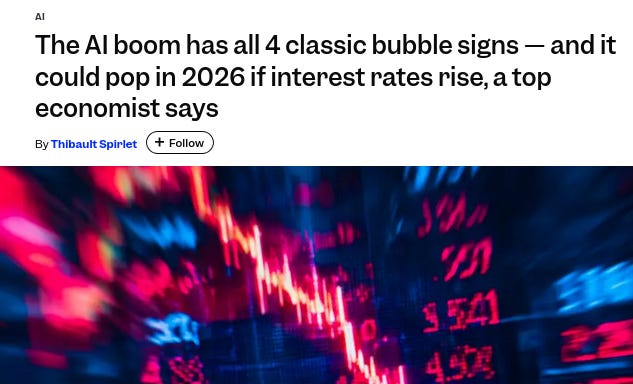
Comparing AIs to digital immigrants that would take away everybody’s job is a great pitch, but calling them “Nobel Prize level” just validates the claims that AI is divine, unstoppable and deserves all the money in the world… instead of being the Hail Mary move of people having no idea of what other excuse to ask for money they could make up when the AI bubble pops:
Even more important is the fact that an awful lot of the millions of “jobs” that AI would destroy are “pretend work” that shouldn’t exist to begin with because they demean human beings, even when they are really well paid. To see what I’m talking about, check the “The work that shouldn’t exist is even more” part of this post.
On Universal Basic Income “because AI”
The second thing I noted in what Harris said about AI destroying jobs is that he too seems - as far as that interview is concerned - to consider Universal Basic Income as an afterthought - an unavoidable countermeasure to the advent of AI - and worries about who will pay for it.
Me, I don’t think we need to go for UBI because AI is coming. I say the opposite is true: we deserved UBI since well before AI came along, AI is just one of the technologies that can finally make it feasible, and the money to pay for UBI can only come from something that really overdue anyway, regardless of both UBI and AI, that is... reinventing money. Continues here.
The elephant in the room
Harris says that the people who are currently trying to get trillions of dollars to dump the AI “god” on us are doing so because they firmly believe that:
“There’s the incentive for everyone to move to paying for AIs rather than paying humans”
“It’s not just first solve intelligence and use that to solve everything else. It’s first dominate intelligence and use that to dominate everything else”
in general, for every company in every sector “it’s win or take all... if I don’t do it, I’ll lose to the other guy that will”
the default path of AI development can only be “companies racing to release the most powerful inscrutable uncontrollable technology we’ve ever invented with the maximum incentive to cut corners on safety”
Harris is right, but what he describes is not the default path of the AI industry. Let’s call things with their actual, legitimate name: that’s the default path of every industry under capitalism.
AI is just peak software, which is just peak capitalism because it’s just peak automation, which overlaps too much, if left unchecked, with peak dehumanization. Never forget that the first AIs were corporations.
That is, Harris is right, but the real solution is not to stop - or reform - the AI industry: it is to stop the capitalism that, even before AI, made us waste billions of dollars, as well as mountains of polluting fossil fuels and scarce materials whose control leads to wars on crap like, off the top of my head:
a movie-like Metaverse that’s just bad, reactionary prepping
What really matters: sensible AI measures
Harris describes well what makes AI, that is peak software, so dangerous:
“AI is... designed to break the reality checking process”
“AI is like a power pump that pumps economic, scientific and military advantage”
“Nuclear weapons cannot invent other nuclear weapons. But AI accelerates everything, including itself” . The first company that succeeds to “automate AI research can then use it to automate everything else”
Developing AI like this feels good to the same kind of people who created toxic social media because it feels like building a god, even if all they are creating is... themselves. We don’t have to put up with their “unavoidability” however. Everybody can act to stop this embarrassing madness, not just investors divesting from AI.
As Harris says, “ you don’t have to understand what’s the engine in the car to understand the consequence that affects everybody of car accidents. And you can advocate for things like speed limits, zoning laws, turning signals and brakes and things like those.”
Doing the same with AI is possible, and it’s been done before, says Harris, for examples in the 1980s, with CFCs that were piercing the ozone layer.
Here is what Harris proposes, in place of continuing to let kids “compete to build a super intelligent uncontrollable god in a box”:
create narrow AIs, that is smaller AIs each optimized to solve one and just one concrete problem, be it educational outcomes, or agriculture or manufacturing output (I like that! Here are some suggestions)
demand design changes that:
make those narrow AIs support and connect humans, instead of isolating them. As an example, Harris describes AI therapists that steer patients back into deeper relationships with their family or actual therapists, instead of doing the opposite
enforce, in AIs and social media, things like, e.g.:
“dopamine emission standards just like we have car emission standards for cars”, that turn off “features” like autoplay and infinite scrolling
algorithms that instead of actively polarizing people “reward unlikely consensus or bridging”
forbid Big Tech executives to ship products that they wouldn’t let their own children use eight hours a day.
make ALL engineering students compulsorily study “all the places that humanity had gotten technology wrong, including [but not limited to] forever chemicals, leaded gasoline and social media”, and have them take a Hippocratic Oath at graduation. I like that, but I’d make that oath compulsory for lawmakers and regulators first
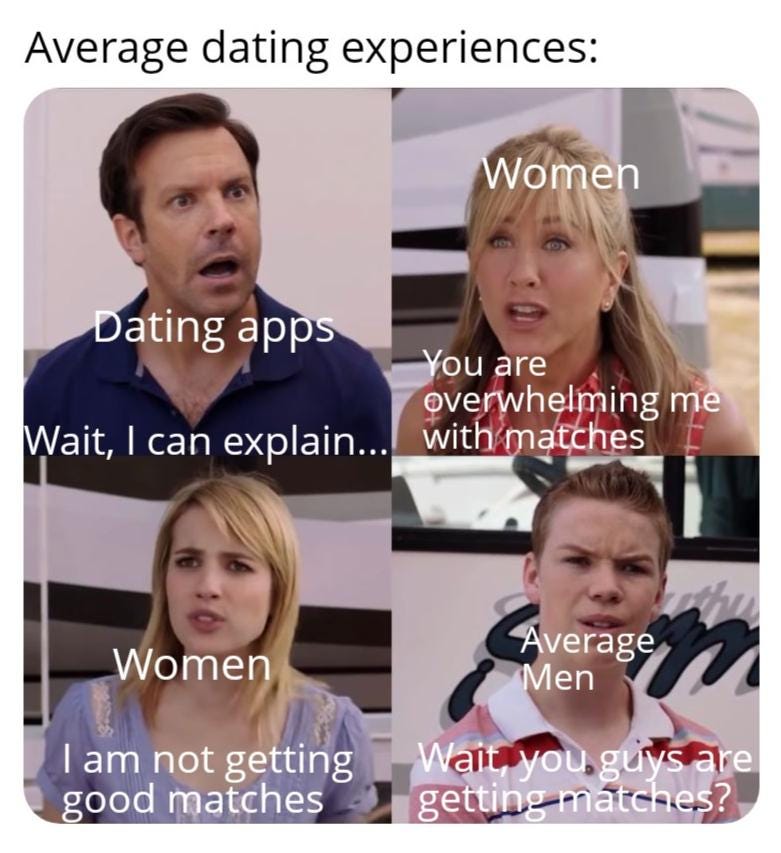
change dating apps so that instead of endless swiping they set up “events in every major city every week”, to give their users “a place where you could go and meet people you were actually excited about and attracted to”. That is, abundance, instead of (see meme at the bottom) exclusion, frustration and cheating.
change the ownership structure of tech companies so that instead of shareholder value they maximize some social benefit (this seems as close as Harris can go to saying the problem is capitalism)
What’s missing
In my opinion, there are at least two more measures that should really be added to that list:
immediately end universal access to general purpose AI chatbots. Making those chatbots accessible only to people who have studied and worked hard enough to control them would be enough to immediately make almost all problems created by current AIs much easier to manage
mandate adversarial interoperability of all social media and other digital communication services. If people could use Instagram, TikTok or anything like that... with any tool they wanted, not just the official applications, social media could never be so addictive
But even as is, that list is full of good, concrete ideas. As I said, I would really like to work for Harris to make it happen. but never mind me: what matters is that you all start to only vote for candidates, of whatever color, who commit to follow those guidelines.
Usual final greeting: to support more writing here on this, or other important topics, thanks for considering a paid subscription or (even better) supporting me with one-time direct donations or in any of the other ways described here.