❌

Normal view

Received — 26 September 2026 ⏭ David Lebovitz Newsletter

Spicy Olive Oil Ginger Cookies

26 September 2026 at 10:57

I’ll admit that entertaining isn’t my strong suit. I wistfully look at cookbooks that break down exactly how to plan a dinner party, sharing multicourse menus that promise you can do it all in one afternoon. And by the time guests arrive, you’ll have changed out of your T-shirt and sweatpants, wearing your best outfit, and enjoying drinks and appetizers with guests, knowing that everything in the kitchen, which is all cleaned up, is ready to serve. You’ve done it. All you need to do now is to enjoy yourself.

Some books have the nerve to insist that there’s nothing better than getting everyone to come into the kitchen, grab a wine glass, and “join in the fun” of preparing dinner. I’m a dictator in the kitchen and don’t want anyone in there with me, if they’re just there to “have fun.” We’ve got dinner to work on…and there’s a reason they call it “work.”

Subscribe now

When someone’s coming for dinner, the panic starts a few days before, planning the menu, and the shopping. Because I am insane (I realize insane + dictator may not be a very appealing combination for potential guests, but these days, here we are), there is one store where I get onions and garlic, another where I buy my lettuce, and another that has the kind of plums I like, that will be ripe by the time I need them.

I get a sustainable seafood delivery once a week, so that needs to be organized and ordered in advance, if fish or shellfish are on the menu. If I’m going to serve meat, I either get it at my local natural food store, which sells meat that’s responsibly raised, and they only have it on certain days. If they don’t have it, I hoof it over to the butcher shop that’s a twenty-minute walk, but it’s worth it because the guys who work there are très beaux, and when you walk in, they dazzle you with their extra-friendly welcome, so it’s worth the trek. The meat isn’t bad, either.

Even if I’m just serving a simple appetizer, a main course, salad, cheese, and dessert, I start first thing in the morning while Romain is huddled over his coffee, wondering what that crazy man in the kitchen is doing. By the time dinner rolls around, to be honest, my goal is to go to bed. Since it’s Paris, people arrive between 8 and 8:30, and I try to get dinner on the table by 9, although we have friends who don’t serve dinner until 10pm or later. By then, all I want is to be horizontal.
Leave a comment

Sometimes I have to make dinner when friends come to Paris, because they don’t heed my advice that reservations nowadays need to be made at least a week in advance, especially if you want to eat out on Friday or Saturday night. Most just want to be a free man (or person) in Paris, unfettered and alive, but even if Joni Mitchell just walked into Septime, the toughest reservation in Paris, (or Serena Williams walked into L’Oiseau Blanc), they wouldn’t get a table.
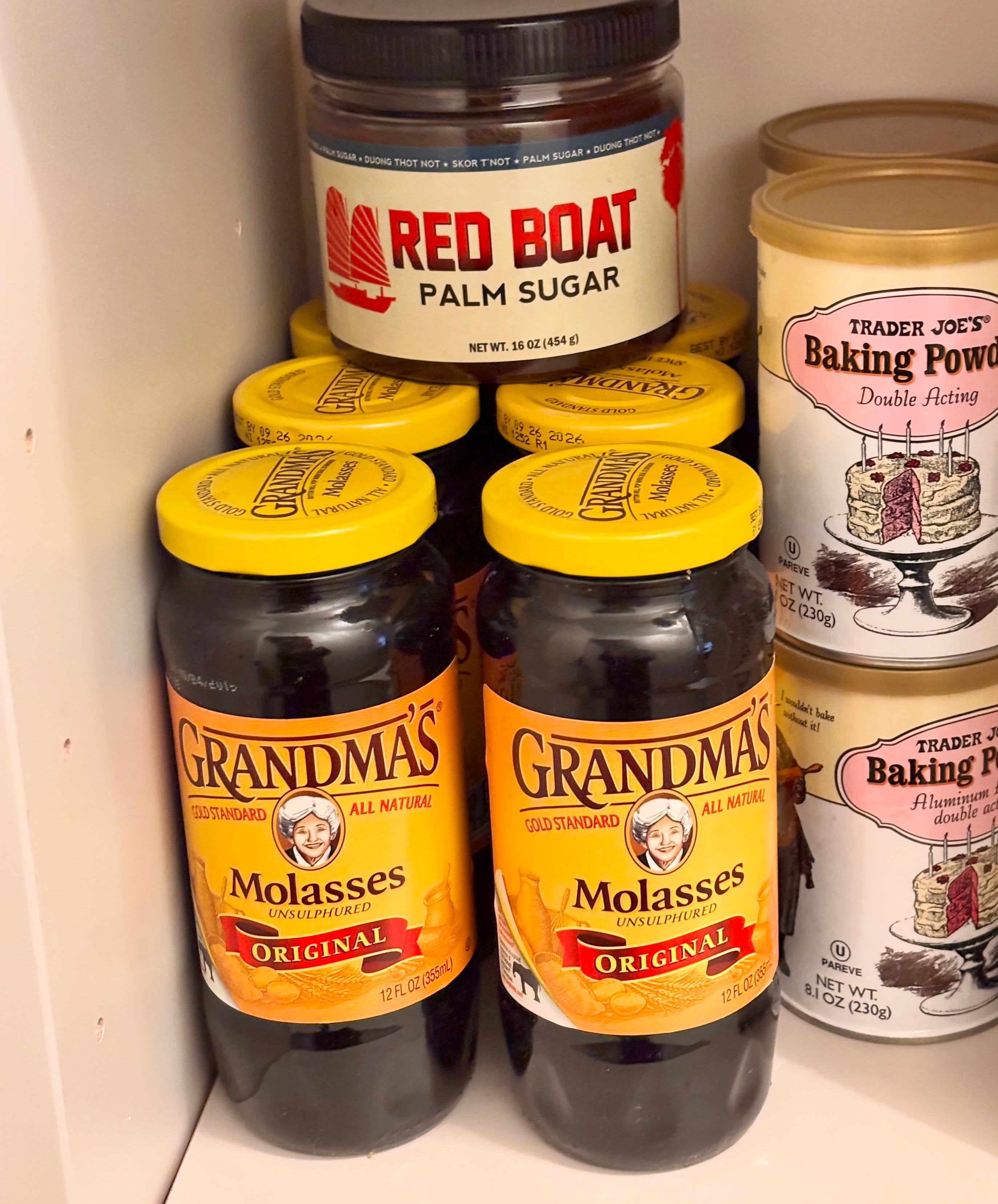
Fortunately I keep a stash of molasses on hand. Molasses isn’t widely used in France and the mélasse sold in natural food stores is closer to blackstrap molasses, whose flavor can overwhelm when used in cakes and cookies.

So when a good friend was coming for dinner recently, and yes, it was on a Friday, and the three restaurants I was hoping to get into were, of course, fully booked, I offered to make dinner.

I made a batch of hummus after I picked up a jar of chickpeas at the natural food store, then rode my bike over to Utopie to pick up a poppyseed-hazelnut baguette, and grabbed some small eggplants at one produce store to grill, a head of lettuce at the other produce store that had the lettuce I like, and a few slabs of tuna at a new poissonnerie in our neighborhood (which involved a very interesting and lengthy discussion with the owner of the shop, whose wife is Japanese, who explained why he keeps the best grades of fish in the refrigerator, which keeps the fish fresher, not on ice like they normally do at seafood shops). Then I stopped at the fromagerie to get some cheese.

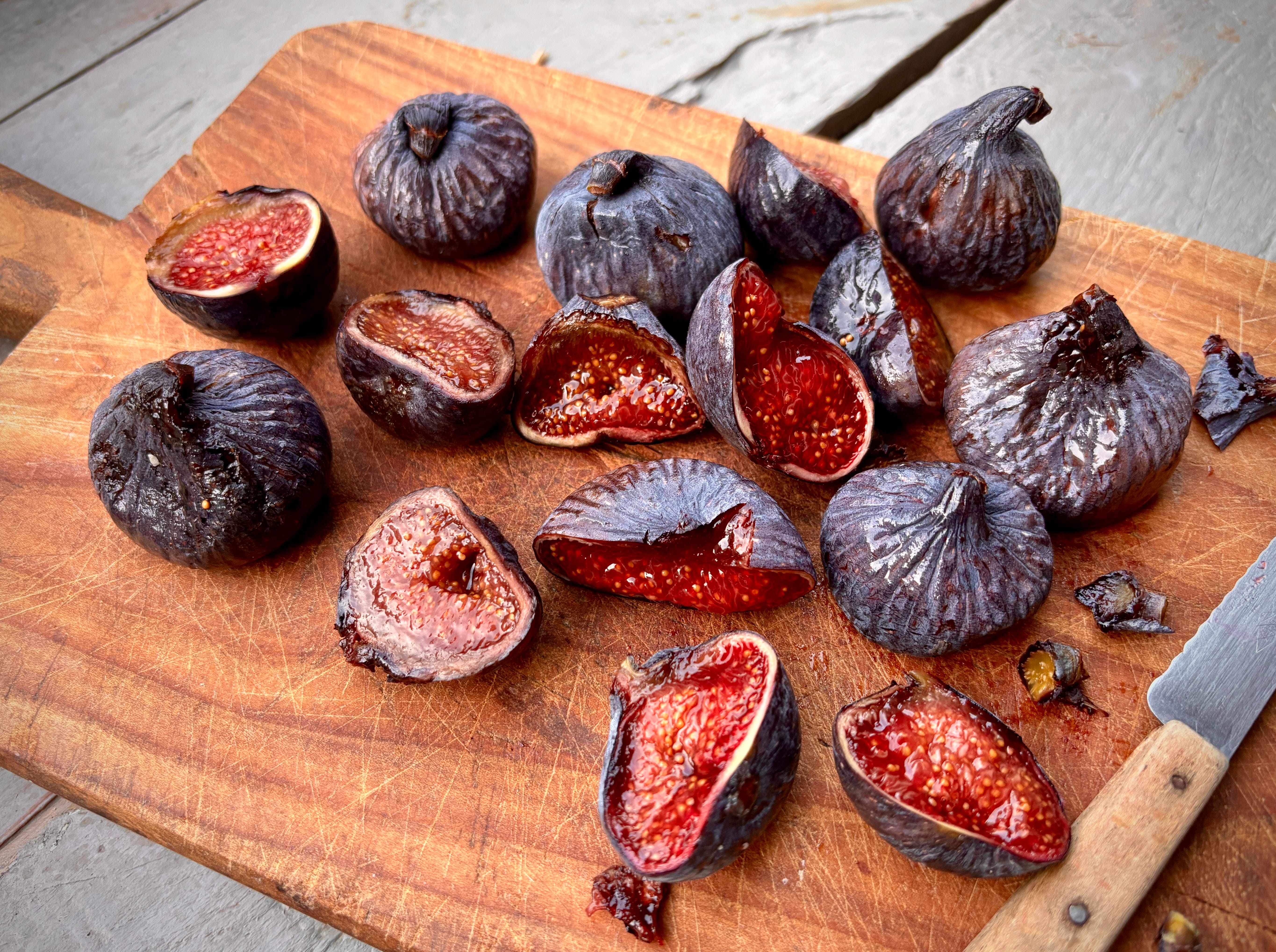
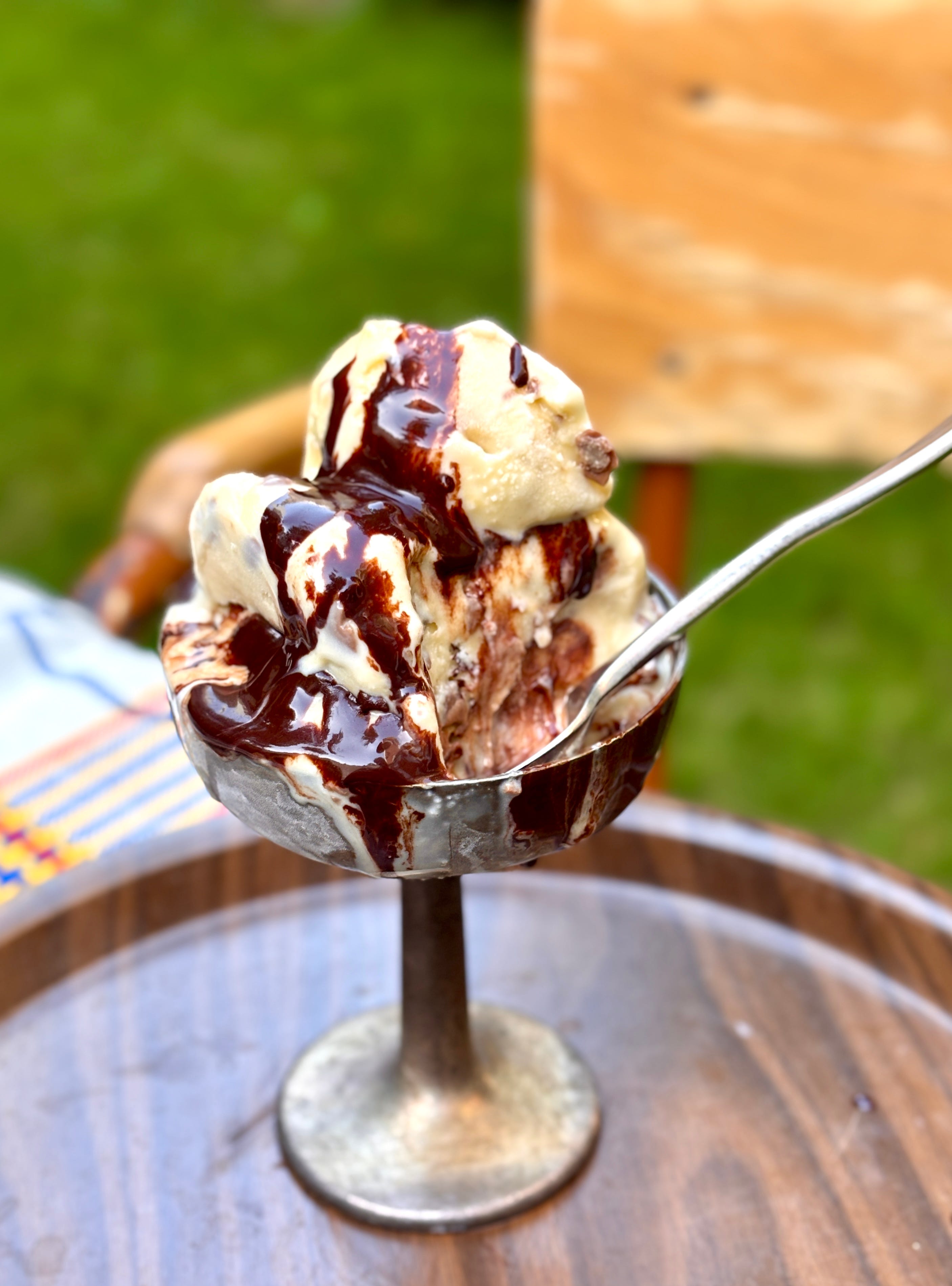
The upside is that when you have really good ingredients, which I’m (obvs) picky about, you don’t have to do a lot to them. One entertainment-friendly cue I have embraced is always having ice cream on hand, in this case, Fig leaf ice cream and Plum sorbet, so dessert was mostly done. I roasted some figs that I’d picked in Provence, which I plucked from one of the bags I’m storing in the freezer, but needed something to go with dessert.

I have plenty of cookies in my repertoire, but I’m embarrassed about the high stack of cookbooks on my desk that I’ve bookmarked with recipes I want to try. One book dates as far back as 1976, so I’m pretty behind.
One newer book was Will This Make You Happy, which bills itself as a “narrative cookbook” (think: memoir), by baker Tanya Bush about navigating her life as a budding baker. This includes a disappointing, yet informative…and formative, internship in Tuscany, working at a cooking school, and hopscotching through rocky relationships. She eventually finds her footing in baking, and her book has recipes such as Soba Cha Panna Cotta, Dark Chocolate and Coconut Birthday Cake, and Toasted Croissant Ice Cream.

Share David Lebovitz Newsletter

I didn’t have a lot of time to spare and was intrigued by her Spicy Olive Oil Ginger Cookies, partially because a spice cookie is welcome with any fruit dessert, and partly because I had all the ingredients on hand, so I didn’t have to do any shopping.
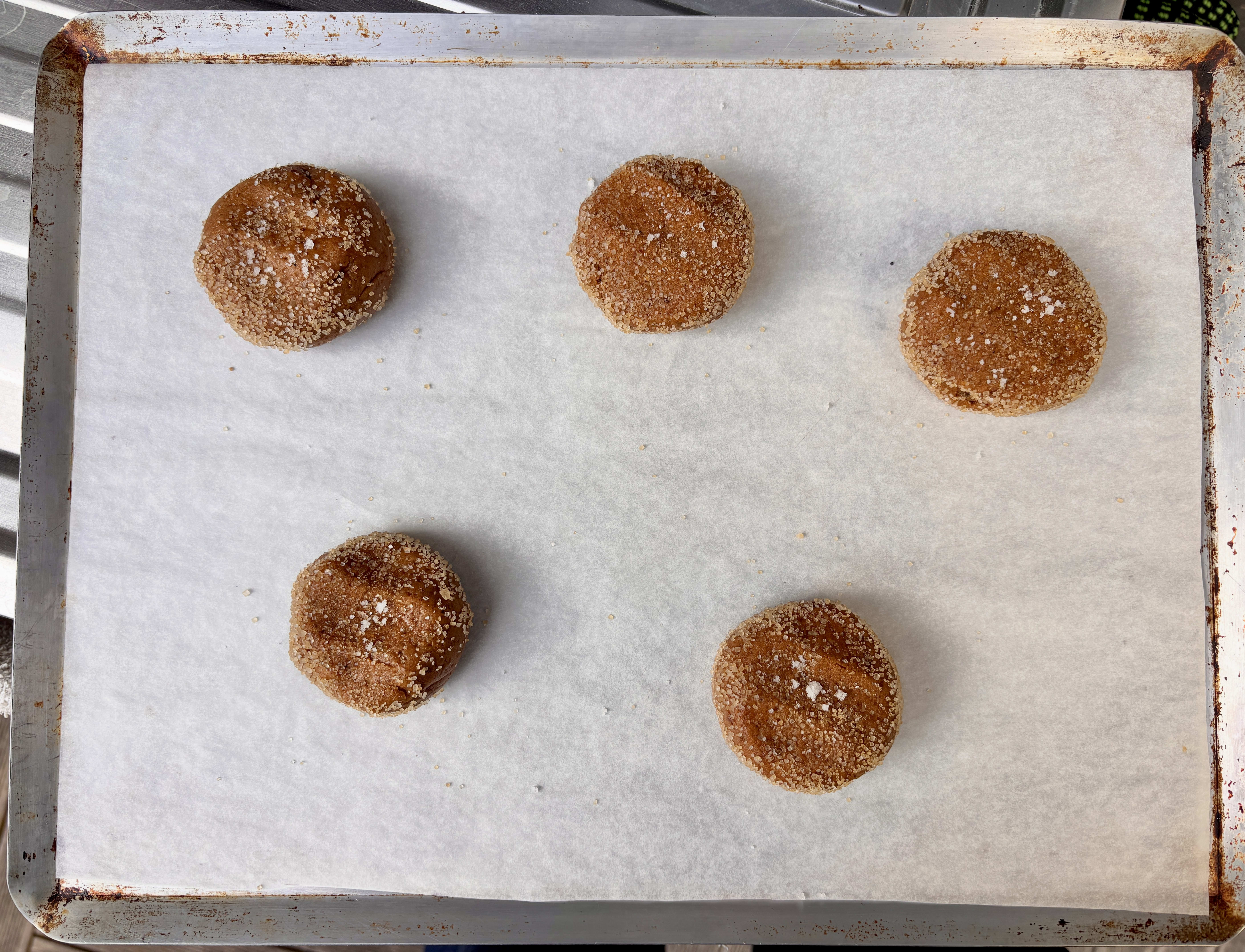
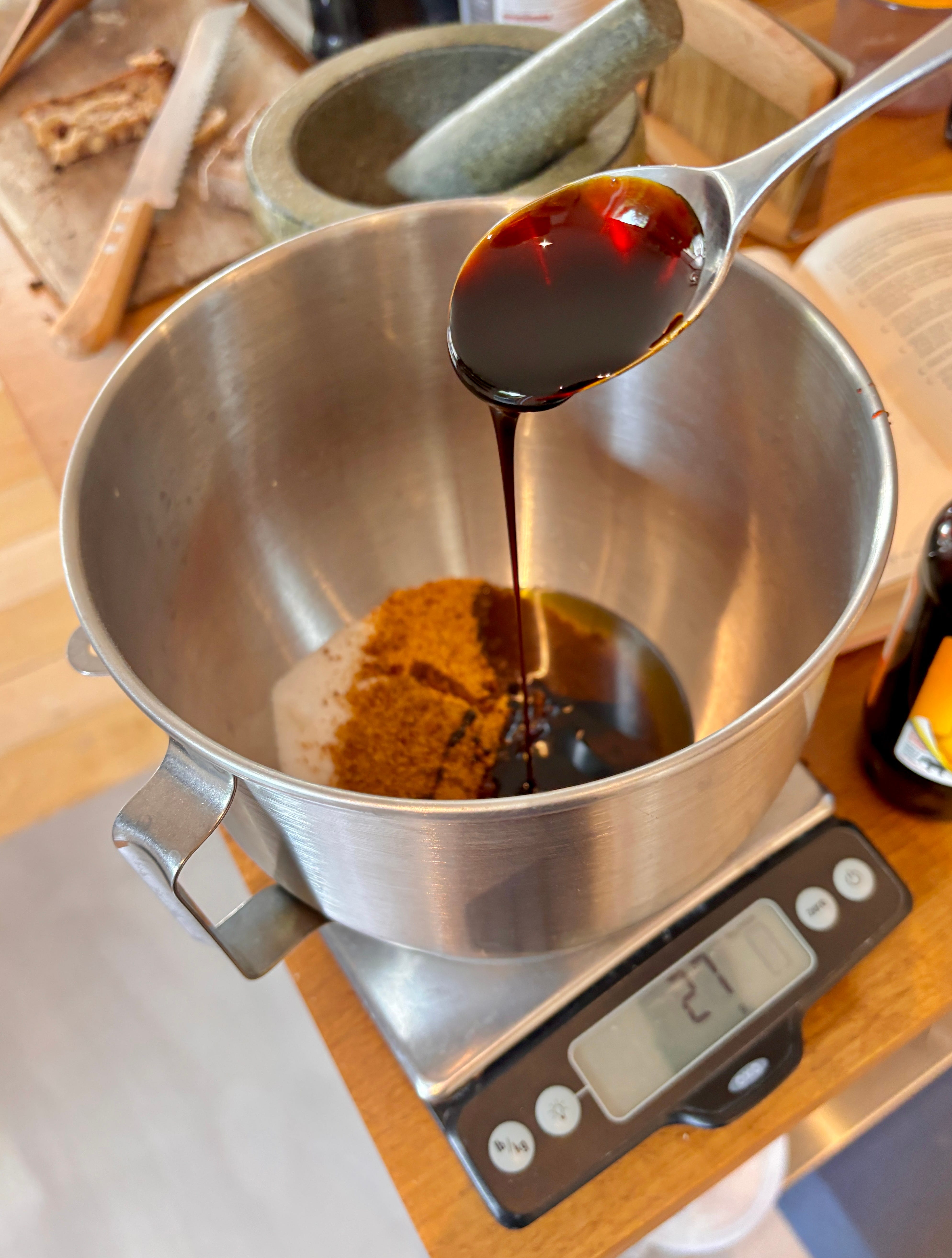
An intriguing thing about these cookies is that they use olive oil rather than butter, so you don’t have to wait for butter to come to room temperature and can make them right away. They do need time to rest in the refrigerator for about 30 minutes, but then, you just roll them in sugar and bake.
Subscribe now

After I baked the cookies and they cooled, I tasted one. I was a bit déçu that I didn’t find the spices punchy enough, and was wondering if I needed to make the recipe again, dialing up the spices.

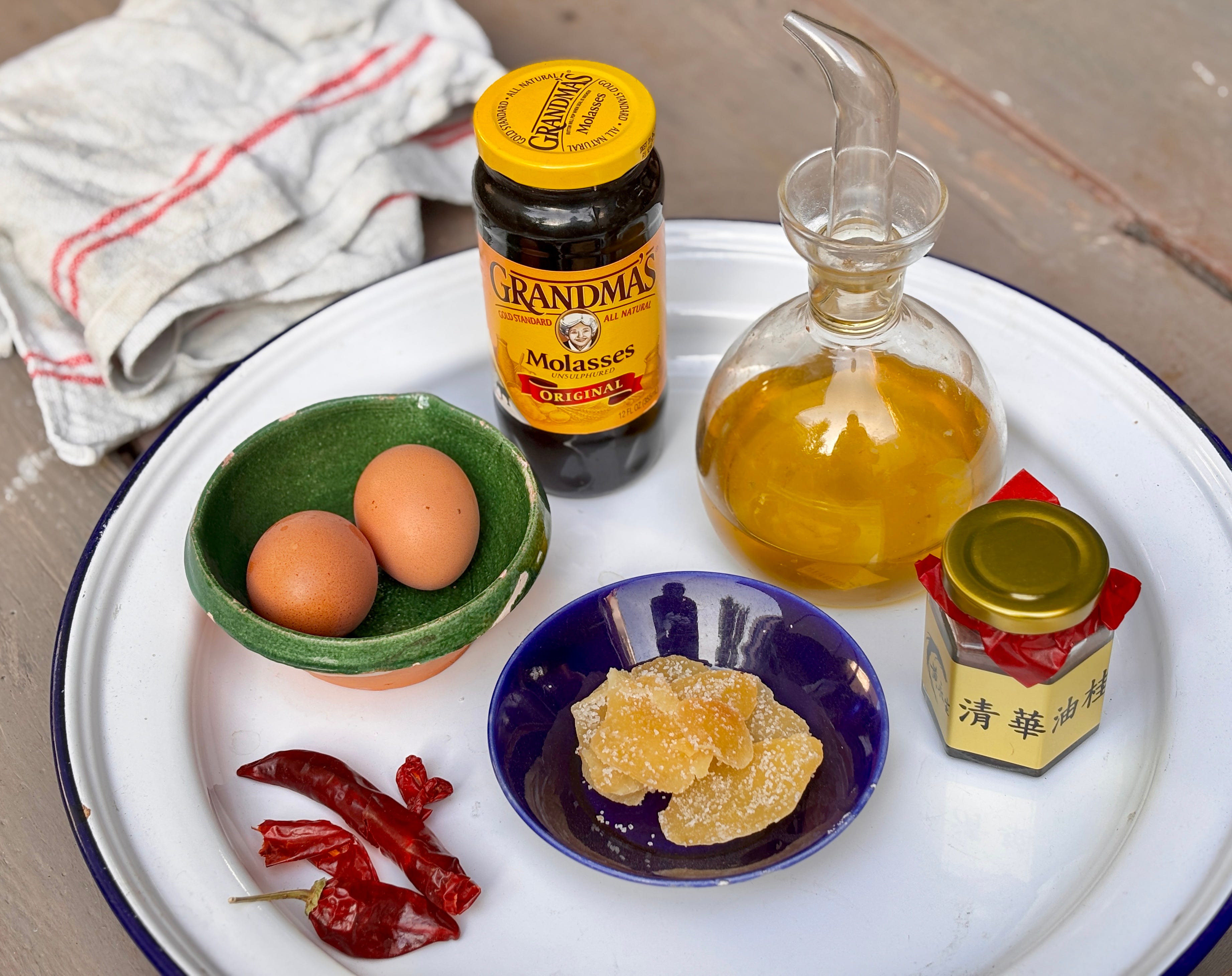
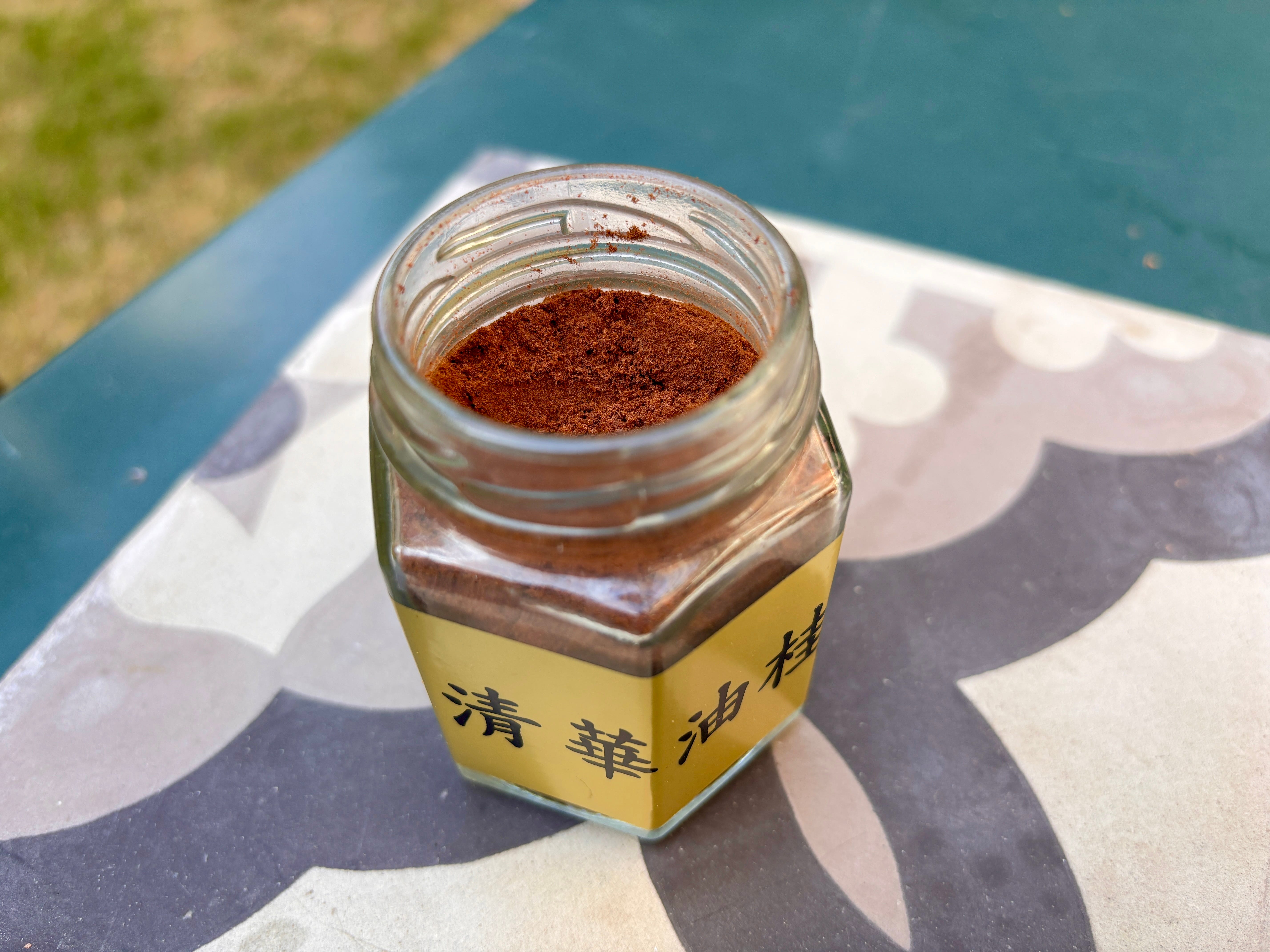
I reread the recipe, which called for a generous 2 tablespoons of ground ginger and 4 teaspoons of cinnamon. That gave me a chance to use the very special, and very expensive, cinnamon I got in Taiwan, although I did swap a teaspoon of ground cardamom for the nutmeg, so maybe that was the culprit.
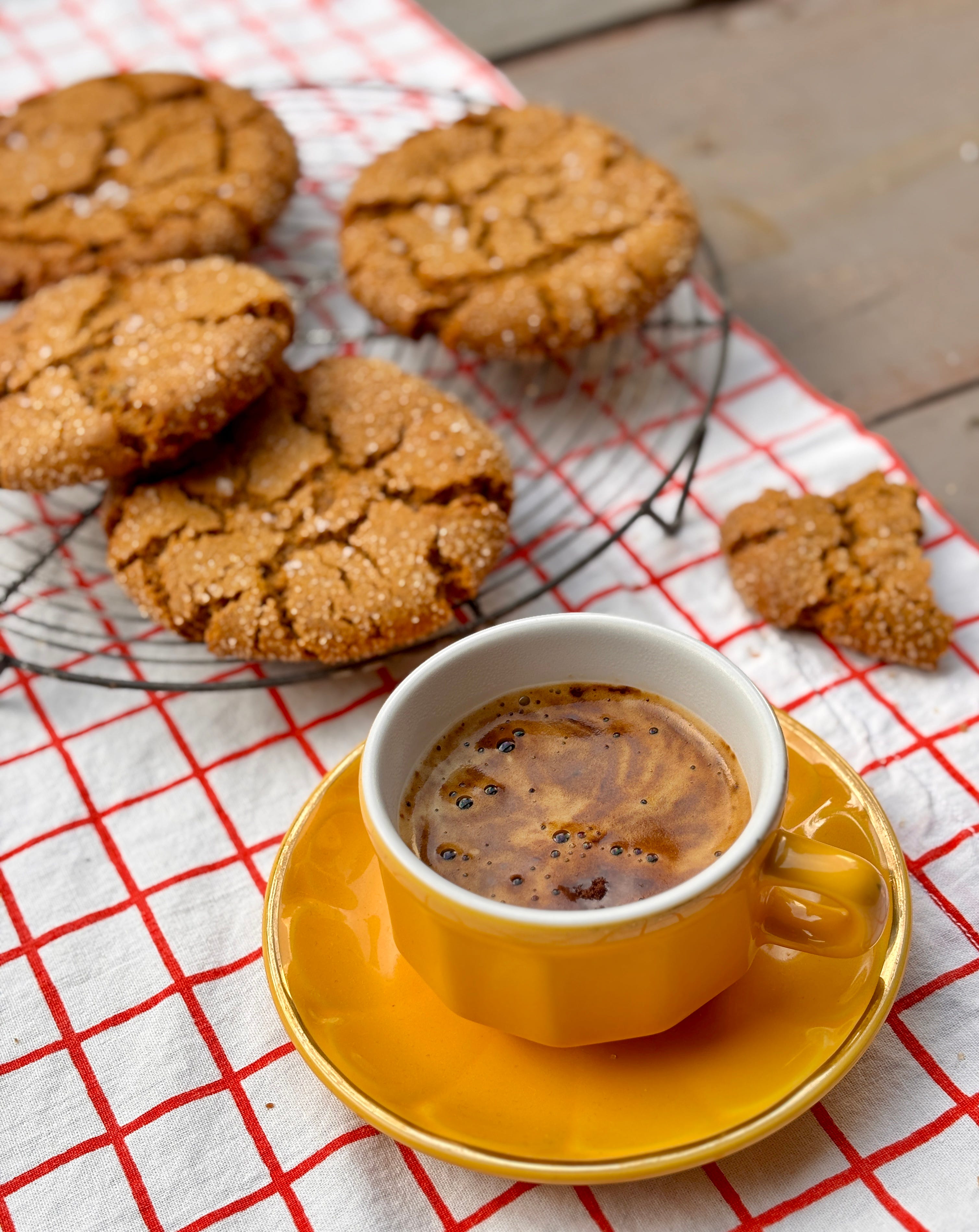
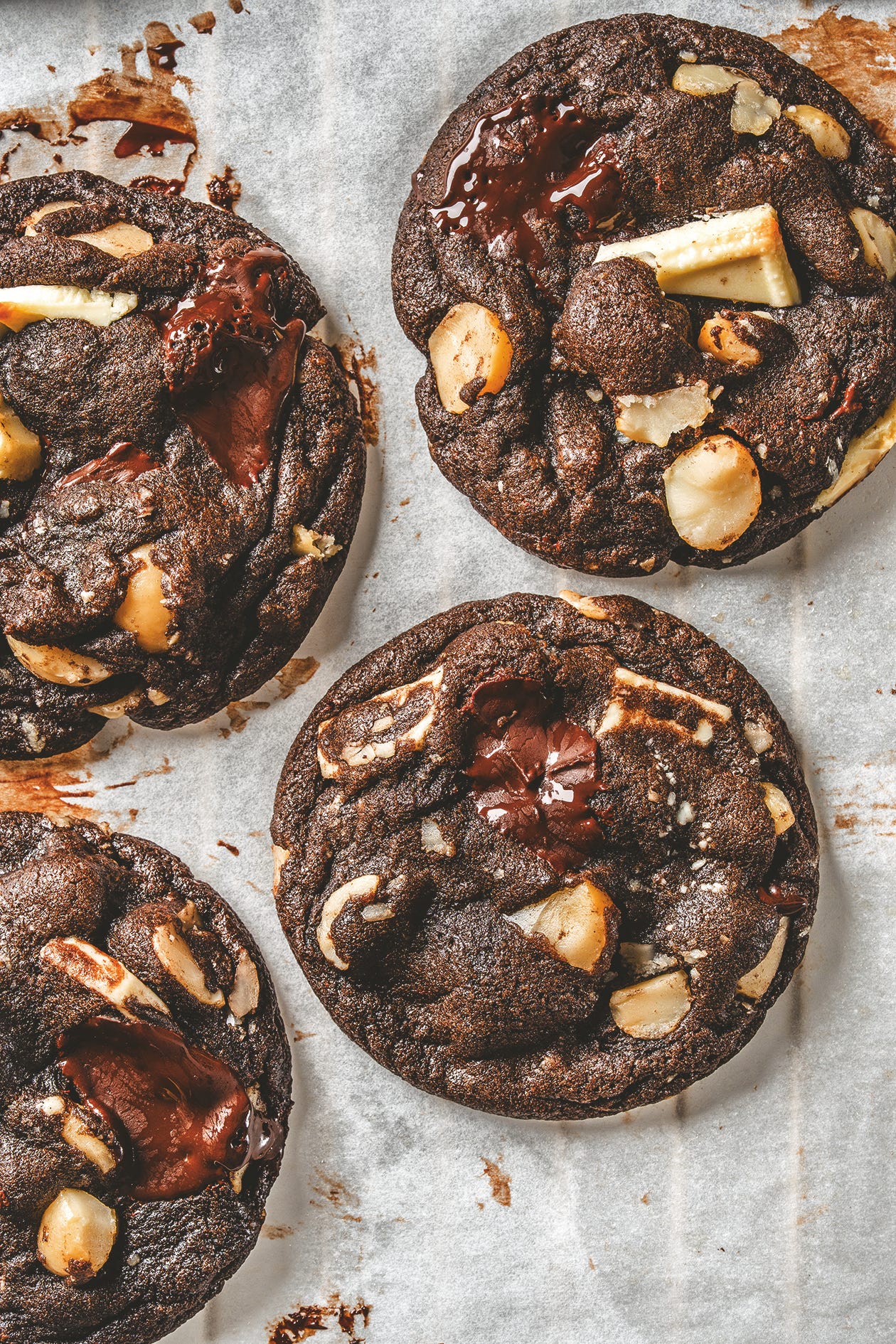
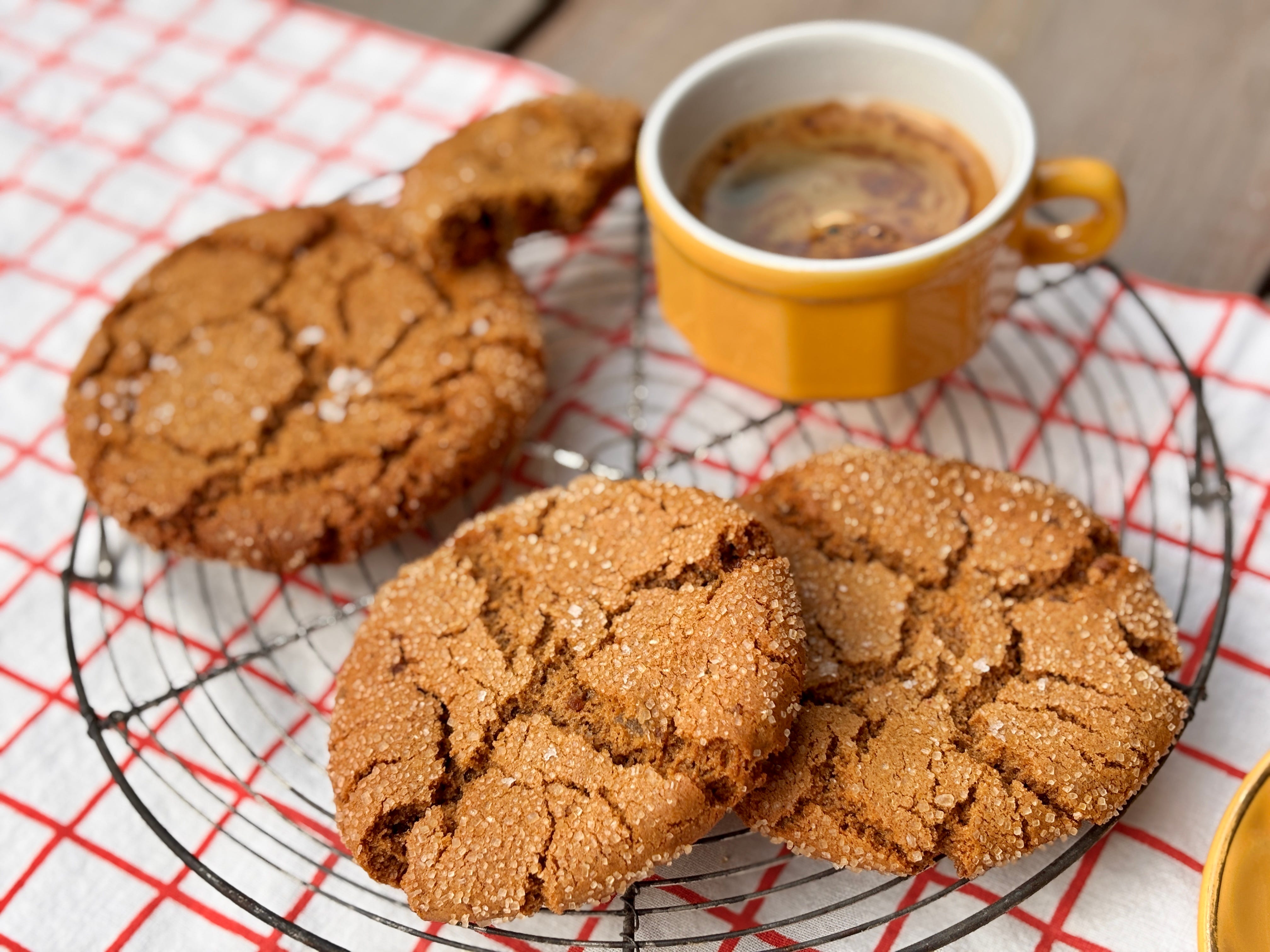
But the more I dug into the cookie, the better it got. And by the time dessert rolled around that night, the flavors were spot-on and the spice level hit its stride. Even better, the next day, I found that the flavors developed even further, making the cookies extraordinarily delicious, with just the right level of spiciness. And the chewiness increased as well. After all that panicking, things eventually worked out and they were the perfect chewy, chunky, spicy cookie.
Leave a comment

Spicy Olive Oil Ginger Cookies

Makes 12 cookies

Adapted from Will This Make You Happy by Tanya Bush

The original recipe was written in metrics, and that’s what I used when making these cookies. (I’ve included Tanya’s conversions here.) More and more people in the U.S. are baking with scales, which provide more consistent results. If you don’t have a scale, consider getting one.

My Favorite Kitchen Scale

Tanya’s instructions said to flatten the cookies to 3 inches (7,5cm) in diameter before baking, but I prefer them a bit thicker and flattened mine to 2 inches (5cm). If you like thinner cookies, go ahead and flatten them to her dimensions.

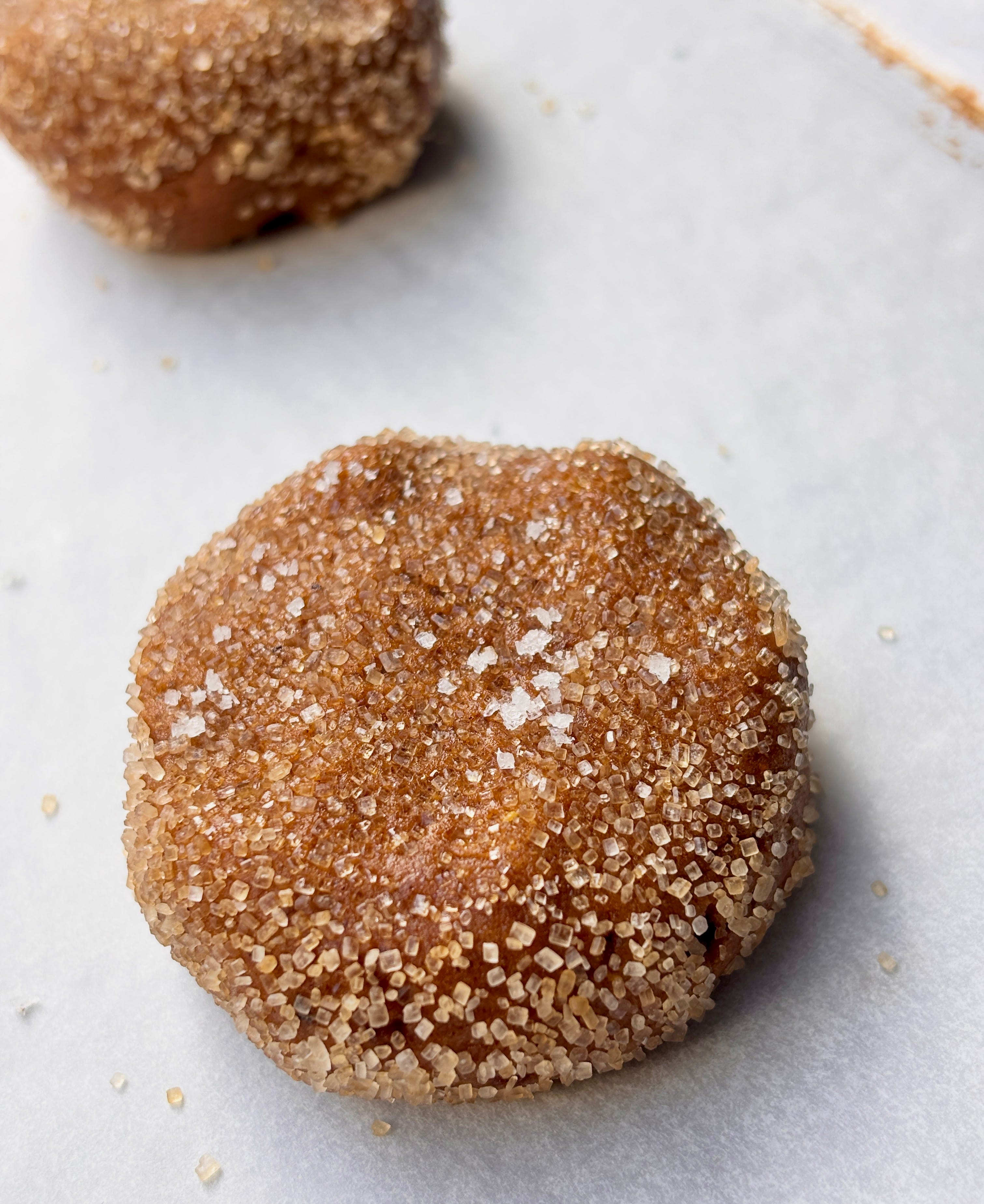
Turbinado sugar (called cassonade in French) are free-flowing, large crystals of natural sugar, which add a marvelous crunch to anything they touch, including these cookies. But you can roll the cookies in granulated sugar if you don’t have turbinado.

The cookie dough

150g (3/4 cup) granulated sugar

50g (scant 1/4 cup, packed) light brown sugar

90g (1/4 cup plus 1 teaspoon) light or mild molasses

65g (5 tablespoons) extra-virgin olive oil

1 large egg, preferably at room temperature

1 large egg yolk

1 teaspoon pure vanilla extract

280g (2 1/3 cups) all-purpose flour

2 tablespoons ground (dried) ginger

4 teaspoons ground cinnamon

1 1/2 teaspoons baking soda

1 teaspoon ground cardamom or a scant teaspoon of ground nutmeg

1 teaspoon kosher or sea salt

1/4 teaspoon cayenne pepper

50g (1/4 cup) chopped candied ginger

For baking and finishing the cookies

60g (1/4 cup) turbinado or granulated sugar

Flaky sea salt, such as fleur de sel or Maldon (optional)

  1. In the bowl of a stand mixer fitted with the paddle attachment, or by hand in a large bowl, mix the granulated and brown sugar, molasses, and olive oil on medium-to-low speed until combined.

  2. Add the egg, egg yolk, and vanilla, and beat on medium speed until they’re well incorporated.

  3. In a separate bowl, whisk together the flour, ginger, cinnamon, baking soda, cardamom or nutmeg, salt, and cayenne pepper. With the mixer on its lowest speed, gradually mix in the dry ingredients. Stop the mixer midway through, and use a silicone spatula to make sure any dry ingredients at the bottom of the mixer bowl are getting incorporated. Remove the bowl from the mixer and mix in the candied ginger.

  4. Cover the bowl and chill the dough for at least 30 minutes. (The dough can also be refrigerated for a few days.)

  5. To bake the cookies, preheat the oven to 325ºF (165ºC). Line a baking sheet (see note, below) with parchment paper or a silicone baking mat.

  6. Spread the turbinado sugar in a shallow soup bowl or small dinner plate. Shape the cookie dough into 12 equal-size rounds, each about 55 grams, or a scant 1/4 cup.

  7. Roll six of the cookies, one at a time, in the turbinado sugar, covering them as thickly and completely as possible, and place them equally spaced apart on the baking sheet. Use your hand to flatten the cookies so they’re about 2 inches (5cm) in diameter.

  8. Bake the cookies on the middle rack of the oven, turning the baking sheet midway during baking so the cookies bake evenly. The cookies are done when they’re light-to-moderately golden brown across the top and puffed up. In my oven, a baking time of 10 minutes was right. If you want them a bit more firm, you can bake them for 12 minutes.

  9. Remove the cookies from the oven and bang the pan on a sturdy countertop once or twice to slightly flatten the cookies, so they are no longer domed. Sprinkle the cookies with a little flaky sea salt, if desired, and let the cookies cool for a few minutes, then transfer them to a cooling rack.

  10. Allow the baking sheet to cool completely, then bake the remaining six cookies the same way.

    Spicy Ginger Olive Oil Cookie Recipe
    79.8KB ∙ PDF file
    Download
    Download

    https://tanyabush.com/Book

Will This Make You Happy

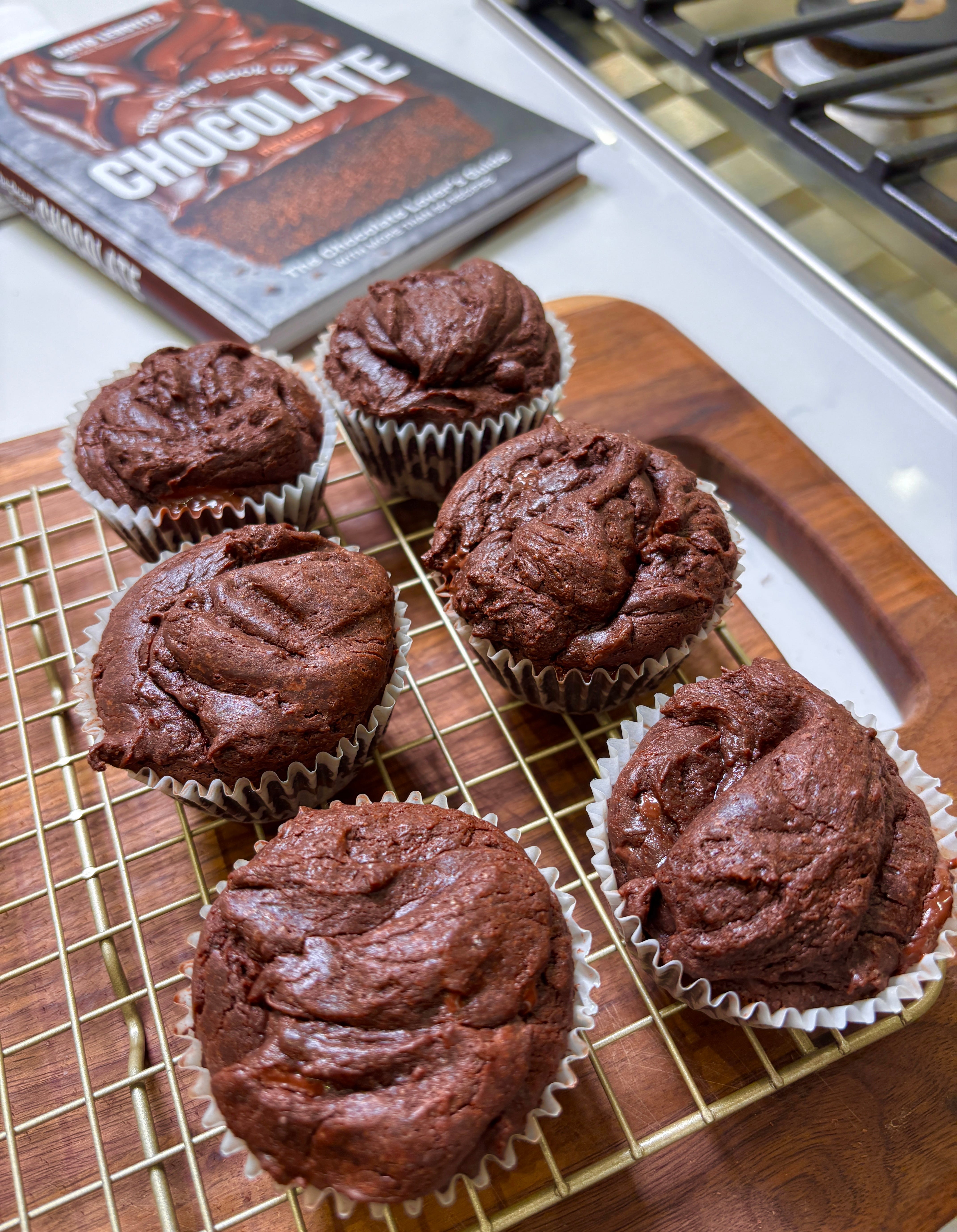
Note: On a standard American half-sheet pan, which is about 13 x 18 inches (33 x 46cm), you should be able to get six cookies on the baking sheet. I baked these in my compact oven so used a European-size baking sheet pan, which is smaller than American baking sheet pans, and baked five cookies on the baking sheet, as shown in the photo in the post.
Received — 22 September 2026 ⏭ David Lebovitz Newsletter

Les Grands Buffets

22 September 2026 at 15:58

It was quite an experience eating at les Grands Buffets, the world-famous, all-you-can-eat buffet in France, last month. There was a lot to eat, and a lot to write about. So I divided the post into two parts. You can read part 1 here:

Les Grands Buffets part 1

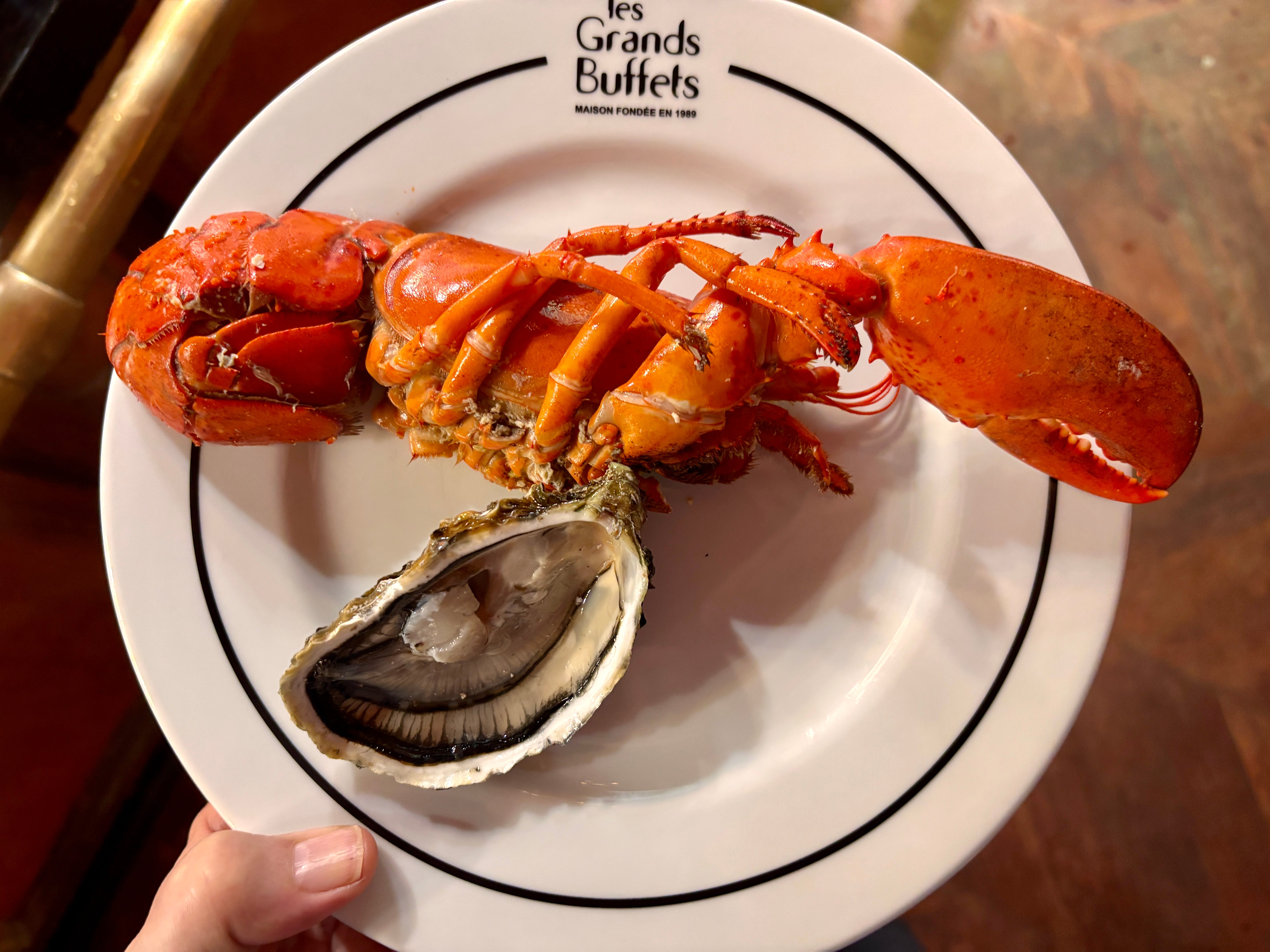
After grazing our way through appetizers, truffle-scented scrambled eggs and soup, lobsters and oysters (and foie gras and ham), we headed over to the main course area, known as La Rôtisserie, which serves up more of Escoffier’s recipes. The main area offers several different dishes, each one plated to order.

You stand in a single, well-organized line and let them know what you want. Then, depending on what you’ve ordered, they hand you a plate with what you asked for, some of it having been cooked almost to order. Among the offerings are filets of beef Rossini, sautéed in butter, with foie gras and black truffles, vol au vent (puff pastry) filled with sweetbreads and morel mushrooms, quail stuffed with foie gras, and lièvre à la royale, a traditional dish of hare braised in red wine, with blood sauce and innards (although more modern renditions often use a bit of chocolate in place of the blood and innards), along with cassoulet de Castelnaudary.

The last two I don’t remember seeing on offer, but they’re not exactly summer dishes. Although I do love cassoulet and would have liked to have tried theirs. (Maybe I need to go back in the winter?)

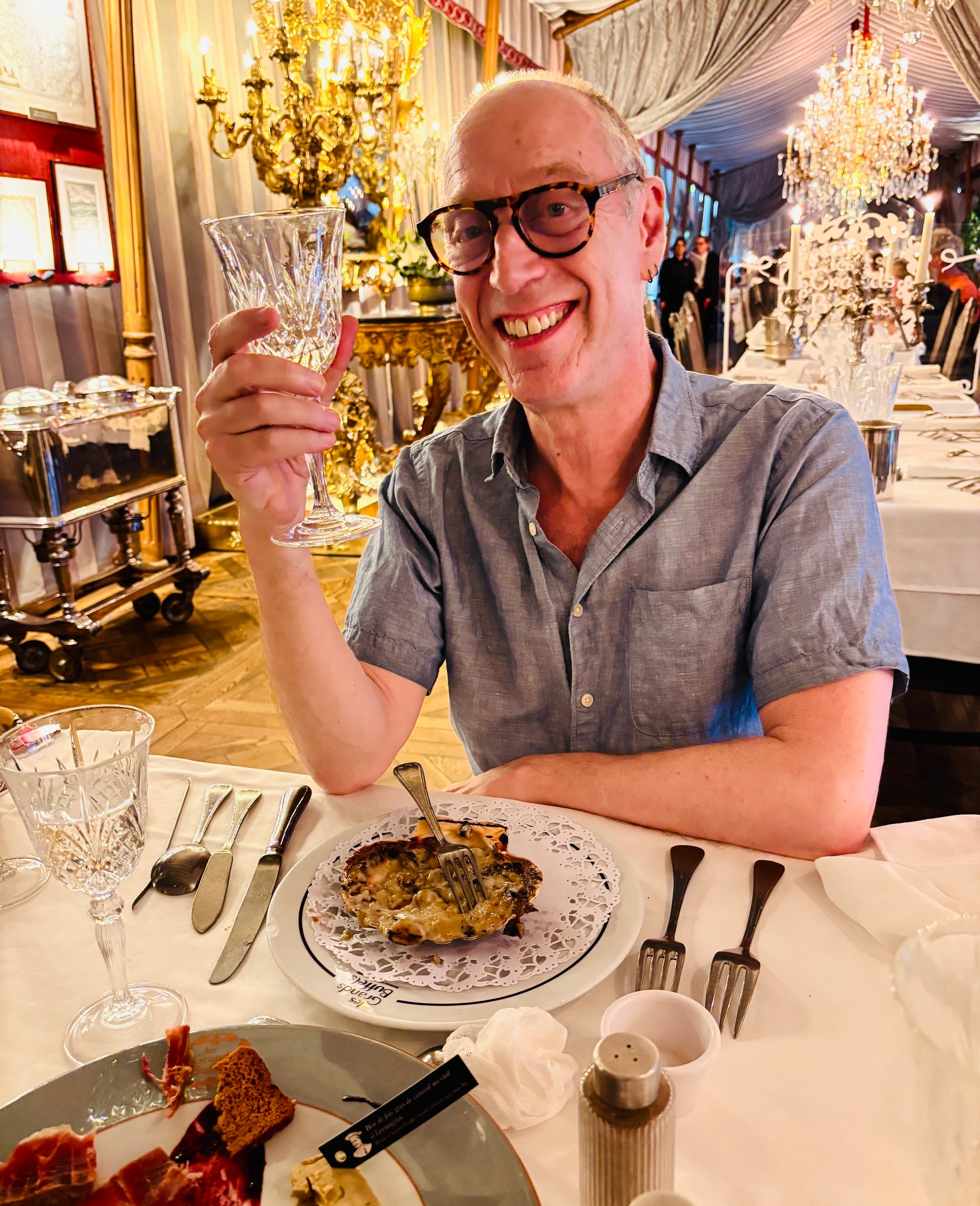
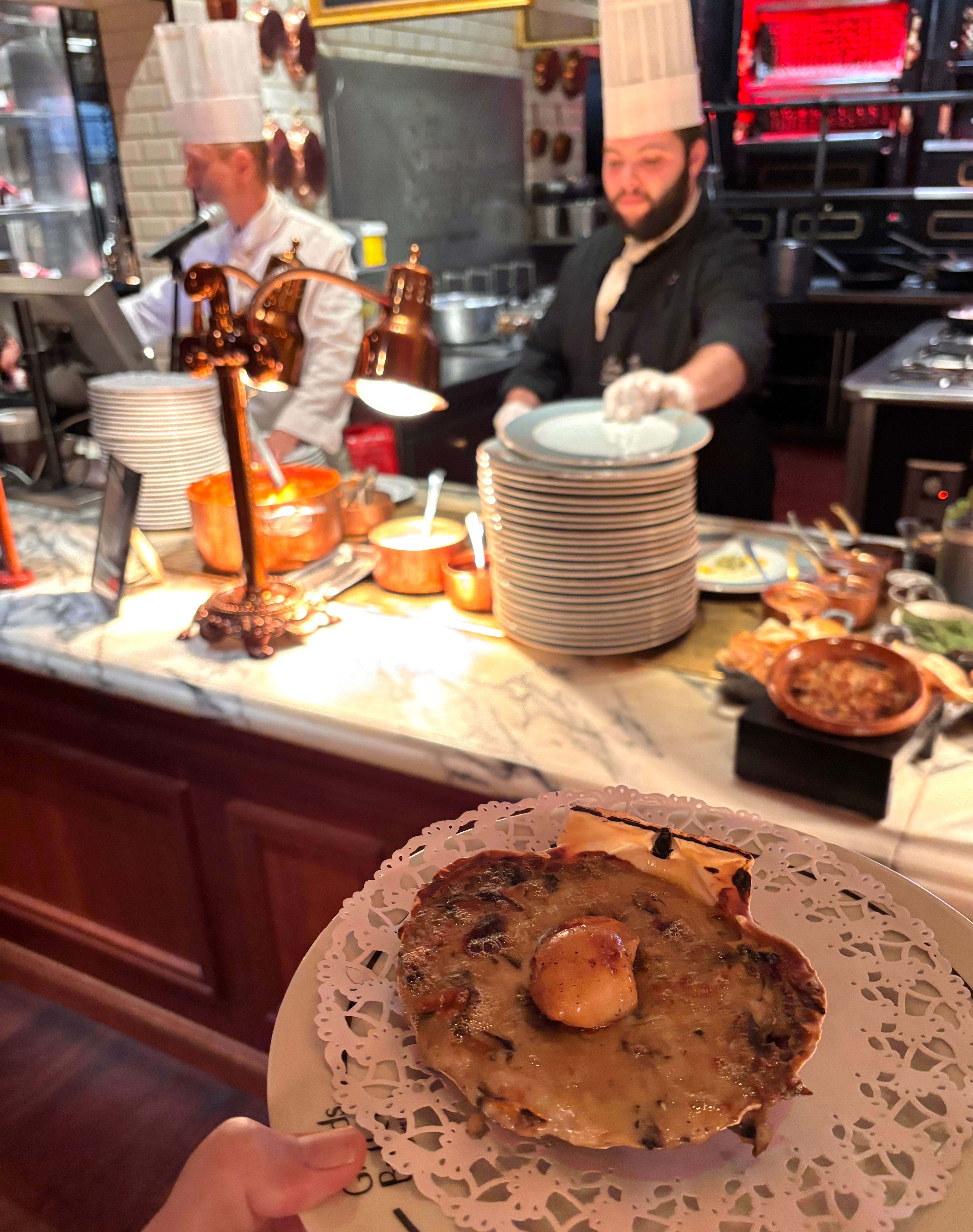
On the rich front, I ordered a Saint-Jacques à la Nantaise, a dish I wasn’t familiar with. After looking it up (and after eating it), I found out that it’s traditionally scallops, mussels, and a sauce made from mashed pain de mie (white bread). It’s perhaps a dish that was better left in the past, when French cooking meant smothering foods, including seafood, with rich, thick sauces. While it was good, with apologies to Escoffier, I think it’s pretty hard to improve on fresh scallops pan-seared in butter. I ended up picking out the seafood and eating that, since I didn’t want to fill up on sauce.

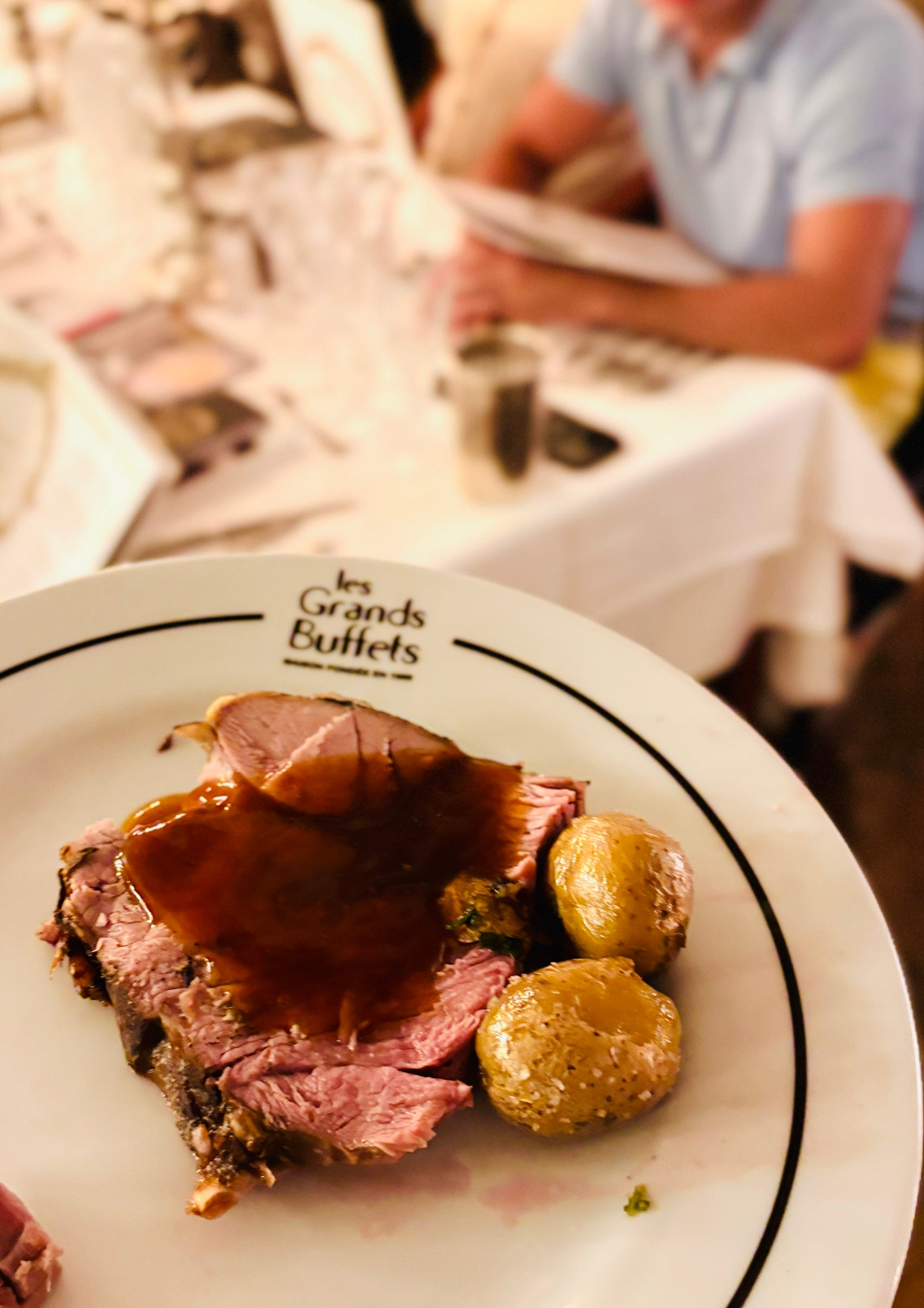
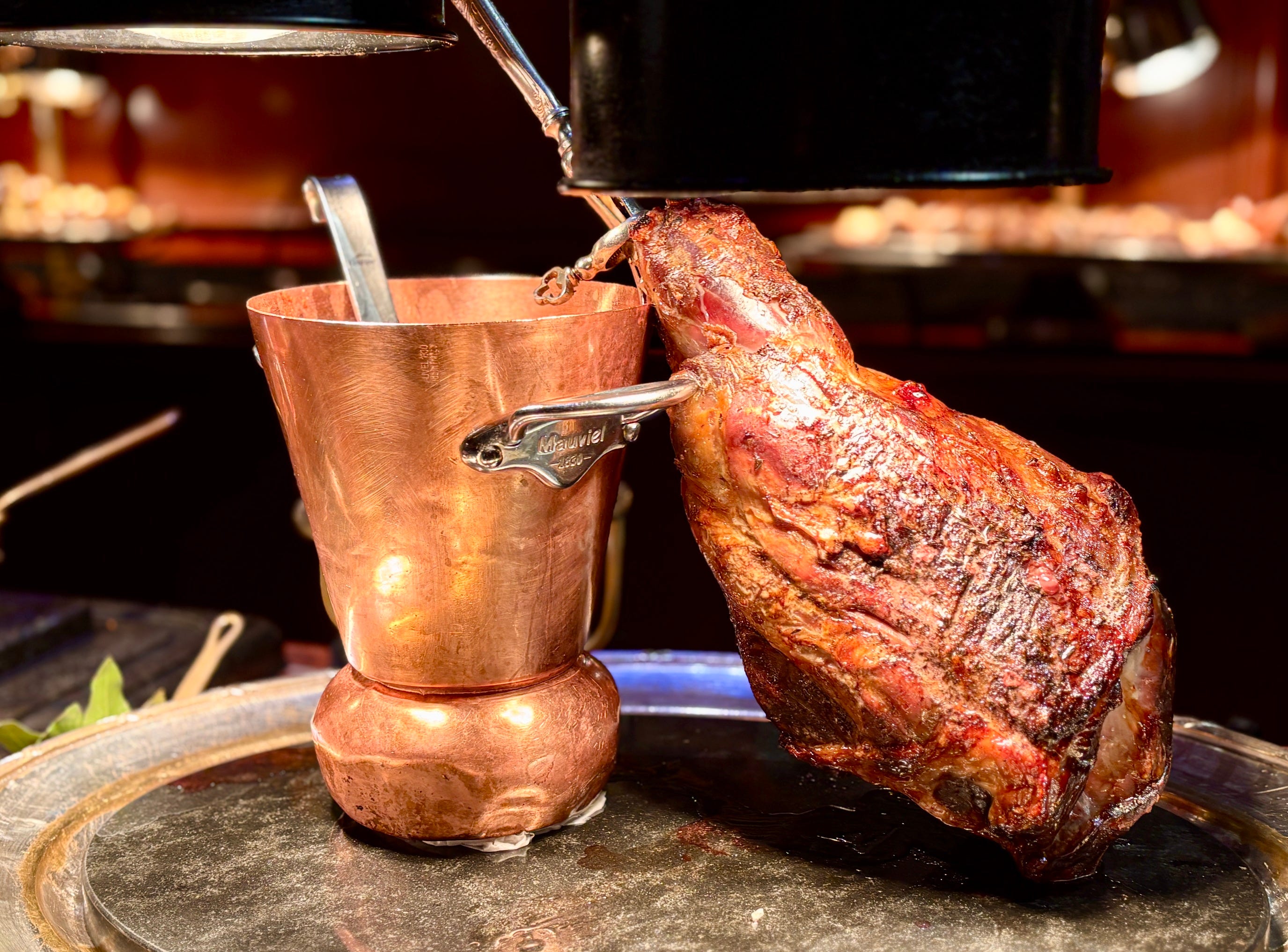
There were also stations where you could get leg of lamb, which I enjoyed a slab of. I did jockey myself in line so when it was my turn, I’d get a piece with some of the crispy crust. And I broke my rule about not filling up on carbs with two delicious pommes grenaille flecked with sea salt.
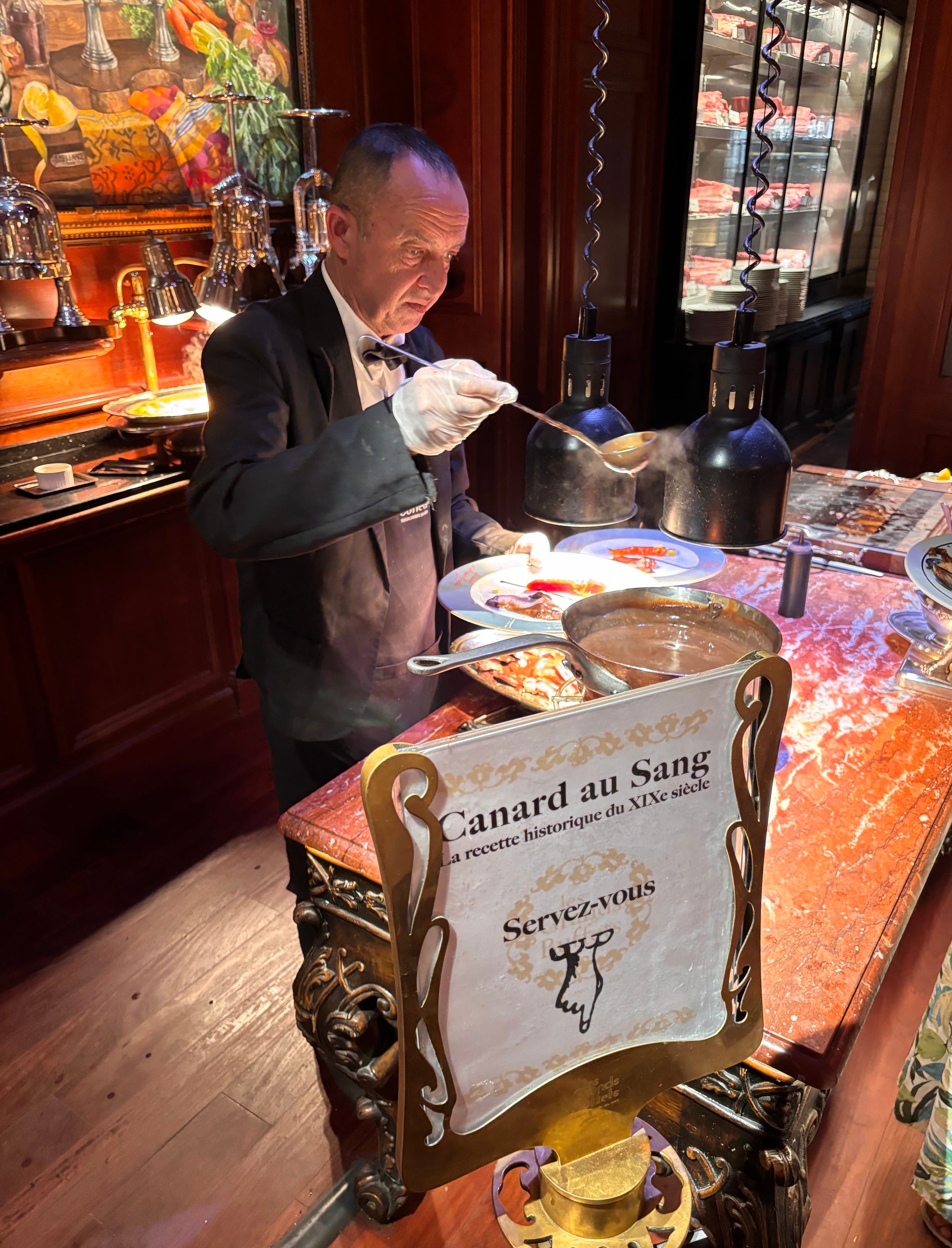
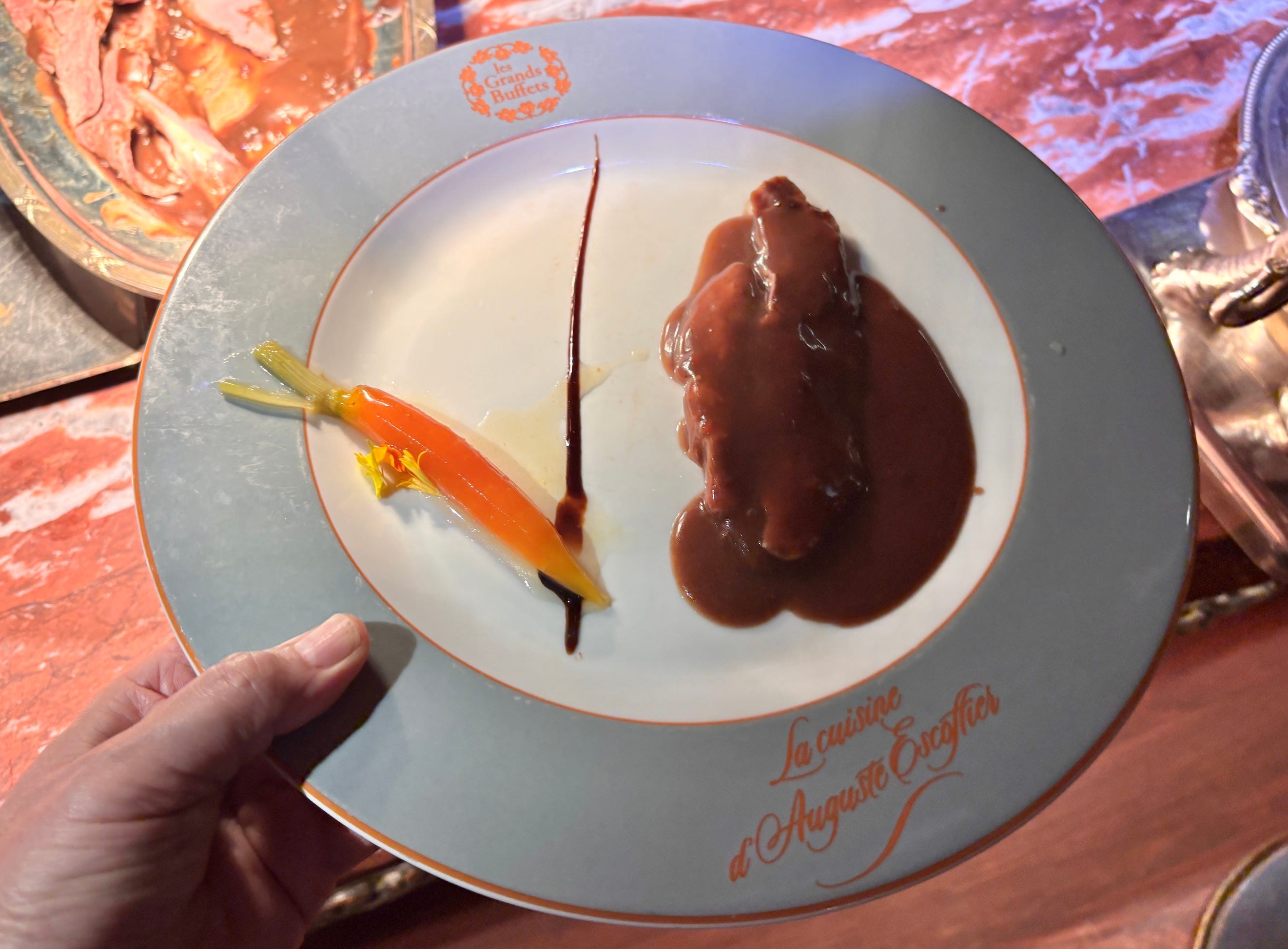
At another station, which some consider the highlight of the buffet, a serious-looking gentleman was serving canard au sang: duck served with a sauce made by crushing the carcass and using the juices, and the blood, to thicken the sauce.
The sign notes they follow the historic recipe from the 19th century.

As you can see, the portions aren’t huge.

Canard au Sang

They’re not being stingy. They don’t want you piling a whole bunch of things on the same plate. Being France, where appearance is everything, a big pile of food on a plate isn’t very becoming. Plus they don’t want to waste food. I didn’t see any signs at les Grands Buffets, but restaurants elsewhere with buffets are starting to charge people for uneaten food. The average diner at les Grands Buffets eats between seven and eight plates of food, which I found was about right. The owner was quoted as saying something along the lines of, it’s not about all you can eat, but it’s all about what you want to eat.

Leave a comment

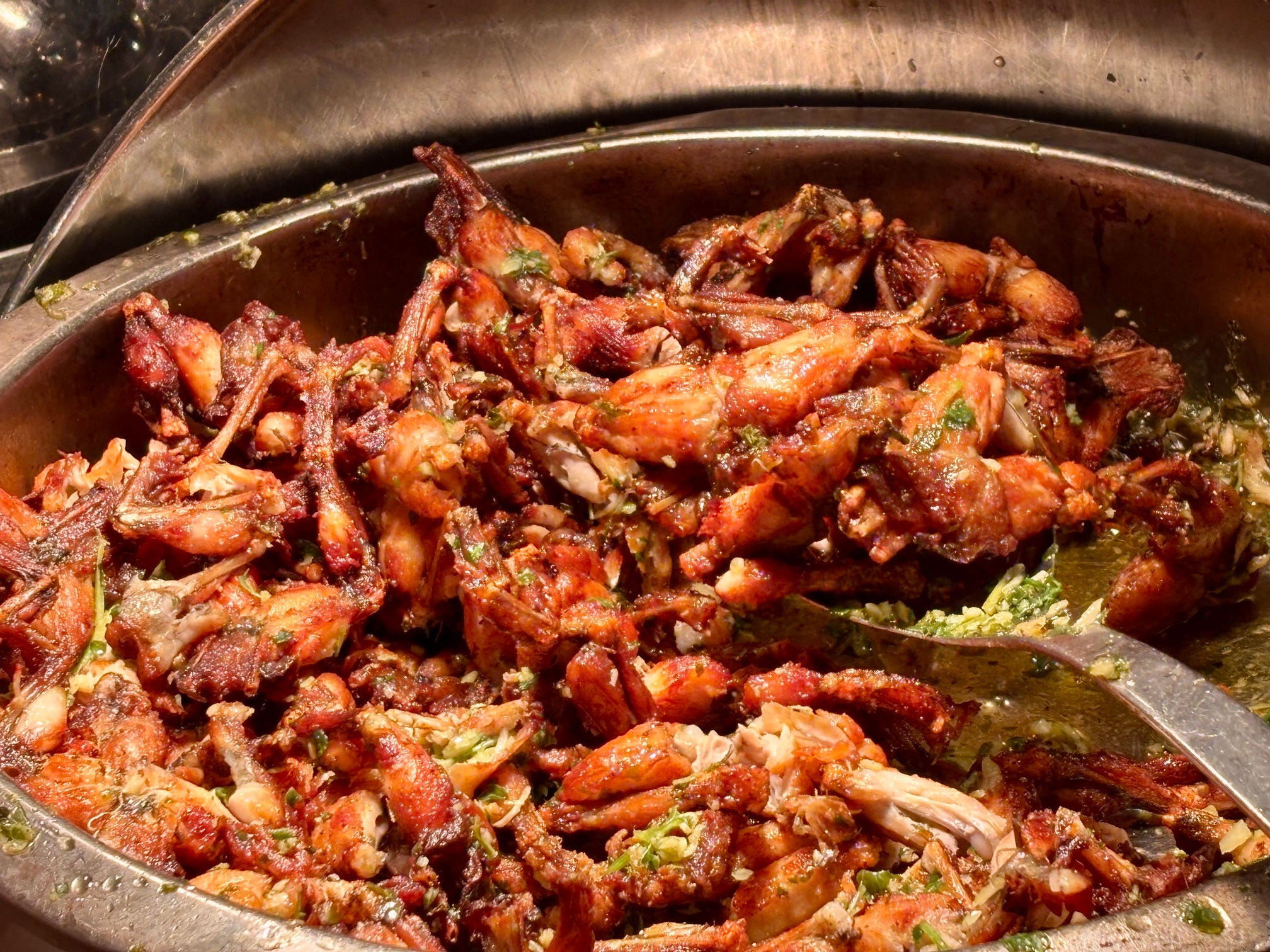
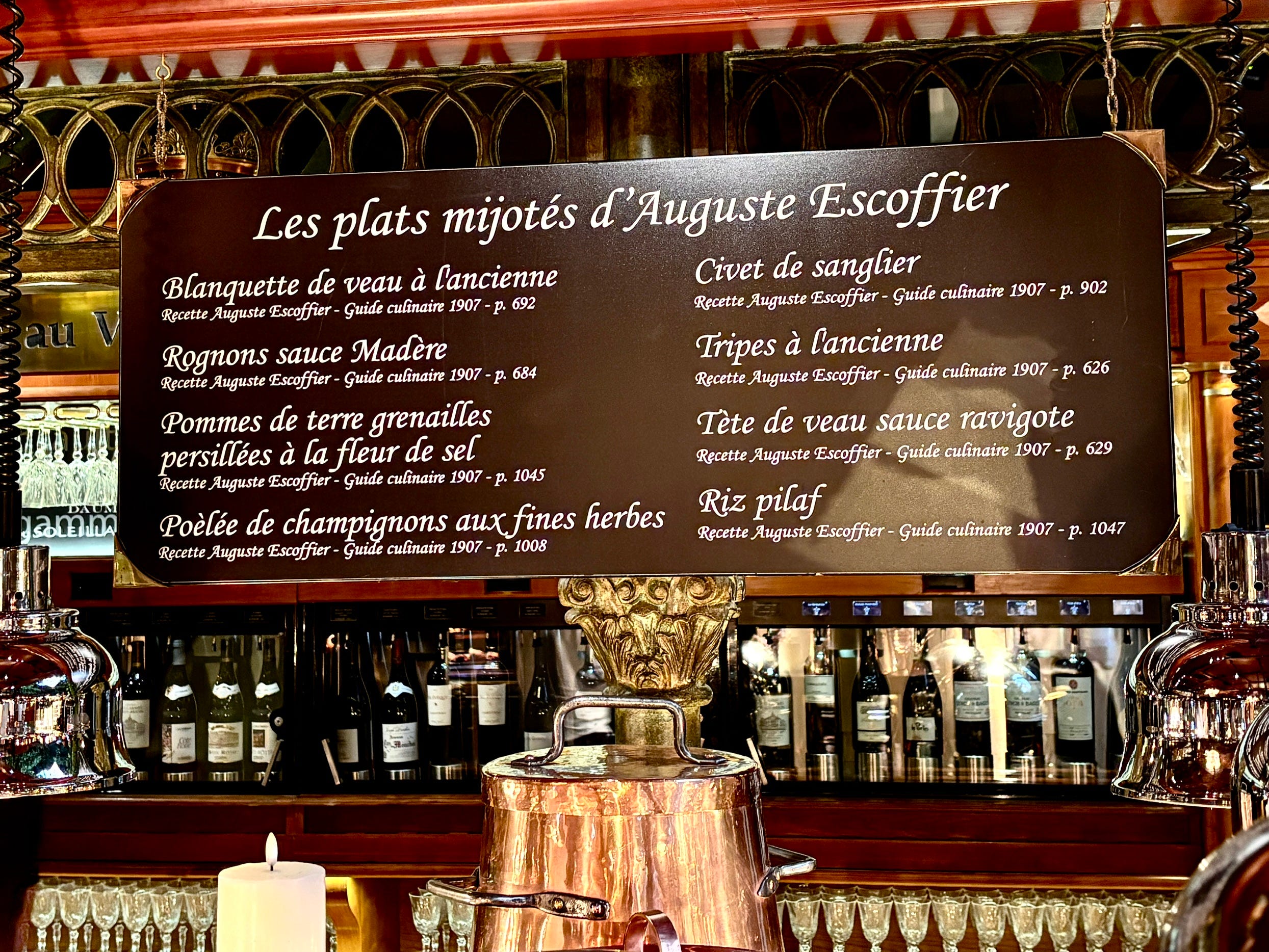
Intriguing, but less compelling to me, were the plats mijotés, simmered dishes, which were presented in chafing dishes, with items like frog’s legs, snails, veal kidneys, and tripe. In case you’re interested, some of those recipes appear in Escoffier’s book on pages 544, 543, and 626. You’re welcome.

Frog’s legs.

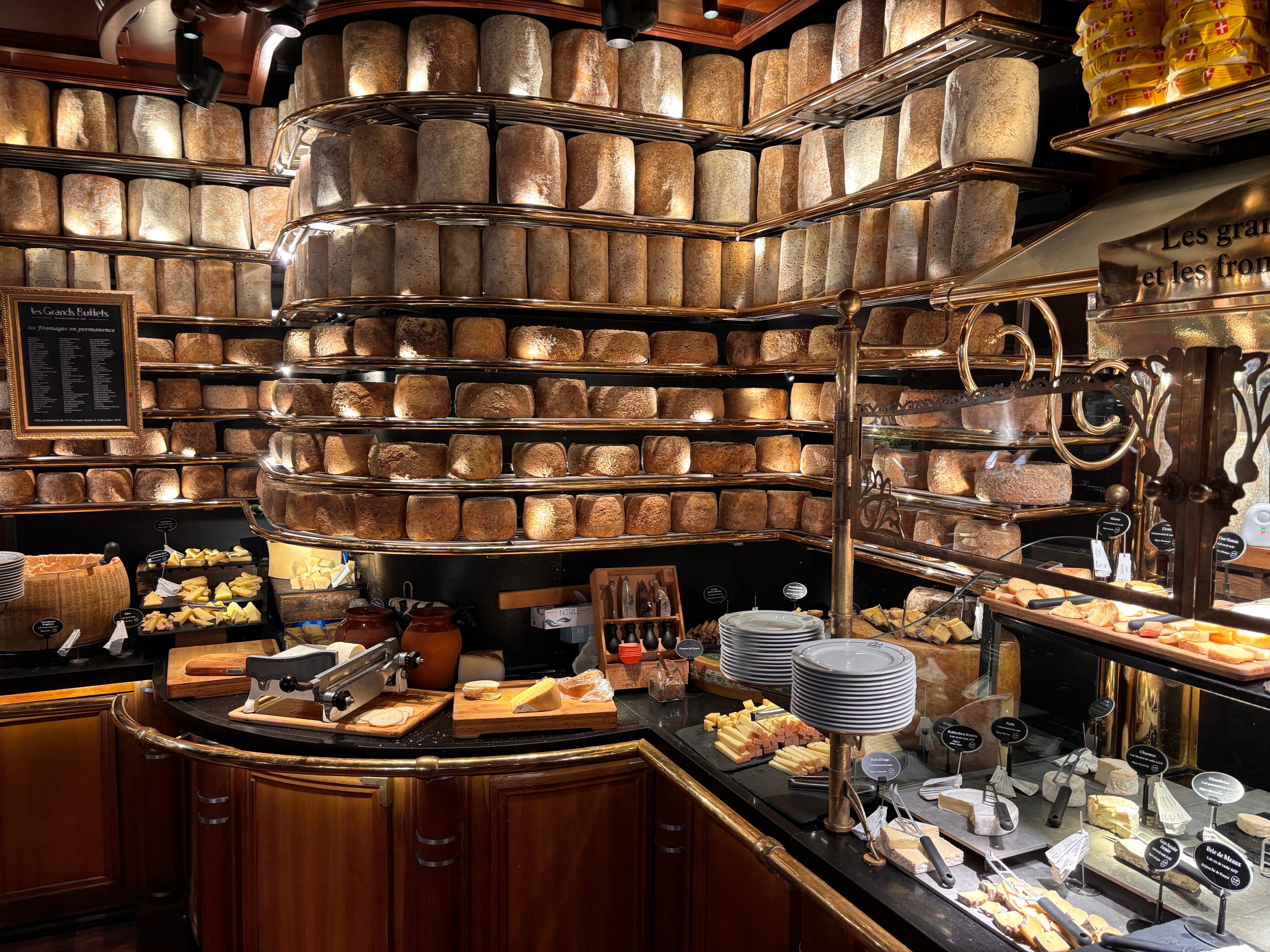
Before dessert, you’re faced with what Guinness World Records certifies is the largest restaurant selection of cheese in the world.

Read more

Received — 16 September 2026 ⏭ David Lebovitz Newsletter

Les Grands Buffets

16 September 2026 at 12:56

Perhaps you’ve heard about les Grands Buffets, the buffet in the south of France that’s à volonté. The all-you-can-eat restaurant is so popular, tables are booked months and months in advance. Like a number of things in France, what’s generally a straightforward process can become…a process.

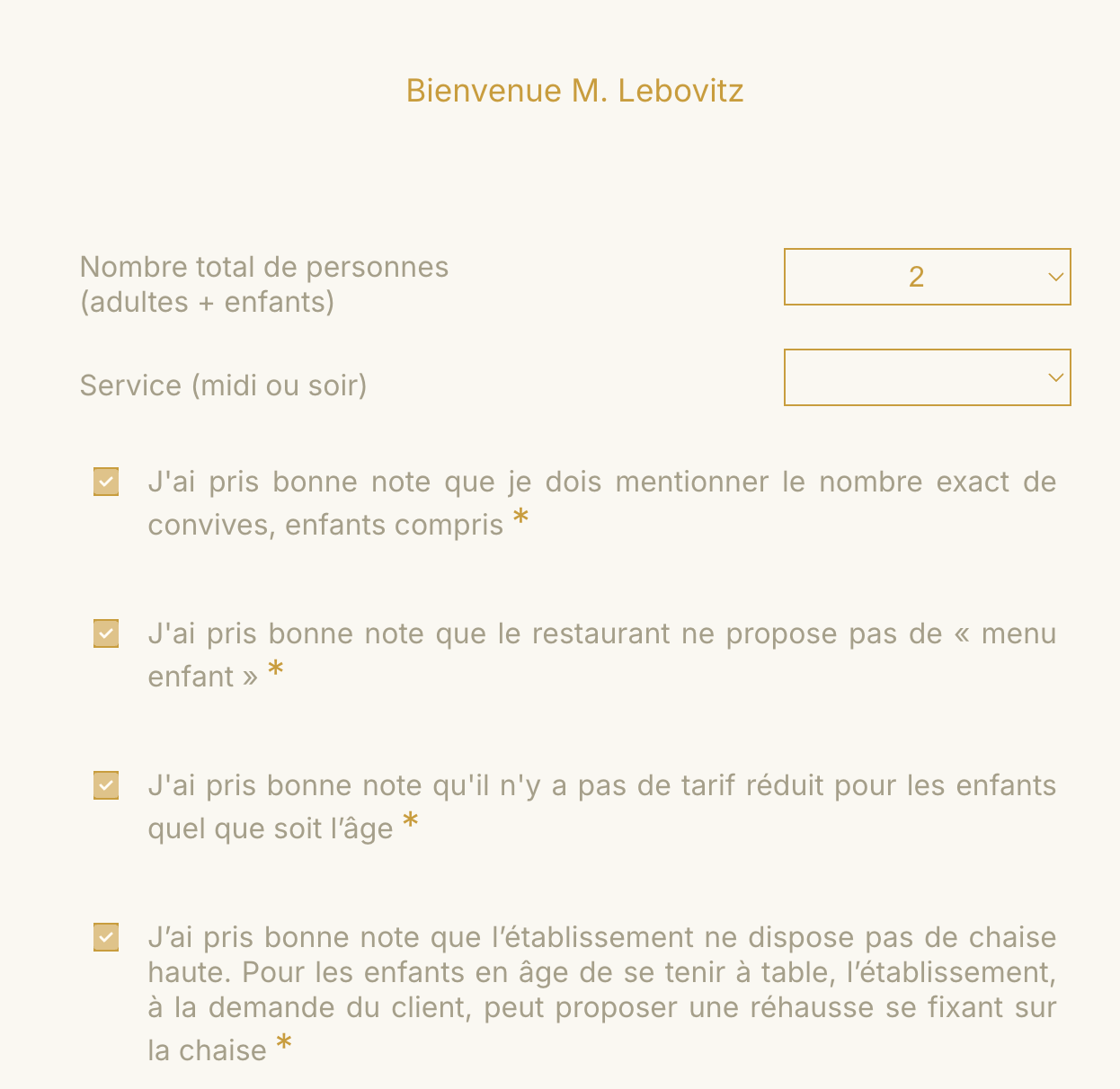
When booking your table, there are multiple screens to pass through, with a lot of boxes to check, making sure that you agree to everything…

You need to confirm that you understand the reservation is for the exact number of people you are asking for (you can’t change it later), that there is no children’s menu or special price for them, and there are no high chairs.

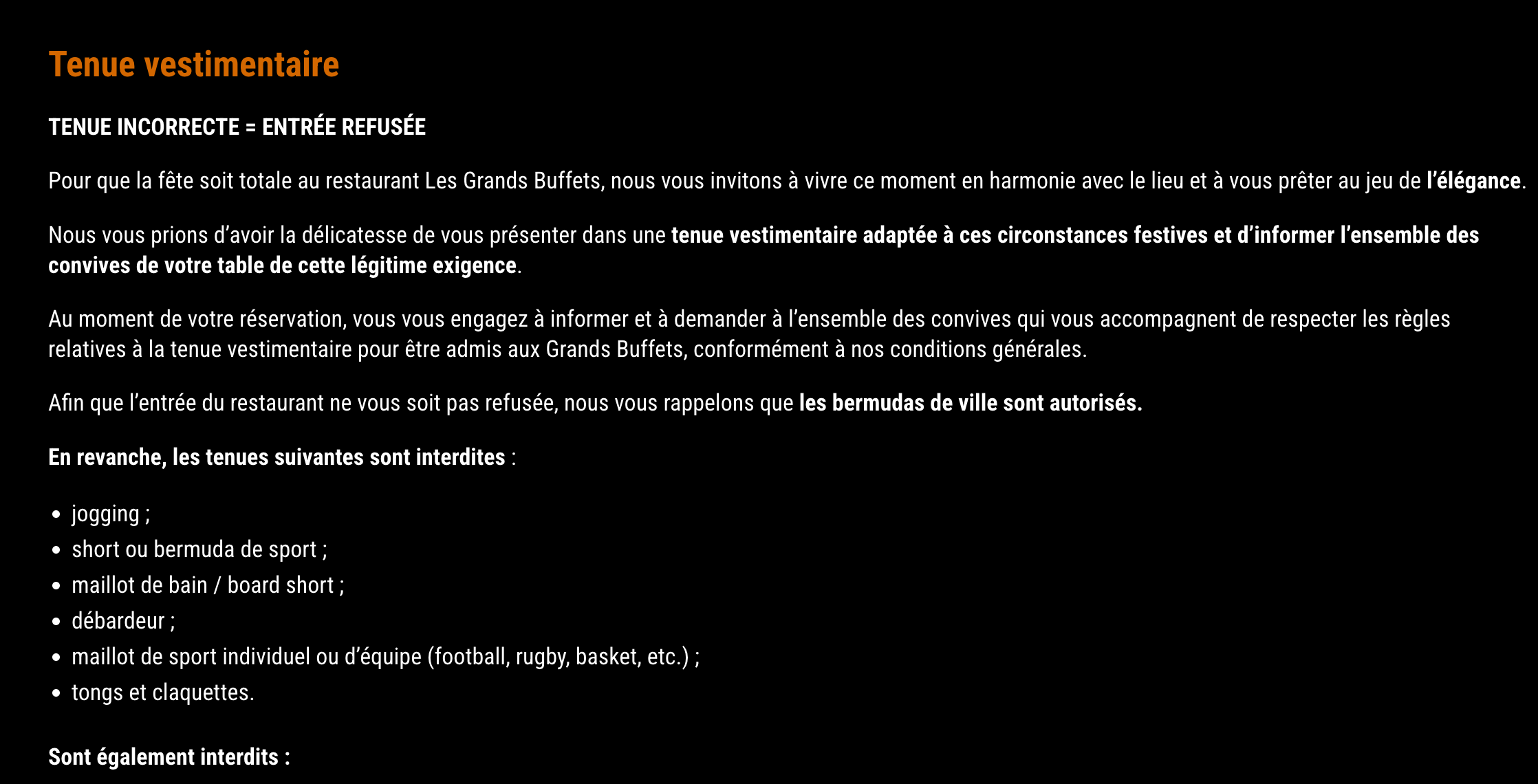
… including a strict schedule of deposits and payments. As someone who loves rules, and who lives in a country where rules are often considered for other people but not for you, I understand why. So they make everything very clear, including the dress code, with entrée refusée if wear athletic clothes, tank tops, flip-flops, or baseball caps:

For men, les bermudas de ville (chino-style shorts) are authorized, since this is, after all, the south of France where people are generally more relaxed. But just to be on the safe side, I wore linen pants. I didn’t want to get there and be refusé at the door.

French towns have started regulating how people dress on the street, including Narbonne, where les Grands Buffets is located. Everyone was pretty well dressed at les Grands Buffets the night we went, except for one guy who wore a tank top (débardeur).

I don’t think they want to police people, but in France you’re often sized-up on how you present yourself. Romain once got into a verbal tussle with a waiter at a restaurant in the French Alps because he was wearing a baseball cap and didn’t want to take it off. The idea, I think, is that they realize les Grands Buffets is a special experience (the night we went, a few women were wearing evening gowns), and they want people to be respectful of that. As long as I don’t have to wear a tie and jacket, I’m fine with whatever.

They’re also strict about seating times, and guests are booked and seated at 15-minute intervals, so everyone isn’t seated (or hits the buffets) all at the same time.

Subscribe now

Les Grands Buffets isn’t in the center of town, but is part of a public building adjacent to the zone industrielle of Narbonne.

Recently I had on my podcast, and we had a great chat that included talking about her excellent article in the New Yorker, The Hottest Restaurant in France is an All-You-Can-Eat Buffet (possible paywall), which put the place on the map for many people who didn’t know about it.

The restaurant was founded in 1989. The city of Narbonne was looking for someone to open a restaurant in a municipal sports center, which Louis Privat did. Currently the restaurant feeds over a thousand people a day at lunch and dinner. There are hundreds of dishes presented, prepared, and served by close to two hundred employees, and the price is €65,90 per person.

According to the BBC, the restaurant grosses €30 million ($35 million) and is the highest-grossing restaurant in France, and 86% of the customers are French. A lot of guests are Spanish since Narbonne is close to the Spanish border…and Spanish people like to eat. Privat has resisted opening another restaurant, even though he frequently is presented with opportunities in other cities. (And likely, in other countries.)

The main mission of the restaurant (aside from being a business) is to preserve French cuisine and traditions, set forth by Chef Auguste Escoffier, who wrote what’s considered the seminal book on French cuisine, Le Guide Culinaire, with instructions for preparing over five thousand French dishes. In it, you’ll find recipes for frog’s legs, snails, and tripe, which have fallen out of favor but are offered at the restaurant to keep those foods, as well as others, alive. My favorite quote from Privat was in Lauren’s article, “Why would you put a tarte Tatin in a shot glass?”

True to his word, thankfully, they don’t.

My own experience with Escoffier was when I was a line cook in San Francisco and ran across the street to the store to get an ingredient that we were out of. When I came back, the head chef wasn’t amused that I wore my chef’s coat to run the errand. “What would Escoffier say?” he admonished me. “I don’t know,” smart aleck me replied. “He’s dead.”

I didn’t see any staff members in chef’s coats running out the door, but a very nice woman named Elodie greeted us as we walked towards the door fifteen minutes early. In a very organized fashion, she made a note that we were there and directed us to their bar, which was next door, by the bowling alley. Knowing how rules about lines in France can be one of those things that are “for other people,” she said that when we came back, if there’s a line, just head to the front of it and ask for her.

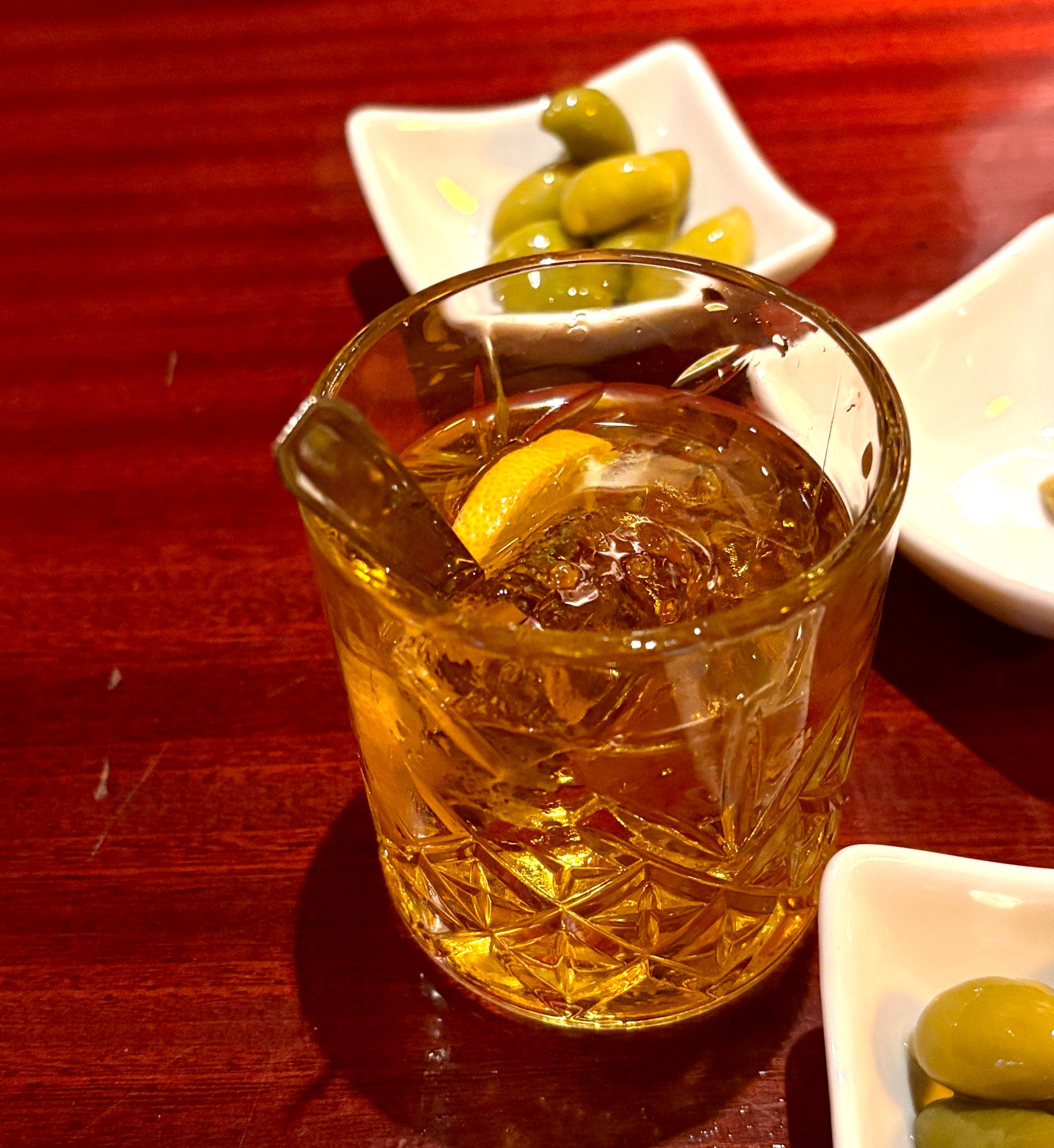
The bar that looked out over the bowling alley was hopping, and I had a glass of Suze, a bitter French apéritif that’s particularly appealing in the summer. To accompany your drinks, there are help-yourself appetizers, such as this DIY Tête de moine cheese machine, which produces perfectly scraped ruffles of cheese with a push of a lever:

The cheese is named after a monk’s tête (head) and one theory goes that it was a symbolic way to get revenge on the monks, who people had to pay rent to hundreds of years ago, for using the land. A few other theories are out there, but as the head of Chartreuse told me when I asked him to fact-check what I wrote in Drinking French about the Carthusian monks, who now make Chartreuse, whose history dates back a thousand years, he replied, “It’s hard to know what happened then…we weren’t there.”

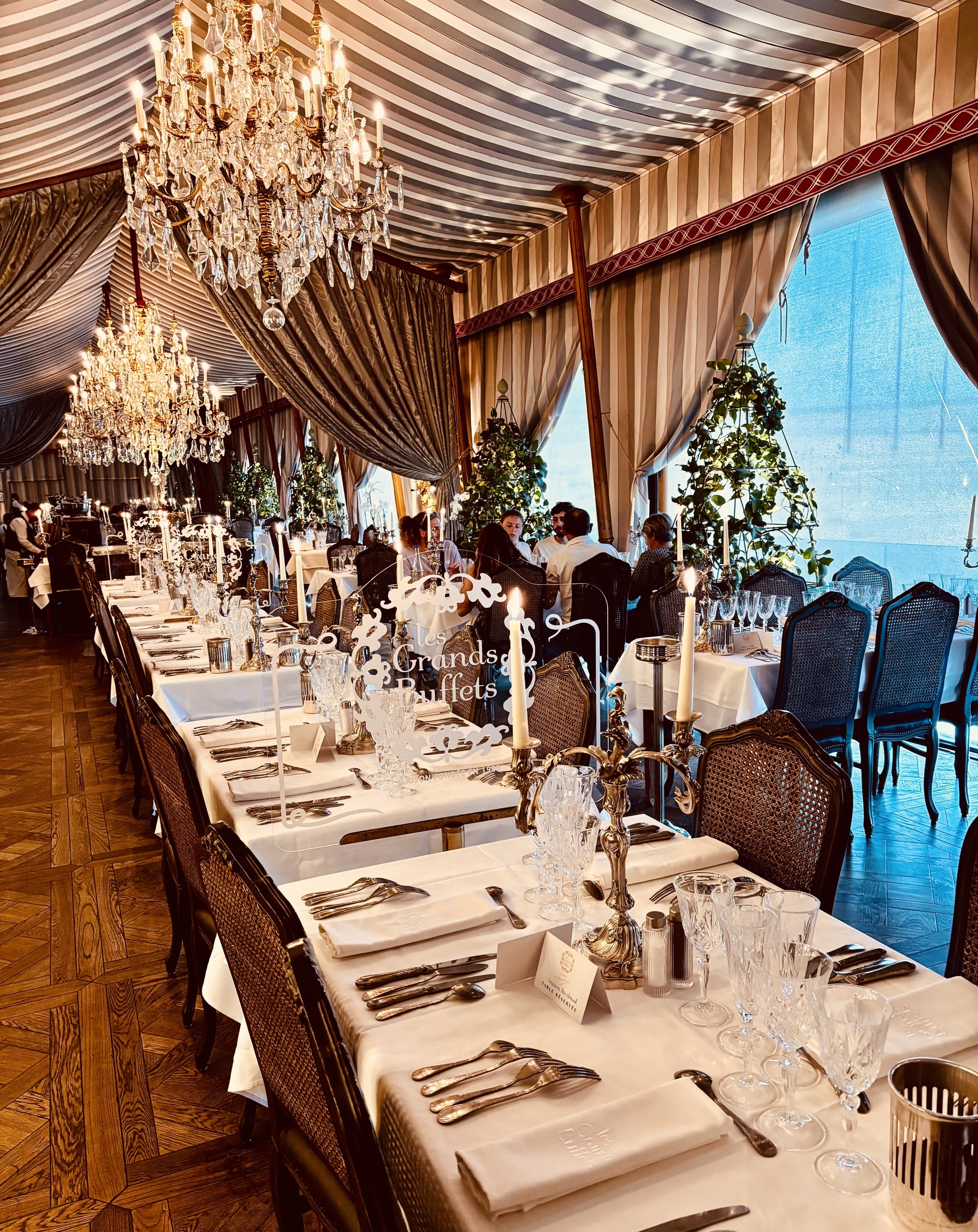
The dining room of les Grands Buffets is a surprisingly elegant affair, and you might feel like you’re attending a wedding or a gala event when you enter the room.

We kicked things off with a bottle of Heidsieck & Co Monopole champagne. Part of the restaurant’s philosophy is to charge close to retail prices for wines, rather than jacking them up. So the wine list is remarkably affordable and many producers from the region are featured in a section marked “Autour de Narbonne” — wines from around Narbonne. A majority of the wines are in the €20-25 ($23-29) per bottle range, which included that champagne.

There are various strategies for tackling les Grands Buffets. Unlike Las Vegas buffets, which a friend noted was likely the inspiration for this restaurant, there wasn’t any shoving or elbowing others out of the way, which also was because the restaurant is in the south of France, not in Paris. Diners lined up politely and waited their turn for their food.

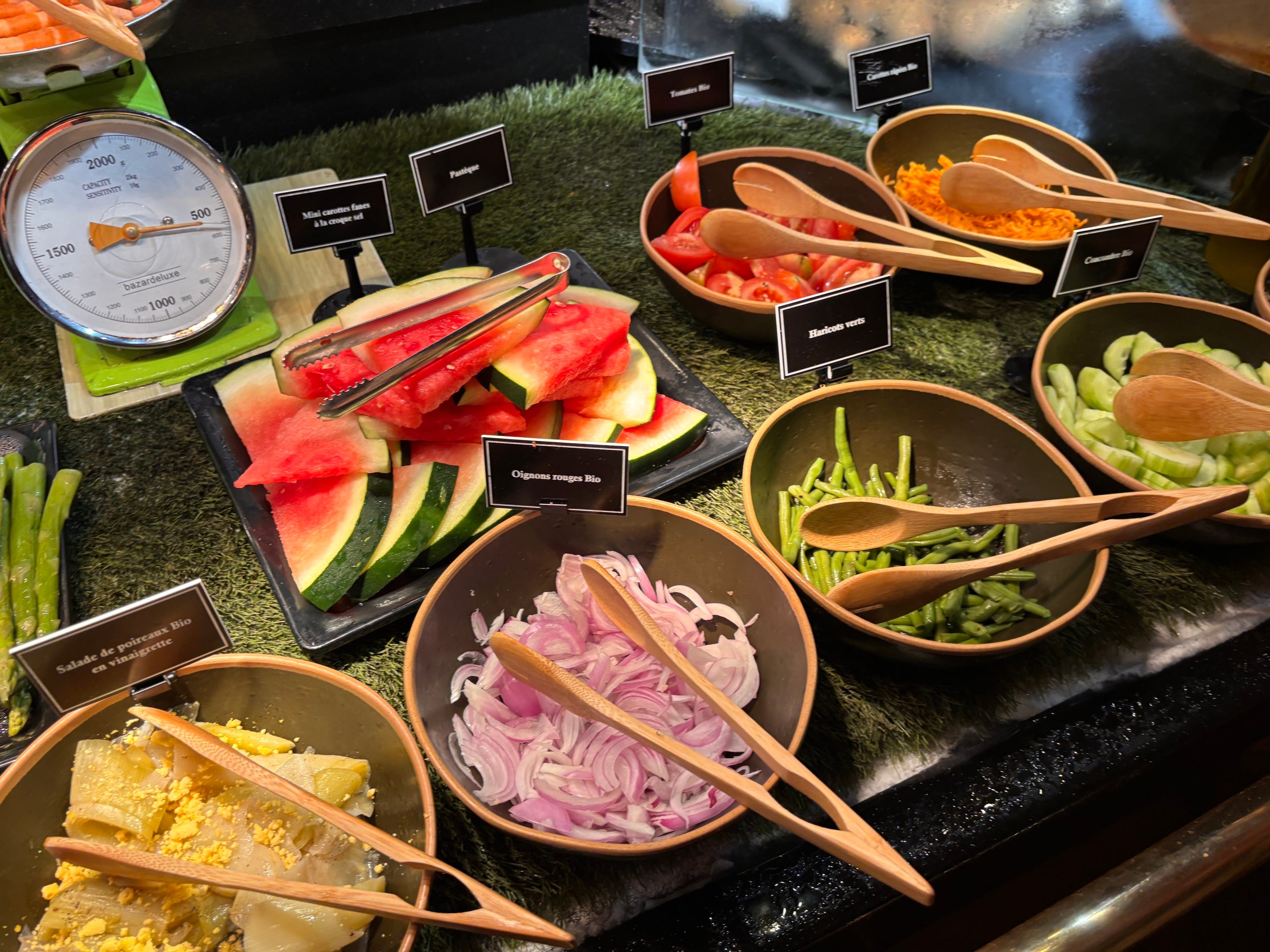
It’s best not to fill up on bread or vegetables, and I noticed most of them went untouched. Another strategy that I read was not to skip lunch if you were going there for dinner, since you’re going to be starving upon arrival and probably fill up on carbs.

Share David Lebovitz Newsletter

I made the truffle station my first stop, where they don’t skimp on truffles. And yes, they’re the real ones. Not “summer” truffles. There wasn’t a whiff of phony truffle oil in sight, nor a smell.

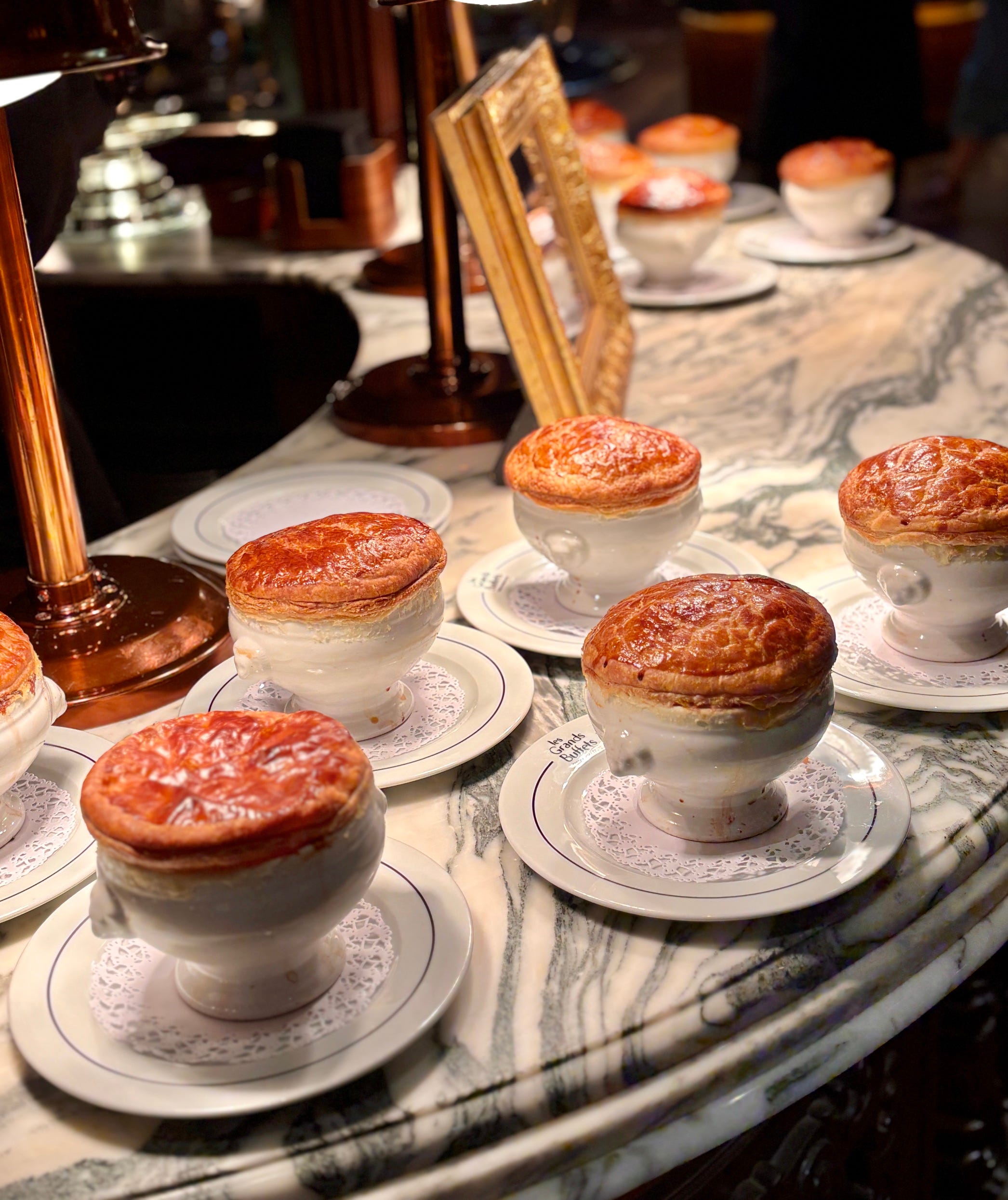
One offering was a soup made with black truffles and foie gras under a cap of feuilletage, buttery puff pastry.

Since I was skipping carbs, I skipped that, but the woman seated at the neighboring table took the soup, lifted the cap off, and ate it like a cookie. I admired her creativity.

I went for the brouillade, a mound of freshly made scrambled eggs, which were scrambled with a lot of minced truffles inside and topped with shaved black truffles.

I was never a big truffle fan. When I worked in restaurants, I would occasionally get to eat them for free (ditto with caviar), so it’s hard for me to pay for truffles and I was never gaga for them. However, years ago, I went on a truffle hunt in France and was in a room with hundreds and hundreds of truffles. Every course at dinner that night was loaded with truffles, and I was hooked. Still, I didn’t go back for the soup but moved on to the charcuterie.

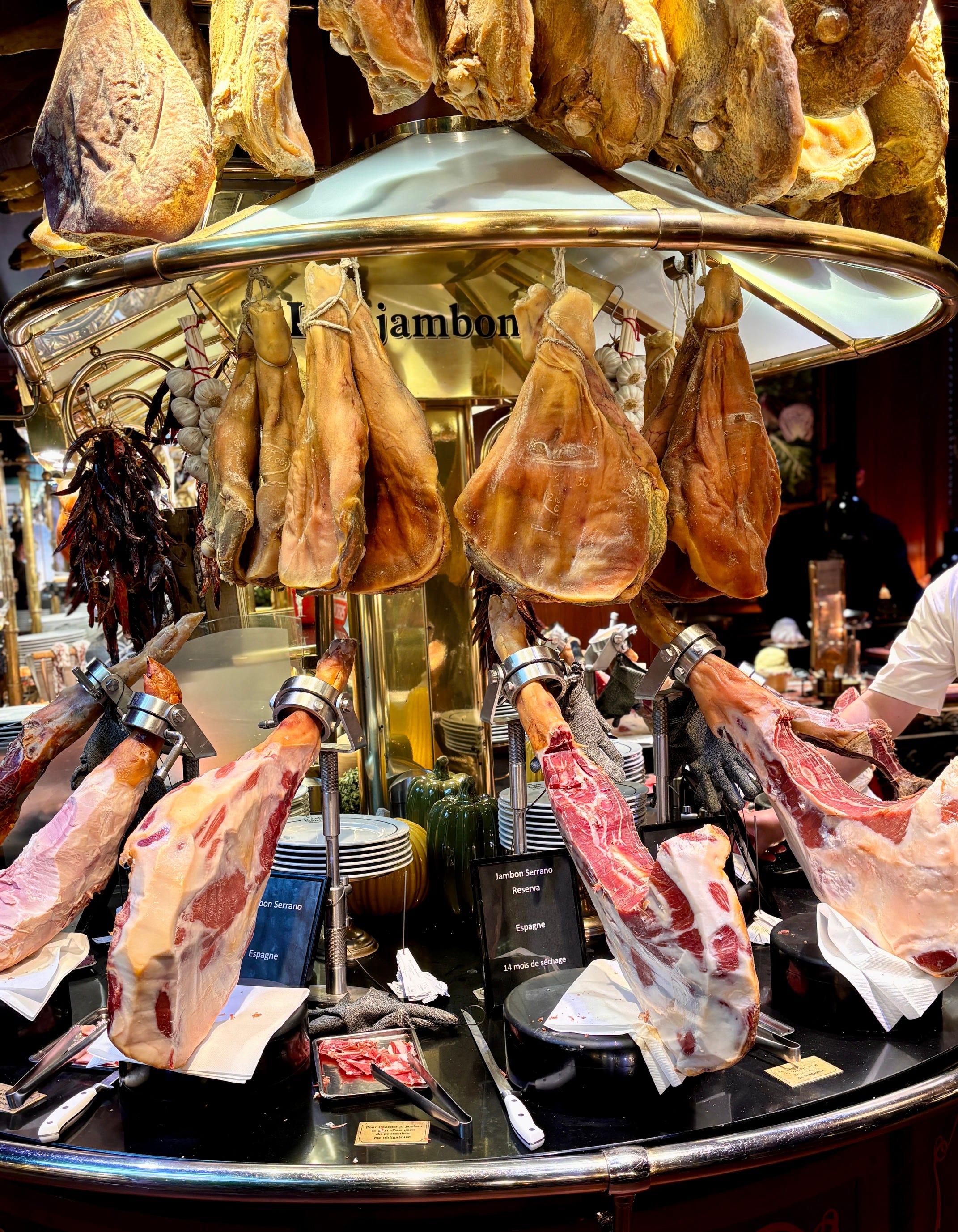
The pièce de résistance in that department was a station of hams, sliced to order. Each one listed its provenance and in France, they tend to slice ham thicker than they do in Spain and Italy, which makes it a little tougher to eat. Romain once told me to tell the person at the charcuterie that I wanted my ham “as thin as cigarette paper.”

I tried that and the guy deadpanned back to me, “Monsieur…je ne fume pas…”
I don’t smoke.

Personally, I think it’s a strategy to sell more ham since when something’s sold by weight, ten thick slices weigh a lot more than ten cigarette paper-thin slices. The lone slicer at les Grands Buffets was doing his best to keep up with all the customers, and the hams. So it was hard to fault him for the thickness of the slices. But maybe he wasn’t a smoker either.

Leave a comment

While I was on vacation, I posted a few pictures from the restaurant. Someone made a comment wondering aloud how there could be so much food, when others have so little? It’s definitely true that most of us have access to food that’s sadly, not available to everyone. Narbonne is not a wealthy city and most people earn less than the national average. Unemployment is around 18%, which is over double the national average (8%) in France.

While researching her article, told me that some people save up all year just to have dinner at les Grands Buffets, that it’s their special night out. After thirty years, the restaurant has figured out how much food they’ll go through each night so there’s very little food waste, and whatever is left over is served at the staff meal. Being in a municipal building, the restaurant is a strong supporter of the local community, which also includes winemakers and other producers, in addition to supporting a staff of hundreds of people.

It’s hard to size up people by how they look and are dressed, but the people eating at les Grands Buffets seemed to be “everyday” people. (I didn’t see any fancy cars in the parking lot.) Judging from their accents, it sounded like there were many locals. Folks in this part of France have what’s referred to as an accent du midi and pronounce certain words, such as wine (vin), as ving, with a bit of a nasal twang on the final “g.” And unlike the buffets of Las Vegas, this restaurant isn’t a palace of gluttony. People weren’t loading their plates up as full as possible, overindulging in whatever they could. It was all quite civilized.

I suppose you can criticize people eating at restaurants when others can’t. But not sure how one draws the line. At least the price point here is not too far from the price of a 3-course dinner at a mid-range restaurant in Paris.

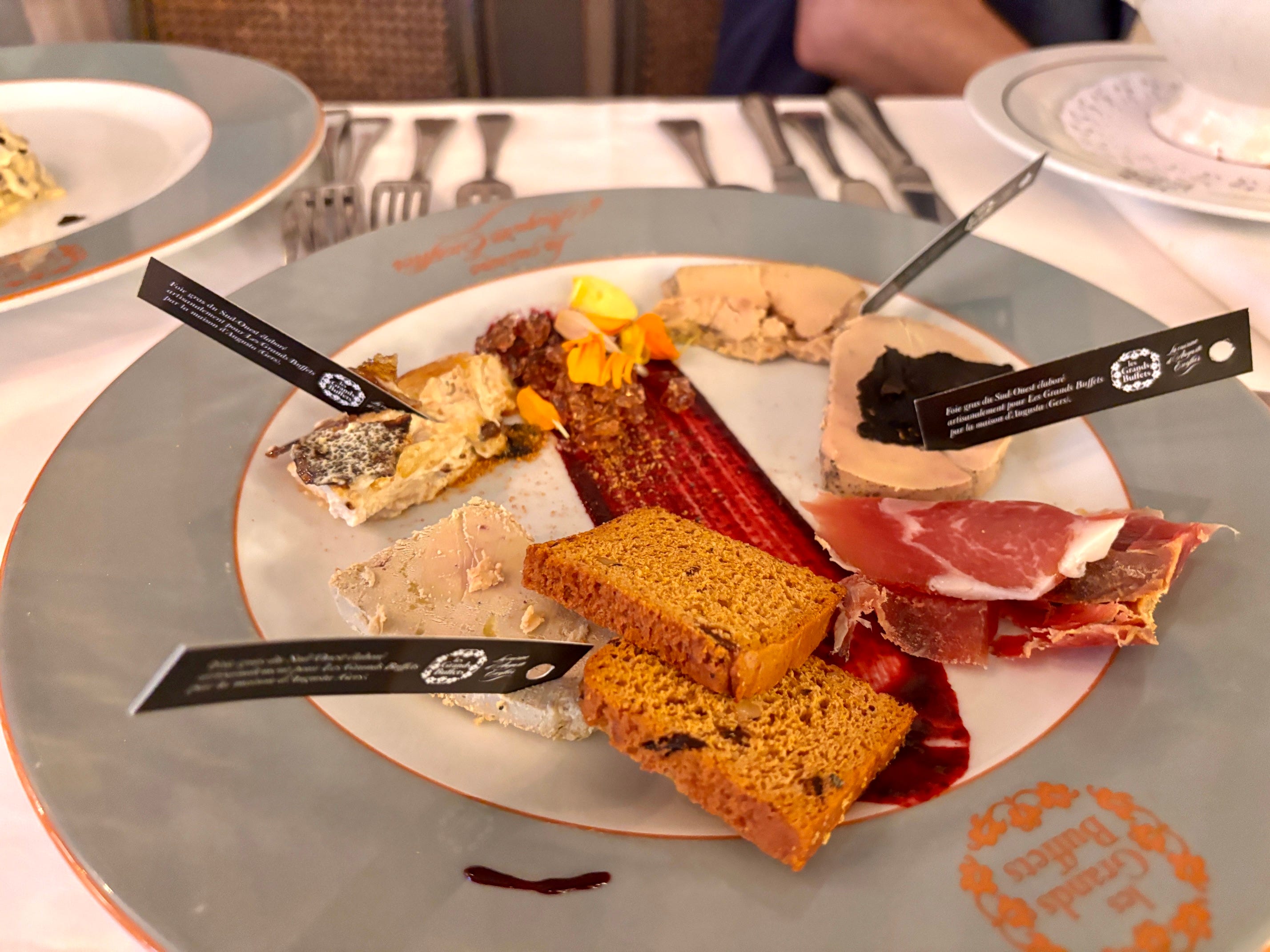
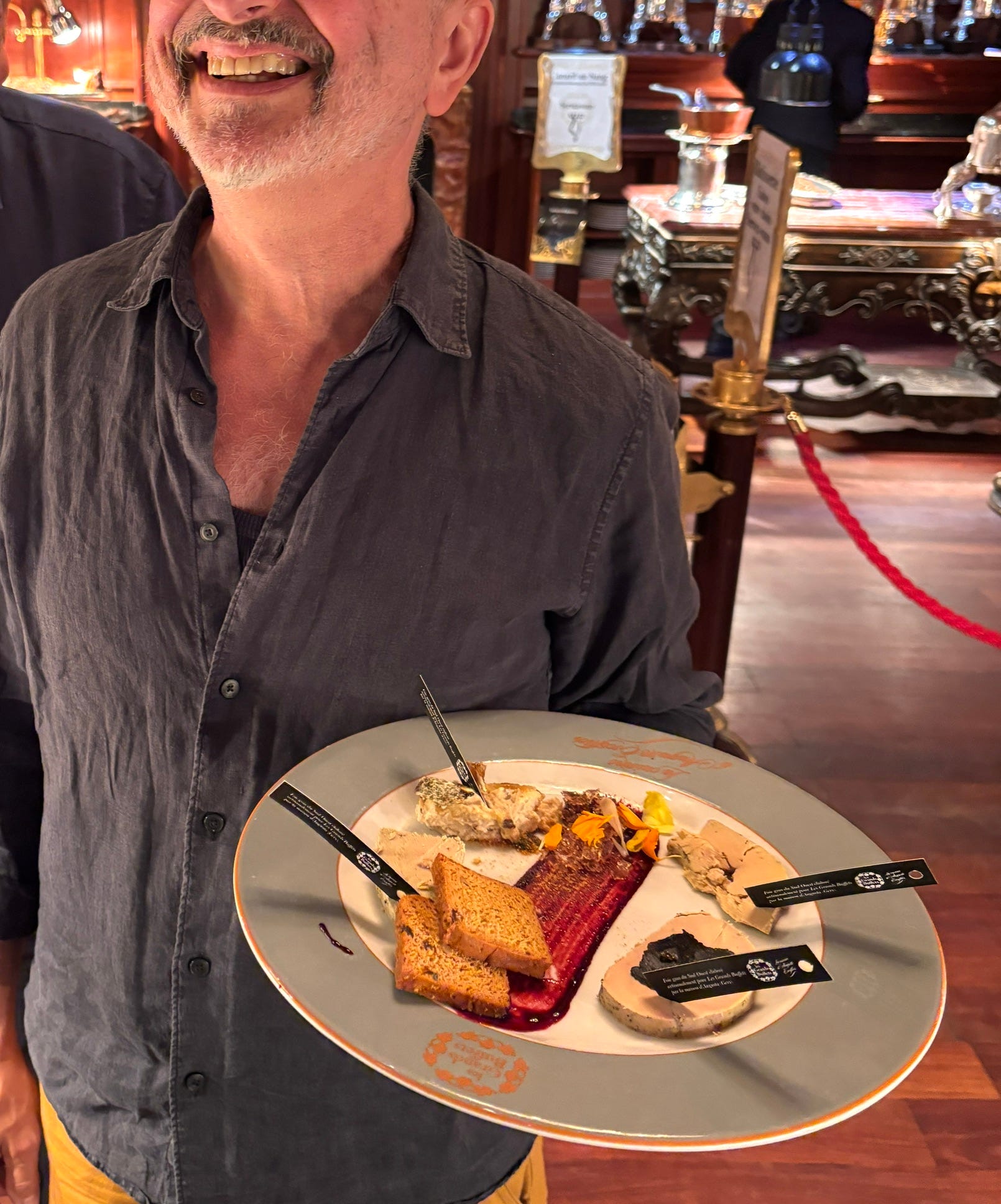
Four presentations of foie gras, with little explanations attached: Lightly smoked, with truffles, mi-cuit (partially cooked) with Armagnac, and in the style of crème brûlée, with port wine.

It’s true that the lobster tower could be considered a little over the top, but as a winemaker in the region told me once, “People who live here know how to cook, so they don’t go out for the food. They go out for the experience.” And the lobster tower is giving it to them.

As mentioned, one objective of the restaurant is to guard the heritage of Auguste Escoffier and la cuisine française. They adhere so closely to his recipes that the page numbers from his book, Le Guide Culinaire, are listed on the menus.

Subscribe to my newsletter to get new posts, Paris dining tips, recipes, and more, sent right to your Inbox. Sign up here!

An undeniable part of French culinary heritage is foie gras. It’s a controversial ingredient, even in France, and is not something we eat often. When we do, I try to make sure that it’s produced in France, not just “packaged” or “transformed” in France, as some jars and cans say, which means the foie gras can be produced elsewhere.

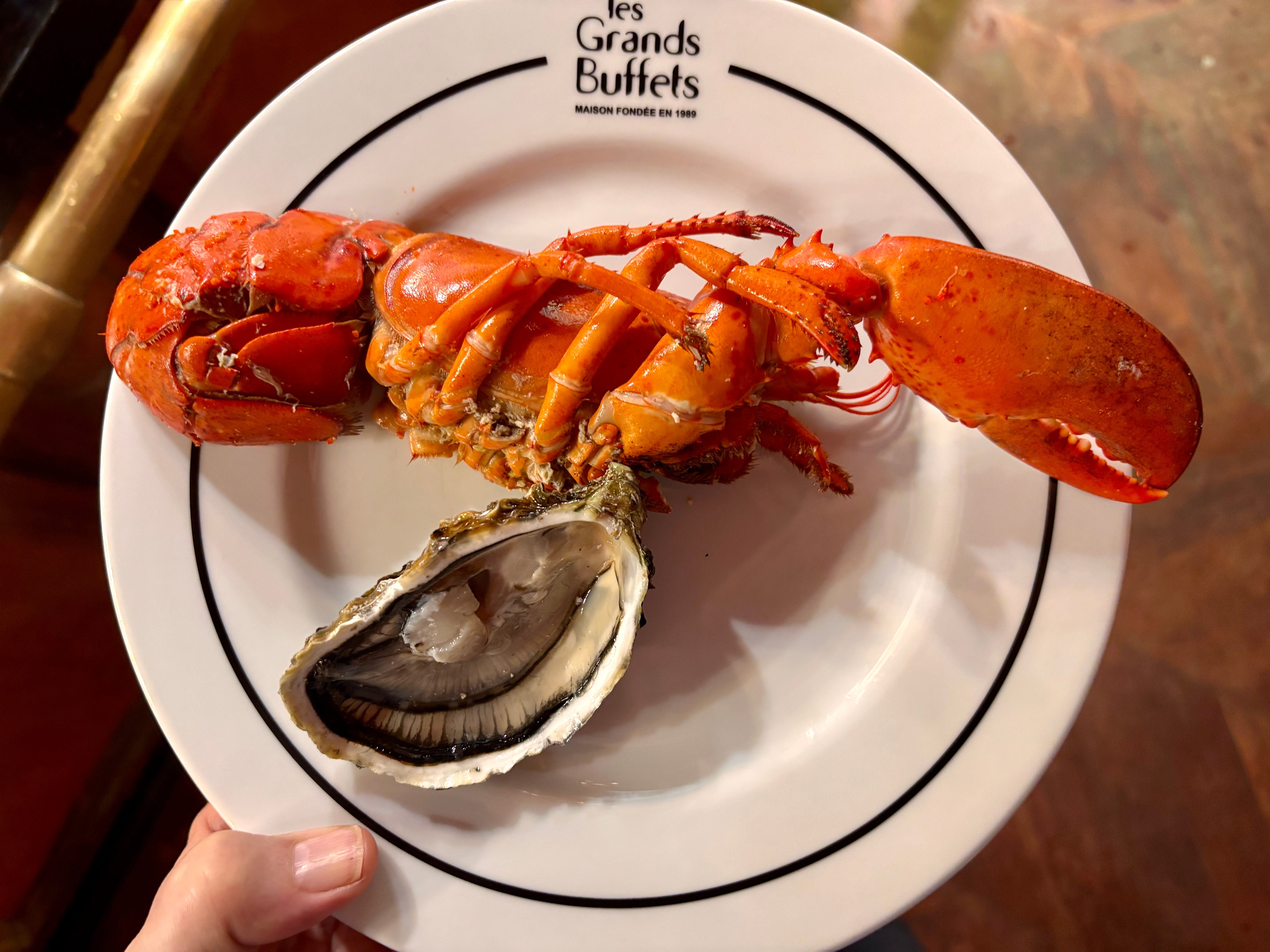
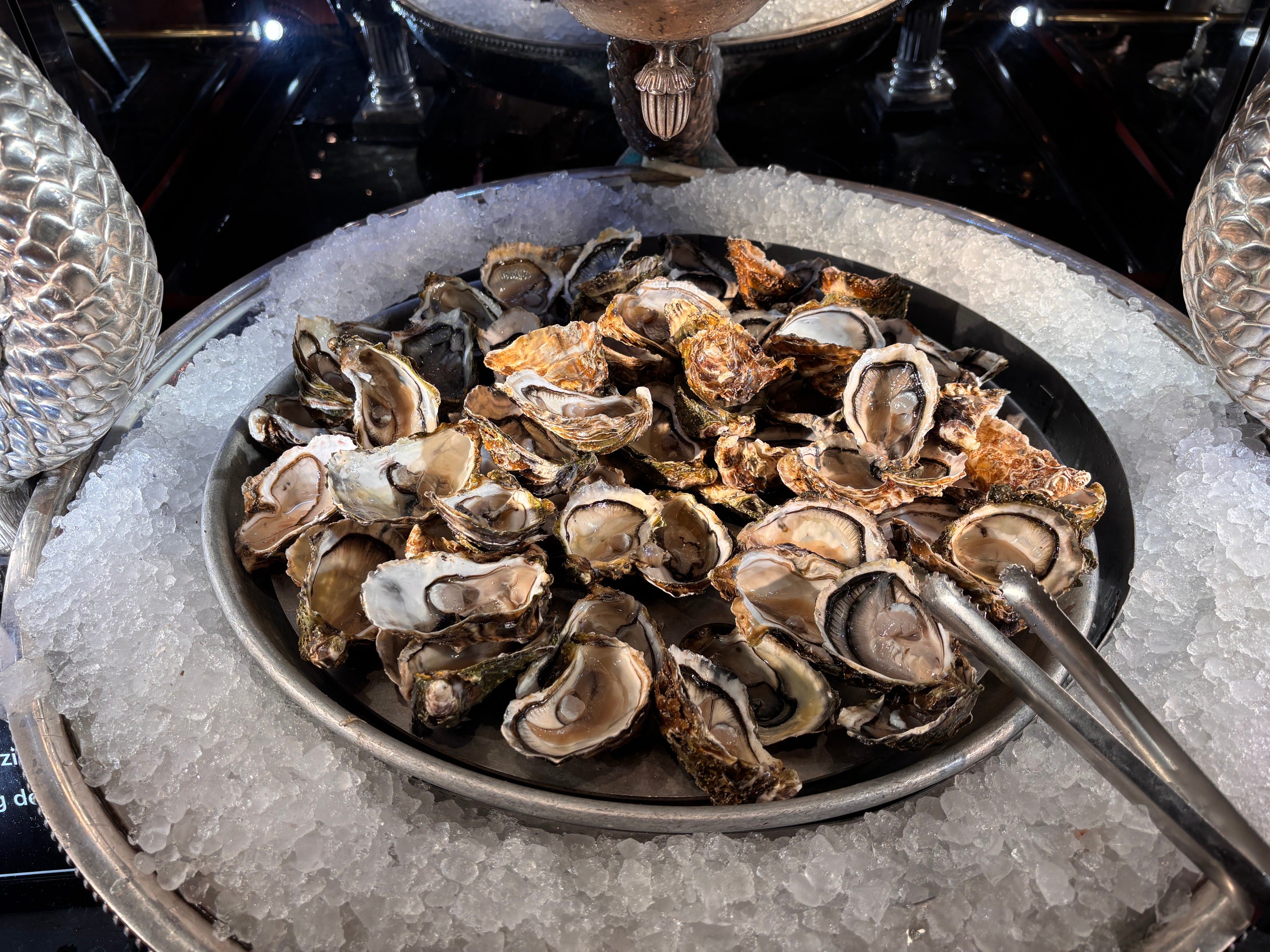
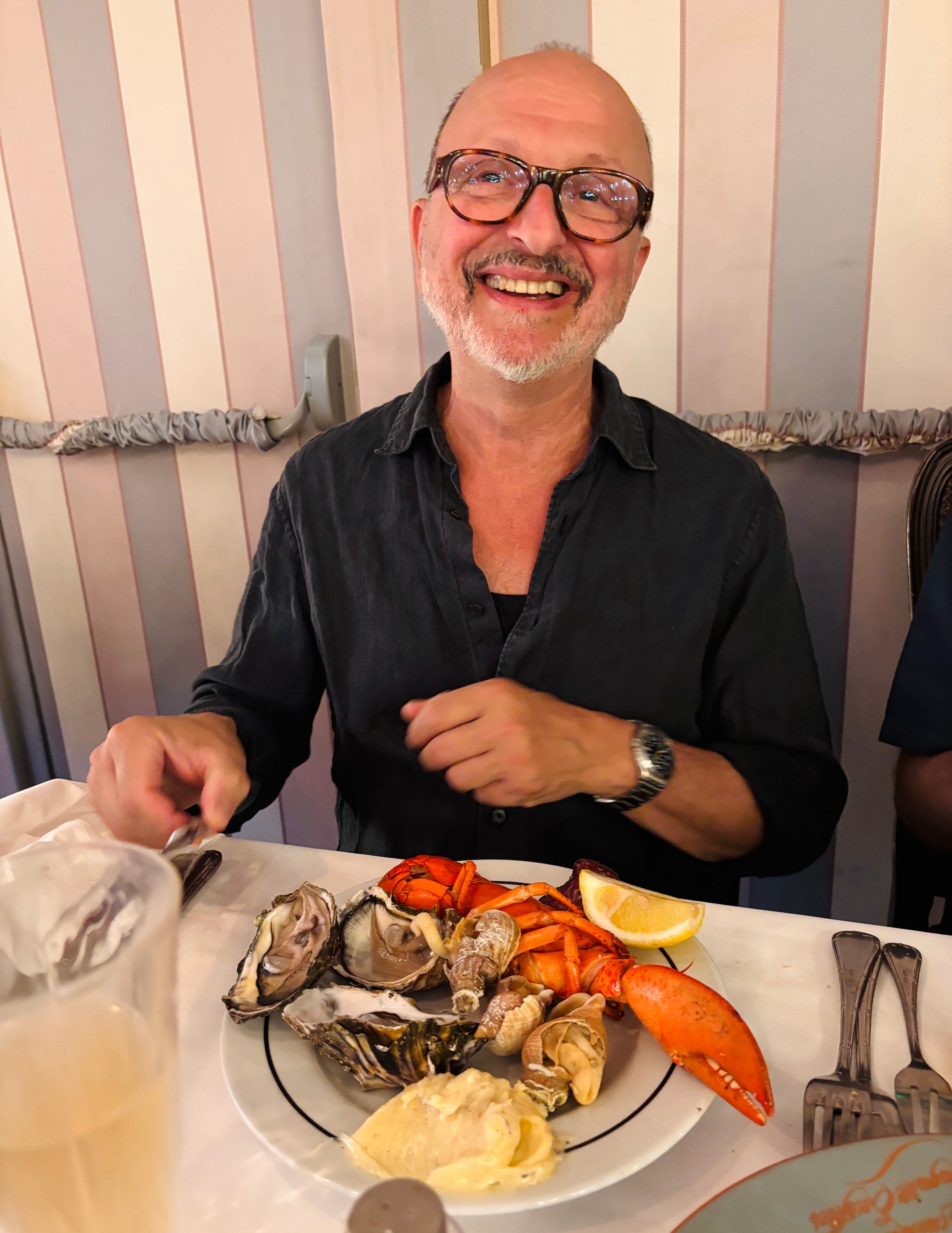
After nibbling around that plate of richness, we headed to the seafood section and loaded up on oysters. They also had mussels, bulots (sea whelks), and smoked salmon, heaped up on ice, all for the taking.

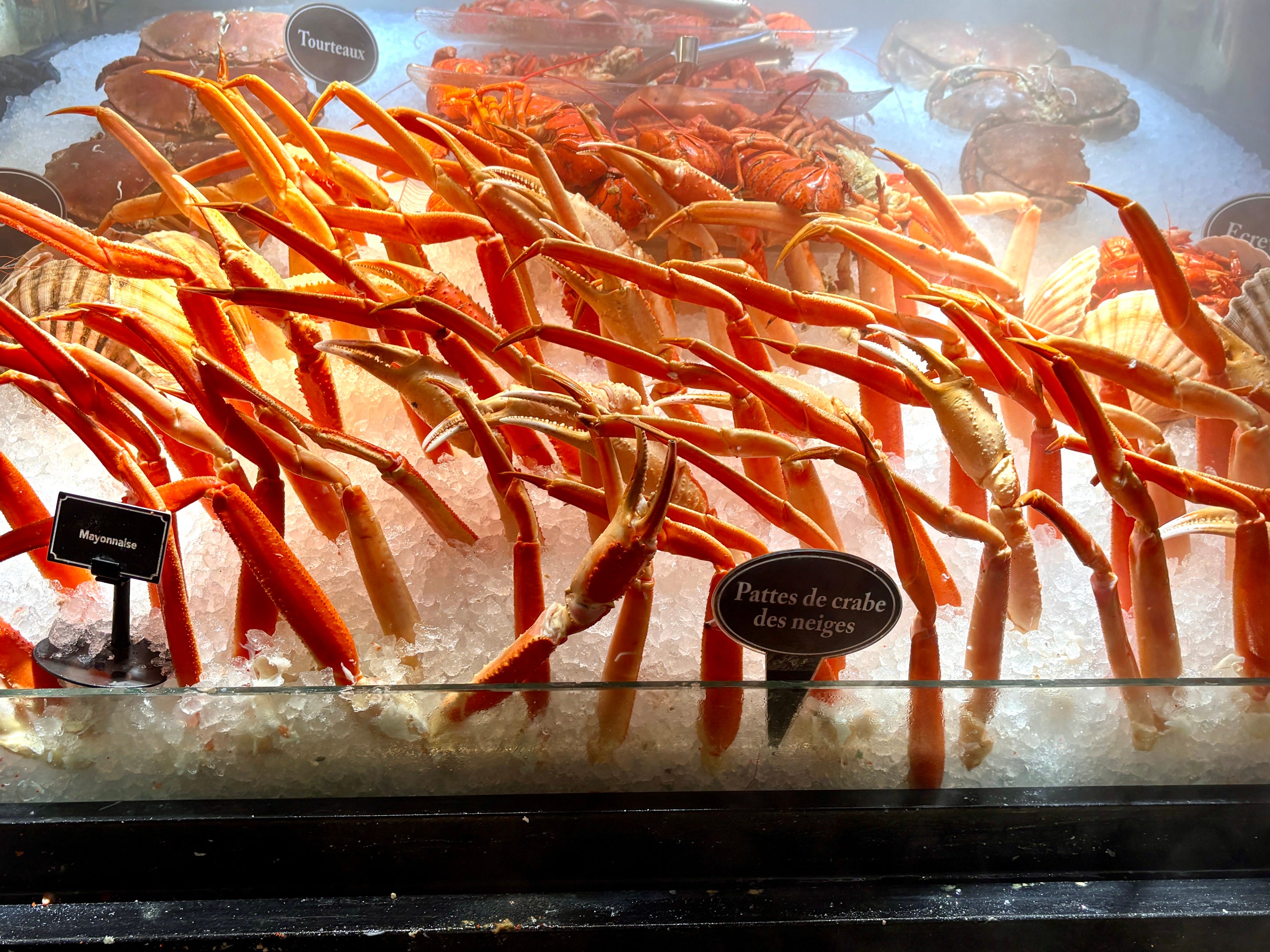
I didn’t try the crab claws, below, which a reader told me was better than the lobsters. As a New Englander, I’m pretty partial to Maine and Canadian lobster. Lobsters from France are twice as expensive are they are in the States, and a pricey indulgence.

I was wondering if the restaurant would have French lobsters, which they didn’t. I guess they blow their budget on black truffles. So if you go, grab a claw or two, or three, and let me know what you think.

Stay tuned for part 2 — main courses, the cheese course from the largest selection of cheeses in the world, and, of course, dessert(s).

To be continued…

Leave a comment

Received — 7 September 2026 ⏭ David Lebovitz Newsletter

September 2026 Newsletter

7 September 2026 at 09:05

It’s no secret that summer vacation is sacred in France. When I moved here, I found it curious that everyone went away en masse, at the same time. Bakeries, restaurants, eyeglass stores, market vendors, and almost every other business take time off for les congés annuels, their yearly break.

But twenty-five years later, I get it. At the beginning of August, things start to slow down, and while I like the relative quiet of Paris during that month, I want to head to the beach and drink rosé and jump in some waves, rather than stay in sticky-hot Paris.

It took me a few years to unwind, and now I’m more low-key than my French friends and family, and am simply content to sit in a lounge chair and read for a few weeks on a beach or by a pool, while they’re scrolling through their telephones. I forgot to set a vacation notice for my email so I had to answer some messages. I think I’ll set it now for next year, so I don’t forget.

Romain tried to get me to visit museums, and he managed to get me in a few churches; if you live in France and have a French partner, the main attraction in any city is the church, whether they’re religious or not. As a good sport, I try to get in some culture on vacation. For example, I loved the Louisiana museum when we went to Copenhagen, even though it cut into my cardamom bun time. (Admittedly, there were no beaches nearby.)

This year I tried to deflect, that I’m an ouvrier, someone who works with his hands (not so much his brain), which got me mostly off the hook.

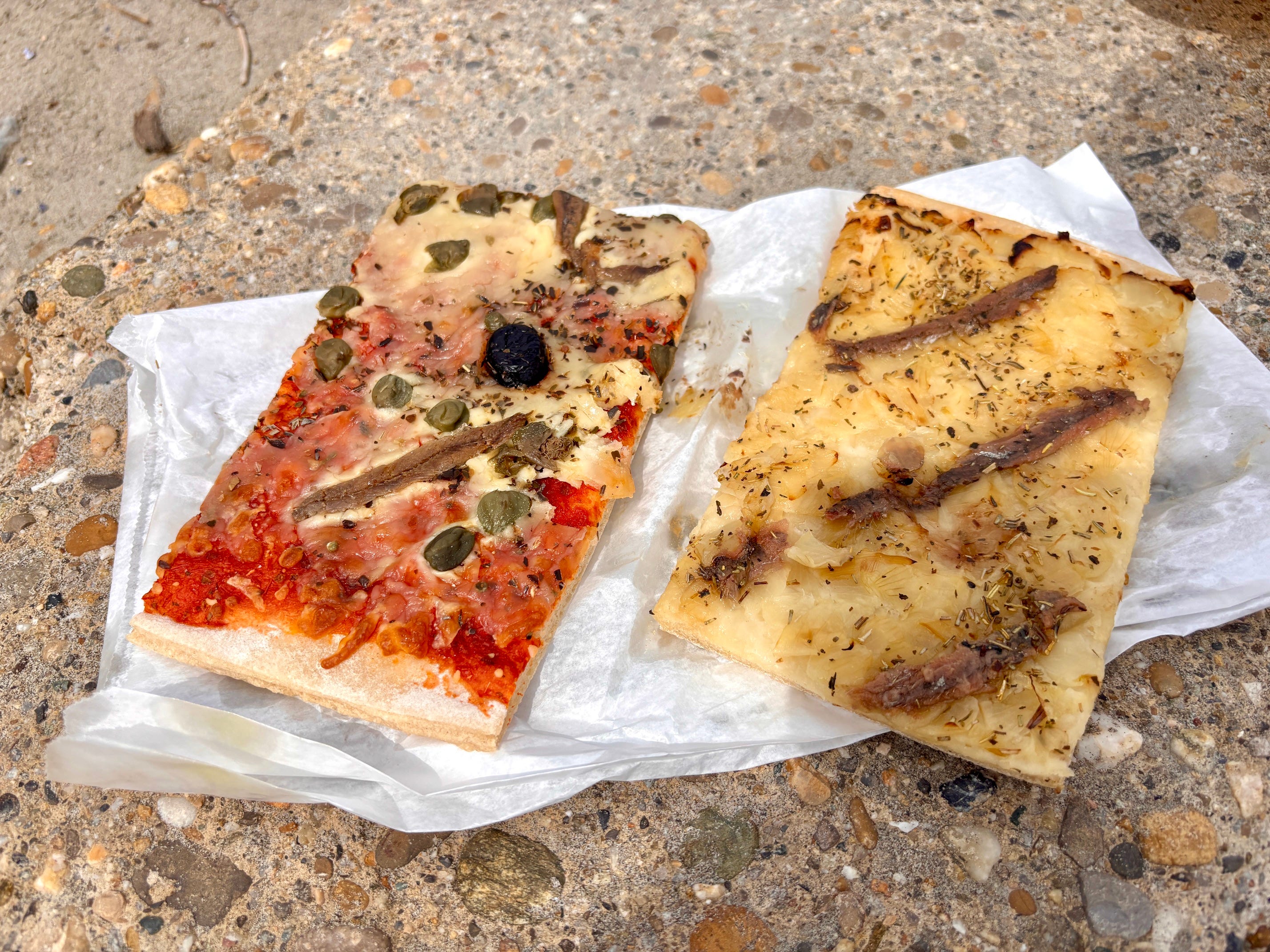
Pizza and pissaladière on the beach.

Happily, I’ve been able to coerce Romain into going to the south of France in the summer. We used to go to Brittany in the summer, a popular destination for Parisians. But sitting on the beach there, even in August, can require a down jacket and a scarf, and my idea of vacation is not to wear anything but a T-shirt, shorts, and sandals.

Subscribe now

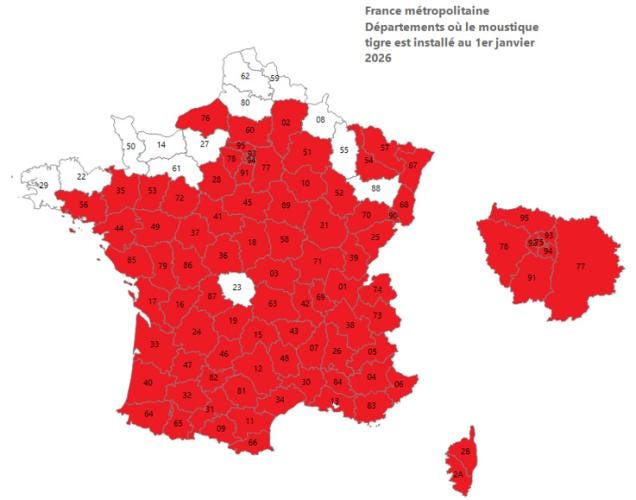
Aside from the five — or was it six? — heatwaves we had in France this year, the second big topic was the mosquitos, which have taken over the country, save for one small region…

…and that’s where I want to go next summer.

Mosquitos aren’t as compelling of a story as, say, the lack of air-conditioning in France, which was analyzed to death by magazines and newspapers in and out of France. By early summer, we couldn’t go in our backyard, which seemed to be the breeding ground for the entire country.

I did find two effective things to ward them off. One was Off! Clean Feel, which is unscented and doesn’t leave a greasy film; friends from the States bring it to me, even though I’m not keen on slathering it on my skin. On the natural side, I found the anti-mosquito stick made by Comme Avant pretty effective, in spite of its waxy feel.

So much of our summer was spent swatting and itching. I was surprised when I visited a friend who lives in the Ardèche and found they’d installed screens on all their windows, which are as common as unicorns in France, and I hope the idea catches on. We did get a bid to put one (1) on our sole bedroom window, which was an astounding €900 ($1045), so it’s no wonder people are reluctant to install them.

Leave a comment

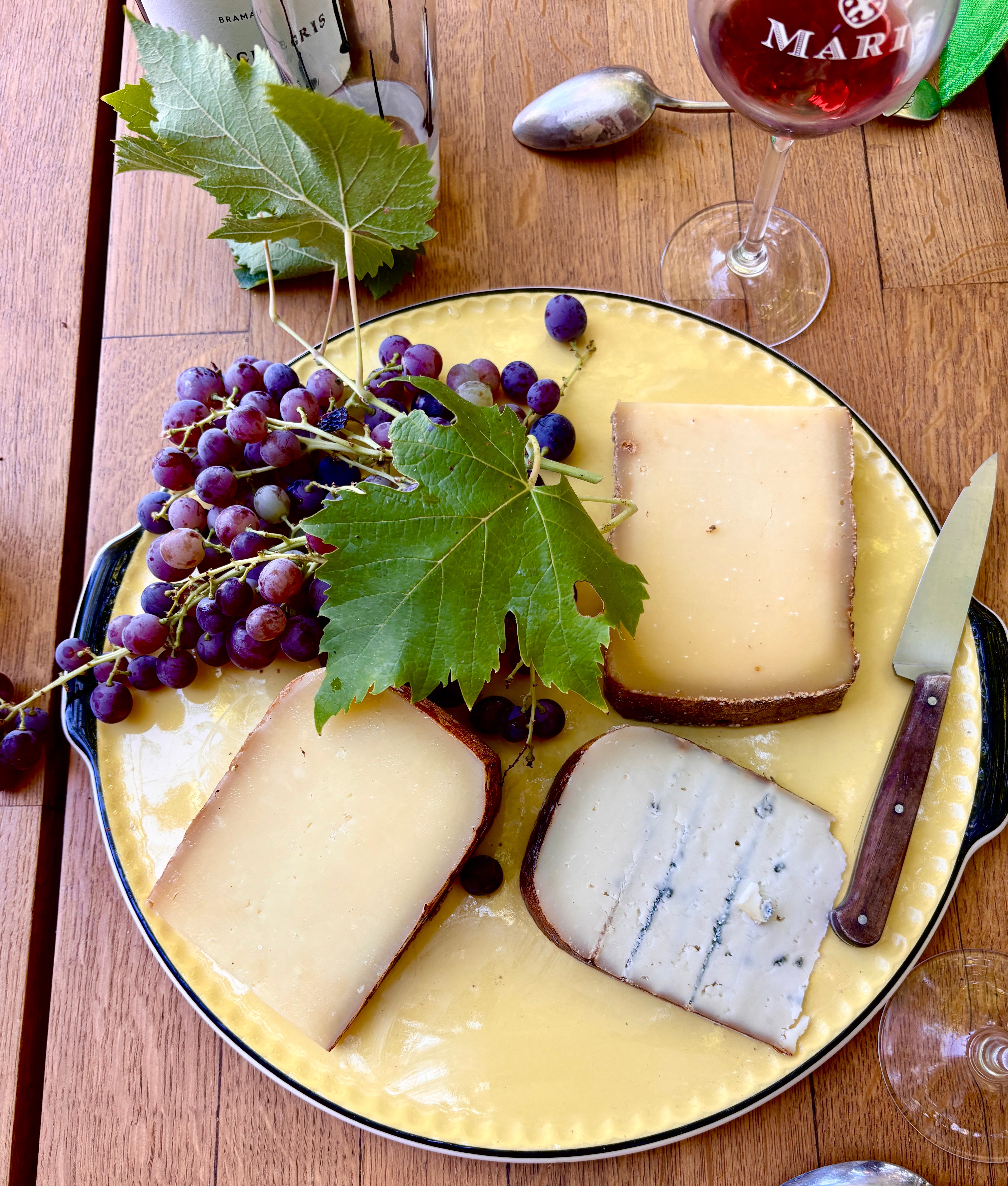
A beautiful cheese plate at lunch with my friends Kat and her husband, winemaker Benjamin Darnault.

The first part of our vacation was spent in the Languedoc, a region in the south of France that’s known for growing grapes. Winemaker Benjamin Darnault told me it was the largest winemaking region in the world.

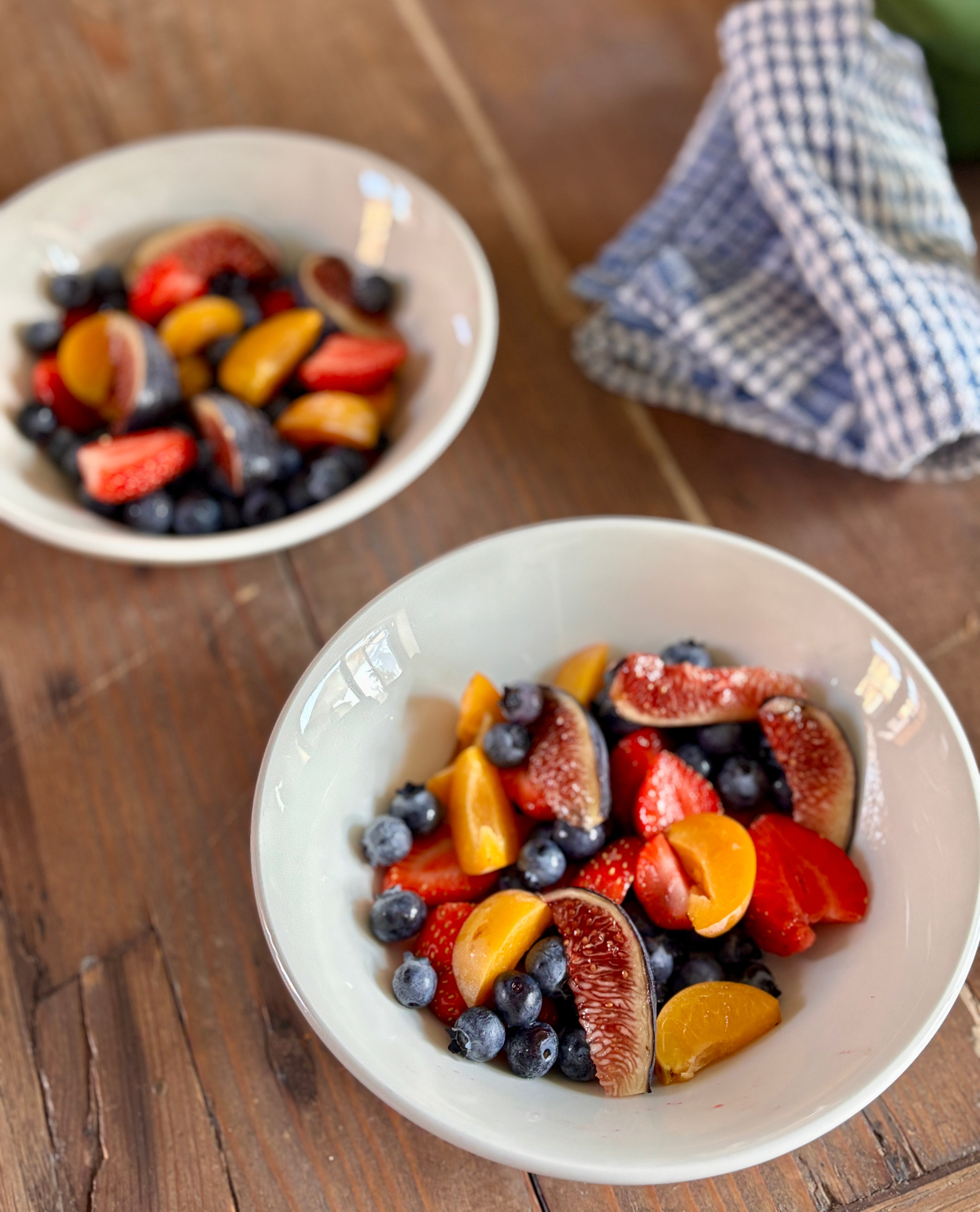
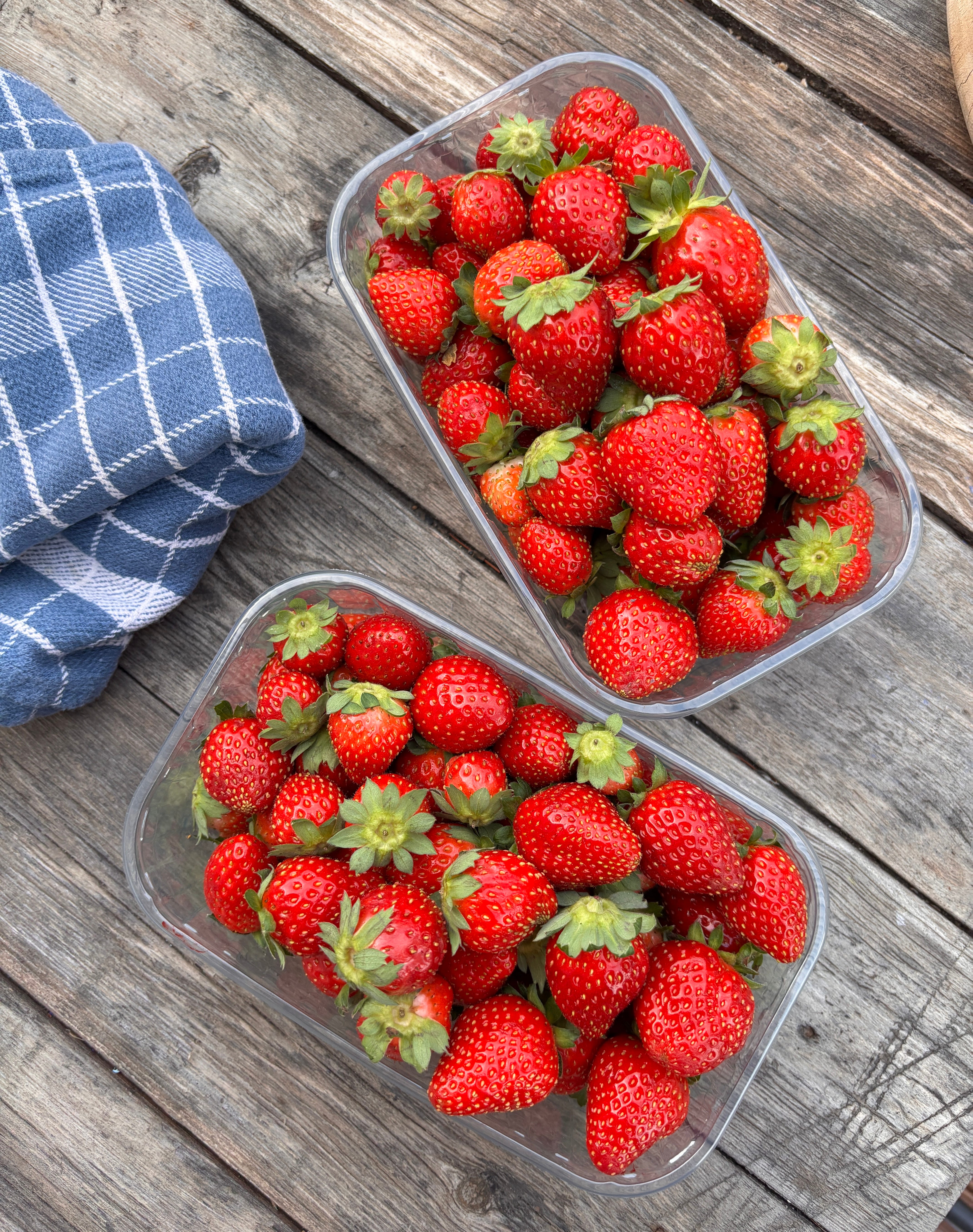
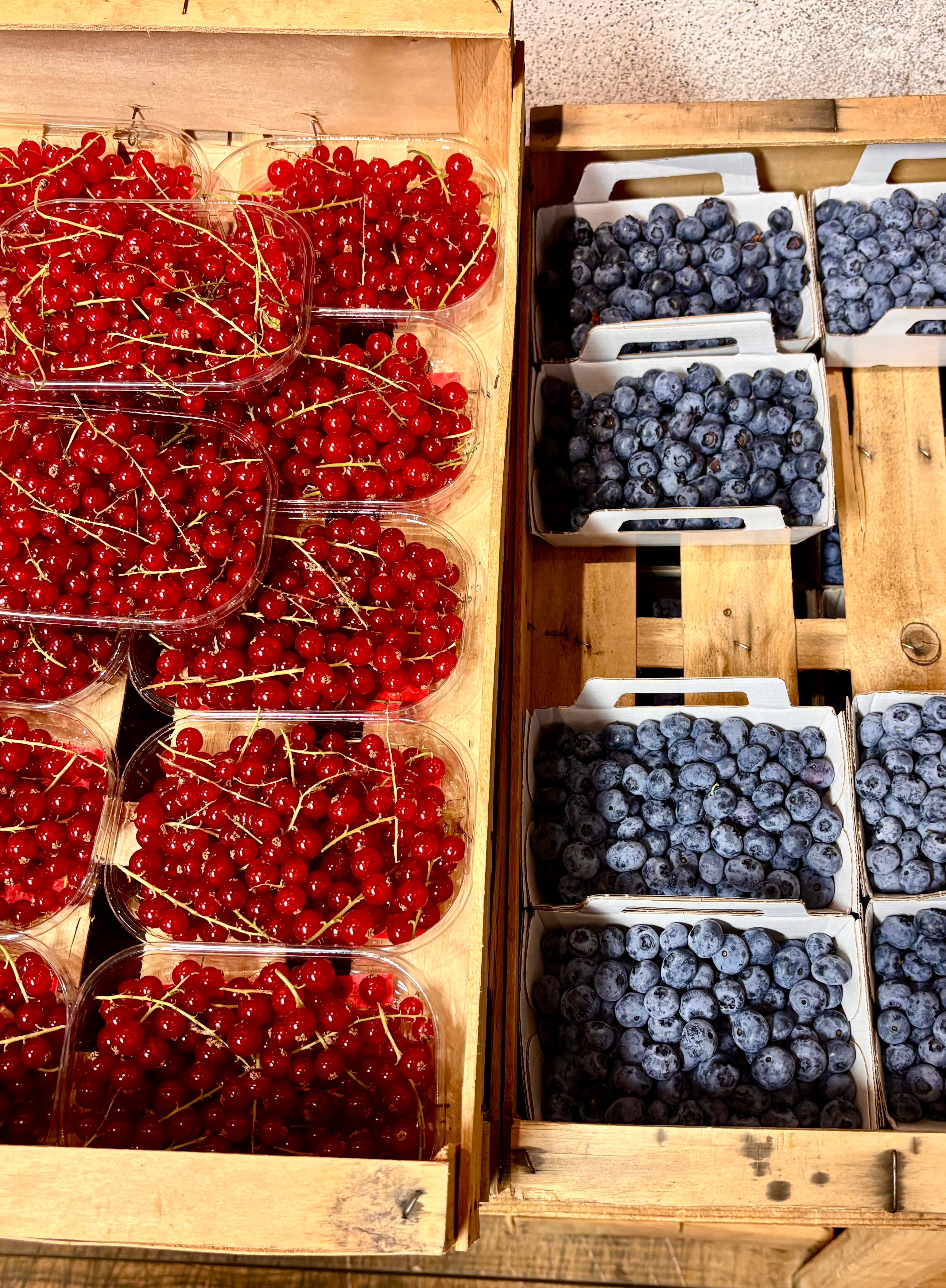
We also visited the Olonzac market, which has the most beautiful fruits and berries you can imagine. Every morning we treated ourselves to a big bowl of fruit, and while I do pretty well getting very good fruit in Paris, the fruits in the south of France are even more delicious.

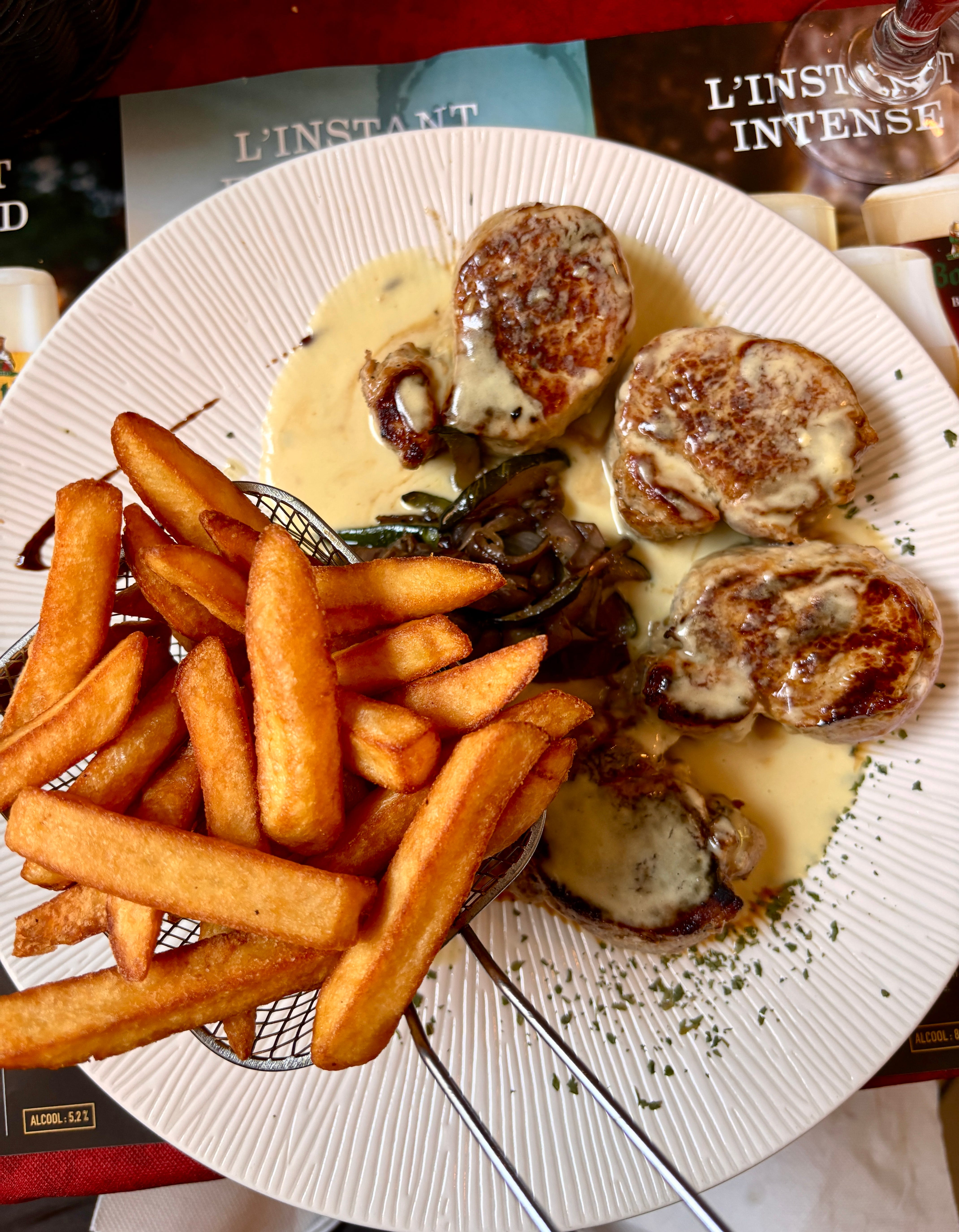
I’m not sure where people got the idea that French people practice portion control. If anyone thinks that, they haven’t eaten at a restaurant like Les Trois Petits Cochons.

That, above, was almost a whole pork loin on my plate. A local friend I was dining with ordered a salad, thinking it would be a healthier, or at least lighter, option. She was startled when the waiter set down a plate the size of a child’s umbrella in front of her: a bed of lettuce topped with several giant bundles of deep-fried filo dough. Inside of each was a slice of toasted bread with melted cheese on it. There was enough food on her plate to feed two. An upside of Covid was that it gave us doggy bags, and if you ask nicely, you can take uneaten food home with you. One place did charge me €1 for the container, though.

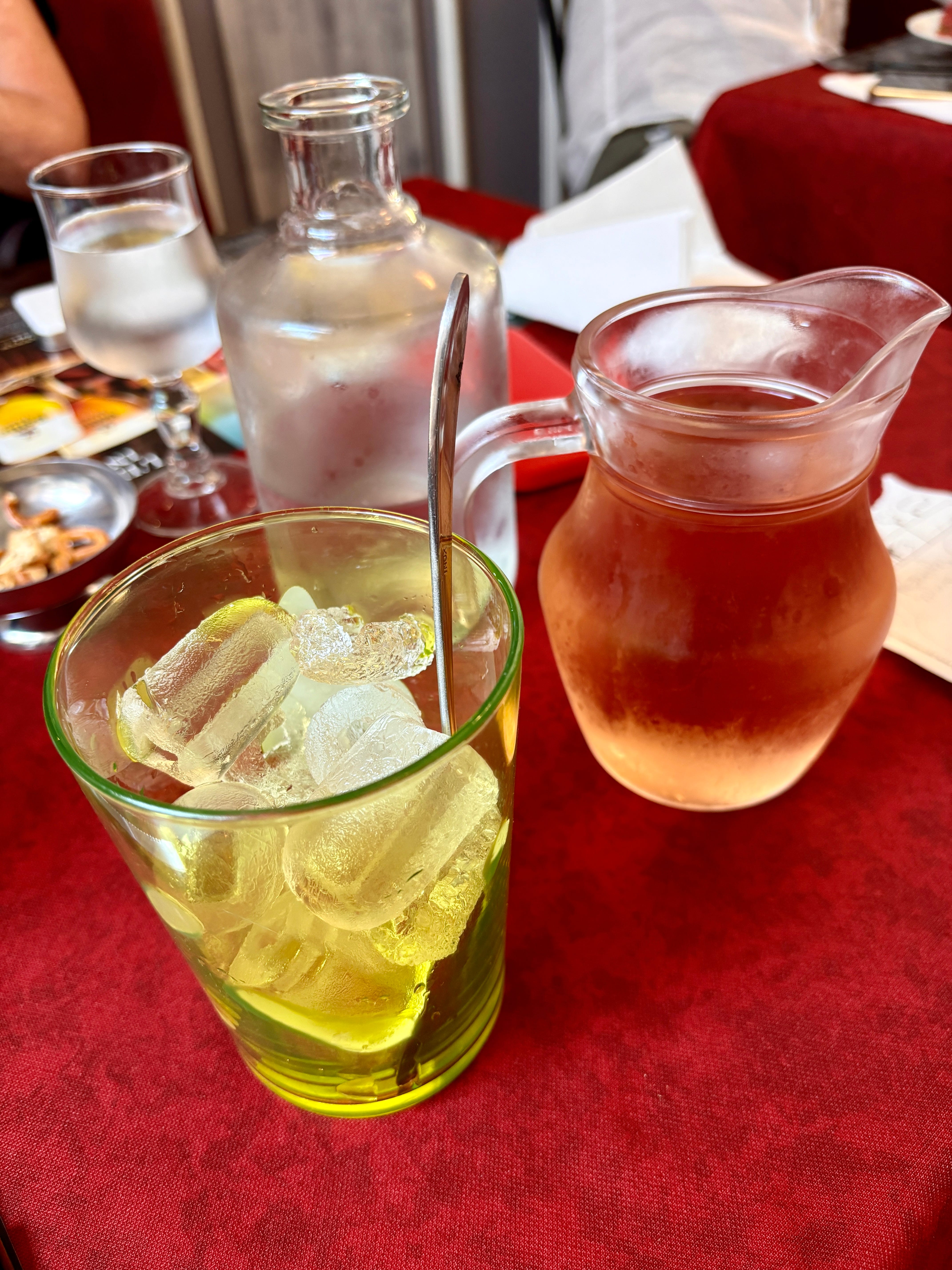
In addition to doggy bags, which used to be a rarity, for those who think (or know) that ice is tough to find in France, it seems all of it is being hoarded in the south. And unlike elsewhere in the country, you won’t hear people telling you it’ll give you pneumonia or freeze your stomach, as I’ve had people tell me. For the record, I’ve enjoyed plenty of iced drinks and so far haven’t had either.

When I asked for a few ice cubes for our rosé, the waiter replied, “Bien sûr, monsieur. C’est obligatoire!” and brought over a glass that was almost as big as the carafe of wine.

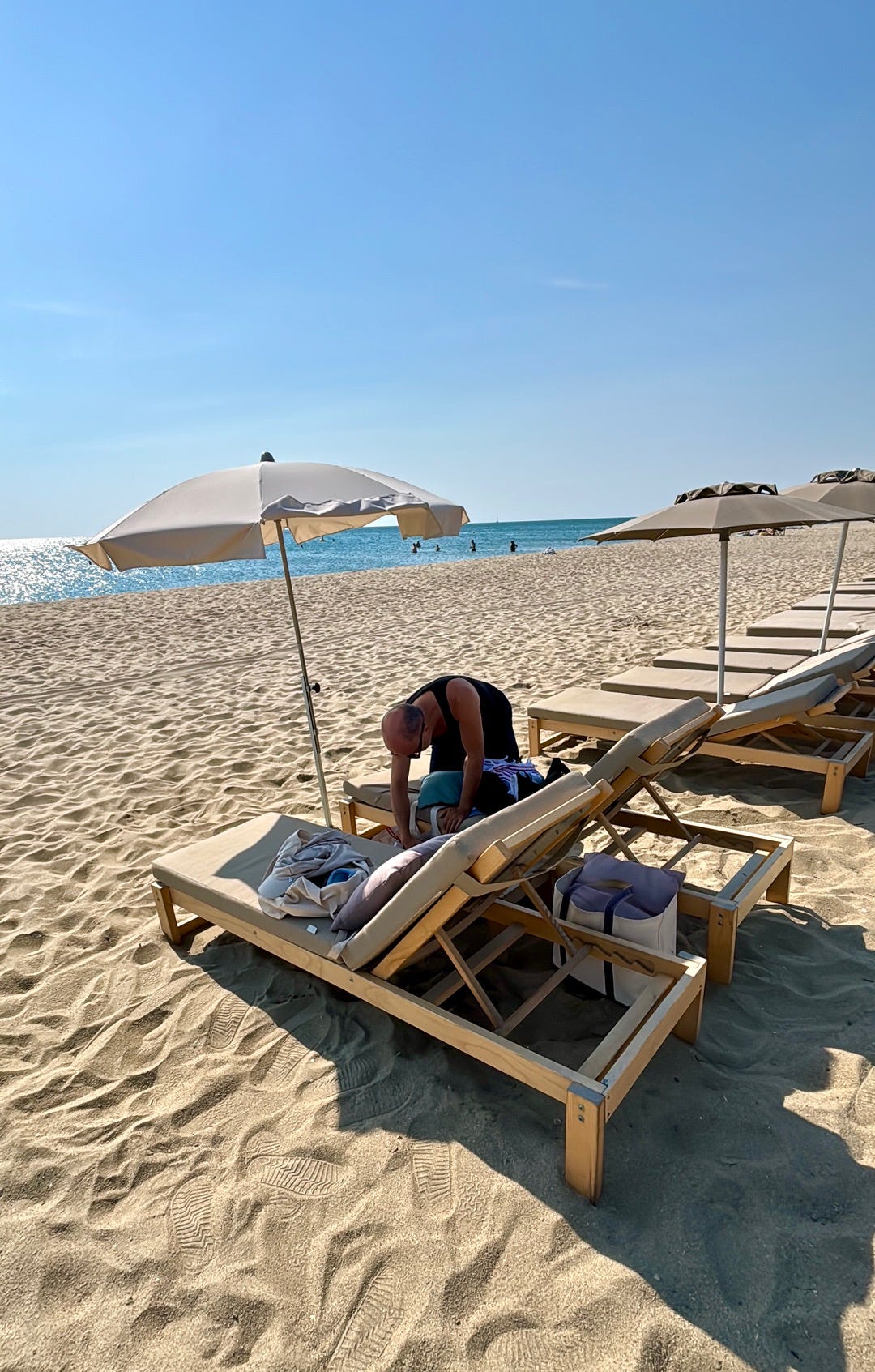
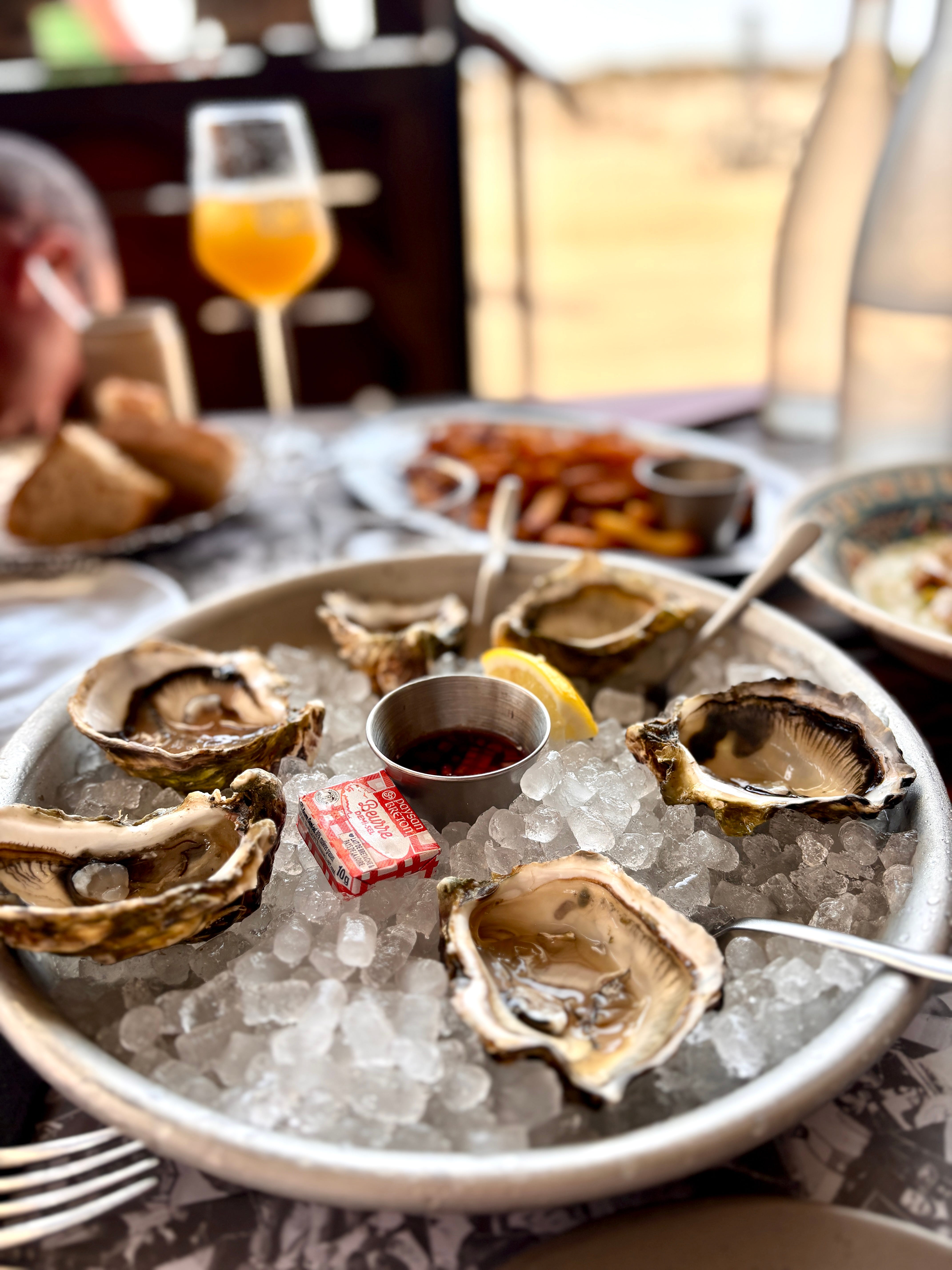
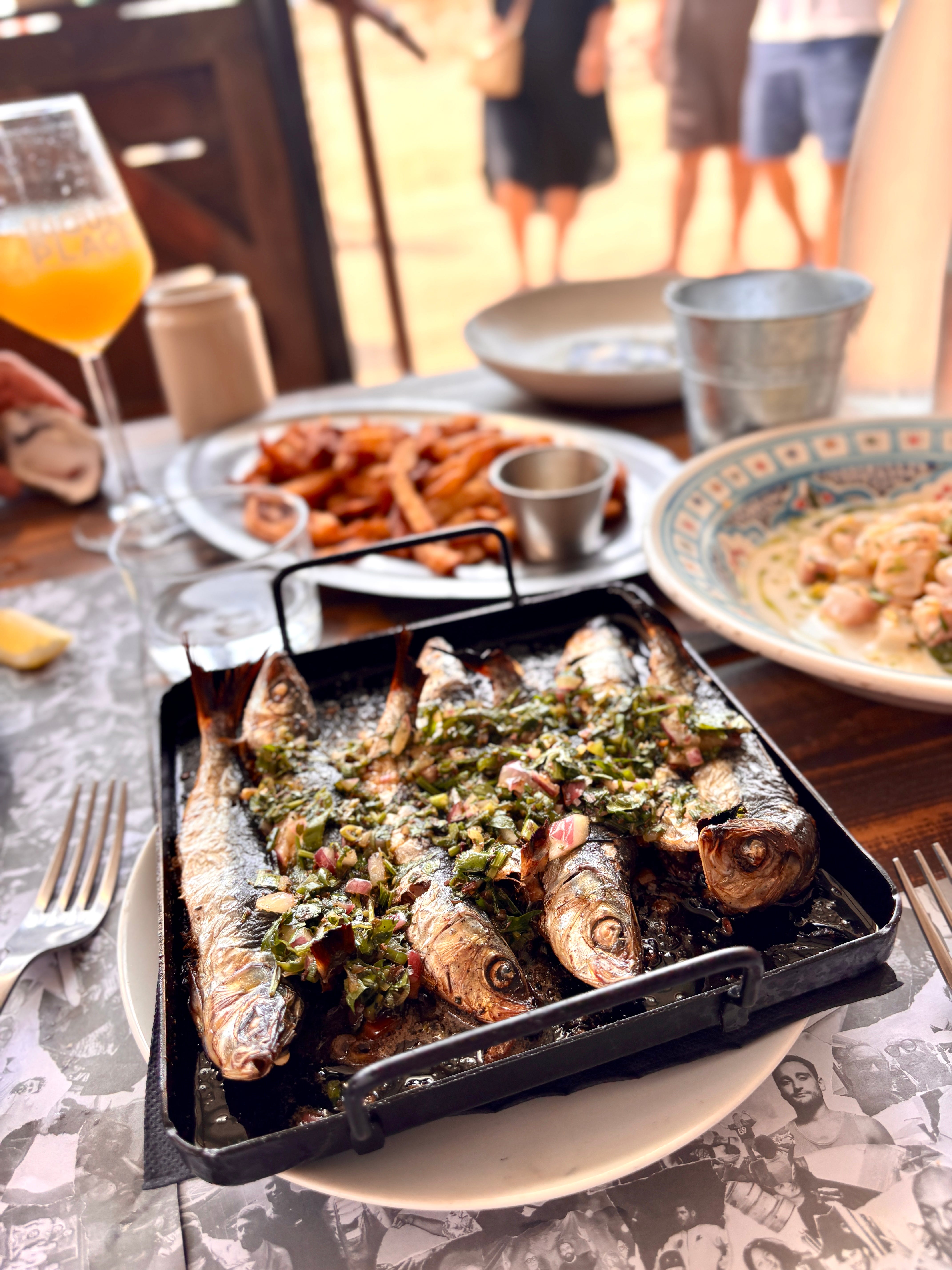
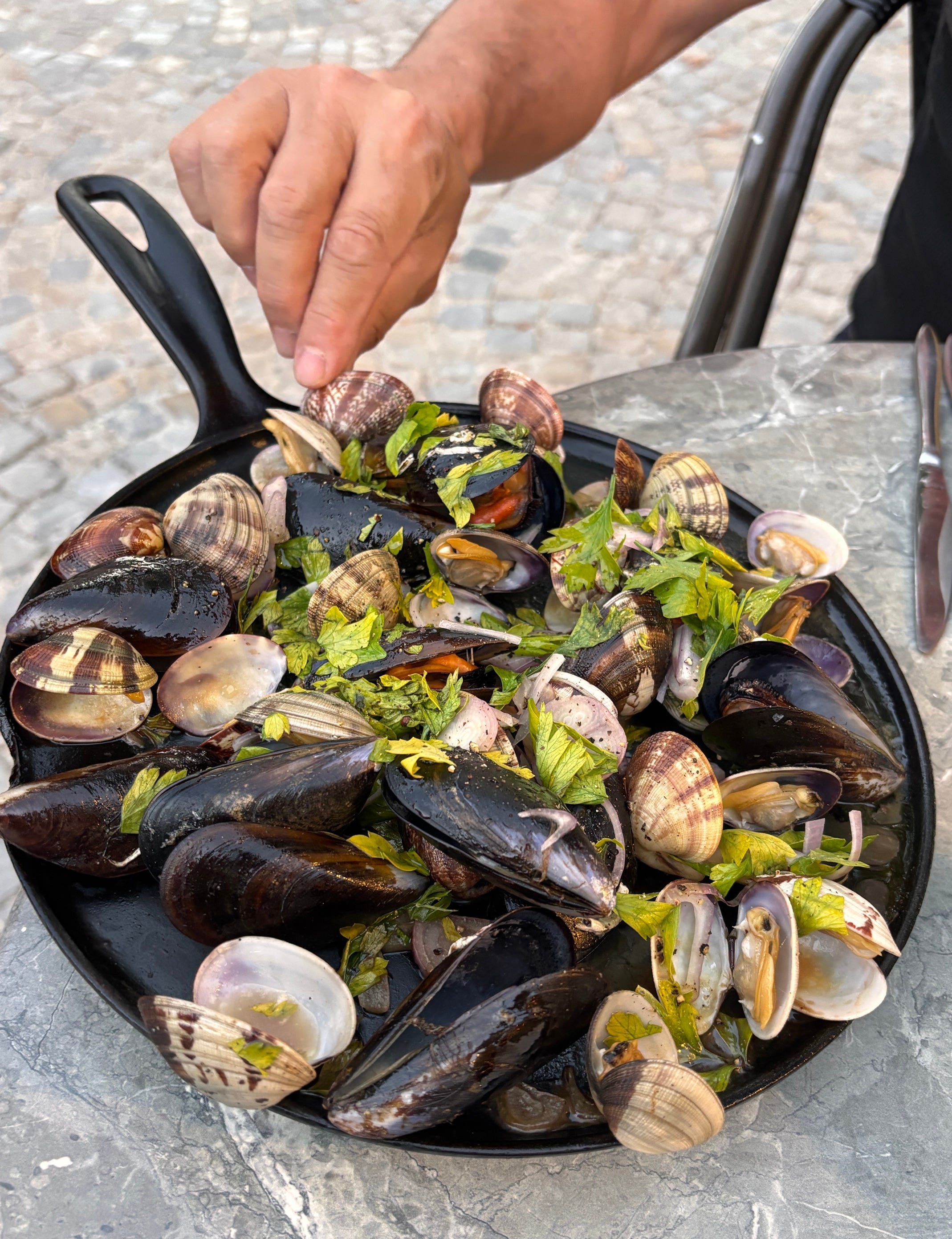
Being close to the southern coast, there’s no shortage of seafood or shellfish. During a lazy day at Biquet Plage, we had grilled sardines, oysters, and French fries. The restaurant on the beach folds up at the end of August, when everything comes down: the walls, the floors, the bar, and the dining room, and is packed away until the following year. It’s an easygoing place to spend the day since you can rent a chair and large beach umbrella, and you just need to bring a towel and swimsuit, as well as a book, and you’re all set.

In the evening, apparently the place turns into a big beach party with a lot of people arriving, a DJ blasting music, people enjoying lots of drinks, and whatever else people indulge in at rave-like parties, so we’re generally out of there by 5pm.

Grilled sardines and frites with aïoli at Biquet Plage.

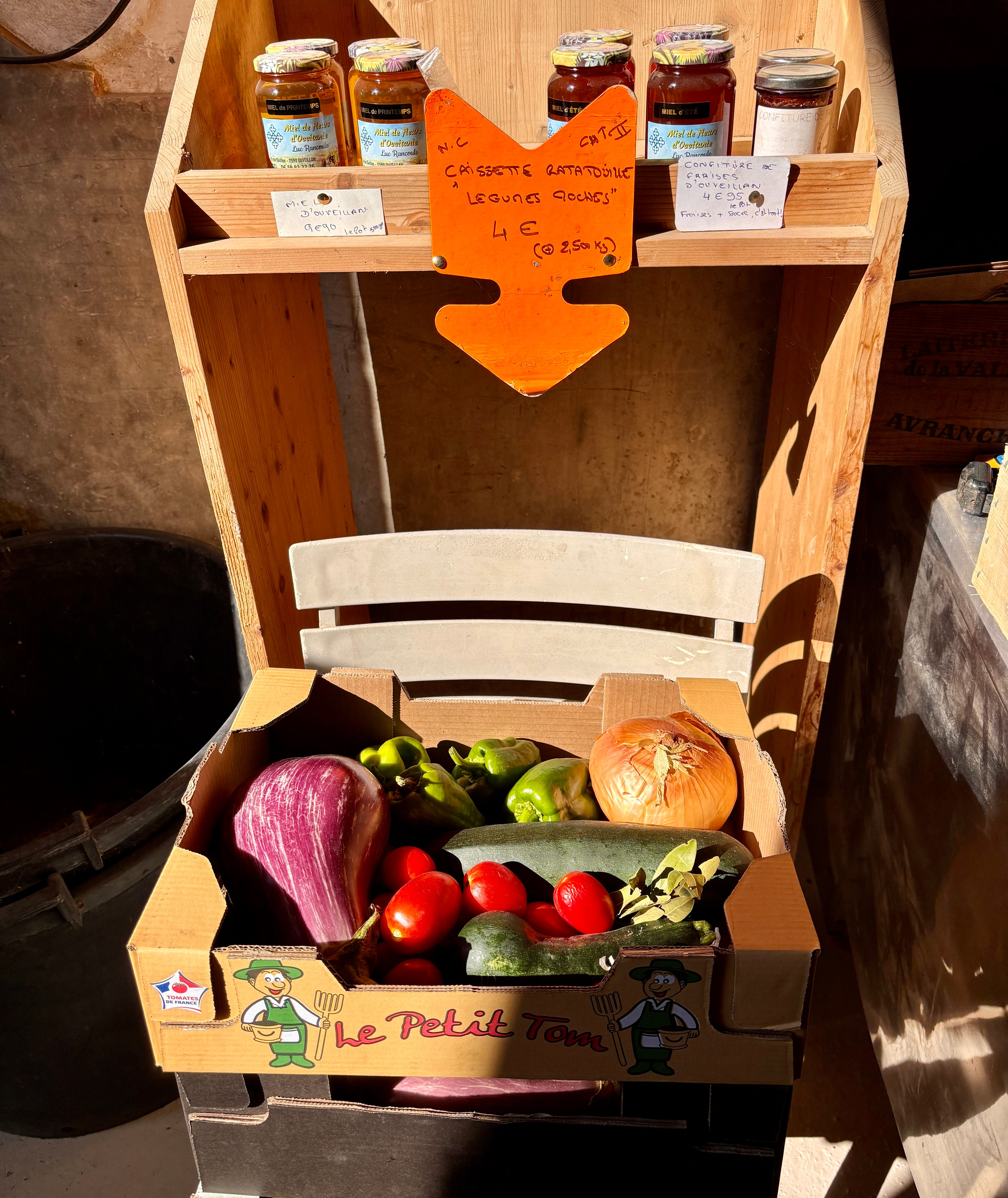
We stopped at a farm stand that we visit every summer. Last year we arrived at the end of the morning, after all the customers had left, and just about all of the produce was gone. We ended up talking to the owner for a good thirty minutes before waving goodbye.

This year when we showed up, during the rush, she was thrilled to see us and began our discussion with, “I think last year we decided to tutoyer each other…right?” It was fine with me since 98% of my life is tutoyer-ing people, and some of those longer, more formal verb tenses that use vous in French can require oral acrobatics for me. Invariably I end up tutoyer-ing someone I should vouvoyez, but I get a pass because people hear my accent. Someone once said that you don’t want to speak French too well because you want to be treated like a foreigner. I’d say that’s pretty true.

Last year, the owner of the stand gave me a big box of unsold chili peppers, and this year, she perhaps assumed I was coming back and gifted me a big bag of dried chilis. I think I’m going to grind them up and use the pepper powder to season food. She gave me so many that I‘m pretty sure I’ve got enough to last me until next year.

Shellfish from the Camargue at Le Café Castillon.

Leave a comment

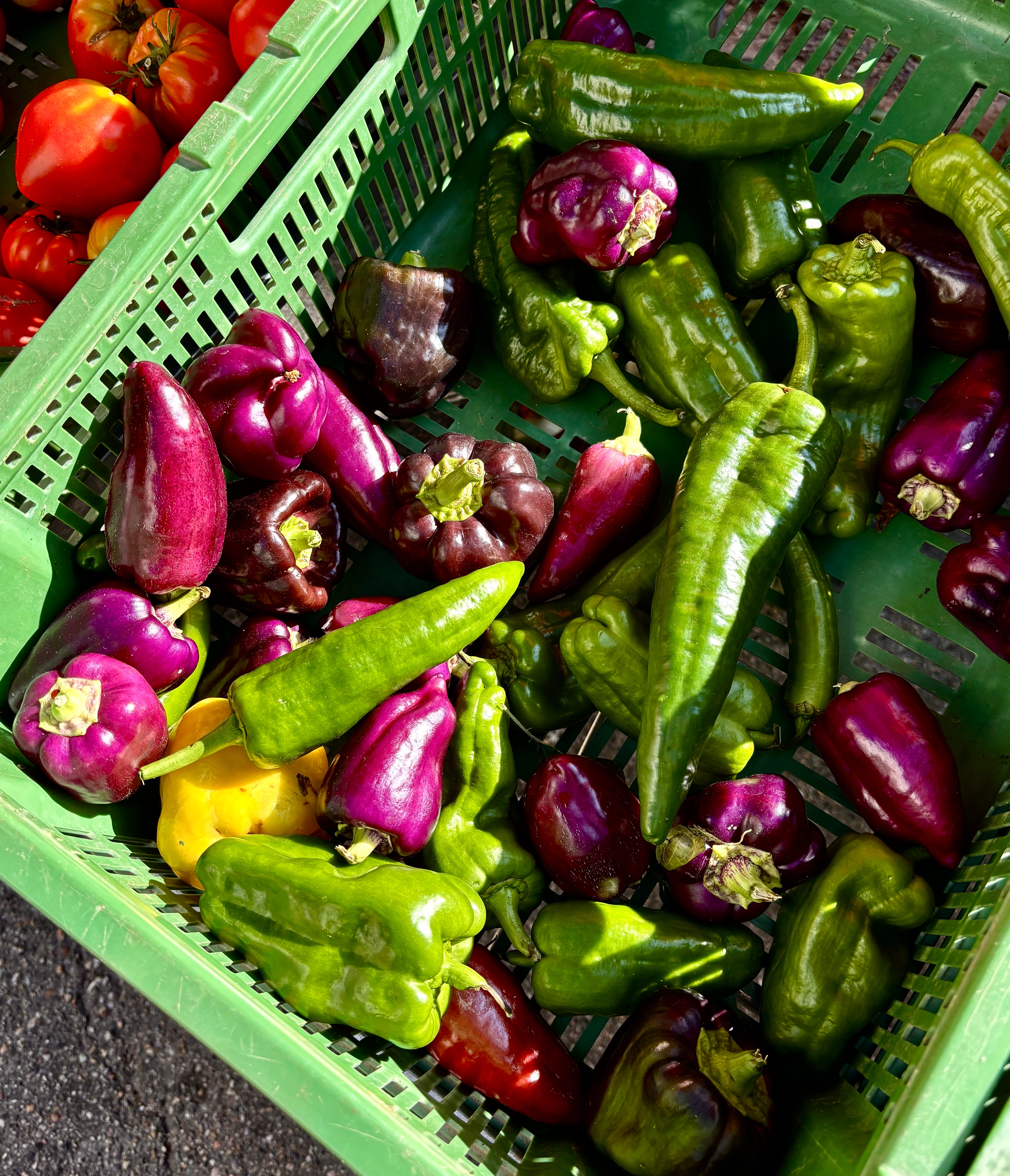
This year she was offering a special box of vegetables for ratatouille, a dish I’ve never made. I’m not a fan of bell peppers and so many versions seem to feature them. But the smaller peppers grown by farmers in the south don’t have the same flavor that bell peppers do, which overtakes everything else in a dish and when raw, are as unpleasant as biting into a dried-out wicker basket.

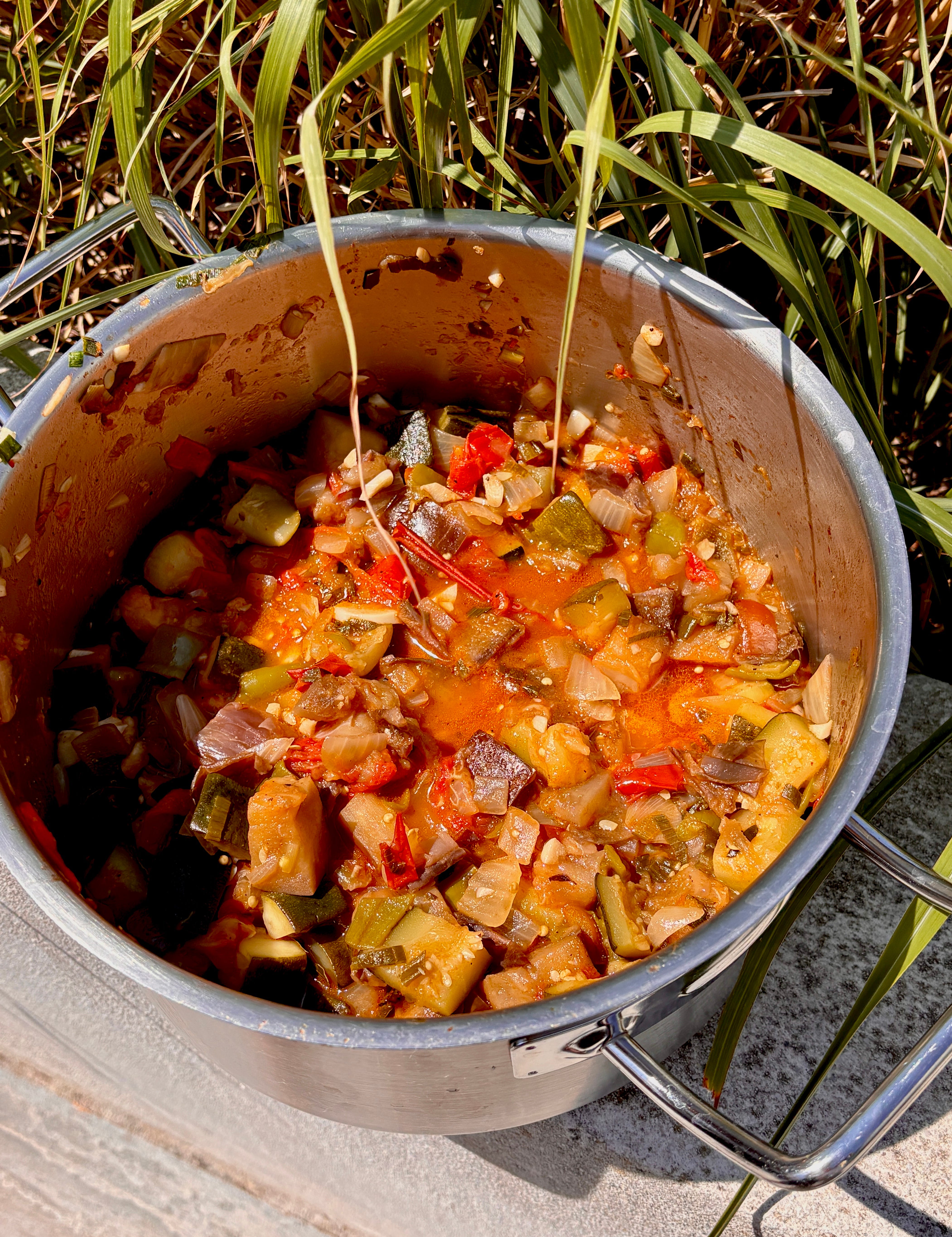
Since I can’t resist a bargain, nor can I resist beautiful produce, I bought a box (Romain likes bargains too, and was insisting we buy two boxes, but I shut that idea down as I didn’t want to spend my whole vacation chopping vegetables). I looked at a few recipes online. Some said to cook the vegetables for just a few minutes, and another said to cook the dish up to 1 1/2 hours. My friend sent me her recipe for Ratatouille Niçoise from her book, Niçoise, which called for some optional hot chile powder. I also looked at Alice Waters’ recipe for inspiration, then decided to just wing it with what was in the box.

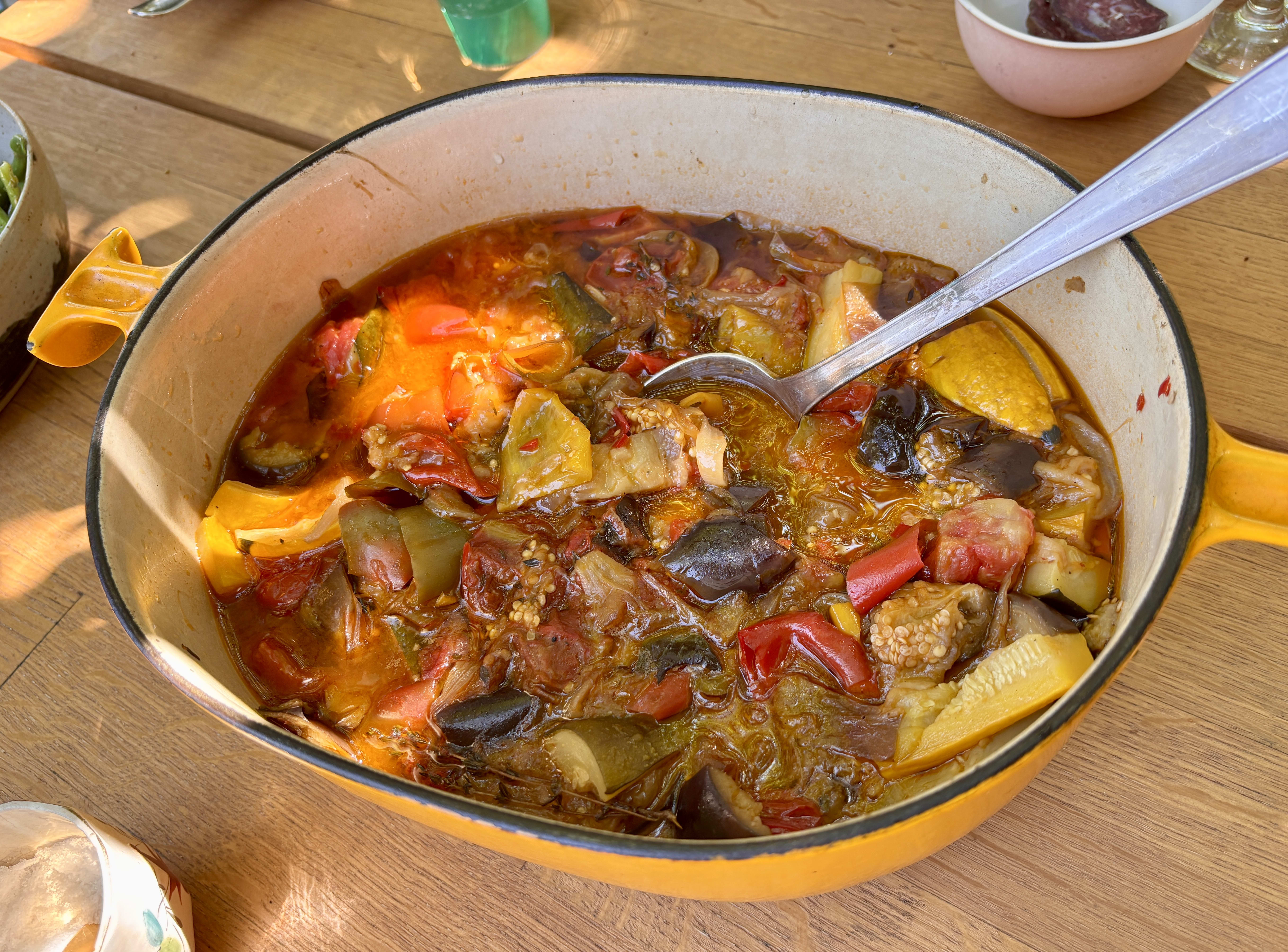
In the end (Warning: Unpopular opinion incoming…), I don’t think I love ratatouille. Mine, above, tasted more like leftovers rather than a delightful pot of freshly cooked vegetables. When you have beautiful fresh vegetables, why cook them up into a stew?

Leave a comment

I was ready to give up on ratatouille forever until my friend Kat invited us for the aforementioned lunch and as part of it, brought out a big vintage casserole dish of…ratatouille. It was so delicious that I started changing my tune about ratatouille.

Perhaps it’s just something I don’t have the touch for, or it’s something you have to live in the south of France to get it right. And if that’s the case, I’ll need help convincing Romain that we need to move to the south of France. I’ve convinced him to go on vacation there, but not sure how far he’s willing to go down that route with me.

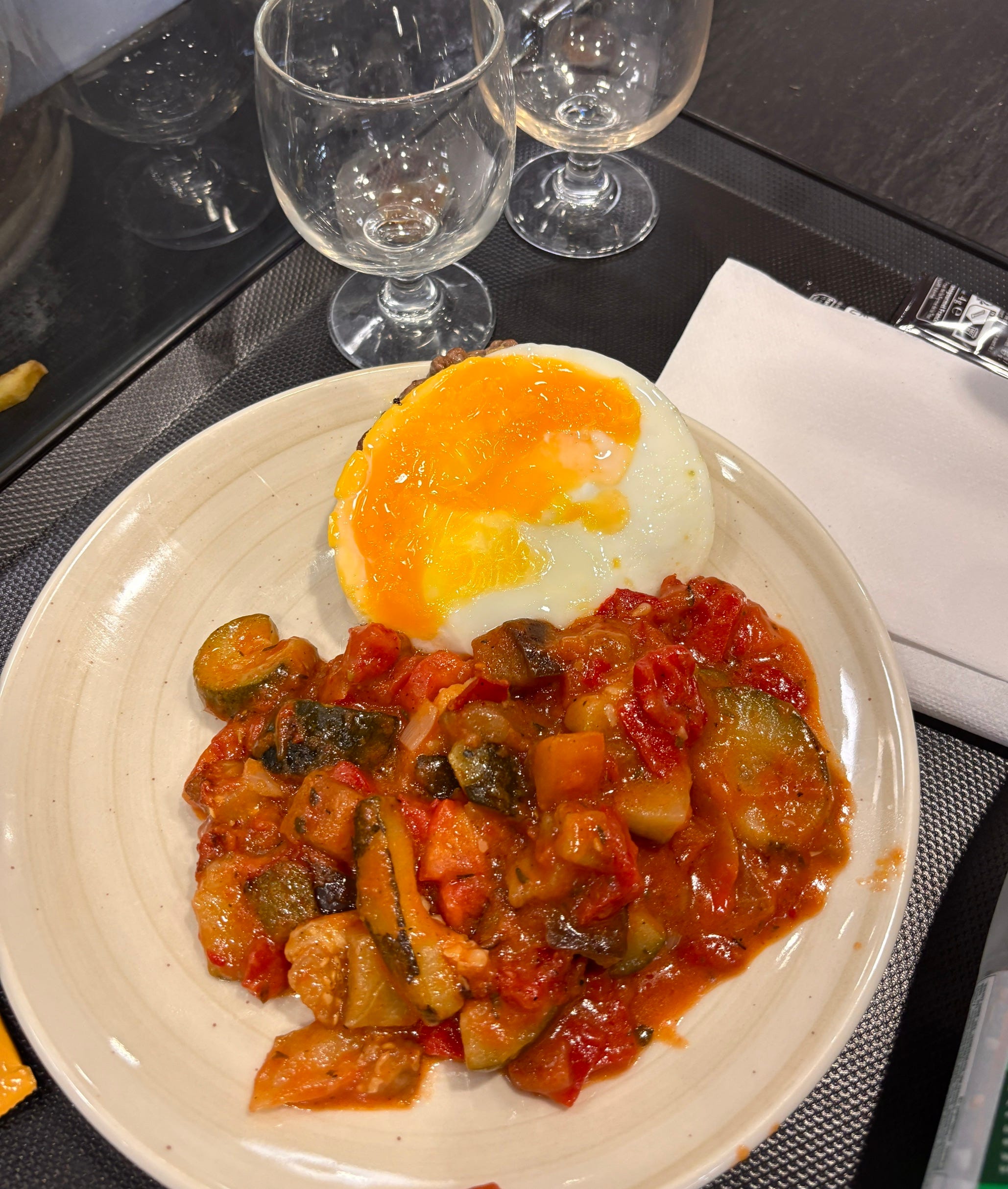
And just when I thought my ratatouille wasn’t up to par, we stopped at an Autogrill at a highway rest stop and below was their ratatouille, which they served alongside a steak à cheval:

Steak à cheval isn’t a burger made of horse meat (cheval) - whew! It refers to the egg riding “horseback” on top of a ground beef patty.

As a former restaurant cook, my inclination if I was cooking for a customer, was that if I broke an egg, I’d cook another one. But since the burgers were taken directly out of the freezer and placed on the grill, I wasn’t expecting the best meal of our vacation.

Romain’s brother said, “C’est pas trop mal pour le déjeuner d’autoroute” - “It’s not so bad for lunch on the autoroute.” While the cook was frying our patties, she asked how we wanted them cooked. The burger ended up being bien cuit, well-done, or à la semelle, as they say in French: like the sole of a shoe. The other option at the rest stop was Burger King and, like moving to the south of France, that was a pretty hard non when I half-jokingly suggested it to Romain.

Subscribe to my newsletter to get recipes, videos, stories, and more…sent right to your inbox!

One notable place where we ate in the south of France was Les Grands Buffets, an all-you-can-eat buffet that proudly features the food of Escoffier. It’s one of the most…if not the most popular restaurants in France, and I was a little wary of (over)eating there, especially in the heat of summer, but it was quite an experience.

I’m going to write about it in another post since there’s a lot more to share than I have the space for here. Stay tuned…

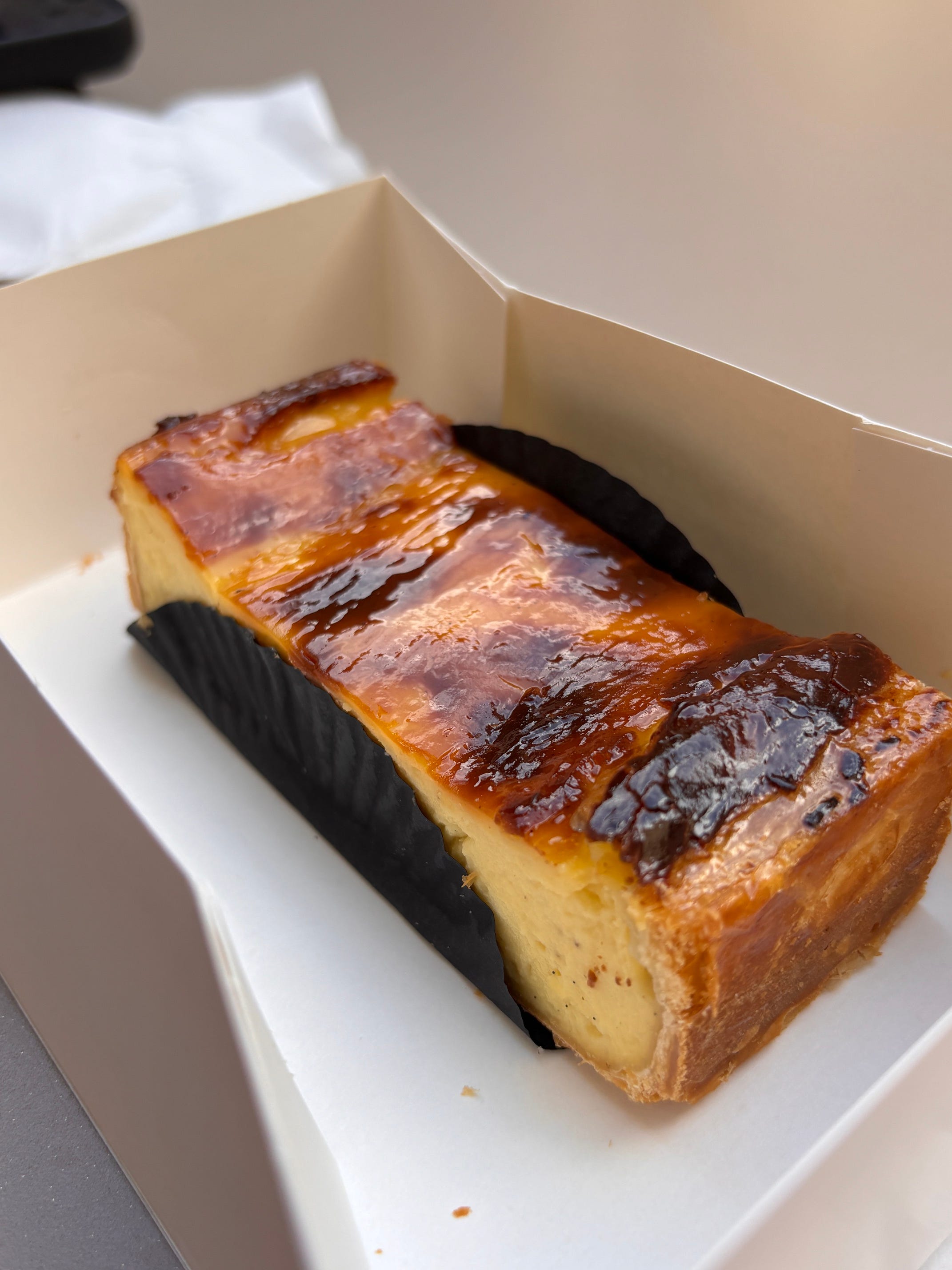
One of the best flans I’ve ever had, at Augusta bakery in Villeneuve-lès-Avignon, after the Saturday morning flea market.
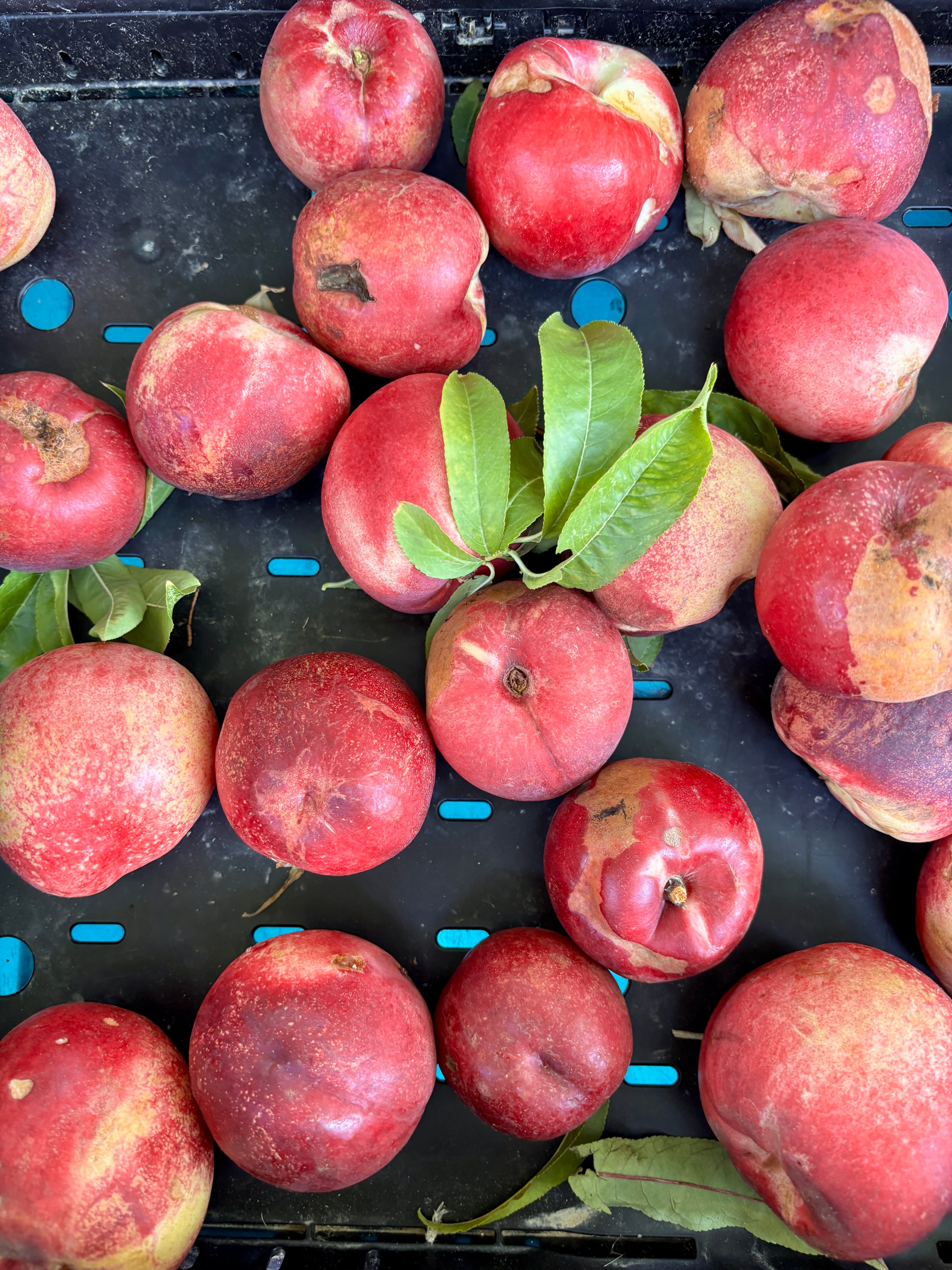
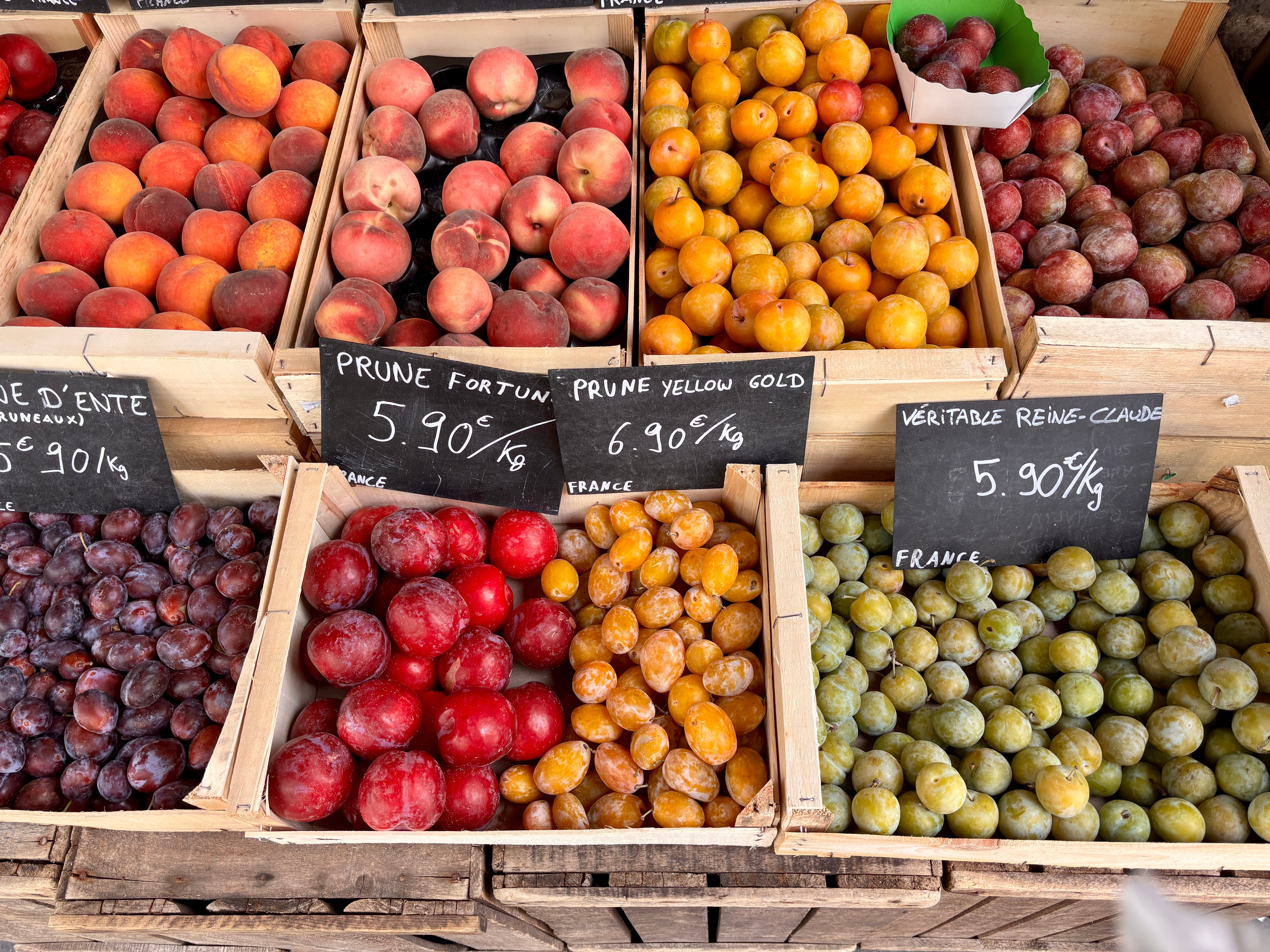
Beautiful plums in Paris.

Now that we’re back and well into September, I remember being told by someone, in no uncertain terms, that I shouldn’t mention when I’m busy. So I won’t mention it, but rather, let’s just say there’s a lot going on around here this month.

Those of you who’ve been with me for a while know I have a website, formerly my blog, with 700+ recipes on it. The technology and all the software and annoying SEO stuff you have to do for a blog finally got to me, and I said, “Game over,” and moved here. But some of my favorite recipes are archived there and I’m shooting short videos to accompany the most popular ones. I’m going to start uploading those this month.

Visit DavidLebovitz.com

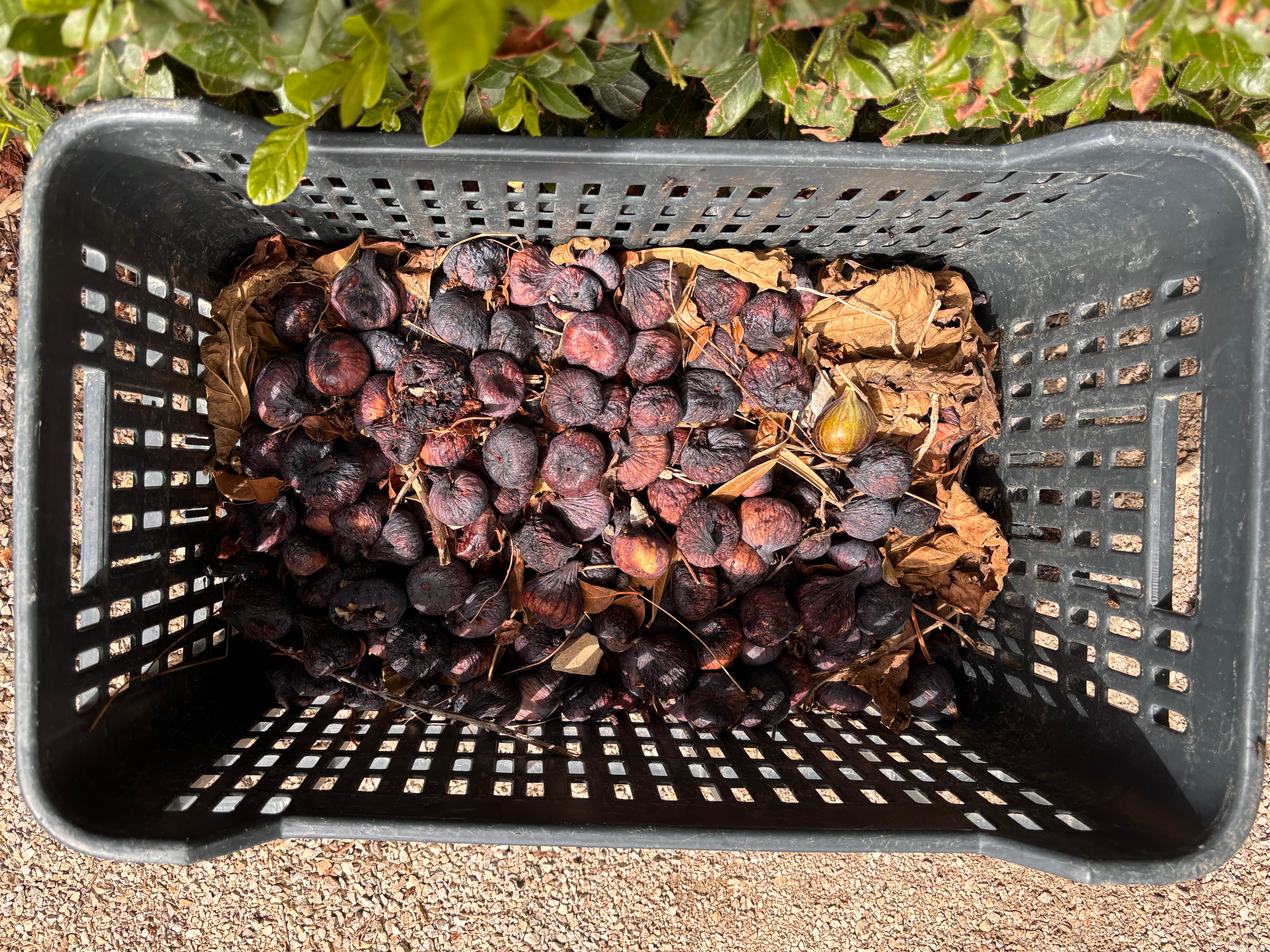
The final stop during our vacation was in Provence, which had a magnificent fig tree right outside our room that was loaded with the most delicious figs I’ve ever tasted. I’ve tasted a lot of figs and each one could barely hold in the sticky-sweet interior, which was ruby-red and already close to being jam. The owners of the property don’t eat them so most go into the compost bin.

Destined for compost…

We furiously picked as many as we could and snagged one of the last coolers in the south of France, to transport them back to Paris. I felt a little guilty taking all their figs, but they said we were doing them a favor as it saved them from having to rake up the figs and haul them over to the compost bin. One man’s trash is certainly a treasure to me, and I can’t believe how many we picked.

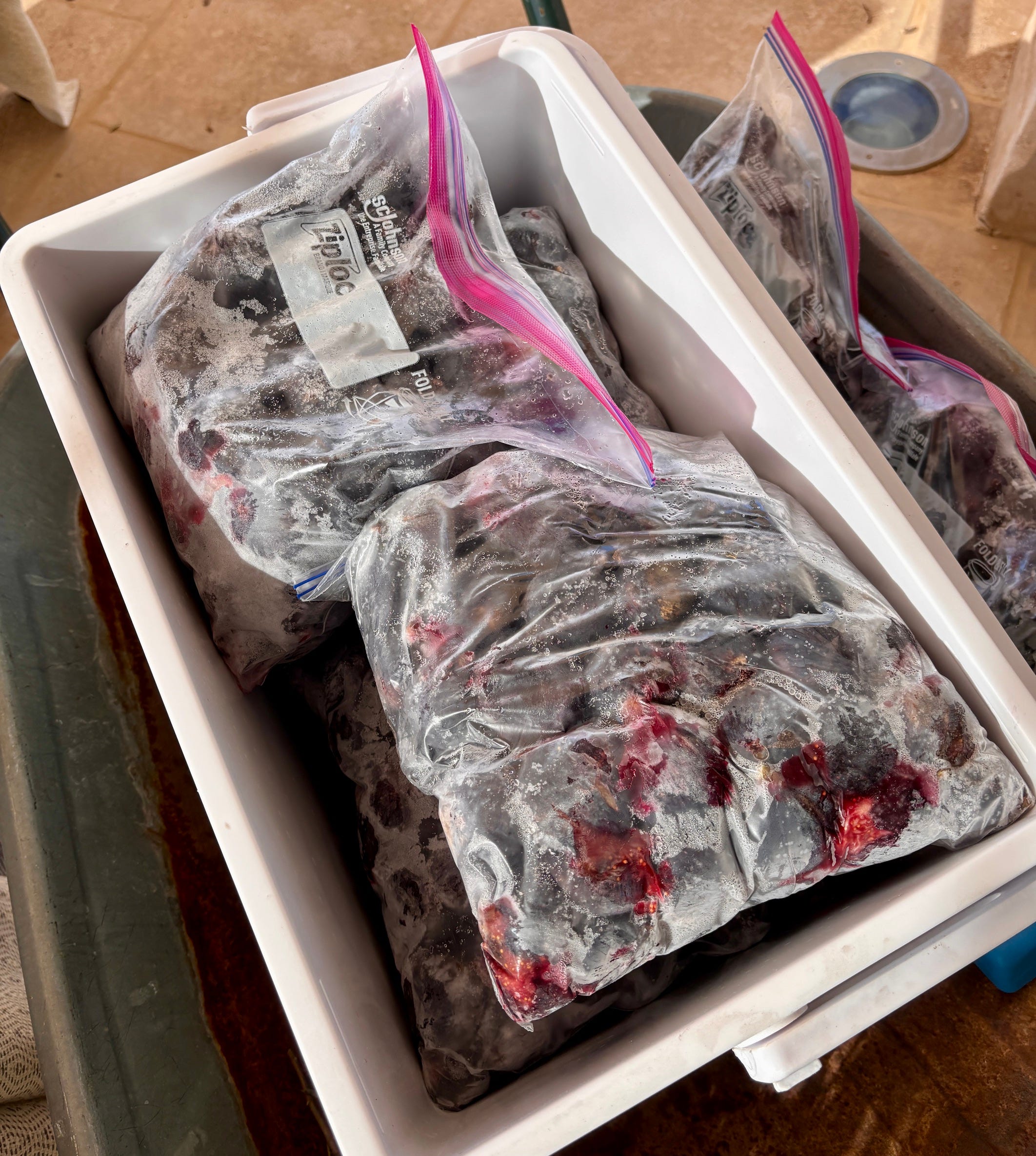
The morning after we got home, I found myself with ten 1-gallon bags full of very ripe figs that needed to be tended to, pronto. Before we left, I cleared out my main kitchen island (which was loaded with pottery and baking dishes and pots and pans and other stuff), where I do all my cooking, because the polished concrete kitchen floor needed to be sealed. The guy who originally laid the floor forgot that step. Oops.

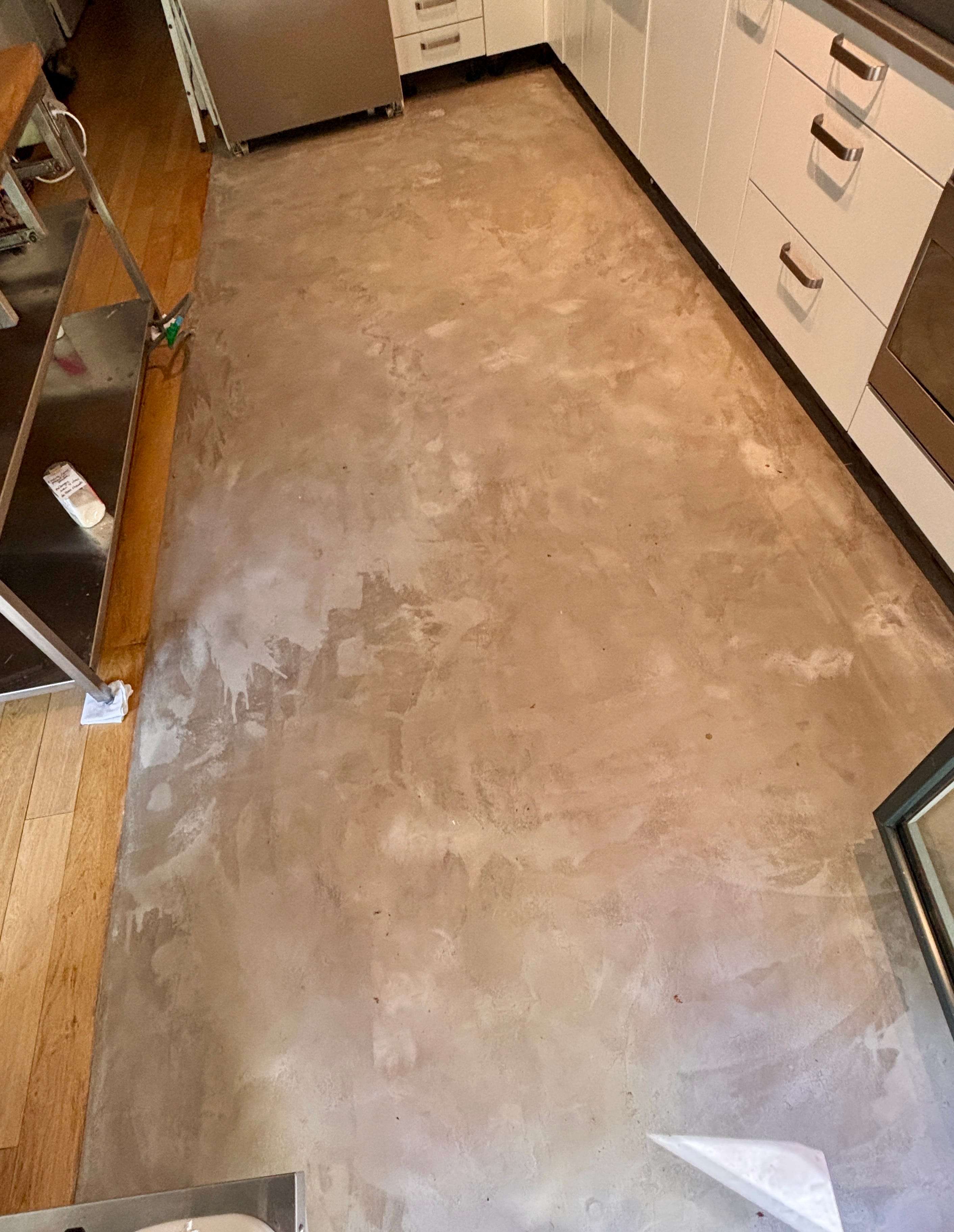
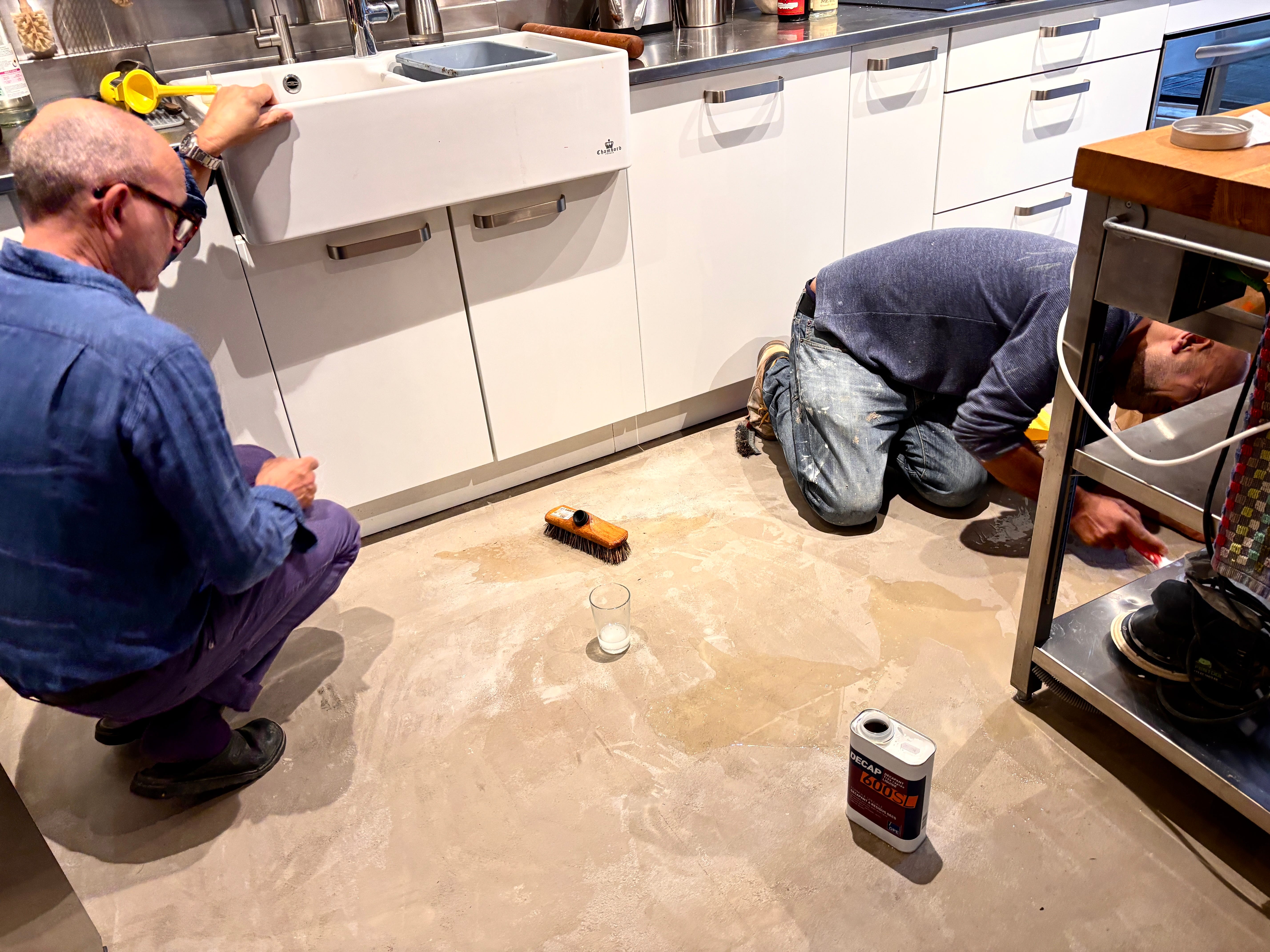
Kitchen floors get a lot of wear and tear and ours got really grimy, which required plenty of elbow grease to scrub, and we were never able to get it really clean. So we finally got someone to come over to seal it properly, which was a several-day process.

I won’t get into the details but when we came home, the new sealant had been applied over the grimy floor - the grime so was embedded in the floor that it couldn’t be cleaned and the sealant just made it look worse. So the floor needs to be re-scraped and completely redone.

That started at the end of last week and will be continuing all through this week, until the weekend. While it’s being redone, we can’t go into, or use, the kitchen. So no cooking or baking for me until it’s finished.

Paris Apartment Renovation Stories

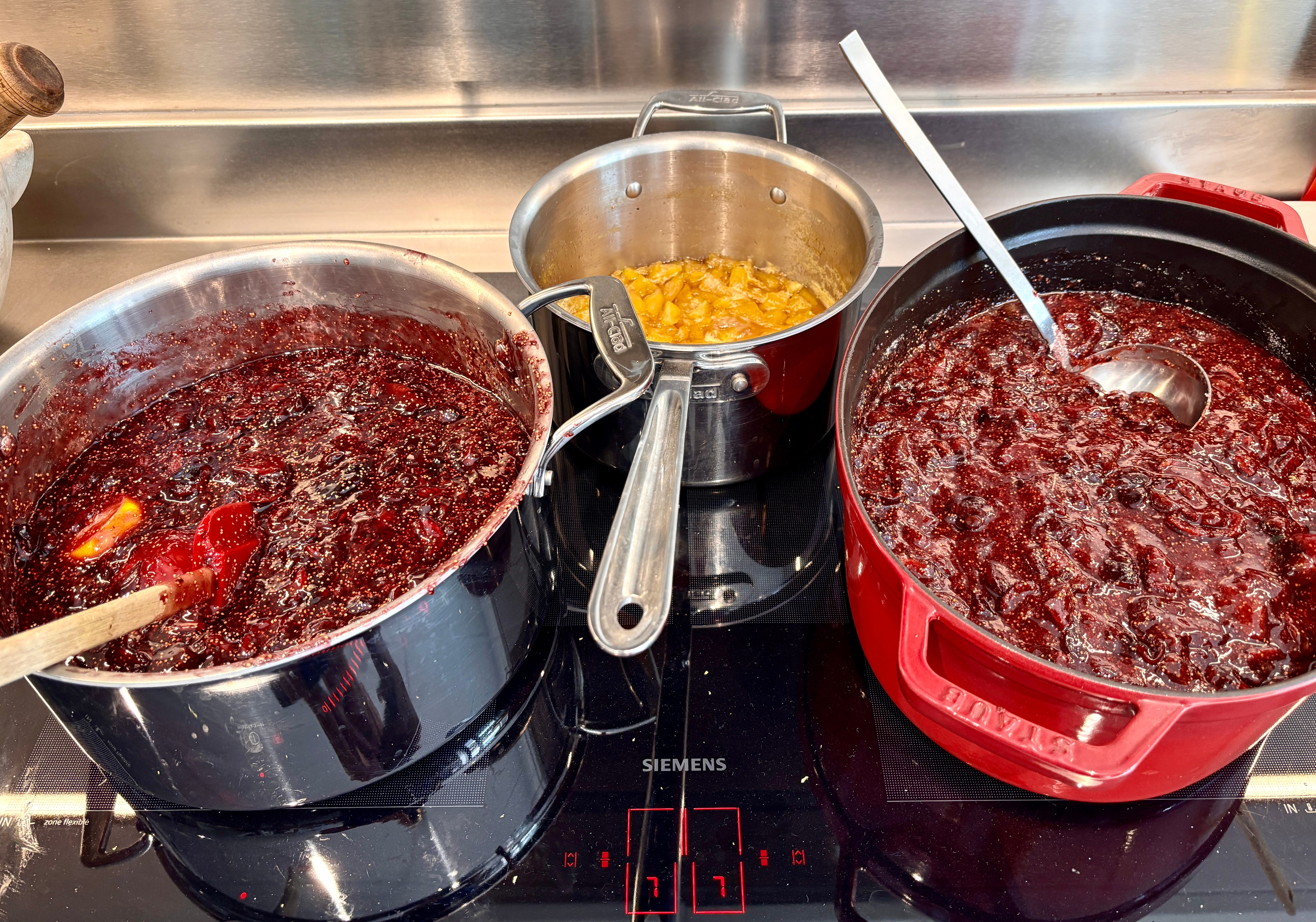
Double pots of jam going. This is about 20% of all the figs I picked and brought home.

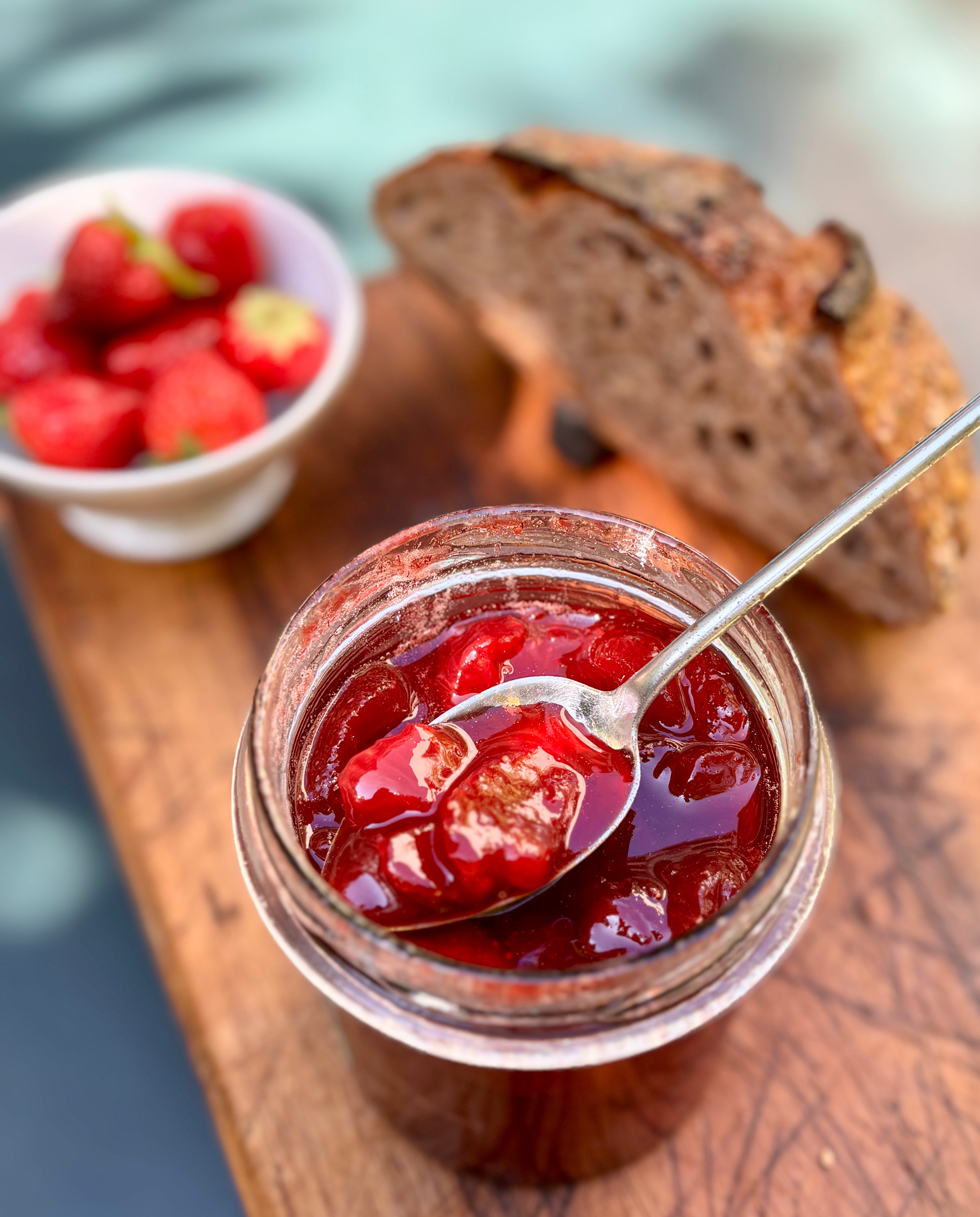
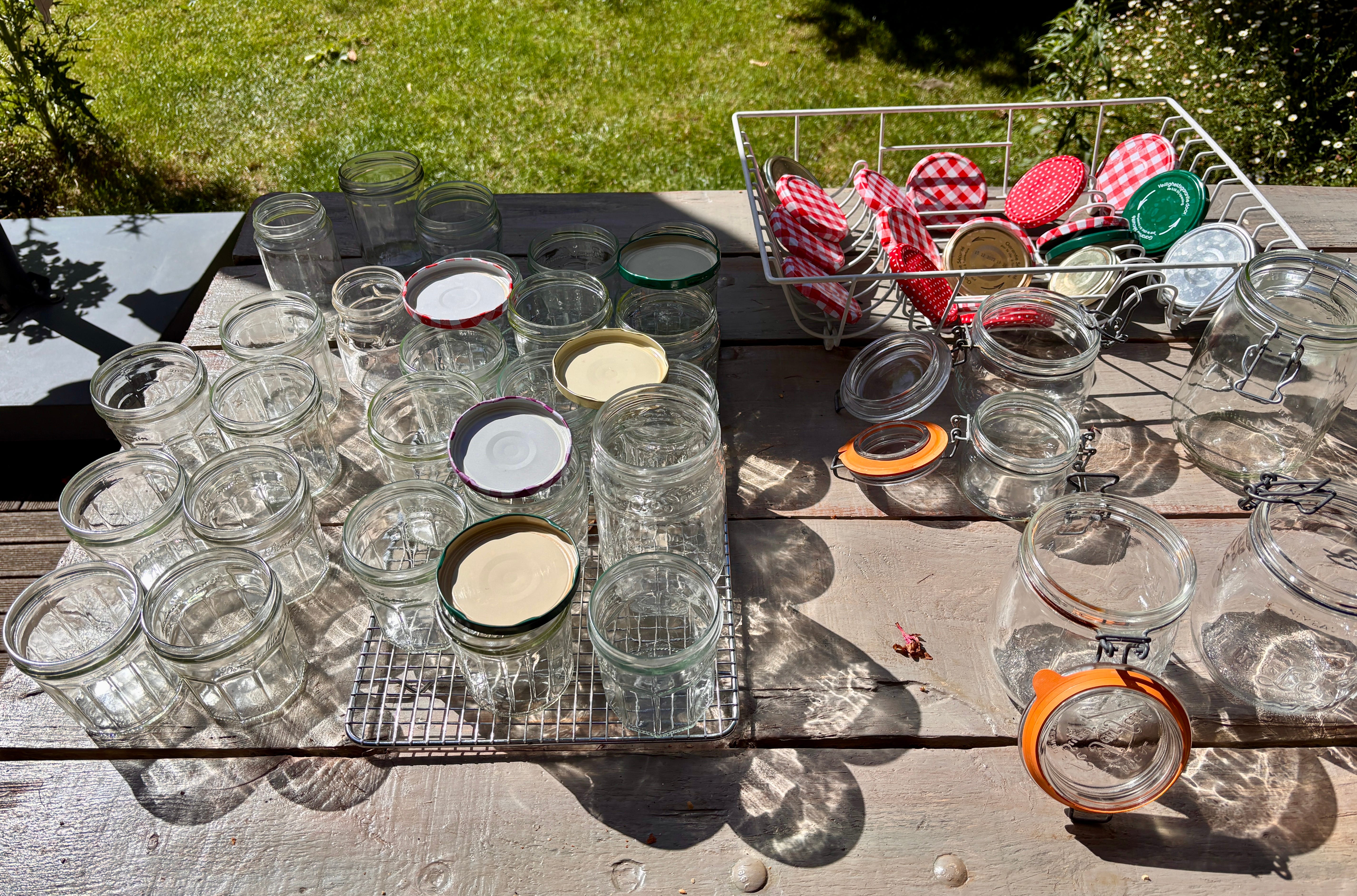
Fortunately I already took care of a few bags of my figs, making Fig Jam and Fig-Pineapple Jam, ending up with nearly thirty jars. The rest will have to wait a few more days until I’ve got my kitchen (and my sanity) back.

-David

Leave a comment

Subscribe to my newsletter here…

Received — 14 August 2026 ⏭ David Lebovitz Newsletter

Keys...please.

14 August 2026 at 10:34

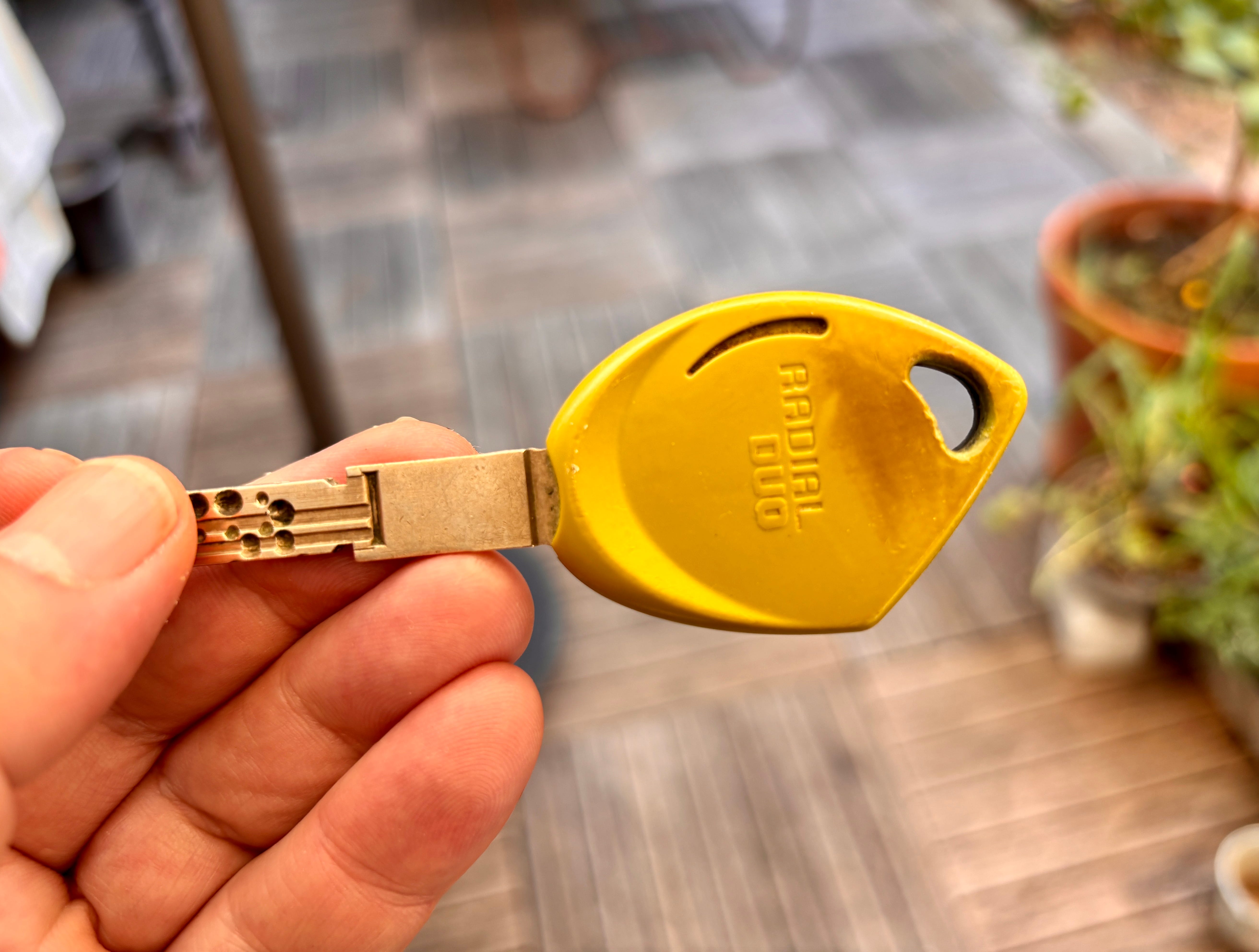
While many things have been replaced by technology, keys are still with us: stiff, sharp metal objects we carry around in our pockets and handbags, messenger bags, and backpacks. We live in fear of losing them or getting locked out for a lack of them. While digital locks have made inroads somewhere, here in France, we live in the land of keys, and I regularly carry around almost a dozen or so every day, attached to a key ring that has fobs, badges, buttons. I don’t know if there’s a comparable word in French*, but I feel like a high school janitor.

I also recently added an Air Tag to the mishigas after I lost my keys six months ago and literally had a panic attack. Not because I was worried someone was going to find them and break into our apartment, but because it would have cost me over €600 ($700) to replace them, not to mention all the paperwork attached to getting them remade. And as I recently learned, all the time that it takes.

Share

I’ve lived in cities like San Francisco and New York, and having a key made cost $2 a pop at my local Ace Hardware store. When I was in New York last year, I had a key made but didn’t have any cash on me. The guy just looked at me and said, “Fuggedaboudit.” Here, I would have had to submit to a prise de sang, giving a blood sample and getting fingerprinted, with a promise to give them my first-born male child, before I’d be able to leave without paying.

Read more

Received — 12 August 2026 ⏭ David Lebovitz Newsletter

Tahini, Halvah, and Coffee Brownies

12 August 2026 at 08:01

I was thrilled when Sami Tamimi told me he was coming to Paris. Sami recently released his third book, Boustany: A celebration of vegetables from my Palestine, so I invited him into my kitchen to make a recipe from it with me. And the weather was so nice, we decided to prepare it outside.

https://www.penguinrandomhouse.com/books/739416/boustany-by-sami-tamimi/

Get Boustany!

Sami is the co-founder of the Ottolenghi restaurants and delis, and the author of Falastin, one of my favorite cookbooks, which explores his Palestinian heritage through stories and recipes from his homeland. Boustany focuses ore squarely on the vegetable dishes of Palestine.

Sami’s book features a bounty of recipes that focus on vegetables, such as salads like the Fridge-raid fattoush, and there are beautifully verdant Gazan fava bean falafels. I’ve never made falafels, but his recipe and the gorgeous photo that accompanies it make me want to. Other recipes that I’ve bookmarked are the spicy Shatta condiment, Bulghur wheat dumplings & lentil soup, and Ouzi phyllo parcels, which are individual dishes filled with rice, orzo, vegetables, nuts, and spices.

Subscribe to Sami's Newsletter

Where does chocolate fit in? Well, like tomatoes and squash (which are lavishly featured in the book), chocolate is also technically a fruit. And besides, who doesn’t love chocolate?

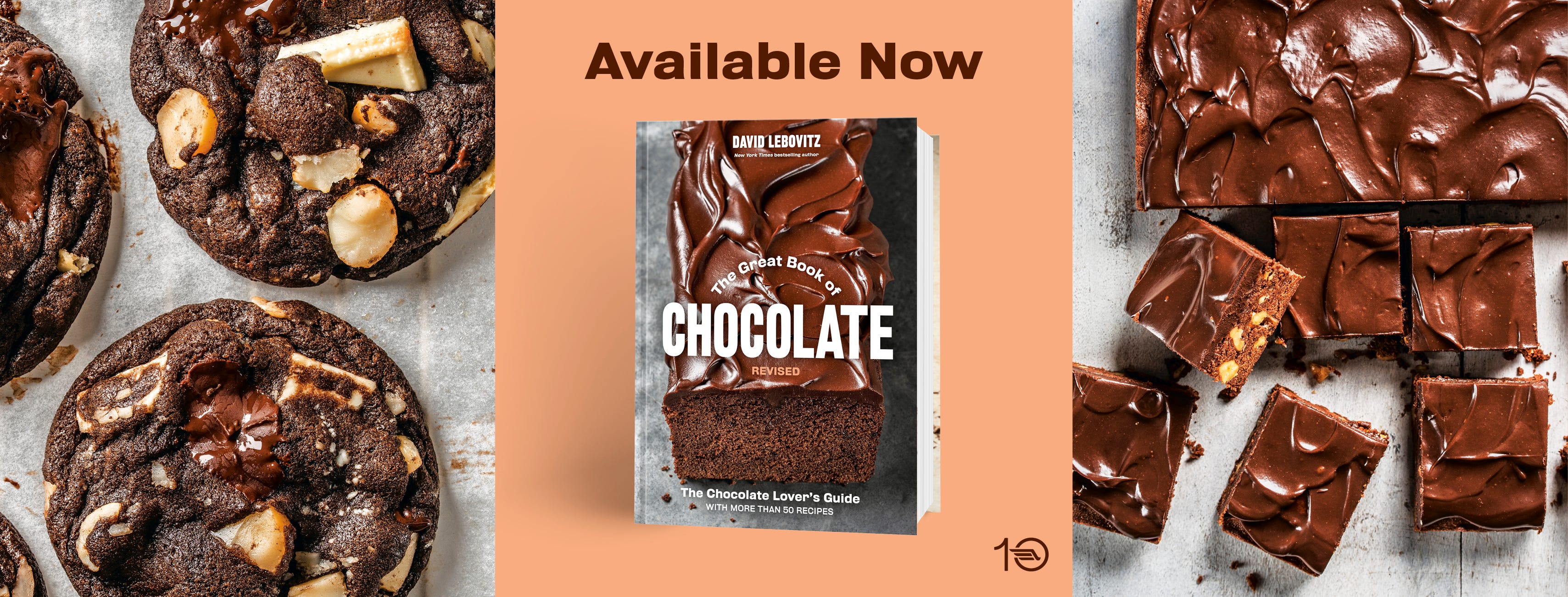
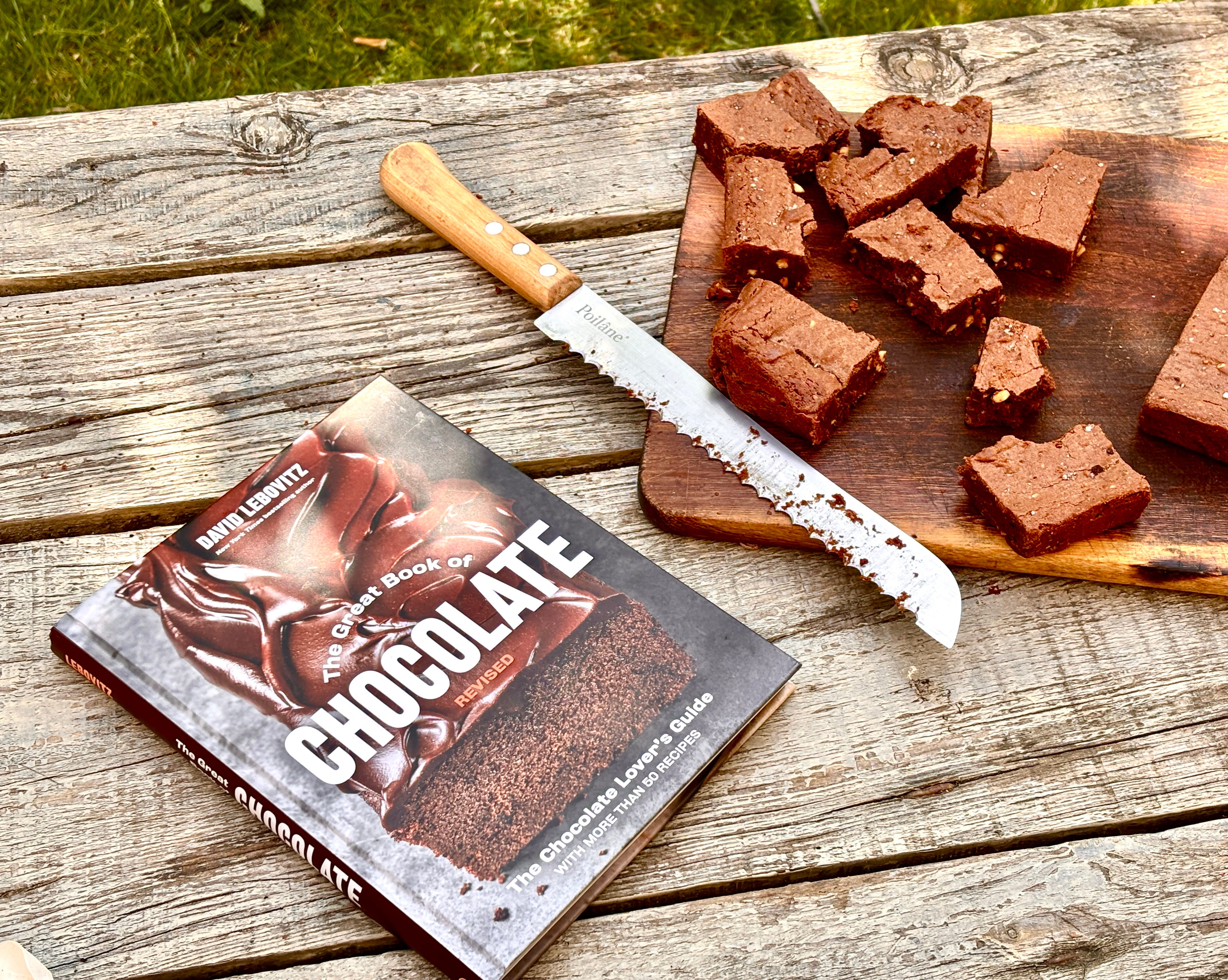
Since I’ve been in the chocolate mode, thanks to The Great Book of Chocolate coming out, I was glad Sami was up for doing some baking and showed up ready to make his Tahini, Halvah, and Coffee Brownies.

Subscribe to my newsletter and get videos, recipes, Paris tips, and more, sent right to your Inbox!

Pan-baked tahini, halva & coffee brownie
(Qahwa w Halaweh brownie)

Reprinted with permission from Boustany: A Celebration of Vegetables from my Palestine by Sami Tamimi, copyright © 2025. Published by Ten Speed Press, an imprint of Penguin Random House

Serves 6

“Imagine yourself sitting in one of many coffee shops dotted around the souk in Jerusalem’s old city, having a piece of chocolate and a strong, sweet Arabic cardamom coffee. One mouthful of this dessert can almost definitely transport you there. It’s a dessert meant for sharing, to be spooned straight from the pan. A great, easy, chewy and fudgy brownie which can be ready in under 20 minutes. It hits all the right spots for chocolate lovers like me.”

“This is the recipe exactly as it appears in Boustany. If you have watched me make these, you will know I improvise. I add more coffee if the batch I have is weaker, that sort of thing. The recipe below is the version I trust, so start there and make it yours.” - Sami Tamimi

Rounded ½ cup / 150g tahini paste

½ cup / 120ml lukewarm water

Heaping ½ cup | 3% oz / 110g granulated sugar

2 large eggs

½ cup / 20g unsweetened cocoa powder

1 tbsp instant espresso coffee

¼ cup / 1 oz / 30g all-purpose flour

½ tsp ground cardamom

½ tsp ground cloves

½ tsp baking powder

salt

1½ oz / 40g dark chocolate chips or chocolate roughly chopped into ¼ inch | ½ cm pieces (70% cocoa solids) (½ cup chopped)

For the toppings

1½ tbsp sesame seeds

1½ oz / 40g dark chocolate chips or chocolate roughly chopped into ¼ inch | ½ cm pieces (70% cocoa solids) (½ cup chopped)

⅓ cup | 70g plain or vanilla halva, broken into chunks

vanilla ice cream

Preheat the oven to 375°F. Grease a 8-inch | 22cm square baking pan or dish with sunflower oil and set aside.

Put the tahini and water into the bowl of a stand mixer, with the paddle attachment in place, and mix on medium-high speed for 2 minutes, until pale and smooth. Reduce to low speed, add the sugar, then the eggs, one at a time, and mix for a further 2 minutes.

Sift all the dry ingredients, using a fine sieve, and add them to the tahini mixture, along with aheaping ¼ teaspoon of salt and the chocolate. Mix for a minute more. Pour the batter into the prepared pan.

Sprinkle the top with the sesame seeds and chocolate and dot with the halva. Bake for 10-12 minutes, until the edges are set and the center is not runny (it needs to be slightly wet). Set aside for 10 minutes before serving.

Serve with vanilla ice cream.

The brownie can be stored in the fridge for up to a week.

Tahini, Halvah & Coffee Brownie Recipe
26.8KB ∙ PDF file
Download
Download

Visit Sami's Website

You can also watch me and Sami make the Chocolate salted butter caramel lava cakes (below) from The Great Book of Chocolate here.

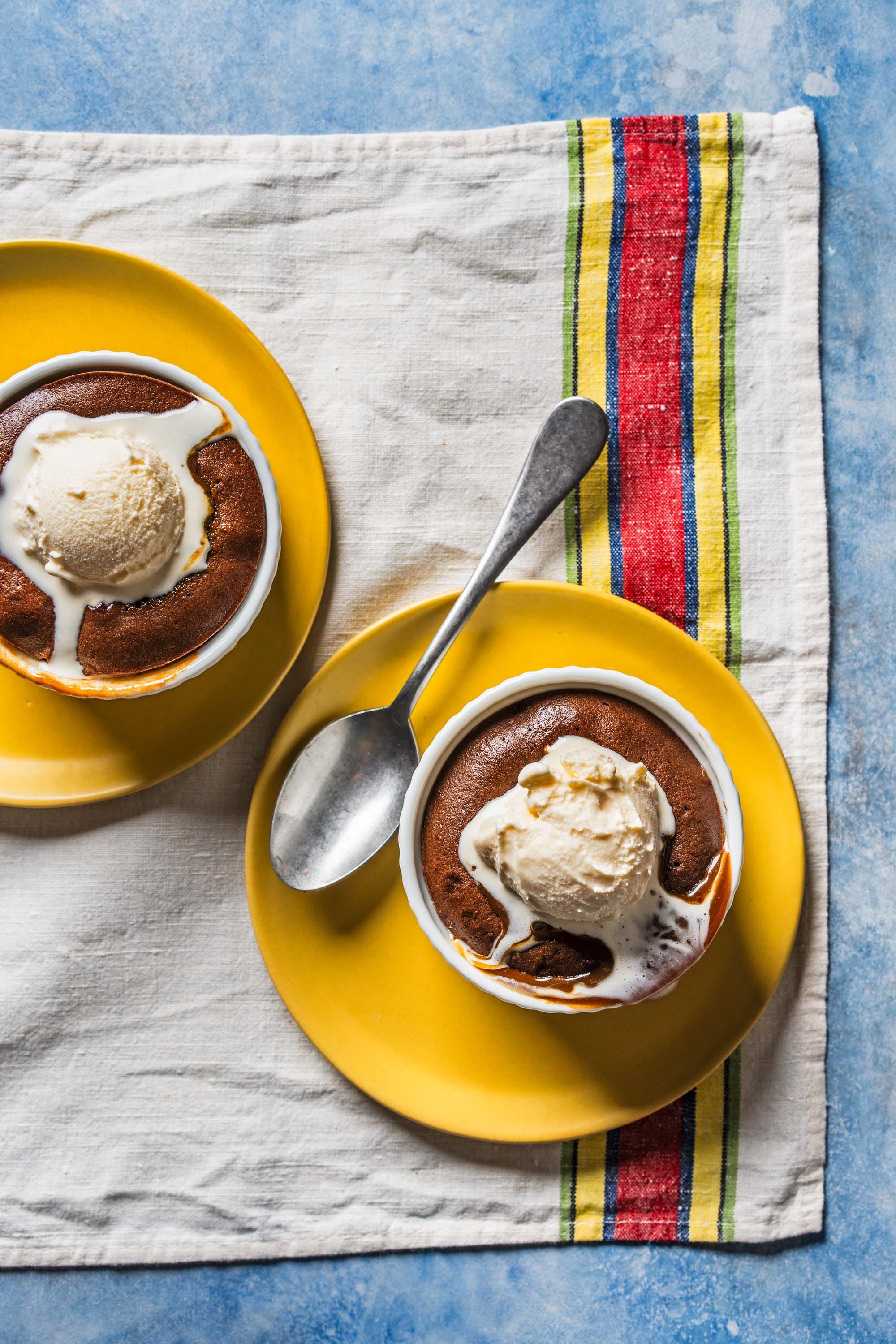
Chocolate salted butter caramel lava cakes from The Great Book of Chocolate. Photo by Ed Anderson

Get The Great Book of Chocolate

https://www.davidlebovitz.com/book/the-great-book-of-chocolate/

Follow Sami on Instagram

Leave a comment

💾

Received — 6 August 2026 ⏭ David Lebovitz Newsletter

Making a French 75 Cocktail

6 August 2026 at 13:53

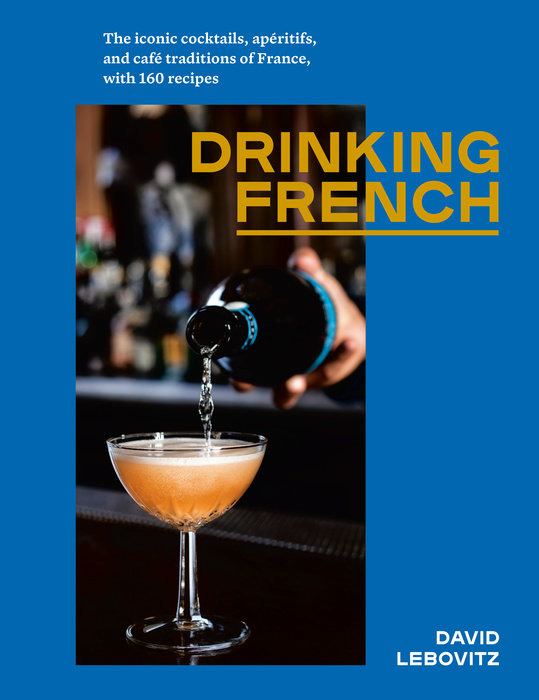
A highlight of writing Drinking French was getting to meet, and highlight, some of my favorite creative people in Paris, and in France, who are part of the cocktail scene, which has rapidly expanded over the years, turning Paris into one of the world’s most exciting cocktail destinations.

Franck was one of the heroes in Drinking French, and as you can see in the video, there are more pictures of him in my book…than of me.

https://www.rizzoliusa.com/book/9780847876495/

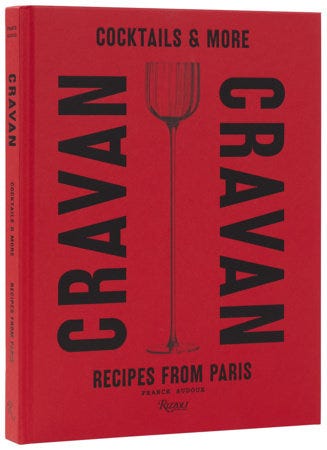
Get Cravan: Recipes From Paris

After working in an art gallery in Paris, Franck went on to work at the highly celebrated restaurant, Le Châteaubriand, where chef Inaki Aizpitarte was invigorating, and shaking up, the world of French cuisine. Franck saw how the world of cocktails was changing outside of France, and decided to delve into cocktails as well, creating cocktails that leaned into French spirits and ingredients.

Subscribe to my newsletter to get videos, recipes, Paris tips, and more, sent right to your Inbox!

In his book, art, film, and Franck’s distinctive style intersect with his expertly made cocktails, which are deceptively simple. Most are careful revisions of classics such as the Tunnel, a reimagined Negroni served in a coupe glass. And his Yellow cocktail is a masterful mixture of Yellow Chartreuse, gin, lemon juice, and Suze gentian liqueur. (It’s one of my top three favorite cocktails of all time.)

Cravan Paris website

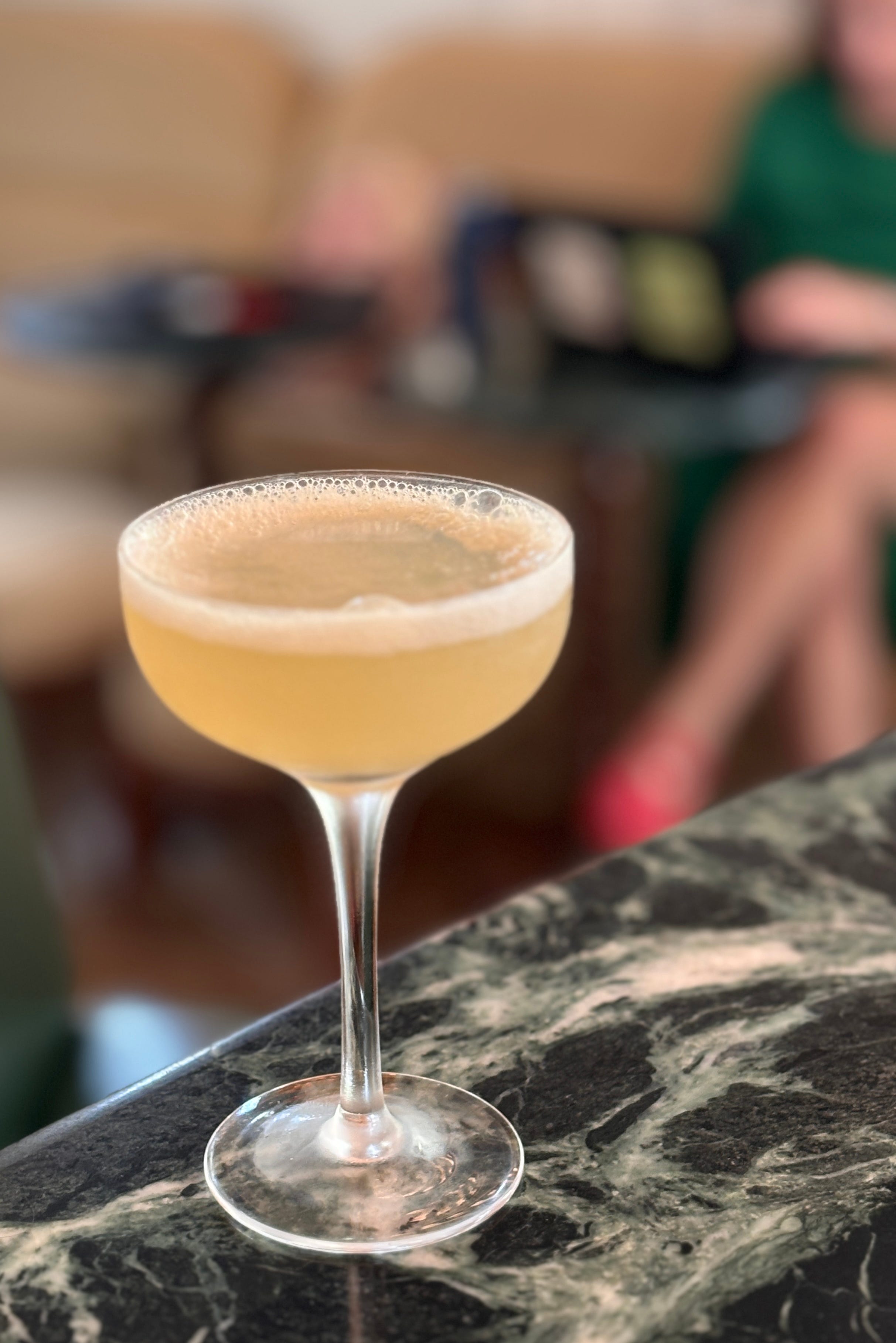
What began as an extraordinarily charming (twenty-seat!) café tucked into a magnificent Hector Guimard Art Deco building, Cravan has extended to a four-story building in the heart of the Saint-Germain-des-Prés, where Franck invited me to stop by for a French 75 on a warm summer afternoon. It was cool perfection in a glass.

À santé!

French 75

Adapted from Cravan: Cocktails and More, Recipes from Paris

One cocktail

To make his interpretation of the French 75, Franck infuses London dry gin with agastache, known in English as dried anise hyssop. I’ve included the recipe for the infusion and the simple syrup after the cocktail recipe.

1 ounce (30ml) anise hyssop-infused London dry gin
1/2 ounce (15ml) simple syrup
1/2 ounce (15ml) freshly squeezed lemon juice
1 dash of absinthe
Lemon twist
Brut (dry) champagne

Combine the gin, simple syrup, lemon juice, absinthe, and lemon twist in a cocktail shaker. Fill three-quarters full with ice. Cover and shake vigorously for two seconds. Double strain the mixture into a chilled coupe glass.

Top with champagne and serve.

-To make the anise hyssop-infused gin, mix 1 3/4 teaspoons (5g) dried anise hyssop flowers with 24 ounces (700g) London dry gin. Cover, shake gently, and refrigerate for 24 hours. Strain, then filter the gin through a premoistened paper filter, such as a coffee filter. Store refrigerated.

Dried anise hyssop, which is different than anise, can be found at herbalists and well-stocked natural food stores. A few places to get it online: Reverie Farm, The Herb Loft, and Etsy. I’ve not tried the cocktail without the infused gin but you could give it a go with uninfused London dry gin.

-To make the simple syrup, heat 3 ounces (90g) sugar with 3 ounces (90g) water over low heat, stirring until the sugar is dissolved. Refrigerate until thoroughly chilled.

-A dash of absinthe adds a little je ne sais quoi to cocktails. Pastis and anisette have a similar flavor profile and you could use one of those, sparingly.

Leave a comment

https://www.davidlebovitz.com/book/drinking-french/

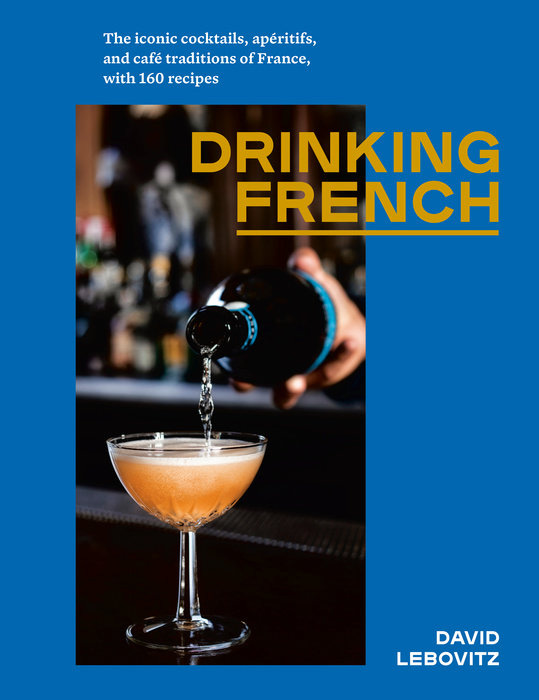
Get Drinking French

💾

Received — 1 August 2026 ⏭ David Lebovitz Newsletter

August 2026 Newsletter

1 August 2026 at 09:26

I used to wonder why, in cities like New York and Paris, everyone claimed that they could never, ever live anywhere else. Then, when summer rolled around, everyone would say they can’t wait to get out of town.

I’m a city person and I like Paris best in the summer. A majority of people have left, so it’s a lot quieter. You can get into all those restaurants that you normally needed to book weeks in advance. And while the markets are more sparse, shops selling produce from small producers have been doing their best to keep their stores stocked, in spite of a lot of fields and farms and vineyards being decimated by successive heatwaves, and now, wildfires. One of our neighbors has been dropping cigarette butts in our backyard, which is as dry as a haystack, so we’re praying our building doesn’t go up in flames, too. But for the time being, Paris has been spared.

At the market in Vernoux-en-Vivarais

We have friends, a couple who live part-time in Ardèche, and when they invited me to come for a few days, I erased everything I had scheduled in my calendar and took a two-hour train ride to stay with them. That region is called the Auvergne-Rhône-Alpes, especially known for sausages, wine, and its famous chestnuts, les châtaignes d’Ardèche, which have protected AOP status in France.

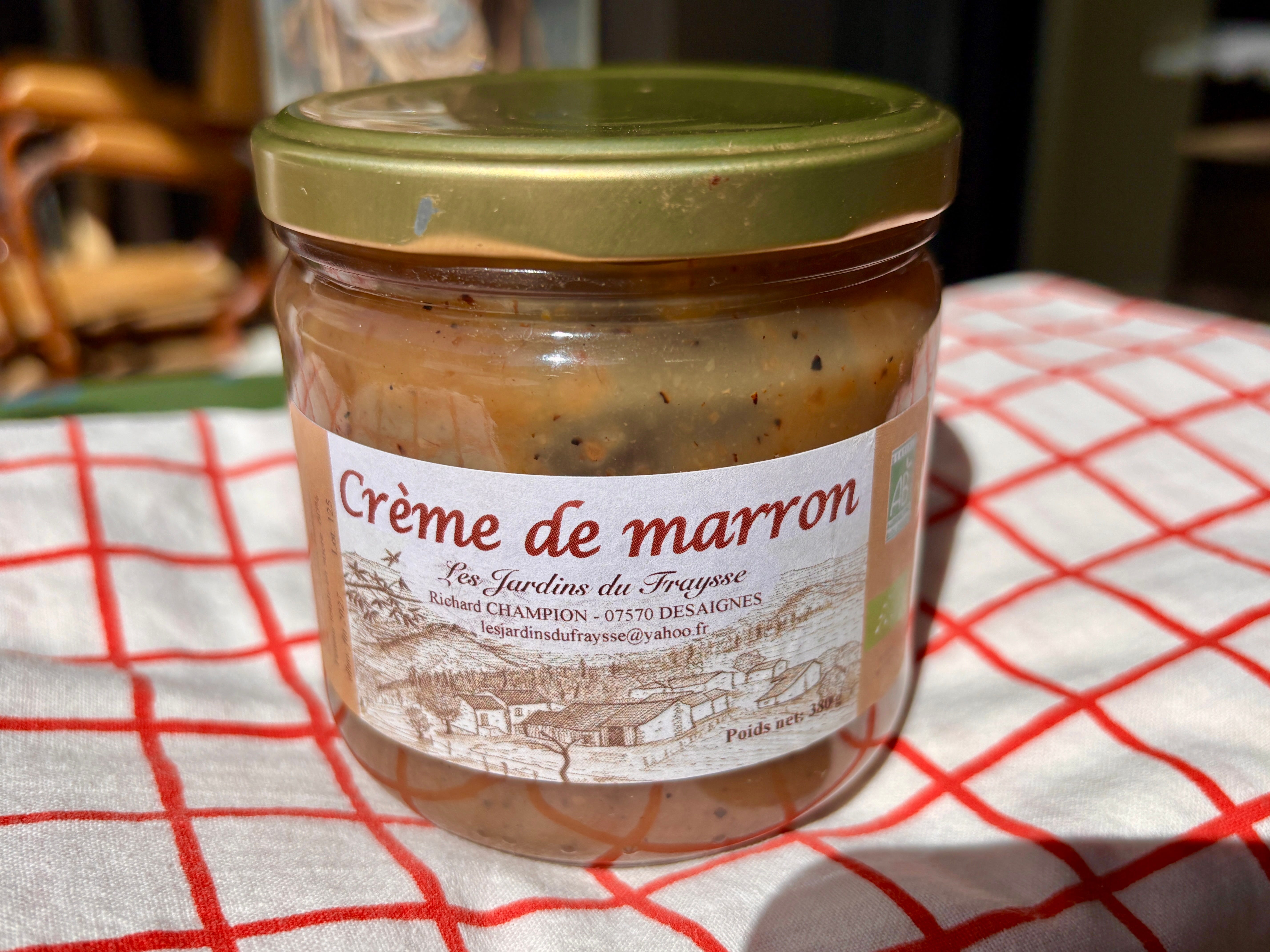
It wasn’t quite chestnut season, and people are worried about the effects of the heatwaves on the chestnut trees, but I picked up a jar of chestnut paste at one of the farm tables at the market. Sometimes the chestnut spread is made with candied chestnuts, but generally at the markets, the varieties are less sweetened, and looser, like the one in the jar, above, that I bought.

Chestnut spread is delicious served with plain yogurt or fromage blanc, or if you buy the ones made with candied chestnuts sold in a tube, like toothpaste, when no one is looking, people squeeze it directly into their mouths.

At the market in Lamastre

I often joke with Romain that when we stay with friends in the summer, invariably they have a bowl of apples and pears, regardless of the season. It’s a bit perplexing to me because when apricots, plums, peaches, nectarines, and cherries are in season, I buy far more than I need because I’ve been waiting all year for them, and it’s a treat to have them so readily available, and so delicious.

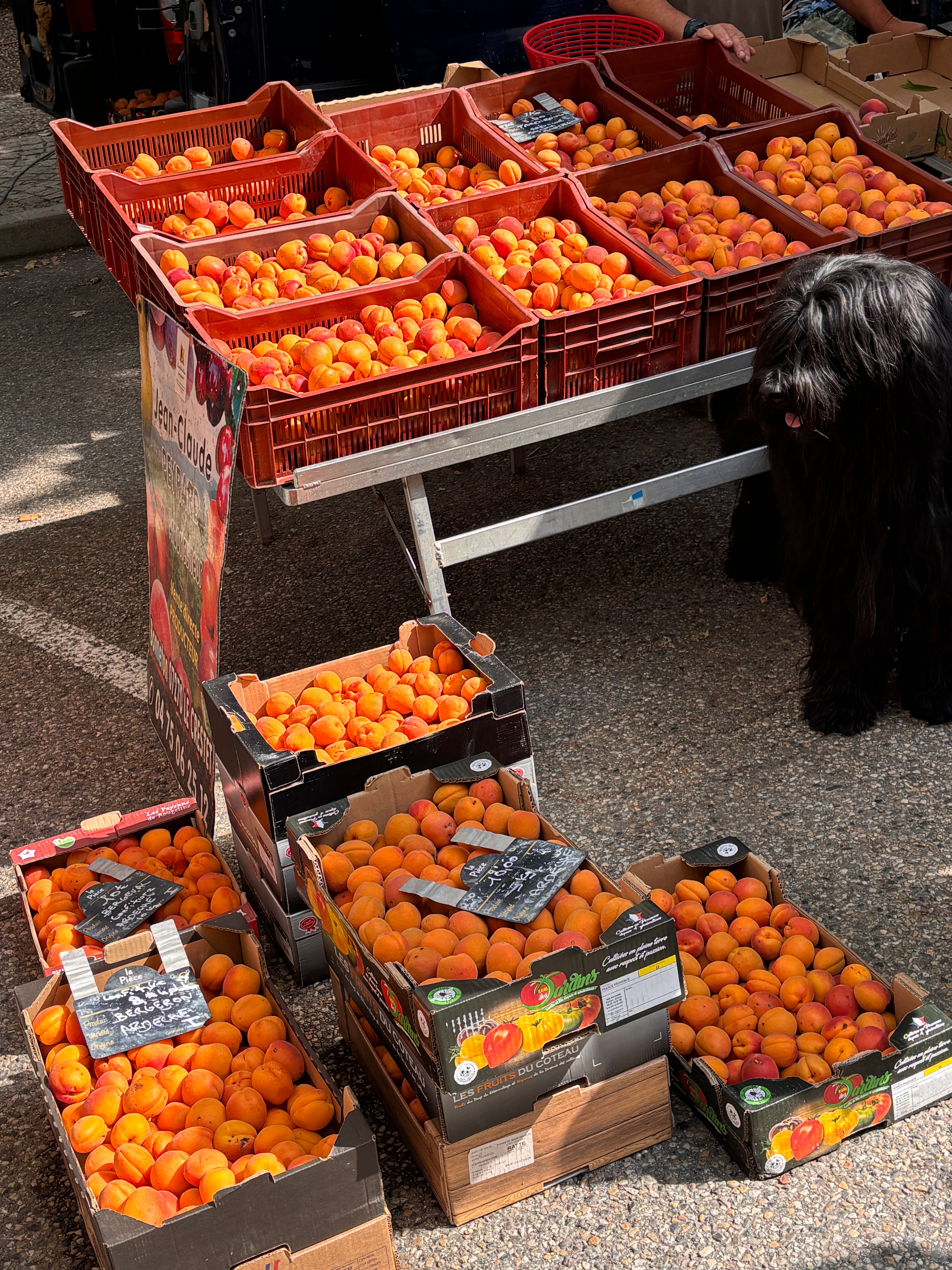
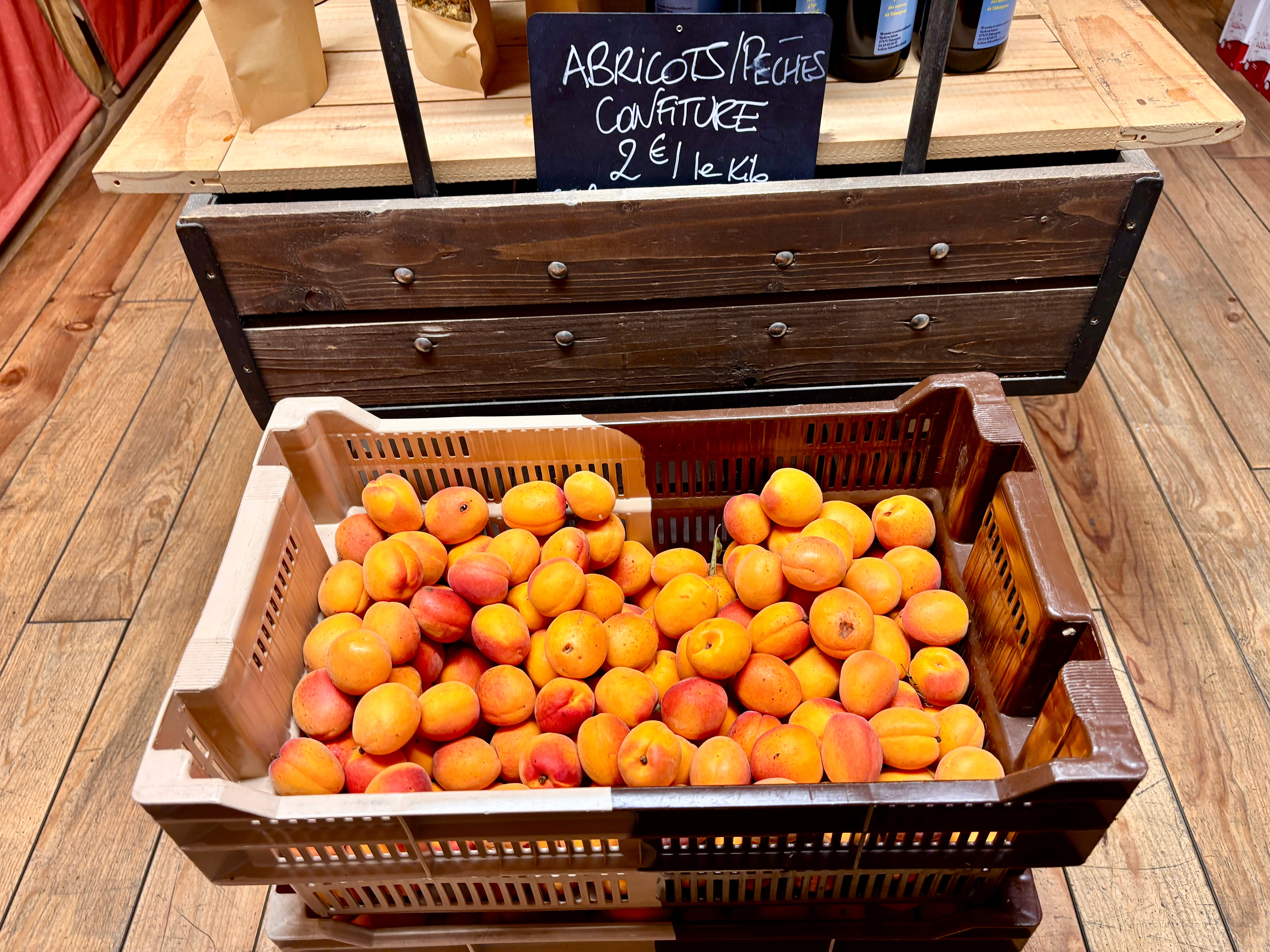
One stand at the market in Lamastre had so many apricots that I thought I would faint. They had three or four varieties, and if I wasn’t taking the train home, I would have bought a few cases, especially those marked down for jam-making.

Fresh apricots sold for a song, for jam-making.

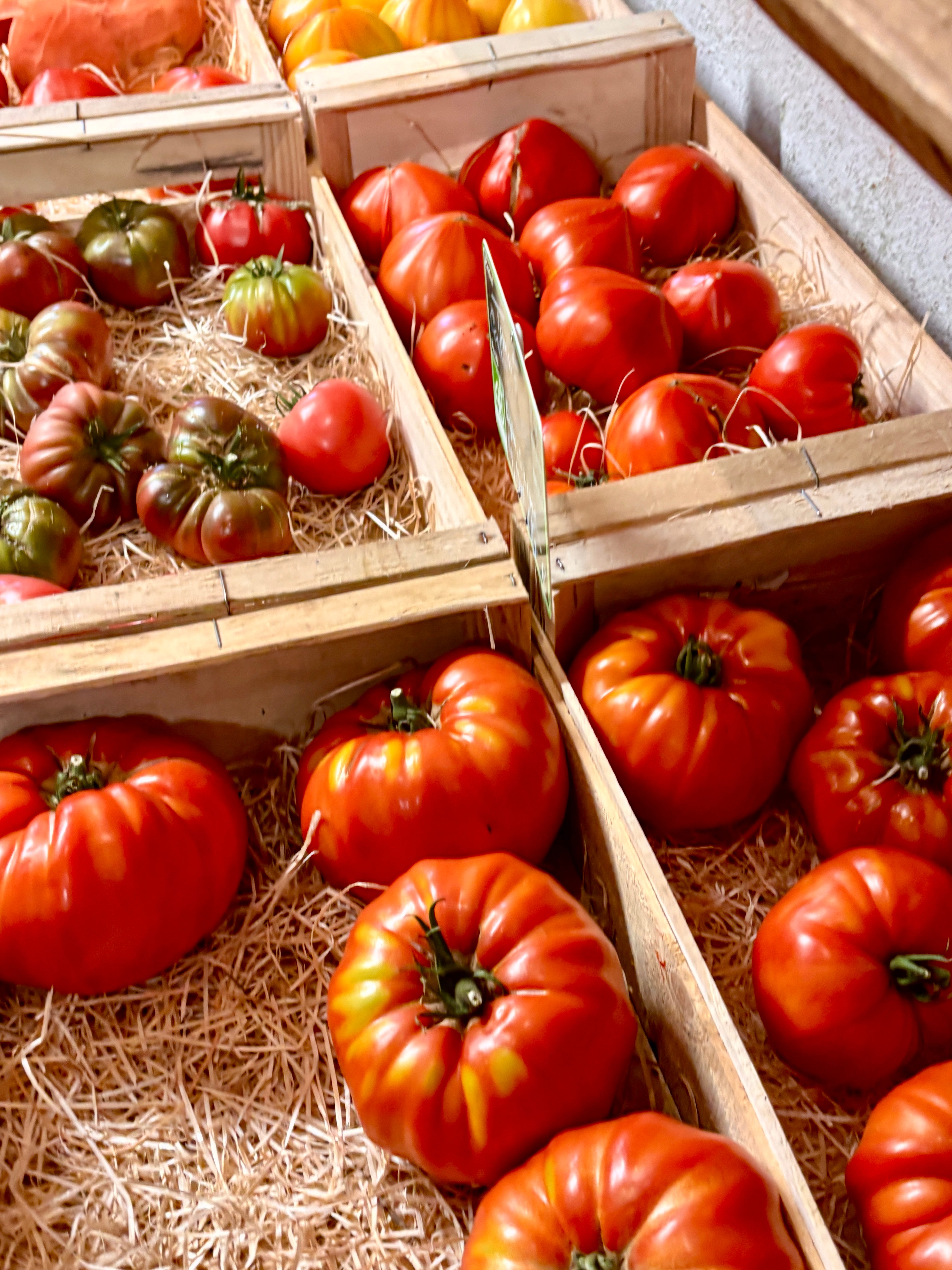
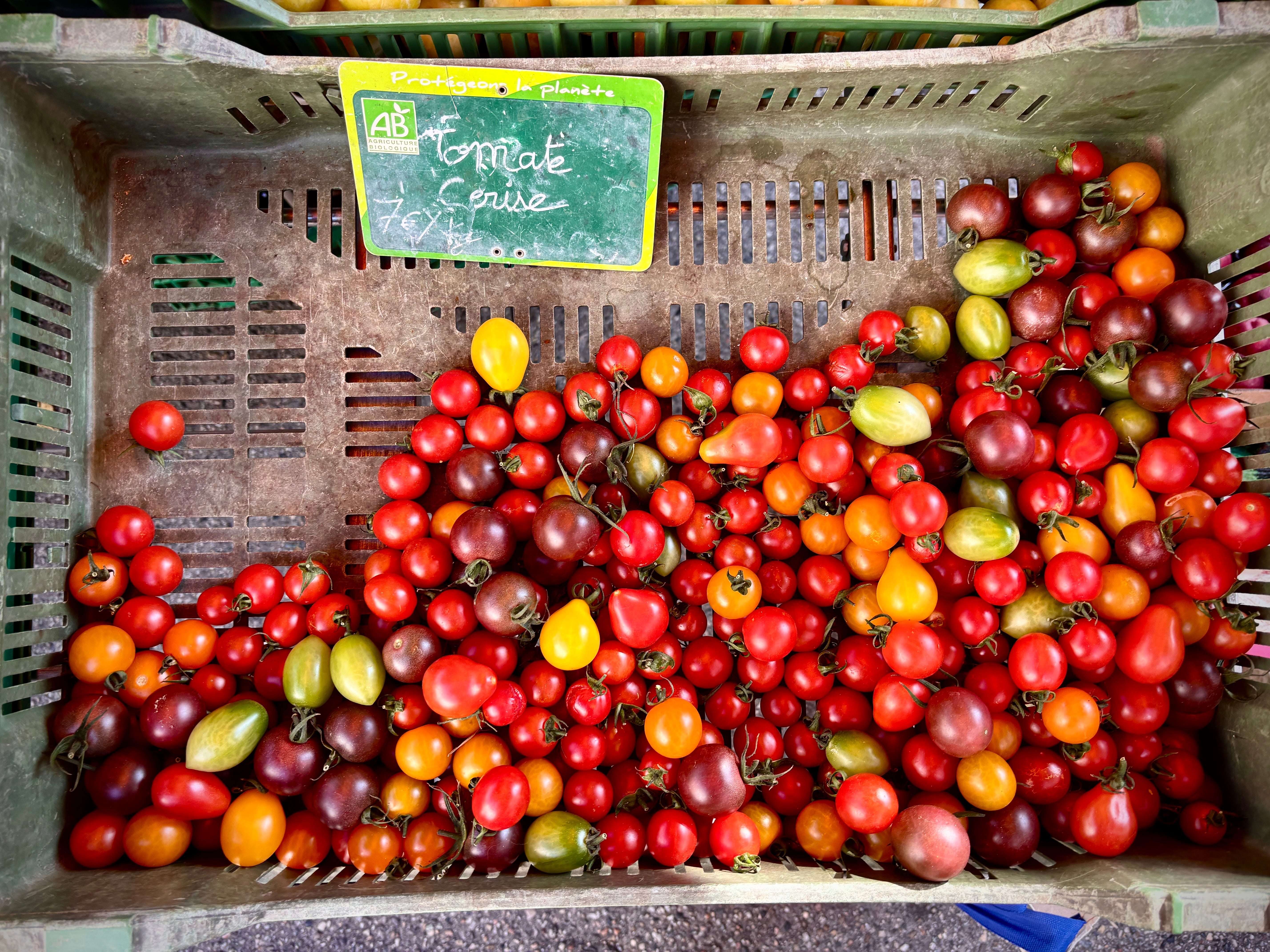
My friends who live there were scandalized about one vendor selling his tomatoes for €4,50 (~$5) per kilo (#2.2), when all the others were selling theirs for €3,50 ($4) per kilo. As a city dweller, both were a bargain to me. It made me reconsider the urban lifestyle that I’ve chosen.

The flavor of the tomatoes was also worlds away from any tomatoes we get in Paris. I see why people are so eager to get out of town!

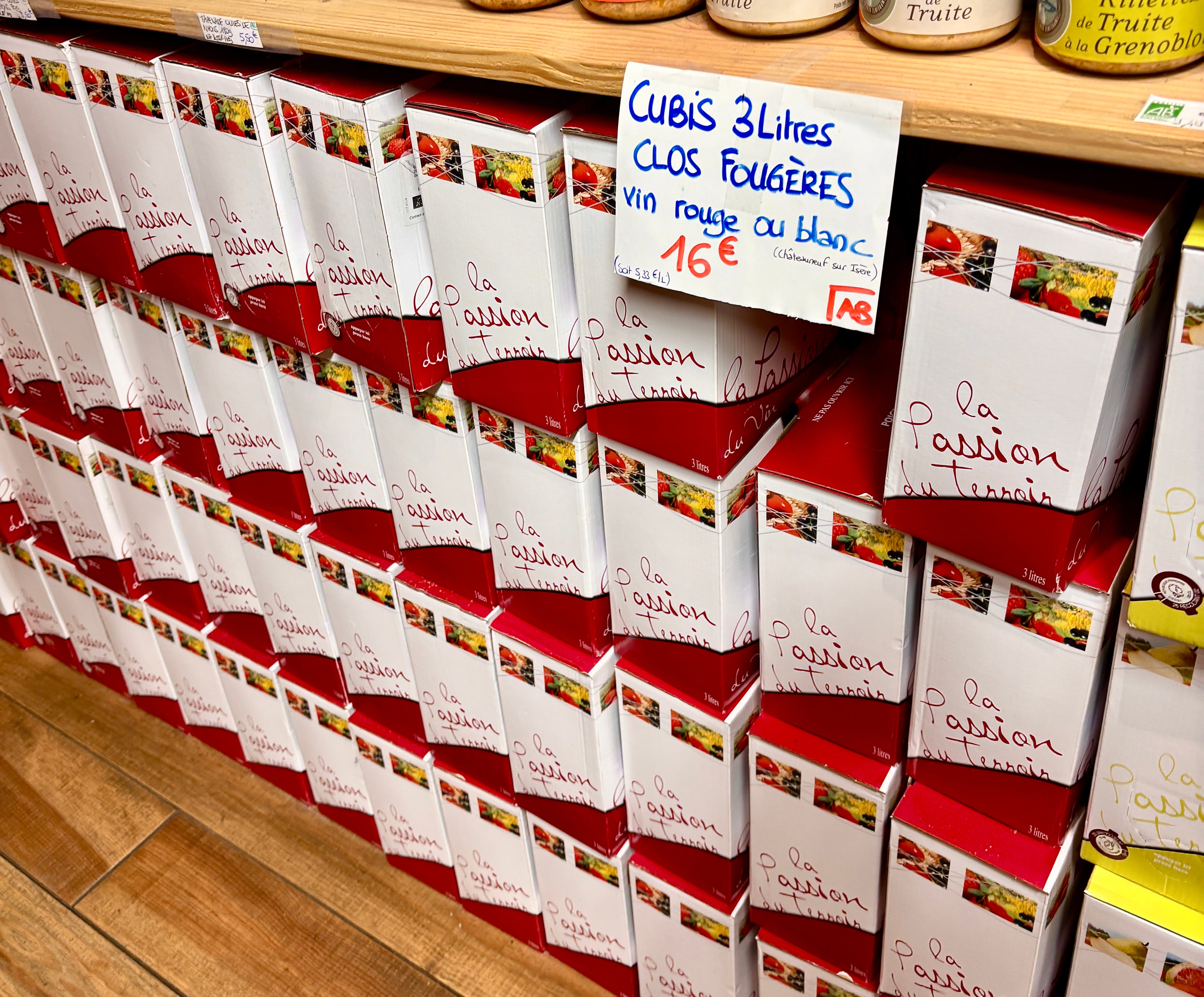
I’ve had (non-French) people tell me, “Oh, no…no one in France would ever drink wine out of a box!” Well, now I’ve got photo proof that they do.

Share David Lebovitz Newsletter

(Someone once insisted to me that no one in Italy would ever dream of buying jarred tomato sauce. The jars sold in grocery stores, they told me, were for tourists. If you’ve ever seen the tomato sauce aisle in an Italian supermarket, you’ll wonder how so many tourists manage to bring all those jars of sauce home with them.)

Wine in a box isn’t a bad thing. It’s wine that’s meant to be drunk daily, not saved for ten years in a cellar. The box keeps the wine fresh; the bag inside the box compresses as the wine is poured, so the wine isn’t in contact with air. Plus the boxes are arguably more ecological (and easier to ship and store) than bottles. Also, you can see the savings on the price: €16 ($18) for the equivalent of 4 bottles of organic wine. Not bad!

Subscribe to my newsletter to get recipes, videos, stories, posts, and more, delivered right to your Inbox!

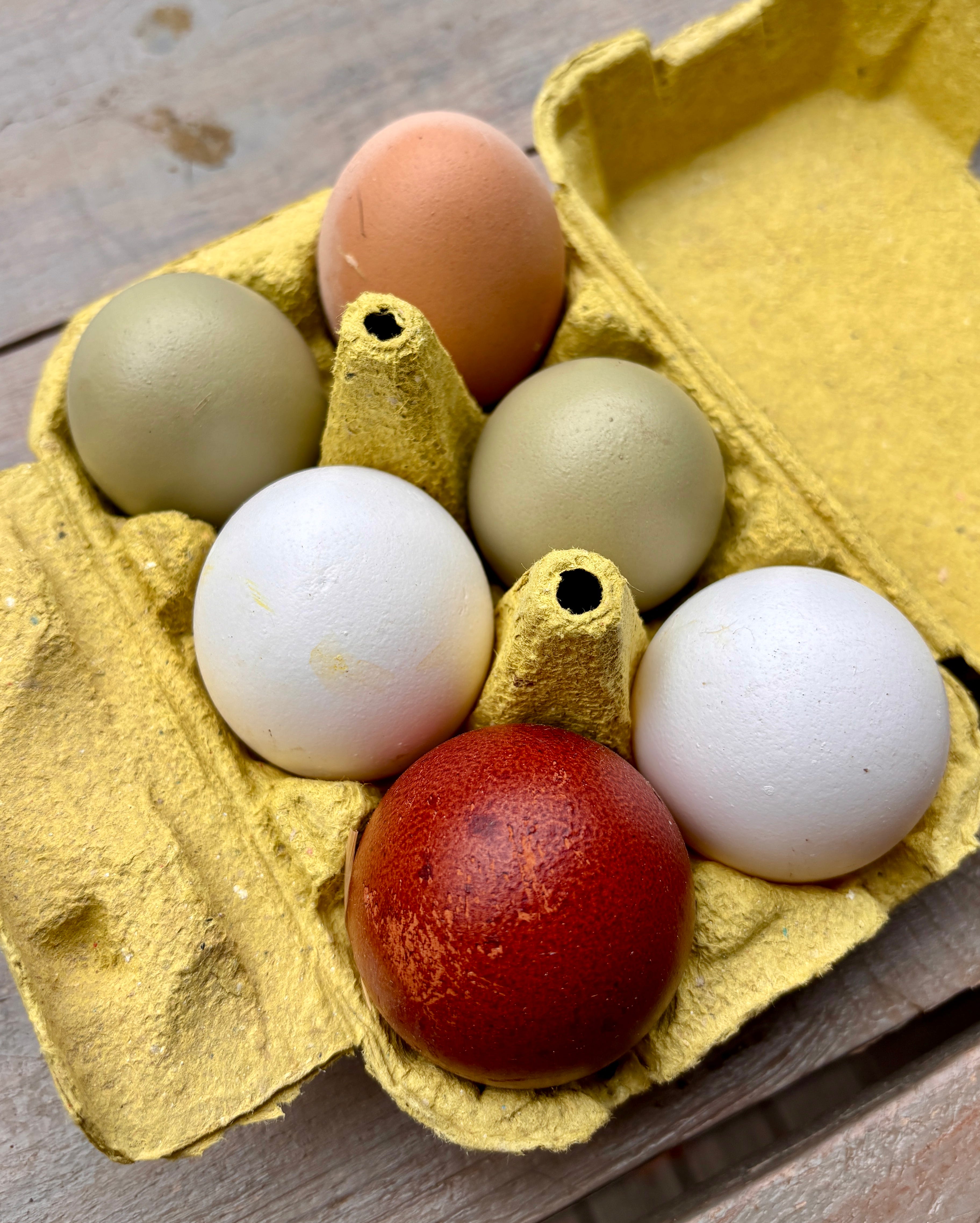
Eggs from our friends’ chickens

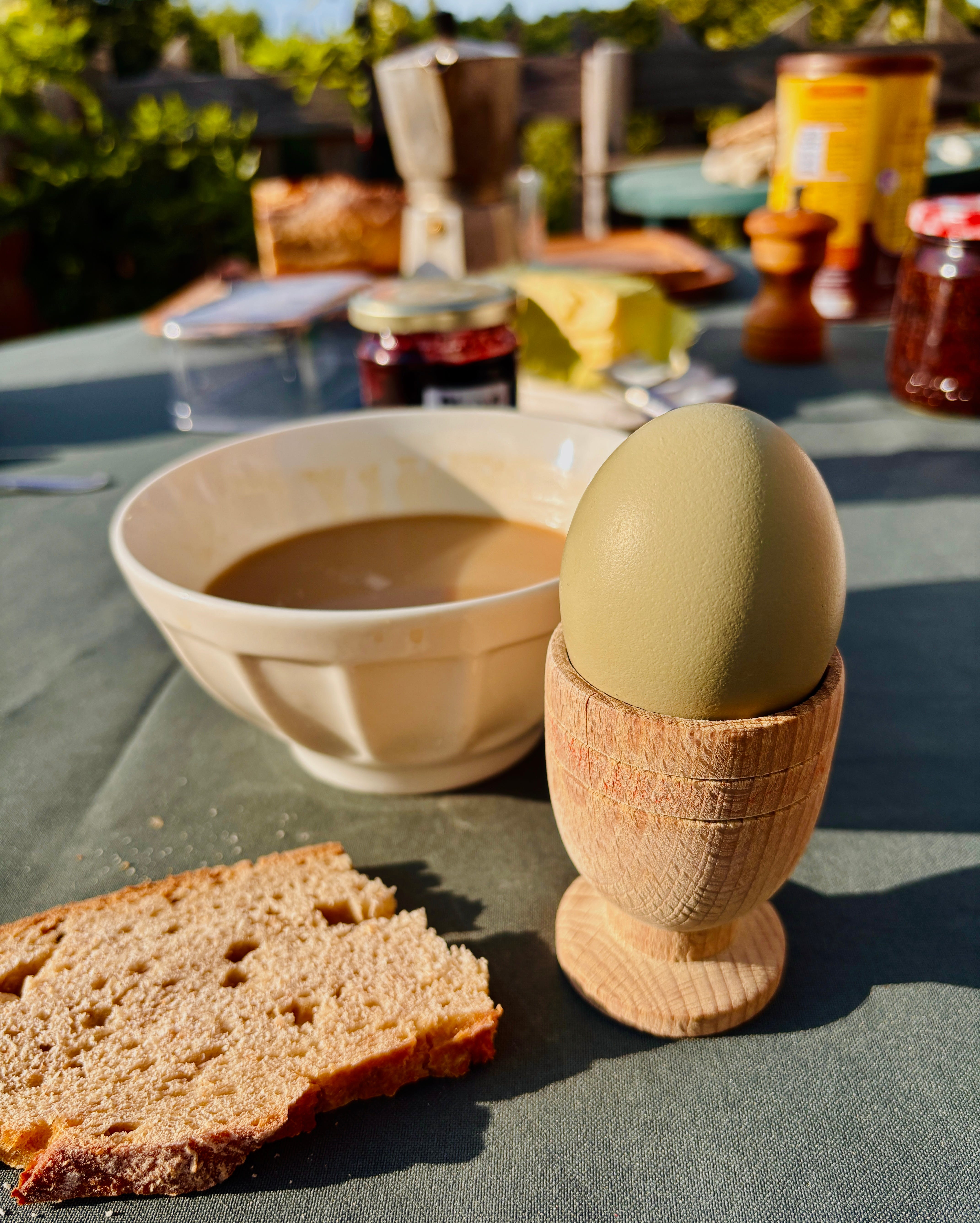
Another delice were the fresh eggs from our friends’ henhouse. They were so beautiful, and it was wonderful having a fresh egg for breakfast every morning.

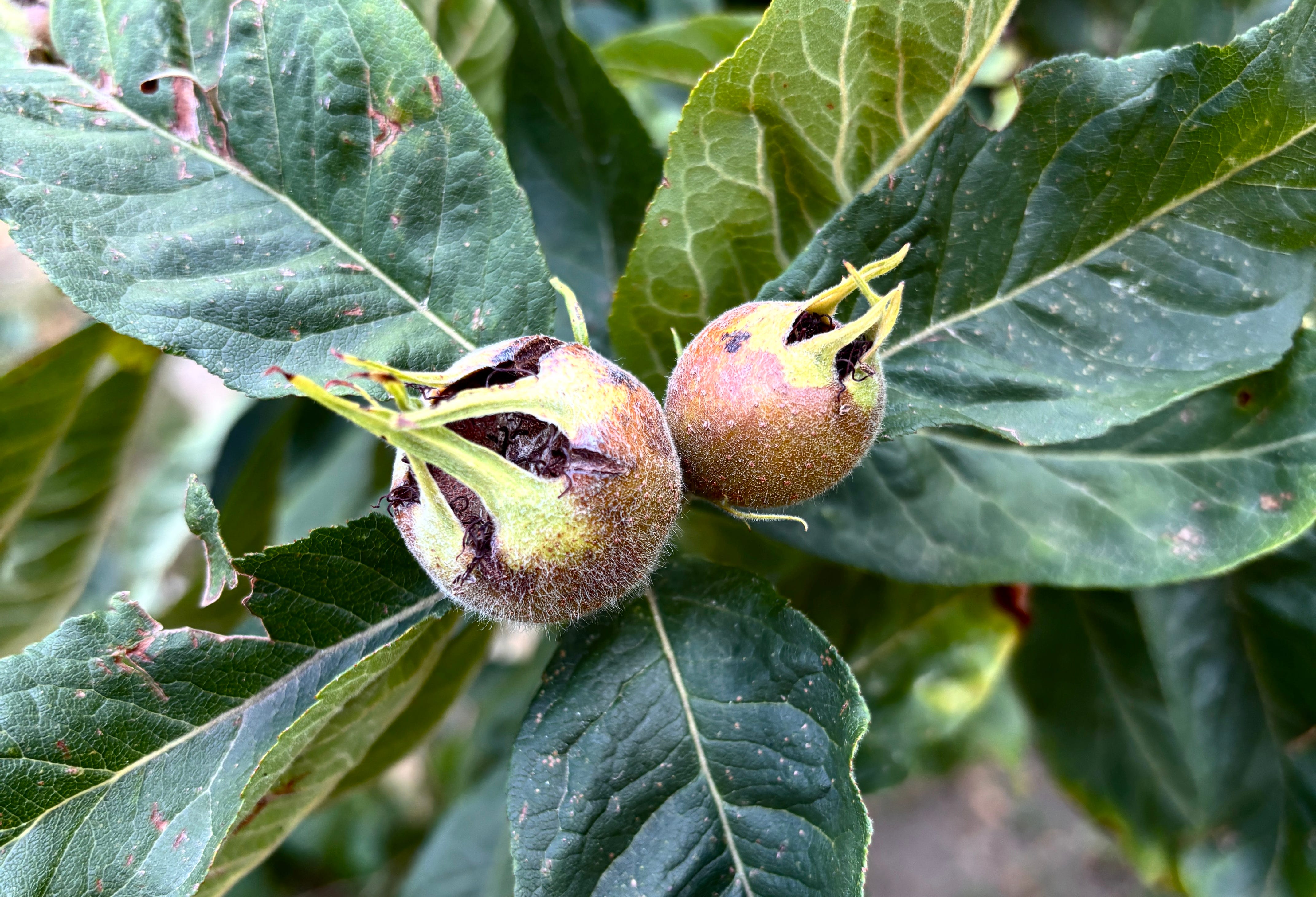
Thankfully, I wasn’t worried about taking a half-dozen eggs home with me, although I carried them carefully on the train. And my friends promised to bring me some medlars from their tree when they’re ready to pick…

…which I use to make rose-colored medlar jelly. With all the jams and jellies that I make, maybe I am a country boy after all?

https://www.davidlebovitz.com/book/ready-for-dessert-revised/

Get my book, Ready for Dessert!

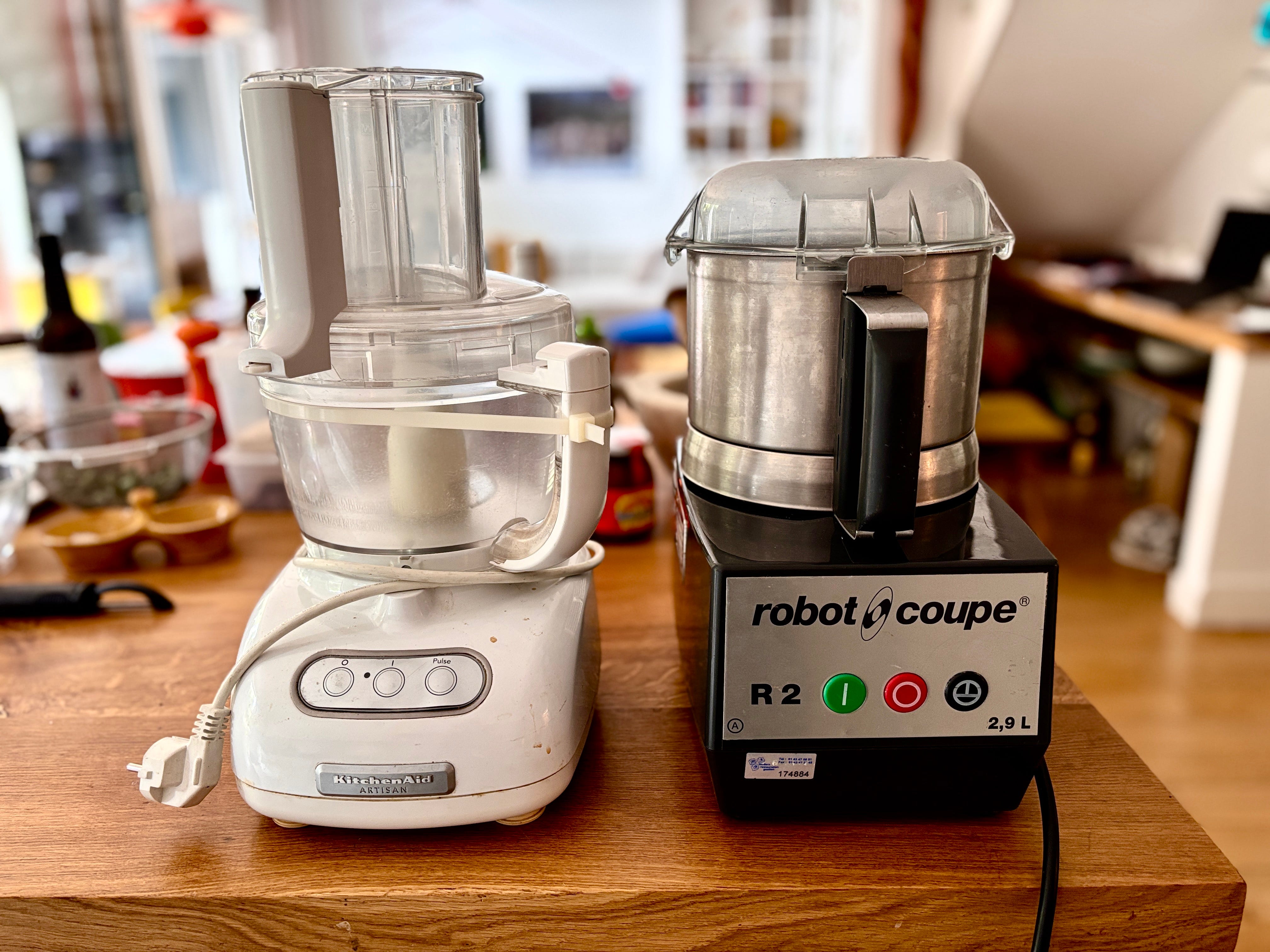
For those following the food processor drama (and for those who aren’t: My KitchenAid food processor bowl broke and was collecting gunk in the handle, and no replacement is available. And yes, I checked everywhere.) I’ve finally resolved it.

When I worked in restaurants, we always used a Robot-Coupe, the original food processor, which could handle anything. The problem in Paris is that the cost for them is pretty steep: Prices for new models are north of a thousand bucks, and I didn’t know if my occasional use of one justified the price. So I did what everyone in France does: I checked out Le Bon Coin, which is the 9th most-visited website in France, right after Google.

You can pretty much find anything in France on Le Bon Coin, from medlar trees to an apartment in Paris, or your dream house in the countryside.

Using the search term “robot culinaire,” I landed on a vintage one (above), just like the ones I used in restaurants. It was a mere €80 ($91) but they didn’t want to ship it, so I had to pass. I set up an alert and a couple of days later, one turned up in Paris.

I’ve honed my bargaining skills in France — as Romain once said to me, “No one is ever going to offer you a deal. You have to ask.” So I did, offering what I thought was a bit low, figuring the seller would come back with a counteroffer in the middle. She came down a bit, and in the few hours that I ruminated whether to just buy it, a notification showed up — Offre acceptée.

Leave a comment

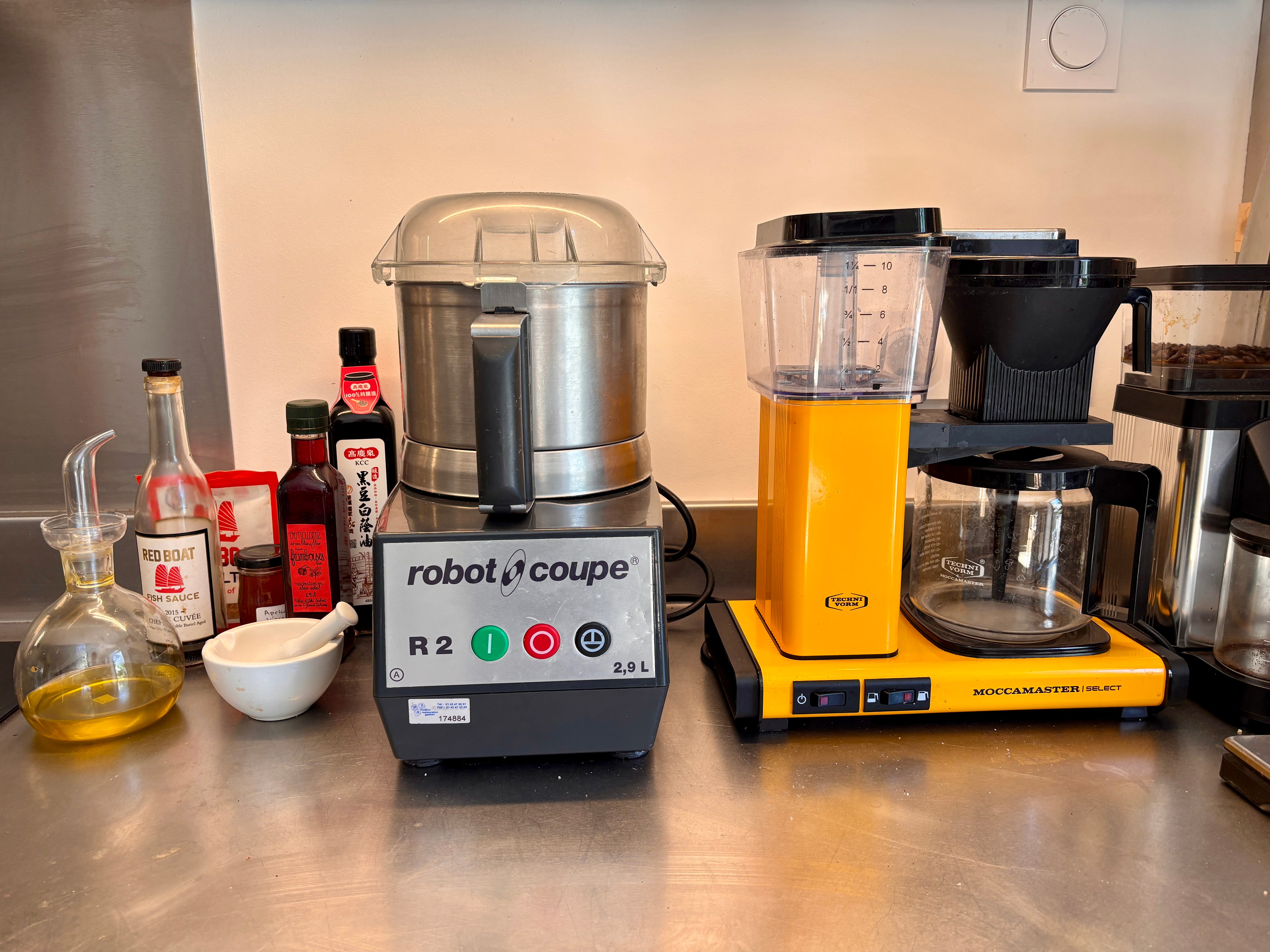
While it wasn’t in the excellent condition she mentioned, it was a solid “very good,” and heavy as a motherf**ker. I placed the machine in the basket of my bike and with every turn, the weight of it threatened to pull me down to the curb, so I rode extra carefully, and slowly, much to the ire of other cyclists. In the U.S., it’s cars that are aggressive to bicyclists but in Paris, it’s the other cyclists who pose the hazards.

I, and the machine, made it home in one piece, and it’s now sitting on my countertop. It weighs a ton so it’s not convenient to store in a cabinet. Romain asked me, “Is that where you’re going to keep it?” when he saw it on the counter. He’d already banished my stand mixer to a distant shelf, which makes it harder to bake (I guess I should use as a counterargument all those cookies and cakes he’s missing out on?), but if he wants the Robot-Coupe to go into a cabinet, he’s going to have to put it in there himself and take it out when I need it.

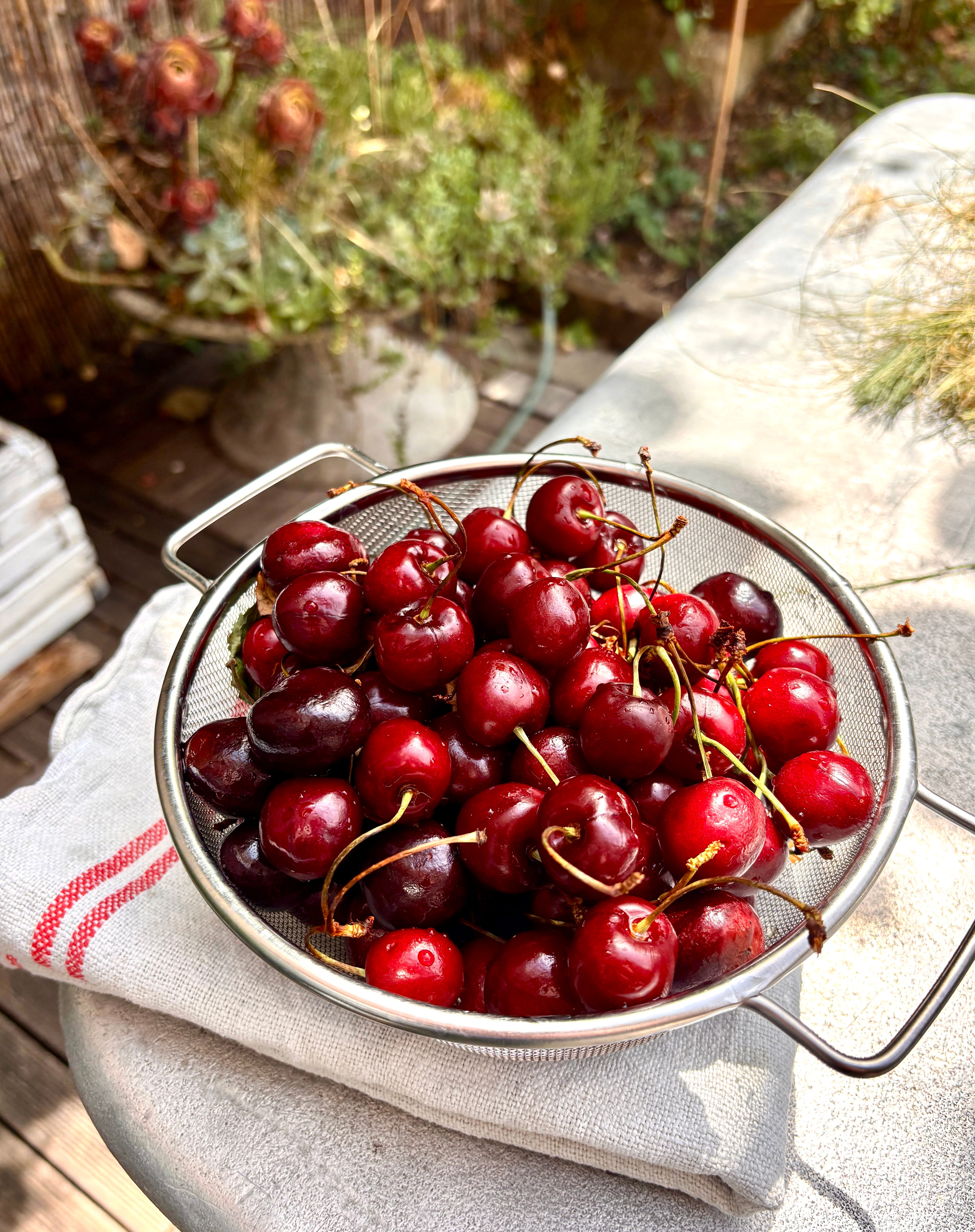
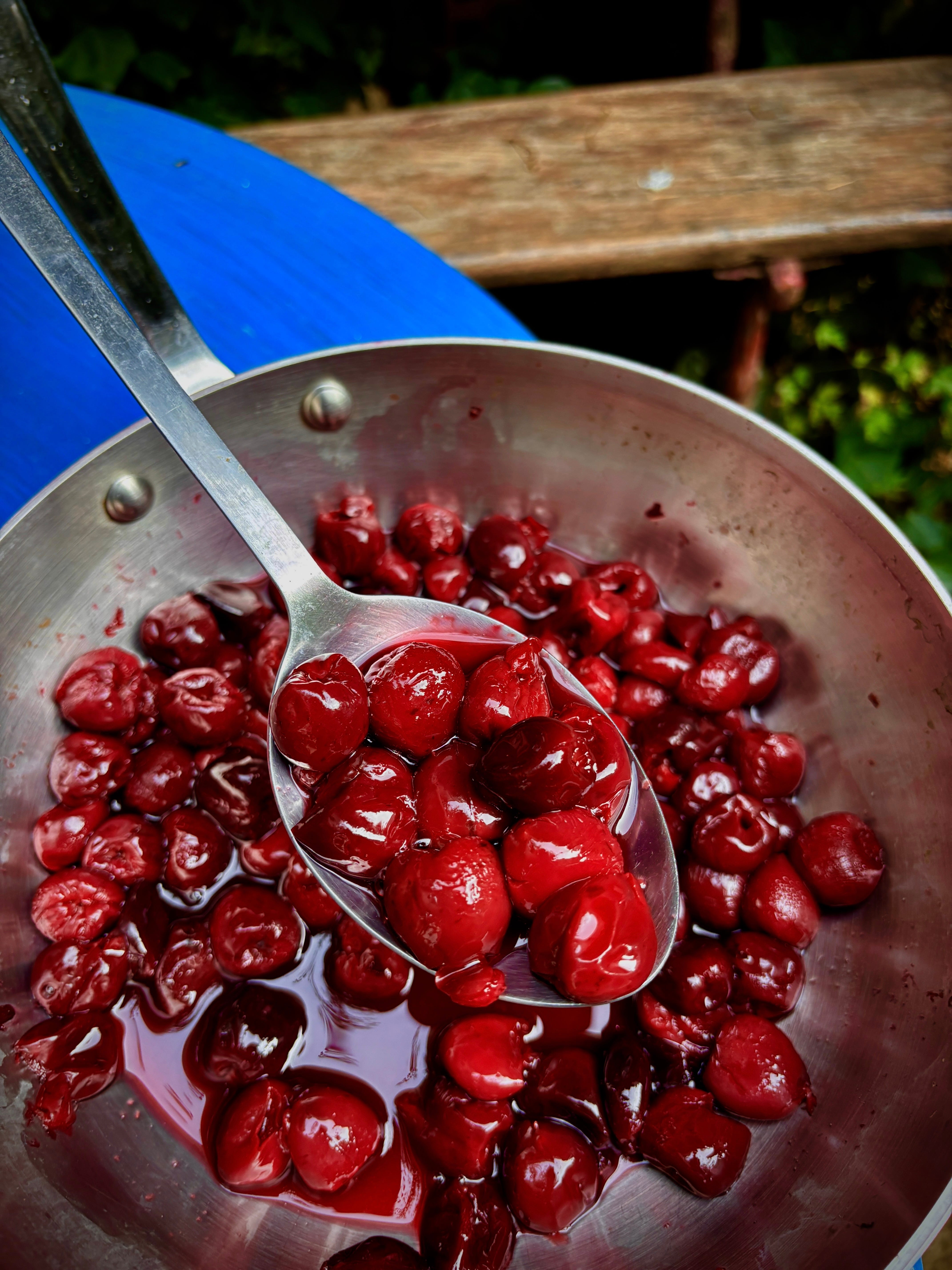
As we enter August, I took advantage of waning cherry season to pick up a load of fresh cherries and turn them into compote, to freeze. It’s nice to pull out a packet of cherries in the winter to serve with ice cream, tangerine sorbet, or frozen zabaglione, which is a great recipe that doesn’t require an ice cream freezer to make.

I pitted and sautéed them until they were cooked through. If you let them sit overnight, the juices will thicken further and the cherries will turn a deeper red color. If you want to freeze them, just put the cherries in a freezer-safe storage container and save them for a rainy, or snowy, day. Mine are now in my freezer, ready for winter. (Which I’m not.)

-David

Subscribe now

When I was in San Francisco on tour with The Great Book of Chocolate, I was invited to the Williams-Sonoma test kitchen to bake bouchons with test kitchen director Belle English. We had SO MUCH FUN! (Paid subscribers: You’ll find the recipe at the end of the newsletter.)

https://www.davidlebovitz.com/book/the-great-book-of-chocolate/

Get The Great Book of Chocolate!

Things I Like

When I lived in San Francisco, I was one of those weirdos, or cool people, who had a Saab. Yes, I was crazy enough to drive a stick shift there and I pitied the people in their fancy BMWs who’d ride my tail on those steep hills, unaware that you had to have lightning-fast reflexes to shift into gear when a red light turns green, to avoid your car backing up an inch or two. Unless you got the timing precisely right, down to a nanosecond, my bumper might tap their front fender.

Fortunately I was pretty adept at shifting on the hills, but the few times I missed and tapped someone’s bumper, I never got out to see if I caused any damage. I just chalked it up to their fault, paving my way for a move to France, where things are inevitably pas ma faute.

Considering how expensive that car was to maintain, the knob on the gearshift was made of cheap plastic. They offered a wood option to replace it for $70, which seemed like a lot of money at the time. I ruminated over it for a few weeks (unlike my Robot-Coupe) until a friend said to me, “David, how many times are you going to touch that knob? Isn’t it worth getting a nice one?” So I caved and bought one, and she was right.

Leave a comment

My friend Sarah caused a bit of an online kerfuffle when she poked fun at a hairbrush store in Paris beloved by influencers, and there’s always a line (yes, for hairbrushes) to get in. I don’t fight with people online but I beg to differ about brushes; I love the kitchen brushes at La Trésorerie that are handmade of wood and with natural bristles. And since there’s no line, the shops are free of influencers.

I saw one while shopping for a bottle brush at La Trésorerie and made the mistake of posting a picture of it on social media. It wasn’t cheap, so I had to ruminate over that too…and people wonder what I do all day… When I went back to the store to buy one, they were out of stock.

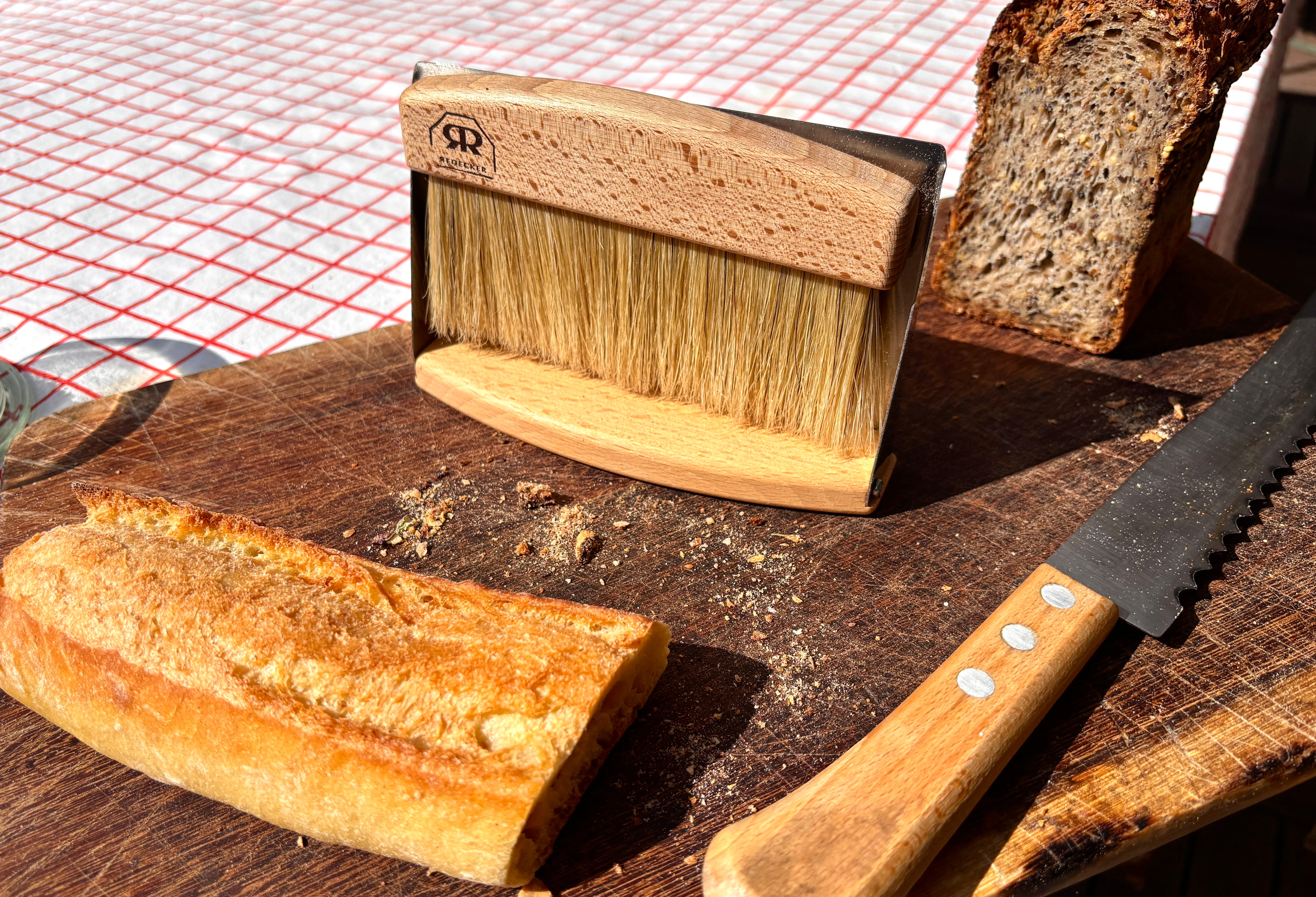
Search results turned up copies online but I found the website for the family-owned company that makes them, which was so engaging, and their brushes were so beautiful, I decided to spring for a handmade one. (The company’s website, Bürstenhaus Redecker, has every type of brush you can imagine.) When I was in Denmark, we happened upon a great kitchenware shop and I hesitated for about four seconds before picking one up.

Besides that it’s handmade by a family-owned business, there’s a lot to like about this brush. It stands vertically on the counter so takes up less space, and has a reassuringly strong magnet that snaps the brush into place, and it stays there.

I’m not sure where to get them outside of Europe. I noticed they have them on Amazon, and companies like Boston General Store and Flotsam & Fork carry the brand, but you may need to do some digging to find this one. Maison Empereur carries them in France, but they can no longer ship to the U.S. In the UK, they sell them here and here. If you can’t find one and resort to buying a copy, I won’t judge you…since I got carpal tunnel unearthing those links.

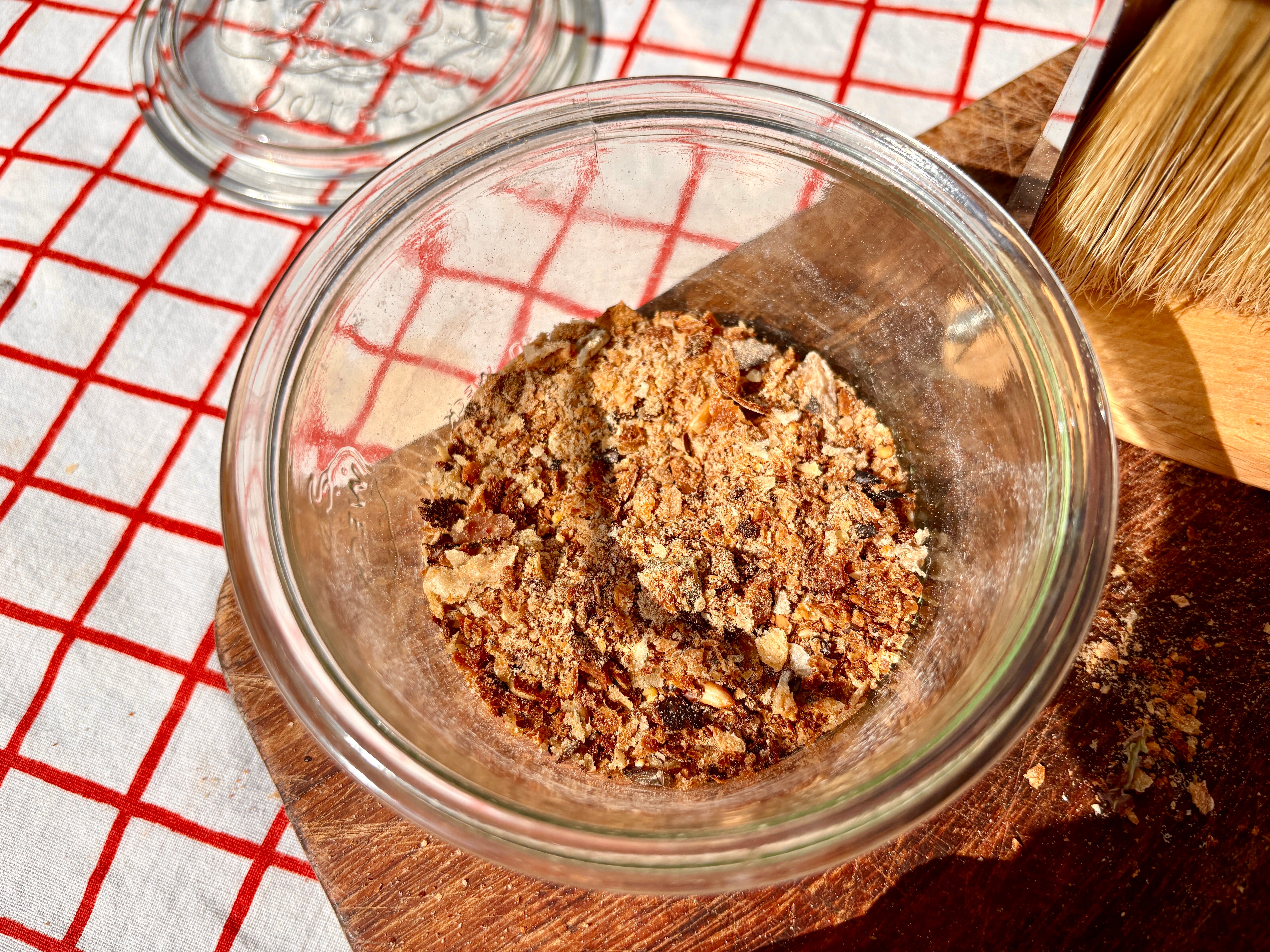
And being me, I am saving all the crumbs, which I hope quash any online kerfuffles about the price. I hope you collect enough of them to pay for the brush.

Subscribe now

As promised, below is the recipe for the dark chocolate Bouchons from The Great Book of Chocolate that I made in the Williams-Sonoma test kitchen. As you can see in the video farther above, we loved eating them, as did the crew who were filming us 😊…

Read more

Received — 29 July 2026 ⏭ David Lebovitz Newsletter

France Heats Up

29 July 2026 at 11:09

La chaleur (the heat) has been the topic du jour around here this summer, due to the record-breaking temperatures that made France hotter than the Sahara Desert. While that got a lot of international press, there’s something that no one’s been talking about: The success of hot sauce in France. And no one was more surprised about it than me.

Like it or not, stereotypes often contain a kernel of truth. Americans have a reputation for being loud. French people are thought to be rude. Anyone who’s lived above or even on the same street as a late-night café in Paris can tell you that there are some very loud Parisians. (Either that, or they’re Americans with an excellent command of French, and perfect French accents.) And the later it gets, the louder they get. And last time I was in the States, as an American, I forgot that people don’t stand as tightly together when waiting in line as they do in France (to prevent line-jumping), and I rudely cut in front of half of the line when I noticed a two-foot gap between two people and assumed that was the end of the line. Thankfully a woman yelled, “Um…SIR!!!” at me, tipping me off that there were other people waiting.

Subscribe now

It’s hard to paint any culture with an all-encompassing brush, but I will say with certainty that a lot of French people avoid spicy food. French diners in restaurants will ask the waiter, “Ça pique?” and demure against ordering anything on the menu that may pique their palate.

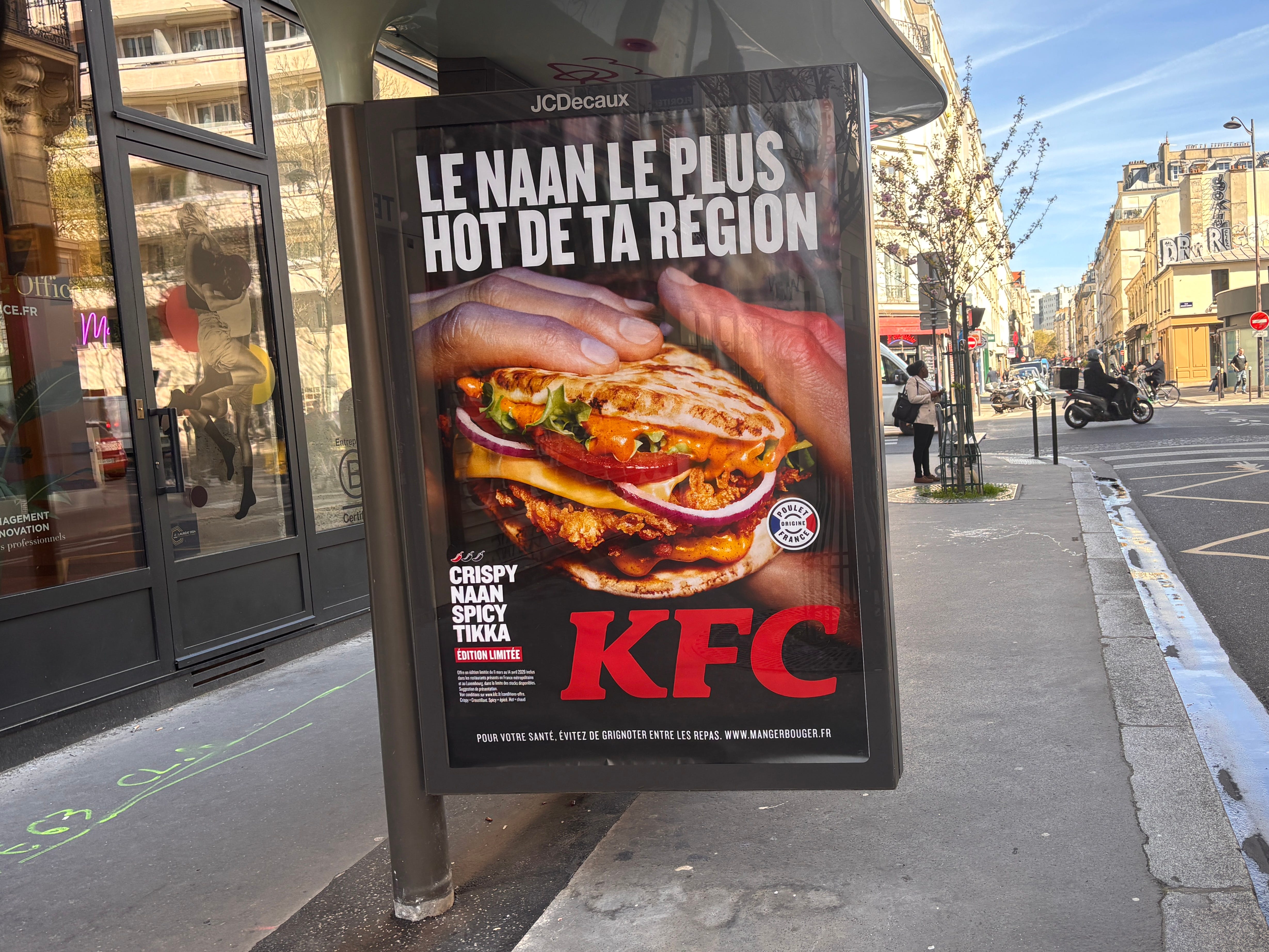
“The hottest naan in your region.” As for being the hottest sandwich in Paris, I don’t know if there is a lot of competition.

In restaurants, waiters will reassure customers that anything with chiles in it are of the variety that are très doux, very mild, and they ne piquent pas — they don’t bite. The last few times we ate at Le Servan, where items on the menu often feature a condiment where chiles are involved, invariably the server will warn us not to worry, they won’t bite. But with more authentic Asian restaurants popping up across Paris, many will use a little chili icon, or a row of icons, to denote the spice level of each item on the menu.

I was recently at an Asian restaurant where, when you order, they ask how spicy you want the food, on a scale of 1 to 3. The table of young Frenchmen next to me were quick to reply: “Zéro.”

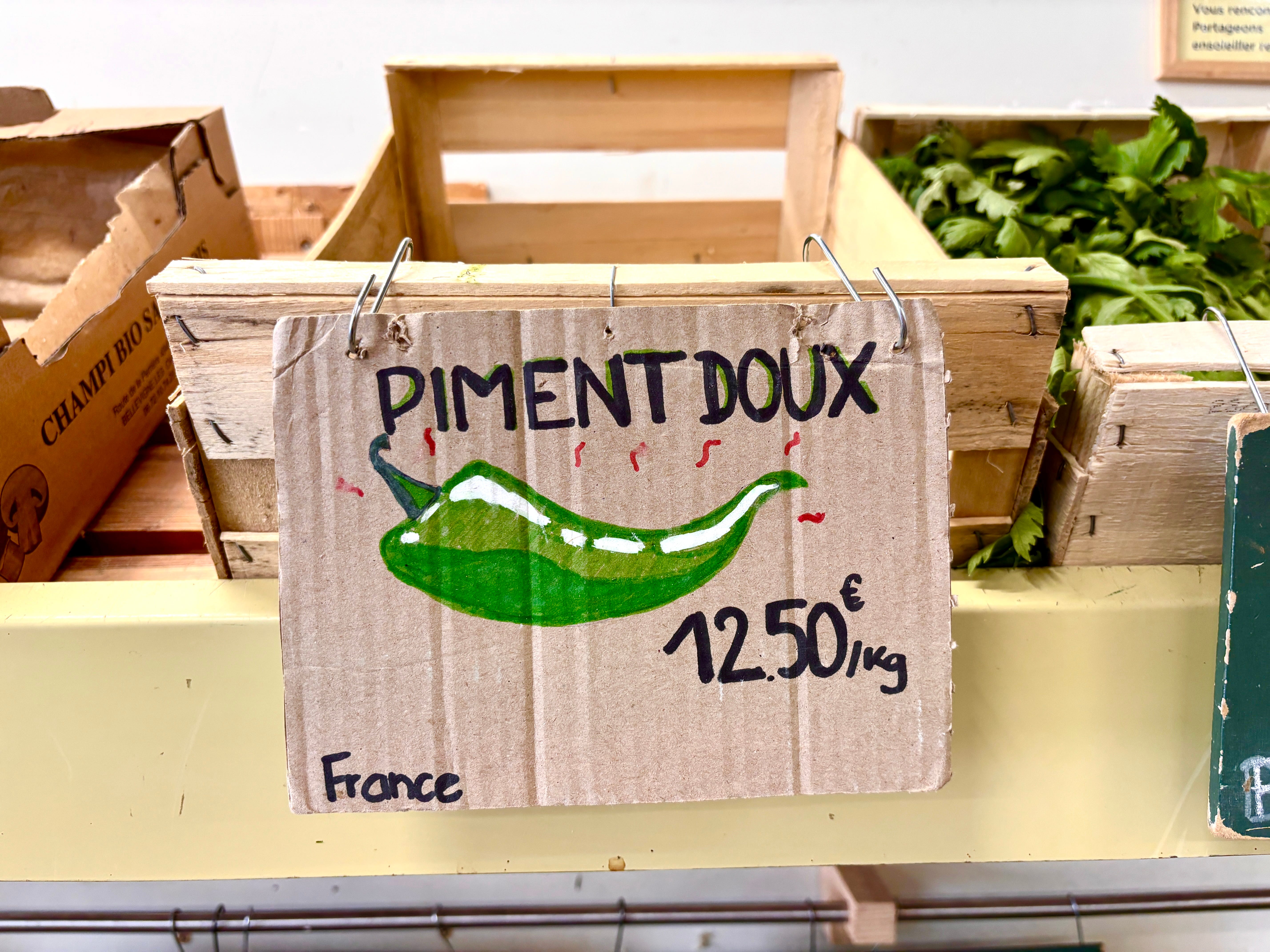
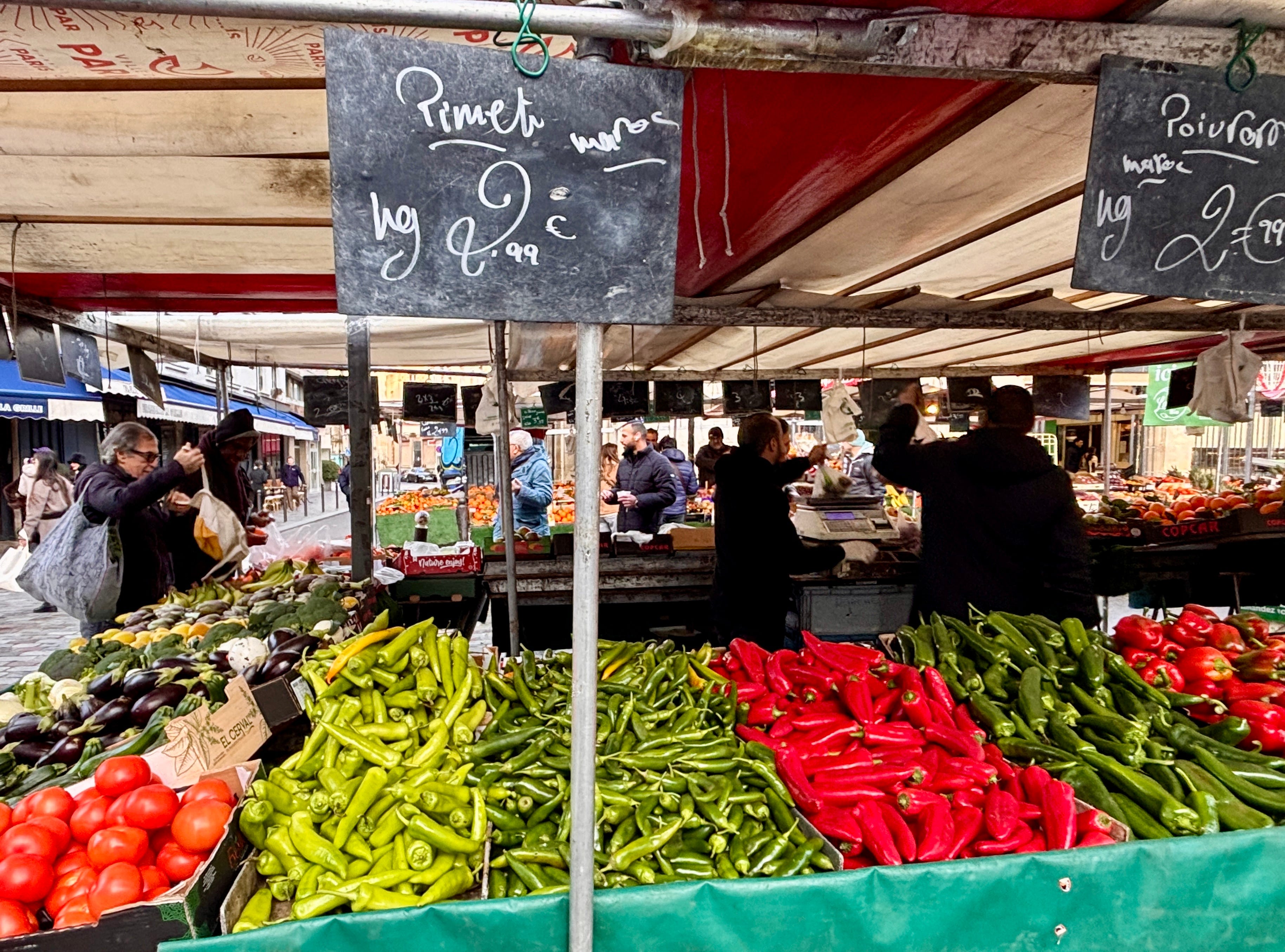
A variety of sweet (doux) chiles at the market in Paris.

When I’ve hit the markets looking for chiles that have a bit of heat to cook with, vendors are quick to (re)assure me that the peppers they are selling are doux, when it’s the spicy ones that I’m after.

I’ve been asked over the years why people in France don’t like spicy food, and here are some of my responses:

Read more

Received — 21 July 2026 ⏭ David Lebovitz Newsletter

Olive Oil Panna Cotta

21 July 2026 at 10:32

When I go to the U.S., I can only bring back three cookbooks* due to stringent measly luggage allowances. Getting anything delivered can be a challenge here, but nowadays, anything you receive will rack up customs, duties, and taxes. They used to be more lenient with books, but someone has to pay the bill for cleaning up the Seine, I guess, so why not make it cookbook collectors?

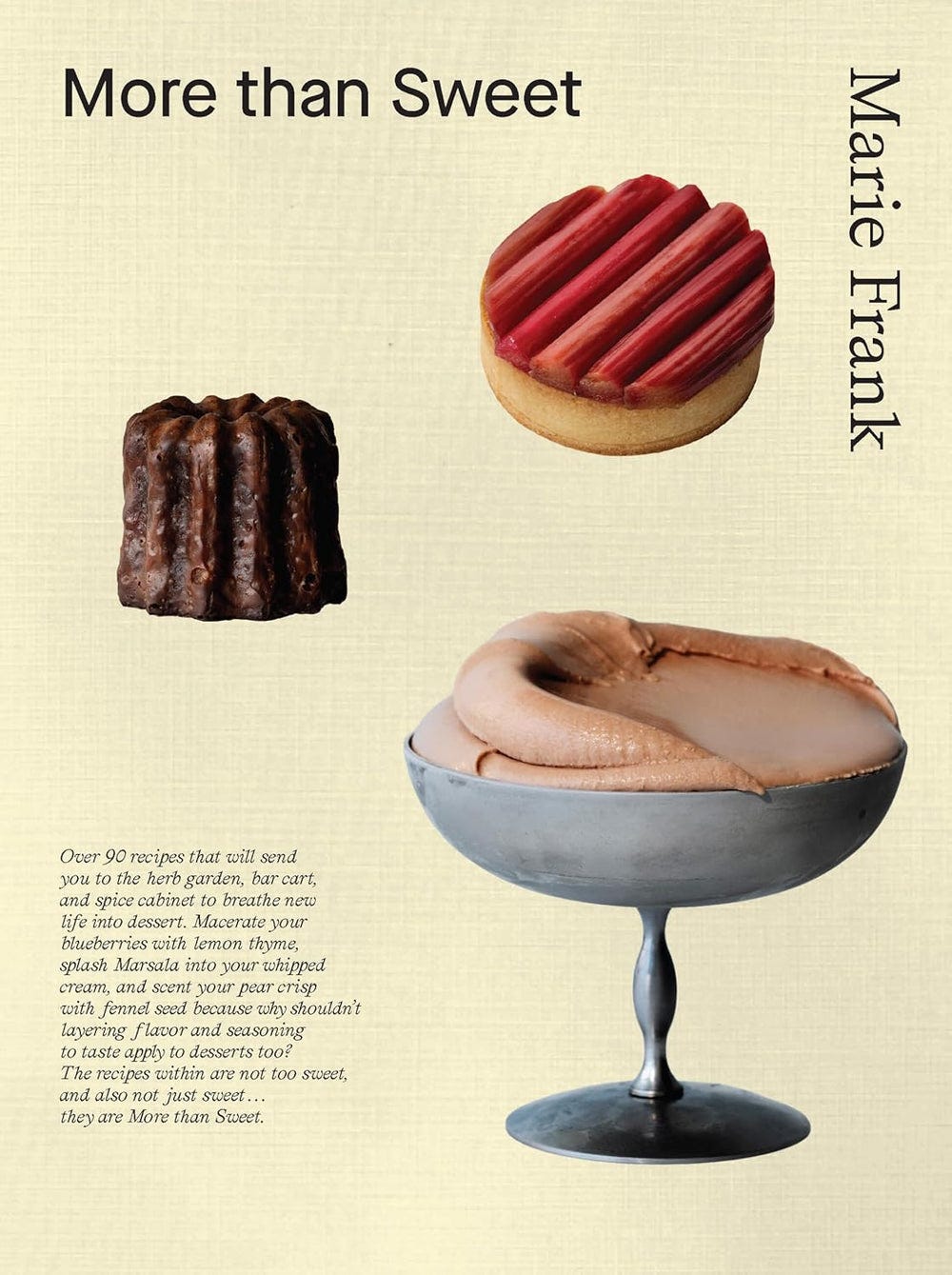
During book tours, such as mine in May for The Great Book of Chocolate, I’m usually at cookbook stores and find myself surrounded by cookbooks, and have to resist immersing myself in all of them. But alas, I can only bring a few back with me, and one was More than Sweet by .

I was not only intrigued by the striking photos and bold layout of the book, but appreciated Marie Frank’s creativity, which often blends the lines between sweet and savory.

As I dove deeper into the recipes, some of the ones I wanted to give a go contained at least one ingredient that I didn’t have on hand, and would be challenging to find. The braised cherries that were paired with this recipe called for one makrut leaf. The mango sorbet in the Vacherin called for a teaspoon of locust bean gum or fruit pectin (which is optional). Her gorgeous plum galette called for ground Sichuan pepper, and the hojicha snickerdoodles called for — yup — hojicha. But boy, do they sound good!

Subscribe to my newsletter to get recipes, videos, and more, sent right to your Inbox!

I was also intrigued by the addition of lots of lemon zest in the Miso-Lemon Chocolate Chip Cookies. But she makes a compelling case for the zest, saying it provides the perfect balance “among the savory, salty, and sweet” flavors, so I’ve got those bookmarked as well as the snickerdoodles with roasted green tea.

Marie Frank does begin the book with a treatise called How to Use This Book, which includes a passage: ”I strongly encourage you to change the flavors with the seasons or simply to suit your personal preferences,” which is reassuring to those who want to go off-script.

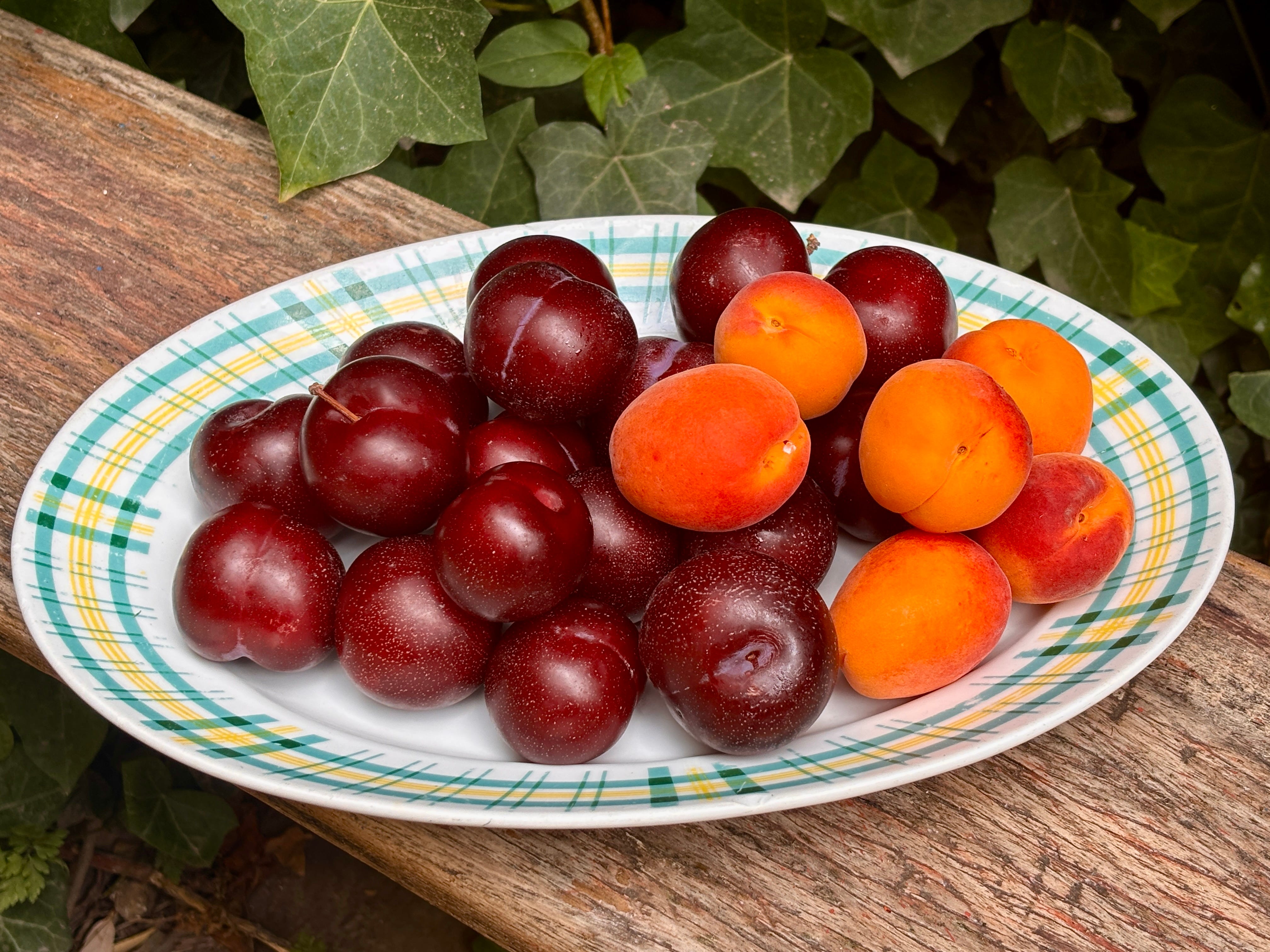
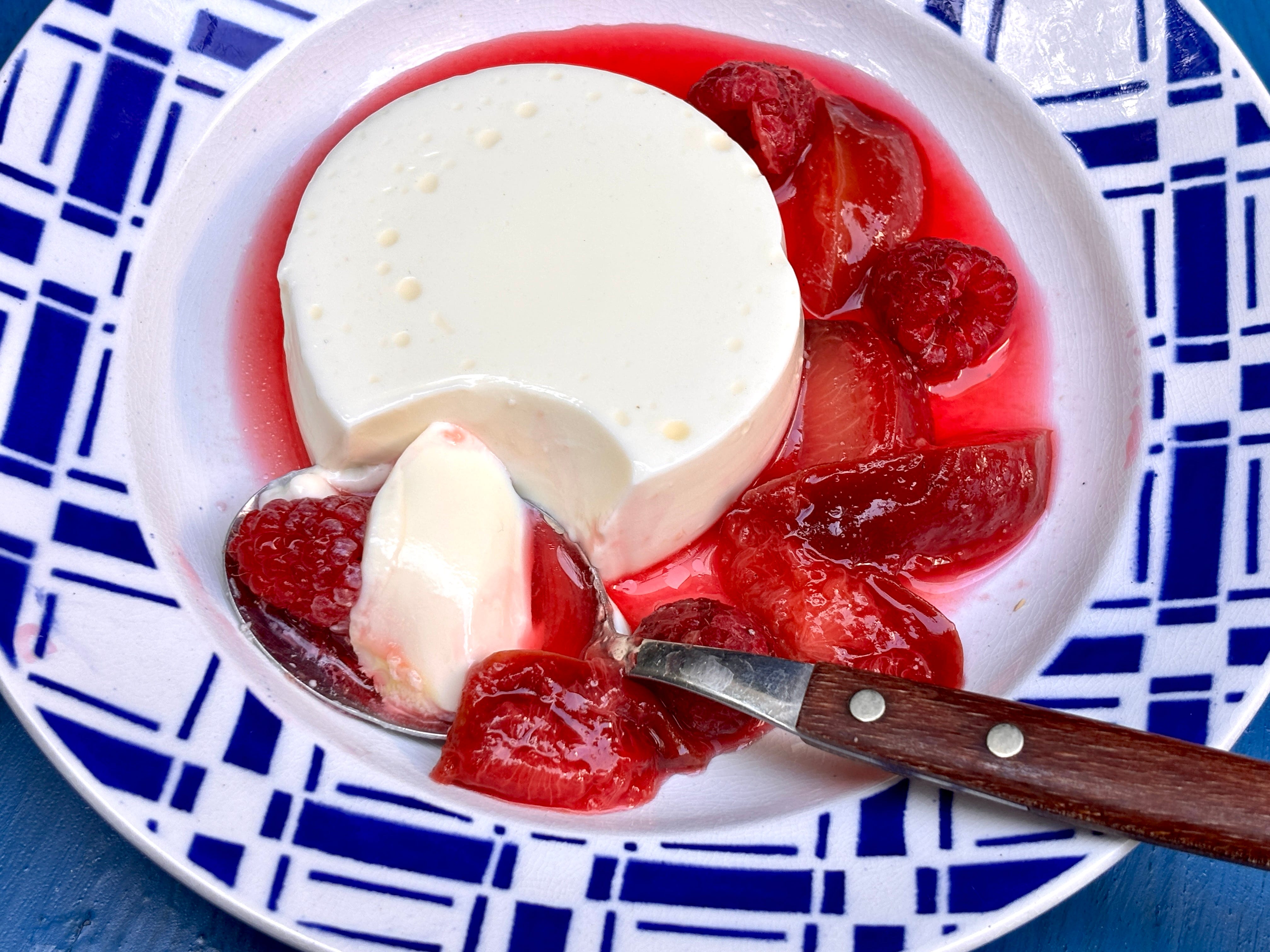
I decided to make the Olive Oil Panna Cotta because I always have olive oil on hand, and we’re also in the midst of summer fruit season and I had plums on hand, which I thought would pair nicely with the creamy dessert, rather than the cherries.

Leave a comment

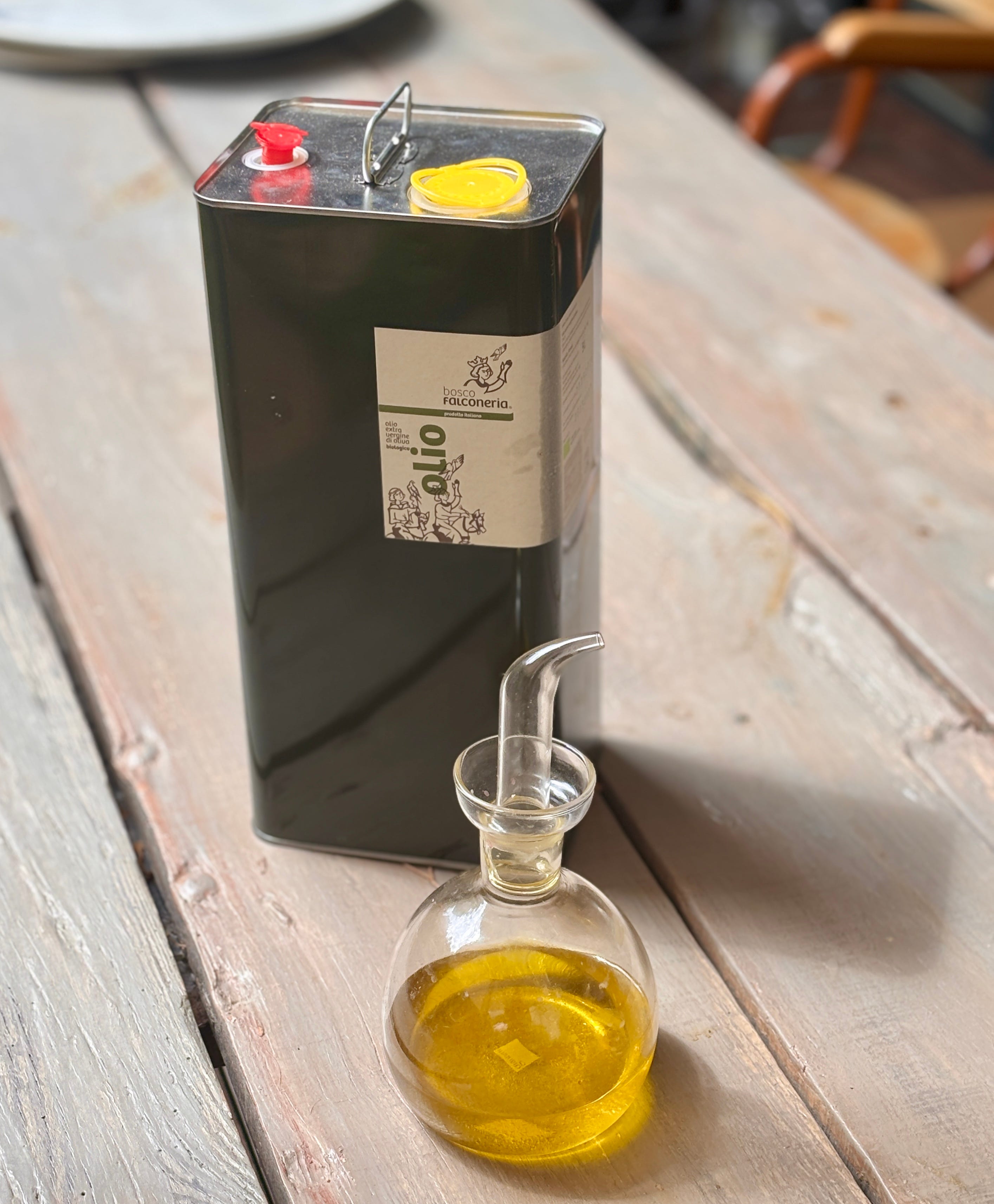
I’m often asked by readers about which olive oil to buy, which is difficult because a lot of the choices are based on where you live. When I moved to Paris, I lived above an olive oil store and just went downstairs with an empty wine bottle and filled it with one of the owner’s olive oils, which were stored in large tins with spigots.

Now I get my olive oil from friends in Sicily, which I buy in 5-liter (5qt) tins, and they only ship within Europe. Understandably, they like you to buy a certain quantity to make the shipping worthwhile. I used to get a whole bunch of friends together to make a large enough order for them to ship. But I often forgot who ordered what, or who’d paid and who didn’t. So I’m sure my poor accounting skills have given someone a complimentary tin of olive oil, at my expense.

[One good olive oil I tasted recently was Arkè extra-virgin, which they sell in consumer-friendly bottles and 2-liter tins. Good mail-order sources for olive oil in the U.S. are Market Hall Foods, Zingerman’s, and Corti Brothers.]

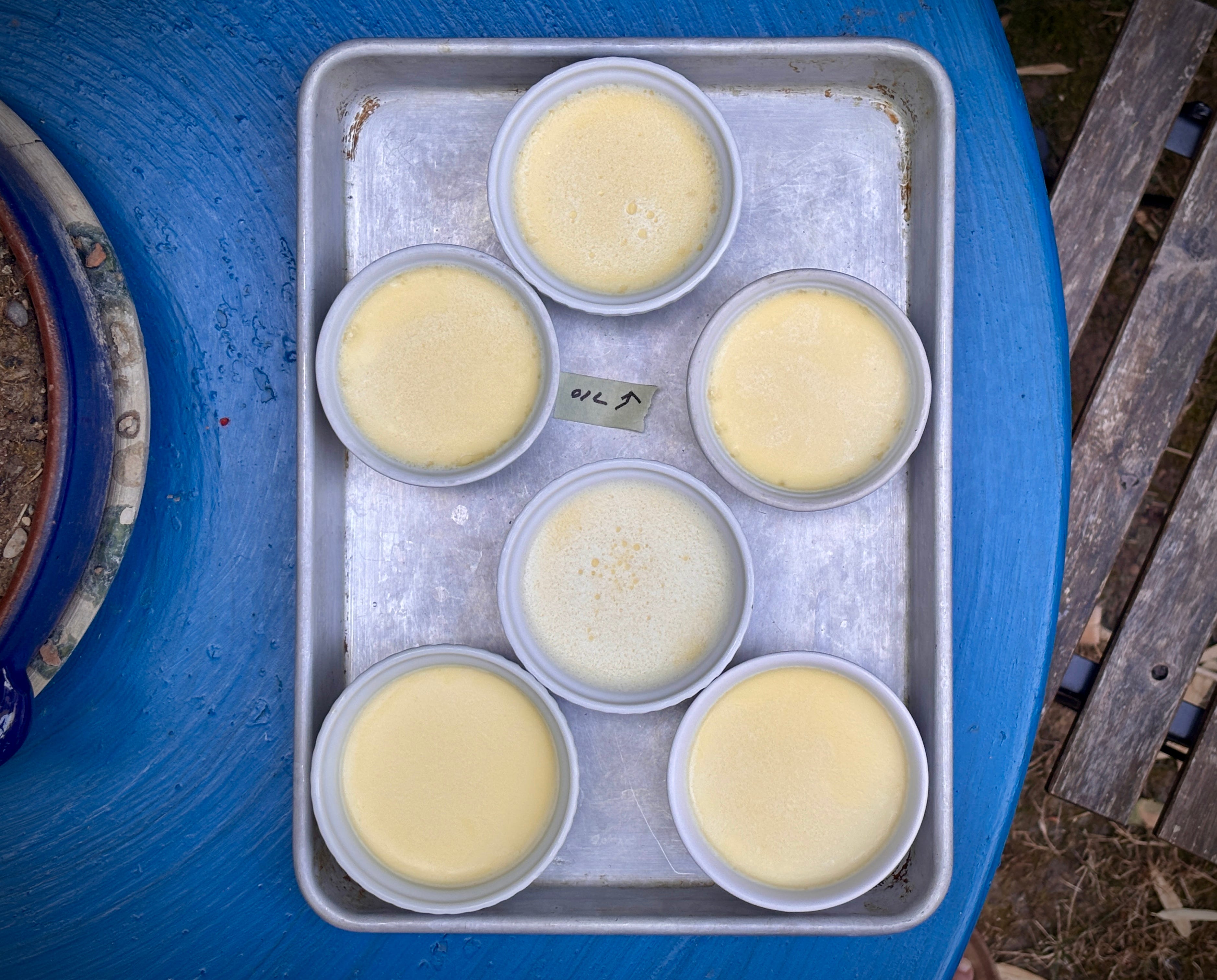
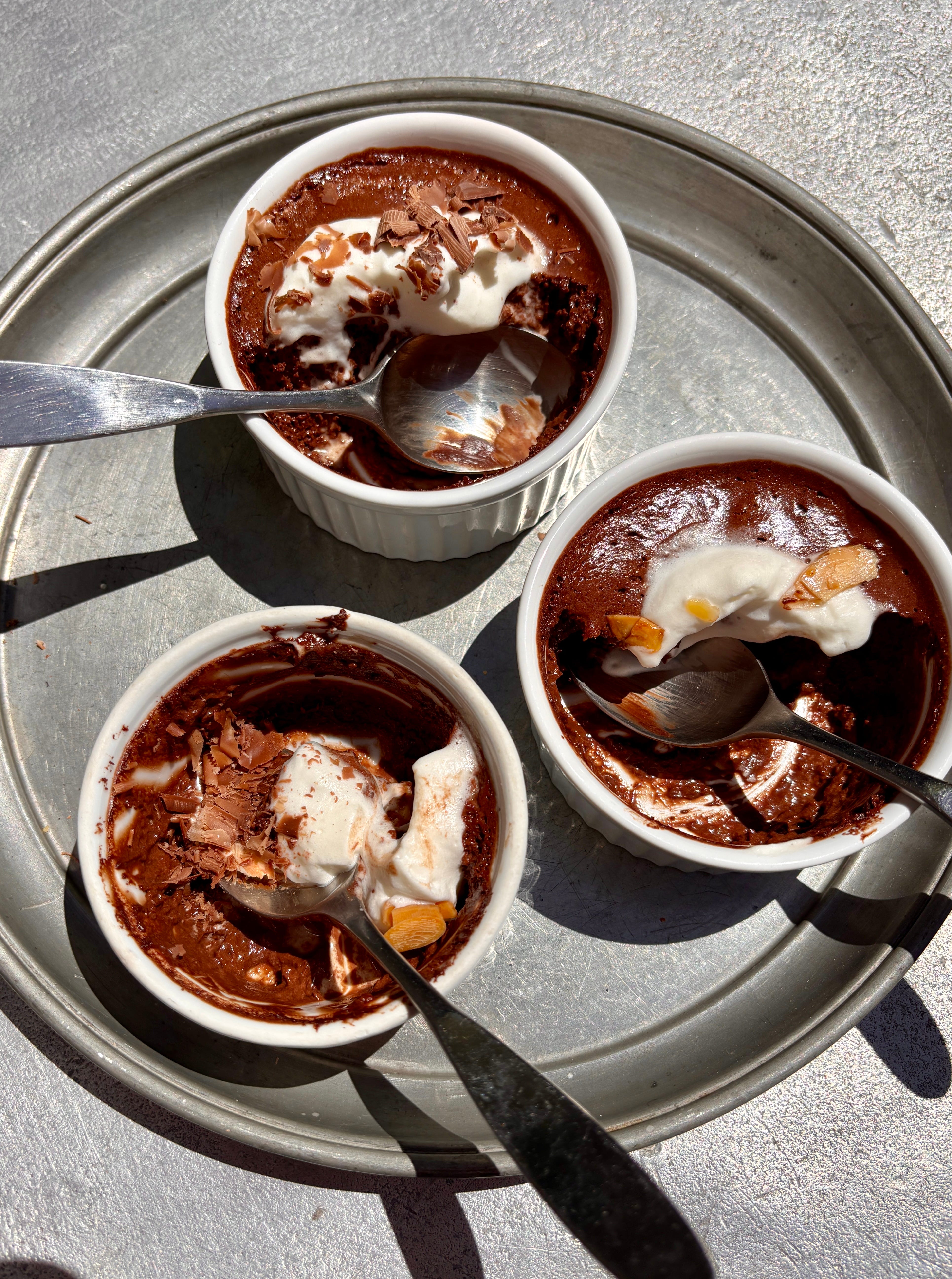
I also wondered about the recipe instructions, which said to pour water into the molds and then shake out any excess before filling them to prevent the panna cottas from sticking. I never tried that so thought I’d do an experiment, lightly oiling half of the ramekins, as I normally do, and using water on the other three, to see if there was a difference.

My tray with three of the oil-coated ramekins on one side, and the other three, on the other.

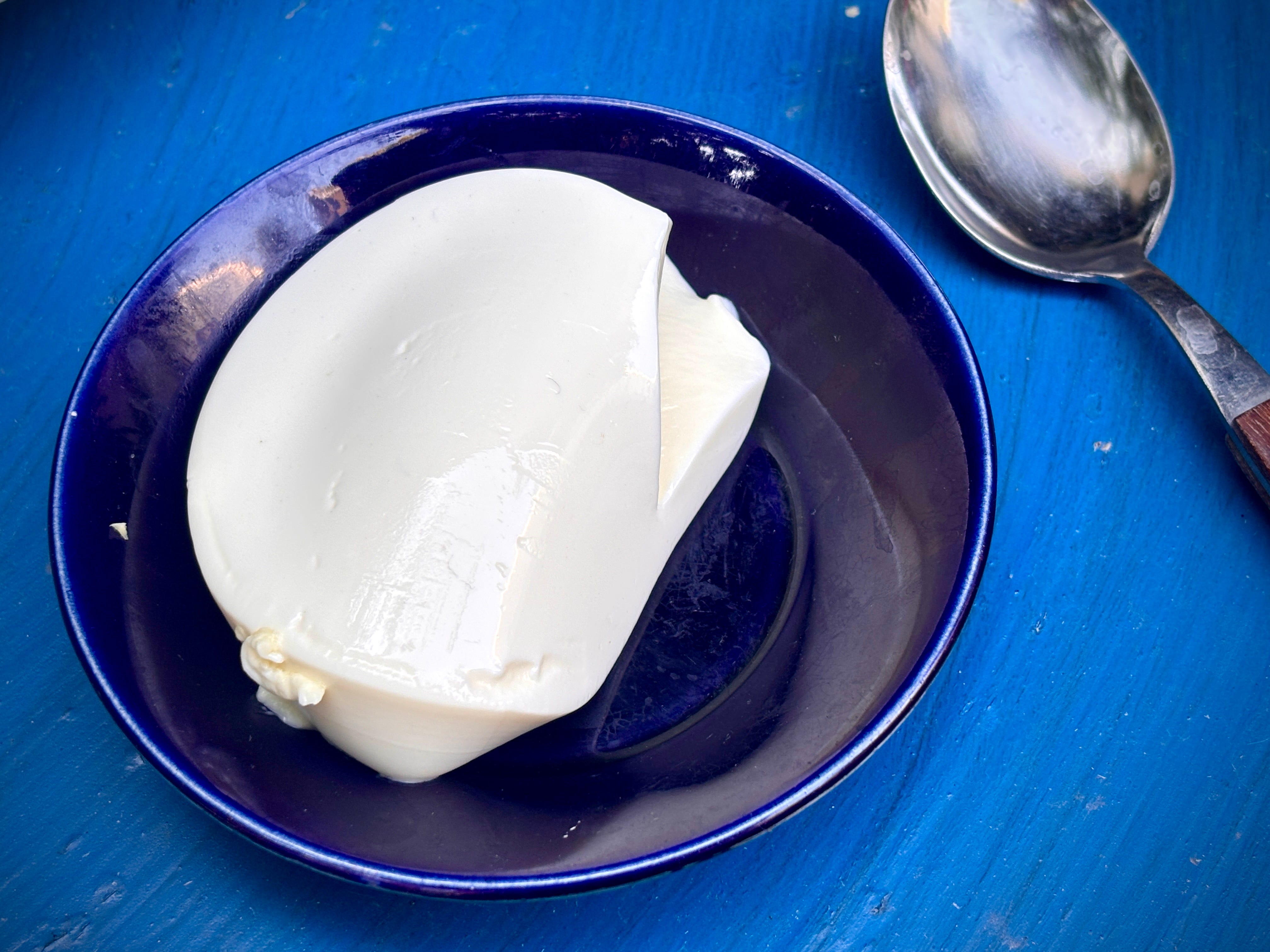
The next day when I went to unmold them, I realized I forgot to put water in the non-oiled ones. D’oh! Since we were in the middle of one of our many heatwaves this summer, let me tell you, strange things happen when the temperatures remain in the triple-digits for over a week and you get a little loopy. So I can’t tell if the water method works, but I do know the oiled ones slipped right out.

And, thanks to my inattentiveness, I also know that if you do nothing, they’ll come out a little floppy, above, but are equally delicious. And if you want to pour the mixture into glasses and serve it in those, there’s no need to do anything to prepare them before adding the panna cotta mixture.

I loved the texture and flavor of this olive oil panna cotta. We happened to be outside and I did think, looking over at our lemon verbena plant, “Hmmm…I wonder what this would be like infused with lemon verbena?” Or maybe a fig leaf or two?

Leave a comment

Olive Oil Panna Cotta

Six servings

Adapted from More than Sweet by

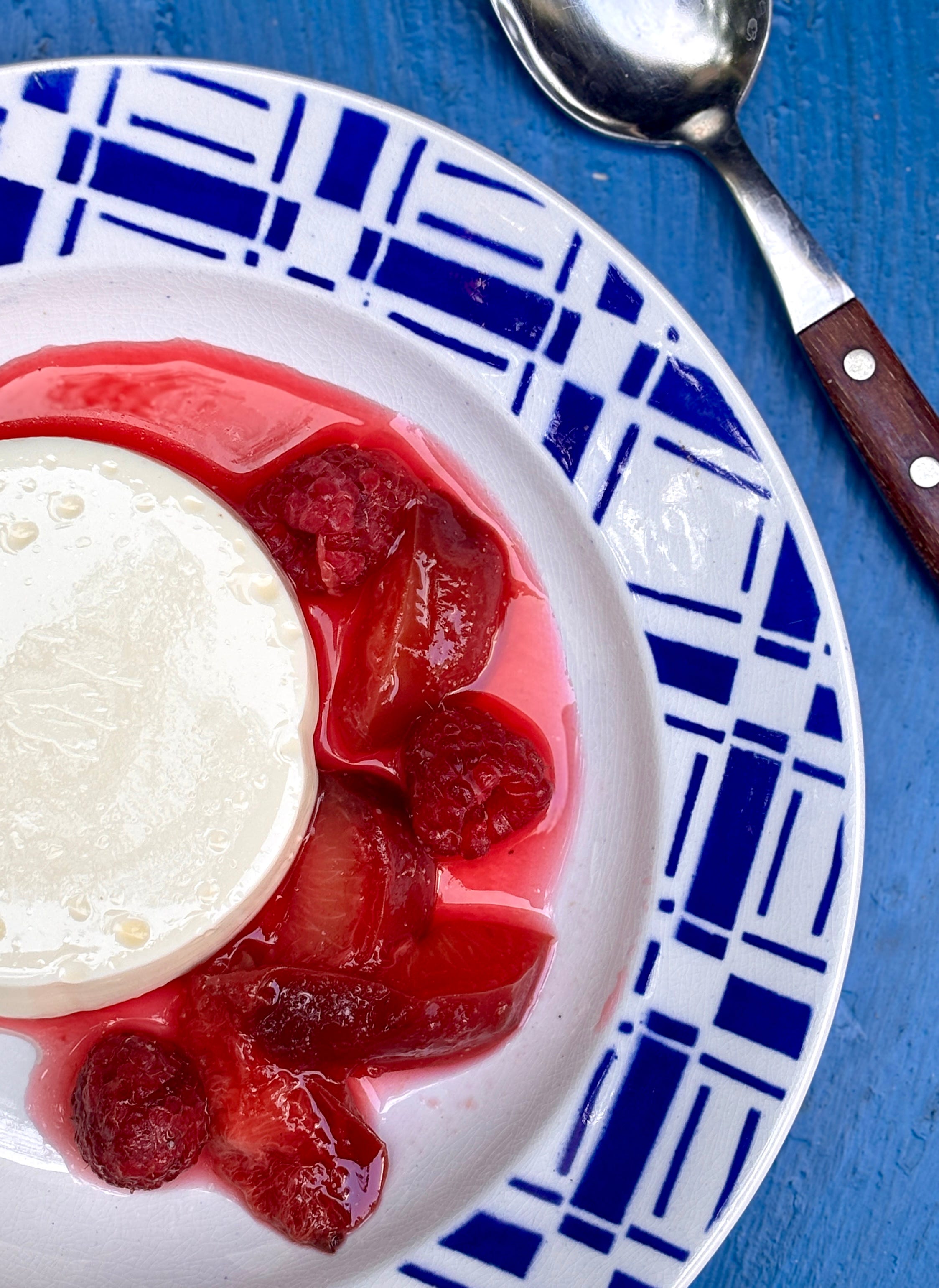
Panna cotta is the perfect summer dessert. It’s easy to make and goes well with summer fruits. She pairs it with braised cherries but I made the plum-raspberry compote from Ready for Dessert to go alongside, cutting eight pitted plums into eighths (or sixths, if small) and simmering them in 1/4 cup (50g) sugar, 1 cup (250ml) water, and half a vanilla bean, just until the plums are soft.

Once cooked, remove from the heat and stir in a basket of raspberries. I usually let it stand for an hour, but they’re even better if you let them sit overnight, refrigerated or at room temperature, which gives time for their juices to thicken. Other possibilities are apricot-cherry compote or oven-roasted figs.

How to Use Gelatin

For those who use sheet gelatin, Marie Frank says you can use 2 1/2 sheets of platinum gelatin, soaked in cold water, in place of the powdered gelatin. If you go that route, soak the sheets for about five minutes, wring out the excess water, then whisk them into the warm cream mixture until dissolved.

1 envelope (2 1/4 teaspoons, 7g) powdered unflavored gelatin

1/4 cup (60ml) cold water

2 cups (500ml) heavy cream

1 cup (250ml) whole or low-fat milk

1/2 cup (100g) sugar

1/2 cup (125ml) fruity extra-virgin olive oil

Big pinch of salt, preferably sea salt

In a small bowl, sprinkle the gelatin over the cold water and let stand 5 minutes.

Warm the cream, milk, and sugar in a medium saucepan, stirring until the sugar is dissolved. When the mixture just starts to bubble, remove from the heat and whisk in the softened gelatin, stirring until it’s completely dissolved.

Add the olive oil and a big pinch — what would call a “three-finger pinch” — of salt, then use an immersion blender to emulsify the mixture. If you only have a standard blender, let the mixture cool until it’s tepid, then blend.

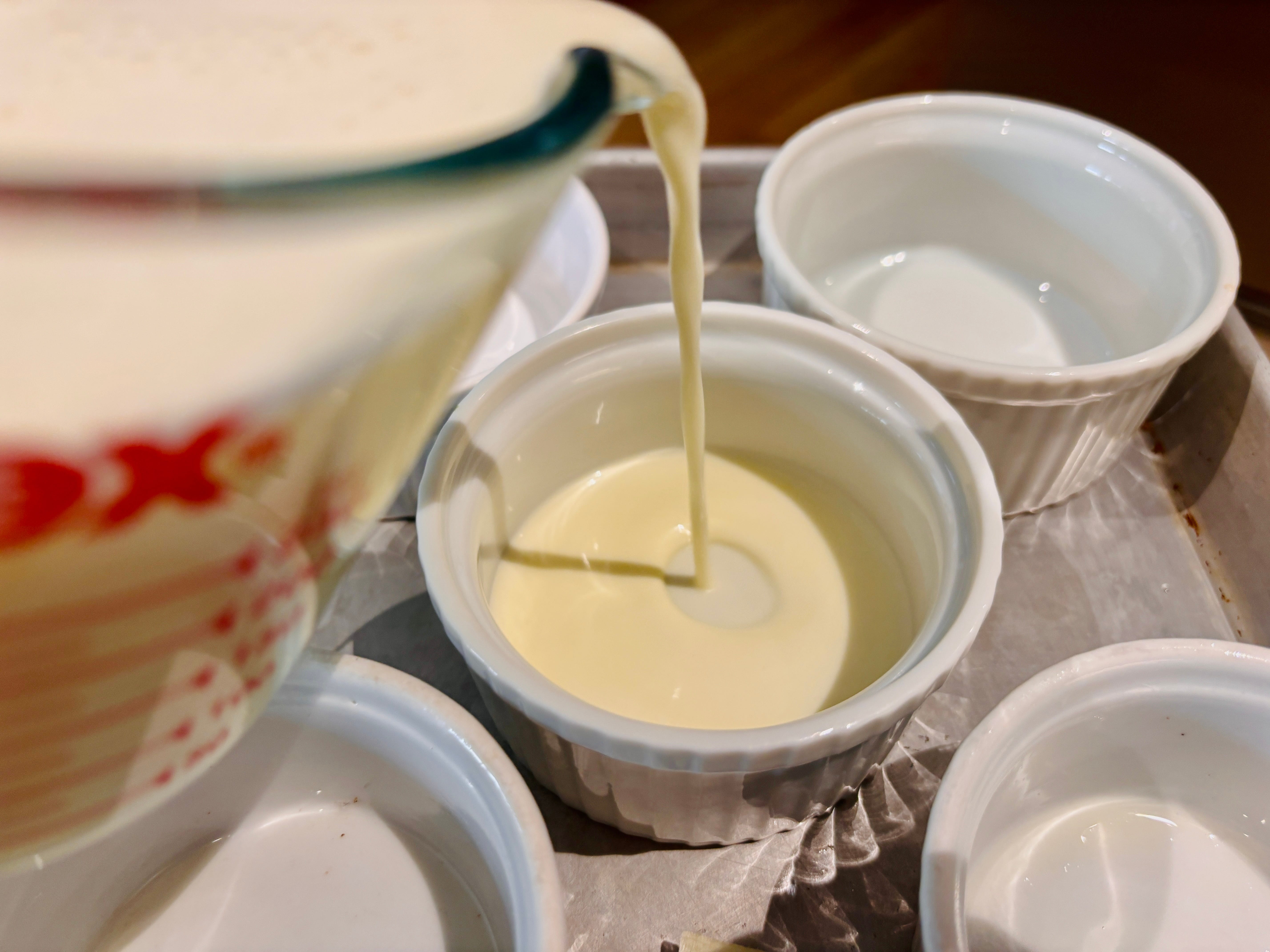
Lightly oil six ramekins or similar-sized custard cups with a very light coat of unflavored vegetable oil.** Or, you can assemble six serving glasses to use, which don’t need to be oiled since you’re not unmolding them.

Transfer the panna cotta mixture into a measuring cup or pitcher with a spout, and divide the mixture between the ramekins.

Chill the panna cotta for at least 12 hours, or overnight. To serve, run a knife around the outside of the panna cotta to loosen it from the sides of the ramekins, and invert them onto dessert plates. If they don’t slide right out, hold on to the ramekins and plates and give them a firm shake, which should loosen them enough to slip out.

Serve with a fruit compote, if desired. You could also serve them with shavings of dark or milk chocolate, or with a little pour olive oil on top and a few grains of flaky sea salt.

Olive Oil Panna Cotta
57KB ∙ PDF file
Download
Download
https://publishing.hardiegrant.com/en-au/books/more-than-sweet-by-marie-frank/9781964786124

*The hard thing about going on book tour is that I go to amazing cookbook stores and see all the incredible cookbooks and want to bring all of them back with me.

**As mentioned, the original recipe said to rinse the ramekins in ice water and shake out the excess, but don’t towel-dry them, rather than oiling them. My experiment didn’t work but if you try it, let us know in the comments how it works out.

Received — 16 July 2026 ⏭ David Lebovitz Newsletter
Received — 14 July 2026 ⏭ David Lebovitz Newsletter

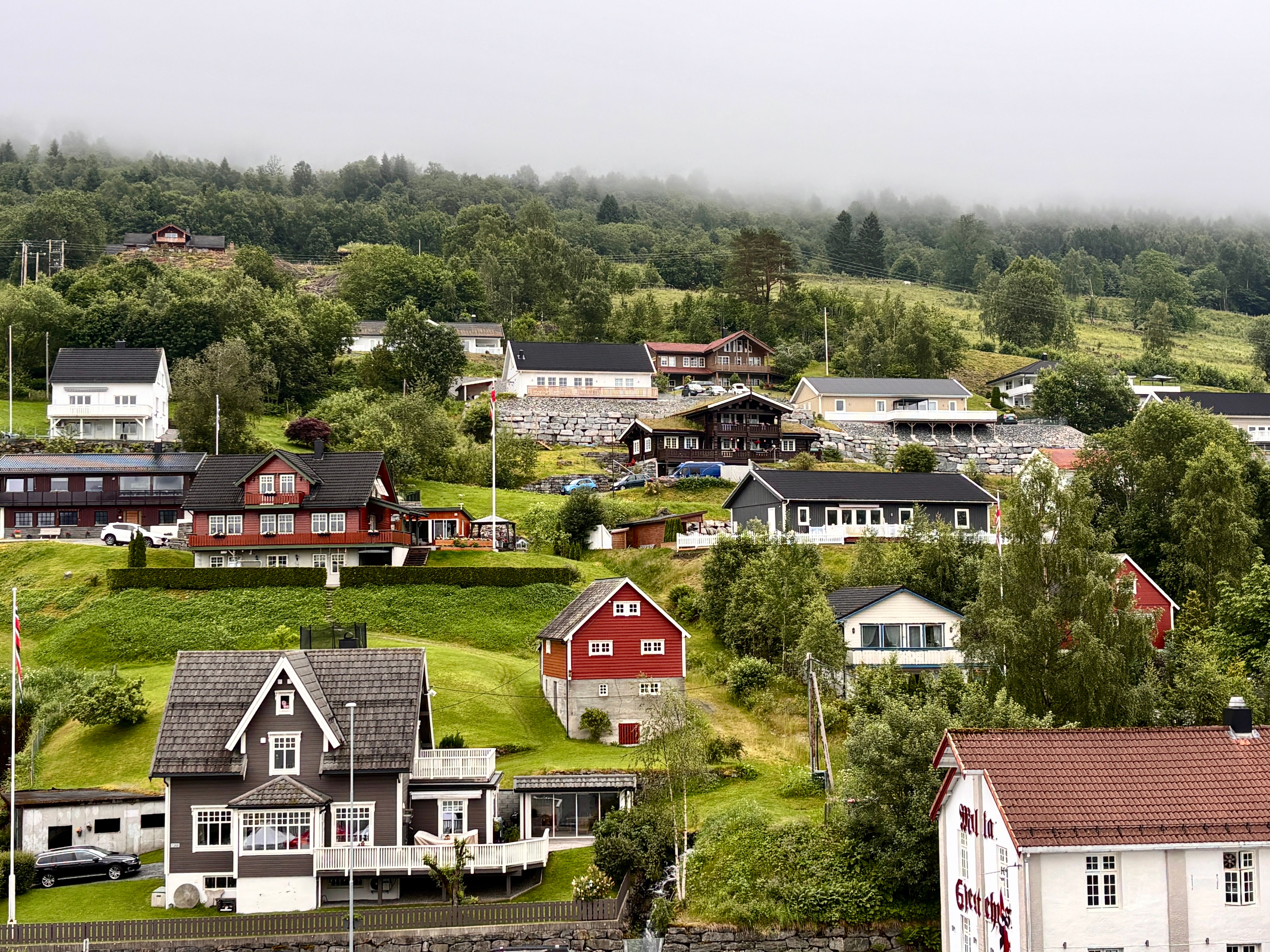
A Trip to Copenhagen and Norway

14 July 2026 at 16:12

As I mentioned in my last newsletter, Norway has been on my bucket list of places to visit in my lifetime. I’d heard about the magnificent fjords and wanted to see them before I kicked the bucket. (Thanks commenter Paul, for pointing out how we similarly, and oddly, use “bucket” in English.) Several friends kindly gave me lists of restaurants they recommended, but I nixed any place that served dinner as a lengthy tasting menu. I’m no longer interested in (is anybody?) sitting at a table for four hours while being presented with course after course of little things served on rocks, or in spoons, while the server carefully explains each one before you eat the little mouthful, then they whisk away your plate (or rock) and bring you another.

When people travel they often say they want to eat where the locals eat. But in a city like Copenhagen, which has less than one million inhabitants, or even Paris, anywhere that’s good is going to have a mix of visitors and locals.

It’s easy to get wrapped up in trying to eat at “the” places, although in most cities nowadays, you need to do a little planning and make reservations if you want to get a table for dinner. I tend to do a deep dive into a city while planning a trip, but most of this trip was meant to be relaxing. So the first part was a couple of days in Copenhagen, then we were scheduled to depart on a boat to see the Norwegian fjords, which left from the Danish capital.

A view from the Flåm Railway, in Norway.

Subscribe now

We’re not really cruise people, but the best way to see the fjords is by boat.

Read more

Received — 10 July 2026 ⏭ David Lebovitz Newsletter

Affogato

10 July 2026 at 10:41

It’s been hotter than heck in Paris, and we’re in the midst of our third heatwave. One way our friends in Italy beat the heat (and get their coffee fix) is to make affogato, a dish of ice cream “drowned” in espresso, with liquor sometimes added, giving it an extra kick.

Get Drinking French

I met Margot Lecarpentier when writing my book, Drinking French. Margot is the owner and head bartender of Combat, one of my favorite cocktail bars in Paris, and she stopped by to make a spirited affogato for me, under the shade of our fig tree.

Affogato is often made with vanilla ice cream but Margot asked me to make a batch of chocolate sorbet, which was perfect with the mix of liquors she stirred up.

Subscribe to my newsletter to get recipes, videos, posts, and more, sent right to your Inbox!

The amaro Margot chose, Rabarbaro Nardini, which is made from rhubarb and has a husky flavor that works beautifully with the other ingredients. There are a lot of amaros/amari out there, and ones such as Fernet-Branca, Braulio, and Dell’Etna, have their own distinctive vegetal notes. You could use one of those, or whatever is available.

Combat in Paris website

You can certainly change the other ingredients to your liking as well, such as swapping in amaretto for the coffee liqueur, or whiskey for the rum, although as I noted in the video, her recipe — as she made it — was truly the best affogato I’ve ever had.

[btw: In the video, you’ll notice some steam drifting across the table. That’s water for heating the ice cream scoop 😄, which helps make nicely-shaped scoops.]

Enjoy the affogato…and stay cool!

Follow Margot on Instagram

Affogato

Two regular servings, or one generous serving

In the video, we shared a generous scoop but you can use this recipe to make two individual portions; feel free to adjust quantities to your taste. Vanilla ice cream is the classic, but Margo thought it’d be fun to use my Chocolate sorbet, and her instincts were spot on.

3/4 ounce (20ml) of each; dark rum, amaro, and coffee liqueur

2 generous scoops, or several smaller scoops, of ice cream

2 shots of espresso

Mix together the rum, amaro and coffee liqueur in a small pitcher or measuring cup.

Put a scoop, or several scoops, of ice cream in two separate ice cream dishes.

Divide the liquor mixture over the two portions of ice cream and add a shot of espresso to each one.

Leave a comment

Want more chocolate? Check out my new book: The Great Book of Chocolate!

https://amzn.to/4ayO5Du

Get The Great Book of Chocolate

💾

Received — 6 July 2026 ⏭ David Lebovitz Newsletter

July 2026 Newsletter

6 July 2026 at 13:53
Classic chocolate mousse, from The Great Book of Chocolate

When you move to a foreign country, or even another city, one of the first things you need to do is find a doctor. It’s especially intimidating if you don’t speak the language and don’t understand the health care system, and don’t know how everything works. Twenty-five years later, I’ve learned that nobody in France fully understands how the French health care system works.

I was talking to a French insurance broker about that recently, and he said, surprisingly, that foreigners often understand the system better than native French people since they have to figure out how it works, whereas French people don’t really have to (or want to) understand it as it’s just part of their lives.

I was lucky to find a French doctor who spoke English, who also happened to be what I call a “legacy” doctor. Because she’d been working so long, she knew all the top doctors and specialists, and they knew (and liked) her. So I was always well taken care of when I went to a doctor who she referred me to. Most doctors in France have a different bedside manner than some of us might be used to.

A visiting friend from the States was hospitalized in Paris and he kept referring to doctors and nurses by their first names. No one said anything, but I could see them tighten up a bit when they were called “Pierre” or “Christine,” rather than “Monsieur” or “Madame.” I was thinking I should try that sometime, just to see what happens, or to see if it breaks the ice…but I’m not sure I’d get the same “pass” as he did, as a foreigner.

My doctor retired last month and I learned an important lesson: Find a doctor who is younger than you.

Subscribe now

It’s hard to find a généraliste, a primary care physician, in Paris, and I was fortunate to have one that was very engaged with me and my care. She did call me by my first name, unlike every other doctor I’ve been to in France, which I gave her a pass on since she knew me pretty well. Often she seemed more interested in talking about chocolate than she did about the rash on my thigh.

I managed to get some good material out of her, albeit a few stories that I wasn’t sure I could repeat. Once when I was removing my pants in her office, I sprained my finger. “Oh, you gay men and your skinny jeans…” were her words of consolation for my crooked digit. The one on my hand, that is. Another time she poked my tummy, which bounced back like Poppin’ Fresh, the Pillsbury doughboy, and told me I should lose some weight. If she knew so much about gay men, she would know that you should never, ever touch our stomachs if we’re over fifty. And my job is to eat. If I’m not eating, I’m not working. At least that’s what I keep telling myself.

We had our final appointment last month, which she booked specifically for me because she wanted to say goodbye. She’s going to be taking a big trip that includes Tahiti, Brazil, and Australia, and I told her that I was going to Scandinavia, which had been on my “bucket list.” She looked puzzled, so I had to explain in French why a travel list could also be a bucket. (Which I don’t understand either.) And although people in France don’t hug their doctors, I couldn’t resist doing so on my way out the door. And yes, I’m now wearing looser jeans, thanks to both of her observations.

Leave a comment

So now I need to find a new doctor, hopefully one that knows better than to touch my stomach. Hopefully, she or he will like chocolate as much as I do. Almost every woman I’ve met in France is happy to talk about chocolate, so maybe I’ll stick with women.

Right after the second weekend of June, we sailed off to Scandinavia. Being my life, of course, there was a one-day baggage handler strike planned at the Paris airports on the day of our flight. I was on turbo-hold with Norwegian Airlines for a little over an hour seeing if we could move our flight to the day before (discount airlines are great…er, until you need help), until I gave up. Then I had the brilliant idea to send our luggage ahead using Sendmybag.com.

Their website clearly explained the process and the price, which wasn’t super expensive - around $75-100 per bag - but then there were some additional dripping charges such as a tracking fee and a postage fee if you want luggage label holders mailed to you. And I was hit with $47 for a “fuel surcharge” due to the escalating price of fuel, which jacked up the price. But still, it was worth it. The only glitch was that the guy picked up the luggage a few hours before the designated pickup time. Thankfully I was home, and when any kind of delivery in France arrives (or in this case, departs), you breathe a sigh of relief.

I was a little nervous since deliveries are notoriously chancy here, but it worked, and our luggage was waiting for us when we arrived at our hotel in Copenhagen. Whew!

Part of an exhibition by French artist Sophie Calle at the Louisiana Museum, near Copenhagen. Worth the day trip!

Now that summer is in full swing, I’m doing my best to use all the beautiful fruits and berries I’ve waited all year for. One of my favorite recipes is this versatile fruit crisp, which you can adapt to any other fruits that are in season:

I also make a lot of jams in the summer, and one of my favorites is Strawberry jam, which we enjoy this time of year, but is especially welcome in the middle of winter. Everyone I know who is married to a Frenchman says that they are jam-eating machines. (Who knew that someone could plow through that much jam at one sitting?) So I hide a few jars, just to make sure they’ll be some in January.

As a jam-maker, I plow through plenty of jam jars and am always on the prowl for more.

Jam and Jelly Recipes

When we moved into our apartment, there was a very kindly older man who I’d see shuffling around in the hallway and mailbox area of our building. He moved slowly and would sometimes acknowledge me, and other times, not. Romain and I were often concerned that he might get preyed upon by people who roam around and when they see an elderly person looking dazed, go up to them and say they’re owed some money, and offer to take them to an ATM and help them withdraw some cash to repay them. 😡

So we kept an eye on him, until we stopped seeing him. Then, a few weeks ago, we met a man in our building who told us that was his father, who had passed away, and he’d come to clean out his apartment. Of course, like everyone in Paris, we’re interested in real estate (as well as being nosy neighbors) and asked to see it, before it hit the market. It wasn’t a large place and had a very modest Parisian kitchen. In spite of the balcony, and the view, my eyes were fixed on the empty jam jars in the kitchen. I guess the older you get in Paris, the more empty jam jars you amass — especially if you’re not a jam-maker and giving them away.

Even though we felt okay asking to see the apartment, the jam jars were a different story and I didn’t want to ask if I could have them. A few hours later, however, when I saw the fellow hauling bags of stuff out of the apartment and walking toward the garbage room, I heard the clanging of glass in the bags and asked if they happened to be jam jars and if so, could I have them?

So I’m now ready for summer.

https://www.davidlebovitz.com/book/the-great-book-of-chocolate/

Get The Great Book of Chocolate!

As most of you have heard, last month there was a vicious heatwave in France, with temperatures close to 44ºC/111ºF in one part of the country. While some say, “It’s hot in________ [fill in their city], too,” the heat is different here, and people aren’t prepared for it, nor is Paris adapted for it. We’ve had heatwaves since I moved here in 2003, but the problem with heatwaves is that once they’re over, people forget about them.

Anyone who’s been entangled in any sort of French bureaucracy call tell you that the French tend to be process-oriented, focusing on the process, rather than being solution-oriented. And anyone who’s been in France during the summer knows that air-conditioning is rare to nonexistent. But because things like to get discussed…and discussed and discussed…air-conditioning was talked about a lot more this year, and more people were buying them, even those who were convinced they’d get sick from them. (In spite of that, 2025 people didn’t survive this last heatwave due to heat-related illnesses. In 2003, that figure was nearly 15,000.)

Subscribe now

It’s a subject that comes up a lot and two good analyses from locals take a deeper dive into it: Paris is Boiling by and France has seen the future, and it’s an inferno by , which concludes that there’s a lack of a centralized plan of action,* which is unfortunate in a country that excels in coming together to provide for its citizens.

Norway

Somehow, I had the foresight back in March to plan our trip to Scandinavia, which coincided with the heatwave in France, so we missed it. (Non, je ne regrette rien.) In Norway and Denmark, it felt like summer in San Francisco: cool, overcast, and often foggy. But beautiful. We ate well and saw some magnificent scenery—those fjords! I was going to share more in this newsletter but I had to catch up on everything I set aside while on vacation, as well as finish Widow’s Bay. During one episode, there was a scene that actually made me jump off the couch. So I’ll write about our trip in a separate post, coming soon…

-David

Sign up below to get newsletters, with recipes, videos, podcasts, Paris travel tips, and more — sent right to your Inbox!

When “Chocolate” Isn’t Really Chocolate

When I was revisiting The Great Book of Chocolate, one thing that fascinated me in the world of chocolate was chocolate alternatives, which don’t contain a trace of cacao, or cocoa, so they aren’t really chocolate.

Many of us remember our old nemesis, carob, which traumatized a generation (possible paywall.) As part of that generation, I was curious to see it re-emerge, as well as to find chocolate alternatives made with sunflower seeds, fava beans, upcycled grape seeds, and malted barley. I ordered half a dozen of them to try and wrote more about them in the book.

I was initially put off by the smell of the one I got from Win-Win, which smelled like beans, but not cocoa beans. Still, I like to keep an open mind when writing books, and I baked the Individual Warm Chocolate Cakes from the book with the Win-Win Dark Chocolate Alternative and was surprised at the results, which I shared with my friend Margot, owner of Combat cocktail bar in Paris, who has great taste:

What you don’t see in the video is the aftermath of the three uneaten cakes, which Romain and I snacked on afterward, and I found myself lopping off bites of cake the rest of the day. So while I’m not ready to give up on real chocolate, it’s nice to know there are alternatives out there.

Leave a comment

Closing out here with a few of my favorite summer recipes that I wanted to share…

I can’t resist pasta any time of the year, and Pasta alla Norma uses summer eggplant and basil, which will transport you to Sicily. At least it has that effect on me:

A live video chat I did with prompted me to make his Lemon blueberry cake, which is punctuated with lots of juicy blueberries, blanketed under a brightly flavored, crunchy glaze:

Share David Lebovitz Newsletter

In my continued effort to promote white chocolate, which is the subject of some derision (lighten up, folks!), cocoa butter-rich white chocolate pairs perfectly with zippy fresh ginger, and this ice cream is a great accompaniment to a summer fruit crisp or cobbler:

It’s said that Pan bagnat is a salade Niçoise in a roll, which is pretty much the case. Filled with lots of raw vegetables, hard-cooked eggs, flakes of tinned tuna, and punctuated with salty olives, stuffed in a roll bathed (bagnat) with good olive oil, these summer sandwiches are perfect for picnics or backyard lunches. Do-aheaders will appreciate that they’re best made in advance:

If you like my Basil vinaigrette, give this Tarragon vinaigrette a try, especially if you have any overload of tarragon in your garden, as we do. It’s great drizzled over summer tomatoes or with grilled fish, chicken, or vegetables:

In fact, I served it for lunch today, with a composed salad of radishes, bonito, avocado, hard-cooked eggs with anchovies, green beans, and torn basil from our garden, which is thriving in this heat…

Share David Lebovitz Newsletter

*There is a plan to harness the water of the Seine and use that to partially cool down the city. Spoiler: The plan is scheduled to be completed in 2042 and the cost is estimated to be €2,6 billion/$2.9 billion; by 2050, temperatures in Paris could reach 50ºC/122ºF.

The geothermic cooling system didn’t quite work very well in the athletes village during the Paris Olympics and athletes were offered the opportunity to buy AC units for their lodgings. But hopefully the systems will improve over time.

Received — 5 July 2026 ⏭ David Lebovitz Newsletter

Moon Dust

5 July 2026 at 17:54

Americans seem to be obsessed with ultimates. Magazines, websites, and social media have made people think that the goal of everything is hyper-crispiness. Don’t get me wrong. I like crispy, too, especially when it comes to fried chicken, French fries, potato chips, baguettes, and fruit crisp toppings. I even spent a few months working on a proposal for a cookbook of recipes of only crispy foods, which I think was ahead of its time. I’m sure by now someone else has done it.

But one thing everyone wants to know is how to keep the bottom of pie dough crispy. News Flash: If you cover something relatively fragile with four-to-six times its weight of fruit (which is 90% water), and bake it for 30 to 45 minutes, you shouldn’t expect that layer of dough underneath to remain as dry as a Wasa bread.

I’ve never heard anyone in France asking (or complaining about) dough that’s not crispy on the bottom of a tart. And that’s in a country where complaining is the national sport. In defense of that, complaining in France isn’t considered a negative thing. It means that you’re exigeant, or discerning. So perhaps that’s why I fit right in.

Read more

Received — 2 July 2026 ⏭ David Lebovitz Newsletter
Received — 29 June 2026 ⏭ David Lebovitz Newsletter

Fresh Tomato Tart

29 June 2026 at 10:50

I’m away until the end of the month, traveling, and (fortunately) escaping the heat in Paris. Here’s a summer recipe I thought I’d reshare that’s easy to make, and captures the essence of the season. It’s definitely going on rotation when I get home! - David

Tarts, or galettes as they’re sometimes called, are a great way to use summer. I know some people are timid about making dough, but this dough couldn’t be simpler, and it’s very hard to screw up.

And if it’s warm where you are, it comes together in a flash. Just be sure to chill the butter and I know sometimes people chill the flour as well, but I’ve never done that. (I actually learned to make puff pastry in a hot restaurant kitchen, in the summer. So making this kind of dough seems to me like a walk in the park…)

Subscribe now

Regarding the mustard, to be honest, I’m more of a fan of Dijon mustard than Romain, who prefers the grainy type. But during the mustard shortage last year, we could only get grainy mustard, so I had a lot of that on hand. But I remain on team Dijon.

Share

I sometimes top the tart with slices of fresh ricotta before baking, and if you’ve got fresh corn, you can add that as well.

Subscribe now

With corn and tarragon

Summer Tomato Tart

Serves 8 (Although everyone always wants a second slice so realistically, it serves 4)

Polenta will make the dough a little less smooth to roll out, but I do like the taste and texture of the coarse bits of ground corn, so it’s worth it for the flavor. You can use fine polenta or cornmeal or additional all-purpose flour (or a whole-grain flour, such as teff or buckwheat) in place of the polenta if you want to leave it out.

I love fresh ricotta with this tart, but you could try it with another cheese that’s relatively moist but won’t melt into a puddle, such as feta or provolone.

I’ve added corn kernels to this tart before baking when I had a hankering for corn. (Fresh or frozen will work.) You can finish the tart with fresh herbs, such as basil, tarragon, savory, or parsley.

For the dough

1 1/4 (175g) cups all-purpose flour

1/4 cup (35g) polenta or cornmeal

2 teaspoons sugar

1/2 teaspoon salt

3 ounces (85g) unsalted butter, chilled and cubed

5 tablespoons (70ml) ice water, plus more if necessary

For the tart

1/4 cup (60g) Dijon or whole-grain mustard

3 medium tomatoes (~1 1/2 pounds)

Salt and freshly ground pepper

6 ounces (170g) whole-milk ricotta

1 1/2 tablespoons melted butter

Parmesan cheese

To make the dough, mix together the flour, polenta, sugar, and salt in the bowl of a stand mixer fitted with the paddle attachment, or make it by hand by putting the dry ingredients in a medium bowl (and use a pastry blender or your fingers to mix the dough). Add the cubed, cold butter and mix until the pieces of butter are the size of large corn kernels. Add the water and continue to mix until the dough starts to come together. Use your hands to gather the dough and shape it into a disk. If the dough feels too dry to do that, add more water, 1/2 tablespoon at a time, until it comes together. Wrap the dough in plastic wrap or your favorite eco-friendly alternative and chill for at least an hour. (The dough can be made up to 3 days in advance.)

To make the tart, remove the dough from the refrigerator. Unwrap it and, holding the disk of dough perpendicular to the counter, rap the sides of the dough on the counter, turning it as you go, to soften the edges, which helps them stay together and not get too ragged when you’re rolling out the dough.

On a lightly floured countertop, roll the dough out to a 14-inch (36cm) circle, turning the dough and sprinkling more flour on the counter and the dough to keep it from sticking as you’re rolling.

Place the dough on a baking sheet lined with parchment paper or a silicone baking mat. Preheat the oven to 400ºF (200ºC) while you assemble the tart.

Spread a layer of mustard on the dough, leaving a few inches/centimeters empty around the perimeter, which you’ll fold over the filling later.

Slice the tomatoes about 1/3-inch (1cm) thick and layer them in concentric circles, overlapping them a little, over the mustard. Sprinkle the tomatoes with a little salt and freshly ground pepper. Fold the edges of the dough over the tomatoes to make an outer crust.
Place chunks of ricotta cheese over and, in some places, partially tucked under the tomatoes. Brush the edges of the dough with melted butter and grate Parmesan cheese over the entire tart, including the crust.

Bake until the tomatoes are soft and cooked through and the crust is dark golden brown, about 35-40 minutes. Slide the tart off the pan onto a wire rack and let cool for about ten minutes before serving.
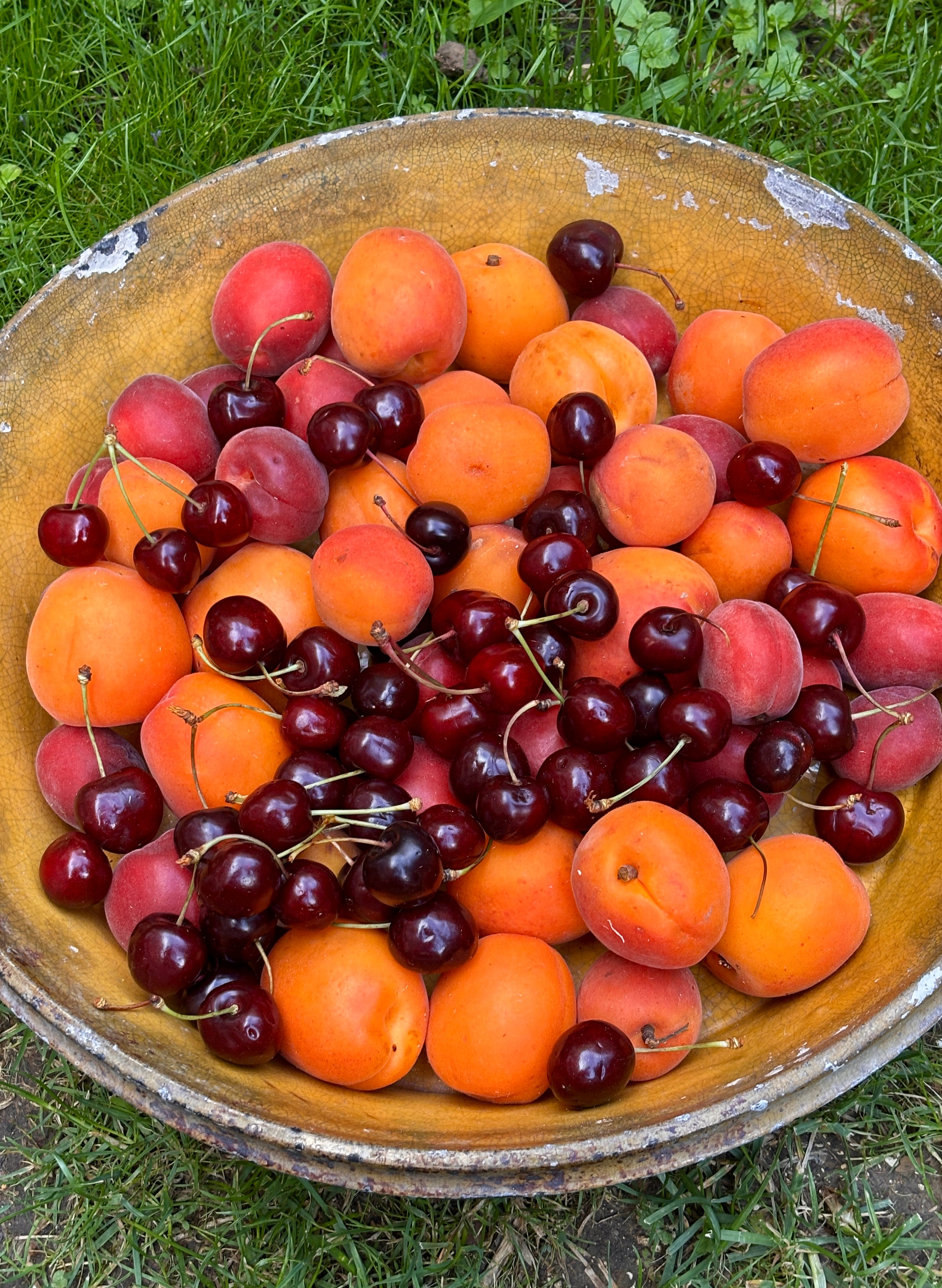
Summer Tomato Tart Recipe
92.5KB ∙ PDF file
Download
Download

Share David Lebovitz Newsletter

Subscribe to my newsletter to get more recipes, stories, and Paris travel tips. Free subscribers get some posts, and paid subscribers get all posts and the ability to participate in the community of commenters!

Received — 20 June 2026 ⏭ David Lebovitz Newsletter

Chocolate Mole Brownies

20 June 2026 at 09:07

I met Carlos Moreno when he was delivering taco kits during the pandemic, when we all wanted to eat “out,” but were stuck eating in. Prior to that period Mexican food wasn’t well represented in Paris. (A lesser-known fact is that France tried to colonize Mexico twice in the mid-1800s.) I loved Carlos’ food and we had a few nice conversations on the sidewalk when he made his deliveries.

Since then he’s gone on to open his own restaurant in Paris, Comer. As I mention in the video, you might not think you want to go to a Mexican restaurant in Paris, but I can assure you that yes, you do. It’s really, really good.

Follow Carlos on Instagram

His cooking is based in traditional Mexican fare with lively moles and amazing salsas, as well as a menu that changes based on the season and what’s available, which includes tostadas with raw tuna crudo, peas and citrus, tacos with pork al pastor, a mille-feuille of fresh tomatoes with housemade salsa macha, and a truly melt-in-your-mouth horneado of beef. One item on the dessert menu that’s a particular favorite are his mole brownies, which are slightly spicy, and served with a vanilla atole sauce and mezcal.

I was happy that when I asked Carlos to stop by and make his famous brownies with me, he said yes. We didn’t make the vanilla atole sauce (you can find my recipe here), which he spikes with mezcal at Comer, but the brownies were delicious all on their own. I hope you enjoy them as much as we did making them!

Comer Paris website

And if you’re in Paris, Comer is some of the best Mexican food you’ll ever have, anywhere.

Comer
96 rue d’Hauteville (10th)
Paris

Leave a comment

Subscribe to my newsletter to get new posts, recipes, videos, Paris travel tips, and more, sent right to your inbox!

https://www.davidlebovitz.com/book/the-great-book-of-chocolate/

Get The Great Book of Chocolate

💾

Received — 13 June 2026 ⏭ David Lebovitz Newsletter

Apricot Cherry Crisp

13 June 2026 at 07:31

A few days ago I ran into our neighbor, who kindly invited us for dinner this weekend. She was the first neighbor we met in the building, over our shared back wall, and we hit it off, right off the bat. People in Paris can have complicated (or, um…thorny) relationships with neighbors, which I wrote about in my book L’Appart. But we scored with this one. We now trade keys, look after each other’s apartments when one of us goes away, accept packages for each other, and even call on each other if there’s an emergency.

I offered to make dessert and decided to scoop up as many of the beautiful fresh apricots I could find, let them ripen a few days, and turn them into a fruit crisp, which are called crumbles in France. That’s a term picked up from our neighbors in England — un crisp doesn’t come off the tongue as readily as un crumble, but both sound a little funny to me with a French accent. But now that I’m on the 🇫🇷 team here, I call them crumbles, too.

But for now, I’m going to write them as crisps, and this is my favorite, go-to crisp topping. What makes it extra-crisp is the addition of polenta. It’s from my book Ready for Dessert, which is subtitled my “best” recipes, and it really is the best crisp topping, if I do say so myself.

https://www.davidlebovitz.com/book/ready-for-dessert-revised/

Get Ready for Dessert

I use very coarse, stone-ground polenta since that has the most crunch, although regular polenta works well, and while I’m not as much of a fan of instant polenta as others are around here, that works too, as does cornmeal. As for the nuts, I generally go with almonds since they go well with stone fruits, but you can use walnuts or pecans if you prefer.

When I wrote my first book, back in 1999, I assumed people didn’t have food processors, although I think they may be more common these days? My KitchenAid food processor* has a broken bowl so the handle is filling with gunk, and they don’t sell replacements. I miss having a classic Cuisinart food processor, which I had in the States, and it was really a workhorse in the kitchen. (Even Wirecutter agrees with me.) But they’re not available in France.

I’m thinking of springing for a Robot-Coupe, although with a starting price of €1200 ($1390) 💸 I’m going to hang on to my food processor until the day dies, then consider my options.

Leave a comment

While I prefer to mix the topping in a food processor, you can also mix it in a stand mixer with the paddle attachment, or by hand if you chop the nuts first. When I make it, I pulse all the dry ingredients until the mixture is sandy, then add the butter and pulse it rapidly a few more times, just until I see small clumps sticking together. I like large, discernible bits of crisp topping in the finished crisp rather than a smooth, sandy texture.

Subscribe to my newsletter and get more recipes, posts, and Paris travel tips, sent right to your Inbox! Paid subscribers get full access to all posts as well as the recipe archives.

Ice cream, of course, is the preferred pairing with a warm fruit crisp. I just happen to have a lot of ice cream in my freezer at the moment, but the one I’m going to bring is the leftover apricot kernel oil ice cream that I made to impress a chef friend who came to make an upcoming video with me.

Ice Cream Recipes

That was one of those recipes I shared back in 2008, when a few companies were making apricot or plum kernel oil, which has become harder to find. Some of it is sold for cosmetic purposes and isn’t intended for food use. I used the last of my bottle, but Vanilla, Cinnamon, White Chocolate-Fresh Ginger, or Malted Milk ice cream are great accompaniments, or just serve the crisp warm with a pitcher of cold heavy cream on the side.

Leave a comment

Apricot Cherry Crisp

Eight servings


We’re fortunate to have a lot of fresh apricots available to us right now, but if you want to swap in slices of nectarines or peeled peaches, reduce the sugar in the filling to 2 tablespoons. In place of the cherries, feel free to swap in blackberries, blueberries, or raspberries, or just use more apricots.

In place of the kirsch and almond extract, you can use 1 teaspoon pure vanilla extract, total. You can make the topping up to one week in advance and refrigerate or freeze it.

Topping

3/4 cup (110g) flour

2/3 cup (100g) polenta

1/2 cup (65g) lightly toasted almonds, walnuts, or pecans

1/2 cup (90g) packed light brown sugar

1 teaspoon ground cinnamon

1/4 teaspoon salt

8 tablespoons (4 ounces, 115g) unsalted butter, cubed and chilled

Filling

6 cups (3 pounds, 1.4kg) sliced, fresh apricots (cut into 1-inch/3cm) slices

1 cup (200g) pitted fresh cherries, sweet or sour

1/3 cup (65g) granulated sugar

1 1/2 tablespoons flour

2 teaspoons kirsch

1/8 teaspoon almond extract

Ice cream or heavy cream, for serving

Make the topping by pulsing together the flour, polenta, nuts, brown sugar, cinnamon, and salt, just until the nuts are slightly broken up. Add the cubes of cold butter and pulse until the butter is well integrated. Pulse a few more times until little bits of the mixture begin to clump together.

Preheat the oven to 375ºF (190ºC).

To make the filling, in a medium bowl, mix together the sliced apricots, cherries, sugar, flour, kirsch, and almond extract. Spread the fruit into a 2-quart (2L) baking dish, then strew the crisp topping evenly over the fruit. Resist the urge to press it down so it’s completely flat; I think it’s best when it’s a little unevenly baked, so you get lots of crunchy bits here and there.

Place the baking dish on a baking sheet lined with parchment paper or aluminum foil, shiny side down. Bake in the oven until the top is golden brown and there are thick juices bubbling up around the edges. When you poke a paring knife into the center, if it meets no resistance, it’s done. If the topping is getting too dark before the fruit is fully cooked, you can drape a sheet of aluminum foil over the top and finish cooking.

The exact baking time depends a bit on the ripeness of the fruit but will take around 40 minutes to bake. Serve warm or at room temperature, with a scoop of ice cream or heavy cream.

Apricot Cherry Crisp
67.7KB ∙ PDF file
Download
Download

*A number of people chimed in the comments, a few saying Cuisinart makes replacement bowls, but my current food processor is (or was) made by KitchenAid, and I’ve not been able to find a replacement bowl after a considerable amount of searching. (I’ve had mixed results ordering replacement parts online. A few times the item didn’t fit the machine I had, even through the item description said it did.

The model number of my KitchenAid food processor is #5KFPM771EWH0 - if anyone finds one, let me know : )

Thanks for reading my newsletter! Feel free to share it.

Share

Received — 8 June 2026 ⏭ David Lebovitz Newsletter

Malted Milk Ice Cream

8 June 2026 at 17:06

When you write a cookbook, a question people frequently ask is, “What’s your favorite recipe in the book?” It’s hard to say because if a recipe wasn’t one of my favorites, I wouldn’t have put it in a book. I don’t have kids, but some people say that’s like asking a parent who their favorite child is. (Although I suspect if that question was asked to parents anonymously, some might have an opinion on that.)

When a recipe goes in one of my books, it’s generally been tested between three to five times, minimum, and sometimes up to seventeen, which was one recipe I got particularly obsessive about. (Often if I don’t get it by the sixth or seventh try, I give up because I think it just might be too fussy or difficult.) Years ago I was at a culinary conference talking with Flo Braker, an expert baker and cookbook author, and a young woman came over to us, who said she was working on her first cookbook. “Sometimes I have to test a recipe three times!” she told us.

When she walked away, Flo turned to me and said, “Oh my goodness, you’re lucky if you get it right by the third try.”

Subscribe now

When The Perfect Scoop came out, I had an unofficial system of calibrating which recipe was my favorite. Because I was churning up so much ice cream, and a freezer can only fit so much ice cream in it, I had to give my trials away as fast as I could to make room for subsequent batches. But the one I didn’t give up was this one: Malted Milk Ice Cream.

This year I was happy to revise and update two of my books: Ready for Dessert and The Great Book of Chocolate. Anyone who cooks or bakes knows that when you make the same thing over and over, after a while, you might change an ingredient, or figure out a new technique for making it that’s faster or more effective.

I thought - why not toast the malted milk powder first? How smart would I be, adding that step to the recipe? Feeling very satisfied with myself, I started heating the powder in a skillet and within a few seconds…

Read more

❌