Login
3653398762918843845
12 June 2025 at 18:38
estimated reading time: < 1 minwallabag can't retrieve contents for this article. Please troubleshoot this issue.


There was a time when the UFC was strenuously apolitical. There were fighters who seemed like assholes and others who didn’t, of course, but that was part of the fun. When Matt Serra famously disparaged his welterweight rival Matt Hughes as “a jock asshole” in season 6 of The Ultimate Fighter, it could be hard for an outsider to know what to make of it. One professional athlete calling another a jock? Aren’t they all jocks? It only made sense within the peculiar logic of MMA broadly and the UFC at the time, which was somehow both a sport and not a sport, “as real as it gets,” but also transparently entertainment. To its fans, it was somehow both the only pure sport and the anti-sport sport. MMA writer Ben Fowlkes once described it as “sports without the metaphor.”

As a Gen X parent of Gen Z teens and young adults, I'm used to cringing at things from 80s and 90s movies that haven't aged well. However, a beloved movie from my youth that I didn't expect to be problematic, "Dead Poets Society," sparked some unexpected negative responses in my kids, shining a spotlight on generational differences I didn't even know existed.
x
next
stay
I probably watched "Dead Poets Society" a dozen or more times as a teen and young adult, always finding it aesthetically beautiful, tragically sad, and profoundly inspiring. That film was one of the reasons I decided to become an English teacher, inspired as I was by Robin Williams' portrayal of the passionately unconventional English teacher, John Keating.
The way Mr. Keating shared his love of beauty and poetry with a class of high school boys at a stuffy prep school, encouraging them to "seize the day" and "suck all the marrow out of life," hit me right in my idealistic youthful heart. And when those boys stood up on their desks for him at the end of the film, defying the headmaster who held their futures in his hands? What a moving moment of triumph and support.
My Gen Z kids, however, saw the ending differently. They loved the feel of the film, which I expected with its warm, cozy, comforting vibe (at least up until the last 20 minutes or so). They loved Mr. Keating, because how can you not? But when the movie ended, I was taken aback hearing "That was terrible!" and "Why would you traumatize me like that?" before they admitted, "But it was so gooood!"
- YouTubewww.youtube.com
The traumatize part I get—that film gets very heavy all of a sudden. But in discussing it further, I uncovered three main generational differences that impacted their "Dead Poets Society" viewing experience and what they took away from it.
The first thing my 20-year-old said when the credits rolled was, "What? That's terrible! Nothing changed! He got fired and the school is still run by a bunch of stodgy old white men forcing everyone to conform!" My immediate response was, "Yeah, but he changed those boys' individual lives, didn't he? He helped broaden their minds and see the world differently."
I realized that Gen X youth valued individuals going against the old, outdated system and doing their own thing, whereas Gen Z values the dismantling of the system itself. For Gen X, Mr. Keating and the boys taking a stand was inspiring, but the fact that it didn't actually change anything outside of their own individual experiences stuck like a needle in my Gen Z kids' craw.
To be fair, I did tell them there was "a sad part" before the movie started. But I'd forgotten how deeply devastating the last part of the movie was, so my daughter's "Why would you do that to me?!" was somewhat warranted. "I thought maybe a dog would die or something!" she said. No one really expected one of the main characters to die by suicide and the beloved teacher protagonist to be blamed for it, but I'd somehow minimized the tragedy of it all in my memory.
But also to be fair, Gen X never got any such warnings—we were just blindsided by tragic plot twists all the time. As kids, we cheered on Atreyu trying to save his horse from the swamp in "The Neverending Story" only to watch him drown. Adults showed us "Watership Down" thinking it would be a cute little animated film about bunnies. We were slapped in the face by the tragic child death in "My Girl," which was marketed as a sweet coming of age movie.
Gen Z was raised in the era of trigger warnings and trauma-informed practices, while Gen X kids watched a teacher die on live TV in our classrooms with zero follow-up on how we were processing it. Those differences became apparent real quick at the end of this movie.
The other reaction I wasn't expecting was the utter disdain my girls showed for Knox Overstreet, the sweet-but-over-eager character who fell for the football player's cheerleader girlfriend. His boundary-crossing attempts to woo her were always cringe, but for Gen X, cringe behavior in the name of love was generally either overlooked, tolerated, or sometimes even celebrated. (Standing on a girl's lawn in the middle of the night holding a full-volume stereo over your head was peak romance for Gen X, remember.) For Gen Z, the only thing worse than cringe is predatory behavior, which Knox's obsessiveness and pushiness could be seen as. My young Gen X lens saw him and said, "That's a bit much, dude. Take it down a notch or three." My Gen Z daughters' lens said, "That guy's a creepo. She needs to run far the other way."
On one hand, I was proud of them for recognizing red flag behaviors. On the other hand, I saw how little room there is for nuance in their perceptions, which was…interesting.
My Gen Z kids' reactions aren't wrong; they're just different than mine were at their age. We're usually on the same page, so seeing them have a drastically different reaction to something I loved at their age was really something. Now I'm wondering what other favorite movies from my youth I should show them to see if they view those differently as well—hopefully without them feeling traumatized by the experience.
This article originally appeared in January
From Your Site Articles
I recently had the privilege to appear as a talking head on Dr. Anna Sulan Masing and Lucy Dearlove’s podcast series “To Be Delicious: A Cultural Context of MSG in the UK.” Across five episodes, Masing and Dearlove examine MSG and umami from multiple angles, investigating how they can be understood through both science and culture, and how it connects to larger concepts like nostalgia, racism, language, and a sense of place. The podcast clearly differentiates between MSG and umami (it bears repeating: they are not the same thing), while also explaining their inseparability and universality. MSG and umami feature in all cuisines. Literally all of them. But their specific forms, the way they are used, and the way they are understood all vary widely from culture to culture.
I went back through my old blog posts and college essays (embarrassing) to see if I could pinpoint when I first learned about umami.1 In November 2004 I wrote a paper called “Adaptation of the Chinese Noodle in Pre-Modern Japan” that explains umami and key umami ingredients, such as katsuobushi and soy sauce.2 By December 2006, I was mentioning umami casually in recipes for chowder on my blog. Back then, umami was novel to me, but also relatively unremarkable. It wasn’t the gastronomic buzzword or international phenomenon it is now. I remember noticing it on a lot of Japanese food packaging in banal contexts: as an ingredient (うま味調味料 umami chōmiryō (umami seasoning)), or in marketing copy and descriptors, such as this “rich taste” (深い旨み fukai umami, literally “deep umami”) nattō sold by Lawson.
In both instances, you could translate umami as “savory,” and it would make sense, and adequately describe the flavor or ingredient in question. But! Note that “umami” is written differently in each instance: うま味 for the umami seasoning, and 旨み for the “rich taste” nattō. This is a difference I only recently came to understand. The former refers specifically to umami the basic taste – you can think of “umami chōmiryō” as analogous to the word “sweetener” on English food labels (though of course that applies to sweet compounds rather than umami ones). The latter is more vague – just like the other umami, it derives from “umai,” which means “tasty,” but in this sense it implies a satisfying, balanced flavor. The Umami Information Center’s Japanese site has an explainer about this, which doesn’t appear on their English site. They take for granted that in English, umami is understood only as savoriness.
Except… it kind of isn’t! There’s still a lot of confusion about what exactly umami is, and some of this confusion comes from how umami as a concept is communicated by the Japanese outwardly, to a global audience. On the podcast, I said that my understanding of umami is really “umami in translation.” But it might be more accurate to say that my understanding of umami is actually limited to the relatively straightforward English definition of umami, which avoids the Japanese issue of homophonic ambiguity. Even so, some of the fuzziness derived from that ambiguity persists in English; the secondary Japanese definition of umami as “deliciousness” isn’t so much lost in translation as warped in translation.3
Back in 2015, The New Yorker published an article by Hannah Goldfield provocatively titled “You Think You Know Umami.” At the time, I felt it badly misrepresented what umami is, while also overcomplicating it, leaning hard into stereotypical characterizations of Japanese cuisine (and Japanese culture generally) as mysterious and inscrutable. (It’s annoyingly common for people writing about Japan to take the position that if they don’t know something, then it must be unknowable.)
The article made me so angry that I ranted about it on my blog, and later adapted that rant into an explainer of umami in Vegan JapanEasy. Here’s one particular snippet from the article that triggered me:
When I asked him to describe what umami tastes like, he grew philosophical. “It’s something that’s kind to the body,” he said. “It’s mild, and, after eating, it’s not heavy on your stomach. It helps you wake up better in the morning. That’s what deliciousness is about. It’s about feeling good after eating.” The most balanced meals, he said, have the same level of saltiness as exists naturally in our bodies, and umami in other countries can be too heavy on the stomach. “In Japan, we talk about it tasting good, sleeping well, and clean bowel movements.”
These statements were made by Kazu Katō, a representative of JRO, the Organization to Promote Japanese Restaurants Abroad. Though JRO’s stated purpose is to promote restaurants, what they really promote are Japanese exports, via the businesses that sell them. They operate mainly at expos and trade events, but also run occasional public campaigns like last year’s Japanese curry stamp rally in London. Umami itself is one of their most prominent marketing assets. But JRO was initially conceived as an organization that would not only promote Japanese food, but also regulate and certify it. Ted Bestor explains the background in an article in Devouring Japan:
In the mid-2000s, Minister of Agriculture, Forestry and Fisheries Matsuoka Toshikatsu complained about “inauthentic” Japanese restaurants after visiting a Colorado emporium that featured both sushi and Korean barbecue on its menu. In response, he advocated a system of certification to be applied to restaurants outside of Japan that represent themselves as serving genuine Japanese cuisine.
The proposal was ridiculed in the Japanese press, as well as in government circles; the project came to naught. Nonetheless, the notion of “sushi police” was picked up by the Japanese media and has remained in popular consciousness, perhaps as a shorthand for referring to officious gatekeeping of what is and what isn’t actually Japanese cuisine. Indicative of such popular derision is a 2016 Japanese television anime series entitled Sushi Police… [which] portrays bumbling Japanese officials, accompanied by a robot powered by soy sauce, pursuing inauthentic sushi in the United States… and elsewhere.4
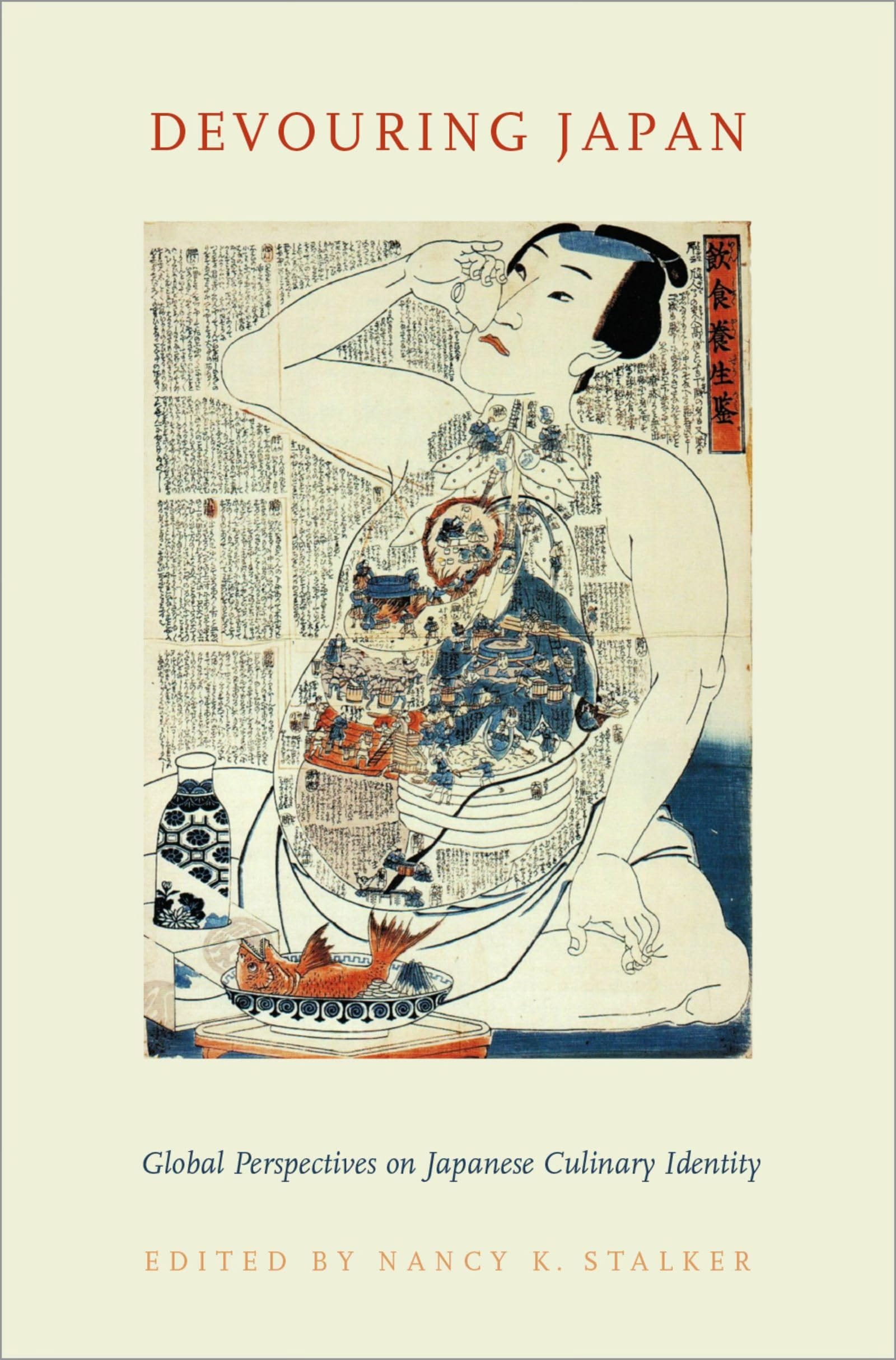
Although Matsuoka’s specific proposal never materialized, it morphed into JRO, which tacitly certified restaurants by including them in campaigns, or by endorsing them in designated restaurant guides. Furthermore, the MAFF scheme turned out to be a hydra: its head may have been cut off, but two more grew in its place: JETRO’s “Japanese Food Supporter” designation, and the completely opaque Nintei Nihon Restaurant accreditation program (apparently initiated by a Japanese restaurant owner in London, with no connection to any other governing body).
This is all to say that umami has been used by Japanese government ministries and trade organizations like JRO as a political and economic tool to support a narrow, generally conservative image of Japanese food, and Katō’s comments should be understood in that context. Elsewhere in Devouring Japan, Yoshimi Osawa investigates the idea of umami as Japanese cultural property in her article “We Can Taste but Others Cannot”:
[Some] Japanese now commonly assert that umami is a taste recognized only by Japanese or that the Japanese understand umami better than foreigners… There are at least three technical reasons why these claims exist: (1) all three umami substances (MSG, IMP, and GMP) were discovered by Japanese scientists, (2) Japanese is one of only a few languages to have a word to describe the umami type of taste, and (3) the existence of umami as a fifth taste was not believed outside of Japan until the discovery of the umami receptor in 2000.5
Osawa’s research included interviews with a number of Japanese chefs in both Japan and the UK, some of whom were absolutely damning in their appraisal of non-Japanese palates as inferior and unable to perceive or understand umami.6 And is it any wonder, when official explanations of umami, such as Katō’s, can be so esoteric and abstract that they invoke sleep quality and bowel movements? Mythologizing umami like this creates a feedback loop between Japan and the West that supports an Orientalist/exceptionalist view of Japan while making umami out to be something more difficult to grasp than it actually is.
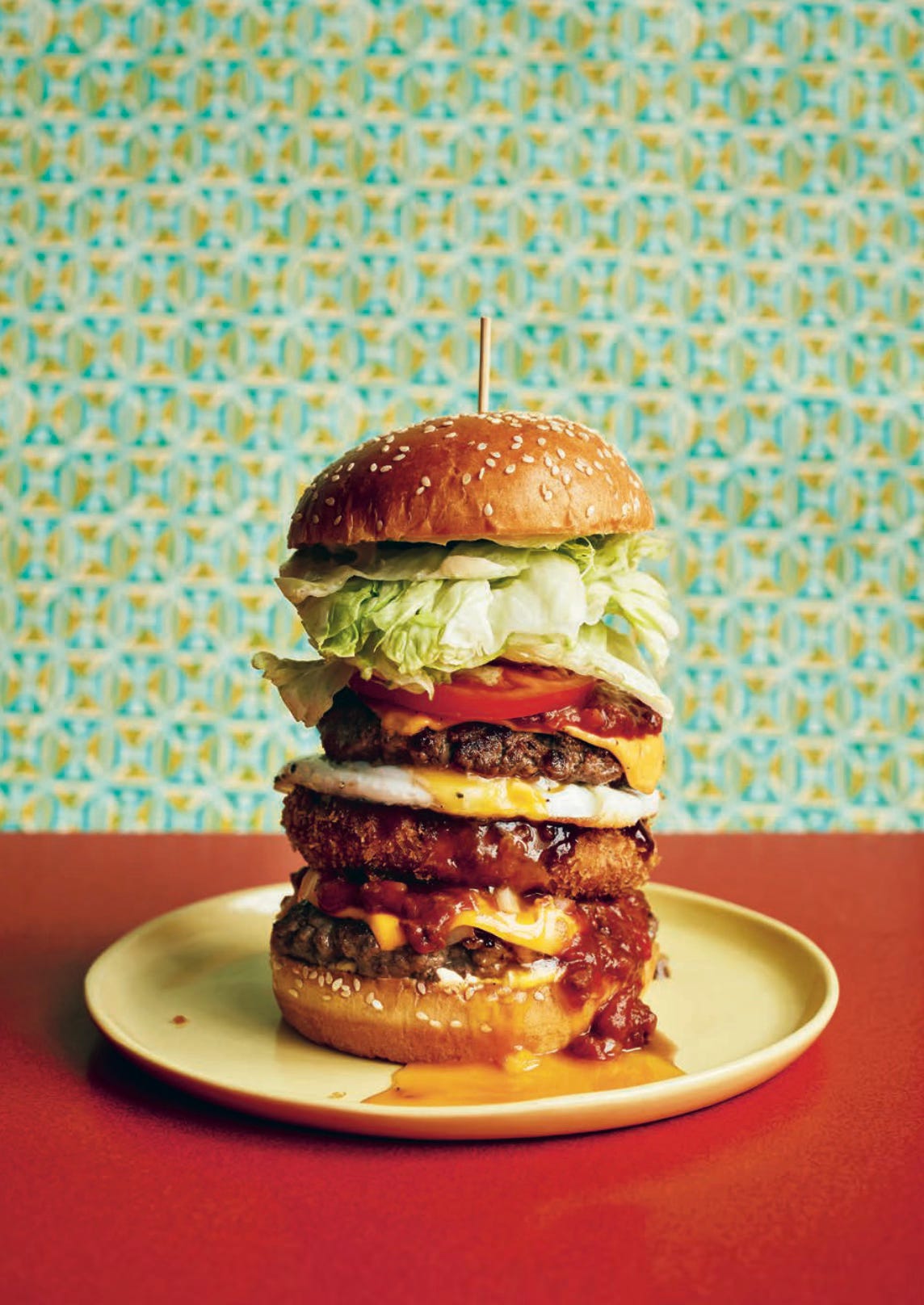
The New Yorker article also features commentary from Adam Fleischman,7 founder of the now mostly-defunct Umami Burger. The whole idea of an “umami burger” is irksome to me, because burgers are already inherently umami, especially if they contain accoutrements that bring their own umami compounds to the party: common toppings such as cheese, tomatoes, ketchup, or pickles. Even at their most basic, burgers express an extraordinary level of umami intelligence. That’s why most of the world’s best burgers are not that different from ones that would have been made one hundred years ago. Adding high-concept condiments such as Fleischman’s “Umami Master Sauce” or “Umami Dust” is… fine, I guess, and probably quite tasty. But it’s also unnecessary. I get the impression that in the case of Umami Burger, umami was deployed primarily to generate marketing buzz, and only secondarily in the service of making a better burger.
The Japanese, [Fleischman] told me, define umami as “an over-all harmonious state of perfection where the ingredients come together, a really rounded and harmonious dish. They have a sort of zen way of looking at it.”
The invocation of Zen says it all: umami is meant to be something mystical, rarefied, profound. But one of Osawa’s interviewees, a Japanese food TV presenter, offers a counterpoint: “To be honest, umami is a convenient expression. If I cannot find an appropriate expression to describe the taste of food, I sometimes use umami instead of just saying oishii (tasty).”8
Imagine, if you will, a parallel universe in which the chemical compounds responsible for the subtle but distinctive taste of savory food were isolated by an Italian scientist, who named this taste “gustosità” or something. I wonder what the discourse surrounding gustosità would look like. Would the Italian government use it to promote anchovies and cheese and tinned tomatoes, and to support the idea that Italians have superior palates? (Lol I can’t even keep a straight face writing that – of course they would.) Would non-Italians be producing podcasts and writing lengthy think pieces about it, like this one?
Or would we all just shrug and say, “Oh yeah, gustosità – I get it, savoriness. American food is savory, too. Burgers are totes savory.”
Clearly, I am very dismissive of the notion that umami is anything more than just a universal basic taste – too dismissive, in fact. Masing and Dearlove’s podcast – which compellingly connects umami to feelings of comfort, satisfaction, nostalgia, and self-care – has made me rethink my hardline, just-the-facts position on umami. Because taste is not just a matter of, you know, taste. How we perceive food and understand our relationship to it, and its relationship to the wider world, has a lot to do with how we contextualize it and talk about it.
Katō’s musings about how umami is “kind to the body” and helps you poop sound pretty woo-woo, but a more open-minded and perhaps less arrogant interpretation would be that he’s expressing an aesthetic sensibility related to umami, rather than trying to define the term in a purely academic way. And certainly, that approach has merit, especially because when it comes to describing sensations, words often fail us miserably.
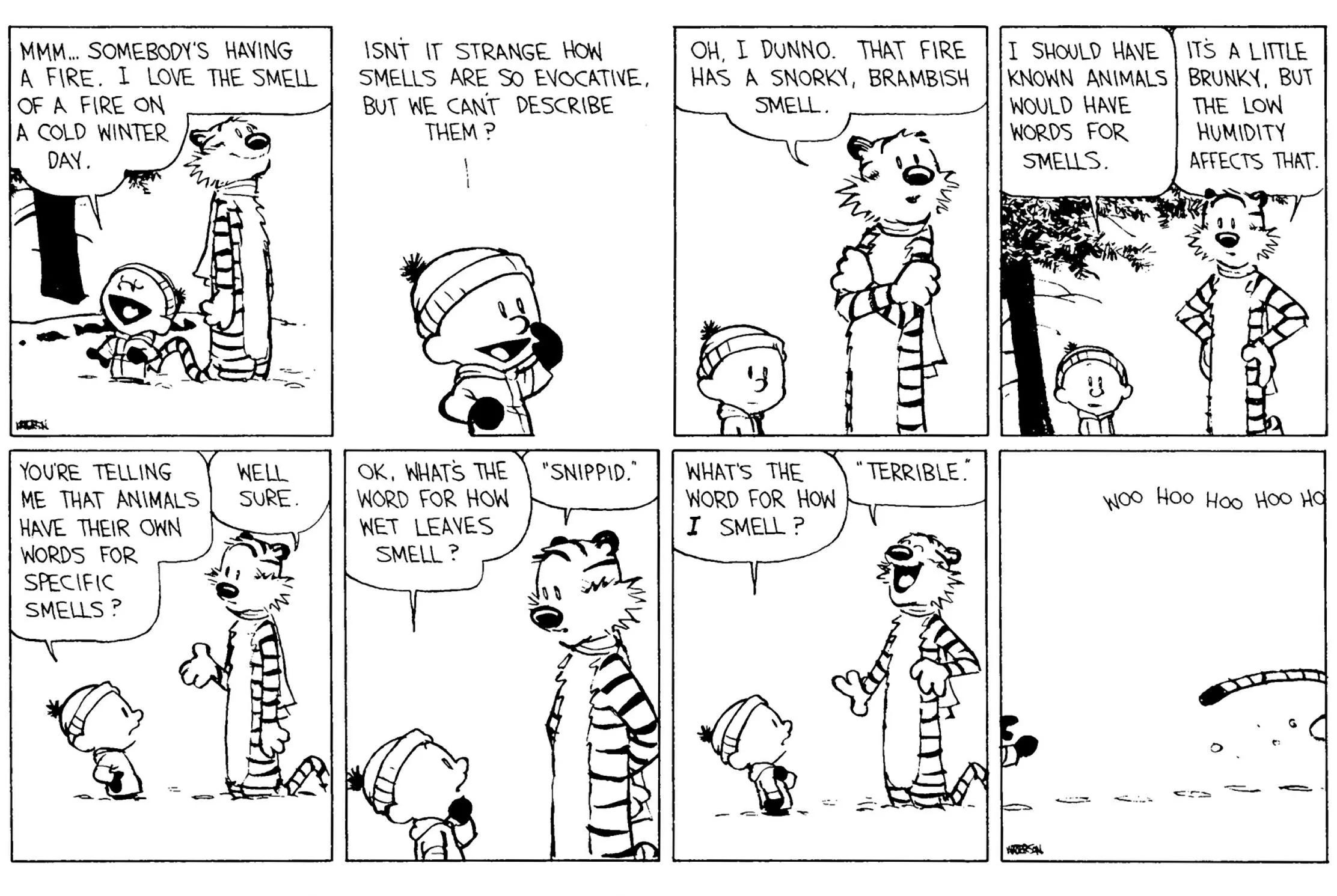
In a way, it’s no wonder we’ve all latched on to umami so excitedly. We don’t have a lot of words to describe tastes, so when a new one comes along, it’s like finding a key to a door that’s been locked our whole life. Now we can name it; now we can talk about it, explain it, move in and make it our own.
Discussing the sensory characteristics of food often involves metaphors. We describe tastes in terms of other things, and vice versa: a bittersweet memory, a sour expression, salty language. But savory…? That’s a bit trickier. We can savor a moment, or meet an unsavory character, but the actual word “savory” doesn’t appear in any English figures of speech that I can think of. Perhaps this indicates that we don’t have strong, definitive associations with the word. It may be worth noting, as Osawa does, that Japanese dictionaries also define umami as “a skillful thing to relish, especially techniques in art” and “profit that is easily gained in business.”9 As a more familiar, more lived-in word (and again, a homophone), umami naturally has other connotations in Japanese.
How on earth would you describe a savory taste to someone else? How would you describe any taste? It’s actually kind of impossible, which is why using metaphors, using narratives, and expanding on the emotions we associate with a taste can be useful – as Masing and Dearlove and their interview subjects have done, and indeed, as Katō does in his explanations. The language Katō uses to explain umami is delicate and calm: “kind,” “mild,” “feeling good,” “sleeping well.” They’re the same sort of words you might hear in a meditation app. Now, compare this to Adam Fleischman’s cookbook:
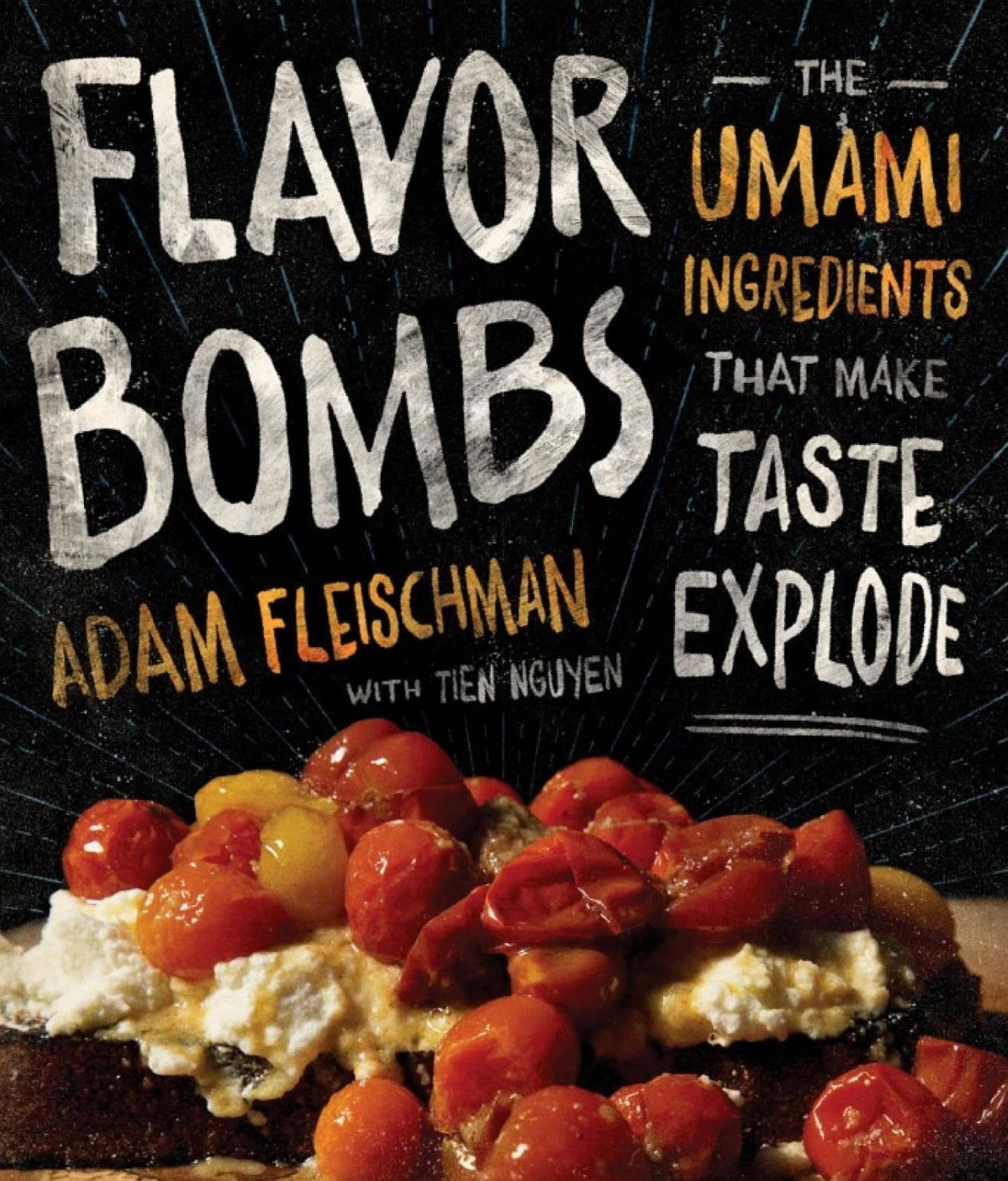
To quote Clive Badger from Fantastic Mr. Fox: Explosions! Flames! Burning things! The back cover copy boasts that this book will teach you how to “detonate flavor”! Kaboom! Could this take on umami be more American?10 Of course it’s to be expected that in a country where there are more guns than people, even umami is weaponized. Goldfield points out that “Fleischman’s approach — Where do I find the umami, and how can I get as much as possible? — is distinctly American.” She also reports that in 2013 David Chang set out to create something he called “the New York umami.” What does this even mean? If you want New York umami, eat a slice of pizza. If you want American umami, just eat any normal cheeseburger. In his cookbook, Fleischman acknowledges the inherent umami of pizza and burgers – but it’s not enough for him. And maybe that’s the American approach to umami, as Goldfield suggests: to ramp up, maximize, exaggerate, explode.
Umami is a basic taste – and I still think that’s the best and simplest way to understand it. But perhaps basic tastes just aren’t so basic after all. Sweet, sour, bitter, salty, and umami: we associate all of them with particular things outside the realm of food, and it is in those associations that they take on new, more complex meanings, which will inevitably vary between different cultures and languages. Tastes are like colors: we all see the same red, blue, and green, but how we interpret them as symbols depends completely on our cultural vantage point. We are what we eat – that’s a given. But we are also the way we talk about what we eat.
24 Hour Pancake People is a reader-supported publication. To receive new posts and support my work, consider becoming a free or paid subscriber.
Thanks for reading! If you enjoyed this post, you may like some of the articles I’ve written for Pellicle, which also explore how symbolism and sense-memories connect to taste and flavor.
“The Fast and the Curious – Discovering the Wider World of Citrus”
“Kōji, Culture, and Community – Part 1 (Miso and Collective Memory), Part 2 (Sake, Storytelling, and Japanese Aesthetics), and Part 3 (Soy Sauce, Enzymes, and Transnationalism)”
I remember my MSG “aha!” moment clearly. When I was living in Japan, at some point I clocked that the salt shaker on the table at my go-to yakitori joint wasn’t just salt. It was aji-shio, or “flavor salt,” a mixture of salt and MSG. So that’s why it makes everything taste so good, I thought. This came after growing up in America and seeing “no MSG” labels on food packaging for years and years, and hearing about MSG primarily in the context of widespread, casually racist demonization of Chinese food. I never really knew why people thought MSG was bad, and it didn’t take much Googling for me to realize that it wasn’t.I’ve been all in for Team MSG ever since.
The paper also refers to synergistic umami, although only in a misspelled citation that took me a while to figure out: “sojo-kaka,” which should have been “sōjō kōka” (相乗効果). To be honest, re-reading this paper made me feel like I’ve been spinning my wheels for 20 years when it comes to communicating about umami!
This is a pretty common occurrence in popular writing about Japanese culture. So many Japanese words have undergone a similar treatment, like ikigai – I really enjoyed this article explaining how it’s been misrepresented in the West. And it’s worth pointing out that we already have cultural concepts analogous to ikigai: raison d’être, or simply one’s life purpose – just like we already have the concept of savoriness. Do we even need “umami”?
Bestor, Theodore. “Washoku, Far and Near: UNESCO, Gastrodiplomacy, and the Cultural Politics of Traditional Japanese Cuisine.” Devouring Japan, edited by Nancy K. Stalker, 109-110. Oxford University Press, 2018.
Osawa, Yoshimi. “We Can Taste but Others Cannot: Umami as an Exclusively Japanese Concept.” Devouring Japan, edited by Nancy K. Stalker, 127. Oxford University Press, 2018.
Osawa 126.
“Butcher” in German; literally “meat man.” Is that nominative determinism or what?
Osawa 121.
Osawa 121.
Out of curiosity, I Googled うま味爆弾 umami bakudan (umami bomb in Japanese), and there are actually quite a lot of results. (The first and most interesting one is for 3D-printed canapés!). So maybe this idea of a violent, explosive umami isn’t so all-American or un-Japanese after all.
Dopamine rushes, withdrawals, and detoxes are trending among wellness gurus online. But experts say the science behind the trendy phrases doesn’t hold up.
The nerve cells pictured here are responsible for producing dopamine, a neurotransmitter that has become an obsession among online wellness gurus. But experts say the popular understanding of dopamine is often wrong—and the chemical actually plays a critical role in learning, movement, memory, attention, mood, and motivation.
Micrograph by Dr. Nick Gatford, Research Fellow/Kavli Institute of Nanoscience Discovery/University of Oxford
ByKatie Camero
February 4, 2025
Dopamine is widely known as a “feel-good” hormone, a major reason why we may feel happy after a shopping spree or eating pizza.
Thousands of TikTok videos reveal how interested people have become in boosting or lowering their daily doses of dopamine—whether through dopamine “rushes” and “withdrawals,” or dopamine “fasts” and “resets.”
But now that the chemical has become an obsession among wellness gurus, scientists who study it want to make it clear: Dopamine can do a lot of things, but making us “feel good” isn’t one of them.
Dopamine doesn’t work like that, and it’s certainly not a “catch-all term for happiness,” says Daniel Dombeck, a neurobiology professor at Northwestern University who studies the molecule.
(Why dopamine drives you to do hard things—even without a reward.)
Dopamine is a sophisticated neurotransmitter that also acts like a hormone and plays critical roles in learning, movement, memory, attention, mood, and motivation. While dopamine contributes to our feelings of pleasure, it doesn’t directly cause them—and it definitely doesn’t act alone.
“There's a lot of ignorance about what dopamine does and how the brain functions,” says Anne-Noël Samaha, an associate professor of pharmacology and physiology at the University of Montreal who studies the science of rewards and motivation. But in a nutshell, “it’s one of the molecules that allows us to stay alive.”
Dopamine acts as a chemical messenger, allowing neurons in different parts of your brain to communicate with each other. How it affects you depends on where it’s acting in your brain, Samaha says.
“In some regions [of the brain], an increase in dopamine can help people focus,” Samaha says. “In others, it could make people more impulsive.”
A lack of dopamine in certain areas of the brain can also negatively impact functions like concentration and movement, and is associated with conditions like attention deficit hyperactivity disorder, Parkinson’s disease, and addiction.
So why is dopamine mostly known for its part in our pleasure and reward system? Dombeck says that’s because it was the subject of early research in the 1980s that found our brains release the molecule when we receive food or another reward. As a result, experts generally accepted that dopamine mediates pleasure.
But in the 90s and early 2000s, mounting evidence challenged that idea. Turns out that when you shut down an animal’s dopamine system, they enjoy their rewards just as much but lose all motivation to seek more.
In other words, dopamine doesn’t make you like something, it makes you want it.
“It's not the molecule of pleasure,” Samaha says. “It's the molecule of the pursuit of pleasure.”
This is why you may want to stop doomscrolling before bed—or using drugs or drinking alcohol—but can’t bring yourself to quit even when it makes you feel terrible. Every time you swipe past funny, shocking, or otherwise engaging content, your brain releases dopamine and records the details about the moment in an attempt to boost the likelihood you repeat it whenever you’re exposed to cues like the ping of a notification on your phone, Dombeck says.
(Here’s what happens to your brain when you take a break from social media.)
This was an evolutionary advantage for humanity.Today, most things we want and need are incredibly accessible for people in wealthy countries. But our ancestors needed dopamine to make them want to walk several miles for a meal or spend months building shelter with their hands.
“We evolved in environments where we had to mobilize our energy and attention to seek out things that were necessary for our survival,” Samaha says, including safety, shelter, and social connection—and dopamine helps us do that.
Yes, dopamine levels do rise when you engage in enjoyable activities like listening to your favorite song. But to call that surge in positive feelings a “dopamine rush” is “more than an oversimplification,” Samaha says, “it’s just plain wrong.”
Those activities also elicit a rise in levels of other neurotransmitters that affect mood like serotonin and oxytocin, as well as endorphins, Dombeck says. How and where these molecules interact with each other determines how you feel.
“At the time of a positive outcome, there’s a rush of activity throughout the brain,” Dombeck says. “To call the whole thing a dopamine rush is underselling what’s actually happening.”
(How to get high on your own hormones—naturally.)
These peaks in dopamine aren’t inherently good or bad, Samaha says—what matters most is that they aren’t extreme. Too much dopamine is associated with conditions like mania, while too little is linked to depression. In most scenarios, though, “dopamine is just neutral,” Samaha says, and is around to “keep us alive.”
Just because you feel temporarily irritated or anxious after losing access to something that brings you joy, it doesn’t mean you’re experiencing a dopamine withdrawal, Samaha says.
“Anytime people have to change their habits, there's always an adjustment period that’s accompanied by some level of anxiety and stress,” Samaha says. “That doesn't mean dopamine levels have greatly decreased and they're now dangerously low.
There is a real condition called dopamine agonist withdrawal syndrome, but that only happens to some people who take medications that mimic dopamine to treat conditions such as Parkinson’s disease and restless leg syndrome. If they suddenly reduce their dose or stop taking their meds, they may experience symptoms similar to drug withdrawal such as agitation, excessive sweating, nausea, and pain.
But a post-vacation gloomy mood, for example, might just be a sign that you’ve gotten used to the high of that stress-free life—not a full-blown dopamine deficit. “It'll take time for your dopamine system to kind of recalibrate and come back down to a normal threshold where other parts of your daily life could activate it,” Dombeck says.
“Dopamine fasting” is another buzzword that, according to the psychologist who coined the term in 2019, is meant to be an “antidote” to our highly stimulating society: Easy access to activities that give us quick dopamine hits are, as the theory goes, numbing us to the pleasures of slower activities like reading or creating art.
Now that we can do most things with a tap on a touchscreen, we’re bombarding our dopamine systems with “very potent rewards that require almost no upfront work,” says Anna Lembke, professor of psychiatry and addiction medicine at the Stanford University School of Medicine and author of Dopamine Nation. As a result, the things we like don’t satisfy us as much, but we still crave them in an “attempt to bring baseline dopamine levels back up to normal, healthy firing.”
Some people, however, have taken the concept of dopamine fasting too literally. Rather than asking you to stop doing everything that might stimulate dopamine in your brain, dopamine fasting is about limiting or completely refraining from impulsive and problematic behaviors.
Besides, there’s no way to actually drain yourself of dopamine, Samaha says. “It's not like Dry January where you decide for a whole month that you won't drink alcohol because it's good. You can't have a dry dopamine day, it’s not possible,” Samaha says. “Dopamine is an ancient molecule…that has been conserved across evolution. It certainly has not evolved to be influenced by social media or people's phone habits.”
Furthermore, although habits like checking social media or gambling can be addictive, there’s no direct evidence that they can dramatically rewire your brain like drug abuse can, Lembke says.
The bottom line? Avoiding harmful habits are bound to benefit you, but you don’t have to avoid the things that make you happy.
“Trust that your dopamine is going to do what it does,” Samaha says, “and just leave it alone.”
This piece was edited on 12/3 at 10:29am to add additional information on the DNA profile, explain the grand jury decision, the handwriting analysis, a few interviews with detectives and FBI investigators, and findings in JonBenet’s room the night of the incident that hint at Netflix and Berlinger manipulating the truth. I also added clips from the Dr. Phil interview because clips are being removed.
I edited it again to add info on the duct tape, Ramsey PR machine, screenshots from their 1997 website.
This case has likely been solved, but will never see justice. The real mystery is why.

A new Netflix documentary on the JonBenet Ramsey case came out last Monday. Prior to its release, the media hyped this new doc as something that would break open the case. The director, Joe Berlinger, did interviews saying he believed the case could be solved with new DNA evidence and couldn’t believe he previously thought conspiracies the parents did it could be true. People who have watched every doc on the case, read books and pored over the released grand jury papers thought this might be the doc that would finally bring new information to light.
In fact, it doesn’t do that at all. Cold Case: Who Killed JonBenet Ramsey presents no new information and is created by someone who seems more enamored with the fact that he got an interview with John Ramsey than anything that points to him being a serious suspect. Of course, without John, there’d be no family or personal involvement and we probably wouldn’t be watching this on Netflix.
What this creates is a terribly one-sided documentary that does a disservice to everyone involved by leaving out crucial information that points to anyone but an intruder. In fact, the documentary uses the idea that the Ramseys did it as a playful twist designed to trick the audience. The first episode highlights how complicated the house was, how the police noticed odd behavior. It leads you to believe it’s the parents before episode 2 comes in and says, well wait, there was DNA!
The problem is, the first episode doesn’t actually get into the evidence that made the police consider the Ramseys. In fact, they repeat a lot of the lies that are in the Ramsey’s book and have been disproven to make the cops look dumb. For example, the Ramseys say the cops focused on them immediately because they said there weren’t footprints outside in the snow. The Ramseys and Berlinger’s doc point out that there were no prints because there was no snow and show photos of the back of the house. This, to them, is evidence that the cops were trying to make them look bad from the start! The thing is, that’s not what the original police report says.
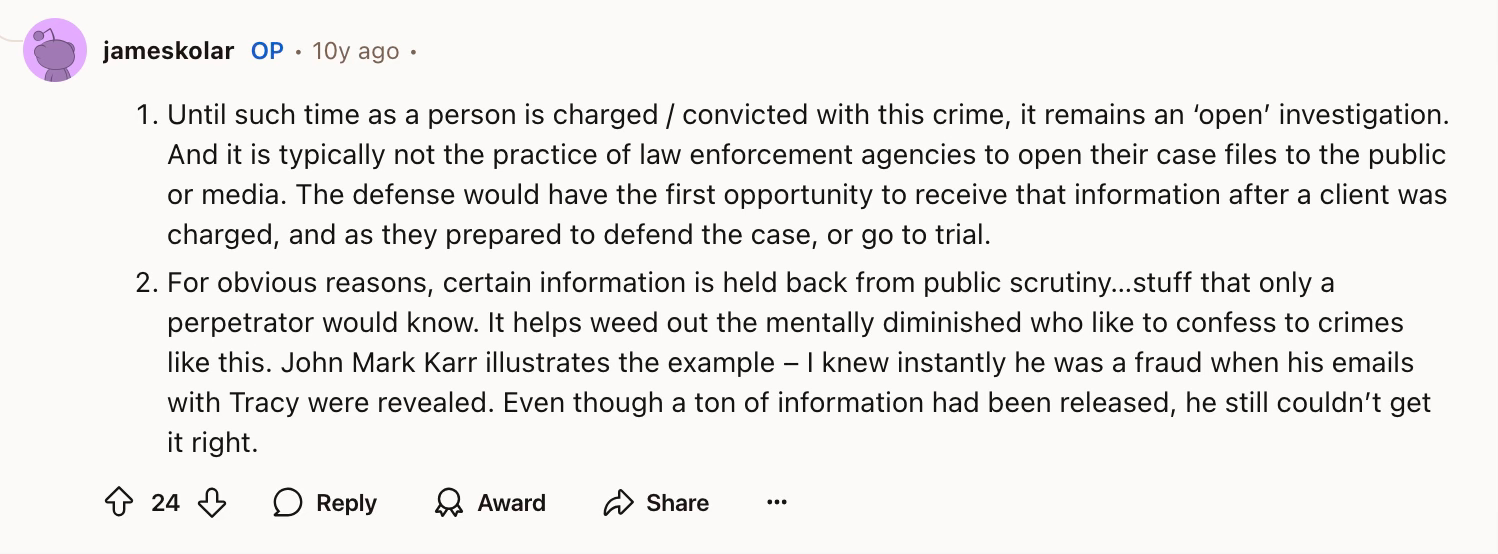
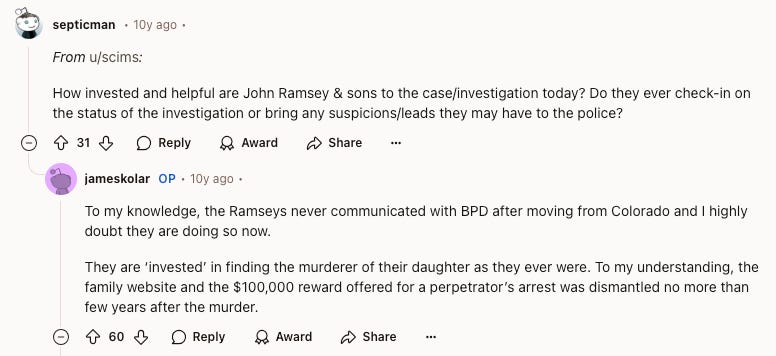
James Kolar was a detective who worked the case. He started working on it in 1997 when he was asked to stake out one of the Ramsey’s friends at a ski resort. In the week after JonBenet’s funeral, the cops couldn’t find the Ramseys and they wouldn’t share their whereabouts. Kolar worked for the Boulder Police Department for 17 years, but had transferred to Telluride when the murder took place. They asked him to head to the ski resort to see if they were there. He didn’t find them, but this pulled him into the case.
By 2005, he was lead investigator. By 2006, he left the case to go back to Telluride, discouraged by what he witnessed from the DA. In 2012, he released a book with his findings called Foreign Faction: Who Really Kidnapped JonBenet?
Kolar’s book is considered one of the best on the subject, though the Ramseys disagree. We’ll get to why, but he mostly does a great job of compiling all primary sources. You see the child abuse report, the photos of the spiderwebs in the grate, the failure to recreate stun gun marks on a pig. He also points out where the cops made mistakes. So, you remember how the Ramseys said the cops tried to pin it on them from the start by making it sound like there was snow everywhere and no footprints when there wasn’t snow?
Kolar’s book is the first time we find out that’s not true. The cops said exactly what the Ramsey’s said in their initial report: there was some snow on the grass and no snow on the rear patio:

The photo of the clear rear patio the documentary uses as a gotcha to prove police incompetence doesn’t do that at all. It matches exactly what the first officer on the scene wrote in his report. There was no attempt to make it seem like the lack of footprints was suspicious, he just wrote down what he saw. The Ramseys, however, saw a narrative that helped them prove bias and ran with that.
This is what the case of JonBenet has become, sadly. A millionaire family with power and PR behind them, a DA with ties to that family and a police force that did make mistakes, but who also were hindered nearly every step of the way.
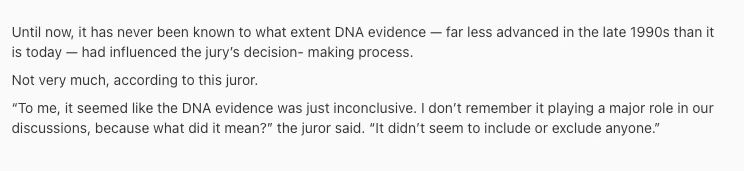
Netflix’s Cold Case: Who Killed JonBenet Ramsey tries to hide or simplify details to present a clean cut, TV-ready conclusion: we need the police to do more DNA testing, we need to focus on the DNA! They hope, with advances in technology and additional DNA from scraping the additional evidence, some day, they’ll be able to link this DNA to a relative of the killer.
Meanwhile, experts have said this probably isn’t a DNA case from the start because the scene was so contaminated and the sample was so small. This remains true. The evidence has not gotten less contaminated over time.
The current DNA profile is actually too small to use genealogical testing, even though this is what the documentary presents as the solution. Again, it is an example of a documentary that is eager to present the truth as black-and-white. DNA must be the solution! How can DNA be wrong? Well, we will get to that.
First, I just wanted you to know, whether you’ve watched the Netflix doc already or not, it is far from the entire story.
I watched Cold Case: Who Killed JonBenet Ramsey as soon as it was out. I’d been waiting for it to drop because, well, this case is the case to me. Am I proud to be a true crime person? Maybe? No? I don’t know? I am aware of the ethical issues and all the bad things it does to society to have 800 podcasts that oscillate between horrific murder details and discounts for Squarespace.
Still, I will put on the latest episode of Evil Lives Here to fall asleep at night. Let’s blame my mom, like I do for most things. She’s the one who raised me on CourtTV! She’s the one who showed me you could read police reports and autopsies online! When I got my first laptop in 2003, I was 12 and ready to become Harriet the Goddamn Spy, okay?
JonBenet was 3 months older than me and like most girls born in 1990, I was obsessed with the photos of her that were all over the news and tabloids. How could something like that happen to a girl my age? At 6, I wasn’t into the details of the case, of course, I was just struck by this pretty girl who suddenly made me realize the world may not be such a nice place for little girls.
By 2003, there’d been a grand jury non-indictment, multiple books on the case released and still no trial or justice. I wanted to know everything. I dug into Angelfire websites, forums, Geocities websites, sketchy transcriptions of police tape interviews and radio interviews. I read Steve Thomas’ 2000 book, JonBenet: Inside the Ramsey Murder Investigation, from an illegal .pdf someone shared and that changed everything for me.
Steve Thomas is featured heavily in the Netflix documentary as a bumbling idiot. The Ramseys sued him after the release of the book and the doc features discrepancies he was caught in. Some of these discrepancies are fair and do point to a man guessing at motive and some details, but he also shares facts on the Ramseys removing items from the crime scene with the permission of the DA.
He mentions leads he wasn’t allowed to follow that would point to the Ramsey’s, like the fact that beaver hair was found on JBR’s (JonBenet Ramsey) panties and the duct tape. The police noticed Patsy wore black furry boots to an interview and asked to test them for beaver hair, but she never turned in the boots. In fact, Patsy and John don’t turn in their clothes from that night until over a year later according to Thomas. Why was this allowed? Why doesn’t the Netflix documentary mention this? Thomas does:
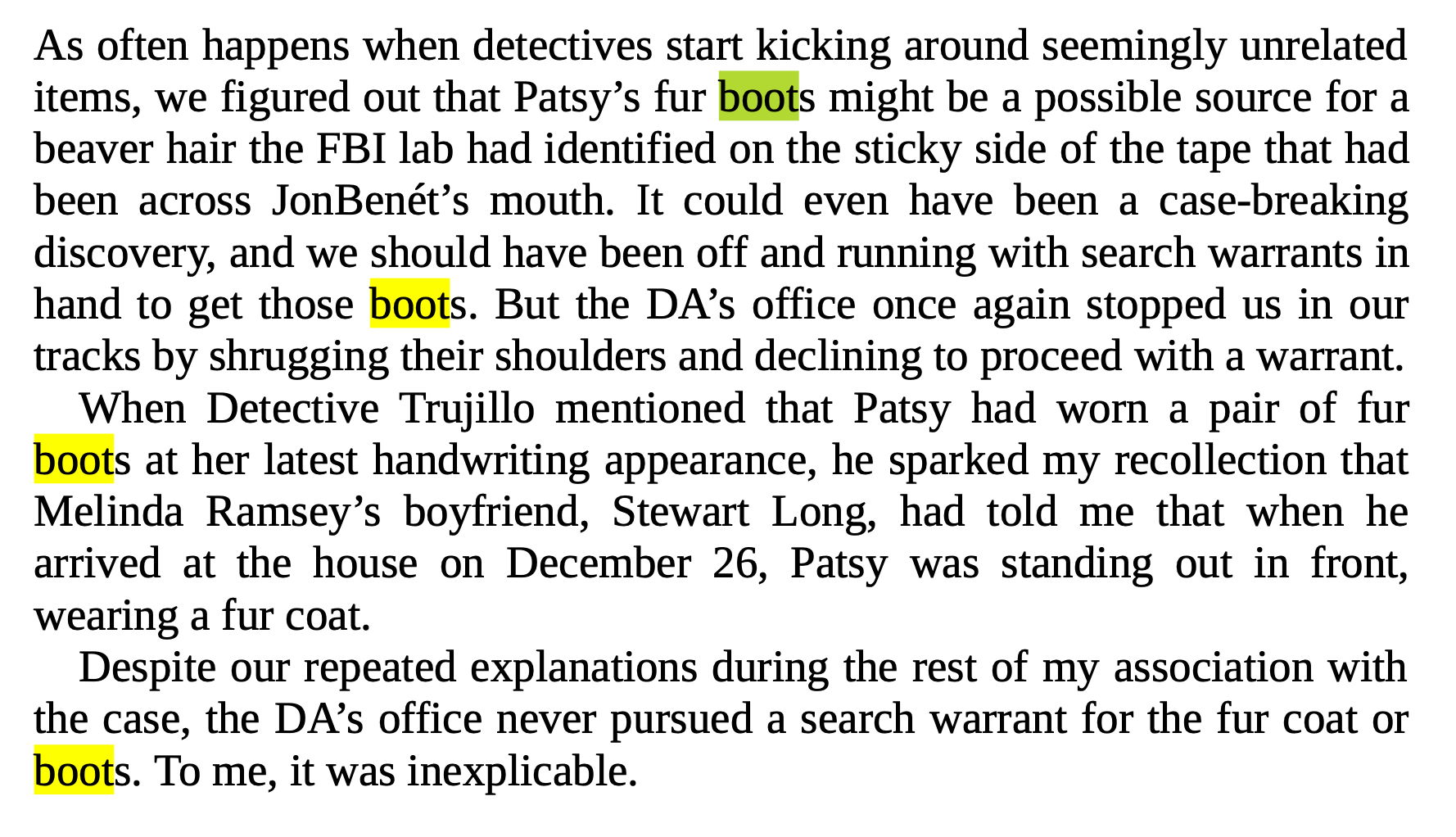
It’s a fair question for Thomas to have while he worked the case. Netflix doesn’t think this is worth mentioning, despite mentioning the many unidentified fibers on JBR’s body. If the parents wanted to clear themselves and help provide a better profile of the killer’s DNA or clothing, why not turn your stuff in immediately so it can be excluded? Instead, the Ramseys waited a year, when these clothes had been washed and mingled with other things to turn them in. It’s almost like the Ramseys don’t actually want a DNA or fiber sample that isn’t compromised.

Take, for example, their actions after receiving the ransom note. Patsy says she didn’t read the entire note, but saw the beginning, went to check on JBR, she wasn’t there, she called for John and then went to call 911. John says he heard Patsy scream, met her on the backsteps, took the letter, laid it out on the floor and started to read it.
This is a bit odd, since Patsy mentions details from the end of the letter on the 911 call, but it is possible John read it aloud or was relaying this info. What’s odd though is that the letter says they’ve been watching the family, they’re related to John’s businesses and if the Ramseys tell anyone about this, they’ll kill JBR.
It makes sense to call the cops immediately, even though the letter says not to. What doesn’t make sense is Patsy calling her four best friends to come over because there was an emergency and she needed them. Barbara Fernie, John Fernie, Fleet White and Priscilla White head over to the Ramsey house without knowing JonBenet has been kidnapped, Patsy doesn’t say this on the phone according to Foreign Faction, pg. 45. At this point, it’s possible someone close to the Ramseys has done this or is involved and they invite friends who know personal details from the letter over?
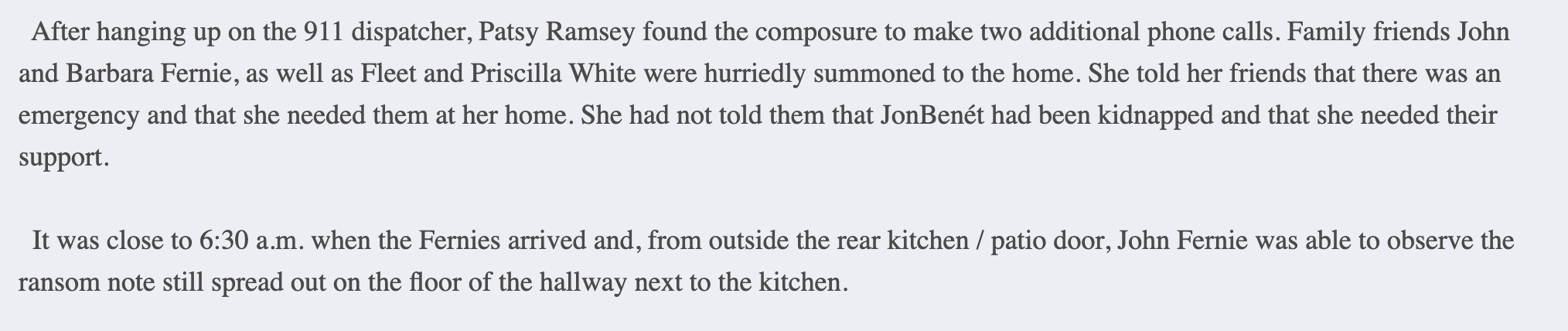
If Patsy had told them a kidnapping with a ransom note occurred, these friends probably would’ve acted like they were arriving at a crime scene. Instead, they thought JonBenet might just be missing in the house and proceed to get their DNA everywhere. A year earlier, Fleet’s daughter, Daphne went missing and was eventually found hiding in their home, so this instinct makes sense.
Fleet thought JonBenet was doing the same and went to search the basement, calling out JonBenet’s name, despite there being a ransom letter. John Ramsey would later point to this as suspicious behavior when he added Fleet White to the suspect list. Well, how unfortunate you invited a possible suspect to roam the house and contaminate the scene before the cops even got to your house.
Not that Fleet was a viable suspect. Someone would’ve noticed if he left his own party the night JBR was murdered. In the time since, White has sued to get the grand jury documents released, as he believes this will clear things up for the public. He cooperated with police and got in a fight with John after the funeral because he felt the Ramseys should talk to the police immediately. It’s unlikely he’s involved if he’s doing everything he can to get information and evidence released. The Ramseys still have him on their suspect list, however.
And while the Ramseys take a year to turn their clothes in from that night, their friends, staff and others are happy to do so immediately. People at the White’s party turn in their clothes to clear themselves and find the person who did this. Because the scene was so contaminated, the officers who arrived also had to turn in their clothes from that night. Trace DNA from all of these people could be eliminated from the trace DNA on JBR fairly soon. The Ramsey family’s was not.
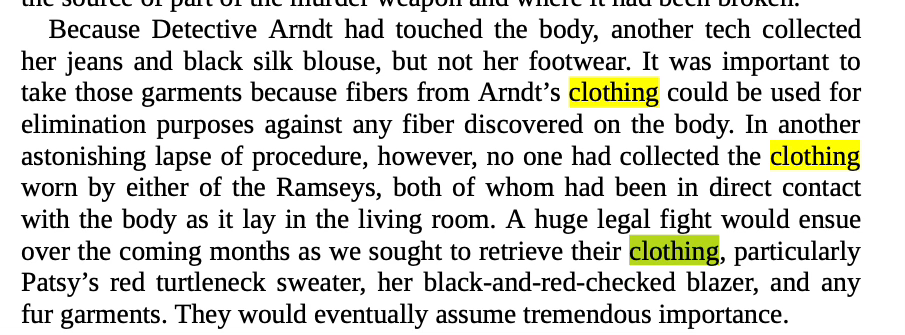
When the documentary discusses the Ramsey’s odd behavior when cops arrived, they talk about John seeming distant or going through the mail, but this when the cops start to suspect the Ramseys. They don’t take their clothes that night and they try to interview them but agree to wait. The Netflix doc fails to mention that it’s their shifting stories in the ensuing weeks that raise suspicion. For example, John tells two officers he read to JBR then went to bed. When he finally does his police interview in April, 4 months after the murder, he says they misunderstood him and that he said he put her to bed and he went to read a book.
The two officers felt like he’d been clear and there was no misunderstanding. Patsy also changes her story. The day of the kidnapping, she says she put a red turtleneck sweater over JBR’s white top and white longjohns. It was winter and cold, so she put two layers on top of JBR. That morning, Det. Arendt (the female officer the documentary depicts as crazy) wrote in her report that she noticed a red garment in the laundry area next to JBR’s bedroom.
When JBR is found she’s wearing a white shirt and white longjohns. In April, Patsy changes her story and says she only put JBR in the white longjohns and she always had a white shirt on. In the interrogation, officers push this and she says she can’t recall when or why the red turtleneck was put in the laundry. Maybe, these are two frazzled parents who can’t remember details, but here’s another bit of info the documentary leaves out:
The Ramsey’s lawyers refused to let them be interviewed unless they could have access to police reports and the previous reports of what they said. Their lawyers were essentially given everything they needed to get their story straight. If JBR was wearing a red turtleneck, how did it end up off and in the laundry? Certainly an intruder didn’t do that. Officer Thomas sees this lie as a red flag. JBR’s longjohns were stained with urine, she had a history of wetting herself, maybe she’d wet the bed and stained the red turtleneck, angering her mom and forcing her to put it in the wash. In a 2015 AMA, Lead Det. Mark Beckner confirmed her long johns and the bed had urine stains.
This is why Officer Thomas is seen pushing the “Patsy lost it because JBR wet herself” theory so hard in the documentary. The doc tries to make it seem like a ludicrous idea with no backing that shows how dumb he is, but he’s led to this conclusion because of Patsy’s lies.
People often say this is a case of he said/she said between the Ramseys and the police, but what you’ll find is that, most often, the police take their lead from the Ramseys changing their story and saying conflicting things. Yes, it is bad the police tried to bait the Ramseys into talking by leaking fake information to the media, but remember, these are the parents of their victim and they can’t even find them after the funeral. They’ve failed to answer questions. They’ve failed to turn over crucial evidence. By this point, it’s been two months since JonBenet was murdered, is it so odd they start to take a focus on the parents by February after such behavior?
The doc leads you to believe the focus on the Ramseys was a quick, lazy decision made by bumbling cops that hindered investigations into an intruder. This isn’t true. The Ramseys became suspects after their own lies and behavior couldn’t be written off. Also, officers did investigate intruder theories immediately! Officer Thomas lists all the steps they took: they used cameras from a business in the area to track every car that turned onto the Ramsey’s street that day (a car is the only means of transportation that makes sense if you’re kidnapping a 6 year old).
They interviewed everyone who’d been at the White’s party the Ramseys attended the night before. They took every lead seriously! This is mentioned in both Foreign Faction and JonBenet: Inside the Ramsey Murder Investigation, but Netflix make sit seem as though this leads just sat until Lou Smit joined the case.
Shall we get into the Lou Smit of it all? He’s often considered the Best Detective and Smoking Gun in the JonBenet case. He didn’t solve it, but he dedicated his life to it and even passed his work on to his kids, as the Netflix doc tells us. Lou was brought in as the case stalled by the DA. From the beginning, he made it clear he didn’t think the Ramseys were capable of committing such a crime; this is why the DA liked him.
He went to work on beefing up the intruder theory. Smit would eventually leave the case when a grand jury was put together that focused on the parents. He was certain they’d be indicted because of the media treatment they received and the facts other officers shared. Some point to Smit’s work as the key to stopping the indictment since the defense was allowed to present the intruder theory to the grand jury.
Maybe, Smit did help. He presented two main theories that made sense of things the cops could never understand:
How the hell did someone get her from her room to the basement without making any noise or disturbing the scene? JonBenet’s room was pristine, it looked like someone just got out of bed, not like an attack occurred. Nothing from her room to the basement was out of place, meaning she wasn’t kicking or screaming on the way down. How was she subdued?
Smit suggests: a stun gun. You see, there are two sets of bruises equal distance apart on the right side of JonBenet’s neck and lower back. Smit believes they look like the pattern of a stun gun. If you’ve watched the doc on him, JonBenet Ramsey: What Really Happened (2021) you’ve seen the clips of him recreating stun gun marks on dead pigs to see if he can recreate similar bruises to JonBenet. He sort of does, they kind of look like the same distance, but they’re burn marks instead of bruises.
He was also only able to recreate it with one brand of stun gun, an Air Taser, and the maker of that stun gun said they’d never had a case where a stun gun renders someone completely unconscious and created bruises rather than burns. He also couldn’t get the dimensions to match JonBenet’s abrasions exactly. The train tracks police initially thought caused them though? A direct dimension match. This reddit thread has information (and sources!). The below images are from Kolar’s book (pg. 241 and 354, respectively):


Why does the doc spend so much time convincing you the stun gun could be possible when it was debunked years ago? Because it helps the Ramseys and is the only thing that could explain how JBR was removed from her bed by an intruder. If it’s the train tracks, an intruder wouldn’t make sense. Why would he decide to poke her with a child’s toy once in the basement?
The Window Well/Grate Theory
Perhaps, Smit’s biggest help to the Ramseys was finally giving them a potential entry point for the intruder. The morning of the kidnapping, police and the Ramseys found all the doors locked as they had been. When asked about the broken window in the basement, John said he broke it months prior when he was locked out. John said that he and Fleet found the window open and a suitcase under it just before they found JonBenet’s body in the wine cellar at 1:05pm.
John said this before he knew Fleet told police he was in the cellar at 6:40am, the window was closed and he moved the suitcase there to investigate the window. When asked about this discrepancy, John said he was in the cellar before 6:40am and had found the window open, but closed it because he “wasn’t thinking” (his daughter had just been kidnapped, there’s a ransom note and he doesn’t think the open window matters?). He then changes his story to say he reopened the window at 1pm with Fleet to see if there was any new glass.
Why does this matter? The window with the suitcase under it seemed like an obvious exit for the intruder before John was caught in his lie in April, during his interrogation. Once it was established no one could say for sure if the window was open or if the suitcase had been moved by Fleet or the intruder, the likelihood of the window as the entrance/exit became a little less likely.
That is, until Lou Smit joined the case. He said it was totally possible that someone had moved the grate above the basement window, jumped down into the window well, opened the window through the hole and gained entrance. He even makes a video showing that he could do it. This has become a huge piece of evidence people turn to! Look, he got in that way and he got out using the suitcase! See, this is a plausible entrance/exit!
There’s just one problem: the window well and grate were covered in spiderwebs. Like, so many that the officers initially thought, well no one could’ve gone through there without disturbing the spiderweb or getting dirt/dust everywhere. From crime scene video taken that day and published in Kolar’s book, we can see this spiderwebs were not disturbed at all:
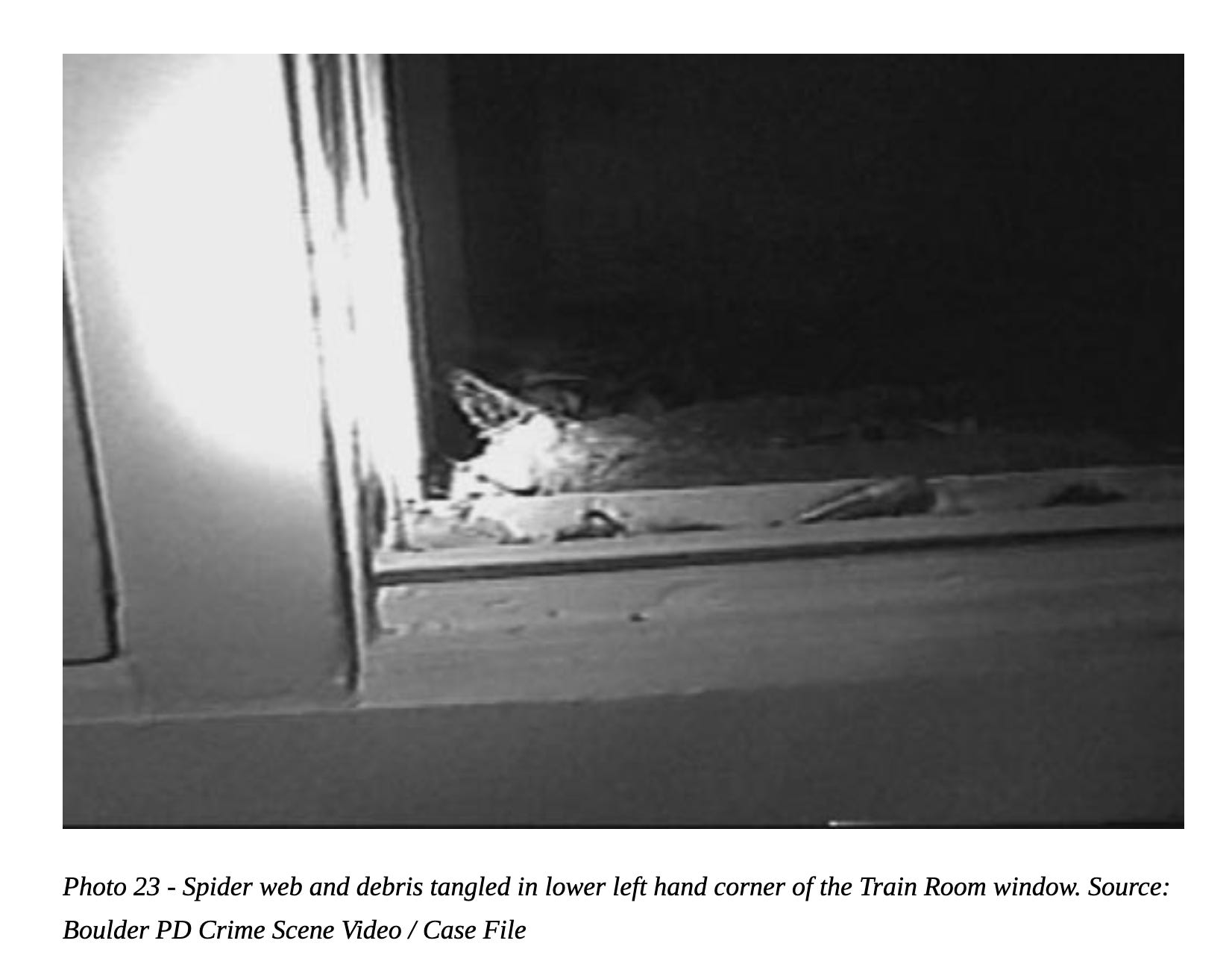
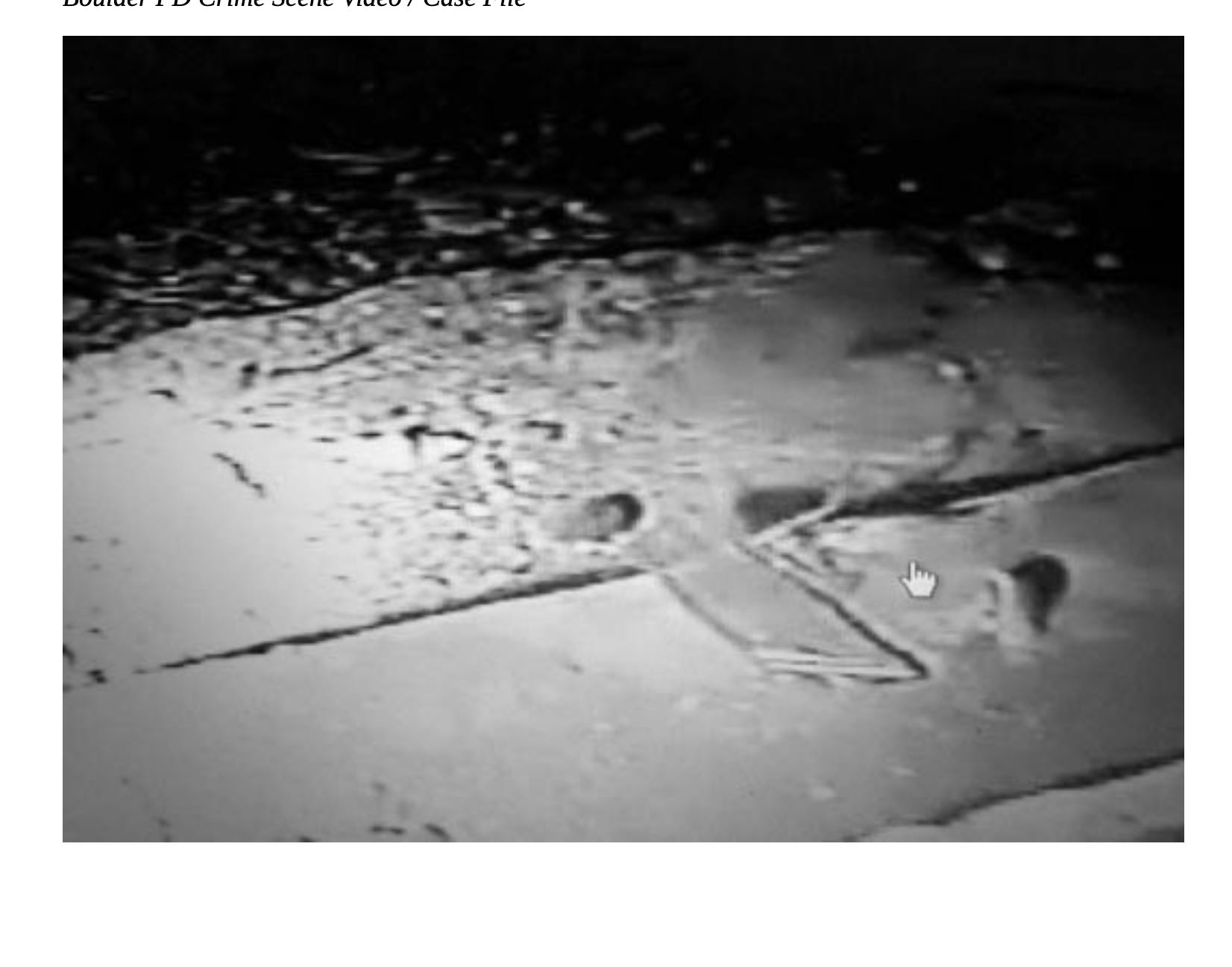
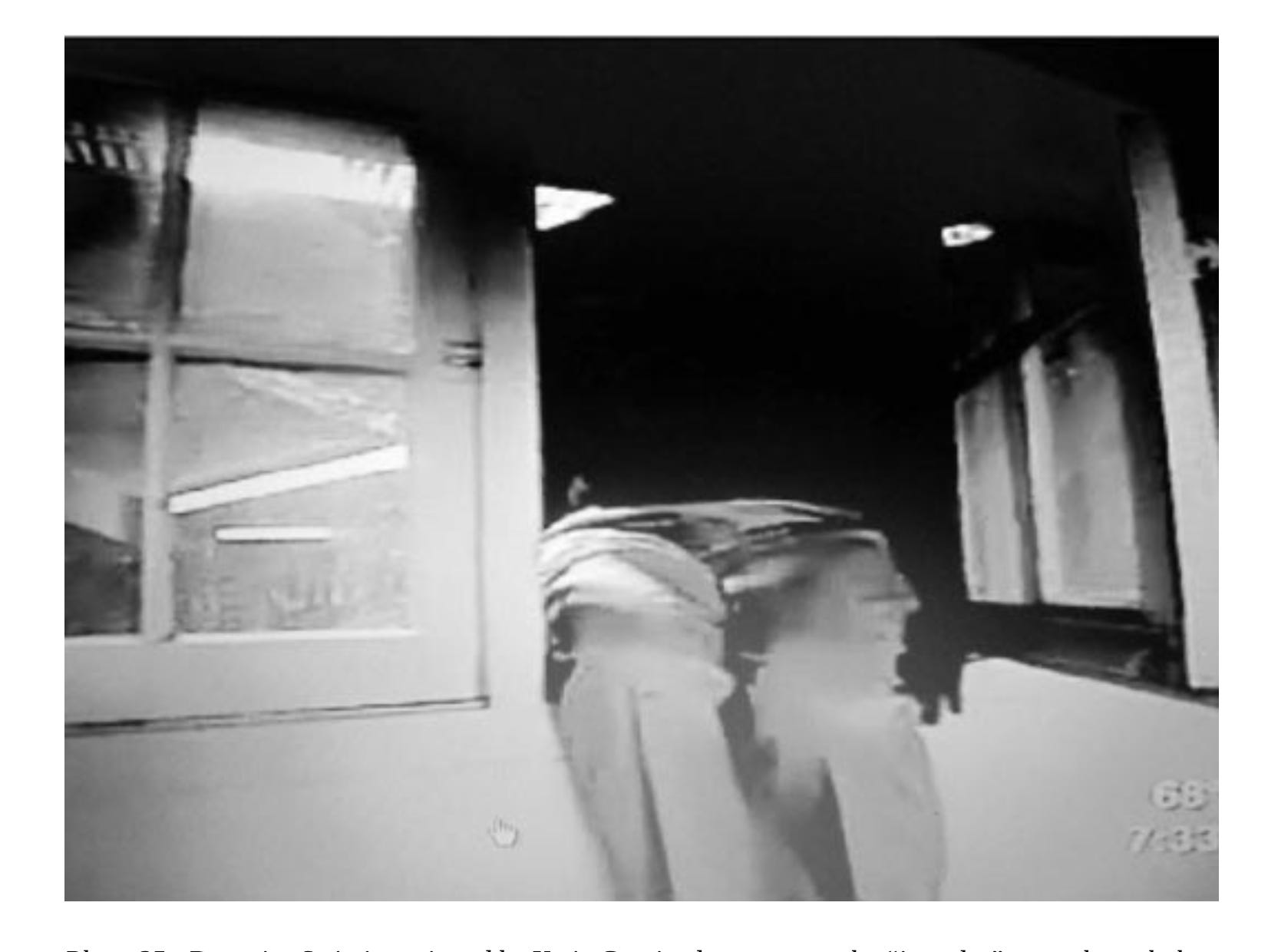
This is how Kolar describes viewing this evidence against Lou Smit’s famous window well video. It took until 2005 for a lead investigator on the case to debunk this theory with crime scene video and until 2012 for the public to know this theory was debunked.
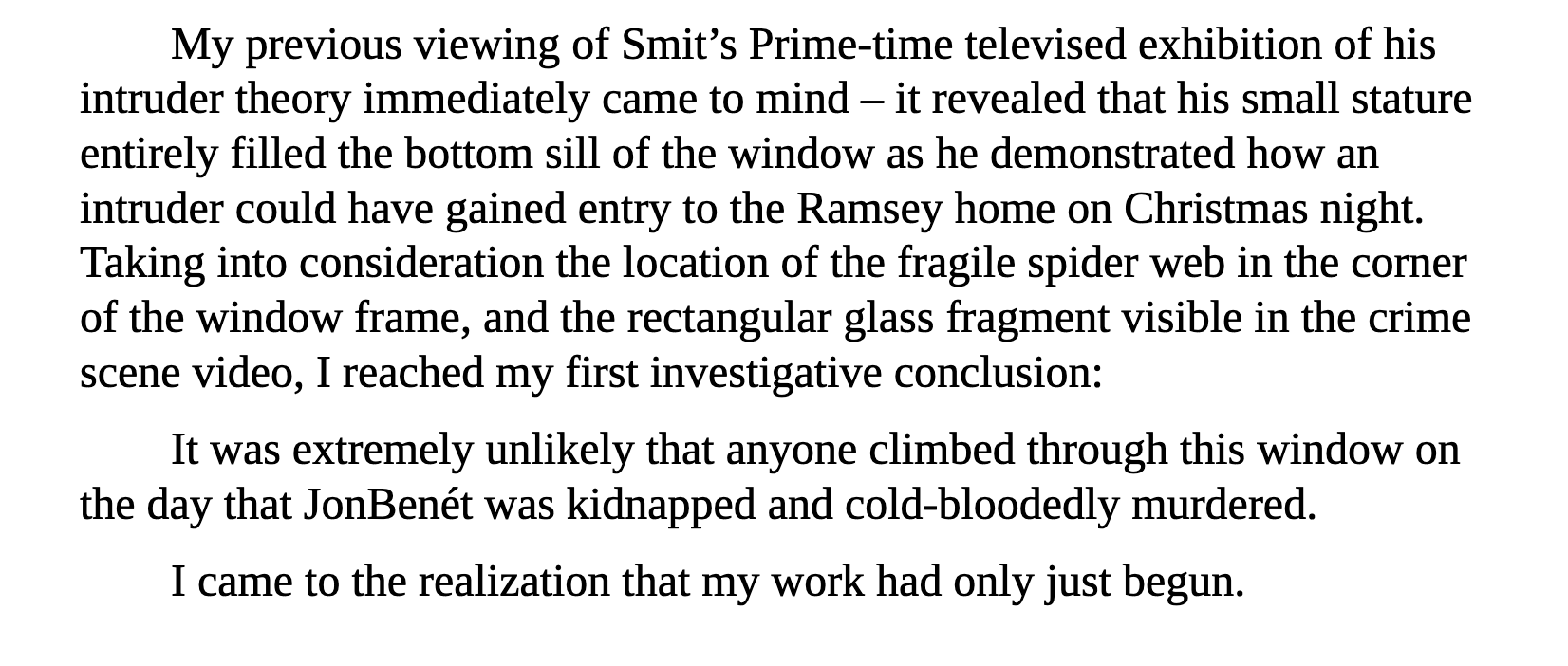
And if you’re thinking, well maybe the intruder got out, destroyed the cobwebs and then the spider rebuilt his web by the time the video was taken? Well, Officer Thomas can speak to that in his book. They had a spider expert at University of Colorado Boulder come in and look at the spider/web. He confirmed these spiders go into hibernation in November and the web couldn’t have been rebuilt that morning.
Despite Lou Smit’s two biggest theories being debunked in the years after they were shared publicly, the Netflix documentary still acts as though these are legitimate theories that haven’t been tested. They still present Smit as an expert and an authority on the case, even though his intruder theory falls apart without the stun gun or the window.
Okay, at this point, maybe you think I’m trying to convince you that the Ramseys did this. I’m not! I mean, I definitely think they did and will lay my theory out at the end, but what I love about my theory is that I came up with it from my own research. I really just want you to know that in this modern media landscape, where it’s easy for streamers to sell narratives via documentary, that you have to be discerning. Dig into books, documentaries and interviews! I encourage everyone to do the same.
So, if the Netflix documentary just offers one part of the story, what else should people watch or read? Hit up the below!
I’m Just Curious
This DNA Explainer - Despite everything you will read in this, people still see all of this information and go “Well, the DNA.” There’s a lot of science behind why this DNA sample is most likely useless. If the Ramsey’s were staging the scene, they could easily plant unidentified DNA by rubbing different items from the house on the body (unidentified fibers were found on JBR - navy and tan cloth, beaver or rodent hair - the coroner thought it seemed like someone wiped areas of her body, Kolar and Thomas).
When the FBI and Boulder PD say this is a DNA case, it’s because they think the DNA won’t point to anyone. They think if this DNA eventually does match something, it will be innocent trace DNA that has nothing to do with the murder and, if it matched other fibers or trace DNA on items in the house at the time, would point to a cover-up. This would be the final nail in the coffin for the Ramseys. This is unlikely, as you’ll see below. The Ramseys removed a lot of items from the house the day after the murder.
However, people who believe an intruder did it think the evidence needs to be scraped again for additional DNA to create a better profile of the suspect. Interestingly enough, if the Ramseys had left those items in the house or turned in their clothes from that night sooner, it would’ve allowed the police to exclude fibers and touch DNA to create a better profile from the start!
As long as this DNA remains “unidentified” the Ramseys can always point to an intruder. If the cops figure out it came from items in the house or people with alibis, they know it’s unrelated to the crime, thus narrowing in on the Ramseys. So, in a way, this is a DNA case, but probably not in a way where AncestryDNA is going to find a match or something.
That the documentary and John Ramsey act as though a better DNA profile could point to John Mark Karr points to how ridiculous this notion is: Karr was in Georgia at the time of the murder and knew no new details. That they even present Karr as a viable suspect shows how little integrity this project has. Most likely, John knows this DNA will never match anyone and that’s why he pushes for a genealogical match as the key to the case.
Cold Case: Who Killed JonBenet Ramsey (Netflix) - What, I’m recommending the doc I just trashed? Well, how else will you know what the discrepancies are!! Also, while this doc is very Pro-Ramsey Family, it inadvertently throws their biggest defense out the window by ending on the fact that the DNA profile used to exclude intruders and the family is contaminated and probably invalid so no one previously excluded can be. That includes the family.
JonBenet Ramsey: What Really Happened (2021) - This is Lou Smit’s take, it is very biased. Still, if you want the parent’s side of things, this is the closest you’ll get.
The Case of: JonBenet Ramsey (2016) - This is the first documentary that presents The Brother Did It theory. It’s based on Kolar’s book which comes to a similar conclusion. The Netflix doc acts as though this doc is ridiculous and invalid because Burke sued CBS and settled, but it actually has legit interviews and science. Also, despite the lawsuit, the documentary is still publicly available.
A lot of the questions this doc brings up have never been addressed by the Ramseys. “Burke Did It” is considered the most “out there” theories by people who only sort of know the case, but it makes sense when you consider that’s the theory presented to the grand jury after the murder (along with the intruder theory) and dig into some of the stuff below.
I Want To Solve This Thing
r/JonBenetRamsey - Do I believe reddit is a legit source for information? No. Do I think incredibly dedicated true crime nerds have created a great subreddit that maintains primary sources, interview transcripts, and photos? Yes. If you have a question about anything in this case, you can probably find a detailed thread that looks into every possible answer. This subreddit explained that the DNA was too degraded to provide a legit suspect DNA profile 4 years before this Netflix doc! So, yknow, dive in, but do your research.
Lead Det. Mark Beckner’s Reddit AMA. It’s verified! He makes it clear Burke was involved, the parents staged a cover-up, this will never go to court or be solved without a confession and BPD and the FBI both believe there was no intruder.
Foreign Faction: Who Really Kidnapped JonBenet? by James Kolar - Kolar’s book is a must-read to me. He lays out the scenario that would be necessary for an intruder to make sense in the first chapter and you can understand how ludicrous it would be for a kidnapper to get so lucky. He then starts diving into the debunked myths he was sold by the DA and lies he catches the Ramseys in.
By the end, he suggests there was an incident involving Burke and JBR, he hit her and the parents covered it up. He points to Burke’s swiss army knife and boot print being found in room where JBR was found. Oh, yeah, that thing in the Netflix doc where they say the Hi-Tec boot print was from the cops? It also could’ve been Burke. Investigators knew when Patsy was interviewed that Burke had a pair of Hi-Tec boots with compasses on them and asked her about it. She claimed she couldn’t remember what shoes she bought him.
JonBenet: Inside the Ramsey Murder Investigation by Steve Thomas - Netflix and the Ramseys don’t want you to read this book, so you probably should. He comes to the conclusion Patsy did it because there are signs she, like Burke, lied about being asleep that night. Her fingerprints are on the bowl of pineapple, she most likely put JBR’s red turtleneck in the wash and there were open suitcases upstairs because the family was going on a trip early the next day and she was still packing when the family came home from the White’s.
This is his theory. He thinks Patsy lost it in an act of rage when JBR wet the bed, I think his theory falls apart there. Also, the only evidence we see of Patsy in the basement is that her palm print is on the wine cellar door where JBR was found twice.
The Death of Innocence - This is the book the Ramseys wrote. It is…interesting. It’s mostly about John feeling like he lost this innocence.
The Bonita Papers - In 1998, Boulder PD brought in three lawyers to help assist the case because they felt the DA wouldn’t let them properly investigate. One of the paralegals who worked with these lawyers gathered all of her unedited notes for a book. The notes were leaked to the press by her nephew and uncovered some lies from the Ramseys and confirmed a lot of what Thomas wrote in his book.
The JonBenet Ramsey case is one of the most researched and investigated out there. It isn’t hard to dig in and find a theory that works for you and the evidence you find. This is why it’s easy for one documentary director to manipulate the narrative.
So, at this point…you probably want to know what I think happened. I’ve been tweeting about it in a lot of threads that are hard to follow, so I’ll break it down below based on my take on reading/watching the above. From the jump with this case, I believed the Ramseys did it. When the Lou Smit stuff came out in the early 2010s, it was the first time I really believed an intruder could be possible.
When Kolar’s book came out in 2012 debunking the Smit stuff, I went back to Ramseys Did It. When the 2016 CBS doc and Burke’s Dr. Phil interview came out, I joined Team Burke Did It. With the most recent Netflix documentary, I once again became convinced of the intruder theory, until I revisited Kolar’s book and the other info left out of the doc.
Oh, let me introduce you to some online nerd case terms:
-RDI (Ramseys Did It)
-BDI (Burke Did It)
-JDI (John Did It)
-PDI (Patsy Did It)
-BDIA (Burke Did It All Except the Cover-Up)
-IDI (Intruder Did It)
You will see people in online forums use IDI, PDI, RDI as badges to denote their favorite theory. You’ll see people who go from IDI, RDI to BDI or BDI to IDI to RDI. Whichever your choice, each one comes with a certain set of facts that those theorists believe. Are you IDI? You probably believe in the stun gun. RDI? Your focus might be the fake ransom letter. (Yeah, the BPD and FBI both think the ransom letter is fake, despite the Ramsey civil suit.)
Where am I on this now? Well, I am back to my 2016, Burke Did It All belief. Even more now that the Ramseys are pushing a new documentary that seeks to bolster the intruder argument again while leaving out facts and promoting debunked evidence. After watching the doc, I reread Foreign Faction and re-watched Burke’s Dr. Phil interview. I’d forgotten about the boot match and Burke’s reveal in 2016 that he hadn’t been asleep all night like his parents said. In fact, he was up after everyone went to bed according to him. Let me lay out how I got here.
The Ramseys Lies
They lie about a lot. Whether they put JBR straight to bed or read to her, whether Patsy noticed JBR was missing and then saw the note or saw the note and then went to her room. Whatever, these are things that could be explained by frazzled parents. It’s just odd that their biggest lies all revolve around Burke, his whereabouts, and his belongings:
The Pineapple Lie - The Ramseys say JBR and Patsy went to bed immediately. John played with Burke for a bit, then put him to bed. He read for a bit and then he got in bed with Patsy, took a melatonin and went to sleep. According to them, everyone in the house slept soundly and heard nothing until Patsy woke up to make coffee, found the ransom note and screamed. The scream alerted John, but according to the Ramseys, Burke slept through this, the 911 call and police arriving.
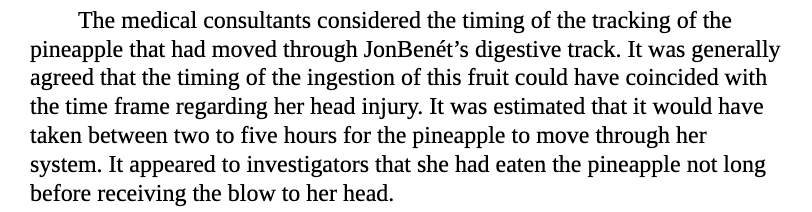
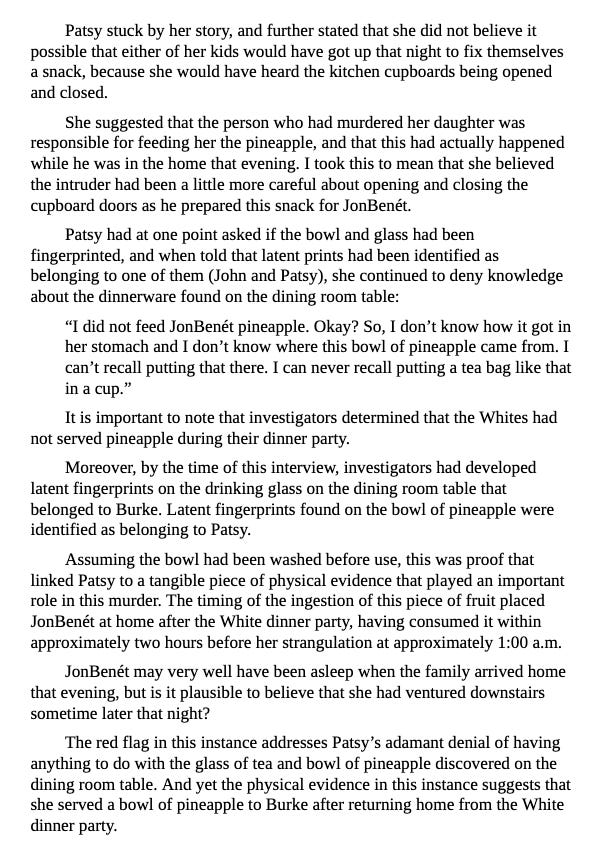
Here’s the thing: JBR ate pineapple at 11pm/midnight, 2 hours before she died. They estimate she died at 1am or 2am. How do we know this? They found undigested pineapple in her stomach. They know it is not from earlier in the day or from the dinner at the Whites because the food from earlier was further along in her digestive tract. Also, officers find a bowl of pineapple on the dining room table. It is a bowl of pineapple in milk next to an empty cup with a tea bag in it.
The Ramsey’s maid said this was Burke’s favorite snack. And, in fact, only Patsy and Burke’s fingerprints are on the bowl of pineapple (see below) and the cup. But, we know JBR ate some from this bowl because they collected it into evidence and tested it against the pineapple in her stomach: it was the same pineapple. Patsy tried to say she had no idea where it came from and someone must’ve left it out in the morning, but how can that be possible if JBR ate some?
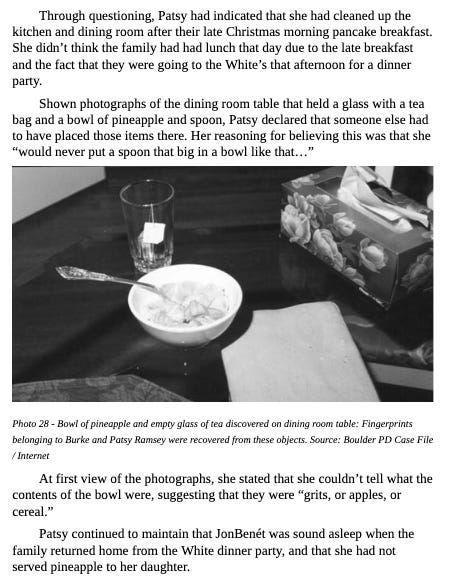
Burke and John say they have no clue either. Well, someone fed that girl pineapple 2 hours before she died and it’s very unlikely an intruder did that. It’s unlikely she could’ve prepared a bowl of pineapple with milk alone at 6 without making noise and waking someone. It’s also unlikely she was eating at midnight with her brother at midnight and an intruder could’ve committed the crime in a 2-hour timeframe without anyone hearing anything.
Below is Burke acting weird about the pineapple in 2016 on Dr. Phil. It’s interesting he says he can’t remember if they ate pineapple and how could anyone remember something that happened so long ago, but when asked about the 911 call, he says he couldn’t forget something like that.
With the pineapple evidence, it is clear she was awake at midnight, allowing 1-2 hours for an intruder to do everything. The Ramseys need to say they all went to sleep as soon as they got home because that opens the window of opportunity up from midnight to 10pm-2am and allows time for an intruder. If it’s as simple as “oh yeah, the kids wanted a snack when we got home,” why not say that?
Of course, there’s another reason Patsy and John may not have known about the pineapple: Burke made it himself and JBR went downstairs when she heard him getting a snack and playing with his toys.
The maid said the kids would often go play or get food after bedtime because the house was so large their parents couldn’t hear them. Burke said in his interview he could hear the fridge open from his room. We also know JBR and Burke would share the same room sometimes. If JBR would wet the bed, she’d change herself and go sleep in Burke’s extra bed. Each child had 2 twin beds in their room (see below). Burke would sleep in JBR’s room sometimes because his would get cold, he says this in his first interview.
The Ramseys say the kids never did that. But, Burke even says JBR slept in his room on Christmas Eve because he wakes up before her and she wanted to him to wake her up for gifts. Basically, there’s a lot of evidence pointing to the two siblings being together without their parent’s knowledge, which would explain the pineapple.
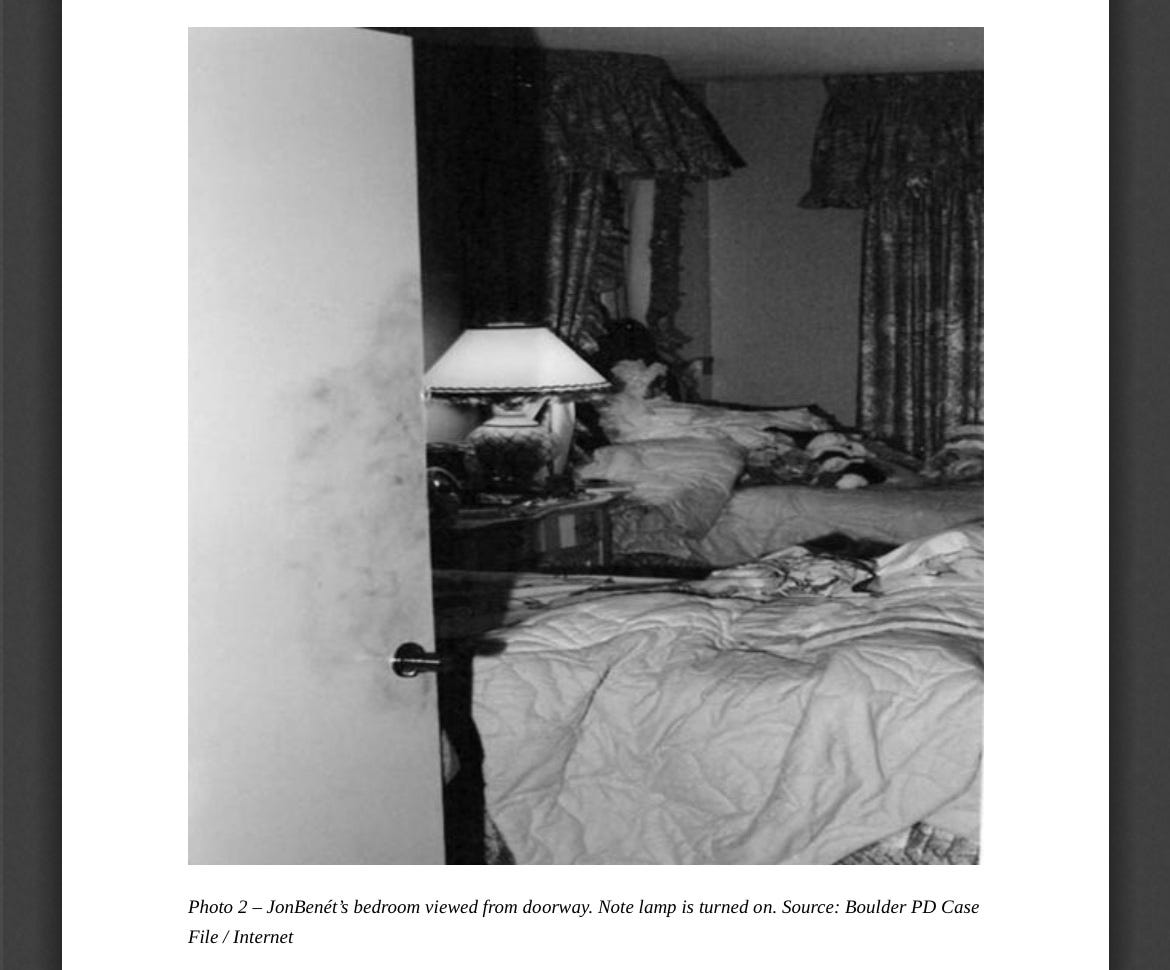
The Ramseys say this isn’t possible and Burke was asleep all night. In 2016, Burke goes on Dr. Phil and admits he was up after everyone went to bed for the first time, giving the pineapple theory more credence. Also, you’ll notice the bedroom light is on in the above bedroom picture. The bedroom is the only scene at the crime that we know was actually secured. It’s fair to assume, this is how it was when the incident occurred. If the intruders had a flashlight, why would they enter the room, walk around the bed and turn on JBR’s bedside light?
In addition to that, it would’ve taken someone with inside knowledge to know that was the only working light in her room, according to the Ramsey’s maid. How would a kidnapper know about the light switch and, again, why would they need a light if they have a flashlight? It seems more like JBR woke up in the night, turned her light on, got out of bed and possibly went to go see who was in the kitchen.
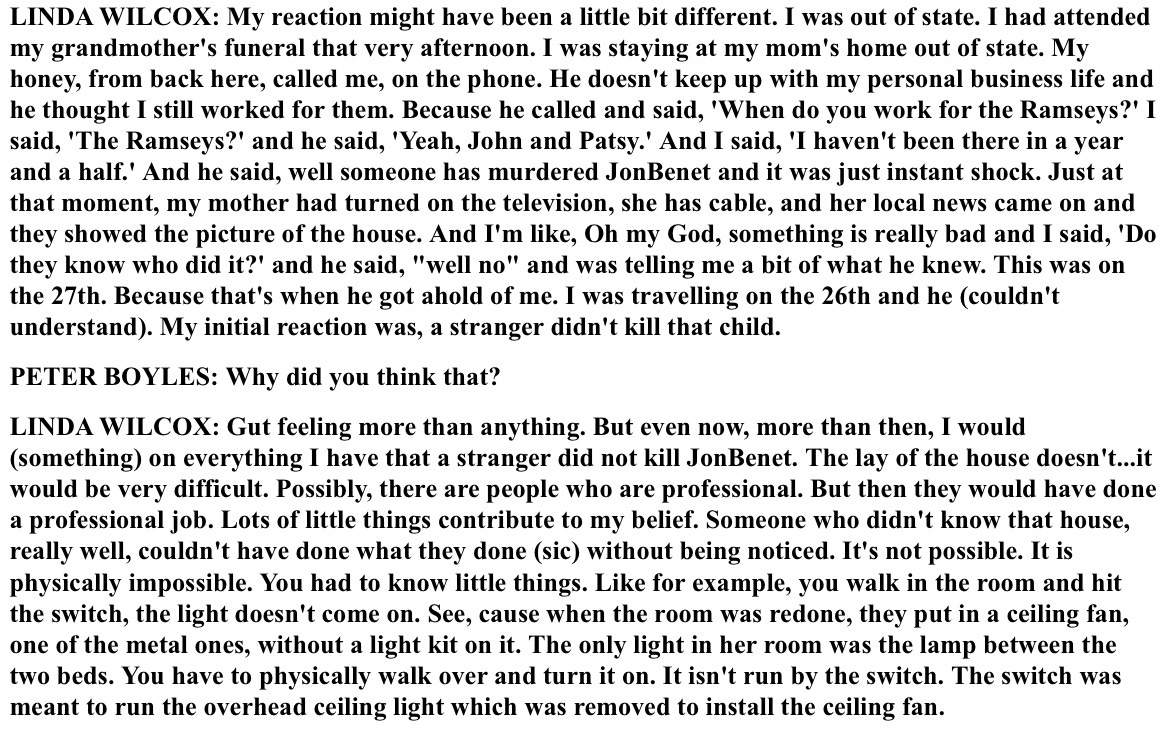
The pineapple lie confuses a lot of people and they dismiss it as a red herring, but it is probably the most important piece of information. The medical examiner is able to determine that JBR died shortly after eating the pineapple. Whoever gave her the pineapple knows how she hit her head:
Here is how Patsy explains the pineapple. It’s all we have since Burke doesn’t remember and won’t answer questions. She thinks the kidnapper fed JBR pineapple right before hitting her. Why would the intruder need to hit JBR then if they’d already subdued her enough to get her downstairs to the table to eat? Why stop to feed her pineapple? You supposedly have a stun gun and duct tape, why not use them and go? Oh, also, if she was stun gunned and dragged from her bed like Lou Smit says, did the intruder wake her up to feed her pineapple in that case?
One more thing about the pineapple? One of the few witnesses in this case is Scott Gibbons, he’s the neighbor to the immediate north of the Ramseys. According to Kolar he tells detectives, “He had been in his south-facing kitchen around midnight on Christmas night. He observed that the upper lights in the Ramsey kitchen were on, but dimmed low. Gibbons didn’t observe anyone inside the residence at the time, and noted that it was not unusual for lights to be on in the home at night.” (Foreign Faction, pg. 101)
That means the light was on in the kitchen around the time she ate the pineapple. If it was the intruder, why would they turn a light on? They have a flashlight. Why risk being seen? Clearly, there are witnesses close by.
The Enhanced 911 Call Lie- Patsy and John swear that Burke was nowhere in the vicinity the entire morning they realized JBR was missing. They do not wake him up for information, they just check on him, see he’s sleeping and leave him alone. They say he didn’t wake up until Fleet White went to get him and take him to the White’s house. Well, that is a lie.
Kimberly Archuleta was the 911 operator who took Patsy’s call. Almost immediately, she felt like something was off about the caller. At the end of the call, when the caller thought they’d hung up, Archuleta heard a change in tone and someone said “What do we do?” This was suspicious to her. She immediately went to her supervisor and noted this. After JBR’s body was found, she went back to her supervisor and said the 911 call should be enhanced because she swore there was more said at the end.
The FBI and Det. Trujillo thought she was right. They sent the tape to the Secret Service and Aerospace. The Secret Service wasn’t able to pick up on anything, but Aerospace, which had better recording equipment, could. The first two experts wrote down what they thought they heard independently. The third, a detective on the case, also wrote what she heard independently. All three of them wrote the same thing:
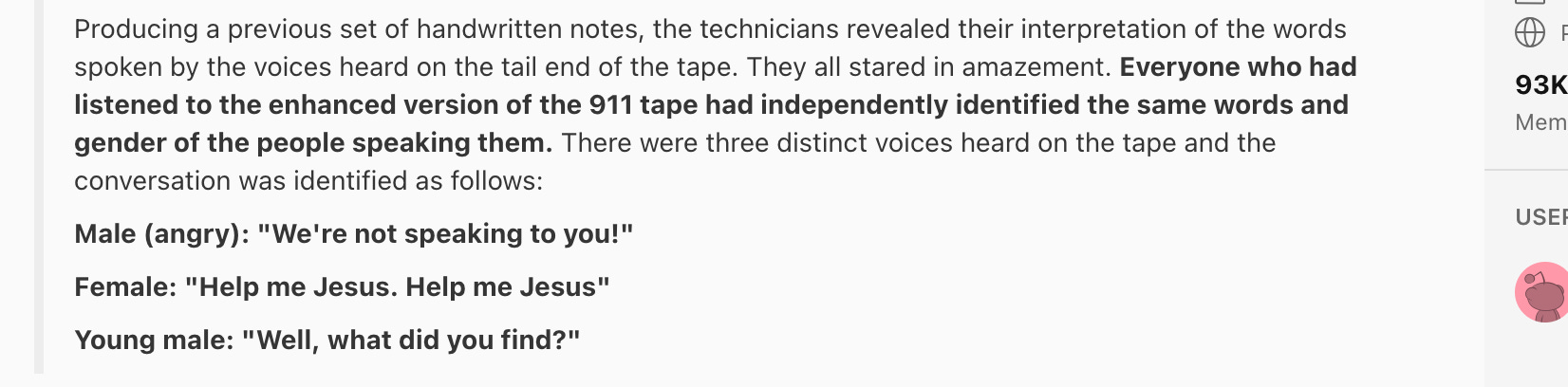
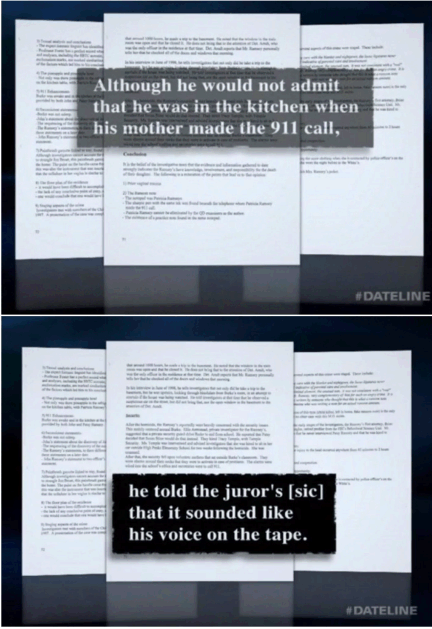
The enhanced 911 call is considered such legit evidence, we learn when the grand jury papers are unsealed in 2013, that it was presented to the grand jury. In fact, they asked Burke about the voices on the tape. He said to the grand jury, as confirmed by the 2016 CBS documentary, “It sounds like my voice on the tape,” but he still said he couldn’t remember if he was awake or not. Burke will later lie in his Dr. Phil interview and say he hasn’t heard the 911 call, but he has heard about it. However, we know the enhanced version was played for him at the grand jury and he said it sounded like him.
John and Patsy swore Burke was nowhere in the vicinity and slept the entire morning. The enhanced 911 call proves he was in the vicinity. If he did wake up and was curious about what was going on and awake because of Patsy’s scream, why hide that? On Dr. Phil, Burke and John say again that Burke was in bed asleep during the 911 call, despite the tape.
After Dr. Phil and the CBS lawsuit, Burke’s lawyer put out a statement saying that Burke never said he was asleep all morning, his parents did and he may have heard the commotion downstairs and screamed from the stairs “What did you find?” This contradicts what Burke says himself on Dr. Phil. It also doesn’t necessarily make sense of John angrily saying “We’re not speaking to you!” In his actual interview after the event, Burke does say he was awake in bed that morning. See below:
Here is the dispatcher talking about it and Burke answering questions about it on Dr. Phil in a way that seems…not so honest. Again, when during the lawsuit, CBS is able to confirm Burke said it sounds like him to the Grand Jury:
Below is the excerpt from the grand jury from Dateline covering the CBS lawsuit:
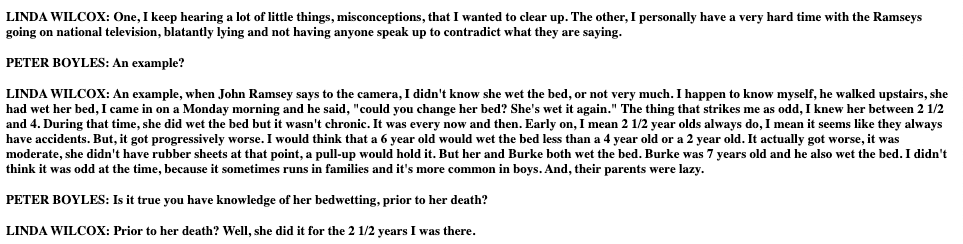
The red shirt and bedwetting lies - John said in their CNN interview that they weren’t aware of JBR wetting the bed. Their maid said John was there many times when JBR wet the bed and it’s odd he lied about this. He also must’ve known about Burke’s bedwetting and feces issues. Burke confirms that John and his mom knew that JBR wet the bed and he describes their routine around it in his videotaped interview.
This interview was eventually shared with the public on Dr. Phil in 2016. The Ramseys lying around JBR wetting the bed is, again, what most likely raised Dt. Thomas’ suspicions around that theory. Netflix makes this sound ridiculous, but they ignore that the Ramseys did lie about it. I clipped Burke’s part of the footage from Dr. Phil below. It’s also interesting Burke says he and JBR wet the bed a lot and his parents would clean it up and he remembers this in 2016, but John couldn’t recall if JBR wet the bed in the 1997 CNN interview.
I also believe Patsy did put the red turtleneck Det. Arendt saw in the wash on JBR that night, as mentioned above. She later lied about just putting her to bed in the white shirt. Again, just minor things there’s no real reason to cover up:
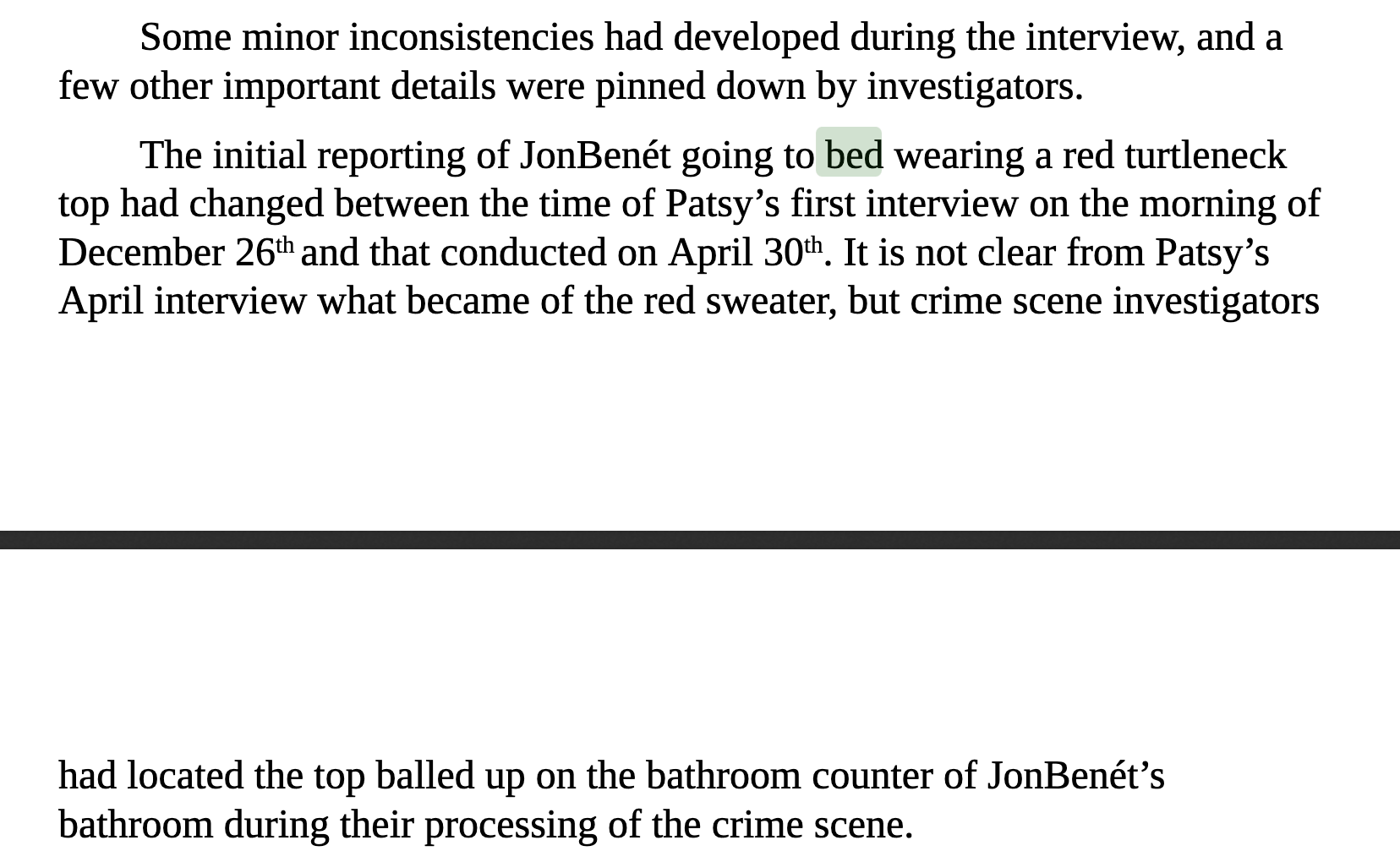
This could also be another clue that JBR woke up in the night and took off the red turtleneck herself, another sign she was awake after her parents say she was asleep. Or did someone else take it off of her?
The Flashlight Lie - Police found a black flashlight in the kitchen. The Ramseys said they didn’t recognize it, but may have owned one. The maid and family friend John Fernie said she absolutely recognized it as the flashlight Burke would sleep with. He’d use it in case he had to go to the bathroom at night. And AGAIN, in 2016, Burke says his dad put him to sleep with a flashlight! Dr. Phil asks if he took the flashlight downstairs and he says he can’t remember. That’s a huge change in John and Burke’s stories!
A flashlight sounds like something a kid sneaking downstairs to get a snack and play with his toys would bring with him. Why lie about recognizing the flashlight? Well the flashlight was the only item able to recreate the damage JBR suffered to her head. It was most likely the weapon used to hit her and BPD has held onto it as the murder weapon.
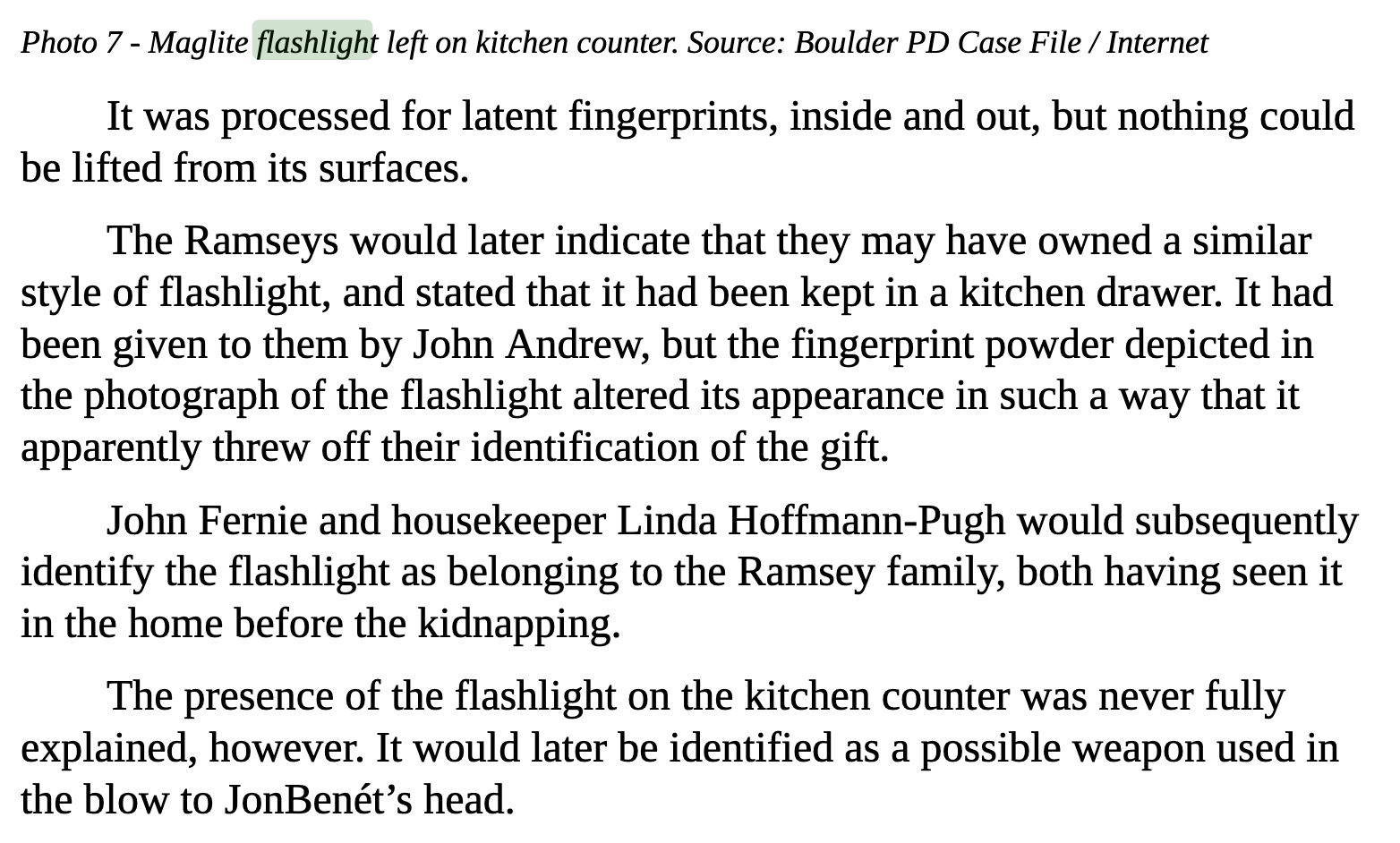
Here is Burke on Dr. Phil in 2016 admitting for the first time that his father put him to sleep with a flashlight and he was up after everyone else went to bed. In this moment, Burke breaks his 20 year alibi and connects both him and his father to the murder weapon the Ramseys previously said they weren’t sure they owned. John doesn’t recognize the flashlight he used that same night with Burke?
The 11am Timeline Lie - When John’s children from his first marriage came to the house after JBR was kidnapped, officers said it was a little before 1pm. This matters because John found JBR at 1:05pm. John’s son-in-law and daughter said that John got in their van as soon as they got there. He climbed in and said “JBR is with Beth now (his daughter who died 5 years before). I found her at 11am this morning.” Well…that means he found JBR before he “officially” did for police. It means he told his other children that JBR was dead before he “found” her at 1:05pm.
John will eventually say got the timezones mixed up, but his son-in-law points out that he was referring to his own timezone, so why talk about a different time zone? Later, the Ramseys will say the kids arrived at 2pm or 7pm, despite John saying in his police interrogation that the entire family left the house at 1:30pm and never returned again.
It’s a little hard to believe his kids arrived at 2pm or 7pm if the Ramseys weren’t there. Also hard to believe they arrived in the 1:05-1:30 window when John would’ve been finding JBR. It is most likely that the cops are telling the truth and the other kids arrived before 1pm, the body was then found and the family left the house for good at 1:30pm as John said in the interrogation. Officer Thomas documents this moment:
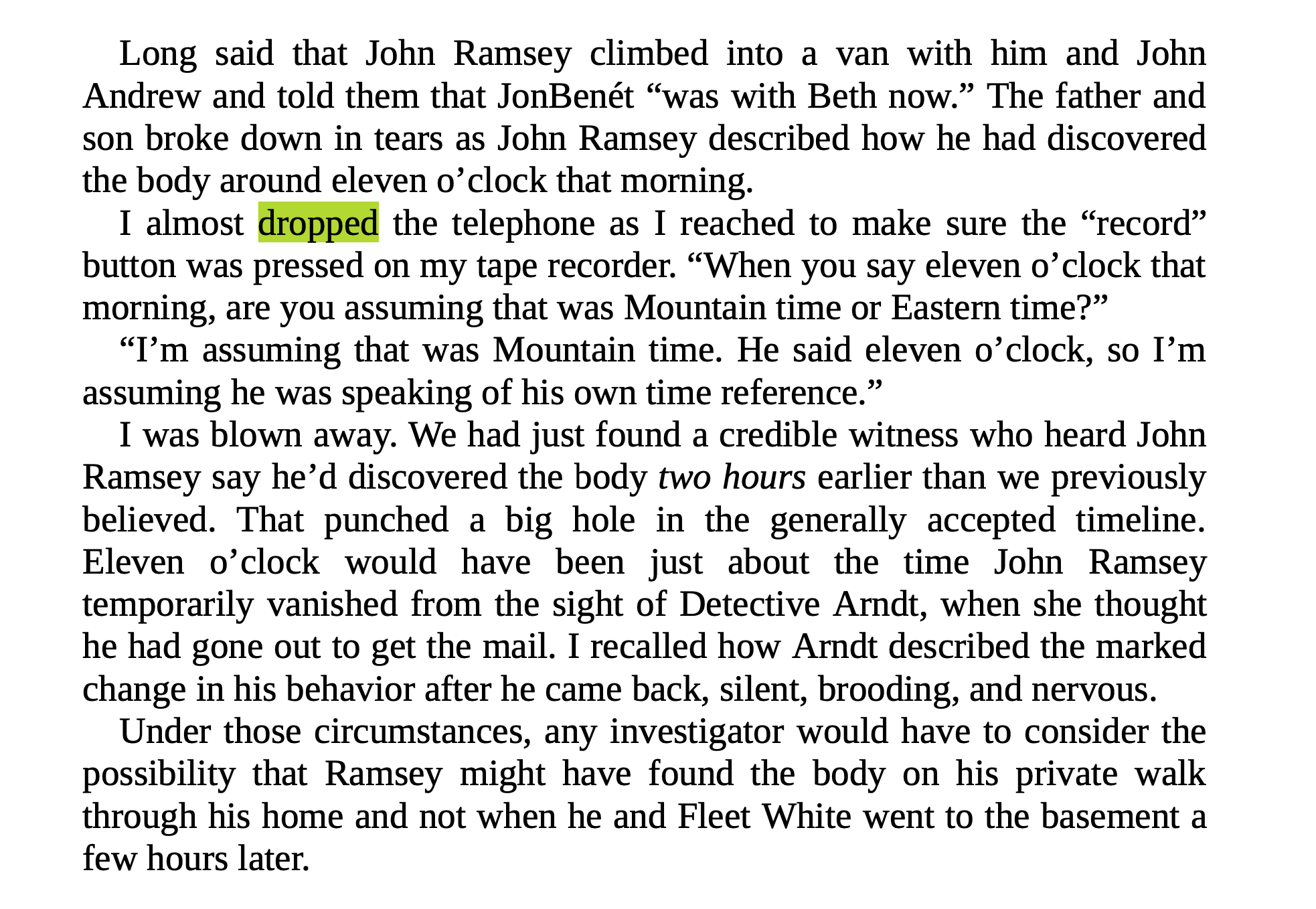
Some believe John did this because he knew the staging was shoddy and didn’t believe that he and Patsy would get away with it. With this move, John gave himself an alibi and potential witnesses who could say he wasn’t involved with the crime until 11am if this did blow up in their faces.
The American Girl Doll Theory - Ok, this isn’t REALLY the American Girl Doll theory, I just call it that because it’s fun. BUT, people who think an intruder did it point to the fact that there was no matching source for the duct tape in the house and the Ramseys hadn’t left all morning, so how could they dispose of the tape? It must’ve come from outside the house. WELL, in his book, Det. Steve Thomas outlines a very easy way the Ramseys could’ve snuck evidence out of the house: they were allowed to.
The day after JBR was found, the Ramseys asked if they could retrieve clothes for the funeral/JBR’s burial. The lead detective said sure, but you have to send someone else, we’ll take them to each room, they’ll point at what they need, we’ll document it and allow it to leave the property.
At least, that’s how it was supposed to go. According to Det. Thomas, when Pam, Patsy’s sister, shows up to gather items, she has an entire list from the Ramseys. It includes credit cards, jewelry, passports, JBR’s American Girl Dolls and stuffed animals, clothes, and other items. Det. Thomas says she filled a car with suitcases, the officers on scene didn’t properly itemize everything taken and if the Ramseys did want to sneak stuff out, this is how they’d do it. How Thomas describes it:
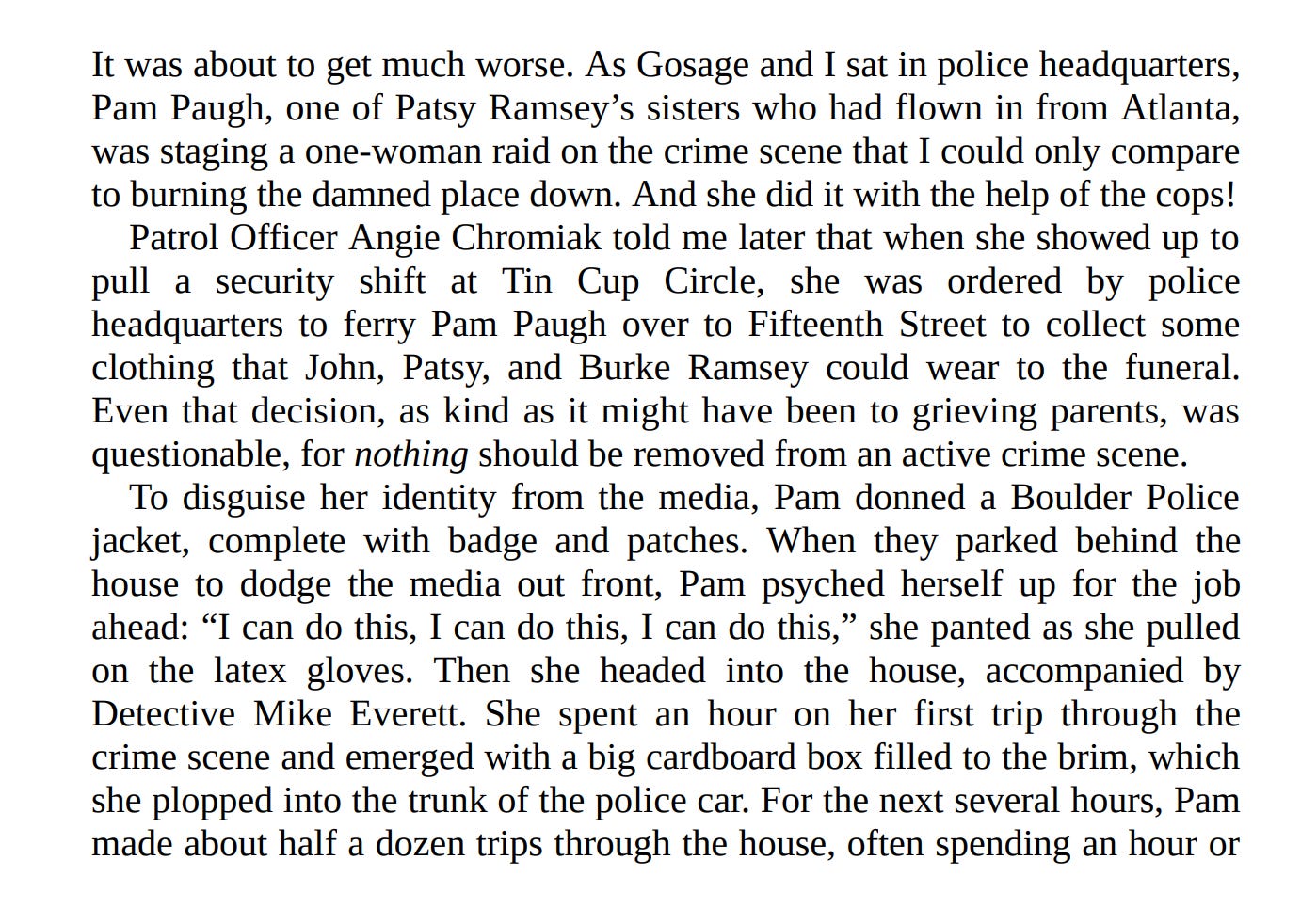
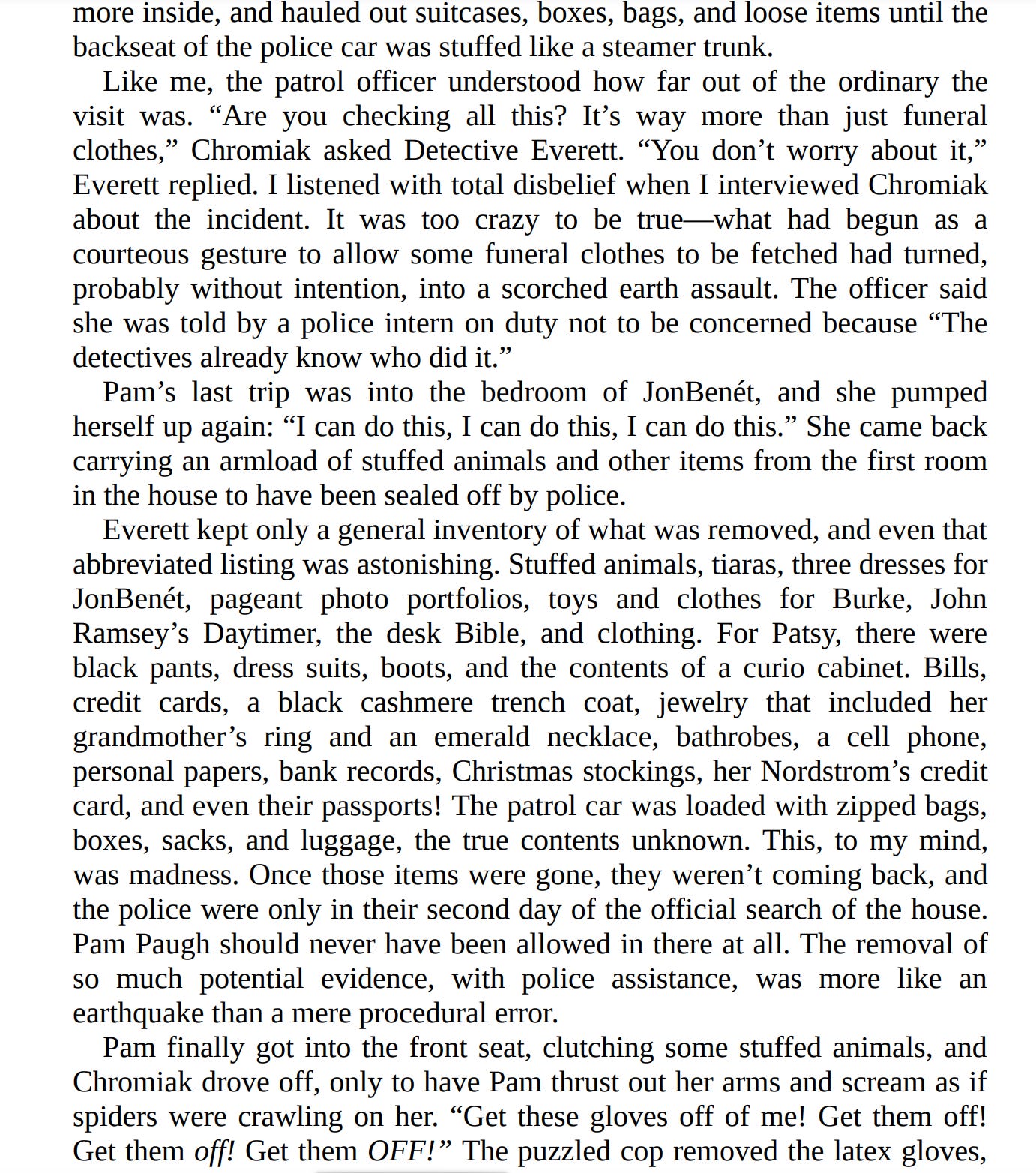
NOW, really crazy conspiracy ppl believe the source of the tape was the American Girl Doll. You see, in 1996, American Girl Doll stores trained employees to put tape on the back of the doll to cover a cord that came from the back of the doll’s neck. They also encouraged people who bought the dolls to do this. Det. Thomas looks into this theory and says it’s farfetched. It’s more likely they just hid the tape in a suitcase and had Pam take it out of the home.
But it is weird that Pam takes a Molly doll that JBR only owned for about a month. Sure, maybe Patsy did want things that reminded her of JBR, but why a doll that’s only a month old and was a gift from her grandma? Well, tan and navy fibers were also found on JBR’s longjohns and the tape. These people think the tan and navy fibers would match the tan body of the Molly doll and her navy clothes. Did the police want to check the Molly doll for a fiber match? Yes. Could they? No. The Ramseys wouldn’t give it to them.
In addition to that, the Molly doll drives suspicion because a few months after the murder, an employee at the American Girl Doll company reached out to Boulder PD to say someone ordered a Molly doll in JonBenet’s name after she was killed. The doll was bought with a money order and was sent to John’s office. John denies knowing anything about the doll, but it’s odd he didn’t go to police and say a stranger mailed him a doll in his dead daughter’s name that she owned before she died.
Couldn’t that be a potential clue? Is it unrelated? Most people think they ordered a new Molly doll and destroyed the one that would match the fibers. People who don’t want to believe in the power of an American Girl Doll to solve this case, however, just think Pam snuck the tape and other evidence out when she grabbed their things.
The Ransom Note - Pretty much everyone thinks Patsy wrote the letter, but I mostly care about the opinion of James Fitzgerald. He was a linguistics expert who caught the Unabomber based on language in letters! He is very good at his job! He says it was Patsy. But, that is just his opinion.
He wasn’t asked to officially review the case, even though he offered to do it for free with a panel of other experts in 2009. Chief Beckner said in his 2015 AMA that he declined the offer because Fitzgerald had trained a previous forensics expert on the case and he felt that was a conflict of interest the defense could benefit from, so there was no point in using Fitzgerald’s panel.
I know Netflix showed you something that said “6 experts said it wasn’t Patsy,” but you see those were 6 experts hired by the Ramseys to help them in the civil suit they filed against Dt. Steve Thomas. These were not the findings of the handwriting experts the grand jury heard. The standards of a civil suit are very different from a criminal suit so their findings can hardly be accepted as the final word.
Oh, also the FBI said in the history of kidnappings, there has never been a 2.5 page ransom letter and they felt it was written as a cover-up. Even if you think Boulder PD were bumbling idiots who dropped the ball, the FBI was a different team of people and the below statement is what they thought about the note.
Also, let’s think about this. If you’re a kidnapper who wants an amount with specific instructions, do you hope there’s paper and a pen in the house so you can write that demand out when you get there? What do you do if you can’t find a pad of paper? If that’s your motive, you’re just crossing your fingers that you get there and find a way to communicate your demands?
Also, if you’re in the middle of kidnapping her and she dies, why leave the ransom letterthat’s the only evidence pointing to you anyway? Without the ransom letter, the kidnapper could take all evidence pointing to him and easily pin this on the parents.
The FBI thought it was odd a kidnapper would leave something so incriminating with the body in the house, which would immediately negate any chance of getting the ransom money and provide a clues on a suspect. If you accept the ransom note is fake, that’s incredibly damning for the Ramseys.

The Morning Timeline Lie/Was Burke Awake? - For 20 years, John and Patsy told the same story about that morning: Patsy woke up to make coffee, she went down the stairs and found the ransom note. She didn’t read all of it, she just immediately ran to JBR’s room. When she saw she wasn’t there, she yelled for John. John ran out of the bathroom to the back stairs and found Patsy. He took the letter and told her to call 911. He says at this point he or Patsy went in to check in on Burke, but they left him sleeping. Both Patsy and John say they never looked for JBR because of the ransom note
For 20 years, the police thought that was weird as hell. Whose daughter goes missing and they don’t call her name out or search for her? Why wouldn’t they wake Burke up and ask if he knew anything? Kolar documents this:
Here, is John saying he was the one who checked Burke’s room and Burke was still asleep.
In 2016, thanks again to Burke’s Dr. Phil interview, we find out that Kolar was right to feel suspect about this because the Ramseys did lie. According to Burke, his mom came bursting into his room, searching for JBR, not his dad. She was screaming, “Where is my baby?!” and woke him up. About an hour later, a police officer enters his room and he says that he stays in bed. This means the Ramseys did search for her, they knew Burke was awake and there was at least an hour between Burke waking up because of his mom and the 911 call and police showing up.
You know I have the clip!
The thing is, Kolar and the police knew to be suspect about this during the case because Burke told the police in 1996 that his mom came rushing into his room looking for JBR. They knew she and John were lying about Burke’s whereabouts and when they woke him up from day one. That’s why the police suspected the Ramseys. Burke’s police interview is below. Dr. Phil also points out it’s weird that Burke would hear his parents searching for his sister and wouldn’t get up to see what was happening:
If the Ramseys did search Burke’s room, they probably searched the rest of the house looking for JBR too. We now know about an hour went by from Patsy waking Burke up to the cops showing up, rather than her original “I found the letter, John checked Burke and I called the cops shortly after, Burke never woke up” timeline.
Did they tell police Burke was asleep and they didn’t search the house because he could mess up their timeline and prove they’d been searching for her for at least an hour before cops arrived?
Burke and JBR’s Behavioral Histories
Most people hate the Burke Did It theory because they can’t imagine a 9yo boy being violent or doing these things. However, Burke had a history of violence with JBR. By the end of this, you’ll see that he was a 9 year old boy who previously sent JBR to the hospital, had issues with bedwetting and feces, and may have been a victim himself.
When Burke was 6, he hit her in the face with a golf club and sent her to the ER. This is in her medical records. At the time, Patsy told friends he lost his temper. In their book, the Ramseys say he was practicing his golf swing and lost control. JBR was taken to the doctor 33 times in the last 3 years of her life. There were frequent doctor calls including three 8 days before the murder. It’s more than likely that Burke hit JBR more than once. As far as we know, he’s the only person in the family to ever send JBR to the ER:
People point to JBR wetting the bed and getting clingier with her mom in the days leading up to her death as evidence she was being sexually abused or suffering trauma. What they tend to ignore is that Burke was also wetting the bed at an older age and people around the Ramseys heard odd comments from the family about his body.
Jane Stobie, a former manager who began working at John’s company Access Graphics in 1990, said Nedra, Pam and Polly (Patsy’s mom and sisters) would comment often on Burke’s penis in her 1997 interview with Vanity Fair. The three were also on payroll at Access Graphics and Stobie managed Nedra.

Of course, this could be how the family jokes around. In addition to that, however, his previous nanny said he was wetting the bed until he was at least 7. Cops asked him about it and he got defensive. If JBR regressing and her bed wetting getting worse is a sign of abuse, the same could be said for Burke. Was he wetting the bed because someone in the family was also sexually abusing him? If that’s the case, could he have picked up learned behaviors that he took out on JBR?
Wilcox says that JBR’s bedwetting was getting worse, but what we also know is that Burke’s issues with feces were also escalating. When Patsy was first diagnosed with cancer, housekeeper Geraldine Vodicka found him smearing poop on the walls. This would’ve been around the time of the golf club incident.
Nedra, JBR and Burke’s grandmother cleaned up the incident Vodicka mentioned so she also witnessed this. Another maid, Linda Hoffman-Pugh, previously found feces in JBR’s bed sheets and thought it may have been Burke’s. This matters because feces were found in JBR’s room when the crime scene was processed:
The Ramseys say that Burke lived in the house and they can’t say when he may have left the pajamas there and question if he even did. Boulder PD didn’t have a chance to question him about it. However, the fact that it was still present at the crime scene points to it being recent: The Ramseys had maids, does it really seem likely they left poop-stained pajamas and candy in JBR’s room for days? A maid was there on the 23rd according to witnesses (this is the day Fleet White makes an “accidental” 911 call at the Ramsey’s home, they had guests over).
We know JBR slept in Burke’s room on the 24th because he says this in his interview. Did Burke do this on the 25th? If so, why? Did the maid leave poop-covered pajamas and a candy box in JBR’s room for days? Did this cause a fight between Burke and JBR that night? It’s unlikely the feces is connected to the intruder, but if Burke did do this on the 25th, again, it points to him being awake that night.
Maybe it was an innocent prank, but did he hear anything while intruders came to kidnap his sister while he happened to be leaving feces in her room? These are questions he could answer, but he doesn’t seem interested.
Back when Burke did his Dr. Phil interview in 2016 and admitted he was up after everyone went to sleep, Boulder PD asked to interview him again. They even sent two people out to his house. They wanted to ask if he heard anything since this was a new revelation after 20 years. That makes sense! They have a possible new witness! Even John Ramsey was shocked at this revelation.
John says he had no idea Burke got back up, “if he even did.” He thinks Burke might’ve misunderstood Dr. Phil’s question, but it’s clear that Dr. Phil asks twice. Dr. Phil says, “Your father says he put you to sleep with the flashlight and you went downstairs.”
Burke says “Yeah, I had some toy that I wanted to put together. I remember being downstairs after everyone was in bed…wanting to get this thing out.” Dr. Phil replies “Did you use the flashlight so you wouldn’t be seen?” Burke says, “I don’t remember. I just remember being downstairs with this toy.” I’ll share this YouTube clip of an interview John did this year for Crime Junkies where he expresses shock that Burke left his room after everyone was asleep. Apparently, John and Burke never talked about this:
John says Burke wouldn’t keep any information to himself, but Burke refused to answer any questions after this revelation and sent a message via his lawyer to never contact him again. If he is interested in finding his sister’s killer, that isn’t something anyone has ever seen, at least outside of the family. Even after the murder, he seemed uninterested in where JBR was or who may have taken her. Fleet White noticed he didn’t ask any questions when he drove Burke from the Ramsey’s home to his the morning JBR was kidnapped. Kolar notes this:

Apparently, no new questions have come up for Burke since 1996. Even though he’s connected to the pineapple, the feces-smeared pajama bottoms and admitted he was up, he has nothing to say. He was willing to talk to Dr. Phil, but not the police. That’s odd.
The Evidence of JBR’s Previous Sexual Assault
Ok, this is a very complicated topic and I will beg you here to read this 2 part reddit thread that quotes from the child abuse panel’s findings on JBR directly. But, look, I know, the Netflix documentary showed you a clip of JBR’s pediatrician from ages 3-6 and he said he saw no signs of sexual abuse during his exams of her. The documentary presents this as final evidence: there was no previous sexual assault before her murder, see her pediatrician said so.
As I’ve said so many times: this isn’t the case! In order to see signs of child sexual abuse, thorough exams are needed that look at the hymen and internal vaginal walls for damage. JBR’s pediatrician never performed a test like that and said so to the grand jury. That wouldn’t have been typical for him to do when JBR wasn’t brought in for those reasons and he had no reason to suspect that. Of course he saw no evidence for sexual abuse, he wasn’t looking for it.
The coroner who did the autopsy did see signs of previous sexual abuse, but couldn’t say when it occurred. The Boulder PD decided to put together a panel of child sexual abuse experts to examine the body and look into the case. This panel included John McCann, who created the standard now used to define child sexual assault in hospitals and police cases. Basically, these are authorities on the topic. The strongest evidence of the previous sexual abuse is that it was allowed into the grand jury evidence:
The other four people on the panel were Richard Krugman, James Monteleone, Valerie Rao and Andrew Sirotnak. Every sexual abuse expert who examined the genital findings from JBR’s autopsy recognized physical signs of sexual abuse that predated her murder. The only thing they couldn’t agree on was when and how often it occurred. McCann said the abrasions were 7-10 days healed, Rao said it could be 2 months, some didn’t feel comfortable trying to date it but could say it was damage that predated her death.
You may have heard that this damage and JBR’s bedwetting were caused by UTIs and irritation that’s common in kids. This is what the Ramseys put out through their lawyers. However, the abrasions seen on the hymenal transection by the panel could only be done through sexual assault or a massive injury. There was no massive injury in JBR’s medical history that pointed to something like this. It couldn’t have been caused by horseback riding or a bike, as these were abrasions that had healed, opened and re-healed, pointing to chronic sexual abuse.
If there was some intruder or pedophile stalker who managed to get access to JBR and assault her 7-10 days before her death, that would be a huge lead. This is evidence that, like the pineapple in her stomach, cannot be denied. But the Ramseys dismiss the evidence from this panel outright. Additionally, if there’s evidence that JBR was being chronically abused, who is to say Burke wasn’t also being abused, causing him to wet the bed again or take out the same abuse on his sister? And even if you don’t believe it’s Burke, couldn’t this be possible evidence that John was abusing his daughter and it’s still someone in the family?
Many believe Burke perpetrated the previous abuse on JBR and not John because a maid previously saw them “playing doctor.” When she asked what was going on, Burke got mad at her. Also, John was gone a lot. Additionally, the previous summer at the family’s Michigan house, Patsy told staff that Burke and JBR couldn’t be alone together. A family friend said Patsy said it was because they were “exploring” with each other too much.
Of course, these are secondary accounts, but coupled with the fact that Burke and JBR would share bedrooms occasionally and they both showed signs of regressing due to sexual abuse, there is a chance that their doctor “play” wasn’t so innocent. Was Patsy having issues with Burke? We can’t say for sure, but police do know that her mother, who cleaned up after Burke spread feces on the wall, gifted her 3 books on raising problem children in the year before JBR died.
One was Why Johnny Can’t Tell Right From Wrong (see above screenshot on feces). Of course, she might just like parenting books and they were just gifts.
The above facts usually get people around to Ramseys Did It. It was this thread that got me fully convinced of Burke Did It. Basically: everything done by JBR could’ve been done by a child and an adult would’ve caused more damage. The Netflix doc ignores all of this. The hit to the head wasn’t enough to kill JBR, it caused internal bleeding and knocked her out, but she wasn’t dead. The choking started 45 minutes to 2 hours after she was hit in the head and also wasn’t enough to kill her by itself. While the skin on the outside of her neck was red, there was no internal damage to the windpipe.
If an adult hit her head, it would’ve killed her. If an adult strangled her, there would’ve been internal damage to the windpipe. She was either choked by an adult who didn’t want to hurt her or a child who wasn’t strong enough to. Also, why would an intruder hit her in the head and wait 45 minutes to 2 hours to choke her? If you’re there to kidnap her, why not just leave now that she’s unconscious and you have her? Also, If you think she’s dead from the hit, why leave the ransom note that would point to you?
And while the garrote used was described as “complex” by the Ramseys, a knot expert and the FBI said it was a simple loop knot a boy scout could make and the tool was rudimentary. Burke was a cub scout. In Officer Thomas’ book, he says these are the facts that even made the FBI ask if a child could be involved.
Let’s get into the reason so many people believe the garrote was complex, despite the opinion of experts. That would be thanks to the Ramseys. You see, soon after their daughter was killed, the Ramseys decided to start a foundation in her name. By March, the foundation was created with tax documents filed.
The Ramseys still wouldn’t talk to police until April, but they took time to do this. Part of the foundation was a website, ramseyfamily.com (since taken down). On this site, the Ramseys shared a tip phone number that led to their lawyers and not the police.
They also shared intimate details about the case before police said it was okay. You see, the Ramseys point to the media circus causing them to become suspects. The truth is that it was the Ramsey’s circus. When the police started leaking information to the media, it was only after the Ramseys started a website with information from the case and started buying ads in the newspaper that also leaked information about the case!
The police couldn’t understand why the Ramseys wouldn’t talk to them to answer questions or get updates, but they wanted to put things online. The World Wide Web! In 1997! The Ramseys published crime scene photos, direct messages from family members, photos of JBR, drawings she did, and updates.
They even published a photo of the garrote, where they ask people to notice the “complexity”:
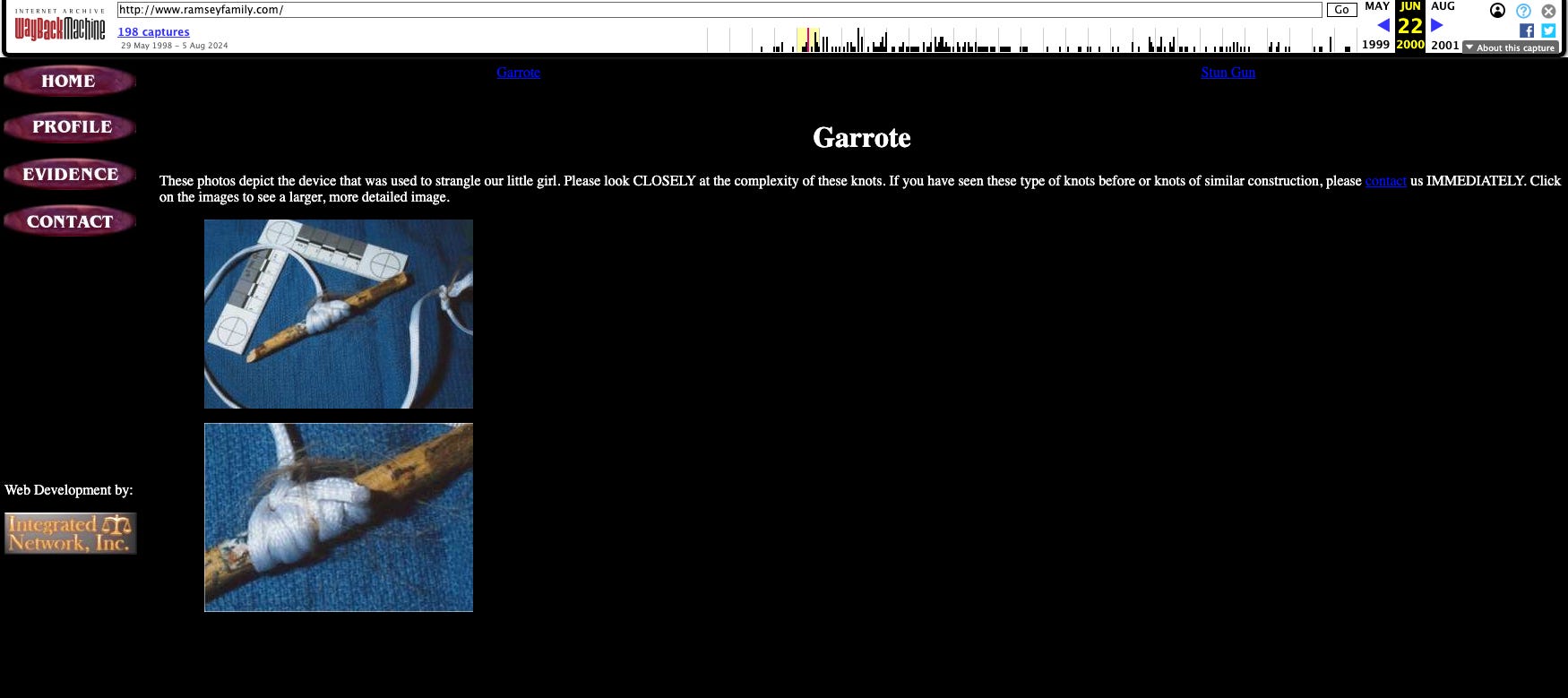
That’s odd considering police experts felt it was a simple knot with a bunch of loops that any adult or Cub Scout could’ve done. The police wondered why the Ramseys were purposefully putting out misleading information. That wouldn’t help find the killer. If it was a close friend or someone in the pedophile circuit, what if they had used simple knots and weren’t an expert? Sharing this information with the public would also mean any wanna-be fake confessor could share details of the case and confuse the suspect list.
The Ramseys are also the ones who leak the ransom note to the press. They buy an ad and publish it in the paper, despite the police begging them not to. The Ramseys even admit on their website that the police have told them not to share details from it, but they share samples of the writing with the public. Now, if an intruder tried to mimic Patsy’s handwriting or just tried to conceal their handwriting, how would releasing this to the public be helpful? This was the most intimate, direct piece of evidence from a supposed intruder and they published it in the paper and on their website:


Well, the police didn’t like this. Neither did their friends. Even Barbara Fernie, one of the people Patsy called over immediately, noticed the Ramseys were misleading the public by presenting false information. She let investigators know that one of the ads the family published was intentionally misrepresenting things. Fleet White also begged the family to stop posting and going on TV and to talk to the police.
This was the power of the Ramsey PR machine! To this day, people think the knots were complicated. They think there was evidence of a break-in on the backdoor! They think an intruder could’ve found duct tape, a paintbrush and cord in the basement of a house this crowded, big and dark (someone leaks the crime scene video at some point)! Oh, are you shocked you just saw a full video of the inside of their house? Yeah. That's pretty weird for 1996.
Maybe the cops leaked it to show the public how hard it would be for anyone to find anything in such a dark, big, crowded basement. Maybe the Ramseys leaked it so there’d be more doubt about who exactly knew the layout of their basement. Who knows?
This is also why John Mark Karr persists as a suspect. Because he knew “private” information. Well, the Ramseys maintained a website for years where relatives left personal messages. Did she ever sign one with that nickname? Hard to say, most of the site has been scrubbed from the internet. If Karr was obsessed with the case, he easily could’ve seen that there. The family put personal photos and crime scene photos on the site, anyone interested could’ve checked obsessively.
Despite the family making all this information public, Boulder PD investigators who previously worked on the case like Kolar knew that Karr was a fraud as soon as his emails came out because he still couldn’t get the details right. Boulder PD did manage to keep a few details from the public and Karr didn’t know them says Kolar in his 2014 AMA. The police know Karr is a fraud from these details, but Netflix dedicates nearly an entire episode to him. Why? It helps the Ramseys and supports their intruder theory.
Boulder Police dropped the ball on this case on day one by failing to secure the crime scene. However, the Ramseys are the people who failed to secure crucial information about the investigation and case after day one. The Ramseys benefit from muddying the evidence, the suspect list and anything else. If the police were able to rule people out, something might point to the Ramseys.
If the Ramseys could make details widely known, there’s just more people to point away from them. Their PR team goes to work at this and, now, the myth that the garrote was “complex” persists. Today, the Ramseys can use Netflix instead of a geocities site. I would be willing to believe they created their site in good faith, to collect evidence or tips, but it’s odd that they dismantled the site a few years after her murder. No one was arrested. They stopped communicating with Boulder PD after they moved back to Georgia. Was the site just a temporary PR effort?
The Ramseys continue to use the media to push the narratives they want. Let’s take, for example, something as simple as the order of JBR’s injuries. The Netflix documentary says it’s “unclear if the head injury or choking” happened first. It makes it nebulous, like no one could tell! Well, the medical examiner could. he listed this as the order of death:
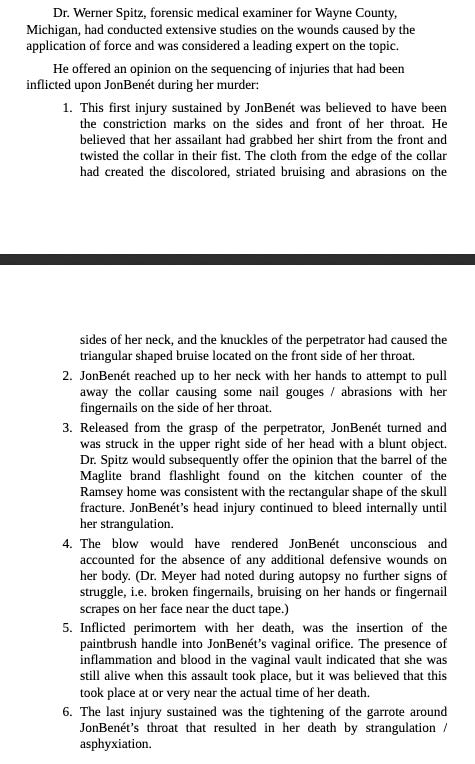
Det. Kolar also points to evidence that this is likely the order. As he says below, if the garrote caused her death or brought her close to death and then she was hit in the head, her head wouldn’t have bled for 45-90 minutes:
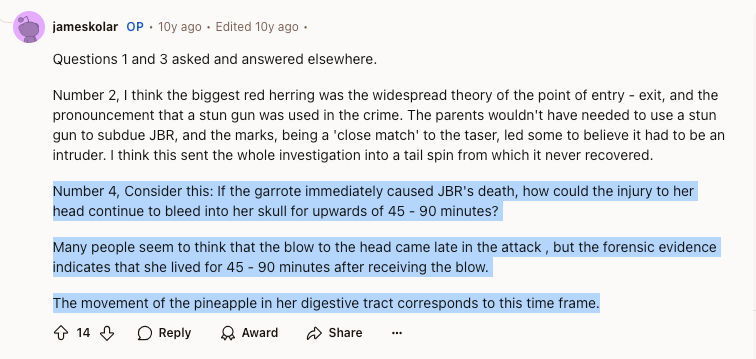
There’s a lot of evidence that makes the timeline clear, so why don’t the Ramseys want you to know the above timeline? Because it makes them look guilty as hell. In fact, the grand jury thought this pointed to the Ramseys. Why would an intruder sit around for 45 minutes to an hour waiting to choke her and not just leave with her?
A few members of the grand jury have spoken out. They said this timeline was one of the most convincing pieces of evidence that the parents did it. They felt the DNA didn’t matter. Naturally, the Ramseys use Netflix to confuse the timeline and make the DNA sound incredibly important.
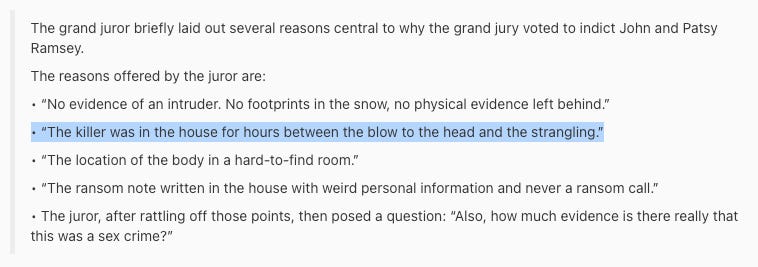
I found the Ramsey site when I was 12. I remember thinking it was so weird I could see crime scene photos and evidence. Isn’t it strange how much publicly available information there is in this case, but the Ramseys still create their own narrative?
Once you accept that these injuries could be caused by a child, the Ramsey’s PR works harder than Kris Jenner, Burke may have been a victim of sexual abuse himself and Burke may have been doing this to his sister, the case makes a lot more sense than a magic intruder floating in through a window without touching spiderwebs or the world’s quietest stun gun.
It also explains why the Ramseys would cover for Burke. If they said he did it, he might tell the police their dad had been inappropriate with both of them. If John or Patsy did it, they have little reason to cover for each other. If either parent did it, why would the other keep Burke around them? Either parent could’ve turned on the other and the innocent parent would look like a hero.
However, if it was Burke that did it, that would damage Patsy and John’s reputation as parents. Could John work for the government if he was famous for raising a son who killed his beauty pageant daughter? Would Patsy still be loved in the community? Patsy also said she’d die if anything happened to Burke. When asked if she’d protect John if he did it, she said no, she’d kill him herself.
John also said he wouldn’t protect Patsy if she did it. When asked if she’d protect Burke if he did it, Patsy screamed “You can’t ask that!” However, Burke being involved is the only reason to do a cover-up or lie about his whereabouts or keep him from answering questions about direct evidence connected to him. John and Patsy wouldn’t have covered for each other.
What do I think happened that night?
The family came home at 9:30/10pm. John did put JBR to sleep and her mom did go in and change her into a red sweater over her white shirt and longjohns. Burke, however, didn’t want to go to bed yet. John said in his interview that Burke wanted to build a car garage toy he got, but he made him go to bed. John goes to bed where Patsy is already asleep after changing JBR.
Thinking everyone is asleep around midnight, Burke gets his flashlight and decides to sneak back downstairs to get his favorite snack, pineapple and milk, and to play with his new toys. I tend to think Burke made the pineapple alone because Patsy would’ve known to clean it up with everything else if she’d known about it.
He gets to the kitchen, makes the bowl and a cup of tea. He finishes the tea, but only eats some of the pineapple. He grabs his flashlight and goes down to the basement. The basement is known as Burke’s toy room. He has an entire train room down there, he often whittles in the wine cellar and is basically left to roam down there a lot according to their maid:
At some point, JBR wakes up in the night. Maybe she heard Burke in the kitchen (her room is above it and even Burke said he could hear the fridge open from his bed). Maybe she hears him playing with toys. Maybe she wet herself and is doing her usual routine of changing and going to his room, but notices he isn’t there. Either way, she’s a six year old and she wants to play too so she goes to find him. Downstairs, she sees the leftover bowl of pineapple and grabs a piece. She heads down to the basement to play with her brother.
Burke has been in the wine cellar, we know this because he later says he opened the gifts that were being kept there (see below), even though Patsy lies and says she did this. She most likely wants to distance Burke from the scene. When JBR comes down, perhaps he sees a chance to “play doctor,” since he believes his parents are asleep. I think this is actually when the paintbrush comes into play. Or, maybe, they just get into a fight over the gifts.

The previous abrasions caused to JBR were thought to be caused by digital penetration. Perhaps, Burke saw his mom’s paintbrush in the basement and escalated things. According to the autopsy, the paintbrush was inserted once and removed. The FBI thought this was odd if it was a pedophile: they’d probably do something similar to sexual stimulation, not jam it in and remove it once. Their conclusion was that it was staged to hide previous sexual abuse. As you see from Dr. Meyer’s report below, this is another grey area the Ramseys took advantage of. It sounds horrific, too horrific for a 9yo to do it, but the actual physical evidence was not consistent with torture:
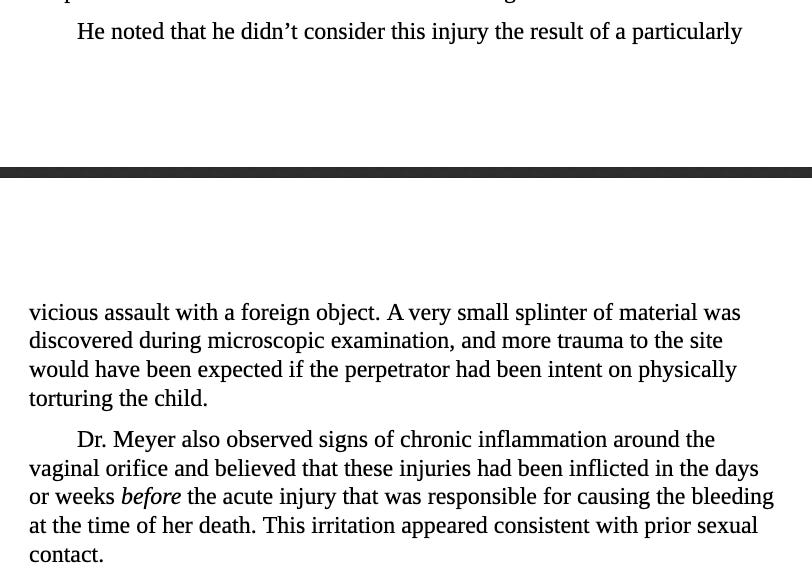
But, imagine a young boy who has been abusing his little sister. Or you just hit her and she’s knocked out and you want to try something extreme to wake her up. He happens to see a paintbrush around, escalates the situation, she screams in pain, jumps up and says she’s going to tell mom. Burke grabs her by the collar to stop her (see below, does this sound like the action of an intruder?).
We know someone grabbed the front of her shirt because it had a wrinkle pattern that looked like someone grabbed it. She scratches at her neck and his hands to get him to let go, which is how DNA ends up under her fingernail. When he lets go, she turns around to run. He grabs his flashlight and hits her on the head. She falls unconscious.
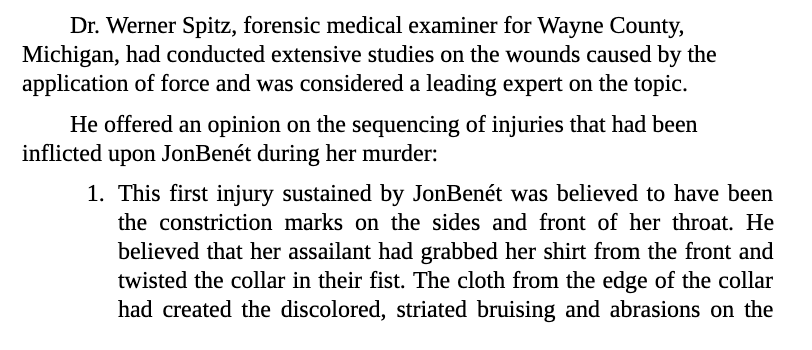
Burke is now a scared little boy who is trying to wake his sister up. He grabs the train tracks that are later found next to her body and starts poking her in the back and in the neck to get her to wake up. She doesn’t. He realizes he might be in big trouble now. He can’t let his parents see what he did. He breaks the paintbrush. He wraps a cord around the broken brush with a knot and decides to strangle her with it. Maybe he thinks that won’t look as bad as what he actually did with it. Or, maybe he simply left the paintbrush there and when Patsy and John find her, they create the garrote to hide what Burke did with the paint brush.
Whoever strangles her isn’t strong enough to break her windpipe or they were careful not to use too much pressure. However, it is enough to kill her with the head wound. After the murder, Burke will casually talk to a friend about possible ways JBR was strangled and how JBR may have been hit in the head. Officers will note he seems comfortable talking about violence. Others believe the garrote is part of the parent’s staging.
Now, Burke or his parents have to hide his crime. Maybe he’s angry and also breaks the Train Room window (some believe it was broken that morning and John’s story about breaking it months prior was a lie.) Maybe he’s so angry about what he’s done, he regresses to smearing poop in JBR’s room. He tries to hide what he’s done and grabs a blanket off of JBR’s bed. He doesn’t realize her Barbie pajamas are wrapped up in it. He goes back to the basement, throws the blanket over it and goes to bed. Some think the parents carefully wrapped her in the blanket with her favorite pajamas, however.
At some point, Patsy wakes up, well before 5:30am. They had to be at the airport at 7am and she hadn’t finished packing yet. We know this because there were open suitcases with clothes in them in the room next to JonBenet’s. Or, maybe she never went to sleep.
When Patsy greets officers after the 911 call, she’s wearing the same clothes she wore to the party at the White’s the night before and she has a full face of make-up. She says she threw on the same clothes from the night before. The Crime Junkies episode and Netflix treat this as normal for her. However, it wasn’t according to her maid. Her friends say she’d never be caught dead wearing the same clothes two days in a row. The family was also headed to the airport for a trip that morning, why travel in party clothes and not something more comfortable if you don’t care? Investigators see it as a sign that she didn’t actually go to bed.
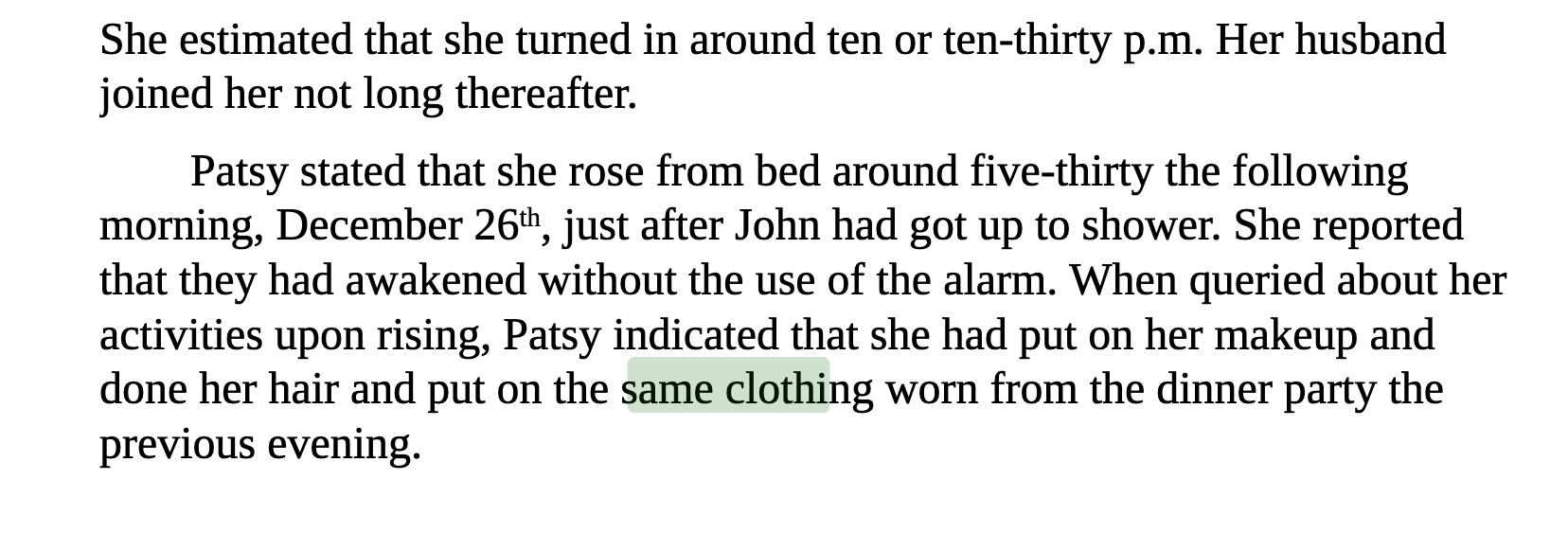
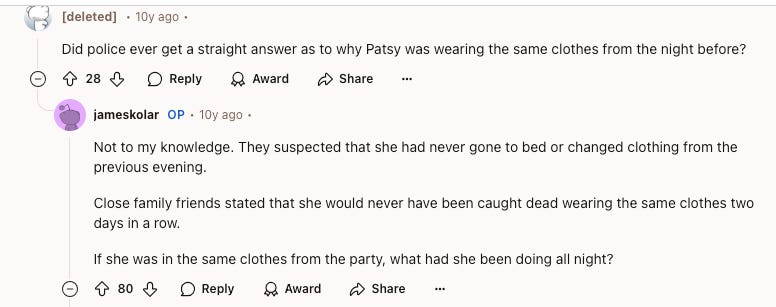
Did Patsy stay up because she heard a fight start between JBR and Burke that escalated into him hitting her? Did Burke sneak into JBR’s room with his flashlight to leave the feces, wake her up and start a fight that ended with him hitting her in the head and Patsy rushing into the room to turn on the only light that worked?
Personally, I do believe her when she said she went to JBR’s room first that morning and noticed she wasn’t there. If John or Patsy had known about the pineapple or feces, they probably would’ve cleaned those parts up, so these activities probably happened without their knowledge.
If she saw JBR wasn’t in bed, she most likely went to search for her. She goes downstairs, she checks the dining room, eventually she goes to check Burke’s playroom downstairs. Maybe she notices he left his new toys out, but she doesn’t see JonBenet. Maybe she notices the door to the wine cellar is partially open. We do know her palm prints are found on the wine cellar door in two locations. She finds JonBenet and screams, waking John up.
John and Patsy go into panic mode. They know Burke has been violent with JBR before, they probably suspect he did it immediately. They can’t lose two children or have Burke admit to any abuse in the home, so they decide to cover it up and make it look like a kidnapping. Patsy or John decide to write a ransom note. He dictates it to Patsy, she writes it. He’s very specific about two things in the letter: they cannot call the police or tell anyone and John must bring a large enough bag to carry the $118k broken down in small bills. He pulls out a large, blue Samsonite suitcase. Later, JBR’s DNA will be found inside this suitcase according to Det. Lou Smit.
This, perhaps, is a clever attempt by John to find a way to remove JBR’s body, I believe. He intended to put JBR in the suitcase and leave the house to dispose of it. The letter would give him cover for leaving the house before calling 911 (“I went to get the cash, they told us not to call,” he could say). However, this didn’t work. Rigor mortis had already set in, they couldn’t get JBR into the suitcase.
Det. Lou Smit offered that theory on Larry King when he leaked info that JBR’s DNA was found on a duvet in the suitcase and he thinks the intruder tried to leave with the body in the suitcase, but couldn’t get it through the window. I don’t think this is realistic. Most likely, she had previously used the duvet and Fleet put the suitcase there. However, if Smit knows there’s DNA beyond the duvet, that really only points back to the parents.
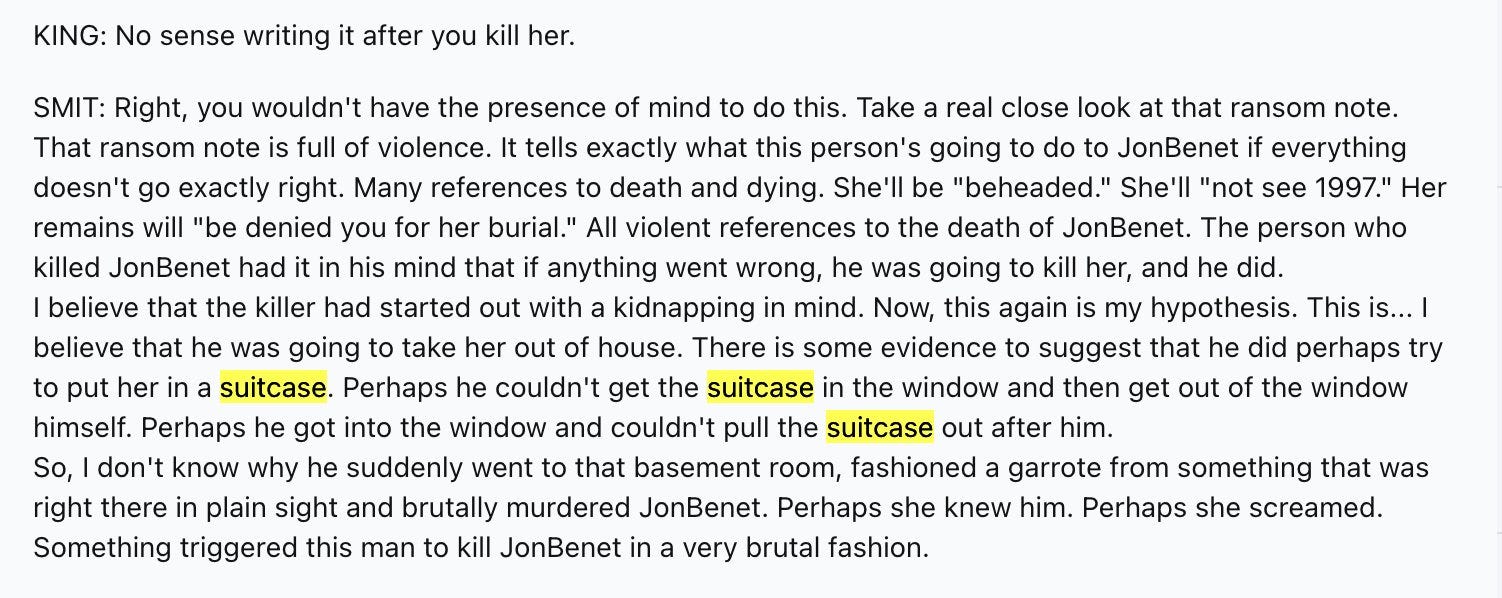
Why would an intruder just hope a perfectly-sized suitcase is there to help smuggle her out that window? Smit believes they changed course and killed her because the suitcase wouldn’t fit (there were scuff marks on the wall). If you’re a kidnapper with only one small, awkward window well to leave through, wouldn’t you prepare?
It doesn’t matter, the parents have to pivot now anyway and leave her in the basement while still making this look like a kidnapping. Patsy gets duct tape and puts it over her mouth. The FBI, Boulder PD and coroner believe the tape was placed on JonBenet after she was dead. Why put tape over a dead or unconscious girl’s mouth?
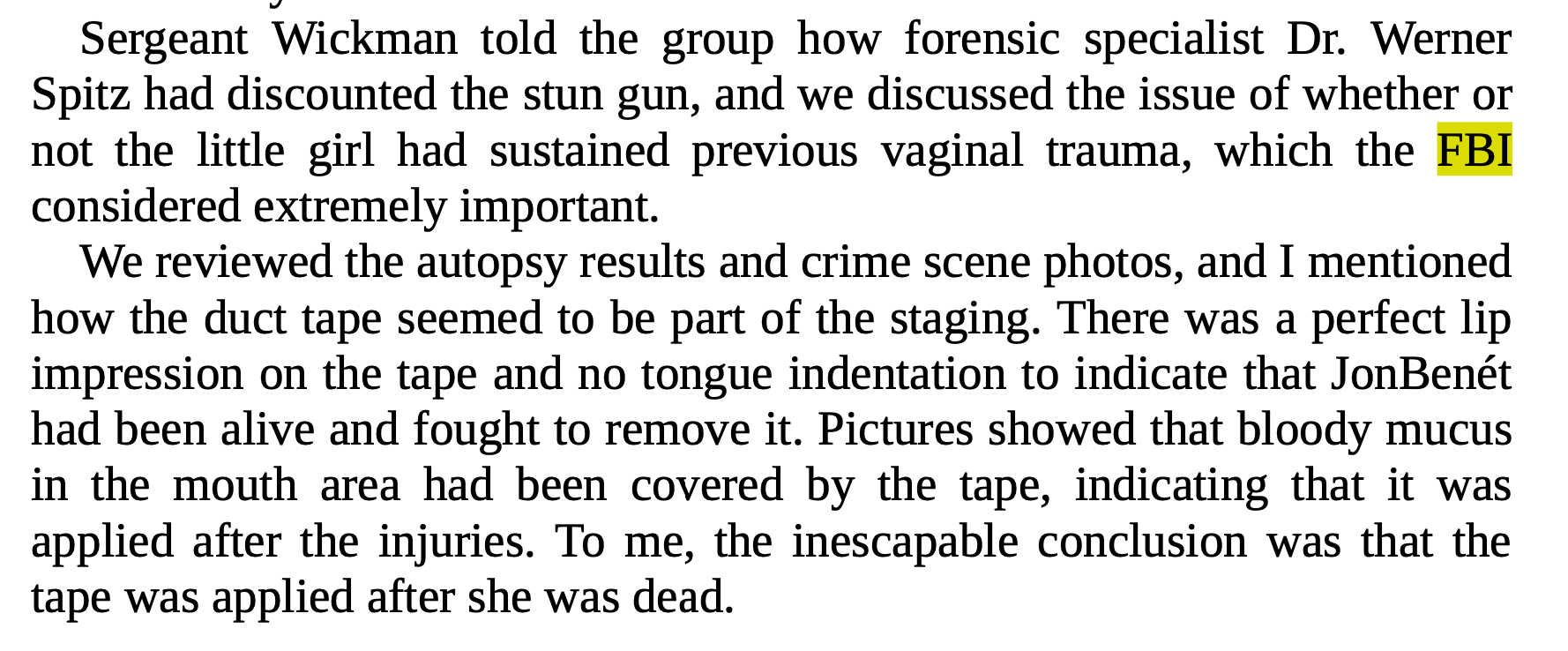

The tape also had Patsy’s from the jacket she wore that night at the White’s (see below) . That means the tape definitely came from the house. John said he carried JBR into the house. Patsy went in to change her, but most likely removed the tape from JBR’s mouth in the basement. It wouldn’t make sense for Patsy’s jacket fibers from that night to be on it if this were brought in by an intruder.
Remember back when I said the Ramsey’s might’ve snuck tape out through Pam? Did the intruder just hope they’d also be able to find duct tape in the house? They didn’t bring it with them for a kidnapping? And why would you need duct tape if you she’s knocked out, bleeding from her mouth and mucous is running down her face? Does it make sense for an intruder to take time at this crucial moment to go search the house for duct tape when the girl is incapable of talking or moving from the head injury?
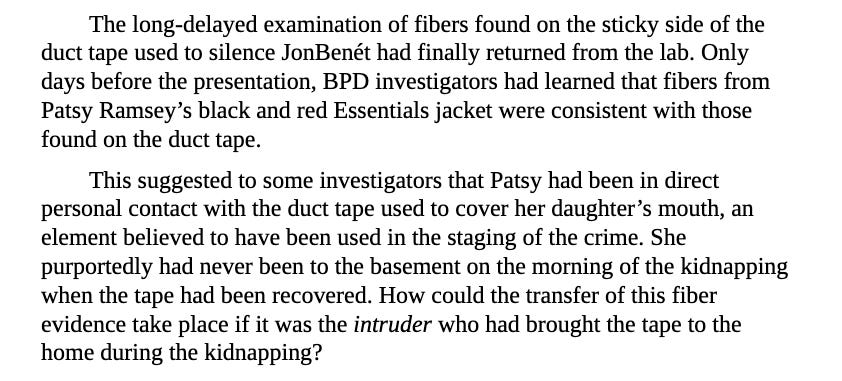
This is the family staging the scene. John ties loose restraints around her wrists. They tuck the blanket in around her. Some believe this is when John may have used the paintbrush to hide his previous sexual assault or he made the garrote to hide Burke’s assault if you can’t believe that Burke made this tool.
It’s time for the Ramseys to call 911 and put on a show, Patsy is yelling into the phone. At some point, this wakes Burke up or he was already up. He asks them “Please what should I do” (this is according to the CBS enhancement of the 911 call, the Aerospace enhancement doesn’t have this). Thinking she hung up the 911 call, his father yells “We’re not talking to you!” His mother says “Help me, Jesus. Help me, Jesus.” Burke asks, “Well what did you find?” and the call clicks off.
Within minutes, the police will be here, but the Ramseys aren’t dumb. They already wiped JBR’s body with a navy blue cloth to mix up DNA. Unsourced fibers are eventually found on her vaginal area. The coroner says it looks like someone tried to “wipe clean” the body with a cloth, but a matching cloth is never found in the Ramsey home. Perhaps Pam removes it when she’s given access to the scene. Maybe an intruder used something with them, but if you’re concerned about leaving evidence on her…why not just take her body like you intended?
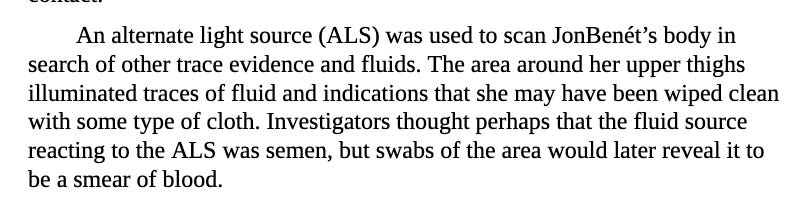
Some have mentioned that it was the 90s and people weren’t thinking about DNA. Well, I’m sorry, but I’m old and that’s not true! On top of that, guess what case happened the year prior? OJ Simpsons! That was a huge case where the main attraction was DNA. OJ was found innocent because of DNA. There’s no way the Ramseys weren’t aware of the case.
In fact, in their first interview a week after their daughter dies on CNN, Patsy mentions OJ. They were aware of him when their daughter died:
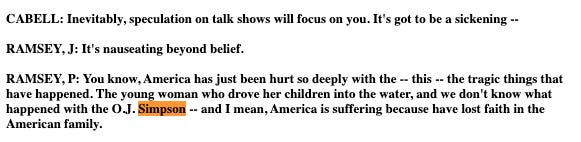
So, yeah, the Ramseys know it matters that only the Ramseys have been in the home and they really want to make sure there’s other DNA around the body. They call their closest friends and tell them to rush over immediately, there’s an emergency and they need them. Hopefully, this will muddy the crime scene. Fleet White comes and immediately heads to the basement, but doesn’t see JBR in the wine cellar because it’s dark and he can’t find the light. He notices the train room window is closed, but it is broken. He moves the suitcase that happens to be there over to look into the windowsill for glass. At some point after this, John goes back down and opens the window.
As the police start to arrive and his friends begin searching the house, John grows frustrated that 2 police officers have failed to find JBR in the wine cellar. When Det. Arendt suggests that he and Fleet go search the house top to bottom to find anything off, he realizes now is his chance. Fleet and John first go to the train room. Fleet asks about the broken window and John says he did it months prior. According to John, they look around for any new broken glass.
Then, as Fleet is still in the train room, John heads to the wine cellar door. With Fleet standing 20ft away, John opens the door and says, “Oh my God, Oh my God.” Fleet follows behind him and sees John turn the light on. For a moment, Fleet considers that he had just walked in that room and couldn’t see anything without a light but John screamed before the light was even on, but he doesn’t make much of that for now. John will eventually say he could see the white blanket. Yet Fleet and a police officer who peered in the room could not.
Rather than risk someone finding the body where the crime occurred, John sees another chance to muddy DNA evidence. He picks up JBR, despite it being clear she is dead, rigor mortis has set in, and rushes her upstairs to “get her help.” Det. Arndt tells John to put lay her at the top of the stairs. He asks if she’s dead and moans when the officer confirms she is. Det. Arndt moves JBR’s body to the living room, but before she can tell anyone not to touch her, John places a blanket over her and a sweatshirt.
He lays on her and cries, he lays next to her and puts his arm around her. Det. Arndt tells him not to touch her hands. Next, Patsy comes in and does the same, laying all over JBR. Their friends stand around JBR and pray. If there was any hope of getting DNA from a single suspect who interacted with the body, that hope is gone now. The Ramseys have successfully created an “unidentified” third profile. I think if this DNA ever does match to anything, it will prove to be touch DNA unrelated to the killer.
Anyway, there’s too much information out there for this to still feel like a mystery. The only mystery is why the Ramsey Family has worked so hard to create a different narrative through their PR, but even that isn’t a mystery.
Well yes, and I imagine the police have already done this. You’ll remember when you started reading this an hour ago, that I told you feces were found on a candy box in JBR’s room and in a pair of pajama bottoms that were too big for her? Well, there’s your answer. Examinations can tell you how old or fresh stool is. The contents of the stool could match the meal served at the Whites and police would know someone in the family was in her room after everyone went to sleep, smearing poop on her candy.
Odds are, the poop was fresh. It’s one piece of evidence the Ramseys have never addressed or tried to spin. It’s also a detail the cops rarely mention. With all that publicly available info, isn’t it odd that this detail is the one that hasn’t been mentioned a million times? If Burke did this in her room that night, did it start a fight? Did he see an intruder while playing this prank in her room? If the poop is old, it’s irrelevant. It’s just…that that’s highly unlikely.
The Ramsey’s maid confirmed she was at the house on the 23rd and there was a huge party. She probably would’ve noticed large, stained grey pajama pants in JBR’s room. She was supposed to go back on the 24th, but didn’t. However, Christmas Eve, JBR sleeps in Burke’s room according to his testimony to police. She wanted Burke to wake her up early for Christmas presents. Seems unlikely he could’ve done this that night without the parents or JBR noticing it Christmas Day. I tend to think John and Patsy didn’t know about the feces incident or they would’ve cleaned it up.
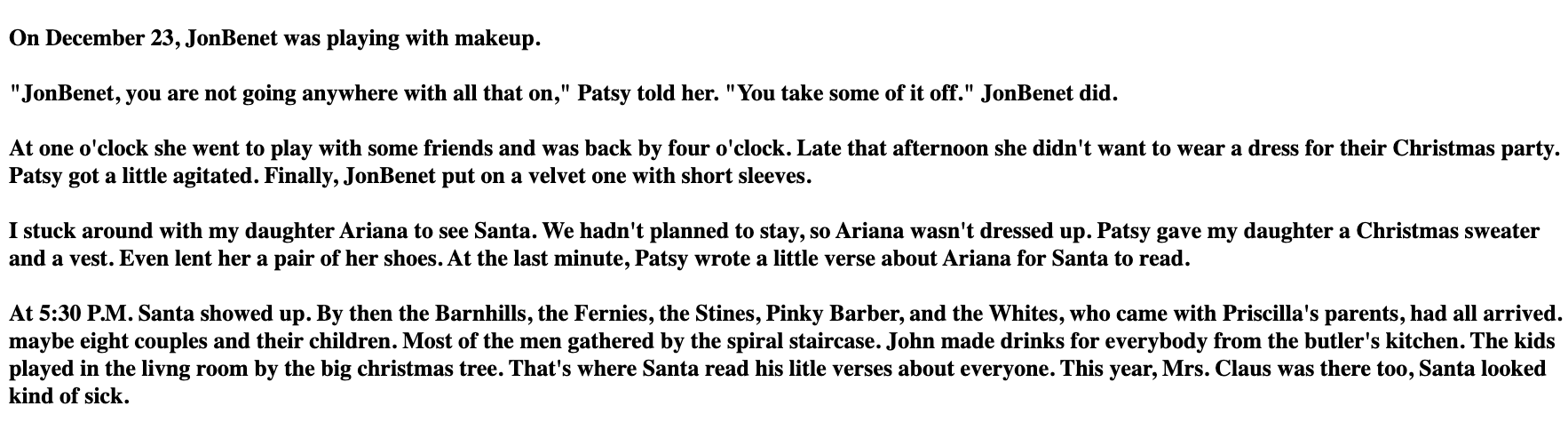
Another way we know the pajama bottoms were probably left Christmas night? Patsy says in her interview with police that she checked JBR’s bed Christmas morning. If the accident happened then, Patsy surely would’ve noticed soiled pajama bottoms. Plus, she even says that JBR had on pink pajamas, not grey, large pajama bottoms.
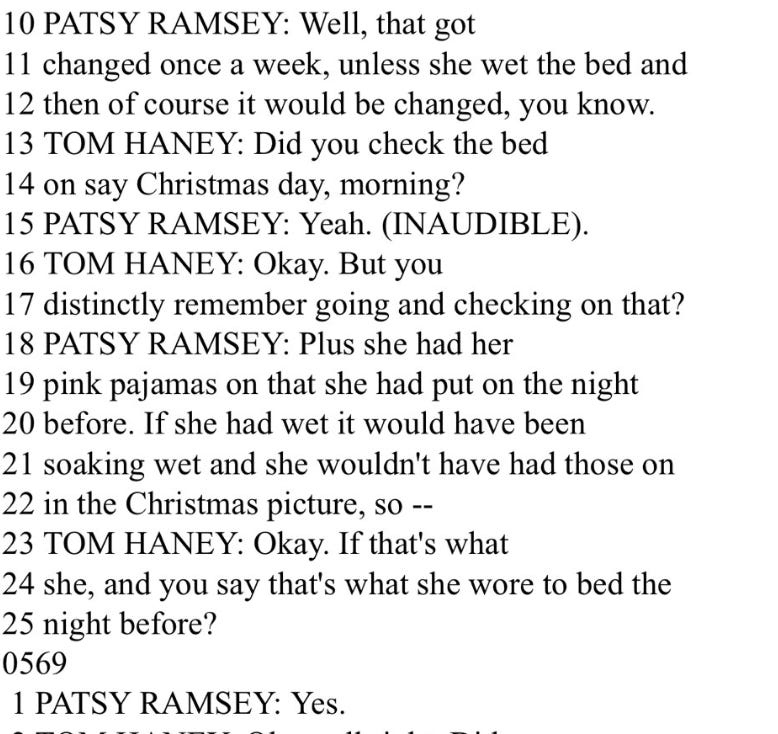
The pajama bottoms were very visible in JBR’s bathroom (each bedroom had its own bathroom), so a maid, JBR or a parent would’ve seen them. Patsy definitely would’ve seen them that Christmas morning. They weren’t hidden or tucked behind anything. If Patsy and John came right home from the White’s and took JBR to bed, did they not notice them right next to the toilet?
Investigators aren’t able to ask Patsy about these pants until 1998, a year and a half after the murder. She said they were JBR’s, not Burke’s despite appearing to be his size and “boys flannel pajama bottoms.” She said it was from JBR not wiping properly. She couldn’t recall when JBR wore them last. Kolar says it’s hard to know if she’s lying about who they belonged to or not in his verified AMA 4 years ago.
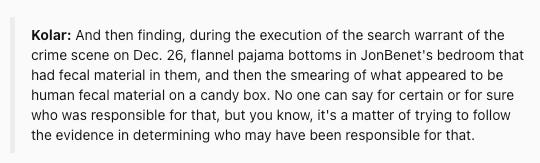


So, let’s say Patsy was lying about who the pajama pants belong to. Doesn’t that mean it’s possible Burke left the feces the night of the murder? He said he got up after everyone went to bed, did he do it then and that’s why his parents didn’t know? If the police have confirmed when this happened, it throws everything the family has ever said out the window. There’s a completely different timeline. That puts Burke in JBR’s bathroom and bedroom. And, if you have a hard time with my theory that Burke was involved with the paintbrush at all, some people think it went this way:
The family came home. Patsy and John tell the kids to go straight to bed, but Burke wants to stay up. After his dad reads him to sleep with the flashlight like he says in Dr. Phil, he goes downstairs. Maybe he makes some pineapple and this wakes up JBR. She eats some of his snack. Either this made him mad or something involving the gifts did and he hits her in the head. He tries to poke her awake with the train tracks, but she doesn’t move. Some time passes, maybe 30 minutes, an hour. He gets nervous, maybe he starts yelling for her to wake up, eventually getting Patsy to come downstairs.
Patsy immediately tells him to go to his room, noticing that JBR isn’t moving. JBR isn’t bleeding, so maybe Burke doesn’t realize how hard he hit her or that she’s really hurt. Maybe he throws a tantrum, angry that he can’t finish his snack (you’ll notice there’s a lot in the bowl) or play with his new Christmas toys because his sister got him caught.
Burke storms upstairs and, out of anger, smears feces on JBR’s candy box and goes to his room. He falls asleep, unaware his parents are creating the scene. He has no idea what they’re do. They have no idea he left feces in JBR’s room or left pineapple out. Now the Ramseys have to stage a crime so horrific that no one would ever consider a 9-year old who previously hit his sister did it again with an object he was often seen with, his bedtime flashlight.
Theoretically, John may have a problem now too. If he’s been abusing his children, he needs to conceal it. If Burke has been “playing doctor” and Patsy and John know that, then they both know they’ll need to hide evidence of that. There will be an autopsy and there needs to be doubt as to where the previous injuries come from. This also explains why they can’t just call 911 after JBR is hit. This is a serious head injury, if they take her to the hospital, they might do an exam and see the prior sexual abuse. They conceal evidence of this abuse and stage the scene.
They miss the feces and pineapple, though.
It also would explain Burke’s comment on the enhanced 911 call. “What did you find?” He might’ve thought they found the pajama bottoms and the candy box. He stays in his room all morning because he thinks he’s in trouble for that. Eventually they tell him JBR was fine after their fight. She went to bed and he didn’t do anything bad. Everyone went to sleep, an intruder came in and now she’s missing.
At 9, Burke might’ve truly believed this was the case. He just has to keep his temper tantrum a secret. He wouldn’t want anyone to know what he did in her room anyway.
When a few people involved in the case did a panel in 2016, they said: The JonBenét Ramsey case is not a mystery. It just remains unsolved. Because the Ramseys want it that way. The grand jury, however, unraveled that mystery and wanted to indict the parents for child abuse.
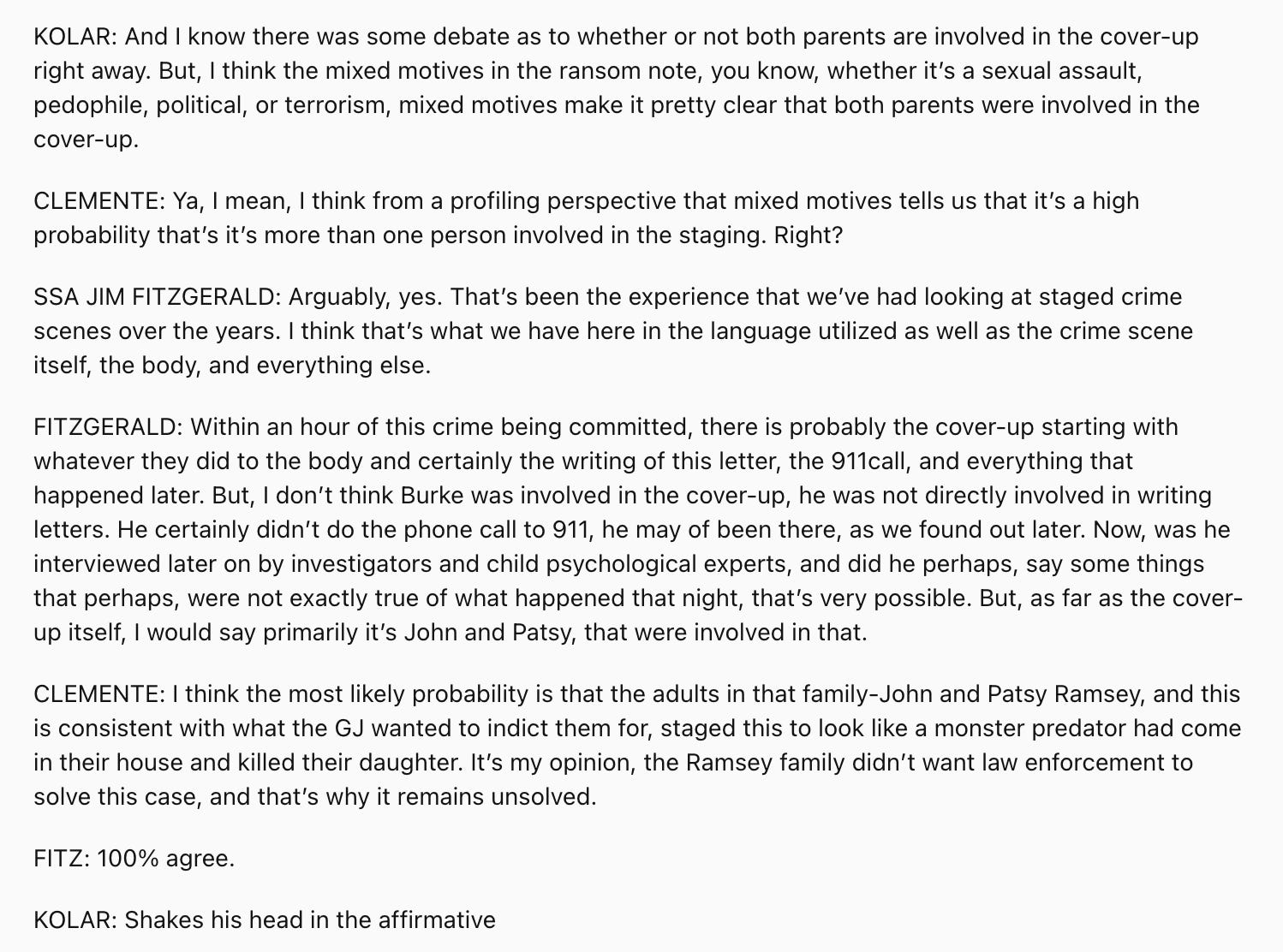
Some people believe the feces information and who it belonged to was in the grand jury trial because it was relevant. Some people think it wasn’t included because it was found to be irrelevant or was JBR’s. Well, it’s sealed, so we don’t know! Either way, it potentially points to a 9-year old being involved in the incident and that’s where the real problem with the idea of “justice” in this case comes in.
If the feces were relevant and Burke hit her, the DA knew they couldn’t prosecute a 9-year old in Colorado and Boulder PD knew they couldn’t leak the source of the feces that confirmed an intruder couldn’t have been in her room if it was related to a child. Without Burke’s exact involvement, you can’t say which parent did what and they can point to the kid or each other (or just John to Patsy, now). It’s a no-win case. There will never be charges.
The only hope this case will be solved? If all the grand jury documents are released. Colorado has strict laws around this, but Fleet White and officers in the case have sued to get them released in the past and ~4 pages have been released. The total indictment is 18 pages. White and the Boulder PD seem to think making the grand jury documents public will solve this for everyone.
When those 4 pages were released, the judge initially decided to release all of them, then changed his mind. Kolar believes it’s because it contained information about a juvenile:
The grand jury who recommended the parents be charged with child abuse for knowing their child was in danger, but not providing help seemed to solve the case. Of course, most people are only just finding out the grand jury made this recommendation because it came out in 2013. The DA and the Ramseys kept that information sealed for 14 years and the Ramseys presented this as them being “cleared.” That was, once again, far from the truth. The grand jury did recommend charges, but the DA declined to move forward.
Netflix tells you the answer to this case is DNA, but the answer sits with the grand jury. While the documentary does mention that the jury did want to convict Patsy and John of 2 charges each, it doesn’t get into the details. The specifics make clear the grand jury believed that Burke was involved. Why does Netflix make this theory sound so ridiculous?
The charges were child abuse and “unlawfully, knowingly and feloniously render assistance to a person.”:
COUNT IV (a)
On or between December 25, and December 26, 1996, in Boulder County, Colorado, John Bennett Ramsey/Patricia Paugh Ramsey did unlawfully, knowingly, recklessly and feloniously permit a child to be unreasonably placed in a situation which posed a threat of injury to the child's life or health, which resulted in the death of JonBenet Ramsey, a child under the age of sixteen.
As to Count IV (a), Child Abuse Resulting in Death: A TRUE BILL
and
COUNT VII
On or about December 25, and December 26, 1996 in Boulder County, Colorado, John Bennett Ramsey/Patricia Paugh Ramsey did unlawfully, knowingly and feloniously render assistance to a person, with intent to hinder, delay and prevent the discovery, detention, apprehension, prosecution, conviction and punishment of such person for the commission of a crime, knowing the person being assisted had committed and was suspected of the crime of Murder in the First Degree and Child Abuse Resulting in Death.
As to Count VII, Accessory to a Crime: A TRUE BILL
If the jury thought the only two people involved were Patsy and John and charged them with assisting each other, one would be charged with the underlying crime. The fact that no one is charged with the underlying crime points to someone who couldn’t be charged, like a child. Colorado Attorney Lisa Polansky agrees with this take in the CBS documentary:

Outside of those documents that made the grand jury feel a third person was involved, is there any hope of solving this? Well, someone could confess.
Yeah, I’m back I’m so sorry, I forgot to mention one more thing.
John Mark Karr - The Netflix doc spends a lot of time with this suspect and his voice messages to a detective on the case. They almost make it seem like he could be a legit suspect if only the DNA was a match. However, Karr has an alibi: he was in Georgia with his family according to them.
Oh, also Boulder PD found pictures of him in Georgia with his family within 18 hours of hearing he was a suspect. They felt the DA never should’ve brought him in. He also didn’t know any private details of the case. He only knew publicly available information. As I told you above, the Ramseys had that damn website with all their info!
Outside of that, the nickname for JBR’s grandma was known in the pageant circle. Her grandma planned most of it. If he attended shows, he may have heard it. However, the doc makes it seem like this wasn’t known at all. Anyway, Karr was cleared in 2006 for those reasons.
Most people do not consider him a serious suspect and view him as a mentally ill pedophile seeking fame. It’s insulting his pedophile audio fan fiction is given serious time in this documentary and he’s getting the fame he wanted. However, it helps the Ramseys, so that may have guided the director’s desire to spend so much time on him. I think that is another bad decision and wanted to make that clear too.

Some people asked if I had any layouts/t
You have been granted access, use your keyboard to continue reading.
When Saori Kawano arrived in New York City in 1978 from Yokohama, most Americans’ ideas of Japanese food ended at instant ramen and onion volcanoes. Since then, if you’ve enjoyed hand-cut soba noodles or an omakase dinner, or admired the graceful curves of a rice bowl or the flash of a Japanese knife blade, you can probably thank her.
Ms. Kawano is the founder and owner of Korin Inc., an importer of knives, kitchen tools and tableware from Japan that has become a place of pilgrimage for restaurateurs since opening in 1982. It’s the main U.S. supplier for big-name chefs like Nobu Matsuhisa, Daniel Boulud, Matsuharu Morimoto and Eric Ripert; restaurants like Buddakan, Sugarfish and Eleven Madison Park; and hotel chains like the Four Seasons and Mandarin Oriental.
Her TriBeCa showroom, packed with wares ranging from $20 kitchen shears to $2,000 sushi knives, hums with customers arriving with knives to be sharpened, and the spin of the custom-made Japanese whetstone that powers the business.
The space is narrow, but it contains a vast network of connections and knowledge that has fueled the extraordinary rise of Japanese food in the United States.
“So much of the popularity and familiarity that we have now is due to her,” said Michael Romano, the chef of Union Square Cafe from 1998 to 2013. He was an early convert from European to Japanese chef’s knives, opened Union Square Tokyo in 2007, and now lives there part-time.
In her shop on a busy winter morning, Ms. Kawano, 68, beamed as her resident sharpener, Vincent Chin, described restoring dozens of knives in the kitchen of the Bellagio in Las Vegas. She tends to credit her success to loyal chefs and employees like Mr. Chin, but her combination of elegance, toughness and charm doubtless played a part.
“I always knew I was not going to live in Japan for my whole life and be a housewife,” she said — partly because her mother, a pioneering female insurance executive, told her so. “I never thought that Japanese food would become the focus of my whole life.”
Long before Amazon or Alibaba, Instagram and Line (Japan’s most popular social media and shopping app), Ms. Kawano was a direct link between the American culinary world and the most prestigious chefs, artisans and craftsmen in Japan.
“She’s the only person who can pick up the phone in New York City and talk to anyone in Japan,” said Yukari Sakamoto, a sake expert who lives in Tokyo and leads high-end food tours. “Connections are everything here. Everyone knows that if Saori has vetted you, you’re worth their time.”
If you have a Japanese knife in your home kitchen, Ms. Kawano may have had a hand in that, too. American cooks have long relied on European-style knives, with one basic blade shape, descended from a butcher’s tool. Among other differences, Japanese knives evolved to cut fish and vegetables, not meat. They have many shapes and a thinner blade, making them capable of cleaner cuts.
The modern culinary conversation between Western and Japanese chefs started with Shizuo Tsuji, a writer and Francophile who opened a cooking school in Osaka in 1960. His relationships with influential chefs like Paul Bocuse and David Bouley laid the groundwork for high-end Japanese cuisine in the United States.
By the 1980s, Japanese food had a firm foothold in Europe; chefs adopted its plating, lightness and seasonality, and turned the traditional kaiseki meal — a progression of carefully ordered bites — into what we now know as a tasting menu. This nouvelle cuisine revolution, radiating outward from France, created an American market for the small plates, square bowls and Japanese knives that Korin stocked.
Ms. Kawano educated herself about the centuries-old Japanese craft of knife-making and its nuances — for example, a sushi chef might use a different knife for the same fish in different seasons, depending on its size and fattiness. She passed that knowledge on to her American customers.
Through the Gohan Society, a nonprofit cultural-exchange program she founded in 2004 (now funded by Kikkoman, Kewpie and other global brands), hundreds of American chefs have followed her to Japan, entering through doors only she can open, visiting woodworkers, potters, glassblowers, sake brewers and miso producers.
When Ms. Kawano came to the United States nearly 50 years ago, it was for the music. Her husband, who had been accepted at the Juilliard School to study classical piano and teach Japanese string instruments, wore his hair long and his boots high-heeled; bands like Queen and the Beach Boys were his extracurricular passion.
She was also a pianist, and like most Japanese girls of her time, was trained in the traditional arts of arranging flowers (ikebana), archery (kyudo) and wrapping a formal silk kimono.
Worldly New Yorkers, she assumed, would have an appetite for learning about Japanese culture. “No one was interested,” she said.
The couple thought they’d brought enough money to last three years; it ran out after six months. So she began her culinary career in desperation, as a waitress at a posh Japanese restaurant near the Pan Am Building (now MetLife) in Midtown, where some of the biggest Japanese companies had their U.S. headquarters.
Because she is that kind of person, it bothered her that the restaurant didn’t always use authentic bowls and plates. Having persuaded the owner to let her order some from Japan, she then decided that Americans would — or should — appreciate the graceful shapes of Japanese tableware.
From her mother’s work selling insurance, she had absorbed persistence, optimism and the art of the cold call. Every day after the staff meal, she shut herself into the restaurant’s pay-phone booth and called the housewares department at Bloomingdale’s. “I believed that someday, there would be someone on the other end who wouldn’t hang up on me,” she said.
Some months later, Ms. Kawano got through, talked the buyer into a meeting and left with a $1,500 order for plain white bowls. She began making sales calls around the city, armed with iron teapots and rice bowls.
“When I got into Zabar’s and Dean & DeLuca, that was my pride and my joy,” she said.
When Ms. Kawano started Korin in 1982, her only regular customers were Asian restaurant owners, who were rarely able to buy expensive tableware. (The era of the $400 omakase dinner was far in the future.)
There were difficult years, when she was in debt, divorced and in despair of finding a market. As a single parent, she could no longer afford child care, so she brought her daughter, Mari, along on sales calls, wrestling a stroller loaded with samples and snacks through the subway system.
Then, in 1991, a young chef with an idea for a glamorous Thai-French restaurant showed up on her loading dock. Jean-Georges Vongerichten had lived in Bangkok for two years and was shopping for his second New York restaurant, Vong. “I couldn’t find the colors and glazes I’d seen in Asia anywhere,” he recalled.
Vong opened with Ms. Kawano’s golden plates, lacquered chopsticks and bamboo place mats, and Mr. Vongerichten spread the word to the city’s other top French chefs who, under the influence of nouvelle cuisine, had already become entranced by ingredients like rice vinegar and yuzu.
Those chefs also had deeper pockets than most of her customers. Instead of ordering wholesale, Ms. Kawano began making direct contact with artisans in Japan, researching the best makers of porcelain in Saga Prefecture and knives in Sakai. She persuaded Japanese chefs to come to New York for demonstrations of sashimi and sushi. She even talked her ex-husband, Chiharu Sugai, into becoming an expert knife sharpener, an educational process that took a decade and continues to pay off by bringing customers into the shop over and over again. (Mr. Sugai died in 2018; Mr. Chin was his protégé.)
When the Japanese chef Noriyuki Sugie arrived in New York in 2003 to become head chef of the brand-new Mandarin Oriental hotel’s restaurant, his first stop was Korin. Entrepreneurs were opening Japanese-influenced restaurants around the world, Mr. Sugie said, with vast menus and themes like waiters dressed as ninja warriors.
“It was a bubble,” he said.
It was also the beginning of Japan’s first official foray into culinary diplomacy. Alarmed by the spread of such inauthentic places, and eager to replicate the successful gastro-diplomacy of countries like South Korea and Thailand, the government began a campaign in 2006 dedicated to spreading knowledge of traditional Japanese foodways — washoku — and informally known as “the sushi police.”
Through agencies dedicated to tourism, food and exports, young Japanese chefs were encouraged to go abroad, both to learn and to teach. “It’s very Japanese to care about whether people thousands of miles away are arranging the fish just right, or stirring wasabi into their soy sauce,” said Ms. Sakamoto, the sake expert.
In 2013, washoku was added to UNESCO’s list of Intangible Cultural Heritage traditions, alongside Neapolitan pizza and Korean kimchi. Today, according to Japan’s official tourism agency, food is the reason cited most often by tourists for their visit to Japan.
Ms. Kawano’s connections to top U.S. chefs were invaluable in this educational project. Americans began to hear more about Japanese fermentation, specialties like Edo-style sushi, and ramen not microwaved in a cup. They traveled to Japan to visit fish markets and shop in Kappabashi, Tokyo’s ever-expanding “kitchen street.”
“When there was more respect for the tradition, and Japanese restaurants began to get Michelin stars, that is when the category began to bring in more money,” said Mr. Sugie, who is now a global consultant for Japanese-inspired restaurants.
Today, Ms. Kawano supplies 8,000 restaurants and hotels, has 34 full-time employees including her daughter, and travels constantly, guiding chefs from around the world through Japan.
Back in the 1990s, she almost moved back to Yokohama when things got hard, but said the same mantra that got her into Bloomingdale’s kept her in New York.
“I’d ask myself, ‘Have I tried everything I can think of?’ and I hadn’t,” she said. “And I remembered that a ‘no’ won’t destroy me.”
Follow New York Times Cooking on Instagram, Facebook, YouTube, TikTok and Pinterest. Get regular updates from New York Times Cooking, with recipe suggestions, cooking tips and shopping advice.
Eating in New York City
Advertisement
SKIP ADVERTISEMENTAdvertisement
San-J’s Tamari Soy Sauce can be found on store shelves in all 50 states and Puerto Rico. While the company operates a plant near Tokyo, Sato's father built a facility in Henrico in 1987.
Up next
Up next
Up next
Up next
Up next
Up next
Up next
I’ve known Dave Arnold for the better part of the last 15 years. Even before we were officially colleagues—I was the bar director for Momofuku while he was helming Booker and Dax, a high-concept cocktail bar nestled behind Momofuku Ssam Bar—we always shared an affinity for waxing nerdily about cocktails: where to find naturally carbonated spring water in upstate New York or how to properly store shaking ice. After all this time, it never gets old.
“OK.” Dave takes a barely perceptible pause before launching into the backstory of the Sagittarius B2, one of his cocktails at New York’s Bar Contra. “So there is a gas cloud in the center of the Milky Way galaxy [called Sagittarius B2] and in that gas cloud was discovered—via radio telescopic techniques—complex molecules with aroma. One of them is ethyl formate, one of the main aroma compounds in both raspberries and rum.” Without pausing for a breath, he continues: “Right away I was like, ‘Dang, Sagittarius B2, we’ve got a raspberries and rum drink coming up.’ And then it gets even better because it’s also got a form of cyanide. While that seems like a negative, for me, I was like, ‘Oh, that’s a huge positive, because bitter almonds are cyanide-adjacent.’”
Although it can be a bit reductive, I tend to describe novel cocktails in terms of their genealogical lineage to earlier, more classic cocktails. In this framework, the Sagittarius B2—a mix of rum, raspberry and orgeat (a syrup made from almonds)—might best be understood as the cosmic love child of a strawberry Daiquiri and a Mai Tai.
For the base spirit, Dave initially wanted to use clairin, a sugarcane distillate native to Haiti, but its intrinsic grassiness was a bit too overpowering. Instead, he went with the more subdued Chairman’s Reserve rum from St. Lucia. Dialing in the other ingredients, in typical Dave Arnold fashion, was much less straightforward. “First I made it with regular orgeat and lime-acid raspberry,” he says, referring to clarified raspberry juice that’s been acid-adjusted with citric, malic and succinic acids to mirror the acidity of lime. “And I was like, nah, not raspberry enough.”
To make the raspberry flavor pop even more, he decided to augment the orgeat with, well, more raspberries, this time in the form of jam. The orgeat begins like any other, by soaking almonds overnight. But fine-tuning the recipe necessitated sourcing almonds from an unlikely source: Trader Joe’s. Apparently the Bazzini brand, which is commonly used in commercial kitchens, just didn’t provide the right flavor for this specific application. Then Dave strained the almonds and combined them with the aforementioned raspberry jam and hot water, before passing the mixture through a 150-micron cloth via a five-ton hydraulic press.
Finally, he augmented the syrup with salt, almond extract, gum arabic, xanthan gum (to keep the mixture in suspension) and Methocel F50, a food-grade thickening and binding agent (for proper foam generation).
Making traditional DIY orgeat is not for the faint of heart in the first place, and adding raspberries to the mix only magnified the challenge of straining the nut solids from the usable liquid. “It’s a huge pain in the ass,” Dave says. To understand that this statement is not remotely hyperbolic, consider this: On a recent Saturday evening, I encountered Dave casually posted up at the bar holding a handwritten matrix of Margarita recipes made with four different orange liqueurs, each with varying Brix levels, determined by a modified least squares regression algorithm. When a person who does this for fun says something is a huge pain in the ass, believe them.
After the ingredients have been dialed in, there’s the matter of actually making the Sagittarius B2 when a guest orders it. Theo Ouya, Bar Contra’s bar manager, found the orgeat too thick to measure out in a jigger, noting that it would slow down service to unacceptable levels. The team attempted to solve this by combining the lime-acid raspberry and the raspberry orgeat into a single cheater bottle, but the drink’s texture wasn’t coming out as optimally as when the two ingredients were mixed à la minute. The solution came in the form of a kitchen scale.
In my experience, a kitchen scale has rarely been the solution for efficiency. It’s typically slower than jiggering and measuring is irreversible—if you accidentally overshoot your mark on any ingredient, you have to toss the drink and start over. “It’s a horrible idea, most of the time,” agrees Dave. But this application proves the value: Jiggering involves two pours, one from the bottle to the jigger and another from the jigger to the shaker. Using a scale halves the number of pours, and in the case of pouring a thick, goopy substance, that can yield significant time savings.
If ever there were a drink that exemplifies the Dave Arnold approach to cocktails—balancing ambition and creativity against physical constraints, and calling on an elaborate tool kit to bring those constraints to heel—Sagittarius B2 is it. As Dave summarizes: “So yeah, it’s all the things.”
Get our freshest features and recipes weekly.
Thank you for subscribing!
There were six hours during the night of April 10, 2014, when the entire population of Washington State had no 911 service. People who called for help got a busy signal. One Seattle woman dialed 911 at least 37 times while a stranger was trying to break into her house. When he finally crawled into her living room through a window, she picked up a kitchen knife. The man fled.
The 911 outage, at the time the largest ever reported, was traced to software running on a server in Englewood, Colorado. Operated by a systems provider named Intrado, the server kept a running counter of how many calls it had routed to 911 dispatchers around the country. Intrado programmers had set a threshold for how high the counter could go. They picked a number in the millions.
Shortly before midnight on April 10, the counter exceeded that number, resulting in chaos. Because the counter was used to generate a unique identifier for each call, new calls were rejected. And because the programmers hadn’t anticipated the problem, they hadn’t created alarms to call attention to it. Nobody knew what was happening. Dispatch centers in Washington, California, Florida, the Carolinas, and Minnesota, serving 11 million Americans, struggled to make sense of reports that callers were getting busy signals. It took until morning to realize that Intrado’s software in Englewood was responsible, and that the fix was to change a single number.
Not long ago, emergency calls were handled locally. Outages were small and easily diagnosed and fixed. The rise of cellphones and the promise of new capabilities—what if you could text 911? or send videos to the dispatcher?—drove the development of a more complex system that relied on the internet. For the first time, there could be such a thing as a national 911 outage. There have now been four in as many years.
It’s been said that software is “eating the world.” More and more, critical systems that were once controlled mechanically, or by people, are coming to depend on code. This was perhaps never clearer than in the summer of 2015, when on a single day, United Airlines grounded its fleet because of a problem with its departure-management system; trading was suspended on the New York Stock Exchange after an upgrade; the front page of The Wall Street Journal’s website crashed; and Seattle’s 911 system went down again, this time because a different router failed. The simultaneous failure of so many software systems smelled at first of a coordinated cyberattack. Almost more frightening was the realization, late in the day, that it was just a coincidence.
“When we had electromechanical systems, we used to be able to test them exhaustively,” says Nancy Leveson, a professor of aeronautics and astronautics at the Massachusetts Institute of Technology who has been studying software safety for 35 years. She became known for her report on the Therac-25, a radiation-therapy machine that killed six patients because of a software error. “We used to be able to think through all the things it could do, all the states it could get into.” The electromechanical interlockings that controlled train movements at railroad crossings, for instance, only had so many configurations; a few sheets of paper could describe the whole system, and you could run physical trains against each configuration to see how it would behave. Once you’d built and tested it, you knew exactly what you were dealing with.
Software is different. Just by editing the text in a file somewhere, the same hunk of silicon can become an autopilot or an inventory-control system. This flexibility is software’s miracle, and its curse. Because it can be changed cheaply, software is constantly changed; and because it’s unmoored from anything physical—a program that is a thousand times more complex than another takes up the same actual space—it tends to grow without bound. “The problem,” Leveson wrote in a book, “is that we are attempting to build systems that are beyond our ability to intellectually manage.”
Our standard framework for thinking about engineering failures—reflected, for instance, in regulations for medical devices—was developed shortly after World War II, before the advent of software, for electromechanical systems. The idea was that you make something reliable by making its parts reliable (say, you build your engine to withstand 40,000 takeoff-and-landing cycles) and by planning for the breakdown of those parts (you have two engines). But software doesn’t break. Intrado’s faulty threshold is not like the faulty rivet that leads to the crash of an airliner. The software did exactly what it was told to do. In fact it did it perfectly. The reason it failed is that it was told to do the wrong thing. Software failures are failures of understanding, and of imagination. Intrado actually had a backup router, which, had it been switched to automatically, would have restored 911 service almost immediately. But, as described in a report to the FCC, “the situation occurred at a point in the application logic that was not designed to perform any automated corrective actions.”
This is the trouble with making things out of code, as opposed to something physical. “The complexity,” as Leveson puts it, “is invisible to the eye.”
The attempts now underway to change how we make software all seem to start with the same premise: Code is too hard to think about. Before trying to understand the attempts themselves, then, it’s worth understanding why this might be: what it is about code that makes it so foreign to the mind, and so unlike anything that came before it.
Technological progress used to change the way the world looked—you could watch the roads getting paved; you could see the skylines rise. Today you can hardly tell when something is remade, because so often it is remade by code. When you press your foot down on your car’s accelerator, for instance, you’re no longer controlling anything directly; there’s no mechanical link from the pedal to the throttle. Instead, you’re issuing a command to a piece of software that decides how much air to give the engine. The car is a computer you can sit inside of. The steering wheel and pedals might as well be keyboard keys.
Like everything else, the car has been computerized to enable new features. When a program is in charge of the throttle and brakes, it can slow you down when you’re too close to another car, or precisely control the fuel injection to help you save on gas. When it controls the steering, it can keep you in your lane as you start to drift, or guide you into a parking space. You couldn’t build these features without code. If you tried, a car might weigh 40,000 pounds, an immovable mass of clockwork.
Software has enabled us to make the most intricate machines that have ever existed. And yet we have hardly noticed, because all of that complexity is packed into tiny silicon chips as millions and millions of lines of code. But just because we can’t see the complexity doesn’t mean that it has gone away.
The programmer, the renowned Dutch computer scientist Edsger Dijkstra wrote in 1988, “has to be able to think in terms of conceptual hierarchies that are much deeper than a single mind ever needed to face before.” Dijkstra meant this as a warning. As programmers eagerly poured software into critical systems, they became, more and more, the linchpins of the built world—and Dijkstra thought they had perhaps overestimated themselves.
What made programming so difficult was that it required you to think like a computer. The strangeness of it was in some sense more vivid in the early days of computing, when code took the form of literal ones and zeros. Anyone looking over a programmer’s shoulder as they pored over line after line like “100001010011” and “000010011110” would have seen just how alienated the programmer was from the actual problems they were trying to solve; it would have been impossible to tell whether they were trying to calculate artillery trajectories or simulate a game of tic-tac-toe. The introduction of programming languages like Fortran and C, which resemble English, and tools, known as “integrated development environments,” or IDEs, that help correct simple mistakes (like Microsoft Word’s grammar checker but for code), obscured, though did little to actually change, this basic alienation—the fact that the programmer didn’t work on a problem directly, but rather spent their days writing out instructions for a machine.
“The problem is that software engineers don’t understand the problem they’re trying to solve, and don’t care to,” says Leveson, the MIT software-safety expert. The reason is that they’re too wrapped up in getting their code to work. “Software engineers like to provide all kinds of tools and stuff for coding errors,” she says, referring to IDEs. “The serious problems that have happened with software have to do with requirements, not coding errors.” When you’re writing code that controls a car’s throttle, for instance, what’s important is the rules about when and how and by how much to open it. But these systems have become so complicated that hardly anyone can keep them straight in their head. “There’s 100 million lines of code in cars now,” Leveson says. “You just cannot anticipate all these things.”
In September 2007, Jean Bookout was driving on the highway with her best friend in a Toyota Camry when the accelerator seemed to get stuck. When she took her foot off the pedal, the car didn’t slow down. She tried the brakes but they seemed to have lost their power. As she swerved toward an off-ramp going 50 miles per hour, she pulled the emergency brake. The car left a skid mark 150 feet long before running into an embankment by the side of the road. The passenger was killed. Bookout woke up in a hospital a month later.
The incident was one of many in a nearly decade-long investigation into claims of so-called unintended acceleration in Toyota cars. Toyota blamed the incidents on poorly designed floor mats, “sticky” pedals, and driver error, but outsiders suspected that faulty software might be responsible. The National Highway Traffic Safety Administration enlisted software experts from NASA to perform an intensive review of Toyota’s code. After nearly 10 months, the NASA team hadn’t found evidence that software was the cause—but said they couldn’t prove it wasn’t.
It was during litigation of the Bookout accident that someone finally found a convincing connection. Michael Barr, an expert witness for the plaintiff, had a team of software experts spend 18 months with the Toyota code, picking up where NASA left off. Barr described what they found as “spaghetti code,” programmer lingo for software that has become a tangled mess. Code turns to spaghetti when it accretes over many years, with feature after feature piling on top of, and being woven around, what’s already there; eventually the code becomes impossible to follow, let alone to test exhaustively for flaws.
Using the same model as the Camry involved in the accident, Barr’s team demonstrated that there were more than 10 million ways for key tasks on the onboard computer to fail, potentially leading to unintended acceleration.* They showed that as little as a single bit flip—a one in the computer’s memory becoming a zero or vice versa—could make a car run out of control. The fail-safe code that Toyota had put in place wasn’t enough to stop it. “You have software watching the software,” Barr testified. “If the software malfunctions and the same program or same app that is crashed is supposed to save the day, it can’t save the day because it is not working.”
Barr’s testimony made the case for the plaintiff, resulting in $3 million in damages for Bookout and her friend’s family. According to The New York Times, it was the first of many similar cases against Toyota to bring to trial problems with the electronic throttle-control system, and the first time Toyota was found responsible by a jury for an accident involving unintended acceleration. The parties decided to settle the case before punitive damages could be awarded. In all, Toyota recalled more than 9 million cars, and paid nearly $3 billion in settlements and fines related to unintended acceleration.
There will be more bad days for software. It's important that we get better at making it, because if we don't, and as software becomes more sophisticated and connected—as it takes control of more critical functions—those days could get worse.
The problem is that programmers are having a hard time keeping up with their own creations. Since the 1980s, the way programmers work and the tools they use have changed remarkably little. There is a small but growing chorus that worries the status quo is unsustainable. “Even very good programmers are struggling to make sense of the systems that they are working with,” says Chris Granger, a software developer who worked as a lead at Microsoft on Visual Studio, an IDE that costs $1,199 a year and is used by nearly a third of all professional programmers. He told me that while he was at Microsoft, he arranged an end-to-end study of Visual Studio, the only one that had ever been done. For a month and a half, he watched behind a one-way mirror as people wrote code. “How do they use tools? How do they think?” he said. “How do they sit at the computer, do they touch the mouse, do they not touch the mouse? All these things that we have dogma around that we haven’t actually tested empirically.”
The findings surprised him. “Visual Studio is one of the single largest pieces of software in the world,” he said. “It’s over 55 million lines of code. And one of the things that I found out in this study is more than 98 percent of it is completely irrelevant. All this work had been put into this thing, but it missed the fundamental problems that people faced. And the biggest one that I took away from it was that basically people are playing computer inside their head.” Programmers were like chess players trying to play with a blindfold on—so much of their mental energy is spent just trying to picture where the pieces are that there’s hardly any left over to think about the game itself.
John Resig had been noticing the same thing among his students. Resig is a celebrated programmer of JavaScript—software he wrote powers over half of all websites—and a tech lead at the online-education site Khan Academy. In early 2012, he had been struggling with the site’s computer-science curriculum. Why was it so hard to learn to program? The essential problem seemed to be that code was so abstract. Writing software was not like making a bridge out of popsicle sticks, where you could see the sticks and touch the glue. To “make” a program, you typed words. When you wanted to change the behavior of the program, be it a game, or a website, or a simulation of physics, what you actually changed was text. So the students who did well—in fact the only ones who survived at all—were those who could step through that text one instruction at a time in their head, thinking the way a computer would, trying to keep track of every intermediate calculation. Resig, like Granger, started to wonder if it had to be that way. Computers had doubled in power every 18 months for the last 40 years. Why hadn’t programming changed?
The fact that the two of them were thinking about the same problem in the same terms, at the same time, was not a coincidence. They had both just seen the same remarkable talk, given to a group of software-engineering students in a Montreal hotel by a computer researcher named Bret Victor. The talk, which went viral when it was posted online in February 2012, seemed to be making two bold claims. The first was that the way we make software is fundamentally broken. The second was that Victor knew how to fix it.
Bret Victor does not like to write code. “It sounds weird,” he says. “When I want to make a thing, especially when I want to create something in software, there’s this initial layer of disgust that I have to push through, where I’m not manipulating the thing that I want to make, I’m writing a bunch of text into a text editor.”
“There’s a pretty strong conviction that that’s the wrong way of doing things.”
Victor has the mien of David Foster Wallace, with a lightning intelligence that lingers beneath a patina of aw-shucks shyness. He is 40 years old, with traces of gray and a thin, undeliberate beard. His voice is gentle, mournful almost, but he wants to share what’s in his head, and when he gets on a roll he’ll seem to skip syllables, as though outrunning his own vocal machinery.
Though he runs a lab that studies the future of computing, he seems less interested in technology per se than in the minds of the people who use it. Like any good toolmaker, he has a way of looking at the world that is equal parts technical and humane. He graduated top of his class at the California Institute of Technology for electrical engineering, and then went on, after grad school at the University of California, Berkeley, to work at a company that develops music synthesizers. It was a problem perfectly matched to his dual personality: He could spend as much time thinking about the way a performer makes music with a keyboard—the way it becomes an extension of their hands—as he could thinking about the mathematics of digital signal processing.
By the time he gave the talk that made his name, the one that Resig and Granger saw in early 2012, Victor had finally landed upon the principle that seemed to thread through all of his work. (He actually called the talk “Inventing on Principle.”) The principle was this: “Creators need an immediate connection to what they’re creating.” The problem with programming was that it violated the principle. That’s why software systems were so hard to think about, and so rife with bugs: The programmer, staring at a page of text, was abstracted from whatever it was they were actually making.
“Our current conception of what a computer program is,” he said, is “derived straight from Fortran and ALGOL in the late ’50s. Those languages were designed for punch cards.” That code now takes the form of letters on a screen in a language like C or Java (derivatives of Fortran and ALGOL), instead of a stack of cards with holes in it, doesn’t make it any less dead, any less indirect.
There is an analogy to word processing. It used to be that all you could see in a program for writing documents was the text itself, and to change the layout or font or margins, you had to write special “control codes,” or commands that would tell the computer that, for instance, “this part of the text should be in italics.” The trouble was that you couldn’t see the effect of those codes until you printed the document. It was hard to predict what you were going to get. You had to imagine how the codes were going to be interpreted by the computer—that is, you had to play computer in your head.
Then WYSIWYG (pronounced “wizzywig”) came along. It stood for “What You See Is What You Get.” When you marked a passage as being in italics, the letters tilted right there on the screen. If you wanted to change the margin, you could drag a ruler at the top of the screen—and see the effect of that change. The document thereby came to feel like something real, something you could poke and prod at. Just by looking you could tell if you’d done something wrong. Control of a sophisticated system—the document’s layout and formatting engine—was made accessible to anyone who could click around on a page.
Victor’s point was that programming itself should be like that. For him, the idea that people were doing important work, like designing adaptive cruise-control systems or trying to understand cancer, by staring at a text editor, was appalling. And it was the proper job of programmers to ensure that someday they wouldn’t have to.
There was precedent enough to suggest that this wasn’t a crazy idea. Photoshop, for instance, puts powerful image-processing algorithms in the hands of people who might not even know what an algorithm is. It’s a complicated piece of software, but complicated in the way a good synth is complicated, with knobs and buttons and sliders that the user learns to play like an instrument. Squarespace, a company that is perhaps best known for advertising aggressively on podcasts, makes a tool that lets users build websites by pointing and clicking, instead of by writing code in HTML and CSS. It is powerful enough to do work that once would have been done by a professional web designer.
But those were just a handful of examples. The overwhelming reality was that when someone wanted to do something interesting with a computer, they had to write code. Victor, who is something of an idealist, saw this not so much as an opportunity but as a moral failing of programmers at large. His talk was a call to arms.
At the heart of it was a series of demos that tried to show just how primitive the available tools were for various problems—circuit design, computer animation, debugging algorithms—and what better ones might look like. His demos were virtuosic. The one that captured everyone’s imagination was, ironically enough, the one that on its face was the most trivial. It showed a split screen with a game that looked like Mario on one side and the code that controlled it on the other. As Victor changed the code, things in the game world changed: He decreased one number, the strength of gravity, and the Mario character floated; he increased another, the player’s speed, and Mario raced across the screen.
Suppose you wanted to design a level where Mario, jumping and bouncing off of a turtle, would just make it into a small passageway. Game programmers were used to solving this kind of problem in two stages: First, you stared at your code—the code controlling how high Mario jumped, how fast he ran, how bouncy the turtle’s back was—and made some changes to it in your text editor, using your imagination to predict what effect they’d have. Then, you’d replay the game to see what actually happened.
Victor wanted something more immediate. “If you have a process in time,” he said, referring to Mario’s path through the level, “and you want to see changes immediately, you have to map time to space.” He hit a button that showed not just where Mario was right now, but where he would be at every moment in the future: a curve of shadow Marios stretching off into the far distance. What’s more, this projected path was reactive: When Victor changed the game’s parameters, now controlled by a quick drag of the mouse, the path’s shape changed. It was like having a god’s-eye view of the game. The whole problem had been reduced to playing with different parameters, as if adjusting levels on a stereo receiver, until you got Mario to thread the needle. With the right interface, it was almost as if you weren’t working with code at all; you were manipulating the game’s behavior directly.
When the audience first saw this in action, they literally gasped. They knew they weren’t looking at a kid’s game, but rather the future of their industry. Most software involved behavior that unfolded, in complex ways, over time, and Victor had shown that if you were imaginative enough, you could develop ways to see that behavior and change it, as if playing with it in your hands. One programmer who saw the talk wrote later: “Suddenly all of my tools feel obsolete.”
When John Resig saw the “Inventing on Principle” talk, he scrapped his plans for the Khan Academy programming curriculum. He wanted the site’s programming exercises to work just like Victor’s demos. On the left-hand side you’d have the code, and on the right, the running program: a picture or game or simulation. If you changed the code, it’d instantly change the picture. “In an environment that is truly responsive,” Resig wrote about the approach, “you can completely change the model of how a student learns ... [They] can now immediately see the result and intuit how underlying systems inherently work without ever following an explicit explanation.” Khan Academy has become perhaps the largest computer-programming class in the world, with a million students, on average, actively using the program each month.
Chris Granger, who had worked at Microsoft on Visual Studio, was likewise inspired. Within days of seeing a video of Victor’s talk, in January of 2012, he built a prototype of a new programming environment. Its key capability was that it would give you instant feedback on your program’s behavior. You’d see what your system was doing right next to the code that controlled it. It was like taking off a blindfold. Granger called the project “Light Table.”
In April of 2012, he sought funding for Light Table on Kickstarter. In programming circles, it was a sensation. Within a month, the project raised more than $200,000. The ideas spread. The notion of liveness, of being able to see data flowing through your program instantly, made its way into flagship programming tools offered by Google and Apple. The default language for making new iPhone and Mac apps, called Swift, was developed by Apple from the ground up to support an environment, called Playgrounds, that was directly inspired by Light Table.
But seeing the impact that his talk ended up having, Bret Victor was disillusioned. “A lot of those things seemed like misinterpretations of what I was saying,” he said later. He knew something was wrong when people began to invite him to conferences to talk about programming tools. “Everyone thought I was interested in programming environments,” he said. Really he was interested in how people see and understand systems—as he puts it, in the “visual representation of dynamic behavior.” Although code had increasingly become the tool of choice for creating dynamic behavior, it remained one of the worst tools for understanding it. The point of “Inventing on Principle” was to show that you could mitigate that problem by making the connection between a system’s behavior and its code immediate.
In a pair of later talks, “Stop Drawing Dead Fish” and “Drawing Dynamic Visualizations,” Victor went one further. He demoed two programs he’d built—the first for animators, the second for scientists trying to visualize their data—each of which took a process that used to involve writing lots of custom code and reduced it to playing around in a WYSIWYG interface. Victor suggested that the same trick could be pulled for nearly every problem where code was being written today. “I’m not sure that programming has to exist at all,” he told me. “Or at least software developers.” In his mind, a software developer’s proper role was to create tools that removed the need for software developers. Only then would people with the most urgent computational problems be able to grasp those problems directly, without the intermediate muck of code.
Of course, to do that, you’d have to get programmers themselves on board. In a recent essay, Victor implored professional software developers to stop pouring their talent into tools for building apps like Snapchat and Uber. “The inconveniences of daily life are not the significant problems,” he wrote. Instead, they should focus on scientists and engineers—as he put it to me, “these people that are doing work that actually matters, and critically matters, and using really, really bad tools.” Exciting work of this sort, in particular a class of tools for “model-based design,” was already underway, he wrote, and had been for years, but most programmers knew nothing about it.
“If you really look hard at all the industrial goods that you’ve got out there, that you’re using, that companies are using, the only non-industrial stuff that you have inside this is the code.” Eric Bantégnie is the founder of Esterel Technologies (now owned by ANSYS), a French company that makes tools for building safety-critical software. Like Victor, Bantégnie doesn’t think engineers should develop large systems by typing millions of lines of code into an IDE. “Nobody would build a car by hand,” he says. “Code is still, in many places, handicraft. When you’re crafting manually 10,000 lines of code, that’s okay. But you have systems that have 30 million lines of code, like an Airbus, or 100 million lines of code, like your Tesla or high-end cars—that’s becoming very, very complicated.”
Bantégnie’s company is one of the pioneers in the industrial use of model-based design, in which you no longer write code directly. Instead, you create a kind of flowchart that describes the rules your program should follow (the “model”), and the computer generates code for you based on those rules. If you were making the control system for an elevator, for instance, one rule might be that when the door is open, and someone presses the button for the lobby, you should close the door and start moving the car. In a model-based design tool, you’d represent this rule with a small diagram, as though drawing the logic out on a whiteboard, made of boxes that represent different states—like “door open,” “moving,” and “door closed”—and lines that define how you can get from one state to the other. The diagrams make the system’s rules obvious: Just by looking, you can see that the only way to get the elevator moving is to close the door, or that the only way to get the door open is to stop.
It’s not quite Photoshop. The beauty of Photoshop, of course, is that the picture you’re manipulating on the screen is the final product. In model-based design, by contrast, the picture on your screen is more like a blueprint. Still, making software this way is qualitatively different than traditional programming. In traditional programming, your task is to take complex rules and translate them into code; most of your energy is spent doing the translating, rather than thinking about the rules themselves. In the model-based approach, all you have is the rules. So that’s what you spend your time thinking about. It’s a way of focusing less on the machine and more on the problem you’re trying to get it to solve.
“Typically the main problem with software coding—and I’m a coder myself,” Bantégnie says, “is not the skills of the coders. The people know how to code. The problem is what to code. Because most of the requirements are kind of natural language, ambiguous, and a requirement is never extremely precise, it’s often understood differently by the guy who’s supposed to code.”
On this view, software becomes unruly because the media for describing what software should do—conversations, prose descriptions, drawings on a sheet of paper—are too different from the media describing what software does do, namely, code itself. Too much is lost going from one to the other. The idea behind model-based design is to close the gap. The very same model is used both by system designers to express what they want and by the computer to automatically generate code.
Of course, for this approach to succeed, much of the work has to be done well before the project even begins. Someone first has to build a tool for developing models that are natural for people—that feel just like the notes and drawings they’d make on their own—while still being unambiguous enough for a computer to understand. They have to make a program that turns these models into real code. And finally they have to prove that the generated code will always do what it’s supposed to. “We have benefited from fortunately 20 years of initial background work,” Bantégnie says.
Esterel Technologies, which was acquired by ANSYS in 2012, grew out of research begun in the 1980s by the French nuclear and aerospace industries, who worried that as safety-critical code ballooned in complexity, it was getting harder and harder to keep it free of bugs. “I started in 1988,” says Emmanuel Ledinot, the Head of Scientific Studies for Dassault Aviation, a French manufacturer of fighter jets and business aircraft. “At the time, I was working on military avionics systems. And the people in charge of integrating the systems, and debugging them, had noticed that the number of bugs was increasing.” The 80s had seen a surge in the number of onboard computers on planes. Instead of a single flight computer, there were now dozens, each responsible for highly specialized tasks related to control, navigation, and communications. Coordinating these systems to fly the plane as data poured in from sensors and as pilots entered commands required a symphony of perfectly timed reactions. “The handling of these hundreds of and even thousands of possible events in the right order, at the right time,” Ledinot says, “was diagnosed as the main cause of the bug inflation.”
Ledinot decided that writing such convoluted code by hand was no longer sustainable. It was too hard to understand what it was doing, and almost impossible to verify that it would work correctly. He went looking for something new. “You must understand that to change tools is extremely expensive in a process like this,” he said in a talk. “You don’t take this type of decision unless your back is against the wall.”
He began collaborating with Gerard Berry, a computer scientist at INRIA, the French computing-research center, on a tool called Esterel—a portmanteau of the French for “real-time.” The idea behind Esterel was that while traditional programming languages might be good for describing simple procedures that happened in a predetermined order—like a recipe—if you tried to use them in systems where lots of events could happen at nearly any time, in nearly any order—like in the cockpit of a plane—you inevitably got a mess. And a mess in control software was dangerous. In a paper, Berry went as far as to predict that “low-level programming techniques will not remain acceptable for large safety-critical programs, since they make behavior understanding and analysis almost impracticable.”
Esterel was designed to make the computer handle this complexity for you. That was the promise of the model-based approach: Instead of writing normal programming code, you created a model of the system’s behavior—in this case, a model focused on how individual events should be handled, how to prioritize events, which events depended on which others, and so on. The model becomes the detailed blueprint that the computer would use to do the actual programming.
Ledinot and Berry worked for nearly 10 years to get Esterel to the point where it could be used in production. “It was in 2002 that we had the first operational software-modeling environment with automatic code generation,” Ledinot told me, “and the first embedded module in Rafale, the combat aircraft.” Today, the ANSYS SCADE product family (for “safety-critical application development environment”) is used to generate code by companies in the aerospace and defense industries, in nuclear power plants, transit systems, heavy industry, and medical devices. “My initial dream was to have SCADE-generated code in every plane in the world,” Bantégnie, the founder of Esterel Technologies, says, “and we’re not very far off from that objective.” Nearly all safety-critical code on the Airbus A380, including the system controlling the plane’s flight surfaces, was generated with ANSYS SCADE products.
Part of the draw for customers, especially in aviation, is that while it is possible to build highly reliable software by hand, it can be a Herculean effort. Ravi Shivappa, the VP of group software engineering at Meggitt PLC, an ANSYS customer which builds components for airplanes, like pneumatic fire detectors for engines, explains that traditional projects begin with a massive requirements document in English, which specifies everything the software should do. (A requirement might be something like, “When the pressure in this section rises above a threshold, open the safety valve, unless the manual-override switch is turned on.”) The problem with describing the requirements this way is that when you implement them in code, you have to painstakingly check that each one is satisfied. And when the customer changes the requirements, the code has to be changed, too, and tested extensively to make sure that nothing else was broken in the process.
The cost is compounded by exacting regulatory standards. The FAA is fanatical about software safety. The agency mandates that every requirement for a piece of safety-critical software be traceable to the lines of code that implement it, and vice versa. So every time a line of code changes, it must be retraced to the corresponding requirement in the design document, and you must be able to demonstrate that the code actually satisfies the requirement. The idea is that if something goes wrong, you’re able to figure out why; the practice brings order and accountability to large codebases. But, Shivappa says, “it’s a very labor-intensive process.” He estimates that before they used model-based design, on a two-year-long project only two to three months was spent writing code—the rest was spent working on the documentation.
As Bantégnie explains, the beauty of having a computer turn your requirements into code, rather than a human, is that you can be sure—in fact you can mathematically prove—that the generated code actually satisfies those requirements. Much of the benefit of the model-based approach comes from being able to add requirements on the fly while still ensuring that existing ones are met; with every change, the computer can verify that your program still works. You’re free to tweak your blueprint without fear of introducing new bugs. Your code is, in FAA parlance, “correct by construction.”
Still, most software, even in the safety-obsessed world of aviation, is made the old-fashioned way, with engineers writing their requirements in prose and programmers coding them up in a programming language like C. As Bret Victor made clear in his essay, model-based design is relatively unusual. “A lot of people in the FAA think code generation is magic, and hence call for greater scrutiny,” Shivappa told me.
Most programmers feel the same way. They like code. At least they understand it. Tools that write your code for you and verify its correctness using the mathematics of “finite-state machines” and “recurrent systems” sound esoteric and hard to use, if not just too good to be true.
It is a pattern that has played itself out before. Whenever programming has taken a step away from the writing of literal ones and zeros, the loudest objections have come from programmers. Margaret Hamilton, a celebrated software engineer on the Apollo missions—in fact the coiner of the phrase “software engineering”—told me that during her first year at the Draper lab at MIT, in 1964, she remembers a meeting where one faction was fighting the other about transitioning away from “some very low machine language,” as close to ones and zeros as you could get, to “assembly language.” “The people at the lowest level were fighting to keep it. And the arguments were so similar: ‘Well how do we know assembly language is going to do it right?’”
“Guys on one side, their faces got red, and they started screaming,” she said. She said she was “amazed how emotional they got.”
Emmanuel Ledinot, of Dassault Aviation, pointed out that when assembly language was itself phased out in favor of the programming languages still popular today, like C, it was the assembly programmers who were skeptical this time. No wonder, he said, that “people are not so easily transitioning to model-based software development: They perceive it as another opportunity to lose control, even more than they have already.”
The bias against model-based design, sometimes known as model-driven engineering, or MDE, is in fact so ingrained that according to a recent paper, “Some even argue that there is a stronger need to investigate people’s perception of MDE than to research new MDE technologies.”
Which sounds almost like a joke, but for proponents of the model-based approach, it’s an important point: We already know how to make complex software reliable, but in so many places, we’re choosing not to. Why?
In 2011, Chris Newcombe had been working at Amazon for almost seven years, and had risen to be a principal engineer. He had worked on some of the company’s most critical systems, including the retail-product catalog and the infrastructure that managed every Kindle device in the world. He was a leader on the highly prized Amazon Web Services team, which maintains cloud servers for some of the web’s biggest properties, like Netflix, Pinterest, and Reddit. Before Amazon, he’d helped build the backbone of Steam, the world’s largest online-gaming service. He is one of those engineers whose work quietly keeps the internet running. The products he’d worked on were considered massive successes. But all he could think about was that buried deep in the designs of those systems were disasters waiting to happen.
“Human intuition is poor at estimating the true probability of supposedly ‘extremely rare’ combinations of events in systems operating at a scale of millions of requests per second,” he wrote in a paper. “That human fallibility means that some of the more subtle, dangerous bugs turn out to be errors in design; the code faithfully implements the intended design, but the design fails to correctly handle a particular ‘rare’ scenario.”
Newcombe was convinced that the algorithms behind truly critical systems—systems storing a significant portion of the web’s data, for instance—ought to be not just good, but perfect. A single subtle bug could be catastrophic. But he knew how hard bugs were to find, especially as an algorithm grew more complex. You could do all the testing you wanted and you’d never find them all.
This is why he was so intrigued when, in the appendix of a paper he’d been reading, he came across a strange mixture of math and code—or what looked like code—that described an algorithm in something called “TLA+.” The surprising part was that this description was said to be mathematically precise: An algorithm written in TLA+ could in principle be proven correct. In practice, it allowed you to create a realistic model of your problem and test it not just thoroughly, but exhaustively. This was exactly what he’d been looking for: a language for writing perfect algorithms.
TLA+, which stands for “Temporal Logic of Actions,” is similar in spirit to model-based design: It’s a language for writing down the requirements—TLA+ calls them “specifications”—of computer programs. These specifications can then be completely verified by a computer. That is, before you write any code, you write a concise outline of your program’s logic, along with the constraints you need it to satisfy (say, if you were programming an ATM, a constraint might be that you can never withdraw the same money twice from your checking account). TLA+ then exhaustively checks that your logic does, in fact, satisfy those constraints. If not, it will show you exactly how they could be violated.
The language was invented by Leslie Lamport, a Turing Award–winning computer scientist. With a big white beard and scruffy white hair, and kind eyes behind large glasses, Lamport looks like he might be one of the friendlier professors at the American Hogwarts. Now at Microsoft Research, he is known as one of the pioneers of the theory of “distributed systems,” which describes any computer system made of multiple parts that communicate with each other. Lamport’s work laid the foundation for many of the systems that power the modern web.
For Lamport, a major reason today’s software is so full of bugs is that programmers jump straight into writing code. “Architects draw detailed plans before a brick is laid or a nail is hammered,” he wrote in an article. “But few programmers write even a rough sketch of what their programs will do before they start coding.” Programmers are drawn to the nitty-gritty of coding because code is what makes programs go; spending time on anything else can seem like a distraction. And there is a patient joy, a meditative kind of satisfaction, to be had from puzzling out the micro-mechanics of code. But code, Lamport argues, was never meant to be a medium for thought. “It really does constrain your ability to think when you’re thinking in terms of a programming language,” he says. Code makes you miss the forest for the trees: It draws your attention to the working of individual pieces, rather than to the bigger picture of how your program fits together, or what it’s supposed to do—and whether it actually does what you think. This is why Lamport created TLA+. As with model-based design, TLA+ draws your focus to the high-level structure of a system, its essential logic, rather than to the code that implements it.
Newcombe and his colleagues at Amazon would go on to use TLA+ to find subtle, critical bugs in major systems, including bugs in the core algorithms behind S3, regarded as perhaps the most reliable storage engine in the world. It is now used widely at the company. In the tiny universe of people who had ever used TLA+, their success was not so unusual. An intern at Microsoft used TLA+ to catch a bug that could have caused every Xbox in the world to crash after four hours of use. Engineers at the European Space Agency used it to rewrite, with 10 times less code, the operating system of a probe that was the first to ever land softly on a comet. Intel uses it regularly to verify its chips.
But TLA+ occupies just a small, far corner of the mainstream, if it can be said to take up any space there at all. Even to a seasoned engineer like Newcombe, the language read at first as bizarre and esoteric—a zoo of symbols. For Lamport, this is a failure of education. Though programming was born in mathematics, it has since largely been divorced from it. Most programmers aren’t very fluent in the kind of math—logic and set theory, mostly—that you need to work with TLA+. “Very few programmers—and including very few teachers of programming—understand the very basic concepts and how they’re applied in practice. And they seem to think that all they need is code,” Lamport says. “The idea that there’s some higher level than the code in which you need to be able to think precisely, and that mathematics actually allows you to think precisely about it, is just completely foreign. Because they never learned it.”
Lamport sees this failure to think mathematically about what they’re doing as the problem of modern software development in a nutshell: The stakes keep rising, but programmers aren’t stepping up—they haven’t developed the chops required to handle increasingly complex problems. “In the 15th century,” he said, “people used to build cathedrals without knowing calculus, and nowadays I don’t think you’d allow anyone to build a cathedral without knowing calculus. And I would hope that after some suitably long period of time, people won’t be allowed to write programs if they don’t understand these simple things.”
Newcombe isn’t so sure that it’s the programmer who is to blame. “I’ve heard from Leslie that he thinks programmers are afraid of math. I’ve found that programmers aren’t aware—or don’t believe—that math can help them handle complexity. Complexity is the biggest challenge for programmers.” The real problem in getting people to use TLA+, he said, was convincing them it wouldn’t be a waste of their time. Programmers, as a species, are relentlessly pragmatic. Tools like TLA+ reek of the ivory tower. When programmers encounter “formal methods” (so called because they involve mathematical, “formally” precise descriptions of programs), their deep-seated instinct is to recoil.
Most programmers who took computer science in college have briefly encountered formal methods. Usually they’re demonstrated on something trivial, like a program that counts up from zero; the student’s job is to mathematically prove that the program does, in fact, count up from zero.
“I needed to change people’s perceptions on what formal methods were,” Newcombe told me. Even Lamport himself didn’t seem to fully grasp this point: Formal methods had an image problem. And the way to fix it wasn’t to implore programmers to change—it was to change yourself. Newcombe realized that to bring tools like TLA+ to the programming mainstream, you had to start speaking their language.
For one thing, he said that when he was introducing colleagues at Amazon to TLA+ he would avoid telling them what it stood for, because he was afraid the name made it seem unnecessarily forbidding: “Temporal Logic of Actions” has exactly the kind of highfalutin ring to it that plays well in academia, but puts off most practicing programmers. He tried also not to use the terms “formal,” “verification,” or “proof,” which reminded programmers of tedious classroom exercises. Instead, he presented TLA+ as a new kind of “pseudocode,” a stepping-stone to real code that allowed you to exhaustively test your algorithms—and that got you thinking precisely early on in the design process. “Engineers think in terms of debugging rather than ‘verification,’” he wrote, so he titled his internal talk on the subject to fellow Amazon engineers “Debugging Designs.” Rather than bemoan the fact that programmers see the world in code, Newcombe embraced it. He knew he’d lose them otherwise. “I’ve had a bunch of people say, ‘Now I get it,’” Newcombe says.
He has since left Amazon for Oracle, where he’s been able to convince his new colleagues to give TLA+ a try. For him, using these tools is now a matter of responsibility. “We need to get better at this,” he said.
“I’m self-taught, been coding since I was nine, so my instincts were to start coding. That was my only—that was my way of thinking: You’d sketch something, try something, you’d organically evolve it.” In his view, this is what many programmers today still do. “They google, and they look on Stack Overflow” (a popular website where programmers answer each other’s technical questions) “and they get snippets of code to solve their tactical concern in this little function, and they glue it together, and iterate.”
“And that’s completely fine until you run smack into a real problem.”
In the summer of 2015, a pair of American security researchers, Charlie Miller and Chris Valasek, convinced that car manufacturers weren’t taking software flaws seriously enough, demonstrated that a 2014 Jeep Cherokee could be remotely controlled by hackers. They took advantage of the fact that the car’s entertainment system, which has a cellular connection (so that, for instance, you can start your car with your iPhone), was connected to more central systems, like the one that controls the windshield wipers, steering, acceleration, and brakes (so that, for instance, you can see guidelines on the rearview screen that respond as you turn the wheel). As proof of their attack, which they developed on nights and weekends, they hacked into Miller’s car while a journalist was driving it on the highway, and made it go haywire; the journalist, who knew what was coming, panicked when they cut the engines, forcing him to a slow crawl on a stretch of road with no shoulder to escape to.
Although they didn’t actually create one, they showed that it was possible to write a clever piece of software, a “vehicle worm,” that would use the onboard computer of a hacked Jeep Cherokee to scan for and hack others; had they wanted to, they could have had simultaneous access to a nationwide fleet of vulnerable cars and SUVs. (There were at least five Fiat Chrysler models affected, including the Jeep Cherokee.) One day they could have told them all to, say, suddenly veer left or cut the engines at high speed.
“We need to think about software differently,” Valasek told me. Car companies have long assembled their final product from parts made by hundreds of different suppliers. But where those parts were once purely mechanical, they now, as often as not, come with millions of lines of code. And while some of this code—for adaptive cruise control, for auto braking and lane assist—has indeed made cars safer (“The safety features on my Jeep have already saved me countless times,” says Miller), it has also created a level of complexity that is entirely new. And it has made possible a new kind of failure.
“There are lots of bugs in cars,” Gerard Berry, the French researcher behind Esterel, said in a talk. “It’s not like avionics—in avionics it’s taken very seriously. And it’s admitted that software is different from mechanics.” The automotive industry is perhaps among those that haven’t yet realized they are actually in the software business.
“We don’t in the automaker industry have a regulator for software safety that knows what it’s doing,” says Michael Barr, the software expert who testified in the Toyota case. NHTSA, he says, “has only limited software expertise. They’ve come at this from a mechanical history.” The same regulatory pressures that have made model-based design and code generation attractive to the aviation industry have been slower to come to car manufacturing. Emmanuel Ledinot, of Dassault Aviation, speculates that there might be economic reasons for the difference, too. Automakers simply can’t afford to increase the price of a component by even a few cents, since it is multiplied so many millionfold; the computers embedded in cars therefore have to be slimmed down to the bare minimum, with little room to run code that hasn’t been hand-tuned to be as lean as possible. “Introducing model-based software development was, I think, for the last decade, too costly for them.”
One suspects the incentives are changing. “I think the autonomous car might push them,” Ledinot told me—“ISO 26262 and the autonomous car might slowly push them to adopt this kind of approach on critical parts.” (ISO 26262 is a safety standard for cars published in 2011.) Barr said much the same thing: In the world of the self-driving car, software can’t be an afterthought. It can’t be built like today’s airline-reservation systems or 911 systems or stock-trading systems. Code will be put in charge of hundreds of millions of lives on the road and it has to work. That is no small task.
“Computing is fundamentally invisible,” Gerard Berry said in his talk. “When your tires are flat, you look at your tires, they are flat. When your software is broken, you look at your software, you see nothing.”
“So that’s a big problem.”
* This article originally stated that there were 10 million ways for the Toyota Camry to cause unintended acceleration. We regret the error.
James Somers is a former contributing editor at The Atlantic.A hammering reverberates through the green fields of Ibaraki Prefecture’s countryside. Inside the spartan workshop at Isamitsu Knives, a blade, glowing red from heat, is being pounded into shape.
The manufacturer, located in Sakuragawa, may be small but it has attracted customers far and wide for its craftsmanship, a reputation earned from its use of high-quality steels known as Aogami Super and Shirogami.
The team at Isamitsu consists of just three smiths: Naoko Abe, Gaku Kanatsu and Isamitsu Abe. After spending 15 years working at a traditional knife workshop in the prefecture, Abe, 45, found himself wanting to start his own company, driven by a desire for autonomy and the freedom to improve upon old techniques.
“I started to notice things that were lacking in the process here and there, and I wanted to do things my own way,” Isamitsu says.
Since 2022, Isamitsu’s knife-making process differs from industrial manufacturers in small but significant ways. For example, when steel drops to a certain temperature after being heated, most smiths no longer hammer it due to risk of breakage. Some workshops might choose to hammer the steel as fast as possible when the temperature is high, but at Isamitsu, they do it differently.

Unlike some other knife workshops that try to attract tourists, Isamitsu Knives is located in a particularly rural part of Ibaraki Prefecture. | CASSANDRA LORD
“Instead, we move between the furnace and the hammer over and over again using a low heat,” Abe says. “By doing so, the steel’s structure becomes denser and tougher. We specifically choose to use the best steels, so we want to use them to their full potential.”
While Abe notes that it’s quite common elsewhere for knife makers to specialize in discrete parts of the process, the small team at Isamitsu necessitates that everyone has a hand in each step.
“When everyone has their own station, it’s hard to know how it will affect the next step,” he says. “This way, we’re thinking about the next step while working on the current one, making it easier to improve the final quality.”
Rather than making each knife one by one, the team makes their knives in batches. Key to this is coke, a special type of slow-burning coal the team uses to forge the knives. Coke takes a long time to cool down — in some cases, coke can burn 45% to 90% longer than normal coal — and forging in batches makes the most of that slow burn, which would otherwise be wasted in making a single blade.
Batch orders can take six months to a year to fulfill, but by intentionally overproducing, remaining knives can go onto the market for the general public. This allows Isamitsu to sell its wares online and via local pop-up stalls.
Isamitsu Abe primarily uses Shirogami and Aogami Super steel in his knives. | CASSANDRA LORD
Still, part of the reason for this deliberate overproduction is an attempt to mitigate one of the drawbacks of working with high-quality Aogami Super and Shirogami metals: They are highly sensitive.
“The metals are hard to use,” Abe says. “If you get the temperature just a tiny bit wrong, they start to crack. When working with fire, the most difficult and most important part is temperature control.”
This is evidenced in the multiple lengths the smiths go to to maintain that careful control. In addition to coke for forging (compressing metal into a desired shape), pine charcoal and mizuyaki (water quenching) are used for quick heating and cooling during tempering (a process that makes steel harder and more elastic).
The many hours of manpower are exactly what you pay for when you buy an Isamitsu knife, and they don’t come cheap. According to its online shop, Isamitsu’s cheapest knife is a 90-millimeter Shirogami paring knife priced at ¥17,600 (about $112), while the most expensive blade is a 330-millimeter Aogami Super gyūtō (butcher’s knife) at ¥189,200 (about $1,203).
In 2022, Isamitsu Abe founded Isamitsu Knives after a stint working at a knife workshop he found too traditional. | CASSANDRA LORD
“When I bought my knife, I wasn’t used to the length,” says Taeko Dada, owner-chef of Dada Shokudo in Tsukuba, Ibaraki Prefecture. “Once I started using it, I realized that the length was effective especially when cutting large pieces of meat. It felt easy to use and cut without a concerted effort.”
The low yen also makes the knives more effective from purchasers overseas, with chefs singing Isamitsu’s praises from as far away as Southeast Asia and Europe.
Nicolas Tam, head chef at Singapore’s one-Michelin-starred Willow, uses a variety of knives at his restaurant but turns to his Isamitsu-made sujihiki (literally, “flesh slicer”) for cutting meat, and as a showpiece when preparing ingredients in front of guests at the counter.
“(My knife) has an amazing heat treat — which allows (it) to hold its edge for a long time — as well as a good grind and a striking and unique appearance,” Tam says. “To be honest, there aren’t any cons I can think of. I use it daily and don’t have any complaints.”
Dutch knife shop owner Elwin de Veld echoed Tam’s praise of an Isamitsu edge.
Professional chefs and Japanese knife enthusiasts say that knives from Isamitsu are top-quality blades — if you know how to take care of them. | CASSANDRA LORD
“A good knife is not only about the steel,” says the owner of Rangelrooij, a specialty Japanese knife store located in The Hague. “Many factors will influence the quality. Abe-san knows these factors by heart: thin, razor-sharp edges and a very good geometry.”
The thought and creativity that goes into Isamitsu’s work is another element customers cite in their appraisals. Canadian knife collector Franco Alo, who goes by the moniker “Kitchen Knife Guy” on YouTube, lauds Isamitsu’s modern approach to the craft.
“They are attentive to the needs of the community,” Alo says. “I don’t doubt if you asked me years from now that there would be changes, because they aren’t stuck in the ways of the past.”
Alo points out, however, that the high price point means Isamitsu knives likely “aren’t for everyone.”
“Their knives, given how sharp they are, how thin they are, are for a more experienced kitchen knife user,” he says. “That doesn’t mean you need to be a professional chef, but you need to have proper cutting technique, use the proper cutting surface and know how to maintain your knife well to appreciate an Isamitsu. Fail at any one of those three and you’ll likely chip your knife.”
While word may have already spread overseas about the knives themselves, Abe hopes to inspire others to follow in his footsteps and take up the craft of making knives themselves.
“These days, it’s difficult to find a place where you can learn (knife-making techniques),” he says. “So eventually I want to create a kind of video manual for setting everything up and doing it yourself.”
There was a little cafe I used to go to that did the best bacon sandwiches. They came in a soft and pillowy white bap. The bacon, thick-cut from a local butcher, was midway between crispy and chewy. Ketchup and HP sauce were served in miniature jars with the sandwich, so you could dab on the exact amount you liked. That was all there was to it: just bread and bacon and sauce. Eating one of these sandwiches, as I did every few weeks, with a cup of strong coffee, felt like an uncomplicated pleasure.
And then, all of a sudden, the bacon sandwich stopped being quite so comforting. For a few weeks in October 2015, half the people I knew were talking about the news that eating bacon was now a proven cause of cancer. You couldn’t miss the story: it was splashed large in every newspaper and all over the web. As one journalist wrote in Wired, “Perhaps no two words together are more likely to set the internet aflame than BACON and CANCER.” The BBC website announced, matter-of-factly, that “Processed meats do cause cancer”, while the Sun went with “Banger out of Order” and “Killer in the Kitchen”.
The source of the story was an announcement from the World Health Organization that “processed meats” were now classified as a group 1 carcinogen, meaning scientists were certain that there was “sufficient” evidence that they caused cancer, particularly colon cancer. The warning applied not just to British bacon but to Italian salami, Spanish chorizo, German bratwurst and myriad other foods.
Health scares are ten-a-penny, but this one was very hard to ignore. The WHO announcement came on advice from 22 cancer experts from 10 countries, who reviewed more than 400 studies on processed meat covering epidemiological data from hundreds of thousands of people. It was now possible to say that “eat less processed meat”, much like “eat more vegetables”, had become one of the very few absolutely incontrovertible pieces of evidence-based diet advice – not simply another high-profile nutrition fad. As every news report highlighted, processed meat was now in a group of 120 proven carcinogens, alongside alcohol, asbestos and tobacco – leading to a great many headlines blaring that bacon was as deadly as smoking.
The WHO advised that consuming 50g of processed meat a day – equivalent to just a couple of rashers of bacon or one hotdog – would raise the risk of getting bowel cancer by 18% over a lifetime. (Eating larger amounts raises your risk more.) Learning that your own risk of cancer has increased from something like 5% to something like 6% may not be frightening enough to put you off bacon sandwiches for ever. But learning that consumption of processed meat causes an additional 34,000 worldwide cancer deaths a year is much more chilling. According to Cancer Research UK, if no one ate processed or red meat in Britain, there would be 8,800 fewer cases of cancer. (That is four times the number of people killed annually on Britain’s roads.)
The news felt especially shocking because both ham and bacon are quintessentially British foods. Nearly a quarter of the adult population in Britain eats a ham sandwich for lunch on any given day, according to data from 2012 gathered by researchers Luke Yates and Alan Warde. To many consumers, bacon is not just a food; it is a repository of childhood memories, a totem of home. Surveys indicate that the smell of frying bacon is one of our favourite scents in the UK, along with cut grass and fresh bread. To be told that bacon had given millions of people cancer was a bit like finding out your granny had been secretly sprinkling arsenic on your morning toast.
Vegetarians might point out that the bacon sandwich should never have been seen as comforting. It is certainly no comfort for the pigs, most of whom are kept in squalid, cramped conditions. But for the rest of us, it was alarming to be told that these beloved foods might be contributing to thousands of needless human deaths. In the weeks following news of the WHO report, sales of bacon and sausages fell dramatically. British supermarkets reported a £3m drop in sales in just a fortnight. (“It was very detrimental,” said Kirsty Adams, the product developer for meat at Marks and Spencer.)
But just when it looked as if this may be #Bacongeddon (one of many agonised bacon-related hashtags trending in October 2015), a second wave of stories flooded in. Their message was: panic over. For one thing, the analogy between bacon and smoking was misleading. Smoking tobacco and eating processed meat are both dangerous, but not on the same scale. To put it in context, around 86% of lung cancers are linked to smoking, whereas it seems that just 21% of bowel cancers can be attributed to eating processed or red meat. A few weeks after publishing the report, the WHO issued a clarification insisting it was not telling consumers to stop eating processed meat.
Meanwhile, the meat industry was busily insisting that there was nothing to see here. The North American Meat Institute, an industry lobby group, called the report “dramatic and alarmist overreach”. A whole tranche of articles insisted in a commonsense tone that it would be premature and foolish to ditch our meaty fry-ups just because of a little cancer scare.
Nearly three years on, it feels like business as usual for processed meats. Many of us seem to have got over our initial sense of alarm. Sales of bacon in the UK are buoyant, having risen 5% in the two years up to mid-2016. When I interviewed a product developer for Sainsbury’s supermarket last year, she said that one of the quickest ways to get British consumers to try a new product now was to add chorizo to it.
And yet the evidence linking bacon to cancer is stronger than ever. In January, a new large-scale study using data from 262,195 British women suggested that consuming just 9g of bacon a day – less than a rasher – could significantly raise the risk of developing breast cancer later in life. The study’s lead author, Jill Pell from the Institute of Health and Wellbeing at Glasgow University, told me that while it can be counterproductive to push for total abstinence, the scientific evidence suggests “it would be misleading” for health authorities to set any safe dose for processed meat “other than zero”.
The real scandal of bacon, however, is that it didn’t have to be anything like so damaging to our health. The part of the story we haven’t been told – including by the WHO – is that there were always other ways to manufacture these products that would make them significantly less carcinogenic. The fact that this is so little known is tribute to the power of the meat industry, which has for the past 40 years been engaged in a campaign of cover-ups and misdirection to rival the dirty tricks of Big Tobacco.
How do you choose a pack of bacon in a shop, assuming you are a meat eater? First, you opt for either the crispy fat of streaky or the leanness of back. Then you decide between smoked or unsmoked – each version has its passionate defenders (I am of the unsmoked persuasion). Maybe you seek out a packet made from free-range or organic meat, or maybe your budget is squeezed and you search for any bacon on special offer. Either way, before you put the pack in your basket, you have one last look, to check if the meat is pink enough.
Since we eat with our eyes, the main way we judge the quality of cured meats is pinkness. Yet it is this very colour that we should be suspicious of, as the French journalist Guillaume Coudray explains in a book published in France last year called Cochonneries, a word that means both “piggeries” and “rubbish” or “junk food”. The subtitle is “How Charcuterie Became a Poison”. Cochonneries reads like a crime novel, in which the processed meat industry is the perpetrator and ordinary consumers are the victims.
The pinkness of bacon – or cooked ham, or salami – is a sign that it has been treated with chemicals, more specifically with nitrates and nitrites. It is the use of these chemicals that is widely believed to be the reason why “processed meat” is much more carcinogenic than unprocessed meat. Coudray argues that we should speak not of “processed meat” but “nitro-meat”.
“Pure insane crazy madness” is how Coudray described the continuing use of nitrates and nitrites in processed meats, in an email to me. The madness, in his view, is that it is possible to make bacon and ham in ways that would be less carcinogenic. The most basic way to cure any meat is to salt it – either with a dry salt rub or a wet brine – and to wait for time to do the rest. Coudray notes that ham and bacon manufacturers claim this old-fashioned way of curing isn’t safe. But the real reason they reject it is cost: it takes much longer for processed meats to develop their flavour this way, which cuts into profits.
There is much confusion about what “processed meat” actually means, a confusion encouraged by the bacon industry, which benefits from us thinking there is no difference between a freshly minced lamb kofta and a pizza smothered in nitrate-cured pepperoni. Technically, processed meat means pork or beef that has been salted and cured, with or without smoking. A fresh pound of beef mince isn’t processed. A hard stick of cured salami is.
The health risk of bacon is largely to do with two food additives: potassium nitrate (also known as saltpetre) and sodium nitrite. It is these that give salamis, bacons and cooked hams their alluring pink colour. Saltpetre – sometimes called sal prunella – has been used in some recipes for salted meats since ancient times. As Jane Grigson explains in Charcuterie and French Pork Cookery, saltpetre was traditionally used when brining hams to give them “an attractive rosy appearance when otherwise it would be a murky greyish brown”.
In earlier centuries, bacon-makers who used saltpetre did not understand that it converts to nitrite as the meat cures. It is this nitrite that allows the bacteria responsible for cured flavour to emerge quicker, by inhibiting the growth of other bacteria. But in the early 20th century, the meat industry found that the production of cured meats could be streamlined by adding sodium nitrite to the pork in pure form. In trade journals of the 1960s, the firms who sold nitrite powders to ham-makers spoke quite openly about how the main advantage was to increase profit margins by speeding up production. One French brand of sodium nitrite from the 60s was called Vitorose or “quick-pink”.
Nitro-chemicals have been less of a boon to consumers. In and of themselves, these chemicals are not carcinogenic. After all, nitrate is naturally present in many green vegetables, including celery and spinach, something that bacon manufacturers often jubilantly point out. As one British bacon-maker told me, “There’s nitrate in lettuce and no one is telling us not to eat that!”
But something different happens when nitrates are used in meat processing. When nitrates interact with certain components in red meat (haem iron, amines and amides), they form N-nitroso compounds, which cause cancer. The best known of these compounds is nitrosamine. This, as Guillaume Coudray explained to me in an email, is known to be “carcinogenic even at a very low dose”. Any time someone eats bacon, ham or other processed meat, their gut receives a dose of nitrosamines, which damage the cells in the lining of the bowel, and can lead to cancer.
You would not know it from the way bacon is sold, but scientists have known nitrosamines are carcinogenic for a very long time. More than 60 years ago, in 1956, two British researchers called Peter Magee and John Barnes found that when rats were fed dimethyl nitrosamine, they developed malignant liver tumours. By the 1970s, animal studies showed that small, repeated doses of nitrosamines and nitrosamides – exactly the kind of regular dose a person might have when eating a daily breakfast of bacon – were found to cause tumours in many organs including the liver, stomach, oesophagus, intestines, bladder, brain, lungs and kidneys.
Just because something is a carcinogen in rats and other mammals does not mean it will cause cancer in humans, but as far back as 1976, cancer scientist William Lijinsky argued that “we must assume” that these N-nitroso compounds found in meats such as bacon were also “carcinogens for man”. In the years since, researchers have gathered a massive body of evidence to lend weight to that assumption. In 1994, to take just one paper among hundreds on nitrosamines and cancer, two American epidemiologists found that eating hotdogs one or more times a week was associated with higher rates of childhood brain cancer, particularly for children who also had few vitamins in their diets.
In 1993, Parma ham producers in Italy made a collective decision to remove nitrates from their products and revert to using only salt, as in the old days. For the past 25 years, no nitrates or nitrites have been used in any Prosciutto di Parma. Even without nitrate or nitrite, the Parma ham stays a deep rosy-pink colour. We now know that the colour in Parma ham is totally harmless, a result of the enzyme reactions during the ham’s 18-month ageing process.
Slow-cured, nitrate-free, artisan hams are one thing, but what about mass-market meats? Eighteen months would be “a long time to wait on hotdogs”, as the food science expert Harold McGee comments. But there have always been recipes for nitrate-free bacon using nothing but salt and herbs. John Gower of Quiet Waters Farm, a pork producer who advises many British manufacturers of cured meats, confirms that nitrate is not a necessary ingredient in bacon: “It’s generally accepted that solid muscle products, as opposed to chopped meat products like salami, don’t require the addition of nitrate for safety reasons.”
Bacon is proof, if it were needed, that we cling to old comforts long after they have been proven harmful. The attachment of producers to nitrates in bacon is mostly “cultural”, says Gower. Bacon cured by traditional methods without nitrates and nitrites will lack what Gower calls that “hard-to-define tang, that delicious almost metallic taste” that makes bacon taste of bacon to British consumers. Bacon without nitrates, says Gower, is nothing but “salt pork”.
Given the harm of “nitro-meat” has been known for so long, the obvious question is why more has not been done to protect us from it. Corinna Hawkes, a professor of Food Policy at City University in London, has been predicting for years that processed meats will be “the next sugar” – a food so harmful that there will be demands for government agencies to step in and protect us. Some day soon, Hawkes believes, consumers will finally wake up to the clear links between cancer and processed meat and say “Why didn’t someone tell me about this?”
The most amazing thing about the bacon panic of 2015 was that it took so long for official public health advice to turn against processed meat. It could have happened 40 years earlier. The only time that the processed meat industry has looked seriously vulnerable was during the 1970s, a decade that saw the so-called “war on nitrates” in the US. In an era of Ralph Nader-style consumer activism, there was a gathering mood in favour of protecting shoppers against bacon – which one prominent public health scientist called “the most dangerous food in the supermarket”. In 1973, Leo Freedman, the chief toxicologist of the US Food and Drug Administration, confirmed to the New York Times that “nitrosamines are a carcinogen for humans” although he also mentioned that he liked bacon “as well as anybody”.
The US meat industry realised it had to act fast to protect bacon against the cancer charge. The first attempts to fight back were simply to ridicule the scientists for over-reacting. In a 1975 article titled “Factual look at bacon scare”, Farmers Weekly insisted that a medium-weight man would have to consume more than 11 tonnes of bacon every single day to run the faintest risk of cancer. This was an outrageous fabrication.
But soon the meat lobby came up with a cleverer form of diversion. The AMI – the American Meat Institute – started to make the argument that the nitrate was only there for the consumer’s own safety, to ward off botulism – a potentially fatal toxin sometimes produced by poorly preserved foods. The scientific director of the AMI argued that a single cup of botulism would be enough to wipe out every human on the planet. So, far from harming lives, bacon was actually saving them.
In 1977, the FDA and the US Department of Agriculture gave the meat industry three months to prove that nitrate and nitrite in bacon caused no harm. “Without a satisfactory response,” Coudray writes, “these additives would have to be replaced 36 months later with non-carcinogenic methods.” The meat industry could not prove that nitrosamines were not carcinogenic – because it was already known that they were. Instead, the argument was made that nitrates and nitrites were utterly essential for the making of bacon, because without them bacon would cause thousands of deaths from botulism. In 1978, in response to the FDA’s challenge, Richard Lyng, director of the AMI, argued that nitrites are to processed meat “as yeast is to bread”.
The meat industry’s tactics in defending bacon have been “right out of the tobacco industry’s playbook”, according to Marion Nestle, professor of nutrition and food studies at New York University. The first move is: attack the science. By the 1980s, the AMI was financing a group of scientists based at the University of Wisconsin. These meat researchers published a stream of articles casting doubt on the harmfulness of nitrates and exaggerating the risk from botulism of non-nitrated hams.
Does making ham without nitrite lead to botulism? If so, it is a little strange that in the 25 years that Parma ham has been made without nitrites, there has not been a single case of botulism associated with it. Almost all the cases of botulism from preserved food – which are extremely rare – have been the result of imperfectly preserved vegetables, such as bottled green beans, peas and mushrooms. The botulism argument was a smokescreen. The more that consumers could be made to feel that the harmfulness of nitrate and nitrite in bacon and ham was still a matter of debate, the more they could be encouraged to calm down and keep buying bacon.
The botulism pretext was very effective. The AMI managed to get the FDA to keep delaying its three-month ultimatum on nitrites until a new FDA commissioner was appointed in 1980 – one more sympathetic to hotdogs. The nitrite ban was shelved. The only concession the industry had made was to limit the percentage of nitrites added to processed meat and to agree to add vitamin C, which would supposedly mitigate the formation of nitrosamines, although it does nothing to prevent the formation of another known carcinogen, nitrosyl-haem.
Over the years, the messages challenging the dangers of bacon have become ever more outlandish. An explainer article by the Meat Science and Muscle Biology lab at the University of Wisconsin argues that sodium nitrite is in fact “critical for maintaining human health by controlling blood pressure, preventing memory loss, and accelerating wound healing”. A French meat industry website, info-nitrites.fr, argues that the use of the “right dose” of nitrites in ham guarantees “healthy and safe” products, and insists that ham is an excellent food for children.
The bacon lobby has also found surprising allies among the natural foods brigade. Type “nitrate cancer bacon” into Google, and you will find a number of healthy eating articles, some of them written by advocates of the “Paleo” diet, arguing that bacon is actually a much-maligned health food. The writers often mention that vegetables are the primary source of nitrates, and that human saliva is high in nitrite. One widely shared article claims that giving up bacon would be as absurd as attempting to stop swallowing. Out of the mass of stuff on the internet defending the healthiness of bacon, it can be hard to tell which writers have fallen under the sway of the meat lobby, and which are simply clueless “nutrition experts” who don’t know any better.
Either way, this misinformation has the potential to make thousands of people unwell. The mystifying part is why the rest of us have been so willing to accept the cover-up.
Our deepening knowledge of its harm has done very little to damage the comforting cultural associations of bacon. While I was researching this article, I felt a rising disgust at the repeated dishonesty of the processed meat industry. I thought about hospital wards and the horrible pain and indignity of bowel cancer. But then I remembered being in the kitchen with my father as a child on a Sunday morning, watching him fry bacon. When all the bacon was cooked, he would take a few squares of bread and fry them in the meaty fat until they had soaked up all its goodness.
In theory, our habit of eating salted and cured meats should have died out as soon as home refrigerators became widespread in the mid-20th century. But tastes in food are seldom rational, and millions of us are still hooked on the salty, smoky, umami savour of sizzling bacon.
We are sentimental about bacon in a way we never were with cigarettes, and this stops us from thinking straight. The widespread willingness to forgive pink, nitrated bacon for causing cancer illustrates how torn we feel when something beloved in our culture is proven to be detrimental to health. Our brains can’t cope with the horrid feeling that bacon is not what we thought it was, and so we turn our anger outwards to the health gurus warning us of its hazards. The reaction of many consumers to the WHO report of 2015 was: hands off my bacon!
In 2010, the EU considered banning the use of nitrates in organic meats. Perhaps surprisingly, the British organic bacon industry vigorously opposed the proposed nitrates ban. Richard Jacobs, the late chief executive of Organic Farmers & Growers, an industry body, said that prohibiting nitrate and nitrite would have meant the “collapse” of a growing market for organic bacon.
Organic bacon produced with nitrates sounds like a contradiction in terms, given that most consumers of organic food buy it out of concerns for food safety. Having gone to the trouble of rearing pigs using free-range methods and giving them only organic feed, why would you then cure the meat in ways that make it carcinogenic? In Denmark, all organic bacon is nitrate-free. But the UK organic industry insisted that British shoppers would be unlikely to accept bacon that was ‘“greyish”.
Then again, the slowness of consumers to lose our faith in pink bacon may partly be a response to the confusing way that the health message has been communicated to us. When it comes to processed meat, we have been misled not just by wild exaggerations of the food industry but by the caution of science.
On the WHO website, the harmfulness of nitrite-treated meats is explained so opaquely you could miss it altogether. In the middle of a paragraph on “what makes red meat and processed meat increase the risk of cancer”, it says: “For instance, carcinogenic chemicals that form during meat processing include N-nitroso compounds.” What this means, in plain English, is that nitrites make bacon more carcinogenic. But instead of spelling this out, the WHO moves swiftly on to the question of how both red and processed meats might cause cancer, after adding that “it is not yet fully understood how cancer risk is increased”.
This caution has kept us as consumers unnecessarily in the dark. Consider sausages. For years, I believed that the unhealthiest part in a cooked English breakfast was the sausage, rather than the bacon. Before I started to research this article, I’d have sworn that sausages fell squarely into the “processed meat” category. They are wrongly listed as such on the NHS website.
But the average British sausage – as opposed to a hard sausage like a French saucisson – is not cured, being made of nothing but fresh meat, breadcrumbs, herbs, salt and E223, a preservative that is non-carcinogenic. After much questioning, two expert spokespeople for the US National Cancer Institute confirmed to me that “one might consider” fresh sausages to be “red meat” and not processed meat, and thus only a “probable” carcinogen. (To me, the fact that most sausages are not processed meat was deeply cheering, and set me dancing around the kitchen with glee thinking about toad in the hole.)
In general, if you ask a cancer scientist to distinguish between the risks of eating different types of meat, they become understandably cagey. The two experts at the National Cancer Institute told me that meats containing nitrites and nitrates have “consistently been associated with increased risk of colon cancer” in human studies. But they added that “it is difficult to separate nitrosamines from other possible carcinogens that may be present in processed meats like bacon”. These other suspects include haem iron – a substance that is abundant in all red meat, processed or not – and heterocyclic amines: chemicals that form in meat during cooking. A piece of crispy, overcooked bacon will contain multiple carcinogens, and not all are due to the nitrates.
The problem with this reasoning, as I see it, is that it can’t account for why processed meat is so much more closely linked to cancer than cooked red meat. For that, there remains no plausible explanation except for nitrates and nitrites. But looking for clear confirmation of this in the data is tricky, given that humans do not eat in labs under clinical observation.
Most of what we know about processed meat and cancer in humans comes from epidemiology – the study of disease across whole populations. But epidemiologists do not ask the kind of detailed questions about food that the people who eat that food may like answers to. The epidemiological data – based on surveys of what people eat – is now devastatingly clear that diets high in “processed meats” lead to a higher incidence of cancer. But it can’t tell us how or why or which meats are the best or worst. As Corinna Hawkes of City University comments, “The researchers don’t ask you if you are eating artisanal charcuterie from the local Italian deli or the cheapest hotdogs on the planet.”
I would love to see data comparing the cancer risk of eating nitrate-free Parma ham with that of traditional bacon, but no epidemiologist has yet done such a study. The closest anyone has come was a French study from 2015, which found that consumption of nitrosylated haem iron – as found in processed meats – had a more direct association with colon cancer than the haem iron that is present in fresh red meat.
It may be possible that epidemiologists have not asked people more detailed questions about what kind of processed meats they eat because they assume there is no mass-market alternative to bacon made without nitrates or nitrites. But this is about to change.
The technology now exists to make the pink meats we love in a less damaging form, which raises the question of why the old kind is still so freely sold. Ever since the “war on nitrates” of the 1970s, US consumers have been more savvy about nitrates than those in Europe, and there is a lot of “nitrate-free bacon” on the market. The trouble, as Jill Pell remarks, is that most of the bacon labelled as nitrate-free in the US “isn’t nitrate-free”. It’s made with nitrates taken from celery extract, which may be natural, but produces exactly the same N-nitroso compounds in the meat. Under EU regulation, this bacon would not be allowed to be labelled “nitrate-free”.
“It’s the worst con I’ve ever seen in my entire life,” says Denis Lynn, the chair of Finnebrogue Artisan, a Northern Irish company that makes sausages for many UK supermarkets, including Marks & Spencer. For years, Lynn had been hoping to diversify into bacon and ham but, he says, “I wasn’t going to do it until we found a way to do it without nitrates.”
When Lynn heard about a new process, developed in Spain, for making perfectly pink, nitrate-free bacon, he assumed it was another blind alley. In 2009, Juan de Dios Hernandez Canovas, a food scientist and the head of the food tech company Prosur, found that if he added certain fruit extracts to fresh pork, it stayed pink for a surprisingly long time.
In January 2018, Finnebrogue used this technology to launch genuinely nitrate-free bacon and ham in the UK. It is sold in Sainsbury’s and Waitrose as “Naked Bacon” and “Naked Ham”, and in M&S as “made without nitrites”. Kirsty Adams, who oversaw its launch at M&S, explains that “it’s not really cured”. It’s more like a fresh salted pork injected with a fruit and vegetable extract, and is more perishable than an old-fashioned flitch of bacon – but that doesn’t matter, given that it is kept in a fridge. Because it is quick to produce, this is much more “economically viable” to make than some of the other nitrate-free options, such as slow-cured Parma ham. The bacon currently sells in Waitrose for £3 a pack, which is not the cheapest, but not prohibitive either.
I tried some of the Finnebrogue bacon from M&S. The back bacon tasted pleasant and mild, with a slight fruitiness. It didn’t have the toothsome texture or smoky depth of a rasher of butcher’s dry-cured bacon, but I’d happily buy it again as an alternative to “nitro-meat”. None of my family noticed the difference in a spaghetti amatriciana.
Nitrite-free bacon still sounds a bit fancy and niche, but there shouldn’t be anything niche about the desire to eat food that doesn’t raise your risk of cancer. Lynn says that when he first approached Prosur about the fruit extract, he asked how much they had sold to the other big bacon manufacturers during the two years they had been offering it in the UK. The answer was none. “None of the big guys wanted to take it,” claims Lynn. “They said: ‘It will make our other processed meats look dodgy’”.
But it also remains to be seen how much consumer demand there will be for nitrite- or nitrate-free bacon. For all the noise about bacon and cancer, it isn’t easy to disentangle at a personal level just what kind of risk we are at when we eat a bacon sandwich. OK, so 34,000 people may die each year because of processed meat in their diet, but the odds are that it won’t be you. I asked a series of cancer scientists whether they personally ate processed meat, and they all gave slightly different answers. Jill Pell said she was mostly vegetarian and ate processed meats very rarely. But when I asked Fabrice Pierre, a French expert on colon cancer and meat, if he eats ham, he replied: “Yes, of course. But with vegetables at the same meal.” (Pierre’s research at the Toxalim lab has shown him that some of the carcinogenic effects of ham can be offset by eating vegetables.)
Our endless doubt and confusion about what we should be eating have been a gift to the bacon industry. The cover-up about the harm of meat cured with nitrates and nitrites has been helped along by the scepticism many of us feel about all diet advice. At the height of the great bacon scare of 2015, lots of intelligent voices were saying that it was safe to ignore the new classification of processed meats as carcinogenic, because you can’t trust anything these nutritionists say. Meanwhile, millions of consumers of ham and bacon, many of them children, are left unprotected. Perhaps the most extraordinary thing about this controversy is how little public outrage it has generated. Despite everything, most of us still treat bacon as a dear old friend.
In an ideal world, we would all be eating diets lower in meat, processed or otherwise, for the sake of sustainability and animal welfare as much as health. But in the world we actually live in, processed meats are still a normal, staple protein for millions of people who can’t afford to swap a value pack of frying bacon for a few slivers of Prosciutto di Parma. Around half of all meat eaten in developed countries is now processed, according to researcher John Kearney, making it a far more universal habit than smoking.
The real victims in all this are not people like me who enjoy the occasional bacon-on-sourdough in a hipster cafe. The people who will be worst affected are those – many on low incomes – for whom the cancer risk from bacon is compounded by other risk factors such as eating low-fibre diets with few vegetables or wholegrains. In his book, Coudray points out that in coming years, millions more poor consumers will be affected by preventable colon cancer, as westernised processed meats conquer the developing world.
Last month, Michele Rivasi, a French MEP, launched a campaign – in collaboration with Coudray – demanding a ban of nitrites from all meat products across Europe. Given how vigorously the bacon industry has fought its corner thus far, a total ban on nitrites looks unlikely.
But there are other things that could be done about the risk of nitrites and nitrates in bacon, short of an absolute veto. Better information would be a start. As Corinna Hawkes points out, it is “surprising” that there hasn’t been more of an effort from government to inform people about the risks of eating ham and bacon, perhaps through warning labels on processed meats. But where is the British politician brave enough to cast doubt on bacon?
After the pandemic began and lockdowns bound many of us to our homes, interest surged in kitchen knives and Japanese ones in particular. Increased demand strained an already limited supply. Forum chatter increased as searchers cast their nets wider in response to shortages. On KitchenKnifeForums (KKF), a user named Omega rose to prominence thanks to a series of posts about the Konosuke company. His intensive research put him in contact with vendors and craftsmen in Japan and North America — that combined with exhaustive data collection made others look to him as an expert and his article on Konosuke is still cited today across KKF, Facebook knife groups, and r/chefknives.
But in late 2020, he was publicly chastised for his research on social media. In response to clarifications about a knife’s steel provenance, a respected North American vendor stepped in to transmit a clear message from Japanese craftsmen and industry professionals: knock it off. From the post comments, “If you don’t speak the language well…you should probably refrain from making public comments about [this]…please moving forward, try to avoid posting about things you don’t truly understand or grasp. It’s important for all of us to know our limits.”
To knife fans, the Omega melodrama lands somewhere between confusing and fascinating. In an arena with such demand for information and commentary, his contributions seem like some of the few resources that combine factual data and citations with actual narrative commentary. So where did the backlash come from?
I want to shed some light on the story. My aim is to answer three questions:
One last thing before jumping in — those familiar with the Omega controversy tend to feel quite strongly about it and already have an opinion. If you feel the same way — either righteous fury toward the craftspeople/vendors or schadenfreude that a naïve forum poster got his comeuppance — I invite you to put aside those feelings and approach the story fresh. You may be surprised.
Let’s begin by reviewing common knowledge about production. In general, there are separate entities involved in the production and sale of your knife. Common entities are as follows:
Example: Tokyo Knives is a wholesaler (#4) that places an order with Bunji the blacksmith (#2) and Satoru the sharpener (#3). Bunji has some older Takefu (#1) steel in stock that matches specifications but warns he only has half as much as he needs and the next batch won’t be identical. Tokyo Knives decides to brand them as two separate lines to avoid the confusion and labels one “vintage carbon” while using Takefu’s designation for the other. They have an existing relationship with three storefronts (#5) domestically in Japan and one in North America and advise them of the upcoming line’s availability.
Why are we talking about the basics of production? It’s because most veteran forum members are acutely aware of all this and want to find details about each of these entities. After all, a rushed sharpening job could mean a lemon of a knife and a novice blacksmith may miss crucial mistakes introduced during forging. Hence you see posts such as “who is your favorite blacksmith?” and “did this knife line change sharpeners?” plastered all over knife forums and groups. They want the best (but also inexpensive) people working on their knives!
Enthusiasts care deeply about this. They feel if they can nail down each aspect of production, they’ll get better, cheaper knives than the unwashed masses. It’s a common problem in watches, motorcycles, musical instruments, and many other industries. Yet in many cases, the enthusiasm may ultimately be overvalued, wrong, and/or clash with Japanese industry practices.
Let’s explore the specifics of our example scenario above. What happens when speculation about Bunji’s “vintage carbon” runs wild online? A popular figure on Instagram comments they love their vintage line knife and a YouTuber does a three-part series on how great of edge retention it has. Forums are inundated with requests for a “Bunji the Blacksmith Vintage Carbon” knife in stock and before long the price doubles. Nothing about the knife or production has inherently changed; it’s strictly information (or rather, lack thereof) at cause. A perceptive buyer could get essentially the same knife for half the price — hence an intense interest in all stages of production and sale.
Those outside production and sales for Japanese knives tend to fall victim to misleading information about manufacture. Unfortunately, even when we do have information from craftsmen or vendors about the production of a given knife, much of it is purposefully vague or only partially true. Combined with runaway speculation in secondary markets and forums, godspeed to anyone trying to untangle facts from marketing.
Craftspeople work behind identities: until now the word “entity” helped avoid specifics on who makes knives. Knife production — especially Japanese manufacturing — varies greatly:
Unfortunately this last point is encouraged by a certain mysticism in customers who sincerely want to believe their knife was lovingly produced by a single master craftsman, ideally wearing traditional clothing, and swinging a hammer at a piece of steel made from iron ore on-site. If a customer manages to get hold of such a knifesmith they are likely to hear exactly the lie they so desperately want to hear.
As my wife gently reminds me about her nine months when ‘we’ were pregnant, sometimes oversimplifying production can leave out crucial details for the sake of a narrative:
Obviously these kinds of practices make good business sense, but they also have a serious impact on price. What happens, for example, when a vendor spills the beans about the legendary sharpener and admits all his knives from the past five years were sharpened by others? Resellers can kiss their market value goodbye and customers who valued their knife based on its provenance will be upset.
Wholesalers misdirect information: because buyers want to hear certain things about their knives, wholesalers figure out a way to let them hear it. Consider the following (fictional) interchange:
Retailer: I’m interested in placing an order on these knives from your brochure. Can you tell me the craftsmen involved for my product description? They look very similar to Bunji’s work from last year.
Wholesaler: You are very observant!
Retailer: …so they are made by Bunji?
Wholesaler: <launches into a story about visiting Bunji’s shop five years ago and how far his work has come along>
Even if the wholesaler doesn’t outright lie (some do), the retailer is given plenty of information to support the idea that Bunji was the smith who forged these blades. In reality, it may be a competitor or colleague doing the actual work, but the wholesaler is motivated to move product and is not obligated toward transparency.
Quick note: the average forum reader would be astonished by how many wholesalers are involved in knife retail. Few retailers buy directly from craftspeople and certain knives cannot be bought direct at all. Wholesalers can be very aggressive and territorial in their business practices.
Vendors exaggerate: look at how vendor descriptions affect perception. One retailer in Canada is known to exaggerate the reputation of Echizen knifemakers to comical extremes before their annual “sales” where prices conveniently aren’t discounted. Another North American retailer has a reputation for finding cheap, high-markup knives and writing astonishing claims about their quality that border on Asian mysticism. Again, take the example we gave above involving the fictional Tokyo Knives order with Bunji the Blacksmith. A vendor might write “The vintage carbon line is considered some of the best work that Bunji has ever produced, hammered by hand over a thousand times. Once it sells out, it’s gone for good!” Perception of scarcity and laborious production are good for business, even if conjured out of thin air.
Vendors may omit information: To state the obvious, publicizing wholesale prices and the network of wholesalers/trading houses that get them to market is akin to showing customers how sausage is made. It’s not good business to share such information. But even some information which seems perfectly reasonable to ask may cross boundaries that a vendor won’t answer:
Customers lie for prestige and market advantage: customers are in many ways the most responsible for moving the needle in terms of misinformation because they fill niches that official sources cannot. Bunji doesn’t have any public contact info and the vendor won’t tell you more about the vintage carbon line? You can write a review on a forum claiming the knife is made of 12th century bloom steel and you’ll be the only source for people to read.
This problem is only exacerbated by opaque business practices — a customer who travels to visit their favorite quasi-celebrity blacksmith is more likely to meet the equivalent of a company mascot than a craftsman day-to-day. I visited one factory where forging and hammering were on full display — I fell just as naively into the mystique gaijin joy as the rest of the group until realizing that the smith was working a piece of wrought iron (much softer and cheaper than steel) and tossing the results into a bin. Away from the tourists was where the real work was done — knives stamped by the dozens from sheet metal. You’ll understand I left that part out of the narrative shared with friends and family back home. It doesn’t make for much of a wow factor.
Finally, we need to acknowledge that the secondary market is plagued by misinformation so that benefactors can resell knives at profit. From the naive (misidentifying cladding lines as hamons) to malicious (coordinating months worth of social media content/forums posts hyping up a target line), there is always a subset of end users who think of their purchases as a speculative investment. Their best interest is in tying the narrative of the knife’s production back to the idealized Japanese mysticism we’ve mentioned prior — and unfortunately it works all too well.
You can still find the KKF post online that inspired all this. It is an amazing work that embodies the principle that “everybody lies a little” in Japanese production. Indeed, Omega relied on facts from vendors and craftsmen that couldn’t be independently verified. The article also falls victim to much of the marketing trap that it had hoped to set straight. Yet it was one of the few examples I’ve ever read that came close to a true analytical history with sources, cross-checked timelines, visual examples, and pages upon pages of measurements. I suspect Omega did all of this hoping that readers would recognize it as a meaningful, highly curated resource — a little prestige in return for a true labor of love.
In the comments for the public response, the aforementioned vendor seemed annoyed that forum members care so much and tend to overextend their knowledge:
“Online culture tends to create environments where people feel the need to show off what knowledge they have gleaned, share secrets not intended to be shared, etc.”
I hope Part 1 shows compelling reasons why online culture is so gossipy: end users want information they shouldn’t know so that they can benefit their own knife collections.
To put it boldly: if customers are snoopy, then it’s a problem of the industry’s own making. The industry is built upon secrets and acts shocked when those secrets are probed.
Having now reviewed many ways in which the industry passes down misinformation to customers, ask yourself: is all this secrecy and mysticism worth preserving? What right do retailers have to a monopoly of information?
At this point it’s worth pointing out that this article is written for a forum audience — not Japanese vendors or craftsmen. The intent of Part 1 was to represent the viewpoint of forum readers and hopefully capture frustrations that have lingered quietly in long-time knife geeks. That meant portraying Japanese industry and their North American partners in a negative light. The aim of Part 2 is to flip this narrative. I hope this reversed perspective surprises you.
It’s not always clear where bad information starts, but much of the “inside scoops” that customers want are based more on marketing than practice. The secret identity of a sharpener, source of steel, who trained who, etc. all really matter quite little.
Let’s start with steel, as it’s relevant to the Omega story. Most people are familiar with designations of various steel types including White Paper #3, Super Gold 2, 52100, etc. along with some rarer types like tamahagane, YXR33, and Togo Reigo. The last one was the crux of why things came to a head in our story — a vendor sold a knife with the material listed as Togo Reigo and Omega saw a contradiction between sources. One vendor claimed this knife was made with Togo Reigo while another vendor claimed Togo Reigo was vanishingly rare and required documentation to qualify as a collector’s item. Believing the latter, Omega pushed for documentation from the smith.
Funnily enough, both sources were partially correct — there is a historic steel named Togo Reigo that was imported from Andrews Steel Company in the early 20th century (Togo is the product line and “Reigo” simply designates the highest quality within that line). Google the name online and you’ll soon be frantically trying to buy some — one site claims that a single smith left in Japan has the skill to forge it while another states that the remaining supply is thanks to a single blacksmith who found a hidden trove over 40 years old. These are astonishing claims and also convenient since the writers tend to own or sell the materials. They also play straight to the theme of Japanese mysticism.
In the end, the type of steel matters less than some may think. A knife maker (especially a good one) will push their materials to the limits in ways that a collector would shudder to imagine. They’ll crack blanks and snap centimeters off edges, repeatedly bend and straighten knives, and otherwise experiment their way toward success. Compare it to a musician struggling to refine their style in a given genre and you’ll have some idea why individual skill matters more than materials — everybody loves to hate on disco music but damn if “Boogie Wonderland” won’t get even the ardent critics on their feet.
“So Trent,” I hear you say. “You admit that the skill of a craftsman does matter? Why shouldn’t we find out if a legendary sharpener farms out his work? Isn’t that a super important secret?”
Secrets about identities or specific work arrangements are largely unimportant personal matters. Craftspeople can be confused why their identity matters so much to the end user. Most are perfectly happy never meeting a customer (more on that later) and just want to get their work done quickly and well. No line cook, programmer, or house builder would be blamed for wanting to avoid customer interaction and they all know that managing others lets you scale up pay and impact. Yet collectors also don’t want to pay Legendary Sharpener bucks for a knife made by his apprentice. Though it’s painful to acknowledge, a little ignorance has its benefits — quality control and training can lead to a much better knife than if the legendary sharpener were actually doing the work alone, especially once that sharpener is past their prime.
To drive this point home, let me suggest that any mystery we enjoy observing the secretive nature of knife production will begin to lose its luster the closer we examine it. Most craftspeople think of their job the same way as you do — a way to pay bills. And in Japan, many craftspeople are pitifully underpaid.
Speaking of being underpaid, most craftspeople are not paid by the hour. They give a quote for an order and then are paid once they complete that order. This means a lot of unpaid overtime and years of tight budgets building revenue streams to keep stride with rising material costs. A blacksmith, then, makes zero extra money from interacting with customers. But, it’s a cost they keep paying especially if they want to build a reputation with end-users.
Many here have worked in commercial kitchens before. So imagine if you had regular customers peering through the door and wanting to watch you work, asking you questions such as:
My guess is that most of us would politely ask our manager to get those customers the hell out of our work area so we can focus. Very few of us will ever trade on our own reputation, and for the same reasons listed above actual interaction with customers may wind up harming personal branding more than it helps.
Before moving on, it’s worth pointing out one exception to this rule: young knifemakers. Those without decades of reputation staked into their work may require some publicity in order to increase demand. Young craftspeople working with Takefu Knife Village or starting their own shops throughout Japan are much more likely to open Instagram accounts or take direct orders with options to communicate with customers. Part of this may be an increasing fluency among younger people in English, but I suspect the larger part is economic — their potential for pay increases goes way up if they can offer “custom” services to loyal clients. Consider that the most in-demand Japanese makers only conservatively increase their prices whereas their Western counterparts on Instagram can double prices seemingly overnight.
If you took the arguments of Part 1 to an extreme, it would mean stripping product descriptions of all non-factual text, leaving purely measurements and lifeless text: “Weight 180g, 240mm x 48mm, made in Japan with carbon steel.” Not a particularly compelling sales pitch.
Not all vendors are equal in their familiarity with craftspeople and knife quality, but certainly all would consider themselves knife fans. The same critics who lambast exaggerated product descriptions also tend to be some of the richest providers of exaggerated knife descriptions. I count myself among them.
If you’re feeling confident, try describing the knife you’re most excited about in a way that would induce others to purchase it. Then, if you’re successful, try doing so for a few dozen more knives. Before long it’s easy to slip into truisms and exaggerations such as “one of the most exciting new smiths” or “an unparalleled work made by the King of Aogami Super.”
To think about it a little differently, consider how vendors need to sell all their knives, not just the ones they love the most. While certainly shop owners would love to limit their offerings to a few curated lines, the reality of supply is that nobody can stay in business without diversity of selection. This means, yes, attracting customers who are lured in with promises of cheap, beautifully ground carbon damascus and then selling them inexpensive Tosa knives when they realize their first pick is OOS. My friend, a major car geek, loves repeating the phrase “car brands build their reputation on limited availability sports cars, but it’s SUVs and commuters that pay the bills.” So too with knife shops.
Most vendors with good reputations are honest about these types of distinctions. If you speak with them about your needs, they’ll help you understand the tradeoffs. Be aware that their business need is to sell knives, but they are also passionately interested in them.
There is a final class of “secrets” that we haven’t mentioned until now that are less about facts than sources. In these matters, it’s more important how we know the information than what the actual information is.
If these examples seem shocking, consider that your apartment lease agreement is likely several times more complicated than the typical business agreement in knife production. With demand, availability, and costs in constant variation, relationships are far more important than a few percentage points of margin.
A wonderful irony in writing this article is that observing the state of knife forums is in itself a recursive subject for study. Doubtless, the content will upset both some forum readers and some industry professionals. But if the only kosher way to inspect vendors and craftspeople is puff pieces with zero fact checking, how can we recognize honest practices and the real standouts?
For now the best sources of information are duplicitous — either knifemakers/vendors with conflicting interests or interlopers with just enough knowledge to get themselves into trouble. I don’t know whether forums are ultimately a good place for this kind of investigation to be presented, especially given the high-stakes environment where a click and 30 seconds of reading lead to purchase decisions. But it is clear that forum contributors and vendors need to maintain a delicate distance if everyone wants to remain happy.
Despite having written…nearly 5,000 words about the way we communicate information about knives, I don’t really have an answer for what happens from here. Can we trust what’s written in forums? Do we believe retailer descriptions? I think the biggest takeaway is neither is entirely reliable and that needs to be said even at the cost of a good conclusion.
When the news broke that, per CNN, Aaron Rodgers reportedly claimed that the Sandy Hook Elementary School massacre was a “government inside job,” I didn’t even flinch.
Obviously, it’s a horrific conspiracy theory that you have to be devoid of human empathy to even entertain. But I have absolutely no problem presuming that Rodgers does hold those beliefs. In fact, I’d be shocked to learn he didn’t believe it.
That’s because I recently listened to the New York Jets quarterback’s appearance on the Look Into It with Eddie Bravo podcast. Currently only available behind a paywall, I plunked down the $14.99 (ugh) necessary to listen to this show’s full episodes, which feature “uncensored conversations with ‘red-pilled’ martial arts stars, comedians, rock stars, and conspiracy theorists.”
You might have heard about the episode as some details made their way onto aggregation sites, news sites, and social media. The list of topics discussed during the three-hour episode certainly paints a picture.

After sitting through that entire discussion, I was left with two very distinct realizations.
One, Eddie Bravo delivers on what he promises.
Two, Aaron Rodgers is so much further down the rabbit hole than many of us even realize. And given all of the things he’s said on The Pat McAfee Show, not to mention what he reportedly once said about September 11, that is saying something.
At the time, it didn’t seem worth writing about as there wasn’t an inherent sports media angle. However, since then, Rodgers has (somehow) become a potential vice presidential running mate, and the aforementioned Sandy Hook story has brought the depth of his conspiratorial thinking to the limelight. So the other tidbits that Rodgers candidly discussed on the podcast suddenly seem to have journalistic merit, confusing as they can be to juxtapose against one another.
I will do my best below to summarize what other things Aaron Rodgers believes, in his own words.
After a long back-and-forth between Bravo and Rodgers about how the COVID-19 virus was fake, the COVID vaccine hurt people, and the entire pandemic was some kind of conspiracy, Rodgers gets extremely passionate about a conspiracy theory recently floated by Bret Weinstein on The Joe Rogan Experience that certain types of immigrants are attempting to enter the U.S. to join the military to gain citizenship and then turn against Americans.
“How bout when [Weinstein] is talking about the two different migration groups, right?” asked Rodgers. “You have the Spanish-speaking group and you have the Chinese group. And he’s talking about the scary thing, which I actually thought about for years. I said, no American-loving soldier is going to turn on their people, right? But who would turn on their people?
“And he mentioned that… on the podcast. What happens if they offer citizenship for military service? That’s a fucking scary thought. And what bill was just brought into the Congress, I believe yesterday, the day before? That exact type of bill offering citizenship for immigrants.”
Rodgers is offering a very dark view of the “Courage to Serve Act,” which is sponsored by Rep. Pat Ryan, D-N.Y., and Rep. John James, R-Mich.
Bravo goes on a rant about how germ theory is fake and viruses “are not what you think they are.” He seems to be on the train of thought that there’s no need for vaccines or even medicine because any sickness is just something your body needs to “push out.”
“When you take antibiotics…you’re stopping the process of your body pushing out all these toxins that it collected from your diet or from the air,” said Bravo. “And it seems like it healed, like, you took antibiotics, oh, it’s gone. But all you did was stop the process of pushing it out. And then your body just saves it.
“Now it’s still in your body. And they believe that possibly there’s links to cancer. Like, maybe that’s what cancer is. Like, tumors and stuff, you never let your body push that stuff out. And we have a cold, same thing. When you have a cold, your body’s pushing out toxins.”
“Same thing with parasites, right?” asks Rodgers. “Have you looked into that part too?”
Bravo then explains that there are “at least 20 studies” that prove people can’t get one another sick, using Alex Jones’ rant about how they’re “putting chemicals in the water that turn the freakin’ frogs gay!” as an example to back up his point.
There’s then a long back-and-forth about how the pandemic shutdown happened so that Anthony Fauci could make a vaccine that isn’t actually a vaccine for a virus that wasn’t real even though people died but maybe people didn’t actually die and every doctor in America was on the take. (Or something like that. Honestly, it’s impossible to keep track of all the strings, not to mention the constant flip-flops).
Eventually, Rodgers arrives at his belief that the COVID-19 vaccine is, in fact, “experimental gene therapy” that “changes your DNA.”
“They vaxxed millions and millions of Americans, right? Who knows what this is going to do to us?” ponders Rodgers. “There was a gentleman early on, there’s a video you can find… He basically admits if we’ve called this what it is, experimental gene therapy, maybe 5 percent of people would have signed up for it.
“But when you tag the term ‘vaccine’ to it, then you open up this whole other thing. So if you question a vaccine, now you’re anti-science, now you’re a tinfoil hat-wearer, now you’re a quack, and you’re anti-medicine, anti-health, right? And that’s what they did. That’s what they did. And then they can vilify whoever they want to vilify.
“I mean, all the shit. Remember this is shit that they said? This is a pandemic of the unvaccinated. President Weekend at Bernie’s Biden went on TV and said it’s going to be a winter of death for the unvaccinated. That’s what he fucking said. Are you kidding me? Do people not remember this? Do you not have a problem with this? Do you not think any of this is a little bit strange?
“They shut the country down. The largest transfer of wealth ever. These pharma companies made billions and billions and billions of dollars for an experimental gene therapy that changes your DNA. That you have bizarre extra death numbers going on.
“If you follow diet suddenly, and you follow and you track healthy, youngish, or even healthy athletes who got jabbed, just dying. Not to question any of it. Like, any, this is a little bit strange. You’d probably be the same people in the 80s going, yeah, nothing wrong with AZT.”
Rodgers followed that last part up with some thoughts on the many, many athletes who died or were forced to retire because of the vaccine.
“There’s plenty of young people and not just who’ve died, but have had episodes on the field, had to retire, had to stop playing. But then now you’re vilified to even question, like, back in the day, this is how fucking crazy and backward this shit is. There was a witchhunt to see in the NFL, who’s vaccinated, who’s not vaccinated, what vaccine you got, shit on the people who aren’t vaccinated, right?
“Like, the first question was like, when you got to the campus, are you vaccinated? And now somebody has a heart episode or dies, unfortunately. And if you happen to be like, wonder if they were vaxxed? You’re a fucking terrible person. You have no empathy. And it’s like, no, I have all the empathy in the world. These people were vilified and scared to death to get vaccinated. And how many people actually would have wanted to?”
Citation needed, to say the least.
“Trump’s an outsider, all the right rhetoric, we’re going to drain a swamp and go after the corruption. And I don’t think a lot happened. And what I fault him for is Tony Fauci because he is an establishment pharmacrat since he got in, and he’s been in forever, and he’s the highest-paid government official. And… not only did Trump push the vaccine, Operation Warp Speed or whatever the fuck it was, but he let Fauci stay in charge and shut the country down.
“So my thing on politics is I’ve always thought it’s a fucking sham because the majority of them are all juiced in, and it’s run by the big banks, the big pharma, the lobbyists, the big everything, right? That doesn’t give a shit deep down about the American people, all they care about is profits, power, and control.
“So my antidote to that is RFK, Jr.”
Speaking of RFK, Jr., Rodgers shared that his appreciation of conspiracy theories goes back to the granddaddy of them all, JFK’s assassination.
“The last real President was the first President I studied, which was JFK,” said Rodgers. “And that’s what got me into questioning things because I did a sophomore project on JFK, life and death. And when I read, back in the day in 1998 or 9… you read the story about Lee Harvey Oswald being the sole gunman of the president and this magic bullet theory, I remember thinking to myself in the sophomore class, ‘That’s fucking bullshit.’ And that got me into questioning things.
“And now when you go back, and I’ve read a ton of books about JFK, about his life, he was trying to do some real shit. He was trying to decrease the power of the Fed and get us back on a metal standard. He was going after corruption. He wasn’t letting the OSS, which turned into the CIA, get us into World War III with Operation Northwoods, which you can go research.
“He fired Alan Dulles. And then if you research Alan Dulles’ background and know his connection to the Bushes and how he basically went from banking to espionage to bringing Operation Paperclip, which brought the scientists, the German scientists, into the States… which turned some of them into MK Ultra.
“And again, these are not conspiracy. These are all proven things, although conspiracy is a term which gets slighted. Conspiracy theories have been right about a lot of things in the last couple of years, if you go back and look at it.”
“Trump got four years. I don’t know how much this swamp got drained. It seemed like there are certain members of the establishment who stayed in power or got to power. Biden. I mean, he’s a puppet. I don’t know who’s actually running the country, whether it’s somebody else, but he can barely put his sentences together.”
“[Biden] goes up on a press conference the same night, coincidentally enough, that Tucker [Carlson] is doing his [Vladimir] Putin interview that got 200 million viewers. He goes out there and can’t put a sentence together and confuses Mexico and Egypt.”
Note – The “200 million viewers” notion was popularized by Donald Trump and is, of course, not true. Do better research.
“Here’s my thing, because I’ve said this before, but why in the world can you not have an election day that’s a national holiday? There’s no excuses about going to vote, right? It’s a national holiday. There’s no work. That’s the day you go vote. They’re all tallied on the same day. You show some form of ID to vote. I don’t think that’s racist. I don’t think that’s preferential. Everybody knows, all right, November 4 is going to be Election Day.
“You have to have some form of ID for that. It’s a day off. If you want to vote, you vote. It all gets tied on the same day. What happened? I mean, how many days after have we seen over the years, whether it’s Bush-Gore in Florida or a bunch of the swing states this last election where they couldn’t get the votes counted until a day after, two days after, a week after, they’re still going through this stuff. That’s crazy. Make people go, hmm, something’s going on here. They call the race the counting at three in the morning and you wake up the next day and it’s totally flipped.”
“How are people getting the news now? They’re listening to podcasts, and Joe [Rogan] is number one. They’re watching X and Elon [Musk] has created a platform that has way more free speech now (Ed. note – Perhaps not?). There’s still some issues with it, for sure, but if you just look at the fucking Twitter Files and the collusion that was going on between the Alphabet companies and censoring of, like, legitimate experts in fields who were just stating their professional opinions. It’s fucking crazy.”
Later on, Bravo and his producer launch into several conspiracies (flat earth, human beings didn’t evolve from monkeys, giants were real) that come together around the Tartarian Empire, a pseudohistorical conspiracy theory that has been described as “the QAnon of architecture” and often appeals to racists and antisemites.
Bravo goes off on a rant about how cathedrals built in the 1800s couldn’t have been built without power tools when Rodgers chimes in.
“The World’s Fair is part of it too,” said Rodgers. “It’s interesting.”
As for what Rodgers is referring to, “one canonical belief of Tartarian aficionados is that the elaborate temporary pavilions built for late 19th century and early 20th century World’s Fairs were, in fact, Tartarian capital cities,” per Zach Mortice.
“That’s very interesting stuff,” Rodgers continued. “I think that’s the best part of kind of going through life with just a curiosity and a skepticism almost about certain things is… ‘Look at this. It’s crazy.’
“I think it starts with the curiosity about our history and what is actually true that we’ve been told and what is a lie. Why does that fucking matter? It’s because if they can lie about that, what else can they lie about? And what are we actually doing on this planet?
“Where do we come from? And why don’t we care about things that actually should matter? And why are we so distracted, and why are they trying these different things for power and control? It goes back to what is real in this world and what can we actually go, ‘You know what? I really believe in this.’
“Tartaria is interesting to me because I have a natural skepticism paired with a true curiosity about history. I studied history in college. When I was nine years old, I studied Egypt. And that’s why I’m so fascinated by Graham Hancock and Randall Carlson and their theories about Egypt. I love their podcast with Joe.
“And why does that history matter? Because there’s been probably thousands and thousands and thousands and tens and hundreds of thousands maybe years of extremely advanced civilizations. Why does that change things? Because everything that they’ve told us could be a lie.
“A lot of the stuff, you mentioned Rockefeller. You look into the history of some of those families and what they’ve done to this country and just look at it from a medicine standpoint. Like, if you know the history of medicine in this country, there’s a great book called Dissolving Illusions, which touches on some of this stuff.
“But if you look at Rockefeller’s influence on history and education…very fascinating. Many buildings and structures and islands around the world and country have been named after a lot of these ruling families in a more of a positive light. But there’s been some interesting things that they brought to this country that maybe aren’t in our best interest. And I just like to question things.
“I think it’s interesting when you go to a big city, whether we play a lot of big cities, and you look at some of the architecture, you’re like, man, that’s fucking crazy. But doesn’t match some of the other stuff in the same time period. It’s very strange. What is this all about?
“And then you look at just looking at the world. It orients you and it gives you a curiosity to question what they’ve been telling you about various structures around the world, and there’s some things I look at, and I’m like, did we have Avatar-style home trees here? You look at some of these mountains that are flattened off that look like petrified pieces of trees.
“What would the world look like with free energy and time travel that he was working on? All the other crazy inventions that Nikola Tesla was bringing to this planet. And what would it look like? We knew the real history of what happened to the Library of Alexandria and what was written there. What’s in the library of the Vatican? What secrets are they hiding there that could move this forward?”
“…So I’m fascinated in the Tartarian empire, just like I’m fascinated with what happened with the Greeks and the Egyptians and America and what’s going on in Antarctica and what happened there. There’s a lot of really interesting things that pique my interest, but the buildings especially.
“I notice it every time I go into big cities, the architecture is very fascinating from just pure esthetic standpoint. They’re gorgeous, they’re beautiful buildings. But then you look at some old photos, and you’re like, what else [indecipherable].”
—–
In all seriousness, one of the things that becomes abundantly clear when you listen to Rodgers talk long enough is that he doesn’t know what he doesn’t know, and he’s more than happy to continue not knowing it. He sees so much of the world through the lens of someone who has never had to get in the muck and deal with reality.
His “common sense” ideas have occurred to everyone, but he lacks the grounding to understand why they’re not in place, not to mention who is responsible for that. And he presumes that it means everyone else must be dumber than him, rather than concluding that he needs to educate himself further. Not to mention it becomes clear that while he appreciates being able to “question things,” he very clearly focuses that skepticism on specific areas and not others. He truly embodies the “college sophomore problem.”
If nothing else, living your life as if EVERYTHING is a conspiracy just sounds depressingly exhausting.
Listen. I’m a meat and potatoes kinda guy. And I've made steak in hundreds of different ways, experimenting with various techniques, marinades, and cooking methods. One of my favorite methods involves sous vide cooking the steak for a few hours, then searing it at 2000 degrees in my forge to achieve the perfect crisp. I thought this was the pinnacle of steak perfection—until I stumbled upon baking soda.
Bear with me as I take you on a journey through the science and magic behind this kitchen hack that has changed my life, making every bite so much more tender…
Thanks for reading! Subscribe for free to receive new recipes and support my creativity.
How Baking Soda Works on Proteins
Proteins in meat have a natural tendency to contract and tighten when exposed to heat. This contraction squeezes out moisture, leading to tougher, drier meat. Baking soda works its magic by altering the pH level of the meat, making it more alkaline.
It's like having a mini tenderizer that works on a molecular level, ensuring each bite is a delight.
Here’s a breakdown of the process:
Raising pH Levels: When you sprinkle a teensy bit of baking soda on meat, it raises the pH on the surface, creating a more alkaline environment. This higher pH level affects the proteins' behavior, making them less likely to bond tightly.
Breaking Down Protein Strands: Proteins are long chains of amino acids that naturally fold into specific structures. These structures are held together by various chemical bonds, including hydrogen bonds and disulfide bridges. In an alkaline environment, some of these bonds begin to break. This process is known as denaturation. In an alkaline environment, the protein strands in meat begin to break down (denature). Denatured proteins lose their structure and are less capable of tightening during cooking. This leads to the tenderest texture.
Retaining Moisture: By preventing the proteins from contracting too tightly, baking soda helps the meat retain more moisture. This is crucial for maintaining juiciness!
Chicken, particularly white meat like breasts, can often become dry and tough when cooked. Applying baking soda to chicken works similarly to steak. It raises the pH, denatures the proteins, and helps retain moisture. For best results, sprinkle a small amount of baking soda on the chicken, let it sit for 15-20 minutes, rinse thoroughly, and then cook as usual. This method is especially effective for stir-frying or grilling. Pork chops and tenderloin can benefit greatly from baking soda’s tenderizing effects. The lean nature of these cuts makes them prone to drying out. By treating pork with baking soda, you can achieve a more tender and juicy texture. Again, apply a small amount, let it sit, rinse well, and cook. This method works wonders for producing pork that is both flavorful and succulent. You can also add a bit of baking soda to all of your steak, chicken and pork marinades and let the meat chill in your refrigerator overnight. The baking soda raises the pH on the outside of the meat as it marinates, in a process known as velveting.
The Ultimate Recipe for Perfect Steak in the Cast Iron Skillet
Now that you understand the science, let's start cooking. Here's my foolproof recipe for a perfect steak with a crispy outside and a tender, juicy center, using baking soda and a cast iron skillet.
Ingredients:
1 ribeye or New York strip steak, about 1 inch thick
1/2 teaspoon baking soda (I know, it seems like it’s not enough, but trust me, it is)
Salt and pepper (to taste)
2 tablespoons vegetable oil
2 tablespoons unsalted butter
4 cloves garlic, smashed
2 sprigs fresh thyme or rosemary
Instructions:
Prep the Steak: Pat the steak dry. Sprinkle the baking soda evenly on both sides of the steak. Let it sit for 15 minutes. Then, season your steak with salt and pepper to your liking.
Heat the Skillet: Place a cast iron skillet (I recommend Lodge for its excellent heat retention) on the stove over high heat. Add the vegetable oil and heat until just smoking.
Cook the Steak: Carefully place the steak in the skillet. Cook for 2-3 minutes on each side until a brown crust forms. Reduce the heat to medium, add the butter, garlic, and thyme or rosemary. Tilt the skillet and use a spoon to baste the steak with the melted butter and aromatics for another 1-2 minutes per side, or until the steak reaches your desired doneness (125°F for medium-rare).
Rest and Serve: Remove the steak from the skillet and let it rest for 5 minutes. This allows the juices to redistribute, ensuring every bite is flavorful and juicy. Slice against the grain and serve!
I hope you enjoyed exploring the culinary science behind using baking soda to tenderize meat. This little trick will revolutionize the way you cook steak, chicken, and pork. Seriously, once you try it, you’ll never go back.
And don't miss my next article, where I'll be revealing the secrets to making the perfect steamed cake for my son's graduation party. Spoiler alert: it’s going to blow your mind! The recipe drops next Wednesday, which, fun fact, is also when I take my piano lessons. 🎹
By the way, all my delicious recipes on this Substack are totally free 99.
Thanks for reading.
It would mean a lot to me if you forwarded this recipe to someone who you think needs more tender meat.
If you enjoy what I'm doing and would like to support my culinary and creative endeavors, consider subscribing for just $5 a month. It's like treating me to a vanilla latte (my favorite) and hanging out with me, except it's through a screen because we're both so busy, haha. As a subscriber, you'll receive exclusive access to my paid posts, including my newest vlogs, behind-the-scenes content, knife secrets, playlists curated by me featuring my favorite music, and more. I want to share more about myself, and I've never felt like my kitchen knife website or product newsletter was the right place to do so. This space encourages me to build a stronger community and connection, which is what I hope to cultivate and create!
Have a great day,
x
John Phillips, a.k.a. The Knife Man
Thanks for reading! Subscribe for free to receive new recipes and support my creativity.
(Lauren Southern / Instagram)
Does promoting marriage and motherhood inevitably make women easy targets for subordinate status, increased vulnerability, and a return to second-class status? One of the very first columns I wrote at UnHerd, back in 2019, described how, for me, becoming a mum meant giving up on a great deal of the liberal ideology I’d embraced when younger — because it was impossible to square with the embodied reality of caring for a baby. A relatively conventional home life turned out to be much more fulfilling than the radical one I’d adopted with my progressive politics.
My accounts of questioning this individualistic ideology, and embracing marriage and motherhood have resonated with social conservatives. Most of these, it goes without saying, feel (as I do) that family life and women’s distinctive sexed realities should be better understood and valued in the public conversation. Some, though, take more hardline positions: that women should never work, for example, that we should always be submissive – or even that women’s right to vote should be repealed.
But surely any stance which risks lending momentum to such extreme arguments cannot be in women’s interests? I explored this question recently with the Canadian Right-wing firebrand Lauren Southern, whose early video content regularly challenged liberal feminist orthodoxy, and promoted domesticity. Our stories are symmetrical in some respects: both of us embraced radical politics in our early twenties, me on the Left and Southern on the Right. Both of us embraced ideologies that felt inspiring in the free-floating world of the internet. And both of us, albeit in different ways, have course-corrected back toward reality in part via the fiercely practical experience of caring for a child.
Southern’s story might easily serve as a cautionary tale for how socially conservative talking-points can lead women into danger. For where I lost my twenties to commune life and niche sexualities, she left media at 22 to embrace a socially conservative template for women: the lifestyle often idealised by social media influencers as “tradwife”. Except it wasn’t all Fifties pinafores and cute cupcakes; it was a living hell. Nor, as she has learned, was she the only conservative woman in this position.
Comparing our experiences, though, two things emerge. Firstly, that this is not simply a matter of the Right being uniquely toxic for women — though, as Southern’s story reveals, there’s plenty of scope for toxicity. It’s rather that purist ideologies as such map at best uneasily onto the practical realities of life as a woman – and especially as a mother. And secondly, that the simplifying, polarising incentives baked into the contemporary internet are increasingly warping the ideologies of both Left and Right into such extreme forms, that any sincere effort to apply these in real life will almost inevitably be the stuff of nightmares.
Southern was perhaps the most telegenic figure in the brash, young, and very online “alt-Right” movement which emerged in the 2010s, quickly gaining international notoriety for her views on mass immigration, Islam, racially-motivated farm murders in South Africa, and the supposed harms of liberal feminism — content that saw her accused by the radical Left-wing Southern Poverty Law Centre of racist dog-whistling, and even hovering “at the precipice of outright white nationalism”. Southern herself has always denied this but that hasn’t stopped her critics on the Left accusing her of “far Right” agitation.
Then, abruptly, she disappeared in 2019, to embrace marriage and motherhood in her husband’s home country of Australia. She was, it seemed, all set to embrace the nurturing, feminine, domestic role promoted by Right-wing traditionalists, idealised by “tradwife” influencers, and criticised by progressives as “dangerous and stupid”. Four years later, though, Southern caused a new round of shockwaves — this time with a video recounting what happened next: the breakdown of her abusive marriage, her return to Canada as a single mother, and a stint living hand-to-mouth in a cabin in the woods.
Southern has attracted vitriolic criticism from the Right, for speaking openly about how “tradlife” went wrong for her. She, however, sees speaking out not as betrayal of her own “side”, but as continuous with her earlier willingness to challenge progressive consensus on topics such as immigration. “I’m not worried about saying the things I’m saying right now, that are getting me so attacked online. Because I’ve dealt with this, with South Africa. I’ve dealt with this with mass immigration, I’ve dealt with this with my critiques of feminism. And every single one turned out: oh, maybe she was onto something.”
For, she tells me, she’s not alone. She tells me she knows many other women still suffering in unhappy “tradlife” marriages. One of her WhatsApp groups, she says, “is like the Underground Railroad for women in the conservative movement”. Some of these are prominent media figures: “There are a lot of influencers who are not in good relationships, who are still portraying happy marriage publicly, and bashing people for not being married while being in horrendous relationships.” She hopes that in speaking out she can reassure “all of these women who are thinking in their heads: I’m uniquely terrible, and I’m uniquely making a mistake” that no: something is more generally amiss.
What, then, is amiss? In her view, it’s not that conservatism as such is fundamentally mistaken, or that complementary sex roles are unworkable. But the online “tradlife” ideology has distilled a version of these roles that’s both rigid and wildly over-simplified, and thus woefully ill-equipped for real life – in ways that pose significant risks for women in such marriages.
How, then, did Southern get from posting videos titled “Why I Am Not A Feminist” to defending women’s sex-specific interests within family life? This is, after all, not a million miles from what used to be called “feminism”. It’s a long and bitter story, in which Southern did her best to live a purist internet ideology to the letter – only to receive a grim object lesson in its shortcomings.
Born in 1995, Southern grew up in British Columbia in a middle-class, conservative, Christian home. Southern was, she recounts, part of the first generation to grow up predominantly online. She and her sister (now a DJ and Twitch streamer) spent their adolescence in the kind of internet hinterlands where wild ideas flourish, free of grounding in material reality or practical experience.
Here, once-complex theories are swiftly distilled to their bare essentials, for maximum viral reach. As Southern puts it: “Follow the listicle, and you’ll be fine.” By the time she met her husband, she’d been condensing conservative values into “listicle” form as a media influencer for some years – to the point where it seemed possible to realise this framework in real life, too. So, when marriage beckoned, at 22, she tells me wryly: “I thought I’d won the lottery”. They were married within four months: arguably the equivalent, for the Right, of my Left-wing embrace of communes, anti-capitalist demos and niche sexual subcultures. She was quickly pregnant.
There were warning signs from early on. “If I ever disagreed with him in any capacity he’d just disappear, for days at a time. I remember there were nights where he’d call me worthless and pathetic, then get in this car and leave.” But she didn’t see them, thanks to the simplified anti-feminist ideology she’d absorbed and promoted: “I had this delusional view of relationships: that only women could be the ones that make or break them, and men can do no wrong.” So she didn’t spot the red flags, even as they grew more extreme. “He’d lock me out of the house. I remember having to knock on the neighbour’s door on rainy nights, because he’d get upset and drive off without unlocking the house. It was very strange, to go from being this public figure on stage with people clapping, to the girl crying, knocking on someone’s door with no home to get into, being abandoned with a baby.”
But as she tells it, the nightmare began in earnest when he was offered a work opportunity in his home country of Australia, a few weeks after the birth of their baby. She did not want to leave her support networks behind. But he used the political and religious importance she placed on lifelong marriage as a lever to force her to agree: “Whenever I wouldn’t do something, he would say: I’m going to divorce you.” So, feeling she had no other option, she assented.
He also insisted she should publicly quit work. His work required a high level of government security clearance; she was a Right-wing provocateur who had faced deplatforming, state investigations, and was even banned from entering the UK. In their early, giddy romance this had felt manageable. But “when we moved back to Australia, he really wanted to get back into his old work”. And Southern was a “hardcore liability”, so the pressure was on: “It was like: Lauren, you gotta hire lawyers. You’ve got to disavow everything. You’ve got to never talk publicly again.”
So, in 2019, she announced that she was leaving media and activism altogether. As Southern tells it, she was trying sincerely to put into practice the ideology she’d promoted in her videos. “I believed I had a certain role in my relationship,” she told me. “And it was to be the more submissive one that supports my husband’s dreams.”
Then, thousands of miles from friends and family, she reports becoming “the closest thing to a modern day, Western slave”. With no income of her own, she had to do everything: “The lawns, the house, the cooking, the baby care, his university homework. And I didn’t know anyone. I didn’t have any support. There was no help changing diapers, there was no help waking up in the night with the baby. I’d still have to get up, to make breakfast before work. I’d be shaking and nervous, for fear I’m gonna get yelled at.” Then he’d berate her for spending all her time on tasks other than earning money: “I was told daily that I was worthless, pathetic. Deadweight. All you do is sit around and take care of the baby and do chores.” When Covid shut down all real-world public life, her situation became “hell on earth”. It was, she said, “the only time in my life where I idealised dying.”
Instead, between the lockdown claustrophobia and her husband’s behaviour, she began to revise her initial willingness to leave public life. In part, she told me, she hoped it would win back his love. “He was so much kinder, sweeter and more pursuant of me when I was this ‘boss babe’ travelling the world working. It seemed like becoming a mother made him lose respect for me. It was shocking to me, again, because the traditional view preached the opposite — that men love you more when you stop working and become a wife and mother.” In her experience, though, this was “very much not the case”. So, a year after retiring to embrace traditionalist domestic life on the Right-wing model, she posted her comeback video, and began making sporadic media appearances.
Never mind the pop-antifeminist ideal of a breadwinning husband and homemaking wife that Southern had once promoted — the freedoms (won by early feminists) for women to work and have interests outside the home turned out to be a lifeline. Those already inclined to dislike Southern’s politics might feel a certain vindictive satisfaction at this collision of ideology with reality. But arguably, in having taken so long to see the potential downsides of her own antifeminism, Southern simply shared the same blind spots as much of the mainstream Left and Right.
It is surely true that conservative advocacy for complementary sex roles sometimes ignores questions about women’s physical vulnerability, and the scope this affords for domestic abuse. Conversely, today many self-identified liberal feminists have also forgotten that the earliest women’s movement was grounded in the sex-specific material vulnerabilities Southern experienced first-hand. The magazine pop-feminism that I internalised in Nineties Britain seemed less concerned with such gritty realities than more nebulous goods such as “empowerment”, representation, and smashing stereotypes. By the time Southern made her first viral video denouncing feminism, this was still more pronounced — and joined by the even more disembodied ideology of gender identity. When the physical vulnerability inherent in becoming a mother gets downplayed across the political spectrum, for different reasons, perhaps it’s no wonder Southern only gradually came to grasp the practical value of some first-wave feminist victories.
But even though she was no longer a “deadweight” financially, her job failed to appease her husband. “He kept demanding I contribute more financially, but then would chew me out whenever I would work.” It didn’t seem to matter what she did: “He would just give me impossible tasks all day. Tasks that I simply could not finish. It felt like he would almost send me on errands with the intent of having me fail.”
All of this was, Southern tells me, difficult to square with her religious beliefs. She would pray by his bed when he was angry with her, hoping that if she gave him grace one more time he’d realise the depth of her love and be kinder. And if this didn’t work, she was encouraged to persist by the way online life had conditioned these beliefs into “listicle” form. But as she discovered, distilling religious traditionalism into viral bullet points does not provide an adequate framework for navigating the complexities of a real-world marriage. She thought, she told me, that “as long as I put on the high heels and the lipstick when my husband comes home, as long as I cook the best meal, as long as I’m always submissive, and say yes, sir, whatever you want, things will go fantastic.” And if it’s not fantastic? The listicle version of traditionalism would just say she should make more effort.
It was, she says, “an embarrassing wake up call, finding myself consistently applying these rules and instructions I found on Twitter, and then never getting the results they were supposed to get, in the real realm of relationships”.
It seems to me, I tell her, that condensing millennia of religious belief and real-world domestic praxis into viral memes has produced a Right-wing gender ideology every bit as over-simplified, dematerialised, and radically disconnected from the complexities of life as the disembodied Left-wing version. In turn, both Southern and other women I spoke to within her wider “underground railroad” of ex-trad women think that, perhaps like its Left-wing analogue, the extremely online nature of this gender ideology attracts a higher than usual proportion of individuals with existing psychological issues.
Ellen (not her real name), 35, is another previously married erstwhile “trad” who is now in Southern’s network. She describes how the men who self-select into these communities are often “wayward, antisocial, disagreeable and very, very misogynistic”, frequently themselves from broken homes and with limited real-world social support. And when their relationships go wrong, as they often do, the very online “trad” gender ideology has no remedy. “If there’s a problem due to the fact that he’s crazy, violent, or hateful,” Ellen says, “that’s just how it’s supposed to be. So there’s nothing really done to fix it.”
Southern is careful to emphasise that she knows many traditionalists in happy, loving, complementary marriages. But, she says, it’s a fallen world, and her community includes many women whose husbands seem to have been drawn to listicle-style gender ideology precisely because of the power it offers over women. “Those guys want someone they feel they can definitely control, who’s never going to leave them, who they can do anything to.”
In the end, it wasn’t Southern who broke the spell, but her husband. Around the time her son was toddling, two family deaths prompted her to arrange a visit home to Canada. Her husband threatened to divorce her if she went, and Southern tells me she had to sign an affidavit promising to return. Finally he relented — only to text after she landed in Canada, declaring that because she’d chosen to travel, the marriage was over.
She moved in with her parents, then into the kind of affordable accommodation available to those on the breadline, in Canada’s brutally expensive housing market: a cheap cabin surrounded by woodland and trailers. Even then she still hoped her marriage could be saved: “I still wanted to make it work. I was texting my husband and calling him, begging to get back together. But he just said ‘No. I don’t even want shared custody.’” The cabin, she said, had an ant infestation; everyone used her washing machine because it was the only one. But, she says, it was unexpectedly healing, and filled with a genuine sense of community.
Still, it was a confusing time for her. “My brain was breaking between two worlds,” she says, “because I couldn’t let go of the ideology.” I was at a similar age when I fell away from the radical Left, and the sense of disorientation she describes is familiar. But where I was free to grapple in private with my cognitive dissonance, Southern had built an international profile promoting this worldview. “I had been banned from countries over this ideology,” she says. “I had destroyed my reputation internationally for this. How am I going let go of this?”
And yet, every manosphere talking point had turned out not to match her experience. It wasn’t true that only women mess up relationships. Being submissive didn’t fix everything. Yes, women mostly initiate divorce — but as she discovered, this can happen because a man wishes to avoid incurring child support liabilities. When she described her redpill-conditioned expectations of divorce to her lawyer, the woman laughed at how mistaken she was.
More than anything, though, what shattered the listicle mindset was simply realising how much nicer life could be, when you live the life that’s in front of you rather than trying to follow rigid precepts. Despite not being “the Right-wing ideal of aristocracy and everyone going to Mass”, she realised she was infinitely happier there in that woodland, among her working-class neighbours, than she ever had been in her marriage. “Every single thing I was experiencing in my real realm, not online realm, was the complete opposite of what I was being told.”
When she first announced her marriage, she says, she’d been lauded by friends and fans; then, when she announced the separation she was inundated with messages lamenting how her life was ruined. But in both cases the exact opposite was true: “Post-divorce, after becoming a single mother, my mental health started to improve. I started to repair all these really important friendships. And I’m living a much happier, much healthier life than I was before….Some of the most miserable people I’ve met – in fact, absolutely the most miserable people I’ve met – have been stuck in this weird, larpy trad dynamic.” The happiest people she knows, on the other hand, “are just living in reality”.
In Southern’s view, the increasingly visible gulf between Right-wing gender ideology and “living in reality” has an analogue in the memes and talking-points of the broader e-Right — a phenomenon that, once again, is mirrored on the other side of the aisle. Here, viral and overly simplistic ideas replicate with seemingly very little reference to reality, human nature, or the world as it actually is. For example, she describes the “Repeal the 19th” meme, which calls for ending women’s right to vote, as “the Right-wing version of Defund the Police”.
Southern thinks the internet’s baked-in incentives encourage this drift toward ever more caricatured viral politics. For example, she tells me that where earlier generations of “red-pill” content merely focused on exploiting women sexually, it “has become just teaching men to hate women” – simply because this is a simpler, cheaper, and more viral message and therefore easier to sell.
Someone less online than Southern might reply: yes, but surely the error was disappearing into online ideological rabbit holes in the first place, and confusing memes for life principles. This is true; but so much of social life now happens online, including for children, that Southern is far from the only individual to have reached adulthood with a set of templates for life gleaned more from memes than real-world adult guidance. Nor is this a problem for just one side of the political aisle.
Against an online world with entropic, culture-dissolving effects at this scale, then, what hope is there for any of us? A pessimist might say the future looks bleak for interpersonal relationships, indeed for our public life tout court. But I think Southern’s story offers cause for optimism. It suggests that maybe, just maybe, our current crop of internet-generated political derangements will turn out to be a temporary symptom, driven by generations who grew up without the internet and hence without much psychological defence against its many pathologies. By contrast, the first generation to grow up online is now approaching middle age. A great many besides Lauren Southern have road-tested ideologies they developed in virtual space and are finding them inadequate to the real world’s complexities.
I doubt online “gender” arguments will abate any time soon. The tussle between men and women is a culture war as old as humanity itself: men and women always need to find a way to live together, which means negotiating those ways our material interests and physical capacities align or exist in tension. With the wider world in flux, it’s hardly surprising to find ourselves here again; the challenge is finding solutions that are grounded in reality rather than abstract, purist ideologies.
But the internet’s first generation of natives may be the ones who bring us back down to earth. Even the erstwhile queen bee of the extremely online radical Right is now a convert to “living in reality”. So perhaps there’s hope that the rest of us — and our politics — will also find our way back there, in the end.
One might balk at the suggestion that the Gin & Tonic is the most important drink in modern cocktail history. After all, the G&T is so often relegated to a call drink, making it little more than an afterthought for many bars. Plus, the two-ingredient drink is hardly modern. But the techniques that Dave Arnold developed on his quest to perfect the simple Gin & Tonic into its bubbly, crystalline ideal have gone on to permeate just about every corner of the contemporary cocktail landscape.
In his book, Liquid Intelligence, Arnold describes his childhood memories of emulating his father’s Gin & Tonics with his own glass of tonic and ice. But in his gin-loving adulthood, Arnold, founder of New York’s Museum of Food and Drink and the pioneering cocktail bars Booker and Dax and Existing Conditions, found the mixture utterly disappointing. “Imagine if you grew up drinking tonic water and then you like gin, but somehow the combination is never right,” he says. “It’s never as bubbly. It was never the way I wanted it.”
For most people, perfecting the two-ingredient recipe would constitute an exercise in bottle selection. But where others saw a bottle of tonic, a squeeze of lime and a soda gun, Arnold saw quinine, acids and CO2. “The goal I always had was, how can I decouple variables so I can choose the combination of variables I want for a given situation,” he explains of his approach to breaking down the drink into its fundamental building blocks.
Arnold’s chief complaint with the common Gin & Tonic is its weak fizz, so the first variable decoupled was carbonation. Knowing that no tonic on the market met his standards, he decided to force-carbonate the entire beverage. “I knew I had to master carbonation so that I could separate the volume of tonic from the quantity of bubbles in the cocktail,” Arnold says.
Standing in the way of optimal carbonation, however, was lime juice. Even well-strained citrus contains thousands of nucleation points, which act as bubbly escape routes for precious CO2. To carbonate lime juice, he’d need to extract that pesky organic matter. “I tried distilling lime, then adding the sugar and acids back to the distillate to create lime,” says Arnold, explaining that the acids that make lime pop do not survive the trip through the still. Ultimately, the process was too time-consuming (but it led him to figure out acid-adjusting, the practice of adding citric, malic or other acids to mimic the pH of lemon or lime, which has become a standard technique in cocktail programs across the world).
With distillation inviable, Arnold studied culinary clarification methods in search of a carbonation-friendly lime juice. After many experiments with gelatin and agar-agar—and developing a faster agar clarification along the way—he found a solution in the centrifuge. By treating lime juice with Pectinex Ultra SP-L and wine fining agents, then spinning it at a few thousand times gravity, Arnold could quickly produce clear, CO2-holding citrus. (This led him to create the Spinzall, a centrifuge designed specifically for food and drink applications.)
Perfecting the tonic portion of the drink proved less arduous, but brought along a new set of variables. Arnold had no intention of reinventing tonic; he only wanted “hyperfresh, hypercrisp, crystal-clear and impeccably clean-tasting tonic.” However, quinine sulfate, which makes tonic tonic, is hard to purchase without connections to a lab, and even USP-verified, food-grade quinine can be fatal in large quantities. Plus, it’s pricey.
Undeterred, Arnold makes his tonic syrup by blending just 0.5 grams of quinine sulfate into one liter of simple syrup. This level of dilution is completely safe, though Arnold cautions that no one should attempt this recipe without a scale accurate to 0.1 grams and a working knowledge of the safety concerns. (For those wary of the risk or the price, Arnold offers a recipe that replaces quinine sulfate with powdered cinchona bark. The resulting syrup produces a better-than-store-bought tonic, but will not meet the translucent ideal.)
The final step is much more straightforward. Arnold combines the clarified lime juice and tonic syrup with filtered water and chills it to –5 degrees Celsius (23 degrees Fahrenheit). Once the mixture is very cold, he force-carbonates the entire beverage before serving it in a champagne flute sans ice for a fiercely bubbled, lucent Gin & Tonic—the type he’d been searching for all along.
A force-carbonated, eminently refreshing take on the G&T.
Arnold knows, however, that not every G&T drinker wants to hit the lab for a single beverage. “We’re willing to do a lot to make a particular product the way we want, but we have to realize that’s not everybody’s life,” he explains. “You want to be inclusive for people who aren’t as anal as you are.” For them, he offers The Best G&T You Can Muster If You Can’t Muster Much, as it’s titled in Liquid Intelligence.
This recipe eschews special equipment to hyperfocus on the procedure of building the drink for maximum carbonation with the ingredients on hand. In preparation, Arnold places the preferred gin and glass in the freezer and an unopened glass bottle of tonic in an ice bath. “The colder you get your drinks, the more CO2 they can hold without foaming and the less carbonation you’ll lose when you serve them,” he explains. To save even more bubbles, he advises memorizing the rise of the drink in an identical glass with five ounces of water (the total volume of the combined gin and tonic) to forgo the need to measure the tonic with a separate measuring vessel.
“The order of operations is important,” says Arnold. “You want to mix the two ingredients thoroughly without any bubble-liberating activities.” To eliminate agitation (a bubble-liberating activity) resulting from pouring gin into the tonic, the freezing gin goes into the chilled glass first. Then, with the glass held at an angle, three and a quarter ounces of tonic are delicately poured on top. After a squeeze of lime, he gently slides a large ice cube, straight from the freezer, into the glass with as little agitation as possible.
Arnold’s attention to detail and precision is not only a reflection of his particular ability to reimagine and improve upon common practices, it’s an invitation to slow down and focus on the simple pleasure of the task at hand, done well. The recipe is not complicated, he explains. “What’s involved is the instructions. The actual thing is just asking you to pay attention to what you’re doing.” And all that attention paid yields a fizzy, crisp G&T very close to the platonic form.
Get our freshest features and recipes weekly.
Thank you for subscribing!
David Chang changed the way America eats. In 2004, Momofuku Noodle Bar, a ramen joint in NYC’s East Village, ushered in a style of restaurant that’s now recognizable everywhere: food that emphasized “what cooks really wanted to eat” with little regard for existing conventions; unabashed loudness; and a maniacal attention to detail and deliciousness, perhaps best encapsulated in its signature dish, a pork-belly bun that would be imitated across the country.
Along with Momofuku’s rise has come Chang’s own. He’s now attached to some 15 restaurants spanning NYC to Toronto to Sydney (not counting his growing Fuku fried chicken enterprise), is the figurehead of a media and entertainment company, and, thanks in part to well-reviewed shows on PBS and Netflix, has become a recognizable public figure, even among those who have never eaten his food. After 15 years spent in the public eye, Chang has transcended his place in the so-called “bad boy” chef generation, and is now a leader in the restaurant industry. “He is probably the modern equivalent of Norman Mailer or Muhammad Ali in the 1960s and ’70s,” the New York Times’s Pete Wells wrote in 2018, “somebody whose success in one part of the culture allows him to sound off on the rest of the culture and where it is heading.”
For those who’ve closely followed Chang’s arc, it’s impossible to divorce the chef and restaurateur’s ascent from the image that helped propel him there — angry, effusive, self-aware, self-righteous, and disarmingly candid — an avatar embraced by the media, but largely created by Chang himself. As the canny narrator of his own story, he has often declared that he is mystified by his own success, as in a2014 interview with CBC/Radio-Canada, when he described himself as “so in the moment, and unaware, and unprepared for any success, and I just didn’t care what anyone thought.”
Part of Chang’s savvy has been the mindful integration of his flaws in public; he has catalogued them throughout his career, so that the man and the myth are nearly inseparable. The latest entry in this ongoing project of self-narrativization is his memoir Eat a Peach, which was released in September. The book, co-written with food writer (and Eater contributor) Gabe Ulla, focuses on Chang’s years building Momofuku, 2004 to roughly 2017, although it briefly explores his formative years, from his “certifiably average” childhood in Virginia to his time in culinary school and as an inexperienced young cook at NYC institutions Craft and Café Boulud.
I am definitely not the intended audience for Eat a Peach: In 2008, I was hired as the corporate beverage director for Chang’s young empire; I held this job for seven months before I was fired without explanation. At the time, there were just three restaurants, all within a stone’s throw of each other, and there had never before been an official sommelier or beverage director at Momofuku.
A few months ago, I began an essay about my experience working at Momofuku. Peter Meehan, food editor of the Los Angeles Times and onetime Chang co-conspirator, had recently stepped down from his position following allegations of toxicity and “explosive anger” directed at his employees. I wanted to know, in part, why Chang hadn’t been held similarly accountable for his own behavior during the late 2000s — the wall-punching, desk breaking, violent threats, and screaming he’s been open about for years — when the peers who had surrounded him were dropping like flies as their misdeeds came to light.
Though my Momofuku career was short-lived, its impact on my life and career was not: For much of the 12 years that followed, I wondered whether being chewed up and spit out was the fault of the industry or the result of my own ineptitude. And now I’m fresh off of some 290 pages of Chang’s innermost thoughts, mea culpas, and sanguine reflections of restaurant life, all of which have reminded me why I began this inquiry in the first place. The David Chang I visited in this memoir is familiar, though the story he tells, viewed from the perspective of someone who lived on the other side of it, feels distorted: Important characters have been stricken from the page, while his own tale has been edited into an ultimately redemptive one — an inward-looking, relentlessly self-flagellating apology performed in public, when the people he hurt deserve one most of all.
Eat a Peach is divided into two sections. The first chronicles Chang’s rise to fame in largely chronological order, while the second section, as he defines it, abandons “the chronological telling of this story to explore subjects I’ve yet to fully process with [his therapist]: mania; some armchair philosophizing and shameless artistic comparisons; the limits of anger; racist chicken; the joy of pushing the boulder back up the hill.”
Chang often switches back and forth in time throughout the book, discussing events that are germane to whatever topic he happens to be addressing (section titles include “On Being Addicted to Work,” “The Magazine Business,” and “Fast Food and Asian Villains”). Vignettes are woven into chapters as footholds, from the time Chang publicly swore at an industry leader who’d given him a “degrading lecture” in the early days of Noodle Bar to trips to overseas festivals once de rigueur in the industry — the Cook It Raw and Omnivores of the mid-2010s.
Like any memoir, Eat a Peach is an exercise in self-reflexivity. But it’s also remarkably transparent about how it operates and what it intends to do. Primarily, it wants to reframe Chang’s self-righteous anger, to bundle it up with his guilt, regrets, and ruminations, and to sell it back to the public as his pardon. He’s older and wiser, he wants us to know — a cliché, but he really means it. This is, of course, classic Chang: to lean into the obvious, to embrace it, and, in the process, to render the accompanying criticism pointless, whether it’s his well-documented love of Bud Light or his passionate embrace of Domino’s pizza. “Even this book, written with the benefit of greater knowledge and better perspective, is still riddled with problems,” he writes. “I’ve talked a great deal about the importance of failure as a learning tool, but it’s really a privilege to expect people to let us fail over and over again.”
And Chang does fail again and again, as he recounts in the book, especially when it comes to his anger. His memoir both acknowledges these failures and attempts to move past them, because absolution feels like the true goal here. “I hate that the anger has become my calling card,” Chang writes. “With friends, family, my co-workers, and the media, my name has become synonymous with rage.” Chang, always seeking to be in control, wants to reassert it over his own mythos, and to that end, he largely succeeds in Eat a Peach — as he always has in telling (and selling) his own story.
After all, the myth of Momofuku did not create itself. It took work. To fuel his high standards of creativity and perfection, Chang needed — and created — a combustible environment at Momofuku, aided by internal and external forces. “Conflict was fuel, and Momofuku was a gas-guzzling SUV,” Chang writes. His pursuit of that conflict was often valorized by the media. A few weeks after I began working at Momofuku, Larissa MacFarquhar’s March 2008 profile in the New Yorker, “On the Edge,” dropped. That profile painted a robust picture of an angry chef who had trouble controlling his emotions: In response to a series of mistakes, none “egregious” in themselves, MacFarquhar writes that Chang had “screamed and yelled until a friend showed up and dragged him out of the restaurant, and his head still hurt nearly twenty-four hours later.”
The anger was always framed as a means to an end, part of Chang’s quest to create “the perfect restaurant.” This need for perfection is a deep throughline in the Chang mythology; a child golf prodigy, he won the Virginia state championship two years in a row. When his peers began to catch up as he grew older, he recounts his father sitting him down to “analyze each mistake I’d made.” Chang has embraced this part of his biography, as well as the emotion that arrives when his peers don’t possess his relentless drive, or when he recognizes that his own high standards are, in fact, unreachable: rage.
Eat a Peach is strewn with references to how this anger manifested within Chang’s body, always simmering just beneath the surface. “When I’m angry, I seethe with such intensity that it can’t simply be emotional,” he writes. “It’s like I’m an animal registering danger.” Elsewhere, he writes that “the only thing that could snap me out of my fits was punching a wall or a steel countertop, anything to cause me some kind of physical pain.” There are the headaches that follow each outburst, the “constant thrum of depression in the back of my skull.”
There are moments when Chang appears to understand the weight of his anger and his indulgence of it. In one section, he describes reading an eGullet review written just a month after Noodle Bar’s opening, in which a diner recounted witnessing Chang’s takedown of an employee during dinner. The diner describes the scene as a “public humiliation,” noting that Chang “brought his cook to the verge of tears, told him he was going to be fired” in full view of guests. “We left feeling a bit traumatized,” the reviewer said of his experience. Chang writes that he doesn’t remember the specific incident, but concedes that, apart from a few details, the account is “accurate and could have been written about almost any night I was working service.”
But acknowledging a problem doesn’t necessarily begin to fix it. It is possible to be both broader in one’s perspective and still complicit in its lack of resolution. It’s notable that Chang’s acknowledgement of this incident, complete with the benefit of hindsight, is presented to the reader as a lesson about how his anger affected the restaurant’s guests. “Recently, I’ve started to see this particular incident for the lesson it was,” Chang writes. “I was contradicting my own belief that the only thing that matters is how the diners feel when they walk out the door. Because we were in such tight quarters, when you came to Momofuku, you were eating dinner with me. And nobody wants to eat dinner with a dick.”
What this anecdote shows is that, while Chang believes that he has learned from his errors, he appears to have missed the full lesson: He was abusive — at the time, unapologetically so — to his staff. I had worked in kitchens for a long time, and I knew chefs, so even MacFarquhar’s startling portrait of a chef so emotionally volatile that he gave himself shingles felt in line with the overall climate of restaurant work. Yet I was surprised by Dave. In all my years of restaurant work, I had never seen anything like the roiling, red-faced, screaming, pulsing, wrath-filled man that was David Chang.
Despite the formative role that Chang’s rage plays in both his personality and the memoir, as someone who witnessed it, its scope and its effects on the people around him never feel adequately described, partly because he favors hazy generalities over specifics, and partly because he claims to suffer from memory lapses in and around the maelstrom of his anger. “The slightest error or show of carelessness from a cook could turn me into a convulsing, raging mass,” he writes, cutting the recipient of the abuse out of the description. At another point in the book, when relaying an outburst he had in Copenhagen, Chang describes the moments that led up to it, and the precipitous aftermath, but not the incident itself,nor whom it affected.
The recipients of Dave’s anger — his employees — lack the same power to forget, or to leave the consideration of its impact to others. I vividly remember the day that a line cook, who could not have been more than 22, was brought to tears by Dave’s rage for cooking what was deemed a subpar family meal: “I will scalp you,” Dave screamed. “I will murder your fucking family!”
I recall, too, in sharp relief, the afternoon service meeting in which I was excoriated in front of my staff for purchasing a sparkling moscato to pair with one of the courses at Ko, even though Dave had himself told me that I had carte blanche to serve whatever I wanted with his food, since I, a certified sommelier through the Court of Master Sommeliers, was the expert. “Who the fuck told you that you could buy this?” he screamed. “Who the fuck do you think you are?”
Reached by my editors, Dave provided the following comment about those two incidents: “While I do not recall these specific instances, they are entirely consistent with my behavior at the time, which I did not begin to correct until several years later,” he said. “The bottom line is that I’m sorry. I’m still working to get better and repair many personal and professional relationships, but I also respect that the path to forgiveness does not exist on my terms. No one but me deserves to carry the burden of my past failings.”
That apology, while noted and accepted 12 years later, cannot change the fallout of that moment. Dave didn’t really care about the moscato; he cared, it seemed, more about cutting me down in front of the staff I managed, so that they no longer saw me as their boss but, instead, as a small, easily flustered, puffy-with-tears young woman. He succeeded. From then on, it was virtually impossible to command respect from my staff. They had seen me as Dave saw me, as someone unworthy of respect. And that was enough.
A memoir is necessarily a work of hindsight, but even for a memoir, Eat a Peach is extremely self-referential. In the book’s preface, ever getting ahead of criticism, Chang sets the reader up for his role as an imperfect narrator: “I won’t pretend I can recount everything exactly as it happened,” he writes. “I’m sure I’ve also contradicted statements I’ve made in the past, whether it’s because I’ve changed my mind or I was playing fast and loose with the facts before or I’m misremembering them now.”
What Chang does effectively with this maneuver is reveal every storyteller’s role as an editor. Often, he points out what hindsight offers in the retelling of a story. And in some vignettes, when Chang recounts actions and events he’s now not proud of, he deems them worth “correcting” — but instead of addressing those he has harmed outright, he fervidly professes his guilt, then opts to write over them. It’s better living through editing.
This is the entire conceit of a chapter simply entitled “Thirty-Five”: It’s printed in the book’s normal black typeface, with “crossed out” sections “written over” in a red typeset, a trick that makes obvious the work of self-editing. “[I]t’s revisionist history if I change [what I was truly thinking at the time],” Chang writes at the beginning of the section. “All I want to do is edit this period of my life — not just for you, but for myself. I wish I could have seen and experienced it all differently. I wish I could am going to rewrite this whole chapter.” The “wish I could” is replaced with “am going to” in red.
Using this storytelling device, Chang pulls back the curtain, revealing some examples of what we now acknowledge were long-standing foundations of abuse in restaurant kitchens. He recalls criticizing and swearing at multiple job candidates who sought a work-life balance: “I convinced myself that basic human needs were selfish. … I had conflated my own selfishness with selflessness. I was miserable to work for,” he writes in the edited red text. With the exception of one struck-through “fuck that guy,” the edit ultimately glosses over exactly how those candidates were dismissed. It projects a better outcome (the edited one) while using his own shame to skip over any direct reckoning of his effect on other people.
Editing happens in less obvious but more egregious ways, as well. One night in Sydney, Australia, as Chang writes in “Thirty-Five,” he threatened a hotel employee — essentially a colleague — with a knife. “My staff tells me I screamed at the man. Threatened him. They said I had been slicing something on a cutting board and was now gesticulating wildly with the knife. They said it could be interpreted as a weapon.” This moment, written in the “edited” red-text format, enjoys one paragraph in Eat a Peach, a spare handful of sentences dedicated to what is almost certainly a crime. (Chang notes, in the lived-in clarity of black text, that “the ensuing report to HR nearly got me deported from Australia.”) Chang claims, and so the reader experiences, an absence of memory.
Elsewhere in the book, Chang displays his ability to recall — or, at least, to fact-check — miniscule details about the past. There are nearly 100 words dedicated to poularde en vessie, an obscure French dish that Chang learned to make at Café Boulud, in which a whole chicken is stuffed with truffles and foie gras and then placed inside of a pig’s bladder. In another place, a description of tuna carpaccio takes up 339 words. And Chang shows off his persistent dedication to detail by including lengthy end-of-night manager log emails from Momofuku, which cover everything from new dishes to staff recalculations to mechanical issues in the kitchen.
The knife-wielding, earth-shattering incident, however, takes up no space whatsoever in Chang’s brain. He claims to have blacked out, his anger so hot a flame it melted his memory. But he could’ve made the same effort to recount the incident and reckon with its impact in the book that he did to unearth all those lavish descriptions of onetime dishes. (As a point of comparison, the late New York Times journalist David Carr’s 2009 memoir, The Night of the Gun: A Reporter Investigates the Darkest Story of His Life, is a model of excellence when it comes to self-reporting, employing standard journalism methods to get to the soul of murky personal truth.) Instead, as an editor, Chang decided that these details could not be rehashed by him after the fact — that his side of the story was all that he could tell. But in his capacity as “truth-teller,” which is partly what he’s attempting to project here, Chang has an obligation to dive deeper into these liminal spaces, particularly if he’s serious about contending with the abuses of his past and their consequences.
One thing in particular that I needed to know was how Chang’s memoir would handle Andrew “Drew” Salmon, who was the behind-the-scenes partner in all things Momofuku for more than a decade (and who went on to become an advisor to Christina Tosi after parting ways with the company in 2017). When I began at Momofuku, he was Chang’s business partner and the company’s chief operating officer. As the head of the restaurant group’s managerial operations, he was my boss. Early into my brand-new job, I was called into a meeting with him. Ostensibly, it was to discuss my schedule, but the only thing I remember,12 years later, is the question he asked in that cramped cellar room.
“Are you a chef-fucker?”
“A what?”
“A chef-fucker. The kind of person who goes around trying to fuck famous chefs.”
I was not, but I suppose that was what he had heard about me. I was young, I had come from other restaurants, and I had slept with a famous pastry chef who was friends with Dave. Word had, I suspected, gotten around, as it does in New York restaurants. Still, being presented with my private life was gutting. Salmon used this meeting to exert his power, and was, from that moment forward, a hostile manager in my eyes. (Salmon, reached by my editors, provided the following comment in regards to the allegation of this conversation: “I’m sorry, I have no recollection of the conversation that is being described. I don’t want to dismiss her feelings or take away from her story or perspective, but I don’t remember having said this.”)
In a straightforward retelling of Momofuku’s history, even one as compressed as Eat a Peach, one might expect at least a passing nod to the business partner whose presence loomed large for more than a decade. But in the 290 pages of Eat a Peach, Salmon’s name never once appears, despite the long and steady roster of other names recited. And if Salmon, whose condescension and abrasiveness as Momofuku’s No. 2 left staffers feeling demeaned and bullied, is absent from this book, I can only wonder what else is left unsaid. (Salmon provided the following comment to my editors regarding his demeanor and its effect on staff: “It was a long time ago. I predominantly worked from our office and probably didn’t fully appreciate how much talent we had in every part of our company. I’m sure I could have been more patient and empathetic in all my communications.”)
At a minimum, Chang has largely left out the problematic friendships that swirled around him during the most meteoric phase of Momofuku’s rise. Missing from the majority of the book’s narrative are the bad actors who had parties in “rape rooms” and then kicked backed at Ssäm Bar, the ones renowned for their bad behavior. He doesn’t get to that part of the story until page 225, tying it specifically to the emergence of the #MeToo movement, and by then it feels like an afterthought.
In fact, for all his supposed self-awareness, Chang does not hesitate to bathe in nostalgia when it comes to the so-called good old days — a point he acknowledges, writing “you can still sense my bro-ish excitement when I tell old war stories.” But when I think about Chang and “war stories,” I mostly remember how, when he came into a room back then, the staff held their breath, like a grenade could detonate at any moment — or the particular terror we experienced if Chang came in and the music was playing too quietly at Ssäm Bar. Then, his sonorous indignation. The rage. None of that was exciting to those of us who were in the blast radius.
Unsurprisingly, I’d push back on the much-repeated idea in Eat a Peach that, as Chang writes, “My greatest strength is in creating environments for other people to grow and succeed. I love teams.” It may be true now, but back then, the restaurant came before its workers, and, beyond that distinction, the back of house superseded the front. In 2008, Chang took what he describes as “the whole gang” to the James Beard Awards, where he ended up winning for Best Chef: New York City. I wasn’t on the “Momobus,” with its disco lights and stripper pole, for “a night the team wouldn’t soon forget,” because I wasn’t invited aboard. Someone had to work service, even though, as Chang writes, at that point, “I still didn’t understand what a sommelier really did.”
Dave was always quick to remind those of us who made up the front-of-house team of our general lack of expertise. More than once he said that he could run a restaurant without the front of house, and yet, there we were, Momofuku’s ugly stepchildren, overpaid, he told us, for skills we didn’t possess. We couldn’t cook, he told us; we were no artists. We were just “greedy bastards,” as he put it in his New Yorker profile. In the book, Chang concedes this prior wholesale lack of respect for the roles played by bussers, managers, sommeliers, and servers. “I’d always felt there was a huge imbalance in the way that servers were compensated with tips, while cooks were not,” he writes, all these years later. “It was my opinion that the kitchen made the only truly essential contribution. Wine lists and waitstaff were affectations of Western dining.”
Early in my tenure at Momofuku, I waited on then-New York Times dining reviewer Frank Bruni, who awarded our restaurant three stars. My pairing with the crab course, which I devised the day before the critic arrived, made it into the newspaper: “[Ko’s] sense of mischief is underscored by the ‘wine pairing’ for a course of soft-shell crab: a glass of chilly Budweiser, bringing to mind a day at the beach,” Bruni wrote. I poured the beer counterside (Ko had no actual tables), into a sake glass, much to his unconcealed delight. But to hear Dave tell it at the time, contribution to the newspaper’s review notwithstanding, my role was that of an overpaid appendage, a testament to his belief that only cooks can add value to restaurant life.
The managerial structure produced by that belief, devised to pit the back of house against the front of house — by tipping kitchen staff out of the collective tip pool, always a point of contention among servers, for instance — meant that the nervous system of Momofuku was permanently electrified with tension. Chang was never abashed about these underpinnings, so perhaps it’s fair to say that his employees knew what they were getting into. But there was also a push and pull between men and women: Momofuku often felt like a boys club, with more male bussers, more male kitchen staff, more male managers, and, generally speaking, more men working at the restaurant than women. While women were in administrative positions and ran much of the company, many were also swayed — or cowed — by the Chang ethos. As a result, there could be a palpable thrum of misogyny, however unintentional, cascading down through the restaurants.
This is all to say that Momofuku culture was insider culture. Either you were in or you were out; I was never “in,” so I was delivered a regular helping of mistreatment by the people — managers, people in administrative roles, and chefs who went on to become nearly as famous as Chang himself — whom Chang groomed to believe that coolness was the premium capital of the Momofuku brand. My schedule changed on a whim. Days off flip-flopped and requests were not recognized. Unpredictability and the personality clashes are common in restaurants, but I lived in a constant and dizzying state of fluctuation. That was the norm, because as Chang writes, “It didn’t matter to me what your personal needs were. Any needs were indicative of frailty and I was of the mind that there was no place for weakness in our company.”
My time at Momofuku ended in September 2008, when I was called into the main office on a fall afternoon and fired without explanation. I had never been written up for any infractions during my time working at Momofuku, nor had I, to my knowledge, broken any rules or done anything in violation of my contract (although New York is an at-will state). I began privately dating a server during my time there, but that was not a contractual issue — and, actually, other staff members higher on the ladder than I was were publicly dating subordinates at the time. My cause for termination was never made clear; I simply understood it to mean that I was being fired because I was not liked by the upper echelons of management, not because I was bad at my job.
In these past months, I have spent a lot of time talking to friends and colleagues from those days. Most remember my trauma, or can speak to their own. I was surprised at how much I unearthed, and also at how much I had forgotten, like the Roundtable emails circulated among management at the end of each night, or the needlessly respected bloggers who visited us in the early days at Ko (though I never forgot Gael Greene, who committed me to the page as a “gorgon”), or even Peter Serpico’s hand-torn pasta with snails and chicken skin, a dish I loved, but filed away with all of my own strange emotions from that time.
I ran into Dave five summers after I was fired, when I was moonlighting as a sommelier at a restaurant in the Hamptons, where I now live. Removed from Momofuku, he did not seem to remember that there had ever been anything but ease between us, and he invited me to sit down at his table for a drink. I declined. He had apparently been able to put our shared past behind him, but I couldn’t.
The problem with Chang’s apparent ability to move on was that many of us who worked for him could not, the scars we received lasting for years, if not a lifetime — a fact he seems to be starting to reckon with. “Recognizing my flaws doesn’t mean I’m ‘cured,’” he writes at one point. “I’ve done so much harm,” at another. But for all of the hand-wringing, all of the guilt, all of the acknowledgment of the bad things that he’s done or condoned, nowhere in the book does he say “I’m sorry” or apologize — the word “sorry” appears six times, never in the form of an apology — other than to “anyone whose role I’ve exaggerated or downplayed in my memory.” In the end, Chang’s trauma, and the trauma he inflicted on other people, becomes part of his public persona, while we simply carry ours.
At the time that Salmon asked me if I was a “chef-fucker,” part of me believed that I deserved to be spoken to in that way, which is why I didn’t quit. Momofuku was the biggest, most important, and best-paying job I’d ever had — I was making $100,000 a year under the most visible umbrella in the dining world — and I had convinced myself I couldn’t replace it. Beyond telling friends and family members, I stayed largely silent. As a leader, a manager, and a chef, Chang had a real and lasting impact on people’s livelihoods. He made careers: Without Chang, you may never have heard of Christina Tosi, Akira Akuto, or Peter Serpico — and that’s just the abbreviated list. He also broke careers. So like everyone else, I accepted the abuses of Momofuku for fear of being fired, of being blacklisted, of never being able to gain a foothold in the restaurant industry again.
But I remain convinced that I speak here not only for me, but also for so many other staff members who walked through the doors of Momofuku one last time, looking back and wondering if they would remember the sublime — and there were enough of those moments — or only the sour. Not everyone shares my experiences or memories, of course, but I know that I am not alone in wondering why it took so long to talk about the despotism of Momofuku. Wrapped up in rising stardom, and in the blackouts of anger, David Chang let the important business of taking care of his staff get away from him; he let us down. He let me down.
And Chang’s impact on restaurant workers goes far beyond me or Momofuku: The “norms” that he initiated over a decade ago still thrive in other restaurants, his intricately documented rage influencing a generation of young chefs. In a restaurant group where bad behavior was sometimes rewarded, that is a lesson learned. Those of us who worked for him — and who lauded him — are not absolved of our responsibility. We may have been terrified, but we should have held him accountable. Even after his rage was given prime real estate in one of the country’s most respected magazines, we gave him a pass.
I think about all of this a lot, and I also think about the fact that I was worked to the bone, drained of my love for restaurants, convinced that I was bad at my job, that I wasn’t cool, that I didn’t belong, that I wasn’t a hard worker, that I wasn’t worthy. The routine assault of my skill set deflated me so completely that, even though I came to Momofuku with an Ivy League degree, a master’s, and a sommelier certification, after my departure, I enrolled in a full-time culinary program at Chang’s alma mater, the French Culinary Institute. I graduated second in my class. He will never be able to say I can’t cook again, I told myself.
Still, even after all this, after all the anger that Dave and Momofuku planted in me, I sometimes think of him and my time there fondly. What I gained at Momofuku, perhaps most surprisingly, are deep and lasting friendships that I find immeasurably meaningful. And, in a strange and twisted way, Momofuku delivered to me my current and complete life: Ten years ago, a close friend whom I met at Momofuku (who still keeps me in her phone as “Momo Hannah”) asked me to come out to Long Island to help her open a restaurant, and, after that, I never really left. I met my husband here, bought my house here, had my babies here, and may even retire here someday.
As for Dave, he was funny, and generous, and I liked him, and I wanted him to like me, in that thirsty way that you want the people whom you feel will never truly like you to at least understand who you are. I stayed longer than I should have, chasing moments that were pleasant enough: a bag of gifted cockles during a weekend in Sag Harbor, a night drinking flaming tiki bowls at the Rusty Knot. I saw versions of Dave that were decent and kind. The world has seen that, too; on November 29, Chang became the first celebrity and 14th contestant in history to win $1 million on Who Wants to Be a Millionaire, the sum of which he donated to Southern Smoke Foundation, a Houston-based crisis relief organization for people in the COVID-battered hospitality industry. He is not a monster, but what he created could devour people in monstrous ways.
Taking Chang at his word, I recognize that he sees some of the pain and torment in what he has birthed. “Restaurants saved my life, but they’ve also hurt and betrayed many of my peers,” he writes. I have no doubt that he has grown in the 12 years since I worked for him. Like me, he’s a parent now. I hope that he is kinder, that he surrounds himself with better people, that he approaches management with less of the toss-spaghetti-at-the-wall wildness than he did back then. I also know that Momofuku is different than it was during my time there: It has a human resources department, and support systems, and it may even be a wonderful place to work now. The place, I hope, like the man, has reached maturity.
Some have asked me what I, personally, would like to see as the denouement to this story. What does restitution look like to those of us harmed by Dave and what he built? Yes, it was different then, and our culture has changed, and I understand that he is working toward becoming a better person. I also believe that he owes a tithe beyond an apology. (Releasing every former employee from any nondisclosure agreement that prevents them from talking about what they experienced at Momofuku might be a start.) For all that Dave has edited in and out of this narrative, what he cannot change is the trauma left in his wake. The one thing he can offer up that is commensurate with the scope and scale of the grief he has caused is the space he occupies in restaurants and in culture: He can cede it to someone who will use it to change this toxic industry that has broken so many of us.
The book’s parting image leaves the reader with a fruit-laden Chang, peaches and nectarines, acquired from the farmers market, firmly in hand. “What are you going to do with all that fruit?” his wife, Grace, asks in the final line of the book. He does not answer. I suspect that he does not yet know what the fruit of his labor should become.
Hannah Selinger’s IACP award-nominated work has appeared in the New York Times, the Wall Street Journal, the Washington Post, the Cut, Wine Enthusiast, and elsewhere.
Dola Sun is a freelance illustrator.
Disclosure: David Chang is producing shows for Hulu in partnership with Vox Media Studios, part of Eater’s parent company, Vox Media. No Eater staff member is involved in the production of those shows, and this does not impact coverage on Eater.
For a guy who chugged a Ghost energy drink for breakfast, Mike Satinover has remarkably steady hands. They don’t jitter when he places a level, the kind you’d buy at Home Depot, on top of two logs of rolled-up dough sheets, resembling industrial spools of paper towels.
Rolling out ramen dough is exacting work. And Satinover won’t trust anyone else at his restaurant to do it — not until he can train someone properly, and that might take months. So with hands as still as a watchmaker’s despite three espresso shots’ worth of caffeine in his bloodstream, he adjusts the rolls of dough until the level’s bubble floats precisely between the center lines.
This ensures an even thickness when the machine he feeds the dough into pushes out what will become 300 servings of ramen noodles. Unfurled end to end, the sheets of dough he’ll make today would stretch 116 yards — longer than a football field.
Satinover, 35, sports peach-fuzz hair and a black Pippin’s Tavern hoodie that’s dusted with flour. As the noodle-making machine whirs and slowly coils, he takes out a pocket humidity gauge. The air inside his Logan Square restaurant, Akahoshi Ramen, measures 17 percent this winter morning, too dry for his ramen to remain as pliable as he’d like — 30 to 40 percent humidity is ideal. Already he’s had to repair some broken patches. Maybe he’ll buy a humidifier, yet one more unexpected expense.
Mostly, the man is exhausted. Energy drinks don’t get Satinover wired anymore, only lift him to a state of not-collapsing. But this is what he signed up for when he left his lucrative marketing job to toil from dusk till dawn in pursuit of serving a perfect bowl of ramen.
“I’m not getting good sleep. It’s pretty brutal,” says Satinover, whose restaurant has been packed since he opened it in late November. “I’m worried the mental and physical exhaustion will get to me.”
He continues feeding dough into the complicated and frightening Yamato Richmen noodle-making machine. It’s all buttons, rollers, and dials — 595 pounds of shine and chrome that could mangle appendages if you’re standing too close and not paying attention. At $40,000, it costs as much as a 2024 BMW 2 Series (shipping alone, from Japan, was $5,000), and for over a year it took up space in Satinover’s West Loop apartment, even before he signed the lease for the restaurant space.
His devotion to precision is astounding to behold, exasperating to capture in words: Three hundred servings of noodles (at 135 grams each) requires 30 kilograms of flour. But not just any flour. Over the years, Satinover has dialed in on the two types and the ratio he needs to hit the sweet spot of noodle firmness, a 13.2 percent protein level: 19,500 grams of King Arthur Sir Lancelot (14.2 percent protein) and 10,500 grams of King Arthur Sir Galahad (11.7 percent). Then, to give the noodles the toothsome chew and pale yellow hue he desires, he adds exactly 10,500 grams of water containing 330 grams of sodium bicarbonate, 150 grams of potassium carbonate, and three-eighths of a teaspoon of riboflavin.
Even with a noodle-making machine as high-tech as Satinover’s, he can’t just set it and forget it. The noodles need to be pressed again and again. Ramen noodles are denser than, say, macaroni — if kept in broth overnight, good ramen noodles shouldn’t bloat. The dough enters the machine between two rollers, set at 1.5 millimeter thickness. Once it emerges, it’s folded by Satinover, then pressed again at specific intervals five more times before it’s cut into those familiar long strands. And that’s just the noodles for his miso ramen; for his soupless ramen, he uses a thicker noodle with an entirely different, but also painstakingly derived, formulation.
This noodle-making process eats up five hours of Satinover’s day, and it doesn’t include the 48 hours required for the noodles to sit in a sealed proofing box, commonly used for pizza dough, to age and develop flavor. All this should yield enough noodles to meet the demand for two nights of dinner service. But the way business is going at Akahoshi Ramen, the buzz surrounding it growing by the day, the reality is closer to a night and a half.
Striving for a perfect bowl of ramen — even if it can’t practically be achieved — requires more than feel, intuition, and thousands of hours of muscle memory. It demands exactitude measured in decimals, seconds, and milligrams, using levels, humidity gauges, and refractometers. It is cooking that veers into the domain of laboratory science.
Ask Satinover why this kind of precision is necessary — or really any question at all — and you’ll get an answer that is thought out, quantitative, ready to be bullet-pointed: “There are two reasons. From a business perspective, it’s consistency. My intuition about what’s right isn’t applicable to every component of every dish. I need a control, and numbers are easy to control. The other reason is to avoid having to think about it, to avoid the mental load of what’s correct and what’s not. The number is correct. Twenty grams of onions is correct, not 10 onions. What if you have a larger onion? It’s for a reduction in mental exhaustion.”
Satinover is a chef obsessed and possessed. But he doesn’t have the contemplative intensity of a Grant Achatz or Curtis Duffy — he is more in the mold of a chill gamer and sneakerhead, his cooking philosophy formed on Reddit, not at the Culinary Institute of America. His singular infatuation with ramen has served him well. For more than a decade, Satinover achieved esteemed status on Ramen Internet, which led him to roll out a series of pop-ups around the country and now to open what is Chicago’s most buzzed-about restaurant in years.
Anything is possible in America, even the redemption of a punch line. As recently as 20 years ago, outside of Little Tokyos and suburban strip malls catering to the Japanese, the idea of ramen as an American dining genre was a fanciful notion. Ramen was the staple of hungry and destitute college students. Ramen was chicken-flavored noodle soup from Maruchan, a dozen packets collecting dust in a food donation bin. Ramen in America was an avatar for cheapness and convenience, until it wasn’t. And now? People travel across multiple state lines just to sample a bowl of Japanese noodle broth because someone on Reddit said it was worth the trip. What a country.
Striving for a perfect bowl of ramen requires more than feel, intuition, and thousands of hours of muscle memory. It demands exactitude using levels, humidity gauges, and refractometers.
The online forum r/ramen is one of the friendlier corners of Reddit. The majority of posts by its 787,000-plus members feature photographs of homemade ramen attempted by amateur cooks. The photos are beautifully composed, the presentation of the ramen an art form in itself.
The more meticulous artisan will execute the “noodle fold,” which involves draping noodles over chopsticks, then carefully folding them once, all together, onto themselves, the individual strands aligned, resembling a three-dimensional barcode. Some bowls have ajitama — a soft-boiled egg marinated in soy sauce — that’s been bisected lengthwise, showcasing its oozy, lustrous yolk in all its sunflower-yellow glory. Amateur cooks are known to use an eyedropper to place precisely random beads of aroma oil — a fat such as butter or lard flavored with aromatics — on the soup’s surface in service of a gorgeous photo.
By and large, r/ramen feels like an encouraging place, with the genial vibe of a student art exhibition. Once the finished bowls are posted, there’ll be upvotes from fellow members, with comments like “Looks amazing” or “Great job!”
Spend any length of time on r/ramen and you’ll notice one user getting name-checked a lot: Ramen_Lord, often spoken of in language befitting actual deities (“Praise be to Ramen_Lord” and “All hail Ramen_Lord,” sayeth two recent posts). Since 2013, Ramen_Lord has earned his reputation by rigorously sharing every data point of his research on making ramen at home, hundreds of thousands of words now. If you’ve posted a photo of a homemade bowl on r/ramen, there’s a decent chance the recipe was developed by Ramen_Lord. At Satinover’s previous job, at the marketing research firm Kantar, a colleague learned Satinover was into ramen and suggested he check out the writings of the Reddit user Ramen_Lord.
What the co-worker didn’t know: Satinover is Ramen_Lord, a secret he kept from all but his family for nearly four years. Like many usernames, the self-glorifying moniker was intended as a joke. Satinover never imagined that one day he would, in fact, be viewed as a ramen lord.
It wasn’t until the food website Serious Eats interviewed the man behind Ramen_Lord in 2017 that Satinover outed himself. There was nary a a word about Satinover not being of Japanese ancestry, this gaijin who dared to call himself Ramen_Lord. By this point in the rise of ramen in America, the well-known names making it weren’t even Japanese: David Chang of the Momofuku Noodle Bar empire is a Korean American. Ivan Orkin is a New York native who ran beloved shops in Tokyo and New York and cowrote a bestselling English-language ramen cookbook.
Reddit users saw Satinover as someone who put in the work, who earned his stripes by being rigorous with his research. From the start, Satinover’s posts were treatises reminiscent of the recipe deep dives that propelled food writer J. Kenji López-Alt into culinary celebritydom. At a time when cooking content is condensed ever shorter, and more aspirational than useful, everything about Satinover’s instructions is slow and precise: Pork belly chashu should be cooked sous vide in a water bath at exactly 154 degrees Fahrenheit. For ajitama, the amount of soy sauce and mirin needed is 10 and 8 percent, respectively, of the combined weight of the peeled eggs and the water, which should be weighed separately.
There’s a culture of secrecy around ramen recipes in Japan, especially among shop owners in a fiercely competitive market. But Satinover wasn’t yet a restaurateur, just a hobbyist. Over the years, he would post a dozen recipes that he developed — from chicken paitan and tonkotsu gyokai tsukemen to a new wave Tokyo-style soy sauce — and these arrived on Reddit with the impact of a surprise Beyoncé album drop.
“I decided I’m just going to have no secrets, no matter what happens. I have to be an absolutist in that approach,” Satinover says. “The more I delved in, the more I realized they weren’t really my secrets to have. I’m not even Japanese. As an outsider, it felt very bizarre to think, Well, I have amassed this knowledge; let me just hoard it for myself. Why not share it? These things deserve to be known by everybody.”
Satinover’s most popular post was his most ambitious. In 2020, he and his twin brother, Scott Satinover, posted a free 137-page e-book called The Ramen_Lord Book of Ramen. There’s no fancy layout and only a handful of pictures — it’s just Satinover’s ramen brain downlinked to 47,351 words in a single-spaced Google doc. (A doctoral student in engineering, Scott helped write, edit, and explain the science.) Whatever poisonous reputation Reddit has sometimes earned, this was the very opposite: a community of like-minded folks celebrating something nice, flipping out in all-caps exaltations that its Lord had collected his wisdom into a bible.
A frequent question from Reddit users: When might they ever get to taste Satinover’s ramen in person. One-off pop-up dinners? Sure. But in that Serious Eats unmasking, Satinover was asked whether he’d consider opening his own restaurant. He replied: “I’m not sure I’m cut out for it. Loving a dish and loving making a dish are only part of the equation for owning a restaurant, and I have an immense respect for those who pursue that career, but it might not be my strong suit.”
Mike Satinover’s upbringing wasn’t dissimilar to that of other kids in 1990s Oak Park: He played a lot of video games, tried tennis and gymnastics, generally earned excellent grades. For a while, he was deep into spoken-word poetry, and his parents remember him obsessing over every word on his laptop to find the perfect imagery. “Mike has a goal in mind and then he pursues it with passion and vigor,” says his father, Ira Satinover, a retired oral surgeon. His mother, Luisa DiPietro, is a professor at the University of Illinois Chicago’s College of Dentistry.
Their son would spend long stretches of his days immersed in role-playing video games like Final Fantasy, the type of attention-span-testing contests where, Mike Satinover says, “you just have to grind to beat it — no shortcuts.” Later, in college, he would go through a phase of making macarons, the notoriously finicky Parisian confection. Over several years, he baked 38 batches, a few dozen cookies each time, documenting every attempt with detailed recipe notes.
In high school, Satinover had aspirations of becoming a chef. It was the alchemy and instant gratification, the possibility that, when it came to ingredients, one plus one plus one could equal five. When he was old enough to drive, he worked 20 hours a week as an unpaid stagiaire at an Italian restaurant in Forest Park. This was about the time Anthony Bourdain’s Kitchen Confidential became a pop culture sensation, and the restaurant industry’s seedy side was still being glorified as rock ’n’ roll. Satinover enjoyed the quieter parts — picking herbs and piping goat cheese into squash blossoms — but the head chef treated him like scum. “He called me all sorts of crazy names,” Satinover says. “He never taught me anything. It was all very unpleasant.” After a solid year of full-frontal shit eating, he couldn’t stomach the idea of entering culinary school, much less spending his life working in a restaurant.
His decision in high school to study Japanese (which interested him more than French or Spanish — that, and he was a fan of Dragon Ball Z) opened up new options. His junior year, he took a two-week trip to Nagano, Tokyo, and Kyoto, spending part of the time with a host family. An Italian Jewish gaming-obsessed geek who knew only upper-middle-class Oak Park, Satinover had his world rocked by Japan. Beyond the modernity and cleanliness, it was the cultural minutiae — like waking up to the smell of a rice cooker instead of an alarm clock — that most intrigued the impressionable 17-year-old. On a more abstract level, the collectivist culture of the Japanese, which stood in contrast to American individualism, was strange and strangely compelling to him.
When the time came for college applications, Satinover sought out schools with strong Japanese language departments. That’s how he ended up at the University of Wisconsin–Madison. He spent his junior year at Hokkaido University. It was there, in Sapporo, Japan, on a frigid November night in 2009, that one perfect bowl of miso ramen would slingshot Satinover’s life into a whole new trajectory.
Sapporo has something in common with Chicago: It, too, is a northern city that endures bitter winters. The warming properties of ramen make the dish a popular elixir, and Sapporo boasts more than a thousand ramen shops in a city of two million people. The defining feature of Sapporo ramen (there are upward of 40 recognized ramen variants across Japan) is a broth cooked with miso, a fermented soybean paste. Unlike cleaner, lighter broths such as shoyu (soy sauce) or shio (sea salt), miso ramen is viscous and often creamy, its pungent, earthy savoriness particularly soul satisfying in cold-weather climates.
Sapporo-style miso is one of the few types of ramen requiring a wok. At searingly high temperatures, woks provide the requisite char (Chinese originators called it “wok hei”) that gives food an appealing, slightly burnt tinge. In Sapparo-style ramen, bean sprouts (or cabbage) with a thick dollop of miso paste first get this charring, the flames from the gas burners licking high and caramelizing the sugars. Pork broth is then ladled into this stir-fry, and within seconds everything comes to a vigorous boil.
Satinover was hooked after his first bowl at a legendary miso ramen shop in Sapporo, Japan. “My brain couldn’t comprehend what this really was in terms of composition. I didn’t understand that you could make food taste like this.”
What happens next necessitates nimble hands and tight choreography. As soon as the curly yellow noodles come out of the cooking water, they are shaken dry to remove excess moisture (overcook them by even 10 seconds and they’ll lose that springy chew). When they land in the serving bowl, the wok broth with bean sprouts is poured over top. Toppings — pork belly chashu, strips of bamboo shoots called menma, scallions, sometimes corn and butter — are nestled into the noodles. Then the finished bowl is quickly dispatched to the diner. Assuming every component is properly prepped, a bowl of miso ramen should take less than four minutes from cook to serve.
Satinover knew none of this when a fellow student recommended he visit Sumire, a legendary miso ramen shop in Sapporo. The only ramen he’d had theretofore was of the instant packet variety, plus a few bowls from the food court at Mitsuwa Marketplace in Arlington Heights. He wasn’t yet a superfan, but the dish sounded more exciting than the broiled fish and steamed rice served at the dorm canteen.
When the ramen bowl arrived at his counter seat, it was nothing pretty: yellow noodles submerged in murky beige with a tangle of light green scallions. On the surface of the soup was what looked like a quarter-inch layer of liquefied pork lard. This insulated a scalding hot broth, McDonald’s-coffee-lawsuit hot, a temperature many degrees higher than what American restaurants would serve.
Here’s the part of the biopic where Paul McCartney sees the guitar in the music store window or Dorothy enters the Technicolor world of Oz: The first sip burned his mouth.
Ask Satinover to describe how the ramen tasted, and he’ll respond by telling you how it made him feel: incredulous. “My brain couldn’t comprehend what this really was in terms of composition. I didn’t understand that you could make food taste like this,” he says. “There was something immensely pleasurable about it in a core, visceral way. Nothing was wrong. Everything was correct.”
If ever a bowl of noodles could kick your ass, Sumire’s miso ramen did it to Satinover with steel-tipped boots. For the first time since arriving in Japan, he was tasting food in the outer bounds: intense savoriness, extreme richness, wobbly fat from the chashu, bean sprouts charred dark. As he sat alone at this second-floor walkup in Sapporo, his life changed, even if he didn’t know it at the time. But the problem with losing his ramen-in-Japan virginity to something so maximally delicious was that it set Satinover up for a high nearly impossible to replicate, like having Gisele Bündchen as your first girlfriend.
Satinover’s ramen bell couldn’t be unrung. Every free moment in the coming months was spent at a ramen shop, slurping, chasing that dragon. So obsessed was he that he proposed doing an independent study at school, documenting and reviewing ramen shops in Sapporo. (Basically, a food blog.) There would be lengthy write-ups of restaurants, photos, interviews with chefs, Google Maps listings. In his introductory post to the Sapporo Ramen Guide, still online today, Satinover wrote (grammar cleaned up slightly):
So, using my decent-at-best Japanese, I will be compiling some of the best, and some of the worst, shops there are, written for your pleasure and use. I will do the research, I will conduct the interviews, I will ask the questions, then show you the results, so you don’t have to.
Two months and 21 posts later, his teacher scored his project 98 out of 100.
When Satinover returned to the University of Wisconsin to complete his degree (in addition to Japanese, he also majored in international business and marketing), he began feeling an intense yearning. The one place in town serving ramen might have been fine for Madison, but it was inadequate for someone who had visited nearly a hundred ramen restaurants during his year abroad. He describes what he felt as “deep reverse culture shock”: “I was like an addict. I went from eating this thing all the time to not having it at all. I missed the memory of it. I had a lifestyle, and that lifestyle was immediately stripped from me in an intense, difficult way.”
Let’s pause to look back at Chicago’s fledgling ramen scene, circa the early 2010s. It’s not like ramen wasn’t around then, but the offerings here were of the mom-and-pop variety, with no online footprint, no publicists — the types of places Eater wouldn’t hyperventilate over. There was one spot where local ramen geeks got their fix: Santouka, the noodle chain with an outpost in Mitsuwa’s food court. But Arlington Heights was so far away that city dwellers had to pay the Illinois Tollway each time they wanted a bowl.
If there was one chef who helped ramen achieve “city cool” in Chicago, it was Bill Kim, who spent time under Charlie Trotter. Kim’s restaurant Urbanbelly, which opened in 2008, had a few things that lent it street cred: It was next to a laundromat in a sad Avondale strip mall, its interior design oozed hipness, and its seating was communal benches, which, apart from Avec, was still a novel concept here at the time.
Kim, a Korean American, served an array of pan-Asian dishes, including lamb and brandy dumplings and a killer pineapple and pork belly fried rice. Urbanbelly also offered ramen, and though it didn’t adhere to traditional Japanese interpretations, it was nonetheless delicious: The restaurant’s flagship bowl featured pork belly and shiitake mushrooms in a broth tinged with pho spices, lime juice, and fish sauce. I suppose you could call that pho, but the noodles were ramen-style.
After Urbanbelly, Chicago’s culinary scene began treating ramen as a fine-dining novelty. (Wagamama was already doing this in London, and David Chang was making waves at his Momofuku in New York.) Around this time, chef Takashi Yagihashi started serving shoyu and miso ramen in the food court at the Macy’s store in the Loop and during Sunday brunch at his namesake white-tablecloth Bucktown restaurant. Those led to Slurping Turtle, which he opened in River North in 2011. After that, Oiistar made a splash in Wicker Park, buoyed by its Yamato noodle-making machine.
Chicago’s ramen renaissance truly arrived in the mid-2010s: High Five Ramen from the Au Cheval team, Furious Spoon, Wasabi, Ramen Shinchan in Palatine. Nick Kokonas, the financier behind Alinea and later the Tock reservation system, said he considered opening a place called Fuck Yeah Ramen.
But for Mike Satinover, posted in the ramen hinterlands of central Wisconsin in 2011, his Sapporo noodle experience became a phantom limb, an itch that couldn’t be scratched.
The only solution was to make ramen himself. Early attempts were predictably awful. The process of making a bowl from scratch is so labor intensive that most amateurs would have given up after one go. But just as it had with macarons, Satinover’s predilection to try, tinker, and try again kicked into gear. His motivation this time was a deep yearning, a physical craving for that one perfect bowl of ramen. So he kept going.
By night he was the mythical Ramen_Lord, chronicling every step of his ramen journey for an online fan base. By day, Mike Satinover made use of his business degree, working as a marketing research analyst. The decade he spent in that job gave him an understanding of consumers and of the product features that appealed to different types of them. (For example, how willing would someone living in the West Loop be to pay $19 for a bowl of ramen?)
He reached, then blew past, his 10,000 hours for mastery a number of ways. Early on, he’d make a bowl of ramen from scratch once a month, and as he became more proficient, he upped that to once a week, then two, sometimes three bowls a week. Over the years, he amassed two dozen Japanese-language ramen cookbooks. He’d discover these during weeklong pilgrimages to Japan, where he’d consume between three and five bowls daily — “a very normal amount,” Satinover contends — fastidiously documenting his research on Reddit and Instagram.
What improved Satinover’s ramen making most swiftly was hosting pop-up dinners around the country, the first in 2017 at New York’s Ramen Lab, an incubator for ramen chefs by the noodle manufacturer Sun Noodle. He’d get in his reps making as many as a hundred bowls a night. Driven by Satinover’s growing profile on social media, coupled with a 2017 profile in the Chicago Tribune, his pop-ups became a hot item. He’d release the tickets on Tock at noon, and within 30 seconds, all 90 seats would sell out. Satinover branded his pop-ups Akahoshi Ramen — the name means “red star,” a symbol that, fittingly and remarkably, appears on the flags of both Chicago and Hokkaido prefecture, of which Sapporo is the capital.
Satinover harbored dreams of quitting his lucrative day job to make ramen. But how? His celebrity on Reddit opened access to a network of professional chefs. “For something in the English language about ramen that showed proper technique, how to source ingredients, how to make proper tare, there was no one else before Mike posted on Reddit,” says Scott LaChapelle, who runs the acclaimed Rhode Island ramen shop Pickerel. “There was no information online, and Mike propelled that forward.”
There’s little consensus on who’s the best ramen chef in America, but Keizo Shimamoto is on the shortlist. A Japanese American who blogged about ramen, he relocated to Tokyo for four years to learn how to make it. That devotion earned him a starring role in the 2013 documentary short Ramen Dreams. When he returned to the United States, he created the ramen burger (a hamburger with a bun made of crispy noodles), which became a viral sensation, and opened his acclaimed shop Ramen Shack in New York City and a second location in Orange County, California.
Satinover dined at Shimamoto’s New York restaurant and introduced himself. Soon the two became friends. Satinover invited Shimamoto to his Chicago apartment, where he served him his interpretation of miso ramen. “It’s top notch. I was really impressed,” Shimamoto says. “I fell in love with miso ramen in Sapporo, and having Mike’s in Chicago and getting that Hokkaido Sapporo feeling, that’s what makes me emotional.”
Shimamoto adds: “He tells everyone I’m the best ramen chef in America. He’s definitely taking that crown pretty soon.”
It’s one thing to control every variable and cook one perfect bowl of ramen in your apartment. It’s something else entirely to scale this up to serving 200 bowls a night to a paying public with sky-high expectations. There’s the practical realities of opening a brick-and-mortar restaurant. (Running joke: How do you become a millionaire as a restaurateur? Be a billionaire, open a restaurant, and run it until you become a millionaire.) Even if the margins are decent, invariably there will be supply chain issues and fluctuating food costs. You’ll need to train staff members to replicate your ramen faithfully, only to have many of them leave the job after a few months. Then there’s dealing with the weekly torment of municipal bureaucracy.
Every pain point makes attaining that one perfect bowl even more difficult. Shimamoto himself urged Satinover not to open a restaurant. In 2022, Shimamoto closed his remaining Ramen Shack in California. In addition to the staffing and supply issues that led to the decision, Shimamoto says, physical and mental health issues had taken a toll on him: “Whether you’re making a million bucks or not, you struggle and question daily what the point is of everything.”
Running a restaurant isn’t the domain of a talented hobbyist. Satinover knew scrutiny and bad reviews would come. And even though he could speak Japanese, he recognized that the optics of a white man making Japanese food and being heaped with acclaim for it weren’t great, even if the criticism came largely from white people on social media. “I doubt very much that the best ramen is in some white guy’s house,” one Facebook commentator wrote in response to the 2017 Tribune story. Satinover’s personal Facebook account was flooded with messages from people calling him a cultural appropriator — but not one of those people, as far as he could tell, was Japanese. (Several Japanese friends tell me that when gaijin come to Japan and attempt their culture’s cooking, the locals view it not as appropriation but as appreciation of their cuisine.)
It’s routine that chefs — white chefs in particular — who devote their culinary lives to a cuisine not of their ethnic origin hear about it from the online cultural appropriation police. The really successful ones, like Andy Ricker, formerly of Portland’s Pok Pok empire, and Rick Bayless, Chicago’s Mexican food devotee, mitigate criticism by being fastidious in their research and respect for tradition. They speak the language, they spend time living in the country, they dive into the cuisine headfirst.
Of those who criticize him, Satinover says this: “It doesn’t matter that I studied Japanese throughout high school and college, that I majored in Japanese. It doesn’t matter. I’m not Japanese, I’ll never be Japanese.”
It would be one thing if this were a passing fancy for Satinover. But it’s a deeply embedded desire of his — one he can’t deny himself. He decided against outside investors because he didn’t want to compromise on his vision. So he poured his life’s savings into Akahoshi Ramen. His goal is simple enough to be written on a napkin: He just wants to make ramen for a living. And he is fine, at least for now, earning a third of his marketing job salary to do it.
“Just doing the math, there’s no return on investment here,” Satinover says. “It’s to have my dream ramen shop. I need my own ramen shop. I don’t care if it makes money or not. I would just hate myself if I didn’t have my ramen shop.”
Over the last few years, this pursuit has provided plenty for Satinover to talk about with his therapist. Recently, their sessions have focused on pushing back against the high expectations of others and, in a way, the voice in his own head. Satinover feels a particular turmoil in accepting praise: He needs a certain amount to satisfy the ego, but he also feels dishonorable when the word “best” gets foisted on him. It sets him up for failure.
“ ‘Best’ is what I’m working towards, and when I get it, I don’t like it,” he says. “How do I give myself more compassion to enjoy the fruits of my labor, instead of beating myself up?”
Fourteen years nearly to the day he tasted that life-changing bowl in Sapporo, 70 days after quitting his marketing job, Mike Satinover peeled back the butcher paper taped over the windows and doors, wiped the glass clean, and opened Akahoshi Ramen to the public. It was the night after Thanksgiving.
He had installed a seven-seat counter, where you could watch him assemble bowls, like you might at a shop in Sapporo. What felt more like an American restaurant were the additional 50 tabled seats, where you could dine more leisurely and, ideally, order a few yuzu highballs to drive up the check average. He had assembled a team of four cooks and five front-of-house staffers. One of those cooks, a longtime fan of Ramen_Lord, DM’d Satinover about working for him the day Satinover announced Akahoshi on social media.
Satinover had learned that if you try to please everyone with options, you risk pleasing no one. So he kept his menu intentionally sparse: four types of ramens, two rice dishes, and extra toppings. That’s it. There is no tonkotsu, the crowd-pleasing, bombastic, pork-fat-laden ramen that’s seemingly obligatory on every ramen menu in America.
His signature bowl is, of course, the Sapporo-style miso ramen, made with a blend of three miso pastes imported from Japan. Also on the menu is a lighter variant, the soy-sauce-based shoyu, as well as tantanmen, a Japanese take on the Sichuan street food dan dan noodles. This bowl does not have broth; instead, it’s mixed with a cool sesame sauce and topped with numbingly spicy crumbles of ground pork. Satinover’s final ramen is also soupless: aburasoba, a garlicky, soy saucy variant with fried scallions and a generous heap of chopped pork belly.
“We only have four ramen, so each one has to be pretty awesome,” he told me as he prepared for the opening that night. “If it’s not awesome, we’ll have a problem.”
The best word to describe the scene in the restaurant hours before the first-ever customers arrived: “boring.” Satinover was washing dishes, sipping his dinner of Monster Energy Ultra Sunrise. The pork belly chashu sat sliced in a hotel pan in three-ounce portions. The broth had been heated to exactly 203 degrees Fahrenheit, a temperature that won’t agitate and cloud the soup. A line cook was snipping toasted seaweed with a pair of scissors. Satinover offered the cooks their choice of prep music, and they chose an album called Impenetrable Cerebral Fortress by the hardcore metal band Gulch. Everything was prepped and precise.
At 5 p.m., the music was switched to something less cranium crushing and more low-fi chill, and soon Satinover called out the restaurant’s first orders: “Two shoyus, two misos, please!” The first tantanmen came out of the kitchen at 5:30; Satinover was delighted that the diner asked for extra chile oil.
“I’ve prioritized this restaurant over everything else in my life. I have no other hobbies, nothing else is driving me. It’s more important than friends, my own mental and physical well-being. And I’m kind of OK with that.”
From the open kitchen, Satinover hobnobbed with well-wishers, many of whom were regular attendees of his pop-ups, and accepted liquid gifts of congratulations. Unlike the ramen culture in Japan, where diners eat as quickly as possible, then leave, Akahoshi has a relaxed come-stay-for-a-while air about it.
Judging from messages reposted on the restaurant’s Instagram feed, customers — including local food writers — enjoyed what they tasted. Nick Kindelsperger, who has since left his post as a Tribune food critic, was among the first diners that opening night, and he posted on Instagram: “This is the best ramen I’ve had in Chicago.”
But there were issues that first week. One night, the ajitama sat too long in the warm soy sauce marinade, so instead of the oozy lava flow, the yolks were fully hard-boiled. Some of the soup was overly salty because the broth wasn’t properly diluted. Another night, the bok choy on the tantanmen was ice cold. The toilet in one of the restrooms overflowed.
Five days in, Eater Chicago published a story about the restaurant’s growing popularity under the headline “Akahoshi Ramen, Now Open in Logan Square, Is Chicago’s Toughest Reservation.” Satinover wasn’t thrilled about that, because it’s not entirely true, as he allocates 50 seats to walk-ins nightly. Between a reputation for hard-to-score reservations and the early adulation from reviewers, Satinover had a creeping sense that the lofty expectations were getting pushed further beyond reach. He’s already heard from a number of customers that $19 a bowl is too expensive. One Google reviewer questioned whether those claiming Akahoshi has the “best ramen in Chicago” were paid off by Satinover.
“The major criticism of this restaurant is that it’s overhyped,” Satinover says. “I knew we would have this problem, I just didn’t realize how much.”
As a former food writer at the Tribune and an avowed ramen geek, I’ve tasted a good sampling of bowls around town. How does Satinover’s stack up? I find his interpretations fantastic — the miso and tantanmen in particular. I’ve had countless other bowls that leave me feeling like I ingested a fat-and-salt bomb. Akahoshi’s are rich but not heavy. The flavor is subtly robust, and the noodles have an appealing bounce. Everything about the bowls tastes clean and unadulterated.
I think part of why Satinover’s ramen seems so exceptional to me is that I have been given privileged information. He painstakingly walked me through the choices he made in composing each bowl. He explained to me how he gives the noodles the requisite chew. I saw him scoop out the three-miso blend used for the tare, the primary seasoning agent that contributes the earthy, sweet-savory undertow in his miso ramen. I watched him use a refractometer to make sure his broth had the proper viscosity. Would a casual diner, without all that, appreciate Satinover’s ramen the same way?
Apparently so. As I watched Satinover prepare the dough that morning in early December — Akahoshi Ramen’s 11th day in business — he spat out his restaurant’s scores for me like a die-hard Bulls fan reciting Michael Jordan stats: On Google, Akahoshi had exactly 39 reviews, with an average of 4.7 stars; on OpenTable, it had 70 reviews, all but one a five-star rating. The previous night, 147 customers walked through the door, ordering 180 bowls of ramen. (Weeks later, Satinover would serve 197 bowls in four hours.)
A normal day at the restaurant for him is 14 hours. And a little more than a week into his new life, he was very tired. Asked on Reddit what he misses from his old desk job, Satinover answered that it was not having body aches all day long. “I’ve prioritized this restaurant over everything else in my life,” he told me. “I have no other hobbies, nothing else is driving me. It’s more important than friends, my own mental and physical well-being. And I’m kind of OK with that.”
This is his new reality, from now until the day his restaurant shutters: coming to terms with the fact that making one perfect bowl of ramen 180 times a night is impossible and futile. Where does one cede control? What compromises will need to be made? And when others proclaim you the most exciting ramen chef in America, is that just putting a target on your back?
Satinover thinks about all this often — it’ll be fodder for his next conversation with his therapist. But that morning there were more pressing issues. He needed to finish making those noodles. And he had just gotten word that his dishwasher had a DJ gig that night and wouldn’t make dinner service. Satinover was going to have to wash 180-plus bowls himself.