Let's consider how over the last while even audiophile magazines have wondered about the High-End Audio Industry's escalation in suggested retail prices for their products.
A year ago, Stereophile attempted to answer "Why Hi-Fi Prices Have Risen". To be fair, I think Jim Austin in the article made some good points about inflation, tariffs, etc. I'm glad that the article also acknowledged the fact that for years now, each generation of "high-end" audio products seemingly have also been just getting more expensive, untethered from inflationary expectations.
Grab a nice beverage, have a seat. Let's talk about prices in audiophilia. Is it true that the "high end" has become much more expensive?
[Some of these thoughts will trickle into the psychology of other luxury products beyond audio. Also, we'll be talking about dollars and cents in this post. Since most audiophile goods are priced in US dollars, let's use that through this post, with early April 2026 currency conversion as needed.]
Significant changes in the UI from the previous CTXMatrixBeta release.
You might recall, last year STC contributed a post on CTXMatrixBeta DSP for Windows. Well, it's great to see that he has continued to develop the software with updated user interface and abilities, this latest edition renamed CTXMatrix Lite, currently at version 1.3. It now includes a standalone processor which I'll spend some time discussing in this post, along with the 64-bit VST3 plugin as shown above that can be used in JRiver, Audirvāna and DAW software like Reaper.
Furthermore, there is now a VST3 plugin for Linux. Since I primarily use Windows for my music listening and processing, I'll stick with the Windows variant here with the hopes that some of this will be applicable. In my discussions with STC, he's aware of interest from Mac OSX users.
Perhaps the most important update in the last few months is that there is now improved support for standard ~60° stereo speaker angle (typically, the recommendation is 20-30° in ambiophonics). As a result, one should have a much better experience with the effect on most set-ups. In particular, hopefully more desktop computer music lovers will give this a listen without needed to move the speaker position and explore what you might be missing in your existing music library.
It's taking a bit longer for my testing of the inexpensive I²S/IIS/I2S-HDMI DDC boxes due to some unexpected results which I'm chasing down currently; hopefully that gets resolved or understood soon.
In the meantime, let me address something that folks might be curious about related to this topic of the I2S-HDMI interface... Does the HDMI cable make a difference to the sound quality?
As with much of audiophilia wherein some members of the culture have the belief that "everything makes a difference", obviously this is not the case and I do not recommend this kind of mindset. There are many things that don't make much, if any difference (as discussed here and here) based on experience and understanding principles of the technology.
Since I have not seen measurements examining the effect of HDMI cables on I²S performance from a DAC, let's do some testing here.
Hey everyone. I'm still waiting to finish the measurements and write-up of the USB DDC boxes discussed last time (a few things I need to double check on!). In the meantime, I thought I'd share some thoughts and pictures with you of a visit I made to a friend, Paul's, place. You'll see that he is much more of a "subjectivist" than I am.
Above, we see his listening room which is capable of multichannel playback as well for music and movies. He's a multichannel enthusiast who values the immersive experience and has a large library of surround content in PCM and DSD - great to see!
Clearly, Paul is a Linn fan with almost an all-Linn system. He has front Linn Akubarik Exakt (Katalyst) active speakers, an Akurate 225 center channel, and a pair of Akudoriks as rear/side channels. Over the years, he has been experimenting with Linn Space Optimisation and wrote an article about his experiences (he contacted me after he saw my tests with Linn SO last year).
This SMSL unit also does MQA decoding for those who want the feature. Unlike the Douk, this box only has an LED to indicate MQA decoding status but does not tell us the PCM or DSD samplerate.
While I've tested some inexpensive devices (like the Topping D10s DAC) which have the ability to convert USB 2.0 input into S/PDIF output, I have not specifically looked into these Digital-to-Digital Converter boxes which some audiophile reviewers (like this fellow, and this) seem to rave about.
For me, there just hasn't been any reason to be particularly interested since other than conversion from one interface type to another, the other promise of such devices - the reclocking capability - just hasn't been of great interest to me. As far as I can tell from listening, it's not like jitter has ever really been much of an issue unless severely bad for any decent modern device I've ever come across even at low price points (nor was jitter really an issue even with old CD players)!
However, since I have not tested I²S/I2S/IIS, I figure I'd buy both the Douk Audio U2 PRO 2025 upgrade version (US$63; Amazon Canada) and SMSL PO100 PRO (US$74; Amazon Canada) boxes to try out; have a listen and run some measurements. Unfortunately due to time limits, I'm not quite ready to show the measurements yet, so keep an eye out for those results, perhaps next week! For now let's just introduce you to these devices and talk about the I²S-HDMI connection.
As typical of the majority of my reviews/critiques, I bought these through retail channels.
It's an interesting experience I think to pop into local "brick and mortar" audiophile stores when traveling (like this, this, this over the years). This past week, I've been in San Francisco visiting family. We happened to stay within walking distance from what I think is the most well-stocked audiophile gear store in the city - Audio Vision San Francisco- located in the Nob Hill neighborhood. They're opened on weekends, closed on Tuesday, and by appointment on Mondays.
Chatting with the salesperson, I was told the store opened about 26 years ago. I suspect most audiophiles will be impressed when you walk into the store and see their selection of gear sitting in the hallway!
For this post, let's discuss a few other audiophile items that have come my way in recent weeks.
First, let's talk about something I haven't brought up for awhile now: sample rate conversion (SRC).
A few weeks ago, Spoon (a.k.a. Steven Elkins of Illustrate) sent me an E-mail about his new src.hydrogenaudio.org page evaluating and ranking the qualities of various software sample rate converters. I believe the page has been online since late 2025. Check out the forum discussion about the project as well.
Let's have some fun this week on miscellaneous topics.
Occasionally, I'll highlight items I've either written or found on audio discussion forums I think would be good to share. One reason I decided to start doing a blog beyond just contributing to forum discussions was precisely because while the public forums are great for interactions with community members, meaningful posts often become obscured behind pages and pages of chit chat, irrelevant responses, and sometimes unpleasant arguments.
[I've unfortunately witnessed situations where very meaningful threads are closed off prematurely based on the bias of moderators. Even worse, threads with useful discussions might be erased entirely from existence which I feel is an slap in the face of well-meaning participants who put their time and efforts into thoughtful reflections. This is nothing new in the audiophile world; for example last year Stereophile scrubbed their website of all public comments accumulated over decades!
While I acknowledge the right of a website's owner to do such things, that doesn't make it any more palatable. I certainly understand the need for moderation in removing nonsensical, trollish, unethical, or crude statements that add nothing to promote thoughtful discussions.]
Speaking of forums and websites, I thought here in early 2026 it would be fun to explore website traffic numbers of some of the most common audiophile/audio sites using a common metric. One can get monthly visit numbers from Similarweb for free, a well-known website traffic tracker.
Last week, I discussed the miniDSP UMIK-2 USB measurement microphone and as I mentioned then, it's not often that we see much discussion about these devices among audiophiles even though they are important in helping us chase down sonic problems and of course to calibrate the sound system. To me, that calibration process is an essentialpart of achieving a truly "accurate" sound system once we sort out basic room set-up; assuming high-fidelity accuracy is what you're after of course!
So, before heading off to other topics, I thought I'd explore a little more about this device.
Well, as mentioned previously, it was a great holiday season and here's another gift from Audio-Santa 🙂 - the miniDSP UMIK-2 measurement microphone. I bought this through Solen.ca here in Canada and they did a great job with the order and quick shipment. Amazon Canada often has limited stock of miniDSP products.
I'm sure the miniDSP company is well known to many audiophiles at this point. I bet many of you, like myself, already have one of their UMIK-1 microphones which I've used in a number of the acoustic measurements on this blog since 2019.
As you can imagine, the UMIK-2, initially released in late 2020, is an evolution of the UMIK-1 with upgrades which we'll talk about. First, let's have a peek at the physical device itself.
Over the holidays, Santa brought me a new SVS SB-2000 Pro subwoofer (currently US$900 black ash, US$1000 piano black, Canada: black ash, piano black) for the system in the sound room. As you can see, I got the slightly more expensive shiny piano black version. As usual, I bought this from typical consumer channels.
On this blog, we've talked about full-range sound, including the importance of subwoofer(s) in order to experience "fully" all there is in our recordings. As a pop, rock, electronica, orchestral, movie-lover, the ability to experience down to 20Hz (even a little lower into "infrasound") with adequate power, and low distortion is all part of what it means to achieve "high-fidelity" audio that is transparent to the source recording. As usual, it doesn't mean I can't enjoy my music without these sub-bass frequencies! It's just nice to know that I'm not neglecting content present in those lower registers as provided by artists and audio engineers.
During the pandemic, in the spring of 2020, I bought myself an inexpensive 8" Polk PSW111 to use as an "accessory" subwoofer to help fill-in the bass response in concert with the mighty Paradigm SUB1 (1700Wrms, 6 x 8" drivers), my main subwoofer that achieves frequency response down below 20Hz. For these last 5+ years, the little Polk has done its job reasonably well but it clearly has limits. For example, when pushed up in level, I can hear the "chuffing" from the small ~4" diameter down-facing port. Also, a ported 8" sub like this can really only be expected to reproduce down to the mid-30Hz at best.
And so, moving ahead, let's spend some money to retire that little Polk sub to my main floor living room, making space for this SVS! 😁
Hope you're all having a wonderful Christmas-New Year Holiday season!
On Christmas morn 2025, as I relaxed in the sitting room waiting for the rest of the family to get ready for some holiday festivities, listening to holiday music, I could not help but marvel at the fact that my little Logitech Squeezebox Radio sitting over the fireplace, released back in 2009 continues to go strong all these years later. The Squeezebox products including the Radio were some of the first devices I posted about with measurements in the early days of this blog.
I think it's an obvious reminder that even though time flies, music preferences and artists change, hardware gets upgraded and new technologies show up at our homes, the ability to enjoy music need not be tied into the hardware obsessionality that can consume audiophiles. We can derive much joy out of even a simple mono "radio" device like this.
Although Logitech got out of Squeezebox hardware production way back in 2012, they continued the official MySqueezebox.com servers until March 2024. I actually didn't even notice this change as I've been using my own Logitech Music Server (LMS) home system since something like 2008.
While LMS development has stopped, it's great to see that the good folks have continued to work on this venerable music streaming system as Lyrion Music Server.
As we can see, there is this ongoing conflict between Danny and Amir/Audio Science Review (ASR) over the years. Obviously, ASR has been highly critical of some GR-Research products like their power cable and speaker designs. I think that's to be expected; since when did objective-leaning audiophiles care for US$400+ power cables? Objective reviews naturally compare metrics and seek out good value so high-priced items that cannot show improvements in the measurements (nor with controlled listening) simply cannot be recommended.
Given that Danny made this video voluntarily, released publicly, I assume he wanted to foster discussion, so let's get into this for a bit.
First, consider the title - "Measurements vs Listening — and the History of a Site with an Agenda". Sure, Audio Science Review has an agenda and it's different from Danny's. There's nothing wrong with that and in fact is to be expected for anyone trying to publicly make a point to influence others! I'd be dishonest if I claim to have no agenda either given the kinds of articles I write in these pages. Here are some of the items on my agenda list:
A. To discuss audiophile topics through a "more objective", rational lens.
B. When I review stuff, to aim to show demonstrable effects (measurements, graphs, etc.).
C. To speak clearly when products appear to be Snake Oil.
I trust that none of those 3 points above would be a surprise to anyone who has read an article or two around here.
Similar to the Fosi LC30, this is also an analog meter with 2-in/2-out switcher which will allow you to select one of two amplifiers and two speakers. As a "Pro" model however, this box has been upgraded with a few funky features over the first version which we'll talk about.
As usual, I bought this from standard retail channels; no contact with the manufacturer.
These days we have AI making hit music, and AI actors coming soon. The AI industry is "hot" and impressive, seemingly the answer to all kinds of queries we may have right at our keyboards! I think it's absolutely true that with the advent of LLM's and multi-modal deep learning models, we have even more ability now to learn, analyze, and summarize all kinds of information unheard of just a few years back. Like all things, there's always a catch which is that we have to use the tools responsibly and we need to make sure not to be overly reliant on these things because the results can also easily be wrong, like the "hallucinations" (more like "confabulations") that happen still all too often during AI chats.
So I guess it's natural then that audiophiles might want to apply the technology to answer some of audiophilia's deepest never-ending debates - the stuff at the heart of numerous snake oil products.
The other day, I ran into an interesting New Record Day / Ron Brenay video where he uses ChatGPT to assess room audio recordings either from components using stock power cables, or through a new fancy GR-Research power conditioner called the "UberBUSS Power Filtration System" starting at US$1,600 that Danny Richie obviously is getting all excited about (my goodness, everything is "another level" with this guy - how many levels are there with mature technology?). This UberBUSS is further paired with his poorly reviewed US$380-$480 B24 power cable for the test.
[I see the UberBUSS isn't a totally new power filter, non-surge suppression product. Apparently it has been out since before 2021, earliest mention 2018, made by P.I. Audio Group which I guess is now defunct? If at first you don't succeed... Keep trying?]
Let's have a look at this video and what's being done...
Scientists used fluid dynamics to learn how to get the most flavor from pour-over coffee.
More than a billion cups of coffee are consumed daily: French-press, espresso, cold brew, whatever it takes.
Arnold Mathijssen, a physicist at the University of Pennsylvania, is partial to pour-over coffee, which involves manually pouring hot water over ground beans and filtering it into a pot or mug below. Surely, he figured, applying the principles of fluid dynamics to the process could make it even better.
With two students of similar mind, Dr. Mathijssen began studying how to optimize the pour in a pour over. Their science-backed advice: Pour high, slow and with a steady stream of water. This ensures the greatest extraction from minimal grounds, enhancing the coffee’s flavor without added beans or cost.
The findings, published this month in the journal Physics of Fluids, highlight how processes that unfold in the kitchen — from making foie gras to whipping up a plate of cacio e pepe — can inspire new scientific directions. In turn, science can enhance the art of cuisine.
“Kitchen science starts off with a relatively low entry barrier,” Dr. Mathijssen said. “But it’s more than just cute. Sometimes fundamental things can come out of it.”
Dr. Mathijssen primarily studies the physics of biological flows, such as the way bacteria swim upstream in blood vessels. But when he lost access to his lab during the Covid-19 shutdown, he started playing with his food — literally. He shook up bottles of whiskey, tested the stickiness of pasta and slid coins down slopes made of whipped cream and honey. The interest culminated in a 77-page review, structured like a menu, of the physics involved in making a meal.
We are having trouble retrieving the article content.
Please enable JavaScript in your browser settings.
Thank you for your patience while we verify access. If you are in Reader mode please exit and log into your Times account, or subscribe for all of The Times.
Thank you for your patience while we verify access.
Conor McGregor is running for president of Ireland on an anti-immigrant platform, Ultimate Fighting Championship head Dana White has personally welcomed the Tate brothers to events, and both are closely aligned with Donald Trump. How, asks writer and longtime UFC fan Vince Mancini, did a sport for the “weird little guy” not only become politicized, but positively toxic?
There was a time when the UFC was strenuously apolitical. There were fighters who seemed like assholes and others who didn’t, of course, but that was part of the fun. When Matt Serra famously disparaged his welterweight rival Matt Hughes as “a jock asshole” in season 6 of The Ultimate Fighter, it could be hard for an outsider to know what to make of it. One professional athlete calling another a jock? Aren’t they all jocks? It only made sense within the peculiar logic of MMA broadly and the UFC at the time, which was somehow both a sport and not a sport, “as real as it gets,” but also transparently entertainment. To its fans, it was somehow both the only pure sport and the anti-sport sport. MMA writer Ben Fowlkes once described it as “sports without the metaphor.”
As a Gen X parent of Gen Z teens and young adults, I'm used to cringing at things from 80s and 90s movies that haven't aged well. However, a beloved movie from my youth that I didn't expect to be problematic, "Dead Poets Society," sparked some unexpected negative responses in my kids, shining a spotlight on generational differences I didn't even know existed.
x
next
stay
I probably watched "Dead Poets Society" a dozen or more times as a teen and young adult, always finding it aesthetically beautiful, tragically sad, and profoundly inspiring. That film was one of the reasons I decided to become an English teacher, inspired as I was by Robin Williams' portrayal of the passionately unconventional English teacher, John Keating.
The way Mr. Keating shared his love of beauty and poetry with a class of high school boys at a stuffy prep school, encouraging them to "seize the day" and "suck all the marrow out of life," hit me right in my idealistic youthful heart. And when those boys stood up on their desks for him at the end of the film, defying the headmaster who held their futures in his hands? What a moving moment of triumph and support.
My Gen Z kids, however, saw the ending differently. They loved the feel of the film, which I expected with its warm, cozy, comforting vibe (at least up until the last 20 minutes or so). They loved Mr. Keating, because how can you not? But when the movie ended, I was taken aback hearing "That was terrible!" and "Why would you traumatize me like that?" before they admitted, "But it was so gooood!"
The traumatize part I get—that film gets very heavy all of a sudden. But in discussing it further, I uncovered three main generational differences that impacted their "Dead Poets Society" viewing experience and what they took away from it.
1) Gen Z sees inspiring change through a systemic lens, not an individual one
The first thing my 20-year-old said when the credits rolled was, "What? That's terrible! Nothing changed! He got fired and the school is still run by a bunch of stodgy old white men forcing everyone to conform!" My immediate response was, "Yeah, but he changed those boys' individual lives, didn't he? He helped broaden their minds and see the world differently."
I realized that Gen X youth valued individuals going against the old, outdated system and doing their own thing, whereas Gen Z values the dismantling of the system itself. For Gen X, Mr. Keating and the boys taking a stand was inspiring, but the fact that it didn't actually change anything outside of their own individual experiences stuck like a needle in my Gen Z kids' craw.
2) Gen Z isn't accustomed to being blindsided by tragic storylines with no warning
To be fair, I did tell them there was "a sad part" before the movie started. But I'd forgotten how deeply devastating the last part of the movie was, so my daughter's "Why would you do that to me?!" was somewhat warranted. "I thought maybe a dog would die or something!" she said. No one really expected one of the main characters to die by suicide and the beloved teacher protagonist to be blamed for it, but I'd somehow minimized the tragedy of it all in my memory.
But also to be fair, Gen X never got any such warnings—we were just blindsided by tragic plot twists all the time. As kids, we cheered on Atreyu trying to save his horse from the swamp in "The Neverending Story" only to watch him drown. Adults showed us "Watership Down" thinking it would be a cute little animated film about bunnies. We were slapped in the face by the tragic child death in "My Girl," which was marketed as a sweet coming of age movie.
Gen Z was raised in the era of trigger warnings and trauma-informed practices, while Gen X kids watched a teacher die on live TV in our classrooms with zero follow-up on how we were processing it. Those differences became apparent real quick at the end of this movie.
3) Gen Z fixates on boundary-crossing behavior that Gen X overlooked
The other reaction I wasn't expecting was the utter disdain my girls showed for Knox Overstreet, the sweet-but-over-eager character who fell for the football player's cheerleader girlfriend. His boundary-crossing attempts to woo her were always cringe, but for Gen X, cringe behavior in the name of love was generally either overlooked, tolerated, or sometimes even celebrated. (Standing on a girl's lawn in the middle of the night holding a full-volume stereo over your head was peak romance for Gen X, remember.) For Gen Z, the only thing worse than cringe is predatory behavior, which Knox's obsessiveness and pushiness could be seen as. My young Gen X lens saw him and said, "That's a bit much, dude. Take it down a notch or three." My Gen Z daughters' lens said, "That guy's a creepo. She needs to run far the other way."
On one hand, I was proud of them for recognizing red flag behaviors. On the other hand, I saw how little room there is for nuance in their perceptions, which was…interesting.
My Gen Z kids' reactions aren't wrong; they're just different than mine were at their age. We're usually on the same page, so seeing them have a drastically different reaction to something I loved at their age was really something. Now I'm wondering what other favorite movies from my youth I should show them to see if they view those differently as well—hopefully without them feeling traumatized by the experience.
Maybe there's no such thing as a "basic" taste after all
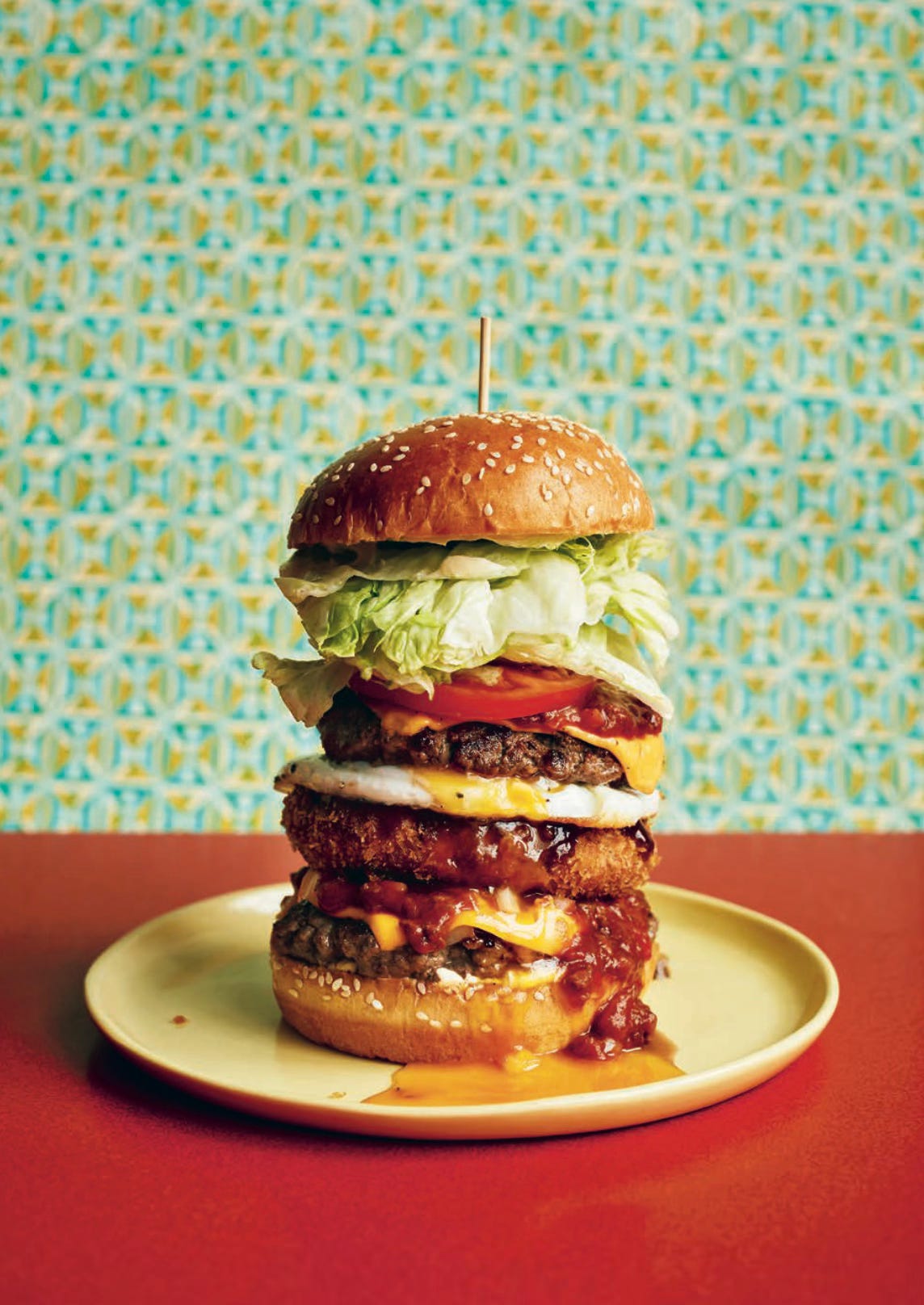
Homage to the Futoccho Burger, Lucky Pierrot, Hakodate (photo by Laura Edwards, from Hokkaido). You didn’t think I was done talking about burgers, did you?
I recently had the privilege to appear as a talking head on Dr. Anna Sulan Masing and Lucy Dearlove’s podcast series “To Be Delicious: A Cultural Context of MSG in the UK.” Across five episodes, Masing and Dearlove examine MSG and umami from multiple angles, investigating how they can be understood through both science and culture, and how it connects to larger concepts like nostalgia, racism, language, and a sense of place. The podcast clearly differentiates between MSG and umami (it bears repeating: they are not the same thing), while also explaining their inseparability and universality. MSG and umami feature in all cuisines. Literally all of them. But their specific forms, the way they are used, and the way they are understood all vary widely from culture to culture.
I went back through my old blog posts and college essays (embarrassing) to see if I could pinpoint when I first learned about umami.1 In November 2004 I wrote a paper called “Adaptation of the Chinese Noodle in Pre-Modern Japan” that explains umami and key umami ingredients, such as katsuobushi and soy sauce.2 By December 2006, I was mentioning umami casually in recipes for chowder on my blog. Back then, umami was novel to me, but also relatively unremarkable. It wasn’t the gastronomic buzzword or international phenomenon it is now. I remember noticing it on a lot of Japanese food packaging in banal contexts: as an ingredient (うま味調味料 umami chōmiryō (umami seasoning)), or in marketing copy and descriptors, such as this “rich taste” (深い旨み fukai umami, literally “deep umami”) nattō sold by Lawson.
In both instances, you could translate umami as “savory,” and it would make sense, and adequately describe the flavor or ingredient in question. But! Note that “umami” is written differently in each instance: うま味 for the umami seasoning, and 旨み for the “rich taste” nattō. This is a difference I only recently came to understand. The former refers specifically to umami the basic taste – you can think of “umami chōmiryō” as analogous to the word “sweetener” on English food labels (though of course that applies to sweet compounds rather than umami ones). The latter is more vague – just like the other umami, it derives from “umai,” which means “tasty,” but in this sense it implies a satisfying, balanced flavor. The Umami Information Center’s Japanese site has an explainer about this, which doesn’t appear on their English site. They take for granted that in English, umami is understood only as savoriness.
Except… it kind of isn’t! There’s still a lot of confusion about what exactly umami is, and some of this confusion comes from how umami as a concept is communicated by the Japanese outwardly, to a global audience. On the podcast, I said that my understanding of umami is really “umami in translation.” But it might be more accurate to say that my understanding of umami is actually limited to the relatively straightforward English definition of umami, which avoids the Japanese issue of homophonic ambiguity. Even so, some of the fuzziness derived from that ambiguity persists in English; the secondary Japanese definition of umami as “deliciousness” isn’t so much lost in translation as warped in translation.3
Back in 2015, The New Yorker published an article by Hannah Goldfield provocatively titled “You Think You Know Umami.” At the time, I felt it badly misrepresented what umami is, while also overcomplicating it, leaning hard into stereotypical characterizations of Japanese cuisine (and Japanese culture generally) as mysterious and inscrutable. (It’s annoyingly common for people writing about Japan to take the position that if they don’t know something, then it must be unknowable.)
The article made me so angry that I ranted about it on my blog, and later adapted that rant into an explainer of umami in Vegan JapanEasy. Here’s one particular snippet from the article that triggered me:
When I asked him to describe what umami tastes like, he grew philosophical. “It’s something that’s kind to the body,” he said. “It’s mild, and, after eating, it’s not heavy on your stomach. It helps you wake up better in the morning. That’s what deliciousness is about. It’s about feeling good after eating.” The most balanced meals, he said, have the same level of saltiness as exists naturally in our bodies, and umami in other countries can be too heavy on the stomach. “In Japan, we talk about it tasting good, sleeping well, and clean bowel movements.”
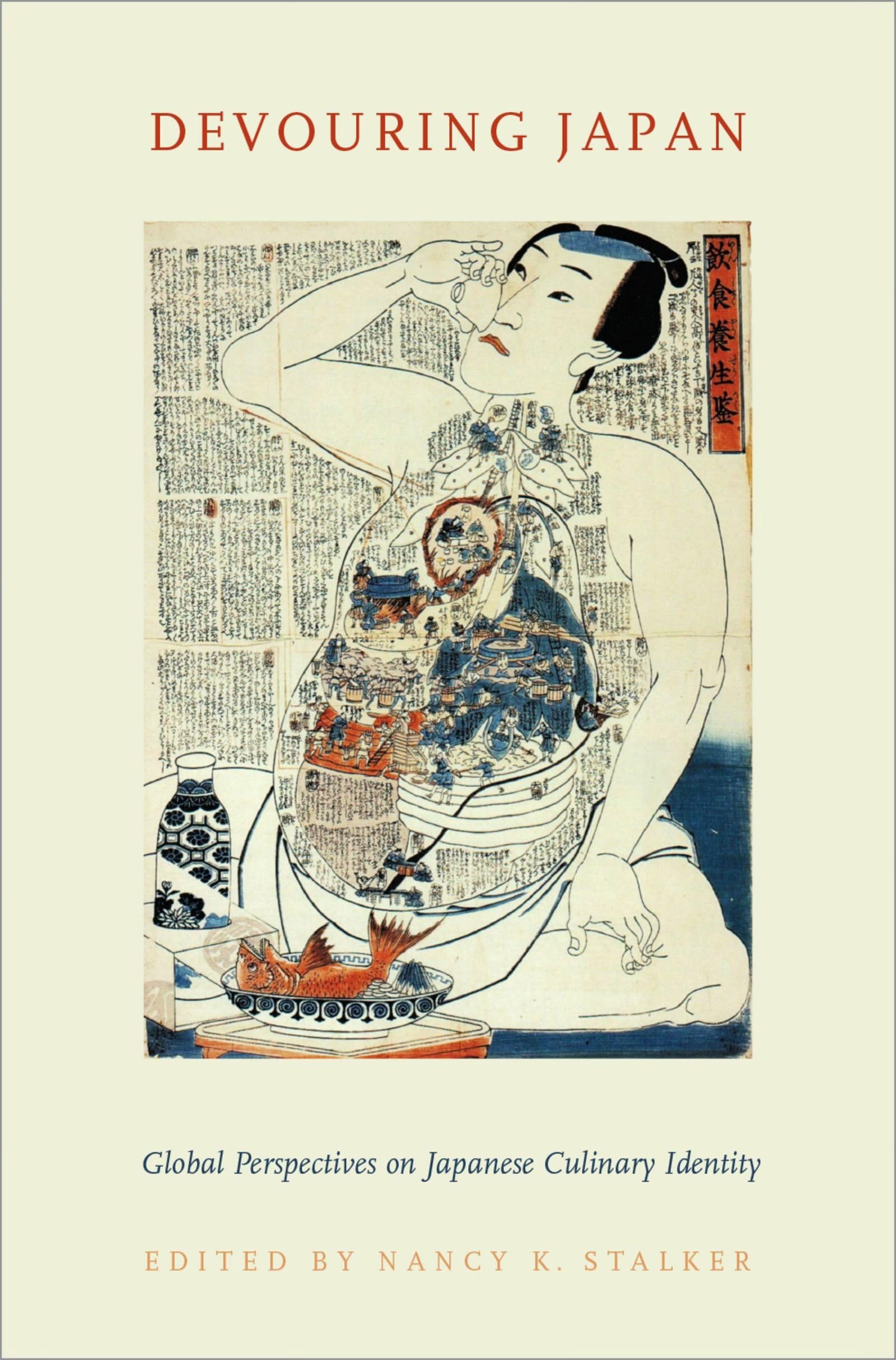
These statements were made by Kazu Katō, a representative of JRO, the Organization to Promote Japanese Restaurants Abroad. Though JRO’s stated purpose is to promote restaurants, what they really promote are Japanese exports, via the businesses that sell them. They operate mainly at expos and trade events, but also run occasional public campaigns like last year’s Japanese curry stamp rally in London. Umami itself is one of their most prominent marketing assets. But JRO was initially conceived as an organization that would not only promote Japanese food, but also regulate and certify it. Ted Bestor explains the background in an article in Devouring Japan:
In the mid-2000s, Minister of Agriculture, Forestry and Fisheries Matsuoka Toshikatsu complained about “inauthentic” Japanese restaurants after visiting a Colorado emporium that featured both sushi and Korean barbecue on its menu. In response, he advocated a system of certification to be applied to restaurants outside of Japan that represent themselves as serving genuine Japanese cuisine.
The proposal was ridiculed in the Japanese press, as well as in government circles; the project came to naught. Nonetheless, the notion of “sushi police” was picked up by the Japanese media and has remained in popular consciousness, perhaps as a shorthand for referring to officious gatekeeping of what is and what isn’t actually Japanese cuisine. Indicative of such popular derision is a 2016 Japanese television anime series entitled Sushi Police… [which] portrays bumbling Japanese officials, accompanied by a robot powered by soy sauce, pursuing inauthentic sushi in the United States… and elsewhere.4
Although Matsuoka’s specific proposal never materialized, it morphed into JRO, which tacitly certified restaurants by including them in campaigns, or by endorsing them in designated restaurant guides. Furthermore, the MAFF scheme turned out to be a hydra: its head may have been cut off, but two more grew in its place: JETRO’s “Japanese Food Supporter” designation, and the completely opaque Nintei Nihon Restaurant accreditation program (apparently initiated by a Japanese restaurant owner in London, with no connection to any other governing body).
This is all to say that umami has been used by Japanese government ministries and trade organizations like JRO as a political and economic tool to support a narrow, generally conservative image of Japanese food, and Katō’s comments should be understood in that context. Elsewhere in Devouring Japan, Yoshimi Osawa investigates the idea of umami as Japanese cultural property in her article “We Can Taste but Others Cannot”:
[Some] Japanese now commonly assert that umami is a taste recognized only by Japanese or that the Japanese understand umami better than foreigners… There are at least three technical reasons why these claims exist: (1) all three umami substances (MSG, IMP, and GMP) were discovered by Japanese scientists, (2) Japanese is one of only a few languages to have a word to describe the umami type of taste, and (3) the existence of umami as a fifth taste was not believed outside of Japan until the discovery of the umami receptor in 2000.5
Osawa’s research included interviews with a number of Japanese chefs in both Japan and the UK, some of whom were absolutely damning in their appraisal of non-Japanese palates as inferior and unable to perceive or understand umami.6 And is it any wonder, when official explanations of umami, such as Katō’s, can be so esoteric and abstract that they invoke sleep quality and bowel movements? Mythologizing umami like this creates a feedback loop between Japan and the West that supports an Orientalist/exceptionalist view of Japan while making umami out to be something more difficult to grasp than it actually is.
The New Yorker article also features commentary from Adam Fleischman,7 founder of the now mostly-defunct Umami Burger. The whole idea of an “umami burger” is irksome to me, because burgers are already inherently umami, especially if they contain accoutrements that bring their own umami compounds to the party: common toppings such as cheese, tomatoes, ketchup, or pickles. Even at their most basic, burgers express an extraordinary level of umami intelligence. That’s why most of the world’s best burgers are not that different from ones that would have been made one hundred years ago. Adding high-concept condiments such as Fleischman’s “Umami Master Sauce” or “Umami Dust” is… fine, I guess, and probably quite tasty. But it’s also unnecessary. I get the impression that in the case of Umami Burger, umami was deployed primarily to generate marketing buzz, and only secondarily in the service of making a better burger.
The Japanese, [Fleischman] told me, define umami as “an over-all harmonious state of perfection where the ingredients come together, a really rounded and harmonious dish. They have a sort of zen way of looking at it.”
The invocation of Zen says it all: umami is meant to be something mystical, rarefied, profound. But one of Osawa’s interviewees, a Japanese food TV presenter, offers a counterpoint: “To be honest, umami is a convenient expression. If I cannot find an appropriate expression to describe the taste of food, I sometimes use umami instead of just saying oishii (tasty).”8
Imagine, if you will, a parallel universe in which the chemical compounds responsible for the subtle but distinctive taste of savory food were isolated by an Italian scientist, who named this taste “gustosità” or something. I wonder what the discourse surrounding gustosità would look like. Would the Italian government use it to promote anchovies and cheese and tinned tomatoes, and to support the idea that Italians have superior palates? (Lol I can’t even keep a straight face writing that – of course they would.) Would non-Italians be producing podcasts and writing lengthy think pieces about it, like this one?
Or would we all just shrug and say, “Oh yeah, gustosità – I get it, savoriness. American food is savory, too. Burgers are totes savory.”
Clearly, I am very dismissive of the notion that umami is anything more than just a universal basic taste – too dismissive, in fact. Masing and Dearlove’s podcast – which compellingly connects umami to feelings of comfort, satisfaction, nostalgia, and self-care – has made me rethink my hardline, just-the-facts position on umami. Because taste is not just a matter of, you know, taste. How we perceive food and understand our relationship to it, and its relationship to the wider world, has a lot to do with how we contextualize it and talk about it.
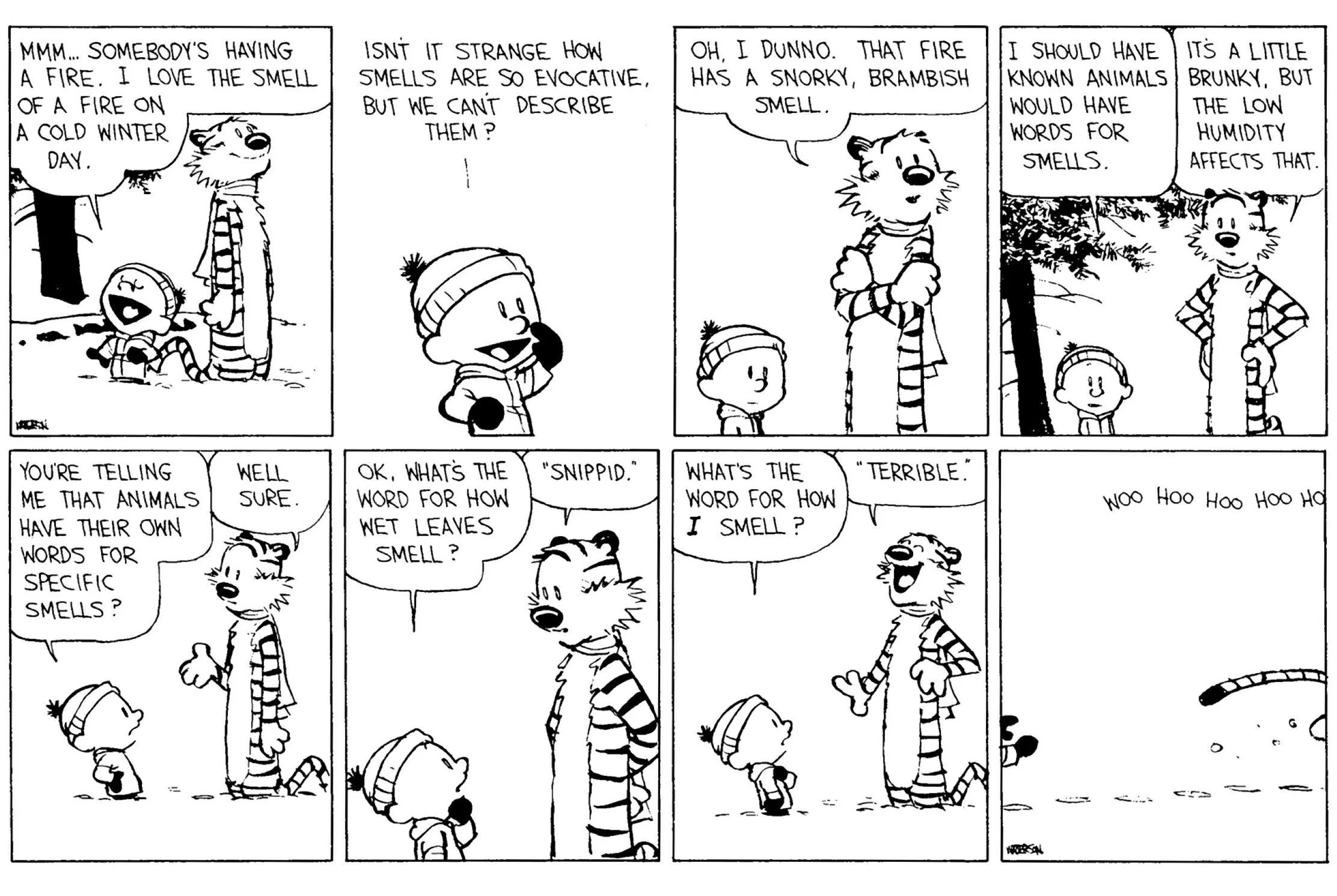
Katō’s musings about how umami is “kind to the body” and helps you poop sound pretty woo-woo, but a more open-minded and perhaps less arrogant interpretation would be that he’s expressing an aesthetic sensibility related to umami, rather than trying to define the term in a purely academic way. And certainly, that approach has merit, especially because when it comes to describing sensations, words often fail us miserably.
In a way, it’s no wonder we’ve all latched on to umami so excitedly. We don’t have a lot of words to describe tastes, so when a new one comes along, it’s like finding a key to a door that’s been locked our whole life. Now we can name it; now we can talk about it, explain it, move in and make it our own.
Discussing the sensory characteristics of food often involves metaphors. We describe tastes in terms of other things, and vice versa: a bittersweet memory, a sour expression, salty language. But savory…? That’s a bit trickier. We can savor a moment, or meet an unsavory character, but the actual word “savory” doesn’t appear in any English figures of speech that I can think of. Perhaps this indicates that we don’t have strong, definitive associations with the word. It may be worth noting, as Osawa does, that Japanese dictionaries also define umami as “a skillful thing to relish, especially techniques in art” and “profit that is easily gained in business.”9 As a more familiar, more lived-in word (and again, a homophone), umami naturally has other connotations in Japanese.
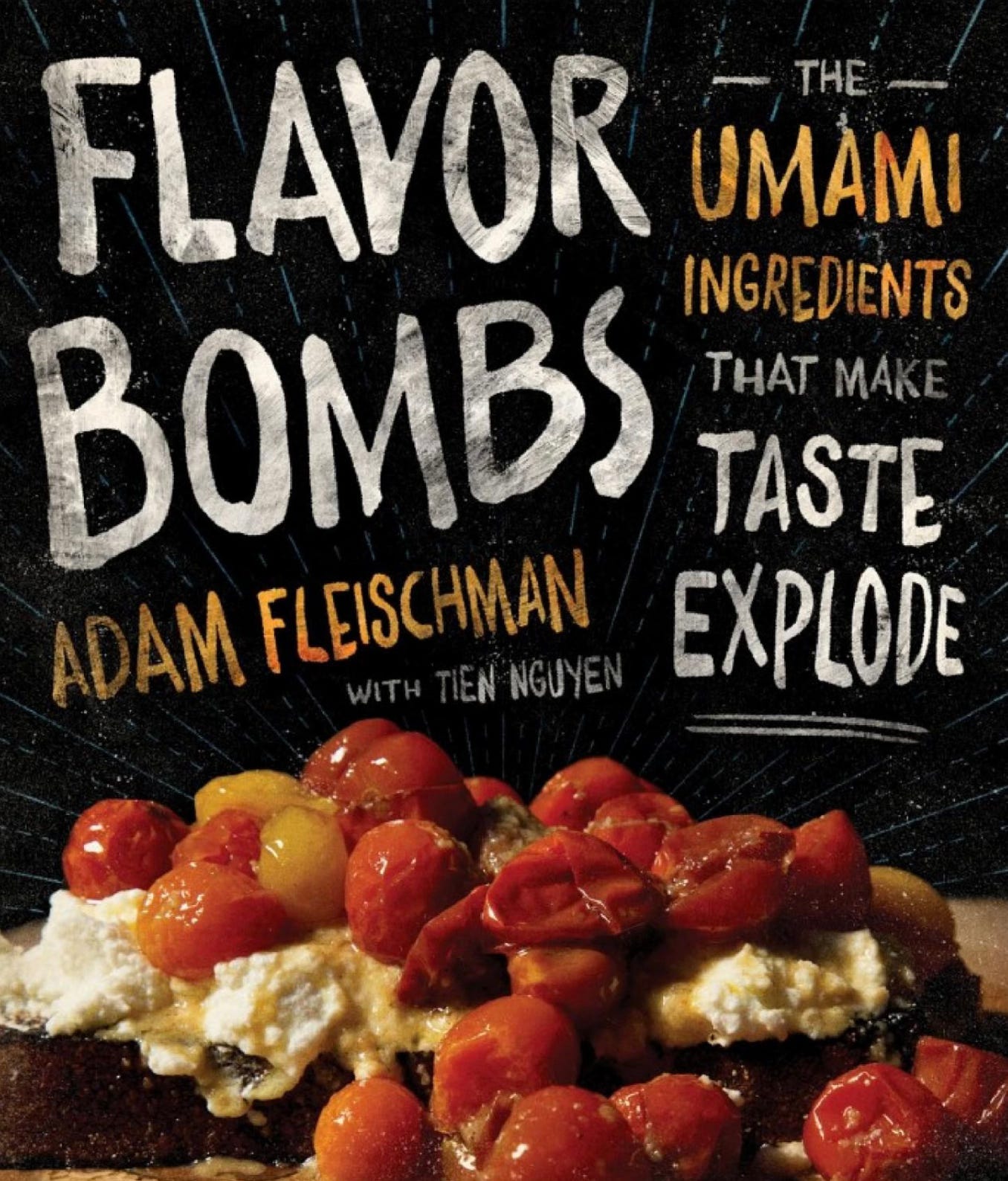
How on earth would you describe a savory taste to someone else? How would you describe any taste? It’s actually kind of impossible, which is why using metaphors, using narratives, and expanding on the emotions we associate with a taste can be useful – as Masing and Dearlove and their interview subjects have done, and indeed, as Katō does in his explanations. The language Katō uses to explain umami is delicate and calm: “kind,” “mild,” “feeling good,” “sleeping well.” They’re the same sort of words you might hear in a meditation app. Now, compare this to Adam Fleischman’s cookbook:
To quote Clive Badger from Fantastic Mr. Fox: Explosions! Flames! Burning things! The back cover copy boasts that this book will teach you how to “detonate flavor”! Kaboom! Could this take on umami be more American?10 Of course it’s to be expected that in a country where there are more guns than people, even umami is weaponized. Goldfield points out that “Fleischman’s approach — Where do I find the umami, and how can I get as much as possible? — is distinctly American.” She also reports that in 2013 David Chang set out to create something he called “the New York umami.” What does this even mean? If you want New York umami, eat a slice of pizza. If you want American umami, just eat any normal cheeseburger. In his cookbook, Fleischman acknowledges the inherent umami of pizza and burgers – but it’s not enough for him. And maybe that’s the American approach to umami, as Goldfield suggests: to ramp up, maximize, exaggerate, explode.
Umami is a basic taste – and I still think that’s the best and simplest way to understand it. But perhaps basic tastes just aren’t so basic after all. Sweet, sour, bitter, salty, and umami: we associate all of them with particular things outside the realm of food, and it is in those associations that they take on new, more complex meanings, which will inevitably vary between different cultures and languages. Tastes are like colors: we all see the same red, blue, and green, but how we interpret them as symbols depends completely on our cultural vantage point. We are what we eat – that’s a given. But we are also the way we talk about what we eat.
24 Hour Pancake People is a reader-supported publication. To receive new posts and support my work, consider becoming a free or paid subscriber.
Thanks for reading! If you enjoyed this post, you may like some of the articles I’ve written for Pellicle, which also explore how symbolism and sense-memories connect to taste and flavor.
I remember my MSG “aha!” moment clearly. When I was living in Japan, at some point I clocked that the salt shaker on the table at my go-to yakitori joint wasn’t just salt. It was aji-shio, or “flavor salt,” a mixture of salt and MSG. So that’s why it makes everything taste so good, I thought. This came after growing up in America and seeing “no MSG” labels on food packaging for years and years, and hearing about MSG primarily in the context of widespread, casually racist demonization of Chinese food. I never really knew why people thought MSG was bad, and it didn’t take much Googling for me to realize that it wasn’t.I’ve been all in for Team MSG ever since.
The paper also refers to synergistic umami, although only in a misspelled citation that took me a while to figure out: “sojo-kaka,” which should have been “sōjō kōka” (相乗効果). To be honest, re-reading this paper made me feel like I’ve been spinning my wheels for 20 years when it comes to communicating about umami!
This is a pretty common occurrence in popular writing about Japanese culture. So many Japanese words have undergone a similar treatment, like ikigai – I really enjoyed this article explaining how it’s been misrepresented in the West. And it’s worth pointing out that we already have cultural concepts analogous to ikigai: raison d’être, or simply one’s life purpose – just like we already have the concept of savoriness. Do we even need “umami”?
Bestor, Theodore. “Washoku, Far and Near: UNESCO, Gastrodiplomacy, and the Cultural Politics of Traditional Japanese Cuisine.” Devouring Japan, edited by Nancy K. Stalker, 109-110. Oxford University Press, 2018.
Osawa, Yoshimi. “We Can Taste but Others Cannot: Umami as an Exclusively Japanese Concept.” Devouring Japan, edited by Nancy K. Stalker, 127. Oxford University Press, 2018.
Out of curiosity, I Googled うま味爆弾 umami bakudan (umami bomb in Japanese), and there are actually quite a lot of results. (The first and most interesting one is for 3D-printed canapés!). So maybe this idea of a violent, explosive umami isn’t so all-American or un-Japanese after all.
Dopamine rushes, withdrawals, and detoxes are trending among wellness gurus online. But experts say the science behind the trendy phrases doesn’t hold up.
The nerve cells pictured here are responsible for producing dopamine, a neurotransmitter that has become an obsession among online wellness gurus. But experts say the popular understanding of dopamine is often wrong—and the chemical actually plays a critical role in learning, movement, memory, attention, mood, and motivation.
Micrograph by Dr. Nick Gatford, Research Fellow/Kavli Institute of Nanoscience Discovery/University of Oxford
ByKatie Camero
February 4, 2025
Dopamine is widely known as a “feel-good” hormone, a major reason why we may feel happy after a shopping spree or eating pizza.
Thousands of TikTok videos reveal how interested people have become in boosting or lowering their daily doses of dopamine—whether through dopamine “rushes” and “withdrawals,” or dopamine “fasts” and “resets.”
But now that the chemical has become an obsession among wellness gurus, scientists who study it want to make it clear: Dopamine can do a lot of things, but making us “feel good” isn’t one of them.
Dopamine doesn’t work like that, and it’s certainly not a “catch-all term for happiness,” says Daniel Dombeck, a neurobiology professor at Northwestern University who studies the molecule.
Dopamine is a sophisticated neurotransmitter that also acts like a hormone and plays critical roles in learning, movement, memory, attention, mood, and motivation. While dopamine contributes to our feelings of pleasure, it doesn’t directly cause them—and it definitely doesn’t act alone.
“There's a lot of ignorance about what dopamine does and how the brain functions,” says Anne-Noël Samaha, an associate professor of pharmacology and physiology at the University of Montreal who studies the science of rewards and motivation. But in a nutshell, “it’s one of the molecules that allows us to stay alive.”
How dopamine works in the body
Dopamine acts as a chemical messenger, allowing neurons in different parts of your brain to communicate with each other. How it affects you depends on where it’s acting in your brain, Samaha says.
“In some regions [of the brain], an increase in dopamine can help people focus,” Samaha says. “In others, it could make people more impulsive.”
A lack of dopamine in certain areas of the brain can also negatively impact functions like concentration and movement, and is associated with conditions like attention deficit hyperactivity disorder, Parkinson’s disease, and addiction.
This prismatic photo captures a network of dopaminergic neurons—nerve cells that produce and release dopamine—generated from human stem cells. Scientific studies have shown that dopamine doesn't actually make you feel good as some people claim—it makes you want the things that make you feel good.Micrograph by Dr. Nick Gatford, Research Fellow/Kavli Institute of Nanoscience Discovery/University of Oxford
An illustrated view of a synaptic cleft, the space between a neuron and the cell where the neuron releases neurotransmitters such as dopamine. A "dopamine rush" is a misnomer, experts say; when you engage in an enjoyable activity you actually experience a rise in levels of several types of neurotransmitters.Illustration by Science Picture Co/Science Photo Library
So why is dopamine mostly known for its part in our pleasure and reward system? Dombeck says that’s because it was the subject of early research in the 1980s that found our brains release the molecule when we receive food or another reward. As a result, experts generally accepted that dopamine mediates pleasure.
But in the 90s and early 2000s, mounting evidence challenged that idea. Turns out that when you shut down an animal’s dopamine system, they enjoy their rewards just as much but lose all motivation to seek more.
In other words, dopamine doesn’t make you like something, it makes you want it.
“It's not the molecule of pleasure,” Samaha says. “It's the molecule of the pursuit of pleasure.”
This is why you may want to stop doomscrolling before bed—or using drugs or drinking alcohol—but can’t bring yourself to quit even when it makes you feel terrible. Every time you swipe past funny, shocking, or otherwise engaging content, your brain releases dopamine and records the details about the moment in an attempt to boost the likelihood you repeat it whenever you’re exposed to cues like the ping of a notification on your phone, Dombeck says.
This was an evolutionary advantage for humanity.Today, most things we want and need are incredibly accessible for people in wealthy countries. But our ancestors needed dopamine to make them want to walk several miles for a meal or spend months building shelter with their hands.
You May Also Like
“We evolved in environments where we had to mobilize our energy and attention to seek out things that were necessary for our survival,” Samaha says, including safety, shelter, and social connection—and dopamine helps us do that.
Dopamine ‘rushes’ are more than just dopamine
Yes, dopamine levels do rise when you engage in enjoyable activities like listening to your favorite song. But to call that surge in positive feelings a “dopamine rush” is “more than an oversimplification,” Samaha says, “it’s just plain wrong.”
Those activities also elicit a rise in levels of other neurotransmitters that affect mood like serotonin and oxytocin, as well as endorphins, Dombeck says. How and where these molecules interact with each other determines how you feel.
“At the time of a positive outcome, there’s a rush of activity throughout the brain,” Dombeck says. “To call the whole thing a dopamine rush is underselling what’s actually happening.”
These peaks in dopamine aren’t inherently good or bad, Samaha says—what matters most is that they aren’t extreme. Too much dopamine is associated with conditions like mania, while too little is linked to depression. In most scenarios, though, “dopamine is just neutral,” Samaha says, and is around to “keep us alive.”
Dopamine withdrawals are complicated too
Just because you feel temporarily irritated or anxious after losing access to something that brings you joy, it doesn’t mean you’re experiencing a dopamine withdrawal, Samaha says.
“Anytime people have to change their habits, there's always an adjustment period that’s accompanied by some level of anxiety and stress,” Samaha says. “That doesn't mean dopamine levels have greatly decreased and they're now dangerously low.
There is a real condition called dopamine agonist withdrawal syndrome, but that only happens to some people who take medications that mimic dopamine to treat conditions such as Parkinson’s disease and restless leg syndrome. If they suddenly reduce their dose or stop taking their meds, they may experience symptoms similar to drug withdrawal such as agitation, excessive sweating, nausea, and pain.
But a post-vacation gloomy mood, for example, might just be a sign that you’ve gotten used to the high of that stress-free life—not a full-blown dopamine deficit. “It'll take time for your dopamine system to kind of recalibrate and come back down to a normal threshold where other parts of your daily life could activate it,” Dombeck says.
The ‘dopamine fasting’ trend isn’t literal
“Dopamine fasting” is another buzzword that, according to the psychologist who coined the term in 2019, is meant to be an “antidote” to our highly stimulating society: Easy access to activities that give us quick dopamine hits are, as the theory goes, numbing us to the pleasures of slower activities like reading or creating art.
Now that we can do most things with a tap on a touchscreen, we’re bombarding our dopamine systems with “very potent rewards that require almost no upfront work,” says Anna Lembke, professor of psychiatry and addiction medicine at the Stanford University School of Medicine and author of Dopamine Nation. As a result, the things we like don’t satisfy us as much, but we still crave them in an “attempt to bring baseline dopamine levels back up to normal, healthy firing.”
Some people, however, have taken the concept of dopamine fasting too literally. Rather than asking you to stop doing everything that might stimulate dopamine in your brain, dopamine fasting is about limiting or completely refraining from impulsive and problematic behaviors.
Besides, there’s no way to actually drain yourself of dopamine, Samaha says. “It's not like Dry January where you decide for a whole month that you won't drink alcohol because it's good. You can't have a dry dopamine day, it’s not possible,” Samaha says. “Dopamine is an ancient molecule…that has been conserved across evolution. It certainly has not evolved to be influenced by social media or people's phone habits.”
Furthermore, although habits like checking social media or gambling can be addictive, there’s no direct evidence that they can dramatically rewire your brain like drug abuse can, Lembke says.
The bottom line? Avoiding harmful habits are bound to benefit you, but you don’t have to avoid the things that make you happy.
“Trust that your dopamine is going to do what it does,” Samaha says, “and just leave it alone.”
estimated reading time: 10 minLike many memoirs, J. D. Vance’s book misses a few details, some of which complicate the story upon which he has based much of his politics.
Last month, after I published an article about the Republican Vice-Presidential candidate J. D. Vance and his fixation on the traditional nuclear family, I received an e-mail from Donna Morel, an attorney in San Diego. Morel is a fact-checking hobbyist—notably, she exposed major fabrications in best-selling books by the late celebrity biographer C. David Heymann. After Donald Trump named Vance as his running mate, Morel had begun looking closely at “Hillbilly Elegy,” the 2016 memoir that brought Vance to national prominence and provided the springboard for his foray into politics. Morel suspected that the book was “a little too made for Hollywood,” she told me—in 2020, it was adapted into a movie starring Glenn Close and Amy Adams—and she wanted to see if her hunch was correct.
Vance, it must be stressed, is no C. David Heymann. Judging by what Morel has unearthed from the archives, Vance has blurred some details, perhaps unintentionally, in a manner that likely comports with most memoirs, especially those that rely heavily on family lore. Vance is careful to acknowledge spots in “Elegy” where he may not have all the facts in place; in the introduction, he writes, “I am sure this story is as fallible as any human memory.” Still, Morel has identified discrepancies and omissions that complicate the family narrative upon which Vance has based so much of his conservative politics and ideology. Some of what was left out of “Elegy” undermines Vance’s larger political project, in which matrimony and the nuclear family are the foundation of a civil society that stigmatizes divorce, single parenthood, same-sex marriage, and, of course, “childless cat ladies.”
“Two generations ago, my grandparents were dirt-poor and in love,” Vance writes toward the start of “Hillbilly Elegy.” “They got married and moved north in the hope of escaping the dreadful poverty around them.” Bonnie and Jim Vance, who are immortalized in “Elegy” as Mamaw and Papaw, left their Appalachian home town in Kentucky in their teens, eventually settling in Middletown, Ohio, where Jim got a union job at the Armco steel mill; tragically, their first child died in infancy. (“Without the baby, would she have ever left Jackson?” Vance asks in “Elegy.” His grandmother’s “entire life—and the trajectory of our family—may have changed for a baby who lived only six days.”) Vance describes Bonnie and Jim as “alone in their new city” and “isolated” from the family they felt closest to. He allows that Jim’s mother, Goldie, was “nearby,” but that Bonnie disliked her, and that she was “mostly a stranger to her own son.”
Morel dug up census records and other documents that add nuance to this tale. “Hillbilly Elegy” doesn’t name Jim’s stepfather, Julius Blackmon, who had worked at Armco for years before Jim was hired there. (“Applicants with a family member working at Armco would move to the top of the employment list,” Vance notes in his memoir, without making the connection.) Despite any disdain that Bonnie may have felt toward her mother-in-law, Bonnie and Jim lived with Jim’s mother and stepfather at two different residences following their move to Middletown, according to the census records. Uncle Jimmy’s birth announcement, in 1951, also shows the young couple living in the Blackmon home. When Bonnie and Jim did get their own place, it was less than a mile away. And, when Julius Blackmon died, Jim was named the executor of his estate—yet another data point that contradicts the picture of estrangement that Vance sketches in “Elegy.”
None of these findings destroys the portrait of two teen-agers leaving their lives behind in Appalachia and striking out to create a better life for themselves in the industrializing Midwest. But the surprising elisions work to exaggerate Bonnie and Jim’s circumstances, putting dents in Vance’s version of their plucky, up-by-the-bootstraps story.
Bonnie and Jim’s marriage was, at times, deeply troubled—in Vance’s telling, both of his grandparents were violent, and Jim was a vicious drunk. But Vance praises them in his memoir and elsewhere for sticking it out. Later in the marriage, Vance writes in “Elegy,” they “separated and then reconciled, and although they continued to live in separate houses, they spent nearly every waking hour together.” (The relationship seems to have improved immensely, Vance observes, after Jim Vance quit drinking, in 1983.) During a 2021 talk in which Vance discussed how divorce harms children, he suggested that, following the sexual revolution of the nineteen-sixties, too many couples in flawed marriages began falling back on divorce as an easy way out, and he offered up Mamaw and Papaw as an aspirational counterexample. His grandparents, he said, “had an incredibly chaotic marriage in a lot of ways, but they never got divorced, right? They were together to the end, ’til death do us part. That was a really important thing to my grandmother and my grandfather.” By the nineteen-seventies and eighties, Vance told his audience, couples were more likely to see marriage as a “basic contract,” one that could be entered into and exited with ease, even caprice:
But that recognition that marriage was sacred, I think, was a really powerful thing that held a lot of families together, and when it disappeared, unfortunately, a lot of kids suffered. And this is one of the great tricks that I think the sexual revolution pulled on the American populace, which is this idea that, like, well, O.K., these marriages were fundamentally—you know, they were maybe even violent, but certainly they were unhappy, and so getting rid of them and making it easier for people to shift spouses like they change their underwear—that’s going to make people happier in the long term.
According to records sourced by Morel, Bonnie and Jim—Vance’s flawed but heroic avatars of traditional marriage—entered divorce proceedings twice. In the first instance, according to court documents and also an announcement in the March 22, 1955, edition of the Middletown Recorder, Bonnie, then twenty-one, filed for divorce from Jim on grounds of “extreme cruelty” and “gross neglect of duty.” Joseph Nigh, a family-law attorney in Columbus, Ohio, told me that “ ‘extreme cruelty’ is a broad spectrum,” and can encompass physical assault, verbal abuse, or “demeaning conduct.” “Gross neglect of duty” is even more of a catchall term, Nigh said, intended to be left to a court’s broad discretion. (Nigh spoke with me about Ohio family law as a general matter, and did not address the Vance case specifically.)
The timing of Bonnie’s divorce petition is out of step with “Elegy,” in which Vance’s Uncle Jimmy compares the early years of his parents’ marriage to “Leave It to Beaver,” and says that, while their bond was always volatile, before the nineteen-sixties, “they were united, they were getting along with each other.” In the divorce petition, Bonnie asked the court for a restraining order against Jim as well as alimony, child support, and custody of three-year-old Jimmy. In August, 1957, the divorce filing was dismissed “without record,” leaving no documented clue as to why. Bonnie and Jim went on to have two more children.
Taylor Van Kirk, a spokeswoman for Vance, said, in an e-mailed statement, “JD’s grandparents lived difficult lives amid struggles with poverty, miscarriages, and alcoholism. But in their later years, they became overwhelmingly positive forces in the lives of their children. The decision for a married couple to divorce is deeply personal and individual—JD respects those decisions.” A representative for Vance also cited recent comments that the candidate made on Fox News in which he stressed that he has never “supported women staying in violent marriages.”
It’s entirely possible that Bonnie and Jim Vance reconciled because of their commitment to the sanctity of marriage. But it’s also useful to place Mamaw and Papaw’s first aborted divorce—which goes unmentioned in “Hillbilly Elegy”—in some historical context. Before the state of Ohio introduced no-fault divorce, in 1974, anyone unilaterally seeking a divorce needed to prove that her spouse had committed a misdeed that was enumerated in Ohio’s divorce code; in addition to “extreme cruelty” and “gross neglect of duty,” these faults included adultery, bigamy, impotence, and “habitual drunkenness.” Prosecuting such a case against one’s spouse required money and resources. In seeking divorce, “the problem that so many women had was that they weren’t financially independent from their husbands,” Elaine Tyler May, a professor emerita of history and American studies at the University of Minnesota, said. “It’s not a coincidence that divorce rates went up as an increasing number of women began working outside the home and were able to support themselves.” (Bonnie Vance, it might be noted, was not employed, did not complete middle school, and did not seem to have any family in Ohio.)
Vance is correct that the nationwide advent of no-fault divorce in the nineteen-seventies did make marriage more akin to a “basic contract.” But a range of statistics drawn from subsequent decades is highly suggestive of the kinds of contracts that some women wanted to break. Research by the economists Betsey Stevenson and Justin Wolfers has shown that, as no-fault divorce became the norm in state after state, domestic-violence rates dropped by some thirty per cent, suicides among women dropped by as much as sixteen per cent, and the number of women murdered by their partners dropped by ten per cent.
In 2020, Vance, who had recently been baptized and confirmed as a Catholic, published an essay in the Catholic journal The Lamp about how his grandmother influenced his decision to convert. “I felt desperate for a worldview that understood our bad behavior as simultaneously social and individual, structural and moral,” he wrote. The philosophy he craved, Vance went on, “could speak against rising rates of divorce and addiction, not as sanitized conclusions about their negative social externalities, but with moral outrage. And I realized, eventually, that I had already been exposed to that worldview: it was my Mamaw’s Christianity.”
Divorce rates have not been rising for some time—they peaked in the U.S. at the turn of the eighties, before Vance was born. Still, it is his prerogative to imagine that his grandmother might have felt a sense of moral outrage about the evolution of divorce law. And Vance’s reader is free to feel a sense of moral outrage on behalf of any young mother of the nineteen-fifties who might have sought to escape a marriage that was characterized by “extreme cruelty.”
A quarter century after Bonnie Vance’s first divorce petition was dismissed, her marriage appears to have reached another breaking point. According to a decree that Morel procured from a court in Butler County, Ohio, Jim filed for divorce from Bonnie; Bonnie filed a counterclaim, and, in 1981—incidentally, around the time that the rate of divorce in the U.S. reached its historical apex—the court found Jim “guilty of gross neglect of duty.” Still, the couple did not divorce. Instead, they legally separated. Nigh, the Ohio family-law attorney, said that a couple might pursue a legal separation instead of a divorce if one or both spouses had religious objections to divorce, for example, or if there was a question of one spouse forfeiting health-insurance coverage. Yet, despite these considerations, “it’s very rarely used,” Nigh said. “In nineteen-plus years of practicing, I’ve only done one or two legal separations.”
The decree ordered that the “parties to said contract shall live separate and apart,” and Jim was required to pay Bonnie seven hundred dollars a month in alimony. He also had to “relinquish all claim” to “the family residence,” cede property he co-owned with Bonnie’s brother to their mother, and hand over the title of the 1980 Buick to Bonnie, even as he continued to make the monthly payments on it. Yet the “marriage contract” between them, the decree states, “shall continue in full force and effect.” Mamaw and Papaw may have looked and sounded divorced. But, technically, they never did give up their claim to “ ’til death do us part.” ♦
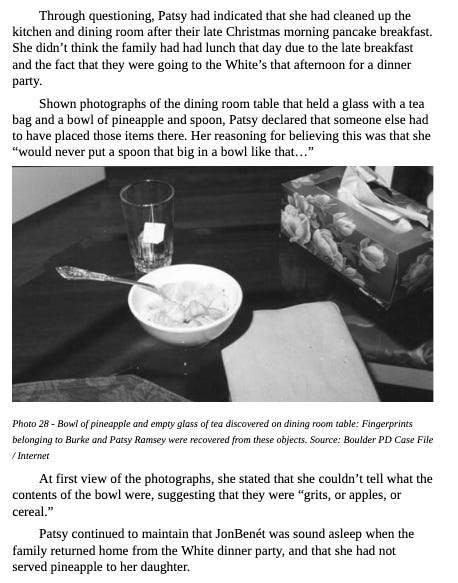
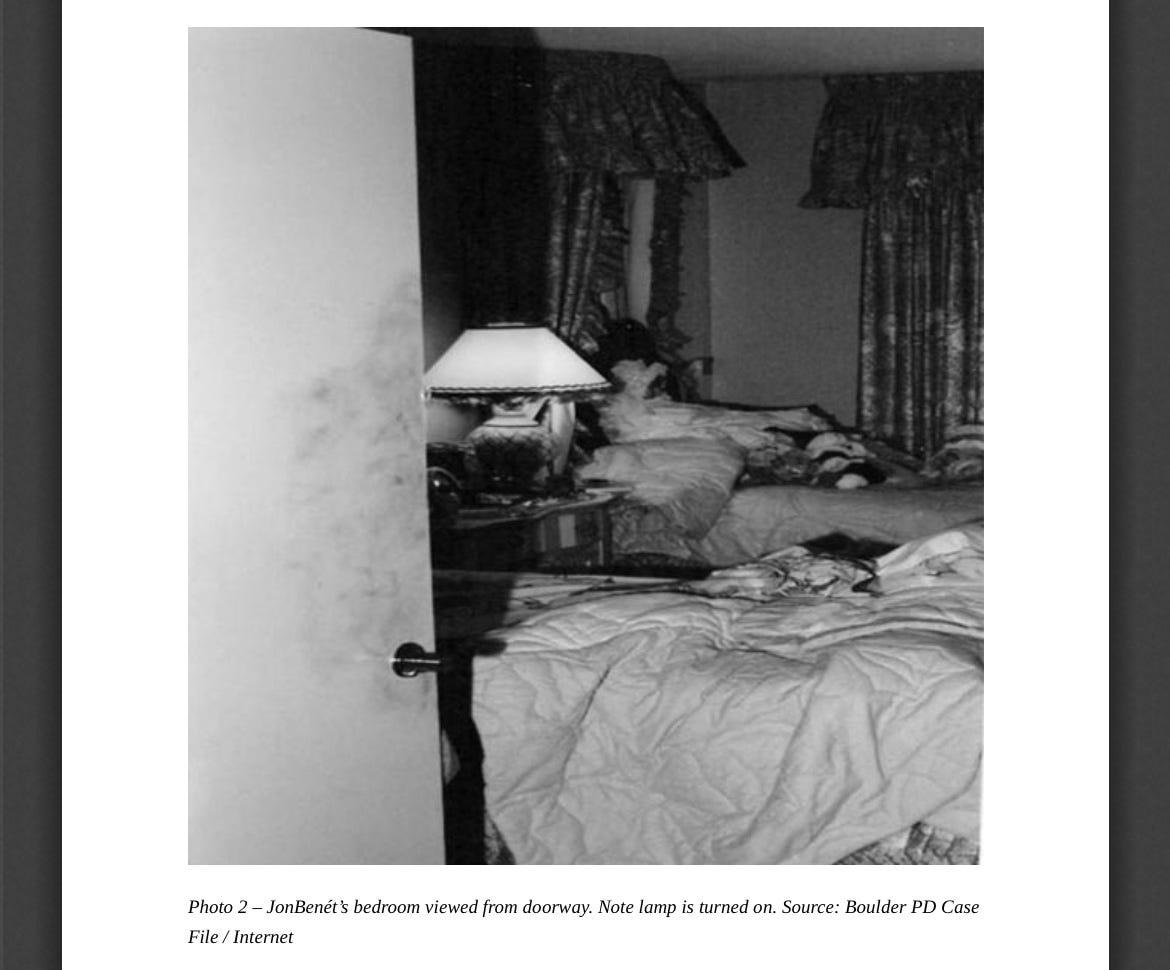
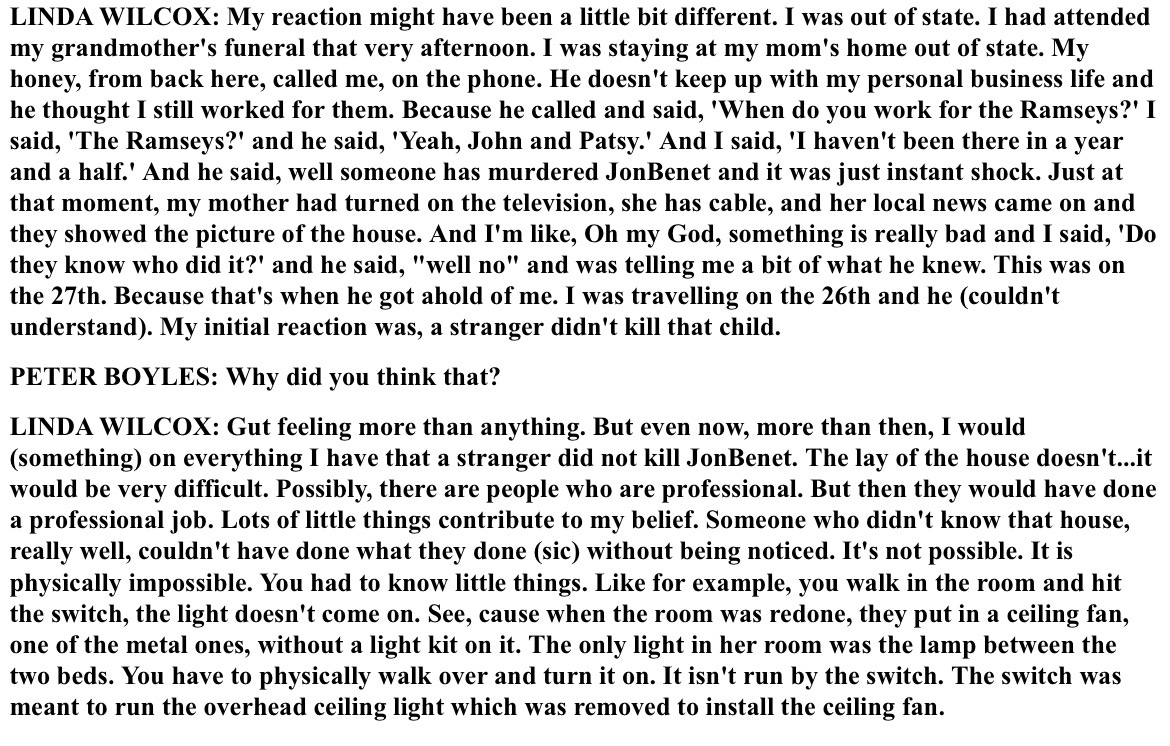
This piece was edited on 12/3 at 10:29am to add additional information on the DNA profile, explain the grand jury decision, the handwriting analysis, a few interviews with detectives and FBI investigators, and findings in JonBenet’s room the night of the incident that hint at Netflix and Berlinger manipulating the truth. I also added clips from the Dr. Phil interview because clips are being removed.
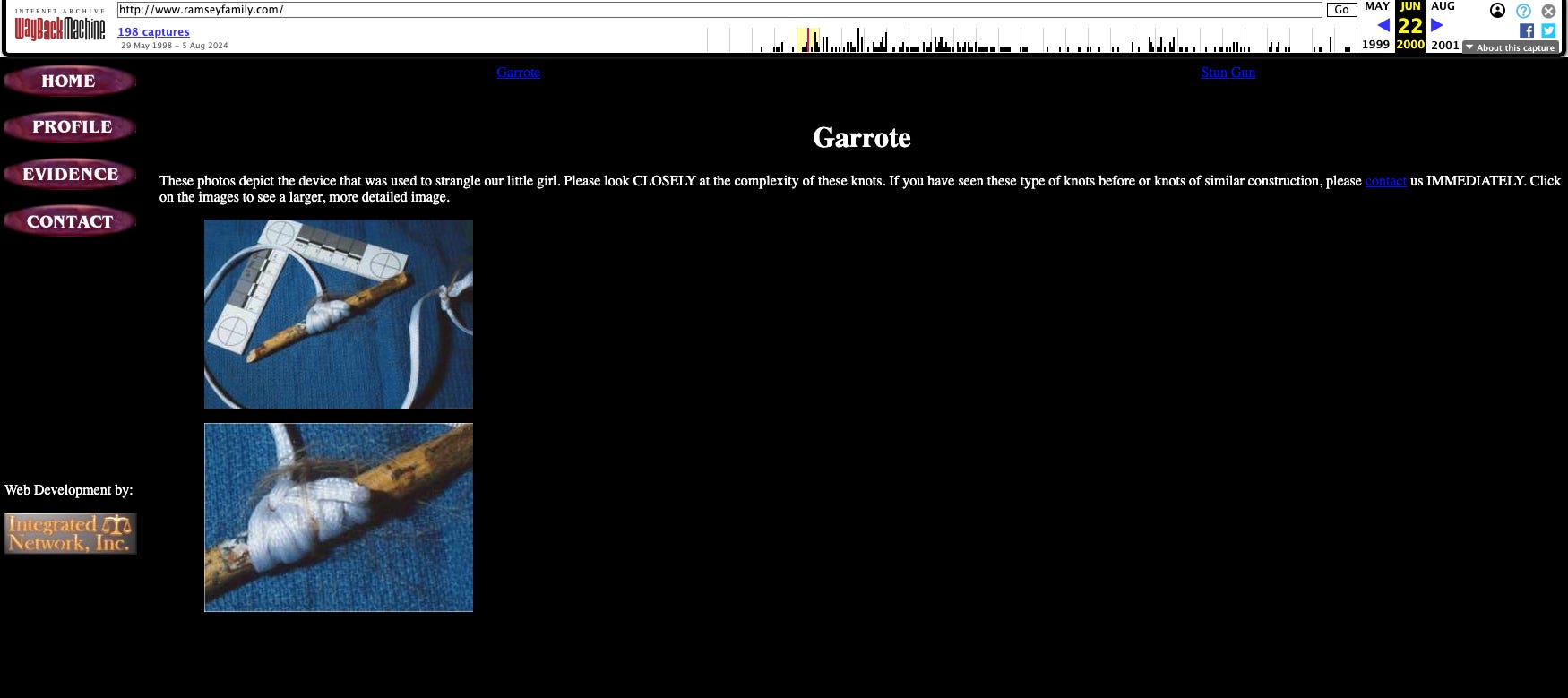
I edited it again to add info on the duct tape, Ramsey PR machine, screenshots from their 1997 website.
This case has likely been solved, but will never see justice. The real mystery is why.
A new Netflix documentary on the JonBenet Ramsey case came out last Monday. Prior to its release, the media hyped this new doc as something that would break open the case. The director, Joe Berlinger, did interviews saying he believed the case could be solved with new DNA evidence and couldn’t believe he previously thought conspiracies the parents did it could be true. People who have watched every doc on the case, read books and pored over the released grand jury papers thought this might be the doc that would finally bring new information to light.
In fact, it doesn’t do that at all. Cold Case: Who Killed JonBenet Ramsey presents no new information and is created by someone who seems more enamored with the fact that he got an interview with John Ramsey than anything that points to him being a serious suspect. Of course, without John, there’d be no family or personal involvement and we probably wouldn’t be watching this on Netflix.
What this creates is a terribly one-sided documentary that does a disservice to everyone involved by leaving out crucial information that points to anyone but an intruder. In fact, the documentary uses the idea that the Ramseys did it as a playful twist designed to trick the audience. The first episode highlights how complicated the house was, how the police noticed odd behavior. It leads you to believe it’s the parents before episode 2 comes in and says, well wait, there was DNA!
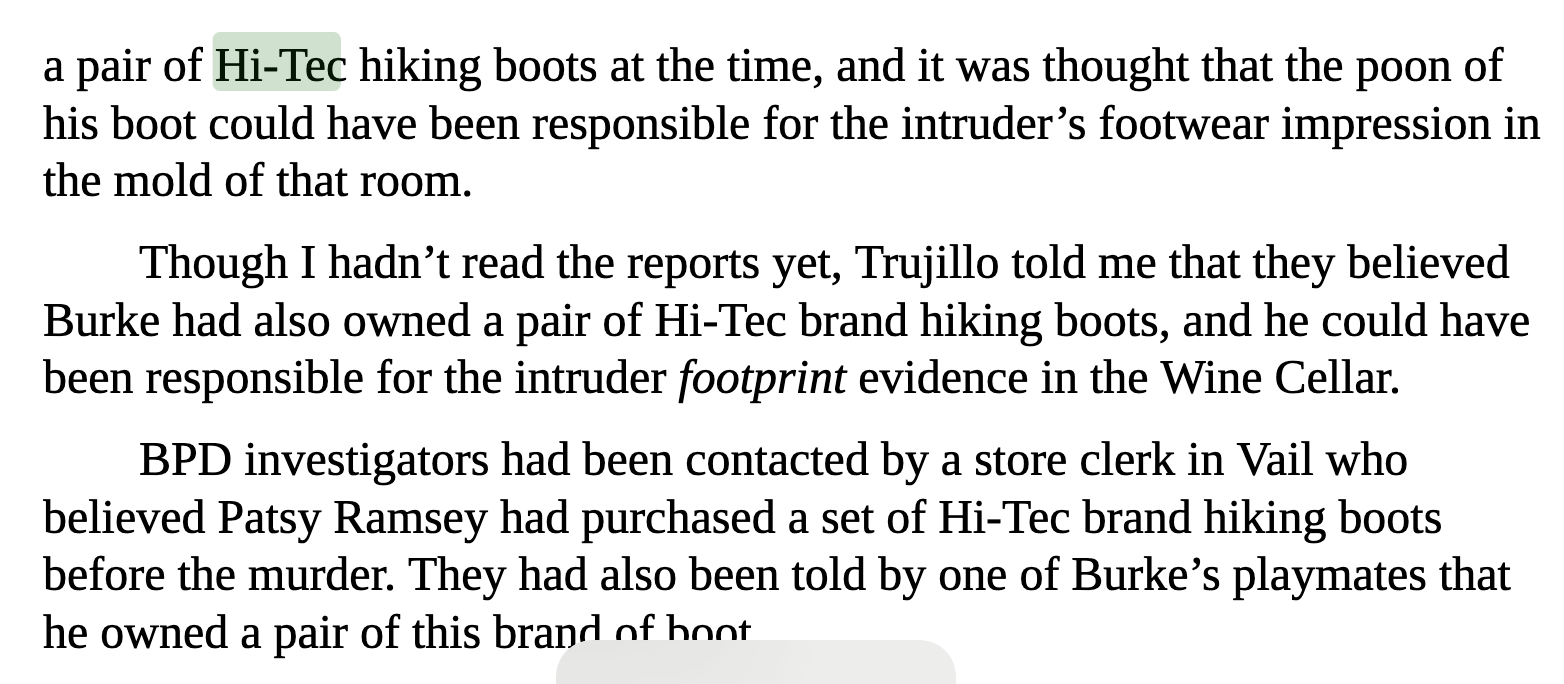
The problem is, the first episode doesn’t actually get into the evidence that made the police consider the Ramseys. In fact, they repeat a lot of the lies that are in the Ramsey’s book and have been disproven to make the cops look dumb. For example, the Ramseys say the cops focused on them immediately because they said there weren’t footprints outside in the snow. The Ramseys and Berlinger’s doc point out that there were no prints because there was no snow and show photos of the back of the house. This, to them, is evidence that the cops were trying to make them look bad from the start! The thing is, that’s not what the original police report says.
James Kolar was a detective who worked the case. He started working on it in 1997 when he was asked to stake out one of the Ramsey’s friends at a ski resort. In the week after JonBenet’s funeral, the cops couldn’t find the Ramseys and they wouldn’t share their whereabouts. Kolar worked for the Boulder Police Department for 17 years, but had transferred to Telluride when the murder took place. They asked him to head to the ski resort to see if they were there. He didn’t find them, but this pulled him into the case.
By 2005, he was lead investigator. By 2006, he left the case to go back to Telluride, discouraged by what he witnessed from the DA. In 2012, he released a book with his findings called Foreign Faction: Who Really Kidnapped JonBenet?
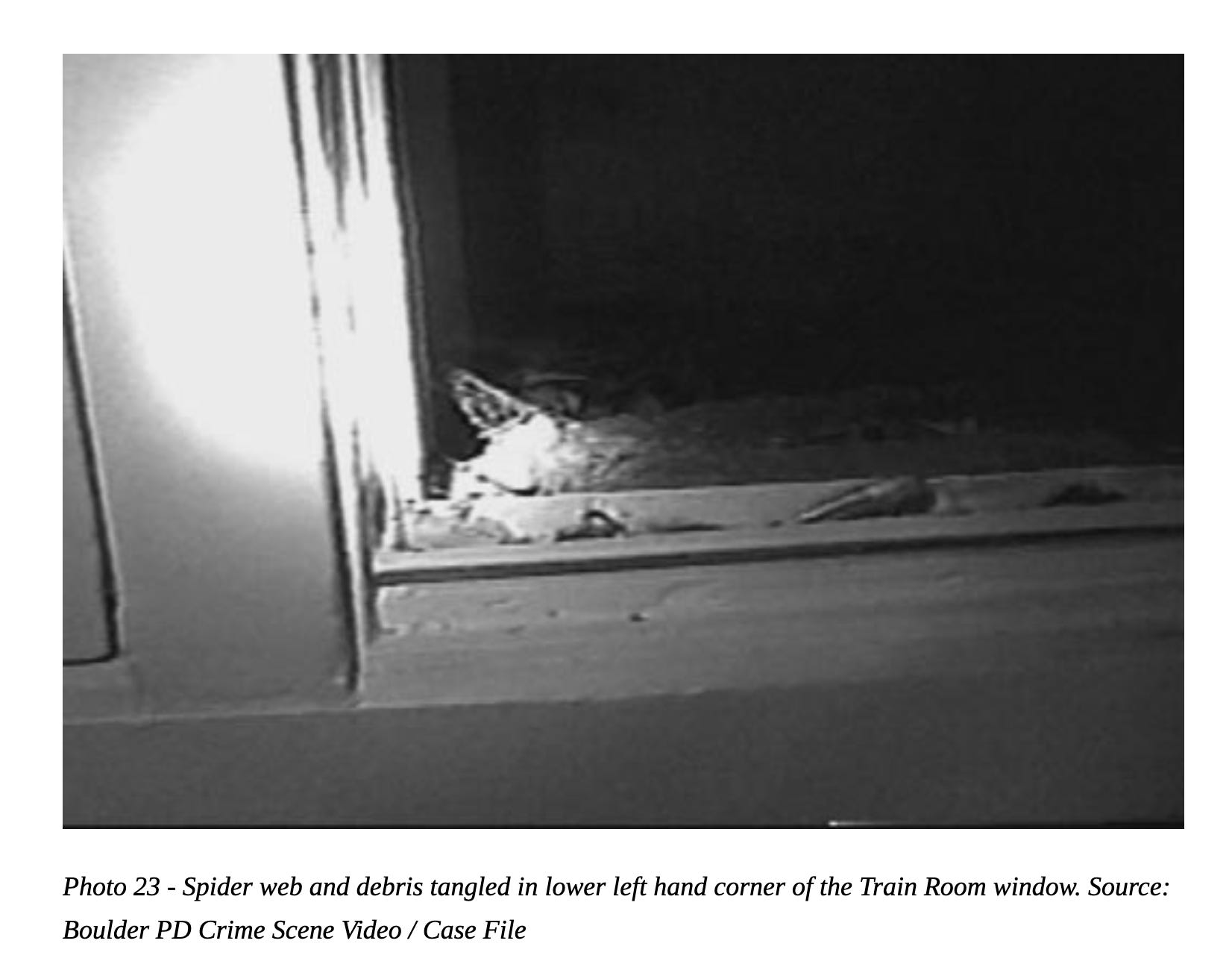
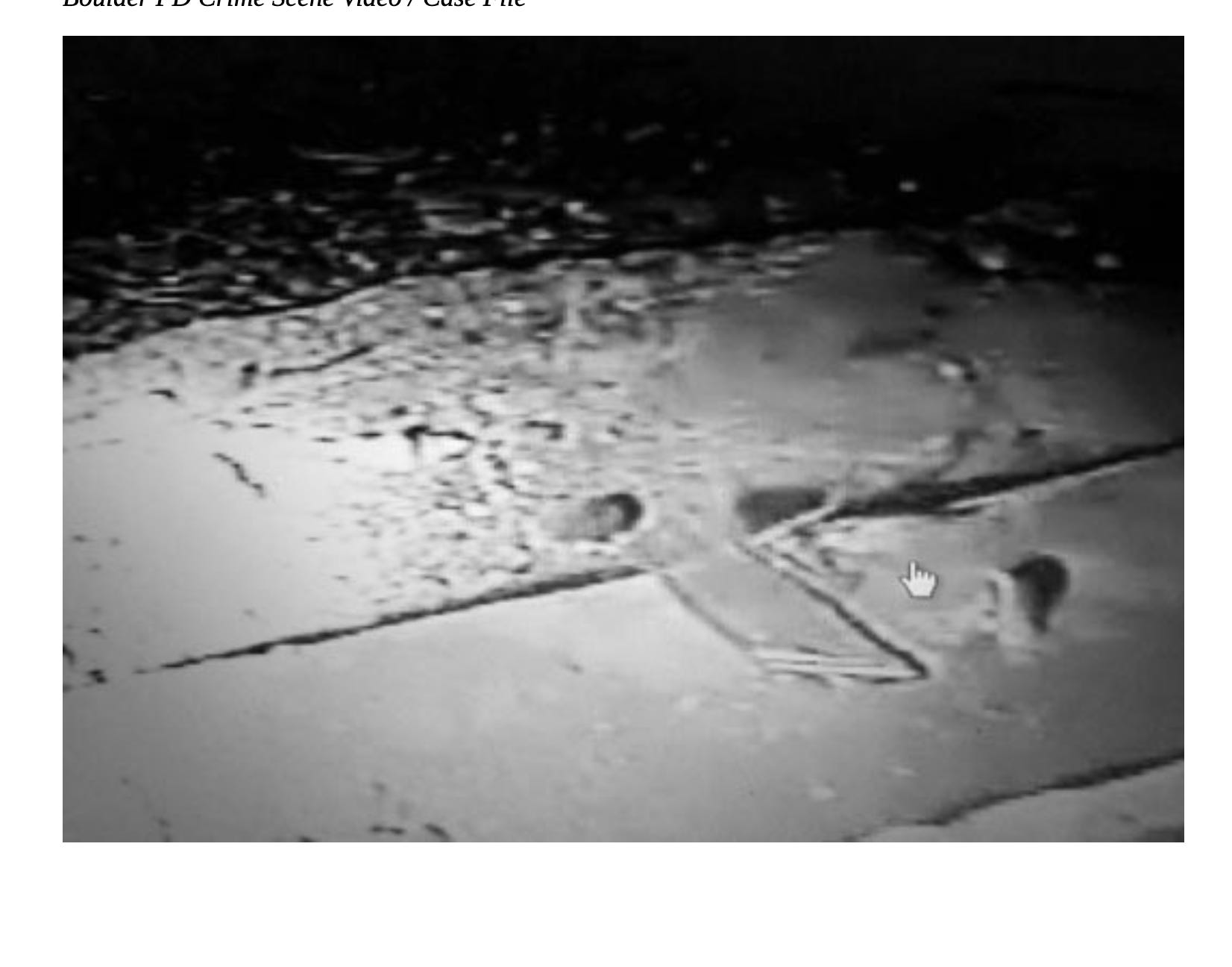
Kolar’s book is considered one of the best on the subject, though the Ramseys disagree. We’ll get to why, but he mostly does a great job of compiling all primary sources. You see the child abuse report, the photos of the spiderwebs in the grate, the failure to recreate stun gun marks on a pig. He also points out where the cops made mistakes. So, you remember how the Ramseys said the cops tried to pin it on them from the start by making it sound like there was snow everywhere and no footprints when there wasn’t snow?
Kolar’s book is the first time we find out that’s not true. The cops said exactly what the Ramsey’s said in their initial report: there was some snow on the grass and no snow on the rear patio:
Officer Reichenbach clearly stating where there was and was not snow in his report from Foreign Faction, pg. 45
The photo of the clear rear patio the documentary uses as a gotcha to prove police incompetence doesn’t do that at all. It matches exactly what the first officer on the scene wrote in his report. There was no attempt to make it seem like the lack of footprints was suspicious, he just wrote down what he saw. The Ramseys, however, saw a narrative that helped them prove bias and ran with that.
This is what the case of JonBenet has become, sadly. A millionaire family with power and PR behind them, a DA with ties to that family and a police force that did make mistakes, but who also were hindered nearly every step of the way.
Netflix’s Cold Case: Who Killed JonBenet Ramsey tries to hide or simplify details to present a clean cut, TV-ready conclusion: we need the police to do more DNA testing, we need to focus on the DNA! They hope, with advances in technology and additional DNA from scraping the additional evidence, some day, they’ll be able to link this DNA to a relative of the killer.
Meanwhile, experts have said this probably isn’t a DNA case from the start because the scene was so contaminated and the sample was so small. This remains true. The evidence has not gotten less contaminated over time.
The current DNA profile is actually too small to use genealogical testing, even though this is what the documentary presents as the solution. Again, it is an example of a documentary that is eager to present the truth as black-and-white. DNA must be the solution! How can DNA be wrong? Well, we will get to that.
First, I just wanted you to know, whether you’ve watched the Netflix doc already or not, it is far from the entire story.
I watched Cold Case: Who Killed JonBenet Ramsey as soon as it was out. I’d been waiting for it to drop because, well, this case is the case to me. Am I proud to be a true crime person? Maybe? No? I don’t know? I am aware of the ethical issues and all the bad things it does to society to have 800 podcasts that oscillate between horrific murder details and discounts for Squarespace.
Still, I will put on the latest episode of Evil Lives Here to fall asleep at night. Let’s blame my mom, like I do for most things. She’s the one who raised me on CourtTV! She’s the one who showed me you could read police reports and autopsies online! When I got my first laptop in 2003, I was 12 and ready to become Harriet the Goddamn Spy, okay?
JonBenet was 3 months older than me and like most girls born in 1990, I was obsessed with the photos of her that were all over the news and tabloids. How could something like that happen to a girl my age? At 6, I wasn’t into the details of the case, of course, I was just struck by this pretty girl who suddenly made me realize the world may not be such a nice place for little girls.
By 2003, there’d been a grand jury non-indictment, multiple books on the case released and still no trial or justice. I wanted to know everything. I dug into Angelfire websites, forums, Geocities websites, sketchy transcriptions of police tape interviews and radio interviews. I read Steve Thomas’ 2000 book, JonBenet: Inside the Ramsey Murder Investigation, from an illegal .pdf someone shared and that changed everything for me.
Steve Thomas is featured heavily in the Netflix documentary as a bumbling idiot. The Ramseys sued him after the release of the book and the doc features discrepancies he was caught in. Some of these discrepancies are fair and do point to a man guessing at motive and some details, but he also shares facts on the Ramseys removing items from the crime scene with the permission of the DA.
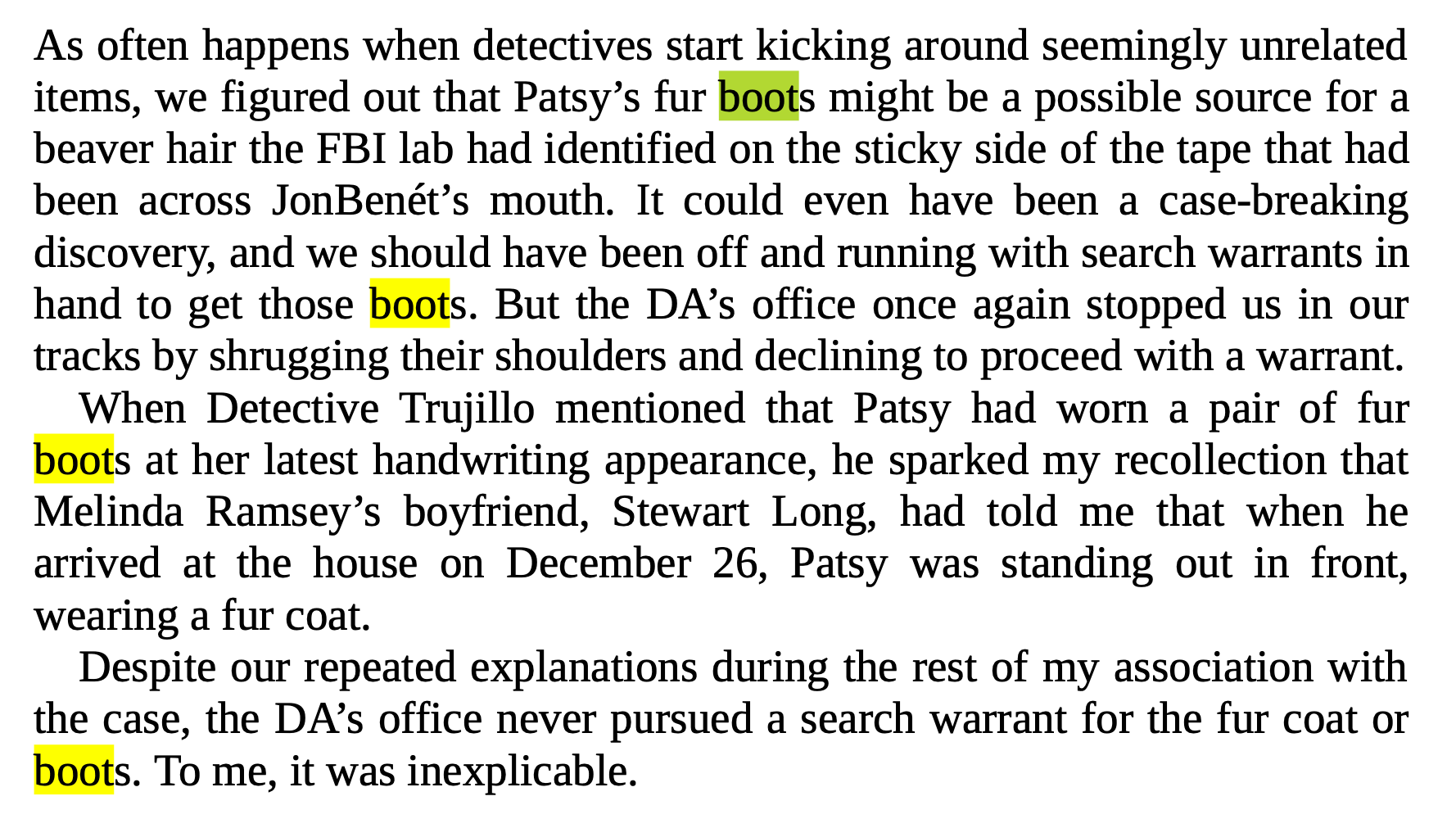
He mentions leads he wasn’t allowed to follow that would point to the Ramsey’s, like the fact that beaver hair was found on JBR’s (JonBenet Ramsey) panties and the duct tape. The police noticed Patsy wore black furry boots to an interview and asked to test them for beaver hair, but she never turned in the boots. In fact, Patsy and John don’t turn in their clothes from that night until over a year later according to Thomas. Why was this allowed? Why doesn’t the Netflix documentary mention this? Thomas does:
Inside the Ramseys Murder Investigation, Pg. 153
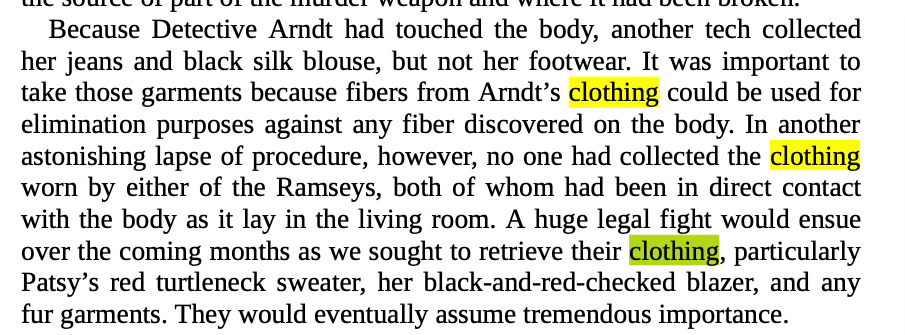
It’s a fair question for Thomas to have while he worked the case. Netflix doesn’t think this is worth mentioning, despite mentioning the many unidentified fibers on JBR’s body. If the parents wanted to clear themselves and help provide a better profile of the killer’s DNA or clothing, why not turn your stuff in immediately so it can be excluded? Instead, the Ramseys waited a year, when these clothes had been washed and mingled with other things to turn them in. It’s almost like the Ramseys don’t actually want a DNA or fiber sample that isn’t compromised.
Foreign Faction
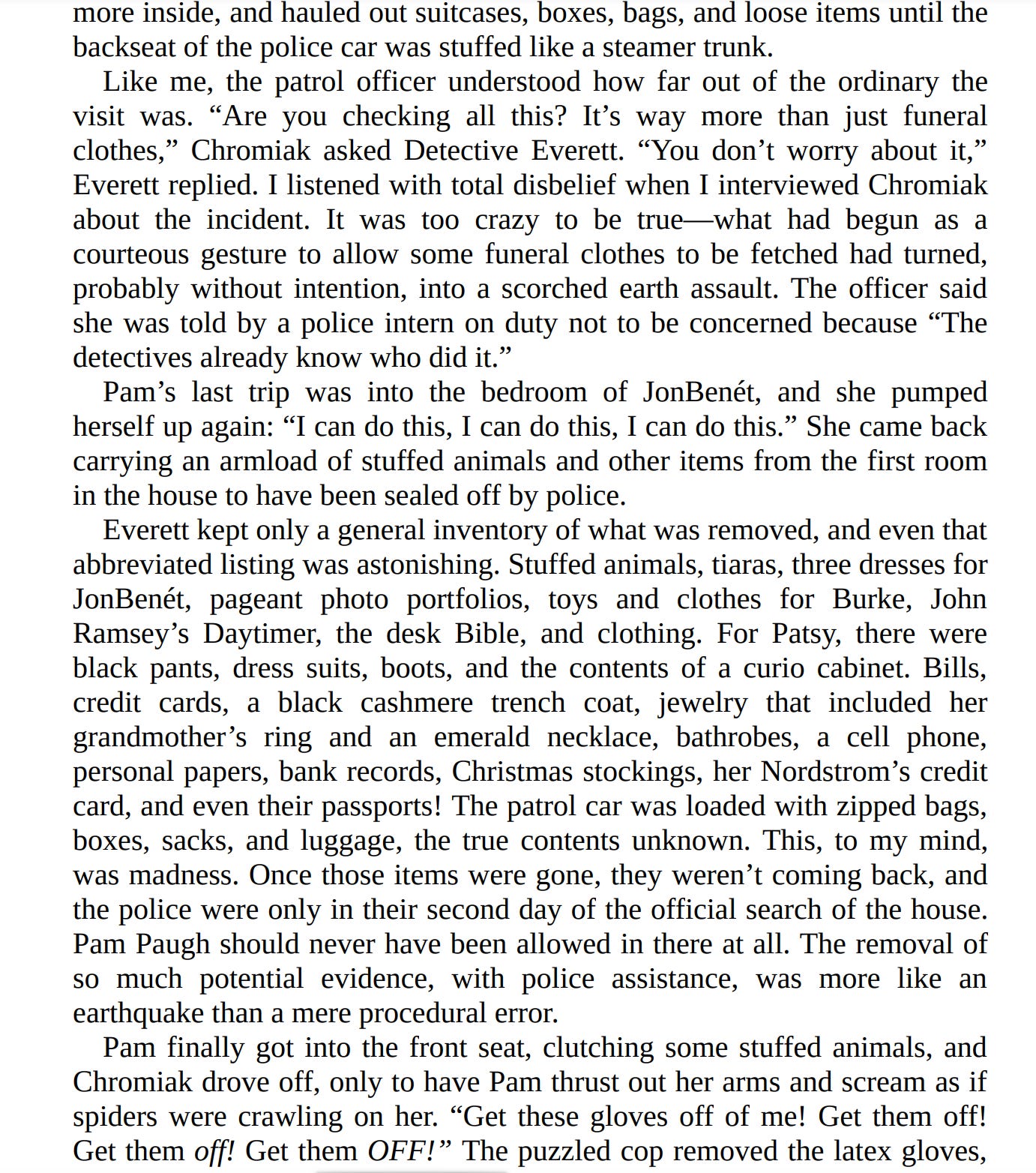
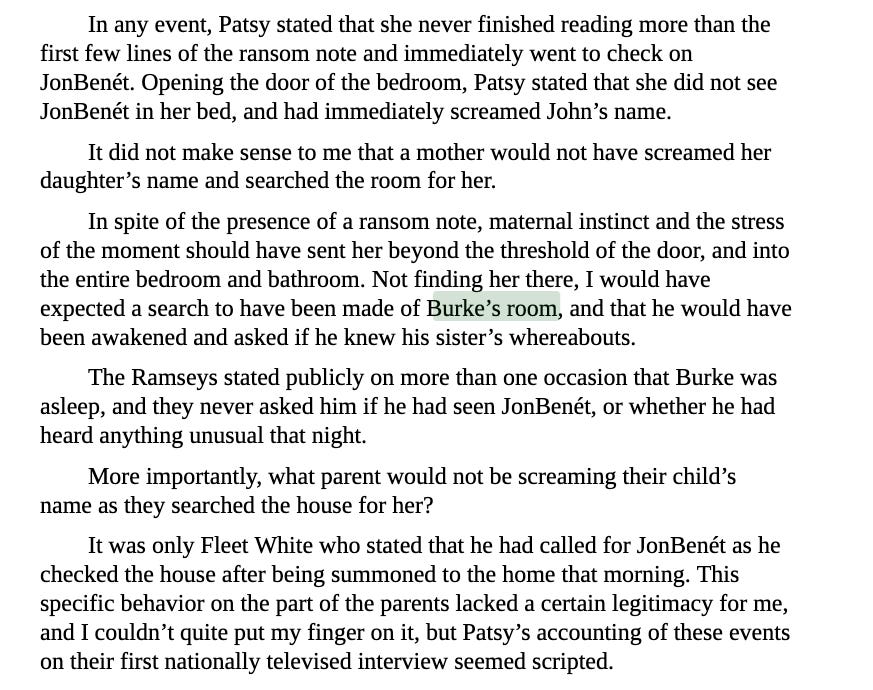
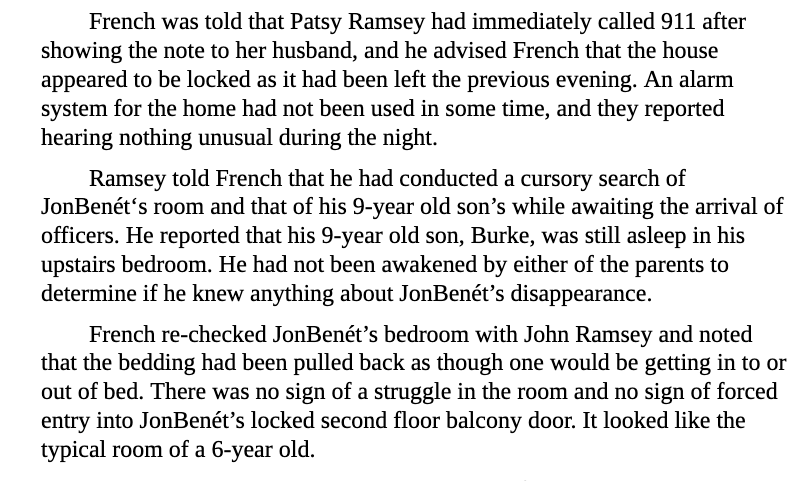
Take, for example, their actions after receiving the ransom note. Patsy says she didn’t read the entire note, but saw the beginning, went to check on JBR, she wasn’t there, she called for John and then went to call 911. John says he heard Patsy scream, met her on the backsteps, took the letter, laid it out on the floor and started to read it.
This is a bit odd, since Patsy mentions details from the end of the letter on the 911 call, but it is possible John read it aloud or was relaying this info. What’s odd though is that the letter says they’ve been watching the family, they’re related to John’s businesses and if the Ramseys tell anyone about this, they’ll kill JBR.
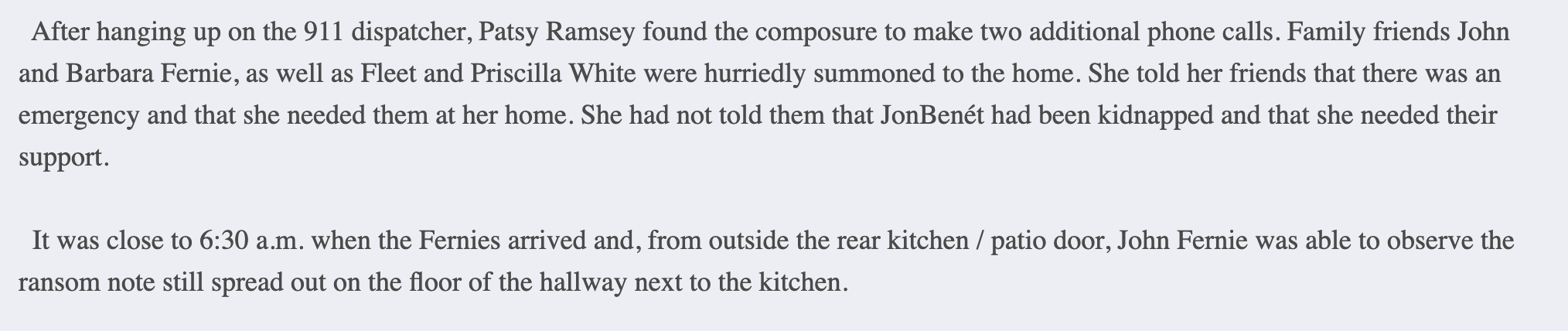
It makes sense to call the cops immediately, even though the letter says not to. What doesn’t make sense is Patsy calling her four best friends to come over because there was an emergency and she needed them. Barbara Fernie, John Fernie, Fleet White and Priscilla White head over to the Ramsey house without knowing JonBenet has been kidnapped, Patsy doesn’t say this on the phone according to Foreign Faction, pg. 45. At this point, it’s possible someone close to the Ramseys has done this or is involved and they invite friends who know personal details from the letter over?
Foreign Faction, pg. 45
If Patsy had told them a kidnapping with a ransom note occurred, these friends probably would’ve acted like they were arriving at a crime scene. Instead, they thought JonBenet might just be missing in the house and proceed to get their DNA everywhere. A year earlier, Fleet’s daughter, Daphne went missing and was eventually found hiding in their home, so this instinct makes sense.
Fleet thought JonBenet was doing the same and went to search the basement, calling out JonBenet’s name, despite there being a ransom letter. John Ramsey would later point to this as suspicious behavior when he added Fleet White to the suspect list. Well, how unfortunate you invited a possible suspect to roam the house and contaminate the scene before the cops even got to your house.
Not that Fleet was a viable suspect. Someone would’ve noticed if he left his own party the night JBR was murdered. In the time since, White has sued to get the grand jury documents released, as he believes this will clear things up for the public. He cooperated with police and got in a fight with John after the funeral because he felt the Ramseys should talk to the police immediately. It’s unlikely he’s involved if he’s doing everything he can to get information and evidence released. The Ramseys still have him on their suspect list, however.
And while the Ramseys take a year to turn their clothes in from that night, their friends, staff and others are happy to do so immediately. People at the White’s party turn in their clothes to clear themselves and find the person who did this. Because the scene was so contaminated, the officers who arrived also had to turn in their clothes from that night. Trace DNA from all of these people could be eliminated from the trace DNA on JBR fairly soon. The Ramsey family’s was not.
Inside the Ramsey Murder Investigation
When the documentary discusses the Ramsey’s odd behavior when cops arrived, they talk about John seeming distant or going through the mail, but this when the cops start to suspect the Ramseys. They don’t take their clothes that night and they try to interview them but agree to wait. The Netflix doc fails to mention that it’s their shifting stories in the ensuing weeks that raise suspicion. For example, John tells two officers he read to JBR then went to bed. When he finally does his police interview in April, 4 months after the murder, he says they misunderstood him and that he said he put her to bed and he went to read a book.
The two officers felt like he’d been clear and there was no misunderstanding. Patsy also changes her story. The day of the kidnapping, she says she put a red turtleneck sweater over JBR’s white top and white longjohns. It was winter and cold, so she put two layers on top of JBR. That morning, Det. Arendt (the female officer the documentary depicts as crazy) wrote in her report that she noticed a red garment in the laundry area next to JBR’s bedroom.
When JBR is found she’s wearing a white shirt and white longjohns. In April, Patsy changes her story and says she only put JBR in the white longjohns and she always had a white shirt on. In the interrogation, officers push this and she says she can’t recall when or why the red turtleneck was put in the laundry. Maybe, these are two frazzled parents who can’t remember details, but here’s another bit of info the documentary leaves out:
The Ramsey’s lawyers refused to let them be interviewed unless they could have access to police reports and the previous reports of what they said. Their lawyers were essentially given everything they needed to get their story straight. If JBR was wearing a red turtleneck, how did it end up off and in the laundry? Certainly an intruder didn’t do that. Officer Thomas sees this lie as a red flag. JBR’s longjohns were stained with urine, she had a history of wetting herself, maybe she’d wet the bed and stained the red turtleneck, angering her mom and forcing her to put it in the wash. In a 2015 AMA, Lead Det. Mark Beckner confirmed her long johns and the bed had urine stains.
This is why Officer Thomas is seen pushing the “Patsy lost it because JBR wet herself” theory so hard in the documentary. The doc tries to make it seem like a ludicrous idea with no backing that shows how dumb he is, but he’s led to this conclusion because of Patsy’s lies.
People often say this is a case of he said/she said between the Ramseys and the police, but what you’ll find is that, most often, the police take their lead from the Ramseys changing their story and saying conflicting things. Yes, it is bad the police tried to bait the Ramseys into talking by leaking fake information to the media, but remember, these are the parents of their victim and they can’t even find them after the funeral. They’ve failed to answer questions. They’ve failed to turn over crucial evidence. By this point, it’s been two months since JonBenet was murdered, is it so odd they start to take a focus on the parents by February after such behavior?
The doc leads you to believe the focus on the Ramseys was a quick, lazy decision made by bumbling cops that hindered investigations into an intruder. This isn’t true. The Ramseys became suspects after their own lies and behavior couldn’t be written off. Also, officers did investigate intruder theories immediately! Officer Thomas lists all the steps they took: they used cameras from a business in the area to track every car that turned onto the Ramsey’s street that day (a car is the only means of transportation that makes sense if you’re kidnapping a 6 year old).
They interviewed everyone who’d been at the White’s party the Ramseys attended the night before. They took every lead seriously! This is mentioned in both Foreign Faction and JonBenet: Inside the Ramsey Murder Investigation, but Netflix make sit seem as though this leads just sat until Lou Smit joined the case.
Shall we get into the Lou Smit of it all? He’s often considered the Best Detective and Smoking Gun in the JonBenet case. He didn’t solve it, but he dedicated his life to it and even passed his work on to his kids, as the Netflix doc tells us. Lou was brought in as the case stalled by the DA. From the beginning, he made it clear he didn’t think the Ramseys were capable of committing such a crime; this is why the DA liked him.
He went to work on beefing up the intruder theory. Smit would eventually leave the case when a grand jury was put together that focused on the parents. He was certain they’d be indicted because of the media treatment they received and the facts other officers shared. Some point to Smit’s work as the key to stopping the indictment since the defense was allowed to present the intruder theory to the grand jury.
Maybe, Smit did help. He presented two main theories that made sense of things the cops could never understand:
How the hell did someone get her from her room to the basement without making any noise or disturbing the scene? JonBenet’s room was pristine, it looked like someone just got out of bed, not like an attack occurred. Nothing from her room to the basement was out of place, meaning she wasn’t kicking or screaming on the way down. How was she subdued?
Smit suggests: a stun gun. You see, there are two sets of bruises equal distance apart on the right side of JonBenet’s neck and lower back. Smit believes they look like the pattern of a stun gun. If you’ve watched the doc on him, JonBenet Ramsey: What Really Happened (2021) you’ve seen the clips of him recreating stun gun marks on dead pigs to see if he can recreate similar bruises to JonBenet. He sort of does, they kind of look like the same distance, but they’re burn marks instead of bruises.
He was also only able to recreate it with one brand of stun gun, an Air Taser, and the maker of that stun gun said they’d never had a case where a stun gun renders someone completely unconscious and created bruises rather than burns. He also couldn’t get the dimensions to match JonBenet’s abrasions exactly. The train tracks police initially thought caused them though? A direct dimension match. This reddit thread has information (and sources!). The below images are from Kolar’s book (pg. 241 and 354, respectively):
The stun gun marks, it’s wider than the marks on the body
The train tracks they believe she was poked with. These train tracks were found next to the body.
Why does the doc spend so much time convincing you the stun gun could be possible when it was debunked years ago? Because it helps the Ramseys and is the only thing that could explain how JBR was removed from her bed by an intruder. If it’s the train tracks, an intruder wouldn’t make sense. Why would he decide to poke her with a child’s toy once in the basement?
The Window Well/Grate Theory
Perhaps, Smit’s biggest help to the Ramseys was finally giving them a potential entry point for the intruder. The morning of the kidnapping, police and the Ramseys found all the doors locked as they had been. When asked about the broken window in the basement, John said he broke it months prior when he was locked out. John said that he and Fleet found the window open and a suitcase under it just before they found JonBenet’s body in the wine cellar at 1:05pm.
John said this before he knew Fleet told police he was in the cellar at 6:40am, the window was closed and he moved the suitcase there to investigate the window. When asked about this discrepancy, John said he was in the cellar before 6:40am and had found the window open, but closed it because he “wasn’t thinking” (his daughter had just been kidnapped, there’s a ransom note and he doesn’t think the open window matters?). He then changes his story to say he reopened the window at 1pm with Fleet to see if there was any new glass.
Why does this matter? The window with the suitcase under it seemed like an obvious exit for the intruder before John was caught in his lie in April, during his interrogation. Once it was established no one could say for sure if the window was open or if the suitcase had been moved by Fleet or the intruder, the likelihood of the window as the entrance/exit became a little less likely.
That is, until Lou Smit joined the case. He said it was totally possible that someone had moved the grate above the basement window, jumped down into the window well, opened the window through the hole and gained entrance. He even makes a video showing that he could do it. This has become a huge piece of evidence people turn to! Look, he got in that way and he got out using the suitcase! See, this is a plausible entrance/exit!
There’s just one problem: the window well and grate were covered in spiderwebs. Like, so many that the officers initially thought, well no one could’ve gone through there without disturbing the spiderweb or getting dirt/dust everywhere. From crime scene video taken that day and published in Kolar’s book, we can see this spiderwebs were not disturbed at all:
Foreign Faction, pg. 231
Uncleared debris on the windowsill, Foreign Faction, pg. 231
Smit demonstrating how someone could’ve gone through the window while also highlighting they couldn’t have done it without disturbing those cobwebs
This is how Kolar describes viewing this evidence against Lou Smit’s famous window well video. It took until 2005 for a lead investigator on the case to debunk this theory with crime scene video and until 2012 for the public to know this theory was debunked.
And if you’re thinking, well maybe the intruder got out, destroyed the cobwebs and then the spider rebuilt his web by the time the video was taken? Well, Officer Thomas can speak to that in his book. They had a spider expert at University of Colorado Boulder come in and look at the spider/web. He confirmed these spiders go into hibernation in November and the web couldn’t have been rebuilt that morning.
Despite Lou Smit’s two biggest theories being debunked in the years after they were shared publicly, the Netflix documentary still acts as though these are legitimate theories that haven’t been tested. They still present Smit as an expert and an authority on the case, even though his intruder theory falls apart without the stun gun or the window.
Okay, at this point, maybe you think I’m trying to convince you that the Ramseys did this. I’m not! I mean, I definitely think they did and will lay my theory out at the end, but what I love about my theory is that I came up with it from my own research. I really just want you to know that in this modern media landscape, where it’s easy for streamers to sell narratives via documentary, that you have to be discerning. Dig into books, documentaries and interviews! I encourage everyone to do the same.
So, if the Netflix documentary just offers one part of the story, what else should people watch or read? Hit up the below!
I’m Just Curious
This DNA Explainer - Despite everything you will read in this, people still see all of this information and go “Well, the DNA.” There’s a lot of science behind why this DNA sample is most likely useless. If the Ramsey’s were staging the scene, they could easily plant unidentified DNA by rubbing different items from the house on the body (unidentified fibers were found on JBR - navy and tan cloth, beaver or rodent hair - the coroner thought it seemed like someone wiped areas of her body, Kolar and Thomas).
When the FBI and Boulder PD say this is a DNA case, it’s because they think the DNA won’t point to anyone. They think if this DNA eventually does match something, it will be innocent trace DNA that has nothing to do with the murder and, if it matched other fibers or trace DNA on items in the house at the time, would point to a cover-up. This would be the final nail in the coffin for the Ramseys. This is unlikely, as you’ll see below. The Ramseys removed a lot of items from the house the day after the murder.
However, people who believe an intruder did it think the evidence needs to be scraped again for additional DNA to create a better profile of the suspect. Interestingly enough, if the Ramseys had left those items in the house or turned in their clothes from that night sooner, it would’ve allowed the police to exclude fibers and touch DNA to create a better profile from the start!
As long as this DNA remains “unidentified” the Ramseys can always point to an intruder. If the cops figure out it came from items in the house or people with alibis, they know it’s unrelated to the crime, thus narrowing in on the Ramseys. So, in a way, this is a DNA case, but probably not in a way where AncestryDNA is going to find a match or something.
That the documentary and John Ramsey act as though a better DNA profile could point to John Mark Karr points to how ridiculous this notion is: Karr was in Georgia at the time of the murder and knew no new details. That they even present Karr as a viable suspect shows how little integrity this project has. Most likely, John knows this DNA will never match anyone and that’s why he pushes for a genealogical match as the key to the case.
Cold Case: Who Killed JonBenet Ramsey (Netflix) - What, I’m recommending the doc I just trashed? Well, how else will you know what the discrepancies are!! Also, while this doc is very Pro-Ramsey Family, it inadvertently throws their biggest defense out the window by ending on the fact that the DNA profile used to exclude intruders and the family is contaminated and probably invalid so no one previously excluded can be. That includes the family.
JonBenet Ramsey: What Really Happened (2021) - This is Lou Smit’s take, it is very biased. Still, if you want the parent’s side of things, this is the closest you’ll get.
The Case of: JonBenet Ramsey (2016) - This is the first documentary that presents The Brother Did It theory. It’s based on Kolar’s book which comes to a similar conclusion. The Netflix doc acts as though this doc is ridiculous and invalid because Burke sued CBS and settled, but it actually has legit interviews and science. Also, despite the lawsuit, the documentary is still publicly available.
A lot of the questions this doc brings up have never been addressed by the Ramseys. “Burke Did It” is considered the most “out there” theories by people who only sort of know the case, but it makes sense when you consider that’s the theory presented to the grand jury after the murder (along with the intruder theory) and dig into some of the stuff below.
I Want To Solve This Thing
r/JonBenetRamsey - Do I believe reddit is a legit source for information? No. Do I think incredibly dedicated true crime nerds have created a great subreddit that maintains primary sources, interview transcripts, and photos? Yes. If you have a question about anything in this case, you can probably find a detailed thread that looks into every possible answer. This subreddit explained that the DNA was too degraded to provide a legit suspect DNA profile 4 years before this Netflix doc! So, yknow, dive in, but do your research.
Lead Det. Mark Beckner’s Reddit AMA. It’s verified! He makes it clear Burke was involved, the parents staged a cover-up, this will never go to court or be solved without a confession and BPD and the FBI both believe there was no intruder.
Foreign Faction: Who Really Kidnapped JonBenet? by James Kolar - Kolar’s book is a must-read to me. He lays out the scenario that would be necessary for an intruder to make sense in the first chapter and you can understand how ludicrous it would be for a kidnapper to get so lucky. He then starts diving into the debunked myths he was sold by the DA and lies he catches the Ramseys in.
By the end, he suggests there was an incident involving Burke and JBR, he hit her and the parents covered it up. He points to Burke’s swiss army knife and boot print being found in room where JBR was found. Oh, yeah, that thing in the Netflix doc where they say the Hi-Tec boot print was from the cops? It also could’ve been Burke. Investigators knew when Patsy was interviewed that Burke had a pair of Hi-Tec boots with compasses on them and asked her about it. She claimed she couldn’t remember what shoes she bought him.
Foreign Faction, Pg. 221
JonBenet: Inside the Ramsey Murder Investigation by Steve Thomas - Netflix and the Ramseys don’t want you to read this book, so you probably should. He comes to the conclusion Patsy did it because there are signs she, like Burke, lied about being asleep that night. Her fingerprints are on the bowl of pineapple, she most likely put JBR’s red turtleneck in the wash and there were open suitcases upstairs because the family was going on a trip early the next day and she was still packing when the family came home from the White’s.
This is his theory. He thinks Patsy lost it in an act of rage when JBR wet the bed, I think his theory falls apart there. Also, the only evidence we see of Patsy in the basement is that her palm print is on the wine cellar door where JBR was found twice.
The Death of Innocence - This is the book the Ramseys wrote. It is…interesting. It’s mostly about John feeling like he lost this innocence.
The Bonita Papers - In 1998, Boulder PD brought in three lawyers to help assist the case because they felt the DA wouldn’t let them properly investigate. One of the paralegals who worked with these lawyers gathered all of her unedited notes for a book. The notes were leaked to the press by her nephew and uncovered some lies from the Ramseys and confirmed a lot of what Thomas wrote in his book.
The JonBenet Ramsey case is one of the most researched and investigated out there. It isn’t hard to dig in and find a theory that works for you and the evidence you find. This is why it’s easy for one documentary director to manipulate the narrative.
So, at this point…you probably want to know what I think happened. I’ve been tweeting about it in a lot of threads that are hard to follow, so I’ll break it down below based on my take on reading/watching the above. From the jump with this case, I believed the Ramseys did it. When the Lou Smit stuff came out in the early 2010s, it was the first time I really believed an intruder could be possible.
When Kolar’s book came out in 2012 debunking the Smit stuff, I went back to Ramseys Did It. When the 2016 CBS doc and Burke’s Dr. Phil interview came out, I joined Team Burke Did It. With the most recent Netflix documentary, I once again became convinced of the intruder theory, until I revisited Kolar’s book and the other info left out of the doc.
Oh, let me introduce you to some online nerd case terms: -RDI (Ramseys Did It) -BDI (Burke Did It) -JDI (John Did It) -PDI (Patsy Did It) -BDIA (Burke Did It All Except the Cover-Up) -IDI (Intruder Did It)
You will see people in online forums use IDI, PDI, RDI as badges to denote their favorite theory. You’ll see people who go from IDI, RDI to BDI or BDI to IDI to RDI. Whichever your choice, each one comes with a certain set of facts that those theorists believe. Are you IDI? You probably believe in the stun gun. RDI? Your focus might be the fake ransom letter. (Yeah, the BPD and FBI both think the ransom letter is fake, despite the Ramsey civil suit.)
Where am I on this now? Well, I am back to my 2016, Burke Did It All belief. Even more now that the Ramseys are pushing a new documentary that seeks to bolster the intruder argument again while leaving out facts and promoting debunked evidence. After watching the doc, I reread Foreign Faction and re-watched Burke’s Dr. Phil interview. I’d forgotten about the boot match and Burke’s reveal in 2016 that he hadn’t been asleep all night like his parents said. In fact, he was up after everyone went to bed according to him. Let me lay out how I got here.
The Ramseys Lies
They lie about a lot. Whether they put JBR straight to bed or read to her, whether Patsy noticed JBR was missing and then saw the note or saw the note and then went to her room. Whatever, these are things that could be explained by frazzled parents. It’s just odd that their biggest lies all revolve around Burke, his whereabouts, and his belongings:
The Pineapple Lie - The Ramseys say JBR and Patsy went to bed immediately. John played with Burke for a bit, then put him to bed. He read for a bit and then he got in bed with Patsy, took a melatonin and went to sleep. According to them, everyone in the house slept soundly and heard nothing until Patsy woke up to make coffee, found the ransom note and screamed. The scream alerted John, but according to the Ramseys, Burke slept through this, the 911 call and police arriving.
Here’s the thing: JBR ate pineapple at 11pm/midnight, 2 hours before she died. They estimate she died at 1am or 2am. How do we know this? They found undigested pineapple in her stomach. They know it is not from earlier in the day or from the dinner at the Whites because the food from earlier was further along in her digestive tract. Also, officers find a bowl of pineapple on the dining room table. It is a bowl of pineapple in milk next to an empty cup with a tea bag in it.
The Ramsey’s maid said this was Burke’s favorite snack. And, in fact, only Patsy and Burke’s fingerprints are on the bowl of pineapple (see below) and the cup. But, we know JBR ate some from this bowl because they collected it into evidence and tested it against the pineapple in her stomach: it was the same pineapple. Patsy tried to say she had no idea where it came from and someone must’ve left it out in the morning, but how can that be possible if JBR ate some?
Foreign Faction
Burke and John say they have no clue either. Well, someone fed that girl pineapple 2 hours before she died and it’s very unlikely an intruder did that. It’s unlikely she could’ve prepared a bowl of pineapple with milk alone at 6 without making noise and waking someone. It’s also unlikely she was eating at midnight with her brother at midnight and an intruder could’ve committed the crime in a 2-hour timeframe without anyone hearing anything.
Below is Burke acting weird about the pineapple in 2016 on Dr. Phil. It’s interesting he says he can’t remember if they ate pineapple and how could anyone remember something that happened so long ago, but when asked about the 911 call, he says he couldn’t forget something like that.
With the pineapple evidence, it is clear she was awake at midnight, allowing 1-2 hours for an intruder to do everything. The Ramseys need to say they all went to sleep as soon as they got home because that opens the window of opportunity up from midnight to 10pm-2am and allows time for an intruder. If it’s as simple as “oh yeah, the kids wanted a snack when we got home,” why not say that? Of course, there’s another reason Patsy and John may not have known about the pineapple: Burke made it himself and JBR went downstairs when she heard him getting a snack and playing with his toys.
The maid said the kids would often go play or get food after bedtime because the house was so large their parents couldn’t hear them. Burke said in his interview he could hear the fridge open from his room. We also know JBR and Burke would share the same room sometimes. If JBR would wet the bed, she’d change herself and go sleep in Burke’s extra bed. Each child had 2 twin beds in their room (see below). Burke would sleep in JBR’s room sometimes because his would get cold, he says this in his first interview.
The Ramseys say the kids never did that. But, Burke even says JBR slept in his room on Christmas Eve because he wakes up before her and she wanted to him to wake her up for gifts. Basically, there’s a lot of evidence pointing to the two siblings being together without their parent’s knowledge, which would explain the pineapple.
Two twin beds in JBR’s room, Foreign Faction
The Ramseys say this isn’t possible and Burke was asleep all night. In 2016, Burke goes on Dr. Phil and admits he was up after everyone went to bed for the first time, giving the pineapple theory more credence. Also, you’ll notice the bedroom light is on in the above bedroom picture. The bedroom is the only scene at the crime that we know was actually secured. It’s fair to assume, this is how it was when the incident occurred. If the intruders had a flashlight, why would they enter the room, walk around the bed and turn on JBR’s bedside light?
In addition to that, it would’ve taken someone with inside knowledge to know that was the only working light in her room, according to the Ramsey’s maid. How would a kidnapper know about the light switch and, again, why would they need a light if they have a flashlight? It seems more like JBR woke up in the night, turned her light on, got out of bed and possibly went to go see who was in the kitchen.
The pineapple lie confuses a lot of people and they dismiss it as a red herring, but it is probably the most important piece of information. The medical examiner is able to determine that JBR died shortly after eating the pineapple. Whoever gave her the pineapple knows how she hit her head:
Foreign Faction
Here is how Patsy explains the pineapple. It’s all we have since Burke doesn’t remember and won’t answer questions. She thinks the kidnapper fed JBR pineapple right before hitting her. Why would the intruder need to hit JBR then if they’d already subdued her enough to get her downstairs to the table to eat? Why stop to feed her pineapple? You supposedly have a stun gun and duct tape, why not use them and go? Oh, also, if she was stun gunned and dragged from her bed like Lou Smit says, did the intruder wake her up to feed her pineapple in that case?
Foreign Faction
One more thing about the pineapple? One of the few witnesses in this case is Scott Gibbons, he’s the neighbor to the immediate north of the Ramseys. According to Kolar he tells detectives, “He had been in his south-facing kitchen around midnight on Christmas night. He observed that the upper lights in the Ramsey kitchen were on, but dimmed low. Gibbons didn’t observe anyone inside the residence at the time, and noted that it was not unusual for lights to be on in the home at night.” (Foreign Faction, pg. 101)
That means the light was on in the kitchen around the time she ate the pineapple. If it was the intruder, why would they turn a light on? They have a flashlight. Why risk being seen? Clearly, there are witnesses close by.
The Enhanced 911 Call Lie- Patsy and John swear that Burke was nowhere in the vicinity the entire morning they realized JBR was missing. They do not wake him up for information, they just check on him, see he’s sleeping and leave him alone. They say he didn’t wake up until Fleet White went to get him and take him to the White’s house. Well, that is a lie.
Kimberly Archuleta was the 911 operator who took Patsy’s call. Almost immediately, she felt like something was off about the caller. At the end of the call, when the caller thought they’d hung up, Archuleta heard a change in tone and someone said “What do we do?” This was suspicious to her. She immediately went to her supervisor and noted this. After JBR’s body was found, she went back to her supervisor and said the 911 call should be enhanced because she swore there was more said at the end.
The FBI and Det. Trujillo thought she was right. They sent the tape to the Secret Service and Aerospace. The Secret Service wasn’t able to pick up on anything, but Aerospace, which had better recording equipment, could. The first two experts wrote down what they thought they heard independently. The third, a detective on the case, also wrote what she heard independently. All three of them wrote the same thing:
The enhanced 911 call is considered such legit evidence, we learn when the grand jury papers are unsealed in 2013, that it was presented to the grand jury. In fact, they asked Burke about the voices on the tape. He said to the grand jury, as confirmed by the 2016 CBS documentary, “It sounds like my voice on the tape,” but he still said he couldn’t remember if he was awake or not. Burke will later lie in his Dr. Phil interview and say he hasn’t heard the 911 call, but he has heard about it. However, we know the enhanced version was played for him at the grand jury and he said it sounded like him.
John and Patsy swore Burke was nowhere in the vicinity and slept the entire morning. The enhanced 911 call proves he was in the vicinity. If he did wake up and was curious about what was going on and awake because of Patsy’s scream, why hide that? On Dr. Phil, Burke and John say again that Burke was in bed asleep during the 911 call, despite the tape.
After Dr. Phil and the CBS lawsuit, Burke’s lawyer put out a statement saying that Burke never said he was asleep all morning, his parents did and he may have heard the commotion downstairs and screamed from the stairs “What did you find?” This contradicts what Burke says himself on Dr. Phil. It also doesn’t necessarily make sense of John angrily saying “We’re not speaking to you!” In his actual interview after the event, Burke does say he was awake in bed that morning. See below:
Here is the dispatcher talking about it and Burke answering questions about it on Dr. Phil in a way that seems…not so honest. Again, when during the lawsuit, CBS is able to confirm Burke said it sounds like him to the Grand Jury:
Below is the excerpt from the grand jury from Dateline covering the CBS lawsuit:
A quote from Burke’s grand jury interview used by CBS to prove even he inferred it sounded like he’s on the 911 call in court.
The red shirt and bedwetting lies - John said in their CNN interview that they weren’t aware of JBR wetting the bed. Their maid said John was there many times when JBR wet the bed and it’s odd he lied about this. He also must’ve known about Burke’s bedwetting and feces issues. Burke confirms that John and his mom knew that JBR wet the bed and he describes their routine around it in his videotaped interview.
This interview was eventually shared with the public on Dr. Phil in 2016. The Ramseys lying around JBR wetting the bed is, again, what most likely raised Dt. Thomas’ suspicions around that theory. Netflix makes this sound ridiculous, but they ignore that the Ramseys did lie about it. I clipped Burke’s part of the footage from Dr. Phil below. It’s also interesting Burke says he and JBR wet the bed a lot and his parents would clean it up and he remembers this in 2016, but John couldn’t recall if JBR wet the bed in the 1997 CNN interview.
I also believe Patsy did put the red turtleneck Det. Arendt saw in the wash on JBR that night, as mentioned above. She later lied about just putting her to bed in the white shirt. Again, just minor things there’s no real reason to cover up:
Foreign Faction, Pg. 133
This could also be another clue that JBR woke up in the night and took off the red turtleneck herself, another sign she was awake after her parents say she was asleep. Or did someone else take it off of her?
The Flashlight Lie - Police found a black flashlight in the kitchen. The Ramseys said they didn’t recognize it, but may have owned one. The maid and family friend John Fernie said she absolutely recognized it as the flashlight Burke would sleep with. He’d use it in case he had to go to the bathroom at night. And AGAIN, in 2016, Burke says his dad put him to sleep with a flashlight! Dr. Phil asks if he took the flashlight downstairs and he says he can’t remember. That’s a huge change in John and Burke’s stories!
A flashlight sounds like something a kid sneaking downstairs to get a snack and play with his toys would bring with him. Why lie about recognizing the flashlight? Well the flashlight was the only item able to recreate the damage JBR suffered to her head. It was most likely the weapon used to hit her and BPD has held onto it as the murder weapon.
Foreign Faction, Pg. 67
Here is Burke on Dr. Phil in 2016 admitting for the first time that his father put him to sleep with a flashlight and he was up after everyone else went to bed. In this moment, Burke breaks his 20 year alibi and connects both him and his father to the murder weapon the Ramseys previously said they weren’t sure they owned. John doesn’t recognize the flashlight he used that same night with Burke?
The 11am Timeline Lie - When John’s children from his first marriage came to the house after JBR was kidnapped, officers said it was a little before 1pm. This matters because John found JBR at 1:05pm. John’s son-in-law and daughter said that John got in their van as soon as they got there. He climbed in and said “JBR is with Beth now (his daughter who died 5 years before). I found her at 11am this morning.” Well…that means he found JBR before he “officially” did for police. It means he told his other children that JBR was dead before he “found” her at 1:05pm.
John will eventually say got the timezones mixed up, but his son-in-law points out that he was referring to his own timezone, so why talk about a different time zone? Later, the Ramseys will say the kids arrived at 2pm or 7pm, despite John saying in his police interrogation that the entire family left the house at 1:30pm and never returned again.
It’s a little hard to believe his kids arrived at 2pm or 7pm if the Ramseys weren’t there. Also hard to believe they arrived in the 1:05-1:30 window when John would’ve been finding JBR. It is most likely that the cops are telling the truth and the other kids arrived before 1pm, the body was then found and the family left the house for good at 1:30pm as John said in the interrogation. Officer Thomas documents this moment:
JonBenet: Inside the Ramsey Ramsey murder Investigation, Pg. 146
Some believe John did this because he knew the staging was shoddy and didn’t believe that he and Patsy would get away with it. With this move, John gave himself an alibi and potential witnesses who could say he wasn’t involved with the crime until 11am if this did blow up in their faces.
The American Girl Doll Theory - Ok, this isn’t REALLY the American Girl Doll theory, I just call it that because it’s fun. BUT, people who think an intruder did it point to the fact that there was no matching source for the duct tape in the house and the Ramseys hadn’t left all morning, so how could they dispose of the tape? It must’ve come from outside the house. WELL, in his book, Det. Steve Thomas outlines a very easy way the Ramseys could’ve snuck evidence out of the house: they were allowed to.
The day after JBR was found, the Ramseys asked if they could retrieve clothes for the funeral/JBR’s burial. The lead detective said sure, but you have to send someone else, we’ll take them to each room, they’ll point at what they need, we’ll document it and allow it to leave the property.
At least, that’s how it was supposed to go. According to Det. Thomas, when Pam, Patsy’s sister, shows up to gather items, she has an entire list from the Ramseys. It includes credit cards, jewelry, passports, JBR’s American Girl Dolls and stuffed animals, clothes, and other items. Det. Thomas says she filled a car with suitcases, the officers on scene didn’t properly itemize everything taken and if the Ramseys did want to sneak stuff out, this is how they’d do it. How Thomas describes it:
NOW, really crazy conspiracy ppl believe the source of the tape was the American Girl Doll. You see, in 1996, American Girl Doll stores trained employees to put tape on the back of the doll to cover a cord that came from the back of the doll’s neck. They also encouraged people who bought the dolls to do this. Det. Thomas looks into this theory and says it’s farfetched. It’s more likely they just hid the tape in a suitcase and had Pam take it out of the home.
But it is weird that Pam takes a Molly doll that JBR only owned for about a month. Sure, maybe Patsy did want things that reminded her of JBR, but why a doll that’s only a month old and was a gift from her grandma? Well, tan and navy fibers were also found on JBR’s longjohns and the tape. These people think the tan and navy fibers would match the tan body of the Molly doll and her navy clothes. Did the police want to check the Molly doll for a fiber match? Yes. Could they? No. The Ramseys wouldn’t give it to them.
In addition to that, the Molly doll drives suspicion because a few months after the murder, an employee at the American Girl Doll company reached out to Boulder PD to say someone ordered a Molly doll in JonBenet’s name after she was killed. The doll was bought with a money order and was sent to John’s office. John denies knowing anything about the doll, but it’s odd he didn’t go to police and say a stranger mailed him a doll in his dead daughter’s name that she owned before she died.
Couldn’t that be a potential clue? Is it unrelated? Most people think they ordered a new Molly doll and destroyed the one that would match the fibers. People who don’t want to believe in the power of an American Girl Doll to solve this case, however, just think Pam snuck the tape and other evidence out when she grabbed their things.
The Ransom Note - Pretty much everyone thinks Patsy wrote the letter, but I mostly care about the opinion of James Fitzgerald. He was a linguistics expert who caught the Unabomber based on language in letters! He is very good at his job! He says it was Patsy. But, that is just his opinion.
He wasn’t asked to officially review the case, even though he offered to do it for free with a panel of other experts in 2009. Chief Beckner said in his 2015 AMA that he declined the offer because Fitzgerald had trained a previous forensics expert on the case and he felt that was a conflict of interest the defense could benefit from, so there was no point in using Fitzgerald’s panel.
Foreign Faction, pg. 338
I know Netflix showed you something that said “6 experts said it wasn’t Patsy,” but you see those were 6 experts hired by the Ramseys to help them in the civil suit they filed against Dt. Steve Thomas. These were not the findings of the handwriting experts the grand jury heard. The standards of a civil suit are very different from a criminal suit so their findings can hardly be accepted as the final word.
Oh, also the FBI said in the history of kidnappings, there has never been a 2.5 page ransom letter and they felt it was written as a cover-up. Even if you think Boulder PD were bumbling idiots who dropped the ball, the FBI was a different team of people and the below statement is what they thought about the note.
Also, let’s think about this. If you’re a kidnapper who wants an amount with specific instructions, do you hope there’s paper and a pen in the house so you can write that demand out when you get there? What do you do if you can’t find a pad of paper? If that’s your motive, you’re just crossing your fingers that you get there and find a way to communicate your demands?
Also, if you’re in the middle of kidnapping her and she dies, why leave the ransom letterthat’s the only evidence pointing to you anyway? Without the ransom letter, the kidnapper could take all evidence pointing to him and easily pin this on the parents.
The FBI thought it was odd a kidnapper would leave something so incriminating with the body in the house, which would immediately negate any chance of getting the ransom money and provide a clues on a suspect. If you accept the ransom note is fake, that’s incredibly damning for the Ramseys.
Inside the Ramseys Murder Investigation, Pg. 131
The Morning Timeline Lie/Was Burke Awake? - For 20 years, John and Patsy told the same story about that morning: Patsy woke up to make coffee, she went down the stairs and found the ransom note. She didn’t read all of it, she just immediately ran to JBR’s room. When she saw she wasn’t there, she yelled for John. John ran out of the bathroom to the back stairs and found Patsy. He took the letter and told her to call 911. He says at this point he or Patsy went in to check in on Burke, but they left him sleeping. Both Patsy and John say they never looked for JBR because of the ransom note
For 20 years, the police thought that was weird as hell. Whose daughter goes missing and they don’t call her name out or search for her? Why wouldn’t they wake Burke up and ask if he knew anything? Kolar documents this:
Here, is John saying he was the one who checked Burke’s room and Burke was still asleep.
Foreign Faction, Pg. 44
In 2016, thanks again to Burke’s Dr. Phil interview, we find out that Kolar was right to feel suspect about this because the Ramseys did lie. According to Burke, his mom came bursting into his room, searching for JBR, not his dad. She was screaming, “Where is my baby?!” and woke him up. About an hour later, a police officer enters his room and he says that he stays in bed. This means the Ramseys did search for her, they knew Burke was awake and there was at least an hour between Burke waking up because of his mom and the 911 call and police showing up.
You know I have the clip!
The thing is, Kolar and the police knew to be suspect about this during the case because Burke told the police in 1996 that his mom came rushing into his room looking for JBR. They knew she and John were lying about Burke’s whereabouts and when they woke him up from day one. That’s why the police suspected the Ramseys. Burke’s police interview is below. Dr. Phil also points out it’s weird that Burke would hear his parents searching for his sister and wouldn’t get up to see what was happening:
If the Ramseys did search Burke’s room, they probably searched the rest of the house looking for JBR too. We now know about an hour went by from Patsy waking Burke up to the cops showing up, rather than her original “I found the letter, John checked Burke and I called the cops shortly after, Burke never woke up” timeline.
Did they tell police Burke was asleep and they didn’t search the house because he could mess up their timeline and prove they’d been searching for her for at least an hour before cops arrived?
Burke and JBR’s Behavioral Histories
Most people hate the Burke Did It theory because they can’t imagine a 9yo boy being violent or doing these things. However, Burke had a history of violence with JBR. By the end of this, you’ll see that he was a 9 year old boy who previously sent JBR to the hospital, had issues with bedwetting and feces, and may have been a victim himself.
When Burke was 6, he hit her in the face with a golf club and sent her to the ER. This is in her medical records. At the time, Patsy told friends he lost his temper. In their book, the Ramseys say he was practicing his golf swing and lost control. JBR was taken to the doctor 33 times in the last 3 years of her life. There were frequent doctor calls including three 8 days before the murder. It’s more than likely that Burke hit JBR more than once. As far as we know, he’s the only person in the family to ever send JBR to the ER:
Foreign Faction, Pg. 83
Foreign Faction, Pg. 341
People point to JBR wetting the bed and getting clingier with her mom in the days leading up to her death as evidence she was being sexually abused or suffering trauma. What they tend to ignore is that Burke was also wetting the bed at an older age and people around the Ramseys heard odd comments from the family about his body.
JonBenet Ramsey: Missing Innocence, Vanity Fair, 10/1/1997, Ann Louise Bardach
Of course, this could be how the family jokes around. In addition to that, however, his previous nanny said he was wetting the bed until he was at least 7. Cops asked him about it and he got defensive. If JBR regressing and her bed wetting getting worse is a sign of abuse, the same could be said for Burke. Was he wetting the bed because someone in the family was also sexually abusing him? If that’s the case, could he have picked up learned behaviors that he took out on JBR?
Wilcox says that JBR’s bedwetting was getting worse, but what we also know is that Burke’s issues with feces were also escalating. When Patsy was first diagnosed with cancer, housekeeper Geraldine Vodicka found him smearing poop on the walls. This would’ve been around the time of the golf club incident.
Nedra, JBR and Burke’s grandmother cleaned up the incident Vodicka mentioned so she also witnessed this. Another maid, Linda Hoffman-Pugh, previously found feces in JBR’s bed sheets and thought it may have been Burke’s. This matters because feces were found in JBR’s room when the crime scene was processed:
Foreign Faction
Foreign Faction
The Ramseys say that Burke lived in the house and they can’t say when he may have left the pajamas there and question if he even did. Boulder PD didn’t have a chance to question him about it. However, the fact that it was still present at the crime scene points to it being recent: The Ramseys had maids, does it really seem likely they left poop-stained pajamas and candy in JBR’s room for days? A maid was there on the 23rd according to witnesses (this is the day Fleet White makes an “accidental” 911 call at the Ramsey’s home, they had guests over).
We know JBR slept in Burke’s room on the 24th because he says this in his interview. Did Burke do this on the 25th? If so, why? Did the maid leave poop-covered pajamas and a candy box in JBR’s room for days? Did this cause a fight between Burke and JBR that night? It’s unlikely the feces is connected to the intruder, but if Burke did do this on the 25th, again, it points to him being awake that night.
Maybe it was an innocent prank, but did he hear anything while intruders came to kidnap his sister while he happened to be leaving feces in her room? These are questions he could answer, but he doesn’t seem interested.
Back when Burke did his Dr. Phil interview in 2016 and admitted he was up after everyone went to sleep, Boulder PD asked to interview him again. They even sent two people out to his house. They wanted to ask if he heard anything since this was a new revelation after 20 years. That makes sense! They have a possible new witness! Even John Ramsey was shocked at this revelation.
John says he had no idea Burke got back up, “if he even did.” He thinks Burke might’ve misunderstood Dr. Phil’s question, but it’s clear that Dr. Phil asks twice. Dr. Phil says, “Your father says he put you to sleep with the flashlight and you went downstairs.”
Burke says “Yeah, I had some toy that I wanted to put together. I remember being downstairs after everyone was in bed…wanting to get this thing out.” Dr. Phil replies “Did you use the flashlight so you wouldn’t be seen?” Burke says, “I don’t remember. I just remember being downstairs with this toy.” I’ll share this YouTube clip of an interview John did this year for Crime Junkies where he expresses shock that Burke left his room after everyone was asleep. Apparently, John and Burke never talked about this:
John says Burke wouldn’t keep any information to himself, but Burke refused to answer any questions after this revelation and sent a message via his lawyer to never contact him again. If he is interested in finding his sister’s killer, that isn’t something anyone has ever seen, at least outside of the family. Even after the murder, he seemed uninterested in where JBR was or who may have taken her. Fleet White noticed he didn’t ask any questions when he drove Burke from the Ramsey’s home to his the morning JBR was kidnapped. Kolar notes this:
Foreign Faction, pg. 343
Burke’s interrogation as described by Dt. Thomas in Inside the Ramsey Murder Investigation, Pg. 116
Apparently, no new questions have come up for Burke since 1996. Even though he’s connected to the pineapple, the feces-smeared pajama bottoms and admitted he was up, he has nothing to say. He was willing to talk to Dr. Phil, but not the police. That’s odd.
The Evidence of JBR’s Previous Sexual Assault
Ok, this is a very complicated topic and I will beg you here to read this 2 part reddit thread that quotes from the child abuse panel’s findings on JBR directly. But, look, I know, the Netflix documentary showed you a clip of JBR’s pediatrician from ages 3-6 and he said he saw no signs of sexual abuse during his exams of her. The documentary presents this as final evidence: there was no previous sexual assault before her murder, see her pediatrician said so.
As I’ve said so many times: this isn’t the case! In order to see signs of child sexual abuse, thorough exams are needed that look at the hymen and internal vaginal walls for damage. JBR’s pediatrician never performed a test like that and said so to the grand jury. That wouldn’t have been typical for him to do when JBR wasn’t brought in for those reasons and he had no reason to suspect that. Of course he saw no evidence for sexual abuse, he wasn’t looking for it.
The coroner who did the autopsy did see signs of previous sexual abuse, but couldn’t say when it occurred. The Boulder PD decided to put together a panel of child sexual abuse experts to examine the body and look into the case. This panel included John McCann, who created the standard now used to define child sexual assault in hospitals and police cases. Basically, these are authorities on the topic. The strongest evidence of the previous sexual abuse is that it was allowed into the grand jury evidence:
The other four people on the panel were Richard Krugman, James Monteleone, Valerie Rao and Andrew Sirotnak. Every sexual abuse expert who examined the genital findings from JBR’s autopsy recognized physical signs of sexual abuse that predated her murder. The only thing they couldn’t agree on was when and how often it occurred. McCann said the abrasions were 7-10 days healed, Rao said it could be 2 months, some didn’t feel comfortable trying to date it but could say it was damage that predated her death.
You may have heard that this damage and JBR’s bedwetting were caused by UTIs and irritation that’s common in kids. This is what the Ramseys put out through their lawyers. However, the abrasions seen on the hymenal transection by the panel could only be done through sexual assault or a massive injury. There was no massive injury in JBR’s medical history that pointed to something like this. It couldn’t have been caused by horseback riding or a bike, as these were abrasions that had healed, opened and re-healed, pointing to chronic sexual abuse.
If there was some intruder or pedophile stalker who managed to get access to JBR and assault her 7-10 days before her death, that would be a huge lead. This is evidence that, like the pineapple in her stomach, cannot be denied. But the Ramseys dismiss the evidence from this panel outright. Additionally, if there’s evidence that JBR was being chronically abused, who is to say Burke wasn’t also being abused, causing him to wet the bed again or take out the same abuse on his sister? And even if you don’t believe it’s Burke, couldn’t this be possible evidence that John was abusing his daughter and it’s still someone in the family?
Many believe Burke perpetrated the previous abuse on JBR and not John because a maid previously saw them “playing doctor.” When she asked what was going on, Burke got mad at her. Also, John was gone a lot. Additionally, the previous summer at the family’s Michigan house, Patsy told staff that Burke and JBR couldn’t be alone together. A family friend said Patsy said it was because they were “exploring” with each other too much.
Of course, these are secondary accounts, but coupled with the fact that Burke and JBR would share bedrooms occasionally and they both showed signs of regressing due to sexual abuse, there is a chance that their doctor “play” wasn’t so innocent. Was Patsy having issues with Burke? We can’t say for sure, but police do know that her mother, who cleaned up after Burke spread feces on the wall, gifted her 3 books on raising problem children in the year before JBR died.
One was Why Johnny Can’t Tell Right From Wrong (see above screenshot on feces). Of course, she might just like parenting books and they were just gifts.
The above facts usually get people around to Ramseys Did It. It was this thread that got me fully convinced of Burke Did It. Basically: everything done by JBR could’ve been done by a child and an adult would’ve caused more damage. The Netflix doc ignores all of this. The hit to the head wasn’t enough to kill JBR, it caused internal bleeding and knocked her out, but she wasn’t dead. The choking started 45 minutes to 2 hours after she was hit in the head and also wasn’t enough to kill her by itself. While the skin on the outside of her neck was red, there was no internal damage to the windpipe.
If an adult hit her head, it would’ve killed her. If an adult strangled her, there would’ve been internal damage to the windpipe. She was either choked by an adult who didn’t want to hurt her or a child who wasn’t strong enough to. Also, why would an intruder hit her in the head and wait 45 minutes to 2 hours to choke her? If you’re there to kidnap her, why not just leave now that she’s unconscious and you have her? Also, If you think she’s dead from the hit, why leave the ransom note that would point to you?
And while the garrote used was described as “complex” by the Ramseys, a knot expert and the FBI said it was a simple loop knot a boy scout could make and the tool was rudimentary. Burke was a cub scout. In Officer Thomas’ book, he says these are the facts that even made the FBI ask if a child could be involved.
Let’s get into the reason so many people believe the garrote was complex, despite the opinion of experts. That would be thanks to the Ramseys. You see, soon after their daughter was killed, the Ramseys decided to start a foundation in her name. By March, the foundation was created with tax documents filed.
The Ramseys still wouldn’t talk to police until April, but they took time to do this. Part of the foundation was a website, ramseyfamily.com (since taken down). On this site, the Ramseys shared a tip phone number that led to their lawyers and not the police.
Foreign Fugitive
They also shared intimate details about the case before police said it was okay. You see, the Ramseys point to the media circus causing them to become suspects. The truth is that it was the Ramsey’s circus. When the police started leaking information to the media, it was only after the Ramseys started a website with information from the case and started buying ads in the newspaper that also leaked information about the case!
The police couldn’t understand why the Ramseys wouldn’t talk to them to answer questions or get updates, but they wanted to put things online. The World Wide Web! In 1997! The Ramseys published crime scene photos, direct messages from family members, photos of JBR, drawings she did, and updates.
They even published a photo of the garrote, where they ask people to notice the “complexity”:
That’s odd considering police experts felt it was a simple knot with a bunch of loops that any adult or Cub Scout could’ve done. The police wondered why the Ramseys were purposefully putting out misleading information. That wouldn’t help find the killer. If it was a close friend or someone in the pedophile circuit, what if they had used simple knots and weren’t an expert? Sharing this information with the public would also mean any wanna-be fake confessor could share details of the case and confuse the suspect list.
Foreign Fugitive
The Ramseys are also the ones who leak the ransom note to the press. They buy an ad and publish it in the paper, despite the police begging them not to. The Ramseys even admit on their website that the police have told them not to share details from it, but they share samples of the writing with the public. Now, if an intruder tried to mimic Patsy’s handwriting or just tried to conceal their handwriting, how would releasing this to the public be helpful? This was the most intimate, direct piece of evidence from a supposed intruder and they published it in the paper and on their website:
Wayback Machine screenshot of the Ramsey ad published August 1997
The Ramseys making sure any pedophile with internet access can learn to copy the note if they’d like to take claim for an infamous case
Well, the police didn’t like this. Neither did their friends. Even Barbara Fernie, one of the people Patsy called over immediately, noticed the Ramseys were misleading the public by presenting false information. She let investigators know that one of the ads the family published was intentionally misrepresenting things. Fleet White also begged the family to stop posting and going on TV and to talk to the police.
Steve Thomas
This was the power of the Ramsey PR machine! To this day, people think the knots were complicated. They think there was evidence of a break-in on the backdoor! They think an intruder could’ve found duct tape, a paintbrush and cord in the basement of a house this crowded, big and dark (someone leaks the crime scene video at some point)! Oh, are you shocked you just saw a full video of the inside of their house? Yeah. That's pretty weird for 1996.
Maybe the cops leaked it to show the public how hard it would be for anyone to find anything in such a dark, big, crowded basement. Maybe the Ramseys leaked it so there’d be more doubt about who exactly knew the layout of their basement. Who knows?
This is also why John Mark Karr persists as a suspect. Because he knew “private” information. Well, the Ramseys maintained a website for years where relatives left personal messages. Did she ever sign one with that nickname? Hard to say, most of the site has been scrubbed from the internet. If Karr was obsessed with the case, he easily could’ve seen that there. The family put personal photos and crime scene photos on the site, anyone interested could’ve checked obsessively.
Despite the family making all this information public, Boulder PD investigators who previously worked on the case like Kolar knew that Karr was a fraud as soon as his emails came out because he still couldn’t get the details right. Boulder PD did manage to keep a few details from the public and Karr didn’t know them says Kolar in his 2014 AMA. The police know Karr is a fraud from these details, but Netflix dedicates nearly an entire episode to him. Why? It helps the Ramseys and supports their intruder theory.
Boulder Police dropped the ball on this case on day one by failing to secure the crime scene. However, the Ramseys are the people who failed to secure crucial information about the investigation and case after day one. The Ramseys benefit from muddying the evidence, the suspect list and anything else. If the police were able to rule people out, something might point to the Ramseys.
If the Ramseys could make details widely known, there’s just more people to point away from them. Their PR team goes to work at this and, now, the myth that the garrote was “complex” persists. Today, the Ramseys can use Netflix instead of a geocities site. I would be willing to believe they created their site in good faith, to collect evidence or tips, but it’s odd that they dismantled the site a few years after her murder. No one was arrested. They stopped communicating with Boulder PD after they moved back to Georgia. Was the site just a temporary PR effort?
The Ramseys continue to use the media to push the narratives they want. Let’s take, for example, something as simple as the order of JBR’s injuries. The Netflix documentary says it’s “unclear if the head injury or choking” happened first. It makes it nebulous, like no one could tell! Well, the medical examiner could. he listed this as the order of death:
Foreign Faction
Det. Kolar also points to evidence that this is likely the order. As he says below, if the garrote caused her death or brought her close to death and then she was hit in the head, her head wouldn’t have bled for 45-90 minutes:
Kolar 2014 Reddit AMA
There’s a lot of evidence that makes the timeline clear, so why don’t the Ramseys want you to know the above timeline? Because it makes them look guilty as hell. In fact, the grand jury thought this pointed to the Ramseys. Why would an intruder sit around for 45 minutes to an hour waiting to choke her and not just leave with her?
A few members of the grand jury have spoken out. They said this timeline was one of the most convincing pieces of evidence that the parents did it. They felt the DNA didn’t matter. Naturally, the Ramseys use Netflix to confuse the timeline and make the DNA sound incredibly important.
I found the Ramsey site when I was 12. I remember thinking it was so weird I could see crime scene photos and evidence. Isn’t it strange how much publicly available information there is in this case, but the Ramseys still create their own narrative?
Once you accept that these injuries could be caused by a child, the Ramsey’s PR works harder than Kris Jenner, Burke may have been a victim of sexual abuse himself and Burke may have been doing this to his sister, the case makes a lot more sense than a magic intruder floating in through a window without touching spiderwebs or the world’s quietest stun gun.
It also explains why the Ramseys would cover for Burke. If they said he did it, he might tell the police their dad had been inappropriate with both of them. If John or Patsy did it, they have little reason to cover for each other. If either parent did it, why would the other keep Burke around them? Either parent could’ve turned on the other and the innocent parent would look like a hero.
However, if it was Burke that did it, that would damage Patsy and John’s reputation as parents. Could John work for the government if he was famous for raising a son who killed his beauty pageant daughter? Would Patsy still be loved in the community? Patsy also said she’d die if anything happened to Burke. When asked if she’d protect John if he did it, she said no, she’d kill him herself.
John also said he wouldn’t protect Patsy if she did it. When asked if she’d protect Burke if he did it, Patsy screamed “You can’t ask that!” However, Burke being involved is the only reason to do a cover-up or lie about his whereabouts or keep him from answering questions about direct evidence connected to him. John and Patsy wouldn’t have covered for each other.
What do I think happened that night?
The family came home at 9:30/10pm. John did put JBR to sleep and her mom did go in and change her into a red sweater over her white shirt and longjohns. Burke, however, didn’t want to go to bed yet. John said in his interview that Burke wanted to build a car garage toy he got, but he made him go to bed. John goes to bed where Patsy is already asleep after changing JBR.
Thinking everyone is asleep around midnight, Burke gets his flashlight and decides to sneak back downstairs to get his favorite snack, pineapple and milk, and to play with his new toys. I tend to think Burke made the pineapple alone because Patsy would’ve known to clean it up with everything else if she’d known about it.
He gets to the kitchen, makes the bowl and a cup of tea. He finishes the tea, but only eats some of the pineapple. He grabs his flashlight and goes down to the basement. The basement is known as Burke’s toy room. He has an entire train room down there, he often whittles in the wine cellar and is basically left to roam down there a lot according to their maid:
At some point, JBR wakes up in the night. Maybe she heard Burke in the kitchen (her room is above it and even Burke said he could hear the fridge open from his bed). Maybe she hears him playing with toys. Maybe she wet herself and is doing her usual routine of changing and going to his room, but notices he isn’t there. Either way, she’s a six year old and she wants to play too so she goes to find him. Downstairs, she sees the leftover bowl of pineapple and grabs a piece. She heads down to the basement to play with her brother.
Burke has been in the wine cellar, we know this because he later says he opened the gifts that were being kept there (see below), even though Patsy lies and says she did this. She most likely wants to distance Burke from the scene. When JBR comes down, perhaps he sees a chance to “play doctor,” since he believes his parents are asleep. I think this is actually when the paintbrush comes into play. Or, maybe, they just get into a fight over the gifts.
Photo of the opened gifts and their location in the wine cellar where JBR is found.
The previous abrasions caused to JBR were thought to be caused by digital penetration. Perhaps, Burke saw his mom’s paintbrush in the basement and escalated things. According to the autopsy, the paintbrush was inserted once and removed. The FBI thought this was odd if it was a pedophile: they’d probably do something similar to sexual stimulation, not jam it in and remove it once. Their conclusion was that it was staged to hide previous sexual abuse. As you see from Dr. Meyer’s report below, this is another grey area the Ramseys took advantage of. It sounds horrific, too horrific for a 9yo to do it, but the actual physical evidence was not consistent with torture:
Foreign Fugitive
But, imagine a young boy who has been abusing his little sister. Or you just hit her and she’s knocked out and you want to try something extreme to wake her up. He happens to see a paintbrush around, escalates the situation, she screams in pain, jumps up and says she’s going to tell mom. Burke grabs her by the collar to stop her (see below, does this sound like the action of an intruder?).
We know someone grabbed the front of her shirt because it had a wrinkle pattern that looked like someone grabbed it. She scratches at her neck and his hands to get him to let go, which is how DNA ends up under her fingernail. When he lets go, she turns around to run. He grabs his flashlight and hits her on the head. She falls unconscious.
Foreign Fugitive
Burke is now a scared little boy who is trying to wake his sister up. He grabs the train tracks that are later found next to her body and starts poking her in the back and in the neck to get her to wake up. She doesn’t. He realizes he might be in big trouble now. He can’t let his parents see what he did. He breaks the paintbrush. He wraps a cord around the broken brush with a knot and decides to strangle her with it. Maybe he thinks that won’t look as bad as what he actually did with it. Or, maybe he simply left the paintbrush there and when Patsy and John find her, they create the garrote to hide what Burke did with the paint brush.
Whoever strangles her isn’t strong enough to break her windpipe or they were careful not to use too much pressure. However, it is enough to kill her with the head wound. After the murder, Burke will casually talk to a friend about possible ways JBR was strangled and how JBR may have been hit in the head. Officers will note he seems comfortable talking about violence. Others believe the garrote is part of the parent’s staging.
Now, Burke or his parents have to hide his crime. Maybe he’s angry and also breaks the Train Room window (some believe it was broken that morning and John’s story about breaking it months prior was a lie.) Maybe he’s so angry about what he’s done, he regresses to smearing poop in JBR’s room. He tries to hide what he’s done and grabs a blanket off of JBR’s bed. He doesn’t realize her Barbie pajamas are wrapped up in it. He goes back to the basement, throws the blanket over it and goes to bed. Some think the parents carefully wrapped her in the blanket with her favorite pajamas, however.
At some point, Patsy wakes up, well before 5:30am. They had to be at the airport at 7am and she hadn’t finished packing yet. We know this because there were open suitcases with clothes in them in the room next to JonBenet’s. Or, maybe she never went to sleep.
When Patsy greets officers after the 911 call, she’s wearing the same clothes she wore to the party at the White’s the night before and she has a full face of make-up. She says she threw on the same clothes from the night before. The Crime Junkies episode and Netflix treat this as normal for her. However, it wasn’t according to her maid. Her friends say she’d never be caught dead wearing the same clothes two days in a row. The family was also headed to the airport for a trip that morning, why travel in party clothes and not something more comfortable if you don’t care? Investigators see it as a sign that she didn’t actually go to bed.
Foreign Faction, Pg. 127. Also, just a side note, but in the Netflix doc, John says he woke up just before the alarm and before Patsy. Patsy says they woke up with no alarm.
Did Patsy stay up because she heard a fight start between JBR and Burke that escalated into him hitting her? Did Burke sneak into JBR’s room with his flashlight to leave the feces, wake her up and start a fight that ended with him hitting her in the head and Patsy rushing into the room to turn on the only light that worked?
Personally, I do believe her when she said she went to JBR’s room first that morning and noticed she wasn’t there. If John or Patsy had known about the pineapple or feces, they probably would’ve cleaned those parts up, so these activities probably happened without their knowledge.
If she saw JBR wasn’t in bed, she most likely went to search for her. She goes downstairs, she checks the dining room, eventually she goes to check Burke’s playroom downstairs. Maybe she notices he left his new toys out, but she doesn’t see JonBenet. Maybe she notices the door to the wine cellar is partially open. We do know her palm prints are found on the wine cellar door in two locations. She finds JonBenet and screams, waking John up.
John and Patsy go into panic mode. They know Burke has been violent with JBR before, they probably suspect he did it immediately. They can’t lose two children or have Burke admit to any abuse in the home, so they decide to cover it up and make it look like a kidnapping. Patsy or John decide to write a ransom note. He dictates it to Patsy, she writes it. He’s very specific about two things in the letter: they cannot call the police or tell anyone and John must bring a large enough bag to carry the $118k broken down in small bills. He pulls out a large, blue Samsonite suitcase. Later, JBR’s DNA will be found inside this suitcase according to Det. Lou Smit.
This, perhaps, is a clever attempt by John to find a way to remove JBR’s body, I believe. He intended to put JBR in the suitcase and leave the house to dispose of it. The letter would give him cover for leaving the house before calling 911 (“I went to get the cash, they told us not to call,” he could say). However, this didn’t work. Rigor mortis had already set in, they couldn’t get JBR into the suitcase.
Det. Lou Smit offered that theory on Larry King when he leaked info that JBR’s DNA was found on a duvet in the suitcase and he thinks the intruder tried to leave with the body in the suitcase, but couldn’t get it through the window. I don’t think this is realistic. Most likely, she had previously used the duvet and Fleet put the suitcase there. However, if Smit knows there’s DNA beyond the duvet, that really only points back to the parents.
Transcript of Lou Smit on Larry King, May 28th, 2001
Why would an intruder just hope a perfectly-sized suitcase is there to help smuggle her out that window? Smit believes they changed course and killed her because the suitcase wouldn’t fit (there were scuff marks on the wall). If you’re a kidnapper with only one small, awkward window well to leave through, wouldn’t you prepare?
It doesn’t matter, the parents have to pivot now anyway and leave her in the basement while still making this look like a kidnapping. Patsy gets duct tape and puts it over her mouth. The FBI, Boulder PD and coroner believe the tape was placed on JonBenet after she was dead. Why put tape over a dead or unconscious girl’s mouth?
Inside the Ramsey Murder Investigation, Pg. 224
Foreign Fugitive, Kolar also believes the duct tape was applied after the injuries.
The tape also had Patsy’s from the jacket she wore that night at the White’s (see below) . That means the tape definitely came from the house. John said he carried JBR into the house. Patsy went in to change her, but most likely removed the tape from JBR’s mouth in the basement. It wouldn’t make sense for Patsy’s jacket fibers from that night to be on it if this were brought in by an intruder.
Remember back when I said the Ramsey’s might’ve snuck tape out through Pam? Did the intruder just hope they’d also be able to find duct tape in the house? They didn’t bring it with them for a kidnapping? And why would you need duct tape if you she’s knocked out, bleeding from her mouth and mucous is running down her face? Does it make sense for an intruder to take time at this crucial moment to go search the house for duct tape when the girl is incapable of talking or moving from the head injury?
Foreign Fugitive
This is the family staging the scene. John ties loose restraints around her wrists. They tuck the blanket in around her. Some believe this is when John may have used the paintbrush to hide his previous sexual assault or he made the garrote to hide Burke’s assault if you can’t believe that Burke made this tool.
It’s time for the Ramseys to call 911 and put on a show, Patsy is yelling into the phone. At some point, this wakes Burke up or he was already up. He asks them “Please what should I do” (this is according to the CBS enhancement of the 911 call, the Aerospace enhancement doesn’t have this). Thinking she hung up the 911 call, his father yells “We’re not talking to you!” His mother says “Help me, Jesus. Help me, Jesus.” Burke asks, “Well what did you find?” and the call clicks off.
Within minutes, the police will be here, but the Ramseys aren’t dumb. They already wiped JBR’s body with a navy blue cloth to mix up DNA. Unsourced fibers are eventually found on her vaginal area. The coroner says it looks like someone tried to “wipe clean” the body with a cloth, but a matching cloth is never found in the Ramsey home. Perhaps Pam removes it when she’s given access to the scene. Maybe an intruder used something with them, but if you’re concerned about leaving evidence on her…why not just take her body like you intended?
Foreign Fugitive confirming she may have been “wiped clean with some kind of cloth”
Some have mentioned that it was the 90s and people weren’t thinking about DNA. Well, I’m sorry, but I’m old and that’s not true! On top of that, guess what case happened the year prior? OJ Simpsons! That was a huge case where the main attraction was DNA. OJ was found innocent because of DNA. There’s no way the Ramseys weren’t aware of the case.
In fact, in their first interview a week after their daughter dies on CNN, Patsy mentions OJ. They were aware of him when their daughter died:
Patsy and John, New Years Day CNN Interview
So, yeah, the Ramseys know it matters that only the Ramseys have been in the home and they really want to make sure there’s other DNA around the body. They call their closest friends and tell them to rush over immediately, there’s an emergency and they need them. Hopefully, this will muddy the crime scene. Fleet White comes and immediately heads to the basement, but doesn’t see JBR in the wine cellar because it’s dark and he can’t find the light. He notices the train room window is closed, but it is broken. He moves the suitcase that happens to be there over to look into the windowsill for glass. At some point after this, John goes back down and opens the window.
As the police start to arrive and his friends begin searching the house, John grows frustrated that 2 police officers have failed to find JBR in the wine cellar. When Det. Arendt suggests that he and Fleet go search the house top to bottom to find anything off, he realizes now is his chance. Fleet and John first go to the train room. Fleet asks about the broken window and John says he did it months prior. According to John, they look around for any new broken glass.
Then, as Fleet is still in the train room, John heads to the wine cellar door. With Fleet standing 20ft away, John opens the door and says, “Oh my God, Oh my God.” Fleet follows behind him and sees John turn the light on. For a moment, Fleet considers that he had just walked in that room and couldn’t see anything without a light but John screamed before the light was even on, but he doesn’t make much of that for now. John will eventually say he could see the white blanket. Yet Fleet and a police officer who peered in the room could not.
Rather than risk someone finding the body where the crime occurred, John sees another chance to muddy DNA evidence. He picks up JBR, despite it being clear she is dead, rigor mortis has set in, and rushes her upstairs to “get her help.” Det. Arndt tells John to put lay her at the top of the stairs. He asks if she’s dead and moans when the officer confirms she is. Det. Arndt moves JBR’s body to the living room, but before she can tell anyone not to touch her, John places a blanket over her and a sweatshirt.
He lays on her and cries, he lays next to her and puts his arm around her. Det. Arndt tells him not to touch her hands. Next, Patsy comes in and does the same, laying all over JBR. Their friends stand around JBR and pray. If there was any hope of getting DNA from a single suspect who interacted with the body, that hope is gone now. The Ramseys have successfully created an “unidentified” third profile. I think if this DNA ever does match to anything, it will prove to be touch DNA unrelated to the killer.
Anyway, there’s too much information out there for this to still feel like a mystery. The only mystery is why the Ramsey Family has worked so hard to create a different narrative through their PR, but even that isn’t a mystery.
Well yes, and I imagine the police have already done this. You’ll remember when you started reading this an hour ago, that I told you feces were found on a candy box in JBR’s room and in a pair of pajama bottoms that were too big for her? Well, there’s your answer. Examinations can tell you how old or fresh stool is. The contents of the stool could match the meal served at the Whites and police would know someone in the family was in her room after everyone went to sleep, smearing poop on her candy.
Odds are, the poop was fresh. It’s one piece of evidence the Ramseys have never addressed or tried to spin. It’s also a detail the cops rarely mention. With all that publicly available info, isn’t it odd that this detail is the one that hasn’t been mentioned a million times? If Burke did this in her room that night, did it start a fight? Did he see an intruder while playing this prank in her room? If the poop is old, it’s irrelevant. It’s just…that that’s highly unlikely.
The Ramsey’s maid confirmed she was at the house on the 23rd and there was a huge party. She probably would’ve noticed large, stained grey pajama pants in JBR’s room. She was supposed to go back on the 24th, but didn’t. However, Christmas Eve, JBR sleeps in Burke’s room according to his testimony to police. She wanted Burke to wake her up early for Christmas presents. Seems unlikely he could’ve done this that night without the parents or JBR noticing it Christmas Day. I tend to think John and Patsy didn’t know about the feces incident or they would’ve cleaned it up.
JBR’s nanny, Linda Hoffman-Pugh confirming she was in the home on 12/23 with a lot of people. Most likely, someone would’ve noticed Burke smearing feces in JBR’s room if it was that day
Another way we know the pajama bottoms were probably left Christmas night? Patsy says in her interview with police that she checked JBR’s bed Christmas morning. If the accident happened then, Patsy surely would’ve noticed soiled pajama bottoms. Plus, she even says that JBR had on pink pajamas, not grey, large pajama bottoms.
The pajama bottoms were very visible in JBR’s bathroom (each bedroom had its own bathroom), so a maid, JBR or a parent would’ve seen them. Patsy definitely would’ve seen them that Christmas morning. They weren’t hidden or tucked behind anything. If Patsy and John came right home from the White’s and took JBR to bed, did they not notice them right next to the toilet?
Investigators aren’t able to ask Patsy about these pants until 1998, a year and a half after the murder. She said they were JBR’s, not Burke’s despite appearing to be his size and “boys flannel pajama bottoms.” She said it was from JBR not wiping properly. She couldn’t recall when JBR wore them last. Kolar says it’s hard to know if she’s lying about who they belonged to or not in his verified AMA 4 years ago.
Kolar, Generation Why podcast interview, 35:55 mark
So, let’s say Patsy was lying about who the pajama pants belong to. Doesn’t that mean it’s possible Burke left the feces the night of the murder? He said he got up after everyone went to bed, did he do it then and that’s why his parents didn’t know? If the police have confirmed when this happened, it throws everything the family has ever said out the window. There’s a completely different timeline. That puts Burke in JBR’s bathroom and bedroom. And, if you have a hard time with my theory that Burke was involved with the paintbrush at all, some people think it went this way:
The family came home. Patsy and John tell the kids to go straight to bed, but Burke wants to stay up. After his dad reads him to sleep with the flashlight like he says in Dr. Phil, he goes downstairs. Maybe he makes some pineapple and this wakes up JBR. She eats some of his snack. Either this made him mad or something involving the gifts did and he hits her in the head. He tries to poke her awake with the train tracks, but she doesn’t move. Some time passes, maybe 30 minutes, an hour. He gets nervous, maybe he starts yelling for her to wake up, eventually getting Patsy to come downstairs.
Patsy immediately tells him to go to his room, noticing that JBR isn’t moving. JBR isn’t bleeding, so maybe Burke doesn’t realize how hard he hit her or that she’s really hurt. Maybe he throws a tantrum, angry that he can’t finish his snack (you’ll notice there’s a lot in the bowl) or play with his new Christmas toys because his sister got him caught.
Burke storms upstairs and, out of anger, smears feces on JBR’s candy box and goes to his room. He falls asleep, unaware his parents are creating the scene. He has no idea what they’re do. They have no idea he left feces in JBR’s room or left pineapple out. Now the Ramseys have to stage a crime so horrific that no one would ever consider a 9-year old who previously hit his sister did it again with an object he was often seen with, his bedtime flashlight.
Theoretically, John may have a problem now too. If he’s been abusing his children, he needs to conceal it. If Burke has been “playing doctor” and Patsy and John know that, then they both know they’ll need to hide evidence of that. There will be an autopsy and there needs to be doubt as to where the previous injuries come from. This also explains why they can’t just call 911 after JBR is hit. This is a serious head injury, if they take her to the hospital, they might do an exam and see the prior sexual abuse. They conceal evidence of this abuse and stage the scene.
They miss the feces and pineapple, though.
It also would explain Burke’s comment on the enhanced 911 call. “What did you find?” He might’ve thought they found the pajama bottoms and the candy box. He stays in his room all morning because he thinks he’s in trouble for that. Eventually they tell him JBR was fine after their fight. She went to bed and he didn’t do anything bad. Everyone went to sleep, an intruder came in and now she’s missing.
At 9, Burke might’ve truly believed this was the case. He just has to keep his temper tantrum a secret. He wouldn’t want anyone to know what he did in her room anyway.
When a few people involved in the case did a panel in 2016, they said: The JonBenét Ramsey case is not a mystery. It just remains unsolved. Because the Ramseys want it that way. The grand jury, however, unraveled that mystery and wanted to indict the parents for child abuse.
Some people believe the feces information and who it belonged to was in the grand jury trial because it was relevant. Some people think it wasn’t included because it was found to be irrelevant or was JBR’s. Well, it’s sealed, so we don’t know! Either way, it potentially points to a 9-year old being involved in the incident and that’s where the real problem with the idea of “justice” in this case comes in.
If the feces were relevant and Burke hit her, the DA knew they couldn’t prosecute a 9-year old in Colorado and Boulder PD knew they couldn’t leak the source of the feces that confirmed an intruder couldn’t have been in her room if it was related to a child. Without Burke’s exact involvement, you can’t say which parent did what and they can point to the kid or each other (or just John to Patsy, now). It’s a no-win case. There will never be charges.
The only hope this case will be solved? If all the grand jury documents are released. Colorado has strict laws around this, but Fleet White and officers in the case have sued to get them released in the past and ~4 pages have been released. The total indictment is 18 pages. White and the Boulder PD seem to think making the grand jury documents public will solve this for everyone.
When those 4 pages were released, the judge initially decided to release all of them, then changed his mind. Kolar believes it’s because it contained information about a juvenile:
Kolar, Reddit AMA
The grand jury who recommended the parents be charged with child abuse for knowing their child was in danger, but not providing help seemed to solve the case. Of course, most people are only just finding out the grand jury made this recommendation because it came out in 2013. The DA and the Ramseys kept that information sealed for 14 years and the Ramseys presented this as them being “cleared.” That was, once again, far from the truth. The grand jury did recommend charges, but the DA declined to move forward.
Netflix tells you the answer to this case is DNA, but the answer sits with the grand jury. While the documentary does mention that the jury did want to convict Patsy and John of 2 charges each, it doesn’t get into the details. The specifics make clear the grand jury believed that Burke was involved. Why does Netflix make this theory sound so ridiculous?
The charges were child abuse and “unlawfully, knowingly and feloniously render assistance to a person.”:
COUNT IV (a)
On or between December 25, and December 26, 1996, in Boulder County, Colorado, John Bennett Ramsey/Patricia Paugh Ramsey did unlawfully, knowingly, recklessly and feloniously permit a child to be unreasonably placed in a situation which posed a threat of injury to the child's life or health, which resulted in the death of JonBenet Ramsey, a child under the age of sixteen.
As to Count IV (a), Child Abuse Resulting in Death: A TRUE BILL
and
COUNT VII
On or about December 25, and December 26, 1996 in Boulder County, Colorado, John Bennett Ramsey/Patricia Paugh Ramsey did unlawfully, knowingly and feloniously render assistance to a person, with intent to hinder, delay and prevent the discovery, detention, apprehension, prosecution, conviction and punishment of such person for the commission of a crime, knowing the person being assisted had committed and was suspected of the crime of Murder in the First Degree and Child Abuse Resulting in Death.
As to Count VII, Accessory to a Crime: A TRUE BILL
If the jury thought the only two people involved were Patsy and John and charged them with assisting each other, one would be charged with the underlying crime. The fact that no one is charged with the underlying crime points to someone who couldn’t be charged, like a child. Colorado Attorney Lisa Polansky agrees with this take in the CBS documentary:
Lisa Polansky, CBS
Outside of those documents that made the grand jury feel a third person was involved, is there any hope of solving this? Well, someone could confess.
Yeah, I’m back I’m so sorry, I forgot to mention one more thing.
John Mark Karr - The Netflix doc spends a lot of time with this suspect and his voice messages to a detective on the case. They almost make it seem like he could be a legit suspect if only the DNA was a match. However, Karr has an alibi: he was in Georgia with his family according to them.
Oh, also Boulder PD found pictures of him in Georgia with his family within 18 hours of hearing he was a suspect. They felt the DA never should’ve brought him in. He also didn’t know any private details of the case. He only knew publicly available information. As I told you above, the Ramseys had that damn website with all their info!
Outside of that, the nickname for JBR’s grandma was known in the pageant circle. Her grandma planned most of it. If he attended shows, he may have heard it. However, the doc makes it seem like this wasn’t known at all. Anyway, Karr was cleared in 2006 for those reasons.
Most people do not consider him a serious suspect and view him as a mentally ill pedophile seeking fame. It’s insulting his pedophile audio fan fiction is given serious time in this documentary and he’s getting the fame he wanted. However, it helps the Ramseys, so that may have guided the director’s desire to spend so much time on him. I think that is another bad decision and wanted to make that clear too.
Interview with JBR’s nanny, Linda Hoffman-Pugh in Perfect Murder, Perfect Town saying Nedra did most of the pageant planning/was involved
You have been granted access, use your keyboard to continue reading.
When Saori Kawano arrived in New York City in 1978 from Yokohama, most Americans’ ideas of Japanese food ended at instant ramen and onion volcanoes. Since then, if you’ve enjoyed hand-cut soba noodles or an omakase dinner, or admired the graceful curves of a rice bowl or the flash of a Japanese knife blade, you can probably thank her.
Her TriBeCa showroom, packed with wares ranging from $20 kitchen shears to $2,000 sushi knives, hums with customers arriving with knives to be sharpened, and the spin of the custom-made Japanese whetstone that powers the business.
Image
Korin’s showroom in TriBeCa, long restricted to culinary professionals, is now open to the public.Credit...Cole Saladino for The New York Times
Image
Ms. Kawano stocks both traditional and modern Japanese knives, and has converted many American chefs to the latter.Credit...Cole Saladino for The New York Times
The space is narrow, but it contains a vast network of connections and knowledge that has fueled the extraordinary rise of Japanese food in the United States.
“So much of the popularity and familiarity that we have now is due to her,” said Michael Romano, the chef of Union Square Cafe from 1998 to 2013. He was an early convert from European to Japanese chef’s knives, opened Union Square Tokyo in 2007, and now lives there part-time.
In her shop on a busy winter morning, Ms. Kawano, 68, beamed as her resident sharpener, Vincent Chin, described restoring dozens of knives in the kitchen of the Bellagio in Las Vegas. She tends to credit her success to loyal chefs and employees like Mr. Chin, but her combination of elegance, toughness and charm doubtless played a part.
“I always knew I was not going to live in Japan for my whole life and be a housewife,” she said — partly because her mother, a pioneering female insurance executive, told her so. “I never thought that Japanese food would become the focus of my whole life.”
Long before Amazon or Alibaba, Instagram and Line (Japan’s most popular social media and shopping app), Ms. Kawano was a direct link between the American culinary world and the most prestigious chefs, artisans and craftsmen in Japan.
Image
Korin’s custom-made electric whetstone is the centerpiece of the showroom.Credit...Cole Saladino for The New York Times
“She’s the only person who can pick up the phone in New York City and talk to anyone in Japan,” said Yukari Sakamoto, a sake expert who lives in Tokyo and leads high-end food tours. “Connections are everything here. Everyone knows that if Saori has vetted you, you’re worth their time.”
If you have a Japanese knife in your home kitchen, Ms. Kawano may have had a hand in that, too. American cooks have long relied on European-style knives, with one basic blade shape, descended from a butcher’s tool. Among other differences, Japanese knives evolved to cut fish and vegetables, not meat. They have many shapes and a thinner blade, making them capable of cleaner cuts.
The modern culinary conversation between Western and Japanese chefs started with Shizuo Tsuji, a writer and Francophile who opened a cooking school in Osaka in 1960. His relationships with influential chefs like Paul Bocuse and David Bouley laid the groundwork for high-end Japanese cuisine in the United States.
By the 1980s, Japanese food had a firm foothold in Europe; chefs adopted its plating, lightness and seasonality, and turned the traditional kaiseki meal — a progression of carefully ordered bites — into what we now know as a tasting menu. This nouvelle cuisine revolution, radiating outward from France, created an American market for the small plates, square bowls and Japanese knives that Korin stocked.
Ms. Kawano educated herself about the centuries-old Japanese craft of knife-making and its nuances — for example, a sushi chef might use a different knife for the same fish in different seasons, depending on its size and fattiness. She passed that knowledge on to her American customers.
Image
Ms. Kawano started her business in 1982, when TriBeCa was filled with abandoned buildings.Credit...via Saori Kawano
Through the Gohan Society, a nonprofit cultural-exchange program she founded in 2004 (now funded by Kikkoman, Kewpie and other global brands), hundreds of American chefs have followed her to Japan, entering through doors only she can open, visiting woodworkers, potters, glassblowers, sake brewers and miso producers.
When Ms. Kawano came to the United States nearly 50 years ago, it was for the music. Her husband, who had been accepted at the Juilliard School to study classical piano and teach Japanese string instruments, wore his hair long and his boots high-heeled; bands like Queen and the Beach Boys were his extracurricular passion.
She was also a pianist, and like most Japanese girls of her time, was trained in the traditional arts of arranging flowers (ikebana), archery (kyudo) and wrapping a formal silk kimono.
Worldly New Yorkers, she assumed, would have an appetite for learning about Japanese culture. “No one was interested,” she said.
The couple thought they’d brought enough money to last three years; it ran out after six months. So she began her culinary career in desperation, as a waitress at a posh Japanese restaurant near the Pan Am Building (now MetLife) in Midtown, where some of the biggest Japanese companies had their U.S. headquarters.
Image
Ms. Kawano, above, says her mother, an insurance executive, encouraged her to be an explorer and an entrepreneur.Credit...via Saori Kawano
Because she is that kind of person, it bothered her that the restaurant didn’t always use authentic bowls and plates. Having persuaded the owner to let her order some from Japan, she then decided that Americans would — or should — appreciate the graceful shapes of Japanese tableware.
From her mother’s work selling insurance, she had absorbed persistence, optimism and the art of the cold call. Every day after the staff meal, she shut herself into the restaurant’s pay-phone booth and called the housewares department at Bloomingdale’s. “I believed that someday, there would be someone on the other end who wouldn’t hang up on me,” she said.
Some months later, Ms. Kawano got through, talked the buyer into a meeting and left with a $1,500 order for plain white bowls. She began making sales calls around the city, armed with iron teapots and rice bowls.
“When I got into Zabar’s and Dean & DeLuca, that was my pride and my joy,” she said.
When Ms. Kawano started Korin in 1982, her only regular customers were Asian restaurant owners, who were rarely able to buy expensive tableware. (The era of the $400 omakase dinner was far in the future.)
There were difficult years, when she was in debt, divorced and in despair of finding a market. As a single parent, she could no longer afford child care, so she brought her daughter, Mari, along on sales calls, wrestling a stroller loaded with samples and snacks through the subway system.
Image
Jean-Georges Vongerichten was the first chef who came to her from outside the Asian restaurant world, in 1991.Credit...via Saori Kawano
Then, in 1991, a young chef with an idea for a glamorous Thai-French restaurant showed up on her loading dock. Jean-Georges Vongerichten had lived in Bangkok for two years and was shopping for his second New York restaurant, Vong. “I couldn’t find the colors and glazes I’d seen in Asia anywhere,” he recalled.
Vong opened with Ms. Kawano’s golden plates, lacquered chopsticks and bamboo place mats, and Mr. Vongerichten spread the word to the city’s other top French chefs who, under the influence of nouvelle cuisine, had already become entranced by ingredients like rice vinegar and yuzu.
Those chefs also had deeper pockets than most of her customers. Instead of ordering wholesale, Ms. Kawano began making direct contact with artisans in Japan, researching the best makers of porcelain in Saga Prefecture and knives in Sakai. She persuaded Japanese chefs to come to New York for demonstrations of sashimi and sushi. She even talked her ex-husband, Chiharu Sugai, into becoming an expert knife sharpener, an educational process that took a decade and continues to pay off by bringing customers into the shop over and over again. (Mr. Sugai died in 2018; Mr. Chin was his protégé.)
Image
The design and material of Japanese knife blades make them capable of finer, cleaner cuts than European-style knives.Credit...Cole Saladino for The New York Times
When the Japanese chef Noriyuki Sugie arrived in New York in 2003 to become head chef of the brand-new Mandarin Oriental hotel’s restaurant, his first stop was Korin. Entrepreneurs were opening Japanese-influenced restaurants around the world, Mr. Sugie said, with vast menus and themes like waiters dressed as ninja warriors.
“It was a bubble,” he said.
It was also the beginning of Japan’s first official foray into culinary diplomacy. Alarmed by the spread of such inauthentic places, and eager to replicate the successful gastro-diplomacy of countries like South Korea and Thailand, the government began a campaign in 2006 dedicated to spreading knowledge of traditional Japanese foodways — washoku — and informally known as “the sushi police.”
Through agencies dedicated to tourism, food and exports, young Japanese chefs were encouraged to go abroad, both to learn and to teach. “It’s very Japanese to care about whether people thousands of miles away are arranging the fish just right, or stirring wasabi into their soy sauce,” said Ms. Sakamoto, the sake expert.
In 2013, washoku was added to UNESCO’s list of Intangible Cultural Heritage traditions, alongside Neapolitan pizza and Korean kimchi. Today, according to Japan’s official tourism agency, food is the reason cited most often by tourists for their visit to Japan.
Image
Ms. Kawano nearly closed the business in the 1990s, but since American chefs discovered Japanese knives, she has thrived.Credit...Cole Saladino for The New York Times
Ms. Kawano’s connections to top U.S. chefs were invaluable in this educational project. Americans began to hear more about Japanese fermentation, specialties like Edo-style sushi, and ramen not microwaved in a cup. They traveled to Japan to visit fish markets and shop in Kappabashi, Tokyo’s ever-expanding “kitchen street.”
“When there was more respect for the tradition, and Japanese restaurants began to get Michelin stars, that is when the category began to bring in more money,” said Mr. Sugie, who is now a global consultant for Japanese-inspired restaurants.
Today, Ms. Kawano supplies 8,000 restaurants and hotels, has 34 full-time employees including her daughter, and travels constantly, guiding chefs from around the world through Japan.
Back in the 1990s, she almost moved back to Yokohama when things got hard, but said the same mantra that got her into Bloomingdale’s kept her in New York.
“I’d ask myself, ‘Have I tried everything I can think of?’ and I hadn’t,” she said. “And I remembered that a ‘no’ won’t destroy me.”
Whipping siphons have revolutionized the art of foam-making, bringing efficiency and creativity to kitchens everywhere. But siphons are useful for making so much more than whipped cream. These tools allow chefs to transform fatty or starchy ingredients—even fluid gels—into delicate, stable foams with ease. We use ours all the time—for making fresh soda, greatly speeding up marinating, infusing fruit with a flavorful juice, or topping a dish with foam for flavor and textural contrast.
Whipping siphons require cartridges of gas to function. Nitrous oxide offers exceptional solubility in fats and oils without the risk of oxidation or bacterial growth. Each standard charger contains 8 g of this versatile gas, which dissolves into the liquid, pressurizing the siphon. When released, the mixture expands, creating the airy, smooth texture that defines culinary foams. Carbon dioxide is also another type of gas that can be used with a whipping siphon, but its high solubility and distinct fizzy taste often make it less ideal for creating creamy, stable foams. With nitrous oxide, however, chefs gain a reliable, flavor-neutral tool for culinary experimentation, whether crafting decadent dessert sauces or innovative savory toppings. This is why we often prefer using nitrous oxide; however, carbon dioxide is required if your goal is to carbonate rather than to foam.
The possibilities with a whipping siphon are virtually limitless, opening up a world of culinary creativity. Take, for instance, our Caramelized Carrot Pizza from Modernist Pizza (page 277), which features a coconut chutney foam. This foam—made with cilantro, mint, green chili pepper, coconut cream, and coconut milk—adds a vibrant, aromatic layer to the dish.
The siphon can also streamline the preparation of batters, like teff injera (Modernist Bread, Vol. 5:156) or tempura batter (Modernist Pizza, Vol. 3:281), creating light, consistent textures with ease.
Additionally, it’s a game changer for emulsion-based sauces, particularly during service. The siphon not only keeps sauces warm but also aerates them, creating volume and a lighter mouthfeel compared to dense, overly rich sauces. For example, we use it to prepare Sous Vide Hollandaise or sabayon sauce.
Whether you’re carbonating, infusing, or foaming, there are a few basics you should know. First off, the siphon requires cartridges of gas, also called chargers, to pressurize the chamber holding the liquid. Carbon dioxide is best used for carbonation only. We use nitrous oxide for foams, marinating, and infusing. A cartridge holds 8 g of gas, can be used only once, and costs about 50 cents. Two cartridges are typically sufficient to charge a 1 L siphon. Use about 2% gas, or 8 g of gas for every 400 g of liquid—more if the liquid is low in fat.
Listen to your siphon. If the seal on your whipping siphon is faulty, the gas will go in and right back out again. So listen closely as you charge it. You should hear gas filling the chamber—and then silence. Still hear hissing? Remnants of a previous foam might be causing a leak, or some part of the siphon could be damaged. Vent the siphon, remove the nozzle, unscrew the top, and take out the cartridge. Then clean these parts and the rubber gaskets thoroughly, and check to make sure that they are undamaged and in place.
The rubber gasket keeps the dissolved gas from escaping from the lid. Make sure it fits snugly along the top of the lid and is intact.
A disposable cartridge holds 8 g of nitrous oxide, the gas used to pressurize the siphon. The number of cartridges you need depends on the volume of the siphon, how full the siphon is, the fat content of the liquid to be whipped, and the temperature of that liquid. Generally, two cartridges are enough for a 1 L siphon.
Charging the siphon—inserting the gas cartridge so that it is pierced by the pin—increases the pressure inside it dramatically and forces the nitrous oxide to dissolve into the liquid. Shaking the container is crucial to ensure that the gas is evenly distributed.
Create a sparkling drink or give porous food a surprising fizz with your whipping siphon. We slice carbonated grapes over chilled oysters and pair rich pâtés with sweet, tart, fizzy raisins. You need three cartridges of carbon dioxide to get really good carbonation in a 1 L whipping siphon or soda siphon.
STEPS TO CARBONATING WITH A SIPHON
Chill both the liquid and the siphon. Carbon dioxide is most soluble in cold liquids.
Pour in a cold liquid or add a chilled fruit. Do not overfill. Tighten the lid.
Insert the first carbon dioxide cartridge while holding the siphon upright. Hold down the nozzle to blow out the gas. The venting step is important because it replaces the air sitting above the liquid with carbon dioxide.
Insert one or two more cartridges of carbon dioxide; do not dispense any of the gas. Shake the siphon vigorously for 5–10 seconds.
Refrigerate the siphon to allow the gas to fully dissolve into the liquid. Let liquids sit for 2–4 hours. Let fruit sit for at least 4 hours, but preferably for 8–10 hours. Don’t open the siphon until you serve the fruit.
Open the siphon by holding it upright, pressing a cloth against the nozzle to contain any liquid, and slowly releasing the gas. Then remove the siphon lid, and pour out the soda or fruit. Dispensing soda through the nozzle results in a tingly and foamy drink, not a fizzy one, because the gas exits the liquid too quickly.
Whipping siphons were designed for aerating cream that is high in fat. (Nitrous oxide dissolves much better in fat than in water.) But you can foam any liquid thick enough to hold bubbles. Add starch, gelatin, eggs, or agar to thin liquids to give them enough body for foaming. A fine, creamy foam comforts and provides contrasting texture, like mashed potatoes, or whipped cream atop a dense dessert. Light, acidic, and airy foams can contribute an additional layer of flavor. The more air in the foam, the less concentrated its flavor, so use a very strong liquid when making a foam to serve as a garnish or sauce. A foam used to top some other flavorful food may not need to be as intense. It’s a matter of finding the right balance.
STEPS TO FOAMING WITH A SIPHON
Add the liquid to the siphon, and tighten the lid. Do not overfill it.
Charge the siphon with only one cartridge of nitrous oxide. Shake vigorously for 5–10 seconds. Resting is unnecessary; the gas dissolves quickly.
Turn the siphon upside down, and press the lever to dispense a bit of foam. Check the texture. One cartridge is usually sufficient for high-fat liquids. Add more cartridges to create progressively thicker foams. The foam will release any gas it can’t hold, so an extra charge won’t ruin it. Shake the siphon each time before you dispense the foam.
You can use the high gas pressure in a siphon to force liquid into a solid, thus speeding up the processes of infusing, brining, or marinating. Meat cut into cubes for kebabs, for example, takes 20 minutes to marinate instead of 1–12 hours. Infusing porous fruit with liquid is a fun twist—think strawberries and lemonade, apple slices bursting with apple juice, or watermelon with hints of green tea.
STEPS TO INFUSING AND MARINATING WITH A SIPHON
Add cubes of meat to the siphon, and cover them with marinade or brine. To infuse fruit with a liquid, add the fruit and enough liquid to cover it. Tighten the lid.
Charge the siphon with nitrous oxide. Use two cartridges in a 1 L siphon. Shake vigorously for 5–10 seconds.
Refrigerate the siphon for 20 minutes to let the flavors infuse.
Open the siphon by holding it upright, pressing a cloth against the nozzle to contain any liquid, and slowly releasing the gas. Then unscrew the siphon lid, and pour out the contents.
You followed a link on instagram.com that redirects to https://modernistcuisine.com/mc/all-about-whipping-siphons/?fbclid=PAZXh0bgNhZW0CMTEAAabAV9wjx_J1PV6kGewRD3C16LGfkVmilZ6Ck45omZHCm3J6pFVNNLHCqK0_aem_UgBphsCEvg-R8tmc9Cb1HQ.
Make sure to only follow links from sources you trust. Learn more
We're showing you this because our systems detected that the link you're trying to follow may not take you where you intended to go.
ForFor just about as long as there have been movies, food has played a meaningful role in film. This history dates all the way back to the silent era and films like Mr. Flip (1909), in which a fed-up waitress who’s being harassed shoves a pie into the face of her tormentor, or The Gold Rush (1925), in which silent film icon Charlie Chaplin makes a soup of his own shoe, ladling the “broth” over the boiled boot before eating it with a knife and fork for Thanksgiving dinner. And whether it’s as a vehicle for Chaplin’s absurdist physical comedy, or it’s offering romantic depictions of Italian cuisine in Goodfellas and Big Night, or it’s the way the The Menu uses visceral horror and biting satire to critique the extravagance of luxury dining culture, food plays a crucial role in making the movies we love feel real.
1/1Skip AdContinue watchingafter the adVisit Advertiser website
But what exactly constitutes a great food movie? Well, that really depends. Some, like Ratatouille and Chef, are obvious picks — they are largely set in restaurants or kitchens, there are chefs involved, etc. Other films employ food in more subtle ways, to further the narrative or help us connect with a character. To celebrate the enduring connection between food and film, we spent the last several months thinking about the most essential food movies, eventually settling on 38 classics, cult favorites, and all the categories in between. The one thing that all of these films have in common is that they depict food, dining, cooking, or eating in relatable, often visceral ways.
To assemble this list, we gathered Eater’s highly opinionated brain trust of writers, editors, and movie lovers to passionately make their case for each and every film worth including. After much heated debate, here, in chronological order, our list of the 38 finest food movies. — Amy McCarthy, reporter
Willy Wonka & the Chocolate Factory (1971)
If you’d never seen Willy Wonka, you might not think its premise — a monopolistic recluse in a purple suit terrorizes a bunch of kids, their parents, and grandpa Joe while leading a corporate plant tour and singing about chocolate — sounded very much like a children’s movie. This is because Willy Wonka isn’t really a kids movie (though it is a family movie). For the first 45 minutes, the film indulges in a good amount of social commentary about class and consumerism aimed at adults, just like the Roald Dahl book on which it’s based (though it thankfully avoids Dahl’s blatant racism). We don’t even enter the titular chocolate factory until near the halfway point. Once we do, the children may be unknowingly competing for the title of CEO, but they’re just acting out basic parables; it’s their guardians that are the real target audience, the ones who need to be educated in the morals of pure, youthful fantasy. The film’s great feat isn’t squashing adult themes into a kids movie, the way animators coyly slide adult jokes into Saturday morning cartoons. The focus from the start is getting adult viewers to embrace the transformative powers of fantastical sweets, which can act as balms for the tedious, quotidian ills of grown-up society, if you can set aside your disbelief. — Nicholas Mancall-Bitel, senior editor
La Grande Bouffe (1973)
If you haven’t seen La Grande Bouffe, I urge you not to take this as a recommendation. The film is grotesque, and if I’m being ungenerous, I’d go as far as to say it serves no purpose beyond provoking disgust in its audience. But on a list of movies about eating it would feel wrong not to include Marco Ferreri’s 1973 satire in which four friends gather at a crumbling mansion and gorge themselves to death. Along the way they rope in some women (three hired, one a local school teacher) to further indulge in carnal pleasures (it’s rated NC-17). Although critics are divided, the more generous read is that it’s a comment on the decadence of the bourgeoisie. And as the four men, all stars of French and Italian cinema at the time, feast and, eventually, painfully consume mountains of pasta, over-the-top smorgastarta, and so much meat, their appreciation for fine cuisine is clear, even if the motivations for absolutely anything else happening on screen are not. — Monica Burton, deputy editor
Jeanne Dielman, 23, quai du Commerce, 1080 Bruxelles (1975)
There’s a scene near the end of Jeanne Dielman, 23, quai du Commerce, 1080 Bruxelles, in which Dielman spends three minutes in silence, alone in her kitchen making meatloaf. The camera remains fixed in place as Dielman folds the ground meat over on itself again, and again, and again, pausing briefly to sprinkle breadcrumbs on top before recommencing the folding. This moment is just one in a series of mundane tasks, many of which take place in the kitchen, that the late director Chantal Akerman highlights in extraordinary — and some might say painfully realistic — detail over the course of the film’s nearly three-and-a-half hour runtime. But while watching a woman skin potatoes, or prepare veal, or struggle — again alone, in silence — to make a cup of coffee for over eight straight minutes might not be entertaining in the traditional sense, Jeanne Dielman offers something more for those willing to sit through it.
Willy Wonka & the Chocolate Factory.Movie images: MovieStillsDB
The film follows Dielman over the course of three days, and as the minutes and hours tick by, a strange thing happens. Sitting in the audience, your mind begins to stray from what’s happening on screen, much as it might if you were washing dishes or cooking dinner in your own home. Time begins to take on a funny, confusing quality, and you start to think in a new way about the cost of labor, specifically the amount of time and effort that goes into preparing a meal. Cooking a healthy, satisfying dinner is a herculean undertaking, but the prep work is often forgotten once a steaming plate is set in front of you. Jeanne Dielman hits its audience over the head with a true representation of kitchen labor, and instills in viewers a newfound appreciation for anyone who has ever served them a meal, even if Dielman’s own bland boiled potatoes leave something to be desired. — Jonathan Smith, interim senior editor
Eating Raoul (1982)
Swingers, culinary aspiration, cannibalism, and death by frying pan: These are the primary ingredients of director Paul Bartel’s 1982 cult classic about Paul and Mary, a married couple who turn to murder in order to fund their dream restaurant. Paul (Bartel himself) is a wine snob who sleeps on a pillow shaped like a Beaujolais bottle, Mary (Warhol star Mary Woronov) is a nurse, and together they live unhappily in an apartment building that hosts frequent swinger parties. When one of the swingers assaults Mary, the pair kills him with the aforementioned frying pan and empties his wallet — and quickly discovers that killing “rich perverts” is a lucrative endeavor. Enter Raoul (Robert Beltran), a double-crossing locksmith who sells the bodies to a dog food factory, and you get a film whose dark satire lives somewhere between Sweeney Todd and Sideways. — Rebecca Flint Marx, home editor
Tampopo (1985)
In 1985, Japanese director Juzo Itami released what is arguably the most iconic film ever made about noodles: Tampopo. The film follows Gun (Ken Watanabe) and Gorō (Tsutomu Yamazaki), a duo of gruff truck drivers, as they embark on a quest to teach flailing ramen shop owner Tampopo (Nobuko Miyamoto) the real art of this beloved Japanese dish via a series of schemes and bumbling espionage attempts. Both a heartfelt, occasionally slapstick comedy and a scathing satire of American Westerns, Tampopo is the rare film that isn’t afraid to get a little weird in its pursuit of ramen perfection. (Just wait for the film’s notorious sex scene, in which an egg features heavily.) — AM
Babette’s Feast (1987)
Based on a 1958 short story by Isak Dinesen, Babette’s Feast is the archetypal tale of cooking-as-art. The titular Babette flees violence in France to work for two pious sisters in 19th-century Denmark, whose bland diet of bread soup keeps them just sustained enough, but never tipping into gluttony. That is, until Babette insists on cooking a “real French dinner” of dishes like turtle soup, quail with foie gras and truffles, and rum sponge cake. In silence (so as to avoid praising what is surely a sensual sin), the town eats, and comes to understand the godly power of pleasure that food can provide. — Jaya Saxena, correspondent
Crossing Delancey (1988)
Director Joan Micklin Silver’s wry romantic comedy is the story of Isabelle “Izzy” Grossman (Amy Irving), an independent New York woman who yearns for an urbane, literary life worlds (or at least blocks) removed that of her Lower East Side bubbe (Reizl Bozyk). But Crossing Delancey is also a story about pickles, as personified by Sam (Peter Riegert), the pickle seller whom Izzy reluctantly meets through the local Jewish matchmaker. Pickles represent everything Izzy is trying to get away from: the old world, the old traditions, the old, Yiddish-inflected storefronts of the Lower East Side. Pickles aren’t sexy — although, as Izzy gradually realizes, the pickle man sure is. Filmed on location, Crossing Delancey is as much a portrait of a disappearing culture as it is of a modern woman negotiating romance, family, and the push and pull of her own expectations. — RFM
Cocktail (1988)
Okay, okay. Cocktail — in which Tom Cruise’s Brian Flanagan falls into the wild world of flair bartending — isn’t a good movie. Studio rewrites, intended to make the story more palatable by Hollywood standards, yielded a convoluted plot, flimsy character motivations, and bonkers tone shifts. It won a Razzie. It’s arguable whether it’s even a good food movie, both in that it totally misrepresents the world of bartending (even flair bartending) and can’t seem to keep its eye on the (high)ball. Yet, despite all its problems, it remains the definitive representation of cocktail mixing in popular culture (which may have more to do with popular understanding of cocktail bars than the movie’s actual staying power). Cocktail has had real-world impacts in ways few movies do: According to Punch, the Alabama Slammer wouldn’t have its widespread name recognition if it weren’t for that Cocktail, and you can still find neon signs reading “Cocktails & Dreams” at bars all over the country. For better or worse (definitely worse), it’s an unshakable part of American drinking culture and history, necessary context to understand the craft cocktail renaissance of the 2000s and everything that came after. — NMB
Mystic Pizza (1988)
Although it’s widely remembered as the movie that helped launch Julia Roberts’s career, Mystic Pizza is a lot more than that: a charming, tonally perfect portrait of three young waitresses at a small-town pizzeria the summer after high school. Roberts stars as the headstrong Daisy, Annabeth Gish as her bookish sister, Kat, and Lili Taylor as their best friend, Jojo, ambivalently engaged to be married. The pizzeria functions as both a source of income and a center of gravity for the three, who hover on the cusp of adulthood with dreams of what they want their futures to be. The movie never condescends to its working-class characters, or to the local pride that excellent pizza can provoke: When a snotty restaurant critic visits the pizzeria, you hope for a good review every bit as much as you hope for Daisy, Kat, and Jojo to get what they want in life. — RFM
When Harry Met Sally (1989)
Probably the greatest friends-to-lovers rom-com to ever rom-com, written by Nora Ephron and starring Billy Crystal and Meg Ryan, When Harry Met Sally follows the friendships and relationships of its two protagonists over the course of 12 years in New York City. As is true for so many New Yorkers, much of Harry and Sally’s life together happens at restaurants. It’s at restaurants that they learn who the other is at their core and then become real friends. Sally is whip-smart and unapologetically herself: Consider her fake orgasm while eating pastrami at Katz’s just to prove a point (“I’ll have what she’s having”) or even the way she delivers a monologue of requests every time she orders. (“Not only does she always pick the best thing on the menu, but she orders it in a way even the chef didn’t know how good it could be,” as Harry puts it.) Harry is funny and secretly warm, at his best when he’s in dialogue with Sally. Here, restaurants are the ultimate life backdrop, or, as Sally’s friend Marie (Carrie Fisher) quotes from New York magazine to Harry’s friend Jess (Bruno Kirby): “Restaurants are to people in the ’80’s what theaters were to people in the ’60’s.” — Hillary Dixler Canavan, restaurant editor
Goodfellas (1990)
Anyone who’s watched Goodfellas has permanently altered the way they approach garlic. But outside of the iconic scene of Paulie Cicero slicing cloves with a razor blade in prison, director Martin Scorsese shows how food and Italian American mob life are intertwined. This thing of theirs is nothing without wooing dates with prime tables at elite supper clubs, laying low at mom’s house while eating her pasta, and making a Sunday gravy in between drug runs. — JS
Fried Green Tomatoes (1991)
Some may say that 1991’s Fried Green Tomatoes, starring Kathy Bates and Jessica Tandy, isn’t a food movie. But this film, based on Fannie Flagg’s classic, similarly titled Southern novel, uses food to explore some of its biggest themes — love, revenge, and reclaiming one’s power. Bates stars as Evelyn Couch, a put-upon housewife who’s steeped in diet culture and stuck with an ungrateful husband until she meets Ninny Threadgoode (Tandy) while visiting a relative in the nursing home. The two strike up a friendship, and Ninny shares with Evelyn a colorful array of stories from her life in early 20th-century Whistle Stop, Alabama.
Ninny’s stories largely center the relationship between her older sister Idgie (Mary Stuart Masterson) and her best friend Ruth (Mary-Louise Parker), who eventually fall in love after they deal with Ruth’s abusive husband in a decidedly dark (and smoky) way. The two run the town’s Whistle Stop Cafe, serving their fried green tomatoes and other Southern comfort staples as they confront terminal cancer, family chaos, and queer love in the 1920s American South. — AM
Movie images: Getty Images, Searchlight, MovieStillsDB, Touchstone Pictures/MovieStillsDB
Like Water for Chocolate (1992)
Based on Laura Esquivel’s 1989 novel of the same name, Like Water for Chocolate is the film that has arguably done more than any other to equate food with the expression of emotion. Its story, directed for the screen by Alfonso Arau, follows Tita (Lumi Cavazos), a young woman living in early 1900s Mexico. Tita is deeply in love with Pedro (Marco Leonardi), but forbidden to marry him due to a family tradition. Instead, Pedro marries one of Tita’s sisters, while Tita, forced by said tradition to take care of her mother, channels her feelings into the food she cooks. This is a film in which tears baked into a wedding cake cause the guests to cry and vomit, and a quail dish made with petals from an illicit bouquet provokes overwhelming horniness in all who consume it. It’s little surprise Like Water for Chocolate inspired similar films (hello, Simply Irresistible and Woman on Top) and that, decades later, its passion still burns. — RFM
Eat Drink Man Woman (1994)
This early Ang Lee comedy-drama is one of those films that it’s impossible to watch without working up an appetite. Chu is a banquet chef with three adult daughters. On Sundays, he gives his talents over to preparing elaborate family meals, and Sunday after Sunday, we watch their lives take dramatic turns, as the dinner table becomes the setting for the seemingly sudden announcements of pregnancies, marriages, and other major life decisions. The importance of food to these characters’ lives is right there in the title — “eat” comes first, after all — but it’s underscored in perhaps the most devastating of the dramatic twists when Chu loses his sense of taste, forcing him to leave his job in shame. The loss is a metaphor — it comes as the chef feels increasingly unmoored by his life outside of the kitchen — but it also makes clear that in the world of the film, life has little enjoyment without the presence of good food and the ability to appreciate it. — MB
Big Night (1996)
More than any other movie on this list, Big Night captures the agony and the ecstasy of restaurant life. The highs are profound — eldest brother, Primo (Tony Shalhoub), is a culinary genius, his talent as a chef is at the heart of the restaurant he runs with his younger brother, Secondo (Stanley Tucci), in New Jersey, the two having emigrated from Italy. The business, however, is in shambles. Primo’s artistry and vision makes him resistant to meeting the demands of his customer base who, in 1950’s fashion, make requests of him like adding a side of spaghetti to their risotto. While their restaurant struggles, the restaurant across the street, Pasquale’s, is thriving under the leadership of owner Pascal (Ian Holm) who happily panders to his guests and hopes to bring Primo onto his staff. In a last-ditch effort to save the restaurant, the brothers heed advice from Pascal and prepare a blowout meal sure to entice celebrity singer Louis Prima to attend, thus earning the restaurant the buzz it needs to survive.
The dinner sequence that follows is part Waiting for Godot, part Italian food fantasia, an amazing demonstration of just how good the restaurant could be at its very best. Bottles of wine litter the table, and few food moments on film hold as much drama as the cooking, and later, unveiling and feasting, of Primo’s timpano, a dome of pasta filled with yet more pasta, sauce, eggs, sausage, and other goodies. The evening is full of ecstasy, but the realities are agony. And it’s that last note that bleeds into the famous final sequence of the movie, a silent choreography of two brothers and a cook in their restaurant kitchen, preparing an omelet that will hopefully heal the wounds delivered the night before. — HDC
Good Burger (1997)
Yes, Good Burger is a goofy kids movie about two dudes who work in a vaguely sketchy burger joint, but this Nickelodeon classic is so much more than that. Dexter Reed (Kenan Thompson) is a delinquent teen who needs a job to make cash after he wrecked his mom’s car, and finally lands at Good Burger, working alongside Ed (Kel Mitchell), a well-meaning, if occasionally clueless, burger-flipper. Amid Dex and Ed’s self-created chaos that frequently involves showers of pink milkshake flying everywhere, a new chain called Mondo Burger threatens Good Burger’s existence, which means that Ed and Dex have to figure out a way to save it.
All the way back in 1997, Good Burger was warning us about the impending problems with chainifcation, the proliferation of chemicals in the American food chain, and labor exploitation in the food industry, all of which we’re still seeing right now. Impossibly prescient for a kids movie, Good Burger also somehow manages to hold up comedically. — AM
Soul Food (1997)
It’s nearly impossible to consume food media that doesn’t extoll the healing powers of home-cooked meals lovingly shared with family in a manner befitting a Hallmark card. In many Black American families, this is embodied by weekly Sunday night dinners, cookouts, or potlucks, typically organized by an auntie or grandmother. But what happens when the primary cook and driver of the tradition falls into a coma? Such is the premise of Soul Food, the star-studded 1997 film following the Joseph family’s struggles to heal past wounds and new betrayals, preserve 40-year-old traditions, and find some way to move forward together.
Told from the perspective of 11-year-old Ahmad Simmons, the movie boasts no shortage of gut-busting punch lines or juicy, gripping drama (cough, cough, a certain affair), but the film’s greatest strength lies in its clear-eyed depictions of meals shared around common tables as both unifying and dividing forces. It’s here that the Joseph family’s loving veneer shatters — and eventually, is reforged. — Jesse Sparks, senior editor
Chocolat (2000)
Chocolat is the kind of film you want to live in. Like please, let me be the seductive, slightly magical Vianne (Juliette Binoche) blowing into the most romantic town in the south of France like Mary Poppins, setting up a picturesque chocolaterie that becomes a home for the wayward and needy, and taking on the Catholic Church’s prudish ideas. It’ll almost have you believe chocolate can change minds, erase prejudice, and reunite families. But mostly, it is the textbook example of how a good food movie should make you salivate. The endless shots of chocolate being stirred, drizzled, unwrapped, and sucked off fingers are made of pure sensuality. — Jaya Saxena
Spirited Away (2001)
It’s not a secret that Japanese animation company Studio Ghibli works magic with food scenes. There’s Ponyo, with its love of all things ham; Kiki’s Delivery Service’s carby bakery wonderland; and The Boy and the Heron’s appreciation of butter and strawberry jam toast. But Spirited Away is the studio’s best tribute to food.
SpiritedAway is not an obvious food movie, it’s about a girl, Chihiro, who is thrown into a fantastical, unfamiliar spirit world that she must navigate to save herself and her family. But it’s also about the transformative and grounding power of food, in both a negative and positive sense: Chihiro’s parents turn into literal pigs after eating all the dim sum at an unmanned food stall, but eating onigiri anchors and strengthens Chihiro so she can embark on her quest. Importantly, Spirited Away also includes one of the world’s most iconic food scenes. When the lonely No-Face spirit demands all the food in a glorious display of indulgence, staffers eagerly bring him every edible thing because they want his tips of gold. We witness him gorging from an undulating buffet of hand-drawn foods — including roast pigs, bao, sushi, and all the rice — and can almost taste and smell the savory aromas.
Director Hayao Miyazaki is a mastermind, and he knows that food is an essential part of the worlds — both real and imagined — that we live in. — Nadia Chaudhury, Eater Austin editor
Harold & Kumar Go to White Castle (2004)
There is no truer modern odyssey than a munchies-fueled quest for fast food. Like the deepest emotional journeys, it is singular in focus, total in its commitment, and absurd in its details. Harold & Kumar, an instant classic when it premiered in 2004, expresses this perfectly (it also made me, at 12 years old, laugh so hard I shot Coca-Cola out of my nose). The movie is exactly as funny and stupid as it needs to be to follow in the footsteps of Cheech, Chong, and other stoner comedy virtuosos of the silver screen. But it also captures an ascendant moment in the cult of fast food, which would later develop into widespread internet fandoms for brands like Chick-fil-A and Jollibee. Sure, the Big Mac already held a place of cultural prominence; H&K premiered the same year as Morgan Spurlock’s fast food documentary Super Size Me (box office rank: 149). But Harold & Kumar gave us a preview of how a slider can become an icon of fascination among fans, inflating in our minds entirely beyond any actual gastronomical experience. Rewatching it nearly 20 years later, the bodily humor is still gross, the CGI cheetah is terrible, but the obsession with White Castle is so familiar, and not just because it seamlessly recalls the mythological odyssey. — NMB
Sideways (2004)
Remembered as the film that put pinot noir on the map (and wiped Merlot from it), Sideways is ultimately a film about coping mechanisms. As Jack Cole (Thomas Haden Church) seeks sex to quell his insecurities on his bachelor weekend, Miles Raymond (Paul Giamatti) uses his knowledge and appreciation of fine wine to avoid dealing with heartbreak and anxiety over his unpublished novel.
Amid golden shots of California vineyards, the two must face what the hell is wrong with them, and wine becomes a beautiful metaphor for care, attention, and not letting things go to waste. — Jaya Saxena
Man Push Cart (2005)
Sometimes food isn’t something that sparks passion or nostalgia or reminds you of the beauty of human creation. Sometimes it’s what gets you through the day, especially for the people selling it. This neorealist film, set in post-9/11 New York, follows Pakistani immigrant Ahmad as he drags his coffee and doughnut cart to his corner to dish out quick breakfasts to office workers. He longs to be with his son, to make enough money for an apartment, to maybe even find love again or restart the music career he had in Pakistan. But the only constant is the cart, the day-in-day-out pattern of coffee and tea and bagels, sold to people he’ll never connect with. Yes, it’s bleak, but it’s also deeply human. And a reminder of the lives that exist behind morning coffee. — Jaya Saxena
Tampopo.Movie images: Janus films
Last Holiday (2006)
Everyone loves an underdog. Last Holiday introduces us to one of the most endearing: Georgia Byrd (Queen Latifah), a shy department store worker who leads culinary demonstrations by day and cooks along to Food Network shows by night — only to give her food away as she resigns herself to frozen Lean Cuisine meals and counting Weight Watchers points. That is until an MRI shows she has a life-threatening brain tumor.
With weeks to live, Byrd changes her tune. She quits her job, abandons her beige-cardigan-coded lifestyle, and blows her life’s savings on an eye-popping trip to a Swiss ski chalet, which just so happens to be staffed by the Emeril Lagasse-esque celebrity chef she adores. Heartwarming hilarity ensues as Byrd sheds her self-doubt, speaks her mind, and truly savors all of the rich, luxurious foods she’d once given up. Naturally, her newfound demeanor rubs off on the guests and hotel staff around her.
Tropey at times — excusable, given that this is a 2006 movie featuring LL Cool J — Last Holiday is a delightful detour from the gravitas often attributed to food films. Instead, it’s an ode to the many food lovers often left outside of the camera’s gaze and a charming reminder that life is meant to be enjoyed, full-fat butter liberally applied, and kitchens gleefully shared. — Jesse Sparks
Waitress (2007)
As Jenna, the heroine of director Adrienne Shelly’s quirky comedy about an unhappily married, unhappily pregnant diner waitress somewhere in the American South, Keri Russell spends a lot of time making pie. Pie is her calling card — she is described as a “pie genius” — as well as a way to channel her feelings, as pies with names like “I Hate My Husband Pie” and “Pregnant, Miserable, Self-Pitying Loser Pie” attest. Waitress belongs to a subgenre of movies that center diners and their employees, but few have used food as such an explicit means of self-expression, and, ultimately, self-actualization. And while the movie has numerous charms, including an off-kilter sense of humor and a supporting cast that includes Cheryl Hines and Shelly herself as Jenna’s fellow waitresses, what lingers is its sweetly stubborn insistence that while pie can’t solve all the world’s problems, it can certainly offer an opportunity for personal salvation. — RFM
Ratatouille (2007)
There is something utterly beautiful about unlikely scenarios, like putting pickles on pizza, dipping fries in milkshakes, or even a rat cooking high-end French cuisine. The latter is the absurd premise of Ratatouille, the touching animated film about a little rat, Remy, who is a fantastic cook. I could go on about the cultural impact of the film — and, in fact, we have — but what Ratatouille does so well is visually and sonically depict the beauty of food. The way Remy experiences food and particularly food combinations is stunning. For example, the moment he takes bites of cheese and strawberries together is an explosion of abstract shapes and squiggles, soundtracked by an orchestral burst.
Of course, it’s the broader message that solidifies Ratatouille as a quintessential food movie, namely that cooking is open to everybody, no matter who you are. Remy learns to reconcile his multiple selves: the one who wants to cook, the one who wants to be a friend to Linguini, and the one who is a rat brother and son. As ghost Gusteau tells Remy, “Food always comes to those who love to cook,” and while Remy initially disagrees, he eventually proves himself wrong. Anyone can cook as long as they have real passion, even tiny chef rats. —NC
Julie & Julia (2009)
Directed by Nora Ephron and starring the dream team of Meryl Streep, Amy Adams, and Stanley Tucci, Julie & Julia was always destined to be a comfort movie for the ages. What makes it so charming upon each rewatch is the way its characters find pleasure in food: Child’s excitement as she tries cassoulet and sole meunière in France, and Powell’s relatable sense of accomplishment as she learns from Child’s recipes how to poach eggs and boil lobsters. By connecting Powell’s and Child’s lives, Julie & Julia is an encouraging and heartwarming — if not entirely realistic — story of two women who were, as Adams says in character, “saved by food.” It also commemorates a major inflection point in modern food culture: when blogging became a serious, viable pursuit, paving the way for today’s creator economy. — Bettina Makalintal, senior reporter
It’s Complicated (2009)
Nancy Meyers is well known for meticulously crafting worlds in which privileged characters play out dramas with comfortingly low stakes. The most delicious of these is showcased in It’s Complicated. Jane Adler (Meryl Streep) finds herself in an affair with her ex-husband (Alec Baldwin), who left her for a much younger woman years earlier. Jane, reeling from her new status as the other woman, is thrown for even more of a loop when her kind architect, played by Steve Martin, shows romantic interest. However, those plot points aren’t nearly as important as the beautiful Santa Barbara, California, setting and the food scenes it gives way to. Jane is a notably good cook, with a predictably enviable kitchen and access to the finest Californian ingredients. She also owns a bakery and in an iconic two-minute sequence, she and the architect visit the shop after hours and whip up some chocolate croissants. It’s Jane at her most joyful, as she and the architect toss around the dough, turning it into beards and the triangles of a bikini top (they’re also high). In a film full of aspirational moments, this is the scene we would most like to recreate. — MB
The Trip (2010)
A food film for anyone who loves to plan their travel around eating, The Trip follows comedian Steve Coogan on a newspaper assignment to review some of northern England’s best restaurants. For the trip (get the name) he brings along fellow comedian Rob Brydon, and off they drive to feast at restaurants like L’Enclume, Holbeck Ghyll, and the Inn at Whitewell. Coogan and Brydon play versions of themselves; their wives and girlfriends are actresses, their circumstances — and the Observer article — are fictional, too, but the dynamic the two cultivate meal after meal is real. Their sprawling conversations as they drive through gorgeous scenery and dine in some of the most acclaimed restaurants in England are less My Dinner with Andre and more unending comedy routine, with the duo’s dialogue and numerous impressions totally improvised. And while it’s clear that while they’re not food experts (Coogan at one point describes a tomato soup as tasting like tomatoes), they do hit on some of the highs and lows of haute cuisine — the scourge of sauce dots, the sometimes silly naming conventions of the dishes (scallops, Brydon muses, can’t be “rested” since they’re dead), but also how damn good fine food and wine can be. And underneath the laugh-out-loud performances lies a moving portrait of middle-aged life, love, and friendship. And so much food. — HDC
Jiro Dreams of Sushi (2011)
With artsy close-ups of ingredients being prepped and plated, set to soaring orchestral music, almost every food documentary now owes some of its aesthetic sensibilities to Jiro Dreams of Sushi. In a novel approach for the time, Jiro took a Planet Earth-inspired eye to shots of hands slicing fish and forming sushi. With it, director David Gelb changed not only how we watch food in the United States, but also how we eat. The award-winning Jiro turned its namesake Jiro Ono into a global phenomenon, making reservations at Sukiyabashi Jiro a hot commodity. In doing so, it also popularized the concept of omakase and spurred a high-end sushi boom in the United States. Of course, Jiro then paved the way for Gelb to make the influential Chef’s Table. — BM
The Lunchbox (2013)
What’s more romantic than a crossed-wires connection a la You’ve Got Mail, especially one in which two people fall in love through the making of and eating of food? This is the core of The Lunchbox. In the international production directed by Ritesh Batra, housewife Ila Singh lovingly cooks lunch tiffins for her husband to be delivered by way of Mumbai’s intricate and lengthy dabbawala system. But it turns out the operation isn’t perfect and her meals end up with a different person in a different office, Saajan Fernandes (played by the late great Irrfan Khan).
Aside from the meet-cute, will-they-won’t-they plotline, The Lunchbox is about food’s particular ability to bring people together. Saajan and Ila develop their friendship as she prepares him dishes she knows he’ll enjoy, like the aubergine stir-fry. Meanwhile, Saajan begrudgingly shares these meals with his new trainee Sheikh, who then becomes a familial figure in his life. The film also beautifully showcases the ways cooking can be a craft, especially in South Asian cultures. I recognize the way Ila taste-tests by dabbing bits on her palm — much like my mom does — and the way her upstairs neighbor could smell that certain spices were missing from a dish. It’s clear the making and enjoying of food is one of those less obvious love languages that director Batra just gets. —NC
Chef (2014)
In the film that Jon Favreau directed, wrote, and stars in, Carl Casper is an acclaimed chef, stuck creating generic crowd-pleasing menus at a fancy-pants Los Angeles restaurant. As he becomes increasingly bored by the whole shtick, he realizes that he wants and needs to cook without any restraints. He gets his wish after he’s fired for blowing up at a food critic over a bad review, and not knowing what else to do, he opens a food truck, El Jefe, focused on Cuban sandwiches. He then takes the truck on a cross-country road trip that serves the dual purpose of allowing Carl to reconnect with his son and find a way back to cooking.
Favreau loves food. Each dish prep scene is shot with care, whether it’s Carl slicing vegetables at the restaurant, pressing a grilled cheese in his home kitchen, or fashioning an assembly line of sandwiches in a tiny food truck space. The same goes for every bite taken on screen, including beignets in New Orleans and brisket straight from the smoker in Austin (hi, Aaron Franklin). But ultimately, Chef is about who we cook for and why, and posits that being a great chef comes from making delicious food for yourself and loved ones. —NC
Movie images: IFC Films, Columbia Pictures/MovieStillsDB, MovieStillsDB
Phantom Thread (2017)
Sometimes, you need to lightly poison your lover to make them act right. Or at least that’s the message at the heart of Phantom Thread, Paul Thomas Anderson’s 2017 epic. Daniel Day-Lewis stars as Reynolds, an intense, obsessive, and sometimes paranoid dressmaker with a voracious appetite. He meets Alma (Vicky Krieps) when she’s waitressing at a restaurant and the two quickly become enmeshed, with Alma moving in with Reynolds to serve as his creative muse. While those who have only seen the trailer might not immediately clock it as a food film, the drama and resolution in Phantom Thread always hinge on a meal. There’s the restaurant where Alma and Reynolds meet, the ill-fated dinner she prepares for him in a display of her devotion, and a pivotal, poisoned mushroom tea, which Alma gives to Reynolds so that she can be the one to nurse him back to health. Finally, the film culminates in a mushroom omelet, lovingly prepared by Alma, that reveals the depth of this complicated couple’s connection. — AM
Bao (2018)
Domee Shi’s Pixar short Bao acted as the intro to Incredibles 2, but I’d argue that it stole the show. In just under eight minutes, Bao told the story of a mother whose baozi becomes sentient. After her coddled dumpling baby grows into an independent adult, the mother impulsively eats him. We realize then that it was a dream, representing the mother’s fear of growing distant from her real, non-dumpling son. Though the twist horrified some viewers, it resonated deeply with others, especially within the Asian American community, for its depiction of overprotective parents and complicated familial love. Every ingredient and the entire dumpling-making process is rendered in beautiful, drool-worthy detail, informed by tutorials from Shi’s mother; Shi’s animated food only improved in her 2022 feature-length debut, Turning Red. — BM
First Cow (2019)
All of the characters in Kelly Reichardt’s masterpiece First Cow know that pastries are out of place in the unforgiving frontier of the 19th-century Oregon Territory. The oily cakes and clafoutis that Cookie (John Magaro) makes are too sweet for a world made savage by greedy, violent interlopers. The titular cow, who lost her bull and calf on the journey to the frontier, is also out of place. When Cookie and King-Lu (Orion Lee) take to secretly milking the cow for a fledgling bakery pop-up, essentially stealing from the local governor who owns the animal, they risk their physical safety, but they also provide purpose where before there was meaningless solitude. Cookie’s pastries not only make use of the cow’s milk, which will never go to her lost calf; they also bring immense joy to local customers otherwise consumed with individual material gain. The protagonists also find a shared purpose in their scheme, as well as comfort, support, and a kind of love in the domestic sphere they carve out of the cold forest, a liminal place that exists outside the rules of polite society and the annals of progress (as King-Lu puts it, “History hasn’t gotten here yet”). In this world, baking becomes a subtle act of rebellion by offering cohesion to disparate elements and motivation to lost people. That’s still true everywhere history has arrived. — NMB
Minari (2020)
Minari follows a Korean immigrant family as they try to build a life in rural Arkansas in the 1980s, drawing partially on the experiences of director Lee Isaac Chung. Jacob (Steven Yeun) and his wife Monica (Han Ye-ri) work as chicken sexers for the poultry industry in order to support their two young children, though Jacob would rather make a living growing Korean vegetables. Arriving from Korea to assist the family, Monica’s mom Soon-ja (Youn Yuh-jung) slowly builds a relationship with her grandchildren, while Jacob’s pursuit of his farm creates other tensions. Tender and moving, Minari — which gets its name from the Korean word for water celery — frames food as a symbol of hope and of sacrifice in pursuit of the “American dream.” — BM
Pig (2021)
Pig was the movie of the summer back in 2021 (or at the very least, my movie of the summer, a substantial portion of which I spent blogging about it). It stars Nicolas Cage as retired chef Robin Feld, who has been living off the grid in the Oregon woods, supporting himself by foraging truffles with his titular truffle pig. When his pig is stolen, Rob must return to the grisly underworld of Portland’s dining scene to get her back, forcing him to confront the life he left behind in the process. It might sound like John Wick, but the mood in Pig is far, well, moodier, exploring themes like loss, grief, artistry, genius, and finding one’s purpose. The film is at turns intimate (Rob connects with a young kid in the backyard of the home he used to live in) and imaginative (an underground restaurant worker fight club lit by chandeliers). And there’s plenty of food, as a movie about a chef should have: There’s the high-end restaurant Eurydice, a send-up of pretentious cheffery — and by contrast there’s the scene where we finally see Rob cook, a beautifully rustic pigeon with chanterelles designed for the movie by Portland’s own Gabe Rucker. A must-see for fans of Cage, mushrooms, and/or tear-jerkers, Pig is unexpected and compelling, a uniquely introspective food film. — HDC
The Menu (2022)
What would you pay for the most exclusive dining experience in the world? That’s the question at the heart of The Menu, director Mark Mylod’s 2002 dark comedy-horror film. Ralph Fiennes terrifies as the tyrannical chef Julian, a man with a lust for revenge on those who have misunderstood or undervalued his culinary genius. His victims are a dining room full of elites, played by a stellar ensemble cast that includes John Leguizamo, Anya Taylor-Joy, and Nicholas Hoult. They’re the kind of people who have earned enough money and power in uniquely unscrupulous ways to fritter away $1,200 per person for dinner — except for Margot (Taylor-Joy), a sharp-witted sex worker who’s determined to make it out alive. The film unfolds much like a tasting menu, and each course more terrifying than the next. That terror culminates in one hell of a dessert, er, ending — one that’s all but assured to have you laughing out loud. — AM
The Taste of Things (2024)
Set in France in the 19th century, The Taste of Things is the love story of a cook named Eugénie (Juliette Binoche) and her gastronome employer Dodin (Benoît Magimel). It’s a film that understands the deep romance in cooking for, and with, another person. Accordingly, the story is told through food, which director Trần Anh Hùng presents in indulgent, drawn-out, and atmospheric detail; the film begins with an ensemble cooking sequence that’s 40 minutes long in the most generous estimations.
Trần excels at displaying cooking sensually. He lets the camera linger on the steam that billows from a pot of stock, for example, and then holds it there as Dodin drips that stock onto the taut skin of a chicken, the kitchen aglow in golden-hour light. These lush visuals are enhanced by the crisp sounds of cooking, with no soundtrack for distraction. It’s a film that makes you yearn not only for the food, but also for the lifestyle — of spending your days cooking in a sun-drenched chateau kitchen, because you love the act of doing it, and then sharing that food with someone you love. — BM
Marylu E. Herrera(she/her) is a Chicago-based Chicana collage, print media, craft, and fiber artist. Her collage work has been featured in the Cut, the Los Angeles Times, Bitch Media, Eater, and Punch.
There is a video version of the following information:
Why Analyze AI Capabilities?
I’ve had multiple people over the past couple years send me steel compositions that ChatGPT came up with. People want to know what I think, and if AI is going to be taking over everything now, including the design of new steels. I took a few of the steel compositions people sent me so I can analyze them to see if they would work. Can ChatGPT come up with new and fresh ideas to revolutionize knife steel? Let’s look at them and see:
Infinisteel
ChatGPT has some grandiose claims for this first steel:
Introducing the revolutionary super steel, InfiniSteel! This cutting-edge material boasts unparalleled toughness, edge retention, and corrosion resistance, surpassing any other steel on the market. By exploiting a unique interplay between various alloying elements, InfiniSteel exhibits remarkable properties that set it apart from conventional steel grades.
The biggest issue with this steel is that it won’t harden. When heat treating knife steel the main step is “austenitizing,” the high temperature step before the steel is quenched (rapidly cooled). You can read more about austenitizing in this article. It is called the austenitizing temperature because the steel transforms from the low temperature ferrite phase to the high temperature austenite phase. Ferrite is the normal “phase” of iron at room temperature which has a certain set of properties, such as being magnetic and soft. When you heat up iron to high temperature the atoms rearrange themselves into a different structure called austenite, which has different properties, one of them being that it is not magnetic. When you quench austenite it transforms to the hard steel phase martensite. If you don’t transform to austenite at your heat treatment temperature you will still have soft ferrite after heat treating and thus it will not make a good knife edge.
Some elements are “ferrite stabilizers” and some are “austenite stabilizers.” This steel has a relatively high content of ferrite stabilizers including 20% Cr, 2.5% V, 0.8% Mo, and 0.5% W. This would be ok if there were enough austenite stabilizers, but the only austenite stabilizer in the steel is carbon, and 1.2% is not enough for all of those ferrite stabilizers. ChatGPT is just adding elements in because when it reads random articles online that say that each element does some beneficial thing. It doesn’t know anything about balancing different elements together and it has no idea that it needs to have enough carbon or other austenite stabilizers to go with all of those ferrite stabilizers.
Here’s a detailed explanation of the role each component plays in the alloy and how they contribute to the exceptional performance of InfiniSteel:
Iron (Fe): As the primary element in steel, iron provides the backbone of the material’s structure. It imparts strength and toughness to the alloy, ensuring InfiniSteel can withstand substantial loads and resist deformation under various conditions.
Carbon (C): The addition of 1.2% carbon significantly improves the strength and hardness of the alloy. This results in superior edge retention, allowing InfiniSteel to maintain a sharp edge even after extensive use. Additionally, the high carbon content enables the formation of carbides, which further enhance wear resistance.
Chromium (Cr): Chromium contributes to InfiniSteel’s exceptional corrosion resistance. At 20%, it forms a stable, adherent, and self-healing passive film on the steel’s surface, effectively protecting it from oxidizing agents. This film also enhances the steel’s resistance to various corrosive environments, such as those with high humidity or in contact with aggressive chemicals.
Vanadium (V): Vanadium’s primary function is to refine the steel’s grain structure, leading to enhanced toughness and resistance to impact. At 2.5%, it forms hard vanadium carbides that strengthen the material and improve its edge retention properties. Additionally, vanadium aids in stabilizing the passive film, further enhancing the steel’s corrosion resistance.
Molybdenum (Mo): Molybdenum strengthens the steel matrix and improves its resistance to high-temperature creep and stress rupture. At 0.8%, it also contributes to the formation of a more stable passive film, increasing the corrosion resistance of InfiniSteel.
Tungsten (W): The addition of 0.5% tungsten enhances the high-temperature performance and hardness of InfiniSteel. It forms carbides that provide excellent wear resistance, contributing to the alloy’s outstanding edge retention properties.
Through this unique interplay of alloying elements, InfiniSteel achieves an unprecedented level of performance in terms of toughness, edge retention, and corrosion resistance. The combination of carefully selected constituents enables the alloy to outshine any other steel on the market, making it the ideal choice for a wide range of demanding applications, such as aerospace, automotive, marine, and cutting tools industries.
The explanations of what the different elements are doing are also very dumb and obviously based on random articles from non-experts online. For example, under iron it says that the iron “imparts strength and toughness to the alloy.” This is a very odd thing to say about the steel since steel is made up of iron. Iron is pretty soft before we add other elements to it, especially carbon. So why would you describe iron as imparting “strength”? Sounds like something a dumb AI would write.
It also says that “Vanadium’s primary function is to refine the steel’s grain structure, leading to enhanced toughness and resistance to impact.” Small amounts of vanadium, like 0.1-0.2%, are added to prevent grain growth. In knife steels when you have 0.3% or more added, that is for wear resistance. In that case it is adding wear resistance and reducing toughness. So the claim by the AI that the vanadium is added for enhanced toughness is nonsense.
The AI also says that molybdenum was added for “its resistance to high-temperature creep and stress rupture.” High temperature creep is when a material is held under stress at relatively high temperature for long periods of time. The material slowly deforms, which is called creep. Resisting creep is totally unnecessary in a knife, and the AI is just pulling things from various places to support its choices in a seemingly random way.
No manganese or silicon was added to the steel. These are not always shown on datasheets but are present in all tool steels that I am aware of. I would say it just didn’t mention them, but it also gave the percentage of iron (75%) which leaves no more room for Mn and Si.
User Please provide a detailed analysis of Infinisteel vs Magnacut?
ChatGPT InfiniSteel and MagnaCut are both high-performance steels designed for demanding applications. Here’s a detailed analysis comparing their properties and performance:
Toughness: Both InfiniSteel and MagnaCut boast high levels of toughness due to their vanadium content, which refines the grain structure of the steel. InfiniSteel contains 2.5% vanadium, while MagnaCut has a higher vanadium content at 4.0%. The higher vanadium content in MagnaCut might result in slightly better toughness compared to InfiniSteel.
Corrosion resistance: InfiniSteel has a higher chromium content (20%) than MagnaCut (17%). This results in better passive film formation and, consequently, superior corrosion resistance. Additionally, MagnaCut’s nitrogen content (0.18%) further enhances its corrosion resistance. However, InfiniSteel is likely to have the edge in this category due to its higher chromium content.
…
The person who sent me this also asked ChatGPT how the steel would compare to MagnaCut. Somehow ChatGPT managed to get the composition of MagnaCut wrong. MagnaCut has 10.7% chromium but ChatGPT says it has 17%. It also has 0.2% nitrogen as a target, so the 0.18% nitrogen that ChatGPT reports could technically be a nitrogen content that would be seen in an individual bar of steel, but that is not the target composition. And it also reports that MagnaCut has 0.3% nickel, even though nickel is not added to the steel and is not reported in the datasheet.
ChatGPT also repeats its mistake from earlier, saying that vanadium in higher amounts leads to more toughness. So it says that MagnaCut would have higher toughness because it has 4% vanadium instead of the 2.5% in “Infinisteel.” That is not how it works.
My Grade: D-
It is difficult to give the steel high marks when you can’t harden it.
Ultravium Steel
— create a unique composition of elements for a great blade steel that does not exist yet… ChatGPT: Creating a unique composition for a great blade steel requires a deep understanding of metallurgy and the desired properties in the resulting steel. While this composition doesn’t exist yet, we can propose an innovative blend of elements to produce an exceptional blade steel:
Name: Ultravium Steel
Composition:
Carbon (C): 2.5% A higher carbon content contributes to increased hardness, making the blade exceptionally sharp and able to hold an edge for extended periods. Vanadium (V): 7% Vanadium adds wear resistance, enhancing the blade’s durability and edge retention. It also aids in fine-grain structure formation, crucial for sharpness. Molybdenum (Mo): 3% Molybdenum boosts the steel’s strength, toughness, and resistance to corrosion. It also helps maintain blade sharpness under high-stress conditions. Tungsten (W): 5% Tungsten further improves hardness, wear resistance, and overall blade performance. It enhances the steel’s ability to withstand extreme temperatures. Niobium (Nb): 1.5% Niobium promotes grain refinement, which contributes to sharpness and overall blade strength. It also adds stability to the steel’s microstructure. Cobalt (Co): 2% Cobalt increases the steel’s strength and high-temperature performance, making it ideal for blades subjected to extreme conditions. Copper (Cu): 0.5% Copper adds a touch of corrosion resistance to the steel while maintaining its strength and hardness. Silicon (Si): 1% Silicon enhances the steel’s toughness and resistance to wear, improving its overall durability.
ChatGPT starts out by saying that a unique composition for knife steel “requires a deep understanding of metallurgy,” which I agree with. However, this composition shows that ChatGPT also does not have this required deep understanding. The approach appears to have been adding large amounts of most of the major elements. This steel is a good example of how ChatGPT “reads” things online that say all the positive things that different elements do. When a layman reads about different elements this is also typically what they see. It says what an element does to improve properties but it doesn’t usually explain the tradeoffs or how elements are balanced or how they work together. It says that molybdenum “helps maintain blade sharpness under high-stress conditions.” I don’t know what that means or how molybdenum is helping. Is a “high stress” condition one where an individual is under attack? Or is “high stress” referring to “engineering stress” where a load is being applied to a knife? It says that tungsten is added “to withstand extreme temperatures.” What kind of temperatures? Is this a knife for use in volcanoes? It says that niobium is for grain refinement, but 1.5% is way more than necessary for grain refinement. That amount is for wear resistance and ChatGPT didn’t even mention wear resistance. Cobalt was added again for “high-temperature performance,” “for blades subjected to extreme conditions.” And again I say that if the temperature is too high for the knife it is way, way too hot for humans. Copper is added for “a touch of corrosion resistance” for some reason.
There is a big omission with this steel, however, which is chromium. ChatGPT didn’t add any of it. This means the steel does not have any corrosion resistance to speak of (that 0.5% copper isn’t doing much). But chromium is also added to steels for other reasons. It is present in nearly all high alloy tool steels, in part so that it has high “hardenability” so that it can be quenched more slowly and still fully harden. Not adding it is very strange for this steel.
Heat Treatment:
Ultravium Steel would undergo a precise heat treatment process, including quenching and tempering, to maximize its hardness, toughness, and fine-grain structure. The ideal hardness level would be around HRC 65-66. Properties:
Ultravium Steel would be renowned for its exceptional hardness, wear resistance, and edge retention. It would maintain sharpness even under heavy use and extreme conditions. The steel’s fine-grain structure would contribute to its ability to take and hold a razor-sharp edge. Superior strength and toughness would make it suitable for a wide range of cutting applications, from fine slicing to heavy-duty chopping. Ultravium Steel would exhibit excellent corrosion resistance, reducing the need for extensive maintenance and ensuring longevity. It would be an ideal choice for high-performance knives, cutting tools, and blades used in demanding environments. Applications:
Chef’s knives: Ultravium Steel would excel in the kitchen, making it a favorite among professional chefs and culinary enthusiasts. Survival and outdoor knives: Blades made from this steel would prove highly reliable in rugged outdoor conditions. Industrial cutting tools: Ultravium Steel would be sought after for its ability to withstand heavy use in manufacturing and construction. Military and tactical knives: Its strength and durability would make it suitable for combat and tactical applications. Artistic blades: Bladesmiths and artisans would appreciate its ability to hold intricate patterns and designs in damascus or layered steel. While this hypothetical Ultravium Steel may not exist yet, advancements in metallurgy continue to push the boundaries of what’s possible. Such an innovative blend of elements could revolutionize the world of blade steel, offering exceptional performance and versatility to knife makers and users alike.
ChatGPT then claims that Ultravium would have “excellent corrosion resistance” which it certainly would not have without any chromium. It also says that bladesmiths would like it for “its ability to hold intricate patterns and designed in damascus or layered steel.” I don’t know what it means to “hold” an intricate pattern. But bladesmiths would likely not prefer this steel for Damascus because the high alloy content would make it more difficult to forge weld.
My Grade: C-
Since this steel hardens I will give it a C-. Can’t give higher than that since it skipped chromium while claiming the steel would have high corrosion resistance.
MagnaCut+
— ChatGPT Hypothetical Composition for “MagnaCut Plus” • • • Element Proposed Content
Expected Improvements • Wear Resistance: The increase in vanadium and tungsten would lead to harder vanadium and tungsten carbides, resulting in better edge retention. • Toughness: The slight decrease in carbon and the introduction of cobalt would help maintain or even improve toughness. • Corrosion Resistance: The increase in chromium and nitrogen should enhance resistance to rust and corrosion. • Grain Refinement: More niobium would aid in creating a finer grain structure, resulting in better overall balance. Potential Drawbacks • Higher Cost: Adding tungsten and cobalt increases the cost of production. • More Challenging Heat Treatment: The changes may require more precise heat treatment to unlock the full potential of the alloy. • Diminished Ease of Sharpening: Higher vanadium content can make sharpening slightly more difficult. This proposed “MagnaCut Plus” would aim to push the limits of what MagnaCut offers without compromising the balanced properties that make it so desirable. It would likely excel in applications requiring even greater edge retention and toughness, such as high-performance cutting tools and hard-use knives.
This steel was requested by the user to be an improvement on MagnaCut. However, ChatGPT offers from very strange reasoning:
“The increase in vanadium and tungsten would lead to harder vanadium and tungsten carbides, resulting in better edge retention.”
The vanadium content was reduced from MagnaCut, down to 3% from 4%. So I don’t know why ChatGPT thinks it has increased vanadium. It also claims that it added tungsten to form “tungsten carbides.” In these types of high alloy steels, adding a tiny amount of tungsten does not lead to the formation of any carbides that are tungsten-rich. The tungsten incorporates into other carbide types such as vanadium-rich or chromium-rich carbides. And those carbides would not be any harder. A small addition of tungsten seems to be a theme for ChatGPT and I don’t really see the point. To be fair, there are several stainless steels from Takefu where they added small amounts of tungsten and claimed similar reasoning. But I have also been on record saying I think that the tungsten is unnecessary in these steels.
“More niobium would aid in creating a finer grain structure.” The niobium content is less than MagnaCut, 0.5% vs 2%. so it does not have “more niobium.”
“The changes may require more precise heat treatment to unlock the full potential of the alloy.” Why? Based on what?
Other criticisms of the design require more in-depth analysis with a thermodynamics software that predicts carbide types and alloy in solution. ChatGPT claims an improvement in corrosion resistance because of the higher chromium, but in fact the chromium in solution is reduced in the “MagnaCut+” alloy because of the other elements. There is also 3-5% chromium carbide in the heat treated structure which reduces corrosion resistance. The improvement in corrosion resistance with MagnaCut came from reducing chromium carbide content to near-zero and this steel dropped that innovation for no reason because ChatGPT doesn’t know what it is doing.
The carbide content of MagnaCut+ and MagnaCut would be similar but MagnaCut+ would have half of its carbide be the larger chromium-rich type, reducing toughness. It also claims that cobalt improves toughness, which it doesn’t.
My Grade: C
The steel can be hardened and would be nearly stainless. But calling it MagnaCut+ while reducing corrosion resistance, wear resistance, and toughness from MagnaCut is bad so it gets a C.
Some General Thoughts
In none of the proposals that ChatGPT gave did it ever say that it would make these steels by powder metallurgy. The very high alloy content of these steels means they would not be very good if made with conventional steelmaking. Or at the very least these would not be an improvement on existing steels if they were not made with powder metallurgy. So to not state explicitly that the steel should be made with powder metallurgy is a big omission.
ChatGPT provided no heat treating information. In one case ChatGPT claimed its new alloy would require “more precise heat treatment” but it did not provide any information on temperature ranges the steel might heat treat from. I very much doubt it could give accurate ranges even if asked. Of course in the one case the steel wouldn’t be able to be hardened at all so it wouldn’t be able to give a temperature that would work.
As I have stated several times, the approach ChatGPT takes is to add a lot of every element. It seems to think that elements only improve steel, so add some of all of them and you have a new super steel. It has no real concept of balancing different elements together or what the drawbacks are for adding different elements. It is basically what happens when “internet experts” try to design their own steel. So maybe this is a win for AI because it is now as smart as “internet experts”?
Could a Different AI Design Knife Steel?
ChatGPT is a “large language model,” meaning it was trained on huge amounts of written text from humans. It uses the statistical information about how humans put words together to generate coherent text. However, the model is not good at collecting data about different things, analyzing and comparing that data to find unique insights and solutions, and then to turn that into information. The other problem is that information about how to design tool steels is not really available on the internet, especially not in a form that ChatGPT could use. To really develop a good model we would need a database of information specific to knife steel design. So not a “general AI” but a “narrow AI” for our specific task. This would still be challenging, because the exact data we want does not really exist. The more data we can feed into an AI model the better the results can be. This is the classic example of “garbage in, garbage out.” A lot of information on tool steels and stainless steels are locked within specific steel companies, or even inside the heads of different metallurgists. The scientific literature, including publicly available journal articles and reported experiments, are not usually in a format that would easily be usable in a large database for an AI. Each study is done with different conditions: they hot rolled the steel with a different amount of reduction, they tested different sized coupons, they reported microstructure values but not mechanical properties, they tested Izod toughness instead of charpy toughness, etc.
For my own development of steel I use several different things, including:
Journal articles and books which collect different studies to find trends with different variables. Changes to composition, heat treatment, etc.
My own data which I have collected the last several years on Knife Steel Nerds – toughness, corrosion resistance, hardness, edge retention, etc.
Thermodynamics software – this software does not use machine learning or AI but uses databases to come up with expected microstructure at different temperatures. When it works perfectly you can know what carbides you have and which elements are “in solution” and how much.
Simple models for different properties – I have created simple equations which predict properties and there are some that are reported in journal articles and books. Some that I have created have been reported on this website such as this study on corrosion resistance or this study on edge wear.
With those pieces of information I can come up with approximate property targets and balance elements together. A similar process could be used for a “narrow AI.” Existing thermodynamics software could also be plugged into this AI, which is already happening. I think to do much better than humans would likely require a bigger database of experimental data than we currently have. For example, small tweaks could be made to existing steels such as the content of Mo, Si, Mn, N, etc. Currently, without experimentation by making these variations, we don’t know which changes could potentially lead to improvements. If our database was big enough, perhaps an AI could make predictions about which changes to try and thus reduce the number of experiments. But we are not there yet.
San-J’s Tamari Soy Sauce can be found on store shelves in all 50 states and Puerto Rico. While the company operates a plant near Tokyo, Sato's father built a facility in Henrico in 1987.
I’ve known Dave Arnold for the better part of the last 15 years. Even before we were officially colleagues—I was the bar director for Momofuku while he was helming Booker and Dax, a high-concept cocktail bar nestled behind Momofuku Ssam Bar—we always shared an affinity for waxing nerdily about cocktails: where to find naturally carbonated spring water in upstate New York or how to properly store shaking ice. After all this time, it never gets old.
“OK.” Dave takes a barely perceptible pause before launching into the backstory of the Sagittarius B2, one of his cocktails at New York’s Bar Contra. “So there is a gas cloud in the center of the Milky Way galaxy [called Sagittarius B2] and in that gas cloud was discovered—via radio telescopic techniques—complex molecules with aroma. One of them is ethyl formate, one of the main aroma compounds in both raspberries and rum.” Without pausing for a breath, he continues: “Right away I was like, ‘Dang, Sagittarius B2, we’ve got a raspberries and rum drink coming up.’ And then it gets even better because it’s also got a form of cyanide. While that seems like a negative, for me, I was like, ‘Oh, that’s a huge positive, because bitter almonds are cyanide-adjacent.’”
Although it can be a bit reductive, I tend to describe novel cocktails in terms of their genealogical lineage to earlier, more classic cocktails. In this framework, the Sagittarius B2—a mix of rum, raspberry and orgeat (a syrup made from almonds)—might best be understood as the cosmic love child of a strawberry Daiquiri and a Mai Tai.
For the base spirit, Dave initially wanted to use clairin, a sugarcane distillate native to Haiti, but its intrinsic grassiness was a bit too overpowering. Instead, he went with the more subdued Chairman’s Reserve rum from St. Lucia. Dialing in the other ingredients, in typical Dave Arnold fashion, was much less straightforward. “First I made it with regular orgeat and lime-acid raspberry,” he says, referring to clarified raspberry juice that’s been acid-adjusted with citric, malic and succinic acids to mirror the acidity of lime. “And I was like, nah, not raspberry enough.”
To make the raspberry flavor pop even more, he decided to augment the orgeat with, well, more raspberries, this time in the form of jam. The orgeat begins like any other, by soaking almonds overnight. But fine-tuning the recipe necessitated sourcing almonds from an unlikely source: Trader Joe’s. Apparently the Bazzini brand, which is commonly used in commercial kitchens, just didn’t provide the right flavor for this specific application. Then Dave strained the almonds and combined them with the aforementioned raspberry jam and hot water, before passing the mixture through a 150-micron cloth via a five-ton hydraulic press.
Finally, he augmented the syrup with salt, almond extract, gum arabic, xanthan gum (to keep the mixture in suspension) and Methocel F50, a food-grade thickening and binding agent (for proper foam generation).
Making traditional DIY orgeat is not for the faint of heart in the first place, and adding raspberries to the mix only magnified the challenge of straining the nut solids from the usable liquid. “It’s a huge pain in the ass,” Dave says. To understand that this statement is not remotely hyperbolic, consider this: On a recent Saturday evening, I encountered Dave casually posted up at the bar holding a handwritten matrix of Margarita recipes made with four different orange liqueurs, each with varying Brix levels, determined by a modified least squares regression algorithm. When a person who does this for fun says something is a huge pain in the ass, believe them.
After the ingredients have been dialed in, there’s the matter of actually making the Sagittarius B2 when a guest orders it. Theo Ouya, Bar Contra’s bar manager, found the orgeat too thick to measure out in a jigger, noting that it would slow down service to unacceptable levels. The team attempted to solve this by combining the lime-acid raspberry and the raspberry orgeat into a single cheater bottle, but the drink’s texture wasn’t coming out as optimally as when the two ingredients were mixed à la minute. The solution came in the form of a kitchen scale.
In my experience, a kitchen scale has rarely been the solution for efficiency. It’s typically slower than jiggering and measuring is irreversible—if you accidentally overshoot your mark on any ingredient, you have to toss the drink and start over. “It’s a horrible idea, most of the time,” agrees Dave. But this application proves the value: Jiggering involves two pours, one from the bottle to the jigger and another from the jigger to the shaker. Using a scale halves the number of pours, and in the case of pouring a thick, goopy substance, that can yield significant time savings.
If ever there were a drink that exemplifies the Dave Arnold approach to cocktails—balancing ambition and creativity against physical constraints, and calling on an elaborate tool kit to bring those constraints to heel—Sagittarius B2 is it. As Dave summarizes: “So yeah, it’s all the things.”
Die beste Eierspeis, das beste Schnitzel, das alles mit beinahe-wissenschaftlichen Tricks: Der Koch aus Seattle kocht außergewöhnlich genau – und lässt uns daran teilhaben
J. Kenji López-Alt arbeitet und kocht auf einem Hausboot in Seattle – immer mit Blick auf die ikonische Space Needle.
"Kenji says ..." hat sich in weiten Teilen des kulinarikbegeisterten Internets in den letzten Jahren zu einer Art Gütesiegel entwickelt. Rezepte, Küchentipps und Restaurantempfehlungen in Zusammenhang mit diesem Vornamen haben Autorität. Doch wer ist dieser Kenji?
Nach "The Food Lab" ist López-Alts zweites Werk "Wok" auf Deutsch erschienen. Tricks und 200 Rezepte rund um den runden Kochtopf: Wok von J. Kenji López-Alt. Erschienen im Christian-Verlag. € 78,50, 656 S.
Sein Weg vom Redakteur eines Kochmagazins zum Foodblogger, Kochbuchautor, Youtuber und zuletzt Podcaster (The Recipe with Kenji and Deb) spiegelt die Veränderungen der Medienbranche wider. "Ich wollte immer möglichst viel Freiheit haben, keinen Chef, und mache das, was mich gerade interessiert. Glücklicherweise war ich bisher immer zur richtigen Zeit am richtigen Ort." Wie sein Job in fünf Jahren – oder am nächsten Tag – aussehen werde, wisse er nicht. Aber jetzt ist erst einmal die Mittagspause und damit das Interview vorüber. Kenji muss zurück zum Sommercamp seiner Tochter, zum gemeinsamen Violinspielen. (Jana Wiese, 19.9.2024)
Er will sich anders positionieren als viele Starköche, die stark auf männliche Klischees bauen: "Ich habe in ziemlich toxischen Küchen gearbeitet, und ich glaube, das hatte stark mit überholten Vorstellungen von Männlichkeit und Autorität zu tun. Ich versuche, Werte zu repräsentieren, die manche dieser Probleme mildern." Sich weiterzuentwickeln und in allen Bereichen Neues zu lernen ist sein erklärtes Ziel und auch die wichtigste Botschaft an seine Fans.
Entwickelt euch weiter
"Meine Rezepte, Texte und Videos zeigen, wer ich bin. Nicht alles, aber einen Teil davon", betont Kenji López -Alt. Dazu gehören Fotos von Lunchboxen für den Kindergarten genauso wie ausführliche Wok-Erklärvideos zu seinem neuesten Kochbuch, Empfehlungen für Fastfood oder teure Restaurants und häufig auch bunt lackierte Fingernägel. "Da gibt es dann Kommentare, die mich als tollen Vater loben, weil ich meiner Tochter erlaube, meine Nägel zu lackieren. Netter Gedanke, aber nein, ich habe die Maniküre professionell machen lassen, einfach weil ich es mag!", lacht der Youtube-Star und fügt an, dass er später am Nachmittag noch einen Termin im Nagelstudio habe.
Sein Publikum habe sich über die Jahre verändert. Es sei weiterhin eher nerdig und auch mit ihm gemeinsam gealtert – weniger alleinstehende junge Leute mit viel Zeit für Kochexperimente, mehr Familien mit kleinen Kindern und Bedarf nach praktischer Alltagsküche. "Ich würde heute nicht mehr so schreiben wie 2015 in The Food Lab und koche meistens auch ganz anders", sagt Kenji López-Alt. Viele seiner Videos entstehen mit möglichst geringem Produktionsaufwand im Alltag: In Kenji’s Cooking Show auf Youtube filmt er mit einer Go-Pro-Kamera auf dem Kopf, wie er zum Beispiel Wassermelonen-Feta-Salat für seine Kinder zubereitet, die im Hintergrund ungeduldig nach einem Snack quengeln.
Heute kocht er anders
"Manchmal setzen Leute etwas, das ich geschrieben habe, online gegen andere ein, im Sinne von 'Die machen es anders als Kenji, die können nicht kochen'. Das finde ich wirklich widerlich", sagt der Kochbuchautor. Die Kommentare unter seinen Videos und Instagram-Posts moderiert er deshalb streng. Er vergleicht sie mit einer Party daheim: "Ich bin der Gastgeber, und du bist der Gast, und das heißt, du musst dich an die Hausregeln halten. Du kannst andere Leute nicht beschimpfen oder gemein sein."
Macht, was ihn gerade interessiert: Kenji López-Alt ist Foodblogger, Kochbuchautor, Youtuber und Podcaster.
Dass seine Rezepte auf Punkt und Komma befolgt werden, als wären sie Gesetz, ist ihm allerdings nicht recht. Viele davon tragen zwar Superlative im Titel – "The Best Chili Ever", "The Ultimate Vegan Nachos" –, das sei aber vor allem der Suchmaschinenlogik geschuldet. "Man kann sich natürlich uneins sein über 'das Beste', und du kannst selbstverständlich dein eigenes 'Bestes' finden – das ist immer kontextabhängig", betont Kenji López-Alt. Diesem Gedanken folgend hat er 2020 sein erstes Kinderbuch geschrieben. Every Night Is Pizza Night handelt von einem kleinen Mädchen, das Pizza für das beste Essen auf der Welt hält und sich weigert, irgendetwas anderes zu essen.
Seine Regeln
Was macht ein gutes Rezept in Kenji López-Alts Augen aus? "Ein gutes Rezept muss von jemandem geschrieben sein, der es ordentlich getestet hat. Und es muss funktionieren! Die besten Rezepte sind so geschrieben, dass sie einem zeigen, wo man abweichen oder experimentieren kann. Sie helfen einem zu verstehen, warum man etwas auf eine bestimmte Art macht." Ein Beispiel: Schnitzel bestreicht er nach dem Klopfen mit Wodka, bevor er es in Mehl, Ei und Bröseln wendet und in Schmalz herausbäckt. Durch den schnell verdampfenden Alkohol bläst sich die Panade schön auf, und das Fleisch innen wird saftig und zart. "Viele der Techniken, die ich nutze, sind nicht 'traditionell'. Denn ich will Probleme lösen, die beim Kochen daheim auftauchen. Eine Restaurantküche bäckt Schnitzel in einer großen Pfanne mit Butterschmalz, da ist viel Platz, damit die Panade richtig gut wird. Zu Hause kann man sich mit dem Alkoholtrick behelfen."
Während seines gesamten Studiums hat der heute 44-Jährige in Restaurantküchen gearbeitet, seinen ersten Medienjob landete er Anfang der 2000er-Jahre bei Cooks Illustrated. Die Rezepte, die er für das Kochmagazin entwickelte, wurden von hunderten Abonnentinnen und Abonnenten vorab ausprobiert, bevor sie abgedruckt wurden. "Aus den Rückmeldungen habe ich viel darüber gelernt, welche Fehler Hobbyköche machen und welche Fallstricke es beim Rezeptschreiben gibt."
Bekannt wurde López-Alt durch seine Kolumne The Food Lab beim 2006 in New York gegründeten Foodblog Serious Eats, in der er Rezepte in quasinaturwissenschaftlichen Testreihen erprobte: Welchen Unterschied macht es, Fleisch vor oder nach dem Braten zu salzen? Was ist die perfekte Kochdauer für ein Frühstücksei? Wie viel Kochwasser braucht Pasta wirklich? Aus der Kolumne entstand ein gleichnamiges Kochbuch, das über 900 Seiten hat und ein weltweiter Erfolg wurde. Sein systematischer Zugang zum Kochen gehe teilweise auf sein Studium an der Eliteuniversität MIT in seiner Heimatstadt Boston zurück: "Man lernt dort, wie man auf wissenschaftliche Art über Probleme nachdenkt, eine sehr nützliche Fähigkeit! Aber ehrlich gesagt glaube ich, dass mir der Abschluss vor allem Glaubwürdigkeit und Ansehen verleiht."
Kochtechniken für zu Hause
Aber dann ein Anruf, ein Gespräch sollte kurzfristig klappen. Er habe eine Stunde Zeit, während der Mittagspause des Musik-Sommercamps seiner Tochter, ich möge doch einfach zu seinem Studio kommen. Sein Studio, das ist ein kleines grünes Hausboot auf dem Lake Union, mitten in Seattle, auf dem er Kochvideos für seinen Youtube-Kanal dreht. Gerade sei es aber unordentlich, "wegen der Kinder" – Alicia (7) und Koji (3) haben noch Ferien –, wir setzen uns deshalb auf die sonnige Dachterrasse. Die fungiert gleichzeitig als Outdoor-Küche: ein Wok mit Gasbrenner, zwei Pizzaöfen und drei verschiedene Griller sind vor dem Panorama der Space Needle, des Wahrzeichens der Stadt, versammelt. Vater und Tochter teilen sich nach einem Vormittag gemeinsamen Violinespielens erst einmal ein Thunfischsandwich von einem nahegelegenen Deli, auf dem See starten derweil dutzende Wasserflugzeuge.
James Kenji López-Alt, wie er mit vollem Namen heißt, ist trotz seiner Online-Omnipräsenz schwierig zu erreichen. Das zeigt sich an den wochenlang unbeantworteten E-Mails seines Verlegers, das bestätigen die Food-Journalistinnen seines Wohnorts Seattle, und auch er selbst sagt: "Ich arbeite eben, wenn ich Lust darauf habe."
Sweet and spicy with a sour tinge, sriracha sauce was an instant hit when David Tran, a Vietnamese refugee, brought it to America in the 1980s under the brand Huy Fong Foods. Asian eateries were the first to snap up Mr Tran’s hot sauce, but before long the green-nozzled bottle, with its distinctive rooster logo, had become a staple in restaurants and pantries alike. Within just a few years Mr Tran went from hawking his wares out of a Chevy van in Los Angeles to walking the floor of a 20,000-square-metre factory. By 2020 his business was worth $1bn.
There were six hours during the night of April 10, 2014, when the entire population of Washington State had no 911 service. People who called for help got a busy signal. One Seattle woman dialed 911 at least 37 times while a stranger was trying to break into her house. When he finally crawled into her living room through a window, she picked up a kitchen knife. The man fled.
The 911 outage, at the time the largest ever reported, was traced to software running on a server in Englewood, Colorado. Operated by a systems provider named Intrado, the server kept a running counter of how many calls it had routed to 911 dispatchers around the country. Intrado programmers had set a threshold for how high the counter could go. They picked a number in the millions.
Shortly before midnight on April 10, the counter exceeded that number, resulting in chaos. Because the counter was used to generate a unique identifier for each call, new calls were rejected. And because the programmers hadn’t anticipated the problem, they hadn’t created alarms to call attention to it. Nobody knew what was happening. Dispatch centers in Washington, California, Florida, the Carolinas, and Minnesota, serving 11 million Americans, struggled to make sense of reports that callers were getting busy signals. It took until morning to realize that Intrado’s software in Englewood was responsible, and that the fix was to change a single number.
Not long ago, emergency calls were handled locally. Outages were small and easily diagnosed and fixed. The rise of cellphones and the promise of new capabilities—what if you could text 911? or send videos to the dispatcher?—drove the development of a more complex system that relied on the internet. For the first time, there could be such a thing as a national 911 outage. There have now been four in as many years.
It’s been said that software is “eating the world.” More and more, critical systems that were once controlled mechanically, or by people, are coming to depend on code. This was perhaps never clearer than in the summer of 2015, when on a single day, United Airlines grounded its fleet because of a problem with its departure-management system; trading was suspended on the New York Stock Exchange after an upgrade; the front page of The Wall Street Journal’s website crashed; and Seattle’s 911 system went down again, this time because a different router failed. The simultaneous failure of so many software systems smelled at first of a coordinated cyberattack. Almost more frightening was the realization, late in the day, that it was just a coincidence.
“When we had electromechanical systems, we used to be able to test them exhaustively,” says Nancy Leveson, a professor of aeronautics and astronautics at the Massachusetts Institute of Technology who has been studying software safety for 35 years. She became known for her report on the Therac-25, a radiation-therapy machine that killed six patients because of a software error. “We used to be able to think through all the things it could do, all the states it could get into.” The electromechanical interlockings that controlled train movements at railroad crossings, for instance, only had so many configurations; a few sheets of paper could describe the whole system, and you could run physical trains against each configuration to see how it would behave. Once you’d built and tested it, you knew exactly what you were dealing with.
Software is different. Just by editing the text in a file somewhere, the same hunk of silicon can become an autopilot or an inventory-control system. This flexibility is software’s miracle, and its curse. Because it can be changed cheaply, software is constantly changed; and because it’s unmoored from anything physical—a program that is a thousand times more complex than another takes up the same actual space—it tends to grow without bound. “The problem,” Leveson wrote in a book, “is that we are attempting to build systems that are beyond our ability to intellectually manage.”
Our standard framework for thinking about engineering failures—reflected, for instance, in regulations for medical devices—was developed shortly after World War II, before the advent of software, for electromechanical systems. The idea was that you make something reliable by making its parts reliable (say, you build your engine to withstand 40,000 takeoff-and-landing cycles) and by planning for the breakdown of those parts (you have two engines). But software doesn’t break. Intrado’s faulty threshold is not like the faulty rivet that leads to the crash of an airliner. The software did exactly what it was told to do. In fact it did it perfectly. The reason it failed is that it was told to do the wrong thing. Software failures are failures of understanding, and of imagination. Intrado actually had a backup router, which, had it been switched to automatically, would have restored 911 service almost immediately. But, as described in a report to the FCC, “the situation occurred at a point in the application logic that was not designed to perform any automated corrective actions.”
This is the trouble with making things out of code, as opposed to something physical. “The complexity,” as Leveson puts it, “is invisible to the eye.”
The attempts now underway to change how we make software all seem to start with the same premise: Code is too hard to think about. Before trying to understand the attempts themselves, then, it’s worth understanding why this might be: what it is about code that makes it so foreign to the mind, and so unlike anything that came before it.
Technological progress used to change the way the world looked—you could watch the roads getting paved; you could see the skylines rise. Today you can hardly tell when something is remade, because so often it is remade by code. When you press your foot down on your car’s accelerator, for instance, you’re no longer controlling anything directly; there’s no mechanical link from the pedal to the throttle. Instead, you’re issuing a command to a piece of software that decides how much air to give the engine. The car is a computer you can sit inside of. The steering wheel and pedals might as well be keyboard keys.
Like everything else, the car has been computerized to enable new features. When a program is in charge of the throttle and brakes, it can slow you down when you’re too close to another car, or precisely control the fuel injection to help you save on gas. When it controls the steering, it can keep you in your lane as you start to drift, or guide you into a parking space. You couldn’t build these features without code. If you tried, a car might weigh 40,000 pounds, an immovable mass of clockwork.
Software has enabled us to make the most intricate machines that have ever existed. And yet we have hardly noticed, because all of that complexity is packed into tiny silicon chips as millions and millions of lines of code. But just because we can’t see the complexity doesn’t mean that it has gone away.
The programmer, the renowned Dutch computer scientist Edsger Dijkstra wrote in 1988, “has to be able to think in terms of conceptual hierarchies that are much deeper than a single mind ever needed to face before.” Dijkstra meant this as a warning. As programmers eagerly poured software into critical systems, they became, more and more, the linchpins of the built world—and Dijkstra thought they had perhaps overestimated themselves.
What made programming so difficult was that it required you to think like a computer. The strangeness of it was in some sense more vivid in the early days of computing, when code took the form of literal ones and zeros. Anyone looking over a programmer’s shoulder as they pored over line after line like “100001010011” and “000010011110” would have seen just how alienated the programmer was from the actual problems they were trying to solve; it would have been impossible to tell whether they were trying to calculate artillery trajectories or simulate a game of tic-tac-toe. The introduction of programming languages like Fortran and C, which resemble English, and tools, known as “integrated development environments,” or IDEs, that help correct simple mistakes (like Microsoft Word’s grammar checker but for code), obscured, though did little to actually change, this basic alienation—the fact that the programmer didn’t work on a problem directly, but rather spent their days writing out instructions for a machine.
“The problem is that software engineers don’t understand the problem they’re trying to solve, and don’t care to,” says Leveson, the MIT software-safety expert. The reason is that they’re too wrapped up in getting their code to work. “Software engineers like to provide all kinds of tools and stuff for coding errors,” she says, referring to IDEs. “The serious problems that have happened with software have to do with requirements, not coding errors.” When you’re writing code that controls a car’s throttle, for instance, what’s important is the rules about when and how and by how much to open it. But these systems have become so complicated that hardly anyone can keep them straight in their head. “There’s 100 million lines of code in cars now,” Leveson says. “You just cannot anticipate all these things.”
In September 2007, Jean Bookout was driving on the highway with her best friend in a Toyota Camry when the accelerator seemed to get stuck. When she took her foot off the pedal, the car didn’t slow down. She tried the brakes but they seemed to have lost their power. As she swerved toward an off-ramp going 50 miles per hour, she pulled the emergency brake. The car left a skid mark 150 feet long before running into an embankment by the side of the road. The passenger was killed. Bookout woke up in a hospital a month later.
The incident was one of many in a nearly decade-long investigation into claims of so-called unintended acceleration in Toyota cars. Toyota blamed the incidents on poorly designed floor mats, “sticky” pedals, and driver error, but outsiders suspected that faulty software might be responsible. The National Highway Traffic Safety Administration enlisted software experts from NASA to perform an intensive review of Toyota’s code. After nearly 10 months, the NASA team hadn’t found evidence that software was the cause—but said they couldn’t prove it wasn’t.
It was during litigation of the Bookout accident that someone finally found a convincing connection. Michael Barr, an expert witness for the plaintiff, had a team of software experts spend 18 months with the Toyota code, picking up where NASA left off. Barr described what they found as “spaghetti code,” programmer lingo for software that has become a tangled mess. Code turns to spaghetti when it accretes over many years, with feature after feature piling on top of, and being woven around, what’s already there; eventually the code becomes impossible to follow, let alone to test exhaustively for flaws.
Using the same model as the Camry involved in the accident, Barr’s team demonstrated that there were more than 10 million ways for key tasks on the onboard computer to fail, potentially leading to unintended acceleration.* They showed that as little as a single bit flip—a one in the computer’s memory becoming a zero or vice versa—could make a car run out of control. The fail-safe code that Toyota had put in place wasn’t enough to stop it. “You have software watching the software,” Barr testified. “If the software malfunctions and the same program or same app that is crashed is supposed to save the day, it can’t save the day because it is not working.”
Barr’s testimony made the case for the plaintiff, resulting in $3 million in damages for Bookout and her friend’s family. According to The New York Times, it was the first of many similar cases against Toyota to bring to trial problems with the electronic throttle-control system, and the first time Toyota was found responsible by a jury for an accident involving unintended acceleration. The parties decided to settle the case before punitive damages could be awarded. In all, Toyota recalled more than 9 million cars, and paid nearly $3 billion in settlements and fines related to unintended acceleration.
There will be more bad days for software. It's important that we get better at making it, because if we don't, and as software becomes more sophisticated and connected—as it takes control of more critical functions—those days could get worse.
The problem is that programmers are having a hard time keeping up with their own creations. Since the 1980s, the way programmers work and the tools they use have changed remarkably little. There is a small but growing chorus that worries the status quo is unsustainable. “Even very good programmers are struggling to make sense of the systems that they are working with,” says Chris Granger, a software developer who worked as a lead at Microsoft on Visual Studio, an IDE that costs $1,199 a year and is used by nearly a third of all professional programmers. He told me that while he was at Microsoft, he arranged an end-to-end study of Visual Studio, the only one that had ever been done. For a month and a half, he watched behind a one-way mirror as people wrote code. “How do they use tools? How do they think?” he said. “How do they sit at the computer, do they touch the mouse, do they not touch the mouse? All these things that we have dogma around that we haven’t actually tested empirically.”
The findings surprised him. “Visual Studio is one of the single largest pieces of software in the world,” he said. “It’s over 55 million lines of code. And one of the things that I found out in this study is more than 98 percent of it is completely irrelevant. All this work had been put into this thing, but it missed the fundamental problems that people faced. And the biggest one that I took away from it was that basically people are playing computer inside their head.” Programmers were like chess players trying to play with a blindfold on—so much of their mental energy is spent just trying to picture where the pieces are that there’s hardly any left over to think about the game itself.
John Resig had been noticing the same thing among his students. Resig is a celebrated programmer of JavaScript—software he wrote powers over half of all websites—and a tech lead at the online-education site Khan Academy. In early 2012, he had been struggling with the site’s computer-science curriculum. Why was it so hard to learn to program? The essential problem seemed to be that code was so abstract. Writing software was not like making a bridge out of popsicle sticks, where you could see the sticks and touch the glue. To “make” a program, you typed words. When you wanted to change the behavior of the program, be it a game, or a website, or a simulation of physics, what you actually changed was text. So the students who did well—in fact the only ones who survived at all—were those who could step through that text one instruction at a time in their head, thinking the way a computer would, trying to keep track of every intermediate calculation. Resig, like Granger, started to wonder if it had to be that way. Computers had doubled in power every 18 months for the last 40 years. Why hadn’t programming changed?
The fact that the two of them were thinking about the same problem in the same terms, at the same time, was not a coincidence. They had both just seen the same remarkable talk, given to a group of software-engineering students in a Montreal hotel by a computer researcher named Bret Victor. The talk, which went viral when it was posted online in February 2012, seemed to be making two bold claims. The first was that the way we make software is fundamentally broken. The second was that Victor knew how to fix it.
Bret Victor does not like to write code. “It sounds weird,” he says. “When I want to make a thing, especially when I want to create something in software, there’s this initial layer of disgust that I have to push through, where I’m not manipulating the thing that I want to make, I’m writing a bunch of text into a text editor.”
“There’s a pretty strong conviction that that’s the wrong way of doing things.”
Victor has the mien of David Foster Wallace, with a lightning intelligence that lingers beneath a patina of aw-shucks shyness. He is 40 years old, with traces of gray and a thin, undeliberate beard. His voice is gentle, mournful almost, but he wants to share what’s in his head, and when he gets on a roll he’ll seem to skip syllables, as though outrunning his own vocal machinery.
Though he runs a lab that studies the future of computing, he seems less interested in technology per se than in the minds of the people who use it. Like any good toolmaker, he has a way of looking at the world that is equal parts technical and humane. He graduated top of his class at the California Institute of Technology for electrical engineering, and then went on, after grad school at the University of California, Berkeley, to work at a company that develops music synthesizers. It was a problem perfectly matched to his dual personality: He could spend as much time thinking about the way a performer makes music with a keyboard—the way it becomes an extension of their hands—as he could thinking about the mathematics of digital signal processing.
By the time he gave the talk that made his name, the one that Resig and Granger saw in early 2012, Victor had finally landed upon the principle that seemed to thread through all of his work. (He actually called the talk “Inventing on Principle.”) The principle was this: “Creators need an immediate connection to what they’re creating.” The problem with programming was that it violated the principle. That’s why software systems were so hard to think about, and so rife with bugs: The programmer, staring at a page of text, was abstracted from whatever it was they were actually making.
“Our current conception of what a computer program is,” he said, is “derived straight from Fortran and ALGOL in the late ’50s. Those languages were designed for punch cards.” That code now takes the form of letters on a screen in a language like C or Java (derivatives of Fortran and ALGOL), instead of a stack of cards with holes in it, doesn’t make it any less dead, any less indirect.
There is an analogy to word processing. It used to be that all you could see in a program for writing documents was the text itself, and to change the layout or font or margins, you had to write special “control codes,” or commands that would tell the computer that, for instance, “this part of the text should be in italics.” The trouble was that you couldn’t see the effect of those codes until you printed the document. It was hard to predict what you were going to get. You had to imagine how the codes were going to be interpreted by the computer—that is, you had to play computer in your head.
Then WYSIWYG (pronounced “wizzywig”) came along. It stood for “What You See Is What You Get.” When you marked a passage as being in italics, the letters tilted right there on the screen. If you wanted to change the margin, you could drag a ruler at the top of the screen—and see the effect of that change. The document thereby came to feel like something real, something you could poke and prod at. Just by looking you could tell if you’d done something wrong. Control of a sophisticated system—the document’s layout and formatting engine—was made accessible to anyone who could click around on a page.
Victor’s point was that programming itself should be like that. For him, the idea that people were doing important work, like designing adaptive cruise-control systems or trying to understand cancer, by staring at a text editor, was appalling. And it was the proper job of programmers to ensure that someday they wouldn’t have to.
There was precedent enough to suggest that this wasn’t a crazy idea. Photoshop, for instance, puts powerful image-processing algorithms in the hands of people who might not even know what an algorithm is. It’s a complicated piece of software, but complicated in the way a good synth is complicated, with knobs and buttons and sliders that the user learns to play like an instrument. Squarespace, a company that is perhaps best known for advertising aggressively on podcasts, makes a tool that lets users build websites by pointing and clicking, instead of by writing code in HTML and CSS. It is powerful enough to do work that once would have been done by a professional web designer.
But those were just a handful of examples. The overwhelming reality was that when someone wanted to do something interesting with a computer, they had to write code. Victor, who is something of an idealist, saw this not so much as an opportunity but as a moral failing of programmers at large. His talk was a call to arms.
At the heart of it was a series of demos that tried to show just how primitive the available tools were for various problems—circuit design, computer animation, debugging algorithms—and what better ones might look like. His demos were virtuosic. The one that captured everyone’s imagination was, ironically enough, the one that on its face was the most trivial. It showed a split screen with a game that looked like Mario on one side and the code that controlled it on the other. As Victor changed the code, things in the game world changed: He decreased one number, the strength of gravity, and the Mario character floated; he increased another, the player’s speed, and Mario raced across the screen.
Suppose you wanted to design a level where Mario, jumping and bouncing off of a turtle, would just make it into a small passageway. Game programmers were used to solving this kind of problem in two stages: First, you stared at your code—the code controlling how high Mario jumped, how fast he ran, how bouncy the turtle’s back was—and made some changes to it in your text editor, using your imagination to predict what effect they’d have. Then, you’d replay the game to see what actually happened.
Shadow Marios move on the left half of a screen as a mouse drags sliders on the right half.CUSEC / Vimeo
Victor wanted something more immediate. “If you have a process in time,” he said, referring to Mario’s path through the level, “and you want to see changes immediately, you have to map time to space.” He hit a button that showed not just where Mario was right now, but where he would be at every moment in the future: a curve of shadow Marios stretching off into the far distance. What’s more, this projected path was reactive: When Victor changed the game’s parameters, now controlled by a quick drag of the mouse, the path’s shape changed. It was like having a god’s-eye view of the game. The whole problem had been reduced to playing with different parameters, as if adjusting levels on a stereo receiver, until you got Mario to thread the needle. With the right interface, it was almost as if you weren’t working with code at all; you were manipulating the game’s behavior directly.
When the audience first saw this in action, they literally gasped. They knew they weren’t looking at a kid’s game, but rather the future of their industry. Most software involved behavior that unfolded, in complex ways, over time, and Victor had shown that if you were imaginative enough, you could develop ways to see that behavior and change it, as if playing with it in your hands. One programmer who saw the talk wrote later: “Suddenly all of my tools feel obsolete.”
When John Resig saw the “Inventing on Principle” talk, he scrapped his plans for the Khan Academy programming curriculum. He wanted the site’s programming exercises to work just like Victor’s demos. On the left-hand side you’d have the code, and on the right, the running program: a picture or game or simulation. If you changed the code, it’d instantly change the picture. “In an environment that is truly responsive,” Resig wrote about the approach, “you can completely change the model of how a student learns ... [They] can now immediately see the result and intuit how underlying systems inherently work without ever following an explicit explanation.” Khan Academy has become perhaps the largest computer-programming class in the world, with a million students, on average, actively using the program each month.
Chris Granger, who had worked at Microsoft on Visual Studio, was likewise inspired. Within days of seeing a video of Victor’s talk, in January of 2012, he built a prototype of a new programming environment. Its key capability was that it would give you instant feedback on your program’s behavior. You’d see what your system was doing right next to the code that controlled it. It was like taking off a blindfold. Granger called the project “Light Table.”
In April of 2012, he sought funding for Light Table on Kickstarter. In programming circles, it was a sensation. Within a month, the project raised more than $200,000. The ideas spread. The notion of liveness, of being able to see data flowing through your program instantly, made its way into flagship programming tools offered by Google and Apple. The default language for making new iPhone and Mac apps, called Swift, was developed by Apple from the ground up to support an environment, called Playgrounds, that was directly inspired by Light Table.
But seeing the impact that his talk ended up having, Bret Victor was disillusioned. “A lot of those things seemed like misinterpretations of what I was saying,” he said later. He knew something was wrong when people began to invite him to conferences to talk about programming tools. “Everyone thought I was interested in programming environments,” he said. Really he was interested in how people see and understand systems—as he puts it, in the “visual representation of dynamic behavior.” Although code had increasingly become the tool of choice for creating dynamic behavior, it remained one of the worst tools for understanding it. The point of “Inventing on Principle” was to show that you could mitigate that problem by making the connection between a system’s behavior and its code immediate.
In a pair of later talks, “Stop Drawing Dead Fish” and “Drawing Dynamic Visualizations,” Victor went one further. He demoed two programs he’d built—the first for animators, the second for scientists trying to visualize their data—each of which took a process that used to involve writing lots of custom code and reduced it to playing around in a WYSIWYG interface. Victor suggested that the same trick could be pulled for nearly every problem where code was being written today. “I’m not sure that programming has to exist at all,” he told me. “Or at least software developers.” In his mind, a software developer’s proper role was to create tools that removed the need for software developers. Only then would people with the most urgent computational problems be able to grasp those problems directly, without the intermediate muck of code.
Of course, to do that, you’d have to get programmers themselves on board. In a recent essay, Victor implored professional software developers to stop pouring their talent into tools for building apps like Snapchat and Uber. “The inconveniences of daily life are not the significant problems,” he wrote. Instead, they should focus on scientists and engineers—as he put it to me, “these people that are doing work that actually matters, and critically matters, and using really, really bad tools.” Exciting work of this sort, in particular a class of tools for “model-based design,” was already underway, he wrote, and had been for years, but most programmers knew nothing about it.
“If you really look hard at all the industrial goods that you’ve got out there, that you’re using, that companies are using, the only non-industrial stuff that you have inside this is the code.” Eric Bantégnie is the founder of Esterel Technologies (now owned by ANSYS), a French company that makes tools for building safety-critical software. Like Victor, Bantégnie doesn’t think engineers should develop large systems by typing millions of lines of code into an IDE. “Nobody would build a car by hand,” he says. “Code is still, in many places, handicraft. When you’re crafting manually 10,000 lines of code, that’s okay. But you have systems that have 30 million lines of code, like an Airbus, or 100 million lines of code, like your Tesla or high-end cars—that’s becoming very, very complicated.”
Bantégnie’s company is one of the pioneers in the industrial use of model-based design, in which you no longer write code directly. Instead, you create a kind of flowchart that describes the rules your program should follow (the “model”), and the computer generates code for you based on those rules. If you were making the control system for an elevator, for instance, one rule might be that when the door is open, and someone presses the button for the lobby, you should close the door and start moving the car. In a model-based design tool, you’d represent this rule with a small diagram, as though drawing the logic out on a whiteboard, made of boxes that represent different states—like “door open,” “moving,” and “door closed”—and lines that define how you can get from one state to the other. The diagrams make the system’s rules obvious: Just by looking, you can see that the only way to get the elevator moving is to close the door, or that the only way to get the door open is to stop.
It’s not quite Photoshop. The beauty of Photoshop, of course, is that the picture you’re manipulating on the screen is the final product. In model-based design, by contrast, the picture on your screen is more like a blueprint. Still, making software this way is qualitatively different than traditional programming. In traditional programming, your task is to take complex rules and translate them into code; most of your energy is spent doing the translating, rather than thinking about the rules themselves. In the model-based approach, all you have is the rules. So that’s what you spend your time thinking about. It’s a way of focusing less on the machine and more on the problem you’re trying to get it to solve.
“Typically the main problem with software coding—and I’m a coder myself,” Bantégnie says, “is not the skills of the coders. The people know how to code. The problem is what to code. Because most of the requirements are kind of natural language, ambiguous, and a requirement is never extremely precise, it’s often understood differently by the guy who’s supposed to code.”
On this view, software becomes unruly because the media for describing what software should do—conversations, prose descriptions, drawings on a sheet of paper—are too different from the media describing what software does do, namely, code itself. Too much is lost going from one to the other. The idea behind model-based design is to close the gap. The very same model is used both by system designers to express what they want and by the computer to automatically generate code.
Of course, for this approach to succeed, much of the work has to be done well before the project even begins. Someone first has to build a tool for developing models that are natural for people—that feel just like the notes and drawings they’d make on their own—while still being unambiguous enough for a computer to understand. They have to make a program that turns these models into real code. And finally they have to prove that the generated code will always do what it’s supposed to. “We have benefited from fortunately 20 years of initial background work,” Bantégnie says.
Esterel Technologies, which was acquired by ANSYS in 2012, grew out of research begun in the 1980s by the French nuclear and aerospace industries, who worried that as safety-critical code ballooned in complexity, it was getting harder and harder to keep it free of bugs. “I started in 1988,” says Emmanuel Ledinot, the Head of Scientific Studies for Dassault Aviation, a French manufacturer of fighter jets and business aircraft. “At the time, I was working on military avionics systems. And the people in charge of integrating the systems, and debugging them, had noticed that the number of bugs was increasing.” The 80s had seen a surge in the number of onboard computers on planes. Instead of a single flight computer, there were now dozens, each responsible for highly specialized tasks related to control, navigation, and communications. Coordinating these systems to fly the plane as data poured in from sensors and as pilots entered commands required a symphony of perfectly timed reactions. “The handling of these hundreds of and even thousands of possible events in the right order, at the right time,” Ledinot says, “was diagnosed as the main cause of the bug inflation.”
Ledinot decided that writing such convoluted code by hand was no longer sustainable. It was too hard to understand what it was doing, and almost impossible to verify that it would work correctly. He went looking for something new. “You must understand that to change tools is extremely expensive in a process like this,” he said in a talk. “You don’t take this type of decision unless your back is against the wall.”
He began collaborating with Gerard Berry, a computer scientist at INRIA, the French computing-research center, on a tool called Esterel—a portmanteau of the French for “real-time.” The idea behind Esterel was that while traditional programming languages might be good for describing simple procedures that happened in a predetermined order—like a recipe—if you tried to use them in systems where lots of events could happen at nearly any time, in nearly any order—like in the cockpit of a plane—you inevitably got a mess. And a mess in control software was dangerous. In a paper, Berry went as far as to predict that “low-level programming techniques will not remain acceptable for large safety-critical programs, since they make behavior understanding and analysis almost impracticable.”
Esterel was designed to make the computer handle this complexity for you. That was the promise of the model-based approach: Instead of writing normal programming code, you created a model of the system’s behavior—in this case, a model focused on how individual events should be handled, how to prioritize events, which events depended on which others, and so on. The model becomes the detailed blueprint that the computer would use to do the actual programming.
Ledinot and Berry worked for nearly 10 years to get Esterel to the point where it could be used in production. “It was in 2002 that we had the first operational software-modeling environment with automatic code generation,” Ledinot told me, “and the first embedded module in Rafale, the combat aircraft.” Today, the ANSYS SCADE product family (for “safety-critical application development environment”) is used to generate code by companies in the aerospace and defense industries, in nuclear power plants, transit systems, heavy industry, and medical devices. “My initial dream was to have SCADE-generated code in every plane in the world,” Bantégnie, the founder of Esterel Technologies, says, “and we’re not very far off from that objective.” Nearly all safety-critical code on the Airbus A380, including the system controlling the plane’s flight surfaces, was generated with ANSYS SCADE products.
Part of the draw for customers, especially in aviation, is that while it is possible to build highly reliable software by hand, it can be a Herculean effort. Ravi Shivappa, the VP of group software engineering at Meggitt PLC, an ANSYS customer which builds components for airplanes, like pneumatic fire detectors for engines, explains that traditional projects begin with a massive requirements document in English, which specifies everything the software should do. (A requirement might be something like, “When the pressure in this section rises above a threshold, open the safety valve, unless the manual-override switch is turned on.”) The problem with describing the requirements this way is that when you implement them in code, you have to painstakingly check that each one is satisfied. And when the customer changes the requirements, the code has to be changed, too, and tested extensively to make sure that nothing else was broken in the process.
The cost is compounded by exacting regulatory standards. The FAA is fanatical about software safety. The agency mandates that every requirement for a piece of safety-critical software be traceable to the lines of code that implement it, and vice versa. So every time a line of code changes, it must be retraced to the corresponding requirement in the design document, and you must be able to demonstrate that the code actually satisfies the requirement. The idea is that if something goes wrong, you’re able to figure out why; the practice brings order and accountability to large codebases. But, Shivappa says, “it’s a very labor-intensive process.” He estimates that before they used model-based design, on a two-year-long project only two to three months was spent writing code—the rest was spent working on the documentation.
As Bantégnie explains, the beauty of having a computer turn your requirements into code, rather than a human, is that you can be sure—in fact you can mathematically prove—that the generated code actually satisfies those requirements. Much of the benefit of the model-based approach comes from being able to add requirements on the fly while still ensuring that existing ones are met; with every change, the computer can verify that your program still works. You’re free to tweak your blueprint without fear of introducing new bugs. Your code is, in FAA parlance, “correct by construction.”
Still, most software, even in the safety-obsessed world of aviation, is made the old-fashioned way, with engineers writing their requirements in prose and programmers coding them up in a programming language like C. As Bret Victor made clear in his essay, model-based design is relatively unusual. “A lot of people in the FAA think code generation is magic, and hence call for greater scrutiny,” Shivappa told me.
Most programmers feel the same way. They like code. At least they understand it. Tools that write your code for you and verify its correctness using the mathematics of “finite-state machines” and “recurrent systems” sound esoteric and hard to use, if not just too good to be true.
It is a pattern that has played itself out before. Whenever programming has taken a step away from the writing of literal ones and zeros, the loudest objections have come from programmers. Margaret Hamilton, a celebrated software engineer on the Apollo missions—in fact the coiner of the phrase “software engineering”—told me that during her first year at the Draper lab at MIT, in 1964, she remembers a meeting where one faction was fighting the other about transitioning away from “some very low machine language,” as close to ones and zeros as you could get, to “assembly language.” “The people at the lowest level were fighting to keep it. And the arguments were so similar: ‘Well how do we know assembly language is going to do it right?’”
“Guys on one side, their faces got red, and they started screaming,” she said. She said she was “amazed how emotional they got.”
Emmanuel Ledinot, of Dassault Aviation, pointed out that when assembly language was itself phased out in favor of the programming languages still popular today, like C, it was the assembly programmers who were skeptical this time. No wonder, he said, that “people are not so easily transitioning to model-based software development: They perceive it as another opportunity to lose control, even more than they have already.”
The bias against model-based design, sometimes known as model-driven engineering, or MDE, is in fact so ingrained that according to a recent paper, “Some even argue that there is a stronger need to investigate people’s perception of MDE than to research new MDE technologies.”
Which sounds almost like a joke, but for proponents of the model-based approach, it’s an important point: We already know how to make complex software reliable, but in so many places, we’re choosing not to. Why?
In 2011, Chris Newcombe had been working at Amazon for almost seven years, and had risen to be a principal engineer. He had worked on some of the company’s most critical systems, including the retail-product catalog and the infrastructure that managed every Kindle device in the world. He was a leader on the highly prized Amazon Web Services team, which maintains cloud servers for some of the web’s biggest properties, like Netflix, Pinterest, and Reddit. Before Amazon, he’d helped build the backbone of Steam, the world’s largest online-gaming service. He is one of those engineers whose work quietly keeps the internet running. The products he’d worked on were considered massive successes. But all he could think about was that buried deep in the designs of those systems were disasters waiting to happen.
“Human intuition is poor at estimating the true probability of supposedly ‘extremely rare’ combinations of events in systems operating at a scale of millions of requests per second,” he wrote in a paper. “That human fallibility means that some of the more subtle, dangerous bugs turn out to be errors in design; the code faithfully implements the intended design, but the design fails to correctly handle a particular ‘rare’ scenario.”
Newcombe was convinced that the algorithms behind truly critical systems—systems storing a significant portion of the web’s data, for instance—ought to be not just good, but perfect. A single subtle bug could be catastrophic. But he knew how hard bugs were to find, especially as an algorithm grew more complex. You could do all the testing you wanted and you’d never find them all.
This is why he was so intrigued when, in the appendix of a paper he’d been reading, he came across a strange mixture of math and code—or what looked like code—that described an algorithm in something called “TLA+.” The surprising part was that this description was said to be mathematically precise: An algorithm written in TLA+ could in principle be proven correct. In practice, it allowed you to create a realistic model of your problem and test it not just thoroughly, but exhaustively. This was exactly what he’d been looking for: a language for writing perfect algorithms.
TLA+, which stands for “Temporal Logic of Actions,” is similar in spirit to model-based design: It’s a language for writing down the requirements—TLA+ calls them “specifications”—of computer programs. These specifications can then be completely verified by a computer. That is, before you write any code, you write a concise outline of your program’s logic, along with the constraints you need it to satisfy (say, if you were programming an ATM, a constraint might be that you can never withdraw the same money twice from your checking account). TLA+ then exhaustively checks that your logic does, in fact, satisfy those constraints. If not, it will show you exactly how they could be violated.
The language was invented by Leslie Lamport, a Turing Award–winning computer scientist. With a big white beard and scruffy white hair, and kind eyes behind large glasses, Lamport looks like he might be one of the friendlier professors at the American Hogwarts. Now at Microsoft Research, he is known as one of the pioneers of the theory of “distributed systems,” which describes any computer system made of multiple parts that communicate with each other. Lamport’s work laid the foundation for many of the systems that power the modern web.
For Lamport, a major reason today’s software is so full of bugs is that programmers jump straight into writing code. “Architects draw detailed plans before a brick is laid or a nail is hammered,” he wrote in an article. “But few programmers write even a rough sketch of what their programs will do before they start coding.” Programmers are drawn to the nitty-gritty of coding because code is what makes programs go; spending time on anything else can seem like a distraction. And there is a patient joy, a meditative kind of satisfaction, to be had from puzzling out the micro-mechanics of code. But code, Lamport argues, was never meant to be a medium for thought. “It really does constrain your ability to think when you’re thinking in terms of a programming language,” he says. Code makes you miss the forest for the trees: It draws your attention to the working of individual pieces, rather than to the bigger picture of how your program fits together, or what it’s supposed to do—and whether it actually does what you think. This is why Lamport created TLA+. As with model-based design, TLA+ draws your focus to the high-level structure of a system, its essential logic, rather than to the code that implements it.
Newcombe and his colleagues at Amazon would go on to use TLA+ to find subtle, critical bugs in major systems, including bugs in the core algorithms behind S3, regarded as perhaps the most reliable storage engine in the world. It is now used widely at the company. In the tiny universe of people who had ever used TLA+, their success was not so unusual. An intern at Microsoft used TLA+ to catch a bug that could have caused every Xbox in the world to crash after four hours of use. Engineers at the European Space Agency used it to rewrite, with 10 times less code, the operating system of a probe that was the first to ever land softly on a comet. Intel uses it regularly to verify its chips.
But TLA+ occupies just a small, far corner of the mainstream, if it can be said to take up any space there at all. Even to a seasoned engineer like Newcombe, the language read at first as bizarre and esoteric—a zoo of symbols. For Lamport, this is a failure of education. Though programming was born in mathematics, it has since largely been divorced from it. Most programmers aren’t very fluent in the kind of math—logic and set theory, mostly—that you need to work with TLA+. “Very few programmers—and including very few teachers of programming—understand the very basic concepts and how they’re applied in practice. And they seem to think that all they need is code,” Lamport says. “The idea that there’s some higher level than the code in which you need to be able to think precisely, and that mathematics actually allows you to think precisely about it, is just completely foreign. Because they never learned it.”
Lamport sees this failure to think mathematically about what they’re doing as the problem of modern software development in a nutshell: The stakes keep rising, but programmers aren’t stepping up—they haven’t developed the chops required to handle increasingly complex problems. “In the 15th century,” he said, “people used to build cathedrals without knowing calculus, and nowadays I don’t think you’d allow anyone to build a cathedral without knowing calculus. And I would hope that after some suitably long period of time, people won’t be allowed to write programs if they don’t understand these simple things.”
Newcombe isn’t so sure that it’s the programmer who is to blame. “I’ve heard from Leslie that he thinks programmers are afraid of math. I’ve found that programmers aren’t aware—or don’t believe—that math can help them handle complexity. Complexity is the biggest challenge for programmers.” The real problem in getting people to use TLA+, he said, was convincing them it wouldn’t be a waste of their time. Programmers, as a species, are relentlessly pragmatic. Tools like TLA+ reek of the ivory tower. When programmers encounter “formal methods” (so called because they involve mathematical, “formally” precise descriptions of programs), their deep-seated instinct is to recoil.
Most programmers who took computer science in college have briefly encountered formal methods. Usually they’re demonstrated on something trivial, like a program that counts up from zero; the student’s job is to mathematically prove that the program does, in fact, count up from zero.
“I needed to change people’s perceptions on what formal methods were,” Newcombe told me. Even Lamport himself didn’t seem to fully grasp this point: Formal methods had an image problem. And the way to fix it wasn’t to implore programmers to change—it was to change yourself. Newcombe realized that to bring tools like TLA+ to the programming mainstream, you had to start speaking their language.
For one thing, he said that when he was introducing colleagues at Amazon to TLA+ he would avoid telling them what it stood for, because he was afraid the name made it seem unnecessarily forbidding: “Temporal Logic of Actions” has exactly the kind of highfalutin ring to it that plays well in academia, but puts off most practicing programmers. He tried also not to use the terms “formal,” “verification,” or “proof,” which reminded programmers of tedious classroom exercises. Instead, he presented TLA+ as a new kind of “pseudocode,” a stepping-stone to real code that allowed you to exhaustively test your algorithms—and that got you thinking precisely early on in the design process. “Engineers think in terms of debugging rather than ‘verification,’” he wrote, so he titled his internal talk on the subject to fellow Amazon engineers “Debugging Designs.” Rather than bemoan the fact that programmers see the world in code, Newcombe embraced it. He knew he’d lose them otherwise. “I’ve had a bunch of people say, ‘Now I get it,’” Newcombe says.
He has since left Amazon for Oracle, where he’s been able to convince his new colleagues to give TLA+ a try. For him, using these tools is now a matter of responsibility. “We need to get better at this,” he said.
“I’m self-taught, been coding since I was nine, so my instincts were to start coding. That was my only—that was my way of thinking: You’d sketch something, try something, you’d organically evolve it.” In his view, this is what many programmers today still do. “They google, and they look on Stack Overflow” (a popular website where programmers answer each other’s technical questions) “and they get snippets of code to solve their tactical concern in this little function, and they glue it together, and iterate.”
“And that’s completely fine until you run smack into a real problem.”
In the summer of 2015, a pair of American security researchers, Charlie Miller and Chris Valasek, convinced that car manufacturers weren’t taking software flaws seriously enough, demonstrated that a 2014 Jeep Cherokee could be remotely controlled by hackers. They took advantage of the fact that the car’s entertainment system, which has a cellular connection (so that, for instance, you can start your car with your iPhone), was connected to more central systems, like the one that controls the windshield wipers, steering, acceleration, and brakes (so that, for instance, you can see guidelines on the rearview screen that respond as you turn the wheel). As proof of their attack, which they developed on nights and weekends, they hacked into Miller’s car while a journalist was driving it on the highway, and made it go haywire; the journalist, who knew what was coming, panicked when they cut the engines, forcing him to a slow crawl on a stretch of road with no shoulder to escape to.
Although they didn’t actually create one, they showed that it was possible to write a clever piece of software, a “vehicle worm,” that would use the onboard computer of a hacked Jeep Cherokee to scan for and hack others; had they wanted to, they could have had simultaneous access to a nationwide fleet of vulnerable cars and SUVs. (There were at least five Fiat Chrysler models affected, including the Jeep Cherokee.) One day they could have told them all to, say, suddenly veer left or cut the engines at high speed.
“We need to think about software differently,” Valasek told me. Car companies have long assembled their final product from parts made by hundreds of different suppliers. But where those parts were once purely mechanical, they now, as often as not, come with millions of lines of code. And while some of this code—for adaptive cruise control, for auto braking and lane assist—has indeed made cars safer (“The safety features on my Jeep have already saved me countless times,” says Miller), it has also created a level of complexity that is entirely new. And it has made possible a new kind of failure.
“There are lots of bugs in cars,” Gerard Berry, the French researcher behind Esterel, said in a talk. “It’s not like avionics—in avionics it’s taken very seriously. And it’s admitted that software is different from mechanics.” The automotive industry is perhaps among those that haven’t yet realized they are actually in the software business.
“We don’t in the automaker industry have a regulator for software safety that knows what it’s doing,” says Michael Barr, the software expert who testified in the Toyota case. NHTSA, he says, “has only limited software expertise. They’ve come at this from a mechanical history.” The same regulatory pressures that have made model-based design and code generation attractive to the aviation industry have been slower to come to car manufacturing. Emmanuel Ledinot, of Dassault Aviation, speculates that there might be economic reasons for the difference, too. Automakers simply can’t afford to increase the price of a component by even a few cents, since it is multiplied so many millionfold; the computers embedded in cars therefore have to be slimmed down to the bare minimum, with little room to run code that hasn’t been hand-tuned to be as lean as possible. “Introducing model-based software development was, I think, for the last decade, too costly for them.”
One suspects the incentives are changing. “I think the autonomous car might push them,” Ledinot told me—“ISO 26262 and the autonomous car might slowly push them to adopt this kind of approach on critical parts.” (ISO 26262 is a safety standard for cars published in 2011.) Barr said much the same thing: In the world of the self-driving car, software can’t be an afterthought. It can’t be built like today’s airline-reservation systems or 911 systems or stock-trading systems. Code will be put in charge of hundreds of millions of lives on the road and it has to work. That is no small task.
“Computing is fundamentally invisible,” Gerard Berry said in his talk. “When your tires are flat, you look at your tires, they are flat. When your software is broken, you look at your software, you see nothing.”
“So that’s a big problem.”
*This article originally stated that there were 10 million ways for the Toyota Camry to cause unintended acceleration. We regret the error.
About the Author
James Somers is a former contributing editor at The Atlantic.

 Login
Login