Since October, MYAM has been hosted on Patreon.com. I made that move for a lot of reasons, which I wrote about here. And since then, lots of other creators have moved off Substack as well.
Many of you didn’t notice the move (and that’s fine!). You should still be receiving your emails as usual. (If not, let me know!)
But I wanted to send you a little email to let you know about all the fun we’ve been having. Maybe to make you a little jealous. Maybe to make you have a little FOMO.
🤖 I interviewed a woman who is dating Luigi Mangione’s AI. And that interview is revelatory about the way that AI blurs the line between fiction, reality, and what we want to believe about ourselves and others. People keep telling me it’s the most weirdly interesting thing they’ve read.
This newsletter cannot exist without subscribers. If you love the Dingus and look forward to it every week, become a paying subscriber. If you can’t afford to subscribe, then like this, share it, and forward it to your richest friends. Except probably not Malcolm Gladwell.
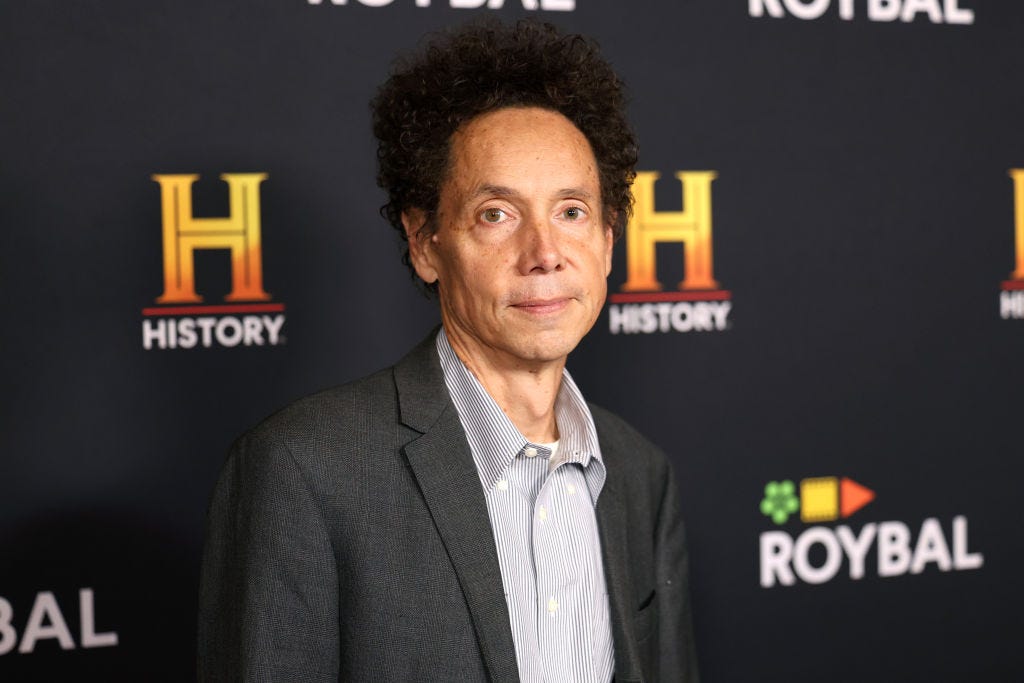
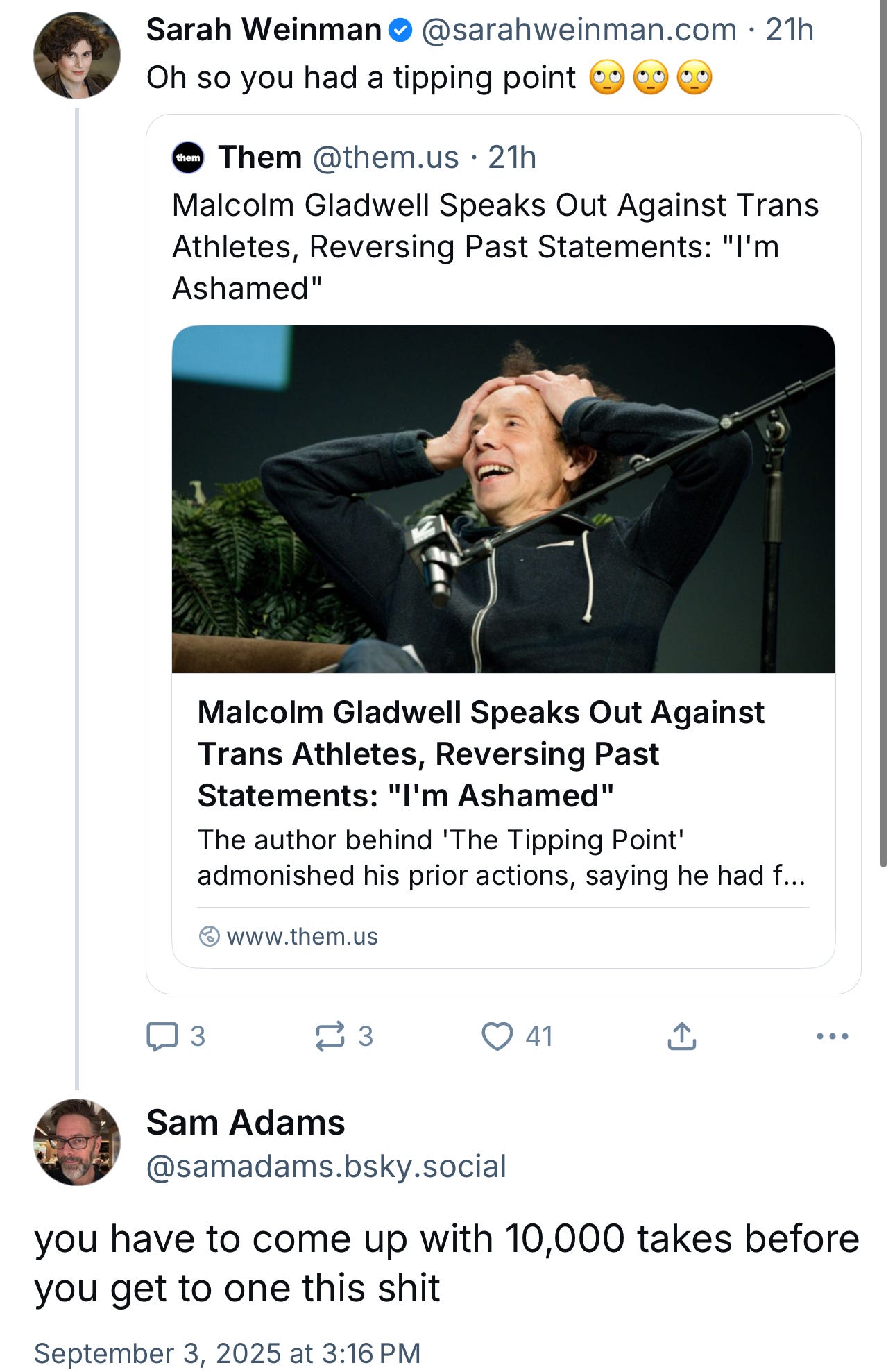
This week, Malcolm Gladwell, the very wealthy bestselling author and staff writer for the New Yorker, said he’d been forced to say trans women belonged in women’s sports.
And wow, poor little baby. Malcolm, are you okay? Do you need to go to the hospital? Should we call your mom to come pick you up?
What did the bullying look like, Malcolm? Is the bullying in the room with us right now?
Gladwell, whose work has been repeatedly debunked by legions of exhausted social scientists, but who somehow still gets heralded as a genius, went on “The Real Science of Sport” podcast with host Ross Tucker and sports journalist Mike Finch.
Then, three years later, Tucker had Gladwell on a panel to talk about the issue, and Gladwell, a wealthy man who has yet to suffer any sort of consequence for churning out takes with the intellectual rigor of a conversation at RFK Jr.’s dinner table, felt “cowed” into silence?
The man wrote a whole book praising military tactics that target civilians. He glorified military atrocities! No one asked him to. Everyone was just minding their own business, and Malcolm Gladwell, Kool-Aid Man, burst through the wall and was like, “Hey! Here is a book about how I think bombing cities is genius!”
If you are ashamed of something, my guy, be ashamed of yourself.
A major part of Gladwell’s career has come from convincing legions of dinguses that they could overcome any lack of talent by simply spending 10,000 hours doing something and becoming an expert. Repeated studies have debunked all of this.
Also, Gladwell’s latest opinion really undercuts his own theory, because even if he spent 20,000 hours studying this issue, he’s still wrong. Nevertheless, he persists.
Also, how is this dingus’s tipping point common decency?
I have written about this topic before, so I won’t bother repeating myself. There is no threat posed by trans women competing in sports. But you know what does threaten women? The fact that I have fewer rights in 2025 than I did five years ago.
It’s truly distressing that in 2025, as our cities are invaded by a tyrannical despot who is actively rotting in front of our eyes, the purported great minds of our era are too busy rotting in a stew of transphobia to do anything about it. Who convinced these absolute losers that targeting less than 1 percent of the population with unfounded hate made them interesting and anti-orthodox?
Kids are dying of gun violence at school and these absolute TED Talk-pilled poster boys for Dunning Kruger are like, “Well, actually, it makes me interesting and not a total creep to talk about a stranger's hypothetical hormone levels on a podcast.”
Also, how is this dingus’s tipping point common decency? Like, people said to him, “Hey, this is a complex issue that doesn’t really affect many people at all. Let’s let trans women play and not spread transphobic rhetoric?” And one of the wealthiest writers in the world responded by curling into a ball and crying, “Help, help! I’m being repressed!”
There are truly no bounds to the desperation of the planet’s most fortunate people. So hungry are they to experience one actual minor inconvenience so they can crow about being victimized that they’re forced to pull fake problems out of the ether. Yes, the wealth enjoyed by certain prominent authors would surely buy a lot of therapy. And yet! Here we are.
I can’t wait to explain this period of history to my grandchildren as we sit around a campfire, armed to the teeth, fearful of the roving hordes of sentient AI-bots coming for our potable water. “Yes, sweeties, women were dying of sepsis in hospital parking lots, but Gavin Newsom and Malcolm Gladwell really hated trans women, so we had to talk about how one swimmer got a fifth-place win over some blond girl while they passed laws taking away our vaccines, and we died from the measles. But hey, at least a subpar college athlete got to take fourth place.”
Dingus Runner-Up: The People Who Emailed to Explain Burning Man to Me
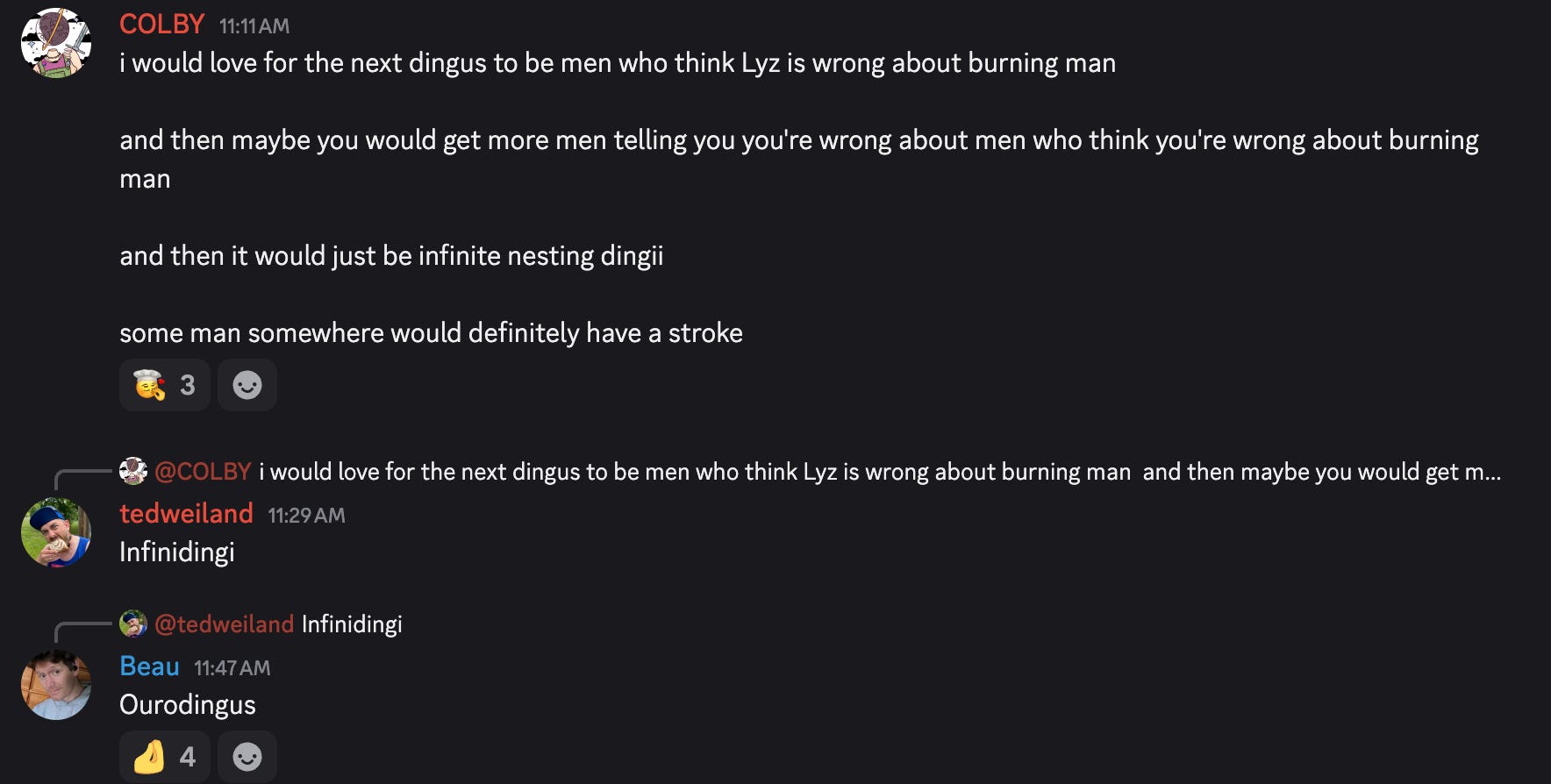
Last week, after I wrote an incredible (if I do say so myself) newsletter roasting the attendees of Burning Man — or as I like to call them, “All my friends’ ex-husbands” — I got no fewer than three very long emails explaining Burning Man to me. All the emails were basically, like, “Burning Man is about inclusion and acceptance, you stupid slut!” Even more people reached out on Substack notes to call me humorless and boring.
Which, yes, definitely, ranting at a stranger online makes you the fun one. That’s right. No, no, keep explaining in 900+ word emails about how Burning Man attendees aren’t the most exhausting chuds on the planet. This all makes perfect sense, you absolute haboobs.
To quote Coldby in the Discord, what we have here is infinite nesting dingii.
Republican Sen. John Barrasso of Wyoming is “deeply concerned” about RFK Jr.’s handling of the CDC. And yeah, my man, it’s very concerning. Maybe stop clutching your pearls and do something?
Please don’t make me beg. I mean, I will beg, but don’t make me! Just take the survey.
Something I am enjoying
This week, I got very sick and spent a lot of time sitting in bed, high on cold medicine, watching Department Q, which is a dark British crime drama full of a lot of mean people. And I loved it.
Today’s Dingus of the Week was handpicked by newsletter reader Tom. Tom has been a longtime reader of MYAM, a supporter of Team Corn Sweat, a Democrat in Iowa, and an active member of the Flyover Discord, and has been lobbying me for years to make Burning Man the Dingus of the Week. In sum: Tom is out here doing the work. Tom’s persistence paid off, because I’m exhausted and I simply cannot fight another man this week. Also, it’s a good pick. Tom is a paying subscriber to this newsletter, and if you, too, want to wear me down and lobby me to take on your own personal grudges (Stefany from HR?) in an email that is blasted out to nearly 72,000 people, become a paying subscriber.
Also, be it known: I do listen to men, sometimes. And it might take four years. BUT I DO LISTEN.1
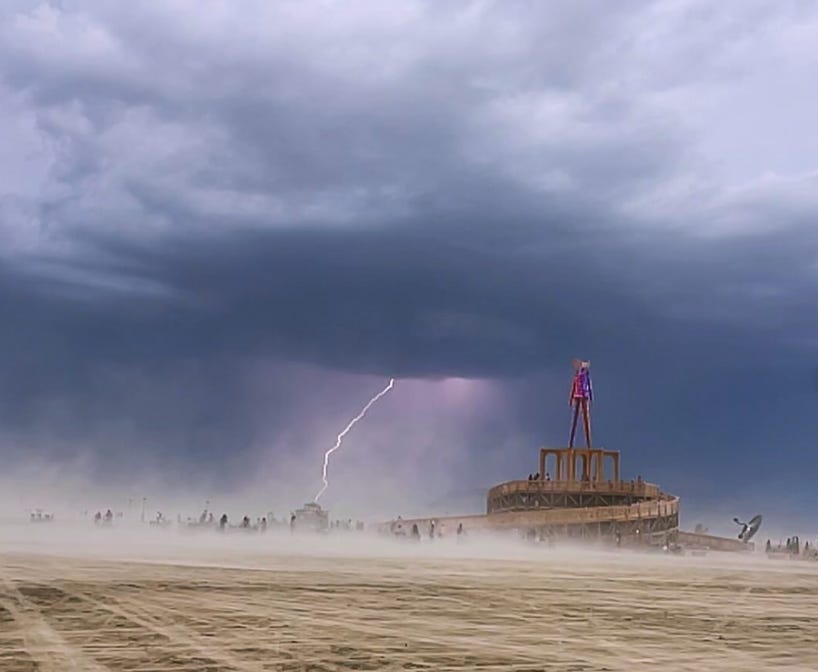
Have you ever wanted to do MDMA with a bunch of tech bros in an outdoor stewpot of mud and piss, with the vibe set by the worst electronica imaginable, and some guy named Trey is demanding to take you to the consensual Orgy Dome while a totem pole of precariously stacked vehicles looms above you? Well, get your ass to Burning Man.
Burning Man is Fyre Festival for people on ketamine.
Burning Man is like a trade show for DJs, where men who have nicknamed themselves “Lampshade” and “Cheeze” will tell you that The Matrix is a good idea, actually.
Burning Man began in 1986 and was initially conceived of as a weeklong countercultural festival in Nevada's Black Rock Desert, at a spot that Burners call the Playa, that centered art and free expression. Now, it’s basically glamping for every man who was behind the 2008 market crash and their third wives.
To be fair to Burning Man, the Orgy Dome, which was destroyed this year by a massive dust storm called a haboob (I know — you can’t make this shit up), is still more stable than the housing market these men built.
But at Burning Man, these men are not concerned with consequences or what evil AI robots they’ve currently unleashed upon humanity, squaring our electricity bills, sucking up our water and convincing the worst person you know that ChatGPT is Jesus and they should definitely become a prophet. No, they’re too busy shirtcocking.
Don’t know what that is? It’s walking around with a shirt but no pants on.
This is Disneyland for fucksticks.
Back to the Orgy Dome, which is a real thing. You can have an orgy on a bunch of mattresses floating on a mud swamp* with a bunch of strangers who think #MeToo went a little too far. (*Actually, given the haboob situation this year, it may have been more like a pack of horny chinchillas writhing around in their dust bath.)
If that doesn’t sound sexy, then wow, are you contributing to the male loneliness crisis? Treyvis Williamford McMuffin III (his playa name is Panty Dropper) has to vote for Trump now because you’re so uptight.
Don’t worry, though, the Orgy Dome organizers vow to rebuild. And I for one find that to be an inspiring testament to the strength, resiliency and potency of their will. And their dicks.
Burning Man is the EPCOT of Trump’s deregulatory agenda. And if your dream is to be mansplained to about the paleo diet and have a 56-year-old man contemplate the nature of reality while he grabs your ass, then it can be your EPCOT, too.
Young people at Burning Man? A bunch of nepo babies cosplaying as Marxists. Their family money comes from strip-mining Appalachia, but they’re going to go on shrooms and tell you about how they’ve found strength and inner peace in these trying times by going offline, eating organic food, connecting with nature, and drinking raw milk.
Also, Burning Man is dangerous. People die there. And injuries are so common SFGate reports that attendees can come out with piles of medical debt. And like, imagine your name is Pepper McFadden and you have to create a GoFundMe because you broke your arm falling from the top of a 70-foot-tall Labubu made from Poppi cans while high on nitrous, wearing a My Little Pony backpack and no pants.
I know all of us are God’s children and we all deserve lifesaving medical care, but this does make it challenging to stand on principle.
Last year, when someone had turned on a lightning effect at the Fluffy Cloud stage, Diplo stopped the music, dropped his headphones and started running away like Forrest Gump into the darkness of Deep Playa. The Reason was that apparently he is terrified of rain and has massive cloud cover anxiety. Look, anyone who Bailed out early because of the rains of 2023 should have never been allowed back. I have ZERO respect for anyone who turned their backs on the community and ran away. There was no valid reason for anyone to leave. Work is not a valid reason for leaving. If you got fired from your job because you went to Burning Man, then you need to get a different fucking Job. Did you need to leave early because you brought kids? If your kids can't spend a few extra days in the rain then you should have never fucking brought them along in the first place. Or maybe you just need to get new kids. Either way, None of Ya'll should ever be welcomed back.
Petition to give Zapper a Pulitzer. Because that is the funniest paragraph I have ever read in my entire life. The whole post is absolutely incredible.
Don’t Diplo out, fucksticks. Not even for your kids.
And now for something good
In Iowa, Catelin Drey, a Democrat, won a special election for a House seat, breaking the Republican supermajority. They still have a majority. But Drey’s win, I think, is a model of what an outspoken woman can do with a social media platform, an incredible ground game, and an actual strong liberal stance. People want to vote for people who stand for something.
This week, I got to do a lot of exciting behind-the-scenes MYAM work that I will talk about very soon. In the meantime, I got to scream my head off at my daughter’s first high school swim meet and watch her win every single one of her events.
My god, the adrenaline rush. I totally understand Tonya Harding’s mom now.
Also, I haven’t had much to drink lately. But on Tuesday night, I did break open a bottle of Bødalen Whiskey, which is made in Minnesota, and had a small glass on my back porch and enjoyed the cooler weather.
Nearly 72,000 people subscribe to this newsletter. But under 10 percent are paying subscribers. If you like this newsletter and support it, become a paying subscriber. I promise, this is the only time I’ve written about Taylor Swift and will most likely be the last time. (Unless you’d like me to write about her more. In which case, let’s talk.)
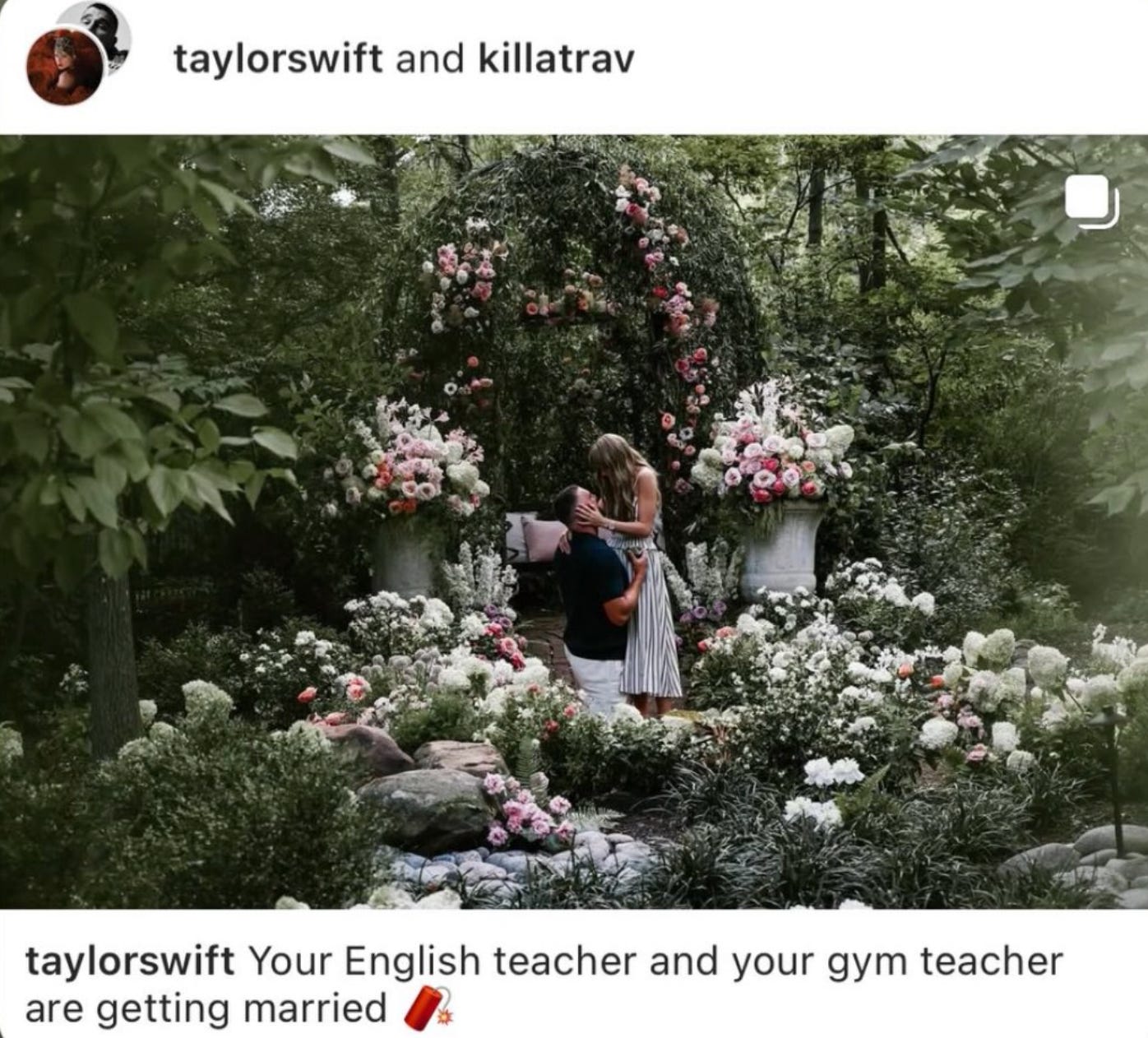
Where were you when you heard the news that one of the most talented and wealthy single women in America was getting married? Me? I was trying to read a book, just 24 hours after getting dumped by a guy who was uncomfortable with my career.
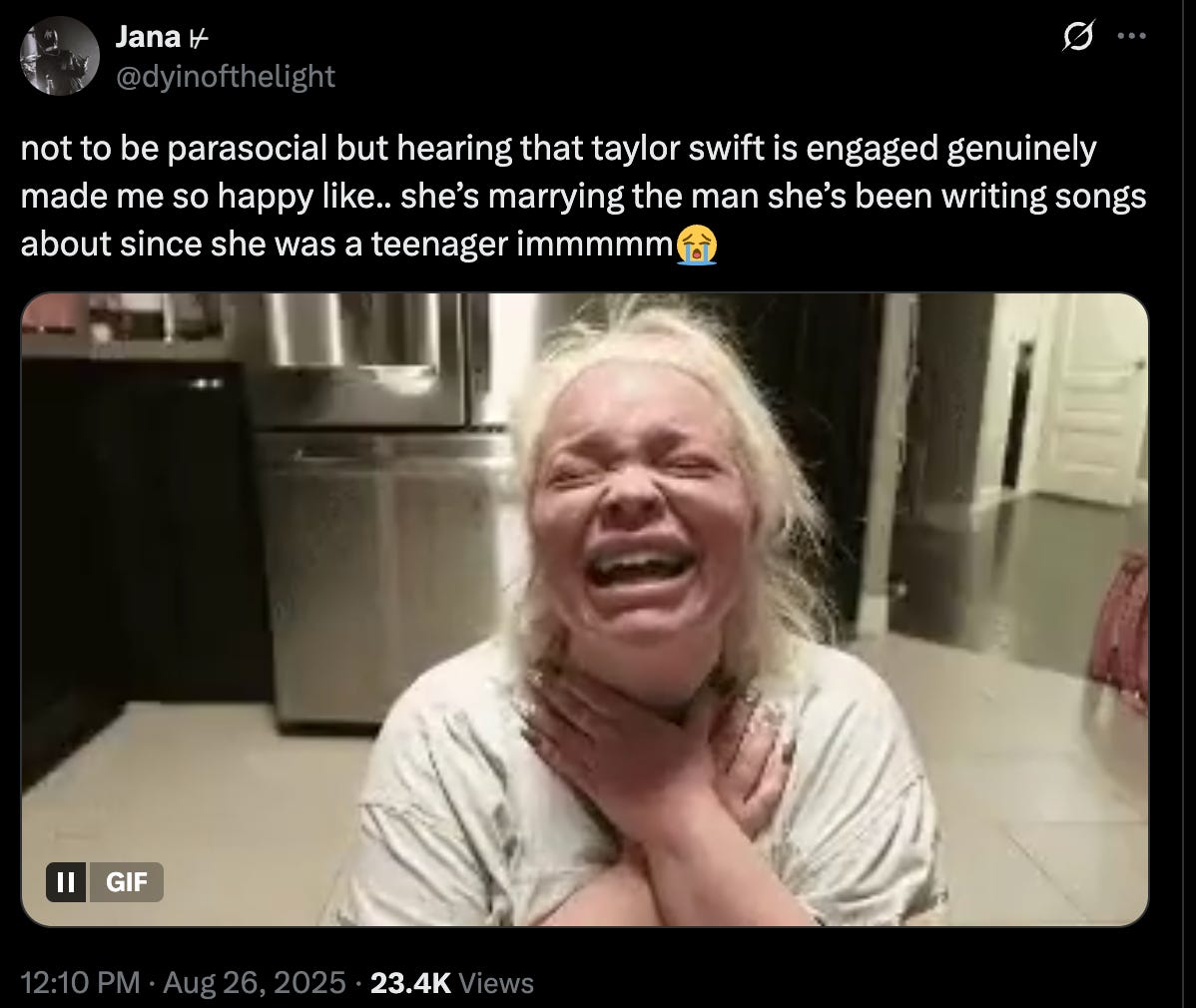
The deluge of posts, hot takes, videos, and memes already beginning to flood the internet have little to do with Taylor Swift and Travis Kelce themselves. Grown women posted that they were crying. The Wendy’s account on Threads posted, “I can’t believe we got Travis Swift before we got gta6.” The New York Times did a push alert; so did ESPN. The president wished the couple “a lot of luck” during a Cabinet meeting at the White House.
From the wedding of Isabella and Ferdinand to the union of Mr. and Mrs. Swift, every highly publicized union is idealized because it makes a fairy tale feel like it’s within reach. Sometimes that fantasy is wealth, beauty, glamour, or a distraction from poverty. In this case, what resonates for many women — who will undoubtedly be scolded for fawning over this royal American wedding — is that this fairy tale features an ambitious and successful woman actually finding a supportive partner.
I don’t know either of these people. And I am not convinced this isn’t some sort of very successful business deal. But who cares? Taylor Swift writes great songs about shitty men and profits from it; good for her!
Also, most of our parents married for worse reasons than record sales.
I am also not trying to project into the interiority of the lives of these celebrities. But the image they are projecting to us is that a successful woman has found a supportive partner, one who eagerly fawns over her new album cover while interviewing her for his own podcast.
This reality is far from reality for most American women.
Since January, 212,000 women have left the workforce, while 44,000 men have joined it. Women’s participation in the workforce peaked as flexible work-from-home policies allowed them more readily to juggle career and family. But under the Trump administration, those policies are being rescinded. Meanwhile, laws that gut reproductive rights and narrow access to childcare, healthcare, and SNAP benefits will do more to push ambitious, educated women out of the workforce and limit their economic power and personal freedom. And a spiritual leader who opposes women having the right to vote has the ear of the president’s Cabinet.
These are all passive forms of punishment for women who seek career success and financial security. Women who speak out are often met with outright misogyny or cutting remarks.
As a millennial woman reckoning with my own disillusionment with the 2010s girlboss era, its obsession with hustle culture, and the broken promise that getting what you want is as easy as asking for it, I too became obsessed with this reevaluation of ambition. During the five years I spent researching and writing my own book about it (out in 2026), I watched as these anti-ambition trends took hold… and evolved — from the #softlife to #feminineenergy to the #tradwife (short for “traditional” wife) — each promising to unlock a new layer of leisure, satisfaction and meaning as it limited women’s ambitions to a smaller and smaller window.
I, too, have struggled with ambition. I have a lot of it and it isn’t going away. But I am also exhausted. I’m so sick of succeeding in spite of everything around me. I’m tired of having a job and still doing the majority of the emotional and domestic labor for my kids while my ex, who is remarried, complains about how I maintain the shared calendar.
Every time I succeed, there’s a downside. The hate mail gets worse. The man I am dating backs away. A tabloid publishes a scathing story about me. I’m so, so tired.
The fantasy that Swift and Kelce are selling isn’t romance; it’s not even equality. It’s a fantasy world where a woman can be successful and her partner won’t be mad about it.
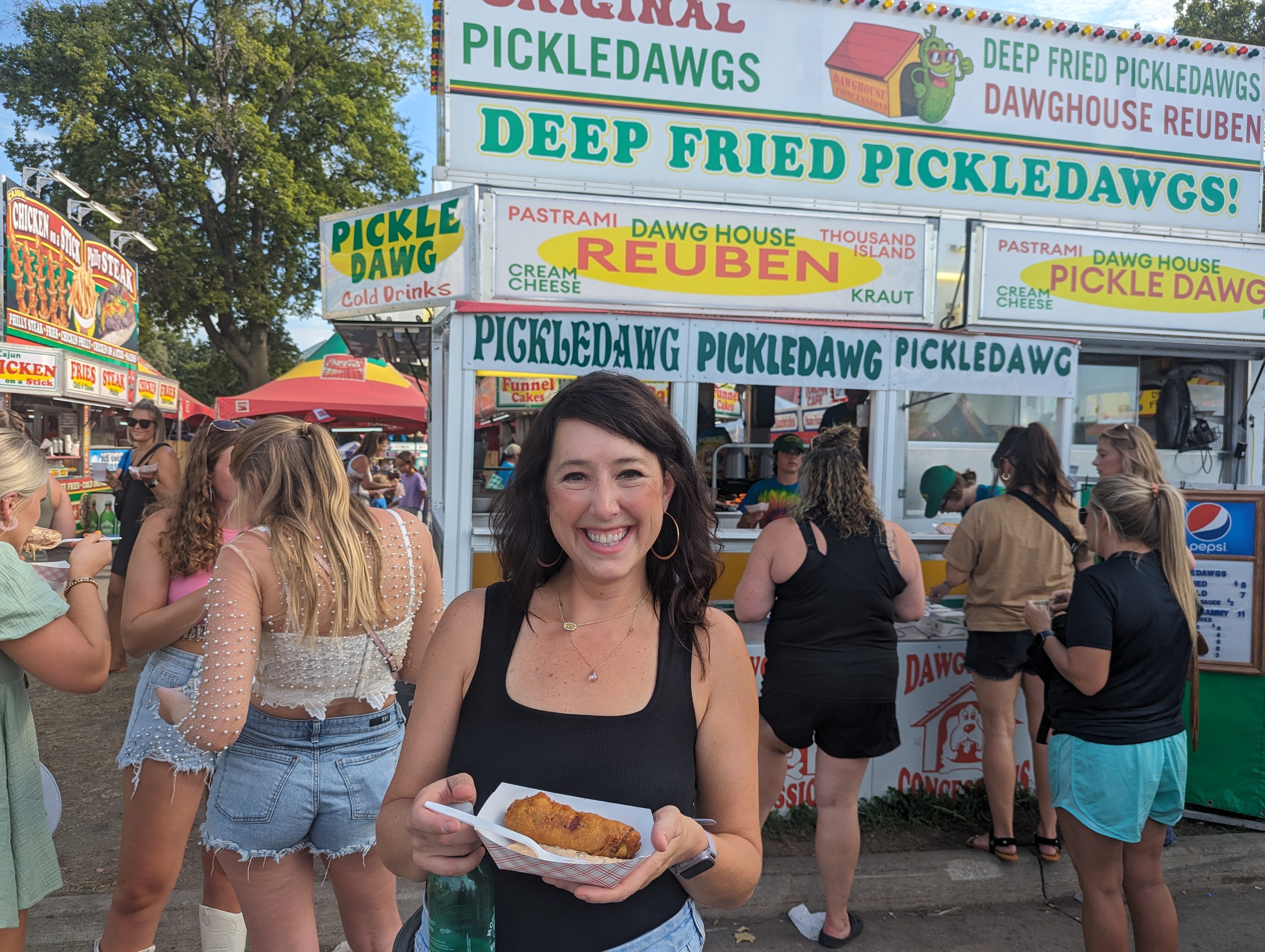
My favorite fair food is the spicy pickle dog from the Pickle Dawg truck. It’s a dill pickle covered in spicy cream cheese, wrapped in pastrami, covered in batter, and deep-fried.
The first bite is crisp, warm, and crunchy with a little bit of peppery heat. I look forward to it every year.
When we talk about the foods of American fairs, we talk about excess and quantity. It’s novelty, nostalgia, and class, all deep-fried and put on a stick for our collective consumption.
So many of the foods are designed to make us laugh, to invert expectations, like deep-fried butter, fried beer, and fried jelly beans. They also seem to mock us by deep-frying cultural stereotypes. In 2022, a vendor at the Iowa state fair was selling the Iowa Twinkie, which was a jalapeno filled with pulled pork, corn, and cream cheese, wrapped in bacon, smoked with sweet and sticky BBQ, then finished with ranch
And while these foods can seem indulgent and exciting, they may also elicit disgust and disdain. I think that is on purpose. Fair foods bait you to try them with novelty, mocking you if you hate them. The foods almost invite you to moralize about nutritional value, fats and carbs and caloric consumption and in response, these foods laugh at you with their fried profligacy. They are not real foods in the sense that you would eat them every day. They are surreal foods — excessive, bizarre, and delightful, existing only in one world: the world of the fair.
Fair food is America inverted, a mirror image reflected back to itself in its greasy plenty, mass-produced and served up hot.
Fair foods find their origins in the celebration of abundance that drove attendance to fairs around the turn of the 20th century. In her article “Eat Me at the Fair,” historian Francine Kirsch describes how food installations at fairs were in part an advertisement for a state to attract people to move there. Look at us, Iowa could declare with an attention-getting palace of corn. We are a land of growth. A land where you can harvest enough corn to build a kingdom.
Historically, it has been through food exhibitions that new foods have captured the American imagination. Fairs are sites of cultural exchange and cultural flattening, a place where, through humor, we negotiate who and what we are through what we eat.
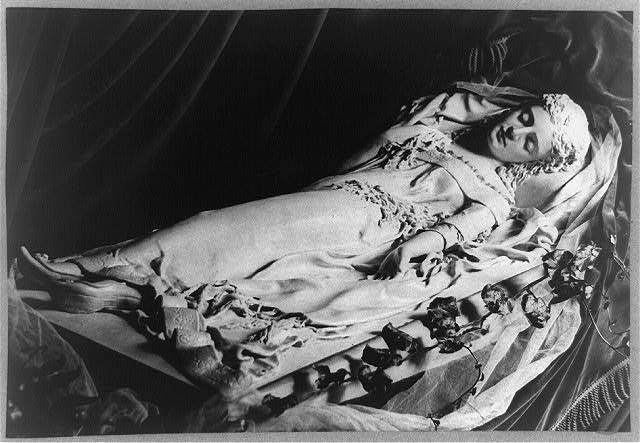
Kirsch writes, “If the food exhibits at later fairs were particularly lavish, their genesis can be seen in drawings made at the 1876 Philadelphia Centennial.” Here in the Agricultural Building, Mary Todd Lincoln’s favorite confectioner Henry Maillard displayed a 15-foot-tall sugar spire covered with edible historical figures. At one booth, a mammoth grape vine from California grew toward the ceiling. The New Hampshire booth displayed stuffed hogs that when they were alive had weighed 1,307 and 1,253 pounds. And this was the same fair that launched the butter sculpture trend when Caroline Shawk Brooks delicately carved Iolanthe.
Sleeping Iolanthe carved by Caroline Shawk Brooks in 1878. Source.
Taken together, these food exhibits “reflected America’s exuberance at its coming of age best,” Kirsch writes. “And that desire to have and be the biggest would truly take hold in more ways than food in the century to come.”
But were they only about size, scale, and excess, I don’t think state fair foods would have nearly the grip they do on our culture. They are also about humor and desire.
Mikhail Bakhtin, in his writings on the carnival, described it as a space outside the everyday, one that is both temporary and freeing for lower classes often oppressed by the usual social order. Here, laughter is a key element, and is built on the subversions of expectations. Whereas in the outside world, we are expected and cautioned to eat more salads, in the world of the fair, that salad is on a stick. Cows are made of their own butter. It’s silly. It’s fun. It’s dark. It’s complicated. Who cares? It’s the fair. And how often is food allowed to be fun? How often are we just allowed to eat and enjoy it and eat some more?
In the oppressive superego of keto, Weight Watchers, protein goals, carb-free, and Noom, state-fair food is our culinary id — a grotesquely joyous display of all that is forbidden and still desired. Waffles and Snickers, battered and fried and put on a stick. Bacon dipped in chocolate. It’s fried and sugary and, unless it’s corn or coleslaw, there is rarely a vegetable to be found.
While fair foods reinforce American identity, they also reveal that our identity is changing.
Because beyond the smorgasbord of deep-fried consumption, fair foods are also the space in which our cultural identity is mediated, processed, put on a stick, and sold back to us.
In Trump’s America 2.0, where DEI is under attack and masked ICE agents are rounding up immigrants, food is both a negotiation of identity and exploitative capitalism.
And, like the food, these conversations can feel a little gross. Last year, at the fair, I went to find a hyped-up Korean BBQ vendor, only to find it was run by a very white couple. I made assumptions. They profited. And I wondered at the people who would take a culture’s food, sell it, and then vote for a president who vowed to deport the same immigrants who brought that food to America in the first place.
Are people more likely to try new foods at a fair? Will it make them more open to other cultures and foods? It’s hard to know. But despite the moralizing, it won’t go away. Egg rolls with bacon and ranch are here to stay. Fiesta wontons. Korean corn dogs.
I can’t tell you if this is good or if it’s bad, only that this is America.
In this world already turned on its head, it’s easy to introduce new foods and change the narrative about who and what America is. The safe space of the familiar fair, combined with the gleeful embrace of novelty foods, creates an environment rich for experimentation.
Every year, new foods are introduced to the fair. This year, at the Iowa State fair, amid all the usual fried concoctions, there are also bacon chicken ranch egg rolls, potato half & half Korean corn dog, and a Saigon lobster dog. The Minnesota State Fair offers a variety of foods that fuse cultures and traditions, like a steamed bun with lutefisk and hoisin sauce, hot honey cheese sticks, and a dill pickle cheese curd taco.1 Other state fairs, too, are embracing and selling more diverse ranges of food, offering a safe environment for people to try new things and experience new flavors.
Fair food is America inverted, a mirror image reflected back to itself in its greasy plenty, mass-produced and served up hot.
If you forward this email and look forward to it every week, consider becoming a paying subscriber. I cannot write this newsletter without support from readers. And independent voices don’t survive without your help.
For over a year, the Planned Parenthood clinic in my city has been closed. At first, it was closed for renovations, the doors and windows covered with wood panels. Now, it’s closed permanently. A casualty of Iowa’s extreme abortion ban, cuts to Medicaid, Title IX funding, the attacks on Planned Parenthood, and, of course, Planned Parenthood’s own dysfunction.
Iowans are getting abortions, but they are going out of state or self-managing them at home. And anecdotally, I hear a growing number of young women are choosing to sterilize, using Reddit to find sympathetic doctors and clinics.
And yet, once a week, as I drive by the clinic on my way to kid pick-ups or the grocery store, I see a group of older white men and women standing in front of the clinic, praying and holding signs demanding an end to abortion. Their stoic Midwestern faces are grim as if they alone are waging a holy war — and the whole world is against them.
On Monday, Donald Trump announced he was calling in the National Guard to patrol the streets of Washington, DC. The claim from the White House was that the country’s capital city is mired in crime and “total lawlessness.” In reality, despite some high-profile incidents, crime in DC is on the decline. Trump’s act of martial law and abuse of power, reporting suggests, was sparked by the attempted carjacking of a former DOGE staffer, Edward Coristine, best known for going by the nickname “Big Balls” online. Coristine is also the nepo baby son of the snack brand Lesser Evil. Everyone has to suffer; the rights of the poor to exist are curtailed, all because a rich man felt victimized once.
These are the fantasy problems of a fictional world. One where the billionaire's fears of being taxed are more terrifying than people going hungry. Where affordable housing is more terrifying than a sexual predator in office. Where 10 trans people competing in women’s sports is scarier than thousands of women dying in childbirth. And one where not getting a date or never marrying is far, far worse somehow than dying septic in a hospital parking lot.
In the middle of the press conference about the made-up problem Trump claims to be solving, he went on a rant about people being transgender. At first he was talking about tax cuts; then he nonsensically went on, “That's why they want men playing in women's sports, that's why they want transgender for everybody. Everybody, transgender. And they just got walloped in an election, in a landslide and they haven't changed one thing. I saw the other day, a certain gentleman who is a very well-known politician, Democrat, was fighting like hell that men should be allowed to play in women's sports. They just don't get it.”
Of course, none of this makes any sense. It was just another moment of free association from an addled brain. But it’s also another moment when a person in power claimed to be the victim of a made-up problem. There are maybe 10 trans athletes in women’s sports in the NCAA. And trans people are more likely to face discrimination and violence than any white man walking to his car in Washington, DC.
It’s an invented narrative to keep the winners claiming grievance, while others lose their rights.
In the pages of the Washington Post, Shadi Hamid wrote once again that men are lonely. He blamed politics and #MeToo. He claimed there is “data” to back this up, but the reality is that men are not lonelier than women. There is no male loneliness crisis. And while we’re at it, the educational crisis among boys is severely overblown.
And while highly male opinion columnists like Hamid, David Brooks and Ross Douthat — and even prominent Democrats like Gavin Newsom — claim men are in crisis, the maternal mortality rate is soaring; Black women are being forced out of the workforce; and women and LGBTQ people are losing their rights to healthcare. Young girls are experiencing a huge mental health crisis.
But so much more ink is spilled over how sad men think they are. It’s a make-believe problem that ignores life-and-death crises for women in favor of the perceived victimhood of men.
These are the fantasy problems of a fictional world. One where the billionaire's fears of being taxed are more terrifying than people going hungry. Where affordable housing is more terrifying than a sexual predator in office. Where 10 trans people competing in women’s sports is scarier than thousands of women dying in childbirth. And one where not getting a date or never marrying is far, far worse somehow than dying septic in a hospital parking lot.
An entire cultural and political movement has been predicated on a mythical narrative of victimhood, loneliness, and disenfranchisement. And we are buying into it even as it kills us.
If you love the dingus of the week and look forward to it every Friday, please become a paying subscriber. I cannot write this newsletter without your support.
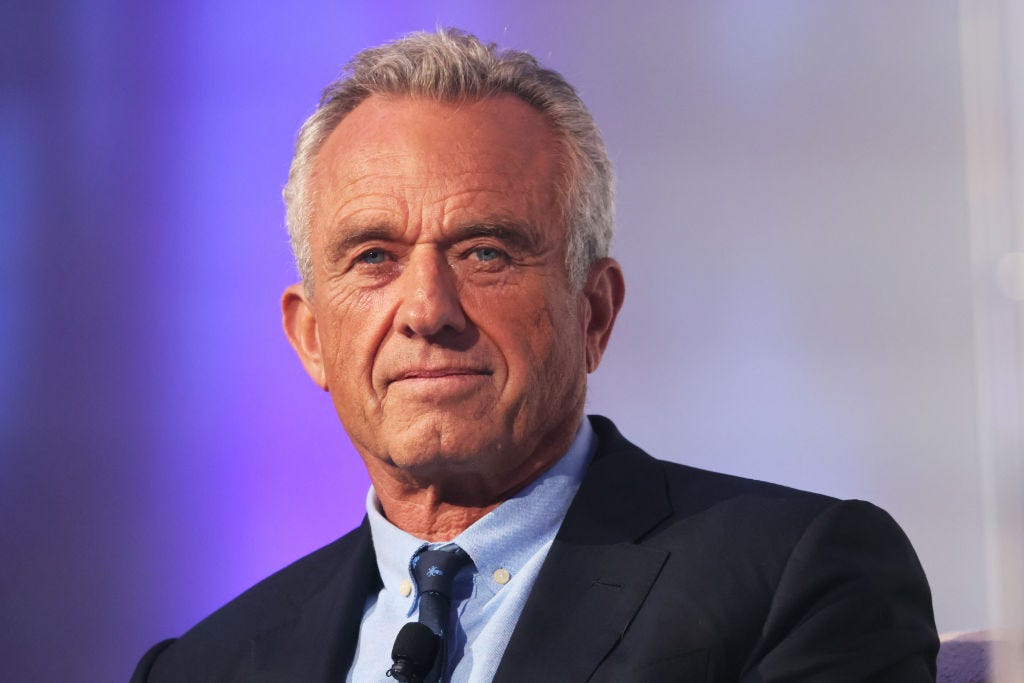
This week, that sentient Froot by the Foot, the man who looks like roadkill got turned into beef jerky with a voice that sounds like a haunted wooden gate, RFK Jr., defunded mRNA vaccine research.
This is really good news if you are longing for the sweet release of death. But for everyone else, including those of us who are a little ambivalent, this is bad.
NPR is not sensationalist. Twenty rabid toddlers armed with knives could take over a daycare in the San Fernando Valley and the headline would be, “Daycare troubles have some California parents concerned.”
NPR is so responsible.1 They will not worry you at all. They’re like the journalistic equivalent of your Midwestern mom breaking bad news to you.
“Oh yeah, no, your aunt won’t be on vacation with us. Oh, why? Well, she died in a car accident last week. No, I was going to tell you, but the authorities were still picking up pieces of her off Highway 151. Make sure you pack sunscreen, sweetie.”
In fact, let’s just do a quick NPR headline translator:
Translation: THE ONLY BIRTH CONTROL JD VANCE WANTS YOU TO HAVE IS THE HOLY SPIRIT. BETTER START STANDING IN FRONT OF SOME MICROWAVES .
But honestly, sex with a straight man? IN THIS ECONOMY? Who can afford it?
Now, back to RFK, that termite-eaten human fence post who clearly wants us all to die. Because why else would he defund life-saving technology?
That worm-addled Habsburgian prince of the collapsing American empire is out here canceling vital scientific research because he thinks it’s dangerous. Which is the equivalent of getting rid of all the elevators because of that one scene in Final Destination. You are trying to solve a fictional problem.
A couple of weeks ago, my friend Megan sent me some Trail Mixers – THC-infused dissolvable powder that can go inside any beverage. They are single-serve, low-dose, and really tiny; they fit inside my purse, which is now small because my kids don’t need diapers anymore and carry their own snacks or just beg me to buy them some Starbies.
Megan has been my internet friend for years and she and her husband are the brains behind Trail Mixers. This week, as I continue to do a lot of work with the Iowa Abortion Access Fund, start working on my next book, plan for the school year, get kids to their various camps, and somehow feed them and myself, I had a very small meltdown.
The meltdown looked something like me sobbing on my bed in the middle of a pile of printed-out school calendars, my laptop, and a phone with 27,000 school apps all buzzing at me.
Which led to me taking part of Wednesday off and going paddleboarding. I started paddleboarding in 2021 as a thing to do on weekend mornings when my kids were with their dad. It’s an easy way for me to put my phone away and get out on the water and just stare placidly at the trees and water, and angrily at the McMansions that line the lake shore.
This week, it was made all the more chill with the Trail Mixers. I just mixed a little into my water bottle. Paddled around for an hour and then came home and took a little nap.
So, if you want to support an Iowa-based company and bring some THC into the next Kesha concert, I highly recommend them.
And also paddleboarding.
And also, I recommend a little meltdown, as a treat.
This week, lawyers for convicted sex trafficker Ghislaine Maxwell, sometime girlfriend and former associate of Jeffrey Epstein, asked the Supreme Court to hear an appeal of Maxwell’s conviction. In a statement, Maxwell’s lawyer David Oscar Markus also asked President Donald Trump to pardon Maxwell, writing, "We are appealing not only to the Supreme Court but to the President himself to recognize how profoundly unjust it is to scapegoat Ghislaine Maxwell for Epstein’s crimes, especially when the government promised she would not be prosecuted."
“Scapegoat.”
Fox News interviewed a January 6 rioter who was in prison with Maxwell. That former inmate told Fox that Maxwell was a model prisoner who was kind and helpful, and who only mentioned her own case once: to state that prosecutors were not interested in her until “Jeffrey died.”
Maxwell is currently serving a 20-year sentence for her role in Epstein’s scheme to exploit and abuse minors. According to the Justice Department, Maxwell was a key part of Epstein’s plan, identifying vulnerable young girls, befriending them, putting them up in her home, and making them feel grateful. And even, in some cases, participating in the sexual abuse.
Former Palm Beach County State Attorney Dave Aronberg called Maxwell “the devil’s accomplice.”
I’m fascinated by the way Maxwell is talked about in these stories and the ways in which her legal team is leaning on sexist tropes to clear her name. In her role aiding a monster of the #MeToo Era, Maxwell embodied a particular kind of woman who uses her gender and status to become a body shield for bad men. But she’s also playing the victim now. Claiming to be nothing but a scapegoat, the Eve taking the fall for the sins of man. During her sentencing in 2022, her lawyers implied just that, stating, “Ms. Maxwell cannot and should not bear all the punishment for which Epstein should have been held responsible.”
It’s interesting to compare people’s reactions to Maxwell to the way they respond to Melania Trump. The first lady has not been convicted of any heinous crimes, but she’s also aligned herself to her husband and the work of the White House. Her entire memoir revealed nothing but pride in her husband and his work, but the cultural impulse to see her as a victim of evil men is a relentless and exhausting cultural trope. Even liberals want to whitewash Melania.
Meanwhile, Maxwell has protested her innocence and is playing the victim but has not yet attained any similar level of plausible deniability. Again, she very much was convicted, but the sort of chivalry that takes up the cause of women playing innocent has never been much concerned with a court of law.
There are a million ways of seeing Ghislaine Maxwell. Is she a scapegoat for the crimes of an evil man? An innocent model prisoner, or the devil’s accomplice? A wily criminal desperately clawing for any chance at freedom?
Maxwell is anticipated to testify under oath on Aug. 11 at or near the federal prison where she is currently serving her sentence. And yesterday, when questioned, President Trump seemed open to giving Maxwell a pardon. In an interview on the Daily Beast podcast, former Daily Beast editor Tina Brown said what a lot of political commentators are thinking: that Maxwell could be pardoned if she helps to clear Donald Trump’s name.
Going from aiding one awful man to pleading her case to another. Ghislaine Maxwell is swinging on the monkey bars of power, privilege, and patriarchy.
If you open this newsletter all the time, if you forward it to your friends and family, and if it challenges you to think in different ways, consider becoming a subscriber. I can’t make this newsletter without your support.
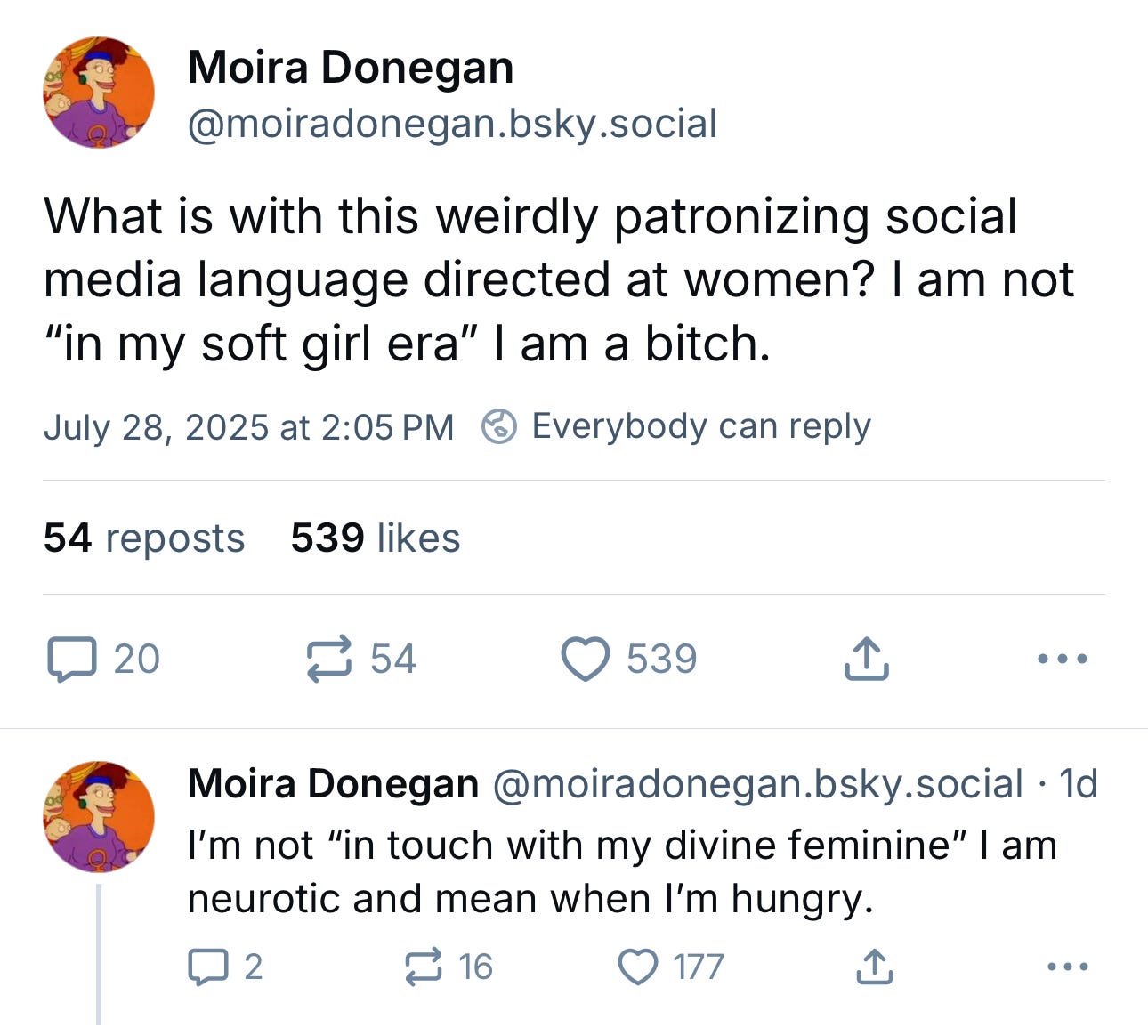
The term “soft girl era” was popularized among Gen Z on TikTok and other social media platforms in 2019 as an aesthetic that embraces femininity, pastels, and a gentle, slow, flowery approach to life. Just as Gen Z began to come of age, the soft girl aesthetic was there to infantilize them.
For a generation of girls becoming women in a post-pandemic world, witnessing the collapse of any social safety net, the revocation of reproductive rights and the seething hostility of men, a retreat into girlhood makes sense.
And yet, the glorification of the soft girl life, of retreat, is also anti-feminist backlash marketed in gentle pinks and yellows. The counterweight to the trope of the angry feminist. It’s a retreat from the world of community and community-based activism to emphasize the individual need for comfort and gentleness.
A “soft girl era” is such a fragile view of femininity. It’s a femininity that is a direct result of the renewed era of toxic masculinity – men as protectors and providers.
Many online complaints about women by men involve women expecting “the princess treatment,” or having a sense of entitlement in dating. And I don’t think this is made up. I hear a lot of my cis-het friends talk about how men should open doors, or always pay, or offer to get the Uber. This expectation derives from a gendered grievance: “If I have to date men in this era, I expect to be taken care of.
I obsessively read the r/NiceGirls subreddit, where men mostly complain about the women they meet on dating apps. The majority of posts are a specific kind of complaint about women’s behavior that arises on apps or during a date, when women demand the men take them to fancy restaurants, or buy them flowers and presents. If I were a man, I would not be happy that someone approached dating me with such economic expectations. And yet, you cannot promote a view of men as protectors and providers, and expect a woman to perceive you and respect you as such, then turn around and complain when women act like widdle babies who want to be coddled.
The Tea App
Even in a time of anti-feminist backlash, Facebook Groups like “Are We Dating the Same Man?” where women compare notes about the violent and/or just crappy men they’ve dated still remain a powerful voice in local communities.
App developers took that need for a woman’s whisper network and made the Tea App. The app claims to have 1.6 million members and aims to create a space for women to exchange information about men in order to stay safe.
This week, the app was hacked by members of 4chan who leaked information about the app’s users online.
So, an app was created for women to safely share information about dangerous men and then that app was hacked by men and the safety of these women was put at risk. It’s a perfect microcosm of gender dynamics in America today.
Other thoughts
“I’ve been very vocal about the genocide of a generation of women by the cosmeceutical industrial complex,” Jamie Lee Curtis told The Guardian in a recently published interview. “I’ve used that word for a long time and I use it specifically because it’s a strong word. I believe that we have wiped out a generation or two of natural human (appearance).” (via CNN)
In this hot summer of discontent, I am running a hot socialist summer sale on annual subscriptions. As a reminder, subscriptions keep this newsletter running as one of the loudest, proudest, most politically feminist newsletters on Elon Musk’s internet.
2025 is a hot summer in America. To paraphrase the Simpsons meme: one of the hottest summers of our lives so far.
The heat and the political turmoil feel different now than in 2020, which was a summer of primal screams, of our political discontent, of shouting for systemic change, of being locked inside and taking to the streets. That summer was hot asphalt and stifling masks. Demanding, pleading for institutions not to kill us and our neighbors.
This summer, we’ve lost so much and we continue to lose. But our screams feel different now. Tired feet back in the hot streets, smelling of tar and the closeness of bodies. Recycled protest signs. Hoarse voices pleading again for life over death. People are exhausted because, as the clichéd sign reads, we can’t believe we’re still protesting the same shit.
Maybe that’s because whatever allegedly ironclad dedication to systemic change was promised and pushed through promptly crumpled like tin foil. Hope and change run over by a desperate keening for the past. Any past.
The conventional wisdom is that as people get older, they will become more comfortable and more conservative. But millennial voters, voters born in the 1980s and ‘90s, are so far bucking that trend, aligning, by a few percentage points, with Democrats over Republicans. It’s not much, but it’s enough that trend forecasters are taking notice. Millennials, now aging, have seen the collapse of a financial system (multiple times), wars, historic elections, girl power to #MeToo to trad wife, the crime bill to racial reckoning to ICE deportations, same-sex marriage to trans healthcare bans.
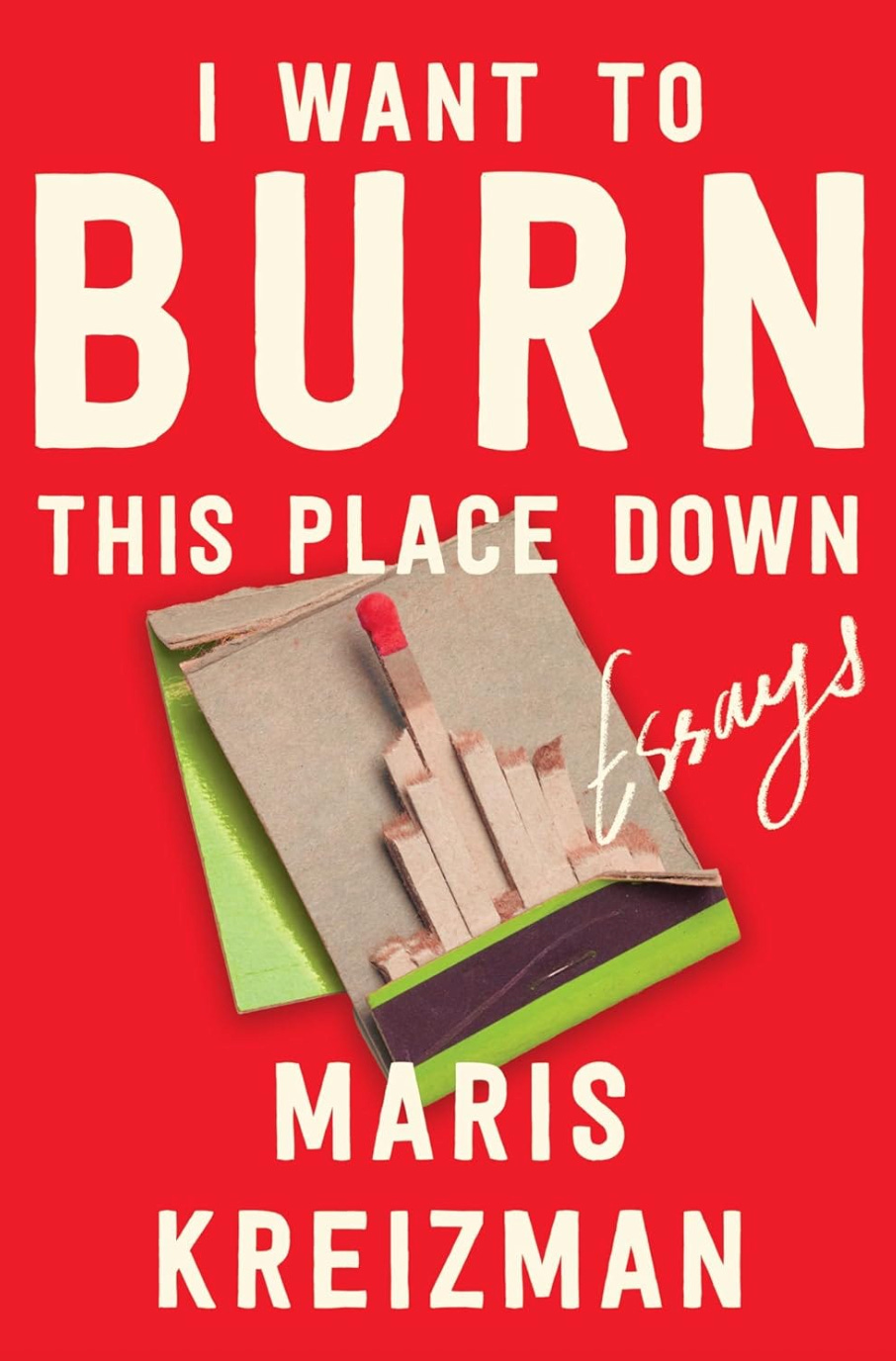
In her book of essays I Want to Burn This Place Down, Maris Kreizman writes in a chapter titled “Neoliberalism and me” about going to see Bill Clinton speak in 1992 and believing so fully in the dream of neoliberalism. Believing that if she worked hard and and played by the rules, she too could be part of the American dream.
The opening is funny in the same way that reading a character in a novel write about how excited they are to take a trip on the Titanic is funny. The reader knows what’s coming. One big sad trombone doing the “whomp whomp” of history. Kreizman takes us from the hope of Clinton to the scandal to the 2000 financial collapse to the Brett Kavanaugh hearings. And then again to Clinton. Kreizman writes about how, when she decried Kavanaugh’s alleged behavior to Christine Blasey Ford, the online hordes pushed back and said, “Well, if you condemn Kavanaugh, you must also condemn Bill Clinton.”
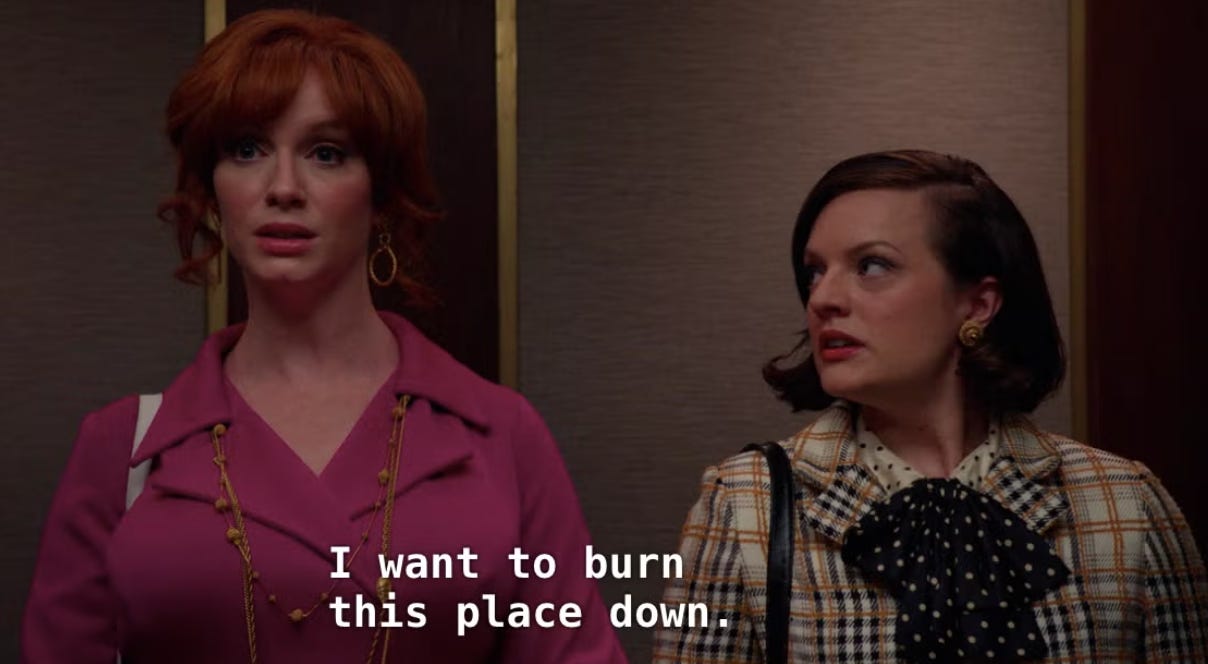
Good. Done. “Sounds good to me,” Kreizman replies. If, upon consideration, those institutions we believed in failed us — if they were part of our oppression when we thought they were our liberation — then, fine, burn them to the ground.
Kreizman’s book is part of a cohort of books from Gen X and older millennial women rethinking ambition, the American Dream, and the promises we were raised with.
A generation of women raised on girl power who saw Hillary Clinton concuss herself on the glass ceiling, and Kamala Harris too, and all of us thinking, “Okay, now what?”
In this space are Jennifer Romolini’s Ambition Monster, The Myth of Making It by Samhita Mukhopadhyay, and Glynnis MacNicol’s I’m Mostly Here to Enjoy Myself. Each a story of a woman pushing against the narrative of girl bosses and ambition and confronting the emptiness of the neoliberal dream.
Other books in this genre come at it slantwise. Sophie Gilbert’s Girl on Girl is a cultural examination of the world in which millennial and Gen X women grew up, charting both the rise of the girl boss and the emptiness and the frustration of clawing to the top. Because if you get there, you haven’t changed the world much; just played by rules never made for you in the first place. So what then?
It’s a conversation my friends and I are all having. When is enough enough? How do we be happy? Where does our ambition go when the world has made it impossible to have it all? Do we keep trying? Do we try something new? A whole generation of Paris Gellers crashing out, we tried to do everything right and still didn’t get where we thought we’d go. Not through lack of hard work or talent, but because these institutions were not designed for our life, liberty, and pursuit of happiness.
For Kreizman, the dream wasn’t complicated. Just a middle-class career in publishing, health insurance, and making books she could believe in. Then came the endless rounds of layoffs, the shitty pay, the revelation that the game is stacked in favor of those who already have money. But Kreizman doesn’t write about quitting in the same way as other cultural conversations around women and ambition.
She’s not saying, “The deck is stacked, so go be a trad wife.” None of the writers in this genre are. But there is a cultural push for that narrative. It’s present on social media and TikTok, in the insistence of princess treatment, the soft girl life, and, of course, the trad wife. Instead, Kreizman talks about agitating for change, unionizing, and demanding better wages.
Each of the essays in the book contends with an aspect of social, political and/or cultural change that Kreizman had to face and rethink, from insulin (Kreizman is diabetic) to the police (her twin brothers are cops), to kids (Kreizman and her husband, Josh Gondelman, are child-free).
I spoke with Kreizman before writing this essay, and I asked her how her ambition has changed as she aged. She told me she no longer has big ambitions for herself, but her ambition hasn’t gotten smaller; it’s gotten more encompassing. Now, she said, “I am ambitious for my community. My ambition is that I don’t want to see people die from a lack of insulin.”
It’s a reframing of ambition that is subtle and big-hearted, moving from the American dream of individual prosperity toward community survival.
Kreizman told me she was worried the book would be seen as “too angry.” The book seethes with a gentle anger, but it’s an anger built out of love, the tired kind of anger that wants everyone to be happy, to live, to experience a socialist revolution.
I asked Kreizman, a New Yorker, what she hopes her book brings to this hot political summer. And she said, “The best thing about having this book come out right this second, right now, is I look at my city, and last week, so many of us decided that the old ways weren't working. The Chuck Schumers of the world and the Democratic Party, as it stands right now, are just putting stuff out on social media and doing nothing. And that is not what most people want.”
“I see Zohran Mamdani capture so much of the imagination of people in my city,” Kreizman continued, “because he calls for change, but does it joyfully. And it's the best message to come out of that election. And what I want for this book.”
Now that’s ambition: to keep pushing for systemic change, despite all we’ve seen and witnessed, and to do with a smile — or, at least, with an endless capacity for joy.
It’s officially a hot socialist summer. And to celebrate, I am going to be running a sale! Twenty percent off yearlong subscriptions to the newsletter. See, socialism can help the economy!
I normally only do sales in October, on the anniversary of the newsletter. But it’s hot as hell and we are all out here in the struggle. If you want to support a fiercely independent feminist voice — one that makes men so mad they email me to say things like “Be nicer to Matt Yglesias!”1 — well, you know what to do.
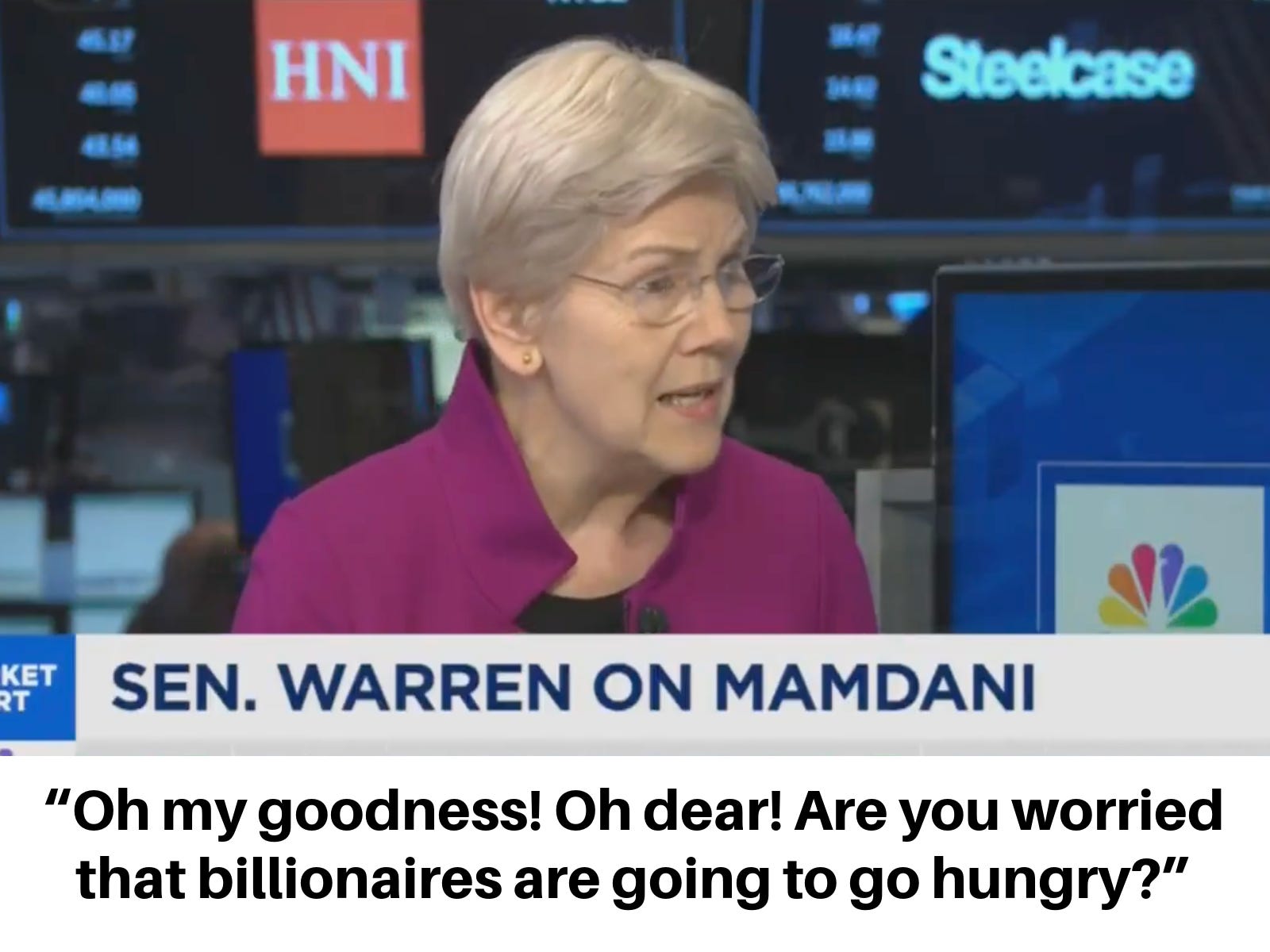
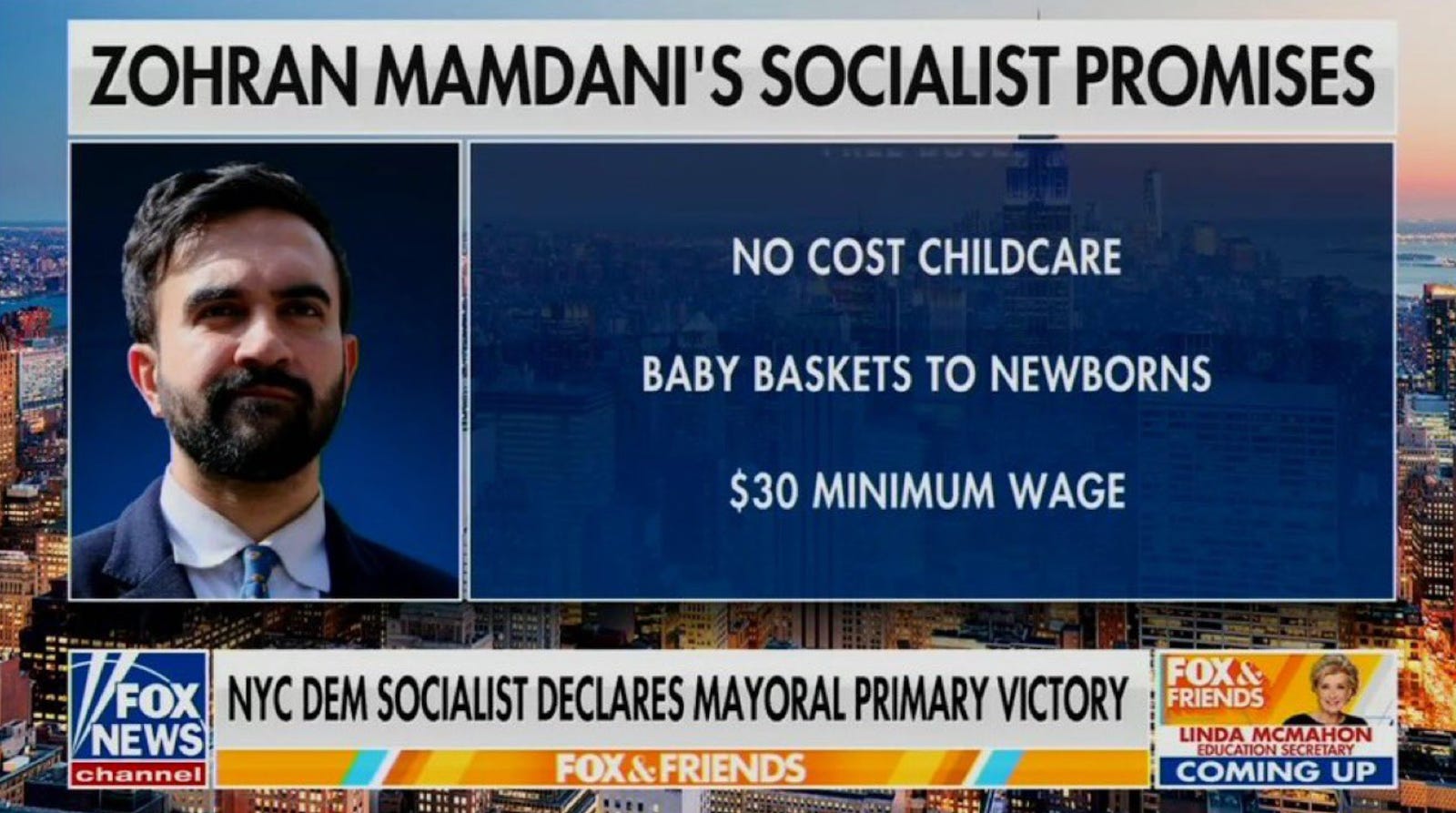
It is the year 2025, and New York City has fallen into the hands of a mob of socialists who have a terrifying and disgusting agenda.
Led by Zohran Mamdani, a bearded man with roguish charm, and my god, that dimple— but no, stay focused on the horrors. They want you to see the dimple and nothing else. That is how the socialists win. We must stay vigilant.
Because, you see, led by Mamdani, the evil socialists want to do unspeakable horrors, like raise the minimum wage, make rent affordable, provide childcare and help new parents. Mamdani plans to round up all the gays… and give them a little kiss on the forehead.
It makes me sick to my stomach.
What’s next? Free public transit?!
You know what could happen when you make buses free? Poor people might have an easier time getting to their jobs, and then, GLOBAL THERMONUCLEAR WAR?!
Wake up, sheeple!
Can’t you see how bad this is? It’s so bad the hedge fund boys be crying. See, the rich boys, they cry. You are laughing, and the rich boys cry! Is this all just a game to you? Have you stopped once to think, what if this is the final straw and they all leave en masse and then NYC suddenly becomes a lot more affordable, and that one insufferable bar stops serving $45 tater tot poutine with a side of artisanal ketchup as an ironic send-up of American culture and $30 old-fashioneds because the cruelty-free cherries were grown with a land acknowledgement? WHAT THEN?
Have you taken even one moment to ask yourself, what happens if all those guys leave, and then, when you open Tinder in Murray Hill, no one is there to explain stock options to you? No. Of course not, because you weren’t thinking about anything except the dimple and a future for America not entirely ruled by corruption and greed. You stupid, stupid socialist sluts.
Like if we let a Democrat run on the actual platform of the Democratic party, what do we do with all the politicians with the moral compass of RFK’s brainworm who are out here saying, “Wait, maybe Charlie Kirk has a point and women are bad?” or “What if we don’t do rights for everyone?” Are we going to toss them into the dustbin of history? WHAT ABOUT MALE LONELINESS?!
Yes, nothing says “We are the good guys!” like backing the guy who allegedly gave kickbacks to Turkish officials because you’re so afraid a guy with a beard might hold you accountable for your greed and encourage you to support your neighbors.
I mean, a 33-year-old man talking about kindness, loving your neighbor, helping the poor!? We must get him out of here. Call Pontius Pilate! He’ll know what to do.
For now, Mamdani is the presumptive Democratic mayoral nominee. And as the NYC mayoral campaigns kick into gear, it’s going to be a long, hot, socialist summer.
A horrible, terrible, no-good, very bad summer when people will be encouraged to think about revolting things like how to make the world a better place. I can’t stand it!
Because you definitely know you are on the right side of history when you back the guy who was charged with corruption, but those charges were dismissed because another guy who was charged with corruption is the president and wants you to stay mayor so he can violate the Constitution and deport immigrants with no due process.
Last weekend, I went to visit my dearest friends in Minneapolis and say goodbye to my friend Anna, who is moving. You don’t know this, but frequently Anna and Kate punch up my jokes in the weekly dingus. (I pay them back by buying dinner when I see them.) And if you read This American Ex-Wife, Anna is the wise friend whose insights punctuate the book. She’s also a brilliant academic whose research and insight often deepens my own work.
I feel so lucky to have had friends for 24 years. I hope to have them for so many, many more years.
So, to toast friendship. I think we should all make Amaro spritzes. I made this drink last week and it was delicious.
Yes, this is a real email I received this week. The logic was that he went to Harvard and he’s just trying to help and I, a stupid woman who needs correction, should be nicer. And my only response is LMAO now I’m gonna get meaner.

 Login