Login
Login
Jesus isn't coming to save you
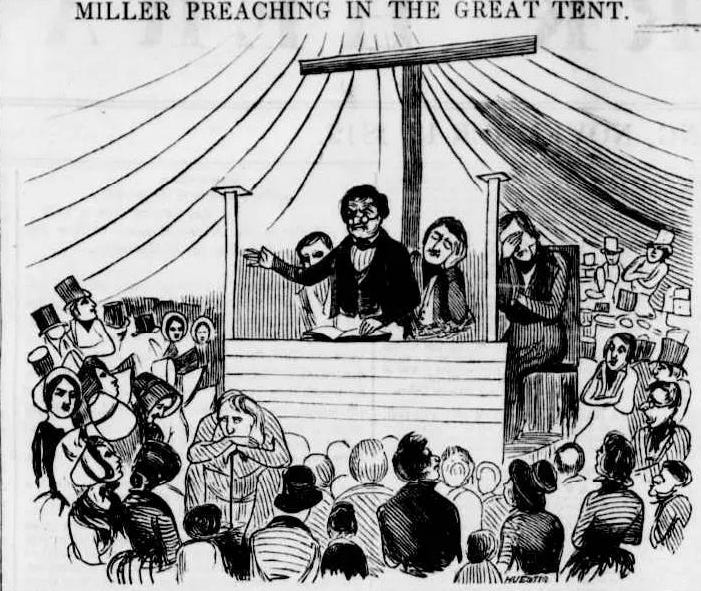
On October 22, 1844, thousands of Christians in England, in New York and across the Midwest gathered in fields and on hillsides, desperately waiting for the sound of heavenly trumpets and for the Lord Jesus to bring them up into the heavens.
The day had been prophesied by a New York farmer turned Baptist minister, William Miller. Miller fought for the Americans during the War of 1812 and was present at the Battle of Plattsburgh, where the Americans, who were severely outnumbered, defeated the British. After witnessing the horrific devastation and loss of that battle, Miller concluded that the Americans had won only due to the mighty hand of God.
After the war, Miller returned home and faced even more loss — the deaths of his father and sister. In despair, he spent years researching, trying to calculate the coming of the Lord, who would save him and his followers from the misery of war and disease. At first, Miller determined Christ would come on March 21, 1844 — but then, no, he apologized; he’d gotten it wrong. It would be in April — nope, sorry, more apologies. He finally settled on October.
But Jesus never came. The Millerites were devastated. As one faithful follower, Hiram Edson, explained, “Our fondest hopes and expectations were blasted, and such a spirit of weeping came over us as I never experienced before. We wept, and wept, till the day dawn.”
The day is known as the Great Disappointment. No one was saved from the misery of their lives.

Independent voices that question Christianity and power are becoming a rarity in the media. Thank you for your support.
Miller, the father of the Seventh-day Adventists, was not the first nor the last minister to declare, in a time of social and political upheaval, that now is the time when Jesus will rescue the faithful.
I grew up in fear of the rapture. In the red-brick Baptist churches of Texas, where fans stirred the thick, hot air, our voices rang over the chords of the piano as we sang, “People get ready, Jesus is coming.”
It was the 1990s, and the siege on Waco had happened only an hour away. It was a sign, our pastor preached, of a world in which the government would take up arms against its citizens. A time in which no one who believed was safe. The governments of the world were hostile to Christians; we were hunted and persecuted across the world. We were surely in the end times.
In this period of millennial panic, between 1995 and 2007, Tim Lahaye and Jerry B. Jenkins published their breakout series, the Left Behind books, which gave a vivid narrative to the supposed end of the world. In that series, persecuted white male Christians were the heroes — aided, of course, by converted women who also happened to be hot.
The books were published by Tyndale House Publishers, a niche Christian publishing company, but they captured the American imagination beginning in the Clinton administration and lasting through two wars in Iraq, Y2K panic, and the attacks of September 11, 2001.
That end, also, never came.
This year, after the murder of Charlie Kirk, my kids’ private school sent an email to all the parents, urging us in this “dificult time” to seek Christ, our only hope and refuge, noting, “At the same time, we should not be surprised by hardship. Paul reminds Timothy that ‘there will be terrible times in the last days’ (2 Timothy 3:1).”
Kirk’s death, the school administrators believe, was a portent of the end times.
The proliferation of the belief in another rapture speaks to the pervasiveness of the politics of pain. It’s a narrative that centers on the grievances of the powerful, while the voices of the vulnerable are muted. “Deliver us,” the faithful cry, while the government whips up a sense of grievance and fear to strip rights away from trans people, immigrants and women.
Over the weekend, I saw TikTok videos and Instagram reels of people obsessing over the end, desperate for Jesus to come save them. And of other people desperate for Jesus to come collect his mess. The rapture was supposed to happen on September 23, 2025.
This obscure prophecy of South African Pastor Joshua Mhlakela gained a foothold in an America blind with panic. A nation in which the victors declare themselves the victims and the victims are afraid to say much of anything. It’s a world in which facts do not matter. Conspiracies have permeated our everyday lives. And we all feel hopeless. A type of end-times theology has even seeped into the liberal worldview, where people are prepping for a climate apocalypse.
As easy and as fun as it is to mock the idea of the rapture, especially for people who aren’t Evangelicals, apocalypse theology affects us all. An apocalypse theology is not only used among the faithful to justify abandoning the wicked to their own fates; it’s also used to justify abandoning red states, or relinquishing our power to authoritarian forces rather than fighting them.
The proliferation of the belief in another rapture speaks to the pervasiveness of the politics of pain. It’s a narrative that centers on the grievances of the powerful, while the voices of the vulnerable are muted. “Deliver us,” the faithful cry, while the government whips up a sense of grievance and fear to strip rights away from trans people, immigrants and women. The justification is found in the logic that these are wicked times. The tribulations of Biblical proportion are upon us.
This past Sunday, at the church I used to attend, the pastor preached that Christians ought to seek our hope in Christ and his second coming. The world is a wicked place, he said. We should not trust governments or people, only Christ.
Watching that video this week, I saw a roomful of people who’d primarily voted for Trump washing their hands of the results. They were declaring themselves the victims, although they’d voted for the victimizers. They used the death of Charlie Kirk to claim persecution of men — Christian men who “innocently” chose to speak out. Erased from the narrative were other forms of violence — the racism, the transphobia, the militarization of ICE against Americans.
Because an end-times theology, as tempting as it is to embrace, is a kind of deus ex machina. It’s a belief that a disastrous end or a swift rapture into the heavens helps us escape our responsibility to our neighbors and our world. Apocalypse logic argues. What can we do?
While researching God Land, I spoke to a farmer who believed in climate change and climate apocalypse, but saw it as part of God’s plan for the end times. He didn’t feel a responsibility to the earth. It would all end anyway.
The world is ending. So the faithful stand on hills, raise their hands, and await the Lord, while ignoring their neighbors.
This end will not come. We will still have to wake up tomorrow, facing the consequences of the world we created.
Further reading: