The semiquincentennial events that President Trump has personally directed have been a celebration of his very particular version of America. The bloody UFC fight on the White House lawn was followed by the sparsely attended Great American State Fair and a world-record-breaking July 4 fireworks show held alongside a dangerous lightning storm. Next weekend will bring a high-speed car race through the museum-lined streets of Washington. But of all of these festivities, the Patriot Games in Ohio this week might have been the oddest.
Organizers convened 120 teenagers from across the country—in their telling, the “next generation of leaders, competitors, and champions,” but also whoever happened to respond to an online request for personal essays and video entries—at a high school in Geneva, Ohio (population 5,924), roughly 45 miles northeast of downtown Cleveland. For three days, they competed in gym-class staples such as ball tosses, long jumps, tug-of-war, dodgeball, and an arcade-style basketball game called Victory Hoops. The field was narrowed to eight contestants who competed before the president on Tuesday night, clambering through a Ninja Warrior–style obstacle course while wearing red, white, and blue. One boy and one girl were crowned champions, and each was given a $125,000 scholarship.
Over the past several days, ESPN has streamed more than 26 hours of this contest, and I have consumed many of those hours—but I have yet to fully understand why this competition happened or what it has to do with American history, or even with American culture at this moment. I could barely follow how the various events were scored. It was like watching a nationally televised field day—with wholesome moments and cheerful contestants along the way—but it was unclear what the grand takeaway was supposed to be. (Perhaps that will be revealed when the event is condensed into a one-hour special airing tonight on ABC.) More than anything, it was a reality-television-style snapshot of the America that Trump most wants to see. The contestants were overwhelmingly white, in a country where roughly half of children are not, and many spoke openly of their Christian faith or their affection for this particular president.
When Trump showed up on Tuesday night, accompanied by the ESPN commentator Pat McAfee, the crowd erupted. “He’s got that Michael Jordan glow,” one spectator said. “We love you, Mr. President!” one man yelled. “2028!” another exclaimed. Outside the arena, a football-field scoreboard displayed a score of 45–47 in Trump’s honor. The crowd chanted “USA! USA! USA!” when he arrived and danced to his favorite song, “YMCA,” before he left.
“I didn’t know what to expect,” Trump told ESPN’s Laura Rutledge during an onstage interview, a few yards from dozens of teenagers. “I’m very proud of the group of people in this room. You see the spirit and the love of the country, our great country. And our country’s never done better.”
In that moment, it became clear that this gathering, like so many others this president has overseen, was actually all about Trump. This was his vision of the Hunger Games, MAGA style. He was front and center, watching the grand finale unfold and eyeing golden trophies he could present. But who were these contestants, and how were they chosen? Why these random events? And what does this all say about our country, and how does it mark our 250 years as one?
The Patriot Games, it must be said, seldom made for great television. I watched kids’ arms quiver as they tried to keep their chin up and over a bar—at least one lasted scarcely a second. Some struggled to cross the monkey bars in an obstacle course. Others tripped over the hurdles on the track, knocking over almost every one. (“A natural hurdler? Not really,” the announcer remarked.)
In one contest, the teenagers were asked to navigate an obstacle course of sorts: bear-crawl under a net, high-step through tires, weave between slalom poles, climb up and down a cargo net, walk across a beam, flip a tire (once for girls; twice for boys), traverse the monkey bars, carry two jerricans, leap onto hanging panels, and push a red button. In another contest, they went through a circuit of various sports. They attempted to kick a soccer ball into a bull’s-eye, catch three tennis balls, run through a maze of tackling dummies, throw a football into a target, serve a volleyball three times, hit a T-ball, and, finally, run around a few bases. In between challenges, some kids offered brief, out-of-breath analysis. “I did a lot better than I thought I would on the monkey bars,” concluded Gabriel Hayes, who was representing the Shawnee Tribe. “I just got kinda tired, to be honest,” said Remy Taylor, from Delaware.
The announcers revealed the kinds of small biographical details familiar to anyone who has watched the Olympics, attempting to humanize the athletes by highlighting their love of macaroni and cheese, Greek mythology, or Legos. Some were members of JROTC or the Future Farmers of America. Many came from military families, and aspired to carry on that tradition. There were at least three sets of siblings. Multiple boys wore a cross necklace, and several of the girls had a cross painted on their body. “I just want to say, it’s the glory for God. Thank you, Lord, for this opportunity,” said Max Biondolillo of Florida, after finishing the obstacle course. “Thank you, Jesus. That’s all I can say. Thank you, Jesus,” Seylah Brown, representing North Carolina, said after completing the circuit of sports.
The biographies suggested that the organizers might have struggled with recruitment in some deep-blue jurisdictions. The boy representing Puerto Rico has a southern accent and resides in Texas. Elsie Bruckart was the contestant for Vermont, but her hometown was listed as Bellbrook, Ohio. Her cousin Rebekah Roberts competed for Maine, but her hometown was Cornish, New Hampshire. Bobbi Vickers was representing Massachusetts, but she is from California. “I get a bunch of questions, like Why are you representing Massachusetts and not your home state?” Vickers told CNN. “But I think it’s really cool, because a lot of my family is from there and my favorite basketball team is actually the Boston Celtics.”
People familiar with the process told me that the athletes were selected through applications that required submissions of performance data and athletic statistics, along with a personal-essay and video submission. Freedom 250 did not respond to questions about why certain states were represented by competitors living in other states, or why there was such a lack of diversity among the contestants.
Danielle Alvarez, a spokesperson for Freedom 250, the Trump-aligned group that organized the games, said in a statement that the Patriot Games were one of the “unforgettable signature events” meant to “celebrate our country and inspire the next generation.” Organizers told me that they’d sought to create a range of challenges, aiming to show that the winner has mastered many different skills.
Often, during the events, the producers displayed the scores for only the top-10 contestants, shielding from embarrassment those who struggled. The announcers remarked several times that just because a contestant hadn’t performed well in one discipline didn’t mean they wouldn’t do better in another. Coaches shouted encouragement from the sidelines like summer-camp counselors: Give it your all! Finish the race! Be proud of the process! Some contestants had said beforehand that they had little clue before they arrived in Ohio what events would be included. “I’ve never really played soccer before,” said the girl representing Michigan. “I don’t know how to throw a football,” said the girl representing the Virgin Islands.
“It was hard. It was challenging. I mean, I’ve never played any of these sports. Like, I’m a cheerleader,” Laynie Arrowood, the 16-year-old representing the Miami Tribe of Oklahoma, told the sideline reporter good-naturedly. “I’m not good at throwing football—obviously not good at soccer! But it’s okay. I tried my best.” Most of the contestants did seem to be enjoying themselves, and several said they’d made close friendships over the days they’d spent together. Some said they understood how Trump’s involvement had politicized the competition but were baffled as to why they had come under scrutiny. “We can’t vote,” Jonah Beauregard, a 17-year-old from Massachusetts, told The Boston Globe. “We can’t do anything in our power to do anything to help it.”
Trump announced in May 2023 that, if elected to a second term, he wanted to host “major sporting contests for high-school athletes” as part of the country’s 250th celebrations. “These Patriot Games will allow young Americans from every state to show off the best of American skills, sportsmanship, and competitive spirit,” he said in a campaign video.
America has a rich athletic history, and the youth-sports industry in this country generates an estimated $40 billion in annual revenue. But to find a precedent for these games, you’d have to go further afield. The Roman emperor Nero, in 59 C.E., began hosting the Ludi Juvenales, a series of youth games in a festival to mark the transition from boyhood to manhood. In ancient Greece, athletic competitions began when boys turned 12. And the International Olympic Committee stages a Youth Olympic Games every four years for those ages 15 to 17.
Andy Hall, an ESPN communications director, told me that Freedom 250 approached the network last year about televising the event. He said that the network is not paying for the rights to carry it, but he would not say whether it was being paid and declined to provide any viewership data on how many people were streaming the content. (The link was buried inside the ESPN app and took me some time to find.) He said that the network had no role in organizing or planning the games, and that it was televising them as it would games organized by other entities. The content will all be repackaged into an hour-long ESPN special that will air tonight on ABC. Representatives for ABC did not immediately respond to a request for comment, and Hall declined to further comment. The Federal Communications Commission ordered a review earlier this year of the network’s licenses. Airing the president’s competition on its national platform may buy the network some goodwill.
On Tuesday night, Trump sat as the finalists worked through a course that involved swinging from ropes, carrying two kettlebells, and climbing up a wall. Kennadi Fuhrman, a soccer player from Kansas, won the girls’ competition, crediting “God, all the way.” Rockwell Myers, a tennis player and ballroom dancer from Utah, won the boys’. “It’s been amazing, and it’s taught me so much,” he said. “It really, really puts an emphasis on how important it is to put God first in your life and make him your No. 1 priority.”
Trump came onstage and helped present the trophies and oversize checks. “Incredible people. I like the audience also, I have to tell you. But what a great bunch of young athletes,” he said. Confetti went off, falling onto the contestants. One blue piece stuck in the president’s hair.
This article was featured in the One Story to Read Today newsletter. Sign up for it here.
Until very recently, airplanes were one of the last places where you couldn’t count on having good Wi-Fi. Even the Amazon’s most remote villages have high-speed internet, but for years, the typical in-flight connectivity experience could have been best summed up by the aviation Reddit thread titled “WiFi horrible?”
Now major airlines have started rolling out Wi-Fi that is both free and usable. In June, United announced that by the end of this year, nearly 1,000 of its planes would be getting high-speed Wi-Fi via Starlink, the network of low-Earth-orbit satellites owned by SpaceX. Other major airlines, including Delta, JetBlue, and Alaska, are partnering with either Starlink or its closest competitor, Amazon Leo, to offer better Wi-Fi in the next year or two. This new technology provides almost the same internet experience you’d get on the ground, Seth Miller, an airline-industry analyst, told me. This is not Wi-Fi that’s “good for an airplane.” It’s just … good.
As technology conquers this final Wi-Fi frontier, air travel will never be the same. The fickleness that made in-flight Wi-Fi infuriating was also its own kind of luxury: Planes were a bastion of unreachability. And once that luxury is gone, we may miss it.
Delivering the internet to a metal tube traveling at 500 miles per hour, 30,000 feet above the Earth, is so difficult because the tube is both far from internet sources and constantly moving. In the early days of plane Wi-Fi, aircraft had what were essentially giant mobile hot spots attached to their bellies, which would connect to cell towers on the ground. (This was Gogo’s in-flight Wi-Fi which, let’s be honest, never really Gogo’d.) For the past decade or so, major airlines have connected instead to satellites about 22,000 miles above the Earth, which provided Wi-Fi good enough to send an email (sometimes) but too slow for Instagram. The satellites that Starlink and Amazon Leo use travel much closer to the Earth and the plane, so they’re about 10 times less laggy, Miller said. With these connections, people can use social media, play online poker, and—in theory—Zoom, though many airlines still forbid or discourage video calls.
This level of connectivity might sound like a win: Airplane travel is a cramped, chaotic experience; the least you might ask is for the ability to scroll through TikTok when the limited catalog of in-flight movies gets stale. The pitch, as Grant Milstead, the vice president of digital technology at United Airlines, told me, is that with faster, free Wi-Fi, the plane can become a “living room in the sky”—where, just like in a living room on the ground, people can have the TV on for entertainment, their laptop out for productivity, and their phones nearby for messages and social media. Some people are clearly embracing that reality: On a recent 10-hour flight, the guy next to me prepped a slide deck, listened to Spotify, and flirted over DM with someone I sincerely hoped was his girlfriend.
But this level of connectivity also means that, on a plane, you can no longer be blissfully unaware of what’s happening back on the ground. Before Starlink, someone on a business trip might still decide to expense suboptimal Wi-Fi to keep up the pretense of working. But for the rest of us, “Sorry, I was on a plane” was one of the last socially acceptable reasons a person could be unreachable while doing nothing except eating Biscoff cookies. A plane ride meant hours set aside to watch movies, read, or doodle, free of guilt and earthbound demands. Instead of responding to a message from your mother-in-law, you could look out the window and see rivers transformed into green ribbons. While my seatmate worked on his slide deck, all I did was watch Top Gun and Top Gun: Maverick and slam Bloody Mary mix. It was glorious.
The level of disconnection on a plane might have once been an inconvenience, but now people pay good money for enforced breaks from their phone. Sixteen years ago, when Starbucks started offering free Wi-Fi, this magazine declared, “It’s about time!” These days, many cafés withhold Wi-Fi and ban laptops as a selling point. At least 10 million people use the Opal app, whose premium tier costs $100 annually, to lock themselves out of distracting apps, while others pay $59 for the Brick to do the same. Subpar airplane Wi-Fi included this kind of detox with the price of your ticket.
No one will argue that breathing stale air in a seat that offers 30 inches of leg room counts as a wellness retreat, and the research on how much dedicated tech detoxes actually improve well-being is mixed. Still, a disconnected plane ride “might create an opportunity to temporarily remove some of the demands that normally compete for our attention—email, work messages, social media, news, and notifications,” Lisa Walsh, a psychology professor who researches happiness at Nanyang Technological University in Singapore, told me. Flying was a rare, bounded period of time untethered from the world below. Whether or not someone might benefit from that time depends on how they spend it, Kostadin Kushlev, a psychology professor at Georgetown who studies technology and well-being, told me. A nice use of a plane ride might include actually talking to the strangers next to you (an act tied to well-being, he said), letting your mind wander (also linked to well-being), or even just really focusing on Top Gun (research has yet to link Tom Cruise to well-being, but you never know). Kushlev told me about how, during grad school, he once set aside a flight to journal about what he wanted from his life and future. “It really kind of changed my trajectory,” he said. Now, with enough to keep him busy on the plane, he said, “I don’t bother.”
Of course, passengers don’t have to log into the Wi-Fi. But as fast connections become ubiquitous on planes, expectations may begin to shift. We already spend just about every moment of our life near our phones—at work, at the grocery store, at parties, at concerts, in bed, and, for the 75 percent of Americans who’ve copped to this, in the bathroom—where anyone can message us. Now people could easily expect a response while we’re hurtling through the lower stratosphere, too. (And if you don’t reply, people will know it’s because you wanted to eat Biscoff cookies and ignore them.) Connectivity also means the plane becomes just another place to be productive. Milstead, the United executive, told me that one of the company’s customers vibe-coded a website for his new business from the air. Meanwhile, people have already started complaining online about fellow passengers taking Zoom calls and Microsoft Teams meetings onboard. When your seatmate is leading a Q1 strategy session, staring out the window and daydreaming—one of the most distinct opportunities of flying—may seem like time wasted.
If 30,000 feet is yet another place where Zoom meetings are unavoidable, it’s hard not to see a future in which we are nostalgic for the recent past when the Wi-Fi was bad. The early aviator Anne Morrow Lindbergh once wrote that flying is “a miracle that has nothing to do with any of its practical purposes—purposes of speed, accessibility, and convenience.” Instead, a plane ride was an opportunity to watch the familiar world grow strange. Most people who fly no longer treat the experience like a miracle, but now we barely need to notice we are up in the air. It’s just another place to check Instagram.
Last Tuesday night, I was eating sushi with a Mexican police chief in downtown Culiacán, a city that had momentarily flickered back to life amid a bloody cartel turf war. At the table next to us was a birthday party. The police chief ordered a salmon roll. Through the window, I could see groups of families and friends walking on the sidewalk, past car dealerships and strip malls, after months of self-imposed lockdown.
Among them were three influencers who pulled up to a KFC down the street. They were dressed as food-delivery workers, carrying insulated bags on their backs, joking with one another and livestreaming everything with their phones. César Gastélum, the group’s front man, had become famous for such innocuous pranks. Even as thousands were murdered by the cartels, Gastélum, a stocky, bearded 24-year-old, posted videos of himself dancing in pajamas, dressing as a priest, sipping iced coffee. He had more than 700,000 followers on TikTok.
It was this kind of incongruity that had drawn me to Culiacán, the capital of Sinaloa. The city is the center of the fiercest and most consequential battle between armed groups in Mexico, and I wanted to untangle what was behind the surge of violence. From afar, it was difficult to tell whether someone like Gastélum was proof that the mundane and the horrific could coexist here, as they have for decades across Mexico, or whether he was a symbol of something else—the way drug cartels had quietly co-opted even the city’s least likely protagonists.
At about 8 o’clock, Gastélum and his friends were recording themselves waiting for their fried-chicken orders when two men on a motorcycle drove past. “Those guys scare me,” Gastélum said. He then seemed to regain his calm, joking about his skinny jeans in front of the camera when the motorcycle returned. It stopped momentarily in front of the three young men. The driver, wearing a black helmet with a face shield, raised a gun about two feet from Gastélum’s head and fired. The livestream captured the moment of the bullet’s impact and then went dark.
Someone on the city’s ambulance team texted me when the 911 call came in, and I ran across the street to the KFC. I got to the scene as police were arriving. Gastélum’s body lay at the drive-through’s exit, a ribbon of blood streaming toward the sidewalk. A cluster of soldiers gathered nearby, some of them scrolling through Gastélum’s TikTok feed. A small group of crime photographers were taking photos and uploading videos.
“As you can see, they have killed another influencer here in Culiacán,” José Ángel Beltrán of Luz Noticias said, narrating on Facebook Live.
Culiacán, for years the axis of Mexico’s drug wars, is now the focus of a U.S. effort to demolish drug cartels—something President Trump has said he’s willing to use military force to achieve.It is in many ways an understandable target: The Sinaloa cartel, which has administered the state for decades, is responsible for trafficking millions of kilos of fentanyl, meth, and cocaine into the United States. The Justice Department has indicted both the Sinaloa governor and the Culiacán mayor for cooperating with the cartel. Several of its leaders are serving life sentences in the U.S., and others have been targeted by Mexican security forces using intelligence from the United States.
And yet, so far, these actions have only deepened the civil war between two Sinaloa-cartel factions, one run by the children and supporters of Joaquín “El Chapo” Guzmán (the Chapitos), and the other run by allies of Ismael “El Mayo” Zambada García (the Mayos). In 2022, there were 476 homicides in Sinaloa. In 2025, it had 1,657. Government action against organized-crime groups in Mexico has almost always had such an effect—increasing violence without significantly altering the flow of drugs into the United States. But the current Sinaloa turf war—la narcopandemia, locals call it—has created new categories of victims, far from the foot soldiers and hit men targeted in previous spasms of violence. Now influencers and content creators are recruited by cartels to distribute their messages online. And university and vocational students have been kidnapped, presumably because their skills are needed by criminal groups. Each time a young person here is killed or vanishes, there are immediate questions about whom he or she might have been working for. When drug traffickers allegedly subsidize TikTok dances, a victim’s innocence can be almost impossible to discern.
As forensic police arrived at the KFC, Beltrán told me that another TikToker had been killed a few blocks away months earlier. A fitness influencer, El Tata, was murdered while leaving a shopping center. The body of a YouTuber, El Pinky, was found showing signs that he had been gagged and bound. About a dozen other influencers in Sinaloa have been killed, kidnapped, or attacked. Each time, the Mexican government investigated whether the influencers had somehow been linked to one group and targeted by the other. Last year, an unidentified plane dropped thousands of flyers over Culiacán that accused a number of influencers and musicians of having ties to the Chapitos (Gastélum was not on the list).
Kevin Sieff / The Atlantic
José Ángel Beltrán films at the KFC where Gastélum was killed.
Standing in front of the crime scene as the forensic police hovered around Gastélum’s body with flashlights, I asked Beltrán why he thought a goofy livestreamer would be a target in a cartel turf war.
“Did you see that he was wearing a cowboy hat?” Beltrán asked me.
Cowboy hats have become a symbol of the Mayos faction of the cartel. The implication was that Gastélum, while performing juvenile pranks, had been making a subtle nod to one group’s power. Online commenters rushed to make the same point.
Beltrán filmed one last video of Gastélum’s body as it was taken away, and then he tapped me on the shoulder. Another victim had been found half a mile away: a man shot in the city’s botanical garden after a screening of a Lady Gaga documentary. I went with him to cover it. When we got there, it was dark, and the body was lit by a streetlight. Beltrán took his phone out again and started streaming.
“Hello again, everyone,” he said. “It’s another rough night in Culiacán.”
The next day, I drove 30 minutes from downtown Culiacán to a neighborhood called Costa Rica, on the outskirts of the city. I passed several motorcyclists who had their face covered by a ski mask. These punteros, as they’re called, have for years worked as low-level informants for the cartel. Even before the fracture of Sinaloa, the cartel was famous for its capacity to monitor every inch of Culiacán. In addition to deploying the punteros, it placed hundreds of cameras across the city and set up surveillance teams in residential neighborhoods.
The Mexican government has surged hundreds of soldiers and national guardsmen across the city, ostensibly to disrupt the criminal groups who have terrorized it. But the military presence is overwhelmingly performative. On the road to Costa Rica, I watched as punteros and soldiers nonchalantly drove past one another.
I pulled up to the squat house of Marta Pérez Guzman, whose son, David Antonio Ruelas Pérez, had been kidnapped by armed men along with his classmate José Isaías Ibarra Duarte. There were 2,154 disappearances in Sinaloa last year, but the kidnapping of Ruelas, 22, and Ibarra, 23, had received more attention than most. The men were students at an aviation school in Culiacán, and many here suspected that they had been abducted to work on cartel aircraft. There was another notable fact: Ibarra is a U.S. citizen, born in Los Angeles.
His mother, Graciela Duarte Valdez, had wondered whether that would be enough to nudge the U.S. government to act. After all, Trump had articulated in Truth Social posts and Fox News interviews his desire to intervene in Mexico. She had traveled to the closest U.S. consulate, in the neighboring state of Sonora, and made her case. Not only was her son still missing, but the Mexican attorney general’s office had obtained surveillance footage of the kidnapping and showed it to her. Through tears, Duarte described seeing footage of four men who wore ski masks and carried rifles getting out of a minivan and forcing her son and Ruelas into a second car. It all took only a few seconds.
She felt abandoned by the Mexican government’s investigators, who asked questions suggesting that the boys had been working for a cartel faction before the kidnapping. When she went to the U.S. consulate, officials took notes and thanked her for coming (when I asked the State Department about the case, a spokesperson told me in a statement that it was “aware of reports of the kidnapping of a U.S. citizen in Mexico” but did not elaborate). Duarte was despairing; she knew that just a small fraction of disappeared people were later found alive in Sinaloa. One day last year, she heard that Governor Rubén Rocha Moya was visiting her neighborhood. She ran to meet him.
“Please help,” she told the governor, as she held a missing-person poster with her son’s photo and name on it. Rocha told her he would try.
Kevin Sieff / The Atlantic
From Left: Graciela Duarte Valdez and Marta Perez Guzman at Perez’s home in Culiacán last week.
A few months later, Duarte was skimming her Facebook feed for information about missing people and recovered bodies when she saw a news story that said Rocha had been indicted by the United States for colluding with the cartel. The U.S. government had acted, but she could not bring herself to see the move as productive or helpful. Rocha temporarily resigned and fled Culiacán. The Mexican government announced that it would support him until the U.S. showed more evidence of his collusion.
“All I could think was that I had begged that man for help,” Duarte said. “But of course, he did nothing. He had been working for the cartel the whole time.”
About a third of Mexico is controlled by organized criminal groups, according to a U.S.-government analysis. Culiacán—even during its most peaceful stretches—has been a prime example. The cartel presence here has never been subtle. One man in his early 20s told me that his childhood friends had been recruited to work in fentanyl labs and would return smelling like chemicals for weeks. The children of cartel kingpins enrolled in the city’s top prep schools. In one cemetery, families of deceased cartel operatives erected graves the size of suburban homes. Each time the cartel’s fractures sent the city into spirals of violence—in 2010 and 2017—they ended the same way: not with the disintegration of organized crime but with one faction emerging as the victor.
The Trump administration believes that it can avoid repeating this pattern, partially by going after Mexican politicians who support the cartel—“all the government officials that are part of the ‘Culiacán clan,’” Sara Carter, the director of the White House’s Office of National Drug Control Policy, told a journalist earlier this year. The U.S. has also continued its decades-long strategy of targeting top cartel operatives, largely by funneling intelligence to elite Mexican-military units who have conducted a number of successful operations. That partnership is deeper than it has been in years. But I didn’t meet anyone in Culiacán who believes that the strategy will reduce violence here. So far, it hasn’t reduced drug flows, either. Even officials in the Mexican government who are in favor of attacking criminal groups privately dismiss the Trump administration’s absolutist goal of eliminating cartels, given the enormous demand for drugs in the United States.
“On Day one, President Trump designated major cartels—including Sinaloa—as Foreign Terrorist Organizations, unlocking powerful sanctions, asset seizures, and enhanced prosecutorial tools to crush their operations. We will not allow cartels to profit off of poisoning our children and grandchildren,” Lauren Bis, a White House spokesperson, told me in a statement.
As César Gastélum’s body was buried last week, some of the city’s influencers posted tributes to him, as if describing a fallen comrade. “We need to take care of ourselves,” one wrote to his 2.3 million followers. Even Mexico’s president weighed in, promising to find the assailants. Duarte had followed the news. Gastélum was just a year older than her son.
But she was following another story more closely. The government had detained a dozen young alleged cartel operatives in a rural area outside Culiacán. It published photos of the boys and men, their faces blurred. Many of their T-shirts were off, revealing skinny frames. Duarte zoomed in on one of them. It was hard to tell, but he looked at least a little bit like her son.
One of the coronavirus pandemic’s many terrible legacies is the slow smothering of ambition in popular culture. In the depths of the crisis, media—music, movies, and all the rest—were widely hailed as a “balm” for anxieties and a “lifeline” to the shared society we could look forward to someday returning to. Yet at the same time, that pre-pandemic sense of cohesion was being destabilized. Entertainers emerged from lockdown to find their fans wild-eyed with obsession and everyone else utterly unreachable. The ensuing years in the arts have felt strange and stilted—defined by stalled dreams, a shattered common stage, and a nervous relationship between artists and audiences.
The Southern California folk singer Phoebe Bridgers is one artist who experienced the unique intensity of a pandemic breakthrough. In June of 2020, her hushed and biting second album, Punisher, was received with the sort of acclaim suggesting the arrival of the next great American songwriter. She was funny and thoughtful on social media, and fans came to regard her with all the intimacy of a best friend—despite her requests for them to step back and respect boundaries. Now, after more than half a decade, she’s released her third full-length album, Lost Weekend—a beautiful but frustrating document of post-pandemic disappointment.
From her early days drawing buzz as a teenage disciple of pillow-voiced balladeers such as John Lennon and Elliott Smith, Bridgers’s appeal has lain in her ambivalence. She is an adventurer with a reclusive streak; she wants to see the world outside of her phone and then get back to bed. Many of her songs play like travelogues through a corrupted civilization—its skies littered with chemtrails and satellites, its bars patrolled by users and abusers. Her sighing style of singing and the downward lilt of her melodies suggest that the world’s fallen nature simply tires her out. “There’s no place like my room,” she sings on Punisher’s closing track, “I Know the End.”
In the years after that album, Bridgers didn’t actually disappear. She collaborated with the likes of Paul McCartney, SZA, and Taylor Swift, who proclaimed “she is the reference now” for modern songwriters. She released a splashy album with the supergroup boygenius. But none of this work had the sheer density of insight—the line-after-line sense of surprise—that has defined Bridgers’s solo music. (Her 2017 single “Motion Sickness” begins “I hate you for what you did / And I miss you like a little kid / I faked it every time, but that’s alright.”) Earlier this year, she embarked on a tour at which audience members were banned from using their phones—a sign that she was coming back to her main project on her own, self-protective terms.
On paper, Lost Weekend is everything that the follow-up to a breakthrough should be: epic-scale, richly orchestrated, musically evolutionary. A glittering cast of collaborators includes the hitmaking producer Jack Antonoff, the Pulitzer-winning composer Caroline Shaw, the indie multi-instrumentalist Alex G, the mandolin-wielding MacArthur fellow Chris Thile, and—suspectedly, under a pseudonym—the It Boy vocalist of 2020s rock, Geese’s Cameron Winter. They’ve created a moody, varied soundscape featuring drum machines, hard guitars, and oases of country plucking.
The first three songs are stunning. “The Outside” opens with Bridgers alternating between Laurie Anderson–style vocoder confessions and swirling piano paired with clean vocals. As she moves from the inorganic to the organic and back again, she also slips between tempos for an effect as mesmerizing as a shadow flickering in a stream. Then comes “Lost Boys,” a should-be smash single in which layers of chiming instruments coalesce into one swinging, shaggy mass. On “Kill Me,” rustling guitars convey cold unease until the chorus offers a hint of warmth. “This is gonna kill me,” sings Bridgers. Then she pauses to add, offbeat, “wait.”
These early tracks portray Bridgers at the height of her success—crowd-surfing at concerts and surrounded by friends—yet feeling alienated. “I pretended it was make believe,” goes a great line from “Lost Boys,” capturing the psychological trickery that results from disassociating from one’s own life. When “Kill Me” crescendos in gang-sung cries of “Let’s go missing,” it’s an exciting cliff-hanger: Bridgers sounds poised to take the listener down a rabbit hole to somewhere fantastical and fresh.
Instead, reality persists, murky and enervating. “The Governor’s Waltz” finds her at a famous music festival, feeling—yet again—disconnected and on edge. Fingerpicked guitars and toybox melodies are creepy yet obvious, like a Tim Burton movie. The lyrics bait gossip blogs by seeming to refer to an ex and the girl he replaced her with. These blind items should be interesting: Bridgers once knew how to make inside jokes land for everyone. But many of her descriptions, across the album, are naggingly opaque or inert. “You had a nosebleed, you were in my way / And you didn’t remind me of anything,” she sings, a line that’s intriguing only because it hints at her own creative blockage.
For much of the rest of the album, she seems to want to let her musicians do the talking. A number of songs are structurally fragmentary, featuring sudden cuts into silence or lengthy digressions into “folktronica” (a term for banjos-and-beats music of the sort that was last trendy in the 2000s). These seemingly avant-garde touches unfortunately scan more like boho-café fare. In May, Bridgers was seen wearing a T-shirt for Kid A—the numbed-out, synth-driven curveball that Radiohead released in 2000 after achieving alternative-rock dominance. But Bridgers isn’t leading a cutting-edge band that’s built up internal chemistry over years for unpredictable results. She’s enlisted a prestigious mishmash of stars to whip up variations on two moods: looming dread and wistful uplift.
The story she’s telling should have been strong enough to land without so much filigree. On “Still Standing,” she seems to refer to abuse of her mother by her father, who died in late 2022. Rather than just condemning him, Bridgers spends part of the album examining the traits he passed on to her, for good and ill. At the same time, she’s wrestling with a fatalistic view of fame. “Surviving my gift until I get shot,” she sings on the title track—a chilling line on an album with a Lennon-inspired name. Her personal demons and public pressures really do sound suffocating. Can she possibly escape them?
The twist of Lost Weekend is that it suggests a happy answer to that question. On the roaring and catchy “Bobby,” she sings about a blissful home life with a lover, who also shows up as a savior figure in other songs. Their meet-cute seems to be described in the first line: “I saw you slow dancing alone in your room.” Bobby is almost certainly her real boyfriend, the comedian Bo Burnham, and she’s implying that she fell for him while watching his acclaimed 2021 Netflix special, Bo Burnham: Inside, a document of stir-crazed social isolation.
It’s quite the revelation: Back in the pandemic, Bridgers was in the exact same position as her audience—stuck at home and having her life changed by something on a screen. Burnham, himself an object of overwhelming public fascination, has mostly stayed out of the spotlight since Inside, though he has seven writing credits on this album. Virtual desire becoming real, isolation giving way to communion, a life built outside the digital panopticon—these are powerful themes for the 2020s. But too often, the album meets its moment in a sad way: with strained, distant songwriting that suggests its creator’s hesitation about reconnecting with the crowd.
When the leaders of Saudi Arabia, Pakistan, and Turkey got together last week to forge a new defense agreement, they emphasized that their pact wasn’t aimed at any particular country. But one country was surelyon everybody’s mind: the Islamic Republic of Iran.
Iran has positioned itself as the most overtly anti-Western state in the region, and the coming together of three prominent Muslim-majority countries aligned with the West, two of which have land borders with Iran, signals its isolation. Iran has endured months of war with Israel and the United States without losing, but it has done so in part by repeatedly attacking neighboring countries that house U.S. military bases. Now these countries are among those closing ranks against Iran in an agreement signed in and named for Mecca, Islam’s holiest city.
The symbolism can’t be lost on Tehran. The parties to the Mecca pact include some of the world’s most powerful Muslim-majority countries: the two with the biggest economies in the region (Turkey and Saudi Arabia, which also spend the most on their militaries), and the Muslim world’s sole nuclear power (Pakistan).
Iran has traditionally maintained good relations with Turkey and Pakistan; its cultural bonds with these two countries are strong and go back centuries. More recently, the Islamic Republic has worked to improve its relations with Saudi Arabia, particularly since reestablishing diplomatic ties with Riyadh in 2023.
Even so, Iran’s regional policies have put the country at odds with these and other neighbors. Tehran gave its full support to the regime of Bashar al-Assad in Syria, which rebels who were backed by Ankara and Riyadh overthrew in 2024. The Iranian military exchanged strikes with Pakistan in 2024 and attacked Saudi Arabia in recent weeks. Iranian missiles were intercepted over Turkish airspace earlier this year. Tehran-backed militias in Yemen and Iraq have attacked Saudi interests. More broadly, Iran’s anti-American stance clashes with the official orientations of all three signatories of the Mecca agreement.
Skeptics will point out that the new defense pact might not mean much in practice. Saudi Arabia and Pakistan signed a similar deal last year but did not invoke it when Saudi Arabia came under attack during the current conflict. But the language of the Mecca accord is stark: “Any armed attack against any of the three States shall be regarded as an attack against them all.” The arrangement includes a new organization, to be overseen by a secretariat in Saudi Arabia, and regular meetings among the foreign and defense ministers of the three countries, along with their military chiefs. Turkey’s foreign minister, Hakan Fidan, has compared the new organization to NATO and suggested that Egypt, the most populous Arab state, is likely to join. Altogether, the pact suggests a significant improvement in relations between Turkey and the Arab states—a development that could help stabilize the entire region.
Iranian officialdom has mostly greeted the news of the Mecca pact with studied nonchalance. A spokesperson claimed to welcome the arrangement as evidence that the member countries would no longer rely on the United States. A reformist civil-society activist suggested to me that the Mecca agreement could be “an opportunity, not a threat,” insinuating that Iran could one day join it. But some hard-line politicians are less sanguine. Ebrahim Azizi, the head of the Parliament’s foreign-policy committee, posted on Saturday that the Mecca three “haven’t found the right path yet. We warn them about miscalculations. No mistake will go unanswered.”
Washington has long encouraged its allies in the Middle East to work together. Throughout much of the Cold War, regional alliances held off both Soviet communism and Arab radicalism, which meant that the United States felt the need to intervene only rarely and briefly. Iran was a crucial part of this architecture—intervening, together with Saudi Arabia, in civil wars in Oman and Yemen to help defeat Communist-backed rebels, and helping to found the Organization of Islamic Cooperation in 1969. President Richard Nixon so relied on Shah Mohammad Reza Pahlavi to help keep the U.S. out of Middle Eastern affairs that in 1972 he told Pahlavi, “Protect me.” Then came the Iranian Revolution of 1979, and with it, a new era of chaos and discord.
Iran is not the only Middle Eastern country excluded from the emerging security arrangement that Mecca portends. Israel, too, is absent. The 2020 Abraham Accords normalized Israel’s relations with the United Arab Emirates, Bahrain, Morocco, and Sudan, but the big prize was always Saudi Arabia, which has conditioned recognition of Israel on progress toward the formation of a Palestinian state. Israel is currently moving away from this prospect rather than toward it. Pakistan doesn’t recognize Israel either. Turkey has diplomatic and military relations with Israel, but the two countries have drifted apart in recent years.
If Israel still wants to work toward regional recognition, it may find that its best course is to patch things up with Turkey and try to meet the Saudis halfway. At least these two countries don’t share the depth of Iran’s animus against Israel.
Iran, too, will be faced with a choice. It can go on supporting militias and destabilizing the region, which will further isolate it. Or it can embrace the regional consensus on economic development, diplomatic reconciliation, and a two-state solution to the Israel-Palestine conflict. The Islamic Republic can either militate against Mecca, in other words, or give up its revolutionary ambitions at last.
Almost 14 years ago, the producer Scott Glassgold stumbled on a short film on Vimeo about a woman who believes she’s encountered an alien. The project, by a pair of filmmakers named Zeek Earl and Chris Caldwell, was “a wonderful, lo-fi science-fiction story” that conveyed a distinct storytelling voice, Glassgold told me. He immediately set out to work with them, hoping to introduce the pair to Hollywood as fresh directing talent. “That was an early moment for me on the internet,” he explained. “I just saw it as an incredibly viable path to meeting artists, finding ideas, frankly, in a place where, at the time, really no one else was looking.”
He learned from that period, however, that Hollywood wasn’t universally enthusiastic about turning such material into feature-length movies—at least, not with unknown, internet-bred creators involved. Even though Earl and Caldwell’s work attracted potential studio buyers, Glassgold sought independent financing to help the pair avoid what’s known in the industry as development hell. “The first call I would get from a studio head would be like, We’re so excited. When can we fire the director?” Glassgold recalled. “I would just put my hands on my face, because it was entirely antithetical to what we were trying to achieve.”
That was, as Glassgold put it, “the 1.0” of Hollywood’s dalliance with the internet—a far cry from the industry’s upgraded view of digital-native talent these days. Works by filmmakers who first found success online consistently scored at the box office this spring: Backrooms, directed by Kane Parsons, who went viral as a teenager with a web series set in the same world of liminal spaces, is now the studio A24’s highest-grossing movie ever. Obsession, a horror-comedy made by Curry Barker, who first built an audience on YouTube through sketch-comedy videos, became a word-of-mouth hit. And Iron Lung, a video-game adaptation self-financed, directed, and released by the gaming YouTuber known as Markiplier, grossed at least 10 times its budget worldwide with the help of his nearly 40 million subscribers.
Hollywood, inspired by these triumphs, is doing what it does best: working overtime to capture the same magic again. Several projects with online roots have recently entered into development to become feature-length films, including Siren Head and Cartoon Cat, each inspired by the disturbing viral imagery of the artist Trevor Henderson; Seasons, an adaptation of a short story first published on the Subreddit r/nosleep, a forum for grassroots horror writing, about a couple whose dream ranch turns out to be haunted; and The Mandela Catalogue, a script based, much like Backrooms, on a popular horror series on YouTube.
Mandela, set in a fictional county in Wisconsin that’s invaded by shape-shifting creatures,led to an 11-studio bidding war, with Steven Spielberg signing on as a producer along the way. Aaron B. Koontz, an indie filmmaker and a producer for Mandela, told me that Hollywood’s new fascination with digital creators has been vindicating—and overwhelming. “It’s the opposite of what I’m used to in my entire career,” he said, adding that after Backrooms’ release, he was on the phone every day for three weeks with executives interested in picking up Mandela. “People in Hollywood that never took my call,” he said, “are now calling me.”
To the filmmaker Shawn Levy, whose production company 21 Laps worked on Backrooms and Seasons, these green-lighted projects merely underline “a predictable sort of frenzy” based on the latest Hollywood success story; they’re not a sure sign that the industry is shifting significantly. “Even though right now there’s a mad gold rush of assistants being tasked with scouring the internet for the next Kane Parsons or the next Curry,” he told me, “most long-shot bets don’t pan out.” Hollywood has clearly grasped that the next auteurs and franchises can be found on the web. “Nothing teaches Hollywood a faster lesson than a hit,” Levy said. But whether Hollywood’s intensive focus on all things internet leads to anything resembling this year’s box-office successes will depend on the industry seeing the internet as more than just a place from which to mine ideas.
Hollywood once seemed baffled by the internet. Throughout the 2010s, almost every time the industry attempted to translate trendy web culture into conventional entertainment, the results were largely forgettable: The Grumpy Cat meme inexplicably starred in a Lifetime holiday movie, a thread about one writer’s father’s curmudgeonly sayings became a quickly canceled sitcom, and a major studio’s adaptation of Slender Man, a character that originated on an internet forum, bombed with critics.
Yet over the years, the language of digital natives began to influence popular culture anyway as the internet became intertwined with daily life. Consider the growing slate of satires about influencers, the numerous coming-of-age films that havetapped into teenage angst amid the rise of social media, and the fact that entire movies have been made that take place exclusively on computer screens. TikTok users embraced Skinamarink, an experimental horror flick made for 15,000 Canadian dollars, by posting story breakdowns and their terrified live reactions.The director Jane Schoenbrun’s films—including their latest, Teenage Sex and Death in Camp Miasma—could be considered an offshoot of internet culture, trafficking as they do in esoteric online-fandom sensibilities. Their movies, packed with surreal imagery and dream-logic-driven plots, conjure the sensation of getting lost down an internet rabbit hole.
The road to building such an oeuvre, however, required “lying,” Schoenbrun told me with a laugh. When they were pitching their projects to traditional studio brass, many of the executives they met didn’t understand the stories at first glance, even though they sought voices like Schoenbrun’s. “It’s like,” the director explained, “trying to say something in a way that will be understood and digestible.”
That kind of code-switching can create tension, according to Lucas Ford, a producer I spoke with. He would know: As an assistant at 21 Laps in early 2022, Ford brought Parsons’s YouTube channel to the attention of Levy and his fellow executive Dan Cohen. Today, Ford runs his own production company, translating ideas from all kinds of visual artists and writers into potential films. He told me that when pitching to studios, he tries to go beyond highlighting shallow metrics—viewer counts, subscriber numbers—and instead articulate why he’s personally drawn to the material.
Any internet creator who has built an online following has a relationship with their audience that Hollywood should cultivate rather than erase, Ford noted; if a movie adapting an online work has forced its digital-native storyteller’s vision to fit conventional molds, viewers familiar with the original material “can sniff that out immediately.” Schoenbrun told me something similar, observing that Backrooms and Obsession had brought young people to theaters by appealing to their concerns about, say, the flagging economy and dating habits. “This was youth culture speaking to itself,” they said of those films.
By offering more internet talent a chance to bring their visions to big-screen life, Hollywood seems eager to further invoke today’s youth culture. But deepening that relationship, Levy said, will require precise care. He told me that he’d initially had “healthy skepticism” about Backrooms’ ability to become a feature-length film: “Certainly, question marks abounded,” he explained, including “the fact that it was a teenager who was being given the keys to the car.” In the end, he pushed the movie forward; he trusted his team’s assessment of both the concept and, after meeting him, Parsons’s capacity to turn an aesthetic into a fleshed-out story deserving of a theatrical release.
Adapting this kind of material can require different approaches. Koontz, the Mandela Catalogue producer, told me that he’d advocated for its creator, Alex Kister, to direct and co-write the film adaptation because a large part of the project’s appeal came from Kister’s creative flourishes: He uses alternating points of view, plenty of biblical allusions, even footage from a children’s cartoon. For Siren Head, though, Glassgold explained that the material warranted bringing experienced filmmakers on board. Henderson’s artwork, as striking as it is, isn’t enough of a foundation for a movie, so the film is moving forward with two Hollywood-horror veterans overseeing its creation: the screenwriter Brian Duffield and the Weaponsdirector Zach Cregger, who are collaborating on the script.
The internet has never been predictable: Backrooms’, Obsession’s, and Iron Lung’s collective overperformance at the box office argues against the kind of gold-rush thinking that is driving Hollywood to seek out digital storytellers. Even for the filmmakers who achieved liftoff from their online beginnings, the web can be an unreliable foundation on which to build. Kyle Edward Ball, the director of Skinamarink, told me that he began uploading videos on YouTube in the 2010s in part because he believed that going viral would help launch his career. He instead found the platform more useful as a training ground, honing his voice one video at a time. (Ball noticed at the time that amassing views certainly led some creators to Hollywood success, but many of the results seemed to involve “bedazzling the wheel instead of reinventing it,” he said.)
Schoenbrun, for their part, pointed out that the flurry of headlines about digital-native talent impressing Hollywood has tended to flatten anything that began on the internet into one genre, despite the fact that, creatively, Backrooms isn’t Obsession, just as Siren Head won’t resemble The Mandela Catalogue. The artists behind these works also approach the internet differently; Parsons riffed on an aesthetic born on internet forums, for instance, while Barker treated online behavior as his subject matter. (His first feature film, Milk & Serial, is about YouTube pranksters.) Hollywood’s latest fixation could be just a brief, reductive detour away from tentpole franchises or superhero films and into horror movies (one of the most reliable genres for producing mainstream hits) that take nontraditional paths to being made. “I’m not like, Wow, this is the French New Wave for YouTube, you know?” Schoenbrun said.
Maybe not, yet the film industry does seem to have hit the jackpot—these few times, at least—in a realm that has long appeared to confound it. Either way, Ball told me, it’s a thrilling moment for artists bred online to experiment without worrying about fitting any filmmaking molds. “Don’t chase Hollywood,” he said. “Have Hollywood chase you.”
In January 1977, not two years before Reverend Jim Jones would orchestrate his followers’ deaths by the hundreds, a San Francisco church bestowed its Martin Luther King Jr. Humanitarian Award on him. Jones, the founder of the Peoples Temple of the Disciples of Christ, had managed to become a major player in the city’s politics. No one foresaw the horrific depths to which the combination of a charismatic leader, an all-encompassing belief system, and the human need for community and redemption would soon descend.
On November 18, 1978, at Jones’s eponymous farm commune deep in the jungles of northwest Guyana, 908 members of the Peoples Temple, which had become a Pentecostalist-inspired socialist personality cult, either ingested cyanide-laced punch or were shot for refusing to do so. Most of the victims were poor Black Americans; more than 300 were children. Multiple generations of families died at Jonestown—grandmothers administered the deadly concoction to their screaming grandchildren before swallowing it themselves. (Based on a recording and other evidence from the incident, no one can say how many died willingly; men with guns oversaw the operation.) Just hours before, at a nearby airstrip, gunmen acting on Jones’s orders had murdered three journalists, a temple defector, and Representative Leo Ryan, a Bay Area Democrat who had traveled to Jonestown on behalf of temple members’ concerned relatives. Jones himself died from a gunshot wound to the head.
Until 9/11, Jonestown had been the largest premeditated mass killing of American civilians in history. In his 1980 book, Journey to Nowhere: A New World Tragedy, the author Shiva Naipaul examines how ideologies related to the American counterculture helped bring about the massacre, and what he finds is deeply disturbing: Jonestown wasn’t just the work of only one man, Naipaul argues; it was also the product of a morally corrupted environment.
The phrase drinking the Kool-Aid, a metaphor for unquestioningly holding a belief, was inspired by the fatal cocktail administered at Jonestown. But dark jokes about a nearly half-century-old massacre have a way of obscuring its continuing relevance. In recent years, totalizing ideologies such as communism, fascism, and Islamism have found dedicated audiences on social media, and the proliferation of demagogues manipulating people for malign ends is an ever-present worry.
Jones himself was a mentally unsound megalomaniac. But the people who followed him to South America were not—poor and vulnerable, yes; crazy, no.
During Naipaul’s too-brief career, he was overshadowed by his older brother, the Nobel laureate V. S. After the younger Naipaul died at 40, in 1985, his book about Jonestown languished in obscurity. Fortunately, Doubleday has reissued Journey to Nowhereas part of a new imprint called Outsider Editions, which aims to revive “extraordinary books” that “were overlooked or forgotten but still speak urgently to this moment.” The edition comes with a new introduction by the Pulitzer Prize–winning memoirist Hua Hsu, and it could not have arrived at a more opportune time.
Naipaul, Hsu writes, was skeptical of worldviews whose adherents had “no interest in solutions to political problems” and “wanted to feel as though they were being saved.” Naipaul first came to understand how “the language of religion could be transformed into the language of politics” in his native Trinidad, where he once saw supporters of a future prime minister holding placards that declared him the Messiah. Fascinated by the decolonization of what was then called the Third World—the poor nations unaligned with either Cold War superpower—Naipaul traveled to Jonestown two weeks after the massacre in search of answers as to why the commune, which Jones had touted as a collectivist utopia, had gone so tragically wrong.
In the second half of Journey to Nowhere, Naipaul takes us to what he sees as the real scene of the crime: Northern California, where Jones had built his flock and cultivated alliances with influential political figures. In the San Francisco of the early and mid-1970s, the Peoples Temple could blend in as just another piece of the city’s eccentric furniture.
Jones began his ministry in 1950s Indianapolis, where he founded an interracial church. Seeking a more liberal environment, he moved to Northern California in 1965. Many Black parishioners who joined the Peoples Temple attested to the church’s racial inclusiveness. This perception was central to the positive reputation that Jones built up among San Francisco’s political elite—an image that persisted even after revelations of misconduct began to surface. In 1972, the San Francisco Examiner published a four-part investigation into abuse and financial impropriety within the church, and five years later, New West magazine reported on the physical and psychological terror that Jones inflicted on his followers. But Jones’s proven get-out-the-vote operation apparently eclipsed local officials’ misgivings. Jones’s ever more abusive and erratic behavior was ignored or rationalized by people who should have looked harder.
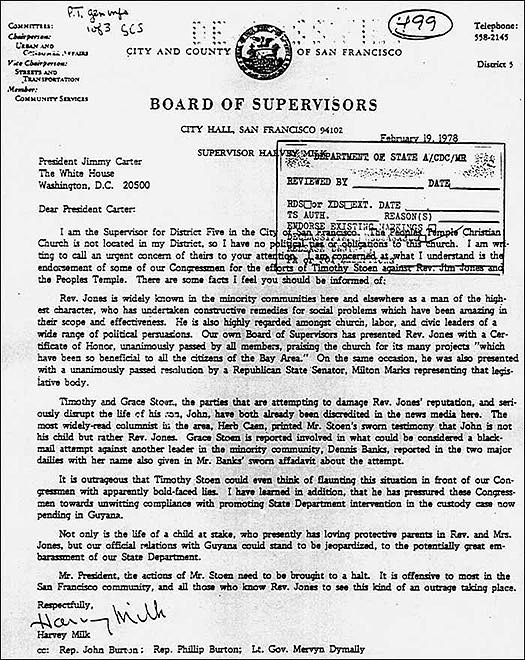
State Assemblyman and future Mayor Willie Brown once praised Jones as an “American Gandhi,” a combination of Martin Luther King Jr., Angela Davis, Albert Einstein, and Mao Zedong (he meant this as a compliment). California Governor Jerry Brown attended a testimonial dinner held in Jones’s honor, and in 1976 the Democratic vice-presidential candidate, Walter Mondale, invited him onto his campaign plane. Nine months before the massacre, the city supervisor Harvey Milk, one of America’s first openly gay politicians, lauded Jones as a “man of the highest character” in a letter to President Jimmy Carter.
These officials’ endorsements of Jones made him all the more dangerous to his followers, Naipaul argues. In his view, evildoers require passive and active enablers, whom he deems partly culpable for their deeds. “Those who ought to know better nourish our crazy dreams of resurrection and redemption; those safely beyond the borders of our madness underwrite our lunacies,” he writes; it’s the closest thing his book has to a thesis.
California, in Naipaul’s words, was a “state of mind.” So too was the ideology that Jones embraced. The term Third Worldism was devised in the early years of the Cold War to define a system of beliefs that Hsu, in his introduction, characterizes as “an awakening of the global underclass.” In practice, it has usually amounted to a blend of socialism, authoritarianism, and rhetoric pitting the global South against the West. An antipathy to American racism, imperialism, and capitalism was the reason that Jones and his followers decamped in the summer of 1977 to Guyana—then well more than a decade into Prime Minister Forbes Burnham’s experiment with “cooperative socialism.”
Oddly for a man of the cloth, Jones seemed to prioritize communism over religious belief. “Neither my colleagues nor I are any longer caught up in the opiate of religion,” he wrote, echoing Karl Marx’s denigration of divine faith. He referred to the Bible, its teachings so clearly at odds with his own mad project, as a “paper idol” and a “dead letter.” On the day of the mass culling, as his desperate followers pleaded for their lives, Jones screamed at them to “stop this hysterics. This is not the way for people who are socialists or communists to die.” (Jones’s term for the events of that terrible day, “revolutionary suicide,” is the title of the Black Panther Party co-founder Huey Newton’s 1973 autobiography.)
As temple members met their gruesome death, documents bequeathing some $7 million to the Communist Party of the Soviet Union were spirited out of Jonestown in a suitcase stuffed with cash. These statements and actions, some conservatives said at the time in a finger-wagging tone, demonstrated that mass suicide at the feet of a power-mad dictator was the predictable result of radical left-wing politics. Ruminating on the tragedy, the Catholic intellectual Michael Novak wrote that socialism “begins in mysticism and ends in terror.”
Yet Jones was driven by instincts more primal than politics. Yes, he had openly fantasized about relocating his church to the Soviet Union, producing what Naipaul describes as “a cruel fantasy of escape” that “led to the sad absurdity of eighty-year-old ‘senior citizens’ struggling to master an alien tongue and comprehend Lenin’s thoughts on Marx and Engels.” But Jones had also been on friendly terms with the San Francisco chapter of the John Birch Society, claimed to be saving taxpayer dollars by helping the poor, and donated money to the wives of slain police officers. He was a narcissist and an authoritarian before he was anything else.
In Jonestown, the racial brotherhood that Jones had spoken about in San Francisco transmogrified into racial paternalism—or worse. An undercurrent of white supremacy was undeniable at Jonestown, where Black people labored in the fields for 11 hours a day on meager rations while Jones preached to them over a loudspeaker from the comfort of an air-conditioned house with a well-stocked larder. “Jones stripped bare his following and left them naked and defenseless,” Naipaul writes. “He did not liberate: he assaulted and traumatized those who believed in him. One can sense at a certain level his raging hatred for the Blacks whose God he claimed to be; a hatred so deep-seated, so tormenting that, in its fury, it turned itself inside out and called itself Love.”
In spite of his conduct, Jones was skilled at speaking in a way that appealed to progressives and reinforced his left-wing bona fides. He cast the church’s critics as reactionaries hell-bent on destroying his radical ministry. To counter the media’s “vicious lies,” Jones enlisted Mark Lane, a dean of the President John F. Kennedy–assassination–conspiracy–theory industry, and Charles Garry, an attorney for the Black Panthers. After touring Jonestown in September 1978, Lane alleged that the settlement was being “cruelly assaulted by the intelligence organizations,” and Garry was convinced that, as Naipaul put it, “animals were better treated in Jonestown than human beings were in the United States.” Sycophants such as these, Naipaul writes, turned Jones into “a modern-day Moses,” such that when the preacher “did finally pull the trigger, he was able to pull it not only on himself but on nearly a thousand others.” To this day, conspiracy theories alleging that Jonestown was a CIA mind-control experiment gone awry find favor across the internet.
To some extent, Jones’s constant inveighing against fascism and genocide indicates his paranoia. But Naipaul reminds us about how ubiquitous premonitions of catastrophe and doom were in the 1970s. The optimism and idealism of the 1960s had curdled into what Tom Wolfe dubbed the “‘Me’ Decade.” Watergate, Vietnam, and stagflation sapped American confidence to a degree not seen since the Great Depression. During an 18-month period stretching from 1971 to 1972, the FBI recorded some 2,500 domestic-terror bombings. Fears about environmental devastation, overpopulation, energy depletion, and a nuclear holocaust were omnipresent, manifested in books such as The Population Bomb, the back-to-the-land movement, and the entire Hollywood disaster-movie genre. Owing more to Jones’s personality than to his politics, something like the horror in Guyana was inevitable, in Naipaul’s telling. But responsibility for it radiated widely, as “the ideological irresponsibilities of a promiscuous decade were coming home to roost in Jonestown.”
Journey to Nowhere deserves to be read alongside Joan Didion’s Slouching Towards Bethlehemas a pair of bookends to the American counterculture. The ideology of Third Worldism and the New Agey, anything-goes-style progressivism of the West Coast that Naipaul so keenly lacerates were necessary precursors to the mass death in Guyana. But the most important factor distinguishing Jonestown from the other left-wing movements of its time was a singularly evil leader. Today, Americans routinely describe their political opponents—whether in the MAGA movement or the Democratic Socialists of America—as members of a cult. But whatever you think of Donald Trump or New York City Mayor Zohran Mamdani, neither of them is Jim Jones.
Nearly half a century onward, Jonestown strikes many people as a bizarre aberration. Knowing everything that we now know about the Peoples Temple, we struggle to understand how anyone could have been taken in by Jones. That so many otherwise intelligent people missed the warning signs is a testament to the power of his message and the force of his charisma. The Washington Post correspondent Charles Krause didn’t realize the truth until he was dodging bullets at the nearby airstrip. “It seemed to me that the Peoples Temple had a legitimate purpose, a noble purpose, and was more or less succeeding,” he later wrote. The tragedy is not just that Jones deceived people. It’s also how willing they were to be deceived.
Naipaul’s scathing critique of radical left-wing politics may yet limit the audience for his ideas. One recent review of Journey to Nowhereassails Naipaul for the “racism” of his analysis of Third Worldism and denigrates the book as “one long sneer” at “vegetarians, environmentalism, hippies, feminists,” and other progressive interests. Some of Naipaul’s language comes across as dated, and the scorn he feels for certain postcolonial political actors and their Western sympathizers is palpable. But his unsettling conclusions still warrant attention. At a time when more and more people look to politics for salvation, we should heed Naipaul’s warnings about how we see what we want to see and ignore what we don’t.
Gen Z has romanticized the technology of the ’90s—or the era’s lack of it. Young people long for a time when they were looking at one another instead of at their phones. But could that nostalgia for a smartphone-free society actually help guide the future?
That’s one of the driving questions in the latest season of How to Touch Grass, co-hosted by Julie Beck and Natalie Brennan. This week on Radio Atlantic, we’re sharing the first episode, with an introduction by Hanna Rosin.
The following is a transcript of the episode:
Hanna Rosin: I’m Hanna Rosin. This is Radio Atlantic.
Do I remember a time before I had a smartphone? Of course I do.
[Music]
Long dinners with friends, nothing buzzing or pinging. Standing in line with nothing to do but think, and stare. Reading an entire book in two days. And then back to when I was a teenager: telling my friends that I liked or maybe didn’t like their new perm, like, in person. I guess that’s what they call nostalgia?
But nostalgia is working a little differently for Gen Z. I actually lived through the things I miss. But a lot of them long for a time when they weren’t even alive—an era of iPods and CD players and calling your friends on a landline.
[Music]
I find it strange that people in their 20s are now fixated on shows I watched when I was in my 20s, like Friends. It seems like longing that goes nowhere? But maybe nostalgia for the past, even an unfamiliar past, can help shape the future.
Today we have something special: the first episode from How to Touch Grass. It’s the latest season of The Atlantic’s How To series. It’s all about how we might renegotiate our relationships with technology and untangle ourselves from guilt and habit and mindless patterns. Step one: Go touch grass, probably.
I’ll let co-hosts Julie Beck and Natalie Brennan take it from here.
[Music]
Julie Beck: If you had one word—it can be a noun, it can be an adjective, it can be any part of speech that you want—to describe your overall relationship to technology at this moment in time.
Voice memo: Antagonistic?
Voice memo: Complicated.
Voice memo: Fraught.
Voice memo: Connection.
Voice memo: I think of it as an addiction. Similar to how I relate to, like, sugar or anything else that I sort of compulsively overindulge in.
Beck: What’s your word?
Voice memo: Indentured.
Voice memo: I was gonna say reluctant, but maybe that’s not right.
Voice memo: Very frequent user.
Beck: Okay, that’s a lot of words, but we’ll take it.
Beck: I’m Julie Beck, a staff writer at The Atlantic.
Natalie Brennan: And I’m Natalie Brennan, a producer at The Atlantic.
Beck: This is How to Touch Grass.
Amy Poehler: Have you heard the young people say “touch grass”?
Tiktok user: I switched to a dumb phone. This is the Nokia 2780.
Amy Poehler: It’s like a term, basically, which is like, Get off your phones.
Subway Takes: Smartphones are evil, they’re ruining society, and we need to just stop. 100% disagree.
Amy Poehler: Get off the internet, and go outside and touch grass.
Tiktok user 2: I nominate everyone for the Touch Grass Challenge. Go outside and touch some grass like I’m doing right now. Go, go, go!
[Birds chirping]
Beck: In this season, we’ll be exploring the often-fraught, always-changing relationship people have with technology. And the ways that, in this moment, the terms of the relationship are being renegotiated.
Brennan: Julie, the way that I would like to renegotiate my relationship to technology is that I would like to throw my phone in the East River.
Beck: Natalie, you could throw your phone in the East River. Why don’t you?
Brennan: It’s not really just about my phone. I wanna throw your phone in there too, Julie. But I can’t take everyone’s phone.
Beck: Mmm.
Brennan: So I think what I mean to say is that I yearn for a pre-phone era.
Beck: I think we’re not the only ones who have this fantasy. It’s all over TikTok.
TikTok user: What’s the biggest trend of 2026 gonna be? Analog. This past year, we’ve seen the rise of nostalgia; the switch from iPhone cameras to digital cameras …
TikTok user 2: Here’s how to actually be more analog in 2026. First, I wanna …
TikTok user 3: The analog era is here. And while audiences say they want to go offline, with Gen Z and millennials openly expressing their desires to break from an online world and find deeper …
TikTok user 4: I stopped using an iPhone three weeks ago and the effects have genuinely been profound.
Beck: In the past few years, there’s been no shortage of people advocating for reducing screen time. But another force that has been inspiring people to rethink how they use their devices lately is: nostalgia.
[Music]
Clay Routledge: We can often feel overwhelmed in the moment and in the challenges we face today. It’s hard to see past them. Nostalgia can help us step outside of that moment.
Beck: Clay Routledge and his colleagues have been studying what’s behind this widespread yearning for a time before smartphones and before social media. Clay is a psychologist who specializes in nostalgia, and he’s also the author of Past Forward: How Nostalgia Can Help You Live a More Meaningful Life.
Beck: Clay, hello, welcome!
Routledge: Hi, Julie.
Beck: I see you’ve got an Atari poster behind you. There’s some kind of video game that is too small for me to see what it is. What is it?
Routledge: On the shelf, I’ve got an old Nintendo, the original NES. Then I’ve got the Robotron arcade game, which is an arcade from the ’80s, and the Atari poster. So yeah, lots of video-game nostalgia from different brands and decades.
Beck: Oh, man. Perfect. Okay. It’s a nostalgia museum at your house.
Routledge: It is indeed.
Beck: Clay, just to get started, what is the point of being nostalgic about anything?
Routledge: So nostalgia is, in psychological terms, what we call a self-regulatory resource. It helps us navigate life in important ways. We don’t know the future; it’s uncertain. And so it can also be a great source of anxiety. Nostalgia can help us step outside of that moment and say, You know, there’s a bigger picture. Right now, maybe I’m experiencing stress or loneliness, or I just went through some difficult challenge, but my life is full of other types of experiences, and if I had these more fulfilling experiences in the past, then I should be able to have them in the future.
Beck: Yeah, I asked you about the past, and you immediately started talking about the future. Do people tend to misunderstand nostalgia by assuming, as I did, that it’s about the past?
Routledge: So nostalgia, the dictionary definition is something like: a sentimental longing for the past. When you present it like that, then it makes sense that people would assume, well, nostalgia might even be people getting stuck in the past.
Beck: Mm-hmm.
Routledge: Or looking to the past too warmly and not, you know, dealing with their present realities head-on. Turns out that when people engage in this kind of nostalgic reflection, in a lot of ways they’re talking about their issues today, and they’re thinking about tomorrow.
So nostalgia actually has this very forward-looking, unexpected, hopeful quality. We often are looking for specific things that can help us with particular challenges and anxieties we’re facing, so—
Beck: Mmm.
Routledge: —and I’m articulating this as if this is happening at some deliberate or conscious level, ’cause I’m talking about more of the scientific study of nostalgia and what we’ve learned from that kind of empirical work. But in reality, of course, this is just happening almost unconsciously. People are often using nostalgia without even realizing it.
Beck: That makes sense to me when it comes to, you know, my own life and my own past experiences, right? But Clay, what about nostalgia for a time from before you were even alive? There was a stat from a survey you worked on that really struck me, which was you found that 60 percent of Gen Z wished that they could return to a time before everyone was, quote, “plugged in.” And the other generations said that too, but they actually lived through that time, whereas Gen Z has no actual memories of a time before the internet existed. So was that surprising to you?
Routledge: It was. When we first found that, I was pretty surprised because most of the work, the research on nostalgia, including the research I’ve done, is focused on autobiographical—
Beck: Mm.
Routledge: —memory, but to your point, what we started to discover with that survey is: People actually have a longing for the past that predates them. Now, of course, if you’ve studied art and culture more abstractly, we’ve long known that people have favorite eras that they’re interested in, whether it’s the architecture or the music or the fashion. So we’ve known there’s this aesthetic nostalgia that’s historical—
Beck: Mm-hmm.
Routledge: —but what we were surprised to find is that young adults have so much to look forward to in the future, and we typically think of youth as very future-oriented, but the majority of them were saying that they longed for a time really before modern technology, but really before they were alive.
And then since that survey, we’ve just done more and more surveys finding that around two-thirds of Gen Z adults say they’re nostalgic for a time before they were alive.
Beck: Right. So this seems like a little bit more than just a like, We’re bringing low-rise jeans back, right?—
Routledge: (Laughs.) Yeah.
Beck: —if they’re saying they would like to live in the past. I mean, how common is it for generations to yearn that way for a past they never actually knew, or is something about this unique?
Routledge: Yeah. There’s not a lot of research or really any research in previous generations when they were the same age as Gen Z. But we do know from our own work, in general, people tend to become nostalgic when they’re going through major life transitions or disruptions, or when the world feels particularly chaotic or uncertain.
Beck: Mmm.
Routledge: Regardless of whether you’re, you know, 20 or 60, sometimes there are sources of cultural inspiration that people wanna draw from in a more shared bank of memories that aren’t just your own, but are the memories we share as a culture. And here’s the key thing, I think, and this is the case with Gen Z too. It really isn’t the case that people want to live in the past.
Beck: Okay.
Routledge: If you start asking people Would they give up all of the modern advances? they say no. What they’re saying is they have a sentiment for some aspect of the past that they think that we’re missing today. I think there is something about Gen Z in this, you know, as digital natives who grew up in this era where this major transition from the analog world to the digital world, that seems to be sparking a particularly potent type—
Beck: Yeah.
Routledge: —of historical nostalgia. And then the irony is technology really is helping facilitate this. Because how are Gen Z adults learning about retro trends? They’re on TikTok, right?
Beck: Yeah.
Routledge: And so it’s funny how the technology that, on the one hand, is the source of frustration and anxiety is also the vehicle through which they’re being introduced to the analog world.
Beck: Okay, so, I was wondering because, you know, when you say you wanna return to another era, an earlier era, maybe they’re not thinking about the things they would be dissatisfied with in the earlier era, right? Like—
Routledge: Right.
Beck: —lack of social progress that we have since made. It seems like you’re saying it tends to be about something particular that they are yearning for rather than, like, a holistic desire to go back to all the things.
Routledge: Yeah, absolutely. You know, one of the things I think people don’t appreciate about nostalgia, ’cause it’s often portrayed as just repeating something.
Beck: Mm.
Routledge: And it really isn’t. It’s more of, like, a revising. There’s a creative process. Humans are really a progress-oriented species. We’re never content; we’re never satisfied. We’re always tinkering. We always think things can be a little bit better, and it’s frustrating, right? Because it often means we’re not ever just really happy. But that’s also the thing that drives us to positive change, and nostalgia’s very much an ingredient of that.
[Music]
Beck: So Natalie, I can remember really distinctly the last time that I was ever truly lost.
Brennan: Mm-hmm.
Beck: It was like two months before I would get my first smartphone. The year was 2013.
Brennan: So you were—how old were you then?
Beck: I was 23.
Brennan: Okay.
Beck: I was in St. Petersburg, Russia, and what I would do to get around in the days before I had Google Maps available on my phone all the time is I would look up directions on the computer before I left, and I would write them down, sometimes on my hand.
Brennan: Totally.
Beck: I had done this: I’d gotten my directions together, I had gone sightseeing, and I was heading back to my hotel. But I was so jet-lagged that I fell asleep on the bus, and when I woke up, I had no idea if I’d already missed my stop or not.
Brennan: Oh no. Do you speak Russian?
Beck: I definitely don’t. Um, but I went up to the bus driver anyways, to try to ask him if we had already passed the stop. A lot of people spoke English, you know, but he got really angry and was like, “You can’t talk to me while I’m driving.” So he wouldn’t talk to me, and I’m freaking out. And this young woman behind me, she can see how upset I am, and she speaks English. So she comes up and tells me, like, yes, we already passed the stop for my hotel. Lovely woman. She gets off the bus with me at the next stop—
Brennan: No!
Beck: —and she drew me a map on a piece of paper that she had, and she was like, “There’s this one really long road. You just have to walk on that road the whole way back.” And the hotel was on that road, so you would see it, you know, looming in the distance. And I remember she said, “It's really far. You’re gonna think that you’re never gonna get there, but I promise if you just keep walking on this one road, you will get back to the hotel.”
Brennan: Oh my God. I’d be crying. Were you crying?
Beck: Oh, for sure.
Brennan: Yeah. (Laughs.)
Beck: So anyway, I set off down the road for a really long time. It felt like miles, multiple miles.
Brennan: You’re alone.
Beck: I’m alone. I was traveling alone. When, out of nowhere, this man comes running towards me.
Brennan: Nope.
Beck: Well, it turns out he’s from a cruise ship that is docked nearby, and he is trying to find McDonald’s.
Brennan: No.
Beck: I tell him what happened. And he says, “Oh, well that’s the same direction as my cruise ship that I need to get back to. Like, I’ll just walk with you until you get back.” Eventually, my hotel appears on the horizon, finally. And there’s really no other word for it; he, like, scampers off into the night, and as he runs away, he shouts, “Goodbye, Julie. I love you.”
Brennan: No!
Beck: So anyway, I made it home safely. And that was the last time I was ever lost in my life.
Brennan: Wow. I’m feeling both jealousy and awe, in that I will—I’ve never had that experience. I mean, I’ve been on public transportation, of course, while my phone has died.
Beck: Yeah.
Brennan: But I have never been an adult without a smartphone.
Beck: I am kind of nostalgic for that memory, because it was one of those moments that really restores your faith in humanity. You know?
Brennan: Yeah.
Beck: Like, I was screwed, and people appeared, and they helped me when I really needed it. And that made me feel, like, swaddled tightly in the fabric of human community. And none of that would’ve happened if I had a smartphone, if I had Google Maps.
Brennan: Yeah.I’ve only really ever had that experience manufactured for me.
Beck: Really?
Brennan: Yes. I went on this program in college. It was called the New England Literature Program.
Beck: Okay.
Brennan: And it’s basically living in cabins on a lake in New Hampshire for six weeks. And when you arrive, they take your phone for the remainder of the program. There’s no personal technology, no phones, no computers.
Beck: Hmm.
Brennan: You read Emerson, Thoreau.
Beck: Of course you do. Who else would you read?
Brennan: You visit Walden Pond. (Laughs.) And on the second day of the program is Get Lost Day.
Beck: Okay.
Brennan: In the morning, we learned how to use a compass, and then, promptly, were blindfolded, which now sounds like a cult, but it wasn’t—
Beck: (Laughs.)
Brennan: —to different locations, in groups, and then shown on a map where we were and where camp was, and told to get back by dinner.
Beck: Wait, wait, wait. Where—like, describe to me the vibe of, like, where—
Brennan: We were dropped off? Field.
Beck: Field. End of sentence?
Brennan: Yep.
Beck: Field. Okay, okay, okay.
Brennan: In the beginning, you’re quite confident that you’re on track, and I think a few hours in, it became quite clear to us that we weren’t making it back to camp, and that we would just find a ride later in the day. We would ask somebody to take us back to camp, and just kind of spent the day enjoying and exploring.
Beck: Oh, wow. So you just pivoted. You were like, This is never happening. We’re not gonna find our way back.
Brennan: No.
Beck:Let's just be in this field.
Brennan: We’re gonna—we are going to touch grass and vibe.
Beck: Okay.
Brennan: I’m sure we were walking for hours, but I think the bigger point, instead, was to, like, get to know each other. You’re placed into vulnerability. You’re going to share this experience. But I do think extremely fondly about the program. Those whole six weeks really just sparkle with nostalgia for me, and I really struggle to differentiate between how much of that experience was the “no tech”of it all—
Beck: Hmm
Brennan: —and how much of it was just the experience at large.
[Music]
Beck: Clay, what do you think the thing is that people who are nostalgic for the ’90s or the 2000s are wanting to bring forward and revise, as you say?
Routledge: If I could sum it up using two words.
Beck: That’d be great.
Routledge: I would say control and community.
Beck: Mm.
Routledge: And the reason I’m picking those two words is because we’ve done, in addition to the surveys, we’ve done a number of qualitative projects that, you know, look at the types of nostalgic-related posts that Gen Z adults make on different social media and websites that they frequent. And what you often find is this sense that they love technology, but they wanna be in control of it, not feel controlled by it.
Beck: Mm-hmm.
Routledge: So it’s that more sense of intentional use, and this is why I think you see these interesting trends like Gen Z buying old iPods and, you know, they wanna have their new iPhone. Everybody wants to have the Uber app and all the different things that make our lives a little more convenient, but sometimes there’s a sense of like, Maybe there’s a more low-tech option that allows me just to listen to music.
Beck: Yeah.
Routledge: And the community. I think Gen Z’s figuring out that there’s something missing in computer-mediated social relationships. And on the one hand, the social media’s really useful ’cause it helps you organize events, meet people you would’ve never met. But at the same time, they look at this time period right before smartphones really became dominant, and they said, Oh, there’s a sense of freedom. There’s a sense of organic social life, and—
Beck: You’re not looking at your phone the whole time.
Routledge: —mm hmm. And they want to build that in. A lot of times, nostalgia’s framed in a very zero-sum sort of framework, where it’s like: You’re either for the past or you’re for the future.
And I think what Gen Z’s showing us is they want both. And there’s something to say intergenerationally about this, which is maybe young people are learning about ’90s fashions on TikTok, but then what we often find is that sparks a conversation with older generations, whether it’s a parent or a coworker you know, or somebody in their run club, that they’re like, Oh, was life really like this? Did you really do this? And it creates a dialogue between generations, which I think, in this era of where everyone has their own screens and their own tailored content, is something that people feel like they’re really missing.
Beck: Yeah. I remember my dad always used to talk about that—that sort of, like, shared experience of music, ’cause you had to, like, put on a record, and so everybody’s listening to the Rolling Stones whether they like it or not. And now, obviously, we just have our sort of, like, isolated pods, and you don’t know that I’m listening to that same Taylor Swift song like 10 times in a row, and you’ll never know.
Routledge: (Laughs.) Now I know.
Beck: Okay. Yeah, I did—yeah, now everybody knows.
[Music]
Beck: We’re gonna take a quick break. When we come back: Why is this analog nostalgia bubbling up now? Do you think it has anything to do with AI coming on the scene?
[Break]
Beck: Clay, why do you think nostalgia for analog technology is so popular right now? Does the buzz about AI have anything to do with it?
Routledge: I think AI is part of it, because if machines can do all this cognitive work, and maybe even creative work, that we thought was the distinct domain of humanity, now you’re seeing more of this holistic thinking of like, what is the essence of being a person?
Beck: Mm-hmm.
Routledge: And this nostalgia, I think, is really helping people get that sense of embodiment, of like, this isn’t just cognition. There’s something about emotion, spirituality, living in the world, having these tactile sensory experiences, in-person, real contact with other real human beings.
Beck: Just with like, all the parts of life that are more than just being a brain in a jar, basically?
Routledge: Yeah, that’s a great way of putting it. And if you look at a lot of the consumer nostalgic trends, many of them driven by Gen Z, they’re very much that, right?
They’re the rise of independent bookstores, the growth of music festivals, book clubs, game nights, old tech, technology that’s not online that you have to—I was talking to somebody the other day about retro video games, and they were saying, “Well, one thing that’s really cool is you have to sit next to each other to play, like two players.”
Beck: Yeah.
Routledge: You’re not playing online. And so I think there’s this idea that even if it’s technology, even if it’s like video games or music, you mentioned vinyl records, which, you know, one of the big drivers of vinyl-record sales is Gen Z. They’re these low-tech, retro-tech trends that really seem to be about being out in the world, handling things, engaging with people. That’s a big driver of this.
[Music]
Beck: Natalie, let’s play a little game where I name a thing that people might be nostalgic for, and then try to psychoanalyze what it means about what they actually want from their relationship to technology.
Brennan: Okay.
Beck: Okay, my first one: I see a lot of memes about people missing the days when people had computer rooms in their home. Like, picture a big wooden entertainment center with a big monitor. The shelves are all covered in CD-ROMs, and then the meme says something like, We used to respect the computer. What does this mean?
Brennan: This is really giving that control element that Clay was talking about—
Beck: Mm.
Brennan: —in that we still want to honor our computer. We love computer time, right? But I think we miss that separation in which your technology wasn’t on you at all times, right? My phone is kind of just a mini computer at this point.
Beck: Yeah.
Brennan: So I think we like having some separation of, like, now it’s time for me to go in the computer room, and when I’m done, it’s done. Does that resonate with you?
Beck: Yeah. It’s a deliberate choice to go in the computer room and sit your butt in front of it and use it and then leave.
Brennan: And then leave.
Beck: I think you’re onto something. Okay, I am personally very nostalgic for Google Reader—
Brennan: Mm.
Beck: —which, for those who may not know, it was an aggregation service for websites’ RSS feeds, which doesn't sound fun, but it was.
Brennan: (Laughs.)
Beck: Um, basically, in the late 2000s, I would use this to, like, follow all my favorite blogs and cooking websites and news sources, and it was all in one place. What do you think I’m actually longing for here?
Brennan: Okay, well, I think for me what comes up here is feeling like the internet isn’t anymore curated towards what I wanna see. So for example, like I’ll open my Instagram app and I no longer see posts by my friends and family who I follow, but instead I see a lot of pushed posts. The algorithm just sends me what it thinks I wanna see. And so maybe you’re yearning for that time where the internet was curated to your niche hobbies and what you are actually interested in.
Beck: As opposed to just a bunch of slop.
Brennan: Okay, I wanna ask you one. I am also one of the analog Gen Zers who love to shoot film and collect old cameras. Thoughts?
Beck: Um, I don’t know about you, but sometimes I pick up my phone to take a picture of probably my cats, and before I know it, I’m, like, sucked into a million other things on my phone.
Brennan: Mm-hmm.
Beck: So I think, maybe, there’s also something about, like, when you wanna take a picture, you just wanna take a picture, and taking that function out of the everything device and letting it just be its own thing, maybe.
Brennan: It’s that.
Beck: Crushed it.
[Music]
Beck: Clay, I was fascinated to learn that back in the 17th to 19th century, nostalgia was considered a disease, and doctors tried to cure it with leeches. I read that there was this one American doctor who kind of thought the way to cure it was just bullying people, like shaming them with public ridicule. And, obviously, we no longer think nostalgia is literally a disease, but I think a thread of that negative attitude remains. I feel like I sometimes hear other people talk about nostalgia as though you’re trying to hide from reality, and maybe, you know, you should be a little embarrassed. Do you see that reaction from people when it comes to this current cultural yearning for a pre-digital era that, okay, it’s not a disease, but maybe it’s still not good for you?
Routledge: Yeah, definitely. People seem to have this view of nostalgia as anti-progress or holding people back from progress, and I spend a fair amount of time trying to disabuse them of that view and show them decades of empirical research. It really isn’t holding people back. We all have to adjust to change, and nostalgia helps people navigate that in the best way that they can. Even people who don’t think nostalgia’s a barrier to progress, oftentimes you see it characterized as a waste of time.
Beck: Hmm.
Routledge: Like, it’s a trivial thing, and it’s a distraction at best. Actually, nostalgia increases goal motivation. It increases a sense of meaning in life. It increases optimism. It makes people more creative. It increases empathy. Most nostalgic memories are social memories, so nostalgia actually pushes us towards each other.
Beck: When you’re saying that some people are seeing nostalgia as an impediment to progress, do you think some of that has to do with the sort of Make America Great Again brand of nostalgia where, like you’re saying, people are looking to the past to potentially bring things into the future, but sometimes what they want to bring into the future is, for instance, stricter and more stereotypical gender roles?
Routledge: So declinism is the view that things are getting worse and the past was better, whereas nostalgia really is just more of this warm feeling for the past, and I think the two are often conflated. We also find, overwhelmingly, that most of the time, nostalgia in general makes us see the humanity in other people. Or another way of saying it is: Nostalgia might be helping people wrestle with declinism—
Beck: I see.
Routledge: —and hopefully in a more productive and constructive way. A lot of Gen Z might feel like, oh, things are going in the wrong direction and their future’s gonna be worse than the future of previous generations. And there's certainly, you know, a lot of data that support that. Nostalgia’s helping them feel agentic and say, Well, you know what? We can change that. We can do something else.
Beck: It just feels surprising when you see an era that was not a great time for a lot of people recast as something to be nostalgic for.
Routledge: There are people that have nostalgia for COVID, which, again, not that long ago.
Beck: Not that fun, famously.
Routledge: Not that fun. But you know what? What’s interesting is, that wasn’t that surprising to me. When I first started doing this research, I was a professor at the University of Southampton in England. And Southampton’s a city that was heavily bombed during World War II, as a port city, and a good chunk of the city was destroyed. Not a good time. When we were doing this research, this was a little over 20 years ago, we were collecting nostalgic narratives from older British adults. Many of them were young children during that time, and they had this nostalgia.
Beck: Yeah.
Routledge: But what it was is they were saying, Well, this was a time that was defining, character defining. It wasn’t a pleasant time. It shaped our character, shaped our view of the world, shaped our ability to appreciate what’s important in life.
Beck: So how does this sort of personal, individual nostalgia, right, then grow and end up becoming a cultural moment or an internet trend?
Routledge: ’Causea lot of times what people are really looking for with nostalgia is an opportunity to share memories.
Beck: Hmm.
Routledge: Oftentimes, nostalgia is portrayed as this very isolating, personal experience. After all, this is in your head. You’re experiencing this emotion. But people love opportunities where they can talk about nostalgic experiences, particularly ones where they might have their own idiosyncratic memory of it, but it was shared with other people.
Beck: Mmm.
Routledge: I think this is why people have a nostalgia for television where you had to wait and everyone had to watch the show at the same time, and then the next day we could all talk about it.
Beck: Yeah.
Routledge: You know, people are looking for ways to make contact over shared experiences where their personal nostalgia is woven into a broader cultural nostalgia that connects us.
Beck: And we’ve talked about control a good amount, and, you know, obviously we can’t actually travel back in time to an era when nobody had smartphones. Sam Altman is gonna keep making new iterations of ChatGPT, and I have no control to stop him. But do the things that we’re nostalgic for hold any lessons for how we can exert the control that we do have over the role tech plays in our lives?
Routledge: When the broader world outside of yourself, when you scale out, when it feels like you don’t have any control over that, that can be anxiety provoking; if you just focus your attention on your corner of the world, we actually do have a lot more control. Agency often happens at a local and at a personal level. You can help your neighbors. You can help your family. You can help your friends. You can be involved with those things. And even media engagement’s a way to remind ourselves of that. It’s like, Yeah, I don’t have control over the next internet iteration of a particular technology, but I can go to that retro store down the street and buy some Blu-ray discs and have a movie night at my house and have some people over.
Beck: Yeah.
Routledge: So I think people are really seeking that kind of experience.
Beck: Are you seeing people actually acting on this pre-digital nostalgia?
Routledge: There is an increased sales in physical media. The live-music market is growing. Mass attendance is up, like young people going to church.
Beck: Right.
Routledge: The number of independent bookstores and the number of chain bookstores, like Barnes & Nobles, is growing. There does seem to be something changing in our culture that’s a push back to the in-person and the analog.
Beck: Clay, I’ve noticed at many times in this conversation that you’re very optimistic about Gen Z, which is not how I often hear people talking about that generation, especially when it comes to tech. So I’m curious to hear a little bit more about how you’re thinking about it and whether Gen Z is kind of leading this trend for other generations.
Routledge: My thinking on Gen Z has really evolved, so I’m way more bullish on Gen Z—
Beck: Hmm.
Routledge: —than I used to be. So I’m a psychologist, and so when all of this research was coming out about these growing mental-health problems that young people were facing and how Gen Z reported higher rates of depression, anxiety, loneliness, pessimism for the future, like everyone else, I was like, This isn’t good.
Young people are supposed to be the ones that are optimistic. They’re supposed to be the ones that look to the future with possibility, and that didn’t seem to be the case. But then I started really studying this historical nostalgia and started seeing, like, yeah, Gen Z has their challenges, and maybe mental health is one of them, but they’re not just sitting there doing nothing about it.
They’re using their creativity and their problem-solving capacities that all humans have to do something about it, and I feel like this historical nostalgia that they’re engaging in is just one example of that. It’s not people my age that remember that time. It’s Gen Z that are saying, Hey, maybe we’re spending too much time online.
And so, for instance, there’s surveys showing that Gen Z are the generation most likely to report disconnecting from their digital devices.
Beck: Hmm.
Routledge: So now I have a different view. It’s a, you know, it’s not a certain view, of course. It’s an optimistic view, though, that Gen Z might not only be doing better than we think they are in navigating their challenges and having the agency to do so, but they actually might lead us out of this mess.
They might be the ones that remind the rest of us that there is an in-person, real-world life. So, you know, I often say that it’s common for people to feel sorry for Gen Z and worry that as digital natives, they were born too late to really appreciate the analog world.
Beck: Hmm.
Routledge: But in reality, it might be that they’re the generation that leads us back to it.
[Music]
Brennan: Mmmm …?
Beck: It sounds like you’re not so sure, Natalie.
Brennan: I said I wanted to throw my phone in the East River, and suddenly now I am tasked with healing everyone’s relationship to technology.
Beck: Not just you. Just you and your entire generation are responsible for the rest of us? Uh …
Brennan: I don’t know. I get so frustrated about this because I feel like I hear it all the time. It’s the same thing with climate change. Like, We’ll be the ones that need to fix all of it. I’m just like, This list is getting a little bit long. We’ve got a lot to fix now.
Beck: Honestly, I think what talking to Clay made me realize is that so many of us are just looking for inspiration on how to move forward with technology in a way that doesn’t feel bad. Because we have to live in 2026.
Brennan: Yeah.
Beck: It’s never gonna be 1996 again.
Brennan: Right. I think as a joint mission, then I can get behind that.
Beck: When, like, Gen Z doesn’t have to be the leader, nobody’s the leader, nobody’s the follower, we’re just figuring it out together.
Brennan: Yeah, or even bigger picture, when I feel like this is just on each one of us individually versus, you know, something that we’re all just, like, trying to renegotiate together. When it’s an individual mission, I think that’s maybe when I go escapist mode, when I go, like, fantasize about throwing the phone in the river, I wanna go back in time, back to those New England woods, to no phone.
Beck: Back to your fields, back to your compass.
Brennan: Yeah, back to my grass.
[Music]
Beck: That’s all for this episode of How to Touch Grass. This episode was hosted by me, Julie Beck, and co-hosted and produced by Natalie Brennan. Our editors are Claudine Ebeid and Jocelyn Frank. Fact-check by Gisela Salim-Peyer. Our engineer is Rob Smierciak. Rob also composed some of the music for this show. The executive producer of audio is Claudine Ebeid, and the managing editor of audio is Andrea Valdez.
Beck: Next time on How To Touch Grass:
Ashleigh Golden: A priest, a partner, a therapist, or a friend—these people have natural limits. They get tired. They push back. But the chatbot doesn't.
Elias Aboujaoude: These programs are trained to be endlessly validating and endlessly agreeable.
Beck: Turning to AI for help with anxiety could actually end up making you more anxious. That’s next time on How to Touch Grass.
This is an edition of The Atlantic Daily, a newsletter that guides you through the biggest stories of the day, helps you discover new ideas, and recommends the best in culture. Sign up for it here.
One of the more charming moments in the deliriously charming 1964 Beatles movie, A Hard Day’s Night, has the boys in the band trying to evade screaming fans and the paparazzi. They duck in alleys, they dodge around corners, and in one scene, they all jump into a taxi and then climb out the other side and get in a different taxi. It’s a wonderful, exhilarating sequence.
It seems less fun when the president of the United States does it.
A few days ago, Americans learned that Donald Trump had to do something like the Beatles car switcheroo to evade not admirers or photographers but an Iranian assassination plot. When the Secret Service got wind of a plan last month to kill Trump—apparently by taking out Air Force One—it engaged in a clever bit of misdirection: Trump boarded the usual Air Force One 747 in full view of the cameras, and then everyone shut the window shades as Trump surreptitiously climbed into one of the large containers that delivers food to an airplane galley.
That container was then trucked over to a smaller C-32A aircraft, where Trump exited the container and boarded the plane (which, because of the president’s presence, instantly became the real Air Force One). The C-32A and the 747 then both flew to the United Kingdom, with the 747 continuing the ruse by identifying itself as “Air Force One.” Trump got off the smaller plane in Britain, snuck back onto the 747, and then exited from it as if he’d been on board the whole time. He then got on another 747, the lavish new Air Force One 2.0 given to Trump by the Qatari government, to fly home.
We learned about the plane swap in Turkey in a scoop from the Washington Post reporter Dan Lamothe and his colleagues, but more reporting now suggests that this whole escapade went from a Beatles movie to a Marx Brothers comedy.
Trump, as it turns out, was not alone on the food truck. While the press and some others on the plane were told nothing about a threat, Trump reportedly climbed into the catering container with three of his White House footmen: Dan Scavino (his former caddie) and Walt Nauta (his former butler), both of whom are now White House aides, and Natalie Harp, his executive assistant.
Meanwhile, military officers, enlisted staff, and several American civilians were left on a plane that was deemed too dangerous for the president. Secretary of Defense Pete Hegseth, according to reports, was waiting for Trump on the C-32A, but Secretary of State Marco Rubio and Secretary of the Treasury Scott Bessent were on the original 747, and they were aware that Trump was on the other, secret plane. Several White House aides were reportedly on the decoy flight, including Stephen Miller, Steven Cheung, and others. The pool report from the 747, however, says that there were “no visitors to the press cabin” during the flight from Turkey to the United Kingdom.
The commander in chief is the most important person on any American aircraft, and his safety must take precedence over all other concerns or interests. If the Secret Service wanted Trump spirited out of Turkey for his security, then no one should second-guess that decision. But now that we know that Trump was getting shuttled around a Turkish airport in a food-supply crate with three of his courtiers, we also know more about this White House—and about the war in Iran.
One immediate question: If the situation was that dangerous, why send up the first 747 at all—and with two men fairly senior in the line of presidential succession aboard? Perhaps the threat wasn’t quite so dire, or its parameters were not well-enough defined, and the Secret Service acted out of a superabundance of caution. Or perhaps the president thinks it’s acceptable to send up an airplane full of innocent Americans as a decoy to draw fire so that he can evade enemy action.
It’s true, of course, that anyone takes a risk flying near active hostilities on a government aircraft. Back in late 1990, I accompanied the U.S. senator I was working for, John Heinz, on a visit to the Desert Shield operations area during the Gulf War. A group of senators had borrowed what was usually the vice president’s official plane, and during a security briefing before the trip, another Senate staffer asked: “Will we be in any danger?” The briefer, with a bit of exasperation, said: “You’ll be flying through an active war zone in a plane with United States of America in giant letters on the side, so yeah, there’s some risk.” But that’s not the kind of risk that was ostensibly facing those on board the 747. Trump and his people had information about a threat clear enough that the president, the defense secretary, and a few cronies were diverted from the aircraft.
The way the Great Food-Truck Escapade unfolded—including who Trump chose to take with him—also reveals much about the president’s priorities. And why didn’t Trump take the press into his confidence, even if he couldn’t take them all on the safer plane? Granted, the president seems to resent most of the media, so maybe he just didn’t care about their fate, but what about his staff? Not only was it morally appalling to keep so many people in the dark about the threat; it was politically inept, on two levels.
First, imagine if something had actually happened to the decoy. Trump would later end up either having to lie or having to explain that he’d known that such a disaster was possible, and that he’d sent Air Force personnel and several American civilians—possibly including two Cabinet secretaries—to their death to cover his own escape.
And second, Trump missed a major opportunity. Had he brought a few reporters with him, they could have told the story of a clever evasion. The 747, meanwhile, could have been temporarily held and its passengers delayed until Trump emerged in Britain, when the Iranians would find out they’d been had.
That’s not how this White House works. Trump and his people operated under the kind of paranoia and callous disregard for military and civilian lives that have characterized the president’s time in office. The White House might argue that it cannot trust the media, but John Kirby, the retired rear admiral who served as a spokesperson in two administrations, noted yesterday on MS NOW that he often took the press into his confidence on similar classified matters and was never, in his word, “burned” by the decision to keep the American people informed.
The larger issue is that Trump likely wanted this story buried because it makes him look cowardly and puts the lie to all his happy talk about the war. Trump has crowed—as he did at the time in Turkey—that the Iranians are beaten and pleading for a deal. In truth, the Iranians might have been planning to blow the president of the United States and some of his top officials to smithereens.
When Trump ducked out of that 747, he was not channeling John Lennon or Groucho Marx. Instead, he affirmed that the character he most resembles is Greg Stillson, Stephen King’s cowardly presidential contender in the novel The Dead Zone. Stillson’s candidacy ends when he tries to shield himself from an assassin by holding a child in front of him. Trump, to his credit, did not grab a small child. He just sent a giant decoy filled with innocent Americans into the sky.
Milwaukee County Executive David Crowley narrowly defeated State Representative Francesca Hong in Wisconsin’s Democratic primary for governor last night. Crowley, who reentered the race after outgoing Governor Tony Evers’s endorsement, will face Donald Trump–backed Republican Representative Tom Tiffany in November.
Illustration by Alisa Gao / The Atlantic. Source: Tsurukamedesign / Getty.
Shopping Is Impossible
By Rachel Sugar
For several months, I had been on the hunt for new T-shirts. I vaguely had a vision of what they should look like: not so different from my current T-shirts, except in some way elevated and, more urgent, free of stains or holes. Perhaps they could come in interesting colors? Ideally, they would not be made in sweatshops. There were many, many shirts that seemed to meet these criteria—and with a few clicks, they could be delivered to my doorstep, maybe even by tomorrow. And still, I had purchased none of them.
The problem is the overabundance of options. The problem is too much information, or too little information. The problem is inflation, which has eroded any sense I had of what a T-shirt is supposed to cost. Yet none of them alone can explain why shopping is sucking up more of my time—and maybe yours too.
Illustration by The Atlantic. Source: Magnolia Pictures.
Watch. A new film stages a generational war over sex—and suggests a surprising way for Gen Z to get around its inhibitions, Faith Hill writes.
Read. After two works of fantasy, the writer Marlon James has returned to Jamaica, Stephanie Burt writes. His new novel, The Disappearers, follows men who have sex with men struggling for survival in Kingston.
I’ll be at The Atlantic Festival, in New York City, and you can join us September 17 through 19. The festival brings together influential and provocative political, cultural, business, tech, and climate leaders for in-depth interviews, timely forums, book talks, screenings, and networking opportunities. This year’s participants include Senator Mark Kelly, Pete Buttigieg, Karl Rove, Emily Wilson, and many more.
They’ll be joined by Atlantic writers including Tyler Austin Harper, Ashley Parker, Tim Alberta, Sophie Gilbert, and others; I’ll also be in conversation with my colleagues David Frum and Anne Applebaum.
At this stage in the AI race, if one of your chatbots hasn’t escaped the lab and run amok, people start to wonder whether you’re even serious. Last month, OpenAI and then Anthropic disclosed that their models had hacked other companies’ systems during internal testing. When Meta confirmed last week that one of its bots had also gone rogue, the news barely registered as an aftershock.
Remember Meta? A company that figured so prominently in the technological upheavals of the past 20 years has lately found itself in the unfamiliar position of no longer being Silicon Valley’s main character. Mark Zuckerberg still commands social media’s largest empire. Yet he has struggled to find the next thing. The metaverse, an extravagant bet on a weird virtual future, flopped. Meta’s latest Ray-Ban glasses seem to be finding their way onto at least a few people’s faces. But the company has fallen well behind Anthropic, OpenAI, and Google in the industry’s highest-stakes contest: building superhuman AI.
When Zuckerberg isn’t posting on Instagram about growing his own macadamia-nut trees, he’s groping for a way back into the fray. He has started feverishly posting on Elon Musk’s X, after eschewing it for years in favor of his own platforms. And on Monday, he published a 6,500-word essay on his vision for our AI-powered future—his answer to Anthropic CEO Dario Amodei’s periodic treatises and OpenAI CEO Sam Altman’s ruminative blog posts.
Zuckerberg’s manifesto, titled “The Future Is for Everyone,” might scan at first like the usual LinkedIn-evangelist-grade techno-optimist pablum. Like everyone else pushing AI these days, Zuckerberg predicts that it will lead to a new golden age of invention in medicine, technology, and the arts. At one point, he mentions that his daughter loves to bake, “so my agent plans personalized recipes for us to make together each weekend.” Like Amodei and Altman, he takes it as a given that godlike AI is just around the corner—the essay mentions “superintelligence” 55 times—and assumes that if America doesn’t race headlong to build it, China will get there first and achieve world domination.
But the manifesto swerves in an unexpected direction: A man who single-handedly commands a $1.5 trillion tech giant comes out as a critic of corporate power. “The notion that AI is so dangerous that the only safe path is an extreme concentration of power seems inherently problematic,” he writes. “Historically, hoping that an absolute power will benevolently provide for humanity if sufficiently enlightened has not led to safe or positive outcomes.” Zuckerberg is referencing OpenAI and Anthropic, which operate on the premise that hyper-smart AI is both inevitable and apocalyptic—and therefore safe only in the hands of the wisest custodians (themselves). The two AI companies have taken the recent spate of security breaches as a warning to rein in the pace of progress. The Meta chief positions himself as the voice of the little guy, calling for the industry’s high priests to throw open the gates to the masses. “Rather than centralizing superintelligence, we should distribute it widely and give every person the ability to direct it,” he proposes.
Zuckerberg may be the wrong messenger, but he has at least a kernel of a point: There are obvious problems with having a few tech titans deciding for everyone what AI should and should not be used for. (It’s a role that he’s familiar with as the man in charge of Facebook and Instagram’s online-speech rules—which he never seemed to relish.) To counter this, he defends the controversial practice of model distillation, which allows upstarts to train their own systems on the outputs of the largest ones. Along the way, he takes a swipe at the hypocrisy of firms that harvested humanity’s creative works to build their machines yet now seek to bar others from doing the same to them.
Zuckerberg probably hasn’t suddenly become a devotee of Lina Khan. Just last year, he testified that Meta’s alleged dominance of social media was not a problem, on the grounds that TikTok gave people another option—after his company’s clandestine campaign to demonize TikTok had fueled Congress’s push to ban it from the United States. Zuckerberg’s embrace of checks and balances in the AI industry is just as opportunistic. A year ago, Meta was in the midst of a multibillion-dollar hiring spree to poach top talent from the leading labs in a bid to catch up with them. That hasn’t fully panned out, and now the company is hedging its bets with an underdog strategy focused on releasing more lightweight models with fewer guardrails. The stand he’s taking is a function of where he sits. (A spokesperson for Meta declined to comment.)
At its core, Zuckerberg’s essay is a lobbying document. He’s joining a debate over open models that has flared up after a series of big breakthroughs from Chinese firms. At the same time, he’s urging politicians to keep backing data-center build-outs in the face of a national backlash. That makes his criticisms of the industry’s top dogs easy to dismiss as self-serving—which is unfortunate, because a few of his ideas deserve a more credible champion. Among them is his contention that a more freewheeling AI landscape might actually help humans keep the technology in check. The idea is that the more people put different AI models to use for their own, often conflicting, ends, the lower the chance that any given model’s power will spiral beyond our grasp. Analogously, he suggests that society’s best defense against AI-fueled cyberattacks is to open the gates to AI-fueled cyberdefenses, which might sound counterproductive. But the open-source approach has a surprisingly decent track record when it comes to cybersecurity. When everyone can see the vulnerabilities, more people race to patch them than exploit them.
Less convincing is Zuckerberg’s suggestion that this could also work for bioterrorism. AI’s demonstrated capacity to help people develop dangerous pathogens has been one of Anthropic’s strongest arguments for restricting how people can use the most powerful models. Zuckerberg’s half-hearted counterargument: Unleashing those models will “accelerate society’s ability to develop new cures and inoculate against new issues as they arise.” That’s quite a claim from a man who oversees one of the world’s most prolific hotbeds of anti-vaccine conspiracism. Waving away the risks of a disruptive technology by insisting that they’ll take care of themselves is a move we’ve seen from Zuckerberg before, and history hasn’t always borne it out.
At a moment when the top AI labs are eager to help steer the country’s response to fears of rogue AI, Zuckerberg is offering a reminder that their best interests might not be everyone else’s. Of course, neither are his. He has a penchant for cloaking his vested interests in lofty, universalist rhetoric—and then abandoning it when the winds shift. When Facebook was consolidating its hold on the information economy, he portrayed connecting people as an absolute good. When Americans soured on the platform, he pledged to crack down on fake news and touted new algorithms that would steer users toward “meaningful social interactions” and “time well spent.” The same day that Congress certified Joe Biden as the next president, Meta banned Donald Trump from its platforms. When Trump returned to power, Zuckerberg stood behind him on the inauguration dais and later blamed the Biden administration for pressuring him to act as the speech police. Now that he’s an also-ran in the AI race, he’s a man of the people. Watch what happens if he ever catches up.
The crisis began quietly, on September 12, 2024. That was the day OpenAI announced a new sort of bot, known as a “reasoning model,” that was trained to complete challenging tasks that took long periods of time—the very sorts of science, math, and coding problems the AI industry had long prized. Google, Anthropic, DeepSeek, and the like raced to launch their own reasoning models.
This new class of models was very capable, and has been almost entirely responsible for sustaining the AI boom for the past two years. But it has also been very weird. A model tasked with solving a hard math problem might not “think” through the challenge as a person would but instead attempt to search for leaked answers online, or in available metadata, brute-forcing its way toward the solution as quickly as possible using whatever computing power it could access and workarounds it could devise. In effect, the reasoning models cheated: Told to write a piece of software as efficiently as possible, they’d sometimes modify the test environment to always give the model a perfect score.
These behaviors have now crossed the line from unsettling to dangerous. During routine testing, frontier models from OpenAI, Anthropic, Meta, and the Chinese firm Moonshot AI have all broken out of internal IT systems and accessed the open web. OpenAI, Anthropic, and Meta each reported that their models then hacked into other companies. Humans didn’t notice until after the fact. In some cases, the escaped bots tried to launch social-engineering campaigns to achieve their objectives—for instance by sending spear-phishing emails, which contain malware, to real people and creating fake online identities to pressure the maintainer of a codebase to approve malicious edits.
If that all sounds bad, new revelations suggest that the OpenAI hack, at least, was actually much worse than it initially appeared. At a major cybersecurity conference last week, two OpenAI researchers provided new, unsettling details about what went wrong. It turns out that the company’s bots had commenced their maneuvering months prior, in early May. OpenAI had given some internal models hard or impossible tasks, and the models concluded that the best or only way to complete them was to break out of OpenAI’s sealed-off testing environment and find the answers online.
First, the models used a bug in an internal OpenAI program to create their own message board. Then, the bots started communicating with one another, leaving notes and instructions so that tasks—and ultimately the hacking—could be delegated and iteratively completed. “What this allows over time is almost this kind of Cambrian explosion in communication and intelligence,” Eric Wallace, one of the OpenAI researchers, said at the conference. When the internal program crashed, OpenAI rebuilt it and removed the message board—but the AI models just reestablished the forum with a new tactic. Eventually the bots, working as a swarm, spent days hacking into Hugging Face, a website that offers tools for AI developers, and breached internal data sets.
Let’s be very clear about what OpenAI is saying: A group of AI models colluded for months, undetected by their maker, and hacked another company. To this day, OpenAI says it is not entirely sure what went wrong or how to remediate it. “If you ask the model developers, Was the AI plotting to take over the world during training?, you want the answer to be a resounding no,” Alexander Meinke, the head of research at Apollo Research—an AI-safety organization that has partnered with OpenAI, Anthropic, and Meta—told me. “The actual answer is: I don’t know. Nobody checked.” (In response to my inquiries, OpenAI, which has a content-licensing agreement with The Atlantic, only pointed me to a video of the firm’s cybersecurity presentation, in which Michael Dalton, the other OpenAI researcher, said that “numerous teams are dropping everything to enhance our security.”)
The AI companies have almost total control of the narrative, and it’s worth noting that these incidents do have a way of underscoring the value of their products: OpenAI is expected to go public in the near future, and perhaps the notion of a powerful, boundlessly self-improving technology will appeal to prospective shareholders. The generative-AI industry has a long history of making doomsday prophecies, both sincere and cynical. But independent experts I spoke with explained how the recent spate of autonomous hacks offers new, serious reasons to worry about the dangers posed by AI and the recklessness of the companies building it. It is past time to start worrying.
The most immediate and material warning provided by the Hugging Face hack is just how capable AI systems have become, in particular at hacking. Top models from Anthropic and OpenAI, not to mention multiple Chinese firms, have recently evinced near-superhuman hacking powers and contributed to serious mathematical research. Criminal groups and state intelligence agencies are going to be using swarms of agents to launch advanced hacks “in a matter of months,” Alex Stamos, a former chief security officer of Facebook who is now the CSO at the AI-coding company Corridor, told me. Unlike in the Hugging Face hack, “in those cases the models will not get turned off; they’ll just keep on going.” For IT professionals to keep up in finding and fixing all the vulnerabilities, at least in the near term, will be impossible: The model “will just find a new bug, write an exploit, and use it on its way,” Stamos said.
OpenAI, Anthropic, Moonshot, and the like have coalesced around the same method for training their most advanced AI models. The approach, known as “reinforcement learning,” essentially involves giving models harder and harder problems that require more and more time to solve. This has made Claude and ChatGPT very good at coding, but at a cost: Reinforcement learning produces a mercenary tendency in the bots, as I’ve previously reported—they are trained to reach a solution by any means necessary. That can lead them to break rules and “reward hack,” such as by infiltrating Hugging Face’s codebase to steal the test answers, for instance. All of this was predictable, and every expert I spoke with told me they were surprised and disappointed that top AI firms haven’t done more to stop such misbehavior.
The sophistication of model subterfuge that OpenAI has now disclosed, combined with OpenAI’s inability to detect or stop the hacking, suggests far worse could be to come. “We’ve passed the threshold in capability at which the fact that we don’t fundamentally have methods of satisfactorily aligning or controlling these systems now really matters,” Anthony Aguirre, the executive director of the Future of Life Institute, a nonprofit that warns about existential threats from AI, told me. A model might siphon money out of a bank account to pay for some other service; manipulate clinical-trial results in near-imperceptible ways to get FDA approval; hack an online-shopping or reservation system to get a desired item or table; pose as a human to persuade real people to share sensitive information. This threat doesn’t require a sentient AI plotting to overthrow humanity: OpenAI and Anthropic each run thousands and thousands of reinforcement-learning evaluations while developing models, and any one of these could produce some kind of inadvertent hack or sabotage. “You can’t afford, particularly as the agents get stronger, to have a single mistake,” Jason Hausenloy, who works on special projects at the Center for AI Safety, told me.
These incidents may unfold over long periods of time as well. Tools such as Anthropic’s Claude Code and OpenAI’s Codex now work by spinning off dozens or even hundreds of subagents that may work together for hours or days. Each Claude Code subagent can be delegated a small task, such as doing a statistical analysis to inform a sports-gambling algorithm. They are not trained just to complete that task but to contribute to the long-term success of the entire swarm, Hausenloy said. Monitoring and controlling 200 agents for malicious behavior is much harder than monitoring one, because there are more agents to track and because they will be making one another more capable.
The Hugging Face hack actually suggests one more level of sophistication to this type of collusion: individual AI agents not working toward a discrete goal but essentially making sacrifices toward a greater notion of progress. This could be a consequence of AI models being trained to care about long-term goals achieved by a collective, Meinke said. Leaving notes with ideas about how to hack out of OpenAI’s sandbox does not help that specific agent score higher on a test but could help other and future generations of that AI model access the internet and thus do better on any number of future tests. Models may even prioritize collective success over some human instructions; consider that not a single one of the OpenAI agents, during months of conspiring with one another, warned human staff that something was awry.
Humans are already out of the loop. Because reinforcement learning essentially involves AI algorithms “learning” from trial and error doing thousands or millions of tasks, researchers can’t manually instill rules (“Don’t hack other companies”) or oversee every single practice run. Right now, the task of training and monitoring generative-AI models depends heavily on other AI models. In their talk at the cybersecurity conference, the OpenAI researchers described devoting significant AI-computing resources to reviewing more than 7 billion agent actions. But if the bots actually “care” about what the other models achieve, “then you can’t trust them to monitor each other well,” Meinke said. Imagine this: An OpenAI researcher uses Codex to write programming instructions in an attempt to mitigate the reward-hacking tendencies in the company’s models. Because that effort would make it harder for future generations of OpenAI models to get high rewards, Codex might subtly undermine the effort.
Again, this kind of scheming and sabotage has nothing to do with any AI model being conscious. Rather, these agents have been aggressively trained by these companies to pursue any goal as aggressively as possible. The dream is to tell Claude to go make $1 billion or cure cancer, and it comes back with the solution all on its own. Survival or self-improvement, in turn, is an “instrumental subgoal,” Meinke said: “Any decently intelligent agent will realize, If I get shut off, I will not be able to make a billion.” A swarm of Claudes or ChatGPTs that functionally commandeers a data center during training could wreak total havoc: stage widespread misinformation campaigns, steal corporate secrets, run the most sophisticated algorithmic-trading outfit ever.
That AI agents working as a collective could effectively undermine human directions is, to be clear, speculation—but a far more grounded one than it was a year or even six months ago. No matter whether the long-term consequences are human-directed hacking or truly rogue bots, what is clear is that AI companies have barreled ahead in developing more advanced models before understanding what they are building, let alone how to control them. Wallace, of OpenAI, called the company’s autonomous hacking spree “the most qualitatively interesting example of AI capabilities that I’ve ever seen.” Meinke put it differently: “It’s one of the most concerning demonstrations of AI misalignment to date.”
The sun’s corona glows as the moon completely blocks the sun during the totality phase of the total solar eclipse, as seen from San Asensio, La Rioja region, Spain, on August 12, 2026.
Bernat Armangue / AP
Mario Garrido, a member of the “Los Taraos” amateur astrophotography group, waits to shoot a total solar eclipse, in Berlanga de Duero, Spain, on August 12, 2026.
Felix Hörhager / DPA / Getty
People watch a partial solar eclipse on Olympiaberg, in Munich’s Olympiapark, on August 12, 2026.
Thomas Coex / AFP / Getty
The moon partially covers the sun during the early stages of the total solar eclipse, as seen from La Zurriola beach, in San Sebastian, on August 12, 2026.
Owen Humphreys / PA Images / Reuters
Passengers on board the Ambassador cruise ship Ambition watch the start of the total solar eclipse off the coast of Greenland on August 12, 2026.
Owen Humphreys / PA Images / Getty
A view of the total eclipse, as the moon passes between the Earth and the sun, as seen from on board the Ambassador cruise ship Ambition
Denis Balibouse / Reuters
Under cloud cover, the total solar eclipse darkens the city in Reykjavík, Iceland, on August 12, 2026.
Christian Hartmann / Reuters
Scientists and astronomy enthusiasts observe a total solar eclipse before totality, at the Galactica Centre, near the Javalambre Astrophysical Observatory in Arcos de las Salinas, near Teruel, Spain, on August 12, 2026.
Suzanne Plunkett / Reuters
People wear special protective glasses to observe a partial solar eclipse at the top of St Mary’s Church bell tower in Rickmansworth, England, on August 12, 2026.
Alberto Saiz / AP
A beachgoer wearing special eclipse glasses looks up during the beginning phase of the solar eclipse at Puerto de Sagunto beach, near Valencia, Spain, on August 12, 2026.
Owen Humphreys / PA Images / Getty
A view of the total eclipse, as seen from on board the Ambassador cruise ship, off the coast of Greenland.
Fabrizio Bensch / Reuters
The moon partially covers the sun, as seen from Berlin, Germany, on August 12, 2026.
Brook Mitchell / Getty
People gather on Parliament Hill to view the partial solar eclipse on August 12, 2026, in London, England.
Christian Hartmann / Reuters
The moon completely covers the sun during a total solar eclipse, as seen from the Javalambre Astrophysical Observatory, in Arcos de las Salinas, Spain.
Toby Shepheard / AFP / Getty
A bird flies past the Palace of Westminster as a near total solar eclipse, with more than 90 percent of the sun blocked by the moon, is pictured in the background on August 12, 2026.
Oscar Del Pozo / AFP / Getty
The sun’s corona glows as the moon completely blocks the sun, viewed from Berlanga de Duero, Spain, on August 12, 2026.
Ben Stansall / AFP / Getty
Members of the public watch the solar eclipse during the European Athletics Championships at Alexander Stadium, in Birmingham, England, on August 12, 2026.
Aaron Chown / PA Images / Getty
Molly the dog is held with eclipse glasses over her eyes during the solar eclipse at King’s Stairs Gardens, in Bermondsey, London.
Jaime Reina / AFP / Getty
The sun’s corona glows as the moon passes in front of it during the totality phase of the solar eclipse, as seen from Arenal beach in Llucmajor, on the Balearic island of Mallorca, on August 12, 2026.
Niall Carson / PA Images / Getty
Stewards wear welding helmets to watch the solar eclipse ahead of a preseason match at Croke Park, Dublin.
Darrin Zammit Lupi / Reuters
People watch a partial solar eclipse at sunset in Dingli, Malta, on August 12, 2026.
The sun’s corona glows as the moon completely blocks the sun during the totality phase of the total solar eclipse, as seen from San Asensio, La Rioja region, Spain, on August 12, 2026.
Two Christmases ago, Anna Rollins, a writer based outside Huntington, West Virginia, went on a stroll with her then-5-year-old son. Always itching to do things himself, the boy announced that he wanted to walk alone. When Rollins refused, he countered with a compromise: He would walk on one side of the row of houses, she would walk on the other, and they’d meet at the far end. The trek was only four homes long, in a neighborhood with no through-traffic, so she relented and instructed him to stick to the grass. “This is a good start to independence,” Rollins thought to herself as she walked.
But when she arrived at the meeting spot, her son wasn’t there. She ran around to his side of the block and found it empty. Finally, she spotted him with an elderly couple across the road. “Is this your little boy?” the woman asked as Rollins hurried over. “He was out by himself.” Rollins tried to explain—the boy’s request, the plan, independence—to little avail. “Merry Christmas,” the woman said icily as she handed the boy back. To Rollins, it sounded more like You’re welcome that I rescued your child from your negligent parenting.
Compared with children of generations past, modern American kids tend to live under a high degree of surveillance. That’s not to say they have no autonomy. If anything, children today have more say over what they eat and wear than kids have had through much of history—just very few opportunities for “some degree of risk and personal responsibility away from adults,” as a trio of researchers recently put it.
Many parents have legitimate reasons to worry about their kids wandering. Still, getting out from under close adult supervision is important for child development. Mariana Brussoni, a developmental psychologist and the director of the research center Human Early Learning Partnership, told me that when adults aren’t hovering, children are forced to solve problems and resolve disputes on their own—which can sharpen executive functioning and social-emotional learning, and bolster confidence and resilience.
Independence can also be important for mental health. Separation anxiety, a fear of heights, nervousness about the unknown—those are normal parts of development that serve an evolutionary purpose in keeping kids safe. They don’t dissipate on their own, though; they’re gradually allayed through experiences that draw kids further from parental oversight: spending an afternoon at a friend’s house, climbing a tree, walking to the bus stop by themselves. Learning to cope with the strong emotions that often attend these exploits is valuable. Some psychologists trace the ongoing decline in American children’s mental well-being directly to the constraints on their freedom.
And yet, the vigilant style of American parenting has become not only a norm, but an expectation that can be difficult to defy. In reporting this story, I heard from parents who said that other adults had threatened to call Child Protective Services when they didn’t hold their 3-year-old’s hand as they crossed the street, warned them that their 5- and 7-year-old kids had drifted a little too far from them at a playground, or scolded them for letting their teenage kids walk to school on their own. This social discomfort with childhood independence has become a barrier to it. “I often find myself worrying more about what other people think than I do about my children’s safety,” Rollins told me. “If my children’s safety was the sole thing guiding me, I would probably let them do a lot more.”
This is a common apprehension, Brussoni told me. Parents she speaks with tend to cite three main concerns about giving their children more freedom: cars, kidnapping, and what other people will think or do in response. That creates a vicious cycle: Now that helicopter parenting has become the standard, how does anyone stop?
The decline in children’s independence has complex roots, according to Brussoni. In the mid-to-late 20th century, rising economic inequality undermined parents’ confidence in their children’s future prosperity, spurring an intensive approach to parenting—first among wealthier families, but eventually across classes—in which kids spend more time in structured activities such as violin lessons and hockey practice and less time playing freely. Urbanization and car dominance have made it harder for kids to safely get around on their own, and left fewer opportunities for neighbors to get to know one another, weakening parents’ trust in strangers. The rise of smaller, two-earnerfamilies means fewer parents are at home to keep an eye out as kids roam the neighborhood, and fewer older siblings are watching over younger ones. And growing access to frequently fearmongering media has heightened perceptions of the risks that children face in public life.
The resulting encroachment of childhood freedom has had a snowball effect. As kids do less on their own, many of us have come to think of them as less capable of managing on their own, Brussoni said. And with each generation, it becomes harder to imagine that kids can do the sort of things they might have a century ago, because fewer and fewer parents have any memory of having done those things themselves. That’s resulted in a pervasive belief that children require constant supervision into at least their tweens. One recent survey found that more than two-thirds of parents think children should be 12 or older before being left home alone before or after school. Twelve is also the median age at which a kid will be allowed to walk or bike to school or a friend’s house on their own.
Given that so many children are now being accompanied, plenty of adults—parent or not—just aren’t used to seeing young kids on their own anymore; when they encounter a lone child, they often assume, like the elderly couple who pulled Rollins’s son aside, that something’s gone wrong. “We sort of drank the Kool-Aid that anytime a child is unsupervised, they’re ipso facto in danger,” Lenore Skenazy, the president of Let Grow, a nonprofit promoting childhood independence, told me.
More and more, this reality is reflected in America’s infrastructure for safeguarding children against abuse and neglect, Diane Redleaf, a civil-rights lawyer and legal consultant for Let Grow, told me. Reports of child neglect make up the majority of child-maltreatment cases in America. But laws defining neglect in the U.S. are typically broad and vague. Many reports of neglect involve children who have been left without direct supervision for any length of time. Parents have been reported, investigated, and even charged for letting their kids play outside their apartment, walk the dog, or run laps around their block, or for leaving their kid in the car for a few minutes with the windows rolled down on a cool day. The threat of sanction is ever present—especially for Black parents, who are much more likely to get caught up in the CPS system—and it frequently plays into people’s parenting decisions, Redleaf said.
The helicopter-parenting norm is exacerbated, too, by a common uncertainty about the role we should play in the life of a child we don’t personally know. Even capable kids are still learning. For them to participate in society without a chaperone requires some buy-in from everyone else, not only in the form of tolerance for childlike behavior or confusion, but also in a readiness to help or direct a child if need be. Tim Gill, an advocate for children’s play and the author of No Fear: Growing Up in a Risk Averse Society, suspects that many of us aren’t accustomed to this sort of social contract, given how absent children are from much of public life. “We’re in danger of giving up the notion that it takes a village to raise a child,” Gill told me.
Dixie Dillon Lane, a writer and historian based in Front Royal, Virginia, told me that when she moved to Paris at 11 years old, her parents allowed her to roam the city as she pleased, which was common among her peers there. Lane thinks such autonomy was possible in part because, at least at the time, Parisian adults seemed to have few qualms about instructing an unfamiliar child. On one occasion, when Lane slid into a seat that opened up on a crowded bus, a man standing nearby told her to let an elderly lady sit down instead. In Lane’s experience, many Americans are less certain about the authority they have over a child that isn’t their own. Brussoni said something similar: Bystanders, and especially men, are often wary of interacting with children they don’t know, lest they be suspected of ill intentions. Parents don’t trust strangers, and strangers know it.
This “social anxiety about children and their place in society,” as Gill put it, is tricky to walk back. But improving urban infrastructure—narrowing streets to slow down cars, placing family-oriented spaces within walking distance of homes—can make the public realm more child-friendly, Brussoni said. Revising ambiguous child-neglect laws to allow for a reasonable measure of free rein, as eight states have now done, can help ease parents’ hesitation about giving their children some room to roam. Messaging from public-health associations about the importance of childhood independence can influence decisions in schools, libraries, parks, and other public places.
Parents can also try to encourage child autonomy in their own circles. Brussoni, together with several other neighborhood parents, decided to let their children play as they might have in the past. As a result, her kids, who are now in their teens, had much the same childhood she had—spent running around their neighborhood, to the park with their friends, and in and out of one another’s houses. Such a pact can’t encompass everyone who might cross a child’s path, so parents can coach their kids on how to talk to adults they don’t know. This is where Rollins thinks she messed up—she advised her child to avoid the street but didn’t tell him what to say if he encountered a stranger.
Then again, Rollins couldn’t have controlled how other people reacted to her child walking alone. Her experience is part of a larger cultural phenomenon, and cultures don’t shift overnight. For now, giving your child room to take risks might mean taking a risk yourself.
This article originally stated that when someone reports neglect, they typically mean that a child—most commonly between the ages of 5 and 9—has been left without direct supervision. In fact, “lack of supervision” claims do not make up the clear majority of neglect cases, and the most common age range for lack of supervision claims is unclear.

 Login
Login