For folks who spend the majority of their waking hours contemplating the music of The Beatles — and there are probably vastly more of us than you might think — “Revolver” (released on August 5, 1966, in the United Kingdom) sure checks a lot of boxes. For one thing, the album’s 14 tracks are a tour de force, a masterpiece of inspired songwriting and musicianship. The LP is also a whirlwind of competing genres in which John Lennon, Paul McCartney, George Harrison and Ringo Starr flex their muscles and prove that they’re at home in virtually any genre.
But when it comes to The Beatles’ unparalleled legacy, “Revolver” finds the bandmates on an unimpeded trajectory towards greatness. Released the previous year, “Rubber Soul” set things into motion — arguably rock’s first cohesive LP. The Beach Boys’ Brian Wilson later recalled being mesmerized by the album, the first record, to his mind, that didn’t have any filler. Just one study in pop-music mastery after another.
In terms of the album’s reception history, “Revolver” has enjoyed a strange odyssey in the United States. For many critics, it served as the tantalizing appetizer before the release of “Sgt. Pepper’s Lonely Hearts Club Band” in 1967, a dazzling entrée if ever there were one.
And for years, “Sgt. Pepper” reigned supreme, routinely topping “best of” lists as the finest album ever recorded. In the decades since the release of The Beatles’ masterworks on compact disc in 1987, when the group’s American LPs were deleted in favor of their canonical UK counterparts, the “Revolver” album has slowly but surely gained momentum — particularly among Stateside listeners, who had no idea what they’d been missing.
As we celebrate “Revolver”’s 60th anniversary, I have come to see the album as The Beatles’ thrilling turning point — in many ways, a continuation of their virtuosic performances on “Rubber Soul.” George Harrison seemed to agree. In later years, he would describe the records as parts one and two of the same album. In one sense, he was selling himself short: “Revolver” featured three Harrison compositions, a glut of new material that included “Taxman,” “Love You To” and “I Want to Tell You.”
Want more from culture than just the latest trend? The Swell highlights art made to last. Sign up here
Harrison, of course, was by no means alone. Paul McCartney and John Lennon, too, rose fully to the occasion, reeling off such masterworks as “Eleanor Rigby” and “Tomorrow Never Knows,” not to mention a bravura single’s release featuring “Paperback Writer” and “Rain.” All told, The Beatles and their magisterial producer George Martin loosed 16 amazing new songs into the world in August 1966, an incredible bounty, by any measure.
Ultimately, “Revolver” exists as a weigh-station, of sorts. First, it was the culmination of the most profound demographic growth in the history of entertainment. During their early years, the band appealed to a narrow swathe of teens and young adults. But all of that changed with “Yesterday,” which Martin adorned with a string quartet. Not only did “Yesterday” emerge as a chart-topping American hit, but the groundbreaking song also saw the band growing their demographic to include the highly desirable world of working adults, ages 25-54, who longed for something more sophisticated.
And then there was “Revolver”’s “Eleanor Rigby” and “Yellow Submarine.” In one fell swoop, The Beatles penetrated two more demographics. “Eleanor Rigby” attracted a post-55 audience in droves, while the good-natured storyline and nautical sound effects inherent in “Yellow Submarine” drew children and pre-teens into The Beatles’ camp. Quite suddenly — and scarcely more than two years after their triumphant American debut on “The Ed Sullivan Show” — the group dominated nearly every quadrant of the consumer age range.
(Michael Ochs Archives/Getty Images) The Beatles’ “Revolver” album cover, designed by artist Klaus Voormann
Yet feats of demography are only part of what “Revolver” bequeathed. The LP served as a runway — or perhaps more accurately, a launching pad — for the more experimental and challenging efforts to follow. There they are, in quick succession: “Sgt. Pepper,” “Magical Mystery Tour” (1967), “The White Album” (1968), the “Get Back” project (1969, released the following year as the “Let It Be” album), and “Abbey Road” (1969).
And then they were gone, leaving a sense of wonder and mystique in their wake that remains unparalleled in the annals of popular music — perhaps even for the whole of Western art. But first, there was “Revolver” — a glittering array of musical chestnuts that we’re only just beginning to appreciate.
This year’s “Everything Fab Four” Fest, taking place November 5-8 at Monmouth University in New Jersey in conjunction with the Bruce Springsteen Center for American Music, will be a celebration of the 60th anniversary of “Revolver.” Please watch for more details and ticket information soon.
At the end of the debut episode of “The Real Food Show,” Robert F. Kennedy Jr. spears a single bite of salmon cake and brings it to his lips. “Amazing,” he says, giving chef Andrew Gruel a slack thumbs-up. The salad on the plate — arugula, white beans and sliced apple — remains untouched. Kennedy does not go back for another bite.
“Thank you,” Gruel replies. “First time I’ve cooked for a dignitary.” Kennedy pats him quickly on the back, then turns to the camera. “We’re here today to teach Americans how to eat real food, high-quality food at affordable prices,” he says, “and we’ll see you next time.”
The bite, it turns out, was less a culmination than an exit cue.
This is the central uncanniness of “The Real Food Show,” which contains all the familiar furniture of a cooking program — the studio kitchen, the chef, the recipe, the price graphics, the ceremonial final bite — but almost none of the curiosity or pleasure that ordinarily gives the form life.
Food is everywhere, but appetite is nowhere.
Officially, “The Real Food Show” is a new HHS cooking series intended to bring the Dietary Guidelines for Americans to life through affordable recipes, easy techniques, practical nutrition advice and special guests preparing their “healthy signature dishes” alongside Kennedy.
(Kennedy is not, apparently, the only member of President Donald Trump’s Cabinet to have recently heard the siren call of the web series. In May, Transportation Secretary Sean Duffy announced “The Great American Road Trip,” a family travelogue starring Duffy, his wife, Rachel Campos-Duffy, and their nine children. It was supposed to premiere in June; as The Bulwark’s Will Sommer noted this week, August arrived without a single episode. Kennedy may, for now, be the only Cabinet host who has actually managed to get his show on the air.)
The premiere opens with Kennedy standing inside a low-budget digital cornucopia. A red cartoon hunk of steak, a bronzed turkey, a few shrimp, a tub of unsweetened yogurt, an apple and a bag of frozen peas cascade alongside him. The show keeps insisting on “real food” while representing it through some of the fakest, cheapest-looking imagery available.
Thanks to President Trump, Kennedy announces, “we’ve flipped the food pyramid and put real food back where it belongs, at the center of the American plate.” He plans to travel across the country showing families how to cook delicious, nutritious meals with real ingredients at affordable prices. At the word “affordable,” a blizzard of dollar bills begins to fall behind him.
The digital collage gives way to a more familiar cooking-show fantasy. Kennedy joins Gruel — a chef, restaurateur and prominent opponent of COVID-19 restrictions in 2020 — in a bright white studio kitchen. They wear matching “The Real Food Show” aprons. Behind them, cookbooks line the shelves, fruit has been arranged decoratively across the counters and every surface gleams with aspirational domestic ease. The set, at least, knows exactly what a cooking show is supposed to look like.
Gruel begins with an entirely reasonable proposition. The ingredients will be familiar to home cooks, he says, but he will introduce a few “cheffy tricks” along the way.
Before much cooking can occur, however, Gruel explains that many Americans are addicted to processed foods because those foods have been chemically engineered to be addictive. With a few whole ingredients, he says, they can make something just as delicious. This, too, is familiar enough advice. What is strange is the air of grim discovery around it, as though the pleasures of cooking with recognizable ingredients had only recently been recovered from a hostile laboratory.
Gruel selects seafood, one of what he calls the country’s “bounty items,” and announces that they will make salmon cakes. The recipe calls for a pound and a half of frozen salmon; an on-screen graphic prices it at $8.99, without naming a retailer or indicating that the fish is on sale. When I checked my local Mariano’s in Chicago, the same amount, even at its sale price, came to about $12. The difference is not ruinous, but it is the first indication that the show may be playing loosely with its promise of meals costing less than $5 per serving.
Gruel notes that home cooks can use another kind of fish, even canned fish — useful, flexible advice that is also so broad as to become generic. Rather than explain how a leaner fish or one packed in oil might change the cake, the recipe simply expands to encompass nearly anything.
There is a brief detour about frozen salmon. Gruel explains that freezing fish kills parasites. Kennedy listens attentively. Given the secretary’s own much-discussed brain-worm story, the moment lands like a joke no one on set appears to notice.
The salmon goes onto a sheet pan. In the kitchen, Gruel recommends rubbing it with avocado oil, salt and fresh herbs. The accompanying graphic quietly offers two additional fats: olive oil and beef tallow, the latter a favorite within the administration’s anti-seed-oil discourse. Viewers are then instructed to roast the fish at 400 degrees for eight minutes. There is no meaningful guidance about the thickness of the fillets, the temperature they should reach or how to tell when they are done.
Yet, the salmon reappears cooked and cooled. Before the hosts can begin flaking it, however, the show pauses to consider why Americans eat so little fish compared with people in Japan.
Kennedy suspects the difference is cultural: In the United States, he says, people tend to think of meat when they think of protein.
It is a curious diagnosis from an administration whose senior officials have lately been swapping notes on a regimen nicknamed the “sauerkraut diet.” Kennedy and several other Cabinet members have reportedly embraced versions of the plan, which emphasizes grass-fed meat and fermented foods while eliminating alcohol and sugary foods. The physician behind it advertises direct consultations costing as much as $18,000. The show, meanwhile, suggests that ordinary Americans priced out of meat try fish — any fish, even canned.
The advice is useful. The asymmetry is difficult to miss.
Then, at last, they cook together. Kennedy flakes the cooled salmon into a metal bowl while Gruel adds an egg, panko, Dijon mustard, chopped red onion, chives, nutritional yeast and avocado-oil mayonnaise. Small price graphics pop up beside the ingredients as they go: 25 cents for the egg, another modest sum for the breadcrumbs. Gruel talks Kennedy through the mixture, offering the kind of loose, adaptable instruction home cooks have received from television chefs for decades.
The recipe proceeds in the key of perfectly fine. The ingredients are accessible, the substitutions sensible, the salmon cakes plausible weeknight fare. The show’s strangeness does not arise from strange cooking advice, but from the ideological burden placed upon it: An ordinary fish cake becomes evidence that Americans might eat their way toward a healthier, more fiscally disciplined nation.
It’s time for a side.
First, however, Kennedy pauses to relitigate the federal government’s recent nutrition policy. The Biden administration’s dietary guidelines ran 453 pages, he says, with the number offered as self-evident proof of their absurdity. His department threw that work “in the trash,” assembled a new group of nutritionists and, he jokes, locked them in a room for 11 months to produce recommendations actually grounded in science. For decades, Kennedy says, the government has lied to Americans about saturated fat.
When the cooking resumes, several salmon cakes have already been shaped and set aside. Gruel explains that resting allows the panko to absorb moisture, though he does not say how long that takes. The finished cakes are browned and appealing.
Pleasure is never quite sufficient justification for cooking something yourself; the viewer must also understand that the old version was artificial, addictive or imposed upon them by a corrupt system. Even the vinaigrette arrives as evidence in a case.
The side dish is a salad of apples, white beans and greens with a simple vinaigrette. Gruel recalls growing up in what he calls the “microwave generation,” in a house stocked with cereal, pasta, refined carbohydrates and premade salad dressings. He describes himself as having been “addicted” to them. Making your own dressing, he says, is one of the easiest ways to improve your cooking.
He is right. Homemade vinaigrette is quick, inexpensive and generally much better than the bottled kind. But “The Real Food Show” cannot recommend a salad dressing without first convening a tribunal. Pleasure is never quite sufficient justification for cooking something yourself; the viewer must also understand that the old version was artificial, addictive or imposed upon them by a corrupt system. Even the vinaigrette arrives as evidence in a case.
That moral framing has consequences beyond the kitchen. “The Real Food Show” never explicitly argues that a salmon cake can replace a social safety net. Some viewers, however, appear ready to complete the thought. “Exactly the type of videos a HHS secretary should be posting,” one commenter wrote. “Good food = Good health = Drastically reducing healthcare budgets.”
It is only one comment, not an official statement of policy. But it articulates the logic hovering around the episode: If Americans can be taught to eat correctly, perhaps they will require less care — and perhaps the government can spend less providing it. That implication is particularly grim after Trump and congressional Republicans enacted legislation projected to reduce federal Medicaid spending by nearly $1 trillion over a decade and leave over 10 million more people uninsured in 2034. The same law is expected to cut federal SNAP spending by roughly $187 billion through expanded work requirements, narrower eligibility and new costs for states.
None of this makes the show’s basic proposition false. Nourishing food can support good health, and learning to cook can make daily life cheaper, easier and more pleasurable. But nutrition instruction cannot substitute for the money, time, access and medical care required to follow it. The kitchen can do many things. It cannot absorb the obligations of the state.
Back in the studio, the final stretch is the show at its most conventionally useful. Gruel demonstrates a knife-sharpening technique, assembles the salad and plates the salmon cakes. Even with Kennedy looming over the counter more than sous-cheffing beside it, “The Real Food Show” briefly becomes the cooking program it has been dressed to imitate.
Then comes the first and final bite. Kennedy takes a stab at the salmon cake, brings one bite to his mouth and calls it “amazing.” He offers Gruel a lazy thumbs-up, accepts the chef’s joke about cooking for a dignitary and immediately turns to the camera to recite the show’s mission statement.
After an episode filled with warnings about addiction, government deception, processed food and discredited fats, the meal itself receives one adjective and one bite. Kennedy does not remark on its flavor or texture. He does not try the salad. He does not return to the plate.
The food has already performed its function. Nobody has to want a second bite.
Ariana Grande has been concerningly thin for years now, but the online discourse about her body exploded this week after she released the music video for “Petal,” the title track of her most recent album. The video’s storyline, in which the 33-year-old pop singer gets “Carrie”-style revenge for men’s misogynist judgments, was completely overshadowed by fan alarm at Grande’s apparent emaciation. Set in the 1960s, the colorful retro fashions hang off her skeletal frame.
“I can’t even enjoy the video without thinking she looks sickly every second she is on the screen,” one person posted on YouTube.
“At this point, im [sic] judging her team, friends, and family,” the video’s top commenter said. “This is insane.”
“She’s is surrounded by enablers,” another wrote. “Eating disorders are not a joke.”
These comments aren’t outliers. To the contrary, the entire discussion on YouTube was about Grande’s body, not the video’s visuals or the music, a lovely torch song where she compares herself to a “petal in the pavement.” While she likely intended the lyric to be empowering, instead it feels more like a metaphor for her apparent physical fragility.
Grande’s public relations team responded to the furor with denial, announcing that the singer would be “taking a step back from visibility” after finishing her tour, insisting that she’s living “both healthily and happily,” while blaming “endless, ongoing public scrutiny” for the move. Her retreat includes a withdrawal from a highly anticipated West End stage production of Stephen Sondheim’s musical “Sunday in the Park with George,” alongside her “Wicked” co-star Jonathan Bailey. The announcement also follows previous comments from Grande scolding people to “be gentler and less comfortable commenting on people’s bodies.”
In response to the news, the famously outspoken actress Jameela Jamil posted an Instagram story in which she argued that the calls of Grande’s team for privacy are missing the point. Jamil, who says she nearly died from her own eating disorder, pointed to Grande’s impressionable fans, “[m]any who have no support system equipped to handle the deadly clutches of anorexia.” Jamil later defended her post, pointing to the “young girls” who are watching the situation unfold, adding, “We don’t have to pretend we are blind because it’s a pop star.”
The ongoing battle over health, thinness and women’s bodies has become more political in recent years, as MAGA and MAHA influencers have turned weight into a culture war battlefield.
Jamil may be blunt, but her point is truer now than ever. The ongoing battle over health, thinness and women’s bodies has become more political in recent years, as MAGA and MAHA influencers have turned weight into a culture war battlefield. Many right-wing figures have become increasingly vocal in their belief that women shouldn’t only be skinny, they should also look weak. Conservatives aren’t just anti-fat anymore. Even building muscle is viewed as suspiciously feminist. Instead, women — and girls — are being told to strive to look frail instead.
Fueled by access to illicit use of GLP-1 appetite suppressants, recent years have seen a surge of online influencers who explicitly push starvation over health — and especially over strength — as a feminine ideal. On TikTok, the trend was even called “SkinnyTok,” where influencers like Liv Schmidt build a fanbase with videos highlighting their perilously meager diets. Most of this content is not explicitly political. But as The Atlantic’s Annie Joy Williams chronicled in June 2025, the right-wing politics aren’t far below the trend’s surface.
As soon as she started looking at SkinnyTok content, Williams wrote, “the tradwife content began to sneak in” to her algorithm. Soon she was being served videos not just about being super-thin, but also geared toward “embracing my divine femininity” and “my natural role.” Experts she spoke with noted this is a common right-wing recruitment tactic of grabbing people with seemingly apolitical content — such as “diet tips” — and then steering them toward far-right propaganda.
This is most clearly evident in the way that Evie Magazine, a far-right Christian magazine that sells its message using the aesthetics of popular women’s magazines like Vogue or Cosmopolitan, has embraced SkinnyTok influencers. In 2025 the publication profiled Schmidt, insisting that she’s merely “being honest” when telling followers that the only pathway to romantic and professional success is to eat as little as possible. Carmen Schober, the profile’s author, ignored the way members of Schmidt’s online forum, Skinni Société, commiserated about their hair loss and inability to stand without getting dizzy. The magazine also raved about “skinny queen” influencer Amanda Dobler for “not apologizing” after coaching followers to avoid even wasabi and soy sauce, because their negligible calorie counts are deemed excessive.
When I purchased a copy of Evie’s print magazine in May, I was alarmed at how the magazine not only promoted radical skinniness but also discouraged women from healthy habits like exercise. The issue explicitly told women to avoid exercise that builds muscle in “quads, hamstrings, and thighs,” on the grounds that it allegedly alienates men. The editors also discouraged women from cardio exercise, falsely claiming it will “throw your hormones off.”
“A woman who is sample size looks great in virtually everything she puts on,” Evie advised, implying throughout the issue that failure to maintain a size zero could ruin your marriage, or even drive your husband to cheat.
This hostility to women exercising has been accompanied by MAGA valorizing fitness as rightfully a masculine endeavor. Even members of Donald Trump’s administration, such as Health and Human Services Secretary Robert F. Kennedy Jr. and Defense Secretary Pete Hegseth, regularly post workout videos that frame exercise as men’s work, all about grunting and showing off muscles. While it’s rare they explicitly exclude women, the lack of female bodies becomes notable if you watch enough of the videos.
There is one form of exercise Evie and other right-wing influencers tacitly allow women: Pilates, a low-impact exercise similar to yoga. Pilates has a lot of benefits, but it’s not known for being especially sweaty or for building larger muscles. As The 19th reported in March, this has led to right-wing influencers extolling the “Pilates girl” as the ideal, since both strength and sweat are deemed too unfeminine. As a bonus, some on the right even claim there are no men in Pilates classes, a false claim that serves to protect fragile male egos from the possibility that a wife or girlfriend might speak to another man without supervision. But as any woman could tell you, Pilates isn’t exactly a calorie-burner. A woman who limits her exercise to Pilates will still have to subsist on very little food to get the delicate, bone-thin look these men conjure with the “Pilates girl” image.
Ariana Grande is an outspoken progressive who incorporates feminist themes in her music, and she would no doubt be horrified by the way the right is using the idea of thinness to bully women into submission and self-loathing. Indeed, Grande seems distressed by the discourse around her body, and she has said she wants people to leave her alone.
But this is where Jamil, perhaps in an impolitic way, is making a point that is both true and uncomfortable. Romanticizing extreme thinness contributes to eating disorders, which can do serious damage to the health of sufferers. In many cases, it might even kill them. That’s been true for decades, but now, as the issue has taken on political salience, the situation is even more alarming.
Women already have an uphill battle trying to maintain a healthy body image. It’s harder now that taking basic care of yourself is demonized as being “woke.”
The news came the way it always comes in my family, sideways, through a phone. I was in my living room, sunk into the chaise lounge I retreat to, comfortable in a way that now embarrasses me, when I heard my mother’s voice in the other room calling my father. Something in her tone. You learn your parents’ registers the way you learn weather, and this was the register of bad news from far away.
Greece was burning again. Crete worst of all, in the south, where a fire near Rethymno had driven some 8,000 people from their homes in a single night. Fires on Paros and Andros, scattered across the Aegean. And then the name I had been bracing against: Lesbos. A blaze near Plomari, the old ouzo town on the island’s south coast, was eating coastal homes while roughly 100 firefighters fought it, and a seaside resort emptied into the dark.
The fires are not a freak event, and no one in Greece pretends they are. They began in early July and have barely paused since; this is the second week of a major outbreak, dozens of fronts at once, fed by a record European heat wave, a spring of too little rain and the Meltemi, the dry seasonal winds that come screaming down the Aegean in July and August at up to 100 kilometers an hour and turn a spark into a wall. Scientists have said it plainly: Climate change is loading the dice, the Mediterranean’s pine and olive and dry scrub catch faster and burn hotter than they used to, and summers like this one are becoming the rule, not the exception. Greece has always burned in August. It has not always burned like this.
My father is from Lesbos. My mother’s people are from there too, further back, so the island runs down both sides of me like a watermark you only see when the light hits it right. It is where my family’s houses stand, where a portion of my life is already promised, where I know I will one day go to live for a while, because the pull has never once loosened. It is, if I am honest, where I come from in the deepest sense, not only the blood but the making. My love of poetry, my hunger for art — I trace all of it back to that island, to Sappho, who sang there 26 centuries ago and somehow reached a Greek-American boy in Pennsylvania and told him what he was.
I have not set foot on Lesbos in 10 years.
That is the sentence, the amount of time, I keep circling. Now I watch it burn on a screen from a soft chair, an ocean and a lifetime away, useless.
There is a particular helplessness to diaspora I have never quite found the words for, though I keep trying. You love a place you are not in. You grieve a fire you cannot smell.
There is a particular helplessness to diaspora I have never quite found the words for, though I keep trying. You love a place you are not in. You grieve a fire you cannot smell. You refresh a feed for news of a village whose name your relatives say with their whole mouths and you say with an accent that gives you away. The distance is not only miles. It is the knowledge that everyone there is living what you are merely watching, and that watching, from comfort, is its own small shame.
I was made by that island’s water. They tell me that as a baby, I would not leave the sea. I would stay in the Aegean until I cried at being carried out, submerging myself again and again until, the family story goes, I matched the sea, my skin gone the temperature of it, indistinguishable, a small animal that had already decided where it belonged. Even now, when I step into that water, something in me resets. The sun on it, the salt, the particular blue no postcard has ever gotten right — it reconnects me to my own being, returns me to whatever I was before the world got complicated.
There was a year, when I was barely one, that the island nearly kept me for good: a lost passport, a wary government that took an American baby for a Greek one, and a U.S. congressman who finally untangled it and got me home. It is a longer story than this essay can hold, but its shape has never left me. The point is this: That island has been trying to keep me since before I could speak, and I have spent a decade letting the ocean between us win.
And here is the thing I cannot hold simply, what kept me on the chaise longer than the news required. That same sea that baptized me is, for thousands of others, a grave.
Lesbos is not only my father’s Eden. For more than a decade it has been a frontline, the first Greek soil that exhausted, terrified people touch when they cross from Turkey in boats that were never built for open water. My sacred water is someone else’s last water. My homeland is a stranger’s checkpoint and, if they are lucky, their refuge.
I don’t know how to make those facts, that awful juxtaposition, clean, and I have stopped trying. Both experiences are true. The island is sacred to me for what it gave me, and it is sacred to the fleeing for what it offers them, which is the oldest thing land can offer: safety, ground, a place to stop running.
When the fires come, they do not check anyone’s passport. They take the olive groves and the goats and the summer houses, and they take the makeshift shelters and the fragile new footing of people who had already lost everything once. In Crete, the deadliest front this week, three firefighters have already died trying to hold the line against the blaze. That is what steadies me and breaks me in the same breath, that a land this rich in what it gives, in shade and figs and refuge and myth, keeps burning while the world half-watches.
A Mediterranean summer on fire has become a genre now, a seasonal rerun we thumb past on the way to something else. This year’s footage looks like last year’s, and that of the year before, a sameness that is its own quiet violence. Repetition sands horror down into wallpaper. But it is not wallpaper to the family loading a car in the dark, or to a firefighter’s widow, or to a man in Pennsylvania watching his one island go up in flames on a screen. Familiar is not the same as bearable.
What the fire has done, strangely, is make me want to go back not to take but to give. To help. To stand on the ground instead of scrolling past it. I have spent ten years loving Lesbos as an inheritance, a thing I own from a distance, and the smoke on my screen has shamed that love into something more useful. My mother’s ancestors and my father’s boyhood and Sappho’s fragments and the sea that raised me are all still there, waiting, under a sky the color of alarm. My uncle is in Athens. My family’s houses are still standing, for now. And I am here, finally understanding that loving a place from afar is not the same as loving it.
I think I will go to Lesbos this year. Not because the fire is out, but because it isn’t. The sea is still there. It is still the color no one can name. And it is still, for me and for the strangers arriving on its shore, the difference between drowning and being born.
Federal officials said the two states had failed to provide sufficient evidence that a number of disputed medical claims were legitimate. These include bills for in-home care and other services covered by the two states’ Medicaid programs for low-income residents.
Medicaid administrators say the funds can be recovered if the states supply the requested documentation. But the action is highly unusual: Typically, Medicaid officials partner with states to conduct an audit when they suspect fraud, a careful process that often takes years.
I’m a historian of social policy who led the first comprehensive historical overview of Medi-Cal, California’s statewide Medicaid system. I’ve found that U.S. leaders have long used the language of fraud and abuse to blur the line between correcting very real failures within Medicaid and – as I believe the Trump administration is currently doing – discrediting and defunding the program itself.
Who pays when Medicaid is cut? It affects children’s health care, nursing home care, disability services and health insurance.
Researchers estimate that almost 12 million people, on top of the estimated 28 million without health insurance in 2025, could become uninsured by 2034 due to these changes. By mid-2026, more than 3 million people had already lost their insurance coverage due to Republican changes to the Affordable Care Act.
‘Padlocking’ the ‘cookie jar’
In February 2026, Vice President JD Vance, Health Secretary Robert F. Kennedy Jr. and Dr. Mehmet Oz, the administrator of the Centers for Medicare & Medicaid Services, or CMS, announced a new anti-fraud initiative called Comprehensive Regulations to Uncover Suspicious Healthcare.
Also known by its rather unsubtle acronym, CRUSH, this initiative is taking unprecedented steps to withhold and defer funds in response to suspected fraud. “CMS is done trying to catch fraudsters with their hands in the cookie jar,” Oz said in announcing CRUSH’s formation. “Instead, we’re padlocking the jar and letting them starve.”
To be sure, Medicaid fraud, waste and abuse – such as providers billing Medicaid for services that are unnecessary or never rendered – are very real problems that cost taxpayers billions of dollars annually. They do divert funds from the low-income and disabled Americans enrolled in the program.
But the Trump administration’s latest moves are part of a much broader history of weaponizing Medicaid fraud and abuse – both real and imagined. I see them as a politicized attempt to prove that Medicaid itself is wasteful, that state governments cannot be trusted to administer federal money, and that public benefits inevitably invite dishonesty.
Secretary of Health and Human Services Robert F. Kennedy Jr. speaks about alleged Medicaid fraud and charges in Minneapolis in May 2026. Christopher Juhn/Anadolu via Getty Images
Providing little oversight at the start
Medicaid was established, along with Medicare for older adults, in 1965 as part of President Lyndon B. Johnson’s “Great Society” reforms. Despite providing millions of Americans with health insurance coverage for the first time, these programs had few centralized mechanisms for the kind of federal oversight that could prevent and catch fraud and abuse.
And the sheer scale and complexity of the Medicaid system – joint federal-state funding, varying eligibility requirements, millions of enrollees and thousands of providers – created opportunities for questionable billing practices among providers.
The 1970s saw a number of highly publicized Medicaid scandals involving nursing homes, laboratories, pharmacies and so-called “Medicaid mills” – healthcare providers that sought to bill the government for large numbers of Medicaid patients for shoddy and often fraudulent care.
The state-run Medicaid Fraud Control Units received generous federal matching funds to investigate and prosecute fraud.
The most serious Medicaid fraud was generally committed by healthcare providers and contractors, not patients. Medicaid Fraud Control Units were principally responsible for investigating providers, while also prosecuting the abuse and neglect of patients whose care was billed to Medicaid.
At the same time, however, Medicaid was becoming entangled in a broader political debate over social spending, whether many Americans were becoming too dependent on government benefits, and the alleged use of benefits by people who should not have received them. In the 1980s and 1990s, widely circulated stories about Medicaid exposed fraud and malfeasance by providers.
But disproportionately, they also highlighted the comparatively few instances of fraud by people enrolled in the program, such as cases where they submitted false receipts for covered medically related travel or sold drugs they obtained through Medicaid for free or at low cost.
Using Medicare fraud to justify spending cuts
The distinction between Medicaid and cash assistance programs, such as the Aid to Families with Dependent Children “welfare” program, frequently disappeared in political rhetoric. False or exaggerated stories that portrayed African American single mothers living extravagantly while fraudulently claiming welfare benefits became potent symbols of supposed government failure.
While campaigning as a presidential candidate, Ronald Reagan seized on this trope of the “welfare queen” in his attacks on social spending.
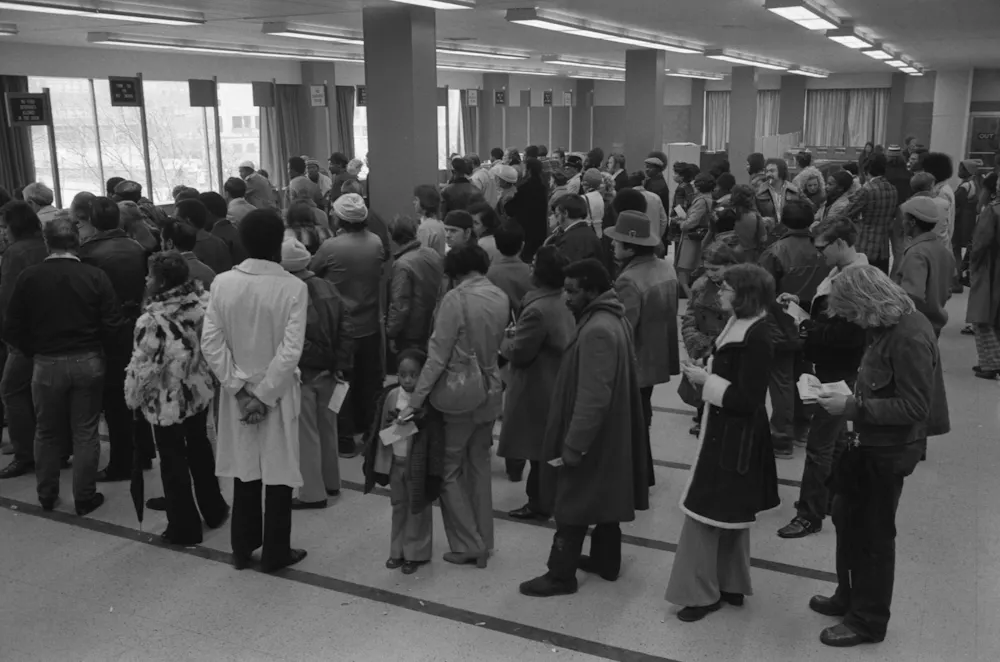
People line up at the Baltimore City Welfare Office in 1975, years before concerns about social spending led to big cuts to safety net programs. O’Halloran/Library of Congress via Getty Images
By the mid-1990s, opposition to welfare programs had become increasingly bipartisan. Politicians in both parties often used tales of Medicaid fraud on the part of providers and recipients to justify tighter eligibility rules and spending cuts.
Concerns about Medicaid’s “integrity” became highly politicized in the debates surrounding the ACA. Critics of Medicaid expansion argued that increasing the number of people who could get health insurance through the program would increase fraud and improper enrollment. Supporters of expanding Medicaid to help more Americans gain health insurance maintained that anti-fraud rhetoric often disguised ideological opposition to the program’s expansion.
Blurring distinctions then and now
For the six decades that this program has helped millions of low-income Americans get healthcare, politicians have blurred the distinction between protecting Medicaid from abuse and using abuse to discredit Medicaid itself.
In my view, the Trump administration’s campaigns against California and Minnesota continue that pattern. It is using real weaknesses within Medicaid to advance much broader political arguments: that Democratic states cannot be trusted, that public benefits naturally invite abuse, and that withholding funds is itself a form of reform.
The result will no doubt be that fewer low-income Americans will be able to get the healthcare they need.
Donald Trump hates embarrassing failures even when they are, ultimately, his own fault. So when the sealant on his $13.1 million-turned-$16-million Lincoln Memorial Reflecting Pool renovation started peeling off in sheets days after the pool reopened and the water turned green with algae, he couldn’t simply say that a rushed, no-bid contract handed to his golfing buddy’s company produced shoddy work. Instead he demanded a villain, and the weaponized Justice Department complied.
On July 2, 2026, U.S. Attorney for the District of Columbia Jeanine Pirro held a triumphant press briefing to announce a felony indictment against former Olympic canoeist David Hearn. Pirro claimed her office possessed solid evidence of guilt proving beyond a reasonable doubt that the 67-year-old had committed a deliberate, forceful and violent act causing over $1,000 in damage to the pool liner when he stopped his bike in June, reached down and touched a loose piece of lining that had already come apart before he ever laid a hand on it. When pressed by journalists like NBC’s Ryan Reilly about photographic evidence showing the liner was already peeling long before Hearn ever stepped near the water, Pirro grew combative, waving off the question with the same on-air contempt she perfected across 14 years as a host at Fox News, and insisted her office would prove the damage in court with expert testimony.
Weeks later, the Justice Department acknowledged something dramatically different.
By late July, as Hearn’s defense counsel moved for release of the grand jury transcripts to expose glaring prosecutorial irregularities, Pirro’s case collapsed. Facing the real possibility of judicial sanctions, an inspector general investigation and disbarment, her office filed a 20-page motion to dismiss the indictment. The filing threw the Interior Department under the bus, claiming Secretary Doug Burgum’s agency had withheld 695 megabytes of crucial documents revealing the damage was caused by contractor error during the rush to finish before the America 250 Independence Day festivities. The department’s own records described repeated installation failures and extensive peeling of the pool liner weeks before the alleged vandalism was ever said to have occurred. Prosecutors asked that the charges be dismissed because the evidence no longer supported Pirro’s claim, evidence that, it bears repeating, had been available to the government the entire time.
The dismissal did not stop with Hearn. Within days, Pirro’s office also moved to drop misdemeanor charges against three more people accused of the same phantom vandalism. Justin Carreno, Sophie Dennison-Gibby and Cameron Thiers all faced lesser counts of destroying property worth less than a thousand dollars, and their attorneys told reporters the common thread was simple: The federal government had just spent millions repainting and relining the pool, and when the work failed, the Trump administration needed a scapegoat. The entire theory of the case — that ordinary citizens had descended on a national monument with knives to sabotage it out of political spite — evaporated once anyone with subpoena power actually looked at the evidence.
The saga of the Reflecting Pool is emblematic of everything amiss in America right now, a perfect diorama of how right-wing media turns Trump’s fantasies into public reality, and then tries to quietly conceal the wreckage once the facts catch up.
The saga of the Reflecting Pool is emblematic of everything amiss in America right now, a perfect diorama of how right-wing media turns Trump’s fantasies into public reality, and then tries to quietly conceal the wreckage once the facts catch up. Fox News was happy to amplify the vandalism narrative when it was useful. But once the case fell apart, the network gave it barely cursory treatment, a striking silence from an outlet that had spent weeks covering the alleged desecration of a national monument when the story served the White House.
That silence makes sense once you remember Pirro’s origins. She spent years at Fox telling viewers whatever the moment required. By her own network’s private assessment, she was a “reckless maniac” whose 2020 election fraud claims helped make Fox liable for one of the largest defamation settlements in American history: a $787.5 million payout to Dominion Voting Systems.
Pirro’s appointment as U.S. attorney represented the full realization of the MAGA media pipeline, in which performative loyalty on television is treated as the primary qualification for federal law enforcement authority. What she is now discovering is that a courtroom does not run on the same rules as a cable television set. At Fox, Pirro could tell her audience whatever she wanted without personal consequence. Telling a federal judge the same kind of thing carries the threat of disbarment and perjury charges, and no amount of bravado previously reserved for on-air broadcasts could change that math.
Predictably, the moment Pirro chose self-preservation over total subversion of the law, Trump turned on her. He spent days publicly berating her, complaining to reporters that she had “folded like an umbrella” and writing on Truth Social that he fully disagreed with his own Justice Department. In a rambling, incoherent stream of consciousness to reporters from the Oval Office on Monday, he continued to insist on the existence of security tapes showing mysterious figures cutting the pool lining with box cutters — tapes no one has ever produced — while simultaneously trying to shift blame for the pool’s historical leaks onto previous administrations. On Monday, Trump met privately with Pirro and Burgum while reports circulated that he was considering replacing her.
After her Senate confirmation in August 2025, Trump promised Pirro would be a powerful crusader, and she has spent the year since prosecuting his perceived enemies with a zeal that has not been matched at trial. Her record in court is poor, with her office winning only half of its first eight criminal trials in 2026 a rate CNN reported was far below the national average. Bloomberg Law’s reporting describes a string of similarly threadbare cases: a man charged with assaulting a federal officer using a Subway sandwich following Trump’s deployment of National Guard troops in the District, who was acquitted by a jury but forced to flee his home after receiving threats; a Maryland woman jailed nearly a week for spitting on an officer at the National Zoo before the charge was quietly reduced and then dropped; a man left with permanent injuries after being tased during a high-speed chase, and whose federal charge also collapsed into a misdemeanor plea. The latter was interviewed by a Bloomberg Law reporter about his ordeal and was, according to the outlet, found dead behind a Washington rowhouse a month later.
As people swept up in this kind of prosecutorial overreach have noted, the goal is not really conviction. It is using state power to inflict maximum disruption on a person’s job, housing and relationships, and to send a chilling message to anyone else who might draw the government’s attention. A conviction, when one happens, is treated as a bonus. The process itself is the punishment.
Pirro will likely survive this particular episode. Trump did not fire her over the weekend, and by Monday he had already moved on to blaming the judge instead. But something has shifted.
The former Fox star who built a television career on never conceding a point is now the first prominent member of this administration to publicly contradict Trump’s own account of a story he has told, in increasingly baroque detail, for weeks. It turns out that feeding Trump’s delusions is a great deal easier from behind a Fox News desk, where no one can hold you in contempt, than standing in front of a federal judge who can.
Even if you scorn Boomer myth-making, the 50th anniversary of “Revolver” — perhaps the Beatles’ best album — is a big deal. It not only sent the band in a new direction, it showed new possibilities in rock music. Look at the state of rock music in the 21st century — when so much of popular music is about artfully recycling existing tropes and styles — and it can be hard to see what the fuss was about. But the album was groundbreaking for a bunch of reasons, and it’s aged better than almost any of the great records of the era.
One way that “Revolver” immediately stood out was its eclecticism. The album that preceded it, “Rubber Soul,” saw the band mostly in acoustic-folkie mode, and the one that followed it, “Sgt. Pepper’s Lonely Hearts Club Band,” was mostly expansive, psychedelic, and orchestrated. Both are masterpieces. (The hype around “Sgt. Pepper’s” has led some to dismiss it, but go listen to it sometime — even overlooking the backstory and concept-album pretensions, it’s packed full of good tunes.) But “Revolver” shows a complex band stretching all over the place: Between an Indian tune, chamber pop, acid-influenced psychedelia, muscular rockers, and everything in between, the album is so wide-ranging that, with the inclusion of one more genre, it would probably not have held together.
Part of the reason “Revolver” worked so well was that the on-again, off-again battle between the band’s three songwriters has reached a point of productive detente. The Beatles had begun as John Lennon’s band, and would soon become Paul McCartney’s: Drugs and indifference and general orneriness would take Lennon far away from the collaboration that a rock group needs. McCartney’s curiosity and squareness — his avoidance of hard drugs, his interest in contemporary art and experimental music, his earnest band diplomacy — was making him more sophisticated and essential with each album. But both were still at the top of their game and working together at least some of the time.
The emergence of George Harrison completed the perfect chemistry: Frustrated over the years by being pushed aside, the guitarist saw three of his songs — the opener, “Taxman,” the Indian “Love You To,” the moderately dissonant “I Want to Tell You” — sneak onto the album.
Throw in Lennon’s rocking “And Your Bird Can Sing” and his psychedelic breakthrough “Tomorrow Never Knows,” and McCartney’s “For No One” and “Eleanor Rigby,” and you have a collection of timeless songs even with an entire side to go.
As lively and inventive as the early Beatles albums were, “Revolver” is also the one that saw them unleashed in the studio. Abbey Road was quite primitive by the standards of our day, and less sophisticated than studios in California. But producer George Martin and Geoff Emerick went out of their way to make instruments sound uncanny, to allow Lennon to indulge strange ideas (a microphone, wrapped in a condom, submerged in water), to incorporate tape loops and unorthodox instruments into the sound.
“Revolver” was so sonically advanced, in fact, that the band stopped playing live around the time of its recording: They saw no way to play its songs outside the studio. In some ways, the process deepened an insularity that would hurt the band creatively and personally.
“Revolver” isn’t perfect. McCartney’s chipper “Good Day Sunshine” and his Motown-inspired “Got to Get You Into My Life” are not among the band’s best music: They’re musically derivative and emotionally forced. Despite its charm, “Yellow Submarine” may not quite fit on the album. “Revolver” would be too grim and brooding with all three of these numbers removed, but they tear its fabric a little bit.
But it’s still a wonder. Part of what’s odd about “Revolver” is that its eclecticism and psychedelia didn’t last long. Music and culture was changing so fast in the ’60s: Bob Dylan released the forward looking “Blonde on Blonde” the same year, and the Rolling Stones briefly dabbled in psychedelia. But by 1968 and ’69, musicians were turning back from the restlessness of “Revolver.” The Stones were in retro-country mode, as was Dylan. Between The Band and Joni Mitchell and Van Morrison, many of the most talented musicians were looking backward. By 1970, Jimi Hendrix — who seemed the most likely to extend the Beatles’ experimentation — was dead.
It’s also safe to say that “Revolver” was the album that kids who grew up in the’70s and ’80s grew into, once their pre-pubescent fascination with earlier, less-challenging Beatles albums wore off. It was the record they were listening to as teens, and it was the one that, possibly more than any other album, was a touchstone for the indie-rock movement of the ’90s. (Just try to imagine the Stone Roses or Oasis or Pavement or Radiohead without it.)
The Beatles experienced a backlash in the United States just before the release of “Revolver” because of Lennon’s remark that the band was “more popular than Jesus now.” More popular or not, as great as their earlier work had been, it was “Revolver” that made them deities.
Throughout July, The Swell celebrated the lasting cultural inspiration of animator Hayao Miyazaki and the legendary films he created with Studio Ghibli. As part of GKIDS’ annual Studio Ghibli Fest, which kicked off in June, you can enjoy theatrical re-releases of some of his most famous works.
While I would never deign to speak for all critics — I’ve been around enough to know I don’t need that smoke — we’re not generally fans of inscrutability. A little layered mystery is just fine. Many of us appreciate artistic execution that leaves plenty of openings for wild interpretations. But once we’re venturing into the territory of “What in the hell was that?” the knives tend to come out.
That’s part of the reason I left “Howl’s Moving Castle,” adapted from British author Diana Wynne Jones’ novel, for the last flight in our monthlong look at Hayao Miyazaki. The plots of “Spirited Away,” “My Neighbor Totoro,” “Princess Mononoke” and “Kiki’s Delivery Service” are as lucid and pure as spring water, relatively speaking. “Howl’s Moving Castle,” on the other hand, is an unconventional love story wrapped inside an anti-war plot about a prince who gave his heart to a demon and a young girl turned into an old woman by a jealous witch. It’s also about curses and a giant house that moves around on chicken legs and a turnip-headed scarecrow and pollution and . . . see what I mean?
It’s nice to know I was never alone in my befuddlement. “There’s much to admire in ‘Howl’s Moving Castle,’ which is precisely the problem,” remarked film critic Stephanie Zacharek in her 2005 review for Salon. “Its whimsical grandiosity practically invites us to use the passive voice, a kind of verbal genuflection.”
“Howl’s” champions the bravery of embracing maturity with a young heart.
The benefit of returning to a story like this 20 years after a first viewing is that presumably, time has softened us. For “Howl’s Moving Castle,” that matters since its heroine, Sophie Hatter (initially voiced in the English dubbed version by Emily Mortimer), spends much of the film waxing and waning between young and elderly selves. When she’s youthful, Sophie catches the eye of a handsome, richly dressed stranger who gallantly escorts her away from two men harassing her on the street. He introduces himself as Howl (Christian Bale), a flamboyant wizard who whisks her across rooftops on her way home.
But Sophie, an introverted milliner, never asked for anyone’s attention and is convinced she’s plain and unattractive. The Witch of the Waste (Lauren Bacall) echoes her insecurities back at her when she strides into Sophie’s shop, insults her, and with a wave of her hand, transforms Sophie into a hunched-over dowager (with Jean Simmons taking over the role).
I could easily hail “Howl’s Moving Castle” as a tribute to maturity, especially when placed against other Miyazaki stories starring young heroines setting out on adventures. That feel especially valid at a time when we have plenty of shoppable salves to soothe midlife crisis ego death in whatever forms that it takes. (I have no idea what the Turnip Scarecrow’s significance is in all this, other than to be this fairy tale’s frog prince.)
But when viewed in one way of many, “Howl’s Moving Castle” is an encouragement to look inward and see the truth about ourselves honestly and kindly. Most of us aren’t the same person on the inside as we seem to be on the outside — including Sophie, a woman in the early bloom of her life whose dedication to work has shriveled her vitality.
Trapping Sophie in a crone’s body and making her realize how much harder it is to cross rolling hills and climb stairs gives her a new appreciation for everything she’s been taking for granted. But more than this, as an old woman Sophie abandons her insecurities about taking up space in the world — especially when she crosses paths with the Witch of the Waste again, and a more powerful wizard’s magic deflates said Witch into an enfeebled pile of skin.
Instead of taking pleasure in the Witch’s undoing, Sophie tenderly cares for her. She understands what it’s like to be unloved and ignored more than most, after all. Eventually, Sophie’s demonstrated empathy makes Howl fall more deeply in love with her.
Want more from culture than just the latest trend? The Swell highlights art made to last. Sign up here
That’s one strand in this tale’s tangle. When following “Howl’s Moving Castle” as the story of Calcifer (voiced by Billy Crystal), the fire demon who holds Howl’s heart and fuels the castle, the movie becomes a fable about nurturing and destruction as two sides of the same coin. When Howl loses himself to a beastly form after attacking opposing forces in the war into which he’s drawn, it’s an allegory about how armed conflict robs us of our humanity. Its complexity makes the movie a treasure.
Ultimately, though, this vision of Miyazaki’s comes down to a lesson about the chameleonic nature of the human heart and soul, how we change to adapt to every situation and interaction, and how the those who love us must love every version. It champions the bravery of embracing maturity with a young heart.
But that’s just my take. Zacharek accurately referred to Miyazaki’s narratives as “wriggly, noodle-shaped things,” and not in offering her compliments to the chef. I get it. I’ve also come to understand that some of Miyazaki’s offerings are tastes worth acquiring through a few tries, even for skeptics. His filmography is as vast and varied as this bizarre castle’s meanderings, with life lessons for anyone.
When I moved to Chicago, I assumed I would become a slightly different person.
Not in the wholehearted country-song sense, where crossing the county line might allow me to outrun myself. The reinvention I had in mind was more municipal than spiritual: perhaps a change in infrastructure might produce a corresponding improvement in character.
I was moving without my car, so I would naturally become someone who walked, biked and took the train more. Our apartment was about ten minutes from Lake Michigan; perhaps proximity alone would turn me into one of those women who began the day with a brisk swim. At the very least, I would develop strong opinions about beach sandwiches.
And I would be living within walking distance of a sickening number of farmers markets.
The life I pictured appeared in View-Master slides, each image crisp and complete, with all the inconvenient connective tissue outsourced.
Click. I’m on the train.
Click. I’m wheeling my bike off it with balletic ease, definitely not annoying my fellow commuters as I lug it down the stairs.
Click. I’m wearing a helmet that looks chic rather than orthopedic.
Click. The helmet — and any evidence that it has touched my hair — has disappeared. I am now carrying a gorgeous straw tote and wearing linen that has somehow survived public transit without acquiring a wrinkle.
Click. Farmers market stalls.
Click. Farmers market haul.
Click. A thrown-together dinner party on the rooftop of my building for all my neighbors. Yes, it overlooks a nest of alleyways, and no, management does not like people going up there, and no, I don’t know all my neighbors by name or even sight yet. But I have somehow assembled enough glittering people and enough secondhand objects — a woven rug, cushions, low tables, an impossible number of candles — that it feels like a tiny seventh-floor pop-up restaurant.
In my imagination, even the building superintendent has been cast. He arrives to break up the party with the energy of the businessman who plans to level the summer camp until he witnesses the final talent-show number. Then he takes a bite of the olive oil cake I have made for dessert. He softens. “Maybe we should do this more often,” he says.
Click. Community.
What I had not pictured was shopping.
In the View-Master version, the market haul arrived already edited. There were no prices to compare, no heavy bags to carry home, no stalls selling six unrelated things I suddenly believed might change my life. I would wander in with my perfectly sized tote, allow whatever charmed me to determine dinner and wait for the ingredients to organize themselves.
Later, when someone praised the meal, I would demur in the manner of women for whom this sort of thing came naturally.
“Oh, this?” I would say. “Just something I threw together.”
Little did I know.
I was a farmers market failure.
This remained true for an embarrassingly long time — including several years when I was already being paid to write about food. I knew how to want everything at a farmers market. I simply did not know how to shop at one.
The clearest evidence came one late-summer afternoon, when several weeks of bad weather produced a scheduling anomaly: two neighborhood farmers markets on the same day. The vendors posted flyers and made an occasion of it.
I decided I would, too.
The first occupied a roped-off parking lot beside an elementary school. I left home with $45 in cash—which felt ample, even indulgent—and one of the crinkly blue totes I had picked up on our last trip to the suburban IKEA.
The day was sticky enough that the plastic adhered to my bare shoulder. Every few minutes, I peeled it from my skin and transferred it to the other side, where it promptly attached itself again. The chic tote from the View-Master apparently had another engagement.
Everyone at the market seemed either to have a distinct plan or to be genuinely content wandering. A mother steered a stroller while consulting a list. A white-haired man in a Tommy Bahama shirt amiably haggled two dollars off his peaches. Another man had a shallot tattooed on his forearm, suggesting either a career behind the line or an allium devotion I could not hope to match.
I wanted to resemble the relaxed browsers who paused over a melon because its scent had summoned them. In fact, I am much more comfortable with a list. I hadn’t learned yet that I was a Type A person masquerading as Type B. The disguise began to fray almost immediately.
I completed one slow circuit, attempting to look discerning. Nearby, a woman with timeless preschool-teacher energy played the accordion for a ring of toddlers as shoppers crowded around nearly white ears of sweet corn. Then I noticed things were disappearing behind me. Baskets I had paused over were emptier when I returned. Someone bought the last loaf of a bread I had not yet decided whether I wanted.
This sent me into a faster orbit.
The accordion sounded louder.
To steady myself, I bought a $12 arancini from a stall that accepted only cards. Because I had designated the cash as my farmers market budget, the card purchase belonged to a parallel economy; by this logic, my $45 remained intact. Arancini in hand, I passed a booth lined with turquoise jewelry, Coca-Cola merchandise and approximately 40 embroidered denim vests. It looked as though the vendor had raided a secret convention of 1990s elementary-school teachers and persuaded them to turn in their uniforms.
I chose two: one ridged and heavy, its skin receding from burgundy into a deep, almost plum color; the other a cheerful red beefsteak. They were fat and beautiful and cost about $8. A woman carrying two heirloom tomatoes could still plausibly claim to be shopping for dinner. I was back on course.
The plan splintered almost immediately. I ping-ponged from soft cheeses to eggs and squash, then past a gelato cart and a table crowded with jams, pepper jellies and a milk carton filled with VHS tapes.
Finally, I arrived at the pastry stall.
It was run by a man in his early 40s with a single gold hoop and a tight gray bun. I had never before described a man bun as severe, but no other word will do. He was arguing with another vendor in the unmistakable register of people with history. “You’re always like this,” one of them said. “I’m not sure why we’re even doing this again.”
I studied the pastries while pretending not to listen: tea-infused buns knotted with candied citrus, laminated pastry layered with spiced cream cheese, craggy oat muffins dotted with boysenberry preserves. I waited for a lull. I misjudged it.
There was no visible menu, so I began, “Excuse me, how much—” just as the baker turned toward the other vendor. “Do you remember last August?” he demanded.
There was an awkward two-second collision. Then he looked at me.
“Prices are marked,” he hissed.
They were not.
I could have walked away. Unfortunately, I have always struggled with disappointing authority figures: professors, bosses, priests, parents — and, apparently, severe-bunned bakers. I pointed to two oat muffins.
“For breakfast,” I told myself.
They were $7.50 each. I wanted them, though not $15 worth of them, but by then “Well, actually…” was beyond me. I paid and tucked them beside the tomatoes.
The bag remained almost offensively empty. For $23 in cash, it contained four objects, all of which now had to be protected from one another. Still, I had just over $20 left. The arancini did not count. The muffins were breakfast. Dinner remained possible.
I could turn this around.
I just needed to go to the second market.
It turned out to be both prettier and worse.
The vendors occupied a tree- and bench-lined pedestrian stretch that I once overheard two teenagers in airbrushed wolf T-shirts nominate as the neighborhood’s most romantic place to smoke a joint. They may have been right about the romance. Unfortunately, everyone else had arrived before me.
By then, the baskets had been picked over. The best things had departed in the totes of people who knew what they were doing. I walked one more circuit, attempting to let the remaining produce speak to me.
I bought a jar of blackberry jam because it sounded good.
Then, on the way home, I stopped at the corner store and spent the rest of my cash on a frozen pizza.
Back at the apartment, I unpacked. Everything from the markets was beautiful, delicious or both. It simply did not add up to the thing I had gone there to find.
The only dinner in that day’s haul had come from the freezer aisle.
This shouldn’t have been a surprise, really. It was not as though the open air of a farmers market was going to cure my base shopping instincts. Put me in a grocery store without a plan and I move through the aisles like a dog with the zoomies: produce, meat, back to produce, an abrupt dairy detour, then three aisles in reverse because I have remembered lemons.
For a long time, I assumed the solution was to become more instinctive. Food culture is inordinately fond of nonchalance: meals that are “almost too easy,” cakes that come together “in a snap.” It reminds me of how, recently, my younger sister — deep in the trials and tribulations of planning her wedding look — called me sounding breathless and almost conspiratorial. “Did you know pop stars wear hair extensions?”
Effortlessness, we agreed, generally has at least a little scaffolding underneath.
Perhaps the market shoppers I envied had simply made a few decisions before everything started charming them.
My reeducation began, as many good things do, with pasta.
I had rigatoni, olive oil and butter at home, which meant one good vegetable would be enough. Zucchini could be grated and cooked down until jammy, then loosened with pasta water; tomatoes could be sliced, salted and left to steep in olive oil. Cheese would be a bonus.
I wrote a two-item list: Good vegetables. Good cheese.
Then I took a beat and added: Pastries for morning.
I gave myself a five-purchase limit, leaving two slots open for surprise.
At the market, I moved differently. With dinner already half-imagined, I could pass the tomatoes and melons without treating each one as an alternate future I might regret abandoning. Instead, I gravitated toward a pile of thin-necked yellow summer squash. The day was in the low 70s, and a breeze was coming through our kitchen window; I decided I would not mind standing at the stove long enough to coax the squash toward sweet collapse. Because one caramelized vegetable is good and two are better, I added a white onion.
Then I followed my list to the cheese stall, where I found a soft chèvre, and to the baker (a different one, blessedly) for croissants and a hunk of cornbread, which I naturally counted as a single purchase. My wildcards were honey, for the vegetables and leftover cornbread, and basil, mostly for color and romance.
At home, I cooked the onion and grated squash in butter with a spoonful of honey, miso and red-pepper flakes until they became jammy. I crumbled some of the cornbread into olive oil and toasted it in a skillet. Then I added the rigatoni and enough pasta water to turn the vegetables velvety, finishing each bowl with the crisp crumbs, little pillows of chèvre and torn basil.
In a way, it really was something I had thrown together.
But the ingredients had not organized themselves.
I had given them somewhere to land.
How I shop the farmers market now
(Ashlie Stevens ) IKEA tote, and contents
The point was never to become less susceptible to the market’s charms. It was to stop asking every beautiful thing to become dinner. Here are five simple tips I keep in mind to let the market surprise me without leaving dinner to chance.
Even a well-stocked farmers market rarely behaves like a supermarket organized around a recipe’s demands. It offers what is there, in the quantity there is. A useful form already provides enough structure — a base, a binder, a vessel — that whatever looks best can find a place within it.
One tomato may not look like a grocery haul, but with bread, mayonnaise and an egg, it is dinner. A handful of mushrooms that seems meager in a paper bag can become the center of a frittata. A single bunch of greens can be folded into beans, piled onto toast or wilted through cheesy rice.
The form supplies the logic. The market supplies the surprise.
Start with the kitchen you already have
A farmers market is not a complete food system. It is exceptionally good at providing the vivid part of dinner — the ripe tomato, the thin-skinned squash, the bunch of herbs still cool from the morning — but it may not provide the starch, protein, fat, acid or seasoning required to turn those things into a meal.
That is what the kitchen at home is for.
Before I leave, I “reverse-shop” my fridge and pantry, taking stock of the support system already in place: pasta or rice, bread or tortillas, eggs, tinned fish, tender white beans; butter, olive oil, yogurt, vinegar and whatever cheese is threatening to fossilize in the refrigerator.
I jot those ingredients at the bottom of my market list. Seeing eggs, rice, yogurt in writing makes it easier to recognize what a bunch of greens or a basket of cucumbers could become—and easier to pivot when the ingredient I imagined isn’t there.
The market ingredient does not need to do everything. It only needs to be good.
Set a limit, but leave room for surprise
A rigid list can make a farmers market feel like a slightly understocked supermarket. I have better luck shopping for roles rather than exact ingredients: Good vegetables, good cheese, pastries for morning.
Perhaps the squash looks better than the zucchini. Perhaps the cheese is a bloomy little wheel rather than chèvre. The role remains useful even when the ingredient changes.
Then I decide roughly how many purchases I want to make. Three items may be plenty for tartines; a big, maximalist salad could happily accommodate eight or ten. The number is not sacred. It simply gives me a stopping point before I begin believing every peach, pickle and pastry belongs to the plan. When necessary, I set a spending limit, too. Other weeks, a predetermined number of decisions is enough.
I also leave room for wildcards. They might improve dinner—herbs, honey, good bread, something pickled—or have nothing to do with it: flowers, jam, a spice blend, a VHS tape, an embroidered denim vest.
Impulse is part of the pleasure. It simply does better with a little containment.
This also preserves the culinary reason for the limit without overpronouncing it: farmers market ingredients are usually best when they remain recognizable. You don’t need to cram every beautiful thing into the same dinner merely because it came home in the same tote.
Let one excellent thing be enough
On that note, a successful trip does not require a photogenic avalanche of produce.
One excellent vegetable can be cooked down with butter and tangled through pasta. One tomato can be grated onto toast. A small bundle of herbs can sharpen a bowl of rice and beans. A few peaches can become dinner with cheese, bread and something salty.
The smaller the minimum, the less likely you are to buy six unrelated ingredients in the hope that abundance will eventually explain itself.
Let the market be incomplete
Sometimes the stalls are picked over. Sometimes the beautiful thing costs more than you want to spend. Sometimes the market is rich in soap, flowers and decorative squash but not in dinner. Pivot to another generous form. Stop at the supermarket for eggs or bread. Buy one jar of good jam for the pantry and go home.
And when the entire enterprise has ceased to sound fun, there is always frozen pizza.
Dinner should not be held hostage by the farmers market.
This story originally appeared in The Bite, my weekly food newsletter for Salon. It is the first half of this two-part farmers market special. Next week, I’ll be back with five flexible recipes to keep in your pocket for market day—including the jammy squash pasta with chèvre and cornbread crumbs that started this whole reeducation. There will be options for tomatoes, greens, fruit and the miscellaneous beautiful thing you bought before deciding what it was for. Subscribe here to have it sent straight to your inbox.
On July 26 in Pennsylvania, House Democratic Leader Hakeem Jeffries introduced the party’s Fighting for an Affordable America agenda to mark 100 days until November’s midterm elections. The plan, according to the Associated Press, calls for “restoring healthcare cuts, bringing the cost of living down and ending the war in Iran to beat Republicans and hold President Donald Trump accountable.”
Democrats always want to run on kitchen table issues, and this time they have an opening you could drive the Titanic through. Even among Trump’s most fervent followers, the war in Iran is unusually unpopular; it’s the first time I can ever remember Republicans not rallying around a war started by a GOP president. In fact, the party used to rally around so-called “Democrat wars” too, at least most of the time, even as they condemned them for being mistakes. Trump, though, seems to have broken that knee-jerk reaction, which, if it lasts, may end up being one of the only things he has done right, even if it was by accident.
After Trump and the GOP’s anti-democracy turn, there are no Democrats — and vanishingly few independents — who are clamoring for a “return to normal,” if anyone can even remember what that looks like.
“Holding Donald Trump accountable” is obviously a necessary goal, and we can only hope that if they take back the House, and perhaps the Senate, Democrats will spend the next two years hammering Republicans on corruption, malfeasance, criminality and incompetence, pounding as many nails into the MAGA coffin as possible in anticipation of a hard-fought 2028 campaign. After Trump and the GOP’s anti-democracy turn, there are no Democrats — and vanishingly few independents — who are clamoring for a “return to normal,” if anyone can even remember what that looks like.
As we get further into Trump’s second term, the rise of the progressive left, generated at least in part by the desperate need for generational change, is bringing some longstanding issues to the surface. Younger Democrats aren’t talking about politics in technocratic terms, as the party’s politicians have been doing for the last 30 years, offering up 10-point economic plans and telling the public how they can work the system more efficiently. They see politics in largely moral terms, and they are ready to address some of the thorniest moral issues we face.
Oligarchy is at the top of the list, an issue that has animated the left since at least the Occupy Wall Street movement began in 2011. Fifteen years later, a global backlash against billionaires who have outsize influence over politics — and who do not pay their fair share — is taking shape.
The left also rejects America’s global role as security guarantor, particularly in light of the tragedy taking place in Gaza, which has been aided and abetted by the U.S. government. The party’s mainstream has moved substantially in their direction, leading to an unprecedented split in the House caucus in July that saw over a hundred House members vote to cut off aid to Israel. Whether it was done out of genuine desire to end the blank check or simply to allow members a symbolic vote going into the midterms, it’s clear that the intense opposition to Israel’s actions have made a difference, despite the ongoing debate about the scope of the policy.
These moral issues are animating a significant faction of the party, and they are having an impact. But I find myself wondering why another moral issue, much closer to home and shocking almost beyond comprehension, isn’t getting much play on the campaign trail.
The treatment of immigrants of all statuses, and sometimes American citizens who happen to look “foreign,” is an abomination. But aside from perfunctory nods to abolish Immigration and Customs Enforcement, it seems to have become background noise.
Masked federal agents are killing people with impunity. They are splitting up families without compunction, throwing people in camps and deporting them to countries they have never even visited. Now, with the permission of the MAGA-compliant Supreme Court, the Trump administration is in the process of deporting Haitians who have been here legally for decades by forcing them to leave immediately or wear an ankle bracelet in anticipation of being sent to a country which our own State Department says is too dangerous to visit. These are people who own property and businesses, and many of them have American-born children. They also happen to be Black.
This is not a popular policy. While most congressional Republicans still approve of Trump’s immigration agenda, many of them aren’t thrilled with the administration’s deportation policy. According to Strength in Numbers, most Americans are appalled and prefer a path to citizenship for non-criminals. Trump’s cruel priorities clearly work for many rank-and-file Republicans, and this seems to have some timorous Democrats spooked. But if there has ever been an issue that the left should be screaming about every single day, it’s this.
Many Americans are out in the streets protesting and putting themselves on the line. In fact, average voters may be more up in arms than Democratic politicians. If the progressive left wants to consolidate the party behind a more virtuous set of values, this is the issue that will rally the entire spectrum of ideologies. Jeffries and party leaders should move it to the very top of the agenda, and make Trump’s abuses a rallying cry across the country.
The Democratic Party should not play politics with this; the president’s abuses are happening right here on our own streets, in our own communities. It is the moral issue of our time.
Two government watchdog groups have demanded investigations into whether Federal Communications Commission members violated ethics requirements by accepting luxury gala tickets from Paramount as the company sought government approval for its $111 billion acquisition of Warner Bros. Discovery.
Commissioner Olivia Trusty’s most recent financial disclosure said Paramount gave her two tickets to the December 2025 honors gala that together were worth more than $12,000. Trusty was one of two commissioners who voted last year to approve Paramount’s merger with another media company, Skydance.
ProPublica’s investigation found FCC members had long enjoyed a night out at the Kennedy Center courtesy of CBS or its parent company. Seven of the 10 commissioners who served since 2016 accepted tickets worth more than $260,000, according to a ProPublica analysis of ethics disclosures.
FCC Chair Brendan Carr’s financial statements show he has reported accepting honors gala tickets from CBS or its parent company eight times since his 2017 appointment to the commission, totaling over $75,000 in gifts.
Carr, who also voted in favor of the Paramount-Skydance merger last year, sat with his wife in a private skybox at the December gala with Paramount CEO David Ellison and other executives from Paramount and CBS. Such seats sold for $125,000 a ticket, according to Kennedy Center guidelines.
Carr disclosed on his latest financial statement that he accepted tickets from Paramount for himself and a guest to the 2025 gala and reception worth $12,390. Carr did not respond to a request from ProPublica to clarify the apparent difference in value between those tickets and the skybox seats.
The FCC only released Carr’s disclosure late on Friday, more than a month after ProPublica had first requested it. The document says the agency certified it on June 22.
“The federal gift regulations and the gratuities statute exist to ensure that government decisions are made on the merits, free from the influence of private benefits,” the Democracy Defenders Fund said in its complaint. “The public must have confidence that the FCC’s merger review process is not compromised by self-dealing or the appearance of impropriety.”
Carr, Trusty and the FCC did not respond to requests for comment. The agency’s inspector general declined to comment. An FCC spokesperson previously told ProPublica that agency ethics officers have for years cleared commissioners to accept the tickets, finding it consistent with ethics law. And Paramount’s chief of communications said it was a decades-long “CBS practice to invite government officials from both parties” to the Kennedy Center show. Carr last year defended the FCC’s approval of the Paramount merger with Skydance, saying it “advances the public interest.”
The FCC’s review of the Paramount-Warner Bros. merger is one of the final federal hurdles facing a historic consolidation of two of the five largest film studios in Hollywood. The deal would unite Paramount Skydance with Warner Bros., bringing under the control of one company Paramount+ and HBO Max streaming services; CBS and CNN; and scores of other major broadcast channels, cable networks and digital platforms.
Four ethics experts told ProPublica that by accepting the tickets, Trusty and Carr had compromised the FCC’s impartiality and should not take part in any upcoming decision on Paramount’s proposed merger.
The Democracy Defenders Fund — led by Norman Eisen, former ambassador to the Czech Republic and White House ethics czar under President Barack Obama — filed its grievance on Thursday with the federal Office of Government Ethics, the FCC’s inspector general and the FCC’s ethics office.
The group said the investigation should examine whether Carr and Trusty broke rules on accepting gifts or broke criminal laws prohibiting federal officials from accepting illegal gratuities.
Carr and Trusty should be required to repay Paramount the “fair market value” of any improper gifts and the federal ethics agency should refrain from certifying Carr’s annual disclosure report until he can prove that he has complied with ethics laws, Democracy Defenders Fund wrote. Its letter to the FCC and the Office of Government Ethics also requests that Carr be disqualified from further participation in the commission’s decision on the Paramount-Warner Bros. Discovery merger.
The nonprofit organization noted that hours after last year’s honors gala ended, Paramount announced it was launching its hostile takeover bid of Warner Bros. Discovery, a move that would later result in a merger agreement that requires FCC approval. About three months later, Carr publicly endorsed the deal on CNBC, promising swift approval.
“The facts that have been reported raise serious questions about the integrity and impartiality of FCC Chairman Carr in particular matters involving Paramount,” including the attempted merger with Warner Bros. Discovery, the letter said.
Citizens for Responsibility and Ethics in Washington, the other group that filed a written protest, requested an FCC inspector general probe of the luxury gifts.
“The reported gifts to FCC officials from businesses that are not only subject to agency regulation but presently engaged in billion-dollar mergers and acquisitions that must be approved by the commissioners themselves are extremely concerning threats to the integrity of FCC operations,” the CREW letter stated.
CREW, founded in 2003 as a nonpartisan organization dedicated to government accountability and ethics, is headed by Donald K. Sherman, a former House Ethics Committee attorney and special assistant to President Joseph Biden.
“Government officials have the power to make decisions that impact huge swaths of the American people,” Sherman said in a statement about the organization’s demand for an inspector general investigation. “With this tremendous power comes a higher ethical standard that apparently wasn’t met. The IG can and must get answers for the public.”
The proposed merger between Paramount and Warner Bros. Discovery has drawn a flurry of legal opposition.
California, New York and 10 other states filed a lawsuit seeking to block the merger under federal and state antimonopoly laws. The Writers Guild of America, the Freedom of the Press Foundation and the Public Interest Project filed similar court challenges in recent weeks.
Paramount has recently agreed to pause its merger until the litigation is resolved or until June 1, 2027, whichever comes first.
If you need any proof that climate change is not some far off problem for future generations — it’s our disastrous present — look no further than the unfolding wildfire crisis gripping the globe. In Spokane County, Washington alone, three major wildfires have devastated the area, prompting the evacuation of almost 65,000 people and destroying more than 700 homes. But there are at least 14 other fires raging throughout the state. In nearby Oregon, a record-shattering 2 million acres have burned, with 102 new fires reported across the nation on Aug. 2 alone, seven of which are large. Meanwhile, across the pond, Europeans are battling their own record-breaking wildfires in the U.K., France, Greece and elsewhere, where two crew members were killed in a midair collision.
High winds and hot, dry weather have fueled the blazes, but these conditions have been worsened by climate change. Fires are a natural phenomenon, of course, but what’s unnatural is their intensity and the level of heat. Every time we burn fossil fuels, it adds more chemicals to the atmosphere that trap more heat, creating a positive feedback loop that makes everything hotter and drier.
Indeed, months of drought and heat waves tend to foreshadow the fiercest wildfires. As a recent analysis found on fires in Spain, Portugal, Turkey, Cyprus and Greece, “human-caused climate change was a key driver of the fire weather conditions, primarily through its influence on exceptionally high temperatures, but also by exacerbating drought conditions.”
The circumstances that make these wildfires so severe are becoming more and more common across the world. “Anywhere can burn under the right conditions, and unfortunately all of those conditions are changing,” Erica Smithwick, a climate scientist at Pennsylvania State University, told Scientific American recently. All of this serves as a warning. The question remains if anyone is still listening.
For a time, John F. Kennedy Jr. was one of the most famous boys in America. He was three years old when a photographer captured him saluting his father’s casket, and for many years, that was how most of America pictured him. Until the 1990s, that is, when relentless tabloid coverage reinvented him as New York City’s Adonis.
“Love Story: John F. Kennedy Jr. & Carolyn Bessette,” which stars newcomer Paul Anthony Kelly as JFK Jr. and Sarah Pidgeon as Carolyn, hangs its justification on that faint memory and his Cinderella-style courtship with Bessette. Next to exes like Madonna and Daryl Hannah, she was a commoner, a Calvin Klein stylist who somehow snared the heart of an American prince.
After a courtship that unfurled in fits and starts, they married in 1996. Three years later, they died together in a plane crash. Given that these details are the extent of what most people know about the couple, one assumes “Love Story” has so much more to give.
Since this is another Ryan Murphy product — this one created by Connor Hines — we should not be surprised to discover that most of the blanks are filled in with squabbling, private anguish and stretches of scenery that could double as feature-length ads for a designer perfume. CK One, perhaps?
As long as Robert F. Kennedy Jr. retains his starring role in the current administration, “Love Story” won’t be the worst thing to happen to the Kennedy clan or America. This first installment of Murphy’s latest anthology franchise is a serviceable romance in a time when such stories rarely receive even modest studio budgets, let alone wide theatrical release. Remember those? Some were better than others; a few defined for a generation what true love could look like, albeit inaccurately.
But this one stretches a basic courtship that could be covered in about 90 minutes, tops, over nine episodes and a total runtime landing between seven and eight hours. In comparison, “Ghost,” one of the genre’s standard-bearers, got it done in two hours and seven minutes. And neither of those characters is a Kennedy.
However, the “Love Story” forebear that matters most in this discussion is not John F. Kennedy or Jacqueline Kennedy Onassis, played here by “Feud” star Naomi Watts. It’s O.J. Simpson.
Ten years ago this month, “The People v. O.J. Simpson: American Crime Story” became the first and still best entry of a Murphy-produced franchise to seriously engage with the anesthetizing myth Americans like to tell themselves about themselves.
Recreating the theatricality of Simpson’s eight-month-long murder trial using extremely famous actors as bait — John Travolta, Cuba Gooding Jr., David Schwimmer and Courtney B. Vance, among them — persuaded us to sit with one of the most famous and broadly televised examples of the unresolved racism baked into our supposedly liberal society.
That it came to TV more than two decades afterward aided in our understanding of the phenomenon less as a murder trial than an unscripted soap opera playing out in front of our eyes, casting otherwise anonymous prosecutors Christopher Darden and Marcia Clark as either heroes or villains.
Some people wanted to see Simpson punished, while others viewed his acquittal as vindication, however meager, for decades’ worth of societal abuse. Either way, the limited series catapulted the careers of Sterling K. Brown, who played Darden, and Sarah Paulson, already a repeat Murphy trouper via “American Horror Story,” to stratospheric heights thanks to their Emmy-winning performances.
(FX) Paul Kelly as John F. Kennedy Jr. and Sarah Pidgeon as Carolyn Bessette Kennedy in “Love Story”
The “Love Story” forebear that matters most in this discussion is not John F. Kennedy or Jacqueline Kennedy Onassis. It’s O.J. Simpson.
It also proved Murphy’s glossy approach could coax viewers into considerate contemplation about systemic ills by wrapping them in celebrity skin.
But eventually, style overwhelmed substance. “The Assassination of Gianni Versace” tried to examine institutionalized homophobia by following the trails of missed opportunities to halt Andrew Cunanan’s escalating malevolence until he appeared on the fashion designer’s doorstep with a loaded gun in 1997. Only this time, its star power (by way of a cast toplined by Oscar Ramirez, Penelope Cruz and Ricky Martin) distracted from the narrative critique.
“Impeachment” was a step-by-step drill-down on the Clinton-Lewinsky scandal that strayed wildly from its original intent. Murphy meant this third “American Crime Story” to be a clear-eyed analysis of abusive power differentials in politics and the workplace. Instead, its parade of latex prosthetics and wigs pulled the spotlight, especially the Linda Tripp fat suit that wore Paulson instead of the other way around.
Murphy had better success in creating a more obvious political parable with the “Cult” season of “American Horror Story” in 2017. But in matters of conversation-shifting achievement, “Pose” represents his post-O.J. apex.
Not only was “Pose” a celebratory masterpiece told from the perspective of trans and queer people at the center of the 1980s ballroom scene, but it also provided a keenly intimate view of life on the margins during the AIDS epidemic while never forgetting its dedication to beauty and joy.
Many of these high-profile attempts to foster serious conversation through art drowned it in vanity. Think of “Ratched,” the pretty and pointless “Halston” and his recent ludicrous, gorgeous disaster “All’s Fair.” (As for “The Beauty,” the jury’s still out on its lasting effects.) Others are frustratingly inconsistent — “Feud: Bette and Joan” wasn’t perfect, but Jessica Lange and Susan Sarandon’s work boosted its excellence more than the superstar cast of “Feud: Capote vs. The Swans” could for that project.
Great performances hide within even the worst of Murphy’s shows, nevertheless. Murphy gave Niecy Nash-Betts enough space and material in “Monster: The Jeffrey Dahmer Story” for her to deliver an award-winning performance that muscled to the fore.
Watts’ take on Jackie O doesn’t hit such heights, but the actor does, in some scenes, achieve a gracious splendor that does justice to her subject’s memory.
And this returns us to “Love Story.” If Murphy’s work can be divided between pulp like “American Horror Story” and prestige, “John F. Kennedy Jr. & Carolyn Bessette” aspires to the latter.
Is there an urgent lesson in their story for us to ponder? Not really, but even lacking that, the series fails its obligation to entertain.
Regardless of how promising the conceit may seem — it’s based on a book titled “Once Upon a Time: The Captivating Life of Carolyn Bessette-Kennedy,” after all — this is American history for fashion influencers. There isn’t much holding it together, but the looks are on point. Kelly closely resembles JFK Jr., while Pidgeon has Bessette’s fragile, elven bearing. Both photograph well.
But the story reminds me less of any supposed fairy tale than the memory that Murphy once intended to devote a limited series treatment to Prince Charles and Princess Diana of Wales’ bad romance under his “Feud” umbrella. “The Crown” beat him to it, so we got “Capote vs. The Swans” along with its greatest accomplishment: Bowen Yang’s Truman Capote impersonation on “Saturday Night Live.”
Theoretically, the romantic journey of JFK Jr. and Bessette should hold an equivalent pull on us as Charles and Di once did. JKF Jr. was the scion of American political royalty, and Bessette was the commoner who won his heart by side-eyeing his fame. But when two of her Calvin Klein coworkers gush, “You’re going to be the American people’s princess!” my inner narrator countered, “No. Not so much.”
Want more from culture than just the latest trend? The Swell highlights art made to last. Sign up here
The difference between what Charles and Diana — or Diana, specifically — meant to the world and the legacy that JFK Jr. left behind is vaster than the span of ocean between Britain and New York. Prince Charles is now England’s king, and Diana devoted herself to a life of service that helped her triumph in the international court of opinion before her untimely death.
America’s “royal” couple didn’t live long enough to make such a definitive mark. The iconic president’s son failed the New York bar exam twice and co-founded George magazine, a glossy devoted to waltzing at the intersection of politics and popular people.
Bessette was lovely and statuesque. For the public’s purposes, she was a cipher onto which we were urged to project our romantic fantasies. Beyond that, the main point of similarity between Bessette and Diana is that the paparazzi hounded both – Diana to death, and Bessette to resentful exhaustion. Is there an urgent lesson in their story for us to ponder? Not really, but even lacking that, the series fails its obligation to entertain. Watts’ Jackie delivers a moving speech or two about what families like the Kennedys owe to the public, but beyond that, the only turn that took me by surprise within the first two episodes is the unexpected death of a pet.
Every producer wants to achieve ubiquity, and Murphy is one of the few that’s done it. But while his influence has certainly grown mightier over the decade since “The People v. O.J. Simpson” conquered the 2016 TV season, the quality and memorability of most of his work since has fallen. This does not mean he isn’t still a reliable viewership magnet; he’s one of the few auteurs whose work commands conversation regardless of its quality. But to paraphrase Norma Desmond, it’s his ambition to say something meaningful that’s gotten small.
“Love Story: John F. Kennedy Jr. & Carolyn Bessette” premieres with three episodes at 9 p.m. ET/ 6 p.m. PT Thursday, Feb. 12 on FX, Hulu and Disney+.
President Donald Trump continued to claim the United States and Iran were in active peace talks on Monday, despite denials from Iranian and U.S. officials.
“Iranian Leadership is unbelievably duplicitous!” Trump wrote on Truth Social. “They ask for a meeting, some would say’ beg,’ talks begin, with more scheduled in the immediate future, and they say, openly and proudly, that they’re not having any discussions, that nothing is being talked about, and they’re only dealing with ‘Oman.'”
Trump told reporters over the weekend that Iran came to the U.S. hat in hand to avoid further airstrikes. The president said that the Pentagon had planned “the biggest attack since World War II.”
“It would have been disastrous for them,” he said. “They didn’t want us to do it, and frankly, Saudi Arabia didn’t want it either.”
Trump called the denial a bit of “their usual bather.” He said that Iran needs to reach a deal with the U.S. or surrender unconditionally. Speaking to a reporter in the Oval Office on Monday, Trump said he was offering Iran “every last chance before decapitation.”
“Very tough to do what we have planned, still planned,” he said. “We’ll see what happens.”
No popular music genre despises the present as much as country music. Through quirks of form and function, all other radio-ready music is incredibly focused on its immediate surroundings. Pop has trendiness in its very bones, and its songwriters’ striving for universality tends to create songs focused on broad, current feelings: the sharp sting of a fresh heartbreak, the effervescence of new heartbreak, the joy of dancing in this club right now.
Rap is usually made quickly by impossibly young stars for an equally young audience, so it tends toward today’s fashion. Micro-trends in production, slang and topics come and go quickly. Last month was another era. Last year might as well be prehistoric.
Country music, though, is a different animal, born out of the urban migration of the 1930s as a way to sell a slice of an idealized past on wax to newly minted city-dwellers longing for home. Sonic trends — from the slick countrypolitan in the 1970s to the neo-traditionalist 1990s and on through the trap-indebted 2010s — have come and gone. Demographics on the dial have shifted. Stars are younger and more male than they’ve ever been. But that focus on greener pastures is as persistent as the apparent blood feud between Texas and Tennessee.
The average country listener wants to have their past misremembered for them, whether it’s the Judds asking Grandpa about the good old days or Tim McGraw missing the nebulous “back when.” The biggest hits sand down the rough-hewn edges of Mama’s metaphorical front porch to up their resale value, perhaps never funnier than Luke Bryan’s bullet-point summer vacation on “Fish, Hunt, Golf, Drink.” All that cornpone Luddism floating around made Gillian Welch’s “Everything Is Free” feel remarkable upon its release 25 years ago.
The concerns of the track from 2001’s “Time (The Revelator)” are topical and immediate. Welch responds to the then-new phenomenon of online music piracy with practical concerns. How am I going to pay my bills if no one wants to pay me for my music? How do I put gas in the car right now? Nearly a decade before the launch of Spotify, Welch saw clearly that someone was bound to “hit the big score” off of the new model — it just wouldn’t be her.
“Everything is free now, that’s what they say. Everything I’ve ever done, gonna give it away,” she sings, before immediately shifting toward plans to make money elsewhere so that she can keep performing.
A quarter century on from the song’s release, the U.S. economy is overrun with people who believe that nothing should come with a price tag.
A quarter century on from the song’s release, the U.S. economy is overrun with people who believe that nothing should come with a price tag. The finance industry is dominated by private equity firms that offload the debt of their corporate acquisitions onto other companies, the better to walk away clean when those companies collapse. The biggest players in Silicon Valley are building data centers to more efficiently run copyright-infringement machines built on terabytes of pirated material.
The journalism industry was hollowed out by the same forces that sliced up Welch’s catalog, leaving few journalists to report on the graft and theft this post-payment class of billionaires are carrying out across the country. The Jeff Bezos-owned Washington Post, once a world-class newspaper, has turned into a shell of its former self following a conservative reorientation of its opinion pages and a corporate downsizing that saw over 300 of newsroom journalists laid off in February, representing about 30% of its total staff.
More recently, Louisiana officials recently inked a secret agreement with Meta to build a five-mile-long data center in the state. The New York Times eventually sniffed out the backroom deal. The local papers were too busy covering the hors d’oeuvres at Mark Zuckerberg’s celebratory luncheon.
At the same time, the ham-fisted hollowing out of regulatory agencies by the Trump administration has had predictable results. Outbreaks of new livestock diseases, parasitic produce and slower responses to global crises followed the Department of Government Efficiency’s wild budget-slashing even as Elon Musk, the man who helmed that project, is richer than anyone else in the history of earth — and he’s gearing up to throw millions into the 2028 presidential and congressional elections.
It would be a stretch to say that Gillian Welch saw all this coming. But listening back now, it’s hard not to marvel at how timeless this timely track feels. You can’t help but sympathize with her desire to skip the coming crisis in her industry. She “never minded working hard,” she sings, but she had a lot of concern about “who I’m working for.” Seeing into the future that she’d soon be asked to work for pennies while someone else got obscenely rich, she passed.
“If there’s anything you want to hear,” she says, “you can sing it yourself.”
If only we all could have opted out in a similar fashion.
For a good portion of “Spider-Man: Brand New Day,” we watch all versions of the film’s namesake arachnid-juiced hero (Tom Holland) — full leotard, half leotard, sans leotard —cyberstalking Ned (Jacob Batalon) and MJ (Zendaya), his best friend and love interest, respectively, who now have no memory of him at all since the last time Spidey put them both in harm’s way, in 2021’s “Spider-Man: No Way Home.”
Romantic threads are a standard given annoyance in these films, put in so there’s something for everyone, to advance the plot when there is no more plot to be had, and to give me the opportunity to jump into the debate of: “They’re just men when they’re not saving the world, they should be allowed to date” with an emphatic: No they shouldn’t!
If you’re new to the Spider-verse, or you’ve forgotten the details of what took place in “No Way Home,” Spider-Man called upon Doctor Strange to wipe the memories of MJ, Ned and the rest of the world during a tear in the multiverse in which Peter Parker’s identity was made known, which was obviously bad news for him and everyone around him. Shortly before this spell is cast, Parker makes a promise to MJ that once things stabilize and there’s no longer the threat of a dimensional collapse, he’ll find her and make her remember not only who he is, but that she’s in love with him. At the end of the film, we see Parker pay a visit to a donut shop MJ is working at and make the choice to leave her be, rather than tip her for his coffee and cruller by backflipping onto the counter and throwing a posterboard with “YOU LOVE ME” written on it in her face.
But flash forward just short of five years, and here he comes again, putting the woman he claims to love in harm’s way just as she’s gotten settled into a relatively danger-free life without him, newly graduated from MIT and nuzzled up with a boyfriend who, while considerably less exciting, will almost definitely not get her killed.
(Sony Pictures) Tom Holland in “Spider-Man: Brand New Day”
What is the plot of “Brand New Day?” You may be asking yourself this regardless of whether you’ve already seen the film or not. Well, given the amount of Marvel Cinematic Universe hooey thrown into this thing . . . what isn’t the plot? But don’t worry, amidst all of the flippin’ and swingin’ and jizzy web-shootin ‘, MJ and other women characters such as a movie-saving Jean Grey (Sadie Sink) and Black Widow (Florence Pugh) are given a few lines so that, regardless of what’s going on, men in the audience will receive flashes of someone to fantasize about saving or showing their pepperoni nipples to.
Sometimes the best way to love someone is by leaving them the hell alone.
The fact that superhero movies always cram in a love story element is both annoying and ridiculous, but it makes sense. Big-budget films of the “Superman,” “Batman,” “Spider-Man” variety need to make sure they turn a profit by getting butts in seats, and that means layering on whatever (and however) they’ve determined each and every one of those butts will be expecting to see in order to make it seem worth tapping their cards for the price of admission and concessions. Romantic threads are a standard given annoyance in these films, put in so there’s something for everyone, to advance the plot when there is no more plot to be had, and to give me the opportunity to jump into the debate of: “They’re just men when they’re not saving the world, they should be allowed to date” with an emphatic: No they shouldn’t!
Want more from culture than just the latest trend? The Swell highlights art made to last. Sign up here
Batman has a crush on someone? Cool! She’s probably gonna die. Superman has been in love with Lois Lane for years? Awesome, she’s never gonna be safe again because every one of his enemies is going to try and throw her off a building. Spider-Man finds time to haunt MJ’s Instagram stories amidst all manner of chaos breaking out in the streets of New York and beyond? Well, sure, let’s just do whatever, at this point. Just like the average moviegoer likes to chuck some Reese’s Pieces in their tub of popcorn to get that salty and sweet action going, most people like for their eyeballs to get breaks from the stomach kicking and face punching by watching implied or actual grab-ass. We’re a simple species. And that’s OK. Still ridiculous though.
(Sony Pictures) Zendaya and Tom Holland in “Spider-Man: Brand New Day”
In “Brand New Day,” as Spider-Man is dealing with his genes mutating in a way that increases his powers, gives him migraines and makes it so that he no longer needs the use of synthetic webs because real (real gross) ones now shoot from his wrists, there’s so much else going on in this still, somehow, pretty boring movie.
Extras are flash-mobbing in the background as Jean Grey telepathically hops from body to body to do a mixed-bag of whatever she wants: infiltrate the Department of Damage Control, mess with Spider-Man, look for her sister who’s dead. The Punisher (Jon Bernthal) is grunting and groaning around, helping Spidey and providing elbow-jab opportunities for guys in the audience to turn to their dates and loudly whisper: That’s me. Black Widow is holding meetings in a Russian bath. The Hulk (Mark Ruffalo) is like, “Did I kill anyone?” And where’s Spider-Man? Putting flowers on Aunt May’s grave each day and pouting when MJ is finally like “Thanks for saying you love me . . . I don’t know you.”
How about this? Maybe in the next Spider-Man movie, and every superhero movie to follow, we put to rest this shoehorned lovey-dovey nonsense and leave viewers with the big takeaway that sometimes the best way to love someone is by leaving them the hell alone and that, in certain circumstances — especially if you’re tasked with saving the world on a daily basis — your job actually is more important.
They must have hoped the photos would dispel conspiracy theories that he’s dead, or at least incapacitated. But the two proof-of-life pictures taken of Sen. Mitch McConnell and his wife, former Labor Secretary Elaine Chao, purportedly from his room at a rehabilitation center, have only generated more speculation about what has really happened to the 84-year-old Kentucky Republican, who hasn’t been seen or spoken in public since being hospitalized in mid-June. In both pictures, the typically sharp-minded senator is staring with a vacant smile at the camera, while the 73-year-old Chao has a firm grip on his arm that reads less as affection and more like direction.
In the first, taken July 12, McConnell holds the day’s newspaper, a tradition familiar more commonly seen in hostage photos. Even that pretext was dropped from the second picture, released July 27, which was accompanied by a note from the Senate attending physician insisting that McConnell is working “to rebuild strength and reduce the risk of future falls.” This followed the senator’s continued refusal to say much about what happened besides that he fell down and was “briefly unconscious.”
McConnell has a long history of dirty tricks — culminating in functionally stealing a Supreme Court nomination from then-President Barack Obama and holding it for Donald Trump — so it’s not surprising that many progressives suspect the former Senate Majority Leader has sinister motives in refusing to step down from his seat. There has also been boundless speculation that he’s using this to gain some illicit power for Republicans. The rumors have gotten so bad that Andy Beshear, Kentucky’s Democratic governor, publicly demanded that McConnell “directly and verbally address the people of Kentucky and provide proof of your capacity to serve, or resign.”
Despite the chatter, it’s almost certain that McConnell isn’t doing this to benefit Republicans in the Senate. In commentary for MS NOW, independent journalist Lindsay Beyerstein pointed out the senator’s absence means “the GOP is down a vote in a closely divided Senate.” Trump’s struggle to get his attorney general nominee Todd Blanche across the finish line is a reminder of how every vote counts for the party.
But it’s hard to fault conspiracy theorists when it really does seem that McConnell — or whoever is making decisions for him — is hiding something. Efforts to convince the public that he is communicative backfired when people noticed that the Republicans claiming to have spoken with him appeared to be working from the same script. As Beshear noted last week, even McConnell’s doctor noticeably avoided addressing whether the senator can “speak, reason, or carry out” his duties. Already set to retire at the end of the year, it’s becoming clear that McConnell is never coming back to the Senate chambers.
Despite the conspiracy theories, the likeliest reason to conceal McConnell’s condition is more pathetic than calculating: It’s hard for these powerful old men and their families to let go of power.
Despite the conspiracy theories, the likeliest reason to conceal McConnell’s condition is more pathetic than calculating: It’s hard for these powerful old men and their families to let go of power.
In their controversial book “Original Sin: President Biden’s Decline, Its Cover-up, and His Disastrous Choice to Run Again,” Jake Tapper and Alex Johnson examined the role that ego and status play in keeping politicians in office long after they’re capable of doing the job. The writers uncovered evidence that Biden’s delusions were bolstered by both his family and his top staff, who seemed loathe to give up the elevated status and power that comes from being close to the president. This impression has only deepened in recent weeks, as Biden’s son, Hunter Biden, has been on a bizarre media tour for no other apparent purpose than squeezing his famous last name for one more bout of attention.
This is why there’s been such a focus on Chao’s role in her husband’s health drama, starting with the clothes she’s wearing in the proof-of-life photos which are being examined and analyzed for clues.
“I can’t imagine Elaine, one of the most put-together people in existence, releasing a pic wearing a thin shirt over a visible black bra, UNTUCKED,” writer Jeff Yang, who claims to know the Chao family, argued on Bluesky about the second photo taken from McConnell’s hospital room. Others argued that the shirt is too cheap-looking to be something Chao, who is every inch the wealthy socialite, would wear.
To be fair to Chao, she is a private person; most of our perception of her fashion comes from glimpses of her at public events. In the real world, people don’t typically dress to visit a medical facility the same way they do for work. Nonetheless, internet sleuths sussed out that the shirt Chao is wearing on the July 26 photo appears to be the same one she was seen wearing on July 15. But whatever her level of responsibility, it’s not surprising that McConnell’s wife is the center of many conspiracy theories. It wasn’t that long ago that then-First Lady Jill Biden was engaged in ham-fisted efforts to deny and downplay her husband’s inability to do his job.
Like the aging politicians themselves, family members often benefit from the status and power they get through their famous relatives. Chao is no different. Not only did she serve in the Cabinets of Trump, George W. Bush and George H.W. Bush, Chao was also appointed to government positions by Ronald Reagan, and she continues to engage in power-brokering around the world. When McConnell was rushed to the hospital in June, she was in China having meetings with high-ranking officials, including the country’s vice president Han Zheng. The trip was so important that she didn’t cut it short to return to her husband’s side. Whatever dealings she has with foreign leaders, she surely gains leverage from her connection to such a powerful man.
We don’t have any specifics on what McConnell and Chao are hiding or why, but after the Biden debacle, it’s silly to pretend such these cover-ups are implausible. If anything, they’re starting to feel like the norm. The late Dianne Feinstein, who served as senator from California for 31 years, faced intense scrutiny and accusations about her obviously failing health before her death in September 2023. The following year, it was revealed that GOP Texas Rep. Kay Granger had been absent from Congress and living in a dementia ward for months. Earlier this year, Rep. Tom Kean Jr, R-N.J., disappeared for months with no explanation, and when he returned, he only shared vague details about a mental health episode after the growing outrage became impossible to ignore. In the past year, six members of Congress have died in office, and while a couple were surprises, most of them had health issues they minimized or ignored until it was too late.
It’s hard not to feel some sympathy for these politicians, and even for McConnell, who has long been especially private and, as reporter Andrew Egger noted on a recent Bulwark podcast, “had a very stage-managed political presence even when things were doing great.” Rare is the person who faces impending mortality with total grace and humility, and being in denial about it, at least some of the time, is a normal part of aging. But McConnell, like Biden and others before him, has a level of presumption that is not acceptable in what is supposed to be a democratic system. Politicians on both sides of the aisle get so accustomed to the power and privilege of their office that they seem to forget it doesn’t actually belong to them, but to the people they are elected to serve.
This is especially troubling when we have an 80-year-old president who is clearly in decline but yearns to be regarded as a king or even a god, and apparently to serve an illegal third term in office. The Trump situation is not helped when so many other politicians, including the previous president, have acted entitled to hold office well beyond what’s reasonable. Dying in office should be a rare and surprise occurrence, not a norm that our authoritarian president can exploit.
Matt Long stood before the Granbury City Council at an April zoning meeting to oppose the influx of proposed data centers in Hood County, likening them to a spiritual abomination.
“I’d consider us a Christian city inside a Christian county,” said Long, a member of the county’s development commission who lives near Granbury. “As Christians, do we think that trading 2,100 acres of natural beauty for godless technological complexes is moving us closer to the creation, or further away?”
“Do we think that entering into negotiations with Google, Meta and Amazon are closer to making a covenant with God, or making a deal with the devil?” he asked the council.
Christians, Long concluded to applause, must stand up to data centers.
Controversy surrounding data center construction has roiled Texas in recent months, fostering a bipartisan coalition of opposition, particularly among rural and suburban residents. With at least 248 planned data center projects and 335 in operation, Texas is poised to become a leader in data center development.
Opposition has also coalesced around religious appeals from a theologically diverse group of residents, leaders and politicians who see data center development as an affront to their most sacred values.
Much of the opposition focuses on environmental impact and the large amounts of water and power needed by massive facilities that operate AI applications.
Clayton Tucker, a Democrat running for Texas agriculture commissioner, is a leader in the anti-data center movement. A Catholic, he wonders if data centers are akin to the apple in the Garden of Eden.
“If we take a bite of that apple of knowledge, is that what’s going to kick us out of this blue marble of Eden … that we call Earth?” Tucker said.
Agriculture commissioner candidate Clayton Tucker speaks at a rally against data center development in Texas on the Capitol grounds in Austin on July 27, 2026.
Religion isn’t solely the domain of the opposition. Texas Railroad Commissioner Wayne Christian, a Republican, said he supports data center construction because “throughout history, Christians have embraced innovations that improve lives, from the printing press to modern medicine.”
“We should approach data centers the same way: embracing their benefits while ensuring they’re built responsibly,” Christian said in a statement.
For Long, biblical passages such as Daniel Chapter 2 and Revelation Chapter 13 reveal that there are spiritual implications to replacing God’s creation “with things created by man.”
The books of Daniel and Revelation, known as apocalyptic literature, have been interpreted in some theological circles as warnings about the misuse of technology — such as artificial intelligence — in ways that threaten God’s intended order and vastly increase the government’s ability to conduct surveillance.
“They’re going to be able to track where we go, they’re going to track our money. … You’re going to have to essentially stay in line socially,” said Long, who believes this generation will be judged by its response to data centers.
“I just don’t want to read that everybody complied, everybody gave in, everybody quit. I want to hear about this small contingent of people that stood on their principles, that saw it coming from a mile away, and said, ‘We’re not budging,’” he said.
Joseph Locke, a professor of Texas and American religious history at the University of North Texas, said he was not surprised that Texans were making religious arguments against data centers.
“Texans have often drawn on religion when they want to enact social or political change,” he said in a statement, adding that “the rhetoric of spiritual warfare is pretty common, especially among today’s Christian nationalists and their conservative allies.”
Long has hosted well-attended prayer meetings in his home and taken his fight online, where he is not alone. Religious arguments are a periodic feature of comments on several dozen Facebook groups dedicated to opposing data center development.
Last month, Clarendon resident Maria Miller asked members of the Texans United Against Data Centers Facebook group to pray against data centers.
Miller said she sees parallels between the rapid development of data centers and the story of the end times told in the Book of Revelation at the end of the New Testament. “It’s kind of a no-brainer,” she said in an interview.
“People of faith feel a moral duty”
Not all religiously grounded opposition sees data centers as apocalyptic or part of a larger cosmic battle between good and evil.
“People of faith feel a moral duty to make sure that people have the things they need to live lives of dignity and thriving, and so water and energy are really important for that,” said Rev. Dr. Becca Edwards of the interfaith policy advocacy group Texas Impact.
“We’re called to be stewards of creation, which means caring for the world as God does. And I think what we see in the creation story is that the world was created to be a place of fruitfulness and plenty,” Edwards said.
Locke said many Texans have drawn on their faith “to attack inequalities, provide for the needy and, yes, advocate for environmental protections.”
In addition, conservative Christians have been “generally supportive of Texas’ conservative economic and environmental policies,” Locke said.
“The oil industry, for instance, has long been wed to conservative Christianity,” he said. “Billy Graham was backed by Texas oilmen, and George W. Bush, who helped bring Texas’ religious politics to Washington, D.C., was rooted in the oil industry.”
Texas churches also spoke out against inequality during the Gilded Age — a late 19th-century period of rapid industrial growth that produced extreme wealth inequality, Locke said. Evangelical leaders “helped to organize the Populist revolt of the 1880s and 1890s” and others “urged Texans to see the sins of our economic system,” he said.
“Texas’ conservative Christian nationalism may win the most headlines, but Texas religion contains multitudes,” Locke said.
Tucker, the Democratic candidate for agriculture commissioner, is a fifth-generation Texan who ties his campaign to Texas’ populist movement and focuses on issues that receive the most petition signatures on his website.
A petition on data center development has been a top performer, and as long as it remains popular, “that’s gonna be our top issue,” Tucker said while driving between anti-data center meetings, many of them held in churches.
“Had you told me a year ago that running for agriculture commissioner, I’d be talking mostly about data centers, I would have looked at you funny,” he said, adding that the facilities’ high-volume water use caught his eye.
“If we run out of water, nothing else really matters,” he said.
Matt Long shakes hands with attendees while holding a sign that says “This is insane” at a Hood County Commissioners Court meeting in Granbury on Feb. 23, 2026.
Long, who identifies as a conservative-leaning libertarian, said Tucker, although a Democrat, is “the only politician that is saying anything negative about data centers.” Older Republicans, he added, “don’t understand, like, the good versus evil fight that I believe we’re in.”
Polls show in many cases opposition to data centers transcends political partisanship. According to a June poll by the Texas Politics Project, 71% of registered Texas Democrats and 44% of registered Texas Republicans oppose data centers, with only 14% of Republicans strongly in support. National polls indicate even greater bipartisan alignment: a May Gallup survey found that 63% of Republicans and 75% of Democrats oppose data centers.
Long said he’s also found himself in a surprising alliance over data centers with some “liberal white women.”
“After the meeting … we’re hugging, and we’re all on the same page, trying to fight this,” he said.
“Humanity over injury and profit”
Elizabeth Dempsey Beggs, a Democrat running for the U.S. House in Virginia, called opposition to data centers a “unifying factor” that crosses political lines. Virginia is home to the world’s largest data center market, with about 685 operating or planned, and Texas advocates have looked to the state as a cautionary tale.
“I guarantee you Jesus would be outside right now flipping tables,” Beggs said in a recent public testimony against data centers.
People “deserve a place that is safe to raise their children, and we know the harm that data centers are doing,” Beggs said in an interview. “That’s not something you can tolerate as a mother, as a citizen, and as a Christian.”
Long, who has nine children, said in testimony earlier this year that data centers create “a sacrificial zone” that negatively harms children. It is ironic, he said, that Hood County adopted a “sanctuary for the unborn” ordinance while not being a sanctuary for the born.
Hood County commissioners bow their heads in prayer at the beginning of a Hood County Commissioners Court meeting in Granbury on Feb. 24, 2026. The meeting included a vote on a moratorium that would pause construction of eight proposed data centers.
Some Jewish leaders have also based their opposition on religious grounds.
“At the core of most religious traditions is a recognition of the sanctity of life and humanity over injury and profit,” Rabbi Jennie Rosenn of the Jewish climate advocacy group Dayenu said in a statement.
Rosenn said data centers are an affront to Judaism’s most foundational teachings of “life, not death (bacharta bahayim), protect creation (shomrei adamah), pursue justice (tirdof tzedek), not waste (bal tashchit), protect the most vulnerable (shomer ger yatom v’almanah), and ensure that life can continue l’dor v’dor (from generation to generation).”
“If this sounds like Judaism’s greatest hits, it’s because it is,” Rosenn continued. “That is how fundamentally the explosive growth of data centers across our nation threatens the values we — and many other people of faith — hold most dear.”
Jane Bannor, treasurer of Unitarian Universalists for a Just Economic Community, a progressive advocacy group, said Unitarian Universalists around the nation are calling for moratoriums on data center construction based on a “respect for the interdependent web of life of which we are all a part.”
“We want to see businesses benefit not just corporate shareholders, but also the surrounding population,” Bannor said.
Tucker hopes religious-based opposition can affect the data center debate in Texas.
Faith appeals carry extra weight, he said, “when you can kind of tie [data centers] to those stories that are foundational to Christianity, that are foundational to a lot of our worldviews.”
(Mark Weinberg / Food52)Flowers are silhouetted against lights from the Stargate data center in Abilene on May 2, 2026.
This story is published through a collaboration between The Texas Tribune and Religion News Service.
Disclosure: Amazon, Facebook, Google, Meta and University of North Texas have been financial supporters of The Texas Tribune, a nonprofit, nonpartisan news organization that is funded in part by donations from members, foundations and corporate sponsors. Financial supporters play no role in The Texas Tribune’s journalism. Find a complete list of them here.
An Australian library has welcomed home a book roughly 150 years overdue after it was discovered inside a tea crate bricked into a sealed fireplace.
Ross Simmons found the water-damaged copy of “The Antiquities of Athens” while renovating a house in the seaside town of Kiama, south of Sydney. The book was published in 1858 and carries the number 506, placing it among the roughly 1,000 volumes held when the Kiama Library opened in 1872.
Simmons believes the book may have been borrowed by his great-great-grandfather, John Simmons, who owned the house when the library first opened. The library’s original borrowing records have been lost, however, leaving the identity of the delinquent reader — and the reason the book was sealed inside a fireplace — a mystery.
Had the library applied the overdue rate printed in the volume, the theoretical fine would have reached approximately 28,000 Australian dollars, or about $19,500 in U.S. currency. Fortunately for the Simmons family, the library no longer charges late fees and has no intention of pursuing a 19th-century borrower’s descendants.
The old lending rules discovered with the book offered another glimpse into library life during the 1870s. A household needed at least three people capable of reading before borrowing, and patrons were prohibited from collecting a book while intoxicated.
Despite some water damage, the volume survived its century and a half inside the fireplace and has now been added to the library’s local history collection.
It will not, however, be returning to circulation.
“We’re not going to allow it to go back out again,” library manager Michelle Hudson said, joking that staff did not want to wait another 150 years for its next return.
The discovery gives Kiama Library an unusually complete local mystery: an unidentified borrower, a hidden fireplace, a theoretical five-figure fine and, after approximately a century and a half, a very late happy ending.
A Florida English professor is suing her former public college, alleging she was fired after its president objected to an award-winning short story she assigned in a freshman literature course.
Vinita Prabhakar filed a federal lawsuit against South Florida State College President Fred Hawkins and the school’s board of trustees, arguing her dismissal violated her First Amendment rights and academic freedom. The lawsuit seeks reinstatement, damages and a declaration that the college acted unlawfully.
Prabhakar had assigned “Bettering Myself,” a short story by acclaimed author Ottessa Moshfegh, in her Freshman English II course. The award-winning story follows an alcoholic Catholic school teacher whose increasingly self-destructive behavior illustrates themes of addiction, alienation and moral decline through the perspective of an unreliable narrator.
According to the complaint, Prabhakar had taught the story for nearly a decade without incident and used it in a unit on unsympathetic and unreliable narrators alongside works by Ernest Hemingway and Raymond Carver. The story won the Paris Review’s 2013 Plimpton Prize for Fiction and has appeared on syllabuses at other universities.
One student reportedly told Prabhakar that the material made them uncomfortable. Prabhakar discussed the story with the student, who later said they felt better about the assignment, according to the lawsuit.
Hawkins nevertheless summoned Prabhakar to a meeting, called the story “political” and ordered her not to teach it again, the complaint alleges. Prabhakar said her department chair, dean and a college vice president supported her explanation of the story’s academic purpose.
The next day, she was placed on administrative leave and told her contract would end after the semester. Prabhakar alleges she received no formal complaint, hearing or explanation of which college policy she had violated.
The Foundation for Individual Rights and Expression, which is helping represent Prabhakar, argues that public colleges may establish curriculum requirements but cannot punish professors merely because administrators dislike ideas expressed in relevant course material.
The allegations have not yet been tested in court. The lawsuit places the latest Florida education dispute at the intersection of academic freedom, faculty discretion and the authority public institutions exercise over classroom instruction.

 Login
Login