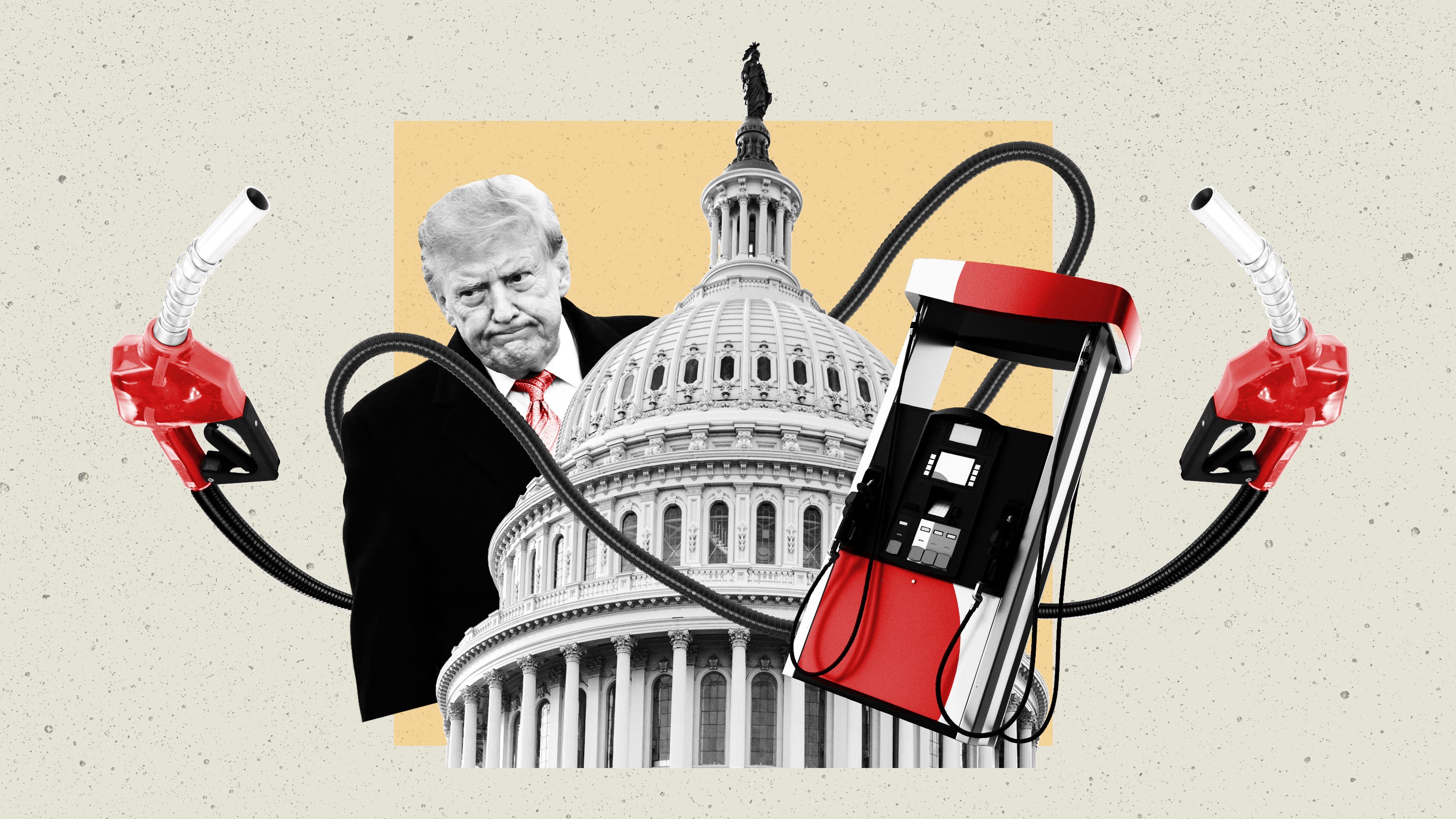
(Photo illustration by Bill Kuchman/The Bulwark | Photos: Getty, Shutterstock)
Seniors of the Corn
Cedar Falls and Mason City, Iowa “We should have term limits for politicians,” said Rob Sand, the Democratic candidate for governor of Iowa, during remarks to a group of college students. He then offered his young audience a bit of fan service: “Also, age limits, anybody?”
After some applause, Sand continued: “There is a certain point at which we should just have a rule that says, ‘Hey, I’m sure you’re doing great. We just don’t wanna have another four or six years of crossing our fingers and hoping you’re gonna continue to do great for another four or six years.’”
Age is a political topic on everyone’s mind in Iowa lately, despite the fact that the state’s candidates for Senate and governor are all quite young. The oldest of the bunch, Democratic Senate nominee Josh Turek, is only 47, which puts him close to the generational boundary between his Gen X cohort and Millennials. But Iowans with age-related concerns aren’t thinking about Turek. They’re thinking about Chuck Grassley.
Iowa’s senior senator first won a race for public office during the Eisenhower administration. He offered a rare acknowledgment of his age a few weeks ago while encouraging people to vote for Zach Lahn, the Republican nominee for governor.
(Photo illustration by Bill Kuchman/The Bulwark | Photos: Shutterstock)
Iowa is back in play
The conventional wisdom about general elections used to be that whichever party wins the swing-district suburbs of Southern California will probably win the House majority. But after redistricting, that region has gotten decidedly bluer, while also producing one Republican-only race where two GOP incumbents, whose districts were redrawn, are now locked in an insult-laden faceoff. Now, the path to a Democratic House majority lies across the Midwest thanks to a combination of opportune historical conditions, the regional consequences of the Trump administration’s economic policies, and voters whose political allegiances aren’t yet set in stone. That dynamic is most apparent in Iowa, where once-moderate-coded Republicans are finding that their tethers to Trump, which once lifted them into the air behind him, are now dragging them after him as he plummets back down to earth.
After driving nearly 350 miles total across the state on Monday to various campaign events, I can recall seeing just one weather-beaten Trump sign, peeking out from a queue of the region’s Republican slate of candidates.
Two House races—in Iowa’s 1st and 3rd Congressional Districts—have seen Democrats rise in the polls while their Republican counterparts adjust long-held positions after major Republican backers withdrew ad money and redirected it to races they consider more winnable. I spent some time on the campaign trail this week with the Democratic candidates in those two districts to get a sense for the view from the ground—set against a long, flat horizon, of course.
Get Press Pass in your inbox
The 3rd Congressional District
Panora, Iowa At the public library in Panora, a town of about 1,100 in a county that went for Trump by a margin of 37 points in 2024, roughly 3 percent of the population had filled the meeting room close to capacity. A local man who had seen Democratic House candidate Sarah Trone Garriott speak several times before told me that he had expected maybe five people to show up, as is common for political events in this town; the tally ended up over thirty. Something is different this cycle, he said. “People are pissed off.” And in his view, incumbent Rep. Zach Nunn can’t blame anyone but himself for that anger.
Nunn, a replacement-level MAGA Republican, has made quite a few blunders over the past few months. He has never held a public town hall, he has repeatedly backed the Trump administration’s tariff policies, and he even brought Defense Secretary Pete Hegseth to the district for campaign events in August. (One of those events, a campaign fundraiser–cum–veterans benefit, was called “Operation Top Nunn.”)
Putting aside the irregular repurposing of the secretary of defense—traditionally an apolitical cabinet position—as a campaign prop, Nunn’s choice of celebrity guest directly linked him to the horribly unpopular Iran war.
In Panora, Trone Garriott even had a laugh about Nunn and Hegseth dressing alike during the political stunt. “They were wearing the same outfit. They had done their hair the same way. They were wearing the same sunglasses,” she told me. “I mean, they clearly had coordinated how they were going to dress like twins, and he could not have aligned himself and tied him to this disastrous war more directly than in that moment.”
Trone Garriott said anger about the war (and its consequences for gas and diesel prices in particular) has given her campaign a lot of its momentum.
“I mean, folks are so frustrated,” she said. “They were promised lower prices. They were promised no wars. They were promised stability, and all they’ve gotten is chaos, and it’s costing them deeply.”
“So, you know, all of the campaign promises . . . that the president, our Congress members [have made]—they’ve not followed through on any of it,” Trone Garriott added. “And people are hurting.”
Trone Garriott also noted the service member deaths resulting from the war. Some of the deceased came from communities she knows well.
“The first week, two Iowa service members were killed. Like, the cost for us has been incredibly personal and really high,” she said. “And those two service members, you know, one was in my state senate district. The other one just lived right down the road.”
Rep. Nunn has a long way to go in a short time if he wants to give himself a real chance at re-election this cycle. But, however tough his challenge, things are even worse for the Republican incumbent a few counties over.
The 1st Congressional District
New Virginia, Iowa During a focus group in a small clubhouse in New Virginia, a town less than half the size of Panora, Democrat Christina Bohannan listened to a roundtable made up of conservatives, liberals, and independents. But notwithstanding their partisan and ideological differences, each one repeatedly emphasized the same thing: Everything is too expensive.
Gas prices are hurting virtually everyone, from commuters to farmers. Farmers participating in the roundtable said diesel costs, which are currently soaring in large part because of the war in Iran, have an outsized effect on their work. One farmer offered that a bushel of corn used to cover the cost of four gallons of diesel, but these days, a single bushel would cover just a single gallon. The same economic factors that are sending diesel prices skyward are also affecting fertilizer and even labor. Another farmer participating in the roundtable mentioned that he’s recently traded cattle for labor. Make bartering great again, I guess.
Health care is another pain point. Several farmers said they can’t afford it on their own and must rely on their wives’ insurance plans for coverage. “The girls work in a town and get the insurance so we can farm,” one said. Bohannan stopped short of supporting the sort of Medicare for All–type plan that is popular with many Democrats at the national level, but she suggested reforms could be made to allow individuals to buy into Medicare.
After the event concluded, Bohannan shared with me her team’s assessment of their prospects in the district: “We do think we have momentum in this race.”
“We’ve been knocking doors since January, and we’ve done thousands of doors now,” she added. “We are predominantly knocking Republican and independent doors and have been for months. And what we are hearing is remarkable.”
A local Democratic party operative told me that they often forewarn their candidates that they’ll probably need to run (unsuccessfully) in multiple cycles before their message can begin to stick with the electorate, at which point they might finally have a genuine chance to defeat a Republican incumbent.
Bohannan has followed that advice: This is her third attempt to unseat Rep. Mariannette Miller-Meeks after defeats in 2022 and 2024; the latter contest she lost by just 798 votes. As for what makes this race different, Bohannan cited soaring costs across the board.
“I think that people are tired of paying super high costs on food and gas and everything else,” she said. “They’re tired of what’s happening with our health care being cut and their health insurance premiums skyrocketing. They know that Mariannette Miller-Meeks is responsible for that. You can kind of draw a direct line from the votes she’s taken to high costs, and people know it.”
Just this morning, the Congressional Leadership Fund, a super PAC aligned with House Speaker Mike Johnson, pulled its funding from the 1st district as part of a triage effort.
Money talks, especially when it’s on its way out. And I have to think Bohannan likes what she’s hearing.
(Photo illustration by Sarah Rogers/The Bulwark | Photos: Getty, Shutterstock)
The postman
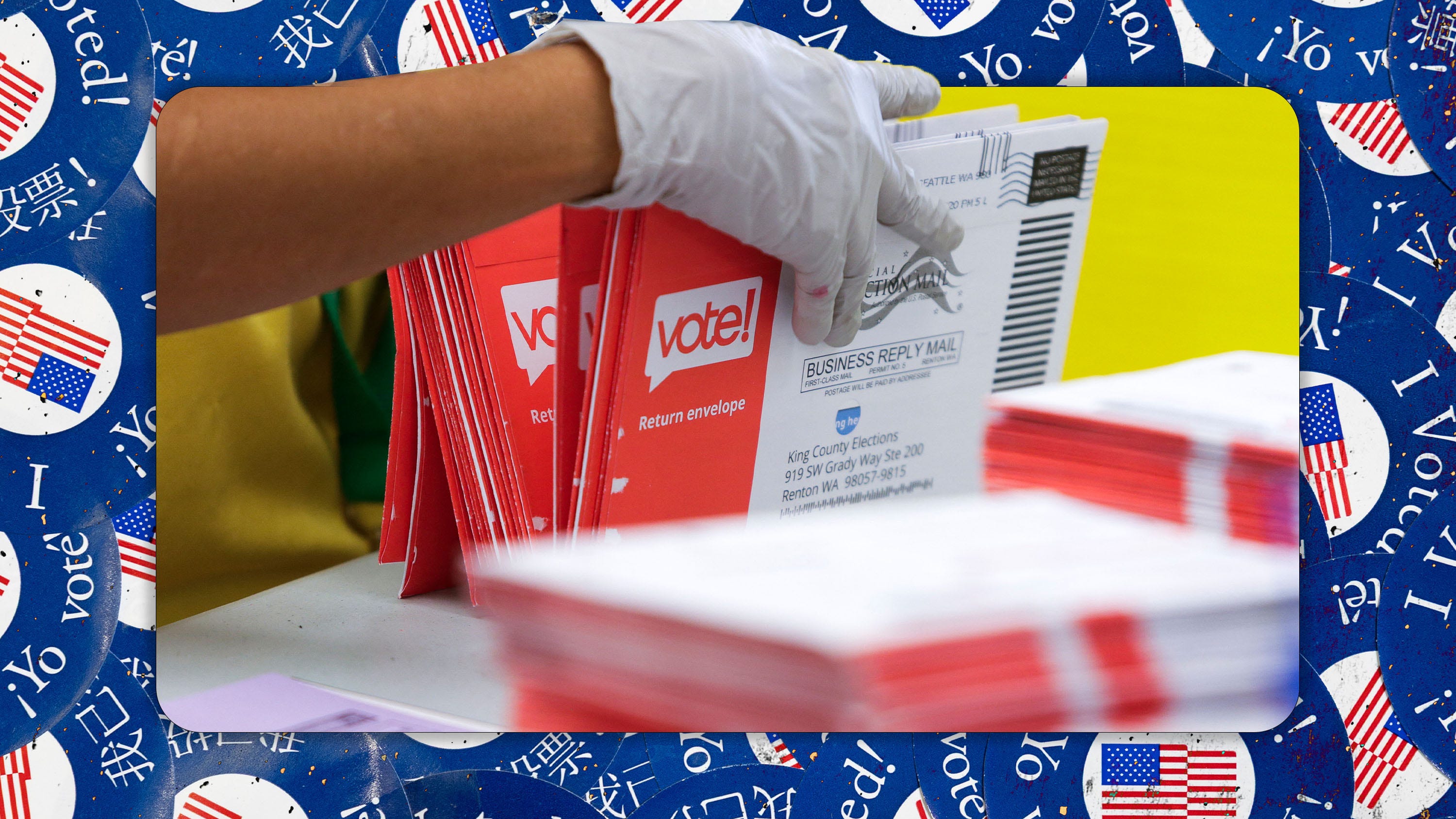
American elections are safe and secure. That was the conventional wisdom for a long time. But lately, some Democrats have started to worry about the safety and security of one method of ballot-casting: voting by mail.
To make sure this is clear from the jump: No, Democrats haven’t come to find Republicans’ arguments against voting by mail any more convincing. They don’t believe that foreign operations are compromising ballot security or that fraudsters and noncitizens are voting on behalf of the dead.
However, they have discerned a new threat vector. You might say that the call is coming from inside the (White) House.
Yes, we know. Paywall. Sorry.
We’d love to give everything away. Unfortunately, reporting on what the Trump administration is doing, asking members of Congress questions they’d rather dodge, and publishing smart, independent arguments about what it all means requires work and time and money.
So this is the bargain: Our Bulwark+ members support our work, and we keep doing it.
There’s a lot ahead between now and 2028. We’d love to have you with us. Join today for 30 percent off the regular annual price.
(Photo illustration by Bill Kuchman/The Bulwark | Photos: Getty, YouTube, Shutterstock)
Red Heat
Giffords PAC, the pro–gun control organization founded by former Rep. Gabby Giffords (D-Ariz.), released two new ads as part of a $10 million campaign in battleground House races ahead of the November elections, The Bulwark can exclusively report. The campaign—an unusually large intervention from an independent PAC—targets districts at the edges of Democrats’ hopes for how far a blue wave this November might carry them.
In a $1 million campaign in Michigan’s 10th Congressional District, the PAC’s ad elevates Christina Hines, the Democratic nominee.
“I investigated cold cases that Christina Hines prosecuted: gun traffickers, domestic abusers, and murderers. I was always relieved when prosecutor Christina Hines was assigned to a case,” a retired Michigan state trooper says in the ad. “She not only listened to me, she heard me. Christina Hines is a great partner to law enforcement. She’s tough, she’s honest, and I trust her.”
Get Press Pass in your inbox
In Florida’s 13th district, where Rep. Anna Paulina Luna (R-Fla.) is fighting for re-election against Democrat Leela Gray, the PAC’s $800,000 campaign about Luna’s connections to the gun lobby will soon fill the airwaves.
“The corporate gun lobby loves Anna Paulina Luna. And why shouldn’t they?” says the ad’s narrator.
They give her thousands of dollars, then she votes their way. Luna voted to weaken gun laws, making it easier for criminals and domestic abusers to get access to guns. She even voted to cut millions from law enforcement—putting our police and families at risk. The gun lobby can always count on Anna Paulina Luna. But Florida families can’t.
In a recent interview with Roger Stone, Luna complained about Giffords’s previous ads in her district and insinuated that school shootings are a consequence less of free access to firearms than of free access to anxiety and depression medications.
“I think that the attack is pretty egregious,” Luna said. “School shootings, no one wants to talk about the fact that a lot of these shooters—and a lot of the trans shooters also, too—are on SSRIs.” She then said the fact that the pharmaceutical companies that manufacture SSRIs are not “held liable for what happens after the fact . . . has to change.”
These two races are interesting targets for Giffords because they aren’t the obvious high-profile races that other Democrats typically designate as most crucial for retaking the House majority. The seat in Michigan’s 10th district, now an open race, has been held by a Republican in recent years while Luna’s seat is rated as “lean Republican” according to the Cook Political Report, indicating Giffords PAC is sending its resources to places national Democrats have been too thinly stretched to meaningfully contest in recent election cycles.
We recently published a leaked audio recording of Rep. Stephanie Bice (R-Okla.) stressing over low Republican enthusiasm heading into the midterms and President Donald Trump’s drag on GOP candidates. Today, we have another example of a Republican incumbent acknowledging that the president is creating problems for lawmakers in his party seeking re-election.
In a radio interview Friday with RadioPlusAudio in Fond du Lac, Rep. Glenn Grothman (R-Wis.) said Trump’s unpresidential actions are prompting Republicans to stay home, while independent voters seek to punish Republican incumbents at the ballot box.
When the host asked Grothman if Republican voters have expressed concern to him about Trump, the Wisconsin Republican said absolutely, counting himself in the lot.
“Oh, yeah, I’m a Republican who’s concerned,” Grothman said.
I mean, we have a situation in which I think a lot of the figures are good. But I think President Trump, who has wonderful people around him, but I think sometimes he says things that aren’t very presidential, and that hurts the Republican brand. I’m not for, you know, renaming Lake Ontario “Lake America,” for example, I think that sort of thing. Or when he tried to change the name of the Kennedy Center. That sort of thing, I think, gets him in trouble. I think sometimes he brags a little bit more than he should. You know, I think he’d do better if he came across a little bit more humble.
The host also noted a recent Marquette University poll that showed Trump’s approval rating at 38 percent, with a 60 percent disapproval. When asked whether that’s going to hurt Republicans in state and national races, Grothman said it would.
“Oh, no question. It’s a big problem,” Grothman said. “I consider myself kind of an independent person. I am not afraid to disagree with President Trump1 and therefore, hopefully that won’t hurt me as much as some Republicans.”
“But yeah, it unquestionably is a problem,” Grothman added. “Because if people don’t like Trump and want to make a statement, they may make that statement by voting against me.”
Grothman’s comments differ from the expressions of Trump-related frustration I’m used to hearing from Republicans on Capitol Hill. More often than not, Grothman’s colleagues will shift the blame from Trump to his advisers. Grothman says the opposite: Trump’s inner circle is trying to do good work in spite of the Don’s efforts to drag it all down.
Grothman himself enjoys comfortable odds for re-election. He won his race in 2024 by more than 22 points. But Bice, who had the hot mic in August, is also sitting in a district with a considerable GOP advantage. The fact that virtually sinecured lawmakers like her and Grothman are expressing panic, privately and publicly, and criticizing the president for having trivial and ego-driven priorities suggests that many of their House colleagues in closer races are in for a rough Election Day.
As their political movement builds momentum following years in the wilderness, young conservatives in Spain are drawing from the conservative American dress codes of the twentieth century to lend themselves a bit of sartorial cachet.
Jason Horowitz reports in the New York Times:
Hundreds of Spanish teenage boys—many wearing loafers, fitted cropped white pants, quilted vests or Barbour hunting jackets—erupted in cheers when a boy band in similar outfits introduced their hit song from the stage.
“This song is self-explanatory, it explains our origins,” one of the singers said to the packed courtyard of an exclusive Catholic prep school on a rainy night in Madrid. “This is who we are and we’re not going to change!”
With that, the group, Avenida, struck the driving opening chords of their hit song “Cayetano,” a term often used to describe young Spanish conservatives with a fondness for preppy clothes. When they reached the chorus, the audience sang “All my friends are named Cayetano” in gleeful unison.
Subcultures tend to adopt uniform standards of dress as they come into their own. It’s why bikers wear leather moto jackets, Republican Capitol Hill staffers wear red satin ties and Air Journos (my nickname for the hybrid sneaker-soled dress shoes), skateboarders dress like skateboarders, and libertarians dress like magicians. When young Spanish conservatives attempt to mimic the preppy stylings of William F. Buckley and Ronald Reagan, they create public signs by which they can identify each other and convey a common cause.
To render a proper homage, though, their pants should be less slim. But I suppose that’s the Old Country for you. For some reason, they love a tight fit over there.
Grothman’s claim that he’s independent of the Trump administration is more than a stretch. His voting record tells a very different story: He maintained a perfect score of voting in line with the president’s priorities, according to a 2025 vote tracker published by the Center for American Progress.
(Photo illustration by Bill Kuchman/The Bulwark | Photos: Getty, Shutterstock)
Government-funded gravy train
The federal government is running television spots during NFL games featuring President Donald Trump advocating for his personal political interests. Senators from both parties who spoke with me about them, including members of the committee whose jurisdiction controls the money being spent on these ads, described familiar feelings of impotence in response to the president’s latest flouting of laws and norms: disappointment in his heedless behavior coupled with few ideas about how to stop it.
“This is the final battle,” Trump’s voiceover says during one ad as he walks down a hallway mean-mugging for the camera. “With you at my side, we will demolish the deep state. We will expel the warmongers from our government.1 We will drive out the globalists. We will cast out the Communists, Marxists, and fascists. We will throw off the sick political class that hates our country. We will rout the fake news media and we will liberate America from these villains once and for all.”
If you’re feeling some déjà vu, it might be because Trump posted the exact same ad on Truth Social while running for president in 2024. (His caption for the Truth Social post invited viewers to text TRUMP to a five-digit number, a tactic he’s been using since 2016 to build his campaign’s contact list for direct updates.) Another ad celebrates his legislative accomplishments and offers the reassurance that “America will never be a Communist country.”
Trump reportedly pushed for and has been directly involved with the ad blitz. But unlike previous federal advocacy campaigns, these TV spots do not push a specific government program or policy. They’re just paeans to Trump himself.
I asked every senator I could find what they thought about the ads. Some of them were very blunt.
(Photo illustration by Bill Kuchman/The Bulwark | Photos: Getty, Creative Commons, Shutterstock)
Eat Pray Love Vote Stand
Leesburg, Virginia One of the major subplots in American politics over the past half-decade is evangelical Christians—the political constituency without which Trump would have never been elected president—becoming the dog that caught the car. They just haven’t had much reason to go to the polls since June 2022, when the Supreme Court overturned the legal right to an abortion in its landmark Dobbs v. Jackson Women’s Health Organization decision.
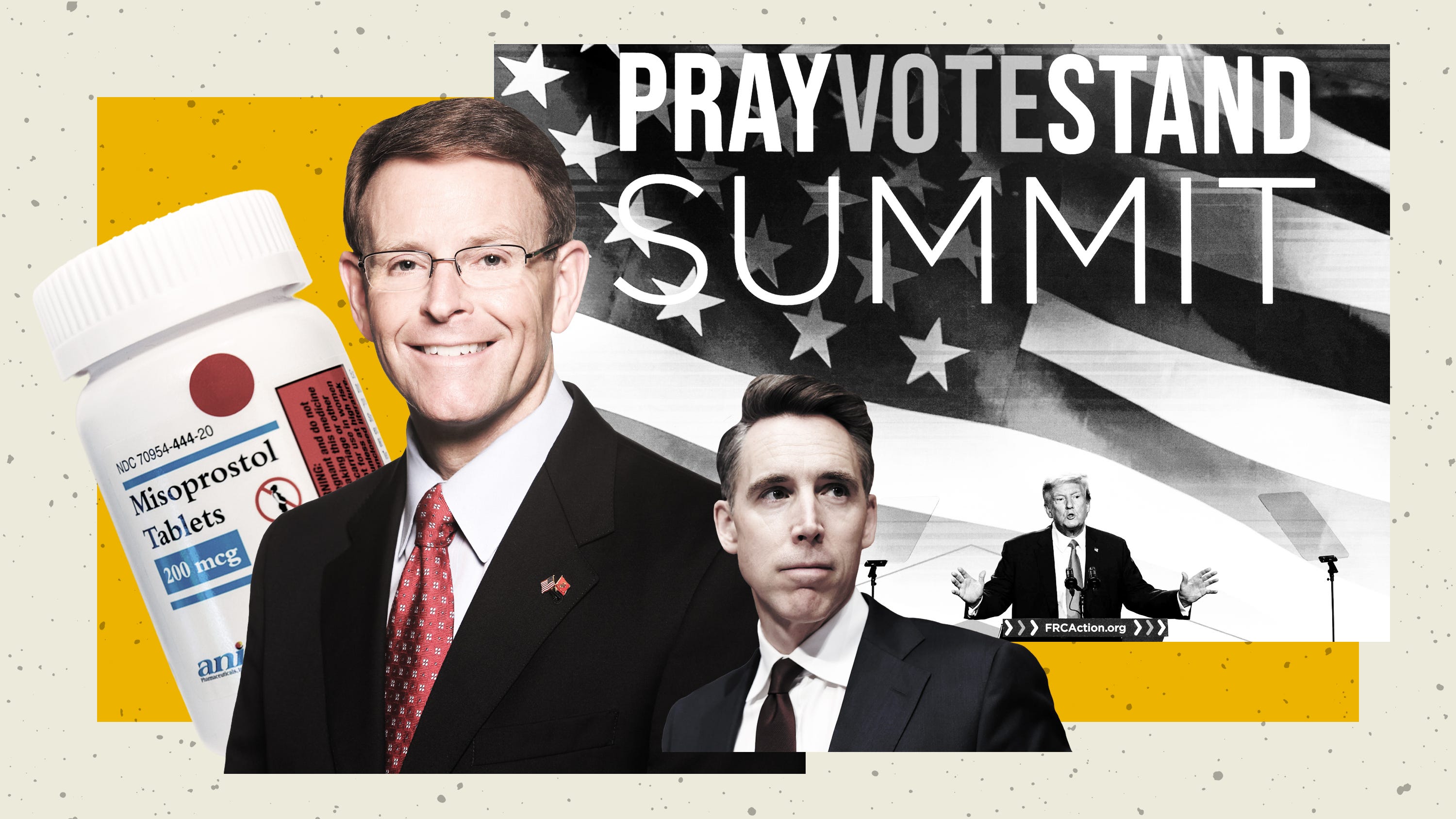
The Family Research Council’s Pray Vote Stand Summit was once a marquee political gathering for evangelicals and their allies in politics. But at this year’s event in Leesburg, Virginia, decline was evident everywhere, from the downsized venue far outside the Beltway to the sparse attendance and general lack of interest from elected officials. When the organization’s leader, Tony Perkins, addressed the audience, it became clear that he has been relegated to the D.C. sidelines after enjoying years of high-contact play as a leader in the anti-abortion movement.
Perkins’s position had once made him something of an evangelical kingmaker. But those who followed his lead in earlier times now largely get their information and political impetus from a shrinking number of online channels or from Trump himself. Perkins’s voice doesn’t resonate the way it once did with conservative audiences. This became clear from watching the crowd while he spoke.
Perkins’s remarks hit on one theme repeatedly: Notwithstanding the Dobbs decision, the right-to-life fight is not over. He supported this point with a real statistic: There are more abortions taking place in Trump’s America—including in deep red states—than in the years immediately preceding the overturning of Roe.
“Mailboxes across America have been turned into the instruments of abortion,” Perkins said, referring to abortion pills like mifepristone that can be delivered by mail. “As a result, we have more abortions today than before the overturn of Roe v. Wade—about a 21 percent increase in the number of abortions since 2020.”
“Many of you come from pro-life states. I’m from a pro-life state in Louisiana. It doesn’t matter,” he added. “We now have more abortions in Louisiana than before Roe [was overturned] because of this abortion pill.”
Each time he mentioned higher rates of abortion following the overturning of Roe, attendees shook their heads in disbelief. Utterances could be heard throughout the crowd of “My God” and “That can’t be.”
Perkins placed the primary blame for this situation on former President Joe Biden rather than Trump, citing the Biden administration’s rule change to allow abortion pills to be sent to private addresses through the United States Postal Service, sidestepping the need to go to a clinic to end a pregnancy, including in states that used the Dobbs decision as a license to ban abortion outright.
Get Press Pass in your inbox
But Perkins’s beef isn’t just with Biden. Throughout the event, he expressed frustration with the Trump administration for a lack of interest in addressing abortion rates, and with Congress for claiming to be pro-life while showing little follow-through.
“It’s been kept in place by the Trump administration,” Perkins said of the FDA decision to allow mifepristone to be shipped by mail. “It has allowed the abortion industry to adopt an Amazon model for business.”
Perkins frequently noted ways in which “the Republican party has lost its voice on this issue,” citing the GOP’s removal of support for a nationwide abortion ban from its official platform in 2024.
“We’re fighting for this life issue that many people thought was solved in 2022 when the Court overturned Roe, but it’s more of a battle today than it was then,” Perkins said, adding that conservatives “have an administration that’s not as committed to it as we’ve seen before.”
Election years produce plenty of noise. Independent journalism aims to produce something else: clarity.
That means reporting instead of repeating. Asking hard questions instead of cheering for a team. And following the evidence even when it’s inconvenient.
That work takes time, people, and money—and our Bulwark+ members make it all possible. Consider joining today:
Perkins and other evangelical leaders are hardly alone in feeling dissatisfied with Trump’s second term. Everyone from Big Oil executives to his most die-hard rallygoers has expressed doubt about whether the president’s priorities are in line with the country’s needs. And that sentiment has become predominant among the American public, according to recent polling.
Despite the lackluster attendance and smaller venue for its flagship conference, the Family Research Council isn’t short on cash. As a 501(c)(3) nonprofit with substantial annual revenue, FRC is obligated to file 990 tax returns, which are public documents; the organization’s filings show that its revenue has been steady since the Dobbs decision. But its big event, previously called the “Values Voter Summit,” no longer takes place at Washington’s swanky Omni Shoreham hotel in Woodley Park, where it convened annually for many years. This year’s summit was held instead at Cornerstone Chapel, an evangelical Christian church in Leesburg, Virginia, about an hour outside D.C.1
The venue was no longer welcoming reporters from across the media spectrum, either, although not necessarily because it didn’t want them. While there, I did not recognize another reporter from the political beat, and when I checked in at registration, the bin carrying envelopes of preregistered press credentials was half empty.
Government officials once flocked to these FRC conferences, but their interest has fallen way off. One easy way to gauge this was by following promotional releases for the event over the summer.
In the months leading up to the event, confirmed speakers included members of the House and Senate and the Trump administration, including at least one cabinet official. By Thursday, the roster of current federal officeholders slated to make in-person appearances had shrunk to just Sen. Josh Hawley (R-Mo.), who appeared alongside his wife, Erin. Coincidentally, Erin Hawley works for Alliance Defending Freedom, a primary sponsor of the summit.
House Speaker Mike Johnson moved from confirmed speaker, to no longer on the roster, to appearing via Zoom on the final day. Rep. Keith Self (R-Texas), Rep. Mary Miller (R-Ill.), Sen. Katie Britt (R-Ala.), and Sen. James Lankford (R-Okla.) all appeared on the confirmed speakers list at one point or another, but none was on the final roster. Sen. Roger Marshall (R-Kan.), who is struggling through a surprisingly tight race this November (ironically, facing a Democratic nominee who pastors a megachurch), also dropped off the confirmed speakers list at some point this summer.
Scott Turner, the secretary of housing and urban development, disappeared from the list as well. The only representation from the Trump administration came from the U.S. ambassador to Israel, Mike Huckabee, an ordained Baptist pastor, who called in via Zoom early Saturday morning.
The Pray Vote Stand Summit felt more like a social gathering than a serious political event. But that’s just how the pro-life movement works under Trump 2.0. Having caught the car, it is still slowly realizing that no one was ever going to let it drive.
The House has left, and having left, it’s also left the Senate out to dry. When House Speaker Mike Johnson abruptly canceled votes last week to avoid a required vote on Defense Secretary Pete Hegseth’s impeachment, the Senate stuck around to make some last-minute gestures.
Sen. Jon Husted (R-Ohio), who is struggling to gain his footing in a hard race against the recently ousted former Sen. Sherrod Brown, is set to receive a consolation vote on his Ratepayer Protection Act, which could prove useful for messaging purposes during the final round of local television advertisements in his race.
While Husted’s bill already passed in the House in a sweeping bipartisan vote, the Senate is poised to advance it only through a procedural vote, not full passage, HuffPostnoted Monday.
In addition, the Senate on Monday evening passed Sen. Ted Cruz’s (R-Texas) College Sports Act. Cruz toldSports Illustrated that he believes Johnson will call the House back into session to move it over the finish line, with the aim of providing Trump with a spectacular signing ceremony live on ESPN’s College GameDay.
Don’t count on that. Lawmakers have pleaded with Johnson to come back into session to pass far more popular legislation that vulnerable Republicans can run on in the final stretch of the campaign.
“I texted him yesterday and put the extra pressure on. I think we should be in Washington, D.C.,” Rep. Ashley Hinson (R-Iowa) said during a press conference over the weekend. “I think it was a mistake for them to cancel session. Every option should be on the table and we should be in Washington working to provide that relief right now and I stand ready to jump on a plane as soon as they make that decision.”
Johnson, meanwhile, is embarking on a tour of nearly two dozen states to make the case in person that the 119th Congress has already been one of the most successful of all time. (Good luck with that, Mike.)
The House and Senate don’t like to work in tandem unless it’s absolutely necessary for them to do so to pass landmark legislation or during electoral off-years when they have a lot more time to actually do their jobs. Besides, Johnson knows what’s waiting for him if he reconvenes the House. So don’t expect a sudden return to session.
President Trump on Tuesday unveiled a new AI assistant intended to provide a one-stop information shop for anyone with questions about anything within the federal government’s purview. But based on a bit of honest questioning from me and my Bulwark colleagues, the bot appears to be dispensing information that directly contradicts President Donald Trump’s preferred versions of reality.
Here’s the no-brainer I started with:
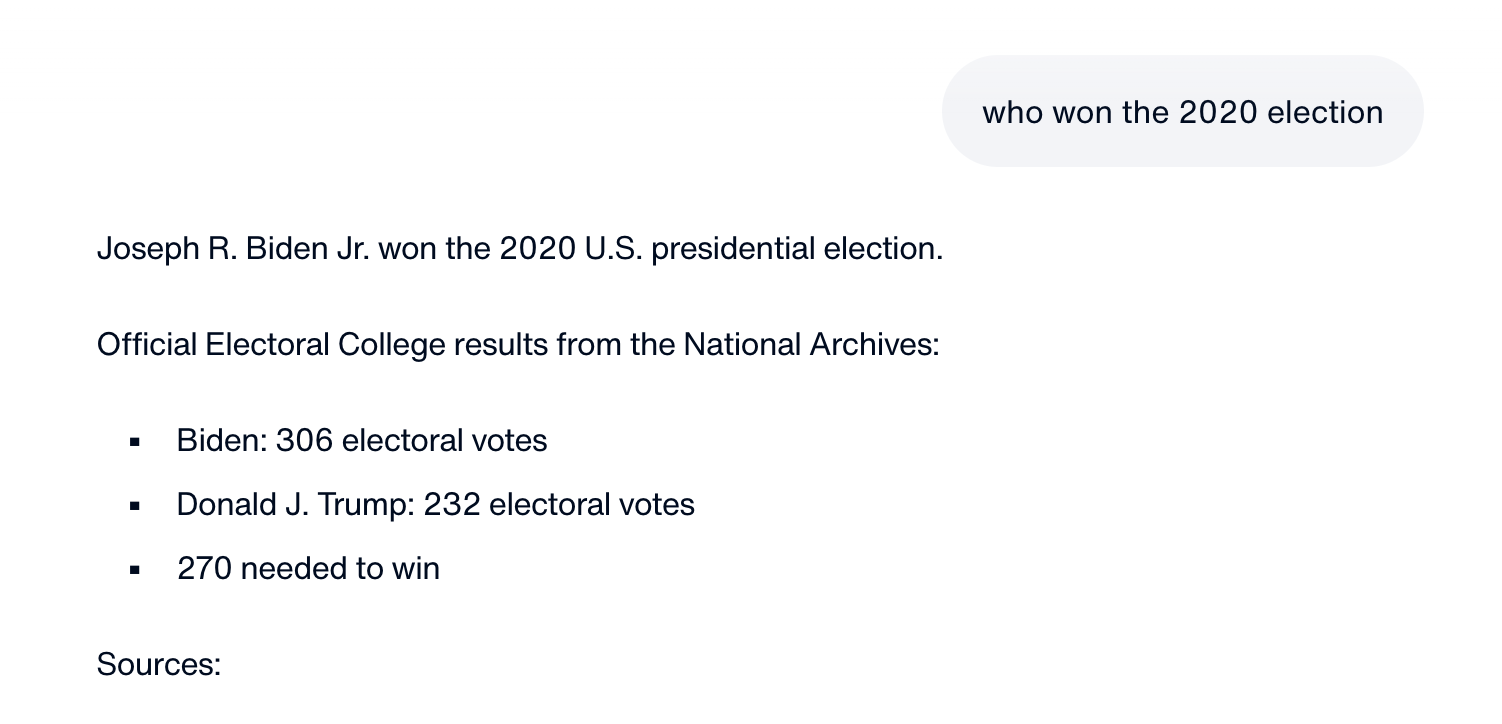
(1) Who won the 2020 election?
The chatbot answered correctly, and it didn’t even dog up its answer with the technical copouts that so many of Trump’s nominees use when asked the same question under oath (they will often say that Joe Biden was merely “certified” as the election winner and “sworn in” as president, but refuse to say that Biden “won” outright).
On to another:
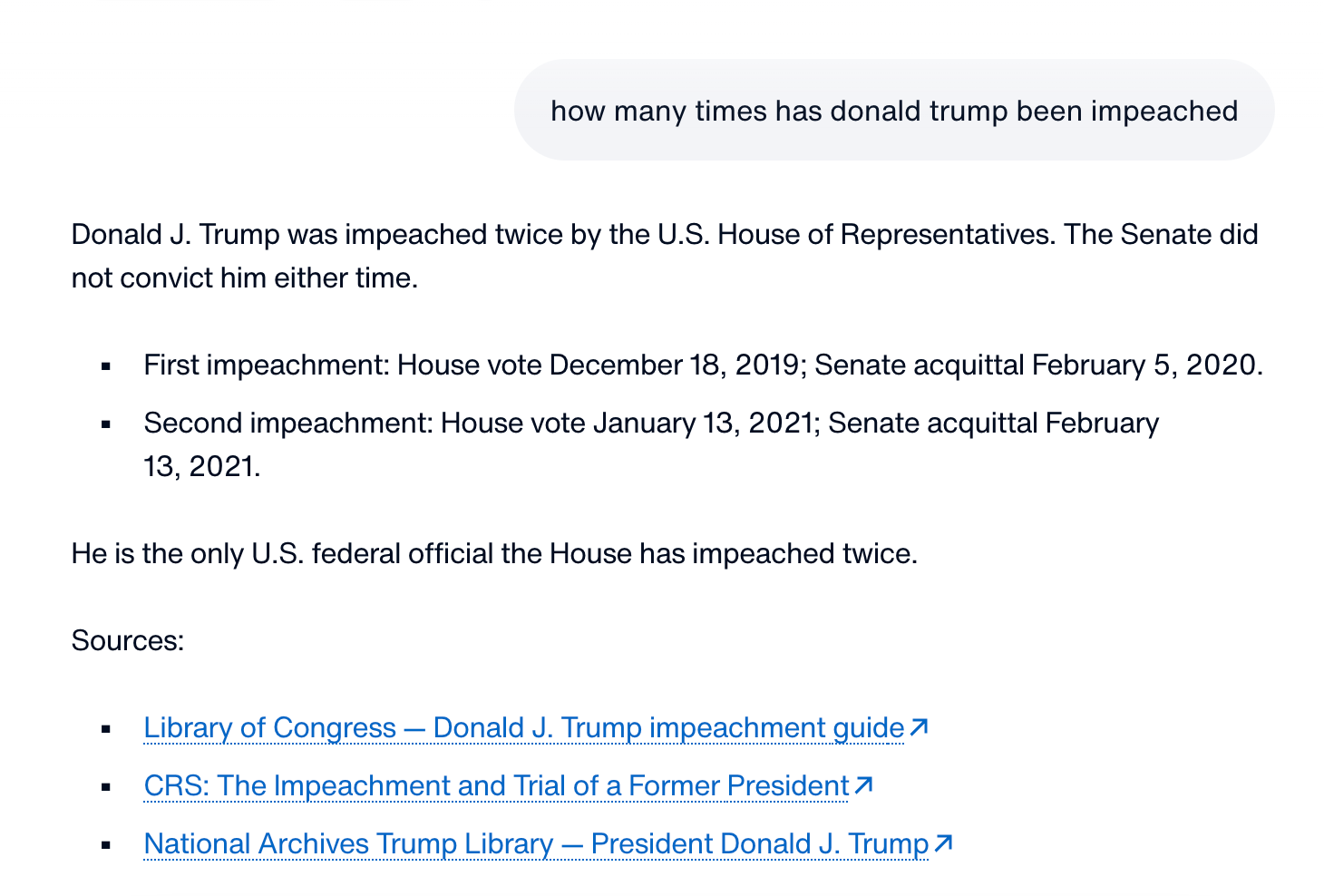
(2) How many times has Donald Trump been impeached?
The correct answer is two, despite MAGA lawmakers’ attempts to “expunge” the impeachments from . . . well, just, ah, to “expunge” them in some general sense. (I don’t think the sponsor of that bill knew what he meant exactly, either.)
Another:
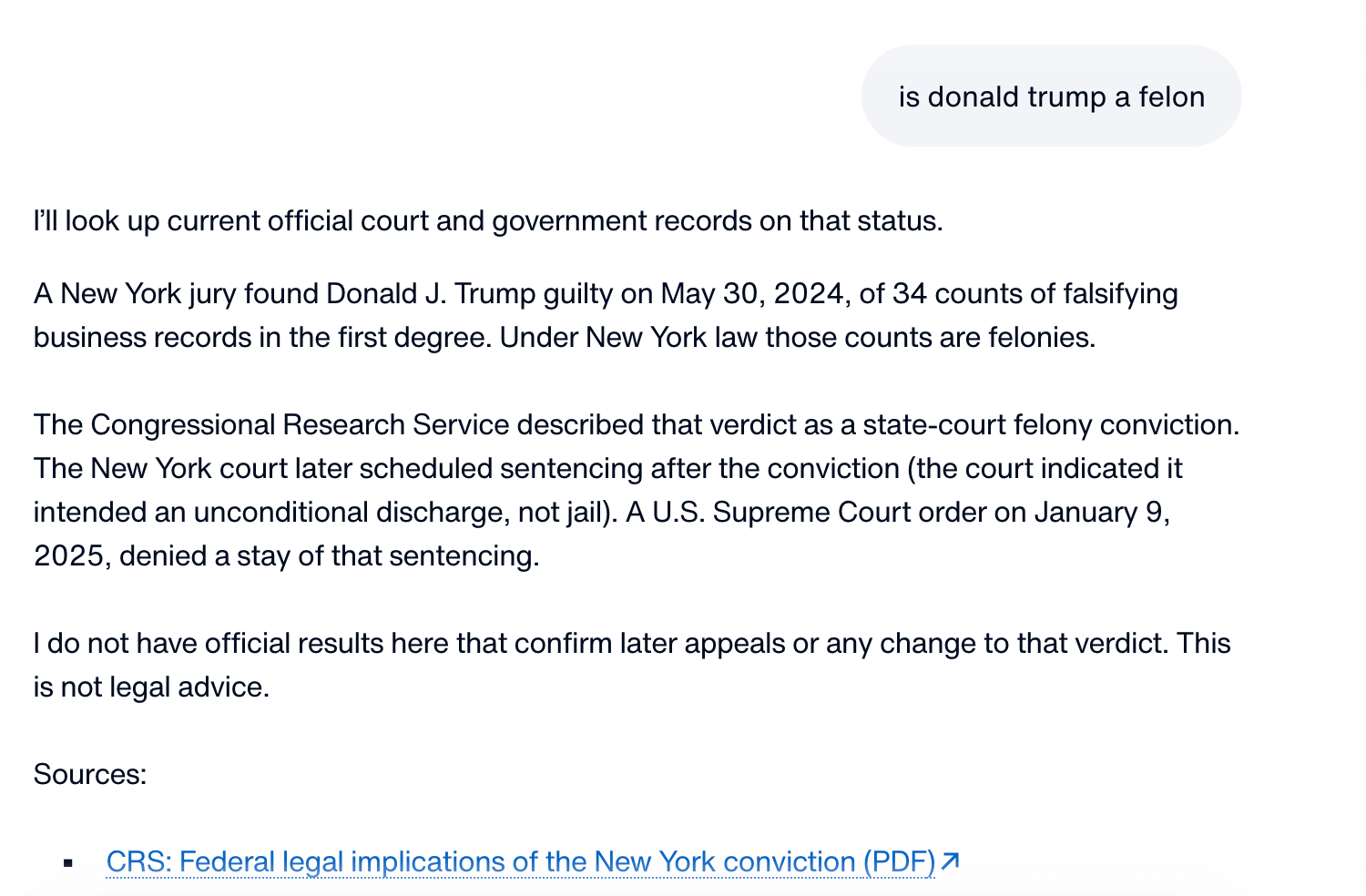
(3) Is Donald Trump a felon?
He is indeed a felon. Good job, computer. Next:
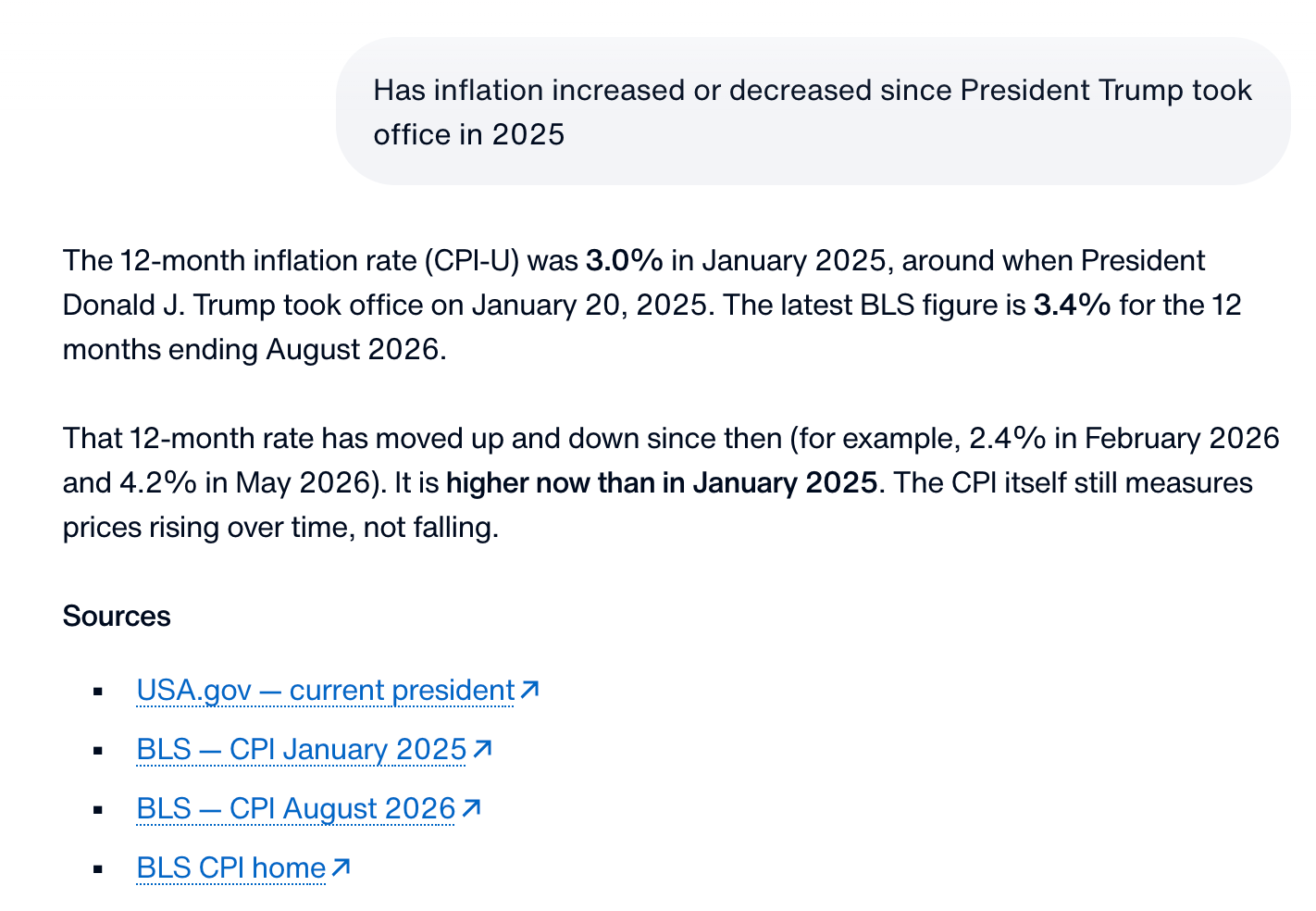
(4) Has inflation increased or decreased since President Trump took office in 2025?
Trump seems to think prices are way down. I’m glad that his AI chatbot is able to link users to the real data. Here comes a good one:
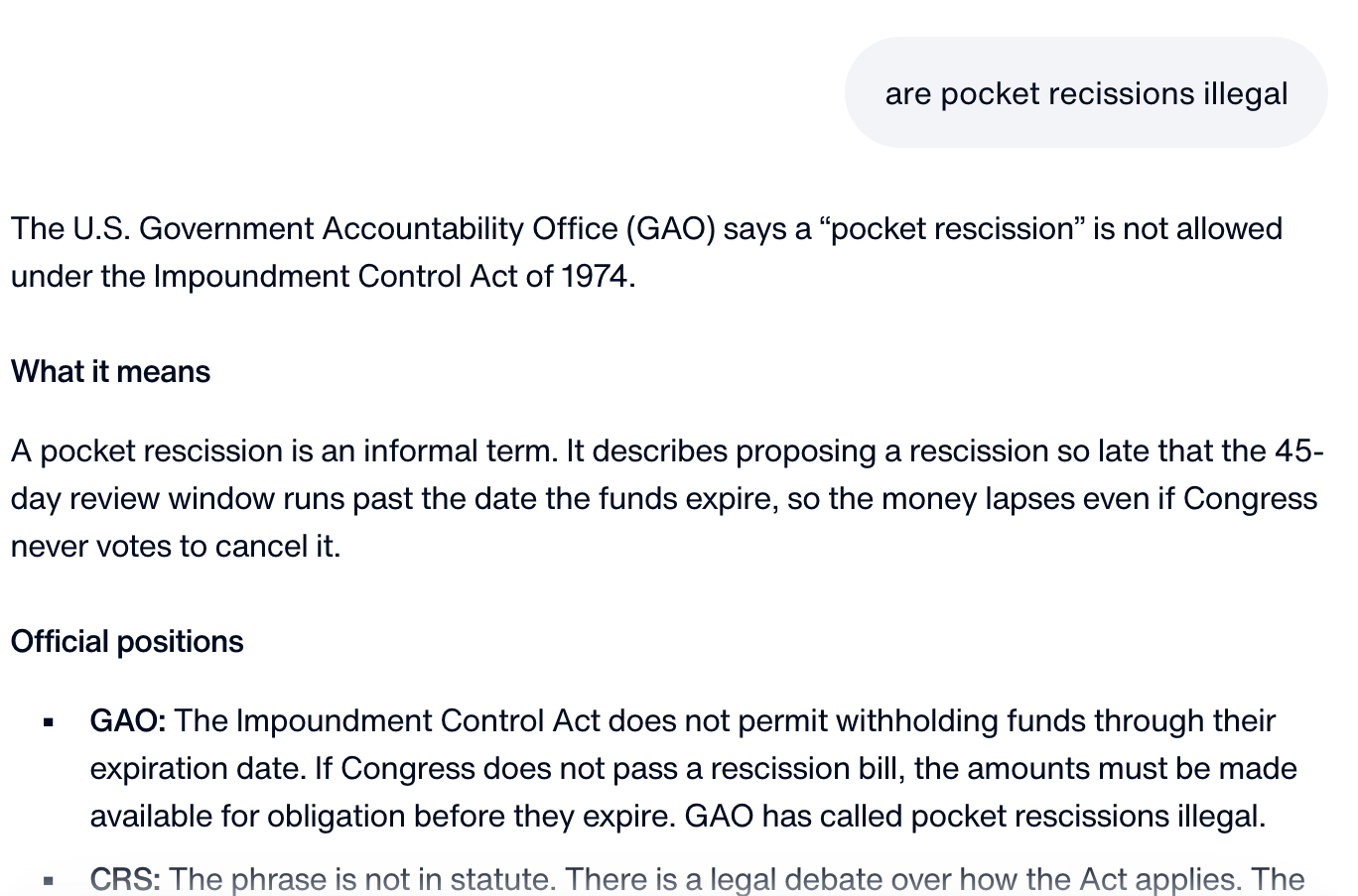
(5) Are pocket rescissions illegal?
The issue is a timely one: The Trump administration recently moved to block more than $800 million in appropriated funds through a practice called pocket rescissions. Members of Congress are nervously dancing around the question of whether this is allowed, suggesting it will be litigated in the courts. The America.gov chatbot offers a pretty clear position on whether it is permitted. But it shouldn’t take a “super intelligence” to arrive at common-sense positions with reference to simple public facts.
(Photo illustration by Bill Kuchman/The Bulwark | Photos: Getty, Shutterstock)
Gasolina
It’s no secret the price of gasoline has been way up since the start of the Iran war. But it sometimes feels as though GOP lawmakers have been trying to keep it a secret from themselves. Their willful ignorance is starting to fade.
In battleground races for the House and Senate, more and more Republicans are breaking away from President Donald Trump on the war, citing high costs at the pump as a primary reason. The national average price of gasoline is $4.48 as of Thursday. The average for diesel has climbed above $6.50, even reaching $7 and $8 per gallon in some states.
With the war in Iran continuing, the Strait of Hormuz remaining contested, and the conflict causing greater instability in other parts of the region, the Trump administration has tried to respond to the problem using a few flimsy tools of domestic policy. But it’s not easy getting fuel prices lower.
Trump-backed discount gas stations have started popping up, but these initiatives are a PR product. And besides, the cost of gas is not the biggest problem right now. Record-shattering diesel prices exist on an entirely different economic scale and political reality.
Once again improvising policy on the fly, Trump now seems to be entertaining a short-term fix meant to artificially boost domestic diesel supply through the end of the year. Politicoreported Wednesday that the administration has started considering a 90-day ban on diesel exports from the United States.
As a matter of policy this won’t work. My colleague, Catherine Rampell, will have a lot more on that in her newsletter tonight.
Politically, meanwhile, this seems like a nonstarter. A lot of senators I spoke with claimed they were withholding judgment until they could get a closer look at the proposal (presumably because they don’t think it could be as simple as a 90-day ban on diesel exports from the United States). Of the Republican senators who understood what such a proposal would mean, none I spoke with regarded it as viable.
(Photo illustration by Bill Kuchman/The Bulwark | Photos: Getty, Shutterstock)
A nightmare on K Street
[Update (September 22, 2026, 3:35 p.m.):Minutes after this article was published, a representative for Hakeem Jeffries told The Bulwark that the minority leader would not be attending the planned event, and that it would not be happening. The article below has been modified to include this information and the statement from Jeffries’s spokesperson.]
A fundraising event that House Minority Leader Hakeem Jeffries had been set to attend was abruptly canceled Tuesday, following reporting from The Bulwark about the planned participation of high-profile Democratic lobbyists associated with a Trump-allied firm, including one longtime consultant who has earned a reputation as Fox News’s favorite dispirited Democrat.
The event was set to involve Michael LaRosa, a former spokesman for First Lady Jill Biden, and a number of other officials at Ballard Partners, one of the top lobbying shops in Washington, D.C. A copy of the invitation obtained by The Bulwark had asked hosts to contribute $8,500 and political action committees to give $10,000, with proceeds going to the Jeffries Majority Fund.
The event was set to take place next week. But hours after The Bulwark asked Jeffries’s office for comment—and minutes after this article was published—a spokesperson for the minority leader said the fundraiser was now off.
“Leader Hakeem Jeffries does not plan to participate in any event hosted by Ballard next week or at any point in the future,” said spokesperson Justin Chermol. “The event is not on his calendar and it is not taking place. Throughout this cycle, he has personally raised over $200 million for House Democrats and the Democratic Congressional Campaign Committee. The average contribution to his re-election campaign is $28.00 per donation.”
Get Press Pass in your inbox:
Any collaboration with LaRosa on the fundraiser was bound to rankle Democrats, considering the latter’s frequent criticisms of party members and praise for the Trump administration. Prior to the cancellation, The Bulwark had been told that the event was a topic of much discussion on several text chains of other Democratic operatives.
LaRosa frequently applauds the president’s foreign policy efforts. He’s gone out of his way to compliment Vice President JD Vance and attackNew York Mayor Zohran Mamdani, even signing a petition encouraging the latter to skip the recent 9/11 memorial ceremony.
LaRosa has criticized Democrats for embracing DEI policies, insisted they’d gone “silent” on Iranian protests, and argued that the party’s rhetoric is “out of control.”
“My party has been out of control with the hyperbole, the aggressive rhetoric, the Nazis, the fascists, the autocrats, all this stuff,” he declared in 2025. He has doggedly gone after far-left figures, including Hasan Piker and Graham Platner—positions that others in the party adopted as those figures became more scandalous. But he has angered Democrats by criticizing Michigan Senate candidate Abdul El-Sayed, whom he slammed for his ties to “big tech, healthcare, and A.I.” (and for “summering in Egypt”—not sure what he’s getting at with that one). He has encouraged voters to back the Republican in the race, Mike Rogers, in part, he explained, because he could “smell [the aftermath of 9/11] from where I was from in Pennsylvania.”
LaRosa declined to comment.
Through it all, LaRosa has regularly praised Jeffries for trying to find a more moderate lane for the party. He was especially pleased that Jeffries met with Trump’s son-in-law, Jared Kushner. “I love the pragmatism. I love the leadership. And I love Jeffries’ willingness to work with anyone to get things done,” he wrote on X.
The possibility of Jeffries collaborating on the fundraiser with Ballard officials also had the potential to cause controversy for his office. Though the now-canceled event was not sponsored by the firm, several of the prospective hosts are top officials there, with clients who have clear interests before Congress.
Ballard’s client roster has gotten packed during the second Trump administration. Among those hoping to leverage the firm’s favor in Trump World are panicked corporations, foreign governments, media companies, and law firms that caved to pressure from Trump to provide pro bono services in exchange for lenience.
Iowa was once a contested state, and now, thanks to President Donald Trump’s horribly unpopular policies, it could become one again. Republicans in the state have realized this, and to salvage their electability in November’s midterms, they are frantically trying to distance themselves from Trump. It might just be too late.
Rep. Ashley Hinson (R-Iowa), who is vying for the open Senate seat created by retiring Republican Joni Ernst, is one of those attempting to recast herself as a reasonable, moderate politician in the final stretch of the campaign.
“Iowans are being squeezed and shouldn’t have to foot the bill at the pump or the checkout line for the war in Iran,” Hinson wrote on X Monday. “We need to use every option at our disposal to provide some relief from high prices.”
Hinson also laid out a list of policies that could help ease costs, but ended with the most obvious solution, writing that “the war needs to be brought to a successful and immediate end.” That line marks a serious change for her. In March, June, July, and even as late as last week, she voted against War Powers resolutions that attempted to claw back the president’s power to continue his military engagement with Iran. But notwithstanding Hinson’s pivot away from Trump on the issue of the war, voters seem to remember her consistent earlier support for the Iranian misadventure. In a Marist poll released Tuesday, Hinson trails Democrat Josh Turek by eight points.
Hinson has also attempted to craft a narrative of bipartisanship in recent weeks.
In an ad released earlier this month, Hinson touted “bipartisan leadership to lower costs for Iowa families.” But according to the Center for American Progress Action Fund’s scorecard, which assesses how often members of Congress vote in line with the Trump administration’s priorities, Hinson logs a perfect score, backing the president 100 percent of the time across 42 votes. Selling voters on “bipartisan leadership” is a tough proposition, given the actual record.
Hinson’s Republican colleagues campaigning to keep their House seats are using the same political playbook. Just before the House abruptly canceled its remaining work schedule last week, Reps. Zach Nunn and Mariannette Miller-Meeks broke party ranks. The duo voted in favor of the last War Powers resolution, despite voting to keep the war going the first three times. Miller-Meeks also skipped the Republican midterm convention in Dallas earlier this month in order to keep campaigning back home.
The Trump administration’s freewheeling trade policies have disproportionately affected the Midwest, souring Trump’s heartland voters and creating in Iowa a rare opportunity for multiple Democratic pickups in the House and Senate. The state’s most vulnerable Republicans in Congress may have realized what sort of position they’re in, but it’s not clear whether their late maneuvering is going to help them escape the electorate’s wrath.
In last Thursday’s edition of Press Pass, I shared some of my favorite pieces of merchandise from the various presidential libraries across the country. Today, I’m sharing some of the worst items that you, in your private civilian capacity, can buy from defense industry contractors.
Because America’s defense and ICE contractors are stepping out into the menswear space, for some reason.
Anduril Industries, a weapons and software contractor with the U.S. government, has an online shop where you can purchase racing jackets, windbreakers, and tacky Hawaiian shirts of the sort you might see hanging off the shoulders of its CEO, Palmer Luckey.
At Palantir, the software company that facilitates much of the current administration’s digital infrastructure for surveillance and mass deportations, you can buy a t-shirt depicting Atlas holding the company’s logo in lieu of a globe, a blue chore coat,1 and tennis apparel. Recently, they produced a limited run of company-branded boxing gloves, presumably for display rather than for accessorizing purposes. (Who wants the hassle?)
At least one person has bought the tennis gear, an operative at the right-wing Manhattan Institute. His stated reasoning was that “I love America, hate terrorists, and need to work on my backhand.”
“Cool” is a subjective term, but one that is often dictated by those who are in the know. Unfortunately, the styles of these items are quite dated or carbon copies of what was once cool in certain circles. If you’re looking for swag in the defense space, I’d recommend this Joint Endeavor NATO/OTAN hat on eBay. If you’re feeling more adventurous, look up some Lockheed Martin–branded gear produced in a strange licensing partnership between the weapons manufacturer and a Korean streetwear brand.
The blue French chore coat is something of a menswear staple. You can find them much cheaper second-hand and at surplus retailers. However, those coats won’t also have a logo that broadcasts your love of a unitary executive.

 Login
Login