❌

Normal view

Katie Zacharia’s Problem Is That She’s Bad at Lying

16 October 2026 at 15:25

We’ve come a long way since Jordan Peele’s 2018 PSA warning about the future of political deepfakes. Back then, everyone assumed that AI-faked video would mostly be the work of nefarious outside actors. Today, a remarkable chunk of the political ecosystem has openly embraced them, particularly on the right. The New York Times reports today that candidates and PACs, predominantly Republican ones, have already spent more than $137 million1 airing AI-generated ads this year alone. About 70 percent of the ads, they found, “contained no disclaimer that AI was used.” Happy Friday.


Join Catherine Rampell and JVL for Receipts Live at 12:30 p.m. EDT today on Substack and YouTube.
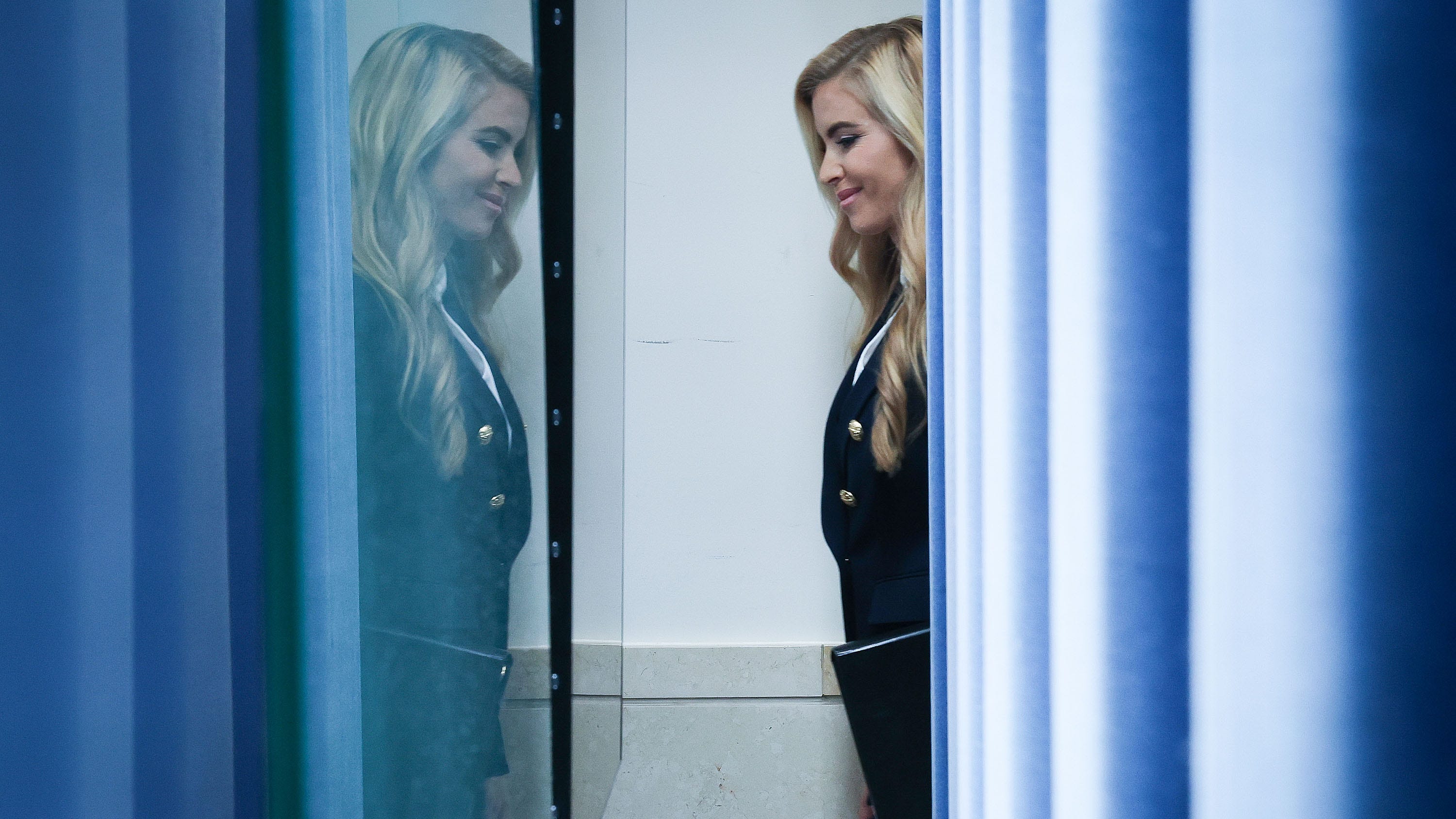

White House Press Secretary Katie Zacharia arrives for her first news briefing at the White House on October 13, 2026. (Photo by Win McNamee/Getty Images)

Post-Truth Press Secretary

by Andrew Egger

The new White House press secretary doesn’t have the one skill Trump’s top flack needs. She just can’t lie good.

Katie Zacharia’s first few days on the job have become dominated by her halting, changing responses to accusations that she spent years falsely claiming to be a lawyer, even though she has never been admitted to the bar in any state and never practiced law. Asked Tuesday when she had passed the bar, she replied “when I went to China.” On Wednesday, she insisted she had misheard the question and had thought she was simply asking what she had done after law school.

Then, yesterday, she did a damage-control tour of conservative media, sitting for interviews with Fox News’s Sean Hannity and MAGA conspiracy theorist Jack Posobiec. She insisted in these interviews that legal experts had assured her she could call herself a “lawyer” so long as she never used the (she said) more specific term “attorney.”

This is a silly dodge: In America, “lawyer” and “attorney” are synonyms. And it’s not a good excuse either: CNN promptly found at least fifteen times since last year that Zacharia had shared posts describing her as an “attorney.”

Katie Zacharia’s job is to lie to you. Our job is to tell you the truth—about the world, the state of our country, and what we really think. Join us.

Even Hannity, far from giving her the softball primetime interview she plainly had hoped for, struck a prickly, skeptical tone last night: “Why get into this long, drawn-out thing about the difference between a lawyer and an attorney?” he asked. He then asked her point-blank about the CNN “attorney” report. “I think they were retweets,” Zacharia blustered, “and I corrected the record and said that I was not endorsing the title, they were retweets of a title that had been given.” As Judd Legum, who broke the story of Zacharia’s resume embellishment, pointed out, she shared one of these tweets just last week.

None of this, of course, reflects particularly well on Zacharia’s honesty and character. Just as importantly, it is terrible comms work. Being able to navigate through stories like this in a disciplined, low-drama way is the single most important requirement for her new job.2 But instead of competently smothering the story, she has prolonged it, her multiple ridiculous “explanations,” each debunked faster than the last, just dragging out the embarrassment.

Put another way: Zacharia’s dishonesty isn’t the reason her job is in trouble. Being dishonest without seeming to is a big part of the job! The problem isn’t that she’s a liar, it’s that she’s a bad liar. Neither Hannity or Trump or anybody in MAGA cares that she lied on her résumé. What they care about is her clumsiness in explaining that now. Because a person who can’t even wriggle out of a little lie like that is going to get completely tangled when it comes time to defend way bigger whoppers in the White House briefing room.

Recall here that Trump picked Zacharia for the job on gut instinct, after seeing her appearances on TV. He made the choice over the objections of White House Chief of Staff Susie Wiles, who thought that CNN commentator Scott Jennings—a truly seasoned, deft liar—would be the superior choice.

“I would not be surprised if he happened to be meeting with her and just decided right then and there to give her the job, without much input or vetting,” Stephanie Grisham, one of Trump’s first-term press secretaries, told me.

Some in the White House who have chafed at Wiles’s leadership were enthused about the move: “Susie wanted someone who would be loyal to her and instead Trump chose someone loyal to him, as it should be,” an administration source told the Daily Mail this week. “He is taking back control, and it is starting to feel more like the first term.” (No argument there.)

What Trump wants and what Trump needs from the people around him aren’t always the same thing. Trump picked Zacharia because she’s a sycophant in his preferred mold. And he thinks she fights hard. But there’s a difference between fighting hard and fighting well. A press secretary who can’t lie convincingly won’t cut it.


A Tip of the Cap to No Kings

by William Kristol

Earlier this week, I asked if a reinvigorated liberalism is possible. I think it is, and urged us to “look abroad,” at the examples of Volodymyr Zelensky, and Péter Magyar, Mark Carney, and Pope Leo XIV, all admirably “strong and confident defenders of liberty.”

And I added,

But you know what else gives me hope for a revitalized liberalism? The American people, or at least an increasing percentage of them. Seeing support for President Trump collapse among the public—with very little help from our pitifully complacent and fearful elites—is heartening. Even inspiring.

And tomorrow, it will be inspiring to once again see millions of Americans show up at No Kings rallies. Because before the polls changed, before the gradual move of the public away from Trump, there were the efforts of the No Kings organizers. There were the peaceful and patriotic demonstrations of the participants. Before it was fashionable, No Kings was there.

The first of the No Kings demonstrations, on June 14, 2025, was organized in response to Trump’s military march in Washington that he’d timed—monarchically—to coincide with his birthday. At the time, according to the New York Times average of the polls, Trump had 44 percent approval and 52 percent disapproval. Anti-Trump elites were engaged in hand-wringing over his apparently unshakable hold on the public. Other elites were busy accommodating Trump. But five million Americans turned out to protest.

The second No Kings gatherings took place four months later, on October 18, 2025. Trump’s approval had barely budged: 43 percent approval to 53 percent disapproval. But turnout at the demonstrations across the nation surged to about seven million Americans. And in Virginia, where I live, there were indications of a big Democratic victory coming at the polls two weeks hence, and a sense that the tide might be turning.

The third day of No Kings rallies occurred this spring, on March 28, 2026, a month after Trump launched the Iran war. They were the largest yet, attracting around 8 million people. The mood was determined but somewhat upbeat, despite all of the depredations of the Trump administration at home and abroad. And it was clear that Trump’s popularity was finally dropping. He was by then at 40 percent approval and 56 percent disapproval, en route to his current 37 percent approval and 60 percent disapproval.

Tomorrow, we’ll get together once again under the rubric of No Kings. The focus this time is less on protesting the Trump administration and more on the practical task of encouraging and aiding voter turnout for the midterms.

As the No Kings coalition website explains,

No Kings: Vote Early is the next step of reclaiming our power after a year of mass mobilizations. It’s a day of nonpartisan voter participation, being in community with each other, and making sure every eligible voter has a plan, knows their options, and is ready to make their voice count.

The events around the country tomorrow will be less dramatic, and probably won’t get quite the numbers the earlier ones did. But they will be the culmination of a genuinely impressive and important effort on behalf of our democracy and our freedom.

I’ll be there tomorrow. And I’ll take a moment to tip my Bulwark baseball cap to No Kings.

Join now


AROUND THE BULWARK


Quick Hits

FUN WITH ROLLS: Donald Trump’s war on mail-in ballots continues. Yesterday, the Trump administration sued the state of California, asking a judge to block the counting of mail-in ballots from around 20,000 California residents it considers “likely” to be non-citizens. Earlier this week, California election officials received the list of supposedly suspect voters on a thumb drive, along with a demand from the Justice Department to remove them from the state’s voter rolls within 48 hours. But Secretary of State Shirley Weber said that Justice had provided no evidence that the persons named in the list were non-citizens—and noted that, when the Department of Homeland Security sent a similar list with similar demands to Nevada last month, state officials ultimately determined that every person listed was in fact a citizen. The AP has more:

The letter sent by acting Deputy Attorney General Trent McCotter gave the state 48 hours to research the list of the 20,000 people it claims might not be citizens. For those whose citizenship cannot be independently verified, the state is to instruct local election officials to segregate their mail-in ballots until their status can be determined, and to not provide a ballot to anyone who has not yet received one.

California Attorney General Rob Bonta said at an unrelated press conference Thursday morning that state officials would not carry out the federal government’s requests to withhold ballots for the alleged noncitizen voters. He noted that the administration’s alleged number of noncitizens on the state’s voter rolls had dropped from the 190,000 flagged over the summer by the Department of Homeland Security to the 20,000 noted by the Justice Department.

One thing after another with these guys. Read the whole thing.


RED HOPIUM: The polls look terrible for Republicans. But Republicans have one reason to console themselves: How many times lately have the polls been flat wrong? Here’s Politico:

Polling over the last decade has struggled to capture Republican voters. The data underestimated Trump’s support in 2016, 2020 and 2024, and Republicans argue similar errors could be happening again this cycle, particularly in competitive Senate races.

“Polling is getting much more difficult to do,” said veteran GOP strategist Karl Rove, adding that if the polls reflect Democratic overperformance “then every one of these races that we’re talking about today—Texas, Michigan, Maine, Alaska, Iowa—they’re all within the margin of error.”

As Nate Silver has pointed out, “The polls have overestimated Democrats for three presidential elections in a row” (emphasis added). But “Polls in the 2018 and 2022 midterms did much better.”

One GOP strategist told Politico that the polls are so Democrat-favored right now that they suggest a change in the electorate “as profound as those seen after Watergate and 9/11”—and surely that hasn’t happened, right? “You’d have to presuppose we’re staring down the barrel of a generational national trauma that no one is aware of,” the strategist said.

Now, look: We’ll be the first to admit that you’d have to be crazy to have tremendous confidence in polling at this moment in time. But is it really so ridiculous to think that the catastrophic crackup of Donald Trump’s political movement—the most potent force in politics over the last decade—is driving some pretty remarkable political realignments? Read the whole thing.

Join now


Cheap Shots

Join now

1

Correction (October 16, 2026, 10:52 a.m. EDT): As originally published, this sentence misstated the amount of political spending on AI-generated ads as $137, rather than $137 million.

2

Even slavish loyalty to Trump isn’t of any use if she’s spending all her time talking about herself.
Short-Term:😀. Medium-Term:😟. Long-Term:🤷‍♂️

15 October 2026 at 15:30

Don’t look now, but more crazy House-GOP leadership drama may be just around the corner. CNN reports that if Republicans lose the house and Speaker Mike Johnson loses his gavel, Rep. Jim Jordan may challenge him for leadership of the conference. Happy Thursday.


Join Bill and Andrew for an extra Morning Shots Live today at 11:00 a.m. EDT on Substack and YouTube.


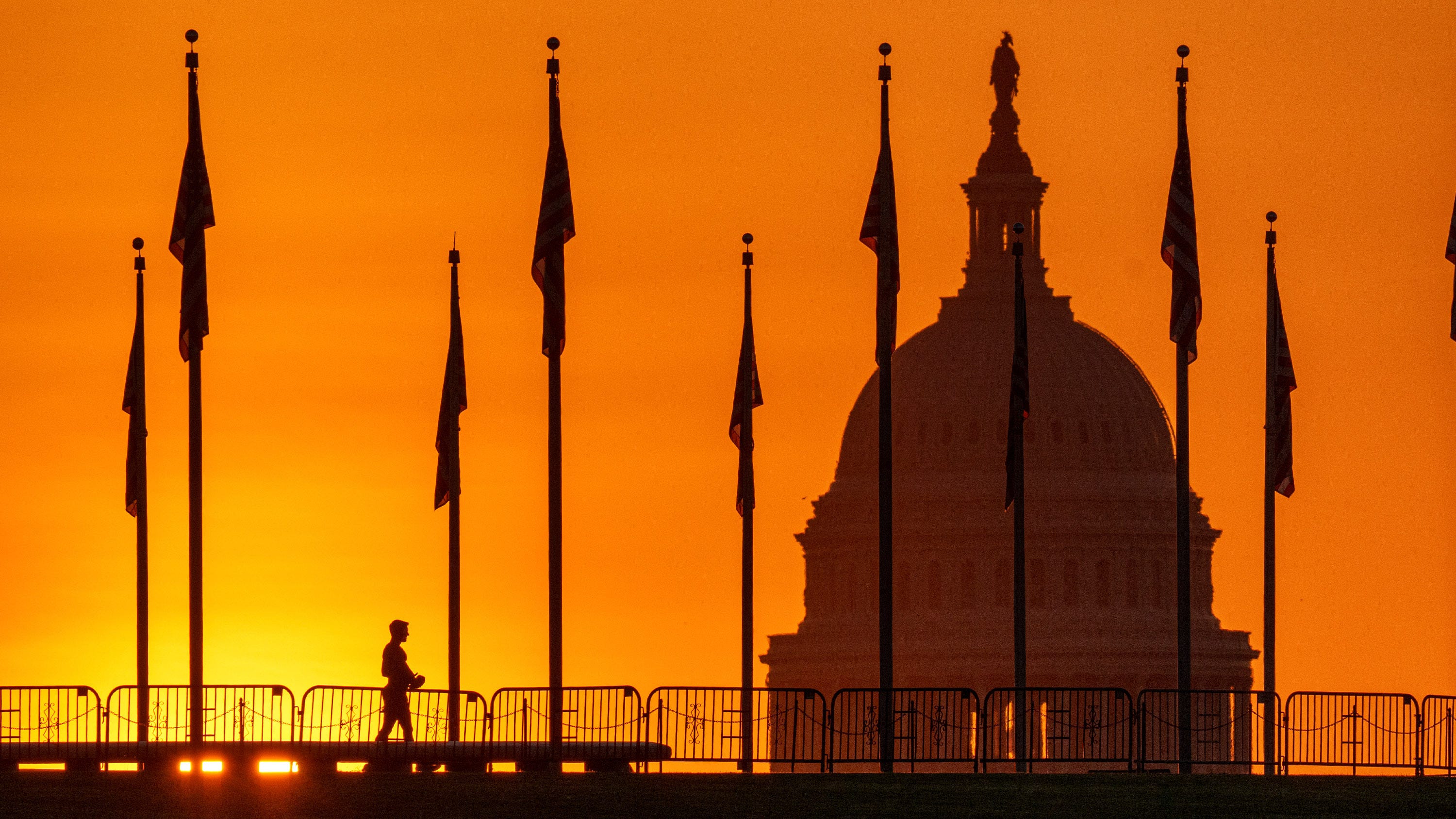
A visitor to the National Mall walks past the Capitol Building at daybreak on September 16, 2026, in Washington, D.C. (Photo by J. David Ake/Getty Images)

On the One Hand, On the Other Hand

by William Kristol

I’m not usually an on-the-one-hand-on-the-other-hand kind of guy. But sometimes life presents you with an on-the-one-hand-on-the-other-hand kind of reality.

So, on the one hand: The upcoming midterm elections look awfully promising for the defenders of liberal democracy. But, on the other hand: The political and governing challenges facing the defenders of liberal democracy in the coming years are awfully daunting.

Last night, Fox News reported that its new poll shows President Trump’s overall job approval at 36 percent, his lowest ever in a Fox News survey. Until now, Fox had shown Trump’s approval holding steady at 39 percent since first dipping below 40 percent in May. And today, of the 36 percent of registered voters approving of Trump’s job performance, 19 percent strongly approve and 17 percent somewhat approve. Of the 64 percent disapproving, 50 percent strongly disapprove, with 14 percent somewhat disapproving. A strong approval to strong disapproval ratio of 19 percent to 50 percent is . . . not good.

You know what is good? A pro-democracy community that’s growing every day. Join us by becoming a Bulwark+ member.

So Trump is in bad shape, and 54 percent of voters now tell Fox they’ll back the Democratic candidate in their House district, with 45 percent supporting the Republican. That 9-point gap is wider than the Democrats’ 7-point lead in the two most recent Fox polls in July and September.

Meanwhile, Republicans are pouring money into states and congressional districts that Trump won in 2024 by 10 points or more. That money may have slowed Democratic momentum, but it hasn’t reversed it, and I think it’s more likely than not that momentum reasserts itself in the final couple of weeks.

So what to expect on Election Day? Despite all the extraordinary features of our present situation, we have seen this movie before. Twice, in fact, in the two most recent midterms with a Republican in the Oval Office.

In both 2006 and 2018, Democrats won the national vote for the House by about 8 percent. They picked up a net gain of 31 and 41 districts, ending up with 233 and 235 seats, respectively. In those two elections, Democrats also had a net gain, respectively, of six and seven governorships. The one marked difference from this year is that in 2018, Republicans had a net gain of two Senate seats, defeating four Democratic incumbents in states that had voted for Trump in 2016. But the dynamic is now decisively in the other direction, with a half a dozen states Trump won by more than 10 points in play. The results should look more like those of 2006, when Democrats won a net gain of six seats to take a narrow majority in that chamber.

And if you want to really go to town on all this good hopium, I’ll add that those 2006 and 2018 midterm victories were followed by decisive Democratic presidential victories in 2008 and 2020. And in both cases the new Democratic president had a Democratic Congress to work with.

So things not just in 2027 but also in 2029 could look pretty good!

But, as we know, in the earlier instances, everyone didn’t live happily ever after.

Politically, Democrats lost the House in 2010 and the Senate in 2014. Democrats lost the House in 2022—and then everything in 2024.

And in terms of actual governing, while there were achievements in the Obama and Biden years, I think it’s fair to say neither had as much lasting success in reshaping America or the world order in a positive direction as they or their supporters hoped. I don’t say this judgmentally, but simply analytically—even sympathetically. Both faced very difficult challenges, not least in taking office in the middle of a financial crisis in 2009 and a pandemic in 2021. But I think it’s the case that at the end of their presidencies, our governing institutions weren’t stronger, our liberal democracy wasn’t healthier, and the world order of which we were the anchor wasn’t more robust.

The next Democratic Congress and the next Democratic president will face challenges comparable to—even greater than—those faced by Obama and Biden. The next Democratic Congress will have its hands full minimizing the damage over the next two years from an unprecedentedly extreme and lawless administration led by an increasingly willful and manic president, while it tries at the same time to lay the groundwork for winning the presidency in 2028, and to prepare for governing successfully in 2029.

And that next president? Remaking a polity and a civic culture that have been deeply damaged, an economy whose distortions of wealth and power threaten the future of democratic capitalism, and a world order that’s collapsed will be an even more formidable task. And that’s to say nothing of the unprecedented test of dealing with the fundamental and even existential threat of the new frontiers of artificial intelligence.

It’s daunting. But as Thomas Paine told his compatriots 250 years ago, “we have this consolation with us, that the harder the conflict, the more glorious the triumph. What we obtain, too cheap, we esteem too lightly.”

There’s nothing on-the-one-hand-on-the-other-hand about that truth, and that challenge.


AROUND THE BULWARK

  • Ukraine Is Hitting Putin Where His Data Lives… Strikes on server hubs are exposing Russian vulnerabilities—but U.S. support is suddenly looking less reliable, writes CATHY YOUNG.

  • Ramaswamy Campaign Ad Accidentally Featured a Sex Offender… The campaign says it’s recutting the spot, which was meant to be about the plague of high property taxes, reports JIM SWIFT.

  • Vladimir Putin Doesn’t Belong in Florida… And if he shows up at the G20 meeting, other leaders should boycott, argue ERIC EDELMAN and FRANKLIN MILLER.

  • Dems Are Already Fighting Over Who Gets Credit for November… The midterms haven’t happened yet, but progressives and moderates are debating what the results will mean for 2028, reports LAUREN EGAN.

  • Roy Cooper and Noam Scheiber: We Gotta Rein Trump In… Elon is now pitching in to help POTUS sabotage Ukraine while Trump makes a payout to Putin and works on his next self-enrichment scheme.

Save the date: This Sunday—October 18 at 7:00 p.m. EDT—we’re going live with Pete Buttigieg!

The gang is hitting the road tomorrow for the Bulwark LIVE: Good Fight Tour and we’re live streaming their Charlotte show exclusively for Bulwark+ members. Join Tim, Sarah, JVL, Sam, and special guest Pete Buttigieg on Sunday for a night of politics among friends. Catherine Rampell and Lauren Egan will be there too! As a Bulwark+ member, you’ll be able to tune in from the comfort of your own home and join fellow members in the live chat. We can’t wait to be together with you all! Watch for location details in your inbox or head to the site on Sunday night at 7 p.m. in the East to join in.

Quick Hits

TEAM RUSSIA AGAIN: The low point in U.S.–Ukraine relations under Donald Trump came last year, during Trump and JD Vance’s infamous Oval Office sandbagging of Ukrainian President Volodymyr Zelensky. Things are nearly that bad again now.

Any time Donald Trump speaks personally to Vladimir Putin, he seems to fall hopelessly under the Russian president’s spell: For days afterward, he seems to have adopted wholesale the Russian view of the war, according to which Ukraine—or even the American-led West more broadly—is the primary offender and aggressor.

So it has been since the pair’s call last Friday. Trump has demanded Ukraine halt attacks on Russian energy infrastructure even as Russia pummels Ukraine’s, insisted insanely that Putin wants peace more than Zelensky, floated the possibility of unfreezing Russian assets, and even seemingly cut off some forms of the limited support the United States is still supplying to Ukraine. Russian missiles fell in Kyiv Tuesday without the usual advance warning provided by U.S. intelligence, and the Starshield satellite-internet systems deployed in Ukraine by the U.S. military, which Ukraine uses to pilot drones, mysteriously experienced major throttling on Wednesday.

For days, Zelensky endured these impossible conditions, biting his tongue and agreeing in principle to abide by Trump’s demand for an energy ceasefire even as Russia was plainly ignoring it. Now he is out of patience. “The block [on attacking refineries] is out,” Zelensky told the Financial Times in an interview published this morning. “We’re done.” How Trump will take that remains to be seen.


TROUBLE IN PARADISE: This week, several stories of remarkable squabbling among Trump’s aides have made it into the press. Yesterday, our old colleague Marc Caputo reported in Axios that former Trump attorney Alina Habba had accused former Kennedy Center leader Ric Grenell, in a remarkable Oval Office confrontation last week, of pocketing a multimillion-dollar donation her billionaire husband made to the institution last year. “POTUS doesn’t want to deal with this,” a senior administration official told Caputo. “Of course, he’s concerned. But if there is missing money, this is a big, big problem.” Grenell called the accusations “absurd” and a “lie.”

And today, Politico reported on a remarkable year-long email squabble between two mid-tier Trump officials: Paolo Zampolli, “a personal friend of Trump’s and a special envoy at the State Department,” and Deputy Secretary of State Christopher Landau. Here’s Politico:

The emails stretch over almost a year and show Zampolli and Landau disagreeing over chains of command as Landau admonishes Zampolli to stick to his remit on cultural issues—but devolve into bitter arguments and unproven allegations.

The messages stand out not just for the personal vitriol but because upward of 16 administration officials were included at times on the email chains, with the dispute at least once spilling over into communications with a top foreign official, opening a window into delicate State Department back-channeling to allies about apparent violations of diplomatic protocol.

Donald Trump runs a tighter ship than he used to. His first administration was racked by constant infighting, and therefore leaked like a sieve; such fights have been far rarer, and the leaks far less frequent, since his return to the Oval Office. Until recently, it seems. Read the whole thing.


KATIE ZACHARIA, ESQ.?: In media appearances and on LinkedIn, new White House Press Secretary Katie Zacharia has presented herself as a lawyer for years. But as Popular Information first reported this week, this appears to be untrue: Zacharia did graduate from law school, but never passed the bar to be authorized to practice law in any state. Yesterday, the Wall Street Journal shed some more light on the subject: Zacharia sat for the bar only once, in California, shortly after graduating law school in 2011. She didn’t pass.

There’s no shame in that; California’s bar exam is notoriously difficult, and the fail rate is high. (Another notable person who famously failed her own first run at the California bar was Kamala Harris.) What is remarkable about Zacharia is how she has been calling herself a “lawyer” anyway ever since—in her work for the Zhong Lun Law Firm in China and, back stateside, as “general counsel” for a Trumpworld nonprofit, Fix California.

“As a lawyer, the procedural steps are absolutely critical to ensure they get this right,” she said on Fox News in August. The WSJ elaborates: “A line appeared on the chyron at the bottom of the screen referring to her as a legal and political strategist, and as an attorney.”


Cheap Shots

Join now

BREAKING: Trump Asked Kimberly Guilfoyle to Resign | Morning Shots

13 October 2026 at 16:56

Andrew Egger and Bill Kristol give their takes on the news White House Press Secretary Katie Zacharia made when she announced on her first day that the White House asked Kimberly Guilfoyle to resign as U.S. ambassador to Greece. Beyond that, Zacharia’s first briefing was remarkably short, with questions from just a few outlets, all of them conservative, yet she still struggled to deliver clear answers and repeatedly returned to praising Trump.

Plus, they examine Trump’s latest rally in Ohio, his attacks on Haitian and Somali communities, the federal raid on Rep. Ilhan Omar’s home, and the growing weaponization of federal law enforcement just weeks before the midterm elections.

Join now

Read more

💾

Donald Trump Got Mugged by Reality

13 October 2026 at 15:25

The midterms hammer hasn’t fallen yet, but it’s getting closer every day. Today, the New York Times reported that top Republican super PACs are giving up on two embattled House incumbents, Iowa Rep. Mariannette Miller-Meeks and New Jersey Rep. Thomas Kean Jr. The PACs are pulling more than $10 million out of the two races, essentially giving them up for lost in an effort to spend more on other seats they hope will be more defensible.

A bit of in-house news: George Conway is back! His new Bulwark show, Psycho Politics, will drop weekly on Monday nights. Happy Tuesday.


Join Bill and Andrew for Morning Shots Live today at 10:00 a.m. EDT on Substack and YouTube.


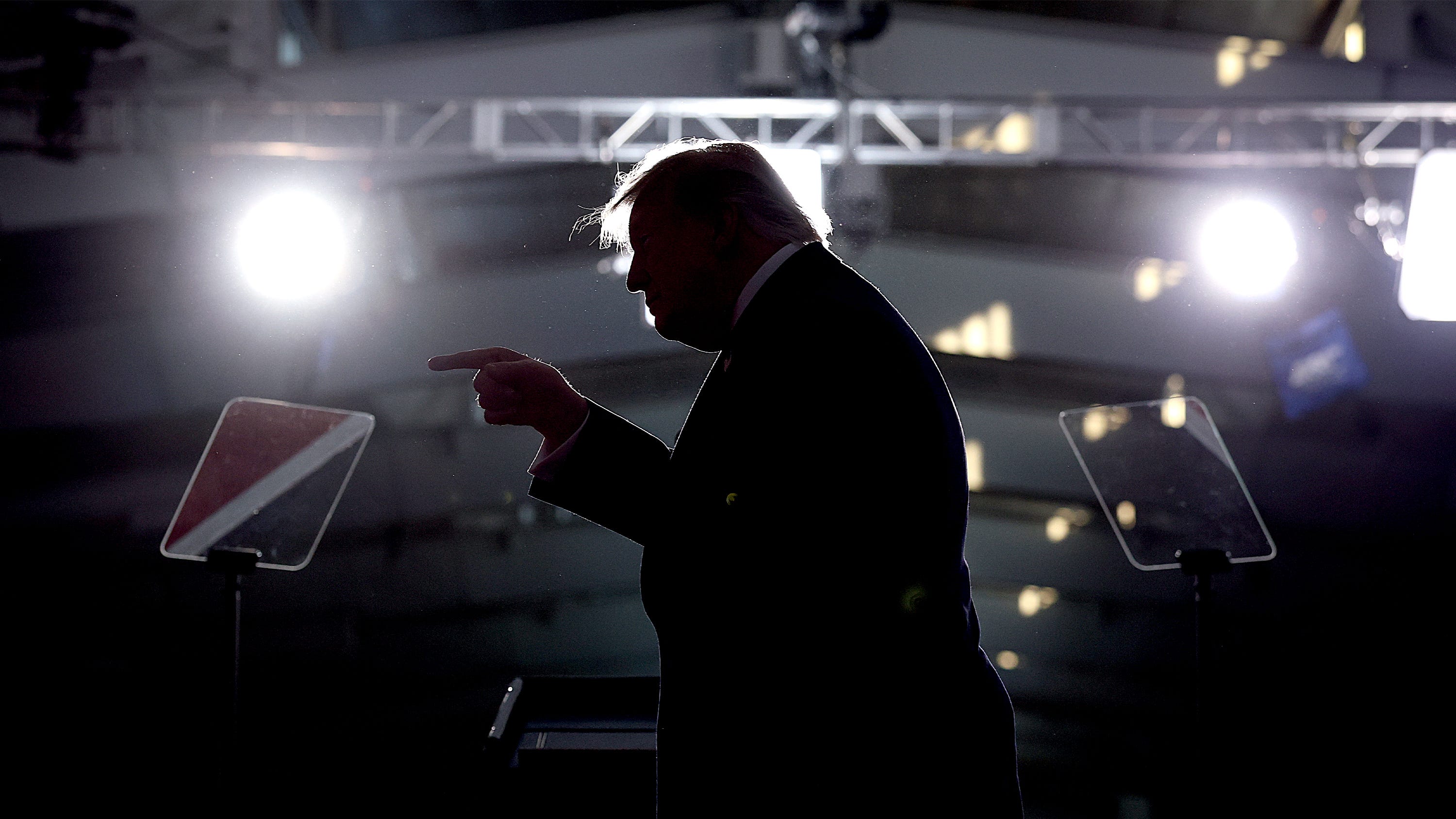
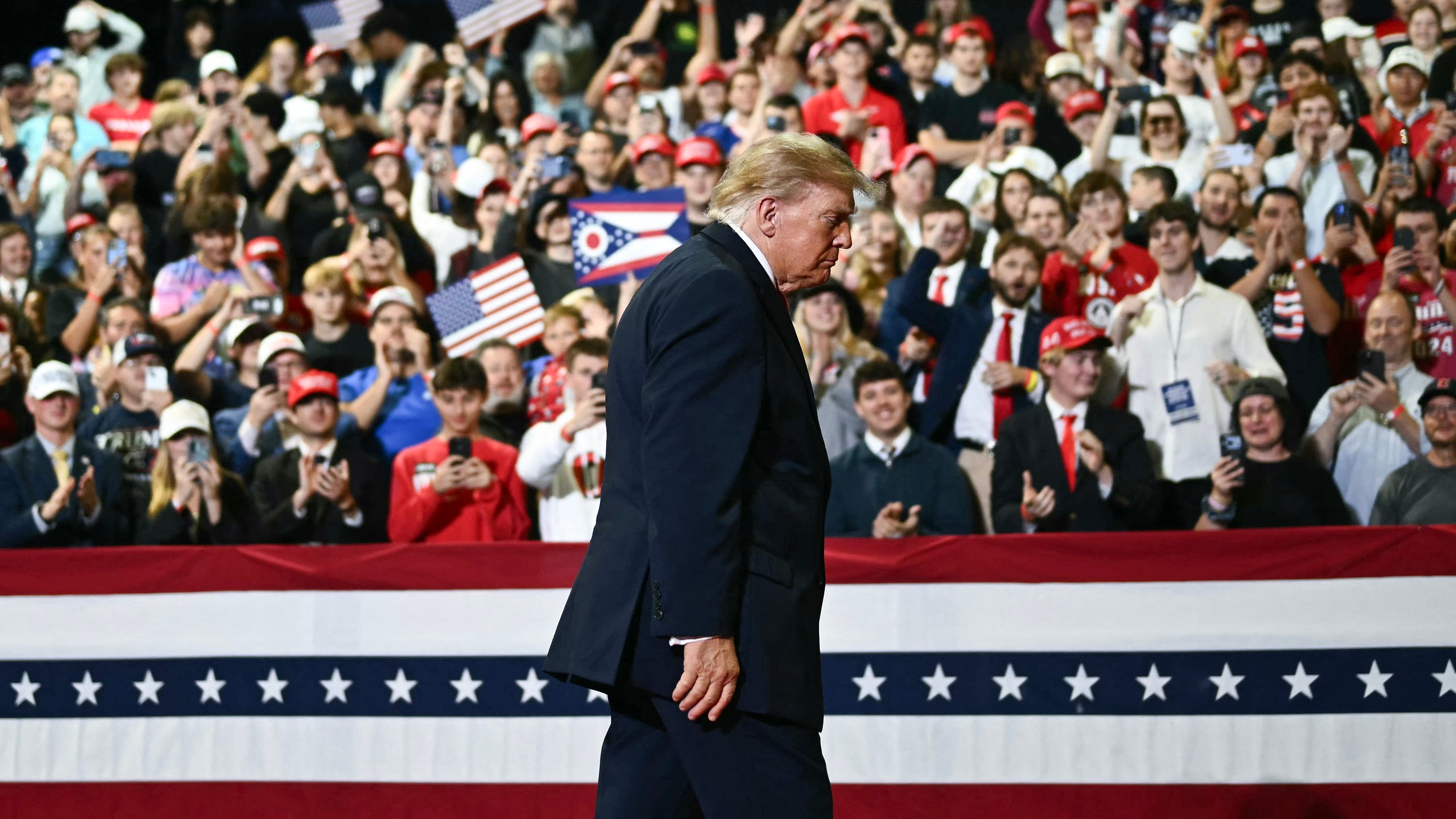
President Donald Trump leaves the stage following a campaign rally at the Covelli Centre in Youngstown, Ohio, on October 12, 2026. (Photo by Kent Nishimura/AFP via Getty Images)

Nothing Left to Give

by Andrew Egger

Donald Trump’s rallies all have so much in common—the stock grievances, the stock insults, the stock anecdotes, the decade-old bits—that they can run together. But there are differences.

Two years ago yesterday, Trump had a rally in Coachella, California, and he was riding high. His political comeback had once looked impossible, unthinkable, and now he was close enough to taste it. He was in Kamala Harris’s backyard. The Biden administration was deeply unpopular, and Harris was struggling to get out of its shadow. Trump, out of power, had no recent record to defend. He was the outsider again, back on attack, and he had a vision to offer.

“The Republican party will always put America first,” he said, “and lead us on to victories like you have never seen before.”

What victories? “We had no wars, and I’ll keep you out of wars,” Trump bragged. “I will end the war in Ukraine, stop the chaos in the Middle East, and I will prevent, very definitely, World War III.”

Or take prices. “I will cut your energy prices in half within twelve months,” Trump promised.

Yesterday, Trump had another rally. And while much was the same, the basic vibe couldn’t have been more different. No time for blue-state stops now: Trump is currently on a lightning tour through some of the reddest states in the union, trying desperately to revive his base’s sagging energy. Yesterday was Youngstown, Ohio—his second Ohio stop in just over a week.

In some ways, the crowd got what they came for. There were the usual moments of surreal shtick, like Trump’s bizarrely lustful description of Sen. Jon Husted’s post-football physique: “I started examining his body, because I didn’t know he was a great athlete. And I looked and I watched, up and down. I looked at his ass. . . . Look at his hands, he’s got these, like, claws. And I got it. You are a great athlete.”

And there was the usual current of xenophobia and violence. Trump led the crowd in chanting for the deportations of two prominent Muslim Democrats, Minnesota Rep. Ilhan Omar and Michigan Senate hopeful Abdul El-Sayed. And a woman who stood up to protest was physically assaulted by the people around her, while Trump jeered her from the stage. Police quickly whisked the protester away; the man who had punched her, pushed her, and yanked her hair was allowed to return to his seat.

It’s easy to dwell on all the gross stuff. (Sam and I did plenty of that in a video we cut after the rally last night.) But the gross stuff, unfortunately, isn’t why Trump’s in trouble. He’s been doing that stuff for a decade now; his people eat it up.

The reason Trump is in trouble is because, beyond the gross stuff, he has nothing else to give them. That was the most extraordinary thing about the rally yesterday, about all Trump’s rallies these days: The remarkable absence of an actual positive case for what his administration has been doing and still intends to do. All those 2024 promises about ending wars, abundant cheap energy, and so on—so easy to make as an insurgent outsider—have simply fallen away.

There are the usual stabs at branding the administration. The forever-repeated story that Biden handed over a “dead country,” but that Arab princes now tell him America is the “hottest country in the world”; the usual hallucinated numbers like the supposed $21 trillion in foreign investment now “pouring” into the country. But mostly, Trump now offers excuses for why things aren’t as good as they will be at some point off in the future—and an endless supply of fearmongering about “radical left Dumbocrat communists.”

The lying, the bigotry, the love of violence—a critical mass of Americans has been and remains enchanted by all this. And a larger group is willing to put up with it. What’s amazing is that Trump, the figure who unlocked and channeled that energy like nobody before in American politics, is now falling apart for so much sillier a reason: He just can’t make the trains run on time.


Our Elites Booked It

by William Kristol

Yesterday I remarked that “seeing support for President Trump collapse among the public—with very little help from our pitifully complacent and fearful elites—is heartening. Even inspiring.”

I didn’t go into any detail to justify my swipe at our elites. I don’t really think much justification is needed. But I thought I might mention here one of the most helpful characterizations I’ve heard of their behavior. It came from Leah Greenberg, co-founder of the grassroots activist organization Indivisible and a key organizer of the No Kings demonstrations, in a conversation we had under the auspices of the New Haven Democracy Project.

I was lamenting the performance of our elites, and asked Leah what she thought of them. Her reply:

So there’s a 2014 Swedish dark comedy called Force Majeure in which a family goes to a ski lodge. It’s a husband and a wife and their two small children, and there is an optical illusion of a controlled avalanche that makes them think that an avalanche is coming at the ski lodge. And the husband just books it. He grabs his phone and he runs and he leaves the wife and their two small children. You know, the wife is desperately trying to shield the children from what they think is an oncoming avalanche. And it turns out it was an optical illusion. Everyone’s safe. It’s fine.

But now they have to live with what that moment has revealed about the fact that the husband will flee and save himself at the drop of a hat. That is kind of how I feel about elites in American society right now. That’s the best metaphor that I’ve been able to come up with for what we have experienced over the last year and a half, which is to say that I think we’ve got a lot of really revealing data about when the chips are down, what people will do, how much they will fold . . . to save themselves, how much they will risk to push back. And, you know, it’s a lot faster to make a list of the people who did push back in early 2025 than the people who did not.

I haven’t seen the movie (or for that matter its 2020 American adaptation, Downhill, starring Will Ferrell and Julia Louis-Dreyfus). But from what I can gather, it’s pretty clear by the end of the movie—if not earlier than that—that the husband/father won’t be able to regain trust or respect, and that the family won’t be getting back together. The status quo ante can’t be restored.

Nor can ours.

Nor should it be.

And so, assuming we survive our current political avalanche, we’ll have to keep two things in mind: Every society has elites. And we need to figure out how to produce a better class of them.

Join now


AROUND THE BULWARK


Quick Hits

SHOWDOWN AT POTOMAC LINKS: Two years in, Donald Trump seems unwilling to risk crossing federal judges except on issues he really, really cares about. So, of course, the administration’s latest mini-constitutional crisis is unfolding over his lawless “renovation” of a local DC golf course. Here’s WaPo:

A “furious” federal judge excoriated the Trump administration Monday morning for cutting down hundreds of trees at East Potomac Golf Links, the historic course eyed for redevelopment by President Donald Trump, telling government lawyers they had cost their credibility by ignoring her repeated warnings to give notice before work continued.

Government lawyers told U.S. District Judge Ana C. Reyes at an emergency hearing that approximately 430 trees were removed Saturday and that another 299 are still targeted for removal. Reyes ordered the government to stop cutting down trees until at least 2 p.m. Tuesday, by when she hopes to hear testimony from another administration official involved in the tree removal.

Reyes says she had been reluctant to issue a temporary restraining order in the case. But, she added, “I have no faith that the government isn’t going to cut them down unless there’s an order in place not to do so.”

Violating her order “by two seconds” would prompt contempt proceedings, the judge said.

Is it good when a federal judge has so little confidence that the government will operate in basic good faith in her courtroom that she feels the need to threaten its lawyers with punishment just to keep things proceeding in a routine manner? Doesn’t seem great. Read the whole thing.


ALL OVER BUT THE CRYING: Americans are hopping mad pretty much across the board about the state of things two years into Donald Trump’s second term. Trump isn’t going to pull a rabbit out of his hat to fix any of them ahead of the midterms. And a new Politico poll suggests it might not matter even if he did.

The poll, which was conducted last week, quizzed undecided voters on whether they would be wooed by a number of (forgive us) implausible future scenarios. Would it make you more likely to vote Republican, the pollster asked, if gas prices went down a dollar a gallon? If President Trump announced the Iran war was over? If data showed that inflation had fallen to its lowest level in five years?

Across the board, respondents were unimpressed. Only about 10 percent of undecided voters suggested that any of these scenarios would make them look more favorably on Republicans. The most favorable possibility—and perhaps the least likely—was the inflation question: A whopping 12 percent said such a drop in inflation would make them more likely to vote Republican.

Maybe such a poll is a silly thought experiment. But it underscores a gloomy reality for Republicans with midterms just weeks away: The cake is looking baked. “There’s nothing that Trump could do,” one GOP operative working on battleground races told Politico, “and frankly, even if he did something, no one would believe it anyway at this point.” Ouch.

Join now


Cheap Shots

Join now

Winning the Midterms Is Not Enough

12 October 2026 at 15:32

Elon Musk has spent $276 million trying to help Republicans win the midterms, according to a new report from the New York Times. The bulk of that money went into the main Republican Senate super PAC, the Senate Leadership Fund. Musk has a net approval rating of -16.2, according to Nate Silver. But that’s still better than Donald Trump’s -22.4. Happy Monday.


Join Will Sommer and Sam Stein for MAGA Mondays live today at 10:00 a.m. EDT on Substack and YouTube.


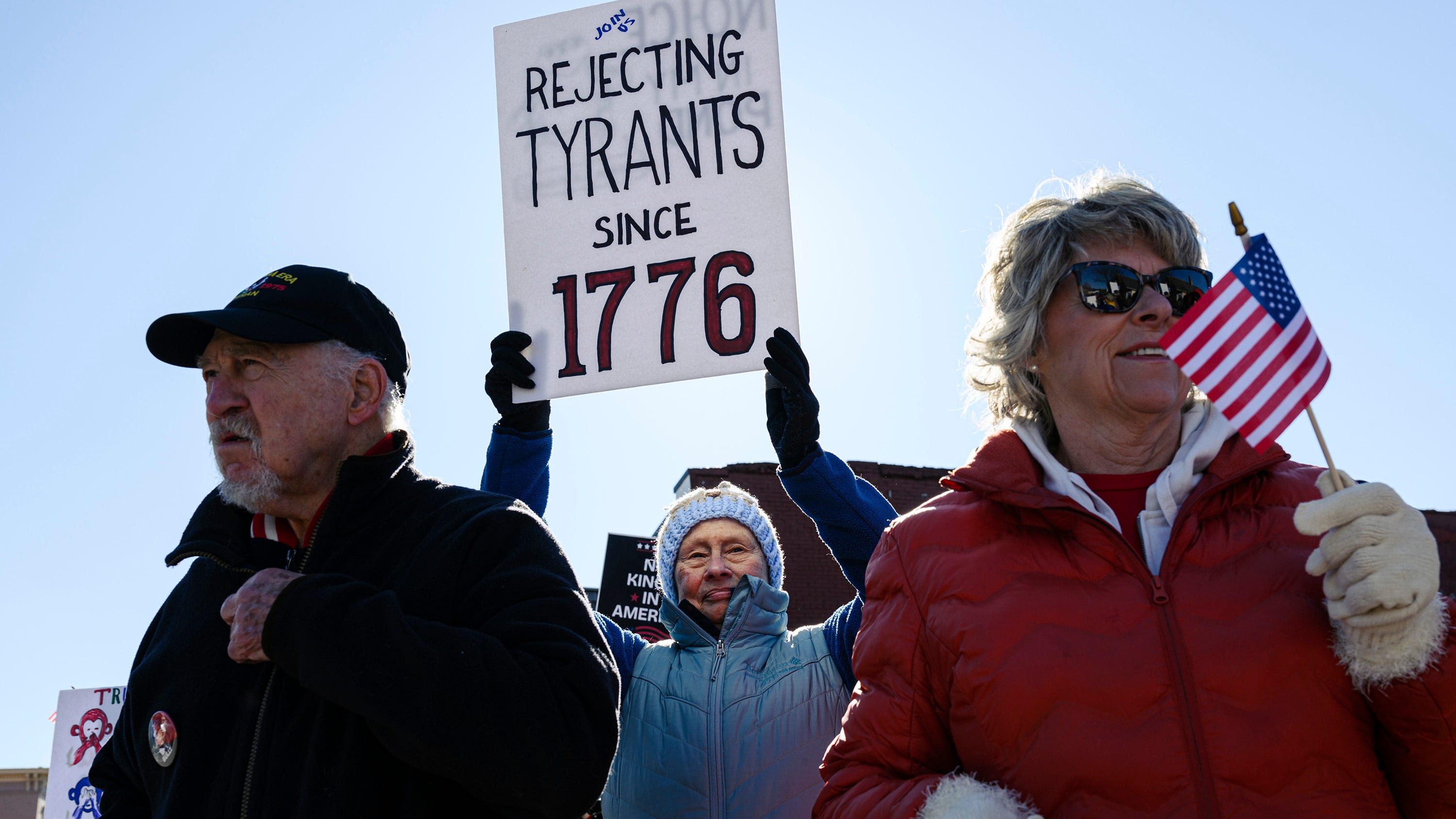
Demonstrators at a No Kings protest on March 28, 2026 in Shelbyville, Kentucky. (Photo by Jon Cherry/Getty Images)

Revitalizing Liberalism

by William Kristol

In three weeks, we’re likely to see a Democratic wave breaching—perhaps overwhelming—Republican electoral fortifications. In present circumstances, that Democratic wave will be a pro-democracy wave, and that will be something to celebrate.

Yes, I acknowledge that gas prices and other material concerns are probably more important to the voters than the theory and practice of liberal democracy. And, yes, I realize that this election will be more of a referendum on the failures of President Trump and his party than a deep reflection on the principles and institutions of a free society. Still, a thoroughgoing defeat for Trump and Trumpism will be a crucial victory for liberal democracy.

But it won’t be a decisive victory. It won’t even guarantee success in 2028—though, as Ron Brownstein noted in our conversation yesterday, there are very few instances in American history of a party retaining the White House when its outgoing president is strikingly unpopular. Which means one of the key tasks of Democrats in 2027–2028 is to not let up the pressure, and to keep Trump from recovering politically. If Democrats can succeed in doing this, they may have a couple more years of grace to work out their own problems.

But if you really do want to save the country, at some point you can’t simply depend on the failures of your rivals. We remember Franklin Roosevelt today not for capitalizing on the failures of Herbert Hoover in the 1932 election, but for what he then did as president. If the task we face over the next decade of reconstructing our government, our economy, and even our society is comparable to the challenge that FDR faced—and I think it is—it won’t be enough to enjoy the failures of our opponents. A reconstructed liberal democracy will need a revitalized liberalism.

Is a rethought and reinvigorated liberalism possible? The political philosopher Harvey C. Mansfield, writing “in defense of liberalism” and as “a friend of liberalism,” posed the challenge back in 1978: “From having been the aggressive doctrine of vigorous, spirited men, liberalism has become hardly more than a trembling in the presence of illiberalism. . . . Who today is called a liberal for strength and confidence in defense of liberty?”

Looking across our fair land, you can wonder if you have a compelling answer to Mansfield’s question. But look abroad: at Volodymyr Zelensky, at Péter Magyar, at Mark Carney, at Pope Leo XIV. You see strong and confident defenders of liberty.

Is what they are doing over there beyond our power here?

If Zelensky could rally his nation to resist the brutal aggression of a neighboring dictator and show the world what free men and women can do in the jaws of peril, can’t we summon the courage and ability to defeat cut-rate Putinism here at home?

If Magyar could organize to defeat Viktor Orbán when all the powers and institutions were stacked against him, can’t we rout Trumpist authoritarianism on a far more advantageous playing field?

If Carney could rally Canadians to stand up to Trump’s bullying, can’t we Americans show as much strength as our neighbors to the north?

If Pope Leo XIV could use his pulpit in Rome to powerfully remind us of liberal principles—indeed, of American principles—can’t other leaders back home, not necessarily of his faith, follow his example?

At moments like these, things can change suddenly. Zelensky became president of Ukraine in 2019, and a world-historical figure in 2022. Magyar, Carney, and Robert Prevost all took office only within the last two years. What could the next few years hold for us?

I’ll add that a revitalized American liberalism could incorporate aspects of the achievements of each of these figures: Zelensky’s inspirational courage, Magyar’s organizing ability, Carney’s calm competence, and Pope Leo’s moral grounding. Is it too much to hope that we could combine some or all of these elements, if not in one candidate, then at least in one political movement?

Perhaps. But you know what else gives me hope for a revitalized liberalism? The American people, or at least an increasing percentage of them. Seeing support for President Trump collapse among the public—with very little help from our pitifully complacent and fearful elites—is heartening. Even inspiring.

And so when you attend the final pre-election No Kings rally this Saturday, take heart from the coming setback to Trump and Trumpism. Begin to think about turning this reversal in 2026 into a decisive defeat in 2028. But give thought as well to the prospect of a revitalization of liberalism that may lie ahead. That is the true prize for which we fight.


Rapid Unscheduled Dissembling

by Andrew Egger

Yesterday, MAGA media thought they’d hooked a whale. James Talarico had been absent from the Texas campaign trail for nearly two weeks, and they weren’t buying that he’d simply been down with flu. Then a pair of influencers released what they claimed was proof that Talarico had actually been receiving treatment at an Ohio mental health facility. The claims went turbo-viral—then fell immediately and hilariously apart.

Last night, Will Sommer and I wrote the whole thing up in an emergency edition of his False Flag newsletter. If you want all the gory details, you can read them there. (It’s a fun story!)

This morning, however, what I’m left thinking about is the bizarre experience of watching the story fall apart in real time—and of watching the MAGA media ecosystem try to cope with the collapse of a story they so desperately wanted to be true. This space is full of self-styled “citizen journalists” and “independent investigators” who carry themselves like plucky truth-seekers. But they behave more like, well, conspiracy theorists: forever concocting ever-more-elaborate explanations for how—with a little faith, hope, trust, and a sprinkling of pixie dust—their hallucinations might still end up true.

Last night, we got a more illuminating glimpse than usual into this coping process—because many of the conspiracy theory’s principal believers were live on an X space as their complicated knot of red string was unraveling. “Is this necessarily provably false?” one wondered. “I don’t know.” Another thanked the influencers “for breaking the story, whether it’s true or not.” He added: “People deserve to know, um, the potential of this.” Others just kept tripling down. One influencer at the heart of the conspiracy, who goes by “Tickle Texts” online, predicted that video would come out by Tuesday proving Talarico had been at the hospital. “It is my hope,” she said. “It is my plan.”

Online, others quickly pivoted to more defensible terrain. “It genuinely doesn’t matter if it was a mental health hospital or the flu,” TPUSA spokesman Andrew Kolvet tweeted. “Bailing on the biggest job interview of your life by disappearing for two weeks is damning enough all by itself.”

That’s right, folks: MAGA media had been going absolutely insane all day on the supposed revelation that Talarico had been in a mental hospital, not suffering from flu. When that story fell apart, however, the flu was suddenly just as bad.

It’s all very funny, of course, but I personally fear they’re wasting their effort. If they’re so sure Talarico is a quivering pile of nerves who’s one bad break away from a breakdown, it seems like all this detective work is a little bit superfluous. Why not just talk Talarico’s opponent Ken Paxton into getting up on stage with him for a debate? Expose him, Ken! What have you got to lose?

Join now


AROUND THE BULWARK


Quick Hits

OUR PUTIN-BRAINED PRESIDENT: Donald Trump desperately wants Russia and Ukraine to stop attacking one another’s energy infrastructure, as the ongoing war in Iran makes any additional shocks to energy production even more costly and painful for global markets. Unfortunately, Trump’s insane, bizarre soft spot for Vladimir Putin seems to be guaranteeing that he draws exactly the conclusions about the Russia–Ukraine war and global energy markets that the Russian leader wants him to.

Ukrainian President Volodymyr Zelensky has repeatedly said that Ukraine would be willing to agree to a bilateral energy ceasefire, if Russia would agree to the same. But Trump continues to believe, remarkably, that Ukraine is the prime aggressor in the conflict when it comes to infrastructure attacks. “He wants to make problems for the world,” Trump said Saturday of Zelensky. “He wants to make problems for our farmers, our ranchers with diesel fuel. . . . He better damn well stop.”

Those comments came one day after Trump’s surprise announcement that the United States would begin buying more diesel from Russia—a deal hashed out Friday on an extraordinarily chummy call between Trump and Putin. Zelensky reacted with dismay to that deal, telling Axios that “it looks like a happy birthday present for Putin,” that it was “not fair and not honest,” and that the United States had blindsided Ukraine with the announcement. “It gives Putin money and he spends money only on this war,” Zelensky added Sunday. “Kill us. Kill our children.”

It’s not immediately clear if Russia can or will export more diesel, even under the handshake agreement with Trump. While energy exports account for a sizable percentage of the Russian government’s revenues, the country banned diesel exports earlier this summer—and renewed the ban late last week, just before the deal with Trump—to help satisfy domestic demand, much of which comes from the Russian military. Ukrainian strikes against Russian refineries have hampered production, dealing a blow to Russia’s economy and complicating its ability to finance and feed its war in Ukraine.

On Sunday, Trump suddenly took to Truth Social for a surprise announcement: Russia and Ukraine, he said, had agreed to an “ENERGY CEASEFIRE,” which was “effective immediately.” Had both sides actually agreed? Zelensky said later Sunday that Russia struck its CHPP-5 power plant in Kharkiv after Trump’s announcement, the very same day.

Nevertheless, it appears that at least for now Putin has Trump right where he wants him. He is whispering in Trump’s ear that Zelensky is the prime impediment to an energy ceasefire, and Trump believes him. And he has managed to convince the president to look away from the fact that Putin is the one unwilling to strike such a ceasefire in the first place.


STATE PROPAGANDA, BEGONE: Better late than never. A federal judge yesterday barred the Trump administration from running any more taxpayer-funded campaign ads—even though the White House already spent about $19 million of the $20 million in the Department of Homeland Security account used for the ads.

“Defendants are enjoined from using, disbursing, or transferring funds appropriated to the Department of Homeland Security to develop, create, disseminate, place, distribute, publish, or air the challenged advertisements,” wrote U.S. District Judge Rochon in her restraining order. The order blocked the White House from airing its final tranche of ads, which had been scheduled to run last night.

Last Monday, Trump had said that he would begin paying for the ads with money from his super PAC. But the federally funded ads, bought with money appropriated for “commemorating efforts and events related to border security” in last year’s One Big Beautiful Bill, had continued to air until Rochon’s order halted them. Politico reported last week that Trump also has no plans to reimburse the taxpayer for the ads.

The upside of all this shameless and illegal propaganda: Voters hate the taxpayer-funded ads, so it’s not clear they did him any good.

Join now


Cheap Shots

Join now

Ron Brownstein: Trump’s Collapse Is Unlike Anything We’ve Seen in Decades | Bulwark on Sunday

11 October 2026 at 19:11

A quick note: Anyone can tell you who’s up in Iowa. The harder question is what happens if Democrats actually win Iowa, and what that could mean for the Supreme Court decades from now. That’s the kind of analysis we do at The Bulwark.

If you do want to support us, you’re in luck—we’re running a 30% off sale for a limited time.

Join now

Trump’s midterm problem may be far worse than it was in 2018, and the warning signs are showing up in places Republicans never expected. Bill Kristol and veteran political analyst Ron Brownstein examine Trump’s collapsing support among core MAGA voters, the surprising Senate races emerging in deep-red states, and how a Democratic wave could reshape the Supreme Court for decades.

Leave a comment

Read more

💾

Hegseth Wants You to Watch a Snuff Film

9 October 2026 at 15:28

Yesterday brought another ICE shooting, this time in New York City. Yesterday afternoon, officers opened fire on a man they were trying to arrest, 28-year-old Oscar Belgal, an illegal immigrant from Senegal. An officer fired seven rounds into Belgal’s car, striking him in the neck, as his horrified five-year-old looked on from the back seat. Why was he shot? We don’t know: Homeland Security hasn’t claimed he was resisting arrest, attacking an officer, or anything else that might have provoked such a response. Given how often the department has falsely claimed that its victims were behaving violently, the absence of such a claim in this case is notable.

ICE officers aided Belgal at the scene, and he was treated at a local hospital before being taken back into ICE custody. Belgal is a criminal, with a grand larceny conviction and other cases pending against him. That ICE should arrest and deport such people is a good thing. That they should do it so hamfistedly that they empty a magazine into a car with a young child inside is not. Happy Friday.


Join Catherine Rampell and JVL for Receipts Live today at 12:30 p.m. EDT on Substack and YouTube.


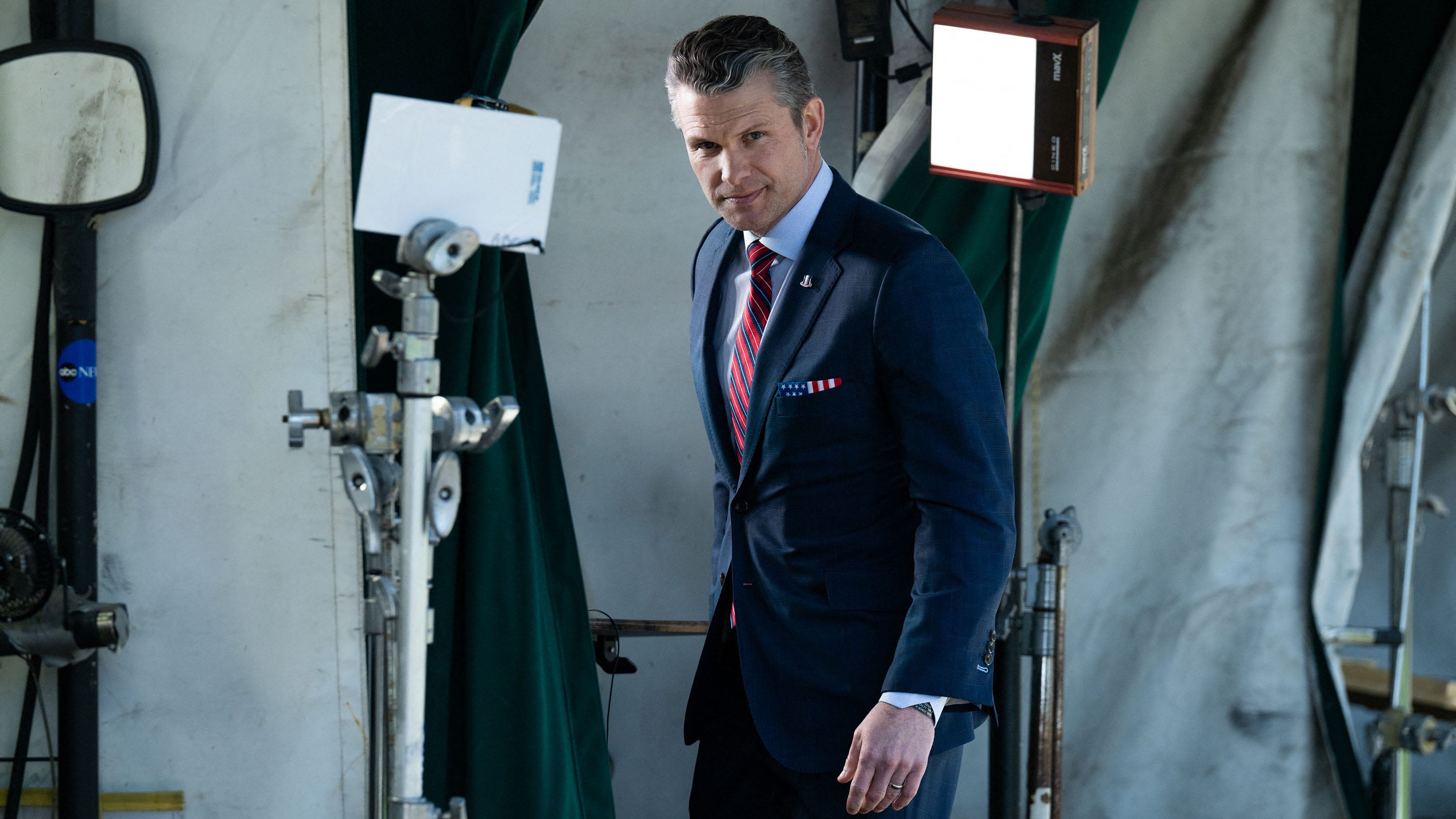
Defense Secretary Pete Hegseth after being interviewed in front of the White House in Washington, D.C. on March 21, 2025. (Photo by Annabelle Gordon/AFP/Getty Images)

Citizens or Voyeurs?

by William Kristol

Last Friday, I wrote that a recent speech by Secretary of Defense Pete Hegseth was “all political bluster. But it’s a particular kind of political bluster. It’s neo-fascist bluster.” I cited Hegseth’s celebration of irrationalism and machismo, identified by Umberto Eco as two key elements of what he calls “Ur-Fascism.”

Another familiar feature of fascism is the transformation of politics into spectacle. Fascism wants to reduce active citizens to passive observers, indeed into voyeurs—especially voyeurs of cruelty and death. Such degradation of a democratic public is key to fascism’s project and to its success.

This has been understood for a long time. The Roman Empire, to which modern fascism appealed as a model, featured bread and circuses. Among those circuses were spectacles of death, including the killing of criminals—and of others—by wild animals. These spectacles were called damnatio ad bestias—condemnation to beasts—and were part of the inaugural games of the Roman Colosseum in 80 A.D.

Yesterday, the secretary of defense of the United States told far-right provocateur Jack Posobiec that he wanted the execution by firing squad of the Fort Hood mass murderer, Maj. Nidal Malik Hasan, to be a public spectacle. Hegseth said, “We’ll make sure that people are able to watch it. That it’s public.” This wasn’t just Hegseth popping off. The Defense Department followed up a few hours later with an official statement that Hasan’s execution, scheduled for December 3, will be live-streamed for the public to watch.

Get your news from people who aren’t afraid of the F word. Join our pro-democracy community.

Hegseth’s claimed rationale for the livestream is ludicrous: “People need to understand that there’s serious consequences for these types of things.” Really? Would the American people fail to understand that the death penalty has been carried out if the execution of the criminal weren’t live-streamed?

Of course not. The reason this is happening is that the Trump administration wants to join regimes like Iran and Afghanistan in making public executions spectacles. It’s eager to follow the example of terrorist groups like Al Qaeda and ISIS in livestreaming them.

Tuaut de La Bouverie, an official during the Terror in Revolutionary France, explained the need for public executions in the National Assembly in 1791: “It takes a terrifying spectacle to hold the people in check.”

But this isn’t merely about holding the people in check. It’s about degrading the people. It’s about desensitizing the public. It’s about normalizing cruelty. It’s about turning citizens into voyeurs—in this case, into voyeurs of a snuff film.

The United States military is far better than this. Senior officials should protest, and if necessary resign, rather than being complicit in the voyeuristic degradation of our democracy.


The Nationalist Right Is Done with Israel

by Joshua Tait

This year’s National Conservatism Conference, hosted this week in Jerusalem, should have been a homecoming for its head honcho, the Israeli-American nationalist thinker Yoram Hazony. Instead, it was a catastrophe. Representatives of the various strands of the MAGA new right have taken the opportunity to break up with Israel—and, for good measure, to tell Jews to stop calling them antisemites. “America First,” it seems, doesn’t leave any room for Israel.

On the third anniversary of the October 7th attacks, a panel chaired by Hazony himself and nominally on the “American Right: The Next Generation” went totally off the rails. Matthew Peterson, editor in chief of the Blaze and formerly of the Claremont Institute, began by insisting that America and Israel had no special relationship. It only got worse for Hazony from there. Each panelist—from the right-wing filmmaker Amanda Milius to the racist podcaster Jonathan Keeperman and the Christian nationalist former Trump administration functionary William Wolfe—made the same points with increasing intensity.

Why is the right breaking with Israel? It “has become the perfect symbol of foreign policy excess,” said Keeperman, who is Jewish. Young right-wing Americans don’t have the attachment to Israel felt by their elders. Nor does special pleading work. “The Holocaust, and the on-again, off-again persecution of Jews . . . no longer resonates in the way it did when the Holocaust was still in living memory,” and may actually turn off the vitalist young right. “We want our national sovereignty back,” Wolfe declared. He described right-wing staffers who see congressmen with Israeli flags in front of their offices and think, “They say ‘America First,’ and this looks like sort of ‘America First plus Israel First.’”

Unlike their conservative forebears, young rightists don’t see their interests aligned with Israel, associating it instead with “forever wars” in the Middle East.

But of course, the other great offense was immigration. Peterson suggested the Israeli right needed to support American nativism, while Keeperman complained that Jewish neoconservatives’ opposition to Trump and liberal Jews’ support for mass immigration (and demonization of the right) has damaged any Jewish–right-wing alliance. The panelists seemed to see the Israelis as nationalists who ought to recognize that America has its own interests, while treating Jewish Americans as either part of the new right, with an “attenuated” relationship to Israel, or as a perhaps naive part of the progressive left.

The panelists were united on one specific point: Forget Nick Fuentes, Tucker Carlson, and the groypers, Jews need to stop calling right-wingers antisemites. “Many of us stopped playing this game a long time ago because it was the left’s central tactic,” said Peterson.

Which is to say that the young right is shameless.

Some panelists pointed out that evangelicals, not Jews, are the main pro-Israel constituency in America. Wolfe, the Christian nationalist, dissented, suggesting that American Jews needed to “know their place.” “Why is it that so much of our national political conversation on the American right is dominated by people who compose one out of seventy or eighty of our voters?” he wondered aloud. After dwelling on Jewish views on abortion rights, Wolfe said that when he thinks of Jews, “I think of people who are my political opponents because they are.”

People used to get exiled from polite conservative society for this sort of stuff.

But Peterson, Keeperman, and Wolfe agreed that there’s no going back to an earlier conservative dispensation. In fact, they allege accusations of antisemitism are really about “the remnants of the prior establishment on the right in America [who] hope that when Trump leaves the scene, they will rise to power once again,” according to Peterson.

Well, guess what? “We support JD Vance. MAGA supports JD Vance,” Wolfe declared about the MAGA new right darling. And, he added, “JD Vance is not an antisemite.”

As for Hazony, who’s spent years attempting to wed a conservative America to a conservative Israel: You sow the nationalist wind, you reap the America First whirlwind.

Join now


AROUND THE BULWARK


Quick Hits

SOCIALISM IS WHATEVER, MAN: Vladimir Lenin famously declared, “Communism is Soviet power plus the electrification of the entire country.” JD Vance, the American vice president, has graced us with what is sure to be an equally legendary definition of socialism. At a presentation on “combating fraud and abuse in work visa programs,” Vance was asked how he defined the term. After some verbiage about socialists not “prioritizing workers,” Vance offered this zinger: “I think in reality what it actually means in the American context is that you want to replace American workers with foreign workers and you want boys to play in girls’ sports.”

In other words: Anything I don’t like is socialism. Or, in an acerbic addendum from Cato Institute Vice President Scott Lincicome: “Anything I don’t like is socialism—including capitalism.”

Lincicome also noted that if Vance had accurately defined socialism, he would have had to include the second Trump administration’s grab of ownership stakes in 35 corporations. Indeed, it’s not for nothing that in August, Robert Wolf, a former economic advisor to Barack Obama, called Trump “the most powerful socialist in the country today”—citing not only the state seizures but such market interventions as price controls on pharmaceuticals and farm bailouts. One could add “promising every American a $5,000 payout as a reward for keeping a one-party system in power”: Sounds pretty socialist to me!

Vance’s much-derided snark underscores what we all know already: The Trump administration’s anticommunist crusade is not about communism or socialism—it’s about tagging the Democrats with a scary buzzword. I can’t wait for Vance to offer his definition of communism: Insensitive comments about Charlie Kirk and Haitian migrants barbecuing cats?

–Cathy Young


IN ABSENTIA: As they try to shore up their chances of holding their Senate seat, Texas Republicans have suddenly seized on a new line: Where is James Talarico? Ted Cruz tweeted a picture of a missing-person ad on a milk carton: “Have you seen this man?” At a MAGA rally Wednesday, Ken Paxton tried to lead the crowd in a (rhythmless, shambolic) chant of “Where is James Talarico?” A little later, Donald Trump claimed that Talarico had gotten sick from having to eat meat at campaign events—because he’s vegan, you see.1

They’ve got a point! Talarico hasn’t done an in-person campaign event since September 28—the result, he said at a virtual event September 30, of a flu diagnosis that had sent him to urgent care. “If I was passing on this illness to somebody and got someone’s grandmother or someone’s baby sick, I couldn’t live with myself,” Talarico said, “so I thought the best thing to do was to put safety first and put everyone’s health first.”

Texas is a weird place to campaign: It’s so enormous, populous, and sprawling that actual retail politics matters very little, except as a means of generating content. It’s simply not possible to establish a grip-and-grin connection with enough voters to matter. But that doesn’t mean these attacks don’t stand a chance of actually hurting Talarico: You don’t want voters to think of you as the candidate who got knocked out for weeks of the home stretch by the flu.

In a statement, Talarico spokesman JT Ennis said that the candidate would be back on the trail this weekend. “Ken Paxton has been ignoring Texans this entire campaign,” he added. “He doesn’t answer to the people of this state—he answers to his billionaire megadonors and special interests.”


SEE JEFF GROVEL: Being one of the richest people in history only gets you so far. In an interview on Fox News this week, Jeff Bezos accidentally committed a faux pas against the emperor: He referred to AI technology as “AI.” His interviewer, Bret Baier, was quick to press the question: “By the way, the president says ‘SI.’ Are you into ‘SI’?”

Bezos’s pivot was instant. “I do like ‘SI,’ because ‘artificial’ is not a very flattering thing. Like, nobody wants an artificial sweetener, artificial flavoring—‘artificial’ sort of means fake.”

Which, yeah: It is fake. It is constructed. AI is an insanely complex computer program performing a very compelling—but ultimately fake—simulacrum of intelligence. Bezos justifiably got roasted online for this servile display. But he knows what side his bread is buttered on, and Donald Trump has decided to make continued use of the term “AI” an excommunicable offense. “The White House considers anyone that uses the term, ‘Artificial Intelligence,’ as opposed to the highly accepted new and more accurate term, ‘Super Intelligence,’ THE ENEMY!” Trump posted yesterday on Truth Social.

Join now


Cheap Shots

Join now

1

Talarico is not vegan, but this hasn’t stopped Trump from saying he is at every campaign stop.

Reasons for Hope. Reasons for Alarm.

7 October 2026 at 15:23

Donald Trump is a friendly boss; he lets his top aides freelance. Two of those aides, James Blair and Chris LaCivita, are spending most of their time spearheading midterms spending for Trump’s PAC. But last week, they both managed to find time for a quick trip to the Balkans, where—the New York Times reports—they have each been paid hundreds of thousands of dollars to consult on behalf of the pro-Russian sub-national government in Bosnia and Herzegovina. Seems fine. Happy Wednesday.


Join Mark Hertling and Ben Parker for Command Post live today at 10:30 a.m. EDT on Substack and YouTube.


(Photo illustration by Sarah Rogers/The Bulwark | Photos Getty, Shutterstock)

The Blue Wave. The Rocky Shore.

by William Kristol

It could be the best of elections. So it makes sense to be hopeful. But it’s surely the worst of administrations. So it makes sense to be alarmed.

On the hopeful side: The blue wave shows no sign of abating. Democrats are doing a decent job of getting out of their own way. Meanwhile Donald Trump is traveling around the country and doing his best to make the election about himself.

Which is good.

According to the polling aggregator FiftyPlusOne, President Trump’s job disapproval stands at 61.9 percent, compared to 35 percent approval. The Democratic advantage on FiftyPlusOne’s average of the generic congressional polling is a still impressive but less overwhelming 51.1 percent to 43.4 percent.

There’s a simple lesson here: The more this election is about Trump, the better. The more the generic ballot numbers move towards the presidential approval numbers, the better. The more Trump visits competitive states for rallies that are all about himself, the better. The more ads we see that feature Trump, the better.

We’re not here to tell you what you want to hear or to rage-bait you. We tell you what we really think. Join our community.

Yesterday morning, stung by media reports that his rallies aren’t what they once were, Trump posted:

My Rally crowds and enthusiasm are unbelievable! Nobody has ever seen anything like it. We are flipping races all over the place. . . . It’s all happening! The Dumocrats [sic, needless to say] never counted on this. Watch for the “Midterm Surprise!”

About an hour and a half later, Trump had a further thought to share, this time in ALL CAPS:

MY RALLIES ARE SAVING THE REPUBLICAN PARTY, AGAIN!!!

Lots of Republicans would beg to differ with the leader of their party. Texas Gov. Greg Abbott, for example, apparently has decided not to join Trump’s rally tonight in San Antonio. After all, as Abbott explained, “Because of my schedule, where I go to multiple cities a day doing events like this, I already have events like this scheduled that day and will not be able to make it.”

It will be amusing to see what important event Abbott’s attending that couldn’t have been rescheduled to make room for the president. And it will be interesting to see if Trump takes offense at the slight. A little intra-Republican squabbling in these closing weeks couldn’t hurt Democrats’ chances, either.

So much for Trump and the GOP.

As for the Democrats, they’re doing a pretty good job of riding the wave of voter discontent. They’re keeping the focus on the Trump administration’s failures and corruption, and on the Republican Congress’s complicity in them. They don’t even seem to be over-thinking things and tying themselves in knots nearly as much as they normally do.

Their biggest problem may be that many of their big donors and key operatives don’t seem to realize what a historic moment this year could be. They’re being cautious when their party has a golden opportunity to win senate seats and governorships that have long appeared to be out of reach. Democrats have a chance to turn a shrinking map into an expanding one.

The implications of a Democratic senate majority of fifty-four seats would be very different from getting to fifty-one. And as for governorships, six of the ten most-populous states now have Democratic governors, and Democrats seem unlikely to lose any of them this November. But in the other four of the ten most-populous states—Texas, Florida, Ohio, and Georgia—the gubernatorial races are competitive. If Democrats win, say, two of the four, they’d govern eight of the ten largest states, and twelve of the largest fifteen. This would affect the character of our politics going into 2028 and beyond.

So there’s reason to be hopeful.

But there are reasons to remain alarmed.

The main reason is obvious: Trump and his loyalists will control the levers of executive power over the next two years. You’d have to be crazy not to be alarmed by what they can do during this time—to our nation’s well-being at home and to its standing abroad, to our civil liberties and civil service, to any remaining guardrails against corruption and lawlessness. So Donald Trump and JD Vance, Todd Blanche and Pete Hegseth, Stephen Miller and Russell Vought in positions of great power remain a clear and present danger to our constitutional republic.

As do their collaborators outside the government. The public has moved pretty decisively in the right direction over the past two years. Our elites have not. Some are eagerly taking advantage of the benefits of crony capitalism. Others, intimidated, are cowering or cutting deals. Few are standing up to autocracy.

And all of this is to say nothing of the threat to free and fair elections in 2028. Trump and his cabinet officials, and all the loyalists they’ve stuffed into government agencies, really do not want to lose power in 2028. They don’t want a new administration to come in and turn over the rocks to uncover their corruption and lawlessness. The threat of election interference in 2026 has been worrisome. But the threats in 2028 will be of a whole different order of magnitude. And the stronger the popular opposition to Trump and Trumpism becomes, the more determined Trump and his authoritarians will be to subvert the democratic process.

So be hopeful and alarmed. And organize, persuade, and vote. It’s our country, after all, either to nobly save or meanly lose.

The October Surprise? You’re going to want The Bulwark.

The midterms are coming. The surprises are inevitable. Get the reporting, analysis, and conversations you won’t get anywhere else.

• Unlock everything: Every Bulwark story + exclusive newsletters, including Sarah Longwell’s new Focus Group newsletter.

• Hear what others don’t: Member-only pods like The Secret Podcast with Sarah Longwell and JVL.

Join Bulwark+ — Save 30 percent for one year.

AROUND THE BULWARK


Quick Hits

NOW WE JUST FEEL BAD FOR HIM: At this point, Ken Paxton may never open his mouth in a private fundraiser again. First it was the New York Times reporting that Paxton had privately admitted Trump’s midterm convention hurt him. Then it was Politico releasing audio in which Paxton complained that “I’ve never been in a race where I felt less control over the campaign” because “it’s all coming from D.C.” And this morning, Axios released even more audio of Paxton lamenting that the Iran war and gas and diesel prices were “dragging” on his campaign.

“So many factors in this federal race are uncontrollable,” Paxton said in the audio. “I don’t make the decisions, and I don’t . . . know what’s behind some of the decisions.”

All of the leaked audio in question is sourced from the same small fundraiser last month, which suggests Paxton was unlucky enough to let a very determined hater into the room: Not only was the leaker eager to release damaging audio, but he or she has been drip-feeding it into the news—different days, different outlets—to keep the story hanging around and maximize the damage against Paxton. I tell you what, it couldn’t have happened to a nicer guy.


STILL REFUSING TO LOSE: All this time later, Ukraine is still holding tough. The New York Times reports on Ukraine’s fruitful counteroffensive in the Donbas:

A monthslong Ukrainian counteroffensive in the northern part of the Donbas has thwarted Russian efforts to encircle the remaining Ukrainian-controlled cities in the region. Russia, Western analysts say, has lost dozens of square miles of territory during the Ukrainian campaign, which Kyiv is calling Operation Vivaldi.

In the southern Donbas, Russia continues to mount furious assaults to break through Ukrainian lines. But Kyiv has reorganized its defense there and has so far kept the Russian military from pressing farther in its efforts to surround the major Donbas cities.

More broadly, Russian gains across Ukraine have slowed markedly in 2026 from their already glacial pace of last year. September was the worst month in net territorial gains for Russia inside Ukraine since June 2023, according to the Finland-based research firm Black Bird Group.

Read the whole thing.


MAINE DEBATE: Sen. Susan Collins has been a unicorn in politics: a GOP senator who has enjoyed consistent success in her blue state of Maine no matter how bad the national environment. But she’s never faced a wave environment quite like this one, and she’s working hard to pull one more rabbit out of her hat.

Yesterday, Collins and Democratic challenger Troy Jackson had a televised debate—their first of four over the next ten days. Unsurprisingly, Jackson’s main strategy was to do everything he could to tie Collins to Trump. He castigated her vote for Supreme Court Justice Brett Kavanaugh, said that Mainers shouldn’t trust her to pick the next justice who comes up for confirmation, and scoffed at her track record of voting for Trump’s priorities while using her leverage only to get certain kickbacks and carveouts for Maine. “Sen. Collins is like an arsonist who set the fire and then she wants credit for bringing a cup of water to put it out,” Jackson said.

Read other takeaways from the debate from the New York Times here.

Join now


Cheap Shots

Join now

Morning Shots Live: Lindsey Graham’s Sister Was Supposed to be a Lock. Now the GOP Is Scrambling

6 October 2026 at 17:36

Ben Parker and Bill Kristol discuss Donald Trump’s increasingly frantic attacks as Republicans face a surprisingly competitive Senate race in South Carolina, including Trump’s use of an anti-trans slur against Democratic candidate Annie Andrews. They examine what the race says about the Republican Party’s standing heading into the midterms and whether D…

Read more

💾

Grandpa Trump Is Getting Desperate

6 October 2026 at 15:24

The hot-mic moments just keep coming for Texas GOP Senate hopeful Ken Paxton. Last week, it was leaked audio of Paxton admitting that Trump’s ballyhooed midterm convention had actually hurt his numbers. This week, it’s audio of Paxton complaining about how little control he has over his own campaign strategy—since most of the money behind him is super PAC money from Trump. “I’ve never been in a race where I felt less control over the campaign and, like, what issues are going to matter,” Paxton told a small fundraiser room, “because it’s all coming—you know—from D.C.” Happy Tuesday.


Join Bill and Ben Parker for Morning Shots Live today at 10:00 a.m. EDT on Substack and YouTube.


President Donald Trump speaks during a campaign rally at Pinnacle Bank Expo Center on the Nebraska State Fairgrounds on October 5, 2026 in Grand Island, Nebraska. ( Photo by Win McNamee/Getty Images)

The President’s Palmetto Preoccupation

by William Kristol

The nineteenth-century American writer Henry David Thoreau famously claimed that “The mass of men lead lives of quiet desperation.” I’ve always thought this assertion unfair, even untrue. But it’s neither unfair nor untrue to observe that one man, Donald J. Trump, is today exhibiting clear signs of not-at-all-quiet desperation.

Yesterday afternoon, for example, Trump was engaged in a typical flurry of posts alternately attacking the media and promising $5,000 to Americans if they re-elect Republican majorities in Congress. And then out of the blue came an attack on the Democratic senate nominee in South Carolina:

Annie “Trannie” Andrews is running against our wonderful Darline Graham for the Senate in South Carolina. . . . Darline is a High Quality person, maybe the Highest, and Annie Trannie is not, in particular, as it pertains to representing the Values of the Great People of South Carolina—She is in favor of Transgender for Everyone, Open Borders, Defunding the Police, High Taxes, a Weak Military, and will absolutely fight to take your guns away—In other words, she is against our Great Second Amendment! Trannie is not for South Carolina, and South Carolina must show, in the upcoming Election, that it is not for her. VOTE FOR DARLINE GRAHAM—SHE HAS MY COMPLETE AND TOTAL ENDORSEMENT, AND WILL NOT LET YOU DOWN! President DONALD J. TRUMP

Before going on to explain Trump’s sudden interest in the South Carolina contest, I do want to note that his bigotry is of course revolting. In a civilized era, it would be shocking to see it coming from a president of the United States. But we do not live in a civilized era. In a non-cowardly era, the slur would be denounced by Republicans as well as Democrats. But we do not live in a non-cowardly era. In a better era, Andrews’s Republican opponent, Sen. Darline Graham, would step up to criticize a supporter for using the term. But we do not live in a better era.

If we want better politics, we have to make it ourselves. That’s what The Bulwark is all about. Join us—and take 30 percent off the first year.

Why, though, this sudden attack on Dr. Annie Andrews, of all people? She’s running for a supposedly safe Republican seat. And since she knows that she needs to win Trump voters over to have a path to victory, she’s actually been sparing in her own attacks on Trump. Consider her response to Trump’s post yesterday:

As a mom and a pediatrician, I’m in this race to fight for my patients, my three kids, and South Carolina. And I’m going to work with anyone to put South Carolina first, because lowering costs and making life better for families across our state is going to take all of us working together. If you care more about your bills than the politics in Washington, this campaign is for you.

So why was Andrews on Trump’s mind? He hasn’t been to South Carolina recently, and isn’t scheduled to go soon. When Natalie Harp (presumably) sent the post on his behalf at 5:23 p.m. yesterday, she and her boss were on Air Force One, heading to Nebraska, where Trump was going to campaign for that state’s endangered Republican, Sen. Pete Ricketts.

So why the rhetorical detour to South Carolina? I’d like to think that it was because yesterday, on Tim Miller’s podcast, I went out on a limb and suggested that Andrews had a real chance to win. Could it be that Trump was watching the most recent Bulwark Daily podcast on Air Force One?

Who knows? Only Natalie, I suppose. But. I suspect the explanation is simple: In recent political updates from staff, Trump has been told that South Carolina looked surprisingly competitive.

And it is. The two most recent public polls on the South Carolina race, one of them from a decidedly Republican-friendly firm, have Graham leading by only one point. A news story over the weekend noted that “Republicans, for their part, said they expected Ms. Graham to need a financial boost to secure a win in the end,” and that there were “conversations about getting more help for Darline.” And then, just this morning, Axios reported that the main Republican Senate super PAC is shifting $5 million to South Carolina to help Graham.

It seems President Trump and I are not the only ones who reached the conclusion that South Carolina is in play. And with a wave of the sort we’re seeing, why shouldn’t it be? After all, Trump won Nebraska in 2024 by a wider margin than South Carolina, and he was in Nebraska last night trying to help save that Republican incumbent. And last weekend’s New York Times/Siena polls had Democratic senate candidates up by seven and six points in Alaska and Texas, and South Carolina was only about five points more Republican in 2024 than those two states.

So with a wave this real, and this big, and probably still getting bigger, even South Carolina could be swept away. And so Trump is living a life of noisy desperation.

Thoreau remarks later on in Walden that “It is a characteristic of wisdom not to do desperate things.” Trump is not a man of wisdom. He will say and do desperate things over the next four weeks, and over the next two years. So while enjoying the change in circumstances that is making Trump desperate, we should also prepare for the dangers we’ll face from a desperate and unhinged megalomaniac in control of the executive branch of the federal government of the United States.

Sen. Annie Andrews—along with her colleagues—will have her work cut out for her over the next couple of years.

The October Surprise? You’re going to want The Bulwark.

The midterms are coming. The surprises are inevitable. Get the reporting, analysis, and conversations you won’t get anywhere else.

• Unlock everything: Every Bulwark story + exclusive newsletters, including Sarah Longwell’s new Focus Group newsletter.

• Hear what others don’t: Member-only pods like The Secret Podcast with Sarah Longwell and JVL.

Join Bulwark+ — Save 30 percent for one year.


EXCLUSIVE: Recordings show Stacy Garrity claiming Trump’s data center plan as her own

by Brendan Hartnett

As Andrew wrote in Morning Shots in August, politicians are suddenly noticing that everybody hates data centers. The data center backlash is moving so quickly that politicians are scrambling to keep up—sometimes contradicting themselves in the process. Pennsylvania Treasurer Stacy Garrity publicly supported data centers in the summer of 2025. Then, according to audio obtained exclusively by The Bulwark, she voiced the same opinion at a December 2025 Greene County Republicans event, saying that while people hold “mixed views” of data centers, they are a “nice opportunity for rural PA, where we have a lot of space where it wouldn’t be so intrusive.” Two months later, at an Elk County meet-and-greet, Garrity dismissed voters’ concerns about the noise generated by data centers and their impact on energy prices on the grounds that “there’s some misinformation out there,” according to the audio recordings.

Then in May, Garrity called for a pause on construction of new data centers.

Garrity insisted she hadn’t switched at all. In July she stated that her “position has not changed: It’s up to the communities.”

More recently, however, she’s mirrored Trump’s position. Last month, according to the recordings shared with The Bulwark, she told a voter at a campaign event in Westmoreland County that her policy was the same as President Trump’s “Ratepayer Protection Pledge”—a voluntary pledge without enforcement mechanisms that asks hyperscalers and tech companies to provide their own electricity to avoid raising rates on locals—“except mine was before the president.” She continued, “I agree with Trump, I’m glad he put it out.”

We reached out to Garrity’s campaign asking if her views on data centers have changed. A spokesperson pointed us to Garrity’s January 2026 remarks at the Pennsylvania Press Club when she said, “There are a lot of areas where you could put data centers where communities would welcome them, but you have to engage with them, you have to talk to them, you just can’t jam it down their throat.” The spokesperson noted that this is “the same answer to a question that the Governor has sliced and diced for his advertising purposes where he leaves out the second part of her statement,” and pointed to “Josh Shapiro’s position and ‘evolution’ on the issue,” accusing him of “selling out the people of Pennsylvania for his own political gain.”

As Garrity’s campaign has pointed out, and The Bulwark previously reported, incumbent Gov. Josh Shapiro has in fact changed his position on the issue. Shapiro started out with a mission to make Pennsylvania an AI haven before signing an order with new restrictions on data center development statewide. The difference is that while Shapiro has held two different positions, he at least admits it.

Join now


AROUND THE BULWARK


Quick Hits

VIBE CHECK ALASKA: Just how far can the vibes shift ahead of next month’s midterms? When the 2026 cycle began, the political handicappers at Sabato’s Crystal Ball rated Alaska’s Senate contest as “safe Republican.” They then re-rated it as a toss-up. And today, Sabato moved the same contest between GOP Sen. Dan Sullivan and Democratic challenger Rep. Mary Peltola to “leans Democratic.” Sabato’s article lays out the data:

A recent New York Times/Siena University survey conducted among likely voters has Peltola leading Sen. Dan Sullivan 50%-43%, while a September AARP poll from the bipartisan firms Fabrizio Ward (R) and Impact Research (D) had her ahead 46%-41% on the initial ballot and 53%-47% after accounting for ranked-choice-voting. The NYT poll found Sullivan leading 47%-45% when they looked at the race in June.

Read the whole thing.


MR. MONEYBAGS: Republicans, by and large, have been losing the national conversation to Democrats. But they do still have one major advantage: A reservoir of campaign cash that far outstrips their opponents’. If, that is, they can convince Donald Trump—whose affiliated super PACs are the biggest thing in Republican fundraising—to shell out for the home stretch. Politico reports:

The word on John Thune’s mind these days is “resources.”

“I think the president is sincerely interested in trying to do whatever he can to help the team,” Thune said about his midterm conversations with the president and his advisers. “I also share with him, too, the importance of just the resources in some of these states. You know, some of the states have gotten very expensive.”

As Trump focuses on turning out his own voters—a message the president is taking into his own hands in a series of preelection rallies—Thune is making sure he also has money on his mind: “I . . . just conveyed to him the importance of ensuring that our candidates are well-resourced.”

Read the whole thing.

Join now


Cheap Shots

Join now

Andrew Egger Saw an Older, Slower Trump on the Rally Stage | Bulwark on Sunday

4 October 2026 at 16:45

Andrew Egger joins Bill Kristol after an extraordinary 24 hours in Ohio: attending the funeral of 20-year-old Haitian immigrant Pierre Bel, then heading straight to a Trump rally, where he found surprising cracks among Trump supporters even as the MAGA faithful rallied around a visibly lower-energy president. They discuss Springfield’s Haitian community, Trump’s immigration rhetoric, and the ominous midterm numbers facing Republicans.

Leave a comment

Read more

💾

Not to Alarm You, But Trump’s Brain Is Melted

2 October 2026 at 15:26

Just how bad has Donald Trump’s leadership been for the Kennedy Center’s financial health? CNN reports that, after Trump slapped his name on the building late last year, donation pledges plunged more than 100 percent compared to the previous three-month period. That’s so dramatic it sounds mathematically impossible, but it isn’t: “A decline of that size is possible,” a tax expert told CNN, “if earlier pledges were withdrawn.”

But hey, that’s just a building’s economic well-being. How about the nation’s? Well, here’s September’s jobs data, as announced this morning: “The U.S. added 29,000 jobs in September, far short of expectations,” and “The unemployment rate rose to 4.2%.” Happy Friday.


Join Catherine Rampell and JVL for Receipts Live today at 12:30 p.m. EDT on Substack and YouTube.

Then, at 2 p.m. EDT, join Sarah Longwell for an AMA where she’ll answer questions from the Bulwark community about politics, her new book, and various and sundry topics—live on Substack and YouTube.


(Photo illustration by Sarah Rogers/The Bulwark | Photos: Getty, Time)

The Sound and the Fury

by Andrew Egger

The president of the United States is not all there, upstairs. He is so wicked, so deceitful, and has put in motion so many awful plans that it can be easy to forget. It’s also embarrassing to think about: This gibbering idiot is the guy who twice pantsed the Democrats and brought the global order to its knees? It’d be less humiliating if he were some sort of evil genius.

Still, sometimes it’s important to remind ourselves of the uncomfortable facts of life. Trump gave a lengthy interview to Time Magazine that was published yesterday. Let’s stare into the abyss together, shall we?

We stare reality straight in the eye—and we do it together. Join the best pro-democracy community on the internet.

On the Fake News

Trump has been trying to ban news outlets from the White House for being too mean to him in their coverage. The official argument—the one his lawyers have made in court—is that CNN, MSNOW, and Politico have imperiled national security. The idea is that this argument is slightly less likely to be laughed out of court than the truth that the president just doesn’t like what they’ve been writing.

Trump, however, can’t be bothered to maintain this polite fiction. Over and over, he makes it explicit: His issue is that they cover him too negatively. If the press isn’t Fake, he asks, why don’t they ever report that he won 86 percent of the popular vote?

“I won the election,” Trump told Time. “I won it handily by massive numbers. I won the popular vote. I won all seven swing states. They said if you won three swing states, I won all seven. I won the counties. It’s very important. 86 percent popular vote.1 Everything, and very conclusively. I haven’t had a good story on CNN in years. . . . If I wasn’t doing a good job, I wouldn’t have won that election by a lot.”

A who-won-more-counties breakdown is about the most useless electoral metric you could think of. But when Trump talks about his 2024 win, it’s plain that he’s allowed that statistic—simply because it’s the most flattering statistic he has—entirely to colonize his understanding of his win. How can he be so bad if he won 86 percent of the popular vote?

Remarkably, despite his own obsession with his press ban, Trump seemed not to know the basics of what the judge had ordered against it.

When Time’s reporter asked whether Trump was ignoring that order by continuing to freeze CNN out of the traveling pool, Trump seemed confused: “No, no, I’m not ignoring his order. . . . What order? I’m not even aware.” His comms director Steven Cheung had to jump in: “The judge basically ordered them to renew their access back to the White House, but that’s different than allowing the pool into the events in the Oval Office or on Air Force One.”

“He actually said to the premises of the White House?” Trump wondered.

On Iran

Did you know that Trump never actually said the Iran war would last four to six weeks? You might think you remember him saying that over and over, but that was actually just another one of those media lies. “I feel like most people heard you say four to six weeks,” Time suggested. “No, I think the press fed it to them,” Trump said. Later, on Truth Social, he offered another incomprehensible attempt to clarify: “I stated, numerous times, that it would take 4-6 weeks to get rid of THE IRAN NUCLEAR THREAT, and I did it in one night! The rest of the time is just to make sure it stays that way.”

Time also pressed the president on the, uh, friction between his repeated claims that he desires peace and his repeated threats to “annihilate” the Iranian people. “Because by annihilating Iran, we’ve created peace in the world,” Trump said. “With Iran, I don’t think you could ever have peace.”

This is staggering stuff. Trump is saying, in plain English, that the ongoing existence of the Iranian people is an insuperable barrier to world peace—and calling for some sort of Final Solution.

Does Trump actually believe the world can’t be safe so long as the Iranian people exist? I don’t think so. This has not been his actual policy toward Iran, for one thing: He would be only too happy to get some face-saving concessions on Iran’s nuclear program and/or the Strait of Hormuz and get out of the war there as fast as possible. This is simply life under a president with a half-melted mind: Sometimes the neurons flicker in such a way that the president openly says an entire people will need to be genocided without even seeming to realize what he’s said.

On the debt

The national debt, Time pointed out, just hit $40 trillion dollars. Fully a quarter of that—$11 trillion—has come during Trump’s five years of presidency. Here was Trump’s response:

Well, Biden just killed our country. He had the biggest inflation in history. He allowed 25 million people in that shouldn’t have been here. We’re still getting around—it’s the toughest thing I have to do. If he would have been elected again, or his ilk would have been, or she, anybody, same, we wouldn’t have a country anymore.

Time tried to clarify: “You haven’t lowered the debt because of President Biden?”

Trump again: “No, because they keep paying higher interest rates. We had great job numbers two weeks ago, right? What do they do? Raise the interest rate. . . . We have a very hostile board, and the board says, ‘We want to hurt Trump.’ They’re not doing this for you. They’re doing this because they have Trump Derangement Syndrome.”

There you go. Donald Trump has added $11 trillion to the debt by slashing taxes without slashing spending. In his mind, however, it’s not a matter of spending far more than he’s taken in: All that debt showed up because Joe Biden let inflation happen and let illegals in, and because the Fed won’t push rates down.

On his passion projects

Time asked a number of other questions—on AI, on the Democrats who might run in 2028, on his own terrible polls. (“They’re fake numbers. I would beat anybody running today by 20 points. Your numbers that you have are fake. The pollsters are corrupt. They’re almost as corrupt as the writers.”) When they started asking about Mitch McConnell’s health and Trump’s plans to pardon his cabinet, however, Trump lost patience. Suddenly, he was brandishing various pictures of his various White House construction projects. Why don’t you fake news jackals ever care about this stuff, he wanted to know.

“You haven’t asked me one fucking positive question,” the president complained:

All of this. What about this? What about that? What about that? What about this? All negative. Why are you devoting all this time to the White House? . . . It’s actually dangerous. People are walking under, crap was falling off it all the time. Every time it rained, it was leaking, horrible. Now it’s perfect, and I would say that I should be given credit for fixing the White House because I’m also doing very well with the war. I’m doing very well with another war that we already won, Venezuela. Do you notice you haven’t asked me a question about Venezuela?

Time had, in fact, asked several questions about Venezuela. But we can leave it at that. We’ve got a drooling madman in charge. It’s good to remember, but unhealthy to contemplate for too long. If you’re a glutton for punishment, go ahead and read the whole interview. Don’t say I didn’t warn you.


Defense Department Duce

by William Kristol

Know your enemy, Sun Tzu taught.

And so Andrew perused the complete text of Donald Trump’s interview with Time. (I’m pleased to report that he’s recovering nicely from the ordeal.) Inspired by his example, I wanted to do my part. So I forced myself to read a transcript (I couldn’t bear to watch) of Secretary of Defense Pete Hegseth’s speech Wednesday on “The State of the Force.”

The remarks of both Trump and Hegseth are appalling. They’re alarming. But they’re also instructive. In the Trump interview and the Hegseth speech, these enemies of liberty and law, of decency and democracy, reveal what they believe, and make clear who they are.

On Wednesday, Hegseth issued this call to arms:

We are no longer the Woke Department or the Weak Department.

Simple translation of that: No fatties. No trannies. No beardos. No weirdos. No wimps. No radicals.

Just warriors. Just tough, ready, committed troops. . . . Or as the President says to me, “Pete … central casting. I want central casting.”

The ideological clowns are out. The patriotic cowboys are in—with testosterone testing on top.

And a bit later in his remarks, Hegseth attacked the press.

A free press is of course important, but partisan activism that intentionally smears the troops and the historic mission they are undertaking is fundamentally anti-American. It’s sick. It’s a national betrayal. It’s treason, actually.

This is all political bluster. But it’s a particular kind of political bluster. It’s neo-fascist bluster.

Here I want to call on the novelist and critic, Umberto Eco, who provided one of the most helpful guides to this kind of politics in his great 1995 essay, “Ur-Fascism.”

Eco provides a list of certain key elements or features of Ur-Fascism, or Eternal Fascism. A couple of these are particularly relevant to the emanations of our secretary of defense: Irrationalism, and machismo.

Here’s Eco on irrationalism:

Ur-Fascism can be defined as irrationalism. . . . Thinking is a form of emasculation. Therefore culture is suspect insofar as it is identified with critical attitudes. Distrust of the intellectual world has always been a symptom of Ur-Fascism, from Goering’s alleged statement (“When I hear talk of culture I reach for my gun”) to the frequent use of such expressions as “degenerate intellectuals,” “eggheads,” “effete snobs,” “universities are a nest of reds.”

And it’s no accident, Eco further points out, that “All the Nazi or Fascist schoolbooks made use of an impoverished vocabulary, and an elementary syntax, in order to limit the instruments for complex and critical reasoning.”

And side-by-side with Hegseth’s embrace of irrationalism is his exaltation of machismo.

As Eco explains,

Since both permanent war and heroism are difficult games to play, the Ur-Fascist transfers his will to power to sexual matters. This is the origin of machismo (which implies both disdain for women and intolerance and condemnation of nonstandard sexual habits, from chastity to homosexuality). Since even sex is a difficult game to play, the Ur-Fascist hero tends to play with weapons—doing so becomes an ersatz phallic exercise.

Eco makes clear that his essay was not intended as merely a historical or diagnostic enterprise. Eco wrote in order to warn that fascism is not a thing of the past. Fascism is a permanent human temptation. It speaks to certain human passions and exploits certain human weaknesses that are always there to potentially be activated.

Fascism is both a permanent temptation and, as history teaches and current events show, a powerful one. As history also teaches, and as current events will I believe show, it can be defeated. First, one has to recognize it for what it is. Trump and Hegseth have helped us in this task.

Join now


AROUND THE BULWARK


Quick Hits

NIXONMANIA: Was Nixon framed? That’s a question the crack minds at the Trump Justice Department are now mulling, per the Wall Street Journal:

The department is reviewing whether the special prosecutor’s office that investigated the famed Watergate break-in committed misconduct, according to people familiar with the matter, more than half a century after that scandal led to Nixon’s resignation.

Geoff Shepard, a former Nixon aide turned Watergate historian and revisionist, recently gave a two-hour presentation at Justice Department headquarters that laid out his theory that the deep state took Nixon down. The title of his 78-page slide deck: “Watergate As Lawfare.”

The Justice Department denied that Shepard’s presentation amounted to an investigation, per se. Some people in the building just wanted to hear him out. But it’s not hard to see why our current presidential crook—and his retinue—would feel a kinship toward Tricky Dick. “If you look at the story of how the deep state took down Richard Nixon,” Vice President JD Vance said this summer, “it’s not all that different from what the same groups of people—the same institutions—tried to do to Donald Trump in the first Trump administration.”


BOND NAUSEA: Donald Trump wants interest rates to come down. But pretty much everything he’s done as president has had the opposite effect. As Trump-induced chaos reigns in markets around the world, bond rates keep pushing to new and costly highs. Here’s the New York Times:

A global sell-off in the government bond market continued on Thursday after the yield on 10-year U.S. Treasury notes reached its highest level since 2002, driving up borrowing costs for consumers and companies around the world.

The 10-year U.S. Treasury yield, which underpins corporate and consumer interest rates, soared as high as 5.34 percent on Thursday, its highest since 2002, before easing back to around 5.24 percent, ending the day at its highest level since 2007.

And, of course, underneath all other economic issues is the $40 trillion elephant in the room: The U.S. national debt, which only gets bigger—and costlier simply to service—year after year.

Join now


Cheap Shots

Join now

1

Maybe that’s what “86 47” meant?

Trump + AI = Blue Tsunami

1 October 2026 at 15:32

The more things change, the more they stay the same. Yesterday, Trump dusted off his old attacks against former Fed Chair Jerome Powell: “He should be forced to resign, IMMEDIATELY! If he doesn’t resign, he should be sued, at the highest level, by the United States Government, for either corruption or incompetence.”

It’s all great news for new Fed Chair Kevin Warsh: He hasn’t been able to lower interest rates yet, either, but for now, Trump seems content to keep blaming Powell. Happy Thursday.


(Photo illustration by Sarah Rogers/The Bulwark | Photos: Getty, Shutterstock)

Ride the Wave, Baby!

by William Kristol

Whoa.

It’s not just that a new Quinnipiac poll shows only 34 percent of voters approving of Donald Trump’s job performance, with 61 percent disapproving. It’s that Quinnipiac has Democrats leading by 12 points on the generic congressional ballot. This is up from 7 points in Quinnipiac’s survey two months ago.

Yes, this poll is something of an outlier. The FiftyPlusOne polling aggregator shows “only” about an 8-point generic ballot lead for the Democrats. But even that’s a ten point swing from 2024, when Republicans won the national vote for the House by 2.6 points. A 10-point swing would be a wave that puts lots of districts and states in play. A 14-point swing, which is what Quinnipiac implies, would be a tsunami.

And I’ll note that Quinnipiac has been on the money before. Their poll in late September 2024 had Trump leading Kamala Harris by 48 percent to 47 percent. I remember seeing those numbers and hoping against hope that they were wrong, that surely Harris had at least a narrow lead. But they were right.

Just as notable as the generic ballot in Quinnipiac’s poll this week was what it found about voters’ views on how our government should deal with the challenge of artificial intelligence. The results were, to say the least, lopsided.

If you haven’t tried out the Bulwark+ community yet, you’re missing out. There’s nothing else like it on the internet—really.

“Seventy-one percent of voters say they are more likely to vote for a political candidate who supports stricter guardrails for AI development,” compared to 16 percent who preferred a candidate who supports expanding AI development. Even Republican voters preferred stricter guardrails, by 52 percent 29 percent.

What’s more, 79 percent of respondents said that with respect to AI, they think safety is more important than staying at the forefront of innovation. Only 15 percent thought the opposite. Again, even Republicans prioritized safety over innovation, by 62 percent to 32 percent.

Voters seem to have noticed that the Trump administration doesn’t agree with them. Only 25 percent support the president’s handling of the issue, while 58 percent disapprove. And that disapproval has started to spill over to his party. Forty-two percent now prefer the Democratic party on AI, while 29 percent prefer the Republican party. Only three weeks ago, by contrast, a New York Times/Siena poll found basically no gap between the two parties on the issue.

I’ll add that this survey was in the field over the weekend, before Tuesday’s White House lunch for the tech oligarchs. There Trump confirmed he was going to do nothing to pause or safeguard or regulate developments in artificial intelligence.

But Trump did issue an executive order rebranding “Artificial Intelligence” as “Super Intelligence.” The order celebrated the fact that these technologies are “transformative” and will allow us to do “what was previously impossible.” But aren’t “transformative” technologies that allow the “previously impossible” the kind of thing that requires some oversight by government, and some guardrails that depend on more than the goodwill of tech oligarchs?

Apparently not. Indeed, it turns out that the “White House Accord on Super Intelligence” released after the lunch of the AI oligarchs was drafted by . . . the AI oligarchs. As Semafor reports:

The idea for what became President Donald Trump’s Tuesday pact with the AI industry came from a conversation between Meta CEO Mark Zuckerberg and House Speaker Mike Johnson at last week’s state dinner . . .

Zuckerberg spoke to Johnson—whom he was seated next to at the dinner for Chinese leader Xi Jinping—about regulatory concerns around AI . . . The Meta CEO then talked to Nvidia CEO Jensen Huang about crafting a set of principles that tech executives could use at their next meeting with Trump . . .

Zuckerberg then circulated a draft ahead of Tuesday’s meeting between Trump and AI executives. Huang played a role gathering support for it among the administration’s guests . . . Eventually Trump himself released the document as a “White House Accord on Super Intelligence,” outlining broad principles for self-regulation.

That story apparently comes from a single source, so it’s possible there’s more to it than that—but it certainly looks like the “White House” executive order was drafted by the AI firms. Trump merely signed it.

It was nice of Trump to throw the glitzy lunch for the AI guys and sign off on their no-safeguards policy. It should make it even easier for Democrats to say for the next month that Trump and his party are bought and paid for big AI.

Maybe the tsunami Quinnipiac forecasts will turn out to be about right.


AROUND THE BULWARK


Quick Hits

TO BOMB OR NOT TO BOMB: President Donald Trump yesterday reiterated his threat to “blow up” Iran, telling reporters that “we have to make that decision: We blow them up or make a deal.” That followed the president’s comments last week at the United Nations: “Will a deal be made with Iran that lets them rebuild and create a far greater country than it ever was before . . . or do I annihilate the Islamic Republic and do it quickly, never giving them a chance to kill and destroy people and countries again?”

Over the weekend, the White House rejected a proposal from Iran that would have reestablished the conditions of this summer’s Memorandum of Understanding, with Iran at least partly reopening the Strait of Hormuz and promising to resume nuclear talks in exchange for the United States lifting its blockade. Trump, possibly responding to one of the major critiques Iran hawks made of the initial MOU, now seems to be pushing for concrete nuclear commitments as part of the ceasefire deal, rather than agreeing to haggle over them later.

A U.S. official also told The Bulwark this week that America is “skeptical of Iran’s promises after they broke the last MOU by firing on commercial vessels . . . so the U.S. needs assurances this time that Iran is serious and it’s not just them trying to get out of the tough situation they are in.” The official added that Trump would still be willing to grant sanctions relief and the release of frozen Iranian funds in exchange for concrete progress on Iran’s nuclear program.

Much of Iran’s nuclear program remains buried under rubble and largely inaccessible to the Iranian government thanks to U.S. airstrikes in June 2025.


NO UGGOS ALLOWED: These are going to be an annual thing, we guess. Defense Secretary Pete Hegseth gave another chest-thumping speech in front of a giant American flag yesterday about his determination to build America the hottest, sexiest, sweatiest military the world has ever known. Here’s the WSJ:

Hegseth said he had eliminated “silly PowerPoint trainings” and “silly drag queen shows.” He touted getting rid of diversity quotas, gender pronouns and “identity months.” He also reprised a refrain from his speech last year: “No fatties, no trannies, no beardos, no weirdos, no wimps, no radicals. Just warriors.”

“The ideological clowns are out,” he added. “The patriotic cowboys are in, with testosterone testing on top,” Hegseth said, referring to his recent mandate for male servicemembers over 30 to undergo annual screening for testosterone deficiency.

Hegseth’s tone throughout was combative, and he attacked the press in the opening minutes of the address. He accused the media of “treason,” denying news reports of munitions shortages and blamed reporters for revealing U.S. base locations to “the enemy.”

Hegseth also announced that Elon Musk, Palmer Luckey, and Newt Gingrich will lead a Pentagon team called “Project Meridian” on the future of warfare. Isn’t it nice to know we’re in good hands?


A BOTCHED EXECUTION: Christa Pike, a Tennessee woman who has been on death row for decades after brutally murdering a classmate at the age of 18 in 1995, was supposed to be executed last night after the Supreme Court declined to intervene on her behalf. But the state botched the job: After two doses of lethal pentobarbital, Pike was still breathing with a beating heart. Eventually, the state suspended the execution, and Pike was taken to a nearby hospital for medical care. The New York Times has the strange story:

It was not immediately clear what went wrong with the administration of the drugs, or what Ms. Pike’s medical condition was. In a statement late Wednesday, her lawyers said that she was at a nearby hospital but that they did not know her condition. Tennessee officials confirmed to a federal judge late Wednesday that Ms. Pike was receiving medical care.

“This event is the worst we’ve seen and unlike any other botched execution in the modern era,” said Robin Maher, the executive director of the Death Penalty Information Center. “There is no precedent.” . . .

Ms. Pike’s lawyers had argued the procedure could be torturous for her because she has small veins, a history of sexual trauma and other medical conditions.

“We take no pleasure in being right, but the concerns raised by Ms. Pike proved to be true: difficult vein access, blown veins, degraded pentobarbital, no emergency medical care available when things inevitably go wrong, all under a protocol that remains veiled in secrecy,” they said in a joint statement after the execution attempt.

Read the whole thing.

Join now


Cheap Shots

Join now

Eric Schmitts the Bed

30 September 2026 at 15:19

For Republicans trying to outrun a blue wave, the verdict is in: The Dallas midterm convention was a stinker. Don’t take it from us, take it from Texas GOP Senate nominee Ken Paxton. “To be honest with you, the numbers—when we did that convention—it dropped our numbers,” Paxton said in leaked audio reported today by the New York Times. “Everybody’s numbers dropped. Right now, yeah, not good.”

Paxton, who made the remark at a private fundraiser, was answering the question: “Do you feel like he’s a little bit of a drag?” Who might “he” be, one wonders. Happy Wednesday.


Join Mark Hertling and Ben Parker for Command Post live today at 10:30 a.m. EDT on Substack and YouTube.


Senate Judiciary Committee members Sen. Eric Schmitt (R-Mo.) and Sen. John Kennedy (R-La.) display a sign accusing former Special Counsel Jack Smith of meeting with Fulton County, Georgia, District Attorney Fani Willis during a hearing before the Senate Judiciary Committee on September 29, 2026. (Photo by Chip Somodevilla/Getty Images)

Hawkward

by Andrew Egger

Poor Eric Schmitt. It had all been going so well. The junior senator from Missouri had been working hard building a MAGA-pleasing brand as a staunch Trump ally who wasn’t afraid to play footsie with the blood-and-soil right. Just yesterday, Axios reported that Schmitt was “seen as a top prospect to become a potential 2028 running mate” for JD Vance. Then, just hours later, his big break seemed to have arrived—the moment that he thought he was about to launch his MAGA brand into the stratosphere.

And then it all fell apart.

The Senate Judiciary Committee had hauled former Special Counsel Jack Smith in for questioning. Republicans’ goal going in was clear: to harass and belittle a man in the top tier of Donald Trump’s enemies list, and to catch him in a perjury trap if they could.

When Schmitt’s time came to question Smith, he embarked on a bizarre line of questioning intended to link Smith with another Trump enemy: Fulton County Prosecutor Fani Willis. Hadn’t he traveled to Atlanta in February 2024, just as a scandal was engulfing Willis’s parallel election-fraud prosecution of Trump? Hadn’t he attended an Atlanta Hawks game that very same week? Was it possible he had gone there to meet with Willis, no doubt for some nefarious purpose?

But Smith did something Schmitt hadn’t expected. He denied having attended the Hawks game in question at all. The senator couldn’t believe it. He and his colleagues had hoped to catch Smith in some lie that could be used as a pretext to prosecute him. And now, he thought, he’d been the one to catch him.

There’s a time to be sober and serious, and there’s a time to point and laugh. We do it all together. Join us.

Schmitt could barely conceal his smug glee as he proceeded: “What would you say if I had a series of text messages from your team that said you were in Atlanta at a Warriors–Hawks game on February 3, 2024?” he asked, a grin tugging at his mouth. “I don’t think you know that we have this stuff, so I’ll give you a second to process it so you don’t perjure yourself. . . . I think you’ve already perjured yourself.” A few minutes later, he wrapped up his testimony by calling Smith a “dirtbag.”

Unfortunately for Schmitt, he was wrong about all of it. Smith hadn’t been in Atlanta for a Hawks game on the day in question. He’d been in Maryland, watching the Terps women’s basketball team take on the visiting Iowa Hawkeyes. Minutes later, a visibly furious Schmitt was blustering wildly as Sen. Amy Klobuchar icily rubbed his nose in it: “I think people should get their facts straight before they accuse someone of being a dirtbag, and not get the teams wrong. You had the teams wrong, sir.” Amazingly, Schmitt refused to apologize, insisting he’d just been asking questions.

I’ll be honest: It was all highly enjoyable to watch. (If you want to watch us having fun watching it, Sam and I did a video breakdown after the fact yesterday.) JVL likes to say it’s great to watch bad things happen to bad people. Sometimes I see what he means.

But to understand just how bad of shape we’re in as a country, consider this: It’s not clear that this humiliation will hurt Schmitt’s aspirations to higher office in the slightest.

On one side of our great informational divide, Schmitt’s blunder is already going down in infamy. It was extraordinarily viral all day yesterday, with many Hill reporters at a loss to remember the last time a lawmaker had whiffed so hard during testimony. For most of professional Washington and for most people with a mainstream-to-liberal information diet, it will likely be their first association when they think of Schmitt for years to come.

Over the divide, however, things look very different. Schmitt’s apparent “gotcha” moment buzzed quickly around right-wing media. Podcaster Benny Johnson tweeted that Schmitt1 had “pulled out the receipts” and “CAUGHT Jack Smith perjuring himself.” Fox News’s Sean Hannity shared the same moment. Both later quietly deleted their posts, but neither posted any acknowledgment that they’d gotten the story backwards—or even commented on Schmitt’s mistake at all.

Some went even further through the looking glass. After the hearing, Schmitt appeared on the popular Turning Point USA podcast still called the Charlie Kirk Show. The exchanges on the subject are surreal: The interviewers themselves don’t acknowledge that Schmitt’s original gotcha was factually wrong. In fact, they don’t even seem to know it themselves. “You caught him out, by the way, in this NBA game in Atlanta,” one host says. “Yeah,” Schmitt replies.

“Gotta give you your flowers,” the host added again later. “So you had text messages from his team confirming he was going to a Hawks game, and he sat there acting dumbfounded and completely clueless?”

“It was the only NBA or NCAA men’s game at that time going on in Atlanta,” Schmitt replied. “He claimed later that he was at another game. Here’s the thing: My job is to ask the questions.”


AI Is a Test. Our Country Is Failing.

by William Kristol

President Trump was so, so excited to host the world’s most powerful technology executives at lunch yesterday at the White House. He posted the luncheon’s seating chart on social media. He had some of them dutifully stand behind him in the White House driveway for a follow-up press availability. He was ebullient:

  • “This is going to be all for the good, and we’re going to have it be nice and safe.”

  • “They’re really going to be policing each other, and that’s the way it works.”

  • “It is the biggest thing there is, maybe the biggest thing there’s ever been.”

And in a rare compliment not to himself but to others, he called the assembled billionaires “very brilliant.”

So they probably are.

But you don’t have to be very brilliant, you just need to have some common sense, to grasp some elementary facts:

  • Scientific and technological knowledge can be used for good and for ill.

  • A basic task of government is to create guardrails and regulations that seek to ensure, as best we can, that the progress of such knowledge doesn’t endanger but rather benefits us.

  • When dealing with new and not-fully-understood technological progress that is developing at an accelerating pace, it’s good to act prudently and responsibly.

President Trump is, to a truly extraordinary degree, ignoring these self-evident truths. He’s shaping administration policy about artificial intelligence in a way that simply refuses to deal with the real and urgent questions about how AI should be regulated.

And so yesterday’s White House gathering resulted in a vague, voluntary, and non-binding and non-enforceable agreement to commit to safety policies the companies had already committed to during the Biden administration, and that they’ve claimed to be already following.

But Trump did announce one new policy:

We’ve changed the name, officially, today. We’ve changed the name officially to SI. SI instead of AI . . . You know what that means? ‘Super.’ That’s quite an announcement.

Actually, as an announcement, it’s not just laughable. It’s pathetic. One might say super pathetic.

After all, recent months have featured a wide range of news reports about AI spinning out of control.

And less than three weeks ago, we had a thoughtful and sober warning from one of those “very brilliant” men who attended yesterday’s White House lunch. Here’s a reminder of what Anthropic’s Dario Amodei had to say:

Like many technologies before it, AI brings risks, and because it is such a powerful technology, these risks are serious. . . . They include the risk of losing control of AI systems, misuse of AI for cyberattacks and bioterrorism, and serious economic disruption. . . .

Over the last few months, I have become convinced that fully addressing the risks requires even more prudence—not just investing in risk prevention, but pacing the rate of capabilities advancement so that risk prevention has time to keep up. We must slow the pace at which we improve the capabilities of AI models. Progress will still seem fast, and we must make wise use of the time we gain.

And other tech leaders have been issuing very compelling warnings. I recommend this essay by Bill Gates and especially his recent interview with Ezra Klein, in which Gates explains that even before we reach the looming problem of controlling recursive self-improvement, we face an “imminent risk.”

“These are the most powerful tools ever,” Gates says, and our government “doesn’t see how dangerous these things are.” So we are doing nothing to create the “supervisory layer” or regulatory structure that “is needed urgently to prevent bad people from using today’s A.I.s to shut down economies or kill millions of people.”

It’s pretty amazing that Trump and his administration are simply refusing to pay attention to the alarm bells going off in the real world, or to heed the warnings coming from knowledgeable people. It’s almost an unprecedented level of irresponsibility at a historic moment from the executive branch of the federal government.

The Trump administration seems hopeless. But the American public has responded sensibly, and favors government regulation and a pause in frontier AI work. What about our leaders outside the executive branch? Will Congress, business, and civil society step up? We face an urgent and momentous challenge. It’s a real national test. So far we’re failing it.

Join now


AROUND THE BULWARK


Quick Hits

A REPRIEVE FOR SALVADORANS?: The White House is currently hard at work uprooting the Haitian immigrants who have lived here for years under temporary protected status, canceling their protection this year and deporting hundreds back to Haiti. This month, the Department of Homeland Security was about to end legal status for hundreds of thousands of Salvadorans, too—until, surprisingly, the administration hit the brakes. Politico reports:

The program had been set to end three weeks ago if it wasn’t extended—so far the administration has punted that decision. DHS and the U.S. Citizenship and Immigration Services had cleared a termination notice to be published in the Federal Register, and the abrupt halt from the White House took some inside DHS by surprise, according to an administration official and three other people close to the administration.

“It just came down from the White House,” said Mark Krikorian who leads the Center for Immigration Studies, a think tank in Washington that favors restrictions on legal immigration and greater immigration enforcement. “They may just be thinking, let’s make this go away for six months until after the election, not because it’s going to have any direct effect on the election. They just don’t want the news stories about this.”

There’s another possible reason too: Salvadoran President Nayib Bukele, of CECOT torture dungeon fame, has petitioned the White House not to kick his nationals out. Politico notes that “the cash Salvadoran immigrants send back home is crucial for the nation’s economy.”


THIRD COUNTRIES: One of the cruelest components of Trump’s mass-deportation agenda has been so-called “third-country deportations”—the shipping of migrants to countries with which they have no ties. That policy had been temporarily blocked by federal courts. But yesterday, the Supreme Court allowed the Trump administration to resume the deportations for now, while teeing up further consideration of the case next term. Here’s the New York Times:

James Percival, the top lawyer at the Department of Homeland Security, celebrated the court’s ruling. In a statement, he called it a “victory.”

“A bad day for criminal illegals and open borders activists alike,” he said. “It’s not too late to get $3,000 and a flight home.” He ended his statement with a link to department instructions for immigrants on how to self-deport.

Trina A. Realmuto, a lawyer for the National Immigration Litigation Alliance and part of the team representing the immigrants, called the emergency decision “a devastating result.” The court, she said in a statement, “has allowed the administration to resume sending people to third countries where they face persecution or torture.”

But she pointed out that the court had agreed to hear full argument in December, saying that Tuesday’s decision “does not decide that the policy is lawful.”

How the Supreme Court will finally rule on the case remains to be seen. But the fact that the case remains ongoing is cold comfort for those who may now be shipped anywhere the White House wishes.


DO ANDROIDS DREAM OF MOROCCAN SPOOKS?: A curious story from up north, where an up-and-coming conservative Canadian pundit named Daniel Robson was recently outed as an AI fabrication. Not that he was a writer who used AI to compose his columns, mind you—that the writer himself was something the computer made up.

That’s embarrassing enough for the publications that have since had to remove his byline from their websites. But the story gets weirder and darker. Yesterday, Türkiye Today—an outlet that Robson pitched at the beginning of September—published a story that argues the AI commentator may actually have been a Moroccan influence operation intended, in part, to target dissidents and international critics of the Moroccan regime, including one specific former senior Moroccan intelligence official who now lives in exile in Canada.

As the managing editor of one of the sites that had published Robson put it when Türkiye Today approached him, “Canada as a middle power is prone to foreign interference. Journalism in Canada can be used as a soft underbelly to influence Western decision-makers. Our industry is suffering financially. And I think that’s a wake-up call.” Read the whole thing.

– Martyn Wendell Jones

Join now


Cheap Shots

Join now

1

Or “Schmidt,” as Johnson called him.

‘We Are Losing Our Soul as a Nation’

28 September 2026 at 15:26

The less popular Trump gets, the more shameless his open lawlessness becomes. This weekend, an old Trump campaign ad was back on airwaves across the country, with Trump railing against the “communists, Marxists, and fascists,” vowing to expel the “deep state” and “warmongers,” and declaring this “the final battle.”

In 2024, the ad was paid for by the Trump campaign. Now, the ad discloses, it is “paid for by the U.S. Government.” Your tax dollars at work. Happy Monday.


Cardinal Robert McElroy, archbishop of Washington, speaks to members of the media on April 21, 2025 in Washington, D.C. (Photo by Andrew Harnik/Getty Images)

Do Not Look Away

by William Kristol

When Pope Leo XIV speaks, Americans tend to listen. He is, after all, the first American pope.

On the other hand, there’ve been scores of American cardinals since the first was appointed in 1875. Those of us who aren’t in the Church don’t necessarily hear much about what they have to say.

I read about what Cardinal Robert McElroy, archbishop of Washington, said yesterday thanks to Christopher Hale’s excellent newsletter, Letters from Leo, which covers developments in the Catholic Church. Last night, Hale reported on McElroy’s speech at the Cathedral of St. Matthew the Apostle in Washington, D.C.

A word about McElroy. He was born in San Francisco in 1954 and graduated from Harvard in 1975, where he studied history. He took an M.A. in American history the next year at Stanford. He then attended seminary and was ordained in the priesthood in 1980. As a priest, he pursued further studies, earning a degree in moral theology from the Pontifical Gregorian University. His dissertation was on the great liberal American Catholic theologian, John Courtney Murray, whose writings in the mid-twentieth century sought to reconcile Catholicism and American liberal democracy and to ground a defense of religious pluralism and religious freedom in both liberal and Catholic thought.

After rising through the church’s ranks to become bishop of San Diego, McElroy was made a cardinal by Pope Francis in 2022, and then archbishop of Washington in March 2025. A couple of months later, he participated in the conclave that elected his fellow American, Cardinal Robert Prevost, pope.

As Hale explains, the occasion for McElroy’s speech was the church’s annual day of recognition of migrants and refugees. The cardinal’s text was the parable of the Good Samaritan, and he pulled no punches. We as a nation have not been good Samaritans.

For the last year and a half, the people of the United States have witnessed the suffering of the undocumented in our midst, purposely and strategically magnified by our government, and for the most part, we have simply passed on by.

Indeed, McElroy explained, we have failed to live up to the two great legacies that shape America’s duty to the stranger: the command in Deuteronomy that “you shall not violate the rights of the alien or the orphan,” and the words of Emma Lazarus on the Statue of Liberty. The cardinal deplored the fact that, in the last eighteen months, our country has traded that legacy for “suspicion, division, cruelty, and violence.” And in abandoning the words of Deuteronomy and the Statue of Liberty, “we are losing our soul as a nation.”

McElroy noted that there are more than a million people who had been living here legally who have now lost or are losing temporary protected status. “These refugees never broke any law,” he said. They are being deported because “the bigotry that has often tarnished American immigration history is rampant once again in our nation.”

McElroy’s words particularly hit home for me. I’d returned the day before from the Bulwark event in Dayton, Ohio, on behalf of the Haitian Support Center in nearby Springfield, where we visited Friday afternoon.

The people of Springfield are fighting back. So are we. Join our community and help us make a difference.

It was inspiring to see the fortitude of immigrants we met there. It was heartening to see how many citizens are rallying to their support, coming from elsewhere in Ohio to bring food packages to Haitian families who have lost their work permits so have no income, and who now can’t venture outside their homes for fear of ICE.

It’s also inspiring that so many of you in the Bulwark community have contributed to support the Haitians in Springfield. When I wrote Friday morning, donations amounted to an already impressive $85,000. This morning they stand at more than $340,000.

So that’s all uplifting. But I must also say that it’s depressing and infuriating to see the city of Springfield and its people suffering under a cruel and unjust assault from our own government.

Our government’s policies are appalling and shameful. And so, as Cardinal McElroy put it yesterday, we need not to avert our eyes but to “recognize the evil that is being carried out in our name and fight every dimension of it.” And we need to “seek to convert our political representatives from tolerating this evil, or replace them.”

In five weeks, we can replace a whole bunch of them.


AROUND THE BULWARK


Quick Hits

BLOOD MONEY: Ever since he decapitated Venezuela’s government last year by arresting President Nicolás Maduro, Donald Trump has pursued a policy toward the South American nation that can best be described as ‘Make Colonialism Great Again.’ The White House didn’t just help itself to Venezuela’s oil reserves—it also immediately began opening up U.S. access to the country’s notoriously corrupt gold market. The New York Times reports:

In early March, as President Trump basked in the success of a military intervention in Venezuela, he joined Interior Secretary Doug Burgum in the West Wing for a private celebration. A businessman also attended, and brought along a pile of gold.

The president looked approvingly at the 10 Venezuelan gold bars stacked in the Roosevelt Room, across from the Oval Office, White House officials recalled. Aides took photos and joked about keeping the gold.

Mr. Trump himself had once blacklisted Venezuelan gold, declaring that it destroyed the environment, poisoned people and financed gangsters and corrupt military officials. But after Mr. Trump toppled the Venezuelan president Nicolás Maduro, his view changed.

On the same day that the bars arrived at the White House, the Trump administration issued a new policy allowing traders to import Venezuelan gold from one of the world’s most violent and corrupt mining regions. The first supplies would come from a state-owned mining company that remained a designated U.S. national security threat.

The Times investigation is full of staggering details about how Trump has brokered deals between U.S. business interests and, functionally, Venezuelan criminal interests—so much so that Venezuelan gold is now piling up in U.S. warehouses, with refiners unwilling to touch it lest they violate laws about financing gangs, environmental destruction, or corruption. Read the whole thing.


WHEN DONALD MET DARIO: Donald Trump’s position on AI existential risk is simple: What, you worrywarts don’t think I can handle it? Days after insisting that he wants to leave the regulation of AI development “exactly where it is”—in other words, not regulated at all—the president again said last night that “we will straighten it out if and when a problem occurs.”

“I don’t worry about it,” Trump said. “We’re leading, and we’re building tremendous, you know, trillions of dollars worth of places. And why should we give that up?”

Will meeting with one of America’s leading AI worriers change his mind? Last night, Trump reportedly had dinner with Anthropic CEO Dario Amodei. Amodei is in a strange position: He’s head of a company that leads an industry that Trump consistently champions and defends, but he’s also repeatedly feuded with the Trump administration—in fact, that government still considers the company a “supply chain risk.” Furthermore, many in MAGA are convinced Amodei is a left-wing wacko. We’ll be eager to hear how that meeting went if we get reporting out of it today.


YOU GET A BAG OF CASH! AND YOU GET A BAG OF CASH!: Companies investing in the AI boom, blindsided by the spike in public opposition to data center development, are now pulling out every carrot they can think of to woo communities into accepting new construction. But many of those communities are still saying, “no, thanks.” The Wall Street Journal reports:

The letters started arriving in June, from a big developer who said he would give $10,000 to every family in town. They could spend it on anything. “Really whatever you want,” the developer wrote.

To get the money, the township just needed to let NorthPoint Development build its data center, the first of 15 buildings the firm planned on 1,300 acres in the Pocono foothills. Then, $10,000 checks would go out to each of the 4,500 households there. It would be a $45 million payout, the developer wrote.

For many in Hazle Township, which has a median household income of about $60,000, a payout of $10,000 would be a significant sum. Even after taxes, it could cover about six months of rent for a two-bedroom apartment or many more months of groceries or fuel.

But regardless of income, job status or location, few of the people in Hazle Township interviewed by The Wall Street Journal indicated that they are eager to welcome the data center for the payout.

Read the whole thing.

Join now


Cheap Shots

Join now

Just How Crazy is the White House Right Now? (w/ Sarah Matthews) | Bulwark on Sunday

27 September 2026 at 16:55

Trump’s White House is racking up losses, picking fights with the press, and increasingly operating without anyone willing to tell the president no. Bill Kristol talks with former Trump White House deputy press secretary Sarah Matthews about what’s happening behind the scenes, why Republicans are suddenly putting some distance between themselves and Trump, and why she fears things could get even more reckless after the midterms.

Leave a comment

Read more

💾

Why We’re Going to Springfield

25 September 2026 at 15:26

When yesterday’s Morning Shots went to press, the White House was still barring journalists from Politico, CNN, and MSNOW from entering the premises, despite a court order that they should be let in. Later in the day, the White House finally complied—kinda. Reporters from the outlets Trump had tried to ban were allowed into the White House complex to gather news, but some staff from CNN and MSNOW were refused entry to the state dinner President Trump was hosting for Chinese President Xi Jinping. One can imagine Trump and Xi looking at each other and asking, What reason could we possibly have to respect journalists? Happy Friday.


Join Catherine Rampell and JVL for Receipts Live today at 12:30 p.m. EDT on Substack and YouTube.


A button worn at St. Vincent de Paul Society, an organization that provides aid to Haitian immigrants, on February 3, 2026 in Springfield, Ohio. (Photo by Jon Cherry/Getty Images)

Help Us Help the Haitians

by William Kristol

I’m writing this before I fly out to Dayton, Ohio this morning.

And boy, will my arms be tired.

I’M SORRY!

I can’t believe I’m inflicting ancient Vaudeville one-liners on you. My excuse is that I’m a sucker for that kind of Rodney Dangerfield humor. And also that it’s VERY early in the morning. And I’m on my first cup of coffee.

So forgive me.

And believe me when I say that I’m truly moved and honored to be able to participate in tonight’s Bulwark LIVE show in Dayton to raise money for the Haitian community in nearby Springfield. I’m pleased to report that more than a thousand people have bought tickets at the Dayton Masonic Center, which is terrific. I look forward to seeing you there.

And I’m thrilled to report that thousands more of you who won’t be in Dayton have stepped up to help out. Bulwark readers and viewers have already contributed more than $85,000 over the past couple of weeks to support the Haitian Support Center in Springfield.

If you’d like to join them, the donation page is here:

Support Springfield's Haitian Community

Thank you in advance. It’s an honor to be part of this community.

A few years ago, my friend James Carville remarked that

I can say with certainty that, in all my years, joining in this crusade to take America back from the brink of destruction is the greatest thing I have ever been a part of in my life. This crusade is something noble.

I feel the same way. It’s been great to be able to contribute as one can to the noble cause of democracy and liberty and decency. We at The Bulwark do so primarily of course through writing and talking and, hopefully, persuading.

But I do want to say that it’s special to be able to participate in an event like tonight’s. I felt this way when we went to Minneapolis early this year to pay our respects to the victims of our own government’s persecution and brutality, and to show solidarity with those who were bravely standing against it.

Over the years, I’ve participated some in efforts to help people who were the victims of persecution abroad. Now we have to rally to support victims of government persecution here at home. Now we have to fight policies of brutality in our own country.

And so, as Tim Miller said this week to the Springfield News-Sun, we’re going to Springfield because

We’ve been horrified at The Bulwark by the treatment of the Haitian community for a long time, going back to the [2024 presidential] campaign. And the tragedy [regarding] Pierre Damas Bel made us feel like we wanted to do something more. This was a good kid who came here legally and did everything right. So, we decided to do a benefit for Springfield. And I think people need to cover this more and pay attention to this more.

We’re honored to do our part to help bring more attention to the outrages that our government is perpetrating in our name. We’re honored that so many of you are part of this effort. More broadly, we sincerely thank you for making this all possible.

And oh, one more thing:

ABOLISH ICE.


AROUND THE BULWARK


Quick Hits

EVERYWHERE IS MINNEAPOLIS: In its first year, the second Trump administration carried out big, conspicuous, intimidating immigration crackdowns in cities like Los Angeles, Chicago, and Minneapolis. The point, apparently, was not only to hit deportation quotas, but to flood left-leaning cities with armed, violent, masked federal agents who would not cooperate with local law enforcement.

That didn’t really work—at least as politics. The backlash was fierce, the strain on ICE and the other agencies dogged by protests and trackers was probably considerable, and Trump paid a price as his poll numbers plummeted—even on his handling of immigration specifically.

Now ICE has a new tactic: Instead of targeting individual cities, this summer the agency conducted a record number of arrests by distributing its operations broadly—especially in red-leaning states with cooperative local law enforcement.

“Arrests by Immigration and Customs Enforcement this summer soared to record highs since the start of this Trump administration—with 43,000 in June, more than 49,000 in July and nearly 51,000 in August,” reports the New York Times. “In Republican-led states like Texas and Florida, where the swell was strongest, they amplified their reach through partnerships with sheriffs and state highway patrol officers. In Democratic strongholds, they intensified their activities despite laws meant to restrict them.” It was all so egregious that our national immigration reporter, Adrian Carrasquillo, dubbed it the “Summer of Cruelty.”

The red states are getting what they voted for—which at least means they’ll feel the economic effects of mass deportations. Unfortunately, so will everyone else.


OH-FOR-16,000: It is literally impossible to have a lower hit percentage than the Department of Homeland Security’s supposed list of non-citizens who were registered to vote in Nevada.

In July, President Trump and DHS Secretary Markwayne Mullin alleged that more than 270,000 non-citizens were registered to vote in several states, including some 16,000 in Nevada. Then the administration conceded that the number was actually slightly lower than 16,000—they were rounding. Then administration officials clarified that most of those not-quite-16,000 were suspected non-citizens, and the number of non-citizens they were sure were registered was 185.

When Nevada election officials investigated those 185, they found something striking. “As for the 185 individuals, our records indicate that they were citizens,” Nevada Deputy Attorney General Greg D. Ott told DHS. “You have provided nothing of substance to suggest otherwise.”

Read the whole story at the New York Times, and consider what these results might say about that original claim of 270,000 non-citizen registered voters.


AT LEAST TRUMP GOT HIS PLAYDATE: China has a lot of problems. But increasingly, the United States isn’t one. We aren’t shoring up our alliances in the Pacific and South Asia to curb and complicate China’s ambitions for territorial expansion. We aren’t working to shape the global economy in our interests (and those of our allies) rather than China’s. We aren’t winning new friends in places like Sub-Saharan Africa, Latin America, and Southeast Asia, where China is seeking and often winning diplomatic influence. We aren’t working through the bureaucracies of international organizations to bend them toward our values, as China is. We’ve relaxed technology transfer restrictions, allowing China to import and use state-of-the-art American chips. At this very moment, Chinese engineers are probably carefully studying highly sensitive and classified parts of the F-35 stealth fighter jet that they apparently stole by diverting a UPS container to Hong Kong.

When Trump bowed and scraped before China’s paramount leader, Xi Jinping, in Washington this week, apparently none of these issues was addressed.

“The two leaders extended a trade truce, exchanged gifts and compliments, and acknowledged the possibility of working together to contain the dangers of AI development,” reports CNN. “For a historic summit meant to address rising tensions between the world’s largest economic and geopolitical powers, the Washington trip was relatively uneventful.”

But at least Donald Trump got his playdate.


WHAT IF PRICES WENT . . . DOWN?: Even before COVID and the economy-wide inflation that has bedeviled us ever since, the cost of higher education has risen in real terms year after year after year—often very quickly. Higher education became, for many, a life-defining expense—and as with buying a house, many were simply priced out.

But now there are signs the trend is reversing. Per the Wall Street Journal:

A growing number of private colleges are reassessing how much they charge families to attend.

With the cost of college under scrutiny, some universities are deploying a fresh wave of financial moves to lure students—like slashing tuition by nearly half, offering “in state” rates to compete with public institutions, and promising loan-free aid to certain families.

Reduced tuition doesn’t necessarily mean lower costs—in some cases, the schools are lowering the sticker price, but then giving out less aid, so the end result is the same. Only the marketing is different.

But it seems significant that, rather than posting the highest-possible sticker price to signal quality, schools are now competing on price, which could eventually lead to lower actual costs for students and their families.

Notably, this change doesn’t seem to have been the direct result of a change to federal student aid programs, or really any government policy. Rather, it appears the schools sensed where the demand was, and adjusted accordingly. If so—finally!

Join now


Cheap Shots

Join now

Trump Kowtows to China

24 September 2026 at 15:34

Well, that was fast. Less than a week after Donald Trump banned three news outlets from the White House, a federal judge ordered all three outlets reinstated in a ruling early this morning. Judge Timothy Kelly, a Trump appointee himself, ruled that Trump had pulled CNN, MSNOW, and Politico’s access without “constitutionally adequate due process.”

It had been obvious that this decision was coming: The ban was nakedly unconstitutional, the “national security” justification the White House tried to give the court was the meagrest imaginable fig leaf, and the president had been grousing about how he was already planning to appeal before the case had even had a hearing. And yet: Hours after the judge’s ruling, reporters from Politico and MSNOW were still being denied entry into the White House premises. Happy Thursday.


President Donald Trump salutes as he greets Chinese President Xi Jinping upon arrival at Joint Base Andrews in Maryland on September 23, 2026. (Brendan Smialowski / AFP via Getty Images)

The Red Carpet Treatment

by William Kristol

Late yesterday afternoon, President Trump traveled to Joint Base Andrews just outside of Washington, D.C. to personally greet the Chinese dictator, Xi Jinping. It was the first time the president had met a foreign leader on arrival at Andrews. Indeed, it was the first time any American president had gone to Andrews to welcome a foreign leader in more than sixty years.

Trump was in no way obligated to make this special gesture. Xi had not personally greeted Trump when he landed in Beijing earlier this year. So Trump wanted to go out of his way to pay his respect to the Chinese strongman. Or was Trump paying not merely respect but homage?

That was certainly the sense conveyed by the ceremony as a whole. There was the televised spectacle of American service members on their hands and knees, smoothing wrinkles and picking specks of dirt off the 100-foot long red carpet that had been unrolled for Xi, as Chinese officials looked on approvingly from the door of their airplane before their leader descended the stairs.

U.S. military personnel unroll the red carpet at the bottom of the stairs of an Air China plane carrying Chinese President Xi Jinping at Joint Base Andrews in Maryland on September 23, 2026. (Kent Nishimura / AFP via Getty Images)

The contrasting appearance of the two leaders was also striking. It was 64 degrees outside, but President Trump was wearing a heavy overcoat and gloves. President Xi was wearing a suit. It was like a mirror image of the contrast between Ronald Reagan and Mikhail Gorbachev at Reykjavik.

U.S. President Ronald Reagan with Soviet General Secretary Mikhail Gorbachev chatting outside during their summit meeting. (Photo by Dirck Halstead/Getty Images)

And then Trump visibly winced and grimaced at the loud sound of the two American B-1 bombers flying overhead at the military welcome, while Xi stood beside him with no visible reaction.

The president of the United States of America looked weak and insecure. The paramount leader of the People’s Republic of China looked strong and confident. But Trump was apparently happy with how it all went. He told reporters as he returned to the White House that it was “a great greeting, and I think they appreciate it—tremendous people.”

Xi’s welcome at Andrews was unusual, but there was a relevant precedent: A little over a year ago, on August 15, 2025, Trump went out of his way to roll out the red carpet for and personally greet Russian President Vladimir Putin when he arrived at Joint Base Elmendorf-Richardson in Alaska.

Trump’s meeting with the Russian dictator on that occasion resulted in no progress on any front. Putin has since done nothing to end or ameliorate his aggression against the people of Ukraine. He has since also provided Iran with satellite surveillance and targeting data to help strike U.S. military bases in the Middle East, most notably in the case of the March 27 attack on Prince Sultan Air Base in Saudi Arabia that injured twelve U.S. service members and destroyed an AWACS aircraft. And he has continued his campaign of sabotage against America’s allies in Europe.

Xi’s visit will presumably feature some token concessions and insincere promises by China, in order to help the fading chances of Trump’s party holding onto Congress in November. But no one expects any important changes in Chinese policy—including towards Iran, which counts China as its largest trading partner and an important source of weapons and technology for use against America and Americans.

But there will be a lavish state dinner. It won’t be as big as Trump would have liked—Trump has expressed regret that he doesn’t yet have a super-sized ballroom, which he has explicitly compared to China’s Great Hall of the People, to honor his esteemed visitor. But there will be big-time fawning aplenty. There probably won’t be much talk of Chinese bullying in East Asia or Chinese activities hostile to our interests elsewhere in the world. Nor will there likely be any mentions of democracy or human rights.

But this will be nothing new for Trump. In his 37-minute speech to the United Nations, Trump mentioned the word “democracy” or “democratic” once—in claiming credit for a peace deal between the Democratic Republic of the Congo and Rwanda (a deal most of whose key provisions remain unimplemented). And Trump only used the term “human rights” twice—in the context of an attack on the U.N. Human Rights council.

And Trump’s U.N. speech clarified once again his approach to America’s dictatorial foes. He mentioned China—our greatest adversary and peer competitor—only once, and that was to claim that in AI technology, “we’re leading now over China by a lot and everyone else.” He mentioned Russia, the other great threat to world peace, six times—but three were to denounce the “Russia, Russia, Russia hoax.” In his other mentions of the country, he conspicuously failed to identify Russia as the aggressor in its war against Ukraine. And most shockingly, he praised “the extraordinary work of our great first lady, who has secured the safe return of many displaced Ukrainian and Russian children back home to their families.” As if Ukraine was kidnapping any Russian children, and as if it was not Russia that was uniquely guilty of seizing and deporting Ukrainian children to Russia and Russia-controlled areas.

So Trump is consistent. He won’t offend Putin. He will suck up to Xi. Our petty presidential bully is cowed by the big-boy bullies of the real world.

The Bulwark is for people who won’t be cowed. We tell the truth. We speak honestly. We fight for democracy. Join us.

I mentioned that yesterday was the first time an American president had gone to Andrews to welcome a foreign leader in six decades. It was on April 27, 1962, that John F. Kennedy went to Andrews to welcome the elected leader of our closest ally, British Prime Minister Harold Macmillan. Macmillan has risen to prominence in Britain as a centrist conservative. But he became truly notable as one of a small band of Conservatives to join Winston Churchill in the 1930s as a critic of the Conservative government’s policy of appeasement of the fascist dictators in Europe. In 1936, Macmillan even proposed a cross-party forum of antifascists to create a united front against the rising threat. His effort was rejected by the leadership of both the Labour and Conservative parties.

In the decisive days of early May 1940, Macmillan was one of the band of Conservatives who voted in the House of Commons against the Conservative government. After that vote, the fiercely anti-appeasement Labour MP Josiah Wedgwood broke regular order on the floor of the House and started singing the patriotic anthem, Rule Britannia, as a gesture of further protest over the government’s failed conduct of the war. Macmillan stood and joined Wedgwood from the Conservative benches. The Chamberlain government fell two days later, and Churchill became prime minister.

I suppose it’s too much to hope that some patriotic attendee interrupts tonight’s state dinner for Xi Jinping and starts singing an anthem in protest. But you never know! In case anyone is so inclined, the choice of lines to sing is pretty obvious:

O say does that star-spangled banner yet wave
O’er the land of the free and the home of the brave?


AROUND THE BULWARK


Quick Hits

WORSE SHOCKS AHEAD: Although the war in Iran has played havoc with energy prices for months, the decisions by the American and Chinese governments to release massive quantities from their strategic petroleum reserves has allowed both countries to keep exporting heavily and prevented global prices from spiking even more painfully. But those reserves are hitting historic lows, and both countries are now considering clamping down on exports—which could spark a global energy shock dwarfing any so far this year.

In America, many Republicans on midterm ballots, desperate to be seen as doing something to curb prices, have called for a temporary ban on diesel exports. Meanwhile, the White House has blown hot and cold on the issue. After Politico reported that the administration was drawing up a proposed ban, the White House denied it as “fake news”—a position undercut by Trump’s own public endorsement of the idea. “I’ve said let’s not send out the diesel,” the president said Tuesday. “I’ve called for it. I’ve called for it within my people.” But Energy Secretary Chris Wright made the opposite case one day later: “The blunt tool of banning diesel exports definitely doesn’t work. . . . If you can’t export the diesel that comes out of our refineries, you run out of places to store it, and you have to reduce U.S. refining, which would put upward pressure on gasoline prices and jet fuel prices.”

Meanwhile, industry groups are warning that Chinese gas and diesel inventories have hit their lowest level in more than a decade, raising concerns that the nation—which already cut fuel exports between March and July of this year—could turn off the spigots again this winter.


YOU JUST CAN’T TRUST THESE ANONYMOUS VICE PRESIDENTS: As part of their effort to keep Politico banned from the White House, the Trump administration this week sent the outlet a letter outlining its stories that had purportedly “threatened national security and/or spread falsehoods.” One supposed transgression: “In June 2026, Politico cited a ‘senior administration official . . . granted anonymity’ [who] said the odds of a preliminary deal to end the conflict with Iran were between 80 and 85 percent.”

The White House claimed that this story showed Politico lacked “trustworthiness.” But they knew that a senior administration official had, in fact, told Politico exactly what Politico recorded. That’s because the “80 to 85 percent” quote wasn’t some anonymous leak. It was a comment uttered on a background press briefing to multiple outlets . . . by Vice President JD Vance.

That’s right: It was Vance himself who gave the quote that the White House used this week to try to denounce Politico’s reporting as untrustworthy. Why did Politico quote him anonymously? Because the White House required exactly that as a condition for attending the briefing.

Oliver Darcy of Status News breaks down the gaslighting on display:

It’s not unusual for White Houses—Republican or Democrat—to make senior officials available for sanctioned background briefings with the press. In fact, it’s quite common. What is unusual is for an administration to attack news organizations for relying on anonymous sourcing while simultaneously requiring reporters to grant its own senior officials anonymity in exchange for information.

Even more unusual, of course, is for the White House to then cite reporting from one of those sanctioned briefings—conducted by the vice president himself—as evidence that a news organization threatened national security and/or published falsehoods.

Exactly so. Even for an administration stuffed to the brim with known liars, this is remarkable. But the White House is right about one thing: The possibility of “publishing falsehoods” is a real danger of ever transcribing anything said by JD Vance.


ANOTHER SLAPP-DOWN: The legal Ls just keep coming for Donald Trump. Yesterday, an Iowa judge threw out his lawsuit against pollster J. Ann Selzer and the Des Moines Register. Trump had preposterously claimed that Selzer’s 2024 poll showing Kamala Harris leading in Iowa ahead of the 2024 election violated state consumer fraud law. Judge Scott Beattie ruled that in bringing the case, Trump had sought to “stretch both Iowa statutory and common law beyond their current bounds, turning speech that enjoys the highest category of First Amendment protection into a liability.”

Selzer’s lawyers at the Foundation for Individual Rights and Expression were a bit less circumspect. “We’re pleased that the court recognized what we’ve said all along: This lawsuit was laughable from the beginning and should never have been brought,” said attorney Bob Corn-Revere. “The First Amendment does not allow anyone in government, least of all the president, to punish people under the banner of ‘fake news.’”

Join now


Cheap Shots

Join now

Trump’s Quadrangle of Doom

22 September 2026 at 15:33

Oil markets breathed a sigh of relief this morning, with the price of Brent crude dipping back below $100 a barrel on two pieces of hopeful news.

First, Saudi Arabia announced it had resumed flows through the crucial oil pipeline that was damaged by a drone strike from Iranian proxies this month. And we got our first suggestion in months of positive motion for the Strait of Hormuz, with Reuters reporting that Iran is offering to reopen the strait in exchange for demands including America’s lifting of its military blockade. Whether this is actually a new concession from Iran or simply a repeat of this summer’s negotiating language games remains to be seen. Happy Tuesday.


Join Bill and Andrew for a special Morning Shots Live today at 9:50 a.m. EDT—they’ll react live to Trump’s address to the United Nations. Should be completely sane and not at all embarrassing for the country. Watch on Substack and YouTube.


(Photo illustration by Sarah Rogers/The Bulwark | Photos: Getty, Shutterstock)

The Quad’s Four Corners

by William Kristol

The “Republican Triangle of Doom” is Sarah Longwell’s name for the feedback loop of Donald Trump, the right-wing infotainment complex, and Republican voters. Here’s how it works: Trump lies, Fox amplifies the lies, and his voters believe the lies. Then GOP politicians echo the lies because that’s what their voters believe. It’s a closed cycle, and it helped bring Trump to power and sustain him in power. It’s shaped our politics to a remarkable degree for a decade.

The good news is that the Triangle of Doom is now fraying, perhaps even coming apart, because reality has (finally) pierced the cycle.

The bad news is that we may now be seeing it supplemented, even supplanted, by an equally dangerous Quadrangle of Doom shaping the behavior of the Trump administration as it enters its last two years. The Quadrangle of Doom consists of a megalomaniacal president, powerful fanatics occupying key positions in his administration, increasingly radicalized MAGA true believers, and reliably cowardly and collaborating elites.

Let’s take a quick look at the four corners of the Trump administration’s Quadrangle of Doom.

To get the deepest insights and sharpest analysis on Trump and Trumpism, become a Bulwark+ member.

An unhinged president

It’s pretty obvious that Trump’s psychological disorders—narcissism and solipsism, the unconstrained lying, the unchecked grandiosity—are increasingly out of control. From the AI posts on Truth Social depicting him as a world savior to his desperate desire to put his name on the Kennedy Center and build his arch, from kicking media organizations out of the White House to using taxpayer resources to invent Trump TV—we’re at a new level of egomania.

One could say we’ve gone from egomania to megalomania, from authoritarianism to a kind of messianism. Trump seems even more detached from reality than he was a year ago, let alone five or ten years ago. Whether it’s advancing age and intimations of mortality, or simply the familiar spectacle of authoritarians believing their own propaganda and becoming ever more detached from reality (likely some of both), Trump is clearly more unhinged, more reckless, more unconstrained than ever. Any filters that once existed are gone. Calculating enablers like Hope Hicks have been replaced by deranged worshipers like Natalie Harp. And as the world and the American public have turned out not to be too resistant to his whims and wishes, he becomes increasingly desperate in his conduct and frenzied in his behavior.

An administration of fanatics and sycophants

If an unhinged president is the first corner of the Quadrangle of Doom, an administration filled with—and led by—fanatics and sycophants is the second corner. Trump’s first term had cabinet secretaries and some White House aides who knew better and would sometimes push back. Trump’s second term has Stephen Miller running immigration policy unchecked, Russell Vought seeking to destroy the civil service, Pete Hegseth firing general officers of the military, and Todd Blanche obeying orders. And so it’s not just Trump’s personal megalomania and narcissism that are increasingly out of control. It’s his administration’s machismo and militarism, its bigotry and nativism and extremism, that are all increasingly out of control.

A radicalized MAGA

The third vertex is MAGA. It’s always been a movement of true believers. But we’ve seen the familiar pattern of increased self-radicalization of authoritarian movements once they taste power. And so over the last several years we’ve gone from more guarded expressions of traditional American bigotry to overt white supremacism, from occasional claims of religious blessing for the movement to outright Christian nationalism, from post-liberalism to neo-fascism. Years of stewing in the poisoned waters of conspiracism and the fetid swamp of victimization has led to increased levels of derangement. And in the face of disappointment, many of the true believers have become not chastened but more extreme. So even as popular disgust at Trump’s mass deportation policy broadens, anti-immigrant fantasists and fanatics inside and outside the administration are doubling down.

Accommodating elites

And yet . . . the elites remain on board. Business and conservative elites, and many social and civic elites, continue to accommodate Trump and his administration. The rise of Trumpist tech oligarchs has made Trump’s dominance of the business world easier, but the more normal business elites have deeply internalized the lesson that they can do well by going along and getting along. And so the calculation and cowardice and capitulation of the elites remains strong even as support from the public drifts away. That may change to some degree after the midterm elections. But lots of business leaders are in too deep to get out. They have real interests and investments in the Trump administration and in Trump world, and they’re not changing course.

So Trump’s megalomania and narcissism are increasingly out of control. His deputies’ fanaticism and sycophancy are increasingly out of control. The radicalization of the MAGA movement is increasingly out of control. And the elites’ accommodation is as widespread and their acquiescence as entrenched as ever.

This Quadrangle of Doom means that we face a truly perilous next two years. The rise of Trumpism was dangerous enough. Its end game could be more dangerous still. Eventually, this Quadrangle may collapse of its own weight, or explode from its own contradictions and psychoses. It may doom the Trump administration and perhaps even Trumpism. But at what cost to the nation, and the world?


AROUND THE BULWARK


Quick Hits

RUNNING FOR COVER: For months now, Republicans on the midterm ballot have been biting their tongues and praying that Trump would find some magical solution to end the Iran war on favorable terms. Now, a few seem finally to be waking up to the reality that no miraculous victory over Iran is coming in time to save the midterms, and they’re starting to position themselves—hilariously—as belated opponents of continuing the war.

Rep. Ashley Hinson, Republican nominee for Senate in Iowa, called yesterday for America to suspend both diesel exports and the gas tax to take the edge off U.S. consumer costs. “The war,” she added, “needs to be brought to a successful and immediate end.” Mike Rogers, the GOP’s Senate nominee in Michigan, sounded similar: “The war with Iran needs to end, and end quickly,” he said in a social media video yesterday. “Michigan families can’t afford to wait.”

Rogers’s statement was particularly rich given his previous public support for the war. When Trump launched his initial surprise attack on Iran in February, Rogers called the attack “a mission for safety and justice” in a statement, arguing that “Iran has waged war against the United States for 47 years” and insisting that “Iran is an imminent threat to our country and must not have a nuclear weapon.”

A month later, he waved off concerns about rising gas prices after Iran’s closure of the Strait of Hormuz: “We’re gonna be fine, we got plenty of oil,” he said during a campaign stop. “You’ll get your oil, because we’re going to pump our oil right here in America, and we got plenty.” And in June, he insisted that a deal to defeat Iran and get prices back down was right around the corner: “I’ve already seen gas prices coming down,” he told the Detroit News. “These inflated costs aren’t helping anybody, but we see a good trajectory about where it’s going.”

Even as his own MAGA allies run for cover, Trump still seems bizarrely indifferent about skyrocketing prices. “You have a little higher. It’s a very inexpensive price to pay for what we’ve done,” he said at a rally in North Carolina last week. “Remember that. It’s a little more. Frankly, even if it was a lot more.”


YOU’LL MISS THE TV CAMERAS WHEN THEY’RE GONE: Donald Trump’s decision to kick three major publications out of the White House press was part personal outburst—he really does get mad about his press coverage—and part comms gimmick: His base likes Trump vs. the Fake News fights, and he hasn’t had one in a while. Unfortunately for him, the plan is already backfiring. CNN, MSNOW, and Politico filed a lawsuit yesterday demanding their reinstatement, which they are all but guaranteed to promptly receive. In the meantime, other major media institutions—most notably, the TV pool of the broadcast and cable networks—are refusing to carry the president out of solidarity.

This has created immediate headaches for Trump, who relies on the press—and especially the broadcast infrastructure of the TV pool—much more than he would ever admit. Without the networks’ professional camera crews on hand to broadcast his every public move, the only people around to broadcast Trump yesterday were the White House staff themselves. Their feed of Trump’s triumphant unveiling of the White House’s new helipad was a work of unintentional comedy: Without the poolers to mic him up, every word the president said was totally drowned by the sound of the helicopter behind him.

Meanwhile, the White House took the opportunity of the controversy to announce something new: Trump TV, a new 24/7 YouTube channel with “top past moments, announcements, and the latest and greatest from the administration all in one place.” Trump’s effort to launch a literal state-run TV service was roundly mocked, but in reality Trump TV turns out to be lamer even than “state-run TV” suggests: It’s nothing but a low-effort loop of the raw feeds of old Trump moments. When we tuned in yesterday, it was playing an apparently uncut feed of Trump’s second inauguration; when we checked back in this morning, it was beaming Melania Trump’s address at the 2025 International Women of Courage Awards to an audience of about a thousand people. (Not to brag, but when Bill and Andrew go live later today to cover Trump’s UN speech, it’ll garner an audience at least several times larger.)


BONTA BAILS ON PSKY BLOCK: News broke yesterday that the state attorneys general led by Rob Bonta of California had settled their antitrust suit with David Ellison’s Paramount Skydance over that company’s attempted purchase of Warner Bros. After months of acrimonious mudslinging and a series of minor court victories that delayed the purchase in a way that could have cost Paramount billions, before all was said and done, the AGs settled for . . . not very much.

Yes, yes: A very impressive board of independent journalists will oversee CBS and CNN to make sure no undue influence is put on the outlets by Ellison, his father and Republican megadonor Larry, or the Trump administration. Paramount Skydance promises to release at least 30 films per year for two years, then 32 for three years after that, risking a $30 million penalty for every film that doesn’t hit that mark. Paramount also agreed to spend more on production and not close its or WB’s studio lots in California. The biggest win for consumers is a limit on the ability of the cable companies to negotiate as a single entity, which will theoretically constrain cable costs.

The structural remedies—that is, concrete actions aimed at breaking up a monopoly, à la the Paramount Decrees’ separation of studios and their theaters in 1948—are nonexistent. There will be no divestment of cable channels like CNN or Comedy Central; Warner Bros. studios will not be spun off into a separate entity; P-Sky-War-Bro-Disc will be allowed to hold on to both HBO Max and Paramount+. In the end, it seems that Paramount and Ellison’s threats to move the studio out of California to friendlier climes like Nashville—which caused panic amongst Democratic pols in the state like Gavin Newsom, Xavier Becerra, and Karen Bass—won the day here, forcing a settlement on terms that strike most observers as very favorable for Paramount.

It was always going to be a tough case for the AGs to make: The merger had been approved by regulatory bodies around the world, and the market-size argument offered by Bonta and his allies was novel. They may well have eventually lost on the merits, but thanks to the settlement, the merger should glide to a close in the next couple of weeks rather than face months of costly legal action. News junkies will have to hold their breath that this board will, as Binta said in his press conference announcing the deal, “ensure independent, objective, fact-based reporting at CBS News and at CNN.” Meanwhile, movie fans will have to wait and see if this is a redux of Disney buying Fox—which led to a drastic reduction in the number of films made, slashing jobs—or if David Ellison, a self-described fan of the theatrical experience, will flood the zone with Warner Bros. and Paramount movies.

—Sonny Bunch

Join now


Cheap Shots

Join now

❌