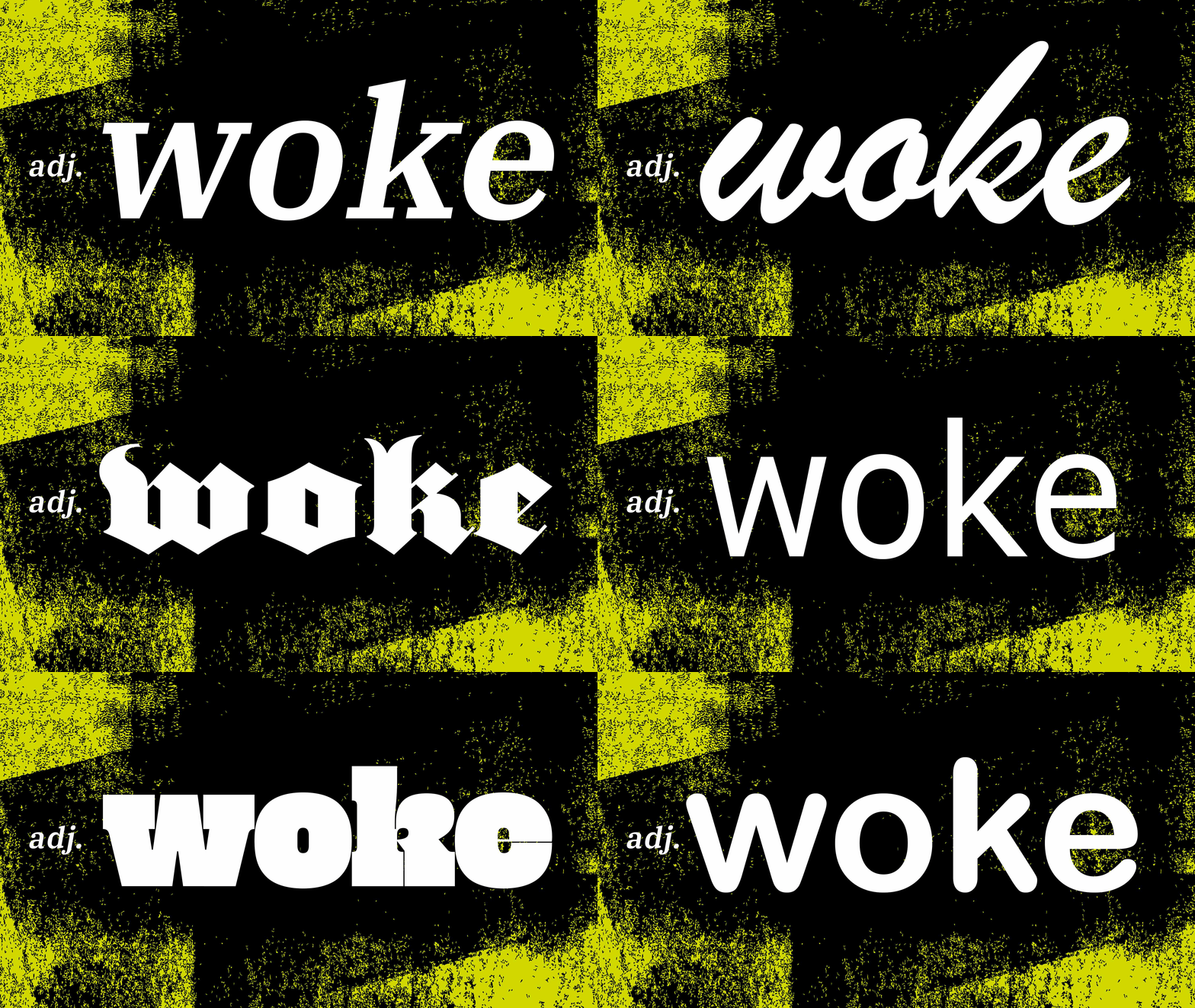
Hi guys! It’s Jasmine here, filling in today for JVL. You may know me from my omnipresence in the comments section or from the Triad Mailbags. This is my first time writing a Triad, so I hope you’ll let me know your thoughts in the comments. Today, we’re going to talk about “woke”—the ideas behind it, plus the political impulse that fell under that umbrella term—and I want to prime you all:
Woke began as one inner-circle concept and ballooned into many other things.
Because of its many meanings, people often talk past one another when it comes to woke.
Keep that in mind when reading below and in our discussion in the comments.
Now let me give you the short version: It’s time we bring back woke.
I’m kidding! I kid because I know that out there on X, someone is going to say, “The Bulwark wants MORE woke?!” And that’s not what I’m arguing here. Today I’m trying to explain the evolution of woke. I want to see if we can come up with a theory for what a new and improved wokeness would look like.
(Spoiler: I think maybe we can?)
But this only works if everyone dials back and engages in good faith. Which I know you guys will do.
If you want to be heard in the comments section, please join us as a Bulwark+ member. That way you can read today’s full newsletter and let me know what I’ve gotten right and where I’ve gone wrong. And you can enjoy all our other locked content. Click here:
(Photo illustration by Sarah Rogers/The Bulwark | Photos Shutterstock)
1. The re-awokening
The word “woke” is as curious a cultural phenomenon as it is a linguistic one. Woke’s great language problem is its flimsy definition: Across roughly a decade, it went from being one half of a phrase used within the Black community (“stay woke”) that meant simply to be aware of social injustice; to a term adopted earnestly by progressives for the same reason; to an insult leveled against sensitive, politically correct leftists; to an amorphous criticism used to describe anything the speaker does not like.
This current definition—“woke” as an all-purpose pejorative used by both the right and the left—is a familiar villain’s journey.
After gaining traction during the first wave of the Black Lives Matter movement in 2014, woke went mainstream. By 2017, lexicographers added it to the Oxford English Dictionary and the political phenomenon became so prominent that commentators started joking, sometimes disparagingly, about a “Great Awokening.” Then woke went off the rails, careening into unpopularity by 2020 when leftists started insisting upon agreement with a host of social and policy issues ranging from expanding bike lanes, to diversity hiring quotas, to critical race theory in K-12 schools.1
This is when, for a swath of America, the left took woketoo far. The crossover point where woke peaked and the MAGA “vibe shift” began was probably around 2022. By 2024, Donald Trump was able to return to the White House in part by running against woke identity politics (think of the “they/them” attack ads he ran against Kamala Harris).
The irony, of course, is that to the extent that wokeness was repressive, it was nothing compared to the total obeisance Trumpism demands of Republicans. The canceling, the censorship, the sycophantic ass-kissing, the overreach—these are now inalienable features of the Republican party. Except the Trump administration has outshone woke and created an actual authoritarian agenda, with real-life, dire consequences—but more on that in a moment.
A word of caution: I am not arguing that we should bring back wokeism. Woke created in-groups and out-groups based on the acceptance of an inflexible ideology that divided society into victims and oppressors, from which the latter group was supposed to grovel for the forgiveness of the former. If woke was attempting to build a unifying coalition to bring about actual change, that was decidedly not the way to do it.
But woke is having a bit of a renaissance. The electoral victories of left-wing Democrats such as Zohran Mamdani,2 D.C.’s Janeese Lewis George, and Colorado’s Melat Kiros—people who would’ve been easily identified as “woke” just a few years ago (and sometimes still are)—may not mean that this strain of candidate is about to sweep the country. But it probably means something.3
Yet Democrats continue to balk at their woke adolescence, cringing at their old social media posts and statements like a twentysomething recalling their embarrassing college years. The latest viral example is from Wisconsin gubernatorial-hopeful Francesca Hong: After facing criticism online over her 2020 post that Thanksgiving should be abolished because it celebrates colonialism, Hong now says it is her favorite holiday.
Canceling Thanksgiving is a ridiculous idea, and it’s equally ridiculous that a candidate for governor is having to talk about this. Many woke trademarks were like this: trivial and irrelevant outside of certain feisty corners of the internet.4 But the terror campaign that Republicans have executed during their government trifecta is of actual consequence. Republicans made a bogeyman out of liberal woke repressiveness—even comparing it to Soviet purges under Stalin—but have stood by as their own party turned into a far more repressive, submissive collective. Yet Democrats refuse to point out this hypocrisy.
Instead, the consensus among Democratic officeholders and candidates—from Gov. Gavin Newsom to Abdul El-Sayed, from Sen. Bernie Sanders to James Talarico—seems to be to continue to distance themselves from wokeism to save face ahead of the midterms. In an article published in the Guardian shortly after the Democratic victories in last November’s off-year elections, labor union leader Dustin Guastella wrote that to maintain the Democrats’ newfound momentum, progressives should embrace moderates, and he warned against “reanimating the dead-end politics of fringe woke causes.”
To be clear: Democratic operatives are wise to widen the party’s aperture to left-wing populism. It’s more likely to create a winning coalition than wokeness, which sabotaged itself by issuing mandates of compulsory guilt and shallow activism. But in the scramble for center-left Democrats to shake off wokeness and brandish populism, they are ignoring that “woke,” flawed as it was, was also not completely off the mark—and that some of its core demands foreshadowed
Get around the paywall by joining our growing community:
Catherine Rampell and Sam Stein went live to cover the terrible jobs report this month, the White House's attempt to spin the economy as booming, the bill in the Senate that could give Trump more tariff power, and a federal appeals court blocking construction on Trump's ballroom.
With America’s stockpiles of crucial munitions getting worryingly low, America’s adversaries seem to be getting interested in testing the boundaries of what they can get away with. Citing U.S. intelligence reports, the Wall Street Journal reports that Vladimir Putin is mulling the possibility of “testing NATO’s resolve” with a “limited assault” on a member country in the next few years. Hey, Vlad, there’s a lot going on over here—could you give us a minute?
In other news, we got some pretty disappointing jobs numbers today: The economy lost 23,000 jobs in July, while May and June’s reports were revised down by a combined 103,000 jobs more. The unemployment rate actually ticked down a hair, to 4.1 percent, as 260,000 people left the labor force. In other words, employers aren’t hiring and workers are starting to notice. To wit, this stat from the Journal: “In recent months, almost three in 10 of the unemployed have been looking to work for more than six months, the greatest share since the pandemic recovery four years ago.” Happy Friday.
Join Catherine Rampell and Sam Stein for Receipts Live on Substack and YouTube today at 12:00 p.m.
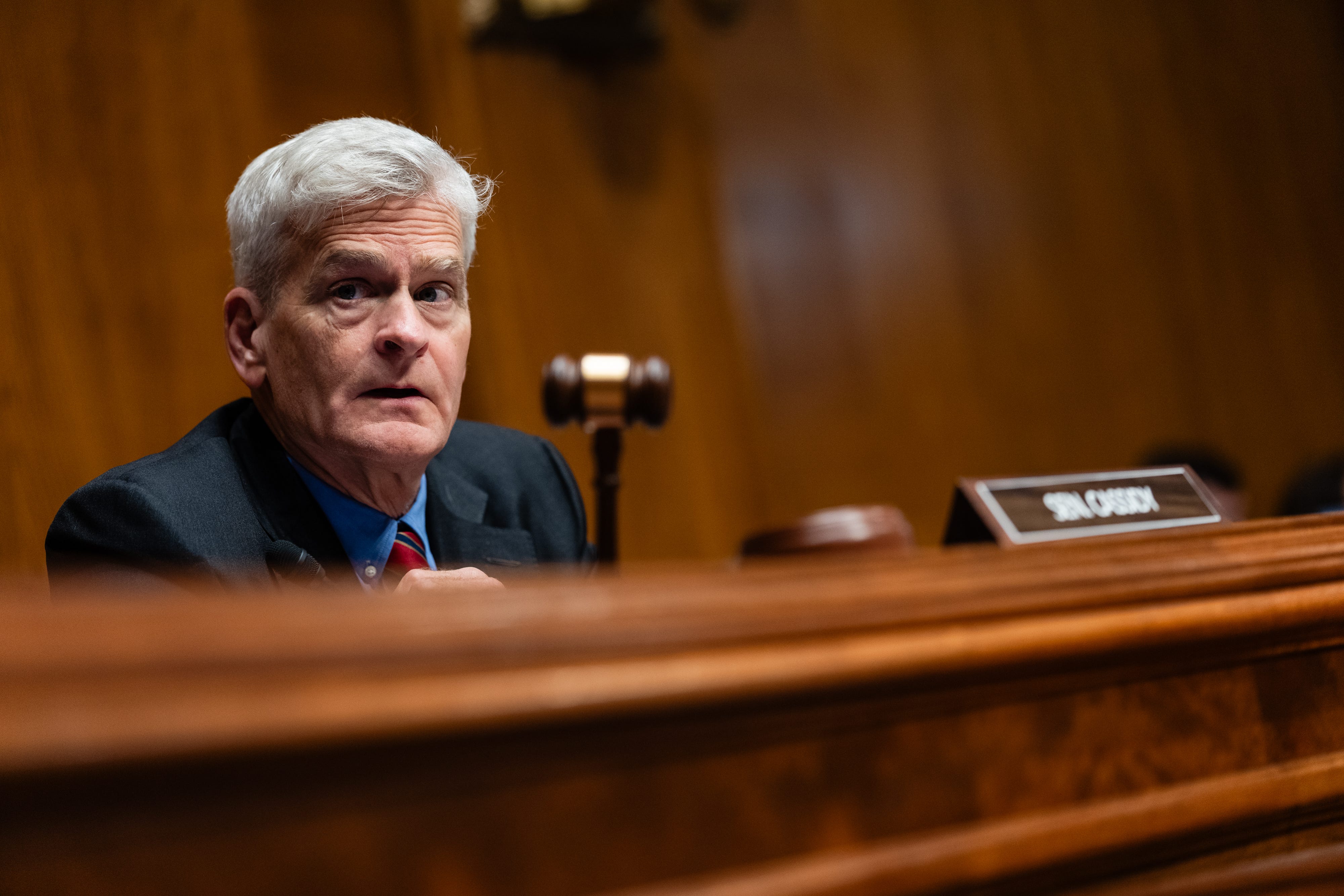
(Photo by Eric Lee/Getty Images)
Cassidy in the Spotlight
by William Kristol
[Update (August 7, 2026, 12:30 p.m. EDT): In remarks on the Senate floor an hour after this newsletter was published, Sen. Cassidy announced he would be voting for Blanche after all. So it goes.]
With Sen. Lisa Murkowski’s (R-Alaska) announcement early this morning that she will oppose Todd Blanche’s confirmation as attorney general, it all comes down to the senior Republican senator from Louisiana, Bill Cassidy.
Cassidy could join Murkowski in opposition. They had, after all, met together with Blanche on Wednesday. This morning Murkowski cited “the politicization—even weaponization” of the Department of Justice that “accelerated” during this administration as her reason for opposing Blanche. Cassidy had already said prior to that meeting that he was “very concerned about the weaponization of the Justice Department” under Blanche. All Cassidy has to say now is that Blanche didn’t satisfy his concerns, as he didn’t satisfy Murkowski’s.
And Cassidy owes Trump nothing. After he voted to convict Trump in the February 2021 Senate impeachment trial, Cassidy was targeted by Trump, and was crushed in the Republican primary earlier this year by a Trump-backed challenger.
What’s more, at the beginning of Trump’s second term, after much public agonizing, Cassidy, a physician and chair of the Senate Health, Education, Labor, and Pensions Committee, provided the decisive vote to confirm Robert F. Kennedy Jr. as secretary of Health of Human Services. He’d received several assurances from Kennedy about what Kennedy would do and wouldn’t do as secretary—assurances that Kennedy has subsequently broken. So you’d think Cassidy would have plenty of reason to resolve not to be fooled again.
Share this story with a friend who keeps getting fooled to help them wise up.
But will he so resolve? Will he do the right thing? Or will he follow in the footsteps of his Republican colleague, North Carolina Senator Thom Tillis?
Tillis was elected to the Senate in the same year as Cassidy, in 2014. A businessman who had entered politics a decade before and had become Speaker of the North Carolina House of Representatives, he ran for the Senate that year with the backing of Jeb Bush, Mitt Romney, and the Chamber of Commerce. He was the establishment pick. And after he defeated a couple of Tea Party Republicans for the nomination, he seemed set to be a relatively centrist North Carolina senator.
Then came Trump. Tillis joined the vast majority of his colleagues in years of accommodation, appeasement, and acquiescence. In February 2021, he chose not to follow Cassidy or, for that matter, his fellow Republican senator from North Carolina, Richard Burr, in voting to convict Trump. But Burr wasn’t planning on running for re-election in 2022, while Tillis was focused on his bright political career ahead.
Nonetheless, by June 2025, his lack of true Trumpist zeal meant that he would face a likely primary challenge from the Trump wing of the party. So Tillis announced he wouldn’t run for re-election.
A couple of weeks ago, Tillis demanded as a condition of his support that Blanche meet with the Epstein survivors whom he’d shunned for eighteen months. Once Blanche’s behavior in that meeting turned out to be utterly disrespectful of the survivors, it would have been easy for Tillis to announce his opposition to Blanche, which would have killed the nomination.
But Tillis caved.
You might think that such a record of repeated capitulation to Trump would induce Tillis to slink off quietly into the sunset. But he didn’t even have the dignity for that. Instead, as the publishing house HarperCollins announced yesterday, he has written a book.
According to HarperCollins, How to Lose Friends and Antagonize Presidents brings us Tillis “outspoken and uncensored.” The book is a “bare-knuckled, darkly funny wake-up call,” a “sharp, no-BS book, “ “a bracing tonic to stiffen spines.” Tillis “pulls no punches” about the “spineless Republican yes-men (and -women), and the weirdos of the MAGA world,” about “the grifting sycophants and useful idiots in Trump 2.0.”
As the kids used to say, gag me with a spoon.
Underscoring the absurdity of it all is the book jacket. It features as examples of the sycophants and idiots of Trump 2.0, photos of Kristi Noem, Robert F. Kennedy Jr., and Pete Hegseth. Tillis voted to confirm all three to their Cabinet posts, along with every other Trump nominee.
Does Cassidy now look at Tillis—and the other pathetic, gag-inducing Respectable Republicans™—and find it just too much? Is it possible that this morning Bill Cassidy is saying to himself: Don’t be Thom Tillis? Or does he too decide that he can write a post-Senate memoir about fake courage without displaying actual courage when he could make a difference?
BIRTHRIGHT CITIZENSHIP, AGAIN: When it comes to throwing out constitutional amendments via executive order, Donald Trump has a simple philosophy: If at first you don’t succeed, try, try again. Two months after the Supreme Court tore up his last attempt to restrict birthright citizenship as “facially unconstitutional,” Trump signed a pair of executive orders attempting to nibble around the edges of which infants born on U.S. soil automatically qualify as citizens. Here’s the New York Times:
It was not immediately clear how the twin orders could realistically be enforced. They would restrict those who could qualify for birthright citizenship, to exclude children of staff working for foreign governments but serving in the United States, and the babies of mothers who lie about their intentions for visiting the country while pregnant. There is a third category, for babies born in U.S. territories, but that would first require congressional action.
And then there are children whose parents are tagged by the government as being part of known terrorist groups or who are “alien enemies.”
Given how tightly the summer’s ruling has tied the administration’s hands on this matter, most of yesterday’s signing ceremony was simply an occasion for grumping. Stephen Miller fumed that the 14th amendment had been passed “exclusively . . . to ensure that the children of slaves would be citizens,” and that it “had no other meaning and purpose outside of that.”1 But there may be some policy levers left to the administration. For example, White House Staff Secretary Will Scharf suggested that they were considering guidance to deny visas to visitors who they suspect are entering the country for the purpose of delivering a child here.
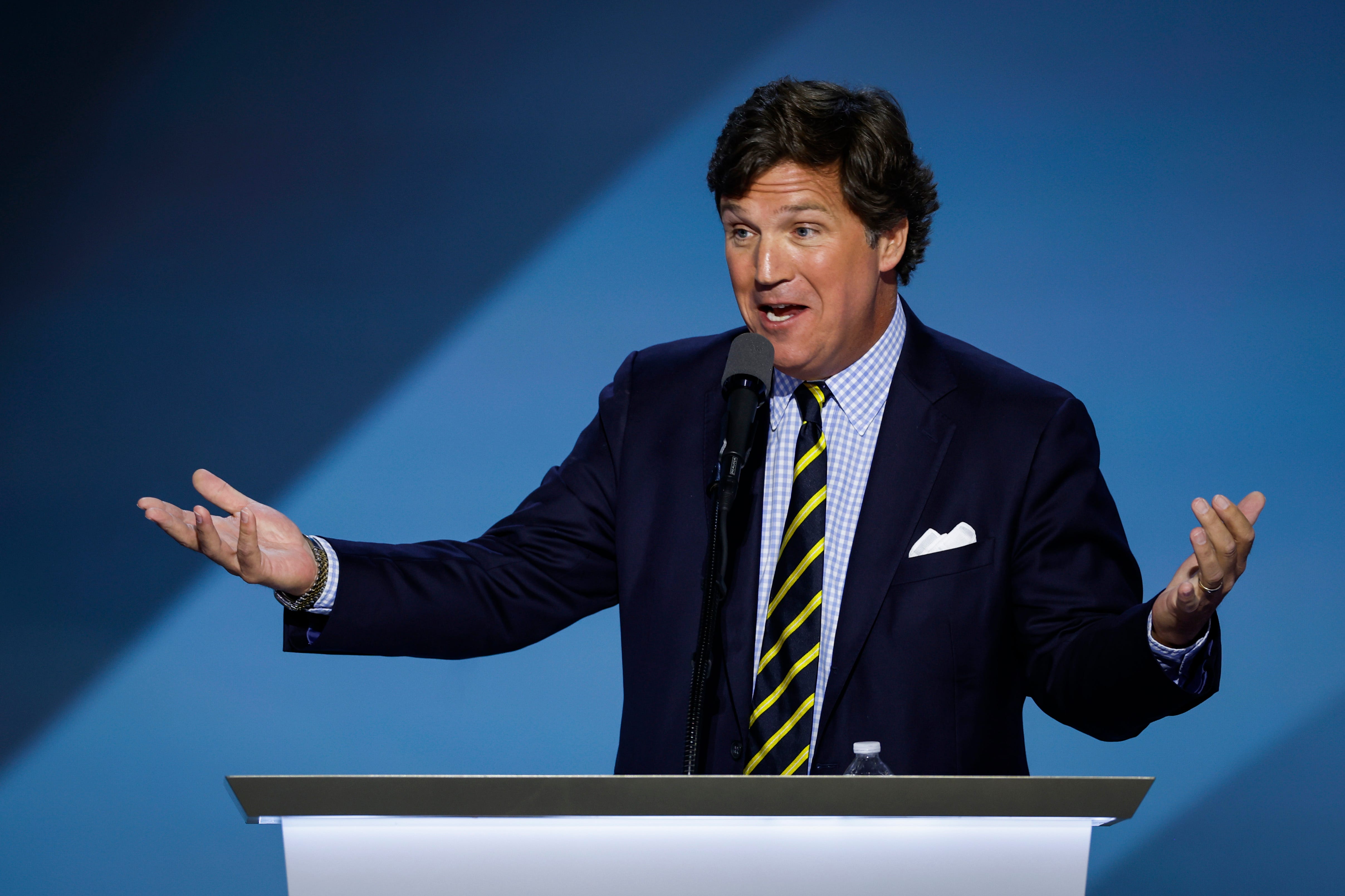
PRESIDENT CARLSON?: Could Tucker Carlson run for president? At the very least, he’s plainly trying to keep the possibility on people’s minds. The former Fox News broadcast star raised eyebrows this week after photos were released of him eating dinner at his Maine home with several exiled MAGA dissidents, including Rep. Thomas Massie, former Rep. Marjorie Taylor Greene, and former administration official Joe Kent. “We said no more foreign wars and we meant it and supported Donald Trump because he made that promise,” Greene posted. “The movement has begun.”
Then, on Wednesday, Carlson released a 90-minute livestream containing what he described as a a ten-point program for “whatever comes next”—a program marrying typical MAGA and MAHA impulses (America should be “sovereign,” “beautiful,” “healthy,” and “united”) with populist attacks on the sort of open corruption and foreign adventurism Trump has embraced (one set of rules must apply to everyone, even presidents, and government officials should be punished for lying to citizens).
There was a lot more to it than that, some of which JVL, Andrew, and Will Sommer discussed on video yesterday. But we have a feeling we’re going to be hearing a lot more from Tucker in the days and weeks to come.
LOSING ALLIES: The list of Republicans calling on Rep. Max Miller to suspend his re-election campaign and resign from Congress continues to grow. Yesterday, two more senators joined the chorus: Jon Husted, who serves alongside Miller’s father-in-law Bernie Moreno as Ohio’s other senator, and Montana Sen. Tim Sheehy. Husted’s statement was more diplomatic—Miller, he said, ought to resign “to focus on what is in the best interest of his daughter”—while Sheehy’s was somewhat less so:
This guy is clearly a degenerate sociopath. Max should step aside and seek help. Staying in this race makes it far more likely we lose this seat and hand Democrats a majority to impeach President Trump.
It’s already too late for district Republicans to hold a special election to replace Miller as their nominee, but party leaders could still replace him in the ballot if he were to drop out before Monday. Miller continues to insist he’s being railroaded and doesn’t intend to drop out. But our old colleague Marc Caputo reports for Axiosthat not everybody is convinced he’ll stick with it: “Republicans privately expect that Miller will drop his re-election bid by the end of this week, according to two sources.”
[Update (August 7, 2026, 2:05 p.m. EDT): The bill discussed in this newsletter passed the Senate 86–11 on Friday afternoon. Efforts to strip the tariff powers from the legislation (led by Sens. Ron Wyden and Rand Paul) failed. The bill now goes to the House.]
DONALD TRUMP HAS SPENT the past year and a half bending every obscure trade law until it snapped, alienating global allies and jacking up costs for Americans. Democrats have heaped scorn on him for this, and Republicans have expressed their own displeasure via indirect or anonymous grumbling to the press. Yet now, lawmakers from both parties are poised to give the president even more tariff power.
And not just any tariff power. It’s potentially the nuclear bomb of tariff power.
A new, bipartisan bill could allow Trump to drop 100 percent tariffs on virtually any country he likes, for as long as he likes, and with pretty much bulletproof legal authority to do so; which means even the Supreme Court couldn’t bail out Congress (or the rest of us) next time.
This is all happening through the Lindsey O. Graham Sanctioning Russia Act, which is rapidly moving through Congress with broad bipartisan support. It is expected to clear the Senate, where it has 62 cosponsors (including 21 Democrats), as soon as today.
As the name implies, the bill is intended to honor the legacy of the late South Carolina Republican and to punish Russia via sanctions.
In reality,
Blast past the paywall: Sign up for Bulwark+ to read on.
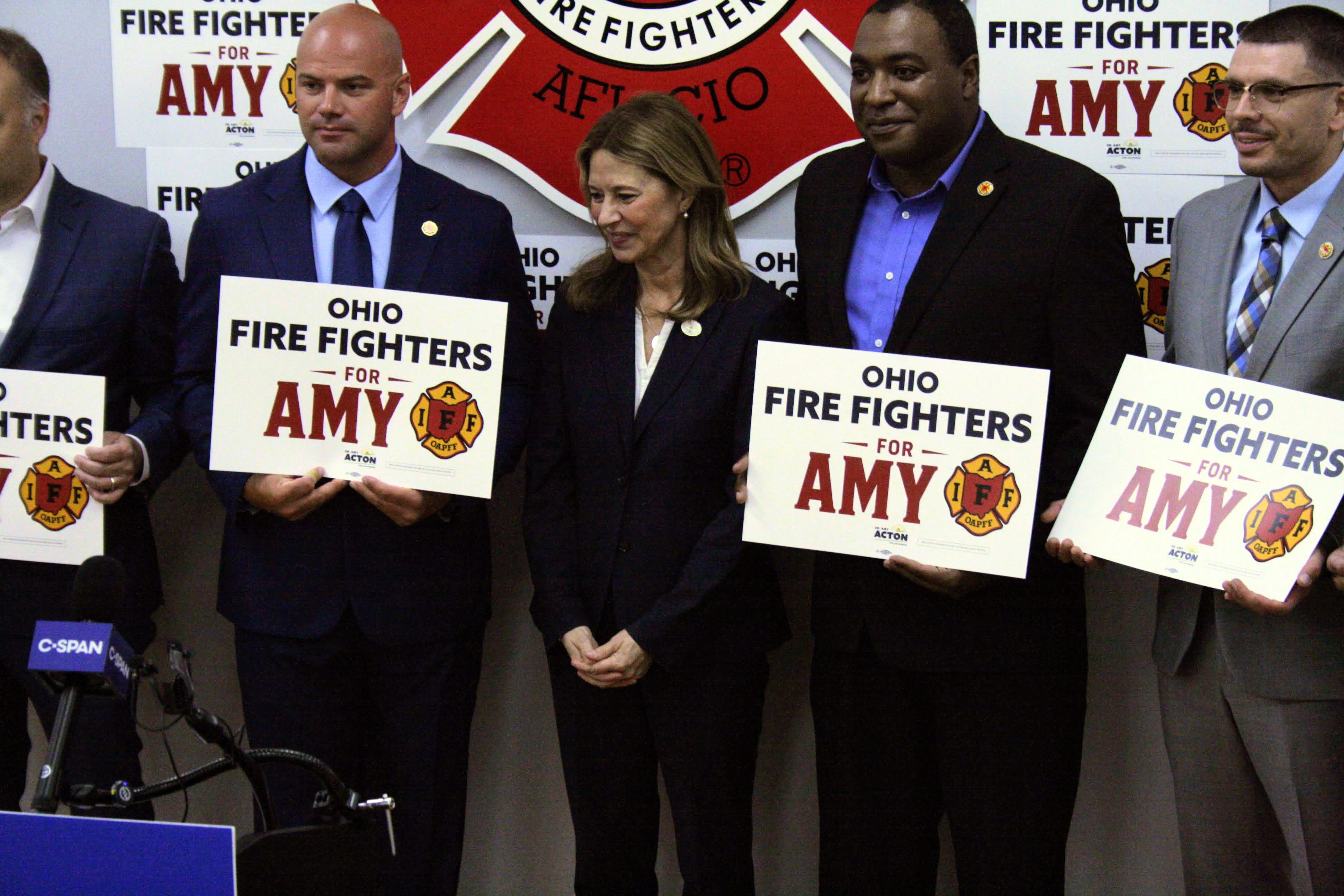
Cincinnati, Ohio AMY ACTON PICKED UP A BIG ENDORSEMENT Monday in a union hall on the city’s west side. In a room decorated with historical mementos honoring Cincinnati’s fire department, the oldest professionalized municipal fire department in the country, Acton was surrounded by a dozen or so union leaders as the Ohio branch of the International Association of Fire Fighters threw its support behind her gubernatorial bid.
This year, the cops-and-firefighters split is stark in Ohio. The state’s Fraternal Order of Police gave Republican Vivek Ramaswamy its endorsement, which it also extended to every other Republican running statewide. And while the firefighters have in the past gone in for both Republicans and Democrats, for most of the last decade and a half—ever since then-Gov. John Kasich in 2011 pushed for and signed a law (later repealed) sharply curtailing public employees’ collective-bargaining rights—they’ve placed their bets pretty firmly with Democrats. This fall they are all-in on Acton.
On this hot summer day I’ve come to the Fire Fighters Union Local 48 hall to see Acton in action and grab her for a chat after. The event, closed to the public but open to some members of the press, will be the first chance I’ve gotten to observe the candidate up close.
(Photo by Jim Swift)
The first thing to grab my attention is a reminder from the president of Columbus’s Local 67, Steve Stein, of how Acton, a physician who was director of Ohio’s Department of Public Health from 2019 to 2020, responded to the pandemic. For Republicans, seething over COVID public health interventions has become de rigueur. There was some freshness, then, in hearing words of praise for a public servant who did battle with a deadly virus against which we were initially almost defenseless:
We weren’t sure if we were going to lose half of our workforce responding to this [COVID]. And every single one of our members said, “We’ll see you tomorrow.” And it was leadership—proven leadership—[from] people like Dr. Acton, Gov. DeWine and the team, and the hard work of our firefighters, EMTs, and paramedics, that responded to every single Ohioan, no matter where they lived. . . . Those decisions weren’t partisan. They were decisions about safety. They were decisions about serving other people.
Stein wouldn’t be offering this praise if Acton didn’t welcome it, which suggests the candidate is going to respond to Republicans’ COVID-related attacks by refusing to cede the ground of science and memory to them. A preference for the truth shouldn’t be extraordinary in mainstream political candidates, but in 2026, it’s a promising opener for anyone who would prefer not to be gaslit about that recent episode of extraordinary suffering and death.
When Acton gets up to speak, she makes clear she is less interested in relitigating the pandemic than in talking about the Ohio she wants to build. But as she gives her values-forward stump speech, it’s tempting to let your mind wander backwards, to a time before the pandemic and before MAGA. In some ways, the future Ohio envisioned by Acton sounds an awful lot like the one she knew during childhood.
“When I was growing up in Youngstown, we didn’t know what party you were in,” she says. “We knew what union you were in.”
Fearless reporting. Sharp analysis. And commentary that helps you see around corners. Make sure you miss nothing—join Bulwark+.
In the Youngstown of Acton’s memory, partisan affiliation was an abstract feature of a person’s identity. The concrete things about you had to do with the institutions down the street: unions, yes, but also churches, neighborhoods, and civic organizations, and underneath all that, the general expectation that you and your neighbors would look out for one another. It’s the spirit of small-town Ohio—a pretty faithful impression, even if the warts have been removed.
Life in such a setting can be far from idyllic, of course. Acton and her brother experienced a childhood marked by abuse and neglect—the subject of her first campaign ad. For a time, they lived in a tent during a Youngstown winter. This morning, she emphasizes that it was often first responders and neighbors who intervened to make sure the pair of kids were okay. Some would even invite them onto their front porch for an impromptu breakfast “just because we were hungry.”
It might be because of this hardscrabble background, but Acton’s empathy doesn’t feel like an act in the way it so often does with other candidates out on the campaign trail. “I’m a doctor. I’m not much of a politician,” she says, adding, “I’m becoming one right in front of your eyes.” Watching Acton, it seems to me that she doesn’t work a room so much as observe it, and in a way that reminds me of the moment a physician looks you over before starting the conversation during an exam. In response to questions, she sometimes pauses to take in the questioners for so long that it’s almost physically discomfiting. Call it retail bedside manner.
The doctor’s diagnosis is that the state has an acute infection of political acrimony that needs to be addressed in order to treat a deeper underlying condition: economic malaise. “Everywhere we go, people are longing for public servants again, and they’re longing for this hate and chaos and vitriol and purposeful pitting against one another to end,” she says. “The issues they talk about—95 percent of them—no one would disagree on: It’s the cost of living, housing, educational costs, childcare, property taxes.”
She cites a Clermont County family with premature twins who had accumulated $300,000 in medical debt from a neonatal intensive care stay. They had done everything right, she says, yet still found themselves financially overwhelmed. Anecdotes like this frame Acton’s defense of her medical debt–relief policy, which Ramaswamy recently seized on as proof that she is a socialist of some kind.
It’s a stark contrast to Ramaswamy—who recently was booed by an audience of conservatives for claiming his generation is “going to be fine” and has “already made it.”1
“For pennies on the dollar, we’re renegotiating that debt,” Acton says—noting that “Illinois spent $10 million of state funding, and they alleviated a billion dollars of people’s debt.”
After this, Acton moves through a cavalcade of pocketbook-focused policies, concluding with her proposal for a “circuit breaker” rebate for middle-income homeowners facing steep tax increases. After that, a moment of vintage Americana.
“This endorsement means everything to me,” she tells the firefighters. “You’ve been my heroes, and I promise that I’ll be fighting so that no one in this state is ever unseen.”
SITTING DOWN WITH ME after her speech, Acton reiterates that she isn’t a natural politician. “My last office I ran for was in high school,” she tells me. “The instincts of being a 60-year-old doctor and doing public health and preventive medicine—it’s always about going to ground. It’s always about the community as your patient. That was my instinct all along, and I started going around listening even before I filed my paperwork to make the decision to run.” In her Toledo-built Jeep Wrangler, she says, “I’ve been to every county in Ohio. . . . I wanted to meet people where they are.”
Meet them she did. At a recent Democratic dinner in Fulton County that normally draws a few dozen people, more than three hundred attendees turned out. Many, she recalls, introduced themselves not as Democrats but as lifelong Republicans. Acton believes some of her draw, and some of the willingness of those guests to put aside partisan loyalties, traces back to the pandemic.
“It’s a deep bond that formed around going through such a very hard time. It’s very unique. I don’t think a politician could intentionally create this kind of connection,” she reflects.
That experience of collective suffering—and Acton’s presence in communal memories of it—also helps explain why, she says, “I’ve never been in a room in two and a half years where someone doesn’t cry.”
Every campaign has its unique rhythms and quirks; regular weeping from eventgoers is far from the strangest I’ve encountered over my years of following national politics. But it provides a curious point of contrast with the aversive reaction associated with Ramaswamy’s campaign.
“My opponent was just out last week with the whole, ‘victors not victims, you’re whiny and complaining’ stuff,” she tells me. I point out that, during his humiliating performance at YALCon, there were quite a few whiners in the crowd.
FOR ALL THE ATTENTION PAID to Acton’s public health role during Ohio’s experience of the pandemic, it is easy to forget that it represents only a small chapter in her career. She has worked with five governors—Republicans and Democrats—and her experiences have given her a zest for (reasonable) bipartisanship.
If elected, she says, she will appoint Republicans to her cabinet, because Ohioans should expect their governor to work with anyone willing to solve everyday problems.
One former Republican governor in particular genuinely excites her: Bob Taft.2 Acton and her running mate, lieutenant governor candidate David Pepper, recently met Taft for lunch. The former governor arrived carrying a crumpled, coffee-stained sheet of paper on which he’d listed everything he’d hoped to accomplish when he became governor in 1999.
Together, Acton tells me, the three of them walked through the list. The Taft of yesteryear had set his sights on constructive, reasonable goals: new parks, initiatives to encourage economic development, and other long-term projects of the sort that rarely dominate campaign speeches but can shape a state for decades.
Acton explains that she didn’t see this as an exercise in nostalgia. Rather, she takes it as a reminder that governors once measured success by what they built. In a time of endless, unproductive scrapping, that seems like a useful thing to recall.
But in addition to the economic and material considerations informing Acton’s policy offer and her own desire for building up Ohio, she has a priority issue in the area of cultural politics. The question: Why are we all so bummed out? Acton’s answer: because we are so damn lonely.3
Ohioans are “absolutely exhausted of hate, chaos, and vitriol, and being pitted against one another,” she tells me. “We are hardwired for human connection.” As an exhausted and angry Ohioan, I am inclined to agree.
She invokes Bowling Alone, sociologist Robert Putnam’s landmark study of America’s fraying civic life and declining social capital that has been helping people see those problems more clearly for over a quarter century. Putnam’s book is “about the fabric of our civic society. I was talking earlier about [how] people didn’t know what party you were in; they knew what union you were in,” she tells me. “They also knew what hat you wore, if you were an Elk or a Moose or whatever. There’s so much pride, and people wanna have pride again in Ohio.”
As an Elk (and a fan of Putnam, who has been a Bulwark Daily guest), I heard Acton speaking to me in my own born-again Ohioan’s language. Our state’s politics, culture, and even our sports teams are subject to derision and often made the butt of hostile jokes. People still laugh about the Cuyahoga River catching on fire. But damn it, I still love Ohio. I moved back here, after all. It’s clear that Acton does, too.
“I always say when I’m going around the country, it’s the United States of Ohio,” she says. “We’re the test market. We represent the whole United States.” That’s part of what being the “Heart of It All” is all about. But the heart is deceitful above all things, and it’s got reasons that reason does not know—all of which is to say, it’s going to be another three months of weeping and whining before we know the road ahead for Ohio, and for the United States thereof.
It’s certainly understandable that Ramaswamy would have a loose grasp of on-the-ground issues for Ohioans, given that he appears to have spent almost half his time during this campaign outside the state.
Tucker Carlson has a new message for the Republican Party—and it sounds an awful lot like the opening pitch of a presidential campaign. JVL, Andrew Egger and Will Sommer give their takes on Tucker's sweeping "10-point" vision for America, why he's increasingly distancing himself from Donald Trump, and whether he's laying the groundwork for a 2028 White House run. Plus, we break down Tucker's appeal to disaffected MAGA voters, the growing rift inside Trump's coalition over foreign policy and corruption, and why JD Vance, Donald Trump Jr., and the rest of the Republican field should be paying attention.
POTUS has always used lies to great advantage, but his fakery can’t disguise the dangerous reality that the United States is running out of missiles. What a time for Trump to don an SNL-grade wig. Meanwhile, AIPAC may be evolving into a Trump super PAC, Max Miller keeps showing everyone he’s a sociopath, the GOP Islamophobia is looking very 2002, and Republican Gov. Joe Lombardo accidentally admits Trump is looking out for the billionaires. Plus: The new Democratic Senate nominee from Kansas, pastor Adam Hamilton, joins Tim to discuss that sleeper race and how incumbent Roger Marshall is all about championing Trump and not the people of Kansas.
Sam Stein and Kansas Democratic U.S. Senate nominee Adam Hamilton join Tim Miller.
As always: Watch, listen, hit the like button or leave a comment. We want to hear from you.
Ad-free editions of The Bulwark Daily are available exclusively for Bulwark+ members.
Tim Miller’s Bulwark Daily is available wherever you get podcasts and on YouTube. New shows drop each weekday afternoon. If you like the show, leave a comment and ⭐⭐⭐⭐ wherever you listen. Add The Bulwark Daily to your player of choice, here.
(Photo illustration by The Bulwark | Images: Facebook, X, Shutterstock)
OF ALL THE CONGRESSIONAL DISTRICTS up for grabs this fall, Michigan’s 7th may be the most hotly contested. Smack in the middle of the state, the 7th went to Donald Trump by just one percentage point in 2024. Its current congressman, Republican Tom Barrett, won his seat that year despite Elissa Slotkin, a Democrat, carrying the district in her Senate victory.
This go-around, Barrett is facing off against William Lawrence, the 35-year-old cofounder of the hyperprogressive Sunrise Movement. Lawrence clinched the Democratic primary on Tuesday after a conservative group secretly boosted his candidacy and two moderate Democrats split the remaining vote.
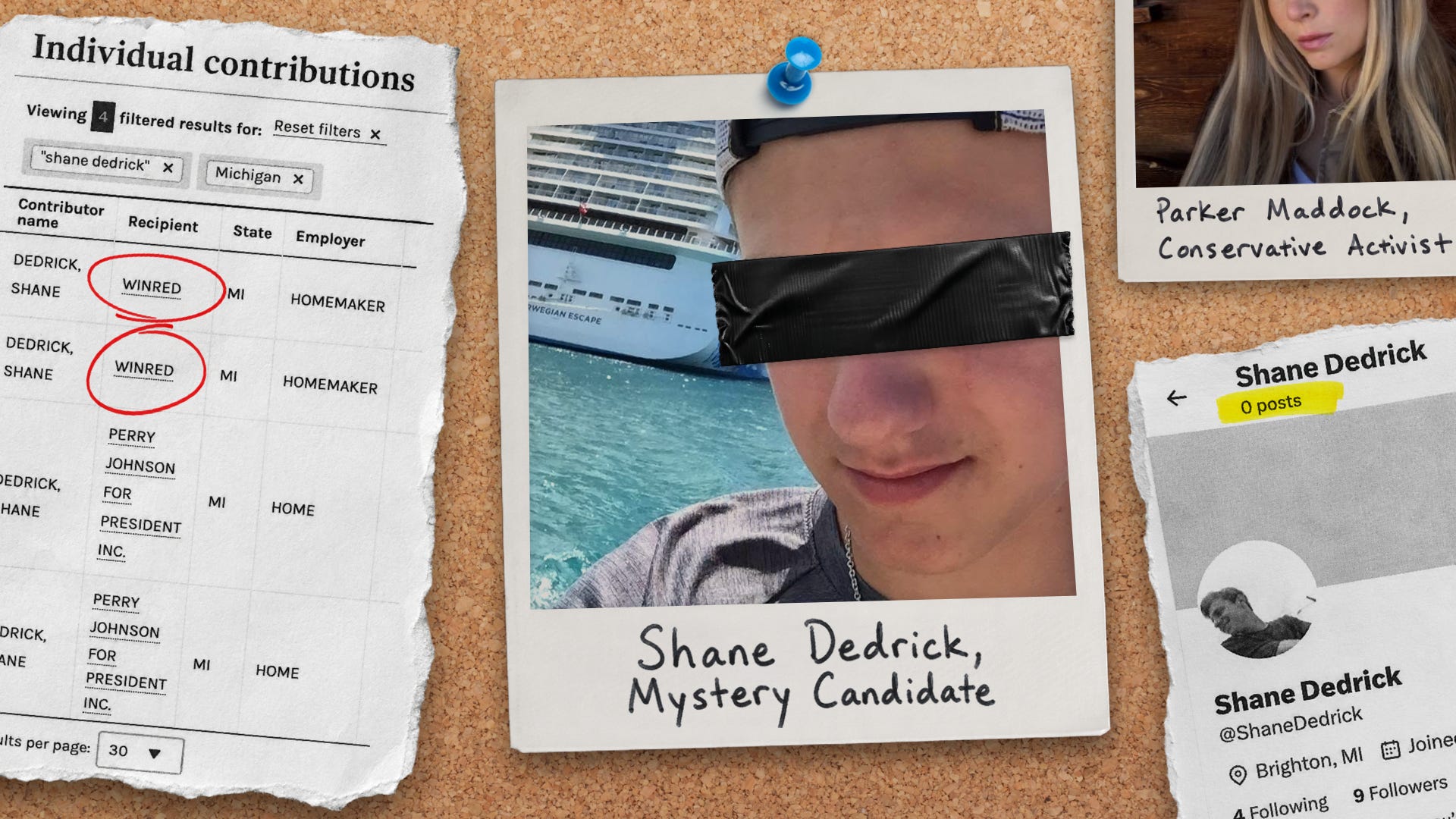
In a race that promises to be close, the presence of a third-party candidate could prove decisive. And this year, the Green Party of Michigan has fielded just such a candidate. His name is Shane Dedrick. You would be excused for having no clue who he is.
Dedrick has almost no digital footprint. What is out there, however, doesn’t give any indication that he is the type of earthy environmentalist that typically runs under the Green Party banner. It might seem that, given Lawrence’s sterling progressive credentials, Dedrick’s candidacy is redundant. But don’t be surprised if he stays in the race. Because, if anything, the online breadcrumbs suggest a real possibility that Dedrick may be a Republican plant.
Sen. Ron Wyden (D-OR) joins Catherine Rampell to discuss his years-long investigation into Jeffrey Epstein's finances and why he believes major Wall Street banks helped enable Epstein's sex trafficking operation by failing to report suspicious transactions. Wyden explains why he says top bank executives should be held accountable, responds to questions about the 60 Minutes interview that never aired, and lays out what Congress could do if Democrats retake the Senate. Wyden also breaks down his opposition to the bipartisan Russia sanctions bill, arguing that it would hand Trump sweeping new tariff powers that could drive up costs for American consumers.
Today I’m going to sketch out a blueprint for reforming the systemic problems with how the federal government is constituted. I do not have a snappy, camera-ready name for it, but that’s a feature not a bug.1
Ready to roll up your sleeves? Let’s look at America’s problemschallenges opportunities and come up with some real-world, non-fantasy solutions.
1. Structures
What is the root of our problem right now?
It’s the character of the American people. Some significant minority of the country wants a post-liberal order.
We can’t change that reality. It will either get worse or resolve itself, independent of any conscious choices made by the forces of liberalism.
What we can do is reform our system of government, which has gone from protecting minority rights to enforcing minority rule. If post-liberalism is going to triumph, at least the chuds should have to earn it at the ballot box. We shouldn’t get dog-walked into a post-liberal order because a bunch of existing liberal institutions got hacked.
So the mission is: How do we reform existing systems to rebalance the power afforded to the minority?
I come to you today not with complaints, but answers. Let’s ride.
TUCKER CARLSON SPENT THE SUMMER in a fugue, talking with an alleged Russian spy and accusing Donald Trump of being the Antichrist, then claiming he never said that. Carlson’s visits to the White House earlier in the year had failed to avert the Iran war, and after the bombs started falling, Vice President JD Vance—once the voice of Carlson’s preferred brand of populist isolationism—came to look like another tool of the same hawkish Republican establishment that had scorned Carlson.
But in a much-hypedmonologue on Wednesday night, Carlson suggested his plan to bounce back from the Vance disappointment: running for president himself in 2028. While he didn’t explicitly say he would run, Carlson spent ninety minutes laying out ten planks of what looks a lot like a populist campaign platform. Like Donald Trump after descending the golden escalator in 2015, Carlson depicts America as crisis-ridden and badly broken—but fixable, if voters choose the right candidate.
“You’re going to need to do something about the pressing question of American identity,” Carlson said, as he finished his speech. “What does it mean to be an American? But it’s fixable. You just have to try. And we will be trying.”
Carlson’s speech hasn’t attracted much interest outside of the right because he didn’t explicitly say he’s a candidate. But it still bears looking at because it reveals how Carlson, a guy nowadays best known for talking about demons and ball-tanning and for cozying up to Vladimir Putin, might go about setting up a run for the White House—and get his revenge on Trump.
Don’t miss the best reporting on the right, the far right, and the over-the-horizon right: Sign up to get False Flag in your inbox.
CARLSON’S SPEECH WAS PRECEDED by a meeting last weekend with other Trump friends-turned-enemies: former Rep. Marjorie Taylor Greene, Rep. Thomas Massie, and former counterterror chief Joe Kent. Ever since the private pow-wow, they’ve been on a media tour attacking Trump and promoting the idea of a third-party run against his chosen candidate in 2028.
Greene, for example, went on an online show hosted by conservative “Walkaway” activist Brandon Straka—himself increasingly critical of Trump—to claim the president said her son deserved to be killed by MAGA activists angry over her efforts to release the Jeffrey Epstein files.
Kent said in an appearance on the lefty show The Young Turks that they all urged Carlson to run for president at their get-together.
“Hopefully he wakes up one day and Tucker says he’s going to run,” Kent said.
Carlson centered his speech on ten words for how he thought the country should be, including “fair,” “sovereign,” and “decent.” Each one led into more specific grievances—the idea that America should be “optimistic,” for example, was really about the declining birth rate.
“A country that doesn’t care about kids doesn’t care about the future,” Carlson said.
In his speech, Carlson positioned himself at the center of several populist concerns: opposition to AI data centers and Flock surveillance cameras, the sense that Epstein associates are getting away with it. Carlson even suggested some sort of debt forgiveness or other radical economic restructuring of consumer debt, saying the country could never be moral in a “society organized around debt.”
“Now the ‘fruited plain’ is just a place to build data centers and windmills, and make ethanol,” Carlson said, evoking a sense of a lost American heartland.
Like any good campaign speech, it was also pretty boring. Aside from calling Defense Secretary Pete Hegseth “a deranged, bloodthirsty monkey,” Carlson hit his usual beats—criticism of Israel and Ukraine, and a sense that Trump has brought the country to the brink of nuclear war by attacking Iran.
Still, the import of Carlson’s video wasn’t lost on his enemies. Idiosyncratic conservative writer Rod Dreher, who recently announced a falling-out with Carlson over Carlson’s refusal to take seriously a potential case of demonic possession, said Carlson’s “fascinating” speech suggested he could launch a new “radical” party.
Jeremy Boreing, the former Daily Wire CEO now trying to build his own podcast empire, summoned a host of Carlson critics, including James “Conceptual James” Lindsay, to hash out exactly what Carlson meant. The panel’s conclusion, essentially, was that Carlson is a dupe following the orders of pro-Putin ideologue Aleksandr Dugin, albeit one who harbors real third party ambitions. Boreing added that Carlson “alluded” to a third party in his speech, and gave the camera “a slight grin” when he hinted at making a future announcement.
“Tucker has a political project, and that project is to create a new American majority out of a coalition formed from left-wing economic populists and right-wing social populists,” Boreing said.
We got lots of important elections stories this week, but none stranger than the outcome in the Republican primary for Michigan’s swingy 8th district, where Trump’s endorsed candidate, Navy veteran Amir Hassan, endured a shocking loss to a man named Tom Smith—who wasn’t even running anymore, having dropped out of the race last month. Smith carried the primary 50 percent to 33 percent, and was as surprised as anyone. Appearing at a GOP unity lunch yesterday, he had this to say: “I’m Tom Smith. I’m running for the 8th congressional district to unseat communist Comrade Rivet, and I’ll need your help to do it.” Those were his full remarks.
For most GOP candidates, Trump’s endorsement is a golden ticket to the lizard-brain love of the GOP base. Sometimes, however, it’s apparently not enough to overcome a different kind of lizard-brain difficulty: running against a man named Tom Smith when your name is Amir Hassan. Happy Thursday.
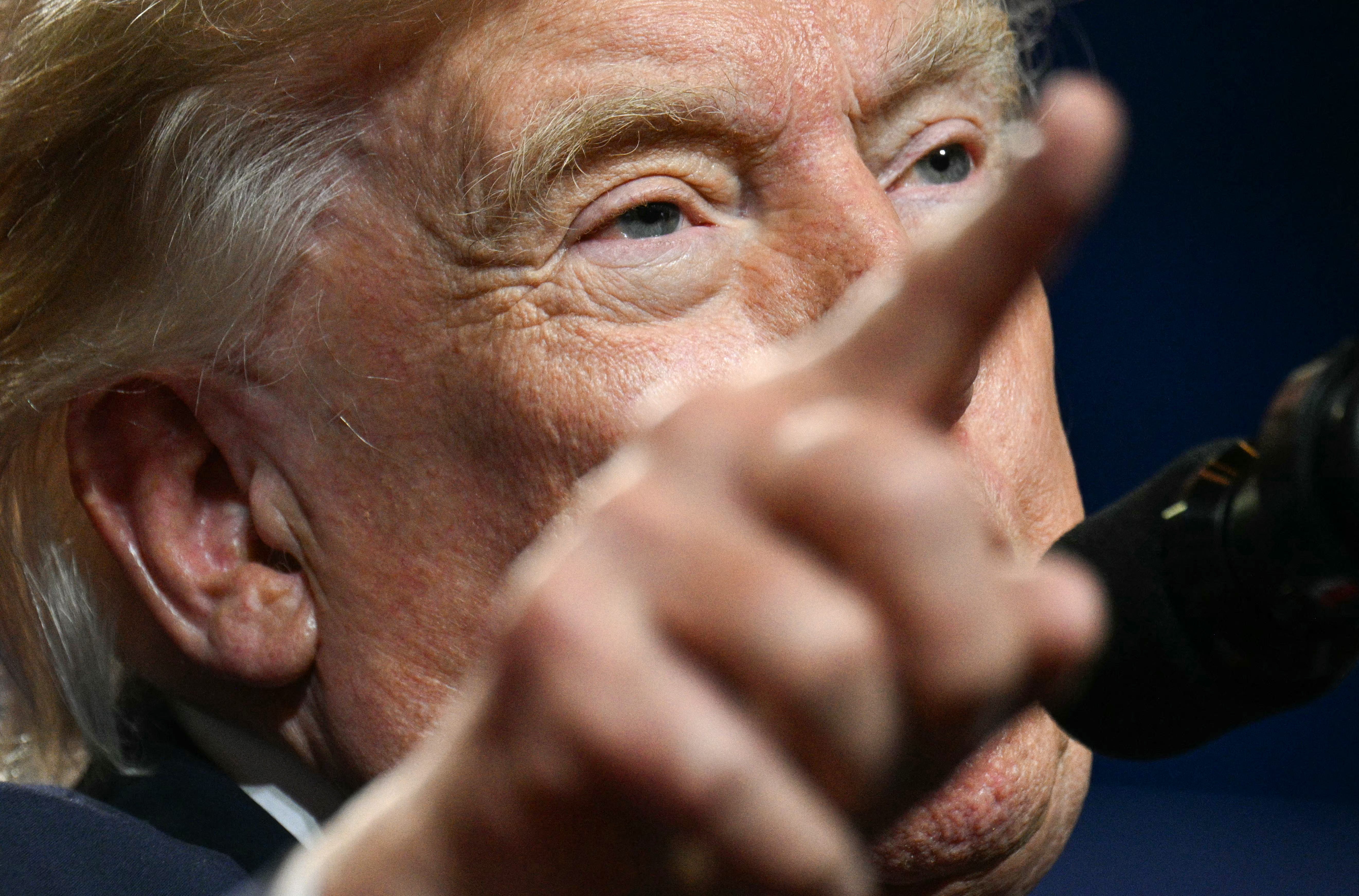
(Photo by Saul Loeb / AFP via Getty Images)
Trump’s Midterms Spitball
by Andrew Egger
Nobody can say with much certainty what will happen in the November midterms. After all, polling is broken and the world is crazy.
But with Election Day just three months away, we can start to hazard a few confident guesses. Donald Trump is less popular than ever, having squandered his second year back in office on a fruitless, expensive war, an elections bill that has been DOA for months, and a cornucopia of vanity projects and self-enrichment schemes. If Trump loses the Republican trifecta this November, he will close out the most favorable years of his second term with few durable victories. It’s amazing, given his Napoleonic aspirations, his total contempt for laws and norms, and his desperate thirst to punish enemies high and low. But when it comes to actual points on the board, the first half of Trump 2.0 is shaping up a lot like the first half of Trump 1.0: Fewer border crossings, one big tax-cuts bill, and… that’s it.
The big difference, of course, has been in the amount of damage inflicted. Trump has dragged America from crisis to crisis, rattling the global economy, our international alliances, the rule of law, and our norms against political and personal corruption. And there’s one area where Trump could still do immense harm before next year—in the administration of the coming elections.
In March, Trump issued an executive order that was a naked attempt to clamp down on mail-in voting. It ordered the U.S. Postal Service to draft new rules refusing to deliver ballots to voters not on federally approved citizen lists—and not to deliver ballots at all in states that refuse to hand over their voter rolls.
That order has been stayed for months, although there have been legal wrinkles. Although one court ruled that the White House doesn’t have this sort of controlling power over elections, full stop, another ruled that because the USPS hasn’t finalized its rules, those rules are not yet eligible for legal challenge. Last month, the administration asked the Supreme Court to lift the stay, arguing that until the rules are in place, states can’t prove they’d be harmed by them. And this week, the litigants—23 states and the District of Columbia—asked the court to leave the stay in place, arguing that lifting it “would allow the federal government to rush out an unprecedented, legally indefensible voter-verification and ballot-interception program that would, among other things, give the U.S. Postal Service far-reaching new powers and responsibilities.”
That outcome is, of course, exactly what the federal government hopes to achieve. Its explicit argument is that the court shouldn’t just rule in their favor, but should do so with haste—since how else will they be able to get the new voting regime up and running in time for the midterms? “Absent a stay,” Solicitor General John Sauer argued in his petition to the court last month, “there will not be sufficient time to obtain appellate relief before the November election.”
If the justices were to agree, it would be a recipe for instant election chaos. Democratic states would immediately be presented with a terrible dilemma: Do they submit to a partial federal takeover of their elections—handing over their voter rolls to Stephen Miller and co. for God-knows-what federal purpose, allowing the White House final administrative say over who gets a ballot mailed to them and who doesn’t? Or do they resign themselves to carrying out their elections in November without the assistance of the Postal Service—essentially giving themselves over to the “no mail in ballots” world that Trump has actually wanted all along?
It’s a grim prospect, and yet one that people seem to be sleeping on. “I think everyone agrees that it’s not going to be implemented for 2026,” Notre Dame Law School professor and elections expert Derek Muller told VoteBeat this week. “The logistics are so horrific.”
I would love to find these sentiments reassuring. But I also wonder whether some of these cheerful assumptions have been overtaken by events. In a normal world, with normal people in charge, the “there’s no non-insane way to try to do this” line of reasoning would make me pretty confident the federal government wouldn’t try. But the administration keeps insisting they want to try, and I’m not sure there’s anything in their track record to suggest that “if you do this, there will be total chaos” is a significant deterrent. In fact, it’s an encouragement.
To be clear, I’m not saying this crisis is very likely. If I were a betting man, I would expect the Supreme Court to take a safe line here, abstaining from taking any action that might throw election administration into chaos right as people start voting.1
But it’s not exactly difficult to construct a counterfactual possibility—one where the Court, in its law-nerd wisdom, rules in Trump’s favor on the narrow procedural question of standing and hands the administration broad ambiguous discretion in how to move forward with implementation. If they do decide that the legal challenges against the president’s order are not yet ripe, we may all suddenly be waking up to a world where Trump has broad leeway to cause election chaos in blue states and the only question left is: Well, would he do it?
The Supreme Court could put the whole thing to bed tomorrow. Even if they allow the executive order to go forward on procedural grounds, the states could quickly sue again after the USPS begins implementation and a lower court could move to freeze the administration once more.
Would it affect the outcome of the midterms? Perhaps not. Mass confusion and chaos could end up harming Republicans more than Democrats, who remain more motivated to vote by any means possible. But we don’t really know how it would bounce in terms of actual results.
Is it all still enough to keep me up nights until this whole thing is resolved? I’m afraid so. It’s amazing how thin the guardrails are everywhere you look with folks like this in charge.
We’re going into the future with our eyeballs taped open. Send Morning Shots to someone who could use the same treatment.
Ukrainian drones are still methodically taking out online retail warehouses and oil refineries across Russia. But on Saturday night, it was an upscale Italian restaurant in Moscow that was the target. The dramatic strike was timed for a birthday bash being held for a member of Russia’s top brass. A woman entering with a gift box was stopped by a security guard; when he tried to inspect the box, it set off a massive explosion. General Alexander Chaiko, 55, who was also celebrating his recent appointment as commander-in-chief of Russia’s Aerospace Forces, survived the explosion and may be unhurt. But five people are dead—reportedly including another unnamed Russian general—and nineteen are injured.
Ukraine has neither confirmed nor denied responsibility; but it had very good reasons to hunt Chaiko, whom it considers a war criminal. At the start of the Russian invasion in early 2022, he was in command of troops advancing on Kyiv. That operation included the nearly month-long occupation of Bucha and other nearby towns, with its well-documented horrors. Chaiko was likely on the ground when these atrocities were committed. There’s also an intercepted audio in which he apparently gives orders to bomb a village and “wipe it off the face of the earth.”
Yet the method chosen to target him made civilian casualties inevitable—prompting some normally pro-Ukraine exiled Russian commentators, such as TV-RAIN host Mikhail Fishman, to call the bombing a terrorist attack. Others such as military analyst Yuri Fedorov strongly disagreed, arguing that the killing of a combatant can never be described as terrorism regardless of collateral damage.
There are troubling ethical issues beyond that. The courier, who died instantly, almost certainly thought she was delivering an ordinary gift box. Was she an innocent victim? Yes. But defenders of Ukraine’s actions in this case have responded that Russia is taking innocent lives in Ukraine every day. Just yesterday, a barrage of Russian ballistic missiles hit Kyiv before dawn, taking advantage of Ukraine’s severe shortage of interceptors and leaving at least 17 people dead and dozens injured.
Curiously, while the Russian government condemned the Moscow restaurant attack (and, preposterously, tried to claim it was meant to intimidate Italians living in Russia), its reaction has been fairly low-key. State television has barely mentioned it. Maybe that’s because, while the bombing makes Ukraine look morally gray, it also makes Russia look weak—unable to protect its generals or keep downtown Moscow safe from explosions. And while Russians may blame Ukrainians, many of them also know that it was Vladimir Putin who brought them this war.
The Self-Inflicted Decline of American Leadership… Team Trump is inadvertently convincing America’s allies that they need one another more than they need us, argues MATT GURNEY.
The Summer of ICE… ADRIAN CARRASQUILLO takes your questions today at 3 p.m. EDT in the r/politics subreddit. Ask him about his reporting on the recent fatal ICE shootings and the broader political and policy implications surrounding immigration enforcement in the Trump era.
The Supreme Court’s Archaeology of Authority… While the Roberts Court’s favorite new legal test promises objective facts, what it actually delivers is unchecked judicial power, writes ERIC SCARFFE.
Capital One Just Dropped an Atomic Bomb on Trump… On The Illegal News, ANDREW WEISSMANN joins SAM STEIN to discuss the Justice Department’s dismissal of charges over damage to the Lincoln Memorial Reflecting Pool, the potential recourse for former Olympian David Hearn—who was accused of vandalism—and Trump’s response.
Pod Save Michigan… The polling was way off, but suburban Dem voters in Michigan nonetheless showed that they’re sick of the party establishment and enraged by Trump, the war, the lies, and the corruption. JANE COASTON joins TIM MILLER on The Bulwark Daily.
Quick Hits
THE OTHER GUY: Rep. Max Miller’s re-election campaign may be dying a death of a thousand self-inflicted cuts, but there’s one guy who’s surprisingly uninterested in twisting the knife: his Democratic opponent, ironworker Brian Poindexter.
Poindexter piled on Miller’s uncomfortable Sunday livestream, tweeting that “no one credibly accused” of the sorts of allegations Miller faces “belongs in the halls of power.” Now, however, Poindexter seems eager to turn the page. “I’m not necessarily running against Max Miller. I’m running for working families,” he told Politicoin an interview yesterday. “We’re continuing to build bridges with people who have abandoned the Democratic Party. . . . Our message stays the same.”
For months now, Democrats have been caught in an electoral Catch-22: Desperate to win back young, white American men, they’re working hard to shed their image as a party of HR ladies and lanyard dorks. But the difficulty is that the active effort to do this is itself pretty lame—there’s nothing less cool than a guy (or party) who’s obviously extremely concerned about flaunting his masculinity. (See, we can be manly! Watch me chug a beer and split a log!) Until now, some of the coverage around Poindexter—through no fault of his own—has reflected this awkward status quo. An Atlantic profile of him last month ran under the headline “The Return of the Democratic Manly Man.”
But Miller’s scandal makes the conversation around “manliness” feel very different in Ohio-7: Voters will be choosing between a guy who works with his hands and a guy who allegedly hits women with them.
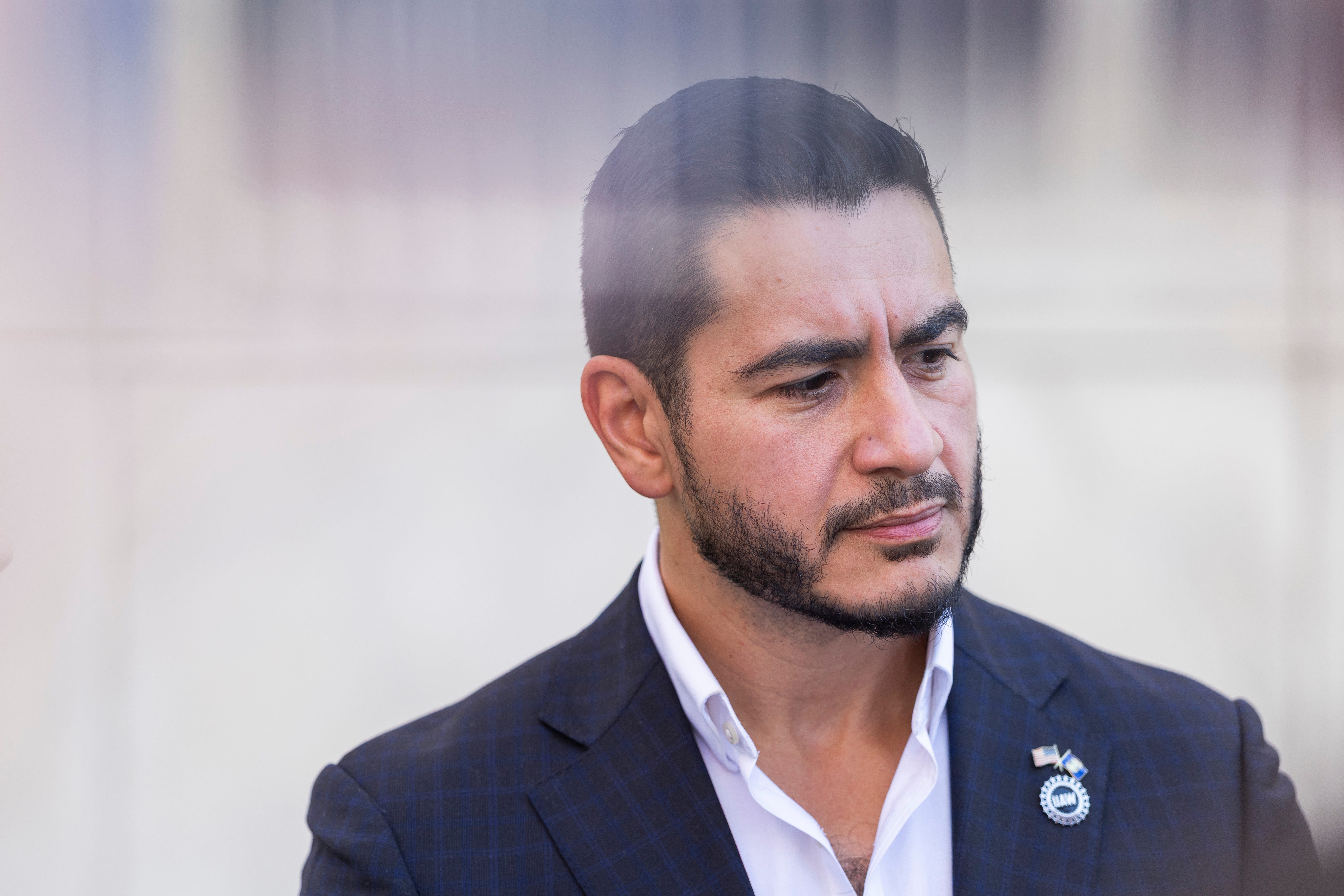
BURYING THE HATCHET: Abdul El-Sayed’s efforts to successfully run a progressive campaign in a purplish Michigan will come down, in large part, to his ability to unify the Democratic party.
That’s because of the extraordinarily bitter slugfest that broke out between him and moderate Rep. Haley Stevens during the primary—the sort of contest that can result in the losers’ voters nursing hurt feelings all the way to the general election. But El-Sayed and Stevens wasted no time burying the hatchet yesterday.
“I love Michigan and am so proud to have put up my hand to serve,” Stevens tweeted. “I spoke with Abdul a few moments ago to offer him my full support as we work to defeat Mike Rogers this November.” El-Sayed quickly responded, thanking Stevens for running a good race: “Putting up your hand to participate in democracy is no easy thing. . . . What unites us is so much bigger than what divides us.”
Good stuff, although not everybody felt quite the same way. As El-Sayed and Stevens were having their lovefest, a viral clip from the night before of leftist streamer and El-Sayed surrogate Hasan Piker was also bouncing around social media: “You are all unbelievably Islamophobic pieces of shit,” Piker said of Stevens supporters. “You literally called the dude a fucking terrorist for months on end and called him a sexist, misogynist, terrorist, bad candidate, fake doctor when he has two fucking degrees. And now you’re going to sit there and be like, ‘You really gotta come to me now.’ What are you talking about? Do you wanna win or not? Lock the fuck in.”
Hours later, El-Sayed kinda-sorta threw Piker overboard. “He’s a streamer. I’m focused on trying to win a race,” he said.
As election-rules challenges have come thick and fast in recent decades, the court has tended to stick to a “let the people vote, then we’ll talk” rule of thumb known as the Purcell principle—although this has been somewhat selectively applied.
(Photo illustration by Bill Kuchman/The Bulwark | Photos: Getty, Shutterstock)
SENIOR OFFICIALS IN THE TRUMP ADMINISTRATION seem alarmed—maybe even insulted—that America’s traditional allies are seeking greater ties with one another, and are, in fact, planning for a possible future in which the United States is no longer at the center of their international relationships.
The administration’s apparently shocked reaction is both laughable and revealing. Trump’s bevy of foreign policy realists are strangely blind to how self-defeating their own actions have become. Their bullying and bluster is driving the formation of the very types of relationships they seem to find objectionable.
Take a look at the comments made by Elbridge Colby, the undersecretary of defense for policy, first in a series of tweets and then in an interview with Ross Douthat. “There is a great deal of hubbub about a collective ‘middle powers’ strategy these days,” Colby posted on X. “From our point of view, a collective middle powers strategy is based on a faulty understanding of international relations.” The whole middle power strategy is a regrettable waste of time, he contended. The comments are classic Colby, but also caught my ear as a belated response to the speech given by Canadian Prime Minister Mark Carney in Davos earlier this year. It’s a speech that’s clearly gotten under Trump’s (and his foreign policy enablers’) skin.
In the address, the Canadian PM declared:
Nostalgia is not a strategy, but we believe that from the fracture [of the former U.S.-led global order] we can build something bigger, better, stronger, more just. This is the task of the middle powers—the countries that have the most to lose from a world of fortresses and most to gain from genuine cooperation. The powerful have their power. But we have something too: the capacity to stop pretending, to name reality, to build our strength at home and to act together.
The speech hit home and Trump and co. have been having a totally normal one in response. I’ll say this for the administration: They’re not hard to read. Trump responded to Carney by name in his own Davos address, retorting that “Canada lives because of the United States.” (To be fair, most of Trump’s speech was given over to griping about NATO being ungrateful and Denmark’s refusal to hand over the “piece of ice” that we call Greenland.)
But Trump’s immediate reply to Carney clearly did not suffice to express the administration’s displeasure. Senior officials are still talking about it seven months later, even if they won’t acknowledge Carney or the speech by name.
At the NATO ministerial summit in June, for example, Secretary of Defense Pete Hegseth said, “Some of NATO’s largest economies, some of the richest countries—allies that are happiest to go on about the rules-based international order and middle powers banding together—still seem to think the era of free riding is here.” It’s pretty clear whom he means here, eh?
Even the more conciliatory members of the administration, such as Secretary of State Marco Rubio, have spoken down to European allies in a “not angry, just disappointed” register. “We want allies who are proud of their culture and of their heritage, who understand that we are heirs to the same great and noble civilization, and who, together with us, are willing and able to defend it,” Rubio told the Munich Security Conference in February. “And this is why we do not want allies to rationalize the broken status quo rather than reckon with what is necessary to fix it. For we in America have no interest in being polite and orderly caretakers of the West’s managed decline.”
Rubio may have been more polite, but the overall message was consistent with the Trump administration’s prolonged effort to lose friends and alienate allies. Trust Colby, though, to state it most baldly. Based on his warped worldview, he contended that nothing intrinsic binds America’s allies together. Instead of seeking to duplicate or replace American power, he argued, Western middle powers should draw closer to America.
Colby’s comments echo similar calls often made by the president, who routinely remarks that, while America doesn’t need anyone’s help (whether that’s anti-drone assistance from Ukraine or trade deals with Mexico and Canada), the rest of the world desperately needs America. The logical implication, in his domination-obsessed style, is that other countries should give America whatever it wants since America’s allies have no choice but to kiss the ring.
(If the president is aware of the incongruity of asserting that the United States needs nothing from anyone while also fuming about a lack of NATO support in the Persian Gulf, he’s yet to give any sign of it.)
THE NOTION THAT NOTHING binds America’s traditional allies together is a genuinely bizarre contention for Trumpian realists to take. Surely Colby and other senior officials are smart enough to have realized that, at the moment, they are the bond. The greatest thing bringing together Japan and South Korea and Canada and Europe and others is mutual alarm at the daily reality of dealing with an erratic United States subject to the whims of Trump and a Republican base content to crow about “America First.” For now, that’s plenty.
And it’s not just Trumpy rhetoric that’s discomfiting allies. Reciting the list of bizarre U.S. foreign policy moves seems rote by now, but some highlights:
Trump’s comments about invading Greenland got serious enough to trigger European military preparations.
He continues to joke (?) about his desire to annex Canada and make it a state.
He has publicly vacillated about whether or not the United States is prepared to defend Taiwan’s autonomy from China.
The United States has signaled that it will be withdrawing units assigned to defend Europe (and has incoherently canceled and uncanceled existing deployments).
And even Israel, a close American ally, has lately found itself marginalized as the Trump White House, in palpable desperation to get out of the war it started with Iran, has simply declared that Israel must cease fire on its northern border with Lebanon—apparently without consulting the Israelis.
Such belligerent inconsistency is underlined by the type of comments regularly made by administration officials like Stephen Miller, who noted in January that our world is one “that is governed by strength, that is governed by force, that is governed by power.” You may not like it, but “these are the iron laws of the world,” he gloated.
Short of actual kinetic attacks on an ally, it’s hard to imagine what more the United States could do to negatively unite the rest of the West. Every speech, tweet, and leaked Signal chat expressing contempt for U.S. allies confirms to other nations and their leaders that America no longer guarantees safety but may now be a threat as a predatory White House seeks to exploit them for trade or territorial concessions.
Trump’s foreign policy is ultimately self-defeating. Any previous administration would have been delighted to see Europe and Canada and others dramatically expanding their militaries and defense industries and speaking firmly about the threat posed by authoritarian states like Russia and China. Europe is rapidly rearming, and will be able to provide much more support for Ukraine. Canada is expanding its armed forces, and is moving ahead with major purchases of aircraft and submarines and is planning a new fleet of surface ships. This will make it a dramatically better partner in the defense of North America. Both Europe and Canada are also building out their defense industries, meaning more weapons and munitions can be produced, faster.
All of this could have enhanced American leadership and influence. Now, these developments, if realized, will instead reduce it.
The comments from Trump and Colby undermine any real confidence U.S. allies can have in America’s willingness to sacrifice for them—and, given public reports about the alarming state of America’s munitions stockpiles, the allies must be growing skeptical about America’s ability even to come to their aid. Once again, regardless of whatever Colby might think, this is all the more reason for the rest of the West to draw closer together.
AND NOW I HAVE TO TALK ABOUT the squishy elephant in the room. Something so notably absent from Colby and Hegseth’s remarks—and certainly from Trump’s—that the omission is glaring. When the Trumpians suggest that nothing binds the middle powers, they overlook the most fundamental commonality of all—basic liberal-democratic values. The kind of values that U.S. leadership once espoused and held up as an example to others.
This is a little hard for me to admit. I am a cynic who agrees with the likes of Colby and Miller on the fact that hard power still matters. Just look at the world around us. Countries do have real national interests, and they can, and indeed must, pursue them. It is true that many of America’s allies to some extent forgot that lesson at some point and coasted on American power—a decision that was both morally wrong and strategically foolish. Too often, the values Western countries touted were observed in the breach, or obligations we neglected. The fact that it took nihilistic opportunists in the White House to show us this is a lesson we shouldn’t forget quickly.
But abandoning our shared liberal democratic values altogether, as Trump seems to instinctually desire and as Colby and Vice President JD Vance demand, is the wrong response. Those values still matter. The middle powers may be imperfect, but they’re still at least gesturing at the same thing: free trade (at least among allies), international cooperation, collective defense against and containment of hostile nations, and—most importantly—coherent, predictable, and stable foreign policies that include abiding by their agreements. This is what mature countries do, especially with their friends.
If America won’t stand up for international norms the way it once did, others need to step up. Canada, France, the U.K., Germany, Australia, New Zealand—wherever—must take the mantle of liberal democracy and stand up to bullies. If America’s allies can’t count on U.S. support, they’ll seek it elsewhere. The best place to start is with like-minded countries facing the same predicament.
(Photo illustration by Bill Kuchman/The Bulwark | Photos: Getty, Shutterstock)
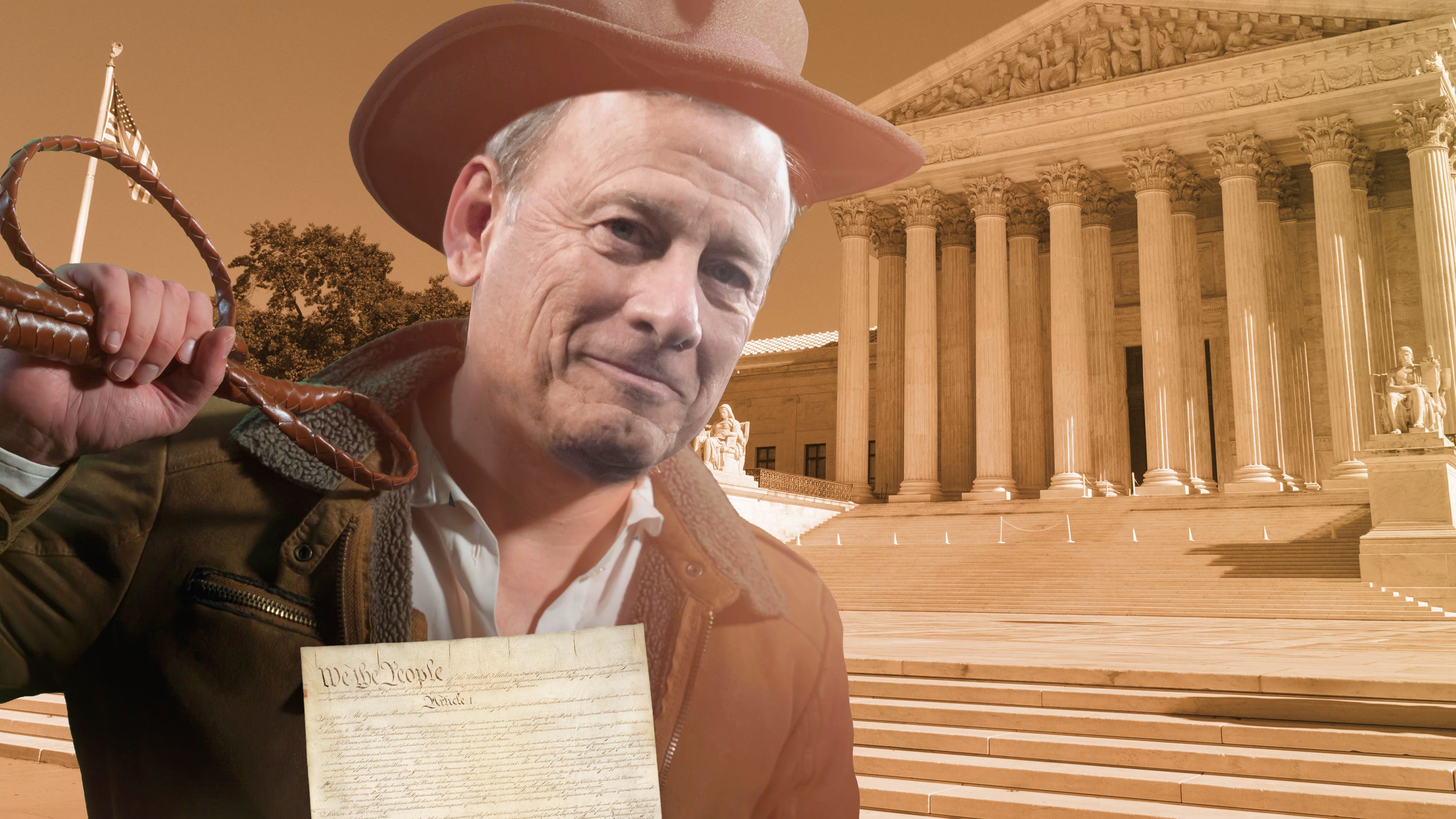
WHEN THE SUPREME COURT CLOSED its most recent term, one lesson stood out: The Court’s most consequential decisions increasingly arrive dressed in the language of history.
Whether the issue is abortion, administrative power, gun regulation, or substantive due process, the justices present themselves less as constitutional decision-makers than as constitutional archaeologists: excavating answers to questions that history supposedly settled long ago.
Yet far from removing values from constitutional adjudication, the use of such history has merely hidden them from view.
The idea that constitutional questions can—and should be—answered via historical analysis is simple enough (and echoes the conservative movement’s longstanding embrace of originalism). According to this view, judges should not impose their own values on the Constitution or decide cases according to their own moral or political commitments. They should instead look backward: asking whether a right or interpretation of a law is deeply rooted in the nation’s historical practices, language, and traditions.
History, in other words, promises to do what judicial philosophy long has not: remove judgment from judging.
The term just finished reminds us once again how central appeals to “history and tradition” have become to the Roberts Court’s constitutional project. Rather than promoting judicial restraint, however, key cases reveal how the “history and tradition test” has been weaponized to enable one of the most radical revisions to this nation’s constitutional order since the New Deal. It has been used not only to overturn previous decisions and precedent, but also to fundamentally shift the way the Court engages in judicial review.
Take the Court’s Second Amendment decisions as an example. On June 25, 2026, the Court issued its opinion inWolford v. Lopez, striking down Hawaii’s restrictions on carrying firearms on private property that is open to the public.
Typically, when considering the validity of the Hawaii law, the Court would ask a familiar set of questions. For starters, does the state have a rational basis for regulating the issue in question (the basic question in the rational basis scrutiny test applied to all law)? Taking things a step forward, the Court often then asks whether there is a fundamental right at issue. And, if so, whether the law in question served a compelling government interest (national security, for example) and whether the law was narrowly tailored in service of that interest. This framework of tests does not eliminate judicial judgment, but it does make that judgment explicit. Courts weigh interests, assess evidence, and openly confront competing constitutional values.
In Wolford, however, the Court opted to adopt its new preferred methodology. Under the historical methodology announced in the 2022 decision New York State Rifle & Pistol Association v. Bruen, Hawaii’s law stood or fell on an entirely different basis: whether the state could identify sufficiently analogous restrictions from the nation’s historical tradition of firearm regulation.
To put that in plain language: The question was not whether the law served a compelling governmental (or public) interest. It was whether a sufficiently similar law existed at some point during the nation’s founding.
Notably, the Court has not confined this approach to Second Amendment questions. In Dobbs v. Jackson, for example, the Court did not ask whether abortion restrictions infringed upon choices central to dignity and autonomy. Rather, it asked whether a constitutional right to abortion was deeply rooted in the nation’s history and tradition.
The Court’s answer, of course, was that it was not.
And so the conservative majority concluded not merely that previous courts had struck the wrong balance between reproductive rights and the state’s interest in prenatal life, but that there was no constitutional right to be balanced in the first place.
It’s hard to escape the conclusion that this was not an accident but the very point of employing the test.
The appeal of history as a constitutional methodology is precisely that it promises to transform disputes over values into disputes over facts. Judges no longer need decide difficult moral and political questions. They only have to determine what was historically the case. As Wolford, Bruen, and Dobbs show, that appeal is an utter mirage.
TAKEN CHARITABLY, the effort to resolve questions of constitutional rights without judges simply imposing their own moral and political preferences on the country is a noble one.
That problem is particularly acute when courts are asked to identify rights that do not appear explicitly in the constitutional text. Few constitutional controversies have generated more criticism than the doctrine of substantive due process: the idea that the Fourteenth Amendment protects certain liberties even if they are not specifically enumerated in the Constitution itself.
For critics, such as Justice Scalia, the difficulty was obvious. If judges were free to discover constitutional rights by appealing to broad concepts such as liberty, autonomy, or dignity, what principle prevented courts from constitutionalizing virtually any deeply held preference? Jurists, especially conservative ones, have sought something to delineate those rights, or at least constrain how they may be discerned. The history and tradition test is one such effort.
The case concerned physician-assisted suicide. Several terminally ill patients, physicians, and advocacy groups argued that Washington state’s prohibition on physician-assisted suicide violated the Due Process Clause of the Fourteenth Amendment.
The Court disagreed.
Writing for the majority, the conservative Chief Justice William Rehnquist acknowledged that substantive due process had long protected certain unenumerated rights involving marriage, childrearing, and family relationships. But if courts were to continue recognizing such rights, he argued, they required a more disciplined methodology. His answer was history.
Courts, according to Rehnquist, should exercise the “utmost care” before recognizing new substantive rights. And those rights should only receive constitutional protection if they were “deeply rooted in this Nation’s history and tradition” and “implicit in the concept of ordered liberty.”
THIS DID NOT APPEAR at the time to be a constitutional revolution.
Indeed, Glucksberg was widely understood as an exercise in judicial restraint, a key aim of Rehnquist’s stewardship of the Court. In this case, the Court was attempting to limit substantive due process rather than expand it—to constrain judges rather than empower them. History was being offered as a limiting principle for one particularly controversial corner of constitutional law, not a general theory of constitutional interpretation.
The Court continued to employ balancing tests, tiers of scrutiny, and means-ends analysis across much of constitutional law. Questions involving speech, religion, equal protection, and criminal procedure generally turned on contemporary governmental interests and the burdens imposed on constitutional rights rather than historical analogies.
Even substantive due process itself proved resistant to Glucksberg’s limiting logic.
In 2003, for example, the Court invalidated laws criminalizing same-sex intimacy in Lawrence v. Texas, despite an extensive historical tradition of prohibiting such conduct. Similarly, in 2015, the Court recognized a constitutional right to same-sex marriage in Obergefell v. Hodges, again despite the obvious absence of any deeply rooted historical tradition protecting it.
Justice Anthony Kennedy’s opinions in those cases spoke the language of dignity, autonomy, and evolving understandings of liberty rather than historical pedigree.
THEN CAME DOBBS, which did not simply overrule Roe: It resurrected Glucksberg.
The Court decided the question at issue was not whether abortion restrictions represented unwarranted government interference in choices central to personal dignity and autonomy, but whether a right to abortion was deeply rooted in the nation’s history and traditions.
Of course, if we focus narrowly on Dobbs, it seems plausible that you could tell a Rehnquist-inspired story that draws a line between Glucksberg and the decision to overturn Roe v. Wade—a longstanding aim of the conservative legal movement—while keeping the scope of the history and tradition test narrowly cabined to cases of particular significance.
But, as evinced by this past Supreme Court term, Dobbs marked the migration of this logic to other issue areas.
For example, during the same 2021–22 term, the Bruen decision imported a remarkably similar methodology into its Second Amendment jurisprudence. For decades, courts evaluating gun regulations had applied familiar forms of constitutional scrutiny, balancing governmental interests in public safety against burdens imposed on the right to bear arms. Bruen rejected that approach.
Instead, Bruen now insisted that the relevant test that courts must apply is whether modern gun regulations were consistent with the nation’s historical tradition of firearm regulation. The resemblance to Glucksberg was unmistakable. And a methodology designed in the 1990s to constrain substantive due process had become a constitutional method capable of traveling across doctrinal boundaries.
THIS BRINGS US BACK TO WOLFORD.
Recall that the issue before the Court here was not physician-assisted suicide or abortion or unenumerated rights, the questions on which this reasoning had been drawn previously. It was whether Hawaii could prohibit firearms on private property open to the public absent affirmative consent from the property owner.
And yet the Court decided the question at stake was not whether the state had a compelling state interest (it did). Nor was it whether the law was narrowly tailored in service of that interest (and there’s a good argument that it was). Instead, the question the Court took up in its opinion was, once again, whether a sufficiently analogous law was deeply rooted in the nation’s history and tradition.
What we’ve seen on full display this term is that a test born as a narrow limitation on substantive due process is coming precariously close to a general theory of constitutional interpretation.
There is irony, of course, in pointing out that the “history and tradition” test itself is not deeply rooted in this nation’s history and tradition. And that, like originalism before it, it appears to work as a theory of general jurisprudence only if you avert your eyes to its internal contradictions.
FOR EXAMPLE, the history and tradition test was supposed to solve the problem of judicial discretion. But historical analysis turns out to require many of the same judgments the test was designed to avoid:
Which historical period matters: 1787, 1791 or 1868? (As an example of historical periods mattering in constitutional reasoning, see Justice Kavanaugh’s concurring opinion in Trump v. Barbara.)
What’s the relevant threshold for something to be considered a historical practice? (Is it the practices and norms of a family, community, state, or some necessary number of states?)
Should courts look for regulations addressing the precise practice at issue, or merely analogous concerns? And how similar must an analogy be before it counts?
The answers to each of these questions can determine the outcome of a case. Consider Dobbs. The Court asked whether there was a deeply rooted historical tradition protecting abortion rights. The answer was no. But one could imagine asking a different question: Was there a deeply rooted historical tradition protecting bodily integrity? What about personal autonomy? Or intimate decision-making?
At that level of generality, the historical record begins to look very different, and the reasons to prefer one way of framing the question over another are a matter of judgment, not historical facts.
The same problem appears in Second Amendment cases. A court might ask whether there existed historical traditions of prohibiting firearms in locations where large numbers of people gathered. Or it might ask whether there existed historical traditions prohibiting the carrying of ordinary firearms by law-abiding citizens. Neither question is dictated by history itself. The judge must decide which question history is being asked to answer.
Of course, this does not deny that history and tradition have an important role to play in constitutional interpretation. Few serious theories of jurisprudence deny that. But history does not eliminate constitutional judgment so much as relocate it. The Roberts Court’s sleight of hand is in its pretense of transforming constitutional conflict and disagreement over values into disagreement over facts. As made plain by this past term, the justices in the conservative majority feel no compulsion to maintain the aura of consistency in achieving these ends. Their opinions float freely between different approaches and positions (sometimes even in opinions issued the same day) and leverage the history and tradition test if—and only if—it produces their preferred outcomes.
BUT SO WHAT?
First, if we take the history and tradition test to its logical conclusion, more than just abortion rights are at stake. Indeed, it seems unlikely that you would find deeply rooted in this nation’s history rights to the use of contraceptives, gay marriage, interracial marriage, or even the idea that rights articulated in the Constitution place limits on state governments (as opposed to just the federal government).
Indeed, Justice Clarence Thomas has acknowledged this to be the logical outcome of this reasoning in a plethora of concurring and dissenting opinions. More surprisingly, however, we have also seen the Court adopt positions previously considered to be held only by the most strident in the conservative legal movement at a blistering pace. Consider, for example, Chief Justice John Roberts’s breathtakingly quick reversal on Section 2 of the Voting Rights Act, which he defended in Allen v. Mulligan (2023) before abruptly reversing course in Louisiana v. Callais (2026). There is also the Court’s increasingly warm embrace of unitary executive theory in Trump v. Slaughter.
Second, and perhaps most troublingly, the history and tradition test is no longer being used for the Court to proceed with trepidation on so-called unenumerated rights (such as abortion or physician-assisted suicide). Rather, it is now being used to declare unconstitutional laws passed by the federal (e.g., the Voting Rights Act) or state governments (e.g., Hawaii’s gun legislation).
Far from being a tool to let states decide for themselves, this past term the history and tradition test has morphed into a tool for the conservative majority to overturn progressive precedent and progressive legislation. The Court, in short, is making perhaps its strongest case to date for the need for its reform, should Democrats take back the House this fall—for if the Court now claims authority to strike down any legislation that does not fit its politics, there appear to be few other choices left.
Glucksberg itself, of course, says this test is grounded in a combination of Moore v. East Cleveland (1977) and Reno v. Flores (1993). But the fact that Justice Rehnquist relies on a combination of cases to derive the relevant parts of its purported “test” undercuts its claim that the test itself is “deeply rooted” in the history of the Court’s jurisprudence.
Tim Miller, Sam Stein, and Will Sommer take on Laura Loomer’s latest cabinet ambitions, MTG’s over-the-top Vegas wedding, Sean Duffy’s disappearing taxpayer-backed road trip, the bizarre MAHA diet taking hold in Trump’s orbit, Steven Crowder’s defense of fascism, and one congressional candidate’s unbelievable beach brawl.
Michigan Democratic Senate primary winner Abdul El-Sayed arrives to a press conference in front of the statue The Spirit of Detroit on August 5, 2026 in Detroit, Michigan. (Photo by Finn Gomez/Getty Images)
Detroit, Michigan ABDUL EL-SAYED TOOK THE STAGE to address supporters around 1 a.m. early Wednesday morning, unable to give the speech he had wanted and was obviously planning to give.
Hours after the very first returns had suggested he was on his way to a double-digit win in the Michigan Senate Democratic primary, the race was too close to call. El-Sayed was holding a small lead over his opponent, Rep. Haley Stevens. But there was just enough outstanding vote in and around Detroit to make declaring a winner impossible at that point.
“I wish I could tell you I was declaring victory right about now—turns out it takes a long time to count some votes in Michigan,” he said, as the tired but still enthusiastic throng inside Detroit’s Majestic Theater cheered loudly.
But then El-Sayed shifted gears into what was almost certainly part of the planned victory speech. He talked about his love of America—how it had given him opportunities for an upbringing and education he might never have had in his parents’ native Egypt, and how the best way of showing that love was making sure all children here have those opportunities. And he talked about the importance of reaching out to Stevens’s supporters, because of their shared goal of defeating GOP nominee Mike Rogers and stopping Donald Trump.
“However much we might disagree with our Democratic opponent, there is so much more that unites us than divides us,” he said. “And so to all of our supporters here tonight watching on TV, tomorrow we begin to mend fences. Whatever happens tonight, we have a responsibility to assure we unite to make sure that Mike Rogers never sees the inside of the U.S. Senate.”
The magnanimity was a sharp break from the rhetoric that had come to define the most bitter Democratic primary anybody here can remember. And it showed that El-Sayed sensed the looming challenge of becoming his party’s nominee, which he became a few hours later when multiple news outlets declared him the primary’s winner.
But El-Sayed only has ninety-one days to win over skeptical parts of the electorate. That’s not a lot of time in American politics. And Tuesday’s results clearly revealed some of the ways that it is going to be difficult—factors that set Michigan apart from the rest of the country, and El-Sayed apart from other candidates in this year’s election.
The polling was way off, but suburban Dem voters in Michigan nonetheless showed that they’re sick of the party establishment and enraged by Trump, the war, the lies, and the corruption. AIPAC didn’t read the room. But party leaders are sounding united behind El-Sayed and Jane predicts he’ll bring a Mamdani-like energy to his campaign against Mike Rogers. Meanwhile, Republicans are sticking with sh*tbag Max Miller. Plus: Federal agents are threatening Americans for speaking out against ICE, Vance is always looking for a way to signal that he hates the war, and what other former podcast hosts can try to segue to elected office?
As always: Watch, listen, hit the like button or leave a comment. We want to hear from you.
Ad-free editions of The Bulwark Daily are available exclusively for Bulwark+ members.
Tim Miller’s Bulwark Daily is available wherever you get podcasts and on YouTube. New shows drop each weekday afternoon. If you like the show, leave a comment and ⭐⭐⭐⭐ wherever you listen. Add The Bulwark Daily to your player of choice, here.
Sam Stein and Andrew Weissmann discuss the Justice Department’s dismissal of charges over damage to the Lincoln Memorial Reflecting Pool, potential recourse for Olympian David Hearn, and Trump’s response. They also examine Todd Blanche’s Senate confirmation prospects, the proposed “anti-weaponization” fund and tax-immunity agreement, Capital One’s anti-money-laundering claims involving Trump Organization accounts, and Anthony Fauci’s decision to invoke the Fifth Amendment before Congress.
The Illegal News with Sarah Longwell is available wherever you get your podcasts and on YouTube. Leave us a review and ⭐⭐⭐⭐⭐ so more people can find this important show from The Bulwark.
Access to this show’s community comments and ad-free editions is available exclusively for Bulwark+ members here and on the Bulwark App—available now in the Apple and Google App stores.
Bulwark+ members can also listen ad-free on your podcast player of choice—click SET UP here.
The Associated Press this morning called the Michigan Senate Democratic primary: Abdul El-Sayed won a much closer than expected victory over Haley Stevens.
Let’s get under the hood on the numbers to understand if Democrats are taking a big risk on the youngblood.
Start with this: El-Sayed should beat Mike Rogers, the former longtime congressman who is the Republican nominee, because Michigan is a fairly Democratic state.
The current governor of Michigan is a Democrat and Democrats have held the governorship for 16 of the last 24 years.1
Since 1979, Democrats have held both of Michigan’s Senate seats for the entire period, with the exception of a single Senate term when Spencer Abraham was elected in the 1994 Republican wave.
That’s an incredible run.
Here are the ten Senate elections since Abraham broke the streak:
You can see a clear pattern of Republicans gaining ground since 2014—but Democrats have still performed well. They’ve won open seats; they’ve won in midterm elections when Republicans are surging nationally. They’ve won in presidential years when Republicans captured the White House.
They’ve even won an open seat while Trump was carrying the state at the presidential level.
What this tells us is that Michigan is a Democratic state. With an open seat, in a good environment for Democrats, without Trump at the top of the ticket, any replacement-level D should win this Senate seat.2
Probably by > 1.5 percent.
Translation: El-Sayed would have to be worse than a generic Democrat—by at least 1.5 points—in order to lose.
That’s a lot of positives. And here’s another one: El-Sayed turned out a lot of voters.
The last time Michigan Democrats had a semi-competitive primary was in 2024. Elissa Slotkin romped with 76 percent of 934,000 votes.
More than 1.5 million people voted in yesterday’s primary. In a primary race in a state where the total number of eligible voters—of both parties—is around 8 million, that’s a lot of excitement; a lot of energy. You have to give El-Sayed credit for a lot of it.
And yet . . .
El-Sayed dramatically underperformed his polls. The last batch of polls had El-Sayed ahead by +13 on average. His worst poll in the final days had him at +8.
As of this writing, he’s ahead by just about 1 percent.
Also concerning is the voting pattern. This race had become a referendum on El-Sayed. He was the main character. He was so far ahead and had so much energy behind his campaign that the question for Democrats wasn’t so much Stevens vs. El-Sayed, but, “Are you sure you want to roll with this guy?”
When Slotkin beat Mike Rogers in 2024, she won by a total of 19,000 votes out of 5.6 million votes cast.
How did she do it? She rolled up huge margins in Wayne, Washtenaw, and Ingham Counties where she won with Saddam numbers. She dominated 8 of the 11 most populous counties.
But she also hung on in the rural counties. Slotkin only dropped below 30 percent in a handful of rural outposts. The difference between hitting 30 percent, or falling to 20 percent, in a county with 5,000 voters isn’t much—500 votes.
But again: She won by 19,000 votes, total. And there are a lot of those small, rural counties.
So the blueprint for a Democrat winning Michigan is:
Absolutely crush with the black vote in Wayne, Oakland, and other dense urban counties, but also . . .
Find every vote you can in the small, rural counties. Lose by 30 points, not 40 points.
El-Sayed only did half of that.
Look at that list up top 👆. El-Sayed lost Wayne and Oakland by >6 points. This tells us that he wasn’t able to excite the African-American voters who are the foundation of the party in Michigan. (Our Jonathan Cohn had his eye on this possibility, and wrote about it last week.)
Now maybe El-Sayed turns out those voters in November. But remember: He doesn’t just need huge turnout in those counties—he needs to absolutely crush the margins.
I am slightly concerned with El-Sayed’s numbers in Macomb, too. Macomb is an affluent white Detroit suburb where Mike Rogers did very well in 2024. El-Sayed lost Macomb by 7 points. He’s going to need to get a bunch of votes out of there and probably can’t afford to lose Macomb by >10 points.
On the rural counties, it’s a mixed bag for El-Sayed.
He did well in places like Iron and Marquette Counties while Stevens won most of the rural counties. But El-Sayed stayed competitive. He didn’t dip below the 30 percent mark anywhere. This suggests to me that rural Democrats are not totally opposed to him. They’ll listen to his pitch and if he connects, then maybe he can get the numbers he needs from the hinterlands.
The final concern for El-Sayed is that Mike Rogers has done this before.
Democrats are dismissive of Rogers as a carpetbagging empty suit. Fair enough. But Rogers ran statewide two years ago and earned a lot of votes. He’s been tested in a high-profile, big-time campaign. There won’t be any bombshells blowing him up. Two years ago he got 48.3 percent of the vote against a quality Democrat. The guy has already convinced 2.7 million Michiganders to pull the lever for him once.
How much is that worth? We have a comp.
In 2018, Republican John James ran for Debbie Stabenow’s Senate seat. He got 45.76 percent of the vote—good enough for 1.9 million votes.
Encouraged by this showing, James ran it back in 2020 for the other Michigan Senate seat. He ticked up to 48.22 percent and 2.6 million votes.
This isn’t straight apples-to-apples. But it’s close. It’s hard to picture Rogers doing much worse in 2026 than he did in 2024. Without Trump at the top of the ticket, he could lose some altitude. But he probably has a hard floor of 47 percent.
Do you like deep-dive analysis that has a point of view but doesn’t pander to your preferences? That’s what we do here, every day. Come ride with us:
Last thing: Another hidden advantage for El-Sayed is that Francesca Hong is going to act as a human shield for his campaign. Every time the media has a “Look at the radical DSA” story, it’ll focus on Hong and El-Sayed will seem mainstream by comparison.
Don’t sleep on this dynamic.
3. Drones
The era of drone warfare is already posing risks to civilian aviation. Yikes.
This past May, a twin-engine Beechcraft King Air medevac plane took off from Roswell, New Mexico, and headed west to the town of Ruidoso to pick up a patient. It shouldn’t have been a challenging flight for the two pilots and two nurses aboard. The temperature was 69 degrees; the sky was clear. The 60-mile journey normally takes a half hour, at most.
But once airborne, the plane ran into trouble. At the White Sands Missile Range that night, US military personnel were conducting a GPS jamming exercise that left the King Air pilots—and anyone else within hundreds of miles—unable to use modern navigation systems. Forced to revert to older technology, ones that they rarely if ever use, the medevac pilots got disoriented and crashed into the side of a mountain. There were no survivors.
The accident marked the first time that GPS jamming had contributed to the crash of a civilian plane in the United States. But it was just one of a string of recent disruptionsacross the world. The skies are more contested than ever, whether it’s civilian drones wandering out of the approved zone or US agencies getting their signals crossed, as happened earlier this year when New Mexico and Texas scared the public by temporarily closing their airspace. (It turned out that US Customs and Border Patrol were using anti-drone lasers in that area.) The GPS jamming exercise that led to this latest crash is not a singular event. In the past year, the US military appeared to have sent out notices for at least 10 such exercises. “As drone warfare and electronic warfare expand, airlines are increasingly encountering navigation disruptions hundreds of miles beyond the actual conflict zone,” says Eliran Almog, CEO of the cybersecurity firm Cyviation.
Lt. Gen. Mark Hertling (Ret.) and Andrew Egger (filling in for Ben Parker) went live to cover reports that the U.S. missile supplies are dwindling, the Russian missile attack on Ukraine, the cyberattacks across several U.S. states, and Oman’s role in a potential deal with Iran.

 Login
Login