Thanks to a shrewdly-timed Jon Ossoff campaign event, a lot more people are suddenly learning about young and blonde Trump confidante Natalie Harp AKA ‘the human printer’—and one of only three aides who accompanied POTUS on his catering truck-secret flight escape. Meanwhile, Trump is lending a hand to white-collar criminals and expanding his extortion and bribery options with his crypto firm. Plus: the flat-out lies about Fauci and miscarriages, Andrew loves the Great Lakes, the tariffs have done so much damage that even Sherrod Brown is against them, and Tim has some choice words about the primary challenge against Jared Moskowitz in Florida.
Bulwark LIVE: GOOD FIGHT TOUR with Tim, Sarah, Sam and JVL is coming to the Southeast in October. Tickets go on sale August 21. Bulwark+ members get early access via our presale starting August 18. Watch your inbox for details. Head to TheBulwark.com/Events for details and to get your tickets.
As always: Watch, listen, hit the like button or leave a comment. We want to hear from you.
Ad-free editions of The Bulwark Daily are available exclusively for Bulwark+ members.
Tim Miller’s Bulwark Daily is available wherever you get podcasts and on YouTube. New shows drop each weekday afternoon. If you like the show, leave a comment and ⭐⭐⭐⭐ wherever you listen. Add The Bulwark Daily to your player of choice, here.
Jonathan Cohn gives his take on the viral “puppy killer” attack against Abdul El-Sayed—and explains how a misleading story about Detroit’s animal control department became a powerful piece of political misinformation. The reality is far different from the headline. El-Sayed inherited an animal control system plagued by neglect and abuse, and the department improved significantly after he took over. Jonathan breaks down how the Daily Mail, right-wing influencers, Republican candidates and Fox News helped spread the story and why this episode is a warning about how easily misinformation can overwhelm the truth.
Photo illustration by Sarah Rogers/The Bulwark | Photos Shutterstock
1. Sides
Over the weekend Hakeem Jeffries was asked if he endorsed the agenda of the Democratic Socialists of America. He said no.
“I don’t support the DSA agenda, as has been articulated by the DSA itself,” Jeffries said. This makes sense. Jeffries is a Democrat, not a member of the DSA. If he endorsed the entire DSA agenda, then he’s be a member of the DSA.
As you might expect, this made some people on the internet mad.
But you know what? They can suck it. Because the DSA—by which I mean the official organ that controls the infrastructure of the Democratic Socialists of America—is forking nuts. So nuts that if you told me that the DSA was a false flag operation run by the Heritage Foundation in order to discredit the Democratic party, it would make sense.
Individual DSA politicians might be closet normies (like Mamdani) but the organization itself? Guys, buckle up. We’re going on a tour of crazy.
Lt. Gen. Mark Hertling (Ret.) and Ben Parker went live to cover Trump threatening to bomb Oman, an ally, as a deal to end the war in Iran remains elusive. Plus, Trump praised North Korea over the weekend and cancelled our military drills with South Korea.
Today marks the end of the sixty-day negotiating period set forth in the memorandum of understanding the Trump administration signed with Iran. By now, we were supposed to have agreements on the status of the Strait of Hormuz and Iran’s nuclear program. And we do! We can all agree that the Trump administration doesn’t know what to do about either problem. Happy Monday.
Join Mark Hertling and Ben Parker for Command Post today at 10:30 a.m. EDT on Substack and YouTube.
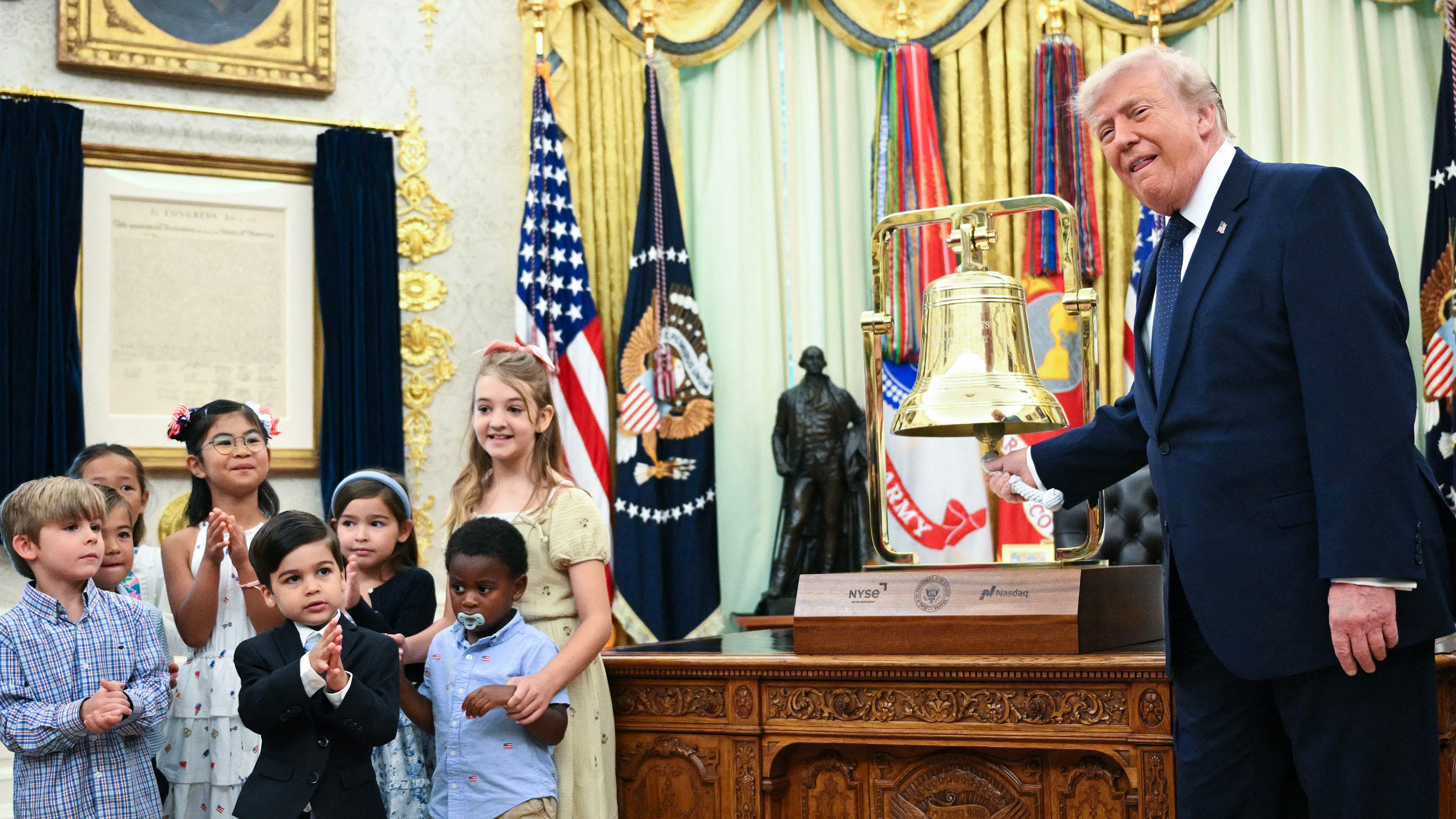
President Donald Trump rings the opening bell for the New York Stock Exchange (NYSE) and Nasdaq during the launch of Trump investment accounts in the Oval Office of the White House in Washington, D.C., on July 6, 2026. (Photo by Mandel NGAN / AFP via Getty Images)
The Other War We Aren’t Winning
by Andrew Egger
I am not, as a rule, a big-time media critic. Journalism’s a tough job in a dying industry, and writing about writing can get a little navel-gazy—life’s too short!
Still, sometimes in life our principles are tested. So it was this weekend, when I found myself unable to stop thinking about a remarkable new Politico article: “TACO No More: How Trump Won On Tariffs.”
The headline alone was fascinating. Until I read it, I personally had been unaware not only how Trump had won on tariffs, but that he had won on them at all. I had been laboring under the delusion that Trump’s tariffs were actually treating us pretty badly: slowing economic growth, pushing up prices, annihilating small businesses, failing to deliver the resurgence of manufacturing that Trump promised. Plus they’ve been losing in court: The Supreme Court crushed his “Liberation Day” tariffs as unconstitutional this year, forcing Trump both to refund billions in collected tariffs and to scramble to reconstitute his tariff regime on other statutory pretexts.
I’d even been harboring suspicions that the tariffs were a major political loser: Only 33 percent of Americans approve of Trump’s trade and tariff policies, with nearly 59 percent disapproving, per the Silver Bulletin polling average on the question. Americans have soured on tariffs so much that even the most tariff-friendly Democrats are starting to run against them: A recent ad for Ohio’s Sherrod Brown quotes a local farmer saying that Sen. Jon Husted “supports the tariffs which have driven the prices down which we can sell our crops.”
In what sense, then, does Politico argue that Trump “won” on tariffs? Simple: Last year, many worried that his tariffs would actually crash the global economy, and so far, they haven’t:
After all, for all his swerves and concessions, the president has not abandoned a global trade war that has fueled inflation or a stalemated conflict with Iran that has rattled oil markets.
And financial markets have become pretty zen about all of it. . . . tariffs, which have upended supply chains, raised costs for businesses and fueled tension with foreign allies and adversaries alike? These days, they mostly just warrant a shrug from investors.
Trump often gets graded on a curve, but this is just grade inflation. What other president has been lucky enough to find their major economic policies graded on a scale of “if it didn’t spark a once-in-a-century depression, it’s a win”?
There are two major reasons why Trump’s tariffs have “merely” resulted in slow-motion economic damage rather than spectacular market disaster. One is simple: Trump himself backed away from the most self-evidently insane ones. In April 2025, we were staring down the barrel of tariffs on China that would have forced a total decoupling between the two economies. The resulting bond-market panic spooked Trump into reversal and gave us the concept of the TACO trade; he hasn’t dared reach for anything like the same level of tariffs since. To call his remaining tariffs a “win” simply because they weren’t as disastrous as the ones originally proposed is ridiculous—why should we praise someone for hitting us in the face with a hammer just because it feels better when he stops?
The other major factor is that the effects of Trump’s trade wars have been partially obscured by the bigger economic story of the past two years: the economic sugar rush of our artificial intelligence boom and the corresponding mammoth data center buildout. Ironically, as Bloomberg News noted this month, that buildout has been taking place on a different trade-policy planet than the rest of the economy: “The deep-pocketed tech firms racing to build data centers have largely gotten a pass” from Trump’s tariffs while importing hundreds of billions of dollars worth of AI infrastructure. “In effect, they’ve been protected from Trump’s protectionism.”
And at the same time, Trump’s other economic calamity—the Iran war—has been so self-evidently counterproductive that it distracts attention from his other economic blunders.
If Trump’s trade philosophy worked, then allowing giant economic drivers like AI manufacturing to short-circuit his tariffs would be a policy disaster. Instead, Trump has quietly let this status quo continue, both as a favor to the tech megadonors in his political coalition and to avoid interfering with the only thing driving the stock market into the stratosphere.
In Trump’s gimmicky, art-of-the-deal-addled mind, all this might add up to a “win.” Apparently, there’s even a Politico writer out there who’d agree. Fortunately, convincing the public will be a much taller order.
We tell you the stakes, not just the odds. We call it like we see it. We tell you what we really think. Join us.
‘Negotiations’ Aren’t the Answer in Iran or Ukraine... “Gentlemen may cry, ‘Peace, peace!’ But there is no peace”, writes BRYNN TANNEHILL.
Trump’s New AG Just Made a Stunning Admission on Meet the Press… WILL SALETAN takes on Kristen Welker’s Meet the Press interview with Todd Blanche, arguing that Blanche’s evasions on Justice Department independence, Trump’s influence over prosecutions, January 6th pardons, and a proposed compensation fund expose him as a loyalist ready to do the president’s bidding.
The Bulwark’s GOOD FIGHT TOUR with Tim, Sarah, Sam, and JVL is coming to the Southeast in October. Tickets go on sale August 21. Bulwark+ members get early access via our presale starting August 18. Watch your inbox for details. Head to TheBulwark.com/Events for details and to get your tickets.
Quick Hits
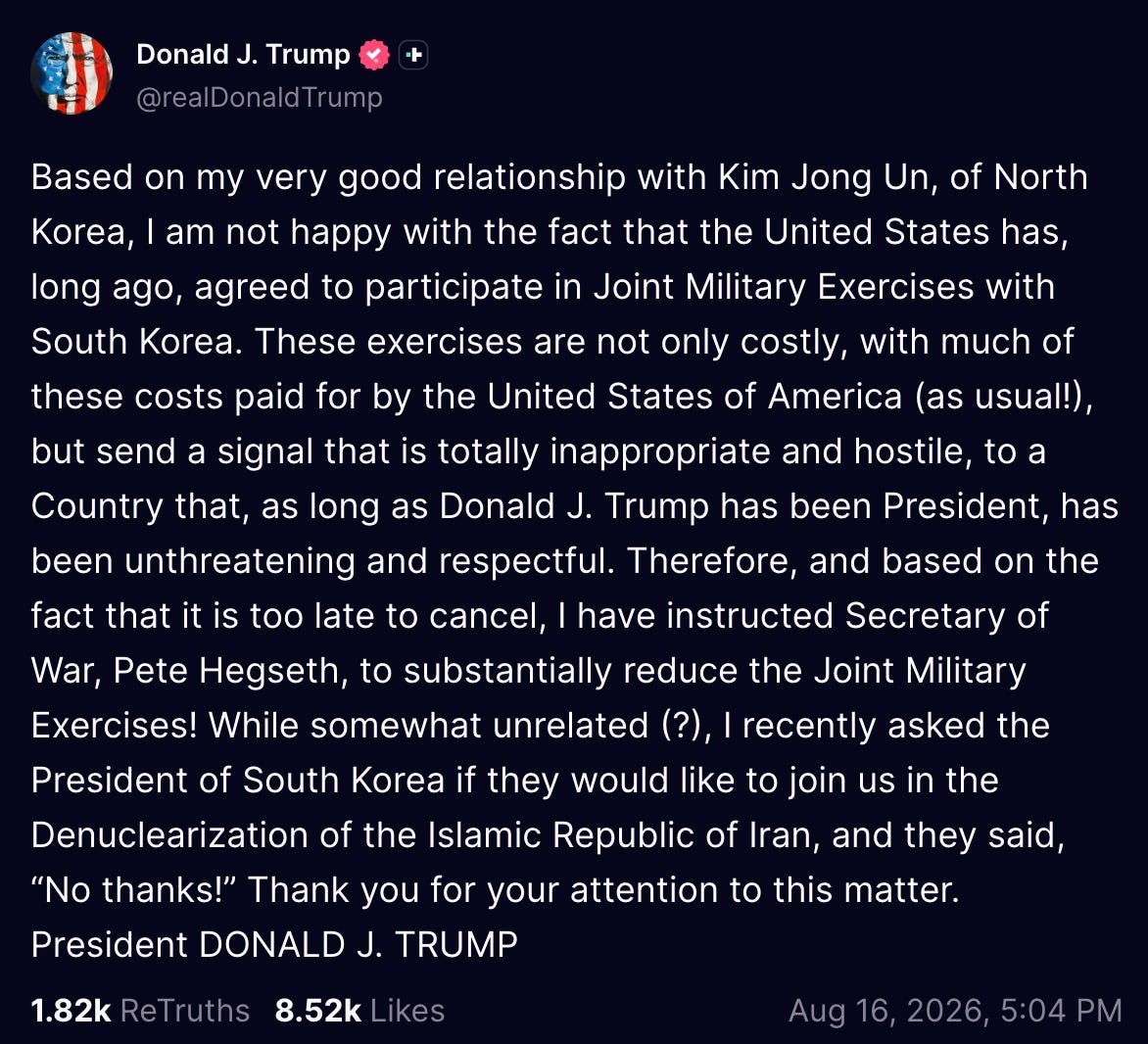
KIM JONG UN-BELIEVABLE: The president posted this yesterday:
There are so many things that are stupid or wrong about this post—let’s see if we can find them all:
Trump habitually fails to distinguish between his own personal interests and those of the country, and maybe he doesn’t feel like North Korea is a threat to him. But just last year, then-director of the Defense Intelligence Agency Jeffrey Kruse told Congress that “North Korea is in its strongest strategic position in decades, possessing the military means to hold at risk U.S. forces and U.S. allies in Northeast Asia, while continuing to improve its capability to threaten the U.S. Homeland.” (Maybe that ballistic missile test they fired off a couple weeks ago was “unthreatening and respectful”?)
Trump is complaining about the costs of exercising our own forces, who are scheduled to train with about 18,000 South Korean troops.
Did last year’s version of the same exercise send a “totally inappropriate and hostile signal”?
Trump’s narration of the timeline is excellent. “I’ve hated these exercises forever, but I forgot to get them canceled and now of course it’s too late.”
“Somewhat unrelated”? Yeah, right.
ARE YOU REASSURED?: Finally, someone is paying some attention to the fate of the USS Lincoln besides the sailors onboard and their worried families back home. Central Command Commander Adm. Brad Cooper visited the ship, which has been at sea since November and is facing a morale and mental health crisis so extreme that at least one sailor has jumped overboard. Adm. Cooper urged perspective: “Of the U.S. Navy’s 11 active aircraft carriers, the Lincoln currently has among the lowest number of cases related to mental health.”
So, the others are worse?
I HAVE THE WORST F—ING ATTORNEYS: Todd Blanche, upon being sworn in as attorney general, promised that under his leadership, the Justice Department would not be independent of the president. On Meet the Press yesterday, he said: “Will I take the president of the United States’ view on something into consideration? Yes, of course.”
Trump would be better off if he hired better lawyers. As Paul Rosenzweig wrote in The Bulwark in December 2024,
Lavrenty Beria, the head of the Soviet secret police is (perhaps apocryphally) remembered for saying, “Show me the man and I’ll show you the crime.” That chilling phrase is the very definition of what, in American law, we call a vindictive prosecution—the claim that a prosecution is being brought as retribution against a person for acts that are unrelated to the crime being charged.
So now any federal defendant whom Trump has insulted, feuded with, denounced, demeaned, declared an enemy of the people, or even so much as looked at sideways can add to their defense the claim that they’re not being prosecuted because the government believes they committed a crime, but because they’re a personal or political enemy of the president. Here’s the history of Donald Trump disliking me, your honor, and here’s the attorney general promising to consider Trump’s views. The argument will be stronger in some cases than in others—but even still, it’s a freebie that no competent prosecutor would want to hand a defendant.
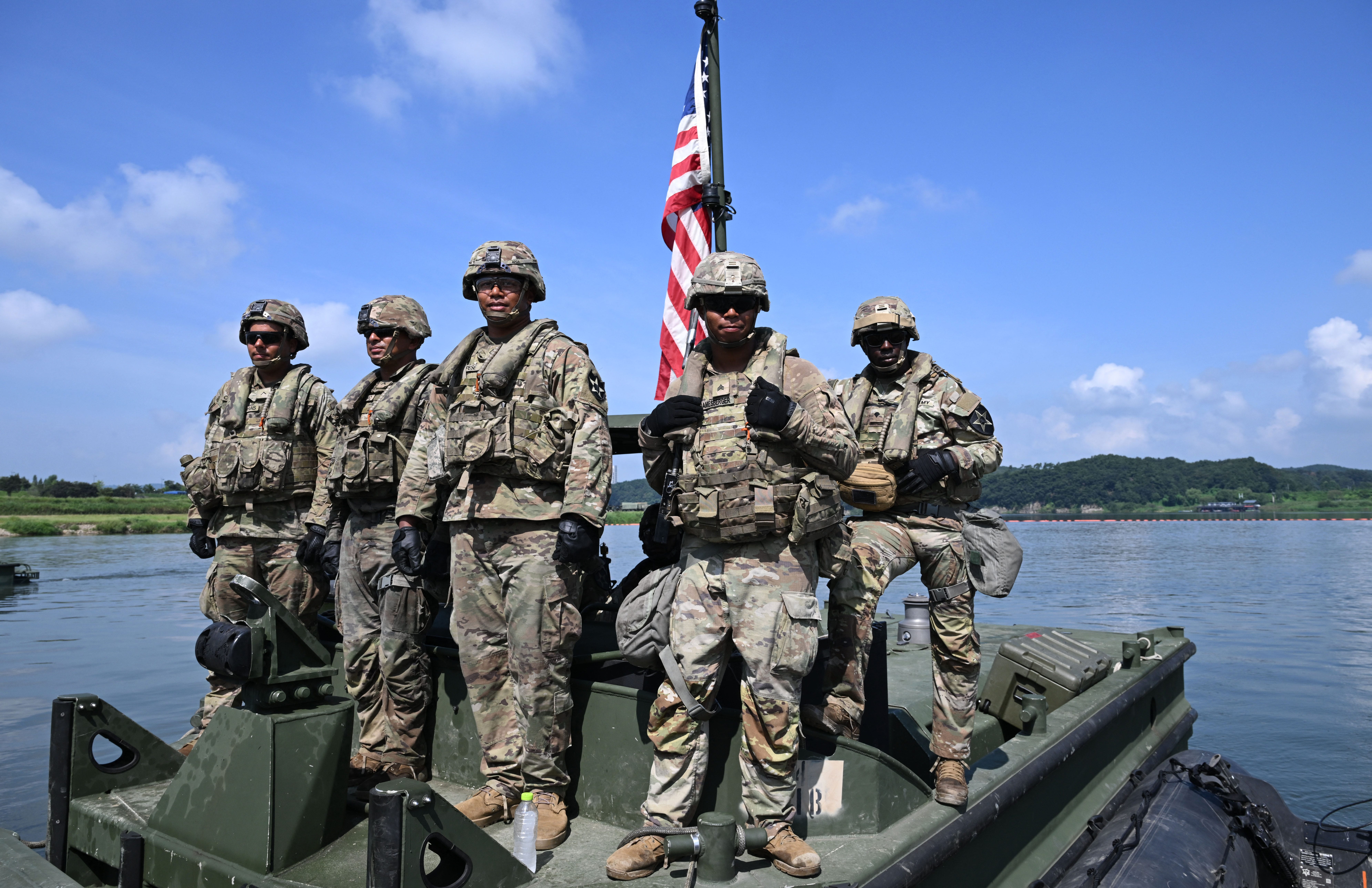
U.S. soldiers stand on a boat connected to a floating bridge during a South Korea–U.S. combined river-crossing drill as part of the annual Ulchi Freedom Shield military exercise in Yeoju on August 27, 2025. (Photo by Jung Yeon-je/AFP via Getty Images)
PRESIDENT DONALD TRUMP announced Sunday that he had instructed Defense Secretary Pete Hegseth to substantially reduce U.S. military exercises with South Korea, just as American and South Korean forces were preparing to begin one of their most important annual training events. Trump complained about the cost, suggested the exercises were unnecessarily provocative toward North Korea, and, astonishingly, connected his decision to South Korea’s refusal to support his administration’s effort to denuclearize Iran.
It is difficult to imagine a more thorough misunderstanding of the purpose of a military exercise—or an alliance.
The annual Ulchi Freedom Shield exercise begins Monday—otherwise Trump suggested he might have canceled this year’s event. But his direction raises questions about future exercises and, more importantly, about his understanding of why American forces train with allies. These exercises aren’t diplomatic favors Washington grants. They are part of the preparation required to deter—and, if necessary, defeat—an attack by North Korea.
The Korean Peninsula remains one of the most dangerous military environments in the world. About 28,500 American troops are stationed in South Korea, facing a North Korean regime with a massive conventional military, nuclear weapons, sophisticated ballistic missiles, and forces that have gained recent battlefield experience alongside Russia in Ukraine. North Korea continues testing missiles and improving its nuclear capabilities while repeatedly threatening South Korea and the United States. That’s why generations of American soldiers have trained in Korea—including me.
Come for the hot takes. Stay for the sharp analysis and insightful commentary. Or vice versa!
IN THE LATE 1990s, I commanded an Army brigade at Fort Lewis, Washington, now Joint Base Lewis-McChord. Our brigade was part of the reinforcement plan for the 2nd Infantry Division in case war broke out on the Korean Peninsula. That mission meant much more than putting soldiers and equipment on airplanes and ships and deploying them west across the Pacific. We had to understand how we would get there, what we would do when we arrived, and how we would fight alongside the South Korean forces already defending their country.
We repeatedly rehearsed the enormously complicated logistical undertaking of moving an armored brigade 5,000 miles across the Pacific and unloading our equipment at the ports, and we practiced gunnery and maneuver on Korean ranges and training areas. We designed our missions around the Korean terrain—dominated by mountains with tight maneuver corridors, speckled with dense population centers, connected by limited road networks—and even the extremes of Korean weather.
But some of the most valuable training involved something harder to measure on a readiness chart: learning how to operate with our Korean allies.
American and Korean soldiers have different languages, military traditions, equipment, procedures, and ways of approaching problems. Those differences don’t disappear when governments sign a treaty. They must be worked through on training fields, in command posts, during planning sessions, and through repeated exercises. We learned how Korean commanders operated, and they learned how we operated. We developed relationships that allowed soldiers and leaders to understand one another before people were shooting at them.
The Korean Augmentation to the United States Army program was particularly important. Korean soldiers (“KATUSAs”) served inside American formations, providing capabilities and cultural understanding while strengthening the bonds between the two armies. To Americans who served in Korea or trained with Korean forces, KATUSAs were fellow soldiers and part of our team, just as we were part of theirs.
That experience taught me something applicable to every military alliance: Interoperability doesn’t happen because politicians announce it. It must be practiced.
Exercises and training expose what doesn’t work. Communications systems fail to connect. Logistics plans prove unrealistic. Units arrive late. Intelligence doesn’t move quickly enough between headquarters. Ammunition, fuel, maintenance, medical support, and transportation become bottlenecks. Commanders discover that assumptions made while looking at maps don’t hold up when they meet actual terrain. It’s far better to discover those problems during an exercise than under a North Korean artillery barrage.
Today’s American–South Korean military relationship is even more integrated than it was when my brigade trained for Korea. The 2nd Infantry Division is now the 2nd Infantry Division/ROK-U.S. Combined Division, the Army’s only multinational division. American and Korean forces operate through command arrangements refined over decades, and their mission is captured in the phrase familiar to virtually every American soldier who has served on the peninsula: “Fight Tonight.”
That’s not just a slogan. North Korean artillery, missiles, special operations forces, cyber capabilities, and nuclear weapons don’t allow for the luxury of spending several weeks figuring out command relationships after a crisis begins.
That is why exercises such as Ulchi Freedom Shield matter. They rehearse command and control, intelligence, logistics, maneuver, air and missile defense, medical support, cyber operations, and reinforcement. Increasingly, they also address drones, GPS jamming, electronic warfare, and other aspects of a rapidly changing battlefield.
TRUMP HAS LONG VIEWED these exercises differently, describing them as expensive and provocative. Following his 2018 Singapore summit with Kim Jong Un, his administration suspended the old exercise, Ulchi Freedom Guardian, and curtailed other exercises in hopes that reducing American military activity would encourage progress toward denuclearization. It didn’t. North Korea continued developing nuclear weapons and increasingly sophisticated missiles.
Sometimes modifying an exercise makes strategic sense. Military exercises send signals, and presidents can adjust those signals as part of diplomacy. If reducing or postponing an exercise produces a meaningful and verifiable security concession from an adversary, that is legitimate statecraft.
But that isn’t what Trump announced Sunday. Instead, he connected military readiness on the Korean Peninsula to South Korea’s unwillingness to support an American policy toward Iran. That transforms an important military exercise from an instrument of deterrence into a political bargaining chip.
South Korea is an ally, not an American subcontractor. Allies share interests, but they don’t always share policies. Seoul has its own political considerations, regional security concerns, and responsibilities to its citizens. Washington can disagree with a South Korean decision concerning Iran without threatening military cooperation necessary to deter North Korea.
The danger extends beyond Seoul. Japan, Australia, and all our allies around the world will watch how the United States treats South Korea. China and Russia will watch, too. And Kim Jong Un will watch most carefully of all, because deterrence depends not simply on American military capability but on an adversary’s belief that the alliance confronting him is capable, prepared, and politically cohesive.
Trump often says America has the greatest military in the world, and in many respects he is right. What he doesn’t seem to understand is how that military became so capable.
Military effectiveness comes from people knowing how to fight under extraordinary pressure. It comes from commanders and staffs practicing difficult missions, pilots flying complex sorties, sailors providing a logistics lifeline to an ally’s peninsula, soldiers conducting gunnery and maneuver training, maintenance crews keeping equipment functioning, and logisticians figuring out how to move fuel, ammunition, spare parts, and medical supplies across oceans. When America expects to fight alongside allies, it trains with those allies until cooperation becomes routine.
That was what our brigade was doing more than twenty-five years ago when we practiced deploying from Fort Lewis to Korea. We weren’t preparing because we wanted a war with North Korea. We were preparing because being ready was one of the best ways to prevent a war. We wanted North Korean commanders to understand that if they attacked south, American reinforcements would be standing strong next to their Korean counterparts. We would arrive knowing the mission, understanding the command structure, and prepared to fight alongside an ally with whom we had already trained.
America does have an extraordinarily capable military. But military excellence isn’t an inheritance that automatically passes from one administration to another. It must be rebuilt every day through training, maintenance, logistics, discipline, leadership, and exercises that cost money and inevitably create friction with potential adversaries.
The purpose of Ulchi Freedom Shield isn’t to make Kim Jong Un comfortable; it is to convince him that starting a war would be a catastrophic mistake. If Trump wants to keep boasting that America has the best military in the world, he needs to understand what made it that way.
(Photo illustration by Bill Kuchman/The Bulwark | Photos: Getty, Shutterstock)
IT’S EASY TO START WARS, and far harder to end them. This is a lesson that both Donald Trump and Vladimir Putin are discovering, for a lot of the same reasons. Both began wars of choice on the assumption that they could conduct decapitation strikes, achieve favorable leadership changes, and end up in control of a puppet state. Trump clearly had Venezuela in mind; Putin probably had a situation more like Chechnya or Belarus. Instead, both ended up trapped in quagmires that they cannot negotiate their way out of.
Nonetheless, the instinct of many Western analysts is to call for negotiations in both cases. That’s a foolish mistake. It assumes that an outcome favorable to everyone is possible, and the logic runs backward from that flawed assumption. In the Iran war and the Russia–Ukraine war, conditions on the battlefield will decide when and how the war ends, and if and when there are negotiations at all—not the other way around.
To understand why, it helps to consider why wars end. There are generally five reasons, any one of which can be sufficient: One side is no longer capable of resistance; one side achieves its objectives; one side decides that the cost of conceding is less than the cost of continuing to fight; one side simply loses the will to fight; or both sides conclude there is no path to victory.
As long as both sides maintain the ability and will to fight, the war will continue. If either side believes it has a plausible theory of victory, it won’t want to make any significant concessions at the bargaining table. The stronger and more plausible the theory of victory, the more comprehensive and inflexible the demands will be.
In modern times, the losing side is rarely completely overwhelmed and no longer able to fight. In the case of the United States and democracies in general, wars either end when a limited but well-defined set of objectives is achieved (e.g., retaking Kuwait, seizing Maduro or Noriega) or when public opinion turns against the war and politicians decide it’s time to stop fighting—for strategic reasons, political reasons, or often both.
Some things are worth fighting for. We think democracy is one of them. If you do too, join us.
Whether and when a country chooses to stop fighting depends on whether the war is one of survival or one of choice. It also depends on who is making that determination: Often a war of survival for an authoritarian ruler or clique can be a war of choice for the nation, so whether the country in question is democratic or autocratic also influences how it makes peace. When democracies fight a war of choice, public support tends to erode quickly. When a democracy is fighting a war for national survival, on the other hand, its people will hang on to any thread of hope and keep fighting.
Autocracies are a bit different: When they fight a war of choice, they can press on regardless of whether the war is popular or not. Such is the case in Russia’s continuing conflict with Ukraine. If an autocrat perceives that losing the war will cost him his position, he can continue to throw old men and boys at the front until victory or collapse. In an autocracy, the fate of the ruler or ruling elite is treated as tantamount to the fate of the country, so even a war of choice can be fought as if it’s a war of national survival, as in Saddam Hussein’s long, bloody, devastating war against Iran.
THIS IS A LOT OF THEORY, but it’s necessary to explain where Russia and Ukraine, and the United States and Iran, are today. The two situations are similar, but with some crucial differences.
Fundamentally, the United States and Russia have both launched wars of choice from which they cannot easily extricate themselves. In Russia there is a history of very bad things happening to rulers who lose wars, and Putin is reportedly considering another mass mobilization, despite the disruption and discontent it will cause. Trump is facing the loss of both the House and the Senate, and is open to declaring a national emergency to rule by fiat and rewrite election rules to rig the elections.
In other words, both Russian and American leaders are enmeshed in a war they can’t seem to win, and to stave off the consequences of losing, both are willing to take steps that will produce massive unrest. The key difference between the countries is that Russia still has a semi-plausible path to victory. It could deploy a massive number of glide bombs and ballistic missiles to pummel cities, infrastructure, and fortifications along with an extra 300,000 to 500,000 mobilized troops. This would overwhelm Ukrainian defenses, albeit with a horrific number of Russian casualties. It might allow them to achieve their territorial goals of capturing Donetsk and Zaporizhzhia oblasts. This slim possibility is the basis for Russia’s intransigent negotiating position.
The United States doesn’t have as clear a path to victory. Trump is operating not as an autocrat nor as a democratic leader, but as something in the middle: He started a war of choice without identifying clear aims or winning political support for it, but his options are limited as long as he still has to care about support for the war among members of his party (and Americans in general). The American arsenal of some critical weapons is depleted, and the American economy and military aren’t set up to launch a ground invasion of Iran—seemingly one of the only solutions that would secure the Strait of Hormuz outside of using WMDs, albeit at enormous cost. Aside from the use of nuclear weapons, there’s no level of aerial campaign pressure that can persuade the Iranians to open the strait. This is why the United States has been indicating that it might accept demands from Iran that would have been unthinkable before the war started, like letting Iran control the flow of ships into the Persian Gulf and charge a toll for passage.
On the other sides of the conflicts, both Ukraine and Iran are in wars of survival. Ukraine’s is one of national, cultural, and political survival, not merely the survival of the ruling regime. Both countries are fighting on their home turf (so to speak) and are willing to endure extreme privation to win a victory, and both have their own theories of how that victory can be achieved.
The Ukrainian plan involves killing Russian troops and causing horrific casualties for every meter of ground captured. It also involves disrupting the Russian economy and forcing the Russian government to resort to mass mobilization. These strategic goals will force Putin to break the social contract he had with the Russian people, in which they traded liberty for a higher standard of living and international prestige. There may be a limit to how much war Russian society will tolerate; that’s the reason why Putin has been so hesitant to order another mobilization, to send draftees to Ukraine, or even to call the war a war.
Both Russia and Ukraine think they can win, and there is no real overlap between their demands. Thus, a negotiated settlement is impossible at this time. The best thing the West can do to achieve peace is to ensure Ukraine makes as much progress as possible toward victory over the next year.
For Iran’s part, its plan for victory is simple: keep the strait closed for the rest of President Trump’s term (at least) and watch him twist in the wind. Trump can’t do anything about it militarily, and is unwilling to meet their maximalist demands. Heads, Iran wins; tails, Trump loses.
Iran has a theory of victory and will pursue it as long as it seems viable, insisting on its extravagant demands as long as Trump is in office. But the United States has no good way out of the mess it made; dramatic escalation or humiliating concessions are the only options left.
(Photo illustration by Bill Kuchman/The Bulwark | Photos: Getty, Shutterstock)
Austin, Texas BARELY A FEW HOURS INTO THE ANNUAL summer meeting of the Democratic National Committee, chair Ken Martin made one thing abundantly clear: that he has read all of the stories about himself. The one about how he threw a phone in a rage. The one about how he put the DNC’s headquarters up for collateral. The pieces about his struggle to raise money and his mishandling of the 2024 autopsy report.
“You see all these stories about Democrats in disarray and Ken Martin this and Ken Martin that, and all the bullshit they want to focus on,” Martin said at the DNC’s Labor Council meeting. “You know who’s not focused on it? Me! And you shouldn’t be, either.”
At the Rural Council meeting the next day, Martin told the crowd: “You can believe all the bullshit you want about me. I just let it all roll off my back.”
Martin repeated that message throughout the week as he made his way from council meeting to council meeting and privately met with DNC members on the sidelines. And he was hardly alone in his effort to project a sense of above-the-fray confidence.
When I arrived at the Hilton Austin on Thursday morning, Donna Brazile—the former DNC interim chair who recently published an op-ed urging Democrats to stop publicly fantasizing about ousting Martin this close to an election—was holding court with a clutch of young Democrats, exhorting them to stay focused and “do the work!” On her way into Friday’s meeting, Minyon Moore, a longtime Democratic strategist and influential DNC member, told me “everything is wonderful!” and encouraged me to “find the good!” to write about.
Seated at a U-shaped conference table in a cavernous ballroom at the executive committee meeting on Friday, finance chair Chris Korge proclaimed that “in spite of spin that comes out from all kinds of people . . . I want to assure you all that our fundraising efforts are really, quite frankly, on track.” Vice chair Reyna Walters-Morgan stressed that “voters don’t care about the internal squabbles.” And as vice chair Malcolm Kenyatta worked the crowd before the Saturday session, he told me: “Anything good you’ve heard is true, and anything bad you’ve heard is all lies!”
The Austin meeting, the DNC’s last big gathering before the midterms, was full of official business. Most significantly, members approved the new 2028 primary calendar that puts South Carolina’s primary first on January 22, followed by Nevada, New Hampshire, New Mexico, Michigan, and Virginia. But the meeting also felt like a giant morale-boosting event intended to rally the troops and quell a nascent rebellion among a minority of DNC members who believe Martin is failing at his job.
Former DNC chair and Virginia Gov. Terry McAuliffe even rescheduled a family golf trip to Ireland to give a rah-rah speech at Saturday’s general session, opening his remarks by talking about his dad, Jack, who he said had a word for when “people spend too much time complaining in our party.”
“He called them ‘lemon suckers.’ His point was: Stop complaining, get up, and actually go do something.”
“I have a message for all of those geniuses and political geniuses out there who constantly go on TV and Twitter—Democrats trashing fellow Democrats, I got a simple message for you: knock it off, or get off the playing field, ’cause we have too much work to do,” McAuliffe continued, as the room of a couple hundred DNC members erupted in applause.
Don’t miss any of our reporting and commentary on this year’s campaigns, the November midterms, and their aftermath. Join Bulwark+ to get it all.
IN THE WEEKS LEADING UP to the Austin meeting, DNC members told me that the gathering would serve as a gut check on Martin’s future. Assuming Martin does not resign voluntarily—something no one expects he will do—the only way to force him out would be for a majority of the DNC’s roughly 450 members to vote in favor of removing him. And if the reaction to Martin’s defiant “bullshit” lines and McAuliffe’s impassioned calls to quit the complaining are any indication, Martin’s chairmanship is safe.
After a summer marked by turmoil within the party—and not just DNC drama, but the Graham Platner episode, Michigan’s ugly Senate primary, ongoing fights over Israel and AIPAC, panic about the rise of the DSA—it’s clear that there’s a real desire among Democratic leadership to unify and focus their unruly coalition on November.
But that doesn’t mean that everyone bought Martin’s can-do spirit. One DNC member described the Austin gathering to me as giving “North Korean parade vibes.”
Many DNC members and party officials continue to be deeply concerned about the DNC’s financial situation. In private, they worry that there will not be a real coordinated campaign this cycle and lament that the DNC can’t give other party committees financial support, a standard practice in a midterm year. Some top party operatives have told me that they don’t even trust Martin to run a functional voter-protection program. Nor do they have much confidence in his ability to organize the 2028 presidential primary, when there are sure to be thorny intraparty fights on such issues as who makes the debate stage. They often emphasize that Martin has driven the DNC to a place of irrelevance.
But the Austin meeting made clear that those existential questions about the utility and purpose of the DNC would have to wait until after November. The DNC members in attendance had their marching orders.
“Full speed ahead,” Michael Kapp, a DNC member from California, told me as he roamed the maze of the Hilton conference rooms in flip-flops and a t-shirt.
— When Kamala Harris’s super PAC sent out a fundraising email last week in support of Mary Peltola, who is running for Senate in Alaska, they likely thought they were doing her a favor in a tight race that has become one of Democrats’ best pickup opportunities of the cycle. But the New York Times reports that Peltola’s campaign is now distancing itself from Harris, clarifying that it did not seek her endorsement or have any knowledge of the email before it was sent out. Reminder: Harris lost the state in 2024 by 14 percentage points.
There’s been a lot of chatter in Democratic circles lately about how Kamala Harris continues to be the frontrunner in the 2028 presidential primary, especially with South Carolina leading the primary calendar—a state where older black women make up a significant segment of the primary electorate. But the Alaska episode is a reminder of the limitations of Harris’s appeal in states where Democrats are hoping to be more competitive.
— Senate Majority PAC, the party’s most influential super PAC, which is aligned with Minority Leader Chuck Schumer, on Friday released a new poll pushing back on the narrative that Abdul El-Sayed has a major electability issue. In the poll of likely voters, El-Sayed leads Republican Mike Rogers by 6 points (50 to 44). The survey credits El-Sayed’s lead to his support among independents (49 points, compared to 40 for Rogers) and Donald Trump’s unpopularity.
— We’re down to the last few weeks of primary contests, with the most-watched races taking place this week in Florida. Rep. Jared Moskowitz is facing a primary challenge from DSA candidate Oliver Larkin in Florida’s newly drawn 25th district. And in the 20th district, Rep. Debbie Wasserman Schultz has caused a stir with her decision to seek the nomination for a seat that has been represented by black lawmakers for more than thirty years—a choice she made after the district she lives in and currently represents was broken into five during redistricting.
“It’s a painful situation,” Rep. Yvette Clarke, the Congressional Black Caucus chair, told Politico’s Kimberly Leonard. “To have a beloved colleague who made a decision basically to run in a district where historically there’s been CBC representation, and I know that the community has been really disrupted by it.”
Pop this newsletter into a friend’s inbox or post it to social media:
Eric and Eliot discuss the week’s jackassery, including the administration’s stripping former Air Force Secretary Frank Kendall of his security clearance for innocuous comments about Trump’s new Qatari-donated Air Force One. They then discuss the irresponsibility of Trump’s using that aircraft to travel to a NATO summit being held adjacent to a war zone. They also cover the new diplomatic alignment among Turkey, Pakistan, and Saudi Arabia in the Middle East, the changes in leadership in Iran, and the rival missile campaigns of Russia and Ukraine in their ongoing war. Frank Kendall then joins the show to discuss his new book, Lethal Autonomy: The Future of Warfare Whether We Like It or Not, and his determination not to be silenced or intimidated by the Trump administration.
Will Saletan takes on Kristen Welker’s Meet the Press interview with Deputy Attorney General Todd Blanche, arguing that Blanche’s evasions on Justice Department independence, Trump’s influence over prosecutions, January 6 pardons, and a proposed compensation fund expose him as a loyalist ready to do the president’s bidding.
Andrew Egger and Catherine Rampell discuss Sen. Bill Cassidy’s criticism of vaccine policy after his vote to confirm RFK Jr., questions surrounding Mitch McConnell’s prolonged absence, growing support for price controls in the GOP, the political fallout from Trump’s tariffs, and the Navy’s potential multibillion-dollar warship redesign to suit the president’s aesthetic preferences.
Will Saletan gives his take on how Republicans accused of serious misconduct have learned to survive scandal. All they have do is follow Donald Trump’s example: never resign, deny everything, attack the accusers, call the investigation “political,” and invoke Trump’s own history as proof that they can stay in the fight. From Duncan Hunter and Matt Gaetz to George Santos, Cory Mills and Max Miller, Will walks through how Trump has become the model for Republican politicians facing allegations, investigations and convictions — with endorsements, pardons and political support often waiting on the other side.
(Photo illustration by Bill Kuchman/The Bulwark | Photos: Daily Mail, Fox News, Shutterstock)
A NEW MAGA ATTACK on Abdul El-Sayed is making the rounds. This one is about his tenure as public health director in Detroit, and how he supposedly oversaw an animal control unit that was rife with abuse and cruelty. The unit was a “slaughterhouse,” according to a Thursday Daily Mail headline that by now has almost certainly landed in millions of social media feeds, thanks to retweets from prominent right-wing influencers and Republican politicians.
But the attack appears to be nonsense.
Not spin. Not shading of the truth. Total, utter nonsense—the kind that tells the very opposite of the actual story.
As it happens, that actual story is politically relevant. There really were big problems with animal control in Detroit. But El-Sayed didn’t create them. He inherited them when he became Detroit’s public health director. And according to every source I could find on Friday, as this controversy was ricocheting across the internet, El-Sayed’s efforts helped to make those problems better.
A single set of figures illustrates the progress during his sixteen-month tenure. The “save” rate—meaning, the percentage of animals not euthanized—was no higher than 26 percent when he took over in 2015, and probably lower. (The exact figure is unclear because of some data issues back then.1)
In 2016, the first full year animal control was under his management, the save rate was up to around 60 percent. By the time he left in 2017, in order to run for governor, it was approaching 70 percent.2
Those numbers come from Melissa Miller, the animal rights advocate and expert whom El-Sayed had put in charge of animal control—and who told me during a phone interview Friday that she was furious about the stories circulating on social media, because they were so off-base. Miller described El-Sayed as “transformational,” explaining that “he inherited an extremely dysfunctional and inhumane department” and yet managed to bring in new management and start changing the culture within a few weeks.3
“I think that’s pretty impressive,” she said.
Tracking down Miller was not difficult: It took just one call. But even that small effort was not necessary to understand the truth. The two news clips now making the rounds on social media—that article in the Daily Mail, another on the Fox News website—contain exonerating information. But it’s buried in the text, below headlines and framing making it seem as if the animal control unit’s problems were El-Sayed’s doing.
That’s what makes the smear of El-Sayed more than just another instance of dishonest propaganda. It’s a case study in how easily misinformation can metastasize in our national political debates. And it’s best understood by looking back at what was actually happening in Detroit’s animal control when El-Sayed first took his post in city government.
CONDITIONS AND PRACTICES in Detroit’s animal control department were bleak in 2015, according to media reports from the time. Drains in the nearly century-old building backed up regularly, creating pools of raw sewage. Maggots fed on dead rats.
Owners who came to reclaim their pets frequently discovered they were injured or had infections, Miller told me. And for those that weren’t claimed? “There were no adoptions,” Miller said. “Basically, if an owner did not reclaim a dog or cat, they did not leave. Everything was euthanized.”
At the time, Mayor Mike Duggan was less than two years into his tenure, and still in the early stages of a project to rebuild government infrastructure after years of downsizing and then a full municipal bankruptcy. In late August, Duggan appointed El-Sayed with a mission to reconstitute the public health department, which had shrunk to just five employees and was outsourcing most of its work to contractors. Less than two months later, in mid-October, Duggan formally announced that he was giving El-Sayed oversight of the animal control unit, which previously had been under the police department’s management.
It’s not clear whether the idea was Duggan’s or El-Sayed’s, or how long before that announcement El-Sayed had begun to prepare for his new responsibilities. Either way, El-Sayed had to quickly learn about both the state of the unit and the basics of animal control, which is not something doctors or epidemiologists (El-Sayed is both) typically learn in school.
“Abdul did something that we had long hoped for within the animal welfare community,” Miller told me, “which is to meet with professionals, go see some shelters that are doing it right, talk to subject matter professionals and get an understanding of why everyone was saying like, no, this isn’t right.”
Almost immediately, Miller said, El-Sayed initiated a program to make a limited number of animals available for adoption every week. But that was a prelude to a bigger change: The appointment of Miller as the unit’s new director. That happened in December, about six weeks after El-Sayed had taken charge, in what the Detroit Newsdescribed as his “first major act.”
“The facility was in terrible shape and some of the practices were, frankly, inappropriate,” El-Sayed told the News. “Our system was, in many ways, broken. Both in terms of the way that we brought dogs in, we sheltered dogs, we paid and took care of the dogs with us. . . . All of those things needed to be rethought and they are being rethought actively.”
Shortly afterwards, he met with some activists who were protesting conditions at the shelter. “In the coming year the face of animal control will look very different than it has in the past,” he promised them.
El-Sayed followed through on those vows, Miller told me, pointing to the rapid drop in the euthanasia rate that began one month after she took over. And while she said El-Sayed mostly delegated management to her, she credits him with teaching her the ins and outs of department administration—and with responding quickly to time-sensitive matters, like finding contractors to clear the drains that were backing up fetid water into the kennels, even though he had his hands full trying to rebuild the health department.
“He gets when the decisions need to be made that day, and he was very responsive to that,” Miller said.
Could there be some hitherto unreported and unpublicized animal control problems from the time when El-Sayed had oversight? Sure. But El-Sayed has talked about this part of his biography for years and publicly he’s gotten praise for it, including from the mayor who put him in charge.
“He (El-Sayed) took it over, got us into the interim facility, lowered the euthanasia rate and wanted the permanent facility,” Duggan said in 2021, when announcing plans for a new shelter. “This is the culmination of what he had hoped for.”
Fight lies with truth: Share this newsletter as widely as possible.
THE DAILY MAIL STORY STARTS with a menacing headline:
As the article explains in the text, the word “slaughterhouse” comes from a whistleblower lawsuit, by an employee who had reported poor conditions and abusive behavior to supervisors.4 But all of the incidents in the lawsuit are from before El-Sayed was in charge of the animal control unit, or even before he started as health commissioner.
The lawsuit never mentions him or the city health department. Instead, it mentions the police department, which was the agency that had overseen animal control before Duggan moved it over to El-Sayed’s portfolio.
Likewise, the Daily Mail article cites “particularly stark” euthanasia figures from 2015 as proof of what El-Sayed oversaw during some of the animal unit’s “darkest days.” Then, as an aside, it notes that the figures improved afterwards. But this is just another version of what Miller told me: That the unit had a high euthanasia rate until late 2015, when El-Sayed came in and started making changes.
The Fox Newsstory on the controversy actually notes this fact explicitly:
Detroit Animal Care and Control’s (DACC) live-release rate was roughly 20% to 26% when El-Sayed inherited the operation in late 2015 but climbed to about 61% to 62% by late 2016—an improvement his campaign points to in arguing that the raw number of animals euthanized during his tenure obscures a turnaround from the dire conditions and euthanasia rates he inherited.
But the headline on the article says:
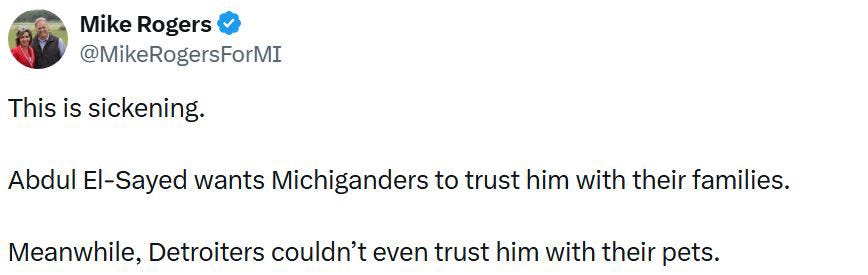
Somebody who saw only the headline would assume the stories were real, especially if they also saw tweets by the likes of Mike Rogers, the Republican former congressman running against El-Sayed for Senate.
Lisa McClain, a Michigan Republican who is chair of the House Republican Conference, tweeted that El-Sayed “literally ran a puppy slaughterhouse.”
The Republican National Committee tweeted that “Abdul is a puppy killer.”
The National Republican Senatorial Committee announced it was forming a group called “Dogs Against Abdul.”
The newly formed “Democrats for Mike Rogers” tweeted “PURE EVIL” and warned the election posed a choice between “Abdul El-Sayed and your pets.”
Right-wing influencers like LibsOfTikTok and Laura Loomer also made big impressions—the latter by linking up the alleged animal abuse (which she’d actually tweeted about before the Daily Mail article) to her feelings about Muslims:
Just how much political impact any of this will have remains to be seen. El-Sayed is on the receiving end of an absolute torrent of attacks right now, many of them straight-up appeals to anti-Muslim and anti-Arab sentiments. And it’s likely just a taste of what’s to come. The animal control unit story might barely register by the time the campaign is done.
But stories about pet abuse, real or imagined, can break through to the public in ways that few other controversies can. Just ask Mitt Romney or Kristi Noem. That might help explain why attacks involving animal abuse have become a weapon of choice for Republicans, whether they’re lies about Haitian immigrants eating people’s pets or distortions of Anthony Fauci’s record on animal experimentation.
Republicans and their allies don’t have to do this, obviously. El-Sayed has provided plenty of material for honest critics to attack. But going after his actual record would leave open the possibility voters might agree with him. Calling him a puppy killer is more likely to work and easier to spread, thanks to social media where even the most baseless, malicious rumors can count on credulous amplification.
Animal control units have many responsibilities, including protecting the public from violent animals. But the save/non-euthanasia rate is the metric that’s at the heart of this controversy. And in 2016 the animal control department announced that dog bites citywide were down 30 percent, attributing the improvement to outreach and education efforts.
Miller went on to serve as animal control director in nearby St. Clair County, resigning earlier this summer in protest of a policy local officials had adopted. She is now a private consultant on animal welfare issues.
Happy Saturday! Overtime is for everyone. If you’re a Bulwark+ membmer: thank you. If you’re not, there’s no better time to subscribe to Bulwark+ than today. If you like today’s issue, you can share this newsletter with someone you think would value it.
Well, it’s the end of summer… Our tradition, since moving here, has been to get to King’s Island before the regular season closes. Growing up in Cleveland, I am a big roller coaster fan (as most are). After a week of storms (and a derecho!) it was a gamble, but it turned out to be a beautiful, uncrowded day.
As seasons change, I get a little nostalgic, turning into Chris Stevens from Northern Exposure who once opined:
We look behind us to see how far we’ve come, and we realize that our past isn’t a solitary trail through secret woods, but a vista… as big and expansive as the ocean itself, with our experiences stretching to the horizon, like tiny dot-like sailboats sucked up into the enormous sea.
A good perspective from a great old show. But now that school and election season is in full swing, it’s good to know from whence you came, but clear about the path forward.
If you’re thinking: what’s something I can do? There’s an easy answer if money and time are tight: volunteer to be a poll worker. In 2023, I wrote an article on a great group called “Power to the Polls” trying to fill the ever present need for people to step up and administer our elections.
The battle lines of the next Republican primary are being drawn in Florida’s Republican primary for governor. There’s a ‘MAGA establishment’ frontrunner running with Donald Trump’s endorsement (but who a lot of Republicans aren’t that excited about). There’s a flamboyantly racist groyper with a wild personal life. And there’s a more Ron DeSantis-aligned candidate struggling to catch on. False Flag author Will Sommer joins Sarah to talk about:
The Florida governor’s race
The future of the America First faction that Tucker Carlson is leading
The growing dissatisfaction among rank-and-file Trump voters
Bulwark LIVE: The GOOD FIGHT TOURwith Tim, Sarah, Sam, and JVL is coming to the Southeast in October. Tickets go on sale August 21. Bulwark+ members get early access via our presale starting August 18. Watch your inbox for details. Head to TheBulwark.com/Events for details and to get your tickets.
How to Eat an Elephant book tour is coming in September.Join Sarah and friends at one of these stops:
Washington, D.C. | New York City | Boston | Los Angeles | San Francisco | Chicago | Kenyon College
Full ad-supported episodes of The Focus Group are available wherever you get your podcasts and on YouTube. Hit that like 🤍 button and share this episode with a friend. Click here to add the show to your player of choice.
Ad-free editions like this one are available exclusively for Bulwark+ members on the site, the Bulwark App, via your member-only RSS feeds, and the Substack mobile and TV Apps. Upgrade now to listen without ads and to join the community in the comments.
(Photo illustraton by The Bulwark / Cover courtesy W. W. Norton & Company)
For the next Bulwark Book Club, Mona Charen and Sonny Bunch will talk all things the Odyssey after the epic poem had quite the summer at the box office.
Mona and Sonny will be reading Emily Wilson’s translation of Homer’s ancient Greek text. It’s the first English translation by a woman, and Wilson herself has had much critical feedback on Christopher Nolan’s film adaption.
See the film, read the translation or do both!
Mona and Sonny would love to hear from you, so please send your questions and thoughts to them on the Odyssey in the comments section of this post.
Programming note: Mona and Sonny will discuss the Odyssey LIVE on Wednesday, September 16 for Bulwark+ members at 1:30 p.m. Eastern time. Can’t join in live? A replay will be available as part of the Mona Charen Show.
Look for Emily Wilson’s translation of the Odyssey at local libraries or through major retailers including Amazon, Barnes & Noble and BookShop.org.
If you’re not yet a member, join today and join us for this discussion of the ancient classic turned summer box office phenomenon.
Tim Miller joins Alicia Menendez to discuss widespread calls for Defense Secretary Pete Hegseth to resign, Trump’s continued support for him, Democrats’ affordability message, and efforts to recruit stronger young candidates for down-ballot races nationwide.
When Graham Platner’s campaign was imploding, Republicans made sure to hang him around every Democrat's neck. Now, Democrats need to make Republicans own Rep. Max Miller, the alleged violent domestic abuser. That definitely includes Neverland Ranch fan Mike Lawler. Plus: Tim reads from the mailbag, more and more focus group voters are seeing that Trump only cares about his vanity projects, Joe Rogan does not seem to be following the news, Woke 1 got some things wrong but not "Abolish ICE," Sarah is sounding kind of left on healthcare, and Bill K is mayor of The Bulwark.
Sarah Longwell joins Tim Miller for the weekend pod.
Recommended films: Idiocracy, Face in the crowd, Primary Colors
Bulwark LIVE: GOOD FIGHT TOUR with Tim, Sarah, Sam and JVL is coming to the Southeast in October. Tickets go on sale August 21. Bulwark+ members get early access via our presale starting August 18. Watch your inbox for details. Head to TheBulwark.com/Events for details and to get your tickets.
As always: Watch, listen, hit the like button or leave a comment. We want to hear from you.
Ad-free editions of The Bulwark Daily are available exclusively for Bulwark+ members.
Tim Miller’s Bulwark Daily is available wherever you get podcasts and on YouTube. New shows drop each weekday afternoon. If you like the show, leave a comment and ⭐⭐⭐⭐ wherever you listen.
Add The Bulwark Daily to your player of choice, here.
Ben Parker and Lt. Gen. Mark Hertling (Ret.) give their takes on the growing crisis aboard the USS Abraham Lincoln, where sailors have endured months at sea with poor food and living conditions, disrupted communications, and little clarity about when they will finally come home. Now, there's been several reports that sailors have considered or attempted jumping overboard. And yet, Defense Secretary Pete Hegseth called the situation “completely misrepresented.”
(1) There are still balcony seats left for the Best Friends Show in NYC on September 8. Come sell out the 92nd Street Y with us! You can get tickets here.
If we sell this show out, JVL will do something nuts.
(2) Sarah, Tim, Sam and I are coming to South Carolina, North Carolina, and Atlanta in October for Bulwark LIVE. We’re bringing friends. Tickets go on sale August 21, but Bulwark+ members get access to an exclusive presale on August 18. Upgrade today to get early access to the best seats.
Trump is trying to put his name on the Kennedy Center again. Grandpa is so thirsty.
Karoline Leavitt is taking her talent for baldfaced lying to the private sector. Who will be the lucky news organization to buy the privilege of having her lie to its audience? And what lucky liar will inherit her spot behind the podium?
JVL loses his mind over the revelation that after DHS agents murdered Alex Pretti, the federal government launched far-reaching investigations against . . . liberal activist groups in Minnesota. This story will take your hate-fire to 11.
Sarah was always right about the Wisconsin Democratic primary.
Why don’t progressives say a little prayer of thanksgiving for winning a big race in Minnesota with Peggy Flanagan while not having to defend Francesca Hong? Take the W.
Also: JVL has some nice things to say about Bernie while Sarah is totally getting there on AOC.
(4) And then there’s the feelings talk. JVL has a lot of them. About Flash and mortality and his gratitude to all of you guys.
(Also: (5) We have news about Rebecca taking us home.)
This isn’t an Instant Classic level show, but it’s a good one. Top quintile for sure. Come to the comments and hang with us there all weekend.
The Secret Podcast with JVL and Sarah is exclusively for members of Bulwark+. Upgrade now to watch (or listen) to this episode and join the Secret community in the comments. New shows drop each Friday. Ride with us!

 Login
Login