Normal view

Apple Seeks Preliminary Injunction Against OpenAI in Trade Secrets Case

4 August 2026 at 18:02

Reuters:

Apple on Monday asked a U.S. judge for a preliminary injunction barring two former employees ​and OpenAI from accessing, acquiring, using or disclosing alleged confidential information as it moves ahead with its trade secrets case. [...]

The iPhone maker also filed a concurrent motion on Monday seeking expedited discovery, including production of documents relating to the defendants’ alleged access ​of Apple’s proprietary and trade secret information. It asked the judge to order the two ​former Apple employees named in the lawsuit, Chang Liu and Tang Yew Tan, to sit for depositions, along with OpenAI employee Yu-Ting Peng and an unnamed OpenAI employee who previously worked at ​Apple.

The request for expedited discovery and the depositions, I understand. Apple wants to move fast, and they want to get depositions (especially, I’m sure, with Tan) now. The preliminary injunction request, though, I think Reuters is underplaying here.

I suggest reading Apple’s actual motion, not the news coverage. From Apple’s motion:

OpenAI, its people, and partners should not be permitted to develop, release, and benefit from products using and developed with the benefit of Apple’s trade secrets.

Bending Spoons to Buy Airtable for $1.3 Billion

4 August 2026 at 17:13

Ivan Mehta, reporting for TechCrunch:

In its first acquisition since going public last month, Bending Spoons on Tuesday said that it has agreed to buy spreadsheet and database startup Airtable for $1.28 billion in cash.

Founded in 2013, Airtable has so far raised over $1.4 billion over multiple funding rounds. At its peak, during the boom days of 2021, it was valued at over $11 billion, but earlier this year, its shares were said to be trading on the secondary markets at a valuation of $4 billion.

With its current net cash-and-cash-equivalents balance, Airtable is now valued at about $2.25 billion, Bending Spoons said.

The problem isn’t that Airtable isn’t a good product with a good business. According to the announcement, Airtable’s revenue is up to $480 million/year and grew 20 percent year-over-year. That’s good. That’s just not $11-billion-valuation good. In the abstract building a company worth $1 billion is a success; it’s a problem, though, if its financials are such that it needs to justify a valuation an order of magnitude greater than what it’s actually worth.

TerminalWidget 1.0

4 August 2026 at 04:32

New app from Brett Terpstra:

TerminalWidget lets you send output from commands, scripts, APIs, and Shortcuts directly to widgets across macOS, iOS, and iPadOS with rich formatting, progress bars, sparklines, and image support. It is available as a universal app on the App Store for $19.99.

I don’t know what I’m going to use this for, but I know I want to use it.

[Sponsor] MCP vs. REST: The Right Way to Connect Agents to Your API

REST serves the developers building against your API. MCP serves the agents now trying to use it. Most teams treat these as competing standards and have to pick one.

They’re not rivals, they’re layers: most MCP servers just call REST internally to do the real work. The best ones don’t convert every endpoint into a tool, they design around what the agent’s trying to accomplish.

Shipping that server also means shipping OAuth 2.1 with scoped tokens. WorkOS AuthKit already speaks that spec, so you skip building an auth provider on top.

Read the breakdown →

John Ternus Has Rehired Former Hardware VP Laura Legros

4 August 2026 at 00:01

Juli Clover, MacRumors:

Incoming Apple CEO John Ternus is rehiring Laura Legros, a former vice president of hardware engineering who retired from Apple in 2022, reports Bloomberg. Legros previously managed product delivery, development schedules, and coordination across engineering teams. Under Ternus, she will work across different parts of the company, and report directly to him.

According to Bloomberg, Legros was one of Ternus’ most trusted deputies before she retired. She has presented at past Apple events, introducing the 2018 MacBook Air and the 2020 iPad Air.

The 2018 introduction of the first retina MacBook Air was an interesting event. I noted at the time that it was conspicuous how seldom Apple mentioned “Intel”, despite the fact that all the products introduced ran on Intel chips. Then you look at the specs of that MacBook Air compared to the then-current iPad Pros (see link above) and you can see why Apple, privately, was seething.

The Information on Apple’s Unusual Use of iCloud for Confidential Work

3 August 2026 at 23:45

Aaron “Homeboy” Tilley, reporting for The Information (paywalled without gift links, alas, but MacRumors has a summary):

When new employees join Apple, the company often issues them an iPhone and Mac and pays for an iCloud account with a large amount of online storage capacity. Crucially, during the onboarding process, Apple encourages new hires to use their preexisting personal Apple IDs with this iCloud account, through which their co-workers can share internal Apple documents and other files with them.

There’s a practical reason for Apple’s policy. Users of iPhones can only log into a single primary Apple ID that unlocks all iCloud capabilities at a time. Apple employees who want to maintain separate work and personal Apple IDs need to carry two iPhones with them. As a result, most Apple employees opt to use their personal Apple IDs to access their iCloud accounts, former employees said.

When employees leave Apple, the company revokes access to a dedicated iCloud directory for Apple work files, as well as an authentication system for logging into other internal services, such as Slack. But former employees say the company doesn’t do a thorough job during the offboarding process of looking for confidential files that have slipped through the cracks. Because those former employees typically continue to use their personal Apple IDs with their iCloud accounts, any Apple documents stored outside workplace directories remain available to them.

If you use your personal Apple ID, you get a magic “Apple Work” folder in iCloud Drive. When you leave Apple, that “Apple Work” folder disappears. But any other files or folders that were shared with you that were outside that magic folder are still in your iCloud Drive, because it’s still your personal iCloud account.

Another factor that plays into this, I think, but which Tilley doesn’t address, is that your Apple ID is not an email address. Your Apple ID is an account that has one or more email addresses associated with it. Let’s say your personal iCloud account has two email addresses associated with it: example@icloud.com and example@gmail.com. Then you take a job at Apple and get the address example@apple.com. When you leave Apple, you lose access to the @apple.com address. But anything shared with your Apple ID through iCloud is still shared with you. You still have the same Apple ID account, even though you no longer have an employee @apple.com email account. Overall, this is a humane way of dealing with digital identity. Your Apple ID account is you, the person, not “example@icloud.com”, one specific unique email address. And you, the person, may well have multiple email addresses — all of which can be associated with your one Apple ID account. That makes Apple IDs more nuanced and complicated than a simple mapping of one email address = one account. And it obviously makes access restrictions more complicated.

Let’s say you delete your Gmail account. Now you can’t access your old example@gmail.com email address. But your iCloud access to items shared with your Apple ID still works, even for items that were sent to your now-deleted @gmail.com address. That’s just not how “work stuff” is accessed at most companies.

Tilley’s report at The Information is presented as being potentially relevant to Apple’s trade secret lawsuit against OpenAI, but Apple, in a statement to The Information, says it is not:

In a statement, Apple said: “This case is about OpenAI employees wrongfully taking Apple’s secret and confidential information regarding our unreleased technologies, processes, and products. Nothing in the filing relates to documents shared by, or stored in, iCloud.” The company said it doesn’t pursue legal claims against former employees who accidentally hold on to Apple documents in their personal iCloud accounts.

Om Malik’s Final Essay: ‘The Myth, the Mythos and the Man’

3 August 2026 at 22:34

Om published this on Monday June 7 — the day of the WWDC keynote. He sent me a note about it, that is too personal to share in full. He described it as his “last shot” — “In case I don’t make it”. He didn’t make it.

I didn’t read it right away because I was busy with WWDC. Then, after he died, I didn’t read it because I couldn’t bring myself to. I did, finally, today. It’s so good. Truly insightful. A taste:

Augustus had the Senate and the priests. Dario had the Oval Office and the Vatican. The structure is the same. Two thousand years apart.

Plato would recognize this immediately. He spent his career distinguishing the philosopher who seeks truth from the sophist who manufactures persuasion. The sophist is not lying exactly. The sophist is selecting, sequencing, and presenting in ways that produce belief without requiring the audience to do the work. Mythos, for Plato, was the domain of poets and myth-makers. Useful for educating the young, dangerous when deployed as a substitute for rigorous argument among adults. He would look at Anthropic’s naming strategy and see sophistry wearing philosophical clothes.

If you haven’t already, set aside some time and give it a read.

★ Why Apple Requires a Cellular Account Through a Big Three Carrier to Lease an iPhone

3 August 2026 at 19:19

Following up from last week, when I asked:

When you lease an iPhone through Apple Upgrade, you need a cellular account on one of the big three U.S. carriers: AT&T, T-Mobile, or Verizon. That kind of stinks, and I’m not quite sure I understand why. You’re leasing the iPhone through Apple and Klarna, not the carrier, so I don’t know why Apple cares. If you know why, shoot me a message and explain it. Is it just a simplistic credit-risk evaluation, where prepaid plan-holders and MVNO users in general are viewed suspiciously?

I got a slew of messages about this. Credit-risk assessment is seemingly part of it. There’s a lot of fraud in iPhone purchases specifically and cell phone service generally. The big three carriers do a significant amount of risk assessment before letting you open a new postpaid account; that you have an active account with one of them is a signal that you’re not trying to lease an iPhone using phony credentials in order to sell it.

But the bigger reason is the complex nature of the contracts between Apple and each of the big three carriers. A reader who worked on the carrier team at Apple for a long time (but left a few years ago) wrote:

In response to your question on why Apple would only offer iPhone on the “Big 3” for the new Upgrade Program: Every year, the Carrier Teams at Apple negotiate a deal/program (hundreds of millions of dollars) with each of those Big 3. In return for those dollars, Apple will make concessions exactly like this (or similar.) This is also why, for example, their logos appear more prominently or are the only ones called out on signage, commercials, etc… Although they really aren’t threatened by MVNO’s (the ones they don’t own) or regional carriers, it’s more like Apple is selling it as part of a package deal that’s exclusively offered to its biggest and best “tier 1” partners. It also acts as a carrot to perpetually try to motivate smaller partners into behavior Apple wants.

This might change — some of the bigger MVNOs are trying to work their way into “tier 1” (or maybe create a new “tier 1.5”). But for many years now, part of the co-marketing agreements between Apple and the Big Three is Apple agreeing to require a postpaid account with a Big Three carrier for all “special” iPhone financing deals, including the old iPhone Upgrade Program and the new Apple Upgrade leasing.

One interesting exception is that Boost Mobile is included alongside the Big Three for Apple Card Monthly Installments (ACMI), a program that offers 0% APR on certain products if you pay for them using an Apple Card. From the ACMI small print:

In order to buy an iPhone with ACMI, you must select one of the following carriers (prepaid carrier plans are not supported): AT&T, Boost Mobile, T-Mobile, or Verizon. An iPhone purchased with ACMI is always unlocked, so you can switch carriers at any time, subject to your carrier’s terms.

So perhaps some of the bigger MVNO carriers might work their way into Apple Upgrade — but if they do, it sounds like they’ll need to pay Apple for the privilege.

With regard to fraud, a former Apple Store retail employee wrote:

I left in 2019, but I’d estimate on some days a double digit percentage of in-person phone sales were fraudulent.

This behavior absolutely exploded when you started to be able to do carrier financing in the store. They had stolen the identity of a legit account holder, come into the store with the info needed to access the account. They always wanted the highest end phone, and would pay the sales tax due at time of sale in cash. Never wanted any accessories. Never wanted to open the box or set up the phone.

As bad as it was with the activation requirement, it would be way worse without it. I believe it’s gotten a lot better, and the carriers have more advanced systems in place to detect and deter this behavior now. But ultimately, the carriers ate the cost for millions of dollars in devices they never got paid for.

I suspect that reader is correct that Apple, in collaboration with the carriers, has cracked down on this.

Ulysses S. Grant on the Future Dividing Line

3 August 2026 at 19:14

Ulysses S. Grant, in 1875:

Where the citizen is sovereign and the official the servant, where no power is exercised except by the will of the people, it is important that the sovereign — the people — should possess intelligence.

The free school is the promoter of that intelligence which is to preserve us as a free nation. If we are to have another contest in the near future of our national existence, I predict that the dividing line will not be Mason and Dixon’s, but between patriotism and intelligence on the one side, and superstition, ambition, and ignorance on the other.

Not sure if the 2020s count as “the near future”, but holy hell is that a spot-on synopsis of our current moment.

Truth Social Launches Paid Early Access to Trump Posts

3 August 2026 at 18:00

Bobby Allyn, reporting for NPR:

Trump Media & Technology Group is now shopping to traders and investors a premium version of Truth Social delivering early access to the feeds of high-profile users, including the president. Starting Saturday, for a fee of up to $100,000 a month, trading firms can access “Truth API” to get a glimpse of the president’s often market-moving announcements about economic policy and global affairs before the rest of the world.

Trump’s media company says customers have already started signing up. Such an offering would give institutional investors a leg up in areas of finance like high-frequency trading, where an advantage of a few milliseconds can mean the difference of millions of dollars. But will the service be widely adopted across Wall Street?

“It’s insane,” said one Wall Street executive, who requested anonymity for fear of retaliation from the Trump administration. “I can say for myself and 200 of my friends in finance, we’re not getting anywhere near this. In another administration, this would be considered criminal.”

It is criminal. It’s prima facie insider-trading-as-a-service, or at least it’s intended to be. And in the next administration, there’s no reason to think it won’t be prosecuted as such. It really is astonishing how far the Trump 2.0 administration is willing to take the notion that it’s not corruption if it’s done in the open. There’s an old adage that it’s not the crime but the cover-up that does you in. They’ve taken this to heart and just eschewed the cover-ups.

Agent Fone

2 August 2026 at 23:02

My thanks to Agent Fone for sponsoring last week at DF. Agent Fone is a crazily ambitious new smartphone that doesn’t merely ship with a built-in AI assistant. Instead, the entire concept is that it enables you to create custom software, right on the phone itself. Ideas for new apps that you’ve had in your notes for years. Weird little app ideas that only you would want. Describe your idea, answer a few questions, and Agent Fone builds an app, or widget, and it’s on your home screen. They’re looking for 50 people and small teams to sell the first 50 hardware units to. If you’re interested, check out their website for all the information you need, and broader description of the platform.

Boris Cherny on Trying to Get Claude Code to Rewrite the Claude App

2 August 2026 at 23:01

Boris Cherny, head of Claude Code at Anthropic, was interviewed by Diana Hu on stage at Y Combinator’s Startup School 2026 last week. Starting around 20:30 in the video, he briefly discussed directing Claude to perform difficult tasks:

Cherny: I think the skill nowadays is less about prompt engineering and more about figuring out how do you give Claude a hard task that seems a little bit too hard. Then how do you make it possible for Claude to verify its work along the way? The verification is probably the single most important thing that people do not get right, largely.

One example of this is people were — we have this desktop app for Claude and it’s built using Electron. We’ve made it quite fast. Now it’s a pretty awesome experience. Six months ago it was sluggish and it wasn’t very reliable. Now it’s pretty awesome. It’s the thing that most of the team uses. As an experiment, I wanted to see what it would feel like if it was native. So what I did is I started a Claude Tag session. Claude Tag is a new product we have. It’s just Claude running in Slack. My first question was, “Hey Tag, do you have access to a Mac OS runner on GitHub?” It said no. Then I hooked up a runner. So it was able to start a Mac virtual machine using GitHub. My second question was, I created this empty code base that was a Claude desktop app rewritten in Swift.

I asked, “Can you access this code base?” It said no. Then I gave it access and it was like, “Okay, great. Now I have access.” Then I said, “Okay, now what I want you to do is I want you to rewrite the Electron app in Swift. I want you to run the Electron app in the Mac virtual machine, screenshot it, and then look pixel by pixel. Compare it to the Swift version. Don’t stop until you’re done.”

Hu: And that was your prompt basically?

Cherny: That was my prompt.

Hu: And how long did this take to run?

Cherny: It’s still running.

Hu: When did you start it?

Cherny: It’s been a little over two weeks. So it’s like 14 days, 15 days.

I suppose this is interesting, but I don’t think it’s interesting in the way some people sending me links to this interview think it is. I don’t think this is a serious effort to create a truly native Mac client for Claude. And if it is, Cherny is going about it all wrong.

It’s not like the problem with the current Claude Mac client is merely the technical detail that it’s written with a bloated non-native framework. The actual problem is that it’s a poorly designed app written with a bloated non-native framework. The design itself is non-native. And aside from ignoring most Mac UI idioms, it’s just a bad design in the abstract. It’s bad on the web, bad on Windows, and thus of course it’s also bad on the Mac. So pointing Claude Code at the current Electron app and directing it to recreate it in Swift — pixel-by-pixel — could at best solve only the technical problems with the current app, not the design problems. I’d be more likely to use Claude if it were well designed but still written using Electron, than if it were ported to AppKit and/or SwiftUI but with exactly the current design. The current Claude app is like a shitty recipe made with shitty ingredients; what Cherny asked Claude Code to do is to follow the shitty recipe using better ingredients. It’s still going to taste like shit.

And it’s probably no wonder the task failed. AppKit and SwiftUI are made to create Mac-style apps. Trying to use them to recreate the utterly un-Mac-like Claude UI is like trying to brush your hair the wrong way. It’s not the way things are meant to go.

I also can’t let pass Cherny’s aside, re: the current Claude Mac app, that “Six months ago it was sluggish and it wasn’t very reliable. Now it’s pretty awesome.” I just launched the Claude app on my Mac, and it took 30 seconds before it was ready to use. The last 15 seconds of which, it showed the spinning beach ball cursor. When it finally finished it showed me a dickover. Maybe it was worse six months ago but this is not “pretty awesome”.

The Apple Upgrade Situation

1 August 2026 at 18:30

Michael Lopp, at Rands in Repose:

I have felt since it was announced that the Apple iPhone Upgrade Program has not just been a deal, but a steal. The specifics:

  • You apply for a loan for a full-price iPhone at 0%.
  • If approved, your payments are split over 24 months.
  • Pay for 24 months, and the phone is yours.

That was just the deal; the steal was that it was low effort every single year to get a new phone. I’d re-up for a new phone, and Apple would forgive the remaining payments of the loan because I’d signed up for another 24 months. Oh, and bonus, AppleCare was included, which was a total steal because I hate iPhone cases (iPhones are designed to be felt) and, uh, also I have been known to drop my phone. [...]

At first glance, the new plan looks cheaper. The original plan: one year of iPhone 17 Pro (256GB, $1,099 sticker) was ~$57/month. 12 payments, trade-in, restart: ~$684 for the year. The new one, same phone: $45.99/month on the 12-month lease: $552 for the year.

But wait! The first and most important change to the new plan is that AppleCare is no longer included. Adding it back to this phone at $13.99/month: $720 for the year.

That’s probably the single best argument for “the catch” in the new plan. The old iPhone Upgrade Program included AppleCare coverage, and the new Apple Upgrade leases do not.

Personally, I haven’t purchased AppleCare for any device, for me or my family, since I got it for my college Macintosh LC in 1991. Apple products come with good warranties. I’ve saved thousands of dollars in the intervening decades by never paying for AppleCare and instead paying for very occasional repairs out of pocket. (I’ve twice cracked my iPhone screen and paid to have it replaced.) But I know that some people wouldn’t even consider buying an iPhone (in particular, as a potentially dropped device) without AppleCare. Update: Lopp’s AppleCare math is for monthly AppleCare; if you pay annually ($139, for a $1,099 iPhone) then the annual cost for the monthly Apple Upgrade payments plus AppleCare is $691 — which is very close to the $684 annual cost for the old iPhone Upgrade Program.

Apple Q3 2026 Results

1 August 2026 at 18:15

Jason Snell:

On Thursday, Apple announced record third-quarter earnings, with total revenue of $109.4B, up 16 percent from the year-ago quarter. iPhone revenue was up 22%, Mac revenue was up 10.4%, Services revenue was up 12%, and Wearables revenue was up 6%. iPad revenue was down 6%.

Six Colors also has their usual transcript of the analyst call, Tim Cook’s 90th and final one.

Over at MacRumors, Juli Clover wrote a retrospective on Tim Cook’s 15-year run as CEO:

When Cook took over as CEO, Apple’s revenue for all of 2011 was $108 billion. Apple reported $109.4 billion for Q3 2026, earning its 2011 revenue in a single quarter. We don’t have the numbers for fiscal 2026 yet, but in fiscal 2025, revenue was $416 billion. [...]

A day after Cook took over in August 2011, Apple’s stock price was $13.35 (split-adjusted). Today, it opened at $304.81, a roughly 23× increase.

Apple did alright under Cook.

The Talk Show: ‘What’s in Louie’s Wallet’

1 August 2026 at 00:50

Louie Mantia returns to the show to talk about the state of UI and icon design on Apple’s platforms, and some speculation on Apple’s trade secret lawsuit against OpenAI.

Sponsored by:

  • Notion: The collaborative AI workspace where teams and agents work side by side, with a Developer Platform teams can build on.
  • Even Realities: Even G2, the everyday display smart glasses. Use promo code talkshow to save 10% off the R1 Ring and/or Even Clip.
  • Squarespace: Save 10% off your first purchase of a website or domain using code TALKSHOW.
Received — 31 July 2026 Daring Fireball

★ Temu Is a Comically Bad App

31 July 2026 at 20:27

Cabel Sasser on Mastodon:

the temu app will be studied for generations.

i opened the app, and recorded this unedited, nearly two minute, launch sequence. it somehow just gets funnier and more absurd

I agree with this sentiment, right down to the fact that Temu doesn’t deserve capital letters.

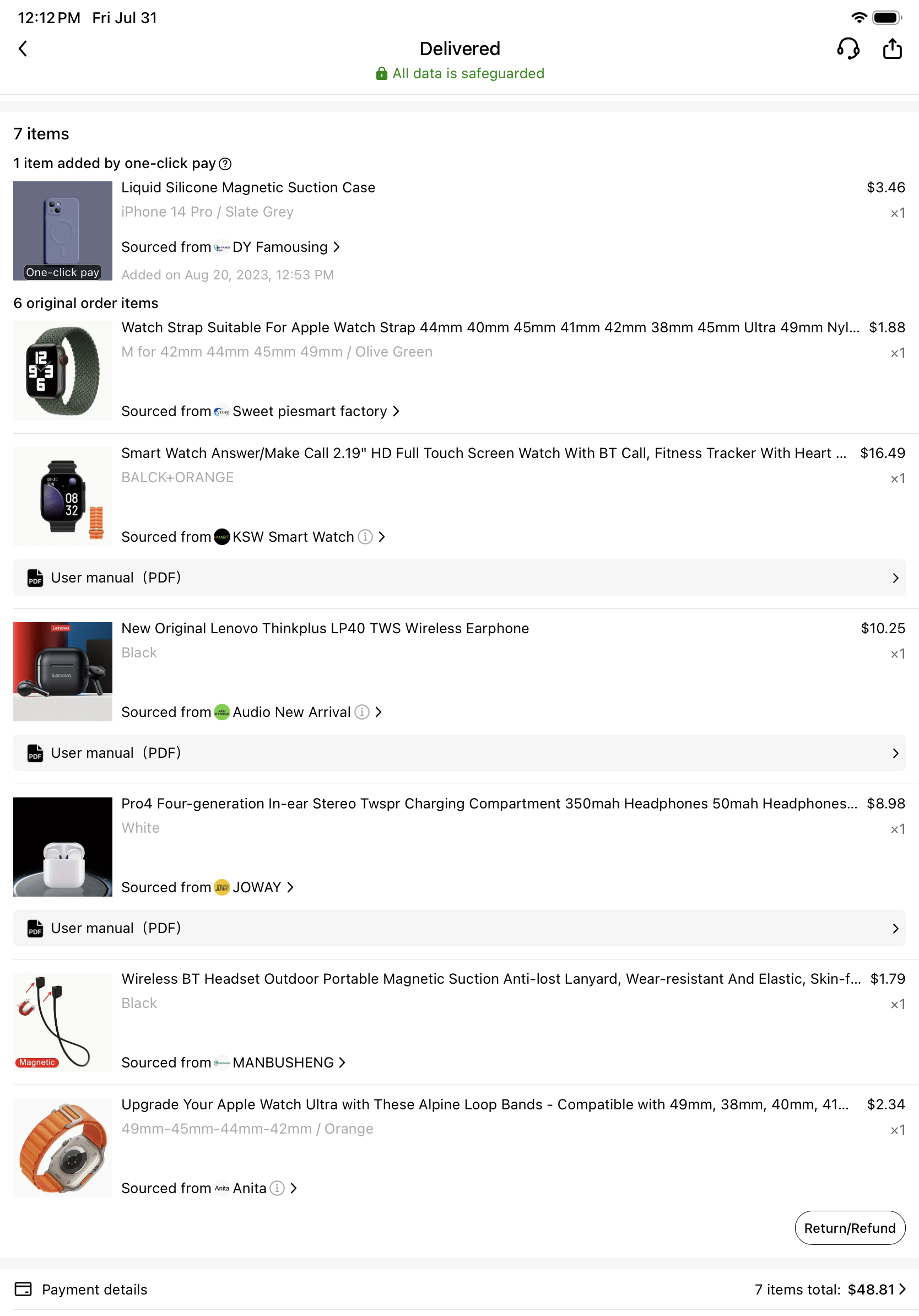
I placed an order from Temu back in August 2023. At the time Temu was the #1 app in the App Store. I surmised it was some sort of crap store, but wanted to see for myself. It is in fact not merely a crap store but a spectacular crap store — like if a souvenir shop on a Jersey shore boardwalk were the size of a football stadium. Thousands of items, many of them rip-offs, at absurdly low prices. I bought (screenshot):

  • Two Apple Watch straps. One of them knocking off Apple’s Braided Solo Loop for $1.88; another knocking off the Apple Watch Ultra Alpine Loop for $2.34.
  • A pair of knock-off AirPods: $8.98.
  • Another pair of wireless earbuds branded “Lenovo” but definitely not made by Lenovo: $10.25.
  • A knock-off Apple Watch Ultra (“Smart Watch Answer/Make Call 2.19" HD Full Touch Screen Watch With BT Call, Fitness Tracker With Heart Monitor”), which included both orange and black (misspelled “balck”) rip-offs of Apple’s Ocean Band, for $16.49.
  • A “Magnetic Suction Anti-Lost Lanyard” for, I think, AirPods: $1.79.
  • An iPhone case: $3.46.

Grand total for all seven items: $48.81. I ordered it all on 20 August 2023, and it arrived at my P.O. box on 2 September. The contents of the box looked less like it had been “packed” than “picked out of the trash and hurriedly stuffed into a box”.

The iPhone case was so flimsy it didn’t properly snap onto the phone. The Apple Watch straps were ... OK? They were about as good as you could hope given that they cost around $2 each. The knock-off Apple Watch Ultra actually did sort of work, insofar as it had a color screen that turned on and showed watch-like screens (that looked nothing at all like WatchOS). The watch case was made of plastic, and watch straps did not snap into place in the slide-in channel where they connect — they just permanently slid around. I couldn’t get either of the bluetooth earbuds to work but I didn’t spend more than a few minutes trying with each, because I realized I had no intention of putting them into my ears. The lanyard I don’t remember.

Temu today no longer tops the U.S. App Store’s Top Free Apps list, but it remains in the top 25. (It was at #19 this morning, and #22 this afternoon.) Temu’s slogan remains unchanged: “Shop like a billionaire.” Who am I to argue with that? We know one of them is on a lot of drugs — maybe all of them are, and Temu is what it’s like.

After I placed that initial order, I started getting emails from Temu. Seven of the emails pertained to my order: an order confirmation, a shipping notice, a shipping update, another shipping update, a “we noticed your order didn’t arrive on time so here’s a $5 coupon” update, a delivery confirmation, and then a prompt to leave “an honest review detailing our product quality and your overall experience”. The emails kept coming. I decided to leave them turned on until I wrote about my Temu experience on Daring Fireball. As I type this sentence, I’ve received a grand total of 916 emails. That’s just under one per day for the 1,076 days since I placed my one and only order from them. Here’s a text file with the dates and Subject lines for all 916 emails. In the early months after placing my order, they sent me multiple emails per day, every single day. I particularly enjoy how, in the Subject lines, they occasionally abbreviate my name as “John Gru...” (for privacy?), despite the fact that (a) the emails are all sent to me, and (b) in many of the other messages, they spell out my full name in the Subject.

Don’t do what I did and actually try Temu. Just watch Sasser’s video. It tells you everything you need to know.

Mark Zuckerberg: ‘The AI Future Is for Everyone’

30 July 2026 at 23:09

Mark Zuckerberg, in an op-ed Tuesday for The Wall Street Journal (gift link; and irony isn’t lost that “everyone” needs a paid WSJ subscription to read this):

We are fortunate to live at an incredible moment in history. In the next few years, people will be able to use superintelligence beyond human capacity to create and discover extraordinary new things, build new businesses, express our ideas, learn new concepts, and improve our lives, health, relationships and careers.

Perhaps we’ll be able to use it to build a metaverse too. Or to keep our attention on a major initiative for more than two or three years.

Apple Releases iOS and MacOS 26.6, MacOS 15.7.8, and More

30 July 2026 at 22:41

Samuel Axon, Ars Technica:

Apple has released iOS, iPadOS, macOS, watchOS, and tvOS 26.6. Apart from potential security hotfixes, these are likely the last updates before the arrival of iOS 27, macOS 27, and so on.

All of today’s releases include minor bug fixes, and there are numerous security updates: more than 150 for macOS 26.6. Apple also rolled out macOS 14.8.8 and macOS 15.7.8 for older devices, also focused on security fixes.

In terms of new features, you won’t find many in these releases, as they mainly pave the way for the next major OS update, likely to hit sometime in September. Most notably, the release notes for iOS and iPadOS 26.6 say the update “optimizes the Spotlight index to prepare for iOS 27.” This update will kick off some indexing work that will then be leveraged in an ostensibly much more robust Spotlight search feature when iOS 27 launches next month.

I don’t mean to pick nits, but there’s nothing “ostensible” about it. You can use the new Spotlight index via Siri AI in the OS 27 beta releases and it’s really good. The initial background indexing took almost a full week for me on iOS, I suspect because I have so much email archived, but anyone who upgrades to these 26.6 releases now shouldn’t have to wait at all after upgrading to 27.0 in September. Or even if you wait for the 27.1 releases — you won’t need to wait for Siri AI to have your full semantic index at hand.

Rogue Amoeba: Unobtrusive Update Notifications

30 July 2026 at 22:33

Paul Kafasis, on the Rogue Amoeba blog back in April:

Though Sparkle serves us very well, it has one notable downside. Update announcements are most likely to appear at the least convenient time: right after you’ve launched the app. You want to start recording with Audio Hijack, for instance, but the app is telling you about a new version.

We’ve long wished to avoid these disruptions. With that in mind, we’re making changes to how update notifications appear throughout our apps. In the future, when the software’s timed automated check detects a newer version, it will no longer pop an obtrusive window like the one seen above.

Instead, a small “Update Available” indicator will be shown in the app’s interface.

Such a little thing, but like I wrote earlier this week, getting all the little things right is how you get to insanely great. Every Mac app using Sparkle ought to copy this. It’s so much nicer.

Received — 30 July 2026 Daring Fireball

Looking for the Catch in Apple Upgrade

30 July 2026 at 18:59

Damon Beres, writing for The Atlantic under the hed/subhed: “The New iPhone Underclass: Apple’s rental program is a trap”:

The Klarna plan — “Apple Upgrade,” which replaces the iPhone Upgrade Program — is truly, legally, a lease. This is confusing! And it’s confusing in part because this is not how Klarna, a well-known buy-now, pay-later service, typically operates: When you use Klarna for clothing from Shein or lip kits at Sephora or an Xbox at GameStop, you’re paying back a loan, exactly as you were in the original iPhone Upgrade Program. Same if you use Klarna to buy a Samsung Galaxy phone. But with Apple Upgrade, you are renting: The Mac or Apple Watch is not yours until the final payment is made.

I don’t think this is confusing at all. Apple Upgrade is the primary brand for this program, not Klarna. Klarna is really only mentioned in the small print. You get into Apple Upgrade through Apple. Off the top of your head, do you remember Apple’s bank partner for the now-discontinued iPhone Upgrade Program? (It was Citizens Bank.) The Samsung program Beres links to above is named “Klarna Pay in 4”. “Apple Upgrade is a leasing program partnered with Klarna” is easily understood.

Here’s what Beres thinks is a “trap”:

Consider a student or a young professional, or perhaps an underemployed older one, who needs a new laptop. They decide on a MacBook. Apple Upgrade will appear to be the best deal: In its announcement, Apple offers the example of a 14-inch MacBook Pro that retails for $1,999 but that can be had for a monthly lease. Perhaps this person goes for the two-year term, which has them paying $54 a month. Best Buy, which currently has the same computer on sale for $1,849, offers an 18-month loan repayment with $103 installments. Apple’s deal appears to be cheaper: The 24-month lease adds up to $1,296; Best Buy’s 18-month loan lands at the store’s full retail price of $1,849.

Why does Best Buy’s laptop seem more expensive? It’s because the plan is actually designed for you to fully pay off the device. At the end of the 24-month MacBook Pro lease, meanwhile, the consumer will still owe $703, meaning that the actual total price of the Apple arrangement is $1,999 — higher than Best Buy’s offer.

This has nothing to do with the differences between Apple Upgrade’s leasing terms and Best Buy’s 18-month loan. It’s the difference between Apple’s retail price of $1,999 and Best Buy’s $1,849. Guess what? $1,849 is less than $1,999.

I generally like paying for everything I buy up front. The only thing I have a loan for right now is our home. So when Apple Upgrade was announced, I approached it with skepticism, presuming that participants would wind up paying more over time than they would buying devices outright up front. But no. There is no interest penalty. If anything, if you presume inflation is still going to run a bit high for the next few years, buying devices through Apple Upgrade might be a slightly better deal than paying up front.

Is it a “trap” that at the end of your 24-month lease you still owe $703 if you want to buy it? I would say that’s not a trap at all, given that you’d have only paid $1,296 to date on a $1,999 device. I’m not trying to be obtuse. I get it. If you pay the full $1,999 up front, or take a loan to pay the full amount over 24 months, then, after two years, you own the device outright and you might not be tempted to buy a new device for a few more years. If instead you lease it and still owe $703 after 24 months, you might be inclined to think that it’d be no fun at all to pay $703 to finish purchasing a now-two-year-old MacBook, even if the price is totally fair and carries no interest penalty. It’s just not fun. What might seem fun, at that point, is to just hand the leased MacBook back to Apple and start a new lease on a brand-new MacBook. That’s surely the appeal of this whole thing from Apple’s perspective — that leasing entices people to keep starting new leases every two years rather than just sit back and enjoy a fully-paid-for device for a few additional years. I think it’s a stretch to call that a “trap”, though.

❌