❌

Normal view

Mark Stephens, a.k.a. Robert X. Cringely, Died at 73

12 October 2026 at 18:43

Mary Alyce Stephens (née Neader), posting on Cringely’s Facebook account:

Hello, this is Mary Alyce, Bob’s wife. I am coming to you with immense sadness to let you know that Bob passed away. His obituary follows. His family is not requesting anything, however, if you would like to make a donation in his honor, please consider The American Heart Association or The American SIDS Institute. [...]

Writing as Robert X. Cringely, Mark became a distinctive voice in technology journalism. He had an unusual ability to understand not only technology but also the human beings behind it — the dreamers, inventors, entrepreneurs, eccentrics, and risk-takers who were changing the world. He could take a complicated subject and make it understandable, entertaining, funny, and deeply human. He was skeptical when skepticism was warranted, irreverent when others were overly serious, and never particularly interested in following conventional wisdom. That independence was not simply part of his writing. It was Mark.

He followed the beat of his own drummer throughout his life. He was brilliant, funny, opinionated, curious, generous, exasperating, and unforgettable — sometimes all within the same conversation. He loved a good story and knew how to tell one. He could make you laugh, make you think, make you argue with him, and occasionally drive you crazy. Life with Mark was rarely dull.

Mark’s life also included heartbreaking loss. He was preceded in death by his beloved sons, Chase and Cole Stephens, as well as his parents, Ray and Lois Stephens and father-in-law Jim Neader. I could also add brother-in-law Jimmy Neader and niece Ericka Neader, but they were a thorn in our side.

That last dig, at her own dead brother and niece, offers a hint at why Cringely loved her. He wasn’t one to pull punches either.

Her full obituary for Cringely/Stephens is visible without being logged into Facebook (I’ve still never created one), but Steven Sinofsky kindly posted it to his account on X. Pick your poison. Update: Here’s a version hosted by the funeral home.

★ X Once Again Marks the Spot

11 October 2026 at 23:05

Upon taking the CEO helm last month, John Ternus began tweeting on X. He tweeted “hello”, posted an iPhone event eve teaser and then a promo video for the new products, celebrated Apple’s plethora of wins at the Emmys and launch day on Fifth Avenue, and commemorated the anniversary of Steve Jobs’s death.

X is the only place these posts go. Same for Greg Joswiak’s account. Lighthearted stuff too, like Cook “introducing” Ternus to Pikachu back in August. You may not like it that X has re-found its footing under Elon Musk’s ownership, but it has. I’m citing Apple executives here but they’re far from alone. There are hundreds of interesting people and accounts I follow that post on X very regularly and do not post anywhere else at all. As a word nerd I love Merriam-Webster’s account — fun, clever, smart posts every day. That’s just one example among hundreds. Here’s another. Fascinating new apps are being shown and discussed on X and nowhere else.

[Update: I stand corrected — Merriam-Webster does have an account on Bluesky. It contains a subset of the items they post to X. They’ve posted 34 original new tweets on X so far in October; only 10 on Bluesky. Plus on X they’ve chimed in with 11 clever and/or informative retweets from other accounts, including one from those notorious fascists at Sesame Street; there are zero of those on Bluesky. So while I regret the error of implying that Merriam-Webster posts exclusively on X, the 45-10 count for October to date proves my point just as well.]

I see more interesting posts on X than I do on Threads, Bluesky, and Mastodon combined. I wish that weren’t so but it is. Most people don’t want to think about politics so they don’t. Those people, when they want to participate in a Twitter-like social network, go to X.

And I can’t blame anyone. The only network that compares to X, size-wise, is Threads — but Threads’s algorithm is weirder than X’s now, and the content I see there is relatively boring. My Threads timeline is full of engagement bait without being engaging. And if you want to judge a platform by its owner, “I’m grossed out and/or appalled by Elon Musk so I’m going to Mark Zuckerberg’s joint” isn’t a way to avoid being grossed out and/or appalled by the owner. Bluesky and Mastodon are too small for most people to care about — and, worse, they are the networks where politics are, in my experience, unavoidable. You can have a discussion about cool new use cases and tools for AI on X and people just discuss the tools and use cases. On Bluesky and Mastodon it’s difficult to have such discussions without arguments from people who (a) believe all use of AI is unethical, and (b) will shove their viewpoints into your replies.

The culture on X today is remarkably friendly and inclusive. It is a cheerful place. That cheerfulness is another differentiator. If you believe the world is falling apart and doomed only to get worse, that our obvious and real problems cannot be surmounted, X is not the platform for you. If you think the world is full of fun and amazing people and things, that humanity’s defining feature is our collective ability to solve any problem, that the only time better to be alive than today is tomorrow, it might be.

If you have stayed away, or even just mostly away, from X for years and then come back, people just say things like “Hey, glad you’re back!” On the other networks, especially Mastodon, they tell you you’re “feeding Nazis” — by going to the platform where Tim Cook posts Pikachu videos. These people have either lost their minds or refuse to check their prior assumptions. (Most of the ones who chime in about it publicly are the lost-their-minds types.)

But the bigger problem is that there’s little action on Bluesky or, especially, Mastodon. There’s a lot of activity on Threads, but little action. There is action on X. I’ve said for years that Mastodon is my favorite of the bunch and in a way it still is, but really that’s because when I go there I don’t have to be diligent to avoid wasting time. I avoid wasting time on Mastodon because there’s so little of interest to see. That’s a feature — for me — but it certainly isn’t what most people are looking for in a Twitter-like posting platform. They want action. The action is on X.

Without any fanfare — perhaps to avoid his ire — X has de-Musked its algorithm. I stopped visiting at all when the algorithm there was putting Musk’s own tweets into my timeline, every time I checked, despite the fact that I never followed him. But they don’t do that anymore. I don’t see much politics of any kind in my timeline, and what I do see is from accounts I chose to follow. I see tech (including a lot of interesting breaking news), sports (including a lot of interesting videos and stats), and stupid stuff that’s actually funny. My only problem with X now is that I do have to pay attention to avoid wasting time when I visit.

Plus, in addition to the tweets, there are now many interesting people using X to post entire essays and blog posts. I wish that weren’t so, for multiple reasons (e.g., no RSS). But it is so.

If you returned from exile on a desert island and took a look at X today for the first time in a year, you might reasonably guess that Elon Musk got bored and sold it while you were away. I do think he got bored micromanaging it, but the rank muskiness that permeated the platform after he took over is — for now, at least — gone.

Apple Only Started Suggesting iOS 26 Users Upgrade to 27 Three Days Ago

11 October 2026 at 21:02

Joe Rossignol, on Thursday:

Starting today, iPhone users still running iOS 26 will see iOS 27.0.1 as the prominent software update in the Settings app under General → Software Update, with iOS 26.7.1 now relegated to a smaller “Also Available” section at the bottom.

Just the other day I posted about how most users only get OS updates when Apple pushes them through automatic updates. But even for users who update manually, until Thursday, the default suggested update for users on iOS 26.x was to remain on the latest version of iOS 26. To get iOS 27 you had to scroll down “below the fold” and most users don’t do that.

iOS 27 adoption amongst normals is very slow, but that’s only because Apple wants it slow. That’s not because iOS 27 is buggy — it speaks to its Snow-Leopard-like focus on bug fixes and performance updates that it’s actually remarkably stable. The obvious explanation is that Apple is slow-rolling 27 updates to gate access to Siri AI.

Sunnny

10 October 2026 at 18:11

My thanks to Sunnny for sponsoring this week at DF. How can B2B software be so friggin’ delicious? Find out when early access launches on Monday, October 19.

‘Proof-of-Human’

10 October 2026 at 18:06

Benjamin Mayo (on X, of course), commenting on Apple promoting behind-the-scenes footage showing that the embroidered “Welcome Home” logo for next week’s keynote/experience was stitched by hand:

There needs to be a name for this phenomenon where every published piece of art by a company is now accompanied by a proof-of-human video.

I agree, and I think Mayo coined the term right there. It’s always been fun to see footage of talented artists and craftspeople making things by hand. But in the age of AI it’s a differentiator — not just that you aren’t lazily generating your art via prompts, but that you understand that heart comes from the human hand.

Let’s Check In on Trump’s Blog

9 October 2026 at 00:52

An actual post from the sitting president of the United States:

The White House considers anyone that uses the term, “Artificial Intelligence,” as opposed to the highly accepted new and more accurate term, “Super Intelligence,” THE ENEMY! President DONALD J. TRUMP

This, from the self-professed “party of free speech”. Trump’s screws are so loose you can hear them rattling around.

Apple Is Slow-Rolling iOS 27 Adoption, So Far

8 October 2026 at 21:30

David Smith, last week:

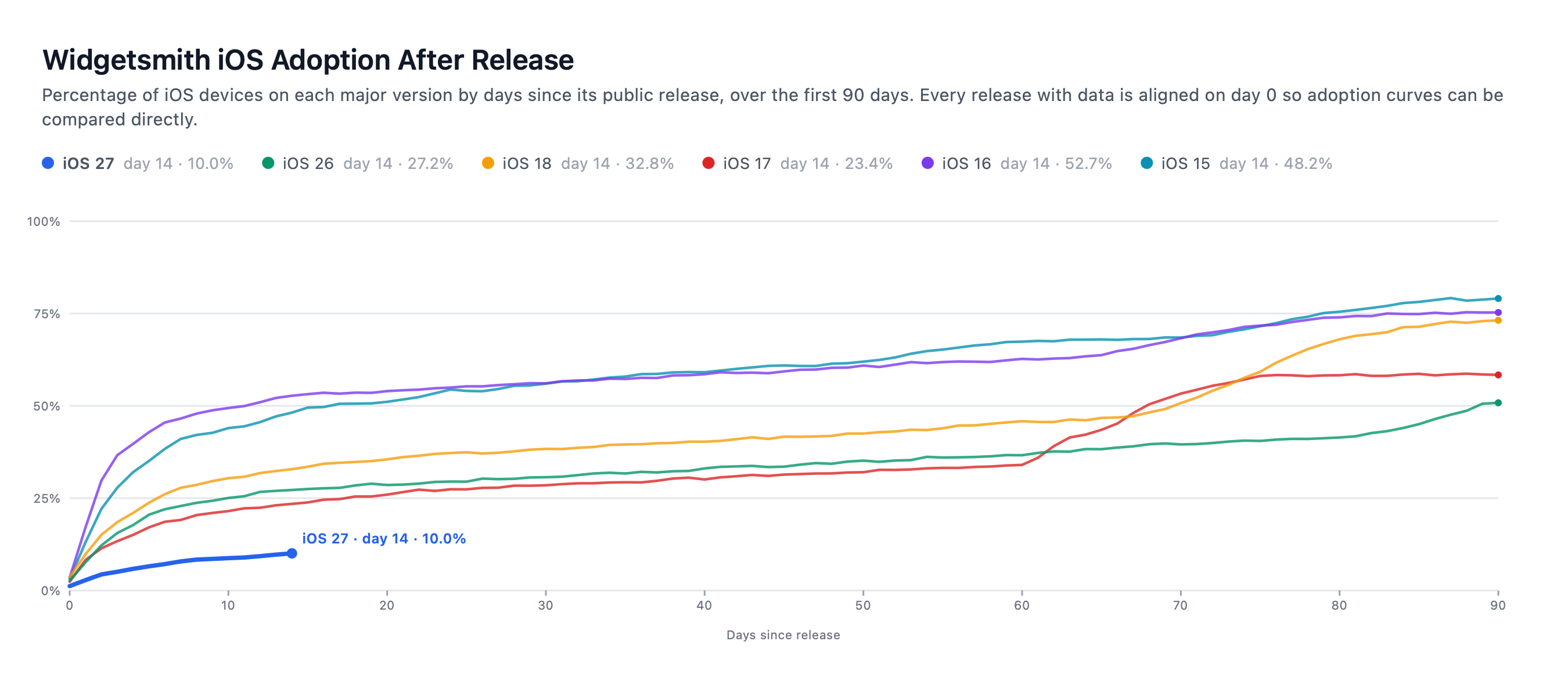
Been really interesting to watch the iOS 27 adoption curve over the first two weeks. Clearly on a different path than previous years. Still steadily growing, at a similar rate to the ‘steady growth’ phase of most years, but without the big surge at the start.

Given that this rate is largely controlled by Apple’s automatic update logic, I suspect it’s a deliberate choice. Likely because it lets them manage the Siri AI waiting list and avoid a big queue on day one.

Smith’s numbers are from analytics from users of Widgetsmith and Pedometer++. If you look at his chart for Widgetsmith, there’s really no explanation other than Apple pushing automatic updates to users more slowly than in any previous year, and I think it makes sense that this is to gate admissions to Siri AI. You can also see from his chart that Apple has been slowing down updates to initial .0 versions in recent years — the adoption rates were much faster for iOS 15 and 16 back in 2021 and 2022. Note too that every year Apple makes it more and more likely that users will opt into automatic software updates. The overwhelming majority of iOS users get OS updates when their devices update themselves.

And remember the whole thing with slower-than-previous-years adoption of iOS 26 last year — that was all attributable to the auto-update pace set by Apple.

(It’s purely personal anecdata, but I feel like Siri AI has gotten worse since iOS 27.0 was officially released. It feels a bit slower and I seem to get worse answers, sometimes. I asked it for a word today, using it as an interactive thesaurus, and it simply told me it couldn’t. It never did that over the summer. I started using iOS 27 full-time on my iPhone the day after the WWDC keynote and I got into the Siri AI beta the next week. While it might be some sort of placebo effect, I feel like Siri AI was better — slightly faster and more useful — in July and August than it is now. I could be wrong, or maybe just unlucky of late. But I’m also quite certain that scaling up the Private Cloud Compute side of Siri AI is a massive challenge for a platform with over a billion Siri AI-eligible users.)

Jaguar Type 01

8 October 2026 at 01:22

This is a cool car. It doesn’t look like anything else and it looks like it’s been pulled a few years from the future. I don’t know about this whole trend where cars don’t have rear windows though. I get it that you just use the camera but my old habits says I want to see out the back sometimes.

But the only reason I wouldn’t buy this thing is that turd of a new logo Jaguar went with. I could not abide driving around in something with this typographic calamity.

Gurman Strikes Again: ‘Apple’s Smart Home Push Includes Doorbell, Lock, Thermostat Codeveloped With LG’

8 October 2026 at 00:02

The incomparable Mark Gurman, reporting for Bloomberg:

Apple Inc.’s upcoming push into smart home devices will include a doorbell, thermostat and other accessories developed through an unusual partnership with LG Electronics Inc.

The products will be part of an ecosystem of devices that work with Apple’s new smart home hub, as well as an upgraded HomePod mini and fresh TV set-top box, according to people with knowledge of the matter. The new Apple devices are set to be introduced on Oct. 13.

The products developed with South Korea’s LG will also include a smart deadbolt lock, indoor security camera, outdoor security camera and floodlight camera, said the people, who asked not to be identified because the undertaking is private.

Though the two companies worked together to develop the accessories, the products will carry the LG brand. The South Korean firm is handling manufacturing and product support.

Gurman has more than “people familiar with the matter” (or Matter, for that matter) — he cites FCC filings from LG that have product names and illustrations of some of the devices’ rear panels (with the connectors).

As Gurman himself notes, this is somewhat unusual for Apple, but it’s not altogether new territory either. In Venn diagram terms, the circle for “peripherals Apple very much wants on the market” is a superset of “peripherals Apple wants to make itself and put the Apple brand on”. For some of these products that Apple doesn’t want to make under its own brand, Apple makes them through Beats. But for others they partner with other companies. They’ve long partnered with Logitech for keyboards, keyboard iPad cases, and even the Logitech Crayon, the only third-party alternative to Apple’s own official iPad Pencils. Unlike Apple’s Pencils, the Crayon works without pairing to a specific iPad — surely a godsend in classrooms. There’s also the Logitech Muse — an air-pencil/magic-wand peripheral for Vision Pro. (Vision Pro is a $4000 mixed reality headset that weighs 2 pounds, which Apple released in early 2024.) Apple does this with Belkin too — that’s another trusted partner for Apple.

And, in addition to serving as a longtime display component supplier for Apple, back when Apple had temporarily and foolishly exited the market for Apple-branded external displays, they worked with LG to make the LG 5K Ultrafine display, which for a while was simultaneously the best external Mac display on the market yet also an unreliable flaky product. Even at its best it had an unstable sub-par stand.

The thing that makes this partnership awkward for Apple is that these products — doorbells, cameras, deadbolt locks — are products that require the utmost of trust. What products could possibly require more trust than a camera with footage of what’s going on in or at your home, or a lock that controls who can get in? I think that’s why Apple wants to get into this market with products that they can put their stamp of approval on. But LG, of all companies, was just exposed in a scandal for shipping “smart” TVs that literally listen to the ambient audio in the room — even in standby! — and invade your privacy by tracking what content appears on screen. (I own a 2019 LG TV but I haven’t allowed it Wi-Fi access since, literally, 2019.)

Unofficial Command-Line Tool Removes Apple Intelligence From MacOS 27

6 October 2026 at 20:17

Scharon Harding, Ars Technica:

Unlike with previous versions of macOS, macOS 27 Golden Gate doesn’t have a toggle for turning off Apple Intelligence. That makes disabling AI features that you may not want more difficult. It also means that the AI models necessary for running Apple Intelligence will take up space on your disk, even if you don’t use them or if you go through your settings to individually find and disable AI capabilities.

In response, a developer known as Om Lahore on GitHub last week created RemoveMacAI, a command-line tool that allows macOS 27 users to “turn off Apple Intelligence on macOS 27” in a way that is “fully reversible,” per the GitHub page. They said that Apple’s Intelligence models take up “about 12GB,” but the models can actually take up over 30GB, The Verge noted.

RemoveMacAI “turns off Siri, Writing Tools, Genmoji, Image Playground, the ChatGPT extension, and all the summaries, then it deletes the models and stops macOS from downloading them again. Dictation still works because it’s a separate setting,” the developer said in a Reddit post first spotted by MacRumors.

Sounds crazy but it’s not rming files in the /System/ folder — it uses techniques that work with System Integrity Protection remaining enabled. I mean, I wouldn’t do it on a production machine, but, I don’t want to disable Apple Intelligence.

I can see the reasons why some people are frustrated that MacOS 27 Golden Gate doesn’t have built-in support for disabling this and removing the local models, though. If your Mac only has 256 or even 512 GB of storage, a dozen GB (or more) is meaningful. And there are institutional groups that have rules against AI — these places aren’t allowing Golden Gate at all until and unless Apple Intelligence can be removed. And that means not buying new Mac hardware that only runs Golden Gate.

OpenAI Announces Their Text Watermarking Plans

6 October 2026 at 00:59

OpenAI, today:

The EU AI Act requires generative AI providers to make generated text identifiable in a machine-readable way. Text watermarking and detection remain early technologies with significant limitations, and views about their benefits and responsible uses are still developing. Our phased approach reflects both the EU AI Act requirements as well as the technology’s limitations, with an emphasis on transparency about what a text watermark can and cannot tell people:

  • Starting today, API customers globally will be able to opt in to text watermarking for select models. Text watermarking will remain off by default in the API.
  • Over the coming weeks, we will add an invisible watermark to eligible ChatGPT and Codex text output in the European Union.
  • We’re opening applications to access our text watermark detector. Access will initially be limited to approved researchers and expert organizations that can help us evaluate and improve the technology.

First, unlike Anthropic, OpenAI is only forcing this upon users in the EU, where it’s mandated by their ill-considered 2024 regulation. Second, also unlike Anthropic, OpenAI has made this available via an API so developers should be able to actually see if this adulterates text output with real-world usage.

Third, none of these companies have yet made their watermark detectors publicly accessible. I remain highly skeptical that they will work as advertised in the real world. I think this is all somewhat of a sham to claim compliance with the EU AI Act without actually providing anything that anyone can actually use in a practical way.

Our text watermarking technology, textGrain, adds an invisible statistical signal to the model’s word choices. Our detector looks for that signal to assess whether a passage contains an OpenAI watermark. More details about how textGrain works can be found in our technical report, which will be updated with additional details in the coming weeks. We also plan to make the technology available in open source so that others can build on it.

In our evaluations, textGrain matched or exceeded the performance of other approaches we tested, including SynthID for text. Even so, strong performance under ideal conditions does not guarantee reliable detection in everyday use.

SynthID-Text is the Google algorithm that Anthropic says they’re using too.

Maybe I’m all wet, but I think what they mean in that last sentence quoted above is that it only performs usefully in ideal conditions, with simplistic prompts, and will prove to be unusable in practical everyday use, especially if the user’s prompt contains instructions designed to circumvent it.

Ternus and Cook Tweet Brief Remembrances on the 15th Anniversary of Steve Jobs’s Death

5 October 2026 at 21:19

John Ternus, posting on X:

The way Steve taught us to care about every detail, every experience, every person, still guides our work today. Forever grateful.

Tim Cook, also on X (with a photo I don’t recall seeing before):

There are people who leave a mark on the world, and then there are people who change it entirely. Steve changed the world and so many lives in the process. He certainly changed my life forever. His spirit lives on in everything he created and everyone he inspired.

WorkOS

3 October 2026 at 23:23

My thanks to WorkOS for sponsoring this last week, once again, at DF.

SSO is table stakes for enterprise deals, but building it into your app yourself means writing SAML controllers, parsing XML assertions, and handling IdP-specific quirks for each provider. Learn how SAML flows work, the tradeoffs between building or buying, and best practices for security, routing, and UX.

Or, skip the hassle and add SSO with WorkOS. Read their developer’s guide to learn more — everything from how SSO works to why WorkOS is the fastest way to add it.

Apple Confirms iPhone 18 Pro Max AT&T Cellular Issues, Affected Devices Require Hardware Replacement

3 October 2026 at 20:21

Chance Miller, 9to5Mac:

In a statement to 9to5Mac, Apple said:

We have identified an issue affecting a small number of iPhone 18 Pro Max users on the AT&T network that may cause a device to lose service and be unable to make calls. We released iOS 27.0.1 earlier this week and strongly encourage all iPhone 18 Pro Max users to update now, and are also issuing a carrier settings update today. These updates together are meant to help prevent this issue from occurring.

The carrier settings update for the iPhone 18 Pro Max will download automatically over the next 14 days. However, users can manually trigger the download by going to Settings, choosing General, then About.

Apple explains that the software updates will help prevent future issues for iPhone 18 Pro Max users on AT&T. The software updates will not restore service on devices that have already lost it.

Apple says that iPhone 18 Pro Max users who have already lost service will need a hardware replacement. Those users should contact Apple Support or AT&T, or visit an Apple Store or AT&T location.

As we reported this morning, iPhone 18 Pro Max users affected by this problem can’t connect to AT&T’s network for calls, texts, and data. Instead, those users see “SOS” in their iPhone’s status bar. The connectivity issues aren’t impacting every iPhone 18 Pro Max user on AT&T.

I’ve heard from a handful of DF readers about this, and the readers experiencing the problem have all found each other in various forums over the last two weeks. The following all seem to be true:

  • It’s only a problem for AT&T customers. No such problems on Verizon or T-Mobile.

  • It’s only the 18 Pro Max, not the regular 18 Pro. The salient fact here is that the only iPhone 18 Pro models that use Qualcomm cellular modems, rather than Apple’s own C2 modem, are 18 Pro Max devices in the U.S.. So the problem seems to be something related to the Qualcomm modem and AT&T’s network.

  • It is not a problem for all 18 Pro Max devices on AT&T’s network. “A small number” is all Apple will say, but anecdotally it seems clear that it’s not most 18 Pro Max devices on AT&T. But it still seems like many. It’s not exceedingly rare.

Pretty unusual that once a device is affected and loses service, the device must be replaced. Yet, the 27.0.1 iOS update contains a fix (or fixes) that should help devices that haven’t yet lost service from losing service. I’d love to understand how a software update can prevent existing devices from being affected, but a software update cannot restore service to existing devices that have already been affected.

Something else I’m curious about is whether it’s related to AT&T customers, or AT&T’s network — are iPhone 18 Pro Maxes that are connected to MVNO carriers whose backend is provided by AT&T similarly affected? E.g. US Mobile customers on US Mobile’s “Dark Star” service? I’d love to hear from anyone who knows.

★ Apple Is Going to Further Tighten the Screws on Full Disk Access on MacOS, in Response to Agentic AI Apps Running Amok

2 October 2026 at 22:40

Apple Developer News, in a post titled “Updates to Full Disk Access in macOS”:

We give developers powerful APIs to build incredible capabilities into their apps for Apple products, backed by a set of controls designed to protect users’ private data. Full Disk Access largely sidesteps these controls in order to allow backup apps to function properly on the Mac. Some developers are using Full Disk Access in ways that could put users at risk, exposing everything on their systems — including files, mail, messages, and even browsing history — without users’ full knowledge and understanding. For communication apps, this can also compromise the privacy of the people users are communicating with.

Going forward, we will introduce additional controls to ensure that users who genuinely wish to grant an app this extraordinary level of access can only do so with very explicit user action. Addressing this is critical. As AI agents become increasingly capable and autonomous, the risks associated with this level of access will grow substantially. We are committed to ensuring users clearly understand these risks before granting such access, so they can make informed decisions about their own data and privacy.

They don’t name names, but clearly this is in response to Meta Muse (cf. Jason Aten’s misadventure with Muse accessing Aten’s iMessages), Grok Bot, Claude, Dots, and the rest. This is why we can’t have nice things.

I really worry about just how much Apple is going to lock Full Disk Access down. I use it with several apps that couldn’t function properly without it, and would be severely hampered if I needed to authorize it manually every time they do something.

But before we Mac power users riot in Cupertino, we should note that we have no idea how many unsophisticated Mac users are calling Apple and queuing up at the retail store Genius Bars to complain about Muse and these other agents having run amok on their Macs, against their desires, after convincing these users to grant them access. It is a legitimate frustration for the highest-functioning users among us that the Mac has, for years, already seemed “too locked down”. But there are now around 150 million Mac users worldwide. Most of them are unsophisticated technically — a majority of them, profoundly so. Many of them have technical needs that cannot be met by the baby computer OS that is iPadOS. For a lot of them it might just be the ability to run the real version of Google’s Chrome web browser — or even the desktop version of Safari. So there are tens of millions of people who need to use a Mac to do things that cannot be done on an iPad, but who have zero understanding of what it means, say, to grant Muse permission for Full Disk Access. And then they think it is Apple’s fault that Muse is suddenly able to read their private iMessage conversations.

(Anyone out there who, say, works at an Apple retail store and can confirm whether this is an escalating support issue — one way or the other — I’d love to hear from you, confidentially.)

On iOS (and its tablet variant, iPadOS), you can say OK to every single thing an app like Muse asks for and Muse still won’t be able to read your email or end-to-end encrypted messages from iMessage or WhatsApp. There is no level of permission that grants third-party apps permission for such things. (The EU wants to force Apple to allow that under the DMA.) MacOS isn’t like that. You still need to grant apps permission for such things, but if you say OK to everything an app like Muse asks for on the Mac, you’re granting that app access to, effectively, almost everything on your startup drive. There are still some things it can’t see, but not many. A lot of non-technical Mac users do not understand this and cannot be expected to understand this. They just think, wrongly, that Apple protects them from allowing anything truly dangerous, because that’s how their iPhone (and/or iPad) works. So they just click OK to every access request from Muse and presume they’re still largely protected.

Hopefully Apple has in mind a solution to this situation that will still enable knowledgeable power users to confirm agreement to a sufficiently scary warning and put their Macs in a state similar to what we have today. I worry. What alleviates my worst fears is the knowledge that every technical user at Apple itself needs to use their Mac as the powerful Unix workstation OS that it is. Some of us need dangerously powerful tools. Most Mac users, however, do not — and don’t realize they’re using a dangerously powerful Unix workstation with a very friendly (literal) face.

Yankees Sweep Boston in Two Games, by Combined Score of 18-2

2 October 2026 at 02:06

In the 6th inning last night the Yankees were only ahead 2-0, and Red Sox first baseman and all-around jackass Willson Contreras hit a home run, closing it to 2-1. Contreras decided to walk around the bases. The baseball gods do not look kindly upon that sort of ostentatiously belligerent showboatery. (Especially when your team is still losing.) Contreras circled the bags after his dinger like a rooster letting you know he just banged a few hens — but at a slower pace.

In the next inning, Contreras wasn’t paying attention and his laziness allowed a Yankee to reach base after striking out on a wild pitch. That started the rally that resulted in the blowout final score.

[Sponsor] WorkOS: How SSO Works and the Fastest Way to Add It

SSO is table stakes for enterprise deals, but building it into your app yourself means writing SAML controllers, parsing XML assertions, and handling IdP-specific quirks for each provider.

Learn how SAML flows work, the tradeoffs between building or buying, and best practices for security, routing, and UX. Or skip the hassle and add SSO with WorkOS.

Read the guide →

❌