❌

Normal view

Steve Davidson (1958-2026)

16 November 2026 at 21:00

Publisher and editor Steve Davidson, 67, died November 4, 2026.

Steven John Davidson was born December 18, 1958. He was an active reader of SF magazines as early as 1978, sending letters to Amazing Stories. In 2012, he acquired Amazing Stories and relaunched it with an online website, covering news and reviews and expanding to offer digital magazine issues, as well as a print edition which ran from 2018 to 2020. From 2014 to 2020, he edited eight reprint anthologies in the series The Best of Amazing Stories with Jean Marie Stine. In 2022, he edited Cents of Wonder: Science Fiction’s First Award Winners with Kermit Woodall. He is survived by his brother Andy and his son.

For more information, see his entry in the Encyclopedia of Science Fiction.

Patrick Stewart, “Star Trek” and “X-Men” star, dies at 86

29 October 2026 at 23:58

English actor Patrick Stewart, who became world-famous as the star of “Star Trek: The Next Generation” and the “X-Men” movies, died on Wednesday at his home in Los Angeles. He was 86. Kelly Bush Novak, his longtime spokesperson, announced that he died from Alzheimer’s disease and Lewy body dementia, which is marked by features of Parkinson’s disease.

“He has been held in the warm embrace of family and friends, surrounded by live music, prayer, tears, laughter and the kind of profound emotion that only he could inspire after a lifetime of devotion to us all,” Bush Novak wrote. “We will forever cherish the peaceful ease and reflection on his face, an enduring reminder of his invincible grace.”

Stewart’s distinctive baritone voice and striking bald head made him one of the most familiar actors to American audiences, but until the late 1980s, he was virtually unknown in the U.S. Before his casting as Capt. Jean-Luc Picard on “Star Trek: The Next Generation,” he had spent decades as a classical theater performer in Britain, especially in the works of Shakespeare. He joined the Royal Shakespeare Company in 1966, where he met fellow actor Ian McKellen, who would become a longtime friend and collaborator.

Over the course of his career, he received four Emmy nominations for his television work, as well as two Laurence Olivier Awards and a Tony nomination for his role in “Macbeth.” In 1996, he won a Grammy for best spoken word album for children for “Prokofiev: Peter and the Wolf.” He was knighted by Queen Elizabeth II in 2010.


Later in his career, Stewart reprised his role as Picard in various “Star Trek” films and a recent spinoff series. His role as professor Charles Xavier in the “X-Men” film series from 2000 to 2017 helped propel his career to new heights and usher in a new era of superhero films. He is set to appear as Xavier in “Avengers: Doomsday,” which will be his final on-screen film appearance.

“I think I’ve been in denial about my life for a very long time,” Stewart told The Guardian in 2023. “I never really took on board how successful I had become. Even today I sometimes think, ‘You’re a lucky son of a b**ch, Patrick,’ when something unexpected or good happens to me.”

Stewart was born on July 13, 1940, in Mirfield, England, a small town in West Yorkshire. He is survived by his wife Sunny Ozell, an American singer, whom he married in 2013; his son, Daniel, also an actor; and his daughter, Sophie.

The post Patrick Stewart, “Star Trek” and “X-Men” star, dies at 86 appeared first on Salon.com.

Matt Howarth (1954–2026)

29 October 2026 at 17:48

SF comics writer and artist Matt Howarth, 72, died October 5, 2026 of complications following a triple bypass.

Howarth was born in 1954. He became active in the fanzine space in 1969, co-founded Howski Studios with Tony Sciarra, and began drawing professionally soon after, publishing multiple SF/F graphic novels and comics such as the Those Annoying Post Brothers. He contributed artwork to books including The Dune Encyclopedia (1984), Clans of the Alphane Moon (1984), Time Out of Joint (1984), Dr. Bloodmoney (1985), and The Zap Gun (1985) by Philip K. Dick; Dr. Adder (1984) and The Glass Hammer (1985) by K.W. Jeter; Eclipse (1985) by John Shirley; Sunglasses After Dark by Nancy A. Collins; as well as several columns in New Pathways. In 1990 he published a short “The Prescott Experiment” in New Pathways. He published one novel, SF The Eden Retrieval, in 2011.

Malcolm Edwards (1949-2026)

13 October 2026 at 17:41

Editor, critic, and publisher Malcolm Edwards, 76, died October 3, 2026. He had Parkinson’s disease.

Malcolm John Edwards was born December 3, 1949 in London, England. He received a degree from the University of Cambridge. He worked at several publishing houses, including Gollancz from 1976-89, HarperCollins from 1991-7, and Orion Books from 1998-2019, first as managing director, then as deputy CEO and group publisher. For Gollancz, he edited the SF Masterworks series, re-releasing SF novels from notable genre authors including Joe Haldeman, Samuel R. Delany, and Ursula K. Le Guin. He later co-edited the companion series, Fantasy Masterworks, with Jo Fletcher. After this, he undertook the SF Gateway project, an ebook library noted as the largest digital SF/F library of its kind at the time, which launched in 2011 alongside the third edition of The Encyclopedia of Science Fiction.

Edwards was active in the UK SF fandom space throughout the 1970s and ’80s, and soon he was working as a critic and magazine editor. He edited for Vector in 1972-4, penning several editorials and reviews. He was the administrator of the Science Fiction Foundation for three years and edited its journal, Foundation: The Review of Science Fiction, in 1975-80. He was a founding board member of Interzone, which he edited in 1982-3. He also wrote one novel around this time, Succubus (1985) with Robert Holdstock under the name John Stock, and one work of short fiction, BSFA Award winner “After-Images” (1983).

He wrote several works of non-fiction, in frequent collaboration with other authors. He wrote Spacecraft in Fact and Fiction (1979) with Harry Harrison; The Complete Book of Science Fiction and Fantasy Lists (1983) with Maxim Jakubowski; and Alien Landscapes (1979), Magician: The Lost Journals of the Magus Geoffrey Carlyle (1982), and Lost Realms (1984) with Robert Holdstock; among others. He edited anthologies Constellations: Stories of the Future (1980), The Gollancz / Sunday Times SF Competition Stories (1987), and A Is for Brian (1990), the latter with Margaret Aldiss and Frank Hatherley. As a fiction editor, he worked with numerous authors, including J.G. Ballard, Philip K. Dick, Stephen King, William Gibson, Terry Pratchett, and more. In 1996, as part of HarperCollins, he won the British Book Award for Imprint & Editor of the Year.

For more, see his entry in the Encyclopedia of Science Fiction.

David Kopaska-Merkel (1957-2026)

1 September 2026 at 19:59

Author and editor David Kopaska-Merkel, 69, died August 26, 2026.

David C. Kopaska-Merkel was born January 11, 1957 in Charlottesville VA. He attended William & Mary, earned a doctorate in geology, worked for the Geological Survey of Alabama in Tuscaloosa, and wrote several articles and books on geology and paleontology. He began writing speculative work in short fiction, starting with his first published story “Mecroniya” (1981), but soon began publishing poetry, beginning with “on the river” (1984) under the name Lawrence Harding and accumulating well over 1,000 published poems. He served as the president of the Science Fiction Poetry Association from 2011 to 2014. In 2017, he was voted a SFPA Grand Master, and in 2025, the association awarded him the President’s Lifetime Service Award. He lived in Birmingham AL.

Several of his works have been recognized with awards, including Rhysling Award winner “The Tin Men” (2005); Rhysling Award nominees “Valley of Years” (2000), “Medusa’s Tale” (2002), “meteor shower” (2002), “Tsunami Child” (2005), and “Rattlebox III” (2009); and Dwarf Stars Award nominee “If She Knew She Was a Ghost” (2017). He was published in Abyss & Apex, Dreams & Nightmares, Eldritch Tales, The Magazine of Speculative Poetry, Scifaikuest Online, Space & Time, Star*Line, Strange Horizons, and many more. His over 30 collections include underfoot (1991), Elgin Award nominee Edible Zoo (1994), Y2K Survival Kit (1999), The Ruined City (2003), I don’t know what you’re having (2005), Drowning Atlantis (2007), Hasp Deadbolt, Private Eye (2007), Brushfires (2010), The Tin Men (2011) with Kendall Evans, Elgin Award nominee SETI Hits Paydirt (2014), Gods and Monsters (2015), The Ambassador Takes One for the Team (2019), Unwelcome Guests (2024), and Risk Assessment(2025). Some Disassembly Required (2022) won an Elgin Award.

Kopaska-Merkel was also a storied editor. Among his projects, he edited Dreams & Nightmares spanning more than 100 issues over approximately 40 years, beginning in 1986, making the magazine one of the oldest recognized speculative poetry magazines. He edited Star*Line from 1996 to 2002 and a 2020 guest issue of Eye to the Telescope. He edited nine issues of the Rhysling Poetry Awards Anthology, and the 2023 issue of the Dwarf Stars Poetry Award Anthology with Miguel O. Mitchell. He contributed numerous works of non-fiction, primarily to Star*Line, but also to Dreams & Nightmares, The Magazine of Speculative Poetry, Mindsparks, Scifaikuest, and Xenophilia.

He is survived by his wife, Sheila, and their daughters.

The post David Kopaska-Merkel (1957-2026) appeared first on Locus.

Robin Johnson (1937-2026)

22 August 2026 at 17:00
Black and white headshot of Robin Johnson
Robin Johnson (1985)

Fan and organizer Robin Johnson, 89, died July 6, 2026 in Ballarat, Australia of underlying causes after a fall.

Johnson was born March 9, 1937 and lived variously in Melbourne, Sydney, Hobart, and Ballarat, as well as in England. He chaired the first Australian Worldcon in 1975 as well as Thylacons 1-3. He was awarded the Ditmar Awards Spe­cial Award in 1974 and in 1983, and he received the Big Heart Award at Worldcon in 2007.

The post Robin Johnson (1937-2026) appeared first on Locus.

Dave Nee (1953-2026)

12 August 2026 at 20:29

SF/F fan and bookseller Dave Nee, 73, died August 6, 2026 of an apparent heart attack.

David Chin-Kuo Nee was born in 1953. He attended high school in the San Francisco Bay Area and studied at the University of California, Berkeley. In 1974, he co-founded The Portable Bookstore with Debbie Notkin and Tom Whitmore as a service running books to local organizations. It would be renamed The Other Change of Hobbit and became a physical store in Berkeley at the suggestion of Sherry Gottlieb, founder of the eponymous bookstore A Change of Hobbit. The physical store relocated multiple times over the decades, finding homes in downtown Berkeley and El Cerrito, before closing in 2014.

Besides bookselling, Nee wrote bibliographies for Thomas M. Disch and Michael Bishop in 1982 and 1983. He also had a long-time involvement with San Francisco Pride, being chair of the SF Pride Safety Committee.

He is survived by his husband, David Scott Marley.

The post Dave Nee (1953-2026) appeared first on Locus.

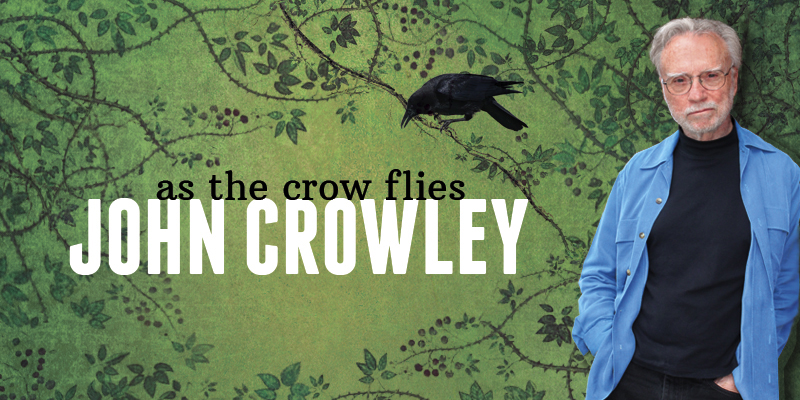
John Crowley (1942-2026)

11 August 2026 at 00:51

John Crowley, 83, died August 8, 2026.

John William Crowley was born December 1, 1942 in Presque Isle ME, where his father, a doctor and captain in the Army Air Corps, was stationed. The family moved several times until settling in Indiana in 1953. He earned an English degree from Indiana University in 1964 and moved to New York City and worked in photography and documentary film writing. Crowley became a freelance writer in 1966, married his wife Laurie Block in 1984 and had twin daughters, and began teaching fiction at Yale University in 1993.

Crowley’s first novel, SF The Deep, was published in 1975. He soon published Beasts (1976), Engine Summer (1979), and Little, Big (1981), his first published work of fantasy and perhaps his best-known work, once called “a neglected masterpiece” by critic Harold Bloom. The novel won a World Fantasy Award and a Mythopoeic Award and was a finalist for a Hugo Award, a Nebula Award, a BSFA Award, and a Seiun Award. He went on to write the highly ambitious Ægypt series, beginning with Ægypt (1987) and followed by Love & Sleep (1994), Dæmonomania (2000), and Endless Things (2007); and he wrote other standalones including The Translator (2002), historical novels Lord Byron’s Novel: The Evening Land (2005) and Four Freedoms (2009), Mythopoeic Award and Grand Prix de l’Imaginaire winner and Locus and World Fantasy Award finalist Ka: Dar Oakley in the Ruin of Ymr (2017), and Flint and Mirror (2022).

Crowley’s shorter fiction is also celebrated, most notably “Great Work of Time” (1991), a World Fantasy Award winner and Nebula Award finalist for Novella. He wrote Hugo and Nebula Award nominee “Snow” (1985) and Locus Award winner and Hugo and Sturgeon Memorial Award finalist “Gone” (1996). His short fiction has been published in F&SF, Omni Best Science Fiction, Interzone, and Asimov’s, and collected in World Fantasy Award-winner Novelty (1989), Antiquities (1993), Novelties & Souvenirs (2004), Totalitopia (2017), and And Go Like This: Stories (2019). Some of his non-fiction was gathered as In Other Words (2007) and Reading Backwards (2019). His work was the subject of critical study Snake’s-Hands: The Fiction of John Crowley, Michael Andre-Driussi & Alice K. Turner, eds. (2003).

Crowley’s numerous awards include an American Academy and Institute of Arts and Letters Award in Literature (1992) and a World Fantasy Life Achievement Award (2006).

For more, see his entry in the Encyclopedia of Science Fiction.

The post John Crowley (1942-2026) appeared first on Locus.

❌