(Photo illustration by Bill Kuchman/The Bulwark | Photos: Getty, Shutterstock)
ON SATURDAY AFTERNOON AT WRIGLEY FIELD, a 23-year-old named Joshua Báez stepped to the plate for the St. Louis Cardinals for the first time in his major-league career. The very first pitch he saw, he belted 449 feet into the center-field seats. That was in the first inning. In the fourth inning, he did it again, this time to the left-field bleachers. And then, impossibly, in the sixth, he did it a third time, to right field.
Three home runs in his first three major-league at-bats. No player in the long history of Major League Baseball had ever done that before. Báez drove in five runs as the Cardinals beat the Cubs, 8–4, and somewhere along the way, a baseball game in August became something people will remember.
I certainly will.
Maybe I am especially susceptible to baseball nostalgia at the moment because the “Field of Dreams” game had been played in Iowa last week, and my wife and I once again watched the 1989 movie that inspired it. Like many baseball fans, I’ve seen that film more times than I can count. And every time, James Earl Jones’s magnificent speech gets me: “The one constant through all the years, Ray, has been baseball.” America changes, he says, but baseball “has marked the time.”
For me, that time has been marked by being a fan of the team with the birds on the bat. I’ve been a Cardinals fan since I was a boy, and when I think about my life, I can mark parts of it by home runs.
I was listening on KMOX radio as a boy of 11 in 1964 when Ken Boyer hit his grand slam against the Yankees in Game 4 of the World Series, turning a 3–0 deficit into a 4–3 Cardinals victory. Three years later, Bob Gibson—my boyhood hero—did something that somehow seemed perfectly normal for Bob Gibson: He pitched a complete-game victory in Game 7 of the World Series at Fenway Park, struck out ten, and hit a home run, too.
By 1982, I was an Army officer, married with children, when rookie Willie McGee hit two home runs in Game 3 of the World Series—and robbed Milwaukee’s Gorman Thomas of one. Baseball had marked the time.
Then came Mark McGwire. Any baseball fan old enough to remember 1998 will recall the anticipation as he and the Cubs’ Sammy Sosa approached Roger Maris’s record of 61 home runs, and the explosion at Busch Stadium when McGwire’s number 62 barely cleared the left-field wall. Today we know much more about baseball’s steroids era, and that complicates the record. But it doesn’t erase the memory of that night—or the extraordinary summer when seemingly everyone was watching baseball, and the game had been reborn in American society.
Another unique event, and still a major-league record, happened in 1999 at Dodger Stadium: The Cards’ Fernando Tatís (senior) became the first—and still the only—player in Major League history to hit two grand slams in the same inning. Both came off the same pitcher, Dodgers starter Chan Ho Park.
Who can forget Albert Pujols, nicknamed “El Hombre” as a nod to Cards legend Stan “The Man” Musial from a half-century earlier. Albert was a master, but when he hit an almost unbelievable home run off Brad Lidge in Houston—two outs in the ninth, with the Cardinals facing elimination—he became a legend. The ball landed above the train tracks at Minute Maid Park. One of the most intimidating HRs I’ve ever seen. Then his three home runs in Game 3 of the 2011 World Series, a feat previously accomplished in the Series only by Babe Ruth and Reggie Jackson.
All Cardinals fans remember David Freese’s two-out, two-strike triple in the ninth inning of a later game in that same 2011 World Series in which Pujols worked his magic. And then, in the eleventh inning, Freese came up again and this time drove the ball over the center-field wall, winning the game. Joe Buck’s call echoed his father’s famous 1991 World Series call: “We will see you tomorrow night.” The Cardinals won Game 7 and their eleventh championship.
There have been so many other great memories. Fan favorite Adam Wainwright homering on the first pitch of his first major-league at-bat at the start of a masterful pitching career. Yadier Molina breaking a ninth-inning tie against the Mets in Game 7 of the 2006 NLCS. Pujols—who had left the Cardinals for the Angels—returning in 2022 for one final, magical season and reaching 703. Each is connected in my mind not simply with where the ball landed but with where I was in life when it did. Like the changing of the seasons, like the birthdays and anniversaries and holidays that dot the calendar, the pacing of baseball—the pitches and outs, the games and series, the seasons and careers—mark a life over time.
That’s the magic of Field of Dreams, too. The movie isn’t really about Shoeless Joe Jackson, or a crazy ballfield in an Iowa cornfield, or even, ultimately, baseball. It’s about fathers and sons, growing older, memory, reconciliation, and the things that somehow remain constant while everything in America changes.
Saturday, Joshua Báez added another marker.
I don’t know what kind of career he will have. That’s another of the beautiful things about baseball: There are no guarantees. But I know that decades from now, some Cardinals fan will remember the Saturday afternoon at Wrigley when a 23-year-old rookie, making his major-league debut, swung at the first pitch he ever saw—and started making history.
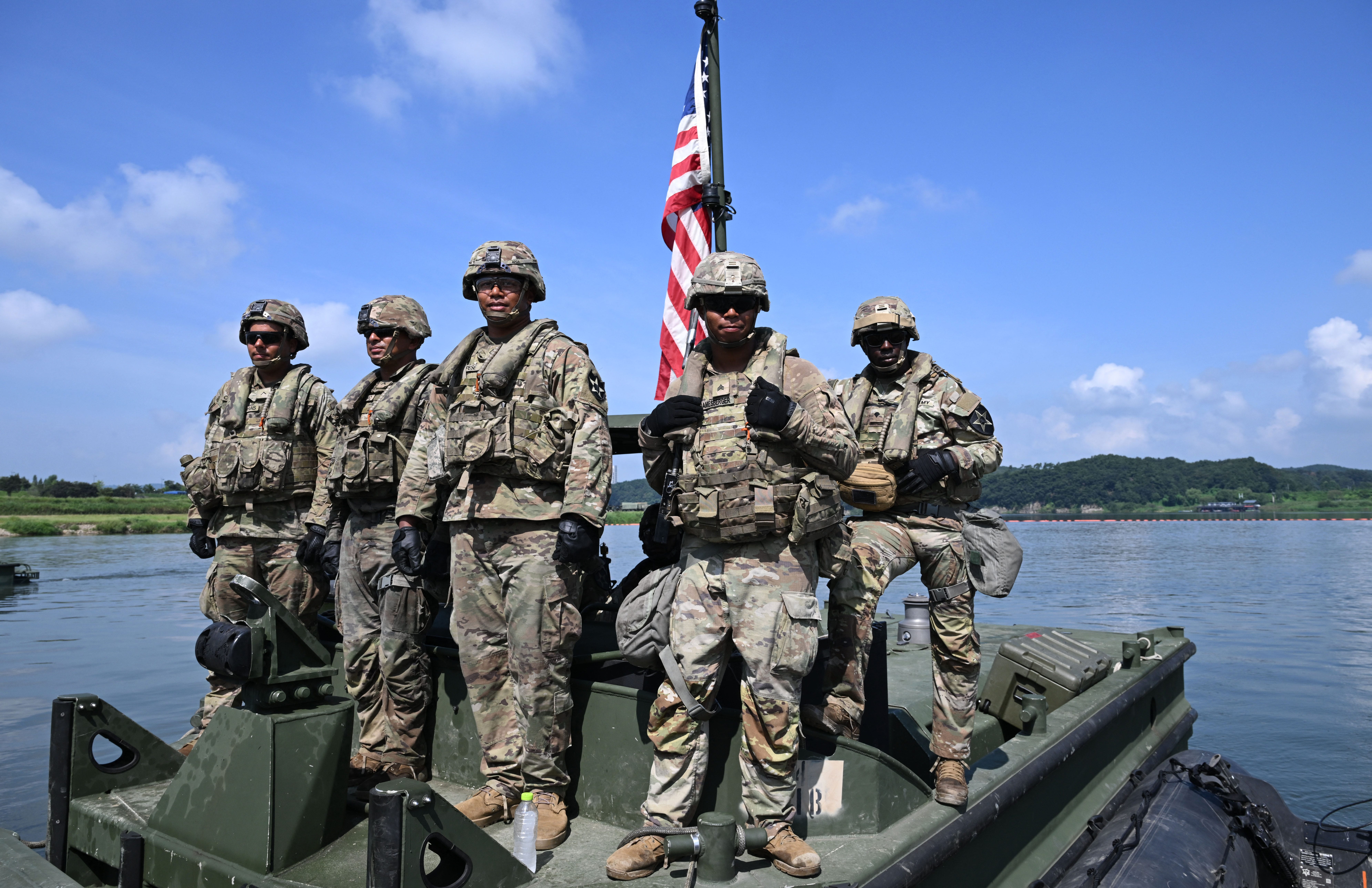
U.S. soldiers stand on a boat connected to a floating bridge during a South Korea–U.S. combined river-crossing drill as part of the annual Ulchi Freedom Shield military exercise in Yeoju on August 27, 2025. (Photo by Jung Yeon-je/AFP via Getty Images)
PRESIDENT DONALD TRUMP announced Sunday that he had instructed Defense Secretary Pete Hegseth to substantially reduce U.S. military exercises with South Korea, just as American and South Korean forces were preparing to begin one of their most important annual training events. Trump complained about the cost, suggested the exercises were unnecessarily provocative toward North Korea, and, astonishingly, connected his decision to South Korea’s refusal to support his administration’s effort to denuclearize Iran.
It is difficult to imagine a more thorough misunderstanding of the purpose of a military exercise—or an alliance.
The annual Ulchi Freedom Shield exercise begins Monday—otherwise Trump suggested he might have canceled this year’s event. But his direction raises questions about future exercises and, more importantly, about his understanding of why American forces train with allies. These exercises aren’t diplomatic favors Washington grants. They are part of the preparation required to deter—and, if necessary, defeat—an attack by North Korea.
The Korean Peninsula remains one of the most dangerous military environments in the world. About 28,500 American troops are stationed in South Korea, facing a North Korean regime with a massive conventional military, nuclear weapons, sophisticated ballistic missiles, and forces that have gained recent battlefield experience alongside Russia in Ukraine. North Korea continues testing missiles and improving its nuclear capabilities while repeatedly threatening South Korea and the United States. That’s why generations of American soldiers have trained in Korea—including me.
Come for the hot takes. Stay for the sharp analysis and insightful commentary. Or vice versa!
IN THE LATE 1990s, I commanded an Army brigade at Fort Lewis, Washington, now Joint Base Lewis-McChord. Our brigade was part of the reinforcement plan for the 2nd Infantry Division in case war broke out on the Korean Peninsula. That mission meant much more than putting soldiers and equipment on airplanes and ships and deploying them west across the Pacific. We had to understand how we would get there, what we would do when we arrived, and how we would fight alongside the South Korean forces already defending their country.
We repeatedly rehearsed the enormously complicated logistical undertaking of moving an armored brigade 5,000 miles across the Pacific and unloading our equipment at the ports, and we practiced gunnery and maneuver on Korean ranges and training areas. We designed our missions around the Korean terrain—dominated by mountains with tight maneuver corridors, speckled with dense population centers, connected by limited road networks—and even the extremes of Korean weather.
But some of the most valuable training involved something harder to measure on a readiness chart: learning how to operate with our Korean allies.
American and Korean soldiers have different languages, military traditions, equipment, procedures, and ways of approaching problems. Those differences don’t disappear when governments sign a treaty. They must be worked through on training fields, in command posts, during planning sessions, and through repeated exercises. We learned how Korean commanders operated, and they learned how we operated. We developed relationships that allowed soldiers and leaders to understand one another before people were shooting at them.
The Korean Augmentation to the United States Army program was particularly important. Korean soldiers (“KATUSAs”) served inside American formations, providing capabilities and cultural understanding while strengthening the bonds between the two armies. To Americans who served in Korea or trained with Korean forces, KATUSAs were fellow soldiers and part of our team, just as we were part of theirs.
That experience taught me something applicable to every military alliance: Interoperability doesn’t happen because politicians announce it. It must be practiced.
Exercises and training expose what doesn’t work. Communications systems fail to connect. Logistics plans prove unrealistic. Units arrive late. Intelligence doesn’t move quickly enough between headquarters. Ammunition, fuel, maintenance, medical support, and transportation become bottlenecks. Commanders discover that assumptions made while looking at maps don’t hold up when they meet actual terrain. It’s far better to discover those problems during an exercise than under a North Korean artillery barrage.
Today’s American–South Korean military relationship is even more integrated than it was when my brigade trained for Korea. The 2nd Infantry Division is now the 2nd Infantry Division/ROK-U.S. Combined Division, the Army’s only multinational division. American and Korean forces operate through command arrangements refined over decades, and their mission is captured in the phrase familiar to virtually every American soldier who has served on the peninsula: “Fight Tonight.”
That’s not just a slogan. North Korean artillery, missiles, special operations forces, cyber capabilities, and nuclear weapons don’t allow for the luxury of spending several weeks figuring out command relationships after a crisis begins.
That is why exercises such as Ulchi Freedom Shield matter. They rehearse command and control, intelligence, logistics, maneuver, air and missile defense, medical support, cyber operations, and reinforcement. Increasingly, they also address drones, GPS jamming, electronic warfare, and other aspects of a rapidly changing battlefield.
TRUMP HAS LONG VIEWED these exercises differently, describing them as expensive and provocative. Following his 2018 Singapore summit with Kim Jong Un, his administration suspended the old exercise, Ulchi Freedom Guardian, and curtailed other exercises in hopes that reducing American military activity would encourage progress toward denuclearization. It didn’t. North Korea continued developing nuclear weapons and increasingly sophisticated missiles.
Sometimes modifying an exercise makes strategic sense. Military exercises send signals, and presidents can adjust those signals as part of diplomacy. If reducing or postponing an exercise produces a meaningful and verifiable security concession from an adversary, that is legitimate statecraft.
But that isn’t what Trump announced Sunday. Instead, he connected military readiness on the Korean Peninsula to South Korea’s unwillingness to support an American policy toward Iran. That transforms an important military exercise from an instrument of deterrence into a political bargaining chip.
South Korea is an ally, not an American subcontractor. Allies share interests, but they don’t always share policies. Seoul has its own political considerations, regional security concerns, and responsibilities to its citizens. Washington can disagree with a South Korean decision concerning Iran without threatening military cooperation necessary to deter North Korea.
The danger extends beyond Seoul. Japan, Australia, and all our allies around the world will watch how the United States treats South Korea. China and Russia will watch, too. And Kim Jong Un will watch most carefully of all, because deterrence depends not simply on American military capability but on an adversary’s belief that the alliance confronting him is capable, prepared, and politically cohesive.
Trump often says America has the greatest military in the world, and in many respects he is right. What he doesn’t seem to understand is how that military became so capable.
Military effectiveness comes from people knowing how to fight under extraordinary pressure. It comes from commanders and staffs practicing difficult missions, pilots flying complex sorties, sailors providing a logistics lifeline to an ally’s peninsula, soldiers conducting gunnery and maneuver training, maintenance crews keeping equipment functioning, and logisticians figuring out how to move fuel, ammunition, spare parts, and medical supplies across oceans. When America expects to fight alongside allies, it trains with those allies until cooperation becomes routine.
That was what our brigade was doing more than twenty-five years ago when we practiced deploying from Fort Lewis to Korea. We weren’t preparing because we wanted a war with North Korea. We were preparing because being ready was one of the best ways to prevent a war. We wanted North Korean commanders to understand that if they attacked south, American reinforcements would be standing strong next to their Korean counterparts. We would arrive knowing the mission, understanding the command structure, and prepared to fight alongside an ally with whom we had already trained.
America does have an extraordinarily capable military. But military excellence isn’t an inheritance that automatically passes from one administration to another. It must be rebuilt every day through training, maintenance, logistics, discipline, leadership, and exercises that cost money and inevitably create friction with potential adversaries.
The purpose of Ulchi Freedom Shield isn’t to make Kim Jong Un comfortable; it is to convince him that starting a war would be a catastrophic mistake. If Trump wants to keep boasting that America has the best military in the world, he needs to understand what made it that way.
(Photo illustration by Bill Kuchman/The Bulwark | Photos: Getty, Shutterstock, Creative Commons)
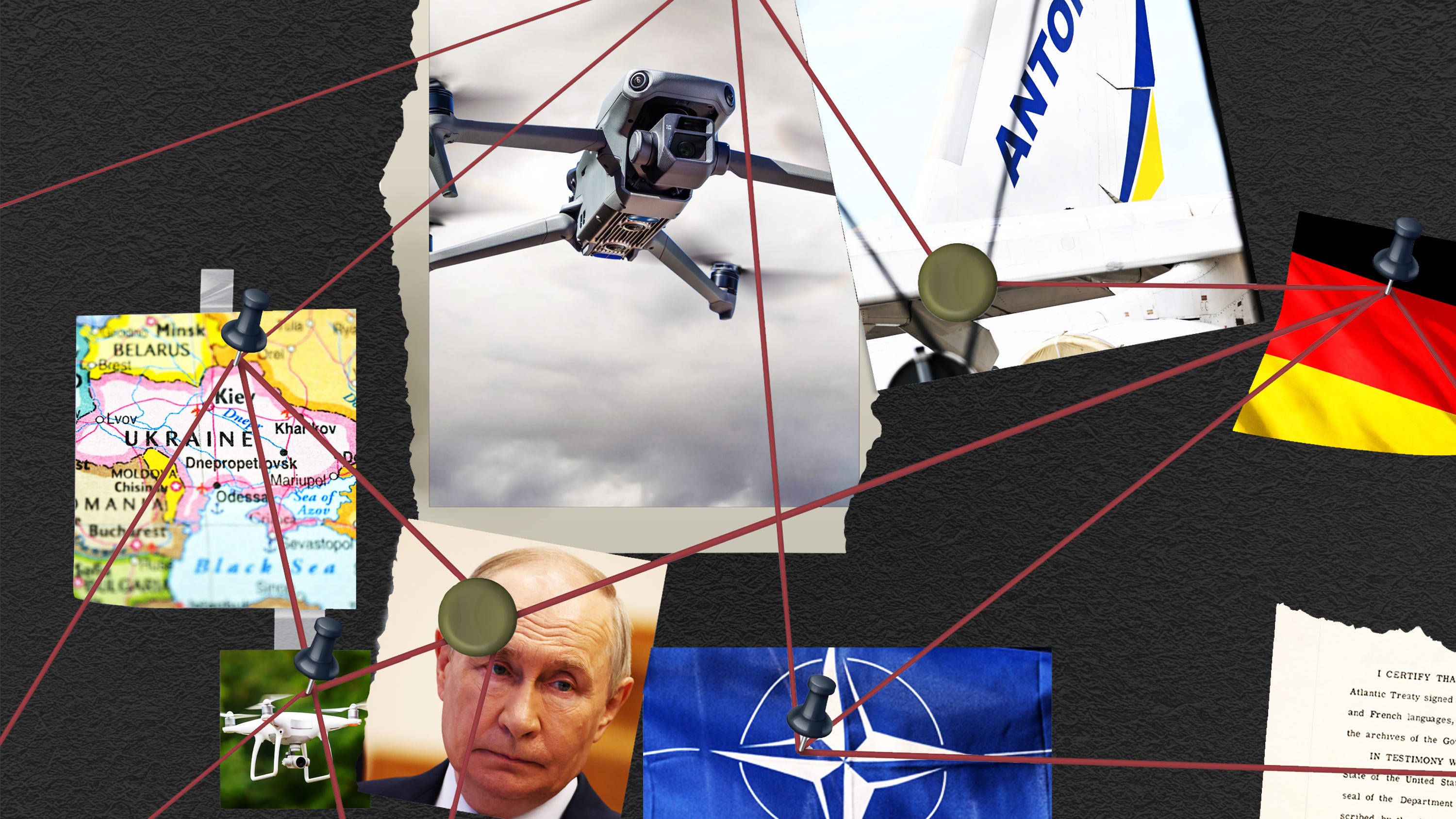
LAST WEEK, A BUS DRIVER AT Leipzig/Halle Airport in Germany briefly became a ninja warrior. He saw a drone buzzing around a Ukrainian An-124 cargo plane, and in a feat of inadvisable athleticism, kicked it out of the air. Whether or not he knew it at the time, that man’s quick thinking and fast feet may have changed the fate of the world.
Leipzig/Halle is one of Europe’s largest cargo hubs and an important node in the logistics network connecting European industry, transportation, and military operations. It has also become an operating base for Antonov, the Ukrainian firm that designs, builds, and operates heavy transport aircraft, since Russia’s full-scale invasion forced much of the company’s operations out of Ukraine. The aircraft at the center of the story is an Antonov An-124 Ruslan, one of the largest cargo airplanes anywhere in the world; it carries roughly 120 tons of cargo and can accommodate outsized equipment too big for most military transports. There are only fifty-seven of the type anywhere in the world, and NATO relies on the An-124 for its Strategic Airlift International Solution, or SALIS, a program that provides allies access to strategic transportation. Leipzig/Halle sits at the center of that arrangement.
When authorities examined the downed drone in Leipzig and found it was carrying explosives, German federal prosecutors took over the investigation, and officials began examining whether the incident represented something far more consequential than an aviation security violation.
Support independent journalism that provides original reporting, sharp analysis, and honest commentary without tribalism or spin. Join Bulwark+.
The bus driver who kicked the drone might easily have been killed, or he might have accidentally detonated the explosives near the aircraft. In either of those cases, the incident might have precipitated an international crisis.
German authorities have not publicly established that Russia was responsible for the incident, though reports suggest the American intelligence community is more certain it was. But whoever sent the drone selected a location containing Ukrainian aircraft involved in the strategic transportation network supporting European security. That should get our attention, particularly since several European governments have openlywarned that Russia may test NATO resolve in the coming years—an assessment reportedly echoed by the American intelligence community. Leaders in the Baltic states and Poland have voiced increasing concerns about threats to energy systems, transportation networks, and other critical infrastructure. Latvian officials have warned specifically about the possibility of Russia indirectly testing NATO’s mutual defense commitment.
A conventional invasion would provide NATO with clarity: If Russian tanks cross the Polish border or troops enter Estonia, it would remove most of the questions about what had occurred and who was responsible. But hybrid attacks create the opposite effect. A warehouse burns, a railway switching station is sabotaged, or an undersea telecommunications cable is severed, or an explosive drone appears under the wing of a Ukrainian transport aircraft at a German airport—these types of events force political leaders to answer tough questions: What happened? Who did it? Can responsibility be proved? Was it criminal activity, terrorism, or state-directed sabotage? Or, perhaps most importantly, does it constitute an attack requiring a NATO response? The ambiguity is the objective.
JUST IMAGINE WHAT MIGHT HAVE HAPPENED if that bus driver had called in sick that day.
The drone detonates beside the An-124, igniting the aircraft and destroying it. Several German airport employees are killed and a dozen or more are seriously wounded. Leipzig/Halle suspends cargo operations while security forces search the airport for additional devices. (In actuality, the airport did shut down its runways for a few hours, and a “second flying object” struck another airplane, causing light damage.)
German authorities treat the incident as a counterterrorism investigation. Within forty-eight hours, German intelligence concludes with high confidence that the operation was planned or directed by Russian military intelligence. The German chancellor announces publicly that a Russian state organization deliberately attacked German territory, destroying an aircraft connected to NATO strategic transportation and killing German citizens. Germany would suddenly face a question far larger than the destruction of one airplane: Should Germany take the investigation and its political demands to Brussels for review by the other thirty-one members of NATO?
Article V of the North Atlantic Treaty is often discussed as though it were an automatic mechanism under which an attack on one NATO member instantly sends the alliance to war. It doesn’t work that way. The treaty considers an armed attack against one member an attack against all, but individual allies take whatever action they deem necessary, which may include the use of military force. NATO has acknowledged that significant cyber or hybrid attacks could reach the threshold of collective defense, but the difficult part is determining where that threshold lies.
Some allies might argue that a Russian intelligence operation killing German citizens and destroying an aircraft at a strategic logistics hub clearly qualifies. Others might urge restraint, fearful that invoking Article V over a covert drone operation could begin an escalatory process no one could control. Some would no doubt want to see conclusive intelligence linking Russia to the attack, but the allies in possession of that intelligence might not be willing to share all the details of how they know what they know. Germany might instead request Article IV consultations, a process that allows countries to share intelligence, evaluate future risks, and plan joint strategies to address the situation in anticipation of future escalation. Washington could seek additional intelligence before supporting a more forceful response. Each of these positions would have a reasonable argument behind it, and that is exactly what makes conducting such operations attractive to Moscow, Beijing, Tehran, and others.
The An-124 might be the physical target, but NATO cohesion could be the real objective. Suppose German attribution is convincing, several Germans are dead, and the aircraft is destroyed, but NATO decides not to treat Leipzig as an Article V attack. The alliance would not suddenly disappear. NATO headquarters would remain in Brussels, American forces would still be stationed across Europe, and alliance exercises would continue. But something fundamental would have changed.
Governments in Estonia, Latvia, Lithuania, Poland, and Finland would immediately ask what kind of Russian attack would trigger collective defense. If a state-directed attack killing NATO citizens at a strategically important facility did not qualify, where was the line? Ten deaths? Twenty? A sabotaged ammunition depot? An electrical grid disabled during a Baltic winter?
Deterrence depends not merely on capability but on an adversary’s perception of political will. Once Moscow concluded that a gap existed between NATO’s treaty commitments and what the various members’ governments were prepared to enforce, the Kremlin would have every reason to probe that gap again. Each subsequent attack could be slightly more damaging, calibrated to remain just below whatever threshold NATO had demonstrated it was reluctant to cross.
There is another possible response, however, and it might represent a serious Russian miscalculation. Europe might not become more cautious. It could become much more aggressive in supporting Ukraine. Poland and the Baltic countries could conclude that the best way to defend themselves was to help Ukraine destroy more Russian military capability before it ever reached NATO territory. Governments could increase deliveries of long-range missiles, drones, air defenses, and ammunition, while accelerating their own defense production and expanding intelligence cooperation with Kyiv. They might even consider supplying their own armed forces to contribute to the Ukrainians’ fight.
Russia might then increase sabotage and cyber operations against the European logistics architecture supporting Ukraine—the ports, railroads, warehouses, airports, and maintenance facilities by which weapons travel from around the world to Ukraine.
The danger is that escalation would not necessarily remain confined to Europe. With the United States and Europe distracted, Tehran might see an opportunity to intensify its own pressure against American forces and interests. Iranian-backed groups increase operations elsewhere, and the Houthis step up attacks in the Red Sea. A Houthi attack strikes a French frigate and kills sailors while Germany is still wrestling with the aftermath of Leipzig. France has casualties at sea while Germany has casualties at home. Poland and the Baltic states are demanding a stronger response against Russia, and Washington is trying simultaneously to contain escalation in Europe and sustain a costly military operation in the Middle East. The situation becomes even more complicated because Saudi Arabia, Turkey, and Pakistan have just entered a new mutual-defense arrangement. Turkey is already a NATO member, while Saudi Arabia faces continuing threats from the Houthis and Iran, and nuclear-armed Pakistan is now in theory responsible for the defense of both countries. If attacks spread to Saudi territory, Ankara could find itself navigating overlapping commitments at precisely the moment NATO is debating how to respond to Moscow.
At the same time, China could announce new air and naval exercises that completely surround Taiwan, raising the prospect of a blockade without actually announcing one. With Washington distracted, America’s Pacific allies struggle to coordinate, and no one challenges the Chinese until it’s too late.
WE TEND TO IMAGINE MAJOR WARS beginning when a leader consciously decides to launch one. History is often messier. Wars expand because one state attempts a supposedly limited action, another responds proportionately, a third sees an opportunity, proxy forces pursue their own interests, and alliance commitments gradually pull additional countries into the confrontation. Each individual decision appears rational while the cumulative result becomes catastrophic.
Ever since Herman Kahn illustrated multi-tiered paths to nuclear war in 1965, military professionals have often described escalation as a ladder, but it actually can look more like a web. Pull one strand at Leipzig and something moves in Tallinn. Increase support to Ukraine and calculations shift in Moscow. Tehran sees Washington distracted and presses its advantage. An attack in the Red Sea changes decisions in Paris. Those decisions affect Brussels, and Brussels affects what Moscow believes it can risk next.
None of this is a prediction about what will follow the Leipzig incident. But military planners conduct war games using precisely these kinds of scenarios because waiting until every hypothetical becomes reality is a poor way to prepare for a crisis.
The significance of Leipzig is therefore not simply that an airport bus driver became an unlikely ninja warrior for a few seconds on a German runway. It is that those few seconds reveal the strange environment in which NATO deterrence now operates and in which global security is threatened or preserved. European leaders warning about a potential Russian attack may be describing something subtler than Russian armies crossing borders. The attack they fear could come as a series of limited actions deliberately designed to prevent anyone from ever identifying a single clear moment when peace became war.
Last week, perhaps through luck, technical failure, or one extraordinarily brave airport employee, NATO did not have to answer that question. We should not assume the next bizarre operation by a malign actor fomenting a crisis will give us the same luxury.
If you read all the way to the end of this article, you’re probably one of us. Sign up for a free or paid Bulwark subscription:
Andrew Egger and Lt. Gen. Mark Hertling (Ret.) give their takes on Iran’s sweeping new demands, Trump’s response, and why the prospects for a diplomatic deal are fading. They discuss Trump’s shrinking military options, depleted U.S. weapons supplies, and the ongoing crisis in the Strait of Hormuz that's left merchant crews trapped at sea for months.
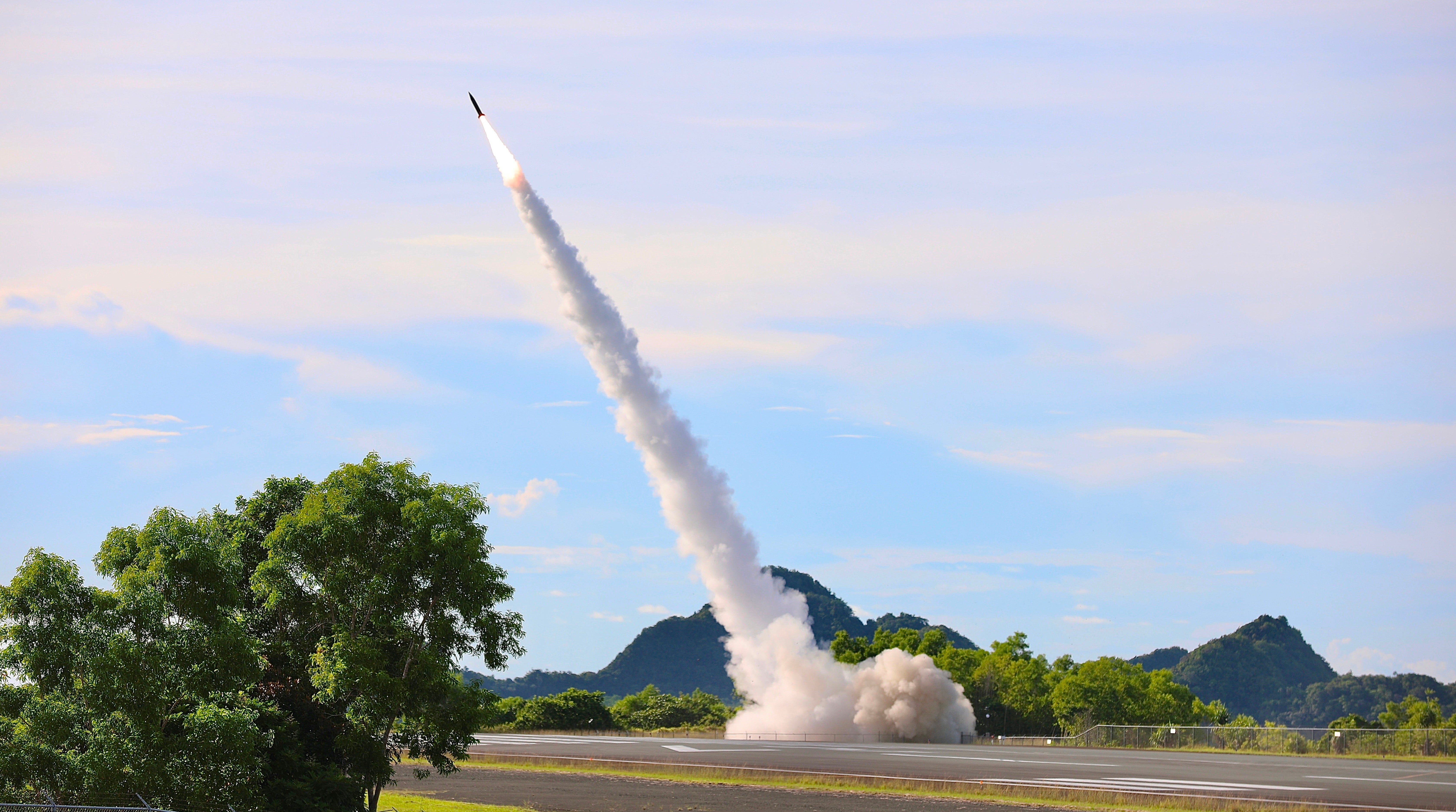
A Precision Strike Missile is launched in June 2024 during a joint live-fire exercise in Palau that marked the first use of a PrSM outside the United States. (Photo by Sgt. Perla Alfaro, U.S. Army)
FOR GENERATIONS, SENIOR MILITARY officers attending professional military education have been taught a simple but enduring truth: Logistics establishes the art of the possible. No commander can conduct operations without the fuel, ammunition, and other resources needed to sustain the fighting force. Napoleon learned it. Eisenhower mastered it. Every successful military campaign has depended as much on logistics as on tactical brilliance.
That principle has not changed, but modern warfare has evolved and added another dimension. Today, inventories of long-range precision strike weapons and advanced missile-defense interceptors increasingly establish the art of the possible, as well. They determine how far a commander can reach, how effectively American forces can defend themselves and their allies, and ultimately how much risk servicemen and women must assume in combat. Precision has fundamentally changed the character of war, but in doing so created a new dependency. When those specialized inventories of weapons are constrained, the tremendous advantage that the precision technological revolution provides—the ability to put distance between friendly forces and the enemy—begins to shrink.
Recent operations against Iran have demonstrated both the extraordinary value of precision weapons and the extraordinary difficulty of replacing them.
President Trump has repeatedlyinsisted that he rebuilt America’s military and that the depleted munitions used to fight this war in Iran can be rapidly replaced because his administration is now building an unprecedented number of ammunition plants and factories. Defense Secretary Pete Hegseth has similarly dismissed concerns about degraded inventories, even while acknowledging that U.S. forces have conducted strikes on more than 15,000 targets during operations against Iran and have expended large numbers of missile-defense interceptors protecting American forces and regional partners from thousands of Iranian missiles and drones fired at their location.
These statements have received increased scrutiny from the public and the press—and that’s appropriate. Not because the United States lacks military strength, but because military capability, industrial capacity, and political credibility are inseparable. When leaders describe one inaccurately, confidence in the others suffers. And our leaders have been describing our capability inaccurately.
Support our independent political and cultural journalism by signing up for a free or paid Bulwark subscription.
THE ISSUE IS NOT that the American military is running out of ammunition. It is not. The United States maintains enormous inventories across thousands of categories of conventional munitions. But there is a far narrower and far more consequential concern. Modern campaigns rely disproportionately on a relatively small family of sophisticated weapons that provide capabilities conventional ammunition simply cannot replicate. Long-range precision strike missiles allow commanders to destroy critical sites like command posts, logistics hubs, missile batteries, and other targets hundreds of miles from friendly forces. In defense, interceptors destroy incoming aircraft, missiles, and drones before they can strike. These systems are not interchangeable with artillery shells or unguided rockets.
I saw the beginning of that evolution firsthand during Operation Desert Storm in 1991. When intelligence identified an Iraqi artillery battalion threatening the advance of our units, destroying it generally required a massed artillery attack. A battalion of Multiple Launch Rocket Systems (MLRS)—the predecessor to today’s long-range precision strike capabilities—would fire dozens of rockets that would cover an area the size of a football field with a targeted strike. Airpower could accomplish similar effects, but doing so entailed a host of complications—pilots, aerial refueling, electronic warfare support, suppression of enemy air defenses, and careful coordination among multiple headquarters. We could achieve the desired effect simply by concentrating large amounts of firepower from the MLRS strike.
That equation changed dramatically over the next three decades. The Army introduced ATACMS, a short-range tactical ballistic missile that allowed a single launcher to strike targets nearly two hundred miles away with remarkable precision—within feet of the point of aim. Today’s Precision Strike Missile (PrSM) extends that reach even farther while maintaining the accuracy. A single PrSM round accomplishes what once required an entire MLRS battalion firing a volley of rockets.
The technological revolution behind precision munitions allowed commanders the ability to attack vital targets deep inside hostile territory without exposing aircraft or ground maneuver forces to unnecessary risk. It is the kind of tactical evolution that each war brings when new technology is applied to the battlefield.
Military technological innovation has consistently sought one objective: increasing the distance between friendly forces and the enemy (while maintaining the ability to destroy that enemy more effectively). A suit of armor puts distance and protection between the human body and a foe’s blade. The longbow extended striking distance beyond the sword or spear. Rifled bullets extended the range and accuracy of the musket ball. Aircraft extended strikes beyond the range of artillery, and precision-guided missiles extended it farther still. Every advance sought the same outcome: strike the enemy at greater distance before he could strike you. Precision weapons became the latest expression of the centuries-long evolution of warfare.
But every technological advance creates new dependencies. Precision substitutes quality and accuracy for quantity. While a single PrSM may accomplish what once required an entire MLRS battalion firing dozens of rockets, each missile becomes far more strategically valuable—and also much more difficult and expensive to build. When inventories of those weapons become constrained, commanders cannot simply substitute conventional ammunition and expect similar results. They either employ larger numbers of less capable weapons (and with them, the increased logistical demands), or they accept that some targets will survive until friendly forces can move closer.
In Iraq, a longtime friend once described close combat associated with the counterinsurgency we were fighting as getting “coffee-breath close” to the enemy. The colorful phrase captures something true about warfare. Every precision strike conducted at distance is one less enemy position American soldiers have to assault at close range. Every command post eliminated deep behind enemy lines with precision disrupts the coordination of those who would otherwise be fighting face-to-face with American troops. But when our long-range precision or “deep strike” capabilities diminish, that protective distance erodes. More missions fall to ground maneuver forces, and history suggests that when armies get coffee-breath close, casualties rise significantly.
The same principle applies defensively. Interceptors do far more than protect installations. They preserve operational freedom by allowing commanders to keep airfields open, ports functioning, logistics hubs moving, and headquarters operating despite missile attack. When these interceptors are depleted or constrained because of another evolution of warfare—massed drones or enemy ballistic missiles—commanders must decide which facilities receive protection, which allied bases assume greater risk, and which critical capabilities must be relocated farther from the fight. Shrinking inventories of U.S. air defense, like the very expensive Patriot or the even more expensive THAAD interceptors, again translates into shrinking distance between the battlefield and those we are trying to protect.
NONE OF THIS SUGGESTS the United States is defenseless. Far from it. The question is whether our nation can sustain the specialized capabilities upon which our force increasingly depends. Thousands of long-range strikes against Iran and thousands of defensive interceptions represent an enormous expenditure of our precision weapons. The exact inventories remain appropriately classified, but the operational reality is obvious: Every missile launched must eventually be replaced, and these kinds of weapons are very difficult to replace.
That brings us back to logistics and our defense industrial base.
The administration is correct that the Pentagon is working to replenish expended inventories. Congress has been asked for substantial appropriations for additional munitions procurement. Defense contractors are increasing production rates by negotiating long-term contracts intended to provide greater manufacturing stability. These necessary initiatives should not be confused with being able to rapidly replace the capabilities consumed during sustained combat operations.
Publicly available evidence does not support the claims of the president and secretary of defense about munitions and defense production. The administration may have held meetings with defense executives in the White House, and there has been some expansion of capacity within existing defense-industry factories, but we have yet to see a corresponding wave of publicly documented new facilities or related delivery of replacement weapons.
That distinction matters because manufacturing precision-guided missiles is fundamentally different from producing conventional ammunition. Our advanced precision systems rely upon rocket motors, seekers, guidance electronics, specialized software, precision machining, and highly specialized subcontractors that are spread throughout an intricate industrial network. At every stage, each component must meet exacting standards. A shortage of a single critical component from within a complicated supply chain can delay an entire production line. Constructing an entirely new missile-production facility requires a dizzying array of contracts, tooling, staffing, training, and years of integration before reaching efficient production. The administration cannot simply announce industrial mobilization. It must be built.
Independent defense analysts conclude that rebuilding our precision weapon inventories will likely require years because the existing defense industrial base was never designed to—and has yet to adapt to—sustain prolonged expenditures at the scale modern warfare is demanding.
The strategic consequences of this reality extend well beyond the Middle East. Reports that Patriot and THAAD interceptor batteries have been shifted from Europe and the Indo-Pacific to support operations in CENTCOM reflect the prioritization that occurs when a nation goes to war in a specific area. Yet every unit and its related ammunition moved into one theater is—temporarily—unavailable somewhere else for any other contingency. As we know, deterrence depends not only upon possessing advanced capabilities but also upon having enough to reassure allies and complicate the calculations of adversaries across multiple regions simultaneously.
It’s not a weakness to acknowledge these realities: it’s good planning. Every commander continuously assesses combat power, ammunition expenditures, logistics, replacement timelines, and future contingencies. Honest assessments allow sound strategy. Political narratives do not replenish inventories.
Precision has a price. It’s not measured only in millions of dollars per missile, but in every factor—the technological investment, the complex supply chains, the skilled workers, the procurement process, and the industrial capacity—that goes into their production. Most importantly, it is also measured in credibility. When political leaders insist that the expenditure of weapons have produced no meaningful degradation in ammunition stocks, or they suggest that years of industrial investment can be compressed into months, they undermine confidence in both military preparedness and national leadership.
The War College lesson remains as relevant today as it was generations ago: Logistics establishes the art of the possible. In the twenty-first century, that art is also determined by the precision weapons that allow American forces to fight at distance and the industrial base capable of sustaining them. If that foundation erodes, the battlefield changes. The distance between American servicemen and women and the enemy begins to close—coffee-breath close. The American people know it by another name: sending more of our sons and daughters into harm’s way than should be necessary because our leaders didn’t plan well, and they didn’t adapt to the realities of the battlefield.
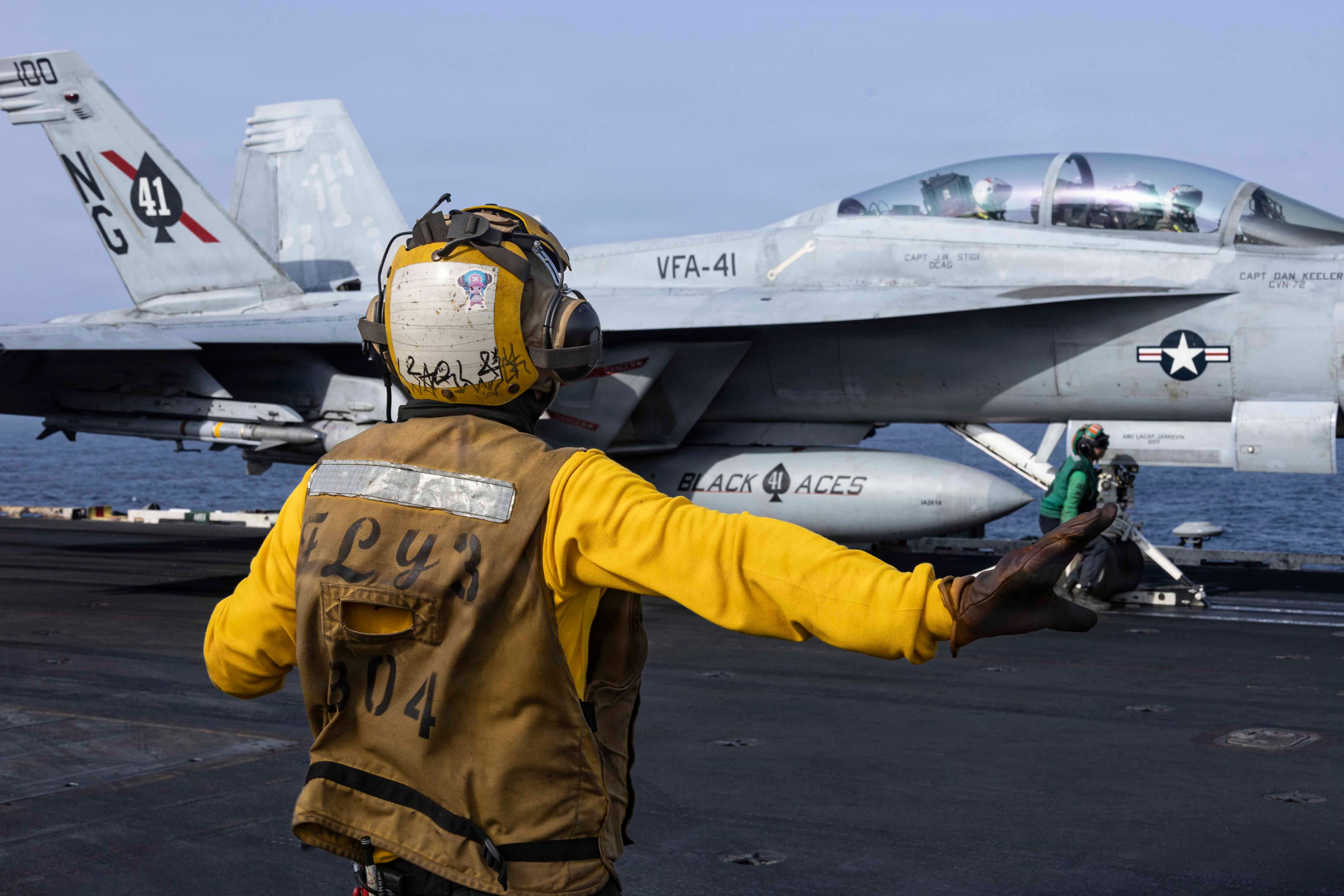
An F/A-18F Super Hornet preparing to launch from the flight deck of USS Abraham Lincoln on June 25, 2026. (Photo: U.S. Navy)
ACTING SECRETARY OF THE NAVY HUNG CAO traveled to San Diego to meet with families of sailors who are part of the USS Abraham Lincoln Carrier Strike Group. On Thursday night, he walked into a room filled with people who were angry, exhausted, frightened, and looking for answers about when their loved ones were coming home.
I know something about walking into that room.
In April 2004, the 1st Armored Division was preparing to return to Germany after a year in Iraq. Families had been counting the days; ribbons and ‘Welcome Home’ banners decorated our bases in Europe. The lucky soldiers who would be the first to leave were packing their gear and helicopters were receiving shrink-wrap. Then, by the time some of our troops had already been home a few days, came word that we would be extended in Iraq for an indeterminate number of months to counter the uprising of Muqtada al-Sadr’s militia. His group’s uprising was spreading across Baghdad and central Iraq, the security we had fought for over the last year was rapidly deteriorating, and the Pentagon believed we should stay to provide additional combat power.
Our twelve-month deployment would become fifteen months. Worse, because some units had already begun returning home, we had to recall back to Iraq roughly a third of our 20,000-person force that had already been reunited with their families in Germany.
In announcing the extension to our team, our division commander, Maj. Gen. Marty Dempsey, gathered his commanders. He told us something I have never forgotten. We could be disappointed, he said. We could even be angry. But we were leaders, and we had been given a new mission by the secretary of defense. Our responsibility was to explain that mission to our soldiers, prepare them for it, and lead them through it.
Then Marty gave me another mission that night: “We need to send a senior leader back to Germany to talk to the families. I want you to do it.” He kidded that it would likely be tougher than combat. To a degree, he was right.
Over three days, I traveled to the seven communities where our soldiers and families lived. At every stop, I walked into an auditorium filled with spouses and children who had expected their soldiers to be home within days or weeks. Instead, they had just been told that husbands, wives, fathers, and mothers would remain in combat for another few months.
When I arrived at the Ramstein airport, my wife was there to meet me. We hadn’t seen each other since the deployment began. After a hug, she gave me the best advice I ever received when talking to families.
Don’t tell them the mission demands their soldiers stay. They already know their soldiers have a mission.
Don’t tell them to be strong. They’ve already been strong for a year.
Don’t brief them on what the division is doing. They really don’t care about that.
Instead, listen to them and answer their questions until they don’t have any more questions to ask, and answer them honestly with what you know and don’t know.
So that’s what I did in all seven of those meetings. And the statements and questions began to flow.
One mother told me that she and her children had filled a jar with M&Ms—one for every day remaining in the deployment. Each night, the children removed one. The jar was almost empty. Now, she asked, what was she supposed to tell them? What was she supposed to do?
A young teenage girl told me she had been waiting for her father to come home because she wanted him to take her to the father-daughter dance at her high school. He wasn’t going to make it, so who would take her?
A 19-year-old Army wife stood up and, with a mixture of anger and confusion, simply said she had married her soldier right before they came to Germany, and he left for Iraq right after they arrived. She’d been making her way so far with the help of the other wives, but now she didn’t understand what was happening. She wasn’t interested in hearing about operational requirements in Baghdad or the strategic implications of the Sadr uprising. She wanted someone to explain why the Army had changed the bargain she thought it had made with her family, and she wanted her new husband home.
There were dozens of questions like those. Some were angry. Some were heartbreaking. A few couldn’t really be answered.
But something happened in those auditoriums. The anger didn’t disappear—nor should it have. Instead, it gradually changed into understanding and, finally, a reluctant acceptance of what their soldiers had been asked to do, and in turn what they had been asked to do. Not because I gave them a brilliant briefing. I didn’t. It happened because someone had come to listen to them, stood in front of them, and treated their fears as legitimate.
I THOUGHT ABOUT THOSE FAMILIES when I heard about the acting secretary of the Navy visiting the families of the Abraham Lincoln.
Their situation is, in many ways, much tougher than what faced us. The Lincoln left San Diego late last year for what was expected to be a normal deployment and was subsequently diverted to the Middle East and combat operations against Iran. Its crew eventually endured 208 consecutive days at sea without a port visit—a modern carrier record—and families now describe sailors dealing with broken toilets and laundry facilities, moldy showers, food shortages, limited supplies, and the grinding physical and psychological effects of months aboard a warship conducting never-ending combat operations.
An aircraft carrier may be one of the most impressive machines ever built, but it is still operated by human beings. Flight decks are extraordinarily dangerous workplaces even under normal conditions. Sailors work long shifts around jet engines, fuel, weapons, heavy machinery, electrical systems, nuclear propulsion, and aircraft launching and recovering day and night. Fatigue accumulates. Attention wanders. Judgment deteriorates. Small mistakes in that environment can become catastrophic ones. This is the human side of war.
That is what some Lincoln families now fear. They aren’t merely complaining that their sailors are tired. They are worried that prolonged stress, exhaustion, and enemy activity could eventually get their loved ones killed.
Cao, himself a retired Navy captain and combat veteran, deserves credit for going to face those families. But showing up is only the first requirement of leadership. The more important requirement is understanding what those families need when you get there.
They don’t need to be told their sailors are heroes. They already know that. They don’t need to be told the mission is important. They understand that better than most Americans. And they certainly don’t need to be told to be strong.
They need leaders to listen. They need honest answers about what the deployment is all about, why the deployment continues, what is being done to reduce the strain on the crew, and—if no one can tell them when their sailors are coming home—an honest explanation of why no one can tell them. Military families accept extraordinary burdens. But accepting those burdens doesn’t mean surrendering the right to ask hard questions of the people who impose them.
Twenty-two years ago, I learned that lesson in seven auditoriums across Germany. Sometimes the most important thing a senior military leader can do isn’t explain the mission. It’s stand in front of the people paying the price for it—and listen.
WHEN REPORTS EMERGED LAST WEEK that hackers had penetrated water systems across multiple American states, public attention immediately turned to the question of responsibility. Was it Iran, Russia, China, or—as President Trump wildly suggested—Democrats within the affected states? While Iranian-affiliated cyber actors are widely considered the leading suspects, federal investigators have yet to make a formal attribution. More importantly, so far there is no evidence that drinking water has been contaminated or that public health has been endangered. What the attacks did demonstrate, however, was that malicious actors have the capacity and, at times, desire to compromise the operational systems that control essential public infrastructure.
Yet the greatest significance of these attacks lies not in their novelty but in their familiarity. For those who have spent careers in the military or national security space, the reports were unsurprising: The attacks represent precisely the kind of threat that American strategists and analysts have anticipated for more than two decades. Long before cyberwarfare entered the public vocabulary, successive administrations, military planners, and allied governments repeatedly warned that America’s greatest vulnerabilities would not necessarily be found on distant battlefields but at home, embedded within the civilian infrastructure that underpins modern society.
That conclusion has appeared consistently in a range of national security planning documents, in various threat assessments by all agencies, and within the National Cybersecurity Strategy. The specific language has evolved over the years, but the underlying assessment has remained strikingly consistent. America’s critical infrastructure—including energy grids, communications systems, transportation networks, financial institutions, health care ecosystems, pipelines, and water systems—would become targets for adversaries seeking strategic advantage while avoiding direct military confrontation. These systems support every other element of national power while often remaining lightly defended compared with traditional military targets, which makes them soft targets.
Within the military, recognizing this has fundamentally changed how campaigns are planned. Leaders no longer view cybersecurity as a technical specialty to be delegated to communications experts after operational plans have been completed. Instead, it has necessarily become an integral part of campaign design from the outset. While joint doctrine describes offensive cyberspace operations, defensive cyberspace operations, and the operation of the Defense Department’s own information networks as distinct missions, commanders tend to think about cyber in broader operational terms. More and more, however, the military integrates cyber capabilities into comprehensive campaigns in which diplomacy, intelligence, economic pressure, information operations, and military force are all synchronized to achieve strategic objectives. Cyber has become another asymmetric capability available and integrated into virtually every modern campaign plan rather than treated as a supporting specialty.
Some cyber operations are conducted independently to collect intelligence, penetrate networks, or create strategic effects without employing conventional military force. Others directly support combat operations by disrupting the enemy’s command-and-control systems, logistics networks, air defenses, or communications, thereby allowing friendly aircraft, ships, and ground forces to maneuver inside the disrupted space.
The strategic evolution of cyber operations reflects a broader truth about contemporary conflict: Adversaries no longer need to destroy a nation’s military to impose real strategic costs; they can instead undermine the systems upon which civil society itself depends. On the face of it, a water-treatment facility may appear to have little connection to national defense until one considers the cascading consequences of disabling it. Hospitals rely upon clean water. Fire departments rely upon water (and water pressure). Manufacturing plants depend upon reliable municipal systems. Citizens expect government to provide potable water every day without interruption. Even a temporary disruption to that confidence forces governments to divert resources, commands attention at the highest political levels, and reminds the public that essential services are more fragile than they are believed to be. The strategic objective is often less about physical destruction than about eroding confidence and trust in government and its institutions. A cyber attack that causes the public to question its drinking water, for example, becomes psychological as much as operational.
Support our independent political and cultural journalism by snagging a Bulwark+ membership:
WHILE SERVING AS CHIEF OF OPERATIONS for U.S. Army Europe nearly twenty years ago, I was present as Estonia experienced what many military professionals now regard as the opening chapter of modern strategic cyberwarfare. In April 2007, the Estonian government decided to relocate a statue called the Bronze Soldier, a Soviet war memorial in central Tallinn that many ethnic Estonians viewed as a symbol of decades of Soviet occupation. The decision ignited protests and diplomatic outrage from Moscow, and, within days, a wave of coordinated cyber attacks unlike anything the world had previously witnessed.
The attacks targeted far more than government websites. The Estonian parliament, ministries, banks, newspapers, broadcasters, telecommunications providers, and other essential services found themselves overwhelmed by distributed denial-of-service (DDOS) attacks that flooded networks with malicious traffic. Financial transactions slowed or stopped. News organizations struggled to communicate. Government agencies found it difficult to provide public services. Emergency communications were affected. It wasn’t war. Nothing exploded, no missiles crossed the border, and no Russian armored columns rolled toward Tallinn. Yet millions of Estonians experienced something deeply unsettling all the same: the realization that a hostile power had found a way to disrupt the daily life of an entire society without firing a shot.
These attacks were particularly acute because of their target. In 2007, only sixteen years had passed since Estonia had regained its independence from the Soviet Union. During that short period, the country had reinvented itself as one of the world’s most digitally advanced democracies. Citizens filed taxes online, voted electronically, managed financial transactions digitally, and embraced technology as a symbol of both national progress and independence from Moscow. The cyber attacks struck at Estonia’s confidence in the very institutions that had defined its remarkable post–Cold War transformation. For many Estonians, the attacks felt less like electronic vandalism than a reminder that geography alone could no longer protect sovereignty.
Rather than retreating from the digital frontier, Estonia invested more deeply in resilience (as well as other counterintelligence programs). Estonian planners redesigned networks with redundancy in mind. Government agencies strengthened partnerships with private industry and facilitated cybersecurity education throughout society. Reserve cyber capabilities were developed. Estonia shifted the emphasis from an impossible goal of preventing every intrusion to an achievable one of ensuring that society could continue functioning despite them. Estonia understood that resilience—not invulnerability—was the true measure of national security.
NATO drew the same conclusion from the lessons of 2007. The alliance established the Cooperative Cyber Defence Centre of Excellence in Tallinn, where military officers, civilian experts, and researchers from across NATO now study cyber doctrine, conduct advanced research, and participate in multinational exercises. (I was proud to have later participated in one of those events as commander of U.S. Army forces in Europe.)
I HAVE WRITTEN REPEATEDLY in The Bulwark about the importance of the Cybersecurity and Infrastructure Security Agency here in the United States, about the value of Estonia’s whole-of-society resilience model, and about the growing disconnect between our strategic understanding of cyber threats and our willingness to sustain the institutions responsible for defending against them. Cybersecurity rarely commands public attention when it succeeds because successful cyber defense is measured largely by crises that never occur: The absence of headlines is evidence that the system is working.
No network can ever be made completely secure. The objective isn’t perfect defense but resilient defense—the ability to continue operating despite persistent attacks. That distinction has become important because our adversaries know they don’t need to destroy infrastructure to achieve strategic effects; they only need to convince citizens that they are vulnerable. An attack on water infrastructure will certainly do just that.
It is difficult to avoid the uncomfortable conclusion highlighted by the widely reported attacks last week. They aren’t a failure of imagination or intelligence. America’s security thinkers correctly identified the threat years ago. It’s been assessed, tracked, incorporated into plans, and publicly discussed. Allied nations like Estonia have demonstrated both the vulnerability and the solution. The problem has never been recognizing the danger. It has been sustaining the political will, institutional continuity, and long-term investment necessary to build resilience before a crisis forces our attention.
It’s an old military adage that generals often prepare to fight the last war. The greater danger today may be that democratic societies remember the last cyber attack only until the next crisis arrives. Strategic documents are written, conferences are held, after-action reports are published, and warnings are issued. But then budgets tighten, institutions are reorganized, priorities shift, and the urgency gradually fades. The result is strategic amnesia.
This reported attack—no matter who conducted it—should remind us that cyberwarfare is not a future threat. It is part of the operational environment in which every modern democracy must function. Professionals in the military, intelligence agencies, and national security have long understood this reality. The question is whether we as a nation possess the strategic discipline to defend and protect the approach that we must take. That, more than the identity of this week’s attackers, will determine how well prepared we are for the next campaign that arrives not with bombs or missiles, but through the networks that sustain our daily lives.
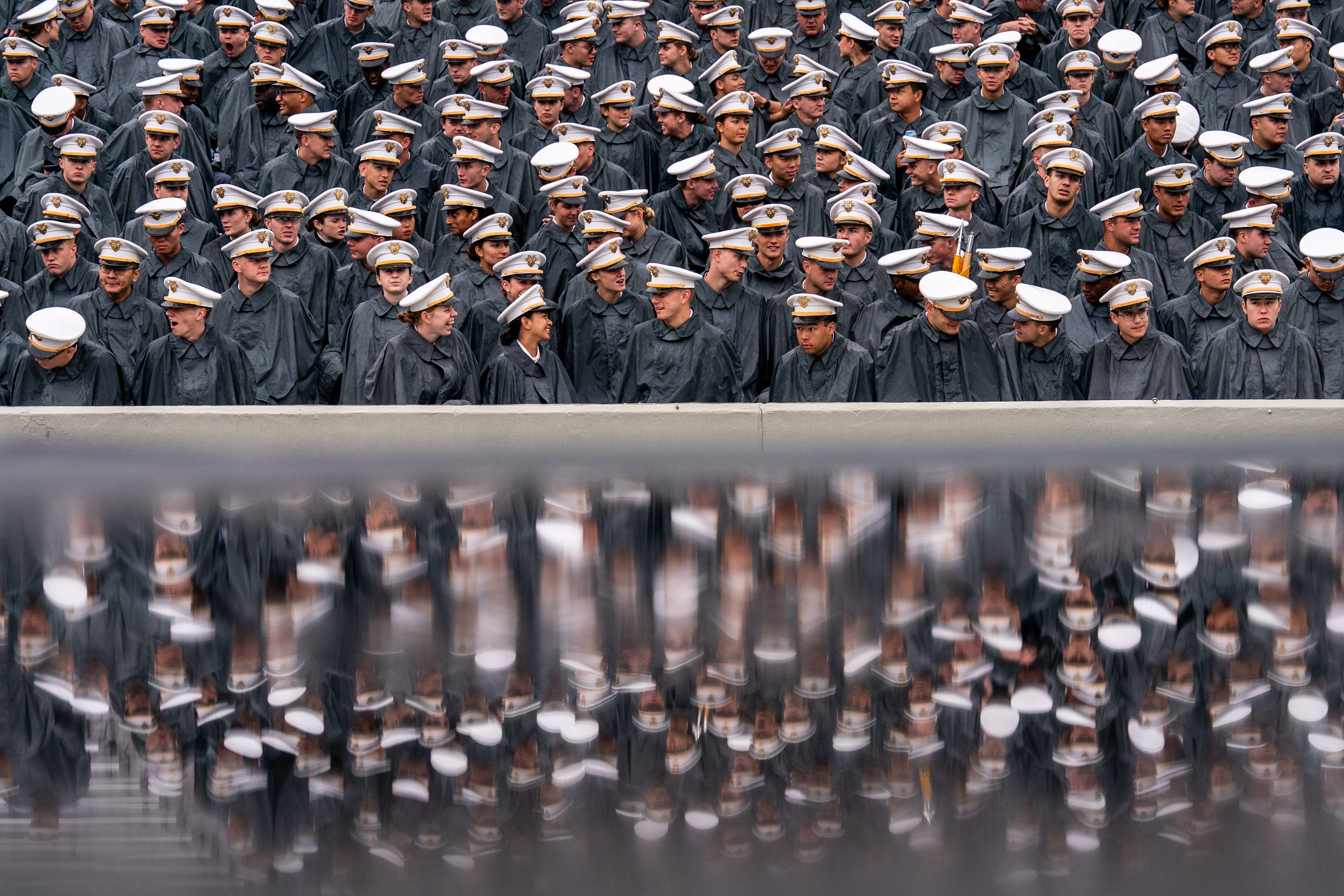
West Point undergraduates are reflected in a pool of rain water during the United States Military Academy commencement ceremony in Michie Stadium at the U.S. Military Academy on May 23, 2026 in West Point, New York. (Photo by Adam Gray/Getty Images)
DOES CHARACTER COUNT FOR ANYTHING in public life anymore? It’s a question that’s come up, it seems, more and more frequently in the past decade, as almost every politician seems eventually to face one kind of scandal or another. Ditto celebrities, professional athletes, leading scholars and scientists, business leaders, and other prominent people. As David French recently summed it up on an episode of TheFocus GroupPodcast: “Do American voters really care about character? No. . . . Does character really matter? Yes.”
I’ll leave it to David and others to analyze the priorities and virtues of the American voter. But I think, when considering the role of character in our society and politics, it’s important to keep in mind that good character isn’t a finite natural resource, but something that can be—and must be—developed intentionally in every person.
Character is easy to admire when it appears and easy to condemn when it fails. But it does not suddenly emerge when an individual runs for office. It is not conferred by elections, and it should not be judged because of promotions, uniforms, titles, wealth, or fame. It is, rather, built patiently over years, long before it is ever tested. The real question may not be whether we still value character, but whether we still understand what it is and how it is formed.
For me—like, I think, for many Americans of my generation—character formation started at home and continued at school, in athletics, in church, and in other civic institutions (in my case, the Boy Scouts). By the time I entered West Point in the summer of 1971, my family and a whole series of institutions had already imprinted themselves on me. The United States Military Academy did not begin the work of building my character; it assumed that work had already started and deliberately sought to deepen it.
WEST POINT’S MISSION WAS NEVER simply to educate engineers or produce tactically proficient Army officers. Its larger purpose was to prepare young men—and, beginning soon after my graduation, young women—to bear extraordinary responsibility for the lives of others and the trust of the nation.
What distinguished West Point is not that it claimed a monopoly on character development, but that it recognized that technical competence without moral development can become dangerous. The academy could teach engineering and history, the proper employment of artillery, and how to write a clear operations order. But none of those skills matter if the person exercising them lacks integrity, humility, and an unwavering sense of duty.
Nowhere was that pedagogical philosophy clearer than in the Honor Code: “A cadet will not lie, cheat, steal, or tolerate those who do.”
Those words establish that trust is the currency of leadership. A leader who cannot be trusted with the truth can never be trusted with soldiers’ lives. Every future decision—reporting casualties honestly, assessing an enemy accurately, advising a superior candidly, accepting responsibility for failure—rests upon that foundation.
The academy reinforced that lesson through its motto: “Duty, Honor, Country.” Those three words described an order of priorities. Duty came before personal ambition. Honor governed how duty was carried out. Country reminded future officers of the purpose that was larger than themselves.
There was one more influence that has remained with me for more than five decades. When I entered West Point, chapel attendance was still mandatory. A federal court later ended that practice on the grounds that it violated the Constitution, but to me, the lasting lesson was never about compulsory worship. It was the academy’s belief that officers entrusted with the lives of others should regularly reflect upon questions larger than themselves. They should wrestle with humility, conscience, courage, and moral responsibility long before confronting those challenges in combat.
That conviction found its clearest expression in the Cadet Prayer:
Strengthen and increase our admiration for honest dealing and clean thinking and suffer not our hatred of hypocrisy and pretense ever to diminish.
Make us choose the harder right instead of the easier wrong and never be content with a half-truth when the whole truth can be won.
Endow us with courage that is born of loyalty to all that is noble and worthy . . .
Written by Chaplain Colonel Clayton Wheat in 1920, those words have stayed with me far longer than engineering equations or military history lessons. They endure because they speak not to what a leader knows, but to who a leader is.
West Point isn’t the only institution of higher education that seeks to develop the character of its students in addition to their minds, nor is it always successful—either in forming good leaders or in living up to its own standards. No institution composed of human beings ever reaches perfection. But the academy’s expectation, its aspiration, is unmistakable: Leadership begins not with authority but with trustworthiness. I now realize that West Point was not replacing the lessons I learned from parents, teachers, coaches, or scoutmasters. It was building upon the foundations others laid. The academy assumed that character formation had already begun and sought to deepen it for a greater purpose.
In the 1970s, this was somewhat countercultural. So much of that era was about self-expression and psychological authenticity—much like today. When so much of society urges, Be true to yourself, West Point demands, Improve yourself. It’s still countercultural. And it’s still, to my mind, better advice.
THE ARMY HAS LONG DESCRIBED ITSELF as a profession of arms, and rightly so. Like medicine, law, education, journalism, or the ministry, it is a profession because society entrusts it with responsibilities carrying profound consequences for others. Technical competence is indispensable, but character ultimately determines how that competence is exercised. That is why I have come to believe that service in the military does not create character, but tests it.
Sometimes those tests appear in quiet, almost invisible moments: admitting a mistake no one else noticed, giving honest advice when a superior hopes for a different answer, accepting responsibility for a failed mission instead of blaming a subordinate. Those decisions seldom attract attention, but they shape organizations and establish trust.
Occasionally the tests become far more demanding. Combat strips away pretense with remarkable efficiency. Exhaustion, fear, uncertainty, and grief have little patience for carefully constructed public personas. Soldiers quickly discover whether their leaders possess moral courage to match their physical courage. They watch to see whether leaders share risk, tell the truth when the news is bad, care for the wounded before themselves, write the letters no commander wishes to write, and remember that every casualty report represents a family whose life has changed forever. Those moments do not suddenly produce character. They reveal whether it was there all along.
Thinking back across nearly four decades in uniform, the officers and noncommissioned officers I admired most were rarely remembered for dramatic speeches or outsized personalities. They earned confidence through consistency. They treated people with dignity regardless of rank. They accepted responsibility without hesitation. They remained calm in crises because their values had already been settled long before a crisis arrived. Soldiers followed them not because regulations required it, but because experience had convinced them those leaders could be trusted.
Only after leaving active military service did I fully appreciate that those lessons extend well beyond the Army. For more than a decade after leaving active military service, I spoke about leadership to a variety of audiences, initially healthcare providers, now graduate business students. The dean of a business school invited me to join their faculty because he believed that modern MBA programs devoted enormous attention to finance, strategy, and management while spending far too little time discussing ethical leadership and character. He wanted me to help change that, and that is a worthy mission.
The private sector “uniforms” are different, the language is different, and the tasks are different. But the essential requirements of character and leadership remain unchanged. Competence is expected in every profession, in every industry. Great organizations define what competence looks like and usually train and teach it well. What separates good organizations from exceptional ones is their understanding that competence alone is insufficient. Character—one of the key attributes of any leader—determines whether knowledge is used with wisdom, whether authority is exercised with humility, and whether success is measured not only by achievement but also by service.
Looking back across that journey—from family and school to coaches and scoutmasters, from West Point to the Army and eventually the private sector—I realize that none of those institutions believed character development was someone else’s responsibility. Each accepted a share of the task. Each expected young people to become a little more than they had been the year before. Most importantly, each reinforced lessons that had begun elsewhere.
Most Americans, regardless of political affiliation, still admire leaders whose actions consistently match their words, whose integrity survives public pressure, and whose decisions reflect something larger than personal ambition. We may disagree passionately about policy or ideology, but few would argue that honesty, humility, courage, and responsibility are obsolete virtues.
FOR GENERATIONS, AMERICANS BENEFITED from an informal partnership among families, schools, faith communities, youth organizations, athletic programs, neighborhoods, professions, and military service. Together, they created countless opportunities for young people to practice responsibility, to show their character, before being entrusted with a leadership role. Some of those institutions remain vibrant today. Others struggle. Technology, social media, and cultural change have transformed the environment in which young people mature.
I’m not suggesting we can—or should—recreate the America of my youth. Every generation must prepare its citizens for the world they will inherit, not the one their parents knew. But one principle has not changed: Character development doesn’t just happen. It grows where families, schools, coaches, employers, congregations, professions, and communities intentionally cultivate it and then expect it. Parents who insist that integrity matters when no one is watching. Teachers who refuse to lower standards. Coaches who value sportsmanship as highly as championships. Mentors who teach service before recognition. Employers who reward honesty as much as performance. Professionals who understand that authority is ultimately an act of stewardship.
Am I living in a dream world to think we can somehow recreate or strengthen all of these? Not for a minute. But if we want character to matter, and I think we do, we all need to contribute to its growth in others. If we want better character in our leaders, there is only one solution: to promote better character in each other, especially young people. If each person sees teaching others, especially the next generation, wisdom, humility, respect, conscientiousness, duty, and service as part of their basic responsibility as a citizen—as a person—then we will end up with fewer individuals of low character seeking positions of power. And those who do will have smaller constituencies.
Character is rarely noticed while it is being formed. But it becomes unmistakable when it stands before us—and its presence is every bit as obvious as its absence. And that matters. Forming character has always been the quiet work of a free society. It’s necessary work if we are to remain a free society.
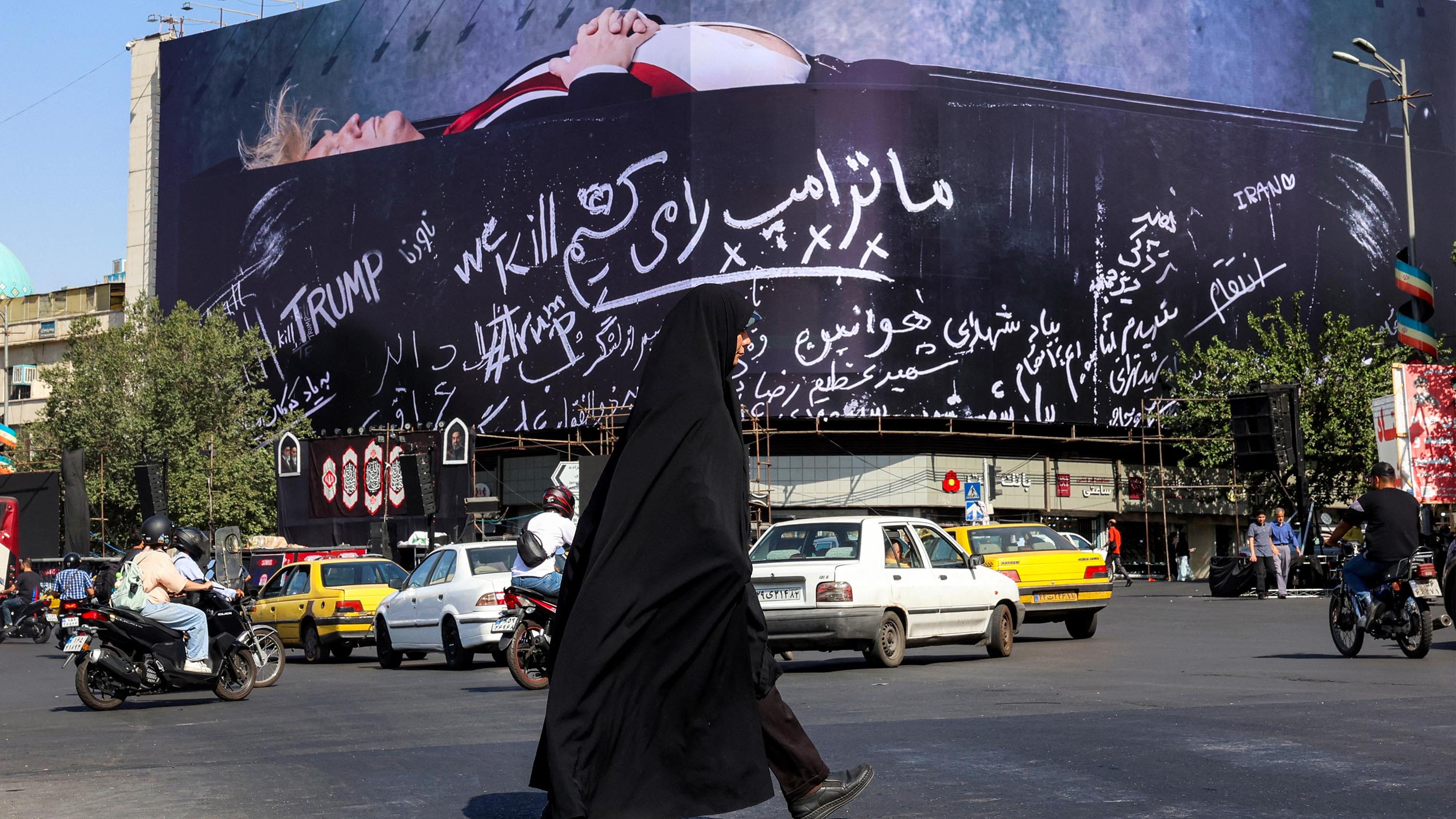
A woman crosses Tehran’s Enghelab Square on July 15, 2026, past a giant anti-U.S. billboard featuring Donald Trump in a coffin. The text reads (in Persian) “We Kill Trump.” (Photo by AFP via Getty Images)
AFTER THIRTEEN CONSECUTIVE NIGHTS of American bombing of Iran, the fourteenth night was quiet.
That silence has generated almost as much speculation as the strikes themselves. The New York Timesreported that President Trump ordered the halt out of concern that the United States is running dangerously low on missile interceptors. But that concern doesn’t preclude other reasons for pausing the strikes: Are nascent diplomatic efforts indicating a path beyond military operations? Did America’s regional partners quietly urge restraint? Or did the president’s advisers conclude that continued bombing was no longer advancing America’s strategic objectives?
We may not know the answers for months, perhaps years. But it may be getting through to the administration that the strategy of air strikes it has pursued against Iran for five months isn’t advancing political objectives.
The moment military action begins producing diminishing strategic returns, leaders face one of the hardest decisions in war: whether to continue pressing the attack or adapt before events force them to. Military professionals still use Carl von Clausewitz’s term for that moment: the “culminating point” of an offensive, when continued attacks begin consuming more military capability than the strategic advantage they produce. Modern military commanders, rather than awaiting the culminating point, now seek evidence that they are approaching culmination, because recognizing the signs in advance helps prevent strategic overreach and potential failure.
That distinction matters. Adaptation is one of the defining characteristics of successful military campaigns; the military that adapts first often prevails. And the most important adaptations occur at the strategic level. Adversaries change their methods. Allies reassess their interests. Resources become constrained. Diplomatic opportunities emerge and disappear. A campaign designed to solve one problem frequently evolves into something else, usually something larger. Continuing yesterday’s operational design simply because it worked yesterday is not persistence; it is wrongheaded.
Don’t just read the news. See farther, understand deeper, and join our pro-democracy community by becoming a Bulwark+ member.
HISTORY OFFERS AN INSTRUCTIVE EXAMPLE. In February 1991, after only one hundred hours of ground combat during Operation Desert Storm, President George H.W. Bush, Chairman of the Joint Chiefs of Staff Gen. Colin Powell, and Gen. Norman Schwarzkopf agreed to halt the offensive. Coalition forces retained overwhelming combat power, and they almost certainly could have continued their assault, even driving toward Baghdad. But liberating Kuwait—not toppling Saddam Hussein—was the coalition’s political objective, and that objective had been achieved. Continuing the attack would not have simply extended the campaign; it would have fundamentally changed its purpose.
Images from what later became known as the Highway of Death reinforced another uncomfortable reality. Coalition airpower continued destroying Iraqi forces that were already retreating from Kuwait. Those attacks undoubtedly remained militarily effective, but they also illustrated the growing gap between tactical success and strategic necessity, punishing an enemy unnecessarily. Additional destruction promised little additional political advantage but would have increased humanitarian costs while risking the cohesion of the international coalition. The decision to stop reflected the judgment that military operations had accomplished the mission assigned.
Iran’s military power today is nowhere near as broken as Saddam’s was at the end of Operation Desert Storm. It remains capable of influencing events across the region, particularly through its network of proxy organizations. The Houthis, who at first largely stayed out of the conflict, are now threatening international shipping and attacking Saudi ports and facilities. Their strikes against Aramco refineries and other facilities have widened the conflict, and American naval forces are now protecting both the Strait of Hormuz and the approaches to the Bab el-Mandeb.
The American campaign initially appeared focused on degrading Iran’s conventional military capability. Increasingly, however, the conflict is being shaped by Tehran’s actions and those of its proxies. Every Houthi attack against commercial shipping, every strike against Gulf energy infrastructure, and every disruption of maritime commerce broadens the war geographically while allowing Iran to impose additional costs on the United States. Continuing to concentrate military effort where the conflict began rather than where it is expanding risks fighting yesterday’s campaign while the enemy adapts.
At the same time, the Times report and others indicating that America’s weapons stockpiles are being used up perilously fast deserve attention. Precision-guided munitions are not merely tactical assets. They are strategic resources underpinning deterrence in the Indo-Pacific, reassuring allies in Europe and the Levant, protecting American forces worldwide, and preserving the nation’s ability to respond to crises that cannot yet be predicted. Every Tomahawk missile launched at Iran, every long-range standoff weapon fired from an American bomber in the Middle East, and every interceptor expended defending U.S. forces in Jordan or Kuwait or the UAE must eventually be replaced. The question is not whether America possesses overwhelming military power; it’s whether continuing to expend some of its most sophisticated capabilities produces strategic gains commensurate with the opportunities they foreclose elsewhere. That’s the difference between having more weapons to use and having as many as you might need.
NO COMMANDER—CIVILIAN OR MILITARY—can simultaneously track operational progress, logistical sustainability, alliance implications, resource consumption, and global readiness alone. That job of integrating those perspectives, identifying approaching risks, and recommending adaptation before success on today’s battlefield creates unnecessary vulnerability tomorrow falls in large part to the chairman of the Joint Chiefs of Staff, who commands no combat forces but has a large staff responsible for understanding these kinds of strategic tradeoffs. The joint staff, with its numbered departments, exists to help civilian and military leaders think strategically rather than operationally. The J3 continuously monitors military operations around the world. The J4 evaluates logistics, sustainment, and the consumption of critical resources, including precision-guided munitions. The J5 examines long-range strategy and assesses how today’s operations affect commitments in all the theaters around the world. The J8 evaluates readiness, force structure, industrial capacity, and future requirements.
The president isn’t obligated to listen to the chairman of the Joint Chiefs, or the joint staff, or anyone. As commander-in-chief, his judgment predominates. If the Times’s reporting is correct, and President Trump ordered the strikes against Iran paused or even ended due to concerns about weapons stockpiles, the question for future historians will be: Why now?
STRATEGY HAS ALWAYS REQUIRED military operations to create political space rather than to substitute for political solutions. Bombs and missiles destroy targets; they do not negotiate agreements, reassure allies, stabilize energy markets, or restore international confidence in freedom of navigation. Those responsibilities belong to diplomacy, economic policy, intelligence, and coalition management. Hints that the Trump administration is considering renewed diplomacy, combined with the growing concerns of Gulf partners about the regional expansion of the conflict, suggest that military operations may finally be creating opportunities for those other instruments of national power to assume greater prominence.
Perhaps that is what makes the silence after thirteen nights so significant. It may have reflected concerns about ammunition inventories. It may have resulted from growing proxy activity, expanding diplomatic efforts, or pressure from regional partners. Most likely, it reflected some combination of all those factors, which together suggest that the campaign was approaching—if not past—its culminating point and was unlikely to produce strategic returns.
We may eventually learn exactly why President Trump ordered the bombing campaign paused. Whatever the explanation proves to be, the more enduring lesson extends well beyond this conflict. Successful governments do not demonstrate strength by refusing to change course. They demonstrate strength by recognizing when circumstances have changed, by adapting before operational success becomes strategic overreach, and by understanding that the purpose of military power is not to maximize destruction but to achieve clearly defined political objectives.
If the halt in bombing reflects that realization, history may judge it as the moment strategy finally began catching up with operations. The silence of the fourteenth night may ultimately prove more consequential than the explosions of the previous thirteen.
(Photo illustration by Bill Kuchman/The Bulwark | Photos: Getty, Shutterstock)
WHEN SEN. GARY PETERS QUESTIONED Defense Secretary Pete Hegseth about the administration’s handling of the conflict with Iran, Hegseth responded by accusing Peters of denigrating the military.
That wasn’t what Peters was doing. In fact, even before Peters asked Hegseth a question, he offered comfort to the families of those who had given their lives in the Iran war. “I want to begin by first echoing my colleagues’ comments,” he said, “and joining them in mourning the loss of American service members who were killed in action these few days. My thoughts are with their families, with the service member who remains missing, and with all those injured during the strike. And I will continue to pray for their families.” He very quickly went out of his way to express admiration for the service members carrying out extraordinarily difficult missions: “I have long said the United States has the strongest military in history, in the world, and I have no doubt that our brave service members can execute any mission and prevail in any battle.” His criticism was directed not at the troops, but at the civilian leadership responsible for defining the mission, establishing the strategy, and honestly describing the results. That distinction matters.
No tribal allegiances. No false equivalency. Just straight talk about saving democracy. Join us.
When I was a young lieutenant, stationed in Germany on my first assignment, I had a conversation with an old veteran in my unit who had been a medevac helicopter crew chief in Vietnam. He was highly decorated, and he was relaying some of the adventures that were reflected in the medals he wore on his chest.
He was young when he got drafted. He didn’t want to go to war, but he answered his country’s call. He flew hundreds of missions, saved untold numbers of lives, was wounded, recovered, and after a year of service, eventually came home. He told me he was proud of all he did in service to his country—proud enough to choose to make a career in the military—but when his plane landed in San Francisco and he stepped into the terminal wearing his khaki uniform, he experienced something disheartening. As he walked through the airport, strangers cursed him, called him baby killer, and even spat on him.
Then, in a changing mood, he looked down and quietly said something that has stayed with me ever since: “It made that whole year seem like a waste. I didn’t agree with the war, either, but it seemed my fellow citizens were confusing the war with the warrior.”
His disappointment wasn’t rooted in the hardship of combat, because soldiers understand hardship. It was his realization that many Americans could not distinguish between the man who had served and the policy that had sent him there. That confusion reappeared during Secretary Hegseth’s testimony this week.
In our constitutional system, the military does not choose the wars it fights. Soldiers, sailors, airmen, marines, guardians, and coasties execute lawful orders issued by civilian leaders. Their professionalism lies in carrying out those missions to the best of their ability, regardless of the politics and the policies surrounding them. Supporting the military does not require supporting every military operation, nor does questioning the wisdom of a campaign diminish the courage of those asked to fight it.
In fact, the opposite is true.
One of the highest forms of respect all citizens can show our military is demanding that our armed forces be committed only to missions with clear objectives, realistic plans, sufficient resources. This is especially true for those who serve in government who make the decisions—or non-decisions—about war and peace. For our leaders, respecting the military means telling the American people the honest truth about progress and setbacks, casualties and costs. For the rest of us, holding civilian leaders accountable for those responsibilities is our way of honoring those in uniform.
Too often, political leaders blur these lines. When strategy is challenged, they wrap themselves in the valor of the troops. When operational shortcomings are exposed, they imply that criticism somehow insults those risking their lives. This may be an effective political argument, but it is a dangerous civic one. The sacrifice of those in uniform should never become a shield protecting policymakers from legitimate scrutiny.
We owe our warriors gratitude, respect, and every resource necessary to accomplish the missions. We owe our civilian leaders rigorous oversight, honest debate, and accountability for their actions and the missions they assign.
We also owe ourselves, as citizens of a great republic, a government that is responsive to our needs and expectations. That applies to the military as much as to anything else. We respect the troops by ensuring that their missions are aligned with the priorities of the country, and we respect ourselves by ensuring that the bravery and sacrifice of those in uniform doesn’t cause us to forget why their calling is called “service.”

 Login
Login