
❌

Normal view

Universal childcare is set to be a 2028 presidential test

14 October 2026 at 12:00
a bright, childlike painted scene on cardboard is within the shape of the Contiguous United States

In late September, Democratic Rep. Ro Khanna of California introduced the Free Child Care for America Act, an $80 billion-a-year proposal to make childcare free for nearly every family with kids under six. The bill would let families choose between sending their child to a daycare center, having a relative, friend, or neighbor paid a living wage to care for them, or taking a $1,000 monthly stipend to keep the child home for the first three years. It comes from a lawmaker who openly says he’s considering a run for president. “I want 2028 to be a big-ideas primary,” Khanna told ABC. “A contest on who’s going to have ideas of the future that meet the moment.”

Khanna’s is not the only big Democratic childcare proposal released in the last few months. In July, Project 2029 — a group of liberal policy experts developing an agenda for the next Democratic administration — proposed something similar to Khanna’s plan: giving families a choice between free daycare and $1,000 a month to provide care at home or pay a trusted caregiver. The group estimates that would cost about $200 billion annually. Third Way, a centrist Democratic think tank, unveiled its own universal childcare pitch, guaranteeing every family at least three affordable options within a 15-minute drive of home or work by expanding home-based, infant, and after-hours care, and leveraging employers as partners. 

Key takeaways

  • Childcare is emerging as a major 2028 issue, with big new proposals from Rep. Ro Khanna, Project 2029, and Third Way.
  • “Universal childcare” means different things to different people — free for all, affordable for most, or simply enough slots to go around.
  • Polls show broad, bipartisan appetite for government action on childcare, with debate over how much families should chip in.

Early childhood policy is quickly becoming a defining issue for 2028 hopefuls. On the right, Vice President JD Vance has staked out an early and controversial position, to pay married stay-at-home parents roughly $9,000 per child annually using existing federal childcare funds. On the left, Rep. Alexandria Ocasio-Cortez is spearheading a new House working group to develop a federal childcare plan. Kentucky Gov. Andy Beshear has been pushing free pre-K for all 4-year-olds, something California Gov. Gavin Newsom has already enacted in his state. And New York City Mayor Zohran Mamdani, who can’t run for president but is widely seen as an influential voice in the party’s future, has made universal childcare one of the top goals of his administration.

Michelle Lujan Grisham, the Democratic governor of New Mexico, recently told Semafor that any politician seeking to run for president in 2028 “absolutely should” run on universal childcare proposals. Last year New Mexico became the first state to offer free childcare to families regardless of income. Her advice echoed David Plouffe, a Democratic strategist who managed Barack Obama’s 2008 campaign, who said that universal childcare should be in the Democrats’ 2028 party platform.

This new wave of enthusiasm marks a pivot for an idea that has long been seen as a distant pipe dream in American politics. It wasn’t always that way: When women filled factories during World War II, the federal government funded thousands of daycare centers to watch their kids. In 1971, Congress actually passed a bipartisan childcare bill, though President Richard Nixon vetoed it, saying it would weaken the family. In the 50 years since, Washington lawmakers have focused their energies on other big battles, offering little on childcare beyond subsidies for some low-income families. Over that time, the US has fallen out of step with nearly all its peer nations around the world, which help parents pay for childcare, on top of offering paid parental leave after birth.

It’s not hard to understand why the idea is finally getting a serious look in the US. With voters citing affordability as a top concern, politicians are looking for ways they can bring down costs facing families. After paying rent or a mortgage, childcare often stands as many parents’ biggest monthly expense. Businesses have started to care too, as access to reliable care affects both people’s ability to hold down jobs and businesses’ ability to attract and retain workers. It’s why organizations like the Chamber of Commerce have taken up the issue and why red, blue, and purple states alike have been elevating childcare in recent years.

In Congress and in the Democratic campaign world, there’s a strong sense that childcare, long overshadowed by climate, infrastructure, voting rights, and health care, is now at the front of the line should Democrats regain power. Insiders credit both donor influence and a feeling that childcare advocates have duly waited their turn.

But as Democrats begin jockeying for 2028 and universal childcare becomes a rallying cry, it’s also become clear that there’s a big unanswered question at the heart of the politicking: No one yet agrees on what “universal childcare” actually means. Does it refer to care that’s totally free, or just affordable? Is it for everyone, like public school, or targeted at families below an income line? Does it start at birth, and include parents who stay home? Are employers involved, or neighbors and grandparents? 

The answers will determine who benefits, how much it costs, and whether the party’s next big promise to families is one it can actually keep.

What is universal childcare?

When I asked Rep. Khanna how he defines universal childcare, he said that it means “childcare should be free” and that families should have flexibility and choice of how to get that care. Workers, he added, should also be paid a living wage in a universal childcare system. 

Later, he described the vision for universal childcare as a public good, akin to public school. “From the time a child is born to the time they’re finished college,” he argued, America has the wealth to provide for kids’ education and development. 

Others, however, are defining the idea differently. Linda Smith, who leads Child Care Trust, a national policy think tank, helped design the military’s well-regarded childcare system and oversaw federal early childhood programs under Obama. Earlier this summer, she released a framework for universal childcare that emphasized it does not inherently mean free care.

Smith says she wrote it after realizing that even the legislative staffers drafting childcare bills didn’t mean the same thing by the term. “After some candid conversations with congressional staff this summer working on child care policy, it became clear that there are many interpretations of ‘universal child care,’” she wrote on LinkedIn. “If we can’t agree on what the term means, we can’t build durable policy around it.”

She argues the “universal childcare” slogan tends to blur three separate goals: universal access, universal affordability, and universal free care. To Smith, the urgent priority is access. Her vision for universal childcare policy would be a system where all families have access to “affordable, high-quality options” that reflect their needs. Her organization estimates that about 4.2 million children under six with all available parents in the workforce lack a childcare slot within a reasonable distance of home, and she warns that cutting costs without adding new supply could worsen shortages and leave families without available options.

Her answer is a mix of building more supply and sharing the cost. She recommends families paying what they can and employers and government covering the rest. Spreading the cost across several payers, she argues, is likelier to sustain the full mix of care families actually use — including home-based care — than leaning on government or parents alone.

Chris Herbst, a childcare policy expert and professor at Arizona State University, told me he agrees with Smith that there’s no consensus regarding what universal childcare means today. Even in New Mexico, he pointed out, which is regularly touted as an example of universal childcare, a light work requirement exists for families to be eligible. “These are fluid definitions, and as such they are a bit up for grabs at the moment,” Herbst said. 

His own view is that a universal childcare system should make the subsidy easy to get and be guaranteed by law, so eligible families get it automatically instead of landing on waitlists when funding runs short.

Another childcare expert, Elliot Haspel, has embraced a definition closer to Khanna and Sen. Elizabeth Warren, arguing that universal childcare means all families can easily secure the type of care they want, and pay no fees to do so. He acknowledged, though, that many things can be called “universal” and be technically correct. “The ambiguity of the term is both what lends it rhetorical power and what can present a major weakness,” he writes.

Some states are adding benefits — but avoiding “universal”

With federal childcare legislation stalled, many states have spent the past few years trying to patch the system themselves. Some states are investing in making care cheaper for families, others in paying childcare workers more, and most in trying to get more providers to open their doors.

The National Conference of State Legislatures has also aimed to get involved. Over the course of a year and a half, state lawmakers across 13 states worked together to hash out a bipartisan policy framework for strengthening childcare systems, a rare cross-party effort on the issue. The NCSL report, released this past summer, steers clear of the term “universal childcare,” but does describe state systems under strain and concludes that incremental fixes alone are unlikely to solve it. The lawmakers stressed there is no one-size-fits-all solution and offered a menu of options organized around seven priorities, from expanding access to investing in the childcare workforce.

In interviews with the working group’s two co-chairs, I asked why their cohort stayed away from the “universal” language. Jim Burgin, a Republican state senator from North Carolina, told me he doesn’t find it to be a helpful term because it could conjure up the image of public schools, which are mandatory and government-run. “I don’t like the term,” he said. “I think we ought to have safe, affordable childcare available to everybody and I don’t want everybody to immediately think we’re setting up government indoctrinated childcare…a lot of people would just push back from that.”

The Democratic co-chair, Washington state Sen. Claire Wilson, said her hesitation was more about precision. “When you say ‘universal’, I think that alone is a question about what do we mean by universal?” she said. In Washington, she explained, it means care open to all families regardless of income, employment status, or immigration status, “but for other states, universal may mean something different.”

Where the public stands

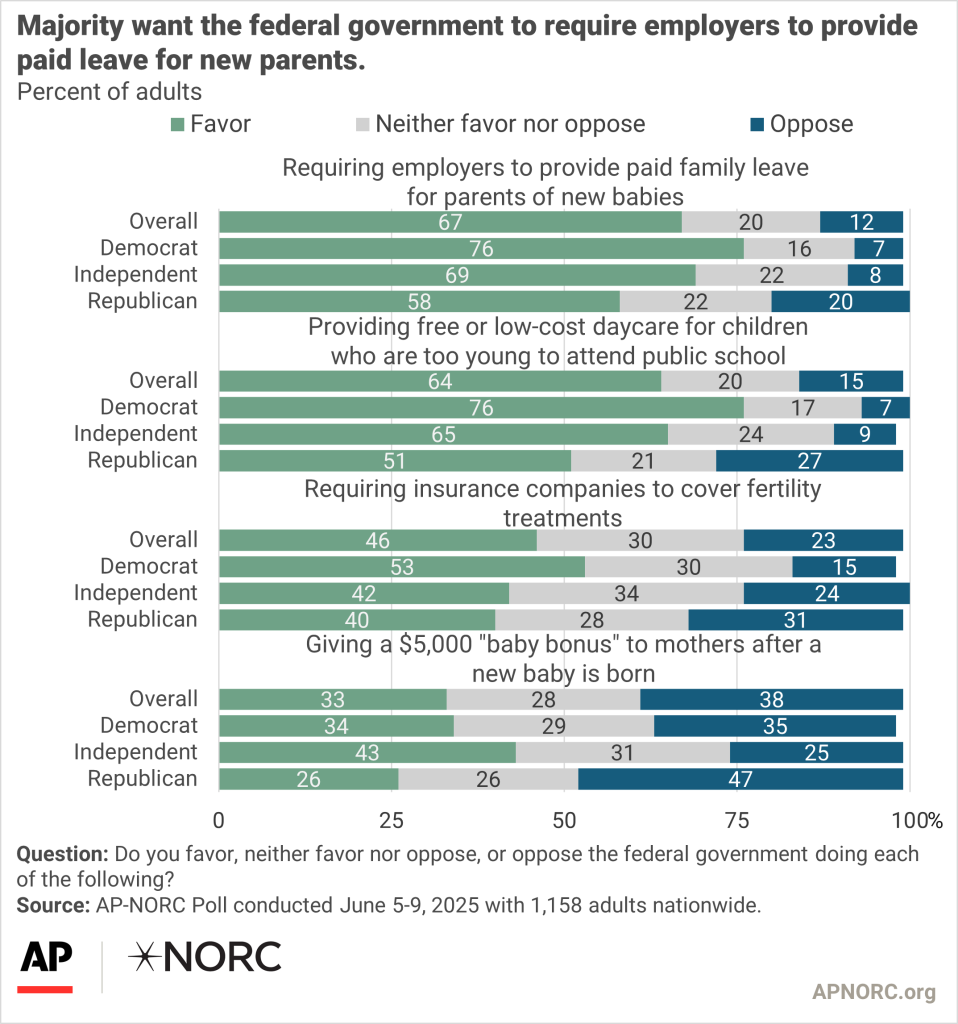
Polling suggests Americans do want to see lawmakers take action on childcare, even if it’s not voters’ top priority when asked to rank among different issue areas. An AP-NORC poll from last year found about three-quarters of Americans say childcare is a “major problem,” and majorities across both parties backed federally funded “free or low-cost” daycare. More recently, YouGov and the 19th News found 52 percent of Americans think the federal government should increase its spending on childcare.

The evidence that most Americans want childcare to be free rather than affordable is less clear. The recent YouGov/19th News found about 40 percent of Americans think parents and government should share in the cost of daycare, compared to 21 percent who thought the government should pay the full cost, and 26 percent who thought parents should cover it all.

A recent New America survey found similar results. When asked if K–12 public education should be a free, taxpayer-funded right, 60 percent of respondents agreed. But only 38 percent said the same of childcare. And among those who “somewhat” or “strongly agree” that childcare should be offered to families for free, paid by taxes, and considered a right, only 31 percent of independents agreed, and just 23 percent of Republicans.

Lena Bilik, a childcare researcher at the Roosevelt Institute, a progressive think tank, told me she thinks public opinion will shift more in favor of free universal childcare when public programs can demonstrate a track record of success, as the country saw with Social Security and more recently the Affordable Care Act. “If we build high-quality public goods that work, I think that with time that problem solves itself,” she said. “But they have to be well-resourced.”

The politics ahead

While states like New Mexico, Vermont, and Connecticut have taken major steps in recent years to expand access to affordable childcare, Bilik of the Roosevelt Institute said even those places vary in how explicitly they pursue the goal of universal childcare, or define it.

The last time Democrats went big on childcare, via the Build Back Better Act, they failed. The bill packaged much of the Democratic agenda into one piece of legislation — climate, healthcare, housing — with childcare bundled alongside paid family leave, elder care, universal preschool, and an expanded child tax credit. It collapsed in late 2021 after talks with West Virginia Sen. Joe Manchin fell apart. 

When I interviewed lawmakers, advocates, funders, congressional aides, and policy experts in 2024 about what lessons they drew from that experience, I found the field divided over strategy. Childcare never got a vote of its own, and the argument ever since has been whether it should have been pulled out and pursued separately. Some argued activists should have narrowed their focus to one or two care priorities. Others saw that critique as premature capitulation, a sign of a limiting “scarcity mentality.” Many of those advocates emphasized that they had come very close to passing everything, losing in the Senate by a single vote, and pointed to the climate movement, which took decades of sustained organizing and spending to win major federal legislation. Care advocates, they said, just needed to keep pushing.

Two years later, the consensus view among Congressional Democrats and national childcare advocates has shifted, with far more now saying what’s needed first and foremost are “big and bold” solutions that the party can run on — even bigger than the ideas laid out in the Build Back Better Act.

Sen. Elizabeth Warren argued this year that childcare failed in Build Back Better because not enough Democrats were “willing to fight for it” and because the $400 billion proposed spending package for childcare and universal pre-K wasn’t nearly big enough. It was “an exercise in how weak and ineffective we could make the childcare program and still call it childcare,” she said. 

Bilik has watched the same change from the research side. The coalition she works with, she told me, has moved away from programs that help only families below a certain income. “What I’m excited about is that we’ve gotten more ambitious with our proposals across the board since Build Back Better,” she said. “We’re finally having conversations about whether implementing something halfway will cause more problems than solutions, so I think the field has moved really far towards being open to a true public program.” 

These sentiments are reflected in the recently released Khanna bill, the Project 2029 proposal, and comments over the summer from Democratic Rep. Sara Jacobs, who said free childcare for all should be at the top of the House’s legislative agenda if Democrats take control after the midterms. 

How that vision translates into legislation remains an open question. Some advocates I talked to for this story, who spoke off the record to describe private coalition conversations candidly, said they worried their allies were going to make the same mistake of over-promising and then failing to prioritize goals when faced with tough budget realities. Should Democrats take power, leaders will also face pressure to restore Medicaid and SNAP funding, expand ACA subsidies, and address housing costs, all while large federal deficits make new spending harder to finance.

Khanna told me his proposals could be funded by shifting priorities away from increased military spending, particularly the $200 billion increase in the Pentagon budget and the war with Iran. The Project 2029 proposal suggests financing through raising the corporate tax rate, repealing the pass-through business tax deduction, and reforming estate taxes and the “stepped-up basis” tax break on inherited assets. Third Way would also fund its plan partly through a corporate tax increase. But those same dollars could be claimed by other Democratic priorities, which means childcare advocates may end up competing for them.

“Everyone is excited to put out the biggest idea, but there’s no real conversation about how to get there, and I feel like that’s the frustration, where ‘how to get there’ just means electing Democrats and demonizing any incremental progress,” one advocate told me. “That is not a strategy.” 

For now, think tanks, presidential hopefuls, and congressional working groups are testing the waters, floating ideas that meet families where they are and, in some cases, go further than what voters say they want. The practical details are unlikely to get settled once the 2028 race is fully underway. If a Democrat wins, the window will narrow further, with unresolved details colliding with other priorities in the first months of a new administration.

“Universal childcare” may remain an amorphous term, meaning free care to one politician, shared costs to another, and a menu of state options to lawmakers who avoid the word altogether. But all of us voters should expect to hear much more of it.

This work was supported by a grant from the Bainum Family Foundation. Vox Media had full discretion over the content of this reporting.

How housing victories in San Diego, Austin, and Atlanta could spread nationwide

13 October 2026 at 12:30
Housing under construction in Atlanta
Atlanta Mayor Andre Dickens has helped advance the city’s broader effort to build or preserve 20,000 affordable homes by 2030. | Elijah Nouvelage/Bloomberg via Getty Images

As rents and homelessness climbed in San Diego over the last decade, leaders watched in frustration as affordable housing projects took months to get approved. The longer a project dragged on, the more expensive it became.  

Housing in America is notoriously slow and complicated to build, so San Diego Mayor Todd Gloria decided to use one lever he had available. In January 2023, he signed an executive order to speed up project approvals, so every fully affordable project now had to be reviewed in 30 business days or less.

To meet this new goal, San Diego had to overhaul how it had been handling permitting. The city streamlined work that had been spread across multiple departments and filled positions it had budgeted for but left vacant. Within a year, fully affordable projects were clearing review in nine days on average. Citywide, 2023 marked San Diego’s biggest year for housing permits since at least 2005, with 9,691 homes approved, or an 82 percent jump from the year before.

Key takeaways

  • Bloomberg Philanthropies is funding up to 30 cities to copy housing fixes that worked in San Diego, Austin, and Atlanta.
  • The bet is that cities lack the know-how to execute good ideas, not the ideas themselves.
  • It’s not clear what will happen to city capacity when the foundation funding runs out.

Austin, Texas embraced a different approach to tackling its housing shortage. After years of local zoning reform, the city legalized up to three homes on most single-family lots in late 2023, then cut the minimum lot size from 5,750 square feet to 1,800 in 2024. Those changes made it easier to add homes, including backyard accessory dwelling units (ADUs), and followed a broader construction boom that has helped bring rents down. Austin, which was becoming increasingly unaffordable, is now one of the few major American cities where asking rents have fallen since the pandemic.

Atlanta adopted a third housing strategy that didn’t require changing any laws at all. Mayor Andre Dickens rallied the heads of every public agency that affects housing, from the city’s housing authority and school system to the transit agency and land bank, and convened them in one room on a regular basis. He called it a “housing strike force” and it has helped advance the city’s broader effort to build or preserve 20,000 affordable homes by 2030. Every housing deal now comes to the mayor’s office, Dickens told me, and “I just start pushing buttons to push them out the door.” 

Seen as a nationwide issue, the housing shortage is an enormously difficult problem, sitting at the nexus of the economy, the financial system, and decades of local zoning decisions. But the fixes don’t all have to be complex. A mayor can do all three of these — faster permitting, ADUs, a housing strike team — without waiting on Congress or their state legislature to act. And now one major nonprofit is betting that other cities could adopt them too.

On Tuesday, Bloomberg Philanthropies is announcing that it will fund up to 30 cities to adopt one of those three housing ideas. Each will get between $450,000 and $750,000 directly and two years of help from Accelerator for America and the digital consultancy Public Digital, also funded by Bloomberg. The philanthropy has already selected the first 15 cities, including Albuquerque, Chattanooga, Cleveland, Durham, Louisville, Miami, Nashville, Pittsburgh, and San Jose.

By housing construction standards, the money doesn’t go very far. The grants are geared toward hiring city staff, buying new software, and helping cities quickly develop the expertise that let San Diego, Austin, and Atlanta do what they did.

“You don’t need everyone to be innovating everything all the time when there are good ideas in the world that are working,” said James Anderson, who leads Bloomberg Philanthropies’ government innovation program. “They need help adapting those ideas to local contexts.”

According to Anderson, the cities were chosen because their mayors had already taken hard political votes on zoning, and wanted help now to do more. Their timing is also intentional. On the federal level, the 21st Century ROAD to Housing Act became law in July, and it creates competitive grants for cities that modernize their permitting, for preapproved housing plans, and that open up their public land. These are the same reforms Bloomberg is now funding, and cities that can show they’ve already done work around it will be better positioned to tap into new federal dollars.

Mayors say they’ve seen big federal programs pass before and then found that actually leveraging those new funding streams in practice can be quite difficult. “We saw that with the Inflation Reduction Act,” Cleveland Mayor Justin Bibb told me. “Even some of the aspects of the bipartisan infrastructure bill, there was a lot of red tape to get some of that stuff across the finish line.”

The Bloomberg bet is that figuring out what to do isn’t as hard as organizing the knowledge of how to do it. The philanthropy thinks that with enough money and hand-holding, good ideas can spread.

It’s an experiment worth testing, but even at the outset there are real limits to what kind of help a short-term infusion of cash can do in practice. San Diego, Austin, and Atlanta all had substantial housing staff in place before they started, and many cities don’t have the same depth to draw on. A two-year grant covers a few staff roles, but doesn’t guarantee they’ll stay long-term in a city where most of the local budget is already committed.

What a “housing strike force” actually is

Dickens had campaigned for office in Atlanta on building 20,000 affordable units in eight years. When he became mayor in 2022, his staff told him the city was on pace to fall 4,000 to 5,000 units short of this goal, and that the main federal subsidy for affordable housing, which gets rationed out by the state in fixed amounts each year, wasn’t going to make up the difference.

What Atlanta did have was land, spread across more than a dozen public entities, each with its own board and its own ideas about what the land was for. One 10-acre city site just northwest of downtown was being used to store trash cans before delivery to residents. “It’s not the highest and best use of the land, but we’ve been doing it for decades,” Josh Humphries, then Dickens’ senior housing adviser, told The Guardian.

So Dickens pulled the heads of those agencies into one body reporting through his chief housing officer. The transit system and school district both answer to their own boards, so his pitch was that they weren’t giving anything up by getting involved. “You are still in charge of your organization, these are your deals, but we are an accelerator,” Dickens told me.

They spent nothing setting it up and hired no new staff for the strike force itself — though when Dickens advises other mayors, he’s blunter about the pressure a mayor would need to exert in convening such a team. An agency that opts out of participating, he said, is “outside of the scope of the mayor’s vision” and “that’s not a safe place to be.”

“I didn’t need another task force,” Dickens added. “Task forces are good, but we know what we’re doing. We don’t have to describe the task. No, this is a strike force. We know the deals, we have the land, we know where the money is for most of these deals, and we have the political will.”

What Dickens did was create “a horizontal way of organizing otherwise vertical players,” as Anderson of Bloomberg Philanthropies put it.

As part of the strike force, agency leaders meet monthly, and quarterly with the mayor. Each one reports what they will produce in the next 30 days, whether that’s a signed agreement, bank financing, or a permit, in front of everyone else. The goal is to move everything as fast as possible to keep down costs.

“You’re in a meeting with 20 colleagues talking about your four or five projects, and everybody is aware of everybody’s projects,” Dickens said. “You don’t want to come back to that meeting saying nothing happened over the last 30 days.”

The limits of the model

Dickens was fairly blunt about where the model stops working. “It works best in cities that have a sizable amount of competent housing development people,” he told me. “A strike force is Army, Navy, Air Force, Marines. You all are capable.” A city still standing up its housing program, he added, should just focus on collaboration, because it would be hard for a small city without “the knowledgeable skills, the capacity” to operate like this.

Most cities can’t easily build that internal bench. Local governments pay less than state or federal employers for the same specialized work, and between half and three-quarters of a typical city’s operating budget is already locked up in salaries, pensions, debt payments, and basic services before the mayor makes a single discretionary call.

In Cleveland, they’re hoping to use the Bloomberg funding to bring in some new support. “Right now it’s a capacity game for us,” Bibb told me. “IT staff, planning staff, development staff, the list goes on. Policy staff as well.”

Cleveland also faces different challenges than Atlanta, which built its strike force for a growth market that already had projects lined up. Cleveland is an older, industrial city with an aging housing stock and a population that has only recently stopped shrinking, so Bibb needs code enforcement and rehab as well as new units. He plans to point the strike force first at a housing innovation district he launched earlier this year, an area spanning parts of three East Side neighborhoods where the city has concentrated its financing and permitting reforms.

Two-year grants can generally be a challenge for cities. Philanthropy often pays for staff long enough to prove a policy works, but when the foundation money goes away, cities can struggle to find the dollars to keep the positions going. While Atlanta’s strike force was organizing around people the city already employed, Cleveland’s will require new ongoing resources for a growing payroll.

Asked what happens when the money runs out, Bibb maintained he’s concentrating on the near term. “Right now we’re just focused on securing the grant, getting the team in place, and really seeing some positive results with the strike force team in our housing innovation district,” he said.

Can a good idea be scaled?

The 30 cities won’t be working alone. Bloomberg is running them as a cohort, meaning each city will pair with the city that pioneered the idea. The goal is to trade advice, mentorship, and opportunities for city leaders to visit and tour. Cleveland is one of roughly 10 cities that will take up the strike force model, meaning Bibb’s team will work with Dickens and his staff.

“One of the major reasons that good ideas do not spread is a lack of clarity around what it took in the original city to get the hard work done,” Anderson said. Adopting cities need to hear from the originals on both a political and a technical level, he told me, to understand “the trade-offs, the costs, the errors, and lessons learned” before they start.

Bloomberg has been testing a version of this model since 2024 through its Idea Exchange, which now includes more than 1,000 cities across 95 countries and has nearly 200 policy replications completed or underway.

Within two years, cities pursuing permitting reform are expected to cut their housing approval timelines in half, those pursuing ADUs to double their pipelines, and participants ultimately to post gains in citywide housing supply.

The housing shortage runs into millions of homes, and these proposed strategies don’t touch challenges like interest rates or the price of lumber. But across the country, they could show how quickly a good idea can spread.

America’s empty bedrooms are up for grabs

28 September 2026 at 12:00
Illustration of three buildings: one in the center with three people living cozily in a shared space, and one on either side with darkened windows and overgrown, thorny vines

Todd Waller wasn’t expecting to spend the latter half of his 30s living with roommates. But in late 2022, following a breakup with his girlfriend, he needed to find a new place to live, quickly. 

A social worker based in the Atlanta metro, Waller started googling “efficiency apartments” and stumbled onto an ad for PadSplit, a company founded in 2017 that lets property owners rent out individual furnished bedrooms in single-family homes by the week. “It said I could get approved right away and move in tomorrow,” he recalled. There was no security deposit required.

All of a sudden, Waller found himself living with six other people and able to save a lot of money. His rent was just $180 per week, or less than $800 per month. Though he earned a decent salary, he never really had anything left over after all his bills were paid, and the new financial breathing room made the tradeoff of housemates feel worth it.

Key takeaways

  • Cities spent much of the 20th century banning cheap rented rooms, and a 1974 Supreme Court ruling still lets them decide who counts as a “family” under zoning law. That’s now being challenged on two fronts.
  • A Kansas lawsuit asking the Supreme Court to revisit that precedent, and “Golden Girls” bills that have already passed in four states and are spreading.
  • The next few years will determine whether co-living stays a niche workaround or becomes a normal option, with more states set to take up the issue in 2027.

After a while, Waller decided he would be willing to upgrade to a nicer PadSplit unit, one with more amenities but still with roommates. Now he pays $1,250 a month to live on one side of a 2,000-square-foot home, with access to his own private bathroom, a private entrance, and a renovated kitchen. Three other people live on the other side of the house, and he rarely interacts with them.

“My house is awesome; I pay $500 less a month than I would if I were renting [a place of my own] without roommates, and I just was able to buy a new car,” he told me. He knows one day he’ll move somewhere else and perhaps even buy his own home, but he likes that he feels he can make that decision comfortably at his own pace.

With rents outpacing wages in most of the country, legislators are increasingly looking at co-living — sometimes called house-sharing or adult dorm rooms — as an overlooked piece of America’s housing stock. Zillow counts roughly 21 million “empty nest households” — or homes where older residents living with no children have at least two extra bedrooms. Some lawmakers want to make it easier for those homeowners to rent them out, which could put workers closer to their jobs and help seniors stay in houses they can no longer afford alone. Others are eyeing a different kind of vacancy: Post-pandemic remote work has left about a fifth of American office space empty, and there’s growing interest in turning some of it into apartments. 

Many advocates for people experiencing homelessness also argue that co-living is a needed solution, something that could help people going through emergencies avoid the scary slide into shelter living, especially models where you can move in almost immediately and without a deposit. PadSplit surveyed its renters in December and found a population that mostly works (83 percent were employed) and mostly hadn’t been to college. The median income was $32,500.

That co-living needs advocates at all is a legacy of the last century. Renting a single room in a boarding house or residential hotel was once an ordinary way to live in an American city, but in the decades after World War II those rooms became shorthand for poverty and vice, and cities responded by banning new ones and paying landlords to get rid of the old. Half a century later, many people still see sharing space with strangers as a last resort, or feel embarrassed about having roommates past a certain age. And discriminatory zoning codes written in that era are still on the books in most communities, enforcing traditional nuclear family arrangements when it comes to single-family housing, by defining “family” as people related by blood, marriage, or adoption. Those rules can be wielded against home-sharing, and against specific renters neighbors want to keep out.

But these longstanding barriers are starting to finally give. Doubling up with people you aren’t related to is less unusual than it used to be. Between 2017 and 2022, the number of households sharing space with nonrelatives grew by more than 500,000. Lawmakers desperate for anything that adds more housing supply also seem less picky about where it comes from. Companies like PadSplit are putting private capital behind the model, and a wave of new laws and litigation — much of it led by conservative legal groups arguing on property-rights grounds — is making it harder for cities to tell homeowners who can and cannot sleep in their spare rooms. 

For the first time since cities banned cheap rooms, the people trying to bring them back have the momentum, and the next couple of years will go a long way toward deciding whether co-living stays a niche workaround for people like Waller or becomes something a lot more people are able to consider.

The return of SROs

At the turn of the 20th century, as American cities swelled, immigrants, day laborers, and factory workers crowded into downtowns looking for somewhere cheap and temporary to sleep. A small room could be rented by the day, the week, or however long someone needed it. Some “boarded” in private homes while others took beds in bottom-rung hotels known as flophouses. These arrangements varied widely, but became broadly known as single-room occupancies (SROs).

The turn against them came after World War II, as middle-class white families decamped for roomy new houses in the suburbs, and SROs grew more closely associated with shoddy housing for the poor and the deviant. New York and other cities started banning SRO construction in the 1950s. By the 1970s, SROs were a regular media villain, even as they still housed hundreds of thousands of people, including the mentally ill who had been turned out by the closing of state asylums. Cities started to offer landlords incentives to convert their SROs into luxury rentals. Between the mid-1970s and the 1990s, roughly a million of these affordable market-rate units disappeared from the market across the country.

The idea that perhaps cities made a mistake in banning these lower-cost housing options has been simmering in urbanist policy circles for the last 15 years, particularly as the homelessness crisis has gotten worse. The Furman Center at NYU argued in 2018 that reintroducing SROs could help address the housing shortage. The architecture critic Karrie Jacobs argued in 2021 that cities had blamed a kind of housing for problems that belonged to the people living in it. “The notion took hold that if you eliminated the housing, the marginal people would simply vanish,” she wrote in Curbed.

Still, lawmakers have dragged their feet on actually making it easier to rent these kinds of units again, and until recently the people pushing for it had little to show beyond op-eds and white papers. What’s different now is that the fight has moved out of the world of policy papers and into places where it can produce actual results, including a lawsuit that could reach the Supreme Court.

Suing over who counts as family

In early 2022, a home-sharing startup called HomeRoom was renting out two houses in Shawnee, Kansas, a suburb of Kansas City. The company rented rooms one at a time to unrelated adults who wanted cheaper housing, and at a local city council meeting that year, Shawnee’s community development director asked whether the city should support such arrangements in single-family neighborhoods at all. Two months later, the council passed an ordinance banning “co-living groups,” which it defined as four or more unrelated adults sharing a home. 

Under the ordinance, if even one adult in a house wasn’t related to the others by blood, marriage, or adoption, the whole household counted as unrelated.

While the new law forced HomeRoom to evict its tenants, it also put Val French, a Shawnee homeowner, in a bad situation. She lived with her husband, their two adult sons, and one son’s girlfriend. Because the girlfriend was related to no one, the house was now deemed in violation of the city’s occupancy rules. Her son and his girlfriend had to move out, and French couldn’t rent the empty room to anyone else.

French and HomeRoom sued in federal court in May 2023, with assistance from the libertarian Pacific Legal Foundation. They argued that their right to choose who they live with is protected under the 14th Amendment, but they ran into legal precedent from a 1974 Supreme Court case, Village of Belle Terre v. Boraas, which upheld a Long Island village’s nearly identical rule against six college students sharing a house.

The decision came down in the same years cities were clearing out their SROs, and it has given local governments cover to decide who counts as a family ever since.

A small bedroom with queen bed, ceiling fan, and a TV hanging above a dresser.

A federal judge dismissed the Shawnee suit in September 2023, citing Belle Terre, and this past April the US Court of Appeals for the 10th Circuit upheld the dismissal. A few months later, the Pacific Legal Foundation (PLF) petitioned the US Supreme Court to hear the case and reconsider Belle Terre once and for all. The precedent has already frayed in places — state courts in California, Michigan, New Jersey, and New York have struck down local “unrelated occupants” limits under their own laws — but it still governs everywhere else. 

There is “a fundamental liberty right to choose household living companions — whether as an articulation of the right of intimate association or independently — that is deeply rooted in American history and tradition,” PLF’s lead attorney on the case, David Deerson, told me. 

The Supreme Court hears only about 1 percent of the cases it’s asked to take, and even if it took this one, the plaintiffs would be asking a conservative majority to recognize a new constitutional right, which that majority has spent the past few years insisting courts should almost never do. 

Deerson’s argument is aimed at that skepticism, though. When the Supreme Court overturned Roe v. Wade in 2022, it held that an unwritten right counts only if it is “deeply rooted in history and tradition.” Deerson and his allies are arguing that living with people you aren’t related to qualifies as such because, for most of American history, boarding houses and lodgers were typical staples of family life. Belle Terre is also a short opinion written by William O. Douglas, a liberal justice whose legacy has little connection to today’s conservative justices. 

The legislative front

A Supreme Court reversal would be the cleanest fix for co-living, but advocates aren’t waiting on it. State legislatures have already shown they’ll act: Iowa barred cities from enforcing relationship-based occupancy limits in 2017, Oregon and Washington followed in 2021, and in 2024, Colorado lawmakers passed a law prohibiting cities from restricting how many unrelated roommates can live under one roof absent a clear health or safety reason. 

The Pacific Legal Foundation worked on that last bill too, and has since turned it into model legislation for other states. They colloquially call it the “Golden Girls bill” since occupancy caps like these would have prevented the four unrelated women of the hit 1980s sitcom from sharing a house. 

This year Pennsylvania lawmakers introduced their own version, with supporters citing not private property rights but the potential to ease the state’s affordable housing shortage. As legislators considered the proposal, Pacific Legal Foundation published research showing that nine of the 10 most populous cities in Pennsylvania capped the number of unrelated adults who could live together. The state House passed the Golden Girls bill this summer, though the Pennsylvania Senate version has not yet received a vote. 

The objection lawmakers hear most is the same one that animated Belle Terre — that lifting occupancy caps could turn quiet, orderly, neighborhood homes into de facto frat houses. That college partying concern killed Connecticut’s proposed Golden Girls bill this year. While the bill cleared the state Senate, it never got a vote in the House, amid reported concerns from the speaker about college students moving into wealthy neighborhoods. “What if a neighbor is unhappy about four unrelated people who are 19 years old or 22 years old living in the house?” state House Speaker Matt Ritter asked in an interview with the Connecticut Mirror. 

Pennsylvania’s sponsors tried to head off those fears by amending the bill to exclude protections where someone is enrolled at a college or university. In other words, the law would have covered Blanche, Dorothy, Rose, and Sophia from Golden Girls unless one of them signed up for a class at their community college.

Nevertheless, advocates are expanding their push. Jim Manley, state policy director for the Pacific Legal Foundation, told me he expects Texas, Florida, Pennsylvania, North Carolina, Rhode Island and Utah to take up new versions of the legislation in 2027.

And occupancy caps aren’t the only co-living target. Sam Hooper, a lawyer who has been lobbying state legislatures to re-legalize SROs, and his former colleagues at the Institute for Justice are now focused on the ROOM Act, model legislation that would bar cities from restricting SROs and other co-living arrangements, including rules that make it hard to convert offices into apartments. A version was first introduced in Rhode Island earlier this year. 

For Meagan Forbes, Institute for Justice’s director of legislation, the goal is for co-living to be treated like any other form of housing. “Other local laws can regulate things like noise and fire safety, but current regulations just go way too overboard in preventing this kind of housing,” she told me. 

Hooper, who drafted the ROOM Act, says he wanted to “take a massive sledgehammer” to existing restrictions. The resistance he runs into isn’t only the frat-house worry, but older cultural fears that SROs would recreate the poor tenement conditions of the early 20th century. “I think there’s this real problem of letting the perfect be the enemy of the good in housing policy,” he told me. “People accuse us of wanting people to live in undignified housing, but they just struggle to understand that it can be a perfectly fine option for many people at different points in their life.” Hooper credits his own London co-living experience in his 20s with introducing him to some of his best friends and his wife. 

Even so, he cited a broad political coalition backing him up, from property rights champions in conservative states to Democrats and progressive YIMBYs drawn to the housing justice and homelessness angles. There are business leaders interested in workforce housing, he said, and he noted that the AARP testified for the ROOM Act in Rhode Island. “I’m hopeful we’ll be able to keep this bipartisan coalition that hasn’t succumbed to the culture wars,” Hooper added.

Not every co-living proposal is about removing rules. DC’s Senior Co-Living Program Establishment Act, also nicknamed the Golden Girls bill, would pay senior homeowners $300 a month to rent a room to another senior, plus up to $2,500 for home modifications. 

The 21st Century ROAD to Housing Act, the federal housing package that became law in July, doesn’t touch occupancy rules. But it does fund a pilot program for converting vacant commercial buildings into housing, which could make adult dorm office conversions easier.

The demand question

While momentum for co-living is real, demand is also complicated. Americans are doubling up more than they were before the pandemic — about 8.2 million households in 2024, up 4.3 percent since 2019, according to analysis shared by Zillow. Yet the share made up of unrelated adults living together actually fell slightly, by roughly 50,000 households, while homes shared with couples or families grew by nearly 400,000. In other words, when Americans need to save on rent, they still mostly turn to people they already know.

PadSplit is betting that changes. Atticus LeBlanc recently announced his company is expanding into New York, Chicago, and San Francisco, three of the most expensive rental markets in the country.

“Does that mean things have gotten more desperate, that it’s forcing this cultural acceptance?” he asked me in an interview. “I think there’s certainly an argument to be made there. But you could just as easily make the argument that, holy cow, we are really, really wasteful with space.”

Trump wants AI in every classroom. Here’s why Republicans are saying no.

25 September 2026 at 12:00
Melania Trump and a humanoid robot walk together
First lady Melania Trump walks with a humanoid robot as she arrives for the Fostering the Future Together Global Coalition Summit in the East Room of the White House in Washington, DC, on March 25, 2026. | Oliver Contreras/AFP via Getty Images)

Six months ago, first lady Melania Trump walked into a White House education summit next to a faceless robot powered by artificial intelligence, which she said could one day give children personalized instruction.

“Imagine a humanoid educator named ‘Plato,’” she said. “Access to the classical studies is now instantaneous…humanity’s entire corpus of information is available in the comfort of your home.” 

Weeks earlier, her guest at the State of the Union had been a 10-year-old from Alpha School, a fast-growing private school network where children learn reading and math from AI software for two hours a day, and spend the rest of their time on workshops and projects overseen by adults the school calls “guides” rather than teachers.

The Trump administration had chosen AI as the future of American schooling, and wanted everyone to know it. But they picked a bad year to ask Americans to trust the technology with their kids.

Earlier this month, top leaders at Anthropic, OpenAI, and Google DeepMind publicly urged for an AI development slowdown, warning that companies racing to build ever more powerful systems could lose control of them, threatening not only large swaths of infrastructure but even humanity itself. Trump responded by calling the panic a “hoax” and said the US would not “hinder or stifle” the industry, because “whoever wins AI wins.” This “let them cook” mantra has met nearly every AI fear this year, from job loss to data center construction.

Key takeaways

  • Trump has made AI in classrooms a priority and Alpha Schools his showcase, but Republican-led states like Florida, Iowa, and Utah have passed limits on AI and screens in schools.
  • Alpha says its students learn 2.6 times faster with two hours a day of AI instruction. No outside researcher has verified that, though studies may soon launch.
  • Republican and Democratic voters want guardrails on classroom tech. Within the GOP fight a fight is brewing over parental choice, innovation, and whether publicly funded schools must prove they work.

Yet the public is not convinced, and parents perhaps least of all. Efforts to bring AI into classrooms have run into organized opposition, and much of it is coming from inside Trump’s own coalition, setting up a fight between the administration’s pro-tech allies and conservatives who think screens have already done enough damage to kids.

In the nation’s two largest school districts, New York City has recently pulled student-facing generative AI from classrooms through eighth grade and Los Angeles blocked it on all student devices. But it’s not just Democratic-run cities that are pushing back. Earlier this year Utah barred students from using generative AI on assignments without a teacher’s say-so, and required schools to notify parents when it’s used in class. Oklahoma followed suit with a law, passed without a single “no” vote, that requires districts to tell parents which AI tools they use and what data they collect, and lets families opt out. Florida went further last week, when its Board of Education adopted rules for parents to opt their children in before they use AI at school, guaranteeing non-AI alternatives, and banning “companion” chatbots outright. 

Even at the Heritage Foundation, a conservative think tank with close ties to Trump, leaders are warning about the risks of AI in the classroom. In a March report, Heritage officials cautioned that AI tools built with addictive design features can harm children’s attention, mental health, and learning, and said schools should set limits rather than assume the technology will regulate itself. In July, the Manhattan Institute, another conservative think tank, recommended New York State bar students from using AI until third grade and keep it out of tests at every grade.

All the while, the Trump administration continues to push in the opposite direction, casting the wider AI race as one the US cannot afford to lose to China. Last year, Trump signed an executive order creating a White House task force to bring AI into K-12 classrooms, train teachers to use it, and build an “AI-ready workforce” to keep America as the global leader.

Polling data released in August found voters across the political spectrum concerned about AI in classrooms, with 85 percent worried about students using it to finish assignments without learning anything. Republicans were, if anything, slightly more eager than Democrats for government guardrails, 80 percent to 76 percent. Put differently, Republican voters appear closer to the Heritage Foundation than to the White House, which points to a coming clash inside the GOP over parental rights, innovation, and whether schools that take public money should have to prove their tactics work.

Up to this point much of the AI backlash has focused on regulating the tech in public schools, while some of its most ambitious boosters have concentrated on building private schools and developing new tools. A state can cap screen time in its elementary classrooms and let another family down the road pay thousands of dollars for Alpha, and everyone can call it a win for parent choice.

That peace may start to fray though as more public money comes on the table. Texas recently expanded vouchers to Alpha network schools and the company has also sought to open publicly funded charter schools. Other states are likely to confront these issues as well, meaning the AI education fight on the right may soon be unavoidable — and would land before an electorate whose patience for the tech, in schools and increasingly everywhere else, has been running thin all year. 

The Trump administration’s AI bet

The AI-in-schools executive order came just three months into Trump’s second term, and called for AI education to begin as early as kindergarten. Within five months, Education Secretary Linda McMahon was touring Alpha School’s Austin campus, describing it as “the most exciting thing” she’d seen in education in a long time. 

Alpha is hardly the first education company to promise a shiny new school model, but it has quickly become an influential player in the growing national debate around AI in schools. Its story so far reflects many of the big questions around AI in the classroom, including how to determine if the tech is helping or hurting kids, who is profiting, and what role governments should play in facilitating its adoption.

Alpha had been a small operation for most of its existence. MacKenzie Price, a Stanford graduate, co-founded it in 2014 after her second-grade daughter complained that school was boring. The tech billionaire Joe Liemandt became Price’s partner and the school’s principal financial backer. As recently as 2024 it served about 300 students across three campuses. 

Growth exploded in summer 2025, when Alpha took over campuses from a shuttered Montessori chain and announced plans for 10 new schools. This August it announced plans for 27 more.

Behind the school’s growth is its claim that students enrolled can cover a full day’s worth of academics in just two hours with AI, learning twice as fast as they would at a traditional school. Alpha can “enable the increase in human intelligence,” Price declared on a panel in Washington, DC, earlier this month, because “our academics can be delivered so much more efficiently and effectively.” 

Alpha says results from MAP tests, a widely used measure of academic growth, show its students learning 2.6 times faster on average than similar students at other schools. But no outside researcher has audited or independently verified those results.

That may soon change. MIT’s Blueprint Labs, the group behind some of the most rigorous charter school research in the country, told Vox it is designing pilot studies to measure the effects of the school’s programs on achievement and engagement, using experimental designs. Alpha is paying for the research; the lab says its own researchers will set the questions and methods. Harvard’s Human Flourishing Program is separately planning to study students’ life skills and well-being via a longitudinal study during the next academic year, Christina Hinton, who is involved with the research, told me. For now, Alpha’s academic claims remain its own.

Meanwhile, scrutiny of Alpha has grown. A Wired investigation last year described the school’s surveillance system as capable of recording students’ screens, keystrokes, and mouse activity and potentially tracking their eye movements. A 404 Media report published this winter claimed Alpha’s own internal documents said its AI-generated lessons sometimes did “more harm than good.” Alpha has disputed both reports, saying they relied on cherry-picked examples and accounts from fired employees, and provided me with an open letter it says every current family at the Brownsville campus signed, stating that the school Wired described doesn’t resemble theirs.

But education officials are still wary. This month, ProPublica and the Texas Tribune reported that at least nine states, Texas among them, had turned down Alpha’s bids to open publicly funded charter schools, with officials repeatedly pointing out that the model had only been tested on affluent students. (Tuition varies based on location, ranging from $10,000 a year at its Brownsville campus to $75,000 at its most expensive California schools.) Where Alpha had worked with lower-income students, ProPublica and the Texas Tribune found, it either hadn’t released enough data to back its claims of student growth or state test scores fell well short of what its leaders had predicted. 

After the Texas State Board of Education rejected Alpha’s charter bid in the summer of 2025, Alpha didn’t reapply. While policy advocacy was “frustratingly slow,” Price wrote, Alpha’s goal was “for students everywhere at every income level to be able to use this model of learning.” They turned instead to Texas’s new voucher program, which lets families spend public money at private schools. Unlike a charter, a private school in the program doesn’t have to give state tests or show anyone how its students perform. The comptroller, which runs the Texas Education Freedom Accounts (TEFA), approved most of Alpha’s Texas schools, which, counting virtual programs and specialty academies, now number more than 30.

None of the concerns that Texas’s State Board of Education had raised about Alpha’s test scores, missing data, or AI applied. “That wasn’t relevant,” Travis Pillow, a spokesperson for the TEFA voucher program, told ProPublica. “Our role is to make sure that a school meets the requirements in the law.” 

The five most expensive Alpha schools in Texas opted to leave the voucher program earlier this month, but many Alpha network schools are still participating, including Texas Sports Academy, Montessorium, NextGen Academy, Nova Academy, and Waypoint Academy. TEFA confirmed to me that students are attending Alpha affiliates via vouchers this year. 

Anna Davlantes, a spokesperson for Alpha, told me that in lieu of vouchers for their most expensive campuses, her network is offering families financial aid. 

The conservative revolt

Despite Alpha’s enthusiastic embrace in the White House, the introduction of AI in schools is increasingly challenged by forces on the right, from grassroots MAGA parents to social conservatives and technocrats.

The new AI rules in Florida, Oklahoma, and Utah, for example, grew out of a broader conservative push against screens in classrooms that predated the rise of chatbots and was turbocharged by parents’ frustrations with virtual learning during the pandemic.

Earlier this year Iowa capped elementary school screen time at an hour a day in a bill Gov. Kim Reynolds signed with Health and Human Services Secretary Robert F. Kennedy Jr. at her side. Tennessee passed a weakened version of a bill that would have banned devices in elementary schools outright, while similar bills in Missouri and Kansas died after school districts and teachers unions objected.

Uniting these efforts is a growing conviction that the last 15 years of education technology has failed most kids. The sponsor of Kansas’s bill used to sit on his state’s board of education and remembers thinking that ed tech held such promise. “What we found out is that not only is it not the education of the future, but it is destroying the education of the past,” he told Education Week. A growing number of lawmakers and parents have been citing The Digital Delusion, a book self-published in 2025 by neuroscientist Jared Cooney Horvath, that blames the proliferation of screens for declining student achievement. In January Sen. Ted Cruz (R-TX), who is otherwise one of the Senate’s leading opponents of AI regulation, invited Horvath to testify about the harms of AI on student learning and mental health.

The screen skeptics overlap with a more traditionalist wing of the GOP that objects to classroom technology on principle. Missouri’s original bill would have required cursive and kept 70 percent of student work on paper. The classical education movement, which holds up teachers as a moral example, has grown fast on the right. (Of the 895 identified classical schools nationwide, roughly one-third opened or converted to the model between 2020 and 2024, according to a Heritage Foundation tracker.)

The strand of conservatism that cuts closest to Alpha School comes from a third group, the school choice advocates. On paper, Alpha sounds like what the school reformers have wanted for years: It can offer an alternative to underperforming local public schools, its AI programs can theoretically compensate for inconsistent teacher quality, it provides personalized instruction, and it checks mastery on every lesson, so families can easily know whether their child is learning. Those are problems the education reform movement was launched to solve, and Alpha claims to fix them all.

The reformers, though, want proof. Mike Petrilli, who runs the conservative Thomas B. Fordham Institute think tank and has spent decades advocating for charter schools, wrote recently on his Substack that parents who want to pay for Alpha out-of-pocket should be able to, but “that doesn’t mean the rest of us shouldn’t be skeptical, or that we shouldn’t worry about fraud, or that we should allow public funding to flow to these school.”

This split was on display in DC this month at the education conference where Price appeared. Molly Hart, who runs Utah’s public schools and calls herself a school choice supporter, argued that once a school takes taxpayer money, “the game changes,” and parents can’t make a real choice without data about how it performs. Erika Donalds, who chairs the education center at the America First Policy Institute and is one of the Trump administration’s closest allies on schools, said parents, not the government, should decide which results matter. Donalds compared the choice to picking a restaurant on Yelp. 

The evidence has started to catch up with parental concern. In a randomized trial involving nearly 1,000 students at a Turkish high school, those given access to a GPT-based math tutor that readily supplied answers scored 17 percent lower on a subsequent exam taken without it. A version designed to withhold answers eliminated that penalty but produced no statistically significant learning gain. A newer working paper tracking nearly 27,000 Chinese students found that adopting AI raised homework scores by 18 percent but lowered monthly exam scores by 20 percent within six months.

Alpha School is working to add more detail to that pile, and other studies will surely follow. It’s at least possible that some aspects of AI in education prove more promising with further study. But public skepticism will remain a major barrier, either way. On an issue where parties are still sorting themselves out, the White House and its allies are swimming against a growing anti-tech tide that extends far beyond just AI or even schools. That’s unlikely to change before 2028, and whoever wants the Republican nomination will have to say which parents they’re listening to.

Will Maine voters hold Susan Collins accountable for the end of Roe v. Wade?

22 September 2026 at 18:55
Susan Collins
Sen. Susan Collins during a Senate Health, Education, Labor, and Pensions Committee confirmation hearing in Washington, DC, on September 16, 2026. | Daniel Heuer/Bloomberg via Getty Images

Nationally, abortion has faded as a campaign issue. Four years after it helped Democrats stave off a red wave, candidates in battleground races are focusing their attention on cost-of-living issues, immigration, and policing. As of mid-August, abortion was mentioned in less than 5 percent of Democratic Senate ads, a key difference from the past two cycles, according to the Wesleyan Media Project.

Maine is different. As of September 16, Democratic advertisers had spent roughly 15 percent of their $40.8 million broadcast TV and streaming dollars on ads focused on abortion rights, according to Nate Schwartz from AdImpact. It’s one of the biggest topics there, he told me, after ads about President Donald Trump and healthcare. Planned Parenthood’s political arm is also making its biggest ad buy of 2026 against Susan Collins, at $600,000, and WinSenate, a super PAC aligned with Senate Democratic leadership, has spent 70 percent of its TV, streaming, and digital money in Maine on abortion-focused ads.

The target is Collins, the only Republican senator up for reelection in a state Trump lost in 2024, and one of Democrats’ best chances to flip a seat. Seeking her sixth term, Collins is running in a year when Democrats lead the generic congressional ballot by about 9 points. It’s also the first time she will face voters since Roe v. Wade was overturned — a decision Justice Brett Kavanaugh helped deliver after Collins, who has long described herself as “pro-choice,” cast the pivotal vote to confirm him in 2018. 

Key takeaways

  • Abortion has receded as a campaign issue nationally, but Democrats in Maine are spending heavily on it against Susan Collins, who cast the pivotal vote for Supreme Court Justice Brett Kavanaugh’s confirmation.
  • Few Maine voters name abortion as their top issue, but Democrats believe Collins’s Kavanaugh vote can motivate their base and persuade older women who have supported her before.
  • A Collins loss would let abortion rights groups argue the issue still moves voters. A win would likely be explained by other factors, leaving the question unresolved.

For the abortion rights movement, this is the race that has to work. Groups are pouring their biggest investments of the cycle into a state where fewer than half a percent of voters call abortion their top issue, in a year when Democrats have opportunities to win nearly everywhere. If a blue wave arrives and lifts every Democrat except the one running to avenge Roe v. Wade and remove the senator who famously sealed its fate, the organizations will have a harder time telling donors the issue still moves voters, and a harder time arguing that Republicans will pay a political price — even in blue states — for votes that restrict access to abortion.

“We know that abortion is the number one negative in Maine voters’ mind,” Lisa Margulies, a Maine spokesperson for Planned Parenthood Votes, told me. “It’s really the No. 1 dealbreaker.”

The first job for Democrats and abortion rights advocates is convincing Mainers the issue is still a pressing one. Seventy-two percent of Maine adults say abortion should be legal “in all or most” circumstances, and since Democrats took control of Maine’s government in 2018, the state has expanded who can provide abortions, required and subsidized insurance coverage for the procedure, eliminated most patient cost-sharing, loosened restrictions on care after viability, and shielded patients and providers from prosecution and lawsuits.

Collins has made that her defense. The Dobbs v. Jackson decision, she said in June, “has not had an impact on the state of Maine in that Maine actually expanded its law.” Advocates call that the central misunderstanding. 

“There’s this perception — and Sen. Collins herself has said it — that somehow Maine is immune, and that’s just not true,” Margulies said, pointing to their state-level efforts to keep access intact and to federal Medicaid cuts that have already hit Maine providers.

Also muddying the waters is the senator’s Democratic opponent. Collins is facing off against Troy Jackson, a longtime fixture in Maine politics who rose from the state House to the Senate presidency but fell short in bids for Congress in 2014 and governor this year. Early in his career, Jackson said that abortion “should never be legal” and that women should be required to view an ultrasound if they want to end a pregnancy. He has since renounced those positions and has earned 100 percent ratings from Planned Parenthood since 2017. (Jackson replaced Graham Platner, the original Democratic Party nominee, who quit the race after being accused of rape, an allegation he denies.)

While Collins prevailed for reelection in 2020 despite voting to confirm Kavanaugh, Democrats say her decision is much more salient for voters now that Americans live in a post-Roe world, one where more than 15 states have near-total abortion bans. 

If Collins loses, Democrats and abortion rights groups will say her Kavanaugh vote is no doubt partly why. A win for Collins would be harder to read, though the explanations that leave out abortion are already being prepared, including a messy nomination process that produced a candidate fewer voters were excited about, and a “unicorn” incumbent with decades of personal relationships across a small state and a long record of bringing federal money back home.

The abortion rights bet hinges on two things: that the Kavanaugh vote cost Collins something on top of what an unpopular president and rising gas prices already have, and that voters will judge Jackson by the positions he’s renounced rather than the ones he once held. 

The vote Collins won’t apologize for

When Collins voted to confirm Kavanaugh, she said she believed his assurances that he considered Roe v. Wade settled precedent. She had previously said that she would not vote for any nominee who expressed “hostility” toward the 1973 decision that established the constitutional right to an abortion.

As many observed at the time, Kavanaugh’s record gave strong signals that he would in fact vote to overturn Roe v. Wade. In her floor speech announcing her vote, Collins dismissed those warnings, suggesting opponents had been whipped into a “frenzy” by advocacy groups. When he ultimately did side with the conservative majority in Dobbs, Collins issued a statement calling the ruling “ill-considered.”

Four years later, though, Collins is doubling down on her vote for Kavanaugh, telling local media this summer that she does “not regret” it. “Given what subsequently happened to Roe, I don’t think that simply fades into the background,” Robert Glover, a political scientist at the University of Maine, told me.

Democrats are zeroing in on the fact that Collins has continued to confirm anti-abortion federal judges, even as recently as this month. Last fall she voted to confirm Joshua Dunlap, a Maine attorney, to the US Court of Appeals for the First Circuit over objections from 20 Maine organizations citing his record on abortion and marriage equality. 

“Susan Collins says she has no regrets about confirming the judges who overturned Roe v. Wade, and has proved it by continuing to vote for Trump’s right-wing judges,” Maine Democratic Party spokesperson Misha Linnehan told me in an emailed statement. “Now, her approvals are underwater, and she’s trailing with women voters because Maine women have had enough of being betrayed.” 

George Hill, the president and CEO of Maine Family Planning, told me Collins “defied” them with her vote for Kavanaugh, causing “irreparable harm” across the country. He emphasized how vulnerable Mainers are if Republicans retake control of state government.

Blake Kernen, a spokesperson for Collins’s campaign, dismissed the criticism about anti-abortion judges, emphasizing that her pro-choice boss also voted for 188 judges nominated by President Joe Biden, including Julie Rikelman, who served as litigation director of the Center for Reproductive Rights. Collins, she noted, is the only Republican who voted to confirm all three of the court’s liberal justices, and she voted against Amy Coney Barrett.

Margulies rejects this accounting. “We deserve better than, ‘Well, she’s not as bad,’” she said. “When it comes to reproductive rights, she’s not a moderate anymore.”

While her judicial votes are facing scrutiny, Collins has also spent decades building up a brand as a Republican willing to buck her party on abortion when the issue comes up in the Senate. 

In May 2025, Planned Parenthood Maine Action Fund published a memo online titled, “Senator Susan Collins’ long history of supporting Planned Parenthood and access to essential health care.” Among other things, the memo highlighted Collins for speaking out against proposed Medicaid cuts, for co-sponsoring a bill in 2022 to codify Roe v. Wade, and for opposing a 20-week abortion ban bill in the Senate. This past summer, the memo was quietly taken down from their website.

Asked about the removed page, Margulies didn’t say when or why it was taken down, but pointed to what she described as a sharp shift in Collins’s record over the past year, particularly on judicial confirmations. “There are times when she’s been true to her word and put Mainers ahead of politics, but she closed that chapter this year,” she told me.

“Because she is a Republican, the national groups continue to twist themselves into a pretzel to support these male candidates with terrible records,” Kernen said, referring to Platner and Jackson. 

So far, Mainers appear to have split Collins in two in their minds: There’s the dedicated public servant who puts her state first on one side, and the partisan Republican who sometimes disappoints them on the other. A University of New Hampshire poll over the summer found Collins rated far better on bringing federal dollars home to Maine than on her Supreme Court confirmation votes. Maine voters, Glover said, “have historically been willing to separate Collins from the national Republican Party and evaluate her through a broader lens of incumbency, independence, and constituent service.” 

The turnout math

Even if Democrats can win the argument on abortion around Collins, it’s an open question how much it will move votes. “Right now, I feel quite confident that affordability, healthcare, and good jobs trump abortion access by a long shot,” Dan Shea, a political scientist at Colby College, told me.

But abortion rights advocates believe the ranking obscures how the issue actually works. Mini Timmaraju, president of Reproductive Freedom for All, said her group has spent years testing how to talk to voters about abortion, consistently finding that it overperforms as an attack. “If you go to a voter in Maine and you say, what are your top three or five issues, they may not name abortion,” she told me. “But if you say to them, Susan Collins took the following vote — and one of them is Brett Kavanaugh, which led to overturning Roe — it is extremely salient, and it moves that voter.”

The Kavanaugh vote works, she argued, as a character verdict — “an indicator that you’re willing to side with extremism over your own constituents.” That, she said, is the piece that’s missing in the analysis of what voters say they care about. “It is one of the most salient attacks in Maine and in a lot of other parts of the country.”

Ashley Kirzinger, a pollster at KFF based in Maine, said priority rankings are a weak guide anyway, noting “the economy” means different things to different voters, and issues compete with candidate dynamics and party loyalty. What has changed since Roe’s overturn, she told me, is who the single-issue abortion voter is.

“Before the Dobbs decision, abortion was a motivating issue for Republican conservative voters,” Kirzinger said. “Now what we’ve seen is a complete shift.” Those voters are more likely to be Democrats, younger women and women of color, and include more people who don’t reliably show up in midterms.

Abortion messaging, therefore, is doing two jobs. The first is turnout. Kirzinger said the Kavanaugh vote is aimed at Democratic women “who are not as enthusiastic about Jackson as a candidate” and who “may be more motivated to turn out as a vote against Collins’ record on abortion rather than for Jackson.” In a tight race inside the margin of error, a couple of points of turnout could make the difference.

The second job is persuasion, and the target is older women, who reliably vote. Women made up nearly 60 percent of Maine’s turnout in 2020, and Collins won them by 3 points. What Democrats need from them is a switch, which is why many of the abortion ads are built around regret. One Planned Parenthood ad features a woman who voted for Collins and “will not make the same mistake twice”; WinSenate’s features a voter who “felt [Collins] was the better choice” and doesn’t anymore. 

Jackson’s change of heart

Complicating the race is Collins’ opponent, Troy Jackson, who is in some ways a mirror image of her own political persona: a Democrat with a history of culturally right-leaning positions to appeal to voters in the other party.

Jackson, who started his political career in the rural and fairly conservative county of Aroostook, used to earn 100 percent ratings from Maine Right to Life. In 2010, as CNN’s KFILE reported, when he filled out the group’s candidate questionnaire saying he thought abortion should never be legal, he declined to say whether there should be exceptions even to protect the life of the mother, for rape or incest, or because of fetal disability. Maine Right to Life, which has not issued an endorsement in the Senate race, did not return requests for comment.

Jackson told MS NOW he evolved on the issue thanks to “a lot of conversations over time” with women, doctors, and community members. “It became more and more clear to me that abortion access was healthcare,” he said.

In 2023, while serving as Senate president, he co-sponsored a bill allowing abortions after fetal viability when a physician deems them necessary, one of the most expansive such laws in the country. In 2024, he shepherded through the Senate a shield law protecting Maine providers and patients of reproductive and gender-affirming care from other states’ bans, despite bomb threats that emptied the statehouse and a letter from 16 Republican attorneys general threatening to sue. “Troy stood up for and never wavered in his commitment to reproductive rights during some really harrowing moments,” Margulies said, “when it would have been a lot easier to step down.”

“I’m rock solid on this now, and Susan has been the opposite,” Jackson said in an interview with Maine Public Radio this summer. Kernan, Collins’s spokesperson, has charged Jackson with flip-flopping for “political convenience.”

The national environment is looking strong for Democrats, and Jackson has been narrowly ahead in recent polls, though all have been within the margin of error. A CNN poll released this month found nearly two-thirds of Mainers feel negatively about the Dobbs decision, including about half saying it makes them angry. A Fox News poll in August found 55 percent worried Collins votes with Trump too often. 

Whatever happens, the explanations are ready. If Collins loses, abortion rights groups will cast it as proof that the issue still moves voters even where it doesn’t top their lists, and as a warning to all Republicans running in 2028. Timmaraju previewed the argument in our conversation: A loss would signal “a crack in the armor” of so-called moderates, and show that voters “are not going to tolerate” incumbents complicit with an extremist administration. 

If Collins wins, the groups that spent millions on abortion ads are unlikely to conclude that doing so was a mistake. Kirzinger pointed to the turmoil that followed the Democratic primary and the late swap of Platner for Jackson, which she said benefited Collins “in a way that is hard to capture in polls.” Glover, the political scientist, noted the things Mainers have always weighed alongside her votes, including decades of relationships, the Senate Appropriations gavel, and federal money. Even Timmaraju, the abortion rights leader, offered the same hedge in advance: A Collins win, she told me, “says more about Susan Collins and Maine than it does about 2028.”

A win wouldn’t show that judicial votes carry no consequences, Glover added. But if Collins holds substantial support among voters who support abortion rights despite the Kavanaugh vote and the fall of Roe, “that would certainly suggest limits” for retrospective accountability for downstream consequences of Supreme Court confirmations.

Though the race is supposed to clarify whether voters will punish elected officials for taking actions that restrict abortion access, it probably can’t — at least not definitively. It will decide, though, who holds the seat, and reproductive rights leaders have been clear that without a Democratic Senate, nothing they want gets a vote.

Is it harder to have kids today? Or is it harder to want to?

10 September 2026 at 12:00
Alexandria Ocasio-Cortez behind a lecturn
Anna Louie Sussman’s book, Inconceivable: The Impossibility of Family in an Age of Uncertainty, arrived as Rep. Alexandria Ocasio-Cortez has been documenting her egg freezing journey. | Sarah Rice/Getty Images

“From the outset, reproduction is a collaborative venture,” writes Anna Louie Sussman, a journalist who has spent years reporting how people all over the world try, and too often fail, to build the families they want. Her work explores how the collaborators of reproduction keep multiplying: doctors, employers, legislators, insurers, and a fertility industry that increasingly promises not just a baby but a better one. 

In her new book, Inconceivable: The Impossibility of Family in an Age of Uncertainty, Sussman traces the economic, political, and psychological negotiations that stand between people and the children they say they want. Her reporting challenges the assumption that falling birth rates can be fully explained by metrics like income, marriage and education that demographers tend to focus on. She argues the answers are much more personal and resistant to measurement. 

I wanted to better understand what Sussman meant by this idea of “impossibility of family” — and how one would even determine that, whether as a prospective parent or as a policymaker. What are the biggest barriers to having kids and how do people tell the difference between what they can’t afford and what they’ve come to believe they need? How much does the media conversation about these issues inform people’s choices? 

I spoke with her about what Rep. Alexandria Ocasio-Cortez’s egg freezing reveals about women who aren’t running for president, what countries that subsidize fertility treatment tell us about the demand going unmet here, and why she hesitates to say outright that having children is good. Our conversation has been lightly edited and condensed for clarity.

You started working on this book seven years ago. What has most surprised you about how the conversation around fertility and family formation has changed in that time? 

There are some people on the left who have always paid attention to family issues, like Elizabeth Warren with her work on bankruptcy and the “two-income trap,” but I do think we’ve been seeing a lot more movement there, with groups like the Congressional Dads Caucus [in 2023], and care infrastructure ideas like those in the Build Back Better Act. There’s also been all this movement around paid leave in the states, 3-K and pre-K, and attempts for more affordable child care. 

On the right there’s been the rise of this strange pronatalism and the turn that’s taken with what I’ve wound up calling “kid-maxxing.” Plus this embrace in Silicon Valley and among the super rich with so-called super babies and the really overt embrace of technology to make children on this industrial scale. I also did not expect Roe to be overturned. I would have hoped that would’ve come with a lot more attention on the right to support for mothers and children, but that really hasn’t come to pass in a big way.

I was startled to read that you found some philosophers attempting to reclaim the term “eugenics.” You cite one who wrote a paper called “Defending eugenics,” which sets out to “reclaim the spirit” of eugenicists like Charles Darwin and Francis Galton. You cite another who calls for “liberal eugenics” grounded in the freedom of parents to choose how to enhance their children in accordance with their own values.

One Oxford philosopher even says parents have a duty of “procreative beneficence” and should select embryos or fetuses “most likely to have the best life” based on the genetic information they have.

That was also surprising to me. Like you, I also thought it was a discredited and taboo word. It’s hard to know how widespread those views are. I mean to be clear, eugenics has always been part of our culture in the US. I think people forget that a lot of Nazi policy was inspired by American eugenic policies, and it’s an attitude that has never really gone away. We still see it in a lot of subtler forms that I mention in the book. I mean, even just how people are choosing embryos and terminating pregnancies based on certain genetic conditions. 

“Clearly you could have a lot more children being born if these technologies were more accessible.”

This eugenicist rhetoric is gaining steam at a moment when some people are also really hard at work on developing technologies that could enable this sort of thing. While some of these philosophers will definitely make a distinction between parents making some individual choices vs. a state sponsored program, I think it’s the attitude that’s at the root of this, and that’s what we really need to work on criticizing and dismantling.

So the book is arriving just as Rep. Alexandria Ocasio-Cortez has been documenting her egg freezing journey, and talking about how she wants to push to expand insurance coverage and federal support for fertility treatments. What does her experience — and the reaction to it — say about our current moment? Some on the right were so mad, as if she should just throw in the towel or eschew hope and agency at age 36. 

What’s so interesting about her experience that I think that people miss is, yes, is it exceptional that she’s contemplating a run for president? Sure. Not many of us are doing that. But on many other levels, she’s doing what a lot of women who can afford to do in their late 30s do when they’re still single. In the book I mention the research of Marcia Inhorn, who interviewed about 150 women who sought to freeze their eggs. And what’s interesting is if you look at their profiles, they were city-dwelling professionals who were on average nearly 37 at the time of freezing.

That is AOC to a tee, and if you asked those study participants why they were doing it, most were not doing so because they felt like they needed to put their families on hold to pursue careers. A full 82 percent cited their lack of a partner as the prime motivation. They wanted to have a family at some point and didn’t want to rule that out. 

What do you think we should take from other countries that do subsidize egg freezing?

So the city of Tokyo has subsidized egg freezing and they were totally oversubscribed. So many women took up the city’s offer, and France has also started offering it. More places offer IVF coverage for people who need it because they treat infertility like a disease, which is how the World Health Organization defines it.

What’s interesting is when you look at places where there is more coverage, it also gives you a sense of the scale of need for it. So in Denmark, where you can get something like up to six rounds of treatment publicly funded for your first child and another six rounds for your second child; I believe about one in nine children is born there with assisted reproductive technologies. If you compare that with the US, it’s closer to one in 36. So clearly you could have a lot more children being born if these technologies were more accessible.

In the book you cite historian Sara Matthiesen, who argues that since legal abortion helped transform having a child into more of a personal choice, pregnancy thus became understood as chosen, with parents then sacrificing or forfeiting some of their claim on societal help. I couldn’t tell where you landed on that argument. Do you find it persuasive?

So I find it persuasive in the sense that I feel like conservatives will grab onto any argument to avoid state responsibility towards families and children. The fact that you can terminate a pregnancy is one more reason that can be provided to individualize the responsibility of parenthood. 

But I think that we’re also seeing the mirror image of that — where the choice to remain or not remain pregnant has also been taken away in so many places post-Roe. And I don’t think that has resulted in the converse of her argument, which is that when that choice is taken away and you can no longer sever pregnancy and motherhood, then states and society will step up to acknowledge that reality. 

In the middle of your book you recall an ex-boyfriend, who was divorced and felt it would be impossible to afford a second kid. You were surprised by this, and later cite a pregnant woman in Venezuela you met while traveling, who was worried about money but excited about parenthood. She told you the Venezuelan proverb that “a baby comes with a loaf of bread under his arm.” The subtext was that they believe things will work out. The subtitle of your book is The Impossibility of Family in Age of Uncertainty. So where do you land? Is it impossible, as your ex said?

I think that’s what people are trying to negotiate with themselves. That’s where things like faith, agency, and disposition come into play. One of the reasons I wanted to write this book was I feel like birth rates and demography are always discussed in terms of these data points that people can measure, like how many people are married and how old are they, and do they have college education or not? Do they earn X, Y, Z income, or not? Do they have a job? 

But it’s just all so personal. So the Venezuelan woman was an optimist, whether that’s culturally or dispositionally, and she did believe things would be okay. And I think we all know stories of people who’ve grown up who came from very challenging backgrounds and wound up achieving some sort of fame, fortune, success…so we know that things are always possible. And that’s where questions of what one is prepared to sacrifice come into play, or what expectations do you have of what you want to provide a child. 

The thing I really want to highlight is how individual these negotiations are, whether you come down on it being impossible or whether you want to lower your standards and maybe your child doesn’t get in-home violin lessons or if music’s really important to you and you can’t imagine a universe in which your child doesn’t play an instrument.

I cover these issues too and I think about a lot about what our role in the media is. I share your view on reproductive justice, and wanting to help people live the lives they want. But you also wrote about experiencing what you called “money dysmorphia” — when someone is feeling insecure about their financial situation even when they are in fact okay. What role do we have as journalists to help people distinguish between genuine financial impossibility and the fear that they can never be secure enough? And if we don’t do that, how do we not end up in a world where only rich people are encouraged to have kids?

So I try to be optimistic, but I also feel like as a country, there’s no bottom to how far someone can fall in America. As Elizabeth Warren found, having a child is a huge predictor of bankruptcy. I would like to be more positive. And I do believe that there’s so many easy policy fixes, so many ways to make parenting easier. But for people I know who’ve gone through serious financial distress because of things in their life changing, there’s a limit to what I can do or say without giving them all my resources. 

Regardless of our job as media, I wish I could say that everything will work out fine. And in some cases it can. Again, people do really great jobs being parents with so much less than I have, which is something I try to keep in mind all the time. But I also would say as a society that we let people fall all the way through the floor and then some. We just don’t have a safety net. So I find it hard to say that everything will work out and you’ll wind up fine.

At the beginning of your book you talk about how having children is an intensely personal decision and you’re not interested in writing about if it’s “good” or “bad” or “worth it.” One of the critiques conservatives make about people like us is that we can be so averse to making any kind of normative statement about having kids that we’ve lost the plot. I’m curious for your thoughts on that. In a book arguing that we need more family-friendly policies, do you think you need to more explicitly say that having kids is a good thing to do?

What I would say is loving relationships are good, and having kids is one of those. I think parenthood is an exceptional one just in the level of responsibility that you’re inviting. Having kids for people who want to have kids is good. But I don’t know, I do hesitate to privilege that relationship above all others because of what doing so means. If you say having kids is good, well, who has kids? That immediately has gendered implications and instantly puts an onus on women.

Though we say public libraries are good and that doesn’t mean we have to make libraries against people’s will. But yeah, I guess I wonder if that position avoids the ways this kind of relationship is different from other loving relationships. While this isn’t what personally motivates me, I think one can definitely make a case that having kids is more of a social good than some other kinds of relationships.

When we say society should be more family-friendly and fund it with tax dollars, it’s not just so everyone can live out the lives they want, but also so we can support our society now and in the future.

Lyman Stone I think gets at this, he says children are good because people are good. Again, I would say if you feel like you might be a good parent and enjoy that relationship, that specific relationship, the whole point of my book is I want that to be more accessible because from what I’ve seen and now in my own experience, it is an amazing relationship. It’s not a relationship like any other one I’ve ever had. But I guess it’s not clear to me what the corollary is of saying having kids is good. It’s definitely good for people who want to have kids, but it’s definitely not good for people who don’t want to have kids.

Though I’m not someone who always wanted to have kids myself. And while I’m strongly against coercing people into having children, I think there are millions of people like me who are like, “I don’t know. I’m not sure. I can’t really picture it.” 

There are people on the right who say, “Therefore, just do it because you’ll like it.” And I don’t think that’s appropriate. But it’s also true that for most of human history, people were simply not asked to come down on this question of: “Do I want it or not?” Now today I’m so glad I have a child and the choice to decide, but if you had asked me five years ago I would have said, “I don’t really like little kids. It’s never been my thing.”

So the identity question becomes interesting and confusing to me, and I think it leaves me more uncomfortable with the idea that we should just support whatever anyone’s choice or desire is today when we know that our choices and desires do change, including based on what people absorb in the media.

I think a lot of young people are just really struggling. I see this all the time on Reddit threads or listening to young people talk about their lives who say, “If I can barely take care of myself, how can I take care of someone else?” We don’t have a society that makes any form of caregiving easy, and people are really struggling to find work. We have a society that doesn’t make it easy to care for oneself, for one’s parents, for one’s friends, for one’s partner.

I mean I did have a kid before I felt totally comfortable and I was just really fortunate that it worked out. I do agree with some of the people on the right who say that a lot of the things you think you need to become a parent, you don’t. And we know that really great people grow up all over the world where they have much fewer resources and infrastructure and everything. So I do think kids need a lot less than we often imagine they need. And that is part of thinking about your own expectations and what you want for a child and also, again, what you’re prepared to sacrifice.

I joke that I go to an annual yoga class fairly regularly. I don’t really cook anymore. I had a single mom who was just resourceful, though she was lucky to be in New York City, where there actually are resources to access. If you’re living in Tennessee or Mississippi those types of resources would probably not be available. 

The smartphone trap we built for ourselves

8 September 2026 at 12:30
A finger taps the Grok artificial intelligence app icon, next to the ChatGPT, Gemini, Claude, Meta AI, Qwen, DeepSeek and Kimi app icons in an Artificial Intelligence folder on an iPhone screen, in this illustration photo taken on August 19, 1926.

Here’s a non-exhaustive list of things that, as recently as seven years ago, we could reliably do without a smartphone:

  • Read a restaurant menu while seated inside, and pay your check. 
  • Enter a concert or sporting event
  • Use a parking garage or park your car on the street
  • Receive packages or retrieve purchases
  • Complete the sign-in process for work, banking, or government services
  • Attend school events or communicate with your kid’s school
  • Access health care and other kinds of appointments 
  • Take public transit
  • Get a taxi 
  • Get into a gym or fitness class

I’ve been thinking about this drift toward mandatory apps and QR codes a lot lately, as a new millennial parent unhappy with my addictive tendency to mindlessly scroll near my baby. I also know that, parent or not, the research on ways that heavy smartphone use negatively affects our own well-being, attention spans, and relationships has become near-impossible to ignore. And people don’t need meta-analyses to be convinced: It’s why so many are turning to tools and hacks that aim to help us limit our phone use, or at least time spent scrolling on certain apps. It’s also why we’re seeing a wave of new clubs and social events that are proudly phone-free.

I think these “digital detoxes” are encouraging, and I’ve been researching so-called dumb phones myself. But none of these trends will really matter if we’re continually forced into a world of apps for every element of daily life. 

Late last month, Meta agreed to pay at least $12.1 billion to settle claims that it deliberately designed Facebook and Instagram to addict children, and announced it would be redesigning the platforms for younger users to include daily time limits, overnight lockouts, and restrictions on like counts and beauty filters.

It’s a start, but we have to think bigger than just the algorithms that keep us glued to our phones. Because they’re not the only forces that make quitting so hard. Increasingly, it’s just basic access to services and companies and public institutions that are making a smartphone exit feel elusive. 

You should not have to have an addictive device in your pocket at all times in order to do ordinary things. We should be pushing for a world where adults can meaningfully reduce their smartphone use, or quit it altogether if they want.

And it’s not just about personal self-improvement. The status quo has already been long untenable for many people, especially the elderly, the disabled, the unhoused, and anyone who just can’t afford a data plan. 

Pushing for a non-smartphone option is about accessibility, affordability, and agency. It’s about demanding the kind of freedom in a society we deserve to have. There should never be any essential service that requires phones as the only way in. 

We can fix this, and some people are already showing how. 

How we got here

Even if it takes us another decade to unwind, it’s important to remember these changes are less than ten years old.

Smartphone ownership exploded over the 2010s, rising from 35 percent of US adults in 2011 to 81 percent in 2019, according to Pew. It has since climbed to roughly 9 in 10. 

In other words, smartphones stopped being a device many people had and started becoming a device every institution could assume you had. What happened next was part real improvements in convenience, part cost-cutting that pandemic-era policy made easier to justify, and part what sociologists call “isomorphism” — organizations converging on a practice not because it works best, but because everyone else has adopted it. 

Isomorphism is one of my favorite concepts I learned in college, and you know it when you see it. For example, you’re planning a conference, and somewhere along the way it became true that a “good” conference has its own app, even though nobody wants to download an app to learn when lunch is on the schedule. Or it’s the way every mission statement sounds like every other mission statement.

I’d say the charitable reason we drifted toward handling so much by smartphone is that a lot of it genuinely is better, faster, and harder to lose. Tapping a turnstile with my phone, and never wondering whether I left my DC metro card at home, has made my life easier.

The less benign reasons are that digital systems let companies and governments cut labor and operating costs. Apps and QR codes replace cashiers, waitstaff, printed materials, and customer service reps, and shift new work onto us, the customer. The smartphone systems also generate a lot of personalized data which companies love to collect, and sometimes sell.

Then there’s control, which companies certainly like. Not all of it is sinister. (Think blocking tickets from being resold, or prices and menus being updated instantly.) But when sellers control the interface and know a lot about us, two people can open the same app at the same moment and see different prices. Economists call this price discrimination, and it’s much easier to pull off when there’s no posted price we can compare against.

But just because inertia is leading us toward a universal smartphone society, that doesn’t mean it’s where we’ll end up. We have options to push back.

Let’s protect the non-smartphone option

Smartphones aren’t going anywhere. But it’s eminently reasonable to demand that whatever cost a company or government pays to keep a viable non-smartphone option is a cost worth paying. 

While the “march of digitization” might feel inevitable, Clare Morell and Brad Littlejohn of the conservative Ethics and Public Policy Center remind us that Americans have a long history of taking on technology in the name of humanity, from automobiles to firearms, and forcing some reasonable accommodations. There has been a push in recent years to preserve paper options for people who struggle to apply for benefits online. Some cities also have laws requiring businesses to accept cash. New York state just passed a ban on “cashless establishments,” which ensures people will still be able to dine out or shop without needing to go through a QR code or app.  

Morell and Littlejohn point to other solutions, like the Americans with Disabilities Act, which they say could be read to require businesses to serve customers who don’t use apps, or adding smartphone ownership to state anti-discrimination statutes. 

Europeans have gotten further with this than we have. In 2023, the Council of Europe’s Parliamentary Assembly urged member states to keep non-digital access to public services available, and in early 2025, a coalition of anti-poverty, disability, and digital-rights groups delivered an open letter asking the European Parliament to guarantee offline access to all essential services. Their argument is that the EU wants everything online by 2030 while more than 40 percent of Europeans still lack basic digital skills.

In the US, we’re also learning that Big Tech isn’t unstoppable. On top of the Meta settlement, school phone bans have spread to at least 40 states, with school districts now considering policies to limit laptop and tablet time, too. 

Focusing on child safety first makes sense both morally and politically. Reformers have amassed a decent track record of getting companies and governments to redesign products around children’s vulnerability, and such redesigns rarely stay confined to kids. In 1997, cigarette mascot Joe Camel was dropped under federal pressure over marketing to kids, but the advertising restrictions that followed reshaped how cigarettes were ultimately sold to everyone. I’d be surprised if Meta keeps a chronological feed and a nighttime cutoff walled off for teens alone.

And yet, we shouldn’t rely solely on osmosis from kid reforms to fix our adult problems. For starters, reforms don’t always trickle down. Congress passed COPPA in 1998 to keep companies from harvesting kids’ data online, and the rest of us still have no equivalent federal safeguard. 

Not every fix would require regulation. Afreka Ebanks, a spokesperson for Dumb.co, which sells smartphone alternatives, told me she’s optimistic that pressure on individual businesses can spark change, in part because marketing has shifted so heavily toward community and belonging in recent years. Companies that want to seem grounded in their neighborhoods, she argued, are more susceptible to locals asking for a non-phone option. She’s been asking her own gym to bring back the key fobs it used to issue, so members can leave their phones at home while they exercise. 

Dumb.co is also betting that if enough people give up smartphones — not a majority, but a large enough minority — businesses won’t want to lose those customers. She cited Capital Bikeshare in Washington, DC, which still makes it easy for riders to unlock bikes with a physical key even as most users go through the app. “They do want to serve those people who aren’t carrying around phones,” she said.

At the end of the day, we’re not going to restore less phone-dependent childhoods for our kids if we can’t also build a less phone-dependent society for the rest of us. And we deserve to have that choice. Opting out just cannot be functionally impossible. 

What happens when a blue state votes on trans sports?

3 September 2026 at 12:45
Three members of a girls flag football club pose together
Members of the Conquer Chargers, the official girls flag football club of the Los Angeles Chargers prior to an NFL preseason game between the Los Angeles Rams and the Chargers on August 27, 2026, at SoFi Stadium in Inglewood, California. | Greg Fiore/Icon Sportswire via Getty Images

Republicans have been turning transgender athletes into a wedge issue since Idaho passed the first state ban in 2020. This year, it’s already playing a major role in midterm ads, with Democrats in competitive races almost always on the defensive. At this point, the fight doesn’t even need a trans athlete: The WNBA spent the summer at the center of a culture war over a hypothetical conflict, after two ex-NBA players declared themselves eligible for the women’s draft as a stunt. There have been no known trans women on any team, and the league confirmed it had “no immediate eligibility matters” on its hands. 

Key takeaways

  • Twenty-seven Republican-controlled states have imposed measures to restrict trans athletes from playing in girls’ and women’s sports since 2020, but this year is the first time voters will have a chance to weigh in on the question directly.
  • Washington state’s proposed measure to verify sex assigned at birth would apply to all girls seeking to play sports, not just players whose eligibility has been challenged.
  • Democrats are split on how loudly to fight it. Washington’s congressional and legislative leaders oppose the measure, while the governor and both US senators have stayed quiet.

It became such a political priority in part because it polls well: Surveys show most Americans, including many otherwise Democratic-leaning voters, favor barring trans women from sports leagues. This November, though, marks the first time voters will confront the issue directly at the ballot box themselves.

Most notably, in Washington state, the public will decide whether to go further than any red-state legislature has even managed. A ballot initiative, I-638, would require every girl who wants to play school sports to first prove their sex assigned at birth, via an inspection of their reproductive anatomy or a test of their sex chromosomes or hormone levels. Competing campaigns in the state are mobilizing voters for and against the measure, which will deliver the clearest test yet of how liberal and moderate voters feel about this issue.

Twenty-seven other states have already imposed measures to restrict trans athletes from participating in girls’ and women’s sports in recent years, and the US Supreme Court ruled earlier this summer that such bans are constitutional. Yet nearly all of those bans passed through Republican-controlled legislatures, mostly in states Donald Trump won three times, and none went directly before voters. That changes this fall, not only in Washington but also with Arizona, Colorado, and Nebraska voters weighing in.

The blue-state ballot battle comes at a time when the Democratic Party is still struggling to figure out how it wants to talk about transgender athletes. Democrats have broadly supported anti-discrimination protections for trans people, but on the specific questions that have dominated the political debate — namely whether trans women and girls should play on sports teams matching their gender identity, and whether minors should have access to gender-related medical treatment — most Democrats have been reluctant to adopt clear positions, while some swing-state candidates have actively distanced themselves from the party.

But the Washington state referendum is forcing its opponents, and allied Democratic politicians, to tackle the issue head-on. And they think they may have found a way to win — by convincing even voters who agree with the ban’s goals that enforcing it will create more problems than it solves. 

What’s different about the Washington sports ban

The measure in Washington state is more far-reaching than other state bans in one key way, as it would require verification from every student seeking to join a girls’ sports team, not just those whose eligibility has been challenged. According to the text for I-638, athletes would need to document their sex assigned at birth based “only on one or more of the following: the student’s reproductive anatomy, genetic makeup, or normal endogenously produced testosterone levels.”

Opponents, organizing under the banner of No Hate in WA State, are seeking to defeat the measure by framing it as the most extreme proposal of its kind. On paper, they face an uphill battle: 73 percent of Americans told Pew last year they were uncomfortable with transgender athletes playing on teams that don’t match their assigned birth sex. Opponents are also being massively outspent by Let’s Go Washington, the PAC campaigning for the measure, which is bankrolled by the conservative hedge fund manager Brian Heywood.

But No Hate in WA State hopes the ballot text will help them show that the proposed ban on transgender athletes would be a nightmare to implement. Even if Let’s Go Washington didn’t intend the outcome, they argue, no defensible reading of I-638 could avoid the conclusion that thousands of children will face either invasive new genital exams or the loss of a spot on a girls’ team altogether because their families can’t afford the genetic or testosterone testing the initiative offers as alternatives.

“Brian Heywood’s Initiative Wants To Inspect Your Daughter’s Body” reads a typical post from the No Hate in WA State campaign account, warning the initiative would yield “medically unnecessary” and “potentially traumatizing” genital or pelvic exams.

Let’s Go Washington disputes this, saying documentation of a genital exam from any routine past checkup, including the physical performed at birth, would suffice. But more than 150,000 school-age girls in Washington lack a regular family doctor with the medical records the campaign says would already be on file, and many schools conduct sports physicals publicly in group settings, where examining a student’s reproductive anatomy would be unthinkable.

Let’s Go Washington could not connect me with an attorney willing to defend its interpretation of the legislative text on the record, though campaign spokespeople Darren Littell and Hallie Herzberg said they consulted lawyers while crafting the ballot language. “I agree with you that it should have been explicit to say, ‘Here’s all the ways in the universe that you could verify a child’s sex’ and we didn’t do that, and that’s where we are now,” Herzberg told me.

Critics of the initiative warn the campaign will stir up more anti-trans sentiment and put vulnerable students in danger. The lead supporters say I-638 is necessary to protect the “integrity and fairness” of girls’ sports, and has nothing to do with targeting trans children. “This is not being motivated because we don’t like trans kids,” Littell said. “I’ve got family members who are trans, and I still love them and care about them.”

The Washington Interscholastic Activities Association is aware of about 10 transgender middle and high schoolers who play sports, out of more than 200,000 student-athletes statewide. Since 2007, the organization has allowed trans students to play on teams that align with their gender identity, with their handbook stating once a student-athlete is granted eligibility, they do not need to seek to renew eligibility every season or school year. 

“School sports is a place where kids can belong, a place of inclusion, where they can learn to work as a team and learn dedication,” Kelsey Gellner, a pediatric nurse based in Seattle, told me. “Tens of thousands of girls will be impacted by this to purposely exclude 10 children. That’s insane.”

Some opponents doubt the measure is really about protecting competition in female sports at all. Earlier this summer, the Heritage Foundation, a conservative think tank closely aligned with the Trump administration, released a report attacking Title IX, the federal law barring sex discrimination in federally funded schools and programs. The report argues for “unwinding our current regime” and blames the law for imposing a male model of competition on women, encouraging girls toward dominance and aggression, and pulling them away from femininity and motherhood.

“Preventing girls from playing sports is the whole point,” Megan Rapinoe, a two-time World Cup champion and Olympic gold medalist, wrote in a recent op-ed lambasting the ballot measure in Washington. “Spaces that leave girls and women feeling empowered are the spaces they want to constrict — and then eliminate.” 

Bringing adult restrictions down to children

The initiative’s proponents point to alternative means of verifying sex at birth, rather than genital exams. But hormone and genetic testing, the less invasive alternatives on offer, are very unusual for minors, and typically have only been required for certain elite adult athletes. 

Earlier this summer, for example, the Women’s Tennis Association announced it would require all players to undergo genetic sex testing in order to compete on the WTA Tour, a move that came on the heels of World Athletics requiring the same for participation in the female category for world ranking competitions. The goal would be to provide blood, saliva, or a cheek swab to test for any presence of the gene associated with the Y chromosome.

These tests are expensive, though, and require specialized training that public school staff virtually never have. 

“The language in the [Washington state] measure is quite alarming because it quite literally would codify sex testing for youth athletes into law,” Anna Posbergh, a professor at the University of Illinois Department of Recreation, Sport, and Tourism, told The Cut.

I-638 doesn’t specify how these tests would work in practice or who would pay for them. The ballot measure is also silent on intersex students, whose anatomy, chromosomes, and hormones may not point to the same answer. Littell says they would leave these questions “up to the doctors and patients, and at the end of the day this is common sense.” 

I asked the Washington State Medical Association what share of primary care and family medicine practices in the state could even run genetic or hormone testing in-house, and what referrals would look like for a rural practice.

“We don’t have that level of data, unfortunately,” Graham Short, a spokesperson for WSMA, told me. He added that his association does not yet have a formal position on the ballot measure, though their policymaking delegation convenes in September and may formulate a stance then. 

The Washington State Nurses Association has come out against the proposal. Gellner, who sits on its board, said it’s been disturbing to watch the idea of sports physicals shift from checking whether a student is healthy to play — i.e., checking their muscles, joints, blood pressure, and signs of asthma — to determining “whether the child themselves is a risk.”

The state chapter of the American Academy of Pediatrics, which has not taken a formal position, asked Let’s Go Washington to stop invoking the national group in the state’s official voter pamphlet, where the campaign cites AAP guidelines on routine childhood checkups. (The campaign refused.) Dr. Erica Li, a Spokane-based pediatrician who has been Let’s Go Washington’s most vocal physician in support of the measure, insisted to me that the process outlined in I-638 just “does not pose any barriers to any female” looking to participate in school sports.

Yet other states have backed away from language like this. A 2021 Florida law signed by Republican Gov. Ron DeSantis originally had language saying that students would have to undergo a genital exam or get hormone or genetic testing if there were ever disputes over a student’s eligibility. That language sparked major controversy and was ultimately stripped from the final bill. House Republicans in Ohio also passed a bill in 2022 that would have required any student athlete whose sex was disputed to prove their sex assigned at birth through those same three options. After backlash, lawmakers removed the language from the Senate version, and put in a birth certificate requirement instead. 

A time of Democratic hesitance

Democrats have broadly supported anti-discrimination protections for trans people, but on sports specifically, the party has struggled to find agreement.

The Biden administration proposed a Title IX rule in 2023 that would have rejected blanket bans but allowed schools to restrict trans athletes’ participation in some cases, but the president never spoke about this nuanced rule publicly. Kamala Harris’s presidential campaign didn’t raise trans rights either, even as Republicans made them a centerpiece of their attacks against her. 

Democratic strategists have urged candidates to address transgender-related attacks more directly this time, but that hasn’t translated to a policy consensus. Virginia Gov. Abigail Spanberger spent millions on ads acknowledging concerns about fairness and safety in school sports, for example, although even Spanberger’s actual position on the subject remains vague. 

Nationally, as the New York Times recently reported, Sen. Ed Markey of Massachusetts appears to be the only high-profile Democrat “eagerly campaigning as a supporter of transgender rights” this cycle.

In Washington state, some prominent Democrats have come out against I-638, including five Democratic members of Congress, such as Rep. Suzan DelBene, chair of the House Democratic Caucus, and Rep. Pramila Jayapal, who chairs the Congressional Progressive Caucus. The state’s top two legislative leaders, Senate Majority Leader Jamie Pedersen and House Speaker Laurie Jinkins, have also come out against it. Gov. Bob Ferguson and Sens. Patty Murray and Maria Cantwell, though, have not publicly joined them. 

Polling thus far is unclear. A September 2025 poll of Washingtonians found 69 percent statewide support for the school-sports initiative, although the survey used language highly favorable to the measure, describing it as protecting “integrity and fairness” and did not explicitly say it would bar transgender girls from girls’ teams. 

No Hate in WA State referred me to May polling conducted by the Ballot Initiative Strategy Center, a progressive group that tracks state ballot measures. Their survey rated I-638 a toss-up, finding voters sharply divided, with 43 percent strongly in favor, 21 percent strongly opposed, 17 percent fully undecided, and another 11 to 14 percent not firmly committed. BISC said they did not have more recent polling to share.

The measure, however it ultimately goes at the ballot box, will be a verdict on how the issue is playing out beyond red states, and directly with voters. For the handful of trans students the WIAA knows about, and for every other girl who wants to play sports, November will decide something more immediate. Voter pamphlets go out in October.

❌