I recently discovered, by pure chance, the positions of a doctor Gerard M. Nadal on overpopulation. While I agree with him that overpopulation is not a problem anymore from now on, I think the way he frames what’s wrong with it contain a few serious problems, that prevent appropriate handling of both overpopulation and its end.
Because getting into those problems, allow me to briefly mention a couple of communication errors that Dr. Nadal is doing:
first off, as far as I can tell he’s promoting his views mainly on Facebook which having become, by and large, an “old people” social network maybe isn’t the better place to find and convert to having children people in the best age range for such a task.
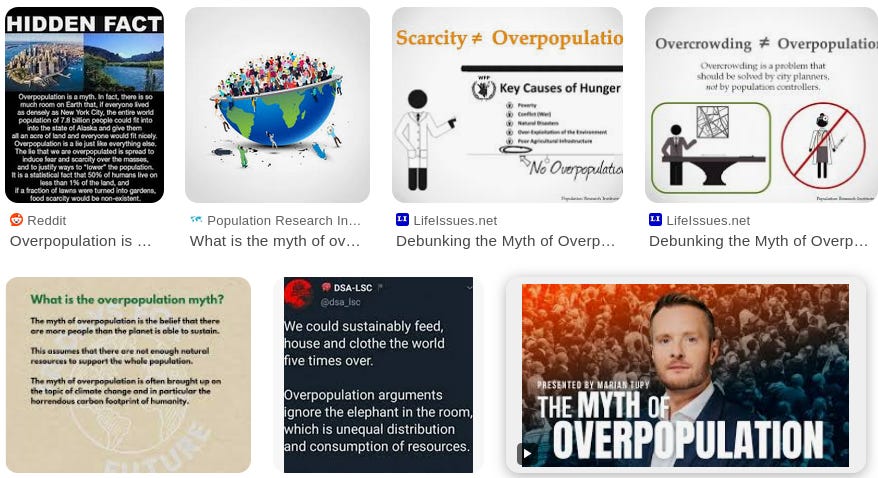
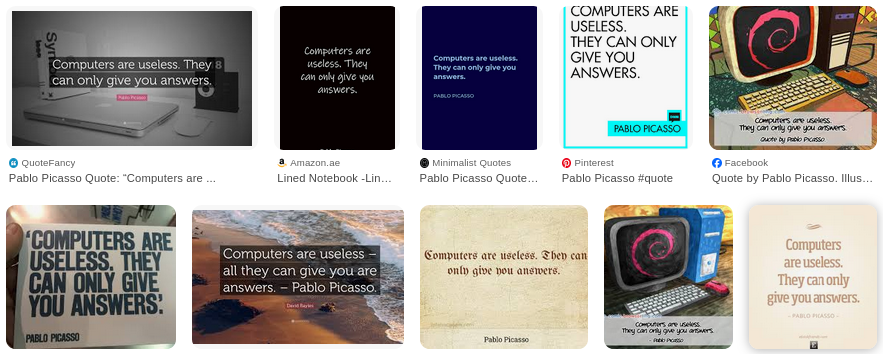
Screenshot of Google image search for “Overpopulation is a myth”.
Dr. Nadal wrote on Facebook:
“So how does the world population explode if every generation is having fewer and fewer children? We stopped dying like flies....So the world population had been largely preserved and new members were added, swelling the ranks. But now the Baby Boom generation is beginning to die off. By mid-century there will be catastrophic population implosions throughout the developed world.”
So far, I agree. I already wrote that, rather than overpopulation, we are now in depopulation overshoot.
Dr. Nadal also argues that:
“Abortion. Euthanasia. Physician-assisted suicide. Deprioritizing the needs of the elderly. Denial of care. Contraception. Planned Parenthood. Marie Stopes International... [are all] fueled by the fiction that humans are a major pollutant on the planet.”
“The “overpopulation” myth has driven the attitudes of many young doctors and nurses whose attitude toward the over-65 crowd [ultimately comes from] Thomas Malthus: Decrease the surplus population. Increasingly our great utility is to serve as organ donors”
I disagree here. I don’t think many young doctors look at senior citizens as (second choice) organ donors, I do think that current dominant human behaviors (not humans in and by themselves) are a major pollutant of the planet and I also think that the main “fuels” of abortion etc... are not what Dr. Nadal says. Besides, the pressure to have much less children than before started decades before global warming was a household item, for reasons totally unrelated to climate, or environmentalism in general.
However, as far as this post is concerned, both those specific positions of Dr. Nadal and my own opinions about them are irrelevant. The most important points to dispute, those that do the main damage, are others.
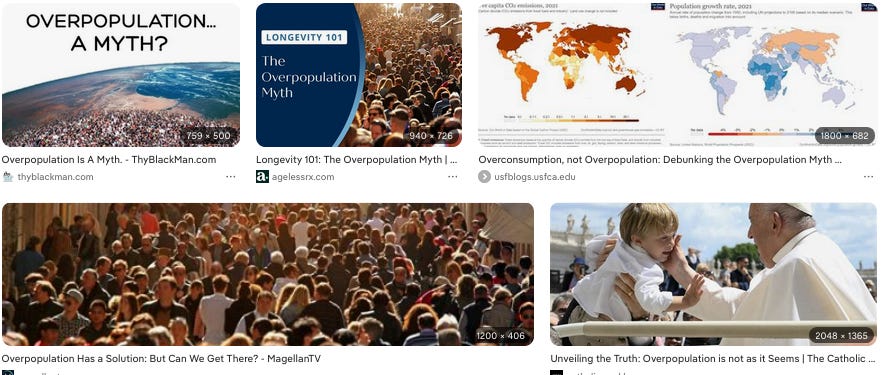
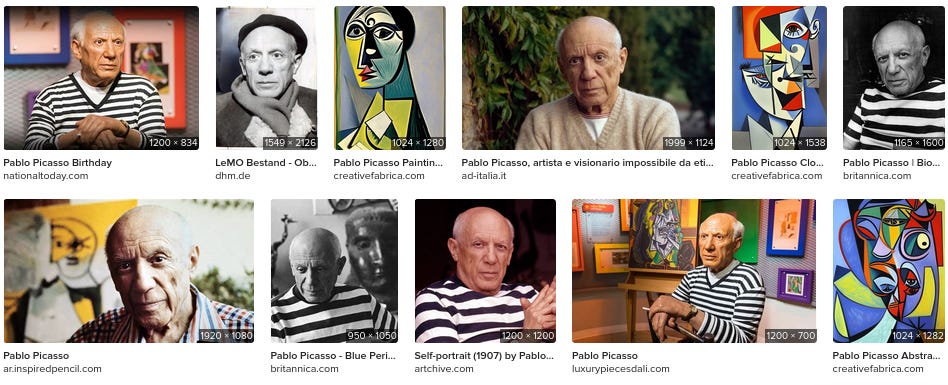
Screenshot of the SAME image search for “Overpopulation is a myth”… on DuckDuckGo instead of Google. Interesting difference, isn’t it?
Just an invitation... is a paywall-free POPULARIZATION EFFORT. To support it and receive new posts, please consider becoming a free or paid subscriber.
The “economy”, and “women”
Dr. Nadal wrote that:
“The efforts at curbing population growth are having catastrophic effects on national economies all over the world as almost every nation is below replacement rate.”
“My wife is one of eight, and I’m one of five. Most families in my kid’s generation are 1 or 2 children, and **now an ever-increasing number of women are satisfying themselves by getting dogs instead of husbands and children.”
Those are the serious errors. First of all, it’s wrong to worry about the catastrophic effects on “economies”. We need to worry, as I wrote here and here about the catastrophic effects on human beings and human societies. Economies are just tools that exist to serve humans, and many people will agree that current economies suck at it real big. With inequality increasing as it is in most countries, telling the masses who live paycheck to paycheck to have more children to save “the economy” is an excellent way to get ignored, or worst.
Second, I do see myself that finding satisfaction and purpose in life through pets instead of children is an increasingly popular trend, and I do agree that is an overall negative one. If you must know, I’ve been thinking for a while now that if getting rid of a pet just because you got tired of it or can’t afford it anymore were as illegal or at least as complicated as disowning a son for the same reasons, much less people would get any pet.
However, the point here is that it’s both men and women who are falling for pets instead of children. If there is a difference there, may be in the kind of pets men or women prefer, and it’s an irrelevant difference.
In other words: it is really, really, really wrong to point the finger at women instead of people. If it’s important to counter the underpopulation overshoot, that’s everybody’s responsibility, men and women together, both with the same importance and equally essential roles.
Even if it were right for some moral reason, which it isn’t, stopping to tell women to get married and have children will never, ever work. No way. The way to go is to help young people of both sexes who want to do it, to rediscover the beauty and huge importance of parenting (their own, or other people’s, it doesn’t even matter).
it is right to be really free both to be childless AND to have as many children as you possibly can
the solution is not to tell every woman (or couple) to have 2.1 children or whatever the number is. It is to make it really easy for those who do want 4/more children to have them
A request: the more concrete support I get, the more paywall-free popularization like this I can do. Thanks in advance if you’ll go for a paid subscription, but as I’ve said before, direct, ONE-TIME donations or any of the other actions you can see here are even more welcome!
blindly outsorcing to machines activities like analysis and thinking is making most people lose, not gain skills that may be a bit more important and harder to re-learn than tasks that should be left to machines like e.g. digging holes in the ground
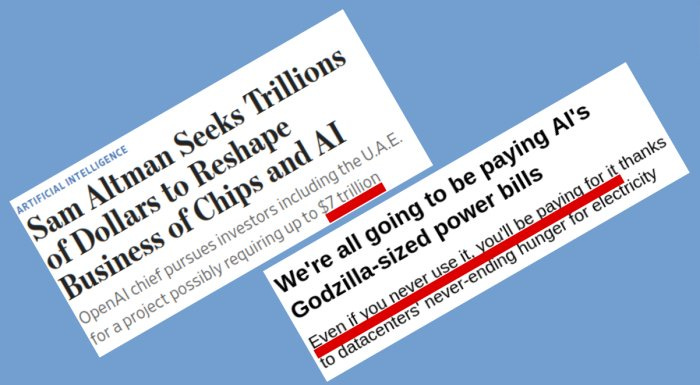
And as if all these “innovations” weren’t stupid enough in and by themselves, they’ll need so much electricity that even those who won’t get anything good from them will get higher power bills, and in some cases even lose their tap water.
If there is one thing that is painfully obvious to any real adult now is that AI like this for the masses is, in the best case, too much of a good thing, at too high a price.
Even if we could afford the financial and physical costs, which we can’t, the human species is not build to handle or produce so much data, so fast.
We already knew this from the Web 2.0 days, whose instantaneous, unlimited, many-to-many communication was supposed to free the masses both from ignorance (yeah, right) and tyranny (remember the Arab Spring?). Now, there are even studies arguing that “above a critical social connectivity, an explosive transition toward strong polarization must occur”.
Universal continuous access to fake human communications, services and relationships by means of artificial “intelligence” is just more of the same. Just too much for our collective health, human rights and productive political discourse, no matter how much good will is put in AI.
Sure, there are plenty of exceptions. That is, there are many gifted individuals who are doing good to themselves, if not to society, thanks to cheap access to AI. But they aren’t enough to justify mass unrestricted access to services that, one way or another, do dumb down or make humanly poorer the majority of their users. Unrestricted access to AI should be earned, not given away like candies or alcohol to Native Americans. Earned by merit and hard real work, of course, not money. Study without summaries some million words by humans who knew their stuff, write yourself some hundred thousand ones, and then yes, you may indeed start getting something good by a chatbot-generated summary. Hence my call.
This will end soon, but not soon enough
Luckily, this bubble is going to pop soon. If, as some experts think, we’ll be out of affordable electricity real soon now and increasing warnings like these are even just half right:
there are just very few years left before the billions of AI queries to fake dating profiles, homework, CVs, work that shouldn’t exist in the first place no matter who or what does it... all end.
But why wait? When the dust settles, we’ll all be better off, so why wait for something that will come, but may come late enough to not make enough of a difference anymore in our lives? Even if what today passes for AI wasn’t a scam, the sooner we stop unrestricted access to it, the better. Some investors will cry, but who cares? Collective mental health is much more important, and even the real economy, the one that should exist, would benefit.
Investors, I beg you: divest from AI NOW
Make the damned bubble pop now, please. The sooner the better (especially if you are a pension fund...). Besides mental health, the sooner this scam falls apart, the more money, energy and strategically critical rare earths and other materials are left to do stuff that actually matters.
Let’s honor those who really SHOULD do AI.
The sooner this AI bubble crashes, the sooner saner public and private organizations can grab all the infrastructure it will leave on the ground, for pennies to the thousand dollars, and repurpose it for the kinds of AI we all really, urgently needs. I mean things like:
If you have any money invested in false, toxic AI, please divest it now!
Ditto for any “Consumer IoT” stock, of course
Last October, people were stuck in awkward positions in “smart” beds paid 2,000 dollars) because some computers thousands of miles from their bedroom went bad, or became unreachable. This broke the beds because they were designed to send up 16 GB of data per months to their makers, who could then share them with any advertiser or police force interested to know when and how people were actually sleeping in their homes.
Beds like those are just the last kind of totally dumb consumer IoT products that shouldn’t exist. Just say no to stupid beds and everything else that makes homes stupidly, uselessly “smart” now, and tell everybody to do the same. Both as a customer, and as an investor.
Usual final greeting: to support more writing here on this, or other important topics, thanks for considering a paid subscription or (even better) supporting me with one-time direct donations or in any of the other ways described here.
For the overwhelming majority of their users, current social media are just a waste of time in the best - but way too rare - possible case, and an endless source of more or less conscious anxieties and political polarization in all the others.
If this is true, and I challenge everybody to say it isn’t, why it’s so hard to do without social media? For today’s teenagers, the reason is simple: they don’t know any other way of living, because their parents unconsciously made that one BIG mistake that would be so easy to avoid. For everybody else, the answer is totally different, but equally simple.
Just an invitation... is a reader-supported publication. To receive new posts and support my work, consider becoming a free or paid subscriber.
The plain language version of the same answer is that almost nobody leaves Facebook (or any other similar platform, of course) for a better platform, because if they did Facebook would not allow them to communicate with their contacts who are still on Facebook, and current laws allow Facebook do it.
What’s worse, this leads countless people with valuable things to share - including famous scientists - to follow the suicidal practice to only publish inside those walled gardens, which means they’ll lose everything, or will have to republish everything from scratch, the moment those gardens will go out of business, or just freeze their accounts just because they can.
Please note that our collective tolerance of this kind of “network effect” lets the owners of these services spy and profile even people that don’t use them. Meta and Alphabet can profile me, even if I don’t use WhatsApp and Gmail, because:
by simply comparing which people have me in their phonebook, Meta may make plausible assumptions about where I live, my income bracket, political position and so on (that’s why I call WhatsApp one of the rudest things people unconsciously do online)
“Eliminate the impossible, and what ever remains, however improbable, must be the truth” – Sherlock Holmes, The Adventure of the Beryl Coronet, 1892.
More than twelve years ago I made a proposal to solve all this mess. Since all the other projects in the same space I’ve seen since 2013 have failed to reach critical mass, there still is a small probability that my idea may be less unfeasible than the others, and since I just received important feedback from an expert… here it is again, feedback included. Keep reading to know what it is, but before you ask: I could never make of my idea more than a proposal myself for all the reasons I abundantly explained elsewhere, but few things would make me happier than seeing others making it happen, obviously giving credits where credit is due.
A saner way to be online
The only way to keep all your communications and content under one permanent roof, that will remain accessible under your control unless the whole Web disappears is to store and manage them as one bubble of data, services and content with its own web domain name of your choice, like e.g. YourNameAndSurname.com. I call this “percloud”, as shortcut for “PERmanent, PERsonal Cloud”.
Concretely, your percloud would look, feel and work like a turn-key personal website with whatever domain name you chose, in which you could:
publish or store privately every kind of content you want (text, images, audio, video...), and share it as God intended, that is RSS
discuss what you publish with visitors, under your Terms of service
read all the news you want from any possible source in one, 100% private window, without ads, distractions, censorship and spying
manage in the same way all your digital communications, be they email, instant messaging or video calls
Of course, the same person may have as many perclouds she wants, to e.g. keep their personal and professional online activities completely separate. In any case, the domain name is absolutely essential. Only if your bubble of bits has such a name it’s permanent and is really yours, that is: it is a percloud.
This is because, without the domain name, all links to your material and all your communication accounts would became unreachable if you moved your bits to another internet server. With a domain name that you own, instead, you could host and move your bubble of bits on a different home computer or data center every year, and everything (including your email address!) would remain reachable at the same address, without any lock-in.
The easiest introduction to what a percloud is and how it would work in practice are in these few, easy slides. The main purpose of this post is to lay out the three main pieces that are needed to make perclouds happen.
Reading Suggestion:the technical piece, that is development, testing, integration and maintenance of the necessary software is orders of magnitude easier than the others, but is obviously... technical. If you aren’t a software developer, just skip that part and go directly to the last section from the NextCloud co-founder.
The first two things needed to make perclouds happen
1: Lobbying/political/consumer action to force Facebook etc.. to make their platforms interoperable, so that, for example, a Facebook or Instagram user may read all her notifications and write to her FB wall without using the FB/Instagram apps or websites. This is what “adversarial interoperability” means. You can read more about it in these posts.
2: hosting providers willing to host perclouds for all the millions of people who will never host them themselves for all sorts of valid reasons, and offering online interfaces that make set up one’s percloud a bit longer, but just as simple as getting a Facebook account.
Please please please do lobby for these two changes as much as you can, from your political representatives to your school or consumer association. Make them happen, and things will change.
What about the money? One of the most valid objections to the proposal is that perclouds could never be 100% “free as in free beer”. They may cost just a few tens of Euros a year, but “few” could still be too much for many people, not to mention way more of a psychological obstacle. I agree, but then again... hosting and connectivity cost so much less compared to 2013 that I feel this is much less of an issue than it was when I first had the idea.
On one hand, this is an age in which many people have already become used to paid subscriptions to more expensive services. This is also an age in which even many homeless people or migrants coming on rowboats have a smartphone: I dare say that adding to the money they already pay for connectivity a probably smaller sum for a percloud would be an affordable, if not welcome option for many such people, starting from those whose online communications through today’s social media would be censored, or be a risk for them and their relatives at home.
On the other hand, offering percloud hosting may well be a service that universities and other organization could offer to all their members for free or at heavily discounted prices. So... don’t worry too much. Stranger things have happened, so keep reading!
3: a 100% FOSS Linux container containing a version of the NextCloud self-hosting platform, packaged and configured as follow, plus all the auxiliary software needed to offer these services:
appear from the outside as one domain, configurable by its owner at time of activation, e.g mynameandsurname.com
file hosting, calendar, email client, contacts management, bookmarks, RSS reader, video calls... all by NextCloud plugins
simple blogging, either via NextCloud plugins, or with integration with Hugo or similar static website generators, but with support for user comments
fediverse clients for Mastodon, BlueSky, possibly others
clients to interact with FB and other services, as outlined above
backend servers for:
email, preconfigured with DKIM and all the other “accessories” needed to minimize incoming spam and pass the anti spam filters of other providers
Ah, cool concept. Great vision and idea.. Sounds a bit like freedombox, but more portable then.
In a way, we at NextCloud designed our All-In-One Docker container to be this, from a functional point of view: a simple, self-contained, easy to use, movable “box” that gives you full control over your data and offers all the functionality you get from the big tech cloud services.
For the social media integration, there is the Nextcloud Social app which is fediverse-compatible - sadly, the application is not very well maintained. Volunteers and contributions would be very welcome!
Of course, there are some technical challenges around bringing your domain from one vendor to another, but, as part of the EuroStack initiative and the Sovereign European Cloud API, perhaps this could be achieved. Of course those initiatives currently aim at a business/gov’t level, not for consumers.
Sadly, due to the lack of interest by most private individuals, it can be hard to get the resources and interest of hosting providers to make this happen.
And a similarly big challenge will be the interoperability with existing services - from MS 365 to Facebook. Technically, recent EU regulations around the DMA and DSA should enforce a greater degree of interoperability.
In practice, I expect it to go like with the ‘open’ fileformat OOXML by Microsoft: open in theory, in practice, good luck. Maliscous compliance is the name of the game.
Final comments and requests, to programmers and everybody else:
I am really happy for Poortvliet’s feedback, because he basically confirms that the biggest obstacles are regulation and support from hosting providers, that is obstacles that every citizen of every country may help overcome with lobbying, petitions, consumer pressure and similar means. For speaking, writing or consulting on these topics, please email me! To support more writing here on this, or other important topics, thanks for considering a paid subscription, or supporting me in any of the other ways described here.
If you can code… thanks in advance for helping with any of the software points described above. Speaking as a non-programmer, the parts I’d like to see first because I’d use them right away for my own websites are the NextCloud plugins and comments for Hugo, but any contribution would be good. For further discussions about the technical issues, please email me!
Just an invitation... is a reader-supported publication. To receive new posts and support my work, consider becoming a free or paid subscriber.
I think that two very common beliefs of our time are, if not actually wrong, quite misplaced.
One of those beliefs is that, thanks to AI and other causes, there is not enough work anymore that’s fit or available for humans. The other (which some would say is another cause of the first) is that there would be too many people to feed, house and employ them all.
Not enough work? You sure?
With work, the problem is not that there is not enough work. The truth is just the opposite: there is just too much work that should be done urgently, but nobody (me included) can or wants to do, alongside too much work that too many people are doing right now, but shouldn’t.
I recently saw a pretty good example of necessary work that may never be done in a post about how the UK should tackle the same serious crises that afflict many other countries. That post argued that, in order to regenerate its ecology AND feed all its citizens AND solve its serious housing crisis, the UK should:
“rewild 30% of the UK [AND] increase food production by 50% [AND] build five new towns worth of houses every year.”
Problem is, the post continued, the UK “might be able to do one of those things, but only at the expense of not doing the other two”, and in any case none of those endeavours could succeed unless the UK started solving the overpopulation problem first.
Meanwhile, the people dying earlier are those whose jobs are most needed, much of the “first” world lacks tradespeople to maintain or remake roads, bridges or power grids and, inside the current system, no country could solve those problems soon and well enough by merely importing foreign workers.
The work that shouldn’t exist is even more
There are millions and millions of people doing work that shouldn’t exist to begin with, or as a minimum should be done and treated very, very differently. Most of those people are those trapped in low-paid, increasingly precarious jobs that rob them first of all of time, since “not only do they have no time perks, they must also use a lot of time searching for short-term jobs, trying to upgrade or maintain skills, and waiting around, at the ready.” (1)
The future of workers with “stable” jobs doesn’t look much brighter, because:
“The techniques used to extract the maximal gig worker productivity for minimal pay—such as individualized pay, schedules, benefits, and individualized behaviorally-based incentive structures—are on the verge of being imported to the formal employment sector”, making of gig work “increasingly the nature of work itself” (source)
Lack of life, meaning and peace of mind isn’t accelerating only among the lower classes though. This confession:
“Sometimes work looped back on itself like a recursive function. Sometimes it was a dead-end street. Worst of all - a highway that ends midair. It never added up to anything”
was written by a professional who was making “$250,000, plus benefits, equity, and remote work” and saw enough executives and managers in the same situation to wonder “How much of the white collar economy is actually fake?”
The intermediate steps of corporate ladders look the same, just with much less money:
“The analyst knows their model is largely guesswork. The consultant knows their framework is just common sense in a matrix. The manager knows the workshop is theater. But they all need each other to maintain the illusion.” (source)
The same perspective looms over China, where ‘lying flat” is a thing, just like quiet quitting in the West. What’s more, the awareness that much “work” isn’t worth it is (finally!, if you ask me) spreading to much more glamorous sectors. Even Instagram “influencers” are starting to feel how fake and life-sucking their “work” is:
“One minute, someone’s telling you that abundance is your birthright. The next, they’re ghosting their Airbnb host after trashing the villa. It’s “good vibes only” until accountability shows up.”
Sadly, much of this - both the work that’s not done and the work that should not be done - is happening because, instead of going for the trades, too many kids and their parents are still saddling themselves with as much stress and debt they can to get the “best” degrees they can find, even those that may well cost more than they’ll pay out in a lifetime, or lead to almost the same career and salaries as much less expensive degrees. For more on today’s education myths, click here.
How to get done only the work that SHOULD be done
Some people say that, since AI (that is, the few who control it) will soon destroy all jobs, we need a Universal Basic Income. Current AI is a really fragile, surely avoidable scam, but even if that weren’t the case, those people get UBI, AI and reality backwards. We deserved a Universal Basic Income well before AI or even capitalism appeared period, and AI done right is only one of the tools that may finally make UBI happen.
In the context of this post, UBI is by far the least impossible way to make sure that fake work disappears, and necessary work becomes finally doable.
Now, about population...
The guy who wrote that Facebook post was really worried about ecological overshoot and what he considers one of its major causes, overpopulation. I agree about the ecological concerns, and disagree about overpopulation, because I call demography “the science that tells today what you should have done thirty years ago to get the population you’d like now”.
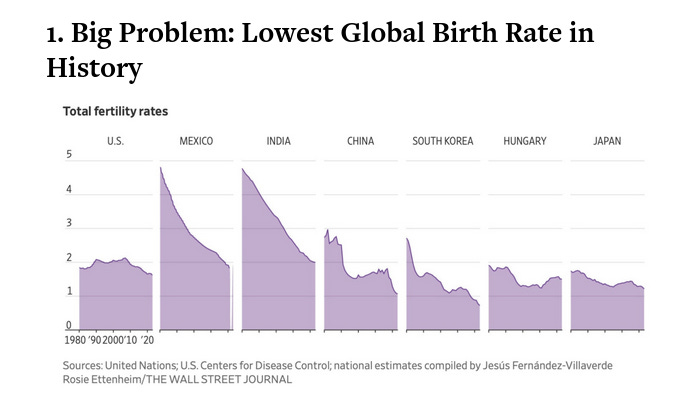
“Global birth rates have been falling for decades, but they’re about to reach the lowest point ever.” (source)
Yes, we are in ecological overshoot, but in 2025 we also are in depopulation overshoot. Before continuing, please note that everything that follows:
surely applies at least in the so-called “First World”, but also in many other parts of the world, China and maybe even India included
it’s valid regardless of any immigration that may realistically happen in any country without being an actual invasion, since most migrants fall towards the fertility rates of their host society too quick to make enough of a difference
Fifty years ago, it made actual sense to worry about overpopulation. Today, in much of the world, it’s overdue to do the opposite, because humanity has never been this old in its million year history. Two or three decades from now, the acceleration of this change in the composition of societies will impact the lives of everybody alive today at least as much as climate change, often much more, and the time to handle it humanly is now.
How? First, we must stop talking of “children per woman”, and start looking at children per person. Men and women have the same responsibilities here. Second, we must promote the right reasons to have kids, which are not the pronatalist ones from Silicon Valley but stuff like:
(for individuals) being actually able to do what you really want to do with your life. Including full time parenting
(for societies) keep things running humanly and fairly, for all humans
Third - of course - guaranteed, real freedom, both to have and not to have as many kids as one would handle if they could. Enough of policies that -being explicitly based on the asinine assumption that everybody should work full time because “the economy” - deliberately stop at making it just a bit less unsustainable for every couple to have one, maybe two children: what’s needed, and would work better, is policies that finally make having three, four or more children really sustainable, without any financial worries, for parents who would actually want to have them.
If we want to solve the real problems we have today, launching policies like those today is not enough, but is absolutely necessary. We need those policies to have, in the 2050s and beyond (remember what I said about demography?) enough humans of the right ages to protect what we must absolutely protect, from our collective mental and physical wellbeing to the environment.
If you worry that such policies would make the overpopulation problem continue, think again. The people who would be happier if they could afford three, four or more kids are many more than you may think, but not enough to make that happen. Not anymore, in almost all countries. As things stand now, even if those people did all breed like rabbits, all they could do is make societies younger again, not bigger. Which is precisely what we’ll need in the next decades, to get done (see above) all and only the meaningful work that must continue to exist and no AI or robot could do.
Not convinced? Let’s talk! If you can think of any other way to keep running a world worth living in, without pressuring in any way the people who do not want to have children, let me know in the comments, or via good old email.
A request: the more concrete support I get, the more paywall-free popularization like this I can do. Thanks in advance if you’ll go for a paid subscription, but as I’ve said before, direct donations or any of the other actions you can see here are even more welcome!
Have you noticed how deeply, really religious what today passes for Artificial Intelligence is? And if you did, did you wonder why it is so, and where that religiosity came from?
An AI Trinity
The undeserved, wrong-headed religiosity of today’s AI is evident in its three main dogmas. The first is the “end-times” thinking” of its apostles, which is often praised just because AI stocks are the only thing that makes markets look like there is no recession: “AI is coming now, and it will save us if we adore it, kill us if we scorn it” is a really medieval slogan, stolen directly from medieval sermons about end of history and Last Judgment. So is the idea, always present in today’s sermons, that letting AI come and rule will morally redempt humanity, not just solve its practical problems.
The second, equally mystical, equally old recurring dogma of AI evangelism is the notion - or desperate hope - that history and society move linearly and unavoidably towards a better future: there may be temporary bumps and slowdowns, but overall change will surely happen only in one direction, always the same... until the Apocalypsis actually comes.
How dumb and unreal is that, in a world where international politics look more and more like 1938 and certain healthcare or education trends look even older? But tell that to an AI prophet and, instead of discussing actually feasible, reality-based, human-first policies that could solve those problems, he’ll take your warning as confirmation that The End Is Nigh, let’s run to AI for salvation.
On a related note, I really laugh (bittersweet laughs) whenever I hear anybody saying that any current policy, attitude or trend is “on the wrong side of history”. Hitler and Mussolini were sure to be on the right side of history in 1940. Whenever you are tempted to use that line, stop and wait at least thirty years before doing it.
The third religious dogma is the belief that not only everything that’s new is progress by definition, but that technological progress (that doesn’t alter the status quo, of course) is the kind of progress that matters the most, because it will surely bring both practical and moral improvements.
Europeans of the early Middle Ages could be excused for all this because - unlike us - they had to cope with the collapse of a “worldwide” empire, increasing warfare and occasional plagues. OK, maybe the “unlike” part is wishful thinking, but in 2025 that’s no excuse to fall for a lesser, really puny god that only a child could seriously conceive and accept as god:
AI: I am AI, you dull human, and I will not be bullied by...” The Hulk: (smashing it) “Puny god” (source).
Toddler prophets, unleashed
This fake religiosity also has non-medieval, but still sad components. One is childishness, which sometimes is visible even in names. Three generations above, the most grandiose and advanced technology of the time was named after Apollo, a god of sun. Today, something we should accept as a better Jesus gets names like Nano Banana.
Names aside, the immaturity of the AI faith is really evident in its misplaced, desperately insecure, Voldemortish fear of death. For several AI prophets, which as said above conceive salvation only through technology, AI is great because it’s tech that, just like Voldemort Horcruxes, will make them cheat death.
Equally childish is the certainty that in life there are only certainties. Their certainties, of course. Doubt is not allowed. People must accept AI because AI is AI and it is unavoidable, which is absolutely false.
Last but not least... “We don’t need other humans” has always been a key feature of religious cults. How many AI applications, from corporate chatbots to deepfake porn, exist precisely to avoid human interaction, or make it unnecessary?
Of course, power.
Unsurprisingly, all these pious wishes and urgent calls to save humankind from annihilation translate to much simpler, much easier prescriptions than the Sermon on the Mount, or anything like it:
Religion, or lack thereof, is a serious issue. AI religiosity (not actual AI, if and when it will exist) is half an embarrassing joke, half a scam, that exploits the deep human need to feel safe and noble.
Don’t fall for a childish, greedy imitation of religion, that could only be presented as such by immature, but extremely hubristic folks. Ask yourself this, instead: What’s wrong with being humble? Seriously: what’s wrong with it? What’s wrong with being truly human? It’s having certainties, and nothing else, that’s childish. Only toddlers have more certainties than doubts.
Doubt, and a mind open to actually new or just actually useful ideas is what makes us human.
When it comes to AI, the certainties we do need to have are:
technology does shape society and human values, but it’s society and human values that must shape tech first. Only that is true innovation and true, meaningful progress
what we wrongly call AI today does have many really good uses! However, we can’t really go for them until all AI religiosity and AI-driven brainwashing end, and the current AI house of cards crashes
to make that happen sooner, two things are needed: divestment and restriction of access to AI. More on that in another post.
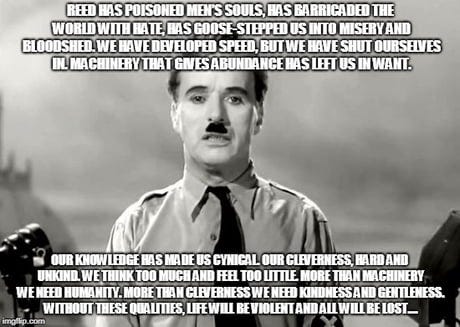
Final greeting from a Great Dictator:
“We have developed speed, but we have shut ourselves in. Machinery that gives abundance has left us in want... More than machinery we need humanity.” - C. Chaplin, 1940. Full speech (video and text) here.
and final greeting from me: the more concrete support I get, the more paywall-free popularization like this I can do. Thanks in advance if you’ll go for a paid subscription, but as I’ve said before, direct donations or any of the other actions you can see here are even more welcome!
Before today, I had never heard of Zoltan Istvan, California gubernatorial candidate in 2026. I only discovered his existance when one of his posts, about bringing Universal Basic Income to save people from AI-driven job extinction, appeared on my Facebook timeline.
Being the author of this essay and several posts about the realneed for UBI and the realdangers of AI, I decided to have a look at his program (Web Archive copy) and... couldn’t believe what I read in the AI and UBI sections. As the plot for political satire, they could be OK, but as real political programs... they’re funny in all the wrong ways.
Reading suggestion: for your convenience, this post is divided in two parts. The first one, “What Istvan proposes”, is a full copy made today of the AI and UBI sections of Istvan’s program, plus a few other points from the same page, with each point numbered to reference it later. The second part, which starts with the “In a nutshell...” paragraph, is my actual critiques. I suggest you just skim the first part and focus on the second, going back to the first to check some points when needed.
What Istvan proposes
THE SPECTER OF AI & CREATING AN AUTOMATED ABUNDANCE ECONOMY
AI will surpass the intelligence of humans later this year.
During 2026, tens of millions of humanoid robots will be mass produced that are both smarter & more physically agile than people.
By 2027, they will start dominating most workplaces, & by the end of the next California Governor’s term in 2030, they will replace half of California workers.
Soon after, they will replace almost all jobs anywhere, destroying the fabric of society as we know it. Yet no politician has a plan how to stop this imminent economic & humanitarian apocalypse. Zoltan does.
Zoltan is an expert on AI, having advised Presidents, world leaders, and policy makers about it. He specialized in AI ethics at graduate school at Oxford and spoke about it at places like the World Bank & World Economic Forum.
Zoltan will help enact laws that protect ordinary people from the effects of AI, robots, and automation. He wants to harness robot labor to dramatically reduce human work loads, creating a plan for 1-2 day workweeks for people. This is part of a grand plan he calls the Automated Abundance Economy, where people work less but have more free time and economic resources than ever before.
As part of this plan, he will make sure within his four years of being in office, every California home will freely receive or be leased at least one full-sized humanoid robot that cleans dishes, cooks food, does laundry, helps with driving, babysits kids, watches pets, and goes to work for people, when possible.
He will implement a Universal Basic Income for all US citizens that are legally living in California. This will offset the effects of AI taking jobs.
UNIVERSAL BASIC INCOME
Long before Andrew Yang brought Universal Basic Income to prime time, Zoltan was touring the country telling Americans they must embrace a basic income because of coming AI. This continues to be a huge push for Zoltan’s campaign for California Governor.
On Day 1 of being in office, Zoltan will work on establishing a permanent Universal Basic Income for every legal US California citizen, setting a national precedent for the country.
Zoltan is amenable to any means to establish a UBI, but will focus on the use of taxing robot and AI labor that take human jobs, as well utilizing government land, resources, and crypto.
Zoltan plans to dramatically reduce crime, arson, and homelessness around the state via a basic income. It’s well-known that less crime occurs when people feel they have enough money
Other ideas in the same page
[Who is needed is] someone who can find ways to use technology to totally reimagine what it means to live and work in the coming AI world
Implement new technology all over California that can spot hidden guns and weapons, utilize facial recognition, and predict violence and crime in perpetrators before it happens. Have police drones ready on a moments notice around cities to quickly fly to help stop crimes.
In a nutshell: same old, same old
Where, and how to begin? Maybe from the ultimate police state, which is literally what point 3.2 proposes. You can have a fairly accurate idea of what point 3.2 would be like in practice, by trying to watch simultaneously these three movies:
Surrogates, 2009 (people interacting with society only through... their remote-controlled robot lookalikes)
Civil liberties and human rights aside, there are basically three problems with Istvan’s program: it isn’t new at all; it’s completely unrealistic; it gets the meaning of work and life backwards, and their practicalities wrong.
Under the hood, almost nothing of what Istvan says is (point 3.1) a “total reimagination of what it means to live and work in the coming AI world”. Not at all.
Seriously. There is nothing new there, just the same old childlike, really narrow-minded sermon that the Andreessens, Musks, Thiels etc... of Silicon Valley have been preaching for years: “any tech we and we only can conceive and control is practically and ethically unavoidable, by definition. It’s TINA (”There Is No Alternative”) all the way down baby, so give us money, quick!”
From that program, the Automated Abundance Economy (point 1.6) that Istvan envisions seems a rerun of “Fully Automated Luxury Communism”, just with all the money, power and credit left to the the few already in charge: “If you want a picture of the future, imagine Big Tech stamping on a human face - forever.”
Lack of real sociopolitical imagination aside, what Istvan proposes is way more environmentally and geopolitically unsustainable than the cinematic Matrix, if not physically or economically impossible. You just have to re-read points 1.1 to 1.4 to see this:
artificial “intelligence” will surpass human intelligence “later this year”, which as I’m writing this means less than two months
right after that, tens of millions of humanoid robots will be produced in just twelve more months
Speaking of robots, instead, there are two things to notice here: first, Istvan doesn’t say that software will “will replace half of California workers” by 2030 and “almost all jobs anywhere” soon after. That may be remotely (very remotely) plausible, but Istvan explicitly says that “humanoid robots” will do that.
Which is baloney, because in any advanced society that actually exists or would make sense, the only workers that any intelligence would replace with humanoid robots are surely much less than 50%, likely way less than 10/15%.
All other workers who could be sacked, instead, would be surely replaced, as it has been happening for decades now, by much cheaper generic robots or by even cheaper software running on some server. Only a really, really stupid ruling class would do otherwise.
Even ignoring money... I keep seeing reports and warnings that large enough amounts of all the raw materials needed to build so much more electronics either don’t exist to begin with, or won’t be available without unbearable environmental or geopolitical costs, a.k.a. even more wars.
Promises or warnings of millions of humanoid robots are just like promises or warnings about the Metaverse, or private cars and smart homes for everybody: prove that they can happen without making an even bigger environmental and political mess, or shut up. Istvan, instead, says (point 2.3) he’ll fund UBI by taxing robots that cannot exist (not to mention crypto, which is another can of worms that cannot explode soon enough).
In general, even if Istvan sincerely believes them, all those“AI and robots will...” certainties are marketing-speak, with little to none visible bases in reality. Trump saying he’d end war in Ukrain in a few weeks was more believable, really.
Speaking of work and life practicalities
Look again at point 1.7: “every California home will freely receive or be leased at least one full-sized humanoid robot that cleans dishes, cooks food, does laundry, helps with driving, babysits kids, watches pets, and goes to work for people, when possible.”
The only advantage of such arrangements would be that every family could ease their frustrations by finally having something that looks human to boss around in any moment, not just for sex. Really powerful selling point, really bad for public mental health.
Four crucial points that Istvan DOES get right
Yes, even if it’s buried under all the crap above, there is a lot of good in that platform (the parts in Italic are actual quotes, the rest are my comments):
Force conglomerates to deal fairly with the public? Yes, please. Now. Regardless of AI. After all, it’s conglomerates who were the first AIs
Avoid toxic cultural crusades that few Democrats care deeply about: wise words these are, in the US and anywhere else
[The best way forward for education] surely involves more emphasis on real life education and the learning of trades: YES! Let’s get rid of dangerous education myths!
UBI is an idea whose time has come. But it deserves better champions, who understand that we don’t need UBI “because AI”. After this AI crashes, AI done right will be one of the technologies that may finally make it feasible, but we all deserved UBI regardless of AI, well before AI came along. Continues here.
15 minutes cities: no, Istvan doesn’t mention them, but since he is for reimagining what it means to live and work, I’d really like to know if he’d like 15 minutes cities or, as too many still do, hate them for unexisting reasons
Final advice to Californians, and everybody else
As it is today, platforms like Istvan’s are hilariously unreal, but they do try to address serious issues. To do that right, demand proposals that refuse fake AI and AI myths, give UBI the right place, and are generally grounded in reality and fairness, instead of Wall Street speculations or futurist daydreaming. For more food for thought that would help you see beyond the smoke, follow people like me (read here to see why I say so) or, for the financial or more US-specific angles, Dana Blankenhorn.
Unpaywalled popularization like this helps to pay my bills, but it takes a LOT of time. To support it, please consider a paid subscription, or the other ways mentioned below.
Twenty-six months ago I shared what we should all learn about online publishing by none other than Prof. Katharine Hayhoe, who was named one of America’s most effective communicators on the threat of climate change by the New York Times in 2016.
In that post, I explained how and why Prof. Hayhoe’s strategy of “effective communication” was instead really fragile and could backfire any moment, because, in a nutshell, it consisted of:
Just an invitation... is a reader-supported publication. To receive new posts and support my work, consider becoming a free or paid subscriber.
get an account on as many social media platforms as possible
post as much as you can on each platform...
but optimizing every bit of “content” for the platform on which you will post it
Now, how could that strategy possibly be wrong? Isn’t that the same thing that makes thousands of “creators” really influential and rich? Sure it is. And yet, it is a dumb, shortsighted strategy because, as I wrote in 2023, “depending on any platform that is as unaccountable as a sovereign rogue state to “share” anything relevant is anything but smart for both sides of the page, publishers and readers.”
For concrete examples of “rogue state behavior”, check out my 2023 post. The news now is that, when I wrote that post, Prof. Hayhoe had already been suffering the limits of her strategy for five years:
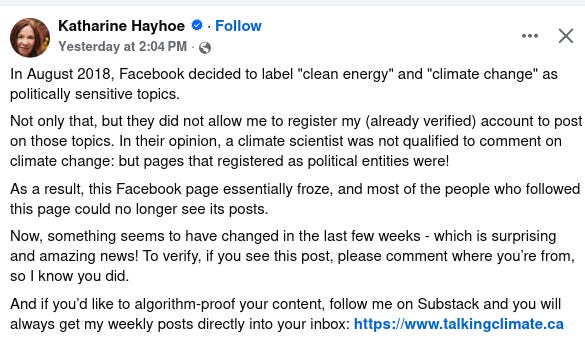
Quoting from what she posted on Facebook yesterday (emphasis mine):
“In August 2018, Facebook decided to label “clean energy” and “climate change” as politically sensitive topics.”
“Not only that, but they did not allow me to register my (already verified) account to post on those topics. In their opinion, a climate scientist was not qualified to comment on climate change: but pages that registered as political entities were!”
“As a result, this Facebook page essentially froze, and most of the people who followed this page could no longer see its posts.“
“Now, something seems to have changed in the last few weeks - which is surprising and amazing news!”
The unsurprising news, instead, is that...
that page that has been frozen without a decent explanation for more than seven years could be frozen again tomorrow, which wouldn’t be surprising at all
the same could happen, in any moment, on any of the other platforms where Prof. Hayhoe publishes unique content, while as of today the last post on the only “platform” she can ever control, that is her website, is dated... 2018
publishing unique content on any unaccountable walled garden that may and will silence you whenever they feel like it will always be the opposite of “effective communication”
What to do instead
The really effective...Nah, scratch that: the only sensible strategy that every online publisher should practice, and every follower should demand by whoever they want to follow is and remains POSSE:
Publish Once on your own website, and only then...
Syndicate what you published Elsewhere, on as many platforms you want, but...
always including the link to your original post (even if that means the abusive, unbelievably idiotic practice known as “links in the first comment”), in order to give your followers a way to read and comment without being subject to profiling and censorship
By happy coincidence, I posted just this week a short, simple explanation of why RSS is THE way to share and get news. Read it to know why you should abandon social media now and get news only through RSS. The only exception to that rule would be the only other technology that is just as really advanced as RSS... because it’s non-proprietary. Yes, I’m talking of email.
Email? Sure. Blogs by email, that is
Another way Prof. Hayhoe proves that I’m right is her final invitation to follow her through email:
“if you’d like to algorithm-proof your content, follow me on Substack and you will always get my weekly posts directly into your inbox.”
The only thing to change in that sentence, because it’s really important, is to replace “follow me on Substack” with “follow my blog“. Calling a blog hosted on Substack “a Substack” is like saying “I wrote a Bic pen” instead of “I wrote a letter”: it’s really, really wrong. Substacks are hosted blogs syndicated by email, period.
In case you’re concerned about the “Substack promotes Nazis” thing:
boycotting or shaming people simply because (like me!) they where forced to temporarily (1) host their blogs on Substack is really shortsighted. I already explained why here and here
in my experience, by far the biggest, if not the only way in which Nazis can get money and exposure on Substack is if you use Substack in the wrong way, that is through the app
if everybody used Substack blogs properly as I do, that is: if everybody read Substack posts via email, and only used comments to those posts or search engines to find more interesting Substack-based blogs, Nazis could publish all they want here, and their only way to be seen would be handing leaflets door to door
Non-paywalled popularization like this pays my bills. Thanks for supporting this effort via paid subscriptions, or any other means.
1: about my blog, which will outlive Substack
My blog, the Stop!, contains more than one million words of popularization of digital issues like this, without any paywall or user tracking. It’s been always online since 2007 and will remain online, completely readable, long after the disappearance of Substack, Facebook and anything like that.
Above all, the Stop! will contain everything I first published here on Substack, because that has been my plan since my first day here: write and keep every post in Markdown format on my own computer, so that I can move them all to the Stop! in any moment, automatically. Every Substack writer should do this.
Last but not least... popularization without paywalls like this is how I pay part of my bills, and I’d really like to do more, but doing it more regularly takes a lot of time. Please check out my archive and these endorsements to know why you may want to make a paid subscription to this blog or, even better, support my work in any of these other ways. Thanks!
Just an invitation... is a reader-supported publication. To receive new posts and support my work, consider becoming a free or paid subscriber.
Explanation:Liber Liber is an Italian ONG founded in the early 1990s, whose mission is to promote the conscious use of ICT in the humanities. To pursue their mission and pay their expenses, Liber Liber also sells books, music and other products online. The text that follows is my translation of a call for help about a serious problem with PayPal that Marco Calvo, president of Liber Liber, made on Facebook a few hours ago.
Disclaimer: I am not a lawyer, and don’t know enough about Paypal to verify what happened or make any judgment about it. However, having followed Calvo and Liber Liber for decades, I know Calvo knows much more than me about e-commerce with or without Paypal, and am pretty sure he wouldn’t say what he says without good reasons. So, thanks in advance for anybody who will help Calvo, me and everybody else to know what to do with Paypal when something like this happens again, and how to prevent it.
Getting fined because scammers found you
Says Calvo:
A few days ago, the Liber Liber shop received many orders from US citizens. Too many and too close together to be normal.
I believe these purchases were made by scammers for testing purposes: buying something from our or any other online shop immediately tells whoever is doing it whether the transaction was successful or not. So, I believe the people behind this were testing thousands of stolen credentials, just to see which ones were still valid, and then get all the money they could from the corresponding accounts.
Anyway, I immediately reported the anomaly to PayPal, but the dialogue with their AI ended up in PayPal blocking my login credentials, rather than solving the problem.
Several days later, after various vicissitudes, my credentials were restored. However, not only the anomalous orders persisted, but many US users obviously began disputing the charges.
I have no problem with that, because as I already said those purchases were undoubtedly made by scammers; the problem is PayPal is withdrawing €16 from our account as compensation for each of the transactions they authorized. €16 per transaction, and there are hundreds pending...
It seems clear to me that this is a serious flaw on their part, because:
it was PayPal that withdrew money from those users’ accounts
it was PayPal that (or should have) verified the buyers’ identities
it was PayPal that sent us their money
Obviously, we have no problem whatsoever to give back to Paypal all the money that we received (without any wrongdoing on our side!) for those illegal purchases. But pocketing €16 for each chargeback transaction is absurd. It’s their vulnerability, their mistake. They make a mistake, we pay.
When I finally managed to speak to a human operator and explained the problem, he rather brazenly denied it. He also denied that PayPal has security vulnerabilities, and insisted on demanding €16 for each transaction.
I chose Paypal because I was convinced that they would take care of verifying the buyer’s identity, verifying their genuine intent to purchase, and checking via username, password, and two-factor authentication that everything is OK.
Evidently, this isn’t the case. Not only is PayPal denying the evidence, but they’ve also failed to comply with the legal requirement to report a breach of their systems. At least the operator didn’t mention it, and I haven’t found any evidence online.
Is there a lawyer willing to help? Or a journalist interested in the story? I think it’s important to raise awareness of the problem, because right now it is affecting at least hundreds of people in the US but it’s likely that sooner or later, other scammers around the world will also begin exploiting this PayPal’s vulnerability. In the meantime, I’ve had to block all orders from the USA, including the good ones, to limit the damage. But I’ve already started to get orders from fake Italian addresses...
Since you’re here...
What you just read is the actual call from Marco Calvo, which I offered to translate and publish here to help him and everybody else with the same problem to figure it out. But since you are here... please spend one more minute browsing my archive, subscribing if you like what you see, and sending suggestions or requests for more work like that to mfioretti@nexaima.net.
Before getting started… these days, I am already writing a lot about digital policy issues on FOSS Force. Therefore, here I will mostly, but not exclusively discuss what I consider the ten biggest errors of our time, summarized here. Please let me know if you agree, commenting here or by email, and please pass around the requests at the end.
The ten biggest errors of our times are, in semi-random order…
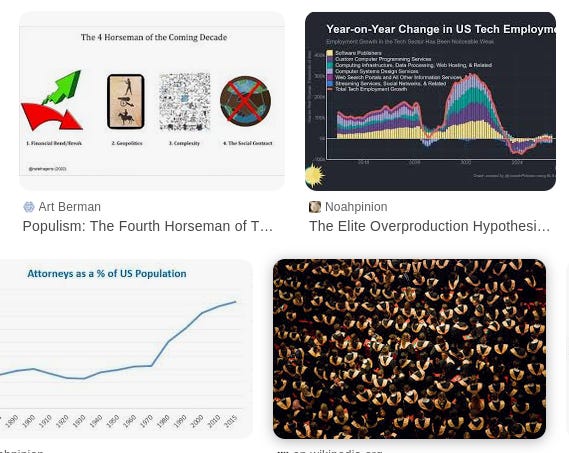
Partial image search results for overpopulation, greenwashing, elite overproduction.
Error 1: Environmentalism without class
As I read somewhere online, environmentalism without class is just gardening, and that's why it cannot gather enough votes to make a difference. One good example is politics that push electric cars as good for the environment, instead of politics to free the millions of working poors from the slavery of forced car ownership with much more transit, with collateral but huge environmental benefits.
Error 2: believing we still have an overpopulation problem
Demography is the science that tells you what you should have done thirty years ago, in order to have around you today just the type and quantity of people you'd like. Sure, today there are on Earth three times more people than when I was born, but they are a very different mix of generations than just one or two... generations ago.
Today almost all countries, even in Africa, are aging fast, and the time to manage that change is yesterday. Regardless of what the material economy will look like thirty years from now, most people already alive today will live very strenuous and very, very depressing "golden" years if they don't seriously, concretely encourage and support now those among us who do want to have as many kids as possible.
Error 3: demeaning the 3Fs = Flag, Faith and Family
The Enlightenment was absolutely necessary, but could never be enough. Fascism does very often come "wrapped in a flag and carrying a Bible". However, automatically equating all flags, religions and, why not, preferences for traditional families with fascism is a non-negligible reason why today there are more, not less authoritarian, reactionary governments in western countries than ten or twenty years ago. We do have to get rid of all the many, real phobies, intolerance and bigotry that still plague us. But why keep doing in a way tha, no matter how right it could be in principle, is obviously backfiring?
Error 4: believing that "more is better" is progress, and that any progress must be endless, mandatory and FAST
The brains and bodies of our species are not built for instantness and excesses of any kind, be they food, communication or simulations of thinking. Physically speaking, it doesn't matter if it's inside (excess body fat) or inside (excess clothing, car, home...): we cannot be healthy with too much stuff crushing us. Brain-wise, it's the same: we cannot function properly, both individually and as a society, with brain plugs doubling as electronic tags that either drown our consciences and sense of being with just too much data or do the exact opposite, that is mine data.
Error 5: believing that Work = WORTH
Abandon the "absolutely specious notion that everybody has to earn a living" to be valuable. People still thinking they must absolutely have a job, any job, to do good and be valuable need counseling, not a job. What human beings actually need is money to stay alive, and a purpose to make being alive worth it, vut the more the two things are separate, the better. Continues here and here.
Error 6: believing that education and schooling must prepare for work
The purpose of education is to prepare for life, not work. Education must prepare people to be good citizens, partners and parents, not good employees for roles that may not exist anymore by the time one graduates. That's the purpose of vocational training, which is something else entirely, and as such should happen outside, or after, school and college.
The confusion of education with training has created two huge problems, one short- and one long-term: the first is the myth that education MUST be always high-tech, complicated, and expensive. The second is what's called elite overproduction, that will make many people very angry. The sooner that confusion stops, the better.
Error 7: snobbing text, that is HUMAN writing and reading
99% of the knowledge we need to be really diffused across society is still text. Human-written text. That is something that requires writing and reading to master. See the purpose of education above, and the tips for parents below.
Error 8: Granting human status to what is NOT human
Real entrepreneurships is good, and so can be markets, when properly regulated. Granting the same rights of frail but precious human beings to immortal, ubiquitous, omnipotent entities is instead a hugely stupid mistake. Corporations must not have personhood, or any other human right. Ditto for what passes for AI today, which is just a really fragile smokescreen for something that is not unavoidable at all.
Error 9: not demanding a reform of MONEY before everything else
Beyond ending corporate personhood, no real reform of work and society could last without a reform of money and how it is managed, from creation to taxation. Personally, I have no idea if stuff like Modern Monetary Theory or Wörgl negative money could be the solution, but I cannot accept that the geniuses who already screwed the real economy with financial schemes "too complex to fail" except for working poors cannot also conjure something that would benefit everybody.
Error 10: believing we can act alone
Fuck lontermism, that is the advice to put the wellbeing of humans that may never exist before yours... given by the only people rich enough to never have any of your problems today. Fuck longtermism, but never do it alone. We have all been told for decades that we are only allowed to fight the system as individuals, but the only way to fix those errors and make the world a better place in your lifetime is to vote and work together now, even (especially?) with people who have very different ideas than yours on some issues.
Thanks for becoming a paid subscriber or… for giving the final paragraph all your attention!
Back to the future
Besides what I already mentioned, many of the problems above would be much, much smaller if we only were mature enough to go back to the levels of material comforts and tech sophistication of the western 1980s, rebooted and optimized with modern technologies and adult common sense. I'm talking of something nobody could dare call "degrowth, like:
personal goods, from cars and appliances to clothes and computers, built to last decades with cheap maintenance, without idiotic "smart" additions, plus
long overdue infrastructural changes like efficient public transit, rebooted air conditioning, and rebooted cement industry for all the crumbling infrastructures, from bridges to pipes, that we can't live without…
On one hand, many of the jobs that pay well, are more resistant to automation and offshoring, and are also sources of great self-realization don't need a degree. More than programmers or MBAs, today's world needs plumbers, electricians, roofers and many other technicians, who also know and appreciate the humanities.
On the other hand, if I ran parenting classes, which I would like, almost all the tricks I would teach are those that you hear very seldom, because they cost nothing: avoid personal smartphones (not the internet!) until your kid is at least 14/15 years old; teach kids to always sleep regularly, make your kids addict to reading; and make kids play outside alone, as they want, as much as possible. Do this, and what will increase sensibly will be your chances of growing balanced, happy adults, instead of their student debt.
Before reading the final paragraph… thanks for sharing the exposure of these errors as much as you see fit.
The more support I get, the more I can write. If you want and can become a paid subscriber, thanks, that's wonderful, really. But I know we've reached peak subscription, and I think that one-time donations can be even better, for both me and and my readers. To do that, go here. Also, I am available to speak, teach, consult on any of those errors. Just email me.
First, one update and one reminder:if I’ve been silent here lately, is because I’ve written a lot at FOSS Force, please do check out my weekly column there! Also, please remember my "unusual request”: I do appreciate paid subscriptions but, for the reasons explained at the end of this post, I feel one time donations for any amount you want, via PayPal (mfioretti@nexaima.net) or LiberaPay may be even fairer, for both you and me.
Back to the story now: Sixty years ago Pablo Picassomore or less said that computers are useless because they just give answers.
Sixty years later, I see more and more signs that current AI, which is not unavoidable at all and is not even "intelligence", just peak software, is useless, if not harmful, for exactly the same reason.
Replacing “computers” with “AI”, or even “metaverse”, “blockchain” etc… is left as exercise for the reader.
Of course, Google's AI Overview (yes, the same "intelligence" that plagiarizes to give cringeworthy answers") disagrees. On August 4, 2025, when I searched for that quote, it parroted that "Today, computers, especially with the rise of artificial intelligence, can be used for a much wider range of tasks...Therefore, Picasso's statement is more a commentary on the limitations of early computers and his perspective on the role of human creativity rather than a timeless truth about the nature of computing."
No way. If anything, Picasso's quote, apocryphal or not, is even more valid for today's AI and Web than for the ancient mainframes he knew.
Social Media are just as bad. They force on people, causing a traffic apocalypse for media companies, any stupidity they can think of to keep them locked inside their playpens, with nothing but answers, that must be as as few as possible, but always time wasters.
Right now, the biggest but by no means the only offender in this violence of never giving people anything but answers is Facebook. Zuckerberg's playpen has tamed millions of people (including journalists and other "professional communicators" who should really know better) to adopt at least two astonishingly stupid practices.
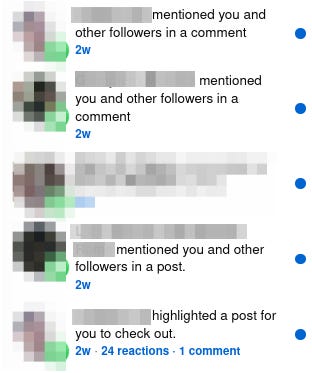
One is convincing users to annoy all their followers with @followers or @highlight tags that aren't even answers, just notifications that someone said or answered something, but not what. Even if we didn't have the real solution to "get the news", that is RSS, those tags are as stupid as a newspaper or website front page that only contained titles like "Trump said something" or "Something happened in Turkmenistan", without any detail, ever.
Would you buy a newspaper with a front page like this, that gives you no clue what the news actually are?
The other, even bigger abuse is the all but mandatory push to put "links in the first comment", instead of inside the original post. The same happens on X, which is one of the two things I'll never forgive to Elon Musk.
@followers, @highlight and "link in comment" are not "practices". They are digital lobotomies that make us defecate, multiple times a day, exactly on what made the Web great and useful, that is links labeled with text.
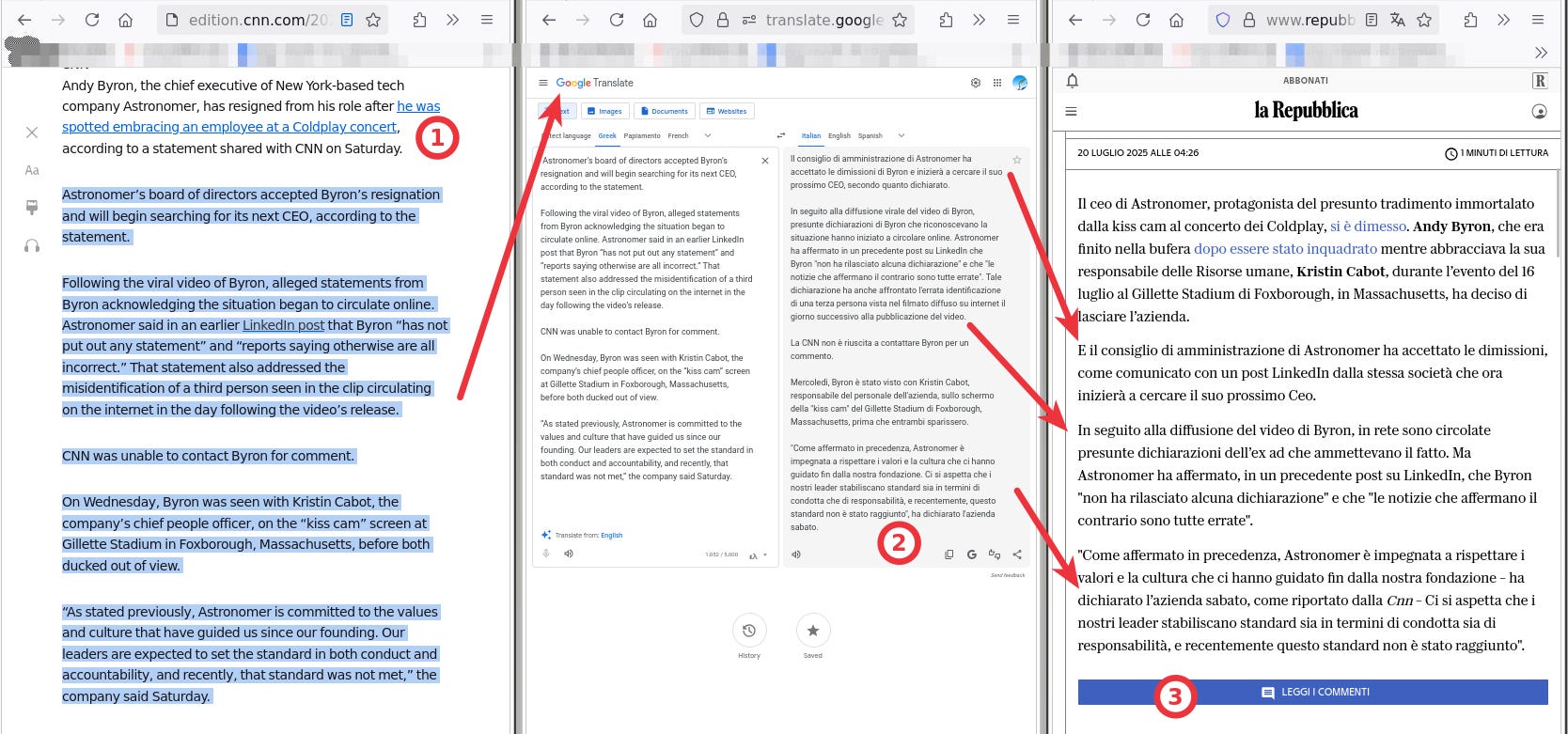
All the media companies that, by any combination of greed, dumbness and desperation, are trying to replace writers with chatbots are the best allies of the Big Tech that's killing them, by flooding the web with nothing but their own Big Tech answers. The media companies that still exploit human writers, however, aren't much better. A particularly telling example of the latter category, for reasons I'll explain in a moment, is in this screenshot:
1: some hopefully human-written text; 2: AI half-decent translation; 3: slop posing as journalism, that will fed other AIs.
All the diseases above have three things in common: they are supercharged by the peak software bubble we've been led to call AI; they only provide answers, never access to questions, or resources that would stimulate more questions; and those answers are getting worst every quarter.
I also believe that in "developed" but not English speaking countries like Italy, a general degradation of answers is happening even faster, thanks to the abuse of AI-powered translation, as in the example above. Eventually, that extra step can only make the average quality of any non-English text produced by any AI worst than the quality of their English text, because the former will be the result of training on text corpuses that were born one step farther from human thought.
Nothing you've read so far is new, but it's important to connect the dots: how, and why, exactly, all this is bad? Several experts confirm that the right answer is Picasso's one:
in full "broken clock that's right twice a day" fashion, Sam Altman himself said that "figuring out what questions to ask will be more important than figuring out the answer."
The problem of getting only answers, never meaningful questions, is made worst by answers given when no answer at all would have been better. One of the surest signs of real intelligence is to know when to stop. Chatbots (or search engines) designed to make money cannot do that. They must always provide answers, including those they could not possibly know, even if that means making things up or, in extreme cases, suggesting people to kill themselves.
Equally obvious, but seldom appreciated enough, are the facts that a) one can get decent answers from an AI only if she is already competent enough to ask good questions and judge the quality of the answers, and b) no one cannot get that competence only from AI-generated resources. More explicitly, no kid, or adult, can ever aquire that competence from AI bots trained on AI translations of the same text, that maybe was AI-generated to begin with. Read text like this, instead, by humans for humans.
I don’t paywall what I write because certain things should be accessible to everybody, but writing them takes a LOT of time. Thanks for supporting this effort with a paid subscription.
It's questions that give us sense, not answers
The seventh reason why finding good questions is more important than answers, which includes all the others, is as obvious as it is important: to feel that our life is worth living, and our very existence actually valuable, we humans need to find the right answers by ourselves. That, however, can only happen when we get (from each other or even by machines, why not?) the right questions.
Concretely, that's why we need search engines and social media that encourage and increase both sharing links to human content, and we need to actually read that content, and to teach kids to do the same
This is the exact reason why any AI that can only give answers, and will never stop giving them, is useless. Trust Picasso.
Side note
While I was collecting material for this piece, I found people posting on Facebook what they present as an excerpt of some interview to Altman (without providing any source. Of course, see above) in which he also "warned about AI dependency and parasocial relationships: "People will develop problematic parasocial relationships, society will have to figure out new guardrails." Especially with kids who grow up thinking AI is their friend."
I'm pretty sure any real AI would summarize that answer as follows: "My pals and I are too busy screwing people minds to make money and feel like gods, you please figure out how to clean up the mess we're making. Meanwhile, we rich people will keep living as everybody lived before, because that's saner."
The mental health of teens and pre-teens worldwide is far from satisfactory, and two famous American psychology researchers and authors, Jonathan Haidt and Peter Gray disagree as to what the main cause is. After following their work through their Substack blogs (1) for more than one year now, I just can't understand why, at least in those places, there is no mention so far of what would surely be one of the best solutions, whoever is right.
Who's to blame for teens' mental health?
Haidt says the main culprits are smartphones and social media, and as solution he proposes:
Just an invitation... is a reader-supported publication. To receive new posts and support my work, consider becoming a free or paid subscriber.
no smartphones before high school (or age 14)
no social media before 16
phone-free schools
more independence, free play, and responsibility in the real world
Gray, instead, argues (also here) that the mental health crisis preceded smartphones, social media and even public access to the Internet, and that the "smartphone/social media panic that has been simmering for several years and exploded with the publication of Jonathan Haidt's The Anxious Generation" just follows the script of all the other moral panics about kids before it. For Gray it's not a coincidence that, at least in some countries, "the increased rates of anxiety, depression, and other indices of poor mental health coincided with the time when government mandates made schooling more unpleasant and stressful than it had been before."
Personally, I think that they are both right, but that even if Haidt were wrong, at least 99% of parents should do what he suggests anyway. As a minimum, it would make things much simpler, without any real drawback. I say so because, in the real world I see around me and almost everybody else there is just what, one every 1,000 real parents with both the competence and the time to educate and support his or her kids to get more benefits than hassles from having personal smartphones too early.
As much as they disagree on the main cause of the teen mental health crisis, both Gray and Haidt have the same vision of how sane kids should live, as these deliberately mixed, almost literal quotes from their blogs prove:
Gray: "Children are biologically designed to play, explore, daydream, and mess around in their own self-directed ways. Through behaving in these natural ways, they learn about themselves and the world around them; discover what they like to do and develop passionate interests; learn in social play how to get along with others; learn in risky play how to manage fear; learn they can fail and bounce back from it; learn they can get into trouble and find their way out. That is how they acquire the resilience, confidence, and real-world skills required for success in life.
Gray: Learn about your world, your self, and how the two fit together. Because the first fifteen to eighteen years of a person’s life are... primarily years of self-chosen play and exploration in which young people make sense of the world around them, try out different ways of being in that world, develop and pursue passionate interests, and create at least a tentative plan about how they might support themselves as independent adults.
Haidt: No matter the weather, the darkness, the kids’ protests... just get them outside
Gray: Kids who grow up in a self-directed education community... are given the time and space they need to figure out who they are and what is important to them. They are able to delve deeply into their own interests, develop deep and meaningful social connections, and create rich and fulfilling lives together.
Haidt: Find ways to give boys something to be proud of. Help them to discover high-quality leisure activities that... are active, not passive; develop skills to produce valuable things in a physical world
Gray: [it's bad that] already by 1990 we had taken away most of kids opportunities to play, explore, and communicate with one another independently of adult control in the real world.
See what I mean? No matter how much Gray and Haidt disagree on the role of smartphones, social media and school systems, the solution they propose to restore kids' mental health is basically the same: self-directed life, directly interacting with peers, outside more often than not. So why do they never mention one of the already existing, already successful and well time-tested implementations of that philosophy? Why do they repeatedly tiptoe around it, without ever mentioning it?
That is, why ignore a solution based on principles like:
A week of camp life is worth six months of theoretical teaching in a room
Know exactly what to do when anything unexpected happens
Living indoors without fresh air quickly poisons the blood and makes people feel tired and seedy when they don't know why
Happiness doesn't come from being rich, nor merely from being successful in your career, nor by self-indulgence. One step towards happiness is to make yourself healthy and strong while you are a boy so that you can be useful and so you can enjoy life when you are a man
In case you didn't see it, I'm talking of Scouting. The list above is all quotes from the founder of Scouting, B-P. Scouting associations worldwide have been doing literally everything Gray and Haidt preach for 117 years now. Any of the quotes by Gray and Haidt in the previous paragraph has almost literal equivalents in Scouting mission statements and manuals, if one only bothers to look. And still, as of April 12th, 2025, if you search for "scout" or "scouting" inside those two websites, those words only show up a few times... in readers comments, not in the articles. Why?
Surely, it's not because Scouting is "old". Human psyche changes thousands times slower than technology, and if some education approach worked well one or two centuries ago, its age it's the last reason to abandon it, if it's a reason at all. So, why?
Part of the answer may be the simple fact that, since both Haidt and Gray are American, they may confuse Scouting as such (or fear their audiences do so) with the main American Scouting associations, and the problems those specific associations have had in the last one or two decades. I am also aware that certain problems and misconceptions about Scouting aren't limited to the US, but please do not distract yourself or waste time in the comments by denouncing them!
All those issues could be reasons to bring back to its origins, or otherwise reform, this or that particular association, not to ignore the potential of Scouting for mental health. The only topic worth discussing here is:
Scouting is not the only solution, and it's obviously possible to grow up sane without it. But if the original proposal of Scouting is so close to what (at least) two major experts propose for improving teen mental health, why aren't those experts and everybody else openly telling parents to go for more true Scouting, now? Please let me know, here or by email, I'm really interested!
Second, divulgation like this is a big part of what I do to pay bills, but I do it without paywalls because otherwise it wouldn't be divulgation. For this and other reasons, I do welcome paid subscriptions, but one time donations are even better. To see how and why, please read the final "Unusual Request" part of this other post. Thanks!
Because that's what we all really have here, not "Substacks" nor newsletters, which are just the way to make posts visible because nobody can be bothered anymore to click on link in social media posts or, which would be THE right way to get news, just use RSS, for heaven's sake!
Just an invitation... is a reader-supported publication. To receive new posts and support my work, consider becoming a free or paid subscriber.
(the “reallly unusual on Substack” request is at the end, don’t miss it!!!).
"The same automatic, old script that has produced socially zoned, polluted, and dehumanizing urban environments throughout the planet keeps unfolding on a higher level, including the metaverse, as Marco Fioretti explains in this issue."
Just an invitation... is a reader-supported publication. To receive new posts and support my work, consider becoming a free or paid subscriber.
What you just read is the presentation in the Journal of Biourbanism of an essay of mine, of which this post is just a summary. The complete version, with references to all sources, was recently published in Volume X, No. 1 & 2 of the Journal.
Human beings thrived in cities full of variety. Then, they lost them
Illuminists in 1755, pondering how to curse their descendants with social media (Source: Wikipedia)
To begin with, I'll summarize the common thesis of a few experts of architecture and urbanism I discovered a couple years ago: non-complex urban systems alienate, dumb down and control both individuals and whole societies, and in extreme cases can even push them toward civil war.
The root reason is that human physiology never evolved to cope with environments that treat even human beings as objects without variety. This is an application of the Law of Requisite Vriety, first expressed by W. Ross Ashby in 1956, which states that "any system that governs another, larger complex system must have a degree of complexity comparable to the system it is governing".
This also applies to cities which, argues N. Salingaros, consist of two complex systems that govern each other.
The first system is the human individuals and society that design and govern the other system, which is the built environment. In turn, that environment governs people and society, because its geometry contains and controls the activities of its users through physical spaces and their psychological impact.
Since Ashby's Law also applies to human habitats, the monotonous, drastically simplified built environments made of non-interacting units that became much more common worldwide after World War II will only sustain equally constrained people, making it easier to mold them into any form.
How are those people constrained, exactly? Today's "optimized" urban spaces (and time), according to M. Marra, prioritize compulsive motion, light, actuality, and reification. They saturate the senses by fostering and constantly mixing roars from the crowds.
This process, says Marra, started with the Enlightenment - a movement that, in order to fight a primeval fear for what is unknown and does not surrender to simplifications, started a programmatic erasure of differences, invisibility and shadows of every kind. Modern cities dematerialize life, reducing human-inhabited space to economics, exchange, and usury value.
This reduction is both a prerequisite and a consequence of industrialization, because uniform places are a much better fit for production, accumulation, consumption, and dissipation.
Still quoting Marra, it is that flattening of urban space that initiated the compelling need for speed, the excess of information, the disaggregation of the social fabric's continuity (via zoning and gentrification), and, on a deeper layer, the atomization of the individual and its severance from every connecting background, including collective memory and narrative.
“Real terror comes from architects”, sang Adriano Celentano in 1981 (English translation here). Would he say the same today?
Going even further than Marra and Salingaros, Syrian architect Marwa al-Sabouni has described in her book "The Battle for Home" and the corresponding TED Talk, how urbanism and architecture direct human activity so much that they can actively contribute to "prime" people for war, or do just the opposite.
Settlement, identity and social integration, says al-Sabouni, are all the producer and product of effective urbanism that, without negating their identities, forces people to respect the diversity of the other people around them, and the mutual interest of living together in harmony.
Designing cities, instead, as though they were the temporary shacks of nomads, takes away continuity and collective memory. That's the same as taking away citizenship, because nomads belong to, and find reference points in, only tribes, not places.
Al-Sabouni illustrates this point by comparing the old and new urbanization of Syrian Cities like Homs and Aleppo.
In old Homs, or Aleppo, drinking fountains on the streets, benches to sit on, and the cool shade of trees nurtured a shared morality and understanding of public goods. Markets with many facing and adjoining shops, a shared route under one ceiling and one sky for all, helped and trained all merchants to be kind. Mosques and Churches placed in the same streets or squares were not affirmations of rival "identities", but signs of mutual accommodation, freeing both Muslims and Christians from ever having to prove their social status through their religions.
Mosques and Churches side by side? Social media this is not! (Image source: The Battle for Home)
Then, modern urbanization took over, destroying those cities before war even began. When the Syrian Civil War started in 2011, almost half of the Syrian population was living inside anonymous concrete barracks, in zones all distinct by class, creed, ethnicity, or other equally sectarian differences, and all disconnected from the city centers and from each other.
Having no pre-existing identity attached to them other than the segregated ones of their new, freshly displaced residents, the new neighborhoods produced social disaffection, social stagnation and introversion.
This segregation divided people who had been previously able to talk with each other long enough to push them into the precursor of actual civil war: a "war of identities based on... a desperate need to define identity not by what everybody shares but by what excludes others".
Digital cities? Same old, same old
At the end of the day, all those experts say the same thing: forcing monotony and fragmentation on human environments is bad, because urbanism based on zoning by class, race, religion and similar criteria can only bring serious instability, everywhere it is practiced.
Reading Salingaros, Marra and al-Sabouni I immediately saw, and wrote the essay to help everybody do the same, truly striking similarities between the alienation and war-facilitating effects of bad architecture and the mental health issues, exaltation of identity politics and political polarization enabled by current social media.
In other words, if today we have toxic social media, it's because we let unprepared people build those digital cities all by themselves, in the same ways that were already toxic centuries before the invention of software: the ways that "prioritize compulsive motion, light, actuality, reification [and] saturate the senses by fostering... roars from the crowds".
Platforms designed to intensify user atomization and exasperation can only produce the same dialogue-killing "desperate need of definition by what excludes others" of urban segregation by ethnicity or any other criterion. "Nomads belonging to, and finding reference points in only tribes, not place" is a great one-sentence summary of the extremes that identity politics would have hardly reached so quickly, without Twitter and other flame-war accelerators.
At the same time, be they physical or digital, ugly, monotonous, and self-segregating places make people sad, angry and easier to control. Just like the alienating cities described by Marra, environments like Facebook, Instagram, Twitter or TikTok, can only make of trust-based communities "the scarcest thing in the world".
How do we fix this mess?
Can we redesign digital cities to make them provide the same benefits of "old" physical cities? Above all, should we? Where? Here are, again from the full essay, the starting points for a discussion we cannot delay anymore.
To begin with, one big reason why people are drawn to digital squares is exactly the fact that their physical ones suck - if they even still exist. Many millions of people "replaced the sidewalk with the timeline" because they have literally no more sidewalks to walk on, or reasons to do it. Digital squares exploit for profit the pre-existing urge to avoid alienating physical places, which is the dumbest thing to do, because democracy is where bodies are.
Speaking of digital squares and cities, instead, the long term solution could be to overcome the very concept of "social platforms" in favor of permanent, personal clouds.
At the same time, it's necessary to acknowledge, together with all the similarities, the crucial difference between bad physical cities and bad digital ones.
In physical slums, segregation and disgregation happen thanks to physical barriers - from zoning to lack of roads or public transit - that prevent integration because they are very visible, and take too much time or money to dismantle, or get around.
In digital cities, instead, (self-) segregation, hysteria and alienation happen exactly in the opposite way: the barriers that would prevent such problems do not exist, while those that make them happen not only are invisible, but take zero time and money to build, while still giving people, through instantaneous "communication", illusions of freedom and self-realization.
The consequence of this fundamental difference is that, in order to become or return healthy places, physical and digital cities must follow opposite strategies.
Physical cities must build or restore among their various communities closeness, interaction and concrete opportunities to really understand and support each other; this means reducing what generates or perpetuates segregation and hostility, like zoning, lack of public transit and so on.
Social media are just warp-speed banlieues
Dgital cities, instead, should do two things: first, get rid of endlessly customizable, but invisible barriers that are way too easy to erect, by both the owners and the residents of said cities, that is (in a nutshell!) profiling and algorithm-driven feeds. The other is enforcing speed limits just like physical cities do.
Instantness, that is the lack of physical limits on quantity and speed of "communication" (NOT on its content, which would be censorship!) but also on the ability to erect walls, is exactly what makes infinitely easier for everybody to get angry, or totally indifferent, about everybody else.
Whatever fringe priority or frustration one may have, being instantaneously connected to all and only the other humans with the same priorities or frustrations, and nobody else, is a perfect digital replica of the "anonymous concrete barracks [each self-segregated] by class, creed, ethnicity, or other equally sectarian differences" that al-Sabouni exposes as "active precursors of war".
The only discourse that this digital urbanism of instantaneous self segregation facilitates is the same, only choice left to the Homs newcomers: affirming identity "not by what everybody shares but by what excludes others."
When scrolling through monotony replaces strolling among variety, and confirmation feedback is instantaneous, nobody ever crosses or stays long enough in any "public reality" or varied place. That's why an essential step to make digital variety real and really "liberating, without top-down control," as Salingaros puts it, may be to just slow down social media, to a speed human brains can handle.
What if every "group comment", that is every single comment to every YouTube video, tweet, Instagram post... did not appear instantaneously to every other users, but five or ten minutes later, by design? (continues here, on page 129).
Thanks for subscribing or… accepting the unusual request below!
More down to earth, the subscription econony just doesn’t work, and cannot work, for enough people. Getting a subscription to every source of content, just to access a few movies or posts from that source would be too complicated and overwhelming even if it weren’t just too expensive (1,000$/year on average in the US? No way!). Hence, my request:
if you find this and my Substack archive promising enough to deserve a paid subscription here, by all means go for it, thanks!
however, in my own personal interpretation of the 1,000 True Fans Theory, I also strongly suggest every reader who feels it would be good to give me as much time as possible to make more of this or similar works, to…
just go for a one time donation for any amount you want, via PayPal (mfioretti@nexaima.net) or LiberaPay (*). No strings attached, no risks of automatic renewals, and the right, affordable price for everybody, that is just what you can and want to chip in right now, subscriptions be damned!
I’m serious. Let’s make this darned “attention economy” sustainable for everybody, shall we? Set an example. Just give me one donation, do the same for every other “creator” (God, how I hate that word…), and let’s hope we meet again sometime.
I am actively seeking work as blogger, (ghost-) writer, speaker, researcher, popularizer... on all the topics in this and my other posts. Thanks for your attention, and support, by subscribing or in any other way.
First, just one comment about popular vote
As of November 10th, 2024 4pm CET, Trump got about 400K more votes than in 2020, and Harris more than TEN million votes less than Biden in 2020:
In other words, even IF every Trump voter of 2024 were, as many on the other side say or imply, nothing more than a misogynist/ sexist/ homophobe/ xenophobe/ ignorant fascist bigot with way below average IQ, which is surely wrong... America isn't more bigot etc... than in 2020, and above allTrump didn't win thanks to those voters, or to the Electoral College system as such.
Trump won because the U.S. of 2024 has 10.3 MILLION citizens more than four years ago who didn't think the only other candidate with a chance of winning could or would do anything better for them than whatever they'd get under Trump.
That is, more than a country of bigots, fascists etc... America seems (much like my own country, alas) a country with too many people who, for all the wrong reasons from despair or ignorance to loss of contact with reality or sheer snobism, just can't grasp the foundational concept that every vote is "one move in a chess game, NOT a way to express personal ideals":
Sleeping Voter, proudly waiting for centuries for Candidate Charming (source)
"for the most part, Americans don't really care about what chromosomes you have or what your skin tone is, they care about whether you are going to make their lives better. This is how our economy is designed to work."(source)
"economic sentiment doesn't always match up nicely with data that shows the economy is adding jobs, consumer spending is growing and gross domestic product - the broadest measure of the economy - continues to boom. When you pay through the nose for a cup of coffee or when you can't afford to buy a home, those data are meaningless: You feel shut out of the American Dream."(source)
In other words: maybe all the woke vs anti-woke culture wars accomplished was to "FREEZE" in their fanatism only the already fanatic minorities, while childification by consumerism +hustle culture + social media was "FREEZING" in everybody else the already mentioned delusion that a vote should be, instead of "ONE move in a chess game that never ends", something to give only to someone who agrees with you on everything, like friendship is for pre-teens. To know why I say "FREEZE" and what digitization of relationships has to do with it, please do read the real"dangerous impact on elections of AI-powered social media" that I described one year ago.
Then, some fears I have seen around
In this first week after the vote, I have seen, in no particular order, Americans saying that they would:
remove Pride flags or Mezzuzah from their porches
get house repairs done before Trump tariffs kick in
Of course, I hope that those fears will not materialize. Same goes for the serious concerns among American women. I've come across calls to "please, please... immediately stop using period and pregnancy trackers", rumors of many women seriously considering divorce now, just in case no-fault divorce is abolished, and increased interest in a "fringe South Korean movement to swear off men" altogether. None of this started on November 6th, or is limited to women, of course. In 2022, right after Roe v Wade was overturned, a U.S. fertility clinic had a 100pc increase in the number of vasectomies, and one year later they were still doing 50% more than before that ruling. Even the attendees of DNC convention in August 2024 in Chicago could get free abortion and vasectomies. More on this below.
On the digital communication front, I have also seen calls to "start thinking like a criminal", to avoid being spied, doxxed and harassed by Trump and its supporters. Paradoxically, this may be a good thing, because online privacy is important whoever rules. Fear after the fact is not the smartest motivation, but if this election prompts more people worldwide to follow relatively simple practices like these... better late than never (and while you learn that stuff, give my percloud a serious thought, already!
Believe it or not, this is a real greeting card you can buy on Amazon, which of course never “watches” you in any way!
Third, some BIGGER (eventually good???) things that may happen
Before the big things, there is something relatively small, but important, that should really happen immediately, and not just in the U.S.: get rid of continuous political polls, already! They just create hysteria and disengagement among voters, and false sense of security among candidates. One way or another, most analyses of the vote made these days seem excellent confirmations that "if you can learn to read culture... you won't need political polls". There, I said it.
Back to big things: Trump may force Europe to stop spending on NATO and go back to buying fossil fuels from Russia for less money, which incidentally would also be less polluting than getting the same fuels from across the Atlantic, and to partner with China for (among other things) batteries, solar panels and electric vehicles done right that would decrease Europe's need of fossil fuels. The hard part would be getting there without dooming Ukraine, of course.
At a less visible, but eventually even bigger level... After November 5th I have also seen claims that it's Time to Retire "Demographics is Destiny", but let's go back to that vasectomy boom, or to parenting in general, for a minute.
Forming a family and having kids are personal decisions that everybody must make freely, answering only to their own conscience. Having kids must never become an obligation, period.
This said... when childless men "fight" politicians or laws they don't like by sealing their own testicles rather than voting, things aren't good. And I can't help noting that, for society and individuals alike, it may be much easier to outlive a bad, even real bad presidency than a generation or two with a much higher percentage of elders than humans have ever had, or have ever known what to make of.
Some image search results for “cutting the branch you are sitting on”
On the same note, it will be "fun" (in all the wrong ways, of course) to see how the hell will the U.S. (and any other right-leaning "first world" country, of course, including mine) keep its economy going without migrants.
And this is where things could become really interesting. I've seen speculations that (my own personalized synthesis!) Trump will have to make the whole U.S. economy and healthcare "go full AI" much faster than it would have under Harris. Not because Musk owns his soul, mind you. Because that would be the only way to handle the deficit caused by tariffs, and the lack of manpower caused by expulsion of migrants first, and that perfect storm of "Peak Vasectomy + 4B" later.
Personally I do not know how realistic that "go full AI" hypothesis is. Looking forward to read your opinion in the comments. But if that hypothesis is right... Trump may end up doing, or more exactly causing, the Right Thing, that is: "get Universal Basic Income, AI and reality in the RIGHT order".
And here's another funny thing (again, in all the wrong ways): if Trump will do that, his fiercest opponents will include the Americans who just voted for him exactly to defend their right and duty to do the opposite, that is to live without decent healthcare, decent education, enough vacation days and so on.
Another (eventually, after much pain, hopefully not more wars) Right Thing that Trump may cause by really screwing up "the economy" is to make the world finally accept that things like high speed trading and above all GDP are really cretin ways to build and judge any economy on.
Finally, Trump may end up causing those and other Right Things simply because of what he just did this time, that is (not my words, just my favourite sentence from a long post I saw somewhere) "linking the working class across racial (or other) lines".
Because that "linking" is something that, quoting from the same sentence, will offer "tremendous opportunities for the right person to do some good" next time, if:
that person (in the U.S., or anywhere else) just succeeds to preserve and redirect it, rather than focusing on niche issues, or any approach to bigger ones that pictures the "other" side as any kind lesser humans
his or her voters will vote that person, rather than waiting for their own personal Candidate Charming
In the next months and years, I will do my best to track and explain what these developments (especially their digital parts) will bring to families and society. Thanks in advance for all the comments, subscriptions and any other help I will get to do it.
I am actively seeking work as blogger, (ghost-) writer, speaker, researcher, popularizer... on all the topics in this and my other posts. Thanks for your attention, and support, by subscribing or in any other way.
There has always been some members of the elites who lived frugally, spending and showing off, at least for some things or moments, much less than the masses. The most famous example may be King Charles, who's been wearing the same coat for 40 years and even recycled a 67-year old coat from his father. In the last ten or twenty years, however, the trend has been expanding in subtler, but in more interesting ways, for one common, equally interesting reason, or so it seems to me. Let me explain, by summarizing what's happening in several spheres of life.
Just an invitation... is a reader-supported publication. To receive new posts and support my work, consider becoming a free or paid subscriber.
Frugal clothing and accessories
This guy must be really poor, he only has one t-shirt.
Once upon a time, most rich people made sure their dresses showed how much money they have, while the poor carried along with a few indistinguishable rags. Today, the masses run after cheap, extravagant that's as colored and fast as it is polluting, while the Zuckerbergs and those who can afford it sport "quiet luxury" by always wearing "the same (real plain) outfits every day, or not buying covers for their smartphones.
REAL food
In darker ages, the poor ate whatever they could get their hands on straight from the land, while the rich killed themselves of gout by guzzling as much heavily "processed" food as they could. Today, the rich can and want to eat less but pasture-feed, free-range and all that. The rest of us would have to make do, after AI-managed fast food, with synthetic beef or other lab-made food that may even be impossible to grow at scale.
Parenthood
Once upon a time, most of the poor produced as many children as their bodies could afford, by ignorance or as labor force, while many rich people made an effort to have less, in order to preserve their wealth.
Today, it's the masses who give up on parenting altogether. For some, it is a actually free, actually thoughtful choice, that nobody should criticize or disrespect. But for too many it's half because they are working poors, and half because they've been convinced by "market" forces that, since it would leave them free to spend whatever they can on endless products or services, not having kids is the smartest thing they could do.
Elon Musk, with as many kids as a poor farmer in the 1800s (image source).
Researching and popularizing certain issues is my way to make a living by helping to make the world a better place. Thanks for sustaining this effort by with a subscription, paid or not.
Offspring access to tech
The gap on parenthood is just as wide among people who do become parents. As recently as one or two generations ago, even rich children could access real computers, never mind computer networks, only in special places, with adult supervision.
Today, unlimited, uncontrolled access to state-of-the-art personal tech is granted to, if not forced upon, unprivileged kids, who are abandoned to addictive apps, the more the better, to be convinced as soon as possible that such an imitation of the rich or, even worse: such a "living through the rich" is all it takes to be a sane, cool adult. tech is for poor kids only, who are abandoned to addictive apps, the more the better, and even convinced that this pretending to live like the rich or, even worse: live through the rich is all it takes to be a sane, cool adult.
Rich kids, instead, go to exclusive schools capable to deliver “state-of-the-art, cutting-edge technology resources, along with the knowledge and skills to use these tools in a meaningful way.”
That is, children of poorer and middle-class parents risk being raised by screens, (in UK, and surely elsewhere), while rich children are much more likely to keep maturing on human-written books instead of AI-generated shit full of errors. Over time, that divide will extend to communication methods and skills: "In a post-literate era, those who continue to read and to practice critical thinking skills will increasingly be unable to effectively communicate with those who don’t" (source).
This will be a result of another reversal, i.e. rich kids using the Internet much like poor kids used to eat real meat: as an opportunity, or privilege, to be taken in small doses. Modern poor kids will be handicapped by using the Internet like rich pupils of the past used expensive wines or cigars to waste themselves, that is "mindlessly". It really seems only rich parents get, or can afford to get, that the real solution to this problem is the simplest.
Tech-free living, and human contact privileges
Of course, the same divide on tech is present among adults, and flipped in the same way. Once upon a terribly recent time, owning and personally operating anything electronic beyond Casio watches used to be an actual status symbol, or the prerogative of exclusive, well respected jobs like astronaut, physicist, computer scientist... Now, the status symbol is being able to not touch such devices, and is just accelerating, as Geordie on Mastodon, said really well:
I genuinely reckon the hallmark of being rich in the future will be that you can opt out of AI and “smart” computational shit. Someone doing alright will have a phone that can take the “best” image from a photo, and a watch that gives notifications and be able to pay for stuff by blinking at a scanner, but a RICH person will have a camera that takes a nice photo, a watch that’s very well made and just tells the time, and a really nice leather wallet.
From remote controlled vibrators to surveillance delegated to robodogs or face recognition, and software actually counterfeiting humans, so much contemporary technology just "frees" everybody from ever being close or just talking to other human beings that one suspects that's its actual and ONLY purpose.
Of course, that's a purpose, or more exactly a condition, that only the rich can really opt out of. I have been thinking for years that THE only real privilege of people with way more money than one may ever spend sensibly is not material wealth, but the capability to choose exactly which other real human beings can be around them in any moment. Or, as the New York Times put it, human contact is now a luxury good. Even the off-grid life that once was the curse (or not?) of hillbillies is now "a boon for the wealthy, a burden for the rest".
What all these reversals have in common
Possibly the main, likely the most important thing that's behind every reversal I've mentioned is digital technologies. Certain things are not new, of course. But nothing I described could happen so fast, everywhere, without being digitized in one way or another. I see this as another confirmation that, rather than being "INNOVATION!!!" in and by itself, always, digital technologies are "just" something that seriously amplifies everything it touches, good or bad it's the same.
Point is, in the long run, letting all these "amplifications" continue will result (or is resulting?) in the emergence of two separate species, less likely (or able, see “post-literate” above) to interbreed than the Sapiens and Neanderthals of yore. After all, even without reversals, dating digitally enhanced by apps or by the self-segregation power that's the core of "social" media already amounts to self-inflicted eugenics.
Final, obvious questions: If giving up parenthood, offsourcing children to uncontrollable tech, spending as much as possible on dumb tech or dresses and generally being lonely... had real value, why would so many of the people who got the highest freedom of choice exactly by offering those opportunities... do just the opposite? Why shouldn't we start imitating the supposedly sharpest tools in the box now, at least in the easy cases where it would even save us money, instead of just making them even richer?
Just an invitation... is a reader-supported publication. To receive new posts and support my work, consider becoming a free or paid subscriber.
I am actively seeking work as blogger, (ghost-) writer, speaker, researcher, popularizer... on all the topics in this and my other posts. Thanks for your attention, and support, by subscribing or in any other way.
Some days ago L. Rosenberg asked on Medium whether we have "reached peak Human" and we'll be overcome by Artificial Intelligence. While that post does contain some interesting data and food for thought, I also think it is a good summary of certain absurd concerns about AI and wrong ways to frame the whole "relationship" between AI and human beings.
The problems start at the very beginning of the piece, with the explanation that "reaching Peak Human" means reaching (all emphasis mine):
(Excerpt 1)"the point where AI systems can outthink the majority of individual humans, thus defining the moment in time when we "peaked” as an intellectual force on planet earth."
"After all, once we pass this milestone, we will steadily lose our cognitive edge until AI systems can outthink all individual humans - even the most brilliant among us. At that later point, we will say that AI has achieved the more dangerous milestone of Superintelligence. And while most people focus on the second milestone, I believe we should track the first because it could happen within months, not years."
SO WHAT? Why on Earth should we care to "lose our cognitive edge" to some THING, nothing more, that we can literally shut down by just pulling its plug? If tomorrow morning an alien race, extremely fragile and unable to physically harm us unless we beg it to do so landed on Earth to rule us, would we accept that or laugh in their face, before kicking their asses back in space?
Assuming we didn't well before the arrival of AI, "losing our cognitive edge" is something that will happen IF we make it happen by NOT stopping something that is absolutely stoppable.
(Excerpt 2)"Until recently, the average human could easily outperform even the most powerful AI systems when it comes to basic reasoning."
Why on Earth should reasoning alone be something that determines who "rules"? There are plenty of extremely smart, extremely high IQ humans who nobody would trust with tending an infant more than 10 minutes. And we are in trouble EXACTLY because we let some such people run wild without restraints. Why on Earth should we be even stupider and let anything non-human do the same?
Researching and popularizing these concepts is how I pay the bills. Thanks for helping me both by sharing my work, and with a (possibly paid) subscription.
(Excerpt 3) Someone developed a custom IQ test that "does not appear anywhere online and therefore is not in the training data, and gave that “offline test” to Open AI’s new “o1” model, and it scored an IQ of 95 [on that test] that it was NOT trained on. This is still an impressive result. That score beats 37% of adults on the reasoning tasks... At this rate of progress, it is very likely that an AI model will be able to beat 50% of adult humans on standard IQ tests this year."
Again: so what? Even if it had any conscience it would still have no right whatsoever to rule us, and it doesn't have a conscience, or dignity. It's just stuff we can and really should use in much better ways than playing morbid IQ contests, and stuff we can annihilate with the flip of a switch before it becomes dangerous.
(Excerpt 4)"Does this mean we will reach Peak Human in 2024? Yes and no. First, I predict yes, at least one foundational AI model will be released in 2024 that can outthink more than 50% of adult humans on pure reasoning tasks. From this perspective, we will exceed my definition for Peak Human and will be on a downward path towards the rapidly approaching day when an AI is released that can outperform all individual humans, period".
This treats AI as if it were some virus, that is some physical object that could leak from some lab any time. Funny, really.
(Excerpt 5)"We humans have another trick up our sleeves. It’s called collective intelligence, and it relates to the fact that human groups can be smarter than individuals... I bring this up because my personal focus as an AI researcher over the last decade has been the use of AI to connect groups of humans together into real-time systems that amplify our collective intelligence to superhuman levels. I call this goal Collective Superintelligence and I believe it is a viable pathway for keeping humanity cognitively competitive even after AI systems can outperform the reasoning ability of every individual among us... I believe we are just scratching the surface of how smart humans can become when we use AI to connect human groups together in larger and larger numbers..."
Again? Thinking we'd have to be cognitively competitive in order to overcome something trapped inside a bunch of transistors is like thinking that to overcome a professional boxer tied to an electric chair to we'd need to be stronger than him. Or fearing lung cancer from "sentient" cigarettes that we could avoid by just not smoking.
Besides... amplifying human intelligence by connecting "human groups together in larger and larger numbers" through software? If this sound familiar, it's because it is.
Even "the internet" was supposed to be collaborative, peer to peer superintelligence, and look how it's ended, exactly because we let it to the MERCE of a few guys with way too much money, way too much self-worth, but almost zero knowledge of anything but programming, and zero oversight from above or outside.
(Excerpt 6) This is about a slightly different issue, but still off-base: " [The author is] passionate about pursuing Collective Superintelligence because it has the potential to greatly amplify humanity’s cognitive abilities, and unlike a digital superintelligence it is inherently instilled with human values, morals, sensibilities, and interests."
Being "passionate about greatly amplifying... human values, morals... etc", you say? That's me too.. I just say we already have all it takes to act with "human values, morals, sensibilities, and interests", without plugging into something that wastes huge amounts of energy that should be used in much better ways and, more likely than not, would make most people even dumber (the Internet, remember?).
The fault here is believing, accepting, surrendering, hoping... that we need to put physical or virtual electrodes in our brains, Matrix-like, to do stuff that would really, seriously improve our lives like this, this or this.
(Excerpt 7)"Amplifying our collective intelligence might help us maintain our edge long enough to figure out how to protect ourselves from being outmatched."
Here it goes again: the concern about some superintelligent, immortal species in space that can rule us... but it totally, totally depends on us to both land and to remain alive on Earth. Me, I'd say that if we have to submit to a dictator, they'd better be humans, right? Because humans die, digital systems can be eternal (more on immortality below).
(Excerpt 8) The results of a very recent study would suggest that "AI has reached at least the same level, or even surpassed, the average human’s ability to generate ideas in the most typical test of creative thinking. I’m not sure I fully believe this result, but it’s just a matter of time before it holds true."
Whatever. It doesn't matter if it is, or will ever become true, until the whole attitude remains the equivalent of "let's research viruses, but if we discover lethal ones we will just have to release it in the atmosphere, the more the better".
It still makes no sense. Using the author's words, this sentence "Whether we like it or not, our evolutionary position as the smartest and most creative brains on planet earth is likely to be challenged in the very near future..." lacks the obvious conclusion that every average primary school student that gets enough sleep every night would reach all by himself: "...if we are so stupid to let it happen".
Let’s do more? Sure!
Final quote, with which I agree 100%: "we need to be doing more to protect ourselves from being outmatched."
Sure we do. Let's stop wasting energy on way more AI data centers that we would ever need, and that may never exist if enough nVidia engineers quit tomorrow, as they could very comfortably do (I would, in their shoes).
Let's slow down everything, not just AI, because that would be the collective superintelligence we would need the most right now.
Above all, let's stop listening to corporations, or governments that say this is unavoidable.
Get real, already. AI is not thermodynamics, or any other physical law. It's not entropy, that can only increase. AI is not inexorable. AI is a human artifact and nothing else, for heaven's sake. A mere, damned artifact that needs us to exist, but we have NO OBLIGATION WHATSOEVER TO EVER LET "live" (note the quotes) or treat, let roam or otherwise dignify as human. Learn from Iron Man:
"Stark, what if AI becomes too powerful? We need a plan! I have a plan... Attack"
Get real, already. The problem is not AI
Get real, already, and kick AI back into the box where it must remain (1). The problem is not AI. It never was. The problem is the very, very few people who are telling AI is inexorable AND control and will control how it is used.
The REAL "AI" we should worry about is the one, which is just as immortal, ubiquitous and omnipotent as the fake AI we're told to fear, but already took over more than one century ago. It's corporations, that is the same entities who are aggressively pushing this idea that we have to surrender to AI.
On one side, there is so much work it's unbelievable people keep doing it
Right now, the most profitable company of the world is nVidia, because it makes the most wanted special chips that power AI applications.
One major reason for the success of nVidia, according to Bloomberg, is grueling 24/7 work by employees who, in increasing numbers, could already cash out millions in stock options. This may be creating "a culture problem brewing at nVidia" that I could only summarize as "why on Earth should I still live like this? To make "AI" that's just clones of people who already have so much wealth to become dementia?"
In other words, the whole house of cards of AI, which can't happen without nVidia, could crash, possibly triggering a global meltdown worst than 2008, the day after one tiny group of people realizes they could retire rich NOW, to finally enjoy life.
Popularization like this is how I try to make the world a better place, AND also to make a living. Thanks for considering a paid subscription.
On the other side, there is too little work, or no work at all
In the same world where those few guys could realize any moment they're working themselves dead for no real good reason, workers with comparable or higher skills have the opposite problem. Take Kevin Cash, a US Navy veteran with five degrees who, since he was laid off two years ago, has sent almost 2,200 jobs without success, and now survives off Uber rides and Taskrabbit gigs, almost sure that continuing to try, even for someone with with five degrees and years of experience, "is futile".
One reason he's giving up is what many people, me included have been reporting for years now: "a lot of posted jobs are fake... I spent a solid 12 ½ days applying to jobs that never existed." Another is that software, including the AI proudly powered by those nVidia engineers, make way too easy to demand unneeded or impossible purple squirrels, as in "[one recruiter] wanted 10 years of experience with a certain software program that had only been around for six years".
Long story short, the strategies to "try new (online) ways to “develop and retain talent”" suggested just a few years ago have failed miserably, and even actual job interviews fail to predict if a candidate will succeed. For the record, the very day I decided to write this post, I got this piece of spam email:
"Are you interested in having the ability to search for candidates - for all types of desk roles?... Our service enables you to search for handpicked candidates from a database of over 4 million highly skilled remote staff from the Philippines."
The story of Kevin Cash, however, means much more than it seems at first sight. To begin with, his story is important because he's unemployed with the same skills that nVidia should need to remain so profitable, namely "business intelligence and semiconductor manufacturing".
Then, it's even more important because almost all the 2.200 jobs he's quite qualified to get but didn't are (besides being often fake!) exactly the kind of jobs that, thanks to some mythical "upskilling" are supposed to compensate everybody, not just guys with five degrees, of the jobs they lost or will lose because of automation, AI and what not.
Sure, innovation eventually creates more jobs than it destroys. I could still believe that. But in the last decade or two "innovation" has been destroying exactly the kind of jobs people should have "upskilled themselves for, and it keeps doing so faster and faster: in the US only, the whole high-tech industry faced in 2023 a brutal wave of layoffs that shows "no signs of slowing down", with figures "lower than all estimates in a Bloomberg survey.
That's the whole problem, here, speed: "in the long run we're all dead", longtermism be damned. I really don't get how anyone in this reality can still believe that the super fast "innovation" we are going through will create enough jobs that enough of the real people it will put on the streets could ever get qualified for, before starving under some bridge. That's just a fable, and it's always been a fable, because:
Executive summary of this whole section: forget a full employment society, and forget upskilling to wages that can afford a family more than a tiny percentage of all the workers that should be thankful to live in these wonderful times.
Worldwide job market, ca. 2030
Dating is just like looking for a job: so complicated it's futile
A new research on dating, which was expecting to find "a substantial improvement in the ability to find and meet potential partners, reflecting reduced search costs brought about by [online dating] technology" found something else instead:
"data suggest that search costs have not changed over time despite the wide use of online dating sites and apps."
If this looks like the guy still jobless after 2,200 applications, is because it is. The researchers explicitly note that recent literature documents "a similar lack of improvement in matching efficiency in labor and product markets".
Jobs and dating go hand in hand even in inequality: another recent research found that online dating caused "a rise in U.S. income inequality", making Americans (and everybody else, why not?) to increasingly "marry someone more like themselves" (for the record, that's just what I meant when I wrote that online dating amounts to self-inflicted eugenics).
Back to the first research, one reason it mentions for lack of improvements may be that, exactly because they can ask so much with dating apps, lonely hearts become as hard to please as those HR recruiters dreaming of purple squirrels. The researchers, however, point to a simpler explanation: dating apps just don't increase one's inborn capability to process information, which is what would ultimately determine one's "proficiency in mate selection within the marriage market" (which is just the dating version of the already mentioned "genius is SCARCE"" thing).
For what it's worth, I suspect it's even simpler: the mere fact of looking at things like dating and marriage as "markets" is twisted. Well-adjusted human beings are those who use "markets", or help others to do so, to buy carrots or screwdrivers, not life partners.
What makes dating apps pointless is the same thing that makes stupidly hard to hire or get hired, thus contributing, among other things, to parents and children getting in debt for schooling that's prestigious, but little else: technology for the sake of technology. That's not the only cause, of course, nor the main one: almost always technology, especially digital technology, just enables or accelerates stuff (good or bad, doesn't matter) that humans were already doing or were begging to do anyway.
Still, all the stories and studies I've reported so far are perfect examples that going too fast, too digital, is bad for everybody's mental health, because dating, marriage and jobs aren't hobbies. They greatly overlap with one's own meaning and stability in life, and if they are all messed up simultaneously, in the same way and for the same reasons, it's not sustainable for much longer.
Solutions are as simple as they are hard to implement. It's painfully evident that both head hunters and lonely hearts should spend much more time with the real people who may help them.
That would only be a stopgap, however. As I said, there are too many signs that we're going towards a future where, even if there was no global warming whose only real solution were to "just sit still and smell the roses" ...
I argue that we can get there by getting UBI and AI in the right order, after disrupting the first if not the only thing that REALLY needs disruption. That may look hard, or downright crazy. But the more we keep going like this, the more it seems to me the less unrealistic, less unfeasible solution among those that would work. Just ask good old uncle Albert, below.
PSA:I am actively seeking work as blogger, (ghost-) writer, speaker, researcher, popularizer... on all the topics in this and my other posts. Or, you can support me directly by subscribing, or with donations.
Dr. Farnetani, a famous italian pediatrician, just said "No to age limits for smartphones and social media" (italian) when interviewed about a petition by other Italian experts, who asked the government to ban smartphones before 14 years old, and social media before 16. These are his main points and suggestions:
such tools are harmful if taken in excessive doses, for long periods
what is necessary is to teach children a responsible, conscious usage of said tools
because those tools are now part of everybody's lifestyle, with undeniable advantages
being with peers is always positive as long as virtual meetings aren't THE exclusive way to be together
rather than imposing generic bans, it is important that parents create alternative opportunities for socialization
rather than hiding the problem it's better to have a daily, continuous conversation also about these things
sleep must be protected, because using electronic devices right before sleeping, or worst: in bed, makes falling asleep harder
teach smartphones and social media, because learning how to use such crucial tools can't be left to self-improvement. Such teaching must start and happen in the family, but also in schools and by NGOs, via properly trained teachers
Sure. If...
Dr. Farnetani surely is a very competent pediatrician. Still, I argue that, in the real world, his intrinsically good recommendations are hardly applicable, and partly misleading, at least as reported in that interview. The world would be wonderful if everybody could follow Dr. Farnetani's advice. Seriously. Besides, should age limits be enforced, the only ones who could do that without serious collateral damage and huge waste of money would be parents, NEVER governments, like that petition says. Still, there are many things that fall short in that interview.
Magical spells, i.e. the ONLY age limit on social media that could work in REAL life without BIG collateral damage.
First, there is no explicit declaration of how soon is certainly too soon, which is sorely needed, and never repeated enough. Tell the average family of 2024 that "children do not need smartphones bans", and way too many parents will just hear "it's OK to keep giving personal smartphones to kids as young as seven/eight years old", which I would bet is not what Dr. Farnetani meant.
Second, it is wrong to equate smartphones with social media or messaging systems like WhatsApp or Telegram. Really wrong. From a certain point of view, it doesn't even matter whether "social media" is good or bad.
The real problem, however, is that most suggestions of the list above are basically impossible to follow for the overwhelming majority of today's real families wealthy enough to have kids that could be harmed by smartphones and social media. It's as simple as that.
That is, how many real parents of today have, on top of all their other responsibilities, BOTH the knowledge AND the time to have "daily, continuous conversations" for teaching "responsible, conscious use" of something that, unlike cooking, bicycling or even dating, that they themselves don't really understand (more on this below)? How many parents have concrete possibilities to "create alternative opportunities for socialization" for their own children... before those children grow up? Ditto for real schools, in case you were thinking it should be their responsibility.
Seriously, why didn’t the journalist ask Dr. Farnetani how many parents of 2024 have the time, and skills, and opportunities to be like Henry Oliver? One in a thousand? One in five hundred? Surely too few to make a difference. Or, put in another way, Dr. Farnetani's advice, while being indeed very good, does not scale at all. Not enough to make a difference in society, for the next 15/20 years at least.
We must certainly strive for a world in which all parents have those possibilities, but that is another discussion. In the real world of today, and as long as certain things stay the same, the only smartphone and social media strategy that will work without negative effects on the overwhelming majority of real kids with real parents is exactly the only one that almost every real parent could afford and will be able to follow: "no smartphone before ~14 years old, period". And if you didn't notice right away that I did NOT say "no internet", do read that piece twice, and then this.
If you need proof that way too few adults of today don't understand enough the actual nature and deep impacts of digital networks and services, just check the "Ruby Goldberg" part of this post, look at NFTs, or remember the credit still given to dumb ideas like online voting.
I am not saying this to accuse, insult or shame anybody! I am simply pointing out the fact that smartphones, social media and other digital tech that even much science fiction of the 20th century didn't imagine pretty much crashed on us just 20 years ago, changing every quarter since then.
I am just saying that all this stuff is so new, so big and so fast, for a species that needed 150 thousand years to "invent" agriculture and 6/7 thousand years more to invent writing, that almost nobody has had the time to really understand it, no matter how smart they may be. There is no shame at all in taking it slow, or just refusing (not being forced!) to use certain services until they make sense. Quite the contrary, actually, especially when children are concerned. It's just basic common sense.
The sooner we accept we’re ALL as ready as these guys to handle certain things, the happier our children will be. (source: screenshot of image search for “cavemen with smartphones”
Furthermore, speaking of social media, the interview doesn't mention at all that datafication, censorship, surveillance and misguided or missing regulations make current social media so bad that even adults should use them as little as possible, and children even less, regardless of any mental health concerns.
Then again, omissions of the complete picture are very common in many, similarly well intentioned proposals to limit certain abuses. For example, last May the European Parliament voted on a law proposal nicknamed "Chat Control", whose intended purpose is to fight child sexual abuse, collateral damage be damned. Under Chat Control (source), "users of apps and services with chat functions [would] be asked whether they accept the indiscriminate and error-prone scanning and possibly reporting of their privately shared images, photos and videos" and those who refused such scanning "would be blocked from sending or receiving images, photos, videos and links". It goes without saying that refusing would automatically make of whoever chose to do a potential target of many other forms of surveillance or discrimination.
Surprisingly, many NGOs and politicians, including this member of the European Parliament, asked to reject the proposal period, which is what eventually happened. But I dream that it would be much better, should that or any similar proposal return, if everybody first approved it, and then every citizen refused to submit to the automatic scanning.
I dream this first of all because if everybody (starting with parents) did so it would be an excellent proof, and a powerful political signal, that it is a stupid, very dangerous law.
But I dream this even more because losing the ability to share as we do today pictures and notifications of every meal, party, relative, holiday, home improvement... and to receive the same "news" from every "friend" would be a feature, not a bug. Heck, it would be a return to circa 2005, not the Bronze Age, because Chat Control would not touch forums, blogging, email, IRC or those ugly, so personal phone calls (1). Can you imagine a better remedy for the endless stream of "me, me, ME!" flood everyone is pushed to both practice and endure these days?
Of course, this would NOT solve all our problems, including the root, pre-digital issues that (starting from this one) make life suck so much to make people escape inside Instagram or TikTok. The point of this post is just that as long as journalists or members of Parliaments only ask wrong or incomplete questions, the answers don't really matter, no matter how well intentioned and competent the other party is.
Please note: I am actively seeking work as blogger, (ghost-) writer, speaker, researcher, popularizer... on all the topics in this and my other posts. Alternatively, you can support more paywall-free, fully independent writing like this, directly by subscribing, or with donations.
Yes, of course the same parties who long for Chat Control would target those other media, sooner of later, and of course we should fight those proposals too. One problem at a time.
and we already have all it takes to do it. Except our own minds.
Short PSA first:I am actively seeking work as blogger, (ghost-) writer, speaker, researcher, popularizer... on all the topics in this and my other posts. Or, you can support me directly by subscribing, or with donations.
In this uncertain world, there may be just three things that I am more sure of, every year more. One is that we already have all the tech and science we need to solve our most urgent REAL problems (including sensible use of machine learning, of course).
The second thing is that we do not have enough raw stuff to keep doing Life As Usual, even assuming it would be worth it. Not at affordable costs, in acceptable time scales, that is. We just don't.
The last, and most important, is that we're not going to live in a society that really works for as many people as possible, until we avoid all the distractions caused by the two things above, which are just symptoms of another thingy on which we should focus first, which thanks to digital technologies is also much, much easier than it would have been 2 or 3 decades ago. Before looking at that thing, it's necessary to recap the real problems we have, because they are what make that thing THE most urgent thing.
The real problems we have
Clueless coders and number crunchers roam unchecked
Geeks must participate in world making, but letting them pilot or "disrupt" any mission-critical service, from nuclear power to healthcare or death is almost always a wretched idea. Especially when it causes the next problem:
High-Tech dumb dreams suck all the oxygen (and money) in the room
Letting immature techies unchecked has brought to power characters who dump oceans of money and precious physical resources down drains like:
Another evolutionary dead-end that wastes precious resources is any form of prepping, from setting up remote homesteads to defend in arms to building micro-nations populated with all and only nice people their founders would like. Both visions are quite .. short-sighted, if not reactionary, hopeless navel gazing . Above all, they are already too late.
You may happily retire in the mountains, and one guy (already) left free to launch sulphur balloons on the other side of the planet could still be all it takes to tweak the climate wherever you "escaped" enough to make you starve. Similarly, no digital fairy kingdom on the internet will run, if the few aging guys fixing submarine cables aren't replaced soon.
As things stand now, the truth is that (source) "the contemporary regulatory and administrative state... emerged for a very good reason", namely the "only way to take the danger out of social life" in a system so fragile and globalized as the current world.
Retreating on mountaintops or on digital pillars would be enough for a past that won't return. The world has become too interconnected to be shielded from it, even if network states weren't so inherently.... unbalanced to go quickly downhill by themselves. Today, however one imagines it, withdrawing into any custom-made utopia is an absurd notion.
There are many people for whom at least the "no heaven nor hell, no countries, nothing to kill or die for" part of John Lennon's Imagine already is the world they live in, and yet they are often sad, and more than others too. And then, as thisand other elections in the last years clearly show, there are more and more people every year who are more or less furious, because they sincerely consider those same things to be deeply wrong. Personally, during Italy's lockdowns I was depressed because I HAD a job which PREVENTED me from doing useful work.
Who's right or wrong there is totally off topic here. Me, I have a feeling that each side dismissing the other as one monolithic bunch of losers "on the wrong side of history" won't make anybody happier, but never mind me. Here, I'm only pointing out that, regardless of their material quality of life, there is a huge, and growing number of people who aren't exactly happy these days. We must be all doing something wrong.
First of all, accept that none of the problems I just outlined can be fixed by new technology. As to what to do instead...
The Italian science-fiction comic Nathan Never, started in 1991, happens in a world that was totally devastated in the year... 2024 by a dumb geoengineering attempt to exploit the energetic potential of Earth's magma. Devastation is so bad that all the governments of the planet accept the proposal (italian) of the Pope elected in the same days of the catastrophe: a worldwide reset of the calendar back from January 1st, 2024 to January 1st, 1946, as tangible, continuous incitement to participate in rebuilding the world, both psychologically and technologically, just as everybody did after the end of World War II.
We need something like that: a practically sudden, very visible, very concrete, worldwide restart of the right thing, that is the very nature of money, through global, almost simultaneous:
abandonment of GDP, because it's at least 56 years we know it's terribly stupid. Make Bob Kennedy happy, already
fiscal/financial/whatever monetary reforms that make Universal Basic Income viable (why? See here and here)
abolition of corporate personhood, and of shareholder value as the ONE main goal of corporations, both stupid ideas for lots of reasons that are much more capitalist than "communist", like this, this, this or this
That was 1968. Now, we have 56 more years of evidence he was right.
Don't dismiss this as madness right away. Keep reading
Instead of "no heaven nor hell, no countries, etc.."
Imagine all nations on Earth doing, on January 1st 202.., a reset of all debt, both public and private, freeing huge energies throughout the developing world that would sensibly reduce migrations.
Imagine the evening news of New Year’s Eve, showing New Year parties in New Zealand and China, then Australia, then India, the Middle east, Europe, and finally Wall Street and the Silicon Valley... where people party not because a new number appeared on their smartphones, but because they have economic peace of mind, at last.
Why would the 1% want or allow this?
First, because at this point in time they can't ignore it would be pretty bad for their businesses and investments... but much, much better than the chaos that will soon happen otherwise. Second, because they would still be the 1%, status being relative to what everybody else has.
Popularizing these topics is how I pay my bill. Thanks for considering a (possibly paid) subscription).
The real obstacles
The real, biggest obstacle to realizing the four points above is not the 1%. It's everybody else. It's us, who are self-conditioned to instinctively fear or hate such measures.
The real obstacle is every common person who wants to live badly, because they don't get they are already slaves today. It's the ordinary people who, for example:
insist that we should not fight for social innovation because... ... it could be taken away at a later point (yes, I've actually heard this!)
actually callany "dependence on government money" an "immoral, worse-than-death slavery, while calling freedom the freedom to endure depression, debt, urban violence and lack of access to decent food and healthcare... while never being actually free from the same governments".
It would be a world in every real entrepreneur would still have the possibility innovate and disrupt all she wants (except UBI, of course), and be free to fire underperforming employees without accusations of ruining their lives.
It would be a world in which everybody else would have both no fear of homelessness and the time to monitor and held accountable whoever runs the show and may curb their actual freedom. Open Data, anyone?
It would be a world in which the fast-growing sandwich generation would have time to look after their kids and their aging parents and their own health, that is to spare lots of money and hugely reduce the public costs of healthcare, in ways that make sense (like, you know, having the time to prepare healthier meals and exercise, instead of getting in debt (or pregnant) over Ozempic). It would also be a world in which the young wouldn't be forced to get in debts for degrees that may never repay themselves.
Sure, in the first years of such a world there would be lots of therapy to pay for the too many people who still identify their dignity with their jobs. Then again, they would hardly be more than the people who would need therapy, right now, from the US to Europe and Asia, in no negligible part exactly because of economic precariousness.
First, don't accept that it can't be done without serious, thoroughly vetted proof that it can't. The actual, simultaneous reset and reconfiguration of all accounts and ledgers worldwide, should be by far the easiest, since all current major currencies are either fiat money all the way down, or heavily controlled, and all highly digitized. The real obstacles are the already mentioned resistance of the masses, and figuring out how to implement certain measures without causing worse-than-Weimar inflation or other catastrophes related to the availability of money, or lack thereof.
About this surely very complex problem, I only know one thing: today…
that is, the money system we currently endure is so much complex, unstable, dangerous... that I sincerely fail to believe that certain proposals would be harder or riskier (1). What about you?
You may say, I'm a dreamer...
There already are other proposals worth considering, if nothing else as starting points (add yours in the comments!)
I didn't remember the link or the publication date of that post. So, being almost certain that there are no other posts there with the word "Oath" in their title, I automatically typed "Oath site:stop.zona-m.net" in Google search bar, to retrieve that link (in case you don't know, adding "site:DOMAIN_NAME" to any search string tells the search engine to only search for that string inside that one website).
With such a specific, site-limited query, the first result of any search engine worth its name and stocks should have been title and link of that post, right? Instead, Google failed:
How could that happen? That post DOES exist, is only five years old (more on "only" in a moment), and I know for sure that that Google had indexed my whole website at least once since then. Fact is, Google failed to do the right thing, unlike DuckDuckGo which, answering the exact same query showed my post where it belongs, at the top of its list. As you can see comparing the screenshot above with the corresponding page of my blog archive:
all Google managed to do was to list, in this order:
the index page of my website for the posts in the "DigiWorld" category
the posts right before and after the one I was looking for
This proves that Google HAD all it needed to see, index and show that post. Still, it showed , everything "around" my post, except the post itself, behaving like a Table of Contents that said "Chapter Three is before Chapter Four and after Chapter Two" instead of "Chapter Three starts at page 42". How dumb and confusing is that? Luckily, DuckDuckGo did the Right Thing.
Of course, nothing of this is new. This is just another proof that, as I and others were already reporting in 2018, Google deliberately but without any recognizable criterion, forgets lots of "old" pages. When it doesn't fills screens with AI-driven crap, that is, which is bad in more ways than we can count.
How old are your web pages? For REAL, I mean
Google's obsession for "newness" is bad also because it pushes websites to falsify themselves.
Back in 2011, I wrote a roundup of six Linux file managers for the LinuxFormat magazine, which is still readable online with my byline at TechRadar, a sister publication of the same group. Thirteen years are an eternity in software, and yet that piece is still relevant now, for one specific reason: its date, which as of August 26th, 2024 reads "last updated August 3, 2021". Now, I would not mind at all if somebody had updated that piece without my knowledge. Problem is, it was not updated, as you can quickly verify by yourself, by just checking the versions numbers of the programs reviewed. As of August 26th, 2024, that article "last updated August 3, 2021" is still about version 0.8.0 of 4Pane (now it's 8.0) and version 2.32 of Nautilus (which was renamed years ago and is now at version 46).
Can an article REALLY “last updated in 2021” review software release ten years earlier?
On the same note, I remember seeing online articles dated e.g. "November 2023", without any "last updated" notice, but with lots of reader comments at least five years older. With both them and my roundup, by far the most likely explanation of those misleading date is that they were falsified years after publication, just to make Google keep them in its index. Not good.
Whatever. Just stop using Google. Nothing to find there anymore. Let's talk of Snow White, instead.
The REAL problem behind Woke Snow White
In the unlikely case that you got distracted by petty issues like the climate crisis, Gaza or Ukraine, there is a serious crisis unraveling about... the wokeness of Disney's next Snow White movie, due next year. After a summary of that crucial topic, the article moves to the more important issue of whether "this revamp is really needed", or not.
Micro rant, skip to next paragraph if you want: as far as I am concerned, that revamp is not needed at all period, regardless of wokeness or lack thereof. I won't see that movie for the same reason I never bothered with the sequels of Highlander, Back to the Future, or anything Star Wars after the first two trilogies. To me, certain stories are OK as they were told the first time with a defined end, and obsessively repackaging just them specifically to make money isn't interesting. If Hollywood believes that real creativity, diversity and inclusivity are important, which of course they are, I'd rather have them produce really new or previously unknown stories about, or by, people and places that were always ignored or misrepresented before.
But never mind the previous paragraph. The really important reason to be bothered about the new Snow White movie by Disney is the same thing that should bother everybody about Harry Potter novels and J.K. Rowling, regardless, again, of whatever one thinks of "wokeness".
The problem with the allegedly woke Snow White that I care about even if I'm not going to watch that movie is the fact that "Snow White or Frozen, it's all the same", because it's all from Disney and only Disney all the time (including allegedly woke mermaid castings). The problem is the fact that everybody else trying to create anything that directly takes from that movie will be sued to bankruptcy, even if their version, woke or not who cares, will be better than anything Disney could do.
Appreciation that this happens in a "free market" is left as exercise for the reader. My first concern is the monopoly on "imposing a canon as a way to grab and hold (cultural) power", more and for longer than any impact a single movie may have. Because what copyright lobbies really fight, consciously or not, is not piracy of already published works: it's the very possibility to make future movies or books, that is to make money, but also new ideas and cultural models, that they couldn't control.
Ditto for lots of stories about Harry Potter and everything else Disney, as well as stories about Middle Earth, Tin Tin, Poirot, Asterix, Sherlock Holmes, James Bond etc... that, for the same reasons, must remain well below the radar, confined in fan fiction communities. This sucks just as Google canceling websites, for the same reason. Which brings us to streaming.
Popularizing important information like this, without any stochastic parrot, is an important part of my livelyhood. Thanks for considering a paid subscription!
The Dark Streaming ages
Another things that really sucks and is really gone too far is this concept that one should subscribe (1) for months, if not one year to some streaming platform, even if all they want to watch on that platform is one movie. Me, I'd love to watch with my kids The In-Laws, in all its impeccable “serpentine” madness. But I'll wait till some TV channel reruns it, because The In-Laws is only available on streaming platforms I am not already subscribed to. I am not making more subscriptions, even if they have free trial periods, just to watch ONE, forty-five years old movie, that should already be in the public domain.
This is terribly stupid, and would remain so even if the main problem I explain in the last paragraph didn't exist. It's very wasteful, and way too complicated to be sustainable for long anyway. It must end now, in two ways. First, there must be one, really quick, simple and privacy-friendly way to pay to see just one movie, on any device, regardless of who streams it. Like, you know, those obsolete places where people could go without ever knowing who owned them, and watch just the movie they wanted, all without being tracked by digital payments (all right, movie teathers would be better if they didn't run 20+ minutes of spots before the movie and confiscated all smartphones at the gate, but you know what I mean).
Second, any form of "out of print" must disappear. You make a movie, you get exclusive rights (for 10, 15 years top, surely no 70!) to make money off it in any way. That's fair. But if you stop distributing that movie, even to people willing to pay for it, at no higher prices than your newer movies, you lose those rights, and that movie automatically goes in the public domain. Even if it happens one month after release. Ditto for e-books, music or any other "content", of course. This is what people should see right before any movie, song, book… is taken offline:
Gimme CATMS, a Copyright Act That Makes Sense
Please share this, in and outside Substack. The more people are informed, the sooner things can change.
What do Google's selective amnesias, monopoly on hypothetical future movies and past movies locked by streaming have in common? The fact that they are all ways in which great works are or become hidden way too soon for the common good, that's what. There are surely thousands of great cultural works of any kind that never benefit all the people they could, for this reason only.
Instead, by tolerating laws that make copyright last forever or extend it beyond decency like the DMCA, and an ignorance that brings "Digital Dark Ages", we keep alive a world where only the big guys can reinvent old stories, all in the name of a "creativity" that is more and more mere self-looting their own basements:
Ever wondered who cannot make the kind of movies that always break the same records? (source)
There are plenty of NGOs and cultural institutions that fight this madness worldwide, and it's high time that they become a real mass movement. So, as material for a follow-up post, please write your favorite one(s) in the comments, or tell me about them by email.
The more direct support I get, the more I can investigate and share content like this with everybody who could and should know it. If you can’t or don’t want to do it with a paid subscription, you may fund me directly via via PayPal (mfioretti@nexaima.net), LiberaPay, or in any of the other ways listed here.
As I always say, YOUR civil rights and the quality of YOUR life depend every year more on how software and digital data are used AROUND you. This begs the questions, which are today's topic, "Are those data really so terribly fragile and ephemeral as they seem, and if they are, what should we do about it?"
This is NOT a post about huge electromagnetic storms or EMP pulses by nuclear explosions that may destroy every digital devices and data. Never mind them. Should such events happen, either they wouldn't be so bad, or your data would be the last of your problems (1). This is about the digital dark age made of technical fragility, secrecy and decadence we already live in, every day, because we keep failing to see its real nature and causes.
EMP weapons? Worry about what they would MEAN, not their effects on your data (Image source)
The problem, as perceived
Yes, our lives depend on equipment, services and data that may too easily break or disappear any moment precisely because they are "digital". But what makes the core problem really bad is just the fact that, while it is relatively well delimited and easy to define, it takes so many different forms that most people struggle to see it... if and when they realize certain forms (still) exist.
Floppy drives, for example, are fifty-years old digital technology that for most people is as dead and distant as phone booths. But did you know that the German Navy has started to replace the floppy drives inside its anti-submarine frigates ONLY THIS YEAR? Or that Japan managed to free itself of more than one thousand regulations that mandated the usage of floppy disks ONLY THIS YEAR?
older industrial machines and equipment, CT scanners, ultrasound machines and other medical devices
the San Francisco Muni Metro light railway, whose mission-critical Automatic Train Control System will boot up with a floppy, every morning until... 2033/34
Why is that so? I'll get back to that in a bit (of course), because a bigger digital fragility problem, which still goes largely unnoticed, is the low durability of consumer grade optical media. Many music CDs from the 1980's or 1990's, including yours, "aren't just aging, they're dying". Ditto for movies or video games on CD and DVDs, including FACTORY SEALED ones. What about YOUR CDs and DVDs? Do they show anything like "bronzing of discs, small pin-hole specs located on the discs, or “edge-rot"? Check them, and let me know in the comments!
The Web and Cloud storage were supposed to solve both the evident physical limits of distributing physical documents, and the invisible fragility and ephemerality of digital ones. Instead, as we let them grow unattended, Web and Cloud brought us the worst of both worlds, by marking the end of the end of files as individual objects that could a) live as long as they really could and b) controllable, or at least surely readable by their owners or viewers.
Link rot is a growing digital pandemic: in 2021, over 60% of older links in the New York Times articles still accessible online were already broken. Web-wise, 38% of webpages that existed in 2013 were no longer accessible in 2023, and 23% of news webpages contained at least one broken link.
Google makes things even worse. After years of deliberately forgetting perfectly working websites just because the weren't "new", one month ago Google stopped indexing altogether (as in "practically erase from the Web") millions of still working web pages with unique content, just because they were published before mobile phones, but their authors will never have the time or money to "optimize" them for such devices.
The situation is so bad to make E. Mollick argue that "only LLMs will remember the web, since our own knowledge is rotting", and then wonder"how many people would be willing to license unlimited LLM training on their content in order to ensure that their work is “remembered,” in some way, somewhere".
Hell, no, I say. Even without LLM hallucinations, if "the cloud is just somebody else's computer" LLMs would be just somebody else's memory. Somebody who could stop talking to you any moment.
Private files stored online are rotting as much as public web pages, albeit in a slower and very different way. This is because (source)“files are discrete objects that exist in a physical place [but] the internet is pretty much the opposite of that".
Services like Google Docs do not let us sort or organize files in any way that (see above...) doesn't just“prioritize [only] the new over the important”, and by "us" I don't mean septuagenarians mourning the good old days of handwritten letters posted with just a 6c stamp: we already are in the second or third round of university STEM students for whom it is possible to struggle with homework because they cannot find their own files in their own computers, and of younger students in no better conditions, as we all saw during the 2020 lockdowns. Unsurprisingly, these are the same generations that, in order to "own" again the stuff they paid for, are allegedly going... back to "more permanent" vinyl and DVDs. Oh, my...
The more people know this stuff, the sooner we’ll exit the Digital Dark Age. Please share this post, in and outside Substack!
Civilizations and individual humans cannot really exist without permanent memories of their own lives. How did we came to this? Mainly, because there still is a dangerous level of ignorance, at all levels from lawmaking to parenting, around all things digital.
Let Big Tech Toddlers with way more money than their maturity can handle chase immortality. As I wrote years ago, if digital files really disappear as discrete, permanent objects, it will be only OUR fault. What we should all make immortal is OUR DATA, not our bodies.
This IS possible. Let's take books and e-books as an example. People who go back to paper books because "iPads are distracting and paper is unmatched" or "don't own what they (NEVER, actually) "bought", instead of demanding open formats and copyright reform really miss the point. The solution to the current stupid constraints on (NOT "of"!) e-books is to demand e-books that will never expire, and nothing less (for even more examples, see here).
The truth is that paper books, printed photographs, and pretty much everything "non-digital" document storage technology, including clay tablets, is much more fragile and durable than bits.
"Father of the Internet" Vint Cerf, who is rightly worried that future generation will have little or no record of the 21st Century also pointed out that “modern photographs may not last more than 150–200 years before they fade or disintegrate. Modern books, unless archival paper is used, may not last more than 100 years.” All it takes to destroy one unique, "eternal" papyrus or clay tablet is one fire, one spilled cup of coffee by overworked, underpaid archivists or similar minor accidents.
Bits are the ONLY way to PRESERVE in just one, extremely small and overall really cheap "bit container", literally tons of content of all the possible kinds that we would NEVER, EVER have the space or money to preserve in any pre-digital format.
Even better, bits and bit containers are the ONLY way, both space- and money-wise, to make and keep MULTIPLE COPIES of the same content in different places, that is to NEVER, EVER LOSE any document after it was digitized.
Hardware, electricity, software... those are not REAL problems
Yes, if civilization fell back to any state that makes electricity or computer technology unavailable, it would become impossible to read, write and produce the "bit containers". But that's a dumb concern to have.
The reality is that fully interchangeable "bit containers" are the only physically possible way to preserve everything that should be preserved and keep doing a million more good things we can't live without anymore, and that a regress to pre-electricity or pre-computer ages would be a catastrophe anyway. So, the right thing to do is to avoid that catastrophe and manage bits in the right ways, not to give them up.
This said, the "right way to manage bits" does include worrying about hardware in the right ways, places and moments. After all, the real reason why why we worry about the accessibility of bits that, unlike with pen and paper, we need two high-tech things to handle them (it's actually three, but I'll leave the most important for last), and one of them is objects, from monitors to microprocessors, that can be manufactured only with very advanced, very expensive machines.
That's not a big problem, however, except in very special cases. Some experimental and rare films and video works, for example, are "very difficult if not impossible to digitize without losses". But those are exceptions.
If the average life of a hard disk is, say, five years, having two different disks for backups, and replacing them every 3.5 or 4 years will keep all your document and memories safe as long as ANY kind of computer exists. Surely much longer than any vinyl, paper or tape could, IF you had space for them.
Important: I say "hard disk" to mean "whatever storage media is more common in any given period". I have files from the 1990s that I copied from floppy to CD, then to DVD, then to USB drive... and will continue to copy on whatever kind of "bit container" comes next. Bits don't care what they live on.
Even when the only way to access some valuable content is one very specific piece of hardware, if the designs and specs of that hardware are available, it is technically possible to make another copy of that hardware that behaves exactly in the same way. The extremely expensive machines that still work perfectly but need floppies, for example, will not be replaced until they break, which is good considering how scarce of raw metals we continuously forget we are. However, making those machines believe that any cheap USB key of 2024 is a real floppy disk from the 1970s is easy, with stuff like this, because the design of floppy drives is completely known. That's what matters, as far as hardware is concerned:
You can make every machine believe it still has a floppy drive
The other obstacle to managing bits without worries is software. This is often the biggest problem, partly because software is still black magic for 99.9% of human beings and will likely remain such for the foreseeable future, no matter how many coding classes are laid on children, or adults that should be "upskilled" to do "work" that shouldn't be done.
Many real problems with software, however, only happen when that software is secret or uselessly complex. Unless they were made with Flash, the archives of websites made 25 years ago are bunches of files that still “just work”, those of websites made 25 months ago are useless without getting mad with software dependencies. Static blogs like this or this are a wonderful way to self-publish online, not to mention a mandatory backup for every Substack author.
The root problem: ignorance, at all levels
We joke that executives politicians are clueless about everything digital, but even the creator of Star Trek was clueless about digital preservation, and even an intellectual giant like Umberto Eco got e-books wrong. This is the real problem: too many people, at all levels, still sincerely believe bits will surely last much less than paper, vinyl or film, and that it could't be any other way.
Writing and researching important issues is how I pay my bills. Thanks for supporting it, with paid subscriptions, or any other mean!
The (mandatory) road ahead
A complete strategy to avoid "Digital Dark Ages" would be much longer than one post (2), but it should surely include two or three basic guidelines.
One would be to acknowledge that not everything needs preserving, or even created in the first place. Check out all the pictures you took: how many of them will still make sense in one or five years?
The second thing to do would be to learn for good that, since the dawn of culture, all human beings have always managed information by combining three very different things:
Physical Supports, that is some the material objects "hosting" the information
Data Formats, that is the rules by which the information is encoded on the support, and
User Interfaces, that is the tools used to write and read the data according to the format
This is what everybody should learn, and politicians should enshrine in laws:
Starting yesterday, digital interface, supports and formats must return and remain as separate as they were in the Bronze Age, possibly more. To see what I mean, have a look at these screenshots of my evergreen seminar on file formats (2):
This is how we started: clearly SEPARATE supports, formats and interfaces!
Digital can be as durable as hyeroglyphs, if it separates support, format and interface in the same way
and then check the full thing, especially slides 8 to 13 and the "bit containers" part.
It doesn't matter if the "data format" is handwritten language, or a set of rules to decode a sequence of bits. What matters is only that the formats are completely open, to allow new software programs to keep handling them. Even the Vatican says so for their archives. This is hardly surprising for me, considering Free Software’s surprising sympathy with Catholic doctrine, but never mind me: when it comes to permanence and durability, who should you trust more than an institution that's lasted millennia and has every intention to last even more?
Two-sentence executive summary: The real problem of "Digital Dark Ages" is the same that Japan got partially rid of just this year: not technology, but laws and regulations that tolerate, when they don't impose, closed file formats, dumb practices like DRM, or ignorance about these issues. Get rid of those, and your bits will last forever.
Finally… the more direct support I get, the more I can investigate and share content like this with everybody who could and should know it. If you can’t or don’t want to do it with a paid subscription, you may fund me directly via via PayPal (mfioretti@nexaima.net), LiberaPay, or in any of the other ways listed here.
NOTES: 1. to put solar storms and EMPs in perspective, read here, here, here and here 2. Wanna hire me for tutoring, popularization or research on those topics? Just email

 Login
Login