
 Login
Login
The real effect of social media, AI and robots was explained 60 years ago
A few days ago, by pure chance, I came across the website of an Italian startup that proudly defines itself “your digital experience company. AI driven, human powered.” Got it? Those guys are proud to be what Doctorow calls “reverse centaurs” instead of the exact opposite - “Human driven, AI powered” - that any serious organization should aspire to be in a saner world.
That, of course, is just the example closer to me of a much wider, much deeper problem: the adoration of fake innovation, intertwined with beliefs that being good at coding and nothing else automatically turns people into demigods exempt from maturity and responsibility that everybody else must follow. Or, as Chesterton more or less said 90 years ago, “When men choose not to believe in God, they do not thereafter believe in nothing, they then become capable of believing in anything.”
Is believing in any thing, no matter how dumb, a direct consequence of not believing in God anymore, as Chesterton said? Whatever your answer is to that question, I’m confident you’ll agree that people who believe in the dumbest things are everywhere these days, from main streets to the highest offices, oval or not.
This inability to recognize dumb ideas, products and practices, and their long-term effects is everywhere, of course. Here, I just want to call out four cases I frequently write about, and thank somebody who started described their long-term effects before I was born.
From now on, I’ll name these four things CSARs for two reasons: it’s the acronym of their initials, in the order in which they came to be, and sounds like “czar”, whose derogatory meaning is the same of my CSARs: “tyranny, unchecked power, and distant, autocratic control”.
In order of appearance - not as new concepts but as mass phenomena that shape and control the whole society, - the four CSARs are: Corporations (as a shortcut for, and personification of Capitalism), Social Media, AI and (Humanoid) Robots.
I dump them all together because they are all the same: Social media are the forerunners of what we call AI, which is just peak software; Humanoid Robots for the masses are just AI hype, repackaged out of desperation; and Corporations, as I have been saying for seven years now, were the first AIs.
Another proof that the four CSARs are four faces of the same thing is that there is at least one set of long-term effects they all cause, and it’s one that was first described, quite well, decades ago.
Earth always was Asimov’s Galaxy
More than seventy years ago, Isaac Asimov started writing a great sci-fi saga about the evolution of the human race and its colonization of its whole galaxy, the Milky Way.
One main theme of that saga is the clash between the two almost opposite kinds of human societies that attempt to colonize the galaxy, Spacers and Settlers. The two groups look at each other with reciprocal contempt and suspicion for several reasons, the bigger one being just their attitudes towards humanoid robots. Spacers totally depend on humanoid robots, and aim to make them completely undistinguishable from real humans. Settlers deeply hate humanoid robots and outright ban them, because they demean humans.
Reading those books really makes you realize that all the struggles, responsibilities and opportunies of galactic Spacers and Settlers that Asimov started describing seventy years ago are right here on this planet (1). Heck, he did it so well to almost make you suspect that that was his whole point all along, didn’t he?
Whatever’s Asimov’s intentions were, it’s hard to ignore that the long-term effects of CSARs on societies that acritically adopt them are the same of Humanoid Robots on Spacers, that Asimov explicitly described in the novels Naked Sun (NS, 1956), Robots of Dawn (RD, 1983) and Robots and Empire (RE, 1985). Read these quotes (2) replacing “robots” with CSAR, and you’ll see what I’m talking about:
NS: once you starting depending on robots, that dependance can only increase
NS: never dare to say that robots are dangerous, saying so is a human disease (especially of inferior humans like the Settlers)
RD: [Spacers] insist to deny the robotic nature of their serfs and give them human status, to avoid acknowledging how much they depend on objects operated by artificial intelligence (and therefore less than human)
RE: (just like the internet, social media and AI) robots weaken the dependencies all human beings have with each other. Robots fill all the interstices between them
RE: Robots are an insulator that undermines the natural attraction of each human towards the others, and when that happens the whole system (of cohesive human society) falls apart, breaking into many separate entities
Indeed, todays we are all much more Spacers than Settlers, thanks to CSARs whose common feature, necessity and purpose is exactly to minimize any need and desire of direct human contacts. “AI driven, lonely-humans powered” is how the Spacers would have described their societies, if only they had been lucid and honest enough to see what they were doing.
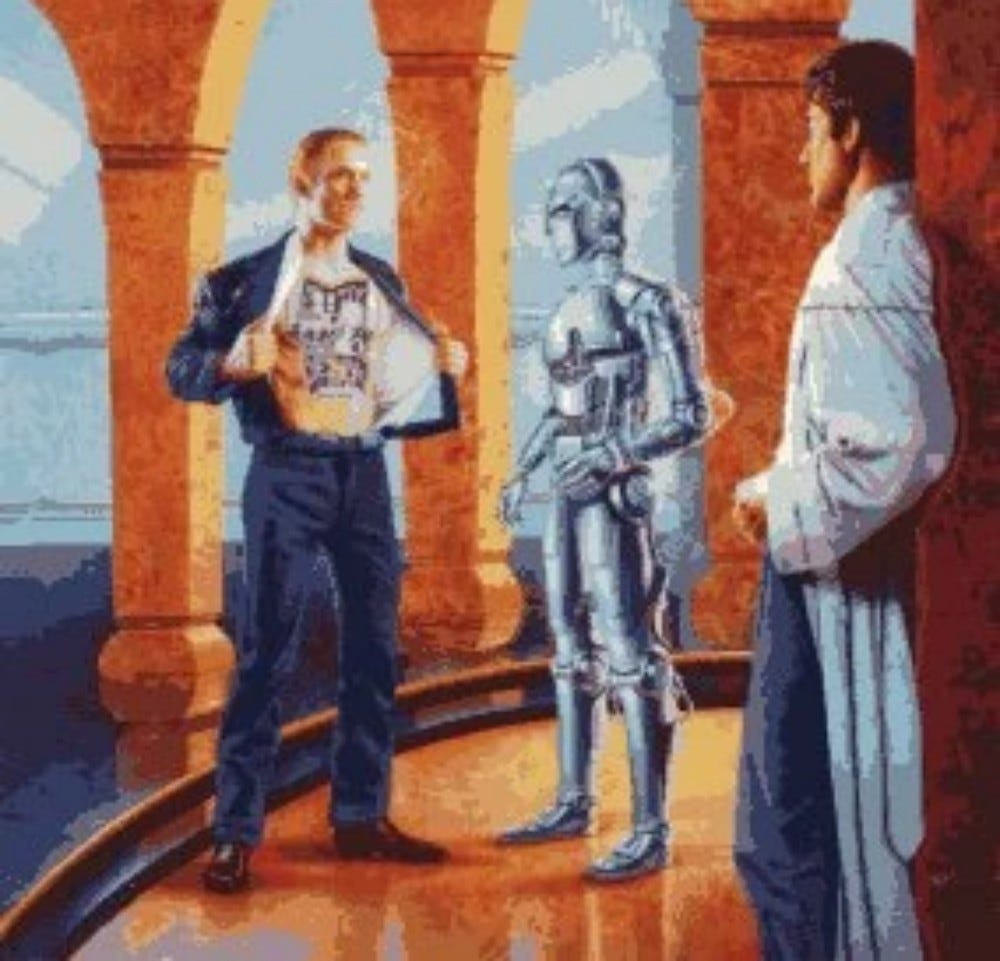
We must be Settlers, not Spacers
Continuing to repeat with CSARs the errors Spacers did with their robots can only have the same final effects: in the worst case, extinction. In the most likely, but still pretty dark case, transformation into something hardly human. Ending those errors doesn’t mean going back in time though. Asimov’s Settlers aren’t clueless luddites. If they survive and thrive all over the Galaxy is exactly because they don’t refuse technology outright, only certain technologies, and certain uses of those technologies, that are inherently toxic.
That’s the same thing we should do. We must realize that the CSARs we have today are inherently toxic in the ways Asimov described decades ago, and that this is happening because (Chesterton, again?), instead of reining the CSARs in we are treating them (especially the root one, that is corporations) as if they were supernatural entities that deserve supernatural status.
Getting rid of all the CSARs would be impossible, even if it were right, which it isn’t. What we really, urgently need to do is to strip them of their superpowers and reputation, as soon as possible. Joanna Bryson’s argument in 2009 that robots should be slaves seems taken straight from Robots of Dawn, but it’s equally valid for all the CSARs, especially the first one:
Robots should not be described as persons, nor given legal nor moral responsibility for their actions. Robots are fully owned by us. We determine their goals and behaviour, either directly or indirectly through specifying their intelligence or how their intelligence is acquired. In humanising them, we not only further dehumanise real people, but also encourage poor human decision-making in the allocation of resources and responsibility... Robots should rather be viewed as tools we use to extend our own abilities and to accelerate progress on our own goals.
All I can add to that is what I first said six years ago: any call to treat AIs and robots like human beings just strenghtens the pretense of corporations to be treated as real human beings.
Summing up: the long-term effects of social media, AI and Humanoid Robots on society are those Asimov started describing seventy years ago. But it’s corporations as they are today - ubiquitous, eternal, millions of times stronger than any single human being, allowed to morph into each other but required to have the same long-term vision of a toddler who refuses bedtime - that are the root problem. It’s them, coupled with inferiority complexes towards whoever got some Computer Science degree, without the maturity and culture to use it right. Enforcing on corporations the same laws Asimov conceived for robots may not be enough to get all the other CSARs right, but it’s a first step in the right direction. In the meantime, thanks for supporting my human-digital work in any way you can, be it subscription, direct donations or simply sharing these posts in and outside Substack.
In my humble opinion, you should read those books regardless of robots, for the struggles between Spaces and Settlers look every year more like those the aging rich countries and the young but poor ones of our own earthly Galaxy.
those are not literal quotes, but my translations, as faithful as possible, of the corresponding sentences in the Italian versions of those books. All the parentheses are my additions.

