Which I perhaps could have avoided if I’d had Fabien Pelissier on my side. His company, FAB Expat, helps newcomers and foreign residents, with challenging tasks such as getting a visa and handling other immigration issues, finding the right insurance, opening a bank account, searching for an apartment, accounting, and other administrative matters.
In addition to the valuable information on his website, Fabien also offers free and VIP consultations, as well as hosting helpful webinars.
I had a great time talking to Fabien after I was a guest on his YouTube channel (link below), so I invited him into my Paris kitchen to be a guest on my podcast, and he happily agreed. We covered a lot, including navigating the French health care system, dealing with French paperwork 😅, and other things to expect if you’d like to call France home.
After last week’s spirited discussion on cross-cultural, third-culture, and fusion cooking, I found myself thinking about my 2008 pho crawl in El Monte, California. At one pho shop, English, Vietnamese, and Spanish bounced off the walls. It was there that I first pondered Viet-Mexican cooking. As I watched the floor manager and expeditor interact, I wondered: if they opened a restaurant together, what would the menu offer? If they had a family, what would they serve at their table?
I’ve seen and tasted pho birria, a pho-ritto, pho tamales, and pho tacos. Recently, at a busy Venice Beach lunch spot, I found pickled jalapeños in a fried tofu banh mi prepared with a bolillo roll! The tangy, spicy chile was good.
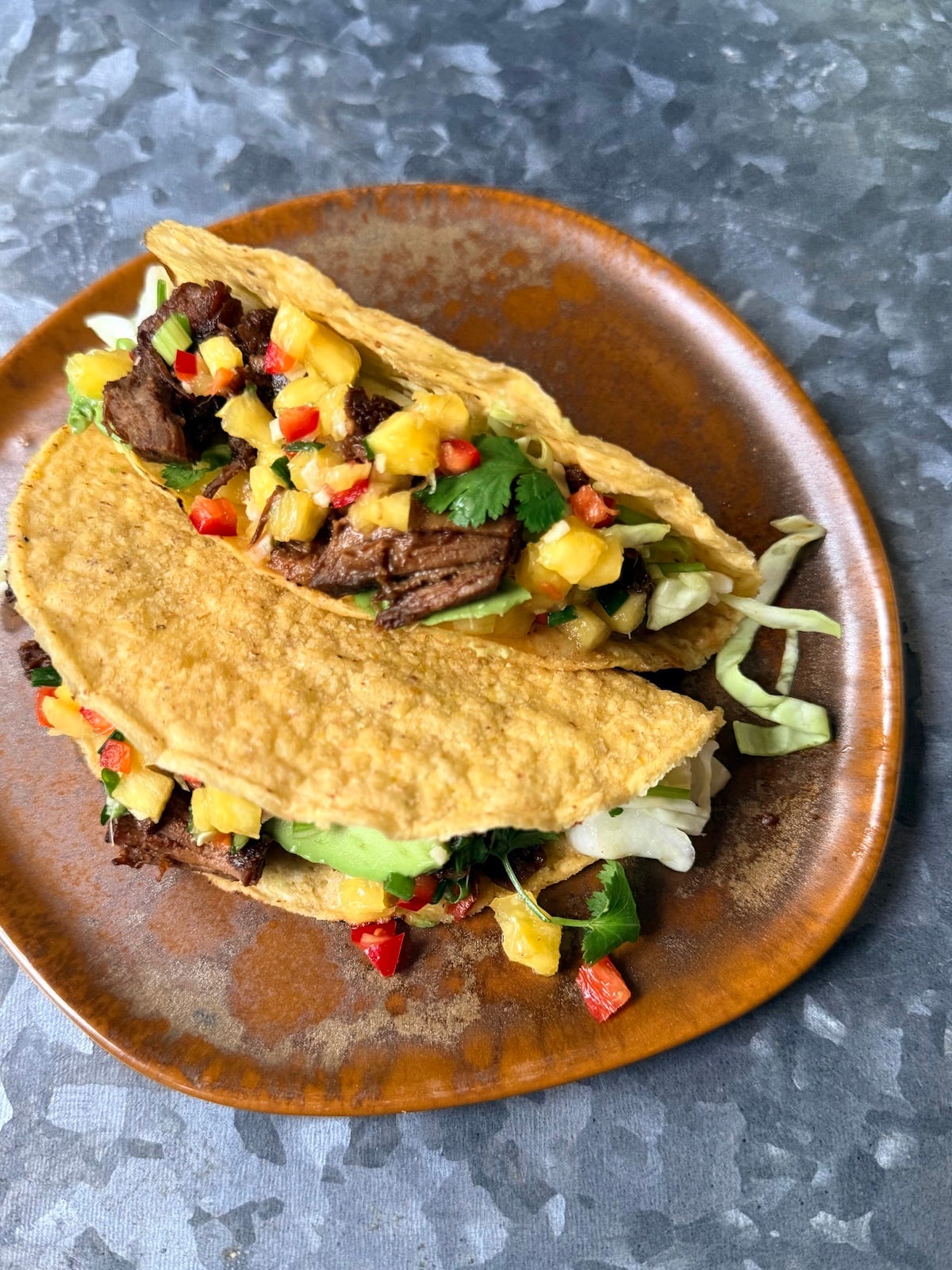
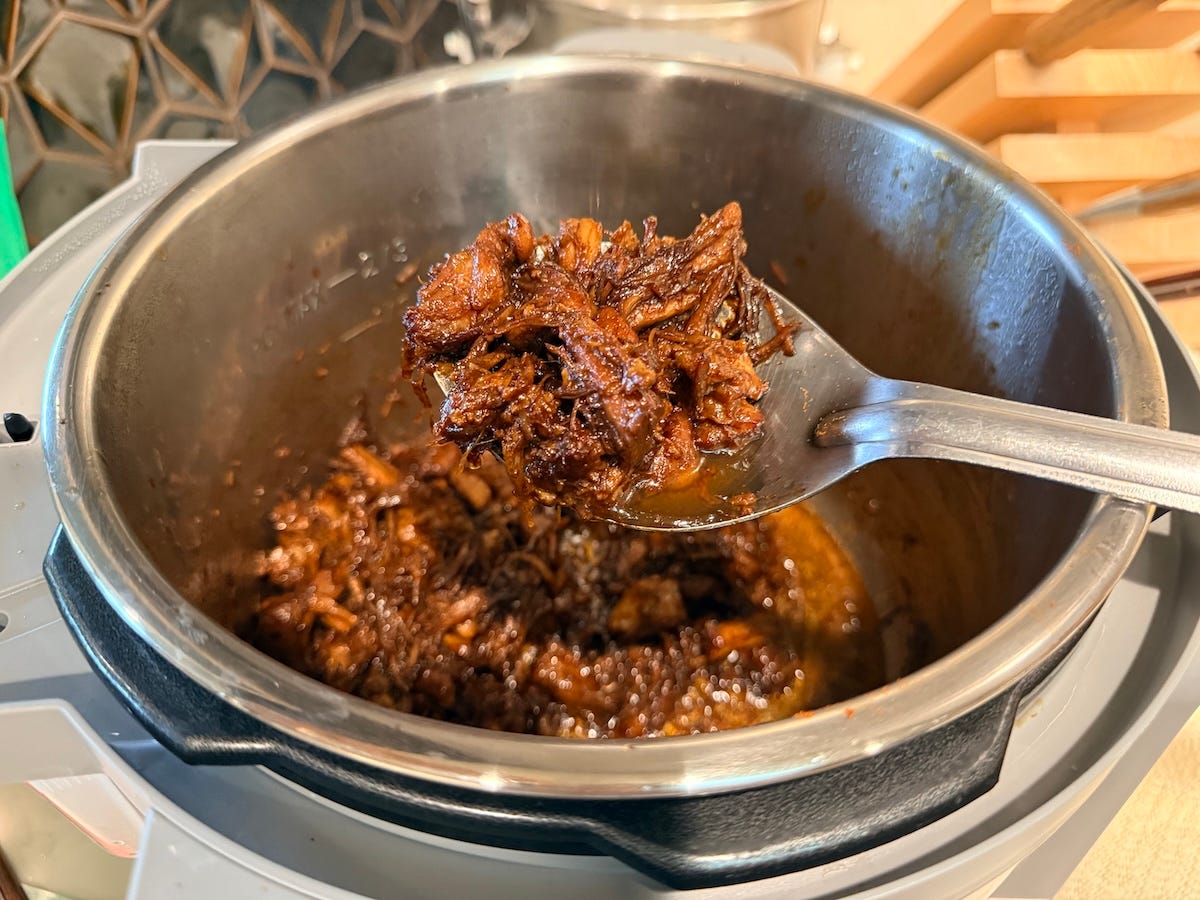
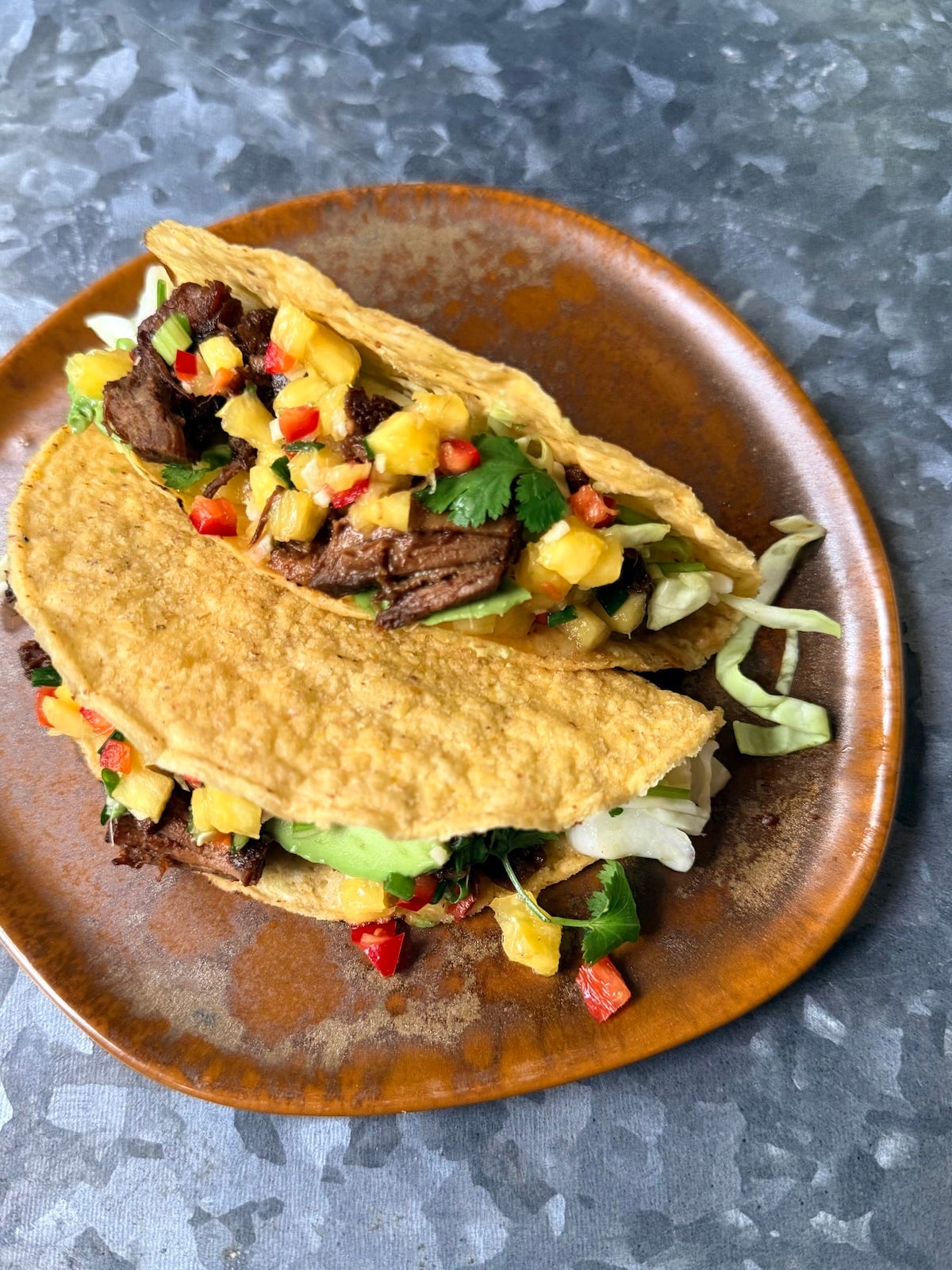
Thinking about the future of Vietnamese and Asian food in America, I developed a weeknight-friendly Instant Pot recipe for char siu pork carnitas, which I stuffed into crispy taco shells with a tangy cabbage slaw accented with Viet herbs and pineapple-ginger salsa. Called xá xíu in Vietnamese, Cantonese char siu pork is a beloved salty-sweet roast pork deeply ingrained in the Viet repertoire.
Label them as tasty fusion, third-culture, Viet-Mexican-Chinese-American cooking, or whatever you like. But do make them. Rory and I enjoyed the tacos twice in a week! The carnitas reheat like a dream. I even tinkered with the leftovers and added mushrooms to make them less meaty! You can do a lot with this new recipe.
Crunchy or soft tacos?
I tucked the char siu carnitas into crunchy taco shells because they remind me of ones from Tito’s Tacos, a Los Angeles icon. Located in Culver City, Tito’s began serving American-style hard shell tacos in 1959. Rory and I regularly shared half a dozen tacos and chased down the shredded beef filling, iceberg lettuce, and shredded cheese with gulps of orange soda. Tito’s was cash only until 2016.
Along with being fun, crunchy taco shells also make dinner extra-easy. Reheat them on a sheet pan in the oven or toaster oven for just a few minutes. Of course, you can get fancy with char siu carnitas soft tacos prepared with fresh tortillas. (I use Masienda and follow the package recipe, weighing the water and masa.)
🌱 For a vegan take, replace the char siu pork with my char siu jackfruit, a free recipe on the website.
The complete Char Siu Carnitas Taco recipe, including the herbaceous slaw and tropical salsa, is below in full text and as a downloadable PDF. I’ve also included ingredient swaps and pointers (what’s the best hoisin and what if you don’t have any handy?). Make this carnitas many ways – cook it in an Instant Pot, stovetop pressure cooker, or regular pot. Instructions are included.
This recipe was created for paid subscribers who sponsor Pass the Fish Sauce. Support the newsletter however you can. Become a paid subscriber for this splendid carnitas recipe and access to 225+ others, along with class discounts and more!
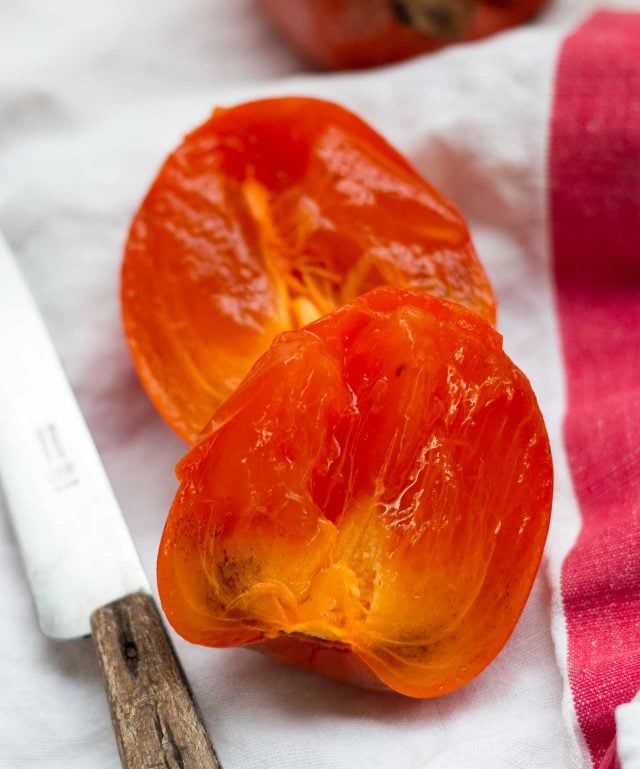
Like most Americans, even French people aren’t so familiar with persimmons. They may see them at the market, look at their curiously, but don’t stop to buy any. Or if they do, they take them home, bite into an unripe one, make a face, and toss them out.
One of my friends living north of San Francisco in Sonoma County had an enormous persimmon tree. Each fall, the leaves would drift off the tree, leaving bright orange globes of fruit dangling off the sparse branches. The beautiful, gnarled wood was quite a contrast to the smooth, brilliantly-colored orbs of fruit. (The wood of the persimmon tree is not just beautiful but it’s prized by makers of many of the finest golf clubs in the world and is considered superior to most others woods or man-made materials.)
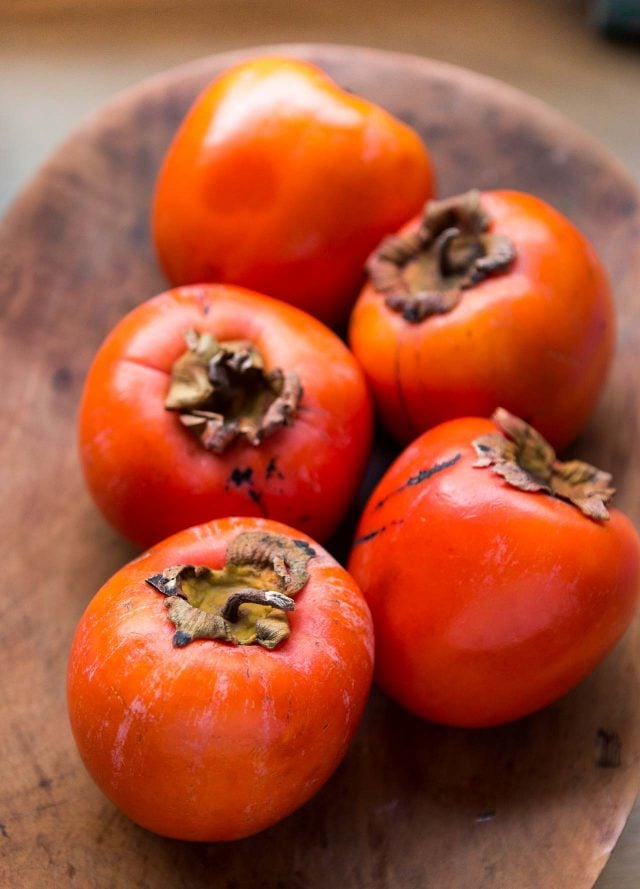
The most common persimmon you’re likely to find is the Hachiya, a slightly elongated fruit that tapers to a point. They’re incredibly tannic and astringent when not ripe and need to be squishy-soft and feel like a full water-balloon before using. Once ripe, the sweet jelly-like pulp can be spooned out and pureed through a blender, food processor, or food mill, although some folks like to eat it as is or frozen. The pulp freezes beautifully, and in fact, I’ll often freeze some for late-winter use. To ripen Hachiya persimmons, simply let them sit on your countertop until very soft. If they don’t riped at the same time, you can store the puree in the refrigerator until the others have ripened. You can hasten the process by putting persimmons in a well-sealed container; adding an apple, which gives off a lot of ethylene gas, which will speed things up.
The other common persimmon is the Fuyu, which is squatter than the Hachiya and matte-orange. Unlike the Hachiya, the Fuyu is meant to be eaten hard and is delightfully crunchy. I peel them, then mix pieces into an autumnal fruit salad along with dates, slices of Comice pears, pomegranate seeds and yes…even some bits of prunes.
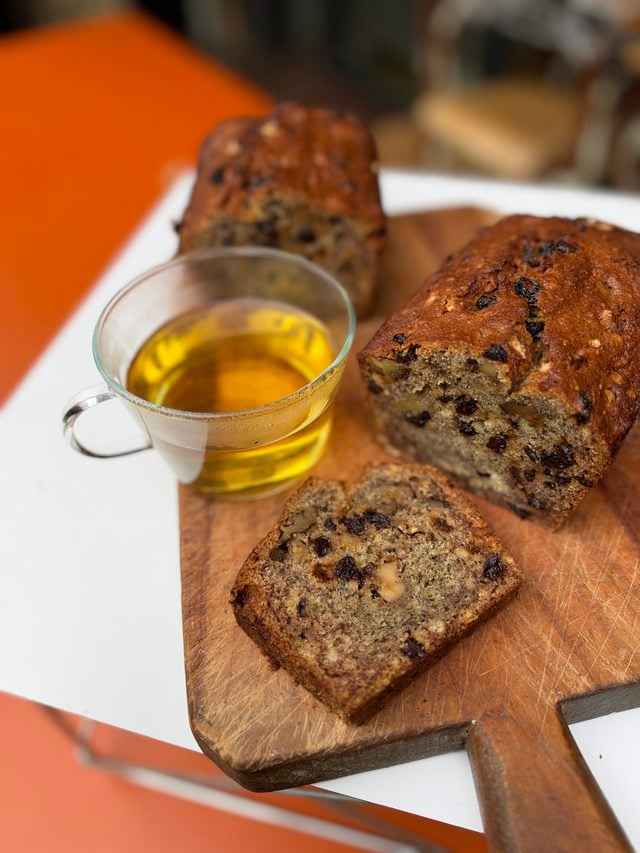
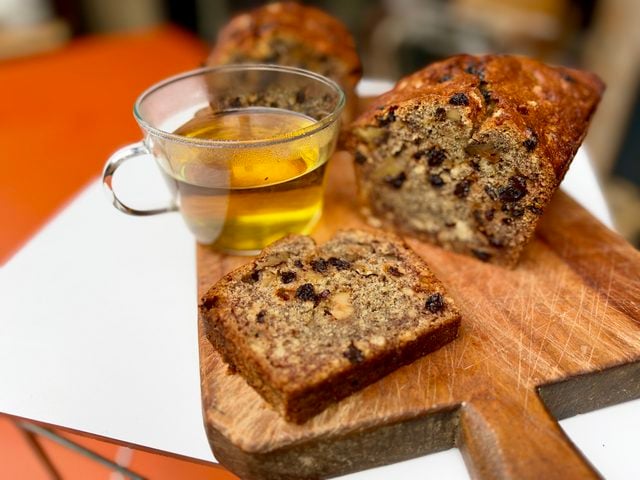
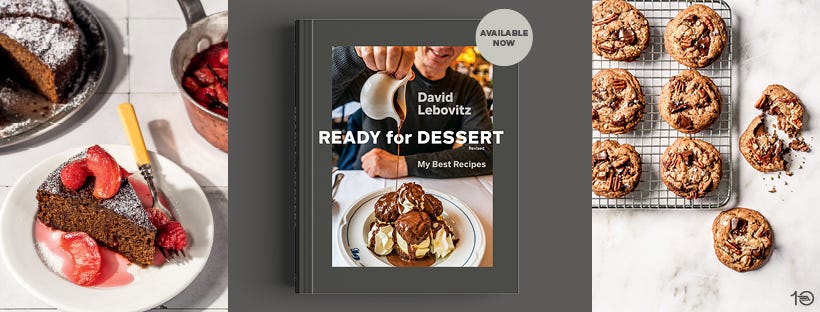
Finding recipes for using persimmons can be difficult. I invented a recipe for a quick Persimmon Cake for my book Ready For Dessert, which I make often for Thanksgiving. And I also like James Beard’s Persimmon Bread, a nifty recipe from his classic book on breadmaking, Beard on Bread, published decades ago.
I was fortunate to meet James Beard several times when he came to dinner at Chez Panisse. In the years after he passed away, we’d get all sorts of luminaries coming through our kitchen, people like James Beard, Jane Grigson, and Richard Olney, who were really wonderful cooks and writers.
The most charming thing about this simple Persimmon Bread recipe is that Beard gives bakers an inexact amount of an ingredient: sugar. So go ahead just this one time to improvise a little. Although I recommend using the higher amount of sugar, feel free to use whichever quantity you’d like…after all, you have permission from the granddaddy of all cooks, James Beard himself.
Adapted from Beard on Bread by James BeardUsing the higher amount of sugar will produce a moister and, of course, sweeter bread. I often use bourbon, as I like the flavor, but cognac, rum or brandy work well, instead. if you only want to make one loaf, cut the recipe in half. If you make two, this bread freezer beautifully.
Course Bread
Cuisine American
Keyword bread, Persimmon, raisins, walnuts
Servings 12servings
Ingredients
3 1/2cups (420g)sifted flour
1 1/2teaspoonssalt
2teaspoonsbaking soda
1teaspoonground nutmeg
2 to 2 1/2cups (400-500g)sugar
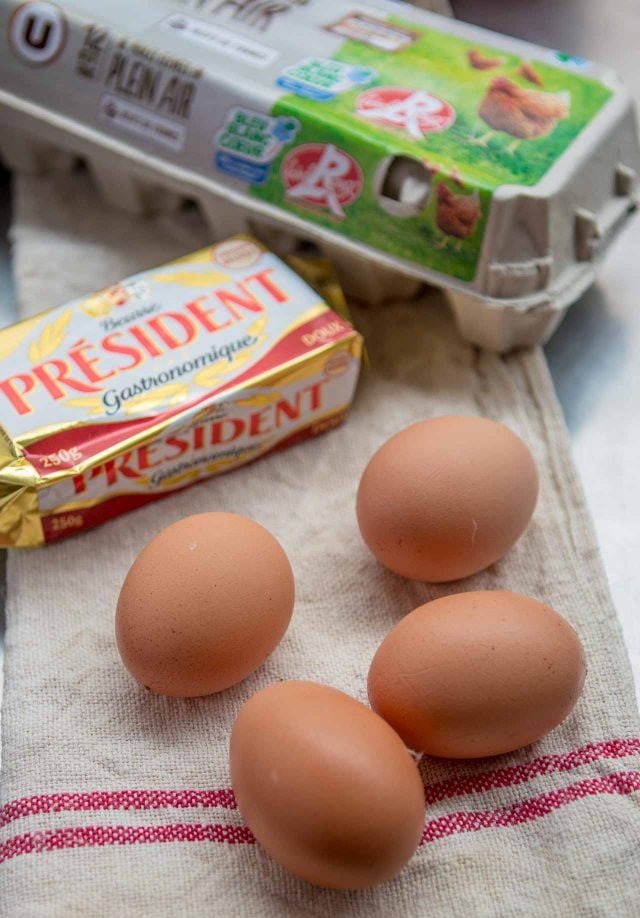
1cup (8oz, 225g)melted unsalted butter cooled to room temperature
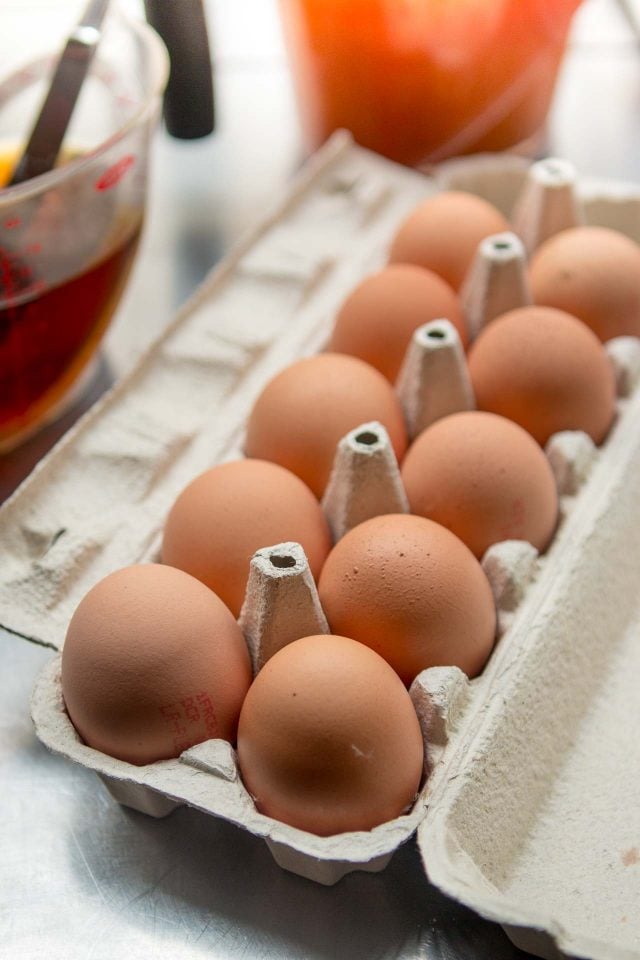
4large eggsat room temperature, lightly beaten
2/3cup (160ml)Cognac or bourbon whiskey (see headnote)
2cups (500ml)persimmon puree(from about 4 squishy-soft Hachiya persimmons)
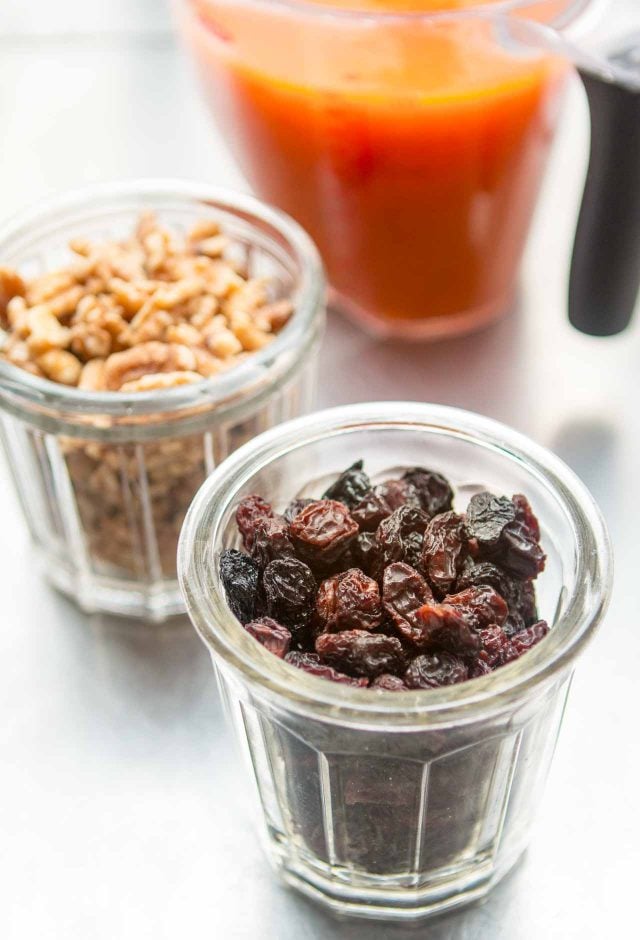
2cups (200g)walnuts or pecanstoasted and chopped
2cups (270g)raisinsor diced dried fruits (such as apricots, cranberries, or dates)
Instructions
Butter 2 loaf pans. Line the bottoms with a piece of parchment paper or dust the pans with a little flour and tap out any excess.
Preheat oven to 350ºF (180ºC).
Whisk the flour, salt, baking soda, nutmeg and sugar together in a large mixing bowl.
Make a well in the center of the dry ingredients then stir in the butter, eggs, liquor, and persimmon puree. Avoid overmixing the batter, but if there are some lumps, you can whisk it a few times briskly to smooth it out. Fold in the nuts and raisins.
Bake 1 hour, or until toothpick inserted into the center comes out clean.
Notes
Storage: Will keep for about a week, if well-wrapped, at room temperature. The Persimmon Bread can be frozen, too.
If you’ve been watching the news, you know that France has been through a tough few weeks. In mid-October, students who were protesting the poor conditions of their schools were joined by other organizations, such as the CGT, a powerful French worker’s union, and the Gilets jaunes, a grassroots movement that was notable, and responsible, for massive nationwide blockages and strikes between 2018 and 2020.
The demonstration on October 17th ended in riots, fires, saccages, and pillages (ransacking and looting businesses) across the country, filled up social media feeds, and prompted a number of people to ask me about them.
(I’ve written a bit here about what’s happening in France 🇫🇷 at the moment since many people have asked me about it. If you don’t want to read a few paragraphs with observations and brief explanations about current events in France, you can scroll down to the picture of a baguette 🥖 ⬇.)
The students have legitimate demands, which aren’t the only problems France is facing right now. I’m not an economist or historian, but is, and he wrote a comprehensive post, Why Europe Is Burning, about some of the root causes of the strife.
I don’t agree with everything that’s been said and written, but most of the violence that’s been broadcast wasn’t perpetrated by students but by casseurs, or vandals, who show up at the end of demonstrations primarily to vandalize. The student protests that I witnessed before October 17th were peaceful.
It’s important to remember that demonstrators in France (not the vandals) are exercising their hard-won right to protest, an integral part of the foundation of France:
While demonstrations and strikes disrupt transit, businesses, and yes, visitors’ vacations, people in France mostly tolerate those inconveniences as they understand that people are exercising their right to assemble and demonstrate. The day after the October 17th events, people were back at the market, doing their shopping, sipping coffee in cafés, standing in lines at the boulangerie, and riding their bikes to work or other appointments.
A week after the major demonstration on October 17th in Place de la République, the monument of Marianne, the symbol of the French republic, which was covered with graffiti and partially vandalized, was all cleaned up, and back to herself.
One of the principle problems facing France is that baby boomers are getting older, and the retirement age is lower than in other European countries; it’s 62 in France versus66 to 67 in Germany, and 67 in Italy. Neither presidential candidate in the election this spring, on the right or the left, is in favor of raising it. One candidate wants to keep it at 62 and the other wants to bring it back down to 60. (I’m 67 so am late in the game.)
Many people aren’t too keen on the two leading French candidates; one is far left and the other is far right. My father was in politics, so I grew up around it. But that was a different time and he worked for a senator from a political party who gave their own president the boot. But the lack of discussion, civility, and engaging with the other side that’s endemic nowadays, globally, isn’t a great recipe for our future, nor for future generations.
Which brings me to a question I’ve been asked a lot lately: Is it okay to come to France?
I’m here 24/7 and made it to November unscathed. Last night there was an aggressive confrontation with the police a few blocks away from us, involving Molotov cocktails, fires and tear gas, with helicopters going back and forth more of the event. On the national news this morning, two of the stories in the first hour were an interview with a woman who makes tiny floral arrangements and puts them under glass, and another segment explaining how pimple patches work.
Watching the news last night, while everything was going on, people were sitting in cafés, smoking and drinking, while protesters were clashing with the police around them.
If you’re scared of traveling somewhere, you probably shouldn’t go. On the other hand, if you avoid the hotspots in Paris, where a lot of demonstrations are taking place (they rarely take place in neighborhoods like the 6th, 7th, or the Marais), you may not even be aware of what’s going on. If you've got a trip planned (another day of demonstrations and strikes is planned for November 5th), and you’re coming to France, be prepared for closures.
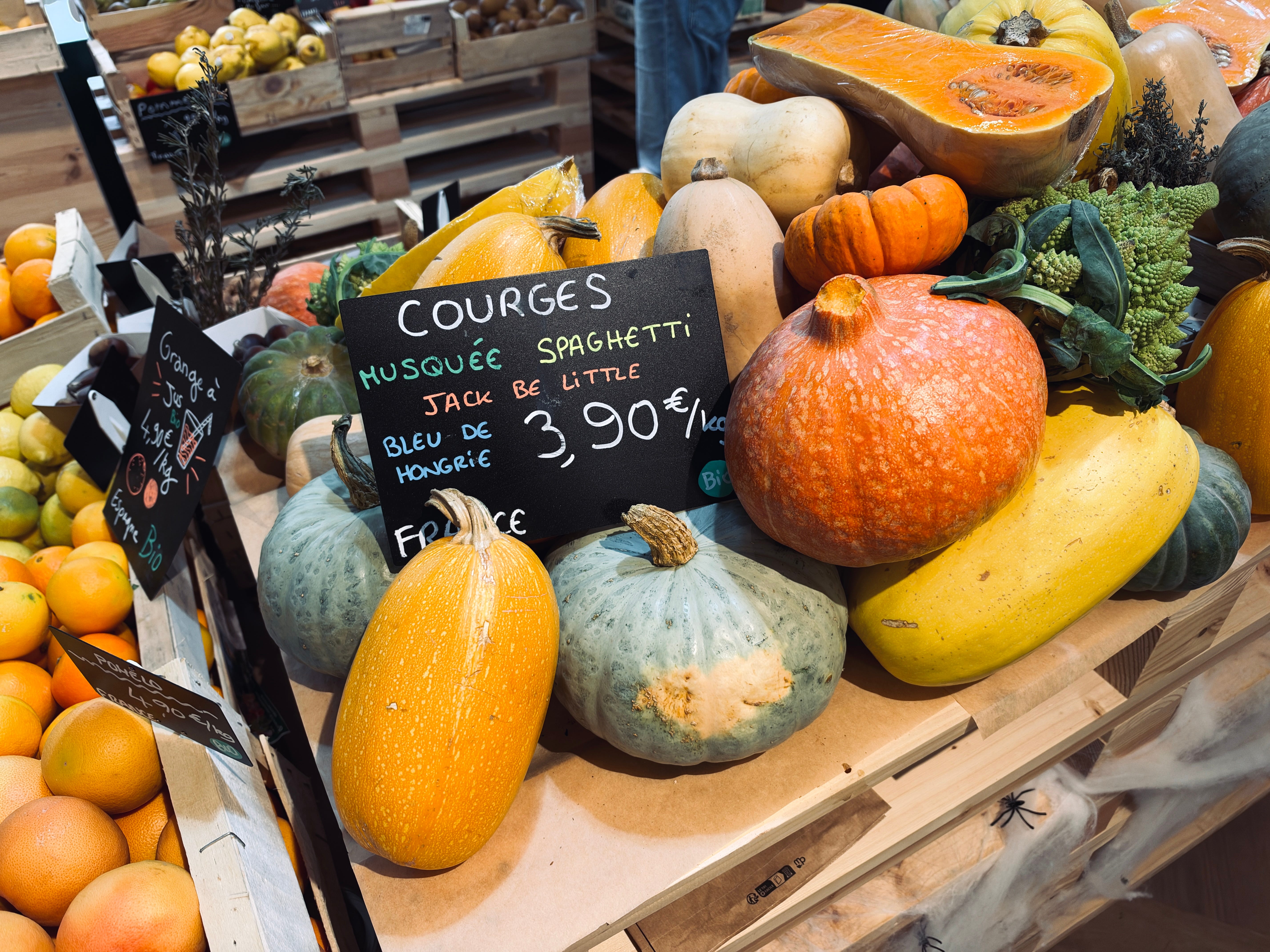
October is traditionally strike season, as well as squash season.
In October, most major museums were closed on the days of demonstrations, and the doors of the Louvre were blocked for several days afterward so the public, including people with tickets, couldn’t get in. Public transit may be disrupted, so best to plan on walking to places and not venturing too far out on days of demonstrations. But transit strikes don’t mean all trains and métros aren’t working. Some lines in Paris, like métro lines (such as lines #1, #8 and #14) are automated, so won’t be affected, but others often run at partial service and often 1 or 2 out of every 3 trains or métros may be running. Paris métro and RER traffic is updated here.
People in your hotel can likely advise you which parts of the city you might want to avoid on those days. So enjoy the restaurants, cafés, markets, and bakeries in the neighborhood you’re staying in, as locals do.
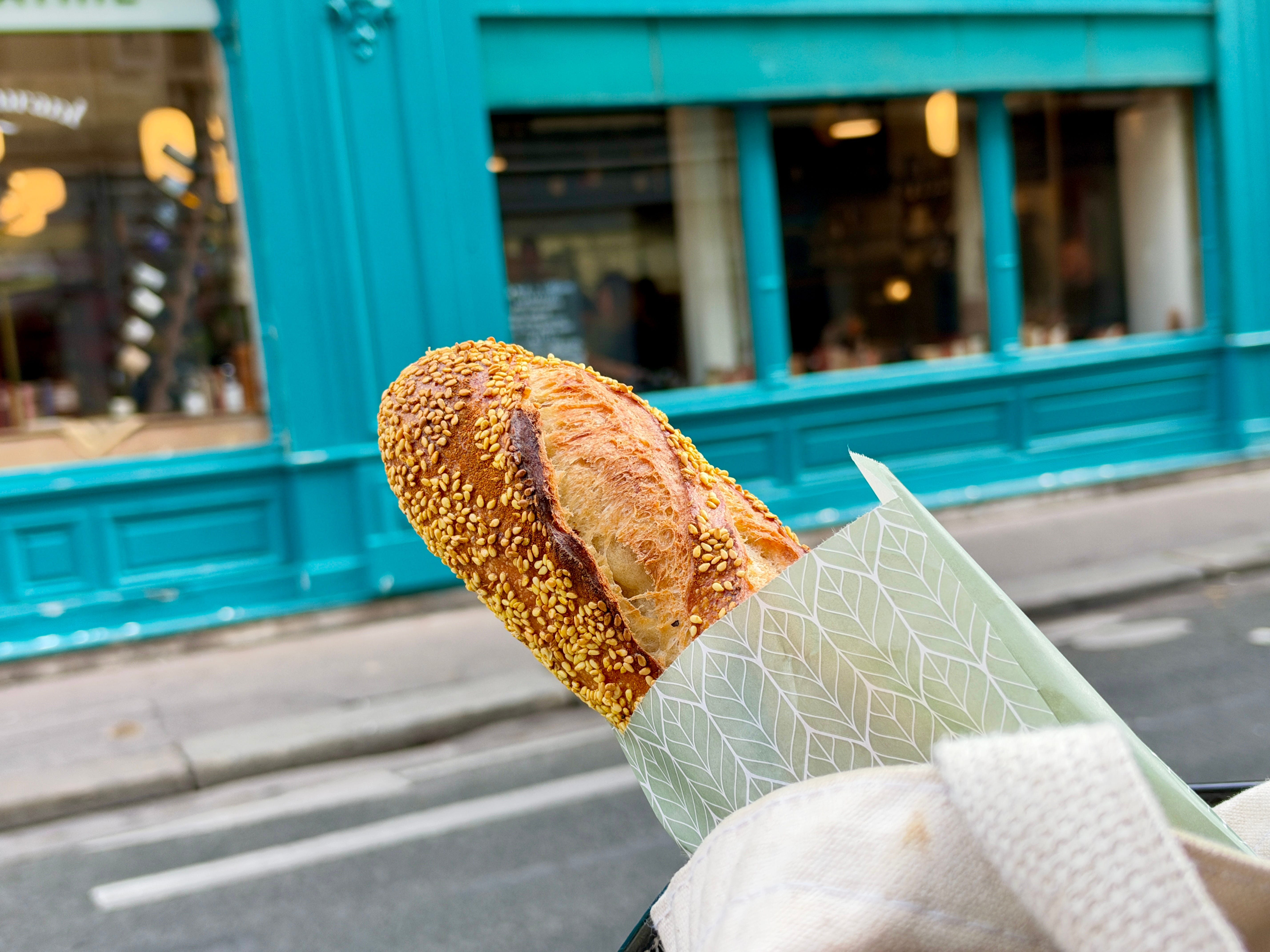
Venturing out for a sesame-curry baguette at boulangerie Utopie.
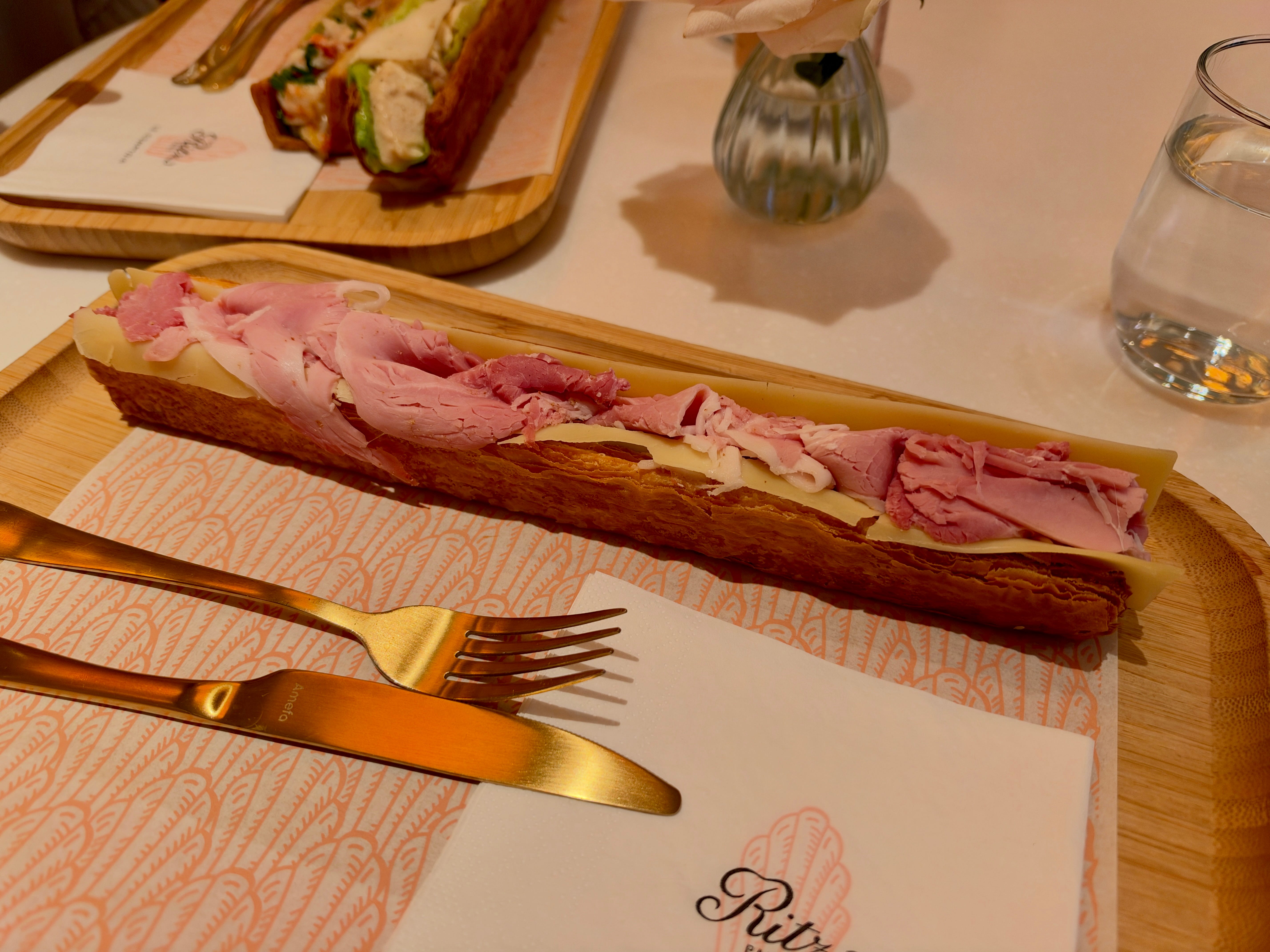
My Marie Antoinette moment was having lunch with a friend at Le Comptoir, the pastry shop of the Ritz hotel. Judging from the length at (now) well-known sandwichshops, everyone who comes to Paris seems to be waiting in line for a jambon-beurre or jambon-fromage sandwich, and Le Comptoir is no exception.
I’d tried a jambon-Comté sandwich from Le Comptoir a few years ago. It was bitterly cold that day and because the sandwich is served in a cradle of butter-rich puff pastry, as soon as I got outside, the pastry seized up and practically froze.
So it was nice to sit inside, where it was warm, and enjoy one, where the crust hadn’t petrified. My friend wanted to try all the sandwiches, including the Homard (lobster) and César. In France, a César salade almost always has chicken on it, which I’ll give them a pass on. At least they didn’t put some of the crazy stuff that you find on César salads here, such as tomatoes (!), shrimp (!), eggs (!), fried chicken tenders (!), and even ham (!) But I’ll admit the César sandwich with chicken was pretty good, too.
Trompe l’œil pastries are still trending in Paris and the Flan pâtissier (above) by pastry chef Joris Theysset, which resembles a palmier, was filled with rich vanilla cream. Chef Theysset’s Chocolate peanut butter tart was delicious, but sooo rich that the two of us only ate half of it, and I took the other half home, which I shared with Romain. Also trending in Paris: very large pastries, big enough to feed 2 to 4 people. So when someone tries to tell you that the French practice portion control, all bets seem to be off when it comes to desserts these days. I think with the stiffer prices at places likeCédric Grolet, where a cookie will run you €15 and a pastry costs €20, they want to give you your money’s worth.
A world away, I spent the first part of October in Nepal, which was quite an adventure. I’ve always associated the country with trekking, so it was never on my radar, but I was so glad I went. While I was there, several people wrote to me to “Be careful of earthquakes!” It was nice that people cared, but I wasn’t sure what one does to avoid an earthquake when you are already somewhere. They have them in San Francisco and Japan, two places I also traveled to this year, but no one warned me about them when I was there. Thankfully, I survived.
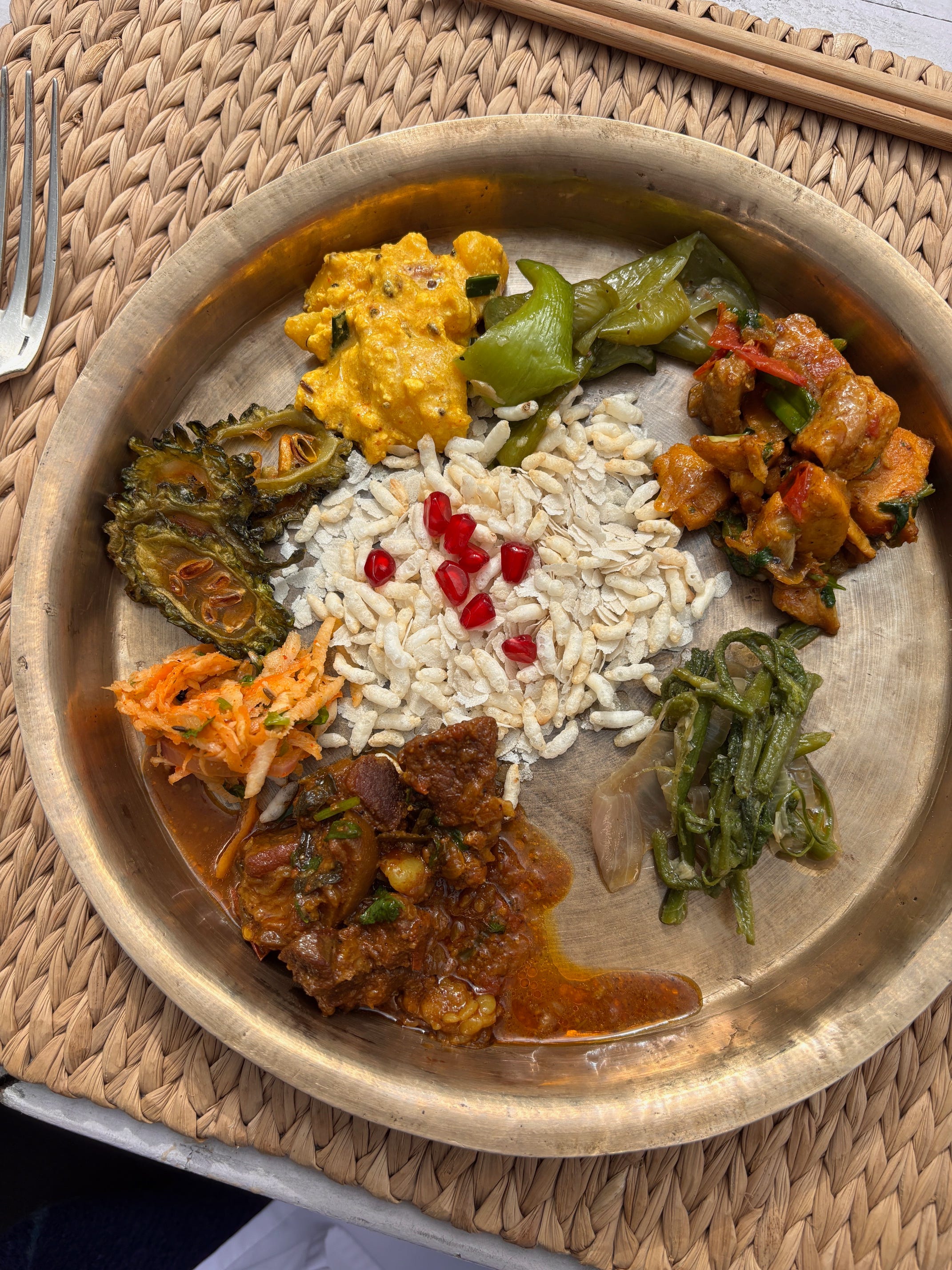
I had some beautiful food in Nepal, such as the Thakali Thali below, a composed plate that can vary, but this one had vegetables (including deep-fried bitter gourds), pickles, spicy potato curry, and a soup of lentils that people often douse over rice, if it’s steamed. But the rice is sometimes puffed, or flattened, rendering each grain completely flat, dry, and very crisp.
I wrote about other foods and the farmer’s markets I went to, here and here. Our tour of the Asan market in Kathmandu was with Alter_nativelife, which you can book through a DM on their Instagram page. I wasn’t thrilled when they said we should meet at the early hour of 7am, but by 8am the vendors were packing stuff up.
Some readers asked me about Nepalese recipes and the best book I’ve seen is Timmur, which is in English and available globally. At a cooking demonstration I attended, the cook explained that Nepalese food has fewer spices than in India, which makes dishes easier to replicate at home. Commonly used spices, such as cumin, coriander, turmeric, garlic, and ginger, are pretty easy to get, even in Paris, so that’s a book I may be adding to my collection.
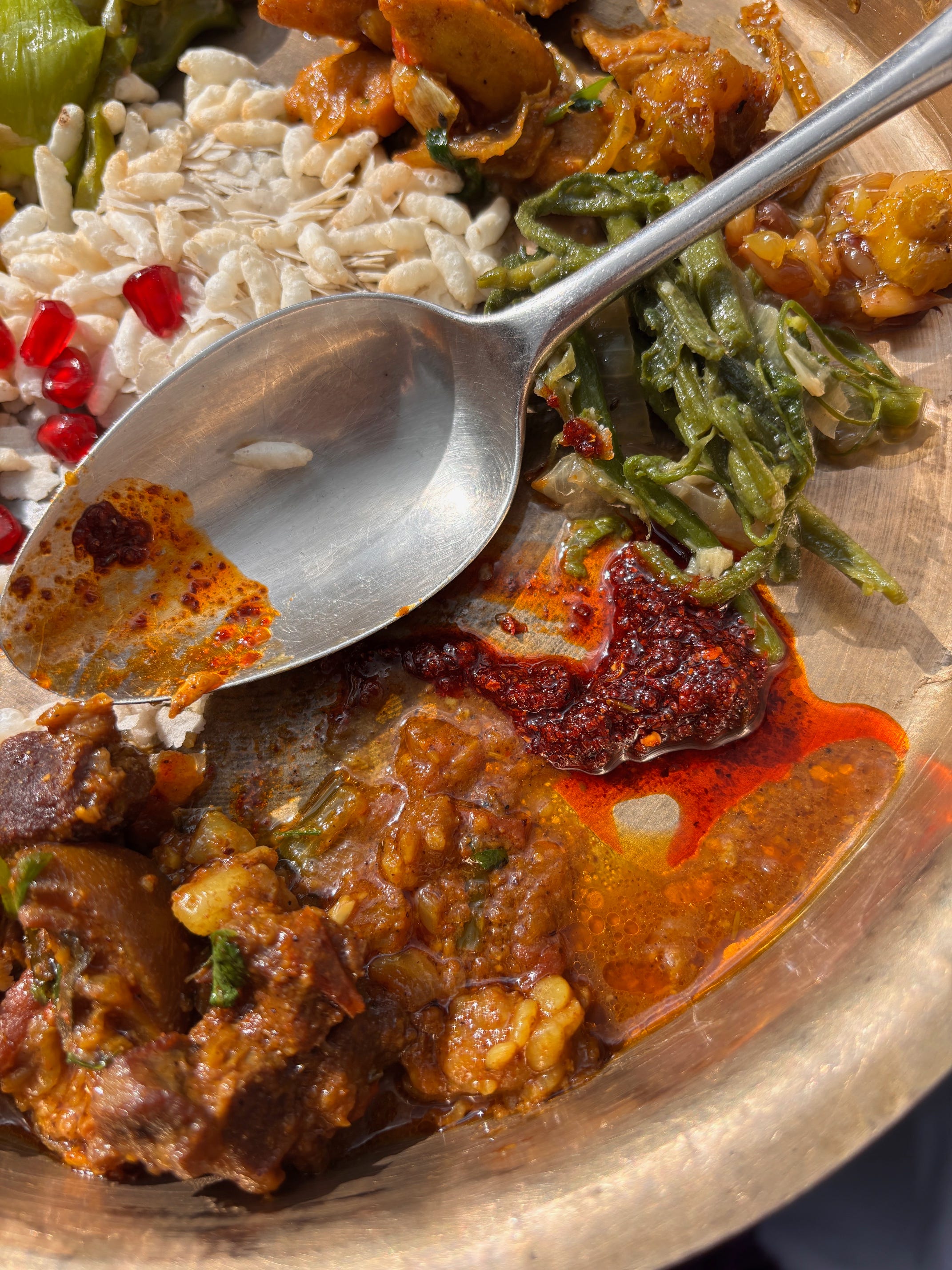
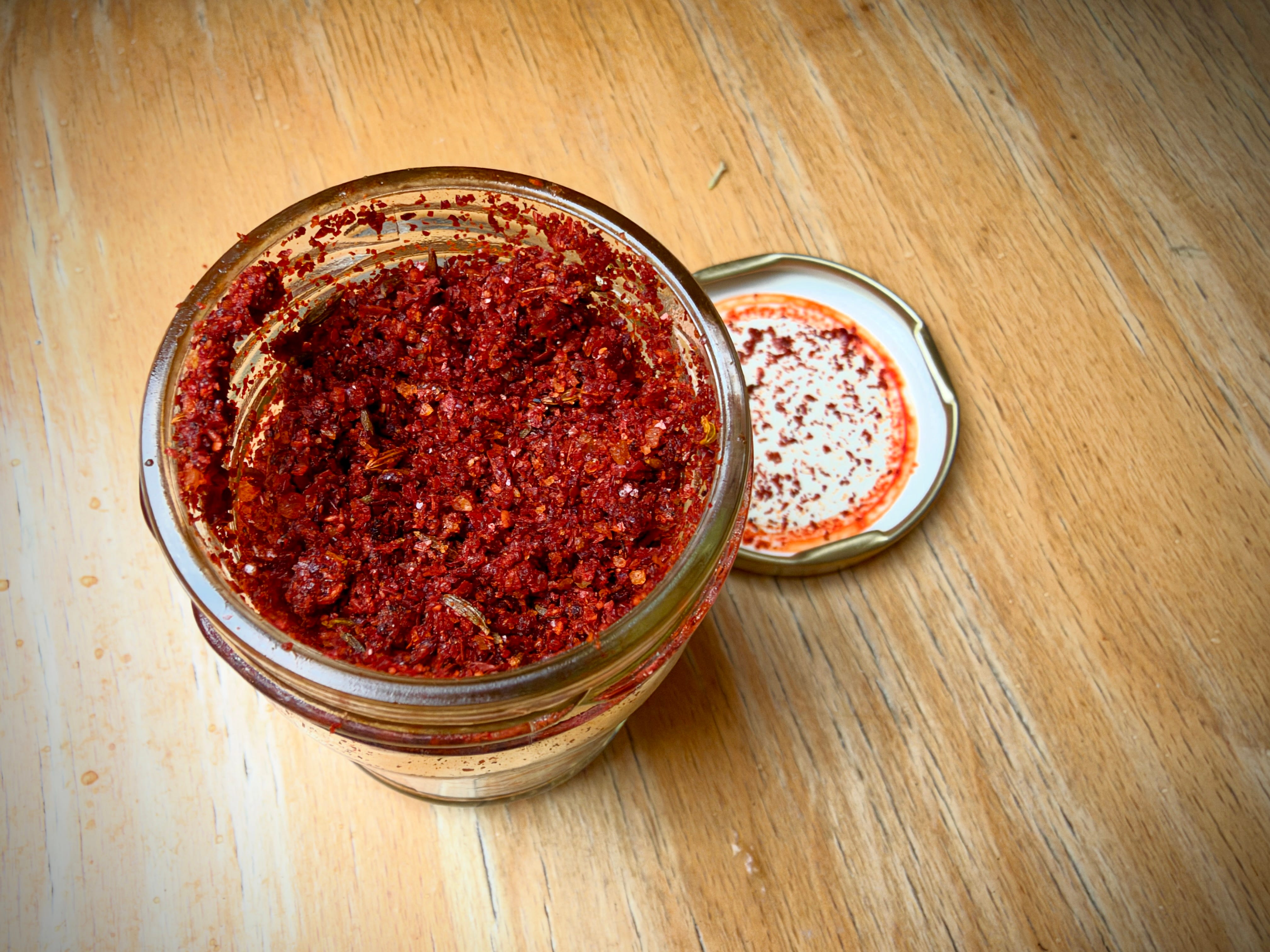
What I really fell for was the red chile sauce that’s served with just about everything in Nepal, at breakfast, lunch, and dinner. It’s no slouch in the spicy department but had a slightly fruity finish, which perked up everything it touched. With hot sauce taking over Paris…
…it might be appreciated here, especially since Romain has discovered, and loves, chili crisp.
Thankfully the wonderful chef Mingmar at The Happy House, where we stayed for a week, gave me a jar of his spice mixture and said just to mix it with olive oil when I got home. Every time I pressed him, or anyone, for that matter, to find out exactly what was in it, I got a completely different answer. I guess it’s true that you can’t have it all.
Now that it’s November, we’ve got lots of pears, apples, and persimmons at the markets. Clementines, with their shiny green leaves attached, are just starting to show up, waiting to be sold by the bagful. Those really brighten up winter.
Gravy? Sweet potatoes with marshmallows? Pumpkin pie? While some of us may be nostalgic for them (I only wanted the marshmallows when I was a kid…and nowadays, I like sweet potatoes, but still, I keep them separate), they’re not all that enticing to French palates. Neither is turkey, although French farm-raised turkeys are excellent. Pro tip: If you’re looking for a whole turkey in Paris, the volaillère at the coveredMarché Beauvau sells holiday birds at non-extortionist prices. I’ve seen whole turkeys selling for €250 ($280) per bird elsewhere. Yikes.
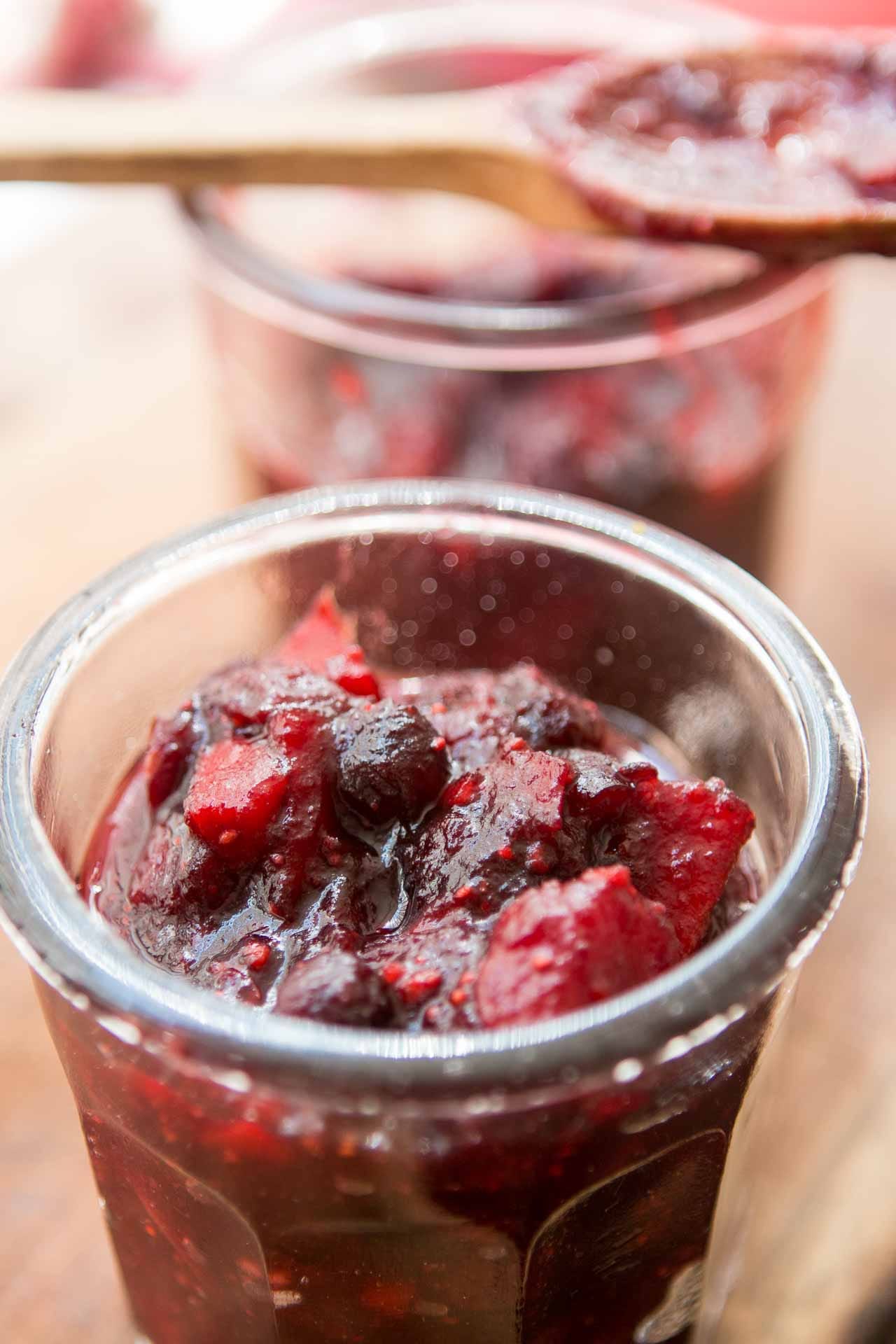
This tangy Cranberry chutney is a favorite around here. I make it whenever I can get my hands on some fresh cranberries, although frozen work just as well.
The other T-day barrier is the scavenger hunt to find all the ingredients here, which can break la banque. I’m maintaining a good stash of molasses, but if anyone’s looking for it, it can be had for €14,50 ($16.50) a jar at La Grande Épicerie. But don’t worry, I list my lower-priced alternative here.
So onward to November. The days are getting shorter and it’s darker earlier. Another day of strikes and demonstrations is planned for November 5th, and there will be more to come. If you’ve got plans to come to Paris, check museum websites and keep abreast of any changes with the métro and other forms of transportation, which are announced in advance on the Paris transit website. Thankfully Paris is a great city to walk in, and one where there’s never a dull moment.
Everybody loves cookbooks, which can’t be replaced by AI, unless AI is able to taste a recipe. So for now, I still have a job.
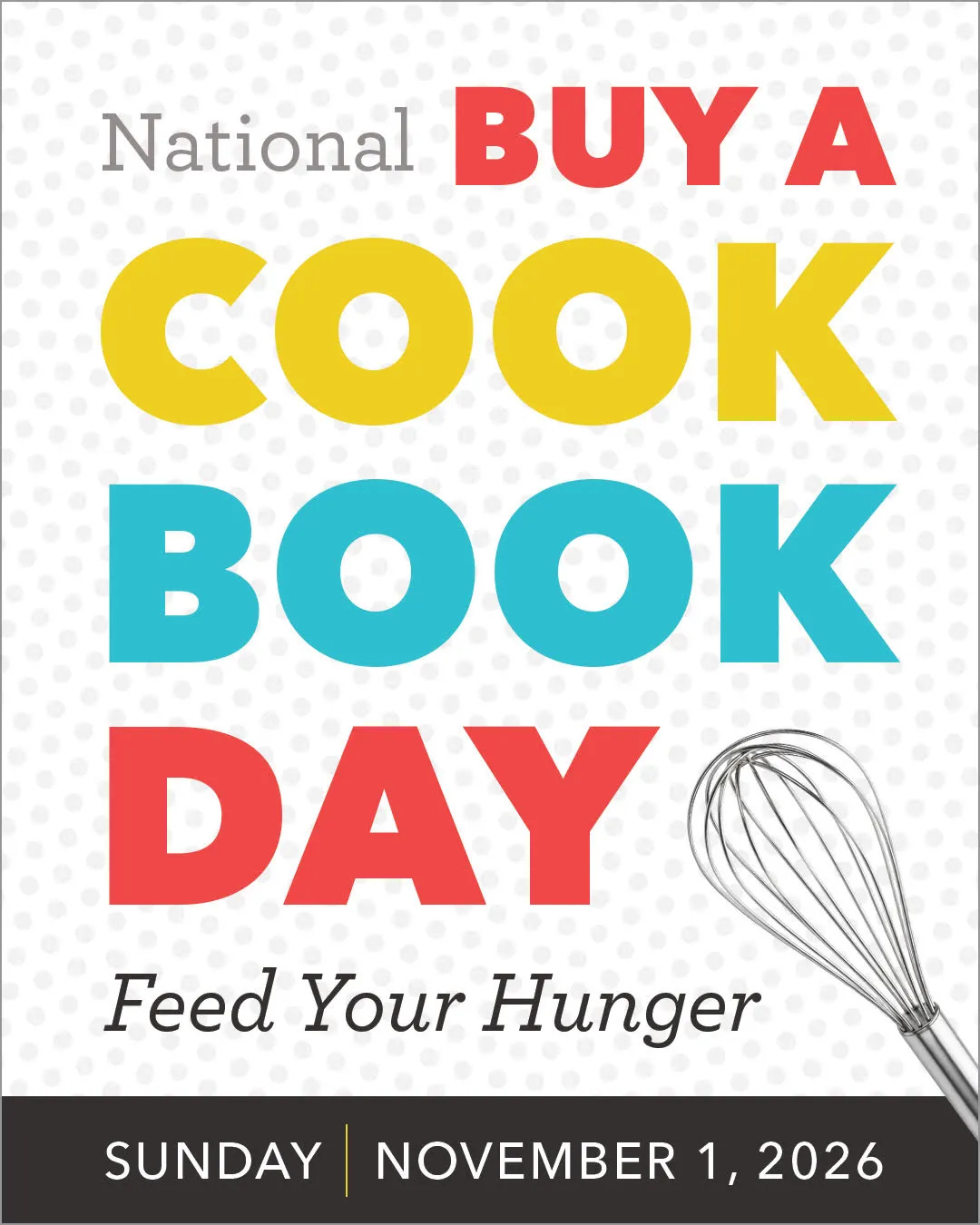
To support the community of cookbook authors, Jenna Helwig of launched Buy a Cookbook Day, when you’re encouraged to buy a cookbook and support an author and a bookseller. There are some wonderful cookbooks that came out this Fall, although you may already have some favorites in mind.
I’ve been revisiting some of my own recipes lately, and often I find new ways to make them, sometimes tweaking ingredients and other times, streamlining instructions. I’ve also been adding short how-to videos to recipes on my website. Here are a few of my recent favorites…
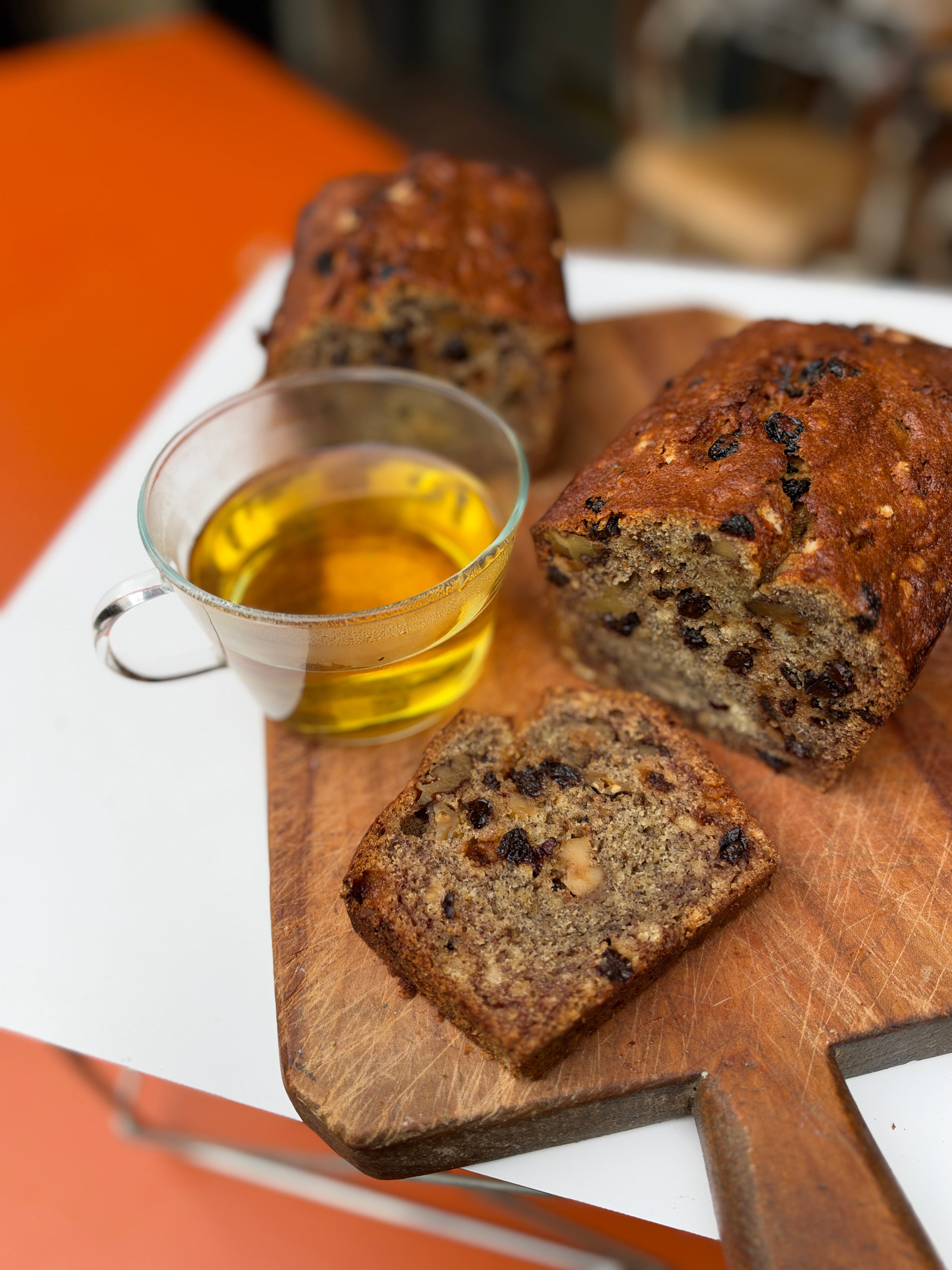
This Persimmon bread is a true Fall treat and a great way to use ripe persimmons. Everybody loves this bread, and I bring a loaf each year to a saleswoman at a well-known Left Bank chocolate shop, who was so nice to me when I first arrived in Paris. So I like to return the favor with an annual cake. If she’s reading this, stand by!
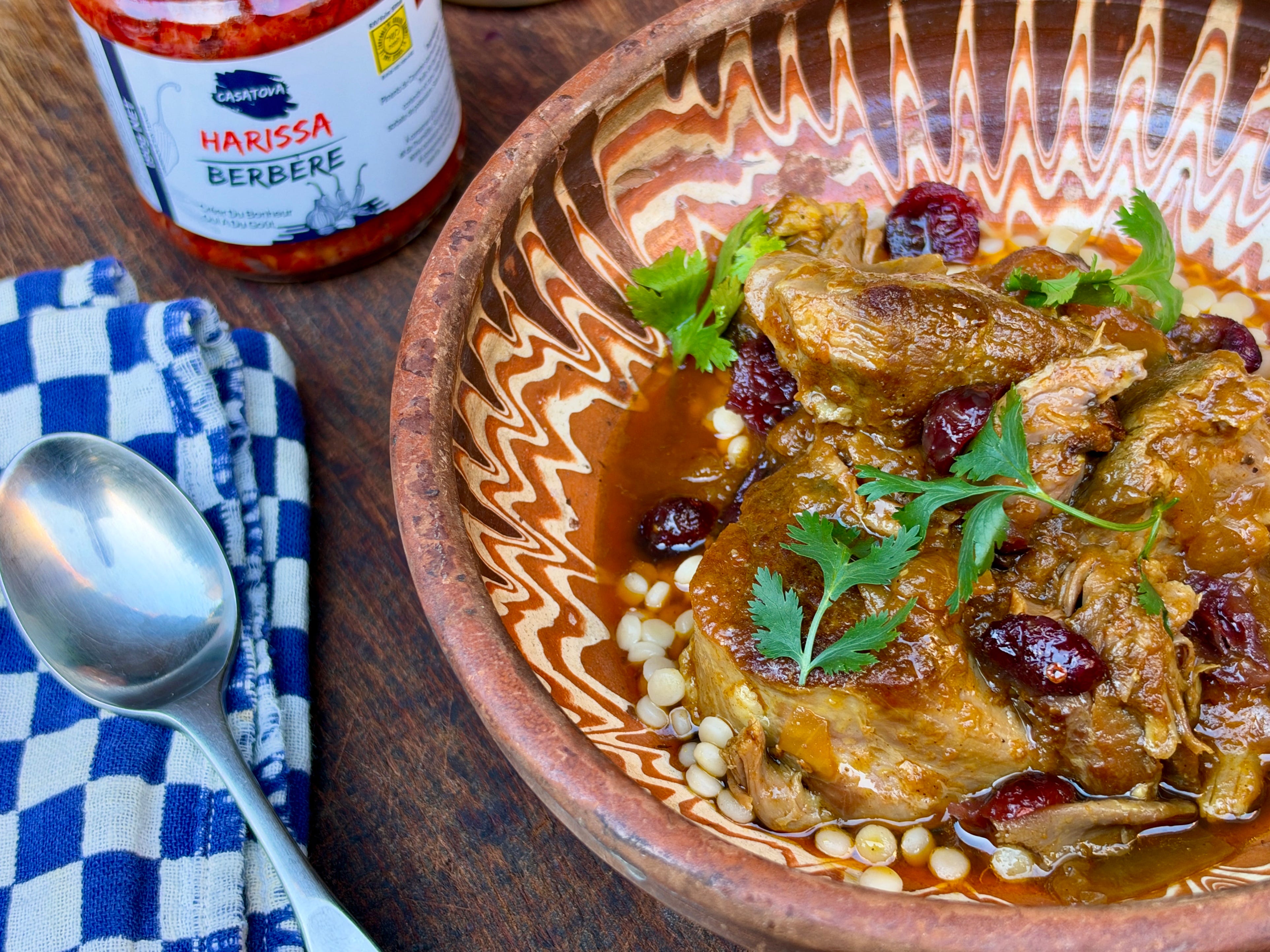
I don’t know the word for “cozy” in Arabic (I’m still working on my French), but tagine is North African comfort food at its best. With gentle spices, falling-off-the-bone lamb meat, and dried fruit punctuating things here and there, offering a little sweetness, Lamb tagine is simple to make and great for winter, when you don’t mind crave something that’s been braised gently in the oven for a few hours. I always serve it with a jar of harissa on the side for guests to dial up the amount of spiciness to their liking.
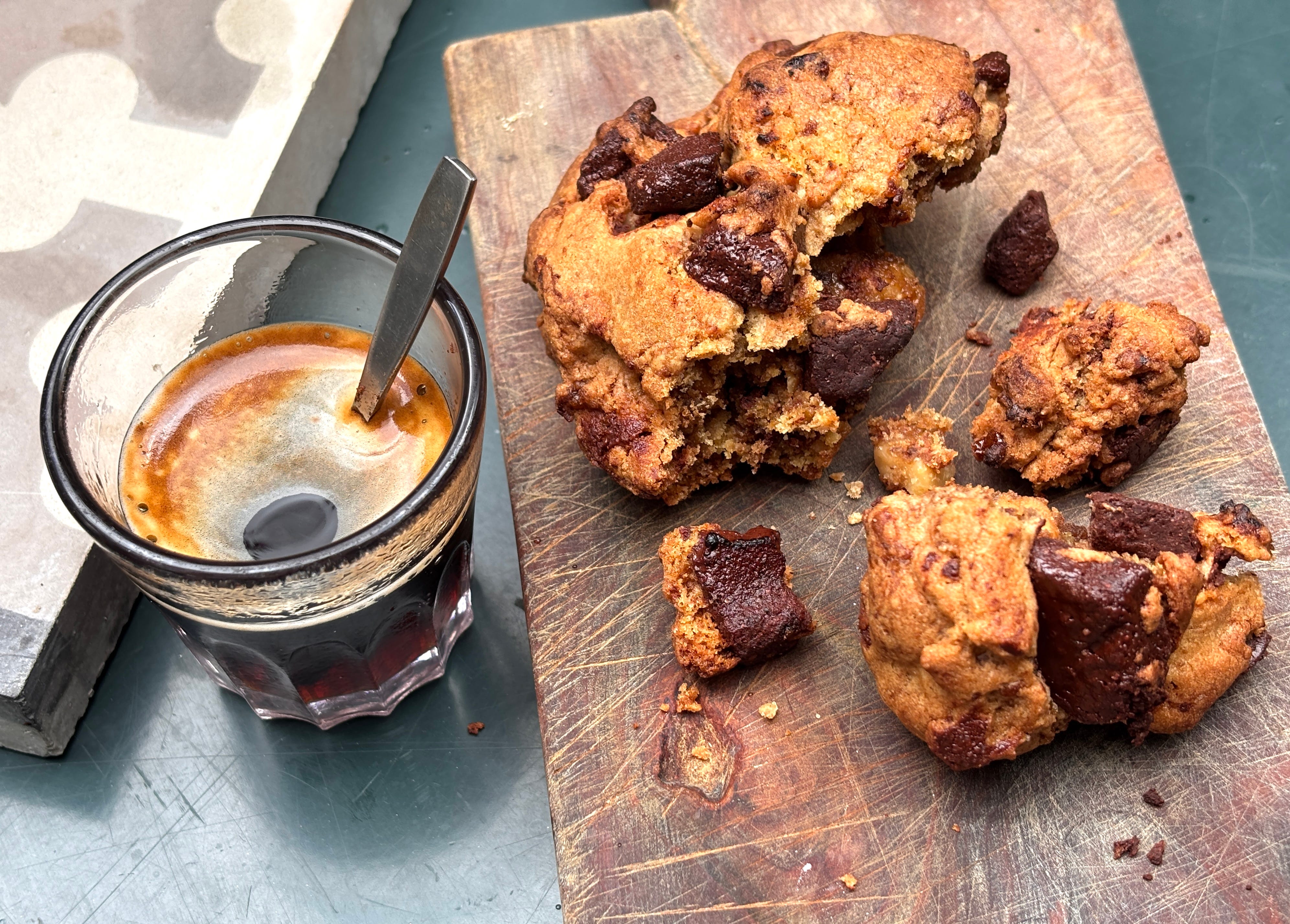
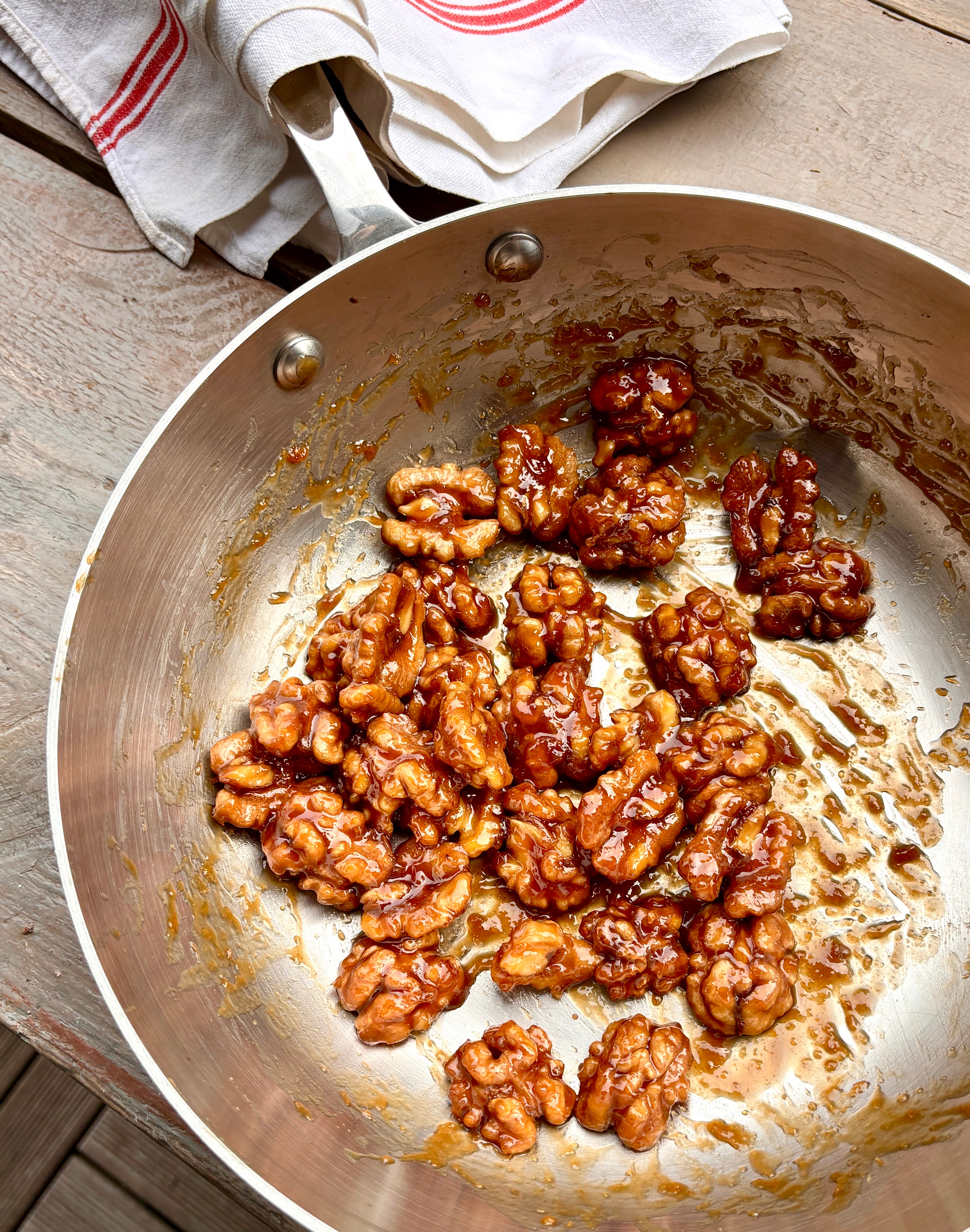
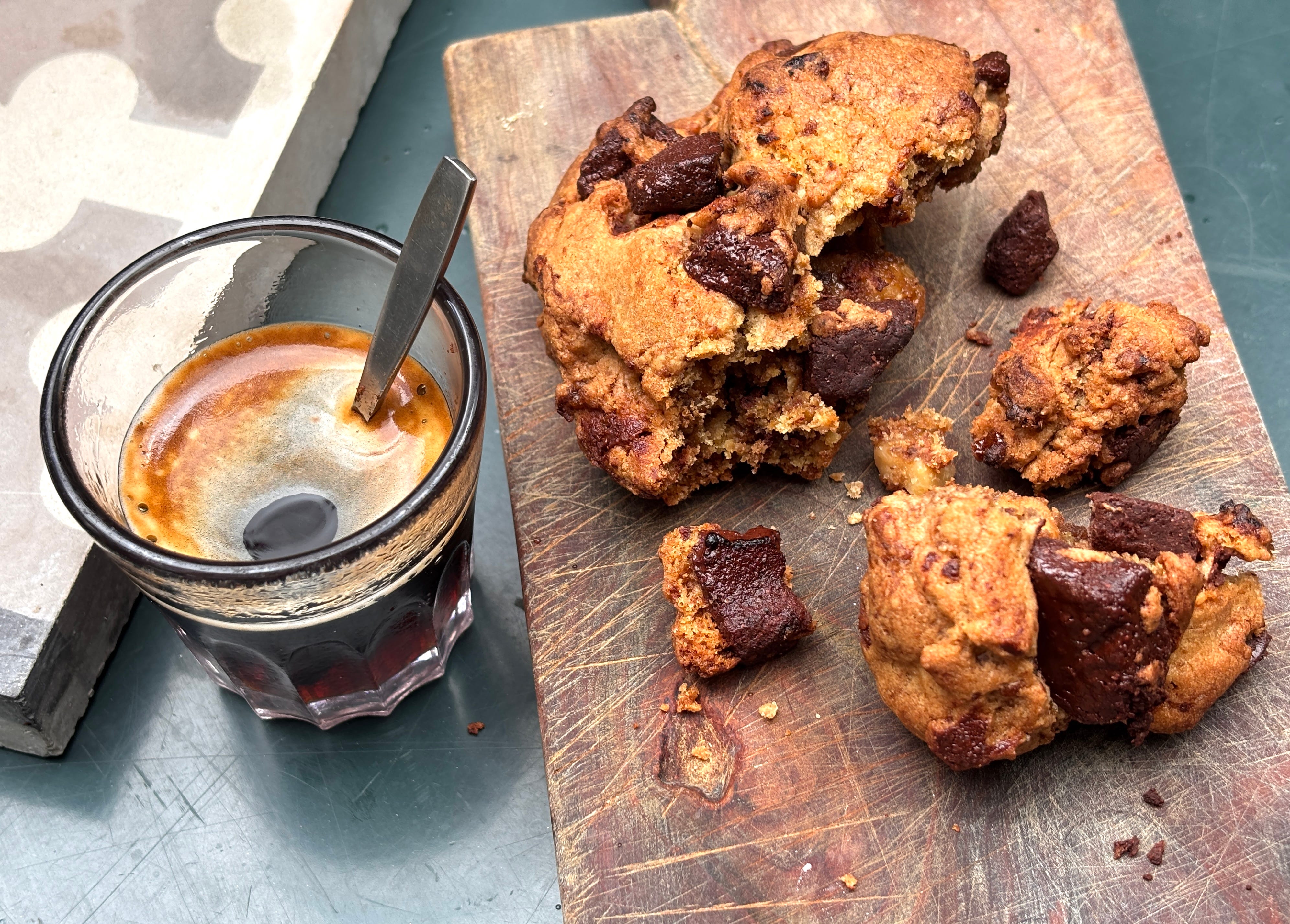
Sift by is such a wonderful baking book that I had to return to it so I could prepare herMiso walnut chocolate chip cookies. The recipe only makes five (5) cookies. But boy, what cookies they are! Each mound is loaded with an overly generous amount of chocolate chunks and crispy nuts. And like the oversized desserts in some Paris pastry shops, each cookie is big enough to share. But sharing is optional.
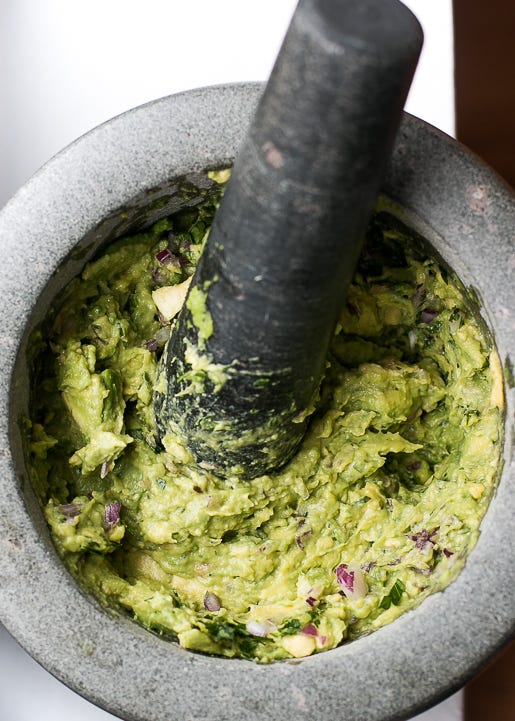
There are a lot of ways to make guacamole. A Mexican friend back in southern California made hers by mashing avocados and mixing in salsa from a jar of Pace. Another friend here in Paris uses white vinegar in his guac, in place of fresh lime juice. And yet another Mexican friend insists that guacamole should only have three ingredients: avocados, lime juice, and salt.
I’m not telling anyone how to make guacamole, but I prepare mine with a bit of red onions, a little garlic, cilantro, and a bit of chopped chiles, which may be unauthorized additions…but I’ve never had any complaints. In fact, people always scrape the mortar clean. And speaking of the French language, the final “e” in guacamole is silent in French, so it’s pronounced guac-a-mole. I’d like to suggest another unauthorized addition: Add an accent to make it guacamolé.
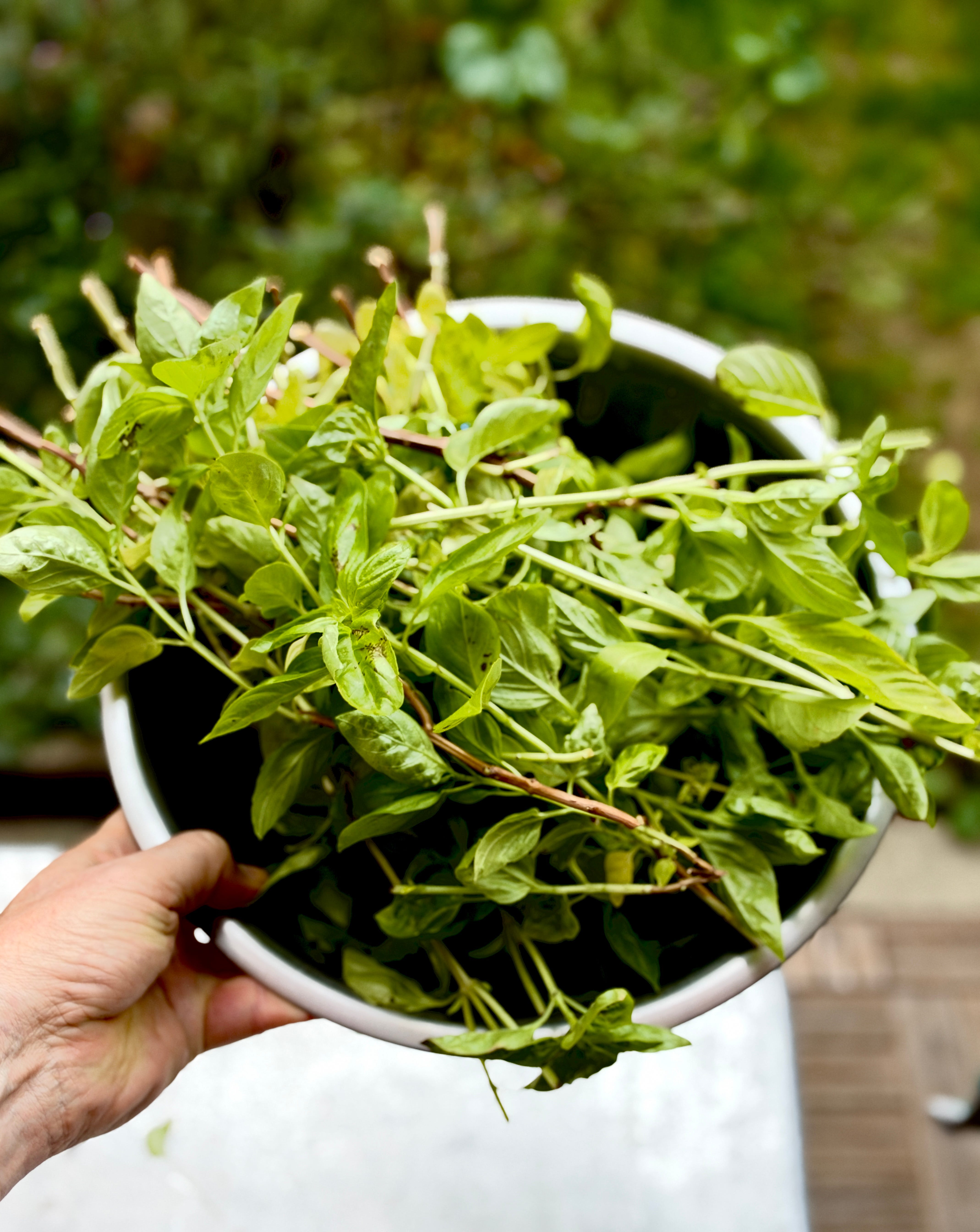
Lastly, the temperature is dropping day-by-day, so this morning, I grabbed my scissors to harvest the last of the fresh basil in our garden, to make one last batch of pesto. 🌿🌿🌿
Deliveries are a bit difficult right now: La Poste, the French post office.
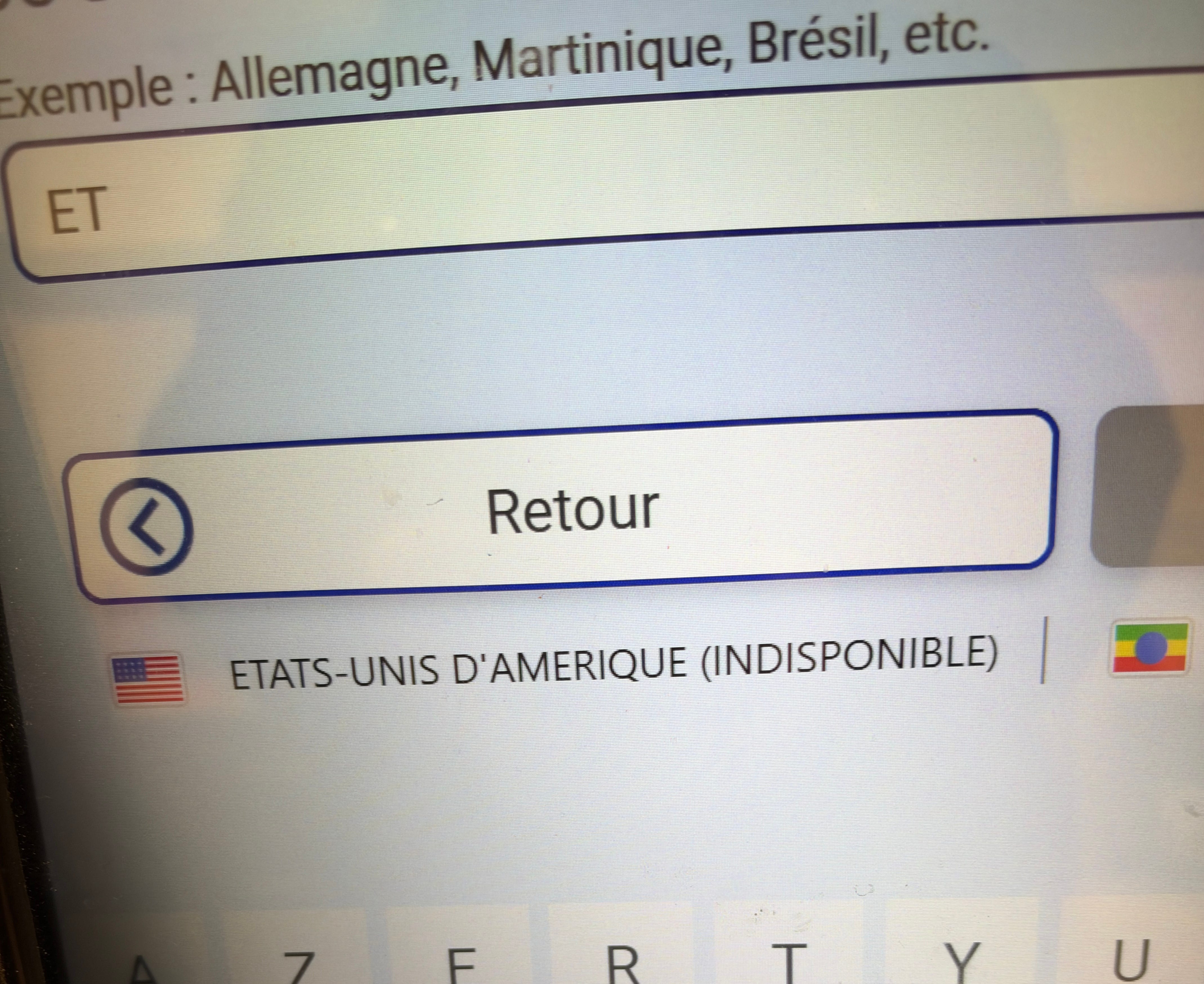
Due to a confluence of factors, here in France, deliveries to and from the U.S., have become a lot more challenging. It wasn’t easy to get deliveries here before, but now it can be a two-week odyssey to find out where a package is, and get your hands on it. Even La Poste, the French post office, says the United States isn’t available. Like other things in France, “non” isn’t necessarily the final word, but that you need to find a work-around.
Fortunately, thanks to my skills at tracking packages (which has become one of my many part-time jobs around here), as well as e-books and PDFs, I’ve been able to see new books that are on the horizon, and in some cases, I got a preview when asked to write quotes for them. I’m always excited when I come across a great cookbook, one that teaches me something or focuses on a subject I want to know more about.
I’m sure I missed a few, so if you have any current favorites, feel free to leave any of them in the comments. Also coming up, November 1st, is Buy a Cookbook Day, so these are some that might interest you.
There’s been a spate of cookie cookbooks out in the last few years, but I got a preview of Cookie Queen by and was wowed by her truly original collection of recipes. Susan is an ace baker and recipe developer, as well as a noted food stylist (she did the food for the films Julie and Julia and Eat, Pray, Love). Her latest book toggles from “rustic and natural” cookies, and offers gluten-free variations for each recipe, such as Quinoa crunch chocolate peanut butter cookies and Toasted corn cookies, to Black sesame palmiers, an oversized Malted chocolate chunk skillet cookie that’s meant for sharing, and Caramel slices, Swedish cookies that crackle with every bite. Susan certainly raises the bar with this book!
Another baker I admire is Joanne Chang, whose bakery, Flour, is a beloved fixture in Boston. Or fixtures, I should say, since there are many other addresses around town. Her newest book is The Joy of Cookies, which leans heavily toward cookie classics, such as Maple shortbreads and Oatmeal cream pies, as well as savory treats like Parmesan-chive coins. I’m especially interested in her Better than Ted Lasso shortbreads, as I watched Hannah Waddingham dig, with euphoric rapture, into her daily box of shortbreads on the show, and wonder if shortbread can get much better? If they’re made from a recipe by Joanne Chang, you can be sure that they live up to their name.
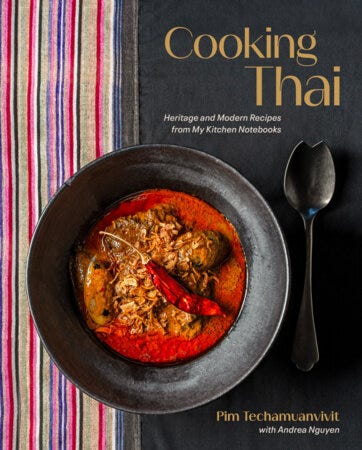
I’ve known Pim Techamuanvivit for over twenty years and still remember an incredible Thai meal she made for us in Paris, circa 2005. I may not remember what I had for lunch a few hours ago, but that meal left an indelible mark on me. Over the years, Pim transitioned from food blogger, to jam-maker, to charcuterie teacher, and now, to Michelin-starred chef, with two outstanding restaurants in San Francisco, Nari and Kin Khao, and one in Bangkok.
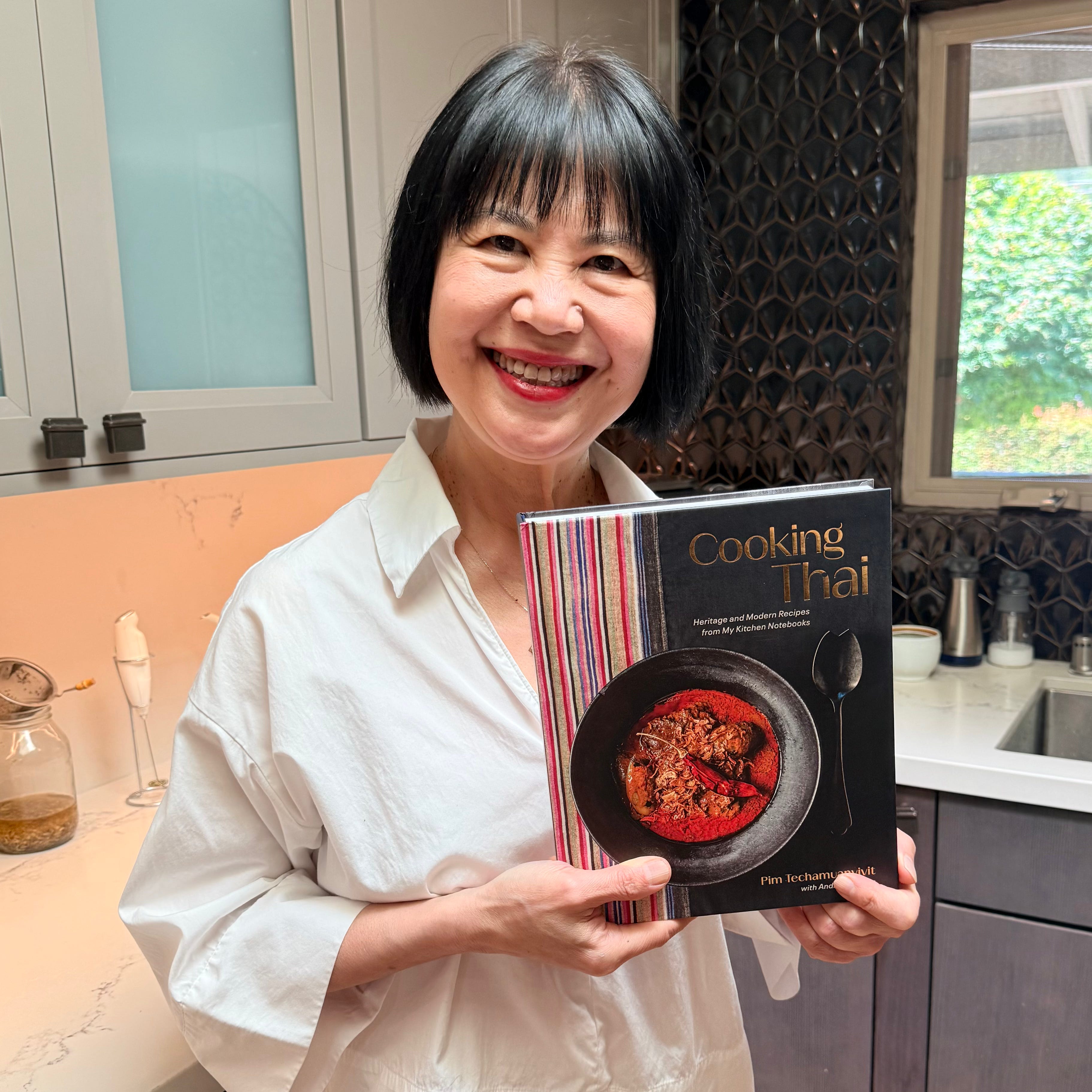
Thai cooking can seem complicated but when I got a preview of Cooking Thai by Pim, co-written with , the recipes were not only enticing but also achievable. They spent two years working closely together, making sure the recipes were accessible to home cooks, a talent Andrea is particularly adept at, with primers on how to moderate chili heat and what ingredients can be swapped out, say, if you want to make Som tum, shredded green papaya salad, and green papaya isn’t available. There’s the recipe for aThai chicken and coconut noodle soup that’s perfect winter fare, as well as Sweet potato massaman curry andKin Khao’s legendary chicken wings. I’m really impressed by this book and while I have a few books on Thai cooking on my bookshelf, this one is going to be used in my kitchen.
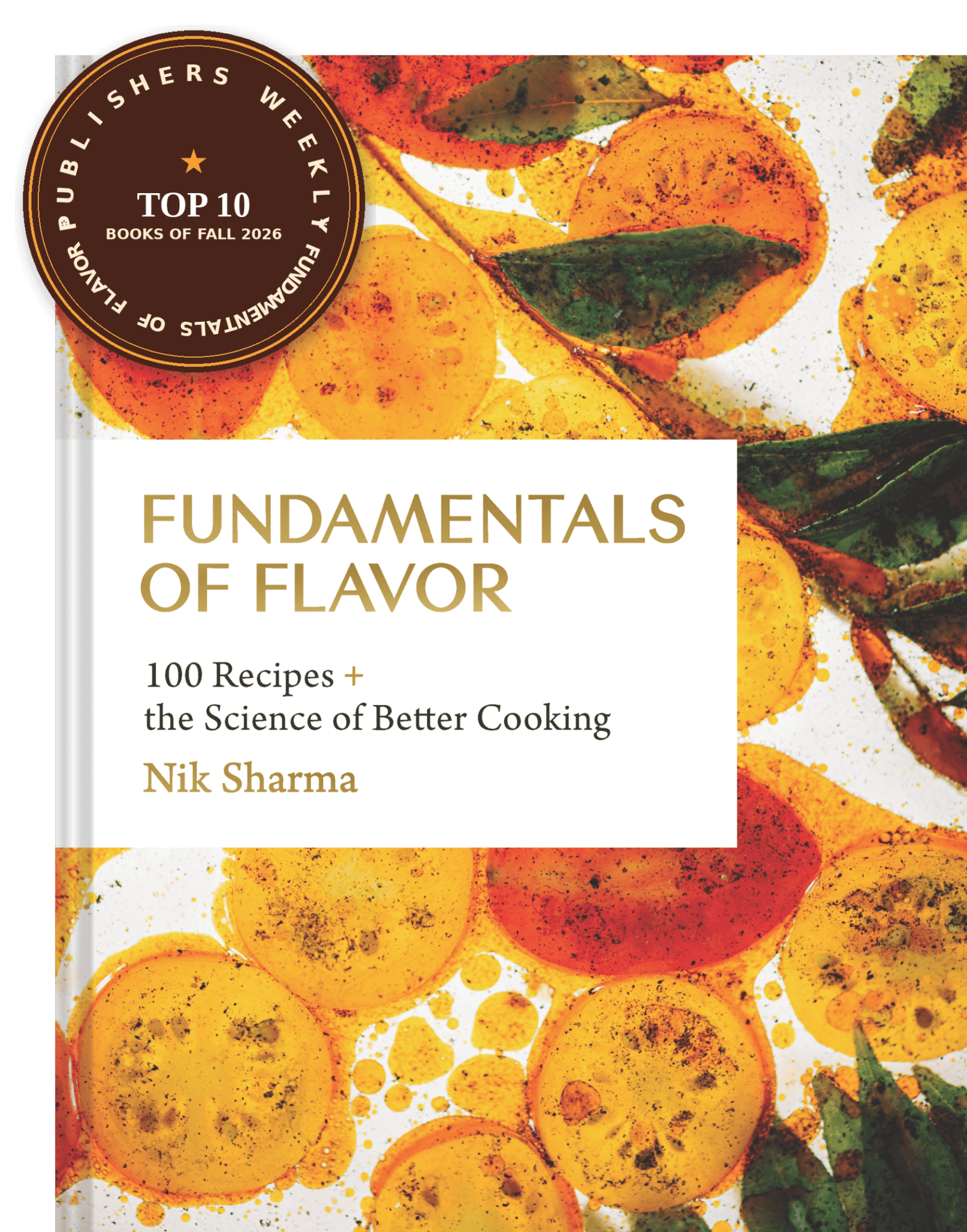
In Fundamentals of Flavor, Nik Sharma continues to explore the intersection between cooking and food science, with a focus on flavor. His book opens with a touching, and sometimes painful, memoir of Nik’s journey from India to the United States, where he eventually found his footing in the food world. The book is divided into four chapters: Fire, Earth, Air, and Water. Nik walks readers through building flavors, with bold recipes such as French onion soup scented with black onion seeds and Tandoori chicken that lets you mimic the flavors of a traditional tandoori oven at home, either on your grill or in the oven.
For those who are obsessed with cultured French butter, Nik has a recipe for making that at home as well. And “My ultimate carrot cake,” which has a few cross-cultural twists, sounds amazing. Cooks and bakers who want to take a deep dive into the world of food science will especially enjoy this book, and if you want to know the how’s of how ingredients work, and the why’s of how to use them, Fundamentals of Flavor answers those questions.
I was obsessed with The Diplomat and did not want season 4 to end. (And who knew that ending was coming?) The Foreign Correspondent’s Wife by Jenna Helwig is another transatlantic thriller, set in post-World War II Paris. It’s a murder mystery involving students at a culinary school, which sounds like a promising yarn. (It’s on my iPad, ready to read.)
I was happy to chat with Jenna recently on my podcast about cookbooks, as well as her first novel. Listen here!
Subscribe to my newsletter to get new posts, videos, recipes, podcasts, and more, sent right to your inbox!
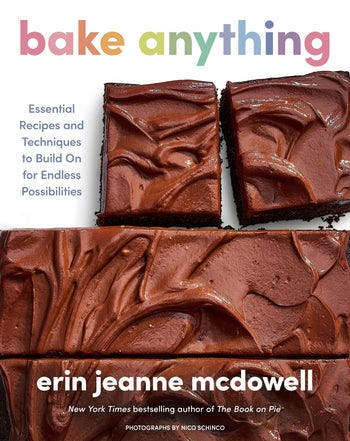
I’ve long admired baker Erin Jeanne McDowell, and her new book, Bake Anything, walks bakers through the basics of baking. Chapters on the basics feature ways to build on those basics, from yeasted morning pastries, such as croissants, morning buns, and brioche, to éclairs, cakes, and French macarons. Accompanying the recipes are QR codes throughout the book so you can learn, and bake along with Erin.
My first encounter with Rose Levy Beranbaum was shortly after her iconic book, The Cake Bible, was published. I was working in the pastry department at Chez Panisse and we were all in a tizzy that she was coming. Since I was driving back to San Francisco after my shift, she asked if I could drop her off at the Neiman Marcus store in Union Square, since they were the only place that carried the bras she wore. That was my introduction to Rose.
Over the years I’ve gotten to know her, as her career continued to take off, with her writing authoritative books on bread baking, pastry, and even Christmas cookies, which happens to be one of the best books on the subject. Rose has finally written Ma Vie en Rose, a memoir of her life, which lists her accomplishments, including the highs (book awards and accolades) and the lows (marriage issues and her husband’s death), and other sometimes uncomfortable truths about her “sweet life.” Some of the stories in the book may startle readers with their frankness (as a courtesy to you, I don’t write about my sex life), but Rose doesn’t shy away from topics like that, and others.
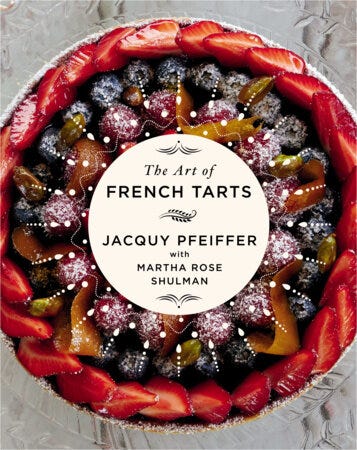
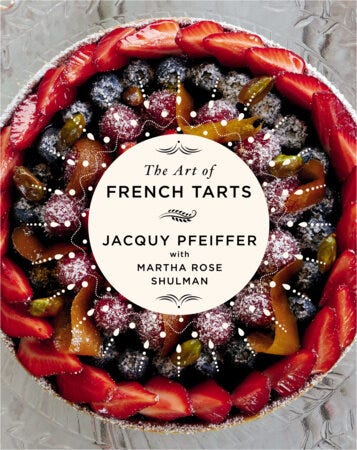
If you watched Kings of Pastry, you know Jacquy Pfeiffer as one of the participants who’s preparing for the strict, and stressful, competition in France, which determines if a chef can attain the prestigious M.O.F. designation, signaling that you’re a master in your field.
(I was surprised, and delighted, to find a picture at that link about M.O.F.s of my chef/instructor, Philippe Gobet, when I was a student at École Lenôtre. On my last day of class, he grabbed my hand and said, “Daveed, I’m going to take you into the factory…” and then proceeded to lead me through the entire pastry production facility of Lenôtre, where he was greeted by everyone on the staff like a cherished friend. It was a highlight of my life.)
No spoilers, but Jacquy, who co-founded The French Pastry School in Chicago and starred in the film, has returned to his native France. He’s now leading culinary retreats in the south, where you can spend a week with him, focusing on all things pastry. (Spoiler: I want to go to one.) If you can’t make it to France, The Art of French Tarts is his brand-new guide to baking French tarts, both sweet and savory.
If you follow chef Pfeiffer on Instagram (above), you know how deftly he explains techniques and tips, making French baking and pastries accessible to anyone. This book is coming out in November, and I’m looking forward to baking my way through my copy, when (or, if?) it arrives. Thankfully, it’s coming from within France…so fingers crossed - 🤞 😅
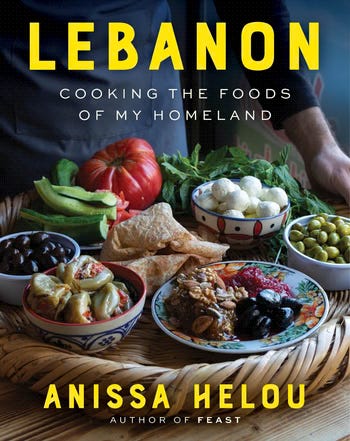
My Lebanese “sister” (Anissa Helou calls me her brother, since we’re both part Syrian) revisits the foods of her homeland in her latest book on Lebanese cooking. As her publisher states, “While only half the size of New Jersey, Lebanon boasts an astounding variety in its cuisine, including classics like hommos or kibbeh…Meatballs in lemony sauce, fava beans and lamb in yogurt, lentil risotto, and baked fish with Tripolitan tahini cilantro sauce…along with delectable sweets, including sweet walnut triangles, aniseed fritters, semolina cream pastries, and tahini rice pudding.”
I’ve had the pleasure of traveling with Anissa, and having her cook for me, and I can tell you there’s no better guide to the cuisine of her family’s country.
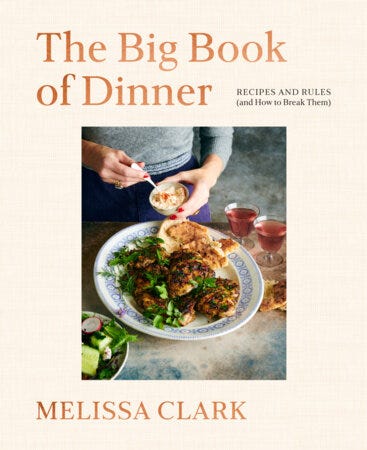
How can you not love a book whose subtitle is “Recipes and Rules (and How to Break Them)”? In her latest cookbook, The Big Book of Dinner, Melissa Clark tackles one of life’s most pressing questions: What’s for dinner?
I loved her book, Dinner: Changing the Game, which changed mine. Melissa is obsessed with dinner, also having written Dinner in an Instant and Dinner in One, and she was even named a Chevalier de l'Ordre du Mérite Agricole, Knight of the Order of Agricultural Merit, by the French government for her book, Dinner in French. Which makes me think that maybe I should stop writing about baking in France and focus on dinner?
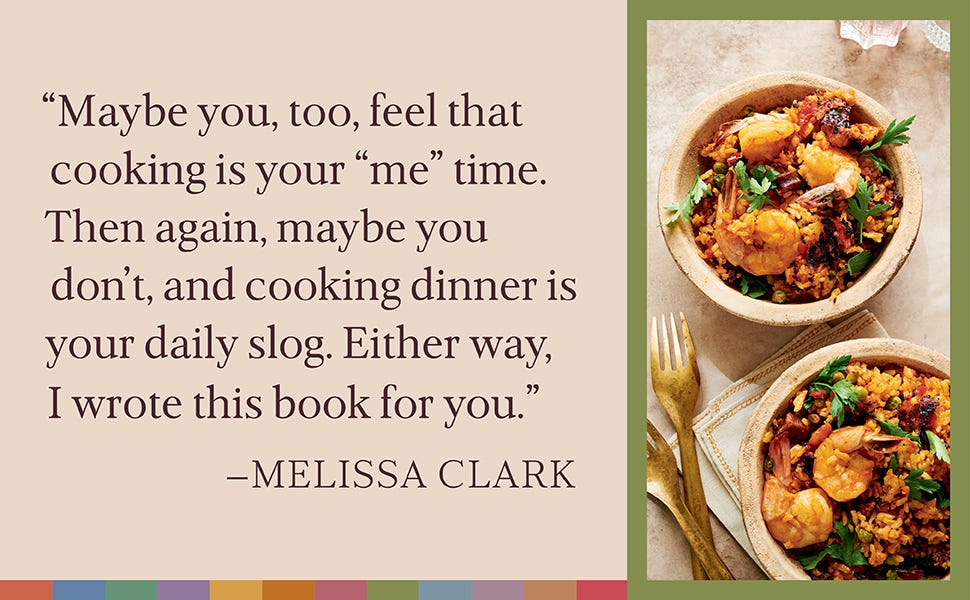
Melissa says her book is for everyone, whether you like to cook, or don’t.
But I’m a fan of Melissa and am thrilled for her well-deserved success, at home and abroad. Her latest book features 175 recipes, with 150 variations, for supper. I’m looking forward to diving into this one, especially all the braises now that winter is just around the corner.
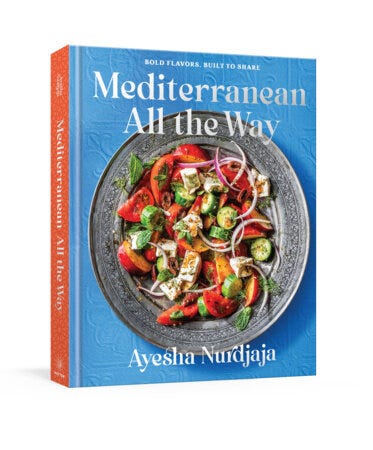
Whenever I’m in New York, Shukette is a must-stop for me. I love, love chef ’s vibrant, flavorful food. (The bread menu is a must, as is their soft-serve ice cream for dessert.) Chef Ayesha’s debut book, Mediterranean All the Way, shares her recipes, which are known for their bold flavors and generous use of fresh vegetables and herbs. Ed Anderson, who photographed my last four books, turned his lens on Ayesha’s food, and what beautiful food it is!
Mediterranean All the Way is currently the number-one best-selling book on Mediterranean food online, and it’s easy to understand why. Who doesn’t want to make Halloumi with strawberries? That combination was a shock to me last time I was at Shukette, but in Ayesha Nurdjaja’s hands, it was a triumph. I learned from her introduction that she almost became a lawyer. Lucky for us, she didn’t.
Much of what we do to be worthy humans is to help other folks and establish a sense of belonging and community. Sometimes it starts out with a cold call or email. From there a relationship begins.
Three years ago, after Ever-Green Vietnamese released, I got an email from Joyce Tang, the baker and owner of Bake Sum, a hip Asian bakery in Oakland. She invited me for a book signing and offered to feature one of my recipes. We chose the Vietnamese Mocha Cake and she replicated it beautifully, complimenting me on how my recipe scaled up well for her commercial bakery needs. She put her own spin on the cake by adding a Vietnamese coffee Swiss meringue buttercream.
I had a fun afternoon hanging out at the bakery and meeting folks. Bake Sum impressed me with how it exists as a hub for anyone interested in Asian American flavors. Joyce and I got talking about a potential book project so she could share her journey and recipes.
Three years later, she has a cookbook, co-authored with another friend of mine, chef, author, and James Beard Award-winning journalist Soleil Ho. With Bake Sum the pastry shop and book, Joyce realized her dream.
If you want to be on the cutting edge of what captivates and influences the cool kids, Joyce has pro-level ideas for you. Bake Sum’s recipes include classics like egg tarts and moon cakes and newfangled gochujang garlic pull-aparts, black sesame snickerdoodles, and a vegan five-spice chocolate cake that relies on an Asian baking technique to get its moist texture.
What about recipe testing bakery formulas for home cooks? If you’re cookbook curious, give a listen to the podcast that and I did with Joyce and Soleil! 🎧 👂
Then make two easy Bake Sum recipes! I’m a matcha fan so I picked these . . .
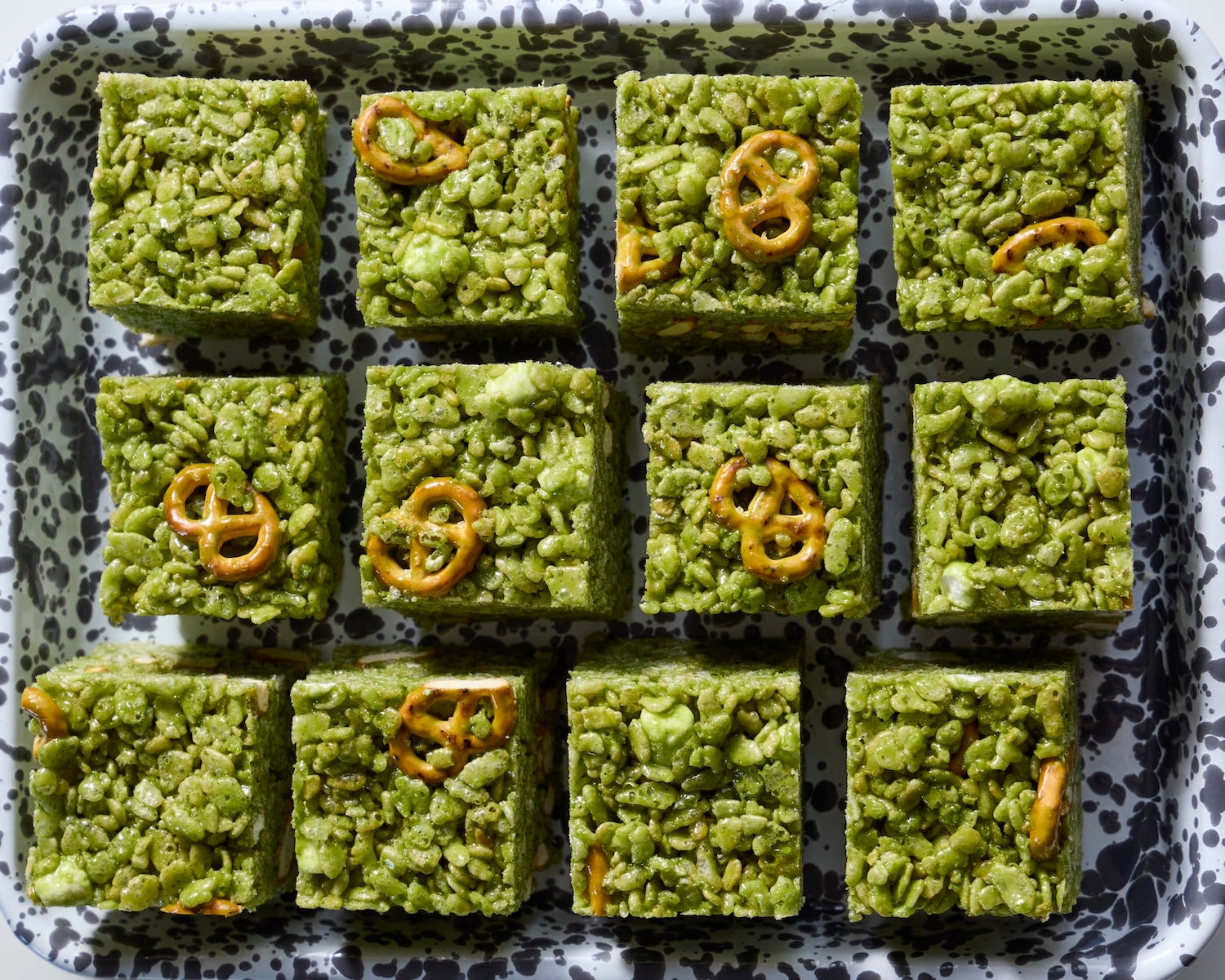
💎 Matcha Fancy Rice Crispy Treats
My sisters and I used to make rice krispy treats in the 1970s so Joyce’s recipe for Fancy Rice Crispy Treats that caught my eye. It looks grownup and fun with matcha and salty pretzels! It’s gluten-free and you can totally adapted it to be vegan. Instead of pretzels, put salted roasted peanuts in the mixture or add furikake. Get Joyce’s 🆓 Fancy Rice Krispy Treats recipe at my website.
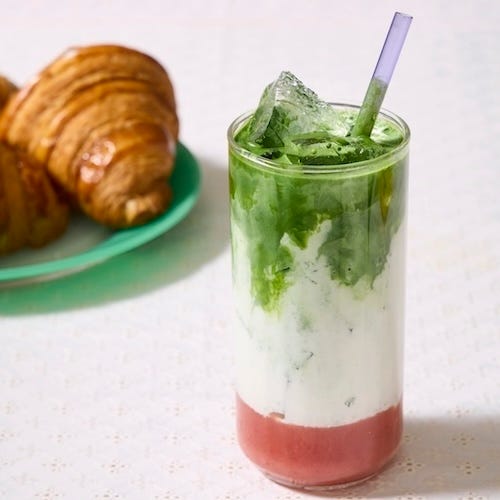
Bake Sum has a fun menu of drinks and I really liked the Matcha Strawberry-Ginger Latte. It was verdant, zippy, rich and tangy — and had the colors of the Italian and Mexican flag too! The MSGL is the first recipe in Bake Sum! It’s easy to prepare and as Joyce describes, “This drink looks and tastes like California in a cup, filled with pastures of green and tons of strawberries.”
✅ From Joyce: Use in-season strawberries if possible. If you use frozen berries, add a bit of extra sugar and lemon juice to balance flavors. If you don’t have a matcha bowl, a small bullet blender will work; however, you’ll end up wasting a little bit of the precious green elixir.
✅ From Andrea: I cheat by using an electric milk frother to make matcha fast. As for matcha powder, I regularly drink Tenzo Tea and Kirkland brand.
Matcha Strawberry-Ginger Latte
Makes 2 drinks
Ingredients
Strawberry-Ginger Puree
1-inch | 2.5 cm knob of fresh ginger, peeled and sliced
½ cup | 100g sugar
½ cup | 113g water
1 cup | 155g strawberries
The rest
1 teaspoon matcha powder
2 tablespoons water
Ice cubes
2 cups | 454 g oat or cow milk
Instructions
Make the strawberry-ginger puree: In a small saucepan, combine the ginger, sugar, and water and simmer over low heat for about 10 minutes, or until the ginger’s bright yellow color starts to become dull. Remove from the heat and cool for a few minutes until it is no longer hot to the touch.
In a blender, combine the strawberries and cooled ginger and its syrup and blend until it’s pourable but still a bit chunky. The ginger should be minced into fine pieces. (The puree can be made ahead and stored in the fridge for up to 2 weeks.)
Assemble the matcha lattes: Sift the matcha powder into a chawan, or matcha bowl, and add the water (see Note). Use a chasen, or matcha whisk, to start whisking vigorously back and forth in a straight line (not in a circular motion). Continue until the whisk has started to produce microfoam.
Pour the strawberry puree into the bottom of two 12-ounce (355 ml) glasses, then top with ice. Fill two-thirds of the way up the glass with the milk of your choice. Pour the just-prepared matcha over the top. Stir and enjoy as soon as possible.
💎 Enter to win a copy of Bake Sum!
Bake Sum has 75 recipes total so there’s lots more to explore. I’ve got a copy to gift one of you lucky PTFS subscribers!
Bake Sum Cookbook Giveaway lowdown:
The prize: One (1) copy of Bake Sum: Asian American Pastries, Breads, and Other Treats (value $35)
Eligibility: You must subscribe to Pass the Fish Sauce, be 18+ years of age, and have a valid U.S. shipping address.
Giveaway end date: Wednesday, October 21, midnight PST.
Selection and notification method: Based on the number of comments, I will randomly draw a winner and notify the person by email.
⚡️ To enter: ❤️ Like this post AND leave a comment (e.g., What’s your favorite classic or modern Asian-y sweet treat? What’s your favorite Asian bakery? What ingredient(s) signal ‘Asia’ to you?) 👇👇👇
Joyce’s recipes got me all nostalgic so I’m taking a walk down memory lane this Sunday with an updated take on a Viet-Chinese snack. Join us behind the paywall, if you have not!
I hope you had a good week, despite the general levels of angst that seems to float about these days over the economy, AI, and so much more!
I’m not quite ready to crawl into a cave because there’s a lot of optimism out there. For instance, our neighbors have been starting families and their young are full of life, curiosity and hope. I also find solace in people doing good things in the culinary world.
Food and Wine magazine released its 2026 Best New Chefs list, and I contributed the write up on Kiln, a two-Michelin star restaurant in San Francisco. I wasn’t prepared to enjoy the 20-course tasting menu but it was super flavorful and not fussy. Chef John Wesley is also a remarkable person with incredible talent. Moreover, FW’s picks includes The Paper Bridge, a Vietnamese restaurant in Portland, OR, owned by Quynh Nguyen, a Hanoi-native, and Carlo Renardi, her American husband. Check out the BNC 2026 listing to see what may be near you!
If you subscribe to , its new issue #35 celebrates women at the forefront of home cooking. Yours truly is in the issue (contributors were asked: “What tastes like home?”). CB selected Cooking Thai as an outstanding fall cookbook and included Pim’s kabocha squash coconut custard dessert recipe.
And, my local Bookshop Santa Cruz announced that our book sold very well last month. 🥳 You may still get signed copies there or at Omnivore Books in SF.
What to cook right now? Some dishes are evergreen like my Vietnamese fish salad (gỏi cá), which Gail recently made with cod cheeks and reported stellar results, including the leftovers!
On the other hand, certain dishes are seasonally appropriate. October is part of the shoulder season. Summer warmth lingers in the day while autumn cool creeps in as the golden light fades. The two recipes I’m sharing this week help you straddle and enjoy the best of both seasons and make the most of what you’ve got.
Make a swank take on a Thai icon 🍃 🌶️
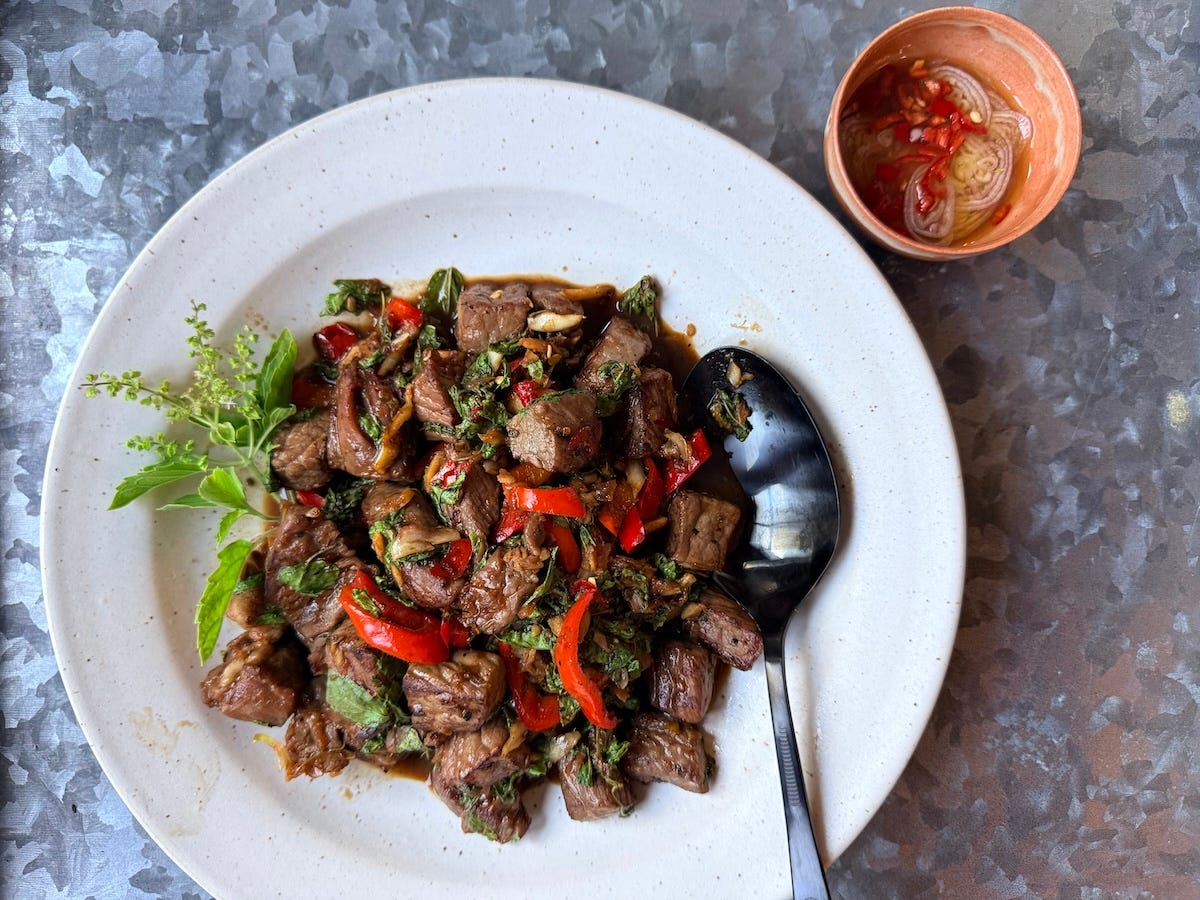
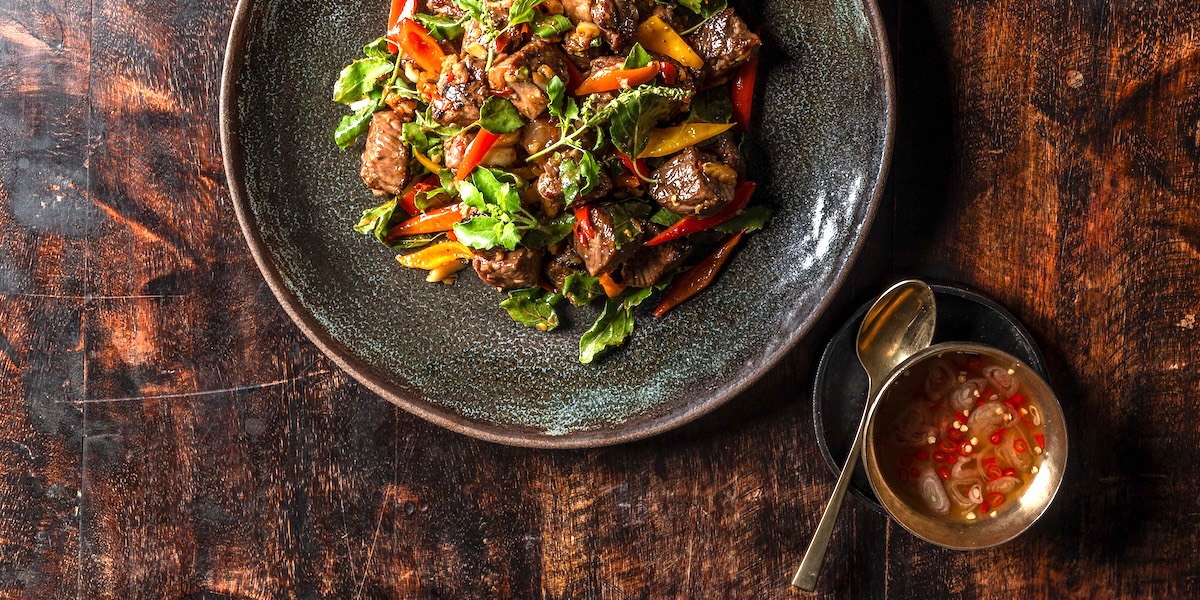
First up is a premium take on pad gaprao, the go-to stir-fry for many people in Thailand. The Thais eat it about once a week, according to an article that Pim found while we were writing Cooking Thai. (Sorry, pad Thai!) I asked her for a recipe and she returned with a masterful one featuring juicy, seared beef steak cubes that are shot through with the garlicky, punchy heat that makes Thai food sultry and exciting. Lots of basil functions as a seasoning, not a garnish.
This came from my kitchen and soon, you’ll be making your own too!
Pim cheekily named her recipe Bougie Pad Gaprao because the typical rendition uses ground meat. If you have the book, the main recipe is on page 233 followed by three (3) variations on page 234. For those of you who don’t yet have the book, I’ve shared our recipe and pro tips — including smart basil swaps — on my website. Pad gaprao is on rotation at our house. It comes together fast so get the 🆓❣️ pad gaprao recipe to experience Asian basil are at its peak.
Use leftover rotisserie chicken for shortcut Viet-Chinese noodle soup (mì gà tiềm)🍗 🍜
While there’s a hurry to savor summer herbs, we’re also looking to hibernate a bit with cozy soup. There’s plenty of time to simmer for hours during winter’s depth. For now, I’m still into quickies and hacks.
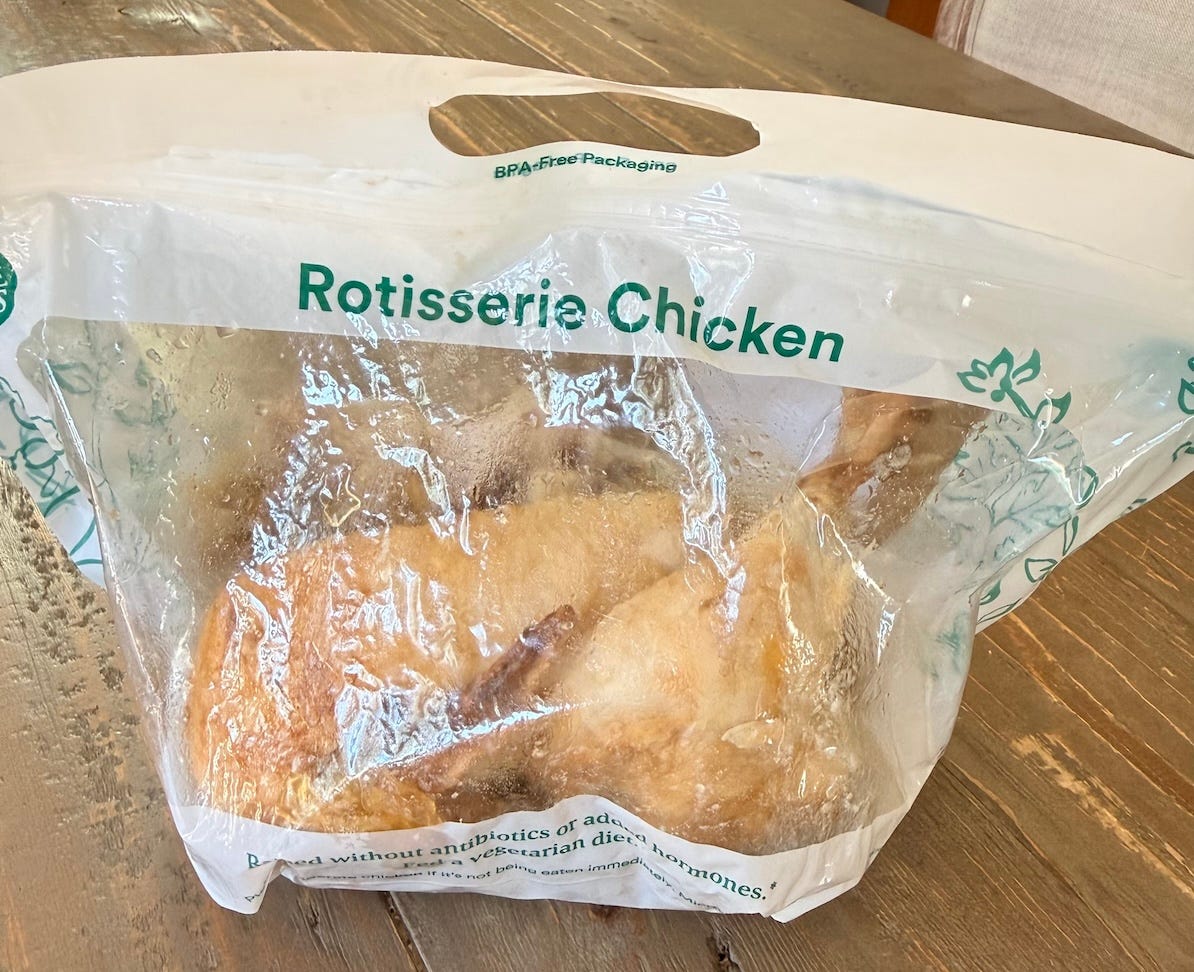
This week, I needed to deal with leftover rotisserie chicken. The store bought bird saved my cooking life last Sunday when I was too tired to cook from scratch. Its comforting roasted flavor, convenience and affordability rescued me. But what to do with the leftovers? Yes, you can make a sandwich or salad but those dishes often blatantly remind you that you’re still eating the same bird. Day-after rotisserie chicken can be dry as a cotton ball and hard to swallow.
This bird didn’t know what would soon happen to it! On Tuesdays, my local Whole Foods runs a $2 off sale on rotisserie chickens. Maybe yours does too?
Not wanting to discard more than half of the bird, I transformed its flesh and all the scraps into a Vietnamese-Chinese noodle soup. It took about 45 minutes and transported me to a family friend’s Chinese barbecue shop in San Diego. Mr. and Mrs. Tan owned the shop that my parents frequented. While the adults talked, I scarfed down Mrs. Tan’s specialty — mì vịt tiềm (“mee VEET tiam”), a braised duck Vietnamese egg noodle soup with a rich, spiced broth. It’s a specialty of the Chinese diaspora in Vietnam, particularly the one in Chợ Lớn, Saigon’s Chinatown neighborhood.
The landmark Binh Tay market in Cho Lon. You can’t miss it. Great place to shop for wholesale housewares though you have to buy lots.
Mrs. Tan gave my mom her recipe, which I used to create the recipe for my first cookbook, Into the Vietnamese Kitchen. That twenty year old recipe on page 220 remains my favorite iteration but it’s time consuming to prepare. Who wants to roast duck or go find one? When traffic is perfect, the closest Chinese barbecue shop is 45 minutes away! And nowadays, what’s sold at those shops as roast duck is anemic.
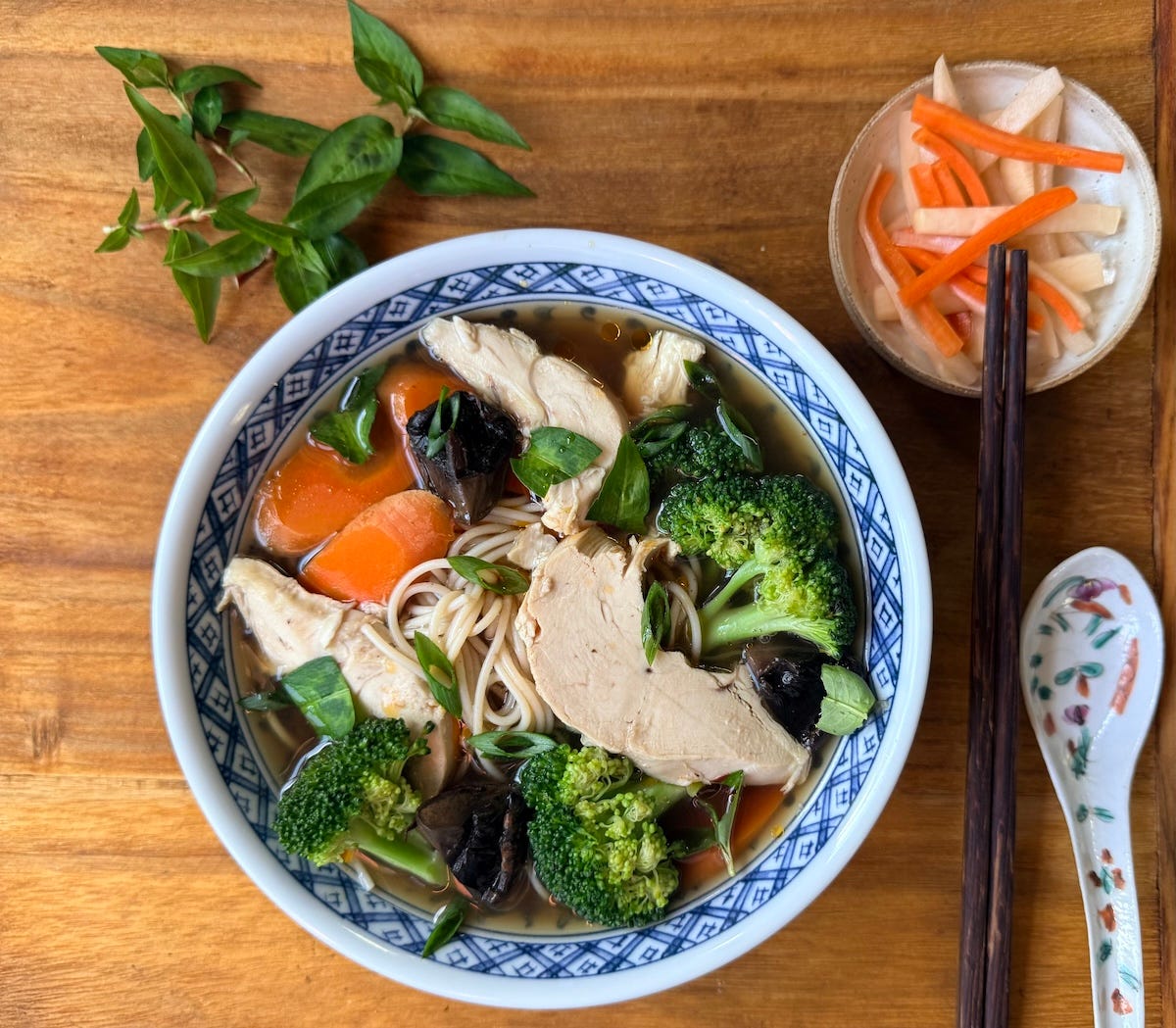
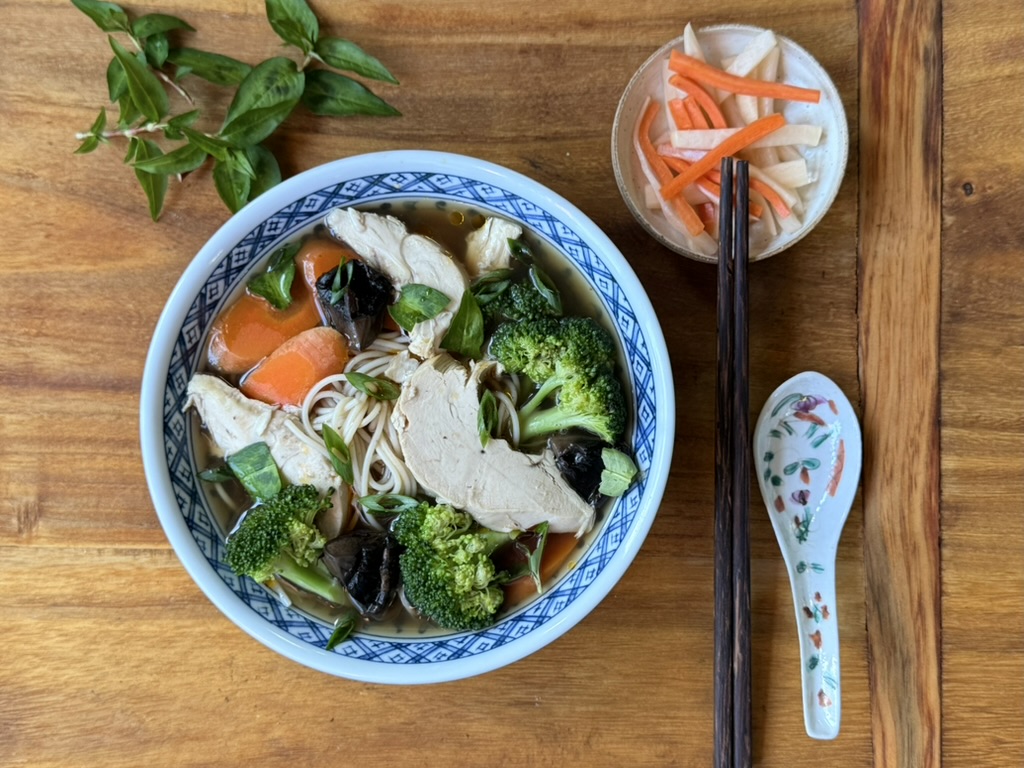
Wanting a cozy shortcut and aiming to use up my rotisserie chicken, I cooked up this shortcut version with chicken. This 45-minute Mì Gà Tiềm hack transforms the chicken into a remarkably fun and special treat. The flesh moistened up, but most importantly, the results made me forget that we were eating humble leftovers. Rory dreaded eating rotisserie chicken dishes but he perked up when I served him a bowl of this noodle soup.
I loaded mine up with vegetables. That’s not traditional but it makes for a complete, wholesome meal. If you want to be super traditional, eat this noodle soup with pickled daikon and carrot. The tang and crunch adds textural contrast and brightens the noodle soup.
When you make this shortcut Mì Gà Tiềm (“mee GAH tiam”), you’ll realize its many virtues.
It uses every bit of the bird for a potent broth. Use your roast chicken leftovers, if you want. Rotisserie chicken isn’t the only game in town. 😆
If you don’t have enough meat, at least turn the leftover scraps into tasty broth. Add mushroom, tofu and napa cabbage and you have quick and easy soup for lunch.
Use Chinese egg noodles, rice noodles, soba, or ramen. Instant ramen is fine.
Employ fresh or dried mushrooms, depending on the time used.
Below you’ll find the recipe in text and a downloadable PDF. Plus you’ll have all my recipe development notes for you to tinker with.
Ok, the clock is running and you’re hungry. Let’s make this noodle soup!
Support Pass the Fish Sauce as much as you can. Become paid subscriber for this recipe and access to 225+ others, along with class discounts and much, much more.
I have a knack for saying things that many people think and few dare to voice openly. Airing dirty laundry has gotten me in trouble a few times with my family but in the past week, in talking to people about Cooking Thai, I’ve had private conversations with folks who quietly say, “You know, such and such Thai restaurant is not very good.” My sister Linh and I have the same conversation about Vietnamese restaurants.
So I have to admit to you that a lot of Thai and Vietnamese restaurants are not great. Many offer the same menus and flavors. To borrow from the New York Times food critic Ligaya Mishan, “We’re in an epidemic of sameness.”
I empathize with the restauranteurs.
If you’re a Viet or Thai restaurant owner, you’ve got financial goals to meet and are looking to fill seats and sell food. You cannot afford to spend too much time to labor to make food that’s going to be as good as homemade. You’ve got to cater to a broad swath of customers. As a result, your menu may be huge and your flavors can easily become diluted.
But, you as the diner — if you’re armed with cooking knowledge, you can make good food yourself to satisfy your palate, save money, and learn. Perhaps you’ll eventually engage with local restaurant owners so they know you have a high level of appreciation of their craft. Maybe they’ll feel more open to try new dishes and offer bolder flavors.
Cooking at home and eating out are not mutually exclusive. I love the healthy and relaxed aspects of home cooking but I want someone else to plan my meal and wash the dishes once in a while!
So, that’s why I write cookbooks and teach cooking — so you can understand how foods are prepared, make them yourself, and be a more informed diner! It’s a Nguyen-win if all that happens. A girl has to maintain and manifest her dreams!
💎 Nampla prik — a 1 minute Thai Wonder Sauce
A few months ago, someone asked about nampla prik, whether or not Pim had a recipe for it. Yes she does, and it’s tucked away in a recipe Note (always read recipe endnotes in the book to unmask little hidden gems!).
Nampla prik literally means fish sauce with chilies spiked with lime juice. I’d had it before at restaurants where it was lackluster, but Pim adds thinly sliced shallot and the sauce dazzles with complex flavor. You can have it as you like — with or without chilies — as much as you like, sometimes with garlic. Add extra lime juice to boost the tanginess for your taste.
How does Thai nampla prik compare to Viet nuoc cham?
Nampla prik is more intensely tart, salty, spicy and pungent. There’s no sugar and no water involved like what’s in my nuoc cham recipes. Also, nampla prik is enjoyed in relatively small, yet potent, quantities. You stir together it together and serve with a small spoon like you see in these photos from Cooking Thai.
Nampla prik isn’t super multipurpose like nuoc cham. In the book, we present it as a Thai “serving sauce” to accompany dishes like the holy basil stir-fries, salted egg yolk-shrimp fried rice and northern curry and mushroom fried rice. But ubiquitous holy basil stir fries (pad gaprao) can be made with practically any kind of meat or tofu so you’re apt to see the same sauce on many tables.
How to make Pim’s nampla prik
Nampla prik brightens and enlivens anything it touches. Use a small spoon to sprinkle the sauce onto your food at the table.
In a small bowl, mix together 1½ Tbsp lime juice, 1½ Tbsp fish sauce (or Thai thin soy sauce), and 1 Tbsp chopped fresh Thai chilies. If you like, stir in 1 Tbsp very thinly sliced shallot. Makes about 1/4 cup to serve 4.
I always pack my tablespoon with the shallot because it tastes really good after sitting in the lime juice and fish sauce. For a primer on Thai fish sauce, check page 22 of the book or visit this page on my website for a 🆓 guide to salty, spicy Thai condiments and seasonings.
Pass the Fish Sauce is a reader-supported publication. To receive new posts, mine the 150+ recipe index, and get 25% off class sign-ups, become a paid subscriber. I welcome your support at all levels!
💎 Take this life expectancy quiz. I got an “F”.
Getting only four out of ten questions right underscored the marvelous facts I didn’t know about living longer! Rory happily said that he may live past 100 so I better get ready to take care of him in his dotage. 🫡
Take the life expectancy quiz via my free gift link. You may have to click through some pitch to subscribe but you should get there. There are good explainers and statistics at the end.
💎 Coming up . . .
In this coming Sunday Special, you’ll see some easy, light recipes that have recently impressed me more than I expected.
When Asian people celebrate — birthdays, graduations, retirement, whatever — there’s likely to be a layer cake featuring fresh strawberries and light, fluffy whipped cream. Such cakes are stalwarts at Asian bakeries, which churn them out daily. But truth be told, the cakes are rather tasteless because they are mass produced with unripe, sturdy fruit. The whipped cream doesn’t taste like much and neither does the cake itself. I’ve been disappointed too many times by these perfect looking cakes. So I bake my own.
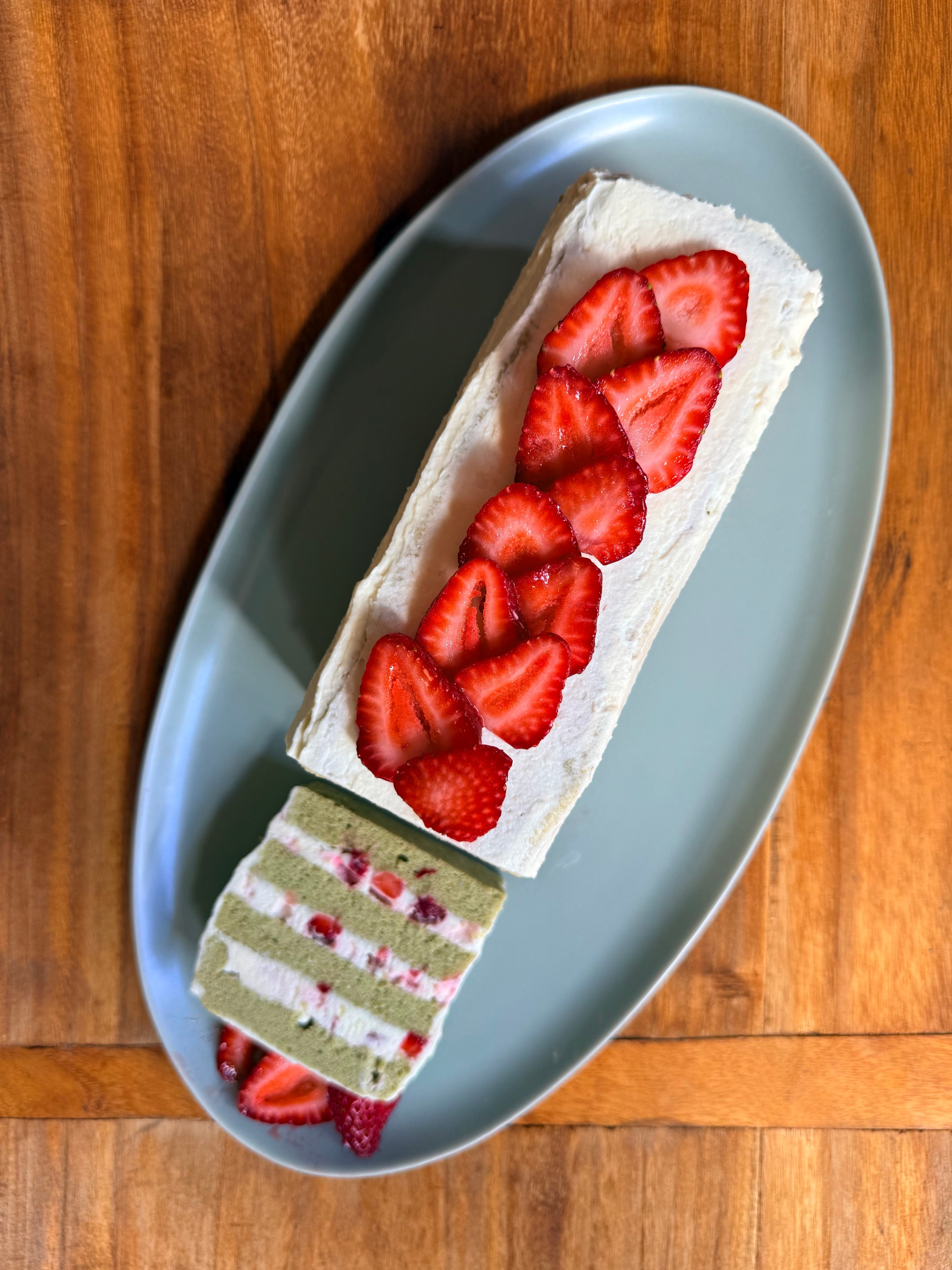
Gearing up for my mom’s 92nd birthday luncheon, I dreamt of baking her a pandan cake. My initial thoughts went to a favorite pandan chiffon cake recipe (🆓 on my website). It’s showstopper green and fragrant from the alluring vanilla-coconut flavor of pandan leaf (screwpine, lá dứa in Vietnamese). Baked in an angel food cake mold, pandan chiffon cake is casual. I needed easy-ish celebratory sparkle, a cake I could bake after a day of work and one that would hold up to an 8-hour roadtrip to my mom’s house. 💖
In the end, I tweaked Shilpa Uskokovic’s strawberry roll cake recipe in a recent issue of Bon Appetit. My creation was a pandan-strawberry cake filled with a coconutty whipped cream. We had twelve adults and two toddlers and when it came time for dessert, I presented the cake. Viola!
My sister Tasha gasped. “You made that?” she said. She’d eaten lots of strawberry and cream cakes with me when we lived near Monterey Park in the 1990s.
Everyone loved the cake, though Linh, my avid baker sister, said, “The cream is delicious but I’d like more cake.” I agreed. You didn’t taste enough pandan. Plus the cake was strangely salty. (Linh had baked a Sicilian orange cake for my mom so our cakes shared the plates.)
Driving home, I sketched out a new recipe for a thicker cake in my head. It took two more bakes before I arrived at the versatile recipe I’m sharing with you today.
Along the way, test cakes went to the neighbors. One neighbor shared a big piece with their grieving best friend who’d just lost her mother to a long battle with breast cancer. The friend ate the biggest piece, I was told.
As I aimed for a thicker cake, I realized that you can’t roll it because the cake cracks and breaks. You can’t see it in the cake on the left but there’s a fissure that kept getting bigger as the cake sat. The neighbors didn’t mind, though!
I tinkered with the batter again and the cake broke during rolling. What to do?
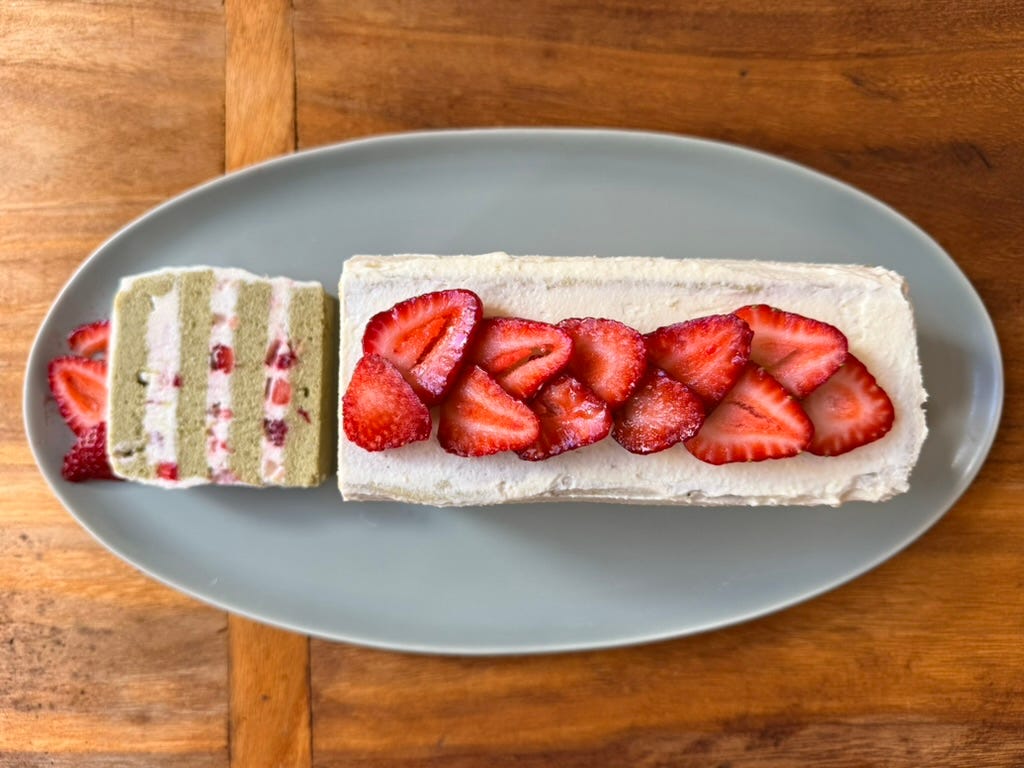
I patched up the cake and pivoted to building a rectangular layer cake. Rory said it looked much fancier than the roll cake. They’re the same cake! 😆 😆 I gifted cake #4 to a different neighbor, who’d just finished an arduous week on a construction project. He couldn’t believe I had baked it and as you see (in his text above), he was so happy.
What began as an Asian celebration cake turned out to be a happiness cake for everyone. Along the way, I made different flavored cakes — pandan, matcha, citrus, and vanilla. I also made two kinds of whipped cream: vanilla and coconut. And yes, I also crafted roll and layer cakes. There were so many wondrous possibilities.
For all those reasons, this is my Strawberry and Cream Dream Cake recipe!
Below you’ll find a versatile, useful package of information containing.
The Pandan-Strawberry and Cream Cake recipe that you can make as a roll cake or as a layer cake (in full text and downloable PDF), with vanilla whipped cream or a coconutty whipped cream!
Three (3) cake variations for Matcha-Strawberry and Cream Layer Cake, Citrusy Strawberry and Cream Layer Cake, and Vanilla-Strawberry and Cream Layer Cake
Pointers for choosing flavorful berries, natural pandan shortcuts, and making fluffy, stable whipped cream that holds up for days
A video tips for making billowy cake batter
Make ahead timing tips so you won’t get cranky
I’m not a skilled cake baker but I mastered this one enough to impress my jaded family and neighbors. It took me a few tries to get here but you’ll make a knockout cake on your first time out because I’ve eliminated a lot of the vagaries.
Bring this dreamy strawberry and cream cake into your dessert rotation.
Curious cooks, readers and eaters fuel this newsletter. The dispatch was created for paid subscribers who sponsor PTFS. For the complete strawberry and cream cake lowdown, fully use the recipe index plus save 25% on my cooking classes, become a paid subscriber. Your support makes a big impact.
Here we are in August already. The July 19 banh xeo sizzling crepe class sold out (hard to believe!!!) and the fun 2-hour session flew by. There was clean up afterwards (of course) and exhaustion but I had dinner made already!
The next day, we packed for a week-long trip to Kauai. It’s our second time there this year to hang out with our dear friend, the fashion and jewelry designer Chan Luu. Where I eat while I’m on the island? At Chan’s home. Her property is loaded with fresh tropical fruit, produce, and now hen-laying chickens. We do market runs to Foodland, Safeway, or Costco for anything else we need!
Some notes on the photos:
The pineapple crowns I saw in January now have fruits! Chan grows many kinds and the pink one looks cool but has little flavor, Chan says. The white Sugarloaf is a bit too sweet for me. The yellow one (above) had a balanced sweet-tanginess. We clean up the pineapple crown so it will root and then Chan’s staff replants them. About 1 1/2 years later, there’s fruit to eat! You can grow from store-bought pineapples but success all depends on growing conditions. She has well draining soil and very good sun on a slope.
The spiky fruit in the basket is soursop, which has a tart-sweet flavor. We had lots of tasty bananas, too.
We also harvested and processed a jackfruit! The tree isn’t big but it produces fruits weighing 12 to 15 pounds. That felt like a giant bowling ball. You don’t want one to fall on your head. If you have to cut jackfruit apart, oil your knives, wear gloves and work on a tarp to minimize its latex mess.
And, next time you’re near a fresh coconut, remember this tool:
Construction workers on her property gift her food they catch (fish!, crab!), hunt (wild pigs!), or forage. One of them, a generous young man named Kaiola, took us into the rain forest on Native Hawaiian land where we picked edible pohole fern tips. Loaded with nutrition, they’re snappy and have flavors similar to asparagus and green beans but with a slightly mucilaginous quality.
Absolutely delicious for stir-fries, salad, and soup. They need to be washed well and then quickly cooked to preserve their texture and color. We wrapped them in banana leaf to keep for about 3 days in the fridge. The fern is available in Thailand, where it’s called pak kood, and is made into salads, stir-fries and even dessert.
Island life is good in Hawaii — the most Asian of all States in the nation.
Thanks for reading Pass the Fish Sauce! This post is public so feel free to share it.
When you wish a vacation would continue, it means it was a good vacation. The day after we got home, I opened Alana Kysar’s new cookbook, Aloha Veggies. Alana has a knack for capturing the spirit of her native Hawaii in recipe form while making the dishes doable for mainlanders like me.
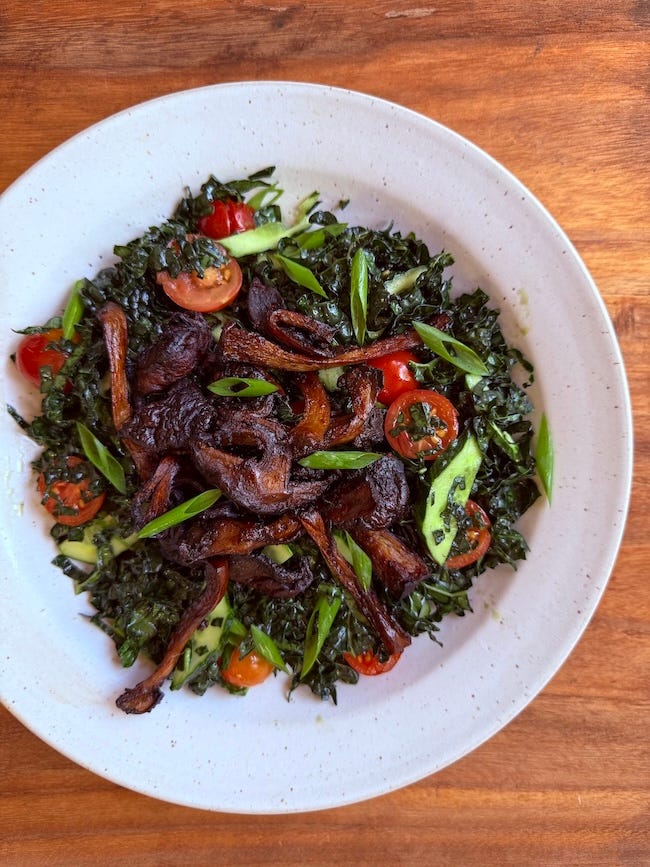
Mushrooms in my fridge and ripe cucumber, green onions, cherry tomatoes from my garden led me to Alana’s Kale and Shoyu Mushroom Salad. All I had to buy was trimmed lacinato (dino) kale leaves from Trader Joe’s. While I roasted the mushrooms and made the sesame soy dressing, Rory cut the greens. Our restorative lunch came together in about 30 minutes!
The vegan salad is simple to make yet layered with the cultures and foodways that make Hawaii inviting and interesting. It was deliciously energizing (dark leafy greens with plenty of fiber!) but moreover, it allowed me to savor island life a little longer. For Alana’s Kale and Shoyu Mushroom Salad recipe, head to my website, where it’s available for free.
Summer in 30+ recipes and oodles of kitchen pointers
Looking ahead at the rest of the year for PTFS, I had to look back. When I did, I realized that we’ve covered a hella lot of territory in since mid May, when I posted the last recap.
There have been so many delicious recipes and a bunch of focused deep dives. Anything marked 🆓 is available to all. The others are for PTFS paid subscribers.
For full access to all paywalled recipes (not just ones listed here!), become a paid subscriber. You’ll also get class discounts and seed new content, too! ⚡️⚡️ Try PTFS for a year at a discount, or save for life! Your support matters.
Cooking Thai releases on August 25 but Pim and I are going to do a fun chat about the book for (International Association of Culinary Professionals). If you want to check out the book before (or after) you pre-order it, sign up here for the virtual session. All are welcome to the free IACP event.
I’ll share info on SF and Santa Cruz book events soon!
Hope summer is treating you well — that you’re not overheating somewhere. Stay cool and well fed.
I used to wonder why, in cities like New York and Paris, everyone claimed that they could never, ever live anywhere else. Then, when summer rolled around, everyone would say they can’t wait to get out of town.
I’m a city person and I like Paris best in the summer. A majority of people have left, so it’s a lot quieter. You can get into all those restaurants that you normally needed to book weeks in advance. And while the markets are more sparse, shops selling produce from small producers have been doing their best to keep their stores stocked, in spite of a lot of fields and farms and vineyards being decimated by successive heatwaves, and now, wildfires. One of our neighbors has been dropping cigarette butts in our backyard, which is as dry as a haystack, so we’re praying our building doesn’t go up in flames, too. But for the time being, Paris has been spared.
We have friends, a couple who live part-time in Ardèche, and when they invited me to come for a few days, I erased everything I had scheduled in my calendar and took a two-hour train ride to stay with them. That region is called the Auvergne-Rhône-Alpes, especially known for sausages, wine, and its famous chestnuts, les châtaignes d’Ardèche, which have protected AOP status in France.
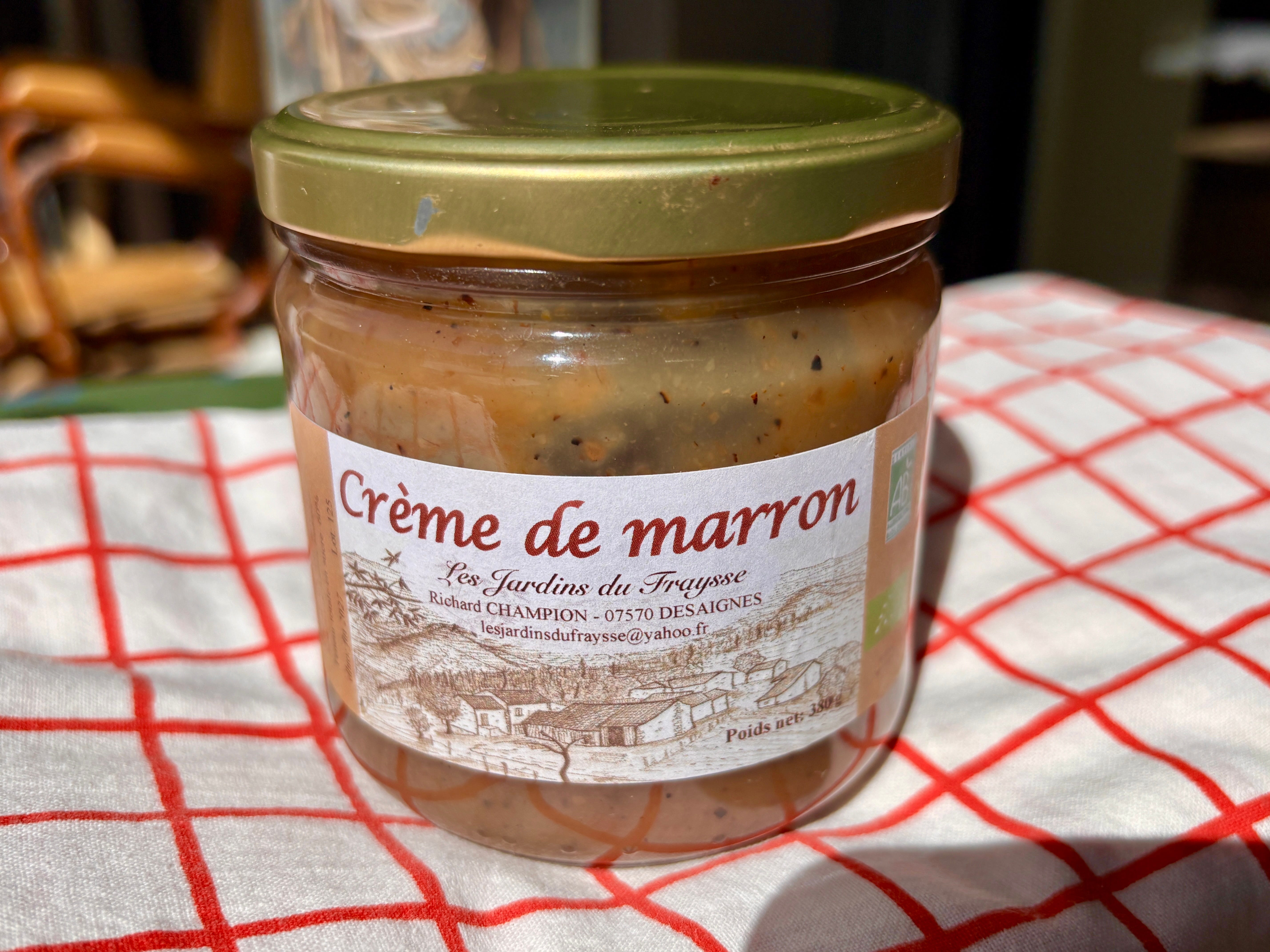
It wasn’t quite chestnut season, and people are worried about the effects of the heatwaves on the chestnut trees, but I picked up a jar of chestnut paste at one of the farm tables at the market. Sometimes the chestnut spread is made with candied chestnuts, but generally at the markets, the varieties are less sweetened, and looser, like the one in the jar, above, that I bought.
Chestnut spread is delicious served with plain yogurt or fromage blanc, or if you buy the ones made with candied chestnuts sold in a tube, like toothpaste, when no one is looking, people squeeze it directly into their mouths.
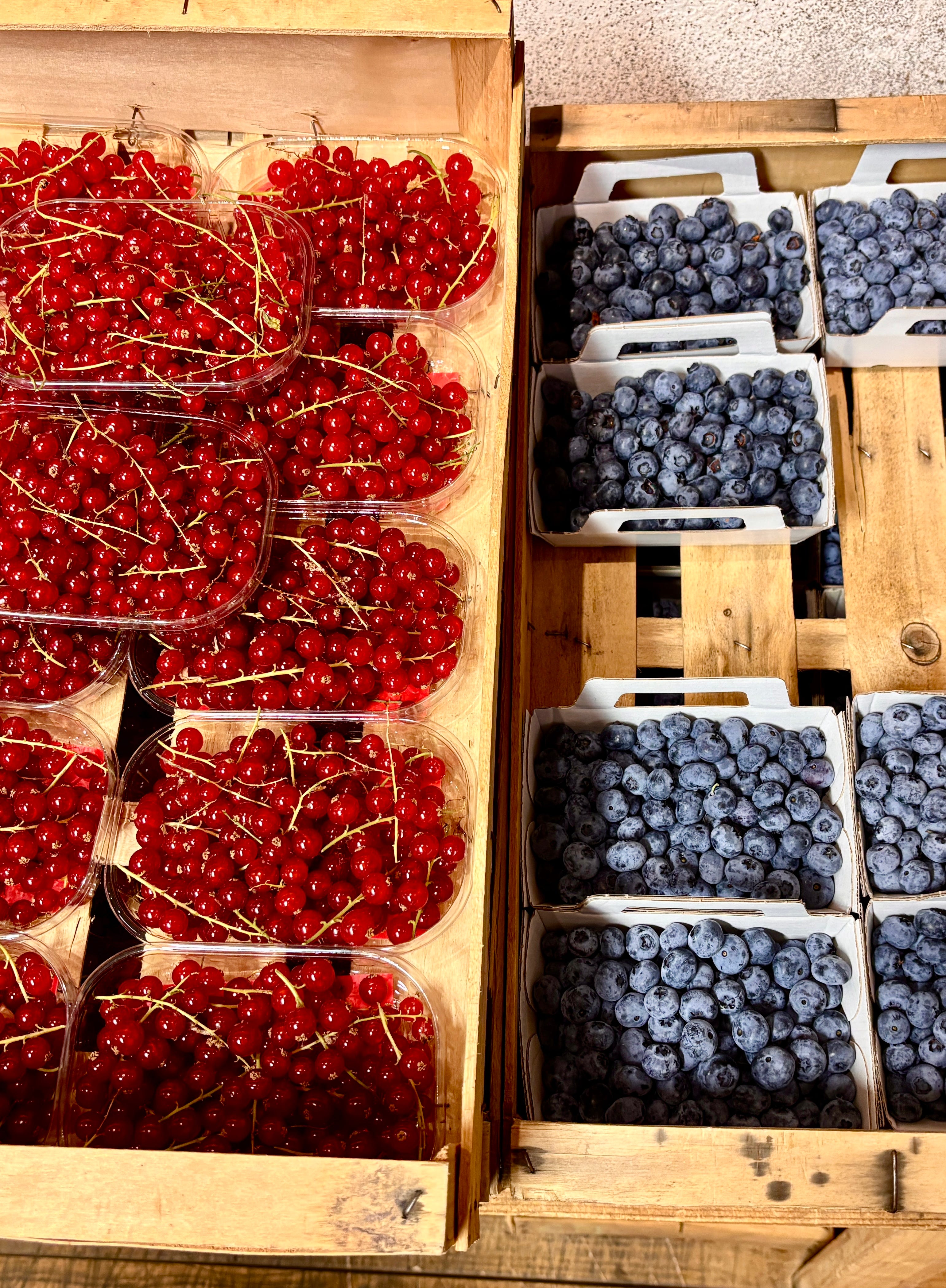
I often joke with Romain that when we stay with friends in the summer, invariably they have a bowl of apples and pears, regardless of the season. It’s a bit perplexing to me because when apricots, plums, peaches, nectarines, and cherries are in season, I buy far more than I need because I’ve been waiting all year for them, and it’s a treat to have them so readily available, and so delicious.
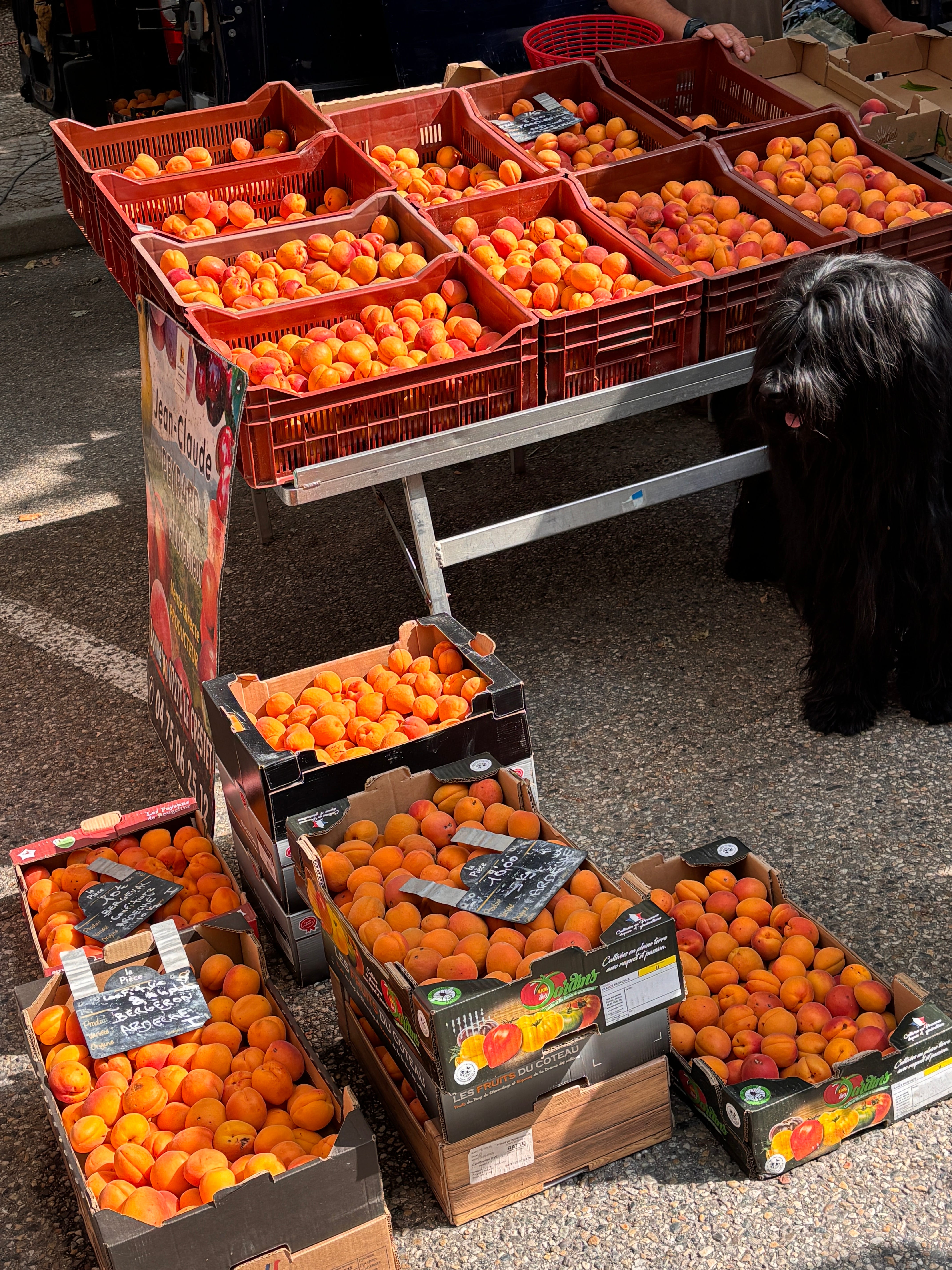
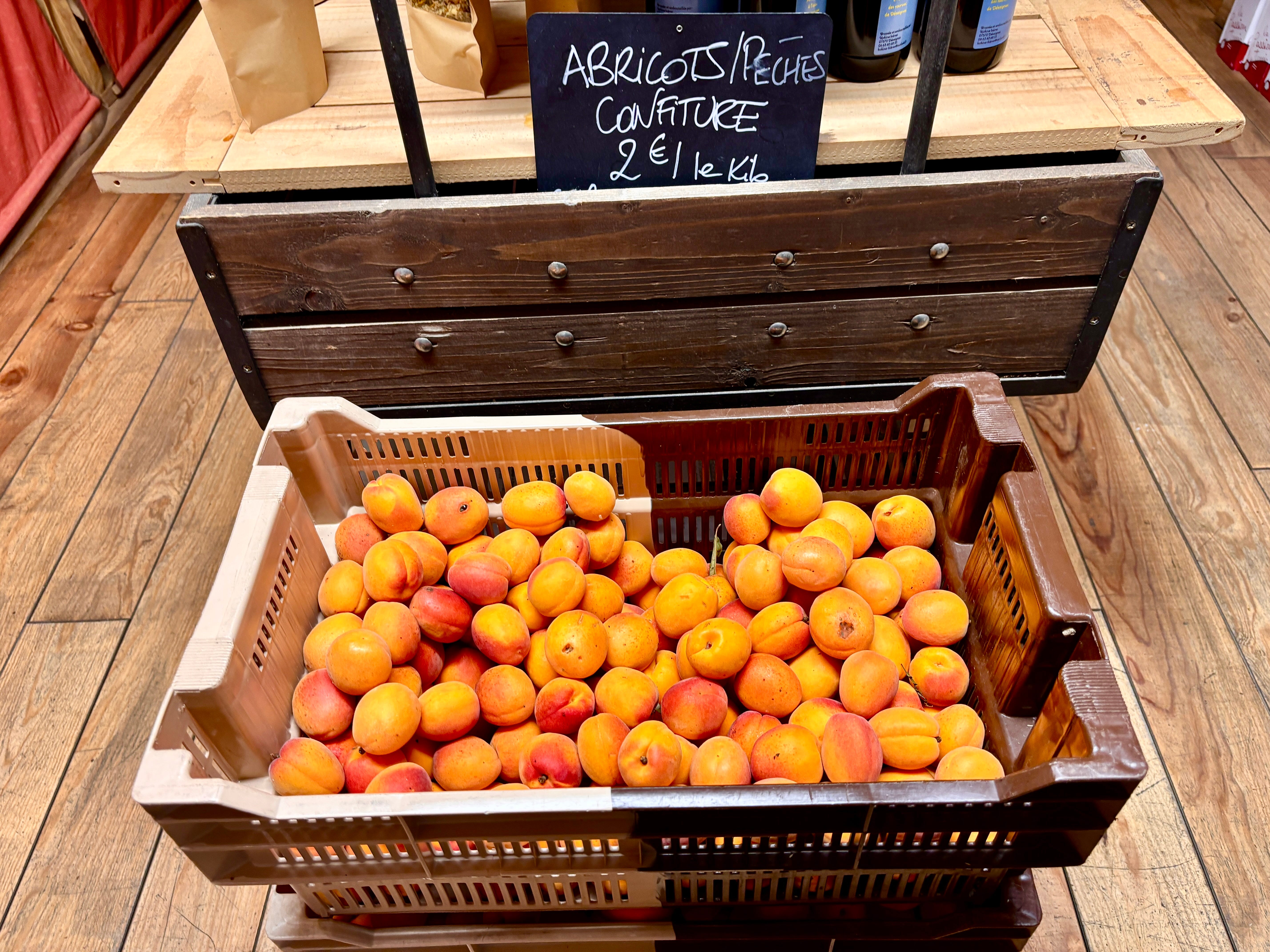
One stand at the market in Lamastre had so many apricots that I thought I would faint. They had three or four varieties, and if I wasn’t taking the train home, I would have bought a few cases, especially those marked down for jam-making.
Fresh apricots sold for a song, for jam-making.
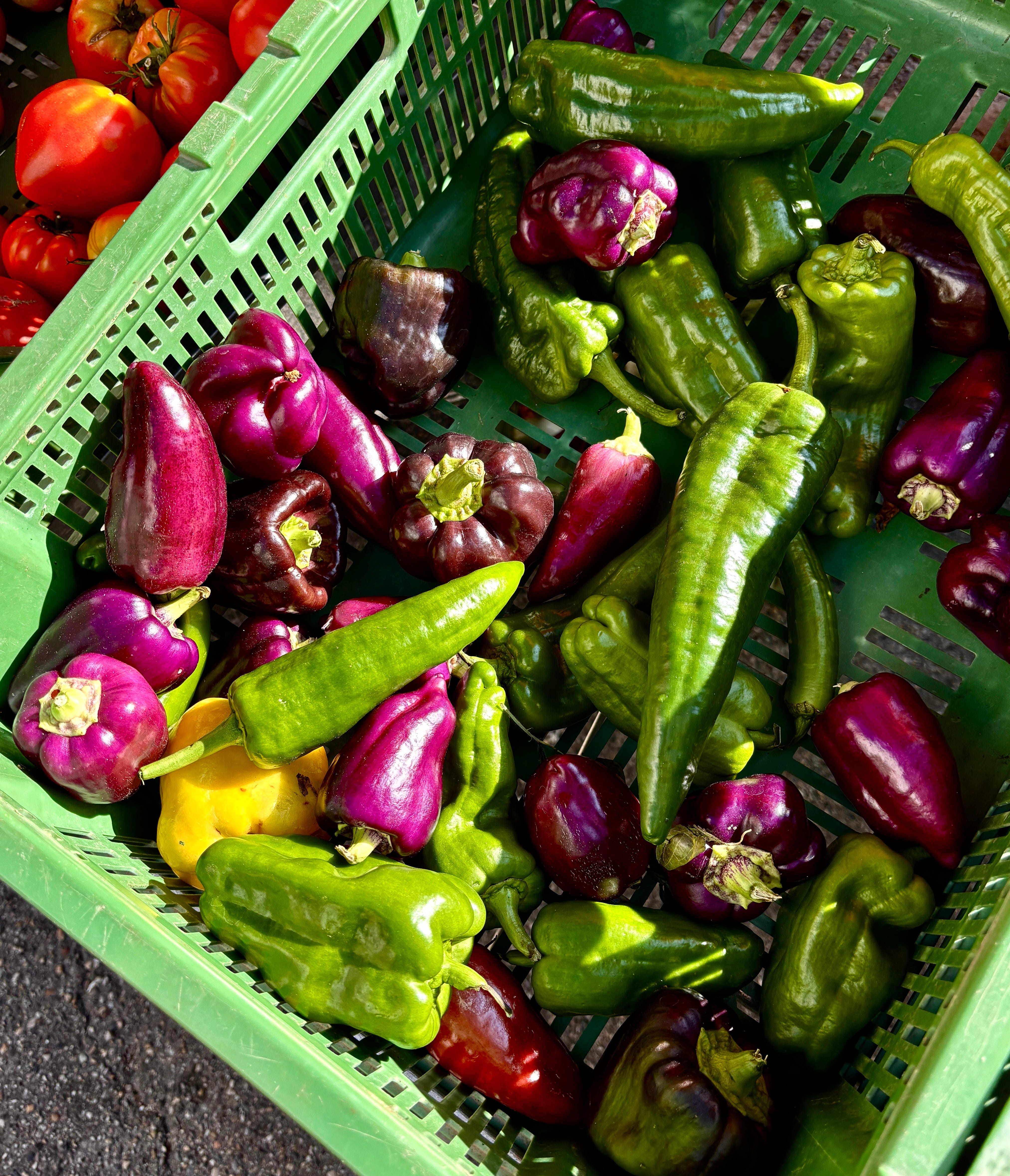
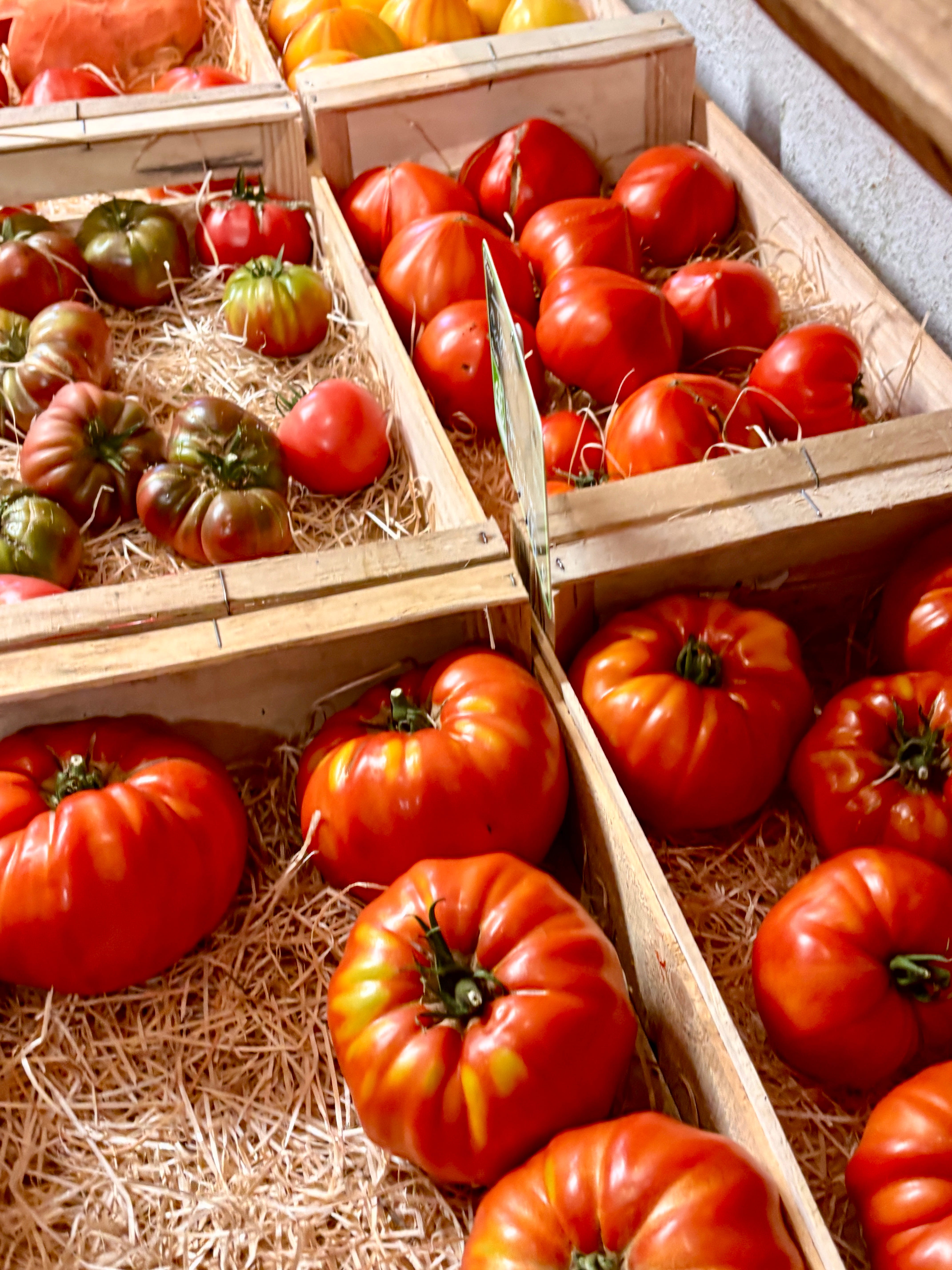
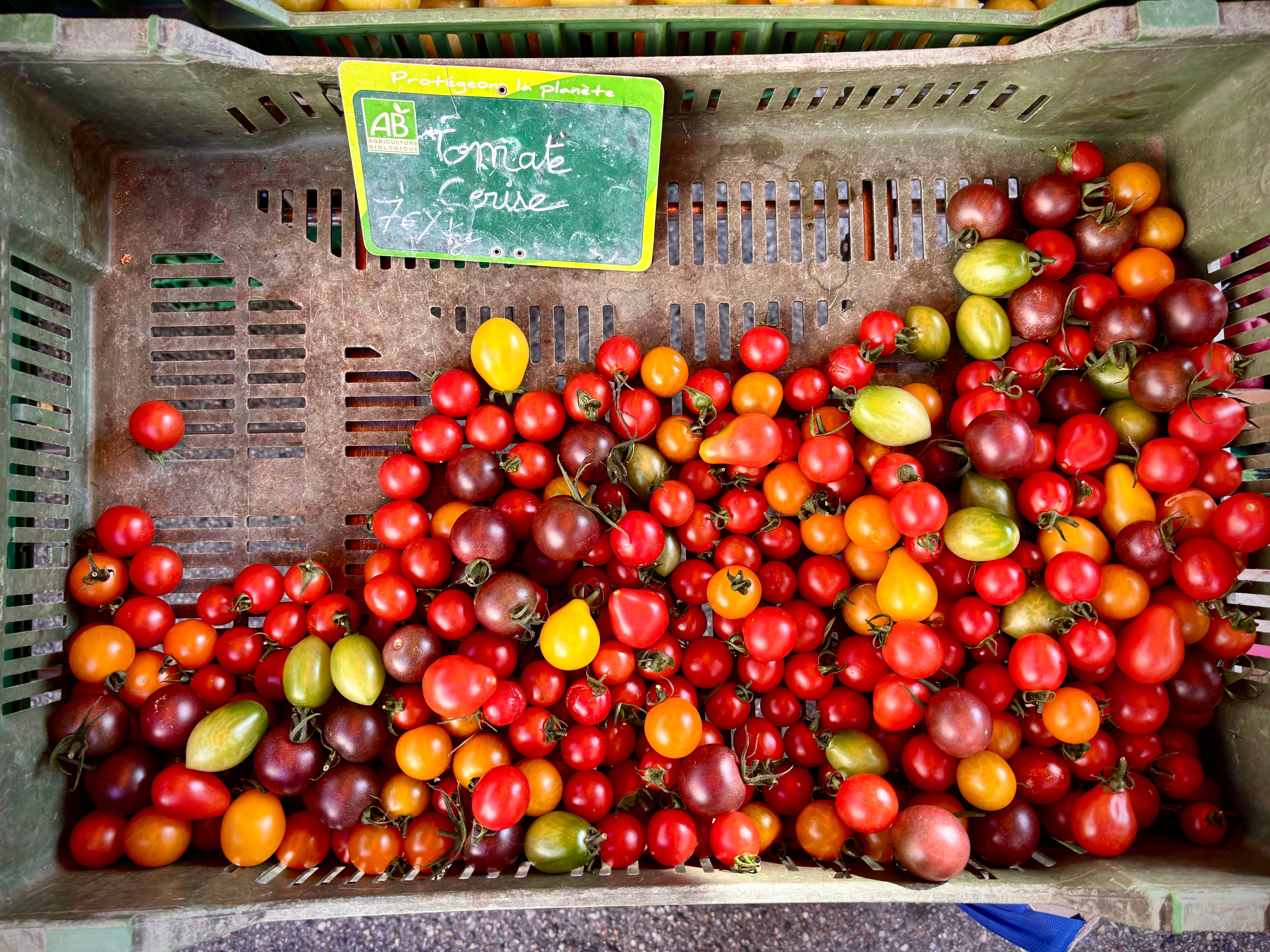
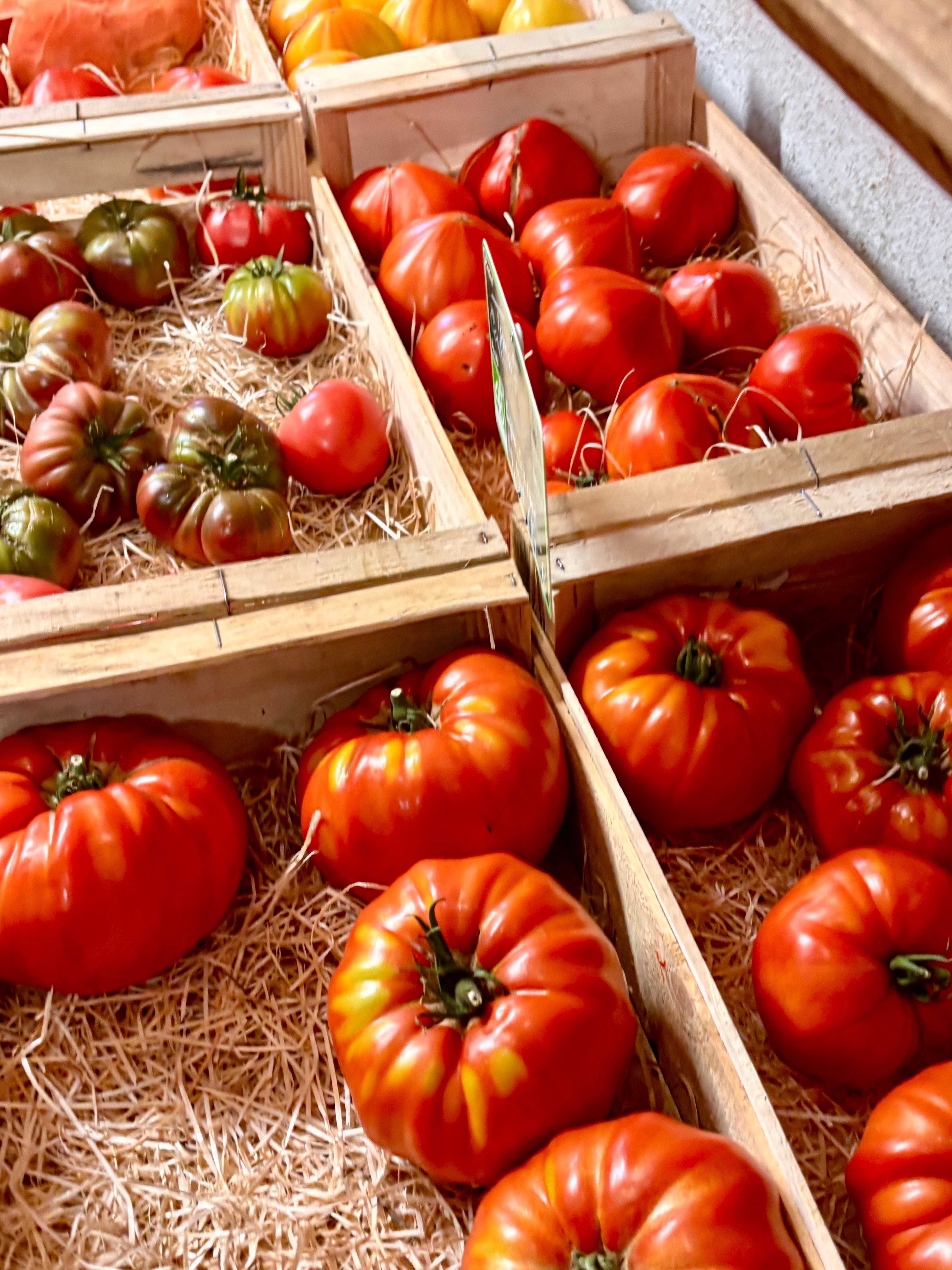
My friends who live there were scandalized about one vendor selling his tomatoes for €4,50 (~$5) per kilo (#2.2), when all the others were selling theirs for €3,50 ($4) per kilo. As a city dweller, both were a bargain to me. It made me reconsider the urban lifestyle that I’ve chosen.
The flavor of the tomatoes was also worlds away from any tomatoes we get in Paris. I see why people are so eager to get out of town!
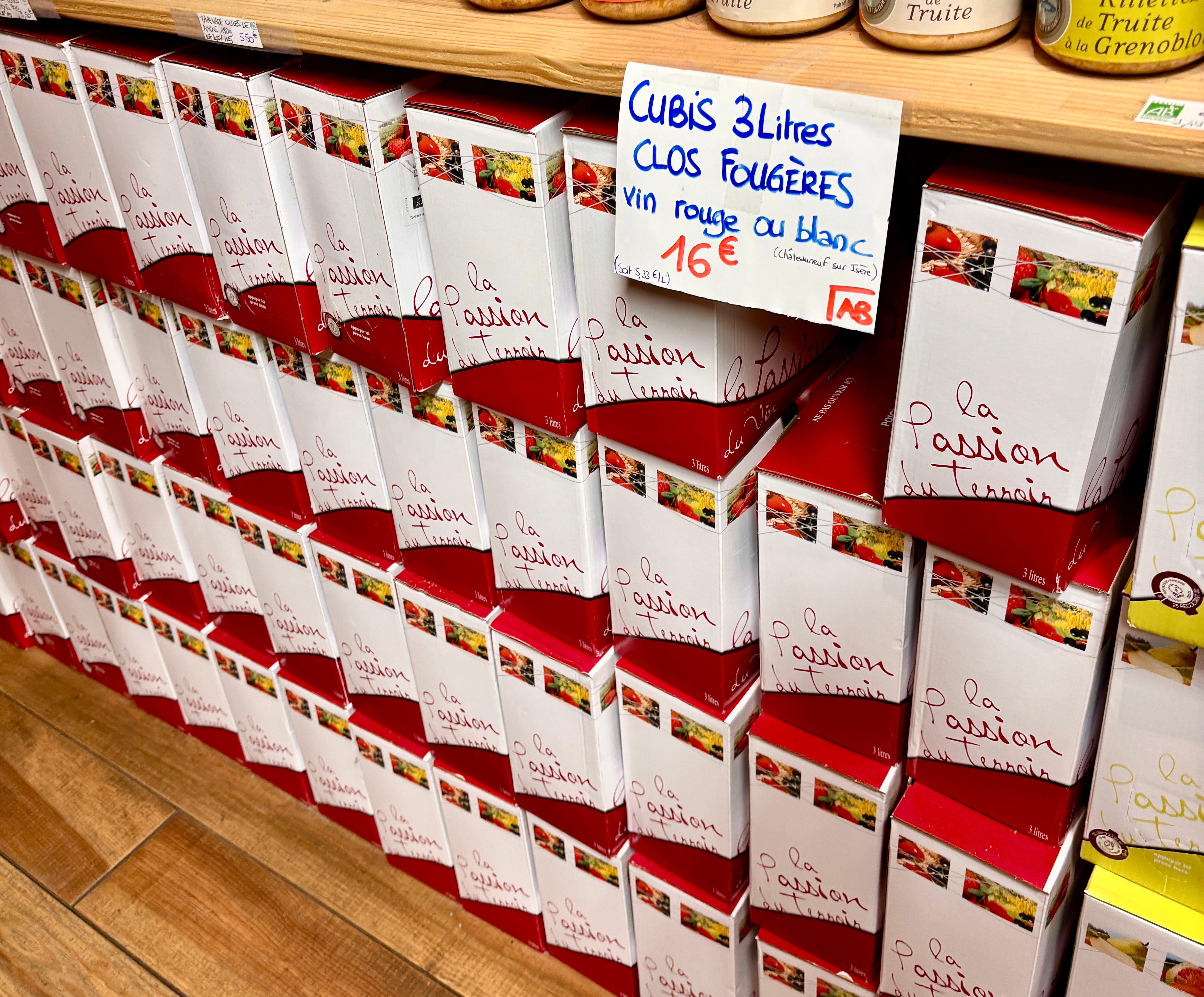
I’ve had (non-French) people tell me, “Oh, no…no one in France would ever drink wine out of a box!” Well, now I’ve got photo proof that they do.
(Someone once insisted to me that no one in Italy would ever dream of buying jarred tomato sauce. The jars sold in grocery stores, they told me, were for tourists. If you’ve ever seen the tomato sauce aisle in an Italian supermarket, you’ll wonder how so many tourists manage to bring all those jars of sauce home with them.)
Wine in a box isn’t a bad thing. It’s wine that’s meant to be drunk daily, not saved for ten years in a cellar. The box keeps the wine fresh; the bag inside the box compresses as the wine is poured, so the wine isn’t in contact with air. Plus the boxes are arguably more ecological (and easier to ship and store) than bottles. Also, you can see the savings on the price: €16 ($18) for the equivalent of 4 bottles of organic wine. Not bad!
Subscribe to my newsletter to get recipes, videos, stories, posts, and more, delivered right to your Inbox!
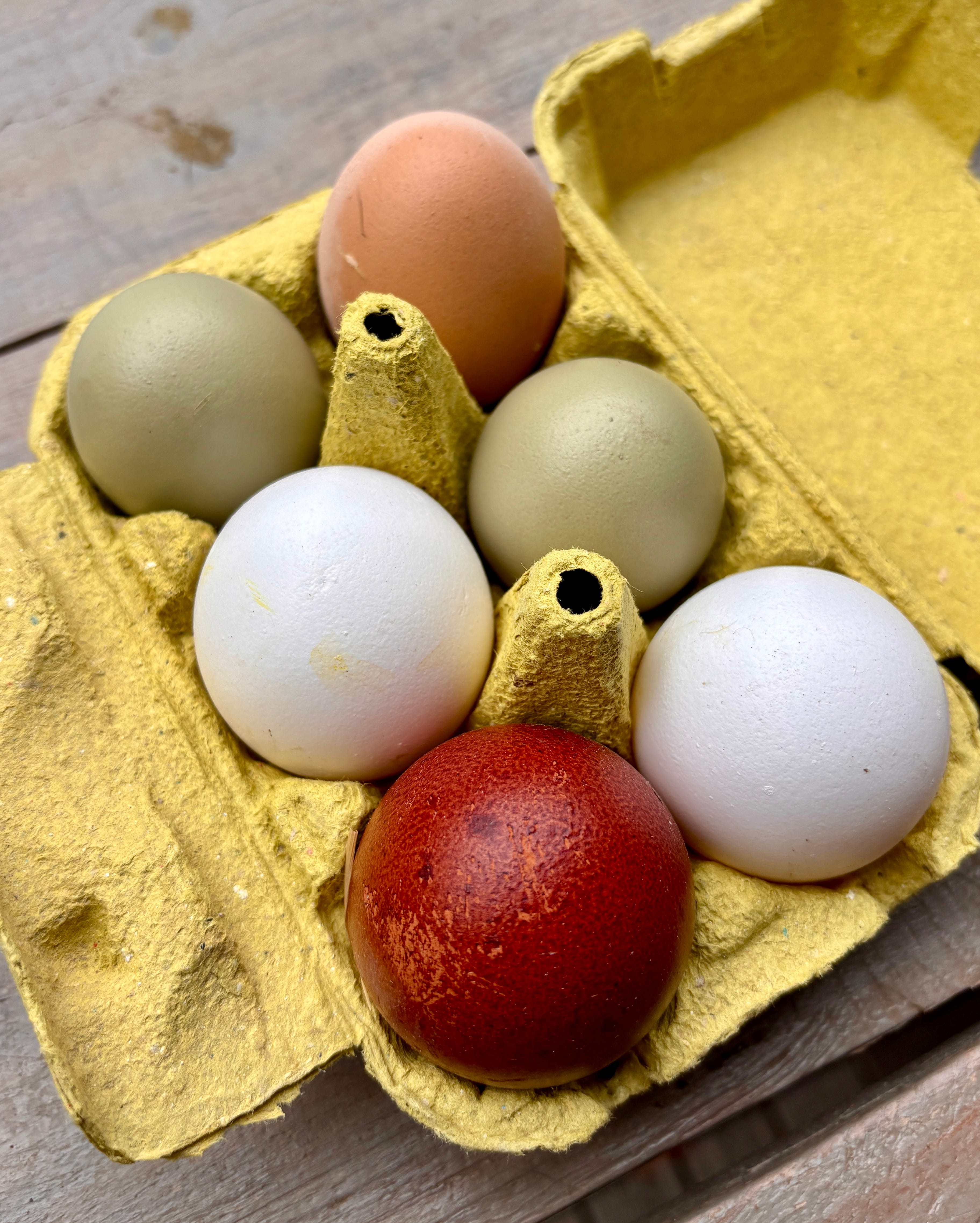
Eggs from our friends’ chickens
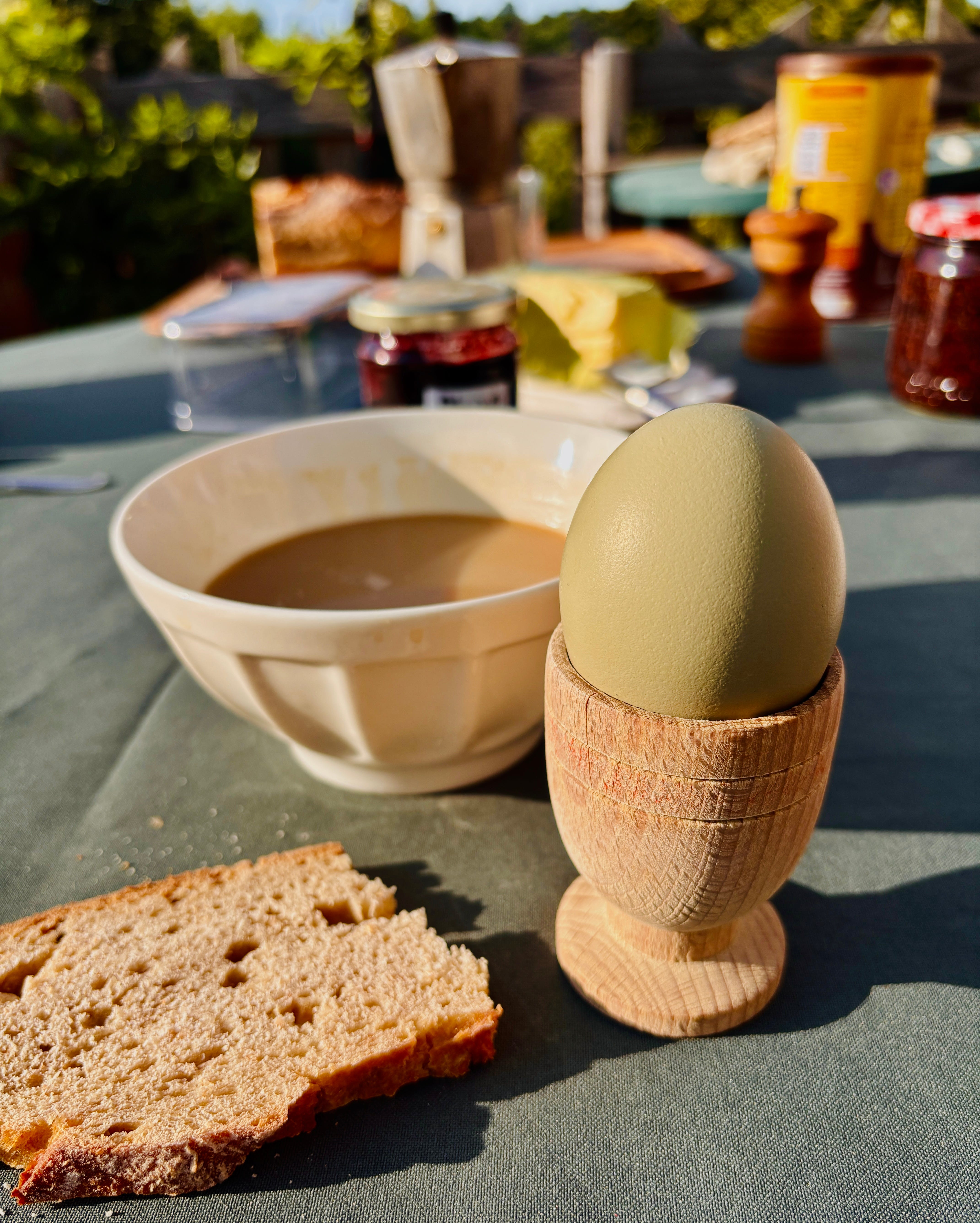
Another delice were the fresh eggs from our friends’ henhouse. They were so beautiful, and it was wonderful having a fresh egg for breakfast every morning.
Thankfully, I wasn’t worried about taking a half-dozen eggs home with me, although I carried them carefully on the train. And my friends promised to bring me some medlars from their tree when they’re ready to pick…
…which I use to make rose-colored medlar jelly. With all the jams and jellies that I make, maybe I am a country boy after all?
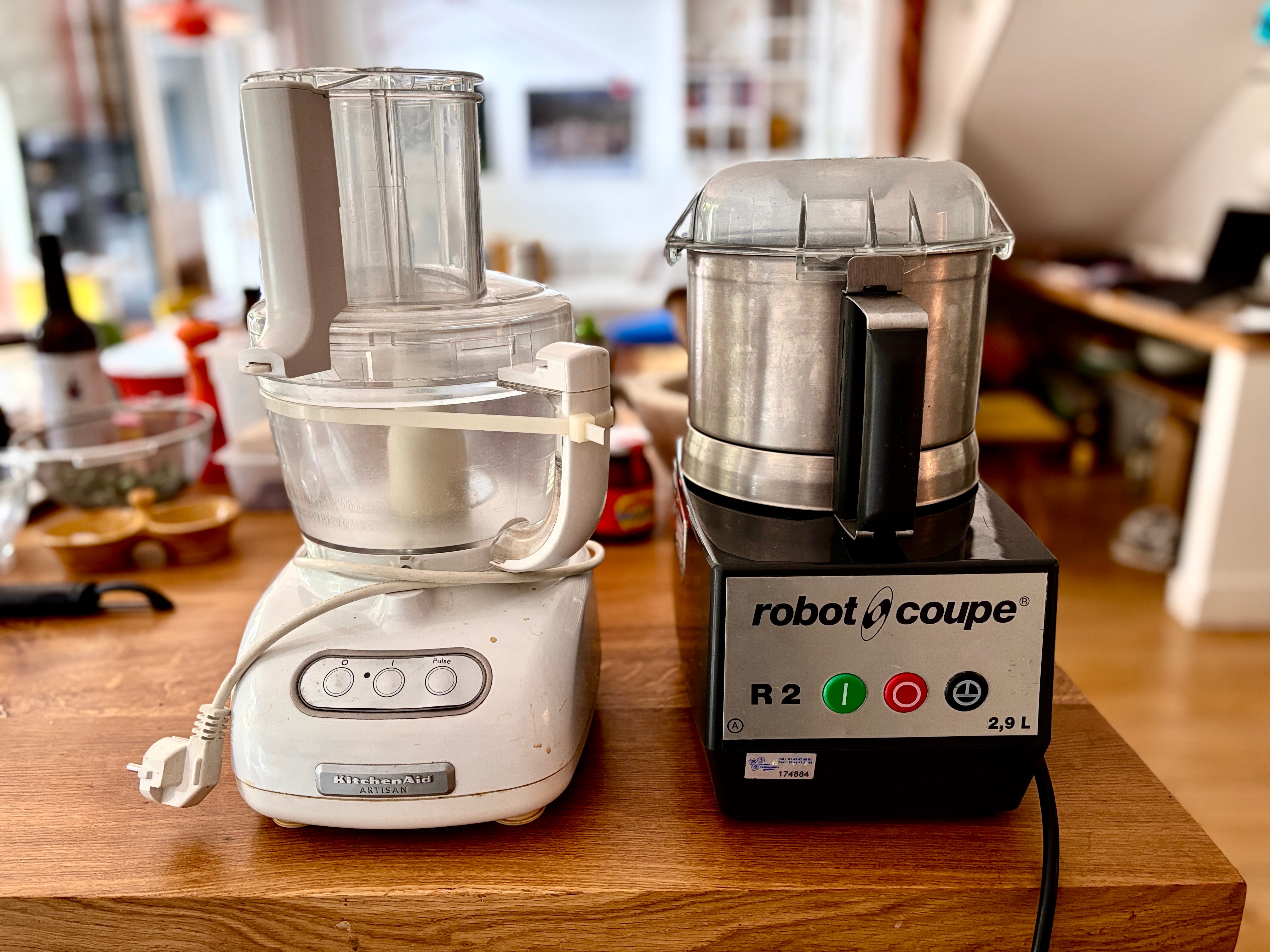
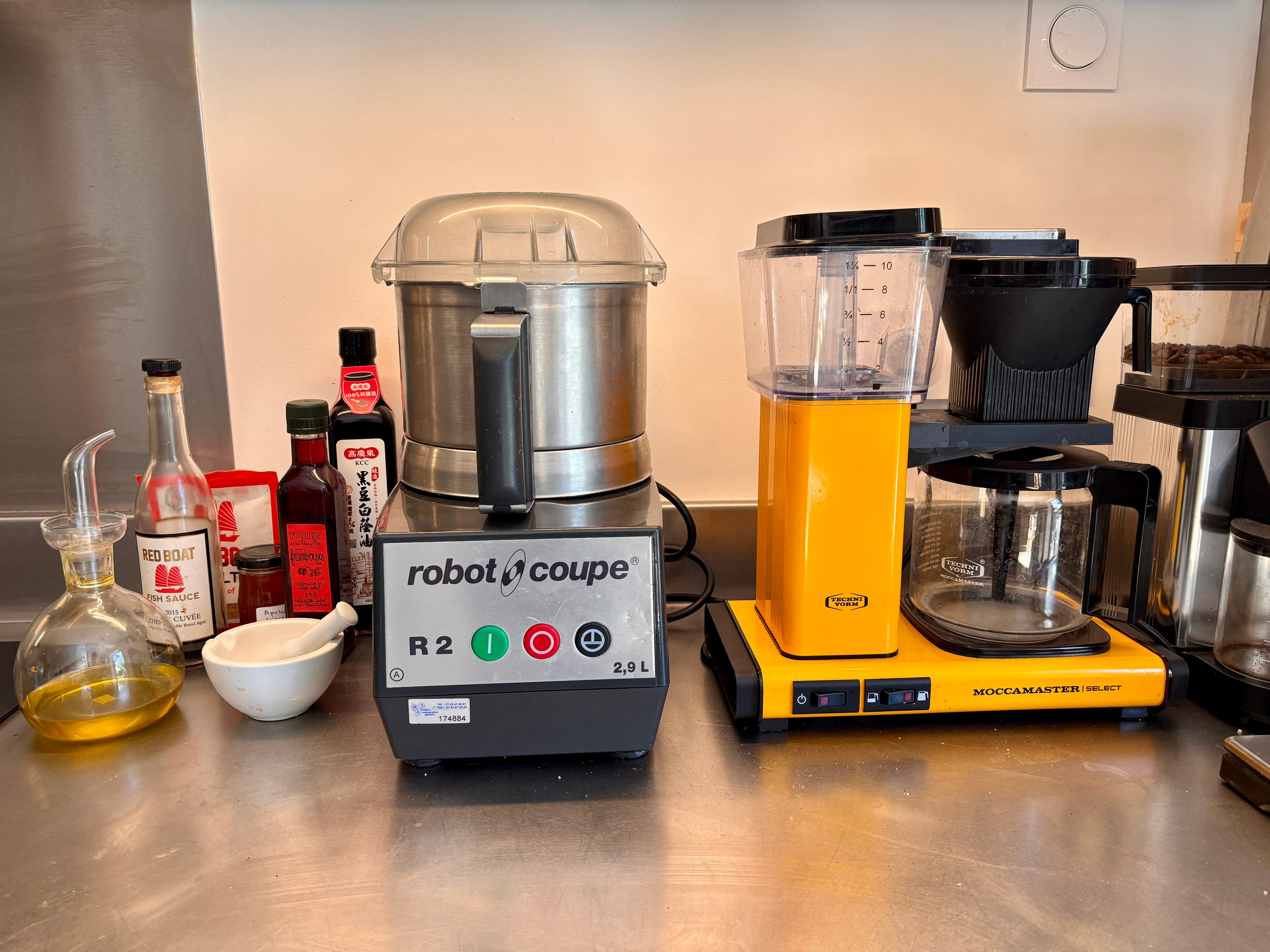
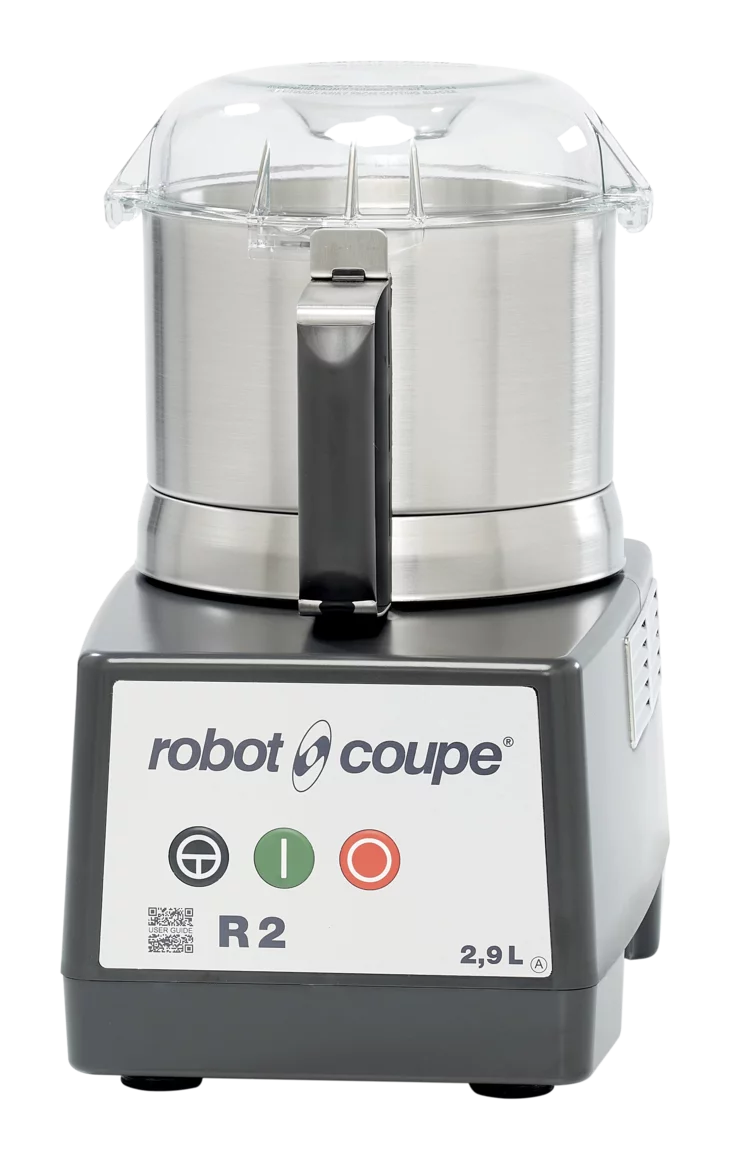
For those following the food processor drama (and for those who aren’t: My KitchenAid food processor bowl broke and was collecting gunk in the handle, and no replacement is available. And yes, I checked everywhere.) I’ve finally resolved it.
When I worked in restaurants, we always used a Robot-Coupe, the original food processor, which could handle anything. The problem in Paris is that the cost for them is pretty steep: Prices for new models are north of a thousand bucks, and I didn’t know if my occasional use of one justified the price. So I did what everyone in France does: I checked out Le Bon Coin, which is the 9th most-visited website in France, right after Google.
You can pretty much find anything in France on Le Bon Coin, from medlar trees to an apartment in Paris, or your dream house in the countryside.
Using the search term “robot culinaire,” I landed on a vintage one (above), just like the ones I used in restaurants. It was a mere €80 ($91) but they didn’t want to ship it, so I had to pass. I set up an alert and a couple of days later, one turned up in Paris.
I’ve honed my bargaining skills in France — as Romain once said to me, “No one is ever going to offer you a deal. You have to ask.” So I did, offering what I thought was a bit low, figuring the seller would come back with a counteroffer in the middle. She came down a bit, and in the few hours that I ruminated whether to just buy it, a notification showed up — Offre acceptée.
While it wasn’t in the excellent condition she mentioned, it was a solid “very good,” and heavy as a motherf**ker. I placed the machine in the basket of my bike and with every turn, the weight of it threatened to pull me down to the curb, so I rode extra carefully, and slowly, much to the ire of other cyclists. In the U.S., it’s cars that are aggressive to bicyclists but in Paris, it’s the other cyclists who pose the hazards.
I, and the machine, made it home in one piece, and it’s now sitting on my countertop. It weighs a ton so it’s not convenient to store in a cabinet. Romain asked me, “Is that where you’re going to keep it?” when he saw it on the counter. He’d already banished my stand mixer to a distant shelf, which makes it harder to bake (I guess I should use as a counterargument all those cookies and cakes he’s missing out on?), but if he wants the Robot-Coupe to go into a cabinet, he’s going to have to put it in there himself and take it out when I need it.
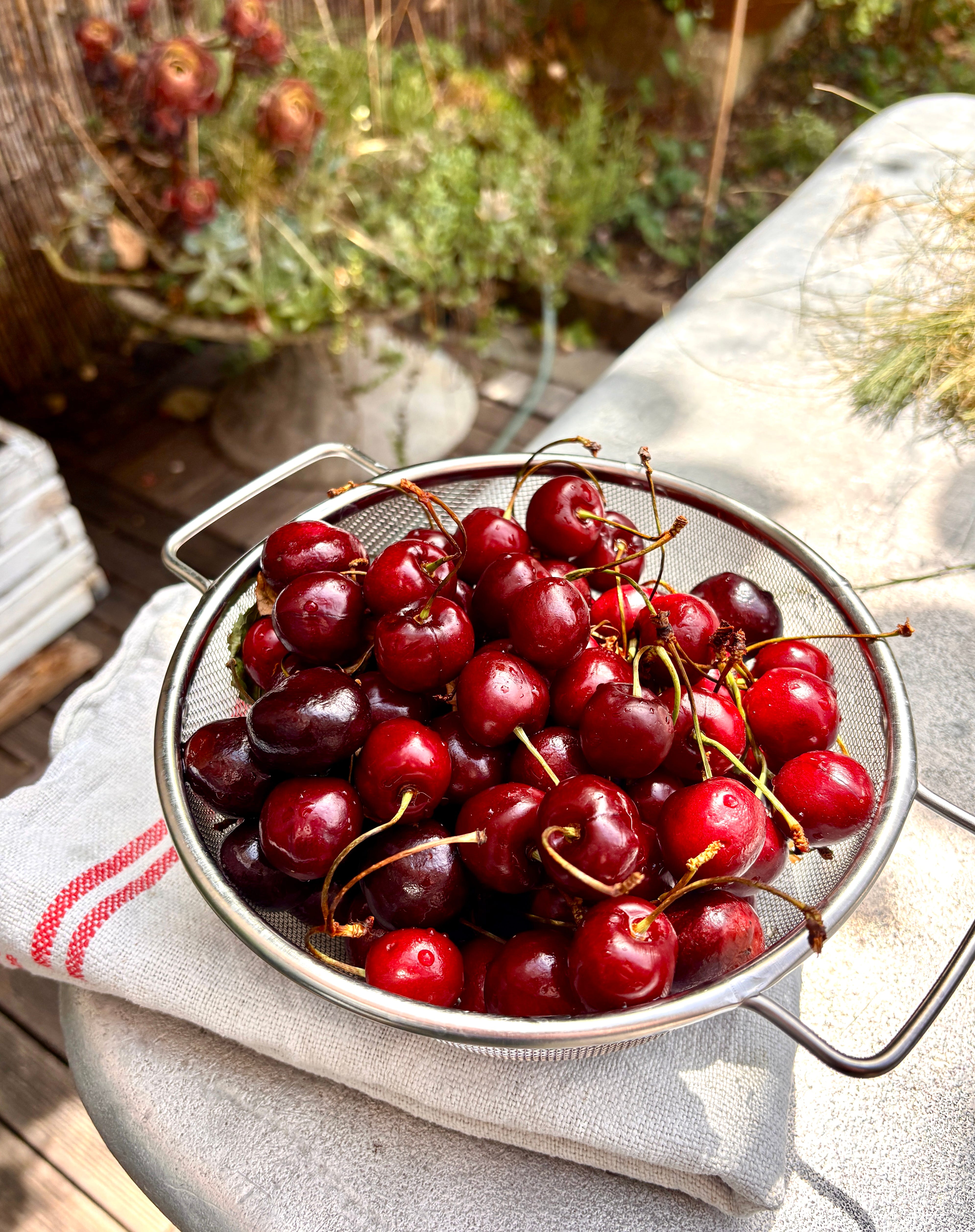
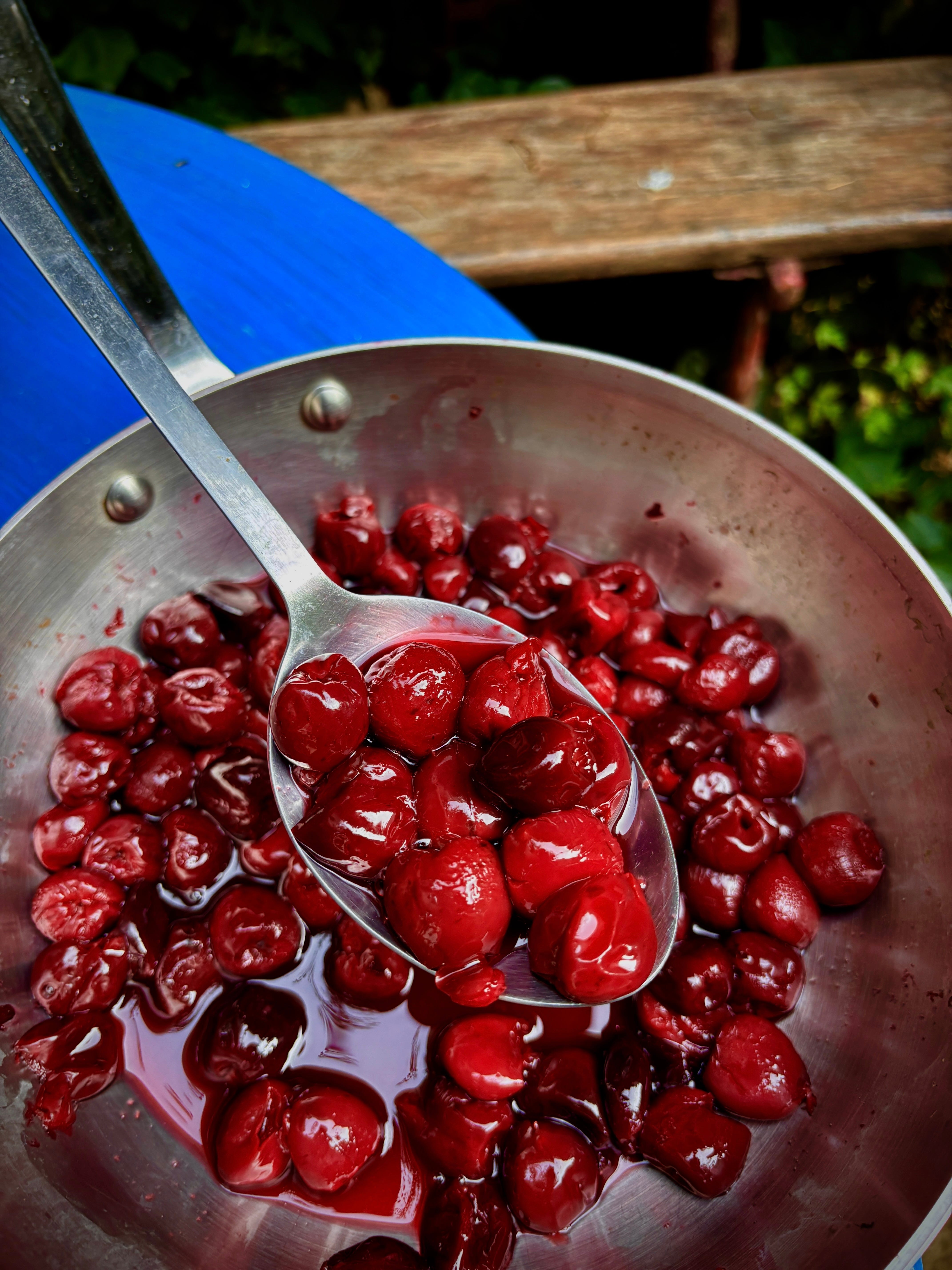
As we enter August, I took advantage of waning cherry season to pick up a load of fresh cherries and turn them into compote, to freeze. It’s nice to pull out a packet of cherries in the winter to serve with ice cream, tangerine sorbet, or frozen zabaglione, which is a great recipe that doesn’t require an ice cream freezer to make.
I pitted and sautéed them until they were cooked through. If you let them sit overnight, the juices will thicken further and the cherries will turn a deeper red color. If you want to freeze them, just put the cherries in a freezer-safe storage container and save them for a rainy, or snowy, day. Mine are now in my freezer, ready for winter. (Which I’m not.)
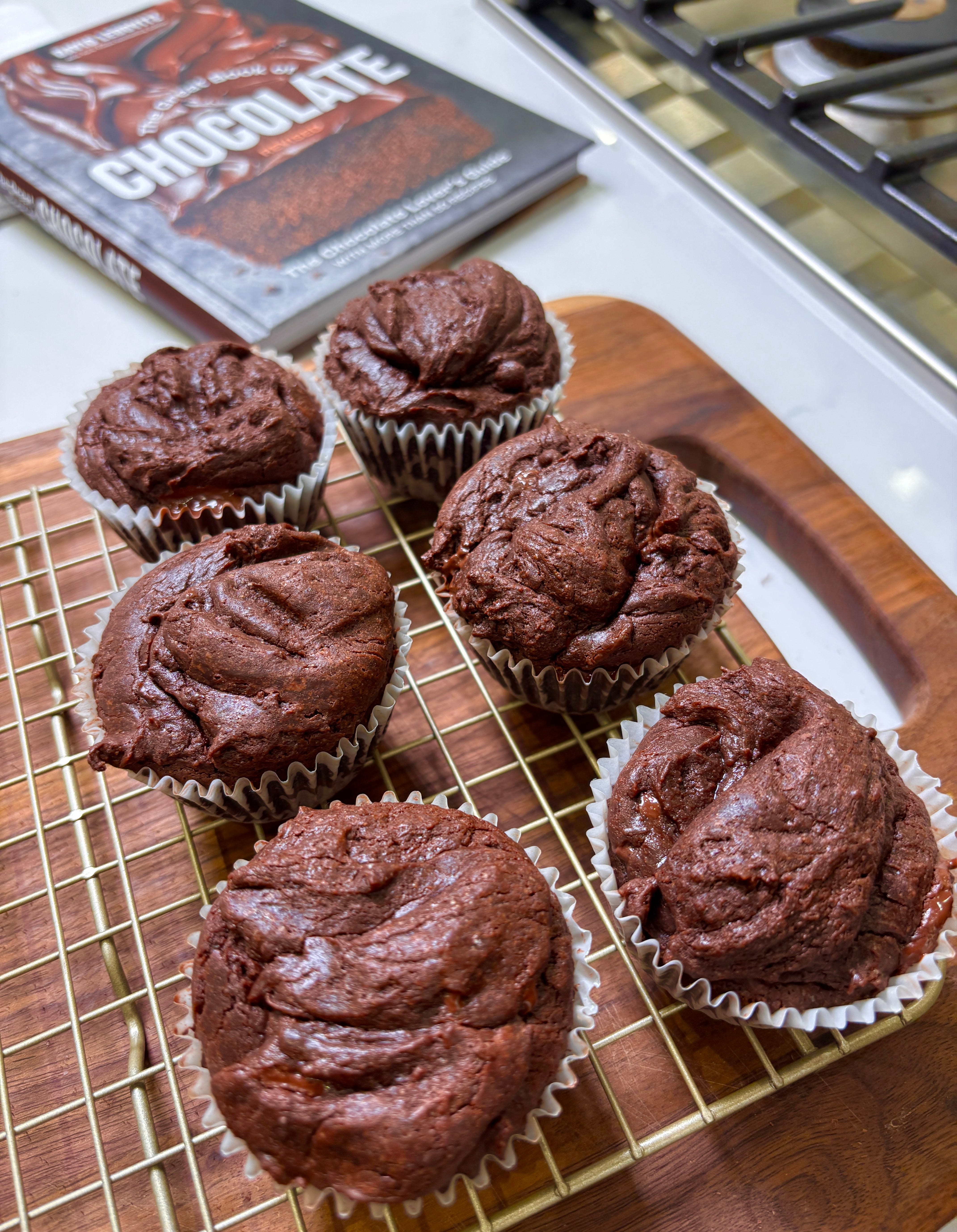
When I was in San Francisco on tour with The Great Book of Chocolate, I was invited to the Williams-Sonoma testkitchen to bake bouchons with test kitchen directorBelle English. We hadSO MUCH FUN! (Paid subscribers: You’ll find the recipe at the end of the newsletter.)
When I lived in San Francisco, I was one of those weirdos, or cool people, who had a Saab. Yes, I was crazy enough to drive a stick shift there and I pitied the people in their fancy BMWs who’d ride my tail on those steep hills, unaware that you had to have lightning-fast reflexes to shift into gear when a red light turns green, to avoid your car backing up an inch or two. Unless you got the timing precisely right, down to a nanosecond, my bumper might tap their front fender.
Fortunately I was pretty adept at shifting on the hills, but the few times I missed and tapped someone’s bumper, I never got out to see if I caused any damage. I just chalked it up to their fault, paving my way for a move to France, where things are inevitably pas ma faute.
Considering how expensive that car was to maintain, the knob on the gearshift was made of cheap plastic. They offered a wood option to replace it for $70, which seemed like a lot of money at the time. I ruminated over it for a few weeks (unlike my Robot-Coupe) until a friend said to me, “David, how many times are you going to touch that knob? Isn’t it worth getting a nice one?” So I caved and bought one, and she was right.
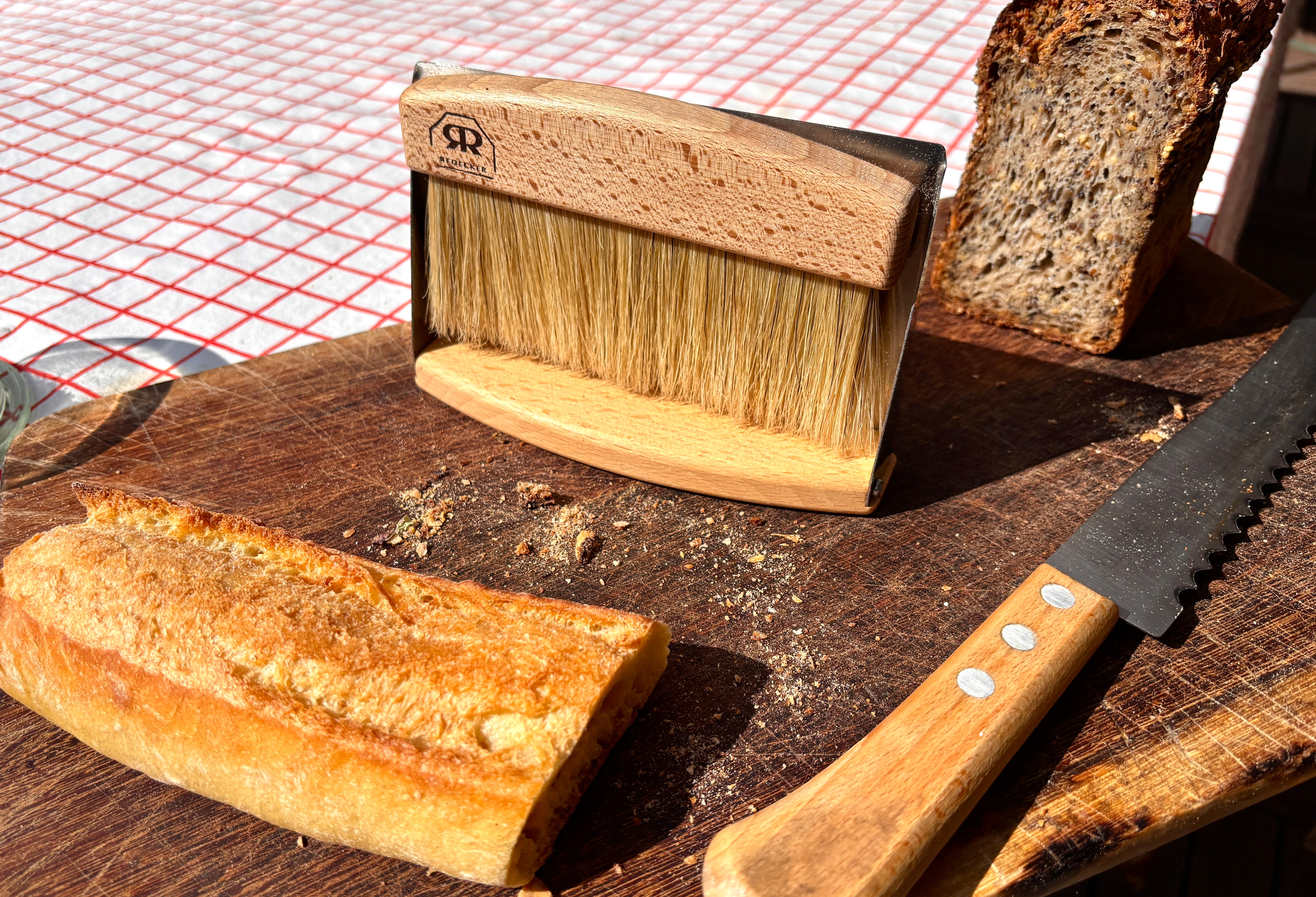
My friend Sarah caused a bit of an online kerfuffle when she poked fun at a hairbrush store in Paris beloved by influencers, and there’s always a line (yes, for hairbrushes) to get in. I don’t fight with people online but I beg to differ about brushes; I love the kitchen brushes at La Trésorerie that are handmade of wood and with natural bristles. And since there’s no line, the shops are free of influencers.
I saw one while shopping for a bottle brush at La Trésorerie and made the mistake of posting a picture of it on social media. It wasn’t cheap, so I had to ruminate over that too…and people wonder what I do all day… When I went back to the store to buy one, they were out of stock.
Search results turned up copies online but I found the website for the family-owned company that makes them, which was so engaging, and their brushes were so beautiful, I decided to spring for a handmade one. (The company’s website, Bürstenhaus Redecker, has every type of brush you can imagine.) When I was in Denmark, we happened upon a great kitchenware shop and I hesitated for about four seconds before picking one up.
Besides that it’s handmade by a family-owned business, there’s a lot to like about this brush. It stands vertically on the counter so takes up less space, and has a reassuringly strong magnet that snaps the brush into place, and it stays there.
I’m not sure where to get them outside of Europe. I noticed they have them on Amazon, and companies like Boston General Store and Flotsam & Fork carry the brand, but you may need to do some digging to find this one. Maison Empereur carries them in France, but they can no longer ship to the U.S. In the UK, they sell them here and here. If you can’t find one and resort to buying a copy, I won’t judge you…since I got carpal tunnel unearthing those links.
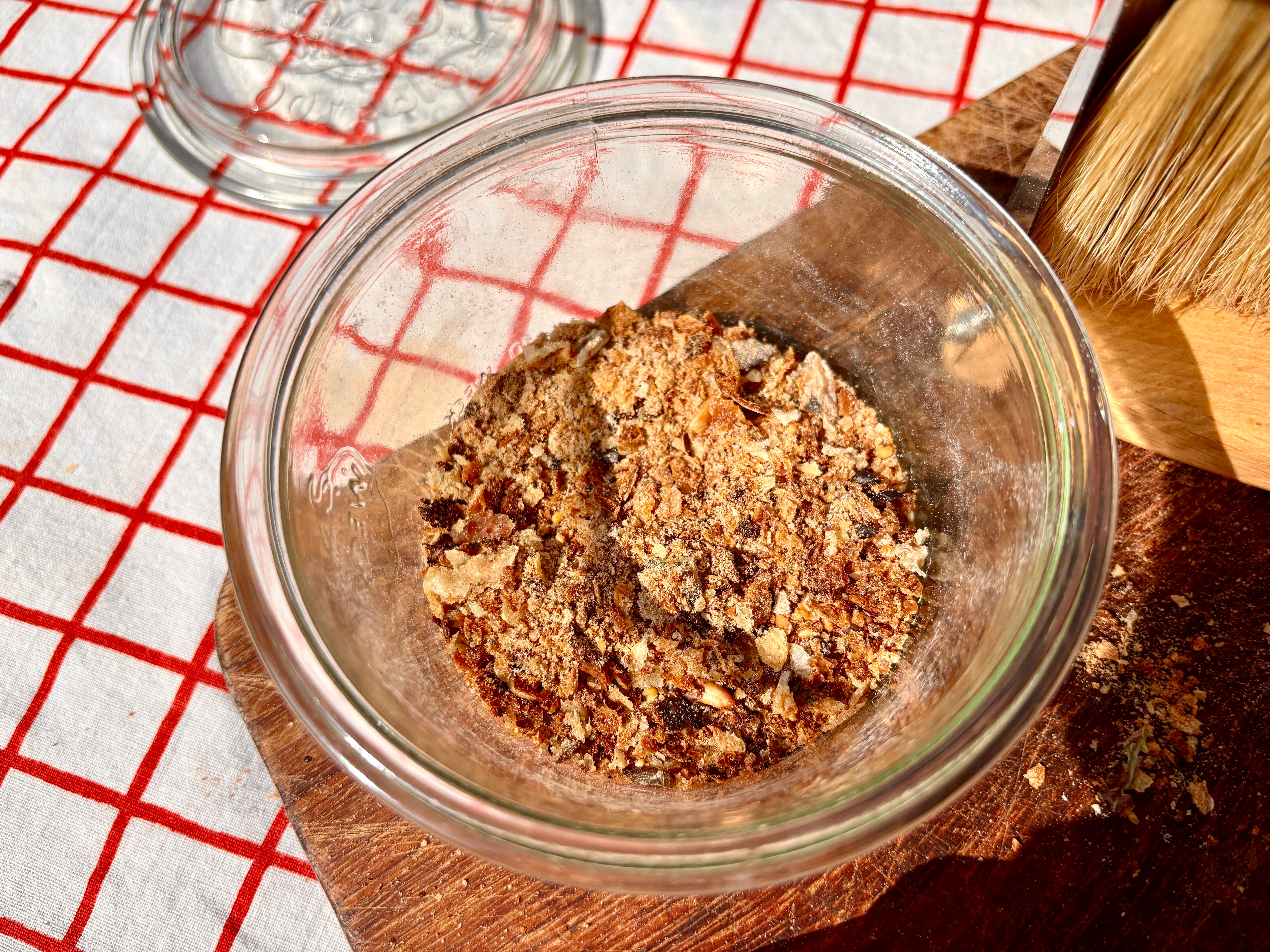
And being me, I am saving all the crumbs, which I hope quash any online kerfuffles about the price. I hope you collect enough of them to pay for the brush.
As promised, below is the recipe for the dark chocolate Bouchons from The Great Book of Chocolate that I made in the Williams-Sonoma test kitchen. As you can see in the video farther above, we loved eating them, as did the crew who were filming us 😊…
California’s Napa Valley wine country is dreamy but it’s also expensive. A couple weekends ago, we went to Napa for a friend’s 90th birthday party and we were astounded by the prices. So, I’d leading off with pointers gleaned from our recent experience there.
💎 Do go on Sunday through Thursday when hotel prices tend to be lower. On a Saturday night at the tidy Best Western Plus, we [ahem] paid $400‼️ (tax and fees included); the midweek rate is about $140. Across the street from the BW are an In-and-Out burger, McDonald’s and Raley’s supermarket so you can get snacks and/or breakfast — which are not included in the hotel price. There’s a swankier Hampton Inn nearby. Stay on the edge of Napa to save money and drive a few minutes into Napa central. You’ll have to drive to the wineries anyway!
💎 Don’t overlook the wine bars and restaurants run by the Culinary Institute of America. They are located in Napa at Copia and at the historic Greystone campus on Highway 29 in St. Helena. The wine bars are automated and you can sample what you like from a curated list (you won’t have a bad wine). It’s fun and low-pressure. The CIA restaurants are helmed by student chefs who prepare and serve a la carte and multi-course dinners with wine pairings. The grounds at Copia and Greystone are great to stroll around, too. More about the CIA wine bars and restaurants here.
Very close to Copia is Oxbow Marketplace for fancy-casual food, an outpost of Gott’s Refresher (good burgers), the Model Bakery (sinful English Muffins and more), plus the Fatted Calf (sandwichery, butcher shop, charcuterie). Grab lunch or dinner or make yourself a picnic.
💎 Pop in for lunch at charming Oakville Grocery. Compared to when I first went in the late 1980s, the grocery store is now much more upscale but in a pleasant, casual elegant way. There’s outdoor seating, plenty of parking, and a automated wine bar. Order a sandwich, pizza, or salad or grab a sweet. Buy a split bottle of bubbly and sit outdoors under the shade for a splendid, lazy lunch.
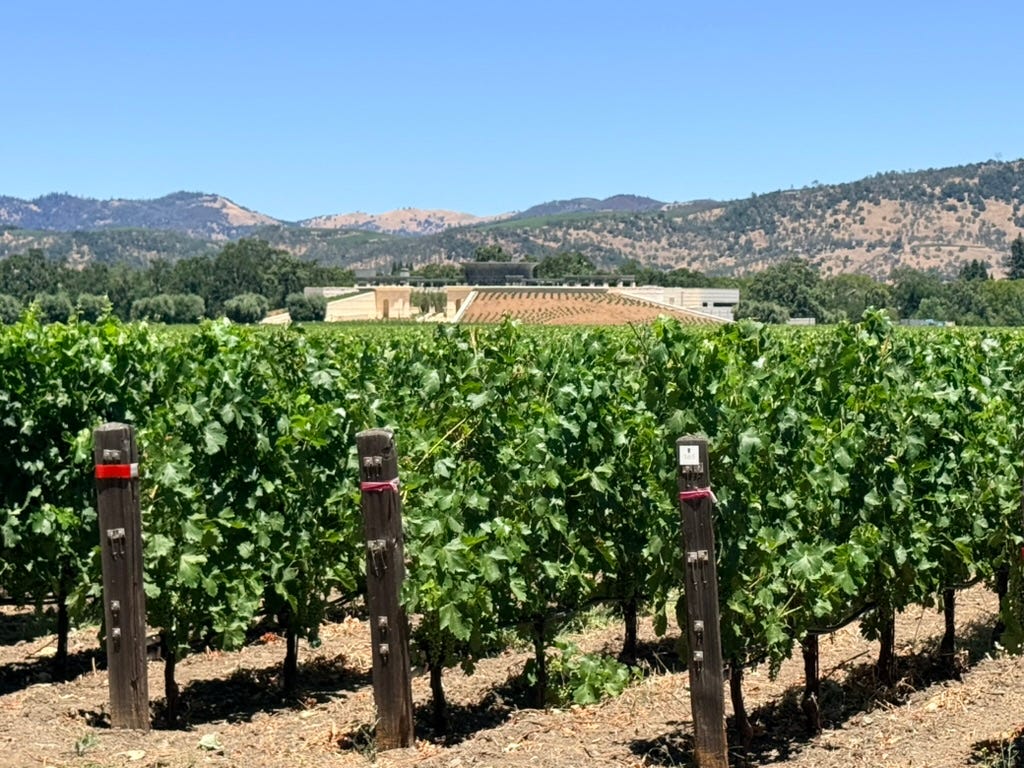
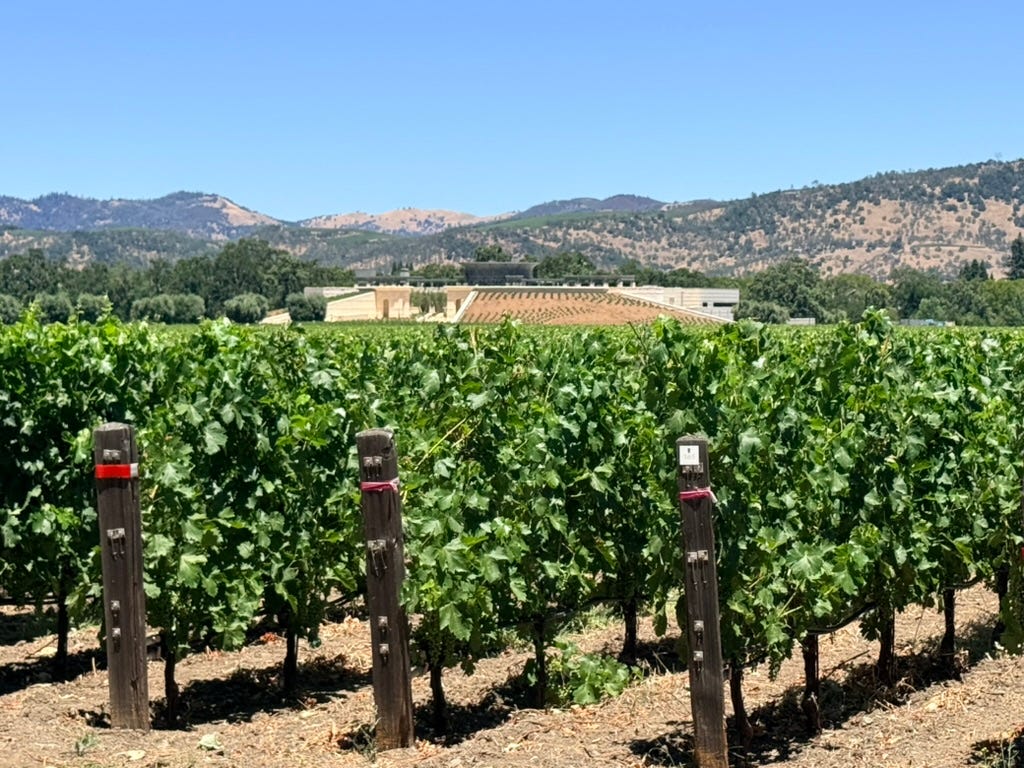
Opus One’s pyramid-esque building, as seen from the Oakville Grocery parking lot.
You’ll be hanging out adjacent to Opus One (Mondavi’s ultra luxe winery), a spectacular facility where the “Opus One Experience” costs $250 per person. Less expensive is the Mondavi Estate that just reopened after renovations; tastings and tours are ticketed and worthy, if you’re a wine enthusiast and Mondavi fan.
💎 Buy beans at Rancho Gordo’s official shop! They recently moved to a bigger location on Main Street, where you can peruse their full selection. The staff is super knowledgeable, and I always notice a new bean or two when I go there (versus shopping online for RG beans). Beans make great gifts.
💎 Eat well at Stateline Roadhouse, if you’re in the Kansas City barbecue mood. Stand in line to place your order at the counter and they’ll bring it to your table. Along with the regular menu, check out the specials by chef/co-owner Darrell Bell, who trained in France and has cooked at Michelin-star restaurants in the States. One time, we got a hamachi collar special that was a knockout.
Pass the Fish Sauce is a reader-supported publication. To receive new posts, mine the 150+ recipe index, and get 25% off class sign-ups, become a paid subscriber. I welcome your support at all levels!
💎 What have you been cooking up?
The PTFS community is near and far, which I’m grateful for in unfathomable ways. I write these dispatches and share recipes that I think you’ll want to cook because they’re tasty, fun, and out of the ordinary.
Bob recently shared a special Peking duck dinner with pancakes and salad with the nuoc cham vinaigrette. Duck and lychee with nuoc cham vinaigrette is an idea I’m borrowing! Also, I love how Bob got a duck from Weee! Do you shop at Weee!?
made the apricot ginger jam with ‘cots on the East Coast and reports the results were 💯! I made a second batch and gifted some to the neighbors whose trees I gleaned. The stellar recipe is 🆓 on my website for you to use!
in France made the fresh apricot sauce with his local abricots and loved it. He had fun taking it in many directions.
I’m stoked that my recipes offer you entry points to play with food in ways that you normally wouldn’t. To keep me posted and share photos, comment on my dispatches, or use Substack Notes or Subcriber Chat (better for pics). I love hearing from you!
💎 Coming up . . .
Don’t forget to register for the July 19 cooking class! It’s only 10 days away. Paid subscribers can sign up for a 25% discount with a special promo code (which you can share with friends and family). Details here: 👇
For this upcoming Sunday Special, I’m sharing knowhow for making a Viet street food that’s popular with kids of all ages. I consider us all youthful adults.
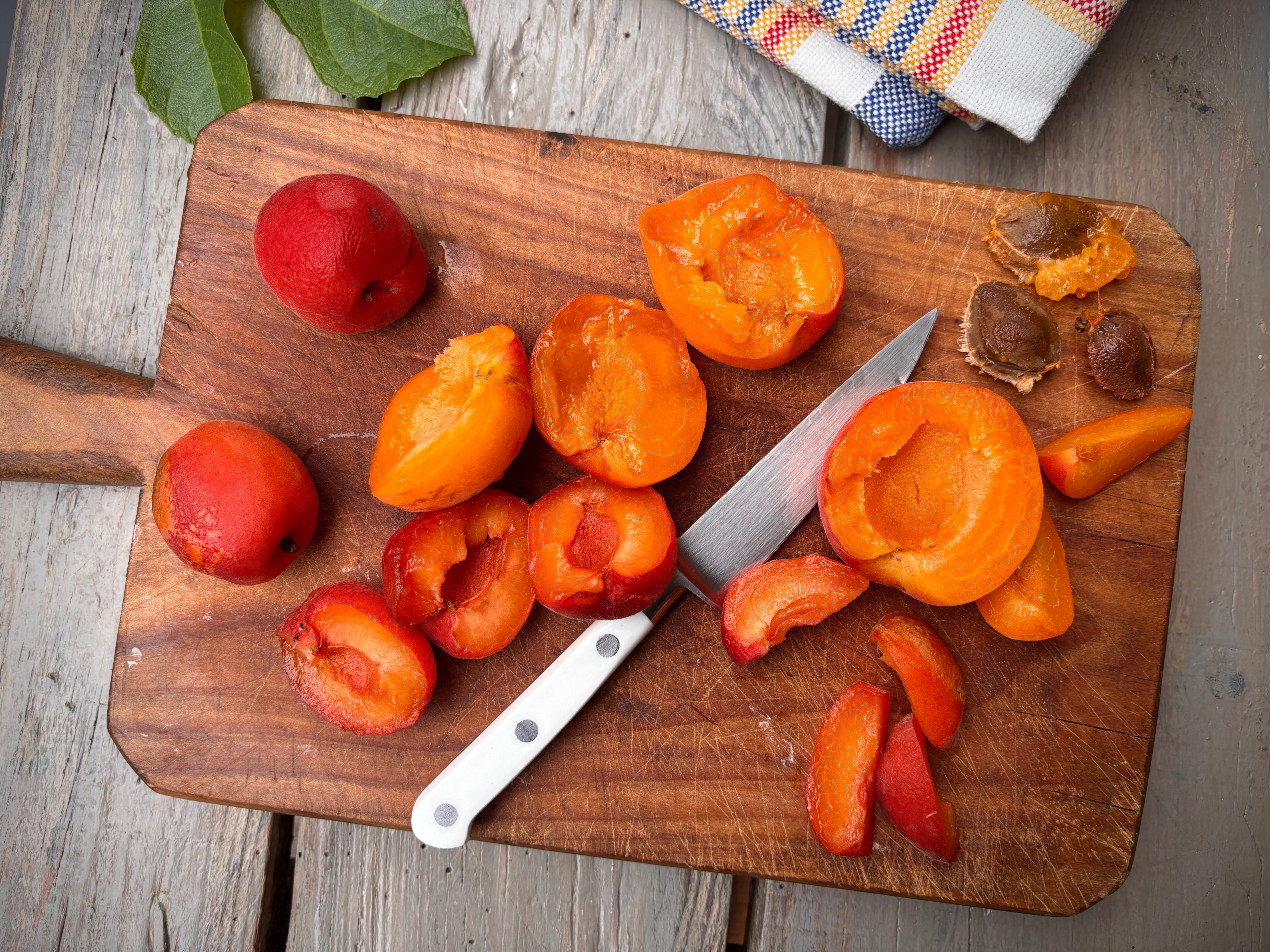
I can’t remember if we had El Nino or La Nina last year but the weather yielded a bumper crop of apricots in Santa Cruz. One of my neighbors is out of the country and I’ve been gleaning the fruit that’s fallen off his trees. Successive windy days knocked lots of the delicate Royal Blenheims off his trees. So far, my windfall ‘harvest” has yielded about 30 pounds of apricots. If I didn’t gather the fruit, the ants would have feasted and I would have cried.😆
At home with the fruit, I sorted them into piles of soft (eat or cook soon) and firm (hold). Blenheims are known for their intense aroma and sweet flavor. They bruise easily so I keep them refrigerated in recycled shoe boxes.
Add to that, another neighbor texted that he was leaving town and I was welcomed to glean what remained on his apricot tree. He even left his picker out for us to grab the fruit at the top of the tree.
We’re eating lots of apricots now to savor their summertime splendor; they’re a delicious, fiber-filled fruit. Plus, I’ve been cooking with them in various recipes. For instance, I’m experimenting with making umeboshi apricots, which will take till July or so to finish. Instead of red shiso, I’m using Vietnamese shiso (tia to), which is garnet and green. This Japanese recipe and this other recipe are serving as my guides.
Here are three other recent apricot projects of mine from this past week that you may be interested in!
The first time I shared a jar of apricot ginger jam with my dad, he ate it right off the spoon. His eyes widened and a big grin spread across his face. The jam was and is that good. It’s not too sweet and has enough lemony tang and gingery bite to balance the flavors and make it taste super special. It’s one of my favorite ways to preserve apricots for winter when I’m needing some sweet sunny summer cheer.
Use apricots from your tree (or someone else’s!), the farmer’s market (ask for jam-quality fruit to save money), or the supermarket. Make a half batch with just 2 1/2 pounds (1.1kg) of fruit, if you like! The jam makes a great gift too so bank your efforts for the holiday gift giving season. The stellar recipe is 🆓 on my website for you to use!
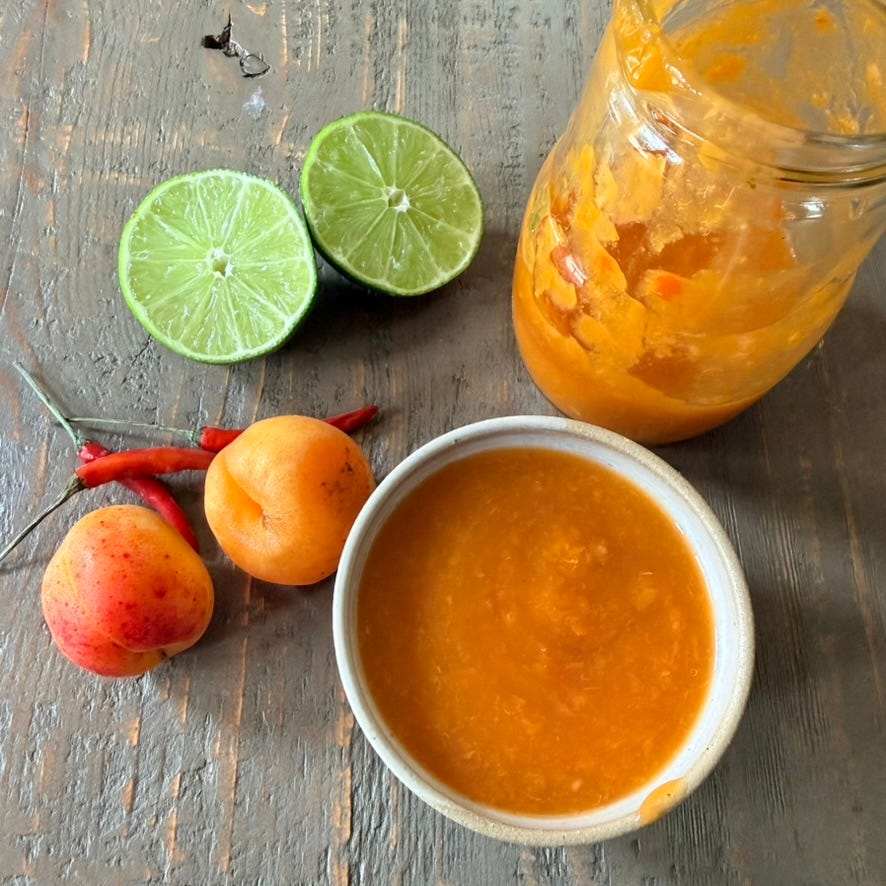
💎 Spicy fresh apricot sauce
Thank for this saucy idea that she suggested on Substack Notes — make a fresh apricot sauce with chile and fish sauce for grilled seafood. I did just that and it was great — even on rice, which reminded me of when my mom used to serve us kids sliced ripe mango with rice and a smidgen of fish sauce. It was Mom’s clever way to get us it to “get the rice to go down.” I’ve adored the fruity-funky combo ever since I was 5 years old! Rory is new to the idea and loved the sauce on rice too.
Enjoy the apricot sauce at room temperature as a dipping sauce or chutney-ish relish. Keep scrolling for the recipe . . .
Spicy Fresh Apricot Sauce Recipe
In a small food processor blend together:
8 ounces (225g) pitted ripe apricots (soft ones are welcomed!)
1 Thai chile, coarsely chopped
2 Tbsp fresh lime juice, plus more to taste
1 Tbsp fish sauce, plus more to taste
1 very small clove garlic, finely chopped
Taste and adjust the flavor with extra lime juice by the to tame sweetness or fish sauce to add savory umami-ness. Incrementally add each by the 1/2 Tbsp (1 1/2 tsp). Use immediately or store in a jar for up to 1 week.
Support Pass the Fish Sauce! Join us for free or upgrade to a become a paid subscriber to enjoy 150+ professionally developed recipes, seed new content, and get future class discounts. Thanks for your enthusiasm!
💎 Almond Apricot Cake (gluten free)
Apricots are from Central Asia and China and almonds may have hailed from those regions too. They are destined to be together in a sweet treat. I wanted an easy cake to combine and celebrate the two ingredients and created this delight. I riffed on ’s almond butter cake recipe from her brilliant Gluten-Free Flavor Flours cookbook, but baked fresh apricots right into the cake, an idea poached from the French moelleux of summer fruits, a cake recipe that wrote about a number of years ago.
One cake serves 8, if you decide to share it.
The fruit sank into the bottom and didn’t turn totally mushy; it added a tangy contrast to the cake that was wonderful to eat. The top baked to a delicate crispness that finished the cake with a truly special crust. (Yes, I think you can make this vegan too!)
I shared some with neighbors, two of whom enjoyed it to celebrate their baby’s 6 month birthday (their baby is also named Rory).
Like the popular PTFS easy lime pound cake recipe, this one is also made in the processor. (I’m a somewhat lazy cake baker.) I’ve just written the 🆓 recipe up at the website for you to bake it up yourself. You can easily play with it too. Make this almond apricot cake recipe your summer go-to!
Coming up for this Sunday Special are ideas for the grilling season that is now upon us!
A few days ago I ran into our neighbor, who kindly invited us for dinner this weekend. She was the first neighbor we met in the building, over our shared back wall, and we hit it off, right off the bat. People in Paris can have complicated (or, um…thorny) relationships with neighbors, which I wrote about in my book L’Appart. But we scored with this one. We now trade keys, look after each other’s apartments when one of us goes away, accept packages for each other, and even call on each other if there’s an emergency.
I offered to make dessert and decided to scoop up as many of the beautiful fresh apricots I could find, let them ripen a few days, and turn them into a fruit crisp, which are called crumbles in France. That’s a term picked up from our neighbors in England — un crisp doesn’t come off the tongue as readily as un crumble, but both sound a little funny to me with a French accent. But now that I’m on the 🇫🇷 team here, I call them crumbles, too.
But for now, I’m going to write them as crisps, and this is my favorite, go-to crisp topping. What makes it extra-crisp is the addition of polenta. It’s from my book Ready for Dessert, which is subtitled my “best” recipes, and it really is the best crisp topping, if I do say so myself.
I use very coarse, stone-ground polenta since that has the most crunch, although regular polenta works well, and while I’m not as much of a fan of instant polenta as others are around here, that works too, as does cornmeal. As for the nuts, I generally go with almonds since they go well with stone fruits, but you can use walnuts or pecans if you prefer.
When I wrote my first book, back in 1999, I assumed people didn’t have food processors, although I think they may be more common these days? My KitchenAid food processor* has a broken bowl so the handle is filling with gunk, and they don’t sell replacements. I miss having a classic Cuisinart food processor, which I had in the States, and it was really a workhorse in the kitchen. (Even Wirecutter agrees with me.) But they’re not available in France.
I’m thinking of springing for a Robot-Coupe, although with a starting price of €1200 ($1390) 💸 I’m going to hang on to my food processor until the day dies, then consider my options.
While I prefer to mix the topping in a food processor, you can also mix it in a stand mixer with the paddle attachment, or by hand if you chop the nuts first. When I make it, I pulse all the dry ingredients until the mixture is sandy, then add the butter and pulse it rapidly a few more times, just until I see small clumps sticking together. I like large, discernible bits of crisp topping in the finished crisp rather than a smooth, sandy texture.
Subscribe to my newsletter and get more recipes, posts, and Paris travel tips, sent right to your Inbox! Paid subscribers get full access to all posts as well as the recipe archives.
Ice cream, of course, is the preferred pairing with a warm fruit crisp. I just happen to have a lot of ice cream in my freezer at the moment, but the one I’m going to bring is the leftover apricot kernel oil ice cream that I made to impress a chef friend who came to make an upcoming video with me.
That was one of those recipes I shared back in 2008, when a few companies were making apricot or plum kernel oil, which has become harder to find. Some of it is sold for cosmetic purposes and isn’t intended for food use. I used the last of my bottle, but Vanilla, Cinnamon, White Chocolate-Fresh Ginger, or Malted Milk ice cream are great accompaniments, or just serve the crisp warm with a pitcher of cold heavy cream on the side.
We’re fortunate to have a lot of fresh apricots available to us right now, but if you want to swap inslices of nectarines or peeled peaches, reduce the sugar in the filling to 2 tablespoons. In place of the cherries, feel free to swap in blackberries, blueberries, or raspberries, or just use more apricots.
In place of the kirsch and almond extract, you can use 1 teaspoon pure vanilla extract, total. You can make the topping up to one week in advance and refrigerate or freeze it.
Topping
3/4 cup (110g) flour
2/3 cup (100g) polenta
1/2 cup(65g) lightly toasted almonds, walnuts, or pecans
1/2 cup (90g) packed light brown sugar
1 teaspoon ground cinnamon
1/4 teaspoon salt
8 tablespoons (4 ounces, 115g) unsalted butter, cubed and chilled
Make the topping by pulsing together the flour, polenta, nuts, brown sugar, cinnamon, and salt, just until the nuts are slightly broken up. Add the cubes of cold butter and pulse until the butter is well integrated. Pulse a few more times until little bits of the mixture begin to clump together.
Preheat the oven to 375ºF (190ºC).
To make the filling, in a medium bowl, mix together the sliced apricots, cherries, sugar, flour, kirsch, and almond extract. Spread the fruit into a 2-quart (2L) baking dish, then strew the crisp topping evenly over the fruit. Resist the urge to press it down so it’s completely flat; I think it’s best when it’s a little unevenly baked, so you get lots of crunchy bits here and there.
Place the baking dish on a baking sheet lined with parchment paper or aluminum foil, shiny side down. Bake in the oven until the top is golden brown and there are thick juices bubbling up around the edges. When you poke a paring knife into the center, if it meets no resistance, it’s done. If the topping is getting too dark before the fruit is fully cooked, you can drape a sheet of aluminum foil over the top and finish cooking.
The exact baking time depends a bit on the ripeness of the fruit but will take around 40 minutes to bake. Serve warm or at room temperature, with a scoop of ice cream or heavy cream.
*A number of people chimed in the comments, a few saying Cuisinart makes replacement bowls, but my current food processor is (or was) made by KitchenAid, and I’ve not been able to find a replacement bowl after a considerable amount of searching. (I’ve had mixed results ordering replacement parts online. A few times the item didn’t fit the machine I had, even through the item description said it did.
The model number of my KitchenAid food processor is #5KFPM771EWH0 - if anyone finds one, let me know : )
Thanks for reading my newsletter! Feel free to share it.
For those of you who wondered how long the Taiwanese sesame noodle sauce lasts, I’m confirming that it’s freezable. I froze a jar of it for a week, then drove it to my mom’s house in Southern California where I whipped up the noodles for a fast lunch. The sauce tasted like it was freshly made! So go ahead and make a double batch of the cold sesame noodles sauce and use one now. Freeze the balance as 1/3 cup (80ml) portions for single servings and faster thawing.
Using egg strips for the sesame noodles reminded me how useful egg sheets are as a protein-rich addition to East Asian noodles, dim sum, and rice dishes. I grew up with trứng tráng (egg sheets in Vietnamese) in sophisticated Hanoi-style bún thang noodle soup and cheery mixed rice (cơm trộn).
My mom regularly prepared the rice dish, which is easy breezy and healthier than fried rice. Cơm trộn is simply hot rice mixed with add-ins but done in a particular fashion so it tastes special and fun. In the photo below, the red strips are a quick pickled sweet pepper which lends a crunch, piquant note to the rice.
Vegetarian mixed rice (cơm trộn chay) with seared tofu. I’ve prepared it with grilled leftovers during summer and thrown in a handful of fresh herbs too. The sky’s the limit with mixed rice so get the blueprint and make it!
Feeling nostalgic and hungry the other day, I threw together a vegetarian batch of cơm trộn for an easygoing lunch. However you make mixed rice, it’s lite and can be served warm or at room temp. It was so good that I shared my blueprint recipe and tips on the website for you to craft your own. When you make my mixed rice, look for the link to the recipe for egg sheets too (you’re welcome). Get friendly with the Viet mixed rice recipe this summer!
This week’s big cooking star was kung pao. I challenged myself to come up with a stellar kung pao chicken recipe that:
Can be used as a plug-and-play template to feature other proteins or be vegan
Includes enough vegetables so it can be eaten with rice as a satisfying, wholesome meal
Allows nuts to shine, not just be minor decor as they usually are in takeout versions
Breaking kung pao rules (sort of)
In Mandarin Chinese, 宫保鸡丁gōngbǎo jī dīng literally means “Palace Guardian Chicken Cubes”. It was a favorite dish of an 18th century provincial governor named Ding Baozhen (1820–1886). Parsing the Chinese name:
宫保 gōng bǎo (Palace Guardian) was part of Ding Baozhen’s official title
鸡 jī means chicken
丁 dīng means cubes and also is a pun on the man’s surname, Ding
Kung pao chicken, the Sichuanese spicy, tangy chicken stir-fry that we know today, likely originated from the time the governor spent his youth in Guizhou (a southwestern Chinese province located north of Vietnam). Modern cooks in Guizhou season kung pao with fermented bean sauce and chili-garlic-ginger paste. No nuts are included in Guizhou kung pao. And, there are versions with chicken, shrimp, potatoes, and even pig’s stomach.
Ding loved chicken stir-fries so much he told his cooks to include it on menus for guests. When he governed northeastern Shandong province, he enjoyed a chile-less version with walnuts or cashews instead of peanuts.
His last post was in Sichuan, which explains why the popularized version of kung pao chicken includes dried chile, Sichuan peppercorns, peanuts, and Chinkiang vinegar. Those ingredients are found in other Sichuan favorites.
My version of Sichuan kung pao chicken.
Compared to other Sichuan dishes like mapo tofu, kung pao chicken is not overly spicy or fiercely hot. Perhaps the governor’s cook incorporated all the ideas from the three provinces where governor Ding had been posted? He and his family moved about the country with a staff, including cooks, who likely adopted his favorite chicken dish to local tastes and ingredient availability, writes Fuchsia Dunlop in an article for the Los Angeles Times1.
As a result, nerdy kung pao fans will recognize Guizhou, Shandong and Sichuan versions. I’ve not graduated to nerdish level and am stuck in the Sichuan level so I focused on that iconic iteration for the foundation of my recipe. That said, kung pao has a rich backstory that makes it much more interesting than what we may normally think. You can play with it.
After formulating my kung pao chicken recipe, I used it to make scallop kung pao and a mushroom kung pao. From one recipe, I got three (3) surprisingly delicious kung pao stir fries. AWESOME.
To prime you to flex your kung pao muscles, watch me make the stir-fry and preview the techniques.
Below you’ll find:
My master kung pao chicken recipe in full text and downloadable PDF
Notes for making Kung Pao Scallop and Kung Pao Mushroom
Ingredient tips for chiles and peppercorns
Pointers for getting kung pao’s vinegary tang just right
Paid subscribers sponsor PTFS. This kung pao tour de force is for them. Upgrade to paid status to get the whole shebang, mine the full newsletter recipe index, and gain so much more. Thanks for your considerations.
As someone who is passionate about cookbooks, I’m always up for talking about them with other cookbook collectors. I know there are lots of cookbook collectors out there, but one who really stands out is , who writes the Cookbookery Collective newsletter, which she describes as:
…a hub for the cookbook community—authors, eaters, cooks, editors, publicists, publishers, agents, and aspiring authors alike. It’s a place to celebrate all cookbooks, new and old, blockbuster and under-the-radar. It’s a place to hear from your favorite authors and talk amongst ourselves in the comments section. It’s a place where everyone is welcome, whether you have just a handful of beloved books or a collection in the hundreds.
I couldn’t have said it better, except to add what a wonderful resource Jenna, and her newsletter, have become to the cookbook community, which features interviews with cookbook authors, including me…
…plus seasonal round-ups of the latest cookbooks to hit the shelves, previews of cookbooks that are about to be released, as well as recipes from her favorite cookbooks.
Not only does Jenna write a newsletter, she’s also the food director at Real Simple magazine, the author of five cookbooks, and runs a personal chef business. Whew!
In addition to her other activities, Jenna is now a novelist, having penned her first novel, coming out this Fall, The Foreign Correspondent’s Wife, a mystery set in Paris.
I was thrilled to get a chance to sit down for this podcast episode with Jenna to talk about our favorite subject: Cookbooks! We talked about everything, from what makes a good cookbook (and what drives her crazy in a cookbook) to how she decides which cookbooks that cross her desk she holds on to, and which ones she lets go. We also discussed what she thinks of influencer cookbooks, and talked about one of the big questions of our time - how will AI affect cookbooks, and will it (or can it) replace them.
Subscribe to my newsletter to get future podcasts, videos, recipes, and Paris travel tips, sent right to your inbox!
I hope you enjoy my chat with Jenna as much as I did…and let us know in the comments what are some of your favorite cookbooks, and why.
My book tour was fun, which was how I spent most of May, with a final stop in Paris. Along the way, it was amazing to meet so many of you, including readers and followers, as well as other cookbook authors, bakers, owners of cookbook shops, chocolate-makers, and Paris-lovers.
I was bowled over by the turnout at my events and my only wish was that I could have done more, although it’s hard to be away from home longer than three weeks, and it takes the better part of the week after you return to get over the jet lag and catch up on everything that happened while you were away. Such as somehow in my absence, something smelling like industrial-strength mint syrup (or cleaner?) was put into the refillable spray bottle of locally made, eco-friendly bathroom cleaner that we use, and no one knows what it is or how it got there.
If anyone has a clue, kindly tell me. I don’t know whether to clean the bathroom with it, or mix it with sparkling water.
As anyone who’s traveled lately knows, things have become a lot more challenging both on the ground and in the air. I give a lot of credit to people who work in airports and on airplanes, as well as travelers who can handle the rigors of travel.
Well, except for the guy next to me on the flight from SFO to LAX, who loudly used his phone just until the last nanosecond when we took off, then continuing the conversation, equally as loud, timed exactly at the moment the wheels of our plane touched ground.
All of us in rows 12-22 (but especially me) got to hear all about how Carol wasn’t in on the meeting but Bill and Warren were, and Pam doesn’t know about it but they’ve got to get the files to the branch in Tennessee, although if they don’t make it there, Tom is going to have a meltdown, and Bill and Howard in other branch offices are going to have to cover for them. I learned that Susan may have to be looped in for the meeting about it, but not to tell Carol. I don’t know what that guy does, but it must be important enough to interrupt the lives of everyone around him.
I’ve always found this post about what authors should do, and shouldn’t do, on book tours pretty spot-on. I think I followed most of them, although I’m waiting for someone to write one about how not to behave on airplanes, which people should have to sign a paper stating that they read it and agree to its terms.
Blueberries at the greenmarket in San Francisco.
I tried to use my downtime wisely, to keep my energy high for meeting everyone. But one thing I recommend that everyone do on the road is to eat well. It can be hard to get your fruits and vegetables in when you’re traveling, which, curiously, is one of the things that American visitors tell me they miss when they’re in France. (If you want fruits and vegetables, rather than looking in cafés and restaurants, it’s best to go to the markets to pick them up.) Maybe our reputation precedes us, but when I come across a salad bar when I’m traveling, in spite of the Debbie Downers about them, it feels really good to have a big bowl (or box) of spinach, cherry tomatoes, tofu, florets of broccoli, grated raw carrots, some proteins, and even alfalfa sprouts, which Pee-wee Herman said, look and taste like hair.
It’s nice to eat “healthy” whenever you can….so you can indulge when something extra-delicious crosses your path, such as this incredible Tin Roof Sundae…
The Tin Roof Sundae with caramel gelato, marshmallow sauce, and salted Spanish peanuts on a crisp waffle cookie, at Mozza, was one of the best desserts I’ve ever eaten.
How could I resist?
I also got to indulge in slices of pepperoni pizza, uber-dark brownies at Hani’s, and marshmallowy S’Mores at a.o.c., as well as Mexican, Chinese, and Thai food. I wrote roundups of what and where I ate in Notes from the Road (San Francisco) and NYC Eats x Book Tour. Apparently I said a few controversial things in New York while being interviewed by on the Taste podcast, which was recorded at my first book tour stop atRizzoli bookstore. The crowd was so nice and welcoming, it was hard not to get personal with everyone who came to the sold-out event, but I guess a few things I said were controversial.
I haven’t listened to it, but I try to steer clear of trouble when being interviewed, since I’m sure some of the things I’ve said over the years have me teetering on the edge of being cancelled. But there’s soooo much to talk about, and I can never resist a challenging interviewer’s question. Talking face-to-face is different than via the internet, where things can be misunderstood or misconstrued. Clearly I need to get out more.
I did get out to the produce stores near where we live when I got home and picked up baskets of fresh cherries and apricots as well as the last asparagus spears at Le Pari Local. I’d bookmarked the Easy, Springy Frittata in Jenna Helwig’s must-read newsletter, Cookbookery Collective, which was adapted from ’s new book, Vegetables the Italian Way…
…and gave it a go. But first, I had to explain to Romain that it wasn’t an omelette because it was fried, hence the name frittata, and wasn’t folded up but served open face, which was when things started to get complicated. So I served it, and hoped for the best. (French people can be quite literal. If you don’t believe me, you should see some of the messages that I get, not to mention the hoops I have to jump through at home.)
I went a bit rogue with the frittata, oven-roasting the asparagus first and adding chopped basil to the eggs, plus a chiffonade of leaves on top. I snuck in an extra egg white since I have a few in the frigo. Mine wasn’t as neat as Jenna’s, but now Romain knows what a frittata is…even though I’ve made them before.
I’m going to go a bit here, who recounts what he’s been watching and reading in his newsletter:
I finally finished The Comeback, which became one of my all-time favorite TV series. It took a few episodes to get into it — season 2 came out ten years after the first season, and the final season, season 3, came out a decade later — but the evolution of Valerie Cherish, the main character (pitch-perfectly played by Lisa Kudrow, who also co-wrote the series), was a tour de force and often very touching. What, on the surface was a superficial character, evolved into something and someone completely different and unexpected.
On the 11-hour plane ride back from Los Angeles, I finished Beef, season 2, which had a bit of The White Lotus vibes but ended up being a deep dive into a group of very complicated humans that, like The White Lotus, cross socio-economic classes. I tried to get into Rooster but not much was happening, kind of Emily in Paris, where the characters end up just circling around each other over and over, with little character progression. I tuned into Margo’s Got Money Troubles, mostly because who doesn’t want to watch anything with Michelle Pfeiffer? Both she and Elle Fanning are excellent actors but like some mini-series (I’m looks at you, Rooster and Your Friends & Neighbors), it could have been half as long. The story plodded a bit, then got much better as it reached its final two episodes. Wanda Sykes has a new comedy special on Netflix, and as usual, she’s hilarious. And some folks may be sad to learn that Emily in Paris is finally saying adieu, and coming to an end.
As for reading, I wrote what I’m currently reading in the links below, but I brought three books back from the States, which was the maximum that my luggage allowance allowed.
My friend, cookbook author, and collaborator Kate Leahy told me that Company was one of the best-written cookbooks she’d come across, so I picked up a copy. I also bought More than Sweet, a new baking book that “breaks down the boundaries between sweet and savory with confidence,” as well as a copy of When French Women Cook by Madeleine Kamman, one of the most important and influential cooks of our generation.
I love that Madeleine Kamman included how much a recipe costs to make. Some recipes in her classic book are listed as “reasonable” and “affordable,” and this one is classified as “inexpensive if you gather the mushrooms yourself.” 😀
As I write this, we are at the tail end of another heat wave in Paris, with the hottest days on record. (Europe is heating up faster than the rest of the world, and not everyone makes it through.) No one was expecting the heat waves to start as soon as May, but here we are.
During the heat waves, people swelter, and some businesses close due to the heat. Tourists wonder why there are no fans or AC or ice in drinks. Once heat waves are over, people forget about them, so solutions evolve slowly. Sixty percent of the roofs in Paris are zinc, and I lived in a top floor apartment where the temperature would hit 110ºF (43ºC) inside. Painting them white or coating them with something reflective would be an effective solution, but with the city seeking to make the zinc roofs protected as UNESCO cultural heritage, it’s doubtful that that’s going to happen.
If you plan to come to Paris, or anywhere in Western Europe, check the weather forecast and bring light clothing, sunscreen, and a refillable water bottle to beat the heat. You might want to cross “waiting in lines outside to get into museums” off your list. And it’s not recommended that you ignore the advice of city officials and jump into the canals to cool down:
So lieu of that, we’re heading to Copenhagen and Norway this month, where it’s cooler.
In the meantime, I’ve been mixing up glasses of Chocolate Frappés from Drinking French, made by vigorously shaking up 1/2 cup (125ml) whole, low-fat, or plant-based milk, 2 tablespoons best-quality Dutch-process cocoa powder, a tablespoon of sugar, and 3 ice cubes in a cocktail shaker. That gets poured into a glass (it’s okay to add any ice chunks to the glass, too). You can top it with whipped cream and chocolate shavings, or just serve as is. I recommend drinking one of these frappés over the water in the canal.
-David
If you’re in Paris and missed my book event, La Trésorierie (48 rue de Grenelle, 7th) has signed copies of my books.
While I was on book tour, one thing people told me about was how much they enjoyed their trips to Paris, thanking me for restaurant suggestions and other tips I post here and there. It makes me happy when people come to Paris and have a good time, and eat well.
After I flew back to Paris last month and collected my luggage, I did what I usually do: I headed to the taxi stand. The airport has affixed large signs on the floor of baggage claim, which you can follow all the way outside to the official taxi stand. (I’ve also seen young people in official vests, guiding and leading people from the baggage claim area, all the way to the official taxi stand.)
On my way, I was asked by at least a dozen men, who whispered almost under their breath, if I needed a taxi. I kept walking but one guy told me I was going the wrong way, and to go to a different doorway, presumably where his car was waiting.
Most of us are zonked after flying into a foreign city, but whatever you do, never, ever take a non-official taxi from the airport in Paris. Always follow the signs for the official taxi stand, where there will be a person in a vest, organizing the taxis and passengers. Getting into an unofficial taxi means you may be paying more than you should or what was originally quoted to you. In one extreme case, a driver tried to charge some tourists €247($288) for the trip. This does happen in other airports, but Americans tend to be polite when we travel and might say, “Sorry, no thank you.“ Locals will just walk by them without saying anything, which I do, and suggest doing as well.
Official taxi prices to and from airports in Paris are fixed by law (current fares are here) and fares are reasonable.
Pro Tip: To get to and from the airport in Paris, probably the best and most reliable taxi service is G7. You can reserve a taxi online (in French or English) or via their app.
The streets of Paris, and the roads around it, are generally a knot of traffic and official taxis are allowed to use the bus lanes, which are less congested. Drivers for services like Uber and Bolt cannot use them.
When going to the airport, you can reserve a pickup online, which costs a few euros more but comes with more peace of mind. After arriving at the airport, unless you’ve ordered a taxi in advance, you’ll have to take whatever one is available from the queue. But official taxis are obliged to charge the fixed price. All drivers are required to take credit cards, but occasionally one will say the machine is broken, and can you pay cash. I always ask before getting in if I can pay bycarte bleue (credit card), just to confirm.
Tipping is optional but I often add 5%. You can tip up to 10% if you’ve got a lot of luggage or the driver makes an extra effort, but it isn’t required.
In the spring of 2027, a dedicated CDG Express train is set to launch, which’ll take you to and from the Gare de l’Est (as well as other stations), right to the airport for €25 ($29) one-way. The project has been delayed for a number of years but appears to be on track to open then, so to speak.
Some take the RER B train, which goes to CDG airport from several stops in Paris, such as Châtelet, Saint-Michel Notre Dame, and the Gare du Nord. But if you have luggage, you may have to schlep it up and down some stairs, and there are reports of pickpockets on the trains. RER B trains can be crowded and have limited ventilation, and occasionally there may be a problème téchnique or construction that can cause a delay. We once missed a flight because of a colis suspect (suspicious package). Then we spent the day at the airport waiting for the next flight, and got stuck in the middle seats in the last row of the plane, which weren’t the most pleasant eleven hours of my life. That was about ten years ago, but I still haven’t been able to uncramp my legs from that journey.
Hello there! I hesitated to send a Midweek Gem this week because I realized that Substack sends you a lot of emails about the livestreams that I’ve been doing. Moving forward with the livestreams, I’m going to curtail those emails.
That said, I wanted to share some exciting news with you! Something called an “advance copy” of Cooking Thai recently arrived on my doorstep.
The book is still being printed overseas but my publisher gets a handful of copies. Chef Pim and I each got one and we’re totally gobsmacked about holding the actual book baby in our hands!
What’s on the cover? One of our favorite recipes in the book — Massaman Curry, based on a time tested recipe by Pim’s grandmother. Pim’s curry pastes are stellar and we developed recipes for you to make it with meat or meatless. There are tips to tweak the heat level so you don’t have to have a Thai built-in heat shield to enjoy this food!
A number of Cooking Thai recipe testers are also PTFS subscribers. We were overwhelmed by their positive response to the flavors and techniques.
It’s been quite a journey to bring Cooking Thai to print. Lots of thrills and near spills. We’ve built it as a solid guide for your Thai cooking adventures for years to come. That’s how Pim and I intend to use the book so we hope you’ll do the same!
How and when can you get the book?Cooking Thai releases on August 25, 2026. The printer is in Asia but luckily the books won’t be shipped through the Strait of Hormuz!
To get a copy ASAP, pre-order it from your favorite book store, cookbook shop, or a vendor like the ones listed here. Pim is planning the book tour so more news will come as things develop. Thanks for your ongoing interest and support.
Congratulations to for winning the giveaway. She cooks lots of Cantonese food so I’ll be curious to know what she thinks of adding Taiwanese flavor to her recipes.
Thanks to all of you who shared your soy sauce brands. And, also to who shed light on La Choy soy sauce and then some.
💎 Focaccia di Recco (one of the best things I’ve ever eaten)
If you live in the Santa Cruz area, get yourself to Mentone in Aptos and order the focaccia di Recco off the specials menu! I’d love for chef David Kinch to permanently add the bedsheet thin flatbread-cracker-quesadilla filled with milky crescenza cheese on the menu. My photo on the right does not do the focaccia justice. 😩
I was so taken by it — a marvel in dough management and manipulation — that I looked up how to make it when we got home from dinner. There are a handful of recipes out there but Janet Fletcher has the scoop from Lidia Bastianich’s recipe. It’s all here on Janet’s website. To get a sense of how it’s made, watch this:
Support Pass the Fish Sauce! Join us for free or upgrade to a become a paid subscriber to enjoy 150+ professionally developed recipes, seed new content, and get future class discounts. Thanks for your enthusiasm!
Coming up for this Sunday Special is a cool noodle dish that Rory and I have been enjoying all week long and we’ve not tired of it.

 Login