❌

Reading view

Pluralistic: Israeli ad-tech company was a delivery system for "mercenary spyware" (17 Oct 2026)


Today's links


A lonely country road with a large roadside billboard. Thrusting out of the billboard is a punching fist with bloody, spiked brass knuckles; it is surrounded by scabrous craters. The sky is a psychedelic roil of red-brown clouds, from behind which loom indistinct, vast tropical flowers.

Israeli ad-tech company was a delivery system for "mercenary spyware" (permalink)

More than half of all internet users have installed an ad-blocker; Doc Searls calls it the largest consumer boycott in history. As large as that boycott is, everyone – yes, everyone – should block every "programmatic" ad, because the entire system is so insecure that failing to do so could result in the total compromise of any or all of your digital devices.

That's the inescapable conclusion of Citizen Lab's latest blockbuster investigative report, "Exposing AdFection," which reveals how the largest ad-tech companies in the world, including Google and Facebook, allowed themselves to be hijacked by a "mercenary spyware" company that used the ad system to locate targeted individuals and serve "zero-click malware" that took over their computers and phones without them having to take any action:

https://citizenlab.ca/research/how-discover-tech-turned-targeted-ads-into-a-pipeline-for-spyware/

These tech giants amassed detailed surveillance dossiers on virtually every internet user, and they've assigned each of us unique, persistent identifiers, like a Social Security Number for spying. These companies also allow advertisers – or anyone pretending to be an advertiser – to serve blobs of code (which is all an ad is) to anyone based on those identifiers.

This allowed an Israeli spyware company called Discover-Tech (which masquerades as an ad-tech company) to sell totalitarian governments and sleazy corporate mercenaries the ability to pluck individual internet users out of the billions who log in every day and then serve "malicious ads" (that is, blobs of arbitrary code) to those targeted users. These malicious ads contained "no-click, zero-day" attacks, which meant that they exploited previously unknown vulnerabilities to take over devices without any user interaction. The mere act of loading a web-page or opening an app that relied on one of these gigantic ad-tech companies to serve ads was enough to compromise your device. No clicks needed, and no warning.

Among the targets of this attack campaign were the computers of workers at Al Jazeera. They were attacked with malware from the mercenary spyware company Candiru (which now calls itself "Integrity Labs" because irony is not dead). Beyond Candiru, Discover-Tech also facilitates attacks by numerous criminal mercenary spyware companies, serving ads on hundreds of thousands of sites and apps.

Discover-Tech was "certified" as a safe supplier by Google, Yandex, Microsoft, Beeswax (a division of Comcast) and IAB, the ad-tech industry's leading professional association. Ironically, Discover-Tech even attacked users by serving them malicious GDPR notices that appeared to let users opt out of commercial surveillance.

Because Discover-Tech was certified by all these industry bodies and firms, it had access to more than four billion ad-auctions, meaning that on billions of occasions, it was able to collect the identities of users loading apps and visiting websites, check them against the list of targets, and attack any victims it discovered through this dragnet.

Discover-Tech is an Israeli company with ties to other Israeli spyware and hacking companies, including through its board, whose members included Eric Banoun ("One of the pioneers of offensive cyber in Israel" –Haaretz). They have overlaps, relationships and affiliations with a rogue's gallery of Israeli companies, including the notorious NSO Group, who routinely sell cyber-weapons to the world's worst governments and whose products have been used to attack journalists, embassy workers, and activists.

The whole incident highlights the monumental insecurity of the ad-tech industry, whose indiscriminate and voracious surveillance and manifestly insufficient vetting and security auditing now exposes every internet user in the world to terrifying targeted attacks. These companies – including Google, a thrice-convicted monopolist whose surveillance tendrils are wrapped around the whole world – claim that they operate their networks with prudence and oversight. But the proof is in the pudding: for years, they've played host to a murderer's row of cyber-mercenaries who used their infrastructure to attack journalists and others.

The only way to avoid this is to block ads. This is easy enough to do in a browser (which is why the majority of internet users have installed an ad-blocker in their browsers), but it's illegal to reverse-engineer and modify an app so you can block the ads in it:

https://pluralistic.net/2026/07/21/dickovers/#block-element

Many websites run anti-ad-block scripts that push out nagging, guilt-tripping notices that call you a thief and a cheapskate for blocking ads. Ignore those notices: if a website is running "programmatic" ads that allow arbitrary third parties to spy on billions of people and target individuals for malicious device takeovers, they are charging too high a price to see their content.

Some sites go further: their notices demand that you either turn off your ad-blocker or pay for a subscription. This "pay or okay" scheme is illegal in Europe, California and other territories with strong privacy laws, and they are morally bankrupt besides. Privacy shouldn't be a luxury item and everyone deserves to be secure from cyber-attacks:

https://noyb.eu/en/noybs-pay-or-okay-report-how-companies-make-you-pay-privacy

This report also provides the most comprehensive rebuttal to a dangerous idea that refuses to die: that we should improve competition in the ad-tech sector by assigning every internet user a mandatory, government-issued advertising ID to "democratize" ad-targeting and followup (which the sector calls "attribution"):

https://pluralistic.net/2024/08/07/revealed-preferences/#extinguish-v-improve

Despite all this, none of it is an indictment of ads per se. The problem here isn't advertising, it's surveillance. The ad-tech sector has convinced advertisers that targeting ads to users rather than content will massively improve ad performance. The evidence for this is very poor: targeted ads improve clickthrough rates by less than 5% (relative to content-based ads that relate to the substance of the page you're looking at), and they're incredibly expensive (and very dangerous!) to serve.

On top of all that, surveillance-based ads shift power away from publishers (who know more about the materials they publish than any ad-tech company ever will) to spying ad-tech companies (who can spy on users in ways that no publisher could ever match). Whatever minor additional revenues surveillance advertising can wring out of the market are totally swamped by the cost of the ad-tech sector's own operations, which the ad-tech sector makes up for by grossly underinvesting in security and by colluding to cheat publishers and advertisers, charging more for ads and paying less to the websites that run them:

https://en.wikipedia.org/wiki/Jedi_Blue

If we want to improve competition in advertising services, the answer isn't to facilitate spying (which also allows the world's scummiest cyber-mercenaries to stage and serve targeted attacks). We should ban surveillance advertising altogether, restoring context-based ads to their role as the way that publishers make an honest living without selling out their audiences:

https://pluralistic.net/2023/05/31/context-ads/#class-formation


Hey look at this (permalink)


A shelf of leatherbound history books with a gilt-stamped series title, 'The World's Famous Events.'

Object permanence (permalink)

#25yrsago Linux on a Big Mouth Billy Bass https://web.archive.org/web/20010927153043/http://bigmouth.here-n-there.com/

#20yrsago No-Fly lists even stupider than suspected https://web.archive.org/web/20061019002553/http://rawstory.com/showoutarticle.php?src=http%3A%2F%2Fwww.cbsnews.com%2Fstories%2F2006%2F10%2F05%2F60minutes%2Fmain2066624.shtml

#20yrsago Canadian MP booted for his blog https://web.archive.org/web/20061026153747/http://www.cbc.ca/canada/story/2006/10/18/turner-caucus.html

#20yrsago Recording industry shuts out Brazilian legal scholars https://web.archive.org/web/20061103225020/http://www.a2kbrasil.org.br/ENG/SIGN-A-PETITION-FOR-AMENDING-THE

#20yrsago How pickpockets work https://web.archive.org/web/20070110023812/http://www.kiplinger.com/magazine/archives/2006/11/mystory.html

#15yrsago Why are more people opting for legal name-changes than ever before? https://web.archive.org/web/20111020163908/http://www.bbc.co.uk/news/magazine-15333140

#15yrsago Advice to the 1% from Lemony Snicket https://occupywriters.com/works/by-lemony-snicket/

#15yrsago Proposed Australian law makes it an offense to insult Gaming Minister Michael O’Brien https://web.archive.org/web/20120507161803/http://www.heraldsun.com.au/news/more-news/surely-this-is-a-joke/story-fn7x8me2-1226167552466

#15yrsago Aloha From Hell: Sandman Slim goes back to Hell and kicks more ass https://memex.craphound.com/2011/10/18/aloha-from-hell-sandman-slim-goes-back-to-hell-and-kicks-more-ass/

#10yrsago California DMV thinks “INFOS3C” is a dirty word https://www.techdirt.com/2016/10/17/california-dmv-rejects-1nfos3c-vanity-plate-because-sexual-connotation/

#10yrsago Howard Stern won’t release Trump tapes https://www.billboard.com/music/music-news/howard-stern-on-replaying-his-donald-trump-interviews-it-would-be-a-betrayal-7542079/

#10yrsago Kim Stanley Robinson says Elon Musk’s Mars plan is a “1920s science-fiction cliché” https://web.archive.org/web/20161018043554/http://www.bloomberg.com/news/articles/2016-10-17/why-elon-musk-s-mars-vision-needs-some-real-imagination

#10yrsago UK’s Investigatory Powers Tribunal says GHCQ illegally spied for 17 years https://www.theverge.com/2016/10/17/13305270/uk-illegal-surveillance-gchq-investigatory-powers-tribunal

#10yrsago Project Include cuts off Y Combinator because Peter Thiel is a part-time investor there https://web.archive.org/web/20161019043240/https://motherboard.vice.com/read/horrified-by-trump-silicon-valley-leaders-debate-cutting-ties-to-peter-thiel

#10yrsago Islamophobic terrorist cell planned a “bloodbath” in Kansas, wanted to kill Muslim babies https://web.archive.org/web/20161018144035/https://www.washingtonpost.com/news/post-nation/wp/2016/10/15/it-will-be-a-bloodbath-inside-the-kansas-militia-plot-to-ignite-a-religious-war/?utm_term=.a9d769256cf6

#10yrsago Everything Belongs to the Future: a tale of pharmadystopian, immortal gerontocrats https://memex.craphound.com/2016/10/18/everything-belongs-to-the-future-a-tale-of-pharmadystopian-immortal-gerontocrats/

#10yrsago UK government proposes issuing Britons with unique porn-viewing ID numbers https://www.openrightsgroup.org/blog/a-database-of-the-uks-porn-habits-what-could-possibly-go-wrong/

#10yrsago Donald Trump’s mail-servers are running Windows 2003 https://pluralistic.net/2021/10/18/labor-shortage-discourse-time/#core

#5yrsago Copyfraudster censors investigation of implausible covid gadget https://pluralistic.net/2021/10/18/labor-shortage-discourse-time/#copyfraud

#5yrsago Corporatism made John Deere ripe for a strike https://pluralistic.net/2021/10/18/labor-shortage-discourse-time/#deere-dash


Upcoming appearances (permalink)

A photo of me onstage, giving a speech, pounding the podium.


A screenshot of me at my desk, doing a livecast.

Recent appearances (permalink)


A grid of my books with Will Stahle covers..

Latest books (permalink)


A cardboard book box with the Macmillan logo.

Upcoming books (permalink)

  • "The Post-American Internet," a geopolitical sequel of sorts to Enshittification, Farrar, Straus and Giroux, 2027
  • "Unauthorized Bread": a middle-grades graphic novel adapted from my novella about refugees, toasters and DRM, FirstSecond, April 20, 2027

  • "Enshittification, Why Everything Suddenly Got Worse and What to Do About It" (the graphic novel), Firstsecond, 2027

  • "The Memex Method," Farrar, Straus, Giroux, 2027


Colophon (permalink)

Today's top sources:

Currently writing:

  • “Once Is Enemy Action,” a science fiction novel about the origins of modern technofascism. Today's words: 563 (26602 total).
  • "The Post-American Internet," a sequel to "Enshittification," about the better world the rest of us get to have now that Trump has torched America. Fourth draft completed. Submitted to editor.

  • A Little Brother short story about DIY insulin PLANNING


This work – excluding any serialized fiction – is licensed under a Creative Commons Attribution 4.0 license. That means you can use it any way you like, including commercially, provided that you attribute it to me, Cory Doctorow, and include a link to pluralistic.net.

https://creativecommons.org/licenses/by/4.0/

Quotations and images are not included in this license; they are included either under a limitation or exception to copyright, or on the basis of a separate license. Please exercise caution.


How to get Pluralistic:

Blog (no ads, tracking, or data-collection):

Pluralistic.net

Newsletter (no ads, tracking, or data-collection):

https://pluralistic.net/plura-list

Mastodon (no ads, tracking, or data-collection):

https://mamot.fr/@pluralistic

Bluesky (no ads, possible tracking and data-collection):

https://bsky.app/profile/doctorow.pluralistic.net

Medium (no ads, paywalled):

https://doctorow.medium.com/

Tumblr (mass-scale, unrestricted, third-party surveillance and advertising):

https://mostlysignssomeportents.tumblr.com/tagged/pluralistic

"When life gives you SARS, you make sarsaparilla" -Joey "Accordion Guy" DeVilla

READ CAREFULLY: By reading this, you agree, on behalf of your employer, to release me from all obligations and waivers arising from any and all NON-NEGOTIATED agreements, licenses, terms-of-service, shrinkwrap, clickwrap, browsewrap, confidentiality, non-disclosure, non-compete and acceptable use policies ("BOGUS AGREEMENTS") that I have entered into with your employer, its partners, licensors, agents and assigns, in perpetuity, without prejudice to my ongoing rights and privileges. You further represent that you have the authority to release me from any BOGUS AGREEMENTS on behalf of your employer.

ISSN: 3066-764X

  •  

Trump’s Midterm Madness | The Coffee Klatch for Saturday, October 17, 2026

Friends,

Today, with just over two weeks to go until the midterm elections, Michael, Kamau, and I take stock of where we are: Trump is acting weirder than ever (which is saying something), his polls are lower than ever, inflation is higher than it’s been in years, his war in Iran is getting even worse and his cozying up to Putin even more bizarre.

So please grab a cuppa, pull up a chair, and join the conversation.

Robert Reich

Share

💾

  •  

How the AI Data Center Construction Boom is Hurting You

Friends,

AI data center construction is diverting capital and labor away from building everything else we need. AI is the biggest, most costly, and least popular economic bet America has ever made. Why are we making it? Who stands to gain? Who’s going to lose? What can we do?

Please watch and share:

Share

  •  

Trump’s Moral Squalor

Friends,

The Democrats’ focus on affordability seems to be a winning strategy (we’ll know for sure in a little over two weeks). But we mustn’t lose sight of the moral squalor at the core of the Trump regime.

It’s that moral squalor — the utter disregard for the opinions, norms, and ideals of the nation or, for that matter, of humanity — that uniquely marks Trump and the reprobates he has attracted to Washington. It has also poisoned much of the Republican Party, including the billionaires and tech bros who finance it.

To put this despicable era behind us, we’ll need to renounce and reverse this squalor.

What are loosely described as Trump’s “conflicts of interest,” for example, extend way beyond enriching himself from his presidency. He has violated the basic norms of presidential decency.

He just decided to host the Group of 20 annual summit of world leaders at his private golf club in Miami in December. When he sought to do this during his first term, it was viewed as a blatant violation of the emoluments clause of the Constitution. Now, after America’s moral sensibilities have been numbed by Trump’s appetite for foreign gifts — such as Qatar’s “donation” of a $400 million jumbo jet — it barely merits a mention.

He sells advance notice of his market-altering announcements for $100,000 a month, thereby profiting by tipping off people who trade on the information before it becomes publicly available. He files a trademark application for “Trump TV” to control the name of a streaming service that the White House uses for official presidential communications, thereby pocketing the benefits from taxpayer funds used to create and run the channel.

His family-backed crypto firm introduces a stablecoin just months before he signs legislation promoting it. His wife is paid tens of millions for a self-promotional film by Jeff Bezos’s Amazon, a federal contractor and major retailer subject to a myriad of regulations. His son has a Russian oligarch, close to Putin, pick up the tab for part of his wedding afterparty in the Bahamas.

He arranges for the Justice Department to grant him and his family immunity for any back taxes and penalties they might owe.

And so on. Trump has tossed away all constraints on making money off his presidency “because I got no credit in the first term” and “I found out that nobody cared.”

Credit? Someone who is entrusted with the highest office in the land must receive “credit” for doing what’s right, in order to continue doing what’s right? Nobody cares? A president can embrace corruption if the public doesn’t mind?

It’s not just the blatant self-dealing. His moral squalor extends to every aspect of governing.

He lies incessantly — a gushing firehose of deception.

His foreign policies make Henry Kissinger’s realpolitik seem principled by comparison. He orders the abduction of the president of another nation, installs a new president of his choosing, and announces he’s taking that nation’s oil — and doesn’t even account for what he does with the oil money.

He attacks Iran without consulting America’s traditional allies or even Congress.

Eager to reduce diesel prices (which are hurting Republicans in the midterms), he turns his back on Ukraine and sides with Putin, the aggressor in that conflict — making a deal to import Russian diesel fuel (a windfall for Putin who can now bomb Ukraine even harder) while demanding that Ukraine stop attacking Russian oil refineries. Trump then blames Ukraine president Zelenskyy for high oil prices rather than Trump’s own war with Iran, and says Ukraine should get a new president.

If this isn’t moral squalor, I don’t know what is.

The squalor also extends to usurping the authority of Congress to decide on tariffs, wars, and whether and how to spend taxpayer money.

And extends to his cynical defiance of Supreme Court orders. When the high court invalidates Trump’s tariffs, he reimposes them under a different statute. When the court rules that he doesn’t have grounds to remove a member of the Fed board of governors, he concocts a means to do so anyway. When the court says he has to remove his name from the Kennedy Center, he closes the center and threatens to demolish it.

It extends to his using the Justice Department and the FBI to prosecute people who have stood up to him, including courageous judges and prosecutors.

It extends to his overt bigotry and racism — claiming Mexicans are “bringing drugs and crime”; calling Somali-Americans “garbage” and denouncing “what they’ve done to Minnesota, these people from Somalia”; and taunting Muslims (calling Dr. Abdul El-Sayed, the Democratic Senate candidate from Michigan, “Mohammed”).

It extends to giving a gigantic tax cut to America’s wealthiest people, financed by cutting nutrition assistance and health care to America’s most vulnerable people.

The moral squalor has turned much of America into a police state — terrorizing large numbers of people residing here, including many here legally. Deploying ICE agents at schools, courthouses, and hospitals. Forcibly taking parents away from their children. Allowing masked gunmen without identification to grab suspected undocumented immigrants off our streets, from their cars, and out of their homes — giving them no opportunity to defend themselves in front of third parties before putting them into often overcrowded and unhealthy prisons or sending them to other countries where they’re imprisoned. Killing and murdering — even murdering Americans who are trying to monitor their activities — then refusing even to conduct official inquiries into the murders.

When asked if there are limits to his authority, Trump replies: “Yeah, there is one thing. My own morality. My own mind. It’s the only thing that can stop me.”

“My own” morality is no morality at all. Morality reflects collective judgments about right and wrong, shared values about what we owe one another as citizens of the same society. Morality refers to the ideals we seek to achieve together.

Trump is not guided by any sense of right and wrong. He is guided only by what enriches him or gives him more power and glory — a nihilistic might-makes-right ethos in which the strong do whatever they want and the weak suffer what they must.

To be sure, Trump’s moral squalor could not have permeated America — he could not have been elected a second time — had our shared norms and ideals not already been compromised.

Vast inequalities of income and wealth, coupled with a growing sense that the social contract at the heart of the American system was coming undone and that those at the top have rigged the game, were already fueling anger and distrust. Trump ignited that fuel.

But without shared ideals or common moral values, there is nothing pushing back against this despicable president and regime — no countervailing moral force against the ongoing squalor.

Part of the project of ridding ourselves of Trump, therefore, must be to rekindle our understanding of the common good and appreciation of what we owe one another as members of the same society.

Of course we must make life more affordable; Democrats are wise to emphasize this in the midterms. But we also must demand common decency from our president.

Share

  •  

Pluralistic: Load-bearing (16 Oct 2026)


Today's links


A detail from Dore's engraving of Samson destroying the temple, depicting tumbling classical columns. Amid the columns, wreaking havoc, are three sf pulp magazine robots.

Load-bearing (permalink)

You find the weirdest stuff inside your walls. Our house was built in 1949 and we're its third owner, and I have no idea what those other people were doing, but at one point someone installed a junction box full of live, bare wires that they filled with crumpled newspaper (!); and don't get me started on the decision not to put vapor barriers in the kitchen windows (we were one good shake away from the entire front of the house falling down when we discovered that one, and while it cost us an extra $19,000 to fix, that was still cheaper than rebuilding the whole front of the house).

Plus there was the unpermitted drainage system installed down the side of the house that must have attracted some (undocumented) planning inspector negativity; at least, that's the only reason I can think of for someone to have filled those drains with concrete (!!), a fact we discovered during the first heavy rainfall after moving in, when the water rose to shin-height (!!!).

But the weirdest and most nerve-wracking mysteries were the "structural" members of dubious quality, placement and utility. Some of them only seemed to be holding stuff up, but on closer inspection turned out to be free-floating 2x4s, not anchored to anything. On more than one occasion, our builders have moved jacks into position and removed those random uprights, only to discover that they weren't holding anything up.

Say what you will about this method, but it is decisive: if you remove a vertical member and nothing falls down, you can be pretty sure that wasn't a load-bearing member.

(This is a metaphor about AI.)

You can be forgiven for rolling your eyes when the subject of "digital sovereignty" comes up. Rhetorically, "digital sovereignty" is a coded way for a politician to say, "We should build a fuckton of AI data-centers while bypassing any environmental review":

https://datacentremagazine.com/technology-and-ai/keir-starmers-2bn-pledge-how-the-uk-plans-to-advance-ai

But AI has nothing to do with digital sovereignty. It is not load-bearing. All it takes to understand this is a little thought-experiment. Imagine that we removed all the chatbots from Canada, or the UK, or the EU, or the USA. What would fall down?

Nothing important.

Every public administrative body – national, regional and local – would continue to function. Every firm – large and small – would continue to trade. Households would be unscathed, save for their youngest members, who would suffer the indignity and tedium of having to do their own homework again.

Which is not to say that "digital sovereignty" is a nothingburger. The walls of our nations are filled with load-bearing digital members. It's just that these are the most boring, regular-degular-ass technologies imaginable.

Like Microsoft Office 365. Take away M365 and every ministry collapses, every firm shutters, and many if not most households will be in serious trouble.

And here's the thing: Microsoft CEO Satya Nadella paid $1m out of his own pocket to join the murderer's row of tech CEOs who sat behind Trump on the inaugural dais:

https://apnews.com/article/trump-inauguration-tech-billionaires-zuckerberg-musk-wealth-0896bfc3f50d941d62cebc3074267ecd

Microsoft donated $10 million to Trump's Epstein Memorial Ballroom:

https://www.geekwire.com/2026/leaked-list-shows-what-microsoft-amazon-and-other-tech-giants-are-giving-for-the-white-house-ballroom/

Microsoft provides the back-end administrative infrastructure for Trump's racist pogroms (take away M365 and ICE would collapse):

https://www.theguardian.com/us-news/2026/feb/17/ice-microsoft-technology-immigration-crackdown

The CEO of Microsoft France admitted that if Trump ordered the company to spy on French citizens' data (or the data of the French government), his company would comply, in secret:

https://www.forbes.com/sites/emmawoollacott/2025/07/22/microsoft-cant-keep-eu-data-safe-from-us-authorities/

And here's the kicker: Microsoft has terminated the M365 and Outlook access of international public officials whose official acts made Trump angry, starting with the Chief Prosecutor of the International Criminal Court, who lost his accounts after he swore out the genocide warrant for Netanyahu:

https://www.computerweekly.com/opinion/Microsofts-ICC-email-block-reignites-European-data-sovereignty-concerns

This is a white-hot, 278-alarm digital sovereignty dumpster-fire. M365 – as well as cloud software from Oracle, Google, Apple, Amazon and other US tech giants that have fused themselves with the Trump regime in exchange for tax breaks and antitrust forbearance – is load-bearing, and worse, those 2x4s are filled with termites and dry-rot.

Digital sovereignty is as real as real can be. It just has nothing to do with AI. AI isn't load-bearing. Boring-ass tech monopolist cloud software is…and we can not trust it:

https://pluralistic.net/2026/01/01/39c3/#the-new-coalition


Hey look at this (permalink)


A shelf of leatherbound history books with a gilt-stamped series title, 'The World's Famous Events.'

Object permanence (permalink)

#25yrsago Anthrax terrorist's handwriting https://web.archive.org/web/20011017003926/http://dailynews.yahoo.com/h/p/nm/20011016/ts/mdf70100.html

#20yrsago Help find stolen WEB GEEK license plate https://web.archive.org/web/20061017222733/https://www.backupbrain.com/2006_10_15_archive.html#a004964#a004964

#15yrsago UK media swallowed the “adult content” filter line https://www.theguardian.com/technology/2011/oct/17/adult-content-filters-good-parenting

#10yrsago Arizona Republic editor responds to death threats following Clinton endorsement https://eu.azcentral.com/story/opinion/2016/10/16/publisher-response-to-threats-after-republic-endorsement-clinton-trump/92058964/

#5yrsago Against the great forces of history https://pluralistic.net/2021/10/17/against-the-great-forces-of-history/


Upcoming appearances (permalink)

A photo of me onstage, giving a speech, pounding the podium.


A screenshot of me at my desk, doing a livecast.

Recent appearances (permalink)


A grid of my books with Will Stahle covers..

Latest books (permalink)


A cardboard book box with the Macmillan logo.

Upcoming books (permalink)

  • "The Post-American Internet," a geopolitical sequel of sorts to Enshittification, Farrar, Straus and Giroux, 2027
  • "Unauthorized Bread": a middle-grades graphic novel adapted from my novella about refugees, toasters and DRM, FirstSecond, April 20, 2027

  • "Enshittification, Why Everything Suddenly Got Worse and What to Do About It" (the graphic novel), Firstsecond, 2027

  • "The Memex Method," Farrar, Straus, Giroux, 2027


Colophon (permalink)

Today's top sources:

Currently writing:

  • “Once Is Enemy Action,” a science fiction novel about the origins of modern technofascism. Today's words: 503 (26039 total).
  • "The Post-American Internet," a sequel to "Enshittification," about the better world the rest of us get to have now that Trump has torched America. Fourth draft completed. Submitted to editor.

  • A Little Brother short story about DIY insulin PLANNING


This work – excluding any serialized fiction – is licensed under a Creative Commons Attribution 4.0 license. That means you can use it any way you like, including commercially, provided that you attribute it to me, Cory Doctorow, and include a link to pluralistic.net.

https://creativecommons.org/licenses/by/4.0/

Quotations and images are not included in this license; they are included either under a limitation or exception to copyright, or on the basis of a separate license. Please exercise caution.


How to get Pluralistic:

Blog (no ads, tracking, or data-collection):

Pluralistic.net

Newsletter (no ads, tracking, or data-collection):

https://pluralistic.net/plura-list

Mastodon (no ads, tracking, or data-collection):

https://mamot.fr/@pluralistic

Bluesky (no ads, possible tracking and data-collection):

https://bsky.app/profile/doctorow.pluralistic.net

Medium (no ads, paywalled):

https://doctorow.medium.com/

Tumblr (mass-scale, unrestricted, third-party surveillance and advertising):

https://mostlysignssomeportents.tumblr.com/tagged/pluralistic

"When life gives you SARS, you make sarsaparilla" -Joey "Accordion Guy" DeVilla

READ CAREFULLY: By reading this, you agree, on behalf of your employer, to release me from all obligations and waivers arising from any and all NON-NEGOTIATED agreements, licenses, terms-of-service, shrinkwrap, clickwrap, browsewrap, confidentiality, non-disclosure, non-compete and acceptable use policies ("BOGUS AGREEMENTS") that I have entered into with your employer, its partners, licensors, agents and assigns, in perpetuity, without prejudice to my ongoing rights and privileges. You further represent that you have the authority to release me from any BOGUS AGREEMENTS on behalf of your employer.

ISSN: 3066-764X

  •  

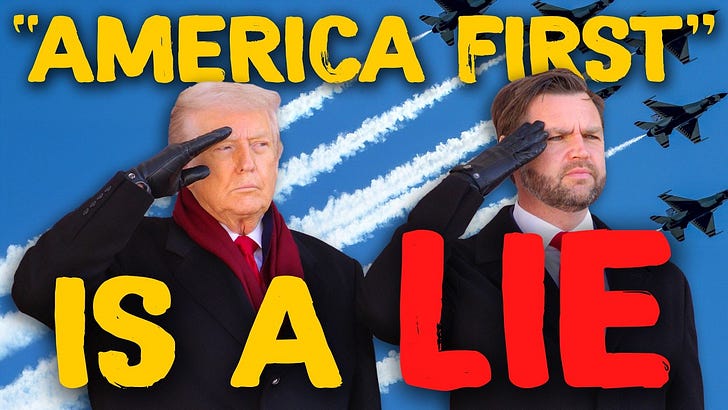
What would a REAL “America First” Agenda Look Like?

Friends,

Trump and Vance claim they’re putting “America first.” They’re not. They’re putting themselves first and America last.

So what would a REAL “America first” agenda look like? Take a look:

Our real America First agenda doesn’t exclude or vilify people. It doesn’t surveil them, take away their healthcare, or give billionaires and corporations unrestricted power over their lives.

America First means taking care of and investing in everyone who resides within our borders. Helping people abroad, not bombing them. Ensuring working people have freedom and control over their own lives.

Don’t let Trump and Republicans claim they put America first. They don’t. This agenda does.

Please share.

Share

  •  

Pluralistic: Expedia amazoned hotel rooms (15 Oct 2026)


Today's links

  • Expedia amazoned hotel rooms: Everything more expensive for everyone, monopolies everywhere, and we're all screwed.
  • Hey look at this: Delights to delectate.
  • Object permanence: Delta v dovening; "Play Money"; Alabama's ethnic cleansing; We trust neuroscience over psychology; Billionaires' anti-homeless pogrom; Game devs v DRM; What security means; Microsoft, tear down that wall! Publisher won't revert rights; SNL's Trump/Clinton debate; Chicago Tribune's murder; AI after AI.
  • Upcoming appearances: Paris, Vancouver, Victoria, Ottawa, Vienna, Kilkenny, Oxford, Sheffield, Oxford, Montreal.
  • Recent appearances: Where I've been.
  • Latest books: You keep readin' em, I'll keep writin' 'em.
  • Upcoming books: Like I said, I'll keep writin' 'em.
  • Colophon: All the rest.


A faded, scratched postcard advertising the 'Edge of Town Motel.' Next to the motel sign is a vast pink piggybank, out of whose slot rises a motel key on a diamond keychain, emblazoned with a metallic dollar-sign.

Expedia amazoned hotel rooms (permalink)

No matter where you shop, you're getting screwed by Amazon. Amazon has found a way to make everything you buy – at Target, at a mom-and-pop shop, even direct from the manufacturer – more expensive. And they're not the only one: Expedia's done the same thing, but for hotel rooms.

Here's how Amazon broke the economy: first, they locked in a key group of shoppers. The vast majority of affluent shoppers in the USA have Amazon Prime accounts. Having prepaid for a year's shipping in advance, those Prime subscribers start their purchasing journey by searching Amazon, and if they find what they're looking for, that's where it ends.

America's affluent top decile – the 10% of richest Americans – do the majority of America's shopping, a phenomenon that has only been accelerated by America's precipitous slide into oligarchy, which has exhausted the savings and the credit-card limits and the home equity of the majority of Americans, who increasingly can't afford to buy anything:

https://dreamagainusa.org/

If you want to sell things in America, you must sell them in the place where the top decile shops, and that's Amazon. For merchants, that is an incredibly expensive proposition: 51-60% of every dollar you spend with an independent merchant on Amazon is claimed by Amazon through junk fees, listing fees, commissions, processing fees and other scams:

https://pluralistic.net/2026/09/04/cheating-at-fraud/#absentee-rentier

Merchants don't have 51-60% margins they can afford to turn over to Amazon. To remain viable while selling on Amazon, they have to raise prices. Amazon doesn't mind if prices go up, so long as Amazon's price remains competitive. So Amazon imposes a requirement on its suppliers called "most favored nation," which requires sellers to offer their best price on Amazon:

https://pluralistic.net/2026/02/25/most-favored-nation/#price-fixing

Practically speaking, that means that when you raise your price on Amazon, you must raise your prices everywhere by the same amount, which means that no matter where you shop (Target, Walmart, the corner store or direct from the factory), you pay the Amazon Tax.

The Amazon Tax is a prime (you should forgive the expression) example of enshittification, in which an intermediary (a business that sits between buyers and sellers, AKA, "a platform") screws both customers and sellers to benefit itself.

But Amazon isn't the only example of a powerful digital intermediary that has used its market power to impose an economy-wide tax. Wherever you look online, you find digital giants who grew the way Amazon grew (buying all of their competitors) and then did what Amazon did (squeezing buyers and sellers, making prices higher everywhere).

That's what happened with Expedia. Almost every travel site you can find online has been purchased by Expedia (Hotels.com, Travelocity, and Orbitz), and the ones that aren't Expedia subsidiaries were acquired by its main rival, Priceline (Booking.com, Kayak, Agoda and even Opentable). Nearly all the hotel rooms are booked by a tiny minority of travelers – largely that same top decile that Amazon has so thoroughly captured and locked in – and hoteliers can't live without their business, and they're almost all Expedia and/or Priceline customers. Expedia accounts for 80% of all hotel bookings by dollar value.

Expedia's position, in other words, is basically Amazon's position, so Expedia is doing exactly what Amazon is doing: they charge huge fees to hotels, and then force the hotels to raise their prices everywhere through a "most favored nation" deal:

https://storage.courtlistener.com/recap/gov.uscourts.wawd.369601/gov.uscourts.wawd.369601.1.0.pdf

But – as Lee Hepner writes for the BIG newsletter – Expedia has figured out ways to out-Amazon Amazon. They've copied one of Amazon's sleaziest businesses, and made it worse:

https://www.thebignewsletter.com/p/how-expedia-rigs-travel-markets-and

Here's Amazon's sleaziest commercial practice: when you search Amazon, the top results for your search aren't the best matches for your queries; they're products sold by the companies willing to pay the most for search placement, in a "real-time auction" that runs every time you search. The cost of winning that auction comes out of your pocket through higher prices: the first result for an Amazon query is, on average, 29% more expensive than the best match. The top row is 25% more expensive. On average, the best match for your query is 17 positions down the screen, on the second page, where almost no one ever bothers to scroll:

https://pluralistic.net/2023/11/03/subprime-attention-rent-crisis/#euthanize-rentiers

This rip-off is Amazon's most profitable line of business, more profitable than AWS or Prime. It makes the company more than $80b/year. And – incredibly – Expedia's found a way to make it even worse.

Like Amazon, Expedia auctions off its search results. They call this their "VIP listing" program. Practically speaking, hotels have to pay for this, because it boosts booking rates by 42% (the first ten results on an Expedia search-results page get 62% of the clicks). VIP listing is expensive for the merchant – but it's even more expensive for you and me.

That's because Expedia requires hotels in its VIP listings programs to raise their prices on non-Expedia sites by 10-25%…INDEFINITELY.

Let me repeat that: to stay in business, hotels need to be on Expedia. To stay in business on Expedia, hotels have to raise their prices to pay Expedia's junk fees, but they have to raise their prices everywhere else. But to really stay in business on Expedia, hotels have to use the VIP program, which is even more expensive. And – one more time – hotels in the VIP program have to jack up their prices everywhere else, INDEFINITELY. This means that, throughout the economy, hotel prices are rising at a superinflationary rate, because Expedia – who command 80% of the market – are pushing those prices up.

This goes a long way to explaining why US hotel rates rose 58% from a 2020 average of $103/night to a 2025 average of $162/night. It explains why hotel prices rose by 5% last year, which is double the rate of inflation. And this is why Expedia stock is up 65% since the start of the Iran war, a fact that Expedia CEO Ariane Gorin attributes to "higher margins" from "higher prices":

https://s202.q4cdn.com/757635260/files/doc_financials/2026/q2/Q2-2026-Earnings-Presentation-Final.pdf

In his coverage of the Expedia lawsuit – which brought many of these details to light – Hepner notes that hotels themselves have undergone near-total cartelization, with Hilton, Marriott, and Choice International owning the majority of all hotels after a string of acquisitions that went largely unchallenged by slumbering antitrust regulators around the world. These consolidated chains have also jacked up prices and enshittified their service, slashing housekeeping and check-in staff and allowing their facilities to slip into disrepair.

This, too, is characteristic of monopolization: whenever a monopoly takes over part of its supply chain, the rest of the supply chain consolidates to prevent itself from being ripped off by the new giant. This is the story of publishers consolidating to defend themselves from Borders/B&N, Walmart and Costco, then Amazon; and it's the story of literary agencies consolidating to resist the power of those overgrown publishers.

And it's the story of health-care, which saw consolidation in pharmaceuticals leading to mergers among hospitals, who screwed the insurers, who also consolidated.

In every case, it's the workers and the people who rely on them that get the shitty end of the stick. Hotel guests, readers and patients pay more for inferior products. Writers, editors, doctors, nurses, hotel staff and housekeepers get lower pay and worse working-conditions:

https://pluralistic.net/2024/12/18/loose-flapping-ends/#luigi-has-a-point

There is nothing wrong with the idea of an intermediary. Most writers can't publish and sell their own books, and few travelers can navigate finding hotels in strange cities without help. The problem of intermediaries is that when intermediaries gain monopoly power – by buying their rivals and capturing buyers and sellers – they are able to squeeze both. As Tim Wu says, this is the moment when a company that's supposed to be helping becomes a predator, acquires "main character syndrome" and makes every transaction all about the middleman, at the expense of the people buying and selling:

https://pluralistic.net/2026/08/05/absentee-landlord/

There are so many reasons for inflation and the cost of living crisis: wage stagnation, wars of choice in Iran, environmental cataclysm after environmental cataclysm. But under cover of these real factors is a cohort of what Matt Stoller calls "economic termites," parasites that have infested the walls of our economy and are devouring it from within.

You can't solve this by shopping. Calling the hotel direct won't fix it: they have to be on Expedia to survive, and to be on Expedia, they have to sign up for VIP service, and to keep VIP service, they have to make their prices higher everywhere. To fix this, we need systemic action: the corporate death penalty for the companies that are consuming the structural members of our society.


Hey look at this (permalink)


A shelf of leatherbound history books with a gilt-stamped series title, 'The World's Famous Events.'

Object permanence (permalink)

#25yrsago Delta diverts flight after passenger reports praying Hassids as suicidal jihadis https://web.archive.org/web/20011016000622/http://dailynews.yahoo.com/h/nm/20011015/od/delta_dc_1.html

#20yrsago Play Money: memoir of a year selling game-gold https://memex.craphound.com/2006/10/15/play-money-memoir-of-a-year-selling-game-gold/

#15yrsago Cereal Monsters: Frankenberry and friends as Universal classic monsters https://www.deviantart.com/jasonedmiston/art/Cereal-Monsters-106139367

#15yrsago Alabama’s racist “immigration” law creates misery and fear for brown people https://www.theguardian.com/world/2011/oct/14/alabama-immigration-law-families-trapped

#15yrsago Neuroscience explanations are more believable than mere psychological ones https://pmc.ncbi.nlm.nih.gov/articles/PMC2778755/

#15yrsago Writer: “my publisher said I could only get the rights to my out-of-print book back if I bought their leftover copies from them” https://writerbeware.blog/2011/10/18/guest-blog-post-fitzhenry-and-whiteside-writer-beware/

#10yrsago SNL’s Trump/Clinton debate sketch makes Saturday Night great again https://www.youtube.com/watch?v=qVMW_1aZXRk

#10yrsago The pathogens of Wells Fargo’s corruption fester in every large corporation https://www.ineteconomics.org/perspectives/blog/three-things-to-know-to-hold-wells-fargo-accountable

#10yrago Billionaire tech investors back ballot initiative to purge homeless people from San Francisco https://eu.usatoday.com/story/tech/2016/10/14/silicon-valleys-acute-homeless-problem-ballot/91082346/

#10yrsago Game developers say no to DRM: “hurts our customers” https://web.archive.org/web/20161013180206/https://kotaku.com/pc-game-developers-say-anti-piracy-tech-would-make-thei-1787747680

#10yrsago After being outed for massive hack and installing an NSA “rootkit,” Yahoo cancels earnings call https://www.huffingtonpost.co.uk/entry/yahoo-hacking-verizon_n_5800eef7e4b0e8c198a78b14

#5yrsago ROT 8000 and what "security" means https://pluralistic.net/2021/10/15/fargo-north-decoder/#on-trusting-trust

#5yrsago The Chicago Tribune is being murdered before our eyes https://pluralistic.net/2021/10/16/sociopathic-monsters/#all-the-news-thats-fit-to-print

#1yrago The AI that we'll have after AI https://pluralistic.net/2025/10/16/post-ai-ai/#productive-residue

#1yrago Microsoft, Tear Down That Wall! https://pluralistic.net/2025/10/15/freedom-of-movement/#data-dieselgate


Upcoming appearances (permalink)

A photo of me onstage, giving a speech, pounding the podium.


A screenshot of me at my desk, doing a livecast.

Recent appearances (permalink)


A grid of my books with Will Stahle covers..

Latest books (permalink)


A cardboard book box with the Macmillan logo.

Upcoming books (permalink)

  • "The Post-American Internet," a geopolitical sequel of sorts to Enshittification, Farrar, Straus and Giroux, 2027
  • "Unauthorized Bread": a middle-grades graphic novel adapted from my novella about refugees, toasters and DRM, FirstSecond, April 20, 2027

  • "Enshittification, Why Everything Suddenly Got Worse and What to Do About It" (the graphic novel), Firstsecond, 2027

  • "The Memex Method," Farrar, Straus, Giroux, 2027


Colophon (permalink)

Today's top sources:

Currently writing:

  • “Once Is Enemy Action,” a science fiction novel about the origins of modern technofascism. Today's words: 508 (25536 total).
  • "The Post-American Internet," a sequel to "Enshittification," about the better world the rest of us get to have now that Trump has torched America. Fourth draft completed. Submitted to editor.

  • A Little Brother short story about DIY insulin PLANNING


This work – excluding any serialized fiction – is licensed under a Creative Commons Attribution 4.0 license. That means you can use it any way you like, including commercially, provided that you attribute it to me, Cory Doctorow, and include a link to pluralistic.net.

https://creativecommons.org/licenses/by/4.0/

Quotations and images are not included in this license; they are included either under a limitation or exception to copyright, or on the basis of a separate license. Please exercise caution.


How to get Pluralistic:

Blog (no ads, tracking, or data-collection):

Pluralistic.net

Newsletter (no ads, tracking, or data-collection):

https://pluralistic.net/plura-list

Mastodon (no ads, tracking, or data-collection):

https://mamot.fr/@pluralistic

Bluesky (no ads, possible tracking and data-collection):

https://bsky.app/profile/doctorow.pluralistic.net

Medium (no ads, paywalled):

https://doctorow.medium.com/

Tumblr (mass-scale, unrestricted, third-party surveillance and advertising):

https://mostlysignssomeportents.tumblr.com/tagged/pluralistic

"When life gives you SARS, you make sarsaparilla" -Joey "Accordion Guy" DeVilla

READ CAREFULLY: By reading this, you agree, on behalf of your employer, to release me from all obligations and waivers arising from any and all NON-NEGOTIATED agreements, licenses, terms-of-service, shrinkwrap, clickwrap, browsewrap, confidentiality, non-disclosure, non-compete and acceptable use policies ("BOGUS AGREEMENTS") that I have entered into with your employer, its partners, licensors, agents and assigns, in perpetuity, without prejudice to my ongoing rights and privileges. You further represent that you have the authority to release me from any BOGUS AGREEMENTS on behalf of your employer.

ISSN: 3066-764X

\

  •  

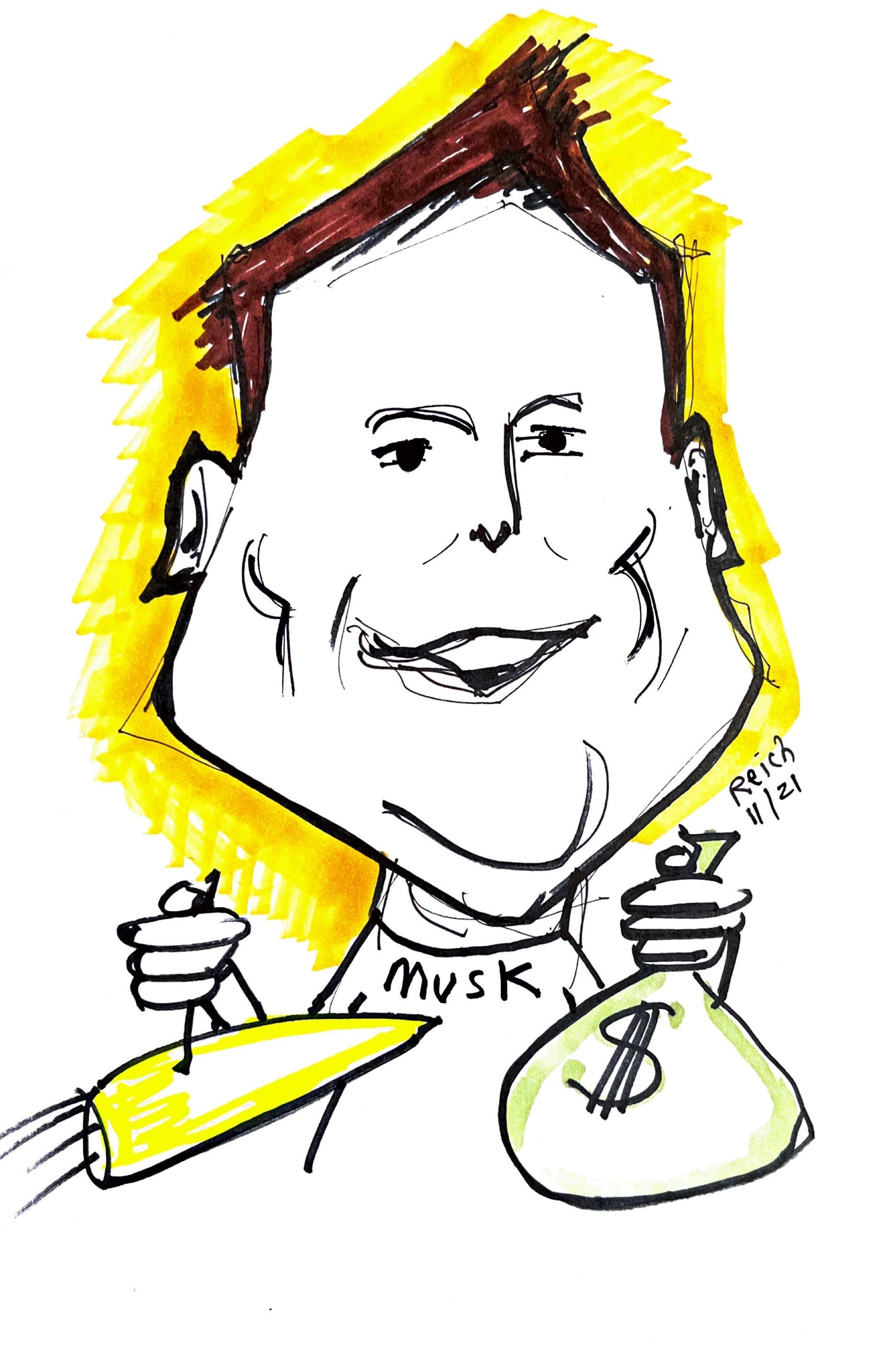
Defund Musk!

Exhibit A

Friends,

He’s Exhibit A on why billionaire wealth should be taxed, why we have to get big money out of politics, why billionaires shouldn’t be allowed to buy up major media, and why our government shouldn’t give them huge military contracts.

I’m talking about Elon Musk, of course.

Yesterday, former Ukrainian defense minister Mykhailo Fedorov thanked Musk for restoring his Starlink satellite’s vital high-speed connectivity: “Thank you, @elonmusk. We hope for your continued support.” (Connectivity had slowed after Musk posted Saturday that “Zelensky has gone too far.”)

But who gave Musk authority to slow his satellite service in the first place — or, for that matter, to publicly comment on Ukraine President Zelensky? (Musk says Starshield systems are owned and controlled by the US government, and that “any limits on speed or usage are decided by the US military and ultimately POTUS.” But if that’s the case, why did Fedorov thank Musk?)

Every time I list another of Musk’s outrages, someone says, “Yes, but he’s an innovator!”

He’s not. As is made clear in Alex Gibney’s smart new documentary, “Musk,” Elon didn’t invent Tesla. He didn’t invent X. He didn’t invent SpaceX. He didn’t invent Starlink satellites. He didn’t invent squat.

Musk is to innovation what Trump is to governing. Both are conmen. Both are megalomaniacs. Both love authoritarians and detest democracy. Both are racist and misogynistic. Neither believes in (or harbors an ounce of) empathy toward anyone. Both think nothing of corrupting governments for personal gain. Both say they’re self-made men — and both worship their creators.

Both spout bigoted filth all hours of the day and night to hundreds of millions of people.

Okay, let me just say it out loud: Both Musk and Trump are loathsome human beings.

Someday historians will come up with an explanation of how two such awful people could have become the two most powerful people in America if not the world (what was there about America in the early 21st century?).

But for now the goal of sane people must be to defund both of them and get them as far away from politics as possible.

That will be difficult, to be sure. Musk has so far sunk roughly $366 million into the 2026 midterm election cycle, $276 million of it since July — all ​to help Republicans retain control of Congress. That makes him the largest single known donor in the entire midterm elections. And he’s aiming to collect a lot of quid pro quos.

Hell, he spent a quarter of a billion dollars in 2024 to help Trump win reelection and was rewarded by Trump with access to every bit of data the U.S. government keeps on every one of us, along with billions of dollars’ worth of no-bid contracts with the Pentagon. (His Starlink satellite system is now key to the military strategy of the United States as well as that of Ukraine.) He was also rewarded with a chain saw inaptly named “Department of Government Efficiency,” which he used to destroy U.S.A.I.D. and slash other government agencies he doesn’t like.

In the last few months Musk has given at least $10 million to a Texas super PAC seeking to elect Republican Ken Paxton to the Senate, despite (or is it because of?) Paxton’s long record of ethical lapses, legal controversies, and official misconduct. Musk’s businesses are headquartered in Texas, so he needs to buy friends there.

On Sunday, Musk pushed the false story to his 242 million followers on X that James Talarico, Paxton’s Democratic opponent, was absent from the campaign trail because he had suffered a mental breakdown and was receiving counseling at the Lindner Center of Hope, a mental health center in Ohio.

Musk’s story has been thoroughly debunked. Security camera footage shows Talarico at home, not at an Ohio mental health facility. (Meanwhile, according to The Wall Street Journal, on New Year’s Eve 2024, Paxton partied in Dubai with his extramarital girlfriend and two fugitives from charges of over $300 million in healthcare fraud in the U.S. One of the men donated $190,000 to Paxton, $25,000 of it after he was indicted.)

The project of defunding Musk will probably have to wait until after January 20, 2029, when, let’s pray, we have a sane administration in Washington that will end all government contracts with him (his support for right-wing extremists around the world makes him a security risk), bust up his monopolies (a reinvigorated Federal Trade Commission and Federal Communications Commission will see to it), and impose a significant wealth tax on him.

But you don’t have to wait until then. Stop buying Teslas. Don’t use X. Don’t sign up for Starlink. And support politicians who promise to defund him.

Oh, and what about deporting him? Hmmm. Didn’t he lack proper work authorization during his student-to-entrepreneur transition time in the mid-1990s?

Share

  •  

Office Hours: What’s his “October Surprise”?

Friends,

Last week, Trump predicted “big surprises” ahead of the midterm elections. During an appearance last Wednesday in Maryland, Trump turned to Russell Vought, the director of the Office of Management and Budget, and stated, “We have some big surprises coming up in another few weeks, right Russ?” without specifying further — thereby teasing the prospect of a big measure later in October.

I’ve asked a number of political advisers, economists, and Trump-watchers what they think Trump has in mind. I’ve grouped their responses below. Please choose one that best matches your sense of Trump’s most likely “October surprise.”

Read more

  •  

The Plot to Remove Him

Friends,

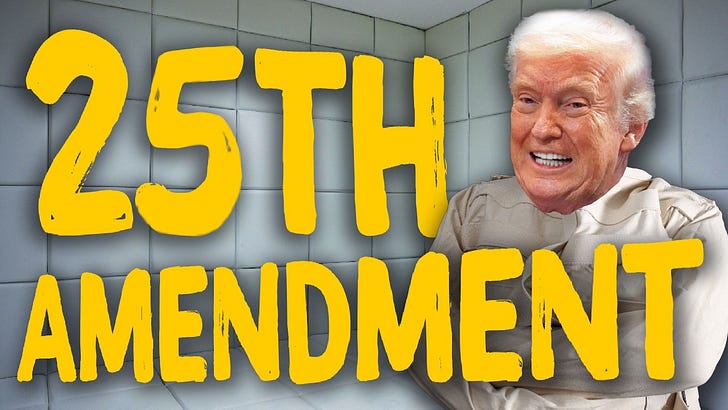
I keep hearing from political insiders that there’s a growing chance Trump will be removed from office soon after the midterms. See this:

It’s becoming apparent that Trump is becoming more demented by the day. He can’t be trusted to do the job — which is why Congress ratified the 25th Amendment to the U.S. Constitution, section 4 of which reads:

“Whenever the Vice President and a majority of either the principal officers of the executive departments or of such other body as Congress may by law provide, transmit to the President pro tempore of the Senate and the Speaker of the House of Representatives their written declaration that the President is unable to discharge the powers and duties of his office, the Vice President shall immediately assume the pwers and duties of the. office as Acting President.”

As you see, even if Trump’s cabinet lapdogs won’t declare he’s unable, Congress may set up a “body” to decide it.

As the above video makes clear, there’s ample reason to believe this is already in the works.

Share

  •  

Pluralistic: Bundestrojaner (13 Oct 2026)


Today's links

  • Bundestrojaner: You can't make people more secure by making them less secure.
  • Hey look at this: Delights to delectate.
  • Object permanence: 9/11 sitcom; Jon Norman v Philcon; Bruce Sterling's post-9/11 geopolitics; Polaroid bankrupt; David Mamet x Shel Silverstein; "Great Big Beautiful Tomorrow"; Canadian government calls abortion doctors "terrorists"; Shanghai Ikea kicks out lonely, loitering seniors; Black Panther self-care.
  • Upcoming appearances: Paris, Vancouver, Victoria, Ottawa, Vienna, Kilkenny, Oxford, Sheffield, Oxford, Montreal.
  • Recent appearances: Where I've been.
  • Latest books: You keep readin' em, I'll keep writin' 'em.
  • Upcoming books: Like I said, I'll keep writin' 'em.
  • Colophon: All the rest.


A moody, silhouetted Trojan horse, with a glowing horse skeleton partially visible inside it. It is acrawl with 1950s pulp robots. It stands in a psychedelic mist, through which peek vivid, brightly colored flowers.

Bundestrojaner (permalink)

Every morning, I revisit my blog headlines from this date, going back 25 years, 20 years, 15 years, 10 years, 5 years, and one year. I publish the most interesting ones in a section of my newsletter that I call "object permanence," and I think it's the most useful part of my day.

"Object permanence," of course, is a reference to the stage in an infant's development when they acquire the ability to connect events in the past to events in the present, which is why it's the point at which babies cease to be amazed by peek-a-boo. I've been blogging for more than a quarter century, and these daily trawls through the things I considered important enough to share are an unexpectedly powerful way to connect the events of the past to the events of the present.

Take cybersecurity, a subject that is filling today's headlines, primarily due to a spate of poorly understood (and criminally poorly explained) incidents in which AI companies' hacking tools broke into various servers on the internet, sometimes trashing them:

https://pluralistic.net/2026/09/12/god-in-the-box/#llms-are-fake

In my discussions of this subject, I've been at pains to tease apart two different aspects of these incidents: first, that it's wrong to speak of bots "going rogue" here (they're doing what they're designed to do); but second, that the alarming thing about these incidents is that they illustrate how deeply unserious our approach to information security has been, and remains.

This is important context, and context is what gives us the object permanence we need to both understand and address real problems, like the two related facts that a) our IT systems are poorly constructed and indifferently maintained; and b) the people who are supposed to be fixing this keep making it worse.

The worst culprits here are governments, though the private sector is also terrible (in truth, our cybersecurity nightmare is something of a private-public partnership from hell). Governments are deeply compromised when it comes to digital security because they have an irreconcilable conflict of interest: on the one hand, they want to defend their countries' administrative systems, firms and households from digital attacks. But on the other hand, they really want to be able to launch attacks on their adversaries, both foreign and domestic.

Worse: because governments don't know who those adversaries might be (or might become at some later date), the state security apparatuses of the world's governments keep insisting that all working computer security must be dismantled, so they can spy on all of us in order to figure out whom among us is a Bad Guy, and then "travel back in time" through each newly discovered "bad guy's" communications to identify their confederates and detail their nefarious plots.

This is an old, old, old fight. It was arguably the first policy fight of the digital era: the fight over whether we could have working encryption at all. Old hands call this era "the crypto wars" (from when "crypto" meant "cryptography"), when the NSA classed working encryption code as a "munition" and criminalized civilian access to it. That was a very hard-fought fight, and it was won decisively by the Electronic Frontier Foundation and our just-retired executive director Cindy Cohn, who, as a young lawyer, litigated the "Bernstein case" that established that code was a form of expressive speech protected by the First Amendment. If you're interested in learning more about this, you should read Cindy's newly published memoir, Privacy's Defender (all profits go to EFF):

https://mitpress.mit.edu/9780262051248/privacys-defender/

Before Cindy came on the scene, the crypto wars were being fought primarily by the "cypherpunks," a motley gang of computer security enthusiasts of many political stripes who were unified by their conviction that the most important aspect of security was defensive. The fact that the NSA wanted to be able to read the private messages and files of their adversaries (the "Four Horsemen of the Infocalypse": terrorists, drug traffickers, child pornographers and organized crime) must not be allowed to trump the fact that any encryption that the NSA could pierce could also be pierced by bad guys: corporate spies, state-sponsored spies, griefers, petty criminals, stalkers, identity thieves and other creeps.

This argument was so indisputable, it's a tautology: "You cannot make a computer user more secure by making their computers less secure." We don't know how to make a computer that only "good guys" can break into, but which "bad guys" bounce off of. Either we make computers more secure, or we don't.

We didn't.

In the decades since the crypto wars, governments have embarked upon an uninterrupted program to weaken the security of our computers, with catastrophic effect. The most spectacular example is unquestionably the spy agencies' doctrine called "NOBUS," which stands for "no one but us"; as in "No one but us is smart enough to find this bug, which means that we can withhold its discovery from the manufacturer, which will allow us to weaponize this bug and use it to attack our enemies. Because no one but us is smart enough to find this bug, none of those enemies will ever discover it, weaponize it, and use it to attack the people who pay our salaries, who expect us to keep them safe."

This turns out to be both catastrophically wrong and catastrophically dangerous. A series of leaks of computer vulnerabilities hoarded by both the NSA and CIA under NOBUS confirmed that these bugs were independently rediscovered by criminals and state actors at the rate of about 20% per year. Worse, though, is that these bugs don't need to be independently rediscovered, because the NSA and CIA both leaked them.

The highest-profile leak was an NSA-hoarded vulnerability in Windows they codenamed "Eternal Blue." Eternal Blue leaked in 2017, whereupon cybercriminals hybridized it with some otherwise undistinguished ransomware to create Wannacry, a devastating piece of malware that took down hospitals, banks and oil pipelines, as well as the entire city government of Baltimore and the British Library:

https://cdn.sanity.io/files/v5dwkion/production/99206a2d1e9f07b35712b78f7d75fbb09560c08d.pdf

But NOBUS isn't the only example of spy agencies making our computers less secure in the name of making us more secure. Perhaps the most egregious example of that are the Bundestrojaners, malicious software purchased by the German government, whose customs agents secretly installed it on the computers of unsuspecting people during border inspections. This "lawful interception" software was hugely invasive: it could grab your screen, plunder your hard drive, and install and execute software on your computer, all with the utmost stealth, intended to keep you from knowing it was installed and operating on your computer. But it wasn't merely invasive – it was insecure, so anyone (rival spies, criminals, stalkers) could scan the internet for infected computers and take them over:

https://www.ccc.de/en/updates/2011/staatstrojaner

You really couldn't ask for a more perfect example of the maxim that you can't make computer users more secure by making their computers less secure. Despite this, governments continue to demand the introduction of grave, universal secure vulnerabilities into our digital lives. Take "chat control," a proposal to force every device manufacturer to install software that continuously scans your devices for child sex abuse material (AKA "child porn"):

https://www.eff.org/deeplinks/2026/04/eu-parliament-blocks-mass-scanning-our-chats-whats-next

There are plenty of things wrong with this, starting with the fact that it requires your device to secretly grab and transmit sensitive images from your phone, which might include sensitive images of your kids that were requested by their doctors. This isn't a hypothetical: it's something that happened to a dad who subsequently lost his email, his login to every other account, his phone number, all of his files (including his tax records and his business data), and every photo he had ever taken of his family, without appeal, after Google automatically detected a photo he took of his son to send to the family pediatrician. Google also falsely accused this man of sexually abusing his child and sicced the SFPD on him:

https://pluralistic.net/2022/08/22/allopathic-risk/#snitches-get-stitches

But even if you're not worried about this, you should still have the object permanence to recall the lessons of NOBUS and the Bundestrojaner. We can't make computer users more secure by making their computers less secure, and it's hard to imagine something more insecure than a computer that you entrust with every sensitive detail of your life that is designed to run computer code in secret that you can neither inspect nor terminate (let alone delete).

Hardly a day goes by without some country demanding that your computer's security be weakened in the name of protecting you. For years, both Conservative and Labour UK governments have been steaming towards a total ban on working encryption in the name of catching bad guys:

https://pluralistic.net/2023/03/05/theyre-still-trying-to-ban-cryptography/

It's happening in Canada, too, where somehow "digital sovereignty" means "making every device used in Canada vulnerable to foreign spies so that our own spies can access our private communications":

https://www.eff.org/deeplinks/2026/05/canadas-bill-c-22-repackaged-version-last-years-surveillance-nightmare

Then there's the "age verification" laws proliferating all around the world. Remember, there's no such thing as "age verification," there's only "spying on everyone, all the time, to figure out who the kids are":

https://pluralistic.net/2026/06/23/destroy-the-village/#to-save-it

Age verification requires multiple entities to assemble vast corpuses of the kinds of sensitive identification papers that would allow identity thieves to destroy the finances and lives of everyone in the country, and (as foretold) every time it's tried, these files leak. Someday, this will lead to doxing whole countries:

https://arstechnica.com/tech-policy/2026/02/discord-faces-backlash-over-age-checks-after-data-breach-exposed-70000-ids/

Age verification is the latest and worst stage in governments' fraught relationship with private sector data-collection. The USA is the worst offender here: it is the largest, richest country in the world that has essentially no privacy protections. The last time the US updated its federal privacy law was in 1988, when the Video Privacy Protection Act banned the disclosure of your VHS rentals. Tech companies spy on you for the same reason your dog licks its balls – because they can, and no one stops them:

https://pluralistic.net/2026/03/10/ice-tech/#foreseeable-outcomes

Which raises an obvious question: why hasn't Congress updated privacy law? And why hasn't the EU figured out how to force the US companies that pretend to be Irish to obey European privacy law? The answer is that governments love private sector data-collection, because it gives them a cheap, off-the-books source of warrantless access to information they aren't legally allowed to acquire:

https://pluralistic.net/2021/04/13/public-interest-pharma/#axciom

From Flock cameras to ICE's use of Google data in its ethnic cleansing campaign, the US government and the commercial surveillance industry have created a public-private partnership from hell, where governments refuse to block commercial spying and companies hand their commercial surveillance data over to governments in return.

From there, it was a short leap to governments insisting that the private sector gather our data. That's the right way to think about age verification, chat control, and other mandates for corporations to spy on us using our devices and our accounts: a government requirement for private-sector mass surveillance.

I have plenty of hostility to corporate overreach, but to have any hope of fighting that overreach, we need governments to be on our side. But for our governments, when it comes to cybersecurity, we are the enemy, and spying corporations are our governments' allies.

Sometimes, that's utterly, literally true. Governments around the world are addicted to buying spyware from cyber-arms dealers, mostly headquartered in Israel and the UAE (with the odd Italian and British company for variety). These arms-dealers practice NOBUS-by-proxy, wherein they discover or pay bounties for bugs in widely used hardware, operating systems and applications and – rather than reporting them to the manufacturer – hoard them and weaponize them, and then sell the weapons to criminals, corporations, and our governments, who give them billions of our money to ensure that our computers have huge, glaring defects in them that leave us terribly vulnerable:

https://citizenlab.ca/focus-area/targeted-surveillance/

In a world where our governments' national security apparatuses were genuinely committed to our safety and security, they would criminally prosecute these companies, not make their owners into billionaires.

This is the context we should all be thinking about when it comes to these "rogue AI hacking agents." The IT systems that these irresponsibly deployed software products have trashed were already terrifyingly vulnerable…by design. Rather than fix these systems, our governmental "security" agencies have spent the past 40 years making them less secure, in order to make it easier for them to catch "bad guys," who now find it trivial to attack us through systems we are all totally reliant upon.

In every way, in every area of law, governments fail to take our security seriously. That even includes copyright law. All over the world, the US Trade Representative has ensured that every country has an "anti-circumvention" law that makes it a crime to reverse-engineer and modify software without permission:

https://pluralistic.net/2026/01/01/39c3/#the-new-coalition

From the very start, these have been a security nightmare. Remember the "Sony Rootkit?" Between 2005-2007, Sony-BMG Music distributed over 6m CDs that were deliberately infected with a piece of malicious software called a "rootkit" that was used to disable your computer's ability to rip (copy) music CDs.

The way this rootkit did so was depraved in its indifference to the security of Sony-BMG's customers: at the same time as Sony-BMG's malware installed its secret anti-ripping program, it also altered their computers' operating systems to make them incapable of detecting any program or file whose name started with $SYS$. Immediately, malicious software authors started adding $SYS$ to the start of all their filenames, and that malicious software was therefore undetectable to millions of users' computers. It was even invisible to anti-virus software. Worse: Sony-BMG's rootkit infected 200,000-300,000 US government and military networks:

https://www.schneier.com/blog/archives/2005/11/sonys_drm_rootk.html

Even worse: after the scandal broke, security researchers all over the world came forward to say that they'd discovered the Sony Rootkit months before it became common knowledge, but their lawyers had told them they weren't allowed to disclose its existence because doing so would fall afoul of anti-circumvention law. For months, this official, deliberate malware epidemic spread in secret because of anti-circumvention law.

It's been more than 20 years since the Sony Rootkit, and anti-circumvention law is now worse than it was in the oughts: now it applies to far more devices from far more vendors. Today, it's common for corporations to threaten their own customers with civil and criminal liability if they have the temerity to hire outside auditors to evaluate the software they entrust their businesses to for security defects. And oh God, it's even worse, because the worst offender is Oracle, who are now the de facto IT czars of America:

https://arstechnica.com/information-technology/2015/08/oracle-security-chief-to-customers-stop-checking-our-code-for-vulnerabilities/

I'm not saying that these are the only problems with our IT security. What I am saying is that the hacking bots everyone's freaking out about didn't appear out of nowhere. If you have just a little object permanence, you can see that they are the terminal stage of a pathology that governments have only ever worsened: by hoarding and weaponizing vulnerabilities; by paying others to hoard and weaponize vulnerabilities; by criminalizing security audits; by insisting that every computer we rely on be equipped with deliberate vulnerabilities in software we can't inspect, terminate or delete.

Yeah, there should be criminal and civil liability for OpenAI, Amazon, Anthropic and every other company whose bots "went rogue" and attacked servers. But that will do nothing to fix our IT.

The table-stakes for a secure digital world are: public agencies that try to make our computers as secure as possible, including by administering the corporate death-penalty to any company that hoards and weaponizes information about bugs in our computer. We should protect and reward individuals and firms who come forward with true disclosures about bugs in systems we rely upon. We should not give companies the right to silence and punish those critics who want to warn us about their defective products. And we should not require that companies make us less secure in the name of making it easier for spies and cops to catch the bad guys.

(Image: Pmk58, CC BY-SA 4.0; Wikipedian Prolific, CC BY-SA 3.0; modified)


Hey look at this (permalink)


A shelf of leatherbound history books with a gilt-stamped series title, 'The World's Famous Events.'

Object permanence (permalink)

#25yrsago CBS sitcom about couple who meet in the WTC rubble https://web.archive.org/web/20011014082646/http://dailynews.yahoo.com/h/eo/20011012/en/cbs_considers_wtc_comedy_1.html

#25yrsago Jon Norman not invited to Philcon https://www.locusmag.com/2001/Departments/Letters10Norman.html

#25yrsago Bruce Sterling's post-9/11 geopolitics predictions https://web.archive.org/web/20011102212150/https://www.edge.org/documents/whatnow/whatnow_sterling.html

#25yrsago Polaroid files Chapter 11 https://web.archive.org/web/20011107181428/http://www.polaroid.com/polinfo/press_releases/october01/101201a.html

#25yrsago David Mamet's tribute to Shel Silverstein https://www.nytimes.com/2001/10/14/theater/theater-a-beloved-friend-who-lived-life-the-chicago-way.html

#15yrago Great Big Beautiful Tomorrow: a chapbook in PM Press’s Outspoken Authors series https://craphound.com/category/gbbt/

#15yrsago Canadian government advice defines abortionists as terrorists https://www.jezebel.com/canadian-government-lists-abortionists-as-terrorists-u-5849963

#10yrsago Ikea Shanghai to elderly, lonely Chinese people: buy something or get out https://qz.com/806990/lonely-shanghai-seniors-now-have-to-buy-something-if-they-want-to-cruise-all-day-in-ikeas-cafeteria

#5yrsago Facebook shows mall ninja gear ads on insurrection articles https://pluralistic.net/2021/01/14/10-point-program/#monetizing

#5yrsago The Black Panther self-care method https://pluralistic.net/2021/01/14/10-point-program/#panthers


Upcoming appearances (permalink)

A photo of me onstage, giving a speech, pounding the podium.


A screenshot of me at my desk, doing a livecast.

Recent appearances (permalink)


A grid of my books with Will Stahle covers..

Latest books (permalink)


A cardboard book box with the Macmillan logo.

Upcoming books (permalink)

  • "The Post-American Internet," a geopolitical sequel of sorts to Enshittification, Farrar, Straus and Giroux, 2027
  • "Unauthorized Bread": a middle-grades graphic novel adapted from my novella about refugees, toasters and DRM, FirstSecond, April 20, 2027

  • "Enshittification, Why Everything Suddenly Got Worse and What to Do About It" (the graphic novel), Firstsecond, 2027

  • "The Memex Method," Farrar, Straus, Giroux, 2027


Colophon (permalink)

Today's top sources:

Currently writing:

  • “Once Is Enemy Action,” a science fiction novel about the origins of modern technofascism. Today's words: 574 (7730 total).
  • "The Post-American Internet," a sequel to "Enshittification," about the better world the rest of us get to have now that Trump has torched America. Fourth draft completed. Submitted to editor.

  • A Little Brother short story about DIY insulin PLANNING


This work – excluding any serialized fiction – is licensed under a Creative Commons Attribution 4.0 license. That means you can use it any way you like, including commercially, provided that you attribute it to me, Cory Doctorow, and include a link to pluralistic.net.

https://creativecommons.org/licenses/by/4.0/

Quotations and images are not included in this license; they are included either under a limitation or exception to copyright, or on the basis of a separate license. Please exercise caution.


How to get Pluralistic:

Blog (no ads, tracking, or data-collection):

Pluralistic.net

Newsletter (no ads, tracking, or data-collection):

https://pluralistic.net/plura-list

Mastodon (no ads, tracking, or data-collection):

https://mamot.fr/@pluralistic

Bluesky (no ads, possible tracking and data-collection):

https://bsky.app/profile/doctorow.pluralistic.net

Medium (no ads, paywalled):

https://doctorow.medium.com/

Tumblr (mass-scale, unrestricted, third-party surveillance and advertising):

https://mostlysignssomeportents.tumblr.com/tagged/pluralistic

"When life gives you SARS, you make sarsaparilla" -Joey "Accordion Guy" DeVilla

READ CAREFULLY: By reading this, you agree, on behalf of your employer, to release me from all obligations and waivers arising from any and all NON-NEGOTIATED agreements, licenses, terms-of-service, shrinkwrap, clickwrap, browsewrap, confidentiality, non-disclosure, non-compete and acceptable use policies ("BOGUS AGREEMENTS") that I have entered into with your employer, its partners, licensors, agents and assigns, in perpetuity, without prejudice to my ongoing rights and privileges. You further represent that you have the authority to release me from any BOGUS AGREEMENTS on behalf of your employer.

ISSN: 3066-764X

  •  

The Twin Evils: Unaffordability and Corruption

Friends,

In these last weeks before the midterms, Democratic candidates have been gaining ground by talking about two things: the affordability crisis and political corruption.

If Democrats regain control of Congress and genuinely want to respond to affordability, they’ll need to do everything possible to root out the corruption.

The two are inseparable. In large part, prices are rising faster than paychecks because so much of the economy has become subject to political bribery, Trump Republican pay-to-play schemes, and kickbacks to Trump and his cronies.

1. Trump’s war and the corruption underlying it

Trump’s war on Iran is causing Americans to spend almost 50 percent more on gas than before the war, on average. And the diesel fuel needed to transport almost everything else we buy now averages more than $6.00 a gallon, which is also being passed on to consumers.

These price increases due to Trump’s war tell only half the story. The other half is the political corruption at the root of the war — enriching Trump’s friends and family.

The war has been a huge windfall for Big Tech supplying the military — such as Palantir, a core artificial intelligence and data-integration partner for the U.S. Department of Defense, founded by Trump and JD Vance’s buddy Peter Thiel, and Elon Musk.

Musk’s SpaceX reportedly quintupled its connection fees for the Pentagon, from $5,000 per terminal to $25,000 per terminal for terminals integrated into U.S. “kamikaze” (LUCAS) drones deployed in the conflict.

Not incidentally, Musk has quietly funneled more than $275 million to Republican candidates in the midterms, making him by far the largest single donor to either party.

Meanwhile, investment companies backed by Donald Trump Jr. and Eric Trump have accumulated billions in Pentagon contracts and future contract options, according to the government’s official contract reporting. (Congressional Democrats continue to demand that the Pentagon’s inspector general investigate the approved deals.)

2. Trump’s tariffs and the corruption beneath them

Trump’s tariffs offer another example of higher prices connected to corruption. The tariffs are import taxes that have increased annual household costs by an estimated $1,100, according to The Budget Lab at Yale.

Again, though, the price increases tell only half the story.

Trump’s tariffs have enabled Trump to give out tariff waivers and carve-outs to industries and companies that do him favors.

After Tim Cook, Apple’s CEO, donated $1 million to Trump’s inauguration and promised major domestic investments, Apple got tariff exemptions for imported smartphones, computers, semiconductors, and flat panel displays, all of which saved Apple huge amounts of money.

After Elon Musk sank a quarter of a billion dollars into Trump’s 2024 campaign, Tesla got a tariff exemption for electronics.

Reyes Holdings, a bottler that ranks among the largest privately held companies in the U.S. and is owned by brothers who have donated millions to Republicans, got a tariff exemption for polyethylene terephthalate, used to make plastic bottles. And so on.

3. Trump’s promotion of AI and the corruption underlying it

A third example linking higher prices to corruption is artificial intelligence. Together with the costs of Trump’s war in Iran, AI’s borrowing of over $500 billion so far this year has contributed to sky-high interest rates on mortgages, auto loans, and credit-card overdrafts. And AI data centers are raising electricity prices in areas where data centers are sucking up energy.

As with the war and the tariffs, Trump’s support for AI is tied to political payoffs. Tech companies and their executives donated over $300 million to support Trump’s 2024 reelection efforts and MAGA ​Inc, the political action committee aligned with Trump. (This doesn’t include Musk’s more than a quarter billion dollars in donations to Republicans.)

According to a CNBC analysis of FEC records, megadonor contributions from AI, crypto, and online gambling executives have overwhelmingly favored Republicans, with 14 of the 20 largest donor groups nearly exclusively backing GOP candidates or outside groups.

To see how Trump’s war, his tariffs, and his support for AI interact on prices, consider housing affordability, which is among voters’ top concerns.

While Trump’s war and encouragement of AI have contributed to the average 30-year fixed mortgage rate rising to over 7 percent, Trump’s tariffs have caused the prices of lumber and building materials to soar. The National Association of Home Builders estimates that tariffs on lumber and building materials have added $10,900 to the cost of constructing a new U.S. single-family home.

The price of copper, a key material for electrical wiring in residential and commercial construction, has risen 40 percent in the past year due to Trump’s tariffs and the demands of data centers — adding even more cost to building a typical home, which requires hundreds of pounds of copper.

4. Trump’s giant tax cut for the rich and the corruption it rests on

A final illustration of the close connection between rising prices and corruption is Trump’s tax cuts. Trump’s megadonors in the 2024 campaign demanded another big tax cut as a condition for their investments, which came in the form of Trump’s “Big Beautiful” (Big Ugly) bill.

But the tax cuts have come at the expense of healthcare for average Americans.

To pay for the tax cuts demanded by their largest donors, Trump and congressional Republicans have slashed Medicaid and failed to renew healthcare tax credits. As a result, millions of Americans are now forced to spend far more for health insurance coverage or do without it altogether.

5. The Democrats’ agenda if they retake control of Congress

If Democrats regain control of Congress, they will need to focus not only on alleviating high prices but also on eliminating the causes of those high prices. It will be impossible to do the former without attacking the latter.

In addition to ending Trump’s war and his arbitrary tariffs, they must reform campaign financing, and help reduce the influence of big money in politics. One method would be to match public financing with small-dollar donations.

They’ll also need to resurrect the systems of accountability Trump has dismantled —the independent civil service, independent inspectors general, the Office of Government Ethics, and the Federal Election Commission.

Under Trump and his Republican enablers, the richest Americans and biggest corporations have made out like bandits. Average working Americans are paying dearly for what the bandits have stolen. The grift and the graft must end.

***

PS: Today I’m joining Bernie Sanders, Stacey Abrams, Paul Krugman, Naomi Klein, Mehdi Hasan, Rebecca Solnit and others for “How We Win,” a weekly Guardian newsletter about defeating Trumpism. Sign up here for bold ideas to build a better future.

  •  

Trump and Vance’s Islamophobic Target

Friends,

Sorry to intrude on your inbox again today, but I wanted to bring your attention to Monday’s raid by federal agents on the Washington-area home of Rep. Ilhan Omar — three weeks before she faces reelection to Minnesota’s 5th Congressional District.

The raid reportedly concerns Omar’s immigration history, including allegations of fraud that she has repeatedly denied.

Omar accuses the Trump regime of weaponizing law enforcement against a political opponent:

“Make no mistake: this is an attempt to target political enemies and weaponize federal law enforcement. For ten years, Trump has targeted me with baseless lies and smear campaigns. This is just the latest escalation in his campaign of political intimidation. I will not be silenced.”

Months ago, Trump called Omar — a Somali-born Muslim who became a U.S. citizen and was elected to Congress in 2018 — “garbage.” He said she shouldn’t be allowed to be a congresswoman and stood by as his supporters chanted to “send her back” to her native Somalia.

This past weekend — before Monday’s raid — Trump renewed his attacks on Omar. “She comes from Somalia,” Trump said, where “they don’t have a government, they don’t have police, all they have is crime and squalor.” He continued:

“She comes into our country and she says ‘my Constitution allows me.’ She’s talking about our Constitution. What they’ve done to Minnesota, these people from Somalia, should never be allowed.”

Let me remind you that this is the president of the United States mouthing this bigoted, racist, nationalistic filth.

In this weekend’s rant, Trump also stated that “JD Vance and our people are looking at it” — referring to Omar.

After the raid on her home, Trump said he has “always found [Omar] to be totally crooked” and called her “a terrible person.”

JD Vance has previously accused Omar of immigration fraud without providing any evidence. In March, Vance reiterated that claim, which he said he had discussed with White House senior aide Stephen Miller.

“We actually think that Ilhan Omar definitely committed immigration fraud,” Vance told a conservative podcaster. The next step, he said, was to figure out how to “build a case.”

In a democracy, the highest officials of one party do not “build cases” to pursue legislators from the opposing party.

Nor do they investigate their political opponents within days of an election, in violation of explicit Department of Justice rules.

The Department of Justice guidance for protecting election integrity explicitly states that the department should not engage in investigative measures that might “chill legitimate voting and campaign activities” or “interject an investigation itself into ongoing campaigns.”

The Justice Manual further states that federal prosecutors and agents “may never select the timing” of investigative steps, charges, or public statements for the purpose of affecting an election or giving an advantage or disadvantage to a candidate or political party.

Election-year guidance dating back to at least 2008 has emphasized that “politics must play no role” in investigative or charging decisions and that prosecutors should exercise particular caution close to elections.

If Democrats regain control of the House, they must investigate this flagrant abuse of power by Trump, Vance, and the Department of Justice.

In the meantime, you might consider making a contribution to Ilhan Omar’s campaign, here. And if you’re able to volunteer for her campaign, do so here.

Share

  •  

“Wealth and Poverty” Class 4: Why your income increasingly depends on where you live

Good morning, friends,

This week’s Class 4 explores why geographic segregation by income, wealth, and race has been on the rise.

In case you missed them, here are the classes that have been released so far: Class 1, Class 2, Class 3.

For Class 4, just double-click on the video below, and you’re in the fourth week of class.

Some background:

Inequalities that depend on where you live are widening in particularly divisive ways.

To be rich in today’s America means never having to come into contact with anyone who isn’t. To be poor in today’s America means being trapped on islands of poverty from which escape has become more and more difficult.

The questions we’ll focus on today:

  • Why is it becoming easier for the wealthier to segregate from the poorer within a nation?

  • What forms does this segregation take in addition to geographic?

  • What are the consequences?

  • Is this much different from a nation as a whole cutting itself off from others around the world who are poorer?

Thanks for joining me!

Recommended Readings:

For a full list of readings and the student handout for today’s class, you can visit the course website here.

Subscribe now

Share

Leave a comment


A huge thanks to the Wealth and Poverty team — to Michael Lahanas-Calderón, Kyle Parker, Dan Davis, and Emmett Tjen — as well as Coro Fellows Ammar Ansari and Meagan Turner for preparing these course materials to be shared with all of you. And to Heather Kinlaw Lofthouse for making all this happen on this page.

  •  

Pluralistic: How labor rights rescued Ultima from a monopolist (12 Oct 2026)


Today's links

  • How labor rights rescued Ultima from a monopolist: If you care about labor justice and artists' rights, stop focusing on copyright.
  • Hey look at this: Delights to delectate.
  • Object permanence: China unblocks Wikipedia; CCC cracks the Bundestrojaner; "Children of the Sky"; "Messy"; Every top Icelandic banker is guilty; Climate activism x digital activism; Gene Kan on P2P's future; Larry Ellison x mass surveillance; W3C v patents; "Work from home" in the cybercrime supply-chain; "Nursery Rhyme Comics"; Glitchy tea-set; Tourist Guy; Vista v reinstallation; Ryanair v your bladder; Wells Fargo CEO loves "sales culture"; "Attention Merchants"; Orban v free press; AI v GIGO; Dylan wins the Nobel; India's starving kids app; Adobe's spyware copyfraud; Charter blackmails customers with bad credit threats; Fix UK housing.
  • Upcoming appearances: Paris, Vancouver, Victoria, Ottawa, Kilkenny, Sheffield, Oxford, Montreal.
  • Recent appearances: Where I've been.
  • Latest books: You keep readin' em, I'll keep writin' 'em.
  • Upcoming books: Like I said, I'll keep writin' 'em.
  • Colophon: All the rest.


A heavy, medieval, ornate brass door with a lion's head in the center and a handle carved as an elaborate winged figure. The lion's eyes have been replaced with dizzy spirals. The head of the winged figure on the handle has been replaced with an 8-bit Ultima avatar's head. The handle center and ring have been altered to add a series of copyright symbols to them. The trim of the door has been worked with the Ultima Online logo. A keyhole set beneath the handle shows a distant pixelated lich sprite from an early Ultima game.

How labor rights rescued Ultima from a monopolist (permalink)

If you work in the media, you have doubtless had a lifetime of encouragement to treat copyright as your primary source of economic protection, and doubtless you've been told that this protection arises from the fact that copyright is a property right – specifically, it's a subspecies of "intellectual property":

https://locusmag.com/feature/cory-doctorow-ip/

Property rights are capitalism's holy sacrament, so of course, it's natural to treasure any property right you can lay claim to. But this is a trap. Creative workers aren't asset speculators, we're workers. When we bargain with a media company to sell them our copyright, we're just bargaining to sell our labor, not our property.

This is a distinction with a difference. Property rights are alienable. When you negotiate to sell your property to someone else, you propose to transfer the title to that property. If you sell your house, you don't get to move back in if you change your mind later. Sell your car, and you must not get in and drive it away.

Nominally, creative workers only bargain away some of their copyright, because copyright is also divisible. You can sell US English print rights to a novel, a one-month license to synch a song to an advertisement, or the right to display a painting for a year.

But here's the thing about property rights: the most reliable predictor of how many property rights you must give up in a sale isn't how many property rights you started with – it's how much bargaining power you have. For 50 years, governments have expanded copyright in every way, making it last longer, cover more works and restrict more uses, all backstopped by ever-steepening penalties. 50 years later, media companies – our bosses – are larger and more profitable than they've ever been, and we're poorer than we've ever been. The share of the money generated by our labor has declined, even as our rights over the product of that labor have expanded.

How to make sense of this? It's easy, once you factor in power. In a world of five publishers, four studios, three labels, two app companies and a single ebook/audiobook company, getting more copyright to bargain with just means getting more copyright to bargain away. When copyright's term expanded from "life plus 50 years" to "life plus 70 years," our bosses simply demanded the entirety of the new term, and didn't offer us a dime more.

This is the thesis of Chokepoint Capitalism, the book on Big Tech, Big Media, and creative labor markets Rebecca Giblin and I published in 2022:

https://www.beacon.org/Chokepoint-Capitalism-P2020.aspx

Chokepoint Capitalism is broken into two parts: the first half of the book is a series of pitiless, plain-language dissections of the baroque scams that media companies have used to make themselves richer from our work, from Spotify to Amazon to Livenation and beyond. From reader feedback, I can tell you that these chapters will make you very angry, because once you strip away all the deliberate obfuscation, all you're left with is one screw-job after another, each of which makes the creators you love poorer even as you pay more for their work.

But then there's the second half of the book. This section is devoted to "shovel-ready" policy solutions, each of which is designed to change the "distribution" of the spoils of the media industry, putting more money in workers' pockets at the expense of our bosses. None of these are things you can do as a "conscious consumer." The monopolistic destruction of creators' livelihoods is a systemic problem and you can't solve it by shopping better.

The point of these chapters is to lay out what we must demand from our policymakers when (inevitably), they propose to "solve" the problem of worsening straits for creative workers – and to help creative workers understand that when our bosses demand more copyright, that's not there to benefit us.

One of these systemic solutions is "termination of transfer," a simple and radical idea that has a proven track-record of making creative workers richer at our bosses' expense. Simply put, "termination of transfer" is the statutory right to void any contract you've signed to transfer your copyright to someone else. In the USA, the 1976 Copyright Act introduced a 35-year termination right. 35 years after you sign any copyright contract, you can file some paperwork with the US Copyright Office and get that copyright back, no matter what your contract says.

Now, most creative works don't have a commercial life after 35 years (very few works are commercially viable even after the original US copyright term of 14 years), but for those that do, termination of transfer is a reliable way to address the extremely common situation in which a creator signs away their rights for a low price, not knowing that it will become a lasting hit. Once you've scored that hit, you can probably get a better deal from your next work, but the deal for that hit is done and can't be altered.

Termination solves this. From The Babysitters Club to the early Stephen King novels to George Clinton's entire catalog, termination of transfer has put lots of money into creative workers' pockets at the expense of corporations that ripped them off at the start of their careers.

From the start, there was no question whether termination of transfer would make it into Chokepoint Capitalism. Rebecca is one of the world's leading experts on the subject, having co-authored the definitive study of termination:

https://pluralistic.net/2021/09/26/take-it-back/

In the book, we note that – unlike longer copyright terms – termination has a proven track record of putting groceries on creators' tables, braces on their kids' teeth, and a roof over their heads. We go over the legislative history of termination in the 1976 Act, noting that it was originally supposed to be automatic and kick in after just 20 years. If we want to make creative workers richer, changing the 35-year administrative right into an automatic 20-year termination right is a no-brainer amendment to copyright law.

How did an automatic right that kicked in after 20 years turn into a right you have to apply for after 35 years? Simple: our bosses hate termination. How much do they hate it? Well, take Mitch Glazier, the head of the Recording Industry Association of America, where he draws a $1.3m annual salary to represent the record labels.

Before Glazier got the RIAA gig, he was an obscure Congressional staffer, but he was forced out of the job after he snuck a clause into an otherwise unrelated bill that killed termination of transfer for recording artists. This was so outrageous that Congress actually convened a special session so they could rip out Glazier's amendment, and Glazier got a new job as a millionaire lobbyist for the recording industry:

https://pluralistic.net/2026/03/03/its-a-trap-2/#inheres-at-the-moment-of-fixation

Termination is hugely useful and quite radical. Last year saw Gary K Wolf, creator of the novel Who Censored Roger Rabbit? (later adapted by Disney as Who Framed Roger Rabbit?) claw back his rights to the book and its characters, in order to continue the series:

https://pluralistic.net/2025/11/18/im-not-bad/#im-just-drawn-that-way

In 2023, Bill Willingham terminated the transfer of his wildly successful graphic novel series Fables from DC and released the copyright into the public domain:

https://pluralistic.net/2023/09/15/fairy-use-tales/#sampling-license

And now, Richard Garriott, AKA "Lord British," has claimed back the rights to the groundbreaking Ultima series of computer role-playing games, which he sold to Electronic Arts in 1992:

https://www.videogameschronicle.com/news/richard-garriott-is-officially-regaining-control-of-the-ultima-series/

On the Techjess podcast, Garriott marveled at how easy the process was: "there’s a really weird United States copyright law that says if you are the original holder of a copyright and you assign it or sell it to any publisher or any other entity, after 35 years, you can just take it back":

https://www.youtube.com/watch?v=2El7VtPuSzs

EA killed off Ultima in 2000, and it has languished since, despite an ardent fandom. Garriott has vowed to reissue the old games and is mulling new ones.

All this brings me back to property rights. Property rights are uniquely unsuitable to this kind of arrangement. You don't get to move back into the house your parents sold 35 years ago, and if you did, the photographer who took the family portrait in the hallway wouldn't be allowed to break in and take it away 35 years after you sat for it.

Termination of transfer isn't an "IP right" – it's a labor right. It belongs to the large class of rights that are far more important and useful than mere property rights, such as privacy rights and human rights:

https://pluralistic.net/2026/09/28/cost-of-everything/#value-of-nothing

If copyright were just about property rights, then termination of transfer would be inconceivable. Termination is a vestigial labor right at the very periphery of copyright. It protects artists, and it can only do so because it is not a property right.

This is one of the themes in The Bezzle, my 2024 historical technothriller, starring my two-fisted forensic accountant hero Martin Hench who uses termination to help an artist claw back his rights from an unscrupulous former manager who forged his signature decades before (this plotline is based on the true story of Parliament/Funkadelic's George Clinton!):

https://craphound.com/bezzle/

If you signed away your rights 35 years ago and want to get them back, check out the Authors Alliance, a nonprofit whose advisory board I volunteer for. We produced a tool that automates all the hardest parts of terminating your transfers and getting your rights back:

https://www.authorsalliance.org/resources/termination-of-transfer/

Some of our most ardent fans are academics, whose publicly funded papers are published in journals dominated by a cartel of giant companies that do not pay the authors, nor the editors, nor the reviewers, but still claim all rights and charge the institutions that funded the research they publish tens of thousands of dollars per journal to access that research:

https://pluralistic.net/2024/08/16/the-public-sphere/#not-the-elsevier

But it's not just academics who have an interest in termination of transfer. It's video game authors, novelists, musicians – and maybe you, someday!

(Image: Reda Kerbouche, CC BY-SA 4.0; Thegreenj, CC BY-SA 3.0, modified)


Hey look at this (permalink)


A shelf of leatherbound history books with a gilt-stamped series title, 'The World's Famous Events.'

Object permanence (permalink)

#25yrsago Tourist Guy https://web.archive.org/web/20011009234007/http://www.touristofdeath.com/

#25yrsago Gene Kan on Open Web Services https://web.archive.org/web/20011031234135/http://www.openp2p.com/pub/a/p2p/2001/08/02/openservices.html

#25yrsago Larry Ellison wants to spy on everyone https://web.archive.org/web/20011206002725/http://www.oracle.com/corporate/index.html?digitalid_comp.html

#25yrsago W3C ponders patents in web standards https://lists.w3.org/Archives/Public/www-patentpolicy-comment/2001Oct/1488.html

#25yrsago Adobe updates the ebook reader that Syklarov cracked https://web.archive.org/web/20011107145015/http://www.vnunet.com/News/1126057

#20yrsago Hungarian airport proposes “nonremovable” RFIDs for every passenger http://news.bbc.co.uk/2/hi/technology/6044310.stm

#20yrsago China unblocks Wikipedia, even though it won’t censor https://web.archive.org/web/20061016133232/http://www.editorandpublisher.com/eandp/departments/online/article_display.jsp?vnu_content_id=1003251388

#20yrsago Eudora going open source, to be based on Thunderbird https://web.archive.org/web/20061014163143/http://www.qualcomm.com/press/releases/2006/061011_project_collaboration_mozilla.html

#20yrsago Vista license only lets you reinstall your OS on new PCs twice https://web.archive.org/web/20061022161256/http://www.techweb.com/wire/software/193300234

#15yrsago Why handmade keys? https://makezine.com/article/maker-news/rebuilt-keys-jimmy-diresta/

#15yrsago Ryanair declares war on bodily fluids, vows to remove toilets https://www.the-independent.com/travel/news-and-advice/ryanair-unveils-its-latest-plan-to-save-money-remove-toilets-from-the-plane-2369232.html

#15yrsago Comic about the complexity and decline of copyright https://web.archive.org/web/20111014201558/http://www.mediademocracyfund.org/about/mdf-voices/appropriart-a-graphic-about-copyright-susie-cagle-co-produced-mdf-and-gia

#15yrsago Chaos Computer Club cracks Germany’s illegal government malware, a trojan that spies on your PC and lets anyone off the street hijack it https://www.ccc.de/en/updates/2011/staatstrojaner

#15yrsago Vernor Vinge’s Children of the Sky: bootstrapping high-tech civilization from hive-mind Machiavellis https://memex.craphound.com/2011/10/11/vernor-vinges-children-of-the-sky-bootstrapping-high-tech-civilization-from-hive-mind-machiavellis/

#15yrsago Facebook’s misleading “log out” button and the future of privacy legislation https://www.eff.org/deeplinks/2011/10/facebook’s-hotel-california-cross-site-tracking-and-potential-impact-digital-privacy

#15yrsago How online crooks use “work from home” patsies to launder goods and forward them offshore https://krebsonsecurity.com/2011/10/shady-reshipping-centers-exposed-part-i/

#15yrsago Nursery Rhyme Comics: Great comic illustrators do Mother Goose https://memex.craphound.com/2011/10/12/nursery-rhyme-comics-great-comic-illustrators-do-mother-goose/

#15yrsago 3D printed “glitchy” tea-set https://www.plummerfernandez.com/works/glitch-reality/

#10yrsago Meet the WWI women who pretended to be rocks for the war effort https://www.atlasobscura.com/articles/why-women-pretended-to-be-creepy-rocks-and-trees-in-nyc-parks-during-wwi

#10yrsago Bernie Sanders’ touching video endorsing his brother’s candidacy for David Cameron’s old Parliamentary seat https://www.youtube.com/watch?v=VAH8FJ3g49g

#10yrsago Messy: When automated anti-disaster systems make things worse, and what to do about it https://memex.craphound.com/2016/10/11/messy-when-automated-anti-disaster-systems-make-things-worse-and-what-to-do-about-it/

#10yrsago Icelandic Supreme Court: all nine top bankers are guilty of market manipulation https://icelandmonitor.mbl.is/news/politics_and_society/2016/10/06/iceland_finds_all_guilty_in_banker_market_abuse_cas/

#10yrsago When “reputation management” becomes perjury, forgery and fraud against America’s federal courts https://web.archive.org/web/20161011055317/https://www.washingtonpost.com/news/volokh-conspiracy/wp/2016/10/10/dozens-of-suspicious-court-cases-with-missing-defendants-aim-at-getting-web-pages-taken-down-or-deindexed/?utm_term=.379bd5b35a91

#10yrsago If you bail on Yahoo Mail, forget about having your email forwarded https://web.archive.org/web/20161012182945/https://hosted.ap.org/dynamic/stories/U/US_TEC_YAHOO_BREACH?SITE=AP&SECTION=HOME&TEMPLATE=DEFAULt

#10yrsago The clumsy, amateurish IoT botnet has now infected devices in virtually all of the world’s countries https://web.archive.org/web/20161012150926/https://motherboard.vice.com/read/internet-of-things-mirai-malware-reached-almost-all-countries-on-earth

#10yrsago Wells Fargo whistleblower: once I complained, they started denying me bathroom breaks https://web.archive.org/web/20161014180455/https://money.cnn.com/2016/10/11/investing/wells-fargo-intimidation-bathroom-breaks/index.html

#10yrsago The astounding story of Iceland’s constitution – and its government’s failure https://www.youtube.com/watch?v=C1qk-BQwNlA

#10yrsago Wells Fargo’s new CEO previously denied that the bank’s sales culture had any problems https://web.archive.org/web/20161014023238/https://consumerist.com/2016/10/13/new-wells-fargo-ceo-recently-denied-overbearing-sales-culture-that-created-fake-account-fiasco/

#10yrsago The Attention Merchants: a deep dive into the origins of the surveillance economy https://memex.craphound.com/2016/10/13/the-attention-merchants-a-deep-dive-into-the-origins-of-the-surveillance-economy/

#10yrsago AI’s blind spot: garbage in, garbage out https://web.archive.org/web/20190429032014/https://www.nature.com/news/there-is-a-blind-spot-in-ai-research-1.20805

#10yrsago Hungary’s Prime Minister shuts down opposition press, then goes after everyone else https://www.theguardian.com/commentisfree/2016/oct/13/hungary-future-europe-far-right-viktor-orban

#10yrsago Using the science of group conflict to understand Trump’s campaign https://thesocietypages.org/socimages/2016/10/12/trumps-brilliant-manipulation-of-the-science-of-group-conflict/

#10yrsago Bob Dylan is the first songwriter to win the Nobel Prize for literature https://www.csmonitor.com/Arts-Culture/Books/2016/1013/Bob-Dylan-lyrics-as-literature-First-songwriter-to-win-a-Nobel-Prize

#10yrsago Poland’s outrageous abortion law is back https://globalvoices.org/2016/10/13/new-abortion-ban-proposals-in-poland-mean-the-black-protest-movement-isnt-over-yet/

#10yrsago Hate crimes spike after Brexit https://www.bbc.com/news/uk-politics-37640982

#5yrsago India funded a starving kids' app, but not food https://pluralistic.net/2021/10/13/theres-an-app-for-that/#solutionism

#5yrsago Adobe uses copyfraud to preserve spyware https://pluralistic.net/2021/10/13/theres-an-app-for-that/#gnash

#5yrsago Charter uses bad credit threats to corral ex-subscribers https://pluralistic.net/2021/10/13/theres-an-app-for-that/#thugs-charter

#1yrago The curious, intertwined history of climate and digital rights activism https://pluralistic.net/2025/10/11/cyber-rights-now/#better-late-than-never

#1yrago How to fix the UK housing crisis https://pluralistic.net/2025/10/13/castles-not-assets/#steve-keen


Upcoming appearances (permalink)

A photo of me onstage, giving a speech, pounding the podium.


A screenshot of me at my desk, doing a livecast.

Recent appearances (permalink)


A grid of my books with Will Stahle covers..

Latest books (permalink)


A cardboard book box with the Macmillan logo.

Upcoming books (permalink)

  • "The Post-American Internet," a geopolitical sequel of sorts to Enshittification, Farrar, Straus and Giroux, 2027
  • "Unauthorized Bread": a middle-grades graphic novel adapted from my novella about refugees, toasters and DRM, FirstSecond, April 20, 2027

  • "Enshittification, Why Everything Suddenly Got Worse and What to Do About It" (the graphic novel), Firstsecond, 2027

  • "The Memex Method," Farrar, Straus, Giroux, 2027


Colophon (permalink)

Today's top sources:

Currently writing:

  • “Once Is Enemy Action,” a science fiction novel about the origins of modern technofascism. Today's words: 562 (24528 total).
  • "The Post-American Internet," a sequel to "Enshittification," about the better world the rest of us get to have now that Trump has torched America. Fourth draft completed. Submitted to editor.

  • A Little Brother short story about DIY insulin PLANNING


This work – excluding any serialized fiction – is licensed under a Creative Commons Attribution 4.0 license. That means you can use it any way you like, including commercially, provided that you attribute it to me, Cory Doctorow, and include a link to pluralistic.net.

https://creativecommons.org/licenses/by/4.0/

Quotations and images are not included in this license; they are included either under a limitation or exception to copyright, or on the basis of a separate license. Please exercise caution.


How to get Pluralistic:

Blog (no ads, tracking, or data-collection):

Pluralistic.net

Newsletter (no ads, tracking, or data-collection):

https://pluralistic.net/plura-list

Mastodon (no ads, tracking, or data-collection):

https://mamot.fr/@pluralistic

Bluesky (no ads, possible tracking and data-collection):

https://bsky.app/profile/doctorow.pluralistic.net

Medium (no ads, paywalled):

https://doctorow.medium.com/

Tumblr (mass-scale, unrestricted, third-party surveillance and advertising):

https://mostlysignssomeportents.tumblr.com/tagged/pluralistic

"When life gives you SARS, you make sarsaparilla" -Joey "Accordion Guy" DeVilla

READ CAREFULLY: By reading this, you agree, on behalf of your employer, to release me from all obligations and waivers arising from any and all NON-NEGOTIATED agreements, licenses, terms-of-service, shrinkwrap, clickwrap, browsewrap, confidentiality, non-disclosure, non-compete and acceptable use policies ("BOGUS AGREEMENTS") that I have entered into with your employer, its partners, licensors, agents and assigns, in perpetuity, without prejudice to my ongoing rights and privileges. You further represent that you have the authority to release me from any BOGUS AGREEMENTS on behalf of your employer.

ISSN: 3066-764X

  •  

He’s not on the ballot, but his ego is

Friends,

Everywhere he goes on the campaign trail, Trump is telling Republican voters to “pretend I’m on the ballot.”

He’s not, of course, but his approval rating is so low that telling voters to “pretend” he’s on the ballot is backfiring big-time.

Which is why so many Republican candidates are trying to distance themselves from him. They’re not mentioning his name. They’re not talking about his policies. They avoid the word “MAGA.” A dozen have removed his name, image, or endorsements from their campaign websites.

They don’t want to appear with him. When Mike Schrimpf, a spokesman for John Sununu’s Senate campaign, was asked why Trump isn’t campaigning with Sununu, Schrimpf limply explained,“John’s focus the entire campaign has been on New Hampshire, and [he] doesn’t plan to campaign with anyone from outside New Hampshire.” Maine’s Republican Sen. Susan Collins told The New York Times she has no plans to campaign with Trump.

Several prominent Republican candidates are openly criticizing Trump. Michigan’s Republican Senate candidate Mike Rogers released a direct-to-camera ad that takes on Trump’s trade war with Canada. “Here in Michigan, we know that Canada is not our enemy,” Rogers says, holding a can of the Canadian-brewed beer Labatt. “We need to end this tariff war — now.”

Yet Democrats in key battleground states aren’t letting their Republican opponents get away with distancing themselves from Trump. At last week’s Senate debate in Maine, Troy Jackson accused Susan Collins of failing to oppose Trump’s war in Iran and his tariffs. “We are in a crisis now because she wouldn’t stand up to Trump.”

In last week’s Georgia debate, Jon Ossoff tied his Republican challenger, Rep. Michael Collins, to Trump — charging that “Whatever Donald Trump says, Mike Collins does” and at one point even calling Trump’s tariffs the “Mike Collins Donald Trump tariffs.”

In last week’s Michigan debate, Democrat Dr. Abdul El-Sayed accused his Republican opponent, Mike Rogers, of being a “sock puppet” for Trump.

The more voters “pretend” Trump is on the ballot, the better for Democrats.

Yet I doubt Trump cares. He isn’t really campaigning for Republicans anyway. He’s campaigning for himself.

His “midterm convention” in Dallas at the start of September — invented by Trump to kick off the campaign season — was little more than a pep rally to glorify himself. His photographs covered the walls of the arena where the Dallas Mavericks play. His face was even plastered on coffee cups, in elevators, over mirrors in lavatories.

His endorsements of Republican candidates have been laced with self-absorption. When asking South Carolinians to vote for Darline Graham for the Senate, for example, he recounted that his “dear friend Lindsey” always told him Darline was the finest, most reliable, smartest, and most loyal person he had ever known. Then Trump said (cue Trump’s ego): “I would be upset with Lindsey for saying this, because I thought I had all of those qualities.”

When Trump appears on the road with Republican candidates who still want to be seen with him, he talks mostly about himself — explaining, for example, why he takes large doses of aspirin daily (he says he “psychologically” needs it); claiming that he has one of the highest IQs “anywhere in the world”; warning that if Democrats take over Congress he’ll be impeached; blaming his lousy polls on “an extremely poor job of promotion,” complaining that his hair is thinning; and railing at the media for not reporting the “huge crowds I’m attracting” to “my” rallies.

He barely mentions the Republican candidates. He doesn’t even talk about America as a whole. Instead, he praises Americans who support him and criticizes Americans who oppose him — such as those in Los Angeles and San Diego, whom he invited Iran to nuke.

He discounts polls showing a blue wave as “fake” because, he insists, the polls haven’t factored in his campaign appearances. “They don’t account for the fact that Trump is out campaigning,” he says. “MY RALLIES ARE SAVING THE REPUBLICAN PARTY, AGAIN!!!”

He’s been deaf to bipartisan concerns over his use of millions of taxpayer dollars to run ads boosting himself — finally conceding last week that he’ll pay for them out of his MAGA, Inc. PAC but won’t commit to reimbursing the public for the cost of the ads he’s already run.

Will Republicans blame him if the GOP loses Congress? More than 30 percent of non-MAGA voters who backed Trump in 2024 say they will blame him for any loss. (Half of Democratic midterm voters say they’ll attribute the loss to Trump, and 46 percent of Democratic voters say they’re casting ballots mainly to oppose Trump.)

But I don’t think he gives a fig. Trump isn’t out campaigning for Republican candidates. He’s campaigning for his boundless ego.

His rallies are delivering to him what he craves more than anything else: audiences that worship him. Although the crowds are far smaller than before, he’s still basking in their adoration.

Share

  •  

Swapping money for expertise

The First Bank of Chicago, a Grecian temple to money. It is surrounded by flames. A skeleton in academic robes and mortarboards has been lynched from its roof. In the foreground are banded packages of US $100 bills.

This week on my podcast, I read Swapping money for expertise, a recent essay from my Pluralistic blog about the political economy of “AI” based on theory-free inference.

The need to understand and describe a thing before you could apply “AI” to it is a bottleneck, because it requires programmers to understand how a thing works before they can incorporate it into an “AI” system. Lots of programmers know how to play chess, but far fewer understand the human pancreas, planetary weather systems, or patterns of mineral deposition in the Earth’s crust.

For programmers to apply machine learning to these domains, they need to collaborate with experts who do understand them, who furthermore expect to be paid for this work. The need for expert input into this kind of “AI” represents a significant increase in the wage-bill paid by the programmer’s employer: it means they have to pay for programmers and experts.

Even worse: this kind of “AI” can’t be applied to systems we don’t understand. We can observe far more causal relationships – instances in which A reliably causes B – in the universe than we can explain. There are lots of examples of us operationalizing these observations without understanding them. If you get sick today, your doctor might well prescribe one of the many medicines whose method of action is either incompletely understood or not understood at all. We know that molecule A reliably treats pathology B, but not why, and while that why is the subject of ongoing research, it’s not necessary that the why be known before the molecule can be given to ailing patients.

MP3

  •  

Caption contest: TV

Friends,

Please submit your caption in the Comments section, and, as before, please use the Comments section only for captions.

Winners will be announced next Sunday. For consideration, please post your caption by Monday at 9 pm PT, 12 midnight ET.

Leave a comment

Last week’s winner:

“It’s not deep enough, but let him keep digging.”

(Congratulations, Laurence Hoffmann.)

Runners-up:

“He’s searching for his latest ratings.”

(Congratulations, Steven Horowitz.)

“It’s not just a hole, it’s an A-hole!”

(Congratulations, Poetic Polemics.)

“Too bad it’s not a black hole. He’d be gone forever into a different universe.”

(Congratulations, Armando Lopez.)

“He likes to cover shit up, why shouldn’t we?”

(Congratulations, sjcasey71.)

“Just like the economy, the president is in the hole!”

(Congratulations, Adam Laurie.)

“Get the shovel! Let’s bury him and the entire GOP .... FAST.”

(Congratulations, Karen Cooper.)

“I really don’t think it’s deep enough. You know how crap always floats to the top.”

(Congratulations, Danny Moran.)

“He’s trying to bury the Epstein files.”

(Congratulations, Pete Anderson.)

“Hit the road Don and don’t you come back no more no more.

Pack up your lies and walk out that door.

Leave us with nothing we are better than before.

Hit the road Don and don’t you come back no more.

(Verse 3)

You etch your name on every tower wall.

A monument to an inevitable fall.

A golden mirror for a hollow soul.

You lost your grip and let go of control.

The concrete crumbles where your vanity stands.

We see the blood on your pathetic hands.

Your legacy is just a pile of stone.

And now you sit on a forgotten throne.

(Chorus)

Hit the road Don and don’t you come back no more no more.

Pack up your lies and walk out that door.

Leave us with nothing we are better than before.

Hit the road Don and don’t you come back no more.”

(Congratulations, John F. M. O’Sullivan O’ Shea.)

Share

  •  

Modern finance is really, REALLY cretin, isn’t it?

I have no problem with people getting rich, even filthy rich, as long as they do it without screwing everybody else, or their pension funds. But don’t you think that what’s pompously called “finance” nowadays, which is how much of that wealth comes from, is a showcase of galactic imbecility? I do, and this is a short rant about the three things in current finance that are the worst ones for me.

You are fervently encouraged to add your examples in the comments, with obvious thanks in advance for one-time donations via PayPal (mfioretti@nexaima.net) or LiberaPay, which as far as I am concerned are even better than (still welcome) paid subscriptions.

Trading instead of investing

For me, “investing” means buying shares on the stock market, that is some amounts of the ownership of some company, for basically two reasons: idealism (you think that company is doing or will do something which you just want to happen because you believe it’s intrinsically good for society) or, much more frequently, profit: you bet that that company will make enough money, over a long enough time, to regularly pay you dividends, eventually, and/or increase the value of its shares, allowing you to sell them some day for more, hopefully a lot more, than you paid them.

Both reasons are 100% good in my book. Without real investors, who take risks to support companies, society would have less opportunities for real innovation (something that’s really, really scarce these days) and real progress, that’s even scarcer than real innovation.

Trading is an altogether different thing. Intra-day trading is gambling, that is just worst because, unlike gambling on e.g. horse races, it too often messes up the lives of people who are not participating in the gamble... even if the gamble itself succeeds. That’s what, to be polite, I intensely dislike.

So, no problem with stock markets for investors. But if I could, I would make it illegal to sell shares less than one year after they were purchased. Seriously, profit is not bad. But speed for the sake of speed in all directions at once is the defining characteristic of cancer cells, not of healthy systems of any kind. Which brings me to the second thing I can’t stand, that is making gambling with other people livelyhoods , I mean trading, even worst.

High speed trading: so bad that only AI could make it worse

The only extenuating circumstance of the gambling in the stock market that’s unfortunately called trading is when it’s only done by humans who must personally watch some monitor and personally type or speak to make trading happen. If trading still only happened that way, as in the “A Good Year” movie:

Trading actually made by humans? Still bad, but at least physically limited. (screenshots from “A Good Year” (2006))

it would still be bad, but couldn’t do much more than a certain amount of damage, and it would be easier to control.

What I cannot stand period is the very existence of high-speed or high-frequency trading, that is gambling at superhuman speeds, thanks to physical infrastructure costing not less than “$200,000 NRE and $20,000 per month for each venue, plus several million in clearing broker collateral”. I already said that profit and getting really rich are OK to me. But I really can’t see how something that not only directly messes up the lives of people unwilling to play, but it’s only possible to players who already have so much more money of their victims can or should ever be tolerated.

I first explained my position on these practices seven years ago. The reason I am back on them is that, as about anything else these days, superfast trading is likely to become much bigger, much more harmful, and much stupider than it already was thanks to... you guessed it, AI. Here’s the kind of AI-driven financial disruption that central bankers, not the millions of people living paycheck to paycheck if they are lucky, were worrying about a few weeks ago:

“Imagine a world where AI-powered trading is so prevalent, fast and effective that the Federal Reserve must give two news conferences, one for humans and another for machines, to avoid ​humans being completely shut out of responding to shifts in monetary policy. Or where central bankers, who in recent decades have moved toward more transparency, must speak in opaque terms and ‌act in unpredictable ways to keep AI agents from gaming the system.”

“Or [a world] where monetary policymakers must intervene directly in credit markets and build larger central bank balance sheets... to avoid the risk of AI-driven market manipulation.”

Reading stuff like this makes me both hilarious and angry. The hilarious part is that anybody to be trusted to deal with other people’s (or countries...) money could think for a second that “speaking in opaque terms” (right, as if normal finance-speak is intelligible) or giving separate news conferences could ever be enough to let “AI” (note the quotes) from getting the full information it needs to wreak havoc.

The sad part is the very speaking of “AI” and “AI agents” as the bad actors. I really wish that this kind of talk were illegal, at least for journalists. Who really does something and must be held fully responsible for any harm “AI” causes it’s NEVER “AI” or “AI agents”: it’s always the humans who run or use that software. If there one’s thing everybody should learn in the cradle about “AI”, and repeat daily, is that.

Summing up, superfast trading always was a really stupid, really harmful idea, doing it with AI only makes it even more harmful and less uncontrollable even by its users, that is stupider, and any harm it causes is is only and always the fault of the people who practice it, or let it happen, with or without “AI”. Especially in moment of panics about the bigger public debt in the world getting even bigger, in no negligible part because AI hype sucks all the money that could sustain it. On to the next thing now.

The boundless, inhuman stupidity of prediction markets

As embarrassing as it is, one of the hottest investment areas of 2026, so hot and dangerous to cause histeric calls for urgent regulation, are the so-called “prediction markets”. I’m sad, really.

Even the name of these scams is ridiculous. It’s unbelievable how we can be both rational enough to snob chiromancers, and gullible enough to tolerate, and even respect, anything that, no matter how dumb or dangerous it is, has the word “market” attached to it. Can you believe that the managers of these things have the gall to call them “sophisticated financial products”?

Maybe that is what explains the painfully inadequate “call for regulation” of these “markets”: “State officials from Arizona to Massachusetts have argued that the prediction markets should be subject to the same rules as traditional sportsbooks and casinos.”

Same rules? The reason why prediction markets are bad is much bigger than their “threatening of critical tax revenue and usurpation of state-level consumer protections for sports bettors.”

I don’t question that those effects are bad enough to require serious regulation, mind you. But we’re talking of services that allow wagers, that is profit, on stuff like, quoting again from Politico:

  • the fate of soldiers missing in action, or

  • any possible “geopolitical event” that will surely kill people, like military strikes, with or without foreknowledge of said event

  • more generally, anything predicated on government actions or any event “where an individual knows or controls the outcome.”

  • if that isn’t enough, add to the list influencing political elections, and all the other filth listed here

Sophisticated products my ass. If it’s OK to bet on people suffering or dying, or events that will have such effects, let’s just bring lions eating slaves back in the Colosseum.

Anything that profits from “bets” like those should be shut down for good period, and anybody daring to call such stuff “sophisticated financial products” should be fined hard enough to end in the street. Do that first, and then regulate what’s left.

Even proposals to ban political representatives and executive branch officials from “participating in prediction markets related to policy decisions and political events” aren’t enough. Me, I would ban from political offices everybody who does consider prediction markets a “financial product”.

Subscribe now

Again, this is not an attack to PEOPLE working in finance

There are good, decent people in every legal sector of what we call “the economy”. I am sure that lots of people working in finance are honest folks who do believe in good faith, just like a fish believes water is great and there could anything else to exist in anyway, that what they are doing is good for humankind or, as a minimum, the least worst way to make things work.

This doesn’t change the facts. Entrepreneurship is good. Risk is good. Getting rich for being good at anything that doesn’t cause more hurt than good is good too. Real investing is good, and some finance is necessary to make any kind of modern society exist. But the current set of concepts, rules and allowed moves that we collectively call “finance” and let rule us all is a king that is not just naked: it’s a totally, hopelessly cretin king that the sooner get kicked strong enough to land in an alternate universe the better. We can have a complex economy where people can still get really rich in ways that make immensely more sense than this, and we all deserve it.

Imagining a world with a different finance is surely hard. How could I ignore it? Heck, I started writing that this finance is almost like bringing back lions eating slaves just three days before the champion country of current finance just announced that it will live stream a death sentence, for heaven’s sake. I know it’s hard. But it’s possible, and it’s really overdue.

Thanks for reading to the end, and for never doing trading, high speed trading or “prediction” bets.

Leave a comment

  •  

Sunday thought: The Beginning of the End or the End of the Beginning?

Friends,

I’m allowing myself to believe that sane people may be in charge of Congress starting next January 20. I know, I know: Polls have gotten our hopes up before only to have them dashed on the rocky shores of political reality.

But this time it does seem as if congressional Republicans will finally get their comeuppance for their blind loyalty to Trump.

The sense of relief in the land is palpable.

We may soon witness the beginning of the end of this daymare — unless Trump goes full-throttled dictator and prevents votes for Democrats in the Senate and House from being certified.

It’s important that we acknowledge that the forces that made Trump president — twice — are still embedded in America. I’m not referring to Hillary Clinton’s “basket of deplorables” or Mitt Romney’s “47 percent.” They aren’t to blame.

I’m talking about the anger and frustration tens of millions of Americans began to feel some 40 years ago when the basic bargain at the heart of the American economy — that if you worked hard and played by the rules, your standard of living would rise through your working life and your children would eventually do even better than you — started coming undone.

Since the 1980s, an increasing amount of wealth has been siphoned off to the top — which has given those at the top enormous power to alter laws and rules, and thereby siphon off even more. It’s been a vicious cycle of compounding riches for a privileged few accompanied by compounding anxieties for almost everyone else, especially working Americans without college degrees.

Trump has channeled their anger into rage at carefully selected scapegoats — immigrants, trans people, Black people, “socialists,” women, Muslims — and asserted white male Christian nationalism as a cure-all.

But it’s become evident to a growing number of Americans that white male Christian nationalism has cured nothing whatsoever. It’s just made it more difficult for us to join together to reestablish the basic bargain.

If all goes well in a few weeks (and I write these words with a mixture of hope and trepidation), we will have a chance to start anew, to plunge into the work of rebuilding what has been destroyed. But also to go beyond rebuilding. To join together to change the balance of power in this land so that we, the majority, can decide our fates — not the billionaires, the tech bros, and the titans of Wall Street.

We can get big money out of our politics. We can achieve Medicare for all, universal childcare and excellent schools, and affordable homes. We can bust up monopolies that keep prices high, rein in AI and its data centers, and provide a universal basic income so AI doesn’t take away our livelihoods. And we can raise taxes on the super-wealthy and the richest corporations to pay for what Americans need.

We can do all this and more — not immediately, not with Trump and his regressive regime still occupying the executive branch and much of the Supreme Court — but we can prepare for it; we can lay the foundation for our future.

That’s what the beginning is all about.

  •  
❌