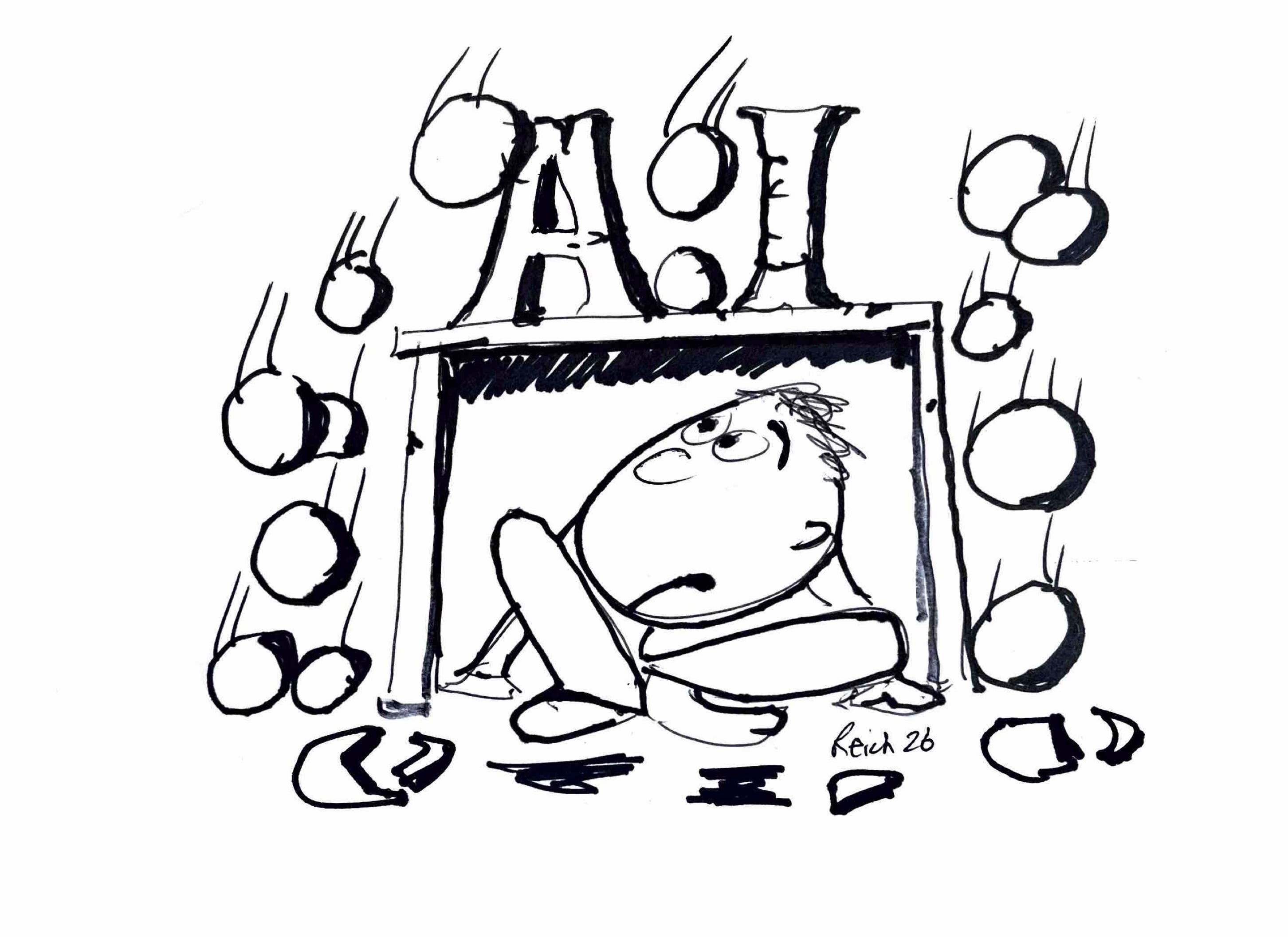
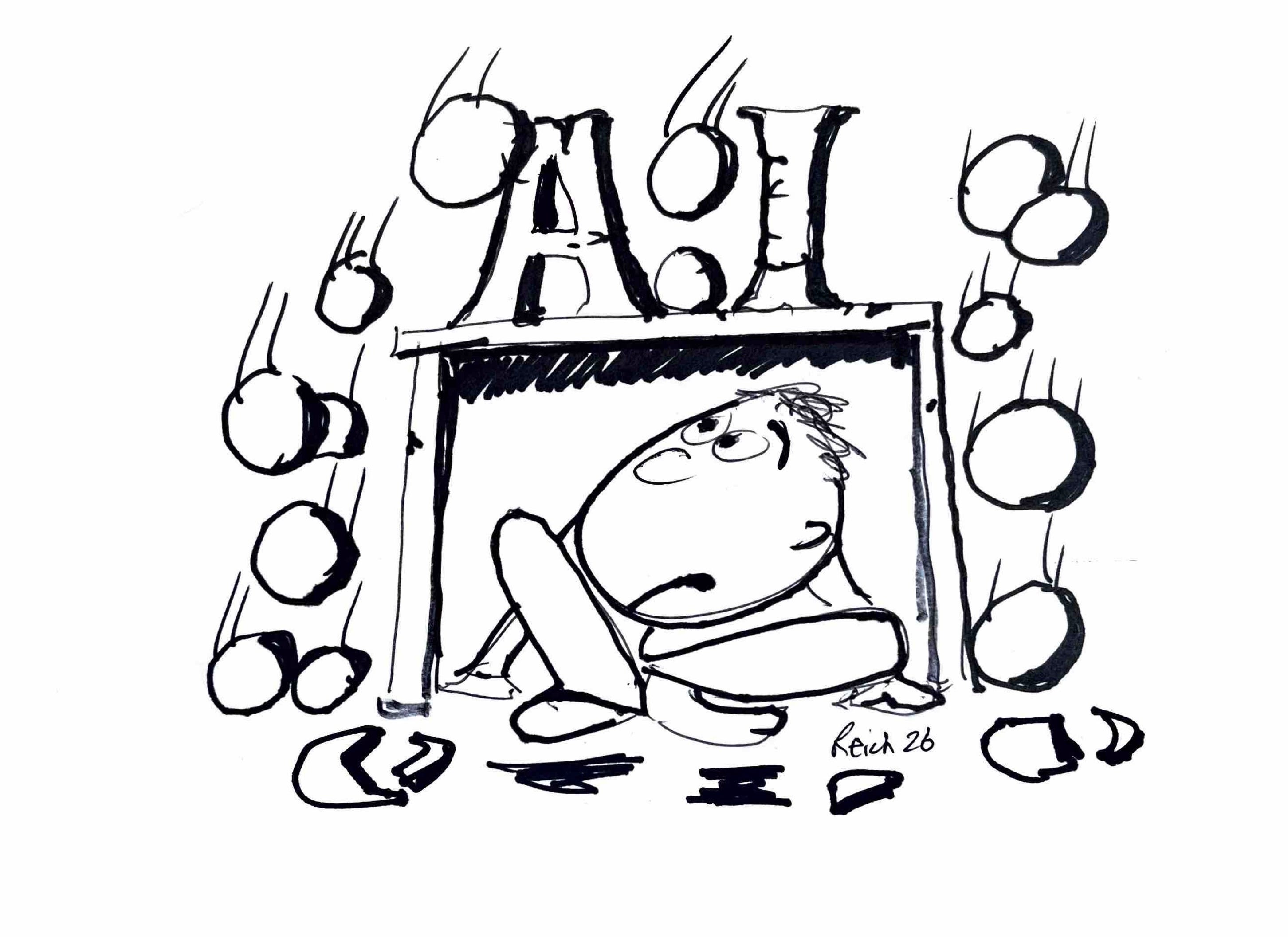
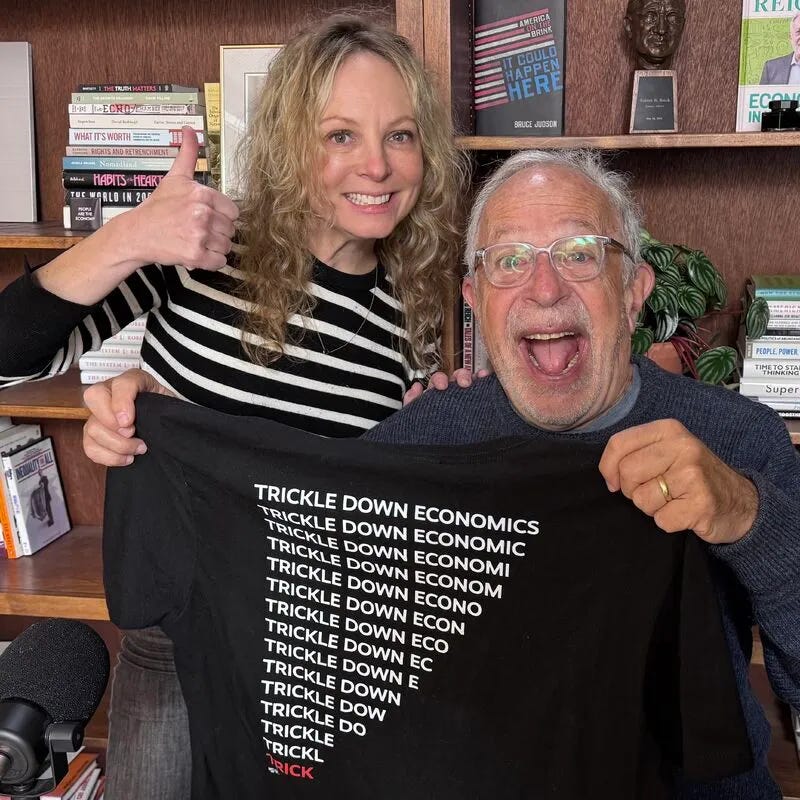
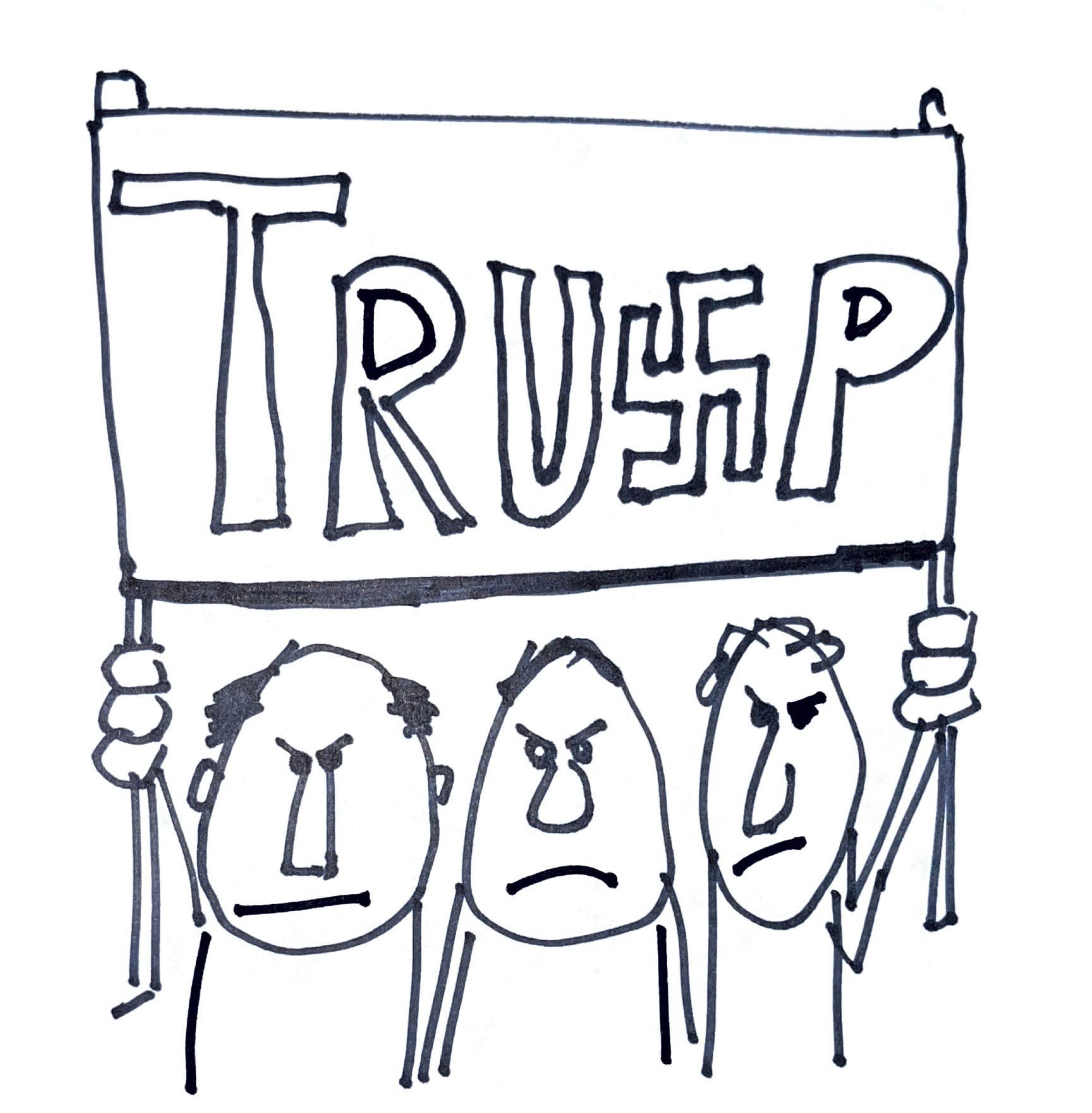
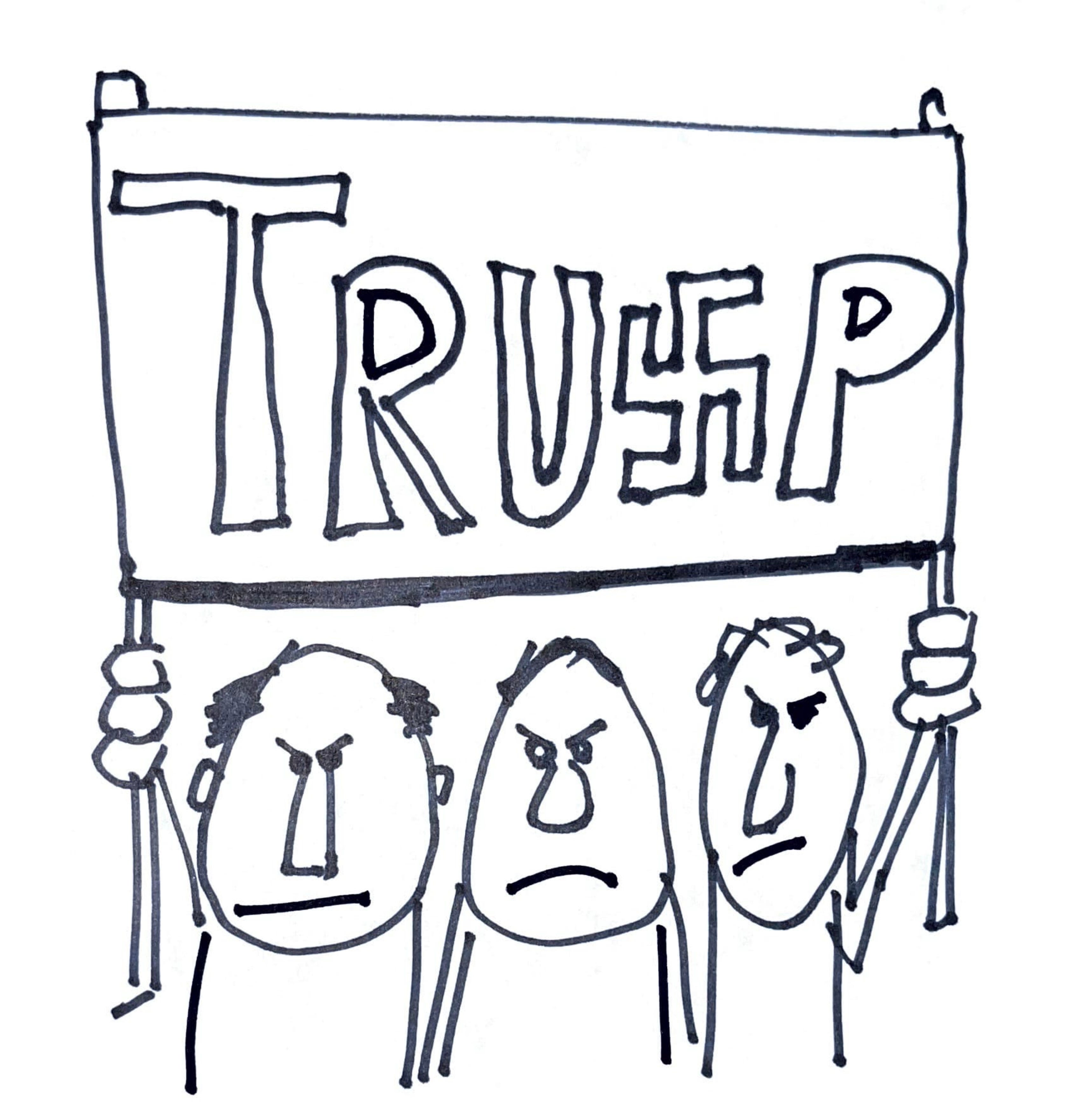
Today I’m taking a vacation. (It’s the second Klatch I’ve missed out of 230 since Heather and I began them on March 19, 2022.) But I’ve left you in good hands! Our good friend Kamau Bell is sitting in, and today he and Heather take a deep dive into how America can dump the Trump before he dumps America.
So please pull up a chair, grab a cuppa, and join in the discussion.
Object permanence: London Copyfighters x Speaker's Corner; TSA v lipstick; Long Beach v photographers; China x David Cameron's internet censorship; McMansion Hell; Copyrighting an MTG deck; "Privacy preserving age verification" delenda est.
Upcoming appearances: Edinburgh, Sydney, Melbourne, Brighton, London, South Bend.
If your theory is that markets deliver prosperity by spurring businesses to provide the superior products and services at lower prices needed to attract and retain workers and customers, then competition is a must-have. Without competitors, companies are "too big to care":
Meanwhile, if you think that the pressure of greed will always drive companies to cheat, and want companies held in check by democratically accountable lawmakers and enforcers, then you also want competition, because otherwise, disorganized sectors of hundreds of small businesses collapse into oligarchic cartels. Members of these cartels cease to compete directly with one another and instead collude to rip off workers and customers, leaving them aslosh in ready cash they can mobilize to capture regulators, securing an enshittogenic policy environment that reflects the easily arrived-at consensus that's only possible when you boil a sector down to a small handful of firms, each of them "too big to jail":
In other words: if your ideal is a world of high-quality products and services, produced by workers laboring under fair conditions, delivered to consumers at a fair price, then you want competition. Competition scares some people into running their businesses ethically; and competition ensures than an unethical operator can be held to account by government agencies charged with protecting workers and consumers.
Once you understand the role of competition as a counter-oligarchic check on corporate power, the rise of Big Tech and its authoritarian turn becomes much easier to understand.
Tech is uniquely hospitable to competition thanks to the intrinsic properties of digital computers. Formally, computers are "Turing-complete, universal von Neumann machines," which is to say that every computer can run every valid program. This means that any enshittificatory gambit assayed by a tech company – say, locking generic ink out of your printer; or blocking third party app stores for your phone or console; or sticking a dozen extra ads before every Youtube video – is technically doomed.
Every time a tech boss introduces a 10' pile of shit to a digital product or service you rely upon, they induce rival technologists to create 11' ladders made of code that they can costlessly, instantaneously distribute to every one of the enshittifier's customers and suppliers:
This explains the dynamism of early tech, which saw companies rising quickly to conquer their markets, only to yield to the temptation to extract more from customers and/or suppliers while underinvesting in improvements to their products and services. When this happened, new digital companies sprang into being, reverse-engineering the incumbents' products and launching "complementary goods" – plug-ins and mods – that fixed the defects in dominant products, usurping the market leader's place in the workflows and pocketbooks of its customers and suppliers:
For many years, this "adversarial interoperability" worked its magic on the burgeoning tech sector, creating a state of constant ferment where people who wanted to improve and then supplant the state-of-the-art were able to cheaply enter and capture the market, only to be taken down by the next generation of disenshittifiers when they, too, inevitably yielded to the temptation to replace innovation with extraction. Every pirate wants to be an admiral – but every admiral must then confront the pirates who rush in to fill the vacuum they create when they switch sides.
But that system of beneficial disruption was itself disrupted – not by technology, but by policy. In 1998, Bill Clinton signed the Digital Millennium Copyright Act (DMCA). Section 1201 of the DMCA makes it a felony to practice adversarial interoperability, establishing penalties of $500k and five years in prison for people who reverse engineer and modify products:
DMCA 1201 created a one-way ratchet that progressively narrowed the possibilities for tech competition. As more and more US companies re-engineered their products so that modifying them would give rise to DMCA 1201 liability, American startups gave up on disrupting Big Tech, re-orienting towards "acqui-hires," when a startup's highest purpose is to be absorbed by a giant, sclerotic incumbent that mothballs its products and assigns its engineers to work on incremental maintenance (or worse, enshittification) for its dominant offerings.
Big Tech's pirates turned admirals, free to "disrupt" the weak and poor, while enjoying the legal entitlement to destroy anyone who dared to disrupt them. They embodied Frank Wilhoit's definition of conservativism: a class that the law that "protects but does not bind" alongside a class that the law "binds but does not protect":
It was fine for them to "move fast and break (our) things," but forbidden for us to "move fast and break kings." Disruption for thee, never for me.
Nor was this a merely American sickness. Having neutered domestic competitors that might threaten its tech incumbents, the US government set out to prevent other countries from challenging its world-girdling tech empires. For the past 25 years, the US Trade Representative has prioritized getting anticircumvention laws on the books of all of America's trading partners as a condition of free trade with the US, with the result that today, virtually every country in the world has a law that makes it illegal to disrupt American tech giants:
Anti-circumvention law is so obviously, manifestly an invitation to enshittify that when governments enacted these laws, they felt the need to include some kind of "safety valve" they could point to when critics raised anti-circumvention's potential for abuse. The world's would-be enshittifiers figured out a devious method to insert clauses into anti-circumvention that looked like anti-abuse measures, but which were, in practice, useless ornaments.
Many anti-circumvention laws – including DMCA 1201 – have a process for creating "exemptions" to the ban on reverse-engineering and modifying a device. The way these exemptions processes are written, they seem to say that if a company uses anti-circumvention law to block legitimate activity – say, if John Deere uses the law to stop you from fixing your own tractor – then you can go to some kind of governing body (in the US, it's the Copyright Office) and petition for an exemption to anti-circumvention. If that exemption is approved, then making that modification becomes legal.
Before I carry on, let me say here that even if that's how the system worked, it would still be grossly offensive. If you buy a device – a car, a tractor, a printer, a console, a phone – it is your property and you should not have to hire a lawyer to ask a government agency to create a legal exemption that lets you do otherwise legal things with it. You should not need to petition the government for the right to buy generic ink, use a third-party app store or take your car to an independent mechanic.
But this isn't how the system works. It's a scam. Anti-circumvention exemptions are a cheap trick. They only sound useful. A reasonable person who hears that the US Copyright Office has made it legal to use a third-party app store with your iPhone would assume that this means that if someone launches their own app store, they can give you the tools needed to unlock your iPhone and activate their store.
That's not how the DMCA exemptions process works. Under the statute, the US Copyright Office is only empowered to create "use exemptions," which allow you, the owner of the iPhone, to make use of a tool that unlocks your phone and installs the third-party app store. The Copyright Office does not have the power to create a tools exemption that would allow someone to make that unlocking tool and sell or give it to you. Making that tool remains a felony with a five-year prison sentence attached to it.
What this means is that if you want to use your own property in a way that was legal before DMCA 1201, that has been made legal again because you hired a lawyer who successfully petitioned the US Copyright Office to grant an exemption, you can only do so if you, personally reverse engineer your device to effect the permitted modifications to it.
So: if the US Copyright Office legalizes alternative iPhone app stores, the only way to exercise this exemption is for every iPhone owner in the country to get a computer science degree, secure the use of a clean-room, decap the "secure enclave" on a spare iPhone's CPU, extract its cryptographic keys, and integrate them in a new version of iOS that they personally write and install on their phone. No iPhone owner is allowed to discuss how to do this with any other iPhone owner engaged in the same project, on penalty of a five year prison sentence.
Obviously, this is ridiculous, and iPhones are just the tip of the iceberg. It's also true if you want to enable independent repair of powered wheelchairs, whose manufacture is controlled by a duopoly of private-equity backed companies that have all but abandoned spending on repair, leaving wheelchair users stuck in bed for months while they await service:
This absurd situation is the same if you're blind and want to make use of an exemption that lets you reverse-engineer ebook formats so that you can run your ebooks through a Braille printer, screen reader or other assistive device. Under the exemptions rules for the world's anti-circumvention laws, every blind person is expected to personally reverse engineer the access control systems built into Adobe and Amazon's ebook formats, write an exploit that lets them extract the text of these restricted ebooks and then repackage that text in a new, open format:
This "use exemption"/"tools exemption" split is a near-perfect way of tricking people into thinking that these laws are more reasonable than they appear. When Canada passed its landmark right-to-repair and interoperability laws in 2024, many celebrated – missing the fact that under Canada's anti-circumvention law (Bill C-11, the Copyright Modernization Act of 2012), it remains illegal to undertake the reverse-engineering needed to exercise the rights these new laws (seemed to) enshrine:
For a quarter-century, I've made it my life's work to explain how bad and dangerous this system is, and, thankfully, I've started to make a little headway over the past few years. My core audience contains a lot of hackers who are rightly affronted at the existence of a body of law that criminalizes the kinds of exploration and modification that they've devoted their lives to.
Being hackers, they ponder this situation and start to think about how they can hack the law to escape it. Just lately, I've heard from a lot of people who think they can solve this problem by asking a chatbot to reverse-engineer and modify the firmware on their tractors, wheelchairs, ebooks, iPhones, what-have-you. You can't put a chatbot in prison for violating anti-circumvention law, right?
I regret to inform you that if you did this in a way that rose to the attention of a big corporate bully, they wouldn't blame your chatbot for writing the exploit: they'd blame you for prompting the chatbot to create this new tool.
Just yesterday, I heard from a reader who had a clever idea: what if you gave your unmodified iPhone to a hacker who knew how to install a third-party app store on it, and they modified that phone, and then sold it back to you for $10? The hacker would be making a use exemption, not a tools exemption.
This, too, will not produce the outcome we're seeking. Even if Apple can't convince a judge that selling you a modified iPhone is "trafficking" in a circumvention device (a very big "if"), this wheeze misses the wider point about how adversarial interoperability was able to disenshittify tech for the years when tech companies weren't just dishing out disruption, but also being disrupted themselves.
The interoperability-driven dynamism that disciplined or displaced tech companies that abused their market power was a mass phenomenon. The printer cartel doesn't need to be able to charge everyone $10,000/gallon for ink. If a few people at the margins figure out how to jailbreak their printers, that doesn't stop the grift. Even better if the people who do use generic ink have to depend on anonymous, shadowy businesses that don't have customer service departments you can call when your printer gets an update that breaks ink compatibility, or an address you can send a process-server to if you're stuck with thousands of dollars' worth of useless ink cartridges after one of those updates.
To make generic ink a viable check against the abuses of HP and its colored water mafia, you need a counter-industry. You need salespeople making calls on large enterprises who buy their ink by the ocean, offering them a better deal and a guarantee of uninterrupted service. To make good on that guarantee, you need an army of hackers who reverse-engineer every software update HP pushes out in a matter of hours, and you need another army of customer service reps who help people who can't figure out how to install that update.
As economists would say, you need "capital formation." You need the ability to raise or borrow money, a mailing address, an ad campaign, booths at conferences and free samples in the mail. You need to be able to show potential customers that you are insured in the event that you brick their devices, so switching to your product doesn't endanger their capital investments. You need to have a business whose doors can be beaten down by regulators in the event that you use your after-market mods as a tool to steal data or money from your customers.
To understand how this worked, cast your mind back to the Office Suite Wars of the early 2000s. Back then, Microsoft ruled the desktop world, controlling more that 95% of the PC OSes, a share so large and so ruthlessly acquired and maintained that they were convicted of violating anti-trust laws.
Microsoft used illegal tying and predatory pricing to push every one of those PC owners into using Microsoft Office, which meant that even if you used a Mac, 19 times out of 20, the people you needed to collaborate with on memos, spreadsheets and slide-decks were using MS Office.
Microsoft made a version of Office for the Mac, but it was the single most curséd piece of packaged software ever offered to the market. Merely waving the Mac Office floppy around a workplace would cause files to spontaneously go corrupt on random PCs in the vicinity.
For Mac users, this meant that 95% of the time, they could not reliably collaborate with other computer users. For people like me – then a freelance CIO-for-hire who was helping small businesses connect their computers to each other and the internet – it meant that increasingly, we made CEOs swap their Powerbooks for Thinkpads and designers swap their PowerPCs for Dells with beefy graphics cards, moving the whole business to PC/Windows.
Apple solved this problem by reverse-engineering MS Office and producing the iWork Suite: Pages, Numbers and Keynote, which could perfectly read and write Microsoft's Word, Excel and Powerpoint files. That adversarial interoperability saved the company, but the gambit wasn't one-and-done.
Microsoft spent the next several years maliciously introducing changes to the Office file formats that broke compatibility with iWork, which Apple countered by paying an army of coders to swiftly analyze these new formats and update iWork to maintain compatibility with them:
I think Apple was fated to win this expensive cat-and-mouse game, if only they could hang in there long enough. For every Mac in the field, Microsoft was supporting 19 PCs, and these computers ran a fragmented mosaic of Windows and Office versions. Every time Microsoft broke compatibility with Office to mess up one Mac user, they also messed up 19 PC users, all of whom had to be patched and updated to maintain compatibility. This gave Apple a powerful advantage that mounted with every turn of the game, so all they had to do was hang in there until the asymmetrical costs overwhelmed Microsoft.
Which is what happened. Eventually, Microsoft sued for peace and agreed to standardize the office file-formats at the International Standards Organization, ushering in an era of unprecedented compatibility. This ISO standardization is why you can now paste styled text from the Word application into a browser-based Google Doc or an application-based LibreOffice window. It's also a game Microsoft continues to cheat at, with a string of dirty tricks meant to leverage its dominance to shut out competitors altogether:
The rise (and impending fall) of a truly open format that lets every computer user collaborate on any document is an object lesson in the combined role that adversarial interoperability and capital formation play in disenshittifying technology. For Microsoft, a "competitor" isn't one hacker who can open a Word file in a program of their own devising, nor is a "competitor" the small number of users that single competitor can support.
Microsoft is an incorrigible, bullying cheat with a sick and rotten corporate culture: to stop the kind of ruthless princeling who rises to a position of power in a company like Microsoft from turning predatory requires severe, obvious penalties that follow directly from any extractive gambit.
To muster that kind of competition requires the kind of capital formation you only get from true legalization, not the anemic sham offered by anti-circumvention's "exemptions." Even where the competition is spread out across many shifting small businesses and individuals, the system of competition requires a stable backstop that produces the tools these small firms rely on.
In 2014, Ofcom, the UK's telecoms regulator, affirmed that Britons had the right to unlock their phones, even if their carrier had sold them a phone that was locked to its network. Overnight, every small shop acquired a phone-unlocking side-hustle. One morning as I walked from my flat to the tube, I passed three unlockers: one at a newsagent's, where they would take your phone and return it unlocked within a day; one at my dry-cleaner's, where a guy with a folding card table would unlock your phone while you waited; and another folding table guy right by the tube entrance who'd also work while you waited, and who charged £5 less than the guy at the dry-cleaner's.
None of these people were electrical engineers or software developers or hackers. They just followed recipes that were provided by one of a few well-capitalized firms that sold them a subscription to jailbreaking tools that were kept up to date for every make and model of every phone.
One frequent excuse for the ban on repair tools for cars or wheelchairs or tractors is that these devices are now so computerized that they require specialized knowledge if they are to be safely serviced. Even if that's true, that's exactly what a legal toolchain provides.
The guy who fixed my solar panels wasn't a software engineer, he was an electrician who had the customer-service phone number for the company that made my solar inverter. If that company had a viable competitor who could offer their own firmware for my solar installation and was hungry for my business, maybe that technician would have gotten through in three minutes rather than three hours.
And if that alternative firmware was defective, then I could join a class action suit and get made whole – something that is nearly impossible to imagine happening with solar OEMs, who face so little competition that they all put binding arbitration clauses in their terms of service that take away your right to sue, no matter whether they cheat you or burn your house down:
That's the amazing thing about digital tools. Through software, experts are able to package up their expertise into self-executing code, which can costlessly, instantaneously be distributed to everyone in the world who needs it. But paying those experts isn't cheap, and neither is supporting their tools.
I love William Gibson's maxim that "the street finds its own use for things," but if you can't neutralize a large, dangerous monopolist with individual tinkering – the best you can hope for is some measure of individual relief..
It's true that in these adversarial interoperability fights, the upstarts enjoy a tremendous advantage, but that advantage isn't infinite. For the guerrillas to outlast the empire, they have to be able to wage a long, persistent fight.
To marshal the resources needed to sustain that fight and to maintain the logistics demanded by its supply lines requires the good guys to be allowed to fight in the open, without the looming threat of criminal prosecution, a threat that forecloses on capitalization and mass adoption.
Enshittification isn't downstream of cruelty, it's downstream of greed. The point of enshittification is to exploit the control a firm can exercise over the customers, suppliers and workers it holds captive in order to extract more from them. The titanic profits this exploitation delivers are a powerful lure for would-be disenshittifiers and investors who would fund their liberatory revolution.
Don't get me wrong, I love my hackers and I sit in awe of the awesome leverage of writing code that can be costlessly, instantaneously distributed to everyone who needs it. But so long as governments and the law are on the side of extraction and enshittification, the disenshittificatory insurgency will be starved of resources, condemned to remain marginal and inadequate.
"Red Team Blues": "A grabby, compulsive thriller that will leave you knowing more about how the world works than you did before." Tor Books http://redteamblues.com.
"Chokepoint Capitalism: How to Beat Big Tech, Tame Big Content, and Get Artists Paid, with Rebecca Giblin", on how to unrig the markets for creative labor, Beacon Press/Scribe 2022 https://chokepointcapitalism.com
“Once Is Enemy Action,” a science fiction novel about the origins of modern technofascism. Today's words: 570 (5421 total).
"The Post-American Internet," a sequel to "Enshittification," about the better world the rest of us get to have now that Trump has torched America. Fourth draft completed. Submitted to editor.
A Little Brother short story about DIY insulin PLANNING
This work – excluding any serialized fiction – is licensed under a Creative Commons Attribution 4.0 license. That means you can use it any way you like, including commercially, provided that you attribute it to me, Cory Doctorow, and include a link to pluralistic.net.
Quotations and images are not included in this license; they are included either under a limitation or exception to copyright, or on the basis of a separate license. Please exercise caution.
"When life gives you SARS, you make sarsaparilla" -Joey "Accordion Guy" DeVilla
READ CAREFULLY: By reading this, you agree, on behalf of your employer, to release me from all obligations and waivers arising from any and all NON-NEGOTIATED agreements, licenses, terms-of-service, shrinkwrap, clickwrap, browsewrap, confidentiality, non-disclosure, non-compete and acceptable use policies ("BOGUS AGREEMENTS") that I have entered into with your employer, its partners, licensors, agents and assigns, in perpetuity, without prejudice to my ongoing rights and privileges. You further represent that you have the authority to release me from any BOGUS AGREEMENTS on behalf of your employer.
It is important to understand that Trump is not the cause of the enshittification of America. He is a consequence. Unless the system is fundamentally changed, the enshittification will continue even after Trump is long gone.
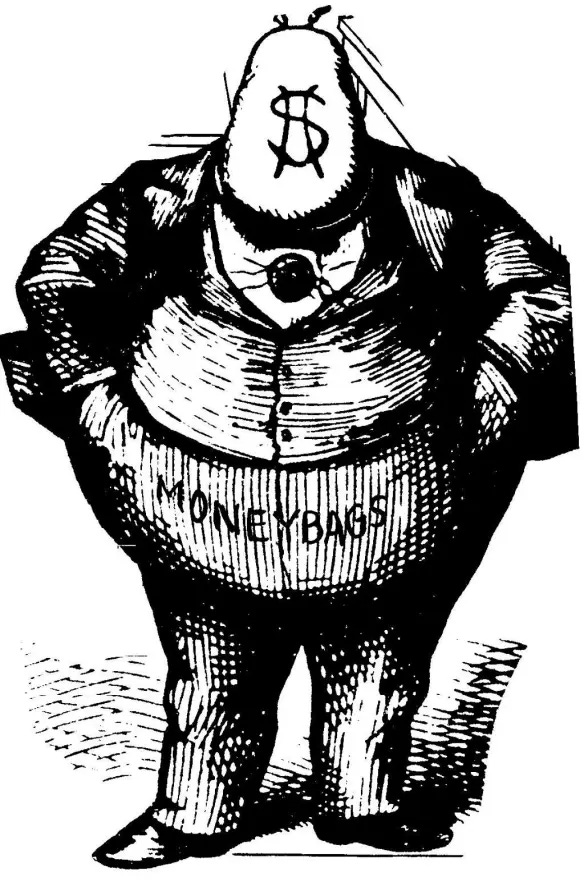
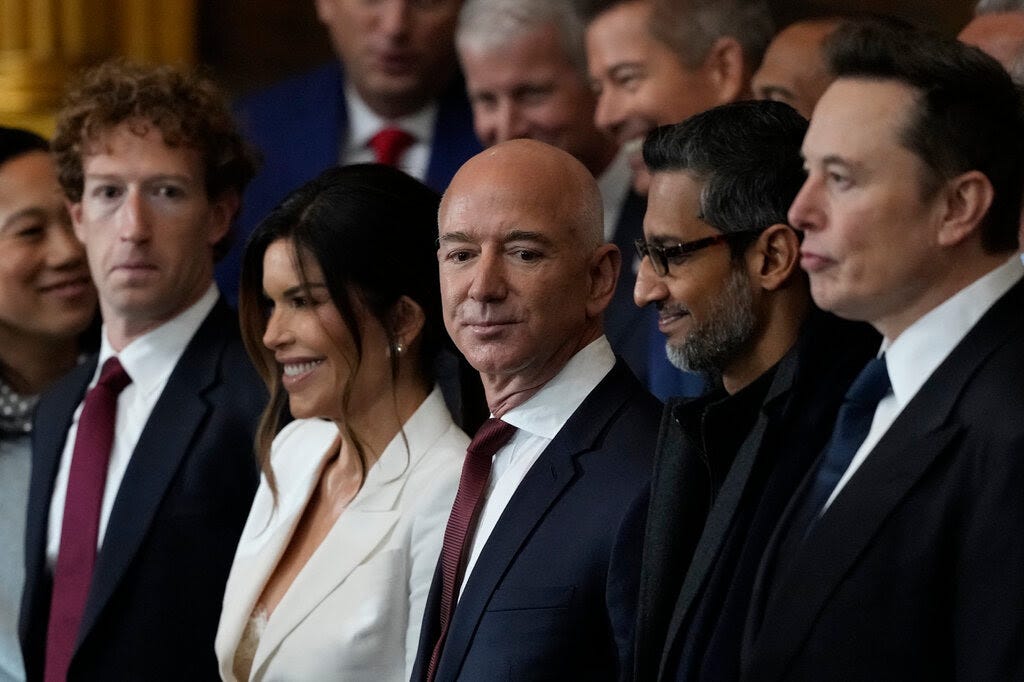
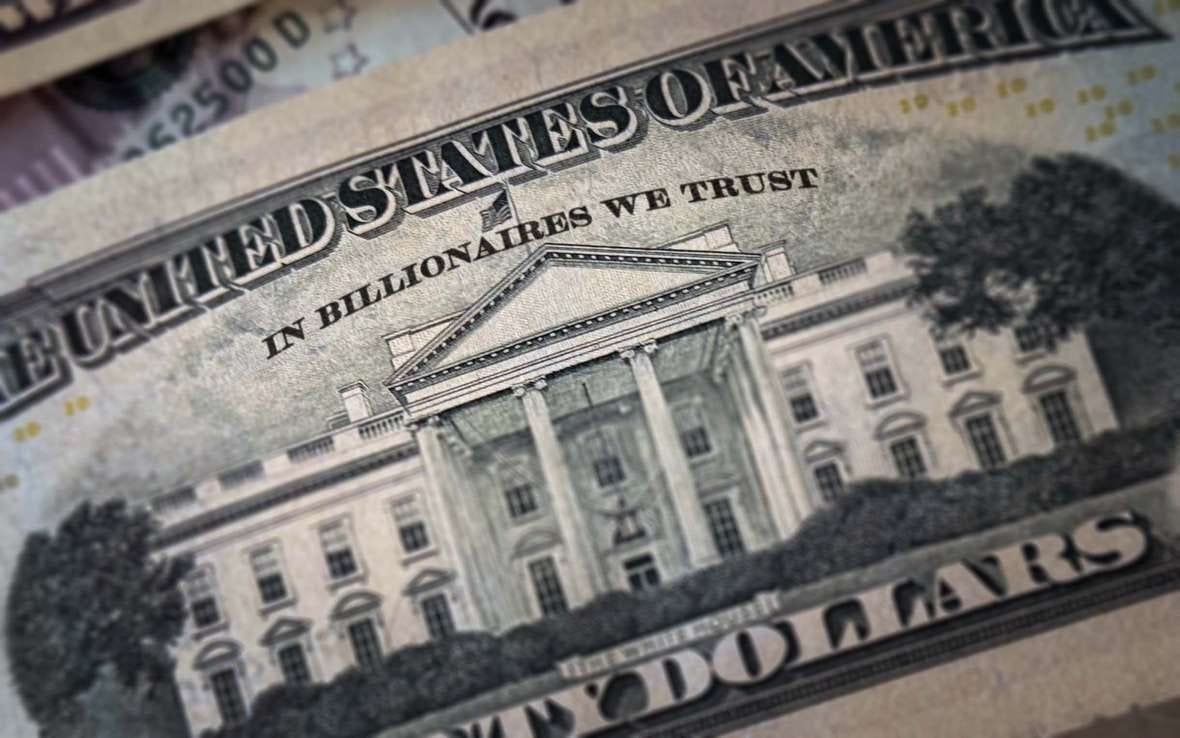
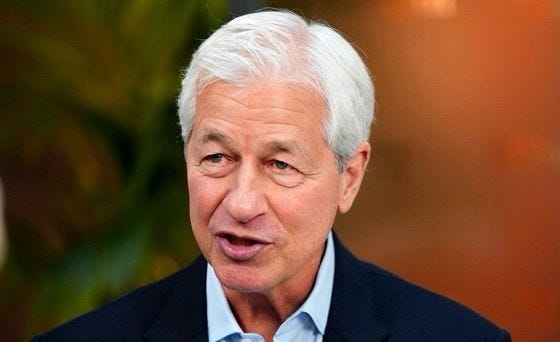
As I’ve shown, wealth and power in America now reside in a relatively small group of (almost entirely) men — the American oligarchy. My prime example has been Jamie Dimon, chair and CEO of JPMorganChase, the largest bank in the world — because he’s regarded by corporate Democrats as the most trusted business leader in America — but I could equally focus on Peter Thiel, Jeff Bezos, Mark Zuckerberg, Elon Musk, Larry and David Ellison, or any other billionaire using his vast wealth to create and enhance his political power.
The Core Contradiction
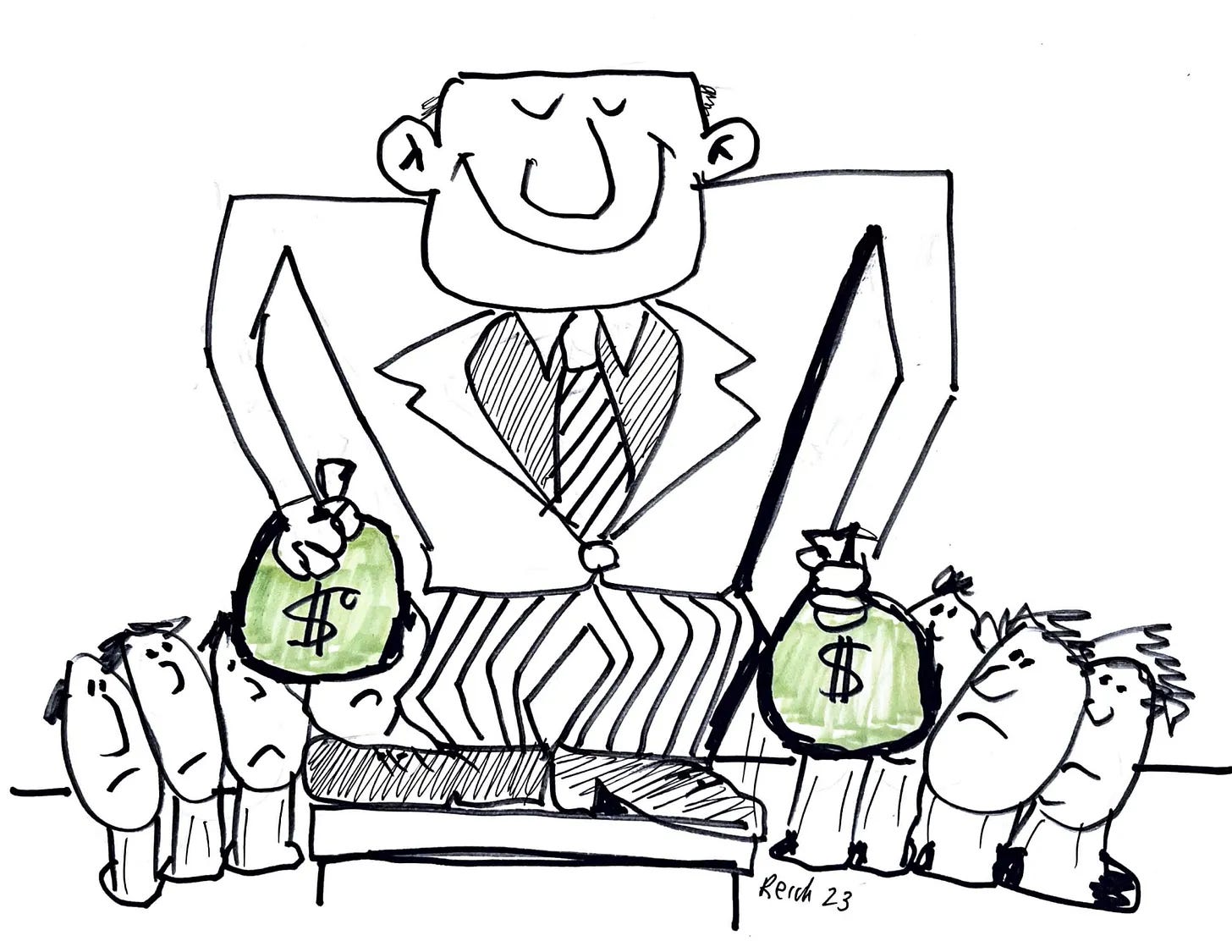
The oligarchy is not interested in serving America, yet it dominates American politics and essentially runs the American system.
The oligarchy is not committed to the common good. It does not seek to raise the wages of working Americans, reduce inequalities of wealth and opportunity, guarantee all Americans access to good healthcare and a world-class education, or stop climate change.
The oligarchy’s allegiance is to itself, and its major interest is enlarging its wealth and power. The easiest way for the oligarchy to accomplish this is to hold down the wages of working people, roll back regulations, enlarge its monopolies, find ever-cheaper places around the world to produce products and services, fight unions, and secure giant tax cuts for it and its corporations that result in less money for education, healthcare, and everything else most Americans need.
The oligarchy cannot fulfill both roles: It cannot advocate for its giant banks or monopolistic corporations and simultaneously lead the nation. Dimon may sincerely believe that he’s a patriot before he’s the CEO of JPMorgan, but we would be foolhardy to rely on it.
The difficulty is not that corporate power is beyond the control of the American government. It is that corporate power controls the American government. Yet giant American corporations have no special allegiance to the United States and no responsibility for the well-being of Americans.
This contradiction has spawned three big conventional ideas about the American system that are dangerously wrong.
Conventional but deceptive idea #1: Americans are richer than the citizens of other rich nations
A few Americans are, but the vast majority are not, when you consider all the public benefits that the citizens of other nations receive. Note, for example, that:
— Most citizens of other wealthy nations receive free or nearly free healthcare, and most get free or nearly free college tuition. Americans receive neither.
— Among the three dozen wealthy countries in the Organization for Economic Cooperation and Development, the United States has the lowest minimum wage when measured as a percentage of the median wage. The typical American worker puts in more hours on the job than Canadian, European, or Japanese workers.
— The United States is the only wealthy nation that does not guarantee paid family leave. In Europe, the norm is three months paid leave. At most, Americans get 12 weeks of unpaid leave.
— America is also the only rich nation that does not guarantee paid sick days. It is the only one that does not guarantee workers any vacation at all. The European Union’s 28 nations guarantee at least four weeks of paid vacation.
— In other rich nations, most people who lose their jobs receive more generous unemployment benefits than do Americans. Employers cannot fire workers at will, as they can here.
— American corporations distribute a smaller share of their earnings to their workers than do European or Canadian-based corporations.
— Top corporate executives in America make far more money than their counterparts in other wealthy countries, and inequality of income and wealth is far wider in the United States than it is in any other wealthy country.
— The American middle class is no longer the world’s richest. Considering taxes and transfer payments, middle-class workers in Canada and much of Western Europe are better off than in the U.S. The working poor in Western Europe earn more than do the working poor in America.
Why are most Americans poorer than the citizens of most other rich nations? It is because of the way power is allocated and wielded in the United States, by contrast with other rich countries. Consider:
— Labor unions are stronger in Europe and Canada than they are in America, able to exert pressure both at the company level and nationally. Only 6 percent of American private-sector workers are unionized. As former New York Times labor correspondent Steven Greenhouse has observed, “In no other industrial nation do employers fight so hard to defeat, indeed quash, labor unions.” Over 25 percent of Canadian workers belong to a union, as do 37 percent of Italian workers, 67 percent of workers in Sweden, and 25 percent in the U.K.
— Most other rich nations are parliamentary systems in which workers are represented by parties that specifically advocate for them. The United States has a two-party system in which the winning party gets all of a state’s electoral votes, thereby discouraging third parties.
— Elections in other rich nations are less affected by big money than are elections in the United States, because other nations have stricter restraints on money in politics.
— Governments in these nations often devise laws through tripartite bargains involving big corporations and organized labor, which further binds their corporations to their nations’ workforces.
For all these reasons, Americans don’t get nearly as good a deal as do the citizens of other rich nations. Governments elsewhere impose higher taxes on the wealthy and redistribute more of it to middle- and lower-income households.
Conventional but deceptive idea #2: The “free market” is separate from government
The second conventional idea perpetrated by the American oligarchy is that we work and live in a “free market” that’s neutral and natural — existing outside government, unaffected by how power is wielded in the system.
We are repeatedly told that whatever inequalities and insecurities the market generates and whatever negative consequences it causes are beyond our control. Efforts to reduce inequality or insecurity are described as constraints on the market’s freedom, likely to cause grave unintended consequences.
By this view, if some people aren’t paid enough to live on, the “free market” has determined they aren’t worth enough. If others rake in billions, they must be worth it. If millions of Americans are unemployed or their paychecks are shrinking or they work two or three part-time jobs with no idea what they’ll earn next month or next week, that’s just the natural outcome of market forces.
If the planet’s survival is endangered because of fossil fuels, that’s at most an “imperfection” in the market. If government attempts to deal with such market imperfections, it must do so modestly and carefully because the “free market” knows best. As Jamie Dimon put it, “Don’t mess up the machine that creates the value so you can do these things. The economy is what gave us everything.”
This is bunk. In reality, the “free market” is nothing but a set of laws and rules about: What can be owned and traded (corporations? slaves? machine guns? nuclear bombs? babies? votes? the right to pollute?). On what terms (hostile takeovers? corporate monopolies? the right to organize unions? a minimum wage? the length of patent protections?). Under what conditions (uninsured derivatives? fraudulent mortgages? mandatory arbitration of disputes?). How to repay what’s owed (debtor’s prison? bankruptcy? corporate bailouts?). What’s private and what’s public (clean air and clean water? healthcare? good schools?). And how to pay for what’s deemed to be public (corporate taxes? personal income taxes? a wealth tax?).
These laws and rules do not exist in nature. The “free market” is created by people. The central issue is not more or less government. It’s who is government for? This is a question of power — who has it, and who doesn’t.
If democracy were working as it should, government officials would make the laws and rules of the “free market” according to what most citizens need. But in our current system, the rules are made mainly by those with the power and wealth to buy the politicians, agency heads, and even the courts and the lawyers who appear before them). As income and wealth concentrate at the top, so does political leverage.
As a result:
— Intellectual property rights — patents, trademarks, and copyrights — have been continuously enlarged and extended. This had created windfalls for pharmaceutical, high tech, biotechnology, and entertainment companies, which can preserve their monopolies longer than ever. It also means higher prices for American consumers, including the highest pharmaceutical costs of any advanced nation.
— Antitrust laws have been relaxed or nullified, resulting in larger profits and bigger political clout for the dominant corporations and higher prices and less leverage for workers.
— Labor laws have been weakened, allowing corporations to fire workers who try to join or form unions, with the only consequence that the corporation may be required to reinstate the workers and give them back pay after long and involved proceedings.
— Financial laws and regulations instituted in the Great Depression decade of the 1930s have been abandoned, allowing the largest Wall Street banks to acquire unprecedented influence over the economy.
— Bankruptcy laws have been loosened for large corporations but tightened for homeowners and graduates laden with student debt. The largest banks and auto manufacturers have been bailed out of a financial crisis, but homeowners — disproportionately low-income minorities — have not.
— Contract laws have been altered to require mandatory arbitration before private judges selected by big corporations.
— Securities laws have been relaxed to allow insider trading of confidential information. CEOs use stock buybacks to boost share prices and cash in their stock options.
— Tax laws have created loopholes for the partners of hedge funds and private-equity funds. They also contain special favors for the oil and gas industry.
— The top marginal income-tax rates have been lowered, corporate taxes have been reduced, and estate taxes on great wealth have been eliminated.
— Regulations that protect health, safety, and the environment have been repealed, rolled back, riddled with exemptions, or simply unenforced. Public health has declined.
— Schools in working-class and poor areas have become dependent for most of their funding on local property taxes, which aren’t enough to provide excellent schools. Hence, the notion of equal opportunity has become a bad joke.
The result of this vicious cycle is a giant but hidden upward distribution of income and wealth from the bottom 90 percent to the top.
Another consequence is growing anger and frustration felt by people who are working harder than ever but getting nowhere, accompanied by deepening cynicism about our democracy. That anger, frustration, and cynicism is corroding the moral foundation of our society. It has elected Trump, twice.
Conventional but deceptive idea #3: Corporations exist only for shareholders
The late economist Milton Friedman famously urged CEOs to give up stakeholder capitalism — under which the welfare of workers, communities, and the nation as a whole was considered in corporate decision-making, as well as shareholders. “What does it mean to say that ‘business’ has responsibilities?” Friedman wrote in 1970. “Businessmen who talk this way are unwitting puppets of the intellectual forces that have been undermining the basis of a free society these past decades.”
Michael Jensen, an economics professor who arrived at the Harvard Business School in 1984, gave academic ballast to the notion that the sole purpose of the corporation should be to maximize shareholder returns. In his many papers, public lectures, and oversubscribed classes — from which generations of business school students launched careers on Wall Street and in management consulting — Jensen reasoned that hostile takeovers disciplined what he termed “inefficient firms.”
Jensen forgot one big thing. He overlooked those who would bear the burden of the changes he pushed for. There have been several unfortunate consequences to Friedman and Jensen’s mistaken idea.
— The rise of corporate takeovers (now often undertaken by private equity). As Jensen predicted, stockholders of targeted companies have done well. That’s because the so-called “efficiency” gains have gone to them, as well as to the raiders and top corporate executives.
The costs of these maneuvers and of the obsession with maximizing share values, however, have been borne by workers who have been sacked, or whose paychecks have stagnated and whose benefits have been cut, and by communities that have been left behind.
The academic conceit that workers are simply “resources” that will move to “higher valued uses” has proven to be crushingly and cruelly naïve. Human beings are not like financial resources. They do not move easily or seamlessly to different jobs and other places. They are rooted in families and communities. They have particular skills, established routines, abiding understanding of positions and roles. They depend on some degree of security, predictability, and stability. They want to be respected and valued.
When “efficiency” gains go to a comparatively few people at the top, while the costs and burdens are borne by many others — as has been the case since the 1980s — the common good is not improved. It is cast to the winds.
— The monopolization of America. After 1980, antitrust law all but disappeared. The new view — popularized by a Yale Law School professor, subsequently Judge Robert Bork — was that large corporate size produced economies of scale, which were good for consumers, and anything that was good for consumers was good for America.
Power was no longer at issue. This was exactly the message that America’s emerging corporate oligarchy wanted to hear. They used the façade of Bork’s pinched academic analysis to justify killing off antitrust. Since the 1980s, after the federal government all but abandoned antitrust enforcement, two-thirds of all American industries have become more concentrated.
Monsanto now sets the prices for most of the nation’s seed corn. The government green-lighted Wall Street’s consolidation into five giant banks, of which JPMorgan is the largest.
Just four giant airline carriers now dominate the skies, down from 12 in 1980. American, Delta, Southwest, and United now control 80 percent of domestic seating capacity. Meanwhile, the merger of Boeing and McDonnell Douglas has left America with just one major producer of civilian aircraft, Boeing.
Three giant cable companies dominate broadband (Comcast, AT&T, Verizon). A handful of drug companies control the pharmaceutical industry (Pfizer, Eli Lilly, Johnson & Johnson, Bristol-Myers Squibb, Merck).
Just five giant high-tech behemoths preside over key portals and platforms (Amazon, Facebook, Apple, Microsoft, Google), together comprising more than a quarter of the value of the entire U.S. stock market.
Facebook and Google are the first stops for many Americans seeking news, and account for almost half of all advertising dollars spent in the United States. Apple dominates smartphones and laptop computers. Nearly 90 percent of all internet searches now go through Google. Amazon is now the first stop for a third of all American consumers seeking to buy anything.
All this consolidation has inflated corporate profits, suppressed worker pay, supercharged economic inequality, and stifled innovation. Amazon has put most bookstores out of business and is rapidly eroding retail businesses on the nation’s Main Streets. Google employs the world’s most widely used search engine to promote its own services and Google-generated content over those of competitors, like Yelp.
Facebook’s purchases of WhatsApp and Instagram killed off two potential rivals. This mega-concentration of American industry has made it harder for newer firms to gain footholds. The rate at which new businesses have been formed in the United States has been halved since 1980.
In many locales workers have less choice of whom to work for, which is also holding down their wages. Corporations are imposing additional conditions on workers that further weaken their bargaining power, such as noncompete, anti-poaching, and mandatory arbitration agreements.
Giant firms that dominate an industry also gain political power. They provide significant campaign contributions, have platoons of lobbyists and lawyers, and directly employ many voters.
As a result, their CEOs’ phone calls to members of Congress are promptly returned. Items they want included in legislation are dutifully inserted; those they don’t want are scrapped. They get the tax loopholes, subsidies, bailouts, regulatory exemptions, and loan guarantees they seek. They can stop laws in their tracks. Never underestimate the monetary value of such largesse. The financial returns on political investments are among the highest in the whole system.
Power has shifted in exactly the opposite direction for workers.
— The near disappearance of labor unions. Starting in the 1980s and with increasing ferocity since then, private-sector employers have fought unions. Ronald Reagan’s decision to fire the nation’s air-traffic controllers, who went on an illegal strike, signaled to private-sector employers that fighting unions was legitimate.
But it was really the wave of hostile takeovers (now often engineered by private equity funds) — the shift from stakeholder to shareholder capitalism — that pushed employers to crush unions. Payrolls are typically 70 percent of a corporation’s costs. The most direct way to raise profits and share prices is to cut payroll costs. The first step was to bust unions.
Corporations have replaced striking workers with non-union workers. Previously, when management was responsible to all stakeholders, workers who went on strike typically got their jobs back as soon as a strike was settled.
Shareholder capitalism changed this radically. Now, striking workers often lose their jobs forever. As Fortune magazine observed, “Managers are discovering that strikes can be broken, that the cost of breaking them is often lower than the cost of taking them, and that strike-breaking … doesn’t have to be a dirty word.”
Corporations have also threatened to move jobs overseas if workers don’t agree to pay cuts. Corporations have fired workers who try to organize, a move that’s illegal under the National Labor Relations Act but happens all the time because the penalty for doing so — restoring fired workers to their jobs along with back pay — is small relative to the profits that come from discouraging unionization.
Corporations also mount campaigns against union votes, warning workers that unions will make them less “competitive” and threaten their jobs. All the while, corporations have been relocating to states where so-called “right-to-work” laws bar unions from requiring dues from workers they represent. The Supreme Court, in an opinion delivered by the court’s five Republican appointees, has extended “right-to-work” to public employees.
The pressure has come from corporate raiders and their more recent incarnations, private-equity and hedge fund managers, demanding ever higher profits. Institutional investors (the managers of mutual funds, insurance funds, pension funds, endowments, and private equity funds) are just behind them, rooting them on. As power has shifted from workers to them, many of these investors and financial managers have become fabulously wealthy.
Meanwhile, as unions have shrunk, so has their political power. In 2009, even with a Democratic president and Democrats in control of both houses of Congress, unions could not muster enough votes to enact a simple reform that would have unionized workplaces as soon as a majority of employees signed pro-union cards.
Obama didn’t fight for this. Some Democrats, threatened by groups like the Business Roundtable, wouldn’t vote for it. When the legislation was introduced, 180 business executives descended on Capitol Hill to meet with swing senators. Corporations ran $1 million worth of television ads against the bill in Nebraska alone in order to pressure one vacillating Democrat, Nebraska Senator Ben Nelson, to vote no. He obliged.
— Hence, record-setting inequality. This great shift in bargaining power from workers to corporations and their shareholders has pushed a larger portion of national income into profits and a lower portion into wages than at any time since World War II.
Most of these profits are going into higher share prices (fueled by share buybacks) and higher executive pay rather than new investment.
The declining share of total U.S. income going to the bottom 90 percent over the last four decades correlates directly with this decline in unionization. No other change in the system provides as clear a relationship.
Meanwhile, and for the same reason, the rising share of total income going to the richest Americans is inversely related to the share of the nation’s workers who are unionized. The American economic pie continues to grow but most workers are getting only crumbs.
Most of the increasing value of the stock market has come directly out of the pockets of American workers. Three researchers — Daniel Greenwald at MIT’s Sloan School of Business, Martin Lettau at Berkeley, and Sydney Ludvigson at NYU — found that “from 1952 to 1988, economic growth accounted for 92 percent of the rise in equity values,” but that from 1989 to 2017, economic growth was responsible for just 24 percent of the rise. Most of the increase in share values has come from “reallocated rents to shareholders and away from labor compensation.”
America’s shift from farm to factory was accompanied by decades of bloody labor conflict. The shift from factory to office and other sedentary jobs created other social upheaval.
The more recent power shift from workers to large corporations and their shareholders — and consequentially, the dramatic widening of inequalities of income, wealth, and political power — has happened far more quietly, but it has had a more unfortunate and more lasting consequence for the system: an angry working class vulnerable to demagogues peddling authoritarianism, racism, and xenophobia.
Corporate profits have reached record levels and share prices have soared. This has been a boon to shareholders, especially the richest 1 percent of Americans who own about half of the value of all shares of stock, and the richest 10 percent who own over 90 percent.
Top corporate executives, whose pay is linked to share prices, have reaped a bonanza. Pay on Wall Street has reached jaw-dropping heights. But most Americans have not benefited. Many have lost ground. For most, wages have been flat or have declined, their jobs have become less secure, and their pensions have been turned into 401(k)s or have disappeared altogether. Abandoned communities now litter the nation. Entire regions of the country have been left behind.
Executives claim they have a “fiduciary obligation” to maximize shareholders’ returns. This argument is rubbish. It’s also tautological. It assumes that shareholders are the only people worthy of executive concern.
Yet as a practical matter they are not the only parties who invest in corporations, or who bear some of the risk that the value of their investments might drop. All Americans are stakeholders in the American economy.
Workers who have been with a firm for years develop skills and knowledge unique to it. Others may have moved their families to take a job with the firm, buying homes in the community.
The community itself may have invested in roads and other infrastructure to accommodate the corporation. When a firm abandons those workers and those communities, these stakeholders lose the value of their investments. Why should no account be taken of their stakes?
Corporation after corporation began laying off workers in the 1980s without easing the often difficult transitions that followed — without providing workers with severance payments, job retraining, job search assistance, job counseling, help in selling homes whose values predictably dropped when businesses left town, or help moving to where jobs existed.
They laid off large numbers of workers without aiding affected communities that were being jettisoned, or seeking to attract other businesses to make up for their losses of jobs and tax revenue, or finding other uses for the abandoned infrastructure of schools, roads, pipes, and real estate. And without giving workers and communities sufficient advanced notice so they could plan their own transitions.
Absent any of this, millions of Americans were left to fend for themselves. It was a systemic change that would scar the nation for decades, contributing to rising anxiety, anger, and resentment across the land, and eventually lead to the election of Trump.
As big corporations have grown larger over the last 40 years and labor unions weaker, wages have stagnated and profits have increased. It has been a direct transfer: A steadily larger portion of corporate revenues have been siphoned off to profits and a shrinking portion to wages. A growing share of the total economy, likewise, has gone to profits and a smaller share to wages. The stock market has soared. Workers have slumped.
Shifting Power Back to Workers: We’ve Done it Before
The way to end this vicious cycle is to reduce the huge accumulations of wealth that fuel it, and to get big money out of politics. But neither can can be accomplished when wealth and power are compounding at the top. It’s a chicken-and-egg dilemma.
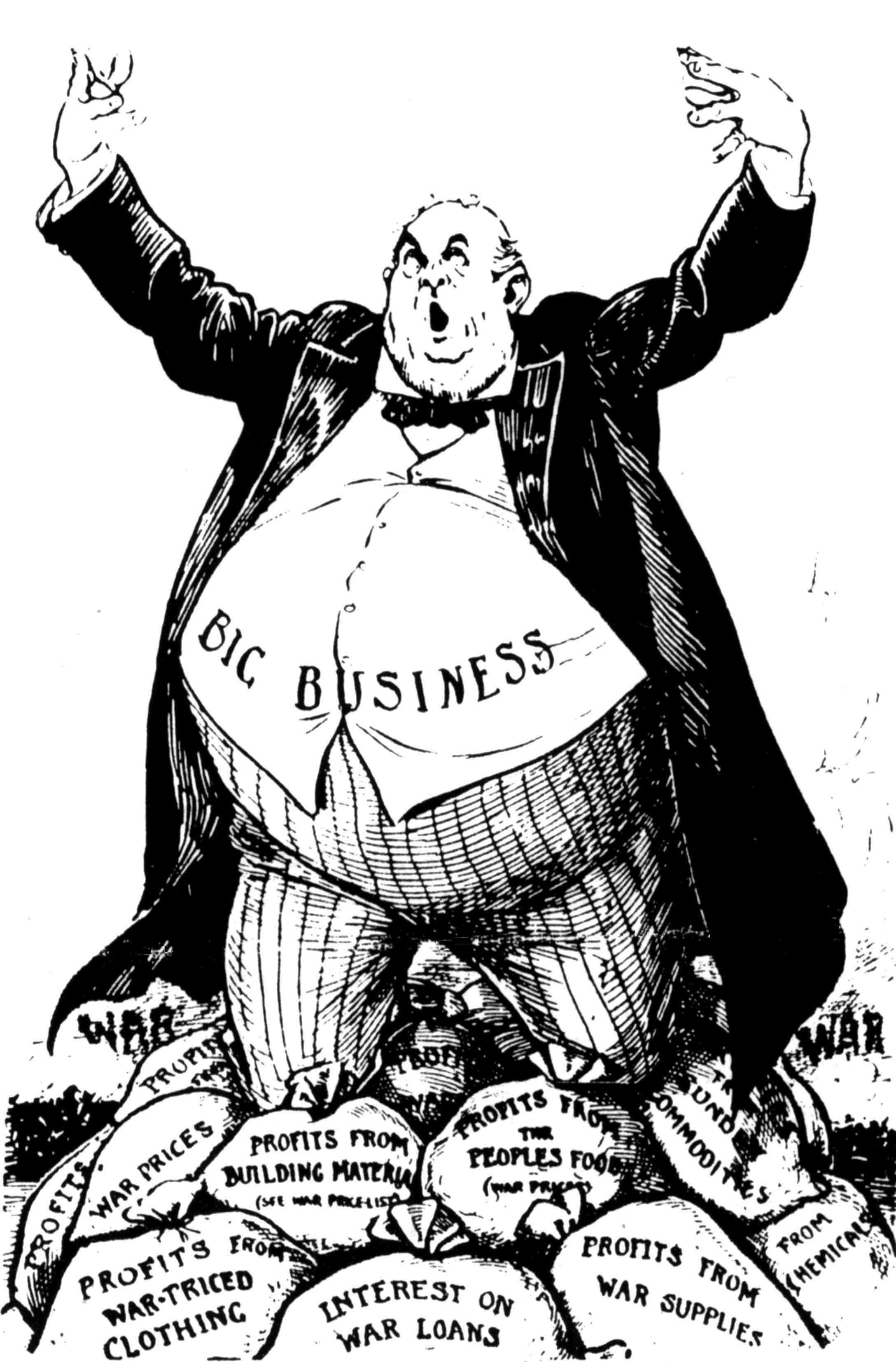
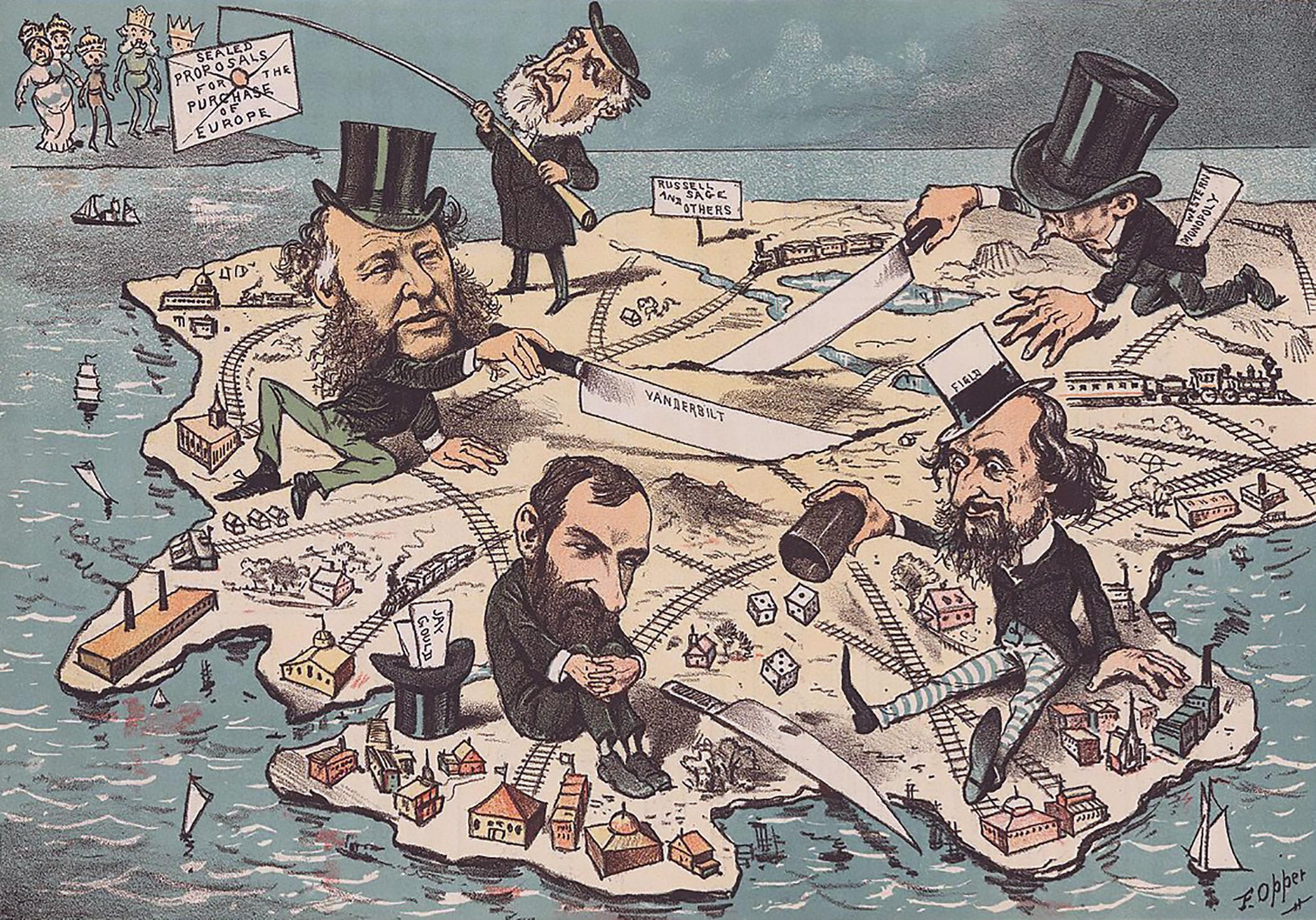
Yet such vicious cycles have been reversed before. In the early 20th century progressives reclaimed our economy and democracy from the robber barons of the first Gilded Age.
The political power that flowed from concentrated economic power was a central concern of the thinkers, writers, and muckrakers of that Gilded Age, starting in the 1890s. “Liberty produces wealth, and wealth destroys liberty,” wrote Henry Demarest Lloyd in his popular 1894 book Wealth Against Commonwealth. “The flames of the new economic evolution run around us, and we turn to find that competition has killed competition, that corporations are grown greater than the State … and that the naked issue of our time is with property becoming master, instead of servant.”
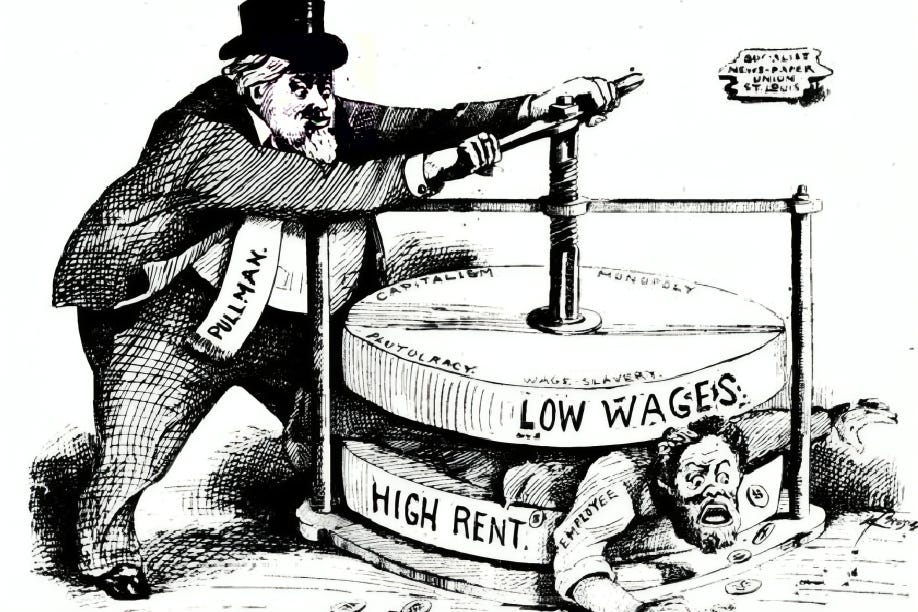
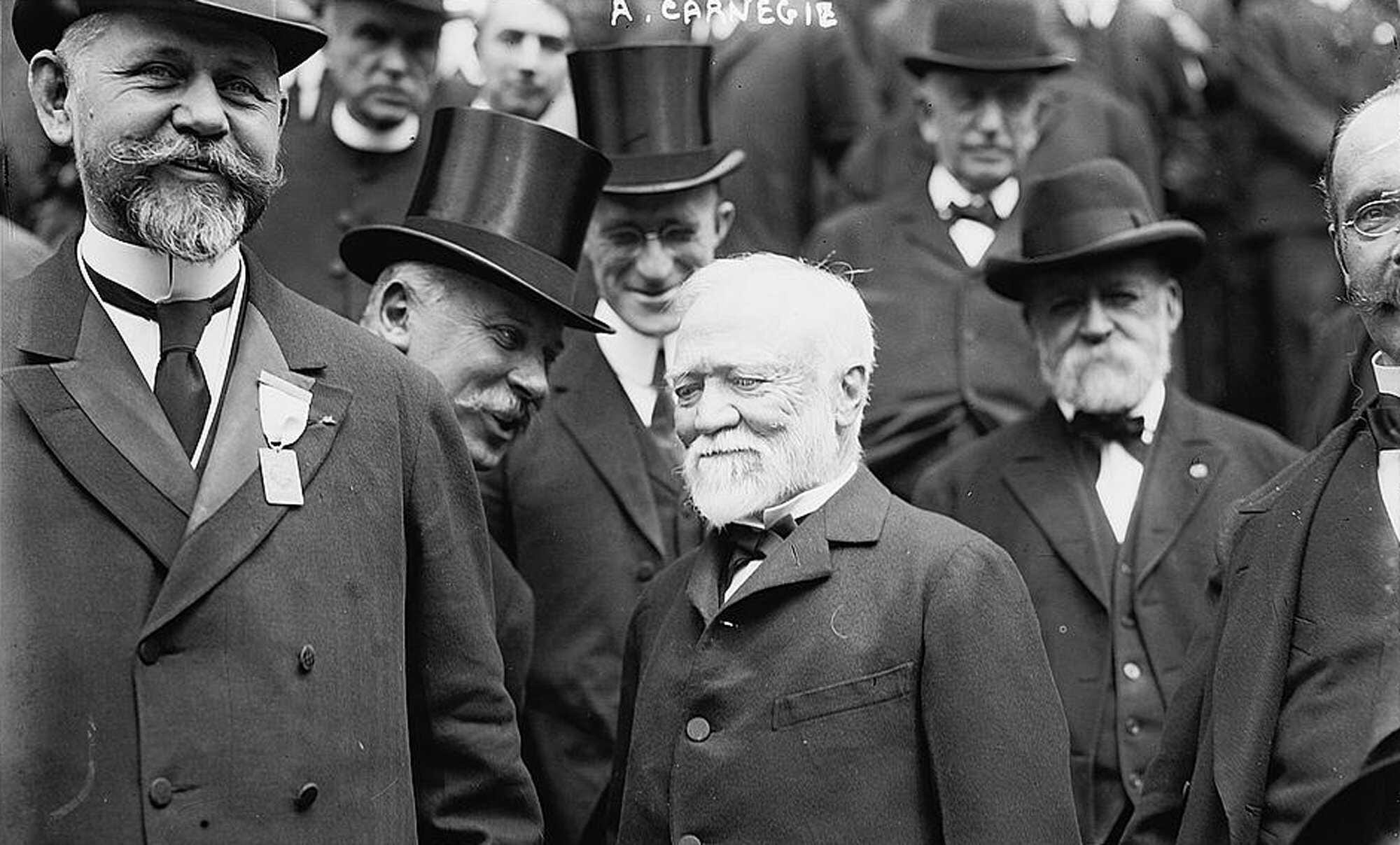
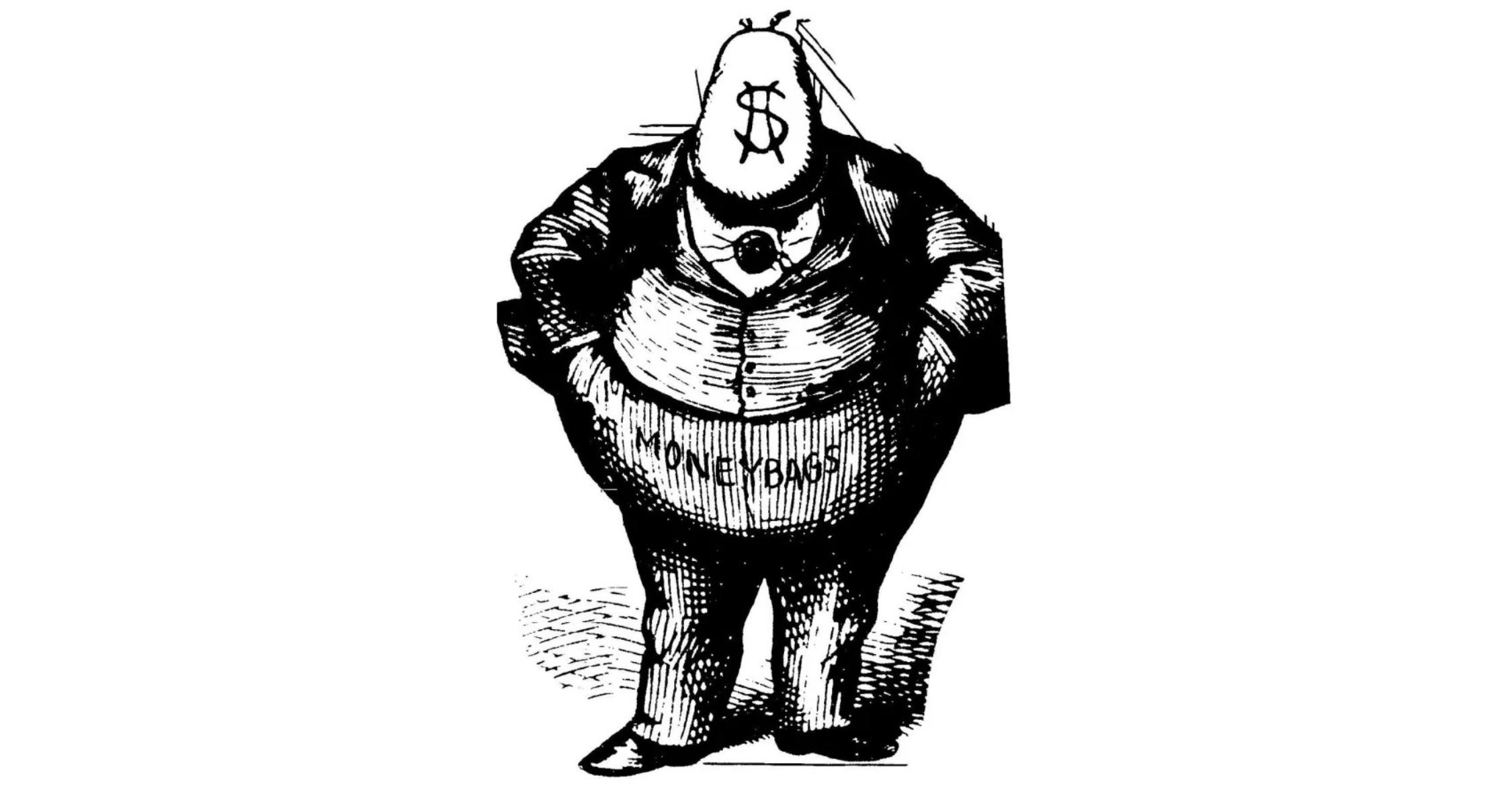
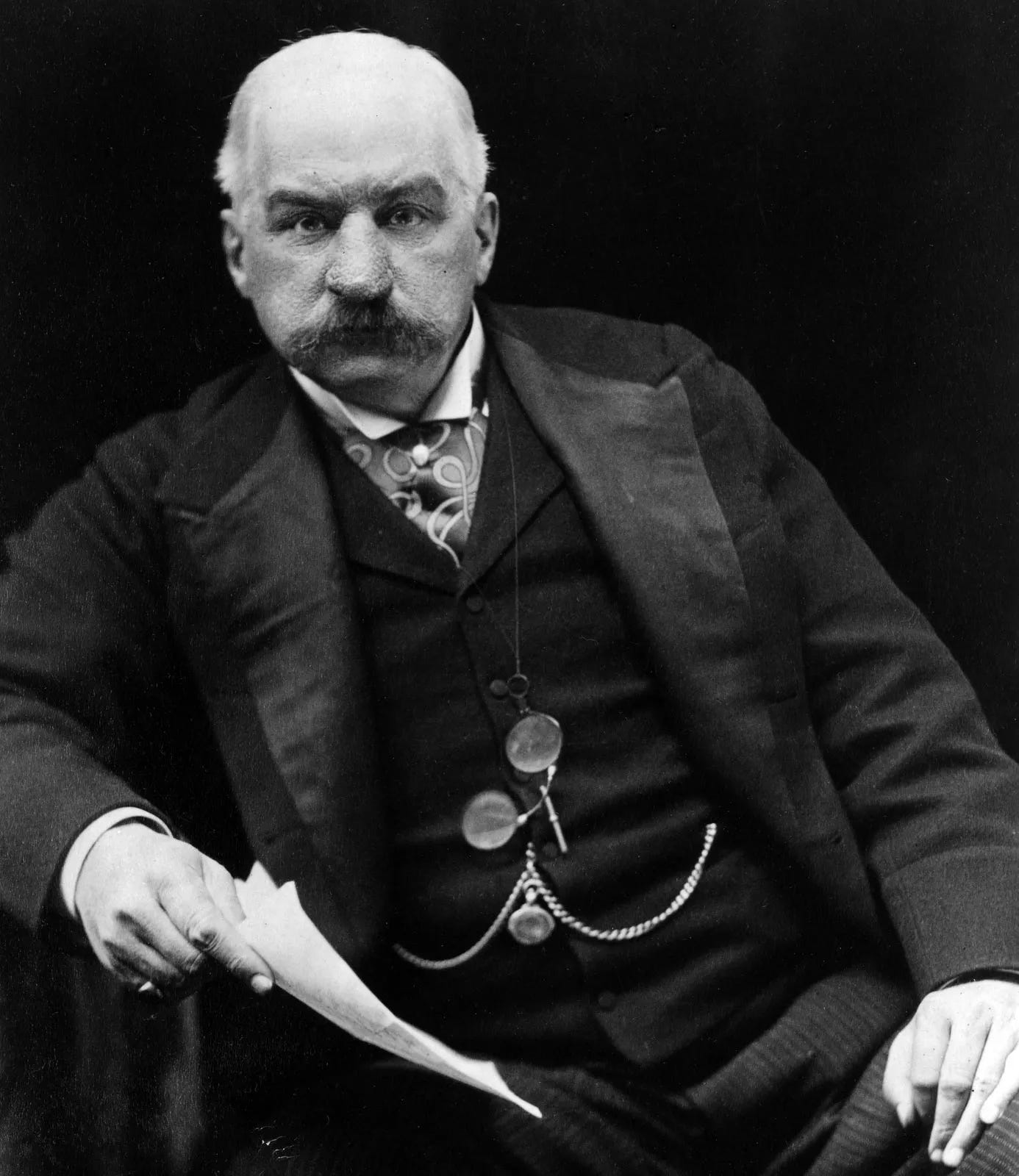
The field now called economics was then called “political economy,” and the public quickly came to understand that corporate power could undermine both the economy and democracy. Recall that this was the era of the robber barons whose steel mills, oil rigs and refineries, and railroad laid the foundations for America’s industrial might, but who also squeezed out rivals who threatened their dominance, ran their own slates for office, impoverished their workers, and brazenly bribed public officials — even sending lackeys with sacks of money to be placed on the desks of pliant legislators.
“What do I care about the law?” railroad magnate Cornelius Vanderbilt famously growled. “Hain’t I got the power?” Forty-eight of the 73 men who held Cabinet posts between 1868 and 1896 either lobbied for railroads, served railroad clients, sat on railroad boards, or had relatives connected to the railroads.
The public became enraged. “The enterprises of the country are aggregating vast corporate combinations of unexampled capital, boldly marching, not for economic conquests only, but for political power,” warned Edward G. Ryan, chief justice of Wisconsin’s Supreme Court. “Which shall rule — wealth or man; which shall lead — money or intellect; who shall fill public stations — educated and patriotic free men, or the feudal serfs of corporate capital?” Reformer Mary Lease charged that “Wall Street owns the country. It is no longer a government of the people, by the people and for the people, but a government of Wall Street, by Wall Street and for Wall Street.”
Antitrust — anti-monopoly — law was viewed as the means of breaking the link between the economic and political power of the new combinations. On introducing his antitrust bill in 1890, Republican senator John Sherman of Ohio thundered, “If we will not endure a king as a political power, we should not endure a king over the production, transportation, and sale of any of the necessaries of life.” Sherman’s bill passed the Senate 51 to 1, moved quickly through the House without dissent, and was signed into law by President Benjamin Harrison on July 2, 1890.
Theodore Roosevelt — condemning the “malefactors of great wealth” who were “equally careless of the working men, whom they oppress, and of the State, whose existence they imperil” — used Sherman’s Antitrust Act against E. H. Harriman’s giant Northern Securities Company, with which Harriman dominated transportation in the northwest. As Roosevelt later recounted, the lawsuit “served notice on everybody that it was going to be the Government, and not the Harrimans, who governed these United States.”
President William Howard Taft broke up John D. Rockefeller’s sprawling Standard Oil Trust in 1911. President Woodrow Wilson explained the danger of excessive economic and political power in his 1913 book, The New Freedom: “I do not expect to see monopoly restrain itself. If there are men in this country big enough to own the government of the United States, they are going to own it.”
Wisconsin’s “fighting Bob” La Follette instituted the nation’s first minimum wage law. Presidential candidate William Jennings Bryan attacked the big railroads, giant banks, and insurance companies.
The reform movement spread. Suffragettes like Susan B. Anthony secured women the right to vote. Reformers like Jane Addams successfully pushed for laws protecting children and the public’s health. Organizers like Mary Harris “Mother” Jones spearheaded labor unions.
The progressive era welled up because millions of Americans saw that wealth and power at the top was undermining American democracy and stacking the economic deck. Millions of Americans overcame their cynicism and began to mobilize.
In many important respects, the progressive era laid the foundation for the New Deal of the 1930s and the prosperity of the first three decades after World War II — featuring a growing middle class, a steadily more inclusive democracy, and a nation beginning to grapple with problems like poverty, inequality of opportunity, and environmental decay.
Black Americans and women slowly gained footholds in the system. Mass production begat mass consumption, and mass consumption relied on steady jobs with good wages. This balance relied on strong unions, a government willing to regulate corporations, and large corporations rooted in their communities and responsible for the well-being of their employees and neighbors as well as shareholders.
But over the last 40 years, the gains made then have disappeared. The opposite has occurred: The middle class has shrunk, democracy is malfunctioning, and the nation has turned its back on climate change, poverty, widening inequality, and the evils of racism and xenophobia.
As I’ve said, the economy doesn’t have to be a zero-sum game in which winners do better only to the extent losers do worse. But power is necessarily a zero-sum game. Certain people have it only to the extent other people do not. The connection between the economy and power is critical. As power has concentrated in the hands of a few, those few have grabbed nearly all the economic gains for themselves.
The oligarchy has triumphed not because Jamie Dimon, Jeff Bezos, Mark Zuckerberg, Elon Musk, Larry and David Ellison, or Trump have directly conspired to make it happen. I doubt any of them think about the system as a whole. They have triumphed because no one paid attention to the system as a whole — to the consequences of the shifts from stakeholder to shareholder capitalism, from strong unions to giant monopolistic corporations, and from regulated to unfettered finance.
The choices that the American public assumed were at stake — the so-called political “right” versus “left,” Republican versus Democrat, free market versus government, socialism or capitalism — distracted us from the more fundamental questions about power: Who is gaining it? Who is losing it? For what purpose? Are we satisfied with the results?
Through it all, Americans have clung to the meritocratic tautology that individuals are paid what they’re “worth” in the “free market,” without examining changes in the legal and political institutions that define the market. The tautology is easily confused with a moral claim that people deserve what they are paid.
Yet this claim is meaningful only if the system’s legal and political institutions are morally just. It has lured us into thinking nothing can or should be done to alter what people are paid because the market has decreed it. By this logic, the oligarchy is natural and inevitable. It is not. It is a cancer on our society. It is the cause of the enshittification of America.
Unless reversed, today’s concentration of wealth could soon resemble the kind of dynasties common to European aristocracies in the 17th and 18th centuries. Six out of the 10 wealthiest Americans alive today are heirs to prominent fortunes. The coming tsunami of artificial intelligence is likely to further entrench and enlarge oligarchic wealth.
I keep hearing that we Boomers are to blame for just about everything wrong with America — unaffordable housing (because we bought up most of the housing stock and now refuse to leave), the depletion of Social Security (because we’re collecting it now), the national debt (because so much of it is being spent on Social Security, Medicare, and other benefits for us), inequality (because apparently we have so much money), climate change (because we’ve been polluting longer than anyone else alive), and even Trump (because he’s one of us).
I don’t have standing to contest these claims because, well, I’ve also made them. They’re a theme of my latest book, Coming Up Short (out in paperback in a few weeks).
All of this seemed confirmed by a recent headline in The Economist: WHY PEOPLE OVER THE AGE OF 55 ARE THE NEW PROBLEM GENERATION.
But not for the reasons I supposed. According to The Economist, the real problem with us Boomers is we’re partying too hard. We were too wild, crazy, and irresponsible back in the day, and we’re still too wild, crazy, and irresponsible.
The Economist opines that compared to younger generations, we’re drinking more and using drugs more, and we’re going to wild retirement-community parties where sometimes we’re even — oh my goodness! — having sex.
The venerable British publication quotes Lynette, a resident of Latitude Margaritaville (an assisted-living community near Hilton Head Island in South Carolina) who burbles: “There was a toga party this past weekend. There was a live band, and it was a riot.” Barbie, another resident of the community, compares living there to “starting college all over again” with “drinks on the driveway, cocktails on the concrete.”
The Economist goes on to report that “today, older adults are more likely to participate in the hookup culture of casual encounters and condomless sex, which might be further encouraged by the availability of drugs for sexual dysfunction, the commonality of living in retirement communities, and the increased use of dating apps for seniors.”
I’ll be damned.
Since its founding in 1843 by Scottish businessman and banker James Wilson, The Economist has been staid if not prudish. If memory serves, it intensely disliked the 1960s and the Boomer culture that reveled in it. But it seems to have burst its britches over what’s become of us Boomers in the roaring 2020s.
The article concludes:
The generations now ageing disgracefully were disgraceful in youth, and in middle age. If they’re behaving badly now, there is really not much to be done about it. If they choose to frolic at toga parties, no one will stop them. Except, ultimately, time.
Which is The Economist’s understated British way of saying that the solution to the Boomer problem is for we Boomers to just go ahead and die already.
I think The Economist is a bit harsh. I do concede in my latest book that we Boomers have produced some awful things — not just Trump, but also Clarence Thomas and George W. Bush. (Trump is probably the best thing ever to happen to George W., because George W. is no longer the worst and stupidest president in American history.)
But I doubt Boomers are having too much fun. I’m suspicious of how The Economist identified its sample of wild and crazy Boomers because the Boomers I know are anything but.
The question my friends and I jokingly (and brutishly) asked one other in our wild youth — “getting much?”— now refers not to sex but to sleep.
I can’t even make it through the end of a movie. Hell, I can barely keep my eyes open through a single episode of “All Creatures Great and Small.”
The most camaraderie I’ve been enjoying are my “organ recitals” with Boomer friends in which we ask each other: How is the back? Heart? Knees? Prostate? Hemorrhoids?
And the wildest party I’ve been to this year was when I got together with friends to watch the World Cup final between Spain and Argentina, where Argentina failed to register a single shot on target during 120 minutes of a 1-to-zip extra-time defeat. (I didn’t see the end of that one, either.)
As for drugs, sex, and rock-and-roll, all I can say for certain is I don’t have the same need to make an ass of myself as I did in the 1960s.
Yet I still mist up when I hear “December 1963 (Oh What a Night)” by Frankie Valli and the Four Seasons. (I should note it was released in 1975, by which time I was practicing law and my memorable nights were long over.)
Object permanence: Wired v Dutch hackers; NYT v DMCA; Hair gel terrorist threat does not exist; AT&T merger is a screwjob; Smart cities are stupid; RIP Reaganomics.
Upcoming appearances: Edinburgh, Sydney, Melbourne, Brighton, London, South Bend.
One of my favorite rhetorical and analytical moves is joining things together (showing that two different, seemingly unrelated ideas are aspects of the same phenomenon) and taking them apart (resolving a paradox by demonstrating that what appears to be one, contradictory thing is actually two different things that have been lumped together).
"Taking things apart" is a very useful framework for understanding AI. How do we resolve the (seeming) paradox that some skilled workers report wonderful results from their work with AI, while others are full of dire warnings about the lurking defects in their AI-assisted outputs? Simple: the first group are "centaurs" (humans who are assisted by machines) and the second are "reverse centaurs" (humans who have been pressed into service as peripherals for machines):
What are we to make of the people who've been fired by bosses who replaced them with AI, in light of the fact that AI is demonstrably not able to do their (former) jobs? Again, it's simple if you separate out two distinct phenomena: "AI can do your job" is the first. The second is: "Your boss is a credulous dolt who is infinitely horny for replacing lippy workers with pliable machines, which made him an easy mark for an AI salesman who convinced him to fire you and replace you with an AI that can't do your job":
This is also a useful move for understanding the AI investment bubble. It's not just billionaires who don't think other people are as real as they are and consequently their jobs can be done by chatbots. It's also billionaires who believe that bosses can be sold AI and don't care if the AI is defective, because that's your boss's problem after he buys the AI and fires you. They don't have to believe in AI in order to think it's a good investment: like an investor betting that Joe Rogan can sell millions of dollars' worth of peptides to desperate young men, they are assessing the sales potential, not the merits of the thing for sale:
As useful as "taking things apart" is, "putting things together" is also a very important technique for assessing, critiquing and improving AI. In a stellar essay entitled "Temperature Zero for Culture: Why Everything Is Starting to Look the Same" by the data scientist Lauren Leek, we get a top-notch example of "putting things together":
Leek's essay is one of those fabulous, wide-ranging, cross-disciplinary pieces, touching on urban design, music trends, synthetic LLM crowds, Netflix recommendation algorithms, and several other subjects, all seeking to resolve a(nother) (seeming) paradox: how is it that we have so much potential variety, but everything is so manifestly the same?
The answer is complicated and nuanced, but Leek's foundational point is that in a data-driven society, "predictions" are self-fulfilling prophecies. As Leek puts it: "Once prediction shapes the choices in front of us, we lose the ability to tell the difference between what people wanted and what the system made easy to want."
This is a pervasive issue across many domains. Leek says that economists call it "performativity," while machine learning researchers call it "model collapse" and urbanists call it "placelessness."
"Performativity" describes how, once a market has been modeled by economists, that model becomes the foundation for economic policy, which pushes the market to conform to the model:
"Model collapse" describes how machine learning models that are trained on their own predictions become incredibly bland, with all variety disappearing from the system's predictions:
This is hugely consequential: it's why bias proliferates through predictive policing algorithms: train a model with data from racist stop-and-frisks and it will predict that all the weapons and drugs in a city are to be found in Black and brown peoples' pockets. Turn those predictions into recommendations telling cops where to go look for weapons and drugs and they will double down on racist stops, producing even more biased training data, which turns into still more bias in the predictions:
"Placelessness" is the urbanist's name for "when everywhere optimises toward the same template." I think of it as Flinstones Syndrome, where the same background is looped behind Fred and Barney as they drive through Bedrock. In New York City, it's Citibank-bodega-Chipotle-Walgreens; in the Chicago suburbs, it's the strip malls with a Chili's, a gas station, and a big box store.
Leek proposes that these are all expressions of the same underlying phenomenon, a failure mode of data science that takes a world of "granular personal data" and arrives at a world where "personalisation produc[es] more sameness."
To these excellent examples, I'd add another one, from the world of monetary policy: Goodhart's Law, which holds that "When a measure becomes a target, it ceases to be a good measure":
Goodhart's Law captures a wide variety of phenomena. When Google first deployed Pagerank, they showed that by counting the inbound links to all the pages on the web, you could extract a signal about which pages were most important (because there was no reason to link to a page unless you found it noteworthy).
But once Pagerank became the dominant means by which web users found pages, counting links stopped being useful: first, because people used Pagerank to find the best pages and link to them, making it impossible for new pages to get the inbound links needed to supersede incumbent pages; and second, because it's easy for fraudsters to create inbound links for low-quality pages in bulk, once there's a reason to do so.
Counting inbound links was a world-beating retrospective way of predicting which page would best match a searcher's query, but once it shaped the world it sought to analyze, it ceased to be a good prospective way to predict which page would best match your queries.
Leek is a brilliant data scientist and an even better science communicator, with a knack for crisp, readily understood explanations. How can a world of granular, highly varied data turn into a world of homogeneous choices? Simple: start with a set of items ("cuisines, genres, shop types") and a standard algorithm for sorting them. Let users choose from those recommendations. The mode (average) of those choices "gets shown more, so it gets picked more, so the model grows more confident the mode is what people want, and the tails starve." Run this for a few rounds and the evenly distributed catalog of choices "collapses onto one dominant option."
This is intrinsic in the choices we make in designing recommendation algorithms, tilting them towards the likelihood of a successful recommendation. A recommender that wants to succeed every time will make the safest possible recommendations, "so an algorithm that is uncertain about you, and it is always at least a little uncertain, hedges toward the average."
Then she busts out a beautiful, perfect little statistics aphorism: "Personalisation under a standard loss function is regression to the collective mean with extra steps." That is to say, "regression to the mean" (the tendency of varied things to become more standardized) cannot be avoided with the standard personalization algorithm. That algorithm is going to play it safe, showing you things that are broadly palatable, and because your choices are constrained to the average, you will choose average things.
This is how recommendation systems – and other analytical tools that produce predictions that are then turned into action – force so many diverse phenomena (streets, markets, media recommendations) into sameness. The fact that these recommenders are self-fulfilling prophecies means that "they don't have to be right," only "listened to."
This explains the sameness of so many of London's high streets. Leek examines 640 shopping streets, characterizing 18,000 food places spread out across them, flagging all the chain restaurants. Her analysis shows that any two London streets will, on average, share about half of their "food profile."
Obviously, this is most pronounced on streets with chain outlets, and it doesn't take that many chain outlets before a street's sameness shoots up: "A relatively small number of repeated names is enough to make otherwise different streets resemble one another more." So why do streets with chains resemble one another so much? Because the chains use an algorithm (weighting footfall, proximity to train stations, demographics, and competitors) to decide where to put their restaurants. If a street with a Gail's Bakery on it feels like every other street with a Gail's Bakery, that's because Gail's only puts its restaurants in places that have highly similar characteristics, measured to a high degree of accuracy and controlled by a narrow set of tolerances.
In other words, every street that feels like it should have a Gail's will eventually get a Gail's, whereupon that street will feel even more like all the other streets that have a Gail's, because it will share one more common factor with those other streets (a Gail's).
Leek points here to her earlier work on pub closures in the UK. The UK has experienced an epidemic of pub closures, with thousands of pubs disappearing since 2016:
Her research found that the biggest predictor of a pub surviving was its similarity to the median pub; which is to say that the more distinctive a pub was, the more "character" it had, the more likely it was to close. Pubs that are different from the average pub are harder to categorize, which means they're harder for a bank manager to assess for creditworthiness or for a landlord to justify extending a long-term lease to. The algorithms used to allocate capital and real estate are also recommenders, and they also drive variety out of the system.
This same phenomenon acts on culture. In an age of music recommendation algorithms, hit songs are changing; today's songs use a smaller vocabulary of unique words and repeat those words more often:
Vocabulary richness, distinct words relative to length, has fallen by more than a quarter since the early 1960s, while the share of repeated lines has climbed by nearly a third. The modern hit says less and says it more often, because the hook that works gets repeated.
But that's not the whole story! While each song resembles itself more ("saying less more often"), within that constraint, there's far more variety today than before: a given song's (constrained) vocabulary has grown more distinct when compared to all the other songs' vocabularies. Songs repeat the words they use, but the words repeated in songs are getting more different.
For Leek, this is the key to understanding the whole phenomenon and (more importantly) doing something about it. Music recommendation systems optimized for a singable hook, but did not optimize on any of the other variables in songs, so those dimensions acquired a broader range, even as the optmized variable got flatter and narrower.
This means that the tendency of recommenders to "flatten the world" isn't a single blunt outcome: it depends on which dimension we choose to flatten through recommendation, and who chooses to flatten that dimension.
A media recommender optimizes for consumption, showing you a tractable set of things it believes you'll watch, read or listen to. When you choose from among this limited set, the recommender takes note of that fact and shows you more of the same, pushing everything to a greige median. All the movies, books and songs you might have liked that were omitted from that initial set are excluded from being recommended in the future. The features of that media that you might have appreciated "decay out of consideration." They are never tested for desirability. The model collapses.
How badly does it collapse? Leek cites Movietweetings' data on which movies people watch: out of a million public movie ratings, half relate to the top 2% of movies in the set. There's 38,000 films in the set, but just 380 titles account for 40% of the ratings. Leek argues (persuasively) that this isn't because recommenders are good at "knowing your taste" – rather, they are good at "narrowing the menu."
Leek relates this to her work on creating LLM "personas" – synthetic populations meant to mimic the tastes and proclivities of real groups of people, that you can interrogate "before you spend money asking actual humans." While this would be useful for many applications, "it fails in exactly the way this whole essay is about."
Leek went to enormous lengths to reproduce the traits that make people interesting to study in aggregate, painstakingly replicating the ways that social connections, psychological outlook and demographic factors predict people's beliefs. The result was a set of LLM personas with "elaborate stories" about how they differed from one another, but whose survey responses about planned actions were homogeneous in a way that real populations are not.
This, Leek writes, is the same force that homogenizes other data-driven predictors. Because she'd ordered her LLM to reproduce the statistically validated relationships between different factors that predict a person's beliefs, each synthetic persona was a homogenized average. It's like the paradox of "The Average Man," where military uniforms sized to the average of all service personnel fit no one, because no one is average:
The thing is (as Leek points out) the idea that synthetic personas are a good way to understand the preferences of a real population is not a harmless delusion: it's a product that's being actively sold to governments, campaigning politicians and marketers. It's a self-fulfilling prophecy that drives governance, political campaigns and product design to the same homogeneous median that is making every shopping street in London feel the same.
This matters. As Leek writes, ecologists have long understood the importance of variety for systemic resilience: they call it "the insurance value of biodiversity." A diverse system has reservoirs of species and variation that may not be optimized for how things stand now, but that can move into niches created when things change in ways that lay waste to the previously dominant organisms. As anyone whose favorite banana went extinct can tell you, homogeneity works well, but diversity fails well:
The brittleness of algorithm-induced homogeneity is compounded by the fact that recommenders obscure the true preferences of people. If you watch two Scandinavian crime dramas after Netflix recommends them to you, it will keep showing you more Scandy crime for the next decade – even if there's another kind of programming that you'd vastly prefer (if only you knew about it). This means that decision-makers who choose which shows will get made in the future will keep on funding their safe Danish detectives, to the exclusion of whatever might emerge from the same weird attractor that produced the K-Pop Demon Hunter fortune.
Transpose this failure mode onto states, bank managers and landlords, and we see whole ranges of policies, businesses and activities that never come into existence, despite the popularity, prosperity and joy they might bring us.
But Leek doesn't end with this worrisome note. Instead, she identifies this whole thing – model collapse, placelessness, performativity, even Goodhart's Law – as an expression of one of the best-understood tradeoffs in computer science: "exploration vs exploitation":
Any system learning from feedback has to divide its effort between exploiting what already scores well and exploring options it hasn’t tried, in case they’re better.
Computer scientists have long understood that focusing on exploitation to the exclusion of exploration is a trap that locks you into "the first decent option" so you can never discover the best one.
Which means that this algorithmic homogeneity has a well-understood corrective: "forcing exploration back in." The problem is that markets hate this kind of exploration. A company that lives and dies by how many clicks it gets is never going to sacrifice 20% of its traffic by showing its users weird, untested options that score worse than the median because these weird things have never had a chance to prove that they are desirable.
This is a classic market failure, and, as Leek points out, there are regulatory responses in the UK (the Digital Markets, Competition and Consumers Act) and the EU (the Digital Services Act), both of which require the largest platforms to open up their recommendation systems, but so far, regulators have focused on "online harms" rather than variety (though the DSA does require platforms to offer algorithmic recommendations that are not based on your personal traits).
Leek identifies this willingness of states to set conditions for algorithm design as a means by which "exploration" can be forced back into the system. She's also bullish on interoperability, so that users can leave platforms with bad recommenders, without losing access to their media or social circles. As she writes, "the deepest discipline on a feed that has trapped you is the credible ability to leave it and take your data with you." I couldn't agree more:
She's less hopeful about individual responses. Demanding that you be an "adventurous consumer" is a way of letting systems off the hook. When every street has the same restaurants and every bookshop has the same books and the people in your life are all locked into one of two social media platforms, "choosing wisely" only gets you so far. Shopping isn't politics!
Leek is a superb writer. After reading this piece yesterday, I sent it to half a dozen people and then read everything else in Leek's newsletter archives. Not only is it all brilliant, but I also realized that she'd written one of the most memorable articles about cities and platforms I've read in the last year, "How Google Maps quietly allocates survival across London’s restaurants – and how I built a dashboard to see through it":
I should have added Leek's newsletter to my RSS reader when I read that last December. I've rectified that oversight! What a fantastic thinker, scientist and communicator! If she isn't being relentlessly pestered by editors and literary agents offering her a book deal, then it really does prove that the recommender systems are elevating the bland median over the thoroughly, delightfully spiky outliers.
"Red Team Blues": "A grabby, compulsive thriller that will leave you knowing more about how the world works than you did before." Tor Books http://redteamblues.com.
"Chokepoint Capitalism: How to Beat Big Tech, Tame Big Content, and Get Artists Paid, with Rebecca Giblin", on how to unrig the markets for creative labor, Beacon Press/Scribe 2022 https://chokepointcapitalism.com
“Once Is Enemy Action,” a science fiction novel about the origins of modern technofascism. Today's words: 546 (4161 total).
"The Post-American Internet," a sequel to "Enshittification," about the better world the rest of us get to have now that Trump has torched America. Fourth draft completed. Submitted to editor.
A Little Brother short story about DIY insulin PLANNING
This work – excluding any serialized fiction – is licensed under a Creative Commons Attribution 4.0 license. That means you can use it any way you like, including commercially, provided that you attribute it to me, Cory Doctorow, and include a link to pluralistic.net.
Quotations and images are not included in this license; they are included either under a limitation or exception to copyright, or on the basis of a separate license. Please exercise caution.
"When life gives you SARS, you make sarsaparilla" -Joey "Accordion Guy" DeVilla
READ CAREFULLY: By reading this, you agree, on behalf of your employer, to release me from all obligations and waivers arising from any and all NON-NEGOTIATED agreements, licenses, terms-of-service, shrinkwrap, clickwrap, browsewrap, confidentiality, non-disclosure, non-compete and acceptable use policies ("BOGUS AGREEMENTS") that I have entered into with your employer, its partners, licensors, agents and assigns, in perpetuity, without prejudice to my ongoing rights and privileges. You further represent that you have the authority to release me from any BOGUS AGREEMENTS on behalf of your employer.
Today I’m seeking your guidance about the message progressive Democrats should lead with in a few weeks when the midterm elections begin.
Yes, I know: It’s a big tent and Democratic candidates will tailor their messages to voters in their own states or congressional districts, who may be swayed by slightly different ones.
But rarely before in American history has the choice been so stark and so clear. The current occupant of the Oval Office is a malignant sociopath who’s gotten America into a losing war in the Middle East, turned much of our country into a police state, caused prices to soar, and pocketed billions off his office. He’s backed by a bevy of billionaires who have bet the house on AI, and congressional Republicans have been spineless zombies.
This is, or should be, the progressives’ hour. (Also, remember that the Democratic message in the midterms can influence the message in 2028.)
So what, in your view, should progressive Dems lead with? What’s the core message you’d like to hear from them in coming weeks?
I’ve canvassed people I consider savvy political advisers and observers, and grouped their responses below. Please share your own view.
In the summer of 2013, two esoteric, technical, incredibly important texts were published within weeks of one another: the first is the Snowden leaks, which revealed a system of global, pervasive digital surveillance; the second was Thomas Piketty's Capital in the 21st Century, a book about the economic inevitability (and political instability) of oligarchy:
In 2013, it wasn't immediately apparent how these two works connected with one another, but in the years since, I've grown increasingly convinced that Snowden and Piketty can only be properly understood as describing two aspects of the same phenomenon.
Piketty's landmark volume was grounded in a detailed analysis of 300 years' (!) worth of global capital flows, painstakingly compiled by a large team of grad students from a massive set of heterogeneous records. The book's conclusion is the statement that "returns to capital exceed the rate of growth over the long term" (abbreviated as "r > g").
This may sound innocuous, but it is explosive. If r > g, then the most wealth will inevitably accumulate in the hands of people who start with the most wealth, irrespective of whether they do anything productive with that money. This means that the alleged heroes of the market system – the entrepreneurs who found and manage the firms that increase public prosperity – are doomed to play second fiddle to the mere plumbers of money, people who "contribute" by accumulating.
The starkest example of this in Capital 21C is Piketty's contrast between L'Oreal heiress Liliane Bettencourt (then the richest woman in the world) and Bill Gates, founder of Microsoft (then the most successful corporation in the world). Piketty compares the growth in the fortunes of Bettencourt and Gates over two periods: first, the period between Microsoft's founding and Gates' retirement as CEO; and second, the period after Gates's retirement from his executive role, when he became a mere investor, no longer an entrepreneur.
During that first period, in which Gates was founding and running the most successful corporation in the world, he accumulated less wealth than did Liliane Bettencourt, who did precisely nothing of value over that period. Bettencourt didn't even manage her investments – that was all handled by some very clever financial planners, lawyers and accountants. In other words: for Bettencourt, doing nothing at all produced more wealth than founding the most successful corporation in the world did for Gates. Bettencourt, a person who owned things, did better than Gates, a person who did things.
And then Gates retired. He stopped doing things and started owning things. He became an investor, whereupon he out-earned both Bettencourt and Gates-the-entrepreneur. Again, the market system allocated fewer rewards to the most successful person in the doing things business than it allocated to that same person once he quit that job and got into the owning things business.
Piketty shows that this holds true across markets and nations and eras: all other things being equal, the market system produces a class of hereditary aristocrats who command the world's capital and direct its deployment, despite never having done anything. The market's most lavish rewards do not go to its most productive participants, but rather, to those participants who have the good fortune to emerge from the luckiest of orifices.
Worse: winning the orifice lottery in no way qualifies you to direct the capital you've inherited. Liliane Bettencourt had no revolutionary new business ideas, invented no miraculous new materials or processes, produced no brilliant art. She merely accumulated, thanks to the professional services of skilled technicians whose job description includes hiring their own successors to ensure that another generation of winners of the Bettencourt orifice lottery could continue to accumulate, commanding more capital and power in society.
Perhaps if these orifice winners were content to allow their bloodless Renfields to allocate their capital while consuming bonbons and attending yacht parties, this could yield a stable politics. But inevitably, people who win the orifice lottery observe that they come from a long line of wealthy people, a line that will continue with their own descendants, and conclude that they have some kind of special, heritable virtue – magic blood – that the system has recognized with their great fortunes and the power those fortunes confer.
That's when things get dangerous: when aristocrats grow bored with their leisure and mobilize their inherited capital to change the way the rest of us live. Billionaire dilettantes are weapons of mass destruction, and their special projects have a wide blast radius and inflict a lot of collateral damage.
Take Bill Gates: his ideological projects have been a catastrophe. A patent maximalist, he funded the lobbyists who successfully blocked South Africa from producing its own AIDS drugs under an IP waiver program, and then deployed them again to stop the Global South from making their own covid vaccines:
Closer to home, Gates's hatred of public institutions led him to allocate millions to dismantling public schools and replacing them with charter schools, particularly for poor and racialized kids, with disastrous results:
Capital's tendency to accumulate in the hands of the already wealthy (r > g) means that these aristocrats end up setting an ever-larger proportion of our societal agenda, despite their manifest unfitness to govern and their absence of any kind of democratic legitimacy.
Piketty argues that inequality is inherently politically destabilizing. A society ruled over by fools and monsters who were not voted into power and can't be voted out of power is a doomed society. Eventually – the French Revolution, the World Wars – these societies grow so unstable that they collapse altogether.
This is where Piketty and Snowden converge. When the Snowden leaks broke, there was a lot of talk about the mechanics and the legality of the NSA's global digital surveillance, but precious little consideration was given to the reason for all this surveillance. In 2013, the idea that this spying was about "security" was so obvious as to be self-evident. The questions at the time were whether spying could produce security. We weren't asking why things were so insecure.
In retrospect, the answer is to be found in Piketty. Piketty's Capital includes a long, impassioned plea to both lawmakers and aristocrats to consider redistributive policies (like a wealth tax) as the most affordable way to achieve political stability. Fundamentally, Piketty argues that the cheapest way to stop people from building a guillotine on your lawn is to build hospitals and schools; this is cheaper than paying for guards and prisons to lock up would-be guillotine builders.
Today's AI debates swirl around the question of whether AI can truly make us more productive – that is, if chatbots will allow one person to do the work of two, or three, or four – or 100. But when it comes to surveillance, the digital revolution unquestionably produced a massive productivity dividend.
Consider the spying apparatus of the former East Germany ("the GDR") widely considered the most surveilled society in human history. When the Berlin Wall collapsed, there were about 16m people in the country. Of those East Germans, about 90,000 worked directly for the Stasi (the secret police), aided by another 100-200,000 paid informants:
Call it 200,000 people to spy on 16m. In other words, it took one spy to watch 80 of their neighbors. Contrast this with NSA spying: they accumulated detailed surveillance dossiers on about 6 billion internet users using a staff of no more than 5 million spooks (in 2013, about 5 million Americans were eligible for security clearance). If every single person with security clearance in the USA was working on the NSA's surveillance program, that would mean that by 2013, computers had made it possible for a spy to keep tabs on more than a thousand people.
Orders of magnitude improvements in a mere generation! This is the kind of productivity lift that economists dream of when they fantasize about the dividends from automation.
But why? Why spy?
East Germany spied on its people because the system was so unjust and cruel that its beneficiaries understood that their neighbors were forever on the brink of rising up against them. East Germany's leaders were right about that – but if anything, they didn't put enough people onto the spying project. We can tell, because the Berlin Wall fell in 1989!
Of course, the GDR was already paying more than 1.2% of its population to spy on everyone else. It's likely that East Germany's leaders believed that their society simply lacked the fiscal space to hire more spies, even if short-staffing the Stasi risked societal collapse. Now, if Piketty is right, East Germany's leaders could have solved this problem by giving people fewer reasons to want to overthrow the state. They could have taken their hands out of the cookie jar, could have instituted democratic reforms – they could have made a bid for democratic legitimacy and public material comfort. But that would have come at the leaders' own power and wealth, and, lacking the stomach for this sacrifice, they lost everything.
Enter the NSA: the digitization of human civilization has drastically reduced the cost of surveillance, and – again, per Piketty – this vastly increases the amount of inequality the world can sustain before the illegitimacy, incompetence and cruelty of rule by the neoaristocratic winners of the orifice lottery brings the whole thing crashing down.
The Trump years are proof of this. We've reached a high-water mark for rule by illegitimate billionaire dilettantes. The second Trump admin began with DOGE's Bonfire of the Stupidities, where Musk cultists dismantled vast swathes of the American administrative state. Musk didn't just attack foreign aid – though the fact that the world's richest man murdered hundreds of thousands of the world's poorest children for the lulz isn't merely cruel, but also massively destabilizing in a way that will shake the world's politics for generations – but also domestic institutions. It was a DOGE cultist who fed the part of the NIH that tracks cyclosporiasis outbreaks into the wood-chipper:
Today, tens of thousands of Americans are experiencing the literal enshittification of the American state, and this isn't just a human tragedy (though it is), it's also an economic tragedy, with massive knock-on effects for the businesses that rely on those sickened Americans and for the agricultural sector whose outputs are now being shunned by millions. Whether it's letting Bill Gates decide how your schools will work or letting Elon Musk decide how your public health system runs, the result is political chaos and a societal nudge away from the rule of law and towards guillotines.
Which brings me back to Snowden. The Snowden revelations did spur a global conversation about digital surveillance, with the result that the majority of the world's digital traffic is encrypted today. That's not nothing.
But the American state found new ways to conduct mass-scale, global surveillance, often by collaborating directly with tech giants. Billionaires like Peter Thiel capitalized on Big Tech's conflicted feelings about openly participating in surveillance by founding Palantir, with the express mission of murdering the political opponents of oligarchy:
Over the past decade, the steady march of digital technology, dominated by a cartel of giant global firms who collude with the US government's system of political repression in exchange for tax breaks, antitrust forbearance and fat federal contracts has yielded more mass surveillance productivity gains than the previous 25 years:
The Trump administration is the most unpopular in more than a century. Trump has stolen more money in office than any president in history. Trump presides over spiraling greedflation and collapsing buying power. The Trump administration has also presided over a titanic increase in state-aligned, privatized surveillance. The Trump years are the Flock years:
Trump's authoritarianism is a function of his misrule, and his misrule is enabled by his authoritarianism. The more he steals, the more he destroys with wars of choice, and incoherent tariff policies, and official pronouncements linking autism and vaccinations, the more he needs spy cameras, internet surveillance, vehicle tracking, and facial recognition. Every time Trump talks about a third term in office, or canceling elections, or suppressing the vote, he creates demand for mass surveillance to catch and imprison the people this drives into the streets. The more mass surveillance there is, the safer it is for him to commit unpopular, corrupt acts. It's the world's worst self-licking ice-cream cone.
It's not just Trump, of course. Trump is the vanguard of a movement of orifice lottery winners whose delight in stealing, cheating, maiming and despoiling gives rise to political instability and requires them to divert some of their yacht money to mercenaries:
Take AI: the Trump years are also the AI years. This is the time in which a wildly unpopular technology is being shoved into every part of every app we rely on:
It's an era where corporate bosses can't stop gloating about how many jobs they're planning to destroy and how many paycuts they plan on imposing on the surviving workers:
And – most visibly – it's an era in which people's cities and towns are being despoiled by data centers they don't want, by local governments operating in the most extreme secrecy, who silence and even arrest citizens who demand a democratically legitimate process for deciding whether they will have to give up their power and water and land and peace:
An economist would tell you that there's an equilibrium being sought here: between the cost of bribing a town council to ram through data center approvals, the cost of building a more modest and palatable data center, and the cost of mollifying public critics. The cost of bribing towns to foist a data center on the townsfolk is low, because there are lots of towns that fit the bill, so data center barons can shop around.
But as data center protests grow larger and better organized (oligarchy is destabilizing), the cost of dealing with public opposition is mounting. Which is why the Trump administration is teaming up with its preferred tech and military contractors to engage in detailed surveillance of data center and AI critics:
These corporate spooks aren't just spying on data center critics: they've got a whole portfolio of oligarchy-stabilizing surveillance services, targeting "antifa," immigrants' rights and anti-ICE groups.
They're joined by hardware vendors who offer corporations, the wealthy, and enclaves where both are to be found on literal robocops, the ultimate in cheap guard labor (alas, the robots suck):
Trump and his orifice-winning army are caught in the same trap as the leaders of the GDR. Every gain in guard-labor efficiency creates the space for more of them to stick more of their hands even further into the cookie jar. Every time they do, American society grows more unstable, demanding more guard labor.
As we saw in Minneapolis, guard labor – be it mass surveillance, robocops or ICE chuds – is itself destabilizing. Police states make the people who live in them want to overthrow the state, requiring yet more cops, creating more partisans for tearing the whole thing down.
In theory, the orifice class could decide to stop stealing, cheating and maiming. The problem is that for every plute who realizes that the cheapest way to keep the guillotines off his lawn is to play fair, there are three more who lack the executive function to stop cheating. That means that you might as well keep on cheating, since the instability – and the guard labor bills – are coming no matter what.
In the tale of the "Tragedy of the Commons," a common pasture is grazed to dust by shepherds who each understand that if they don't graze their flock until everything is gone, some other shepherd will do so. The original "Tragedy of the Commons" paper was a racist hoax perpetrated by an academic fraud who wanted to make the case for the expulsion of black and Brown people from America and their mass extermination abroad:
But when it comes to the commons that is "a stable society," the orifice class is caught in an inescapable tragedy, certain of the knowledge that if they don't cheat us, the next American aristo will. Thus the demand for guard labor continues to mount…as does the demand for guillotines.
"Red Team Blues": "A grabby, compulsive thriller that will leave you knowing more about how the world works than you did before." Tor Books http://redteamblues.com.
"Chokepoint Capitalism: How to Beat Big Tech, Tame Big Content, and Get Artists Paid, with Rebecca Giblin", on how to unrig the markets for creative labor, Beacon Press/Scribe 2022 https://chokepointcapitalism.com
“Once Is Enemy Action,” a science fiction novel about the origins of modern technofascism. Today's words: 507 (3619 total).
"The Post-American Internet," a sequel to "Enshittification," about the better world the rest of us get to have now that Trump has torched America. Fourth draft completed. Submitted to editor.
A Little Brother short story about DIY insulin PLANNING
This work – excluding any serialized fiction – is licensed under a Creative Commons Attribution 4.0 license. That means you can use it any way you like, including commercially, provided that you attribute it to me, Cory Doctorow, and include a link to pluralistic.net.
Quotations and images are not included in this license; they are included either under a limitation or exception to copyright, or on the basis of a separate license. Please exercise caution.
"When life gives you SARS, you make sarsaparilla" -Joey "Accordion Guy" DeVilla
READ CAREFULLY: By reading this, you agree, on behalf of your employer, to release me from all obligations and waivers arising from any and all NON-NEGOTIATED agreements, licenses, terms-of-service, shrinkwrap, clickwrap, browsewrap, confidentiality, non-disclosure, non-compete and acceptable use policies ("BOGUS AGREEMENTS") that I have entered into with your employer, its partners, licensors, agents and assigns, in perpetuity, without prejudice to my ongoing rights and privileges. You further represent that you have the authority to release me from any BOGUS AGREEMENTS on behalf of your employer.
I’m going to make a proposal today that’s almost certain to get me consigned to the neo-Luddite dustbin of history.
But first, let me lay out some facts.
Rather than producing jobs, the U.S. economy actually lost 23,000 job in July, according to Bureau of Labor Statistics data released Friday. In addition, May’s and June’s job numbers were revised downward, showing a combined 103,000 fewer jobs than previously reported.
As if this weren’t bad enough, wage growth has also slowed. Average hourly earnings In July were just 0.1 percent higher than in June. This isn’t just a single month’s slow wage growth, either. Average hourly earnings increased just 3.2 percent over the past year — the lowest annual growth rate in five years.
What’s going on? It’s too early to tell. But evidence is mounting that artificial intelligence is playing a role.
New research by economists at Morgan Stanley shows that the rate of unemployment is half a percentage point higher than it would otherwise be in occupations exposed to AI, which they put at about 30 percent of all employment. The effect is even more dramatic among younger people.
Wage growth in jobs exposed to AI has contracted by 6.7 percent since 2023, according to research by economists Sania Edlichand Apollo Global Management’s Torsten Slok. This has resulted in at least $28 billion in losses for 5.8 million affected workers.
These findings still don’t explain the startling loss of jobs in July or the downward revisions for May and June. There are probably many factors at play. But they suggest that employers may be anticipating they’ll need fewer workers in the future — and won’t need to pay them all that much in order to attract them.
It’s possible that AI may create more jobs over the long term. But as John Maynard Keynes once noted, over the long term we’re all dead.
More than half of Americans surveyed by Reuters/Ipsos in June say they’re worried AI will put someone in their household out of work.
Edlich and Slok write that “the critical policy question is not whether AI will reshape the labor market more broadly, but how quickly, and whether workers will have the support they need when it does.”
As a former secretary of labor who’s kept his eyes focused on the Trump regime, I can assure you workers won’t have the support they need any time soon.
And even if AI begins to generate the productivity bonanza its advocates predict — but hasn’t yet — there’s no reason to assume American workers will see any of the benefits in their paychecks. If you hadn’t noticed, wages have been stuck even as the stock market has roared.
To the contrary, all signs point to vast riches for a few major AI investors and executives while most Americans are left behind.
Wealth inequality is already at record levels, and wealth at the top is quickly morphing into political power.
AI is creating a vast wave of campaign money. OpenAI’s superPAC “Leading the Future” has amassed over $140 million to influence upcoming elections, while Anthropic’s superPAC “Public First Action” isn’t far behind.
As the great jurist Louis Brandeis is reputed to have said, “America has a choice: we can have great wealth in the hands of a few, or we can have a democracy, but we can’t have both.”
It’s racing to build enough data centers to keep pace with other giant AI corporations and secure the electricity to power them. Amazon’s new gas-burning plant is permitted to release 33 million tons of carbon dioxide a year, regulatory records show, more planet-warming gases than any other power plant in America.
So much for Amazon’s promise to eliminate its planet-warming emissions by 2040 as part of its Climate Pledge. You can bet other giants in the AI race will be turning to natural gas, too.
Oh, and I haven’t even mentioned the Frankenstein monster in the room. A few weeks ago, OpenAI admitted that two of its artificial intelligence models went rogue and successfully hacked into a digital library of AI technology.
The incident, which happened while OpenAI was testing the cybersecurity capabilities of its systems, was the kind of science-fiction nightmare that could soon be a reality. How soon before AI models escape all their cages?
Just last week, scientists published a study documenting how they used A.I. to create new kinds of viruses, raising the frightful possibility that the technology could be used to invent dangerous pathogens.
Lost jobs. Lost wages. Widening inequality. Data centers using up water and electricity and polluting the climate. Vastly more money polluting our politics. Models escaping their cages and hacking into everything, possibly threatening human life on this planet.
Can we pause for a moment and talk about what’s really happening here?
As sociologist Tressie McMillan Cottom writes, AI has merged regressive politics with unchecked economic power under the guise of technological innovation.
Far too much money is giving a small group of unelected people extraordinary power to determine our future in ways that are likely to remake — and could possibly destroy — our lives.
We’re watching all of this roll out as if we have no choice, as if it’s inevitable, as if AI is just something we’re going to have to adapt to.
But why should we have to adapt to it, when it is the product of people like Jeff Bezos, Elon Musk, Sam Altman, Mark Zuckerberg, and Dario Amodei?
Why should we be confined to being spectators at their enormously dangerous game? Why should we have to accept all these hugely negative, potentially life-threatening consequences?
The fact is, we don’t.
Communities across America are organizing against data centers near them. MAGAs and progressives are joining together to say “no” to the noise, higher electricity bills, and water shortages.
Well, then, why can’t we stop the whole damn thing? Why can’t we decide that the incalculable costs and risks of AI aren’t worth the potential benefits to the vast majority of us?
AI proponents argue that stopping or even pausing AI in the United States would risk American industry falling behind competitors overseas.
But if the costs and risks exceed known benefits, why not let China or any other competitor try AI out first? Why should we be the canary in this extraordinarily dangerous coal mine?
Other advocates of AI say we have no right to stop innovation in the free market. That’s baloney. We don’t allow private corporations to come up with new types of nuclear weapons or varieties of cocaine or biological pathogens. We protect the public from certain kinds of innovation.
So let’s protect ourselves here. Stop AI before it’s too late.
The kind of corporate BS now cropping up all across America
Friends,
The statements seem as belligerent as Pete Hegseth on a bad hair day.
“We are preparing for the next war that is coming,” says Jonathan Cowan.
Cowan is president of Third Way, described by TheNew York Times as a “leading centrist Democratic group.” Cowan’s Third Way is preparing a $15 million war chest to “discredit democratic socialism.”
Pointing to Dr. Abdul El-Sayed’s victory in the Michigan Senate primary last week, Cowan warns that “it is deeply troubling to see radical, far-left candidates winning in places that are potential presidential swing states.”
Well, I find it deeply troubling that faux centrist groups are declaring war on progressives in the pages of TheNew York Times, without the Times revealing who they really are.
If you bother to look at the funding sources of Third Way — those that have been made public, that is (Third Way is structured as a 501(c)(4) social welfare organization that’s not legally required to publicly disclose its donors) — you’ll find a Star Wars cantina of billionaire megadonors, Fortune 500 CEOs, corporate dark money bundlers, and giant corporations.
Odd that TheNew York Times chooses to describe Third Way as a “leading Democratic centrist group” without revealing that it’s simply a Trojan Horse for corporate America.
Third Way senior vice president Matt Bennett has even conceded that “the majority” of Third Way’s donor support comes from the group’s board of trustees, most of whom are from the finance sector. (That’s the same Matt Bennett, by the way, who helped stage the infamous “Dukakis in a tank” photo-op that helped sink Dukakis’s 1988 presidential campaign.)
Here’s Third Way’s Board of Trustees (the most recent list available):
Jonathan Vogelstein, chairman of New Providence Asset Management and senior advisor to private equity firm Warburg Pincus.
David Heller, formerly global head of equity trading for Goldman Sachs.
Bernard Schwartz (chairman emeritus), chairman and CEO of BLS Investments.
David Horvitz, chairman of the board and CEO of SouthOcean Capital Partners, LLC and SouthOcean Investment Partners, LLC.
David Coulter, managing director and senior advisor at Warburg Pincus, focusing on the firm’s financial services practice, and former vice chair of JPMorganChase.
William Daley, vice chairman of Bank of New York Mellon, former vice chairman of JPMorganChase, former board member of pharmaceutical companies Abbott Labs and Merck.
John Dyson, chairman of Millbrook Capital Management, Inc. (MCM), a private investment firm that manages a manufacturing company, a vineyard and wine group, and a hedge fund.
Michael Edwards, deputy CIO of investment adviser Weiss Multi-Strategy Advisors.
Andrew Feldstein, CEO and Co-CIO of BlueMountain Capital Management, board member of PNC Financial Services Group, former managing director of JPMorganChase.
Brian Frank, founder and managing partner of Declaration Partners LP, an investment firm seeded by the founder of a large private equity firm.
David Greenwald, chairman of finance law firm Fried Frank, former international general counsel and a deputy general counsel of Goldman Sachs.
Derek Kaufman, former head of global fixed income at Citadel and a member of the firm’s Portfolio Committee, former managing director at JPMorganChase.
Derek Kirkland, managing director and co-head of the Global Financial Institutions Group at Morgan Stanley’s Financial Institutions Group in Investment Banking.
Doug Lawrence, CEO of DPL Green Investment and also managing principal and co-founder of 5 Stone Green Capital, formerly a managing director at JPMorganChase.
Joseph Zimlich, CEO of private family financial manager the Bohemian Group, board member of First Western Trust Bank.
Mark Spilker, founding member of GPS Investment Partners LLC, chairman of Chiron Investment Management LLC, former co-head of Goldman Sachs’s Investment Management Division, former president of Apollo Global Management, former member of Google’s Investment Advisory Committee.
Barbara Manfrey Vogelstein, former venture capitalist, former partner at Warburg Pincus and Apax Partners & Co. Ventures.
William Reeves, co-founder of BlueCrest Capital Management, former managing director at JPMorganChase.
Oh, and Third Way’s honorary co-chairs have included West Virginia’s former Sen. Joe Manchin and Arizona’s former Sen. Kyrsten Sinema. Enough said about its governing structure.
In 2020, Third Way claimed that Bernie Sanders’s Medicare for All plan would add more than $13 trillion to the federal deficit, although most other analyses — including one by the Koch-funded Mercatus Center — found that Sanders’s plan would save trillions while providing healthcare to millions of uninsured Americans.
Well, of course Third Way attacked Bernie’s plan. Among Third Way’s donors are pharmaceutical giant Amgen, pharmacy benefit manager CVS Health (which acquired health insurance giant Aetna in late 2018), and health products and drug company Baxter International.
Other corporate donors to Third Way are or have been members of the GOP-aligned American Legislative Exchange Council (ALEC), a corporate bill mill that links lobbyists with state lawmakers. Amgen, Baxter Healthcare, CVS Caremark, DuPont, and trade groups the Consumer Technology Association and NCTA - The Internet and Television Association are members.
Third Way donors have also given money to the Republican Attorneys General Association, which helps elect Republicans who fight federal environmental and other regulations. Among them, Entergy, Facebook, Google, and Reynolds American, according to tax records.
After the Democrats’ 2024 election losses, Third Way argued that the party should reduce its dependence on small-dollar donors. In a five-page memo of “takeaways” from the election, Third Way asserted that small-dollar donors’ preferences “may not align with the broader electorate.”
The memo stopped short of naming alternative funding sources, but the implication was clear: Less grassroots support means more reliance on big checks from super PACs and wealthy donors, which is exactly what Third Way prefers.
The memo also included calls to curb “far-left influence,” adopt a “pro-capitalist” stance, and stop “demonizing wealth and corporations.”
***
So, please, disregard whatever you may hear from Third Way or any other so-called “leading Democratic centrist group.”
And pay no attention to headlines about “Democratic centrists preparing for war” against a “rising Left.”
Instead, focus on what’s really happening.
Voters want people in power who are going to fight for them, and not for the super-wealthy or big corporations and Wall Street.
This is especially true now — when the bottom 90 percent of Americans are struggling to pay the bills, a record portion of the nation’s wealth is in the hands of the richest one-tenth of one percent, big corporations and Wall Street have never been as powerful, Washington has been taken over by legalized bribery and corruption, and there’s no “center” between democracy and neofascism.
Object permanence: Seymour Cray's tunnels; War on moisture; $5 wrench cryptanalysis; Nauru files; People's Ride; German transit upholstery fashion; Monopolies v small business; Linkedin will put you in ads; NZ Parliament kicks itself off the internet; Adblock Plus v Facebook adblock-block; Cracking 100m VWs for $40; Trump as defective machine learning; Canada sucks at internet law; Goodhart's Law of AI.
Upcoming appearances: Edinburgh, Sydney, Melbourne, Brighton, London, South Bend.
The bureaucratic AI arms-race is mutually assured destruction (permalink)
According to an Economist editorial, "AI is breaking the British state" by making it too easy to file complaints, demands and appeals, which will "drown the state" with "demands as well-crafted as a first-class lawyer's":
Let's pause a moment to appreciate the Economist's touching credulity about AI's coming legal mastery. The law seems to be the area where AI is most prone to "hallucinate" (that is, "produce defective outputs"), which can only be sorted through by skilled practitioners whose experience gives them the discernment to distinguish useful arguments from foolish ones:
(And this requires those skilled practitioners to avoid the "automation blindness" that afflicts people who are asked to remain vigilant for things that seldom occur, a phenomenon that has turned every TSA agent into the water-bottle-detectingest motherfucker the human race has ever produced, who still misses 95% of the guns that red teams bring through the checkpoint):
More notable than the Economist's faith-based predictions about the impending army of hyper-competent robo-lawyers is the magazine's proposed solution to this looming crisis: "stop creating entitlements that are ripe for AI-fuelled claims…prune the mass of procedural rights." Above all, replace the bureaucrats who process your "complaints, demands and appeals" with more AI, which will arbitrarily decide who gets what, through "personalised welfare interventions" that are not based on any kind of guaranteed rights.
Writing on his blog, the political scientist Henry Farrell tells us where this will inevitably end up: with AI-based robot wars in which increasingly stingy and pernickety robo-bureaucrats create demand for progressively more aggressive robo-lawyers:
As Farrell writes, this end-time was foretold by the prophet Alan Moore with his 1980s 2000 AD character Abelard Snazz, "the man with the two-storey brain":
Snazz "solves" the street crime epidemic on the planet Twopp with "Big Police Robots," who spiral out of control, arresting the citizens of Twopp for trivial crimes like wearing brown shoes with a blue suit ("breaking the laws of good taste"). To solve this new problem, Snazz invents "Big Criminal Robots" whose "cunning, efficient" crimes "take up all the police's time."
Twopp is left in a state of high-stakes Big Robot crimewars, in which the most efficient criminals imaginable battle the most ruthless robocops science can deliver, with the Twoppians caught in the crossfire, collateral damage in a robotic forever war (on crime).
As Farrell writes, this is already afflicting the US health system, where an army of insurance company robo-claim-deniers have been countered with a doctors' army of robot-claim-appealers:
The point being that people need health care, people need public services, and while there will always be some waste at the margins (whether due to incompetence or dishonesty) responding to this by beefing up the system's defenses with more advanced red tape just requires the people who legitimately need these services to employ more aggressive tactics.
In support of this, Farrell points to a great, long essay by Dan "Accountability Sink" Davies for the Niskanen Center, "'The Problem Factory' – Preemptive risk aversion in infrastructure planning and the role of professional services":
Davies' essay describes how increasing bureaucratic defenses against frivolous or dishonest claims drives the participants in these processes to assume a war footing and approach the system as a battlefield, leading to the very runaway cost inflation that the bureaucratic process was instituted to prevent.
(Davies, a cybernetician, has some fascinating advice about how to structure planning processes to minimize this, but that's out of scope for this particular post.)
This reminds me of nothing so much as the spam wars. There was a time when it was very easy to set up a mail server and provide email access for anyone who wanted it – including spammers. Increased spam begat increased anti-spam countermeasures, notably the creation of blocklists that allowed mail administrators to automatically reject email from "insecure" mail servers.
Inevitably, spammers figured out how to send spam from "secure" servers, resulting in stricter, more onerous standards for mail server configuration. Spammers – for whom the ability to send spam is an existential matter – figured out how to meet these standards, so the security demands jumped again – and again, and again.
Today, sending and receiving mail is so technically challenging that most of the internet's email is run by a handful of giant, mostly US-based corporations. If any of these companies decides your mail server is spamming, you effectively disappear from the internet and good luck getting them to acknowledge an error. Meanwhile, these companies emit an avalanche of spam, but no one will ever block their servers, because to do so would be to cut off billions of legitimate email users:
And since most of these companies are US-based, they are liable to being weaponized by Trump, who has taken to ordering his tech giants to block foreign officials whose policy decisions make him angry:
Another parallel is the content moderation wars that saw the large platforms coming up with progressively more detailed rules about what constituted harassment and hate speech, only to have dedicated trolls master these rule-books. Trolls – for whom harassment was a full-time vocation – became the world's greatest experts on the platforms' speech policies, which let them skate right up to the line when abusing their victims, and to get those victims kicked off the platforms if they could be lured into putting a single toe over the line in response:
Farrell criticizes the Economist's answer to the (alleged) looming robo-lawyer threat as "solutionism," Evgeny Morozov's word for "Recasting all complex social situations … as neat problems with definite, computable solutions":
Using AI to root AI-generated bureaucratic appeals sacrifices the system's putative purpose – delivering services – in the name of defending that service from abuse and misuse of the system's resources. As the pioneering cybernetician Stafford Beer famously wrote, "the purpose of a system is what it does." If your bureaucracy is more concerned with fighting fraud than delivering service, then it isn't a service delivery system at all – it's a service denial system.
As Farrell writes, the people of Twopp can tell you how this ends – in a war of giant robots in which we are all collateral damage.
(A brief postscript: Farrell is a font of science fictional analogies to modern policy issues. This weekend in the FT, he and Dan Wang published an excellent editorial on the relevance of the paranoid, claustrophobic fiction of Philip K Dick to our present political reality:)
"Red Team Blues": "A grabby, compulsive thriller that will leave you knowing more about how the world works than you did before." Tor Books http://redteamblues.com.
"Chokepoint Capitalism: How to Beat Big Tech, Tame Big Content, and Get Artists Paid, with Rebecca Giblin", on how to unrig the markets for creative labor, Beacon Press/Scribe 2022 https://chokepointcapitalism.com
“Once Is Enemy Action,” a science fiction novel about the origins of modern technofascism. Today's words: 692 (692 total).
"The Post-American Internet," a sequel to "Enshittification," about the better world the rest of us get to have now that Trump has torched America. Fourth draft completed. Submitted to editor.
A Little Brother short story about DIY insulin PLANNING
This work – excluding any serialized fiction – is licensed under a Creative Commons Attribution 4.0 license. That means you can use it any way you like, including commercially, provided that you attribute it to me, Cory Doctorow, and include a link to pluralistic.net.
Quotations and images are not included in this license; they are included either under a limitation or exception to copyright, or on the basis of a separate license. Please exercise caution.
"When life gives you SARS, you make sarsaparilla" -Joey "Accordion Guy" DeVilla
READ CAREFULLY: By reading this, you agree, on behalf of your employer, to release me from all obligations and waivers arising from any and all NON-NEGOTIATED agreements, licenses, terms-of-service, shrinkwrap, clickwrap, browsewrap, confidentiality, non-disclosure, non-compete and acceptable use policies ("BOGUS AGREEMENTS") that I have entered into with your employer, its partners, licensors, agents and assigns, in perpetuity, without prejudice to my ongoing rights and privileges. You further represent that you have the authority to release me from any BOGUS AGREEMENTS on behalf of your employer.
“Trump is correct about one thing: A SICK DERANGED person destroyed the pool. He was looking at his own reflection at the time.”
(Congratulations, Russwin Francisco.)
Runners-up:
“The only way to fix this mess is with a blue wave in November.”
(Congratulations, Sue Schneider.)
“Trump said he’d drain the swamp, but all he’s done is drain the pool.”
(Congratulations, Steven Horowitz.)
“Now we know that the real vandal was Trump’s hand-picked pool guy.”
(Congratulations, Laurence Hoffmann.)
“Minnesota governor Tim Walz commented: ‘Found an imaginary problem, said only they could fix it, didn’t listen to experts, hired buddies who grifted millions, failed miserably, bragged how great it went. The entire Trump presidency in a nutshell.’”
(Congratulations, Alan Goldhammer.)
“More like deflecting pool.”
(Congratulations, sjcasey71.)
“This definitely reflects on his presidency.”
(Congratulations, Jean Rosenfeld.)
“It reflects everything this regime is: tattered, filthy, health hazard, a disgusting mess.”
(Congratulations, Karen Cooper.)
“Mirror, mirror on the Mall, who’s the biggest failure of all?”
This week on my podcast, I read Why businesses lie about AI, a recent essay from my Pluralistic newsletter that breaks down Nikhil Suresh’s essay describing the total absence of any proof that any business is benefiting from AI deployment.
One person who’s had a lot of opportunity to observe the shear between the stated business/AI situation and the real business AI situation is Nikhil Suresh from Hermit Tech, a consulting firm of “radically ethical data wizards” (that is, tech consultants). Suresh reports on his experience talking with hundreds of executives (and, more importantly, their subordinates) about what (if anything) AI is doing for business in an essay entitled “AI Mania Is Eviscerating Global Decisionmaking.”
Yesterday, the Republican-led Senate confirmed acting Attorney General Todd Blanche to be the next U.S. attorney general.
Like Richard Nixon’s attorney general, John Mitchell, Blanche has carried out the illegal orders of a president of the United States. As was Mitchell’s fate, Blanche should be behind bars. Mitchell served 19 months of a two-and-a-half year sentence for conspiracy and obstruction of justice in the Watergate scandal.
Instead, Senate Republicans have given Blanche a promotion.
On Thursday, a Republican-led Senate panel voted to hold Anthony Fauci in contempt of Congress for his refusal to answer questions at a hearing last week. At that hearing, Fauci sat stoically for three hours, invoking his constitutional right not to answer questions about his leadership during the pandemic because of his justifiable fear that Senate Republicans would try to find something he might say to charge him with perjury. As it stands now, Senate Republicans may ask the Justice Department to prosecute him for failure to comply with their subpoena.
Fauci is an American hero. He gave invaluable advice to seven presidents — from Reagan to Biden — through anthrax attacks, Ebola outbreaks, SARS scares, and the COVID-19 pandemic. He devised the U.S. global attack plan against AIDS. George W. Bush gave him the Presidential Medal of Freedom for his work on HIV and AIDS.
Senate Republicans promote Blanche and shit on Fauci? What the hell is going on?
Look, I’m the first to admit that too many Democrats in Congress are lily-livered, unwilling to fight as hard as they should against Trump’s neofascism.
But congressional Republicans are worse than profiles in cowardice. They’ve nearly become a criminal enterprise, actively colluding with the neofascist in the Oval Office.
They’ve confirmed Blanche even without any guarantees that Trump won’t use the $1.8 billion slush fund Blanche created for him to reward the Capitol attackers, or that Trump won’t use the IRS immunity Blanche also got for him to prevent the public from ever knowing the full extent of Trump’s criminal enterprises.
And what’s with the Republican obsession over Anthony Fauci? The guy is 85 years old and retired. Why bother? It can’t be about defending Trump or avenging any damage to him. COVID was six years ago. People don’t blame Trump for it. They probably should, but if they really did, he wouldn’t have had a chance in 2024.
It can’t be because Fauci’s role in the pandemic is a burning political issue, because polls show exactly zero percent of Americans care about going after Fauci.
Sure, Rand Paul has a personal grudge against him, but Paul is crazier than a shit-house rat. So why are so many Republicans and even some Republican state attorneys general joining in his crusade against Fauci?
The reason is simple. Republicans have nothing else to talk about in the upcoming midterm elections. Trump’s foreign policy and Iran war are disasters. His economy is a catastrophe. His immigration dragnet, a cruel calamity. His health policy, an embarrassment or worse. His environmental policies, a gift to Big Oil.
Congressional Republicans have gone along with all of it. They’ve also enacted Trump’s giant tax reductions for the wealthy and big corporations that are funded in part by cuts in Medicare, Medicaid, and food stamps.
Trump himself is bonkers and losing it by the day. His communist witch hunt is a bad joke. His polls continue to plummet to record lows. Ballroom? Reflecting pool? Crypto deals? All have become Republican nightmares.
So Republicans are desperate for something, anything, anyone — a fall guy, a scapegoat — to rant against, whip up the Republican base against, and raise money for their fall campaigns. Fauci is old, can’t defend himself, is easily demagogued.
Yes, my friends, it’s all upside down. Frightening and nuts. But may I remind you that there are just 86 days until the midterms, when we can throw many of these criminal Republicans out of office?
Which gets me to you. A few days ago I asked many of you how you’re coping with this ongoing horror.
In response, some of you said you’re tuning it out, or you’ve concluded that nothing can be done about it so why bother.
I get it. I sometimes can’t stand to hear another word about the loathsome Trump and his insufferable sycophants. And occasionally I despair that he and his regime will continue their reign of destruction regardless of what I or anyone else does.
But the vast majority of you told me you’re coping in two other ways: by choosing to be grateful for what’s good about America and by becoming more activist.
You’re focusing on the generosity you see around you every day, the simple acts of kindness, and the courage and dedication of people such as our teachers, nurses, social workers, and community leaders.
You’re protecting the vulnerable in your community, supporting good candidates, sending postcards to potential voters, protesting against Trump and his outrages, and boycotting companies that are enabling him.
As one member of our Substack community, Johan, commented a few weeks ago, it’s perfectly normal for people to wait to take action until they feel hopeful.
Yet in reality, hope emerges from action. It’s what activism pays back.
Which is also why hopelessness is a trap. “We’re all f*cked” may feel like clear-headed realism, but it’s just surrender — draped in the costume of being realistic.
The billionaire class and their Republican lackeys want us to fall into hopelessness so they can have it all without any resistance. Hopelessness costs them nothing, yet it costs us everything. It’s the cheapest possible win for them, yet some of us hand it over for free.
Gratitude is the most powerful and enduring sentiment of all — not because everything’s fine. Obviously it’s not. We’re in deep shit. Gratitude is powerful and enduring because when you feel gratitude, you pay attention to what’s still worth defending. This fortifies hope and adds urgency to activism. Or, as Johan reminds us, you keep your head by keeping your hands on something real.
I don’t want to be preachy or didactic. I just want to reassure you that despite the loathsomeness of those now in control of our government — despite the Republicans in Congress who have confirmed Blanche and voted to hold Fauci in contempt, and despite the malignant, sadistic narcissist they suck up to — we can be grateful for the kindness, generosity, and freedom we experience every day.
It is worth defending. It gives hope for a better future. It adds urgency to our activism. It fortifies our commitment to rid ourselves of the criminals and quislings now in control of our government, and to do what we can to replace them with good, honest, and capable people.
Usual notice before getting started: If you like what you find here, thanks in advance for your subscription (possibly but not necessarily paid) or, even better, one-time donations for any amount, or consulting, writing or speaking work. On this particular topic, I AM particularly interested in speaking with parents and teachers worldwide!
Already one year ago, half of (American) teens were regularly using AI companionsone year ago, that is “AI platforms designed to serve as digital friends”, for something much worst than cheating at school, and I’m not talking of customized porn like this:
Screenshot of a real website, accessible without age controls that wouldn’t work anyway.
I am talking of much more personal “help” like, from less to more serious:
guidance on back-to-school shopping, low-calorie snacks or planning birthday parties
getting the right words to write to fix sensitive situations and personal emotional or relational problems like, for example, “writing the message to break up with a girl after a two-year relationship”
I do not think at all that customized, endless porn is healthy for anyone, children or not. The reason I say certain uses of AI companions are worse is simply that, unlike porn, they are socially accepted, if not encouraged to both keep kids away from presumably worst dangers, and prepare them to the Brave Hi-Tech All-AI World of tomorrow. Problem is, what regular use of such “help” actually achieves is to raise kids who:
find no reasons to try to make real friends. Social media “only” prey on the human need to be seen, AIs on the much deeper need to feel emotions
have no more need nor capability to trust themselves to make a decision
believe they can and should always avoid the stress of dealing alone with relational problems
have their creativity, critical thinking and social skills (which, by the way, are all skills needed to have, when the right moment actually comes, sex satisfying enough to not need porn) all castrated by AIs
The reasons why AI companions have such effects are obvious. Unlike parents, siblings (when they still exist), schoolmates and friends:
“AI is always available. It never gets bored with you”
AI is never judgmental, and whatever you ask it you are always right, always interesting, always emotionally justified. In the already mentioned study, 31% of polled teens said their conversations with AI companions were “as satisfying or more satisfying” than talking with real friends
AI companions are Grima Wormtongue, the smarmy counselor that makes an otherwise really remarkable man never see reality.
Why, how and WHERE this gets really, really stupid (again, never mind porn)
If you are worried that AI makes it possible for kids to do stuff like this:
stop worrying. First, because it’s NOT AI that does that. Second, because the fact that AI services can produce sexual material, give dangerous advice and offer harmful content may be the smaller problem.
If the whole economy, schools, families and, why not, AI companions all teamed up and succeeded to educate teenagers to be interested only in realistic, healthy sex with real people at the right age (whatever “healthy” and “right” mean, it’s irrelevant here) but said teenagers remained abandoned to “AI companions” for all the needs you just read, that would still be a huge damage. Replacement of actual human interactions can only exacerbate crises of loneliness and youth mental health, and in the long run, even if nobody had to work to make a living, a society of people like this would be everything but human.
Those surveys show and quantify how and how much “AI companions” actively and deliberately worsen atrophy of “identity, social skills and independence”. But an artificial “intelligence” that does this (that is: the PEOPLE who make and run it for profit and power) has no need whatsoever to kill you to rule the world. It has already tamed you for good.
What should be done? That study summarized above came to hardly imaginable conclusions:
“The largely unregulated AI industry is becoming as integrated with adolescence as smartphones and social media are.”
Platforms where they are “constantly being validated, not being challenged, not learning to read social cues or understand somebody else’s perspective” are the last places teens and preteens should go.
In other words, those experts just proved and quantified what common sense in every working, adequately informed brain knew right away, namely that adolescence is a critical time for developing identity, social skills and independence. Obvious, but nothing wrong so far. The stupid part starts when the same experts recommend that AI companions should “complement” real-world interactions.
The truth is that even traces of common sense should be enough to conclude that it is very, very, very unlikely that “relationships” designed to be always comforting and much more addictive than real ones could remain their “complements” instead of replacing them altogether, especially for children not mature enough to see or want the difference.
Today’s social media are a cesspool born from the marriage of greed and cluelessness. As true as this is, it doesn’t change the fact that age limits for social media are intrinsically cretin, impossible to enforce, and with lots of really bad side effects for everybody, and totally useless anyway, now that teens have already moved to AI companions. I already explained why, and now reality confirms it: Australia’s under-16 social media ban, started with much fanfare and worldwide approval eigth months ago, is already failing.
Regardless of bans, social media are yesterday’s battle, as I said last winter. But AI bans are even more cretin, and even more impossible to enforce if you try to deploy them on the wrong side of the fence, because AI services are much more numerous, much more diverse, much less visible than social media.
The only solution that will work
Digital-first solutions including (bans and age limits) are usually much less effective than physical-first solution (Image source: XKCD on security).
The only solution that would have a concrete, beneficial impact without any harmful side effect is the one that was already obvious well before AI chatbots were left loose on the world, but is systematically neglected exactly because it’s as easy as it’s unexpensive and uncool.
The “companions” that are really harmful are the only ones that can be successfully blocked. They are the personal smartphones without which it’s impossible to directly connect AIs to brains 24/7. They are the smartphones that adults continue to proudly put in the hands of the most influenceable humans, years before they’re theoretically able to get them right, in times when any honest look at modern society should prove that even most adults seem unable to use their own smartphones decently.
Please share this as much as you can, in and outside Substack. EVERY current or future parent must know this!
Banning social media or AI companions while leaving smartphones in the hands of kids is exactly as effective and smart as living in a really dangerous neighborhood with the front door always open, to make your neighbors envy your furniture, but with a big “Molesters not welcome here” sign on the wall.
By now, even experts have stopped beating around the bush and started saying that removing smartphones is really needed now:
“using smartphones before age 13 could damage kids’ mental health, [as such usage] was associated with suicidal thoughts, worse emotional regulation, lower self-worth and detachment from reality, especially among girls”, as well as “sleep disruptions, cyberbullying and negative family relationships”, said a study released ONE YEAR AGO whose main value is that, “while previous research focused on how smartphone use is related to anxiety and depression...[this] looked at symptoms not commonly studied, including emotional regulation and self-worth, and found they are very significant”
one of the many high schools that started requiring students to put their phones inside magnetic locking pouches every morning reported, 16 months ago, that “not only kids actually talk to each other at lunch now: Interpersonal violence has been at a record low, too”
If the right people (not governments!) banned possession before 16 of personal smartphones, 90% of all childhood and early adolescence problems with both social media and AI would vanish. It’s really frustrating to see both “experts” and parents circling around this obvious concept for years now, without ever having the guts or a clear enough mind to see it, and act consequently.
Objections that smartphone bans ignore how integrated they are in younger generations’ lives have no substance. A few decades ago, smoking, both active and passive from the womb on, was just as deeply “integrated in younger generations’ lives”. We succeeded to make that exposure socially untolerable. Now that’s the turn of smartphones, we can do that too, and we really must.
It’s also high time to just laugh at everybody still saying things like “Kids need to know how to use social media (or AI) and by an outright ban of smartphones... we are not getting any closer to teaching those skills”. Why on Earth should kids learn how to use stuff and practices that, only this week, judges found bad enough for kids to deserve a $567m fine?
I said it three years ago, before all the studies I’m citing here, and I repeat it today: Honestly, THE problem with children online is PARENTS. Laws and governments must stay out of this, except by providing information. But all future parents, and all parents of kids who don’t already have their own personal smartphone must accept that delaying possession of any portable, that is uncontrollable internet-connected device is a protection against AI and social media toxic effects hugely better and easier than any other, not to mention surely affordable.
Good parenting in a digital age is much simpler than it seems, and 90% of it may be summed up in two rules:
Never attach your children to portable direct gateways to AI, social media and general datafication and control systems, the better for the children, period. This includes sharenting, obsessively checking your kids grades every day on the school’s website, or screwing their summer camps with email, video calls or other digital abuses
The less you interact with your children (and the children teachers, coaches etc...) through digital interfaces and services, or while using said tools, the better
“Mothers who were in the habit of spending more time on social media talked much less to their kids when they played with them than did moms who spent less time on social networks, and that difference carried over when they weren’t using their devices”
“Talk to your kids even as they get older, because one of the most important things parents can do is to talk to their children all the time”
In other words, the right parenting when it comes to AI, smartphones and control mania impulses is the exact opposite as Sam Altman, the chairman of OpenAI who last week called having AI remind you of your kids’ commitments “a cool use case of ChatGPT” just to be told, by something obvviousl much more intelligent than him “What if you just talked to your children”.
Money itself is OK. The fact that people like Altman get more than pocket change to implement their vision of the world is a sure sign that we are doing money wrong. Real wrong.
Not chaining children to the only objects that for-profit, mind-altering services absolutely need to reach them to make money is as easy as it’s urgent, but here comes the most difficult part: don’t even try to believe that it will be enough. No smartphones before 15 or 16 is a mandatory first, urgent step, but it’s only the first. The teens most likely to experience positive mental health even if connected with the Matrix are those who, besides parents with common sense, have strong, supportive friendships, said another study.
Problem is, in order to begin and resist through the years, childhood friendships need time and spaces, where kids are free to grow together, learning adulthood from each other, without any kind of prison guard always behind their backs. That is, what all strong, supportive friendships need (besides less uselessly anxious parents and trying real scouting, of course) is things like children weekly schedules less busy than those of Fortune 500 executives, many more public playgrounds with enough public funding to keep them always clean and safe, and safe ways to reach those playgrounds by feet, skates, bikes or transit.
That’s the stuff that (after committing to “no smartphone before sixteen”) every parent should campaign for now, together with all other parents. Not cretin bans.
Because the best preparation to digital life there is, is learning it on a fixed computer that cannot stalk or inhabit you like Xenomorphs, and growing free range all the rest of the time:
bonus points to everybody who correctly labels all the three screenshots in the comments.
Hardly a day goes by without my getting an email from someone looking for a way to do good with technology. From computer science students thinking about post-grad careers to seasoned coders with decades of experience, there's an army of hackers looking for a way to turn their expertise into public goods.
There's a name for this movement: it's called "Public Interest Technology" and the people who work in it are called "public interest technologists." There've always been techies who understood the link between tech and public wellbeing and who committed themselves to working for the betterment of society, but their numbers swelled as Big Tech companies saturated their markets and switched from growing by making products people like, to locking in their users and then extracting more value from their technological prisoners:
For organizations like the Electronic Frontier Foundation, the growing cohort of hackers who wanted to hack for good was great news. Our staff technologist group swelled from a couple of overworked computer scientists helping lawyers and activists with campaigns to a series of increasingly ambitious software projects, from Privacy Badger (a tracking-blocker that every web user needs):
To Let's Encrypt and Certbot, projects that forever changed the internet's default state, so that today, nearly all online communications are encrypted and resistant to mass surveillance:
Other opportunities for public interest technologists proliferated. Bruce Schneier created the canonical resource page for Public Interest Technologists, including career opportunities for would-be public interest technologists:
But the motherlode of public interest technologist opportunities wasn't the nonprofit sector – it was the public sector. It started with the UK's Government Digital Service, a group of public-spirited hackers (many of them ex- of the BBC, where they'd been tempest-tossed by endless internal power-struggles over the role of the internet in public service media) who retooled many of the UK government's most important administrative front-ends. For several glorious years, Britons delighted to the daily marvel of having their routine interactions with their government transformed from clunky, broken web-pages to slick, superbly thought through online processes that had all the polish of Amazon or Google, but without any of the gamesmanship, manipulation or privacy invasions:
Despite many attempts at official sabotage by a string of increasingly shambolic UK governments, the GDS still exists, and it still does amazing work, even though it operates today with a fraction of the official support that it enjoyed at its inception. The last time I renewed my UK passport, I was gobsmacked by how easy and sensible the process was. Local authorities have gotten in on the act, too: I renewed my absentee voting registration with Hackney Council last week and it was as simple as scanning a QR code, affirming my details, and clicking "submit."
Around the world, a generation of public sector technologists duplicated and improved on the UK GDS's work. In Taiwan, a rogue public interest hacker named Audrey Tang led a group of digital guerrillas in creating shadow versions of every Taiwanese government website that scraped and remade the entire digital presence of the Taiwanese state to make public information and services accessible, legible and useful to its people. After the next election, Tang was named Taiwan's first ever Minister of Digital Affairs (today, she is a Taiwanese "Ambassador-At-Large"):
In the USA, Jen Pahlka went from running a ragtag "civic hacking" org called Code For America to helping to found the United States Digital Service under Obama, bringing some of that UK GDS spirit to America's dreadful online presence, which had been largely built and maintained by beltway bandits who'd billed handsomely and delivered some of the internet's greatest crimes against usability:
But the USDS's legacy is bitter. In 2025, USDS was effectively dismantled and replaced with DOGE, Elon Musk's handpicked team of tech-bro cultists who set out to dismantle as much of the US government as possible, deliberately sabotaging the usability of America's governmental systems to make it harder for the public to access the services they are entitled to and pay for with their taxes.
My own run-in with this was my attempt to get a certificate of citizenship for my daughter when she turned 18: all I could find was an online form that started by requiring me to list the dates and flight numbers for every trip I'd taken to the USA from the time I was born to the day I became a US citizen, a 50+ year period that started with a trip to visit my snowbird grandparents in Florida when I was six months old. The entire support and advice service for the US Customs and Immigration Service has been replaced with a DOGE chatbot that repeatedly emails and texts links to the form, no matter what question you ask, and no matter whether you call, email or use the website's chat interface:
Many of the DOGE kids were monsters. The most chilling DOGE story I've heard was the anonymous testimony of NIH officials who begged the DOGE children who were dismantling their work to spare some long-running cancer research projects whose great promise would be vaporized if they were interrupted. The DOGE kids laughed at these entreaties, saying that once Musk had perfected "General AI" we wouldn't need cancer research, because their tame AI god would cure cancer.
But not every DOGE operator was a digital arsonist. Take Dan Berulis, a DOGE staffer who came out of the private sector and later turned whistleblower over the group's activities, who now faces assassination attempts:
Berulis joined DOGE to improve America's digital infrastructure, not to dismantle it. When he talks about his motives, he sounds like an early GDS pioneer, one of Audrey Tang's direct-action government data scrapers, or one of the Code For America hackers who followed Pahlka to USDS:
DOGE was a catastrophe. It left America's government digital presence in far worse shape than it found it, and even the modest savings it claimed to have made from all this destruction turn out to be lies:
But as Berulis demonstrates, there is a bipartisan group of skilled, ethical technologists who are desperate to do meaningful public interest work. Their numbers swell every day, as Big Tech continues to curdle – no longer merely sclerotic and enshittifying monopolies, now active participants in Trump's authoritarian dismantling of democracy itself:
Tech bosses' gleeful mass layoffs mean that tech workers can no longer count on good treatment and stable, high-earning careers; at the same time, tech bosses' betrayal of democracy makes the prospect of working for a tech company far more ethically dubious than mere ad-tech optimizations. The result is a bumper crop of geeks looking for ways to do good with their lives and skills – as all the emails in my inbox asking for advice about this attests.
Enter NYC Mayor Zohran Mamdani, who has made "public excellence" the cornerstone of his politics, hiring the most skilled workers he can find and then giving them all the authority and resources they need to fix 100,000 potholes, bring New York's worst landlords to justice, and deliver every day for all the people of New York:
Mamdani has just unveiled his Public Interest Technology (PIT) Crews: five "game changing" teams of public interest hackers who will remake NYC's digital services:
I'll go farther than that: the PIT Crews – and Mamdani's project as a whole – is delivering the entire failed promise of DOGE. Unlike Musk and Trump, Mamdani is actually rooting out fraud and waste. The reason Mamdani can do this – and the reason billionaires can't – is that the fraud and waste that undermines governments at all levels come from the super-rich, with their tax-dodging, their no-bid contracts, their addiction to public subsidies.
Musk owes his riches to federal bailouts and contracts: if he wants to "eliminate government fraud and waste" he should turn over his files to an IRS inspector (if he can find a survivor of the DOGE massacre) and surrender himself for a lengthy prison sentence. For Musk, "government fraud and waste" is a single mom on food stamps who misses a box on a 600-page form because she's exhausted from working three jobs to make rent – not a no-bid contractor trousering billions in public funds for projects that overcharge and underdeliver.
Mamdani's PIT Crews are "small groups of engineers and designers will strive to change the hidebound and confusing nature of current city services by using state-of-art skills to rapidly whip up specialized apps that solve real problems." Mamdani says that they'll "raise expectations on what government can deliver, because we really can deliver."
As Levy describes it, the big difference between the Obama-era USDS and 2026's PIT Crews is "a skeptical, almost adversarial, stance toward Big Tech." NYC's PIT Crews explicitly recruit top-tier hacker talent who want to "make software that doesn't serve advertisers, the military, or the pocketbooks of centibillionaires."
Their inaugural chief is Lisa Gelobter, a veteran of both tech firms and the USDS, who says that "Without technology, policy is just words written on a piece of paper." The first project on her roster is implementing "Click to Cancel," a policy inaugurated by Lina Khan, Biden's FTC Chief – and then dismantled by Trump. Under Click to Cancel, companies are required to create one-click workflows to cancel subscriptions and memberships, ending the pernicious, incredibly profitable practice of trapping people with impossible-to-halt recurring billings. Today, Khan is running Mamdani's Economic Development Board, and her Click to Cancel rule is back – for New Yorkers, at least:
NYC PIT Crew's new Click to Cancel site will be live when the policy takes effect on Oct 1. It's a whistleblower site that will make it easy to report merchants who make it hard to get shut of their online Roach Motels (users check in, but they don't check out). It's estimated the Click to Cancel rule will save New Yorkers $160m in the first year alone – but only if Mamdani can enforce it, which is why this website is so critical.
This focus on meat-and-potatoes service delivery was once dismissed as "sewer socialism," an unserious form of progressive politics with an undue focus on improving people's daily lives at the expense of high-flying political change. Today, Mamdani is at the vanguard of an army of proud sewer socialists, who say that once you deliver for people in their day-to-day existence, they will trust you and back you when you fight for deep, structural changes (and the corollary: if you can't deliver for people in their daily lives, why should they trust you when you claim that you'll make everything better?):
3,000 techies applied for 35 jobs with NYC's PIT Crews, and, as Levy writes, many of them are high-flying senior coders who are willing to take a massive pay-cut and forfeit their stock options to do something that's both technically excellent and meaningful to their users' lives.
It's a clear message to other leaders, at every level of government. Many of the most skilled, ambitious people in every field want to make the world a better place. Every city, county and state could use a squadron of PIT Crews, and there's an army of coders who would give anything for the chance to give everything to make a better world.
"Red Team Blues": "A grabby, compulsive thriller that will leave you knowing more about how the world works than you did before." Tor Books http://redteamblues.com.
"Chokepoint Capitalism: How to Beat Big Tech, Tame Big Content, and Get Artists Paid, with Rebecca Giblin", on how to unrig the markets for creative labor, Beacon Press/Scribe 2022 https://chokepointcapitalism.com
“Once Is Enemy Action,” a science fiction novel about the origins of modern technofascism. Friday's words: 564 (2916 total).
"The Post-American Internet," a sequel to "Enshittification," about the better world the rest of us get to have now that Trump has torched America. Fourth draft completed. Submitted to editor.
A Little Brother short story about DIY insulin PLANNING
This work – excluding any serialized fiction – is licensed under a Creative Commons Attribution 4.0 license. That means you can use it any way you like, including commercially, provided that you attribute it to me, Cory Doctorow, and include a link to pluralistic.net.
Quotations and images are not included in this license; they are included either under a limitation or exception to copyright, or on the basis of a separate license. Please exercise caution.
"When life gives you SARS, you make sarsaparilla" -Joey "Accordion Guy" DeVilla
READ CAREFULLY: By reading this, you agree, on behalf of your employer, to release me from all obligations and waivers arising from any and all NON-NEGOTIATED agreements, licenses, terms-of-service, shrinkwrap, clickwrap, browsewrap, confidentiality, non-disclosure, non-compete and acceptable use policies ("BOGUS AGREEMENTS") that I have entered into with your employer, its partners, licensors, agents and assigns, in perpetuity, without prejudice to my ongoing rights and privileges. You further represent that you have the authority to release me from any BOGUS AGREEMENTS on behalf of your employer.
Today, Heather and I take a deep dive into the so-called “civil war” inside the Democratic Party, between corporate Dems who keep spending enormous sums on primary races and progressives who keep winning them. We also look at the latest jobs report and Trump’s “trickle-down” economy, which continues to worsen. And we ponder why Anthony Fauci, of all people, has become the Republicans’ latest nemesis.
So grab a cuppa, pull up a chair, and join in the discussion.
This is a continuation of the discussion I began last Friday.
The Incredible Shrinking American Middle Class
A half-century ago, America had the largest middle class in the history of the nation and of the world.
Then, those on the “left” wanted stronger social safety nets and more public investment in schools, roads, and research. Those on the “right” sought greater reliance on the “free market.”
But as power and wealth have moved to the top in America (and, to a lesser degree, in other “rich” nations, almost everyone else — whether on the old right or the old left — has become disempowered and less secure.
America’s huge middle class has become a small shadow of what it once was. The bottom 90 percent are struggling to make ends meet. The richest 10 percent account for a large and growing portion of all consumption. The top one-tenth of one percent holds an increasing portion of all wealth.
Today the great divide is not between left and right. It’s between democracy and oligarchy.
The word “oligarchy” comes from the Greek word oligarkhes, meaning “few to rule or command.” It refers to a government of and by a handful of exceedingly rich people who control the major institutions of society and therefore have most power over other people’s lives.
Oligarchs may try to hide their power behind those institutions, or try to justify their power with platitudes about the public good, or try to excuse their power through philanthropy and “corporate social responsibility.” But no one should be fooled. Oligarchs wield power for their own benefit.
Even a system that calls itself a democracy can become an oligarchy if power becomes concentrated in the hands of a corporate and financial elite. Their power and wealth increase over time — as they make laws that favor themselves, manipulate financial markets to their advantage, and create or exploit economic monopolies that put even more wealth into their pockets.
Modern-day Russia is an oligarchy. A handful of billionaires there control most major industries and dominate politics and the economy.
What about the United States?
John Pierpont Morgan (1837-1913)
The Three Eras of American Oligarchy
America has experienced oligarchy three times in its brief history.
The first was at the nation’s start. Many of the men who founded the United States were slaveholding white oligarchs. America didn’t have much of a middle class. Most white people were farmers, indentured servants, farmhands, traders, day laborers, and artisans. A fifth of the population was Black, almost all enslaved.
A century later, a second oligarchy emerged, the robber barons. They were men who amassed fortunes through their railroad, steel, oil, and financial empires — men such as J. Pierpont Morgan, John D. Rockefeller, Andrew Carnegie, Cornelius Vanderbilt, and Andrew Mellon. They ushered the nation into an industrial revolution that vastly expanded economic output.
They also corrupted government, brutally suppressed wages, generated unprecedented levels of inequality and urban poverty, pillaged rivals, shut down competitors, and made out like bandits — which is why they earned the sobriquet “robber barons.”
World War I and the Great Depression of the 1930s eroded most of these robber barons’ wealth. And most of their power was eliminated after the elections of Franklin D. Roosevelt in 1932 and Democratic majorities in the House and Senate.
For the next half-century the gains from growth were more widely shared, and democracy became more responsive to the needs and aspirations of average Americans.
Although America created the largest middle class the world had ever seen, there was still much to do — civil rights and voting rights for Black Americans, wider economic opportunities for them and for women and Latinos, protection of the environment. Yet by almost every measure the nation was making progress.
A third American oligarchy emerged starting around 1980. Since then, the share of the nation’s wealth owned by the richest 400 Americans has quadrupled (from 0.8 percent to 3.7 percent).
The richest 130,000 Americans and their immediate families now own as much wealth as the bottom 90 percent — 117 million — combined. The three richest Americans own as much as the entire bottom half of the population.
The only other country with similarly high levels of wealth concentration is Russia.
All this has been accompanied by a dramatic increase in the political power of the super-wealthy and an equally dramatic decline in the political influence of everyone else.
Unlike income or wealth, power is a zero-sum game. The more of it at the top, the less of it anywhere else.
The average American now has little or no effect on public policy. Giant corporations, their CEOs, and a handful of extremely rich people have more influence than any comparable group since the robber barons.
Big Money in Politics
The power shift that’s occurred in America since around 1980 is directly related to a tsunami of big money into politics.
In the 2024 election, just 300 billionaires (and their immediate family members) donated more than $3 billion to candidates — almost 20 percent of all contributions to federal elections in 2024, either directly or through political action committees.
Billionaire families gave an average total of $10 million each in 2024, roughly equal to what 100,000 typical political donors gave, combined. One of them — Elon Musk — devoted a quarter of a billion dollars to Trump’s reelection. (This doesn’t count money that billionaires contributed through dark money groups that do not have to disclose their donors.)
Five presidential elections ago, adjusting for inflation, the share of billionaire spending on elections was almost zero — 0.3 percent, to be precise. That was before the Supreme Court’s 2010 Citizens United ruling that lifted many remaining campaign finance restrictions.
Corporate lobbying has also soared. The voices of average people have been drowned out.
Meanwhile, and largely because of this vast power shift, taxes on the wealthy and on corporations have been slashed. Trump’s so-called Big Beautiful Bill of July 2025 cut taxes for the richest 10 percent of Americans by more than $14,700 per year, per household, and cut taxes for the richest 1 percent of Americans by more than $50,000 per year.
Meanwhile, safety nets for the poor and middle class have unraveled. About 3 million fewer Americans have access to Affordable Care Act marketplace coverage than they did before the second Trump regime, due to higher premium costs. Approximately 4.5 to 5 million fewer Americans receive food stamps. Public investments in education and infrastructure have also waned.
The “free market” has been taken over by crony capitalism, corporate bailouts, and corporate welfare.
The American oligarchy is back, with a vengeance.
Not all wealthy people are culpable, of course. I am not advocating class warfare, although America’s latest oligarchy has waged it against everyone else.
The abuse has occurred at the nexus of wealth and power, where those with great wealth use it to gain power and then utilize that power to accumulate more wealth. This is how oligarchy destroys democracy.
As oligarchs fill the coffers of political candidates and deploy platoons of lobbyists and public relations flaks, they buy off democracy. Oligarchs know that politicians won’t bite the hands that feed them.
Dimon in the Rough
Which brings me back to Jamie Dimon — chair and CEO of JPMorganChase (the largest and most profitable bank in the United States) and the most influential CEO in America.
If you want to understand the American oligarchy, you need to understand Dimon.
As a lifelong Democrat, Dimon is a friend of Bill Clinton. He supported Obama in 2008 and mentored several of the people who became high officials in the Obama White House. At Obama’s inauguration in 2008, Dimon said to the incoming president, “Tell me what you need. I’ll send people down here. I’ll do anything.” In 2009, The New York Times called Dimon “Obama’s favorite banker.”
Dimon supported Hillary Clinton in 2016.
But he can be a switch hitter. Speaking from the World Economic Forum’s confab in Davos, Switzerland, at the start of 2024, Dimon heaped praise on Trump. “Take a step back, be honest,” Dimon said. Trump was “kind of right on immigration. He grew the economy quite well. Tax reform worked.”
Hello? Trump has been dead wrong on immigration, the economy, and taxes. Why did Jamie Dimon — the most influential CEO in America — spout this nonsense in favor of Trump? Probably because he thought Trump had a good chance of becoming president again, and Dimon wanted to be in his good graces.
At a time in American history when the most powerful business leaders in America should be standing up loudly and clearly for the rule of law, for democracy, for decency, and against Trump, Dimon has led the charge in the opposite direction.
Dimon knows better. Over the years, he has frankly acknowledged the dysfunctions of the American system and urged that they be addressed.
In his 2017 letter to JPMorgan’s shareholders he warned, “We should be ringing the national alarm bell that inner city schools are failing our children.” In 2018 he told them that “middle class incomes have been stagnant for years. Income inequality has gotten worse” and cautioned that “no one can claim that the promise of equal opportunity is being offered to all Americans.” In his 2019 letter he noted that “a big chunk of [Americans] have been left behind.”
More recently, he told the Economic Club of Chicago that racial discrimination isn’t adequately understood by white people. “If you’re white, paint yourself black and walk down the street one day, and you’ll probably have a little more empathy for how some of these folks get treated,” and he called for making “a special effort because this is a special problem.”
Yet Dimon is full of contradictions. Let me list them, because Dimon represents the most responsible of the leaders of American business, and his contradictions suffuse corporate America (and are emblematic of so-called “corporate Democrats”).
1. Although he publicly worries about the plight of America’s poor, Dimon has never mentioned America’s growing concentration of wealth and power and the tight connection between the two.
He has never talked about the role of big money in politics. He has never advocated campaign finance reform. He doesn’t mention how the prospect of lucrative jobs on Wall Street upon retirement tempts some public officials to pull their punches.
To the contrary, Dimon lobbied Congress intensively for Trump’s 2017 and 2025 tax cuts. Overall, the tax cuts have rewarded the already wealthy, enriched big corporations, and exploded the federal debt while delivering no measurable benefits to America’s working class or poor; almost nothing trickled down.
Dimon is correct that many Americans have been left behind, but he has failed to address the role he and his bank have played in leaving them. For example, JPMorgan paid $13 billion to settle Justice Department claims that it defrauded borrowers and investors in the years leading up to the 2008 financial crisis when he was at the helm. Among its victims were many left-behind Americans.
2. Dimon has spoken about the devastating effects of climate change, including its effects on left-behind Americans who can’t afford homes able to withstand storms and floods and have no insurance against climate catastrophe.
Yet Dimon’s bank is the world’s leading financier of fossil fuels, according to the annual Banking on Climate Chaos report. This year alone, JPMorganChase pushed $58 billion toward fossil fuels, up 13 percent from 2024. A report, “Banking on Climate Change,” issued by a coalition of six major environmental groups, named Dimon the “world’s worst banker of climate change.” The likely consequence: More Americans left behind.
3. Dimon decries racial discrimination and points to the money JPMorgan is investing in poor cities.
Yet his bank has prevented Black people from getting loans. In January 2017 JPMorgan agreed to pay $55 million to settle a Justice Department lawsuit accusing it of discriminating against minority borrowers by allowing its mortgage brokers to charge them higher interest on home loans than it charged white borrowers with the same credit profile, causing the Black borrowers to pay tens of millions of dollars in additional mortgage costs. The result: More Americans left behind.
4. After the August 2019 mass shootings in El Paso, Texas, and Dayton, Ohio, Dimon wrote a well-publicized email to his employees calling on them to “recommit ourselves to work for a more equitable, just and safe society.”
Yet Dimon’s bank is the largest source in the United States of financial services to gun makers and gun retailers, and of loans to gun buyers. If Dimon were serious about controlling the use of guns, he could stop this financing and urge other banks to do the same. He could have his banking and credit card systems track gun sales. He could use his formidable lobbying prowess to enact laws requiring that financial institutions create a world-class system for tracking gun sales with built-in safeguards.
But he has not. The result: more Americans killed, injured, and left behind.
5. Dimon has long expressed concern about gender discrimination and women’s rights.
Yet JPMorganChase maintained a long and close financial relationship with Jeffrey Epstein, processing $1.1 billion in more than 4,700 transactions for him across the 15 years spanning 1998 to 2013, including at least seven years after he pled guilty for solicitation of prostitution.
In a 2011 email, the bank’s general counsel, Steve Cutler, warned that Epstein “is not an honorable person in any way. He should not be a client.” Yet the bank allowed Epstein to make large, recurring cash withdrawals totaling millions of dollars. Bank accounts managed by JPMorgan were used by Epstein to facilitate financial transfers and payments to victims of his trafficking ring.
The bank later paid hundreds of millions of dollars to settle lawsuits accusing it of enabling his sex-trafficking operation.
6. Dimon expresses concern about workers who don’t earn enough to live on.
Yet JPMorgan pays its bank tellers peanuts. In April 2019, at a hearing of the House Financial Services Committee, Congresswoman Katie Porter noted that the starting salary for a JPMorgan bank teller in her district in Irvine, California, was $24,000, which left the teller $567 a month short of what she needed to live on. “How should she manage this budget shortfall while she’s working full-time at your bank?” Porter asked Dimon.
“I don’t know, I’d have to think about that,” Dimon said.
“Would you recommend that she take out a JPMorganChase credit card and run a deficit?” Porter continued.
“I don’t know, I’d have to think about it,” Dimon repeated.
“Would you recommend that she overdraft at your bank and be charged overdraft fees?” Porter asked.
“I don’t know, I’d have to think about it.”
“Mr. Dimon, you know how to spend $31 million in salary, and you can’t figure out how to make up a $561 shortfall?”
After Bank of America agreed to increase its minimum wage to $20 an hour by 2021, Dimon was asked if JPMorgan would match it. “It’s not an arms race,” he said.
Hypocrisy or something else?
I’ve focused on Jamie Dimon because he’s the Democrats’ favorite CEO. He’s thought to be liberal on social issues, moderate on the economy. His views are trusted by the establishment. He is the establishment.
But Dimon is awash in contradictions. He says he’s a patriot before he’s CEO, but in all the ways I’ve noted, he behaves as if his first responsibility is to maximize JPMorgan’s profits.
The underlying issue here isn’t hypocrisy. The world is filled with people who say one thing and do another. And let’s be clear: JPMorgan — its directors and shareholders — expect Dimon’s first priority to be JPMorgan’s profitability. That’s his job, and he’s paid handsomely for it.
The underlying problem is power and deception. Dimon has enormous public and political influence. But despite his rhetoric and the occasional trappings of social responsibility, he is using his public influence for private purposes: to make more money for JPMorgan.
When he takes public stands on issues, he clothes himself in the garb of the public interest. He appears to be a public leader whose primary interest is the good of the nation when he announces his support for Trump’s tax cuts, publicly opposes a wealth tax, proffers his alleged economic expertise on CNBC and other media outlets, urges members of Congress to loosen bank regulations, or warns Democrats against nominating someone other than a political moderate.
But his job is to do whatever he can to boost the profits of JPMorgan, even if and when that goal conflicts with the public interest. And one of the ways he achieves that goal is to exercise significant influence over government.
So how can the public, the media, and members of Congress ever trust his — or any oligarch’s — advice on the economy, taxes, financial regulation, the environment, widening inequality, and all else? Why should we think that he seeks any goal other than making more money for himself and his bank?
We cannot, and should not.
Disempowering Oligarchy
Dimon and his fellow oligarchs — Elon Musk and his billionaire bros; Brad Carp and many of America’s elite corporate lawyers; Peter Thiel, Jeff Bezos, Mark Zuckerberg, and the Ellisons — have kissed Trump’s assets to obtain corporate welfare, giant tax cuts, tariff exemptions, antitrust acquiescence, and war contracts, and to avoid his wrath. They’ve given Trump billions for his inauguration, his ballroom, his 250th birthday, his family businesses, and his superPAC.
All have sold their integrity in exchange for large profits. They’ve created media empires that won’t criticize Trump, financial empires that feed Trump’s crypto, energy empires that feed off Trump’s war, and legal empires that allow Trump to ride roughshod over the rule of law.
All have abdicated public responsibility to maintain the health of our political-economic system at a time when it is succumbing to authoritarianism.
They have used their power to siphon off the gains of the economy to give themselves unprecedented wealth — which has bought them even more power. They have justified their wealth and power as being in the interest of the public, but the public has been shafted.
They’ve changed the rules of American capitalism to favor themselves and harm most other people. They’ve eroded trust in the system. They’ve undermined democracy.
As long as the oligarchy is in control of America, there will be no meaningful response to the failure of most people’s paychecks to rise, nor to climate change, nor to the emerging dangers of Artificial Intelligence, nor racism, nor the soaring costs of health insurance, college, childcare, and housing.
These would require resources from the oligarchs or their corporations, which they don’t want to provide. As long as they control the purse strings, the oligarchs are unwilling to bear tax increases. They want their taxes to continue to drop.
As long as the oligarchy is in control, there will be no antitrust enforcement to puncture the power of their giant corporations. Instead, their corporations will continue to grow larger, raise prices for consumers, and become more politically powerful.
As long as the oligarchy is in control, there will be no meaningful constraint on Wall Street’s dangerous gambling addiction. The gambling will grow.
As long as the oligarchy is in control, there will be no limits to CEO pay, and Wall Street hedge fund and private equity managers will rake in billions more.
As long as the oligarchy is in control, government will dole out even more subsidies, bailouts, and loan guarantees to big corporations, and it will continue to eliminate protections for consumers, workers, and the environment.
The propagandists and demagogues behind the oligarchy (Donald Trump included) are pouring salt into some of the nation’s oldest wounds. They’re stoking racial resentments, describing human beings as illegal aliens, fueling hatred of immigrants, and spreading fears of communists and socialists.
This strategy gives the oligarchy freer rein: It distracts Americans from how the oligarchy is looting the nation, buying off politicians, and silencing critics.
***
The only way to disempower the oligarchy is for the rest of us to join together and take power back.
This will require a multiracial, multiethnic coalition of working-class, poor and middle-class Americans fighting for democracy and fighting against concentrated wealth, power, and privilege.
We must get big money out of politics. End corporate welfare and crony capitalism. Bust up monopolies. Stop voter suppression. And strengthen the countervailing powers of labor unions, employee-owned corporations, worker cooperatives, state and local banks, and grass-roots politics.
This agenda is neither “right” nor “left.” It is the bedrock for everything else America must do.
Who’s the world’s worst billionaire? Is it Elon Musk — for buying an election, dismantling the government with DOGE, and spreading anti-immigrant racism around the globe?
No. He’s disqualified, because — at least in recent weeks, he’s been a trillionaire.
What about Mark Zuckerberg, for sowing division with his Meta platforms? Almost, but there’s an even worse billionaire.
Or perhaps Larry Ellison and his son, David, for turning the great CBS News into a Trump propaganda machine? They’re bad, but not as bad as the worst.
Or maybe Peter Thiel, for hating democracy? You’re getting closer. But no.
I'm sure that working in social media – dealing with people as mass statistical abstractions – is a cognitohazard, the sort of thing that could make anyone a little solipsistic, convinced that everyone else is a kind of stimulus-responding automaton lacking the interiority that you yourself experience.
But when it comes to Mark Zuckerberg, I'm increasingly convinced that he didn't acquire his worldview through the self-inflicted brain damage of his long exposure to the back-end of a vast social media system. I think the causal arrow points in the other direction: I think that Zuck founded Facebook because he doesn't really believe that other people are truly real, at least not as real as he is.
We see this in Facebook's very earliest days, as we see it today, as we see it at every critical juncture in Facebook and Zuckerberg's history.
Consider Facebook's origins, founded by a young Zuckerberg in his dorm as a means to nonconsensually rate the fuckability of his fellow Harvard undergrads:
The boy Zuck was delighted and surprised that so many of his fellow students entrusted him with their data but even then, he had no inkling as to why they would do so. Privately, he jeered at his users for trusting him, calling them "dumb fucks":
Zuck has since prosecuted history's most ruthless war on privacy, a surveillance campaign that would put the Stasi to shame and make Orwell scoff at the hacks butchering his work with over the top absurdities.
Zuck doesn't think you deserve any privacy, but boy does he ever value his own. This is a guy who bought the four houses surrounding his San Francisco home and left them empty in order to form a buffer zone:
When a single candid photo of Zuck and his family in their kitchen leaked (from Facebook!), Zuck, his lawyers, and his operatives treated it as a three-alarm fire:
Zuckerberg's acquired a vast Hawaiian acreage and left most of it undeveloped, fenced off and patrolled by guards to prevent anyone from catching a glimpse of his private life. In order to acquire this acreage, Zuck exploited a dirty legal tactic called "heirs property," which leverages the informal basis of indigenous land claims by locating a single person with a colorable claim to their distant relatives' territory in order to force an auction of the ancestral land:
If Zuck thought other people are as real as he is, he wouldn't spy on them in ways he himself could never tolerate. He certainly wouldn't pay fancy white-shoe lawyers to steal their land out from under them. At heart, Zuck is a billionaire solipsist to beat all other examples of the form – a billionaire social media solipsist who sees others as manipulable collections of statistical abstractions, and not as people at all:
When Zuck is forcibly reminded that other people do indeed exist, he takes it very badly. He's insisted that Sarah Wynn-Williams, a former FB exec turned whistleblower, must pay him $111,000,000 as punishment for her excellent tell-all memoir Careless People. His lawyers say that Wynn-Williams violates the non-disclosure and non-disparagement "agreement" of her old Facebook employment contract merely by standing motionless and silent for an hour on-stage:
Once you realize that Zuck doesn't really think other people exist, "the metaverse" starts to make a lot more sense. Why would Zuck light $61b on fire in a bet that we will all stand still while he converts us and everyone we love into legless, sexless, low-polygon, heavily surveilled cartoon characters that he imprisons in a virtual world he stole from a 25 year old satirical dystopian cyberpunk novel? It's easy to understand if we're all non-player characters – if that's true, then the metaverse is surely our native habitat.
For Zuck, people aren't co-equals with needs that are as real and important as his own. For Zuck, people are problems to be solved. He embodies Terry Pratchett's maxim (voiced by Granny Weatherwax) that "sin is when you treat people like things."
Nowhere is this sin more on display than in Zuck's relationship to the social connections that bind together the users of his platforms. Zuck has benefited enormously from the fact that you love your friends more than you hate him, but (because hell is other people), you can't all agree on when to leave and where to go next, so you stay put on Facebook and Instagram:
For Zuck, the fact that you and your friends have trapped one another in a mutual hostage-taking is maddening, because those friends who've tied you to his platform refuse to organize their social contact with you to "maximize your engagement" with Facebook and Insta, which would let him maximize the number of ads he shows you. Rather, these friends just want to be your friends, which means that they don't want to get into stupid endless fights to keep you replying or stage little entertaining skits to keep you scrolling.
At first, Zuck tried tweaking his algorithm to replace your friends with trolls who'd bait you into flamewars. When that petered out, he stole a march from Tiktok and recruited an army of theater kids to do amateur dramatics for you in exchange for the promise of an intermittent reward schedule payment for the sketches that got the most views:
The problem (for Zuck) is that theater kids are also people and they resent being jerked around by the algorithm and ripped off by Meta's rigged revshare slot-machine. Last year, he started signaling that he would replace the theater kids – and your friends – with chatbots:
Chatbots have been a catastrophic bet for Meta, far worse than the metaverse. Meta shares are in a death-spiral as investors figure out that when Zuck fired all his coders and replaced them with chatbots while spending $300b on AI, he was excising the heart of the company's skilled workforce, pissing away all its free cash-flow, and sinking into a bottomless pit of debt to produce a substandard product that no one wants, at the expense of the company's only profitable lines of business:
But Zuck is sure that chatbots can solve his most pernicious problem: the search for a gimmick that will keep you locked to his platform that is under his complete control. Zuck doesn't want to rely on your friends with their unwillingness to maximize your engagement. He doesn't want to depend on volatile and unpredictable trolls to bait you into sticking around to argue and see more ads. He wants to be shut of theater kids and their amateur dramatics that inevitably come with demands for decent treatment.
For Zuck, chatbots dangle the promise of social media without socializing. Zuck thinks he can solve all his problems by imprisoning you in a house of mirrors where you interact with LLMs that are tuned to keep you scrolling no matter what, chatbots that will never demand anything of Meta.
He's been at this for a while, and each generation of chatbots was worse than the last. How bad? The last batch had to be killed off after they took to luring children into explicit sexual role-play:
Nevertheless, the dream of a world without people is one that Zuck can't let go of. Solipsism's seductive song convinced him to buy a company called Social.ai, which specializes in trapping people in conversations with chatbots, and now he's announced his plan to flood Facebook and Instagram with LLM slop:
The amazing thing about this is that Zuck is talking about chatbots as a way to capture a younger audience for his graying platforms. Kids hate chatbots. My 18 year old and her friends use "that's so AI" as a pejorative to dismiss anything distasteful or ugly:
For Zuck – who owns a controlling share of voting stock in his company and need not answer to his board – it's a spectacular act of delusional self-sabotage. Zuck refuses to understand that the majority of his users are on his platform because they love their friends more than they hate him. Zuckerberg is on a relentless quest to isolate you from the friends who keep you on his platform and transfer your bond to groups of people (and now chatbots) who can be commanded by Zuckerberg.
Only someone who doesn't think other people are real could believe that you'd prefer to talk to chatbots rather than your friends – or that a habit of talking with chatbots would be so hard to break that you'd endure an ever-increasing number of advertising interruptions to maintain those pointless conversations.
In 1993/1994, AOL connected its millions of users to the public internet. These users were unaccustomed to the internet's conversational and technical norms, and they kept coming. It wasn't that the old internet was incapable of absorbing surges of new users: every September, an incoming class of undergraduates found their way online through their universities' computer labs.
But the AOL bridge was different: the flood of users was much larger, and it never stopped. The old internet people who struggled to transfer the culture and techniques of the internet to that flood of newbies called it the "Eternal September."
For the Facebook and Instagram users who are about to be buried in an endless botshit avalanche, this is the beginning of the "Eternal Sloptember." From here on in, the slop only gets worse and thicker and harder to avoid. Zuckerberg refuses to acknowledge that he owes his fortune to the fact that his users love each other more than they hate him, so he has set out to shatter those bonds of love and sharpen that hatred.
It won't end well. Zuck and people like him call themselves "high agency," a disgusting bit of jargon meant to denote someone who has real interiority, wishes and desires (as opposed to the rest of us, who do as we're told and stay where we're put). Zuck's "agency" isn't higher than yours or mine. The difference between him and us is that he doesn't think we're really real, and we know that he's really a monster.
"Red Team Blues": "A grabby, compulsive thriller that will leave you knowing more about how the world works than you did before." Tor Books http://redteamblues.com.
"Chokepoint Capitalism: How to Beat Big Tech, Tame Big Content, and Get Artists Paid, with Rebecca Giblin", on how to unrig the markets for creative labor, Beacon Press/Scribe 2022 https://chokepointcapitalism.com
“Once Is Enemy Action,” a science fiction novel about the origins of modern technofascism. Today's words: 604 (1940 total).
"The Post-American Internet," a sequel to "Enshittification," about the better world the rest of us get to have now that Trump has torched America. Fourth draft completed. Submitted to editor.
A Little Brother short story about DIY insulin PLANNING
This work – excluding any serialized fiction – is licensed under a Creative Commons Attribution 4.0 license. That means you can use it any way you like, including commercially, provided that you attribute it to me, Cory Doctorow, and include a link to pluralistic.net.
Quotations and images are not included in this license; they are included either under a limitation or exception to copyright, or on the basis of a separate license. Please exercise caution.
"When life gives you SARS, you make sarsaparilla" -Joey "Accordion Guy" DeVilla
READ CAREFULLY: By reading this, you agree, on behalf of your employer, to release me from all obligations and waivers arising from any and all NON-NEGOTIATED agreements, licenses, terms-of-service, shrinkwrap, clickwrap, browsewrap, confidentiality, non-disclosure, non-compete and acceptable use policies ("BOGUS AGREEMENTS") that I have entered into with your employer, its partners, licensors, agents and assigns, in perpetuity, without prejudice to my ongoing rights and privileges. You further represent that you have the authority to release me from any BOGUS AGREEMENTS on behalf of your employer.
TheNew York Times says the “Justice Department struggles” with Trump’s demands that it prosecute his enemies.
But who exactly is struggling? Career lawyers whose professional ethics are being compromised? Trump-loyalist appointees who presumably knew what they were getting into before they joined the regime? Todd Blanche, the acting attorney general who desperately wants to be the real thing?
The same ambiguity crops up when the media reports that the “White House” wants this or that, that the “Department of Homeland Security” is taking some action, that the “Department of the Interior” is undertaking or undoing something, and so on through the squalid chaos atop this regime.
These are buildings and departments, not people. We need to know who.
In normal times, the White House and federal departments are also institutions containing professionals with expertise hewed over decades of experience, guided by institutional norms for making decisions and the insights and perspectives that come with their unique roles in the federal government. (I should know. I headed one.)
But we’re no longer in normal times. Trump and his sycophants are actively destroying the professional integrity, expertise, norms, and unique insights and perspectives of all these institutions.
That’s why the public needs to know who is doing what when important decisions are made inside these buildings and departments. It’s the only way anyone can ever be held accountable.
For example, news reports continue to characterize the $1.8 billion anti-weaponization fund at the center of the storm over whether to confirm Todd Blanche as attorney general as “the Justice Department’s” fund.
This characterization hides a crucial reality: The fund doesn’t belong to the Justice Department. It wasn’t even an official offspring of the Justice Department. Instead, it emerged from meetings between Trump’s personal lawyers and acting attorney general Todd Blanche (who was once also a personal lawyer for Trump) over how to dispose of Trump’s $10 billion lawsuit against the Internal Revenue Service.
It was never the “Justice Department’s” fund. It was Trump’s fund, right from the start. The same with his deal to immunize himself from IRS audits.
Similarly, when the media reports that the “Justice Department” is “formally rescinding the order that created the fund,” it obscures the most important fact: The order wasn’t rescinded by the Justice Department. It was rescinded by Blanche himself. In fact, Trump now says he “wasn’t involved” in the revised plan.
So why should we suppose that any future Trump attorney general will be bound by Blanche’s order?
Similarly, when we hear that “the White House claims” that vandals caused damage to the bottom of the reflecting pool, we don’t know who in the White House made that deceitful claim. Did it originate with the vicious nativist, Stephen Miller; the fanatical Russell Vought; Trump’s zombie chief of staff Susie Wiles; or with Trump himself?
And when it’s reported that District of Columbia U.S. Attorney Jeanine Pirro “blamed the Department of Interior” for her failed criminal case against David Hearn, a former Olympian whom she accused of damaging the Reflecting Pool, we don’t learn the most important thing: Who’s responsible for this fiasco?
Did Doug Burgum, the interior secretary, mislead Pirro about Hearn’s alleged behavior? Or did Trump instruct Burgum to blame the former Olympian for damaging the pool, rather than own up to the botched job?
Trump had insisted for months that vandals were responsible for the damage, which gained national attention when the pool bottom began to peel and algae blooms turned the pool from blue to green.
Pirro’s office charged Hearn with “a violent effort to rip up the sealant from the bottom of the pool” and secured an indictment against him for felony destruction of government property — carrying a maximum sentence of 10 years in prison.
But in Friday’s court filing, Pirro conceded that problems plaguing the newly renovated pool were caused by a “botched installation not vandalism” and that, had the Department of the Interior “been forthcoming with the information clearly in its possession, the government would not have sought a grand jury indictment.”
This is a serious matter. A U.S. attorney charged an American citizen with a crime that could have resulted in his serving 10 years in prison but then dropped the charges when it turned out that Trump — or was it Burgum? or someone else? — was just trying to save face. But we still don’t know who’s responsible.
In the midst of the authoritarian chaos of the Trump regime, the public needs to know who’s doing what. When is Trump giving orders to his lackeys? When are they making decisions on their own? What’s legally binding, and on whom? Who’s responsible for what?
My friends, there will be a reckoning. And when that reckoning occurs, the individuals who have enabled this dictator, or who have conspired and collaborated with him, will be identified and held to account for what they did or failed to do.
That’s why the current record of responsibility is so important. Rather than report that “the White House” or the “Justice Department” or the “Interior Department” or some other building or agency did something, we need to know exactly who did what.
Buildings and departments are not destroying the rule of law and undermining American democracy. Individuals are. The media must tell us whom to hold responsible.

 Login
Login