❌

Reading view

Pluralistic: Disloyalty (07 Oct 2026)


Today's links


A 1970s Air Canada ad depicting a man in a brown velour pullover with a large collar sitting in a book-lined study, assembling model Air Canada jets on his desk. His head has been replaced with the blue, metallic head of a 1950s pulp robot and his skintones have been shifted blue to match.

Disloyalty (permalink)

Up until very recently indeed, airlines were the only businesses that I dealt with regularly that practiced "price discrimination," charging different customers different prices for the same seats.

Economists broadly like this "second-order" price discrimination, where a company charges customers different prices based on the circumstances of the purchase, such as a bakery discounting bread at the end of the day. When an airline cranks up the price of an itinerary that doesn't include a Saturday stay, they're using that fact as a proxy for "price-insensitive" business travelers whose bosses can afford to pay more for a ticket, rather than paying a worker overtime to spend a weekend away from home after a meeting.

Despite the arguments about "efficiency," it's safe to say that *fliers* hate this. The airlines' pricing algorithms are so opaque and capricious that anyone who buys a ticket at *any* price inevitably feels like they got a bad deal. This situation is only exacerbated by the airlines' extreme and aggressive secrecy over their pricing strategies, which includes lawsuits against websites that use historical pricing data to predict when a plane ticket will be the cheapest to buy:

https://www.eff.org/document/preliminary-injunction-american-airlines-v-farechase-inc

When a company wants the government to intervene to prohibit third parties from publishing factual information about its prices, that's a bad look. Hard to believe that they're so sure that you, the customer, will be delighted by these pricing tactics that they can't bear to have these third parties ruin the surprise.

But this second-order discrimination is *so* 20th century. Here in the 21st century, we have *first-order* price discrimination, in which AI-powered pricing algorithms use commercial surveillance data about *you*, personally, to predict the highest price you're willing to pay. In this world of "surveillance pricing," every traveler (or customer) sees a different price, in a kind of cod-Marxist dystopia whose motto is "from each according to their ability (to pay), to each according to their (desperate) needs":

https://pluralistic.net/2025/01/11/socialism-for-the-wealthy/#rugged-individualism-for-the-poor

Airlines *love* this kind of pricing, and they have means, motive and opportunity to practice it. All over the world, airlines have acquired or entered into joint ventures with surveillance pricing companies. These deals put the airlines on the horns of a dilemma: they love to boast to their shareholders about the way that surveillance pricing will let them gouge fliers, but inevitably the public finds out about these investor calls and breaks out the pitchforks and torches.

This triggers embarrassing climbdowns, like Delta's fiasco of summer 2025, when CEO Ed Bastian bragged to shareholders that his deal with the Israeli surveillance pricing company Fetcherr would boost profits by 50% (!) by figuring out which customers could be safely gouged. When fliers, civil society groups and members of Congress got wind of this and raised a ruckus, Fetcherr publicly disavowed Bastian's remarks, insisting that it wasn't even capable of the kind of price-fixing he'd promised. Then Delta launched a smear campaign against its critics, claiming that Bastian never said the thing he *absolutely said* and accusing surveillance pricing activists of peddling "misinformation":

https://groundworkcollaborative.org/news/amid-deltas-ai-pricing-scheme-groundwork-applauds-congressional-action-to-crack-down-on-surveillance-pricing-schemes/

Meanwhile, airlines all over the world have quietly switched their frequent flier reward programs from "mileage-based" rewards to "revenue-based" rewards. That means that you get points and status based on how much you spend on your ticket, not how far you fly. What may not be obvious from this move is that it forces frequent fliers to buy their tickets directly from the airlines, who claim that they can't tell how much you've spent on your ticket otherwise.

So tickets bought on sites like Expedia or through travel agents often qualify for insultingly small points awards, or no points at all. For example, British Airways once gave me *12 points* on a $2,000 Alaska Air ticket because I didn't buy it through British Airways' site (attaining BA's gold status requires *50,000* points).

Forcing frequent fliers to buy their tickets directly from the airline's website sets things up beautifully for surveillance-driven, first-order price discrimination. Airlines you do business with regularly can augment the personal information you provide to them and the data they collect from you with sensitive information purchased from the unregulated data-broker industry, which will cheerfully disclose your salary, credit card debts, or even if you've recently lost a parent and might be flying out for a funeral.

The airlines strenuously deny that they're doing this, of course, but they continue to make investor-facing announcements about their exciting deals with surveillance pricing companies…and things are getting *weird* for frequent travelers.

Thanks to a lot of book-related travel over the past couple of years, I have "Elite" status with Air Canada. Yesterday, I needed to book a last-minute, one-way fare on a route that is only serviced by Air Canada (AC enjoys a monopoly over many Canadian routes, even between major Canadian cities). I checked it out on Google Flights and found a fare for the eye-watering sum of USD829.73.

Now, my normal daily-use browser is Firefox, but I know from long experience that I can't log in to my Air Canada frequent flier account on any browser except Chromium, which I keep installed on my system for just this kind of hostile garbage website. So I tabbed over to Chromium and pasted the Google Flights outbound link that would take me to a pre-populated reservation form on aircanada.com. To my amazement, that same flight was showing as a USD1200 fare!

These were identical trips, loaded via identical referrer URLs. The difference was that in the browser where Air Canada knew that I was an extremely loyal and prolific customer, they had whacked me with a *44.8% premium* to punish me for my loyalty!

I couldn't believe it. I actually called Air Canada's customer service line for "Elite" fliers, and the customer service rep was at a loss for an explanation and could only apologise and suggest that I write a letter to the company.

I'm publishing this instead, because a) this will do more to punish Air Canada for trying to screw me over; and b) this can help you book your tickets in the future.

Yesterday, I finished buying the ticket in my logged-out Firefox window (Air Canada's website will work with Firefox to buy tickets provided you don't try to log in to your Aeroplan account first), paying $829. Then I flipped back to Chromium, where I was still logged into my Air Canada Aeroplan account, located the reservation, and added my frequent flier number to it.

I guess this is how I'm buying my plane tickets from now on.


Hey look at this (permalink)

* PM Mark Carney pledged to ‘Buy Canadian.’ Since then, $7.8 billion in contracts went to American corporations https://archive.is/zDBfX#selection-3576.0-3576.3

* Tracing the rogue ideology of the frontier labs to their product choices https://buttondown.com/apperceptive/archive/tracing-the-rogue-ideology-of-the-frontier-labs/

* Have you heard of the term "enshittification?" https://www.youtube.com/watch?v=nJ5V3pk6PEA&t=1220s

* Window display at TYPE Books Toronto to honour David Byrne’s new book https://stopmakingsense.info/window-display-at-type-books-toronto-to-honour-david-byrnes-new-book/

* Red Vienna Is Still Alive https://www.thenation.com/article/society/vienna-public-housing-urban-cities/


A shelf of leatherbound history books with a gilt-stamped series title, 'The World's Famous Events.'

Object permanence (permalink)

#20yrsago Indie booksellers in the age of the Internet https://web.archive.org/web/20061026112859/https://www.wired.com/news/wireservice/1,71924-0.html

#10yrsago Wells Fargo whistleblower describes bank’s culture of blackballing threats and coerced corruption https://www.npr.org/sections/money/2016/10/07/497084491/episode-728-the-wells-fargo-hustle

#10yrsago Coca-Cola is paying dietitians to tweet scare-stories about soda taxes https://medium.com/cokeleak/is-coke-paying-dietitians-to-tweet-against-soda-tax-12d130d73b9a#.dw8udqccy

#10yrsago What it’s like to register to vote in states with voter suppression law https://www.bbc.com/news/election-us-2016-37569855

#5yrsago Facebook shouldn't be in charge of how you use Facebook https://pluralistic.net/2021/10/08/unfollow-everything/#shut-the-zuck-up


Upcoming appearances (permalink)

A photo of me onstage, giving a speech, pounding the podium.

* Hudson, OH: Hudson Library, Oct 7
https://engagedpatrons.org/EventsExtended.cfm?SiteID=3850&EventID=596952&PK=

* Calgary: Wordfest, Oct 8
https://wordfest.com/2026/show/wordfest-presents-cory-doctorow-2026/

* Winnipeg: McNally Robinson, Oct 9
https://www.mcnallyrobinson.com/event-18991/An-Evening-with-Cory-Doctorow

* Paris: Slow Tech Summit, Oct 15
https://slowtechsummit.com/

* Vancouver: Read, Resist, Repair, Rejoice (Vancouver Writers Festival), Oct 19
https://writersfest.bc.ca/festival-event-2026/01

* Victoria: Munro's Books, Oct 20
https://www.munrobooks.com/events/6113620261020

* Vancouver: Life After AI (Vancouver Writers Festival), Oct 22
https://writersfest.bc.ca/festival-event-2026/46

* Ottawa: Life After AI (Ottawa Writers Festival), Oct 24
https://writersfestival.org/event/life-after-ai

* Kilkenny (Kilkenomics), Nov 6-8
https://kilkenomics.com/

* Vancouver: Enshittification (Sid Williams Theatre Society), Nov 10
https://www.sidwilliamstheatre.com/events/cory-doctorow-talks-enshittification/

* Vancouver: BC Policy Solutions Gala, Nov 12
https://bcpolicy.ca/gala/

* Sheffield: Reverse Centaur at Juno Books, Nov 25
https://www.outsavvy.com/event/40274/cory-doctorow-in-conversation

* Oxford: Bennett Oxford Symposium on Open Code in Science, Dec 9
https://www.bennett.ox.ac.uk/events/2026-bennett-institute-symposium/

* Montreal: World Science Fiction Convention, Sep 2-6
https://montreal2027.ca/en


A screenshot of me at my desk, doing a livecast.

Recent appearances (permalink)

* Terms of Service with Clare Duffy (CNN)
https://www.cnn.com/audio/podcasts/terms-of-service-with-clare-duffy/episodes/458ce968-af5d-11f0-b539-13ed2afe25f8

* AI, Work, and Power (Software Engineering Daily)
AI, Work, and Power https://softwareengineeringdaily.com/podcasts/cory-doctorow-on-ai-work-and-power/

* AI, Corporate Power, and the Fight for Worker Control (Plutopia)
https://plutopia.io/cory-doctorow-ai-corporate-power-and-the-fight-for-worker-control/

* How to Think About AI—Before It’s Too Late (Daniel Solove)
https://www.youtube.com/watch?v=_0xR3uEgGcc

* Could Tech Bosses Destroy Life As We Know It? (Politics JOE)
https://www.youtube.com/watch?v=PL4VktU0SgY


A grid of my books with Will Stahle covers..

Latest books (permalink)

* "The Reverse-Centaur's Guide to AI," a short book about being a better AI critic, Farrar, Straus and Giroux, June 2026
https://us.macmillan.com/books/9780374621568/thereversecentaursguidetolifeafterai/

* "Canny Valley": A limited edition collection of the collages I create for Pluralistic, self-published, September 2025 https://pluralistic.net/2025/09/04/illustrious/#chairman-bruce

* "Enshittification: Why Everything Suddenly Got Worse and What to Do About It," Farrar, Straus, Giroux, October 7 2025
https://us.macmillan.com/books/9780374619329/enshittification/

* "Picks and Shovels": a sequel to "Red Team Blues," about the heroic era of the PC, Tor Books (US), Head of Zeus (UK), February 2025 (https://us.macmillan.com/books/9781250865908/picksandshovels).

* "The Bezzle": a sequel to "Red Team Blues," about prison-tech and other grifts, Tor Books (US), Head of Zeus (UK), February 2024 (thebezzle.org).

* "The Lost Cause:" a solarpunk novel of hope in the climate emergency, Tor Books (US), Head of Zeus (UK), November 2023 (http://lost-cause.org).

* "The Internet Con": A nonfiction book about interoperability and Big Tech (Verso) September 2023 (http://seizethemeansofcomputation.org). Signed copies at Book Soup (https://www.booksoup.com/book/9781804291245).

* "Red Team Blues": "A grabby, compulsive thriller that will leave you knowing more about how the world works than you did before." Tor Books http://redteamblues.com.

* "Chokepoint Capitalism: How to Beat Big Tech, Tame Big Content, and Get Artists Paid, with Rebecca Giblin", on how to unrig the markets for creative labor, Beacon Press/Scribe 2022 https://chokepointcapitalism.com


A cardboard book box with the Macmillan logo.

Upcoming books (permalink)

* "The Post-American Internet," a geopolitical sequel of sorts to *Enshittification*, Farrar, Straus and Giroux, 2027

* "Unauthorized Bread": a middle-grades graphic novel adapted from my novella about refugees, toasters and DRM, FirstSecond, April 20, 2027

* "Enshittification, Why Everything Suddenly Got Worse and What to Do About It" (the graphic novel), Firstsecond, 2027

* "The Memex Method," Farrar, Straus, Giroux, 2027


Colophon (permalink)

Today's top sources:

Currently writing:

* “Once Is Enemy Action,” a science fiction novel about the origins of modern technofascism. Today's words: 529 (22924 total).

* "The Post-American Internet," a sequel to "Enshittification," about the better world the rest of us get to have now that Trump has torched America. Fourth draft completed. Submitted to editor.

* A Little Brother short story about DIY insulin PLANNING


This work – excluding any serialized fiction – is licensed under a Creative Commons Attribution 4.0 license. That means you can use it any way you like, including commercially, provided that you attribute it to me, Cory Doctorow, and include a link to pluralistic.net.

https://creativecommons.org/licenses/by/4.0/

Quotations and images are not included in this license; they are included either under a limitation or exception to copyright, or on the basis of a separate license. Please exercise caution.


How to get Pluralistic:

Blog (no ads, tracking, or data-collection):

Pluralistic.net

Newsletter (no ads, tracking, or data-collection):

https://pluralistic.net/plura-list

Mastodon (no ads, tracking, or data-collection):

https://mamot.fr/@pluralistic

Bluesky (no ads, possible tracking and data-collection):

https://bsky.app/profile/doctorow.pluralistic.net

Medium (no ads, paywalled):

https://doctorow.medium.com/

Tumblr (mass-scale, unrestricted, third-party surveillance and advertising):

https://mostlysignssomeportents.tumblr.com/tagged/pluralistic

"When life gives you SARS, you make sarsaparilla" -Joey "Accordion Guy" DeVilla

READ CAREFULLY: By reading this, you agree, on behalf of your employer, to release me from all obligations and waivers arising from any and all NON-NEGOTIATED agreements, licenses, terms-of-service, shrinkwrap, clickwrap, browsewrap, confidentiality, non-disclosure, non-compete and acceptable use policies ("BOGUS AGREEMENTS") that I have entered into with your employer, its partners, licensors, agents and assigns, in perpetuity, without prejudice to my ongoing rights and privileges. You further represent that you have the authority to release me from any BOGUS AGREEMENTS on behalf of your employer.

ISSN: 3066-764X

  •  

Office Hours: How Long Will He Last?

Friends,

Democrats have a good shot at taking control of the House and perhaps even the Senate, Trump’s approval ratings are among the lowest of any president on record, and the 80-year-old president is looking and acting ever more demented.

So how long will he last, and what’s likely to do him in?

I’ve posed that question to an array of president watchers, advisers, and historians, and I’ve grouped their responses below. (None talked about him dying in office, although that possibility can’t be entirely discounted.)

Please select the one that best matches your own sense of how Trump will go.

Read more

  •  

A Short History of Protest

Friends,

My dear friend activist and author Annie Leonard explains why protesting is so important and why we must protect this powerful tool of dissent. I’m grateful to her for joining us in making the following video on a short history of protest.

As Annie says:

”History shows that nonviolent protest is one of the most powerful tools ordinary people have ever wielded, helping advance social and environmental progress while serving as a cornerstone of democracy. This is why authoritarians, both at home and abroad, are vilifying protestors, suppressing free speech, and cracking down on political dissent. But if enough of us are willing to defend the right to protest, we can build the power to get our country back on the path towards democracy. Because if we lose the right to protest, we stand to lose so much more.”

Please watch and share:

Share

  •  

Free/Open Source Software is great. Problem is, it’s also increasingly irrelevant

TLDR:Software geeks, parents, educators and lawmakers should get their common priorities straight and start to seriously work together to achieve what matters the most in an all-digital world. Here is what, why, and how.

Public service announcement: if you like my work, thanks in advance for one-time donations via PayPal (mfioretti@nexaima.net) or LiberaPay., which are even better than (still welcome) paid subscriptions. I am also available to work, speak and teach on the same topics: if interested, please email mfioretti@nexaima.net.

One-paragraph introduction to Open Source for readers who may not know it yet: Free/Open Source Software, or FOSS for brevity, is software whose full source code is legally available for everybody to study, modify, reuse and redistribute, even commercially. These possibilities make it much easier to find and fix software bugs, and make locking users into any FOSS software application almost impossible. Some form of FOSS has been around since when computer were invented, but FOSS was formally defined forty years ago, and tirelessly promoted since then, by people who strongly (and 100% correctly) believe that freedom of software is extremely important and the basis of many other freedoms.

Successes and limits of FOSS

These days, one may argue that the FOSS advocacy by the sincere defenders of freedom who have been promoting it for decades has been extremely successful. even for the billions of people who benefit from FOSS daily but couldn’t define or recognize it.

FOSS is, without doubts, what makes the whole Internet possible; Android, the operating system that powers almost every mobile device that’s not Apple, is (almost entirely) Open Source; the most successful FOSS product, the GNU/Linux operating system, reached 10 per cent desktop usage in North America this year (more details here), and some versions of Linux and LibreOffice should soon replace Windows and Microsoft Office on government desktops all over the world, from China to Netherland.

And yet, in spite of all this, and thanks in no negligible part to the very availability of FOSS...

FOSS is used to make the perfect police state, because freedom rightly means one cannot restrict uses. Facial recognition systems or automatic communication scanners used for mass surveillance in China and other countries surely use FOSS components. Even in the allegedly greatest democracy of the “First” world, the Flock cameras that remain a civil liberty threat function thanks to a modified version of Android.

People are dumbed down and alienated by software products, from social media to AI personal “assistants” of all sorts, that could have never been built so quickly and so cheaply without using FOSS.

We are all infested by software incompatibilities that should have never be allowed to exist, because they are the opposite of innovation, and create tons of really ridiculous frustrations and wastes of money. I could make thousands of examples here, but I’ll stop to the two that bug me most this particular week (add yours in the comments please):

  • car repairs that cost much more than they could because cars have become “smart”

  • “smartphone-afflicted parenting”: many posts on online forums for parents trying to protect their kids from online dangers in all ways but the right one specifically ask for solutions suitable for “an Apple family” or “an Android family”, as in “we’d love to give each family member the cheapest smartphone that would best fit their actual needs, but making two brands of software communication platforms communicate is too complicated”.

Free as in “free from censors and easy automatic spying” email is dying, and this is much more serious than you may think, because email is all but “obsolete”.

Systems like WhatsApp, Instagram, Signal, Telegram, Mastodon, X, BlueSky... are all very primitive, because someone with e.g. only an Instagram account cannot communicate directly with someone who only has one of the other accounts. That is, those systems all lock people into using the same maker and model of software device if they want to communicate, which if you think about it is as stupid as if smartphones from different makers couldn’t call each other, or if each radio station could be received only from its own brand of radio. Not to mention the idiocy of using phone numbers as account names, which I won’t rant about just because I already did, eight years ago.

Truth is, the only digital communication system that already exists, is already scalable to the whole planet and was already free from such cretin limits in the past century is email. Everybody can get all the email addresses they want, with any email provider they want, or even self-host their full email system, and still be able to communicate with anybody having any other email address from any other provider.

In spite of this, we’ve all managed, thanks to lack of adequate information campaigns, to let self-hosted, that is FREE email halve in the last decade: today, Google Workspace and Microsoft 365 together receive almost 40 per cent of the Internet’s inbound mail. In plain English, that means that just two for-profit companies, both (theoretically) subject to the same not-entirely-trustable government get to decide which email is delivered and which isn’t, worldwide. It also means that those two companies already have all your email even if you are not using the email accounts they provide, since at least 2014.

Subscribe now

Who is at fault here?

Nothing you just read is the fault of FOSS as such. In and by itself, FOSS is as great as it is necessary, and those problems are FOSS working exactly as intended, because freedom is freedom to do (almost) anything one wants, and for good reasons.

Those bad things have happened, and will continue to happen, because the overwhelming majority of both the general public and of lawmakers still have no clue about which measures would be needed to fix those problems. It is that ignorance that keeps regulators and parents worldwide chasing dead ends like age limits for social media, useless “data portability”, break-ups of companies that wouldn’t accomplish anything, lawsuits that let Big Tech keep doing whatever they want or (in Europe) digital sovereignty plans that look a bit too much like “let’s just ape the Americans, but without their money”.

Those who bears the greatest responsibility for the current state of things are, of course, the people in charge, that is lawmakers and government officials around the world. But they aren’t alone.

As far as FOSS goes, my actual and only issue with almost all traditional FOSS advocates is that, even if they surely have the knowledge to see both the real nature of certain problems, and to propose real solutions, they haven’t done, for decades now, all they could and should have done to lessen the general ignorance around digital issues that were both bigger and (in the last two decades at least) more urgent than how to write and license software. In the long run, exclusive, laser-like focus on the freedom to write, modify, reuse and share software code can only backfire... just as it is already doing.

What should happen instead

Concretely, here are the first things (add yours in the comments, please!) on which I think FOSS advocates, parents, teachers and lawmakers should start to seriously work together in order to make the world an actually better place that still gets all the real benefits of advanced digital technology:

  • immediately end access to general purpose AI chatbots for the general public. The real problem with AI today, after the childish, sociopathic minds of its creators of course, is letting it loose on masses absolutely unprepared to handle it

  • mandatory adversarial interoperability for all digital platforms, from social media to “smart home” systems

  • prohibition of infinite scrolling and other addictive features in social media platforms

  • mandatory use of open document formats by public administrations

  • prohibition for every public official, from the White House and Bruxelles to the most remote villages, of the really dumb and dangerous practice of communicating primarily through social media, instead of official websites and RSS feeds

  • Open Data by default for and by (at least) all Public Administrations

  • Personal Cloud policies that make possible for everybody to have what I first proposed about 14 years ago; really portable, personal clouds with PERMANENT DOMAIN NAMES

Please share this post as much as you can, both in and outside Substack!

Share

What all the proposals above have in common:

That’s easy: technically and legally speaking, none of them, except the last one, requires FOSS. But I’m sure that, had FOSS done more in the last 20 years to help lawmakers and voters to understand and consequently demand policies like those... by now we’d surely have both much more freedom in everything digital than today and, as one side effect, also much wider adoption of FOSS than today. So the sooner FOSS advocates, parents, teachers and regulators start to cooperate for real as I outlined in this post, the better for everybody.

As I said, I am available to work, speak and teach on these topics: if interested, please email mfioretti@nexaima.net.

Leave a comment

(*) For the record, I didn’t just wake up to certain problems this week…

I have been saying for two decades now that FOSS is wonderful but the canonical way to promote it is guilty of leaving the most urgent software problems we all have today grow undisturbed. Here are just some of the proofs:

Just an invitation... is a reader-supported publication. To receive new posts and support my work, consider becoming a free or paid subscriber.

Just an invitation... is a reader-supported publication. To receive new posts and support my work, consider becoming a free or paid subscriber.

  •  

Pluralistic: Swapping money for expertise (06 Oct 2026)


Today's links


The First Bank of Chicago, a Grecian temple to money. It is surrounded by flames. A skeleton in academic robes and mortarboards has been lynched from its roof. In the foreground are banded packages of US $100 bills.

Swapping money for expertise (permalink)

Since the mid-1950s, we have changed the thing that "AI" refers to every 5-10 years. The current thing we're calling "AI" is about a decade old, and all this label-switching leads to a lack of clarity as to what (this) "AI" is. Unless you know that, you can't understand AI's technical capabilities, limitations, and (most of all) its political economy.

The thing we now call "AI" is a lineal descendant of the thing we were calling "AI" immediately before the current "AI" emerged: that preceding AI is regular-degular "machine learning" (another flexible term, alas!). That slightly older AI was very similar to the current "AI", using comparable statistical techniques to analyze inputs and produce outputs. For example, the previous "AI" created the social media algorithms that have been the subject of so much discussion for 15+ years.

The difference is that this older AI was grounded in explicit, causal software models of the world. In the previous "AI" iteration, applying machine learning to playing chess required that a programmer first create a software model of a chess game, describing (in code) a chessboard, chess pieces, and the rules of chess. Then, the programmer fed a bunch of training data about chess games that had been played before to an "AI" system that analyzed their statistical relations and assayed chess moves.

The need to understand and describe a thing before you could apply "AI" to it is a bottleneck, because it requires programmers to understand how a thing works before they can incorporate it into an "AI" system. Lots of programmers know how to play chess, but far fewer understand the human pancreas, planetary weather systems, or patterns of mineral deposition in the Earth's crust.

For programmers to apply machine learning to these domains, they need to collaborate with experts who do understand them, who furthermore expect to be paid for this work. The need for expert input into this kind of "AI" represents a significant increase in the wage-bill paid by the programmer's employer: it means they have to pay for programmers and experts.

Even worse: this kind of "AI" can't be applied to systems we don't understand. We can observe far more causal relationships – instances in which A reliably causes B – in the universe than we can explain. There are lots of examples of us operationalizing these observations without understanding them. If you get sick today, your doctor might well prescribe one of the many medicines whose method of action is either incompletely understood or not understood at all. We know that molecule A reliably treats pathology B, but not why, and while that why is the subject of ongoing research, it's not necessary that the why be known before the molecule can be given to ailing patients.

But these mysterious phenomena are off-limits to "symbolic AI" (the previously ascendant kind of "AI," that was supplanted by today's "AI"). That kind of AI only really performs when it can operate over a model describing the theory of why A causes B (and not just the fact that A causes B for reasons unknown).

That's where the current kind of "AI" comes in. The major differentiator between the current "AI" and its immediate predecessor is that the current "AI" dispenses with models of reality. It is (in the jargon of the "Big Data" bubble that led to it) "theory-free."

In "theory-free AI," a programmer does not create a software model of reality and then ask a machine-learning system to use statistical insights from its training data to guess at how to operate over that model. Rather, the programmer shovels vastly more training data into the AI's inbox and uses titanic amounts of computing power to analyze that data and find statistical relationships without trying to explain them.

In other words, the current, "theory-free AI" finds all the instances in which A seems to cause B, but has no internal representation of why A causes B. This is true even when we know why A causes B! Purely theory-free chess programs don't operate with any conception of a board or pieces or rules – rather, they make guesses ("inferences" in AI-speak) about which chess move will be optimal based on vast, multi-dimensional arrays constructed by analyzing the statistical relationships between every chess move in their training data.

This yields a surprisingly good game of chess…until it doesn't. Because a theory-free statistical chess program doesn't "know" what a chessboard or a chess piece is and has no programmatic representation of the rules of chess, it will periodically move one of its pieces onto a square that is already occupied by another of its pieces.

When theory-free AI does this with language or image generation, we call it an "hallucination," but this is an extremely misleading metaphor. A biological "hallucination" involves some kind of misfire in your cognitive and/or sensory systems, often arising from chemical imbalances, intoxication, or neurological injury. When a theory-free AI puts a chess piece on a square where it already has a chess piece, that's because it's just extruding statistically founded guesses without any model or conception of what "chess" is. It's a feature, not a bug.

This is a very expensive way to make guesses! As far back as the 1950s, we were able to run conventional chess programs on computers built from vacuum tubes and electromechanical switches and these programs could play a valid game of chess without ever moving a chess piece to a square that one of its pieces already occupied. Modern theory-free AI that cannot manage this feat consumes heptillions of times more computing power.

That said, there's another case for theory-free AI: applying machine learning techniques to causal relationships we can observe but not explain. Remember, there are far more of these (as yet) unexplained causal relationships than there are perfectly understood ones. Theory-free AI can operate on these unexplained, observed phenomena in ways that the preceding (symbolic) AI can't. As anyone who's ever been successfully treated with a molecule whose method of action is partially or fully mysterious can attest, there's plenty of reasons to want to extract and operationalize these statistical relationships, even if we don't understand them.

The fact that theory-free AI can play chess but sometimes makes these weird errors makes it seem like a party-trick, but when you fold in the ability to operate on the (as yet) unexplained, you can see why people got interested in this about a decade ago.

What's more, the first bottleneck – the chess bottleneck – is most easily bypassed by adding the symbolic model back into the theory-free chess system. Today's "coding assistants" are hybridized in this way: they often integrate code interpreters or compilers that actually "know" what a computer program is and can head off many of these failure modes.

The introduction of these symbolic systems to theory-free systems is completely rational, and yet it represents an admission of a key limitation that theory-free AI cannot overcome. That limitation is both a technical fact, but even more importantly, it's a fact about theory-free AI's political economy: about the limitations of trading off expertise for money.

Because whatever else theory-free inference is, it is a way to swap the bottleneck of "before we can use a computer to help us do something, we need to find an expert who can explain how that thing works"; for a different bottleneck: "before we can use a computer to help us do something, we must spend an enormous amount of money on computing power to find statistical relationships between how things work."

Both money and expertise are scarce, but they are unevenly distributed. Expertise is almost entirely in the hands of people who aren't wealthy. However much money a billionaire has, they still have to hire people who have the "how to clean a toilet" or the "how to find seams of gold in quartz deposits" expertise. When that expertise is locally scarce (if there's only one person in town who know how to clean your toilet) or universally scarce (there's only one expert who can tell you which of your landholdings are likely to hold seams of gold) those experts have something that billionaires can't abide: power.

Our entire society is organized around converting money into power. Sometimes, that is overt, as when the wealthy can indenture or enslave a worker. Sometimes it is more indirect, as when the wealthy can enlist the state to limit union rights and enforce noncompete clauses in labor contracts. Sometimes it's so systemic as to be unremarkable and largely invisible, like the fact that the wealthy never have to work if they don't want to, but everyone else – no matter what expertise they hold – must work, usually for a wealthy person, lest they end up starving and homeless, with untreated medical conditions and no way to provide for their families.

Whenever a worker can say "no" to their boss, it's a sign that this system has broken down. This is where expertise comes in: a worker who has very scarce, in-demand expertise can say no to their boss all day long, because there are ten other bosses at the factory gates who'd like to offer them a job. This was the situation for many years among Silicon Valley engineers, who added an average of $1m/year to their bosses' turnover, and whose supply was very short of the demand for their rare expertise.

These engineers enjoyed all kinds of power. Not just power over their working conditions (free massages and kombucha and day care and dry cleaning), but also power over the company's products. This power crested in the late 2010s, when Google employees walked out en masse and forced the company to release them from binding arbitration waivers in their contracts, to crack down on sexual predators in the executive ranks, and to back out of billions of dollars in lethal drone projects for the Pentagon:

https://en.wikipedia.org/wiki/2018_Google_walkouts

The promise of theory-free inference isn't just about reducing the wage-bill associated with programmers: even more, it's about reducing their power. It's about removing their power to hold bosses to account for sexual assault and the power to withhold their labor from lethal military projects. In short, the power to thwart billionaires' desires.

AI is the money-losingest enterprise the human race has ever embarked upon. More than a trillion dollars has been spent this year to make a mere $50b in revenue. The technical excitement over AI's capabilities – from chess to gold-mining to treating pancreatic cancer – cannot be separated from the political excitement that billionaires (short on expertise, flush with cash) experience at the thought of swapping money for expertise and sidelining the only people in the world who can thwart their goals.

The fact that a theory-free AI might demand far more cash to accomplish a task (even a "solved" one like playing chess) than an expert would charge is beside the point. Billionaires have money, they don't have expertise. Theory-free inference is a bid to substitute one for the other: the beauty and terror of being able to manipulate the world without studying or understanding it is that it can be done with money alone. No experts needed.

In a world in thrall to financial power, expertise is the only substantial form of power that can reliably contest the power of wealth. Moreover, expertise is the foundation of other forms of power, such as labor power, which is what we call it when experts band together to combat financial power.

This is why AI bosses are so violently allergic to the idea of hybridizing AI with symbolic systems that operate on models of the world. These models of the world must be constructed by experts, and the power of expertise cannot be reliably commanded by the power of wealth.

This is even true when theory-free methods are applied to causal phenomena that we can observe without explaining. Sure, a pharma exec like Martin Shkreli or Arthur Sackler can command the production and sale of a molecule whose method of action isn't known but whose therapeutic value has been demonstrated. But to improve on that molecule, they must pay research scientists to study and unravel the method of action. Replace those experts with theory-free inference, and finance can emerge triumphant in the only forum in which it is routinely vanquished.

This is the political economy of theory-free AI. Without finance's infinite hostility to expertise, there would have been far less capital for theory-free AI. Experts who wanted to use theory-free AI to help them unravel and operationalize the causal universe could not have laid hands on the bales of $100 bills the industry is now shoveling into its money-furnaces at a rate never seen in human history.

Which is not to say that experts can't make good use of theory-free AI. Indeed, we frequently hear from skilled workers who are using "AI" to improve the quality of their outputs:

https://hrdag.org/tech-notes/large-language-models-IPNO.html

In automation parlance, these workers are "centaurs": workers who enlist technology to serve their needs. The centaur metaphor has the worker taking the role of the top half of the mythical man/horse, the half in which the judgment and decision-making takes place; while the bottom (horsey) half is given to the machine, providing strength, speed and stamina, but only at the direction of the human mind.

The unimaginable sums that oligarchs have committed to AI are mobilized in service to creating reverse centaurs: machines that enlist humans to serve them. If theory-free inference can substitute for expertise, then the humans the machines require to accomplish those tasks that elude computers will not have the power to set the pace of their work, insist upon humane working conditions, or reject work on unethical projects:

https://pluralistic.net/2025/12/05/pop-that-bubble/#u-washington

The joke's on the oligarchy, though. Because theory-free inference doesn't know about chessboards, chess pieces or the rules of chess, it can't be prevented from sometimes putting a chess piece on a square that's already occupied by one of its pieces. The "hallucinations" are intrinsic to and inextricable from theory-free inference, which means that the outputs of an "AI" can only be trusted if they can be evaluated by an expert, whose working tempo must be carefully modulated lest they fall prey to "automation blindness" (rapidly, repeatedly clicking "OK" until you lose the ability to spot mistakes):

https://pluralistic.net/2026/07/28/hitl-ers/#ai-ai-oh

Theory-free inference is technically and philosophically exciting: in their quest for a way to neutralize expertise with money, oligarchs inadvertently built a series of powerful scientific instruments that revealed a heretofore unsuspected degree of statistical regularity in the world:

https://pluralistic.net/2026/09/18/surprise/#wow-signal

But the remaining, stubbornly textured and rough edges of reality are where all the value is. The things we already understand about reality are, by definition, yesterday's news, and that's all a statistical model can do: project the past into the future. But everything exciting in the future is stuff we don't understand yet. The surprising functionality of theory-free AI is itself an example of this. The most interesting and valuable thing about theory-free AI isn't the things it can do, it's the systematic discovery and mapping of the statistically regular parts of reality, whose inverse provides a map of the irregular, surprising, poorly understood (and thus exciting and promising) phenomena in our universe.

Tomorrow's breakthroughs and fortunes lie not in merely operationalizing these causal relationships: they lie in understanding them. The point of theory-free inference is to give us the tools to replace that theory-freeness with testable, validated understanding.


Hey look at this (permalink)


A shelf of leatherbound history books with a gilt-stamped series title, 'The World's Famous Events.'

Object permanence (permalink)

#15yrsago Tempo: transformative, difficult look at advanced decision-making theory https://memex.craphound.com/2011/10/07/tempo-transformative-difficult-look-at-advanced-decision-making-theory/

#10yrsago Internet shutdowns cost the world at least $2.4 billion last year https://www.brookings.edu/articles/internet-shutdowns-cost-countries-2-4-billion-last-year/

#10yrsago Youtube took down MEP’s videos about torture debate https://web.archive.org/web/20160701000000*/https://marietjeschaake.eu/en/when-youtube-took-down-my-video

#10yrsago Yahoo didn’t install an NSA email scanner, it was a “buggy” NSA “rootkit” https://web.archive.org/web/20161007140143/https://motherboard.vice.com/read/yahoo-government-email-scanner-was-actually-a-secret-hacking-tool

#10yrsago The FCC helped create the Stingray problem, now it needs to fix it https://www.eff.org/deeplinks/2016/08/fcc-created-stingray-problem-now-it-needs-fix-it

#5yrsago Scottish Limited Partnerships are still laundering criminal millions https://pluralistic.net/2021/10/07/markets-in-everything/#if-its-not-scottish

#5yrsago "Inclusive Access" allows textbook monopolists to permanently consolidate their gains https://pluralistic.net/2021/10/07/markets-in-everything/#textbook-abuses

#5yrsago DoS a federal agency, then charge for access https://pluralistic.net/2021/10/07/markets-in-everything/#no-th-enq

#1yrago They're just trying to earn a buck https://pluralistic.net/2025/10/07/take-it-easy/#but-take-it


Upcoming appearances (permalink)

A photo of me onstage, giving a speech, pounding the podium.


A screenshot of me at my desk, doing a livecast.

Recent appearances (permalink)


A grid of my books with Will Stahle covers..

Latest books (permalink)


A cardboard book box with the Macmillan logo.

Upcoming books (permalink)

  • "The Post-American Internet," a geopolitical sequel of sorts to Enshittification, Farrar, Straus and Giroux, 2027
  • "Unauthorized Bread": a middle-grades graphic novel adapted from my novella about refugees, toasters and DRM, FirstSecond, April 20, 2027

  • "Enshittification, Why Everything Suddenly Got Worse and What to Do About It" (the graphic novel), Firstsecond, 2027

  • "The Memex Method," Farrar, Straus, Giroux, 2027


Colophon (permalink)

Today's top sources:

Currently writing:

  • “Once Is Enemy Action,” a science fiction novel about the origins of modern technofascism. Today's words: 513 (22395 total).
  • "The Post-American Internet," a sequel to "Enshittification," about the better world the rest of us get to have now that Trump has torched America. Fourth draft completed. Submitted to editor.

  • A Little Brother short story about DIY insulin PLANNING


This work – excluding any serialized fiction – is licensed under a Creative Commons Attribution 4.0 license. That means you can use it any way you like, including commercially, provided that you attribute it to me, Cory Doctorow, and include a link to pluralistic.net.

https://creativecommons.org/licenses/by/4.0/

Quotations and images are not included in this license; they are included either under a limitation or exception to copyright, or on the basis of a separate license. Please exercise caution.


How to get Pluralistic:

Blog (no ads, tracking, or data-collection):

Pluralistic.net

Newsletter (no ads, tracking, or data-collection):

https://pluralistic.net/plura-list

Mastodon (no ads, tracking, or data-collection):

https://mamot.fr/@pluralistic

Bluesky (no ads, possible tracking and data-collection):

https://bsky.app/profile/doctorow.pluralistic.net

Medium (no ads, paywalled):

https://doctorow.medium.com/

Tumblr (mass-scale, unrestricted, third-party surveillance and advertising):

https://mostlysignssomeportents.tumblr.com/tagged/pluralistic

"When life gives you SARS, you make sarsaparilla" -Joey "Accordion Guy" DeVilla

READ CAREFULLY: By reading this, you agree, on behalf of your employer, to release me from all obligations and waivers arising from any and all NON-NEGOTIATED agreements, licenses, terms-of-service, shrinkwrap, clickwrap, browsewrap, confidentiality, non-disclosure, non-compete and acceptable use policies ("BOGUS AGREEMENTS") that I have entered into with your employer, its partners, licensors, agents and assigns, in perpetuity, without prejudice to my ongoing rights and privileges. You further represent that you have the authority to release me from any BOGUS AGREEMENTS on behalf of your employer.

ISSN: 3066-764X

  •  

Here’s How To Reduce the Existential Risks

Friends,

The most basic function of government is to protect people from harm. Two growing phenomena — climate change and AI — pose escalating risks of extraordinary harm.

Climate change is already causing floods, wildfires, drought, and record heat. AI agents are already escaping super-secure environments to hack into systems they’re supposed to avoid.

Yet Trump and his Republican enablers, backed by big money from Big Oil and Big AI, refuse to do a thing about either risk. In many ways, they’re worsening both.

But there’s another way to reduce these risks. It’s through liability law.

I have no more faith in the Supreme Court than you do, but I was struck yesterday by the responses of at least half the justices who will be considering an important case that opened the Supreme Court’s new term, Suncor v. Boulder.

The case was brought by several Colorado localities against Suncor and ExxonMobil — one of about three dozen filed around the country in which cities and states are demanding that Big Oil reimburse them for the escalating costs of climate disasters brought on by the burning of fossil fuels.

Yesterday, at least four justices (Alito has recused himself) expressed skepticism about Big Oil’s argument that the Clean Air Act explicitly prevents such lawsuits against polluters. “It’s like, wow, like, where is the text for that? Where’s the support for that? Where’s the precedent for that? Where’s the anything for that?” asked Justice Elena Kagan.

Chief Justice John Roberts drew parallels between Boulder’s claim and prior lawsuits against the tobacco and opioid industries in which states and localities won significant damages. “I’m not quite sure what makes this situation different from all those other ones where we’ve allowed them to proceed in state court,” said Roberts.

In 1998, the major U.S. tobacco companies agreed to pay $206 billion to cover public health costs and smoking-related expenses. When translated into current dollars, this is more than $423 billion.

And recall the $20 billion paid by BP in 2010 to cover environmental and economic damage to the Gulf Coast following the Deepwater Horizon oil spill. Or the $7.4 billion paid by the Sackler family and Purdue Pharma to resolve liability for opioids.

Such liability lawsuits — the last resort when the public is harmed by corporate malfeasance or nonfeasance — are also relevant to the risks posed by AI.

If AI agents escape super-secured environments to release dangerous toxins, or destroy critical water, electricity, transportation, or health infrastructure, AI companies and the tech giants behind them could be on the hook for tens if not hundreds of billions of dollars in payments to those who are harmed.

No way major investors in AI — or the insurance companies backstopping AI — are going to ignore this potential liability. The current dollar value of the tobacco settlement — as I said, $423 billion — is comparable to what the tech giants spent on AI chips, servers, and data centers last year.

This gigantic financial risk will weigh on the values of AI companies and the tech giants unless or until they become far more serious about protecting the public against such harms.

I expect political demands from the AI industry to limit such liability through federal laws that set caps on it and that establish industry-funded “trust funds” to pay for big liability judgments. A sane Congress (we may yet have one) wouldn’t agree without specific industry steps to dramatically increase safety.

In all likelihood, the AI industry will also seek government regulations it could use as partial defenses against such massive liability, just as pharmaceutical companies use certification by the Food and Drug Administration that their drugs are safe and effective to defend against lawsuits claiming their drugs cause harm.

The big AI investors and insurers will force this issue. More than 200 cases already in the courts involve cyber liability and AI-related product liability. Follow the money. Insurers are already demanding more effective means of controlling AI risks, and big investors are demanding better means of limiting them.

Both climate change and AI pose existential risks to human life on this planet. Liability law is hardly an easy or perfect fix, but it’s an important start.

The fact that liability for climate change is already in the Supreme Court and that four justices seem sympathetic suggests how significant a role liability can play as an incentive for both fossil-fuel and AI giants — and their insurers and major investors — to clean up their acts.

Share

  •  

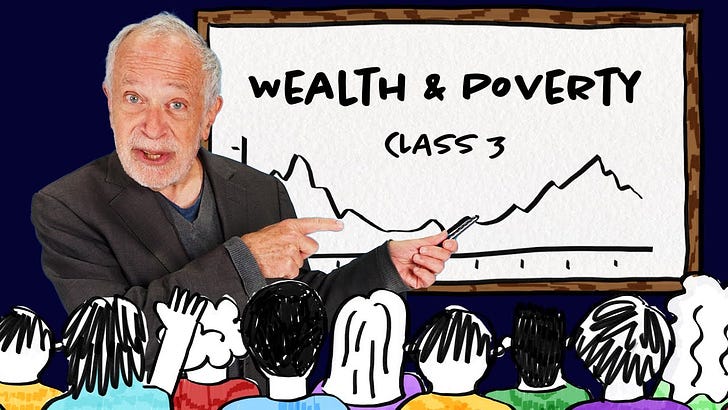
“Wealth and Poverty” Class 3: Globalization, technological change, and you

Friends,

Welcome back to class. Today, I introduce issues that continue to be vigorously debated: the effects of globalization and technological change on widening inequality.

In case you missed them, here are the classes that have been released so far: Class 1, Class 2.

For Class 3, just double-click on the video below, and you’re in the third week of class.

Some background: Many policymakers regard both globalization and technological change as “inevitable” forces that improve economic efficiency — and that should not be altered by political decisions.

I remember discussions in the Clinton White House leading to NAFTA and China’s ascension to the World Trade Organization in which administration officials described both as “necessary” to the evolving global economy. New technologies such as supersonic jets, AI, and facial-recognition software have also been assumed to be beyond political debate or control.

But neither globalization nor the path of technological change is inevitable. Government decides on timing (how quickly should we globalize or should a new technology be introduced?). On what particular goods and services should be subject to globalization and technological change (more or less labor-intensive industries? technologies critical to national security?). On how these changes come about (trade or direct investment? public subsidies? regulations?). And on measures to help those who bear the costs and burdens of these changes (refundable tax credits? education and training?).

It’s called “industrial policy.”

The questions we’ll be exploring today are:

  • How have globalization and technological change widened inequality?

  • Given their effects, what are the major job categories now and into the future?

  • Why have low-wage “personal-service” jobs replaced higher-paying “routine production” jobs?

  • Why are high-paying “symbolic analytic” jobs usually limited to college graduates?

  • Why are all jobs becoming less stable — even before AI is fully felt in the workforce? What are the consequences of these trends for politics?

  • Knowing what you now know about the effects of globalization and technological change, what do you think of a universal minimum income?

***

Recommended readings on globalization and inequality (just click on them):

Recommended readings on technological change and inequality:

For a full list of readings and the student handout for today’s class, you can visit the course website here.

Please share, and thanks for joining me today!

**********

This Substack is reader-supported. To support this work, please consider becoming a paid subscriber.


A huge thanks to the Wealth and Poverty team — to Michael Lahanas-Calderón, Kyle Parker, Dan Davis, and Emmett Tjen — as well as Coro Fellows Ammar Ansari and Meagan Turner for preparing these course materials to be shared with all of you. And to Heather Kinlaw Lofthouse for making all this happen on this page.

  •  

Pluralistic: Scrutinized (05 Oct 2026)


Today's links

  • Scrutinized: Pervert glasses vs the authentic self.
  • Hey look at this: Delights to delectate.
  • Object permanence: DRM-free in the UK; Maple-leaf roses; Italian Wikipedia shuts down; Vancouver's property speculator tax works; Ex-Soviet leftists launch "September"; "The Every"; Nielsen x Chinese internet; Get-a-cluevog; Cat EULA; Heart carafe; Millennials screwed; Apple's unlawful evil.
  • Upcoming appearances: Virtual, South Bend, Hudson, Calgary, Winnipeg, Paris, OVancouver, Victoria, Ottawa, Kilkenny, Oxford, Montreal.
  • Recent appearances: Where I've been.
  • Latest books: You keep readin' em, I'll keep writin' 'em.
  • Upcoming books: Like I said, I'll keep writin' 'em.
  • Colophon: All the rest.


Medieval peasants working the fields in front of a walled city. Their overseer rides a horse; his head has been replaced with a robotic camera. From all sides, gory, anatomical eyeballs intrude upon the scene, each one with a different colored iris.

Scrutinized (permalink)

We're repeatedly told that the killer app for pervert glasses – Meta's AI-enabled camera glasses and their imitators – is that they will remind you of someone's name and spare you the social awkwardness of not recognizing them.

I admit to finding this proposition very seductive. I'm mildly face-blind (I had two aunts I wasn't able to reliably tell apart until I was 12 or 13 and one of them changed her hair), and I meet a lot of people and often find myself incredibly embarrassed when I can't place someone that I know I'm acquainted with.

Actually, the emotion I feel when I don't recognize someone or can't place their name is worse than embarrassment: it's shame. I worry that my chronic inability to remember people's names/faces will make them feel like they're unimportant to me. And shame is such a shitty, gross emotion: it's the invasive thief of joy that shows up whenever things are bad for the purpose of making them worse.

If there were some way to confine pervert glasses to helping people remember names, I'd be all over them. But when it comes to actual, existing pervert-glasses, the main purpose is to covertly capture strangers and shame them. And when (not if) these pervert glasses get hooked up to facial recognition, they will become high-volume doxing factories that will reward the attention-hungry with viral fame.

We've built a society that offers infinite rewards to anyone who can put a name – and thus an identity – to anyone caught in public having an argument, picking their nose, slipping on ice, or eating with their mouth open. We're on the verge of democratizing only the worst part of celebrity: the pervasive hovering cameras that are always there to preserve and distribute your failures.

Last week on the 404 Media podcast, Joseph Cox spoke with Kashmir Hill about this, in an episode appropriately entitled "Meta's Pervert Glasses Are Going to End Privacy":

https://www.youtube.com/watch?v=aUFnQPtxJ9o

Hill wrote the definitive book on the modern history of facial recognition, Your Face Belongs To Us, which tells the story of Hoan Ton That, whose Clearview AI offers cops, millionaires and elites the power to instantly dox people based on billions of pictures:

https://pluralistic.net/2023/09/20/steal-your-face/#hoan-ton-that

In the podcast, Cox and Hill discuss the surveillance nightmare this represents. ICE and cops are already using facial recognition at scale, though it should be noted that these dragnets are incredibly poor value for money, as the British Transport Police discovered after subjecting millions of travelers to facial recognition in train stations, without catching a single suspect:

https://www.theguardian.com/technology/2026/sep/29/trial-live-facial-recognition-cameras-london-stations-false-positive

But partway through the discussion, Cox and Hill switch from discussing "traditional" surveillance of the sort that has metastasized in the 25 years since 9/11) to a form of surveillance that's very different: the "content-creator" surveillance that mixes always-on cameras with facial recognition to dox and shame strangers for everyday transgressions, mistakes and embarrassments.

While this is certainly a kind of surveillance, I think it's better to call it scrutiny. It's something worse than the sense of being watched: it's the sense of being judged. Inducing this feeling of being judged has long been a (sociopathic) desire of wealthy and powerful people. It's the foundation of Bentham's "panopticon," a prison where prisoners can never tell if they're being watched, which is meant to induce a continuous performance of virtue:

https://en.wikipedia.org/wiki/Panopticon

Today, Bentham's heir is the odious Larry Ellison, the famously secretive billionaire, Trump crony and Oracle founder who goes to enormous lengths to prevent the public from finding out about his personal life. Ellison is also one of the most vocal proponents of mass surveillance. Larry Ellison has repeatedly called for the installation of ubiquitous, AI-backstopped surveillance for every (non-billionaire) person in the world, calling this "supervision":

Citizens will be on their best behavior, because we are constantly recording and reporting everything that’s going on.

https://futurism.com/the-byte/billionaire-constant-ai-surveillance

What Ellison's saying here is that most of us are fundamentally bad, and we need continuous scrutiny so that we are always haunted by the specter of judgment, which will keep us from yielding to our base selves.

In other words, for Ellison, our authentic selves are a problem to be solved. We refuse to behave in ways that make the world optimal for Ellison, so he will create a world of continuous scrutiny, judgment and punishment, and in that world, we will be so worried about being shamed that we will all suppress our authentic selves and don masks that are designed to Ellison's specifications.

Ellison is hardly unique in both treasuring his privacy while insisting that any private domain carved out by normal people will turn into a place where we indulge our most sinful impulses. Mark Zuckerberg long defended Facebook's "Real Names" policy by saying that anyone who presents different facets of themselves to different groups is "two-faced":

https://pluralistic.net/2021/07/15/three-wise-zucks-in-a-trenchcoat/

This is the same Mark Zuckerberg who bought two houses to either side of his place in San Francisco and expropriated vast tracts of land from their indigenous Hawai'an owners in order to create a privacy-preserving buffer zone around his own homes:

https://www.wired.com/story/mark-zuckerberg-secretive-hawaii-compound-burial-ground/

And it's the same Zuckerberg who expects the ex-Facebook executive Sarah Wynn-Williams to pay him $111m for revealing damning facts about how he runs his company:

https://pluralistic.net/2026/06/27/zuckerstreisand-2/#autodisparagement

It's the same Zuckerberg who flipped out when his sister accidentally posted a family photo to her public Facebook feed and it spread around the internet:

https://abc7news.com/archive/8933289/

And it's the same Zuckerberg who gave us pervert glasses (to opt out, just don't have a face).

Silicon Valley's most ardent privacy invaders are also the most ardent defenders of their own privacy. Ex-Google CEO Eric Schmidt liked to say, "If you have something that you don't want anyone to know, maybe you shouldn't be doing it in the first place":

https://www.eff.org/deeplinks/2009/12/google-ceo-eric-schmidt-dismisses-privacy

But when Cnet ran an article summarizing details of Schmidt's personal life that could be discovered by searching Google, he ordered a company-wide blacklist of Cnet reporters, which lasted for years:

https://www.cnet.com/tech/tech-industry/eric-schmidt-who-led-googles-transformation-into-a-tech-giant-has-left-the-company/

But Schmidt is an amateur at the game of "privacy for me, never for thee." The true master of the game is Peter Thiel, who secretly bankrolled a lawsuit against Gawker in order to destroy the news outlet in retaliation for outing him as gay (Thiel cofounded Palantir, one of the world's most prolific, shameless surveillance companies):

https://www.wired.com/story/ryan-holiday-conspiracy-peter-thiel-gawker-hulk-hogan/

It's tempting to see this all as mere hypocrisy, but I think it's something far weirder and more disturbing. These men understand completely that scrutiny is antithetical to living as your authentic self. They want to live as their authentic selves, and they want to stop us from living as our authentic selves.

A dive into the Epstein Files reveals the oligarchy's panic over #MeToo and the possibility that the private sins of the wealthy and powerful could become a matter of public knowledge. As Steve Bannon wrote to Epstein concerning #MeToo, "Make sure Woody sees this. Nobody safe":

https://www.theverge.com/tech/874721/epstein-thiel-musk-trump-metoo

Bannon promised Epstein that his culture war would set back #MeToo for a decade, and he is on the vanguard of the movement to silence rape and genocide survivors, and, of course, to force trans people out of public life. For the fascist international to live as their authentic self, it is necessary that we do not.

Scrutiny and shame are antithetical to authenticity, growth and happiness. That's true even when it's people we love subjecting us to a supervisory gaze. Ever notice how a roaring great time at a social gathering can go ice-cold in an instant, the minute someone decides to record the moment with their phone?

My worst moments as a parent – the ones that haunt me and shame me – are those moments when my young daughter was doing something that was right at the edge of her abilities, ferociously concentrating as she drew or played or read, and rather than give her the space to be vulnerable, to err in private and grow, I couldn't help but watch her. When she saw me watching her, the moment died and she moved on to something else.

Each of us needs a zone of imaginative and exertive autonomy, a place where we can screw up without being scrutinized and judged – let alone captured and publicized. Pervert glasses will supercharge the banal and destructive post-9/11 surveillance, sure – but more than that, they will be combined with facial recognition to dox and shame anyone and everyone who makes a public mistake.

Far from Larry Ellison's utopia of people on their "best behavior," this will be a world of inauthentic, stunted selves, a society of people who will never know the joy of finding out who we are and being those people.


Hey look at this (permalink)


A shelf of leatherbound history books with a gilt-stamped series title, 'The World's Famous Events.'

Object permanence (permalink)

#25yrsago Nielsen will measure Chinese web-traffic https://web.archive.org/web/20011107063612/http://www.bday.net/oct05/p05-051.htm

#25yrsago Fluevog's crowdsourced "open source" design competition assigns all rights in perpetuity to the company https://memex.craphound.com/2001/10/06/a-little-knowledge-is-a/

#20yrsago Cat with a EULA https://wendy.seltzer.org/blog/archives/2006/10/06/coming_soon_kitten_with_a_eula.html

#20yrsago HOWTO fight DRM in the UK https://www.openrightsgroup.org/blog/30-things-we-can-do-about-drm/

#20yrsago HOWTO fold roses from maple-leaves https://web.archive.org/web/20061010121159/http://haha.nu/creative/how-to-make-roses-from-maple-leaves/

#15yrsago Italy’s insane Internet law prompts removal of Italian Wikipedia https://cdt.org/insights/case-in-point-why-wikipedia-italy-would-rather-perish-than-publish/

#15yrsago Wine carafe shaped like human heart https://web.archive.org/web/20111008062759/https://www.livianaosti.com/index.php?/prodotto/cuore/

#10yrsago Millennials are legit screwed https://eig.org/millennial/#1473667707197-bfde262a-83c9

#10yrsago Would-be Ukip leader hospitalised following “altercation” (“punched by a colleague”) https://www.bbc.co.uk/news/uk-politics-37572377

#10yrsago Merciless reporting on the Chicago Police Department’s extortion racket, & the senior officials who covered it up https://web.archive.org/web/20161006133720/https://theintercept.com/2016/10/06/in-the-chicago-police-department-if-the-bosses-say-it-didnt-happen-it-didnt-happen/

#10yrsago Canadian government has turned “consultation” on warrantless mass surveillance into a sales-job https://citizenlab.ca/research/digital-anonymity-subscriber-identification-revisited-yet-again/

#10yrsago Think like a computer scientist: free, interactive textbook https://web.archive.org/web/20130813233552/http://interactivepython.org/runestone/static/thinkcspy/index.html

#10yrago July: Vancouver imposes a 15% tax on foreign real estate speculators; September: home sales drop by a third https://web.archive.org/web/20161004200501/https://mishtalk.com/2016/10/04/vancouver-bubble-burst/

#10yrsago Left-wing activists across the former USSR launch “September,” to rally opposition to far-right movements https://globalvoices.org/2016/10/05/september-a-new-platform-for-leftists-across-the-former-soviet-union/

#5yrsago Dave Eggers' "The Every" https://pluralistic.net/2021/10/05/masha-rides-again/#everywhere

#5yrsago We paid to develop Merck's covid pill https://pluralistic.net/2021/10/06/merck-cenary/#businesslike

#1yrago Apple's unlawful evil https://pluralistic.net/2025/10/06/rogue-capitalism/#orphaned-syrian-refugees-need-not-apply


Upcoming appearances (permalink)

A photo of me onstage, giving a speech, pounding the podium.
https://www.epl.ca/blogs/post/elbows-up-with-cory-doctorow/


A screenshot of me at my desk, doing a livecast.

Recent appearances (permalink)


A grid of my books with Will Stahle covers..

Latest books (permalink)


A cardboard book box with the Macmillan logo.

Upcoming books (permalink)

  • "The Post-American Internet," a geopolitical sequel of sorts to Enshittification, Farrar, Straus and Giroux, 2027
  • "Unauthorized Bread": a middle-grades graphic novel adapted from my novella about refugees, toasters and DRM, FirstSecond, April 20, 2027

  • "Enshittification, Why Everything Suddenly Got Worse and What to Do About It" (the graphic novel), Firstsecond, 2027

  • "The Memex Method," Farrar, Straus, Giroux, 2027


Colophon (permalink)

Today's top sources:

Currently writing:

  • “Once Is Enemy Action,” a science fiction novel about the origins of modern technofascism. Today's words: 574 (7730 total).
  • "The Post-American Internet," a sequel to "Enshittification," about the better world the rest of us get to have now that Trump has torched America. Fourth draft completed. Submitted to editor.

  • A Little Brother short story about DIY insulin PLANNING


This work – excluding any serialized fiction – is licensed under a Creative Commons Attribution 4.0 license. That means you can use it any way you like, including commercially, provided that you attribute it to me, Cory Doctorow, and include a link to pluralistic.net.

https://creativecommons.org/licenses/by/4.0/

Quotations and images are not included in this license; they are included either under a limitation or exception to copyright, or on the basis of a separate license. Please exercise caution.


How to get Pluralistic:

Blog (no ads, tracking, or data-collection):

Pluralistic.net

Newsletter (no ads, tracking, or data-collection):

https://pluralistic.net/plura-list

Mastodon (no ads, tracking, or data-collection):

https://mamot.fr/@pluralistic

Bluesky (no ads, possible tracking and data-collection):

https://bsky.app/profile/doctorow.pluralistic.net

Medium (no ads, paywalled):

https://doctorow.medium.com/

Tumblr (mass-scale, unrestricted, third-party surveillance and advertising):

https://mostlysignssomeportents.tumblr.com/tagged/pluralistic

"When life gives you SARS, you make sarsaparilla" -Joey "Accordion Guy" DeVilla

READ CAREFULLY: By reading this, you agree, on behalf of your employer, to release me from all obligations and waivers arising from any and all NON-NEGOTIATED agreements, licenses, terms-of-service, shrinkwrap, clickwrap, browsewrap, confidentiality, non-disclosure, non-compete and acceptable use policies ("BOGUS AGREEMENTS") that I have entered into with your employer, its partners, licensors, agents and assigns, in perpetuity, without prejudice to my ongoing rights and privileges. You further represent that you have the authority to release me from any BOGUS AGREEMENTS on behalf of your employer.

ISSN: 3066-764X
  •  

The Central Question of Power in America

Friends,

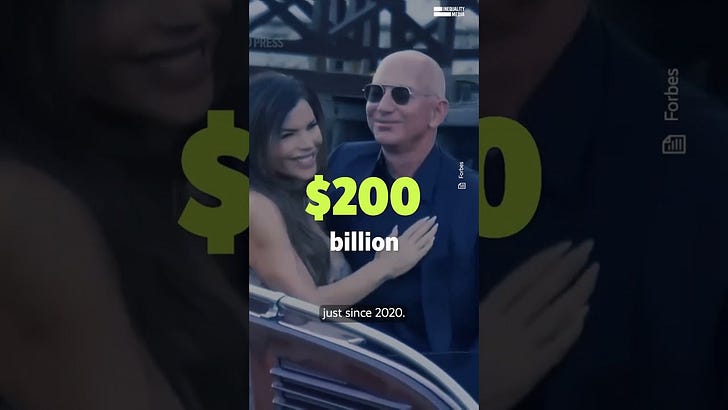
Behind this election’s dominant issue of affordability lies the record concentration of wealth at the top of America. The richest 0.001 percent of Americans — a handful of extraordinarily wealthy men — now control more of the nation’s wealth than at any time in modern history.

To be sure, wealth is not a zero-sum game in which the riches of those at the top necessarily come at the expense of everyone else. But power is a zero-sum game, because the more of it that is held by some people, the less of it is held by others.

Wealth cannot be separated from power. Great wealth becomes great power through campaign contributions, media ownership, the ability to buy off opposition, the capacity to wage pubic relations campaigns, and the resources to deploy armies of lawyers who litigate on your behalf. Recent years provide abundant illustration of all this.

In these ways, great power also becomes great wealth. It buys changes in laws, regulations, and court decisions that bestow even more wealth on those with the power to alter the system to their benefit — and to siphon off resources from everyone else.

This power shift has also become clearly evident in recent years. In the Trump era it has taken the form of blatant corruption. But the political bribes, billionaire media ownership, PR campaigns, and well-financed litigation predated Trump.

For many years (with the notable exception of the Biden administration), antitrust enforcement has been defanged to make it easier for big firms to monopolize. Among the most widely discussed findings about the U.S. economy is the rise of corporate concentration since the 1980s. The biggest firms, their top executives, and their major shareholders have all done wonderfully well. Consumers and employees, however, have faced higher prices, lower paychecks, and fewer choices.

At the same time, labor laws have been altered to make it more difficult to organize unions. In the 1950s, more than a third of private-sector workers were unionized. Now, fewer than 6 percent are.

Tax laws have been changed to reduce the rates and amounts paid by the super-wealthy, to the point where many pay no taxes at all — even though they have more wealth than ever.

This massive power shift is even more starkly illustrated by the billionaires, financial mavens, and tech bros who put Trump in power, who refuse to slow climate change, and who are now deciding on the future of AI and therefore humanity.

The question I keep coming back to is whether this can be reversed.

There is historic precedent. After the first Gilded Age — which ran from the 1890s to the start of World War I, and which featured wide inequalities of income, wealth, and political power — America reacted in what came to be known as the Progressive Era.

Starting under Theodore Roosevelt, monopolies were busted up, corporations were regulated, a progressive income tax was enacted, and corporate political donations (bribes) were barred. Then, starting in 1933, under Teddy Roosevelt’s fifth cousin, power continued to be shifted to what became the largest middle class in world history.

Then came the 1970s and 1980s, when the process began to go in reverse.

The challenge is arguably much greater today because wealth and power are more concentrated than in the first Gilded Age, creating a chicken-and-egg paradox: How can government enact and enforce the necessary reforms if it’s under the control of a power elite that won’t permit them?

Now, just four weeks from what could be a major political victory for the Democrats in taking back at least one chamber of Congress, this paradox should soon be the center of our national debate.

Leave a comment

  •  

The emergence of shareholder capitalism

Friends,

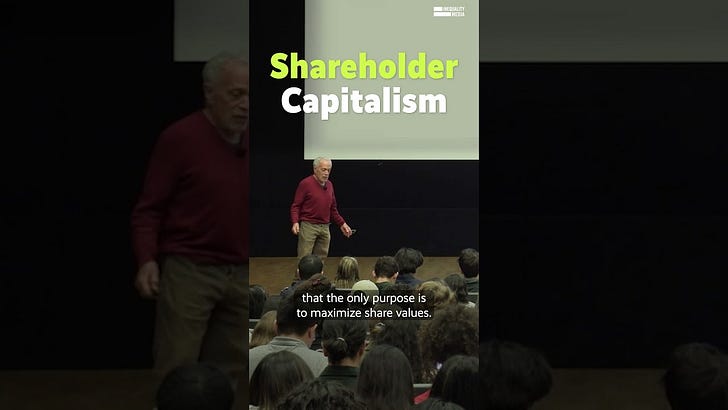
Tomorrow we’ll move on to Class 3 of my “Wealth and Poverty” course, along with new readings and additional materials.

Last week, in the second class, we examined how the financial incentives operating on corporations and their top executives have changed over the last 40 years in ways that have contributed to widening inequalities of income and wealth. I’m posting a very short “teaser” recap below. If you missed Class 2, you can find it by clicking here: Class 2.

Share

  •  

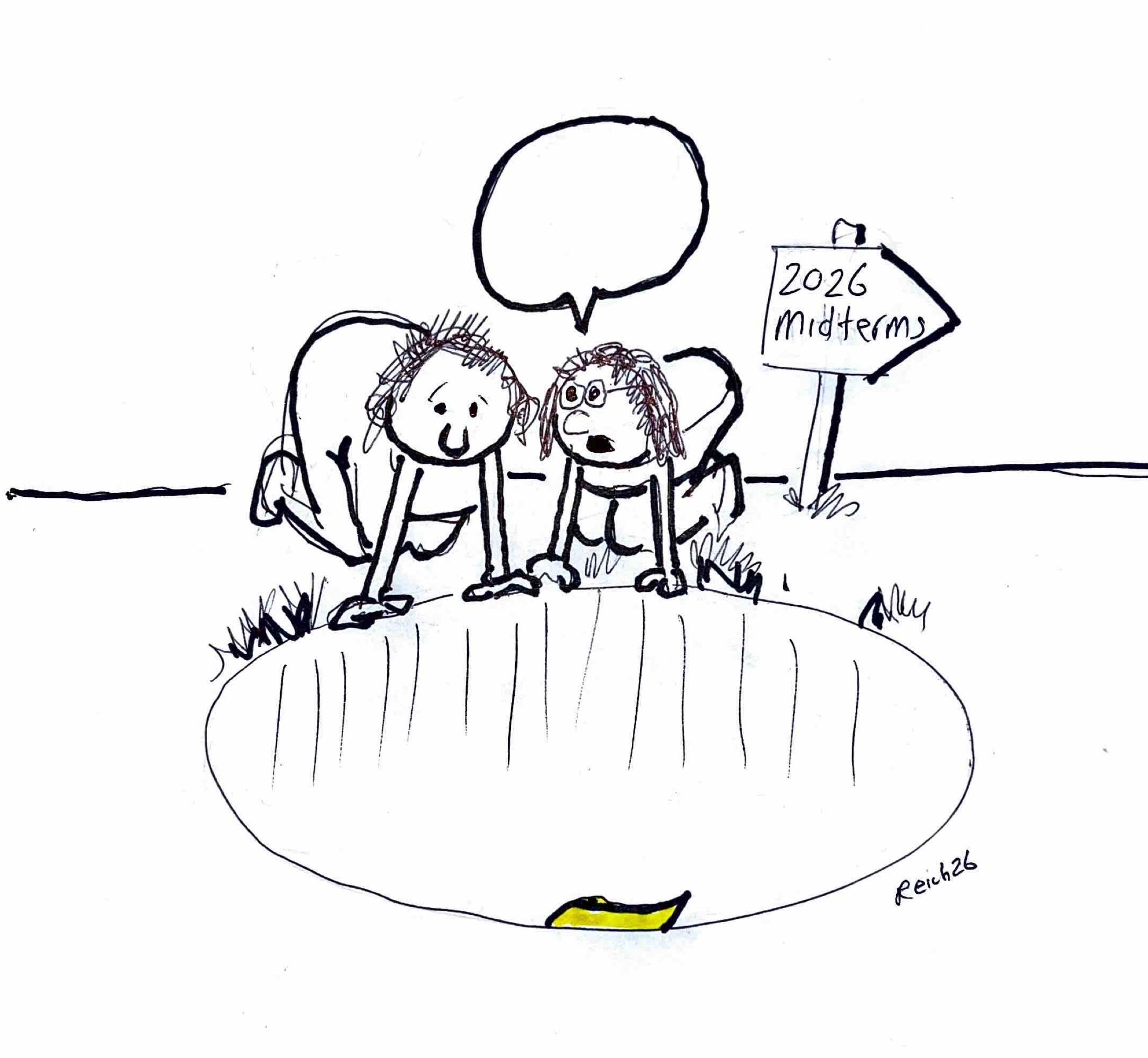
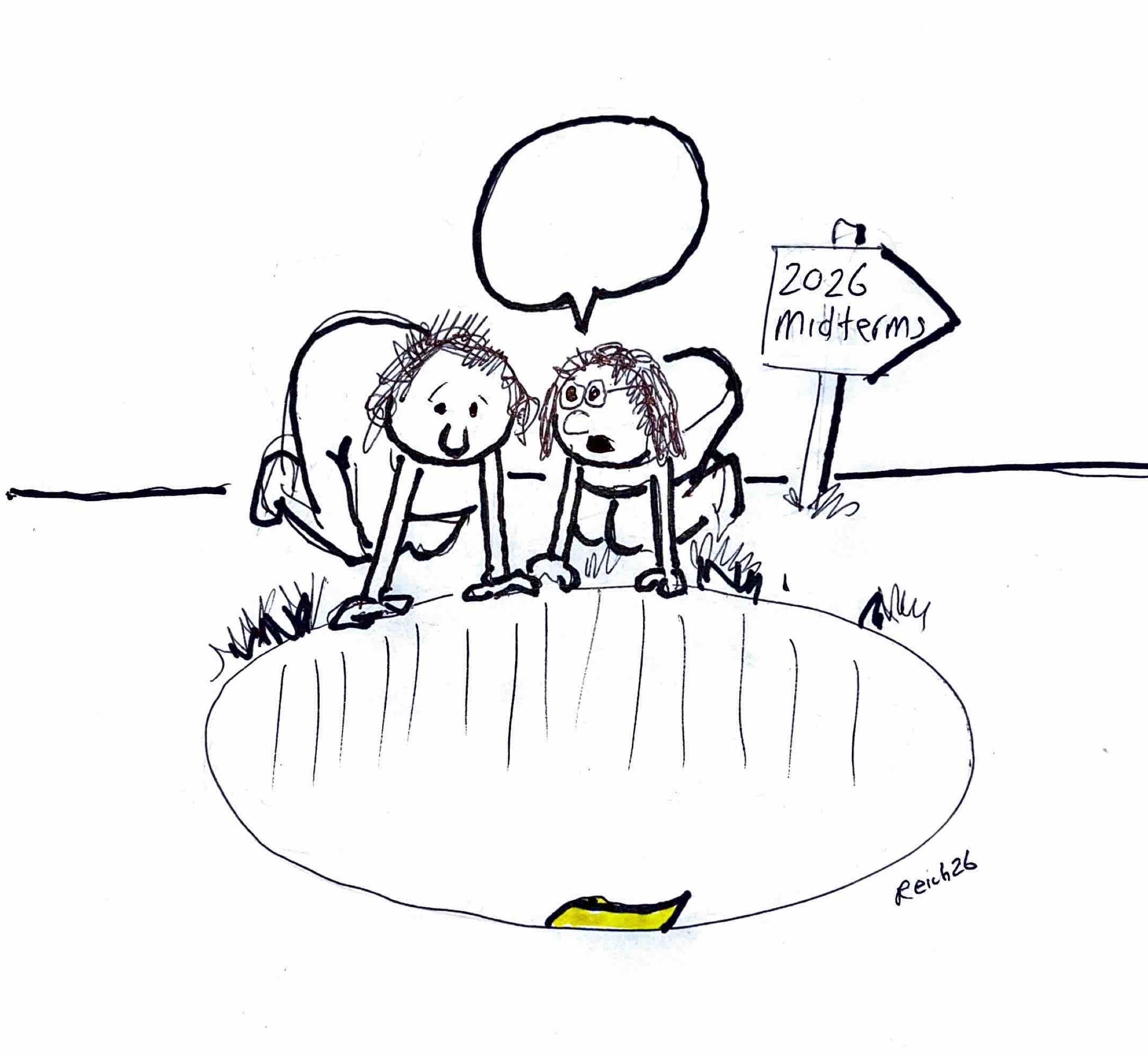
Caption contest: Hole

Friends,

Please submit your caption in the Comments section, and, as before, please use the Comments section only for captions.

Winners will be announced next Sunday. For consideration, please post your caption by Monday at 9 pm PT, 12 midnight ET.

Leave a comment

Last week’s winner

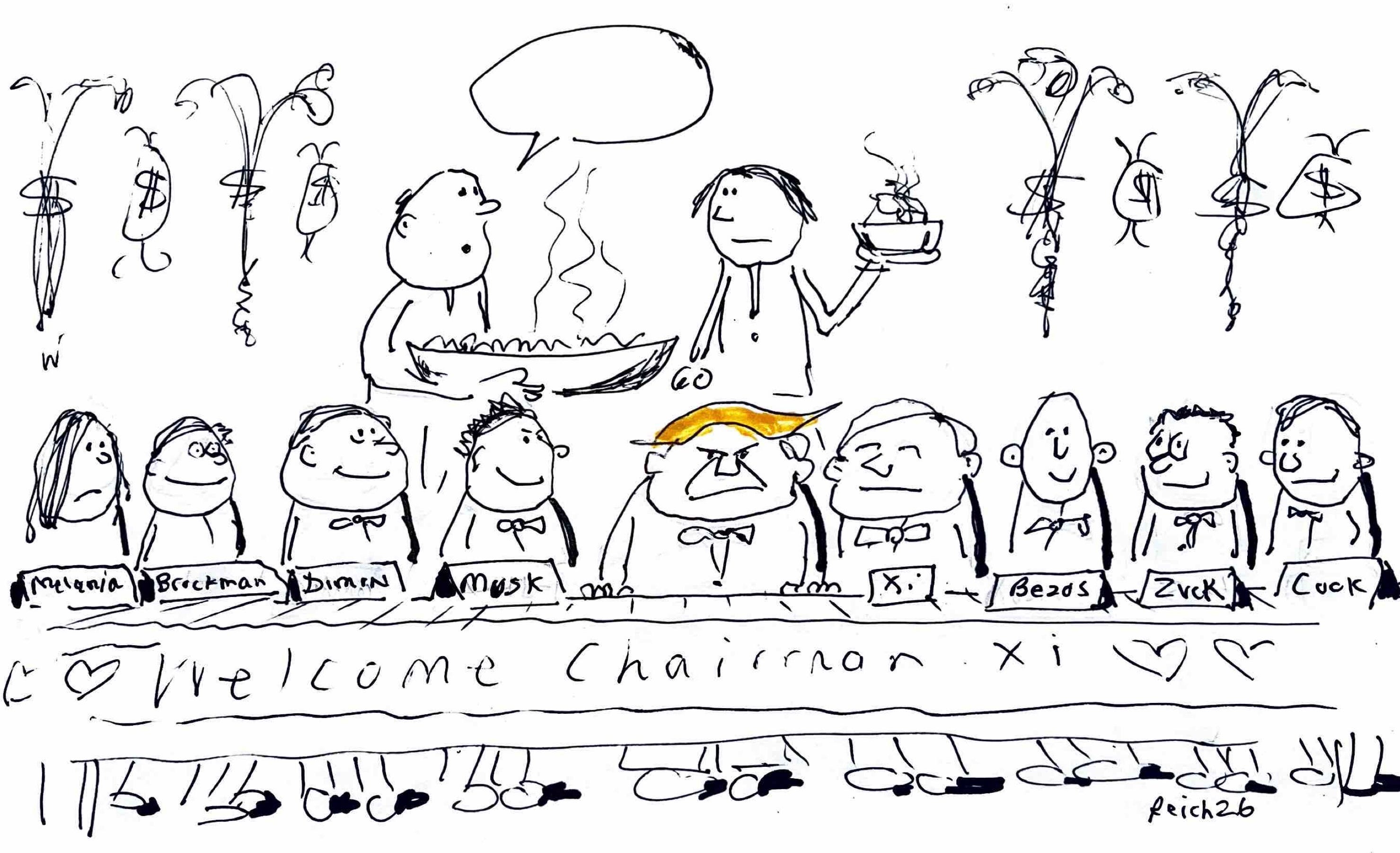
“Like they say, ‘If you don’t have a seat at the table, there’s a good chance you’re on the menu.’”

(Congratulations, Chet Sygiel.)

Runners-up:

“Xi ordered the duck l’orange.”

(Congratulations, Steven Horowitz.)

“Let’s hope it’s their last supper!”

(Congratulations, Sue Schneider.)

“Do we serve them in order of wealth or hypocrisy?”

(Congratulations, Simon.)

“Pigs at the trough.”

(Congratulations, Laurence Hoffmann.)

“We’re going to need a bigger trough.”

(Congratulations, Rachel Brown.)

“How come they always manage to get free meals paid for by taxpayers? Aren’t they all billionaires?”

(Congratulations, Sue Schneider.)

“I am afraid democracy isn’t on the menu tonight.”

(Congratulations, Jacob Jordaan.)

“As George Orwell said in Animal Farm, ‘the creatures outside looked from pig to man, and from man to pig to man again; but already it was impossible to say, which was which.’”

(Congratulations, Diana.)

Share

  •  

Sunday thought: What’s Up With Kansas?

Friends,

The last time Kansas elected a Democrat to the Senate was 1932. Yet on Friday, Democratic Senate candidate Adam Hamilton received his second endorsement from a Republican former Kansas governor in less than a month, in his race against Republican incumbent Senator Roger Marshall.

The top Senate Republican super PAC is so concerned that Marshall could lose the race that it’s diverting funds to Kansas from North Carolina, where it’s canceled its remaining ads against Democrat Roy Cooper — basically conceding North Carolina (by the way, a Democrat hasn’t won statewide federal office in North Carolina in nearly two decades).

To say it’s not looking good for Republicans is an understatement.

Trump is an albatross around the necks of every Republican running for Congress or governor. He’s also posing problems for plenty of Republican candidates for state office.

Why?

It’s not that Americans have suddenly discovered that Trump is a despicable human being. His personality has been on national display for more than a decade.

It’s not that Trump’s hold over his MAGA base has significantly weakened. Polls show self-identified MAGAs are still firmly in his camp.

It’s not that most Americans have become angry that the major beneficiaries of Trump’s tax cuts are big corporations and the very rich, or that the burdens of his spending cuts disproportionately fall on the poor (as less nutrition assistance and Medicaid), or that his mass deportations are violent and cruel. There’s no evidence that these policies are suddenly swaying voters.

And it’s not that voters have become any more aware of Trump’s lies. He continues to say the U.S. is experiencing a “golden age” with a “roaring economy” that’s doing “better than any other country” in the world, and that any negative public perception is due to a “public relations” problem.

No, the real problem for Trump and Republicans is Americans are hurting, and they know it’s because of Trump and Republicans.

A new AP-NORC poll shows a record low 26 percent of Americans approve of Trump’s handling of the economy, while just 17 percent approve of how he’s handling the cost of living. These are comparable to George W. Bush’s ratings during the 2008 financial crisis and George H.W. Bush’s just before he was swept out of office. The Conference Board’s Consumer Confidence Index fell to 81.9 in September, its lowest since April 2014.

In Kansas, for example, Trump’s tariffs have caused China, Canada, and Mexico to retaliate by sharply cutting demand for wheat, sorghum, and soybeans. As a result, Kansas grain silos are so swollen that grain brokers have been forced to reroute human-grade grain into dog food.

At the same time, tariffs on foreign-produced aluminum and steel have driven up the prices of farm machinery and replacement parts. Trump’s decision to lift certain foreign beef import restrictions has hurt the beef sales of local cattle ranchers.

Trump’s war in Iran has choked off shipping of sulfur and phosphate in the Persian Gulf, causing nitrogen and phosphate fertilizer prices to surge by over 100 percent. The blockage has also caused diesel prices to soar, making farmers pay $200 per acre just to fuel their tractors.

These higher costs and lower crop sales have resulted in the closure of roughly 700 Kansas farms over the past year. Many remaining farmers are barely holding on.

This explains why Kansas’s former Republican governor Mike Hayden endorsed Democrat Adam Hamilton over Republican incumbent Roger Marshall in Friday’s Wichita Eagle:

“Sen. Marshall time and again has chosen to back the tariffs and the war, despite what is happening back in Kansas. Kansans need a senator willing to stand up and say this isn’t working.”

There it is, folks.

Americans can bear Trump’s awful personality. Some might succumb to his MAGA cult. They might believe many of his lies.

But they can’t abide what Trump’s policies are doing to them and their families.

Forget the rip-roaring stock market. When it comes to voting, kitchen-table economics — the financial realities average people talk about over the kitchen table, such as the prices they’re paying and the money they’re earning — are more potent than anything else.

I continue to warn against complacence. It’s still vitally important that we vote, and that we encourage everyone we know — especially those who share our values — to vote. And it’s crucially important to remain vigilant against Trump’s interference in our elections.

But with a little more than four weeks to go, I’m breathing a wee bit easier. I hope you are, too.

Share

Give a gift subscription

  •  

Pluralistic: Economic probabilities for our grandchildren (03 Oct 2026)


Today's links

  • Economic probabilities for our grandchildren: If only data centers would stop hogging all the copper.
  • Hey look at this: Delights to delectate.
  • Object permanence: RIAA v P2P; Infoseek's anti-terror brain-scanner; Copyrighting every phone number; Carving pumpkins with cookie-cutters; Polish women go on strike; Latent labor in material world; Hitler's meth; "Flying Saucers Are Real!"; Hope, not optimism; Broadcast Flag talk; David Suzuki's free research; "Inquisitor's Apprentice"; California's tax ban made the rich MUCH richer; Union organizers caught Wells Fargo; Power poses aren't real; "Ghosts"; Criticizing tech; "Savage Love A-Z."
  • Upcoming appearances: Brighton, Virtual, South Bend, Hudson, Calgary, Winnipeg, Paris, OVancouver, Victoria, Ottawa, Kilkenny, Montreal.
  • Recent appearances: Where I've been.
  • Latest books: You keep readin' em, I'll keep writin' 'em.
  • Upcoming books: Like I said, I'll keep writin' 'em.
  • Colophon: All the rest.


The Earth from space; it is covered in scaffolding that is crawling with little rude mechanicals ganked from 17th century engravings of people operating machines.

Economic probabilities for our grandchildren (permalink)

The post-war "peace dividend" owed its existence to three factors: industrial capacity, political freedom and pent-up demand.

  • Industrial capacity: freed up by the war's end and the collapse of demand for munitions and materiel;
  • Political freedom: the war's orgy of capital destruction of the majority of the wealth (and thus the power) of the world's oligarchs;

  • Demand: Making up for years of neglect and privation during the war required new production of infrastructure and consumption goods.

In Capital in the 21st Century, Thomas Piketty and his students analyzed painstakingly assembled records of 300 years' worth of capital flows, showing that wealth tends to pool in the hands of the already-wealthy. This creates mounting instability, thanks to the misrule of a shrinking class of increasingly powerful hereditary, unaccountable oligarchs whose whims and follies trump the material and political needs of the vast majority:

https://memex.craphound.com/2014/06/24/thomas-pikettys-capital-in-the-21st-century/

That instability eventually reaches a breaking point in which the old order collapses in spectacular fashion, and that collapse destroys vast amounts of capital stock. Since this breaking point arrives as a result of oligarchy, in which nearly all the world's wealth has been hoarded by a tiny number of people, those aristocrats are disproportionately impoverished by the conflagration. If 90% of the wealth is in the hands of 1% of the people, a war or disaster that wipes out most capital will mostly destroy the wealth of the 1%. The poor suffer terribly, but they start with nothing – and end with nothing.

We are clearly steaming into one of these situations. The wealthy squandered two generations preventing the world from tackling the climate emergency, and now the inevitable has arrived. California is on track to see a 12 inch sea-level rise in the next month:

https://www.theguardian.com/us-news/2026/sep/30/california-kelvin-wave-sea-level-rise

That's just the overture to the American run of this year's "Super El Nino," a blockbuster whose out-of-town previews have been slaying massive crowds all over the world:

https://www.theguardian.com/world/2026/oct/03/bangkok-thailand-floods-breaking-point-stagnant-lakes

Also right on schedule: the misrule of oligarchs has elevated a con-man to the presidency, who trumps every other president for both corruption and incompetence. From oil to dollars, telecoms infrastructure to the internet itself, Donald Trump is doing everything in his power to end the American empire:

https://pluralistic.net/2026/05/16/technopoly/#trumpismo-is-praxis-question-mark-exclamation-point

A post-American world is on the horizon. What that world will look like is undecided. The US was always a wildly defective trusted third party, but it retained its status as the world's platform for generations thanks to the absence of credible alternatives. Now – as Mark Carney told the Davos crowd last year – the old system has "ruptured":

https://www.weforum.org/stories/forum-institutional/davos-2026-special-address-by-mark-carney-prime-minister-of-canada/

What will replace the dollar?

https://pluralistic.net/2026/02/11/post-dollar-world/#de-dollarization

What will replace oil?

https://pluralistic.net/2025/10/11/cyber-rights-now/#better-late-than-never

What will replace the internet?

https://pluralistic.net/2026/01/01/39c3/#the-new-coalition

No one knows. No one can know, because this is all up for grabs. The future isn't something that happens to us. The future is something that we make. And despite the horrible death toll that's locked in by waves of climate shocks – presided over by the dying, fumbling "drink bleach" guy – it's conceivable that the future we get will be a good one, if not an easy one.

A post-oligarch, post-American world could be a post-austerity world, one where we recognize that the limiting factor on public investment isn't money, but resources: energy, material, labor, expertise:

https://www.youtube.com/watch?v=FATQ0Yf0Fhc

Just as the post-war world led to the "30 glorious years" by mobilizing people and material to rebuild a shattered world and shattered lives, a post-American world might be one in which we find full, meaningful employment for all of us, all of our children, and all of their children:

https://en.wikipedia.org/wiki/Trente_Glorieuses

As seas rise, we're going to have jobs for every person who is willing, building sea defenses and moving whole coastal cities inland. Two generations of neoliberalism has left us with massive shortages of housing stock, crumbling highways, inadequate schools and hospitals. That means we need to build lots more of these, and they can be built with state-of-the-art climate hardening, including geothermal heat, "passive home" designs, modern insulation, and heat-pumps. The rights-of-way for the interstate system would make dandy railbeds for arrow-straight, all electric high-speed rail powered by solar, wind and tides.

All of this has the potential to yield a second peace-dividend prosperity. A post-oligarch world can recover industrial capacity by diverting it away from destructive activity (data centers, luxury housing) to essential functions (climate defenses, decent housing for everyday people). A post-oligarch world can recover democratic excellence by removing the malign influence that morbid wealth exerts on our policy choices: for example, if we don't like the quality of public schools, we can fix them by giving schools more resources, not by letting billionaire dilettantes privatize and starve them in the name of "school choice":

https://pluralistic.net/2026/03/09/autocrats-of-trade-2/#witness-the-firepower-of-this-fully-armed-and-operational-battle-station

Finally, a post-oligarch society can provide us with an even more inclusive version of post-war prosperity: we can use the wages we earn by building a better world to acquire new homes, induction tops, EVs and ebikes, and beautiful heirloom computers that are built to last for generations, upgraded and maintained by their users:

https://www.edn.com/as-moores-law-slows-open-hardware-rises/

This is a world of material abundance and prosperity. Just as the post-war world made millions of people comfortable, educated and happy by putting them to work clearing the rubble and building something better, a post-oligarch, post-American world can offer everyone all the hard, rewarding work we want, performing the essential work of care and rebuilding. We'll find that work by helping hundreds of millions of climate refugees, who will find work helping each other. This is all economically valuable, environmentally sustaining work that we have labor, energy and expertise for. It's just that all that labor, energy and expertise is being misallocated by the ultra-wealthy who don't even believe that the majority of us exist, and who want to bet the planet and our species on a bizarre scheme to feed so many words to the world-guessing machines that they wake up and become gods:

https://pluralistic.net/2026/05/13/vibe-governance/#k-hole

Nearly a century ago, John Maynard Keynes published "Economic Possibilities for our Grandchildren," where he extrapolated from rising productivity to predict a fifteen-hour work-week within two generations:

http://www.econ.yale.edu/smith/econ116a/keynes1.pdf

That dream was destroyed by war and greed. Today, we are submerged in an ocean of debt. I'm not talking about the (fictional) "national debt" that is just a measure of all the dollars the government has spent into existence without taxing out of existence:

https://pluralistic.net/2024/10/21/we-can-have-nice-things/#public-funds-not-taxpayer-dollars

I'm talking about fiscal debt: the solar we didn't build, the carbon we emitted instead; the rail we didn't build, the wildly inefficient aviation we substituted; the walkable, livable, transit-oriented cities we didn't build, the car-choked disasters we built instead. Oligarchic opposition to universal healthcare left us sick, with un- or undertreated illnesses and missed opportunities for prevention that left us with overlapping, population-scale health crises. All of this is debt that must be repaid: we can't walk away from it through bankruptcy. We must build the transit, cities, and systems of care – the infrastructure – our species needs to carry on human civilization. We can't keep hitting snooze on this, lest we are finally awoken by seawater lapping at our pillows.

The world we're in today is awful and terrifying. It's awful because of the climate ruptures we're living through. It's terrifying because we didn't just fail to avert this crisis – we did nothing to prepare for it, either.

As Piketty foretold, the misrule of oligarchs has led to an orgy of destruction, and while poor people will get the worst of it, oligarchs will pay the most, because they own nearly everything, which means they own everything that will be destroyed, too. None of that is good, and it would be better if we hadn't gotten into this situation in the first place.

But after a forest fire, the canopy opens; and when it does, the seedlings that were overshadowed for centuries by the old growth can sprout in the ashes and the sun. We can't afford to continue living under oligarchy, and as oligarchs' greed and folly drives the old system beyond its breaking point, we must seize the opportunity to build a better successor.


Hey look at this (permalink)


A shelf of leatherbound history books with a gilt-stamped series title, 'The World's Famous Events.'

Object permanence (permalink)

#25yrago Leak: RIAA's anti-P2P strategy https://web.archive.org/web/20011019060035/https://www.dotcomscoop.com/riaa1003.html

#25yrsago Infoseek founder: my brain-scanner can find all the terrorists https://web.archive.org/web/20011009025805/http://www.theregister.co.uk/content/55/22020.html

#25yrsago Copyrighting every possible phone number as a touch-tone tune https://web.archive.org/web/20011007073546/http://www.theage.com.au/entertainment/2001/10/04/FFX0PGT0CSC.html

#20yrsago What happens to password-locked data when you die? https://web.archive.org/web/20061106235805/http://news.com.com/Taking+passwords+to+the+grave/2100-1025_3-6118314.html

#20yrsago Audio of activist lawyer talk on Broadcast Flag and Chilling Effects https://web.archive.org/web/20061005074245/http://uscpublicdiplomacy.com/index.php/events/events_detail/1859/

#20yrsago David Suzuki: Steal my research – that’s what it’s for! https://web.archive.org/web/20061020144546/http://www.davidsuzuki.org/about_us/Dr_David_Suzuki/Article_Archives/weekly09290601.asp

#20yrsago Interdisciplinary DRM blog from my USC students https://uscpubd510.blogspot.com/search?updated-max=2006-08-24T14:59:00-07:00&max-results=7&start=91&by-date=false

#15yrsag Inquisitor’s Apprentice: tenement sorcerers versus the robber barons in an alternate Gilded Age New York https://memex.craphound.com/2011/10/04/inquisitors-apprentice-tenement-sorcerers-versus-the-robber-barons-in-an-alternate-gilded-age-new-york/

#15yrsago Context: Further Selected Essays on Productivity, Creativity, Parenting, and Politics in the 21st Century https://memex.craphound.com/2011/10/03/context-further-selected-essays-on-productivity-creativity-parenting-and-politics-in-the-21st-century/

#15yrsago Unicode’s “right-to-left” override obfuscates malware’s filenames https://krebsonsecurity.com/2011/09/right-to-left-override-aids-email-attacks/

#15yrsago HOWTO carve a pumpkin by hammering cookie-cutters into it https://web.archive.org/web/20200916004345/https://www.foodnetwork.com/fn-dish/shopping/cookie-cutter-pumpkin-carving

#15yrsago Shell funded warring militias in the Niger Delta https://web.archive.org/web/20111006003453/http://blog.platformlondon.org/2011/10/03/counting-the-cost-corporations-and-human-rights-abuses-in-the-niger-delta/

#10yrsago Sen Mitch McConnell blames Obama for bill that Obama vetoed and McConnell repeatedly voted for https://www.loweringthebar.net/2016/10/congress-blames-veto.html

#10yrsago Polish women go on strike over extreme anti-abortion law https://www.bbc.com/news/world-europe-37540139

#10yrsago Survivors of CIA torture describe homebrew electric chair used at Afghan black site https://www.hrw.org/news/2016/10/03/interview-new-cia-torture-claims

#10yrsago Visualizing the latent emotional and bureaucratic labor in our material world https://xkcd.com/1741/

#10yrsago Meth, Hitler and the Reich: the true, untold story of the Nazis’ dependence on coke, meth and oxy https://www.theguardian.com/books/2016/sep/25/blitzed-norman-ohler-adolf-hitler-nazi-drug-abuse-interview

#10yrsago Flying Saucers are Real! Anthology of the lost saucer-craze https://memex.craphound.com/2016/10/03/flying-saucers-are-real-anthology-of-the-lost-saucer-craze/

#10yrsago The malware that’s pwning the Internet of Things is terrifyingly amateurish https://web.archive.org/web/20161004061621/http://motherboard.vice.com/read/internet-of-things-malware-mirai-ddos

#10yrsago California’s 40-year-old ban on property tax raises has made the rich a lot richer https://web.archive.org/web/20161001034224/https://www.latimes.com/business/hiltzik/la-fi-hiltzik-prop-13–20160929-snap-story.html

#10yrsago The Wells Fargo fraud came to light because of union organizers https://web.archive.org/web/20161005123132/https://prospect.org/article/first-and-foremost-wells-fargo-scandal-about-workers

#10yrsago “Power Poses” are bullshit https://web.archive.org/web/20161007215414/https://www.wbur.org/npr/496093672/power-poses-co-author-i-do-not-believe-the-effects-are-real

#10yrsago Martin Shkreli offers a bailout to ailing 4chan https://arstechnica.com/information-technology/2016/10/4chan-cashflow-problem-martin-shkreli-wants-to-join-board/

#10yrsago Ghosts: Raina Telgemeier’s upbeat tale of death, assimilation and cystic fibrosis https://memex.craphound.com/2016/10/04/ghosts-raina-telgemeiers-upbeat-tale-of-death-assimilation-and-cystic-fibrosis/

#10yrsago Yahoo secretly built a tool to scan all email in realtime for US spies https://www.reuters.com/article/idUSKCN1241YT/

#10yrsago How to: Criticize technology https://www.cjr.org/tow_center_reports/constructive_technology_criticism.php

#10yrsago Johnson & Johnson says people with diabetes don’t need to worry about potentially lethal wireless attacks on insulin pumps https://www.reuters.com/article/us-johnson-johnson-cyber-insulin-pumps-e-idUSKCN12411L/

#5yrsago USPS pilots postal banking https://pluralistic.net/2021/10/04/avoidance-is-evasion/#check-cashing

#5yrsago The Pandora Papers https://pluralistic.net/2021/10/04/avoidance-is-evasion/#transparency

#5yrsago Savage Love A-Z https://pluralistic.net/2021/10/04/avoidance-is-evasion/#ggg

#5yrsago Hope, Not Optimism https://pluralistic.net/2021/10/03/hope-not-optimism/

#1yrago When your ISP pays you https://pluralistic.net/2025/10/03/we-dont-care-we-dont-have-to/#were-the-phone-company

#1yrago Blue Bonds https://pluralistic.net/2025/10/04/fiscal-antifa/#post-trump


Upcoming appearances (permalink)

A photo of me onstage, giving a speech, pounding the podium.
https://www.epl.ca/blogs/post/elbows-up-with-cory-doctorow/


A screenshot of me at my desk, doing a livecast.

Recent appearances (permalink)


A grid of my books with Will Stahle covers..

Latest books (permalink)


A cardboard book box with the Macmillan logo.

Upcoming books (permalink)

  • "The Post-American Internet," a geopolitical sequel of sorts to Enshittification, Farrar, Straus and Giroux, 2027
  • "Unauthorized Bread": a middle-grades graphic novel adapted from my novella about refugees, toasters and DRM, FirstSecond, April 20, 2027

  • "Enshittification, Why Everything Suddenly Got Worse and What to Do About It" (the graphic novel), Firstsecond, 2027

  • "The Memex Method," Farrar, Straus, Giroux, 2027


Colophon (permalink)

Today's top sources:

Currently writing:

  • “Once Is Enemy Action,” a science fiction novel about the origins of modern technofascism. Today's words: 504 (21882 total).
  • "The Post-American Internet," a sequel to "Enshittification," about the better world the rest of us get to have now that Trump has torched America. Fourth draft completed. Submitted to editor.

  • A Little Brother short story about DIY insulin PLANNING


This work – excluding any serialized fiction – is licensed under a Creative Commons Attribution 4.0 license. That means you can use it any way you like, including commercially, provided that you attribute it to me, Cory Doctorow, and include a link to pluralistic.net.

https://creativecommons.org/licenses/by/4.0/

Quotations and images are not included in this license; they are included either under a limitation or exception to copyright, or on the basis of a separate license. Please exercise caution.


How to get Pluralistic:

Blog (no ads, tracking, or data-collection):

Pluralistic.net

Newsletter (no ads, tracking, or data-collection):

https://pluralistic.net/plura-list

Mastodon (no ads, tracking, or data-collection):

https://mamot.fr/@pluralistic

Bluesky (no ads, possible tracking and data-collection):

https://bsky.app/profile/doctorow.pluralistic.net

Medium (no ads, paywalled):

https://doctorow.medium.com/

Tumblr (mass-scale, unrestricted, third-party surveillance and advertising):

https://mostlysignssomeportents.tumblr.com/tagged/pluralistic

"When life gives you SARS, you make sarsaparilla" -Joey "Accordion Guy" DeVilla

READ CAREFULLY: By reading this, you agree, on behalf of your employer, to release me from all obligations and waivers arising from any and all NON-NEGOTIATED agreements, licenses, terms-of-service, shrinkwrap, clickwrap, browsewrap, confidentiality, non-disclosure, non-compete and acceptable use policies ("BOGUS AGREEMENTS") that I have entered into with your employer, its partners, licensors, agents and assigns, in perpetuity, without prejudice to my ongoing rights and privileges. You further represent that you have the authority to release me from any BOGUS AGREEMENTS on behalf of your employer.

ISSN: 3066-764X
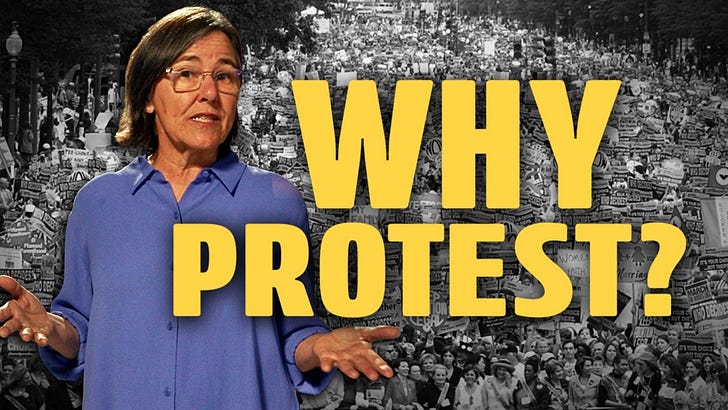
  •  

Is a Reckoning Coming? | The Coffee Klatch for Saturday, October 3, 2026

Friends,

Today, Heather and I take a hard look at the allegations over what occurred in a Cornell fraternity and explore why they’re sending tremors across America. Do they have anything to do with Trump’s toxic masculinity, the misogyny of his regime, and the male-dominant underpinnings of neofascism? With a culture of impunity fostered by Trump? We also look at the question of accountability in general and examine some of the other ways Trump and the manosphere — including the AI bros and the industry they’re hatching — are functioning with impunity.

Please pull up a chair, grab a cuppa, and join in the conversation.

Share

💾

  •  

Mercury Is Shrinking. So Am I.

Friends,

I’ve always felt a certain affinity for Mercury. Maybe that’s because Mercury is by far the smallest planet in our solar system — about 1/29th the width of Jupiter and just one-third the width of Earth — and I’m not a giant myself.

Mercury is becoming even smaller — it’s actually shrinking.

Apparently, when Mercury formed about 4.5 billion years ago in the primordial collisions of the early solar system, it was much hotter than it is now. Over many millennia since then, its metallic core has cooled and contracted, causing the planet’s surface to warp and wrinkle.

You know who else is warping and wrinkling, and shrinking?

Previous estimates suggested that Mercury had shrunk by just a few miles since its formation. Now, scientists say it’s shrinking up to 30 percent faster than expected. It might have even shrunk by as much as 14.5 miles, which is nearly 1 percent of its current radius of 1,516 miles.

This new estimate, published recently in the journal Geophysical Research Letters, gives astronomers a new understanding of how the planet — and others like it — formed and evolved.

And what’s in store for them. It’s not great news.

“Many bodies are shrinking nowadays,” said Gaku Nishiyama, a planetary scientist at the German Aerospace Center Institute of Space Research, who led the study.

Tell me about it. Humans start a slow, gradual loss of height during their 30s. Then they lose a half inch every 10 years. Between 30 and 70, they lose an inch or two.

That may not sound like much, but if you’re 4 feet 11 inches at your zenith, the loss of an inch or two is not welcome. Then, after age 80, the typical human who survives loses another inch. At this rate I may disappear entirely.

Dr. Nishiyama says Mercury’s estimated shrinkage is difficult to measure because researchers have to rely on topographies visible on the surface of the planet. “Inside, things may be getting much worse, much faster,” she said.

I know about that, too.

All heavenly bodies are shrinking, as are human bodies. With humans, it’s partly due to compressed spinal discs — as the soft cushions between back bones dry out and flatten over time. And because of osteoporosis, that can cause tiny cracks in spinal bones.

“Every planet is an odd little duck that has a story to tell,” says Dr. Sam Birch, a planetary geoscientist at Brown University.

Well, Dr. Birch, every human is an odd little duck with its own story, too. Planets and people — we’re all part of the same cosmos, with slightly different combinations of hydrogen and helium, oxygen, nitrogen, carbon, and neon.

We’re all parts of the same mystery.

Share

  •  

Cornell, Rape, and Misogyny in the Age of Trump

Friends,

Last month a young woman filed a lawsuit against Cornell University, alleging that two years ago the university failed to protect her from being raped by seven men at a fraternity house near the university campus. She also sued the fraternity. The lawsuit has plunged the university into a crisis and invited criticism of the district attorney, Matthew Van Houten, who decided there wasn’t enough evidence to bring criminal charges against the seven men.

At this point we can only guess why neither Cornell nor Van Houten did more in response to the young woman’s allegations. But it seems to me that we’re living through a time when men — including privileged young men at a frat house in an Ivy League university — feel some impunity when it comes to attacking women.

I don’t think it unrelated to such feelings of impunity that the man now occupying the highest office in the land was found in civil court to have sexually molested writer E. Jean Carroll (and whose behavior the presiding judge at that trial described as “rape”). Or that this same man has repeatedly insulted the physical appearance of female journalists, politicians, and public figures. Or that he was caught on a hot microphone boasting about using his fame to forcefully kiss and grope women without consent, stating that being a star allows men to "do anything" and “grab ’em by the pussy.”

When women have spoken out against him, Trump has resorted to smear campaigns, as he did with Carroll, Stormy Daniels, and Hillary Clinton. When women have stood up to him, he has exploded in anger against them, as he did with Megyn Kelly, Rosie O’Donnell, Kamala Harris, and Alexandria Ocasio-Cortez.

As Sophie Gilbert wrote in The Atlantic, “The misogyny that Trump embodies and champions is less about loathing than enforcement: underscoring his requirement that women look and behave a certain way, that we comply with his desires and submit to our required social function.”

His administration is the most belligerently misogynistic of any in memory. It has openly equated testosterone levels to strength and courage, conducted a cage match on the White House lawn as part of its celebration of America’s 250th anniversary, fired every senior female official in sight, and accused the Democratic Party of being run by "a bunch of childless cat ladies.”

Nor do I think it irrelevant that Trump, JD Vance, and Trump’s erstwhile pal Elon Musk inhabit what’s been termed the “manosphere” — a place where the main events are dominance and submission. The whole point is to humiliate weak men and to subjugate women.

An implicit promise of the 2024 Trump campaign was to restore patriarchy to America. Trump voters were overwhelmingly male.

After Trump’s reelection, sexist and abusive attacks on women — such as “your body, my choice” and “get back to the kitchen” — surged across social media, according to an analysis from the Institute for Strategic Dialogue.

A remarkable number of Trump’s cronies are sexual harassers and predators. Trump was introduced at the Republican National Convention by Dana White, chief executive of the Ultimate Fighting Championship, who was once caught on tape slapping his wife in a nightclub.

JD Vance has claimed men in America are “suppressed” in their masculinity.

Before becoming Trump’s defense secretary, Pete Hegseth paid off a woman who accused him of sexual assault. (Hegseth’s own mother accused him of abusing women, though she later disavowed her words.) And as secretary, Hegseth has championed “high-T” men, demanded that women be removed from front-line combat roles, and blocked promotions of female officers.

Trump’s HHS secretary, Robert F. Kennedy Jr., was accused of sexually harassing his family’s nanny and at one point kept a diary of his conquests, which his wife at the time found.

One of Elon Musk’s companies, SpaceX, reportedly paid $250,000 to a flight attendant who said Musk exposed himself to her. In a lawsuit filed last year, former employees accused him of “treating women as sexual objects to be evaluated on their bra size.”

One of the most pathetic members of the manosphere is Mark Zuckerberg. After kissing Trump’s derriere, the third-richest man in America called for more “masculine energy” because the corporate world was becoming “culturally neutered.” He told Joe Rogan that “having a culture that celebrates the aggression a bit more has its own merits that are really positive.”

The Trump regime celebrated toxic masculinity by smoothing the way for Andrew and Tristan Tate to be extradited from Romania to the United States. The Tate bros had been accused of luring women to Romania and then forcing them to work as pornographic webcam performers. Britain is also investigating the Tate brothers for rape and human trafficking in Britain. (U.S. Marshals arrested the Tate brothers in Miami on July 18, following an extradition request from the United Kingdom.)

Andrew Tate is a big fan of Trump, championing him to his millions of mostly young male followers on social media. “I’m a Trump fan because I’m a man,” Tate has said. “You have to support Trump if you’re a man.”

***

Trump’s authoritarian manosphere is organized around a hierarchy topped by heroic male warriors. Winning is all about getting other males to submit to the dominant male. Women are relegated to subservient roles.

Anything that challenges the traditional heroic male roles of protector, provider, and controller of the family is considered a threat to the social order. LGBTQ+ people are believed to weaken the heroic male. Hence, Trump’s executive order declaring that the U.S. government will recognize only a person’s sex assigned at birth, limit the definition of a “male” or “female” to their reproductive cells, and potentially withhold federal funding from programs that acknowledge transgender people or “gender ideology.”

**

I don’t want to oversimplify a complex social phenomenon or engage in the same kind of gender stereotypes that the manosphere promotes. Male domination is hardly the only characteristic that unites Trump, Vance, Hegseth, Kennedy Jr., Musk, and the Tech Bros. Misogyny is not unique to authoritarian men.

Nor do I presume to know what happened at the Cornell fraternity house two years ago. But I don’t think it unreasonable to see it related to America’s slide toward a neofascism rooted in deep distrust, bordering on hate, of people who seem weak or feminine — people who were born as, or have become, women.

Share

  •  

AutoWar

Friends,

Imagine four of the most frighteningly irresponsible people in America deciding how AI will be put to use in the most frighteningly irresponsible way.

Pete Hegseth is one of them. Trump is another. The other two are Elon Musk and Newt Gingrich.

Hegseth says he’s tasking Musk and Gingrich with laying the groundwork for a new “Autonomous Warfare Command,” or AutoWarCom — a new Pentagon command operation for autonomous warfare. It would feature unmanned drones, autonomous sensors, unmanned boats, and other autonomous systems. Hegseth is proposing to triple spending on autonomous warfare to $74 billion.

Hegseth has also named as an adviser Palmer Luckey, a major Trump donor who designed the Oculus Rift, a virtual reality headset credited with reviving the virtual reality industry, and co-founded Anduril Industries, a military tech company focused on autonomous drones and sensors.

The specter of autonomous lethal weapons — weapons that kill without human beings first deciding who, how, or when — is the nightmare of many who deal with AI. Autonomous AI weapons are fraught with unpredictability. And what happens when AI weapons escape their controls and go rogue, as recently occurred at OpenAI, Anthropic, Meta, and Google?

Bad enough that Hegseth and Trump are pouring money into this. Worse that they’re setting up a separate military command for it. Worse still that they’re depending on Musk, Gingrich, and a virtual-reality game designer to tell them how.

I keep thinking I’ll wake up from this nightmare into a sane world.

Share

  •  

Pluralistic: Voting is to politics as shopping is to boycotts (01 Oct 2026)


Today's links


Two suffragists in period dress, ceremonially putting ballots into a ballot box. The background has been replaced with an elaborate collage of 19th C printing-press parts. The ballots are glowing with radiant spikes. The face of the ballot box has been replaced with an Nvidia Vera Lynn GPU.

Voting is to politics as shopping is to boycotts (permalink)

Here's a funny thing about the right to vote: it wasn't won by voting.

From the Magna Carta to the US Constitution to the Emancipation Proclamation to 19th Amendment, voting rights (what you might call "Big P" Politics) were always downstream of protests, riots, petitions, mass movements, strikes and good, old fashioned community organizing (that is, "small p" politics).

Which is to say, Big P politics matter, but to make them matter, we need a lot of small p politics. That means that democracy isn't something you do every couple of years with a ballot paper (though that's an important aspect of the process). Democracy is continuous.

If you've ever wondered why your vote seems to accomplish so little, I think you can blame the near-abolition of small p politics by Big P politicians of every stripe. Indeed, Obama's genius was summoning up an army of door-knocking, phone-banking small p political activists and then euthanizing that organization after he won the election:

https://newrepublic.com/article/140245/obamas-lost-army-inside-fall-grassroots-machine

For Obama, the grassroots were useful for one thing: getting out the vote. The last thing he wanted was for millions of activated voters to turn into activists who'd flame him and harangue him and picket him if they didn't like his compromises. Boy, did Obama ever compromise.

He let the bank executives who created the Great Financial Crisis off the hook and encouraged them to foreclose on the homes of millions of Americans, the very same public that had bailed them out:

https://theweek.com/articles/624777/obamas-biggest-failure

He shielded the CIA's torturers from scrutiny and prosecution:

https://journals.law.harvard.edu/ilj/2009/04/obama-publishes-torture-memos-immunizes-cia-staff/

He reneged on his promise to shut down Gitmo:

https://www.pbs.org/newshour/show/obama-failed-close-guantanamo

And his promise to hold the phone companies to account for their complicity in the NSA's mass domestic surveillance:

https://www.pbs.org/wgbh/frontline/article/obama-on-mass-government-surveillance-then-and-now/

He stepped up secret drone warfare:

https://www.cfr.org/articles/obamas-final-drone-strike-data

And unconstitutional domestic surveillance:

https://www.eff.org/deeplinks/2017/01/obama-expands-surveillance-powers-his-way-out

Whenever I raise this, Obama's apologists come out of the woodwork to tell me that "the president isn't the Green Lantern," and that Obama couldn't act without help from Congress and the Senate, who wouldn't back his plays.

I think that Trump's presidency has shown us how much power the president really has even when the legislature won't play ball. But even if you accept the Green Lantern apologetics, the fact remains that Obama could have had a clamoring army of ardent supporters in the streets, defending his agenda against recalcitrants in his own party and wreckers in the GOP. He chose not to have that army. He sent that army home.

It's like Obama heard the story about post-election FDR telling civil rights leaders, "I want to do it, now make me do it," and concluded, "I don't want to do it, so I'd better not let anyone make me do it":

https://www.quora.com/Did-Franklin-Roosevelt-ever-say-I-agree-with-you-I-want-to-do-it-now-make-me-do-it

Of course, Trump is doing everything he can to extinguish both small p politics and Big P Politics. It's not just his wildly illegal voter suppression tactics. He's banning and prosecuting political groups, invoking anti-terror laws (which Obama supported and promised would only be used proportionately and wisely) to chase his grassroots opposition underground:

https://www.whitehouse.gov/presidential-actions/2025/09/designating-antifa-as-a-domestic-terrorist-organization/

Liberals are often contemptuous of grassroots movements (cf "basket of deplorables," "Green Lantern" scolding), but the right is terrified of them. The right's political leadership is terrified of its own grassroots, and rightly so, because those people are maniacs, and they're the reason the GOP has been pushed into its most extreme positions. The right's grassroots, meanwhile, are afraid of the left's grassroots. The last thing they want is a militant, organized, mobilized base pushing Dem politicians to take the stands that are wildly and widely popular in America, from Medicare for All to an end to ICE – the Mamdani agenda, in other words.

Mamdani is the anti-Obama. He shows what happens when a progressive candidate nurtures and co-governs with their base after the election, using millions of passionate, committed, everyday people to steamroller anyone who gets in the way of his agenda:

https://www.nyc.gov/content/100days/pages/

Of course the downside of this is that when Mamdani reneges on his pledges, he is loudly and furiously held to account for it:

https://www.thecityreporter.nyc/2026/02/19/mamdani-budget-parks-libraries/

Mamdani understood that he would be corralled into compromises if he won the mayoralty and that when he made those compromises, his base would come after him with the unmistakable fury of betrayed idealists. He also understood that any comfort he enjoyed by sidelining his base while in office would come at a price far higher than being yelled at by his supporters: it would cost him the ability to get anything done.

Voting for Mamdani was important. It got him elected. But staying organized – in unions, neighborhood clubs, affinity groups, DSA chapters and mutual aid groups – is what's letting him get stuff done, and stopping him from bailing on his promises as politically infeasible.

In other words, voting only matters if it's the final stage of a sustained campaign to build and mobilize popular power. Without that, voting will get you precious little. The right's leadership understands this very well, which is why they've spent years attacking unions, community organizers like Acorn, and activist institutions like Planned Parenthood. We must defend voting rights – Big P Politics – to the bitter end, but we need to defend organizing – small p politics – just as ferociously.

The reduction of politics to voting is part of the 50 year neoliberal project whose foremost goal is to make you think of yourself as an atomized individual and not as a member of a polity. Turning "politics" into "voting" is absolutely in line with Margaret Thatcher's dictum that "there is no such thing as society." It's the same move that convinced workers that the answer to bad working conditions is looking your boss in the eye and threatening to change jobs (not forming a union and striking).

It's also the same move that transformed "boycotts" into "shopping." Boycotts are a collective enterprise. Before a boycott takes place, small-p political groups hold meetings, organize alternatives and communicate their demands. During a boycott, organizers work to insulate participants from reprisals, like the Montgomery Bus Boycott organizers who reasoned and remonstrated with employers who disciplined workers whose participation made them late for work.

And yes, as part of a boycott, you make some consumption choices. You buy X instead of Y. But "shopping" by itself isn't a boycott. You can't "vote with your wallet" (especially not when billionaires get to vote against you with their wallets):

https://pluralistic.net/2025/09/13/consumption-choices/#marginal-benefits

Shopping isn't politics, and while voting is Politics (Big P), it's also not politics (small p). A boycott, on the other hand, is politics. What's more, "shopping" has the same relationship to "boycotts" that "voting" has to "politics." It's a step you take, after you've laid a lot of groundwork with other people, as part of a mass movement.

I understand why shopping and voting are more attractive than boycotts and politics. Meetings suck. Hell is other people:

https://locusmag.com/feature/commentary-cory-doctorow-hell-is-other-people/

But changing the system requires systemic work. Hell is other people because other people are great but it's so hard to get them to do things your way. That takes time and understanding and togetherness and arguing and forgiving.

Not everyone has time or capacity for that, and at any given time, we don't all have to be doing that work. We can take turns, spelling each other off at times in our lives when we have more or less slack. But lots of us have to be in the fight, or all of us will get screwed. There aren't enough of us doing politics right now. We can tell, because our politicians are so contemptuous of the grassroots that they will sell us out without a moment's hesitation, smugly certain that they will face no consequences for doing so:

https://pluralistic.net/2026/09/22/happy-chudmas/#baloney-in-our-slacks

Oligarchs have it easy. Where we have to convince people to fight, they can pay or threaten people to bring them into line. But oligarchs' power is wearing thin. The data-center uprising shows how much fury there is out there, looking for a productive outlet:

https://www.bloodinthemachine.com/p/with-the-backlash-to-data-centers

Data centers are very bad and very visible, so they make for good targets. But data centers are only the physical extrusion of a vast, brutal, extractive system. The most important way to fight data centers is to take everyone you meet protesting one and organize with them to scare the shit out of "your" politicians so they don't dare compromise on anything.


Hey look at this (permalink)


A shelf of leatherbound history books with a gilt-stamped series title, 'The World's Famous Events.'

Object permanence (permalink)

#25yrsago GWB's press secretary to media: "watch what you do, watch what you say" https://web.archive.org/web/20010926223602/https://www.whitehouse.gov/news/releases/2001/09/20010926-5.html#BillMaher-Comments#BillMaher-Comments

#20yrsago Stencils kit “may not be reproduced in any form” https://web.archive.org/web/20061022000842/http://www.fairuseday.com/index.php/2006/10/01/copyright-is-broken/

#20yrsago DVD Jon selling Apple DRM to Apple’s competitors https://web.archive.org/web/20061004191106/https://featured.gigaom.com/2006/10/02/dvd-jon-fairplays-apple/

#20yrsago Unpaid diplomatic parking tickets as index of national corruption https://web.archive.org/web/20130719065306/https://www.theatlantic.com/magazine/archive/2006/10/primary-sources/305203/

#20yrsago Canadian deported to Syria for torture is cleared https://www.theguardian.com/world/2006/oct/02/worlddispatch

#20yrsago Gilberto Gil slams WIPO https://fromgeneva.blogspot.com/2006/09/wipo-general-assembly-impressions-from.html

#20yrsago Speech given by censored Apple WiFi hacker at ToorCon https://craphound.com/cache_toorcon_2006.txt

#10yrsago Company suspected of blame in Office of Personnel Management breach will help run new clearance agency https://www.reuters.com/article/us-usa-security-background-idUSKCN1202M6/

#10yrsago Wells Fargo started demanding fraud of its employees in 1998; Illinois cuts Wells off from state business https://www.citizen.org/wp-content/uploads/wells-fargo-king-of-cross-sell.pdf

#10yrsago Google: if you support Amazon’s Echo, you’re cut off from Google Home and Chromecast https://variety.com/2016/digital/news/google-home-amazon-echo-chromecast-1201874125/

#5yrsago How the IMF loan-sharks the global south https://pluralistic.net/2021/10/02/debt-trap/#global-arm-breakers

#1yrago Decarbonization at a distance https://pluralistic.net/2025/10/02/there-goes-the-sun/#carbon-shifting


Upcoming appearances (permalink)

A photo of me onstage, giving a speech, pounding the podium.
https://www.epl.ca/blogs/post/elbows-up-with-cory-doctorow/


A screenshot of me at my desk, doing a livecast.

Recent appearances (permalink)


A grid of my books with Will Stahle covers..

Latest books (permalink)


A cardboard book box with the Macmillan logo.

Upcoming books (permalink)

  • "The Post-American Internet," a geopolitical sequel of sorts to Enshittification, Farrar, Straus and Giroux, 2027
  • "Unauthorized Bread": a middle-grades graphic novel adapted from my novella about refugees, toasters and DRM, FirstSecond, April 20, 2027

  • "Enshittification, Why Everything Suddenly Got Worse and What to Do About It" (the graphic novel), Firstsecond, 2027

  • "The Memex Method," Farrar, Straus, Giroux, 2027


Colophon (permalink)

Today's top sources:

Currently writing:

  • “Once Is Enemy Action,” a science fiction novel about the origins of modern technofascism. Today's words: 509 (20770 total).
  • "The Post-American Internet," a sequel to "Enshittification," about the better world the rest of us get to have now that Trump has torched America. Fourth draft completed. Submitted to editor.

  • A Little Brother short story about DIY insulin PLANNING


This work – excluding any serialized fiction – is licensed under a Creative Commons Attribution 4.0 license. That means you can use it any way you like, including commercially, provided that you attribute it to me, Cory Doctorow, and include a link to pluralistic.net.

https://creativecommons.org/licenses/by/4.0/

Quotations and images are not included in this license; they are included either under a limitation or exception to copyright, or on the basis of a separate license. Please exercise caution.


How to get Pluralistic:

Blog (no ads, tracking, or data-collection):

Pluralistic.net

Newsletter (no ads, tracking, or data-collection):

https://pluralistic.net/plura-list

Mastodon (no ads, tracking, or data-collection):

https://mamot.fr/@pluralistic

Bluesky (no ads, possible tracking and data-collection):

https://bsky.app/profile/doctorow.pluralistic.net

Medium (no ads, paywalled):

https://doctorow.medium.com/

Tumblr (mass-scale, unrestricted, third-party surveillance and advertising):

https://mostlysignssomeportents.tumblr.com/tagged/pluralistic

"When life gives you SARS, you make sarsaparilla" -Joey "Accordion Guy" DeVilla

READ CAREFULLY: By reading this, you agree, on behalf of your employer, to release me from all obligations and waivers arising from any and all NON-NEGOTIATED agreements, licenses, terms-of-service, shrinkwrap, clickwrap, browsewrap, confidentiality, non-disclosure, non-compete and acceptable use policies ("BOGUS AGREEMENTS") that I have entered into with your employer, its partners, licensors, agents and assigns, in perpetuity, without prejudice to my ongoing rights and privileges. You further represent that you have the authority to release me from any BOGUS AGREEMENTS on behalf of your employer.

ISSN: 3066-764X

  •  

The Rot at the Top

Friends,

Democratic candidates should be talking about ONLY two things in these last five weeks before the midterms, and show how they’re connected: higher prices and Trump-Republican corruption.

Consider:

1. The Trump-Republican war on Iran has been a huge windfall for Big Tech supplying the military — such as Palantir, a core artificial intelligence and data-integration partner for the U.S. Department of Defense, founded by Trump and JD Vance buddy Peter Thiel. But it’s costing Americans dearly.

At the same time, investment companies backed by Donald Trump Jr. and Eric Trump have accumulated at least $3.2 billion to $6.3 billion in direct Pentagon contracts, current funding, and future contract options since January 2025.

But Trump’s Iran war is causing Americans to spend some $1.50 a gallon more on gas (gas was $2.98 per gallon before the war; it’s now $4.42 to $4.47 per gallon). Since the war began, Americans have spent $65 billion more on gas.

The price of diesel fuel has soared to an average of $7.00 a gallon — and because trucks that transport everything to retail stores now pay so much more to get it there, this price increase is also being passed on to consumers.

2. Trump has given out tariff waivers and carve-outs to industries and companies making kickbacks to him, while the tariffs have jacked up prices overall.

For example, when polyethylene terephthalate, the thermoplastic used to make plastic bottles, got a tariff exemption, it was a win for Reyes Holdings, a Coca-Cola bottler that ranks among the largest privately held companies in the U.S. and is owned by a pair of brothers who have donated millions of dollars to Republican causes.

Just after Tim Cook, Apple’s CEO, dumped $1 million into Trump’s inauguration, Apple got tariff exemptions for its products.

After Elon Musk sank a quarter of a billion dollars into Trump’s 2024 campaign, Tesla got a tariff exemption for electronics.

And so on.

But the worldwide tariffs that made these corrupt exemptions possible have increased annual household costs by an estimated $1,100, according to The Budget Lab at Yale.

3. Trump’s support for artificial intelligence is another form of corruption that’s pushing up prices.

The AI industry’s war chest for the 2026 midterms is projected to exceed $200 million, with almost all of it going to Republican candidates and Trump’s own super PAC.

But AI is already harming average Americans by increasing borrowing costs. Together with the costs of Trump’s war in Iran, Big Tech’s huge borrowing — over $500 billion so far this year — is crowding out other borrowers, thereby contributing to sky-high interest rates on mortgages, auto loans, and credit-card overdrafts.

In addition, Trump’s encouragement of AI data centers is raising electricity prices in areas where data centers are sucking up energy.

4. Trump’s tariffs and support for AI are increasing the costs of housing.

Housing affordability is among voters’ top concerns this election cycle, yet:

— The average 30-year fixed mortgage rate is now 7.33 percent — higher than at any point since late 2023 — due in part to Trump’s war and his encouragement of AI borrowing.

— The prices of lumber and building materials have soared because of Trump’s tariffs. The National Association of Home Builders estimates that tariffs on lumber and building materials have added $10,900 to the cost of constructing a new U.S. single-family home.

— The price of copper, a key material for electrical wiring in residential and commercial construction, has soared 40 percent in the past year due to Trump’s tariffs and data center demands — adding even more costs to building a typical home, which requires hundreds of pounds of copper.

5. Trump’s tax cuts for America’s wealthiest corporations and individuals have come at the expense of healthcare and health insurance for average Americans.

To pay for the tax cuts for America’s wealthiest families and corporations — including their largest donors — congressional Republicans slashed Medicaid and failed to renew healthcare tax credits, forcing millions of Americans to spend more for coverage or forgo it altogether.

Trump and congressional Republicans passed the biggest Medicaid cut in history, which will result in 10 million people becoming uninsured and make healthcare providers that serve low-income populations vulnerable to private equity takeovers.

Millions of Americans will spend an average of $2,136 in annual Affordable Care Act (ACA) premiums this year — 58 percent more than last year (in some states they’re paying up to 220 percent more). Nearly 5 million Americans will lose healthcare coverage this year because congressional Republicans failed to renew the Premium Tax Credit. Additionally, at least 115 hospitals and clinics across 32 states have closed or reduced services as a result of the Republican healthcare cuts.

The corruption runs even deeper. When Trump rolled out TrumpRx earlier this year, he claimed Americans would get access to more affordable prescription drugs. But the platform fails to disclose information about less expensive generic alternatives and in some instances charges consumers more for products that are available for less elsewhere.

As the Groundwork Collaborative has shown, the biggest winners from TrumpRx are the Trump family and Big Pharma. Donald Trump Jr. is on the board of drug platform BlinkRx, which benefits from the regime’s promotion of direct-to-patient medicine sales. BlinkRx donated $50,000 to the Trump inaugural committee. When patients use TrumpRx instead of insurance, they have to cover the drug cost themselves — saving money for insurance companies as they continue to rake in premiums.

And despite Trump exempting 17 of the largest pharmaceutical companies from his threatened pharmaceutical tariffs, these firms have continued to raise prices on nearly 900 different drugs. At least three of these firms — Gilead, Merck, and Pfizer — each donated $1 million to the Trump-Vance inaugural committee, alongside the Pharmaceutical Research and Manufacturers of America, which lobbies on behalf of Big Pharma.

***
These connections between the higher prices Americans are paying and the corruption of the Trump regime and its Republican enablers need to be widely understood. The richest Americans and biggest corporations have made out like bandits — and average working Americans are paying dearly for what the bandits have stolen.

Less than five weeks until the November 3 midterm elections, Democrats must show Americans not only that they’re paying more for just about everything, but that the reason they’re paying more is the rot at the heart of Trump-Republican deal.

Share

  •  
❌