One man was injured in a shooting in Brussels’ Saint-Gilles municipality Saturday evening, just a day after gunmen targeted a police station in Anderlecht.
Saint-Gilles Mayor Jean Spinette told Belga news agency the victim didn’t suffer life-threatening injuries and linked the incident to narcotics-related crime. The shots were fired on a square known as “place des Deux Bancs,” associated with drug trafficking.
The attack comes one day after shooters carrying a heavy weapon targeted a police station in another Brussels municipality, Anderlecht, before fleeing on an e-scooter.
The violence marked “yet another wake-up call” for the Belgian capital, the region’s Minister-President Boris Dilliès reacted on X. “We will not let organized crime take over our city,” he added.
Dilliès said his government was taking measures to address the violence, including by appointing a Brussels commissioner for drugs, who will take on the role from September, and by restricting the use of e-scooters, which he said “unfortunately, are often used by criminals.”
The city’s top prosecutor Julien Moinil said that, given the target of Friday night’s shooting, “there is a clear intent to undermine authority” — but he added that “they will not succeed.” He explained that a lot of shootings are ordered from inside prison, calling for secure zones where phones cannot operate.
A third shooting followed early Sunday morning, when a bullet hit the window of an apartment near Porte de Hal.
Brussels recorded 57 shootings in the first seven months of 2026. Two people were killed and 21 injured, according to VRT.
Even as Donald Trump’s war against Iran drags on with no end in sight, let alone any sort of victory for the U.S., there’s another conflict America will definitely never win: the drug war. Even though “war” is somewhat metaphorical here, it has always been waged like one, with military-grade equipment used to police neighborhoods, support clandestine spying operations and aid in the invasion of cities. But given that the main opponent of the Drug Enforcement Administration is, well, drugs, which don’t possess the ability to surrender, there can never be an end to this war, only further escalation.
At the same time, it was announced Wednesday that the DEA is helping to investigate the death of actress Hayden Panettiere earlier this week, apparently as the result of an overdose. No official cause of death has been announced, but Panettiere was open about her struggles with addiction, chronic pain and domestic violence. While her sudden death at the age of 36 is nothing but tragic, I question the DEA’s involvement as a good use of federal resources. Panettiere’s passing wasn’t the result of some high-level cartel assassination or a major drug trafficking operation, it seems to have been a sadly routine accidental poisoning.
But as with the death of actor Matthew Perry in October 2023, which the DEA also jumped on, superstar overdoses are attractive bait for an agency that thrives on celebrity energy and little else. Such a high-profile investigation may lend the DEA a veneer of competence, but its billions in annual funding have done little to stop the tide of deadly overdoses plaguing the U.S., or to make a meaningful dent in the flow of drugs entering the country. The investigation of Perry’s death — which, it must be emphasized, was a result of drowning while on ketamine, not purely an overdose of the drug itself — did ultimately result in several arrests, but it produced no significant reforms for addiction treatment or healthcare access.
The agency is accused of letting drugs “walk,” meaning that fentanyl deliveries were permitted to happen to build bigger cases against drug traffickers.
What’s interesting is that, according to the Associated Press, the DEA is itself being investigated for allegedly allowing the powerful opioid fentanyl to flood into New Mexico between 2023 and 2025 in yet another of their many botched undercover operations. The agency is accused of letting drugs “walk,” meaning that fentanyl deliveries were permitted to happen to build bigger cases against drug traffickers. On Monday, a Justice Department internal watchdog announced a review of this controversial tactic, which may have resulted in overdose deaths and/or injuries, which are exactly what the DEA is supposed to prevent.
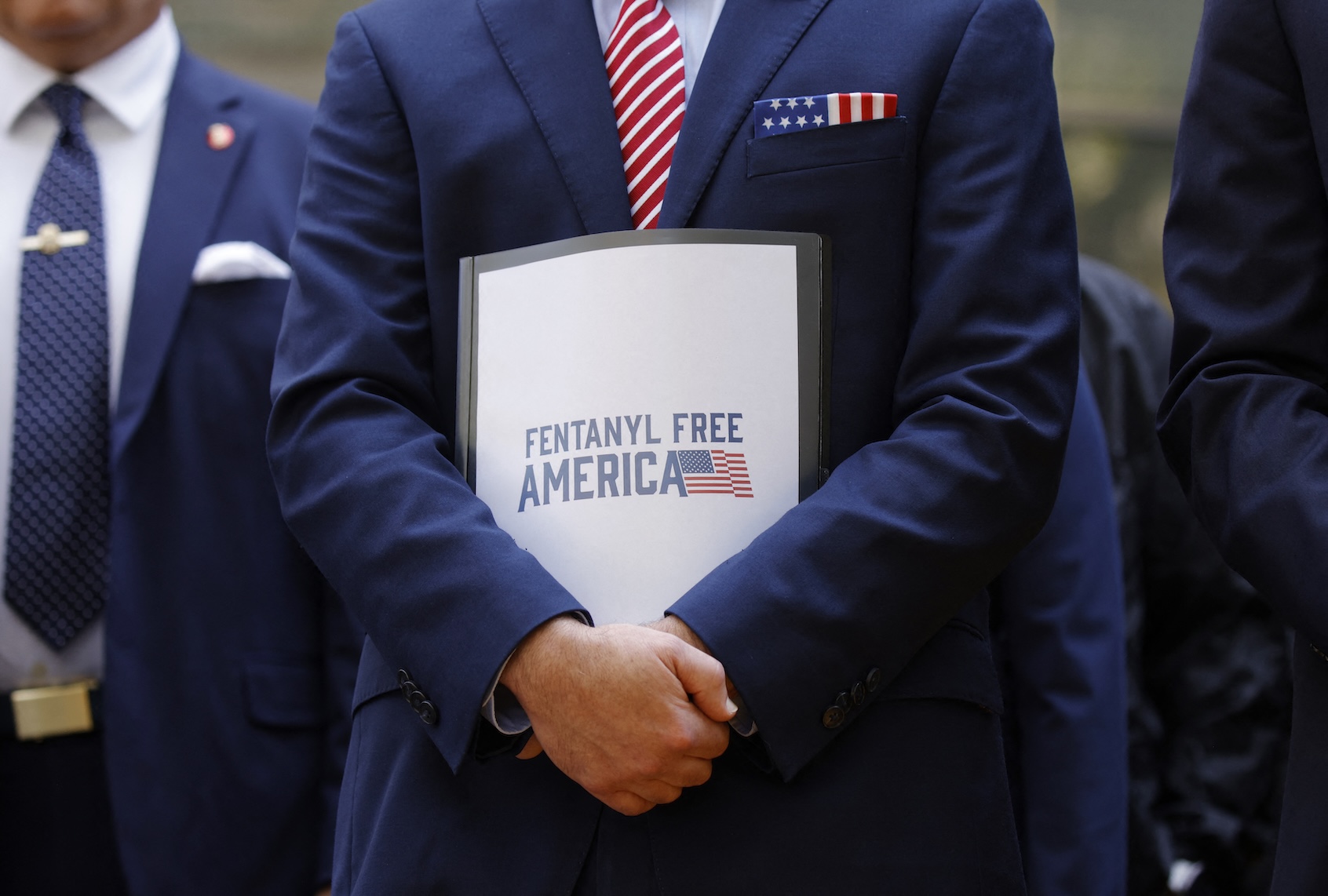
The irony here is extra thick when you recall that the Trump administration designated fentanyl a “weapon of mass destruction” last year. Does that make the DEA a terrorist organization, or perhaps “enablers” of terrorism? Imagine if the Department of Homeland Security, using similar methods that the DEA allegedly utilized in New Mexico, allowed white supremacists to blow up a few bridges so they could get a bigger conviction against them.
This underscores the absurdity of labeling fentanyl a weapon of mass destruction in the first place. The drug is used safely every day in virtually every hospital in America, and in fairness, most users who ingest the drug do not die immediately. Many don’t die at all. It’s an opioid, not sarin gas. More importantly, the hysterical label does nothing to help people struggling with addiction or to reduce overdose deaths. It does, however, give cover for Trump and Defense Secretary Pete Hegseth’s ongoing campaign to blow up boats in the Caribbean, which has widely been condemned as a war crime.
Whether it’s spreading myths about “rainbow fentanyl” in kids’ Halloween candy, or promoting the ludicrous lie that simply touching fentanyl can cause an overdose, the DEA is a bigger source of drug misinformation than that kid in your high school who channeled a lot of Joe Rogan. For all the phony celebrity investigations, in more than 50 years the DEA has made little progress in ending the war on drugs, let alone making America healthier. And there’s a reason it will never work: Addiction is a health problem, not a policing problem. It can’t be solved with more cops or more guns. Amid all the talk about abolishing Immigration and Customs Enforcement, there are other three-letter agencies that deserve the same fate.
Careful: After watching our latest documentary about the Amazonian drug, kambo, you might start seeing frogs wherever you go.
Thinking about the poison, which is derived from giant monkey frogs, and then seeing the creatures dotted hither and thither as you go about your daily life would be taken by most people as a funny coincidence.
However, there are those to whom this is a clear sign that they need to dab their flesh with the venom and then vomit their guts into a bucket, in the name of a ceremonial ritual that supposedly cures almost any ailment (naturally, there’s no clinical evidence for these claims).
VICE’s Amber Rawlings has been meeting British kambo enthusiasts, who have been gathering in apartments, parks, nature reserves, and lay-bys across the suburbs to be “healed” by part-time shamans armed with venom sourced from Indigenous rainforest tribes.
Though this is not illegal in the UK, the stuff isn’t a licensed medicine. Earlier this year, a 40-year-old man died after reportedly taking part in a ceremony—one of a number of suspected fatalities around the world.
Amber first got interested in kambo while interviewing tripsitters, and although this isn’t a psychedelic, fans of the venom credit it with all kinds of powerful psychological benefits.
I gave her a call to find out a bit more about the documentary, which you can watch on YouTube now.
VICE: How did you stumble into this one? Amber Bean Rawlings: Psychedelics can do a lot of good, but if you’re professionally into psychedelics, you’re probably gonna have a god complex. It’s funnier if someone’s got a god complex and they’re just some man you could find down the pub, but on the weekend he’s a shaman wearing a cloak. There’s something so funny about going into someone’s flat that’s meant to look spiritual, and it’s a throw from Urban Outfitters on the wall.
How would you describe the people involved in this? Practitioners, it’s a spectrum from health and wellness to woo-woo. With the people doing it, there are health and wellness people, people who treat it a bit like a psychedelic, to whom it’s a really spiritual experience—people who probably rely too much on kambo. It also intersects with anti-pharmaceutical, anti-conventional medicine, kind of like, “Kambo’s the answer.”
How do you feel about the woo-woo side of it? I don’t know if there’s anything actually spiritual going on. If you’re sick enough, you’re going to feel quite euphoric. You’ve fasted for 16 hours and you vomit loads, someone’s blowing sage around and there’s tribal music on—if this was in the jungle, I’d be well into it.
Did you feel awkward sitting around watching these people vomit? I’ve had some awful hangovers in my time where I’ve vomited 30 times in a day. So I don’t mind the vomit that much. Whatever—it’s not vomit, vomit. It’s just the water they’ve drunk. It’s not like seeing someone chunder up a McDonald’s.
Any weird shit you didn’t include? We did a whole other session with two older ladies that we didn’t have time for in the documentary. One really cried when she took the kambo, and I found it quite moving and had a little tear myself. I was like, “Maybe my mom should do kambo.”
What’s behind the popularity of kambo in the suburbs? A lot of people are disillusioned with conventional medicine, probably somewhat due to misinformation. People are able to promote kambo through social media and make it look like this sleek package. There’s no regulation around saying, “This is going to heal you and help addiction issues.”
vice host amber rawlings
“It’s not like seeing someone chunder up a McDonald’s”
I don’t know, the world’s a bit fucked, so maybe people are like, “Yeah, fuck it. I’ll do kambo. Why not?”
Where’s your thinking around regulation at the moment? There probably should be. The people I met seemed well-intentioned. People are going to watch the documentary and think they’re grifters, but if you actually chat with them and hear about how kambo changed their life, I’m kind of like, “There’s worse things going on.”
Did making the documentary change your perspective on kambo then? It hasn’t made me want to do it. I’m happy for other people to do it. Fill your boots, but I’ve been sick enough in my life.
You don’t want that kambo glow? During all the ceremonies, there’s a point where they’re all gray—the color of their face changes, and it’s really freaky. Then they have a little sleep, and like 20 minutes later they look amazing. So I don’t know, maybe I can make it part of my routine, like going to the sauna. I don’t think I’d be doing it for a spiritual epiphany. It would just be to see how skinny I can get.
Since doing the documentary, have you been seeing any frogs around? I don’t think I’ve seen a single frog, and to be brutally honest, I don’t think I will. But maybe it will happen, and then I will find myself in Preston by the motorway, vomiting up my demons and shitting everywhere.

 Login
Login