❌

Reading view

Pamela Voorhees has a point, and Peacock’s “Crystal Lake” proves it

I can’t remember the last time a catch-up phone call with a confidante didn’t include one of us marveling that we haven’t caught an assault charge. If any law enforcement happens to be reading this, I want to make it clear that will never happen.

Well, let’s call it a non-zero chance. At the end of the day, I am a realist; anything can flip a person’s switch from off to blackout rage. However, I have decades of practice holding back my inner She-Hulk. So do most women.

Every day, we wake up in a nation controlled by a convicted felon accused of multiple sexual assaults, while a college student seeking justice after alleging she was gang-raped at a fraternity party is doxxed and swatted. We are not taken seriously in politics or at work. The manosphere has poisoned our water coolers and social media feeds.

Women have had it, including with each other. Aspiring tradwives and “Live, Laugh, Love” Karens selling out everyone else to keep up their manicures are legion. They threaten to run you down in crosswalks and refuse to bow out gracefully when told, for instance, that a pretty mechanical bird mounted on a boutique’s wall isn’t for sale.

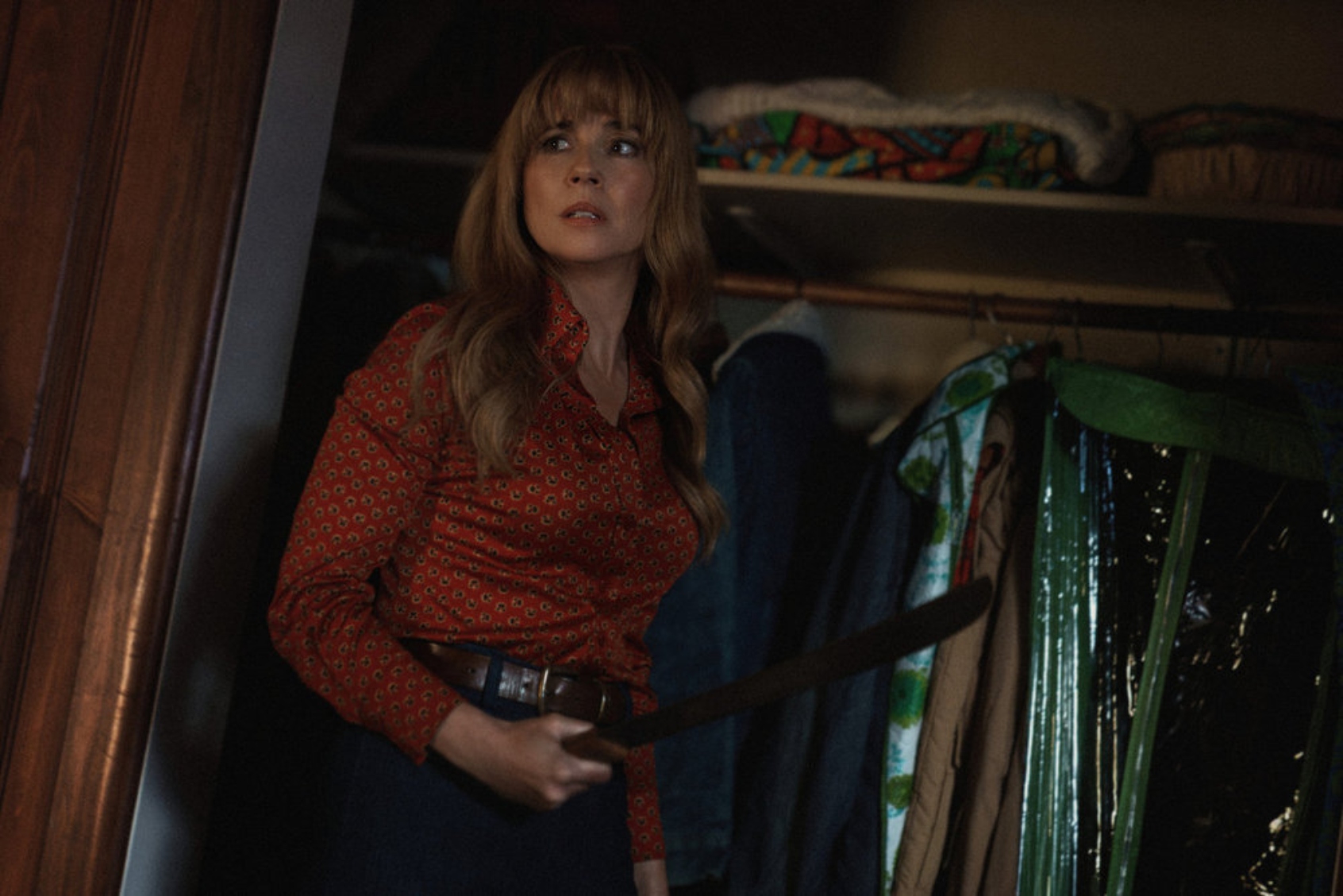
Ladies, look to your left. Now look to your right. One of you is dying to knife somebody. Only Pamela Voorhees, brought to life by Linda Cardellini in “Crystal Lake,” has the guts to act on that impulse. Her bloodlust coats her skin in the crappy opening scene of this “Friday the 13th” prequel, after she’s dispensed with two goons who make the fatal blunder of invading her home and taunting her. One goes down with a swift nick to the jugular. The other loses half his face to the Voorhees family’s machete.
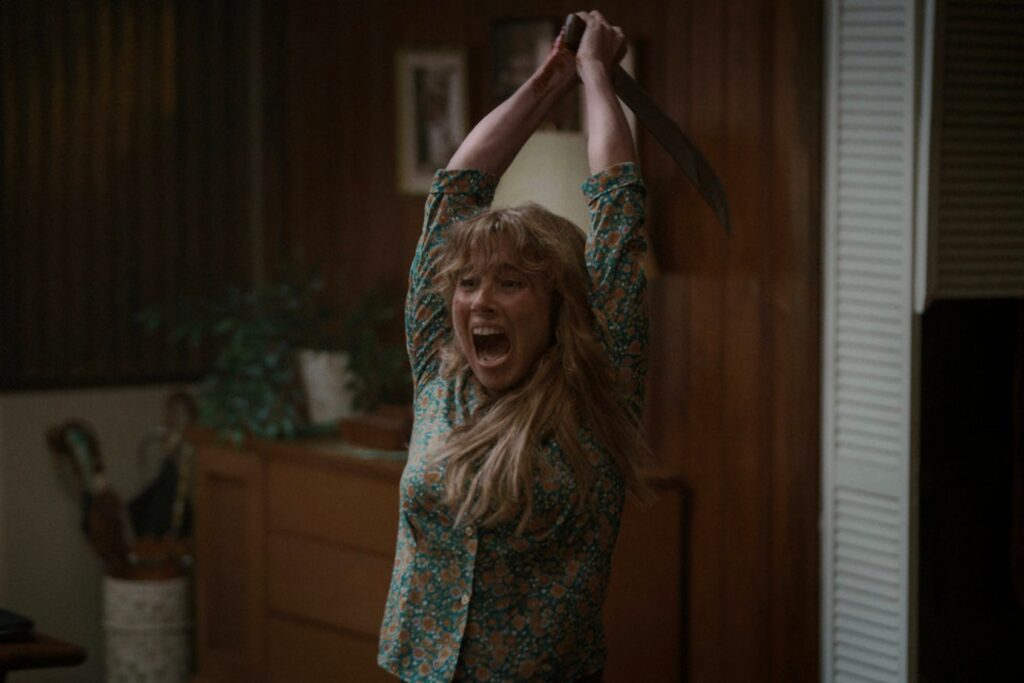
(©2025 Peacock TV LLC. All Rights Reserved.)

The thing is, by the time we’re assaulted by all that, we understand that Pamela has had it, too. She lost her gentle son, a boy born with hydrocephalus, a birth defect in the brain, who is endlessly bullied until he drowns at camp. The town moves from pitying her to whispering that she’s crazy, leaving her rutted in the anger stage of the grieving process. As she chops away at the men who attack her, I found myself muttering, “Yes. Get him. Again. Again!”

Don’t confuse this for an endorsement. Please don’t. “Crystal Lake” is a barely watchable gorefest, with a plot riddled with more seeping holes than Pamela’s victims. (Of course, if you’re into that kind of thing, which I am not, I guess that counts as a recommendation.) What passes for story amounts to little more than a two-dimensional cartoon rendered in human-flesh puppetry, courtesy of actors capable of much better, Cardellini included.

Even so, it’s kind of great to watch one of TV’s most enjoyable performers massacre a gaggle of sex-crazed hippies, or knock an abusive parent into a deep fryer for stress relief.  Few of us can claim to have never daydreamed about, say, an anvil dropping from the clouds to erase some menace from our lives, whether it’s an entitled relative or an idiot comedian. Jason Voorhees’ mom simply prefers a hands-on approach.

I understand why the many chefs who mucked up the “Crystal Lake” cauldron, starting with Bryan Fuller, were compelled to fill in the blanks of Pamela’s origin story. The beauty of the character, once her truth was revealed in the original 1980 movie, is her relative mystery. Who would suspect a frumpy matron in a humble sweater could wreak such unhinged havoc? Other women, that’s who. We’ve always suppressed murderous desires. (See: “Dateline,” “Snapped” and rest of the Oxygen channel’s true crime lineup.) Only recently have we taken to saying that out loud.

Long before the medical and pharmaceutical industries made perimenopausal rage fashionable, Pamela Voorhees was a genre outlier, especially in a cultural climate that had already started retreating from a decade of legislative gains for women’s rights.

Now, in this post-Roe v. Wade world of ours, feminine wrath must be mansplained to be taken seriously. While women have produced excellent recent examinations, including “Furious” and “East of Eden,” the brutal truth is that the “Friday the 13th” movies are IP recognizable to hockey-masked trick-or-treaters too young to watch them.

So it falls to “Crystal Lake” to tell most of us why the mother of slasher cinema’s patron saint was driven to kill, kill and kill again in the first place. But it also helps us understand why a crumpled sock in the middle of the living room or dirty dishes on the kitchen counter makes the exhausted woman in your life crash out.

Let’s assume that if you’re reading this far, you already know the first movie’s big twist: the real killer wasn’t Jason Voorhees, but his mad mama. If not, I mean, what gives? Did you see that picture of Cardellini and wonder what cool-as-a-cuke Lindsay Weir from “Freaks and Geeks” has been up to? With regret, I present this as your answer.

But as any old-school porn hounds skilled in fast-forwarding through “the plot” will tell you, there’s merit in skipping straight to the action — meaning, Pamela destroying fools with something more cutting than wit.

Maybe Fuller, the guy who classed up “Hannibal,” could have done something brilliant with Pamela. But he exited the project early due to creative differences, leaving “It: Welcome to Derry” showrunner Brad Caleb Kane to expand the legend of a woman whose motives were fairly basic. I mean, if your kid died because two horny teen counselors shirked their lifeguard duties to bone in a shed, you might harbor a few homicidal compulsions too.

Alas, in these days of milking dormant franchises for every drop of ichor, a simple explanation isn’t enough. Therefore – and this will either save you the trouble of enduring all eight episodes or spoil them – Pamela Voorhees is revealed to be a victim of a patriarchal industrial plot.
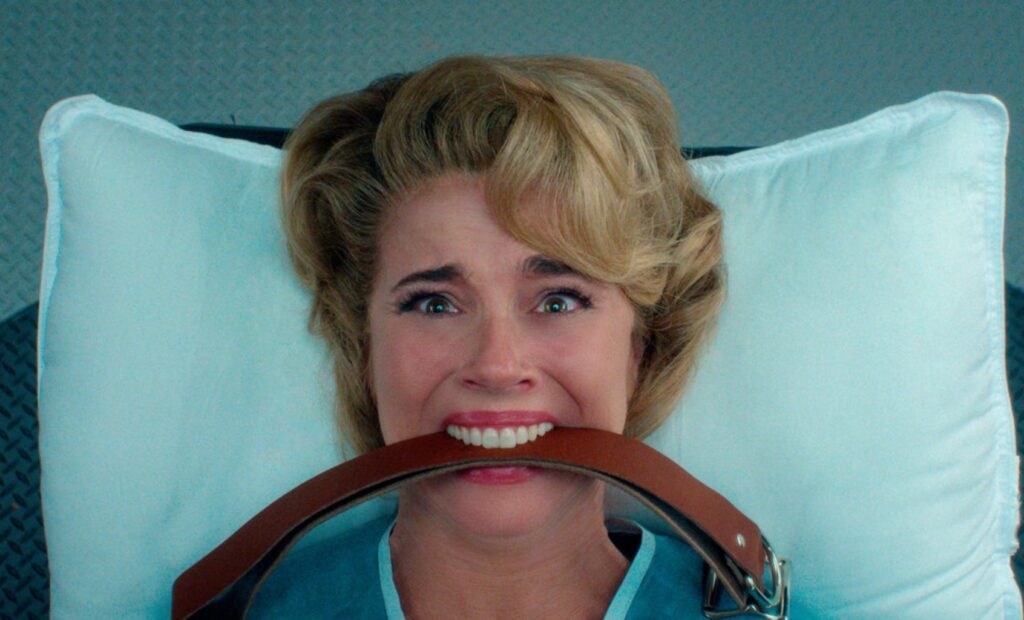
(©2025 Peacock TV LLC. All Rights Reserved.)

The former professional singer gets knocked up by her lover, Elias (Hamish Linklater), who works for a company called Bellflower. When she nearly miscarries, he convinces her to marry him and move to his company’s sponsored enclave that’s popping with pregnant women like her. Once she’s settled in, her husband plies her with Bellflower-manufactured TV dinners and happy pills, occasionally shuttling her to the doctor to be pumped full of mystery muck. Truly a MAHA conspiracist’s nightmare.

Sometime later, Jason arrives and demonstrates a knack for reviving from naps the average human wouldn’t wake up from. So father secretly subjects son to all manner of mad science, including massive radiation exposure. Once Pamela discovers this, she rescues Jason, turning the skull of the man who gets in her way into soup, and they escape to Crystal Lake.


Want more from culture than just the latest trend? The Swell highlights art made to last.
Sign up here


Cardellini’s Pamela Voorhees is what happens when women drinking from a bottomless well of contempt and human carelessness hit their limit. The writers, in their clumsy way, cater to that idea by having her dispose of her first slaughter by slathering the bodies in a deconstructed tonnato sauce of canned fish and honey, and standing by as a massive bear lumbers up to feast.

Before the animal takes a bite, it sizes up Pamela, sniffs her tears, and leaves her be. You could view this as one predator recognizing another. To women of a certain mood, though, it confirms what we already know: that a bear is preferable company to thoughtless, dangerous people. Plus, it’ll help rid you of pesky evidence without asking questions, which only a true, understanding friend would do.

All episodes of “Crystal Lake” are streaming on Peacock.


The post Pamela Voorhees has a point, and Peacock’s “Crystal Lake” proves it appeared first on Salon.com.
  •  

You can now play P.T. natively on PC, no remake required

2014 horror game P.T. has left an enduring legacy behind, just as much for what it wasn't as what it was. It was a pitch-perfect bite-sized horror experience from the mind of gaming auteur Hideo Kojima. It wasn't, however, a full-sized, multi-hour game with a massive bag of tricks — that was teased at the end. — Read the rest

The post You can now play P.T. natively on PC, no remake required appeared first on Boing Boing.

  •  

We got the original “Resident Evil” films all wrong

In the sixth and final installment of Paul W.S. Anderson’s original “Resident Evil” film franchise, the writer-director — known for his abrasive, nu-metal vulgar auteurism — raises a middle finger of sorts to his detractors. Over 17 years and thousands of poor reviews, Anderson’s adaptations of the beloved Capcom survival-horror video game series became somewhat famous for pissing off critics and diehard game fans alike. The bulk of Anderson’s sprawling vision chose to forgo the games’ shadowy zombie story for high-octane thrills and compelling (if clunky) commentary on corporate greed, biological warfare, AI and identity. His “Resident Evil” films are unapologetically ambitious and undeniably imperfect, much like their human lead, Alice (Milla Jovovich), whose sole mission is to retain her humanity in a world eating itself alive. In charmingly symbiotic fashion, neither Alice nor Anderson himself is willing to give up on their mission without a fight.

As if Anderson were taking a victory lap to celebrate the impressive feat of making six films in a series that was horribly reviewed but terribly financially successful, a flashback sequence in 2016’s “Resident Evil: The Final Chapter” closes the sextet’s loop. In the scene, set just before the events of 2002’s “Resident Evil,” executives at the diabolical Umbrella Corporation gather to discuss the world’s impending end. Nuclear war is a real possibility, climate change is inevitable, famine and death are on the horizon. Umbrella’s answer? The T-Virus, a mutagenic pathogen that will bring an undead plague across the Earth, leaving it free for Umbrella’s higher-ups and other wealthy patrons to inhabit once the zombies are safely eradicated. “We will emerge onto a cleansed Earth,” says Umbrella CEO Dr. Isaacs (Iain Glen), “one that we can then reboot in our image.” 

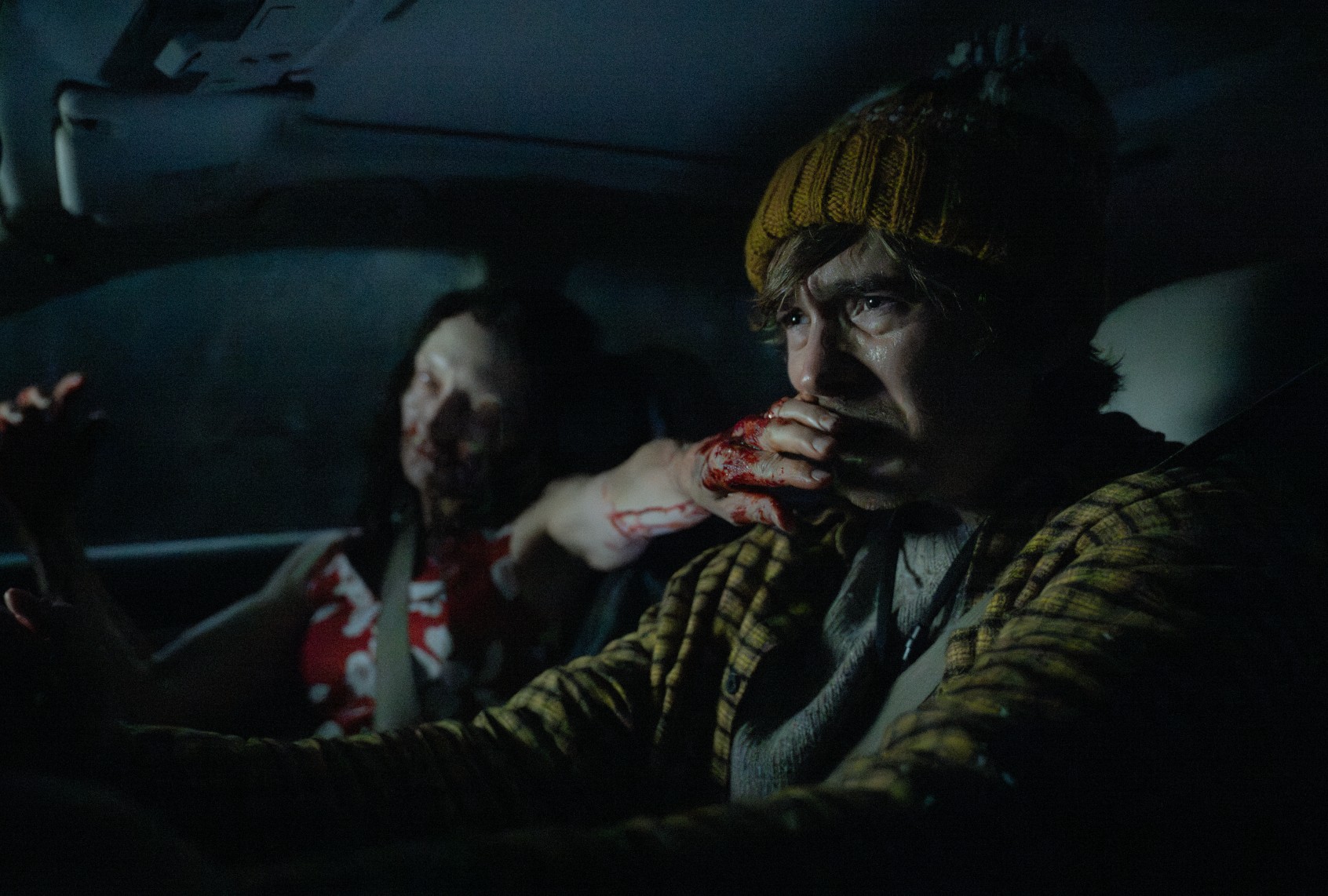
(Dušan Martinček/Columbia Pictures) Austin Abrams in “Resident Evil”

Everything has become so hyper-personalized and algorithmic that viewers subconsciously watch media looking for themselves. But that is the great joy of Anderson’s “Resident Evil” films: They are so remarkably stylized, so absurdly over-the-top, so referential and deferent to Anderson’s own inspirations, that they’ve become singular visions.

Here, Anderson’s message is clear: Whoever has the power controls the image. And if one doesn’t like that image, they’re free to fight back. But to know what they’re fighting for, one must first understand what they’re fighting against, engaging with the enemy rather than dismissing it.

That idea has been rattling around my mind after seeing Zach Cregger’s new “Resident Evil,” itself a reboot made in its creator’s image. Cregger’s film is more faithful to the spirit of the original games, with uncertainty and plenty of monsters just around every dark corner. The movie trades the gun-slinging Umbrella defector Alice for a medical courier named Bryan (Austin Abrams), who finds himself completely out of his depth when a routine delivery mutates into something much more horrifying.

“I’d rather watch a movie starring a schlub who’s out of shape and never fired a gun before,” Cregger told Polygon of his adaptation. Unlike Alice, Bryan is the audience stand-in: the average guy who responds to a mind-boggling, impossible situation as clumsily as you or I might. Critics and audiences responded in turn, taking an immediate shine to Bryan’s doofiness and contrasting it with Alice’s purposeful, goal-oriented approach to a zombie apocalypse. One review called Cregger’s movie “different and much better than the other ‘Resident Evil’ movies,” which were termed “depersonalized zombie sludge.”

I find that to be the trouble with the way people watch and talk about films these days, as if a movie’s merit is defined by whether or not it reflects the viewer. Everything has become so hyper-personalized and algorithmic that viewers subconsciously watch media looking for themselves. The line between art and commerce has blurred so much that people unintentionally conflate all visual media with advertising — if they can’t see themselves in it, they’re not buying it.

But that is the great joy of Anderson’s “Resident Evil” films: They are so remarkably stylized, so absurdly over-the-top, so referential and deferent to Anderson’s own inspirations, that they’ve become singular visions. The mere fact that there are six increasingly wacky installments should be enough to warrant curiosity. And yet, Anderson’s “Resident Evil” has always been the butt of the joke, brushed off largely because his movies dared to be different when people wanted more of the same.

Perhaps that’s rich, given just how much DNA the original “Resident Evil” franchise shares with the “Matrix,” “Mad Max,” and “Alien” franchises. And I’m no fool; having seen all of Anderson’s “Resident Evil” films, I know they are not created equal. Some, like the fifth installment, “Retribution” — which reorients the series to a much more salient, focused place — stand head and shoulders above others. But not every “Matrix,” “Alien,” “Mad Max,” or other film franchise movie shares the same quality as its in-universe peers, either. While one might argue that those are original titles of distinguished quality, it’s unfair to write off “Resident Evil” simply because it’s a game adaptation. After all, Anderson’s most fascinating ideas merge the immersive structure of gaming with the spectacle of filmmaking, and he’s one of the few filmmakers who has successfully pulled off such an audacious combination.


Want more from culture than just the latest trend? The Swell highlights art made to last.
Sign up here


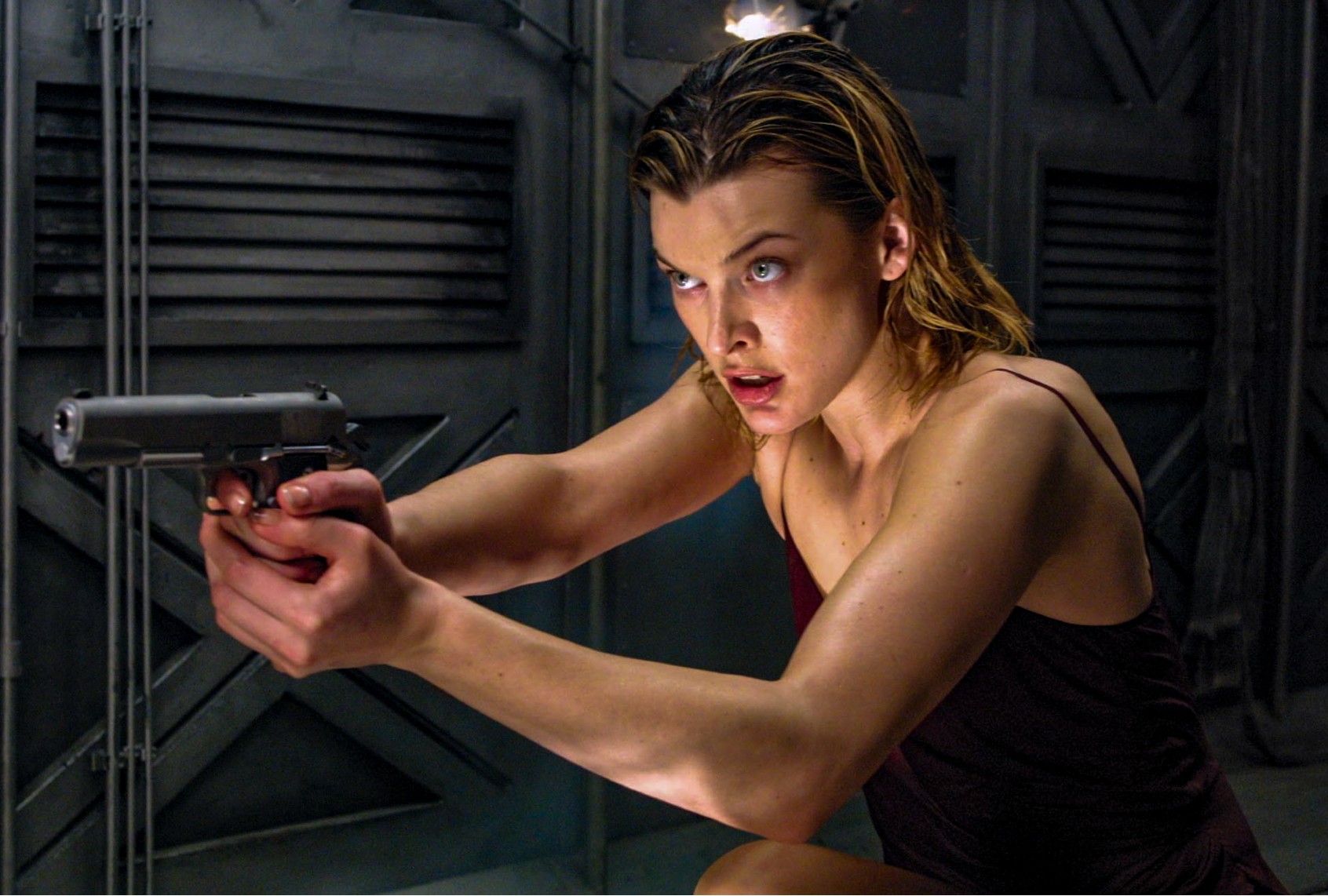
From the start, Alice is the viewer’s avatar, at once a skilled security operative and someone with no memory of their past. She, much like the person behind the proverbial controller, is dropped into a world quickly becoming overrun by a viral plague with no idea what to do. Press A to jump. Press X to shoot. Press Y+X for the combo move. Because we learn alongside Alice — only watching instead of playing — Anderson forges a connection between the viewer and the character on screen without running the analog cable that connects a controller to a console, as Cregger seems keen to do. Anderson’s “Resident Evil” protagonist is not a projection of any specific viewer. Rather, she’s the film’s embodiment of a lawful good, pre-programmed to fulfill her mission linearly without getting lost in the big, open world.

Vulgar auteurism doesn’t necessarily suggest that a film is as “good” as others of its ilk, only that the film earnestly explores ideas as enduring as those in any formally rigid, awards-bait film. Anderson’s “Resident Evil” franchise — with all of its ruminations on identity in the tech age, artificially intelligent warfare, corruption and greed — certainly fits that bill.

Maybe that can feel stifling for some viewers. Across six films, Alice rarely faces a challenge that she can’t overcome. Even the endings feel like save points, with Alice respawning at the start of each consecutive movie with another mutated monkey on her back. 

For me, that’s where Anderson’s series gets its draw. Alice is placed in an impossible situation with no say in the matter, and no choice but to fight her way out. As she progresses through the level-by-level (or, in this case, film-by-film) structure, the knowledge she acquires informs her identity and reorients her spirit. Alice’s humanity is defined by her total rejection of the manufactured digital world and the havoc its creators wrought. Her quest is not to defeat all of the monsters, but to always remember that every zombie was, like her, human. That’s how she holds onto her soul.

But no matter how noble Alice’s mission is, her consistent character is no match for Anderson’s heavy hand. His “Resident Evil” films are as gratuitous as they are ridiculous — often repetitive and typically predictable. I’ve never found that to be a barrier to entry, especially for something so balls-to-the-wall exciting as these movies. The merits of so-called vulgar auteurism are often debated among film fans. But to say that no filmmakers are working in mainstream, high-flying, big-budget action with real artistic value negates the principle of filmmaking as an art form. Just because something doesn’t fit into the regressive limitations of “good” and “bad” doesn’t mean that it has no worth. Assertions of vulgar auteurism don’t necessarily suggest that a film is as “good” as others of its ilk, only that the film earnestly explores ideas as enduring as those in any formally rigid, awards-bait film. Anderson’s “Resident Evil” franchise — with all of its ruminations on identity in the tech age, artificially intelligent warfare, corruption and greed — certainly fits that bill.


I find that I’m beating this drum daily, trying to convince people that thoughtfully engaging with art they don’t immediately like or understand is a worthwhile practice. But we’ve reached a moment in media consumption where reputation is practically insurmountable. It’s become more difficult to convince people of “bad” media’s merits, to encourage them to see with eyes other than their own. I stumble into these moments all the time, waxing poetic about misunderstood and misread films like Halle Berry’s “Catwoman,” or claiming Zack Snyder’s “Sucker Punch” is a bold feminist text and not 110 minutes of CGI-laden misogyny. In all my years of picking apart films to grasp why they appeal to my senses, I’ve watched others’ curiosity decline, especially in the face of someone else’s passion. Now that Cregger’s “Resident Evil” looks and feels a bit more like the classic games, I fear the effusive reaction will drown out Anderson’s franchise’s nutty strengths forever. 

Of course, not everything has to be highbrow and meaningful. Some things are silly, and will be just fine remaining that way. But it’s the inclination to bang the gavel and move on that irks me. With AI images bleeding into the real world at a pace none of us can keep up with, there’s human marvel to behold in Anderson’s madness. These are films of strenuous work and daring vision, even when their execution doesn’t always match up with those big ideas. Analyzing what works and what doesn’t, instead of dismissing the whole thing outright, is a free and life-affirming way to connect with the world and its people. Investigating everything further — following Alice down the rabbit hole and fighting alongside her to preserve what makes us human — might be laborious at times, sure. But it just might be one of the last ways to save our souls.

The post We got the original “Resident Evil” films all wrong appeared first on Salon.com.

  •  
❌