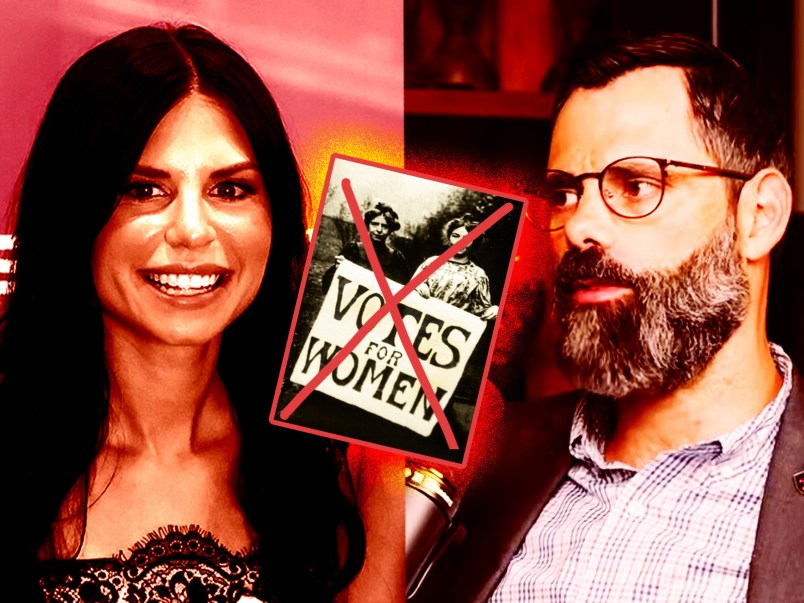
Being a MAGA influencer just isn’t what it used to be.
When the Trump administration returned to power nearly two years ago, the influencers swaggered into Washington, D.C. with unrelenting hubris. The inauguration gave us a window into just how decisive they’d been in the previous election. The late Charlie Kirk “got a better seat than every member of Congress,” according to The Daily Beast. Jake Paul and his brother Logan took selfies with OpenAI CEO Sam Altman, one of many Big Tech Trump allies who donated to his inaugural fund to secure access to the administration. Joe Rogan and Tucker Carlson mingled with government leaders and titans of industry.
Republican Efforts to Subvert the Vote Zero in on Alaska
A couple of Republican senators are looking ahead to January and suggesting they will refuse to seat Democrat Mary Peltola should she win her Senate race.
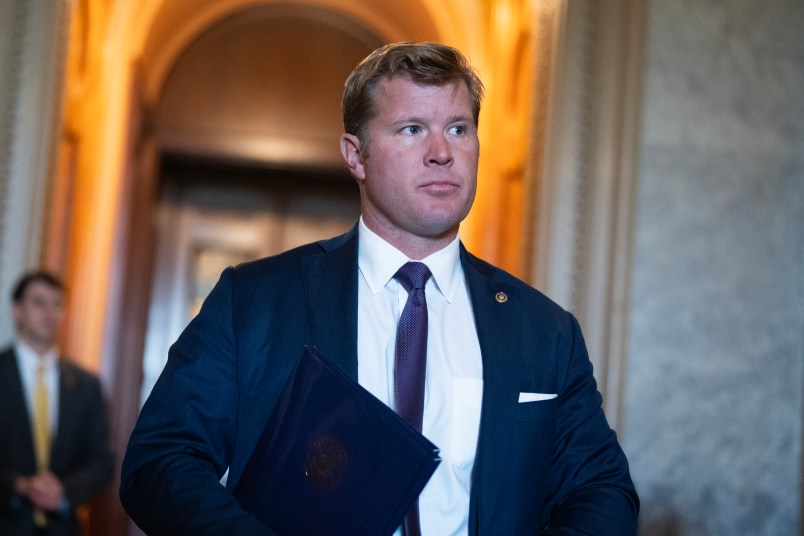
“Under no circumstances should Mary Peltola be seated if she wins an election in a fraudulent manner,” Tim Sheehy (R-MT) tweeted on Saturday.
In a Sunday Meet the Press interview, Tim Scott (R-SC), the chair of the National Republican Senatorial Committee, also refused to commit to accepting the results, even if they are certified by Alaska, pointing to the DOJ investigation into the dueling Dan Sullivans on the ballot.
Later that day, a federal district court judge rejected the Department of Justice’s preemptive effort to halt Alaska’s certification of the election. The DOJ wants the state to not certify until an investigation is completed into whether voters who intended to vote for incumbent senator Dan Sullivan actually cast ballots for the other Dan Sullivan, who, a New York Times investigation suggested, may have been encouraged by Democratic operatives to run. Such an investigation would be impossible, because voters’ identities are not linked to their ballots, the judge noted.
“Those cast ballots have been commingled and cannot now be segregated or the identity of the person who cast each ballot ascertained,” Judge Sharon Gleason wrote.
The DOJ appealed Sunday’s decision. That litigation is separate from DOJ efforts to investigate the non-senator Sullivan.
As the Times’ story noted, nothing it reported is “fraud,” or a violation of election law; in a world where the DOJ and congressional Republicans were not beholden to Trump, there would not be much to investigate. As many experts have pointed out, Alaska’s ranked-choice voting system is designed to ensure that, in a close election, senator Dan Sullivan will in fact win any voters who intended to vote for him, since it eliminates minor candidates.
Each state is in charge of certifying its own elections and sending the winners to Congress. The Senate, however, plays a role in determining which members to seat; contested races, have, historically, been investigated by the Senate Rules Committee.
These scenarios are rare, however, and the Senate procedures around disputed elections have often been determined by the body itself, not any law. The vagueness opens the door to a huge range of options, including opportunities for Republicans to attempt to block Peltola, and opportunities for Democrats to fight back.
House Oversight Committee chair James Comer (R-KY), who is also conducting an investigation into Alaska’s election, said Sunday that the Senate might refuse to seat Peltola.
One Republican who said he would accept the results is the senator Dan Sullivan.
“Are you only going to accept the election results if you win?” Jake Tapper asked him Sunday on CNN.
“No, I’m going to accept the election results,” Sullivan replied.
Haley Stevens’ Very Weird Sunday
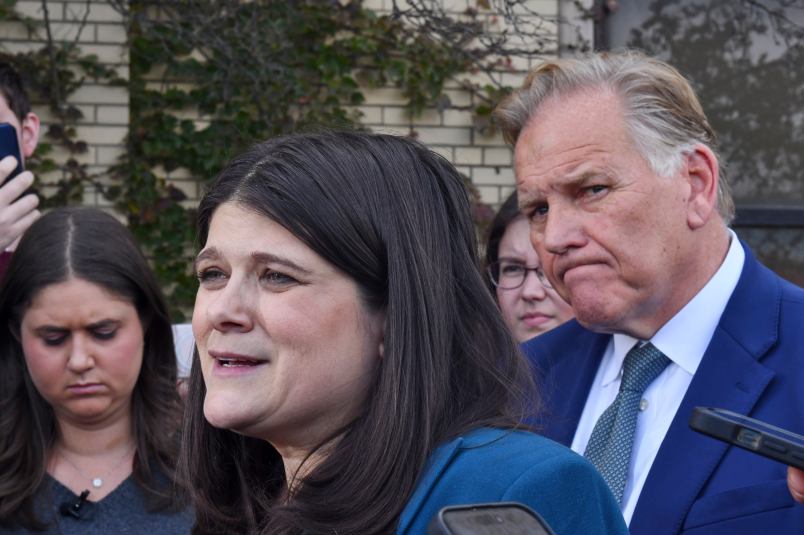
DETROIT, UNITED STATES – 2026/11/01: Michigan Democratic Representative Haley Stevens (L) endorses Republican Senate candidate Mike Rogers (R). The 2026 United States Midterm Elections, including the Michigan U.S. Senate race, will take place on November 3. (Photo by Dominic Gwinn/SOPA Images/LightRocket via Getty Images)
In the hours following Stevens’ dramatic switch, from supporting Democratic Senate candidate Abdul El-Sayed to supporting Republican Mike Rogers — a man who in August she described as “another rubber stamp for Donald Trump’s dangerous agenda” — journalists and Michigan Democrats searched for some clue as to what prompted such a sudden reversal.
Stevens’ differences with El-Sayed were well known. But, as TPM and other outlets reported, she had the previous night assured Democrats she would not do the very thing she did. Rep. Debbie Dingell, a respected Michigan Democrat, said Stevens told her at “midnight” that the possibility she would endorse Rogers was “all a rumor and it was not true.” Rep. Jamie Raskin (D-MD) also described Stevens telling him one thing Saturday before doing the opposite Sunday.
During an Anderson Cooper interview yesterday evening, the host repeatedly pressed her to explain why the switch happened when it did. Cooper noted that while Stevens had strongly critiqued El-Sayed — saying that he had not adequately distanced himself from streamer Hasan Piker or from a super PAC ad that suggested inflation was caused by U.S. arms sales to Israel — nothing had changed on those topics between the time she assured her party members she would not endorse Rogers, on Saturday, and the time, the next day, when she did.
Stevens did hint that El-Sayed’s decision to uninvite her from a unity event, scheduled for Sunday morning, in the face of her mounting critiques, prompted her to switch allegiance. “Abdul made very clear that I was not welcome in his campaign, that he didn’t need me there, that he didn’t want me there,” she said at a press conference with Rogers.
Speculation within Democratic circles also narrowed in on Stevens’ fiancé, the political donor Jason Turkish, who endorsed Rogers last week. Journalist Zach Gorchow reported a story told by former Democratic governor James Blanchard, who was in office from 1983 to 1991 and who said he had recently had dinner with the couple. Blanchard described Turkish “working her over,” telling her fiancé that “everyone is disappointed” in her. Blanchard said he intervened to defend Stevens as a “team player.”
“I’ve known Haley for a long time. I don’t know her fiancé,” Mallory McMorrow, one of Stevens’ and El-Sayed’s primary opponents, said during a local news interview yesterday. “I don’t. But to see him out there so publicly — I can only speak for myself, but my husband and I talked about this, and my husband said if he ever tried to speak for me the way we see happening now, he was like, ‘you would leave me.’ It’s hard to watch.” Dingell, also part of the interview, added, “it’s very hard.”
Stevens chief of staff of eight years, and other staffers in her office, resigned yesterday.
Benjamin Netanyahu didn’t win last week’s election in Israel. But he didn’t exactly lose it either. The real loser may have been Israel’s fragile democracy, already corrupted from within, perhaps past the point of no return, by Netanyahu’s decades-long death-grip on power.
On the eve of a momentous election in the United States, the parallels are both inexact and unavoidable. Israelis must now decide what kind of country they will have, or at least what kind they aspire to have. They must decide whose votes actually count, and whether some citizens are more equal than others.
Those same questions also confront Americans, both in this week’s midterm elections and, in a more general sense, on the larger political and historical stage. No doubt it is tempting for liberals and progressives to express outrage at the blatant flaws and contradictions of Israeli democracy. But to invoke the Christian tradition here, it might be better to remove the plank from your own eye before trying to remove the speck from your brother’s.
On the surface, the electoral arithmetic in Israel appears straightforward. Parties opposed to Netanyahu’s far-right government won 67 of the 120 seats in the Knesset, Israel’s parliament. So a majority coalition of anti-Netanyahu forces is clearly achievable, right? You would think so, except that 19 of those 67 seats were won by Israel’s “Arab parties,” an all-time high, and that startling fact has thrown the entire political system into confusion.
Netanyahu and his allies have spent the last week airing groundless allegations that the election was fraudulent or rigged, a refrain that Americans are likely to hear a great deal in coming days. What the Zionist far right means is that too many Israeli Arabs — meaning the Palestinian population that remained in Israel after the state was created in 1948 — decided to vote this time, an outcome that no one expected, and that none of the parties representing the Jewish majority particularly wanted.
Now, in a masterstroke of historical or perhaps biblical irony, Israel’s Arab minority — which is not a monolithic group in political or cultural terms, and until now has never been electorally significant — holds the balance of power, and perhaps the nation’s future, in its hands.
In a masterstroke of historical or perhaps biblical irony, Israel’s Arab minority — which is not a monolithic group in political or cultural terms, and until now has never been electorally significant — holds the balance of power, and perhaps the nation’s future, in its hands.
Gadi Eisenkot, the former general who leads the centrist-Zionist opposition to Netanyahu, promised during the campaign not to form a government with Arab support. Over the last several nights, thousands of demonstrators in Tel Aviv and Jerusalem have urged him to do precisely that, since the only realistic alternative is the grim default setting of Israeli politics: another wobbly right-wing government headed by Netanyahu, which means more brutality and destruction in Gaza, more war with Iran and more settler violence in the West Bank.
As Gideon Levy of the left-leaning Israeli newspaper Haaretz explains it,
The future of Israel now depends on its Arab citizens and on the attitude of its Jewish citizens toward its Arab ones. Eighty years after the Nakba and the establishment of the Jewish state, Israeli Palestinians may determine its fate. Is there greater historical justice than that?
The election’s unexpected results are “a cause for rejoicing,” Levy writes, in that they have presented Israelis with a clear choice “between a government led by Benjamin Netanyahu and a government that includes the Arab parties.” If the “change bloc” within the Zionist majority cannot accept a coalition with Arab Israelis, he continues, “they will make it clear that they are actually the same as Netanyahu, that they prefer even the devil Netanyahu over repressing their racism. … [E]veryone will know that racism is the supreme value in this country, across the board, above any other value.”
That ferocious language certainly does not represent mainstream Israeli opinion, but it’s fair to say the strong emotion beneath Levy’s words is far more widely felt. I don’t think it’s possible for a non-Jewish observer (such as myself), however well educated or sympathetic, to understand the anguish felt by Jewish people — wherever they live, and whatever their political views — at the enormous distance between what Israel originally represented to the world, or claimed to represent, and what it represents now.
I’m old enough to remember when most American liberals and progressives viewed the state of Israel in overwhelmingly positive terms, as a locus of charismatic or heroic renewal for the people Hitler couldn’t kill, infused with the spirit of European socialism and, not far below the surface, the collective guilt of the Holocaust. I grew up in one of the most left-liberal corners of America, surrounded by educated adults who supported the civil rights movement, opposed the Vietnam War, hated Richard Nixon and loved Israel. Golda Meir and Moshe Dayan were beloved celebrities; the Six-Day War of 1967 and the Yom Kippur War of 1973, as narrated by U.S. media, were straight-up battles between the forces of light and darkness.
That says more about the moral blindness or willful innocence of American liberalism, I must admit, than it says about Israel. In any event, when I saw Joe Biden’s fateful bear hug with Netanyahu on the tarmac of Ben Gurion Airport in the aftermath of the dreadful Oct. 7 attack, I understood it. I recognized the country Biden was coming from, because I came from there too: It was the Democratic majority of the not-so-distant past, when Israel was embraced as a light to the nations and left-wing radicals who brought up the Palestinian cause were being unreasonable hotheads, if not openly antisemitic and a little bit Nazi.
What Israel has become during Netanyahu’s long and destructive reign is now clear to most of the world, and most of all to the many Jewish or Israeli critics who have been speaking difficult truths for many years, often at enormous personal cost. I am disinclined, however, to judge too harshly those who cling to the vision of Israel as an exceptional nation — one that has stumbled, perhaps, but may yet regain its true path.
Like I said earlier, we should mind the plank in our own eye first. Isn’t that the same vision that many Americans still cling to? That somehow, on the other side of this dreadful phase of our history — yes, a full decade of Donald Trump, but I’m afraid the damage goes back a lot further than that — the “indispensable nation” variously articulated by Abraham Lincoln, John F. Kennedy and Barack Obama is still there, still retrievable, still bending its moral arc toward justice.
Americans and Israelis are conjoined by history, for better or worse, and now see each other as distorted reflections, through a glass darkly, as the King James Bible puts it. We face versions of the same decisions this week, about whose votes count and whether the highfalutin words of our constitution apply to everyone. About whether to see terror and tyranny for what they are, and turn the page.
In any other election cycle, a viral Fox News gaffe would have registered only as a momentary laugh. Last week, reporter Lucas Tomlinson was covering a South Carolina rally for incumbent Republican Sen. Darline Graham, who is seeking to serve a full term following the death of her brother, Sen. Lindsey Graham. In reality, the event was more about Donald Trump, who had flown to the Palmetto State to help shore up Graham’s candidacy, which increasingly appears to be at-risk. Spotting a middle-aged white man with a beard, Tomlinson assumed he was about to get some choice footage of a gushing Trump superfan. Instead, Tom Hoyle, with an admirable deadpan, joked that he had turned out for the rally because he was too young to have witnessed the 1978 Jonestown massacre, in which 918 followers of Rev. Jim Jones died after drinking a fruit drink laced with poison. “There’s nothing like seeing a cult right up front, man,” he added.
“All right, maybe this is not a Trump supporter,” Tomlinson said, scurrying away.
The surreal moment capped what has been a desultory midterm election season for Fox, a network that bills itself as “news” but has long been seen by fans and detractors alike as Republican propaganda. Despite their largely worshipful coverage of the president, Trump has been complaining that the network isn’t doing enough to salvage the campaigns of the GOP.
“FoxNews is spending far too much time putting on the OPPONENTS of Republican Party Candidates,” he recently posted on Truth Social, echoing his prior complaints that the network focuses too much on the Democrats running this cycle than on their Republican opponents.
Trump is not wrong about the coverage tilt. According to Media Matters, during this election cycle the network has mentioned the names of Democratic candidates at over three times the rate of Republicans. That disparity, though, doesn’t mean the coverage is sympathetic. To the contrary: Fox producers likely recognize that this year’s GOP field of candidates is deeply uninspiring. Some, such as Vivek Ramaswamy, who is running for governor of Ohio, and Texas Attorney General Ken Paxton, who is seeking a Senate seat, are so repulsive that even lifelong Republicans can’t pretend to like them.
This season, Democratic candidates are making more compelling TV, particularly the charismatic incumbent Sen. Jon Ossoff, D-Ga., Michigan’s Senate nominee Dr. Abdul El-Sayed and Texas state representative James Talarico, who is running against Paxton. The most Fox News can hope for is to hijack these candidates’ ability to command attention, and then use it to drive negative polarization with endless “who do these people think they are?” outrage. But then again, the network knows its audience.
As Salon’s Sophia Tesfaye recently noted, it’s not like Fox News knows what else to do. The hosts, she writes, have been grabbing wildly at straws, praying they can find any story to spark culture war hysteria that will distract voters from serious issues like inflation, the war with Iran or the metastasizing deportation crisis. The network tried to make hay out of the French riots, but even Fox viewers struggled to see why student protests in Paris matter to America. It attempted to pretend Sen. Elissa Slotkin, D-Mich., was calling for mass arrests of young Republicans when she was asked during a recent appearance about holding the GOP accountable, but that never really caught on either. A last-minute gambit to feign outrage over Barack Obama’s recent joke comparing Trump’s White House decor to the Cheesecake Factory fizzled out as well, likely because it simply reminded people of how the current resident is defiling the People’s House.
Part of Fox’s problem is immediate. Many voters’ economic woes are sky-high, making it hard for culture war nonsense to feel relevant. But there’s also a longer-term problem for the network, which is that they don’t make as much sense as they used to.
Fox News has long existed to dress up gutter bigotries and far-right paranoia in the clothes of respectable news coverage, mostly through the use of dog whistles and innuendo. In the past, winks at some of the fouler ideas out there was enough to titillate the audience while keeping up the pretense of respectability. But now, that stuff seems dated and out of touch.
This is an era when, as Jamelle Bouie of New York Times said on YouTube, the actual president offers “Klansman-level racism” from the campaign stump, calling Black people “low IQ,” flinging a slur for transgender people at Democratic politicians and suggesting that El-Sayed’s Muslim faith makes him a terrorist. Right-wing social media, especially the Elon Musk-owned X, reads like Stormfront message boards from the 1990s, with Musk himself regularly promoting white nationalist ideas and memes. Former Fox hosts Megyn Kelly and Tucker Carlson offer their former employer stiff competition by being more dishonest and outrageous than the lawsuit-wary network can be, with segments suggesting only supermodel-hot women get raped or that Holocaust deniers have a point.
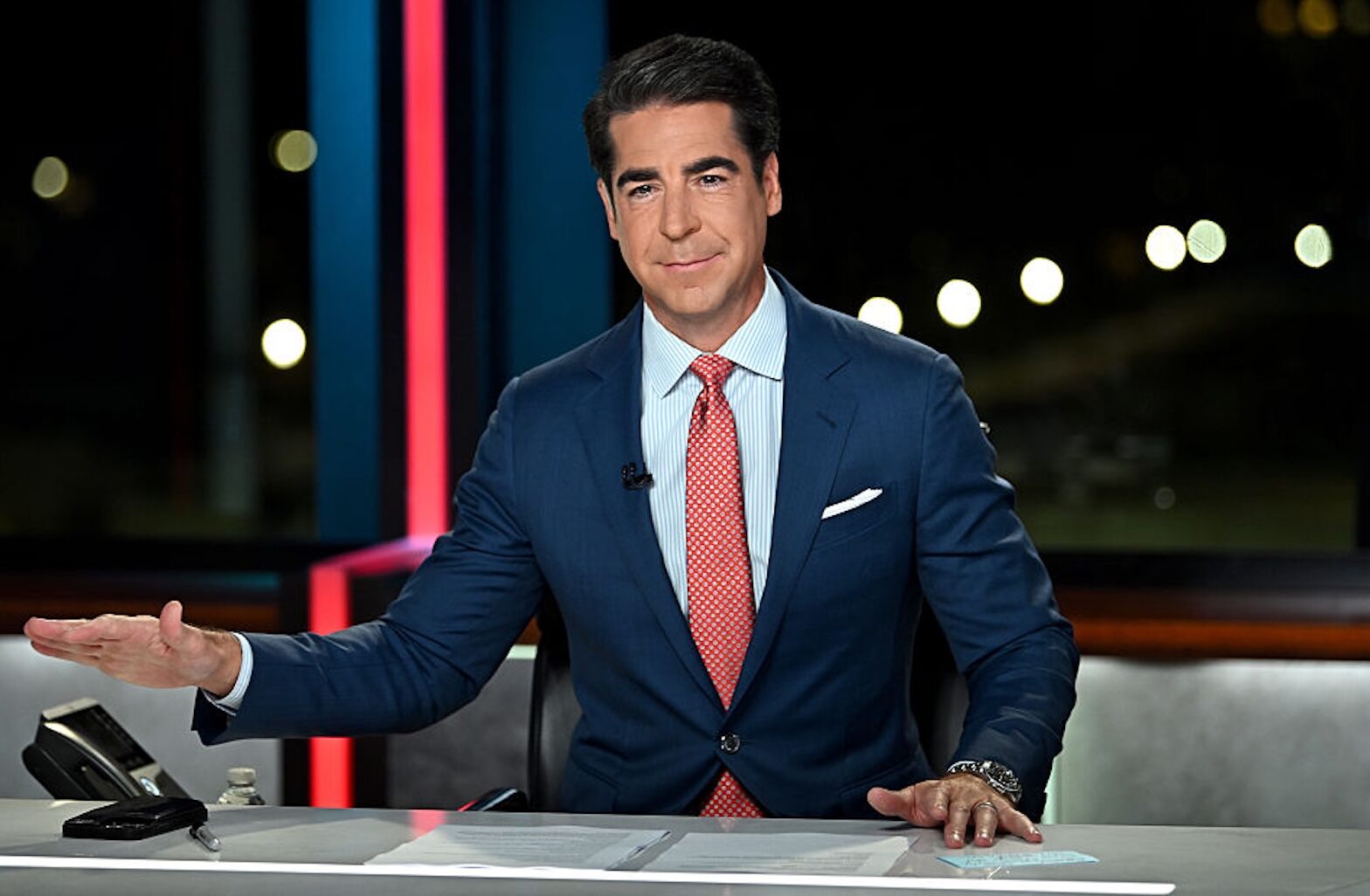
But according to Salon’s Alex Galbraith, one Fox host seems to be getting sick of his network’s culture war strategy. Jesse Watters has complained openly on air about how bad the GOP is doing and how Fox coverage isn’t doing much to excite their audience. In one particularly telling segment, he lashed out about the relentless attention Fox News gives to non-stories from the WNBA, including hysteria over trans players, of which there are zero.
“I don’t want to push this story anymore!” Watters said. “I want to leave this story alone! I am no longer talking about the WNBA. As of now, I boycott this segment.”
Although his reasoning may differ, the host is right that the Fox fixation on the WNBA is stupid. The league has become such an obsession on the right because, plainly put, many male conservatives hate seeing female athletes perform feats they couldn’t even manage in their youth. They want to end professional women’s sports and return to the sexist delusion that all men are stronger and faster than all women. This much is evident in how real-life right-wingers behave toward the WNBA, such as going so far as to buy tickets so they can throw sex toys at the players.
Fox hosts are careful to never say outright that women shouldn’t play sports; that, as they well know, could alienate millions of Republican voters, especially women and fathers of female athletes who are more moderate on this issue. Instead, the network attempts to hijack the antipathy many conservatives feel toward female basketball players with their traditional wink-and-nudge coverage, pretending they want to “clean up” the sport. This preserves the illusion that the right doesn’t hate female athletes while portraying the players — the white ones at least — as fragile, helping to reassure an insecure male audience.
In the past, this kind of tap dance has worked. Now, as Watters implied, it’s floundering, feeling much too tepid when compared Fox’s online competitors and actual politicians flinging unprintable slurs. Watters suggested as much during another segment, when he argued that Republicans need more “fear porn” if they want to win.
His use of the word “porn” is telling. Watters was arguing that it doesn’t do to be coy any longer — that only the hard-core stuff will move the base. But for Fox News, that would come at the cost of losing advertising dollars and the eyeballs of less radical viewers. This is a true dilemma — and it’s one that couldn’t happen to a more deserving network.
RIO GRANDE CITY, Texas — When Cynthia Villareal voted for President Donald Trump in 2024, she did so trusting his campaign promises of lower gas prices, border security and “assistance for the people — for the middle class.”
The 43-year-old mother of four turned out for Trump alongside a sizable majority of voters in heavily Latino Starr County, which hugs the border with Mexico and had reliably turned out for Democratic candidates for five generations.
Less than two years later, Villareal said the promise of her vote never materialized. “He said gas prices were gonna go down. They haven’t — they haven’t at all,” said Villareal, who drives around the Rio Grande Valley for her job supervising home health aides and feels every little surge. Villareal manages workers in a shortstaffed, tough profession where wages have simply not kept up with the cost of living. Many of her best workers, she said, are immigrants without permanent legal status experiencing the brunt of Trump’s immigration agenda.
“I mean, he didn’t mention that these ICE agents were just going to be picking up all of these hardworking employees, you know, that have no backgrounds,” Villareal said, referring to immigrants without a criminal record. “They’re leaving people without their family, basically, and then some of the people are even dying in there,” she said of immigration detention. “Like, who knows what they’re doing to these poor people?”
For Villareal, life is more expensive, and her job harder. “It’s just too much.”
Latina voters’ rightward shift was a crucial part of Trump’s reelection in 2024, and while more Latino men backed the president, Latinas actually made larger strides to the right in the last four presidential cycles.
Ahead of the midterms, Latinas are also registering higher levels of regret when thinking about their support for Trump, a dynamic that may decide the outcome of competitive races from Texas to Florida and beyond.
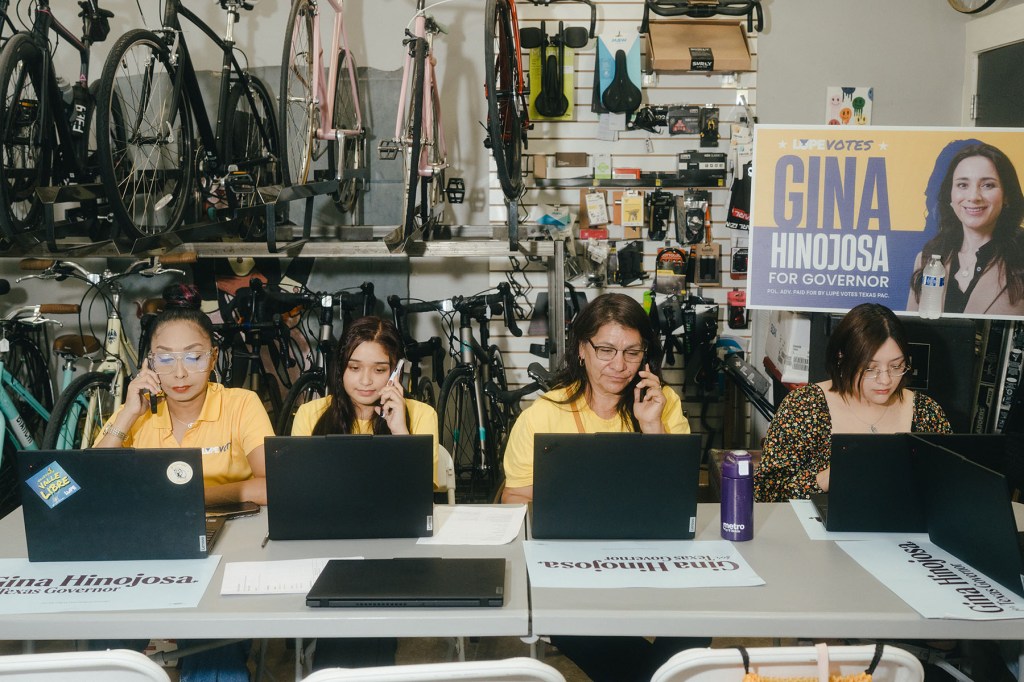
Volunteers with LUPE Votes phone bank for Democratic candidate for Texas governor Gina Hinojosa in Brownsville, Texas, on September 15, 2026.
(Brenda Bazán for The 19th)
Voters like Villareal shed light on how Trump regret among this swingy and powerful group of voters — Latinas vote at higher rates than Latino men — may be the swell that breaks into a blue wave for Democrats this November.
“I do think the narrative of this election could be that Latina women, in particular, help decide who is in control of the House of Representatives and the balance of government. And I say that because of the shifts we’ve seen over time and the shifts back that we are seeing now among Latina women in particular,” said Stephanie Valencia, who studies Latino voters at Equis Research.
Latinos’ political power this cycle is spread across the midterms map. Latinos make up at least 15 percent of the population in six of the 17 most competitive congressional districts, as well as in 29 other districts considered broadly competitive, mostly in the Southwest, California and Florida. Latino voters could be the deciders in competitive races for the U.S. Senate in Texas and Florida. Also in Texas, Latinos could swing the most competitive governor’s race the state has seen in years and, in doing so, elect the first Latina to the state’s top job.
“Trump appealed to their pocketbooks and people were suffering here. I also think people were tired. We’ve been Democratic for over 100 years — why don’t we try something different?” said Cecilia Hernández, who founded the local political group Somos STARR this year in response to the big swings to the right she’s seen in her community.
In an interview at the office of her family’s trash collection business, Hernández said voters’ views are shifting this cycle.
“I think along with everything that’s happening with immigration and with the cost of living today, what I’ve been receiving a lot is, ‘I’m in the middle,’” Hernández said. “They don’t want to be seen as far right, and they don’t want to be seen as far left, either.”
Latinas stand out in just how much they are feeling the burn of rising costs. They report higher levels of financial stress and are less optimistic about the national economy, according to multiple surveys of Latino voters conducted over the past year.
An expansive survey of Latinos conducted in the spring and sponsored by UnidosUS, a Hispanic civil rights and advocacy organization, found that Latinas are more likely than Latino men to say that they have trouble meeting expenses — 23 percent of women vs. 17 percent of men. Men are much more likely to say they can meet their expenses and even have a little left over.
Thirty-eight percent of Latinas voted for Trump in 2024, versus half of Latino men, according to one high-quality analysis, driven by high costs and lack of confidence in the party in power on the economy. The UnidosUS survey of 3,000 Latino voters found that almost a third of Latinas who voted for Trump had regrets about their vote — seven points more than Latino men.
Regret is most striking among young Latinas: 42 percent said they would not vote for him again, a 12-point gap with young Latino men. Latina voters are more likely to register and turn out to vote, and with Latino voters skewing younger, young Latinas wield outsize political power.
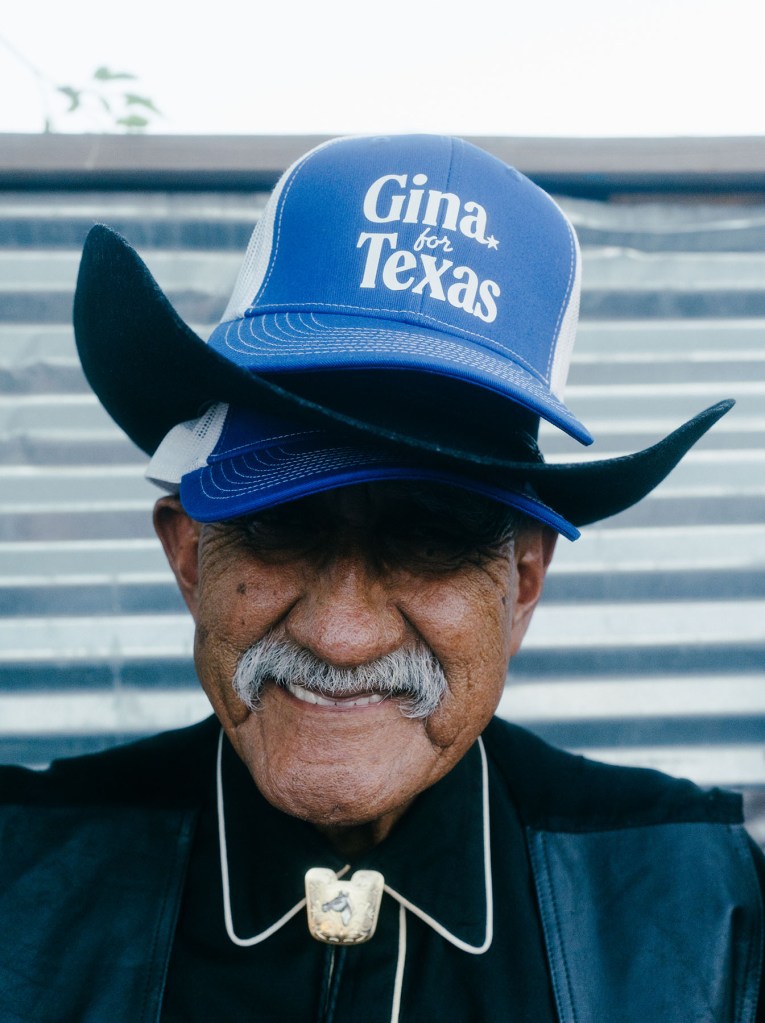
Juan Lozada, a supporter of Democratic candidate for Texas Governor Gina Hinojosa, at an event in McAllen, Texas on September 14, 2026.
(Brenda Bazán for The 19th)
“Latina women have a large gender pay gap. We also have higher unemployment. We also generally have the responsibility of going to the supermarket and paying the grocery bills and understanding that eggs and and everything else is more expensive,” said Katharine Pichardo, the president and CEO of the Latino Victory Project, which backs progressive Democrats. Latinas are more likely to be closely involved in their kids’ education and doctors’ appointments, a frontline view on rising costs that Pichardo said shaped how they voted in 2024 and their views on that vote now.
Melissa Morales, the president of Somos Votantes, which does political outreach to Latinos on behalf of Democratic candidates, said Latinas started peeling away from Trump almost immediately in his second term, while Latino men started shifting in the latter part of 2025.
While Latinos, like voters overall, broadly rank the cost of living as their top issue, the disparate impact of the administration’s immigration policies on Latino communities is also registering among Latino voters.
A New York Times/Siena poll conducted in mid October found that only a third of Hispanic voters approve of the administration’s handling of immigration. UnidosUS’ survey found significant gender gaps between Latino men and women. While both groups rank the importance of the issue about the same, Latinas were more likely to oppose policies like ending birthright citizenship and more funding for Immigration and Customs Enforcement (ICE). Latinas were also more likely to support banning ICE from sensitive locations like schools and hospitals and to support requiring warrants for enforcement at home or in a workplace.
Some of the most dramatic shifts toward Trump and Republicans in 2024 were logged in Texas’ Rio Grande Valley, where Villareal lives. A string of counties in this part of Texas saw double-digit shifts in Trump’s favor compared with the 2020 election, after significant shifts to the right from 2016 to 2020.
Latina voters in the Rio Grande Valley and around Texas will have a big impact on the Texas governor’s race, where Democrat Gina Hinojosa is locked in a dead heat with three-term Gov. Greg Abbott. Hinojosa describes herself as a populist who will tackle corruption and undue influence in government, which she ties to rising costs, weakened public schools and more.
Hinojosa rarely acknowledges the history-making potential of her campaign as a Latina in a state that has never elected a Latino to the governor’s mansion. She instead nods to it by saying that she’d be the first governor from the Rio Grande Valley, which for Texans may as well mean the same thing.
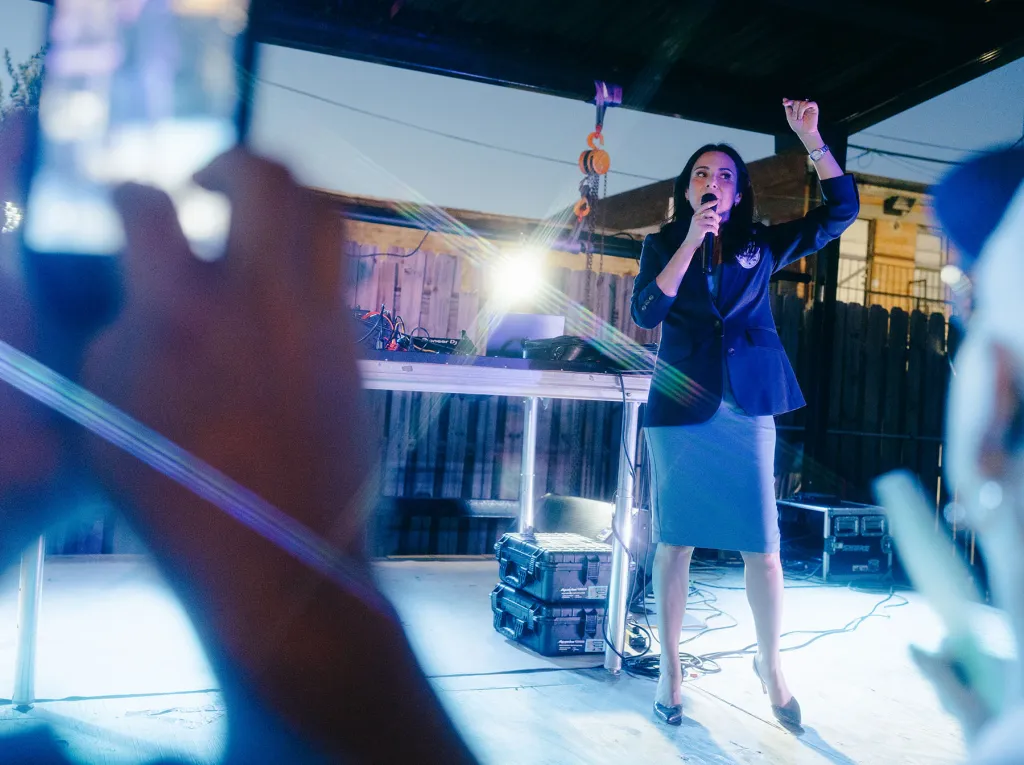
Gina Hinojosa speaks at an event in McAllen, Texas, on September 14, 2026. If elected, Hinojosa would become the state’s first Latina governor and its first governor from the Rio Grande Valley.
(Brenda Bazán for The 19th)
Hinojosa, who is bilingual, flexes her Spanglish easily on the stump, telling voters that the most important lesson she ever got came from her mother was the scolding, “No te dejes.” It doesn’t have a direct translation in English.
“The best thing I can come up with is, ‘Know your worth and defend it,’” Hinojosa said in an interview. Asked if the Spanish phrase was connecting with voters, Hinojosa said, “for sure with Latinos, and 1,000 percent with Latinas.”
“I’ve learned on the campaign trail that this is a saying that is mostly passed down through the women in the family,” she added. “And I think it’s because of this knowledge that women have for their daughters, grandmothers have for their granddaughters, that the world is tough, and we have to be strong.”
At campaign events in the Rio Grande Valley in September, several voters cited Hinojosa’s identity and approach to politics as a motivating factor.
Juanita Vallejo, 40, of Edinburg, Texas, said she sees Hinojosa as an “empowered woman,” and likes her firm stances in support of public schools and curtailing data centers.
“I don’t want to say it this way, but I’m going to say it — she wouldn’t kiss ass to Trump. I think she would stand up to what is right,” said Rosie Hernandez, 56 of McAllen.
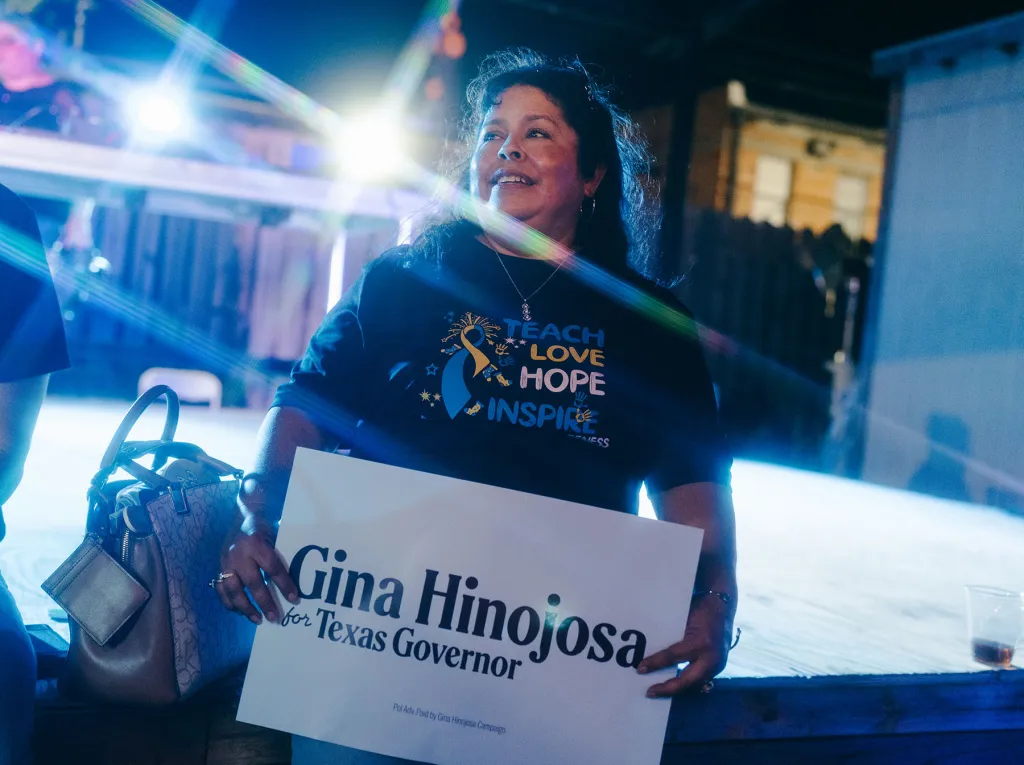
Rosie Hernandez, a supporter of Democratic candidate for Texas governor Gina Hinojosa, at an event in McAllen, Texas, on September 14, 2026. Hernandez, 56, said she believes Hinojosa would stand up to Trump and fight for public schools and curtailing data centers.
(Brenda Bazán for The 19th)
Hinojosa is one of the breakout candidates of the cycle, but she has had to plead for funding from national Democrats hesitant to spend in Texas. Earlier this month, a group of influential Latinos in Democratic political circles put pressure on Kentucky Gov. Andy Beshear, who chairs the Democratic Governors Association (DGA), to invest $10 million in the Texas governor’s race. The DGA decided to send $1 million.
Valencia, who signed onto the letter, said Democrats’ investment in Hinojosa’s race has larger implications for the party and sends a message to Latinos. “She’s a once-in-a-generation candidate from a state that is disproportionately Latino that has been the unicorn that Democrats have chased for decades,” Valencia said.
“To have such a young, dynamic, charismatic Latina candidate in this environment and to not back her is a statement in and of itself, and it says a lot about how certain national Democrats feel about Texas and how they feel about certain candidates.”
Hinojosa’s ability to build enthusiasm for her campaign after starting out with a low profile as a state legislator from Austin could bode well for one the biggest challenges when it comes to Latino voters: turning them out.
Latinos had the lowest turnout rates among the major racial and ethnic groups at 51 percent, compared with 71 percent among White voters and 60 percent among Black voters. Nearly 6 million eligible Latinas did not vote in 2024.
During a town hall in Houston with a local Latino influencer this month, Hinojosa mused about the event likely being the first time a candidate for governor hosts an event in Spanish. Before Hinojosa arrived on stage, the host ushered to the microphone a woman who identified herself as a 46-year-old Houston native who had never voted before. Holding a white and orange slip, she said she had registered to vote earlier that day. “Quiero cambio,” she said to cheers. “No more Trump.”
Democratic candidate for Texas governor Gina Hinojosa meets with supporters in Weslaco, Texas, on September 15, 2026.
(Brenda Bazán for The 19th)
As both parties look ahead to the 2028 presidential election, they’ll have to contend with the fact that the Latino vote is a swing vote. Whatever gains Democrats make this cycle, they have a lot of ground to make up — especially with Latinas.
Nine days out from Election Day, Villareal said she is planning to vote for Democrats up and down the ballot. She described her vote this time as against Republicans — a register of regret — rather than about enthusiasm for the Democrats on the ticket.
“We have to trust somebody. We have to vote for somebody no matter what,” Villareal said.
“And obviously, the way things went in 2024 with Republicans, there wasn’t a change at all. It’s just been worse. So we’re gonna try and see.”
To check your voter registration status or to get more information about how to vote and what’s on your ballot, visit vote.org.
Stevens appeared alongside Rogers at Detroit’s Perfecting Church after plans for her to campaign with Democratic nominee Abdul El-Sayed and Rep. Jim Clyburn, D-S.C., fell apart amid renewed tensions over Israel.
The congresswoman, who narrowly lost Michigan’s August Democratic primary to El-Sayed, praised Rogers’ support for investment in Black-owned businesses. In a video announcing her decision, Stevens said El-Sayed had made clear she was no longer welcome in his campaign.
I am endorsing Mike Rogers for the United States Senate today. https://t.co/pQgfSBuhOJ
The endorsement followed days of public disagreements between the former primary rivals. Stevens criticized an advertisement from Rebellion PAC, an independent group supporting El-Sayed, that linked American aid to Israel with rising grocery prices.
El-Sayed said his campaign had no involvement with the advertisement and explicitly rejected its contents Saturday. Stevens initially welcomed his response, but their planned joint appearance had already unraveled.
Rep. Debbie Dingell, D-Mich., who helped arrange the church visit, told The Associated Press she asked Stevens not to attend because the dispute had become a distraction.
“I’m the one who pulled it because it had become way too distracting,” Dingell said.
The rift intensified Wednesday when Stevens’ fiancé, Jason Turkish, announced he would vote for Rogers, citing concerns about El-Sayed’s positions on Israel. Stevens initially maintained that she would support the Democratic nominee.
The public split comes as Democrats seek to retain the Senate seat being vacated by retiring Sen. Gary Peters. Michigan is among the states central to the party’s effort to regain control of the chamber.
Stevens, who is not on Tuesday’s ballot, said she remains a proud Democrat despite endorsing her party’s Republican opponent.
Ahead of Tuesday’s midterms, Democrats are biting their nails and enduring sleepless nights, wondering whether they will be forced to endure yet another election that has so often characterized the Trump era: close races that seem inevitably to go to the Republicans. All the fundamentals and polls indicate a possible blowout and a big one, but after watching Americans shockingly elect Donald Trump the first time, live through his Big Lie and witness his historic comeback only two years ago, no one can feel confident that this era of chaos, corruption and cruelty might finally be beginning its descent into the dustbin of history. We thought we were here before, and it didn’t end well.
There are reasons to be hopeful, though, even if you assume that the polls are underestimating Republican enthusiasm for their leaders once again. While there have been misses in the polling over this past decade, it hasn’t manifested in midterms as it has in the races with Trump on the ballot. In those years, the polling was pretty much on the money. Democrats have done very well in all the off-year and special elections this cycle, and although that’s no guarantee, it has to be considered a good sign.
The big difference this time is that Trump’s approval rating is hovering close to 30%, a lethal number, and he has presided over a high cost of living and a war of choice with Iran, both things he promised would never happen if he were president. The one election he lost in 2020 was the result of his mismanagement of the only crisis he faced, the Covid-19 pandemic, and this second term has solidified the impression among many voters who were inclined to give him the benefit of the doubt anyway, that he simply doesn’t know what he is doing.
One sign that should give Democrats some real comfort in these last couple of days is Trump’s performance on the campaign trail. To say the 80-year-old has lost a step is an understatement. Sure, he barnstormed through all the battleground states and even attempted to shore up enthusiasm in places that should not need his presence to get out the vote. But his patented “weave” is unraveling at every stop.
Trump has taken to doubling down on the weirdness, going on about men’s bodies to a truly bizarre degree, being under the impression that because his trained rally goers will ritualistically cheer anything he says, this is a winning message. His recent comments warning people to stay away from Mar-a-Lago, his private Florida club, because they would be unable to afford the hamburgers could not be more in keeping with his apparent pursuit of Marie Antoinette’s legacy.
After years of ragging on Democrats for bringing celebrities on the campaign trail and bragging that he didn’t need any to help him fill up stadiums, the president has invited some to join him at campaign rallies — although one could scarcely call them A-listers.
But most embarrassing for the president is that he is no longer the singular star of the Trump show. As POLITICO reported, after years of ragging on Democrats for bringing celebrities on the campaign trail and bragging that he didn’t need any to help him fill up stadiums, the president has invited some to join him at campaign rallies — although one could scarcely call them A-listers. The cast leans heavily on older athletes, from retired NFL players to race car drivers, although Trump did manage to talk at least one genuine country music star, Jason Aldean, to join him in a rally held just a few miles from his home. Rapper Nicki Minaj has become a staple on the trail, and the president’s old friend Mike Tyson is often with him. Trump simply can’t carry the show by himself anymore.
This is the most expensive campaign in history, with Elon Musk alone spending more than $400 million in money he dug out of his couch cushions, but the total spending on both sides has reached upwards of $16 billion, the vast majority of it to benefit the Republicans. The fact is that it doesn’t appear to have done them much good. In fact, their spending is almost all coming from large donors like Musk, while their small donor base has shrunk considerably. That’s usually a sign of a lack of enthusiasm, and it doesn’t bode well for Tuesday’s results.
The election’s stakes are profound. America crossed the Rubicon in 2024 when it invited Trump back into power after he tried to overturn the election, was convicted of fraud, and was revealed to have possessed and leaked classified information after he was out of office. The media and the nation’s elites interpreted that victory as a sign that Trump was some sort of magical superhero, and that it was in all their interests to join with him and reap the rewards. The result has been nothing short of catastrophic, revealing gaping holes in our constitutional order, weaknesses in our democratic system and a void in our society where moral authority used to be. America has never been perfect, and it always falls short of its professed ideals, but this political era has stripped away the belief that we have any at all.
The corruption on display, coupled with a lack of concern for the lives of ordinary people, is breathtaking. And while it remains shocking that tens of millions of Americans still support this administration, it seems that a majority may have finally had the veil lifted from their eyes, allowing them to see the incompetence, grift and megalomania for what it is.
It’s hard to see how a nation founded on the ideas espoused in the Declaration of Independence can survive without even the pretense of ethics or universal values. At the moment, the American creed is simply “to the victor go the spoils,” by which Trump is not just imperiously referring to the foreign countries he seeks to colonize. He’s talking about America itself.
There can be no more questions about what the Republican Party is capable of, and as weak as he appears on the campaign trail, Trump is clearly frustrated and angry. Reporting suggests that he plans to double down on all of it the minute the election is over. If the American people somehow fail to forcefully repudiate Trump and the oligarchs who use and manipulate him, it’s unlikely we’ll get another chance.
More than 40% of people flagged by the Trump administration as suspected noncitizen voters in California aren’t on the state’s current voter rolls, according to a new analysis filed in federal court Saturday, raising fresh questions about the Justice Department‘s efforts to intervene in ballot counting days before the midterm elections.
Researchers with UCLA’s Voting Rights Project examined a list of 20,930 people identified by federal officials as potentially ineligible voters. They found that 8,880 names, or 42%, could not be matched to California’s current voter file.
The analysis also identified at least 22 people who appear to be U.S. citizens, with researchers warning that the number of citizens included on the list could be considerably higher.
The findings were submitted in litigation brought by the Coalition for Humane Immigrant Rights, which is challenging the administration’s efforts to use federal immigration data to identify suspected noncitizen voters.
🚨 CHIRLA & the UCLA Voting Rights Project have filed a federal lawsuit to defend voting rights ahead of the 2026 midterms.
The case seeks equal treatment under the Constitution for all U.S. citizens, regardless of birthplace.
No second-class citizens. No second-class votes.
The Justice Department demanded that California election officials separate ballots associated with the listed individuals and withhold them from counting until their citizenship can be verified. Federal prosecutors have also warned election officials of potential criminal consequences for knowingly processing ballots cast by noncitizens.
California officials rejected the demands, questioning the list’s reliability and warning that separating ballots could disrupt an election already underway.
On Friday, the 9th U.S. Circuit Court of Appeals rejected the administration’s emergency request to force California to set aside the disputed ballots. The court concluded that the government had not demonstrated that such extraordinary intervention was legally justified.
A federal district judge had previously rejected the request, warning that it could disenfranchise eligible voters and create chaos in the election system.
The Justice Department maintains that its efforts are intended to prevent illegal voting, which is prohibited in federal elections. The administration has defended its data and argued that counting ballots from ineligible voters would undermine legitimate votes.
But the new analysis raises questions about whether the government’s list accurately identifies people who are registered to vote, much less whether they are ineligible.
The dispute comes as millions of Californians have already cast ballots ahead of Tuesday’s midterm elections.
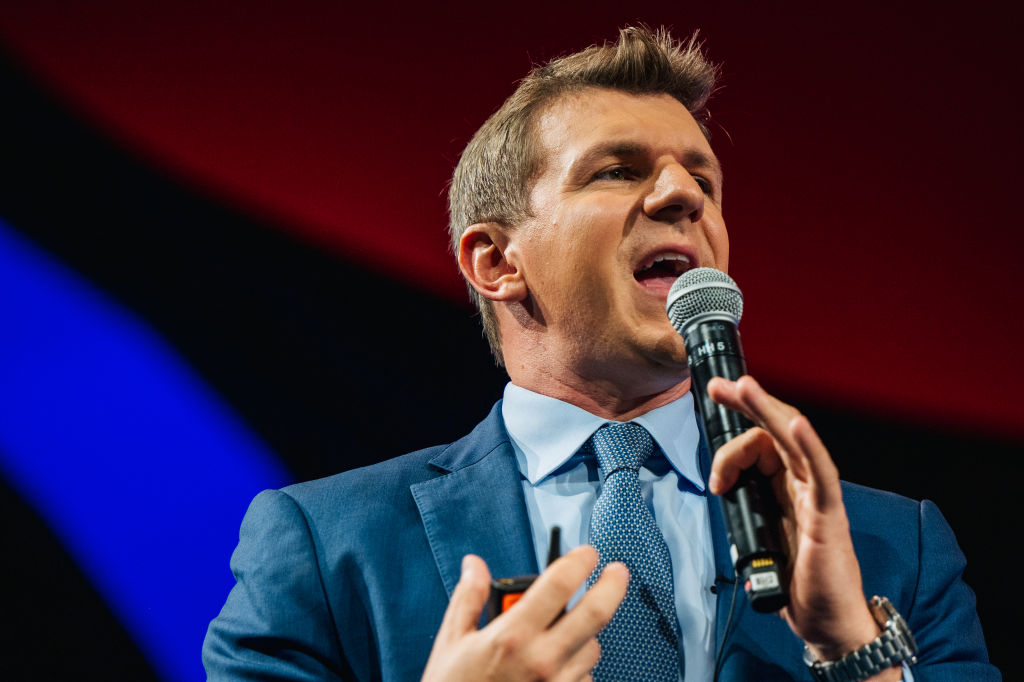
Conservative activist James O’Keefe set out to expose alleged vulnerabilities in Minnesota’s election system. Now, he faces felony charges stemming from the undercover operation.
O’Keefe, formerly of Project Veritas and current CEO of the O’Keefe Media Group, and conservative influencer Cameron Higby were charged Wednesday with unlawful voting and identity theft after allegedly impersonating registered voters at Minneapolis polling places during the state’s Aug. 11 primary.
According to Hennepin County prosecutors, the men wore disguises, used fake accents and provided election workers with the names of registered voters without their knowledge or permission. They filmed the encounters and later posted videos claiming to expose weaknesses in Minnesota’s voter registration procedures.
The operation targeted the state’s *vouching* system, which allows registered voters to verify the residency of people seeking to register on Election Day. The process requires sworn statements and identifying information from prospective voters.
Neither O’Keefe nor Higby cast a ballot or signed the required vouching oath. Prosecutors contend that misrepresenting their identities while beginning the voting process was itself unlawful.
O’Keefe defended the operation as investigative journalism, calling the prosecution an attack on First Amendment rights. Higby also denied breaking the law, saying the pair intended to expose election vulnerabilities.
The charges are the latest controversy involving O’Keefe’s undercover tactics. In 2017, reporters at the Washington Post caught him trying to sell them a false story. In 2009, he collaborated on hidden-camera investigations targeting Planned Parenthood and gained national attention for videos involving the community organization ACORN. He later settled a lawsuit brought by a former ACORN employee for $100,000 without admitting wrongdoing.
But Minnesota officials say the latest operation demonstrated something different from what O’Keefe intended.
Election workers noticed suspicious behavior and reported it, prompting an investigation. Hennepin County Attorney Mary Moriarty said the state’s system for identifying and responding to potential misconduct functioned as intended. This vouching process itself accounted for fewer than 0.6% of votes cast in Minnesota’s 2024 general election, according to state election officials.
O’Keefe and Higby are scheduled to appear in court Nov. 16. Neither has been convicted.
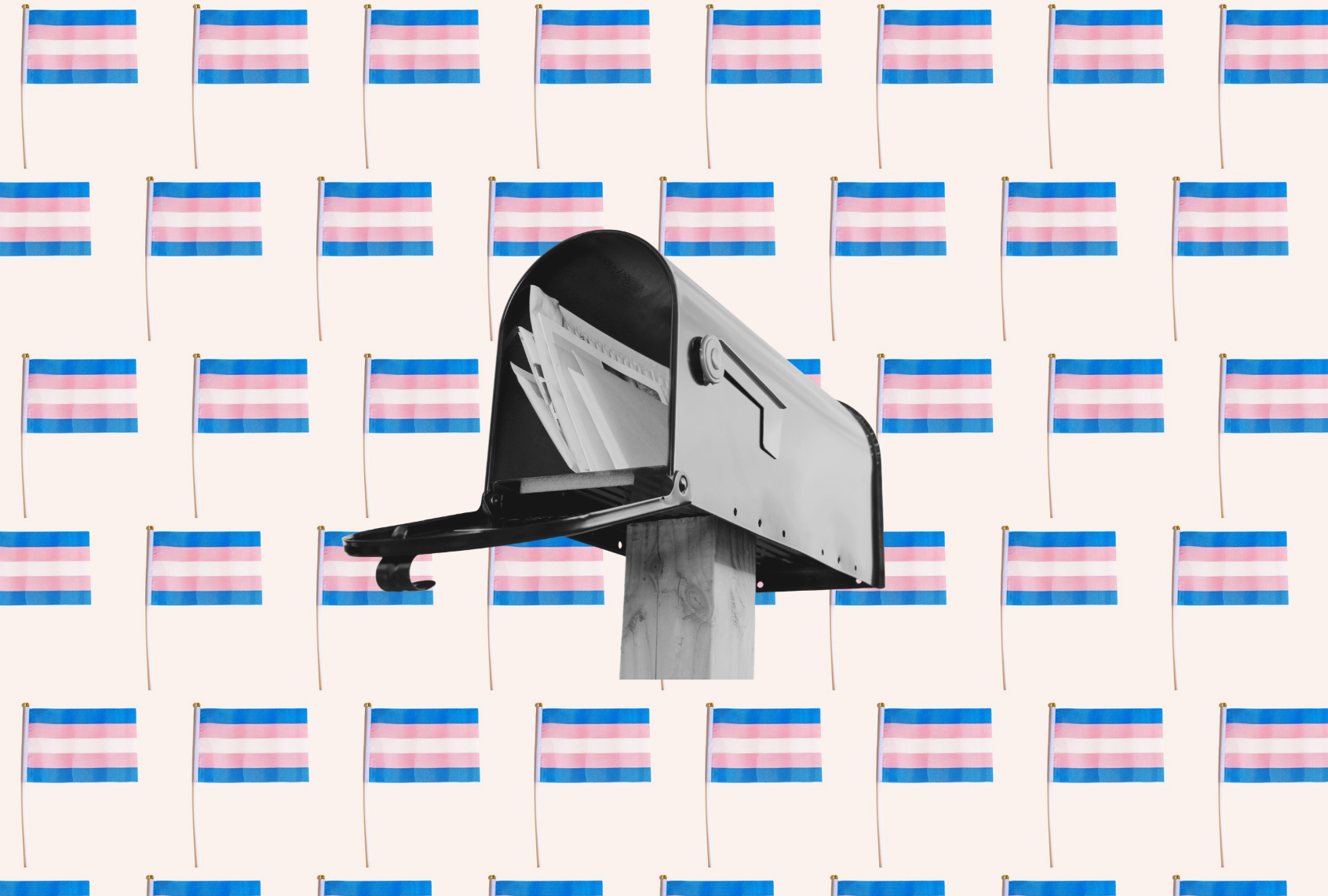
On Thursday night, the smear at the heart of the mysterious transgender mailers that have rocked the final weeks of the midterm elections in Texas completed its journey. What began as baseless social media whispers quickly ascended the ladder of conservative influence, jumped into mailboxes across the Lone Star State and ultimately into the comforting prime-time embrace of Fox News.
At a town hall in Fort Worth, a Texas mother of six named Rebekah Smith told Vice President JD Vance that her 11-year-old daughter had received a letter explaining how to transition without her parents ever knowing, and asked how Republicans would keep the government out of her family. “I don’t know who sent that letter to your child,” the vice president said, “but I think the person who sends a letter to an 11-year-old about gender transition, what I call that in my family is a pervert, and that person ought to go to prison.” Host Jesse Watters, never one to let a grievance go to waste, promised that Fox would investigate “this perverted letter.” Vance asked Smith to talk to his staff because he would “like the Department of Justice to investigate that” as well.
Watters rushed to promote the spectacle. “WHOA! Texas MOM tells JD Vance her DAUGHTER received a letter telling her TO TRANSITION TO A BOY,” he posted on X, followed by Vance’s promise. Missing from that framing was the question that should have governed the segment: Who actually sent the material?
Nobody on that stage mentioned that the pamphlet was a fake. Nobody mentioned that the real transgender advocacy group named inside it had disavowed the mailer. Nobody mentioned that sworn testimony filed that same week had tied the text messages that accompanied it to a national Republican organization. The vice president was asking federal prosecutors to chase a forgery that may well have originated in his own party’s orbit — and he was doing it on a network whose viewers had been marinating in that forgery for weeks.
The race between Republican Attorney General Ken Paxton and Democratic challenger James Talarico has become a crucible for dark-money maneuvers. As polls show the Republican grip on the Lone Star State slipping, conservative campaigns and their surrogates have resorted to increasingly desperate tactics. In early October, for example, Talarico took a brief hiatus from the campaign trail to recover from a severe case of the flu. Rather than accepting a routine human illness, the right-wing echo chamber treated a temporary absence as evidence of mental illness. Within days, the fabricated scandal has collapsed — yet the machinery of right-wing media simply pivoted to amplifying a more insidious operation designed to trigger visceral outrage.
This second October surprise involved millions of unsolicited text messages and a wave of physical mailers sent to Texas households with materials that directed readers to the website of the Transgender Education Network of
It does not need to survive scrutiny. It just needs to circulate upward.
Texas while inserting provocative advice on child emancipation that the real organization says it never authored or authorized. By flooding the electorate with extreme material disguised as progressive advocacy, right-wing operatives appear to have sought to create a fake controversy that could be weaponized in attack ads and campaign speeches. Vance, for instance, told the Fox News audience that Talarico has “a weird fascination with trans kids,” and that “he’ll probably defend the right of the person sending the letter, not the right of the parent who is rightfully creeped out by this.” Vance claimed that Talarico “has actually called it abusive when parents try to prevent their children from transitioning” and that Paxton “has fought hard to prosecute those people, whereas James Talarico has fought hard to protect those people.” Even the distortion had been laundered by then — Talarico called denying a child’s gender identity abusive, a different claim from saying parents must permit medical transition, but at the top of the ladder the difference no longer exists.
That is how a smear works in the closed ecosystem of the American right. It does not need to survive scrutiny. It just needs to circulate upward. An anonymous account posts it; an influencer adopts it; a donor-funded outlet reports the influencer’s outrage as news; an elected official demands an investigation, and the demand becomes proof the story matters; cable news books the controversy; a vice president promises federal action. Each rung launders the one below it. The correction, when it comes, travels in the opposite direction and arrives nowhere.
The paper trail looks like what you would expect from a covert operation. Texas Transgender Student Union LLC was formed in Wyoming on Sept. 2 through a commercial registered agent that helps owners stay anonymous. After CBS News Texas visited the agent’s address in Sheridan, Wyoming, the agent announced it was resigning. The mailers listed a Houston-area post office box. The Texas Observer reported that the barcode on the envelopes traced to a mail-tracking company that has taken federal campaign money from only one group this year, the National Republican Congressional Committee. The committee said it had nothing to do with the mailers, and the company would not say who paid. CBS News Texas reported that the bulk-mail permit belongs to an Illinois printer owned by the Zerrusen family, who have given heavily to Republican PACs and been photographed with Donald Trump.
When the real Transgender Education Network of Texas filed a petition in Travis County court to unmask the perpetrators behind the impersonation campaign, the partisan safety nets of the Texas judiciary eventually snapped into action. A deposition of Infobip, the messaging company that delivered the texts, which a Travis County judge ordered made public, indicated that the texts were sent on behalf of the Republican Women’s Caucus Fund and a man named John Braun. But on Friday, the Texas Supreme Court, composed entirely of judges appointed by Republican Governor Greg Abbott, issued an administrative stay that blocked its release. Chris Hilton, an attorney who previously served under Paxton, defended him during his impeachment trial and was later pushed out of office amid sexual harassment allegations, argued on behalf of the company that the mailers were not political speech because they named no candidate or party.
Dirty tricks are an old tradition of American politics. This cycle, Republican PACs in Nevada mailed a flyer calling a nonpartisan candidate, Danielle Ford, the “AOC of Nevada,” hoping voters would mistake her for the actual Democratic nominee, Aaron Ford. This week also brought word that the group that funded Cornel West’s 2024 ballot drives raised every dollar through a dark-money network bankrolled by Elon Musk.
The president’s party whines about decoy candidates in Alaska while running them at home. Ratf**king is a long and proud Republican tradition, and the Texas operation fits inside perfectly.
ALAMO, Tex. – Eustorgia Santos de Torres has lived here for four decades. Last year, she turned to a trusted Rio Grande Valley nonprofit for help navigating the citizenship application process. The same nonprofit — La Unión del Pueblo Entero, or LUPE — then helped her register to vote, and she cast her first ballot as a citizen in the primary election last March.
Santos de Torres, 67, is retired after years cleaning houses and working as a healthcare aide. She speaks mainly Spanish and is the primary caretaker for her husband, Nemorio, who is blind. “Yo soy sus ojos,” Santos de Torres said — I am his eyes.
But last month, Santos de Torres, a new voter, struggled to help Nemorio, an American-born citizen, understand and cast his mail ballot for the November election. All the information on the ballot is in English, she said, and the letters are small.
So Santos de Torres helped Nemorio to the car and made the familiar 7-minute drive to LUPE’s headquarters in the neighboring town of San Juan to ask for help with her husband’s ballot.
This time, though, LUPE workers reluctantly turned the couple away.
In 2021, Texas’ GOP-dominated state Legislature passed a sweeping and controversial overhaul of election laws known as SB1. Among other changes, SB1 made it illegal for anyone to receive compensation for helping voters fill in their ballots.
That not only makes it illegal for paid nonprofit staff to help voters, but also criminalized common past practices, such as organizations giving volunteers gas money or stipends. Violations are a felony punishable by up to 10 years in prison and a fine of up to $10,000.
In the wake of the law, Texas Attorney General Ken Paxton, a Republican currently running in the state’s nationally watched U.S. Senate race, investigated and prosecuted voting rights advocacy groups and organizers in heavily Latino communities across the state.
Groups such as LUPE say they have been forced to alter or stop some voter outreach as they worry about running afoul of the law. LUPE used to send workers out walking blocks to help voters. Now it has to instead ask volunteers to do more limited versions of that work.
LUPE is known for providing one-on-one assistance to people in the Latino community, so the restrictions on helping with voting are a real pain point for the organization, Executive Director Tania Chavez Camacho said. Texas has strict rules limiting who is eligible to use mail ballots, but people over 65 may do so. LUPE helps around 30,000 people a year, she said, including people with disabilities and many older people who, each year, “want to vote by mail and they come in wanting help.”
Now, Chavez Camacho said, when the group holds public town halls for residents to instruct them on how to vote, if a voter pulls out their mail ballot to ask for help, organizers must ask the voter to leave so paid employees aren’t near the ballot.
And if workers for LUPE’s advocacy arm are canvassing for candidates and a voter shows them a mail ballot and asks for help filling it out, workers have been trained to say they can’t and walk away, Chavez Camacho said.
“We literally have to turn them away,” Chavez Camacho said. “We’ve had to do a lot of training with our staff for the past three years because they were so accustomed to helping folks one-on-one and now they can’t.”
Santos de Torres did what she could to help her husband, who mailed back his ballot about a month ago.
“But I don’t think it’s right that LUPE can’t help us,” she told a reporter in Spanish. “That law is not right. It’s excluding people who need help.”
“What if,” she added, “my husband didn’t have me?”
‘A person who doesn’t know how to read has to do it on their own’
The Rio Grande Valley, where LUPE is based, covers roughly 4,300-square-miles across Hidalgo, Cameron, Starr, and Willacy counties along the Mexico border at Texas’ southern tip. It’s a diverse community with some residents who primarily speak Spanish. Younger generations of residents easily switch between English and Spanish in conversation.
Many households are made up of families whose members have mixed legal statuses, including some who have lived in the area for generations. The Valley also has a history of activism as the birthplace of the Texas farmworker movement of the 1960’s. Farmworkers – who harvested cotton, vegetables and fruits — organized and marched for roughly 400 miles from the Valley to Austin to demand fair wages and better working conditions. Mexican-American farmworker labor today remains key to the area’s growth and agricultural economy.
But due to the lack of affordable housing, Mexican Americans for years purchased land they could afford in rural areas outside of city limits, often lacking basic infrastructure and public services. Those communities are known now as the colonias.
Alamo, where Santos de Torres lives, and San Juan, where LUPE is based, are neighboring cities. The landscape varies depending on the side of town. In the southern parts of the cities, closer to the border with Mexico, modest residential homes with green front lawns adorn along palm tree-lined streets. Shopping centers, chain restaurants, stadiums, and commercial developments lie to the north of the cities, along Interstate Highway 2, reflecting the transition from the once primarily agricultural community to a growing metropolitan hub. The Valley has for years relied on its trade of goods and services with Mexico. It has a population of more than 1.4 million people and 90% of them are Hispanic or Latino, according to Census data.
About 24% of people in the Valley live below the poverty line, which is more than double the national rate. And about 30% of Valley residents don’t have health insurance – one of the highest uninsured rates in the country. The area also has one of the highest rates of diabetes in the country; Nemorio Torres’ blindness is a complication of the disease.
LUPE and other advocacy groups have long worked with residents in the colonias and all over the Valley, providing resources to find affordable housing and medical treatment, or helping with complex procedures such as filing taxes. Voter education and outreach was part of the mission.
Now, instead of providing one-on-one assistance, LUPE hosts group sessions with a screen projector showing what mail ballot applications and mail ballots look like. Facilitators point at the screen indicating what the instructions say and explaining how the forms should be filled out.
The limitations are frustrating, Chavez Camacho said, especially “si una persona no sabe leer” — if a person can’t read. “It doesn’t matter that we’re doing those sessions because a person who doesn’t know how to read has to do it on their own and we can’t help them to know where to mark,” she said.
Instead, LUPE’s workers and volunteers now focus on letting people know key deadlines are coming up. They also have fewer volunteers willing to guide and interpret for voters at the polls, she said, because the law now requires such people to sign an oath affirming the voter is qualified to receive help because they are disabled or need an interpreter, and detail their relationship with the voter. They must also affirm they are not being paid by a candidate or political committee, which would be illegal. Volunteers fear any misstep while assisting voters could get them in trouble, Chavez-Camacho said.
“We really feel that the people are not getting the support they need,” Chavez Camacho said.
Election and voting law experts say the courts have interpreted “compensation” prohibited from going to volunteers by SB1 as any type of benefit. That interpretation is so broad that it makes it difficult for voter outreach organizations to know whether they are violating the law, said Zachary Dolling, litigation director at Texas Civil Rights Project, which works with groups to design trainings in voter outreach that comply with the law.
Dolling said some organizations historically provided unpaid volunteers dinner, T-shirts, or pens, and others have given volunteers college credit for their work.
“All of those things are items of value” and could be considered compensation, he said.
Advocates warned state leaders of added burdens for people with disabilities
Texas Republicans passed SB1, the sweeping overhaul of election law, in part responding to false claims and conspiracy theories about the 2020 election.
Republicans claimed the law would increase public trust and confidence in the elections. Democrats argued the legislation would disproportionately burden voters of color and people with disabilities, and staged two walkouts and a 15-hour Senate filibuster in their failed attempt to defeat the bill.
Despite lawsuits from voting rights organizations including LUPE, the League of United Latin American Citizens and organizations representing Texans with disabilities, a federal appeals court ultimately upheld key provisions of SB1, including the restrictions on voter assistance.
Other attempts to expand voting help for people with disabilities were meanwhile unsuccessful.
In 2023, Gov. Greg Abbott, a Republican, vetoed a bipartisan bill that would have expanded vote-by-mail access for people with disabilities — specifically people who are blind or paralyzed and need assistance marking their ballot — by allowing such voters to request an electronic ballot and use a computer to mark their choices. Similar options in Texas are already available for military overseas voters and astronauts, but not for voterswith disabilities.
The challenges Santos de Torres and her husband have faced are an example of what advocates worried about under SB1, said Lydia Nunez Landry, statewide coordinator for REV UP Texas, which works to get out the vote among people with disabilities.
“That was our worst fear and now it’s happening,” she said. Nunez Landry has muscular dystrophy, uses a power wheelchair, and needs help doing basic tasks such as opening the refrigerator.
The state has made voting “just so impossible and so arduous for people — and now people are also terrified of helping us,” she said.
An increased ‘sense of anxiety’
Groups across the state have been changing their voter outreach work to comply with SB1.
Asian Texans for Justice conducts voter outreach in Asian communities, focusing on San Antonio, Houston, Austin, and North Texas.
The stricter rules associated with voting by mail under SB1 have created “a sense of anxiety” in those communities, Executive Director Nabila Mansoor said. She said that the process is now much more complicated for elderly voters, who must provide one of two forms of ID on their application and pay close attention to pages of instructions that are written in font that is small and hard for them to read. In addition, an error could force them to restart the whole process of applying for a ballot.
“That anxiety comes from this kind of fear that they’re going to do something wrong,” Mansoor said. “Whenever you have that kind of fear, it is one more barrier for that person to actually go out and vote.”
Now that Asian Texans for Justice can no longer provide one-on-one help, they’ve turned to providing checklists for voters, she said, which she believes is less effective when some voters may need help reading and understanding the ballot and instructions
Mansoor said she believes that SB1’s goal was to make it harder for people to vote.
“It means that we have to be more careful. It means that we have to dot our i’s and cross our t’s. It means that we have to take good records. It means that we have to be very thorough in terms of our training of our volunteers,” she said, adding that the organization assembled a legal team to defend against challenges to their work as well.
In the meantime, volunteers for LUPE and other groups say they are doing their best to fill the gap.
Maria Gomez, better known as Doña Mary, of Pharr, worked as a farmworker for years in Hidalgo County and has been a member of LUPE since the organization was founded. Gomez, 78, was involved in the farmworker movement years ago. She now ensures her elderly friends and neighbors are aware of election deadlines, know where to vote, and have a ride to the polls if they need one.
After she drops off her grandkids and great-grandkids at school, she makes her rounds around the Colonias in San Juan in her small red SUV. She chats up her neighbors, and asks them what they need help with or if they need resources or a ride. She’s always fielding calls.
“People don’t vote because sometimes they can’t leave their home and because they might not have access to that piece of paper that they need to sign to receive their ballot,” Gomez said in Spanish, referring to voter registration forms and ballot-by-mail applications.
One of her friends, 80-year-old Teresa Corona Garza of San Juan, has relied on Gomez for rides to the polls for some time now. Corona Garza struggles to stand for long periods of time and can’t see very well out of her left eye. Even though she qualifies to vote by mail, she prefers to go to the polls in person.
“There’s so much on there you have to fill out, and those letters are small,” Corona Garza said in Spanish. “No, I prefer to go, quiero ver que mi voto cuenta,” she said – I want to see that my vote is counted.
The laws have gotten so complicated and strict that Gomez worries state leaders may even try to prevent volunteers like her from providing rides to the polls.
“I don’t know what’s going to happen, if they’re going to keep making this harder for people,” she said, “but I would like to see people who want to vote to be able to do it.”
Natalia Contreras covers election administration and voting access for Votebeat in partnership with the Texas Tribune. Natalia is based in Corpus Christi. Contact her at ncontreras@votebeat.org.
Votebeat is a nonprofit news organization covering local election integrity and voting access. Sign up for their newsletters here.
Republicans are shaking in their boots about the upcoming midterm elections, according to numerous reports. In a Wednesday episode of his podcast, Sen. Ted Cruz, R-Texas, said his home state “is excruciatingly close,” adding that “we could lose Texas. Let me repeat that: We could lose Texas. And by the way, not just the Senate race. We could lose every single statewide race in Texas. That’s how close these numbers are.”
According to Politico, House Republicans aren’t quietly discussing whether or not they’ll lose their majority, but are counting how many seats. “It could be quite a brutal evening,” a senior Republican told the outlet. The mood at the White House is “grim,” the New York Times reported as advisers close to the White House anticipate at least losing the House, if not the Senate.
That’s seemingly why the world’s richest man, Elon Musk, has dumped nearly half $1 billion into the race, mostly into his own America PAC. The PAC’s spending has focused overwhelmingly in Texas with approximately $48 million, followed by Michigan and Ohio around $9 million and Iowa at $4 million. According to CNN, Musk’s spending streak “makes him the single, largest disclosed donor in modern American politics and one of the Republican Party’s largest-ever benefactors.”
But some people are already looking beyond next Tuesday to see how President Donald Trump may react, and not just by challenging the results, which is more than expected and arguably already being attempted. But the president’s legal options are limited, so even if he does try to seize voting machines, declares a national emergency, or otherwise wedges the federal government into the electoral process, there’s a chance it could fail. Jonathan Diaz, director of voting advocacy and partnerships at the Campaign Legal Center, told Forbes that the president can “certainly try” to intervene, but there “just isn’t a lot that he can actually do.”
Still, most analysts anticipate that the president will turn the dial up on his dual wars, the trade wars with America’s partners and the Iran war Trump started alongside Israel in late February 2026. The Pentagon is slowly building up its military presence in the Middle East, including drawing up plans to strike Iran’s nuclear facilities, energy infrastructure and missile and drone stockpile.
“It might be difficult for Democrats in Congress to restrain Trump from a course of action which he is strongly committed to, but they can still raise the political costs associated with plowing ahead,” Andrew Gawthorpe, a senior research fellow in the Foreign Police Centre, told The Independent. “Facing a hostile Congress, Trump might become even more willing to simply ignore domestic opposition and plow ahead with controversial and unpopular policies, as he did by attacking Iran or threatening to annex Greenland.”
Ramaswamy Is Very Disappointed That Everyone is Talking About His Ad and Not ‘Policy’
Vivek Ramaswamy’s campaign has stopped running the ad featuring his opponent Amy Acton’s estranged mother denouncing her as a liar.
The ad repulsed voters, especially after they learned the backstory: Acton’s mother, Donna Arthur, had not been in touch with her daughter since her husband, Acton’s stepfather, was accused of raping Acton in the 1970s, when Acton was 12 years old. Arthur and her husband then fled to avoid a trial.
One internal poll, described by Axios, found that voters who were aware of the ad disapproved of it 2-to-1 and found Ramaswamy falling behind in the polls as a result of it.
Earlier this week, Trump continued to defend Ramaswamy.”Vivek was treated very unfairly,” he said. “He had the mother of his opponent say that her daughter was a liar. I said, ‘why can’t I have an opponent like that?’ She said worse than that. Horrible things about her own daughter. And the press — the fake news — criticized him.”
Ramaswamy tried to claim his campaign had not pulled the ad.
The campaign had set aside $4 million for it, according to the Columbus Dispatch, but only spent $1 million.
Ramaswamy then tried to shame a reporter for asking about it. “For all of the discussion around 30 second ads, I would love, even for this final close, for this campaign to really be about policy.”
Black Workers Flee Government; Administration Tries to Replace Them With Young Right-Wingers
Scott Kupor testifies during a Senate Homeland Security Committee hearing on his nomination to be Director of the Office of Personnel Management (OPM), on Capitol Hill in Washington, DC, on April 3, 2025. (Photo by Brendan SMIALOWSKI / AFP) (Photo by BRENDAN SMIALOWSKI/AFP via Getty Images)
More than a year ago, TPM’s Layla A. Jones was flagging troubling numbers in federal jobs data, showing the impact that DOGE and other Trump efforts to remake the federal government were having on Black workers. Black Americans are overrepresented among the federal workforce.
A Washington Post report yesterday followed up on this story, finding that about one in five black workers has left the federal government during Trump’s second term.
Between late 2024 and September 2025, “the estimated number of Black people working for the government fell by 30 percent,” The Post reported. “By comparison, reported federal employment declined by 4 percent among all other races included in the survey.”
On Thursday, TPM published a story by Bex Heimbrock on the Trump administration’s recruiting efforts. Office of Personnel Management head Scott Kupor has been touring the country with Turning Point USA aligned influencers, including Benny Johnson, seeking to recruit young — and presumably deeply conservative — college graduates. “What I really want to see is more people like ‘Big Balls,’ or Ed,” said Kupor, referring to former DOGE staffer Edward Coristine.
Laugh or cry, we’ll be here all week. Try the veal.
I wonder what a Todd Blanche outfit looks like? The image of Frankenstein’s monster, for some reason, sticks in my mind.
It’s time to sit back, relax and enjoy the elections — a midterm extravaganza featuring two flailing political parties jockeying for supremacy in a nation full of educated young adults working as cabbies and delivery drivers who aspire to be “influencers” while their parents wonder how in the name of God they’ll be able to afford retirement.
To be able to handle that good news, maybe you can channel your inner Hunter S. Thompson, without resorting to dropping a couple of hits of acid or snorting lines of cocaine in Studio 54 while Donald Trump ogles the dancers in tight pants, female and male alike.
Then again, you might need a tall glass of Wild Turkey 101 on ice (Thompson’s favorite) when you hear Trump say that Democratic U.S. Senate candidate Mary Peltola should be prosecuted because there are two Dan Sullivans running for office in Alaska, or declares that the country “would be gone” if he hadn’t won the presidency two years ago.
Everything old is new again. At any rate, we’ve seen this carnival roadshow before, though it seems a bit different this time. Trump has less energy as he flails about dancing to the Village People. He plays before smaller crowds every week. He seems to be on stage only to get laughs. “Am I right?” he whispered hoarsely with a big grin last Saturday night in Georgia, after mocking Democrats one more time. He apologized for his raspy voice and kept going with the low-energy insult comedy. His small crowd chortled and ate it up.
In the last week on the campaign trail, Trump has appeared at a livestock arena, a school gymnasium, a hockey rink and, on Thursday in Rock Hill, South Carolina, at a venue that holds just 1,200 people. He doesn’t seem to care. He’s on autopilot. The war in Iran? He’s got nothing. The war in Ukraine? Nothing. Corruption, immigration, AI (sorry, never “SI”), the economy and any other real-world issue? He’s either got nothing, or it’s all nonsense we’ve heard before: The Democrats, Joe and Kamala, and marauding bands of violent dark-skinned immigrants and communists are to blame. As for the economy, he tells us he’s doing great and making billions. We should all be happy.
In the last week on the campaign trail, Trump has appeared at a livestock arena, a school gymnasium, a hockey rink and, on Thursday in Rock Hill, South Carolina, at a venue that holds just 1,200 people. He doesn’t seem to care. He’s on autopilot.
Forget it. He’s done with campaigning, quite literally. The White House confirmed Thursday that two campaign stops planned for Kansas and Iowa this weekend have been canceled. What happens next is what we need to watch. It must be the season of the witch. Or as Thompson himself told us, “When the going gets weird, the weird turn pro.”
Thompson was covering Richard Nixon when he penned that epigram, but it is equally applicable to covering the surreal spectacle of vampires, zombies, ghouls and degenerates awkwardly shuffling across the MAGA landscape. It certainly should be a factor in understanding what Trump does on Nov. 4 and afterward. Ask anyone, Republican or Democrat, and they’ll all say the same thing: Whatever happens is likely to be simultaneously annoying and frightening.
Trump has already filed suit against Alaska’s election results, even though the election has yet to occur. In Missouri, the GOP lost three times trying to gerrymander districts in a case that went to the Supreme Court, all in hopes of gaining one seat in the House. That move may have backfired big time. Not only did Republicans fail to gain a guaranteed seat, but in Missouri’s Second District Democrat Fred Wellman is poised to pull off a miracle against Republican incumbent Rep. Ann Wagner (albeit with little support from party leaders in D.C.). Trump appears ready to file suit there as well. Some insiders say he might try to sue in every state where an incumbent Republican loses. Check your favorite gambling app for the over/under on that.
At the same time, there’s a constant susurrus from Trump about “voter fraud” that surfaces wherever his candidates look to be failing. There are rumors of National Guard and ICE officers roaming the countryside on Election Day hunting and bagging anyone with a good tan who speaks something other than English. Long voting lines and randomly closed precincts are a given. A general feeling of chaos among the electorate, whipped into a frenzy by the president himself, is expected. There’s still stray talk about invoking the Insurrection Act and declaring martial law. What’s the over/under on that move?
I’m actually tired of the talk. We all know Trump will not go gentle into that good night. If the GOP loses control of Congress, his administration will likely see more people convicted and jailed than Nixon’s during the Watergate weirdness that made Thompson “turn pro.”
On the other side of the aisle, the aging Democratic leadership looks as lost and confused as Trump. Some in the party want to remain silent, cross their fingers and hope for the best, fearful of Democratic infighting and hopeful that Trump is really on his last legs. Others want to defeat Trump then turn on the “establishment” Democrats.
I don’t want to listen to this from either side. After covering Trump for 10 years, he reminds me of my children during their pre-pubescence, always cocksure, arrogant and wrong. My children grew up to be adults. Trump never has. The same can be said for some of the more argumentative Democrats.
The Democrats, as is often the case, lack focus and leadership at the national level. The headless horsemen run amok, trying to scream “The Trumps are coming!” while fighting with each other, even before they hold any power. It does not exactly inspire confidence. Younger voters find each party equally repellent, and for good reason. If Democrats win a majority in the House, as nearly everyone expects, and the Senate, as a growing number of Democrats have the audacity to hope, how long will it be before they slice each other’s throats over their marginal political differences while what remains of the GOP looks on with glee?
Still, the Republican Party at this point looks like a horde of zombies led by Art the Clown. To extend the horror-movie metaphors even further, Trump is such a crude cartoon character that if he isn’t the Terrifier then maybe he’s Pinhead from “Hellraiser.”
For lazy reporters, or those who’ve never covered another president, Trump makes the job easy. He doesn’t hold news conferences. He has no policies. There are no long meetings with press secretaries. Come to think of it, there’s no press secretary.
But our president can still generate media attention, even as his crowds continue to diminish. He may soon be reduced to appearing before middle school PTA meetings across the South, but he’ll still be on TV. As one of the younger members of the White House Correspondents’ Association recently said, in all earnestness, “We’ll miss him when he’s gone.” Some reporters even find his insults of the press amusing. I don’t agree, but I admit that my experience is limited to the Ronald Reagan presidency — and every one since then.
Some of us were here before Trump, and will still be here when he’s gone. For lazy reporters, or those who’ve never covered another president, Trump makes the job easy. He doesn’t hold real news conferences. He has no policies. We don’t have directives to read or position papers to study. There are no long meetings with press secretaries. Come to think of it, there’s no press secretary. Covering Trump is easier than covering a traffic accident, and twice as gory. That’s how he governs.
It’s obvious to even the most casual political observer that Trump’s campaign tactics are the signs of a desperate man with dwindling influence. After he lost control of Congress in the 2018 midterms, he purged his staff and yanked press passes from reporters. Some senior officials quit. Expect a repeat of all that, beginning next week. Only now most of my colleagues in the press pool will wag their tails and bark a bit before waiting for a presidential treat.
Secretary of Defense Pete Hegseth, unless he gets appointed as a senator from Tennessee, is most assuredly a goner. Even the Republicans in Congress dislike him, and Trump, who never accepts responsibility for anything, still needs a scapegoat for the war in Iran — the one he has claimed is over on more than a dozen occasions.
While Speaker of the House Mike Johnson says he’ll do his job and seat every Democrat who wins in the midterms, Trump is eagerly searching for ways to stop that from happening. Some believe he’ll try to stage another insurrection, while others believe he’ll let government funding run out and spend the rest of his presidency presiding over a government shutdown, in effect dissolving Congress.
Whatever he does won’t work. His recent public appearances add up to a tell on how badly he will fail. High school basketball teams in Kentucky are filling gymnasiums better than this president.
White House pool reports from Trump’s campaign stops no longer mention the venue capacity or attendance, but the empty seats in those modest arenas and his listless rhetoric, combined with ever-louder outbursts from protesters, are evidence enough that this guy isn’t what he once was.
While Speaker of the House Mike Johnson says he’ll do his job and seat every Democrat who wins in the midterms, Trump is eagerly searching for ways to stop that from happening.
Whether he’s complimenting another man’s (or woman’s) behind, berating reporters or making deals with Russia while screwing over former allies, his raging incompetence is still center stage at these increasingly feeble campaign events. We still can’t look away.
I recently watched a documentary about the fall of the Bronze Age civilizations. It was an era of climate change, supply chain collapse, earthquakes, famine, disease, migration, drought and armed incursions and invasions. Stop me if you’ve heard any of that before.
What worries one of the archaeologists in the documentary and causes him to lose sleep is how similar our world is to that one.
We are ripe for catastrophe, and poor leadership exacerbates the problems we currently face. “How resilient will we be? How will we get back up?” the documentary asks. Those are excellent questions to ask now.
After the midterm elections are settled, we may learn some answers. If Hunter S. Thompson was right, maybe there’s some hope. After all, I’ve never seen politics any weirder than this.
Trump looks done, in ways I’ve never seen him look done before. I’ve seen him stumble, fall and constantly deflect reality. He’s always managed to survive those stumbles. Not now. The cancellations, his delusional ramblings, his anger and increasing desperation, the smaller crowds, the raspy voice combined with the collective shoulder-shrug I see from even his closest allies — countered by the quiet optimism of the Democrats and their muted sniping at each other — have created a stew of weirdness that Thompson might find eclipses the waning days of the Nixon administration.
All this leaves us pondering two questions: How far will Trump go to challenge the outcome of the midterms, and what will the Democrats do with power if they get it?
Trump’s waning influence may ultimately be the deciding factor in both questions.
If I’m wrong, I’ll admit it. But if the Democrats win both houses of Congress, I don’t think Trump will do much of anything after the midterms. He will make lots of threats. But he has to deal with the zombies in his administration and all the fires they have started: wars, battles with immigrants, court cases, affordability issues, the economy, personal corruption, racism, misogyny, the destruction of healthcare and education and the existential problems brought about by ignoring climate change. That’s too much for almost any leader, and way above his level. For the next two years, we’re likely to see Trump in the White House on Tuesdays and Wednesdays and in Bedminster or Mar-a-Lago the rest of the week, somewhere on the back nine.
Meanwhile, we teeter on the brink, and any one of those issues I just mentioned could push us over the edge. During the Bronze Age, a natural climate disaster led to the decline of the culture. Today we can do that ourselves.
The week ahead will be challenging week, no matter what happens. I need to channel my inner Morgan Freeman, from the film “Se7en”: “Ernest Hemingway once wrote, ‘The world is a fine place and worth fighting for.’ I agree with the second part.”
Jon Husted has a problem: People can’t seem to remember who he is. The former lieutenant governor of Ohio was appointed to be the state’s junior U.S. senator in 2025, after JD Vance became vice president. But Husted hasn’t much of an impression on the Buckeye State’s residents. In an August poll conducted by Emerson College, nearly four in 10 Ohio voters answered “unsure/never heard of” when asked their opinion of the Republican incumbent. Only 14% answered the same regarding his Democratic opponent, former Sen. Sherrod Brown. In fact, one in four voters in a Bowling Green State University poll even mistakenly identified Brown, a popular veteran of Ohio politics, as the incumbent. (In fact, Brown lost his seat to Ohio’s other Republican senator, Bernie Moreno, in 2024.)
The Husted campaign has tried to spin his forgettability as an asset, hoping to trick voters into thinking of Brown as a failed incumbent, but it doesn’t seem to be working. Brown is pulling ahead in the most recent polls, riding a larger national turn away from the GOP. So Republicans turned to the one person who knows how to get a headline: Donald Trump.
Bringing the president to campaign in Ohio has certainly helped to boost Husted’s name recognition, but at a painful cost. Now Husted has become the single most famous male victim of Trump’s relentless appetite for sexual harassment.
The president’s public ogling of Husted started at a Youngstown rally on Oct. 12, when Trump delivered a monologue about how he’d “started examining [Husted’s] body” and had seen big hands and shoulders. Then he said the word “ass.” This caused a reaction of shock and laughter reaction in the crowd and also generated a lot of media attention. So Trump, like a narcissistic rat pushing the “applause” button, turned it into a running joke. At nearly every rally now, whether in Ohio or somewhere else, Trump raves about the 59-year-old Husted’s reputedly spectacular and muscular backside.
Trump is famously a lifelong heterosexual, so many in the media and on the left are confused. They assume that latent homoerotic yearnings are burbling up, perhaps from the disinhibition that can occur among people who take regular tests for dementia, as does our president. But that’s unlikely, and not just because Husted actually possesses the softer derrière typical of a man his age. If genuine same-sex desire was behind Trump’s leering, the overtly homophobic crowds who populate MAGA rallies would be highly uncomfortable.
Bringing Trump to campaign in Ohio has certainly boost Husted’s name recognition, but at a painful cost. Now he’s the single most famous male victim of Trump’s relentless appetite for sexual harassment.
Instead, as videos show, they scream with the same laughter they produce when Trump goes on a racist tirade, encourages audience members to commit acts of violence or otherwise showcases his affinity for childish bullying, which remains his main and often sole selling point to his base. It’s a large-scale version of the infamous “Access Hollywood” tape, where Trump tried to impress the show’s host, Billy Bush, with braggadocious claims that he can grab women’s genitals and they have to put up with it.
The MAGA crowd may not favor the term “sexual harassment,” but they get that’s what Trump is doing to Husted. He did the same bit with Nicki Minaj, making the rapper-turned-MAGA shill stand up and show off her backside to the crowd at a Michigan rally. As feminists like to remind folks, sexual harassment is about demonstrating power, not lust. Husted is far from the only man Trump ever catcalls. As the New York Times notes, Trump loves making a spectacle out of men’s looks, for the approval of hooting MAGA audiences who get a vicarious thrill from watching Trump say inappropriate things to fellow Republicans, who have no choice but to grin and pretend they enjoy it. It’s a continuation of the other ways Trump displays his dominance over Republicans with fancy job titles, such as senators and Cabinet officials, by expecting them to flatter him grotesquely on camera or to wear ill-fitting shoes he has “gifted” them.
None of this should make us feel any sympathy for Husted or other Republicans, who could at any point grow an actual spine and reject Trump’s abuse. These people grovel for their failing leader in the vain hope that some of his celebrity stardust will rub off on them and boost their political ambitions. Husted is a classic example of the problem now facing Republicans. Like most in his party, he has nothing to offer voters, unless they’re hyper-rich capitalists seeking deregulation or massive tax cuts. He has no discernible charisma of his own, either. So all that’s left is leeching onto Trump and hoping his ability to speak to the lizard-brain impulses of bigots will rally enough voters to drag Husted’s empty pair of pants (and his mediocre ass) across the finish line.
Like most in his party, Husted has nothing to offer voters, unless they’re hyper-rich capitalists seeking deregulation or tax cuts, and no discernible charisma. All that’s left is leeching onto Trump and hoping his ability to speak to the lizard-brain impulses of bigots can drag Husted’s empty pants across the line.
What’s funny about all this is that Husted’s blandness is likely what landed him in the unfortunate spot of getting rhetorically goosed by Trump almost every night. By his own account, Trump knew very little about the Ohio Republican he was there to support at the Youngstown rally, but learned shortly beforehand that Husted played football in college. Trump, whose background is in reality TV, resorted to his tendency to reduce a person to a single defining trait that could fit on a chyron. So even though Husted’s gridiron career ended decades ago, Trump indulged in lame fantasies about how he thinks a football player should look like, complete with broad shoulders and well-defined glutes.
Likely, it would have ended with one iteration if he hadn’t praised Husted’s ass, which elevated a pedestrian effort to define a candidate into the realm of attention-getting weirdness. But of course that remark got everyone’s attention, and Trump will reliably return to any bit, no matter how bizarre, as long as it draws eyeballs. So it was that Husted, who was on the verge of being relegated to “Former College Football Player” in the sprawling reality show cast of Trump’s political orbit, instead became the butt of Trump’s favorite new joke.
It could be worse, of course. Trump has a similar bit he likes to trot out about Texas Attorney General Ken Paxton, the Republican nominee for that state’s Senate seat. Except instead of being an imaginary muscleman like Husted, Trump has cast Paxton in the role of ugly loser. In nearly every speech where he mentions Paxton, Trump has to talk about how hideous the guy is and how poorly he supposedly dresses.
With both of these GOP candidates, Trump’s oversimplified, theatrical descriptors don’t have much to do with reality. Whatever he once looked like, Husted doesn’t really have the athletic build Trump fantasizes about. Paxton is nobody’s idea of a handsome man, but it’s simply not true that he dresses poorly. There are many terrible things we could say about Paxton, but his wardrobe appears perfectly fine — especially compared to Trump, who seems to believe that wearing enormously oversized suits will hide his ever-expanding bulk. But these two guys are now characters in Trump’s world, where, as in reality TV shows, individual humans are stripped of all their complexities to be turned into broad, easily consumed caricatures.
Whether he’s inviting the world to stare at these men’s allegedly spectacular rear end or daring them to smile while he calls them ugly, Trump is sending a message: He owns these people. He can define them in reductive, humiliating language, and they have been so hollowed out as human beings that they won’t even defend themselves. Normally, when a leader is both a lame duck and cratering in his approval polls, the way Donald Trump is now, that person’s party will start looking for ways to move on and forge a new identity. It’s a sign of how empty the Republican Party is that they seem incapable of doing that. They don’t just submit to Trump’s continued abuse, but even keep seeking it out. That must be a miserable experience, but clearly they feel that without him, they’re nothing at all. It’s tough to disagree.
President Trump is warning House Democrats of supposed consequences to come if they vote on articles of impeachment against the bombastic and shameless Defense Secretary Pete Hegseth in the new Congress, should they win control of the House in a few short days.
“I think it’s terrible,” Trump told the Washington Examiner on Thursday morning before heading out to another rally for Republican candidates in South Carolina who probably do not want him there. “All they do is they talk about impeaching everybody.”
“I mean, honestly, if we wanted to play that game, we could play it just as well,” Trump said. “But they’re talking about Pete Hegseth. He’s doing a great job. He’s a great warrior. I think he’s the best at his job in many, many years, and a lot of people agree with him.”
It’s not clear what Trump means by “we could play it just as well,” but he is likely referring to his intention to veto anything that comes his way should Democrats pull off an upper and lower chamber sweep. No one would expect any different.
The fault in Trump’s logic is intertwined with a problem that has plagued House Republican leadership throughout the entire 119th Congress — a problem of their own making, too: Thomas Massie.
The Trump Justice Department has, after a month’s delay, revived its attempt to bully states into changing how they administer elections under threat of withheld FEMA funds. It’s just one of many efforts by Trump’s DOJ to try to exert federal control over election administration.
With less than a week to go before the midterms, the Republicans’ desperation is becoming obvious. Donald Trump is stumping in Mississippi, where Sen. Cindy Hyde-Smith is locked in a tight race, and half the Cabinet is running around giving speeches to people who don’t know who they are. But the biggest sign of the GOP’s anxiety is the resurrection of a tried-and-true tactic: racism.
Only months ago, the party went all-in on red-baiting, accusing mainstream Democrats of being communist sympathizers, a reaction to the 2025 victory of New York Mayor Zohran Mamdani and the primary wins of a few democratic socialist candidates. This came alongside the now perennial attacks on transgender Americans, led by the president who continues to insist that elementary schools are performing gender-affirming surgeries in the nurse’s office without parental consent.
We knew they would rely on xenophobia, which has been the central organizing principle of Trump’s decade of political dominance. He may not have kept most of his promises, such as “no new wars” and “bringing prices down on day one,” but he has delivered magnificently on his pledge to incarcerate and deport as many immigrants, undocumented and otherwise, as humanly possible. In fact, he’s even exceeded expectations.
Since they make up the largest share of immigrants, Latinos have been hit the hardest by this cruel policy, and Trump has long asserted that they are all violent criminals. But as we were warned in the 2024 presidential campaign, Haitians have also been among the top immigrant groups targeted by MAGA leaders, with Vice President JD Vance homing in on the racist right-wing id by declaring that these Black immigrants were eating the household pets of their Real American white neighbors.
For a moment, there seemed to be a new target when a social media post by Bo French, the GOP’s nominee for Texas Railroad Commissioner, went viral, exposing a growing conservative antipathy to Indian Americans. This was somewhat surprising since Vance, one of the party’s leading race-baiters, is married to the daughter of Indian immigrants, and Vivek Ramaswamy, another child of Indian immigrants, is Ohio’s Republican nominee for governor.
But none of these attacks and lies has gotten the traction they were hoping for, so the party has gone back to the deep well to draw up a big bucket of Islamophobia.
In the wake of 9/11, some in the GOP became infected by a strain of anti-Arab bigotry that, to his credit, George W. Bush attempted to fight. It waxed and waned as the attacks grew more distant. Then came Trump, whose demonization of Muslims goes back to the 2016 campaign. At that time, the U.S. was in the midst of an outbreak of “lone-wolf” terrorist attacks, and his violent rhetoric really got the crowds going.
Trump famously said he wanted to take up waterboarding “and worse,” and told lurid stories about dipping bullets in pigs blood to scare terrorists. Declaring that he would ban all Muslims from coming to America “until we can figure out what the hell is going on,” he executed his infamous “Muslim ban” days after taking office in 2017, an order that became the focus of legal challenges and, after some re-tooling by the administration, was ultimately upheld by the Supreme Court in 2018.
Rep. Ilhan Omar, D-Minn., has long been a particular focus of Trump’s ire. As a progressive, she has been a fierce critic of the administration, but no more than most other Democrats. But she’s a Black woman, an immigrant and a Muslim who wears a hijab. Omar, who fled Somalia with her family at eight and lived for years in a Kenyan refugee camp, represents Minnesota, which became one of Trump’s bete noirs after Kamala Harris chose the state’s governor, Tim Walz, as her running mate. Trump began attacking Minnesota’s community of Somali Americans with some of the most bigoted comments in American history, and that’s saying something.
Somalia, he said, is “garbage, a “sh*thouse country” that “stinks.” He has even claimed that 98% of Somali immigrants don’t work and that they are all criminals driving around in Mercedes-Benz and BMWs. Reprising his role as inciter-in-chief, the president called for (white) Minnesotans to “fight back” against the state’s Somali population, writing that they “view you as weak and stupid people.”
Another target of MAGA’s anti-Muslim bigotry is Dr. Abdul El-Sayed, the Michigan-born Democratic nominee for the Senate. Earlier this week, Vance referred to him as “very, very evil,” a “psychopath” who pushes “anti-white racial hatred.” This charge of reverse racism is one of the favorite tropes of the modern right, guaranteed to draw cheers at a MAGA rally. Trump called El-Sayed a violent jihadist, and Health and Human Services Secretary Robert F. Kennedy Jr. expanded the attacks, saying that the one billion Muslims worldwide contribute nothing to society, having never won the Nobel Prize or any other prestigious awards, an easily disprovable lie.
The blatant bigotry of these latest attacks is enough to take your breath away, not because they are unprecedented; this is America, after all, and racism is one of our “exceptional” characteristics. But until the last decade, Republicans had learned that it was far better for them to obscure their racism with dog whistles and code words so as not to scare the suburban white people.
The blatant bigotry of these latest attacks is enough to take your breath away, not because they are unprecedented; this is America, after all, and racism is one of our “exceptional” characteristics. But until the last decade, Republicans had learned that it was far better for them to obscure their racism with dog whistles and code words so as not to scare the suburban white people. The famous quote from the notorious GOP strategist Lee Atwater, who recommended referring to “welfare” and “busing” to stand in for overtly racist language, held true for years.
Republicans stuck with that tactic for decades, starting with Richard Nixon, who used the term Trump thinks he invented, “law and order,” as a code word for cracking down on Black protests in inner cities. Ronald Reagan famously talked about “welfare queens” during his 1976 primary bid for president, and four years later he opened his presidential campaign by declaring his belief in states’ rights — another dog whistle — in Mississippi, near the spot where white civil rights workers were killed. Three decades later, Trump turned even more creative with his “birther” campaign against President Barack Obama, combining the party’s burgeoning Islamophobia with classic All-American racism. To this day, Trump refers to Obama using his full name — Barack Hussein Obama — with a childish glee.
I don’t think claiming that a whole African country is a “sh*thouse” or saying that Black immigrants are barbecuing their neighbors’ cats for dinner is the kind of subtlety Atwater was talking about. In fact, I will not be surprised to see Trump, who has lost virtually all rhetorical restraint, drop the ugliest epithets of all someday soon. It’s just a matter of time. And if he does, I’m sure JD Vance and all the rest of MAGA’s staunchest loyalists will find a way to rationalize it as something the other side is responsible for.
Washington State Describes DOJ’s Supposed Noncitizen Voter List as ‘Not Reliable’
Washington State late Wednesday responded to the DOJ’s demand that it segregate 400 ballots from supposed noncitizen voters. Washington, Secretary of State Steve Hobbs wrote in a letter to the state’s two U.S. attorneys, would not be doing as the DOJ asked.
“This list includes United States citizens and is not reliable,” he wrote. “Without individualized proof of ineligibility, it would be both irresponsible and illegal for election officials to decline to process a registered voter’s ballot. If you have individualized proof, I invite you to provide it so election officials can take appropriate steps that are consistent with federal and state law.”
Hobbs also described the timing of the letter as “profoundly disappointing,” noting that Washington had mailed out ballots weeks ago.
“Despite that, you sent your letter well after that date and barely one week before Election Day,” it continued. “As you know, my office holds regular consultations with your office in the months leading up to elections. If you had valid concerns about voter registrations, the time to raise them was months ago. Your decision to wait until the eve of an election and announce those concerns at a press conference instead of timely providing the list and any corroborating evidence to my office is not a sign of good faith to ensure a free, fair, and accurate election.”
The DOJ sent similar lists to various counties in California, ordering officials there to segregate ballots from people on the lists. But those lists had similar problems to Washington’s. One county election official received a list of people who did not live in her county; another received a list of people who had not voted, according to the New York Times.
In a statement that I first saw reported by CalMatters, Butte County, California’s Clerk-Recorder said the list he received was “a print screen of a poorly formatted excel spreadsheet with missing and jumbled information.” He said of the 47 people on the list the DOJ sent to him, 32 were not on the active voter rolls and were not sent ballots; seven others “did not have sufficient information … to match to our voter list with confidence”; and six entries seemed to describe people who may not have been eligible to vote, but the DOJ did not provide evidence on why it believed that to be the case.
“Given the overall inaccuracy of the list provided and its lack of specificity, I believe the Department of Justice has not met that burden,” the clerk-recorder, Keaton Denlay, said. “There will be no further action taken at this time.”
“Happy voting,” he signed off.
Late Wednesday, a federal district court declined to order Los Angeles to carry out the scheme in a case that’s become the primary vehicle for deciding the legality of what the DOJ is trying to do.
“Eroded trust in our democracy is irreparable. Once a vote is segregated, lasting harm has occurred,” judge David O. Carter wrote. “If the Executive can discount votes and threaten an ongoing election due to unproven allegations, then our democracy is in danger.
“This Court declines to be a party to such process,” he concluded.
Flávio Bolsonaro Says He Is the True Leader of Brazil
Flavio Bolsonaro steps off a plane after arriving at Opa Locka Executive Airport in Miami, Florida on October 28, 2026. Brazil’s defeated right-wing presidential candidate Flavio Bolsonaro stepped out of a private plane in Florida today, AFP witnessed, despite a court order banning him from leaving his country. His plane touched down at Opa-Locka Executive Airport outside Miami after flying from Argentina with a stopover in Ecuador, as speculation had swirled for days over his whereabouts. (Photo by Ricardo Arduengo / AFP via Getty Images)
I’ve been writing about the saga of Flávio Bolsonaro here over the last few days in part because his movement has overlap with right-wing nationalism in the U.S. in ways that go deeper than the superficial similarities. Yes, his father Jair Bolsonaro in 2022 attempted a coup that looked extremely similar to January 6. Yes, the Bolsonaro family has drawn on support from the same influencers and operatives who push Trump, including Steve Bannon and Nick Shirley.
But Bolsonaro and Trump’s movement is hyper-connected in more nuanced ways, and often motivated by the same very-online culture war greivances — a description that also applies to Argentina’s Javier Milei and various right-wing actors in Europe. Its a relationship that sees the Latin American leaders and their allies repeatedly turn up at places like CPAC, while Trump’s biggest supporters also travel the globe, trying to build something that draws on but extends beyond America’s unique strain of right-wing nationalism. There’s also the cross-pollination of ideas: DOGE was inspired in part by Milei; the State Department’s Office of Remigration takes its name from European ultra-nationalists.
So anyway, the latest with Flávio: In a letter posted to X (where else) Wednesday, he described himself as Brazil’s leader, and thanked Milei and Trump for assisting with his covert flight to the U.S.
His allies, however, described to the Washington Post a fractured movement unsure of its next steps.
The Wall Street Journal, meanwhile, has a fascinatingly detailed story on his escape, including the use of decoys to confound authorities, describing his journey by car from Brazil into Argentina, then to Ecuador, and on to Miami.
Tabs
Jason Turkish, fiancé to former Michigan candidate for Senate Haley Stevens (D), says he will vote for Republican Mike Rogers. Though Michigan Democrats were praised for coming together to back voters’ candidate of choice after a nasty, three-way primary, Turkish, a prolific political donor who has supported both parties, is undercutting that just a bit, explaining in detail to the Detroit News why he cannot vote for Abdul El-Sayed. “We have never seen a candidate for U.S. Senate act so recklessly toward the safety of Jews in the community as we have seen from Abdul,” he says. Theirs is “a household divided,” Stevens offered to CNN.
Google’s Gemini will not give a straight answer on who won the 2020 election, Mediaite reported yesterday, encouraging users who asked the question to “review the documents provided by the Federal Election Commission (FEC) and the records maintained by the National Archives.” The company told Business Insider it was trying to fix the issue.
Man of the Hour
WASHINGTON, DC – JANUARY 19: Founder of Project Veritas James O’Keefe walks the red carpet at the Turning Point USA Inaugural-Eve Ball at the Salamander Hotel on January 19, 2025 in Washington, DC. (Photo by Samuel Corum/Getty Images)
It’s James O’Keefe, the notorious conservative influencer known for highly misleading hidden-camera stings. In an attempt to show how easy it is to commit voter fraud in Minnesota, O’Keefe and a fellow influencer dressed in “Muslim” clothes and visited polling sites. On Wednesday, they were hit with state charges for allegedly committing the very crimes they tried to document themselves getting away with.

 Login