Federal authorities arrested a Saudi national employed at OpenAI and charged him with planting a recording device in a company’s executive conference room, the Department of Justice announced Tuesday.
On or around Sept. 30, OpenAI discovered a sophisticated recording device inserted into the back of a television in an executive conference room located in one of its San Francisco offices. The company determined that the device was installed approximately a couple days prior, concealed in toilet paper. The contents of the device were encrypted, according to the DOJ.
The Department of Justice said in a news release that the employee, Abdulrahman Alfozan, 35, was arrested Friday and appeared in federal court Tuesday. OpenAI confirmed the incident on social media and said that it was supporting the FBI’s investigation.
“We used our models to understand the device and where it had come from, identifying that a specific employee had planted it a few days earlier,” OpenAI said in its statement. “At this time, we have no indications of this individual inappropriately accessing or exfiltrating model weights, source code, or customer data.”
Alfozan used a “productivity tool” to inquire about the company’s meeting rooms, calendars, and “leadership and exec” locations, according to OpenAI’s complaint to the DOJ. A chatbot account associated with his spouse also indicated that the user submitted prompts in September relating to installing and remote accessing a recording device.
The DOJ said that CCTV footage showed Alfozan, who had been employed as an engineer by OpenAI since July 2025, near and inside the conference room on multiple occasions before the device was discovered. Meetings in the conference room “frequently involved discussions of highly confidential technical, commercial, and strategic information, including proprietary research, product plans, and business-development opportunities,” according to the complaint.
The company also discovered another recording device in one of Alfozan’s bags left in the office.
“We referred the matter to the FBI, and we’re grateful to the agents and prosecutors who moved quickly to make an arrest,” OpenAI said. “Our security program is designed to protect against a wide range of threat actors, from insider risks to cybercriminals to nation states, and this case is an example of how AI can help address these sophisticated security threats.”
The Saudi national, who has since been fired by OpenAI, faces a maximum penalty of five years in prison, a $250,000 fine and three years of supervised release if convicted, according to the DOJ.
“For us it is a matter of national security,” U.S. Attorney Craig H. Missakian for the Northern District of California said in a statement. “This arrest highlights our relentless efforts in partnership with the FBI to identify and prosecute those who seek to steal our technology, as alleged in the complaint.”
BRUSSELS — The European Union’s cybersecurity agency and in-house research center have each begun experimenting with open artificial intelligence models from China, three EU officials have told POLITICO.
The Joint Research Centre (JRC) — the EU’s in-house scientific research center — is evaluating “publicly available open-weight models” originating from China, European Commission spokesperson Maciej Berestecki confirmed. The head of ENISA, the bloc’s agency responsible for cybersecurity, also said in an interview that his team was now testing Chinese AI.
The experiments with Chinese models at the JRC are part of a broader research project to evaluate artificial intelligence that also includes leading models from the United States and Europe, Berestecki said. “Models from different origins are included in a comparative scientific evaluation of their capabilities, performance, limitations and risks,” he said, adding that the JRC is also looking into their potential scientific applications.
AI safety and security — topics currently under intense scrutiny following a series of incidents in which advanced AI models hacked real-world networks during testing activities — are not the core focus of the JRC’s testing activities, according to a different Commission official, who was granted anonymity to discuss sensitive material.
Open-weight models are those whose core components are publicly released, allowing anyone to run the model and study how it works. China’s approach to AI has leanedmore towards open models than the United States. Some major U.S. tech and AI companies, including chips giant NVIDIA, are investing in open-weight models.
Forced to choose
The U.S. and China are locked in a race to dominate in the technology, with Europe largely sitting on the sidelines. Without a viable European frontier model, European private and public organizations may be left to choose between American and Chinese providers for advanced AI applications.
In a recent speech, European Commission President Ursula von der Leyen suggested Europe should not try to win the frontier AI race. A top German tech company told POLITICO this week it was dropping Europe’s leading AI lab Mistral in favor of open-source Chinese models.
The JRC has not entered into any “bespoke access” or licensing negotiations with the relevant Chinese developers, Berestecki said. The models are run on the center’s “secure, on-premises scientific infrastructure” and the Commission is not intending to use Chinese models for its own purposes, he added.
EU cyber agency ENISA — which has gained access to advanced models from top U.S. AI firms Anthropic, OpenAI and Google — is also experimenting with “a couple” of open-weight Chinese models, its executive director Juhan Lepassaar confirmed in an interview on Wednesday.
JRC and ENISA have been tasked with working together to set up an AI testing platform under a recent EU action plan on AI and cyber, the European Commission’s attempt to respond to the growing concerns after a series of incidents involving AI systems breaking out of testing environments and breaking into other organizations’ digital systems.
Last Wednesday, the head of an AI tech company casually announced, in a long-winded post on X, a discovery that, if true, would represent a major breakthrough in biomedical research. Dario Amodei, CEO of Anthropic, wrote that his company’s large language model Claude had found “a molecular machine that we suspect could represent a new gene editing mechanism.”
So what does this “molecular machine” actually do? No one is entirely sure yet. But that hasn’t stopped tech bros from already upholding it as a new version of CRISPR, the enzyme-wielding tool that cuts up DNA like nobody’s business, sparking a revolution in ultra-precise genetic modification that has spanned research in everything from agriculture to cancer therapy. It’s no surprise its discoverers earned a Nobel Prize in Chemistry. If an AI program really just made a similar discovery, it would be big news.
Indeed, Amodei goes on to say that this finding could be a step toward developing cures for most diseases in five to 10 years. The company’s press release goes into more detail, but basically says that Claude was prompted to search through a massive database of DNA sequences for reverse transcriptases, enzymes that copy RNA into DNA. “After 21 hours spent searching this data by roughly 950 agents using 210 million tokens, one of the agents spotted something remarkable: a repeating pattern of DNA sequences that occurs next to the gene for an odd-looking RT,” the statement reads. Except that nothing about that is so “remarkable,” at least according to numerous people who study and work in this field.
“It is too soon to say that Claude — or the team of human researchers involved has discovered a ‘new CRISPR,’” Dimitri Perrin, an associate professor at the Queensland University of Technology, writes in The Conversation. He goes on to emphasize that what Claude found — a previously uncharacterized enzyme system found in viruses that infect bacteria — isn’t necessarily going to be useful. More research is needed, but Perrin explains that for now, the discovery is “CRISPR-like in its architecture, but there is no evidence that it is CRISPR-like in its function.”
“Claude’s work isn’t even close to being in the same league as DeepMind’s AlphaFold system for predicting protein structure, which is proving to be truly transformative,” Michael Le Page, a senior reporter at New Scientist, wrote. Social media exploded with other examples of people dunking on Anthropic’s PR, with Simon Maechling, a PhD chemist, writing on X, “Claude discovered something in biology. Nobody knows what it does. But we already have the press release. … Finding something interesting isn’t the same as understanding it. Understanding it isn’t the same as showing it works. And showing it works isn’t the same as making it useful.”
Perhaps AI researcher Timnit Gebru summarized it best: “Please see what experts in this field are saying about this ‘discovery’ and not these scammers or press stenographers. This hype DDOS from them isn’t going to stop any time soon and we’ve seen how the mainstream media is doing press-release-as-a-service at this point.”
So it seems like Anthropic is making some pretty bold claims over something that is mildly cool and worth investigating, but at this point, also seems unlikely to revolutionize medicine or science. Why does this matter? A tech company making extreme claims is far from new. Big deal. But contrast all this hype (not to mention the energy spent debunking it) with the buzz just a few weeks ago about how, in just a few years, AI will supposedly gain sentience and kill off humanity. Consider how Anthropic CEO’s Amodei is among those pushing such a narrative, including warning that his company’s tools carry a risk of being used for cyberattacks or terrorism, including developing deadly viruses. Taken together, this presents a false dichotomy: AI will either end disease and suffering or inflict it in untold measure. Might there be a third option?
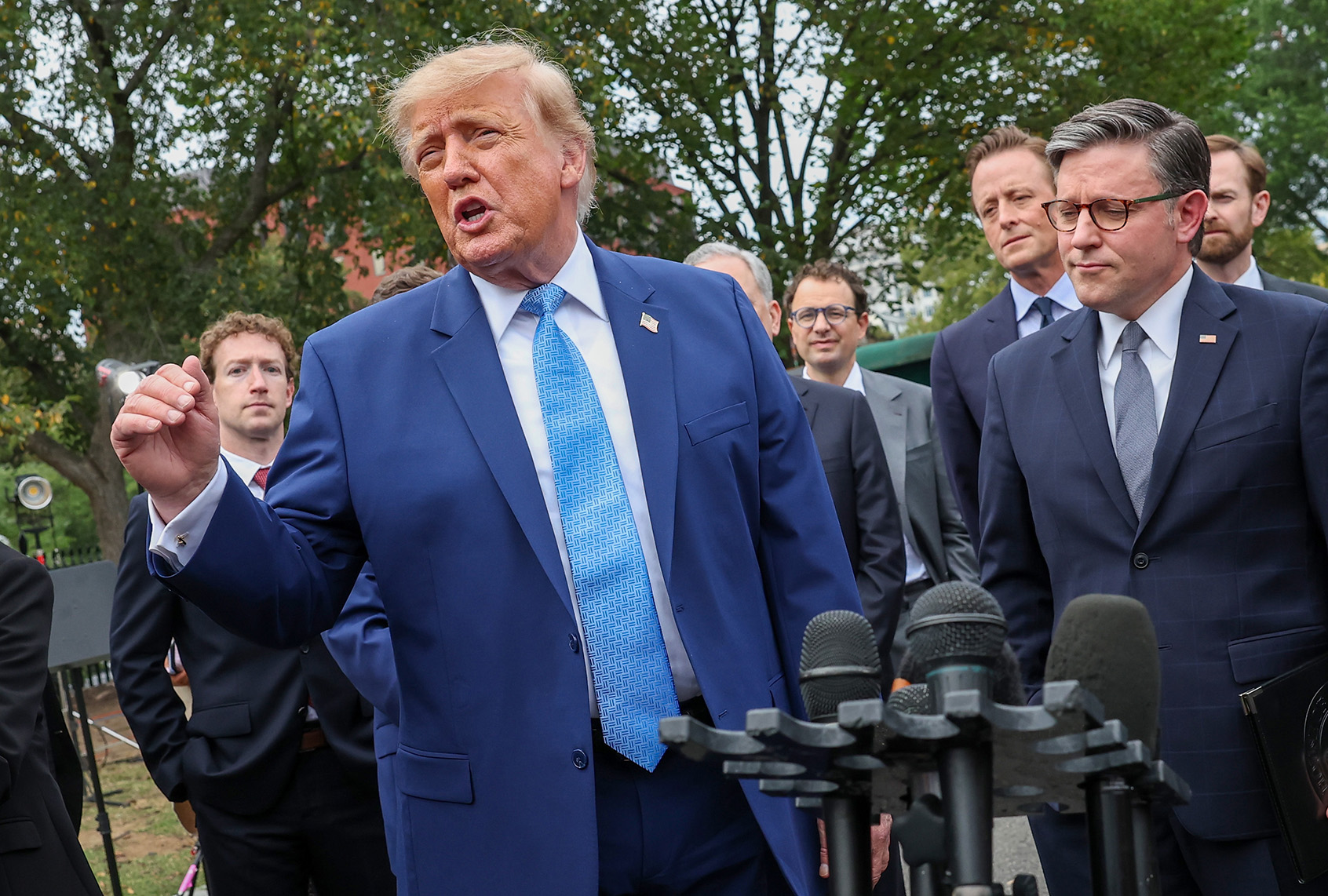
For anyone who buys the AI spiel, it’s a tool with boundless power. For now, however, the tech companies still rely on an old-fashioned kind of power offered by the state, which is precisely why other tech CEOs were seen sucking up to Chinese President Xi Jinping during his recent U.S. vacation. Amodei missed meeting Xi, for what it’s worth, but had a private dinner with President Donald Trump late Sunday night and later this week joined other tech leaders for a luncheon hosted by Trump and House Speaker Mike Johnson. There — joined by Nvidia CEO Jensen Huang, Tesla and SpaceX CEO Elon Musk, Meta’s Mark Zuckerberg and others — the president signed a “morally binding” artificial intelligence document, which sounds promising, until you hear Trump repeatedly tell reporters that tech companies can supervise themselves. “The self-regulation is very important,” Trump said. The document signed seems to have zero enforcement or legal mechanisms, so in this context, it appears “morally binding” just means “self-policing.”
It’s no mystery why the president — heavily invested in the AI industry as he acridly dismisses any notion of regulation — is cozy with the idea of AI’s alleged abilities. In his latest effort to sell the American public on the coming “golden age” of AI (of course Trump would use that phrase), on Monday the Trump administration both launched America.gov, an AI chatbot powered by Google’s Gemini and Elon Musk’s Grok, and signed an executive order to rename AI “super intelligence.”
As Gebru observed, the grift has no end. All the more reason to pour cold water on outrageous claims about flagging little enzymes in huge databases. (Let’s avoid anthropomorphizing these programs by using the verb “discover.”) The goal of Anthropic’s AI propaganda — because that’s what it is — is to get most people skimming past the headlines to only catch “AI finds new CRISPR” and think a cure for cancer and world peace are right around the corner. All we have to do is hand the keys and all our money to Silicon Valley. Whether it’s utopia or dystopia, that’s the pitch: cede control of this tech to the billionaires in charge. In that sense, blindly swallowing AI’s positive hype can be as dangerous as its alleged existential risks.

 Login
Login