 Login

The Woman Who Led Trump’s Anti-DEI Push Bemoans GOP Bigotry

Dirty Laundry
In the weeks since the midterm elections, top Trump administration officials and others in the broader MAGA extended universe have taken to airing out their dirty laundry to explain the GOP’s defeat. One former DOJ senior official offered a particularly revealing insider perspective on Republicans’ ethnoreligious chauvinism in a podcast interview last week: Harmeet Dhillon, who resigned from running the DOJ’s Civil Rights Division on Nov. 6.
Dhillon prompted a mass exodus of experienced lawyers when she directed the division to seek voter roll information from dozens of states (an effort that failed in each case that was brought to court), end police consent decrees, and more. After an ICE officer shot and killed Renee Good in Minneapolis, Dhillon declined to open an investigation into whether the killing violated her civil rights, causing even more resignations. But one of the bigger changes she made was to reorient DOJ away from protecting groups that have historically faced discrimination in the U.S., and instead throw the weight of the federal government behind advocating for white people.
This apparently didn’t help Dhillon gain much favor within the party. As she said on “NewsNation Prime,” her Sikh faith and South Asian background has made her a target for the nativist far-right. “Not a lot of people are standing up for me in that top tier of conservatives,” she said, “because it’s some of their base who’s attacking me, and they don’t want to lose any of that groyper, anti-semite, anti-immigrant base.”
Nativists like to call their vision of citizens “heritage Americans.” While that term may sound like something out of a middlebrow gated community, what they mean is that they believe some Americans have a greater claim to citizenship than others due to their ancestry. J.D. Vance has espoused a similar idea.
Dhillon hit out at the “scary people” in the Trump administration who support this nativism. “Instead of saying heritage American, which is, you know, seven syllables, just say white,” she said. “That’s what you mean. You mean white. You mean only whites are real Americans and everyone else isn’t.”
That’s not to say Dhillon herself is above drawing some lines around exactly who constitutes a real American. In the same interview, she argued that New York City Mayor Zohran Mamdani should be considered for ideological denaturalization based on his purported communist tendencies and bemoaned a lack of “courage to do that.”
By Josh Kovensky

The Story of the Future
“Whose imagination do you want to live in?”
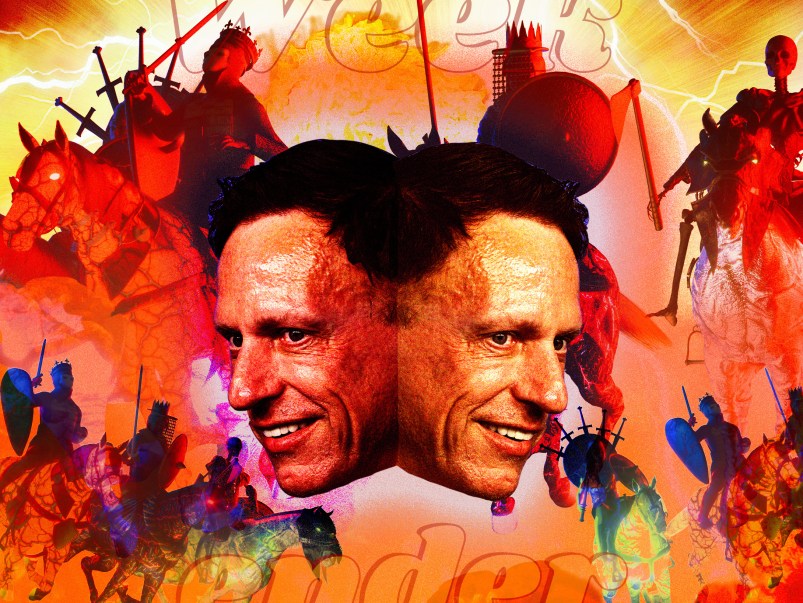
That’s the tagline to Walter Isaacson’s new podcast series, The Builders, where Isaacson interviews our current cadre of tech leaders about the future they’re trying to create. Given a lineup of guests that includes figures like Alex Karp, Peter Thiel, Elon Musk and Dario Amodei, the question functions more as a menacing proposition than a fun choose-your-own-adventure type hypothetical. What anyone outside of Silicon Valley’s tech oligarchy wants doesn’t appear to be a primary concern of our tech overlords. Fittingly, Isaacson’s interviews focus more on what they want. And with few exceptions, what they want is the unfettered power to decide the future for the rest of us.
In an age where writing a 5,000 word manifesto about the future is de rigeur for any tech leader of consequence, we aren’t exactly lacking for insight into their idiosyncratic perspectives. But that doesn’t mean The Builders isn’t insightful. Having written biographies of Leonardo DaVinci, Ben Franklin, Albert Einstein, Steve Jobs, and most recently, Elon Musk, Isaacson has assumed the mantle of Thomas Carlyle and his great man theory. This makes Isaacson one of the few journalists with whom it’s desirable for powerful people to consort. It also has the effect of turning The Builders into something like a competition or audition for “great man/woman” of the era. In each episode featuring a different tech titan, Isaacson lobs softball questions and the guests present their theory of the future — starting almost universally from the premise of AI’s inevitability. If there is a case for greatness, it seems to come more from the ability to steward AI than from the broad appeal of ushering in a new and transformative technology.
Of course, an AI future is not inevitable. What makes it feel that way is that Silicon Valley has spent the last 30-plus years entrenching itself as the source of the world’s digital infrastructure. Starting with genuinely revolutionary technologies that promised previously unimaginable access to information and global connectivity, companies like Google and Facebook were able to achieve massive, world-spanning scale by providing free access to their platforms in exchange for our data (famously, making us the product). They were helped along in their ambitions by a deregulation campaign known as the Palo Alto Consensus, which provided bipartisan support for American tech companies to “move fast and break things” in pursuit of creating a single, global internet. If the ostensible goal was an internet that adhered to American ideals like free speech and free access to information, the reality was an internet that scrambled countries’ information ecosystems and frequently perpetuated or poured gasoline on the kind of divisions and tensions that lead to political upheaval. While this was bad for most countries and governments; for Silicon Valley, any political capital lost was more than offset by massive gains in financial capital. Having established a near-global monopoly in both hardware and software, American tech companies were empowered to exploit platform dependencies and take us down our current path of rentier capitalism and enshittification.
Now a major player in the world of finance, and in possession of more money than there were “opportunities to invest in,” — as Garry Tan, CEO of Y Combinator, phrased it to Isaacson — Silicon Valley poured cash into AI where the digital infrastructure was already in place to all but ensure top-down adoption (see: Google Gemini). This was a considerable advantage for the tech companies, because, as Neil Postman explains in his book, Technopoly, “once a technology is admitted (to a culture), it plays out its hand; it does what it was designed to do.” With U.S politicians again forgoing regulations so America could win an AI arms race with China, and with individual power in the marketplace defanged by the AI companies prioritizing corporate and government contracts over consumer products, the last obstacle standing in the way of AI inevitably might just be the ideological debate over what “it was designed to do.”
No inventor has a perfect, or even good, understanding of the impact his/her invention will have on the world. That’s because technology doesn’t just transform culture, culture also transforms technology (Postman uses the example of how the printing press, invented by Gutenberg, a Catholic, was later used by Luther to bring about the Protestant Reformation). What’s notable in the lineup of “builders” Isaacson has interviewed so far is how few of them are inventors or builders in the traditional sense. (Thiel is an investor and lawyer. Karp is Thiel’s friend. Amodei is a researcher. Even Musk, who is considered to have an “engineering mind,” is more of a visionary than a creator). What they are, primarily, is storytellers. They don’t build technology, they build companies. And to raise money for these companies, they tell stories about how the companies’ technologies will change the world. Paradoxically, the fact that they don’t know how the technologies will change the world is why they tell the stories. It’s how they literally control the narrative and imbue the technology with their own world views and ideologies. Their companies are not the technology, they are part of the culture attempting to bend the technology to their own ends.
This doesn’t mean AI is somehow neutral. It’s not. But it’s up to a society to figure out the role it was designed to play. That the general populace appears to have more antipathy than enthusiasm for AI doesn’t necessarily speak to whether the technology itself is useful. It’s just as likely a reaction to the way its uses have been shaped by an ideology that isn’t interested in problems beyond the C-suite. While the AI titans handwave at the technology’s potential to produce widespread benefits like medical breakthroughs and agricultural abundance, it’s telling that its current uses include labor reduction, mass surveillance, war gaming and agentic dinner planning. What seems evident is that if AI is indeed a transformational technology capable of improving the lives of those outside a small circle of tech elites, it will have to be shepherded under a worldview that doesn’t include the concept of a permanent underclass.
As I finish writing this, the AI frontier lab Anthropic is in the middle of an initial public offering that has the company valued at nearly $2 trillion and on pace to break SpaceX’s record for the largest IPO in history. This comes after a week in which tech failures and cyberattacks grounded planes, made email services inaccessible, compromised personal banking and cryptocurrency information, and even led to the International Hockey Federation’s website being hacked. It’s foolish to think anyone knows the story of the future. But we’ve lived long enough in Silicon Valley’s imagination. Maybe we want to give something else a try.
By Derick Dirmaier

A Marked Lack of Rahmentum
A new poll released this month from the excellent data journalist G. Elliott Morris and Verasight provides a first glimpse at the standing of the various potential hopefuls in the 2028 presidential race, and it doesn’t look good for Rahm Emanuel. The former Chicago mayor, congressman and White House chief of staff wasn’t highlighted in the main writeup of the numbers, but Morris revealed Emanuel’s level (read:lack) of support in response to a comment on Bluesky.
“Not a single person volunteered Rahm Emmanuel’s name as their first choice in our initial 2028 primary poll,” Morris wrote. “As a second choice, he gets 0.3%.”
Ouch.
Those grim figures should come as a surprise to no one. After all, Emanuel abandoned his bid for a third term in the Windy City after his approval rating plunged into the low 20s following a teacher’s strike and a controversial police shooting. Amid various scandals, one 2015 survey even showed a majority of Chicagoans wanted him to resign. More recently, the pollsters over at YouGov have ranked Emanuel’s popularity as one notch above President Donald Trump’s on-again-off-again legal fixer, Michael Cohen, and the far-right billionaire Peter Thiel.
The political press has continually highlighted Emanual as a potential force in the looming Democratic presidential primary despite this lack of evidence. Over the past year and change, Emanuel has been the subject of lengthy profiles and photo spreads in The New York Times, The Atlantic, and Politico.
All of these pieces have focused on Emanuel’s core message, which is, essentially, that Democrats need to be more moderate and less woke. Much like the man himself, that take seems unpopular based on the results of the most recent election.
So, why is the conventional wisdom class seemingly stuffing Rahm Emanuel down our throats, despite so many signs that a campaign just won’t be a thing? It’s hard not to suspect that, perhaps, Emanuel’s righteously angry call for centrism so closely matches the core ideals of the major D.C. media players that they are trying to push his White House bid along by force of sheer will. The simplest and less conspiratorial explanation is that the 2028 press corps are starving for potential candidate interviews — even with longshots — and Emanuel is more than willing to oblige.
Personally, I believe both of these things are true. Washington always loves a passionately moderate voice and a big name who won’t stop talking.
Either way, it’s clear the rest of the country isn’t feeling it so far. Maybe the real Rahmentum is the newspaper and magazine friends he made along the way.
By Hunter Walker

Can GTA Heal the GOP?
Grand Theft Auto VI was released Thursday and most of the world is having a great time with it. Metacritic, a website that aggregates reviews of games and movies, gives GTA VI a score of 99. Universal acclaim. Here’s one review I found symbolic of all the rest: “Despite its cultural significance taking on an almost mythical guise in the years leading up to launch, the game itself is, luckily, worthy of these lofty expectations.”
Not everyone is pleased though. The ever jovial folks at Fox News are apoplectic that people are taking off work to play GTA VI.
Harris Faulkner demonstrates she doesn’t understand how paid time off works with this gem: “If this generation wants to preach about affordability, but they’re willing to cost billions of dollars in revenue loss on a day like today to go play a game, that probably tells you everything you need to know … Get yourself to work.”
Fox News contributor Paul Mauro agreed with Faulkner, but had an additional gripe harkening back to an earlier Culture War era: the game is too violent. “This is almost the equivalent of giving [a kid] a gun at an age when they don’t understand the responsibility.”
Fake guns being worse than real guns. What a throwback. Maybe the GOP is healing.
By Joe Ragazzo

How Much of This Week’s News Do You Remember?
- Where did Markwayne Mullin fly in a private jet last Saturday while tens of thousands of people were still stranded in airports after the FAA grounded flights nationwide?
- What government administration was Heidi Overton tapped to lead until the White House was forced to withdraw her nomination?
- What long-distance milestone did the Voyager 1 spacecraft reach this week, 49 years after leaving Earth?
Answers below.
By

Unbalanced Man Seeks Balance
“I think we want to have some checks and balances here.” — Elon Musk, newfound proponent of government.
By
Birds of a Leather
when one ceo is in distress, the others in the herd will adopt his distinctive plumage
— derek guy (@dieworkwear.bsky.social) 2026-11-19T06:34:12.802Z
By

Airborne Toxic Event
Just to be safe, the U.S. The Army has delayed the “controlled demolition” of lead azide (a toxic chemical used in detonators and blasting caps) at an Army plant in Middletown, Iowa. The detonation has been moved from Friday to Monday — the latest possible date to detonate before a temperature drop that, according to Army Secretary Adam Telle, “would risk further destabilization of the material.”
According to an EPA and Army joint advisory, the plan is to bury the 68 barrels of lead azide, “inside earth-covered magazines made of concrete: and surrounded by two-story-high sand barriers.” Reassuringly, before and during the detonation the ground over the barrels will be saturated with water and misters will be deployed. As for the people of Middleton — they’ve been asked to evacuate because the blast will cause ground vibrations that could shatter windows and create a plume of dust that the Army says, “will contain some lead.”
OK! Good thinking with the delay, but to echo what Josh Marshall wrote on Bluesky, if you need to evacuate the town because you’re releasing toxic dust into the air, maybe there’s a problem with the plan?
By
Line Goes Down

By
Trivia answers: 1) An LSU football game 2) The FDA 3) One light-day from Earth
By