Login

Why data centers are at the center of the Big Tech backlash
Journalist Paris Marx unpacks his new book "Hyperscale."

ANTALYA, Turkey — There’s an old adage in politics: never let a crisis go to waste. Yet governments at crucial U.N. climate talks just did exactly that.
The Antalya summit lurched to a chaotic conclusion Sunday when a draft deal on tackling global warming collapsed, despite a desperate scramble for an agreement which had already taken negotiations 48 hours over the scheduled finish.
Countries failed to strike a final agreement despite fresh scientific warnings and an energy price shock which many governments said offered more momentum than ever for ditching planet-heating fossil fuels.
That means countries are leaving Antalya after two weeks of intense negotiations with only a handful of technical agreements to their name. There is no political deal to show how they intend to pull the planet back from the verge of dangerous climate change.
U.N. climate chief Simon Stiell stressed that the summit made “real progress,” despite the lack of agreement on the main text (called the “cover decision”).
Others weren’t as generous.
“This ridiculous system of having absolute consensus, where 192 countries and 100,000 people who are here in Antalya agree on absolutely everything, it’s a recipe for disaster,” Juan Carlos Navarro, Panama’s climate minister, told POLITICO earlier in the week. “COPs have turned into a laughing stock.”
Governments arrived in Turkey knowing the world stands on a precipice. This summit marked the first climate conference since the U.N. announced the world was sure to overshoot the target to limit long-term global warming to 1.5°C above pre-industrial levels.
“The situation coming into this talk was the most complicated and fraught geopolitical environment in living memory, and also, in ways I very much sympathize with, the impacts of climate change [are] getting worse,” Australian Climate Minister Chris Bowen, who co-hosted the talks, told reporters Sunday.
Missing the 1.5C target, the Paris Agreement’s most ambitious aim, loomed large in Turkey. Many nations cited the impending overshoot as justification for agreements to make deeper cuts to pollution, take stronger action to prepare for disasters and increase financial support for poorer countries.
But countries rich in oil and gas resources fought to keep any mention of fossil fuels — the main cause of global warming — out of the final text, while wealthy nations were reluctant to commit to specific funding goals.

The final impasse that brought down the talks revolved around the future of energy. A coalition of 130 countries, led by the European Union and small island states, demanded the COP31 text include a reference to a three-year-old commitment to phase out fossil fuels. But that was too much for some petrostates. Even recommitting to this earlier agreement was a red line for countries such as Saudi Arabia.
Another point of conflict was a paragraph in earlier drafts of the deal that appeared to put contentious carbon capture technologies on equal footing with clean power sources such as renewables. The anti-fossils coalition wanted those references deleted, arguing they catered to Riyadh’s interests to prolong the use of oil and gas.
On Sunday, Saudi Arabia pushed back. “We cannot reconcile a position that stated so publicly that we need to keep 1.5 degrees within reach, and yet called carbon capture, utilization, and storage technologies greenwashing,” said country negotiator Mohammad Ayoub.
In a fractious final plenary session, the EU and small islands, alongside the United Kingdom, Norway, Switzerland, several Latin American nations and a group of the world’s poorest countries, rejected the deal drawn up by Turkey and Australia, the conference co-hosts.
“We will not endorse a decision that does not respond to the science, that disregards the implementation gap, and that actually risks deepening the chasm between global commitments and the action required to correct the overshoot and bring 1.5 degrees back to within reach,” said Irish Climate Minister Darragh O’Brien, speaking on behalf of the EU.
“We will not endorse a cover decision,” he added, “that does not even mention fossil fuels, which is the key driver of climate change. And we will not accept negotiating backward in time.”
All Turkish minister Murat Kurum, presiding over the talks, could do was admit defeat. He walked off the plenary floor not long after, before the conference — which had by then turned into the longest climate summit in its 30-year history — had ended.
Some pointed to deals made on the margins of the talks, in the so-called action agenda, as well as the conclusion of technical agreements, as evidence the U.N. climate process was still working.
“I share the disappointment of many,” Stiell told reporters Sunday evening. “We must also recognize that this COP process has two tracks, and across the action agenda COP31 has delivered real progress and concrete results.”
The conference was not always destined to end in disarray. The geopolitical momentum was on the Turkish-Australian presidency’s side.
Beside U.N. warnings about overshooting the 1.5°C barrier, the talks coincided with growing public anger over high fossil fuel prices caused by the Iran war. Many governments around the world, alarmed at rising costs of oil and gas imports over which they had little control, were already speeding up their switch to clean energy, citing affordability and sovereignty as well as climate action.
Co-hosts Australia and Turkey sought to harness that crisis through proposals to accelerate efforts to replace fuel-burning gasoline-powered cars with electric alternatives such as EVs.
But their proposed flagship target to increase electricity’s share in the world’s energy consumption from 23% today to 35% in 2035, included in the final draft text, was rejected along with everything else.
It was discussions around the electricity target that started the debate that, ultimately, led to the conference’s breakdown.
The International Energy Agency says that to reach net-zero emissions by the middle of this century — a key effort to meet the Paris Agreement goals — the global electrification rate must increase in line with that proposed target, but also that clean power like wind and solar must supply 90% of electricity by then — up from 42% today.
That pushed several countries to lobby for an agreement on “clean” electrification — to ensure that the electrification push does not open the door to more high-polluting coal, oil or gas.
“EU citizens will not accept a fossil fuel COP,” a senior European official said Friday afternoon, warning of a “no-deal scenario” over “insufficient language on clean electrification” in a draft version of the accord.
The EU then teamed up with small island states and dozens of other nations that had backed a push for exiting fossil fuels at last year’s conference in Brazil. Together, the gang of more than 100 nations marched into the presidency offices on Saturday night to state their demands: a reference to the previous energy transition agreement and the deletion of the Saudi-linked carbon capture text.
When tweaks to the text during the final plenary did not deliver what they wanted, many of these countries rejected the text outright.
“We came here expecting the world to deliver a comprehensive and urgent response on reducing emissions, on protecting our people, and on providing the finance to do this,” said Kathy Jetn̄il-Kijiner, a negotiator for the Marshall Islands. “We have been let down on all sides.”
Not all countries rejected the text. China, India and a group of African nations said they would not stand in the way of its adoption. U.N. climate summit decisions, however, require consensus from all the nearly 200 nations in attendance.
Discontent with the Australian-Turkish co-hosts started brewing early this week.
A first draft of the deal — a laundry list of all possible demands from countries — baffled many national delegations when it was published on Monday. A second draft only came on Thursday, setting off days of shuttle diplomacy behind closed doors.
After many delays, a third and supposedly final draft decision appeared just after midnight Sunday, long after the conference was meant to wrap. Exhausted and disgruntled diplomats were by then in no mood to make further concessions.
“The process is basically mismanaged,” Xolisa Joseph Ngwadla, an adviser to the chair of the African negotiating group, told reporters Saturday. “We haven’t seen text in more than 48 hours. We haven’t met as all parties in more than three days. We’ve all seen just snippets of text. That’s not conducive to a transparent and inclusive process to work towards an outcome. You don’t get an outcome like that.”
But the conference backdrop also spelled trouble. The stakes were low — while Australia and Turkey insisted on pushing for a political agreement, no blockbuster deal needed to be done.
It was all happening while geopolitical tensions soared amid wars in Iran and Ukraine. A rising far right and tight budgets at home put many rich countries on the defensive — while many developing countries, reeling from worsening climate disasters and mounting debt, demanded more financial support.
The EU, smarting from last year’s conference where it was left isolated pushing for more climate action, was gearing up for a fight.
And the absence of the United States from the process, after President Donald Trump withdrew his country for the second time, shifted the power dynamics toward emerging economies. Privately, several European diplomats said that with the “old U.S.” in the room, Saudi Arabia could have been contained.
The draft deal would also have done little to address the overshoot of 1.5°C, which scientists say can be brought back under control only through dramatic emissions cuts and large-scale deployment of technologies for sucking carbon from the atmosphere. Most such tech is unproven to work at the scale required.
European diplomats said Saudi Arabia even questioned the science behind the overshoot, suggesting that research is not settled unless it appeared in reports of the Intergovernmental Panel on Climate Change — while simultaneously allegedly trying to delay future reports from the IPCC. The Saudi energy ministry did not respond to a request for comment.
An attempt to resolve the standoff over science, injected into the presidency’s draft decision, failed alongside the rest of the text.
The talks also collided with skyrocketing global electricity demand, driven by the sudden expansion of data centers, modernizing economies and an explosive uptake in electric cars worldwide.
Artificial intelligence alone poses new risks to international climate efforts, as tech companies increasingly use natural gas to run new power plants dedicated to data centers’ massive compute capacity. Yet the summit barely addressed those growing climate threats.
Some negotiators tried to put a quick brave face on the collapse.
The EU and Britain both insisted they would continue pushing for global climate agreements. “Our position is not a rejection of multilateralism, but a defence of multilateralism that delivers,” Ireland’s O’Brien and the bloc’s climate chief Wopke Hoekstra said in a joint statement.
“History will not judge COP31 by whether a decision was adopted, but by whether the international community rose to the challenge of our time,” they added.
This time, at least, it didn’t.

This article was originally published at ProPublica, a nonprofit newsroom that investigates abuses of power.
A dozen Democrats in Congress are calling for limiting or banning the construction of data centers on public lands. The moves follow reporting from ProPublica that revealed Interior Secretary Doug Burgum, who leads the White House’s artificial intelligence push, has tens of millions of dollars invested in AI companies.
An artificial intelligence (AI) system is judged on the job it does, not on how clever it is in general. For European businesses, that is an opening. For example, a pharmaceutical company does not need a model that can discuss biology. It needs one that can flag the rare adverse-event signal in its own trial data. An energy grid operator needs load forecasts built on its own network topology, not generic ones. A defense manufacturer needs a system that can verify a weld against its own specification, and say why it passed or failed. Each needs a system that understands its domain, works on its data, follows its rules and guardrails, and can be trusted to execute in a protected, controlled environment.
An edge Europe can’t buy
That task-specific fit is Europe’s opening to turn its industrial expertize into an AI edge, because that edge was never going to come from outspending anyone. US private AI investment reached US$285.9 billion in 2025, more than 23 times the US$12.4 billion invested in China — though looking at just private investment figures likely understates China’s total AI spending, given its government guidance funds. The Stargate venture plans to invest between US$100 billion and US$500 billion to build advanced AI data centers across the US by 2029. Matching that euro for dollar would be a strategic mistake, and Europe’s grids rule it out regardless: connection queues in major hubs already run seven to 10 years. None of this means Europe should stop building AI factories. They matter for critical workloads and for a credible European alternative. The point is not to scale compute, but to invest smartly in the infrastructure needed to run specialist industrial applications. A factory with nothing to run on is just an expensive data center. The number that matters is not compute deployed, but the number of specialist applications built, the tasks addressed and the vertical industry solutions delivered.
Breadth first, depth next
The same pattern shows up globally in how AI is actually used. Our September 2026 CIO Pulse survey of 300 technology leaders worldwide found that 70 percent were using AI for individual productivity: particularly copilots and general-purpose tools adopted across the organization. Only 37 percent were using it to orchestrate processes end-to-end with agents, where AI sits inside a process and solves a real business problem in context, as a specialist. Breadth of adoption is arriving first, and faster, than depth. Depth is harder, because it needs specialization, context and precision, not just more scale, and that is where Europe can lead.
Sovereignty by design
Another factor in European AI adoption is non-negotiable: sovereignty. In mid-2025, 61 percent of the business leaders we surveyed called it a strategic priority. By early 2026 that figure exceeded 80 percent. The June 2026 suspension of access to two frontier models under US export controls showed how fast the terms of access can change, and how little say any European company had in the decision. Sovereignty itself has layers: where infrastructure sits, where data lives, which models run, and now, above all three, what knowledge those models are grounded in. It has to be designed in from the start. It cannot be bolted on after a system is already live. Being sovereign while staying part of the global technology landscape is Europe’s real competitive advantage. That balance only works through specialization: the precision to control what matters most while still drawing on the best of what the world builds. This is a wave Europe is well placed to ride.
Specialist AI in practice

We call this operating logic Specialist AI in our report, AI designed with intention. How Europe can win with Specialist AI: model size, data, deployment location, inference pathway and governance controls matched deliberately to a defined task. Frontier models suit open-ended reasoning, cross-domain synthesis and genuine exceptions, which we estimate account for roughly 10 percent of enterprise workloads. Smaller domain-tuned models suit repetitive, high-volume work where latency, cost, auditability or local control matter most. The strongest architecture uses both, deliberately, not by accident.
The point is not to scale compute, but to invest smartly in the infrastructure needed to run specialist industrial applications. A factory with nothing to run on is just an expensive data center.
The European Patent Office (EPO) shows what this looks like in practice. With Mistral AI, it processes 400,000 pages a day on a one-billion-parameter model fine-tuned on 50,000 patents. The error rate is below 1 percent, and work that used to take five days now takes minutes. The model runs on the EPO’s own domain data, in a sovereign environment. It is not the biggest model in the world. It is the right one.
Upcoming regulation, including the proposed Cloud and AI Development Act which was put forward in June, will likely only reinforce this shift and the opportunity it creates, especially through its multi-layer sovereignty definitions. Companies should start shoring up governance that holds across every layer of the stack now and understand that different parts of the stack carry different types of risk, with kill-switch exposure varying by layer. The future needs sophisticated controls, but it also rewards whoever builds them first.
Turning advantage into action
Three moves follow for enterprises:
Policymakers can reinforce the shift. Compute investment should connect to sectoral test facilities and adoption centers, not sit apart from them. Procurement should reward task performance, auditability, energy efficiency and portability, not just scale. Standards should enable interoperability and federation, so every provider adds to a single European fabric of capacity rather than 27 disconnected ones.
Europe may not lead on AI breadth, but it can lead on AI depth. By combining generations of industrial expertize with sovereign, specialist AI, designed for specific tasks and deployed on Europe’s terms, businesses can turn the potential of AI into lasting competitive advantage.

Here's a fantastic Kickstarter for a book by Boing Boing reader Stephen Voss.
From Stephen's email to Boing Boing:
I wanted to share a project I've been working on for the past three years. I'm a photographer based in Washington, DC and I've become obsessed with photographing the data centers in Virginia, trying to make a record of the physical landscape of AI and our digital lives that's being built in Virginia.
The post Stephen Voss spent three years photographing Virginia's data centers, and is making a book appeared first on Boing Boing.

This is the free edition of Where Things Stand
I’ve been chronicling the swelling backlash toward data center construction in communities across America — and how we thought it might translate into some losses for some Republicans in the midterms — in this evening newsletter for months, as regular readers will know.
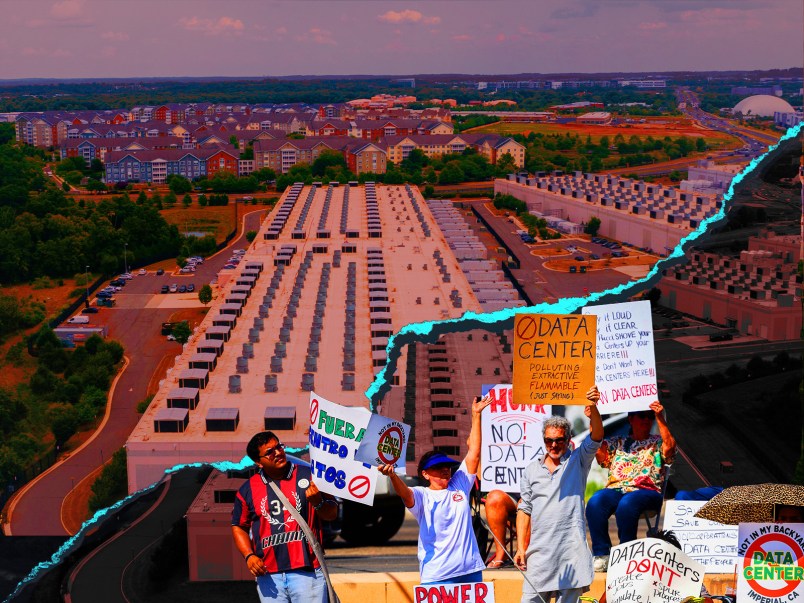
The righteous outrage that Americans across the political spectrum feel toward Big Tech oligarchs coming in and draining crucial water supplies in their communities, polluting their air and driving up the costs of basic necessities — like electricity — was overwhelmingly apparent at the voting booth. Voters rejected data centers both literally and figuratively in dozens of races across the nation.
Let’s start with the literal backlash.
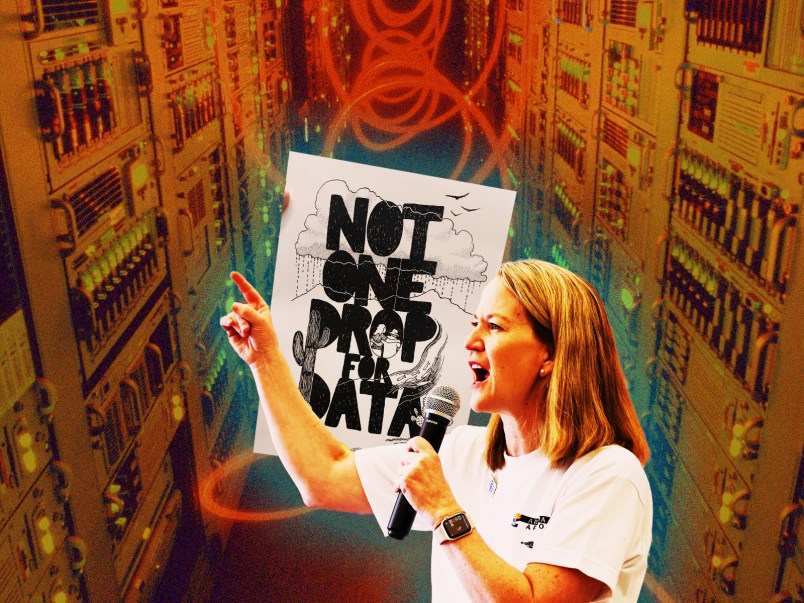
Arizona Attorney General Kris Mayes is making the waning days of her campaign for reelection all about the widespread backlash to data center construction in her state — and the ways in which she has worked to try to limit an explosion of artificial intelligence infrastructure in Arizona that drains the state’s already-low water supply. If she can harness bipartisan and pervasive public outrage on the issue, she may be able to not only boost her own reelection prospects, but also help Democrats down ballot who may be on the verge of taking back one chamber of the state legislature for the first time in 60 years.
This article is part of TPM Cafe, TPM’s home for opinion and news analysis.
This year in Arizona, we took on one of the most powerful industries in the world and won.

Republican incumbents and candidates facing data center outrage back home have been trying to get President Trump to land where he just landed on data centers for months, as the party works to develop some sort of concrete campaign position for candidates on an issue that has sparked ubiquitous backlash across the nation.
Republican leadership and Trump’s allies, for their part, attempted to carve out a compromise lane for candidates to operate within on the campaign trail, as Trump made his position on the matter clear: he’s in bed with Big Tech and, thus, entertaining no nuance. Both Senate Majority Leader John Thune (R-SD) and Vice President JD Vance tried to obscure Trump’s obstinance on data centers by suggesting in August and September that the tech companies expanding and building them need to cover their electric costs, either by “putting power back into the grid,” as Vance suggested, or by finding ways to make the data centers “self-sufficient.”
“They ought to be able to take care of their own utilities, their own power, and that ought to be a given any place they go in the country. But they shouldn’t be going places where there isn’t support for them at the local level,” Thune told a local South Dakota TV station in September.
Another Senate Republican, Jon Husted, is locked in a heated campaign in Ohio that is also foundering under the weight of the data-center backlash. I’ve written before about the data center skeletons in Sen. Jon Husted’s (R-OH) closet, left over from his time as lieutenant governor. Sen. Sherrod Brown (D-OH) has skillfully spun this baggage into a pretty compelling attack operation. Husted then mounted an ultimately unsuccessful gambit to try to get Senate Dems to help him pass legislation that would help him on the campaign trail, which I wrote about here.
But the crux of the matter is this: Husted was pushing to pass a bill, the Ratepayer Protection Act, that would direct state utility regulators to consider implementing new standards that ask Big Tech companies to cover the cost of electric bills and the grid updates needed to run their data centers.
Officials in the Trump administration in August were even working to convince tech and utility companies to sign a pledge to prevent AI model-driven electricity cost hikes.
This is all to say, Republicans have been trying to stand in this lame space between support for Big Tech and its wild enthusiasm for data centers and AI, and Americans’ bipartisan outrage about the risks to their communities and their finances that come along with the facilities. And Trump has not let them, determining a few months back that anyone who is against data centers — and the strain they place on local resources — is “backwards and poor.”
Now, just shy of two weeks from Election Day, he’s come around to other Republicans’ position. In a Truth Social post this morning, Trump “mandated” (whatever that means) that tech companies “make their own electricity” and pay communities that host the facilities “dividends” (he also put this term in quotes, so unclear if he or anyone knows what that means):
As the President of the United States, I have been watching Data Centers very closely, and have come to a very strong conclusion. New and large, in some cases gigantic, Data Centers are mandated by me to make their own electricity, and give or sell any excess back to the local community, or grid, and therefore there is electric price increase. In fact, there could be a substantial decrease. Other elements likewise! If companies want to make their Data Centers popular, pay the community, and/or individuals within the community, a “dividend.” I have watched the process closely, and Data Centers that were highly unpopular in a certain area, have become extremely popular when a financial deal is struck. MAKE DEALS, and get them built!!! GREAT FOR THE U.S.A. President DJT
Republicans have done this to themselves by advocating against AI regulation (state level anti-regulation measures were ultimately stripped from the Big Beautiful Bill before passage, however) and getting in bed with the tech oligarchs gunning to buy off politicians for years. And Democrats struggled with how to message on the matter until the American public invited them to seize on their indignation.
There are a few key races that will reveal whether Trump’s last ditch data center pivot was effective this cycle.
Earlier this month, three data centers in western Russia suddenly went dark due to a “rapid unplanned disassembly,” to use euphemistic engineering parlance. They exploded, in other words. Operated by Yandex, a Russian technology company often compared to Google that offers many similar services — a search engine, online shopping, cloud computing and the like — the centers were heavily damaged in a series of coordinated drone strikes over four days by Ukraine, which saw them as a valuable target in the country’s military campaign against Russian infrastructure.
As Russia’s war against Ukraine slogs on, both sides are increasingly adopting this strategy. While power plants and oil refineries have been hit, data centers and internet facilities are becoming the latest quarry for drone and missile strikes — and not just in Europe. Data centers operated by Amazon in Bahrain and the United Arab Emirates have also been targeted in the ongoing Iran war.
Few Americans have probably heard of Yandex, let alone use its services, and most likely didn’t notice when many of its hosted websites became inaccessible. But after Ukraine’s attacks, many people started to claim that social media was seemingly different. Ukrainian President Volodymyr Zelenskyy was quick to suggest his country had dealt a massive blow to Russia’s online disinformation machine, saying, “It suddenly became a little easier to breathe on many social platforms. There was less hate, less division and fewer provocations.” Several reports seemed to support his claims, citing data from internet monitoring service Cloudflare, that allegedly showed “Russia’s Yandex bot traffic nearly eliminated overnight.”
But the truth is far more complicated, as some experts have noted. Yandex did experience a crash in bot activity, but at least some of that traffic seems to be legitimate. “When Cloudflare data shows a precipitous drop in ‘bot’ traffic, that does not mean ‘automated social media troll accounts’, it means ‘software that makes automated web requests on a large scale,’” Michał ‘Rysiek’ Woźniak, an internet infrastructure expert, told The Guardian. Others noted that they haven’t seen an actual drop in online disinformation. “Our platforms are still monitoring Russian social networks across the world and there is no discernible change in their posting patterns,” said Amil Khan, the chief executive of Valent, a tech startup that tracks disinformation.
None of that has stopped Reddit and other corners of the web from celebrating and memeing the issue. If those celebrations aren’t quite justified, there’s still something to be learned from the ordeal, which digs into the so-called dead internet theory. The basic premise is that almost nothing we see online is human-generated anymore. In his 2025 book “Market-Oriented Disinformation Research,” business academic Carlos Diaz Ruiz, who has studied how disinformation spreads in social media echo chambers, describes what many of us experience online on a daily basis: “an eerie feeling that the Internet is made up of bots talking to bots, following and liking bots, and posting AI-generated content designed for machine consumption, the algorithm, not humans.”
Indeed, bot traffic makes up an increasingly large share of the internet, surpassing human traffic for the first time in history over the summer, according to a June Cloudflare report. No doubt the surge in generative artificial intelligence use is what tipped the scales, but of course, not all bots are created equal. Many have legitimate, beneficial uses, like archiving web data.
Start your day with essential news from Salon.
Sign up for our free morning newsletter, Crash Course.
Some people have wedged dead internet theory into a conspiracy theory that Diaz Ruiz divides into “weak” and “strong.” The weak version of the theory is that the internet is now little more than a hall of mirrors used to manipulate the masses into fighting a culture war instead of a class war. “The Internet drama keeps the population occupied and distracted, preventing them from resisting the elites secretly controlling the world,” as Diaz Ruiz says. “The ‘strong’ version of the dead internet conspiracy theory claims that online activity is entirely disconnected from human activity because our society ceased to exist some time ago. In some versions, a catastrophic event occurred in the past, triggering society’s collapse.”
OK, so we’re basically talking the plot of “The Matrix” here. The argument that humanity peaked in 1999 may be compelling, and I won’t argue against it. If reality truly is nothing more than a hallucination, dream or computer screensaver in the brain, why should we waste time disputing it? Proving a negative with such a lack of evidence is fruitless. The point is, some people may be taking dead internet theory a little too far, but that doesn’t change the fact that within the last week people felt like they got a taste of some version of it.
If we lift the hood on some of these conspiracies, we can understand what people are really afraid of. Last December in the journal Computer, Hal Berghel, a computer science professor at the University of Nevada, argued the dead internet is more than a conspiracy and should not be dismissed, writing, “There’s certainly evidence of the distortion of the internet from the original concept as a liberating, self-healing, packetized purveyor of useful and important information: the original commitment to net neutrality is on life support, the goal of a shared public information repository is constantly compromised by paywalls, the content has moved from valuable scholarship to a sub-cerebral landfill, and the users are subjected to a mind-numbing cacophony of digital threats: spam, phish bait, spyware, malware, online bullying, online fraud, extortion, hacking, VoIP 911-swatting, doxing, slander, pretexting, etc.”
In other words, there’s a good reason so many people find dead internet theory attractive. Once a zone of promise and connection, the web has not only rotted and enshittified, it’s turned into a literal warzone. There really are algorithms out there, unleashed by governments actively dropping bombs on one another, that are designed to infect our minds and prejudice our ability to perceive the truth. It’s one of the many ways modern warfare has become invisible, pervasive and endless. No wonder social media is making so many people depressed — it can be a form of assault.
“In tandem with proxy warfare, cyber operations have become a central pillar of modern statecraft. Cyber warfare enables states to conduct aggressive acts; espionage, sabotage, infrastructure disruption without engaging in kinetic violence,” philosophers Oluyemi Opeoluwa Adisa and Kareem Shwan Adham wrote last year in a study published in the International Journal of Scientific Research and Management. “The strategic advantage of cyber warfare lies in its stealth and ambiguity. Because it blurs the line between war and crime, attribution becomes difficult, enabling perpetrators to operate with minimal consequences.”
We need your help to stay independent.
How do we even tell how much of the dead internet theory is true? Perhaps through that old tech-support adage: Turn it off and back on again. And no, I don’t mean bombing more data centers, though we’re likely to see more of that, for better or worse. If everything feels fake, maybe we’re better off getting outside and experiencing something real for a minute. Yeah, yeah, we’ve all been told to touch grass so much that such advice is routinely mocked, and anyway, not everyone can easily do that.
But here’s your daily reminder that humans are primates whose still-evolving brains are exponentially outpaced by technological advancement. Being in nature is essential because we are nature. There’s a certain reset available in the presence of trees, birds and clouds. Even more important is connecting with real humans: family, friends, neighbors. Socialization is the essence of the primate brain too. You don’t have to uninstall any apps or delete Facebook, though you could try it too. Off, on again.
And when you are online, which is unavoidable for many of us, try to remember that you are probably interacting with fewer humans than you might think. So don’t take it so seriously. Temper those outrageous emotions, the ones the algorithms have gotten so good at teasing out of us. Maybe instead we can fortify them into weapons to attack the real problems we face, like widening wealth gaps, destruction of the environment and the rise of authoritarianism.
Read more
about tech
The post The internet isn’t dead. It’s even worse appeared first on Salon.com.