❌

Reading view

The Trans Panic Clickbait Economy

The past few weeks my social media feeds have been more apocalyptic than usual. Not due to escalating war with Iran, the shellshocked economy, or oil prices, but because of a wave of posts and news articles proclaiming imminent doom for trans people in the United States. Attacks on trans rights are obviously not new and have steadily risen the past ten years, but this recent collection of worrying claims are especially apocalyptic, or outright genocidal.

Just this month I’ve seen viral posts, citing online articles, saying that ICE is going to round up and “disappear trans people,” that the FDA is making a national “registry of trans women,” and that an adult trans healthcare ban is rapidly on the way. These panic inducing claims and the articles they’re sourced from are referring to real things or movements happening in anti-trans activism, regulations, and legislation, but are framed in a way to maximize catastrophe rather than understanding what’s actually happening at the moment and what we can do about it.

The danger of uncritically engaging with trans panic clickbait is that it reduces the worthwhile process of “staying informed” to being in a state of constant doom and feeling hopeless against an unstoppable enemy. Alternatively, it risks causing people to completely check out and not believe anything they see online even if there is a real pressing threat. Both of these outcomes cloud our ability to accurately assess and respond to very real threats.

Migrating While Trans

The bulk of this article will focus on a story claiming that ICE is now permitted to detain anyone for “looking trans.” This story and the online discussion around it is a microcosmatic example of how we understand both the Trump administration’s attacks on trans people, and how and why ICE operates as an agency.

On March 12th, a Substack article was posted with the headline “Trump Administration Opens the Door for ICE to Target Anyone Suspected of Being Trans.” The subheadline continues by reading, “Under a new rule, the State Department will be able to revoke trans people’s visas over ‘misrepresentation.’ It’ll give ICE grounds to suspect all trans people of being in the US illegally.”

The information contained in this headline is the furthest many people will engage with the content of this article. Combining that headline with preconceived notions about how ICE functions under the second Trump administration makes this a very frightening claim.

So what evidence does the Substack article include to support this claim? Earlier this month the State Department updated its policy for the Diversity Immigrant Visa Program, also known as the green card lottery.

New State Department rules require that applicants upload a scan of their foreign passport’s biographic and signature page to help cut down on fraudulent DV Program entries. The policy update also changed the “gender” entry to “sex” on the form. In the policy rule update the State Department wrote, “The marker reflected in the “sex” field on any visa application, including the entry form, should match the applicant’s biological sex at birth, even if that differs from the sex listed on the applicant’s foreign passport or other identifying documentation.”

The Substack article claims this could force a “mismatch between trans people’s applications and their passports—something it can then use to declare their applications fraudulent and disqualify them entirely.” The first half of that sentence is true, a mismatch may occur between the gender listed on foreign documents, and the sex listed on a US visa application. But it’s not the case that this mismatch will inevitably result in an application being deemed fraudulent and then denied.

According to Malita Picasso, staff attorney for the ACLU’s LGBTQ & HIV Rights Project, the kind of fraud this rule change is trying to combat by requiring a passport scan is not unique to trans people. Picasso said in an email that the new rule “seems to more directly target fraudulent activities involving third parties basically entering the lottery on behalf of individuals without their knowledge and consent, and then extorting them for large amounts of money if they are selected.”

The stipulation requiring an applicant to list their “biological sex at birth” on forms has actually already been State Department policy for both immigrant and nonimmigrant visa applications for over a year. Effectively since Trump’s executive order mandating the US government officially recognize two biological sexes which are determined at birth, and that “government-issued identity documents, including visas, and all forms that require an individual’s sex shall accurately reflect an individual’s immutable biological classification as either male or female.”

Claiming that a mismatch between the gender listed on a foreign document and the sex marked on application forms will itself “disqualify” someone from receiving a visa has little to no basis in government policy. Picasso told me that the new policy itself recognizes this could cause discrepancies, and that she doesn’t see a “new or heightened risk of being accused of fraud/willful misrepresentation if a transgender person follows the instructions by listing their sex assigned at birth on the application, even if they also file a birth certificate that has been updated to reflect their gender identity.”

The State Department has been aware for a while that their “biological sex” policy will create these kinds of mismatches. A February, 2025 State Department memo reads, “There may be instances when a consular officer becomes aware that the sex listed on the foreign passport may not be the applicant’s sex as defined in the [Executive

Order]. In such cases, the adjudicator should confirm the applicant’s sex as defined in the E.O., indicate that sex on the visa, and add a case note documenting any discrepancy between the passport and the visa to prevent issues at the [Port of Entry].”

Later in April of 2025, USCIS officially updated their policy on requiring “biological sex” on immigration applications. The policy also states that “USCIS does not deny immigration benefits solely based on a failure to properly indicate the benefit requestor’s sex.” ACLU staff attorney Malita Picasso told me that USCIS officials do have “a lot of discretion,” and that the policy warns that failure to list biological sex “will cause delays in processing the application while USCIS tries to verify your sex assigned at birth,” according to Picasso.

The State Department has said there are grounds to deny visa applications for trans people if they make a “willful, affirmative, material act of misrepresentation” by misrepresenting their “biological sex at birth” in application forms or to a consular officer to gain entry to the United States under false pretenses. This language was written to restrict trans athletes from entering the country to play sports. The sort of misrepresentation the State Department is talking about is if a trans woman “misrepresents” her birth sex to procure a visa or admission into the country for the purpose of competing in a women’s sports competition.

This same sports memo, dated February 24th 2025, also states, “If there is a discrepancy either in the applicant’s documents or in electronic consular records, or if other evidence casts reasonable doubt on the applicant’s sex, you should refuse the case under 221(g) and request additional evidence to demonstrate sex at birth.” Section 221g of the INA is a temporary visa refusal pending further documents or information provided by the applicant. For an athlete visa the bar is very high and the burden is on the applicant to prove they have the special and rare qualities required to be eligible for a visa.

But the Substack article doesn’t just claim being trans could disqualify you from receiving a visa, the article escalates its claims to say that trans people who already have a valid visa could have it revoked and be deported for misrepresenting their sex in the past. The author of the Substack cites US law that if an alien is found to have obtained a visa “by fraud or willfully misrepresenting a material fact” they are ineligible to be in the United States, and refers to a section of the foreign affairs manual which includes providing a “fake birth certificate in support of an Immigrant Visa application” as “misrepresenting a material fact.” The article goes on to assert that the Trump administration would refuse to recognize trans people’s amended birth certificates and essentially consider them “fake,” thus making their visa eligible to be revoked.

The author links to another of her own articles on federal policy regarding the issuing of US passports with sex markers reflecting “biological sex at birth.” Under the new passport policy, State Department employees may check birth certificates for signs of being amended, and request more documents that list sex at the time of birth such as medical, hospital, or early school records. Picasso said that this does not mean officially amended birth certificates are “fake” for the purposes of establishing fraud or willful misrepresentation, which the Trump administration has never argued.

“I think it’s dangerous to even suggest that a legally obtained and valid birth certificate could be viewed as “fake” without a much clearer statement from the federal government to that effect,” Picasso advised. Trump’s recent travel bans have specifically mentioned the availability of fake birth certificates in certain countries.

This whole claim about trans people’s visas being revoked because of accusations of misrepresentation is contradicted by the State Department which said last year, “Currently valid U.S. visas issued prior to the effective date of this guidance bearing a sex that differs from the visa holder’s sex as defined in the E.O. will remain valid through its expiration date; the visa holder does not need to apply for a new visa with an amended sex marker until the current visa expires.”

The first half of this article covers what I argue are misinterpretations of State Department visa policy. The second half speculates on how this misinterpretation could be enforced by ICE. In a Supreme Court ruling last year, Justice Kavanaugh wrote that ICE could detain people based on a combination of factors such as working a certain kind of job, ethnicity, and speaking Spanish or talking with an accent. Kavanaugh said that ICE can detain someone for questioning “if they have a reasonable suspicion, based on specific articulable facts, that the person being questioned . . . is an alien illegally in the United States.”

With a substantial leap in logic, the Substack author argues that Kavanaugh’s concurrence “effectively permitted” ICE to use the fact that someone ‘looks’ trans as the “specific articulable fact allowing its officers to question, harass, detain, and even deport both citizens and non-citizens—as long as it has a reason to claim that being trans makes a person more likely to be in the US illegally.” Adding that because of State Department policy asking applicants to list “biological sex” on forms, ICE now has the “enforcement rationale to assert that trans people are more likely than cis people to have “misrepresented” themselves during the visa process and, therefore, are more likely to have entered the country “unlawfully.””

This assertion rests on the idea that looking transgender makes someone more likely to be in the US illegally, which is simply not supported by any immigration policy, memo, or guideline. It also assumes the justification for a Kavanaugh stop is the same as the legal process of removal, which it is not. This idea was invented by the author of this article, it’s not based on any enforcement directive from ICE, and misrepresents what the State Department means by “intentionally misrepresenting” biological sex in the visa application process.

Discrepancies in gender markers across government documents is not itself grounds for detention or deportation, in fact it’s federal policy to create such discrepancies. Furthermore, dealing with potential discrepancies between gender markers on foreign documents and the Trump admin’s insistence on only using “biological sex at birth” on federal documents is handled by State Department consular officers and USCIS employees, not ICE Enforcement and Removal Operations officers who work under an entirely different agency.

But the main thing that makes me believe that ICE will not suddenly start targeting people for being trans is that this State Department policy requiring sex at birth on visa applications isn’t actually new! It’s existed since February of 2025 for both immigrant and nonimmigrant visas, the only recent change is that the green card lottery rules have been updated to use the same language.

“Nothing about this new rule makes it more or less likely that ICE will be free to scrutinize trans people’s documents and detain those whose documents show any inconsistencies,” affirmed Picasso.

Put plainly, State Department restrictions on stating assigned sex at birth on green card/visa applications does not give ICE any new justification to roam around disappearing random people who “look trans.” But it could make border crossings more risky for noncitizens and visa applications harder to navigate and subject to delays. This policy from the State Department is bad, but turning that into “ICE is going to now round up trans people and v-code them” doesn’t understand how this will actually affect immigrant trans people.

[ “V-coding” refers to the systematic enabling of sexual abuse toward incarcerated trans women to please male prisoners. ]

Near the end of the article the author suggests that trans Kansans could be at extra risk of getting detained by ICE because of a new law invalidating driver’s licences and birth certificates with amended gender markers, possibly leaving some US citizens temporarily unable to prove citizenship with a valid birth certificate. In that case a passport would be ideal, otherwise a hospital birth certificate or early school records can theoretically be used to help prove citizenship. It’s worth reiterating that a citizen temporarily losing documentation, does not put them at the same level of marginalized risk as an undocumented immigrant. The new Kansas law does direct the office of vital statistics to “reissue birth certificates when necessary to correct the sex identification.” Similarly, DMVs were instructed to reissue a “corrected” license once the invalided one was turned in.

Doomer Discourse

The unsubstantiated claims made in this article went viral across social media platforms like TikTok, Bluesky, and Twitter bolstering speculation. Social media posts even further extrapolating the potential harm facing trans people by ICE agents beyond the claims made in the article by saying ICE will now “deport” or “disappear” trans citizens.

Anyone who tried to push back on the legitimacy of these were labeled “dangerous” or “feds” for trying to “downplay” the threat posed by ICE. Back and forth discourse largely took three forms. One: Saying that because ICE is already doing X bad things, they could then also start doing this new bad thing. Two: Asserting that this is already happening. Three: Arguments based on distrust of the government or ICE’s lack of legality.

Much of the discussion emerged from the genuine belief that ICE has been granted new power or has been “authorized“ to detain someone for “looking trans,” that Trump has “opened the door” for ICE to start profiling trans people. That, like the Supreme Court’s ruling last year, profiling has essentially been greenlit for trans people, or that checking the consistency of gender markers has been added to ICE’s “jurisdiction.” To be 100% clear, there has not been any new ICE memo or policy related to trans people, gender markers, or documentation being in their jurisdiction. State Department policy about not misrepresenting birth sex on visa applications has existed for over a year. The real danger posed by this policy is that more trans immigrants could have visas delayed or in extreme cases denied, and may need help navigating an increasingly confusing application process.

Still, social media users have tried to assert that ICE’s specific targeting of trans people was “already happening.” In the past year ICE has detained trans people; it’s hard to get exact numbers on this because ICE stopped collecting detention data for trans people last year to comply with Trump’s anti-trans executive orders. Though we do know of attempts to deport trans people from news reporting. Last August, ICE detained a trans woman who overstayed a visa by 6 years, and in November a trans woman who lost her lawful permanent resident status in 2023 after pleading guilty to a felony was “inadvertently” deported to Mexico, despite a court order specifically barring her being sent to Mexico. There’s no evidence that these women were targeted for removal on the basis of being trans, but what happened to them is still horrific. As of now there has been no reporting on people being targeted for detention based on “looking trans,” because the government has not actually argued that being trans itself qualifies as reasonable suspicion of illegal presence.

When I posted about this online in an attempt to dissuade panic-inducing misinformation, people argued that even if this has yet to happen, ICE still could expand their operations to include profiling and targeting trans people for detention since they’re already profiling and rounding up “random brown people.” After all, I write for a podcast called “It Could Happen Here,” and ICE has detained both citizens and legal immigrants and sent them to camps.

Just because I work on a news show called It Could Happen Here doesn’t mean I should spread unsubstantiated doom spiraling disconnected from the material reality of real policies advancing a fascist project. The Trump administration has been very clear and open about targeting groups of people flooding through our southern border. That’s who ICE is designed to target. ICE has policies directing them to do so and expanded authority from the Supreme Court.

It is true that ICE has temporarily detained US citizens when looking for people they suspect are undocumented immigrants. This has been for two reasons: US citizens accused of interfering with ICE activity while protesting, or because ICE suspects US citizens may be undocumented, based on factors like skin tone, occupation, or speaking a foreign language, usually Spanish. This second group of people then must demonstrate proof of citizenship, or if they are immigrants, their legal status. The period they’re detained is supposed to be relatively short, usually a few hours, though in extreme cases that’s stretched into multiple days.

During my brief engagement in this online discourse, someone sent me a Wikipedia article claiming it proved that ICE has deported 170 US citizens during Trump’s second term. This article actually said 170 citizens have been detained. Since Trump’s took office again there have been a few reported instances of US born citizens being deported, these were citizen children deported with immigrant parents to avoid child separation.

The last argument people fall back on is simply that ICE is a completely lawless agency and can do whatever it wants, including going after trans people. After all, ICE has murdered US citizens on camera in broad daylight. But it’s important to remember that happened for a reason, those were not random acts. ICE and CBP murdered people protesting ICE raids targeting immigrant neighbors. Federal agents killed people because the protesting was an inconvenience, and there was use of force policy and training directing ICE to do so. For decades CBP agents have killed people at the border and gotten away with it.

The Trump admin may not care about the law, but this analysis is not based on any assumptions about legality. It’s based on the administration’s own stated goals, which they have been very open about, and the policies and practices currently in effect, none of which relate to ICE targeting people for “looking trans.” The Kavanaugh stops have never been used to target trans people for being trans as reasonable suspicion of being illegally in the country, and there’s been no change in guidelines saying that being trans can be the basis for stops. Asserting otherwise is simply false. Insisting that because of State Department application guidelines, ICE will now randomly arrest trans people is conflating two very different things. This is not about the potential legality of ICE targeting trans people, it’s that there is no such directive instructing ICE to do that.

Asserting that the Trump admin is completely 100% unbounded by law ignores the fact that federal and immigration courts are still an active terrain of battle. While the administration has ignored the courts and judges orders, people have also been successfully released from ICE custody by filing habeas corpus petitions.

It’s not that I believe in the personal integrity of ICE agents, far from it, but this concept of ICE as this vague fascist death squad that will go after any group the Trump administration hates turns ICE into this abstract idea, rather than a single material agency with concrete motivations and limits, that leaves a wake of destruction in the course of achieving their purpose. ICE does raids where there are high concentrations of immigrant workers. Their targeting isn’t actually random, ICE is going after undocumented immigrant workers, sometimes using skin and language as a rough proxy for document checks.

To assert the inevitability of ICE going after trans people, people invoke comparisons to the Nazis. As rhetorically useful as it is to equate ICE to a modern version of the Gestapo, this is not Germany in the 1930s. ICE is a contemporary version but the current world is different. History is not destined to repeat the exact same way, it evolves. The chronically online doomer may retort, “But once ICE is done with immigrants, then they will go after trans people! What’s the purpose of increasing ICE’s staff and funding, or building a network of detention centers across the country, if not to use them against the undesirables?”

There’s about 15 million undocumented immigrants in the United States, and about 3 million trans people. That’s five times as many undocumented immigrants than trans people! Last year ICE reached a record high number of deportations, over 600,000. This record number still leaves millions and millions of undocumented immigrants. ICE will never be “done” with immigrants. This logic again reduces ICE to this vague abstract evil and fails to consider the purpose of ICE and why it currently operates as it does.

So what motivates ICE? Do individual ICE agents share the same motivations as the agency itself, or the people directing it? Individual agents certainly could be motivated by racism, political ideology, a paycheck, or a combination thereof. But the motivating factors cannot solely be based on ethnicity itself, or else you wouldn’t see as many hispanic ICE and CBP agents.

People tend to think of hate as a vague causal force itself, rather than being the result of complex societal factors shaped by material forces, like the economy, job insecurity, and housing shortages. These material forces are often expressed as racial or ethnic prejudice, but the underlying motivation of ICE as an agency, and by extension DHS, still rests on material forces, not racial hatred as an abstract ideal.

Rank and file employees could have entirely different modifications compared to some of those at the top or the agency as a whole. People in charge of the agency may even be confused as to the material motivations that underline the existence of immigration enforcement agencies; this lack of alignment is a weakness in the agency and DHS more broadly, as demonstrated by the fallout of Operation Metro Surge in Minneapolis which left ICE and DHS in a compromised state.

Then why does ICE exist, what material role does it fulfil? It seeks to stabilize the social order by targeting surplus populations. And what’s the most efficient way to do that? By going after the most marginalized populations with the least amount of legal and economic protections, which are undocumented immigrants. This operation may be sold to the public, and indeed its enforcers, by marketing it in the language of race and crime, categories which are often equated, but underneath that it’s still an attempt to solve problems caused by material economic forces. In reality this material motivation establishes a certain direction of impact as well as material limits, like budget, personnel, and balancing between public approval and opposition.

So with that in mind, does it make sense to claim that Immigration and Customs Enforcement is going to conduct the targeted mass detention of trans people as a class? Signs point to no. It’s not that I disagree with the idea that trans people are under threat from the government, but they’re under a different threat than undocumented immigrants or people detained by ICE based on profiling.

Obviously trans immigrants have an overlapping threat vector. As such, migrant support should remain focused on ICE-Watch, rapid response networks, and providing immigrants legal resources, including to trans immigrants who may need assistance navigating the visa process, and working to get people out of ICE detention. The latter is especially important considering Trump’s executive order forcing trans women in federal custody to be detained with men, and the Trump administration’s plan to end federal prison rape protections for trans people.

Most people engaged in this discourse genuinely don’t understand how the State Department policy on visa applications will actually affect trans immigrants and what we can then do to support trans immigrants. This whole discourse takes the focus away from the people most at risk of ICE which are undocumented immigrant workers. Lilith in Seattle with a 150k dollar tech job is not at high risk being detained by ICE. Believing otherwise prohibits people who are actually safe and secure from using their wealth and status to support others who do not have the same safety provided by status or wealth, whether they’re transgender, an immigrant, or both.

Misleading articles and the larger panic driven information economy encourages people with financial or legal security to be scared into paralysis because they believe that any amount of opposition to the government will result in being disappeared to a concentration camp. This justifies a retreat from the world by framing it as safety, allowing one to focus on maximizing their own power and wealth to achieve security. Retreating solely into the role of the victim

achieves a sort of emotional catharsis, but this also alienates you from the world and ends up doing propaganda for the enemy.

In this discourse there’s a tendency to make the enemy out to be an unstoppable monster, which further justifies inaction because it doesn’t allow you to understand the limits of the enemy, whether logistical or ideological, and resigns us to cower before an omnipotent all powerful evil. ICE operations are an expensive, unpopular, destabilizing thing, we must keep an eye on the fragility of power as that informs us how to fight it. When removed from action in the real world people have no way to confront truth.

It is a frightening time to be a trans person, on top of what feels like never ending attacks on healthcare and our ability to exist in public life, you now see news stories about a US state invalidating people’s ID at the same time as viral social media posts claim ICE has been given the authority to detain trans people and deport immigrants for having the wrong gender marker.

Various attacks on trans rights separated through time could be viewed as a coherent centralized strategy towards a singular horrific end, but in fact are disparate, often petty attempts at cruelty intending to demoralize trans people and make trans life prohibitively difficult. The way red states and the Trump admin are trying to “eliminate transgenderism,” as Michael Knowles would say, is by making it incredibly difficult to socially and medically transition, such as not recognizing gender on government documents, being excluded from public bathrooms, and the continuing efforts to restrict healthcare.

Constant Catastrophe

Trans internet is trapped in a state of catastrophic fear. This is maintained by a near constant wave of articles that flood the zone with panic-inducing headlines, which then fuel social media posts that further escalate and abstract the claims made in headlines to a Nazi Germany-esque level of potential danger facing trans people.

One such impending danger circulating online this month is a claim that the FDA is making a registry of trans women and moving to criminalize DIY estrogen. This claim originated from an article in a trans news outlet, published March 12, reporting that anti-trans lobbying groups sent a petition to the FDA to create a registry of trans women who take estrogen and to restrict the use of feminizing HRT, which if implemented could “fast track a pathway to criminalizing estrogen use.”

Importantly, this citizen’s petition is not US law or proposed government legislation, nor is it FDA policy or regulation, it was written by an anti trans activist coalition and sent to the FDA over three months ago in December of 2025. The petition requests “immediate action” by establishing a new docket for the public to officially comment on the “safety and effectiveness” of estrogen in gender transitions, and to schedule a public hearing on the subject. That is mainly what this petition is for, though it does make further “recommendations” following the conclusion of a public hearing. These recommendations include adding a warning label to estrogen, conducting a safety review, having clinicians report adverse events to the FDA, and requiring drug manufacturers “establish a patient registry as part of a Risk Evaluation and Mitigations Study to capture real-world safety data.”

This article, or more accurately, distorted versions of its claims went viral around trans twitter, with tens of thousands of likes and hundreds of thousands of “views,” but received strong pushback on Bluesky for being “sensationalist and inflammatory.” The outlet that published the story later updated the article to clarify that the FDA receives hundreds of petitions a year, and even if implemented it can take years to go into effect. From 2001 to 2013 only 6.6% of FDA citizen petitions were approved and resulted in new regulation. A study from 2016 found that on average “these petitions required 2.85 years for a final agency decision, and many decisions remain pending 10–13 years after their initial submission.”

The FDA petition story was not the only article this month theorizing about a trans registry or adult HRT restrictions. In mid March, multiple LGBTQ news outlets reported that Republican lawmakers in Tennessee advanced a bill that would “create a public list” of trans residents in the state. The bill in question mandates insurance companies also cover detransition, and would require that care providers submit statistics on gender-affirming care to the Tennessee Department of Health, which must “not contain individually identifiable information defined in HIPAA.” The Tennessee Department of Health would then use that information to make a publicly available statistics report.
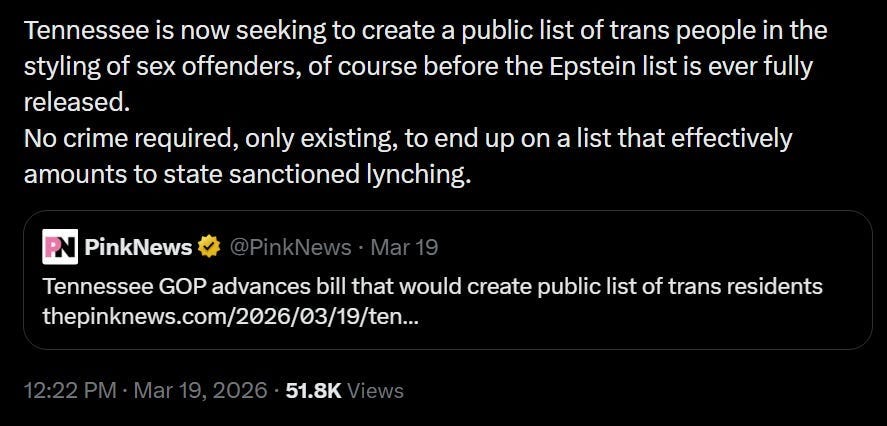
But online accounts are spreading this story as if Tennessee is making a “sex offender style” public registry with the names and locations of all trans people in the state. A bill like this could potentially be used for harm, and it may face court challenges for possibly violating parts of HIPAA by collecting data on county of residence and procedure dates, but the reporting on the bill and viral reaction online make it out to be something completely different. There’s no reason to believe this bill would create a publicly accessible registry or list identifying trans people in the state.

The bill has not yet passed the state senate, and it may not in its current form. Currently it’s unclear what exact form the collected data will take within a statistics report and what level of anonymizing data aggregation will be employed. This is something to keep an eye on if the bill does pass and the state Department of Health drafts guidelines for the mandatory statistics reporting, but the way it’s being reported is misleading. Interestingly, the originating source for the “public list” framing is the same substack outlet that created the false story about ICE now being able to detain people for “looking trans.”

Earlier this month, multiple LGBTQ news outlets reported that the 4th circuit court approved state bans on gender affirming healthcare for adults. On March 10th, a Republican appointed three-judge panel of the Fourth Circuit Court of Appeals ruled that states can prohibit gender affirming surgery from being covered by Medicaid. The ruling affirmed a ban on Medicaid coverage for “sex-change surgeries” in West Virginia, with the panel arguing it doesn’t discriminate against trans people because it applies to specific procedures, not specific individuals.

Certainly bad news for trans people in West Virginia on medicaid, but reporting that this decision could soon result in trans people losing healthcare in other states or nationally is misleading and removes key context. This is not a total ban on these procedures, it’s a ban on state Medicaid coverage of these procedures. The ruling is not a ban on other forms of gender affirming healthcare like HRT, nor does it threaten the hospital’s ability to receive Medicare and Medicaid funds for providing gender affirming healthcare like the Trump admin has threatened, so far unsuccessfully.

Some independent reporters theorized about how this ruling could be laying the legal groundwork to eliminate adult transgender healthcare, but trans journalist David Forbes noted that this ruling will likely be appealed to the wider 4th circuit, which has recently ruled in the opposite direction of this three panel ruling. What panicked assertions of an impending total ban on trans healthcare tends to overlook is that going from a state ban on medicaid coverage for surgery straight to an all ages ban on gender affirming healthcare skips a lot of steps, and those steps are crucially important.

The larger problem here is that panic clickbait induced doomer mindset treats every single horrific potentiality as an inevitable eventuality. This “flooded zone” undermines our ability to accurately assess risk and effectively dedicate resources to oppose pressing threats, like the new Idaho bill punishing public bathroom use with prison time.

The Substack Incentive

So what purpose does this sort of doom posting serve? And why are people so primed to believe it? These panic driven claims rest on the very real fact that trans people are facing present danger. Oftentimes people boosting these panic stories are genuinely trying to help inform their own community of potential harm. In the case of that ICE story, it was based on the assumption that there was a legitimate recent rule change enabling ICE to target people under suspicion of being trans.

It makes sense that people want to raise the alarm about ICE gaining new powers, but ACLU staff attorney Matilda Picasso cautioned, “We are supporting our community by trying to warn people. BUT these warnings need to be clear and accurate. Otherwise we end up inadvertently contributing to the chaos and fear.”

Other times, these panic stories are spread with the hope of scaring allies into caring about the ongoing attacks on trans people. Perhaps successfully in some cases, I don’t know, but as a side effect this strategy deals significant damage to the people it’s trying to protect. Forecasting inevitable doom 24/7 can drive people into hopeless despair and push them away from strategies to fight against the current attacks on trans rights. Panic driven agit-prop could also contribute to a girl who cried wolf scenario where allies start to discount concerns about certain attacks on trans rights due to previous unsubstantiated viral claims.

Though many people spreading these claims may have genuinely good intentions, the people creating these claims may develop certain material incentives. Traditional mainstream journalism has failed to question the massive government overreach into the lives of trans people, and in some cases helped manufacture consent for the stripping away of trans rights. This state of affairs made trans people lose faith in the big outlets, leading to small upstart outlets filling the information gaps in trans news coverage without any institutional backing.

Independent news sites and Substack style blogs have to build an audience and generate traction to stay operating. Turns out thousands of people constantly freaking out creates high social media engagement! This creates a loop where trans panic fearmongering boosts social media engagement, which further encourages more irresponsible clickbait framing.

Those who are successful may slowly develop a new class position which then needs to be maintained. Financial incentives may even pressure journalists who have done good work to fall back on panic driven engagement bait to attract new traffic. This isn’t exclusive to trans outlets either. Following the assassination of Charlie Kirk, Ken Klippenstein reported on his substack that the FBI was about to “designate transgender people as violent extremists.”

New verifiable information was absent from this report, the core evidence was an unnamed “senior official” who told Klippenstein he “feels” like trans people could be labeled “Nihilist Violent Extremists.” Klippenstein has previously misunderstood the NVE label, the term actually predates the Trump admin and refers to groups like 764, other child sextortion rings, and communities like the school shooter fandom “TCC.”

Hours before Klippenstein’s report was published, the Heritage Foundation and the Oversight Project publicly released a petition calling for a new classification of extremism called “Trans Ideology Inspired Violent Extremism,” to categorize attacks they believe are motivated by “transgender ideology.” The petition memo denied that all trans people and their allies would be designated domestic terrorists under this label, only those who “encourage, promote, condone, take, or incite unlawful violent action or threats based on this ideology.” The Heritage petition also runs contrary to Klippenstein’s report by advocating against the use of the NVE label to describe transgender motivated violence.

A Heritage petition to establish a new category of extremist action is different from an unnamed official who “feels” like trans people as a whole could be labeled under “NVE,” and it’s important to understand that distinction. That was last September, it’s now half a year later and neither of these things has come to fruition. The closest was in late September following Trump’s Antifa Terrorism executive order, with the National Security Presidential Memorandum-7 which listed “extremism on migration, race, and gender” as “common recurrent motivations and indicia…of violent and terroristic activities under the umbrella of self-described “anti-fascism,”” among many other threads animating violent conduct. Regardless of that, people online interpreted both Klippenstein’s reporting and the Heritage petition as meaning that the FBI classified the entire class of trans people as domestic terrorists.
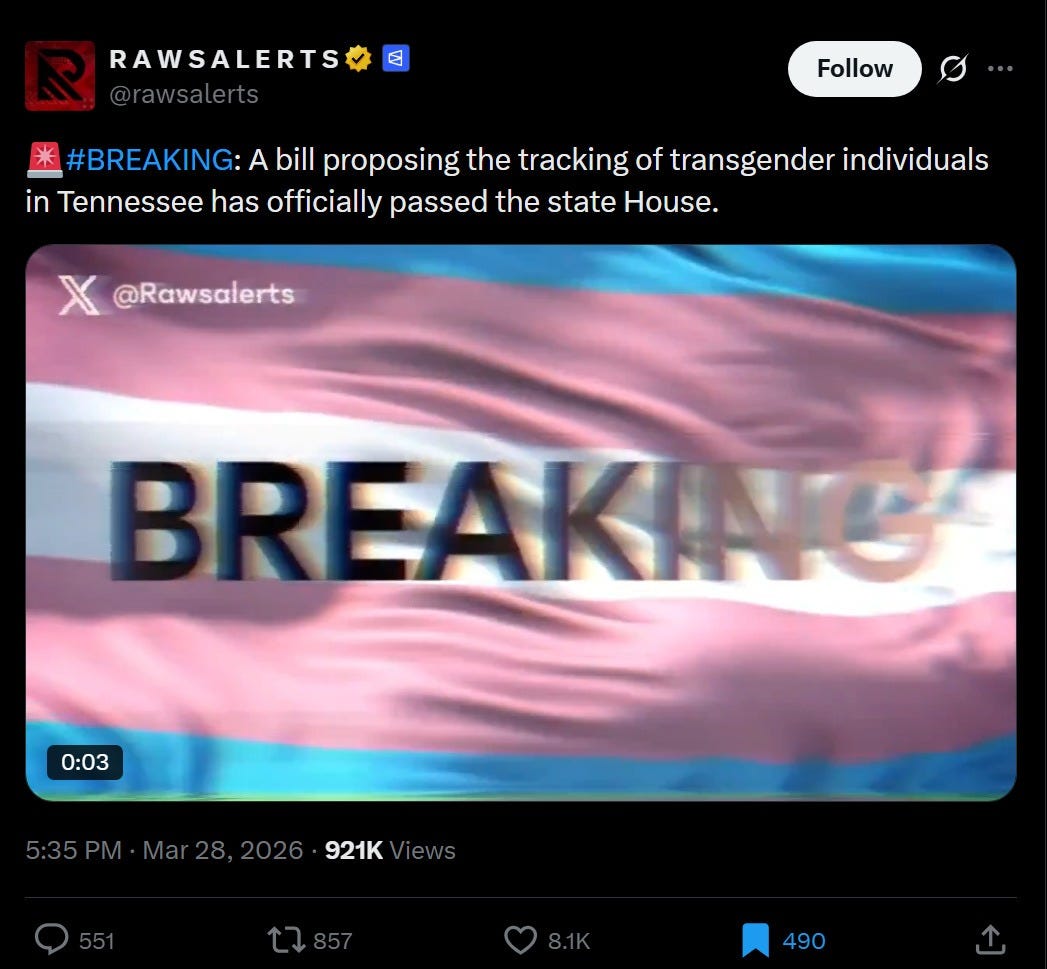
Social media both amplifies and distorts already misleading claims, turning news into a massive game of telephone, and the siloing of certain users and platforms makes countering misinformation difficult. The social media economy carries certain incentives, for the producers of panic bait that could be attention, status, and money. Monetized news aggregation accounts like “NewsWire,” “PopBase,” and the Polymarket powered “RawsAlerts” have figured out that trans panic posting is a cheat code for high engagement. But the consumers of panic also stand to gain something, catharsis, justification for their actions (or lack thereof), as well as attention from fellow consumers. Panic produces helplessness, but helplessness can actually be cathartic for the individual. It’s not helpful for people currently in the most danger.

These clickbait panic pieces explode around trans Twitter which is still quite active, consisting of sex workers, gamers, tttt style posters, and zoomers who think Bluesky is cringe and liberal. Some of these panic stories, like the FDA registry, don’t do very well on Bluesky because that’s where a lot of trans journalists who do actual journalism are. But those journalists are not as active on Twitter and Tiktok, making it harder to counter misinformation on those platforms.

Countering trans panic clickbait misinformation suffers from algorithmic suppression because it doesn’t get people as riled up. A wave of emotionally charged doom posting is boosted much farther than a calm and calculated rebuttal. The biggest TikTok about ICE detaining people under suspension of being trans has 1.2 million views, the biggest TikTok “fact checking” this claim has 290k views.

So much of social media politics is emotional manipulation based on anger, fear, or catharsis. Posting about perceived danger is essentially viewed as a form of activism, and if someone casts doubt on what’s seen as an existential threat, that person becomes emotionally equated with the enemy threat.

So then what is there to do? In terms of the trans panic information economy, don’t be afraid to openly question the legitimacy of certain reporting due to fear of backlash from “the community.” If it’s good reporting, it should be able to stand up to scrutiny. When you see a new story that triggers an emotional response, stop a moment before clicking share and find out where this claim is coming from. A reliable journalistic outlet? An independent publication? What other reporting has this publication done, has it been accurate? Who is the reporter? Are you familiar with their reporting? What else have they reported on? Is it speculative? Are there logical jumps without supporting evidence? Have other outlets reported this differently?

I’m not trying to minimize the danger coming from attacks on trans people, quite the contrary. The right is continuing to take away trans rights, and these threats should be treated seriously. When trying to counter these real attacks, one must be cautious about looking so far ahead into the speculative future that it takes the focus away from the clear and present harms. Healthy skepticism regarding certain claims isn’t about trusting the government, it’s about trying to accurately understand the world in order to change it.


  •  

How The Federal Government Fell

The government of two weeks ago no longer exists. We are now in a fundamentally different country. Under the authority of President Trump, Elon Musk is leading a de facto cyber-coup of the United States. Using the intentionally vague and unaccountable “Department of Government Efficiency,” Musk is seizing control of the United States’ critical digital infrastructure, literally rewriting the code that runs our country, and culling the federal workforce.

Using the justification of removing government bureaucracy, Musk and the Trump administration have installed their own batch of bureaucratic tech oligarchs, made up of former Tesla and SpaceX interns and engineers, Thiel Fellowship researchers, Palantir employees, eugenics enthusiasts, and Nick Fuentes pilled groypers.

Thanks for reading Shatter Zone! Subscribe for free to receive new posts and support my work.

Career employees have been locked out of their respective agencies, both digitally and physically, as the DOGE team ransacks various departments and accesses wide swaths of sensitive government data. Agency officials who tried to resist Musk’s seizure of classified materials have been fired, and more federal employees have been put on leave, including the entirety of USAID. This effectively amounts to Musk abolishing the whole department, all without congressional authorization or oversight, not even an executive order from Trump that exceeds presidential authority. On a whim, the unelected Elon Musk decided to carry out the closure of a government agency. He is far from finished; DOGE has hijacked the Treasury to withhold authorized payments to multiple agencies.

Elon Musk has personally directed the General Services Administration to terminate leases on “mostly empty” federal buildings. The GSA, essentially the landlord of the federal government, was one of the first agencies to receive Musk’s “Fork in the Road” deferred resignation letter offering to buy out the entire workforce. The legality of the letter is uncertain as it promises to pay out currently unappropriated funds. IRS workers who accepted the resignation offer have already been asked to return to work until May.

The newly appointed GSA commissioner, Michael Peters, a private equity executive that specializes in downsizing corporate real estate, has decided that “non-DoD federal building space should be reduced 50%,” according to a GSA employee who requested to remain anonymous. On top of planning to cut the entire federal portfolio by half, DOGE is seeking to cut GSA’s own budget by as much as 50%, with talk of consolidating GSA offices to a few major cities using a “hub model.” Wired reports that DOGE staff may be trying to use White House IT credentials to access GSA computers remotely.

An anonymous GSA employee claims that few people at the agency have elected to take up the voluntary paid resignation offer, with those who have mostly being of retirement age. High-level Trump appointees used “scare tactics” in agency emails, pressuring career employees to accept the deferred resignation offer, warning that cost cutting measures will eventually lead to a further “reduction in force.” Employees are concerned that a reduced workforce would result in federal buildings losing their operations and maintenance contracts, with disastrous consequences for the functionality of government buildings. “The brain drain is going to cripple our ability to maintain the buildings, even more than it already was. We aren’t overstaffed,” per a GSA employee.

“I think this process is already too far along to stop,” adding “I’m hoping we just need to get to the midterms.”

What is happening across the federal government right now is unprecedented. But this is not Germany in the 1930s; it’s not the fall of the Soviet Union. We grasp at analogies to help contextualize current events that escape understanding. There are similarities, but what’s happening is new, very American, and very 21st century. In 50 years it will be talked about in the vein of ‘What happened to the United States in the mid-2020s.’

Rhetoric of cutting red tape and breaking federal bureaucracy has been common political claptrap for decades, and previous efforts have largely been all bark and no bite, but now there’s been a huge chomp. So why now?

DRAIN THE SWAMP

Trump has blamed entrenched federal bureaucracy (or the ‘deep state’) for preventing him from enacting sweeping change during his first term. The obstacles Trump encountered didn't just come from Congress and the courts, but rank-and-file government workers who run the day-to-day operations. Last month the far-right America First Policy Institute published a report titled Tales From the Swamp: How Federal Bureaucrats Resisted President Trump. The author, James Sherk, a former Heritage fellow, credits “hostile career employees” for “refusing to implement policies.”

“Many career employees refused or defied directives, withheld information, slow-walked projects they opposed, performed unacceptably, and used strategic leaking to undermine the president’s agenda,” writes Sherk.

Trump himself realized this late into his first term and sought to remedy the problem by revoking civil protections for tens of thousands of federal career employees, reclassifying them as at-will employees under an executive order called Schedule F. This allowed Trump to treat large swaths of federal employees as political appointments. In his article for AFPI, Sherk refers to career removal protections as a “modern invention that protects entrenched bureaucracy.”

Though Biden repealed Schedule F, Trump effectively reinstated the order on the first day of his second term. Trump promised to restore his authority to “remove rogue bureaucrats” back in early 2023 under his Agenda47 plan, vowing to “wield that power very aggressively.”

When Trump first ran on “drain the swamp” in 2015, he was referring to corporate lobbyists, special interests, and Washington corruption. But now the term is used to deride the so-called “administrative state,” federal agencies, regulatory boards, and bureaucratic career employees that maintain the basic functionality of our government. Both Schedule F and DOGE are part of a two-pronged assault on the administrative state, all in service of consolidating then amplifying executive power.

Trump has fully embraced the unitary executive theory, proposed by the likes of Russell Vought, Project 2025 co-author and the newly confirmed director of the White House Office of Management and Budget. Although it’s understood that Congress has “power of the purse,” under unitary executive theory Trump now believes that the funding appropriated by Congress does not need to be spent; rather, the executive branch controls the flow of federal spending, and Congress merely “sets a ceiling” on spending that the executive must not exceed.

Under this interpretation of the Constitution, the President has sole and complete control of the Executive Branch, including all its agencies and departments. But others, like JD Vance and Elon Musk, could be pushing Trump to go even further. To where “the President considers both the judicial and legislative branches purely ceremonial and advisory,” in the words of New Right philosopher Curtis Yarvin.

And arguably we are already well on our way to that point. This centralized executive power allows the Executive Branch to achieve goals I would have previously considered quite lofty. I’ll outline two examples pulling from the aspirations of the modern conservative movement.

BYE BYE FBI

Though the Right has typically been thought to be firmly in the “back the blue” camp, this isn’t always the case, especially on the more extreme end. The far-right “militia movement” has long clashed with federal law enforcement agencies like the FBI and ATF. In the aftermath of January 6th, many MAGA supporters found themselves at odds with the Federal Bureau of Investigation. Republican politicians began to feed into right-wing uproar surrounding the FBI as Trump himself became a target for investigations.

After the Mar-a-Lago raid in August of 2022, Marjorie Taylor Green tweeted "DEFUND THE FBI!" Arizona Rep. Paul Gosar joined in attacks on the bureau, posting, “We must destroy the FBI. We must save America."

That same month, right-wing columnist and podcaster Liz Wheeler published an op-ed titled “Abolish the FBI,” which called to “farm out the vital functions of the FBI and raze the rest.” The New-Right publication Compact Magazine featured a slightly better written article by the same title, “Abolish the FBI.” At CPAC in March of 2023, Matt Gaetz advocated to get rid of the FBI, among other federal agencies.

In April of 2023, Trump joined in calls to defund the FBI after being charged with 34 felony counts of falsifying business records. Next month, two former FBI employees testified in a congressional hearing, accusing the bureau of “weaponization” against conservatives in regards to January 6th investigations. The same two former FBI employees, who had their security clearance revoked after espousing J6 conspiracy theories, later called to “abolish the FBI” at a Heritage Foundation symposium on the “Weaponization of U.S. Government” in April of 2024.

During a live episode of Donald Trump Jr.’s podcast on July 8th, 2024, he called to abolish several federal agencies starting with the FBI, as well as the CIA and IRS.

The Trump admin has already begun the process to dismantle large swaths of the FBI before Kash Patel has even been confirmed by the Senate. Eight top FBI officials have been fired or forced to resign by order of Acting Deputy Attorney General Emil Bove, despite resistance from Acting FBI Director Brian Driscoll. A questionnaire was distributed to FBI supervisors requesting agents provide information pertaining to their involvement in the January 6th investigations; this was believed to be used for the targeted removal of agency personnel.

Last week the FBI handed over a list containing the information of 5,000 employees and agents who worked on the January 6th investigations. FBI leadership initially chose to withhold employee names; in response, Bove accused the FBI leadership of insubordination. This was ultimately a fruitless effort as data seized by Elon Musk’s DOGE team could easily match employee IDs to names. Trump has since agreed to not publicly release the names of agents until at least late March, as lawsuits continue, and is required to give two days notice if the administration chooses to disclose names.

But individual agents are still worried. An anonymous letter from an FBI agent warns, “Currently, there is an effort to cull a significant number of career Special Agents from the Federal Bureau of Investigation.”

Around one third of FBI agents were told they would be placed on leave, according to a government source who spoke on the condition of anonymity. FBI employees have lost access to systems only to later regain access, while others were told to wait to find out their employment status. Agents are now trying to negotiate back into their jobs, with sources saying FBI employees may be able to stay if they prove their loyalty to Trump and disown the January 6th prosecutions.

I write all this not in defense of the FBI, but to demonstrate how far Trump is willing to go to expand his executive power and transfer law enforcement duties to agencies seen as more loyal to the President. Though I doubt the FBI will be completely abolished in the next few years, the agency could become unrecognizable. A shell of its former self, with hardline Trump loyalists replacing the existing (already largely conservative) workforce. Alternative agencies perceived as being more loyal to Trump, like Homeland Security Investigations, could start picking up the FBI slack. According to a senior government source, on day two of Trump’s second term, HSI was instructed to reopen investigations into the 2020 George Floyd protests “to identify protesters (“blm rioters”), “like they did to us after Jan 6.””

DEPARTMENT OF EDUCATION

Conservatives have advocated for dismantling the Department of Education ever since Jimmy Carter signed its modern incarnation into law in 1979. Most notably, Ronald Reagan tried and failed to abolish the department in 1981, but Reagan’s commission ironically strengthened support for the department. Once Reagan ran into roadblocks, he instead sought to limit the department’s power and influence.

Since Reagan, calls to abolish the Department of Education have been a recurring Republican talking point among certain think tanks and politicians, but they have struggled to land sizable blows against the department. Trump previously fiddled around with merging the Departments of Education and Labor during his first term, but that plan went nowhere.

In Trump’s own Agenda 47 plan released in 2023, he expressed his goal of “closing up the Department of Education in Washington, D.C.” Later at the National Religious Broadcasters’ 2024 Christian Media Convention in February of 2024, Trump repeated the promise, “I will close the federal Department of Education, and we will move everything back to the states, where it belongs, and where they can individualize education.”

Project 2025 outlined how to achieve the effective dismantling of the Department of Education by transferring funding and duties to other departments such as Health and Human Services and the DOJ.

Opposition to the Department of Education was a frequent topic at the 2024 Republican National Convention in Milwaukee, Wisconsin. I attended multiple panels and events taking aim at the department, hosted by groups like Mom’s For Liberty and the Heritage Foundation. On the first day of the convention, the party ratified their official 2024 RNC platform, which called to “close the Department of Education in Washington, D.C. and send it back to the States, where it belongs, and let the States run our educational system as it should be run.”

And now the department seems to be next on the Trump/DOGE chopping block. The administration is drafting a sweeping executive order while Trump says he wants his education nominee, Linda McMahon, “to put herself out of a job.”

The planned executive order would not just direct the Secretary of Education to begin dismantling the department but also ask Congress for assistance in formally abolishing the agency. It’s unlikely Trump would get the 60 Senate votes needed to pass the “necessary” legislation. But even if they can’t manage to technically abolish the Department of Education, he could still try to rip its guts out, slash spending, and forcibly resign or fire employees. Basically make the department simply non-functioning, much like what DOGE did to USAID. Upwards of 16 DOGE staffers are currently listed in the Education Department directory. Federal education employees have already received the “Fork in the Road” resignation buyout offer, while others have been fired for alleged links to DEI.

Without someone like Elon Musk in Trump's administration, there was no clear path towards implementing some of the more lofty plans proposed by conservative thought leaders, whether they be Trump’s own Agenda 47, the Heritage Foundation’s Project 2025, or Curtis Yarvin’s dream of a CEO-King. Only Elon Musk could do this; you need someone with his influence, connections, money, experience, and knowledge of fringe neo-reactionary Silicon Valley political theory to propose and carry out something like DOGE. So how did Musk get here?

MUSK TIMELINE:

Though it's common knowledge that Musk has drifted pretty severely rightward the past 5 years, leading into the 2024 presidential campaign, he was not an out and proud Trump supporter. As recently as 2022, Musk deemed Trump too old to serve as president again, tweeting that it was time for Trump to “hang up his hat & sail into the sunset.” Initially Musk threw his support behind the doomed presidential bid of Florida Governor Ron DeSantis, but as it became clear Trump would be the Republican nominee, Musk fell in behind (his new) party line. Musk’s implicit support of Trump was kept on the down-low. The two met in Florida in March of 2024, among other wealthy Republican donors, as Trump was lobbying for campaign funding. The New York Times reported that Musk did not want to publicly endorse Trump, as of early 2024, telling friends the most he would do was an “anti-Biden endorsement.” Instead of public support, Musk would create his own super PAC to secretly help get Trump elected, timing payments so his fiscal backing of Trump’s campaign could only go public after the election.

But all that changed on July 13th. After Trump’s brush with death in Butler, Pennsylvania, Musk seemingly took Trump’s call of “FIGHT! FIGHT! FIGHT!” to heart, tweeting less than an hour after the attempted assassination, “I fully endorse President Trump and hope for his rapid recovery.” This opened more frequent communication between Musk and Trump. Later that weekend, both Musk and Peter Thiel called Trump to recommend JD Vance as Vice President.

Next week was the Republican National Convention, during which Elon Musk was frequently name-dropped, both by official speakers and regular attendees. Talked about as some kind of mythic right-wing superhero. On the final day of the RNC, rumors circulated that Musk himself would make a surprise appearance on stage. Though said rumors did not come to fruition, Musk's specter haunted the entirety of the convention.

Come August, Musk just finished overhauling leadership at his America Super PAC and was rigorously pushing pro-Trump messaging on X (the everything app). On August 12th, Musk hosted Trump in a two-hour live-streamed phone call, dubbed an “X-space.” This conversation marked the first time Trump casually spoke at length about the assassination attempt. The pair also discussed “migrant crime” and the need to eliminate federal bureaucracy. Trump complimented Musk, calling him “the greatest cutter,” followed up by saying, “I need an Elon Musk. I need somebody that has a lot of strength and courage and smarts. I want to close up the Department of Education, move education back to the states.”

News outlets were more interested in reporting on the stream’s technical glitches rather than Musk’s idea for a “government efficiency commission,” to which Trump responded very positively. Next month, on September 4th, Trump announced that “at the suggestion of Elon Musk,” if elected he would “create a government efficiency commission tasked with conducting a complete financial and performance audit of the entire federal government and making recommendations for drastic reforms.” Musk himself agreed to be appointed head of the commission, aiming to cut “trillions of dollars.”

The New York Times called commissions such as this, “a favorite Washington solution for delaying dealing with hard problems.” The Times later reported that the commission “can issue recommendations around federal funding and regulations but will be powerless to enact them without executive actions by Mr. Trump or funding approval by Congress.”

Meanwhile that autumn, Musk's super PAC mobilized thousands of canvassers across key swing states and collected data to target both enthusiastic and unlikely voters. Throughout 2024, Musk spent over 290 million dollars in contributions in support of the MAGA campaign, mostly via his own super PAC.

On October 5th, Musk made his first appearance at an official campaign event, joining Trump for his return to Butler, Pennsylvania. Musk continued to appear at Trump rallies in the month leading up to the election. By election day, Musk was firmly in Trump’s inner circle, spending election night and most of the next week with President-Elect Trump at Mar-a-Lago.

SPEEDRUNNING:

Now a few months later, Elon is doing to the U.S. what he did to Twitter. By the end it still might technically function on some level, just worse in every way. Prone to glitches and full of nazis. The previous version was already bad and harmful, but the new one somehow sucks even more and no longer has the aspects that made it semi-worthwhile.

The “Fork in the Road” deferred resignation letter sent to government employees used the exact same title as a similar email sent to Twitter employees after Musk bought the company. The DOGE team installed sofa beds on the fifth floor of the headquarters of the Office of Personnel Management to enable working around the clock, mirroring Musk’s previous actions during his takeover of Twitter.

Musk has brought on some of the same exact people who helped him take over Twitter, all of whom are now ‘special government employees’ with odd job titles but immense power.

It was reported in Wired that a Musk stooge told General Services Administration workers that the agency will now pursue an “AI-first strategy,” and that GSA should operate like a “startup software company.”

Musk ordered the General Services Administration to terminate leases for all roughly 7,500 federal offices amidst a national call to return to in-person work. This is, again, a classic Musk move taken from his takeover of Twitter, in which to cut costs, he refused to pay rent for Twitter offices in London, NYC, and San Francisco while the buildings were still in use. A current GSA employee was quoted in Wired as saying, “They are acting like this is a takeover of a tech company.”

Musk’s own personal success hasn't been from his skill as an inventor or software engineer. What he’s proficient at is taking over corporations and molding them in his image. This is what happened to Tesla, SpaceX, and Twitter. In 2020 Musk called government “the ultimate corporation,” and now he seeks to become CEO.

In doing this, Musk is following the tech industry motto ‘move fast and break things.’ So far, all his actions bypass Congress, the slow controller of stable government. Having everything be done via executive order and DOGE helps to speedrun a full reboot of the administrative state. The motto of the old federal government may as well be ‘move slow and build things.’ Progress is slow, but detonation is fast. The breakage of government isn’t a mere side effect or bug of this expedited form of rule; it’s a feature. To reshape the government into their ideal technocracy, first breaking things is a requirement.

They might not get away with all of it, and they don't need to. They are doing SO much, SO fast, knowing they will only get away with some of it. But with new Supreme Court-approved presidential immunity and unlimited pardon power, they can try as much as they want with zero consequence.

These are not the moves you would make if you wanted a stable government. It’s the moves you would make as a new tech company. Which is why Musk’s operation is masked with the Silicon Valley language of ‘efficiency.’ The inefficiencies of government are part of the point! That's what creates stability, makes the country a trusted ally, and gives the dollar value.

"Regulations can be bothersome sometimes and downright problematic...but that's kinda the point. They act as a control on imprecise and rushed decision making. If the cost of doing business is slowing down the process, that's the cost that has to be made,” to quote a government employee who spoke on the condition of anonymity.

But those inefficiencies and pesky regulations really irritate the Silicon Valley tech bros who think they are the smartest people on the planet. It’s their view that since they’re so smart, shouldn't they run the country? Musk has a personal interest in slashing the regulatory state as it interferes with his own businesses and dream of space colonization. Last year Musk claimed that DOGE was “the only path to extending life beyond Earth.” The White House press secretary said that Musk himself will determine when there is a conflict of interest involving his businesses and DOGE. SpaceX alone has received 15.4 billion in government contracts, according to The New York Times.

BUTTERFLY REVOLUTION:

The large reduction in the federal workforce, through the combined efforts of DOGE and Schedule F, bears an irrefutable similarity to a plan outlined by New Right blogger Curtis Yarvin, Peter Thiel’s favorite philosopher. In 2022, Yarvin outlined how a second Trump term could “reboot” the United States government. This plan amounts to a corporate takeover of government, which subsequently reshapes the structure of government akin to a corporation.

Though in Yarvin’s mind, it is not President Trump who assumes the role of CEO. Instead, the President acts as “chairman of the board” and, before inauguration, should select a CEO who is “an experienced executive.” This appointed CEO could then “run the executive branch without any interference from the Congress or courts,” while President Trump reviews the CEO’s performance in the background.

Yarvin writes, “most existing important institutions, public and private, will be shut down and replaced with new and efficient systems. Trump will be monitoring this CEO’s performance…on TV, and can fire him if need be.”

Musk may believe he has successfully maneuvered Trump into appointing him CEO, but Trump could be well aware of Musk’s ambitions but is keeping him around as an emergency patsy, ready to fire when needed. The Trump admin is testing the limits of presidential authority, and once those limits get surpassed by the standards of Senate Republicans, Musk is the easiest guy to blame and push out of the administration's inner circle.

The first step in Yarvin’s plan has the Trump campaign running on centralizing executive power to eliminate government inefficiency. This was in line with both Project 2025 and Musk’s suggestion of an efficiency commission. Once Trump gets into office, the plan is as follows:

Purge bureaucracy, what Yarvin calls RAGE, Retire All Government Employees. This is being carried out by DOGE, Schedule F, and pressuring career employees to accept deferred resignation offers by threatening future mass layoffs. Senior-level officials have been replaced by a batch of loyal tech oligarchs with links to Musk and Peter Thiel. The stupidity of DOGE was almost a secret weapon; the cryptocurrency meme-ness made everyone in respectable society not take the idea seriously. What’s the worst an advisory commission could do with no power to enforce its suggestions? Oops!

Nullify “elite” institutions of power, like the media and academia. Musk’s takeover of Twitter has gone a long way in altering the country’s information ecosystem. The Trump admin seems to be utilizing Steve Bannon’s “flood the zone” strategy to distract and exhaust the media, as well as more directed attacks. On January 31st, the Department of Defense kicked out NBC News, The New York Times, NPR, and Politico from their in-house press offices and replaced them with One America News, the New York Post, Breitbart, and HuffPost. Under direction from DOGE, the White House has ordered government agencies to cancel subscriptions to policy news services from multiple news outlets. A White House advisor told Axios, “The eye of Sauron is on more than just Politico. It's all the media.” For academia, the federal grant freeze has had devastating effects on university research.

Co-opt Congress and ignore the courts; this is where we are at right now. The goal is to reduce both the judicial and legislative branches to being purely ceremonial and advisory, as advocated by Yarvin. So far the Trump administration has effectively sidestepped the legislative bodies via Elon Musk and DOGE. It’s highly unlikely Trump would ever be impeached or removed by this Congress. Furthermore, this Congress seems to have willfully given up their power over the federal budget. “The real challenge is that Congress is on board for now in losing their own budgetary authority,” to quote a senior government official. A lone security guard standing outside USAID and the Department of Education has been enough to deter resistance.

“When Congress is willing to hand the keys over to the president, then we really no longer have, you know, a democracy, or at least the constitutional democracy that was created a couple centuries ago,” says Derek Black, a constitutional law professor at the University of South Carolina. “The bigger danger, I think, is that through law itself, Congress cedes more and more power to the president with new legislation, so if Congress were to pass new legislation giving the president more centralized power, that would be a concerning thing to me.”

The real roadblock is the courts. The Trump administration has already displayed a willingness to ignore the courts, based on the continued halting of federal spending and grants, despite an order from a U.S. District Judge. The Justice Department argued that the order to resume funding “contains several ambiguous terms and provisions that could be read to constitute significant intrusions on the executive branch’s lawful authorities and the separation of powers.”

This past weekend, Musk raged against a federal judge who ordered to temporarily restrict DOGE’s access to Treasury data. Both Musk and the White House have labeled the judge an “activist,” with White House spokesperson Harrison Fields calling the order “absurd and judicial overreach.” On X (the everything app), Musk boosted claims calling this a “judicial coup” and an announcement from California Rep. Darrell Issa to introduce legislation “to stop these rogue judges.”

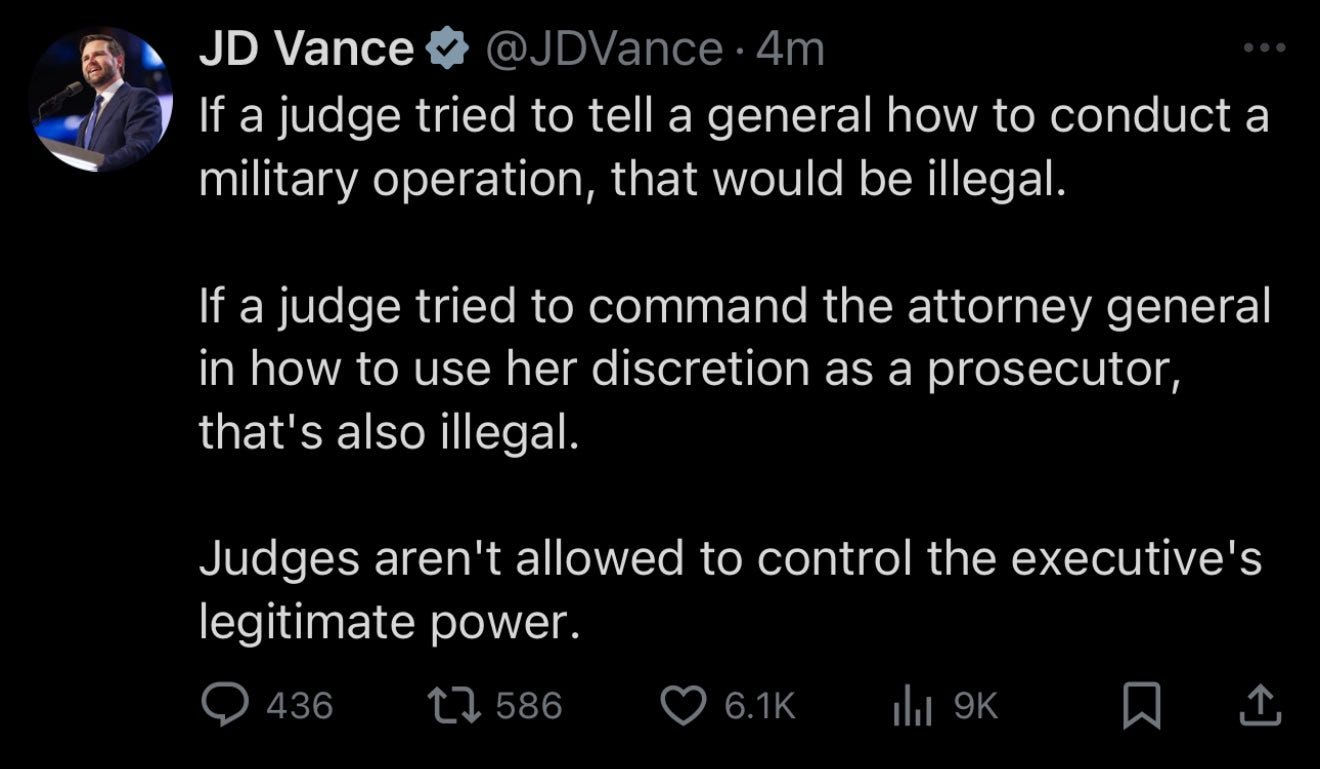
Even without added legislation, Musk and the Trump administration are gearing up to directly defy judicial authority. On Saturday Musk shared a tweet reading, “I don't like the precedent it sets when you defy a judicial ruling, but I'm just wondering what other options are these judges leaving us if they're going to blatantly disregard the constitution for their own partisan political goals?” On Sunday, JD Vance posted a statement undermining judicial power.

Now it all comes down to force. If the executive branch not just ignores judicial authority but blatantly defies it, who would be left to enforce the power of the court? Which leads us to…

Centralize the police; nationalize local law enforcement to place them under federal control. Trump has flirted with this tactic when he deputized Washington police as U.S. Marshals to kill Michael Reinoehl. DOGE staff threatened to call U.S. Marshals when USAID security officials (who have since been fired) denied them access to classified systems. Yarvin believes this step is paramount: “support of the democratic public is a cipher; I think that actually all you need is command of the police.” If you have all the guys with guns, who can physically stop you? Support from the public doesn't hurt though, and if things get tricky Trump could…

Mobilize populist support, but don’t wait until you are at your weakest, at the end of your term after losing an election. Under popular mandate, deploy your empowered supporters at the height of your power to oppose any obstruction from government agencies or the courts. Trump may weaponize Supreme Court-ordained presidential immunity and his unrestricted pardon power to make any willing actor carry out his bidding with zero risk of legal consequence.

Even if Trump himself isn’t aware of this plan, his vice president certainly is. On a far-right podcast in 2021, JD Vance laid out a very similar vision for a second Trump term, using what the Peter Thiel protégé described as a “de-woke-ification program” to purge bureaucracy.

“I think Trump is going to run again in 2024. I think that what Trump should do, if I was giving him one piece of advice: Fire every single mid-level bureaucrat, every civil servant in the administrative state, replace them with our people.”

The future vice president continued, “And when the courts stop you, stand before the country and say, ‘The chief justice has made his ruling. Now let him enforce it.’”

Yarvin writes that the initial goal of the new administration should not be to simply govern, but “to figure out what the Trump administration can actually do—when it assumes the full constitutional powers given to the chief executive of the executive branch.”

What the administration can do once they fully seize this power is so incredibly vast. Without checks and balances, all those “crazy things” Trump tried to do in his first term would be a lot easier to enact, let alone whatever Musk and the tech oligarchs want out of the United States Incorporated. But that is a whole separate topic. The current fight determines the degree to which this power is seized.

Yarvin notes the importance of going all the way: “Trump in 2017 took office; he took about 0.01% of power. If Trump in 2021 wants to have more than 0.001% of power the only way he can do it is to take 100%. To take it all at once, completely legally. The real Donald J. Trump would never have the guts to even think of doing this. (And he’s just too old.)”

All this doesn't even need to benefit Trump supporters, because Trump’s main campaign promise wasn’t mass deportations, fixing the economy, or abolishing the Department of Education. It was retribution. As extremism analyst Jared Holt notes, “The Right got its base so hooked on the idea of ‘revenge’ it doesn’t even have to pretend any of this benefits their base in any tangible way. They just have to say it hurts the ‘wrong’ people and it satisfies them.”

If Trump and Musk continue to get their way it could take years to fix, but the past ten years have shown us you can’t return to normal. There probably is no going back. The options are to hunker down and play it slow and try to survive whatever happens in the next 2-4 years while offering passive resistance. Or accelerate to whatever comes next, put cards on the table, trigger a kinetic confrontation, and fully manifest the results of this constitutional crisis. We are dealing with managing crumbles vs. full systems collapse. Sad face emoji.

Thanks for reading Shatter Zone! Subscribe for free to receive new posts and support my work.

  •  

AI Is Coming For Your Children

The Internet is awash with cheap takes on what AI means for the future. From Terminator-inspired fears of military robots killing their operators to articles claiming AI is going to save education and rescue students (the latter features Bill Gates excitedly explaining how the OpenAI taught a chatbot to pass an AP test). Somewhere in between these two hype peaks is this story about an author who wrote “97 books” in 9 months using ChatGPT.

The real story is rather less exciting than you might think. The “author”, Tim Boucher, used an AI to generate dozens of 2-5,000 word “stories”, each with dozens and dozens of illustrations crudely rendered by Midjourney. He dumped these onto a webpage where people can pay $2.99 if they want to read thrilling stories like “Occupy A.I.”, where protesters square off against cops who look curiously like the bad guys from Spaceballs.

I don’t have much respect for Tim’s project, but its potential for harm is fairly minimal. All of his ‘works’ are geared towards adults. But there’s something more sinister lurking behind the florid headlines predicting AI doom or salvation. The robots are coming for your children.

I was keyed onto this story by a Reuters article about a “boom” in AI-written e-books on Amazon. The piece zooms in on a wannabe author named Brett Schickler, a salesman from Rochester who heard ChatGPT was capable of writing stories and decided he’d been given a new lease on his dreams: “The idea of writing a book finally seemed possible. I thought, I can do this.”

His book, “The Wise Little Squirrel: A Tale of Saving and Investing”, is a guide to financial literacy through the eyes of Sammy the Squirrel, who gets some credit for being the least deranged looking character featured in this article. This book, available in paperback only, is currently around #30,000 in Literature & Fiction for Children.

Late last year Folding Ideas, a YouTube channel run by researcher / writer Dan Olson, published an investigation into a group of Amazon con-artists who promise their followers big money if they take classes to learn how to mass-produce and sell low-quality books on Amazon KDP (Kindle Direct Publishing) and Audible. The topics of the books didn’t really matter, as long as they included keywords that corresponded to popular searches on Amazon. The writing was all done by barely paid ghostwriters. The goal was to trick enough people searching for real books on various topics into buying trash books that the whole endeavor turned a profit.

The main barrier in terms of both production time and profitability was the ghostwriting. A human being can only write so fast, even if they’re just re-wording a Wikipedia article. ChatGPT and other large language models provide an incredible opportunity for these hustlers to increase their output. There’s only one problem: getting ChatGPT to write an entire proper novel (50k+ words) is basically impossible right now. That’s why all of Tim Boucher’s books were just a couple thousand words long.


Children’s books are a different story (forgive the pun) because they are heavy on illustrations but light on text. Each page may only have a paragraph or two without looking suspiciously light. And sure enough, a brief Youtube search reveals video after video with titles like “EASY AI Money: Make $100k Writing Children’s Books with ChatGPT and Midjourney” and “Easy PASSIVE Income With ChatGPT and Midjourney Creating Children’s Books”.

I watched too many of these videos, all of which lay out the same strategy. The first step is to pick a prompt. An actual author might decide, ‘I want to teach children about the importance of conservation with a cautionary tale about thoughtless capitalization of natural resources’ or ‘I want to write a book about a bat raised by birds to show kids that bats are beautiful and complex creatures, not just spooky set dressings for vampire stories’. But chatbots and grindset influencers are both incapable of feeling things, or wanting to transmit their feelings to others.

Instead, the process of picking a topic for an AI children’s book is mechanical and bleak. It starts with a trip to Amazon’s sales rankings. An extension like BookBolt is used to show which topics are selling well without being too crowded by competition.

The most successful AI kids books will only sell dozens, or perhaps a hundred or so copies, but the people making these videos try to bait their hooks by showing sales calculations from successful books by human writers to make the case that AI kids books are an untapped goldmine:

The Zinny Studio notes that you want to copy the premises of real kid’s books that have several hundred reviews, but ideally less than a thousand. My guess would be that this is to avoid doing anything too high profile. You’re looking for a sweet spot where there’s a lot of demand but not too much attention.

There’s also a strategy for price points. The Zinny Studio points out that Amazon pays a 70% royalty rate for books that cost from $2.99-$9.99 but books under $2.99 only pay out 35%.

Some creators will take their research and use it to create an original premise, but for the most part they just collect keywords and ask the AI to generate a story premise, which they then feed back to it, thus avoiding the risk that human creativity might be involved at some point in the process.

There are only occasional weak jabs at encouraging original thought. One guide I found (268k views) was by The Zinny Studio. It cautioned viewers:

“You’re not doing research to find books to copy, you’re doing research to understand what is working. It’s important to make your own original pieces…so you can stand out from the competition.”

But here’s the actual prompt The Zinny Studio used to generate their example children’s book:

“Write me a children’s story about a girl going on an adventure to find a missing treasure. lesson ‘You achieve what you put your mind on’. Make it 6 pages and title each page. make is mind blowing and intriguing”

The spelling and punctuation mistakes are all theirs. As you can see, actual characters, a conflict and a plot are not necessary. This is sufficient to generate something that technically qualifies as a storybook:

“Page 1: ‘The Missing Treasure’

Once upon a time there was a brave and curious girl named Sarah. She lived in a small village at the foot of a big mountain. One day, she heard about a missing treasure that was hidden in the mountain a long time ago. Sarah was very intrigued and decided to go on an adventure to find the missing treasure.

Page 2: “The Journey Begins”

Sarah packed her backpack with food, water, and a map, and set out on her journey. She hiked up the mountain, and along the way, she met many animals who offered to help her. But Sarah declined their help, saying, “I want to do this on my own.”

Page 3: ‘The Cave of Trials’

After several days of hiking, Sarah finally reached the top of the mountain. There she found a cave that led deep into the mountain. She entered the cave and was met with many trials, including steep cliffs, deep chasms, and dark tunnels. But Sarah didn’t give up. She kept moving forward, always remembering the lesson she learned from her parents: “You can achieve what you put your mind to.”

You see what the machine is doing here. The prompt asked for an intriguing story so it described Sarah as “very intrigued”. The prompt asked for the story to include the lesson, “You achieve what you put your mind on”, so ChatGPT had Sarah remember that her parents told her that after she went through a series of “trials” that aren’t actually described.

I found an even lazier example of synthetic storytelling in a video by Christian Heidorn (120k views) whose YouTube channel is called Tokenized AI. He had Midjourney create what he calls a “comic book”, using an equation for story ideas that reads like the brain of every Netflix executive.

Christian decides to have the machine write him a comic book with Indiana Jones / Uncharted-style vibes. The vibes are purely a product of the (derivative, plagiarized) artwork, because the actual ‘plot’ here is nonexistent.

Looking at a bunch of these in a row pulls the curtain aside on AI storytelling. Much of the dialogue is utterly nonsensical- why is Leo saying “That’s my line!” in Scene 1? He’s never said that before in this story, it doesn’t really make sense as a joke. I can only guess that at some point a real person wrote a story with that line as a retort and whatever calculation ChatGPT ran to finish that page concluded it was probably appropriate.

Scene 5 shows us what happens when these things attempt to generate conflict. As a spoiler, Maya and Leo decide not to take the treasure, choosing friendship over greed. But at no point is it explained why they wouldn’t be able to have both. There’s no actual reason for them not to take the treasure. Leo just says, “But at what cost?” and the tale moves along.

What we have here is the simulacrum of a story, technical ingredients arranged in such a way that it satisfies the needs of someone whose only purpose is to trick overworked parents into buying a copy for their child, who will likely be too young to elucidate why something seems wrong with their new book.

Because the text generated by these AI programs is really just chopped and screwed together pieces of actual stories written by people, AI hustlers are very concerned with plagiarism. So they feed their text into apps like Grammarly to run test plagiarism detection scans. Inevitably, the story fails.

Worry not, there’s a simple solution: Quillbot. Billed by its creators as an “online paraphrasing tool”, Quillbot combs through a document and replaces the adjectives and verbs with synonyms (‘courageous’ for ‘brave’, ‘resided’ for ‘lived’ etc). Simply feed your Frankentext into Quillbot and you’ve got something that won’t trigger Amazon’s plagiarism sensors.

(It’s actually unclear to me how Amazon scans for plagiarism. I reached out to one of their PR reps and asked about their policies on plagiarism and AI generated books, but have not heard back at time of publication.)

Once they’ve got passable text, the next step is to create image prompts for all the ‘illustrations’ in the book. Again, there’s no room for creativity here. For each page they ask ChatGPT to generate descriptions of the images needed for that text. Then they feed that text into Midjourney, or Leonardo or some other AI image generator and use it to produce something like this:

By the standards of AI children’s book art, this is actually pretty good. The worst-case scenario is shown in this video (412k views) by Paul Marles. Prior to the AI explosion he was teaching people how to con rubes through Amazon KDP the old-fashioned way. His videos had titles like “$9636 From 30 to 60 Minutes Work!! -Make Money Online With KDP Low Content Books”.  He has dozens of books for sale on Amazon.

Paul ups the ante on laziness here by cutting out the text entirely and instead generating a children’s coloring book he hopes will SEO well enough (because it’s about dinosaurs) to turn a profit. From a half-assed prompt that misspells the name of the dinosaur…

…we get a series of off-putting and biologically inaccurate T-Rex’s, all of which have massive front legs instead of tiny arms. The claws are just as fucked up as AI hands tend to be, although Midjourney is smart enough to hide them, Liefield-like, in the top left image.

Paul’s guide also goes through how to lay out your coloring book for publication, cobble together a cover, and upload it to Amazon where they’ll ship physical copies off to whoever you can trick into ordering one.

My worry here is that the parents who fall for these books are likely to be overworked, with low budgets and little free time to vet purchases. They might just click on whatever is affordable. I also worry charities that provide poor kids with free books might do bulk orders of this junk because the price looks right. In our glorious AI future, rich kids get to color in proper dinosaurs while poor kids grow up thinking Stegosaurus had no tail and the earth used to have a second moon that looked like a human nipple:

Paul did respond to my request for comment. I asked if he was concerned that his coloring book or others like it might have a “negative impact” on children who received the coloring books. Paul did not answer this question. He claimed, “The images I used in the video were just examples and not to be taken as exact images I published.”

But a cursory search of Amazon shows numerous coloring books that look quite similar to the one Paul shows in his video. Here’s his book:

Here are several near identical copies all sold under different names. Note how some have missing legs, or extra legs, or distorted nightmare arms. All are clearly AI works.

I asked Paul if this was one of his or if he thought it was made by one of his viewers. He just said, “that is not my book”. Perhaps I should have sent along this cover, which features what I can only describe as a hybrid of a T-Rex and Salad Fingers:

Despite featuring easily the worst dinosaur drawing I’ve seen in my life, this coloring book appears to be selling reasonably well. At the time this article was written it was #75 in the Teen & Young Adult Drawing category.

In addition to making 3-legged T-Rexes, most AI image generators struggle to keep characters consistent across multiple images within a single book. Most of the creators I followed just ignore this, trusting that what they put out looks close enough to fool someone skimming over the book. If the prompts are engineered carefully enough, sometimes different pictures look pretty close to right.

But that is rarely the case. The laziest example of this I’ve found is from “Treasures Beyond Gold”, the adventure comic book I described earlier. Christian Heidorn, the author, prefers very technical prompts for his images, but this still means that he’s just asking the machine to draw “attractive Western man” or “young Asian woman” on each page.

That results in a comic book where every page features totally different characters, often drawn in different styles. In the second image here she’s been anime’d up by at least 20% and he’s gone from looking like fanart of Dean Winchester to having like 15% Shaggy from Scooby Doo tossed into the mix.

The first of these pictures is supposed to show both characters bumping into each other in a Southeast Asian market while reading identical treasure maps. Not only is no map featured in the image, but it just looks like a head on portrait. There’s no visible evidence of either character interacting.

An adult will have no problem picking this out as just cheap weird shitty AI art. But these books could be quite damaging to little kids. A substantial body of research into emergent literacy (the reading and writing skills possessed by a child before they learn how to formally read or write) has shown that illustrations play a crucial role in transmitting the building blocks of literacy. One study on emergent reading strategies by Judith Lysaker and Elizabeth Hopper of Purdue University notes:

“Emergent reading practices such as wordless book reading are often seen as precursors to the meaning making that comes later during print reading.”

And that’s what actually scares me about Midjourney-generated kid’s books. Small children are info-vacuums, hoovering up observations about the world at a terrifying pace. We know that before they can read, little kids come to understand things like story structure and the meaning of words and phrases by studying the illustrations that accompany text. AI images are generated without any intent or understanding, and as a result they always look somewhat disjointed and off.

So the worry here is not just that parents get tricked into buying bad books. It’s that AI books are so incomplete and broken they might fundamentally damage the way young children acquire reading skills.

AI advocates insist that this is just version 3 or 4 or whatever of [App X], and the programs will only get better and better as time goes on. This is far from a guarantee. For one thing the popularity of these tools means more AI-generated crap will get spat out onto the Internet. Since new AIs will be trained on this content there’s a high chance of creating a feedback loop which can lead to what’s called model collapse. A group of researchers published in the open-access pre-print repository arXiv described this as what happens when the, “...use of model-generated content in training causes irreversible defects in the resulting models.”

I find this particularly worrisome because the present models are already full of defects. Take the storybook generated for a video called “I Create a Best Selling Children’s Book Using AI in Under an Hour”. Here’s the creator, Grayson Sands. I have reached out to him for comment but have not received a response as of publication. His sunglasses irritate me.

He decides to generate a book featuring a character based off a tattoo he got of a Triceratops playing a stand-up bass:

Midjourney did a decent job on the tattoo itself, but as you can see the world behind the character looks a bit…off.

This becomes more obvious in subsequent pages:

Now I can admit there’s something interesting and amusing about the hallucinatory nature of this art, but it has nothing to do with the story, which is about a Brachiosaurus (who plays piano for some reason) teaching a Triceratops how to play bass.

At the end of the video, Grayson tells us how he got his book to be a “best-seller”. It turns out he just called up a bunch of his friends and family and told them he’d written a book that was on Amazon and begged them to buy it. They did, and he shot up through the rankings (it doesn’t take a lot with print books) and started appearing higher in Amazon’s search results.

I can’t tell you how well this actually worked. At present “Dandy the Dinosaur” only has 2 reviews. Both are five stars, but it’s impossible to know if those are real or not. Even if Grayson’s effort to game the system was unsuccessful, other people with more resources, and an actual agenda, will find ways to succeed here. And that brings me to this fellow:

His name is Lucas Kitchen and based on the illustration for his book you’d guess it was about an old man and his dog getting murdered in the woods by a rabid unicorn.

It’s actually much weirder than that. Lucas is an Evangelical Christian who writes sci-fi books about proselytizing on Mars. His story prompt is easily the oddest one I’ve come across, although it does at least seem to have been written by a human.

“Write a children’s story where the protagonist is a little puppy named Fluff. Fluff wants someone to tell him about Jesus, but he can’t read John 3:15, so he needs a solution. The antagonist of the story is a bad unicorn. In the story include a field with trees. Also include magic in the forest. Also include a character who says “uhn uh” over and over.”

Lucas had his kids help him write the prompt. This is potentially a nice learning exercise to do with your children, provided they’re old enough to be thinking about things like story structure in more abstract terms. I can see kids learning from the effort to correct a deficient AI story and turn it into something engaging. But the ‘book’ Lucas generates with ChatGPT is as nonsensical and devoid of actual plot as the others we’ve seen.

“Once upon a time, in a magical forest with fields full of trees, there lived a little puppy named Fluff. Fluff was a curious puppy and he loved to explore the forest and learn new things.

One day, Fluff heard about a man named Jesus who was very special and had done many wonderful things. Fluff was very interested and wanted to learn more about Jesus, but there was one problem: Fluff couldn’t read.”

He even plays AI narration of the story along with the illustrations and records his kids reacting to it. They don’t seem impressed.

There’s nothing really sinister in Lucas’s story but it did provoke in me an unsettling vision: Churches and political organizations with axes to grind and money to spare, generating propaganda content and buying up copies to ensure Amazon’s algorithm spreads it far and wide. It’s a version of the current strategy used to sell autobiographies of politicians and celebrities.

Those books are generally targeted towards adults though. Kids are a lot easier to influence, or at least confuse, and Amazon has no vested interest in stopping Kindle from making money off propaganda for Kindergartners.

In Literature as Exploration, an influential book on educational literary theory, Professor Louise Rosenblatt argues that the reader is a crucial part of any piece of literature: “There is no such thing as a generic reader or a generic literary work; there are only the potential millions of individual readers or the potential millions of individual literary works. A novel or a poem or a play remains merely inkspots on paper until a reader transforms them into a set of meaningful symbols.”

So books, from Blood Meridian to Hop on Pop, are in part a dialogue between writer and reader. But the machines generating these stories cannot participate in a dialogue. They’re Mechanical Turks, guessing what word comes next based on a mix of complex math and the labor of Kenyan contractors paid less than $2 an hour to make sure the responses aren’t too racist.

This is a problem because real books teach empathy. It’s pretty common knowledge that reading long-form fiction makes you better able to identify with other people’s thoughts and struggles. Could being handed enough lazy AI slop in first grade not only impact your future literacy, but your capacity for empathy? There’s no real way to know yet and we have no idea how many kids will be exposed to how much of this stuff.

I reached out to Lucas Kitchen to ask if he shared my concerns about the way these AI-generated books might harm young readers. His book was not the worst offender, but its religious nature did set me on edge. To his credit he responded and gave a reasonably direct answer when I asked if he believed there was potential harm these books could do if allowed to flood Kindle en masse:

“…I wouldn’t say I’m worried, but I would say that I agree with you that there is a lot of crap that is being slung out by people who don’t yet understand their role in the AI generative production workflow. The book that I did was a quick, one hour demo, that would need real work done to it if it was going to be for sale.”

This at least counts as direct by the standards of his peers. Lucas insists that he would never publish a book as unfinished as the one he showed on YouTube. He expressed his belief that there would always be a need for the “artist’s eye, decent editing, a cohesive idea and a vision for what they want to create”. But his attitude seemed to be that the people crapping out disjointed AI kid’s books onto Kindle were just lazy, rather than predatory.

“They jumped into the AI generative world, thinking that they could produce something decent while being lazy. That isn’t the case. It is still hard, artist work to get something that is great. I think that the generative AI model has simply raised the bar for what we will consider great. I think it is advancing art and writing in an amazing way, And the expectations for what we consider good writing and good art will be next level from now on.”

Image added here for no particular reason.

On the whole I have found this investigation dispiriting and worrisome. The upside is that I have learned a lot about the science of building literacy in little people. Education researchers have found that very young children can be influenced towards new behavior by the stories they read. From an article by Peggy Albers in The Atlantic:

“Stories can be used to change children’s perspectives about their views on people in different parts of the world. For example, Hilary Janks works with children and teachers on how images in stories on refugees influence the way refugees are perceived.

Kathy Short studied children’s engagement with literature around human rights. In their work in a diverse K-5 school with 200 children, they found stories moved even such young children to consider how they could bring change in their own local community and school.”

In that last case, students were so moved by the story of anti-child labor activist Iqbal Masih, who was murdered at age 12, that they decided to create a community garden to donate food to a local food bank. Are AI stories capable of inspiring positive actions like that? What about negative ones?

Nobody knows. But we’re all going to learn the answer together, whether we want to or not.

Thanks for reading Shatter Zone! Subscribe for free to receive new posts and support my work.

  •  

The Covenant School Shooter and Right-Wing Disinformation

Written by Garrison Davis, James Stout and Robert Evans

The following is a piece that boils out the current known facts about the shooting at the Covenant Christian school in Nashville, TN, on Monday, March 27th. The shooting has become fodder for a right-wing culture war, and disinformation is rampant, so we felt a text-based piece would be useful to accompany the podcast episode on the subject.

Thanks for reading Shatter Zone! Subscribe for free to receive new posts and support my work.

Here is the story in brief: Audrey Hale, 28, entered a private Christian school in Nashville this Monday morning and killed three nine year old students and three adult staff members in their 60s including the “Head of School” Dr. Katherine Koonce. Hale shot through a side door to gain entry into the school and was armed with at least two “assault-style rifles and a handgun,” according to Metro Nashville Police spokesperson Don Aaron. Some reports suggest one of the rifles was actually an AR-15 style pistol (both weapons are close to identical in this situation).

As the shooter made their way through the first and second floors of the school they fired multiple shots, seemingly at random, before being killed by police on the school's second floor.

Police statements following the shooting were varied and inconsistent. Initially police claimed the shooter was a teenager, but minutes later changed course and described them as a 28 year old woman. Nashville Police Chief John Drake eventually identified the shooter as Audrey Hale, 28, of Nashville. The chief added that Hale “identifies as transgender.”

Both police and most media continued to refer to the shooter as a woman, with NBC printing “Nashville police said the accused Covenant School shooter was a transgender woman,” possibly based on a statement by Police Chief Drake that he gave while answering a question regarding if the shooter was a transgender man or woman.

Some time later, USA Today revised their coverage and reported, “Police identified the attacker as Audrey Elizabeth Hale, 28, a transgender man who was assigned female at birth.”

Chief Drake also stated that Hale was a former student at the school, though he was unsure of what year. His initial statements on motive in particular were extremely muddled and unclear, which is not uncommon in the wake of mass shootings. Drake initially seemed to state that the shooter’s identity, as a trans person, may have influenced the attack. This was taken up rather gleefully by right wing pundits.

Some time later, on Lester Holt’s show, he clarified his previous statements about the possible motive of the shooter: 

“We feel very strongly that she went to that actual school. There’s some belief that there was some resentment for having to go to that school.”

On the question of if the shooter’s gender identity was a factor in the shooting, Chief Drake said “right now we’re unsure if that actually played a role,” and mentioned there were plans for shootings at multiple locations. 

As you can see, the facts here are still rather muddled. The claim that Hale attended the school seems to rest on the recollection of Bill Campbell, who was headmaster at the Covenant School from 2004 to 2008. He told NBC: “I’ve looked back in my annuals, and I do remember her as a former student. She was just one of our young ladies.”

It seems likely that Hale transferred after graduating 4th grade, based on Campbell’s recollections.

The Covenant School is a preschool through 6th grade private Christian school, founded in 2001, it shares the same location as Covenant Presbyterian Church. Its website states the school has 33 teaching faculty and around 200 enrolled students with tuition around 16,000 dollars per year.

According to the school's website, “The Covenant School is a ministry of Covenant Presbyterian Church, created to assist Christian parents and the Church by providing an exceptional academic experience founded upon and informed by the Word of God.”

Aidan and Audrey

A Linkedin page for a “Audrey Hale” in the Nashville area has “He/Him” pronouns alongside the name. 

Hale appears to have had a website for their graphic design portfolio called “ahillustrations,” which has posts tagged as being from 2023. The website has an About page that introduces themself as Audrey Hale, but also directs you to a now vanished Instagram page called “@creative.aiden”.

A self portrait titled “Audrey The Artist” can be found in Hale’s online portfolio, dated as 2022. The artwork is tagged with a different social media username “@crea.tivedre”, which appears to be an old instagram handle before they changed it to @creative.aiden. Hale’s website also has another self portrait with the name “Aiden.”

Although the Instagram page seems to have been taken down, it appears Hale had other social media accounts that are still online, besides the aforementioned Linkedin. A TikTok account by the name of “iam_aiden10” shares a profile picture with Hale’s website and also links to Hale’s Instagram page.

The TikTok account was seldom active, with their first visible post being from March 15th, 2022. Two other posts are from that month, all three of these posts are about late 90s and early 2000s video game nostalgia, and thanks to TikTok’s username embedding feature we can see that the account used to be called “audreyvideogamenerd_10” before being changed to “iam_aiden10” sometime between March 16th and April 15th of last year.

Hale’s last visible post is from just over a month ago, February 9th, 2023.

It is worth noting that, as researchers who regularly comb through the social media profiles of mass shooters, none of us saw anything that would have been an indication of violence in Audrey’s public pages. Right wing media has made a big deal about the fact that Hale made pro LGBT ads, presumably as part of their job:

But there is actually very little to go on at present. Some fuss has been made about Hale’s art depicting Jack Nicholson’s character from ‘The Shining’:

But this appears to be the only piece of art that references The Shining, one of the most popular movies ever made. It’s hard to see how anyone could interpret a single piece of fan art as a red flag. 

The Wet Cement Moment

Whenever some horrific act breaks through the normal cacophony of media noise to draw mass attention, there’s a fleeting period of time in which it is possible to reach people and break through media bubbles in ways that are normally not possible. This is why fighting disinformation is so important in the early stages of a mass shooting, terrorist attack, or similar event. 

The right wing media understands this, and conservative personalities rallied rapidly behind the claim that this was an act of terrorism by a transgender person that justifies punitive responses.

This post from DC Draino (686k+ followers), a “husband”, “patriot”, “lawyer”, “constitutionalist” and “anti-woke”, represents some of the most popular and widely shared right wing responses:

DC_Draino, and many of his colleagues, are eager to paint this as part of a wave of “trans terrorism”. 

The shooting he references as part of this purported trend happened in 2019. A 19-year-old and a 17-year old shooting and killing a student at a high school in Highlands Ranch, Colorado and wounding several others. The 17-year-old, who has been sentenced for their part in the shooting, is transgender. They claimed the shooting was in retaliation for bullying. 

This was, of course, not an act of terrorism. Bullying has been invoked as an excuse by school shooters for decades and there is no reason to suspect the Highlands Ranch shooting represents anything unusual in this country’s long history of gun violence. Still, claims like these have legs, as we see in this post (which earned a comment from Elon Musk).

These are lies as well (the Colorado Springs does not actually identify as non-binary, the 2018 Aberdeen shooting was a workplace mass shooting, not a terrorist attack). 

But the truth is immaterial. The cement is wet and the right is attempting to lock in their narrative while they still can. One of the uglier posts comes from “American Dissident” Stew Peters, who identifies himself as executive producer of #diedsuddenly, which searches for stories of people dying young and blames them on the COVID vaccine. 

Other right-wing influencers have used this to further arguments that gender-affirming care, and not firearms, should be restricted:

Jack Posobiec, a conservative commentator and strategist, was among the first to blame the shooter’s actions on his assumption that they were taking hormones. 

That tactic has already been picked up by Representative Marjorie Taylor Green:

Jack Posobiec clearly sees political hay in connecting this to Tucker Carlson’s recent fear mongering about armed trans people:

There is no evidence that it was “specifically” targeted to Tennessee, and the police have stated the school itself was the target. This doesn’t matter; for Posobiec this is a gleeful opportunity, and he wasted no time claiming unrelated memes supporting the right to self defense for trans people are somehow tied to this school shooting:

Similar cases abound in the right wing fever swamps. The most blatant and shameless example of this is here:

The photo on the left is claimed to be of the Nashville shooter at a protest, screengrabbed from an instagram account named “chicago_patriots”:

This is a fake, as the chicago_patriots instagram itself makes clear:

Luke Rosiak is an “investigative reporter” at the Daily Wire, and has made a career of lying about transgender people.

Rosiak is another of the many right-wing content creators attempting to make links between this shooting and queer self defense training and protests.

Ian Miles Cheong, a far right internet influencer from Malaysia, stoked fear with similar rhetoric about how “much of the conservative public” is “open season for gender extremists.” Without any evidence Cheong’s post also implied a link between the shooting and the recent anti-trans legislation passed in Tennessee, there is currently no evidence tying the shooting to legislative changes or a so-called “Day of Trans Retribution.”

The sheer speed with which this narrative locked into place is stunning, and underlines the importance they give this issue. It is disheartening and horrifying, but also too early to tell whether or not this will spread beyond their fetid corners of the Internet. Early indications from social media suggest liberal and moderate responses to this shooting have been quite different.

Throughout the day, the Highland Park shooting, in Colorado, the Uvalde shooting and the Columbine shooting all trended, as most people rightfully connected this to the increasingly vast history of American school shootings rather than trans people. What is evident so far suggests most people see through this attempt.

Thanks for reading Shatter Zone! Subscribe for free to receive new posts and support my work.

  •  

The Leftist Case for Warhammer 40,000

Sometime around late 2015, as the reality of Donald Trump’s candidacy began to sink in, a series of memes spread depicting Donald Trump as the God-Emperor from Games Workshop’s iconic game setting, Warhammer 40,000.

In the game, the God-Emperor is an ancient, undying superhuman and abusive father. The art above depicts him during his heyday, in a period prior to the game people usually play, when he was carrying out a galactic genocide Hitler would’ve called “extra”. In fact this portrait of him is set literal seconds before he was brutally mauled by his eldest son and left in a near-vegetative state. As things “currently” stand in-game, he’s hooked up to a city-sized ICU bed that has to be fed the souls of a thousand children every day in order to remain active.

Thanks for reading Shatter Zone! Subscribe for free to receive new posts and support my work.

It’s actually a decent allegory for the way power functions in society, the vibrancy of the young and poor used to sustain a sclerotic, largely unaware but all-consuming ruling elite. Art depicting the ‘modern-day’ emperor would function just as well if repurposed as anarchist political cartoons.

This piece of art is by the great John Blanche, perhaps the very best games illustrator alive today and an absolute icon in his field. For some reason, his work rarely shows up in the right-wing memes. It’s a shame. They’re missing some real bangers.

r/ImaginaryWarhammer - Pontifex Maximus by John Blanche

I spent hours staring at this exact picture in the late 1990s, desperately trying to figure out what in the game John was attempting to depict here. Decades later, I’d be struck by how well John’s work seems to capture the attitude of an ISIS fighter posing for a picture.

John’s work is almost psychedelic in its weirdness, it was an incredibly cool thing to set in front of a 12-year-old raised by Reagan Republicans. But I’m not surprised it loses out in the meme-wars to shit like that first picture of the Emperor, which in 2019 found its way to the head of an Italian carnival parade:

Good-hearted fans of the game often say that fascists who repurpose art idolizing the God-Emperor are ‘missing the point’. Warhammer’s roots are, as documented in this wonderful article (and this pretty good one), definitively leftist. One of the earliest Warhammer Fantasy supplements was an extended reference to the 1984-1985 miner’s strike. Orcs, described as “repulsive monsters who live to inflict pain”, initially fought under a banner depicting Margaret Thatcher.

Games Workshop was founded in 1975 by three guys who actually have relatively little to do with Warhammer itself. They were games nerds, and one of them left early on when it became clear that his partners were more interested in “progressive games” (stuff like Dungeons & Dragons and early computer RPGs) than backgammon. The company stayed afloat, and eventually thrived, when it won the official UK distribution rights to Dungeons & Dragons and Runequest.

Early GW shotgunned this first wave of nerd games out into Europe at a rapid pace, which helped fund fund a series of experimental wargames and role playing settings that eventually brought us Warhammer Fantasy Battles. This period, from the late 1970s through the mid-1980s, was the heyday for weird leftist politics in Games Workshop products.

Early Warhammer deserves credit for being progressive in a number of ways. While it did feature plenty of the same tired pop fantasy trends, it has also been noted for its prevalence of strong female characters. Zhu Bajiee, who has done the absolute best writing on this subject, notes:

“The text in Forces of Fantasy makes it explicit: “Dark Elf soldiery is as likely to be female as male; Elf maidens are as cruel and murderous as their menfolk.” This aspect of gender equality, in both text and image, radically subverts established conventions of the fantasy genre. While there are certainly examples of cheesecake or pin-up art, these tend to be non-warrior types such as magic-users. In the early Warhammer oeuvre, the transformation of the Dark Elf from sexy dominatrix to serious combatant is a departure that establishes a tone of equality in terms of representation and ability.”

There were anti-colonial themes in early Warhammer Fantasy supplements, and the heroes were more likely to be depicted as punks and vagrants than defenders of Empire. This is in keeping with the working class backgrounds of many early GW designers. Tony Ackland, who basically created GW’s Dark Elves, was raised by his mother who worked in the pottery industry. John Blanche, famed for his distaste of “pin-up” style drawings of female fantasy characters, was raised on a Council estate in the 1950s. He describes it as “grey and flat”, which helped inspire some of the setting’s most iconic art.

As the 80s churned along, Games Workshop lost the distribution rights to D&D, so they pivoted hard in favor of the weird little wargames that formed an increasing share of their profits. Warhammer 40,000: Rogue Trader was released in October of 1987. The game was initially a big glorious pastiche of every great work of contemporary sci-fi and fantasy. The Space Marines were heavily influenced by the novel Starship Troopers. There were bits of Star Wars, heavy chunks of Dune, and a dollop or two of Tolkien, all rounded out by (one presumes) piles of cocaine taller than Big Ben.  

There were still bits and pieces of leftist imagery, but the female protagonists and extended labor metaphors faded away. The defining characters of Games Workshop games morphed from socialist Dwarf miners and Thatcherite Orcs to the now-iconic Space Marines.

(The Space Marines are the guys in the upper left, not the dude manning the mortar who was clearly based on Fidel Castro.)

In the ‘fluff’ (in-universe story) Space Marines are literal child-soldiers, taken from their families and surgically mutilated to become post-human warriors. In the more self-aware background fiction, they evoke both Ottoman Janissaries and the Children’s Crusade in equal measure. But most Warhammer fiction is not particularly self-aware, and over time the popularity of these models led to ‘fluff’ that was less tongue-and-cheek and more a celebration of how cool Space Marines were.

This change happened mostly from the late 1990s to the early 2000s. In Second Edition Warhammer, where I started playing, there were still hints of radicalism. This art, which was featured on the 40k rulebook, is probably the first piece of Warhammer art I ever saw:

It’s a clear visual reference to the British Empire’s most infamous propaganda art, depicting the disastrous battle of Isandlwana during the Zulu War:

The Space Marines are depicted as struggling, overwhelmed colonial soldiers, thrown into a hopeless slaughter by the careless machinations of their distant overlords. Compare that to this piece of Third Edition artwork, by John Blanche, from just a few years later:

Superficially, this is a very similar piece. But the Space Marines lack any sense of desperation or vulnerability. Much of the grit has been replaced by Cool Guys Posing With Guns. Of course, this is still a John Blanche piece, and it looks undeniably good. But as the years went by, more and more Games Workshop art left the grit behind in favor of stuff like this:

And this…

Warhammer 40,000 is still, at some level, a chilling depiction of a galactic fascist regime, propped up by mutilated child soldiers who enforce a racial supremacist hierarchy via genocide. But it’s easy to miss that in favor of celebrating how badass your favorite Chapter or warrior happens to appear. This brings us back to the memes.

There’s, unfortunately, an awful lot going on here. The quote above the image is from Julius Evola, a fascist mystic who found Mussolini’s politics “too compromising” and eventually took a job working as a spy for the Nazis. After the war he became a deeply influential right-wing occult guru whose work pops up whenever weird groups of Nazis gather to plan terrorist attacks.

In the actual meme, the guys on the bottom are demons of the Chaos gods. To these right wing weirdos they represent degeneracy. The concept for Chaos in Warhammer 40k is basically stolen wholesale from the work of Michael Moorcock. His Chaos gods were neither good nor evil, and in fact they often wound up fighting against the most toxic aspects of the gods who represent Law. Moorcock’s fiction is heavily anarchist, and the Chaos symbol he created can be found on many works of anarchist political theory today.

A good example of this would be the AK Press collection ‘No Gods, No Masters’, which is the first book of anarchist political theory I ever bought.

Today, depiction of Chaos in Warhammer fiction varies widely. Games Workshop is generally smart enough to give their fiction writers a pretty loose hand. If you read novels from their publishing arm, Black Library, you’re as likely to come across hard-nosed military sci-fi about the brutal human cost of war and the staggering incompetence of Imperial Bureaucracy as you are books about how cool it is when a huge guy hits people with his giant metal hand.

Depictions of Chaos, however, rarely have much subtlety to them. The very best you’re likely to get is competent works of cosmic horror. There are some pretty cool stories to tell with Games Workshop’s Chaos, who feed off of human emotions and gradually warp reality around themselves, slowly consuming the galaxy.

Agents of Chaos tend to spread their taint by leading uprisings against Imperial power, often powered by real injustices perpetrated by corrupt Imperial governors. The fact that these dissidents are inevitably doomed by their flirtation with Chaos plays into the hands of weird fascists who see it as an allegory for their revolt against Satanic Marxists. Art like this doesn’t exactly help.

Of course, the fluff is rather more muddled then that. The Emperor himself, back before he wound up in that ICU bed, was on a quest to eradicate the concept of religion from the human soul. This was part of his plan to starve the Chaos gods and save the galaxy for homo sapiens. Everything he did, the child soldiers and interstellar genocide, was to advance this end.

It failed disastrously, of course, and there are several dozen books you can read if you’d like to know more. But the consistent depiction of Chaos as The Worst Thing Ever has led a lot of otherwise well-meaning fans to wonder if the Emperor wasn’t right all along.

I find this interesting, because the bulk of Games Workshop’s fiction depicts the Emperor as an abusive father and a superpowered fascist psychopath, whose arrogance doomed himself and humanity to ten thousand years of the worst government imaginable. Every single book published in the Warhammer 40,000 universe starts with these words.

Over the decades, and all the many changes Warhammer 40,000 has seen, one thing has remained consistent. The Imperium of Man is “the cruelest and most bloody regime imaginable”. The only end result of fascism is suffering and failure, no matter how many cool chainsaw swords come with it.

Thanks for reading Shatter Zone! Subscribe for free to receive new posts and support my work.

  •  

Rationalist Harry Potter and the Collapse of Crypto

Those of you who are regular listeners of the show will know that I got kinda obsessed with the epic saga of Sam Bankman-Fried and FTX, the massive crypto exchange that just collapsed and nuked like, $30 billion of funny money and probably like $8 billion real dollars.

As soon as the company collapsed stories started to filter out about FTX’s sister company, Alameda Research, which apparently gambled away the client funds that went missing in a manner likely to result in prison time for several people. The financial press seemed particularly fascinated by Caroline Ellison, the 28-year-old CEO of the company, on-again-off-again polyamorous lover of Sam Bankman-Fried, and Harry Potter devotee.

Thanks for reading Shatter Zone! Subscribe for free to receive new posts and support my work.

Caroline Ellison

I’m not particularly interested in finance or the nitty gritty of Crypto, but I am endlessly entertained by the way the mainstream press rode the dicks of the people who ran FTX and Alameda. The short of it is that FTX and Alameda were big gambling platforms, in which nerds in their late 20s with delusions of grandeur bet on what are called “shitcoins” while giving interviews about effective altruism and claiming that all of this was being done in the service of charity.

The way the tech press fell for this is fascinating, but today we’re going to look at some of the ideology that helped inspire the greatest disaster in crypto history. And to tell that story, we need to look back at Caroline Ellison, and her obsession with Harry Potter.

I think the first reporting on this I saw was from the totally legit reporting platform “efinancialcareers.com”, which simply noted:

“Before joining Alameda as a trader in March 2018, Ellison spent 19 months as a junior trader at Jane Street after graduating from Stanford University with a bachelor's degree in mathematics in 2016. In a podcast two years ago, Ellison explained that Jane Street was her first job out of college. A diehard mathematician and Harry Potter fan born of two economists, Ellison she hadn't wanted to go into trading but "just didn't really know what to do" with her life.”

A Forbes article, published November 18th, provided more information, claiming Ellison was a “Harry Potterhead”, and that her parents first started reading the books to her when she was three years old.

But if Caroline were just obsessed with the normal Harry Potter series, I would not be writing about it.

Her old Tumblr existed under the name “WorldOptimisation”. Gawker revealed this for an article in which they also noted she was heavily into fan fiction. Several folks on Twitter pointed out that the phrase “World Optimisation” has its origin in another piece of fan-fiction, an epic re-write of the first Harry Potter book called Harry Potter and the Methods of Rationality.

If you are a normal, decent, well-socialized human being, you probably have not heard about Harry Potter and the Methods of Rationality. Actually explaining what this thing is will have to happen in several different stages. But I should start by telling you this re-write of the first Harry Potter book is around 660,000 words long.

The entire Lord of the Rings series, including The Hobbit, comes in at a little less than 580,000 words.

About ten years ago, when the first chapters of Rationalist Harry Potter were posted by a guy name Eliezer Yudkowsky, it was quickly heralded by a weird number of mainstream media figures as a work of brilliance. Legal scholar William Baude, writing for the Washington Post, called it "one of my favorite books written this millennium" in 2015. In 2021, Joe Biden appointed him to the Presidential Commission on the Supreme Court.

Ben Wikler, Chair of the Wisconsin Democratic Party, called Rationalist Harry Potter "the #1 fan fiction series of all time," in The Guardian. David Whelan, writing for Vice, called it “curiously mind-altering” and we’re going to come back to that Vice article in a second because it is very silly. All these guys are very silly.

(William Baude (left) and Ben Wikler (right), two normal dudes who wrote articles about a 600,000 word Harry Potter fanfic and went on to high-powered jobs in the Democratic establishment. This is very funny, as is the fact that Will’s Wikipedia picture seems to have been screencapped during a Skype call while Ben got the best head-shot J.C. Penney could provide.)

First: what is Rationalist Harry Potter about? The story itself is an alternate version of Harry Potter history, where Aunt Petunia’s sister receives the magic equivalent of elective surgery (via her sister Lily) which makes her hot, so she marries an Oxford professor instead of Vernon Dursley. Lily and James still get murdered by Voldemort, so Hot-Petunia and Oxford guy raise Harry, who is also a supergenius in this story.

When Rational Harry Potter he gets his invitation to Hogwarts and learns that magic is real he decides to apply the scientific method to understanding and manipulating the arcane arts. That’s actually not a bad premise for a fan-fiction, or even a work of original satire inspired by the Harry Potter series. Let me assure you that Eliezer Yudkowsky does nothing cool with this idea beyond introducing it.

In a broader sense, the “story” of Rational Harry Potter has very little to do with what the book is about: Rationalism.

Rationalism is a school of thought dedicated to encouraging people to act more rationally, using reason instead of subjective experience to navigate the world. “But Robert,” I hear you cry, “people’s opinions about what the ‘rational’ choice is in different situations can vary wildly, and the scientific method simply doesn’t apply to many of the most important decisions human beings have to make in life.”

Yes, that’s true, but in another, more important way, it’s false, because the world’s sole arbiter of Rationality is Eliezer Yudkowsky, a man who spent five years writing a Harry Potter fanfic so long the audiobook for it clocks in at 500 hours.

In interviews, Eliezer has claimed Rational Harry Potter was written to push the rational skills he promoted in his online community, LessWrong. LessWrong is now sorta defunct, but at its height it was basically a weird little online cult dedicated to Yudkowsky’s teachings. We’ll talk about him more in a bit, but Rational Harry Potter was basically conceived as an advertisement for LessWrong and it worked spectacularly well in that task.

Reading Rational Harry Potter is supposed to equip you with skills to act less irrationally and gain the kind of super-powers the bad sort of psych nerds think you get from reading enough neuroscience abstracts. Here’s how David Whelan explained it in that Vice article I promised we’d return to:

“All those times in the original where Harry grieved over his dead parents or said precisely the wrong thing to Cho Chang to get in her pants, turns out he was acting irrationally.

This new Potter, though, doesn't. He's basically the Jesus Christ of Rational Thought. He owns this book. He hits Voldemort out of the fucking park with a bunt while scratching his ass with his foot. And—here's the kicker—if you start copying him—that is, making rational decisions that overcome cognitive biases—you, too, can make life your bitch.”

First off, none of this is actually true. While Eliezer’s Harry Potter is obsessed with rationalist thought experiments and Bayes’s Theorem, he very rarely solves any problems via logic and intelligence. Instead he gets a time-turner (Harry Potter time machine) right away and then uses time travel to solve nearly all of his problems. I have read roughly 100,000 words of this stupid thing, along with a chapter-by-chapter review by an actual scientist. If you’re the kind of person who learns useful life lessons from Rational Harry Potter, you’re probably multi-billion dollar fraudster Caroline Ellison.

Speaking of which, remember when I said her Tumblr name “WorldOptimization”, was a reference to Rational Harry Potter? It comes from this line, spoken Eliezer’s 11-year-old protagonist:

"World domination is such an ugly phrase. I prefer to call it world optimization."

Rational Harry Potter spends a mind-numbing portion of the book’s total length discussing his desire to take over the world once his rationalist skills allow him to hack magic. He is not depicted as being a bad guy for wanting this.

World domination is a background theme that runs through the whole online rationalist community. In February of 2021 Caroline Ellison posted a list of “cute boy things” that, not by coincidence, describes the protagonist of Yudkowsky’s fanfic perfectly:

There’s a lot more here because the story of Rational Harry Potter, and the community around it, eventually ties into Peter Thiel, Elon Musk, and some of the worst science-fiction I’ve ever read in my life. And if you want to learn more about all that, I’ll be going into much more depth on it with Margaret Killjoy, in an upcoming live episode of Behind the Bastards.

You can buy a ticket now! The show is December 8th, at 6PM PST, and will also conclude a live Q&A afterwards! If you can’t make that time, you can still buy a ticket and watch the replay for whole week. So if you found this article interesting, or you just like Behind the Bastards and think seeing my face during an episode would be neat for some reason, book today!

Thanks for reading Shatter Zone! Subscribe for free to receive new posts and support my work.

  •  
❌