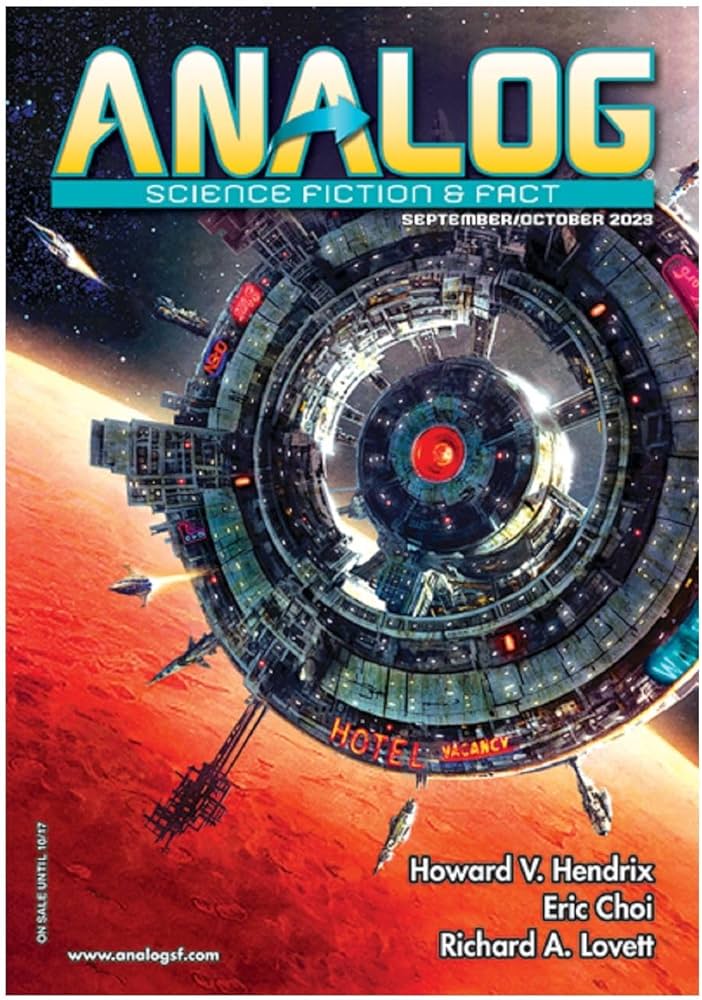
 Must Read Magazines has issued a statement shared by Analog Science Fiction and Fact on Bluesky in response to public criticism by John Picacio, Donato Giancola, Victoria Strauss, and others about its contract terms for artists.
According to the statement,
We previously commissioned illustrators to create covers as work-for-hire when they were asked to adapt authors’ original stories for elements such as cover art.
This will be changing.
The rights granted to MRM are limited, and therefore we can’t protect the intellectual property and rights of the original author of the story, if we at the same time grant the authors’ rights to the illustrator so that the illustrator can then retain an adaptation copyright. We don’t acquire rights from authors that allow us to grant illustrators broad unencumbered use of the worlds, characters, and other elements created by the author.
We’re planning to pause cover contracts based on specific stories for the foreseeable future while we figure out the best way forward with those kinds of commissions.
…
Regarding retention of “moral rights” in illustrations: our licensing agreements for original art and original fiction use language prepared by an international IP attorney based on notes we received from SFWA’s contracts committee. These kinds of agreements no longer include a waiver of moral rights.
We always appreciate when contributors to the magazines express their concerns.
The response comes after a public memo from Picacio shared to “strongly advise” against submitting stories to or creating art for any of Must Read’s magazines. Picacio has sent Locus a copy of the boilerplate contract he received. Elements he rejected read as follows:
Artist hereby waives the benefits of any provision of law known as “droit moral” and/or “moral rights” or any similar law in any jurisdiction of the universe and hereby agrees not to institute or support, maintain, or permit any action or lawsuit on the grounds that the The Work or any ancillary uses thereof violates any of Artist’s rights or is in any way a defamation or mutilation of the The Work. Company shall solely own the copyright in the The Work. Neither the suspension nor termination of Artist’s services nor the expiration of this Agreement shall in any way adversely affect Company’s ownership of the The Work.
Company or its divisions may be credited as the copyright holder of the work…
Workable files shall mean layered files suitable for use in Adobe Photoshop or such similar software.
At no additional cost, Company will be presented with at least Two (2) and at most Three (3) rounds of drafts of the The Work for review by Company. … Company may instruct Artist to make changes up to Three (3) times upon review of the The Work and drafts inclusive of Company’s notes on such drafts.
The contract sets the artist’s pay at $1,200. Giancola, who reported in a separate post that he rejected a cover art contract offering the same pay, described this as being “on the low side and the same fee they had offered six years before for similar work.” Giancola also strongly criticized the usage of a work-for-hire agreement, “NOT a contract structure I had worked under before for ANY of my previous Asimov’s covers,” as well as several other terms for “deviat[ing] far beyond” his contracts with other SF publications, including some of those quoted above.
I went back and forth in contract revisions with Asimov’s SF legal department five times over three months. Nearly as much time was spent on these negotiations, legal revisions, and emails then what I would put into creating art for a final illustration. All for a $1200 fee on a commission who’s legal contract issues were settled in a five minute digital handshake six years ago.
At the end of June, while their legal department was still soliciting me to supply a Non-Disclosure Agreement I would be fine signing after stating I would not sign one, I told Asimov’s SF to find another artist. Their legal department was not negotiating in good faith to get me to work on their magazine – they were looking for an artist to exploit.
Strauss commented on the subject on the SFWA-sponsored Writer Beware blog: “[E]ven if the publisher is willing to make changes, [writers] must think about what it says about the publisher, and its attitude toward its writers, that it would offer a bad contract to begin with. … [W]riters shouldn’t be afraid to negotiate, and publishers should be open to change. It’s just really important not to let the details obscure the big picture.”
Scott Edelman, who has previously written about his decision to withdraw all submissions to Must Read, also commented on the company’s statement: “This defense from the publisher of Asimov’s, Analog, and F&SF is no defense at all. I’d hoped those of us who’d protested rights-grab contracts last year had caused a change in the way the company dealt with creators, but sadly, all three dream markets must still be unacceptable outlets for me.”
For more information, see previous coverage by Locus, including Must Read’s acquisition of several SF/F magazines, its delisting from The Submission Grinder, SFWA’s provision of contract notes, and Must Read’s announcement of contract revisions.

 Login
Login

 The winners of the 2025 Australasian Shadows Awards have been

 “Guardians of the Well” by Rose Strickman (In Another Time 6/25) has been announced as the winner of the 2026 Washington Science Fiction Association (
 Winners of the French-language Prix Boréal have been
  The winners of the 2026 Colorado Book Awards were revealed at a ceremony located in Denver CO on September 26, 2026. Titles and authors of genre interest in categories with winners of genre interest include:


 The six-title shortlist for the 2026 Booker Prize has been announced, with works and writers of genre interest including

 a “non-profit dedicated to bolstering the careers of nascent professionals working with the speculative arts,” has
 The African Speculative Fiction Society (