❌

Reading view

Site Outages and a Slower Holiday Week

Hey folks. Like the rest of the internet & other tech infrastructure, KDO has seen some outages in the past week or so, amounting to a few hours of downtime. Our time here together isn’t what I would call mission critical — reading the site an hour or two after you’d originally wanted to is not the worst thing in the world — but it’s still a bummer to have the site be unavailable.

The reasons for the KDO downtime have been various, but that it occurred around the same time as some of these other outages isn’t, IMO, coincidental. Security researchers and developers armed with LLMs are going bananas finding exploits in a bunch of the software and infrastructure underpinning, well, everything. On the other side of the aisle, sysadmins are scrambling to fix all of these newly found exploits.

But of course, poking holes in things is easier & faster than plugging them. LLMs can help with the patching,1 but it’s asymmetric warfare — being slow & careful with upgrades and patches isn’t a luxury you have when so many things are coming at you on a daily basis. Hopefully the situation won’t get too much worse before it gets better, but in the meantime, I’m thankful for everyone who is trying to keep these systems running. 🙏

Second thing: after a few months on the other side of the world, I’m spending some time with my family for Thanksgiving, and so the site will be a bit slower this week and very early next week. I’ve been pushing quite a bit over the past several weeks and it’s nice to take a bit of a break.

  1. And it’s probably hurting in other cases, with inexperienced teams rolling out LLM-coded “upgrades” that do more harm than good. ↩

Tags: kottke.org
  •  

The Energy Tax of Living in a New Place

Laura Serbest writing on Instagram:

Before moving abroad, I was really independent. I loved socialising, visiting new places, trying new things. But over the past few years I’ve become so much more anxious and reserved, and I only just realised why.

When you live somewhere familiar, life is second nature. You know the language, the systems, the culture, and the social expectations. You have routines, support and things are predictable.

But when you live abroad, the energy required to participate in life increases. Socialising, going to appointments, buying a coffee, answering the phone. Everything requires so much more planning, energy and courage.

When you’re already mentally exhausted, you have less energy for the things you want and should do. You avoid situations that feel difficult. You become more reserved, less confident, more isolated and less independent.

I’m writing this at the airport after spending 2.5 months in Tokyo and feeling the above acutely. I’ve never been what you’d call outgoing, but after the initial rush of being here wore off after a few weeks, I definitely noticed myself becoming “more reserved, less confident, more isolated and less independent”. Some days, I barely left my apartment because I couldn’t bear summoning the energy to make a plan, negotiate a new restaurant, or figure out how to get from point A to point B on the train. I sought out places that were easy: online ticketing, digital ordering screens, English menus, chain stores & restaurants.

The confidence piece is probably the hardest for me. I have to work hard in social situations with people I don’t know, and doing that in a language I don’t speak and in a cultural context I don’t fully understand is challenging, especially when I need to do it 10 times a day. I rely on humor in situations like these and, well, I don’t know how to be funny in Japan.1 Confidence tends to be a pervasive trait — a dip in one area of your life causes an overall decline across many areas. And all this is coming after living for the past decade in a place where I never felt like I fit in.

Anyway, it’s been eye-opening, this shift in energy & confidence. I’m onto the next place soon, but this is something I definitely need to keep an eye on.

  1. Tbh, I’m barely funny in English on a good day. But it’s the attempt that counts. ↩

Tags: Jason Kottke · Laura Serbest · travel

  •  

The Kottke.org Video Closet

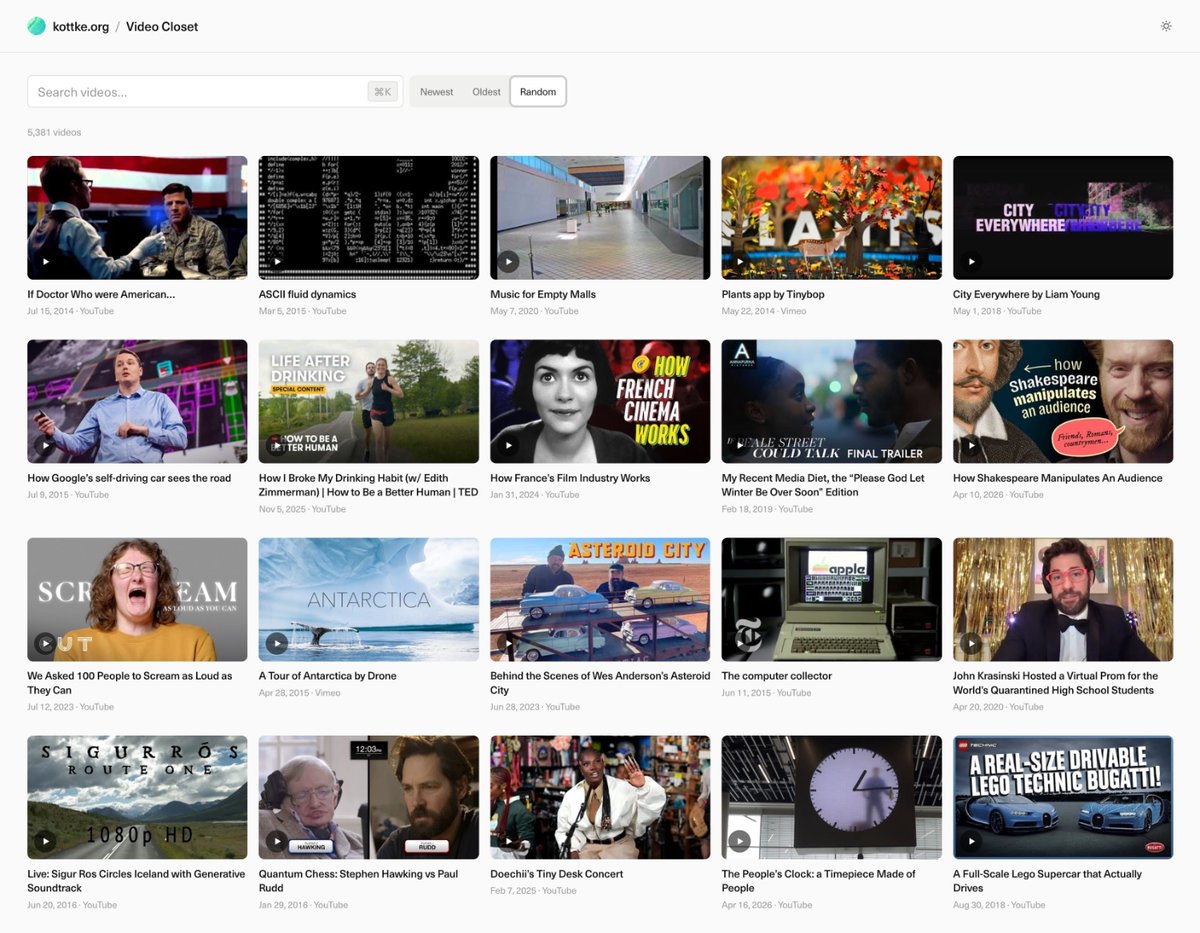
Ok folks, I’m gonna apologize in advance for totally ruining any plans you might have had for the rest of your day. This weekend I knocked together the Video Closet, a simple tool for exploring & watching every YouTube & Vimeo video1 I’ve posted to KDO since 2014 that’s still live: almost 5400 of them in total. It’s like a YouTube that’s just for people who read KDO. Click a video to play it or click the title to go to the original post containing the video.

The toughest thing about building the Video Closet was getting repeatedly distracted by videos while I was testing it. Seriously, don’t open this thing if you want to get any work done for the rest of the day!

I also tweaked how video embeds work on the main site: there’s now a play button (plays the video in place), an “open on [service]” button (opens it in a new tab on YT or Vimeo), and, on desktop browsers, a widescreen button that embiggens the video in the current window and plays it (my favorite). I like rolling my own video embeds because the default ones from YT & Vimeo are heavy and include a lot of tracking — and now you can choose three different ways of watching, according to the customs of your people.

See also a bunch of other stuff I’ve launched lately.

  1. I didn’t include Instagram because Instagram doesn’t want to be part of the open internet, their embeds suck, and a few more reasons I could probably think up if I wanted to spend any more precious seconds on this. ↩

Tags: kottke.org · video · Video Closet

  •  

Map of New England Places Everybody Pronounces Wrong

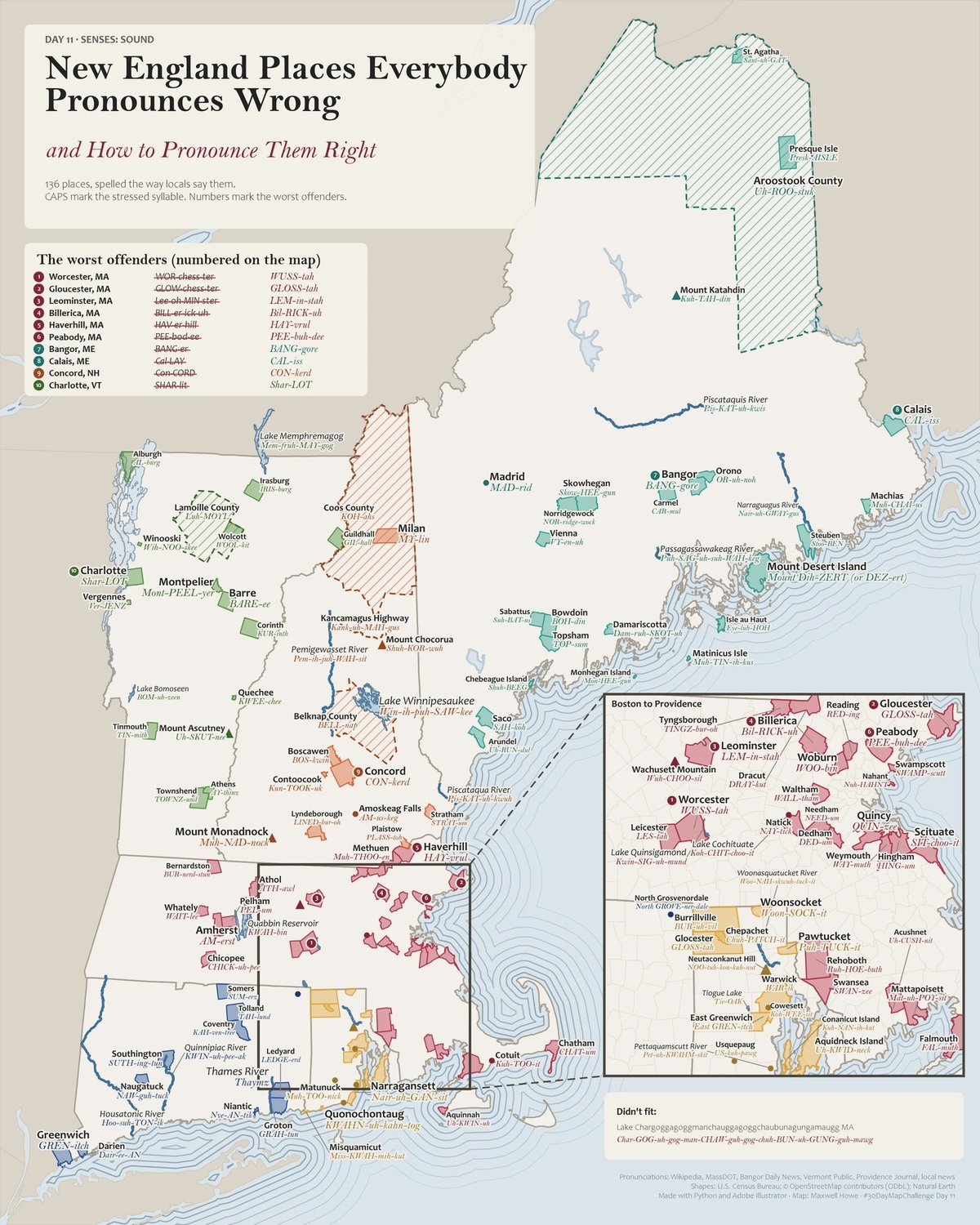
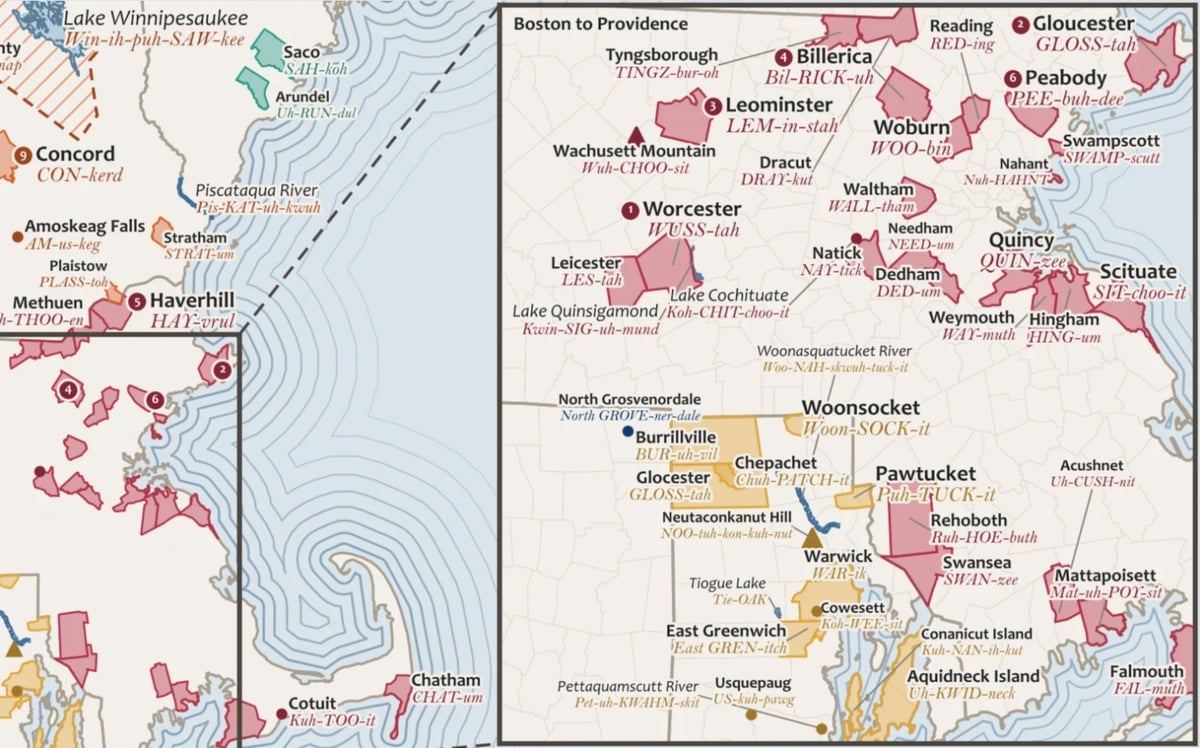
As part of the 30 Day Map Challenge, Maxwell Howe created a map of New England places that many out-of-towners mispronounce (Instagram). As you would expect when you start talking about local pronunciations and accents, he’s getting some blowback:

You’re mixing accent with correct pronunciation. It’s only WUH-stah if you have a non-rhotic accent. If a non-native dropped that instead of “WUH-ster” in conversation they’d sound like an asshat. Same with Lem-in-ster et al. You do this correctly when you write Concord as CON-kerd, where the local accent would have it sound like “CON-kid”…. We expect the accent on the first syllable, but not for the R to drop. Source: native new englander with a rhotic accent.

Growing up in the Midwest, we had plenty of our own place names like this: Madrid (MAD-rid) and What Cheer (WATCH-ear) in Iowa were two of my favorites.

As a baseball card collector in my teens, I was familiar with the Rhode Island city of Pawtucket from the minor league stats listings on the backs of the cards of Red Sox players (Pawtucket is the Sox’s AAA team). My friends and I pronounced it like it looked. It was only when I went to a Red Sox game like 15 years ago that I overheard a guy talking about some prospect coming up from Puh-TUCK-it (he made it sound like a single syllable somehow) that my eyes went wide and my brain exploded. That’s how you pronounce it?

Tags: language · maps · Maxwell Howe

  •  

Staying Cool at the Airport

A comment by Adam Keys about showing grace in airports over on Craig Mod’s site reminded me of this story from the introduction of Genny Rumancik’s book The Wisdom of Feeling: Finding Clarity, Courage, and Connection Through Emotional Intelligence:

I was in the last boarding group, and when they finally called our zone, there was a bottleneck of people trying to get in line to board. As I stood waiting and shuffling around, I watched as a man took a step forward to get in line and saw him step right in front of a woman who was on her last nerve.

She threw her hands up in the air and spoke angrily but passively to the man’s back, “What an ass. Oh, well, I guess you must be sooo important—you should just go right ahead! Don’t worry about the rest of us.”

She rolled her eyes and heaved heavy sighs, throwing a little tantrum.

The man didn’t realize he’d done anything wrong, and it took him a moment to realize the kerfuffle happening behind him was related to his actions. As he turned around and saw how flustered she was, he reacted with genuine wide-eyed surprise and apology, “Oh, I’m sorry! Please, go ahead.”

The woman doubled down.

Hands up, avoiding eye contact, exaggerating sighs, and waving him forward. “No, no, no, go ahead, Mr. Big Shot.”

The man paused and turned like he was going to walk forward but then stopped.

He took a breath, turned all the way around to face the woman, and gently said, “This feels important to you. Please, I would like for you to go ahead of me.”

He stepped to the side and calmly gestured for her to go forward. There was no passive aggression, no sarcasm, no hidden agenda. Those of us watching could feel that he meant it.

At this, the woman deflated. Her aggressive energy melted.

She began apologizing, “No, I’m sorry, I’ve had such a hard day. That damn delay just put me right over the edge…”

“I completely understand,” he responded, smiling and nodding back at her.

By then the line was moving forward. I took my place behind them and listened to their amicable conversation about holiday plans as we boarded the plane.

This was a small moment in time—an interaction that took maybe ninety seconds in total—that impacted me deeply. I was so impressed by how this man was able to be present to this woman’s aggressive behavior in a tense, public setting without taking it on or responding defensively.

He remained calm, present, and genuinely kind, and in doing so helped her regain her own composure, which then resulted in a warm connection between the two of them.

His maturity neutralized the tension in the space, making it safer for everyone else in the vicinity, too.

There’s so much aggression in airports…it brings out the worst in people. Ever since reading this passage, I have been trying to be more mindful and chill in crowded public spaces.1 Part of that effort, as it relates to airports in particular, involves this advice: “Arrive early and move through the airport like the Dalai Lama.”

  1. This advice works for crowded online spaces too. I feel like the KDO community guidelines are geared towards creating this type of atmosphere in the comments section here. ↩

Tags: books · Genny Rumancik · The Wisdom of Feeling

  •  

USPS Announces Mythical Creatures Stamps for 2027

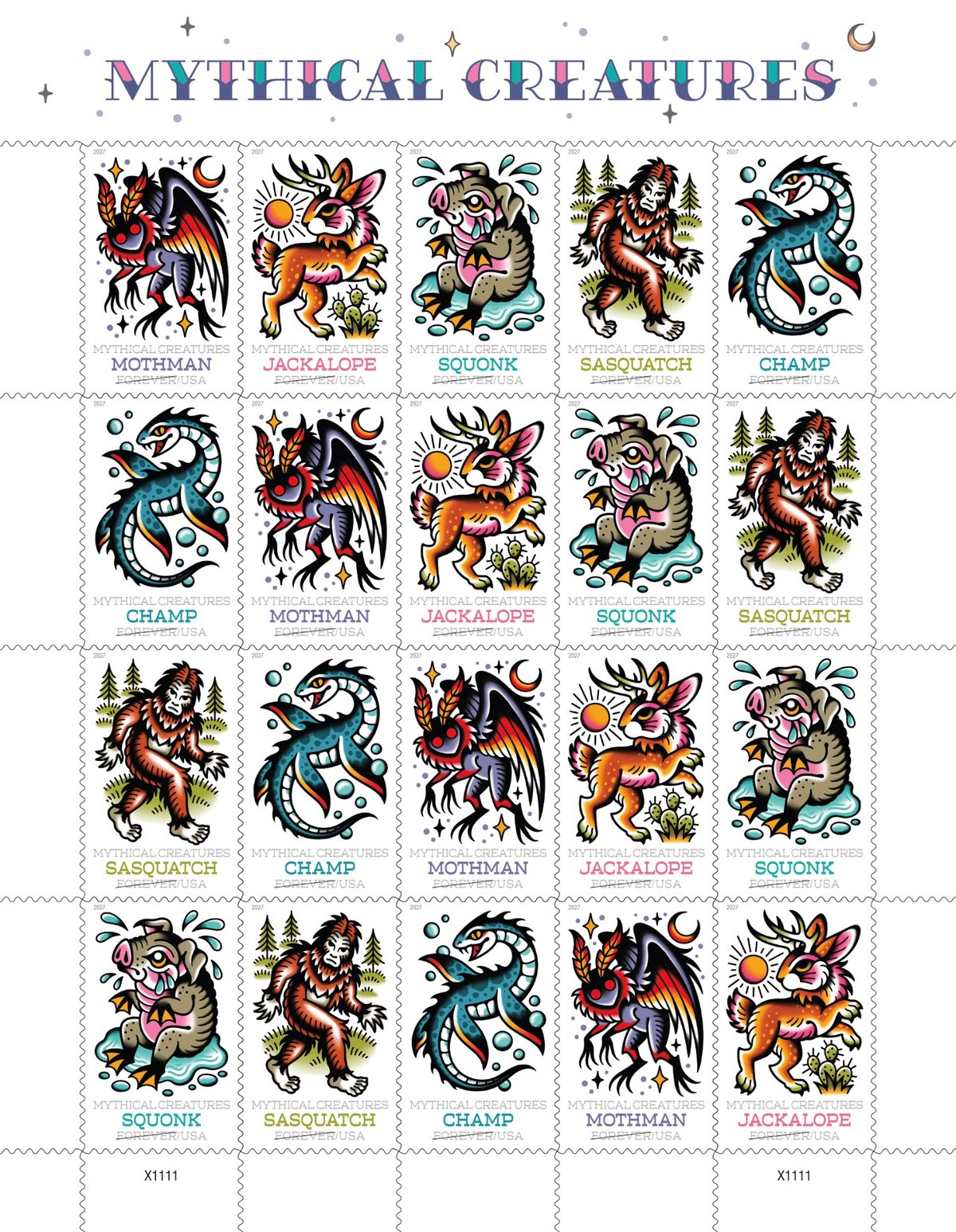
The US Postal Service recently released a partial list of the stamps it’s putting out in 2027. One of the sets is Mythical Creatures, featuring five cryptids.1

The legend of Mothman has endured for more than six decades, but of the creatures encountered on these stamps, this flying, man-sized, red-eyed being emerged the most recently. The cryptid was first reported in West Virginia in 1966. Several nights after a gravedigger reported a winged, human-sized creature swooping above, two couples on a midnight drive in the rural outskirts of Point Pleasant reported being chased from overhead at great speed as they fled back to town. Newspapers dubbed the creature “Mothman.” After a year of eerie sightings was followed by a local tragedy, some interpreted the appearances as harbingers of disaster. In the years since, a lighter side of Mothman has been embraced by festival attendees, many in “spooky-cute” costumes that evoke this increasingly popular cryptid.

Unlike most of the creatures on these stamps, the Jackalope has been spotted by a great many Americans. It has multiplied rapidly, especially in the West, since first appearing in the 1930s in Douglas, Wyoming. This antlered rabbit was the creation of two young brothers studying taxidermy by mail who, in a moment of inspiration after a hunting trip, crafted the hoax. When the masterful mashup was displayed at a local inn, the Jackalope quickly sprang into regional folklore. Today, Jackalopes are found in gift shops in the Great Plains and Western states — on postcards, stickers, and T-shirts, and as plush toys and mounted specimens. The fanciful hybrid endlessly inspires the imaginations of those who encounter it, and who add to its lore with their own stories, songs, and artworks.

The Squonk hides away in northern Pennsylvania’s dense hemlock forests, so distressed by its own appearance that it cries constantly. This piglike animal, wrinkled, blemished, and self-conscious, was first described in print in a 1910 collection of lumberjack folklore, Fearsome Creatures of the Lumberwoods. The book — recounting tales often spun and re-spun by the fireside in remote logging encampments of the 19th and early 20th centuries — relates an episode of a Squonk captured in a bag: As the hunter carried his prey, its weeping faded and the sack grew lighter. Investigation revealed that the Squonk had melted into “nothing but tears and bubbles.” In recent years, the melancholy character has been revived as a darling mascot of introverts and anyone else who relates to the Squonk’s social anxiety.

Sasquatch captures the American imagination like no other cryptid. Nobody, though, has captured Bigfoot, as this large hairy hominid is commonly called, nor even retrieved a confirmed strand of hair from its notoriously stinky, shaggy fur. In the Pacific Northwest, ancient Indigenous tales of mysterious, hairy humanoids encouraged caution in the wild and mindful custodianship of forest habitat. By the late 20th century, reported sightings of Sasquatch and similar regional creatures had taken hold and spanned the nation. In fact, tales of huge bipeds are told worldwide, almost anywhere shadowy terrain could conceivably conceal such elusive beings. Hoaxes abound, including blurry films and casts of outsized human-like footprints, but the most notable impression Sasquatch makes is its lasting mark on American popular culture. Even if our most famous mythical creature is nowhere to be found, Sasquatch is everywhere.

Champ, as the Lake Champlain monster is affectionately known, is said to dwell within the nation’s sixth largest lake, which defines more than 100 miles of the New York–Vermont border. A glacial lake reaching 400 feet deep and 14 miles wide is bound to contain mysteries — over the last few centuries, hundreds have claimed to see the serpentine organism. Cryptozoologists have tried to determine what it could be: perhaps a descendant of an aquatic, dinosaur-era reptile or whale, as found in fossils? Skeptics point to more mundane possibilities: sturgeon and other large fish that inhabit the lake, swimming deer, waves, mirages, and tree trunks riding currents. While a living specimen has proven elusive, Champ is ever-present as a beloved mascot of the region, celebrated in business logos, and in festivals and museum exhibits.

The stamps feature the artwork of tattoo artist Nat Power and will be available next year.

  1. The 2027 stamp lineup also includes a set of unicorn stamps. So many fantastical animals! ↩

Tags: design · stamps · USPS

  •  

10 Years of Kottke.org Membership

An important KDO milestone whooshed by the other day and I was so heads-down on tuning up the new search engine (more on that below) that I missed it. So: it’s been 10 years since I started the KDO membership program! (Quick recap of the value proposition from the membership page FAQ: “kottke.org is my full-time job and member support keeps the site free, open, and available to everyone on an internet that is increasingly paywalled.”)

10 years! It is impossible for me to overstate the impact membership has had on my work. Beyond the simple fact that KDO wouldn’t exist without it, membership support allows me the freedom to choose when, where, how, and why to work, resulting, IMO, a better place for all of us to spend time.

The last couple of years have felt especially membership-inflected and influenced. We’ve been working together on building the KDO comments into a quieter haven for sharing stories and information, outside the social media networks driven by algorithms and outrage. It’s taken time, but KDO is starting to feel like a neighborhood joint where folks can stop by and find a welcoming place for interesting conversation.1 And more to come!

I’ve also been working hard on different ways of helping people find stuff to read/watch/listen to online and just generally making things easier to use around here. There’s:

  • The Rolodex (which includes a mini feed reader for members), which is a list of the sites and people I read that you might like too.
  • Improvements to the comments to help make following & having conversations easier. This has been a steady effort — tweaks and new features every few months since launching member comments three years ago. (How has it been that long?!)
  • Prometheus, a search & discovery tool for gift links, open only to members for now.
  • KDO site search. Still only open to just members. I spent a lot of time over the past weekend tuning it to return better results, and I think we’re getting somewhere. Improved the speed as well, at the expense of, well, increased expense.2 It’s still not magic, but I’m hoping to open this up to everyone soon.
  • Underscore, a web-based music player I built for listening to music across multiple streaming platforms while I work. Anyone can listen to my collection and members can compile their own collection to listen to.

And this is in addition to the site’s usual service of curated links and posts. A lot of this has happened in just the last month — Jesus, Kottke, slow down! — but I’ve been working on some of these things, on and off, for years. I couldn’t focus on this stuff for months and months earlier this year — launching requires a level of attention that’s difficult for me to muster when other things are going on. Getting the move behind me and establishing myself in surroundings more suitable to my temperament has been a real boon.

I hope all of this adds up to a place and project that people want to make use of and support. Twenty-something years into doing KDO as my full-time job, I can honestly say I am enjoying it more than ever. Thanks so much for reading and for your support. If you’re not yet a member and want to join us on this ride, you can check out your membership options here — it only takes a minute to sign up (less if you use Apple Pay or Stripe’s Link autofill).

  1. Maybe KDO readers have always felt this way about the site, but for me, the comments have livened things up and added a new dimension to things. ↩

  2. I’m using a couple of outside services for search, but at the relatively small volumes I’m dealing with, it won’t come to more than a few bucks every month. ↩

Tags: kottke.org

  •  

The Ten Best Captain Picard Episodes of Star Trek

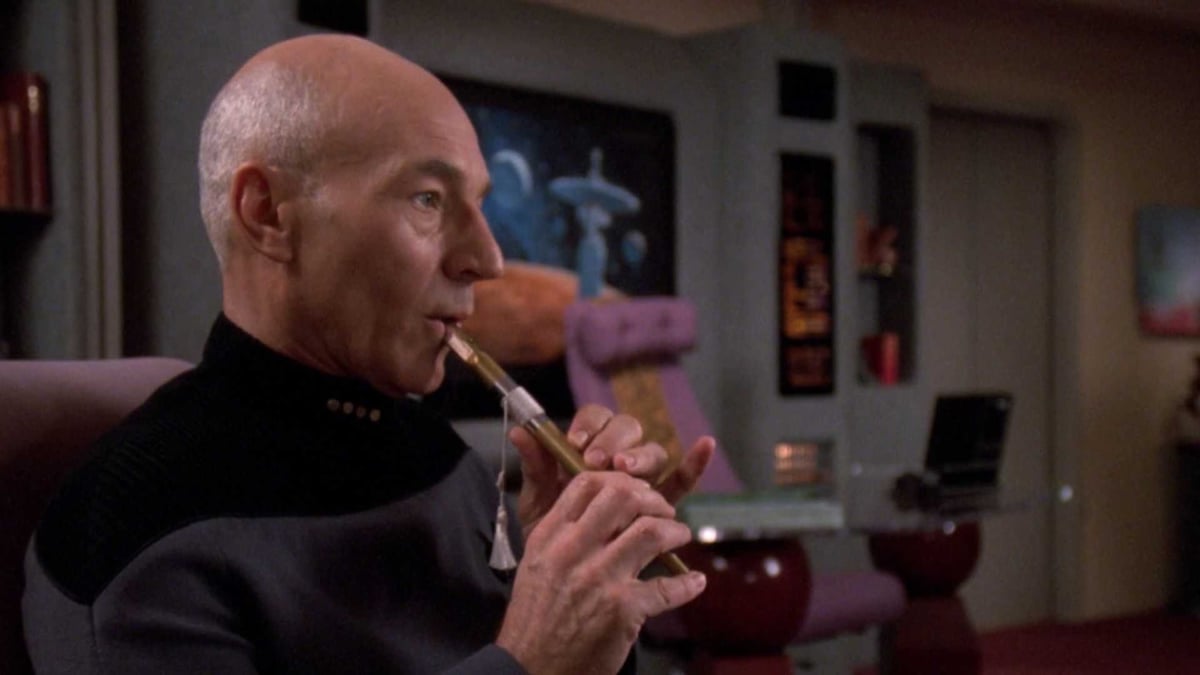
In the wake of Patrick Stewart’s death the other day, I watched a couple episodes of Star Trek: The Next Generation — the two-part series finale All Good Things… in fact.1 Wanting to add more Picard-centric episodes to my watchlist, I did some research.

There are several lists out there of the episodes of ST:TNG and Star Trek: Picard where Captain Jean-Luc Picard particularly shines. Some episodes appear on nearly every list; these are the consensus favorites:

  • The Inner Light. “Captain Jean-Luc Picard is struck unconscious by an energy beam from an alien probe. While just 25 minutes pass for the rest of the crew between Picard being struck unconscious and eventually regaining consciousness on the Enterprise bridge floor, the probe makes Picard experience 40 years of lifetime as Kamin, a humanoid scientist whose planet is threatened by the nova of its sun.”
  • Family. “Captain Jean-Luc Picard visits his brother’s family in France, where he begins to come to terms with his treatment by the Borg.”
  • The Best of Both Worlds. “In this two part episode, the Enterprise must battle the Borg who are intent on conquering Earth, with a captured and assimilated Captain Picard as their emissary.”
  • Darmok. “The crew of the Enterprise is unable to establish meaningful communication with the crew of an alien vessel, which is resolved by the struggle of the ships’ captains to defend each other from a vicious beast.”
  • All Good Things… “The plot involves Captain Jean-Luc Picard jumping through time and the formation of an anomaly that defies causality, the whole situation being a test that allows Picard to demonstrate human potential to the Q Continuum by making an intuitive leap of faith to understand the cause of, and how to eliminate, the anomaly before it destroys humanity.”
  • The Measure of a Man. “In this episode, the rights of the android officer Lt. Commander Data are threatened by a scientist who wishes to dismantle him to produce replicas of him. Captain Jean-Luc Picard fights in a Starfleet court for Data’s right of self-determination, not to be declared mere property of Starfleet, while Commander William Riker is obliged to argue on behalf of the scientist.”
  • Starship Mine. “While the Enterprise is evacuated for hazardous maintenance, Captain Picard must, alone, contend with thieves posing as a work crew aboard the ship. The plot has been noted for its similarity to the 1988 action film Die Hard.”
  • Chain of Command. “Jean-Luc Picard is relieved of command of the Enterprise and reassigned to lead a covert mission, while his replacement is assigned to deal with the Cardassians openly. The second part of the episode is noted for the intense performance of Patrick Stewart and its depiction of brutal torture and interrogation scenes.”
  • Tapestry. “Q allows a supposedly deceased Captain Jean-Luc Picard to re-visit a pivotal event in his youth that he since regrets. Picard changes the past, but upon returning to the present he finds that the event made him the man he became.”
  • The Drumhead. “An explosion aboard the Enterprise leads to a high-level investigation headed by Admiral Norah Satie, a retired officer renowned for her skill at exposing conspiracies.”

You can check out the lists at Screen Rant, Collider, Comicbook.com, That Love Podcast, and Popular Mechanics for more good Picard episodes.

The movies seemed to be out of scope for these lists, but I’ve always loved First Contact and Picard’s unhinged pursuit of the Borg — “The line must be drawn here!”

  1. Did I tear up at the final scene at the poker table? When Picard says, “I should have done this a long time ago”? Yes. Yes, I did. Did I tear up again watching just that scene just now? Yes. 💞 ↩

Tags: best of · lists · Patrick Stewart · Star Trek · TV

  •  

Star Wars: The Radio Drama

Somehow I’d never heard of this before: NPR produced and aired1 radio dramatizations of the films in the original Star Wars trilogy. The first program was particularly popular, garnering NPR hundreds of thousands of new listeners. The original versions are available in full on The Internet Archive:

Or get all three parts ripped from the CD.

All three programs contain elements of John Williams’ original soundtrack. Mark Hamill and Anthony Daniels reprised their movie roles for the first two radio programs2 and some other bold-faced names made appearances throughout: Billy Dee Williams as Lando Calrissian, John Lithgow as Yoda (??), Ed Begley Jr. as Boba Fett (???), David Alan Grier as a nameless X-wing fighter pilot, and Nia Vardalos.

The radio programs were based on the original film scripts with some added scenes; from Open Culture:

With science-fiction novelist Brian Daley brought on to add or restore scenes to the script of the original dialogue-light feature film, the story stretches out to thirteen episodes for a total runtime of six hours. The series thus stands as an early example of the expansion of the Star Wars universe that, in all kinds of media, has continued apace ever since.

And from Wikipedia:

Daley adapted the script partly using material from earlier drafts of Lucas’s scripts, and restored several scenes cut from the final edit of the film, as well as adding original new scenes created specially for the audio version. The narrative of the first two episodes takes place entirely before the opening scene of the 1977 film, and expands the background to events leading up to the capture of the Tantive IV spacecraft above the planet Tatooine. Episode 1, largely based on cut scenes from the original, explores the life of Luke Skywalker on Tatooine. During the story, Luke’s skyhopper (a vehicle seen in the background in Luke’s garage during the film) is damaged during a desert race; Luke sees the distant Star Destroyer battle in the sky; and he is reunited with his childhood friend, Biggs Darklighter. Episode 2, made up of material written entirely by Daley, provides backstory to Princess Leia’s acquisition of the Death Star plans from agents of the Rebel Alliance on the planet Toprawa. In scenes set on the planet Alderaan, Leia discusses the plans with her father, Prestor Organa, and determines to go in search of Obi-Wan Kenobi.

There are recut fan versions of the three programs as well, including Nigel’s Edits (Hope, Empire, Jedi); he added some of Ben Burtt’s sound effects into the mix:

These versions, boldly called The Definitive Editions (Hope, Empire, Jedi), include opening scrolls and images taken from Star Wars comic books and trading cards:

Yes, that’s a script turned into a movie turned into an audio drama turned into a, uh, quasi-cinematic Powerpoint? (via open culture)

  1. NPR produced the first two programs but not The Return of the Jedi…it was produced by someone else. ↩

  2. Daniels also voiced C-3PO in the Jedi dramatization. ↩

Tags: movies · NPR · radio · remix · Star Wars

  •  
❌