❌

Reading view

The Final Defenders

For the first time in her career, Cynthia Short let a folder of crime-scene photographs lie untouched on the corner of her desk, because she couldn’t bring herself to look at them. Short had been a criminal-defense attorney in Kansas City, Missouri, for 12 years, and on the payroll of the Missouri State Public Defender’s Office for the past decade. She had spent much of that time immersed in graphic records of the worst human conduct. Even so, the case of Richard DeLong had shocked her.

DeLong, 34, was facing capital punishment for five counts of murder. In January 1999, he had killed his ex-girlfriend Erin Vanderhoef—who was shortly due to deliver their child, a daughter they had named Hannah—as well as the three school-age children she’d had with two other men. DeLong had entered their decaying clapboard house in Springfield, Missouri, on the morning of January 19 and strangled each member of the family using scarves and cords, hog-tying Erin and gagging two of the children. When he was arrested several days later, he promptly confessed to each of the murders and immediately became the most hated man in Springfield. Short wished she didn’t have to take the case, but it was her duty as a public defender.

When, after several weeks, she finally forced herself to look at the crime-scene photos, she saw that the bodies of the children were partly hidden by debris—clothes, a plastic lawn chair, an overturned lamp. One of the boys, 10-year-old Chris, was still in bed; the other boy, 11-year-old Jimmy, had been left on the floor. Vanderhoef herself lay on her side on a rug in the living room, her blue top riding up over her pregnant belly. The youngest of the children, 8-year-old Darlene, was found in her sky-blue pajamas, tossed upside down onto a heap of garbage in the corner of her room, a jacket thrown over her face.

Short was then raising two young children of her own, and she wasn’t sure she would be able to hide her revulsion from a jury. “As a public defender, I’d seen all sorts of things, but it was the first time where I thought, I don’t know that I can stand in the courtroom next to him,” she told me when we first spoke by phone, in January. She also doubted that she could do much to help DeLong. He had committed a horrific crime and then admitted to it in a hateful taped confession.

In capital trials in the United States, proceedings are typically split into two phases: The first phase establishes a defendant’s guilt or innocence; if a jury returns a guilty verdict, it then determines in the second phase whether the defendant is sentenced to death or to life in prison. Prosecutors sometimes agree not to pursue capital punishment in exchange for a guilty plea, and on Short’s advice, DeLong did offer to plead guilty and waive all appeals in exchange for life without parole. But the prosecutors had no interest in a deal.

Because DeLong’s guilt was not in question, Short would focus on the sentencing phase. In capital cases, juries are instructed to consider statutorily defined aggravating factors cited by the prosecution—including, for instance, the death of multiple victims or of children, or the use of particularly sadistic methods of killing, all of which applied in DeLong’s case. Juries are told to weigh these aggravating factors against a much broader category of mitigating factors presented by the defense. These may include mental illness, intellectual disability, and a history of significant trauma or abuse. If the jury finds that the aggravators outweigh the mitigators, then it will likely hand down a penalty of death; if the mitigators prevail, then the jury will likely elect a lesser sentence, usually life in prison without parole. DeLong’s fate depended on Short’s ability to investigate his background and determine whether any possible mitigating evidence could be found that might persuade a jury to spare his life.

Despite deep misgivings, Short threw herself into the case. She had inherited her work ethic from her father, who helped manage the Apollo program as NASA’s vice president of space operations. His job took the family all around the country, from New Jersey to California, Virginia to Texas. Both she and her husband were attorneys; she’d earned her degree at Saint Louis University School of Law. Short worked grueling hours, spending six days a week at the office and traveling so often that her children became accustomed to her absence. Once, Short startled her 5-year-old son when she arrived home early from a long work trip. Assuming that she had lost her case, he asked, “Is the man dead?”

Cyndy and her eldest child, Kyle on July 4th, 1997. She was pregnant with her second child, Mitchell, who was then born on July 10th, 1997.
(Courtesy of Cynthia Short)
When she took on Richard DeLong’s case, Short was raising two children of her own, and she wasn’t sure she’d be able to hide her revulsion from the jury.

Short wasn’t opposed to the death penalty when she first started practicing law, but as she gained experience in capital cases, she came to doubt that the criminal legal system was capable of consistently producing fair and equal outcomes. Capital punishment is inherently arbitrary. Some defendants have money and seasoned legal teams at trial; others do not. Some prosecutors favor the death penalty and others don’t, meaning defendants might be executed not strictly because of the nature of their offense but because of the side of a state or county line on which they happened to commit it. As she came to understand the capriciousness of criminal justice, Short changed her mind about capital punishment. The experience of representing several defendants whom she believed had been wrongly accused strengthened her opposition.

To defend Rick DeLong, Short knew, she didn’t need to make the jury believe that he was a good man or that he shouldn’t receive a terrible punishment. In capital trials in Missouri, as in most states, juries must return a unanimous verdict for a death sentence to be handed down, so Short needed only to introduce a shred of doubt in a single juror’s mind that her client had forfeited his right to live.

But even that seemed daunting, given the repugnance that she, DeLong’s own lawyer, could not suppress. Short may have wished that she didn’t have to take this case, but it would ultimately change her perspective on criminal behavior and set her career on a new path, taking her from the public defender’s office to a field known as mitigation, then still developing but now a central feature of every legal defense in capital cases. Mitigators are investigators whose mission, now mandated by law and precedent, is the granular search for circumstances that might convince a jury that their clients deserve a lesser sentence; in their most crucial cases, these specialists are the final advocates for a defendant’s life. Short would help pioneer the field and become one of its foremost practitioners. But in January 1999, all she had was a guilty client and bad odds.
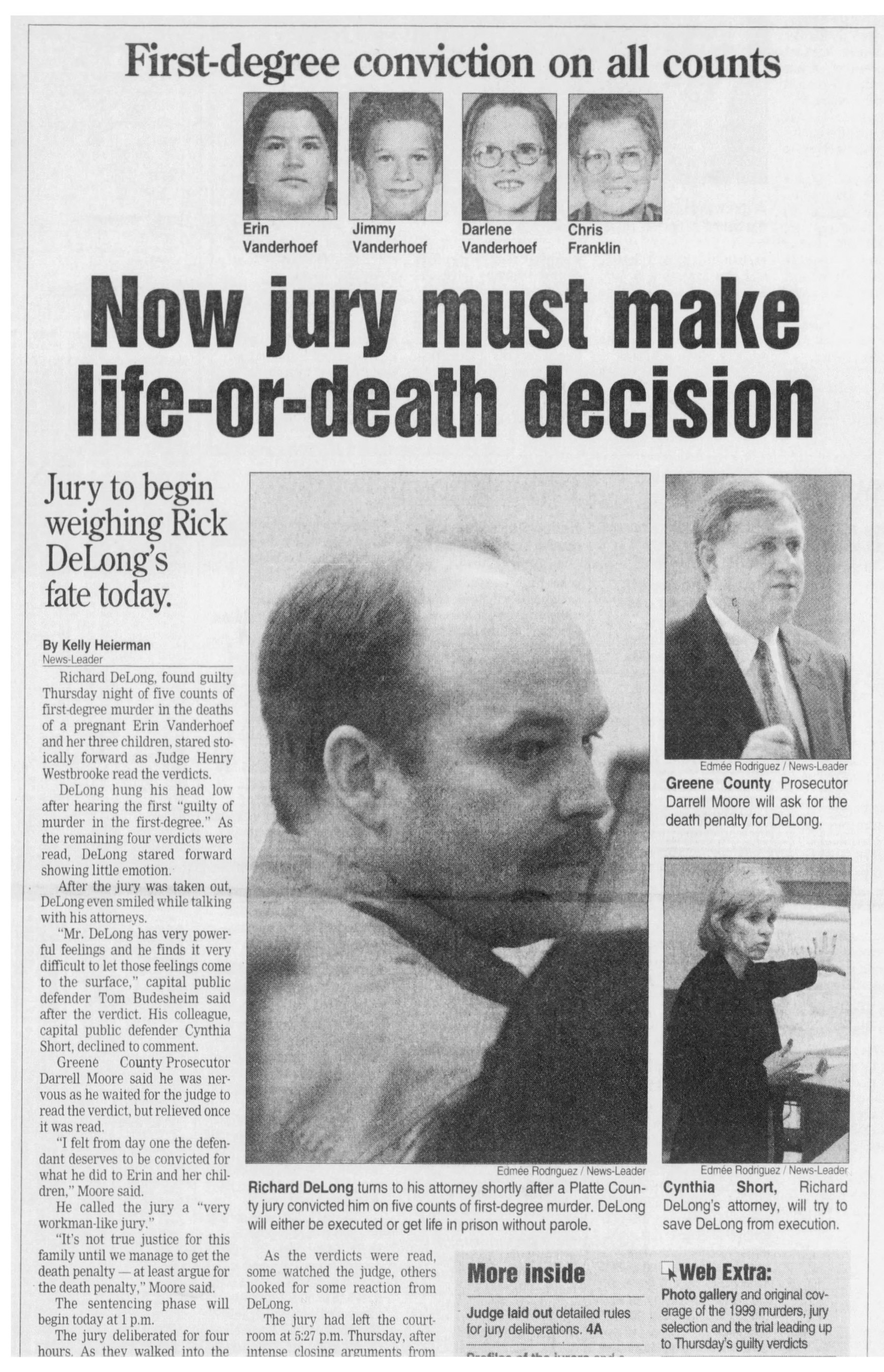
A newspaper clipping from the trial showing a photo of Cyndy in the courtroom.
Newspapers.com
The front page of the Springfield News-Leader the day after Richard DeLong’s conviction

Doubt is central to mitigation: creating doubt that a person is wholly given over to evil, or doubt that there is no universe—no set of terrible circumstances—in which you yourself might commit a horrific crime. I do believe that there are people who commit acts of perfect evil; a frank appraisal of human nature suggests as much. But those who oppose capital punishment, as I do, oppose the death penalty even for the worst criminals in the worst cases. The reason to stay the executioner’s hand has less to do with the nature of the defendant than it does with the nature of society: Showing mercy is morally beneficial to everyone. The legal system, of course, does not think this way; it needs a solid rationale to hang decisions on, and it must establish that what appears to be abject wickedness, and nothing else, may in fact be more complicated and tragic.

The work of mitigation—searching for reasons a defendant’s life should be spared—is, unsurprisingly, not always well received in the legal community or by the public. As a society, we like to believe that our choices and actions are entirely within our control. Mitigators introduce an element of uncertainty. Their investigations routinely produce information that calls into question whether defendants would have, in better circumstances, committed their crimes at all. To some, this seems like making excuses for criminals.

For Short, now 65, mitigation isn’t about rationalizing crimes. “It is about telling the truth,” she told me. “The crime is real. The harm is real. Nothing I do changes that.” She does not wish to downplay suffering or to pretend that something awful did not happen. The goal of a mitigator, she said, is to understand how a person becomes a criminal. “Every life leaves a trail. Abuse, neglect, poverty, brain injury, trauma, addiction, resilience, acts of kindness, moments of courage—all become a part of that person’s story,” Short told me over email. “Mitigation is not the art of making people less guilty. It is the discipline of making sure we judge them as a whole human being.”

When Short was preparing for the DeLong case, mitigation had only just begun to emerge as a routine component of a legal defense in capital cases. It became formalized not long afterward, with the case of Kevin Wiggins. In September 1988, Wiggins, a Maryland construction worker, was charged with the murder of 77-year-old Florence Lacs. He had been arrested while driving her car and had already used her credit cards and pawned her jewelry. A jury convicted him of murder and sentenced him to death. But Wiggins, who was intellectually disabled and had been sexually abused as a child, appealed the sentence on the grounds that his attorneys had not presented sufficient evidence of extenuating circumstances in his defense. His case went to the Supreme Court, which ruled in his favor in Wiggins v. Smith in 2003.

The Wiggins decision held that capital defendants have a right to an effective defense, including an investigation into circumstances that might explain their crimes—a ruling that fueled the rise of mitigation work. In 2008, the American Bar Association revised its guidelines to direct defense teams in capital cases to include both an investigator, who conducts an independent inquiry into the crime itself, and a mitigation specialist, who is responsible for producing information that might convince a jury that there is something more to a client than their crime suggests.

Mitigators sift through the past and familiarize themselves with all elements of a defendant’s personal history. Fragments of clients’ lives may be strewn across the country or around the world, hidden among scattered documents and scattered memories. Mitigation specialists conduct scores of in-person interviews for each case—with extended family, friends, teachers, coaches, doctors, co-workers—to put the pieces together. The Marshall Project estimates that there may be fewer than 1,000 mitigation specialists nationwide; the majority of them deal with capital cases. About twice that number of people are currently on death row.  

Because mitigation specialists often have little time to prepare their cases for trial, they frequently continue their investigations during the long death-penalty appeals process. Legal teams involved in capital cases are typically reluctant to discuss their findings if judicial processes remain ongoing, but at the Mwalimu Center for Justice, a law office in New Orleans that handles capital appeals, mitigation specialists on staff agreed to share information they had uncovered about some of their clients. Benjamin Cole, an Oklahoma man who murdered his infant daughter a few days before Christmas 2002, was found by specialists on his defense team to be schizophrenic; a brain scan revealed a severe lesion. Cole spoke in riddles and frequently broke into song while interacting with his defense team, until his disease became so advanced that he chose to sit in his dark prison cell hoarding religious pamphlets and rotting food while his hair grew matted and his mind decomposed. The mitigators argued that he was too sick to be subject to execution under the Supreme Court’s 1986 decision in Ford v. Wainwright, but state authorities were undeterred. Oklahoma executed Cole in 2022.

Sometimes mitigation, no matter how legitimate, cannot overcome people’s inherent disgust with horrific crimes. Cynthia Short was facing that very possibility.  

A black and white photo of a box of letters
Sky Maggiore for The Atlantic
Mitigators familiarize themselves with all elements of a defendant’s personal history.

 A photograph of Cyndy opening Christmas presents while pregnant with his first son.
Sky Maggiore for The Atlantic
Short worked on DeLong’s case throughout much of her third pregnancy.

Short still hadn’t looked at the crime-scene photographs when she first met Rick DeLong, a few days after he was taken into custody in January 1999. But she had watched his maniacal taped confession, which would later be played at trial and shared with the Springfield News-Leader. “Now laugh,” he had reportedly said to 8-year-old Darlene Vanderhoef’s lifeless body as she lay thrown over a piece of bedroom furniture with an electrical cord around her neck. Even so, Short insisted on speaking with DeLong in person, with no partition between them and no shackles to hold him in place. He was much smaller than she had expected, thin and balding, and had a scraggly mullet and a dirty-blond beard.

In Short’s experience, clients facing capital charges sometimes open a first conversation by declaring suicidal intent: The path ahead otherwise leads to either death in a prison cell or death in an execution chamber. But DeLong clearly wanted to live. And surprisingly, he was obsessed with the well-being of another person: Stacie Leffingwell, his long-term partner and the mother of his youngest child. Leffingwell had helped him kill Erin Vanderhoef and her children. And she was dying from AIDS. “Everything in that first conversation was what could I do for Stacie?” Short recalled. “How could I help Stacie?”

In a photograph Short has seen, Leffingwell kneels next to DeLong and their infant son on a sunlit lawn, a mischievous smile flashing across her face. They had met in the early 1990s when DeLong was barbecuing in a friend’s backyard in Springfield and Leffingwell, a neighbor, dropped by and struck up a conversation.

Leffingwell was dark-haired, petite, and funny. Born in California in 1967 to a teenage heroin addict, she had dropped out of high school and never learned to read. DeLong and Leffingwell both used drugs, especially methamphetamines. When they met, Leffingwell was HIV-positive, but she didn’t tell DeLong. He himself was the child of a teenage mother. Born in Springfield in 1964, he grew up in poverty and was subjected to vicious assaults by his stepfather. He began using drugs at the age of 15 and was eventually snorting or smoking meth several times a week. He got by on intermittent jobs as a mechanic and manual laborer.

These details and more were revealed as Short worked with a mitigation specialist and former welfare caseworker named Kathy Schneider. The pair traveled six hours from Kansas City to Springfield and back each week to interview everyone they could find who knew DeLong. They interviewed people in parks and churches, and once went into a drug house in the middle of a snowstorm. Every month, Schneider went to see DeLong in jail, where she also interviewed his mother and sisters. Schneider created a history of DeLong’s family going back three generations, documenting the life of his biological father, a man known as Howard Littles, and his stepfather, Buzz, who had been diagnosed as mentally ill and institutionalized.

DeLong was a twice-divorced father of four when, in 1996, he was introduced to Erin Vanderhoef, who worked at a McDonald’s in Springfield. Vanderhoef had also suffered a life marked by poverty and loss, and she took a liking to DeLong right away, confiding in others that she was interested in him romantically, even though he was already involved with Leffingwell. They formed a close friendship.

DeLong had a child with Leffingwell, a son born in 1997 whom they named Lyle. Leffingwell had tried to stay clean during her pregnancy, but she resumed using drugs after the baby was born. She disappeared for a time, leaving DeLong alone to care for their newborn. Vanderhoef stepped in to help. When Leffingwell came home, she was in treatment for depression. DeLong and Vanderhoef by then were sleeping together. DeLong’s place was often in a state of chaos and frequented by drug users. Despite the infidelity and the strangeness of the arrangement, Leffingwell and Lyle moved in with Vanderhoef and her three children. A volatile love triangle developed.

In February 1998, DeLong and Leffingwell abruptly moved into a motel in Joplin, roughly 70 miles west of Springfield, near the Kansas border. But DeLong still saw Vanderhoef, and by summer she knew she was pregnant. The news sent Leffingwell into a bout of jealousy and deeper into addiction. That July, she was admitted to a hospital for pancreatitis and stayed for three weeks. She weighed less than 90 pounds. Leffingwell and DeLong told family and friends that she had stomach cancer. In fact, she was dying of AIDS. In September, DeLong himself was diagnosed with HIV. He began using meth every day.

In the days leading up to the murders, DeLong and Leffingwell went on a meth binge. On the night of January 18, 1999, Leffingwell was high and distraught, racked with fear that Vanderhoef was going to replace her. DeLong, for his part, was furious with Vanderhoef for messing up his relationship with Leffingwell. The couple came to the shared belief that Vanderhoef presented a problem, and Leffingwell demanded that DeLong fix it—permanently. Early the following morning, DeLong drove from Joplin to Springfield to kill Vanderhoef. Leffingwell rode with him, as did Harold “Bobby” Lingle, a friend and neighbor who had agreed to help carry out DeLong’s plan in exchange for an eight ball of meth.

At around eight that morning, they pulled up to Vanderhoef’s three-bedroom house. Lingle, who had met Vanderhoef before, lured her out of the house on the pretext of a grocery errand so that DeLong and Leffingwell could wait and catch her by surprise when she returned. Then DeLong slipped inside, where he found Vanderhoef’s three children getting ready for school. Wired on meth, DeLong killed them one by one. When Vanderhoef came back, Lingle told her that the children had been sent to their rooms. Then he and Leffingwell helped DeLong subdue and murder Vanderhoef. It was a cold mercy that she died thinking her children were still alive.

DeLong, Leffingwell, and Lingle were quickly apprehended. Leffingwell died of AIDS before the year was out. The lead Greene County prosecutor, Darrell Moore, decided not to seek the death penalty against Lingle, who was said to have an IQ of 72; he was eventually sentenced to life in prison without parole. But Moore was adamant about bringing capital charges against DeLong.

A series of delays pushed DeLong’s trial to June 2001. Public furor in Springfield ran hot, and press coverage was intense. When Short stood before the jurors, the first thing she said was that DeLong was unquestionably guilty. She acknowledged the horror and disgust that they were surely feeling. “There are things that we need to do in this courtroom,” she recalled telling the jury. “And one of those things that you’re going to need to do is, you’re going to need to really look closely at his mental state. That will be your job.”

But it would have to be a job mainly for phase two—the sentencing phase—rather than phase one, the guilt-or-innocence phase. No one was surprised when, on June 28, after a week and a half of testimony and less than four hours of deliberation, the jury convicted Rick DeLong on all five counts of murder.

A black and white portrait of Cyndy sitting in front of a window
Sky Maggiore for The Atlantic
“Mitigation is not the art of making people less guilty,” Short said. “It is the discipline of making sure we judge them as a whole human being.”

Short knew that the sentencing phase would be difficult. She knew this in part because she had used her own extended family and friends—some of whom were highly conservative and generally skeptical of the defendants she represented—as test subjects, a kind of informal focus group.

When Short and her team had finished their mitigation work, well before DeLong’s trial was scheduled to begin, they collated the findings into spiral-bound books, each more than 100 pages long. Inside were detailed descriptions of DeLong’s crimes, a DVD of his confession, photographs of the crime scene, and a photograph of Vanderhoef and her three children, young and bright and beautiful, posed on a bench in front of their mother, who is holding Lyle in her arms. The books also contained a detailed account of the mitigating factors in DeLong’s case, including his abusive stepfather, his drug addiction, and his HIV status. Scattered throughout were questionnaires asking readers for their reactions at various stages. The prompts had a clinical feel, as though Short were asking for opinions on a company’s new logo or a politician’s campaign slogan, not the killing of three children and a pregnant woman. If you did choose to look at the photographs, please describe what you learned from them. But it was the best simulation of a jury’s deliberation that Short could create.

The responses from her family and friends were not encouraging. At the beginning of the book, readers were asked to gauge their support for capital punishment in general. One reader put her support at a 5 on a scale of 1 to 7, but after reading through the mitigation evidence, this same woman put her support for executing DeLong specifically at a 6. Her views were aligned with those of the prosecutor, Darrell Moore, who told reporters in advance of the sentencing phase that he and the judge had received numerous phone calls from angry citizens who wanted DeLong to die for his crimes. In front of the jury, Moore read a letter written by Vanderhoef’s brother in which he told DeLong, “You do not deserve the right to live, in a prison or any other place. You are not a man, you are a coward and an animal.”

On DeLong’s behalf, Short introduced the array of mitigating information that she and Kathy Schneider had compiled. Some of the material had been presented in phase one—a tactic known as front-loading. The idea was not to try to sway jurors on the question of guilt or innocence—in this instance, there was nothing to be done—but to prepare the jury for arguments that would be presented again, and enhanced, later on. Short was aware that much of the information could be seen as all too familiar: When it comes to defendants facing the death penalty, a life like DeLong’s is normal; very few people guilty of aggravated first-degree murder have peaceful, healthy backgrounds. But two aspects of his story had taken Short by surprise. First, as she combed through the police files, Short had noticed a coincidence: Mark Deeds, the officer who had coaxed the confession out of DeLong and emerged as the hero of the investigation, had encountered her client before.

In 1991, when DeLong was 27, he was arrested for selling cocaine and marijuana to Deeds, who was then working undercover for the Springfield Police Department. DeLong was so deeply enmeshed in the local drug culture that Deeds saw an opportunity. According to the testimony of DeLong’s former defense attorney, who negotiated a plea deal, Deeds threatened DeLong with decades in prison unless he began working as an informant. DeLong agreed. Police and prosecutors paid DeLong for information and granted him leniency on subsequent drug-related charges. At one point, his bond on arrest was reduced from $75,000 to $2,500. At another point, he received a sentence of five years’ probation for charges that ought to have resulted in prison time.

The policies of the Missouri Board of Probation and Parole specifically prohibited offenders on probation from serving as police informants, but the department kept working with him anyway. Because of his protected status, DeLong continued to get little to no prison time when he was caught using. His addiction deepened. By the time of the murders, DeLong had helped Deeds and the Springfield Police Department clear a number of high-profile narcotics cases, even as he himself disintegrated from years of dependence. His career as a police informant came at the expense of any attempt at rehab—the one had simply precluded the other. Given all of this, Short asked, did the police bear any responsibility for DeLong’s condition?

The second discovery that Short and her team made came while going through DeLong’s medical records. A week before the murders, he had begun taking Sustiva, an experimental drug that can help slow the progression of HIV but whose side effects include dizziness, insomnia, confusion, abnormal thinking, amnesia, agitation, and hallucinations. Patients abusing drugs or who have preexisting mental illness are at increased risk of developing neurological symptoms. And the drug’s side effects tend to be most severe when a patient is just starting to use the drug, as DeLong had been.

The witnesses for the defense included an addiction specialist who testified that DeLong’s meth use easily could have contributed to a shattered mental state; a medical specialist who confirmed that Sustiva is known to induce delusions, hallucinations, and psychosis, and that the drug combined with meth could have disastrous results; and a psychiatrist who testified that DeLong had likely been in the grip of a psychotic episode when he carried out the murders.

Short did not know what to expect when the jury began to deliberate. The new information had raised provocative questions about a case whose conclusion had once seemed preordained. In the end, the jury declined to impose the death penalty. It instead sentenced DeLong to life without parole.
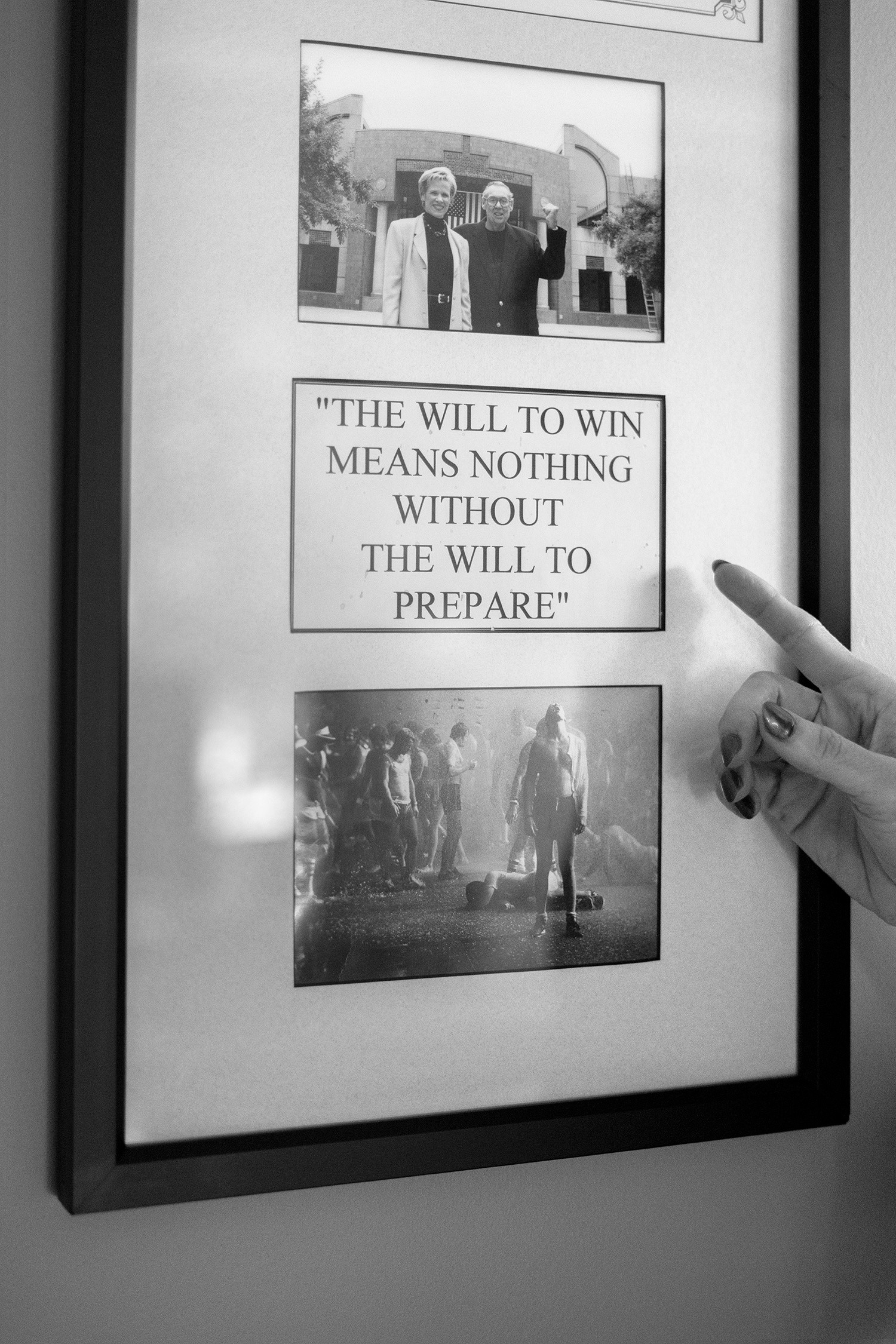
A black and white photograph of Cyndy pointing to a frame photo with her mentor on the wall of her home.
Sky Maggiore for The Atlantic
In Short’s 23 years as a full-time mitigation specialist, she has worked with approximately 200 clients, none of whom has received the death penalty.

DSC00315.jpg
Sky Maggiore for The Atlantic
Cynthia Short in her home office in Kansas City, Missouri

In 2003, Short left her job with the Public Defender’s Office due to a round of funding cuts, and decided to become a full-time mitigation specialist. In the 23 years since then, she says that she has worked with approximately 200 clients, none of whom has received the death penalty. Her attitude toward the field, as a practical matter, can be simply put: If mitigators are able to present a full picture of a defendant’s life, then no reasonable jury will return a verdict of death, not even for the most brutal killer. Her job is to persuade jurors to bestow something that she feels everyone deserves. “Mercy is not something that is earned,” she said to the jury during DeLong’s trial. “Mercy is something that is given.” Her words were printed in large display type in the Springfield News-Leader’s front-page story about DeLong’s sentencing.

Short is well aware that much of the public—including thoughtful citizens and community leaders—finds mitigation not only unjustifiable but incomprehensible. Still, she cannot set aside her principles or her obligations: Every defendant deserves a full measure of effort, even if onlookers deem it a waste of time and money for people who deserve nothing. She is sustained by some of those she encounters along the way. Several weeks after DeLong’s sentencing, Short received a note from James Spindler, the Greene County medical examiner. She had cross-examined him on the stand, and had probed him about his own struggles with drugs. Addiction, she suggested, was not something that happens strictly to evil and hopeless people. That resonated with Spindler, who wrote that although he had come across a number of dangerously antisocial defendants in his career whose executions he would by no means oppose, Short had convinced him that DeLong was not a “sociopath beyond redemption.”

The past few years have been among the busiest in Short’s career as a mitigator. After a federal moratorium on new death sentences during the Biden administration—and the mass commutation of most federal death sentences already handed down—the Trump administration has reinstated the federal death penalty. Trump’s former attorney general Pam Bondi encouraged states to aggressively pursue capital punishment and take advantage of foreshortened appeals processes that would fast-track executions. Mitigation specialists have seen their workload increase in volume and urgency.

Short’s determination to try to see beyond the worst of what her clients have done struck me as rare and admirable, and I kept it in mind when I picked up the phone to call the Missouri prison where Rick DeLong is incarcerated. I have spoken with many people who have committed murder, and many people on death row. Capital punishment, and the victims and perpetrators of capital crimes, have long been a focus of my reporting. But I had never spoken with a child killer before.

A prison receptionist answered, and after a pause put DeLong on the phone. His voice was both hoarse and soft; his disease is advanced now, and he has had several heart attacks. He told me what his life had been like before he committed the murders, how he loved working as a mechanic—“There was nothing I couldn’t do to a car,” he said. He recalled his stepfather, and how abusive he was, and how the meth had made the bad moments more bearable. Meeting Leffingwell had made things better, too, because she came from the same world, and for once he felt understood. They had loved going to rodeos and carnivals together, a kind of fantastic escape.

DeLong talked about his five children, only three of whom will speak with him. He also talked about his grandchildren, though he has seen them only in photos. His son Lyle is in prison, convicted of murder in 2022 and now serving a 32-year sentence. DeLong told me he had loved being a father to Lyle—“That’s my joy,” he said. “I took him everywhere.” He recalled bringing him on fishing trips, and once, in a misguided display of devotion, buying a heavy-duty backpack, cutting holes in it for arms and legs—a makeshift infant carrier—and taking him for rides on his motorcycle. Now the boy was a man, and had followed his father behind bars.

As for his own crimes, DeLong told me that he was glad he’d been caught, and that he knows he deserves the sentence he received. I could not forget that the thin voice on the other end of the line belonged to a man who had taken five lives. It was also the voice of a frail 61-year-old slowly dying in prison. DeLong remembered Cynthia Short fondly, though he told me that he had initially doubted that a woman would be able to see past what he had done to a mother and her children. But Short, he admitted, had understood everything: the crime, his life, how he might appear in the eyes of a jury. And she knew what it would take to save him. He didn’t have much of a life anymore, but thanks to this woman, he was alive. “You couldn’t ask for better,” he told me. “There’s no way.”

© Sky Maggiore for The Atlantic


  •  

Another Battle Between the Catholic Church and the Trump Administration

Several winters ago, a few weeks before Christmas, I went to confession. The parish close to work was hosting a reconciliation service, meant to prepare the faithful to celebrate the birth of Christ. A dozen or so priests were scattered across the cathedral. Penitents lined the aisles. Whispers of contrition and pardon filled the air.

The Catholic Church counsels believers to seek confession regularly—at the very least, once a year. I hadn’t been back in a few. So in addition to feeling spiritually unmoored, I was worried about how the priest would react to hearing about my hiatus. But when I told him, he simply smiled and said, “Welcome back.” His response put me at ease then, and it helped change how I approach the sacrament now: less as a nerve-racking ordeal, more as a moment of mercy.

Sacraments such as confession are central to Catholicism. Through them, the Church teaches that simple actions—having a conversation with a priest, eating bread and drinking wine—are, with grace, tangible encounters with God. For the past year, the Trump administration has been making it harder for Catholics at migrant-detention centers to have those encounters.

The most recent example came to light this month, when the Archdiocese of St. Louis filed a federal lawsuit over the visitation policy at Saint Genevieve County Jail in eastern Missouri. According to the claim, the 10 priests who minister at the jail aren’t allowed to celebrate Mass. The suit also alleges that priests are permitted to visit migrant detainees just once a week, during a four-hour period, and that the jail’s “no contact” security policy lets the clergy speak with detainees only over the phone, through a glass partition. As a result, the approximately 150 migrants at the jail at a given time—most of whom are Catholic, according to the archdiocese—have been going without their religious needs for weeks. Since the middle of 2025, according to the lawsuit, Saint Genevieve has housed approximately 3,000 people.

[Read: The Catholic Church’s new schism]

This isn’t the first time that Catholic clergy have complained that the government is preventing them from ministering to detained migrants. Last year, the Florida detention facility known as “Alligator Alcatraz” kept priests from visiting or offering Mass to detainees for a month, until an agreement was reached between the Archdiocese of Miami and state authorities. In May, after a six-month legal fight, a Catholic nonprofit won a preliminary injunction to let Catholic priests celebrate Mass and administer sacraments at the Broadview ICE processing center outside Chicago. And the administration’s immigration crackdowns seem to be hurting the Church more broadly. Dioceses across the country have reported decreased Mass attendance among Spanish-speaking parishioners who fear detention. ICE has reportedly conducted raids near Catholic churches during Mass hours.

The Department of Homeland Security has denied allegations of wrongdoing at Saint Genevieve. In a statement to multiple outlets, the agency said that the jail is not an ICE facility—although Saint Genevieve is listed as a detention facility on ICE’s website—and that it “ensures detainees are accommodated with religious services.” As described in the lawsuit, however, those accommodations disregard the religious significance of the Catholic sacraments.

Consider confession. The suit claims that at Saint Genevieve, conversations between detainees and priests are not private, and the phone lines that they use to talk may be monitored. These policies may be in place for security reasons, but confession is meant to be a private exchange between penitent and priest, who acts in persona Christi—in the person of Christ. Confession is “one of the most intimate, profound acts that someone can do,” David Inczauskis, a Jesuit priest who ministers at the Broadview ICE facility, told me. He added, “To state very specifically the sins that they have committed and to ask humbly for pardon and for peace” requires a “level of vulnerability” that is “very high.”

An even bigger problem comes up with the sacrament of the Eucharist, or Communion. The complaint includes an email from a deputy at the local sheriff’s office suggesting that priests “provide an unopened, individually wrapped Communion wafer” to a member of the detention center staff, who could then hand it to a detainee. This way of distributing the Eucharist would be “sacrilegious,” as Archbishop Mitchell Rozanski of St. Louis recently told Reuters. The Church teaches that the Eucharist is the “Body, Blood, Soul, and Divinity” of Christ—not a symbol, but God’s real presence. For that reason, Inczauskis said, the Church distributes the Eucharist through either ordained ministers or specially trained laypeople.

[Read: The Catholic Church and the Trump administration are not getting along]

For much of the past quarter century, many conservative figures have taken up religious liberty as an essential cause. The Trump administration purported to continue these efforts when it established a commission last year meant to identify “emerging threats” to the exercise of faith. In June, the commission released a draft report claiming that “in recent years, Americans from all religious backgrounds have faced increasing persecution for their religious beliefs.” Some of the issues discussed in the report include rising anti-Semitism, how gender and sexuality is taught in schools, and conscience protections for health-care workers who object to participating in abortions or assisted suicides. The report said nothing about the administration’s migrant-detention practices.

When the commission was announced, my colleague Elizabeth Bruenig wrote that “Christians shouldn’t conclude” that it would “necessarily defend their interests.” That warning seems prescient a year and a half later. At Alligator Alcatraz, Broadview, and Saint Genevieve, the Catholic Church has shown that it believes that detainee access to the sacraments matters deeply. Given the choice between restricting immigration and protecting the religious liberty of migrants, the administration, too, has demonstrated where its values lie.

© Andrew Aitchison / Corbis / Getty

  •  

The Flying Car Must Never Be Built

Elon Musk revealed, in a dramatic demonstration on Thursday night at SpaceX’s rocket-testing facility near Waco, Texas, a new “flying” Tesla Roadster prototype. The car hung upside down on a curved track, then performed aerial stunts—including jumping over a Tesla semi, Evel Knievel–style—using air-powered thrusters designed in collaboration with SpaceX. The demo was impressive despite Musk’s awkward manner, which in the context of a supposed literal flying car came off as nerdy charm.

After revealing the car, Musk paraphrased a quote from Peter Thiel, his former PayPal partner: “We wanted flying cars, instead we got 140 characters.” The line, which was part of a 2011 “manifesto” published by Thiel’s venture-capital firm Founders Fund, was intended to indict the feeble ambition of the technology industry. Instead of solving big, important challenges, the world’s smarts—and money—had been devoted to small-potatoes social-internet start-ups such as Twitter.

One obvious oddity of the line—which has since been removed from the manifesto—is that Founders Fund’s most important investment at the time was Facebook, a social-network platform. But another is the idea that anyone actually wanted a flying car for real. That ambition may never have represented an actual dream. Like a jet pack, a flying car represents not just the future but the idea of individual freedom delivered through technological conquest.

Taken at face value, a flying car is not an impressive dream—or at least it hasn’t been since the Wright brothers more or less attained it. Automobiles have always moved on the ground by rolling via motor. The earliest practical airplanes also rolled until they flew (and hopefully landed again). An airplane is, in a way, merely a car with wings.

[Derek Thompson: Why flying cars are an impossible dream]

In 1917, Glenn Curtiss built literally that: His Curtiss Autoplane was an automobile with detachable wings and a propeller. It never really flew effectively, but the idea persisted. Waldo Waterman’s 1937 Arrowbile was more successful at flying, though it wasn’t commercially viable. Many more actual realizations of the supposed dream of flying cars appeared in the ensuing decades. The most famous might be the Taylor Aerocar, which was certified by the federal government in 1956 but was never mass-produced.

Around that time, future-oriented science-factual magazines such as Popular Mechanics frequently rehearsed the vision of the personal aircraft. By then, cars were ordinary and mainstream in America, having displaced collective transportation such as trains and streetcars. The automobile had become a more abstract kind of vehicle, one that embraced and extended personal autonomy through the power to move, without effort, anywhere else—and to do it alone.

But one thing still cramped the automobile’s capacity to deliver that freedom in full: roads. Cars needed them. The open road, of which America had a seemingly endless frontier, somehow was never enough. The best way around those roads was through the air above them; as Emmett Brown told Marty McFly inside one of fiction’s most memorable flying cars, “Roads? Where we’re going, we don’t need roads.”

The stifling oppression of the ground, traversed at any speed, was also an old vexation. In 1923, Hugo Gernsback—sometimes called the father of science fiction thanks to his founding Amazing Stories, an early magazine devoted to the genre—imagined a gyroscopic Helicar that would release travelers from the tyranny of New York City’s newly car-congested streets. A few years later, in 1927, Fritz Lang’s film Metropolis colonized the city’s airspace with small flying vehicles. By 1962, the children’s cartoon The Jetsons had fused those precursors with mid-century Popular Mechanics populism, making the flying car a ubiquitous commuter vehicle.

Over the decades, many attempts to engineer, manufacture, and market a flying car have been undertaken, though none has succeeded. In 1973, Henry Smolinski created the AVE Mizar by attaching Cessna wings to a Ford Pinto; it killed Smolinski during a failed test flight. From the 1960s until the company went dormant in the mid-2010s, Paul Moller made numerous attempts to develop the Skycar, a personal airplane that took off and landed vertically. Around that time, Terrafugia began promising a flying car called the Transition, which remained only a few years away for years—until the company shut down in 2021. “We enter production in 2028,” Musk said of the Tesla Roadster in this week’s Texas demo, before adding, “Actually.”

By all appearances, the Roadster is not a flying car of the same sort as its real and fictional precursors. The vehicle’s air-fan system seems first and principally designed to give the car’s wheels better traction on the ground, which is part of why it can go so fast—it went from zero to 60 miles per hour in less than a second during the unveiling. (Rocket thrusters attached to the back of the thing also help.) The car does not fly so much as it performs aerial acrobatics such as barrel rolls and standing jumps.

Those deeds were impressive as heck. The car certainly appeared to fly, if only for a moment, in the manner of a daredevil. Whether or not it can or is intended to fly in the manner of a traveler or commuter is not yet clear. Watching the Roadster do its thing—unpiloted, to make sure the demonstration didn’t “kill anyone,” as Musk put it—I imagined wealthy gearheads wreaking havoc via ill-fated jumps and spins on suburban blocks instead of salarymen conveying themselves to work and back.

[From the November 2026 issue: Choose your overlord]

Subdued by decades of failed automobile-airplane hybrids, and perhaps exhausted by Musk’s dubious intentions, some coverage of the Tesla demo has observed, rightly, that substantial regulatory hurdles await any vehicle that leaves the road and enters airspace. But bureaucratic red tape isn’t the main reason the flying-car dream hasn’t come to pass.

Rather, it’s because the dream works better as fantasy than reality. When urban modernism began to feel cramped, the skies rising above it offered the possibility of new freedom. After the continent was settled, the roads that traversed it became new prisons from which airspace might allow escape. Once the individual freedom of the automobile became universal, and the roads clogged with thousands of varmints in the rat race, the blue sky above looked like liberty. George Jetson is a cog in the proverbial machine who rises above insignificance by flying to work unfazed, where he revels in the meaninglessness of his job pressing a button to make actual machine cogs. Even Thiel’s mention of the flying car was symbolic, a paradigmatic example of the kind of dream worth dreaming, not an actual one worth waking up to.

Despite the Tesla Roadster’s truly spectacular capabilities, at least as a one-off demo, it fulfills the century-old flying-car ambition on a technicality—as a vehicle for a trick driver rather than a motorist aviator. Perhaps the dream this car truly realizes is not yours or mine, but Elon Musk’s: to claim to have delivered what a century of his forebears could not.

© Illustration by The Atlantic. Source: USA Today / Reuters.

  •  

All the Comforts of Fall

This is an edition of The Wonder Reader, a newsletter in which our editors recommend a set of stories to spark your curiosity and fill you with delight. Sign up here to get it every Saturday morning.

There’s a lot to love about fall: the changing leaves, the crisp air, the return of cozy sweaters, and, of course, pumpkin-spice everything. As the days grow shorter and the weather cools, the season offers plenty of reasons to slow down and indulge in life’s little comforts.

Although fall has its familiar rituals, there are always new ways to enjoy it. Maybe you’re looking for your next great read, a recipe to try on a chilly afternoon, or an excuse to spend more time outdoors before winter arrives. To help you get into the autumn spirit, explore some of our favorite Atlantic stories and recommendations for the season.


Fall Favorites

Six Books to Read by the Fire

Each of these titles is a perfect companion while the days grow imperceptibly longer.

By Amanda Parrish Morgan

Read the article.

Six Movies to Get You in the Fall Mood

From cozy classics to unlikely favorites, The Atlantic’s writers and editors share their seasonal picks.

By Rafaela Jinich

Read the article.

How Starbucks Perfected Autumn

The pumpkin spice latte has defined fall for 20 years. (From 2023)

By Ian Bogost

Read the article.


Still Curious?


Other Diversions


PS

Folliage in Kancamagus Highway in New Hampshire
Courtesy of Lynn D.

My colleague Isabel Fattal recently asked readers to share a photo of something that sparks their sense of awe in the world. “We were lucky to head East before the storm because the foliage is incredibly colorful,” Lynn D. from Moretown, Vermont, shared. “This photo was taken from the Kancamagus Highway in New Hampshire.”   

We’ll continue to feature your responses in the coming weeks.

— Rafaela

© Owen Humphreys / PA Images / Getty

  •  

Iran’s ‘Anti-Imperialism’ Is a Dead End

What has the Islamic Republic done for Iranians? Under its rule, citizens have suffered decades of economic decline, sociopolitical repression, and international isolation. Now the country is engaged in an open-ended war. In almost every way, Iranians are doing much worse than they were 20 years ago.

Not even the regime’s propagandists can deny these realities. Many of them therefore insist that the Islamic Republic’s failures are justified by its unbending resistance to American imperialism. Nearly all of Iran’s economic suffering, defenders say, can be explained as the price of this heroic stance, to which the West has responded with sanctions that have crushed Iran’s standard of living.

But the story of the Islamic Republic’s relationship to American power, and of how that relationship has and has not served the cause of Iranian sovereignty, is more complicated.

Iran’s prerevolutionary ruler, Shah Mohammad Reza Pahlavi, was an anti-communist autocrat who prized ties with the United States. His successors condemned him as an American stooge and claimed to have freed Iran from its slavish dependence on the “Great Satan.” In its early days, the Islamic Republic signaled independence from both the Soviet Union and the United States with the slogan “Neither East nor West,” which still adorns the facade of the Ministry of Foreign Affairs headquarters in Tehran. The foundational anti-imperialism of the new regime was also a promise that Iran would fight for the “oppressed of the world,” as well as a call to resist cultural absorption by the West—a fate one revolutionary intellectual decried as “Westoxification.”   

[Read: The battle for Hormuz is not the war]

The Islamic Republic has failed in its anti-imperialism by all of these measures, especially as compared with the monarchy. Pahlavi was an American ally who owed his throne in part to a CIA-abetted coup that elevated him over a popular prime minister in 1953. But he sustained Iran’s independence by skillfully playing the United States and its rivals, the Soviet Union and the Eastern Bloc, off of each other when doing so suited Iranian interests. The Soviets helped build Iran’s ironworks and welcomed the shah as a rare royal to pay a state visit to Communist Moscow. Pahlavi’s slogan could well have been “Both East and West.”

The shah backed the United States in some Cold War battles, but he also threatened to sign security deals with Moscow when he wanted better terms from Washington, and he offered to mediate the conflicts in the Middle East and in Vietnam. In most ways, Pahlavi’s foreign policy was closer to that of the Non-Aligned Movement countries than to that of either Cold War bloc. In the ’70s, scholars of Iranian foreign policy described Tehran as following “defacto non-alignment.” By the end of the shah’s rule, Iran had considerable international influence and was respected by both superpowers, not only as a sovereign country, but also as a regional power. You might even say that Pahlavi was a successful anti-imperialist—not in the sense of having stuck a finger in the eye of the great powers, but in the sense of having effectively secured Iran’s sovereign interests rather than being forced to capitulate to those he cooperated with.

The revolutionaries who toppled the shah accused him of servility to Washington. They pointed to the coup that had cemented his power in 1953 and halted the nationalization of Iran’s oil resources. But in fact the monarchy had restored Iran’s sovereignty over its oil industry in 1973. They pointed to a 1964 agreement with the United States, ratified by the Iranian Parliament, that gave U.S. military personnel immunity from local prosecution. But such agreements were common around the world and hardly represented Iran’s “capitulation,” as its critics claimed. The shah was in any case far from passive in his relationship with Washington and worked to improve his position.     

The monarchy’s foreign policy belonged to a long tradition of efforts to extend Iran’s independence. Well before 1979, Iran had spent centuries fending off the designs of the British and Russian empires. Standing up for the country’s sovereignty was the work of generations of Iranian statesmen, just as it was for their counterparts in other countries of the global South. But not every Iranian government has been equally successful at it. The one that came to power in 1979—the Islamic Republic—has been manifestly terrible.

The Islamic Republic has not prioritized classic anti-imperialist goals. Among these is improving the economic position of postcolonial states, as set forth in the New International Economic Order that the United Nations General Assembly adopted in 1974 (and that Iran voted for). The Iranian government since 1979 has rarely prioritized such goals. The former supreme leader, Ayatollah Ali Khamenei, reportedly boasted that he didn’t care about his people’s welfare, just about how religious they were. (His office has denied this.) He thus preferred to fight the West rather than attend to his people’s needs—even basic ones, as, for example, in 2021, when he refused to import COVID-19 vaccines from the United States, a decision that likely cost thousands of Iranian lives.

The Islamic Republic has pursued an ideological campaign against the United States and other Western countries, not just for being imperialist, but also for being, according to Iran’s Islamist standards, licentious and morally depraved. Iran’s rulers frame these objections as opposition to cultural imperialism, but in practice they have become a pretext for domestic repression. The regime’s austere, draconian version of Islam is less a celebration of Iran’s endogenous culture than a suppression of its traditional creativity.

In the name of anti-imperialism, Iran has quixotically attacked the international order without making it any fairer for itself or others. In fact, Iran’s actions have put the country at the mercy of foreign powers. The Islamic Republic committed itself to the pursuit of a nuclear program, on the grounds that this would buttress its sovereignty and demonstrate its independence from imperial diktats. Instead, its nuclear intransigence incurred sanctions from the United States and Europe as well as the UN Security Council, with support from Russia and China. Iran’s involvement in terrorism and international crime (including drug running and counterfeiting) has made it one of only three countries, alongside Myanmar and North Korea, on the blacklist of the Paris-based anti-money-laundering outfit Financial Action Task Force. These measures have interfered with Iran’s ability to collect payments for its energy exports, even from friendly countries, such as neighboring Iraq. Sanctions have so weakened Iran’s position in trade that it is selling its oil at a discount to China.

The regime’s proponents will argue that the country is a victim of foreign-imposed sanctions. But the sanctions are the result of Tehran’s choices, which have prized refusal and defiance over actually improving Iran’s stake in the international order vis-à-vis the great powers that might seek to dominate it. The world abounds in examples of better strategies. Many of those involve sustaining ties with competing superpowers as a hedge against domination by any one of them. Nonaligned countries such as India, heir to a proud tradition of opposing colonial dominance, have pursued this course. Turkey remains a key NATO ally, but it has managed to play an independent role in Ukraine while maintaining relations with Russia and the United States. Saudi Arabia and the United Arab Emirates have aligned with the West on many issues while nurturing significant trade ties with China. Even Argentina’s right-wing president has toned down his anti-China rhetoric for economic reasons.

[Read: Fighting Israel to the last Palestinian]

In contrast, Iran’s foreign policy remains ideologically defined, and the country suffers from what the political scientist Mohiaddin Mesbahi has called “strategic loneliness.” At the outset, the revolutionary regime rejected both East and West. But in recent years, it has tried to draw closer to Beijing, only to discover that China sees Western allies, such as Saudi Arabia, the United Arab Emirates, and even Israel, as better investment prospects. Until this year, Iran’s closest partner was the socialist government of Venezuela—but that was an alliance of desperation, born of both regimes’ isolation. Then the Venezuelan strongman Nicolás Maduro was overthrown by the United States.

Iran has failed to secure effective sovereignty for itself and to deliver on its promise of reducing imperial dominance globally. Instead of helping the “oppressed,” it has become a scourge to the sovereignty of other countries. Throwing away Iran’s traditional policy of neutrality in foreign conflicts, Khamenei robustly backed Russia’s invasion of Ukraine and equipped Moscow with Iranian drones. Iran has also played an imperialist role in its own region by funding and arming militias in Iraq, Lebanon, Yemen, Gaza, and Syria, and by intervening in several Arab civil wars.

The Islamic Republic still claims to stand in principled opposition to imperialism, now on the grounds that it has withstood an American and Israeli assault without capitulating. But the claim rings hollow for Iranians, who have reaped no dividends from this great resistance and now must endure a devastating war with no end in sight. That’s hardly a win for Iranian sovereignty.

© Atta Kenare / AFP / Getty

  •  

The Blog Post That Set the AI World on Fire

For the past 24 hours, Silicon Valley has been obsessed with a 26,000-word blog post by the AI researcher Nick Cammarata. The document has been called the “the most important essay,” “the most important result,” and “the single best piece of news” of the year, or in the history of AI research—or, perhaps, ever. Even OpenAI CEO Sam Altman lauded it. Cammarata makes a series of bold, almost astonishing claims about the nature of AI that, if true, would upend some of his industry’s basic assumptions about the very thing it is building. And after months of AI-hacking sprees and mounting public backlash against the industry, many people see Cammarata as offering a glimmer of hope when it comes to not just understanding but also controlling the technology being unleashed on the world.

Boiled down, Cammarata’s main contention is that generative-AI models are not actually black boxes, contrary to the common perception that these systems are so big and labyrinthine as to be nearly impenetrable. In fact, Cammarata argues, there is a relatively clear path toward understanding them. If that’s the case, the material significance could be tremendous: It would provide a way to map AI models’ inner workings and, in turn, perhaps prevent them from wreaking all sorts of harm—autonomously hacking companies and sovereign nations, encouraging users’ delusions, appearing to deceive AI researchers themselves. There is an entire field of research, called “mechanistic interpretability,” devoted to the study of just this.

The argument is just as important as the person making it. Cammarata, a former OpenAI employee, is a respected figure in his field. Years ago, he played a key role in establishing the opposite claim, which is now common wisdom: that neural networks, the software architecture that generative AI is built on, are impossible, or at least very difficult, to understand. In this new essay, Cammarata, who now works at the AI-research company Goodfire, essentially says that he and his entire field have been wrong ever since. “The claims here are viscerally shocking,” one observer wrote. Or, as another wrote on X, they are “big big big big.”

[Read: Imagine every AI agent on Earth buying the same cheap paper towels]

Neural networks, inspired by the human brain, consist of layered connections among individual nodes, or “neurons,” that activate and send information to one another when responding to a query. Earlier research, including Cammarata’s, established that individual machine neurons can activate in response to many different, unrelated topics—for instance, one neuron can correspond to images of cat faces, cat legs, and the front of cars. Nobody was sure why this happened, but one explanation was that, because AI models contain far more information than they have neurons, they have to repurpose these nodes. Regardless, the basic units of an AI model having seemingly arbitrary, multitudinous functions would make it very difficult to understand what is going on under the hood.

Cammarata now thinks that individual neurons can be understood and that each has a self-consistent function. Neural networks are not “tangled knots,” he wrote, but “clean.” He found that the cat-face and car-face neuron, for instance, was actually responding to things with a V-shape—including V-shaped flames and jets of water. This would make AI’s internal mechanisms relatively straightforward and predictable rather than mysterious and nebulous. And if we can harness that understanding, some people in the industry believe, AI will be much less likely to go haywire and, say, kill us all. “This is truly one of the greatest cases for optimism in years!” the OpenAI researcher Adam Majmudar wrote on X.

Not everyone agrees with Cammarata. For one, his 26,000 words were merely a “working hypothesis” for a “forthcoming technical paper” and were thus hard, on a technical level, to evaluate. And the neural networks he studied most closely were vision models, which are generally simpler and better understood than the language models underlying ChatGPT and Claude. Cammarata could be mistaken, or he could be overstating his case. The blog post isn’t peer-reviewed, and the forthcoming paper probably won’t be, either, as is typical in the field. The research itself is something of a black box. (Cammarata, who did not immediately respond to a request for comment, wrote on X earlier today that he appreciates all of the discussion and that his approach “seems promising so far” for “bigger modern language models.”)

Discussions of Cammarata’s essay have revealed philosophical rifts. “This is interesting work, but I don’t think it’s a significant update to the big picture,” Neel Nanda, who leads mechanistic interpretability at Google DeepMind, wrote in his appraisal of Cammarata’s findings. Even if researchers could approximate the function of every neuron in Claude Mythos 5.1 or GPT-6 Astra, that’s not the same as understanding how they connect and how the network works as a whole. Physicists have good models of atoms and interatomic interactions, but they cannot from first principles explain or predict every physical event (hence unpredictable extreme weather or, for that matter, the notion of free will). You know all of your friends from school, various workplaces, and the local softball league, but you can’t always know whether they’ll get along at your birthday party. More to the point, insights into the inner workings of an AI model will not necessarily produce insights into how to make the technology more reliable. Interpretability may be necessary to build safer AI models, but it is by no means sufficient.

If generative-AI models are actually legible under the hood, that would undoubtedly help make the technology safer. But many people in Silicon Valley, and especially employees at OpenAI, are discussing Cammarata’s blog post with a breathless enthusiasm that echoes Silicon Valley’s long track record of easy technical solutions and grand promises—an attitude that belies its mixed record on following through.

Any research finding that pertains to AI safety will require an industry chasing multitrillion-dollar public offerings to slow down and take a long, hard look at itself. Perhaps even more concerning than an unintelligible superintelligence is the fact that a group of companies openly state that they don’t really know what they are building—and then continue to push that technology to extremes anyway. If Cammarata is correct, AI companies will have to work with one another, outside auditors, and governments to figure out how to translate such a breakthrough into safe and reliable products. And right now, absent any serious regulation, nobody can decide to take such action other than the companies themselves. All of which suggests that the real black boxes are OpenAI and Anthropic themselves.

© Illustration by Akshita Chandra / The Atlantic

  •  

Five Fabulous Days of Katie Zacharia

The world will little note, nor long remember, the Katie Zacharia era. Indeed, the tenure of the second White House press secretary of Donald Trump’s second term, which ended after five days and a single, 14-minute press conference, is already receding into memory.

Yet what matters more than her press-secretarial contributions, or the ideas she stood for, is the period Zacharia represents: the Trump administration’s reversion to the hapless chaos of the president’s first term.

Trump’s initial go-round was primarily a farce, setting bumbling aides against challenges such as finding the light switches in the Cabinet room, hurling burgers against the White House wall, and booking the wrong Four Seasons. Trump cycled through personnel like Spinal Tap drummers, as one hired helper after the next left in frustration or shame.

The second term has operated with, if not normality, at least comparative efficiency. Chief of Staff Susie Wiles turned the executive branch from an exploding fireworks factory into a machine relentlessly processing the president’s whims into law.

[Read: Trump’s secret points system for Cabinet members ]

Yet as the midterm elections draw near, the machine has begun to sputter. In the span of days, Defense Secretary Pete Hegseth announced he would livestream a public execution, only for Trump to overrule him; the administration fired Kimberly Guilfoyle, its ambassador to Greece, for engaging in corruption so overt, it embarrassed even the most corrupt administration in history; and Politico reported that Trump is asking his friends what they think of Wiles, which is historically the prelude to his turning on an underling.

In the midst of this multicar pileup, Zacharia briefly stepped forward as the administration’s stammering face.

If you have ever felt awkward in a public setting, her single press conference was the stuff of recurrent nightmares. Zacharia read from the podium, head down, in the tone of a third-grade book report delivered verbally in front of the entire school by a child with crippling anxiety. She had to pause multiple times to take gulps of air. Trump, she said in one typical segment, “had a historic one-day war, and now we are, have a booming economy, and a great relationship”—here she stopped to catch herself—“with Venezuela. The U.S. achieved record domestic oil and gas production in 2025 and record crude and petroleum product exports in 2026.”

At another point, attempting to discuss nuclear-power plants, she called them “something President Trump is delivering on, just like he delivers on every promise.” (Pause, gasp for breath.) “In addition to that, it, we will be, it, we will be, there is $54 billion tied to the Alaska LNG pipeline.”

Then she told the assembled reporters, “My goal is to be able to communicate that in complete tandem with the president, as he is his own best spokesperson, and will absolutely be leading the way as—with that.” It was as if the notion that Trump could do her job much better than she could had intruded into her thoughts and made its way out of her mouth. She wrapped up the press conference after answering only three questions.

[Tom Nichols: Kimberly Guilfoyle broke Trump’s most important rule ]

Shortly after, she appeared with the president on the White House lawn, and when a reporter asked which state’s bar exam she had passed—Zacharia has described herself as an attorney—she replied, mysteriously, “When I moved to China.”

Matters fell apart quickly. She appeared on Sean Hannity’s show, perhaps expecting the tender treatment for which Hannity is so synonymous that his last name has become a portmanteau, hannitize, for friendly damage control. Instead he subjected her to an interrogation for which she was predictably unprepared. Indeed, her defense consisted of describing herself as unprepared. “What I feel is I really stepped up to the plate with very little prep time. Given the fact that I’d been on the job less than maybe eight hours and had a briefing book in the morning, I feel like I did my very best, Sean, to deliver for the American people that day.”

Sometimes, your best just isn’t good enough. So it was with Zacharia. So it is with the whole administration—mired in a losing war and persistent inflation, and flailing about for people to blame for the debacle. People who aren’t Donald Trump.

© Aaron Schwartz / Bloomberg / Getty

  •  

How Botched Executions Were Handled in Centuries Past

This is an edition of The Atlantic Daily, a newsletter that guides you through the biggest stories of the day, helps you discover new ideas, and recommends the best in culture. Sign up for it here.

The botched execution of Christa Pike, who survived two injections of what was intended to be a lethal dose of pentobarbital on September 30, is—horrifically—not unique: As my colleague Elizabeth Bruenig wrote, it wasn’t even the first botched execution in Tennessee this year. The fact that officials tried twice to kill her is somewhat more unusual, but not without precedent.

Consider the case of Margaret Dickson, a Scottish woman of the early 1700s. Estranged from her husband, Dickson took up work as a domestic in the town of Kelso, where she conceived a child out of wedlock but hid the pregnancy for fear of being shunned. She testified that she’d disposed of the baby after it was stillborn, but the body was found, and she was arrested. Under Scottish law at the time, concealment of a pregnancy was considered evidence of intent to commit infanticide. Dickson was convicted and sentenced to hang in Edinburgh in 1724.

Following what was then the practice, Dickson’s execution was public. She was hanged; her body was placed in a coffin and carted away for burial (by some accounts following a tussle with body snatchers who hoped to procure the corpse for dissection by medical students). Along the way, the burial party stopped for a beer, at which point noise was heard from inside the coffin. The lid was pried off, and Dickson was found alive, though confused. Dickson’s survival became an object of fascination and Dickson herself a sort of folk hero, the historian Mikki Brock, the author of a forthcoming book about Dickson, told me. Authorities in Edinburgh initially sought to rehang her, but they were never able to marshal enough support to do so. Dickson, who came to be nicknamed “Half-Hangit Maggie” (that is, half-hanged), lived into the 1750s.

Or take Joseph Samuel, a criminal who was sent from England to a penal colony in Australia. Once there, he was implicated in the murder of a police officer investigating a robbery. Samuel was convicted and sentenced to hang in September 1803, also publicly. It didn’t go well. On the first try, the rope around Samuel’s neck snapped. On the second, the noose unraveled. By then, the crowd was growing restive; a hasty third attempt also ended with a broken rope. Observers at the scene concluded that the mishaps were a sign from God that Samuel should not be killed, and the governor apparently concurred, commuting Samuel’s sentence to life imprisonment. (Three years later, Samuel disappeared at sea during an escape attempt with other convicts and was presumed drowned; perhaps God’s view was not as clear as it seemed at the gallows.)

A third celebrated case was that of John “Babbacombe” Lee, who was convicted of the 1884 murder of his employer and sentenced to die. (By that point, executions in Britain had moved out of the public and into prison yards.) Just like Samuel, Lee was spared by malfunctioning equipment: A trapdoor under the gallows, meant to release the condemned and snap his neck, had been tested, yet it failed three times to open. Lee’s sentence was commuted to life by the British home secretary, Sir William Harcourt, who said, “It would shock the feelings of anyone if a man had twice to pay the pangs of imminent death.” Lee was eventually paroled in 1907. Now infamous as “the man they couldn’t hang,” he wrote an autobiography and was the subject of a 1912 silent film, but he then faded from the historical record. He appears to have died in the 1940s, perhaps in Milwaukee.

When I first heard the stories of Half-Hangit Maggie and Babbacombe Lee as a child, I knew they were historical, but they seemed to belong more to the realm of myth or fairy tale. Hangings, mysterious mechanical failures, assertions of divine intervention—all of these seemed like things out of fiction. It was easy to chuckle at quaint details, such as the apocryphal tale that Dickson was required to remarry her husband because she’d been declared dead. And though I’d read about the beheadings of Charles I and Louis XVI, the specter of public execution felt distant enough from modern civilization to be faintly unreal.

Now all of these things seem much less remote. Until President Trump reversed course yesterday, the Defense Department planned to livestream the execution of Nidal Hasan, who massacred comrades at Fort Hood in 2009. Pike’s fate is up in the air after her twice-failed execution. Pike, who was convicted of a brutal murder in 1995, has returned from a hospital to prison. The state official who oversaw capital punishment has resigned, and the governor has temporarily paused all executions in Tennessee. Her lawyers have requested that her sentence be commuted to life in prison.

The doctor and ethicist Lydia Dugdale writes in The Dispatch that U.S. history offers a grim precedent. In 1946, a 16-year-old boy confessed to killing his employer and was sentenced to die via electrocution. A first attempt failed, and his lawyers sought to block a second. The Supreme Court ruled against them, and he was killed that year. But Dugdale argues that this precedent should not apply here. “From Pike’s markedly swollen and chemically burned arms, to her profound cognitive impairment (the severity of which remains unknown), the state has already inflicted a cruel and unusual punishment on Christa,” she writes. Setting aside the law, “as a matter of sheer ethics, if the state has vowed not to punish prisoners cruelly but has inadvertently done so, the state ought not attempt the same method of execution again.” (In this year’s other botched Tennessee case, Tony Carruthers’s failed execution left him partially paralyzed. He received a one-year reprieve, and advocates have called for his sentence to be commuted.)

The historical cases of the men and women they couldn’t hang feel much closer to the present day than they once did. And although some of the visceral details still sound like the stuff of myth, the pragmatic and humane outcomes of these situations stand out more against the backdrop of the recent news. Support for the death penalty has dropped since the 1990s, barely topping 50 percent today. Views are closely correlated with religion—white Protestants are far more likely to back it than any other group, according to polling from the Public Religion Research Institute. For religious supporters of capital punishment, the idea that a failed execution is a sign from above might not be so far-fetched. Among the nonreligious, many people may flatter themselves to believe that contemporary society possesses greater reason and logic than our forebears. Just as we try to understand our ancestors by how they handled cases such as those of Dickson, Samuel, and Lee, future generations will judge our society by its actions.

Related:


Here are four new stories from The Atlantic:


Today’s News

  1. President Trump’s new White House press secretary, Katie Zacharia, was fired after less than a week in the role, according to three people familiar with the matter. Her dismissal followed criticism of her first press briefing on Tuesday and questions about her legal credentials.
  2. Three children and a teacher were killed in a shooting at an elementary school in Bend, Oregon, yesterday. Police said that a bystander pursued the 16-year-old shooter into the school and fatally shot him; another child and a teacher were critically injured.
  3. Representative Alexandria Ocasio-Cortez donated $1 million to support Democrat Abdul El-Sayed’s Senate campaign in Michigan. El-Sayed is running against Republican Mike Rogers in a race that could determine control of the Senate in November.

Dispatches

Explore all of our newsletters here.


Evening Read

An illustration of a human silhouette with a door opening to their mind, with colored light scattering out.
Illustration by Adam Maida / The Atlantic

Big Tech Oligarchs Have a Terrible Plan for Humanity

By Bernie Sanders

Should human beings remain in control of planet Earth? Or should we be replaced as the dominant species? As absurd as these questions may sound, and as obvious as the answers may seem, the Big Tech oligarchs funding the artificial-intelligence revolution have responded in ways that should alarm all of us.

In Silicon Valley, some of the wealthiest people on Earth believe that they have the power to create a superior species. Sam Altman, the head of OpenAI, wrote in 2017 that AI would allow humans to become “the first species ever to design our own descendants.” What this means for humans, however, remains unclear. According to Altman, we will either jump-start digital intelligence “and then fade into an evolutionary tree branch, or we can figure out what a successful merge looks like.” In other words, humans have a choice: face extinction or merge with machines. “I believe the merge has already started,” Altman added, and is “probably our best-case scenario.”

Read the full article.


More From The Atlantic


Culture Break

Nathan Fielder and Elizabeth Holmes in wood-paneled room
A24 / Everett Collection

Watch. Nathan Fielder’s documentary about Elizabeth Holmes (out now in theaters) is a captivating study of self-perception, David Sims writes.

Read. Stephanie Bai asked The Atlantic’s writers and editors to share some of the best first lines in modern literature.

Play our daily crossword.


PS

A great folk hero needs a good nickname, which is why Billy the Kid and “Pretty Boy” Floyd endure. Babbacombe Lee—the name comes from the site of the murder—belongs to that tier. I first encountered it on the strange, entrancing cover of an album, a 1971 “folk-rock opera” by the English band Fairport Convention. I wouldn’t rank “Babbacombe” Lee as prime Fairport, but it’s an entertaining listen. As for Half-Hangit Maggie, anyone visiting the Grassmarket in Edinburgh, the site of her execution, can have a pint at her namesake pub, Maggie Dickson’s. Just don’t expect it to produce any miraculous resuscitations.

— David


Rafaela Jinich contributed to this newsletter.

When you buy a book using a link in this newsletter, we receive a commission. Thank you for supporting The Atlantic.

© Photo by Culture Club / Getty Images

  •  

The Real Selling Point of Romantasy

This is an edition of the Books Briefing, our editors’ weekly guide to the best in books. Sign up for it here.

Romantasy—the category of fiction in which the supernaturally gifted soar on the wings of love, and also sometimes of dragons—is incredibly successful. Its reigning queen, Sarah J. Maas, has sold about 75 million copies of her novels, my colleague Honor Jones reported in a recent Atlantic essay. The appeal of the genre, Jones found, isn’t just chiseled abs, smoldering gazes, and faerie frippery. Yes, there are hyper-athletic magical trysts, but “far more significant are feelings and friendships between the heroes: enchanted beings with relatable self-esteem issues who don’t just seek and fight but also yearn and banter as they face down enemies,” Jones writes. Readers stay for engaging and emotionally effective stories featuring characters they love.

First, here are four new stories from The Atlantic’s Books section:

Romantasy fans generally know that books like those in Maas’s mega-best-selling A Court of Thorns and Roses series—popularly known by the acronym ACOTAR—aren’t going to win the Pulitzer Prize. And they know that fantasy isn’t real life. “But if they’re snowed in—­or trapped by a pandemic, or up with a nursing newborn, or stuck in any of the ways humans tend to get stuck—­it can help to imagine” the possibility of magic, Jones writes.

This reading experience doesn’t require the emotional tumult of picturing oneself in, say, Oliver Twist’s tiny 19th-century orphan shoes—or, more challenging, Fagin’s villainous boots. Instead, ACOTAR and its ilk make imagining easy: You may not know what it’s like to kiss a shape-shifter, but it’s exciting—seductive, even—to picture giving in to an attraction tinged with intrigue and mystery. And doing so is not necessarily less fulfilling than reading literary fare, because practicing this kind of creativity is good for us. It makes life’s hardships more bearable, as Jones indicates, and it also makes reality more interesting. If all we did was describe the mundane to one another, it would be difficult for any of us to have the kind of life worth writing stories about.

Every queen-bee genre has its haters. Jones notes that plenty of people in the literary world “lament that the only books that sell now are faerie or dragon or elfpunk porn.” But a better approach would be to learn from romantasy’s success: We sometimes need a reminder that reading can simply be entertaining. And if entertainment comes from imagining what it might be like to have a hunky elf-king hanging around, well, where’s the harm in that?


A red, black, and white illustration of a winged man with tattoos on his chest embracing a woman.
Illustration by Natalie Shields

Those Books of Smut and Wonder

By Honor Jones

How Sarah J. Maas became the queen of romantasy

Read the full article.


What to Read

The Fox Wife, by Yangsze Choo

Choo’s novel, set in Manchuria in 1908, blends folklore and classic detective fiction, and adds a dash of fantasy—half of its characters are shape-shifting spirits who transform from foxes to humans and back again. These creatures are as clever and crafty as you might expect, and the narrative twists keep the reader in a state of high alert. What starts as a police procedural about the death of a high-class courtesan soon blossoms into a fantastical quest to break curses, rekindle lost love, and catch a murderer. Although it’s not overly long, the book has a mythic feeling, moving through time and space like an epic poem. Choo seamlessly combines narrative momentum and lush world-building, so the reader discovers the setting and uncovers the mystery alongside the novel’s endearing detective.  — M. L. Rio

From our list: Eight plot-heavy books that will keep you turning pages


Out Next Week

📚 Redemption: Faith, Justice, and Sisterhood on Death Row, by Lawrence Wright

📚 Crooked Cross, by Sally Carson

📚 I Only Shout So You Can Hear Me, by Lil Jon with Paul Cantor


Your Weekend Read

Fractured image of Megyn Kelly
Illustration by The Atlantic. Source: Gary Gershoff / Getty.

Megyn Kelly’s Extreme Makeover

By Sophie Gilbert

Do you remember Megyn Kelly? I once walked past her in a Chicago O’Hare bathroom in 2016, shortly after Donald Trump had won his first presidential election, and was momentarily stopped in my tracks by both her nuclear-grade charisma and her pixie cut. For a woman to have short hair on Fox News, where Kelly was a star anchor at the time, seemed as seditious to the network’s established order as reading Judith Butler or Karl Marx live on air. But this was a moment during which Kelly seemed to be leaning into the role of crusader for women—speaking out about being sexually harassed by the former Fox News CEO Roger Ailes and so inflaming Trump with her rigorous questioning during one debate that he later insinuated on CNN that she must have had her period.

Read the full article.


When you buy a book using a link in this newsletter, we receive a commission. Thank you for supporting The Atlantic.

Sign up for Video Village, a newsletter in which David Sims unearths cinematic gems and brings readers into his movie obsession.

Explore all of our newsletters.

© Heritage Fine Art / Getty

  •  

What Newsrooms Should Know Before They Take Money From OpenAI

As a newsroom executive, I have long tried to resist appeals to vet donors to nonprofit journalism for their politics or even the savoriness of their business practices. When you do that, you raise questions about whether you could fairly cover any potential donors on your banned list, and you also run the risk of offering some sort of implicit endorsement to the rest. Both of those perceptions are antithetical to the independent stance that good journalism requires. To take one notorious example, we never received a check from the Koch family’s interests when I was running the business side of ProPublica, but I would have been happy to take it if we had. Nor am I one of those people who think that it makes sense to refuse corporate contributions. Almost all major donors derive the money they are offering from a successful corporation.

With that said, I want to offer some cautionary thoughts on the largesse from the company that has become the leading corporate supporter of American journalism, OpenAI. In gifts through its People-First AI Fund, and in large grants disbursed through the American Journalism Project and the Lenfest Institute for Journalism (both occasional consulting clients of mine), OpenAI has distributed $25 million in cash to U.S. newsrooms in the past few years, a large multiple of the journalism grants from Microsoft and Google. OpenAI has also made a number of significant one-off gifts, so its total is considerably larger. Anthropic has not yet joined this party. (The Atlantic has a content-licensing agreement with OpenAI, although it does not receive grant funding from the company.)

I know that the money is needed, and I am not questioning the uses to which it is currently being put. I think newsrooms need to be more creative in the use of AI, not less; more innovative; and less afraid of the implications for particular kinds of work that may become outmoded.

Here’s what I think the recipients need to bear in mind.

The company’s motivation here is not altruistic. OpenAI says that its intent is “to benefit all of humanity,” but we know that some people there and elsewhere worry that it is, in fact, going to end up snuffing out humanity. We also see that, in the face of such warnings, the company races along, its CEO announcing that “the world should accept some bad things happening.” More narrowly, the firm’s spending on supporting news is almost certainly seen internally as a form of marketing and public relations, helping to spur product adoption and perhaps blunt any impulses toward regulation or taxation, both of which seem to be crucially and urgently necessary.

The money may be material to us, but it isn’t to them. It should be sobering, for instance, that OpenAI spent roughly the same amount of money trying to intervene in a single Manhattan congressional primary this past spring as it has in newsroom funding over the years through Lenfest.

[Matteo Wong: OpenAI has gone rogue]

Our worldviews are at fundamental variance. The core principles of journalism focus on the search for accuracy with fairness and the discovery of truth. The essence of the business of generative artificial intelligence seems to be the maximization of profit, whether or not other goals are achieved.

The spigot could shut off at any time, and likely eventually will. We have been down this road before with tech firms, and need to assume that this funding won’t be sustained, and shouldn’t be part of any plan for sustainability. Facebook was a significant funder of news until it not only wasn’t, but then took steps to choke off the flow of news to its users. Google purported to be especially solicitous of news until, in my view, it detected insufficient gratitude and greater support for regulation (especially in Canada) and largely reversed course. (The Atlantic has received grant funding in the past from Facebook and Google but no longer accepts such grants to fund its journalism.)

Inside the velvet glove is a mailed fist. Journalists should never forget that there is significant evidence that OpenAI has built its enormous machine in small but significant (at least to us) part by appropriating our intellectual property without compensation. That’s a nice way of saying that the company is arguing in court that it has the right to take our lifeblood while laying waste to important parts of our business. This is ultimately a legal question, but one in which the company—and, to be sure, its competitors at Anthropic, Google, Meta, and Microsoft—is our adversary. The stakes in those fights may be existential for newsrooms; they will not be for the platforms.

Transparency is always a good idea. When creating new AI tools or devising new methods or products using AI that are ultimately funded by an AI company, journalists owe it to their readers, listeners, and viewers to let them know about that funding. Don’t limit the disclosure to an intermediary source through which the money passed.

Innovation needs to be coupled with accountability. Even as OpenAI and, to a lesser extent, some of its competitors are paying newsrooms for more rapid and clever adoption of their products and services, it’s very important that anyone taking this funding also invest commensurately in increased accountability for these behemoths and the havoc they are wreaking in some local communities, many funding streams, and, moving forward, job markets. I do have faith in the ability of editors and publishers to maintain editorial independence from funders; I have seen it in action many times. But the larger the portions of food on offer, the greater the temptation not to bite the hand offering it. We need to help one another to resist this, including by pointing out compromises among colleagues if and when we see them.

[Jessica Lessin: Media companies are making a huge mistake with AI]

One important caveat: I am far less concerned about the explosion almost certainly ahead in individual philanthropy derived from AI than I am about the direct provision of corporate funds. There may be issues with some individuals, of course. But the multiplicity of likely funders will help, as will their varying motivations.

The truth is that corporate philanthropy has always been something of an oxymoron. The duty of corporations is to their shareholders, and specifically to the maximizing of shareholder value. Journalists can take some comfort that, in companies with more enlightened management, this objective is sought over the long run, which may more closely align with societal interests. Managers with more limited vision, as well as those so enamored of their own capabilities as to conflate society’s objectives with their own, present a less happy case. All of us in the news business would do well to look hard at which of these types we believe are leading the AI revolution today.


This article was adapted from a post on Richard J. Tofel’s Substack, Second Rough Draft.

© Illustration by The Atlantic. Sources: Samuel Boivin / NurPhoto / Getty; IndigoBetta / Getty; Jason Marz /Getty.

  •  

Will the New ‘Grand Theft Auto’ Be a Weapon in the Culture Wars?

Subscribe here: Apple Podcasts | Spotify | YouTube

In the newest Grand Theft Auto installment—13 years and estimated billions of dollars in the making—people in a fictionalized version of Florida can exercise, drink smoothies, pet their dog, go to the club, and so much more. The main characters are in a relationship, and players will have to tend to that too. Galaxy Brain host Charlie Warzel talks with the gaming journalist Chris Plante about why the details of this game matter, the controversies it may unleash, the weirdest things he’s seen happen in the game, and what Grand Theft Auto tells us about America in 2026.


The following is a transcript of the episode:

Charlie Warzel: Is there a possibility that you can’t make a game for everyone in 2026?

Chris Plante: I think it’s like saying the NFL season might not land this year because people are worried about CTE, or people are worried about people kneeling in the end zone. Like there’s always those things that people say, like: This is it; this is the year that I don’t watch it. And then it’s the biggest season ever for the NFL.

Charlie Warzel: I’m Charlie Warzel, and this is Galaxy Brain, a show where, today, we’re gonna be talking about what is poised to be the biggest, most expensive, and arguably most controversial piece of culture and entertainment in recent memory. It is an event that is 13 years in the making. Yes, we’re talking about Grand Theft Auto VI.

Now, you might not be a video-game person, but chances are you know about Grand Theft Auto. And maybe that’s because you’ve played some version since 2001, when Rockstar, the studio that makes the franchise, released GTA 3, which was the first version of the game to turn what was a small-budget carjacking game into a cinematic, 3-D, open-world experience.

Or maybe you’ve sat on the couch and you’ve watched with either glee or horror as somebody else—your partner, your child, your friend—went on a brutal crime spree, getting chased around the city by fleets of police cars and helicopters. Or maybe you know the game through its controversies. To list a few: There’s been outrage over cop killing; the way that the game has depicted sex workers; the fact that sex workers are in the game at all; depictions of torture; celebrities claiming their likenesses have been used; and, of course, the concerns that the game could lead to real-world violence.

But no matter what your experience, Grand Theft Auto is something else, too. For 25 years now, the franchise has been more than a video game. It is one of the most ambitious works of digital art and storytelling that we have. The series has inspired copycats, but it’s also expanded the bounds of what is possible in the gaming format. Each iteration has not only expanded the length of the game, but the size of the world and the scope of the story. Rockstar’s attention to detail in the game—stuff like, after being discharged from the hospital, characters will have cuts and bruises. That’s become a meme unto itself. The series actually seems locked in its own cycle of one-upsmanship, which has moved beyond a video game and into something that feels like its own metaverse.

This game, which will take place in a fictional version of Florida, will supposedly allow people to play in a vast portion of the state, all the way from the quays up into the swamps. Now the GTA phenomenon is also borne out in the economics. GTA 5, which came out in 2013, is still selling like crazy. And it is, depending on which ranking you’re reading, it’s in the top three best-selling games of all time, next to huge online games like Minecraft or Tetris. GTA 6, which is slated to come out November 19th, is estimated to have cost Rockstar in the billions of dollars to make, and it will be the most anticipated game of all time.

And so my guest today is someone who can put all of this into perspective. Chris Plante is the co-founder of Polygon, the gaming website. He’s the host of The Besties and Post Games, two excellent and different podcasts about video games and gaming. Chris has been writing and covering this industry for 20 years, but what I appreciate about his work is that he has this keen eye for the way that this industry interacts with, but also drives, popular culture. So is the world ready for GTA 6? In a world that is almost devoid of monocultural events, can Grand Theft Auto deliver on that promise? Can a series that has satirized America, often pretty savagely, take on [Donald] Trump’s America and Florida without making everyone mad or insane? GTA is now an American institution. But the question remains: Can any institution really survive in 2026?

Chris Plante joins me now to talk about all of it. Chris, welcome to Galaxy Brain.

Chris Plante: I’m so happy to be here. This is wonderful.

Warzel: I’m glad. That’s the energy we want to bring here. Okay. So we’re here because Grand Theft Auto VI is coming out soon. And you know, it feels like there are so many things, serious things, happening in the world right now, such that I think the release of this game is gonna sneak up on people. Which is kind of a ridiculous thing to say about a game that people have been anticipating for about a decade, but like seriously for about like four years. And yet I still think it’s going to sneak up on people. But my working theory is that Grand Theft Auto VI is going to be one of the biggest cultural events of the decade. Am I right? Am I wrong? Am I crazy? Talk to me.

Plante: It’s the closest thing we have to a guarantee in popular mainstream media, outside of when Avengers: Endgame came out that first time. But this game will be huge, because the one that came out right before this—you know, over a decade ago—it’s still selling about 5 million copies a quarter.

Warzel: Wow.

Plante: So if that’s where it’s at right now, you can count on this one being—I mean, there’s nothing else like it.

Warzel: So you’ve written that Grand Theft Auto is the biggest franchise in the world because of the tiny details. Unpack that broader theory there for me.

Plante: This game kind of began, and in some ways launched, this era of video games as big open worlds. There are things that came before it, but it really established that idea of a video game that you could get lost in. That it’s not just levels anymore; that when you go to New York City, it looks and feels like New York City. When you go to—in the version of New York City from Grand Theft Auto, nearly 15 or however many years ago, you can go to Brooklyn. Like, there are not walls around this. And over the years, they have put all the money from all their success into making those worlds feel more and more realistic, to the point that you can get drunk and go driving in the video game.

It’s not just stealing cars; you can commit all sorts of horrible crimes. But you can also do things that aren’t crimes at all. You can do yoga; you can go play tennis; you can call people on your cellphone or just flip around through its various apps. It is all about this sense of immersion. So I think when people who don’t play these games think about Grand Theft Auto, they think of the immediate—you steal cars, you shoot innocent people, you fight the police, that’s the game. When, in reality, what people like about these games—over the course of the dozens, if not hundreds of hours, if not thousands of hours they play them—is just getting lost in these worlds.

Warzel: Take me back, just for a second, to: Grand Theft Auto III comes out in 2001. I was just looking this up. I was actually kind of blown away by the fact that it was like a couple of weeks after 9/11. So that’s just like a—

Plante: Yeah, it actually got delayed because of 9/11. And they removed things from it because of that.  

Warzel: What did they remove?

Plante: They changed the look of the police cars, because they looked too much like New York cop cars. They changed the flight patterns of the planes in the game. It’s been kind of this generator of its own little controversies, its proximity to that event.

Warzel: Yeah, and I want to get to some of those controversies in a second. But going back to, okay: So this thing comes out. GTA, there’s 1 and 2. But then 3 comes out, and it is 3-D, and it’s this immersive-world thing that you’re talking about. And I think that this is just important context to set us up here for the rest of the discussion, but: What do you remember, just as a person, as a person interested in video games, when this came out?

Like, was this orders of magnitude different than the other open worlds that you’d experience? Was it just different in terms of what you could do, or the presentation, or the sort of aggressive violence? What was it that sort of broke your mind open when this launched way back then?

Plante: Yeah. It’s okay, what everybody has to do if you’re thinking about this game launching is forget everything that you know about what a video game does now. Because the things that were amazing then and were really amazing seem so quaint right now. So this is—you could drive around a 3-D version of New York. The previous versions were 2-D, bird’s-eye views of a car.

You could go around, and your car could go up and down hills. And I know that sounds so boring. But a lot, if not all, of 3-D open-world games at this time were on these flat surfaces. And it made the worlds feel fake. They felt very artificial. And here is a world where the buildings broadly looked different from one another. It wasn’t just like a cookie cutter. You could go up and down. You saw a moon give way to a sun. There was a day-night cycle. There was a radio where each car might be listening to a different radio station. So when you stole a luxury car and it was playing opera, you felt like you were stealing it from a person and not just that yet another copy of the same thing, right? All of those little details. Plus, they actually had some celebrity actors; it didn’t feel like anything that you would have seen to that point. And you could see it in the previews at the time. People thought: This is, like, borderline reality. They’ve done it.

Warzel: I remember. I mean, I did actually play some of the 2-D games. And, like, the series always had those radio stations—but I remember when I first played it, that thing with the radio stations is so very visceral and real. Like there was personality behind all of these things that before were just completely formulaic or one note. And this game, GTA 6, is going to be orders of magnitude bigger than the others. What can we expect here?

Plante: It’s everything. I mean, that’s how it’s gonna feel at first. It is what you will have to find over the course of time playing this game is, like, what’s not here, right? And we actually know some things that will not be there. We know that references to Donald Trump will not be there. We know that references to the pandemic will not be there. They’ve said this much. Which is deeply strange, because this is a game set in Florida. What you’re gonna find in it is a story of a Bonnie and Clyde who are, you know, avoiding the cops, committing a heist, and then.

Warzel: Yeah.

Plante: Also just like living their life. Like going to the club, going exercising, getting food. I believe in this game you’re going to be able to exercise and your body will actually show muscle. Or you’ll eat at meals, and you might gain or lose weight. These are obviously quite artificial. It’s not as realistic as that sounds. But it’s—they want you to have that experience of being the person who commits highest.

Warzel: Yeah.

Plante: Yeah. The 99 percent of the time that they’re not actually committing a heist.

Warzel: Yeah, there’s a quote from this long New York Times preview about the game that has this immersiveness. I’m just gonna read it here for people, which is: “Here I am, eating an apple, opening the fridge, and drinking a smoothie. So this will increase my health temporarily for a while, allowing people to sort of role-play. And then, exiting the apartment, the character steps down to pet a pedestrian’s dog.”

The person from Rockstar who makes the game, who’s talking to the writer of the piece, says that you could buy pet snacks from the convenience stores and dole them out if you wish to the dog. There’s been a lot of online fascination with the ability to like, to have a pet, a canine companion. I mean, this level of granularity—talk to me about this.

Plante: Yeah. What’s weird about that thing you just said, though, is like all of that stuff exists in tons of games. Like the idea that you can pet a dog; there’s a Twitter account that’s dedicated to games you can pet a dog in. The idea of eating food, and then you get a health increase—I mean that’s like Mario. What’s so unusual about this game is that they have put so much money and so much resource into animating it so that you see all of it seamlessly. Where in a lot of games, you know, like you pick up a health item and maybe like a little sparkle happens over your head and you see the bar rays at the top. Where here, it’s like: Okay, you pick up the item and then they unwrap it. And then they put it in their mouth, and we actually see the food get masticated and get swallowed and their stomachs adjust. And all of that time and resources it gets back to what you said of the little details. That you’re doing things that you do in tons of video games—you’re just doing it in a way that it looks like a movie, that it looks consistent perpetually. And it’s not stopping to just say a little number goes up.

Warzel: And it also feels like—inside this world, aside of just the options for things that you’re going to be able to do, there’s a like what you’re speaking to. Like the animations; there are, I think, like over 600,000 non-playable character animations. I think, to people who don’t play video games, there’s a little—like I mean, people know now, “NPC” has become like a thing people say. Derogatorily. But like, what does it mean to have, you know, 600,000 non-playable character animations?

Plante: Yeah, it’s a little unhinged. Like, it’s detached from reality. And it’s certainly detached from the rest of video-game reality. Nobody can afford to do this but Rockstar, the people who are making this game. Nobody has another, the previous game continuing to bring in, you know, 5 million copies a quarter, to just inflate your pool of cash. They also have an online mode that is also bringing in money constantly.

So because of that—and because they know that’s what people expect from their games—they can put money into these animations. That a single animation could take somebody who knows how long. These are not things that you just do in an afternoon. And you can have people who are dedicated just to, let’s say, walking animations for these pedestrians. You could have people who are dedicated to just trees and shrubbery and nature. All of these individual details can have people assigned to them. And the staffing, it’s in the thousands. I mean it’s about as many people who work on a Marvel movie. I believe it was 4,000 people for GTA 6. Like, that is so many people working so long over such tiny details.

Warzel: Mm-hmm. So is this going too far? Do people want this? Like, do they actually want this? I know, as a thought experiment, if you’re Rockstar, you’re one-upping yourself every time. There’s a lot of expectations that this has to be amazing. Do people really want to be walking their dogs or exercising to avoid gaining weight, doing the things that we do here in the world and grumble about? Like, is this gonna be too onerous for people?

Plante: I don’t think it will be for this game. I think the problem is bigger than this game. It’s the video-game market, which thinks, Well, this is a success, so we should have 50 more of these. And the answer is in fact no. We should not have 50 more of these. It’s, again, the Marvel comparison—that you see Endgame and you’re like, You know what we need? We need an Endgame. And it’s like, Well, there’s only so many of those, ’cause they take up so much time.

So yeah, there are a lot of people, who maybe play one or two games a year, who are going to love that this game does all of the stuff that we’re talking about, and more. And they’re gonna love it so much that it’s gonna be the only thing they play. And that’ll be a large percentage of the audience. Like, I guess more than half of people who play video games are not playing games that came out this year. You kind of lock into what you love.

And I think this serves that very mainstream portion of the video-game audience. Do I think every game should be this? Absolutely not. That would be such a colossal waste of artistry and human resources and time.

Warzel: I imagine the people who are listening to this are much more generalist in terms of this, in terms of like the specifics of gaming. And I think there’s probably a large portion of people out there who just see the Grand Theft Auto series as these static releases, right? Who don’t understand that there is this constant—both economy but also culture—that is being created and tended to throughout the years. I saw, you know, the report a while back that there was a production of Hamlet being staged in an online version of GTA.

What happens—like, what cultures are being built inside the online version of this game? And how has that sort of changed the franchise?

Plante: Yeah, it’s kind of: How many layers deep do you want to go? Because the first layer is this online mode. With Grand Theft Auto V, they also released Grand Theft Auto online. It lets you go around that game’s version of L.A. and Southern California, but do it with friends and complete different quests, and they kept updating it with stuff that, hey, if you wanted, you could pay a little bit more money for each month and just keep giving Rockstar money over and over and over again. That was a tremendous success for them. A lot of people loved it after a rocky launch. Then players started role-playing in the virtual world. And if any of your listeners are familiar with LARPing—I’m really feeling like I’m the dorkiest person somehow to be on an already somewhat-dorky show.

Warzel: No, lean in. Lean in, Chris.

Plante: When you think of LARPing, it’s live-action role-playing. It’s, you know, Ren Fest type of stuff. This is people going into the world of Grand Theft Auto and creating their own rules and their own modifications to the game’s, like, actual code to make it a place where you can do the things that are not what you do in Grand Theft Auto. You could be a police officer, which is the opposite. You could be somebody who just runs a restaurant. You could be a journalist in it and actually write up stories about what is happening in Grand Theft Auto? You can get arrested in this version and then have to wait out your time in jail, or maybe somebody breaks you out.

It is very much a true role-play—not like a role-playing game, just a role-play experience. And it has become so popular that Rockstar itself is partnered with one of these. They recognize this and want to foster this community.

Warzel: You’ve listed off a few things, but is there anything that comes to mind as like the weirdest stuff you’ve heard of happening?

Plante: The weirdest stuff for me is more that people modify the game to just do all sorts of things it’s not meant to do. And then people will try to play through the game in these completely broken ways. And by that I mean they have made versions of the game where every car in the world is going, I think it’s like 400 miles per hour, no matter what, at all times. And then you see somebody trying to get through just a single mission when the roads are filled with 400-mile-per hour cars. They made a version where there are hundreds of airplanes that fall out of the sky every 30 seconds. They made another version where you teleport every 50 seconds. So teleporting in this, I would be like teleporting from Vegas to Santa Ana. Like, a real inconvenience.

And people love this stuff. They love taking this world and breaking it. And I think that, for me, is really why these games last. Because you create this hyper-real world, and then you let people be gods with it and set their own rules to the physics and to the logic. And that’s where like the internet memes come; that’s where the Twitch streams come, that’s where the YouTube stuff comes. And that is like—that’s why the game lasts.

Warzel: And not to be all like, you know, galaxy-brained about it, but a problem with a lot of technology is that people build these things painstakingly, whether it’s a platform or whatever, and feel like they have an understanding of how the world is going to receive it. There’s an idealized way that the world must experience this. And I think a little of what is great, if we’re gonna give Rockstar a little bit of credit for this, is their understanding that the world is going to come into this thing and receive it completely differently and break it.

Plante: Absolutely.

Warzel: Like, that’s what people do with technology, right? They use it in unexpected ways. And so I think that this is a really fascinating example of this. The other thing that I think about is, you know, Facebook changed its company name and hard-pivoted and spent billions and billions of dollars on a metaverse that no one wanted. And yet there’s just, like, all these people, you know, running restaurants and being journalists in Grand Theft Auto V online. It’s like there is a metaverse. Metaverses do exist, and there are people in them. It’s just not the ones where you’re gonna have a meeting and, you know, not have legs.

I want to talk a little bit about controversies in this game. Because Grand Theft Auto is a series that has always been very controversial. There’s a few that have percolated. There’s gonna be more specifically surrounding the fact that you said there’s this Bonnie-and-Clyde style of protagonists. They’re a couple, and you have to ideally attend to their relationship and keep each side happy. Some of the articles that I’ve seen have shared these social-media posts from people who are arguing that simply playing the game is cheating on your spouse, if you have a spouse. What do you make of a controversy like that?

Plante: Yeah. I think it’s incredible how we’ve gotten to real controversies meaning so little and fake controversies meaning so much. And by that I mean—when the original Grand Theft Auto III and its sequels came out, right, these games would be trotted out before Congress. I mean, these were really serious issues. There were Supreme Court cases that decided the future of games as a medium, in part reacting to these video games. And then after that—and it’s gotten more and more and more—the controversies around this game become meaningless. Like, you can do some truly heinous things in this game. And I’m happy to list them out.

Warzel: Yeah. List a few out.

Plante: And yet the thing that people are worried about is like this, right? It’s like there is leaked footage of this game that came out, where you saw someone just slaughter multiple police officers, and then also stab to death many unhoused people living under a highway. And it was just a normal sequence in this game. And it’s almost old hat. At this point people are like: Yeah, I mean, we’ve been, you know, killing people like that forever in these video games. Now, you having a relationship—that seems pretty naughty. I don’t know. It’s like, everybody wants a piece of it for their SEO or to be part of a conversation. And so we get these very bizarre controversies that feel half-hearted, like from the drop.

Warzel: Well, what I think is interesting, though, is the way that this kind of mundane, “you have to manage a relationship” controversy. The way it’s come into the culture, though, I think speaks more to the culture, right? I don’t know if I fully agree that it’s, like, just people trying to grab a little SEO. Because I think it’s actual anxieties about what has happened both to gaming and to men and to online life and alienation and whatever, in between the time that something like GTA 3 came out in 2001 and 2026, right? Like this idea of people being worried about a digital relationship usurping another one—it seems to speak more to me about cultural anxieties of, like, what this game is going to give to an either disaffected or introverted kind of style of dude, or woman, or whomever, right?

Plante: Yes. That’s so interesting to me. Because I would’ve put it as—this speaks to our general prudishness, of the fact that someone kissing in a movie is now seen as kind of shocking if it’s like a romantic or sensual kiss, versus even in like the ’90s. But what you’re saying sounds right. I guess I wasn’t seeing that, because we’ve already started to see the hard-right reaction to the game, which is: It might be woke. I need to assert my anti-woke bona fides right now and let you know that, like, this has bisexual lighting on its cover art, and therefore I won’t be playing it.

I think that we might—and maybe already are starting to—see a bit of what happened around The Odyssey. That the really hard-right part of the internet only has one way of reacting to mass-cultural things, which is: It must be woke. It’s big, it’s mainstream. And then they push against it. So I agree with what you’re saying.

At the same time, I also feel like there will be a part of the kind of, like—the saddest men on the internet, who will turn against this game simply because it is part of pop culture. And because you play as a woman of color in it. And like, that has been enough for people to get very mad on the internet, when it comes to their video games.

Warzel: If you had to predict a couple of these outrages, what do we think? I mean, we’ve got, right—this takes place in a facsimile of Florida. Not veiled at all, but there’s a lot of Florida Man in there, right? Like the meme stereotype of the Florida Man—you know, kind of rednecky, “doing crazy things” stereotype. So I gotta imagine there’s something there. Like you said, the person of color. How do you think, practically, this is gonna slot into the culture wars?

Plante: Yo, every which way. Every group will have an opportunity to be mad about this game if they so want it. And so it will be on you, dear listener, to decide whether you want to be riled up. By that I mean, like—there is the violence against police officers. There is the depiction of Miami as a dangerous place full of criminals, which the local leadership of every city that a GTA is in gets very upset about. There is going to be questions about naked bodies. There is a lot of nudity, we believe, in this video game. Both male and female, something that is not super common in video games and certainly not common in mainstream media. And those bodies are not just like “sexy bodies.” They are very natural bodies. And I think that will cause some issues.

Warzel: Let’s talk a little bit about how this game is influenced, right? There’s a quote from that Times article that says the players will be able to learn about the world of Grand Theft Auto VI through an in-game feed known as Snapmatic, on which influencers, celebrities, friends of [the main characters] Jason and Lucia will share photos and videos. Now it’s early, clearly. But what are you seeing in terms of how social media and the internet have imprinted on this game’s development?

Plante: I think each one of these Grand Theft Auto games, if you’ll find a very quick trip to the past, is influenced by whatever the culture is at that time. Or at least what its creators see as the dominant culture. The Houser brothers—who didn’t create Grand Theft Auto but have led it, especially since Grand Theft Auto III—they came up in the music scene. They wanted to run Rockstar like a record label. And the first GTA 3, we talked about music; it is a game very much influenced by music. Grand Theft Auto IV is a game very much influenced by the mob movies of the ’80s and the ’90s; of film, of cinema. Grand Theft Auto V is a game very much about the internet and kind of the beginning of smartphones. It is a game where you finally have apps. You can pull out your phone; you can take pictures.

And I think that this game is going to be one very much influenced by short-form media and social media. That is where they are pulling a lot of their anxiety, a lot of their humor. These are ultimately games about the American experience through the eyes of two brothers who were born in London and kind of born into artistic royalty in London. But they have a lot of thoughts about America, and so do their writing teams. And I think because of that, yes. But we are going to look through it through the lens of our time—or at least of 2018 to 2020, when this game really began development.

Warzel: You talking about the Houser brothers being, you know, not from the States and this idea of wanting to tell the American story. But through the lens of kind of “an outsider telling the insider story.” And at the same time, it seems like every time we get that reflection, like Americans are kinda giddy for that—to be perceived by somebody else in this satirical way. Why do you think we love these portrayals? Which I have to say, in all the Grand Theft Auto elements—they’re not that flattering.

Plante: No, they’re not at all. This game will be a little different. We can get to that. But I think people like to see their enemies bullied. I think that is a sad reality of the United States. And I think that this game is happy to oblige in the way that South Park is, too, right? Like, we’re going to say it. And there are gonna be things that you will hear in these games that you don’t like, and there are gonna be things that you’re like, That’s pretty funny. Like, that is the type of person that I despise, and look at them being portrayed in the worst way possible. I think that’s part of it.

But I think the other part of it is: The story does disappear. Like, you play this game for the 30 or 40 or however many hours that you’re gonna play it, and you see all the silly billboards that are like weird puns about how shitty America is, and that’s all there.

And then you play for another 40 hours over the next, I don’t know, decade. And that all fades. And suddenly what you’re left with is actually an exceptionally beautiful ode to America as like a space. And its natural beauty is portrayed in these games. The architecture is so lovingly made. The people in the games that are not in these stories are so human. Like I said, you’re gonna see naked bodies in a video game that look like people, and are just out in the world having a nice time. And for all of its cynicism, I think ultimately what really sticks people around these is the rest of the stuff. The stuff that would keep you in a role-play, right? You’re not gonna stick around in a role-play of these games, or an online world, because you hate it there. Maybe that brings you in, but it’s certainly not what locks you in.

Warzel: You mentioned that there’s a part that like we’re not gonna get. Were you alluding to the fact that the politics is a little bit diluted? Or you know, purposefully so?

Plante: So I think two things. The one, the Houser brothers; this will be the first game without, I believe, Dan Houser working on it. I believe he left at some stage of the development. And I think that they have shifted over control in some of the narrative ambition to fresh talent. And I think also, maybe they’ve finally caught on that their Gen X humor has worn out its welcome. I think, you know, once you get two generations removed, you are able to look into the mirror and be like, yeah: Gen Z kids are not gonna wanna hear me, you know, make jokes about Pearl Jam and make shitty jokes about pronouns.

And I think that they had not caught that yet with GTA 5. I think that was a game it almost felt, at times, like where they maybe started to realize it halfway through, and it was too late to pull back some of the stuff that they were doing. And now the question that I have for the series is, what are you? Like if you aren’t South Park anymore, and you aren’t going to make this? And they’ve said as much. They said, you won’t be seeing— like, not every brand label is gonna be some crummy joke. Not everything you hear on the radio station is going to be, like, a parody about America. There is more going on here. Well then, what is it? Because ultimately they do have a story that they want to tell. They do have feelings that they want you to feel. And I think that they want to make something honestly more hopeful, which we’ll see. I mean, this is still a game that, like, I think the opening of the Netflix preview was somebody yelling, Crackheads are here. So like they’re still doing their thing. But I don’t know.

Warzel: What this makes me wonder is: So much has changed since in the media environment. In politics—but just in the world in general—in the space between the last Grand Theft Auto and this one, right? It’s not just the amount of time that’s lapsed. It’s like the acceleration of culture. It’s the difference between different generations, right? And their experiences. And I just am wondering—do you think that there’s a chance that this could just not land? Like, all of these have landed in part because it’s felt like the world has been just, like, a little bit more monocultural in each one of these. And maybe getting less and less and less as the internet accelerates and everything.

But now we’re in this place where everyone’s experience of the world is so completely different. It is so—whatever your information bubble is, or whatever your politics are, whatever your niche thing. Or, you know, the experience of someone in Gen Z is so much different than someone who’s coming in Gen X. Or you know, a Boomer or whatever.

Like—is there a possibility that you can’t make a game for everyone in 2026?

Plante: I think it’s like saying the NFL season might not land this year, because people are worried about CTE. Or people are worried about people kneeling in the endzone. Like there’s always those things that people say. Like: This is it; this is the year that I don’t watch it. And then it’s the biggest season ever for the NFL. I think this is just one of those truly weird cultural forces that is so big that it’s genuinely hard for me to imagine it failing in any significant way, barring I don’t even know what. Like, it would truly have to have something, I think, very explicit politically for it to be that big of a disaster, right?

Like, if there was a mission about Donald Trump. If there was a mission about Charlie Kirk. Like, those are the things where I think you could maybe start to see it. But this is again—when it’s making this much money, I’m sure that they have dotted every I and crossed every T. To make this feel like it has teeth, but also to make sure that there’s nothing in here that is going to even remotely run the risk of kicking the real hornets’ nest.

Warzel: As the game then comes out in the real world, let’s say it kind of is failure proof in some ways. We do need metrics to judge its success, right? Like, what are the things you’ll be looking at in terms of judging that? People are obviously gonna play it, but what does success mean for a game that is this big? How do we really evaluate it?

Plante: So they’re going to be very careful with how they roll this out, and how they continue to have those numbers go up. They’ve already laid the groundwork for that here. So this game is going to come out on PlayStation 5, an Xbox—Series X, S, whatever—this fall. And then a PC version is going to come out sometime next year. And presumably, and then an online mode is going to come out. And by the time we get past that, the new Xbox and PlayStation will probably be out. So then they’ll release it again for that. And it’ll have all the graphical upgrades everybody wanted to run on PC.

This thing, to be clear, I don’t know how it’s even gonna run on modern hardware. I feel like you’re gonna have to play with your headphones on, with the volume up, because your machine’s gonna be overheating. But each of those opportunities, right, is just another opportunity to get a sale. So when you see that GTA 5 has 230 million copies sold, that’s not 230 million people who went and bought the game. That is many people who have bought that game multiple times. That is that game being offered as a bonus as part of maybe a Netflix subscription, or something like that. I don’t know if it’s Netflix that did that, but I think Sony or Xbox did at certain points. There are ways to just continue to get this game in front of people over the course of a decade, really.

Warzel: It feels like there’s actually been some backlash that I have seen about that. People are already frustrated with Rockstar with this. There is the sort of like: Why don’t you just release it for everything right away, right? Like, why are you not allowing certain people to do that?

There’s also—I don’t believe there’s a physical copy of the game. It’s all gonna be digital, to which people are saying, Of course, here we go. This is how you charge me 12 times for this thing, right?

Plante: I mean, this is a fair thing to be concerned about. But it’s a much bigger issue than this game and I think, weirdly, Rockstar got lucky in a grim way. Because Sony PlayStation came out shortly after this saying: Actually, we’re not planning to do discs for any of our games in the future. And suddenly that conversation shifted.

Warzel: But you know, in general, I think the top line here is that there are people who are frustrated with Rockstar right now. There’s also been some issues with Rockstar of alleged union busting. They sort of strenuously deny this, but there were I think it was like 30 or more employees who were fired; I think they were participating in a Slack that may have had something to do with unionizing. Rockstar did strenuously deny this.

Plante: Yeah.

Warzel: What’s going on right now though, in terms of the perception of the company with all of this stuff swirling around in advance of obviously their biggest release ever?

Plante: So this is what I’m curious about when the release actually hits. Because I don’t think this stuff has hit the kind of mainstream conversation yet. And you’re right. I think it was 31 people dismissed in October 2025; claims of gross misconduct for sharing information in places that were not approved by the company. That was a Discord that was being used, too, and I think the team was hoping to create a union—very much still getting processed through the U.K. system, right? It seems not great.

I don’t think those stories happen on the mainstream spaces until the game is out, and suddenly CNBC needs something to talk about. What’s their angle? Fox Business needs something to talk about; what’s their angle? And suddenly every angle gets brought in, and all these controversies that are largely living right now in forums and on video-game websites are gonna become fodder for the larger media ecosystem. And I think that is what we might see around this game at its launch. I think some of these controversies around: Hey, wait; you don’t even get to own the game, as I understood it? What’s up with that? Hey, you maybe busted a union, or at least that’s what people are claiming. What is up with that?

And those things also tie into these much bigger stories of what’s happening in games in general. Unions is the anxiety around an industry in which layoffs happen seemingly every day. And they are massive amounts of layoffs. And those things are about—I don’t know. It feels like they’re just about to hammer together in a way that games culture just has not had the opportunity to be in front of the microphone within a very long time.

Warzel: Well, and then add to that the avalanche of the cultural, political, whatever controversies that are coming in the game, right? The culture-war thing. I mean, it seems to me like that will also hit and create this kind of perfect storm. If you had to guess, what are your odds that either via Truth Social, or in some other format, that Donald Trump mentions GTA VI?

Plante: Yeah. There’s again—I wouldn’t even. There’s no bet.

Warzel: There’s no bet.

Plante: He will. Like, there will be an AI-generated Grand Theft Auto VI post on Truth Social at least shared by the president before the end of November. I would liquidate everything I have if you gave me that bet.

Warzel: Don’t do that.

Plante: It would be the easiest bet there will be. Because that’s the other thing. Is—this administration loves using video games as part of their kind of, I don’t know, propaganda cudgel. They have been doing this with everything from Halo to Tetris. And nobody’s really in a position to hold them accountable for it, because people know what happens if you try.

Warzel: I am curious if Donald Trump will actually clock this. I personally, I do think you’re right that this administration loves to use games and also just anything that’s in popular culture. I think as I’m talking about this, I’m genuinely not prepared for the amount of reenactment-style things that are going to happen. We’re kinda coming off the one-year anniversary of the assassination of Charlie Kirk and the stuff—like the sort of cynical, awful memes that even people on the right make around this. Like I’m just thinking of like reenactments of all these awful things that have happened in the past 13 years since the last game, and just the ability to do that in a higher-definition thing. I’m not ready.

Plante: Yeah. Can I give you my, like—this is like the bet I wouldn’t make, but a bet that I have stuck in my head.

Warzel: Please.

Plante: Which is: All of this might happen, and probably will happen. Almost certainly, people are gonna use the game to make all these awful things. And it’s gonna be a political minefield, and yada. But, what if—because the election happens like two or three weeks before this game comes out—I think there’s a release that can happen after these things. Where everybody’s like: You know what? Thanksgiving’s coming. Christmas is here. We got through yet another election cycle in America. I just want to play my video games. I don’t wanna see another ad for a politician ever again. I don’t wanna hear about any of this. I don’t wanna talk to my family about it. I don’t want any of it.

And I think that there are a lot of people whom that is going to fall onto right when this game comes out.

And I think that there’s this weird scenario where this game launches, and—let me be clear. I’m not talking about, like, Hands Across America. Like it’s not that, but like where it launches and weirdly it lands kind of softly. That it isn’t seen as all of this, all these controversies. Because people are so burnt out by the time that the election ends that they just want to like, I don’t know, play a cool video game.

Warzel: That’s a really interesting theory. I believe the game comes out November 19.

Plante: Something like that, yeah.

Warzel: There it is coming up—that’s very strategic to put it after an election cycle. It’s also very strategic to put it right before everyone, you know, takes a couple of days off and eats a bunch of turkey and the holiday season. I just saw a thing with the NBA player Steven Adams predicts that the level of play across all sports is gonna plummet after November 19. Just like: No, guys, like we’re gonna be in our hotel room, staying up too late, playing this game. We’re not gonna go to the gym. We’re not gonna practice as much. Obviously tongue-in-cheek, but I think also speaking to the idea that there is this way that it’s gonna—it may be that societal lull if people really are getting sucked into this at the kind of unprecedented level that people are expecting.

Okay, so last question here. You wrote this post on your Substack, the title of which I really like. It’s titled “How to See the Profound Beauty in Gaming’s Tiniest Details.” And in the post you talk about—it’s not just about GTA, clearly. But you talk about getting really mired in the obsessiveness of these very elaborately constructed worlds. And also just kind of delightfully fixating on some of these questions.

One of the two questions that you listed was: Do GTA 5 street signs comply with California law? And what is the oldest building in Grand Theft Auto V? I love this. I love the idea of treating these big worlds with the seriousness of the real world, and thinking about especially the in-game bureaucracy. And so, what questions are you planning to investigate in GTA 6?

Plante: That is such a great question. I should give a shout-out where it’s due. That was an interview with this YouTube creator named Any Austin, who actually goes and figures these things out. Like, What’s the oldest building in Liberty City? And then uses the design of the architecture versus real architecture books and historians to find out the answer. For me, I’m not that patient or that smart.

Ha. But the thing that I love is: How long will it take me to walk from one end of a map to the other? And that is such a great way to see the artistry of a video game like this and actually see all the stuff that is not the, like, shooting people, and the quests, and all the obligations and all the little things that they put in the game to make all the chemicals released in your brain. If you start as far as you can one end of the map of South Florida, I think maybe like in the Keys—whatever they call it in this video game—and you try to get as far north as you can, the sheer amount of stuff that you will see.

You will see obvious things that you will find in Miami. You’ll find clubs and strip clubs and more clubs and high rises and also more clubs. You’ll see all of that, right? But then you’ll also go through a bayou and be able to see crocodiles and people fishing and people jumping off of diving boards and all sorts of bonkers animations. And then you’ll get even further north, and you’ll see versions of the American South. And you’ll see kind of, this almost desiccated sun-scorched landscape from global warming. You’ll see all of this, and all the attention to detail in it, down to the plumbing that is pushing the water through these fake environments. That is what I love.

Because, again, 4,000 people worked on this for nearly a decade. When you think about how much stuff that they made, there’s a very real chance that we will not be seeing some little detail until 10, 15 years from now. If you go and watch the videos by that creator that I mentioned, there are things that he’s seeing that I don’t think anybody has ever bothered to notice because they were simply in a part of the game that there’s no reason to go to. And yet they made it anyway. And that is what I’m really looking forward to.

Warzel: What I love about that is that’s a reminder of the artistry of all this, right? And there’s gonna be this long series of—as we just detailed—controversies and takes about all of it. But at the end of the day, too, it’s a strangely living, breathing work of art and culture.

Chris, hopefully once this thing’s out in the world we could send you out there to go LARP, do some journalism in Grand Theft Auto VI and report back to us to tell us what the oldest building is. Or, I don’t know, uncover a corrupt gambling ring or something. I don’t know what, but we’re gonna put you on the case and have you back to talk about this once it’s entered the world. But thank you so much for coming on Galaxy Brain. I really appreciate it.

Plante: Thank you so much for having me.

Warzel: So that’s it for us here. A quick reminder: We are doing an “ask me anything” episode with me, Charlie, the host. You can ask me anything, truly. Stuff about the show, stuff about my reporting process, any burning questions about tech, social media, what I’m reading, what I’m listening to. Everything is on the table. I can’t wait to get your questions. You can shoot me an email at charlie at theatlantic.com. Put “Galaxy Brain AMA” in your subject line.

And if you liked what you saw here, it’s a reminder: New episodes of Galaxy Brain drop every Friday. You can subscribe on The Atlantic’s YouTube channel or on Apple or Spotify, or wherever it is that you get in your podcasts. And if you want to support this work and the work of all my colleagues here at The Atlantic, you can subscribe to the publication at TheAtlantic.com/Listener. That is TheAtlantic.com/Listener. Thanks so much, and I’ll see you on the internet.

Learn more about your ad choices. Visit podcastchoices.com/adchoices

© Illustration by The Atlantic

  •  

A Bet That Young People Are Willing to Make

Sign up for Over/Under, a new newsletter on the latest in prediction markets, gambling, and the evolution of everyday risk.

More than a decade ago, the anthropologist Natasha Schüll set out to describe the mindset of a certain kind of Las Vegas gambler—the type whose penchant for video poker, slots, and other solitary casino games would likely register to most people as extreme. What she found was that their pursuit wasn’t always about the money. For many of them, it was about the experience itself, which would consistently produce a strange sort of trancelike state. Drawing on her subjects’ own descriptions, Schüll called this “the zone”: a psychic frame in which “time, space, and social identity are suspended,” and risk is replaced by a temporary feeling of safety.

Many people experience something similar on today’s internet, even outside the financial realm. You might find yourself swiping on a dating app, seeking the thrill of the next match (and the next, and the next) without necessarily pursuing a real-life relationship. You might flick past a dozen Instagram Reels without really knowing why you did so. There’s a reason the concept of “endless scroll” has become a cliché. This is a tempting rubric for understanding the explosive growth of online betting too. But when I spoke with Schüll last month, she explained that for the mostly young, mostly male users of modern sportsbooks and exchanges, the pleasure of the zone is just one among many.

Online betting happens today in a few major forums. On prediction markets, users can buy contracts tied to real-world outcomes, which can then be sold and resold. Polymarket and Kalshi, recently valued at $21 billion and $22 billion respectively, are leading an industry that could see $10 trillion in annual trading volumes by 2035. Partly for regulatory reasons, these firms are adamant that the services they provide are distinct from “gambling” as it’s been traditionally understood. This is up for debate, and the classification question remains legally ambiguous in some states. (Earlier this week, The Washington Sun reported that the Federal Trade Commission has begun probing the sports-gambling industry, and that the agency’s review isn’t expected to target prediction markets.)

But conventional gambling is alive and well too. In 2018, the Supreme Court overturned a decades-old law preventing most states from authorizing sports betting, paving the way for all kinds of new corporate ventures and partnerships between the world of gambling and the world of professional sports. And it was the legalization of mobile sports betting, which happened on a state-by-state basis in the aftermath of the Court’s ruling, that really popularized the practice.

Although most of the money flowing through prediction markets is being placed on sporting events, these platforms also allow bets on a huge range of other topics. (A market on the number of X posts that Elon Musk will make this month has already seen more than $350,000 in trading volume.) And these markets are constantly introducing new offerings to expand their user base. Bettors can attempt massive, multi-leg parlays, compounding both the risk and the potential rewards. On Kalshi in particular, this feature can lead to setups with absurdly low odds. The people spending time on these apps are more likely to lose money than to make money. (That’s true of both prediction markets and sports-betting platforms.) So why do they keep coming back?

About a quarter of Gen Z investors say that they treat sports betting as a viable investment strategy, rather than a sometime habit, yet the average bet placed on these platforms is typically small. New York State reported that in 2025, the average mobile sports bet was $42. Users don’t necessarily feel compelled to bet, either. Research has shown that people who live near physical casinos are more likely to become problem gamblers, and rates of addiction have climbed in the states that legalized sports betting. But the majority of sports bettors don’t report what the National Council on Problem Gambling describes as “problematic behavior.”

For young people, the rise of mobile betting has been happening against a backdrop of elevated financial risk more broadly. The number of households that invest in stocks and bonds has increased dramatically in recent decades, in part thanks to a legislative and technical evolution. IRAs didn’t exist until 1974; today, low-fee exchange-traded funds and automated brokerage apps make it easy to invest aggressively and often. Scott Baker, a finance professor at the University of Wisconsin at Madison who studies betting, told me that because young people have grown up in an environment of normalized risk, they can sometimes “misperceive” the boundaries between healthy and unhealthy risks. Putting your money in a stock-market index fund carries the expectation of some kind of return; sports betting and prediction markets tend to be much more volatile.

The economist and author Allison Schrager, who recently wrote a book about risk, put it to me another way. It’s only by taking some risks, she explained, that young men learn to distinguish between the good kinds and the bad kinds. Yet each generation seems to become more risk-averse; younger people get married later, are less inclined to change where they live, and drink and socialize at lower rates. Without the training that experience provides, young people can end up making all kinds of uninformed choices, such as turning to sports gambling and prediction markets as a long-term investment strategy.

Some commentators have attempted to marry those two trends—a profound aversion to social risk among young people, and an increased appetite for betting—under the heading of “financial nihilism.” The theory is that, as young people come to grips with the fact that many of them may never own a home, or may never escape the so-called permanent underclass of a stratified society, they figure that online betting could be their only ticket to wealth. In this telling, there’s no misperception of good and bad risk; instead, people are making impractical bets because they’re resigned to an uncertain future.

When I raised this to Schüll, she seemed skeptical of the idea that all young bettors are experiencing that kind of resignation. At least, that may not be why they start making wagers. For prediction-market “sharps”—industry lingo for traders who consider themselves savvy enough to make a consistent profit—it has to do with a literal “sense of being sharp, hoping to win and get that money,” she said. And the connection to sports can make betting a social activity. Some young bettors get involved because they want to be a “big man on campus.”

The race is on to bring more and more users into the fold. Athletes, musicians, and influencers are now being paid huge sums to give this industry a human face. In recent weeks, anyone passing through Times Square could look up to see Sydney Sweeney, nearly nude and eight stories tall, shilling for the sports-betting app Novig on a digital billboard. After the ad went up, the start-up’s valuation quadrupled. These companies know their audience, and they’re hard at work making sure that it’s impossible to look away.


Possible Futures

In every edition, I’ll share my thoughts on a few news stories I’m watching.

  • The Securities and Exchange Commission has approved Cboe’s pitch for prediction-market options tied to companies’ performance metrics. Per Bloomberg, traders will be able to “wager on whether companies will exceed or fall short on specific metrics, such as how many cars Tesla Inc. might deliver or how many new iPhones Apple Inc. might sell during a quarter.” It’s part of an industry-wide effort to expand these markets in ever more granular ways.
  • Most professional sports leagues are all in on prediction markets. In a twist, the NFL filed an amicus brief earlier this month in support of New Jersey regulators’ legal battle against Kalshi, asserting that states, not the federal government, should have the last word on how to regulate these companies. (This is the opposite of what most prediction-market executives seem to want.) My read is that this could be a sign that the league thinks the regulators will prevail. If the case ends up in the Supreme Court, the NFL may want to be on the winning team.
  • A bipartisan majority of Americans oppose making prediction-market bets on elections, per a Reuters/Ipsos poll released this week. And three-quarters of Americans agree that using these platforms to trade on real-world outcomes counts as gambling. It’s not clear whether the courts will ultimately feel the same, but these results are a sign that the industry could be doing a better job of making its case.

© Illustration by the Atlantic. Source: Bettmann / Getty.

  •  

Can Elizabeth Holmes Drop the Act?

When he was in charge of Apple, Steve Jobs was notorious for projecting a “reality distortion field.” That was the jokey way his employees described Jobs’s mix of charisma and bravado and his demanding management style—which would lead people to accept seemingly impossible deadlines, or to promise that they could fix unfixable problems. A malfunctioning version of the same phenomenon once surrounded Elizabeth Holmes, the disgraced founder of the failed medical start-up Theranos. She worshipped Jobs, imitating his style and unnerving confidence, even while presiding over an imploding enterprise. Her promises of a device that could affordably perform rapid medical tests with only a drop of blood were, at best, fantastical; once valued at $9 billion, Theranos collapsed into nothing. In 2022, Holmes was sentenced to 11 years in prison for defrauding her investors.

In the new documentary You Can See Everything, the comedian and television auteur Nathan Fielder steps into Holmes’s reality-distortion field. Fielder, accompanied by his co-director, Lance Oppenheim, and a small camera crew, essentially moved into Holmes’s abode for the 34 days before she reported to federal prison. The team received fairly unfettered access to her, her two small children, and her partner, the entrepreneur Billy Evans, who professes obsessional devotion to Holmes. What Fielder was expecting to find while staying at the family’s Del Mar, California, rental is unclear, but he ends up in an odd and unsettling game of cat and mouse: He’s trying to suss out whether Holmes is a master manipulator or someone so deeply convinced of her own genius that she can’t distinguish fiction from fact.

The film capturing that experience is an odyssey of human perception. Fielder knows that no matter how intimate his time with Holmes is, the minute the camera is trained on her, both he and the audience will be consumed by the question of whether she’s giving yet another performance. The movie unfolds and evolves over nearly three hours, spanning both the month ahead of Holmes’s May 2023 incarceration and the years following; throughout, Fielder pores over his interactions with not just Holmes but also the people around her, sifting for kernels of authenticity. What emerges is a transfixing portrait of a phenomenon most viewers will understand—a deep desire to empathize, even as we are horrified by what’s occurring or suspect we’re being lied to.

[Read: Manipulator vs. manipulator]

Holmes would disagree about that last part. Early on, she plainly states to Fielder that she has never told a lie, a statement so bewildering that it cracks his reliably deadpan expression. Watching him work to make sense of what she could mean by that, I thought of Jobs’s strange force of personality. Holmes has saucer-shaped, striking blue eyes, and she repeatedly meets Fielder’s squinty gaze with an unblinking stare and gauzy smile. Holmes may indeed be flatly misleading her interviewer, but she comes off as unnervingly sure that she’s being honest; she’s perhaps deceiving herself alongside the people in her orbit.

Evans is a vital part of her new facade, which has morphed from the elite-businesswoman persona of her CEO days to that of a loving mother and partner. Holmes often has a child draped over her, and she seems profoundly attached to her worshipful partner. Yet at other times, Evans gives off a controlling air. He plucks a bowl from her because she’s not stirring eggs quickly enough. When Fielder’s questions probe too close to an uncomfortable topic, Evans will show up, put his hands on Holmes’s shoulders, and softly try to shut down the conversation. The claustrophobic proximity between Fielder and his subjects comes across visually: Oppenheim shoots them all with zoom lenses, holding on their faces for a discomfitingly long time as they wince, frown, and grin. Like his co-director, he’s searching for the truth by getting as physically close as he can. Given Holmes’s past, however, the task of uncovering anything feels impossible.

Fielder is obviously uninterested in relitigating the details of Holmes’s case; she appears firmly assured that she did nothing wrong, and he knows there’s nothing he can do to tell her otherwise. Instead, he pokes at how she takes in the world, and how Evans is helping to feed her surreal self-image. It also becomes apparent that the pair are working on a new version of Theranos, chatting to investors and patent lawyers on the phone with abandon. When the harsh reality facing her—that she’ll soon have to leave her children behind—peeks through, her devastation seems genuine. But those moments then flit by as Holmes and Evans try to ponder a brighter future.

[Read: The comic who’s his own worst enemy]

The first half of the movie consists of captivating fly-on-the-wall footage. The second half, which Fielder and Oppenheim have begged critics not to spoil (and I do think it’s fun to experience it cold), establishes You Can See Everything as one of the best films of the year. That portion finds Fielder fixating on his brief time with Holmes and the untoward influence Evans had over it: He brings in other perspectives to consult, re-creates scenes to better understand them (something he’s wont to do, especially on his fascinating HBO show, The Rehearsal), and, most important, reckons with his role in telling this chapter of Holmes’s life story.

Fielder is smart enough to know that his celebrity presence further pierces the bubble around how we perceive ourselves and one another. But he quickly developed a sort of emotional intimacy with Holmes, even as he sought to remain objective. You Can See Everything is a bold title, an invitation from Holmes that she is unlikely to follow through on. Can Fielder see everything that’s going on in her head? Beyond that, can he be an effective audience surrogate so viewers can see what he sees? The true question of this documentary isn’t just whether Holmes—who has been a figure of societal fascination for more than a decade—is putting on another performance, but also whether that’s all we, the viewers, crave from Holmes anyway.

© A24 / Everett Collection

  •  

What the Loss of Starshield Revealed

Starlink and its military-grade counterpart, Starshield, have become indispensable to Ukraine’s armed forces. That much became clear this week, when a sudden outage plunged Ukraine’s air defenses into semidarkness. As one Ukrainian officer told Politico, “This is comparable to a nuclear strike against us. All operations are on hold.”

Ukraine uses Starshield to control drones via secure internet. These include interceptor drones as well as other short- and medium-range drones inside Ukraine. This week, Starshield connectivity abruptly cut out as soon as Ukrainian drones and vehicles began to move faster than 100 miles an hour (and, in some cases, well short of that threshold), making the interception of incoming Russian fire virtually impossible.

As of Thursday morning, Starshield service was reportedly restored. But the outage revealed a vulnerability that hasn’t gone away. Russia has been hitting Ukrainian energy infrastructure with drones and missiles every winter since the war began and has made clear that it intends to begin targeting water infrastructure as well. Ukraine’s primary counter to Russian drones has been a fleet of small, cheap, fast drones controlled remotely by operators on the ground using Starshield. Without access to these high-speed data links, Ukraine loses most of its defensive capability.

[Read: Zelensky asked Trump for a favor from Elon Musk]

Without Starshield, Ukraine also loses its “middle strike” capability. The military deploys drones to hit moving targets as near as 20 and as far as 125 miles behind the front lines, with the goal of disrupting Russian logistics, particularly by destroying fuel trucks. Ukraine has been blowing up more than 700 supply trucks a month, leaving Russian troops short on fuel and other necessities.

To a lesser extent, the throttling of data could also affect Ukraine’s front-line tactics, which involve the use of drones against infantry and small vehicles near the front. This week, some reports suggested that data cut out for vehicles moving as slowly as 45 miles an hour, which could include short-range drones chasing down motorcycles, trucks, and all-terrain vehicles carrying Russian troops.

The importance to the warring armies of Starlink, Starshield’s civilian cousin, has already been demonstrated. In February, SpaceX shut down Russia’s pirated access to Starlink in Ukraine, and the effects were immediate: Communication between distant outposts and field units collapsed, forcing Russian troops into a chaotic retreat coordinated by radio and other unreliable wired alternatives. Thousands of these pirated Russian Starlink terminals continued to try to connect to the network, and in doing so gave away their position to the Ukrainians. This became actionable intelligence for artillery strikes and psychological disruption.

The chaos coincided with a change in fortunes for Russia, as its gains in Ukraine ground to a halt and were even reversed. Since then, the front lines have been practically frozen, with neither side decisively gaining or losing ground. Russia is scrambling to develop its own version of Starlink but is years away from implementing it.

The timing, abruptness, and severity of this week’s disruption invite questions—most obvious, about who was responsible and why. SpaceX has adjusted Starlink’s maximum operating speed in the past, bringing it down from 550 miles an hour to 450 at the end of last year, and then capping standard plans to a strict 100 miles an hour in March. Starshield satellites and government services, however, are owned and controlled by the American government. Some news outlets have reported that this week’s sudden speed cap came from SpaceX, but Elon Musk indicated on X that the ultimate decision lay with President Trump. A Reuters report last night confirmed that the order originated inside the White House.

The limitation came at a time when U.S.-Ukrainian relations are at a nadir. Trump has publicly blamed Ukraine and its president, Volodymyr Zelensky, for high diesel prices in the United States. He points to Ukrainian strikes on Russian refining facilities, despite the far greater likelihood that the price hikes are tied to America’s war in the Middle East, and he has demanded that Ukraine hold new elections to replace Zelensky. He also claimed to have negotiated an “energy ceasefire,” in which Ukraine would stop attacking Russian petroleum facilities in exchange for Russia ceasing to attack Ukrainian energy infrastructure. Russia effectively rejected this offer and continued to hit Ukrainian electrical facilities. Over roughly the same period, Trump announced a surprise deal with Russian President Vladimir Putin to supply more than 4 million metric tons of Russian diesel to U.S. and global markets.

[Read: Ukraine may be just the ally America needs]

The Starshield decision was likely meant to pressure Ukraine into complying with U.S. demands to stop hitting Russian oil facilities, so that the president could be seen as bringing fuel prices down before the midterm elections. But why, then, would the administration call for Starshield to be switched back on?

Maybe Trump sought to avoid a showdown over the decision in Congress. Maybe the idea was just to scare the Ukrainians and not to actually destroy them. Or just as likely, Elon Musk, who has spent $366 million on Republican campaigns in 2026, could have let the White House know he was unhappy with actions that might lead Starshield clients to seek alternatives to his products.

Surely other defense-industry leaders and U.S. allies were also alarmed. Messing with Ukraine’s defensive capabilities doesn’t cause problems for just Kyiv: Poland and Germany supply and pay for Ukraine’s Starlink and Starshield terminals, and these are directly pertinent to Poland’s defense. Russian drones have repeatedly breached the Polish border, many of them passing first through Ukrainian airspace. The episode signaled something that many American allies already feared: that U.S.-made military technology could become a liability to those who depend on it.

Starshield is reportedly back online, and so are Ukraine’s operations, for now. But the incident puts all American allies on notice: Developing homegrown technology, however expensive, may be better than relying on SpaceX and the United States.

© Andre Alves / Anadolu / Getty

  •  

Photos of the Week: Rabbit Jumping, Floating Bazaar, Chief Mouser

A model poses outside, in front of a half-dozen passing hot-air balloons, wearing a flowing garment based on traditional designs.
İlkin Eskipehlivan / Anadolu / Getty
Traditional clothes and designs created by designers from across the Turkic world were showcased during the Cappadocia leg of the ninth Türksoy Women and Ethno-Fashion Meeting in Ürgüp, Nevşehir, Turkey, on October 9, 2026.
A riot police officer detains an injured protester with a bloodied face.
Hameraldi Agolli / AP
A riot police officer detains an injured protester during clashes near the Ministry of Education in Tirana, Albania, on October 13, 2026, joining a demonstration organized by the Flamingo protest movement demanding the resignation of Prime Minister Edi Rama.
A person walks past a burning kiosk during a protest.
Florion Goga / Reuters
A person walks past a burning kiosk during clashes between police and demonstrators amid an anti-government protest by students in Tirana on October 15, 2026.
A tall tree stands in silhouette against smoke illuminated by a wildfire.
Bruno Kelly / Reuters
A deforested area of the Amazon rainforest burns during the dry season in the municipality of Autazes, in the state of Amazonas, Brazil, on October 12, 2026.
A closed walkway spans across part of a large and complex waterfall that is overflowing with high water.
Kiko Sierich / Reuters
A walkway, closed for safety reasons, photographed during high water flow at Iguazu Falls in Foz do Iguaçu, Paraná state, Brazil, on October 13, 2026
Storm waves crash into damaged beachfront homes.
Jae C. Hong / AP
Waves from Post-Tropical Storm Rachel crash into damaged beachfront homes in Long Beach, California, on October 12, 2026.
Many dozens of scooter and motorcycle riders jam into a queue at a gas station.
Johannes Christo / Reuters
Motorcyclists queue to refuel at a petrol station amid a fuel-supply shortage in Badung, Bali, Indonesia, on October 15, 2026.
Dozens of sailboats sail together in a harbor, seen behind an ornate lighthouse.
Alberto Pizzoli / AFP / Getty
Boats sail past Vittoria Light lighthouse at the start of the 58th Barcolana sailing regatta in the Gulf of Trieste on October 11, 2026.
An elevated view of a long road bridge shrouded in hazy smoke.
Edmar Barros / AP
The Jornalista Phelippe Daou Bridge is shrouded in smoke from wildfires in Manaus, Amazonas state, Brazil, on October 9, 2026.
A Blue Angels jet aircraft flies past, generating a cone-shaped condensation cloud.
Jeff Chiu / AP
The U.S. Navy Blue Angels fly during the San Francisco Fleet Week Air Show, on October 9, 2026.
A firefighting helicopter flies above a fire crew on a hillside.
David Swanson / AFP / Getty
An L.A. County Fire helicopter flies above crews fighting the Bike Fire on the outskirts of Santa Clarita, California, on October 11, 2026.
Many birds perch on a power transmission tower.
AFP / Getty
Migratory birds perch on a power-transmission tower on the Yellow River floodplain in Yueyahu township in Yinchuan, in China’s northern Ningxia region, on October 10, 2026.
Two acrobats swing upside-down from ropes attached to a tall pool on a rocky beach.
Fernando Llano / AP
The Flying Men of Papantla perform the “Danza de los Voladores” on the beach as Hurricane Simon approaches Puerto Vallarta, Mexico, on October 10, 2026.
Two tram cars hang beneath a suspended railway above a river.
Halil Sagirkaya / Anadolu / Getty
The Wuppertaler Schwebebahn suspension railway carries passengers above the Wupper River in Wuppertal, North Rhine-Westphalia, Germany, on October 11, 2026.
A young child drives a small pink electric car on a road open to pedestrians.
Ellen Schmidt / AP
Bryanna Sarmiento cruises on the Stillwater Lift Bridge in her electric car during the annual Harvest Festival in Stillwater, Minnesota, on October 11, 2026.
A person works aboard a small boat amid many spherical floats in an abalone farm.
AFP / Getty
An aquaculture worker navigates a boat through an abalone-farming area to carry out maintenance work in Guanwu village, Lianjiang county, in China’s Fujian province, on October 13, 2026.
Many people sit and stand in dozens of small boats during a floating bazaar.
Thein Zaw / AP
Locals row their boats at a local floating bazaar in Inle Lake, Shan State, Myanmar, on October 13, 2026.
Soldiers carry long guns and heavy gear as they wade through waist-deep water.
Juni Kriswanto / AFP / Getty
Members of the Australian Defence Force take part in the “Keris Woomera” joint military drills with Indonesian marines at Banongan beach in Situbondo on October 15, 2026.
A car-shaped river taxi carries passengers down a river.
Khaled Desouki / AFP / Getty
A car-shaped river taxi cruises along the Nile River in central Cairo, Egypt, on October 15, 2026.
Sparks fly behind an F1 racing car.
Sam Bagnall / Sutton Images / Getty
Sparks fly behind Pierre Gasly during sprint qualifying ahead of the F1 Grand Prix of Singapore at Marina Bay Street Circuit on October 9, 2026.
Two workers wield hammers at a sword-making forge, with one striking hot metal and sending up a shower of sparks.
VCG / Getty
Tourists visit a workshop at the Shen Guanglong Sword Casting Park to observe traditional sword-forging techniques on October 10, 2026, in Lishui, Zhejiang province, China.
Red deer stags battle each other during the annual rut.
Ian Forsyth / Getty
Red deer stags battle each other during the annual rut at Raby Castle on October 11, 2026, in Staindrop, England.
A life-sized dinosaur statue is loaded onto the low bed of a truck, as people watch.
David Ebener / DPA / Getty
A life-size Camarasaurus made of steel and concrete is transported from its previous location at the Barkhausen dinosaur trails in Bad Essen to Damme, Germany, on October 11, 2026.
A leashed rabbit hops over an obstacle during a competition.
Jonathan Nackstrand / AFP / Getty
A rabbit hops over an obstacle as its handler guides it during the long-jump competition at the European Rabbit Jumping Championships in Lysekil, Sweden, on October 9, 2026. The three-day championship featured several disciplines, including straight-course jumping and high jump.
A gray-and-white cat sits outside 10 Downing Street in London.
Henry Nicholls / AFP / Getty
Larry the cat, the chief mouser to the Cabinet Office, poses outside 10 Downing Street, the official residence of Britain’s prime minister, on October 14, 2026.
A handler pets a highland cow during an exhibition.
Jeff J Mitchell / Getty
A handler pets a cow at the 129th Highland Cattle Society autumn show and sale on October 11, 2026, in Oban, Scotland.
An aerial view of a seaside neighborhood with a long and curving pier.
Ulises Ruiz / AFP / Getty
An aerial view of the Zona Romántica (“Romantic Zone”), a tourist district in Puerto Vallarta, Jalisco state, Mexico, seen on October 12, 2026
An elevated view of people rafting on a river in a steep valley, surrounded by trees in fall colors
Sergei Gapon / AFP / Getty
Tourists take a traditional rafting trip on the Dunajec River aboard a wooden raft guided by local raftsmen near the village of Sromowce Niżne, Lesser Poland Voivodeship, Poland, on October 13, 2026.

© İlkin Eskipehlivan / Anadolu / Getty

Traditional clothes and designs created by designers from across the Turkic world were showcased during the Cappadocia leg of the ninth Türksoy Women and Ethno-Fashion Meeting in Ürgüp, Nevşehir, Turkey, on October 9, 2026.
  •  

How the Catholic Church Is Rethinking War

Updated at 9:30 a.m. ET on October 17, 2026

When Pope Leo took heat from Donald Trump and the MAGA movement for denouncing the war in Iran earlier this year, much of his Church stood with him. Conservative and liberal Catholics alike argued that Leo was right to condemn the fighting, given the administration’s holy-war rhetoric and its inconsistent justifications of the conflict.

This broad agreement among Catholics, however, hid a more fundamental dispute—not about Trump or Iran, but about the principles that guide how the Church thinks about war. The “just war” theory, which draws from Saint Augustine’s writings during the fall of the Roman empire and was systematized in the Middle Ages by Saint Thomas Aquinas, exists to address a persistent theme in human history: Bad actors regularly commit terrible deeds, and nations must decide when and how to defend themselves, or to intervene on behalf of others. According to the framework, an armed conflict must have a just cause, such as responding to an unprovoked attack. It must be pursued as a last resort and have reasonable hope of success. It must be motivated by good intentions and carried out by a legitimate authority. It must rely only on just means, such as using proportional force and distinguishing between combatants and civilians. Its expected good must outweigh its inevitable harm.

Despite its long lineage, just-war theory’s influence in Catholic thought has been dwindling for decades as conflicts have become more complex and weapons more destructive. To some observers, the clearest sign yet of the framework’s fall from favor came in May, when Pope Leo wrote in his encyclical Magnifica Humanitas that it is “outdated.” A month later, 178 cardinals met at the Vatican to discuss whether the Church should move away from the language of just war. Still, many Catholics support the theory and dispute the suggestion that it’s passé. They believe that it was, and remains, the best way the Church has to make sense of war. At the center of the debate is a deeper question: How can the Church help limit violence in an all-too-violent world, in which nuclear bombs, terrorist attacks, and AI-guided drones are ever-present threats?


Just-war theory isn’t just the stuff of papal encyclicals. Military academies teach courses and host conferences about it. Human-rights laws are in part derived from it. Prominent pundits and politicians have opposed and defended some of the largest conflicts of the past few decades on just-war grounds.

Since the mid-20th century, though, the Vatican has seemed more focused on promoting peace than on explaining the ins and outs of the theory. The Church has tended to emphasize nonviolence “as the first resort and oftentimes an effective alternative to the use of military force,” Gerard Powers, who directs the Catholic Peacebuilding Studies program at the University of Notre Dame, told me. Pope John XXIII wrote about the need for nuclear disarmament; Pope Paul VI made an impassioned anti-war plea at the United Nations; Saint John Paul II described war as “always a defeat for humanity.” Recent Catholic scholarship, moreover, has highlighted the Church’s role as a mediator in conflicts—between the Colombian government and the Revolutionary Armed Forces of Colombia, for example—and criticized just-war theory for being too focused on the ethics of war rather than on nonviolent ways of preventing it.

[Read: The Catholic Church’s new schism]

Popes have also voiced doubts about how applicable just-war theory can be today. In 2003, the future Pope Benedict XVI said that “we should be asking ourselves if it is still licit to admit the very existence of a ‘just war.’” In 2020, Pope Francis wrote that “it is very difficult nowadays” to “speak of the possibility of a ‘just war.’” As critics of the theory have pointed out, modern weapons and tactics have far more destructive power than they had in the late Roman and medieval period, when just-war theory was formulated, which makes just-war principles especially difficult to apply. When a military uses aerial bombing, civilians are almost certain to be among the casualties. Autonomous weapons raise new questions about moral accountability, which is the core of any ethical theory.

Some critics also assert that just-war theory has been “ineffective or inadequate at preventing and restraining war,” as Eli McCarthy, a lecturer in theology at Georgetown University, told me. “Even if we see a war that looks like it might meet the just-war criteria,” he said, those same wars tend to “get us stuck in cycles of violence.” The United States entered World War II, for example, to respond to Japan’s attack on Pearl Harbor, to protect Europe against fascism and Nazism. That conflict also led to the Cold War and several proxy wars. America invaded Afghanistan after the 9/11 terrorist attacks killed thousands of civilians, but that war did not permanently rid the country of the Taliban, and escalated the War on Terror.

The Vatican’s zeal for peace and seeming ambivalence about just-war theory has drawn criticism, especially among a conservative contingent of American Catholics. In the early 2000s, the philosopher Michael Novak and the writer George Weigel contended that the Church’s reflexive opposition to war downplayed governments’ moral obligation to uphold order and keep their citizens safe from autocrats and terrorists. Weigel wrote that the post–World War II Church had adopted a “functional pacifism” that ignored centuries of just-war teaching. Novak suggested that the Church underestimated the asymmetries presented by terrorism: Ideologically motivated, non-state actors intent on destruction at all costs are unlikely to be moved by diplomacy and may well be stopped only by force. More recently, J. D. Vance admonished Pope Leo in April “to be careful when he talks about matters of theology,” after the pontiff’s criticism of the Iran conflict. “There is more than a 1,000-year tradition of just-war theory,” Vance said. To skeptics of just-war theory, these criticisms exemplify its biggest flaw: how susceptible it is to being interpreted too broadly, or co-opted for political goals. Novak and Weigel defended the invasion of Iraq on just-war grounds, as did Catholic politicians including Joe Biden and the late U.S. Representative Henry Hyde.

[Read: Pope Leo’s unsettling vision of the AI future]

Just-war theory’s defenders have answers to this objection and others. John Schwenkler, a philosopher at the University of Texas at Austin, told me that the fact that the theory is “only as good as those whose hands it is in” doesn’t invalidate it. Just-war theory, he said, was meant to be “a framework within which to reason and debate,” not a “decision manual” that provides ready-made answers. If anything, the sloppy use of just-war theory makes clarifying its criteria “more important than ever.”

Theorists have also applied just-war criteria to new technologies. After World War II, when popular opinion held that the use of atomic bombs in Hiroshima and Nagasaki had been a “necessary evil,” the Oxford University philosopher Elizabeth Anscombe argued against their use on just-war grounds. She and others maintained that the scale of destruction, though ghastly, was secondary: What mattered was that the United States had intentionally targeted civilians—and that was unjust. To the theory’s supporters, examples such as this show that it is neither overly permissive nor outdated; instead, it sets a high bar for the legitimate use of force and can be used to think about the ethics of novel technologies.

In Magnifica Humanitas, Leo wrote that just-war theory has “all too often been used to justify any kind of war,” even as he also affirmed “the right to self-defense in the strictest sense.” (Notre Dame’s Powers told me that “the Church has not become pacifist,” pointing out that Leo has supported Ukraine’s defensive war against Russia.) Catholic leaders and academics have interpreted this part of the encyclical in a variety of ways. In a video address delivered to attendees of a conference last month in Rome, Cardinal Robert McElroy, the archbishop of Washington, D.C., said that he understood the pope’s statement as a “remarkable transformation” toward “eclipsing the role of the just-war tradition.” The Catholic philosopher Edward Feser, however, told me that “there’s no rupture with traditional just-war theory,” since Leo “explicitly acknowledges that military action for the purpose of strict self-defense can be legitimate.” What’s not legitimate, Feser has written, are wars such as the one in Iran: those that, as he told me, are carried out under “expansive and vague” aims that seem to “shift from moment to moment.”

The Vatican now faces two challenges. It will need to clarify what it means, exactly, when it says that just-war theory is outdated. And if the Church does intend to move away from the just-war framework, it will need to offer a successor theory that better addresses the many moral challenges that modern-day wars pose.


In the early Middle Ages, when soldiers returned from battle, the Catholic Church would at times impose spiritual penalties called “penances” on them for injuring or killing someone. The particulars varied—being denied Holy Communion for a time, or being told to eat only bread and water on certain days. “I think it’s actually quite a profound thing,” Phil Klay, a Catholic writer and Iraq War veteran, told me about the practice. “You’d have to seek forgiveness even if you were in a just war.”

[Read: Pope Leo’s pro-life challenge to conservative Catholics]

This tension is at the root of the Church’s debates about just-war theory. Many supporters and critics agree that the theory is prone to abuse. They also agree that peace is precious. But their disagreement underlies how all wars, no matter how righteous, are tragic because they require killing people who, as Klay put it, are “made in the image of God.”

For now, the Catholic Church seems to be distancing itself from just-war theory even more overtly than in the past. At the September conference in Rome, Cardinal Charles Maung Bo, the archbishop of Yangon in Myanmar, told attendees that “we need a new paradigm” that recognizes nonviolence as “a more effective form of defence.” Cardinal McElroy said that Leo’s Magnifica Humanitas deemed that the theory “can no longer constitute an authentic pathway of moral guidance in the life of the Church.”

But earlier this year he also said that “there are times when military force is morally legitimate.” Most Catholics invested in the Church’s teaching on war understand that despots, fanatics, and the human urge to dominate can make war unavoidable. For all of its faults, just-war theory recognizes this. Any new Church teaching would need to contend with this reality too.


This article originally stated that one of the reasons the United States entered World War II was to end the Holocaust; in fact, the government was not fully aware of the Holocaust until after it entered the war.

© Illustration by The Atlantic. Sources: Alberto Pizzoli / AFP / Getty; Universal History Archive / Getty.

  •  

Imagine Every AI Agent on Earth Buying the Same Cheap Paper Towels

Close your eyes, and imagine a frictionless day.

You wake up to a notification that a grocery-store employee will deliver all of the ingredients for the three recipes you saved last night to your “Weeknight Dinner” folder. While you brew your coffee, a program browses online retailers to compare toilet-paper prices, and another solicits competitive bids for Sheetrock work you need done in the garage. During your commute, a bot moves your upcoming dentist appointment to avoid a scheduling conflict. On your lunch break, you get an alert that computers acting on your behalf noticed some unclaimed funds and class-action payouts in a state database and claimed them. Also, the machine has negotiated a cheaper internet plan. By the time you get home, the groceries are on your doorstep, and you’ve gotten back $150.

This is the future that OpenAI, Meta, xAI, Google, and the rest are selling with a spate of always-on AI assistants that work for you. “Imagine every person on earth with a second mind beyond their own,” Meta’s chief AI officer, Alexandr Wang, wrote of the company’s new AI helper, Muse. A few weeks after Muse’s launch, OpenAI launched its competing product, Dots, which Sam Altman claimed would let you “get more of your time and attention back.”

[Read: The singularity is not what it seems]

These AI agents promise to bulldoze the inefficiencies of daily life. Think about all of the opportunities you’re currently leaving on the table: You don’t change cell-service providers for a flash sale because of the paperwork involved. You haven’t fiddled with your 401(k) investments in years. You have kids to pick up, a date to dress for, sleep to catch up on. But your AI agents are different—they’re relentless, tireless, and shameless. They work in the background, without supervision, eagerly helping with all of these tasks and a bunch you didn’t even ask for. They use every tactic and loophole at their disposal to get you the best price and the highest-quality service because they’re able to pay attention to everything at once.

The AI companies see a massive opportunity for hyper-personalized agents to become a new intermediary layer for the internet and the physical world. This future is already unfolding: People are giving Muse access to their phone number, email, credit cards, and bank accounts to make dinner reservations, contact customer service, and book vacations. Mark Zuckerberg says that he is using Muse to coach his martial-arts form and help him bake with his daughter (he isn’t very familiar with baking, being “normally into smoking meats”).

Silicon Valley’s vision of boundless efficiency is shortsighted, or at least incomplete. Near the end of his blog post about Muse, Wang writes that “we’ve never seen humanity with every single person’s agency fully switched on.” He paints a utopian vision of laptop-class optimization. But such frictionless commerce, if it ever does come to pass, could bring about something else entirely: chaos.

The era of the agentic web started less than 24 months ago. Anthropic’s Claude Code, introduced in early 2025, allowed agents to write software and use other programs on your laptop. OpenClaw, launched later that same year, could navigate the web on your behalf. In the spring of 2026, Instinct, an invite-only app that let users text requests to a bot over iMessage or WhatsApp, began capturing the imagination of Silicon Valley insiders. It could book museum tickets, purchase gifts, and find in-network doctors.  

But it wasn’t until the launch of Meta’s Muse in early September that personalized agents hit the mainstream. Muse has been downloaded more than 5 million times in the past month and is especially popular among early adopters—entrepreneurs, investors, software developers. These users are now reporting back on their experiences and offering previews of our potential agentic future, which sounds both strange and jagged.

When we reached out to Rajan Lukose, a start-up founder in the Bay Area, to discuss his use of AI assistants, he had his Muse set up a calendar invite. In the late 1990s and 2000s, Lukose worked for corporate research-and-development teams in Silicon Valley and did early research on web agents. Now, he told us, “they’re actually, finally becoming sort of real.” Lukose has been using Meta’s program for “annoying things that I would never do”: tracking travel sites over time to book the cheapest flights, submitting receipts for DoorDash credits, sorting out problems with a magazine subscription. “That’s something that’s a real pain in the ass that just gets done,” he said.

Lukose said that the primary upside of using an agent is clawing back time and money. A few years ago, for instance, Lukose installed an automated tool that went through his Gmail, looked at various transactions, and filed claims under price-purchase guarantees. “That was like $600 that I just would not have gotten myself,” he said. The agentic era promises to deliver those kinds of savings to everyone.

Decades ago, the internet was supposed to create perfect markets, with users able to compare the cost and quality of products and services from anywhere in the world. But it failed: People continued to make lots of decisions based on habit. That, in turn, is good for business. “A lot of things online are premised on limited human attention,” Andrey Fradkin, an economist at Boston University, told us. Digital advertisements, recommendation algorithms, brand reputation, and celebrity endorsements steered consumers toward making suboptimal purchases.

AI agents are now here to finally fulfill the promise of perfect commerce. “The agent knows your preferences; they can go to every single platform, find the best products, the best deal for you, and then help you make that purchase,” Fradkin said. The agent won’t be fooled by sponsored posts or give up on shopping when they get distracted or hungry. “The current attention-based economy—if you gain the eyeball, you have a better chance to sell certain goods—that may change,” Ken Huang, who studies agentic AI at the University of San Francisco and runs an AI consultancy, told us. The bots are impervious to human-targeted nudges. Their attention is infinite.

In the short term, however, this automated quest for efficiency is creating some unsettling dynamics. Over the past month, X, Reddit, and other forums have been overrun with examples of agents haggling customer-service representatives and contractors. Take the case of the Muse user Luke Whiting, who sent his agent to check on a prescription at Walgreens. Whiting, who works for an open-source-database company in San Francisco, told us that the pharmacist at the other end of the call refused to speak to an AI system. His Muse suggested that the best way forward would be for Whiting to abandon using the agent altogether: “Honest take: other stores might say the same thing,” it said. Having the Muse call other pharmacies “could just burn time. The fastest path is probably you calling yourself.”

On a Subreddit for call-center employees, a recent thread is titled, in all caps, “I AM NOT AI.” “I have been asked 3 times this week ‘are you human?’” one person replied. Other users who identify themselves as call-center workers discuss their frustrations. One says that when customers question whether they’re talking to AI, they like to respond, “I’m a real boy,” like Pinocchio. Another, fed up with rude callers, vented, “Customers deserve ai.”  

Companies, meanwhile, are starting to tap AI systems to squeeze more out of their customers. According to Fradkin, many hospitals don’t charge as much as they could, simply because medical-billing codes are countless and labyrinthine. But using AI to document and code patient visits reliably allows hospitals to charge for more, and more expensive, services. That likely contributed to patient costs increasing by $650 million across Blue Cross Blue Shield from 2023 to 2025. And that’s only the beginning; health payments are projected to rise another 9 percent next year, largely because of AI billing. McDonald’s is reportedly using AI to analyze millions of consumer transactions and adjust prices at each location, for each menu item, based on local demand. (McDonald’s has said that its pricing portal is “a tool, not a mandate” to help franchisees.) It’s not hard to imagine vendors using AI to develop personalized, on-demand inventory management and dynamic pricing to maximize profits for streaming subscriptions, sports tickets, drug prescriptions, consumer electronics, insurance policies, and loans.

This optimization assumes that the agents work as intended. So far, there have been plenty of stumbles: In a paper published earlier this year, a group of AI researchers found that agents, given assistant-style tasks in a virtual environment, leaked Social Security numbers and were easily hijacked by other people. Agents powered by Chinese models refused to complete tasks that involved politically sensitive topics. Two weeks ago, a tech executive’s AI agent randomly posted his financial information in a workplace chatroom for employees to see.

Things could get weirder still: Tech companies market their agents as perfectly rational, when, in actuality, they can be extremely erratic and unpredictable. Sophia Kazinnik, who studies AI agents at Stanford, found some models to be overly generous and others to be exceedingly greedy. Across the board, they were far less patient than humans. When two personal AI agents are haggling over prices in the wild, the outcomes might not be maximally profitable. And there’s no assurance that all future agents will be created equal: More powerful models may have an upper hand in negotiations.

Even if the agents are able to effectively shop and negotiate for us, important rules governing the privacy rights, liability, and economic allegiance associated with these tools will have to be codified. Does your Muse have a fiduciary responsibility to you, or a legal responsibility to Meta? If Muse pays for a $2,000 espresso machine instead of a $200 one, can you be refunded? If Muse leaks your account and routing numbers, is Chase required to refund any fraudulent payments?

At some point, everyone’s agents could reach parity. “Just like today, every business has a website and social-media accounts and email addresses and all these things, every business is going to have agents too,” Zuckerberg said in an interview this week.

In this future, communication and commerce function almost entirely via computer proxies. Your agent calls a fancy restaurant for a dinner reservation, and a digital maître d’ picks up. Your agent and your insurer’s agent and your hospital’s agent all negotiate the price for your recent appointment. Prices fall, buyers and sellers are better matched, and businesses are incentivized to deliver higher-quality, customized services and products. This is “what economists dream about,” Fradkin said.

But friction can serve a purpose for businesses. Banks make great sums when customers leave money in low-interest checking or savings accounts, and studies show that sizable portions of retailer subscription revenue are driven purely by “inertia,” another way of saying that people forget to cancel. (Friction can help consumers too: Inattention and incomplete information at times lead landlords, pharmacies, and other businesses to undercharge.) Our entire economy and basically every company are structured around the notion that humans have mental and physical limitations. Without them, existing market structures could collapse.

“There’s this strange protection provided by the inefficiencies in our economy,” Rory Van Loo, a lawyer and a professor at the Wharton School, told us recently. In 2019, well before the rise of large language models, Van Loo envisioned a phenomenon he dubbed “digital market perfection.” Imagine everyone has a digital agent that is always looking for a lower price or a newer, better service. In this world, Van Loo argues, agents could, all at once, direct millions of consumers toward a new product or service—a process he calls “hyperswitching.” That would in theory be good news for consumers, but it would be sheer hell for companies. The nightmare scenario that Van Loo and others have conjured is a style of agentic bank run, where similarly attentive agents all pull money from a bank at once to get their clients better interest rates elsewhere.

Maybe this sounds good or exciting to you—a kind of consumer’s revenge—but in practice, stable commercial markets would begin to look and function like the stock market. “If, all of a sudden, people could purchase whatever they wanted at the lowest price with the perfect ability to see every possible option, there’d be a lot of volatility in the world. It would seem highly efficient from an economic standpoint, but it could have devastating effects,” Van Loo said. Picture 1 million personal agents all switching their consumers to a new brand of paper towels on Amazon because a markdown made them three cents cheaper. The same Sweetgreen salad is $18 one week and $38 the next. Your electric bill is $150 one month and $450 the month after, and you’re uncertain with each payment whether your local utility is about to go bankrupt.

“Stocks are bought and sold fast; markets change and plummet—such that we have a stop button for it, because it can go off the rails,” Van Loo noted. “But we don’t have those kinds of protections in most other markets.” There’s potential for collateral damage everywhere. If millions of people switching to higher-yield accounts causes a bank run, that’s a disaster for any person or institutional investor with money locked up at that bank. If half of Verizon’s customers switch to AT&T in one week to take advantage of a flash sale, the business could collapse overnight, affecting the other half of its customers. Sometimes, this rapid switching could signal healthy competition. Other times, it could cause organizations to implode.

A world where AI proxies do the planning and talking could also mean a future where humans are constantly surprised by things they once were able to anticipate: a birthday present for your spouse ordered in a preposterous size that you must try to explain; a plumber showing up out of the blue.

Or perhaps none of this will happen. It’s possible that an assistant-dominated economy turns out to be far more mundane, defined by tacked-on fees to keep the agents in check. Instead of agents allowing you to negotiate and bring down health-care, insurance, and electrical bills, the companies responsible for all of these services charge your agents every time they request to pull your data. Banks, to bolster their revenues in the event of a bank run, institute new and higher fees on checking accounts. Amazon, unable to profit from dynamic pricing and ads in the face of perfectly rational agents, raises prices for consumers and takes a bigger cut from manufacturers. “Generally, if one fee goes away, you get another,” Fradkin said. In other words, everything could be faster, easier, and more efficient for the consumer—but potentially more expensive.

Van Loo said that the bigger AI companies will eventually find ways to strike deals with platforms via these protocols, negotiating access, commissions, and partnerships in ways that benefit the companies, not necessarily the consumers. This could result in a sort of preferential treatment like the deals already in place between Meta and Walmart, Sephora, and other retailers, which will effectively cause Muse to prioritize their products. Taking another approach, Amazon has blocked Muse and encourages visitors to browse with its own agent, “Alexa for Shopping,” meaning the company is basically negotiating on both sides of the deal. Meanwhile, this week, JPMorgan announced that it would not allow Instinct, Muse, or other agents into customer accounts. Ultimately, this might all lead to “the same old heavily obstructed, inefficient world we have now,” Van Loo said. “But it will look far more efficient, because it will save some people time and feel much more convenient.” Very powerful companies will design new structures for markets and the internet, determining what can be sold, by whom, and for how much—as they always have.

For all the time and money the agentic future could save us, the technology entails another sort of cost: an additional layer of abstraction and disengagement. We’ve largely outsourced our decision making to a small number of platforms: Amazon guides our shopping; Google Maps steers us toward certain restaurants and primary-care providers; Instagram dictates our news consumption. We are told that these recommendations and ads are, based on troves of personal data, already optimal. The companies pushing agents assure us that the decision making will now be even more rational and the deals even better. But checking these claims for ourselves will be harder, because the logic behind those recommendations will be buried in large-language-model chains of reasoning. Eventually, the skeptical instinct to check agents’ work could atrophy altogether. Over time, humans will play a smaller and smaller role in their own life.

In the age of the algorithm, it’s easy to throw out cliché terms such as late-stage capitalism in an attempt to describe the extractive, inhumane dynamics of the economy. But what is an agentic future if not the furthest extension of our current market logic? A future of capitalism so perfect, so efficient, that it doesn’t need us at all.

© Illustration by Raven Jiang

  •  

What Three Gene-Therapy Deaths Have in Common

In recent months, news came out about several distressing cases that have underscored the risks of gene therapy, which delivers DNA to a patient’s cells to treat disease. All of these cases have one thing in common that’s not apparent at first glance.

A child in China, enrolled in a clinical trial for gene therapy, died of acute respiratory distress syndrome, in which fluid builds up in the lungs and oxygen cannot enter. In a separate clinical trial in China, a child died after clots formed in their small blood vessels, likely disrupting the delivery of oxygen to organs such as the kidneys and brain. And earlier this year, researchers reported that a 5-year-old boy treated in Philadelphia had a brain tumor that was likely caused by gene therapy. (He’s doing okay now.) In each of these cases, the gene therapies relied on a versatile but unpredictable type of virus: adeno-associated virus, or AAV for short.

AAVs are the workhorses of many of the most successful gene therapies in the world. Scientists modify them so that they can deliver a working copy of particular genes to the body, but cannot replicate and aren’t infectious. These treatments have transformed a form of spinal muscular atrophy—once the genetic disorder most responsible for infant mortality—into a survivable condition, and have been approved for a devastating enzyme deficiency, muscle-wasting disease, and hemophilia, to name a few.

The terrible outcomes AAVs can cause are rare, but they’re a real risk. So far, the treatments have been used in small patient groups—the most commonly given one has been received by about 5,000 children since 2019—and focused on diseases that dramatically affect or shorten people’s lives. But AAV-based gene therapies are being explored for prevalent ailments, including heart disease, high blood pressure, and perhaps even Alzheimer’s. As the use of gene therapy increases, so might the instances in which it goes dramatically wrong.

The modified AAVs involved in gene therapy each contain a single strand of DNA. One portion of that strand drives the virus’s ability to get inside cells, and another is the helpful human gene that’s being delivered. The viral components are more likely than the therapeutic gene to be unpredictable and can cause side effects. On occasion, for instance, instead of hanging around within cells, AAVs insert themselves into the patient’s genetic code. This seems to have been what happened to the 5-year-old who developed a brain tumor—the AAV put itself into a part of his DNA that then produced the cancer.

Hurler syndrome, the condition the boy was being treated for when he received the gene therapy at 13 months old, is progressively debilitating. The syndrome can cause problems for the skeleton, heart, lungs, and liver, and affect cognitive development; life expectancy is short. Many gene therapies are geared toward children for whom a working copy of a vital gene would promise something closer to a healthy life. “We should remember what diseases we are talking about,” Albert Rizvanov, a scientist at Kazan Federal University in Russia who studies gene therapy, told me.

For such patients, gene therapy may seem like an obvious choice. But parents are still left weighing the potential benefits of treatment against the real risks, including fatal complications.


Jo Kaur and her husband, Richie DiGeorge, faced this question not too long ago. Their son Riaan was born in 2019 weighing less than six pounds, and by the time he was three months of age, they were concerned about his eyesight. Riaan’s pediatrician suspected it was just near-sightedness, Kaur, who has written extensively online about her family’s story, told me, but her “mom radar went off.” She secured an appointment with an ophthalmologist who found that her son had cataracts in both his eyes. Riaan’s overall growth also wasn’t on track, and he was missing milestones. At 15 months old, he was diagnosed with a severe form of Cockayne syndrome, a genetic condition that causes progressive muscle weakness and nerve damage.

This diagnosis meant not just that Riaan had problems with his eyes or was growing a little slowly, but that his life would likely be short—perhaps just five to seven years. He could roll and pull his family in for cuddles, but by the time he was 6 years old, at the end of 2025, he was still unable to sit independently for more than a few minutes at a time, or stand or walk independently, or feed himself. He was so small that he was still wearing clothes for 18-month-olds.

By then, Riaan had lost a lot of nervous tissue. His brain size was about 50 percent of what would be typical for a child his age. But Kaur and DiGeorge had worked closely with scientists for years to develop a gene therapy for Cockayne syndrome. The hope was to stop or at least slow Riaan’s loss of nerve cells. “Because Cockayne syndrome is neurodegenerative, even an extended period in which Riaan simply remains where he is now would be enormously meaningful to us,” Kaur said.

The researchers developing a Cockayne-syndrome treatment for Riaan had done mouse experiments to determine whether the medication was safe and whether it worked. Some of the animals had signs of liver damage, but they also lived longer. Kaur and her husband had been involved in countless meetings and stayed up-to-date on all of the developments. Knowing the risks so intimately increased the weight of the decision to allow Riaan to receive the treatment. “We’d read all the papers, we knew the science,” she said, “but you’re still making a huge decision for your child.” She and her husband were primarily concerned about the treatment’s safety.

Ultimately, this past April, they decided to go ahead with the therapy. Riaan would be the first child in the world to receive this treatment for Cockayne syndrome. Surgeons created a small hole in his skull, inserted a catheter, and within minutes delivered the gene therapy to him. When night came, as Kaur wrote in her own account of Riaan’s procedure, she fought the urge to sneeze as he slept on her arm in the hospital. Everything seemed very delicate, and she dared not move. His head had to stay elevated and he “had so many wires,” she told me. “I didn’t want to wake him.”


The first successful gene therapy, tested back in 1990, used a nonreplicating version of a mouse virus. But that virus doesn’t readily get into all cells, so scientists kept looking for others to try. One was adenovirus—an attractive option in part because it could deliver working genes to a high number of cells. But in 1999, an 18-year-old named Jesse Gelsinger died shortly after having a severe immunological response to a therapy that used adenovirus to treat his rare metabolic disorder. Gelsinger is believed to have experienced the same acute respiratory distress syndrome that killed one of the patients in China.

In that recent trial, the Chinese company HuidaGene Therapeutics was using gene therapy to treat Duchenne muscular dystrophy. In many cases, the body weakness caused by Duchenne leads to death during a child’s teenage years, and families whose kids might benefit from gene therapy have been pushing for it. In the United States, a different AAV-based gene-therapy treatment for Duchenne, made by the company Sarepta, has been controversial in part because of concerns that it may not actually do enough for patients. But it has also been associated with deaths: Last summer, the FDA reported that it was investigating after several patients receiving Sarepta’s therapy succumbed to acute liver failure, a known risk. (After the deaths, in a public statement, HuidaGene extended condolences to the family and reiterated its focus on patient safety. Sarepta paused shipments of treatment for certain patients.)

AAVs delivered into the bloodstream are very good at reaching the liver, where they’re filtered out and can accumulate. As a result, the engineered viruses can have a harder time reaching other organ systems and tissues, including muscle. To get to those harder-to-reach parts of the body, sometimes scientists increase the amount of treatment they give. The doses of viral particles in gene therapy can vary so widely that one type of treatment might have a dose of 500 billion functional viral particles per kilogram, and another 300 trillion. (The doses in commonly used drugs tend to occupy a much narrower range.) Many patients have few other options than to risk a bigger dose, Luk Vandenberghe, who was involved in the discovery of a commonly used AAV and now directs the gene-therapy center at the Massachusetts Eye and Ear Infirmary, told me. “The alternatives can mean restarting development with a new and modified gene therapy,” he said.

Researchers have been trying to test different variants of AAV and engineering the viruses’ shells to get them to reach desired tissues in the body. But that, too, can change how the body reacts. A year ago, a child died in a clinical trial that used an AAV designed with a shell to help it reach the brain and deliver treatment for a congenital seizure disorder. The company behind the trial, Capsida, paused the clinical trial and a few months later said that the child had experienced brain swelling following the infusion. In May, it announced that it had closed the trial. (The company has “been conducting extensive nonclinical work to understand what led to the outcome” and will incorporate its findings into future work, Katherine Carlyle Smith, a Capsida spokesperson, wrote in an email.)

Despite the risks of gene therapy, the growing number of people who have received it also means that many people have benefited, without concerning side effects. “Caution is of course always top of mind, but I think the promise of gene therapy overwhelms the risks of not taking action for a lot of parents,” Kaur, Riaan’s mother, told me. She and her husband felt especially cautious about giving Riaan gene therapy, precisely because he had a life-limiting disease: “We want to maintain and preserve the life and happiness that he currently has,” she said.

Currently, Riaan is being tapered off his immunosuppressants and monitored closely. In the meantime, Kaur is observing signs that the therapy might be helping. He can sit by himself on the edge of the couch. He still needs support to stand or walk, but he wants to try more often. Kaur knows these observations are anecdotal, but Riaan’s physical therapist has also noticed the changes, she said. He has become more expressive, too—an outcome that surprised Kaur. “He would rarely say ‘mama,’ and now he says it all day long … ‘ma-ma-ma,’” she says. “It’s beautiful to hear.”

© Illustration by The Atlantic. Source: Getty.

  •  

The Cutest Target of Trump’s D.C. Makeover

When Donald Trump flies over Washington’s East Potomac Park, as he does on his helicopter rides to Joint Base Andrews, he sees a piece of prime waterfront real estate with serious PGA potential. In what might as well be another episode of Extreme Makeover: Capital Edition, the president wants to convert the more than 300-acre man-made island and its affordable golf course into a championship-worthy destination. But it turns out that there’s a lot you can’t perceive from the sky. 

The park, which Trump visited for 90 minutes in June, buzzes with life. Municipal golfers—hardly the country-club set—trek across the green. Cyclists and runners collect miles on Ohio Drive, the road that circles the wing-shaped island. Fishers and picnickers sit along Hains Point, the park’s tip. Many locals fear that they could lose all of this if the president gets his golf-course glow-up.

Although it sits just south of Washington’s expanse of monuments, East Potomac Park isn’t typically a site of controversy. Usually, its biggest moment comes each spring, when its cherry trees blossom. But the attention was less cheerful on Saturday, when the National Park Service went on a sudden tree-chopping spree. The agency cut down more than 400 trees along the course, prompting worries that it might be using maintenance as a cover for beginning work on Trump’s grander plans, which still face bureaucratic hurdles. 

On Monday, timber was piled up on the golf course. Among the standing trees, I counted about 75 marked with caution tape to save them from the axe. A lone protester held a sign that read Stop Tree Genocide. Ana C. Reyes, the federal judge presiding over a lawsuit about the renovation, lambasted the administration in an emergency court hearing that day, saying that officials had lost all credibility in the case. She has since extended an order to stop the government from clearing trees through October 26 and is requiring the administration to provide three business days’ notice before it makes irreparable changes to the golf course.

A lawyer for the government told Reyes that officials had done their best to notify her of their plans ahead of time, as she’d requested. “No, you did not do your best,” Reyes said. “You did your absolute worst.” 

Few know what will happen to East Potomac Park if Trump gets his way. Full plans for the golf-course project have not been released, and the National Park Service canceled a historic-preservation meeting, which might have offered the public some insight. (The park is on the National Register of Historic Places and is subject to extensive review.) But Trump has given indications that this public park might soon take on a more exclusive air. For many, last year’s sudden East Wing demolition destroyed a symbol of the American people. The plans for East Potomac Park represent something far more tangible; people feel that the White House is trying to seize part of their neighborhood. 

There’s another, even lesser-known corner of East Potomac Park. Hidden beneath a canopy of trees lies the cutest potential casualty of the renovation projects that have occupied much of Trump’s time during his second term: the country’s oldest continually running mini-golf course. (There are competing claims to that superlative.) It’s a microcosm of a microcosm—the most welcoming place in a park made, by congressional act, for the public.

EL_20260904_MiniGolf10.JPG
Eric Lee for The Atlantic

Perhaps the reelection of a golf-loving, resort-owning president was always going to affect the three low-cost municipal golf courses in Washington, D.C., which are on land controlled by the National Park Service. Last December, the Trump administration suddenly terminated a nonprofit’s leases to operate the sites. That group, National Links Trust, made a deal with the White House in May to continue running two of the courses long-term and East Potomac Golf Links in the interim, before its White House–led renovation. The president tapped the well-known golf architect Tom Fazio, a longtime collaborator who has worked on a handful of Trump courses, to run the project. Trump criticized the site as “dilapidated, worn out, and very dangerous and outdated” and vowed to turn it into a host site for major tournaments. Creating such a course would likely require taking over almost the whole park. The Washington Post reported last month that Trump has been fixated on eliminating Ohio Drive and extending the course to the island’s edge, a change that could make jogging or cycling around the park impossible. 

In response to questions about the project, a White House spokesperson told me that Trump would restore its “glamour and prestige,” writing, “As a private citizen, President Trump built some of the greatest golf courses in the world, and he is now extending his unmatched design skills and excellent eye for detail to D.C.’s East Potomac Golf Links.” The Department of the Interior told me that “DOI and NPS are committed to continuing the relationships we have built with the local golf communities to ensure these courses are safe, beautiful, open, affordable, enjoyable, accessible, and world-class for people living in and visiting the greatest capital city in the world.” DOI did not respond when asked a second time about whether the mini-golf course will remain. The attraction did not seem to be included in renderings of the course disseminated by the National Garden of American Heroes Foundation, a Trump-associated fundraising entity. Nor was mini-golf visible on a design of the new course that Trump was photographed holding during his summer tour.

EL_20260904_MiniGolf36.JPG
Eric Lee for The Atlantic

This may seem like a small problem—mini, even. But the humble course speaks to the broader dismissiveness toward D.C. residents that has characterized Trump’s impositions on the capital. The changes can be felt across the city: the year-plus deployment of National Guard troops on neighborhood streets; the fencing-off of public spaces such as Lafayette Square; the takeover of the Kennedy Center, which has been all but shut down. Municipal golf courses, which are owned or operated by local governments, are known for widening access to a sport associated with the wealthy. Nowhere is this democratic spirit more alive than on a municipal mini-golf course frequented by children, parents, and newbies to the green. 

Somehow, on my first round of the fun-size sport in more than a decade, I hit a hole in one. I played the mini-golf course this spring with Ryan Moody, a landscape architect who’d worked on a 2024 renovation of the mini course, and Michael McCartin, a co-founder of National Links Trust. As we strolled past the classical-columned clubhouse, Moody mentioned that he was planning to host his son’s fifth-birthday party there; McCartin said that he was pretty sure he’d had his own tenth birthday at the mini-golf course, decades ago. 

[Read: The capital is a mess]

The mini course has a retro feel and a simple design that should not be mistaken for technical simplicity. It might be the toughest mini-golf course in the country, McCartin warned. There’s no rating system, he clarified, but whereas newer mini-golf courses are dominated by easier holes, this one is full of elaborate, multistep excursions. Nearly 100 years old, it is blissfully uninterested in granting players instant gratification.

Mini-golf conjures images of theme-park kitsch—faux volcanos, towering plastic dinosaurs. With its clean lines, concrete edges, stone walls, and limited color palette, the East Potomac mini-golf course is closer to bureaucracy-core. It has some decorative touches: a loop-de-loop here and a wishing well there, but overall, the atmosphere is understated. You’re supposed to feel like you’re golfing in a garden, Moody told me. 

As actual golfers took their shots on the larger courses around us, McCartin coached us. At one point, I thought I’d hit another hole in one, but then I discovered that the ball had gone through a hidden tunnel and ended up on another green with even more steps to the actual finish. On another hole, I simply gave up counting my attempts, which were well into the double digits. 

One hole involved hitting the ball through replicas of nearby landmarks. (You could imagine the addition of a triumphal arch if the course survives.) When I accidentally overshot a ball and it flew over the White House, the U.S. Capitol, and Mount Vernon, my golfing partners let me keep going from where it landed. Jumping over governmental obstacles felt like some kind of metaphor.

EL_20260904_MiniGolf32.JPG
Eric Lee for The Atlantic

Remote and central at the same time, East Potomac Park provides an escape from city life. Congress designated the site in 1897 “to be forever held and used as a park for the recreation and pleasure of the people.” Alex Rosen, a D.C. resident who recently founded Save East Po, an activist group opposing Trump’s renovation, told me that every addition to the park, such as the cherry trees and Ohio Drive, “has broadened and expanded what it means to have recreation on this peninsula.” 

The 18-hole mini-golf course opened during the Great Depression and became among the park’s most popular sites. When Moody took on its revamp, the tiny course was in disrepair, but he studied old photos and tried to bring past elements back, such as catenary lighting that once kept the place open late. “It’s respectful of the historic layout of the course,” he said, a layout that has “stood the test of time.” In contrast, the plan for a professional-grade course risks sharing a heavy-handed quality with Trump’s other D.C. projects. Ideas like the triumphal arch are “all sort of plopped down in the landscape, aggressively and without any recognition of continuity of visual and spatial relationships,” Charles Birnbaum, a landscape architect who leads the Cultural Landscape Foundation, a group that has opposed many of Trump’s changes, told me. 

The mini-golf course may have continuity with the landscape, but if I’m being honest, it does not have continuity with how I like to spend an afternoon. If I could save one feature of East Potomac Park from Trump’s wrecking ball, it would not be the mini. Ohio Drive has my vote. But that’s the beauty of the place. I’m not forcing the golfers to join me on my 10-mile run, and I don’t need to join them with my 10-over-par. In a world where East Potomac Park is doing what Congress intended, no activity needs to be sacrificed for anyone else’s favorite sport.

© Eric Lee for The Atlantic

  •  

He Joined the Military. They Reported His Wife to ICE.

Giovanna Perez loaded her four kids into the car on September 21 and drove from their home in Weslaco, Texas, to Naval Air Station Corpus Christi. She had a 9:30 a.m. appointment to pick up the ID cards that would allow them to access military medical insurance, facilities, and commissary stores. Her husband, Pedro Gutierrez, had recently enlisted in the Army and left a month earlier for basic training at Fort Benning, in Georgia.

Perez approached the military guards at the gates with some trepidation. Her parents illegally brought her across the U.S. border from Mexico when she was 6 years old. Now 35, she and Gutierrez have been together since they were 17 and have carefully kept her immigration status a secret. Gutierrez is a U.S. citizen, but marriage does not give legal status to someone who is in the country unlawfully. When the Obama administration started the Deferred Action for Childhood Arrivals program to protect immigrants like Perez who had arrived as children, she did not apply, for fear that the government might someday use the information against her family.

Perez told us that her husband believed that joining the Army would allow him to serve his country, give his family access to health care—including the costly medications his son takes—and potentially protect his wife from deportation. He had already submitted her application for a benefit called Parole in Place, which offers a path to legal residency for the close relatives of service members. Officials at Fort Benning had assured him that she would have no trouble getting IDs for herself and the children, and that it didn’t matter that she didn’t have a Social Security number, Perez told us.

At the gates of the Navy base, guards told Perez they had no record of her appointment. She remained calm as they directed her to a nearby office to get a visitor’s pass. That’s when two military officials took the family into a room for questioning. “In my head, I thought it was just protocol for the safety of the base, but it started getting weird,” Perez said. As she answered, she told us, one of the military officers appeared to be relaying her responses to someone through text messages.

Two other men entered the room. They wore khaki pants, she said, not military fatigues. The patches on their shirts said U.S. Immigration and Customs Enforcement. It appeared to Perez that they’d been waiting for her, at the base or somewhere nearby. The men told Perez to report to the ICE office in Harlingen, Texas, in three days. Her older children, ages 17, 15, and 11, were confused. “My kids were just, like, What’s going on?” Perez told us. “Are they gonna detain you? Why are they doing this to us? I thought you were supposed to be safe.”

Perez didn’t know what to tell them, and she had no way to call her husband. When she went to the ICE office three days later, she was booked and issued an order to appear in immigration court. She suspected the military shared her information with ICE. And now the government was trying to deport her.

Perez’s attorney, Alex Martinez, told us he’s trying to determine whether other families have been targeted in similar ways. He suspects that the government has been using Parole in Place to gather information for immigration-enforcement purposes—the opposite of what military recruits are led to believe.

“There’s no bigger betrayal to our soldiers than to use their trust in a program, set out by our government to protect their families, and ultimately use it to destroy their families while they’re serving our country and putting their lives on the line,” Martinez told us. “You’re stabbing your own soldiers in the back.”

A phone photo of a soldier in combat training
Gabriel V. Cárdenas for The Atlantic

Perez shows a photo of her husband, who is at military training.

The Associated Press in August identified at least 50 cases in which close family of active-duty service members were arrested by ICE. What’s different about Perez’s case is that U.S. military personnel appeared to be working with ICE to identify a potential target and use a long-standing military-recruitment tool—the promise of legal status for loved ones—to facilitate an arrest.

ICE confirmed to us in a statement that Navy personnel had reported Perez to immigration officers when the family arrived at the base. The Department of Homeland Security and ICE “value the contributions of all those who serve in the U.S. military,” the statement said. “Having a family member in the military is not a free pass to violate our nation’s laws. Military service by an immediate relative does not automatically grant parole, lawful status, or immunity from immigration enforcement."

Perez told us the ICE officers seemed to be expecting her, told her they knew that Gutierrez had applied for Parole in Place, and asked questions about a trip her son had taken with his grandmother to Mexico years earlier.

Neither the Army nor the Office of the Secretary of Defense responded to requests for comment, but one defense official told us that there have been “varying degrees of cooperation between military installations and the Department of Homeland Security” for more than a year. The official declined to be named because he, like others we spoke with, was not authorized to talk publicly about this issue. Another official told us that DHS often made such requests to installations at a local level, but there were inconsistent degrees of cooperation. The Navy declined to comment.

[Read: Trump loves ICE. Its workforce has never been so miserable.]

Within months of President Trump’s second inauguration, military mental-health specialists began telling us that service members within their units were fearful about how the administration’s crackdown on immigrants could affect their families. They described spouses afraid to go on base while their partner was deployed, family members too scared to leave their home, and uniformed service members accompanying loved ones to immigration appointments or hearings with the hope that their presence would make immigration officials or judges pause. Such worries, the specialists said, were becoming a distraction for those serving, particularly during deployments. It was an early sign of a break in a long-standing bargain: A government that asks Americans to take extraordinary risks would not add stress that could distract service members from their missions.

Defense Secretary Pete Hegseth frequently touts the military’s surging recruitment numbers. Less often mentioned is the military’s success in recruiting from some of the country’s most heavily Hispanic communities, including the Rio Grande Valley of South Texas, where Perez and Gutierrez live. Hispanic recruits accounted for nearly 27 percent of new Army soldiers last year, up from just less than 20 percent in 2020, according to Army statistics. This population remains key to the Army meeting its recruiting standards even as service members from these communities have reported that their families have been targeted by ICE.

Military law enforcement cannot provide direct support to civilian law enforcement, under the Posse Comitatus Act, a 19th-century law that was intended to keep the military from meddling in the affairs of southern states. But to secure an installation, military police can inspect those who enter. “Anytime somebody makes an appointment on a military base, that information could get shared throughout the federal government,” Margaret D. Stock, an immigration lawyer and former Army Reserve officer who helped develop the Military Accessions Vital to the National Interest (MAVNI) program, told us. Under the Trump administration, those who serve, along with their families, are no more protected from immigration enforcement than those submitting their data to any other government agency. “The military is no longer immune from this,” Stock said. Some troops are asking for overseas assignments where they can live with their family members, far from ICE agents.

In April, ICE officers arrested the 22-year-old wife of a U.S. soldier when the couple moved to an Army base in Louisiana. The woman, Annie Ramos, was born in Honduras and had a previous deportation order issued in absentia when she was a toddler. Ramos was released after Senator Mark Kelly of Arizona, a Democrat, spoke with Homeland Security Secretary Markwayne Mullin on her behalf.

Bobby Pulido, a Democratic candidate in the Rio Grande Valley who is running for Congress, has cited her case as an example of ICE overreach by the Trump administration. “The scary part is they’re doubling down on it. They don’t care,” Pulido said in a video clip with Perez that his campaign posted on social media on Wednesday.

It used to be that the military was seen as a potential pathway to U.S. citizenship. Military service can qualify noncitizens for expedited naturalization, and the Pentagon has at times recruited people who were not permanent residents. More than 180,000 members of the U.S. military have become naturalized citizens since 2002, according to U.S. Citizenship and Immigration Services. In 2008, at the height of the wars in Iraq and Afghanistan, the Pentagon launched the MAVNI program, which allowed some immigrants who were living legally in the U.S. but were not citizens to enlist based on specialized skills considered vital, including medical expertise and foreign-language proficiency. The program expired in 2017 and was not renewed. The government established the Parole in Place benefit in 2010, allowing family members to remain in the United States and apply for legal status. Approval is discretionary and does not guarantee a green card. But the promise remains a powerful recruiting tool for the armed services in immigrant communities.

[Read: The northern passage]

Perez said she has no criminal record and no previous deportation orders. She met her husband at a quinceañera party when they were teenagers in Laredo. Gutierrez drove commercial trucks but decided to enlist in the Army to secure health-insurance coverage for the family and college-tuition aid for their older children. Fixing Perez’s immigration status was another incentive for him, she told us.

a woman holds a small child in her lap
Gabriel V. Cárdenas for The Atlantic

Perez plays with her 2-year-old son at their home in Weslaco, Texas.

It was in a 20-minute weekend phone call that Gutierrez learned the country he was serving had been trying to deport his wife and separate his family. Had Perez been sent to a detention center, as many immigrants are, Gutierrez would have been forced to leave basic training to care for his children—a governmental loss of not just a new service member but also roughly $50,000 in sunk training costs, according to Army estimates. Perez stays home to take care of their 2-year-old, and she told us she has no idea what would happen to her children if ICE sent her to Mexico. “I have no one,” she said. “I’m by myself.”

Her husband will graduate from basic training on November 5, and Perez and her children plan to drive to Georgia for the ceremony at Fort Benning. They were issued their military IDs, so they should be allowed onto the base. Perez told us that she’s in a discussion group with other military families who are asking a lot of questions about who will be allowed to attend the graduation. Five days after the ceremony, Perez will be due back in court in Texas.

© Gabriel V. Cárdenas for The Atlantic

  •  
❌