Reading view

Trump’s New Strategy of Nothing

President Trump has been repeatedly stymied in his efforts to bring the Iran war to a close. Resuming a limited bombing campaign didn’t get it done. Neither did making apocalyptic threats to wipe out Iran’s entire civilization. Every time Trump touts a possible breakthrough in negotiations, the hard-liners in Tehran seem to delight in changing their terms and yanking away a possible deal. It’s like Lucy holding the football for Charlie Brown, except this time, the pigskin is the Strait of Hormuz.

Nothing has worked. So Trump’s new strategy is to try doing nothing, and see whether that works. The president is de-emphasizing both diplomacy and military action, and instead placing his faith in economic pressure, in the hope that time can accomplish what force could not. This wait-and-see approach is meant to allow stepped-up financial sanctions and a U.S. naval blockade of Iranian ports to inflict economic pain. The hope is that a return to this strategy—which was used, in spurts, earlier in the conflict and has been championed by some in the administration all along—will finally force leaders in Tehran to seriously engage in negotiations to open the strait and end the war.

But this new tack will require the president to show patience. Trump is, to say the least, not known for his self-discipline. Or for his ability to stick to a plan. Or for his capacity to avoid being influenced by the last segment he saw on cable TV. Advisers privately acknowledge that a single Truth Social post fired off in anger could lead to an escalation that derails the entire plan. And there are risks even if the strategy works. Iran has repeatedly surprised U.S. officials with its economic resilience; the time now needed to effectively squeeze the country all but ensures that there will be no quick resolution to the war—and no corresponding decline in energy costs—before Republicans try to defend their congressional majorities in November’s midterm elections. But Trump and his aides see few other options to end their war of choice.

Within the White House, a new set of statistics is winning the debate. In recent weeks, aides have shown Trump the significant impact that existing sanctions are having on Iran’s economy, two senior administration officials told me. The case has been laid out before the president in Oval Office meetings—and, in at least one instance, in a call from Treasury Secretary Scott Bessent while Trump was wrapping up a round of golf—that tightening the current sanctions and issuing fresh, tough ones could force leaders in Tehran to buckle, the officials said, speaking on the condition of anonymity to discuss internal deliberations. The idea is hardly new: Trump has relied on an economic “maximum-pressure” campaign since his first term to try to force Iran to abandon its nuclear program. And earlier this year, further sanctions were applied.

Aides think it may work this time. And Trump underscored this belief yesterday, telling reporters that “Iran is broke, totally broke.” But he has repeatedly misjudged the Iranians. In the conflict’s early days, Trump was convinced that the war would take a few weeks at most and that—despite warnings provided by the Pentagon—Iran would not try to close the Strait of Hormuz. Those assumptions were wrong, as was the belief held within the intelligence community that Iran would buckle quickly under the economic strain. But the regime seems willing to endure significant hardship, and its own citizens’ struggles, to maintain its grip on power.

And it has responded with its own changing list of demands that includes an insistence on collecting some sort of toll or fee for use of the narrow channel. More than once, and as recently as last week, it appeared that a deal to reopen the strait was close and that Trump was prepared to declare victory in the conflict and move on (conveniently ignoring that the waterway had been open and free for all to use prior to the war). Allies in the Persian Gulf have registered unhappiness at any increased Iranian control over the strait but were told that they would have to live with the new arrangement, at least for a while. Bessent asserted to Trump, and later in interviews, that the Strait of Hormuz would become irrelevant within two years, claiming that up to 70 percent of the energy that transits the waterway will eventually flow through underground pipelines.

But once more, the regime leaders in Tehran altered the deal, this time insisting that the strait would reopen only once the United States paid reparations for losses suffered during the five-month war. That condition was deemed a nonstarter in Washington, and an enraged Trump countered by declaring that the U.S. would need to be paid its own set of reparations for the deaths of American forces over the decades as well as for the families of Iranian protesters slain in the past 50 years, including in recent demonstrations (which won’t happen either). Despite the occasional hopeful-sounding statements from mediators in Oman and Pakistan, negotiations remain at an impasse. Trump has furiously told aides that he doesn’t feel that Iran is negotiating in good faith.

The White House stressed to me that Iran’s economy is already reeling, with soaring inflation, reduced energy revenue, and some agricultural shortfalls. One official added that “there are many levers the president can crank harder in the weeks and months ahead.”

But there is another set of numbers that also informed Trump’s decision to sit tight: the dwindling stockpiles of some U.S. munitions, especially missile defenses. Before the war, there was no monthslong buildup of forces and no large-scale deployment of troops. Although the military has since surged additional forces into the region, many assets—particularly Navy ships—were diverted from other theaters of war rather than trained for the conflict. And as my colleague Nancy A. Youssef and I reported last week, some missile stockpiles are as low as 20 percent of what the Pentagon would like to have. There may not be enough to defend American interests in Asia, and stores of some sophisticated interceptor missiles are too depleted for the U.S. to give or sell the weapons to Ukraine or to effectively defend against Iran’s launch of ballistic missiles.

[Read: Ukraine’s short-lived comeback ]

This shortage has curtailed Trump’s options. Were he to authorize another wide-scale strike against Iran, U.S. officials are not confident in their ability to protect American bases or allies in the region from retaliation. And Iran has proved effective in striking against U.S. forces. Last month, during a renewed stretch of fighting, an Iranian missile slipped through defenses at a base in Jordan and detonated on a barracks housing U.S. troops.

The danger posed by Tehran is so great that the Secret Service took extraordinary measures to safeguard Trump last month when he left a NATO summit in Turkey, which shares a border with Iran. The Qatari-made luxury jet filling in as the presidential aircraft was deemed to lack appropriate defensive measures, so the original, standard Air Force One was purportedly assigned the task of taking Trump out of Ankara. But according to The Washington Post, the threat was so credible that Trump had to secretly move to another aircraft via a small catering truck. The smaller plane carrying the president took off without notice, and the Boeing 747 normally designated Air Force One then departed, carrying some senior officials and the traveling press pool.

Of course, no one in the White House knows whether Trump will be patient enough to stick to the new plan. He has been bored of the war for a while, but perhaps the slow economic squeeze will allow the conflict to slip from the headlines and permit him to focus on other things (such as the Reflecting Pool and maybe Cuba).

But Iranian leaders have proved effective at goading Trump into action, and there are hawks in Congress and the Pentagon who have advocated for wider strikes. The president might also hear from Republicans running for reelection this fall who are saddled with the party’s poor poll numbers and the politically damaging high price of gas, who might beg him to do something—anything!—about it. Trump tends to be swayed by viral social-media posts and cable-news chyrons. His longtime adviser Steve Bannon told me years ago that Trump doesn’t try to “win a news cycle”; instead, he aims to win “a news moment, a news second,” and that trait has only intensified since. It likely wouldn’t take much to get him to shift course again.

But for now, at least, the White House thinks Trump’s best play might be to do just the opposite.
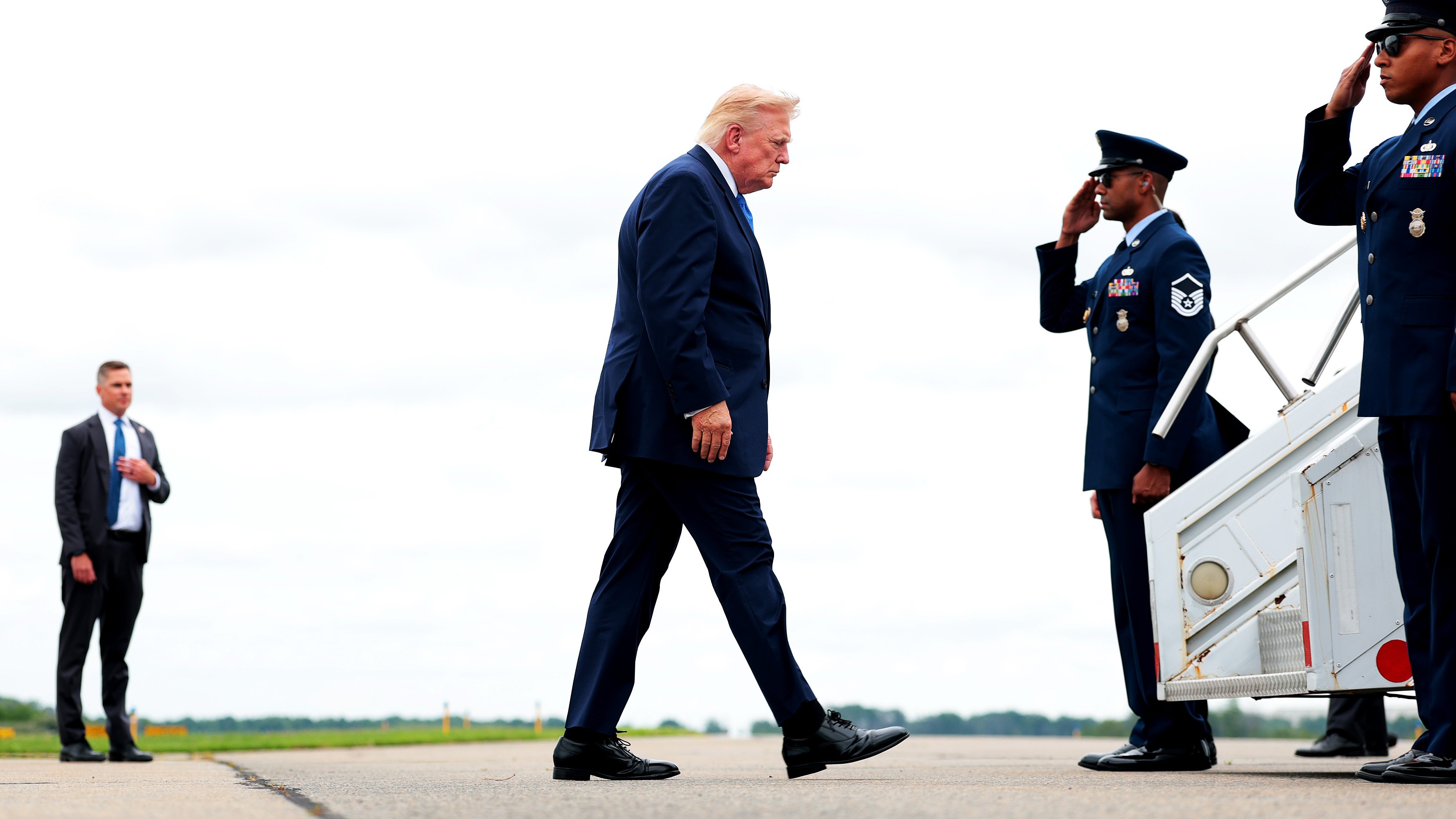
© Brendan Smialowski / AFP / Getty

  •  

How the U.S. Squandered Its Strategic Advantage

The United States is running out of missiles. After five months of war with Iran, stockpiles of long-range weapons are so low, current and former U.S. defense officials told us, that they don’t believe the U.S. has enough to combat a threat in Asia. The remaining supplies, depending on the munition, are as low as 20 percent of what the Pentagon would like to have in hand. And stores of sophisticated interceptor missiles, such as Patriots and Terminal High Altitude Area Defense (THAAD) missiles, are too depleted to give or sell the weapons to Ukraine or effectively defend against Iran’s launch of ballistic missiles. Even when troops see Iranian missiles approaching, they are forced to decide in a matter of seconds whether to expend a limited number of interceptors or hope for the best, the defense officials told us.  

Defense Secretary Pete Hegseth this week pleaded with Republicans on Capitol Hill for billions of dollars to replenish America’s dangerously depleted stockpiles of missiles and other crucial munitions. Hegseth’s appeal was nakedly partisan—he ignored Democratic lawmakers entirely—but also long overdue.

The Pentagon this year has awarded tens of billions of dollars in contracts to replenish those arsenals. But signing contracts is not the same as delivering missiles. Those contracts will produce munitions over the coming years, not the coming months. The Trump administration has invested in the defense industrial base to accelerate production, as did the Biden administration, but for crucial systems such as the Patriot, supply is not projected to meet demand until about 2030. Meanwhile, Iran has ramped up production of its offensive drones and ballistic missiles, and enhanced their capabilities. The war is now being shaped as much by industrial supply and logistics as by economic considerations and the politics of the midterms.

President Trump raged at the assessment his national-security team gave him at Camp David on Friday, which showed that the U.S. military was running low on the munitions that would be necessary for Trump to order an escalation against Iran, a senior administration official familiar with the meeting told us. If the U.S. were to strike, Tehran would likely launch a barrage of missiles and drones against its neighbors in the region and the American bases they host.

The president barked at aides and had some pointed words for the Department of Defense’s leadership. (He is not presently considering staff changes, a White House official told us.) Trump has grown frustrated at his inability to escape the stalemate of the war; he’s seething at its toll on the economy and is desperate to move on. In a post on Truth Social earlier today, Trump said that reports of munitions shortages were false and that such “leaks” were treasonous. Manufacturers are shipping “large amounts” of munitions “as needed,” he wrote.

[Read: This may be Trump’s biggest error in the Iran war]

White House aides are concerned that Trump is losing his leverage in the conflict. He has threatened Iran many times but has rarely followed through; Tehran knows that. Tehran also knows that the U.S. is running low on munitions despite what Hegseth and the president say in public. Military leverage depends not simply on the U.S. ability to strike but also on its capacity to defend against Iran’s retaliation. Iran has displayed the confidence to further test the U.S., attacking ships in the Strait of Hormuz. The White House has maintained that Iran would soon face an economic situation so dire that the regime would be forced to negotiate, and U.S. intelligence reports suggest that Iran is struggling. But the Trump administration has been surprised at Tehran’s resilience, and is no longer certain that the regime will reach the point where negotiation is its only option.

In the five months since the war started, the president has never faced such a weak position. The shortage of interceptors makes escalation dangerous. Nor would expanded strikes guarantee that Tehran will come back to the table.

That may leave diplomacy and concessions as the administration’s least risky option. Trump and Secretary of State Marco Rubio have repeatedly said that Iran will never be allowed to control any part of the Strait of Hormuz. But Trump is now considering a deal that gives Iran some control over maritime traffic. The proposed agreement between Oman and Iran, pending U.S. and Gulf approval, would reopen the strait by establishing a jointly managed framework for commercial shipping. Such a deal would give Iran the oversight of the crucial waterway it feels it has earned from the war, while also honoring Oman’s insistence on preserving freedom of navigation.

America’s stockpiles have been under strain for years, but became painfully clear after Russia invaded Ukraine in 2022. The U.S. military fired hundreds of missiles, some costing millions each, during the Trump administration’s 53-day campaign last year against the Houthis in Yemen. That was followed by nearly two weeks of U.S. and Israeli attacks on Iran and the interception of Iranian missiles and drones aimed at Israel. During the first 38 days of the Iran war, the U.S. launched thousands of munitions.  

Hegseth has repeatedly denied any shortage, including to Trump as recently as last week, one U.S. official told us. On Capitol Hill, the defense secretary did not make a compelling case for the funding he wants, particularly to legislators who face tough reelections partly because of the war’s unpopularity. Between American voters’ frustrations with rising gas prices and Hegseth’s mixed messages and past combative relationship with Congress, “there is no goodwill for the department here,” one congressional aide told us.

[Read: A tragedy in Iran might persuade Hegseth to change course]

Still, Congress is ultimately expected to provide much of the funds the Pentagon says it needs to replenish its stores. But what the U.S. really needs is time. Depending on the weapon, replenishment to prewar levels could take as long as five years, Mark Cancian, who tracks munitions stockpiles for the Center for Strategic and International Studies in Washington, D.C., told us.

Another three years would get stockpiles “to a level where the joint staff and U.S. commanders in charge of the Asia Pacific would be comfortable,” Cancian said. In theory, that gives Beijing plenty of time to take advantage of American shortages with, say, an invasion of Taiwan.

“Claims of U.S. munition shortages are false,” and the amplification of them is irresponsible, Sean Parnell, Pentagon spokesperson, told us in a statement. “We have everything required to strike at the time and place of the President’s choosing.”

The problem predates the Trump administration. After the Cold War, the U.S. reduced the number, and slowed the pace of production, of vital munitions, figuring that long bouts of peace between short, conclusive wars would provide plenty of capacity. But the military has been almost constantly engaged somewhere in conflicts led by missile strikes: Libya, Yemen, Syria, Iran, Nigeria. And Russia’s war with Ukraine has been defined by rapid advances in munitions. The Biden administration signed contracts to replenish Kyiv’s weapons but could not keep up with demand, Cancian told us.  

The U.S. raced to develop cheaper ways to tackle the Iranian-supplied drones that Russia deployed, and has made some progress. But the stores of interceptors such as Patriots and THAADs were rapidly expended. “There are no good alternatives for stopping ballistic missiles,” Cancian told us. “Without these defensive missiles, attacking missiles will land unopposed. That is what is happening in Ukraine.”

Before Russia’s invasion, the U.S. produced roughly 300 Patriot missiles a year, half of which went to allies. Production has since doubled, but badly trails wartime demand.

Had the Iran war been over in a matter of several weeks, as the administration initially predicted, the U.S. munitions problem would not be so dire. And the problem would be mitigated “if we knew when the war will end,” one defense official told us. “The real problem is that there is no long-term strategy—and we can’t plan around that.”

Before the shortages, the U.S. used its technological advantages to shape its strategy. Now the technological advances of its foes—and the strain they have put on U.S. stockpiles—are forcing Washington to reconsider its strategy again, this time without the long-held assumption that U.S. forces would enjoy an advantage in munitions.

© Illustration by The Atlantic. Sources: Kent Nishimura / AFP / Getty; Charly Triballeau / AFP / Getty.

  •  

The Once-Shameless President Is Deeply Embarrassed

Sign up for Inside the Trump Presidency, a newsletter featuring coverage of the second Trump term.

One of President Trump’s superpowers is his shamelessness. Most of the time, he demonstrates a singular ability to shrug off—or flat-out lie about—scandals or missteps that would have caused another politician’s career to self-immolate. Get caught on an Access Hollywood video boasting about abusing women? That’s just locker-room talk! Grow insecure about crowd size? The photo must be doctored! Mistakenly suggest that Alabama was in the path of a hurricane? Someone get a Sharpie and a map! Trump has long been able to shrug off a bad headline and move on to the next news cycle, counting on his base to swallow his claims and never waver in their support.

But that power appears to be fading. Trump is undeniably in a bad spot. His poll numbers have tumbled, and Republicans are fearful that they will lose at least one chamber of Congress this November. Trump’s behavior has grown more erratic in recent months—just check out his Truth Social account most nights—and he recently marked his 80th birthday. And lately, he has shown something else: an ability to be embarrassed. When that has happened, he has lashed out angrily—and has been willing to deploy the levers of government, and his compliant staff, to menace those he blames for his humiliation.

His recent targets include an Olympic canoeist accused of vandalizing the Lincoln Memorial Reflecting Pool after a rushed and botched renovation project, and journalists who reported about the security deficiencies of Trump’s new Air Force One. In the first matter, he pushed for a prosecution after an arrest was made; in the other, he ordered a criminal investigation. (The case against the canoeist and other alleged vandals fell apart, and the subpoenas of the journalists have been dropped, at least for the moment.)

For months now, Trump has been on the receiving end of another humiliation: He has been repeatedly mocked and ignored by the hard-line leaders in Iran. Once more this week, the president reacted with rage when Iran again contradicted his claims about negotiations to bring the war to a close. How will he lash out this time?

Trump really, really does not want to be forgotten, and he cares deeply about leaving his physical mark on Washington. He is a developer at heart who spent decades obsessing over the details of his homes in Manhattan and Palm Beach while also overseeing the design of luxury golf courses around the world. He mostly kept that impulse in check during his first term, but now, facing his political mortality, he has decisively shifted his focus to his legacy, whether that be trying to claim territory for the United States or reshaping the nation’s capital. You know the list: the East Wing, the Rose Garden, the Kennedy Center, the arch, the municipal golf courses, a helipad on the White House South Lawn, and so on. Trump has long prized symbols—particularly when the symbols can project his power—and seized upon America’s 250th birthday as an opportunity to further beautify Washington, his backdrop as he presided over the grandiose celebrations. His attention was particularly drawn to the Reflecting Pool.

[Read: Let them eat gold]

Trump was not wrong in thinking it could use a little love. The Reflecting Pool, which stretches east from the Lincoln Memorial, on the National Mall, toward the Washington Monument, has long leaked and showed its age, bedeviling administrations for decades. In April, Trump announced a solution: a swimming-pool liner that would be, in his words, American-flag blue. To complete the project before the July 4 festivities, the Trump administration awarded no-bid contracts to redo the base of the pool and install a nanobubbling system that was meant to kill off algae growth. Instead, the algae flourished, the pool turned green, fences went up, and mitigation efforts failed. The Reflecting Pool undeniably looked worse. More than $16 million was wasted, and the national symbol was closed on the nation’s birthday.

Trump was furious. One of his signature projects had fallen apart—and he needed a scapegoat. He settled on an unexpected one: an Olympic canoer. David Hearn, 67, says he had just finished up a bike ride when he swung by the Reflecting Pool to see the failing sealant and reached down to touch the green water. He was arrested and detained for hours. The case, on its surface, seemed ridiculous. But it gained traction when Trump, reeling from the renovation’s failures, began going on Truth Social to blame so-called vandals for destroying the pool and accuse them of cutting an (improbable) 250-foot gash down the middle. Media outlets promptly debunked the claim with a series of fact-checks, but Trump was undeterred, relentlessly claiming that the pool had been vandalized.

Even some of his closest allies, two of them told me, privately rolled their eyes at the president’s obsession and scoffed at his refusal to admit a mistake. One Republican lawmaker, speaking to me on the condition of anonymity to avoid Trump’s wrath, deemed it “the dumbest controversy of his term” but added, with a rueful chuckle, that “it’s better than talking about how badly everything else is going.” But the episode had real-world consequences: Hearn told my colleague Matt Viser that it was “unsettling to feel like I’m being targeted by my government.” He had to hire lawyers and attend court dates, and he had his phone seized. The legal process itself functioned as a form of punishment.

The Reflecting Pool was an unlikely cause célèbre this summer, but it seemed likely to end with a whimper at the end of last week. U.S. Attorney Jeanine Pirro, who once touted her office’s ability to prosecute the case, executed a textbook Friday news dump when her office asked to dismiss the cases against Hearn and the handful of others accused of vandalism because evidence had emerged that suggested the damage was the the result of a botched installation, not vandalism. The farce seemed, mercifully, over.

[Read: How the Reflecting Pool vandalism case fell apart]

Nope! Trump went on social media this past weekend to eviscerate Pirro, who has been one of his most loyal allies. Throwing the facts out the window, Trump declared that “to me, it was a pure case of VANDALISM” and that he would “disagree 100%” with the U.S. attorney in D.C. Accustomed to complete fealty, he raged to allies. In the Oval Office on Monday, he declared that the former Fox News host had “choked” and “folded like an umbrella.” Pirro was then summoned to the Oval Office; she was later seen walking out of the West Wing, wheeling a box full of materials from the case that she had brought to show the president and Interior Secretary Doug Burgum, whose agency has oversight of the Reflecting Pool (Trump did not appear to be mollified by the meeting and continued to criticize his longtime ally last night). A White House official told me that Pirro still had her job. The official added that may not be the case for long.

Trump has complained about Air Force One for nearly a decade. When he took office after his 2016 election, the president—who had grown accustomed to flying around in his luxury private jet—was dismayed by the antiquated state of the two VC-25 aircraft that usually bear the call sign, which had been in use since the early ’90s. He pushed for a new plane with a more Trumpian color scheme, but a series of setbacks and delays pushed the arrival of the modern replacement jet until 2028. This was not something, most people understood, that could be rushed: Air Force One needed to be outfitted with top-of-the-line (and often classified) communications and security features that allow it to serve as a White House in the sky, especially in case of an emergency.

But Trump grew impatient. So when Qatar’s royal family offered to give him a $400 million “palace in the sky,” Trump immediately demanded that the luxury liner become his interim aircraft until Boeing completed delivery. It would, Trump said, be a gift to the Department of Defense, and it would go to his presidential library once he left office. This, of course, prompted all sorts of pushback. Permitting a foreign government to supply the signature American aircraft struck many people as not just unpatriotic, but also an outrageous security risk. It was also yet another example of Trump displaying a disregard for norms and for traditional legal and political guardrails—and this time at a truly gargantuan scale.

[Read: The MAGA-world rift over Trump’s Qatari jet]

Trump didn’t care. Nor did he seem bothered that it would cost up to $1 billion to retrofit the jet to make it acceptable for an American president to use. He set the same aggressive timeline as with the Reflecting Pool: He wanted the interim plane ready for use on the nation’s birthday. And there it was, soaring above Mount Rushmore on July 3 and then off to a NATO summit in Turkey a week later. But then, suddenly, Trump was back aboard the old baby-blue-and-gold Air Force One when he left Ankara. He claimed that the new jet had gone ahead of him to England to give troops stationed there a chance to tour it and that he was taking the original “for old time’s sake.”

A few days later, The New York Times reported what many had suspected: When hostilities ignited again in nearby Iran, the Secret Service determined that there were security concerns with the new aircraft flying near a danger zone. It was missing some key defense modifications, the paper reported, in a story that ran only after the president had safely returned to the United States. Trump, once more, was furious and embarrassed, and summoned FBI Director Kash Patel to the White House. In an extraordinary escalation of the administration’s pressure on independent news organizations, subpoenas were issued to several Times reporters, some delivered at their homes. The government requested the reporters’ phone records and demanded that they provide grand-jury testimony as part of a leak investigation to unmask the confidential sources who had provided information to the newspaper about a national-security matter.

The Times defended its reporters, while press organizations and Democrats issued statements about overreach and intimidation. Trump, once again, took to social media to blast his hometown paper and its journalists, sometimes in ugly, personal ways. It didn’t matter, it seemed, that the White House later admitted that the new plane would need upgrades, and that the president himself said it would be “maxxed out,” which all but confirmed the newspaper’s reporting. Trump was “incensed,” one adviser told me, and “wanted a head on a pike.” But, again, the legal process intervened, this time in the shape of a federal judge who grilled Department of Justice lawyers late last month over the handling of the subpoenas. DOJ then withdrew them. White House Press Secretary Karoline Leavitt told me in a statement, “The President and the Administration remain committed to holding individuals who recklessly and illegally leak classified information to the media accountable.”

There was a reason Trump reacted so strongly to those two humbling moments, some people close to him told me. And that’s because they came against the backdrop of the near-daily humiliation that the president has been suffering at the hands of Iran. The war is not going well. A conflict that Trump thought might take a few weeks at most has now stretched into its sixth month, and, try as he might, he can’t get out of it. He has declared victory many times and threatened to wipe Iran off the map nearly as often. Neither has happened. At this point, his unfulfilled threats—with Iran calling his bluff—have almost become a dark running gag.

[Read: The YOLO presidency]

The past few days, in a way, have been a microcosm of the whole conflict: Over the weekend, Trump came close to ordering a new wave of attacks, but walked them back after calls from regional allies, including Saudi Arabia, and fears of how Iran might respond. Instead, Trump said he would give diplomacy another chance, claiming that good progress was being made and that the Strait of Hormuz would soon be open. But Tehran denied that any negotiations were happening. And then another ship was attacked in the strait. Trump reacted in fury, posting that the Iranian regime was “unbelievably duplicitous,” when decades of history would suggest that Tehran was, in fact, very knowably duplicitous.

But how Trump will respond next to this ongoing embarrassment remains unknown. He’s made the war deeply personal. Will he now bail on the stalled war entirely, leaving Iran more empowered in the region? Will he follow through on his threats to dramatically escalate the conflict, perhaps even to strike civilian infrastructure and energy sites? Or will he channel his rage against Americans who point out his mistakes?

© Anna Moneymaker / Getty

  •  

This May Be Trump’s Biggest Error in the Iran War

Sign up for our newsletter about national security here.

For 2,500 years, military commanders have heeded the injunction of Sun Tzu, the great Chinese military strategist: Know your enemy. Yet the Trump administration’s greatest mistake in the Iran war may be its persistent failure to understand Tehran’s priorities and motivations—and how much punishment the regime is willing to absorb to prevail.

Iran’s decision Tuesday to launch ballistic missiles at U.S. troops in Jordan was a prime example. It befuddled Washington. U.S. officials had come to expect that their actions would drive the war, and Iran would react. But here was Tehran, escalating matters just after the United States had suspended its 13-day barrage of strikes against Iranian defenses and infrastructure. U.S. Central Command, which is responsible for military operations in the Middle East, described the move as a “surprise attack.”

Tehran characterized the missile strikes as self-defense against what the regime saw as the Trump administration’s broadening of the war. Around the same time as the Iranian attack, U.S. and Saudi forces launched joint strikes on Iran-backed militias in Iraq, Riyadh’s first publicly acknowledged military strikes of the conflict. Turki al-Maliki, a Saudi defense-ministry spokesperson, said in a statement that the militias had attacked the kingdom’s oil facilities and that Riyadh reserved the right to respond “at the appropriate time and place.”

This week’s events hardly represented the first time that the two sides had misread each other’s intentions. The convoluted and complicated war has swung almost weekly between peace overtures and fighting. Those misinterpretations appear set to continue, especially amid signs that others may be dragged into the fight. Egyptian officials earlier this week confirmed that a drone had set two gas vessels ablaze at Damietta, a port city on the Mediterranean near the Suez Canal. No group has claimed responsibility, but the attack raised fears that Iran has expanded its list of nations to target.

The memorandum of understanding that Washington and Tehran signed in the middle of last month quickly devolved into one of the war’s signature misunderstandings. The very first clause of the agreement promised to end the fighting, but the two sides had fundamentally different interpretations of their obligations.

The memorandum did not end the dispute over the Strait of Hormuz but rather, it papered over it. Washington believed it had secured 60 days of open, toll-free commercial navigation. Tehran read the agreement as preserving its authority to manage traffic through the waterway. As the dispute erupted, some Iranian officials believed that the U.S. had purposely drafted a vague agreement to trigger a violation that could be used as a predicate to resume strikes, a person familiar with their thinking told us. And the U.S. sought to use financial incentives, such as sanctions waivers and investment, to entice a government that was preoccupied with the assassination of its supreme leader. Was anyone really surprised that the pact fell apart? Certainly not President Trump, who professed that he “couldn’t care less” after each side had walked away.

[Read: War by any other name]

Even before the war began, in late February, the two governments were talking past each other. The U.S. believed that Iran was fragile and the regime susceptible to collapse after nationwide protests. The regime believed that nothing short of its total capitulation to U.S. demands would prevent a war. Trump ordered the war to begin while talks were still under way, and his administration believed that the death of Iran’s supreme leader, Ayatollah Ali Khamenei, on the conflict’s first day would quickly be followed by the collapse of the state. Instead, five months in, the regime remains intact and seems to have enough confidence to endure any U.S. response.

This could put the two sides on a path to escalation, each remaining convinced that more military pressure will force the other to abandon its objectives. “America’s calculation is that escalation would lead to surrender. Iran’s calculation is that escalation would lead to deterrence,” Vali Nasr, a professor of international affairs and Middle East studies at the Johns Hopkins School of Advanced International Studies, told us.

Trump promised on Fox News earlier this week to “beat the fucking shit out of them.” Iran’s Islamic Revolutionary Guard Corps, meanwhile, said that the base in Jordan would remain a target because “as long as threats against Iran persist, resistance will persist.” (The Jordanian military said that all five missiles fired Tuesday were intercepted.) But neither side seems able to answer the question that matters most: What if escalation doesn’t work?

Escalation is “a means to an end, but we don’t know what the end is,” Danny Citrinowicz, a former Israeli intelligence officer who specializes in Iran, told us.

Part of the confusion may stem from the fact that Trump himself appears to be of (at least) two minds about how he wants to proceed. He has vacillated between backing more military action and giving peace talks a chance. The U.S. cannot begin to understand its enemy if it has yet to settle on its own aims—or how to achieve them. Trump has repeatedly sought to back away from the conflict, but during a meeting with senior advisers last Friday, he seriously considered ramping up attacks. He opted not to, but the plans remain on his desk, a senior White House official told us. A pause in U.S. strikes that began Saturday was over by midweek following Iran’s attack on the base in Jordan.

The U.S. is seeking to understand an enemy that is changing and adapting. Iran appears intent on reintroducing the element of military surprise, driven by the belief that it can outlast Trump and that negotiations no longer present a viable path. The regime operates differently under its new supreme leader, Mojtaba Khamenei, who replaced his late father. Iran is no longer content to let proxies across the region fight for its interests. It wants to use its missiles and drones to fight for its long-term security. And it is willing to endure strikes by the U.S. to the point that American military commanders are running short on viable targets it can hit to stop attacks on the strait.

“They are willing to sacrifice themselves and the public for the future of the regime,” Citrinowicz said. He doesn’t believe that Iran wants to fight an endless war any more than Trump does. But Tehran thinks Trump faces constraints, including the economic damage stemming from the strait’s continued closure and the tepid response of Gulf States. Iran’s position, in contrast, has been strengthened by support from the Houthis in Yemen, who recently began targeting Saudi interests and threatened to close the Bab al-Mandab Strait to commercial shipping. Iranian leaders, Citrinowicz said, “believe at the end of the day, they are able to shape the situation on the ground to their own benefit.”

A number of influential MAGA allies—including Laura Ingraham and Steve Bannon—have publicly and privately called for the White House to rapidly wind down the war, believing that the conflict has demoralized Trump’s base and will hurt the GOP in the midterms. Republicans facing tough reelection fights have expressed fears to the West Wing that an escalation in the conflict would lead to even higher gas prices, which could doom their November chances. Yet at same time, Persian Gulf allies have made clear that they find Iran’s control of the Strait of Hormuz untenable—especially if the regime charges tolls. That would, in effect, mean that the same countries battered by Tehran’s missiles would be stuck paying for Iran to rebuild.

Perhaps as a result, Washington has lurched among military, diplomatic, and economic strategies, hoping that one, or some combination of them, would compel Tehran to yield. Yesterday, the Trump administration announced a new round of sanctions that aim to put economic pressure on Iran by targeting companies and tankers tied to its maritime trade. The U.S. also hopes that an escalation of military strikes will do enough to tip the regime either into collapse or capitulation. But even the threat of escalation can come with a cost: Brent crude climbed nearly 8 percent after Trump’s profanity-laden remarks, briefly breaking $91 a barrel yesterday.

Officials told us that Trump was noncommittal when Israeli Prime Minister Benjamin Netanyahu, during his Tuesday visit to the White House, urged the president to ramp up attacks on Iran (among the ideas being considered is to strike the land routes that Iran has been using to resupply its forces). Netanyahu expressed deep skepticism that Iran would ever agree to a reasonable peace deal. U.S. officials believe that some factions in the Iranian power structure favor making a deal, but whether they have the authority to do so is not clear. The officials also believe that Iran’s economy will continue to weaken to a point at which Tehran will be forced into a deal.

For now, there are no good options for Trump and there is no clarity as to how two sides in a widening war can find off-ramps, particularly if they continue to misinterpret each other’s actions.

[Graeme Wood: The U.S. is subtly shifting its Iran strategy]

Trump could declare victory, noting that the U.S. and Israel killed the ayatollah, and vow to attack again should Iran resume its quest for a nuclear weapon. Or he could try to return to the terms of the MOU. But the administration would likely have to sign on to some aspects of Iran’s interpretation of it, such as its retention of control of the Strait of Hormuz. Or Trump can escalate, hitting Iran’s missile capabilities to make the targeting of U.S. bases and Gulf partners more difficult. But he would have to do so at a rate faster than Iran can reconstitute its forces. And he faces political opposition to a more prolonged conflict: A CBS News/YouGov poll released earlier this week found that a majority of Americans are not optimistic about the war and feel that its objectives are not clear. More than two-thirds of respondents said the Trump administration should end the war now.

Both sides seem to agree on one thing: There is no end in sight to the war. U.S. defense officials told us that they believe conflict will continue into 2027. Iran is signaling that it plans for a fight even longer than that.

© Fatemeh Bahrami / Andalou / Getty

  •  

Zelensky Asked Trump for a Favor From Elon Musk

Sign up for our newsletter about national security here.

During closed-door talks at the White House on Tuesday, Ukrainian President Volodymyr Zelensky laid out a plan for his country to survive another winter of war with Russia. For it to work, President Trump would need to call in a big favor from his ally Elon Musk. But according to two officials familiar with the conversation, Trump was noncommittal, leaving the future of the plan in doubt.

The new proposal, which has not been previously reported, offered the United States a way around sending Ukraine advanced air-defense missiles, known as Patriot interceptors, which the war in Iran has dramatically depleted. Instead, Ukraine would expand its use of another American technology: the Starlink satellite-communications network, which Musk controls.

Zelensky asked Trump to secure Musk’s permission for the use of Starlink to guide drone strikes inside Russia, according to the two officials, who spoke on condition of anonymity to discuss internal deliberations. (A third official confirmed Zelensky’s request.) Up to now, Musk has allowed the Ukrainians to use Starlink only on their own territory, including in Crimea and other regions that Russia has occupied. Musk’s aerospace company, SpaceX, has restricted the use of Starlink inside Russia.

Ukraine’s campaign of long-range drone strikes has therefore employed less reliable targeting methods, including onboard computers with AI-powered navigation tools. These weapons have been effective at hitting large infrastructure sites in Russia, such as oil refineries and warehouses. But, in his talks with Trump on Tuesday, Zelensky explained the need to hit much smaller and more mobile targets, especially the ballistic-missile batteries that Russian forces have used to hit cities across Ukraine. Last night, as Zelensky and his entourage traveled home through Poland, Russia launched more than 70 missiles, killing at least 10 people in one of the biggest salvos of the war. One of the rockets exploded in Poland.

Starlink offers the most precise means available to steer Ukrainian drones to the Russian missile launchers, many of which are mounted on trucks dispersed across Russia. During his visit to the U.S. this week, Zelensky asked to meet with Musk to talk about his plan for targeting these launchers, but the billionaire declined the invitation, according to one person involved in the discussions. Musk and SpaceX did not respond to requests for comment.

When they met at the White House, Trump told his Ukrainian counterpart that he would consider the requests, but he did not indicate whether he would eventually grant them, one official told told us. Trump did tell Zelensky that he would talk with Musk about it but did not offer a timetable for that conversation or for his eventual decision.

Trump has made no secret of his desire to bring the Russia-Ukraine conflict to a close, and has been frustrated at how long it has taken. One of the officials told us that his eventual decision on Zelensky’s proposal would likely be largely based on whether he felt it could help hasten the end of the conflict. If he thinks that using Starlink would enable Ukraine to push Russian President Vladimir Putin to the negotiating table, then Trump may support it. But if he feels it would only escalate matters, then he likely would not, one official told us.

[Read: Zelensky makes his pitch to Trump]

Trump, of course, has been highly deferential to Putin for more than a decade now, and that has hardly changed during this war. Although he has flashed his frustration with the Russian leader at times, he has mostly stayed skeptical of Ukraine’s cause and its chances. But, one official told us, Trump has been impressed with Ukraine’s recent ability to strike deep within Russia with its drone technology and has sensed that Kyiv has some momentum in the conflict (Trump loves to be associated with winners). The meeting remained convivial and Zelensky invoked the memory of the late Senator Lindsey Graham when making his pitch.

With the war in its fifth year,  Zelensky emphasized to Trump that Ukraine needs to counter the missile threat before the onset of winter, when Russia may again try to use these weapons to knock out Ukraine’s power grid and heating systems, according to the two officials familiar with the talks.

Without the ability to hit launchers inside Russia, “we have no clear path through this winter,” one of the officials told us. Last winter, Ukraine still had a limited supply of Patriot interceptors to shoot down Russian missiles and protect its most crucial infrastructure. But the war in Iran has since depleted roughly two-thirds of the U.S. stockpile of these interceptors, according to an analysis published this week by the Center for Strategic and International Studies, a research institute based in Washington, D.C. The CSIS report estimated that the U.S. now has as few as 759 of the most advanced Patriot rockets.

Zelensky asked the U.S. to send 300 of these for Ukraine to use this winter. Trump has demurred. Instead, during his talks with Zelensky earlier this month in Ankara, he promised to give Ukraine a license to make its own Patriot interceptors—though Ukraine would not be able to produce them at scale for years.

In the Tuesday meeting, Zelensky argued that Starlink could offer a faster and cheaper answer to the ballistic-missile threat from Russia, according to two of the officials familiar with the conversation. Ukraine already has the long-range drones needed to target missile launchers inside Russia. The Ukrainian company that produces many of them, Fire Point, uses various guidance systems to get around the ban on deploying Starlink inside Russia.

[Read: Ukraine’s Dr. Strangelove]

One of the company’s co-founders, Denys Shtilerman, told us that drones equipped with Starlink could prove far more effective than Patriot interceptors in neutralizing the Russian ballistic-missile threat. “Instead of shooting down the arrows, we would strike the archers,” he said.

Inside its own territory, Ukraine has already used Starlink-enabled drones to create what it calls a “kill zone” along the front line—a no-man’s-land, dozens of miles wide, where drones can target any Russian forces that seek to advance. With permission to do the same thing inside Russian territory, “we could widen the kill zone to 500 kilometers,” Shtilerman told us. “If they increase the range of their strikes, we would widen the kill zone all the way to Siberia if needed. The technology would allow us to do that.”

Musk has long resisted the use of Starlink in warfare. The system depends on the world’s largest constellation of satellites to provide a high-speed internet connection to anyone with a Starlink subscription and a receiver. At the start of the Russian invasion, in 2022, Musk provided Ukraine with Starlink receivers free of charge. Ukrainian hospitals, emergency workers, and government agencies used them to stay online despite Russian attacks on the country’s internet infrastructure. The armed forces of Ukraine soon began using Starlink to coordinate troop movements and pilot drones, and the system became the backbone of Ukraine’s military communications.

During some of Ukraine’s most brazen strikes against Russian forces, Musk got cold feet. “How am I in this war?” Walter Isaacson quoted him as asking in his 2023 biography. “Starlink was not meant to be involved in wars. It was so people can watch Netflix and chill and get online for school and do good, peaceful things, not drone strikes.”

That year, the Pentagon began contracting with SpaceX for the communications services it provides to Ukraine’s armed forces. The company also created a separate network, known as Starshield, for use in defense and national security. During his talks with Trump on Tuesday, Zelensky suggested that if Musk refuses to allow the use of Starlink for strikes on Russia, the Pentagon could give Ukraine access to the Starshield network for the same purpose, two of the officials told us.

One of them added, however, that Starshield would not work as well for Ukraine. “It’s more expensive, more complicated, more difficult to integrate into our systems,” the official said. “We have long figured out how to fly drones on Starlink. It would not be hard for us to send them across the border. But Starshield is a somewhat different system. We would need to figure out how to integrate it.” That leaves Starlink as the cheapest and most reliable guidance system available for Ukraine’s long-range drones.

From Musk’s earlier decisions, it can be hard to discern a coherent strategy toward the war in Ukraine. He has used Starlink in ways that each of the warring sides has perceived as helping the other. A few months into the Russian invasion, Musk began to complain about the spiraling cost of providing Ukraine with Starlink service. He refused a Ukrainian request in September 2022 to use Starlink in an attack on Russian warships in Crimea, arguing that the operation risked a nuclear response from the Kremlin.

The following month, Musk published a four-point plan for peace in a post on Twitter. (He would buy the social network for $44 billion a few weeks later.) His peace plan hewed closely to Russian demands, including a provision for Ukraine to remain “neutral” after the war. In response, Zelensky posted his own Twitter survey, asking whether people preferred the Musk who supports Ukraine or the one who supports Russia. Andriy Melnyk, who served as Ukraine’s ambassador to Germany at the time, also shot back at Musk’s peace plan: “Fuck off is my very diplomatic reply to you @elonmusk.”

In Zelensky’s wartime government, the official who cultivated the strongest ties with Musk and SpaceX was Mykhailo Fedorov, the chief architect of the Ukrainian drone program. Early this year, while serving as minister of defense, Fedorov persuaded Musk to shut off the Starlink receivers that Russian forces had been using to fly their own drones in Ukraine. But Fedorov lost his job this month in a government reshuffle, which cost Ukraine its main point of contact with Musk. “Fedorov has a super constructive relationship with him,” a Ukrainian official told us. “So the timing is very bad to install a new minister.”

[Read: Elon Musk moves against the Russians in Ukraine]

One person close to Fedorov told us that, in the weeks before he was fired, the minister lobbied Musk and various other contacts in the U.S. to allow the use of Starlink for drone strikes into Russia. Fedorov received assurances from Musk that it would be possible “if Trump says to do it,” the person said. The talks broke off, he added, after the government reshuffle. (Fedorov did not respond to a request for comment.)

The Trump administration could have its own reasons to balk at Zelensky’s request. “It’s one thing to let Ukraine do this on its own territory,” the Ukrainian official said. “It’s another thing to use American technology on the territory of Russia to take out their air defenses, their launchers for ballistic missiles. This is an unfriendly act. I don’t know how Russia could react to that.”

Russia recently deployed new methods for interfering with Starlink signals in Ukraine. Earlier this month, a set of documents was published that appeared to show Russia plotting with China to destroy Starlink satellites, through either hacking, jamming, or knocking them out of orbit. The documents, allegedly produced by China and obtained by The Insider, highlighted the risks Musk faces in helping Ukraine fight the war.

His willingness to broaden that assistance could depend on the leverage Trump has over Musk—and his desire to use it for Ukraine’s benefit. Earlier this month, Trump seemed open to Zelensky’s strategy for pressuring Russia to negotiate a peace deal. “It’s an escalation,” Trump said when asked about Ukraine’s strikes on oil refineries and military targets deep inside Russia. Seated beside Zelensky in Ankara, Trump added: “But it’s also an escalation that could help lead to an end.”

© Zelensky Social Media Account / Anadolu / Getty

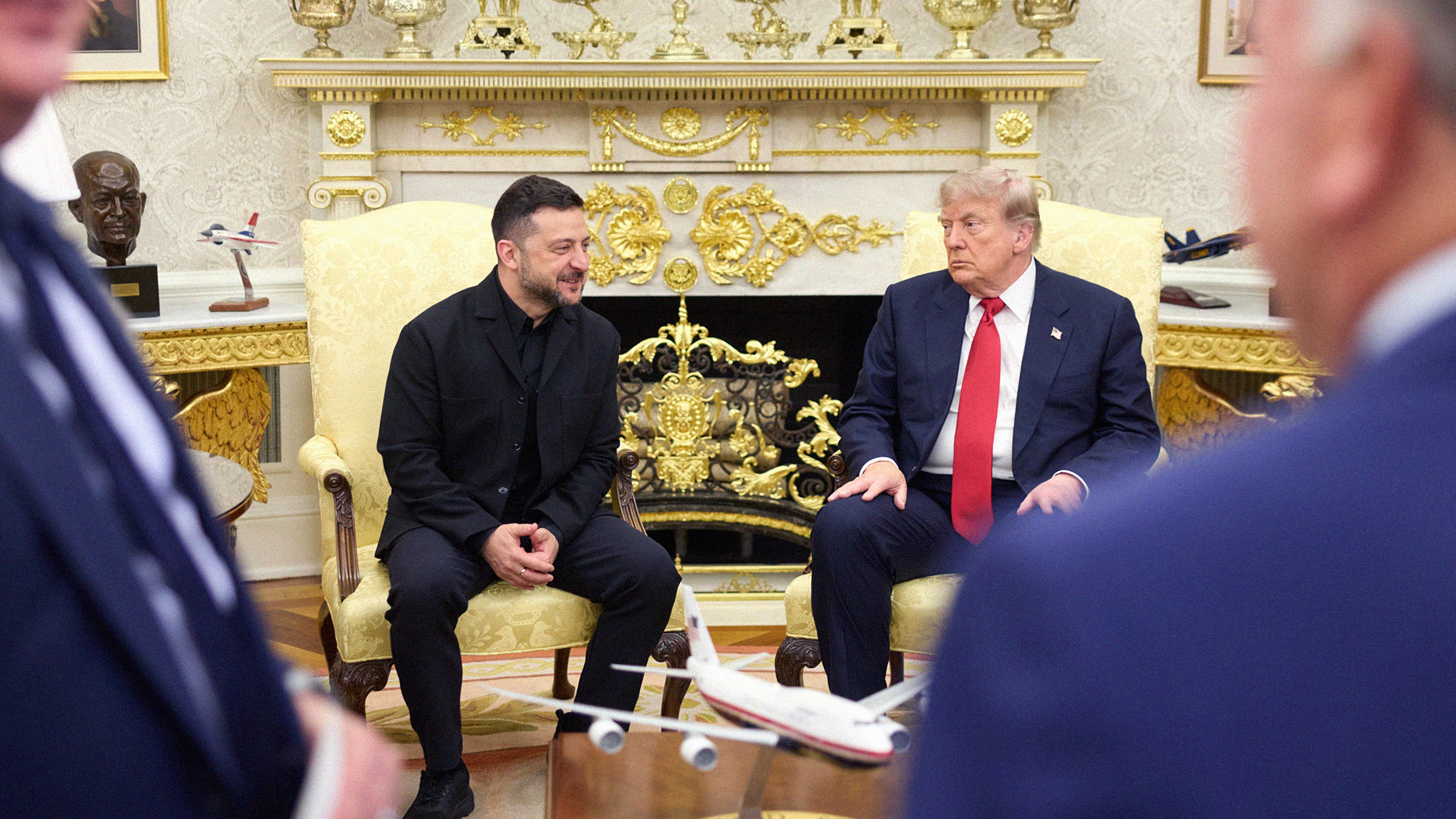
In this handout photo from Ukrainian President Volodymyr Zelensky’s social-media account, Zelensky and President Trump meet in the Oval Office on July 28, 2026.
  •  

Trump Crashes Into Reality

This article was featured in the One Story to Read Today newsletter. Sign up for it here.

President Trump has mused about being the most powerful man in history. He has started wars and remade his nation’s economic and strategic relationships with the world. He has demanded, and largely received, total obedience from his party. He has dominated the national discourse like no president has before, and he’s tried to recast his nation’s capital—and even its history—to his liking. He’s everywhere. He has said he believes that there are “no limits” to his power.

But if that was ever truly the case, it certainly isn’t now. Recent months have delivered a reckoning for Trump, who has crashed hard against some real limits. The war in Iran, a conflict that he’d once thought would take only a few weeks, hit the five-month mark today. The U.S. casualty count is growing, weapons stockpiles are running low, and gas prices are again surging. Trump desperately wants the war to end. He is receiving conflicting guidance from his advisers—escalate, some urge, as others tell him to cut and run—and has become just the latest U.S. president to be humiliated by hard-liners in Tehran.

Trump is also flailing domestically. His approval numbers have sunk, and Republicans are finally, in small doses, beginning to defy him. Trump has demanded that the Senate blow up the filibuster to pass the SAVE Act, which would make voting more difficult and require voters to provide proof of citizenship. But Republicans have refused. Although the legislation seems dead, Trump called yesterday for Republicans to stay in Washington to work on it, potentially saddling them with unpopular (and doomed) votes while also preventing them from returning home to campaign ahead of the midterms. Strategists from both parties predict that at least one chamber of Congress will flip to the Democrats, allowing the party to stall whatever is left of the president’s legislative agenda and open investigations into his administration and allies.

Once the midterms are over, Trump could face his worst fear: irrelevance. He will be a lame duck, down to his final two years in office, and at some point will no longer be the nation’s top topic of conversation. As focus shifts to the presidential primaries, Trump risks disappearing from the headlines. Even some of his closest allies don’t know how he’ll react.

Trump gathered a team of senior advisers at the White House on Friday to walk through the latest options in the war that he’d already declared won. The meeting came after nearly two weeks of the United States bombing Iran, with Tehran striking back against allies in the region, including a hit on a military base in Jordan that killed three American service members. Trump had wanted to avoid resuming hostilities after signing a cease-fire agreement last month at Versailles, of all places. But negotiations for a permanent peace have stalled, and Iran has continued to menace the Strait of Hormuz and threatened to charge tolls for ships using the vital waterway, a nonstarter for American allies in the Persian Gulf. Meanwhile, the new wave of bombings, green-lit by Trump, has not produced meaningful change along the strait. The meeting was set to discuss the possibility of returning to an all-out war.

[Read: War by any other name]

Trump has threatened escalations many times before, only for Iran to call his bluff. This time, a senior White House official familiar with the discussions told me, the frustrated president seemed more inclined to order a heavier assault—but he and his advisers once again opted against it. There were several reasons to discard the idea, at least for now, the official said, speaking on the condition of anonymity to discuss internal conversations. That included the risk of dangerously depleting the number of defensive interceptor missiles available to the military’s Central Command, which is responsible for operations in the Middle East. Advisers also expressed worry about the prospect of a widening war in the Middle East, the anger of key Gulf allies targeted by Iran’s counterattack, and the potential for an energy or a refugee crisis. Trump repeatedly told advisers that he worried that an escalation could spark a global economic conflagration and “turn me into Hoover,” the senior official told me.

A number of influential Republicans and conservatives have begun to urge Trump to abruptly declare some sort of win and leave the Iran mess behind. They argue that the short-term benefit of doing so would be to lower prices, push Iran out of the headlines, and potentially salvage Republicans’ midterm chances this fall. But the geostrategic consequences would be significant; Tehran would possess an economic weapon—control of the strait—that it could wield at any time to inflict global economic pain. And the Iranian regime could strike with impunity at its neighbors, including Israel.

Trump’s campaign swing through Michigan yesterday was a rarity in his second term. But his refrain there was not: He made unfounded claims about election fraud and, this time, appeared alongside a GOP congressman running for governor who falsely said that Trump had won the state three times. (Nope, only twice.) The president exaggerated the nation’s manufacturing rebound under his watch and, once more, mocked the affordability crisis that polls suggest is top of mind for many voters. His recent moves seem designed to dissuade or prevent voters from casting their ballot, not to inspire them. He has spent weeks talking about election security, including in a prime-time White House address, prompting Democrats to warn that Trump is trying to set up a pretext for challenging this fall’s results. His administration has appealed to the Supreme Court to curb mail-in voting, and Trump has relentlessly pushed for voter restrictions via the SAVE Act.

Senate Majority Leader John Thune has refused to do away with the filibuster, a move that would allow the GOP to push the SAVE Act through. Karoline Leavitt, the White House press secretary, said last week that the president’s “patience is running out” with Thune, and a senior adviser told me that Trump has privately derided the majority leader as “one of my biggest headaches.” (Trump downplayed the friction yesterday, telling reporters on Air Force One that his relationship with Thune was “fine” while also demanding that the legislation pass.)

Just over a year ago, the GOP marched in lockstep to pass the One Big Beautiful Bill Act tax legislation. Now Trump’s wish list has stalled. Some Republicans have sought permission to distance themselves from the unpopular president, and even loyalists such as House Speaker Mike Johnson said last week that, in terms of the war, it was time to “wrap it up.” By no means are Republicans in revolt. But Trump’s grip on the party has loosened, just a little.

The White House spokesperson Abigail Jackson reiterated to me in a statement that the SAVE Act “has always been a top priority for President Trump and it remains one,” adding that he “will not stop fighting until it is passed.”

Trump, a man who has spent his life in pursuit of attention, is also beginning to contemplate the limits of his relevancy. The former celebrity developer and reality-TV star has famously declared that he’d rather receive bad publicity than no publicity. At times, he even faked being his own publicist to plant some news. One of his superpowers is his ability to command attention, to change the news cycle or move markets with a stray comment or tweet. His ubiquity, some of his advisers believe, is a strength—because Trump is everywhere all the time, he’s hard to pin down, and controversies slide away. With loud volume and relentless repetition, he can shape the national conversation.

[Read: A different kind of fading president]

But even those in Trump’s inner circle aren’t sure what to expect if people start talking about him less. The political calendar is relentless: Once the midterms clear, Washington will turn its focus to the 2028 presidential campaign. With no incumbent in the race and no clear front-runner in either party, it will be as wide-open as any race in decades. Trump may no longer be among each day’s top stories—arguably for the first time since he came down the Trump Tower escalator more than a decade ago. It’s not as if he will suddenly vanish; he’ll aim to play GOP kingmaker, and he’ll still be commander in chief. But he’ll be staring at life as a private citizen again, one whose businesses and family could face questions from a future Democratic president’s Department of Justice. His widely panned speech at last week’s White House Correspondents’ Dinner seemed to offer a preview of his future: His grievances were met mostly with silence. Some of the president’s allies have begun to privately wonder how he might handle a new, reduced status. No one suspects that he’ll take it well.

© Andrew Harnik / Getty

  •  
❌